

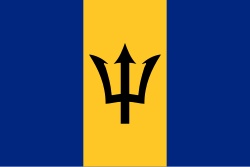

Barbados
View on Wikipedia
Barbados[a] is an island country in the Caribbean located in the Atlantic Ocean. It is part of the Lesser Antilles of the West Indies and the easternmost island of the Caribbean region. It lies on the boundary of the South American and Caribbean plates. Its capital and largest city is Bridgetown.
Key Information


.svg)


Inhabited by Kalinago people since the 13th century, and prior to that by other Indigenous peoples, Barbados was claimed for the Crown of Castile by Spanish navigators in the late 15th century. It first appeared on a Spanish map in 1511.[7] The Portuguese Empire claimed the island between 1532 and 1536, but abandoned it in 1620 with their only remnants being the introduction of wild boars intended as a supply of meat whenever the island was visited. An English ship, the Olive Blossom, arrived in Barbados on 14 May 1625; its men took possession of the island in the name of King James I. In 1627, the first permanent settlers arrived from England, and Barbados became an English and later British colony.[8] During this period, the colony operated on a plantation economy, relying initially on the labour of Irish indentured servants[9] and subsequently African slaves who worked on the island's plantations. Slavery continued until it was phased out through most of the British Empire by the Slavery Abolition Act 1833.
On 30 November 1966, Barbados moved toward political independence and assumed the status of a Commonwealth realm, becoming a separate jurisdiction with Elizabeth II as the Queen of Barbados. On 30 November 2021, Barbados transitioned to a republic within the Commonwealth, replacing its monarchy with a ceremonial president.[10][11]
Barbados's population is predominantly of African ancestry. While it is technically an Atlantic island, Barbados is closely associated with the Caribbean and is ranked as one of its leading tourist destinations.[12]
Etymology
[edit]The name "Barbados" is from either the Portuguese term os barbados or the Spanish equivalent, los barbados, both meaning "the bearded ones".[13][14] It is unclear whether "bearded" refers to the long, hanging roots of the bearded fig tree (Ficus citrifolia), a species of banyan indigenous to the island, or to the allegedly bearded Kalinago (Island Caribs) who once inhabited the island, or, more fancifully, to a visual impression of a beard formed by the sea foam that sprays over the outlying coral reefs. In 1519, a map produced by the Genoese mapmaker Visconte Maggiolo showed and named Barbados in its correct position.[15] Furthermore, the island of Barbuda in the Leewards is very similar in name and was once named "Las Barbudas" by the Spanish.[citation needed]
The original name for Barbados in the Pre-Columbian era was Ichirouganaim, according to accounts by descendants of the Indigenous Arawakan-speaking tribes in other regional areas, with possible translations including "Red land with white teeth"[16] or "Redstone island with teeth outside (reefs)"[17] or simply "Teeth".[18][19][20]
Colloquially, Barbadians refer to their home island as "Bim" or other nicknames associated with Barbados, including "Bimshire". The origin is uncertain, but several theories exist. The National Cultural Foundation of Barbados says that "Bim" was a word commonly used by slaves, and that it derives from the Igbo term bém from bé mụ́ meaning "my home, kindred, kind";[21] the Igbo phoneme [e] in the Igbo orthography is very close to /ɪ/.[22] The name could have arisen due to the relatively large percentage of Igbo slaves from modern-day southeastern Nigeria arriving in Barbados in the 18th century.[23][24] The words "Bim" and "Bimshire" are recorded in the Oxford English Dictionary and Chambers Twentieth Century Dictionaries. Another possible source for "Bim" is reported to be in the Agricultural Reporter of 25 April 1868, where the Rev. N. Greenidge (father of one of the island's most famous scholars, Abel Hendy Jones Greenidge) suggested that Bimshire was "introduced by an old planter listing it as a county of England". Expressly named were "Wiltshire, Hampshire, Berkshire and Bimshire".[21] Lastly, in the Daily Argosy (of Demerara, i.e. Guyana) of 1652, there is a reference to Bim as a possible corruption of "Byam", the name of a Royalist leader against the Parliamentarians. That source suggested the followers of Byam became known as "Bims" and that this became a word for all Barbadians.[21]
History
[edit]Geological history
[edit]Around 700,000 years ago, the island emerged from the ocean as a body of soft rock known as a diapir rose from the mantle beneath its present-day location. This process is still ongoing, raising Barbados at an average rate of 30 centimetres per thousand years.[25] Dozens of inland sea reefs still dominate coastal features within terraces and cliffs on the island.[25]
Pre-colonial period
[edit]Archeological evidence suggests humans may have first settled or visited the island c. 1600 BC.[26][27][28] More permanent Amerindian settlement of Barbados dates to about the 4th to 7th centuries AD, by a group known as the Saladoid-Barrancoid.[29] Settlements of Arawaks from South America appeared by around 800 AD and again in the 12th–13th century.[26] The Kalinago (called "Caribs" by the Spanish) visited the island regularly, although there is no evidence of permanent settlement.[30]
European arrival
[edit].jpg)
It is uncertain which European nation arrived first in Barbados, which probably would have been at some point in the 15th century or 16th century. One lesser-known source points to earlier revealed works antedating contemporary sources, indicating it could have been the Spanish.[7] Many, if not most, believe the Portuguese, en route to Brazil,[31][32] were the first Europeans to come upon the island. The island was largely ignored by Europeans, though Spanish slave raiding is thought to have reduced the native population, with many fleeing to other islands.[26][33]
English settlement in the 17th century
[edit]
The first English ship, which had arrived on 14 May 1625, was captained by John Powell. The first settlement began on 17 February 1627, near what is now Holetown (formerly Jamestown, after King James I of England),[35] by a group led by John Powell's younger brother, Henry, consisting of 80 settlers and 10 English indentured labourers.[36] Some sources state that some Africans were among these first settlers.[26]
The settlement was established as a proprietary colony and funded by Sir William Courten, a City of London merchant who acquired the title to Barbados and several other islands. The first colonists were actually tenants, and much of the profits of their labour returned to Courten and his company.[37] Courten's title was later transferred to James Hay, 1st Earl of Carlisle, in what was called the "Great Barbados Robbery".[38] Carlisle then chose as governor Henry Powell, who established the House of Assembly in 1639, in an effort to appease the planters, who might otherwise have opposed his controversial appointment.[26][39]
.jpg)
In the period 1640–1660, the West Indies attracted more than two-thirds of the total number of English emigrants to the Americas. By 1650, there were 44,000 settlers in the West Indies, as compared to 12,000 on the Chesapeake and 23,000 in New England. Most English arrivals were indentured. After five years of labour, they were given "freedom dues" of about £10, usually in goods. Before the mid-1630s, they also received 5 to 10 acres (2 to 4 hectares) of land, but after that time the island filled and there was no more free land. During the Cromwellian era (1650s) this included a large number of prisoners-of-war, vagrants and people who were illicitly kidnapped, who were forcibly transported to the island and sold as servants. These last two groups were predominantly Irish, as several thousand were infamously rounded up by English merchants and sold into servitude in Barbados and other Caribbean islands during this period, a practice that came to be known as being Barbadosed.[39][40] Cultivation of sugar was thus handled primarily by European indentured labour until it became difficult to bring more indentured servants from England.[41]
Parish registers from the 1650s show that, for the white population, there were four times as many deaths as marriages. The mainstay of the infant colony's economy was the growth export of tobacco, but tobacco prices eventually fell in the 1630s as Chesapeake production expanded.[39]
Effects of the English Civil War
[edit]Around the same time, fighting during the War of the Three Kingdoms and the Interregnum spilled over into Barbados and Barbadian territorial waters. The island was not involved in the war until after the execution of Charles I, when the island's government fell under the control of Royalists (ironically the Governor, Philip Bell, remaining loyal to Parliament while the Barbadian House of Assembly, under the influence of Humphrey Walrond, supported Charles II). To try to bring the recalcitrant colony to heel, the Commonwealth Parliament passed an act on 3 October 1650 prohibiting trade between England and Barbados, and because the island also traded with the Netherlands, further Navigation Acts were passed, prohibiting any but English vessels trading with Dutch colonies. These acts were a precursor to the First Anglo-Dutch War. The Commonwealth of England sent an invasion force under the command of Sir George Ayscue, which arrived in October 1651. Ayscue, with a smaller force that included Scottish prisoners, surprised a larger force of Royalists, but had to resort to spying and diplomacy ultimately. On 11 January 1652, the Royalists in the House of Assembly led by Lord Willoughby surrendered, which marked the end of royalist privateering as a major threat.[42] The conditions of the surrender were incorporated into the Charter of Barbados (Treaty of Oistins), which was signed at the Mermaid's Inn, Oistins, on 17 January 1652.[43][44]
Irish people in Barbados
[edit]Starting with Cromwell, a large percentage of the white labourer population were indentured servants and involuntarily transported people from Ireland. Irish servants in Barbados were often treated poorly, and Barbadian planters gained a reputation for cruelty.[45]: 55 The decreased appeal of an indenture on Barbados, combined with enormous demand for labour caused by sugar cultivation, led to the use of involuntary transportation to Barbados as a punishment for crimes, or for political prisoners, and also to the kidnapping of labourers who were deported to Barbados.[45]: 55 Irish indentured servants were a significant portion of the population throughout the period when white servants were used for plantation labour in Barbados, and while a "steady stream" of Irish servants entered the Barbados throughout the 17th century, Cromwellian efforts to pacify Ireland created a "veritable tidal wave" of Irish labourers who were sent to Barbados during the 1650s.[45]: 56 Due to inadequate historical records, the total number of Irish labourers sent to Barbados is unknown, and estimates have been "highly contentious".[45]: 56 While one historical source estimated that as many as 50,000 Irish people were deported to either Barbados or Virginia during the 1650s, this estimate is "quite likely exaggerated".[45]: 56 Another estimate that 12,000 Irish prisoners had arrived in Barbados by 1655 has been described as "probably exaggerated" by historian Richard B. Sheridan.[46]: 236 According to historian Thomas Bartlett, it is "generally accepted" that approximately 10,000 Irish were deported to the West Indies and approximately 40,000 came as voluntary indentured servants, while many also travelled as voluntary, un-indentured emigrants.[47]: 256
The sugar revolution
[edit].jpg)
The introduction of sugar cane from Dutch Brazil in 1640 completely transformed society, the economy and the physical landscape. Barbados eventually had one of the world's biggest sugar industries.[48] One group instrumental in ensuring the early success of the industry was the Sephardic Jews, who had originally been expelled from the Iberian peninsula, to end up in Dutch Brazil.[48] As the effects of the new crop increased, so did the shift in the ethnic composition of Barbados and surrounding islands.[39] The workable sugar plantation required a large investment and a great deal of heavy labour. At first, Dutch traders supplied the equipment, financing, and African slaves, in addition to transporting most of the sugar to Europe.[39][26] In 1644 the population of Barbados was estimated at 30,000, of which about 800 were of African ancestry, with the remainder mainly of English ancestry. These English smallholders were eventually bought out and the island filled up with large sugar plantations worked by African slaves.[26] By 1660 there was near parity with 27,000 Black people and 26,000 White people. By 1666 at least 12,000 white smallholders had been bought out, died, or left the island, many choosing to emigrate to Jamaica or the American Colonies (notably the Carolinas).[26] As a result, Barbados enacted a slave code as a way of legislatively controlling its enslaved Black population.[49] The law's text was influential in laws in other colonies.[50]
By 1680 there were 20,000 free whites and 46,000 enslaved Africans;[26] by 1724, there were 18,000 free whites and 55,000 enslaved Africans.[39]
18th and 19th centuries
[edit]
The harsh conditions endured by the slaves resulted in several planned slave rebellions, the largest of which was Bussa's rebellion in 1816 which was rapidly suppressed by the colonial authorities.[26] In 1819, another slave revolt broke out on Easter Day. The revolt was put down in blood, with heads being displayed on stakes. Nevertheless, the brutality of the repression shocked even England and strengthened the abolitionist movement.[51] Growing opposition to slavery led to its abolition in the British Empire in 1833.[26] The plantocracy class retained control of political and economic power on the island, with most workers living in relative poverty.[26]
The 1780 hurricane killed more than 4,000 people on Barbados.[52][53] In 1854, a cholera epidemic killed more than 20,000 inhabitants.[54]
20th century before independence
[edit]Deep dissatisfaction with the situation on Barbados led many to emigrate.[26][55] Things came to a head in the 1930s during the Great Depression, as Barbadians began demanding better conditions for workers, the legalisation of trade unions and a widening of the franchise, which at that point was limited to male property owners.[26] As a result of the increasing unrest the British sent a commission, called the West Indies Royal Commission, or Moyne Commission, in 1938, which recommended enacting many of the requested reforms on the islands.[26] As a result, Afro-Barbadians began to play a much more prominent role in the colony's politics, with universal suffrage being introduced in 1950.[26]

Prominent among these early activists was Grantley Herbert Adams, who helped found the Barbados Labour Party (BLP) in 1938.[56] He became the first Premier of Barbados in 1953, followed by fellow BLP-founder Hugh Gordon Cummins from 1958 to 1961. A group of left-leaning politicians who advocated swifter moves to independence broke off from the BLP and founded the Democratic Labour Party (DLP) in 1955.[57][58] The DLP subsequently won the 1961 Barbadian general election and their leader Errol Barrow became premier.[citation needed]
Full internal self-government was enacted in 1961.[26] Barbados joined the short-lived British West Indies Federation from 1958 to 1962, later gaining full independence on 30 November 1966.[26] Errol Barrow became the country's first prime minister. Barbados opted to remain within the Commonwealth of Nations.
The effect of political independence meant that the United Kingdom government ceased to having sovereignty over Barbados, Elizabeth II, instead, reigning in the country became the Queen of Barbados. The monarch then was represented locally by a governor-general.[59]
Post-independence era
[edit]The Barrow government sought to diversify the economy away from agriculture, seeking to boost industry and the tourism sector. Barbados was also at the forefront of regional integration efforts, spearheading the creation of CARIFTA and CARICOM.[26] The DLP lost the 1976 Barbadian general election to the BLP under Tom Adams. Adams adopted a more conservative and strongly pro-Western stance, allowing the Americans to use Barbados as the launchpad for their invasion of Grenada in 1983.[60] Adams died in office in 1985 and was replaced by Harold Bernard St. John; however, St. John lost the 1986 Barbadian general election, which saw the return of the DLP under Errol Barrow, who had been highly critical of the US intervention in Grenada. Barrow, too, died in office, and was replaced by Lloyd Erskine Sandiford, who remained Prime Minister until 1994.[citation needed]
Owen Arthur of the BLP won the 1994 Barbadian general election, remaining prime minister until 2008.[61] Arthur was a strong advocate of republicanism, though a planned referendum to replace Queen Elizabeth as Head of State in 2008 never took place.[62] The DLP won the 2008 Barbadian general election, but the new Prime Minister David Thompson died in 2010 and was replaced by Freundel Stuart. The BLP returned to power in 2018 under Mia Mottley, who became Barbados's first female prime minister.[63]
Transition to republic
[edit]The Government of Barbados announced on 15 September 2020 that it intended to become a republic by 30 November 2021, the 55th anniversary of its independence, resulting in the replacement of the Barbadian monarchy with a president elected through electoral college.[64][65] Barbados would then cease to be a Commonwealth realm, but could maintain membership in the Commonwealth of Nations, like Guyana and Trinidad and Tobago.[66][67][68][69]
On 20 September 2021, just over a full year after the announcement for the transition was made, the Constitution (Amendment) (No. 2) Bill, 2021 was introduced to the Parliament of Barbados. Passed on 6 October, the Bill made amendments to the Constitution of Barbados, introducing the office of the president of Barbados to replace the role of Elizabeth II as Queen of Barbados.[70] The following week, on 12 October 2021, incumbent Governor-General of Barbados Sandra Mason was jointly nominated by the Prime Minister and Leader of the Opposition as candidate to be the first president of Barbados,[71] and was subsequently elected on 20 October.[72] Mason took office on 30 November 2021.[73] Prince Charles, the heir apparent to the Barbadian Crown at the time, attended the swearing-in ceremony in Bridgetown at the invitation of the Government of Barbados.[74]
Queen Elizabeth sent a message of congratulations to President Mason and the people of Barbados, saying: "As you celebrate this momentous day, I send you and all Barbadians my warmest good wishes for your happiness, peace and prosperity in the future."[75]
A survey that was conducted between 23 October 2021 and 10 November 2021, by the University of the West Indies showed 34% of respondents being in favour of transitioning to a republic, while 30% were indifferent. Notably, no overall majority was found in the survey; with 24% not indicating a preference and the remaining 12% being opposed to the removal of Queen Elizabeth.[76][77]
On 20 June 2022, a Constitutional Review Commission was formed and sworn in by Jeffrey Gibson (who at the time was serving temporarily as Acting President of Barbados) to review the Constitution of Barbados.[78]
The commission was given a 15-month timeline to complete its work, which included consulting the public about the new republic and drafting a constitution.[79] Thus, the CRC engaged the public in a number of public meetings, lectures, and Twitter Spaces.[80] The report was announced delayed by August 2023,[81] with the final report submitted 30 June 2024.[82]
Geography and climate
[edit]
Barbados is situated in the Atlantic Ocean, east of the other West Indies Islands. Barbados is the easternmost island in the Lesser Antilles. It is 21 miles (34 kilometres) long and up to 23 km (14 mi) wide, covering an area of 439 km2 (169 sq mi).[83] It lies about 168 km (104 mi) east of both the countries of Saint Lucia and Saint Vincent and the Grenadines; 180 km (110 mi) south-east of Martinique and 400 km (250 mi) north-east of Trinidad and Tobago. It is flat in comparison to its island neighbours to the west, the Windward Islands. The island rises gently to the central highland region known as Scotland District, with the highest point being Mount Hillaby 340 m (1,120 ft) above sea level.[26]
In Barbados, forest cover is around 15% of the total land area, equivalent to 6,300 hectares (ha) of forest in 2020, which was unchanged from 1990. In 2020, naturally regenerating forest covered 6,300 hectares (ha) and planted forest covered 0 hectares (ha). Of the naturally regenerating forest 0% was reported to be primary forest (consisting of native tree species with no clearly visible indications of human activity) and around 5% of the forest area was found within protected areas. For the year 2015, 1% of the forest area was reported to be under public ownership, 0% private ownership and 99% with ownership listed as other or unknown.[84][85]
In the parish of Saint Michael lies Barbados's capital and main city, Bridgetown, containing one third of the country's population.[26] Other major towns scattered across the island include Holetown, in the parish of Saint James; Oistins, in the parish of Christ Church; and Speightstown, in the parish of Saint Peter.[citation needed]
Geology
[edit]Barbados lies on the boundary of the South American and the Caribbean Plates.[86] The subduction of the South American Plate beneath the Caribbean Plate scrapes sediment from the South American Plate and deposits it above the subduction zone forming an accretionary prism. The rate of this depositing of material allows Barbados to rise at a rate of about 25 mm (1 in) per 1,000 years.[87] This subduction means geologically the island is composed of coral roughly 90 m (300 ft) thick, where reefs formed above the sediment. The land slopes in a series of "terraces" in the west and goes into an incline in the east. A large proportion of the island is circled by coral reefs.[26]
The erosion of limestone in the northeast of the island, in the Scotland District, has resulted in the formation of various caves and gullies. On the Atlantic east coast of the island coastal landforms, including stacks, have been created due to the limestone composition of the area. Also notable in the island is the rocky cape known as Pico Teneriffe[88] or Pico de Tenerife, which is named after the fact that the island of Tenerife in Spain is the first land east of Barbados according to the belief of the locals.[citation needed]
Climate
[edit]
The country generally experiences two seasons, one of which includes noticeably higher rainfall. Known as the "wet season", this period runs from June to December. By contrast, the "dry season" runs from December to May. Annual precipitation ranges between 1,000 and 2,300 mm (40 and 90 in). From December to May the average temperatures range from 21 to 31 °C (70 to 88 °F), while between June and November, they range from 23 to 31 °C (73 to 88 °F).[89]
On the Köppen climate classification scale, much of Barbados is regarded as a tropical monsoon climate (Am). However, breezes of 12 to 16 km/h (7 to 10 mph) abound throughout the year and give Barbados a climate which is moderately tropical.[citation needed]
Infrequent natural hazards include earthquakes, landslips, and hurricanes. Barbados lies outside the Main Development Region for tropical cyclone activity in the Atlantic, and is often spared the worst effects of the region's storms during the rainy season. On average, a major hurricane makes landfall in Barbados about once every 26 years. The last significant hit from a hurricane to cause severe damage to Barbados was Hurricane Janet in 1955; in 2010 the island was struck by Hurricane Tomas, but this caused only minor damage across the country as it was only at Tropical Storm strength at the time of impact.[90]
Environmental issues
[edit]
.svg)
Barbados is susceptible to environmental pressures. As one of the world's most densely populated isles, the government worked during the 1990s[91] to aggressively integrate the growing south coast of the island into the Bridgetown Sewage Treatment Plant to reduce contamination of offshore coral reefs.[92][93] As of the first decade of the 21st century, a second treatment plant has been proposed along the island's west coast. Being so densely populated, Barbados has made great efforts to protect its underground aquifers.[94]
As a coral-limestone island, Barbados is highly permeable to seepage of surface water into the earth. The government has placed great emphasis on protecting the catchment areas that lead directly into the huge network of underground aquifers and streams.[94] On occasion illegal squatters have breached these areas, and the government has removed squatters to preserve the cleanliness of the underground springs which provide the island's drinking water.[95]
The government has placed a huge emphasis on keeping Barbados clean with the aim of protecting the environment and preserving offshore coral reefs which surround the island.[96] Many initiatives to mitigate human pressures on the coastal regions of Barbados and seas come from the Coastal Zone Management Unit (CZMU).[97][98] Barbados has nearly 56 miles (90 kilometres) of coral reefs just offshore and two protected marine parks have been established off the west coast.[99] Overfishing is another threat which faces Barbados.[100]
Although on the opposite side of the Atlantic, and some 3,000 miles (4,800 kilometres) west of Africa, Barbados is one of many places in the American continent that experience heightened levels of mineral dust from the Sahara Desert.[101] Some particularly intense dust episodes have been blamed partly for the impacts on the health of coral reefs[102] surrounding Barbados or asthmatic episodes,[103] but evidence has not wholly supported the former claim.[104]
Access to biocapacity in Barbados is much lower than world average. In 2016, Barbados had 0.17 global hectares[105] of biocapacity per person within its territory, much less than the world average of 1.6 global hectares per person.[106] In 2016 Barbados used 0.84 global hectares of biocapacity per person - their ecological footprint of consumption. This means they use approximately five times as much biocapacity as Barbados contains. As a result, Barbados is running a biocapacity deficit.[105]
Wildlife
[edit]Barbados is host to four species of nesting turtles (green turtles, loggerheads, hawksbill turtles, and leatherbacks) and has the second-largest hawksbill turtle-breeding population in the Caribbean.[107] The driving of vehicles on beaches can crush nests buried in the sand and such activity is discouraged in nesting areas.[108]
Barbados is also the host to the green monkey. The green monkey is found in West Africa from Senegal to the Volta River. It has been introduced to the Cape Verde islands off north-western Africa, and the West Indian islands of Saint Kitts, Nevis, Saint Martin, and Barbados. It was introduced to the West Indies in the late 17th century when slave trade ships travelled to the Caribbean from West Africa. The green monkey is considered a very curious and mischievous/troublesome animal by locals.[109][110]
Demographics
[edit]
The 2010 national census conducted by the Barbados Statistical Service reported a resident population of 277,821, of which 144,803 were female and 133,018 were male.[111]
The life expectancy for Barbados residents as of 2020[update] is 80 years. The average life expectancy is 83 years for females and 79 years for males (2020).[1] Barbados and Japan have the highest per capita occurrences of centenarians in the world.[112]
The crude birth rate is 12.23 births per 1,000 people, and the crude death rate is 8.39 deaths per 1,000 people. The infant mortality rate was 11.057 infant deaths per 1,000 live births in 2021, according to UNICEF.[113][114]
Ethnicity
[edit]
Close to 90% of all Barbadians (also known colloquially as "Bajan") are of Afro-Caribbean ancestry ("Afro-Bajans") and mixed ancestry. The remainder of the population includes groups of Europeans ("Anglo-Bajans" / "Euro-Bajans") mainly from the United Kingdom, Portugal, Ireland, Germany, and Italy.[citation needed] Other European groups consisted of the French, Austrians, Spaniards, and Russians. Asians, predominantly from Hong Kong and India (both Hindu and Muslim) make up less than 1% of the population. Other groups in Barbados include people from the United States and Canada. Barbadians who return after years of residence in the United States and children born in the United States to Bajan parents are called "Bajan Yankees", a term considered derogatory by some.[115] Generally, Bajans recognise and accept all "children of the island" as Bajans, and refer to each other as such.[citation needed]
The biggest communities outside the Afro-Caribbean community are:
- The Indo-Guyanese, an important part of the economy due to the increase of immigrants from partner country[clarification needed] Guyana. There are reports of a growing Indo-Bajans diaspora originating from Guyana and India starting around 1990. Predominantly from southern India, they are growing in size but are smaller than the equivalent communities in Trinidad and Guyana.[116][26] The Muslim Barbadians of Indian origin are largely of Gujarati ancestry. Many small businesses in Barbados are run and operated by Muslim-Indian Bajans.[117][118]
- Euro-Bajans (5% of the population)[1] have settled in Barbados since the 17th century, originating from England, Ireland, Portugal, and Scotland. In 1643, there were 37,200 whites in Barbados (86% of the population).[119] More commonly they are known as "White Bajans". Euro-Bajans introduced folk music, such as Irish music and Highland music, and certain place names, such as "Scotland District", a hilly region in the parish of St. Andrew. Among White Barbadians there exists an underclass known as Redlegs comprising followers of the Duke of Monmouth after his defeat at the Battle of Sedgemoor, as well as the descendants of Irish indentured labourers and prisoners imported to the island.[120] Many additionally moved on to become the earliest settlers of modern-day North and South Carolina in the United States. Today the Redlegs number only around 400.[121]
- Chinese-Barbadians are a small portion of Barbados's wider Asian population.[26] Chinese food and culture is becoming part of everyday Bajan culture.[citation needed]
- Lebanese and Syrians form the island's Arab Barbadian community.[26]
- Jews arrived in Barbados just after the first settlers in 1627. Bridgetown is the home of Nidhe Israel Synagogue, one of the oldest Jewish synagogues in the Americas, dating from 1654, though the current structure was erected in 1833, replacing one ruined by the hurricane of 1831.[122] Tombstones in the neighbouring cemetery date from the 1630s. Now under the care of the Barbados National Trust,[123] the site was deserted in 1929 but was saved and restored by the Jewish community beginning in 1986.[citation needed]
- In the 17th century, Romani people were sent from the United Kingdom to work as slaves in the plantations in Barbados.[124]
Languages
[edit]English is the official language of Barbados, and is used for communications, administration, and public services all over the island. In its capacity as the official language of the country, the standard of English tends to conform to vocabulary, pronunciations, spellings, and conventions akin to, but not exactly the same as, those of British English. For most Barbadians, however, Bajan Creole is the language of everyday life, despite remaining primarily oral and lacking a standardised written form.[125]
Religion
[edit]
Christianity is the largest religion in Barbados, with the largest denomination being Anglican (23.9% of the population in 2019).[126] Other Christian denominations with significant followings in Barbados are the Catholic Church (administered by Roman Catholic Diocese of Bridgetown), Pentecostals (19.5%), Jehovah's Witnesses, the Seventh-day Adventist Church and Spiritual Baptists.[26] The Church of England was the official state religion until its legal disestablishment by the Parliament of Barbados following independence.[126][127] As of 2019, 21% of Barbadians report having no religion, making the non-religious the second largest group after Anglicans.[128] Smaller religions in Barbados include Islam, Hinduism, the Baháʼí Faith,[129], Rastafarism[130] and Judaism.[26]
The state is considered secular, guaranteeing freedom of religion or belief to all and featuring only symbolic allusions to a higher power in the preamble to the constitution.[128] Nearly half (45.5%) of all Barbadians reported no religious affiliation whatsoever in the 2021 Census.[131]
Government and politics
[edit]
Barbados has been an independent country since 30 November 1966.[132] It functions as a parliamentary republic modelled on the British Westminster system. The head of state is the President of Barbados – presently Sandra Mason – elected by the Parliament of Barbados for a term of four years, and advised on matters of the Barbadian state by the Prime Minister of Barbados, who is head of government. There are 30 representatives within the House of Assembly, the lower chamber of Parliament. In the Senate, the upper chamber of Parliament, there are 21 senators.[133]
The Constitution of Barbados is the supreme law of the country.[134] Legislation is passed by the Parliament of Barbados but does not have the force of law unless the President grants her assent to that law. The right to withhold assent is absolute and cannot be overridden by Parliament.[135] The Attorney General is the principal legal adviser to the government (according to s.72(1) of the Constitution.[136] The independent judiciary, known as the Judicature, is established by s79C of the Constitution.[137]
During the 1990s, at the suggestion of Trinidad and Tobago's Patrick Manning, Barbados attempted a political union with Trinidad and Tobago and Guyana. The project stalled after the then prime minister of Barbados, Lloyd Erskine Sandiford, became ill and his Democratic Labour Party lost the next general election.[138][139] Barbados continues to share close ties with Trinidad and Tobago and with Guyana, claiming the highest number of Guyanese immigrants after the United States, Canada and the United Kingdom.
Barbados is a party to the Rome Statute of the International Criminal Court.[140]
According to International IDEA’s Global State of Democracy (GSoD) Indices and Democracy Tracker, Barbados performs in the mid to high range on overall democratic measures, with particular strengths in gender equality, inclusive suffrage, and freedom of expression.[141][142][143]
Political culture
[edit]Barbados functions as a two-party system. The dominant political parties are the Democratic Labour Party and the incumbent Barbados Labour Party. Since independence on 30 November 1966, the Democratic Labour Party (DLP) has governed from 1966 to 1976; 1986 to 1994; and from 2008 to 2018; and the Barbados Labour Party (BLP) has governed from 1976 to 1986; 1994 to 2008; and from 2018 to present.[citation needed][144]
Foreign relations
[edit]Barbados follows a policy of nonalignment and seeks cooperative relations with all friendly states. Barbados is a full and participating member of the Caribbean Community (CARICOM), CARICOM Single Market and Economy (CSME), the Association of Caribbean States (ACS),[145] the Organization of American States (OAS), the Commonwealth of Nations, and the Caribbean Court of Justice (CCJ). In 2005, Barbados replaced the Judicial Committee of the Privy Council with the Caribbean Court of Justice as its final court of appeal.[146]
Barbados has been a member of The Forum of Small States (FOSS) since the group's founding in 1992.[147]
World Trade Organization, European Commission, CARIFORUM
[edit]Barbados is an original member (1995) of the World Trade Organization (WTO) and participates actively in its work. It grants at least MFN treatment to all its trading partners. European Union relations and cooperation with Barbados are carried out both on a bilateral and a regional basis. Barbados is party to the Cotonou Agreement, through which, As of December 2007[update], it is linked by an Economic Partnership Agreement with the European Commission. The pact involves the Caribbean Forum (CARIFORUM) subgroup of the African, Caribbean and Pacific Group of States (ACP). CARIFORUM is the only part of the wider ACP-bloc that has concluded the full regional trade-pact with the European Union. There are also ongoing EU-Community of Latin American and Caribbean States (CELAC) and EU-CARIFORUM dialogues.[148]
Trade policy has also sought to protect a small number of domestic activities, mostly food production, from foreign competition, while recognising that most domestic needs are best met by imports.[149]
Military and law enforcement
[edit]The Barbados Defence Force has roughly 800 members. Within it, service members aged 14 to 18 years make up the Barbados Cadet Corps. The defence preparations of the island nation are closely tied to defence treaties with the United Kingdom, the United States, the People's Republic of China,[150] and other eastern Caribbean countries.
The Barbados Police Service is the sole law enforcement agency on the island of Barbados.[151]
Administrative divisions
[edit]Barbados is divided into 11 parishes:
|
|

Economy
[edit]
Barbados is the 52nd richest country in the world in terms of GDP (Gross Domestic Product) per capita,[152] with a well-developed mixed economy and a moderately high standard of living. According to the World Bank, Barbados is one of 83 high income economies in the world.[153] Despite this, a 2012 self-study in conjunction with the Caribbean Development Bank revealed that 20% of Barbadians live in poverty and nearly 10% cannot meet their basic daily food needs.[154] Barbados was ranked 77th in the Global Innovation Index in 2024,[155] but its ranking dropped to the 84th rank in 2025.[156]
Historically, the economy of Barbados was dependent on sugarcane cultivation and related activities, but since the late 1970s and early 1980s it has diversified into the manufacturing and tourism sectors.[26] Offshore finance and information services have become important foreign exchange earners.[157]
Partly due to the staging of the 2007 Cricket World Cup, the island saw a construction boom, with the development and redevelopment of hotels, office complexes, and homes.[158] This slowed during the 2008 to 2012 world economic crisis and the recession.[159]
The economy was strong between 1999 and 2000 but entered a recession in 2001 and 2002 due to decreases in tourism and consumer spending and the impact of the 11 September 2001 attacks in the United States and the 7 July 2005 London bombings in the United Kingdom. The economy rebounded in 2003 and grew from 2004 to 2008. The economy went into recession again from 2008 to 2013 before growing from 2014 to 2017. Then it declined to another recession from 2017 to 2019 during the world economic crisis. There were 23 downgrades by both Standard & Poor's and Moody's in 2016, 2017 and 2018. The economy showed signs of recovery with 3 upgrades from Standard and Poor's and Moody's in 2019. From 1 January to 31 March 2020 the economy had started to grow, but then it experienced another decline due to the COVID-19 economic recession.[citation needed]
Traditional trading partners include Canada, the Caribbean Community (especially Trinidad and Tobago), the United Kingdom, and the United States. Recent government administrations have continued efforts to reduce unemployment, encourage foreign direct investment, and privatise remaining state-owned enterprises. Unemployment dropped to 10.7% in 2003.[1] However, it has since increased to 11.9% in second quarter, 2015.[160]
The European Union is assisting Barbados with a €10 million program of modernisation of the country's International Business and Financial Services Sector.[161]
Barbados maintains the third largest stock exchange in the Caribbean region. As of 2009[update], officials at the stock exchange were investigating the possibility of augmenting the local exchange with an International Securities Market (ISM) venture.[162]
Sovereign default and restructuring
[edit]By May 2018, Barbados's outstanding debt had climbed to US$7.5 billion, more than 1.7 times the country's GDP. In June 2018 the government defaulted on its sovereign debt when it failed to make a coupon on Eurobonds maturing in 2035. Outstanding bond debt of Barbados reached US$4.4 billion.[163]
In October 2019, Barbados concluded restructuring negotiations with a creditor group including investments funds Eaton Vance Management, Greylock Capital Management, Teachers Advisors, and Guyana Bank for Trade and Industry. Creditors will exchange existing bonds for a new debt series maturing in 2029. The new bonds involve a principal "haircut" of approximately 26% and include a clause allowing for deferment of principal and capitalisation of interest in the event of a natural disaster.[164][165]
Health
[edit]The main hospital on the island is the Queen Elizabeth Hospital; however, Barbados has eight polyclinics across five parishes. There are also well-known medical care centres in Barbados such as Bayview Hospital, Sandy Crest Medical Centre and FMH Emergency Medical Clinic, and Urgent Care.[166][167]
Education
[edit]
The Barbados literacy rate is ranked close to 100%.[168][26] The mainstream public education system of Barbados is fashioned after the British model. The government of Barbados spends 6.7% of its GDP on education (2008).[1]
All young people in the country must attend school until age 16. Barbados has over 70 primary schools and over 20 secondary schools throughout the island. There are a number of private schools, including those offering Montessori and International Baccalaureate education. Student enrolment at these schools represents less than 5% of the total enrolment of the public schools.[169]
Certificate-, diploma- and degree-level education in the country is provided by the Barbados Community College, the Samuel Jackman Prescod Institute of Technology, Codrington College, and the Cave Hill campus and Open Campus of the University of the West Indies. Barbados is also home to several overseas medical schools, such as Ross University School of Medicine and the American University of Integrative Sciences, School of Medicine.[170]
Culture
[edit]Barbados is a blend of West African, Portuguese, Creole, Indian and British cultures. Citizens are officially called Barbadians, but are colloquially known as "Bajans" (pronounced ˈbājənz). This term evolved from "Badian" (a shortening of "Barbadian") during the 19th century.[171][172]
The largest carnival-like cultural event that takes place on the island is the Crop Over festival, which was established first in 1687 and reintroduced in 1974. As in many other Caribbean and Latin American countries, Crop Over is an important event for many people on the island, as well as the thousands of tourists that flock to there to participate in the annual events.[26] The festival includes musical competitions and other traditional activities, and features the majority of the island's homegrown calypso and soca music for the year. The male and female Barbadians who harvested the most sugarcane are crowned as the King and Queen of the crop.[173] Crop Over gets under way at the beginning of July and ends with the costumed parade on Kadooment Day, held on the first Monday of August. New calypso/soca music is usually released and played more frequently from the beginning of May to coincide with the start of the festival.[174]
Art
[edit]Barbadian art has evolved over the centuries, influenced by the island's complex history, which includes Indigenous cultures, colonial periods, and the subsequent emergence of a vibrant post-colonial identity. The interplay of African, European, and Caribbean influences has given rise to a unique artistic heritage that continues to inspire contemporary artists.[175]
The latter part of the 20th century and into the 21st century witnessed a cultural renaissance in Barbadian art now documented by Raskal Magazine. Artists began to explore diverse mediums and techniques, blending traditional practices with contemporary expressions. This period of experimentation contributed to the dynamic and multifaceted nature of Barbadian art, reflecting the island's openness to cultural exchange and adaptation.
Barbadian artists, mindful of their place within the global art community, began to engage with international artistic trends. This global perspective led to a cross-pollination of ideas, as artists drew inspiration from diverse sources while simultaneously contributing to the broader discourse on Caribbean and diasporic art.
Media
[edit]Cuisine
[edit]
Bajan cuisine is a mixture of African, Indian, Irish, Creole and British influences. A typical meal consists of a main dish of meat or fish, normally marinated with a mixture of herbs and spices, hot side dishes, and one or more salads. A common Bajan side dish could be pickled cucumber, fish cakes, bake, etc. The meal is usually served with one or more sauces.[176] The national dish of Barbados is cou-cou and flying fish with spicy gravy.[177] Another traditional meal is pudding and souse, a dish of pickled pork with spiced sweet potatoes.[178] A wide variety of seafood and meats are also available.[179]
The Mount Gay Rum visitor's centre in Barbados claims to be the world's oldest remaining rum company, with the earliest confirmed deed from 1703. Cockspur Rum and Malibu are also from the island. Barbados is home to the Banks Barbados Brewery, which brews Banks Beer, a pale lager, as well as Banks Amber Ale.[180] Banks also brews Tiger Malt, a non-alcoholic malted beverage. 10 Saints beer is brewed in Speightstown, St. Peter in Barbados and aged for 90 days in Mount Gay 'Special Reserve' Rum casks. It was first brewed in 2009 and is available in certain Caricom nations.[181]
Music
[edit]
The music of Barbados includes distinctive national styles of folk and popular music, including elements of Western classical and religious music. The culture of Barbados is a syncretic mix of African and British elements, and the island's music reflects this mix through song types and styles, instrumentation, dances, and aesthetic principles.
Barbadian folk traditions include the Landship movement, which is a satirical, informal organization based on the Royal Navy, tea meetings, tuk bands and numerous traditional songs and dances. In modern Barbados, popular styles include calypso, spouge, contemporary folk and world music. Barbados is, along with Guadeloupe, Martinique, Trinidad, Cuba, Puerto Rico, and the Virgin Islands, one of the few centres for Caribbean jazz.[182]In 2021, Rihanna was appointed as a National Hero of the country by Prime Minister Mia Mottley, during its presidential inauguration, which served to mark the country becoming a republic.[183][184]
Sports
[edit]
As in other Caribbean countries of British colonial heritage, cricket is very popular on the island. The West Indies cricket team usually includes several Barbadian players. In addition to several warm-up, group stage and few "Super Eight" matches, the country hosted the final of the 2007 Cricket World Cup and 2024 ICC Men's T20 World Cup.[185]
In Track and Field, sprinter Obadele Thompson won a bronze medal in the 100m at the 2000 Summer Olympic Games. As of August 2022, he was the first Olympics medalist in the Barbados.[186]
Rugby is also popular in Barbados.[187]
Basketball is an increasingly popular sport, played at school or college. The Barbados men's national team has additionally shown some international success, including a fifth-place finish in the 2006 Commonwealth Games.[188]
Polo is very popular among the rich elite on the island and the "High-Goal" Apes Hill team is based at the St James's Club.[189]

In golf, the Barbados Open, played at Royal Westmoreland Golf Club, was an annual stop on the European Seniors Tour from 2000 to 2009. In December 2006 the WGC-World Cup took place at the country's Sandy Lane resort on the Country Club course, an 18-hole course designed by Tom Fazio. The Barbados Golf Club is another course on the island.
Volleyball is also popular and is mainly played indoors.[190]
Tennis is gaining popularity and Barbados is home to Darian King, who has achieved a career-high ranking of 106 in May 2017 and has played in the 2016 Summer Olympics and the 2017 US Open.[191]
Motorsports also play a role, with Rally Barbados occurring each summer and being listed on the FIA NACAM calendar. Also, the Bushy Park Circuit hosted the Race of Champions in 2014.[192]
The presence of the trade winds along with favourable swells make the southern tip of the island an ideal location for wave sailing (an extreme form of the sport of windsurfing)
Netball is also popular with women in Barbados.[193]
Several players in the National Football League (NFL) are from Barbados, including Robert Bailey, Roger Farmer, Elvis Joseph, Ramon Harewood and Sam Seale.[194]
Each March, the Barbados Surf Pro surfing contest is held in Bathsheba. It is the season-ending event for the World Surf League's North American qualifying series.[195]
The Barbados national football team, nicknamed the Bajan Tridents (after the country's flag), competes in CONCACAF, but has never qualified for a major tournament.
Transport
[edit]
Although Barbados is about 34 km (21 mi) across at its widest point, a car journey from Six Cross Roads in St. Philip (south-east) to North Point in St. Lucy (north-central) can take one and a half hours or longer due to traffic. Barbados has half as many registered cars as citizens. In Barbados, drivers drive on the left side of the road.[196]
Barbados is known for its many roundabouts. One famous roundabout is located east of Bridgetown and holds the Emancipation Statue of the slave Bussa.[197]
Transport on the island is relatively convenient with "route taxis" called "ZRs" (pronounced "Zed-Rs") travelling to most points on the island. These small buses can at times be crowded, as passengers are generally never turned down regardless of the number. They will usually take the more scenic routes to destinations. They generally depart from the capital Bridgetown or from Speightstown in the northern part of the island.[198]
Including the ZRs, there are three bus systems running seven days a week (though less frequently on Sundays). There are ZRs, the yellow minibuses and the blue Transport Board buses. A ride on any of them costs Bds$ 3.5.[199] The smaller buses from the two privately owned systems ("ZRs" and "minibuses") can give change; the larger blue buses from the government-operated Barbados Transport Board system cannot, but do give receipts. The Barbados Transport Board buses travel in regular bus routes and scheduled timetables across Barbados. Schoolchildren in school uniform including some Secondary schools ride for free on the government buses and for Bds$ 2.5 on the ZRs. Most routes require a connection in Bridgetown. Barbados Transport Board's headquarters are located at Kay's House, Roebuck Street, St. Michael, and the bus depots and terminals are located in the Fairchild Street Bus Terminal in Fairchild Street and the Princess Alice Bus Terminal (which was formerly the Lower Green Bus Terminal in Jubilee Gardens, Bridgetown, St. Michael) in Princess Alice Highway, Bridgetown, St. Michael; the Speightstown Bus Terminal in Speightstown, St. Peter; the Oistins Bus Depot in Oistins, Christ Church; and the Mangrove Bus Depot in Mangrove, St. Philip. In July 2020, the Barbados Transport Board received 33 BYD electric buses which were obtained not only to add to the ageing fleet of diesel buses but also to assist the Government in their goal of eliminating the use of fossil fuels by 2030.[200][201]
Some hotels also provide visitors with shuttles to points of interest on the island from outside the hotel lobby. There are several locally owned and operated vehicle rental agencies in Barbados but there are no multi-national companies.[202]
The island's lone airport is the Grantley Adams International Airport. It receives daily flights by several major airlines from points around the globe,[203][204] as well as several smaller regional commercial airlines and charters.[205][206] The airport serves as a southern air-transportation hub for the Caribbean.[207] It underwent a US$100 million upgrade and expansion from 2003 to 2006.[208] In 2023, it began conversion of its former Concorde terminal and museum to a new departure terminal,[209] and in December 2023, Prime Minister Mia Mottley announced the negotiations for a US$300 million for additional airport development.[210]
The Bridgetown seaport is the primary port of call for commercial container and cruise traffic.[211][212] Maritime traffic is managed by the Barbados Port Inc., formally Barbados Port Authority.[213]
Until 2009, when Bajan Helicopter closed their doors, they offered helicopter shuttle services.[214] Air traffic is managed by the Barbados Civil Aviation Department.[215]
See also
[edit]

Notes
[edit]- ^ UK: /bɑːrˈbeɪdɒs/ bah-BAY-doss; US: /bɑːrˈbeɪdoʊs/ ⓘ bar-BAY-dohss; locally /bɑːrˈbeɪdəs/ bar-BAY-dəss
References
[edit]- ^ a b c d e f Barbados Archived 23 January 2021 at the Wayback Machine CIA World Factbook
- ^ "Our World in Data". Archived from the original on 12 January 2024. Retrieved 11 January 2024.
- ^ 2021 Population and Housing Census Report – August 1, 2021 (PDF) (Report). Barbados Statistical Service. June 2023. p. 21.
- ^ a b c d "World Economic Outlook Database, October 2023 Edition. (Barbados)". IMF.org. International Monetary Fund. 10 October 2023. Archived from the original on 5 November 2023. Retrieved 20 October 2023.
- ^ "Human Development Report 2023/2024". United Nations Development Programme. 26 May 2025. Retrieved 25 May 2025.
- ^ "Barbados". 29 August 2006. Archived from the original on 15 October 2007. (fco.gov.uk), updated 5 June 2006.
- ^ a b Sauer, Carl Ortwin (1969) [1966]. Early Spanish Main, The. University of California Press. pp. 192–197. ISBN 0-520-01415-4.
- ^ Secretariat. "Barbados – History". Commonwealth of Nations. Archived from the original on 20 August 2014.
- ^ "The story of Irish indentured servants sent from here to the Caribbean". 4 July 2019.
- ^ Said-Moorhouse, Lauren; Foster, Max (30 November 2021). "Barbadians celebrate the birth of a republic and bid farewell to the Queen". CNN. Archived from the original on 30 November 2021. Retrieved 29 January 2022.
- ^ Safi, Michael (30 November 2021). "Barbados parts way with Queen and becomes world's newest republic". The Guardian. Archived from the original on 30 November 2021. Retrieved 30 November 2021.
- ^ Belle, Nicole; Bramwell, Bill (1 August 2005). "Climate Change and Small Island Tourism: Policy Maker and Industry Perspectives in Barbados". Journal of Travel Research. 44: 34–38. doi:10.1177/0047287505276589. ISSN 0047-2875. S2CID 154912745.
- ^ Dr Ainslie (1816). Dr Ainslie (ed.). "To the Editor of the Colonial Journal". The Colonial Journal (1). London: G. Davidson: 104. Archived from the original on 18 April 2023. Retrieved 4 April 2023.
- ^ Fiske, Amos Kidder (1899). The West Indies: A History of the Islands of the West Indian Archipelago, Together with an Account of Their Physical Characteristics, Natural Resources, and Present Condition. G. P. Putnam's Sons. p. 357. Archived from the original on 18 April 2023. Retrieved 4 April 2023.
- ^ Sawe, Benjamin Elisha (1 November 2018). "How Did Barbados Get Its Name?". WorldAtlas. Retrieved 9 August 2025.
- ^ Barbados the Red Land with White Teeth: Home of the Amerindians. Barbados Museum & Historical Society. Archived from the original on 5 May 2010. Retrieved 14 May 2010.
A temporary exhibit which examined some of the preliminary excavations conducted at the dig site at Heywoods, St. Peter.
- ^ Barbados – Geography / History. Fun 'N' Sun Publishing Inc. 2008. Archived from the original on 13 December 2010. Retrieved 14 May 2010.
- ^ Faria, Norman (17 June 2009). "Guyana Consul (Barbados) Visit to Former Amerindian Village Site in B'dos" (PDF). Guyana Chronicle. Pan-Tribal Confederacy of Indigenous Tribal Nations. p. 2. Archived from the original (PDF) on 24 May 2016. Retrieved 14 May 2010.
Adjacent to the park, there is still a fresh water stream. This as a main reason the village was here. A hundred or so metres away is the sea and a further five hundred metres [550 yd] out across a lagoon was the outlying reef where the Atlantic swells broke on the coral in shallow waters. As an aside, the word "Ichirouganaim", said to be an Arawak word used by the Amerindians to describe Barbados, is thought to refer to the "teeth" imagery of the waves breaking on the reefs off most of southern and eastern coasts.
- ^ Drewett, Peter (1991). Prehistoric Barbados. Barbados Museum and Historical Society. ISBN 1-873132-15-8.
- ^ Drewett, Peter (2000). Prehistoric Settlements in the Caribbean: Fieldwork on Barbados, Tortola and the Cayman Islands. Archetype Publications Ltd. ISBN 1-873132-22-0.
- ^ a b c Carrington, Sean (2007). A~Z of Barbados Heritage. Macmillan Caribbean Publishers Limited. p. 25. ISBN 978-0-333-92068-8.
- ^ Allsopp, Richard; Allsopp, Jeannette (2003). Dictionary of Caribbean English Usage. University of the West Indies Press. p. 101. ISBN 9766401454.
- ^ Eltis, David; Richardson, David (1997). Routes to Slavery: Direction, Ethnicity, and Mortality in the Transatlantic Slave Trade. Routledge. p. 87. ISBN 978-0-7146-4820-0. Retrieved 24 November 2008.
- ^ Morgan, Philip D.; Hawkins, Sean (2004). Black Experience and the Empire. Oxford University Press. p. 82. ISBN 0-19-926029-X.
- ^ a b Cook, Terri; Abbott, Lon (7 June 2018). "Travels in Geology: Barbados: Ascending the sea-level staircase". Earth Magazine. Archived from the original on 31 May 2023. Retrieved 13 February 2023.
- ^ a b c d e f g h i j k l m n o p q r s t u v w x y z aa ab ac ad "Barbados". Encyclopedia Britannica. Archived from the original on 8 October 2014. Retrieved 9 July 2019.
- ^ Drewett, Peter (1993). "Excavations at Heywoods, Barbados, and the Economic Basis of the Suazoid Period in the Lesser Antilles", Journal of the Barbados Museum and Historical Society 38:113–137.
- ^ Fitzpatrick, Scott M., "A critical approach to c14 dating in the Caribbean", Latin American Antiquity, 17 (4), pp. 389 ff.
- ^ Beckles, Hilary McD. A History of Barbados: From Amerindian Settlement to Caribbean Single Market (Cambridge University Press, 2007 edition).
- ^ Watson, Karl (1997). "A brief history of Barbados". In Ali, Arif (ed.). Barbados. Hansib.
- ^ "AXSES Systems Caribbean Inc., The Barbados Tourism Encyclopaedia". Barbados.org. 8 February 2007. Archived from the original on 16 January 2000. Retrieved 4 July 2010.
- ^ "History of Barbados". Encyclopedia Britannica. Archived from the original on 13 September 2010. Retrieved 4 July 2010.
- ^ Beckles, A History of Barbados (2007), pp. 1–6.
- ^ "New Take on George Slept Here". The Boston Globe. Archived from the original on 4 March 2016. Retrieved 18 October 2017.
- ^ Beckles, A History of Barbados (2007), p. 7.
- ^ "Holetown Barbados – Fun Barbados Sights". funbarbados.com. Archived from the original on 12 September 2017. Retrieved 12 September 2017.
- ^ William And John Archived 17 November 2017 at the Wayback Machine, 11 January 201, Shipstamps.co.uk
- ^ "Barbados: A Walk through History (Part 3) | The Association for Promotion of International Cooperation (APIC)". www.apic.or.jp. Retrieved 24 September 2025.
- ^ a b c d e f "Slavery and Economy in Barbados". Archived from the original on 12 February 2012. Retrieved 9 July 2019.
- ^ Corish, Patrick J. (12 March 2009). "The Cromwellian Regime, 1650–60". Patrick J. Corish, The Cromwellian Regime, 1650–1660. Oxford University Press. pp. 353–386. doi:10.1093/acprof:oso/9780199562527.003.0014. ISBN 978-0-19-956252-7. Archived from the original on 6 April 2016. Retrieved 26 March 2016.
- ^ Marjoleine Kars (2020). "2 – Labor Camps in the Making". Blood on the River. New York: The New Press. pp. 39–40.
developed sugar plantations on the islands of Barbados and Jamaica, first with indentured and convict laborers from England and then, when that supply dried up, with enslaved Africans
- ^ Blakemore, Richard J. and Murphy, Elaine. (2018). The British Civil Wars at Sea, 1638–1653. Woodbridge, Suffolk: The Boydell Press. p. 170. ISBN 9781783272297.
- ^ Watson, Karl (5 November 2009). "The Civil War in Barbados". History in-depth. BBC. Archived from the original on 2 December 2010.
- ^ Pollard, Albert (1899). . Dictionary of National Biography. Vol. 59. pp. 211–212.
- ^ a b c d e Monahan, Michael J. (2011). The Creolizing Subject: Race, Reason, and the Politics of Purity (1st ed.). Fordham University Press. ISBN 978-0823234509.
- ^ Sheridan, Richard B. (1974). Sugar and Slavery: An Economic History of the British West Indies, 1623–1775. Canoe Press. ISBN 978-976-8125-13-2. Archived from the original on 26 July 2020. Retrieved 19 July 2020.
- ^ Bartlett, Thomas. "'This famous island set in a Virginian sea': Ireland in the British Empire, 1690–1801". In Marshall, P. J.; Low, Alaine; and Louis, William Roger (1998). P. J. Marshall and Alaine Low (eds.). The Oxford History of the British Empire. Volume II: The Eighteenth Century. Oxford: Oxford University Press.
- ^ a b Ali, Arif (1997). Barbados: Just Beyond Your Imagination. Hansib Publishing (Caribbean) Ltd. pp. 46, 48. ISBN 1-870518-54-3.
- ^ Jerome Handler, New West Indian Guide 91 (2017) 30–55
- ^ Sweet Negotiations: Sugar, Slavery, and Plantation Agriculture in Early Barbados Archived 25 January 2021 at the Wayback Machine, Chapter 6 "The Expansion of Barbados", p. 112
- ^ "Noël 1831 La grande révolte des esclaves jamaïquains | L'Humanité" (in French). Humanite.fr. 25 December 2019. Archived from the original on 19 December 2021. Retrieved 6 February 2022.
- ^ Orlando Pérez (1970). "Notes on the Tropical Cyclones of Puerto Rico" (PDF). San Juan, Puerto Rico National Weather Service. Archived (PDF) from the original on 29 June 2011. Retrieved 12 February 2007.
- ^ Edward N. Rappaport; Jose Fernandez-Partagas; Jack Beven (1997). "The Deadliest Atlantic Tropical Cyclones, 1492–1996". National Oceanic and Atmospheric Administration. Archived from the original on 21 February 2012. Retrieved 2 January 2007.
- ^ "Barbados" Archived 29 January 2012 at the Wayback Machine. Library of Congress Country Studies.
- ^ "Barbados – population". Archived 29 January 2012 at the Wayback Machine. Library of Congress Country Studies.
- ^ Price, Sanka (10 March 2014). "'Political giant' passes away". Daily Nation. Nation Publishing. Archived from the original on 10 March 2014. Retrieved 7 April 2014.
- ^ "The Party". Official Web Site. Democratic Labour Party. Archived from the original on 4 February 2012. Retrieved 3 December 2011.
- ^ Nohlen, D. (2005) Elections in the Americas: A data handbook, Volume I, p. 85. ISBN 978-0-19-928357-6
- ^ HRM Queen Elizabeth II (2010). "History and present government – Barbados". The Royal Household. Archived from the original on 10 October 2012. Retrieved 10 May 2010.
- ^ Carter, Gercine (26 September 2010). "Ex-airport boss recalls Cubana crash". Nation Newspaper. Archived from the original on 24 January 2012. Retrieved 16 October 2011.
- ^ Dieter Nohlen (2005) Elections in the Americas: A data handbook, Volume I, p. 90. ISBN 978-0-19-928357-6.
- ^ Norman 'Gus' Thomas. "Barbados to vote on move to republic". Caribbean Net News. Archived from the original on 28 December 2007.
- ^ "Barbados General Election Results – 24 May 2018". caribbeanelections.com. Archived from the original on 12 September 2019. Retrieved 26 May 2018.
- ^ Yasharoff, Hannah (16 September 2020). "Barbados announces plan to remove Queen Elizabeth as head of state next year". USA TODAY. Archived from the original on 7 October 2021. Retrieved 16 September 2020.
- ^ "Barbados elects first president, replacing UK Queen as head of state". CNN. 22 October 2021. Archived from the original on 26 October 2021. Retrieved 23 October 2021.
- ^ Team, Caribbean Lifestyle Editorial (15 September 2020). "Barbados to become an Independent Republic in 2021". Caribbean Culture and Lifestyle. Archived from the original on 23 September 2021. Retrieved 15 September 2020.
- ^ Speare-Cole, Rebecca (16 September 2020). "Barbados to remove Queen as head of state by November 2021". Evening Standard. Archived from the original on 13 August 2021. Retrieved 16 September 2020.
- ^ Madden, Marlon, ed. (17 September 2020). "Wickham predicts Barbados' republic model to mirror Trinidad's". Top Featured Article. Barbados Today. Archived from the original on 13 August 2021. Retrieved 4 June 2021.
As Barbados prepares to ditch the Queen as its Head of State and become a republic, a prominent political scientist is predicting that Prime Minister Mia Mottley will follow the Trinidad and Tobago model. What's more, Peter Wickham has shot down any idea of the Barbados Labour Party administration holding a referendum on the matter, saying that to do so would be a 'mistake'. 'There is no need to and I don't think it makes a lot of sense. We had a situation where since 1999 this [political party] indicated its desire to go in the direction of a republic. The Opposition has always supported it ... So, I think there is enough cohesion in that regard to go with it,' he said.
- ^ "Barbados to remove Queen Elizabeth as head of state". BBC News. 16 September 2020. Archived from the original on 11 March 2021. Retrieved 18 March 2021.
- ^ "Barbados Parliament Bills Archive". barbadosparliament.com. Archived from the original on 8 October 2021. Retrieved 8 October 2021.
- ^ "Letter to the Speaker RE Nomination of Her Excellency Dame Sandra Mason as 1st President of Barbados" (PDF). Parliament of Barbados. 12 October 2021. Archived (PDF) from the original on 15 October 2021. Retrieved 16 October 2021.
- ^ Paterson, Kirsteen (20 October 2021). "Barbados just appointed its first president as it becomes a republic". The National. Scotland. Archived from the original on 21 October 2021. Retrieved 21 October 2021.
- ^ "In Barbados, parliament votes to amend constitution, paving the way to republican status". ConstitutionNet. 30 September 2021. Archived from the original on 8 October 2021. Retrieved 9 October 2021.
- ^ "Barbados becomes a republic and parts ways with the Queen". BBC News. 30 November 2021. Archived from the original on 30 November 2021. Retrieved 10 May 2023.
- ^ "A message from The Queen to the President and people of Barbados". The Royal Family. 30 November 2021. Archived from the original on 1 December 2021. Retrieved 30 November 2021.
- ^ "Survey shows support for republic". Barbados Today. 21 December 2021. Archived from the original on 21 December 2021. Retrieved 22 December 2021.
- ^ Brathwaithe, Sheria (20 December 2021). "UWI poll: Republic preferred option". nationnews.com. Archived from the original on 22 December 2021. Retrieved 22 December 2021.
- ^ "Members of Constitutional Review Commission sworn in". nationnews.com. 20 June 2022. Archived from the original on 21 June 2022. Retrieved 21 June 2022.
- ^ Barrow-Giles, Cynthia; Yearwood, Rico (12 August 2022). "The Constitutional Reform Commission of Barbados: Much Expectation, Great Skepticism". ConstitutionNet.
- ^ "Public Meetings". Constitutional Reform Commission. 15 January 2024.
- ^ Joseph, Emmanuel (23 August 2023). "Report of Constitutional Reform Commission delayed until 2024". Barbados Today.
- ^ "Constitutional Reform Commission gets another extension". Barbados Today. 26 April 2024.
- ^ "Barbados country profile". BBC News. 2 August 2012. Archived from the original on 2 October 2023. Retrieved 2 October 2023.
- ^ Terms and Definitions FRA 2025 Forest Resources Assessment, Working Paper 194. Food and Agriculture Organization of the United Nations. 2023.
- ^ "Global Forest Resources Assessment 2020, Barbados". Food Agriculture Organization of the United Nations.
- ^ Logan, Gabi. "Geologic History of Barbados Beaches". USA Today. Archived from the original on 22 March 2012. Retrieved 2 July 2011.
Barbados lies directly over the intersection of the Caribbean Plate and the South American Plate in a region known as a subduction zone. Beneath the ocean floor, the South American Plate slowly slides below the Caribbean Plate.
- ^ "Barbados Sightseeing – Animal Flower Cave". Leigh Designs. Little Bay House. 2010. Archived from the original on 12 December 2011. Retrieved 10 July 2011.
The Animal flower Cave is the island's lone accessible sea-cave and was discovered from the sea in 1780 by two English explorers. The cave's coral floor is estimated to be 400,000 to 500,000 years old and the "younger" coral section above the floor is about 126,000 years old. The dating was carried out by the German Geographical Institute, and visitors can see a "map" of the dating work in the bar and restaurant. The cave now stands some six feet above the high tide mark even though it was formed at sea level. This is because Barbados is rising about one inch per 1,000 years, which is yet another indication of the cave's age.
- ^ Gloria. "Pico Teneriffe – Barbados Pocket Guide". barbadospocketguide.com. Archived from the original on 27 November 2016. Retrieved 3 April 2017.
- ^ "Average and Record Conditions at Bridgetown, Barbados". BBC Weather. Archived from the original on 20 February 2007. Retrieved 10 September 2009.
- ^ "Hurricane Tomas lashes Caribbean islands" Archived 5 November 2015 at the Wayback Machine. BBC News, 30 October 2010.
- ^ Domestic and Industrial Wastewater Treatment Techniques in Barbados Archived 24 July 2013 at the Wayback Machine. Cep.unep.org. Retrieved 20 April 2014.
- ^ Barbados, World Resources Institute
- ^ Perspectives: A continuing problem and persistent threat Archived 24 July 2013 at the Wayback Machine. Barbadosadvocate.com. Retrieved 20 April 2014.
- ^ a b "PERSPECTIVES: Squatting – a continuing problem" Archived 24 July 2013 at the Wayback Machine. Barbadosadvocate.com (24 March 2008). Retrieved 20 April 2014.
- ^ "Squatters get thumbs down from MP Forde" Archived 21 April 2014 at the Wayback Machine. Nationnews.com (30 June 2010). Retrieved 20 April 2014.
- ^ Adhya, Sarah Wakefield. "Barbados Commits to Ambitious Ocean Conservation". The Nature Conservancy. Archived from the original on 16 June 2023. Retrieved 16 June 2023.
- ^ "Welcome to Coastal Zone Management Unit – Coastal Zone Management Unit". Archived from the original on 1 March 2012. Retrieved 24 February 2012.
- ^ Barbados' CZMU in demand Archived 24 July 2013 at the Wayback Machine. Barbadosadvocate.com (4 February 2012). Retrieved 20 April 2014.
- ^ Centre for Resource Management and Environmental Studies Archived 28 November 2012 at the Wayback Machine, The University of the West Indies.
- ^ Fishery and Aquaculture Country Profiles Archived 23 December 2011 at the Wayback Machine, UN-FAO Fisheries and Aquaculture Department
- ^ Prospero, Joseph M. (June 2006). "Saharan Dust Impacts and Climate Change". Oceanography. 19 (2): 60–61. Bibcode:2006Ocgpy..19b..60P. doi:10.5670/oceanog.2006.65.
- ^ The Effects of African Dust on Coral Reefs and Human Health Archived 2 May 2012 at the Wayback Machine. Coastal.er.usgs.gov (15 April 2014). Retrieved 20 April 2014.
- ^ When the Dust Settles (DAAC Study) Archived 12 February 2012 at the Wayback Machine, NASA
- ^ The Impact of African Dust on Childhood Asthma Morbidity in Barbados Archived 24 July 2013 at the Wayback Machine. Commprojects.jhsph.edu. Retrieved April 2014.
- ^ a b "Country Trends". Global Footprint Network. Archived from the original on 8 August 2017. Retrieved 24 June 2020.
- ^ Lin, David; Hanscom, Laurel; Murthy, Adeline; Galli, Alessandro; Evans, Mikel; Neill, Evan; Mancini, MariaSerena; Martindill, Jon; Medouar, FatimeZahra; Huang, Shiyu; Wackernagel, Mathis (2018). "Ecological Footprint Accounting for Countries: Updates and Results of the National Footprint Accounts, 2012–2018". Resources. 7 (3): 58. Bibcode:2018Resou...7...58L. doi:10.3390/resources7030058.
- ^ Caribbean Travel: Swim with the turtles in Barbados Archived 15 March 2012 at the Wayback Machine. Thestar.com (13 March 2012). Retrieved 20 April 2014.
- ^ Sea Turtles – Dive Operators Association of Barbados Archived 19 March 2012 at the Wayback Machine, Barbados Blue Inc.
- ^ Overing, Matt (3 August 2023). "MEDDLESOME MONKEYS: CENTRE STUDENTS RESEARCH ONGOING DILEMMA IN BARBADOS". Centre College. Archived from the original on 10 March 2024. Retrieved 9 March 2024.
- ^ Sealy, Shane; Wood, Chris (14 October 2014). "CBC Barbados – Monkey on the Evening News". CBC TV-8 News. Caribbean Broadcasting Corporation (published 8 October 2014). Archived from the original on 10 March 2024. Retrieved 9 March 2024.
- ^ 2010 Population and Housing Census (PDF) (Report). Vol. 1. Barbados Statistical Service. September 2013. p. i. Archived from the original (PDF) on 18 January 2017. Retrieved 17 November 2016.
- ^ Best, Tony (9 April 2005)"Bajan secrets to living long". Archived from the original on 11 December 2007. Retrieved 27 June 2006. . nationnews.com.
- ^ "Data Warehouse". UNICEF DATA. Archived from the original on 13 November 2023. Retrieved 13 November 2023.
- ^ "Barbados (BRB) – Demographics, Health & Infant Mortality". UNICEF DATA. Archived from the original on 13 November 2023. Retrieved 13 November 2023.
- ^ Byfield, Judith Ann-Marie; Denzer, LaRay; Morrison, Anthea (2010). Gendering the African diaspora: women, culture, and historical change in the Caribbean and Nigerian hinterland. Indiana University Press. pp. 39–. ISBN 978-0-253-22153-7.
- ^ Niles, Bertram (7 September 2006). "BBCCaribbean.com | Are Guyanese welcome in Barbados?". British Broadcasting Corporation (Caribbean Bureau). Archived from the original on 11 September 2016. Retrieved 8 July 2016..
- ^ Amadou Mahtar M'Bow; M. Ali Kettani (2001). Islam and Muslims in the American Continent. Center of Historical, Economical and Social Studies.
- ^ Rhoda Reddock (1996). Ethnic minorities in Caribbean society. I.S.E.R., The University of the West Indies. ISBN 978-976-618-024-9.
- ^ Watson, Karl (17 February 2011) "Slavery and Economy in Barbados", BBC | History. [1], BBC.
- ^ Rodgers, Nini (November 2007). "The Irish in the Caribbean 1641–1837: An Overview". Irish Migration Studies in Latin America. 5 (3): 145–156. Archived from the original on 19 November 2017. Retrieved 15 February 2009.
- ^ "Remnants of an indentured people". The Irish Times. 19 December 2009. Archived from the original on 22 October 2012. Retrieved 23 January 2019.
Today, behind the facade of a lush green, rural setting, the descendants of those transported still remain – a poor, white population of around 400 known as the Red Legs.
- ^ "Jews in Barbadoes". jewish-history.com. Archived from the original on 25 October 2017. Retrieved 26 July 2017.
- ^ "About". Barbados National Trust. Retrieved 28 June 2024.
- ^ "Feature – Roma and Gypsy Slavery". Travellers Times. 24 February 2017. Archived from the original on 27 October 2020. Retrieved 1 September 2020.
- ^ Fenigsen, Janina (2007). "Language Ideologies in Barbados: Processes and Paradigms". Pragmatics. 17 (2): 167–188. doi:10.1075/prag.17.2.02fen.
- ^ a b "Barbados 2019 International Religious Freedom Report" (PDF). US Department of State. Archived (PDF) from the original on 30 September 2021. Retrieved 30 September 2021.
- ^ "375: Anglican Church Act". Laws of Barbados (PDF). Government of Barbados. 2008. Archived (PDF) from the original on 14 July 2021. Retrieved 6 June 2021.
- ^ a b "Freedom of Thought Report: Barbados". Freedom of Thought Report. Humanists International. 16 October 2020. Archived from the original on 30 September 2021. Retrieved 30 September 2021.
- ^ "Baha'u'llah". Bci.org. Archived from the original on 28 August 2010. Retrieved 4 July 2010.
- ^ "Barbados – 2022 World Factbook (Archive)". Central Intelligence Agency. 2022. Religions. Retrieved 10 August 2025.
Protestant 66.4% (includes Anglican 23.9%, other Pentecostal 19.5%, Adventist 5.9%, Methodist 4.2%, Wesleyan 3.4%, Nazarene 3.2%, Church of God 2.4%, Baptist 1.8%, Moravian 1.2%, other Protestant 0.9%), Roman Catholic 3.8%, other Christian 5.4% (includes Jehovah's Witness 2.0%, other 3.4%), Rastafarian 1%, other 1.5%, none 20.6%, unspecified 1.2% (2010 est.)
- ^ "BSS clears air on 2021 census data". Barbados Today. 28 May 2024. Retrieved 30 April 2025.
- ^ Fransman, Laurie (2011). Fransman's British Nationality Law. A&C Black. p. 848. ISBN 978-1-84592-095-1.
- ^ "Parliament". Official Website of the Barbaros Government. Archived from the original on 3 April 2019. Retrieved 20 January 2024.
- ^ The official Constitution of Barbados Archived 15 December 2012 at the Wayback Machine (1966) version.
- ^ Pursuant to section 58 of the Constitution of Barbados Archived 2 December 2021 at the Wayback Machine
As amended by section 26 of the Constitution (Amendment) (No. 2) Act, 2021 Archived 19 October 2021 at the Wayback Machine - ^ "The Constitution of Barbados" (PDF). Government of Barbados. Retrieved 24 July 2025.
- ^ "The Constitution of Barbados" (PDF). Government of Barbados. Retrieved 24 July 2025.
- ^ "Chasing after an elusive union". Jamaica Observer. 20 July 2003. Archived from the original on 24 June 2009. Retrieved 14 December 2010.
- ^ "Former PM: Caribbean doing/un-doing everything again and again" Archived 19 February 2012 at the Wayback Machine. NationNews.com. 14 July 2003
- ^ "Latin American and Caribbean State Parties to the Rome Statute". International Criminal Court. Archived from the original on 9 August 2021. Retrieved 10 July 2021.
- ^ "Barbados | The Global State of Democracy". www.idea.int. Retrieved 6 October 2025.
- ^ "Global State of Democracy Indices | The Global State of Democracy". www.idea.int. Retrieved 6 October 2025.
- ^ "Home | The Global State of Democracy". www.idea.int. Retrieved 6 October 2025.
- ^ "Barbados country profile". BBC. 13 May 2024. Retrieved 5 March 2025.
- ^ BarbadosBusiness.gov.bb, The Barbados government's Regional and International affiliations
- ^ "Constitution (Amendment) Act, 2003" (PDF). Archived (PDF) from the original on 9 October 2022.
- ^ 50 Years of Singapore and the United Nations. World Scientific. 2015. ISBN 978-981-4713-03-0.access-date=28 March 2024
- ^ "European Union – EEAS (European External Action Service) | EU Relations with Barbados". Europa (web portal). 19 June 2014. Archived from the original on 30 November 2021. Retrieved 10 November 2018.
- ^ "TRADE POLICY REVIEW BARBADOS". p. 7. Archived from the original on 3 June 2023.
Trade policy has also sought to protect a small number of domestic activities, mostly food production, from foreign competition, while recognizing that most domestic needs are best met by imports.
- ^ "Barbados turns to China for military assistance". Caribbean360.com. 7 August 2006. Archived from the original on 17 September 2013.
- ^ "GOV.BB". gov.bb. Archived from the original on 9 June 2023. Retrieved 9 December 2023.
- ^ Barbados Archived 10 May 2017 at the Wayback Machine, International Monetary Fund.
- ^ World Bank – Country Groups Archived 18 March 2011 at the Wayback Machine. Retrieved 6 June 2021.
- ^ "20 percent in poverty". Caribbean Broadcasting Corporation. 20 April 2012. Archived from the original on 23 April 2012. Retrieved 22 April 2012.
- ^ World Intellectual Property Organization (2024). Global Innovation Index 2024. Unlocking the Promise of Social Entrepreneurship. Geneva. p. 18. doi:10.34667/tind.50062. ISBN 978-92-805-3681-2. Retrieved 22 October 2024.
{{cite book}}: CS1 maint: location missing publisher (link) - ^ "Barbados ranking in the Global Innovation Index 2025". www.wipo.int. Retrieved 21 October 2025.
- ^ "Barbados". United States Department of State. Archived from the original on 19 October 2023. Retrieved 15 October 2023.
- ^ Morris, Roy (2 January 2006). "Builders paradise". The Nation Newspaper. Archived from the original on 4 January 2006. Retrieved 29 July 2009.
Industry sources are warning, however, that while the boom will bring many jobs and much income, ordinary Barbadians hoping to undertake home construction or improvement will be hard pressed to find materials or labour, given the large number of massive commercial projects with which they will have to compete. ... Construction magnate Sir Charles 'COW' Williams, agreeing that this year will be "without doubt" the biggest ever for the island as far as construction was concerned, revealed that his organisation was in the final stages of the construction of a new US$6 million plant at Lears, St Michael to double its capacity to produce concrete blocks, as well as a new US$2 million plant to supply ready-mixed concrete from its fleet of trucks. "The important thing to keep in mind is that the country will benefit tremendously from a massive injection of foreign exchange from people who want to own homes here," Sir Charles said.
- ^ "Barbados profile – Overview". BBC. 22 December 2013. Archived from the original on 5 April 2014. Retrieved 6 April 2014.
- ^ "Latest Socio-Economic Indicators". Barbados Statistical Service. Archived from the original on 5 November 2015. Retrieved 8 November 2015.
- ^ Lashley, Cathy (24 July 2009). "Barbados signs agreement with EU". gisbarbados.gov.bb. Archived from the original on 24 July 2013. Retrieved 29 July 2009.
- ^ "Treaty network an advantage in securities trading". Barbados Advocate. 28 July 2009. Archived from the original on 11 February 2006. Retrieved 28 July 2009.
- ^ "Barbados announced a technical default on coupon of Eurobonds with maturity in 2035". cbonds.com. Archived from the original on 12 June 2018. Retrieved 10 June 2018.
- ^ "Barbados reaches debt restructuring deal with creditors". latinfinance.com. 21 October 2019. Archived from the original on 17 December 2019. Retrieved 17 December 2019.
- ^ "Barbados completes debt restructuring and Lebanon facing growing risks". ihsmarkit.com. 25 October 2019. Archived from the original on 17 December 2019. Retrieved 17 December 2019.
- ^ "Welcome to Urgent Care Barbados". Urgent Care Barbados. Retrieved 4 April 2025.
- ^ "Barbados Healthcare & Medical Tourism Market Report, 2030". www.grandviewresearch.com. Retrieved 26 January 2025.
- ^ "Unesco Institute for Statistics: Date Centre". 14 September 2007. Archived from the original on 30 January 2011. Retrieved 28 February 2011.
- ^ "Barbados Education System / Welcome Stamp / Ministry of Educational Transformaion". mes.gov.bb. Retrieved 4 July 2025.
- ^ "Barbados Education System / Welcome Stamp / Ministry of Educational Transformaion". mes.gov.bb. Retrieved 4 July 2025.
- ^ Dickson, W.; Marshall, P.; Marryat, F.; Hamilton, B.; Strachan, H. (1 July 2023). "Bajan, adj. & n. meanings, etymology and more". Oxford English Dictionary. Retrieved 21 June 2024.
- ^ "Definition of BAJAN". Merriam-Webster. 23 October 2023. Retrieved 21 June 2024.
- ^ "Crop Over Festival". 2camels.com. Archived from the original on 5 March 2010. Retrieved 30 July 2009.
- ^ "Barbados Education System / Welcome Stamp / Ministry of Educational Transformaion". mes.gov.bb. Retrieved 4 July 2025.
- ^ Reynolds, Mr Adrian (6 March 2021). "Caribbean Art: Unveiling a Journey of Cultural Identity". Adrian Reynolds. Retrieved 4 July 2025.
- ^ Barbados Food Archived 29 March 2015 at the Wayback Machine. Totally Barbados. Retrieved 25 January 2011.
- ^ Barbados National Dish: Coucou & Flying Fish Archived 16 June 2011 at the Wayback Machine. Epicurian Tourist. 25 December 2007. Retrieved 21 January 2011.
- ^ [2] Archived 30 May 2017 at the Wayback Machine.www.barbados.org. Retrieved 28 May 2015.
- ^ "Barbados Food and Cooking". www.tastetheglobe.com. Retrieved 4 July 2025.
- ^ "Banks Beer: The Beer" Archived 7 July 2011 at the Wayback Machine. BanksBeer.com. Retrieved 9 March 2011.
- ^ "10 Saints beer". Archived 16 May 2017 at the Wayback Machine. Banks Beer. Retrieved 9 March 2011.
- ^ De Ledesma and Popplewell, p. 518.
- ^ Respers France, Lisa (30 November 2021). "Rihanna honored as 'national hero' of Barbados". CNN. Retrieved 4 April 2025.
- ^ "The Honourable Mia Amor Mottley, SC, MP". Official Website of the Prime Minister of Barbados. 24 October 2018. Retrieved 4 April 2025.
- ^ "Malcolm Marshall | West Indian Fast Bowler, Cricket Legend | Britannica". britannica.com. 12 March 2024. Archived from the original on 29 August 2017. Retrieved 29 March 2024.
- ^ Salmon, Santana (30 November 2022). "Obadele Thompson, Barbados' first and only Olympics medalist". CNW Network. Retrieved 27 June 2024.
- ^ "BARBADOS RUGBY CLUB | Sporting Barbados". sportingbarbados.com. 5 September 2011. Archived from the original on 29 March 2024. Retrieved 29 March 2024.
- ^ Perez, Mike (23 March 2006). "FIBA – Barbados power past Scotland". FIBA. Retrieved 11 April 2024.
- ^ "Ape hills polo". Ape hills Club. Archived from the original on 12 January 2015. Retrieved 2 June 2015.
- ^ "Volleyball". Totally Barbados. Archived from the original on 29 March 2024. Retrieved 29 March 2024.
- ^ "Darian King | Bio | ATP Tour | Tennis". ATP Tour. Retrieved 29 March 2024.
- ^ "Race of Champions | Event | Motorsport.com". motorsport.com. 14 December 2014. Archived from the original on 29 March 2024. Retrieved 29 March 2024.
- ^ "Netball". The Barbados Olympic Association Inc. 7 December 2020. Archived from the original on 29 March 2024. Retrieved 29 March 2024.
- ^ Grasso, John (2013). Historical Dictionary of Football. Scarecrow Press. Page 484. ISBN 9780810878570.
- ^ "BTMI Barbados Surf Pro 2025". World Surf League. 27 March 2025. Retrieved 28 March 2025.
- ^ Guide, Barbados org Travel. "Barbados Driving Tips – Stay Safe As You Explore The Island". barbados.org. Archived from the original on 19 October 2023. Retrieved 17 October 2023.
- ^ "Statue of Bussa – Barbados Pocket Guide". barbadospocketguide.com. Archived from the original on 19 October 2023. Retrieved 17 October 2023.
- ^ "Private Transportation – Barbados Pocket Guide". barbadospocketguide.com. Archived from the original on 19 October 2023. Retrieved 17 October 2023.
- ^ Fare Policy Archived 31 December 2019 at the Wayback Machine: Barbados Transport Board
- ^ "EV buses are here". epaper.barbadostoday.bb. Archived from the original on 16 September 2020. Retrieved 16 September 2020.
- ^ "National Energy Policy for Barbados 2019 – 2030". energy.gov.bb. Archived from the original on 16 September 2020. Retrieved 16 September 2020.
- ^ "Barbados - Page 6 of 6 - Smoke Tree Manor". 5 September 2019. Retrieved 4 July 2025.
- ^ "American Airlines Adding More Barbados Flights for Holidays". Caribbean Journal. 16 July 2023. Archived from the original on 18 July 2023. Retrieved 14 April 2024.
- ^ "Barbados welcomes return of Delta Airlines". Jamaica Gleaner. 7 February 2024. Archived from the original on 9 February 2024. Retrieved 14 April 2024.
- ^ Epstein, Curt (15 May 2023). "Universal Aviation Adds Barbados FBO to Network". Aviation International News. Archived from the original on 11 October 2023. Retrieved 14 April 2024.
- ^ "FlightSupport (Barbados) Ltd Celebrates Successful Launch in Barbados". PR Newswire. 5 December 2023. Archived from the original on 4 March 2024. Retrieved 14 April 2024.
- ^ "InterCaribbean 'cutting-edge' Support System takes flight". Barbados Today. 2 December 2023. Archived from the original on 12 December 2023. Retrieved 14 April 2024.
- ^ "Grantley Adams International Airport Expansion and Renovation". Airport Technology. 1 November 2017. Archived from the original on 8 December 2023. Retrieved 14 April 2024.
- ^ "Barbados Is Transforming the Concorde Hangar Into a New Airport Terminal". Caribbean Journal. 25 November 2023. Archived from the original on 22 December 2023. Retrieved 14 April 2024.
- ^ Deane, Sandy (15 December 2023). "PM hoping to finalise airport PPP by early 2024". Barbados Today. Archived from the original on 21 December 2023. Retrieved 14 April 2024.
- ^ Ahmed, Zahra (29 October 2022). "3 Major Ports In Barbados". Marine Insight. Archived from the original on 29 November 2023. Retrieved 2 April 2024.
- ^ Mehter, Sasha (22 December 2023). "Port extends hours amid cargo surge". Barbados Today. Archived from the original on 27 December 2023. Retrieved 14 April 2024.
- ^ "Our History". Barbados Port Inc. Retrieved 10 March 2025.
- ^ BFP (11 April 2009). "Bajan Helicopters Closes Doors – Now The Police & Barbados Government Will Have To Buy Their Own!". pp. Barbados Free Press. Retrieved 10 March 2025.
- ^ "Our History". Barbados Civil Aviation Department. Retrieved 10 March 2025.
Further reading
[edit]- Burns, Sir Alan, History of the British West Indies. London: George Allen and Unwin, 1965.
- Davis, David Brion. Inhuman Bondage: The Rise and Fall of Slavery in the New World. New York: Oxford University Press, 2006. ISBN 0-19-514073-7
- Frere, Samuel, A Short History of Barbados: From its First Discovery and Settlement, to the End of the Year 1767. London: J. Dodsley, 1768.
- Gragg, Larry Dale, Englishmen transplanted: The English Colonization of Barbados, 1627–1660. Oxford University Press, 2003. ISBN 978-0199253890
- Hamshere, Cyril, The British in the Caribbean. Cambridge, MA: Harvard University Press, 1972.
- Newman, Simon P. A New World of Labor: The Development of Slavery in the British Atlantic. Philadelphia, PA: University of Pennsylvania Press, 2013. ISBN 978-0812245196
- Northrup, David, ed. The Atlantic Slave Trade, Second Edition. Boston, MA: Houghton Mifflin Company, 2002. ISBN 0-618-11624-9
- O'Shaughnessy, Andrew Jackson, An Empire Divided: The American Revolution and the British Caribbean. Philadelphia, PA: University of Pennsylvania Press, 2000. ISBN 978-0812217322
- Rogozinski, January 1999. A Brief History of the Caribbean: From the Arawak and Carib to the Present. Revised version, New York, USA. ISBN 0-8160-3811-2
- Scott, Caroline 1999. Insight Guide Barbados. Discovery Channel and Insight Guides; fourth edition, Singapore. ISBN 0-88729-033-7
 This article incorporates public domain material from The World Factbook (2025 ed.). CIA. (Archived 2003 edition.)

External links
[edit] Definitions from Wiktionary
 Media from Commons
 News from Wikinews
 Quotations from Wikiquote
 Texts from Wikisource
 Textbooks from Wikibooks
 Resources from Wikiversity
 Travel information from Wikivoyage


- Official website
- Government of Barbados Official Information Service Archived 2 May 2023 at the Wayback Machine
- Official webpage of Queen Elizabeth II as Queen of Barbados
- Parliament of Barbados official website
- Barbados Tourism Authority—The Ministry of Tourism
- Central Bank of Barbados website
- Barbados Chamber of Commerce & Industry (BCC&I)
- Barbados Investment and Development Corporation
- Barbados Maritime Ship Registry
- Barbados Museum & Historical Society Archived 5 May 2010 at the Wayback Machine
General information
[edit] Wikimedia Atlas of Barbados
 Geographic data related to Barbados at OpenStreetMap


Articles relating to Barbados | |||||||||||||||||||||||||||||||||||||||||||||||||||||||||||||||||||||||||||||||||||||||||||||||||
|---|---|---|---|---|---|---|---|---|---|---|---|---|---|---|---|---|---|---|---|---|---|---|---|---|---|---|---|---|---|---|---|---|---|---|---|---|---|---|---|---|---|---|---|---|---|---|---|---|---|---|---|---|---|---|---|---|---|---|---|---|---|---|---|---|---|---|---|---|---|---|---|---|---|---|---|---|---|---|---|---|---|---|---|---|---|---|---|---|---|---|---|---|---|---|---|---|---|
| |||||||||||||||||||||||||||||||||||||||||||||||||||||||||||||||||||||||||||||||||||||||||||||||||

.svg)


| International | |
|---|---|
| National | |
| Geographic | |
| Academics | |
| Artists | |
| People | |
| Other | |
Barbados
View on GrokipediaEtymology
Derivation and historical usage


History
Geological origins
Barbados consists primarily of sedimentary rocks formed through accretionary processes at the boundary between the subducting North American Plate and the overriding Caribbean Plate, resulting in the Barbados accretionary prism of which the island represents the exposed crest.[14] The underlying strata include deformed turbidites, volcanogenic deposits, and oceanic sediments accreted over tens of millions of years, with oceanic crust beneath the prism dating to the Cretaceous period around 70–100 million years ago.[15] Principal uplift of the prism initiated abruptly during the Miocene, elevating these sediments above sea level without associated volcanic activity, in contrast to the igneous-dominated Lesser Antilles arc to the west.[16]

Pre-Columbian inhabitants


European contact and early colonization
The first recorded European contact with Barbados occurred in 1536 when Portuguese navigator Pedro a Campos sighted the island en route to Brazil, naming it "Los Barbados" or "Os Barbados" due to the bearded fig trees observed there.[30] The Portuguese did not establish a permanent presence, abandoning any claims by 1620 as their focus shifted elsewhere in the Americas.[31] Spanish maps had noted the island as early as 1511, but neither Iberian power pursued colonization, leaving Barbados uninhabited by Europeans until the English arrival.[32]
Development of the plantation economy


Slavery, resistance, and abolition


19th-century reforms and self-rule
Following emancipation in 1838, Barbados maintained its colonial assembly established in 1639, distinguishing it from other Caribbean colonies that transitioned to crown colony government amid unrest; this continuity stemmed from the island's relative political stability under British institutions, which prioritized planter interests and incremental adjustments over radical restructuring.[55] In 1876, Governor John Pope Hennessy's proposal for confederation with the Windward Islands provoked the Confederation Riots, as local elites and smallholders opposed perceived threats to autonomy and feared economic subordination to larger islands like Jamaica; the violent backlash, including clashes that resulted in at least 14 deaths, led to the scheme's rejection and Hennessy's recall, reinforcing Barbados's insistence on preserving its legislative self-governance.[56][55] Subsequent reforms expanded electoral participation without dismantling elite control. The 1884 Suffrage Expansion Act, advocated by figures like Dr. Charles Ford, reduced the income qualification for voting from £10 to lower thresholds, effectively broadening the electorate within the House of Assembly and incorporating more propertied smallholders and emerging professionals; this measure reflected pragmatic responses to post-emancipation pressures rather than egalitarian ideals, as property restrictions persisted to exclude landless laborers.[57] Economically, the sugar sector grappled with slumps triggered by free labor transitions, beet sugar competition from Europe, and soil exhaustion, prompting failed diversification efforts such as limited cotton revivals in the 1840s–1850s, which yielded poor results due to unsuitable conditions and entrenched monoculture dependencies; policy rigidities, including absentee landlordism and restricted peasant land access under the 1838 labor apprenticeship system, exacerbated vulnerabilities, contributing to localized distress and provisioning shortages in the 1840s amid global price volatility.[58] Parallel to these changes, a colored middle class—comprising free people of mixed African-European descent and educated former slaves—emerged through access to elementary education via missionary schools and government grants post-1838, fostering clerks, teachers, and artisans who challenged racial barriers without inciting widespread disorder; this group's growth, from comprising about 7% of the population in 1840 to influencing electoral politics by the 1880s, laid groundwork for measured nationalist sentiments by highlighting institutional exclusions, yet British oversight ensured reforms remained evolutionary, averting the crown colony impositions seen elsewhere.[59][60]20th-century nationalism and independence
In the 1930s, amid the Great Depression's economic distress, labor unrest intensified in Barbados, driven by low wages, unemployment, and poor working conditions in agriculture and docks.[61] Riots erupted on July 27, 1937, following the deportation of organizer Clement Payne, resulting in clashes that killed at least 14 and injured hundreds, exposing systemic inequalities under colonial rule.[62] These events spurred the formation of the Barbados Labour Party (BLP) in October 1938, led by Grantley Adams, which organized workers and demanded reforms like union rights and universal suffrage.[63] British authorities responded with concessions, including the 1938 Trade Union Act and welfare initiatives such as poor relief and housing, initiating organized nationalist pressure for self-rule while maintaining oversight.[61] Post-World War II, decolonization accelerated through incremental constitutional advances: adult suffrage arrived in 1951, enabling broader electoral participation; a ministerial system was established in 1954, transferring executive powers to local leaders; and full internal self-government was granted in 1958, allowing Barbadian control over domestic affairs.[64] The short-lived West Indies Federation (1958–1962) tested regional unity but dissolved amid economic disparities, prompting Barbados to pursue separate independence.[64] Errol Barrow's Democratic Labour Party (DLP), formed in 1955 as a breakaway from the BLP, won the 1961 election on a platform emphasizing sovereignty and diversification from sugar dependency.[65] Independence was achieved on November 30, 1966, with Errol Barrow as premier transitioning to prime minister, severing formal ties to Britain while preserving the Westminster parliamentary model, bicameral legislature, and common law traditions for institutional stability.[66] This continuity facilitated smooth governance amid decolonization, avoiding the upheavals seen in some peers. Early post-independence growth averaged 5% annually from 1960 to 1979, fueled by tourism expansion, light manufacturing, and foreign investment, elevating per capita income from reliance on monoculture.[67][68] The 1973 and 1979 oil shocks strained this trajectory, as energy imports—comprising over 90% of needs—drove inflation to double digits and widened fiscal deficits to 10% of GDP by the late 1970s.[69] Government responses included expanded public sector employment and subsidies, raising its share of GDP from under 25% in the early 1960s to 35% by 1979, which sustained short-term welfare but increased debt burdens and arguably constrained private enterprise by elevating taxes and regulations in a small, open economy.[70] Despite these pressures, the retained Westminster system ensured policy continuity and electoral accountability, mitigating deeper crises compared to regionally divergent interventions elsewhere.[71]Post-independence governance and economic shifts
Following independence on November 30, 1966, Barbados maintained a Westminster-style parliamentary democracy with power alternating between the Democratic Labour Party (DLP) and the Barbados Labour Party (BLP). The DLP, under Errol Barrow, governed from 1966 to 1976, emphasizing state-led development including public sector expansion and infrastructure investment to foster economic diversification beyond sugar.[72] The BLP then held office from 1976 to 1986 under Tom Adams, continuing expansionary fiscal policies that increased public employment from about 15% of total employment in the late 1960s to nearly 20% by the 1990s, prioritizing social services and education spending.[73] The DLP returned in 1986, led initially by Barrow until his death in 1987 and then by Erskine Sandiford until 1994, before the BLP under Owen Arthur assumed power in 1994, initiating market-oriented liberalizations that boosted the services sector.[72] Economically, post-independence policies shifted toward tourism and light manufacturing, with tourism arrivals doubling from 115,000 in 1968 to surpass sugar as the primary foreign exchange earner by 1972.[74] This diversification reflected market-driven successes, as private investment in hotels and offshore finance grew faster than state-supported agriculture, with tourism contributing over 10% to GDP by the 1980s while sugar's share declined amid global price volatility and inefficiency.[75] However, persistent public sector over-expansion, with government expenditure outpacing revenue growth—particularly after 1985—fueled fiscal deficits that strained reserves, highlighting endogenous policy choices favoring patronage over fiscal restraint rather than external factors alone.[76] By the late 1980s, these imbalances culminated in a 1991 balance-of-payments crisis, triggered by excessive fiscal deficits from 1989 to 1991 that depleted foreign reserves to critically low levels.[77] The government responded with tightened fiscal measures, including expenditure cuts and an IMF-supported structural adjustment program, averting devaluation of the Barbados dollar pegged to the US dollar and restoring growth without currency adjustment.[78] Concurrently, emigration pressures intensified from the 1970s onward, with recessions and stagnant real wages prompting skilled worker outflows—contributing to brain drain beyond colonial legacies—as economic opportunities lagged behind private sector potentials in tourism.[79] This migration, peaking in the 1970s amid global oil shocks, reduced the labor force in key sectors like agriculture and public services, underscoring the costs of policy-induced stagnation.[80]Transition to republic and recent developments

Geography
Physical location and topography


Geological features


Climate patterns


Environmental pressures and biodiversity
Habitat loss and fragmentation from tourism development, urban expansion, and unsustainable land practices constitute the primary threats to Barbados' biodiversity, precipitating declines in endemic terrestrial and marine species.[111] [112] For instance, habitat degradation has contributed to extinctions such as the endemic Barbados racer snake and rice rat, while ongoing pressures endanger surviving endemics like the threadsnake (Leptotyphlops bilineata), rediscovered in 2025 after decades, and certain land snails including potentially extinct Bulimulus fuscus.[113] [114] [115] Invasive alien species exacerbate these risks, with estimates indicating that invasive species threaten 42% of endangered taxa in the Caribbean, including in Barbados through predation and competition.[116]

Demographics
Population dynamics
The 2021 Population and Housing Census recorded Barbados's resident population at 269,090 persons, reflecting a decline of 8,731 from the 2010 figure of 277,821.[122] This stagnation stems from a combination of sub-replacement fertility and persistent net emigration, with annual population growth averaging below 0.1% in recent years.[123] Net migration has been negative, estimated at -0.29 migrants per 1,000 population, equating to roughly 80-90 departures annually after accounting for inflows.[124][125] Demographic aging exacerbates these pressures, with the median age reaching 39.4 years and the total fertility rate at 1.71 children per woman as of 2023.[126][127] Below-replacement fertility, coupled with longer life expectancies, has increased the old-age dependency ratio, projecting nearly two dependents per working-age individual over the next three decades and intensifying fiscal strains on public pensions.[122][128] Reforms, including raising the retirement age from 65 to 67 in 2018 (with further increases planned to 68 by 2034), aim to mitigate insolvency risks in schemes like the National Insurance Scheme, where fewer contributors support a growing retiree cohort.[129] Population distribution is heavily urbanized around the capital, with the Bridgetown metropolitan area encompassing approximately 110,000 residents, or about 40% of the national total.[130] This concentration in Saint Michael parish drives economic activity but amplifies infrastructure demands amid overall stagnation.Ethnic and racial composition
The population of Barbados is predominantly of African descent, comprising 92.4% according to 2010 estimates based on self-identification. Whites account for 2.7%, individuals of mixed ancestry 3.1%, East Indians 1.3%, with the remainder consisting of other groups (0.2%) or unspecified (0.3%).[1][131] These figures reflect a demographic structure shaped by the island's history of transatlantic slavery, which transported over 300,000 Africans to Barbados between the 17th and 19th centuries, establishing a majority population of African origin that has persisted with minimal alteration.[1] Genetic analyses of Barbadian cohorts reveal a complex ancestry profile beyond self-reported categories, with self-identified individuals of African descent typically exhibiting 80-90% West African genomic components alongside 10-20% European admixture, attributable to historical intermixing between enslaved Africans and European colonizers or planters. Maternal mitochondrial DNA studies indicate African-derived haplotypes in the majority, though up to 42% show indigenous American lineages. Paternally, European influence is evident in Y-chromosome markers among many Afro-Barbadians, underscoring asymmetrical admixture patterns driven by colonial power dynamics.[132][133][134] The East Indian minority traces its origins to approximately 450 indentured laborers from British India who arrived between 1853 and 1885 to supplement the post-emancipation workforce on sugar plantations, forming a small but distinct group that has grown modestly to around 3,000 individuals by 2010. This contrasts with larger Indo-Caribbean communities elsewhere, such as in Trinidad or Guyana, due to Barbados's limited scale of importation. The white population largely descends from 17th- and 18th-century British settlers and planters, maintaining a cohesive community through endogamy and land ownership.[1][135] Barbados exhibits relative ethnic homogeneity compared to regional peers like Trinidad or Guyana, sustained by low net immigration rates—averaging under 1,000 annually in recent decades—and restrictive policies favoring skilled entrants over mass inflows. Annual immigration stocks hovered around 34,000 in 2015, but emigration outflows, particularly of skilled labor, offset gains, preserving the dominant African-descent majority without significant diversification from Asian, Middle Eastern, or Latin American sources.[136][137] This stability counters narratives of uniform "Afro-Caribbean" identity by highlighting admixture realities and minor persistent minorities, as evidenced by consistent census proportions over decades.[1]Linguistic landscape
English serves as the official language of Barbados, employed in government administration, legal proceedings, education, and formal media.[138][139] This reflects the island's history as a British colony from 1627 until independence in 1966, with standard British English forming the basis for official communication.[140] Proficiency in English is near-universal, with surveys indicating that approximately 100% of the population of around 287,000 speaks English or its creole variants, enabling high functional literacy in formal contexts.[139] The predominant vernacular is Bajan, an English-based creole language featuring phonetic simplifications, unique grammar such as invariant verb forms, and lexical borrowings primarily from West and Central African languages brought by enslaved populations in the 17th and 18th centuries.[141][142] Bajan dominates informal daily interactions, with around 286,000 speakers using it as their primary mode of expression, though it remains mutually intelligible with standard English and is not formally recognized as a separate language.[139] This creolized form incorporates British syntactic structures alongside African substrate influences, resulting in expressions like "wunna" for "you all" and simplified tenses, but lacks significant ongoing evolution into a distinct non-English system. No indigenous languages persist in Barbados, as pre-colonial Arawakan tongues spoken by early inhabitants were eradicated following European contact and displacement by the 1600s.[143] Vestigial traces of other European languages appear in place names and minor lexicon—such as the Portuguese-derived "Barbados" from "os barbados" (the bearded ones), linked to early 16th-century explorers and later Madeiran immigrants—but these exert negligible influence on contemporary usage, overshadowed by English and African elements.[144] Public education systems prioritize standard English proficiency to facilitate economic participation and international engagement, with curricula mandating its use in schooling from primary levels onward, thereby reinforcing its practical dominance over Bajan in professional and upward-mobility contexts.[139] Language use surveys, such as those embedded in literacy assessments, underscore this bilingual continuum, where formal English fluency correlates with socioeconomic outcomes while Bajan persists in community and familial settings.[145]Religious affiliations

Government and Politics
Constitutional framework and branches
Barbados functions as a parliamentary republic under its 1966 Constitution, as amended in 2021 to transition from constitutional monarchy to republic effective November 30, 2021.[81] This framework preserves the Westminster parliamentary model inherited from British colonial governance, emphasizing separation of powers across executive, legislative, and judicial branches while maintaining democratic accountability through regular elections.[153] The system's stability is evidenced by uninterrupted democratic transitions since independence in 1966, with no successful coups or authoritarian interruptions, attributing durability to institutional checks and cultural adherence to rule of law.[154] The executive branch is led by the President as ceremonial head of state, elected jointly by both houses of Parliament for a single seven-year term, with limited powers including assenting to legislation and appointing officials on ministerial advice.[155] Executive authority resides with the Prime Minister, who must command majority support in the House of Assembly and leads the Cabinet, responsible for policy implementation and accountable to Parliament.[153] This structure ensures fusion of executive and legislative powers typical of Westminster systems, where the government's survival depends on parliamentary confidence, promoting responsiveness but risking dominance by the executive if legislative opposition is weak. Legislatively, Barbados maintains a bicameral Parliament comprising the House of Assembly, with 30 members directly elected by universal suffrage for five-year terms, and the Senate, consisting of 21 appointed members: 12 on the Prime Minister's advice, two on the Leader of the Opposition's advice, and seven at the President's discretion to reflect public interest.[153] The bicameral design aims to provide checks on hasty legislation, with the Senate serving as a revising chamber, yet its composition—predominantly influenced by the executive—has sparked debates on efficacy versus efficiency in a small polity of under 300,000 people, where unicameral alternatives could streamline decision-making without substantial loss of scrutiny.[156] The judiciary operates independently, structured hierarchically from magistrates' courts through the High Court and Court of Appeal, with final appellate jurisdiction vested in the Caribbean Court of Justice (CCJ) since Barbados acceded to its appellate role in 2005, replacing the UK's Judicial Committee of the Privy Council to foster regional sovereignty in legal interpretation.[157] Judges are appointed by the President on advice from the Prime Minister and Judicial and Legal Service Commission, insulating adjudication from political interference and upholding constitutional supremacy, which has sustained public trust in impartial dispute resolution amid the stable post-independence order.[158]Political parties and electoral system


Governance challenges and transparency
Barbados scores 68 out of 100 on the 2024 Corruption Perceptions Index published by Transparency International, placing it 23rd out of 180 countries and indicating relatively low perceived public sector corruption compared to global averages.[169] Despite this ranking, procurement processes have faced criticism for opacity, with reports highlighting risks of favoritism and irregularities in public contracting, particularly in sectors like transport where cronyism allegations surfaced in the 2010s.[170] [171] The emigration of skilled civil servants exacerbates governance capacity, driven primarily by low public sector wages that fail to compete with private or international opportunities; Barbados recorded a skilled emigration rate of 61.4% in 2000, among the highest globally, with ongoing losses in public roles like nursing due to understaffing and compensation shortfalls.[172] [173] Following its 2018 sovereign debt default and subsequent restructuring, Barbados implemented IMF-supported reforms that bolstered fiscal accountability, including expanded debt transparency measures covering a broad range of instruments and sectors, which reduced public debt from 157% of GDP at the program's outset.[174] [175] Nonetheless, public sector employment persists at elevated levels, comprising approximately 17% of the labor force as of 2014 and expanding by over 6,000 positions in administration during the COVID-19 period, contributing to inefficiencies amid earlier attempts to trim 3,000 jobs via attrition.[176] [177] [178]Foreign relations and international commitments
Barbados pursues a foreign policy centered on advancing national interests through multilateral diplomacy and sustained bilateral partnerships with Western allies, emphasizing economic stability, security cooperation, and regional integration. Since independence in 1966, the country has prioritized relations with the United States, United Kingdom, and Canada, which provide developmental aid, trade access, and tourism inflows critical to its economy.[179][180] Barbados remains a member of the Commonwealth of Nations despite transitioning to a republic on November 30, 2021, retaining ties with the UK focused on trade, investment, and security.[181] It is also a founding member of the Caribbean Community (CARICOM), participates in the United Nations, World Trade Organization, and Organization of American States, and engages in forums like the Association of Caribbean States to promote collective bargaining on issues such as climate vulnerability and migration.[182][183]

Security apparatus


Economy
Macroeconomic structure
Barbados' economy, valued at approximately $7.56 billion USD in current prices for 2024, exhibits a heavy reliance on services, which accounted for 75.4% of GDP in 2023, rendering it susceptible to external shocks in tourism and global demand.[204][205] Per capita GDP stood at $25,930 in 2024, reflecting moderate income levels amid structural dependencies that amplify cyclical fluctuations.[206] Real GDP growth has been robust at around 4% in 2024, driven primarily by tourism recovery, but projections for 2025 temper to 2.7%, underscoring volatility tied to visitor arrivals and international travel patterns as per IMF assessments.[89][207] Public debt remains elevated at 103% of GDP in 2024, down from peaks exceeding 120% following a 2018-2020 restructuring, yet sustained by persistent fiscal imbalances where government expenditures have historically outpaced revenues, necessitating IMF-supported adjustments to curb deficits.[208][209] This ratio, while improving through primary surpluses—reaching 3.7% of GDP in FY2023/24—highlights vulnerabilities in a small, open economy prone to revenue shortfalls from tourism downturns, as evidenced by post-pandemic rebounds masking underlying fiscal rigidities.[210] In the 2025 Index of Economic Freedom, Barbados ranks 36th globally with a score of 68.9, classified as "moderately free," benefiting from sound monetary policies and property rights but constrained by regulatory burdens and government spending that limit market efficiency.[211] Such rankings reflect empirical measures of institutional quality, where tourism dominance introduces procyclical risks, as growth contractions in 2020 (over 17% decline) demonstrated the perils of overdependence without broader diversification buffers.[89]Dominant sectors and diversification efforts
Tourism constitutes the backbone of Barbados' economy, directly contributing an estimated 17.5% to GDP in 2024 while supporting broader growth through linkages in transportation, retail, and construction.[212] Including indirect effects, the sector's influence approaches 40-50% of economic output, rendering the island highly susceptible to disruptions like the COVID-19 downturn, which contracted visitor arrivals by over 70% in 2020, or hurricanes that damage infrastructure and deter stays.[213] Recovery has been robust, with tourism driving 4% real GDP growth in 2024 amid record stay-over arrivals, yet this reliance perpetuates boom-bust cycles absent deeper structural shifts.[85] The international financial and business services sector, bolstered by the International Financial Services Centre (IFSC) established in 2017, has emerged as a key diversification pillar, attracting captive insurance, funds, and headquarters operations through tax incentives and regulatory frameworks.[214] Non-bank financial assets grew steadily post-2021, comprising a rising share of GDP via outbound services, though global scrutiny on tax havens has prompted compliance enhancements under OECD standards, limiting unchecked expansion.[215] This sector now rivals tourism in traded services exports but remains secondary overall, with growth hampered by competition from larger hubs like the Cayman Islands. Agriculture's role has dwindled to under 2% of GDP by 2024, down from historical peaks, as sugar output—once the economic mainstay—contracted 7% in value terms amid mill closures and competition from subsidized imports.[216] Diversification attempts into rum distillation and non-sugar crops like vegetables have yielded marginal gains, failing to reverse the sector's structural decline due to land fragmentation, climate vulnerabilities, and insufficient investment in productivity-enhancing technologies.[70] Empirical evidence from repeated policy initiatives since the 1980s shows persistent output stagnation, underscoring coordination failures between government subsidies and private adoption. Construction surged in 2024, expanding by 7% and fueling overall GDP momentum through hotel renovations, public infrastructure, and private residential projects valued at up to $6 billion collectively.[217][218] This boom, however, reflects cyclical demand tied to tourism recovery rather than endogenous diversification, exacerbating import reliance—food imports alone represent 13% of total inflows, with energy fully sourced externally—heightening exposure to global price volatility.[219] Broader efforts to foster manufacturing or high-tech exports have faltered empirically, as evidenced by stalled industrial output and unmaterialized non-tourism FDI targets, leaving the economy undiversified and prone to external imbalances.[70]Labor and employment realities
The labor force of Barbados totaled approximately 142,000 persons in 2022, with employment concentrated overwhelmingly in the services sector, which accounted for 80.81% of total employment in 2023, followed by industry at 16.56% and agriculture at 2.63%.[220][221] The overall unemployment rate declined to 7.7% in the second quarter of 2024, reflecting improvements from 8.5% a year prior, driven by gains in tourism-related jobs.[222] Youth unemployment, however, remained elevated at 19.5% over the first half of 2024, down from 22.1% in the comparable 2023 period, indicating persistent entry barriers for younger workers amid limited formal training alignment with market needs.[222] Emigration of skilled professionals exacerbates labor shortages, particularly in nursing and teaching, with Barbados losing around 70 nurses to overseas recruiters by mid-2022, primarily to the United Kingdom and Canada, amid demands for better pay and conditions.[223] This brain drain pattern, common across the Caribbean, contributes to understaffing in public health and education sectors, as migrants seek higher wages abroad while local systems struggle to retain talent trained at national expense.[173] Teachers similarly migrate for opportunities in developed nations, widening gaps in instructional quality and workforce readiness.[224] Skills mismatches hinder efficient labor allocation, with experts warning that without a comprehensive labor demand survey, Barbados risks deepening shortages in emerging sectors like digital services and green technologies, where available training fails to match employer requirements.[225] Employers report difficulties filling vacancies due to inadequate vocational alignment, as evidenced by regional studies showing up to 50% of skilled job openings unfilled from lack of qualified applicants.[226] Trade unions, such as the Barbados Workers' Union, maintain significant influence through advocacy for wage protections and against understaffing, as seen in 2022 nurse strikes and ongoing disputes over stalled negotiations.[173][227] However, debates persist on labor market rigidity, with analyses indicating Barbados' flexibility—measured by hiring/firing costs and wage adjustment responsiveness—ranks average regionally, potentially constraining job creation in a tourism-dependent economy vulnerable to external shocks.[228][229] Employer groups push for reforms to reduce procedural barriers, arguing that excessive protections deter investment without proportionally benefiting the unemployed.[230]Fiscal management and public debt
In June 2018, the Government of Barbados suspended payments on approximately BBD 4.4 billion in external commercial debt, marking the country's first sovereign default amid a public debt burden exceeding 150% of GDP, driven by years of persistent fiscal deficits and rising interest costs rather than external shocks alone.[231][232] This action followed a decade of public debt accumulation from 80% of GDP in 2008 to over 150% by 2018, attributable to expansive recurrent spending on public wages and transfers without corresponding revenue mobilization or growth-enhancing reforms.[233] A comprehensive debt restructuring ensued, with domestic creditors accepting losses in October 2018 and external bonds restructured via innovative swaps in 2019, extending maturities and reducing coupons but deferring fiscal adjustment pressures into the 2020s.[233][209] To support stabilization, Barbados entered an Extended Fund Facility (EFF) and Resilience and Sustainability Facility (RSF) program with the IMF in 2022, targeting a primary surplus of around 4% of GDP through expenditure restraint and revenue measures, with the arrangement concluding successfully in June 2025 after meeting all quantitative targets.[234][89] These efforts reduced public debt to 103% of GDP by the end of fiscal year 2023/24, down from peaks above 160%, though sustainability hinges on maintaining surpluses amid vulnerabilities like tourism dependency.[85][208] Fiscal management has emphasized revenue enhancement, including a shift to a flat 9% corporate income tax rate effective January 1, 2024—up from prior tiered rates as low as 1%—and implementation of a 15% top-up tax for multinational enterprises under OECD Pillar Two rules to curb base erosion.[235] Critics, including local economists, argue these hikes exacerbate compliance burdens without addressing entrenched tax evasion, estimated to erode up to 20% of potential revenues through underreporting and informal sectors, thus necessitating broader administrative reforms over punitive increases.[236] Public spending, averaging 28% of GDP with significant allocations to social protection (around 4-7% of GDP for pensions and benefits), has crowded out private investment by prioritizing transfers over infrastructure, contributing to subdued growth and ongoing debt vulnerabilities despite consolidation gains.[237][238][239]Trade policies and external dependencies

Society
Health outcomes and systems
Life expectancy at birth in Barbados averaged 79 years in 2024.[249] Infant mortality declined to 9.3 deaths per 1,000 live births in 2023.[250] Non-communicable diseases (NCDs) cause over 80% of deaths, with cardiovascular conditions, cancers, and diabetes predominant; diabetes prevalence reaches 15-20% among adults, driven by sustained hyperglycemia from poor glycemic control rather than acute shortages.[251][252] Obesity affects more than 60% of adult women and 55% of men, correlating with NCD burdens; causal factors include a nutritional shift toward imported ultra-processed foods high in refined sugars and fats, which displace traditional diets and promote caloric surplus independent of income levels or exercise deficits.[253][254] This pattern reflects broader post-colonial dietary adaptations favoring convenience over nutrient density, exacerbating insulin resistance and metabolic syndrome without direct ties to absolute poverty.

Education attainment and challenges


Social inequalities and mobility
Barbados exhibits moderate income inequality by global standards, with a Gini coefficient of 34.1 recorded in 2016, among the lower values in Latin America and the Caribbean.[270] This figure reflects a distribution where the richest 10% of households earned 3.7 times the average income in 2015, a ratio that has widened since 1960 when disparities were tied more directly to colonial legacies.[271] Despite overall economic growth driven by tourism, which accounts for a significant share of GDP, wealth remains concentrated among elites in that sector and related services, limiting broader distribution as low-skill jobs predominate and high-value opportunities favor established networks.[272]

Crime trends and public safety
Barbados has experienced a marked escalation in violent crime, particularly homicides, over the past decade, with annual totals roughly doubling from averages in the 2010s to peaks exceeding 40 in recent years. The homicide rate stood at approximately 10 per 100,000 in 2010, but surged to 49 murders in 2024—a 158% increase from 2023—many linked to interpersonal disputes amplified by gang affiliations.[279][280] Early 2025 data indicates continued pressure, with 13 homicides recorded from January to March, concentrated in urban parishes like St. Michael.[281] This uptick correlates with the importation of external gang dynamics and firearm availability, rather than endogenous socioeconomic collapse, as evidenced by the role of U.S.-sourced weapons in facilitating retaliatory violence within emerging youth gangs.[282] Firearm-related incidents dominate the homicide surge, accounting for 34 of 49 murders in 2024, with gun crimes doubling in multiple police districts amid challenges in intercepting illicit inflows through porous maritime routes.[280] Gang culture, imported via cultural exports like music and media glorifying territorial conflicts, has driven demand for arms used to safeguard drug distribution points, where narcotics and theft proceeds serve as barter.[282] Policing faces constraints from limited resources and low incarceration rates—Barbados maintains a prison population under 1% of its 290,000 residents—exacerbating recidivism in gang-involved offenders despite proactive seizures.[283] Property crimes, by contrast, remain relatively subdued, with residential burglary as the primary concern but overall rates not mirroring the violent spike; for instance, person crimes trailed property offenses at 929 versus 1,599 per 100,000 in 2013 data, a pattern persisting amid the homicide focus.[284]
Culture
Historical influences and traditions
Barbados's historical traditions reflect the enduring legacy of British colonial rule from 1627 to 1966, which established a common law system and Westminster system-style parliamentary governance that prioritized rule of law and institutional continuity, fostering post-independence stability unmatched in many Caribbean peers.[288] British cultural practices, such as cricket—introduced in the 19th century and embedded in social formation—instilled values of discipline, hierarchy, and communal participation, with the sport serving as a mechanism for cultural continuity rather than mere recreation.[289] Afternoon tea customs, adapted from English planter traditions, persist in social etiquette among elites and middle classes, underscoring class-based social structures originating in plantation society.[290]

Arts, literature, and media


Culinary practices


Music and festivals


Sports and national identity
Cricket dominates Barbadian sports culture as the national sport, governed regionally by Cricket West Indies, with the Barbados Cricket Association overseeing domestic participation that engages players across all ages on streets, beaches, and formal grounds like Kensington Oval.[332][333] The sport fosters national pride and unity, serving as a cultural symbol that transcends class and contributes to social cohesion by providing shared experiences and a collective identity rooted in historical British colonial ties and regional West Indian triumphs.[334][335] Participation in cricket youth programs, such as community empowerment initiatives, promotes skill-building and counters youth idleness through structured engagement, though broader evidence of disciplinary gains remains anecdotal amid limited formal studies.[336]
Infrastructure
Transportation systems
Barbados maintains a road network totaling approximately 1,700 kilometers, nearly all paved, with vehicles driving on the left side of the road in accordance with British colonial legacy.[344][345] The country lacks any operational rail system, following the closure of its narrow-gauge railway in 1937, which once served sugar transport but proved economically unviable.[346] High private vehicle ownership, ranking among the highest in the Caribbean at over 400 vehicles per 1,000 residents, fosters car dependency that exacerbates inefficiencies such as increased fuel consumption and maintenance costs for the limited road infrastructure.[347]

Energy and resource management
