


Community hub
Recent from talks
Contribute something
Nothing was collected or created yet.
Bell P-39 Airacobra
View on Wikipedia
The Bell P-39 Airacobra is a fighter produced by Bell Aircraft for the United States Army Air Forces during World War II. It was one of the principal American fighters in service when the United States entered combat. The P-39 was used by the Soviet Air Force, which used it to score the highest number of kills attributed to any US fighter type flown by any air force in any conflict.[N 2] Other major users of the type included the Free French, the Royal Air Force, and the Italian Co-Belligerent Air Force.[4]
Key Information


The P-39 had an unusual layout, with the engine installed in the center fuselage behind the pilot, and driving a tractor propeller in the nose via a long shaft. It was also the first fighter fitted with a tricycle undercarriage.[5] Although the mid-engine placement was innovative, the P-39 design was handicapped by the absence of an efficient turbo-supercharger, preventing it from performing well at high altitude. For this reason it was rejected by the RAF for use over western Europe but adopted by the USSR, where most air combat took place at medium and lower altitudes.
Together with the derivative P-63 Kingcobra, the P-39 was one of the most successful fixed-wing aircraft manufactured by Bell.[6]
Design and development
[edit]Circular Proposal X-609
[edit]In February 1937, Lieutenant Benjamin S. Kelsey, Project Officer for Fighters at the United States Army Air Corps (USAAC), and Captain Gordon P. Saville, fighter tactics instructor at the Air Corps Tactical School, issued a specification for a new fighter via Circular Proposal X-609.[7] It was a request for a single-engine high-altitude "interceptor" having "the tactical mission of interception and attack of hostile aircraft at high altitude".[8] Despite being called an interceptor, the proposed aircraft's role was simply an extension of the traditional pursuit (fighter) role, using a heavier and more powerful aircraft at higher altitude. Specifications called for at least 1,000 lb (450 kg) of heavy armament including a cannon, a liquid-cooled Allison engine with a General Electric turbo-supercharger, tricycle landing gear, a level airspeed of at least 360 mph (580 km/h; 310 kn) at altitude, and a climb to 20,000 ft (6,000 m) within six minutes.[9] This was the most demanding set of fighter specifications the USAAC had presented to that date.[N 3] Although Bell's limited fighter design work had previously resulted in the unusual Bell YFM-1 Airacuda, the Model 12[11] proposal adopted an equally original configuration with an Allison V-12 engine mounted in the middle of the fuselage, just behind the cockpit, and a propeller driven by a shaft passing beneath the pilot's feet under the cockpit floor.[11]

The main purpose of this configuration was to free up space for a 37 mm Browning Arms Company T9 cannon, later produced by Oldsmobile, firing through the center of the propeller hub for optimum accuracy and stability. This happened because H.M. Poyer, designer for project leader Robert Woods, was impressed by the power of this weapon and pressed for its incorporation. This was unusual, because fighter design had previously been driven by the intended engine, not the weapon. Although the T9 was devastating when it worked, it had very limited ammunition, a low rate of fire, and was prone to jamming.[12][13]
A secondary benefit of the mid-engine arrangement was that it created a smooth and streamlined nose profile. Much was made of the fact that this resulted in a configuration "with as trim and clean a fuselage nose as the snout of a high-velocity bullet".[14] Entry to the cockpit was through side doors (mounted on both sides of the cockpit) rather than a sliding canopy. Its unusual engine location and the long drive shaft caused some concern to pilots at first, but experience showed this was no more of a hazard in a crash landing than with an engine located forward of the cockpit. There were no problems with propeller shaft failure.

XP-39 developments
[edit]The XP-39 made its maiden flight on 6 April 1938.[2] at Wright Field, Ohio, achieving 390 mph (630 km/h) at 20,000 ft (6,000 m), reaching this altitude in only five minutes.[15] However, the XP-39 was found to be short on performance at altitude. Flight testing had found its top speed at 20,000 ft (6,000 m) to be lower than the 400 mph (640 km/h) of the original proposal.[3]
As originally specified by Kelsey and Saville, the XP-39 had a turbo-supercharger to augment its high-altitude performance. Bell cooled the turbo with a scoop on the left side of the fuselage.[16] Kelsey wished to shepherd the XP-39 through its early engineering teething troubles, but he was ordered to England. The XP-39 project was handed over to others, and in June 1939 the prototype was ordered by General Henry H. Arnold to be evaluated in NACA wind tunnels to find ways of increasing its speed, by reducing parasitic drag.[17] Tests were carried out, and Bell engineers followed the recommendations of NACA and the Army to reduce drag such that the top speed was increased 16%.[17] NACA wrote, "it is imperative to enclose the supercharger within the airplane with an efficient duct system for cooling the rotor and discharging the cooling air and exhaust gases."[18] In the very tightly planned XP-39, though, there was no internal space left over for the turbo. Using a drag-buildup scheme, potential areas of drag reduction were found. NACA concluded that a top speed of 429 mph (690 km/h) could be realized with the aerodynamic improvements they had developed and an uprated V-1710 with only a single-stage, single-speed supercharger.[19]
At a pivotal meeting with the USAAC and NACA in August 1939, Larry Bell proposed that the production P-39 aircraft be configured without the turbocharger.[20] Some historians have questioned Bell's true motivation in reconfiguring the aircraft. The strongest hypothesis is that Bell's factory did not have an active production program and he was desperate for cash flow. Other historians mention that wind tunnel tests made the designers believe the turbocharger installation was so aerodynamically cluttered that it had more disadvantages than advantages.[21][22]
The Army ordered 12 YP-39s (with only single-stage, single-speed superchargers) for service evaluation[23] and one YP-39A. After these trials were complete, which resulted in detail changes including deletion of the external radiator,[23][24] and on advice from NACA,[23] the prototype was modified as the XP-39B; after demonstrating a performance improvement,[23] the 13 YP-39s were completed to this standard, adding two 0.30 in (7.62 mm) machine guns to the two existing 0.50 in (12.7 mm) guns.[23] Lacking armor or self-sealing fuel tanks, the prototype was 2,000 lb (900 kg) lighter than the production fighters.[25]
The production P-39 retained a single-stage, single-speed supercharger with a critical altitude (above which performance declined) of about 12,000 ft (3,700 m).[26] As a result, the aircraft was simpler to produce and maintain. However, the removal of the turbo destroyed any chance that the P-39 could serve as a high-altitude front-line fighter. When deficiencies were noticed in 1940 and 1941, the lack of a turbo made it nearly impossible to improve upon the Airacobra's performance.[N 4] The removal of the turbocharger and its drag-inducing inlet cured the drag problem but reduced performance overall.[18] In later years, Kelsey expressed regret at not being present to override the decision to eliminate the turbo.[28]
After completing service trials, and originally designated P-45, a first order for 80 aircraft was placed 10 August 1939; the designation reverted to P-39C before deliveries began. After assessing aerial combat conditions in Europe, it was evident that without armor or self-sealing tanks, the 20 production P-39Cs were not suitable for operational use. The remaining 60 machines in the order were built as P-39Ds with armor, self-sealing tanks and enhanced armament. These P-39Ds were the first Airacobras to enter into service with the Army Air Corps units and would be the first ones to see action.[23]
Technical details
[edit]
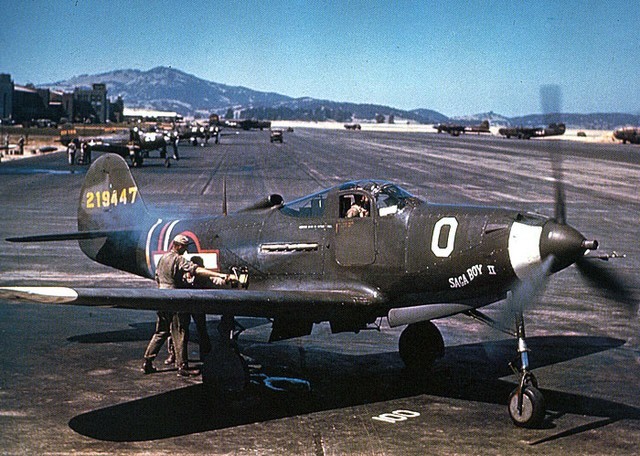
The P-39 was an all-metal, low-wing, single-engine fighter with a tricycle undercarriage and an Allison V-1710 liquid-cooled V-12 engine mounted in the central fuselage, directly behind the cockpit.
The Airacobra was one of the first production fighters to be conceived as a "weapons system"; in this case the aircraft (known originally as the Bell Model 4) was designed to provide a platform for the 37 mm T9 cannon.[29] This weapon, which was designed in 1934 by the American Armament Corporation, a division of Oldsmobile, fired a 1.3 lb (590 g) projectile capable of piercing 0.8 in (20 mm) of armor at 500 yd (460 m) with armor-piercing rounds. The 90 in (2.3 m)-long, 200 lb (90 kg) weapon had to be rigidly mounted and fire parallel to and close to the centerline of the new fighter. It would have been impossible to mount the weapon in the fuselage, firing through the cylinder banks of the Vee-configured engine and the propeller hub as could be done with smaller 20 mm cannon. Weight, balance and visibility considerations meant that the cockpit could not be placed farther back in the fuselage, behind the engine and cannon.[29] The solution adopted was to mount the cannon in the forward fuselage and the engine in the center fuselage, directly behind the pilot's seat. The tractor propeller was driven with a 10-foot-long (3 m) drive shaft made in two sections, incorporating a self-aligning bearing to accommodate fuselage deflection during violent maneuvers. This shaft ran through a tunnel in the cockpit floor and was connected to a gearbox in the nose of the fuselage which, in turn, drove the three- or (later) four-bladed propeller by way of a short central shaft. The gearbox was provided with its own lubrication system, separate from the engine; in later versions of the Airacobra the gearbox was provided with some armor protection.[29] The glycol-cooled radiator was fitted in the wing center section, immediately beneath the engine; this was flanked on either side by a single drum-shaped oil cooler. Air for the radiator and oil coolers was drawn in through intakes in both wing-root leading edges and was directed via four ducts to the radiator faces. The air was then exhausted through three controllable hinged flaps near the trailing edge of the center section. Air for the carburetor was drawn in through a raised oval intake immediately aft of the rear canopy.[30][31]
The fuselage structure was unusual and innovative, being based on a strong central keel that incorporated the armament, cockpit, and engine. Two strong fuselage beams to port and starboard formed the basis of the structure. These angled upwards fore and aft to create mounting points for the T9 cannon and propeller reduction gearbox and for the engine and accessories respectively. A strong arched bulkhead provided the main structural attachment point for the main spar of the wing. This arch incorporated a fireproof panel and an armor plate between the engine and the cockpit. It also incorporated a turnover pylon and a pane of bullet-resistant glass behind the pilot's head. The arch also formed the basis of the cockpit housing; the pilot's seat was attached to the forward face as was the cockpit floor. Forward of the cockpit the fuselage nose was formed from large removable covers. A long nose wheel well was incorporated in the lower nose section. The engine and accessories were attached to the rear of the arch and the main structural beams; these too were covered using large removable panels. A conventional semi-monocoque rear fuselage was attached aft of the main structure.[30][N 5]

Because the pilot was above the extension shaft, he was placed higher in the fuselage than in most contemporary fighters, which, in turn gave the pilot a good field of view.[29] Access to the cockpit was by way of sideways opening "car doors", one on either side. Both had wind-down windows. As only the right-hand door had a handle both inside and outside this was used as the normal means of access and egress. The left-hand door could be opened only from the outside and was for emergency use, although both doors could be jettisoned. In operational use, as the roof was fixed, the cockpit design made escape difficult in an emergency.[32]
The complete armament fit consisted of the T9 cannon with a pair of Browning M2 .50 in (12.7 mm) machine guns mounted in the nose. This changed to two .50 caliber and two .30 in (7.62 mm) guns in the XP-39B (P-39C, Model 13, the first 20 delivered) and two .50s and four .30s (all four in the wings) in the P-39D (Model 15), which also introduced self-sealing tanks and shackles (and piping) for a 500 lb (230 kg) bomb or drop tank.[23]
Because of the unconventional layout, there was no space in the fuselage to place a fuel tank. Although drop tanks were implemented to extend its range, the standard fuel load was carried in the wings, with limitations on range.[33]
A heavy structure, and around 256 lb (116 kg) of armor, were characteristic of this aircraft as well. The production P-39's heavier weight combined with the Allison engine with only a single-stage, single-speed supercharger, limited high-altitude performance, which was markedly inferior to contemporary European fighters and, as a result, the first USAAF fighter units in the European Theater were equipped with the Spitfire V. However, the P-39D's roll rate was 75°/s at 235 mph (378 km/h) – better than the A6M2, F4F, or P-38 up to 265 mph (426 km/h).[34]
Above the supercharger's peak altitude of about 12,000 ft (3,700 m), performance dropped off rapidly, limiting usefulness in traditional fighter missions in Europe as well as in the Pacific, where it was not uncommon for Japanese bombers to attack from above the P-39's ceiling (which in the tropical heat was lower than in cooler climates). The late production N and Q models, which made up 75% of Airacobras built, could maintain a top speed of 375 mph (604 km/h; 326 kn) up to 20,000 ft (6,000 m).
Weight distribution could result in it entering a dangerous flat spin, a characteristic Soviet test pilots demonstrated to the skeptical manufacturer, which had been unable to reproduce the effect. It was determined the spin could only be induced if the aircraft were flown with no ammunition in the nose. The flight manual noted a need to ballast the front ammunition compartment to achieve a reasonable center of gravity. High-speed controls were light, consequently high-speed turns and pull-outs were possible. The P-39 had to be held in a dive since it tended to level out and the recommended never-exceed dive speed limit (Vne) was 475 mph (764 km/h; 413 kn).[35]
Soon after entering service, pilots began to report that "during flights of the P-39 in certain maneuvers, it tumbled end over end." Most of these events happened after the aircraft was stalled in a nose high attitude with considerable power applied. Bell pilots made 86 separate efforts to reproduce the reported tumbling characteristics. In no case were they able to tumble it. In his autobiography veteran test and airshow pilot R.A. "Bob" Hoover provides an account of tumbling a P-39. He goes on to say that in hindsight, he was actually performing a Lomcovak, a now-common airshow maneuver, which he was also able to do in a Curtiss P-40.[36][N 6] A study of its spinning characteristics was conducted in the NASA Langley Research Center 20-foot (6 m) Free-Spinning Tunnel during the 1970s. A study of old reports showed that during earlier tests the aircraft never tumbled. However, it was noted that all testing had been done with a simulated full ammunition load, which moved the center of gravity forward. After finding the original spin test model of the P-39 in storage, the new study first duplicated the earlier tests, with consistent results. Then, the model was re-ballasted to simulate a condition with no ammunition load, which moved the aircraft's center of gravity aft. Under these conditions, the model was found to tumble.[38]
The rear-mounted engine was less likely to be hit when attacking ground targets, but was vulnerable to attacks from above and behind. At its upper altitude limits, the Airacobra was out-performed by many enemy aircraft.[39]

Service and versions
[edit]In September 1940, Britain ordered 386 P-39Ds (Model 14), with a 20 mm Hispano-Suiza HS.404 and six .303 in (7.7 mm) instead of a 37 mm cannon and six .30 caliber guns. The RAF eventually ordered 675 P-39s. However, after the first Airacobras arrived at 601 Squadron RAF in September 1941, they were found to have an inadequate rate of climb and performance at altitude for Western European conditions. Only 80 were operated, all by 601 Squadron. Britain transferred about 200 P-39s to the Soviet Union.
Another 200 examples intended for the RAF were taken up by the USAAF after the attack on Pearl Harbor as the P-400, and were sent to the Fifth Air Force in Australia, for service in the South West Pacific Theatre.[40]
By the date of the Pearl Harbor attack, nearly 600 P-39s had been built. When P-39 production ended in August 1944, Bell had built 9,558[23][24] Airacobras, of which 4,773 (mostly −39Ns and −39Qs[23]) were sent to the Soviet Union through the Lend-Lease program. There were numerous minor variations in engine, propeller, and armament, but no major structural changes in production types, excepting a few two-seat TP-39F and RP-39Q trainers.[41][N 7] In addition, seven went to the US Navy as radio-controlled drones.
Trials of a laminar flow wing (in the XP-39E) and Continental IV-1430 engine (the P-76) were unsuccessful.[23] The mid-engine, gun-through-hub concept was developed further in the Bell P-63 Kingcobra.
A naval version with tailwheel landing gear, the XFL-1 Airabonita, was ordered as a competitor to the Vought F4U Corsair and Grumman XF5F Skyrocket. It first flew 13 May 1940,[23] but after a troublesome and protracted development and testing period, it was rejected.

Operational history
[edit]The Airacobra saw combat throughout the world, particularly in the Southwest Pacific, Mediterranean and Soviet theaters. Because its engine was equipped with only a single-stage, single-speed supercharger, the P-39 performed poorly above 17,000 feet (5,200 m) altitude. In both western Europe and the Pacific, the Airacobra found itself outclassed as an interceptor and the type was gradually relegated to other duties.[5] It often was used at lower altitudes for such missions as ground strafing.
United Kingdom
[edit]In 1940, the British Direct Purchase Commission in the US was looking for combat aircraft; they ordered 675 of the export version Bell Model 14 as the Caribou on the strength of the company's representations on 13 April 1940. The British armament was two nose-mounted .50 caliber machine guns and four .303 caliber Browning machine guns in the wings. The 37 mm gun was replaced by a 20 mm Hispano-Suiza cannon.
British expectations had been set by performance figures established by the unarmed and unarmored XP-39 prototype. The British production contract stated that a maximum speed of 394 mph (634 km/h) +/- 4% was required at rated altitude.[42] In acceptance testing, actual production aircraft were found to be capable of only 371 mph (597 km/h) at 14,090 ft (4,290 m). To enable the aircraft to make the guaranteed speed, a variety of drag-reduction modifications were developed by Bell. The areas of the elevator and rudder were reduced by 14.2% and 25.2% respectively. Modified fillets were installed in the tail area. The canopy glass was faired to its frame with putty. The gun access doors on the wing had been seen to bulge in flight, so they were replaced with thicker aluminum sheet. Similarly, the landing gear doors deflected open by as much as two inches at maximum speed, so a stronger linkage was installed to hold them flush. The cooling air exit from the oil and coolant radiators was reduced in area to match the exit velocity to the local flow. New engine exhaust stacks, deflected to match the local flow and with nozzles to increase thrust augmentation, were installed. The machine gun ports were faired over, the antenna mast was removed, a single-piece engine cowling was installed and an exhaust stack fairing was added.

The airframe was painted with 20 coats of primer, with extensive sanding between coats. Standard camouflage was applied and sanded to remove the edges between the colors. Additionally, about 200 lb (91 kg) of weight was removed, making it lighter than normal (7,466 lb (3,387 kg) gross).[43] After these modifications, the second production aircraft (serial AH 571) reached a speed of 391 mph (629 km/h) at 14,400 ft (4,400 m) in flight test. As this speed was within 1% of the guarantee, the aircraft was declared to have satisfied contractual obligations.[42] Despite the success of these modifications, none were applied to other production P-39s. Later testing of a standard production P-400 by the British Aeroplane and Armament Experimental Establishment (A&AEE) revealed a top speed of only 359 mph (578 km/h).[44]
The British export models were renamed Airacobra in 1941. A further 150 were specified for delivery under Lend-Lease in 1941 but these were not supplied. The Royal Air Force (RAF) took delivery in mid-1941 and found that performance of the non-turbo-supercharged production aircraft differed markedly from what they were expecting.[45] In some areas, the Airacobra was inferior to existing aircraft such as the Hawker Hurricane and Supermarine Spitfire and its performance at altitude suffered drastically. Tests by the Royal Aircraft Establishment at Boscombe Down showed the Airacobra reached 355 mph (571 km/h) at 13,000 ft (4,000 m).[46] The cockpit layout was criticized, and it was noted that the pilot would have difficulty in bailing out in an emergency because the cockpit roof could not be jettisoned. The lack of a clear vision panel on the windscreen assembly meant that in the event of heavy rain the pilot's forward view would be obliterated; the pilot's notes advised that in this case the door windows would have to be lowered and the speed reduced to 150 mph (240 km/h)[47] On the other hand, it was considered effective for low level fighter and ground attack work. Problems with gun- and exhaust-flash suppression and the compass could be fixed.
No. 601 Squadron RAF was the only British unit to use the Airacobra operationally, receiving their first two examples on 6 August 1941. On 9 October, four Airacobras attacked enemy barges near Dunkirk, in the type's only operational action with the RAF. The squadron continued to train with the Airacobra during the winter, but a combination of poor serviceability and deep distrust of this unfamiliar fighter resulted in the RAF rejecting the type after one combat mission.[4] In March 1942, the unit re-equipped with Spitfires.
The Airacobras already in the UK, along with the remainder of the first batch being built in the US, were sent to the Soviet Air force, the sole exception being AH574, which was passed to the Royal Navy and used for experimental work, including the first carrier landing by a tricycle undercarriage aircraft, on 4 April 1945 on HMS Pretoria Castle,[48] until it was scrapped on the recommendation of a visiting Bell test pilot in March 1946.[49]
US Army Air Forces
[edit]Pacific
[edit]
The United States requisitioned 200 of the aircraft being manufactured for the UK, adopting them as P-400s. After the attack on Pearl Harbor, the P-400 was deployed to training units, but some saw combat in the Southwest Pacific including with the Cactus Air Force in the Battle of Guadalcanal.[50] Though outclassed by Japanese fighter aircraft, it performed well in strafing and bombing runs, often proving deadly in ground attacks on Japanese forces trying to retake Henderson Field. Guns salvaged from P-39s were sometimes fitted to Navy PT boats to increase firepower. Pacific pilots often complained about problems of performance and unreliable armament, but by the end of 1942, the P-39 units of the Fifth Air Force had claimed about 80 Japanese aircraft, with a similar number of P-39s lost. Fifth and Thirteenth air force P-39s did not score more aerial victories in the Solomons due to the aircraft's limited range and poor high altitude performance.
Airacobras first fought Japanese A6M Zeros on 30 April 1942 in a low level action near Lae, New Guinea. From May to August 1942 combat between Airacobras and Zeros took place on a regular basis over New Guinea. Compilation of combat reports indicates the Zero was either equal to or close to the P-39 in speed at the altitudes of the various low level encounters.
From September to November 1942, pilots of the 57th Fighter Squadron flew P-39s and P-38s from an airfield built on land bulldozed into Kuluk Bay on the barren island of Adak in Alaska's Aleutian Islands. They attacked the Japanese forces that had invaded Attu and Kiska islands in the Aleutians in June 1942. The factor that claimed the most lives was not the Japanese but the weather. The low clouds, heavy mist and fog, driving rain, snow, and high winds made flying dangerous and lives miserable. The 57th remained in Alaska until November 1942, then returned to the United States.

While Lieutenant Bill Fiedler was the only American pilot to become an ace in a P-39, many later US aces scored one or two of their victories in the type. The Airacobra's low-altitude performance was good and its firepower was impressive; regardless, it soon became a joke in the Pacific Theatre that a P-400 was a P-40 with a Zero on its tail.[51]
Mediterranean
[edit]In North Africa, the 99th Fighter Squadron (also known as the Tuskegee Airmen) transitioned quickly from the P-40 and were assigned P-39s in February 1944, but only flew the type for a few weeks. The 99th carried out their duties including supporting Operation Shingle over Anzio as well as missions over the Gulf of Naples in the Airacobra but achieved few aerial victories.[52]
The major MTO P-39 operators included the 81st and 350th Fighter Groups, both flying the maritime patrol mission from North Africa and on through Italy. The 81st transferred to the China Burma India Theater by March 1944 and the 350th began transition to the P-47D in August 1944, remaining in Italy with the 12th Air Force.
Soviet Union
[edit]
Nearly half of all P-39s were sent to the Soviet Union: 4,719, accounting for more than one-third of all US and UK-supplied fighter aircraft in the VVS.[53] The Soviet Air Forces received the considerably improved N and Q models via the Alaska-Siberia ferry route. The tactical environment of the Eastern Front suited the P-39's strengths—sturdy construction, reliable radio gear, and good firepower—and did not demand the high-speed, high-altitude performance of RAF and USAAF operations.
The first Soviet Cobras had a 20 mm Hispano-Suiza cannon and two heavy Browning machine guns, synchronized and mounted in the nose. Later Cobras arrived with the M4 37 mm cannon and four machine guns, two synchronized and two wing-mounted. "We immediately removed the wing machine guns, leaving one cannon and two machine guns," Golodnikov recalled later.[54] That modification improved roll rate by reducing rotational inertia. Soviet airmen appreciated the M4 cannon with its powerful rounds and the reliable action but complained about the low rate of fire (three rounds per second) and inadequate ammunition storage (only 30 rounds).[54] The United States did not supply M80 armor-piercing rounds for the autocannons of Soviet P-39s; instead, the Soviets received 1,232,991 M54 high-explosive rounds, which they used primarily for air-to-air combat and against soft ground targets. The VVS did not use the P-39 for tank-busting.[55]
The Soviets used the Airacobra primarily for air-to-air combat.[56] They developed successful group aerial fighting tactics, and scored an outsized number of aerial victories over a variety of German aircraft, including Bf 109s, Focke-Wulf Fw 190s, Ju 87s, and Ju 88s. Soviet P-39s had no trouble dispatching Junkers Ju 87 Stukas or German twin-engine bombers and matched, and in some areas surpassed, early and mid-war Messerschmitt Bf 109s. The usual nickname for the Airacobra in the VVS was Kobrushka ("little cobra") or Kobrastochka, a blend of Kobra and Lastochka (swallow), "dear little cobra".[57]
A common Western misconception is that the Bell fighters were used as ground attack aircraft. This is because the Soviet term for the mission of the P-39, prikrytiye sukhoputnykh voysk (coverage of ground forces) has been mistaken as meaning close air support. In Soviet usage, it has a broader meaning including protection of the airspace above army operations. Strafing was mostly handled by thousands of heavily armored Ilyushin Il-2 aircraft; while Soviet-operated P-39s did make strafing attacks, it was "never a primary mission or strong suit for this aircraft".[58]
"I liked the Cobra, especially the Q-5 version. It was the lightest version of all Cobras and was the best fighter I ever flew. The cockpit was very comfortable, and visibility was outstanding. The instrument panel was very ergonomic, with the entire complement of instruments right up to an artificial horizon and radio compass. It even had a relief tube in the shape of a funnel. The armored glass was very strong, extremely thick. The armor on the back was also thick. The oxygen equipment was reliable, although the mask was quite small, only covering the nose and mouth. We wore that mask only at high altitude. The HF radio set was powerful, reliable and clear."
During the battle of Kuban River, VVS relied on P-39s much more than Spitfires and P-40s. Aleksandr Pokryshkin, from 16.Gv.IAP (16th Guards Fighter Aviation Regiment), claimed 20 victories in that campaign in a P-39.[59]

The last plane shot down by the Luftwaffe was a Soviet P-39, on 8 May by Oblt. Fritz Stehle of 2./JG 7 flying a Me 262 over the Ore Mountains.[60] The last Soviet air victory was in a P-39 on 9 May when Kapitan Vasily Pshenichikov downed a Focke-Wulf Fw 189 over Prague.[61] Half of the 10 highest-scoring Soviet aces logged the majority of their kills in P-39s. Grigoriy Rechkalov scored 44 victories in Airacobras. Pokryshkin scored 47 of his 59 victories in P-39s, making him the highest-scoring P-39 fighter pilot of any nation, and the highest-scoring Allied fighter pilot using an American fighter.[62] This does not include his 6 shared victories, at least some of which were achieved with the P-39.
Soviet Airacobra losses totalled 1,030 aircraft (49 in 1942, 305 in 1943, 486 in 1944 and 190 in 1945).[63]
Airacobras served with the Soviet Air Forces as late as 1949, when two regiments were operating as part of the 16th Guards Fighter Aviation Division in the Belomorsky Military District.[64]
Australia
[edit]
A total of 23 re-conditioned Airacobras, on loan from the US Fifth Air Force (5 AF), were used by the Royal Australian Air Force (RAAF) as a stop-gap interceptor in rear areas. The aircraft were assigned the RAAF serial prefix A53.[65]
In the early months of the Pacific War, the RAAF was able to obtain only enough Curtiss Kittyhawks to equip three squadrons, destined for front-line duties in New Guinea.[66] and – in the face of increasing Japanese air raids on towns in northern Australia – was forced to rely on the P-40, P-39, and P-400 units of 5 AF for the defence of areas such as Darwin. During mid-1942, USAAF P-39 units in Australia and New Guinea began to receive brand new P-39Ds.[66] Consequently, P-39s that had been repaired in Australian workshops were loaned by 5 AF to the RAAF. In July, seven P-39Fs arrived at 24 Squadron, in RAAF Bankstown in Sydney.[65][66] In August, seven P-39Ds were received by No. 23 Squadron RAAF at Lowood Airfield, near Brisbane.[65][66] Both squadrons also operated other types, such as the CAC Wirraway armed trainer. Neither squadron received a full complement of Airacobras or saw combat with them. From early 1943, the air defence role was filled by a wing of Spitfires.
Both 23 and 24 Squadron converted to the Vultee Vengeance dive bomber in mid-1943, their P-39s transferred to two newly formed fighter squadrons: No. 82 (augmenting P-40s, still in short supply) at Bankstown and No. 83 (as it awaited the Australian-designed CAC Boomerang) in Strathpine, near Brisbane.[65] After serving with these squadrons for a few months, the remaining Airacobras were returned to the USAAF and the RAAF ceased to operate the type.[65]
France
[edit]In 1940, France ordered P-39s from Bell, but because of the armistice with Germany they were not delivered. After Operation Torch, French forces in North Africa sided with the Allies, and were re-equipped with Allied equipment including P-39Ns. From mid-1943 on, three fighter squadrons, the GC 3/6 Roussillon, GC 1/4 Navarre and GC 1/5 Champagne, flew these P-39s in combat over the Mediterranean, Italy and Southern France. A batch of P-39Qs was delivered later, but Airacobras, which were never popular with French pilots, had been replaced by P-47s in front line units by late 1944.
Italy
[edit]
In June 1944, the Italian Co-Belligerent Air Force (ICAF) received 170 P-39s, most of them -Qs, and a few -Ns (15th USAAF surplus aircraft stored in Napoli-Capodichino airfield) and also at least one -L and five -Ms. The P-39 N (without the underwing fairings for .50 caliber machine guns) had engines with about 200 hours; a little newer than the P-39Q engines with 30–150 hours. A total of 149 P-39s would be used: the P-39N for training, while newer Qs were used in the front line.
In June–July 1944, Gruppi 12°, 9° and 10° of 4° Stormo, moved to Campo Vesuvio airstrip to re-equip with the P-39s. The site was not suitable and, in three months of training, 11 accidents occurred, due to engine failures and poor maintenance of the base. Three pilots died and two were seriously injured. One of the victims, on 25 August 1944, was the "ace of aces", Sergente Maggiore Teresio Vittorio Martinoli.[67]
The three groups of 4° Stormo were first sent to Leverano (Lecce) airstrip, then in mid-October, to Galatina airfield. At the end of the training, eight more accidents occurred. Almost 70 aircraft were operational, and on 18 September 1944, 12° Group's P-39s flew their first mission over Albania. Concentrating on ground attack, the Italian P-39s proved to be suitable in this role, losing 10 aircraft between 4 November and 3 December 1944,[68] to German flak. In February–March 1945, 10° and 9° Gruppi moved North of Galatina, in Canne airbase, near Campobasso, while the Allies allowed Italian pilots to use the airstrip of Lissa island, in the Adriatic sea, as an intermediate scale during the long sorties on the Balkans. The 4° Stormo pilots flew many effective ground attack missions on northern Yugoslavia, losing only one more P-39, for engine failure in Sarajevo area, on 2 April 1945.[69] The Italian P-39 flew over 3,000 hours of combat.[70]
By the end of the war, 89 P-39s were still at the Canne airport and 13 at the Scuola Addestramento Bombardamento e Caccia ("Training School for Bombers and Fighters") at Frosinone airfield. In 10 months of operational service, the 4° Stormo had been awarded three Medaglia d'Oro al Valore Militare "alla memoria".[71] After the war the P-39s were taken over by the Aeronautica Militare Italiana (the new Italian air force) and used for several years as training aircraft. In Galatina fighter training unit (Scuola Caccia), war veteran Tenente colonnello Francis Leoncini was killed during a flying accident, on 10 May 1950.[69]
Portugal
[edit]Between December 1942 and February 1943, the Aeronáutica Militar (Army Military Aviation) obtained aircraft operated by the 81st and the 350th Fighter Groups originally dispatched to North Africa as part of Operation Torch. Due to several problems en route, some of the aircraft were forced to land in Portugal and Spain. Of the 19 fighter aircraft that landed in Portugal, all were interned and entered service that year with the Portuguese Army Military Aviation. They formed the Squadron OK, based at Ota Air Base.[72]
Though unnecessary, the Portuguese Government paid the United States US$20,000 for each of these interned aircraft as well as for one interned Lockheed P-38 Lightning.[73] The US accepted the payment, and gave as a gift four additional crates of aircraft, two of which were not badly damaged, without supplying spares, flight manuals or service manuals.[73] Without proper training, incorporation of the aircraft into service was plagued with problems, and the last six Portuguese Airacobras that remained in 1950 were sold for scrap.
Post-war use
[edit]A very small number of late-production P-39Qs survived long enough in the USAAF inventory to be acquired by the United States Air Force upon its separation from the Army. These aircraft served in training and testing roles for approximately a year. They were redesignated as ZF-39Qs ("ZF" for "Obsolete Fighter") in June 1948 as part of the new aircraft designation scheme throughout the USAF.
In 1945, Italy purchased the 46 surviving P-39s at 1% of their cost but in mid-1946 many accidents occurred, including fatal ones. By 1947, 4° Stormo re-equipped with P-38s, with P-39s sent to training units until the type's retirement in 1951. Only a T9 cannon survives today at Vigna di Valle Museum.[70]
Racing
[edit]
The Airacobra was raced at the National Air Races in the United States after World War II. Famous versions used for racing included the twin aircraft known as "Cobra I" and "Cobra II," owned jointly by Bell Aircraft test pilots Tex Johnston and Jack Woolams. These aircraft were powered by an extensively modified 2000-horsepower engine, and a P-63 four-blade propeller. "Cobra I" with its pilot, Jack Woolams, was lost in 1946 during a test flight over Lake Ontario. The "Cobra II" flown by test pilot "Tex" Johnston, beat racing-modified P-51s, as well as other P-39 racers (which were the favorites), to win the 1946 Thompson Trophy race.[74]
Cobra II competed again in the 1947 Thompson Trophy, finishing 3rd. In the 1948 Thompson trophy, it was unable to finish due to engine difficulties. Cobra II did not race again and was destroyed on 10 August 1968 during a test flight prior to an attempt at the world piston-engine air speed record, when owner-pilot Mike Carroll lost control and crashed. Carroll died and the highly modified P-39 was destroyed.
Mira Slovak's P-39Q "Mr. Mennen" (Race #21) was a fast unlimited racer, but a late arrival in 1972 kept the 2,000 hp (1,500 kW) racer out of the Reno races, and it was never entered again. Its color scheme was all white with "Mennen" green and bronze trim. It is now owned and displayed by the Kalamazoo Air Zoo, in the color scheme of P-400 "Whistlin' Britches."
Variants
[edit] | This section needs additional citations for verification. (November 2021) |
- XP-39
- Bell Model 11,[75] one prototype 38–326 first flown 6 April 1938[76] or 1939.[77] Powered by a 1,150 hp (860 kW) Allison V-1710-17 (E2) engine and was fitted with a General Electric B-5 turbosupercharger, creating a two stage supercharging system similar to the P-38 (engine-mounted mechanical supercharger, remote exhaust-driven turbo-supercharger as a second stage for high-altitude). Aircraft remained unarmed. Later converted to XP-39B.[76][77]
- XP-39B
- One conversion first flown 25 November 1939. Streamlined XP-39 based on NACA wind tunnel testing resulting in revised canopy and wheel door shape, oil cooler/ engine coolant radiator intakes moved from right fuselage to wing roots, fuselage increased length by 13 in (330 mm) and decreased wingspan (by 22 in (560 mm). The turbosupercharger was removed, and the single-stage, single speed, supercharged 1,090 hp (810 kW) Allison V-1710-37 (E5) engine remained. The carburetor air intake was moved behind the canopy.[78][79]

- YP-39
- Bell Model 12, service test version, 1,090 hp (810 kW) V-1710-37 (E5) engine. Armed with an M4 37 mm cannon with 15 rounds, 2 × .50 caliber machine guns with 200 rpg, and 2 × .30 caliber machine guns with 500 rpg in the nose. Wider vertical tail than XP-39B. 13 completed with the first flying on 13 September 1940.[80][81]
- YP-39A
- One intended to have a V-1710-31 engine, but was delivered as a regular YP-39.[81]
- P-39C
- Bell Model 13, initial US Army designation P-45 Airacobra. First flown in January 1941, it was the first production version, identical to YP-39 except for 1,150 hp (860 kW) V-1710-35 engine. Armed with 1 × 37 mm cannon, 2 × .50 caliber and 2 × .30 caliber machine guns in the nose. Aircraft lacked armor and self-sealing fuel tanks. Twenty were produced out of an order of 80, with the remainder completed as P-39Ds.[82]
- P-39D
- Bell Model 15, production variant based on the P-39C with additional armor and self-sealing fuel tanks.[82] Armament increased to 1 × 37 mm cannon with 30 rounds, 2 × .50 caliber and 4 × wing mounted .30 caliber machine guns; 429 produced.[82][83]
- P-39D-1
- Bell Model 14A, production variant fitted with a 20 mm M1 cannon instead of 37 mm cannon. Specifically ordered for delivery under Lend-Lease.[82] 336 produced.[83]
- P-39D-2
- Bell Model 14A-1, production variant again intended for lend lease and fitted with 20 mm cannon, but with 1,325 hp (988 kW) V-1710-63 (E6) engine. 158 produced.[82][83]
- P-39D-3
- 26 conversions from P-39D-1 to photo reconnaissance configuration; K-24 and K-25 camera in rear fuselage, extra armor for oil coolers.[82][83]
- P-39D-4
- 11 conversions from P-39D-2 to photo reconnaissance configuration. Same modifications as D-3 aircraft.[82][83]
- XP-39E
- Bell Model 23. three P-39Ds modified for ground and flight testing first flown 21 February 1942.[84] Intended for 2,100 hp (1,600 kW) Continental I-1430-1 engine but only flown with 1325 hp Allison V-1710-47 engine. Used to test various wing and vertical tails. Fuselage lengthened by 21 in (530 mm) and used in the development of the P-63. The production variant, with the Continental engines was to be designated P-76; there was no Bell XP-76 as such.[84]
- P-39F
- Bell Model 15B, production variant with three-bladed Aeroproducts constant speed propeller. 229 built.[85][86]
- P-39G
- Bell Model 26, 1800 ordered, intended to be a P-39D-2 with a different propeller. Later cancelled, with aircraft delivered as P-39K, L, M and N.[86]
- P-39J
- Bell Model 15B, P-39F with 1,100 hp (820 kW) V-1710-59 engine with automatic boost control; 25 built.[87][88]
- P-39K
- P-39K-1
- Bell Model 26A. Fitted with an Aeroproducts propeller and powered by a 1,325 hp (988 kW) V-1710-63 (E6) engine. 210 built.[85][87]
- P-39K-5
- One conversion with a V-1710-85 (E19) engine to serve as a P-39N prototype.[87]

Lend-Lease to USSR
- P-39L
- P-39L-1
- Bell Model 26B, similar to P-39K with Curtiss Electric propeller and higher gross weight. 250 built.[85][87]
- P-39M-1
- Bell Model 26D, variant with an 11 ft 1 in (3.38 m) Aeroproducts propeller, 1,200 hp (890 kW) V-1710-83 engine with improved high-altitude performance, 10 mph (16 km/h) faster than P-39L at 15,000 ft (4,600 m). 240 built.[85]
- P-39M-2
- Modification of P-39M-1 for ground attack/[89]
- P-39N
- Bell Model 26N, originally part of the P-39G order. 1325 hp V-1710-85 (E19) engine.[90] 10 ft 4 in (3.15 m) Aeroproducts propeller and different reduction gear ratio. Starting with the 167th aircraft, the propeller diameter was increased to 11 ft 7 in (3.53 m) and internal fuel reduced from 120 to 87 US gal (450 to 330 L; 100 to 72 imp gal); 500 built.
- P-39N-1
- Variant with internal changes to adjust center of gravity when nose guns were fired; 900 built.
- P-39N-2
- 128 P-39N-1 converted with additional belly armor and cameras in rear fuselage.
- P-39N-3B
- 35 P-39N converted with additional belly armor and cameras in rear fuselage.
- P-39N-5
- Variant with armor reduced from 231 to 193 lb (105 to 88 kg), Armor plate replaced the bulletproof glass behind the pilot, SCR-695 radio was fitted, and a new oxygen system was installed; 695 built.
- P-39N-6
- 84 P-39N-5 converted with additional belly armor and cameras in rear fuselage.

- P-39Q
- The final production variant last one built in August 1944.
- P-39Q-1
- Bell Model 26E,[75] variant with wing-mounted .30 caliber machine guns replaced with a .50 caliber with 300 rounds of ammunition in a pod under each wing. Armor was increased to 231 lb (105 kg); 150 built.
- P-39Q-2
- Five P-39Q-1s modified to carry cameras for photographic reconnaissance by adding K-24 and K-25 cameras in the aft fuselage.

The Fighter Collection
- P-39Q-5
- Production variant with reduced armor (193 lb (88 kg)), fuel capacity increased (110 US gal (420 L; 92 imp gal)). Type A-1 bombsight adapters added; 950 built.
- TP-39Q-5
- One conversion to a two-seat training variant with additional cockpit added in nose – no armament. Enlarged tail fillet and a shallow ventral fin added.
- P-39Q-6
- 148 P-39Q-5s modified to carry cameras for photographic reconnaissance by adding K-24 and K-25 cameras in the aft fuselage.
- P-39Q-10
- Variant with increased armor (228 lb (103 kg)), fuel capacity increased (120 US gal (450 L; 100 imp gal)). Automatic Boost controls added and throttle and RPM controls coordinated. Winterization of oil systems and rubber mounts added to the engines; 705 built.
- P-39Q-11
- Eight P-39Q-10s modified to carry cameras for photographic reconnaissance by adding K-24 and K-25 cameras in the aft fuselage.
- P-39Q-15
- Production variant with reinforced inclined deck to prevent .50 caliber machine gun mounting cracking, bulkhead reinforcements to prevent rudder pedal wall cracking, a reinforced reduction gearbox bulkhead to prevent cowling former cracking, and repositioning of the battery solenoid. Oxygen system reduced from four bottle to two; 1,000 built.
- P-39Q-20
- Production variant with minor equipment changes. The under-wing .50 caliber machine gun pods sometimes omitted; 1,000 built.
- P-39Q-21
- 109 P-39Q-20 fitted with a four-bladed Aeroproducts propeller.
- RP-39Q-22
- 12 P-39Q-20s converted to two-seat trainers.
- P-39Q-25
- Production variant similar to the P-39Q-21 but with a reinforced aft-fuselage and horizontal stabilizer structure; 700 built.
- P-39Q-30
- Production variant that reverted to the three-bladed propeller; 400 built.
- ZF-39
- Remaining examples in service, re-designated in June 1948.
- P-45
- The P-45 was the initial designation of the P-39C or Model 13.
- XFL-1 Airabonita
- One prototype tail-wheel undercarriage carrier fighter for the USN.
- XTDL-1
- United States Navy (USN) designation for two P-39Qs used as target drones.[91] Assigned to NAS Cape May for test work. Later redesignated F2L-1K.
- F2L-1K
- XTDL-1 drones re-designated.
- P-400
- An export model of the P-39 with a less powerful cannon, using a 20 mm Hispano cannon rather than the standard 37 mm cannon. It also had 2 .50 caliber machine guns in the nose, and 2 x .30 caliber machine guns in each wing.
- Airacobra I
- Bell Model 13, Royal Air Force (RAF) designation for three P-39Cs delivered to the A&AEE Boscombe Down for testing.
- Airacobra IA
- Bell Model 14. Briefly named Caribou. 1,150 hp V-1710-E4 engine, 1 × 20 mm cannon with 60 rounds and 2 × .50 caliber machine guns mounted in the nose and four .303 caliber machine guns were mounted in the wings. IFF set removed from behind pilot. note: the designation IA indicates direct purchase aircraft (as opposed to Lend-Lease); 675 built. The USAAF operated 128 former RAF aircraft with the designation P-400.
Operators
[edit]


- Italian Co-Belligerent Air Force operated 170 Bell P-39 Airacobra [92]

- Italian Air Force operated 102 surviving Bell P-39 Airacobra retired in 1950s

- Polish Air Force (One aircraft operated; personal aircraft of General Fyodor Polynin, Commander of the Polish Air Force)

- Esquadrilha Airacobra (Airacobra Squadron), later renamed Esquadrilha 4 (Squadron No. 4) — Aeronáutica Militar (Army Military Aviation)

- Soviet Air Forces (Voyenno-Vozdushnye Sily or VVS)
- Soviet Naval Aviation

- Royal Air Force
- Royal Navy (Airacobra Mk 1 – test flight)

Surviving aircraft
[edit]Australia
[edit]On display P-39D
- 41-6951 – Beck Military Collection in Mareeba, Queensland.[93]
Canada
[edit]Under restoration P-39M
- 42-4725 – Under restoration at the Alberta Aviation Museum in Edmonton Alberta.[94]
Finland
[edit]P-39Q
- 44-2664 – The Anti Aircraft Museum in Tuusula. Plane was formerly placed in Aviation Museum of Central Finland in Tikkakoski.[95]
Papua New Guinea
[edit]P-39N
- 42-19039 – J. K. McCarthy Museum in Goroka, Papua New Guinea.[96]
Russia
[edit]On display P-39
- 42537 – UMMC Museum Complex, Verkhnyaya Pyshma, Russia[97]
- 220613 – House of Culture. Gagarin, Yakutsk, Russia, 280 mi (450 km) south of the Arctic Circle[98][99]
United States
[edit]Airworthy P-39F
- 41-7215 (unnamed) – Military Aviation Museum in Virginia Beach, Virginia.[100][101] Was restored by Pioneer Aero Ltd at Ardmore, Auckland, for Jerry Yagen. MSN 15-554[102] was forced to land near Weipa, Queensland, on 1 May 1942, after running out of fuel. The aircraft remained abandoned at the site until recovery operations began in November 1971.[103] First flight at Ardmore by Frank Parker on 26 February 2019. Painted in USAAF colors as P-39Q-5-BE 42-20341 (Lend Lease to USSR) and now relocated to and flying with the Fighter Factory/MAM as of May 2019.[104]
P-39N
- 42-8740 (unnamed) – Yanks Air Museum in Chino, California.[105][106]
P-39Q
- 42-19597 Miss Connie/Old Crow – Commemorative Air Force (CenTex Wing) in San Marcos, Texas.[107][108]
- 42-19993 Brooklyn Bum – Lewis Air Legends in San Antonio, Texas.[109][110]
On display P-39N
- 42-18814 Girlie – recovered from Tadji New Guinea in 1972 by MARC Pima Air & Space Museum, adjacent to Davis-Monthan AFB in Tucson, Arizona.[111]
- 42-18408 Snooks 2nd / Betty Lou 3rd – Buffalo and Erie County Naval & Military Park in Buffalo, New York.[112]
P-39Q
- 42-20000 (unnamed) – March Field Air Museum at March ARB (former March AFB) in Riverside, California.[113]
- 42-20007 (unnamed) – Virginia Air & Space Center near Langley AFB in Hampton, Virginia.[114]
- 44-2485 (unnamed) – Erickson Aircraft Collection in Madras, Oregon.[115]
RP-39Q
.jpg)
- 44-3887 (unnamed) – National Museum of the United States Air Force at Wright-Patterson AFB in Dayton, Ohio.[116]
- 44-3908 Whistlin Britches – Air Zoo in Kalamazoo, Michigan.[117]
Under restoration or in storage P-39N
- 42-19027 Small Fry/Little Sir Echo – under restoration for static display at Planes of Fame in Chino, California.[118]
P-39Q
- 44-2433 Galloping Gertie – in storage at the Paul Garber Facility of the National Air and Space Museum in Silver Hill, Maryland.[119]
- 44-2911 Miss Lend Lease – under restoration at the Niagara Aerospace Museum in Niagara Falls, New York. This plane was recovered from a Russian lake after disappearing during a routine mission during WWII. The pilot's remains were recovered and buried with full military honors. The aircraft crashed due to engine failure, as two holes were found inside the engine block from snapped connecting rods.[120]
Specifications (P-39Q)
[edit]

Data from Flight Operating Instructions P-39Q;[121] Memorandum Report on P-39Q-5 Airplane[122]
General characteristics
- Crew: One
- Length: 30 ft 2 in (9.19 m)
- Wingspan: 34 ft 0 in (10.36 m)
- Height: 12 ft 5 in (3.78 m)
- Wing area: 213 sq ft (19.8 m2)
- Empty weight: 6,516 lb (2,956 kg)
- Gross weight: 7,570 lb (3,434 kg)
- Max takeoff weight: 8,400 lb (3,810 kg)
- Powerplant: 1 × Allison V-1710-85 V-12 liquid-cooled piston engine, 1,200 hp (890 kW) at 9,000 ft (2,743 m) (emergency power)
- Propellers: 3-bladed constant-speed propeller
Performance
- Maximum speed: 389 mph (626 km/h, 338 kn)
- Stall speed: 95 mph (153 km/h, 83 kn) power off, flaps and undercarriage down
- Never exceed speed: 525 mph (845 km/h, 456 kn)
- Range: 525 mi (845 km, 456 nmi) on internal fuel
- Service ceiling: 35,000 ft (11,000 m)
- Rate of climb: 3,805 ft/min (19.33 m/s) at 7,400 ft (2,300 m) (using emergency power)
- Time to altitude: 15,000 ft (4,600 m) in 4 minutes 30 seconds, at 160 mph (260 km/h)
- Wing loading: 34.6 lb/sq ft (169 kg/m2)
- Power/mass: 0.16 hp/lb (0.26 kW/kg)
Armament
- Guns:
- 1 × 37 mm M4 cannon firing through the propeller hub (compare engine gun)
- 2 × .50 caliber synchronized Browning M2 machine guns, nose-mounted
- 2 × .50 caliber Browning M2 machine guns on each wing
- Bombs: Up to 500 lb (230 kg) of bombs under wings and belly
See also
[edit]
Related development
Aircraft of comparable role, configuration, and era
- Curtiss P-40
- Hawker Hurricane
- Koolhoven F.K.55
- Messerschmitt Bf 109
- Nakajima Ki 43
- Supermarine Spitfire
- Weiss Manfréd WM-23 Ezüst Nyíl
- Yakovlev Yak-1
Related lists
References
[edit]Notes
[edit]- ^ Some sources give 6 April 1939 as the date of the first flight; there is very good evidence that 1938 is correct (see talk page).[3]
- ^ The P-39 has the highest total number of individual victories attributed to any US fighter type, not kill ratio; Finnish-modified Brewster Buffalos had the highest kill ratio.
- ^ Brigadier General Benjamin S. Kelsey recalled in 1977 he and Lieutenant Gordon P. Saville (later General) drew up the specification in 1937 using the word "interceptor" as a way to bypass the inflexible Army Air Corps requirement for pursuit aircraft to carry no more than 500 lb (230 kg) of armament including ammunition. Kelsey was looking for a minimum of 1,000 lb (450 kg) of armament.[10]
- ^ Quote: "With the turbo, Bell's fighter had outstanding performance in spite of the associated drag penalties NACA aerodynamicists found so objectionable. Elimination of the turbo without substituting comparable gear-driven supercharger performance relegated the airplane to an 'also-ran'..."[18]"... there is no doubt that the deletion of the turbo-supercharger ruined the P-39."[27]
- ^ Note: Photographs of the P-39's structure can be found in images from: "Image of P-39 structure.", "P-39 recovered fuselage structure.", "P-39 Cockpit and rear arch." pacificwrecks.com. Retrieved: 12 May 2009.
- ^ In any of several variations, the Lomcovak involves autorotating the aircraft end over end at the apex of a climbing outside snap roll. Most Lomcovaks are entered from a near vertical attitude with power applied, which matches the description of how P-39 tumbles were entered.[37]
- ^ Trainers were a rarity for fighter types outside the Soviet Union in the 1940s.
Citations
[edit]- ^ Angelucci, Enzo (1988). Combat aircraft of World War II. Orion Books. p. 40. ISBN 0-517-64179-8.
- ^ a b Angelucci and Bowers 1987, p. 41.
- ^ a b Matthews 1996, p. 85.
- ^ a b Gunston 1980, p. 22.
- ^ a b Angelucci and Matricardi 1978, p. 25.
- ^ Bishop, Chris. The Encyclopedia of Weapons of World War II. New York: Orbis Publishing Ltd., 1998. ISBN 0-7607-1022-8.
- ^ Bodie 1991, p. 19.
- ^ Bodie 1991, pp. 16–17.
- ^ Lockheed P-38 Lightning. Retrieved: 21 January 2007.
- ^ Bodie 1991, p. 14.
- ^ a b Donald 1997, p. 106.
- ^ McDowell 1980, p. 10.
- ^ Jackson, David D. "The Oldsmobile Division of General Motors in World War Two". The American Automobile Industry in World War Two. Retrieved 19 July 2022.
- ^ Woods 1941[page needed]
- ^ Johnsen 1998, p. 7.
- ^ Johnsen 1998, p. 8.
- ^ a b Pearcy 1993, p. 25.
- ^ a b c AAHS Journal 2001, pp. 295–297.
- ^ Matthews 1996, p. 97.
- ^ Matthews 1996, p. 101.
- ^ Matthews 1996, p. 102.
- ^ Lednicer 2000, p. 2.
- ^ a b c d e f g h i j k Donald 1997[page needed]
- ^ a b Fitzsimons 1977, p. 50.
- ^ Kinzey 1999, pp. 9, 13.
- ^ Dean 1997, p. 191.
- ^ Dwyer, Larry. "Allison V-1710 – USA." Aviation-History.com, 6 August 2005. Retrieved: 25 March 2009.
- ^ Kelsey 1982[page needed]
- ^ a b c d Bowers 1978, p. 24.
- ^ a b Green and Swanborough 1977, pp. 8–9.
- ^ "P-39 cooling system (PDF File)." zenoswarbirdvideos.com. Retrieved: 12 May 2009.
- ^ Johnson and Heffernan 1982, p. 90.
- ^ Dean 1997, pp. 191–192.
- ^ Dean 1997, pp. 192, 602.
- ^ Dean 1997, p. 200.
- ^ Hoover and Shaw 1996, pp. 25–26.
- ^ Williams 1975[page needed]
- ^ Lednicer 2000, p. 7.
- ^ Dean 1997, pp. 206–207.
- ^ Dean 1997, p. 194.
- ^ Donald 1997, p. 107.
- ^ a b Matthews 1996, p. 120.
- ^ Matthews 1996, pp. 119–120.
- ^ "The Calamitous ‘Cobra'." Air Enthusiast, Vol. 1, No. 3, August 1971.
- ^ Mason 1969, pp. 5–6.
- ^ Johnson and Heffernan 1982, p. 93.
- ^ Johnson and Heffernan 1982, pp. 91–92.
- ^ Brown 2006, p. 93.
- ^ Brown 2006, p. 145.
- ^ Baugher, Joe. "Airacobra I for RAF, P-400." Archived 4 November 2010 at the Wayback Machine Bell P-39 Airacobra, 4 August 2010. Retrieved: 16 September 2010.
- ^ Pejčoch 2008, p. 86.
- ^ "The combat record of the Tuskegee Airmen speaks for itself." Archived 30 November 2010 at the Wayback Machine tuskegeeairmen.org. Retrieved: 16 October 2009.
- ^ Hardesty 1991, p. 253.
- ^ a b c Drabkin 2007, p. 133.
- ^ Loza and Gebhardt 2002, p. 359.
- ^ Gebhardt, Major James F., USAF (Retired). "Some Additional P-39 History." Archived 14 December 2009 at the Wayback Machine March Field Air Museum. Retrieved: 29 October 2009.
- ^ Mitchell 1992, p. 34.
- ^ Colonel Dmitriy Loza, Red Army. Loza and Gebhardt 2002, pp. 15–16.
- ^ Morgan 1999, p. 20.
- ^ Bergstrom, Christer (2008). Bagration to Berlin: The Final Air Battles in the East: 1944–1945. Great Britain: Ian Allan. pp. 123–124. ISBN 978-1-903223-91-8.
- ^ Bergstrom, Christer (2008). Bagration to Berlin: The Final Air Battles in the East: 1944–1945. Great Britain: Ian Allan. p. 124. ISBN 978-1-903223-91-8.
- ^ Saltzman, B. Chance; Searle, Thomas R. (2001). Introduction to the United States Air Force. Airpower Research Institute, Air University Press. p. 114. ISBN 978-1-4289-2621-9.
- ^ Bergström 2008, p. 132.
- ^ Holm, Michael. "P=39." Archived 1 April 2012 at the Wayback Machine ww2.dk. Retrieved: 26 September 2011.
- ^ a b c d e Crick, Darren. "RAAF A53 Bell P-39D/F Airacobra" Archived 2013-05-10 at the Wayback Machine adf-serials.com, 2006. Retrieved: 28 August 2013.
- ^ a b c d Birkett, Gordon R. "RAAF Bell Airacobras Part 1." adf-serials.com, 2005. Retrieved: 20 June 2007.
- ^ "Dimensione Cielo aerei Italiani nella Seconda Guerra Mondiale." Caccia Assalto3. Roma: Edizioni Bizzarri, 1972, pp. 75–76.
- ^ Dimensione Cielo 1972, p. 77.
- ^ a b Dimensione Cielo 1972, p. 78.
- ^ a b Gueli 2004[page needed]
- ^ "Dimensione Cielo aerei Italiani nella Seconda Guerra Mondiale." Caccia Assalto3. Roma: Edizioni Bizzarri, 1972, p. 78.
- ^ "The P-400 / P-39L Airacobra." Portuguese Airacobra service history. Retrieved: 16 October 2009.
- ^ a b Public Record Office entry of 18 March 1943, quoted by "Wreckovery" in Aviation News, 10–23 August 1984.
- ^ Johnston, A.M. "Tex" (1992). Tex Johnston, Jet-Age Test Pilot. New York: Bantam. pp. 92–108. ISBN 9780553295870.
- ^ a b Pelletier 1992, p. 224
- ^ a b Pelletier 1992, pp. 27–28
- ^ a b Dorr 1998, p. 126
- ^ Pelletier 1992, pp. 28, 39
- ^ Dorr 1998, pp. 126–127
- ^ Pelletier 1992, pp. 28–29
- ^ a b Dorr 1998, p. 127
- ^ a b c d e f g Pelletier 1992, p. 29
- ^ a b c d e Dorr 1998, p. 129
- ^ a b Bowers 1979, p. 25.
- ^ a b c d e f g Pelletier 1992, p. 31
- ^ a b c Dorr 1998, p. 130
- ^ a b c d e Dorr 1998, p. 132
- ^ a b Angelucci and Bowers 1987, p. 46.
- ^ Pelletier 1992, pp. 31–32
- ^ "Allison V-1710-85 & Drive Train for P-39Q". National Museum of the US Air Force. Archived from the original on 3 March 2015. Retrieved 21 April 2016.
- ^ Pelletier, Alain J. (1992). Bell Aircraft. Great Britain: Naval Institute Press. ISBN 1-55750-056-8.
- ^ "Italian Air Force Aircraft Types". www.aeroflight.co.uk.
- ^ "P-39D Airacobra/41-6951" pacificwrecks.com Retrieved: 4 March 2015.
- ^ "Progress Continues On Decade Long P-39 Joint Restoration Project". 4 November 2021.
- ^ "P-39Q Airacobra/44-2664" aerialvisuals.ca Retrieved: 4 March 2015.
- ^ "P-39N Airacobra/42-19039" pacificwrecks.com Retrieved: 4 March 2015.
- ^ "В музее военной техники УГМК появилась легендарная «Аэрокобра»". Archived from the original on 5 July 2023. Retrieved 5 July 2023.
- ^ ""P-39 Bell Aeorcobra/220613"". Archived from the original on 21 January 2013.
- ^ [1] Archived 2017-12-11 at the Wayback Machine "P-39 Bell Aeorcobra/220613"
- ^ "FAA Registry: N39FF." FAA Registry. Retrieved: 15 July 2021.
- ^ "P-39F Airacobra/41-7215". Military Aviation Museum Retrieved: 21 September 2022.
- ^ "Airacobra ZK-COB Update" nzcivair.com Retrieved: 7 January 2019
- ^ "Warbird Directory: Bell" Retrieved: 7 January 2019
- ^ "News: P-39 flies in New Zealand". Aeroplane. Vol. 47, no. 4. April 2019. pp. 6–7. ISSN 0143-7240.
- ^ "FAA Registry: N81575" FAA.gov Retrieved: 15 July 2021.
- ^ "P-39N Airacobra/42-8740" Archived 26 July 2020 at the Wayback Machine Yanks Air Museum Retrieved: 3 May 2017.
- ^ "P-39Q Airacobra/42-19597" CAF CenTex Wing Retrieved: 3 July 2023.
- ^ "FAA Registry: N6968" FAA.gov Retrieved: 15 July 2021.
- ^ "P-39Q Airacobra/42-19993" Lewis Air Legends Retrieved: 13 January 2020.
- ^ "FAA Registry: N139RL" FAA.gov Retrieved: 15 July 2021.
- ^ "P-39N Airacobra/42-18814" Pima Air and Space Museum Retrieved: 16 March 2020.
- ^ "P-39N Airacobra/42-18408" Buffalo & Erie County Naval & Military Park Retrieved: 12 September 2022.
- ^ "P-39Q Airacobra/42-20000" March Field Air Museum Retrieved: 19 December 2017.
- ^ "P-39Q Airacobra/42-20007" Virginia Air & Space Center Retrieved: 19 December 2017.
- ^ "P-39Q Airacobra/44-2485" Erickson Aircraft Collection Retrieved: 8 March 2015.
- ^ "RP-39Q Airacobra/44-3887" National Museum of the USAF Retrieved: 19 December 2017.
- ^ "RP-39Q Airacobra/44-3908" Kalamazoo Aviation History Museum Retrieved: 16 March 2020.
- ^ "P-39N Airacobra/42-19027" Planes of Fame Museum Retrieved: 13 January 2020.
- ^ "P-39Q Airacobra/44-2433" Archived 2015-09-06 at the Wayback Machine National Air and Space Museum Retrieved: 22 July 2014.
- ^ "P-39Q Airacobra/44-2911" Niagara Aerospace Museum Retrieved: 12 September 2022.
- ^ "Flight Operating Instructions P-39Q" (PDF). Archived from the original (PDF) on 14 December 2022. Retrieved 27 September 2015.
- ^ "Memorandum Report on P-39Q-5 Airplane" (PDF).
Bibliography
[edit]- AAHS Journal, American Aviation Historical Society, Volume 46, 2001.
- Angelucci, Enzo and Paolo Matricardi. World Aircraft: World War II, Volume II (Sampson Low Guides). Maidenhead, UK: Sampson Low, 1978. ISBN 0-562-00096-8.
- Angelucci, Enzo and Peter M. Bowers. The American Fighter: The Definitive Guide to American Fighter Aircraft from 1917 to the Present. New York, Orion Books, 1987. ISBN 0-517-56588-9.
- Bergström, Christer. Bagration to Berlin – The final Air Battle in the East 1944–45. Hersham, UK: Classic Publications, 2008. ISBN 978-1-903223-91-8.
- Bodie, Warren. The Lockheed P-38 Lightning. St. Paul, Minnesota: Widewing Publications, 1991. ISBN 0-9629359-5-6.
- Bowers, Peter M. "Airborne Cobra Pt. I". Airpower, Vol. 8, No. 6, November 1978.
- Bowers, Peter M. "Airborne Cobra Pt. II". Airpower, Vol.9, No. 1, January 1979.
- Brown, Captain Eric. Wings on My Sleeve. London: Weidenfeld & Nicolson, 2006. ISBN 0-297-84565-9.
- Byk, Gary. The Modeller's Guide to the Bell P-39 Airacobra in RAAF Service. Melbourne, Australia: Red Roo Models Publication, 1997. ISBN 0-646-32869-7.
- Dean, Francis H. America's Hundred Thousand. Atglen, Pennsylvania: Schiffer Publishing Ltd, 1997. ISBN 0-7643-0072-5.
- Dial, Jay Frank. The Bell P-39 Airacobra, Aircraft in Profile no.165. Windsor, Berkshire, UK: Profile Publications. Ltd., 1966 (reprinted 1971). No ISBN.
- "Dimensione Cielo aerei Italiani nella Seconda Guerra Mondiale." (in Italian) Caccia Assalto 3. Rome: Edizioni Bizzarri, 1972.
- Donald, David. "Bell P-39 Airacobra." The Encyclopedia of World Aircraft. Leicester, UK: Blitz Editions, 1997. ISBN 1-85605-375-X.
- Dorr, Robert F. "Bell Cobra Variants: Bell P-39 Airacobra and P-63 Kingcobra". Wings of Fame, Volume 10, 1998. London: Aerospace Publishing. pp. 116–143. ISBN 1-86184-013-6. ISSN 1361-2034.
- Dorr, Robert F. and Jerry C. Scutts. Bell P-39 Airacobra. Ramsbury, Marlborough, Wiltshire, UK: The Crowood Press Ltd., 2000. ISBN 1-86126-348-1.
- Drabkin, Artem. The Red Air Force at War: Barbarossa and the Retreat to Moscow – Recollections of Fighter Pilots on the Eastern Front. Barnsley, South Yorkshire, UK: Pen & Sword Military, 2007. ISBN 1-84415-563-3.
- Fitzsimons, Bernard, editor. "Airacobra, Bell P-39". The Illustrated Encyclopedia of 20th Century Weapons and Warfare, Volume 1. New York: Columbia House, 1977. ISBN 0-8393-6175-0.
- Green, William. War Planes of the Second World War, Volume 4. London: Macdonald & Co., 6th Edition, 1969. ISBN 0-356-01448-7.
- Green, William and Gordon Swanborough. WW2 Aircraft Fact Files: U. S. Army Air Force Fighters, Part 1. London: Macdonald and Jane's, 1977. ISBN 0-356-08218-0.
- Gueli, Marco. "Gli Airacobra Italiani" (in Italian). Storia Militare n.132, September 2004.
- Gunston, Bill. Aircraft of World War 2. London: Octopus Books Limited, 1980. ISBN 0-7064-1287-7.
- Hardesty, Von. Red Phoenix: The Rise of Soviet Air Power 1941–1945. Washington, D.C.: Smithsonian Institution, 1991 (first edition 1982). ISBN 0-87474-510-1.
- Hoover, R.A. and Mark Shaw. Forever Flying. New York: Pocket Books, 1996. ISBN 978-0-671-53761-6.
- Johnsen, Frederick A. Bell P-39/P-63 Airacobra & Kingcobra. St. Paul, Minnesota: Voyageur Press, 1998. ISBN 1-58007-010-8.
- Johnson, Brian and Terry Heffernan. A Most Secret Place: Boscombe Down 1939–45. London: Jane's Publishing Company Limited, 1982. ISBN 0-7106-0203-0
- Juszczak, Artur and Robert Pęczkowski. Bell P-39 Airacobra (in Polish). Sandomierz, Poland/Redbourn, UK: Mushroom Model Publications, 2003. ISBN 83-916327-9-2.
- Kelsey, Benjamin S. The Dragon's Teeth?: The Creation of United States Air Power for World War II. Washington, D.C.: Smithsonian Institution Press, 1982. ISBN 0-87474-574-8.
- Kinzey, Bert. P-39 Airacobra in Detail, D&S Vol. 63. Carrollton, Texas: Squadron/Signal Publications, Inc., 1999. ISBN 1-888974-16-8.
- Kulikov, Victor (August 2000). "Les "Cobras" soviétiques au combat" [Soviet "Cobras" in Combat]. Avions: Toute l'Aéronautique et son histoire (in French) (89): 5–13. ISSN 1243-8650.
- Kulikov, Victor (September 2000). "Les "Cobras" soviétiques au combat". Avions: Toute l'Aéronautique et son histoire (in French) (90): 6–22. ISSN 1243-8650.
- Lednicer, David A. "Aerodynamics of the Bell P-39 Airacobra and P-63 Kingcobra." SAE paper 2000-01-167. Warrendale, Pennsylvania: SAE International, 9 May 2000.
- Lopez, Mario Canoniga (August–November 1990). "Fighters of the Cross of Christ". Air Enthusiast (13): 13–25. ISSN 0143-5450.
- Loza, Dmitriy and James F. Gebhardt, editor and translator. Attack of the Airacobras: Soviet Aces, American P-39s & the Air War Against Germany. Lawrence, Kansas: University Press of Kansas, 2002. ISBN 0-7006-1140-1.
- Mariinskiy, Evgeniy. Red Star Airacobra: Memoirs of a Soviet Fighter Ace 1941–45. Solihull, UK: Helion and Company, 2006. ISBN 1-874622-78-7.
- Mason, Francis K. Royal Air Force Fighters of World War Two, Volume One. Garden City, New York: Doubleday & Company Inc., 1971. ISBN 0-85064-012-1.
- Matthews, Birch. Cobra! Bell Aircraft Corporation 1934–1946. Atglen, Pennsylvania: Schiffer Publishing, 1996. ISBN 0-88740-911-3.
- Mattioli, Marco. Bell P-39 Airacobra in Italian Service, Aviolibri Special 7 (Bilingual Italian/English). Rome: IBN Editore, 2003. ISBN 88-86815-85-9.
- McDowell, Ernest. P-39 Airacobra in Action, Aircraft No.43. Carrollton, Texas: Squadron/Signal Publications, Inc., 1980. ISBN 0-89747-102-4.
- Mellinger, George and John Stanaway. P-39 Airacobra Aces of World War 2. Botley, Oxford, UK: Osprey Publishing, 2001. ISBN 1-84176-204-0.
- Mitchell, Rick. Airacobra Advantage: The Flying Cannon. The Complete Story of Bell Aircraft Corporation's P-39 Pursuit Fighter Plane. Missoula, Montana: Pictorial Histories Publishing Co., 1992 (second printing 1995). ISBN 0-929521-62-5.
- Morgan, Hugh. Gli assi Sovietici della Seconda guerra mondiale (in Italian). Rome: Edizioni del Prado/Osprey Aviation, 1999. ISBN 84-8372-203-8
- Park, Edwards. Nanette, Her Pilot's Love Story. Washington, D.C.: Smithsonian Institution Press, 1977. (2nd edition 1989). ISBN 0-87474-737-6.
- Pearcy, Arthur. Flying the Frontiers: NACA and NASA Experimental Aircraft. Annapolis, Maryland: Naval Institute Press, 1993. ISBN 1-55750-258-7.
- Pejčoch, Ivo. Bojové Legendy: P-39 Airacobra (in Czech). Prague, Czech Republic: Jan Vašut s.r.o., 2008. ISBN 978-80-7236-573-9.
- Pelletier, A. J. Bell Aircraft since 1935. Annapolis, Maryland, USA: Naval Institute Press, 1992. ISBN 1-55750-056-8.
- Roman, Valerij. Aerokobry vstupayut v boy ('Airacobras enter combat'), Белл P-400, P-39D-1, P-39D-2 ("Avia-retro" series 1) (in Ukrainian). Kyiv, Ukraine: Aero-Hobby, 1993. ISBN 5-77075-170-3.
- Roman, Valerij. Aerokobry nad Kuban'yu (Airacobras over Kuban'), P-39 K, L и M ("Avia-retro" series 2) (in Ukrainian). Kyiv, Ukraine: Aero-Hobby, 2006. ISBN 0-9780696-0-9.
- Tomalik, Jacek. Bell P-39 Airacobra Cz.1, Monografie Lotnicze 58 (in Polish). Gdańsk, Poland: AJ-Press, 1999. ISBN 83-7237-032-X.
- Tomalik, Jacek. Bell P-63 Kingcobra, XFL-1 Airabonita, P-39 Airacobra Cz.2, Monografie Lotnicze 59 (in Polish). Gdańsk, Poland: AJ-Press, 2001. ISBN 83-7237-034-6.
- United States Air Force Museum Guidebook. Wright-Patterson AFB, Ohio: Air Force Museum Foundation, 1975.
- Williams, Neil. Aerobatics. New York: St. Martin's Press, 1975. ISBN 978-0-9504543-0-6.
- Wixey, Ken. "Flying Cannon: Bell's Cobra Family, Part One". Air Enthusiast, No. 80, May–June 1999, pp. 20–27. ISSN 0143-5450
- Woods, Robert J. "Why a Rear Engine Installation," Parts I and II. Aviation, March and April 1941.
Further reading
[edit]External links
[edit]
- A film clip Flying The P-39, demonstrating techniques for piloting the P-39 Airacobra is available for viewing at the Internet Archive
- Australian War Memorial, US 5th Airforce gun camera footage, 1943. Includes P-39 gun camera footage (from the 1:03 mark). Lt Robert Adler (41st FS, USAAF) downing twin-engine Japanese bombers near Tsili Tsili, New Guinea, in 1943.


| International | |
|---|---|
| National | |
| Other | |

Bell P-39 Airacobra
View on GrokipediaDesign and development
Origins and proposals
In the late 1930s, the U.S. Army Air Corps sought to modernize its pursuit aircraft inventory amid growing concerns over high-altitude bomber threats, prioritizing fast-climbing monoplanes capable of intercepting enemy formations at altitude.[4] This drive for advanced interceptors reflected broader doctrinal shifts toward defensive air superiority, with emphasis on speed, climb performance, and heavy firepower to neutralize armored bombers effectively.[5] To meet these needs, the Army Air Corps issued Circular Proposal X-609 in February 1937, specifying a single-engine, high-altitude interceptor with a top speed of 360 mph at 15,000 feet, a climb rate to 20,000 feet in 6 minutes, armament totaling 1,000 pounds including a nose-mounted cannon, tricycle landing gear, and a turbo-supercharged liquid-cooled engine.[4][5] The proposal, drafted under the guidance of Lieutenant Benjamin S. Kelsey, Project Officer for Fighters, aimed to leapfrog existing biplane designs and incorporate cutting-edge features for tactical interception and attack missions.[5] Bell Aircraft Corporation, established in 1935 and eager to enter the military fighter market, responded aggressively to X-609 with its Model 12 proposal in May 1937, introducing a radical mid-engine layout to centralize mass for better balance, maximize forward visibility for the pilot, and enable concentrated nose armament without compromising aerodynamics.[5] Chief engineer Robert Woods, drawing on prior experience with experimental layouts, championed the tractor propeller configuration linked to the rear-mounted engine via an extension shaft, which allowed the 37 mm cannon to fire through the propeller hub for precise gunnery.[6] This innovative approach addressed the proposal's armament and visibility demands while promising enhanced maneuverability at low to medium altitudes. The U.S. Army Air Corps approved Bell's concept, awarding an initial contract in October 1937 for one XP-39 prototype to validate the design, including its tricycle gear for improved propeller clearance and ground operations, and integration of the Allison V-1710 liquid-cooled V-12 engine for the required power output.[7][5] Woods' team focused on creating a cohesive "weapons system" around the cannon, prioritizing conceptual simplicity and pilot-centric ergonomics to fulfill the interceptor role outlined in X-609.[5]Prototypes and testing
The XP-39 prototype, serial number 38-326, conducted its maiden flight on April 6, 1939, at Wright Field, Ohio, piloted by Bell test pilot James Taylor.[8] During initial evaluations, the aircraft demonstrated promising performance, achieving a top speed of approximately 390 mph at 15,000 feet, which met or exceeded U.S. Army Air Corps expectations for a high-altitude interceptor.[9] The flight revealed no major structural concerns with the innovative mid-engine layout, though minor adjustments were noted for stability. Following the successful debut, the U.S. Army ordered 13 YP-39 service test prototypes to evaluate production potential and armament integration.[7] These aircraft, powered by the Allison V-1710-37 engine, underwent extensive ground and flight testing starting in late 1940, focusing on the synchronization and firing of the primary 37 mm M4 cannon through the propeller hub alongside twin .50-caliber machine guns in the nose.[5] Armament trials confirmed reliable operation at low altitudes but highlighted synchronization challenges under high-speed maneuvers, prompting refinements to the firing mechanisms. Early testing identified several issues with the turbo-supercharger system, including exhaust gas buildup that caused engine overheating and reduced efficiency during prolonged high-altitude runs.[10] To address these, Bell engineers redesigned the exhaust ducting and relocated the turbocharger to the lower fuselage in the XP-39B configuration, improving airflow but complicating maintenance access. Spin characteristics were also rigorously assessed using scale models and full-scale flights; results indicated recoverable spins with standard techniques, though the aircraft's center of gravity required careful rudder and elevator inputs to avoid flat spins.[11] U.S. Army evaluations from 1940 to 1941, conducted at Wright Field and other bases, included high-altitude trials that exposed limitations in climb rate above 20,000 feet due to turbocharger inefficiencies.[2] A notable incident occurred on August 6, 1940, when the XP-39 prototype, flown by Captain Ernest K. Warburton, stalled during landing approach, resulting in a crash that rendered the aircraft beyond repair and underscored the need for enhanced aileron damping.[12] As testing progressed toward production readiness, the Army directed the removal of the turbo-supercharger to simplify manufacturing and reduce weight by approximately 300 pounds, shifting focus to low- to medium-altitude roles.[7] This modification, implemented in the XP-39B and carried into the P-39C series, lowered overall complexity but compromised high-altitude performance, paving the way for initial production contracts in early 1941.[2]Technical features
The Bell P-39 Airacobra featured a distinctive mid-fuselage engine placement, with the Allison V-1710-31 or -39 liquid-cooled V-12 engine mounted behind the pilot's seat, delivering 1,050 to 1,150 horsepower at takeoff. This configuration necessitated a long extension shaft, approximately 10 feet in length, that passed between the pilot's legs to drive the nose-mounted tractor propeller via a remote gearbox, allowing for a compact forward fuselage and improved pilot visibility.[13] The single-stage supercharger on the V-1710 limited the aircraft's effectiveness above 15,000 feet, as it lacked the two-stage or turbo-supercharger systems found in contemporaries like the P-38 Lightning, resulting in reduced power and performance at higher altitudes.[14][15] The cockpit adopted a car-door style entry with sideways-hinging doors on both sides, equipped with wind-down windows for access and ventilation, while later variants incorporated elements of a bubble canopy to enhance all-around visibility without the full rearward obstruction of traditional designs.[16] Armament centered on a 37 mm Oldsmobile M4 cannon firing through the propeller hub with 30 rounds of ammunition, supplemented by two synchronized .50 caliber machine guns in the cowling (200 rounds per gun) and four .30 caliber machine guns in the wings, providing formidable firepower for ground attack but challenging synchronization due to the cannon's recoil.[14] To mitigate center-of-gravity shifts from the cannon's operation, spent casings and machine gun links were collected in a tray beneath the cockpit, preventing unwanted weight redistribution during firing.[17] The P-39 utilized a tricycle landing gear arrangement, the first on a production fighter, with electrically actuated retraction: the main wheels folding inward into the wings and the nose wheel retracting rearward into the fuselage for streamlined aerodynamics.[18] Internal fuel capacity stood at 120 US gallons, stored in self-sealing tanks added from the P-39D variant onward to enhance survivability, complemented by 245 pounds of armor plating around the cockpit and engine for protection against small-arms fire.[19] These features contributed to handling quirks, including challenging spin recovery due to the aircraft's tendency toward flat spins, exacerbated by the mid-engine layout and requiring precise pilot technique to avoid irrecoverable attitudes.[1][2]Production overview
The Bell P-39 Airacobra was manufactured exclusively at Bell Aircraft Corporation's plant in Buffalo, New York, with production spanning from 1940 to 1944 and totaling 9,584 aircraft.[1] Production began with the experimental YP-39 in 1940, transitioned to initial series in 1941, reached its peak in 1943 when over 5,000 units were completed, and concluded in August 1944 as wartime priorities shifted to more advanced fighters.[2][20] Among major series, approximately 600 P-39D and F models were built as early production variants, while the P-39L (250 units) and P-39N (2,095 units) series totaled approximately 2,345 units with enhancements for improved range and performance; the P-39Q became the most numerous at 4,905 aircraft, incorporating refinements like underwing hardpoints.[2][21] Additionally, 675 P-400 export models were produced specifically for Allied orders.[2] Under the Lend-Lease program, 4,773 P-39s—predominantly Q models—were allocated to the Soviet Union, representing nearly half of total output and emphasizing the aircraft's role in supporting Eastern Front operations.[1] Over 600 units, including P-400s and some assembled by Bellanca, went to the United Kingdom.[2] Manufacturing faced significant hurdles, including supply chain bottlenecks for the Allison V-1710 engines, which were in high demand across multiple U.S. aircraft programs and delayed assembly lines.[2] Delays in producing the 37 mm M4 cannon, prone to reliability issues and synchronization problems with the propeller, further slowed output until substitutions like the 20 mm Hispano were adopted in some variants.[2] Worker training for the P-39's complex tricycle gear and mid-fuselage engine layout also posed challenges, requiring specialized skills amid rapid wartime expansion at the Buffalo facility.[2]Operational history
Soviet Air Force
The Soviet Air Force received 4,773 Bell P-39 Airacobra fighters through the Lend-Lease program, primarily via the Alaska-Siberia (ALSIB) ferry route between 1942 and 1944.[1] These deliveries included mostly the improved P-39N and P-39Q models, which Soviet ground crews adapted for cold-weather operations by addressing issues such as engine freezing and incorporating local modifications to radios and instrumentation suited to Eastern Front conditions.[17] The aircraft arrived in large numbers and were quickly integrated into frontline units despite initial logistical challenges in remote sectors.[22] In Soviet service, the P-39 excelled as a low-altitude interceptor and ground-attack aircraft, performing effectively against Luftwaffe forces at altitudes between 5,000 and 10,000 feet where its Allison V-1710 engine provided adequate power without the need for high-altitude supercharging.[23] Pilots leveraged its robust construction for close air support, escorting bombers, and engaging enemy fighters in the tactical environment of the Eastern Front, claiming approximately 2,500 aerial victories—the highest total for any U.S.-built fighter in any air force during World War II.[24] This success stemmed from the P-39's suitability for the Soviet doctrine emphasizing maneuverable, short-range operations over contested ground, where it disrupted German supply lines, silenced artillery, and cleared skies for advancing troops.[17] Key operational units included the 9th Guards Fighter Aviation Division (9th GIAD) and the 16th Guards Fighter Aviation Regiment (16th GIAP), which amassed hundreds of victories while honing specialized tactics.[23] Leading aces such as Alexander Pokryshkin, who scored 48 of his 59 total victories in the P-39, and Grigory Rechkalov, with over 40 kills in the type, flew from these units and developed innovative formations like the "Kuban ladder"—a stepped echelon climb allowing sequential attacks on superior enemy numbers while maintaining energy advantage.[22] These methods, inspired by observations of Luftwaffe tactics, emphasized altitude control, speed retention, and precise firing sequences to maximize the P-39's strengths in dogfights.[23] The P-39 saw intense action in major engagements, including the Kuban air battles of spring 1943, where units like the 16th GIAP used it to challenge Luftwaffe dominance over the Black Sea region, and the Berlin offensive in April 1945, supporting ground advances with low-level strikes.[23] In the Kuban operations alone, Soviet P-39 pilots from the 9th GIAD claimed 1,147 enemy aircraft destroyed while operating from forward bases.[23] By war's end, approximately 1,178 P-39s remained in service, underscoring their reliability in sustained combat.[22] Despite its combat effectiveness, the P-39 suffered high attrition, with around 50% of losses attributed to non-combat causes such as accidents and spins induced by its tricycle landing gear and center-of-gravity issues during tight maneuvers. Units like the 16th GIAP lost 36 aircraft in 1943 alone, often to rough-field landings or inadvertent spins at low altitudes.[23] Total Soviet P-39 losses reached about 1,030 aircraft across the war, reflecting the aircraft's average frontline lifespan of roughly three months under intense operational tempo.[17] Post-combat assessments by Soviet pilots praised the P-39's exceptional low-speed maneuverability, which allowed tight turns superior to many German fighters, and its potent firepower from the nose-mounted 37 mm M4 cannon combined with .50-caliber machine guns, ideal for decisive burst attacks.[17] However, it was criticized for poor high-altitude performance above 15,000 feet due to the non-supercharged engine, limiting its use in escort roles against climbing adversaries, and for frequent maintenance demands, including cannon jams from unreliable ammunition feed systems that required on-site modifications.[2] Overall, the type was regarded as one of the most successful Lend-Lease fighters, with its adaptations enhancing Soviet air superiority in key low-level battles.[22]United States Army Air Forces
The Bell P-39 Airacobra entered operational service with the United States Army Air Forces (USAAF) in the summer of 1941, with the 31st Pursuit Group at Selfridge Field, Michigan, becoming the first unit to receive the aircraft, followed by the 8th and 36th Pursuit Groups.[25] These early groups conducted training and maneuvers, including simulated combat exercises during the Louisiana Maneuvers, where the P-39 demonstrated effective low-altitude performance but highlighted handling challenges.[20] By late 1942, as superior fighters like the P-47 Thunderbolt and P-51 Mustang became available, the USAAF began transitioning P-39 units from air superiority roles to ground attack and close air support missions, a shift that was largely complete by 1943 due to the aircraft's limited high-altitude capabilities stemming from its single-stage supercharger.[25] In the Pacific Theater, P-39-equipped units saw initial combat with the 8th Fighter Group in New Guinea starting April 1942, where squadrons like the 36th and 89th Fighter Squadrons contributed to approximately 80 victories claimed by V Fighter Command units by the end of 1942, including several Mitsubishi A6M Zeros, but suffered heavy losses owing to the Japanese fighters' superior maneuverability at higher altitudes.[25] The 347th Fighter Group, including the 68th Fighter Squadron, deployed P-39s to the Solomon Islands and Aleutians from mid-1942 through 1943, engaging Japanese forces in low-level operations.[26] The 54th Fighter Group in the Aleutians added about 10 victories during engagements in October 1942, primarily against Japanese patrol aircraft, before the P-39 was phased out for better-performing types.[25] In the Mediterranean and China-Burma-India (CBI) Theaters, the 81st Fighter Group arrived in North Africa in late 1942 for Operation Torch, conducting ground support and reconnaissance missions through 1943 with P-39s, scoring around 20 aerial victories while losing over 100 aircraft, mostly to flak.[25] The group transferred to the CBI in March 1944, where it flew escort and photo-reconnaissance sorties supporting Allied operations against Japanese forces, leveraging the P-39's low-altitude agility for these roles until mid-1944.[27] Similarly, the 350th Fighter Group, equipped with P-39s and P-400s, participated in the invasions of North Africa and Sicily in 1943, focusing on tactical support and achieving limited aerial successes amid high operational attrition from ground fire.[28] Overall, USAAF P-39 units claimed at least 110 aerial victories across all theaters, though the aircraft's poor performance above 18,000 feet—limited by its engine placement and supercharger—led to its replacement by higher-altitude fighters like the P-47 and P-51 by late 1943 in most frontline roles.[25] Stateside training with the P-39 was marred by its propensity for uncontrollable flat spins and high stall speeds, resulting in a crash rate of 245 per 100,000 flying hours—higher than the P-40's 188—and over 100 fatalities in accidents, particularly among novice pilots at bases like Dale Mabry Field, where 21 crashes occurred in 1942 alone.[29][17]Royal Air Force and Commonwealth
The Royal Air Force ordered 675 export variants of the Bell P-39, designated Airacobra I and equivalent to the P-400 model, in April 1940 following the fall of France, with deliveries commencing in mid-1941. These aircraft featured a 20 mm Hispano cannon in place of the standard 37 mm M4 to align with British armament preferences, along with modifications for RAF operational needs. However, only a small number reached frontline units in the UK, as production delays and shifting priorities led to many being diverted to Lend-Lease recipients, including the Soviet Union and U.S. forces.[30] The sole RAF squadron to employ the Airacobra operationally was No. 601 Squadron, which received its first aircraft in August 1941 and conducted limited evaluations and sorties through early 1942. Trials revealed strong low-altitude maneuverability, allowing the aircraft to out-turn contemporaries like the Messerschmitt Bf 109 in mock engagements, but it underperformed at higher altitudes due to the absence of a turbo-supercharger, achieving speeds about 10% below manufacturer claims. Pilots praised the tricycle landing gear for improved ground handling but criticized the mid-engine layout for complicating maintenance and the 20 mm cannon for frequent jamming after a few rounds. Spin recovery also proved challenging, requiring precise techniques to avoid flat spins, which contributed to training incidents.[2][14][1] Combat employment was minimal, with No. 601 Squadron flying just eight sorties, culminating in a single operational mission on 9 October 1941 when four Airacobras strafed German barges and troops near Dunkirk, France, without confirmed aerial victories. The squadron recorded no enemy aircraft kills during this brief period, highlighting the type's unsuitability for the RAF's emphasis on high-altitude interception and rapid response over Western Europe. By early 1942, following these evaluations and the Dunkirk engagement, the Airacobra was withdrawn from frontline service and replaced by Supermarine Spitfires, with surviving examples repurposed for training and target towing roles within the RAF.[31][32] Within the Commonwealth, the Royal Australian Air Force received a small number of P-39s on loan from the U.S. Army Air Forces in 1942 as an interim measure to bolster defenses against Japanese advances in the South West Pacific. These aircraft supplemented Curtiss P-40 Kittyhawks in jungle operations, particularly around Port Moresby, New Guinea, where they conducted ferry flights and limited patrols amid challenging terrain and weather. RAAF units experienced high attrition during transit, with several lost to accidents en route from Australia to forward bases, but the type saw no confirmed aerial victories and was quickly phased out in favor of more reliable fighters. Overall, RAF and Commonwealth operations underscored the Airacobra's niche as a low-altitude platform ill-suited for sustained European or Pacific theater demands, resulting in approximately 50 losses across combat, training, and ferry incidents.[33][34]Other Allied and captured use
The Free French Air Force received around 165 Bell P-39 Airacobras, mainly D and N variants, beginning in 1943 for operations in North Africa and later Italy. These aircraft equipped several fighter groups, including GC 1/4 Navarre, GC I/5 Champagne, and GC III/6 Roussillon, which employed them in escort, reconnaissance, and ground-attack roles against Axis forces over the Mediterranean theater. The P-39s proved effective in low-altitude engagements.[35][36] The Italian Co-Belligerent Air Force, after switching allegiance to the Allies in 1943, was supplied with approximately 149 P-39s (74 N models and 75 Q models) by the USAAF in 1944. These were primarily assigned to the 4th Stormo Caccia's 10th and 12th Gruppi for training, coastal patrol, and limited ground-support missions in southern Italy until the war's end in 1945. In addition, at least 10 P-39s recovered from crash sites in North Africa were repaired and integrated into Italian operations for familiarization flights. Meanwhile, the fascist Aeronautica Nazionale Repubblicana tested two captured P-39s in 1944 primarily for propaganda and technical assessment, without operational deployment.[37][17] Portugal's Army Aviation acquired two ex-USAAF P-39N Airacobras in 1943 through internment and diplomatic channels for evaluation testing, focusing on performance and maintenance aspects; neither saw combat, and both were placed in storage following the assessments. Limited use of the P-39 also occurred among Polish exile units integrated into the RAF, where a small number were employed for advanced training exercises in the UK. The South African Air Force conducted brief evaluation trials of the type in 1943, assessing its suitability for regional defense but ultimately not adopting it operationally.[38] Captured P-39s underwent evaluation by Axis powers during the war. The Luftwaffe repaired and flight-tested several examples, including one marked GE+DV, to analyze its handling, armament, and vulnerabilities at facilities like Rechlin; these assessments informed tactics against the fighter in North Africa and Italy. In the Pacific, Japanese forces recovered and evaluated a handful of crashed P-39s from USAAF operations in New Guinea and the Aleutians, using them to study Allied low-altitude tactics and the 37 mm cannon's effectiveness.[39]Variants
Production variants
The production variants of the Bell P-39 Airacobra evolved from the initial service model to address performance limitations, particularly at low altitudes, through engine upgrades, propeller changes, and structural refinements, while maintaining the core tricycle landing gear and mid-fuselage engine layout.[2] A total of 9,584 P-39s of all types were manufactured between 1940 and 1944 at Bell's Buffalo, New York facility.[1] The P-39C was the first production variant, with 20 aircraft built in 1940 for evaluation. Powered by the Allison V-1710-35 engine, it lacked armor and self-sealing fuel tanks and featured armament of one 37 mm M4 cannon, two .50 caliber machine guns in the nose, and two .30 caliber machine guns in the wings.[21] The P-39D followed as the main early production variant, with 923 aircraft built from 1941 to 1942, including subvariants D-1 to D-5.[21] Powered by the Allison V-1710-35 engine rated at 1,150 horsepower, it featured a three-bladed propeller and armament consisting of one 37 mm M4 cannon firing through the propeller hub, two .50 caliber machine guns in the nose, and four .30 caliber machine guns in the wings. Subvariants incorporated minor improvements such as self-sealing fuel tanks, additional armor plating, and a tailfin fillet for better stability, with some D-1 and later models using a 20 mm Hispano cannon instead of the 37 mm for higher rate of fire.[40] The P-400 was an export version of the P-39D for the Royal Air Force (Airacobra Mk I), with 675 built featuring a 20 mm cannon and .30 caliber wing guns.[21] The P-39F, produced in 1942 with 229 units completed, introduced the Allison V-1710-59 engine and a four-bladed Aeroproducts constant-speed propeller to enhance low-altitude torque and climb performance.[15] Retaining the P-39D's armament configuration, it was primarily allocated for Lend-Lease to Allied nations, with 27 examples later modified as P-39F-2 for ground-attack roles featuring underwing bomb racks.[21] One P-39F was converted to the two-seat TP-39F-1 trainer prototype, but no further production followed.[2] The P-39J, with 25 aircraft built in 1942, featured the Allison V-1710-49 engine and minor refinements to the propeller and exhaust systems.[21] The P-39K, produced with 210 units in 1942–1943, used the Allison V-1710-63 engine delivering 1,200 horsepower at takeoff and a shorter 10 ft 4 in four-bladed propeller for improved ground handling. It included underwing hardpoints for bombs or drop tanks and retained standard armament.[2] Building on the K model, the P-39L saw 250 aircraft produced in early 1943, equipped with the Allison V-1710-63 engine and a longer 11 ft 6 in four-bladed propeller. It included underwing hardpoints capable of carrying a 500-pound bomb or drop tank, improving its versatility as a fighter-bomber, while armament remained consistent with prior variants. Minor aerodynamic tweaks addressed handling issues observed in testing.[21] The P-39M, with 240 examples built in 1943, tested "wet" self-sealing fuel cells in the wings using the Allison V-1710-67 engine, but production was limited due to leakage issues. Armament and external stores provisions were similar to the P-39L.[2] The P-39N, with 2,095 examples built in 1943, was optimized for export and low-altitude operations through weight reductions, including optional removal of some fuel cells to enhance agility. It used the Allison V-1710-81 or -85 engines (both rated at 1,200 horsepower), paired with a three-bladed Aeroproducts propeller, and was particularly favored by Soviet pilots for its maneuverability.[41] Armament was unchanged, but subvariants like the N-1 through N-5 added provisions for external stores similar to the P-39L.[21] The P-39Q represented the most refined and numerous production variant, with 4,905 aircraft manufactured from late 1942 through 1944.[21] Powered by the Allison V-1710-85 or later -90/-91 engines (1,200 horsepower), it featured an improved carburetor air intake to reduce power loss during dives and reinforced airframe components to handle increased stresses.[1] Armament standardized on the 37 mm cannon, two .50 caliber nose guns, and four .30 caliber wing guns, with subvariants from Q-1 to Q-30 incorporating progressive changes such as raised exhaust stacks, modified oxygen systems, and fuselage reinforcements starting with the Q-25.[42] Underwing racks for bombs or fuel tanks became standard from the Q-5 onward.[2] For training purposes, 12 P-39Q airframes were converted to the two-seat TP-39Q configuration in 1944, featuring dual controls, a lengthened forward fuselage with an additional cockpit, and removal of armament to accommodate an instructor.[2] These were designated for Lend-Lease delivery, primarily to the Soviet Union, with side-hinged canopies and a ventral strake for improved stability.[21]Experimental variants
The XP-39E represented a significant experimental effort to enhance the P-39's performance through structural modifications. Three prototypes (Bell Model 23) were built in 1943, featuring a redesigned wing with a laminar flow airfoil, squared tips, and a 22-inch increase in span for improved high-speed characteristics. Intended to be powered by the Continental V-1430-1 engine producing 1,325 horsepower, they were instead fitted with the Allison V-1710-47 engine due to delays in Continental development. The variant achieved a top speed of 386 mph at 21,680 feet during testing, but its empty weight of 6,936 pounds and loaded weight of 8,918 pounds made it the heaviest Airacobra, resulting in slower climb rates, lower service ceilings, higher landing speeds, and longer takeoff distances compared to standard models. These drawbacks led to its rejection for further development, though it informed later proposals like the unbuilt P-76 production derivative.[43][44][2] Efforts to address the P-39's known limitations in high-altitude performance included proposals to restore the turbocharger system from the original XP-39 prototype. The initial turbo-equipped design had been abandoned after NACA wind tunnel tests in 1939 revealed aerodynamic penalties, including excessive drag and cooling issues, which degraded overall efficiency. Later wartime considerations for retrofitting turbochargers on modified P-39 airframes were evaluated but ultimately not pursued, as the added complexity outweighed potential gains without a full redesign.[2] Armament experiments focused on alternative cannon configurations to boost firepower. Early proposals for the P-39A export variant included the 1.46-inch Vickers S gun in the nose, but this was canceled in favor of the standard 37 mm M4 Oldfield cannon due to integration challenges and availability. The XP-39E retained the typical P-39 nose cannon and machine gun setup but was tested with underwing modifications for potential pod-mounted weapons, though specific 20 mm Hispano configurations in pods were not adopted owing to excessive weight penalties that further compromised maneuverability.[21] Post-war experiments repurposed surplus P-39 airframes for specialized roles. Two P-39Q fighters were converted into radio-controlled target drones for the US Navy, designated XTDL-1 and later redesignated XF2L-1K, with remote control systems installed and armament removed to simulate aerial gunnery practice. These conversions highlighted the airframe's durability but saw limited use before more advanced drone designs supplanted them. Additionally, some P-39s were modified into radio-controlled variants akin to the Q-series for target towing, influencing later developments like the F5D-1 Skyray's target drone adaptations, though direct P-39 to P-63 conversions were not undertaken due to minimal parts commonality.[2] Unadopted ideas included engine swaps to leverage British technology. In 1941, Bell considered replacing the Allison V-1710 with the Rolls-Royce Merlin for better high-altitude output, but the proposal was rejected primarily due to supply chain constraints on Merlin production and incompatibility with the P-39's remote reduction gearbox and shaft-drive system, which would have required extensive reengineering.[45]Military operators
World War II operators
The Soviet Union was the principal operator of the Bell P-39 Airacobra during World War II, receiving 4,773 aircraft via Lend-Lease for service with the Soviet Air Forces (VVS).[1] These were primarily employed by frontline units such as the 16th Air Army and the 9th Guards Fighter Aviation Division for low- to medium-altitude operations.[46] The United States Army Air Forces (USAAF) allocated approximately 4,000 P-39s across various theaters, with key operators including the 31st, 36th, 68th, 81st, 347th, and 350th Fighter Groups, which utilized the type for escort, reconnaissance, and ground-attack roles.[1] The United Kingdom's Royal Air Force (RAF) and Commonwealth forces received more than 600 P-400 variants (export P-39s armed with 20 mm cannon), with operational use limited to Nos. 601, 602, and 112 Squadrons for trials and limited front-line duties.[32] Australia's Royal Australian Air Force (RAAF) obtained over 30 P-39s transferred from RAF stocks, primarily equipping No. 75 Squadron for air defense in the Southwest Pacific.[47] The Free French Air Force received approximately 165 P-39s starting in 1943, assigning them to fighter groups including GC 1/4 and GC 2/9 for Mediterranean theater operations.[35] Italy's Co-Belligerent Air Force received approximately 149 P-39s from the USAAF starting in June 1944, primarily Q and N models, for use by the 4° Stormo Caccia in operational roles over the Mediterranean and Balkans, while the Aeronautica Nazionale Repubblicana (ANR) incorporated about 15 captured P-39s into service, with the 51° Stormo conducting evaluations and limited patrols.[37][48] Other nations conducted evaluations with small numbers: Portugal interned and tested two P-39s that made emergency landings.[16]Post-war operators
Following World War II, the United States retained only a minimal number of Bell P-39 Airacobras for experimental and testing purposes, with one P-39Q modified as a US Navy pilotless drone testbed in 1946 before being stricken from inventory.[21] Most surviving examples were transferred to Allied nations or disposed of through scrapping and surplus sales, with no further active combat roles assigned to the type after 1945.[6] In the Soviet Union, the P-39 was phased out of front-line service by 1947 in favor of more advanced fighters, though some late-model variants remained in reserve units into the early 1950s, with complete attrition by around 1950.[2] These 4,773 aircraft delivered via Lend-Lease were often refitted with Soviet-standard armament such as the Berezin 20 mm cannon but saw no combat during the Korean War era.[1] Portugal interned 17 P-39s during the war from emergency landings and acquired them for service, using them primarily for training at Ota Air Base until retirement in 1950, when the last six were sold for scrap.[49] Although the exact number retained post-war varied due to accidents, at least two P-39Ns were held for advanced training flights until 1952.[49] The Free French forces transitioned their P-39s to the post-war Armée de l'Air, where the approximately 165 delivered examples were largely scrapped between 1946 and 1948 as they were replaced by types like the P-47 Thunderbolt.[35] Similarly, Italy's co-belligerent air force placed surviving aircraft from the approximately 149 supplied during the war into reserves with the Aeronautica Militare until 1946, when accidents and re-equipment with P-38s and P-51s led to their withdrawal, with some used for training until around 1950.[37] Globally, the vast majority of the 9,584 produced P-39s were disposed of post-war through scrapping, dumping, or abandonment, including numerous wrecks from Lend-Lease ferry routes in Alaska and the Aleutians that remain as historical sites today.[14]Post-war and civilian use
Remaining military service
Following World War II, the Portuguese Air Force continued to operate a small number of interned Bell P-39 Airacobras, which had force-landed in Portugal during ferry operations in late 1942 and early 1943. In April 1943, Portugal purchased 17 of these aircraft for $20,000 under an agreement with the United States, assigning them to the Esquadrilha de Intercepção (later redesignated Esquadrilha 4) for evaluation and training purposes.[50] These P-39s remained in limited service through the 1950s, primarily supporting non-combat roles before eventual retirement.[51] In the Soviet Union, surviving P-39s from Lend-Lease deliveries were retained in reserve units for advanced pilot training, valued for their tricycle landing gear that aided transitions to jet aircraft. This secondary role persisted until around 1948, with some late-model examples lingering in service into the early 1950s as a testament to the type's durability and suitability for low-altitude operations.[2] Postwar evaluations by the United States Army Air Forces confirmed the P-39's potential in ground-attack configurations, but its obsolescence relative to newer designs led to widespread declarations of surplus by 1946, facilitating disposals to Allied nations and eventual scrapping programs. In Italy, the Aeronautica Militare acquired 46 surviving P-39s in 1945 at a nominal cost, continuing their use in training and ground-support roles despite a series of accidents in summer 1946, including fatalities. By 1947, frontline units like the 4° Stormo transitioned to Lockheed P-38 Lightnings, reassigning P-39s to flight schools such as Lecce until the early 1950s, after which most were scrapped.[52] French forces similarly retired their P-39 inventory by the mid-1940s, with no significant extensions beyond demobilization efforts. The P-39 saw no involvement in major postwar conflicts, marking the end of its active military career across all operators by the early 1950s.[2]Air racing and civilian applications
Following World War II, several Bell P-39 Airacobras were acquired by civilian owners and modified for air racing, capitalizing on the aircraft's low-altitude performance and compact design to compete in events like the Thompson Trophy Race. These conversions typically involved stripping out military armament, armor, and non-essential equipment to reduce weight, along with aerodynamic refinements such as clipped wings and tuned Allison V-1710 engines for higher speeds.[2] At least two P-39Qs were prepared by Bell Aircraft engineers specifically for the 1946 National Air Races in Cleveland, Ohio, where the racer "Cobra II" (race number 84), piloted by test pilot Alvin M. "Tex" Johnston, won the Thompson Trophy with an average speed of 373.9 miles per hour over the 15-mile pylon course.[53][54] "Cobra II" returned for the 1947 Thompson Trophy, finishing third behind winners in modified Navy fighters, while other civilian P-39Qs also entered races with similar modifications for competitive edge.[55][56] The aircraft appeared in subsequent events, such as the 1948 Thompson Trophy, though mechanical issues like engine overheating often limited finishes.[2] By the late 1940s, around a dozen P-39s had been adapted for such competitions, but the type's participation waned as faster surplus jets and prop fighters dominated unlimited-class racing.[57] Beyond racing, P-39s found niche civilian roles in the 1950s, including private ownership for aerobatics and demonstration flights. Approximately 20 airframes remained airworthy in private hands during the decade, often maintained by former military pilots for barnstorming tours and airshows.[2] Some were employed in Hollywood productions; for instance, a heavily modified P-39 fuselage served as the basis for a fictional jet fighter mock-up in the 1950 Warner Bros. film Chain Lightning, starring Humphrey Bogart as a test pilot.[58] A few examples were exported to South American aviation clubs in the early 1950s for recreational flying and training, though maintenance challenges limited their longevity.[56] Experimental civilian upgrades, such as wingtip extensions for better roll stability, were tested on select airframes, though few reached full production due to parts shortages. By the 1960s, stringent FAA safety regulations, coupled with dwindling supplies of Allison engines and airframe components, effectively ended P-39 involvement in racing and most civilian operations.[2]Surviving aircraft
Airworthy examples
As of 2025, three Bell P-39 Airacobras remain airworthy worldwide, all located in the United States and actively maintained for flight operations and airshows.[59] Yanks Air Museum operates a P-39N Airacobra (s/n 42-8740, originally recovered from Papua New Guinea), restored to airworthy condition in 2002 by Fighter Rebuilders in Chino, California. This example has accumulated flight time since restoration and is based at the museum in Chino, California, where it participates in commemorative events.[60] The Commemorative Air Force operates a P-39Q Airacobra named "Miss Connie" (s/n 42-19597), restored to airworthy condition and based at the CAF's Central Texas Wing in Graham, Texas, where it participates in commemorative events honoring World War II pilots.[61] The Military Aviation Museum in Virginia Beach, Virginia, flies a P-39F Airacobra (s/n 41-7215, from a Papua New Guinea wreck), restored by Pioneer Aero Ltd. in Ardmore, New Zealand, with its maiden post-restoration flight in February 2019 before ferrying to the U.S. This survivor represents the type's Pacific Theater service and is regularly flown for demonstrations.[15][62] Maintaining these rare aircraft presents unique challenges, including the removal or deactivation of the original 37 mm cannon for modern safety regulations and the integration of updated avionics to meet contemporary air traffic requirements, while preserving the mid-engine design's handling characteristics.[15]Static displays
Several Bell P-39 Airacobra aircraft survive today as static displays in museums around the world, preserving the fighter's historical role in World War II operations across multiple theaters. These grounded exhibits, often recovered from crash sites or abandoned airfields, highlight the aircraft's service with Allied forces, including lend-lease deliveries to the Soviet Union and combat use in the Pacific and Aleutian Islands.[1][63] In the United States, the National Museum of the United States Air Force in Dayton, Ohio, displays a P-39Q Airacobra (serial 44-3887), acquired in 1966 and painted to represent a P-39D from the 57th Fighter Squadron during the Aleutians Campaign on Adak Island in 1942, underscoring the type's early Pacific deployments against Japanese forces.[1] Another example is at the Planes of Fame Air Museum in Chino, California, where P-39N Airacobra (serial 42-19027) is under restoration for static display; recovered from Tadji Airfield in Papua New Guinea in 1974, it exemplifies the aircraft's lend-lease path via the Alaska-Siberia route and its abandonment during Pacific operations.[13] The Niagara Aerospace Museum in Niagara Falls, New York, exhibits "Miss Lend Lease," a P-39 recovered from Lake Mart-Yavr in Russia's Arctic Circle in 2004, symbolizing the extensive U.S. aid to the Soviet Union where the type achieved significant victories, including by ace pilot Aleksandr Pokryshkin.[63] In Russia, the Central Museum of the Air Force in Monino houses a P-39N Airacobra (Soviet serial 219158) from the 7th Air Army, delivered via the Alaska-Siberia ferry route and used in Eastern Front air-to-air combat until 1949, reflecting the Soviet Air Force's preference for the design's low-altitude performance and armament.[64] Additional recoveries include multiple P-39s raised from northern lakes, such as those by Russia's Northern Fleet divers in 2017, preserving airframes lost during ferry flights or operations near the Kola Peninsula.[65] The Classic Jets Fighter Museum maintains a P-39 under restoration for static display at Parafield Airport in South Australia, featuring a preserved example that commemorates the Royal Australian Air Force's use of the fighter in New Guinea from 1942 to 1943, where it defended against Japanese incursions before being supplanted by P-40s and P-38s.[66] In Finland, the Aviation Museum of Central Finland in Tikkakoski exhibits a restored P-39Q Airacobra marked as "white 26" (fuselage from USAAF 44-2664, wings from 44-3255), captured after a Soviet force-landing in southeastern Finland on June 17, 1944, and completed using parts from other downed examples; it highlights the type's brief but notable encounters during the Continuation War.[67] Papua New Guinea preserves several crashed P-39s in jungle sites, including P-39D (41-6970) near Port Moresby and P-39N (42-8740) at Tadji Airfield, abandoned during intense 1942-1943 fighting; these wrecks, some salvaged in the 1970s for museum restoration, illustrate the aircraft's challenges in tropical environments and high-loss rates in the Southwest Pacific.[68] In Canada, the Alberta Aviation Museum in Edmonton is restoring two P-39 Airacobras, incorporating wreckage from a 1942 crash near Wetaskiwin of a lend-lease example intended for Soviet service, to be displayed with original markings that evoke the North American ferry routes and the type's role in Allied supply chains.[69]Specifications
P-39D characteristics
The Bell P-39D Airacobra was a single-engine, single-seat fighter aircraft designed for low- to medium-altitude operations by the United States Army Air Forces.[2] It featured a tricycle landing gear configuration and a distinctive mid-fuselage engine placement with the propeller driven by a long shaft, allowing for a 37 mm cannon to fire through the propeller hub.[14]Dimensions and Weights
| Parameter | Value |
|---|---|
| Crew | 1 |
| Length | 30 ft 2 in (9.19 m) |
| Wingspan | 34 ft (10.36 m) |
| Height | 11 ft 10 in (3.61 m) |
| Wing area | 213 sq ft (19.8 m²) |
| Empty weight | 5,462 lb (2,478 kg) |
| Gross weight | 7,500 lb (3,402 kg) |
Armament
The P-39D's armament emphasized firepower for ground attack and air-to-air combat, centered on a nose-mounted cannon supplemented by machine guns.| Weapon | Location | Ammunition |
|---|---|---|
| 1 × 37 mm M4 cannon | Nose (propeller hub) | 30 rounds |
| 2 × .50 in (12.7 mm) M2 machine guns | Nose | 200 rounds per gun |
| 4 × .30 in (7.62 mm) M1919 machine guns | Wings | 200 rounds per gun (800 rounds total) |
Performance
The P-39D achieved a maximum speed of 355 mph (572 km/h) at 15,000 ft (4,572 m), reflecting its optimization for operations below 20,000 ft without a turbo-supercharger.[71] Its range was 650 mi (1,046 km) on internal fuel, suitable for tactical missions.[16] The service ceiling reached 31,000 ft (9,449 m), while the initial rate of climb was 2,100 ft/min (10.7 m/s).[70] These performance figures positioned the P-39D as an effective interceptor in its intended low-altitude role, though it was outclassed at higher altitudes by contemporaries with superchargers.[1]P-39Q characteristics
The Bell P-39Q Airacobra represented the pinnacle of the Airacobra design, incorporating refinements such as a more powerful engine variant, strengthened structure for heavier armament, and aerodynamic tweaks for better low-altitude performance, making it the most numerous production model with over 4,700 units built.[1] These enhancements addressed limitations in earlier variants like the P-39D, particularly in firepower and climb capability, while retaining the distinctive mid-engine layout and tricycle landing gear.[14] The aircraft accommodated a crew of one pilot.[1] Its overall dimensions comprised a length of 30 ft 2 in, wingspan of 34 ft, height of 12 ft 5 in (3.78 m), and wing area of 213 sq ft (19.8 m²).[1][14] The empty weight stood at 5,970 lb, while the gross weight was 7,570 lb.[72][1] Power was provided by a single Allison V-1710-85 liquid-cooled V-12 engine rated at 1,200 hp, an upgrade from the 1,150 hp unit in the P-39D that improved responsiveness at medium altitudes.[73] Armament on the P-39Q emphasized ground-attack and fighter roles, featuring one 37 mm M4 cannon with 30 rounds firing through the propeller hub, supplemented by four .50 in M2 Browning machine guns with 200 rounds per gun—two synchronized in the nose and two in underwing pods for greater destructive power compared to the P-39D's mix of .30 and .50 caliber guns.[1] Optional underwing bomb racks allowed for up to 500 lb of ordnance, enhancing its versatility in close air support missions.[1] Key performance metrics for the P-39Q demonstrated measurable gains over the P-39D, driven by the engine upgrade and reduced drag from fairings, though it remained optimized for operations below 15,000 ft without a turbo-supercharger.[14] The following table summarizes principal figures:| Metric | P-39Q | P-39D |
|---|---|---|
| Maximum speed | 376 mph at 15,000 ft | 355 mph at 15,000 ft |
| Range (with drop tanks) | 1,075 mi | 650 mi (internal fuel only) |
| Service ceiling | 35,000 ft | 31,000 ft |
| Rate of climb | 2,800 ft/min | 2,100 ft/min |