Recent from talks
Nothing was collected or created yet.
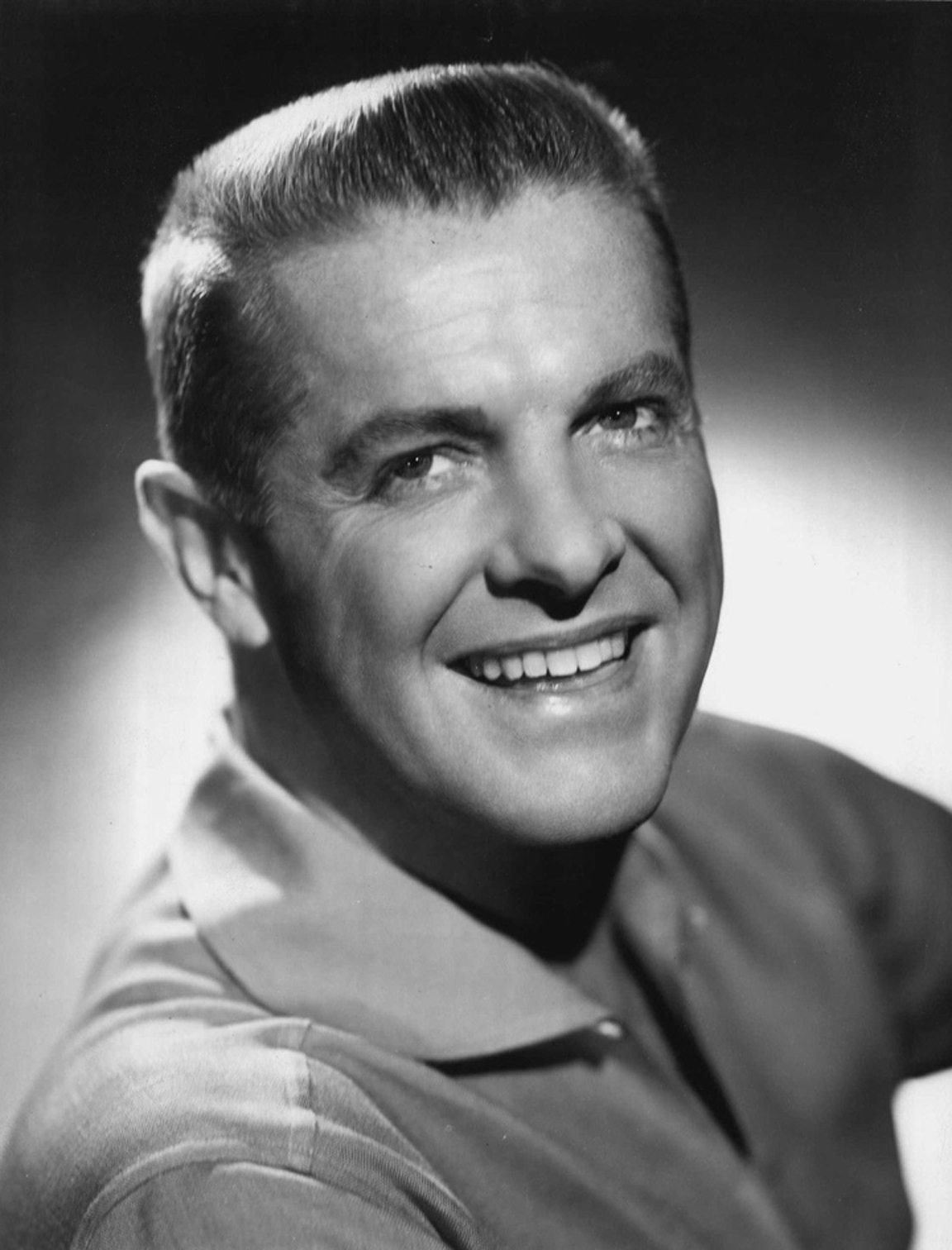
Robert Cummings
View on Wikipedia
Charles Clarence Robert Orville Cummings (June 9, 1910 – December 2, 1990)[1] was an American film and television actor who appeared in roles in comedy films such as The Devil and Miss Jones (1941) and Princess O'Rourke (1943), and in dramatic films, especially two of Alfred Hitchcock's thrillers, Saboteur (1942) and Dial M for Murder (1954).[2] He received five Primetime Emmy Award nominations, and won the Primetime Emmy Award for Best Actor in a Single Performance in 1955. On February 8, 1960, he received two stars on the Hollywood Walk of Fame for his contributions to the motion picture and television industries,[1] at 6816 Hollywood Boulevard and 1718 Vine Street.[3] He used the stage name Robert Cummings from mid-1935 until the end of 1954 and was credited as Bob Cummings from 1955 until his death.[4][5]
Key Information
Early life
[edit]Cummings was born in Joplin, Missouri, a son of Dr. Charles Clarence Cummings and the former Ruth Annabelle Kraft.[6] His father was a surgeon, part of the original medical staff of St. John's Hospital in Joplin, and the founder of the Jasper County Tuberculosis Hospital in Webb City, Missouri.[7] Cummings's mother was an ordained minister of the Science of Mind.[6]
While attending Joplin High School, Cummings learned to fly.[8] His first solo flight was on March 3, 1927.[9] Some reports of his learning to fly refer to Orville Wright, the aviation pioneer, as being his godfather and flight instructor.[10][11][12][13] However, these reports appear to be based on either media interviews of Cummings or other anecdotal references.[14][15][16][17][2] There is no historical record of Orville Wright having traveled to Joplin, Missouri, either around the time of the gestation or the birth of Cummings, or during 1927, the year Cummings learned to fly.[18][19][20] Cummings, born in 1910, would have been only 8 years old when Orville Wright had essentially stopped flying on May 13, 1918, as a result of injuries he sustained in an accident at Fort Myer, Virginia, on September 17, 1908.[21][22][23] The report that Orville Wright taught Cummings to fly is also contradicted by Cummings' interview reported in the March 1960 Flying magazine.[24] In the interview, Cummings described how he learned to fly "by trial and error, mostly error" during 3 hours of instruction from a Joplin, Missouri, plumber named Cooper before he soloed on March 3, 1927.[24] During high school, Cummings gave Joplin residents rides in his aircraft for $5 per person.[7]
When the government began licensing flight instructors, Cummings was issued flight instructor certificate No. 1, making him the first official flight instructor in the United States.[9][25]
Education
[edit]Cummings studied briefly at Drury College in Springfield, Missouri, but his love of flying caused him to transfer to the Carnegie Institute of Technology in Pittsburgh. He studied aeronautical engineering for a year before he dropped out for financial reasons, his family having lost heavily in the 1929 stock market crash.[7][26]
Cummings became interested in acting while performing in plays at Carnegie Tech, and decided to pursue it as a career.[27] Since the American Academy of Dramatic Arts in New York City paid its male actors $14 a week, Cummings decided to study there.[28] He stayed only one season, but later said he learned "three basic principles of acting. The first – never anticipate; second – take pride in my profession. And third – trust in God. And that last is said in reverence."[29]
Career
[edit]Blade Stanhope Conway
[edit]Cummings started looking for work in 1930, but couldn't find any roles, forcing him to get a job at a theatrical agency.[7] Realizing that, at the time, "three quarters of Broadway plays were from England"[30] and that English accents and actors were in demand, Cummings decided to cash in an insurance policy and buy a round-trip ticket there.[31]
He was driving a motorbike through the countryside, picking up the accent and learning about the country, when his bike broke down at Harrogate. While waiting for repairs, he devised a plan. He invented the name "Blade Stanhope Conway" and bribed the janitor of a local theatre to put on the marquee: "Blade Stanhope Conway in Candida". He then had a photo taken of himself in front of the marquee and had 80 prints made. In London, he outfitted himself with a new wardrobe, composed a letter introducing the actor-author-manager-director "Blade" of Harrogate Repertory Theatre, and sent it off to 80 New York theatrical agents and producers.[30]
As a result, when Cummings returned to New York, he was able to obtain several meetings.[28][7]
One of the producers to whom he sent letters, Charles Hopkings, cast him in a production of The Roof by John Galsworthy, playing the role of the Hon. Reggie Fanning. Also in the cast was Henry Hull.[32] The play ran from October to November 1931 and Brooks Atkinson of The New York Times listed "Conway" among the cast who provided "some excellent bits of acting".[33]
In November 1932, "Conway" replaced Edwin Styles in the Broadway revue Earl Carroll's Vanities[34] after studying song and dance by correspondence course.[35]
Cummings later encouraged an old drama-school classmate, Margaret Kies, to use a similar deception – she became the "British" Margaret Lindsay.[27] He later said pretending to be Conway broke up his marriage to Emma Myers, a girl from Joplin. "She couldn't stand me."[36]
He was an extra in the Laurel and Hardy comedy Sons of the Desert (1933)[37] and in the Vitaphone musical short Seasoned Greetings (1933).
Bryce Hutchens
[edit]Cummings decided to change his approach, when in the words of one report, "suddenly the bottom dropped out of the John Bull market; almost overnight, demand switched from Londoners to lassoers."[30]
In 1934, Cummings changed his name to "Bryce Hutchens".[28][7][38] He appeared under this name in the Ziegfeld Follies of 1934, which ran from January to June in 1934.[39][40] He had a duet with Vivi Janiss, a native of Nebraska, with whom he sang "I Like the Likes of You".[41] Cummings and Janiss went with the show when it went on tour after the Broadway run, and they married toward the end of the tour.[26]
Paramount
[edit]The tour of Ziegfeld ended in Los Angeles in January 1935. Cummings enjoyed the city and wanted to move there.[42][26] He returned to New York, then heard King Vidor was looking for Texan actors for So Red the Rose (1935). Cummings auditioned, pretending to be a Texan, having acquired his own version of a Texan accent by listening to cowboy bands on the radio.[30] His ruse was exposed, but Vidor nevertheless cast Cummings under his actual name.[35][43][31] In their review, The New York Times said that Cummings "does a fine bit" and "has the only convincing accent in the whole film."[44]
He followed this with a part in Paramount's The Virginia Judge (1935).[45] In July, the studio signed Cummings to a long-term contract.[46] Before his first two Paramount films were released, he was also cast in a supporting role in Millions in the Air (1935).[7][47]
Paramount was then remaking old Zane Grey silent westerns for the talking screen, with new scripts and performers. Robert Cummings appeared as one of the leads in the westerns Desert Gold (1936) and Arizona Mahoney (1936). He then had a supporting role in Forgotten Faces (1936) and a starring role in Three Cheers for Love (1936).[48] He also appeared in:
- Border Flight (1936)
- Hollywood Boulevard (1936)
- The Accusing Finger (1936)
- Hideaway Girl (1936)
- The Last Train from Madrid (1937).[49][35]
Most of these were B pictures. He had a small role in an A picture, Souls at Sea (1937), then appeared in Sophie Lang Goes West (1937), Wells Fargo (1937) and College Swing (1938). He had a small role in You and Me (1938) (directed by Fritz Lang), and was in The Texans (1938) and Touchdown, Army (1938).
Eventually, Paramount dropped their option on him. "I was poison", he said. "No agent would look at me."[36] In June, Paramount announced he would return for King of Chinatown with Anna May Wong, but he does not appear in the final film.[50] In September he was cast at Republic, playing the lead in the crime movie I Stand Accused (1938). Cummings said it was "...a fluke hit—so at least I could get inside the casting agents again."[36]
Universal
[edit]
In November 1938, Cummings auditioned for the romantic lead in Three Smart Girls Grow Up (1939), starring Deanna Durbin, for producer Joe Pasternak.[51] Pasternak was reluctant to cast him, preferring to find a musician, but Cummings told him, "I could fake it". He later said, "I'd had a lot of experience faking things harder than that. He let me try it and he signed me up."[36]
On 21 November Universal gave Cummings an option on a seven-year contract starting at $600 a week, going up to $750 a week the following year, then ultimately up to $3,000 a week.[52] His first film for them, Three Smart Girls Grow Up (1939) was a big success, and in March 1939 Universal took up their options on the actor. The film was directed by Henry Koster, who called Cummings "brilliant, wonderful... I made five pictures with him. I thought he was the best leading man I ever worked with. He had that marvelous comedy talent and also a romantic quality."[53] Reviewing the film, Frank S. Nugent of The New York Times said Cummings "displays a really astonishing talent for light comedy—we never should have suspected it from his other pictures."[54] Filmink wrote "Cummings found himself as an actor" with this movie.[5]
Pasternak used him again, as the juvenile lead in The Under-Pup (1939). Although it was the first film to give Robert Cummings billing above the film title, The Under-Pup was actually a showcase for the studio's newest singing star, Gloria Jean. Although Cummings did well in the light-comedy role, the trade columnists and reporters concentrated on Gloria Jean, overshadowing Cummings. Universal announced that the Under-Pup cast, including Cummings, would be reunited in a sequel, Straight from the Heart, [55] but the project was canceled when producer Pasternak left the studio.[56] The follow-up, with Robert Stack standing in for Cummings, was A Little Bit of Heaven (1940).
In August 1939 Columbia wanted Cummings for the lead in Golden Boy, but could not come to terms with Universal;[57] the role went instead to screen newcomer William Holden. Cummings supported Basil Rathbone and Victor McLaglen in Rio (1939), then was borrowed by 20th Century-Fox to romance Sonia Henie in Everything Happens at Night (1939). At Universal he had a key role in Charlie McCarthy, Detective (1939), then was borrowed by MGM to play the lead in a B movie with Laraine Day, And One Was Beautiful (1940). Back at Universal, Cummings was the romantic male lead in a comedy, Private Affairs (1940); then he romanced Durbin again in Spring Parade (1940). Cummings made his mark in the CBS Radio network's dramatic serial titled Those We Love, which ran from 1938 to 1945. He also played the role of David Adair in the serial drama Those We Love, opposite Richard Cromwell, Francis X. Bushman and Nan Grey.
A series of classic films
[edit]
Cummings and Allan Jones were cast as the comic leads in the film One Night in the Tropics (1940), but they were overshadowed by the performances (as supporting actors, in their first film) of Abbott and Costello.[5]
MGM borrowed Cummings a second time, to play opposite Ruth Hussey in Free and Easy (1941). In the same period, he was borrowed by a company established by Norman Krasna and Frank Ross, who were making a comedy from a script by Krasna for release through RKO: The Devil and Miss Jones (1941). Cummings played a union leader, Jean Arthur's love interest, under the direction of Sam Wood. Cummings shot the film at the same time as Free and Easy.[58] Free and Easy lost money for MGM, but Devil and Miss Jones was a critical and commercial success. 20th Century Fox borrowed him for Moon Over Miami (1941), starring Don Ameche and Betty Grable; Fox was willing to postpone the film so Cummings could finish Devil and Miss Jones.[59]
In January 1941 Louella Parsons wrote, "Is that boy going places in 1941. From the looks of things it's a Cummings year – because all his troubles with Universal are ironed out and almost every studio in town wants to borrow him."[60] Back at Universal, Pasternak used Cummings as the romantic male lead in It Started with Eve (1941), from a script by Krasna opposite Deanna Durbin and Charles Laughton. Meanwhile, Sam Wood was directing an adaptation of the novel Kings Row (1942) over at Warner Bros, where the head of production was Hal Wallis. Wallis did not have any contract players at Warner Bros who were considered ideal for the role of Paris, and after trying desperately to get Tyrone Power, he tried to borrow Cummings, who had done an impressive screen test.[61] However, Cummings was busy on It Started with Eve and the actor had to drop out. Then the schedule was rearranged and Cummings was able to make both films.[62] Production of Kings Row did have to be suspended for a week so Cummings could return to Universal to do reshoots for Eve.[63] Both films were huge successes. Hal Wallis said Cummings "was actually too old for the part" in Kings Row "not quite right, but he was helped considerably by an extraordinary support cast."[64]
Back at Universal, Cummings starred in the Alfred Hitchcock spy thriller Saboteur (1942), made at Universal, with Priscilla Lane and Norman Lloyd. He played Barry Kane, an aircraft worker wrongfully accused of espionage, trying to clear his name.[65] In December 1941, John Chapman said Cummings was among "the most sought-after leading men in town" and was one of his "stars for 1942".[66] Filmink wrote "Few male actors had a hot streak like Robert Cummings from 1941 to 1942: The Devil and Miss Jones, It Started with Eve, Kings Row and Saboteur are all stone-cold classics, and he made crucial contributions to all."[5]
Universal announced Cummings for Boy Meets Baby with Deanna Durbin,[67] which became Between Us Girls (1942) with Diana Barrymore. He filmed it concurrently with a Hal Wallis movie at Warner Bros titled Princess O'Rourke (made 1942, released 1943), Norman Krasna's directorial debut. Cummings was meant to be in We've Never Been Licked (1943) for Walter Wanger at Universal,[68] but did not appear in the film.
World War II
[edit]In December 1941, Cummings joined the fledgling Civil Air Patrol, an organization of citizens and pilots interested in helping support the U.S. war effort. In February 1942, he helped establish Squadron 918-4 located in Glendale, California, at the Grand Central Air Terminal, becoming its first commanding officer. Two weeks later, he and other members of the squadron went in search of the Japanese submarine that had attacked the oil refinery at Goleta, California. During the war, Cummings participated in search and rescue missions, courier missions, and border and forestry patrols around the Western United States. For this work he used his own aircraft, Spinach I, a 1936 Porterfield, and Spinach II, a Cessna 165 Airmaster. The squadron he established still operates as San Fernando Senior Squadron 35 and is based at Whiteman Airport in Pacoima, Los Angeles. In November 1942, Cummings joined the United States Army Air Forces.[69] During World War II, he served as a flight instructor.[2][7] After the war, Cummings served as a pilot in the United States Air Force Reserve, where he achieved the rank of captain.[70] Cummings played aircraft pilots in several of his postwar film roles. During the war service, he had small roles in the all-star Forever and a Day (1943) and Flesh and Fantasy (1943), but he was effectively off screen for two years.[71]
Suspension from Universal
[edit]Cummings was meant to be in Fired Wife with Teresa Wright, Charles Coburn, and Eddie Anderson and a director "comparable with" Leo McCarey. However, when he found out these actors would not be in the film, and the director would be Charles Lamont, he refused to be in it. (Filming began in April 1943 with Robert Paige taking Cummings's role.[72]) Universal put him on suspension for five weeks, refused to give him a new part, or pay his weekly salary of $1,500 after the suspension had been lifted. Cummings notified the studio in May 1943 that he considered himself no longer under contract. In September 1943, Cummings sued the studio for withheld wages of $10,700, also arguing that for some time, Universal tried to put him in minor roles to "run him ragged" and "to teach him a lesson".[73] In March 1944, the court ruled in Cummings's favor, saying Universal had voided its contract with the actor and owed him $10,700. This decision happened in the same fortnight as another court case involving Olivia de Havilland, which also ruled in the actor's favor.[74][75]
Freelance star
[edit]Hal Wallis
[edit]Cummings was considered free of Universal effective August 1944. In January he signed a four-year exclusive contract with Hal Wallis, who had left Warner Brothers to become an independent producer.[76] Shortly after, he took leave from the Air Force to star in You Came Along (1945) for Hal Wallis, directed by John Farrow with a screenplay by Ayn Rand. The Army Air Forces pilot Cummings played, Bob Collins, died off camera, but was resurrected 10 years later for Cummings's television show. Cummings was under contract to Wallis for four years.[71][77] Also for Wallis—who had now moved to Paramount—he did The Bride Wore Boots (1946), a comedy with Barbara Stanwyck. He was announced for Dishonorable Discharge for Wallis from a story by John Farrow, but it appears to have not been made.[78] Neither was Its Love Love Love, which was announced by RKO,[79] or Dream Puss, which Wallis announced for Cummings at Paramount.[80]
In 1946, Cummings said, "Often I play the boyfriend of a girl young enough to be my daughter. I'm 36, and whenever I start drooping, I run one of my pictures and feel like a kid again."[81] Around this time, he also said he was more interested in producing and directing, and hoped to act in only one film per year.[82]
United California Productions
[edit]
Cummings had the leads in two films for Nero Films, a production company run by Seymour Nebenzal and Eugene Frenke, who released through United Artists: a film noir, The Chase (1946); and a Western, Heaven Only Knows (1947).
Cummings decided to form his own production company with Frenke and Philip Yordan, which they called United California. (They originally called it United World, but it was too similar to another company's name.[83][84]) In December 1946, it was announced that Cummings had signed an exclusive contract with United California Productions, and that his deal with Wallis was for one film a year for seven years.[85][86] They announced Bad Guy from a script by Yordan.[87] They were also going to do Joe MacBeth[88] (which was ultimately made by others).
In 1947, Cummings had reportedly earned $110,000 in the preceding 12 months.[89] The Lost Moment (1947) with Susan Hayward was a film noir for Walter Wanger at Universal based on The Aspern Papers by Henry James. It was a resounding flop at the box office. Cummings was initially meant to follow it with The Big Curtain for Edward Alperson at Fox but that picture was never produced.[90]
Cummings appeared in Sleep, My Love (1948), another noir, directed by Douglas Sirk and produced by Mary Pickford.
United California eventually brought in manufacturer Frank Hale as partner. Its first film, Let's Live a Little (1948), was a romantic comedy with Hedy Lamarr, released through United Artists.
Cummings announced a series of projects for United California: Ho the Fair Wind from a novel by IAR Wylie, The Glass Heart by Mary Holland, Poisonous Paradise (a docudrama for which some footage had been shot called Jungle), Passport to Love by Howard Irving Young, and a remake of Two Hearts in Three Quarter Time. Cummings was also trying to interest Norman Krasna into writing the story of how Cummings broke into acting, to be called Pardon My Accent.[91][92][93]
Cummings did the melodrama The Accused (1949) for Hal Wallis at Paramount, supporting Loretta Young.
Reign of Terror (1949) was a thriller set in the French Revolution for director Anthony Mann; Eagle Lion co-produced with United California.[94]
Cummings did a comedy at Universal, Free for All (1949).
Columbia
[edit]In July 1949, Cummings signed a three-picture deal with Columbia.[95] He made Tell It to the Judge (1949), with Rosalind Russell, for them. He did one for Wallis at Paramount, Paid in Full (1950) (originally Bitter Victory), then went back to Columbia for The Petty Girl (1950) a musical with Joan Caulfield.
Cummings did announce he would make The Glass Heart for his own company and release through Columbia, but this did not happen.[96]
Cummings supported Clifton Webb in For Heaven's Sake (1950) at Fox, then played a con man in The Barefoot Mailman (1950), his third film for Columbia.
Cummings began working in television, appearing in Sure as Fate ("Run from the Sun") and Somerset Maugham TV Theatre ("The Luncheon").
He was in a Broadway play Faithfully Yours (originally The Philemon Complex), which had a short run in late 1951.[97][98] In November 1951 he announced he only had one more Columbia commitment and was open to doing more theatre.[99]
At Columbia, he was in The First Time (1952), the first feature directed by Frank Tashlin. On TV, he was in Lux Video Theatre ("The Shiny People", "Pattern for Glory"), Betty Crocker Star Matinee ("Sense of Humor"), and Robert Montgomery Presents ("Lila My Love").
Cummings was one of the four stars featured in the short-run radio version of Four Star Playhouse.
He was offered Battle in Spain, the story of El Cid, with Linda Darnell, but turned it down because it was too controversial.[100]
Television star
[edit]My Hero
[edit]
Cummings starred in his first regular television series in the comedy My Hero (1952–53), playing a bumbling real estate salesman. He also wrote and directed some episodes.[101] The series ran for 33 episodes before (it was reported) Cummings decided to end it and accept other offers.[102] In reality, the show had been axed. "After it was dropped, I was as dead as you could possibly get in show business" said Cummings. "I sat in my agent's office one day and heard a top producer tell him on the phone that nobody would buy me."[103] Out of work, he accepted the State Department's invitation to go on a goodwill mission to Argentina.[103] The show earned him an Emmy nomination.[104]
Cummings was in Marry Me Again (1953) at RKO for Tashlin, then went to England to star in another Hitchcock film, Dial M for Murder (1954), playing the lover of Grace Kelly, whose husband Ray Milland tries to kill her. The film was a hit.[2][7]
Cummings then supported Doris Day in a musical at Warner Bros, Lucky Me (1954).[105]
He was chosen by producer John Wayne as his co-star to play airline pilot Captain Sullivan in The High and the Mighty, partly due to Cummings's flying experience; however, director William A. Wellman overruled Wayne and hired Robert Stack for the part.[106]
Twelve Angry Men
[edit]In 1954, Cummings appeared in Twelve Angry Men, an original TV play for Westinghouse Studio One written by Reginald Rose and directed by Franklin Schaffner, alongside actors including Franchot Tone and Edward Arnold. Cummings played Juror Number Eight, the role taken by Henry Fonda in the feature-film adaptation.[7][107] Cummings's performance earned him the 1955 Emmy Award for Best Actor in a Single Performance.[108]
Other television appearances included Campbell Summer Soundstage ("The Test Case"),[109] Justice ("The Crisis"), The Elgin Hour ("Floodtide"),[110] and a TV version of Best Foot Forward (1954).[111]
Laurel Productions and The Bob Cummings Show
[edit]In July 1954, Cummings formed his own independent film production company, Laurel Productions, Incorporated. The company's name had several affiliations to Cummings: his youngest daughter was named Laurel Ann Cummings; the street he and his family lived on was named Laurel Way; his wife's grandmother's name was Laurel; and finally, the fact that Laurel & Hardy had given Cummings his film debut back in 1933.[112][113][114] His wife Mary Elliott was appointed president of Laurel Productions.[113] In July 1954, Cummings filmed the pilot for his television show, The Bob Cummings Show, and would go on to produce 173 episodes.[114][115][116][117]
Cummings intended to produce a film titled The Damned through Laurel Productions, from a novel by John D. MacDonald and to be written and directed by Frank Tashlin.[112][118] In December 1954, Cummings and George Burns formed Laurmac Productions, with the hope of co-producing a feature film in May 1955.[119]
In January 1955, The Bob Cummings Show began airing, and went through 1959. Cummings starred on the successful NBC sitcom, The Bob Cummings Show (known as Love That Bob in reruns), where he played Bob Collins, a former World War II pilot who became a successful professional photographer. The character, a bachelor in 1950s Los Angeles, considered himself quite the ladies' man. The sitcom was noted for some very risqué humor for its time. Reviewing the show, Variety wrote "few video performers are as infectious as Bob Cummings" calling the sitcom "a combination of corn, slapstick and sex. If it took itself seriously, it'd bomb bigger than Bikini. But everybody acts as though he's improvising on a camp picnic."[120]
A popular feature of the program was Cummings's portrayal of his elderly grandfather. His co-stars were Rosemary DeCamp as his sister Margaret MacDonald; Darryl Hickman as his nephew Chuck MacDonald; Lyle Talbot as his old Air Force buddy Paul Fonda, and Ann B. Davis, in her first television success, as his assistant Charmaine "Schultzy" Schultz.
When Cummings appeared on the NBC interview program Here's Hollywood,[7] he was seen by Nunnally Johnson, who cast him opposite Betty Grable in How to Be Very, Very Popular (1955) at Fox, which turned out to be Grable's last film. Cummings's contract was amended to allow him time off to rehearse and record his TV show.[121]
Around this time, Cummings said he had made 78 films, and "I always had the feeling I was distinguished for none of them. Hollywood's never been really hot about me. I was always second choice. I used to say to my wife Mary, 'Somebody's got to be sick someday – Bill Holden or maybe some boy not even born yet! I used to say 'If I could find another business where I could be successful!'."[104]
Cummings was one of the hosts on ABC's live broadcast of the opening day of Disneyland on July 17, 1955, along with Ronald Reagan and Art Linkletter. On that day, Cummings played off his playboy character image by being “caught” embracing and kissing a young woman in a bonnet with a stricken look on her face.
Cummings's performance in The Bob Cummings Show earned him another Emmy nomination for Best Actor in a Continuous Role in 1956.[122]
He turned down The Heavenly Twins for the Theatre Guild; and was mentioned for Bewitched by Charles Bennett in England, but did not do it.[123]
During the series' production, Cummings still found time to play other roles. He returned to Studio One ("A Special Announcement"), and did episodes of General Electric Theater ("Too Good with a Gun"), The George Burns and Gracie Allen Show, and Schlitz Playhouse ("One Left Over", "Dual Control").
He was also in "Bomber's Moon" for Playhouse 90 (1958), from a Rod Serling script directed by John Frankenheimer, who said "Bobby's a really fine dramatic actor, but people usually associate him only with comedy. Naturally enough I suppose. Directing an actor like this who feels immediately what the script wants and what the director wants makes you love this business."[124]
"It's a great life, acting", Cummings said in 1959. "I wouldn't have it any other way. I'm a completely content actor."[125]
When his TV show ended in 1959, Cummings claimed it was his decision, as he was tired and wanted to take a year off. He was also keen to sell the show into syndication. "I don't think I'll do another comedy", he said.[126] The show had been very lucrative for him.[127]
In 1960, Cummings starred in "King Nine Will Not Return", the opening episode of the second season of CBS's The Twilight Zone, written by Serling and directed by Buzz Kulik.[128]
He guested on Zane Grey Theatre ("The Last Bugle", directed by Budd Boetticher), The DuPont Show of the Week ("The Action in New Orleans"[129]), The Dick Powell Theatre ("Last of the Private Eyes", co-starring Ronald Reagan), and The Great Adventure ("Plague").
The New Bob Cummings Show
[edit]The New Bob Cummings Show followed on CBS for one season, from 1961 to 1962. It was a variation of The Bob Cummings Show with Cummings as a pilot who had various adventures.[130][131] It ran for 22 episodes before being cancelled.[132]
Cummings returned to films with a supporting role in My Geisha (1962), written by Krasna. Variety called the actor "astonishingly youthful" and said "it's nice to see him back on the theatre screen."[133]
He was top-billed in Beach Party (1963), although the film is better remembered today for first teaming Frankie Avalon and Annette Funicello.[134] In its review of the film Variety wrote "Cummings shows himself to be amenable farceur and notably at ease. in surroundings which might embarrass a less professional star."[135]
Cummings had supporting roles in two popular films, The Carpetbaggers (1964) with George Peppard and Alan Ladd and What a Way to Go! (1964) with Shirley MacLaine, and was in Theatre of Stars ("The Square Peg").
Also in 1964, he was a guest as a beauty pageant judge in The Beverly Hillbillies episode, "The Race for Queen".
My Living Doll
[edit]In 1964–65, Cummings starred in another CBS sitcom, My Living Doll, co-starring Julie Newmar as Rhoda the robot and Jack Mullaney as his friend. After 21 episodes, Cummings asked to be written out of the show.[136] It lasted five more episodes.
Later career
[edit]
In the late 1960s, Cummings had supporting roles in The Carpetbaggers (1964), Promise Her Anything (1966) and the remake of Stagecoach (1966) (playing the bank embezzler).
Cummings had the lead in Five Golden Dragons (1967) for producer Harry Alan Towers and supported in Gidget Grows Up (1969).
He was in another Broadway play, The Wayward Stork, which had a short run in early 1966.[137] A review in The New York Times said Cummings "is not in top form. He sounded a bit hoarse and somewhat strained. Usually he is a quite acceptable, breezy farceur."[138]
He guest-starred again on Theatre of Stars ("Blind Man's Bluff"), as well as The Flying Nun ("Speak the Speech, I Pray You"), Green Acres ("Rest and Relaxation"), Here Come the Brides ("The She-Bear"), Arnie ("Hello, Holly"), Bewitched ("Samantha and the Troll"), Here's Lucy ("Lucy's Punctured Romance", "Lucy and Her Genuine Twimby"), and several episodes of Love, American Style.[139]
Cummings's last lead roles on film were in a pair of TV movies, The Great American Beauty Contest (1973) and Partners in Crime (1973).
During the 1970s for over 10 years, Cummings traveled the US performing in dinner theaters and short stints in plays while living in an Airstream travel trailer.
He relayed those experiences in the written introduction he provided for the book Airstream written by Robert Landau and James Phillippi in 1984.[140]
Cummings had a cameo in Three on a Date (1978) and appeared in 1979 as Elliott Smith, the father of Fred Grandy's Gopher on ABC's The Love Boat.[141]
In 1986, Cummings hosted the 15th-anniversary celebration of Walt Disney World on The Wonderful World of Disney.
In 1987, he said, "I wouldn't mind living until I'm 110. I still swim, do calisthenics, and keep fit. I've never been in hospital, except for a hernia operation at one time. People laugh about my using so many vitamins. When I tell them I take 50 liver pills a day, they look surprised, but whether they laugh or not, the thing works." He added, "I'm retired, I live on a pension" and "if I have a problem I get expert counsel, then ask the opinion of a good psychic."[142]
Robert Cummings's last public appearance was on The Magical World of Disney episode "The Disneyland 35th Anniversary Special" in 1990.
Personal life
[edit]Marriages
[edit]Cummings was married five times and fathered seven children. His first marriage was to Emma Myers, a girl from his hometown. His second marriage was to Vivi Janiss, an actress he met while performing in Ziegfeld Follies. His third wife, Mary Elliott, was a former actress, and she ran Cummings's business affairs. They separated in 1968 and had a bitter divorce, during the course of which she accused him of cheating on her with his former secretary Regina Fong and using methamphetamines which she said caused wild mood swings. She also claimed he relied on astrologers and numerologists to make financial decisions with "disastrous" consequences.[143] In 1970, when the divorce was finalized, their communal property was estimated as being worth from $700,000 to $800,000 (equivalent to between $5.8 million and $6.6 million in 2025).[144]
He was married to Regina Fong from 1971 to 1987 and married Martha Burzynski (1932-2017) two years later. He died the following year.
Hobbies
[edit]
He was an avid pilot and owned a number of airplanes, all named "Spinach".[145] He was a staunch advocate of natural foods and published a book on healthy living, Stay Young and Vital, in 1960.[146]
Legal troubles
[edit]In May 1948 Hedda Hopper reported that there were four lawsuits against Cummings.[147]
In 1952, Cummings was sued by a writer of My Hero who had been fired. In 1952, Cummings was served with papers concerning the suit by LA County Deputy Sheriff William Conroy; Cummings assaulted Conroy and was then sued by the sheriff for damages. Conroy stated that when he tried to serve Cummings with a subpoena the actor gunned the motor of his car and dragged him along the pavement. Cummings explained that he did not know Conroy was a deputy.[148] Both cases were settled in 1954.[149]
In 1972 he was charged with fraud for operating a pyramid scheme involving his company, Bob Cummings Inc, which sold vitamins and food supplements.[150]
In 1975 he was arrested for being in possession of a blue box used to defraud the telephone company.[151] He avoided trial under the double jeopardy rule.[152]
Reported drug addiction
[edit]Despite his interest in health, Cummings was alleged to have been a methamphetamine addict from the mid-1950s until the end of his life. In 1954, while in New York to star in the Westinghouse Studio One production of Twelve Angry Men, Cummings began receiving injections from Max Jacobson, the notorious "Dr. Feelgood".[153][154] His friends Rosemary Clooney and José Ferrer recommended the doctor to Cummings, who was complaining of a lack of energy. While Jacobson insisted that his injections contained only "vitamins, sheep sperm, and monkey gonads", they actually contained a substantial dose of methamphetamine.[155]
Cummings allegedly continued to use a mixture provided by Jacobson, eventually becoming a patient of Jacobson's son Thomas, who was based in Los Angeles, and later injecting himself. The changes in Cummings's personality caused by the euphoria of the drug and subsequent depression damaged his career and led to an intervention by his friend, television host Art Linkletter. The intervention was not successful, and Cummings's drug abuse and subsequent career collapse were factors in his divorces from his third wife, Mary, and fourth wife, Gina Fong.[153]
After Jacobson was forced out of business in the 1970s, Cummings developed his own drug connections based in The Bahamas. Suffering from Parkinson's disease, he was forced to move into homes for indigent older actors in Hollywood.[153]
Children
[edit]Cummings had seven children. His son, Tony Cummings, played Rick Halloway in the NBC daytime serial Another World in the early 1980s.
Political affiliation
[edit]Cummings was a supporter of the Republican Party.[156]
Death
[edit]On December 2, 1990, Cummings died of kidney failure and complications from pneumonia at the Motion Picture & Television Country House and Hospital in Woodland Hills, California.[146]
He is interred in the Great Mausoleum at Forest Lawn Cemetery in Glendale, California.[157]
Filmink called Cummings' career "a triumphant success – he did it all: Broadway, Hollywood, Harry Alan Towers, Golden Years of Television, Hitchcock, Deanna Durbin… He just made one mistake – he got on drugs."[5]
Filmography
[edit]Stage work
[edit]- The Roof (1931)
- Ziegfeld Follies of 1934 (1934)
- Faithfully Yours (1951)
- The Wayward Stork (1966)
- Remember It's Never Too Late (1972)
Television credits
[edit]- Somerset Maugham TV Theatre ("The Luncheon") (1951)
- Lux Video Theatre ("The Shiny People") (1951)
- My Hero (1951–1952) as Robert S. Beanblossom (33 episodes)
- Betty Crocker Star Matinee ("Sense of Humor") (1952)
- Robert Montgomery Presents ("Lila, My Love") (1952)
- Lux Video Theatre ("Pattern for Glory") (1952)
- Campbell Summer Soundstage ("The Test Case") (1954)
- Justice ("The Crisis") (1954)
- The Elgin Hour ("Floodtide") (1954)
- Best Foot Forward (1954) as Jack Haggerty
- Westinghouse Studio One ("Twelve Angry Men") (1954) as Juror No. 8
- The George Burns and Gracie Allen Show ("Gracie Thinks Bob Cummings Is in Love with Her") (1954)
- The Bob Cummings Show (1955–1959) as Bob Collins / Grandpa Josh Collins / Josh Collins (173 episodes)
- Dateline: Disneyland (1955) as Himself / Co-Host
- Studio One ("A Special Announcement") (1956) as George Lumley[159]
- General Electric Theater ("Too Good with a Gun") (1957) as Russ Baker
- The George Burns and Gracie Allen Show ("A Marital Mix-Up") (1957)
- The Lucy-Desi Comedy Hour (1957–1960) ("The Ricardos Go To Japan") (1959) as Himself
- Schlitz Playhouse ("One Left Over") (1957)
- Schlitz Playhouse ("Dual Control") (1957)
- Playhouse 90 ("Bomber's Moon") (1958) as Colonel Culver
- The Twilight Zone ("King Nine Will Not Return") (1960) as Capt. James Embry
- Zane Grey Theater ("The Last Bugle") (1960) as Lt. Charles B. Gatewood
- The New Bob Cummings Show (1961–1962) as Bob Carson (22 episodes)
- The Dick Powell Theatre ("The Last of the Private Eyes") (1963)
- Bob Hope Presents the Chrysler Theatre ("The Square Peg") (1964)
- The Great Adventure ("Plague") (1964) as Dr. Benjamin Waterhouse
- My Living Doll (1964–1965) as Dr. Robert McDonald
- Bob Hope Presents the Chrysler Theatre ("Blind Man's Bluff") (196y)
- The Flying Nun ("Speak the Speech, I Pray You") (1969) as Father Walter Larson
- Gidget Grows Up (1969) as Russ Lawrence
- Love, American Style (1969) (first ever episode) as Bert Palmer (segment "Love and the Pill")
- Hollywood Squares (1970) as Guest Appearance
- Love American Style (1970) as Grandpa (segment "Love and the Second Time")
- Green Acres ("Rest and Relaxation") (1970) as Mort Warner
- Here Come the Brides ("The She-Bear") (1970) as Jack Crosse
- Arnie ("Hello Holly" (1971)
- Bewitched ("Samantha and the Troll") (1971) as Roland Berkley
- The Good Life ("A Tremendous Sense of Loyalty") (1971)
- Here's Lucy ("Lucy's Punctured Romance") (1972) as Bob Collins
- The Great American Beauty Contest (1973)
- Partners in Crime (1973) as Ralph Elsworth
- Love American Style (1973) as Walding (segment "Love and the Secret Spouse")
- Three on a Date (1978)
- The Love Boat ("Third Wheel/Grandmother's Day/Second String Mom") (1979) as Eliott Smith - co starring with Ethel Merman
- Walt Disney's Wonderful World of Color ("Walt Disney World's 15th Anniversary Celebration") (1986) as Host / Narrator / Himself
- Disneyland's 35th Anniversary Special (1990) as Himself (final film role)
Radio credits
[edit]- Lux Radio Theatre "You Can't Take it With You" (1939)
- Suspense "Dead of the Night" (1944 and 1947)
- Lux Radio Theatre - "Without Reservations" (1946)
- Hollywood Star Time - "The Most Dangerous Game" (1946)
- Lux Radio Theatre - "Great Expectations" (1947)
- Screen Directors Playhouse - "Lets Live a Little" (1949)
- Lux Radio Theatre - "What a Woman" (1949)
- Four Star Playhouse - "Third Girl from the Right" (1949)
- Four Star Playhouse - "Surprise for the Professor" (1949)
- Lux Radio Theatre - "I'll Be Yours" with Ann Blyth (1950)
- Cavalcade of America - "Decision in the Valley" (1950)
- Screen Guild Theatre - "Tell It to the Judge" (1950)
- Cavalcade of America ("Spindletop") - with Teresa Wright (1951)
- Screen Directors Playhouse ("Bachelor Mother") (1951)[160]
- Cavalcade of America - "Uncle Eurys Dollar" (1951)
- Cavalcade of America ("Going Up") (1952)[161]
- Cavalcade of America - "The Melody Man" (1952)
- Four Star Playhouse - "The Hunted" (1953)[162]
- Lux Radio Theatre - "Strangers on a Train" (1954)
References
[edit]- ^ a b Oliver, Myrna (December 3, 1990). "Robert Cummings". Los Angeles Times.
- ^ a b c d Wise and Wilderson 2000, p. 189.
- ^ "Robert Cummings". Hollywood Walk of Fame. Retrieved June 27, 2016.
- ^ Robert Cummings Also Known As Bob Cummings at American Film Institute Catalog
- ^ a b c d e Vagg, Stephen (October 29, 2024). "Movie Star Cold Streaks: Robert Cummings". Filmink. Retrieved October 29, 2024.
- ^ a b FilmReference.com
- ^ a b c d e f g h i j k Christensen 1999, p. 225.
- ^ Greenwood, James R. (March 1960). "Meet Bob Cummings ... Pilot, Actor, Businessman". Flying. Vol. 66, no. 3. pp. 44, 46–47.
- ^ a b Greenwood 1960, p. 45.
- ^ "Robert Cummings". Walkoffame.com. Retrieved January 26, 2019.
- ^ WIse, James E. and WIlderson, III, Paul W. (2000). Stars in Khaki: Movie Actors in the Army and Air Services. Naval Institute Press. p. 189. ISBN 9781557509581.
{{cite book}}: CS1 maint: multiple names: authors list (link) - ^ "Charles Clarence Robert Orville Cummings". Des Moines Register. June 8, 1980.
- ^ "Cummings Joins Lucy Show". Ithaca Journal. September 8, 1972.
- ^ The Robert Briem Show, KABC-AM Radio (May 22, 1982 12:07 a.m. to 1:56 a.m), referenced at http://www.classicmoviehub.com/blog/classic-movie-trivia-robert-cummings-and-orville-wright/ Archived January 9, 2023, at the Wayback Machine Retrieved September 26, 2018.
- ^ Gatti, Annmarie (May 1, 2014). "Classic Movie Trivia: Robert Cummings and Orville Wright". Classic Movie Hub Blog. Archived from the original on May 10, 2019. Retrieved January 26, 2019.
- ^ "Cummings Joins Lucy Show" Ithaca Journal 1972
- ^ "Charles Clarence Robert Orville Cummings" Des Moines Register 1980.
- ^ Renstrom, Arthur G. (1975). Wilbur and Orville Wright A Chronology Commemorating the Hundredth Anniversary of the Birth of Orville Wright. Library of Congress. pp. 43–54 (August 1909 through December 1910), 83–84 (1927), and 208 (Orville Wright last flight as a pilot on May 13, 1918, in his Wright 1911 biplane). ISBN 0844401315.
- ^ McCullough, David G. (2015). The Wright Brothers. Simon & Schuster. ISBN 9781476728742.
- ^ Correspondence of Stephen Wright of The Wright Brothers Family Foundation, January 31, 2019 ("The Wrights' lives during this period [1909 - 1910] were busy and well documented. Most of their time was spent in travel throughout Europe and the East Coast and consisted of meetings, flying demonstrations, ceremonial appearances and the work of building airplanes. The story of Robert Cummings' father having met Orville, or both brothers in one account, make it seem likely to have been impossible. ... With regards to Orville having personally trained Robert Cummings to fly [in 1927]: I can tell you with reasonable certainty that Orville's last flight as Pilot in Command, as documented in Arthur George Renstrom's Chronology, was made in 1918.")
- ^ Renstrom 1975, pp. 32, 71.
- ^ Correspondence of Stephen Wright 2019.
- ^ Edwards, John Carver (2009). Orville's Aviators. McFarland & Co. p. 158. ISBN 9780786442270.
- ^ a b Greenwood 1960, p. 46.
- ^ "The Life Story Of: Robert Cummings". Voice. Vol. 23, no. 35. Tasmania, Australia. September 2, 1950. p. 4. Retrieved October 12, 2017 – via National Library of Australia.
- ^ a b c "The Life Story of Robert Cummings". Picture show. No. 36. December 5, 1936. p. 20. ProQuest 1880296370.
- ^ a b P. H. (August 29, 1937). "Greta Garbo and Hepburn used guile". The Washington Post. ProQuest 150943442.
- ^ a b c Lyon et al. 1987, p. 164.
- ^ Hopper, Hedda (October 1, 1950). "Movie Mills Prove Real Grind, Says 'Old Hand' Bob Cummings: Bob Cummings Describes Screen Actors' Problems". Los Angeles Times. p. E1.
- ^ a b c d "What's in a Name?". Los Angeles Times. February 9, 1963. ProQuest 168336124.
- ^ a b Wilkinson, L. A. (October 29, 1939). "Hoaxer of Hollywood". Los Angeles Times. ProQuest 165014887.
- ^ "CBC: Life And Times". CBC.ca. November 12, 2002. Retrieved July 25, 2012.
- ^ Brooks, B. J. (October 31, 1931). "The Play". The New York Times.
- ^ "New Roxy Theatre Plans Its Opening". The New York Times. November 23, 1932.
- ^ a b c Shaffer, R. (October 18, 1936). "Bob Cummings is a modern Horatio Alger in Hollywood". Chicago Daily Tribune.
- ^ a b c d Frederick C. Othman (March 29, 1939). "Prize faker finally lands regular job". The Washington Post. ProQuest 151188805.
- ^ "Features". laurel-and-hardy.com.
- ^ "Likeable Robert Cummings". Voice. Vol. 15, no. 34. Tasmania, Australia. August 22, 1942. p. 3. Retrieved October 12, 2017 – via National Library of Australia.
- ^ "Ziegfeld Follies of 1934". IBDB.
- ^ Bloom (October 14, 1934). "Clever Young Folks in "Follies"". Chicago Daily Tribune. ProQuest 181540837.
- ^ Tucker 2011, p. 185.
- ^ "Comic trio will appear". Los Angeles Times. January 23, 1935. ProQuest 163299654.
- ^ Paul H. (August 29, 1937). "Greta Garbo and Hepburn used Guile". The Washington Post. p. 1. ProQuest 150943442.
- ^ A. S. (November 28, 1935). "The Screen". The New York Times. p. 6.
- ^ Schallert, E. (July 13, 1935). "D. W. Griffith preparing to film "broken blossoms" for English company". Los Angeles Times. ProQuest 163356338.
- ^ "Screen Notes". The New York Times. July 17, 1935.
- ^ Scheuer, Philip K. (August 26, 1935). "Luise Rainer and William Powell, "Escapade" Stars, United for "Ziegfeld"". Los Angeles Times. p. 19. ProQuest 163390829.
- ^ "Cummings Groomed For Stellar Parts". The Washington Post. April 26, 1936. p. AA3.
- ^ Harrison, F. (February 13, 1936). "Hollywood News and Gossip". The China Press.
- ^ Schallert, Edwin (July 29, 1938). "United Artists Allots Wanger $1,500,000". Los Angeles Times. p. 15.
- ^ "Screen News Here and in Hollywood". The New York Times. November 17, 1938.
- ^ Read, K. (December 6, 1938). "Around and about in Hollywood". Los Angeles Times. ProQuest 164888934.
- ^ Davis, Ronald L. (2005). Just making movies. University Press of Mississippi. p. 8.
- ^ Frank S. Nugent (March 18, 1939). "The Screen: Deanna Durbin Scores Again in 'Three Smart Girls Grow Up'". The New York Times. p. 9.
- ^ "Gloria Jean's Starring Career to Gain New Zip". Los Angeles Times. May 13, 1940. p. 11.
- ^ MacGillivray, Scott and Jan. Gloria Jean: A Little Bit of Heaven, iUniverse, 2005, p. 56. ISBN978-0-595-37080-1.
- ^ Schallert, Edwin (March 27, 1939). "Verne Sub-Sea Saga Acquires Sudden Life: Cary-Carole Duettino Music Fills Disney Air Gertrude Michael Signs Cummings Bit for 'Boy'". Los Angeles Times. p. 18.
- ^ Frank Daugherty (March 7, 1941). "Easy to make a picture, if combination is right". The Christian Science Monitor. ProQuest 515683755.
- ^ Douglas W. Churchill (January 10, 1941). "Fox signs don ameche, carole landis and robert cummings for roles in 'miami'". The New York Times. ProQuest 105505046.
- ^ Parsons, Louella O. (January 11, 1941). "Close-Ups and Long-Shots Of the Motion Picture Scene". The Washington Post. p. 6.
- ^ Louella O. Parsons (May 1, 1941). "Close-Ups and Long-Shots of the Motion Picture Scene". The Washington Post. p. 12.
- ^ Douglas W. Churchill (July 11, 1941). "Screen News Here and in Hollywood". The New York Times.
- ^ Douglas W. Churchill (September 15, 1941). "Screen News Here and in Hollywood". The New York Times.
- ^ Wallis, Hal B.; Higham, Charles (1980). Starmaker: the autobiography of Hal Wallis. Macmillan Pub. Co. p. 101.
- ^ Douglas W. Churchill (November 8, 1941). "Screen News Here and in Hollywood". The New York Times.
- ^ Chapman, J. (December 28, 1941). "The Stars of 1942!". Chicago Daily Tribune. ProQuest 176583435.
- ^ "Article 12 -- no title". The New York Times. January 10, 1942. ProQuest 106249615.
- ^ "Screen News Here and in Hollywood". The New York Times. October 3, 1942.
- ^ Ashbu 2006, p. 265.
- ^ "Cummings, Robert Orville ('Bob'), Capt." Togetherweserved.com. Retrieved: March 15, 2015.
- ^ a b "Cummings Going Places". Chicago Daily Tribune. May 20, 1945. ProQuest 177129879.
- ^ "Screen News Here and in Hollywood". The New York Times. April 16, 1943. ProQuest 106690770.
- ^ "Actor Robert Cummings Sues Over 'Minor Roles'". Los Angeles Times. September 24, 1943. p. 13. ProQuest 165469900.
- ^ Fred S. (March 26, 1944). "Hollywood Mulls Court Decisions". The New York Times. p. 1.
- ^ "United States Court of Appeals For the Ninth Circuit – Universal vs Robert Cummings" – via Internet archive.
- ^ "Screen News: Ida Lupino, Zachary Scott Set for 'Mrs. Carrolls'". January 25, 1945. p. 16.
- ^ Hedda Hopper (May 20, 1945). "Cummings Going Places: Looking at Hollywood". Chicago Daily Tribune. p. C2.
- ^ "Screen News". The New York Times. June 1, 1945. ProQuest 107158033.
- ^ Schallert, E. (January 9, 1946). "Pickford, Rogers line up six film subjects". Los Angeles Times.
- ^ "Paramount Signs Robert Cummings". The New York Times. May 18, 1946.
- ^ Condon, R. (June 9, 1946). "A kid of thirty-six". Los Angeles Times.
- ^ Zylstra, F. (September 29, 1946). "Cummings is going places". Chicago Daily Tribune.
- ^ T. F. (March 2, 1947). "Sifting the Hollywood News". The New York Times. ProQuest 107807555.
- ^ "Film Firm Formed by Chaplin's Son". The New York Times. August 20, 1946. ProQuest 107520981.
- ^ Schallert, E. (December 2, 1946). "Jupiter, juno deal on; allied pacts bennett". Los Angeles Times. ProQuest 165749096.
- ^ Scheuer, P. K. (December 12, 1946). "Bart Marshall signed as fourth star in 'Ivy'". Los Angeles Times. ProQuest 165714841.
- ^ Scheuer, P. K. (December 20, 1946). "Ruth Warrick to star in 'Unguarded Heart'". Los Angeles Times. ProQuest 165708766.
- ^ Thomas F. Brady (February 6, 1947). "New Film Concern Plans First Movie". The New York Times. ProQuest 107836057.
- ^ "Theater Mogul With $568,143 Top '45 Earner: Betty Grable's $208,000 Leads Women". Chicago Daily Tribune. August 26, 1947. p. 5.
- ^ Thomas F. Brady (March 1, 1947). "Cotten to Appear in Selznick Film: Actor Will Play Dual Role in 'Rupert of Hentzau,' Which Producer Is Remaking". The New York Times. p. 11.
- ^ A.H. Weiler (October 17, 1948). "By Way of Report: Actor to star double; 'lydia bailey' on slate". The New York Times. p. 1. ProQuest 108258717.
- ^ Schallert, E. (June 7, 1948). "Actor to Star Double; 'Lydia Bailey' on Slate". Los Angeles Times. ProQuest 165825061.
- ^ Schallert, E. (March 23, 1948). "Amdzon Luring Movies; Niesen Back in Cinema". Los Angeles Times. ProQuest 165803103.
- ^ "News of the Screen". The New York Times. August 3, 1948. ProQuest 108349600.
- ^ Schallert, E. (July 23, 1949). "'Song of Norway' film lurking for Jeffreys; John Russell gets lead". Los Angeles Times. ProQuest 165982025.
- ^ Thomas F. Brady (July 23, 1949). "Deborah Kerr Gets Metro Movie Lead". The New York Times. ProQuest 105803181.
- ^ "Faithfully Yours – Broadway Play – Original". IBDB.
- ^ J.P. Shanley (July 19, 1951). "'Two on Aisle' Due to Arrive Tonight". The New York Times. ProQuest 111914562.
- ^ "Cummings seeking legiter for next year". Variety. November 14, 1951. p. 57.
- ^ Hopper, H. (July 2, 1952). "Looking at Hollywood". Chicago Daily Tribune. ProQuest 178376543.
- ^ Ames, W. (November 8, 1952). "Cummings' my hero series to debut tonight; pair of grid games for television fans". Los Angeles Times. ProQuest 166416368.
- ^ Swirsky, S. (August 13, 1953). "Robert Cummings explains why his TV show is off the air". Los Angeles Times. ProQuest 166519526.
- ^ a b Thomas, B. (January 12, 1958). "Bob Cummings Show Remains Right at Top". Chicago Daily Tribune. ProQuest 180290349.
- ^ a b Scheuer, P. K. (April 3, 1955). "A Town Called Hollywood". Los Angeles Times. ProQuest 166745718.
- ^ "Hollywood Diary". The World's News. No. 2727. New South Wales, Australia. March 27, 1954. p. 27. Retrieved October 12, 2017 – via National Library of Australia.
- ^ McGivern 2006, p. 82.
- ^ Review of production at Variety
- ^ "Gobel named top new TV personality". Chicago Daily Tribune. March 8, 1955. ProQuest 179393566.
- ^ Review of production at Variety
- ^ a b "Boxoffice-September.24.1955". yumpu.com. Retrieved June 27, 2021.
- ^ a b "Chicago Tribune from Chicago, Illinois on May 12, 1956 · 39". Newspapers.com. May 12, 1956. Retrieved June 27, 2021.
- ^ a b "Chicago Tribune from Chicago, Illinois on December 8, 1956 · 61". Newspapers.com. December 8, 1956. Retrieved June 27, 2021.
- ^ Fink, J. (December 8, 1956). "The President of the Corporation Says". Chicago Daily Tribune. ProQuest 179997896.
- ^ Review of prodiction at Variety, Jan 1955
- ^ Review of show at Variety Oct 1955
- ^ Scheuer, Philip K. (November 21, 1955). "Drama: Indie Setups Announced by Cummings, Chandler; Hello, Barry Fitzgerald". Los Angeles Times. p. 41.
- ^ "The Los Angeles Times from Los Angeles, California on December 30, 1954 · 51". Newspapers.com. December 30, 1954. Retrieved June 27, 2021.
- ^ "The Bob Cummings Show". Variety. October 10, 1956. p. 35.
- ^ Louella parsons (January 29, 1955). "Bob's already very, very popular". The Washington Post and Times-Herald. ProQuest 148745816.
- ^ Ames, W. (February 24, 1956). "TV 'emmy' nominees named by DeFore; daly emcees eastern awards". Los Angeles Times. ProQuest 166918241.
- ^ Hopper, H. (March 10, 1955). "Gregory gets rights to novels by Wolfe". Los Angeles Times. ProQuest 166753397.
- ^ Smith, C. (May 22, 1958). "The TV Scene". Los Angeles Times.
- ^ J. C. (March 29, 1959). "Bob is becoming TV's Dorian Gray". The Washington Post and Times-Herald. ProQuest 149218267.
- ^ Anderson, R. (November 1, 1959). "Cummings is out to kill a rumor". Chicago Daily Tribune. ProQuest 182393364.
- ^ "Cummings' $2,595,000 rerun coin". Variety. June 1959.
- ^ Review of production at Variety
- ^ Korman, S. (September 16, 1961). "Bob Takes the High Road". Chicago Daily Tribune. ProQuest 183017370.
- ^ Review of show at Variety
- ^ V. A. (January 28, 1962). "News of TV-Radio". The New York Times. ProQuest 115932042.
- ^ "My Geisha". Variety. January 31, 1962. p. 6.
- ^ Vagg, Stephen (December 4, 2024). "Beach Party: An Appreciation". Filmink. Retrieved December 11, 2024.
- ^ "Film Reviews: Beach Party". Variety. July 17, 1963. p. 6.
- ^ V. A. (February 6, 1965). "Comedians Plan TV Series in Fall". The New York Times. ProQuest 116738337.
- ^ "The Wayward Stork – Broadway Play – Original". IBDB.
- ^ Stanley Kauffmann (January 20, 1966). "Theater: Prime Time TV: Bob Cummings Stars in 'Wayward Stork'". The New York Times. p. 27.
- ^ "ABC's Weekly Package of Love, American Style – It's Different". Los Angeles Times. October 19, 1969. ProQuest 156324659.
- ^ Airstream by Robert Landau and James Phillippi, published in 1984 by Gibbs M. Smith Inc and Peregrine Smith Books, Salt Lake City
- ^ Maltin 1994, p. 189.
- ^ Mitchell Smyth, T. S. (March 29, 1987). "Health nut actor heads for 100". Toronto Star. ProQuest 435548849.
- ^ "Bob cummings used drug, wife charges". Chicago Tribune. October 29, 1969. ProQuest 169778070.
- ^ "Robert Cummings Divorced". The New York Times. January 16, 1970. p. 33. ProQuest 118877797.
- ^ Woog 1991, p. 192.
- ^ a b Flint, Peter B. (December 4, 1990). "Robert Cummings is dead at 82; Debonair actor in TV and films". The New York Times.
- ^ Hedda Hopper (May 8, 1948). "Looking at Hollywood". Los Angeles Times. p. 9.
- ^ "Cummings Assault Charge Dismissed". Variety Publishing Company. Retrieved June 28, 2020 – via Lantern.
- ^ "$119,600 Suits Against Robert Cummings Settled". Los Angeles Times. August 4, 1954. p. 1. ProQuest 166673744.
- ^ Auerbach, Alexander (September 26, 1972). "Actor Cummings, Cosmetics Magnate Charged With Fraud". Los Angeles Times. p. 3.
- ^ "Bob Cummings held in telephone fraud". Chicago Tribune. December 17, 1975. p. 3.
- ^ N.R. Kleinfeld (March 27, 1978). "The Myriad Faces of Fraud on the Phone". The New York Times. p. D1.
- ^ a b c Lertzman and Birnes 2013, pp. 83–89.
- ^ Bryk, William (September 20, 2005). "Dr. Feelgood". New York Sun.
- ^ Lertzman and Birnes 2013, pp. 79–82.
- ^ Critchlow 2013, p. 130.
- ^ Wilson, Scott (August 19, 2016). Resting Places: The Burial Sites of More Than 14,000 Famous Persons, 3d ed. McFarland. ISBN 9781476625997 – via Google Books.
- ^ Directors: René Clair, Edmund Goulding, Cedric Hardwicke, Frank Lloyd, Victor Saville, Robert Stevenson and Herbert Wilcox.
- ^ Review of production at Variety
- ^ "Those Were The Days". Nostalgia Digest. 39 (2): 32–39. Spring 2013.
- ^ Kirby, Walter (April 27, 1952). "Better Radio Programs for the Week". The Decatur Daily Review. p. 48. Retrieved May 9, 2015 – via Newspapers.com.
- ^ Review of production at Variety
Bibliography
[edit]- Ashbu, LeRoy. With Amusement For All. Lexington, Kentucky: University Press of Kentucky, 2006. ISBN 978-0-81314-107-7.
- Christensen, Lawrence O., ed. Dictionary of Missouri Biography. Columbia, Missouri: University of Missouri Press, 1999. ISBN 978-0-82621-222-1.
- Critchlow, Donald T. When Hollywood Was Right: How Movie Stars, Studio Moguls, and Big Business Remade American Politics. Cambridge, UK: Cambridge University Press, 2013. ISBN 978-1-107-65028-2.
- Gilmore, Susan. "Tired of the commute? All you need is $3.5 million". The Seattle Times, September 5, 2006.
- Greenwood, James R. "Meet Bob Cummings...Pilot, Actor, Businessman". Flying, 66:3, March 1960, pp. 44–46, 54, 56.
- Lertzman, Richard A. and William J. Birnes. Dr. Feelgood: The Shocking Story of the Doctor Who May Have Changed History by Treating and Drugging JFK, Marilyn, Elvis, and Other Prominent Figures. New York: Skyhorse Publishing, 2013. ISBN 978-1-62087-589-6.
- Lyon, Christopher, James Vinson, Susan Doll and Greg S. Faller. The International Dictionary of Films and Filmmakers. New York: St. James Press, 1987. ISBN 978-1-55862-041-4.
- Maltin, Leonard. "Robert Cummings". Leonard Maltin's Movie Encyclopedia. New York: Dutton, 1994. ISBN 0-525-93635-1.
- McGivern, Carolyn. The Lost Films of John Wayne. Nashville, Kentucky: Cumberland House, 2006. ISBN 978-1-58182-567-1.
- Tucker, David C. Eve Arden: A Chronicle of All Film, Television, Radio and Stage Performances. Jefferson, North Carolina: McFarland& Company, 2011. ISBN 978-0-7864-8810-0.
- Wise, James E. and Paul W. Wilderson. Stars in Khaki: Movie Actors in the Army and the Air Services. Annapolis, Maryland: Naval Institute Press, 2000. ISBN 978-1-55750-958-1.
- Woog, Adam. Sexless Oysters and Self-Tipping Hats: 100 Years of Invention in the Pacific Northwest. Sasquatch Books, 1991. ISBN 978-0-91236-547-3.
External links
[edit]Robert Cummings
View on GrokipediaEarly life
Family and childhood
Charles Clarence Robert Orville Cummings was born on June 9, 1910, in Joplin, Missouri, to Dr. Charles Clarence Cummings Sr., a surgeon on the original medical staff of St. John's Hospital, and Ruth Annabelle Kraft, an ordained minister in the Science of Mind church.[7][3][8] His godfather was aviation pioneer Orville Wright, fostering an early fascination with flying; by age 16, Cummings had earned his pilot's license, and during high school, he gave Joplin residents rides in his aircraft for $5 per person; he later owned his own airplanes.[3][9][7] The family remained in Joplin during his childhood, where he attended Joplin High School and developed diverse interests, though specific early exposures to theater or performing arts are not well-documented in contemporary accounts. His father died in 1931 at age 64, when Cummings was 21.[10][11]Education and early ambitions
Cummings graduated from Joplin High School in Joplin, Missouri, in 1928. He subsequently attended Drury College (now Drury University) in Springfield, Missouri, for one year.[5] Following his time at Drury, Cummings transferred to the Carnegie Institute of Technology (now Carnegie Mellon University) in Pittsburgh, where he initially studied aeronautical engineering but soon shifted his focus to the school's drama program, developing a strong interest in acting. He did not complete a degree there but continued his training at the American Academy of Dramatic Arts in New York City.[12][5][4] Determined to pursue acting over other potential paths influenced by his family's medical background, Cummings adopted pseudonyms to enhance his professional opportunities and circumvent typecasting in an industry transitioning from silent films to talkies. For British-accented stage roles on Broadway, he invented the name Blade Stanhope Conway, fabricating a backstory as an upper-class Englishman to appeal to producers seeking aristocratic characters; this ruse secured him small parts, including in the 1931 production of The Roof. To break into Hollywood, he later assumed the identity of Bryce Hutchens (sometimes spelled Brice), posing as a wealthy Texan with a fabricated Southern drawl, which helped him land initial film roles without revealing his Midwestern origins.[13][5][14] His earliest professional experiences came in the late 1920s and early 1930s through minor roles in stock theater companies, often under these pseudonyms, as he honed his craft while navigating the competitive New York theater scene.[13][14]Career
Stage debut and early pseudonyms
After training at the Carnegie Institute of Technology, where he developed an interest in acting, Robert Cummings sought opportunities on the professional stage in New York City during the early 1930s.[15] To secure roles, he adopted a British accent and invented the pseudonym Blade Stanhope Conway, portraying himself as an English actor from the Harrogate Repertory Theatre.[16] This persona proved effective for aristocratic or sophisticated characters, allowing him to land his Broadway debut in John Galsworthy's The Roof in October 1931, where he played the Honorable Reggie Fanning opposite Henry Hull.[17] The production ran briefly until November 1931, marking Cummings' entry into professional theater amid the economic hardships of the Great Depression.[4] Cummings continued using the Blade Stanhope Conway name for select engagements, but as casting trends shifted away from British types toward more American or Western personas in the early 1930s, he adapted by creating another alias, Brice Hutchins, a Texan with a drawl suited to everyday or rugged roles. Under this pseudonym, he appeared in the chorus of the Ziegfeld Follies of 1934, a revue that toured after its Broadway run from January to May, providing him with variety experience in comedy sketches and musical numbers.[18] By mid-decade, as opportunities on Broadway remained scarce due to the ongoing Depression— which curtailed theater productions and audiences— Cummings transitioned to using his real name, Robert Cummings, for subsequent stage work.[4] In addition to his New York efforts, Cummings built versatility through regional theater in the early 1930s, performing in stock companies that offered training in both comedy and drama. He appeared with the Pasadena Playhouse in California, honing his skills in ensemble productions before fully pivoting to Hollywood in 1934, where the film industry promised more stable prospects amid the era's theatrical downturn.[16] These early stage experiences, though limited by economic constraints, laid the foundation for his later success in versatile character portrayals.Paramount contract and initial films
Cummings arrived in Hollywood in the early 1930s and made his film debut in an uncredited role as a steamship announcement witness in the Hal Roach comedy Sons of the Desert (1933), featuring Laurel and Hardy.[19] Although this appearance went unnoticed, it marked his entry into motion pictures before he secured a formal studio affiliation. In 1935, after a promising screen test, Paramount Pictures signed Cummings to a long-term contract, launching his initial phase as a contract player in the studio's B-picture lineup.[13] Under the Paramount deal, Cummings quickly transitioned to credited supporting roles that highlighted his youthful charm and versatility in light dramas and comedies. He first drew attention for his portrayal of Jim Preston, a young man entangled in family tensions, in the Southern drama The Virginia Judge (1935), directed by Edward Sedgwick and co-starring Walter C. Kelly and Marsha Hunt.[20] This was followed by the role of George Pendleton, a Confederate officer, in the Civil War-era romance So Red the Rose (1935), where he supported leads Randolph Scott and Margaret Sullavan in a story of post-war Southern life.[21] These early efforts established Cummings as a reliable presence in ensemble casts, though his characters often served as romantic foils rather than leads. As his Paramount tenure progressed, Cummings continued in secondary parts amid stiff competition from established stars, gradually building screen experience through varied genres. Notable among these were his performance as Juan Ramos, a fleeing soldier, in the Spanish Civil War thriller The Last Train from Madrid (1937), directed by James P. Hogan and featuring Dorothy Lamour and Gilbert Roland.[22] He also appeared as George Martin in the seafaring adventure Souls at Sea (1937), playing a lieutenant opposite Gary Cooper and George Raft in Henry Hathaway's tale of slave trade and heroism on the high seas.[23] These roles underscored his typecasting as affable, light romantic leads or earnest supporting figures, yet stardom eluded him during this period due to the studio's emphasis on bigger names and the era's crowded field of young actors.[13]Universal breakthrough and Hitchcock collaborations
After being released from his contract with Paramount Pictures in 1938, Robert Cummings signed a seven-year deal with Universal Pictures, marking a pivotal shift in his career toward more prominent roles.[13] This move allowed him to star in a series of films that showcased his versatility in comedy and light drama, beginning with the 1939 coming-of-age story The Under-Pup, where he played a supportive mentor figure to young Gloria Jean at an elite summer camp.[24] The following year, Cummings appeared in Universal's musical Spring Parade opposite Deanna Durbin, portraying a charming Austrian officer in a tale of romance and wartime intrigue, which helped solidify his position as a reliable leading man within the studio.[21] He also featured in the comedy One Night in the Tropics, Universal's first film with the comedy duo Abbott and Costello, playing a skeptical friend entangled in a bet over love insurance.[25] Cummings achieved his breakthrough at Universal with the lead role in Alfred Hitchcock's 1942 thriller Saboteur, where he portrayed Barry Kane, an aircraft factory worker falsely accused of sabotage and murder who flees across America to clear his name.[26] Directed by Hitchcock during World War II, the film highlighted Cummings' ability to convey urgency and moral resolve in high-stakes action sequences, earning praise for his "competent" handling of the everyman hero amid suspenseful set pieces like the iconic chase at the Statue of Liberty.[27] Critics lauded the picture as a "swift, high-tension" wartime propaganda piece that captured national paranoia effectively, with The New York Times noting its rapid pacing that left little room for disbelief.[28] Saboteur performed strongly at the box office, grossing approximately $3.6 million in domestic rentals against a modest budget, far exceeding expectations and boosting Cummings' profile as a dramatic lead.[29] This success facilitated Cummings' transition to more mature roles in a string of acclaimed films around 1941–1942, blending comedy and deeper characterizations. In RKO's The Devil and Miss Jones, he starred as a labor organizer opposite Jean Arthur, delivering a nuanced performance in this satire on class divides that highlighted his growing dramatic range. At Universal, he led Between Us Girls as a romantic interest caught in a mother-daughter identity mix-up, showcasing his comedic timing while exploring family dynamics. Loaned out to Warner Bros. for the prestige drama Kings Row, Cummings played the idealistic Parris Mitchell in this adaptation of Henry Bellamann's novel, a role that required emotional depth amid themes of small-town secrets and personal tragedy, further establishing him beyond lighthearted fare.[30] Cummings continued his momentum with Universal anthology projects in 1943, contributing to the war-effort ensemble Forever and a Day, where he appeared in a segment depicting World War I romance as part of a star-studded tribute to British resilience.[31] He also starred in the initial segment of Flesh and Fantasy, Universal's omnibus of supernatural tales, playing a law student drawn to a masked woman during Mardi Gras, a role that delved into themes of illusion and desire and received positive notices for its atmospheric tension.[32] These collaborations underscored Cummings' dramatic peak, positioning him as a versatile actor capable of anchoring both intimate character studies and high-profile Hitchcockian suspense.World War II contributions
In November 1942, shortly after his role in Alfred Hitchcock's Saboteur, Robert Cummings enlisted in the United States Army Air Forces, drawing on his extensive pre-war aviation experience to serve as a flight instructor. Having earned his private pilot's license in 1936 and becoming the first civilian certified as a flight instructor by the Civil Aeronautics Authority in 1939, Cummings brought over 300 hours of logged flight time to his military duties, where he trained new pilots essential to the war effort.[33][12] Cummings' service as a commissioned officer honed his discipline and technical skills, though it temporarily halted his momentum in Hollywood at a time when he was gaining prominence in films. He rose to the rank of lieutenant during active duty, contributing to the Air Forces' training programs amid the demands of the global conflict.[34] Cummings received an honorable discharge in 1945, after which he continued flying in the Air Force Reserve and attained the rank of captain, often highlighting his wartime contributions in post-war publicity to underscore his authentic portrayals of aviators on screen. His military tenure, while delaying his stardom, provided valuable real-world expertise that informed his later career choices and public image.[34]Post-war suspensions and freelance transitions
Following his World War II service, Robert Cummings returned to Hollywood in 1945 as a freelance actor after a federal court ruling voided his contract with Universal Pictures, stemming from an earlier suspension and disputes over role assignments. The 1943 suspension, which lasted five weeks for refusing the lead in Fired Wife, escalated into a lawsuit when Universal withheld his $1,500 weekly salary post-suspension and attempted to assign him what he deemed inferior parts, leading to the court's March 1944 decision awarding him $10,700 in back pay and declaring the contract terminated effective August 1944.[35] This legal victory freed Cummings from studio obligations, allowing him to negotiate independently amid challenges of being in his late 30s and often typecast in romantic leading roles that limited dramatic range. Archival reviews of the case in 2020s film history analyses, including digitized court records, reaffirmed the resolution in his favor, highlighting how such disputes empowered actors to pursue better terms outside rigid studio systems.[36] Among his early post-war projects, Cummings starred in The Lost Moment (1947), a Gothic thriller directed by Martin Gabel for Universal-International, opposite Susan Hayward as a publisher uncovering a poet's hidden love letters in a decaying Venetian mansion. He followed with Sleep, My Love (1948), a noir psychological drama directed by Douglas Sirk and released by RKO, where he played a detective aiding Claudette Colbert's amnesiac character amid suspicions of murder. By 1948, these freelance opportunities solidified his shift away from exclusive contracts, enabling selective role choices despite ongoing typecasting pressures.[37][38]Hal Wallis productions and independent work
Following the end of his Universal contract, Cummings entered a freelance phase that included a multi-picture agreement with independent producer Hal B. Wallis, who distributed through Paramount Pictures. Under this arrangement, Cummings starred in the family melodrama Paid in Full (1950), directed by William Dieterle, portraying a young doctor navigating sibling rivalry and marital strife alongside Lizabeth Scott and Diana Lynn; the film drew praise for its emotional depth and grossed approximately $2.3 million domestically, marking a solid commercial success for Wallis Productions.[13][39][40] Cummings' collaboration with Wallis allowed flexibility for other independent projects, enabling him to demonstrate his range beyond romantic comedies. In Dial 1119 (1950), an MGM thriller directed by Gerald Mayer, he delivered a chilling performance as a psychologically unhinged gunman who takes hostages in a Los Angeles bar, earning acclaim for shifting from lighthearted leads to intense dramatic roles in this taut, single-location suspense piece.[41][42] This freelance period also saw him in lighter fare like the musical The Petty Girl (1950) at Columbia, where he romanced artist Joan Caulfield in a Technicolor romp inspired by George Petty's pin-up illustrations, and the adventure comedy The Barefoot Mailman (1951), again for Columbia, playing an honest mail carrier uncovering a scam in 19th-century Florida. In 1951, Cummings established his own production company, United California Productions, to develop low-budget dramas and genre films, aiming for creative control and profitability in the post-studio era. The company focused on economical Westerns and period pieces throughout the 1950s, though specific profit details remain sparse, and the entity quietly dissolved by the mid-1960s amid shifting industry dynamics toward television.[13]Columbia Pictures roles
In the early 1950s, Robert Cummings fulfilled and extended a three-picture contract with Columbia Pictures, initially signed in July 1949, which allowed him to star in a series of light comedies and dramas that highlighted his affable screen persona and comedic timing.[13] Under this arrangement, he headlined The Petty Girl (1950), a musical comedy directed by Henry Levin in which Cummings played artist George Petty, the creator of the famous Petty Girl pin-up illustrations, opposite Joan Caulfield; the film playfully satirized the world of commercial art and received praise for its Technicolor vibrancy and Cummings' easy charm in romantic interludes.[43] Cummings continued his association with Columbia through The Barefoot Mailman (1951), an adventure comedy directed by Earl McEvoy and adapted from Theodore Pratt's novel, in which he starred as con artist Sylvanus Hurley who flees to 19th-century Florida and teams up with a young mail carrier (Jerome Courtland) and a tomboy (Terry Moore) to deliver a fortune; the film blended humor with swashbuckling elements and was noted for its Florida location shooting.[44] His final significant Columbia lead came in The First Time (1952), a domestic comedy directed by Frank Tashlin, where Cummings and Barbara Hale portrayed expectant parents Joe and Betsey Bennett adjusting to new parenthood amid mishaps and marital adjustments; critics appreciated the film's realistic portrayal of 1950s family life and the natural chemistry between Cummings and Hale in their romantic and comedic exchanges.[45] As the decade progressed, Cummings' status as a leading man in films gradually diminished amid the rise of television and competition from younger stars, leading him to take on more supporting and character roles while increasingly balancing movie commitments with TV work.[13] These Columbia projects underscored his versatility across genres, from musicals and adventures to intimate family stories, though they often emphasized his strengths in romantic leads where his boyish appeal and witty delivery shone, even as international releases like The First Time (known abroad as a lighthearted take on marital bliss) helped sustain his profile overseas.[46]Television transition and sitcom success
Cummings transitioned to television in the early 1950s amid a shifting landscape for Hollywood actors seeking new outlets beyond declining film opportunities. His first regular series was the NBC sitcom My Hero, which aired from November 8, 1952, to June 20, 1953, under Dunhill sponsorship, where he portrayed Robert S. "Bobbo" Beanblossom, a well-meaning but inept real estate agent constantly rescued by his devoted secretary.[5] The show, comprising 33 episodes, highlighted Cummings' comedic timing in domestic mishaps but ended after one season due to modest ratings.[3] In 1954, Cummings delivered a dramatic turn in the live CBS anthology Studio One adaptation of Reginald Rose's Twelve Angry Men, playing the principled Juror #8 who challenges a hasty guilty verdict in a murder trial. His nuanced performance, emphasizing moral conviction over flashiness, earned him the 1955 Primetime Emmy Award for Best Actor in a Single Performance, marking a pivotal recognition in his shift to television. Cummings achieved his greatest television success with The Bob Cummings Show (also known as Love That Bob), which premiered on NBC in January 1955 and ran for five seasons until 1959, producing 157 half-hour episodes through his production company, Laurel Productions. In the series, he starred as Bob Collins, a charming Hollywood photographer juggling flirtations with models while navigating family interference from his sister Margaret and niece Chuck. The program blended light romance, slapstick, and subtle innuendo—often centered on Collins' bachelor pursuits—appealing to 1950s audiences with its breezy Hollywood insider vibe. Cummings received a 1958 Primetime Emmy nomination for Best Continuing Performance by an Actor in a Leading Role in a Comedy Series for the role, though his co-star Ann B. Davis won supporting actress Emmys in 1955 and 1958.[47] The show's enduring appeal led to widespread syndication under the Love That Bob title starting in the 1960s, and by the 2020s, episodes became available on streaming platforms including Tubi and Amazon Prime Video.[48] Following a brief hiatus, Cummings attempted a revival with The New Bob Cummings Show on CBS, debuting in October 1961 and reimagining him as John Cort, an aircraft designer and amateur photographer in a similar romantic comedy setup with family and romantic entanglements. Despite retaining elements of his signature charm, the series struggled with low ratings in its Thursday night slot opposite strong competition and was canceled after one season in 1962, having aired 35 episodes.[49] Cummings' final lead role came in the CBS science-fiction sitcom My Living Doll, which aired from September 1964 to March 1965 for 26 episodes. He played Dr. Robert McDonald, a psychiatrist tasked by the Air Force with training the lifelike female robot Rhoda (Julie Newmar) to behave in human society, leading to humorous clashes over her literal-minded responses and his frustrated attempts at control. The series innovated by merging sitcom tropes with early sci-fi themes, such as artificial intelligence and gender dynamics, and was praised for the palpable chemistry between Cummings' exasperated everyman and Newmar's poised, enigmatic portrayal. Production tensions, including reported conflicts between Cummings and Newmar, prompted his early departure after filming most episodes, contributing to the show's cancellation despite solid but not top-tier ratings.[50] These television ventures revitalized Cummings' career, transforming him from a film supporting player into a household name synonymous with witty, flirtatious comedy, with The Bob Cummings Show in particular cementing his legacy in the medium's golden age.[5]Later film and guest appearances
In the 1960s, Cummings took on supporting roles in several films, marking a shift from leading parts to character work as his career evolved. He portrayed the agent Dan Pierce in the drama The Carpetbaggers (1964), directed by Edward Dmytryk and starring George Peppard and Carroll Baker.[51] Later that year, he appeared as the psychiatrist Harold H. Holbrook in the black comedy What a Way to Go!, directed by J. Lee Thompson, which featured an ensemble cast including Shirley MacLaine, Paul Newman, and Dean Martin.[52] In 1966, Cummings played the child psychologist Dr. Philip Brock in the romantic comedy Promise Her Anything, directed by Arthur Hiller and starring Warren Beatty and Leslie Caron.[53] Cummings also continued in lighter fare during this period, including the role of Professor Sutwell in the beach party comedy Beach Party (1963), alongside Annette Funicello and Frankie Avalon. By the 1970s, his film appearances became more sporadic, with roles such as Commander Walsh in the Disney comedy The Boatniks (1970) and a news reporter in Charley and the Angel (1973). His final on-screen film credit was a supporting part in the 1974 documentary The Great American Cowboy, where he provided narration about rodeo champion Larry Mahan. On television, Cummings made notable guest appearances throughout the 1960s and 1970s, leveraging his comedic timing in ensemble formats. He played a fictionalized version of himself, credited as Bob Cummings, in the Beverly Hillbillies episode "The Race for Queen" (1964), interacting with the Clampett family during a beauty contest storyline.[54] In 1979, he guest-starred on The Love Boat as Eliott Smith, the estranged father of regular character Gopher (played by Fred Grandy), in the episode "Third Wheel/Grandmother's Day/Second String Mom." These roles highlighted his enduring charm but reflected a transition to brief, peripheral parts. As Cummings aged into his 70s, his output diminished, with fewer leading opportunities available; he retired from acting following the Love Boat appearance, though he briefly hosted the 38th Annual Primetime Emmy Awards in 1986.[4] He received a Primetime Emmy nomination in 1959 for Best Actor in a Leading Role (Continuing Character) in a Comedy Series for The Bob Cummings Show, his last such recognition after earlier nods in 1957 and 1958.[6]Personal life
Marriages and divorces
Robert Cummings was married five times, with four of the unions ending in divorce. His first marriage was to Emma Myers, a hometown acquaintance from Joplin, Missouri, in 1931; the brief relationship concluded in divorce two years later.[55] In 1935, Cummings married actress Vivi Janiss, whom he met while performing in the Ziegfeld Follies; they had one daughter together before divorcing in 1943.[56] Cummings' third marriage, to former actress and model Mary Elliott, took place on March 3, 1945, and lasted until their divorce on January 15, 1970; the couple had five children, and Elliott managed aspects of his career during the union. The dissolution was one of the earliest under California's no-fault divorce law and followed a separation in 1968, amid reported bitterness.[57][58] On March 27, 1971, Cummings wed Regina Fong, his secretary since 1966; they had two children before divorcing in 1987 after 16 years. His final marriage was to Martha "Jane" Burzynski in 1989, which lasted until Cummings' death in 1990.[55] The timelines of Cummings' marriages often coincided with peaks in his acting career, from early stage work to television stardom, though specific reasons for most divorces centered on incompatibility rather than public scandals.Children and family dynamics
Cummings fathered seven children through two of his marriages. His third marriage to actress Mary Elliott from 1945 to 1970 produced five children: sons Robert (a doctor), Anthony (also known as Tony), and Bob Jr., along with daughters Michelle and Patricia.[5][55] His fourth marriage to Regina Fong from 1971 to 1987 resulted in two more children: daughter Laurel Ann and daughter Melinda (later Melinda Cameron).[5][8] Despite his high-profile career in film and television, Cummings prioritized family privacy, shielding his children from excessive public scrutiny.[4] In a 1987 interview, his youngest son Bob Jr., then 18 and studying fashion design, described their home life as lively and engaging, with "never a dull moment," reflecting a supportive father-son bond even amid Cummings' health challenges from Parkinson's disease.[59] Bob Jr. credited his father's theatrical background for exposing him to performing arts from a young age, as he often watched rehearsals backstage.[59] Several of Cummings' children ventured into entertainment. His son Anthony appeared as Rick Halloway in the NBC soap opera Another World during the early 1980s.[60] Daughter Melinda Cummings briefly pursued acting, performing in student productions at Brigham Young University after attending the school in the 1970s.[61]Hobbies and aviation passion
Cummings developed a lifelong passion for aviation beginning in his teenage years. While attending Joplin High School in Missouri, he received flying lessons from his godfather, aviation pioneer Orville Wright, and completed his first solo flight on March 3, 1927.[33][36] He soon began offering paid rides to local residents for $5 per person, charging passengers to experience flights in his aircraft.[36] In the late 1920s, Cummings pursued formal aviation training and obtained his pilot's license, initially aspiring to a career in the field before transitioning to acting.[62] He owned multiple airplanes throughout his life and frequently piloted them personally, including cross-country flights.[12] His enthusiasm for flying extended to performing aerial stunts in films, where he often portrayed pilots, drawing on his real-world expertise.[12] During World War II, Cummings served as a flight instructor in the U.S. Army Air Forces, a role that further honed his skills; he was issued the first official flight instructor certificate by the Civil Aeronautics Administration upon the government's initiation of licensing in 1938.[34] Postwar, he continued active involvement in general aviation, joining the Civil Air Patrol to conduct search-and-rescue missions, courier flights, and border patrols.[12] Beyond aviation, Cummings enjoyed photography, a pursuit mirrored in his portrayal of a professional photographer on The Bob Cummings Show (1955–1959), though he practiced it personally as well.[63] He also pursued painting and collecting antiques as leisure activities.[63]Legal issues and reported substance use
In the 1970s, Robert Cummings faced several legal challenges related to his business ventures and personal conduct. In 1972, he was charged with fraud by the California Attorney General for operating a pyramid scheme through his company, Bob Cummings Inc., which marketed vitamins and food supplements; the scheme was accused of generating profits primarily from recruiting new distributors rather than product sales, leading to consumer complaints and the company's eventual bankruptcy filing under Chapter XI.[3][64] Three years later, in 1975, Cummings was arrested in Denver for possessing a "blue box," an electronic device that enabled users to make free long-distance phone calls by mimicking telephone company signals and bypassing billing; he faced misdemeanor charges but avoided criminal trial under a double jeopardy ruling after a related civil suit by the phone company was dismissed.[65][66] Cummings' most significant personal struggles involved reported substance use, particularly his long-term addiction to methamphetamine, which began in the mid-1950s. Known for his advocacy of health fads, diet regimens, and vitality through exercise and nutrition, Cummings sought treatments to maintain his youthful energy and slim physique for demanding television schedules; in 1954, while in New York, he was introduced to Dr. Max Jacobson—infamously dubbed "Dr. Feelgood"—who administered injections that Cummings believed contained vitamins and hormones but actually included methamphetamine and steroids.[13] These injections initially boosted his stamina during the production of The Bob Cummings Show (1955–1959), but Cummings soon developed a dependency, receiving regular doses that escalated over time and persisted until his death.[67] The addiction manifested in erratic behavior on film and television sets, notably during the 1964–1965 series My Living Doll, where co-star Julie Newmar later attributed production conflicts and Cummings' unpredictable actions—such as demanding script changes and clashing with the creative team—to his methamphetamine use, which strained professional relationships and contributed to the show's early cancellation. Cummings publicly denied any substance issues throughout much of his life, framing his health routines as wholesome and denying rumors in interviews, though he later acknowledged overcoming addiction through spiritual principles in a 1970s Guideposts article.[16] Biographies and medical accounts confirm the habit's role in exacerbating his chronic kidney problems, which ultimately led to renal failure and his death in 1990 at age 80.[5][13]Political involvement
Robert Cummings was a committed Republican throughout his adult life, aligning with the party's conservative wing in Hollywood during a period of intense political polarization in the entertainment industry. In 1960, he publicly supported Richard Nixon's presidential campaign as part of a group of prominent Hollywood figures, including George Murphy and Helen Hayes, who endorsed the Republican nominee.[68] Cummings continued his conservative political engagement into the 1970s by endorsing Ronald Reagan's successful bid for California governor, appearing alongside other celebrity backers such as Chuck Connors and Buddy Ebsen to bolster Reagan's appeal in a race against incumbent Democrat Jesse Unruh.[69]Death
Health decline
In the 1970s and 1980s, Robert Cummings experienced a marked decline in his health, exacerbated by long-term substance use from his earlier career years, including a reported addiction to methamphetamine administered as "vitamin shots" by physician Max Jacobson starting in the mid-1950s. This addiction, part of the broader Hollywood "pill culture" where studios and doctors supplied amphetamines to maintain actors' energy during grueling schedules, contributed to his physical deterioration over decades.[67] By the 1980s, Cummings faced multiple hospitalizations for kidney disease, limiting his professional output primarily to voiceover work as his conditions worsened. His Parkinson's disease, evident by the late 1980s, further impacted his daily life.[59] Lifestyle factors such as prolonged aviation activities and the cumulative effects of substance history accelerated this progression, though family members provided support during treatments.[3]Final days and burial
In the final stages of his long-term health decline, Robert Cummings was admitted to the Motion Picture and Television Hospital in Woodland Hills, California, on November 18, 1990, suffering from pneumonia while being treated for advanced Parkinson's disease. His last public appearance occurred earlier that year at Disneyland's 35th anniversary celebration, where he joined Art Linkletter and former President Ronald Reagan.[5] Cummings died on December 2, 1990, at the age of 80, from kidney failure and complications of pneumonia, surrounded by family members at his bedside.[5][3][70] He was buried at Forest Lawn Memorial Park in Glendale, California.[1] Following his death, obituaries in major publications emphasized his enduring legacy in television comedies, particularly his role in The Bob Cummings Show. Details of his estate were not publicly disclosed in available reports.[5][4]Credits
Film roles
Robert Cummings began his film career in the early 1930s, appearing in supporting roles in low-budget productions before gaining prominence in the 1940s. His early work often featured him in light comedic or romantic parts, transitioning to more dramatic roles under major directors like Alfred Hitchcock and Sam Wood. Over his career, Cummings amassed over 50 film credits, including several uncredited appearances, primarily with studios such as Paramount, Universal, and Warner Bros. Many of his films have seen post-2020 home video releases, including restored Blu-ray editions of classics like Saboteur (2021 Universal restoration) and Dial M for Murder (2023 Warner Archive 4K UHD).1930s
Cummings' initial films were B-movies and supporting roles, establishing him as a versatile character actor in comedies and dramas. He often played youthful, earnest leads in Westerns and romances.| Year | Title | Role | Director | Co-Stars | Studio | Notes |
|---|---|---|---|---|---|---|
| 1933 | Sons of the Desert | Uncredited | William A. Seiter | Stan Laurel, Oliver Hardy | Hal Roach | Early uncredited bit part in comedy classic.[71] |
| 1935 | So Red the Rose | Edmund McDowell | King Vidor | Margaret Sullavan, Walter Connolly | Paramount | Supporting role in Civil War drama about Southern plantation life.[71] |
| 1935 | The Virginia Judge | Jim Clark | Edward Sedgwick | Marsha Hunt, Fred Stone | Paramount | Romantic comedy; Cummings as the love interest. |
| 1935 | Millions in the Air | Tommy Wallace | Ray McCarey | Willie Howard, Eric Blore | RKO | Musical comedy short expanded to feature. |
| 1936 | Desert Gold | Fordyce 'Ford' Mortimer | Joseph Kane | William Boyd, Judith Allen | Paramount | Western adaptation of Zane Grey novel.[72] |
| 1936 | Forgotten Faces | Billy Clark | Ewald André Dupont | Herbert Marshall, Gertrude Michael | Paramount | Drama about a circus performer's redemption. |
| 1936 | Border Flight | Lt. Bob Dixon | Otho Lovering | Frances Farmer, John Howard | Paramount | Aviation adventure film.[72] |
| 1936 | Three Cheers for Love | Jimmy Tuttle | Raymond McCarey | Betty Grable, Adolphe Menjou | RKO | Musical comedy with dance numbers.[72] |
| 1937 | Hideaway Girl | Peter Farley | George Archainbaud | Shirley Ross, Ray Milland | Paramount | Romantic comedy. |
| 1938 | The Texan | Unknown role (uncredited) | Gregory Ratoff | Randolph Scott, Joan Bennett | Paramount | Western; brief appearance. |
| 1939 | Three Smart Girls Grow Up | Richard 'Rix' Evans | Henry Koster | Deanna Durbin, Charles Winninger | Universal | Breakthrough romantic lead opposite Durbin in musical comedy; helped launch his stardom.[73] |
| 1939 | Rio | 'Duke' Ferrel | John Brahm | Dolores del Río, Basil Rathbone | Universal | Drama set in Latin America. |
1940s
The 1940s marked Cummings' peak as a leading man, blending comedies with Hitchcock thrillers and dramatic roles. He freelanced across studios, showcasing range in espionage and small-town tales.| Year | Title | Role | Director | Co-Stars | Studio | Notes |
|---|---|---|---|---|---|---|
| 1940 | One Night in the Tropics | Steve Harper | A. Edward Sutherland | Allan Jones, Nancy Kelly | Universal | Comedy marking Abbott and Costello's film debut; Cummings in comic lead overshadowed by duo.[74] |
| 1940 | Spring Parade | Cpl. Harry Marten | Henry Koster | Deanna Durbin, Robert Cummings | Twentieth Century Fox | Musical romance; reprise of youthful charm with Durbin.[74] |
| 1940 | Private Affairs | Jimmy Nolan | Albert S. Rogell | Simone Simon, Walter Abel | RKO | Screwball comedy.[74] |
| 1940 | And One Was Beautiful | William Forrest | Raoul Walsh | MacMurray, Helen Wood | MGM | Romantic drama.[74] |
| 1941 | The Devil and Miss Jones | John 'Johnny' O'Hara | Sam Wood | Jean Arthur, Charles Coburn | RKO | Comedy classic; Cummings as undercover department store heir aiding a clerk's fight against management. Marked his rise in sophisticated comedy. |
| 1941 | Moon Over Miami | Jeffrey Boulton | Walter Lang | Betty Grable, Don Ameche | Twentieth Century Fox | Musical comedy with Grable as sister; lighthearted romance.[75] |
| 1941 | Free and Easy | Max Clemington | George Sidney | Judy Garland (uncredited), Ruth Hussey | MGM | Comedy. |
| 1942 | Saboteur | Barry Kane | Alfred Hitchcock | Priscilla Lane, Norman Lloyd | Universal | Hitchcock thriller; Cummings stars as an aircraft worker falsely accused of sabotage who flees across America, hitchhiking with Lane's character and exposing a Nazi spy ring, culminating in a Statue of Liberty showdown. Praised for suspense and social commentary on wartime paranoia. Co-stars include Otto Kruger; restored 2021 Blu-ray release.[76][26] |
| 1942 | Kings Row | Parris Mitchell | Sam Wood | Ann Sheridan, Ronald Reagan, Betty Field | Warner Bros. | Dramatic epic based on Henry Bellamann's novel; Cummings as an aspiring doctor uncovering dark secrets in a repressive Midwestern town, including his friend Reagan's mysterious double amputation ("Where's the rest of me?"). Explores themes of hypocrisy, mental health, and forbidden love; co-stars Claude Rains, Charles Coburn. 2022 Warner Archive Blu-ray restoration. Highly acclaimed for ensemble performances.[77][78] |
| 1943 | Princess O'Rourke | David Rocklin | Norman McLeod | Olivia de Havilland, Charles Coburn | Warner Bros. | Romantic comedy; Cummings as a pilot falling for an incognito European princess. Nominated for Oscars.[79] |
| 1943 | Flesh and Fantasy | Michael Frazier | Julien Duvivier | Edward G. Robinson, Charles Boyer | Universal | Anthology drama; Cummings in segment about a fortune teller. |
| 1945 | You Came Along | Dr. Jack Ross | John Farrow | Rhonda Fleming, Don DeFore | Paramount | Romantic drama written by Ayn Rand; USO entertainer falls for soldier. |
| 1946 | The Bride Wore Boots | Jeff Calhoun | Sidney Lanfield | Barbara Stanwyck, Dianne Foster | RKO | Comedy about a horse-loving wife.[75] |
| 1947 | The Lost Moment | Lewis Ramsay | Martin Gabel | Susan Hayward, Agnes Moorehead | Universal | Gothic drama based on Henry James' novella; Cummings as a publisher obsessed with a 105-year-old woman's letters. |
| 1948 | Sleep, My Love | Bruce Elcott | Douglas Sirk | Claudette Colbert, Don Ameche | United Artists | Psychological thriller; Cummings as a scheming husband. |
| 1949 | The Accused | Dr. Richard Cordell | William Dieterle | Loretta Young, Wendell Corey | Paramount | Noir drama; Cummings as a professor involved in a student's death.[80] |
| 1949 | Tell It to the Judge | Pete Webb | Norman Foster | Rosalind Russell, Gig Young | Columbia | Romantic comedy; ex-husband schemes to win back judge wife. |
1950s
Cummings continued in romantic comedies and thrillers, often playing charming everymen, though his film work lessened with rising TV fame. Focus shifted to supporting roles.| Year | Title | Role | Director | Co-Stars | Studio | Notes |
|---|---|---|---|---|---|---|
| 1950 | For Heaven's Sake | Jeff Bolton | George Seaton | Clifton Webb, Joan Bennett | Twentieth Century Fox | Comedy about angels helping a couple. |
| 1954 | Lucky Me | Dick Carson | Jack Donohue | Doris Day, Phil Silvers | Warner Bros. | Musical comedy; showbiz romance.[79] |
| 1954 | Dial M for Murder | Det. Lt. Tom Mallory | Alfred Hitchcock | Grace Kelly, Ray Milland | Warner Bros. | Hitchcock suspense classic; Cummings as the detective investigating a perfect murder plot against Kelly's character by her husband. Features tense phone-strangling scene; co-stars John Williams. 2023 4K UHD restoration.[2][79] |
| 1955 | The Purple Mask | Rene de Traviere / Valdar | H. Bruce Humberstone | Tony Curtis, Gene Barry | Universal | Swashbuckler adventure. |
| 1955 | How to Be Very, Very Popular | Dr. Sidney B. Latimer | Nunnally Johnson | Betty Grable, Sheree North | Twentieth Century Fox | Comedy remake of Three Coins in the Fountain. |
| 1957 | The Chase | Edwin Stewart | Arthur Penn (debut) | Marlon Brando, Jane Fonda (debuts) | Mirisch | Drama about escaped convict; early roles for Brando, Fonda. |
1960s–1980s
Cummings' later films were sporadic, often character parts in comedies and Westerns, with rarities in the 1960s. His final feature was in 1973. These roles tied loosely to his TV persona of the affable photographer from The Bob Cummings Show. Total film credits exceed 50, emphasizing his enduring appeal in light entertainment.[79]| Year | Title | Role | Director | Co-Stars | Studio | Notes |
|---|---|---|---|---|---|---|
| 1963 | Beach Party | Police Capt. Henderson | William Asher | Frankie Avalon, Annette Funicello | American International | Comedy; authority figure in teen surf musical.[79] |
| 1964 | What a Way to Go! | Leonard Crawley | J. Lee Thompson | Shirley MacLaine, Paul Newman | Twentieth Century Fox | All-star comedy; one of MacLaine's husbands in satirical tale of wealth and woe.[81] |
| 1966 | Stagecoach | Marshal Lou Mallory | Gordon Douglas | Ann-Margret, Alex Cord | Twentieth Century Fox | Remake of 1939 Western; Cummings as stagecoach owner. Uncredited in some scenes.[79] |
Stage performances
Cummings initiated his professional stage career in the early 1930s by adopting the alias Blade Stanhope Conway, fabricating a backstory as a British actor from the Harrogate Repertory Theatre to overcome typecasting barriers in New York theater circles. This strategy proved effective, enabling his Broadway debut in 1931.[15] Under the Blade Stanhope Conway pseudonym, he made an early notable appearance in the revue Ziegfeld Follies of 1934, performing alongside stars like Fanny Brice, Eve Arden, and Willie Howard in a production featuring songs such as "I Like the Likes of You" by E. Y. Harburg and Harold Arlen. The show opened on January 4, 1934, at the Ziegfeld Theatre and enjoyed a successful run of 182 performances until June 9, 1934. After achieving prominence in film and television during the 1940s and 1950s, Cummings returned to Broadway in a leading role for the comedy Faithfully Yours, portraying the philandering Thomas O. Harding opposite Ann Sothern as his wife Betty. Adapted by Mary Helen Fay from a Hungarian play by L. Bush-Fekete, the production premiered on October 18, 1951, at the Fulton Theatre and ran for 68 performances through December 15, 1951. Reviews highlighted its farcical elements but criticized the script's contrived plot and lack of depth, with Time magazine dismissing it as "claptrap of Broadway."[82] Cummings's next Broadway outing was the short-lived comedy The Wayward Stork (also known as The Littlest Revue), in which he played Robert Stevens, a harried family man. Written by Jack Richardson and directed by Jules Irving, the play opened on January 19, 1966, at the Brooks Atkinson Theatre but closed after only four performances on January 22 amid poor audience reception and competition from other shows. In the 1970s and into the 1980s, following a decline in television opportunities, Cummings focused on live theater, performing in regional productions and dinner theaters nationwide. These engagements, often in comedic revivals and light dramas, sustained his career and allowed him to leverage his enduring youthful charm before health issues curtailed his activities.[13]| Production | Role | Venue | Run Dates | Notes |
|---|---|---|---|---|
| Earl Carroll's Vanities | Performer (as Blade Stanhope Conway; replacement for Edwin Styles) | Earl Carroll Theatre | Nov 1932 – 1933 | Broadway debut. |
| Ziegfeld Follies of 1934 | Performer (as Blade Stanhope Conway) | Ziegfeld Theatre | Jan 4 – Jun 9, 1934 (182 performances) | Revue with music by Vernon Duke; co-stars included Fanny Brice. |
| Faithfully Yours | Thomas O. Harding | Fulton Theatre | Oct 18 – Dec 15, 1951 (68 performances) | Comedy; co-star Ann Sothern. Mixed reviews for humorous but shallow script. |
| The Wayward Stork | Robert Stevens (as Bob Cummings) | Brooks Atkinson Theatre | Jan 19 – 22, 1966 (4 performances) | Short-run comedy by Jack Richardson. |
