


Community hub
Recent from talks
Contribute something
Nothing was collected or created yet.
Mixed martial arts
View on Wikipedia | This article may be too long to read and navigate comfortably. (February 2022) |
Mixed martial arts (MMA)[a] is a full-contact fighting sport based on striking and grappling, incorporating techniques from various combat sports from around the world.
Key Information


In the early 20th century, various inter-stylistic contests took place throughout Japan and the countries of East Asia. At the same time, in Brazil there was a phenomenon called vale tudo, which became known for unrestricted fights between various styles such as judo, Brazilian jiu-jitsu, catch wrestling, luta livre, Muay Thai and capoeira. An early high-profile mixed bout was Kimura vs Gracie in 1951. In mid-20th-century Hong Kong, rooftop street fighting contests between different martial arts styles gave rise to Bruce Lee's hybrid martial arts style, Jeet Kune Do. Another precursor to modern MMA was the 1976 Ali vs. Inoki exhibition bout, fought between boxer Muhammad Ali and wrestler Antonio Inoki in Japan, where it later inspired the foundation of Shooto in 1985, Pancrase in 1993, and the Pride Fighting Championships in 1997.
In the 1990s, the Gracie family brought their Brazilian jiu-jitsu style, first developed in Brazil from the 1920s, to the United States—which culminated in the founding of the Ultimate Fighting Championship (UFC) promotion company in 1993. The company held an event with almost no rules, mostly due to the influence of Art Davie and Rorion Gracie attempting to replicate mixed contests that existed in Brazil[10] and Japan. They would later implement a different set of rules (example: eliminating kicking a grounded opponent), which differed from other leagues which were more in favour of realistic, "street-like" fights.[11] The first documented use of the term mixed martial arts was in a review of UFC 1 by television critic Howard Rosenberg in 1993.
Originally promoted as a competition to find the most effective martial arts for real unarmed combat, competitors from different fighting styles were pitted against one another in contests with relatively few rules.[12] Later, individual fighters incorporated multiple martial arts into their style. MMA promoters were pressured to adopt additional rules to increase competitors' safety, to comply with sport regulations and to broaden mainstream acceptance of the sport.[13] Following these changes, the sport has seen increased popularity with a pay-per-view business that rivals boxing and professional wrestling.[14]
History
[edit]Antiquity
[edit]
In ancient China, combat sport appeared in the form of Leitai, a no-holds-barred mixed combat sport that combined Chinese martial arts, boxing and wrestling.[15]


In ancient Greece, there was a sport called pankration, which featured grappling and striking skills similar to those found in modern MMA. Pankration was formed by combining the already established wrestling and boxing traditions and, in Olympic terms, first featured in the 33rd Olympiad in 648 BC. All strikes and holds were allowed with the exception of biting and gouging, which were banned. The fighters, called pankratiasts, fought until someone could not continue or signaled submission by raising their index finger; there were no rounds.[17][18] According to the historian E. Norman Gardiner, "No branch of athletics was more popular than the pankration."[19] There is also evidence of similar mixed combat sports in ancient Egypt, India and Japan.[15]
Modern-era precursors
[edit]The mid-19th century saw the prominence of the new sport savate in the combat sports circle. French savate fighters wanted to test their techniques against the traditional combat styles of its time. In 1852, a contest was held in France between French savateurs and English bare-knuckle boxers in which French fighter Rambaud alias la Resistance fought English fighter Dickinson and won using his kicks. However, the English team still won the four other match-ups during the contest.[20] Contests occurred in the late 19th to mid-20th century between French savateurs and other combat styles. Examples include a 1905 fight between French savateur George Dubois and a judo practitioner Re-nierand which resulted in the latter winning by submission, as well as the highly publicized 1957 fight between French savateur and professional boxer Jacques Cayron and a young Japanese karateka named Mochizuki Hiroo which ended when Cayron knocked Hiroo out with a hook.[20]
Catch wrestling appeared in the late 19th century, combining several global styles of wrestling, including Indian pehlwani and English wrestling.[21][22] In turn, catch wrestling went on to greatly influence modern MMA.[citation needed][23] No-holds-barred fighting reportedly took place in the late 1880s when wrestlers representing the style of catch wrestling and many others met in tournaments and music-hall challenge matches throughout Europe. In the US, the first major encounter between a boxer and a wrestler in modern times took place in 1887 when John L. Sullivan, then heavyweight world boxing champion, entered the ring with his trainer, wrestling champion William Muldoon, and was slammed to the mat in two minutes. The next publicized encounter occurred in the late 1890s when future heavyweight boxing champion Bob Fitzsimmons took on European wrestling champion Ernest Roeber. In September 1901, Frank "Paddy" Slavin, who had been a contender for Sullivan's boxing title, knocked out future world wrestling champion Frank Gotch in Dawson City, Canada.[24] The judo-practitioner Ren-nierand, who gained fame after defeating George Dubois, would fight again in another similar contest, which he lost to Ukrainian Catch wrestler Ivan Poddubny.[20]
.jpg)
Another early example of mixed martial arts was Bartitsu, which Edward William Barton-Wright founded in London in 1899. Combining catch wrestling, judo, boxing, savate, jujutsu and canne de combat (French stick fighting), Bartitsu was the first martial art known to have combined Asian and European fighting styles,[25] and which saw MMA-style contests throughout England, pitting European catch wrestlers and Japanese judoka champions against representatives of various European wrestling styles.[25]
Among the precursors of modern MMA are mixed style contests throughout Europe, Japan, and the Pacific Rim during the early 1900s.[26] In Japan, these contests were known as merikan, from the Japanese slang for "American [fighting]". Merikan contests were fought under a variety of rules, including points decision, best of three throws or knockdowns, and victory via knockout or submission.[27]
The 1909 fight between capoeirista Ciríaco Francisco da Silva and jujitsu fighter Sada Miyako in Brazil stands as one of the earliest recorded interdisciplinary martial arts clashes in the country.[28][29]
Sambo, a martial art and combat sport developed in Russia in the early 1920s, merged various forms of combat styles such as wrestling, judo and striking into one unique martial art.[30][31] The popularity of professional wrestling, which was contested under various catch wrestling rules at the time, waned after World War I, when the sport split into two genres: "shoot", in which the fighters actually competed, and "show", which evolved into modern professional wrestling.[32] In 1936, heavyweight boxing contender Kingfish Levinsky and professional wrestler Ray Steele competed in a mixed match, which catch wrestler Steele won in 35 seconds.[32] 27 years later, Ray Steele's protégé Lou Thesz fought boxer Jersey Joe Walcott twice in mixed style bouts. The first match was a real contest which Thesz won while the second match was a work, which Thesz also won.
In the 1940s in the Palama Settlement in Hawaii, five martial arts masters, under the leadership of Adriano Emperado, curious to determine which martial art was best, began testing each other in their respective arts of kenpo, jujitsu, Chinese and American boxing and tang soo do. From this they developed kajukenbo, the first American mixed martial arts.

In 1951, a high-profile grappling match was Masahiko Kimura vs. Hélio Gracie, which was wrestled between judoka Masahiko Kimura and Brazilian jiu jitsu founder Hélio Gracie in Brazil. Kimura defeated Gracie using a gyaku-ude-garami armlock, which later became known as the "Kimura" in Brazilian jiu jitsu.[33] In 1963, a catch wrestler and judoka "Judo" Gene Lebell fought professional boxer Milo Savage in a no-holds-barred match. Lebell won by Harai Goshi to rear naked choke, leaving Savage unconscious. This was the first televised bout of mixed-style fighting in North America. The hometown crowd was so enraged that they began to boo and throw chairs at Lebell.[34]
On February 12, 1963, three karatekas from Oyama dojo (kyokushin later) went to the Lumpinee Boxing Stadium in Thailand and fought against three Muay Thai fighters. The three kyokushin karate fighters were Tadashi Nakamura, Kenji Kurosaki and AkiFujihira (also known as Noboru Osawa), while the Muay Thai team of three authentic Thai fighter.[35] Japan won 2–1: Tadashi Nakamura and Akio Fujihira both knocked out their opponents with punches while Kenji Kurosaki, who fought the Thai, was knocked out by elbows. The Japanese fighter who lost, Kenji Kurosaki, was a kyokushin instructor, rather than a contender, and that he had stood in as a substitute for the absent chosen fighter. In June of the same year, karateka and future kickboxer Tadashi Sawamura faced top Thai fighter Samarn Sor Adisorn: Sawamura was knocked down sixteen times on his way to defeat.[35] Sawamura went on to incorporate what he learned in that fight in kickboxing tournaments.

During the late 1960s to early 1970s, the concept of hybrid martial arts was popularized in the West by Bruce Lee via his system of Jeet Kune Do.[36] Lee believed that "the best fighter is not a boxer, karate or judo man. The best fighter is someone who can adapt to any style, to be formless, to adopt an individual's own style and not following the system of styles."[37] In 2004, UFC President Dana White would call Lee the "father of mixed martial arts" stating: "If you look at the way Bruce Lee trained, the way he fought, and many of the things he wrote, he said the perfect style was no style. You take a little something from everything. You take the good things from every different discipline, use what works, and you throw the rest away".[38]
A contemporary of Bruce Lee, Wing Chun practitioner Wong Shun-leung, gained prominence fighting in 60–100 illegal beimo fights against other Chinese martial artists of various styles. Wong also fought and won against Western fighters of other combat styles, such as his match against Russian boxer Giko,[39] his televised fight against a fencer,[40] and his fight against Taiwanese kung fu master Wu Ming-jeet.[41] Wong combined boxing and kickboxing into his kung fu, as Bruce Lee did.
Muhammad Ali vs. Antonio Inoki took place in Japan in 1976. The classic match-up between professional boxer and professional wrestler turned sour as each fighter refused to engage in the other's style, and after a 15-round stalemate it was declared a draw. Muhammad Ali sustained a substantial amount of damage to his legs, as Antonio Inoki slide-kicked him continuously for the duration of the bout, causing him to be hospitalized for the next three days.[42] The fight played an important role in the history of mixed martial arts.[43]
The basis of modern mixed martial arts in Japan can be found across several shoot-style professional wrestling promotions such as UWF International and Pro Wrestling Fujiwara Gumi, both founded in 1991, that attempted to create a combat-based style which blended wrestling, kickboxing and submission grappling. Another promotion formed around the same time by Akira Maeda called Fighting Network RINGS initially started as a shoot-style professional wrestling promotion but it also promoted early mixed martial arts contests. From 1995 onwards it began identifying itself as a mixed martial arts promotion and moved away from the original shoot style. Professional wrestlers Masakatsu Funaki and Minoru Suzuki founded Pancrase in 1993 which promoted legitimate contests initially under professional wrestling rules. These promotions inspired Pride Fighting Championships which started in 1997. Pride was acquired by its rival Ultimate Fighting Championship in 2007.[44][45]
A fight between Golden Gloves boxing champion Joey Hadley and Arkansas Karate Champion David Valovich happened on June 22, 1976, at Memphis Blues Baseball Park. The bout had mixed rules: the karateka was allowed to use his fists, feet and knees, while the boxer could only use his fists. Hadley won the fight via knockout on the first round.[46]
In 1988, Rick Roufus challenged Changpuek Kiatsongrit to a non-title Muay Thai vs. kickboxing super fight. Roufus was at the time an undefeated Kickboxer and held both the KICK Super Middleweight World title and the PKC Middleweight U.S. title. Kiatsongrit was finding it increasingly difficult to get fights in Thailand as his weight (70 kg) was not typical for Thailand, where competitive bouts tended to be at the lower weights. Roufus knocked Changpuek down twice with punches in the first round, breaking Changpuek's jaw, but lost by technical knockout in the fourth round due to the culmination of low kicks to the legs that he was unprepared for. This match was the first popular fight which showcased the power of such low kicks to a predominantly Western audience.[47]
Growth of MMA
[edit]The growth of mixed martial arts (MMA) globally has been remarkable over the past few decades. MMA has evolved from being a niche combat sport to one of the most popular and commercially successful sports worldwide.[48]
Timeline of major events
[edit]| 2,000+ years ago | – Leitai | |
| – Pankration | ||
| Late 19th century | – Hybrid martial arts | |
| – Catch wrestling | ||
| Late 1880s | – Early mixed style matches | |
| 1899 | – Barton-Wright and Bartitsu | |
| Early 1900s | – Merikan contests | |
| 1920s | – Early vale tudo competitions and Gracie Challenge matches | |
| 1950s–1960s | – Hong Kong rooftop street fights | |
| 1963 | – Gene Lebell vs. Milo Savage | |
| 1960s–1970s | – Bruce Lee and Jeet Kune Do | |
| 1970s | – Antonio Inoki and Ishu Kakutōgi Sen | |
| 1974 | – Kickboxing "Full Contact Karate" (a hybrid Martial Art encompassing Boxing, Karate, Taekwondo and other styles) rises to prominence in the United States with the first Professional Karate Association world championships. | |
| 1976 | – Muhammad Ali vs. Antonio Inoki | |
| 1979–1980 | – First MMA promotion in the U.S. forms – CV Productions, Inc.'s Tough Guy Contest | |
| 1983 | – First bill introduced to outlaw MMA in the U.S. – The Tough Guy Law | |
| 1985 | – First MMA promotion in Japan forms – Shooto | |
| 1989 | – First professional Shooto event held | |
| 1991 | – First Desafio (BJJ vs. Luta Livre) event | |
| 1993 | – Pancrase forms | |
| – UFC forms | ||
| 1995 | – The L-1 Tournament, the first all-women's MMA event, was held by LLPW | |
| Mid/Late 1990s | – International vale tudo competitions | |
| 1997–2007 | – PRIDE FC era | |
| 1997 | – First MMA promotion in Russia forms – M-1 Global | |
| 1999 | – International Sport Combat Federation founded as the first sanctioning body of MMA | |
| 2000 | – New Jersey SACB develops the Unified Rules of MMA | |
| 2001 | – Zuffa buys UFC | |
| – First MMA promotion in the UK forms – Cage Warriors | ||
| 2005 | – The Ultimate Fighter debuts | |
| – US Army begins sanctioning MMA | ||
| 2006 | – Zuffa buys WFA and WEC | |
| – UFC 66 generates over a million PPV buys | ||
| 2007 | – Zuffa buys PRIDE FC | |
| 2008 | – EliteXC: Primetime gains 6.5 million peak viewers on CBS | |
| 2009 | – MMA promotion in Mexico forms – Ultimate Warrior Challenge Mexico | |
| – Strikeforce holds the first major MMA card with a female main event | ||
| 2011 | – ONE FC forms | |
| – WEC merged with UFC | ||
| – Zuffa buys Strikeforce | ||
| – Velasquez vs. Dos Santos gains 8.8 million peak viewers on Fox | ||
| 2012 | – International Mixed Martial Arts Federation was founded with support from UFC | |
| 2013 | – UFC 157: Rousey vs. Carmouche is headlined by the first women's bout in UFC history | |
| 2016 | – WME-IMG buys UFC for US$4 billion | |
| 2017 | – The currently most important promotion in Mexico and Latin America is formed - LUX Fight League | |
| – WME-IMG changed its holding name to Endeavor | ||
| 2023 | – UFC merged with WWE, with both continuing to run as separate divisions of TKO Group Holdings | |
| – PFL buys Bellator MMA |
Modern sport
[edit]The movement that led to the creation of present-day mixed martial arts scenes emerged from a confluence of several earlier martial arts scenes: the vale tudo events in Brazil, rooftop fights in Hong Kong's street fighting culture, and professional wrestlers, especially in Japan.
Vale tudo began in the 1920s and became renowned through its association with the "Gracie challenge", which was issued by Carlos Gracie and Hélio Gracie and upheld later by descendants of the Gracie family. The "Gracie Challenges" were held in the garages and gyms of the Gracie family members. When the popularity grew, these types of mixed bouts were a staple attraction at the carnivals in Brazil.[49]
In the mid-20th century, mixed martial arts contests emerged in Hong Kong's street fighting culture in the form of rooftop fights. During the early 20th century, there was an influx of migrants from mainland China, including Chinese martial arts teachers who opened up martial arts schools in Hong Kong. In the mid-20th century, soaring crime in Hong Kong, combined with limited Hong Kong Police manpower, led to many young Hongkongers learning martial arts for self-defence. Around the 1960s, there were about 400 martial arts schools in Hong Kong, teaching their own distinctive styles of martial arts. In Hong Kong's street fighting culture, there emerged a rooftop fight scene in the 1950s and 1960s, where gangs from rival martial arts schools challenged each other to bare-knuckle fights on Hong Kong's rooftops, in order to avoid crackdowns by colonial British Hong Kong authorities. The most famous fighter to emerge from Hong Kong's rooftop fight scene was Bruce Lee, who combined different techniques from different martial arts schools into his own hybrid martial arts system called Jeet Kune Do. Lee went on to popularize the concept of mixed martial arts internationally.[50]

Early mixed-match martial arts professional wrestling bouts in Japan (known as Ishu Kakutōgi Sen (異種格闘技戦), literally "heterogeneous combat sports bouts") became popular with Antonio Inoki only in the 1970s. Inoki was a disciple of Rikidōzan, but also of Karl Gotch, who trained numerous Japanese wrestlers in catch wrestling.
Regulated mixed martial arts competitions were first introduced in the United States by CV Productions, Inc. Its first competition, called Tough Guy Contest was held on March 20, 1980, New Kensington, Pennsylvania, Holiday Inn. During that year the company renamed the brand to Super Fighters and sanctioned ten regulated tournaments in Pennsylvania. In 1983, Pennsylvania State Senate passed a bill known as the "Tough Guy Law" that specifically called for: "Prohibiting Tough Guy contests or Battle of the Brawlers contests", and ended the sport.[51][52][53]
Japan had its own form of mixed martial arts discipline, Shooto, which evolved from shoot wrestling in 1985, as well as the shoot wrestling derivative Pancrase, which was founded as a promotion in 1993. Pancrase 1 was held in Japan in September 1993, two months before UFC 1 was held in the United States in November 1993.
In 1993, the sport was reintroduced to the United States by the Ultimate Fighting Championship (UFC).[54] UFC promoters initially pitched the event as a real-life fighting video game tournament similar to Street Fighter and Mortal Kombat.[55] The sport gained international exposure and widespread publicity when jiu-jitsu fighter Royce Gracie won the first Ultimate Fighting Championship tournament, submitting three challengers in a total of just five minutes.[56] sparking a revolution in martial arts.[57][58]
The first Vale Tudo Japan tournaments were held in 1994 and 1995 and were both won by Rickson Gracie. Around the same time, International Vale Tudo competition started to develop through (World Vale Tudo Championship (WVC), VTJ, IVC, UVF etc.). Interest in mixed martial arts as a sport resulted in the creation of the Pride Fighting Championships (Pride) in 1997.[59]
The sport reached a new peak of popularity in North America in December 2006: a rematch between then UFC light heavyweight champion Chuck Liddell and former champion Tito Ortiz, rivaled the PPV sales of some of the biggest boxing events of all time,[60] and helped the UFC's 2006 PPV gross surpass that of any promotion in PPV history. In 2007, Zuffa LLC, the owners of the UFC MMA promotion, bought Japanese rival MMA brand Pride FC, merging the contracted fighters under one promotion.[61] Comparisons were drawn to the consolidation that occurred in other sports, such as the AFL-NFL Merger in American football.[62]
Origin of the term MMA
[edit]The first documented use of the name mixed martial arts was in a review of UFC 1 by television critic, Howard Rosenberg, in 1993.[63][64] The term gained popularity when the website, newfullcontact.com (one of the biggest websites covering the sport at the time), hosted and reprinted the article. The first use of the term by a promotion was in September 1995 by Rick Blume, president and CEO of Battlecade Extreme Fighting, just after UFC 7.[65] UFC official, Jeff Blatnick, was responsible for the Ultimate Fighting Championship officially adopting the name mixed martial arts. It was previously marketed as "Ultimate Fighting" and "No Holds Barred (NHB)", until Blatnick and John McCarthy proposed the name "MMA" at the UFC 17 rules meeting in response to increased public criticism.[66] The question as to who actually coined the name is still in debate.[67]
Regulation
[edit]
The first state-regulated MMA event was held in Biloxi, Mississippi on August 23, 1996, with the sanctioning of IFC's Mayhem in Mississippi[68] show by the Mississippi Athletic Commission under William Lyons. The rules used were an adaptation of the kickboxing rules already accepted by most state athletic commissions. These modified kickboxing rules allowed for take downs and ground fighting and did away with rounds, although they did allow for fighters to be stood up by the referee and restarted if there was no action on the ground. These rules were the first in modern MMA to define fouls, fighting surfaces and the use of the cage.
In March 1997, the Iowa Athletic Commission officially sanctioned Battlecade Extreme Fighting under a modified form of its existing rules for Shootfighting. These rules created the three 'five-minute round/one-minute break' format, and mandated shootfighting gloves, as well as weight classes for the first time. Illegal blows were listed as groin strikes, head butting, biting, eye gouging, hair pulling, striking an opponent with an elbow while the opponent is on the mat, kidney strikes, and striking the back of the head with closed fist. Holding onto the ring or cage for any reason was defined as a foul.[69][70] While there are minor differences between these and the final Unified Rules, notably regarding elbow strikes, the Iowa rules allowed mixed martial arts promoters to conduct essentially modern events legally, anywhere in the state. On March 28, 1997, Extreme Fighting 4 was held under these rules, making it the first show conducted under a version of the modern rules.[citation needed]
In April 2000, the California State Athletic Commission voted unanimously in favor of regulations that later became the foundation for the Unified Rules of Mixed Martial Arts. However, when the legislation was sent to the California capital in Sacramento for review, it was determined that the sport fell outside the jurisdiction of the CSAC, rendering the vote meaningless.[71]
On September 30, 2000, the New Jersey State Athletic Control Board (NJSACB) began allowing mixed martial arts promoters to conduct events in New Jersey. The first event was an IFC event titled Battleground 2000 held in Atlantic City. The intent was to allow the NJSACB to observe actual events and gather information to establish a comprehensive set of rules to regulate the sport effectively.[72]
On April 3, 2001, the NJSACB held a meeting to discuss the regulation of mixed martial arts events. This meeting attempted to unify the myriad rules and regulations which had been utilized by the different mixed martial arts organizations. At this meeting, the proposed uniform rules were agreed upon by the NJSACB, several other regulatory bodies, numerous promoters of mixed martial arts events and other interested parties in attendance. At the conclusion of the meeting, all parties in attendance were able to agree upon a uniform set of rules to govern the sport of mixed martial arts.[72]
The rules adopted by the NJSACB have become the de facto standard set of rules for professional mixed martial arts across North America. On July 30, 2009, a motion was made at the annual meeting of the Association of Boxing Commissions to adopt these rules as the "Unified Rules of Mixed Martial Arts". The motion passed unanimously.[73]
In November 2005, the United States Army began to sanction mixed martial arts with the first annual Army Combatives Championships held by the US Army Combatives School.[74]
Canada formally decriminalized mixed martial arts with a vote on Bill S-209 on June 5, 2013. The bill allows for provinces to have the power to create athletic commissions to regulate and sanction professional mixed martial arts bouts.[75]
MMA organizations
[edit]Promotions
[edit]Since the UFC came to prominence in mainstream media in 2006, and with their 2007 merger with Pride FC and purchases of WEC and Strikeforce, it has been the most significant MMA promotion in the world in terms of popularity, salaries, talent, and level of competition.
According to Fight Matrix, these are the promotions with the top ranked talent as of November 2024:[76]
- Ultimate Fighting Championship (UFC). Based in Las Vegas, United States. Broadcasts their fights locally on ESPN (prior to 2019 on Fox Sports) and on other networks around the world.
- Professional Fighters League (PFL). Based in McLean, Virginia. Broadcasts their fights locally on ESPN and ESPN+ and streaming internationally on DAZN and other platforms
- Absolute Championship Akhmat (ACA). Based in Grozny, Russia. Broadcasts their fights on locally on Match TV, and other platforms around the world.
- Konfrontacja Sztuk Walki (KSW). Based in Warsaw Poland. Broadcasts their fights locally on the Polsat Sport 1 and other networks around the world.
- ONE Championship. Based in Kallang, Singapore. Broadcasts their fights regionally on Fox Sports Asia and streaming on their Mobile app (without Geo-blocking).
- Oktagon MMA. Based in the Czech Republic and Slovakia.
- Legacy Fighting Alliance (LFA). based in Houston, Texas. Broadcasts their fights on UFC Fight Pass.
Gyms
[edit]There are hundreds of MMA training facilities throughout the world.[77][78]
MMA gyms serve as specialized training centers where fighters develop their skills across various martial arts disciplines, such as Brazilian jiu-jitsu, wrestling, Muay Thai, and boxing. These gyms provide structured environments for athletes to prepare for competition, offering coaching, sparring, and conditioning programs. Certain gyms, such as the UFC Performance Institute offer facilities like cryotherapy chambers, underwater treadmills, and DEXA machines.[79] The following are popular MMA gyms along with notable fighters that have trained out of them.
- Jackson-Winkeljohn MMA located in Albuquerque, New Mexico – Jon Jones, Georges St-Pierre, Frank Mir, Holly Holm
- American Kickboxing Academy (AKA) located in San Jose, California. – Islam Makhachev, Khabib Nurmagomedov, Daniel Cormier, Luke Rockhold, Leon Edwards
- Serra-Longo located in Long Island, New York. – Matt Serra, Chris Weidman, Aljamain Sterling, Merab Dvalishvili
- Bangtao Muay Thai & MMA located in Phuket, Thailand. – Alexander Volkanovski, Jiří Procházka, Zhang Weili
- Nova União located in Rio de Janeiro, Brazil – José Aldo, B.J. Penn, Junior dos Santos
- Team Alpha Male located in Sacramento, California. – Urijah Faber, T.J. Dillashaw, Cody Garbrant, Gordon Ryan (grappler)
- American Top Team (ATT) located in Coconut Creek, Florida. – Arman Tsarukyan, Bo Nickal, Glover Teixeira, Movsar Evloev
- Kings MMA located in Huntington Beach, California. – Sean Strickland, Wanderlei Silva, Fabrício Werdum, Yair Rodríguez
- Kill Cliff FC located in Deerfield Beach, Florida. – Kamaru Usman, Michael Chandler, Shavkat Rakhmonov
- Black House (Team Nogueira) based out of Rio de Janeiro, Brazil. – Anderson Silva, Junior dos Santos, José Aldo
Fighter development
[edit]As a result of an increased number of competitors, organized training camps, information sharing, and modern kinesiology, the understanding of the effectiveness of various strategies has been greatly improved. UFC commentator Joe Rogan claimed that martial arts evolved more in the ten years following 1993 (the first UFC event) than in the preceding 700 years combined.[80]
"During his reign atop the sport in the late 1990s he was the prototype – he could strike with the best strikers; he could grapple with the best grapplers; his endurance was second to none. "
The high profile of modern MMA promotions such as UFC and Pride has fostered an accelerated development of the sport. The early 1990s saw a wide variety of traditional styles competing in the sport.[82] However, early competition saw varying levels of success among disparate styles. In the early 1990s, practitioners of grappling based styles such as Brazilian jiu-jitsu dominated competition in the United States. Practitioners of striking based arts such as boxing, kickboxing, and karate, who were unfamiliar with submission grappling, proved to be unprepared to deal with its submission techniques.[83][84][85][86][87] As competitions became more and more common, those with a base in striking arts became more competitive as they cross-trained in styles based around takedowns and submission holds.[87] Likewise, those from the varying grappling styles added striking techniques to their arsenal. This increase of cross-training resulted in fighters becoming increasingly multidimensional and well-rounded in their skill-sets.
The new hybridization of fighting styles can be seen in the technique of "ground and pound" developed by wrestling-based UFC pioneers such as Dan Severn, Don Frye and Mark Coleman. These wrestlers realized the need for the incorporation of strikes on the ground as well as on the feet, and incorporated ground striking into their grappling-based styles. Mark Coleman stated at UFC 14 that his strategy was to "Ground him and pound him", which may be the first televised use of the term.
Since the late 1990s, both strikers and grapplers have been successful at MMA, although it is rare to see any fighter who is not schooled in both striking and grappling arts reach the highest levels of competition.
Fighter ranking
[edit]MMA fighters are ranked according to their performance and outcome of their fights and level of competition they faced. The most popular and used, ranking portals are:
- Fight Matrix: Ranks up to 250–500 fighters worldwide for every possible division male and female.
- Sherdog: Ranks top 10 fighters worldwide only for current available UFC divisions. Also used by ESPN.
- SB Nation: Ranks top 14 fighters worldwide only for male divisions. Also used by USA Today.
- MMAjunkie.com: Ranks top 10 fighters worldwide for current UFC available divisions.
- UFC: Ranks top 15 contenders, UFC signed fighters only, as per UFC divisions (for example: #2 means the fighter is #3 for the UFC, behind the Champion and the #1).
- Tapology: Ranks top 10 fighters worldwide for every possible division.[88]
- Ranking MMA: Top 50 MMA World Rankings for all Men's Divisions and Top 25 MMA World Rankings for all Women's Divisions. RankingMMA publishes Independent Mixed Martial Arts rankings that does not exclude any fighter based on their promotion. RankingMMA also provides UFC Rankings (Complete Roster), Historical MMA Rankings, Non-UFC Rankings, and MMA Prospect Rankings. Ranking MMA has published MMA World Rankings since 2006.
- Sports Illustrated: Ranks top 10 fighters worldwide for current UFC available divisions.[89]
- MMA Rising: Ranks top 10 fighters worldwide in every possible division.[90] Notable for their Unified Women's Mixed Martial Arts. Rankings[91][92]
- MMA Weekly: Ranks top 10 male fighters worldwide in every possible division, and P4P for female fighters.[93] Also used by Yahoo! Sports.
Rules
[edit]
The rules for modern mixed martial arts competitions have changed significantly since the early days of vale tudo, Japanese shoot wrestling, and UFC 1, and even more from the historic style of pankration. As the knowledge of fighting techniques spread among fighters and spectators, it became clear that the original minimalist rule systems needed to be amended.[94] The main motivations for these rule changes were protection of the health of the fighters, the desire to shed the perception of "barbarism and lawlessness", and to be recognized as a legitimate sport.[citation needed]
The new rules included the introduction of weight classes; as knowledge about submissions spread, differences in weight had become a significant factor. There are nine different weight classes in the Unified Rules of Mixed Martial Arts. These nine weight classes include flyweight (up to 125 lb / 56.7 kg), bantamweight (up to 135 lb / 61.2 kg), featherweight (up to 145 lb / 65.8 kg), lightweight (up to 155 lb / 70.3 kg), welterweight (up to 170 lb / 77.1 kg), middleweight (up to 185 lb / 83.9 kg), light heavyweight (up to 205 lb / 93.0 kg), heavyweight (up to 265 lb / 120.2 kg), and super heavyweight with no upper weight limit.[72]
Small, open-fingered gloves were introduced to protect fists, reduce the occurrence of cuts (and stoppages due to cuts) and encourage fighters to use their hands for striking to allow more captivating matches. Gloves were first made mandatory in Japan's Shooto promotion and were later adopted by the UFC as it developed into a regulated sport. Most professional fights have the fighters wear 4 oz gloves, whereas some jurisdictions require amateurs to wear a slightly heavier 6 oz glove for more protection for the hands and wrists.
Time limits were established to avoid long fights with little action where competitors conserved their strength. Matches without time limits also complicated the airing of live events. The time limits in most professional fights are three 5 minute rounds, and championship fights are normally five 5-minute rounds. Similar motivations produced the "stand up" rule, where the referee can stand fighters up if it is perceived that both are resting on the ground or not advancing toward a dominant position.[94]
In the United States, state athletic and boxing commissions have played a crucial role in the introduction of additional rules because they oversee MMA in a similar fashion to boxing. In Japan and most of Europe, there is no regulating authority over competitions, so these organizations have greater freedom in rule development and event structure.[citation needed]
Previously, Japanese-based organization Pride Fighting Championships held an opening 10-minute round followed by two five-minute rounds. Stomps, soccer kicks and knees to the head of a grounded opponent are legal, but elbow strikes to the head are not.[95] This rule set is more predominant in the Asian-based organizations as opposed to European and American rules. More recently, Singapore-based organization ONE Championship allows soccer kicks and knees to the head of a grounded opponent as well as elbow strikes to the head, but does not allow head stomps.[96] In 2016, ONE later banned soccer kicks.[97] However, they still allow knees to the head of a grounded opponent. In 2024, the Association of Boxing Commissions and Combative Sports Mixed Martial Arts Committee made changes to the Unified Rules of Mixed Martial Arts, loosening the rules surrounding what a grounded opponent is, meaning fighters are now more vulnerable to kicks and knees to the head, and they also eliminated the rules prohibiting "12 to 6" elbows.[98]
Victory
[edit].jpg)
Victory in a match is normally gained either by the judges' decision after an allotted amount of time has elapsed, a stoppage by the referee (for example if a competitor cannot defend themselves intelligently) or the fight doctor (due to an injury), a submission, by a competitor's cornerman throwing in the towel, or by knockout.
Knockout (KO)
[edit]As soon as a fighter is unable to continue due to legal strikes, his opponent is declared the winner. As MMA rules allow submissions and ground and pound, the fight is stopped to prevent further injury to the fighter.
Technical knockout (TKO)
[edit]Referee stoppage: The referee may stop a match in progress if:
- a fighter becomes dominant to the point where the opponent cannot intelligently defend themselves and is taking excessive damage as a result.
- a fighter appears to be losing consciousness as he/she is being struck.
- a fighter appears to have a significant injury such as a cut or a broken bone.
Doctor stoppage/cut: The referee will call for a time out if a fighter's ability to continue is in question as a result of apparent injuries, such as a large cut. The ring doctor will inspect the fighter and stop the match if the fighter is deemed unable to continue safely, rendering the opponent the winner. However, if the match is stopped as a result of an injury from illegal actions by the opponent, either a disqualification or no contest will be issued instead.
Corner stoppage: A fighter's corner may announce defeat on the fighter's behalf by throwing in the towel during the match in progress or between rounds. This is normally done when a fighter is being beaten to the point where it is dangerous and unnecessary to continue. In some cases, the fighter may be injured.
Retirement: A fighter is so dazed or exhausted that he/she cannot physically continue fighting. Usually occurs between rounds.
Submission
[edit]A fighter may admit defeat during a match by:
- A physical tap on the opponent's body or mat/floor.
- Tapping verbally.
Technical Submission: the referee stops the match when the fighter is caught in a submission hold and is in danger of being injured. This can occur when a fighter is choked unconscious, or when a bone has been broken in a submission hold (a broken arm due to a kimura, etc.).
Decision
[edit]If the match goes the distance, then the outcome of the bout is determined by three judges. The judging criteria are organization-specific.
Technical decision: in the unified rules of MMA, if a fighter is unable to continue due to an accidental illegal technique late in the fight, a technical decision is rendered by the judges based on who is ahead on the judges' scorecards at that time. In a three-round fight, two rounds must be completed for a technical decision to be awarded and in a five-round fight, three rounds must be completed.
Other conditions
[edit]Forfeit: a fighter or their representative may forfeit a match prior to the beginning of the match, thereby losing the match.
Disqualification: a "warning" will be given when a fighter commits a foul or illegal action or does not follow the referee's instruction. Three warnings will result in a disqualification. Moreover, if a fighter is unable to continue due to a deliberate illegal technique from his opponent, the opponent will be disqualified.
No contest: in the event that both fighters commit a violation of the rules, or a fighter is unable to continue due to an injury from an accidental illegal technique, the match will be declared a "no contest", except in the case of a technical decision in the unified rules. A result can also be overturned to a no contest if the fighter that was originally victorious fails a post fight drug test for banned substances.
Clothing
[edit]Mixed martial arts promotions typically require that male fighters wear shorts in addition to being barechested, thus precluding the use of gi or fighting kimono to inhibit or assist submission holds. Male fighters are required by most athletic commissions to wear groin protectors underneath their trunks.[72] Female fighters wear short shorts and sports bras or other similarly snug-fitting tops. Both male and female fighters are required to wear a mouthguard.[72][99]
The need for flexibility in the legs combined with durability prompted the creation of various fighting shorts brands, which then spawned a range of mixed martial arts clothing and casual wear available to the public.
Fighting area
[edit]According to the Unified Rules of Mixed Martial Arts, an MMA competition or exhibition may be held in a ring or a fenced area. The fenced area can be round[100] or have at least six sides. Cages vary: some replace the metal fencing with a net, others have a different shape from an octagon, as the term "The Octagon" is trademarked by the UFC (although the 8-sided shape itself is not trademarked).[101] The fenced area is called a cage generically, or a hexagon, an octagon or an octagon cage, depending on the shape.
-
 A ring used by PRIDE
 -
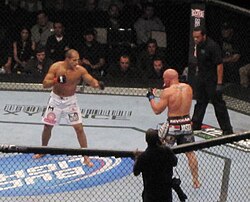
 An octagon cage used by the UFC


Common disciplines
[edit]Most 'traditional' martial arts have a specific focus and these arts may be trained to improve in that area. Popular disciplines of each type include:[102]
- Stand-up: boxing, kickboxing, Muay Thai, karate, taekwondo, capoeira, combat sambo, savate and sanda are trained to improve stand-up striking.
- Clinch: judo, freestyle wrestling, folkstyle wrestling, Greco-Roman wrestling, catch wrestling, sanda and sambo are trained to improve clinching, takedowns and throws, while Muay Thai is trained to improve the striking aspect of the clinch.
- Ground: Brazilian jiu-jitsu, judo, sambo, folkstyle wrestling, freestyle wrestling, catch wrestling, Greco-Roman wrestling and luta livre are trained to improve ground control and position, as well as to achieve submission holds, and defend against them.
Most styles have been adapted from their traditional forms, such as boxing stances, which lack effective counters to leg kicks, the Muay Thai stance, which is poor for defending against takedowns due to its static nature and a light front leg, and judo or Brazilian jiu-jitsu techniques, which must be adapted for no-gi competition and susceptibility to strikes. It is common for a fighter to train with multiple coaches of different styles or an organized fight team to improve various aspects of their game at once. Cardiovascular conditioning, speed drills, strength training and flexibility are also important aspects of a fighter's training. Some schools advertise their styles as simply "mixed martial arts", which has become a style in itself, but the training will still often be split into different sections.
While mixed martial arts was initially practiced almost exclusively by competitive fighters, this is no longer the case. As the sport has become more mainstream and more widely taught, it has become accessible to wider range of practitioners of all ages. Proponents of this sort of training argue that it is safe for anyone, of any age, with varying levels of competitiveness and fitness.[103][104]
Brazilian jiu-jitsu
[edit]Brazilian jiu-jitsu (BJJ) is a form of submission grappling. It came to international prominence in the martial arts community in the early 1990s, when BJJ expert Royce Gracie won the first, second, and fourth Ultimate Fighting Championships, which at the time were single-elimination martial arts tournaments. Royce often fought successfully against larger opponents who practiced other styles, including boxing, wrestling, shoot-fighting, karate, and taekwondo. It has since become a staple art and key component for many MMA fighters. BJJ is largely credited for bringing widespread attention to the importance of ground fighting. BJJ is primarily a ground-based fighting style that applies close range grappling techniques and uses joint locks and chokeholds to submit the adversary. But standup techniques can also be used such as throws, holds, and strikes.
Some notable fighters who are known for using BJJ skills include: Alexandre Pantoja, Amanda Nunes, Anderson Silva, Antônio Rodrigo Nogueira, Charles Oliveira, Cris Cyborg, Deiveson Figueiredo, Demian Maia, Fabrício Werdum, Glover Teixeira, José Aldo, Junior dos Santos, Lyoto Machida, Maurício 'Shogun' Rua, Rafael dos Anjos, Ricardo Arona, Ronaldo Souza, Vitor Belfort, Wanderlei Silva, Mackenzie Dern, Aljamain Sterling, B.J. Penn, Brian Ortega, Brandon Moreno, Chael Sonnen, Demetrious Johnson, Frank Mir, Georges St-Pierre, José Alberto Quiñónez, Gerald Meerschaert, Ilia Topuria, Jim Miller, Nate Diaz, Gabriel Benítez, Tom Aspinall, and Tony Ferguson.
Wrestling
[edit]Wrestling (including freestyle, Greco-Roman and American folkstyle) gained tremendous respect due to its effectiveness in mixed martial arts competitions. It is widely studied by mixed martial artists as Wrestling allows competitors to control where the match will go: superior wrestlers can dominate the Clinch and take their opponents into the ground with its excellent takedowns, particularly against the legs, where they will transition into groundfighting and can either get a superior top position and start striking their opponent (a tactic known as Ground-and-Pound)[105] or start grappling for submissions. While wrestlers with stronger striking base can use defensive wrestling to defend takedowns maintain the fight in the feet where they use their superior striking, a tactic known as "Sprawl-and-Brawl",[106] or use wrestling to escape submission attempts. It is also credited for conferring an emphasis on conditioning for explosive movement and stamina, both of which are critical in competitive mixed martial arts.

There are multiple wrestling styles around the world which MMA fighters have as their base. American fighters are usually trained in folkstyle wrestling, the style competed in high school and college competitions. Many American champions were former NCAA Division I Wrestling Champions, such as Kevin Randleman and Mark Kerr. While fighters from around the world train primarily in "international" Olympic styles such as Greco-Roman and Freestyle wrestling. Some former wrestlers who competed in the Olympics have joined MMA competition, such as Daniel Cormier, Dan Henderson, Ben Askren, silver medalists Matt Lindland and Yoel Romero, and gold medalist Henry Cejudo.[107] Some fighters have also come from local Folk wrestling backgrounds, UFC flyweight champion Deiveson Figueiredo is trained at Luta Marajoara, a folk wrestling style from Marajó island.[108] Notable wrestlers who were MMA competitors include: Khabib Nurmagomedov, Jon Jones, Chael Sonnen, Georges St-Pierre, Cain Velasquez, Randy Couture, Brock Lesnar, Mark Coleman, Frankie Edgar, Colby Covington, Kamaru Usman, Justin Gaethje, Chris Weidman, Daniel Cormier, Dan Henderson, Tito Ortiz, Khamzat Chimaev, Ilia Topuria, Tyron Woodley, Yoel Romero, Deiveson Figueiredo, Michael Chandler and Henry Cejudo.
Greco-Roman
[edit]Greco-Roman wrestling is one of two styles of wrestling contested at the Olympic Games, the other being Freestyle. Greco-Roman wrestling only allows for holds above the waist and has a strong emphasis on clinch fighting. Due to the difficulty to achieve takedowns when one is not allowed to attack the legs, Greco-Roman is not utilized in MMA as often as styles that do allow fighters to attack the legs, such as Freestyle and Catch. Despite this, there have been fighters who come from a background in Greco-Roman wrestling. Notable examples are Randy Couture, Dan Henderson, Mark Madsen, Matt Lindland (all four were Olympic wrestlers or Olympic alternates), Jon Jones, Dan Severn, Ilia Topuria, Alexander Volkanovski, Magomed Ankalaev and Sergei Pavlovich.
Catch-as-catch-can
[edit]Catch wrestling is the ancestor of freestyle wrestling and includes submissions which are prohibited in freestyle wrestling.[109] Widely popular around the world during the 19th and 20th centuries, catch wrestling underwent a decline as its amateur-side became olympic freestyle wrestling, while the professional side became modern professional wrestling. Catch survived in Japanese Puroresu-style Pro Wrestling, where wrestlers such as Antonio Inoki and Karl Gotch promoted "strong style pro wrestling", that while worked, had realistic and full contact moves, resulting in the creation of the Universal Wrestling Federation and Shoot wrestling (which in their own turn would inspire the creation of legit proto-MMA shootfighting organizations such as Shooto and Pancrase). Many pro wrestlers that trained in shoot-style would later compete in MMA, which led to resurgence of Catch with the advent of mixed martial arts in the 90s. The term no holds barred was used originally to describe the wrestling method prevalent in catch wrestling tournaments during the late 19th century wherein no wrestling holds were banned from the competition, regardless of how dangerous they might be. The term was applied to mixed martial arts matches, especially at the advent of the Ultimate Fighting Championship.[110]
A lot of MMA fighters train in catch wrestling as their sole grappling style or as a complement to Brazilian jiu-jitsu, as it teaches techniques and tactics not found in Brazilian jiu-jitsu.[109] Notable MMA fighters who use catch wrestling as their primary grappling style include: Josh Barnett, Ken Shamrock, Frank Shamrock, Bas Rutten, Kazushi Sakuraba, Erik Paulson, Bobby Lashley, Minoru Suzuki, Masakatsu Funaki, Rumina Sato, Masakazu Imanari, Muhammad Mokaev and Paul Sass.[109]
Kickboxing
[edit]Kickboxing, along with boxing, are recognised as a foundation for striking in mixed martial arts, and are both widely practiced and taught. Each has different techniques. Kickboxing is a group of stand-up combat martial arts based on kicking and punching. The modern style originated in Japan, developed from Karate, and had additional development in the Netherlands and the United States. Different governing bodies apply different rules, such as allowing the use of elbows, knees, clinching or throws, etc. Notable fighters include Alex Pereira, Joanna Jędrzejczyk, Zhang Weili, Edson Barboza, Darren Till, Anderson Silva, José Aldo, Charles Oliveira, Mauricio Rua, Wanderlei Silva, Ciryl Gane, Donald Cerrone, Jiří Procházka Cris Cyborg, Stephen Thompson, Mirko Cro Cop, Alistair Overeem, Israel Adesanya, Sean O'Malley, Michael Page, Yair Rodríguez, Cory Sandhagen, Alexander Volkanovski, Volkan Oezdemir, Dricus Du Plessis and Leon Edwards.
Boxing
[edit]Boxing is a combat form that is widely used in MMA and is one of the primary striking bases for many fighters.[111] Boxing punches account for the vast majority of strikes during the stand up portion of a bout and also account for the largest number of significant strikes, knock downs and KOs in MMA matches.[112] Several aspects of boxing are extremely valuable such as footwork, combinations, and defensive techniques such as slips, head movement and stance (including chin protection and keeping hands up) commonly known as the Guard position.[113] Boxing-based fighters have also been shown to throw and land a higher volume of strikes when compared with other striking bases, at a rate of 3.88 per minute with 9.64 per minute thrown (compared with Muay Thai at 3.46 and 7.50, respectively).[111] Fighters known for using boxing include: Petr Yan, Dustin Poirier, Conor McGregor, Max Holloway, Erik Pérez, Calvin Kattar, Sean Strickland, Cain Velasquez, Nick Diaz, Glover Teixeira, José Aldo, Ilia Topuria, Junior dos Santos, B.J. Penn, Dan Hardy, Shane Carwin, Jack Della Maddalena, Francis Ngannou, Alexander Gustafsson, Gabriel Benítez, Jamahal Hill, Justin Gaethje and Andrei Arlovski.
Luta Livre
[edit]Luta Livre (also referred to Luta Livre Brasileira, Submission or Esportiva) is a Brazilian submission wrestling style, developed in Brazil in the 1920s by catch wrestling practitioner Euclydes "Tatu" Hatem, including techniques from catch wrestling, judo, wrestling and Brazilian jiu-jitsu. In 1942, Hatem solidified the art's legitimacy by defeating George Gracie in a historic match.[114] Decades later, in 1968, his student Euclides Pereira — repeated the feat by defeating Carlson Gracie.[115]
Luta livre is divided in the categories of esportiva, which is a form of submission grappling, differentiating from no-gi BJJ with its focus on quick and energetic submissions, and vale tudo, which includes strikes both standing up and on the ground in addition to grappling and submissions.[116] Luta livre was important to the development of mixed martial arts, as rivalry between jiu-jitsu and luta livre fueled the vale tudo scene. However, the success of Brazilian jiu-jitsu over luta livre practitioners, especially after the Desafio: Jiu Jitsu vs Luta Livre event in 1991 (which was broadcast live by Rede Globo), resulted in the style waning in popularity,[117] although it seems to be making a resurgence, especially as an alternative to both Brazilian jiu-jitsu and catch wrestling.[118] Some notable luta livre practitioners in MMA include: Marco Ruas, Eugenio Tadeu, José Aldo, Renato Sobral, Pedro Rizzo, Alexandre Franca Nogueira, Terry Etim, Jesus Pinedo and Darren Till.

Judo
[edit]Judo is a Japanese grappling martial art which has both ne-waza (ground grappling) and tachi-waza (standing grappling), several judo practitioners have competed in mixed martial arts matches. They use their knowledge in judo for clinching and for doing explosive and fast takedowns which quickly transition into submission holds in the ground. However, judo is traditionally and exclusively trained using the judogi, as such, many techniques and strategies from judo can not be translated into MMA.[119] Fighters who hold a black belt in judo include Fedor Emelianenko, Marco Ruas, Khabib Nurmagomedov, Islam Makhachev, Ian Garry, Dong Hyun Kim, Cub Swanson, Don Frye, Antônio Rodrigo Nogueira, Fabricio Werdum, Vitor Belfort, Benoît Saint-Denis, Merab Dvalishvili, Reinier de Ridder and Olympian judokas Ronda Rousey,[120] Hector Lombard, Rick Hawn[121] and Hidehiko Yoshida. Former WEC middleweight champion Paulo Filho has credited judo for his success in an interview.[122]
Sambo
[edit]Sambo is a Russian martial art, combat sport and self-defense system.[123] It is a mixture of judo and freestyle wrestling using a keikogi known as kurtka. Sambo focuses on throwing, takedowns, grappling, and includes submissions from judo and catch wrestling. Sports sambo is characterized as a grappling style focused in pinning and in explosive takedowns which can be quickly transitioned into devastating leglocks. Sambo also has a modality known as combat sambo, which adds punches, kicks, elbows and knees, making it a proto-MMA hybrid fighting style. Sambo is popular in Russia and eastern Europe, where it is taught as a complement to judo and wrestling training, Sambo also provides a good base for MMA with all-around skills for combining grappling and striking. Some notable Sambo fighters that transitioned into MMA include: Fedor Emelianenko, Khabib Nurmagomedov, Islam Makhachev, Igor Vovchanchyn, Oleg Taktarov, Andrei Arlovski, Yaroslav Amosov, and Shavkat Rakhmonov.
Karate
[edit]Karate is a striking-based Japanese with Okinawan origins martial art using punches, kicks, sometimes elbows, knees and even limited grappling. It is divided in various schools and styles, which distinguishes techniques, training methods, among other things. Some styles, especially Kyokushin and other full contact styles, has proven to be effective in MMA as it is one of the core foundations of kickboxing, and specializes in striking techniques.[124][125][126][127] Karate from all styles has also been a common base, with many getting introduced to martial arts and combat sports by training Karate in their youth. Various styles of karate are practiced by some MMA fighters, notably Stephen Chuck Liddell, Bas Rutten, Lyoto Machida, Stephen Thompson, John Makdessi, Uriah Hall, Erik Pérez, Ryan Jimmo, Georges St-Pierre, Kyoji Horiguchi, Giga Chikadze, Robert Whittaker, Henry Cejudo, and Louis Gaudinot. Liddell is known to have an extensive striking background in Kenpō with Fabio Martella.[128] Lyoto Machida practices Shotokan Ryu,[129] and St-Pierre practices Kyokushin.[130]
Wushu Sanda
[edit]Sanda, or Sanshou, is one of the two disciplines of sport wushu. It is a modernized and full contact version of wushu, created in the late 20th century as a condensation of traditional Chinese kung fu techniques to be used in a full contact competition environment.[131][132] It is a kickboxing style which has punching, kicking, some use of elbows and knee strikes—similar to Kickboxing or Muay Thai— but it has the distinction of allowing a range of takedowns, throws and sweeps, similar to judo and wrestling.[131][133]
They can be highly effective in competition due to their mixture of striking and takedowns, which can be easily synthesized with the rest of MMA training, such as groundfighting.[133] It is prominently used by fighters from China, but it has found a following amongst many fighters around the world.[133] Chief amongst these fighters is Cung Le, who is most notable for his TKO and KO victories over former UFC champions Frank Shamrock and Rich Franklin, and UFC strawweight champion Zhang Weili, the first Chinese champion in the UFC. Other wushu sanshou based fighters who have entered MMA include Michael Page, Song Yadong, K. J. Noons, Pat Barry, Zhang Tiequan,[134] Muslim Salihov,[135] and Zabit Magomedsharipov.[136]
Taekwondo
[edit]Taekwondo is a Korean martial art, emerging in the 1950s as a mixture between Japanese Karate, traditional Korean martial arts and some Chinese kung fu. It is a striking-based style with heavy focus on various styles of kicking, such as head-height kicks, spinning jump kicks, and fast kicking techniques.[137] Several accomplished MMA fighters have an extensive background in taekwondo, and many were introduced to martial arts through it.[138][139] Some fighters who use taekwondo techniques in MMA are former UFC lightweight champion and WEC lightweight champion Anthony Pettis, who is 3rd dan black belt as well as an instructor,[140] Benson Henderson, Yair Rodriguez, Marco Ruas and former UFC middleweight champion Anderson Silva, who is a 5th dan black belt.[141]
In his instructional book, Anderson Silva admitted the influence of taekwondo in the formation of his unique style. "In each of my fights, I tried to utilize techniques from all the various styles I had studied. I threw taekwondo kicks. I threw Muay Thai knees and elbows, and I used my knowledge of Brazilian jiu-jitsu on the ground."[142] Anthony Pettis has also stated that he is "definitely a traditional martial artist first and a mixed martial artist second",[140] as well as his "style of attacking is different [because of his] taekwondo background".[143]
Other notable fighters who have a base in Taekwondo or are known for using their Taekwondo skills while fighting include Edson Barboza, Valentina Shevchenko, Benson Henderson, Yair Rodriguez, Anthony Pettis, Mirko Cro Cop, Cory Sandhagen, Israel Adesanya and Conor McGregor.
Capoeira
[edit]Capoeira is an Afro-Brazilian art form that incorporates elements of martial arts, games, music, and dance. Capoeira is often practiced as a form of dancing and game, but its origins lie as a concealed style of self-defense and combat, and can be used as such. It uses a style of fighting with quick and complex maneuvers, which use power, speed, and leverage across a wide variety of kicks, spins and techniques. Pure Capoeira is difficult to use in MMA due its complexity, but many fighters incorporated individual techniques into their reportoire.[144] Additionally, Capoeira has an importance to MMA history, as many capoeiristas participated in Vale Tudo challenges in Brazil against practitioners of other martial arts, in particular with a rivalry with Brazilian Jiu-Jitsu.[145] In 1995 at the Desafio Internacional de Vale Tudo event, Capoeirista Mestre Hulk defeated two-time BJJ world champion Amaury Bitetti using Capoeira techniques in an underdog victory.[146]
Some fighters which have trained Capoeira and incorporated techniques include Anderson Silva, Conor McGregor, Deiveson Figueiredo, Thiago Santos, Marco Ruas and Michel Pereira.
Savate
[edit]Although not as common as other disciplines, some fighters have used Savate effectively in MMA. Savate restricts the use of shins and knees, allowing only foot kicks. It focuses on kicking more than punching, and its kicks are characteristically very fast, mobile and flexible. It also possesses a complex and evasive footwork. However, because Savatuers train wearing shoes, adjustments have to be made to how they throw kicks in MMA. Notable Savate fighters include Karl Amoussou, Gerard Gordeau, Cheick Kongo, and former Bellator Light Heavyweight Champion Christian M'Pumbu.
Basic strategies
[edit]The techniques utilized in mixed martial arts competition generally fall into two categories: striking techniques (such as kicks, knees, punches and elbows) and grappling techniques (such as clinch holds, pinning holds, submission holds, sweeps, takedowns and throws).
Today, mixed martial artists must cross-train in a variety of styles to counter their opponent's strengths and remain effective in all the phases of combat.
Sprawl-and-Brawl
[edit]Sprawl-and-Brawl is a stand-up fighting tactic that consists of effective stand-up striking while avoiding ground fighting typically by using sprawls to defend against takedowns or throws.[106]
A Sprawl-and-Brawler is usually a boxer, kickboxer, or karateka who has trained in various styles of wrestling, judo, and/or sambo to avoid takedowns to keep the fight standing. This is a form which is heavily practiced in the amateur leagues.
These fighters will often study submission grappling to avoid being forced into submission should they find themselves on the ground. This style can be deceptively different from traditional kickboxing styles, since sprawl-and-brawlers must adapt their techniques to incorporate takedown and ground fighting defense. A few notable examples are Igor Vovchanchyn, Mirko Filipović, Chuck Liddell, Mark Hunt and more recently Alex Pereira, Francis Ngannou, Junior dos Santos, Justin Gaethje, Andrei Arlovski,[147] and Joanna Jędrzejczyk.[148]

Ground-and-pound
[edit]Ground-and-pound is a strategy consisting of taking an opponent to the ground using a takedown or throw, obtaining a top, or dominant grappling position, and then striking the opponent repeatedly, primarily with fists, hammerfists, and elbows. Ground-and-pound is also used as a precursor to attempting submission holds.
The style is used by fighters well-versed in submission defense and skilled at takedowns. They take the fight to the ground, maintain a grappling position, and strike until their opponent submits or is knocked out. Although not a traditional style of striking, the effectiveness and reliability of ground-and-pound has made it a popular tactic. It was first demonstrated as an effective technique by Mark Coleman, then popularized by fighters such as Chael Sonnen, Glover Teixeira, Don Frye, Frank Trigg, Jon Jones, Cheick Kongo, Mark Kerr, Frank Shamrock, Tito Ortiz, Matt Hughes, Daniel Cormier, Chris Weidman, and Khabib Nurmagomedov.[105]
While most fighters use ground-and-pound statically, by way of holding their opponents down and hitting them with short strikes from the top position, a few fighters manage to utilize it dynamically by striking their opponents while changing positions, thus not allowing their opponents to settle once they take them down. Cain Velasquez is one of the most devastating ground strikers in MMA and is known for continuing to strike his opponents on the ground while transitioning between positions.[149] Fedor Emelianenko, considered among the greatest masters of ground-and-pound in MMA history, was the first to demonstrate this dynamic style of striking in transition. He was striking his opponents on the ground while passing guard, or while his opponents were attempting to recover guard.[150][151]
In the year 2000, MMA play-by-play commentator Stephen Quadros coined the popular phrase lay and pray. This refers to a situation where a wrestler or grappler keeps another fighter pinned or controlled on the mat, throwing light strikes to avoid a stand up, yet exhibit little urgency to finish the grounded opponent with a knockout or a submission for the majority or entirety of the fight, looking for a decision win through high control time.[152] The implication of "lay and pray" is that after the wrestler/grappler takes the striker down and 'lays' on them to neutralize the opponent's striking weapons, they 'pray' that the referee does not return them to the standing position. This style is considered by many fans as the most boring style of fighting and is highly criticized for intentionally creating non-action, yet it is effective. Some argue that 'lay-and-pray' is justified and that it is the responsibility of the downed fighter to be able to protect themselves from this legitimate technique.[152][153][154][155] Former UFC Welterweight champion Georges St-Pierre has been criticized by fans for playing it safe and applying the lay-and-pray tactic in his fights,[156] as has former Bellator MMA Welterweight champion Ben Askren, who justified the tactic, explaining that championship fights are much harder, as they are five rounds long compared with the usual three.[157]

Submission-seeking
[edit]Submission-seeking is a reference to the strategy of taking an opponent to the ground using a takedown or throw and then applying a submission hold, forcing the opponent to submit. While grapplers will often work to attain dominant position, some may be more comfortable fighting from other positions (ex. fighters pulling guard). It enable fighters to force opponents into submission through joint locks or chokes. Brazilian Jiu-Jitsu (BJJ) plays a significant role in MMA submission grappling, with techniques such as armbars, triangles, rear-naked chokes, guillotines, and kimuras being commonly utilized.[158]
If a grappler finds themselves unable to force a takedown, they may resort to pulling guard, whereby they voluntarily pull their opponent into a dominant position on the ground.[159] This was one of the first fighting styles that had shown success, popularized by BJJ exponent Royce Gracie during early UFC events. Submissions are an essential part of many disciplines, most notably Brazilian jiu-jitsu, catch wrestling, judo, sambo, luta livre and shoot wrestling. Submission-based styles were popularized in the early UFC events by Royce Gracie and Ken Shamrock, and were the dominant tactic in the early UFCs. Modern proponents of the submission-seeking style, such as Demian Maia, Ronaldo Souza, Charles Oliveira, Ryan Hall, Marcin Held, and Paul Craig tend to come from a Brazilian jiu-jitsu background.[160]
Clinch-fighting
[edit]Clinch-Fighting is a tactic consisting of using a clinch hold to prevent the opponent from moving away into more distant striking range, while also attempting takedowns or throws and striking the opponent using knees, stomps, elbows, and punches. The clinch is often utilized by wrestlers and judokas that have added components of the striking game (typically boxing), and Muay Thai fighters.
Ken Shamrock was known for his impressive clinch work when he submitted Dan Severn with a standing guillotine choke at UFC 6.
Wrestlers and judoka may use clinch fighting as a way to neutralize the superior striking skills of a stand-up fighter to prevent takedowns or throws by a superior ground fighter. Ronda Rousey, with her judo background, is considered a master at initiating throws from the clinch to set up armbars.[161]
The clinch or "plum" of a Muay Thai fighter is often used to improve the accuracy of knees and elbows by physically controlling the position of the opponent. Anderson Silva is well known for his devastating Muay Thai clinch. He defeated UFC middle weight champion Rich Franklin using the Muay Thai clinch and kneeing Franklin repeatedly to the body and face—breaking Franklin's nose. In their rematch Silva repeated this and won again.[162]
Other fighters may use the clinch to push their opponent against the cage or ropes, where they can effectively control their opponent's movement and restrict mobility while striking them with punches to the body or stomps also known as dirty boxing or "Wall and Maul". Randy Couture used his Greco-Roman wrestling background to popularize this style en route to six title reigns in the UFC.[163]
Score-oriented fighting
[edit]Score-oriented fighting is a style that is based around trying to win through outscoring their opponent and winning a decision. Usually fighters who adopt this strategy use takedowns only for scoring, allowing the adversary to stand up and continue the fight. They also want to land clear strikes and control the octagon. In order to win the fight by decision, all score oriented fighters have to have strong defensive techniques and avoid takedowns.[164]
In general, fighters who cannot win fights through lightning offense, or are more suited to win fights in the later rounds or via decision are commonly known as grinders. Grinders aim to shut down their opponent's game plan and chip away at them via light strikes, clinching, smothering and ground-and-pound for most of the rounds. Prominent examples of grinders are Sean Strickland, who has a very defensive and stand-up striking focused style, and Merab Dvalishvili who has a very aggressive, wrestling focused style.
Women's mixed martial arts
[edit].jpg)
While mixed martial arts is primarily a male dominated sport, it does have female athletes. Female competition in Japan includes promotions such as the all-female Valkyrie, and Jewels (formerly known as Smackgirl).[165] However historically, there has been only a select few major professional mixed martial arts organizations in the United States that invite women to compete. Among those are the UFC, Strikeforce, Bellator Fighting Championships, the all female Invicta Fighting Championships, and the now defunct EliteXC.[citation needed]
There has been a growing awareness of women in mixed martial arts due to popular female fighters and personalities such as Ronda Rousey, Megumi Fujii, Miesha Tate, Cristiane Santos, Joanna Jędrzejczyk, Holly Holm, Alexa Grasso and Gina Carano among others.
History
[edit]In Japan, female competition has been documented since the mid-1990s. Influenced by female professional wrestling and kickboxing, the Smackgirl competition was formed in 2001 and became the only major all-female promotion in mixed martial arts. Other early successful Japanese female organizations included Ladies Legend Pro-Wrestling, ReMix (a predecessor to Smackgirl), U-Top Tournament, K-Grace, and AX.[citation needed]
Aside from all-female organizations, most major Japanese male dominated promotions have held select female competitions. These have included DEEP, MARS, Gladiator, HEAT, Cage Force, K-1, Sengoku, Shooto (under the name G-Shooto), and Pancrase (under the name Pancrase Athena).[citation needed]
In the United States, prior to the success of The Ultimate Fighter reality show that launched mixed martial arts into the mainstream media,[citation needed] there was no major coverage of female competitions. Some early organizations who invited women to compete included, International Fighting Championships, SuperBrawl, King of the Cage, Rage in the Cage, Ring of Combat, Bas Rutten Invitational, and HOOKnSHOOT. From the mid-2000s, more coverage came when organizations such as Strikeforce, EliteXC, Bellator Fighting Championships, and Shark Fights invited women to compete.
Outside Japan and the United States, female competition is almost exclusively found in minor local promotions. However, in Europe some major organizations have held select female competitions, including It's Showtime, Shooto Europe, Cage Warriors, and M-1 Global.
Following Zuffa's acquisition of Strikeforce in March 2011,[166][167][168][169] the UFC began promoting women's fights, with Ronda Rousey rapidly becoming one of the promotion's biggest draws.[170]
Controversy arose in 2013, when CFA (Championship Fighting Alliance) fighter Fallon Fox came out as a transgender woman. The case became a centerpiece of debates concerning whether it was fair to have a transgender woman compete against cisgender women in a contact sport.[171] Neither the UFC nor Invicta FC says they will allow her to fight, and then-UFC Bantamweight champion Ronda Rousey said she would not fight her.[172]
Amateur mixed martial arts
[edit]Amateur Mixed Martial Arts is the amateur version of the Mixed Martial Arts in which participants engage largely or entirely without remuneration. Under the International Mixed Martial Arts Federation (IMMAF) and World MMA Association (WMMAA), it is practiced within a safe and regulated environment which relies on a fair and objective scoring system and competition procedures similar to those in force in the professional Mixed Martial Arts rules.[173][174] Amateur MMA is practiced with board shorts and with approved protection gear that includes shin protectors, and amateur MMA gloves.
The International Mixed Martial Arts Federation and the World Mixed Martial Arts Association announced an amalgamation on April 11, 2018, uniting the two organizations behind one bid for Olympic sport recognition after being instructed by Global Association of International Sport Federations (GAISF). The WMMAA and the IMMAF signed a legally binding affiliation memorandum of understanding (MOU) in May 2018 and finalized the agreement by November 2018, along with the first unified world championships.[175][176]
The Global Association of Mixed Martial Arts (GAMMA) was established in 2018 by former WMMAA and IMMAF federations and representatives.[177][178] From 8 to 12 March 2024, mixed martial arts was included as a demonstration sport in the 2023 African Games in Accra, Ghana, under GAMMA.[179][180][181][182] From 11 to 13 July 2024, GAMMA member federations participated in the 2nd Asian Mixed Martial Arts Championships organised by the Asian Mixed Martial Arts Association (AMMA) under the Olympic Council of Asia.[183]
World Mixed Martial Arts Association
[edit]World Mixed Martial Arts Association (WMMAA) was founded in 2012 in Monaco by M-1 Global commercial promoters and is under the leadership of the General Secretary Alexander Endelgarth, President Finkelstein and Fedor Emelianenko.[184][185][186][187] The World MMA Association was an organization that managed and developed mixed martial arts, establishing rules and procedures, hosting MMA competitions.
On October 20, 2013, the first World MMA Championship was held in Saint Petersburg, Russia.[188]
By December 2013, WMMAA had 38 member states representing the sport and registered in accordance with national laws. By 2017, WMMAA had expanded to 83 members: Afghanistan, Albania, Armenia, Austria, Azerbaijan, Belarus, Belgium, Bulgaria, Canada, Croatia, Colombia, Czech Republic, France, Guatemala, Georgia, Greece, India, Iran, Italy, Kazakhstan, Latvia, Lithuania, Macedonia, Moldova, Monaco, Mongolia, the Netherlands, Poland, Portugal, Romania, Russia, Senegal, Serbia, Slovakia, South Korea, Spain, Switzerland, Tajikistan, Trinidad and Tobago, Turkey, Ukraine, Uzbekistan, and Venezuela.[189]
International Mixed Martial Arts Federation
[edit]On February 29, 2012, the International Mixed Martial Arts Federation (IMMAF) was set up to bring international structure, development and support to mixed martial arts worldwide.[190] IMMAF launched with support of market leader, the Ultimate Fighting Championship (UFC).[191][192] The IMMAF is a non-profit, democratic federation organized according to international federation standards to ensure that MMA as a sport is allowed the same recognition, representation and rights as all other major sports. The IMMAF is registered under Swedish law and is founded on democratic principles, as outlined in their statutes.[193] As of 2025, there were 128 total members.[194]
The IMMAF held its first Amateur World Championships in Las Vegas, US, from June 30 to July 6, 2014.[195][196][197]
Global Association of Mixed Martial Arts (GAMMA)
[edit]
GAMMA was founded in 2018 as the international governing body for mixed martial arts, with the support of main sponsor ONE Championship.[177][178] It aims are to achieve official international sport recognition for mixed martial arts, to develop the sport and its governance structures globally and promote its growth and benefits in communities worldwide. Its vision is Olympic Games inclusion.[198][199][179] GAMMA is a non-profit organisation registered in the Netherlands with Alexander Engelhardt as president.[200] GAMMA has 80 national federations as members across 5 continents[200] and organises international, nations tournaments around the world under amateur MMA rules.[201][202][203][204] In 2024, GAMMA achieved the inclusion of mixed martial arts as a demonstration discipline in the 2023 African Games in Accra.[179][180][181][182]
Safety
[edit]
Mixed Martial Arts competitions have changed dramatically since the first Ultimate Fighting Championship in 1993, specifically with the inception of the Unified Rules of Mixed Martial Arts. There remains a paucity of data on injuries that occur in MMA, and resulting concerns with regard to MMA's safety remain. A 2014 systematic review concluded that the injury incidence rate in MMA appears to be greater than in most, if not all, other popular and commonly practiced combat sports.[205]
Injury rates
[edit]In a 2014 meta-analysis of the available injury data in MMA, the injury incidence rate was estimated to be 228.7 injuries per 1000 athlete-exposures (one athlete-exposure is defined as one athlete participating in a single fight).[205] The estimated injury incidence rate in MMA is greater than in other full-contact combat sports such as judo (44.0 injuries per 1000 athlete-exposures),[206] taekwondo (79.4 injuries per 1000 athlete-exposures),[207] amateur boxing (77.7 injuries per 1000 athlete-exposures),[208] and professional boxing (118.0–250.6 injuries per 1000 athlete-exposures).[209][210][211][212]
Injury pattern
[edit]In general, the injury pattern in MMA is very similar to that in professional boxing but unlike that found in other combat sports such as judo and taekwondo.[205] The most commonly injured body region is the head (66.8% to 78.0% of reported injuries) followed by the wrist/hand (6.0% to 12.0% of reported injuries), while the most frequent types of injury were laceration (36.7% to 59.4% of reported injuries), fracture (7.4% to 43.3% of reported injuries), and concussion (3.8% to 20.4% of reported injuries).[205] The frequency of impact to the ear and low utilization of ear protection leads to a high frequency of perichondral hematoma that can lead to cauliflower ear.[213]
Brain injury and CTE
[edit]The repeated head strikes received by MMA competitors causes frequent concussions and permanent brain damage.[214] Also, the repeated head trauma in contact sports, especially combat sports, are directly related to a brain disease called chronic traumatic encephalopathy (CTE). This disease begins to develop during the life of the athlete, and continues to develop even after sports activity has ceased.[215][216][217][218][219][220]
Because the disease is detected post-mortem, and MMA as a sport is relatively young, there are still few cases of CTE recognized in MMA, although there are more and more suspected and confirmed cases of CTE.[221][222] In preliminary results reported in April 2012 as part of an ongoing study of a 109 professional boxers and MMA fighters being conducted by Charles Bernick and his colleagues at Cleveland Clinic's Lou Ruvo Center for Brain Health, fighters with more than six years of ring experience were observed to have reductions in size in their hippocampus and thalamus, while fighters with more than twelve years of ring experience were observed to have both reductions in size and symptoms such as memory loss (the hippocampus and thalamus deal with memory and alertness). Bernick speculates that the cumulative damage over time from lesser blows may eventually prove an even more important topic of study than that of infrequent concussions.[223]
In January 2021, veteran UFC fighter Spencer Fisher confirmed to MMA Fighting that he suffered from all the symptoms of CTE: "I'm just beat up, and it's just gotten worse, like all my injuries are catching up with me now, aside from the brain thing, which is the biggest one, because it adds, it adds the depression, and putting things, thoughts together and staying on track." Later, Dana White ruled on this: "He's not the first and he's definitely not going to be the last. This is a contact sport and anybody who's ever done this younger, myself included, is dealing with brain issues. It's part of the gig."[224] In late 2021, Rose Gracie, daughter of UFC founder Rorion Gracie, in an interview about CTE on the Trocação Franca podcast, called the lack of CTE awareness in MMA 'criminal negligence'.[225]
Although brain damage is common for MMA fighters, some, like Demetrious Johnson, managed to avoid it. Johnson participated in a long-term brain study from 2012 to 2023 by the Cleveland Clinic, where he underwent regular evaluations. Despite his 17-year MMA career, doctors concluded that his brain had not deteriorated at all. In fact, they found improvements in his cognitive abilities, including speech articulation and IQ. However, it is important to note that throughout his career, he only suffered one knockout and much less head trauma than other fighters.
Fatalities
[edit]There have been seven known deaths in MMA to date.[226][failed verification] There were no documented cases of deaths after a sanctioned MMA event prior to 2007.[227]
Since 2007, there have been six fatalities in mixed martial arts matches. The first was the death of Sam Vasquez on November 30, 2007.[228] Vasquez collapsed shortly after being knocked out by Vince Libardi in the third round of an October 20, 2007, fight at the Toyota Center in Houston, Texas.[227] Vasquez had two separate surgeries to remove blood clots from his brain, and shortly after the second operation suffered a stroke and did not regain consciousness.[228]
The second death stemming from a sanctioned mixed martial arts contest occurred in South Carolina on June 28, 2010, when 30-year-old Michael Kirkham was knocked out and never regained consciousness. He was pronounced dead two days after the fight.[229]
The third death on August 11, 2012, involved 30 year old Tyrone Mims, who was making his amateur MMA debut at "Conflict MMA: Fight Night at the Point VI" in South Carolina, making his the second MMA-related death in the state.[230] After being TKO'd in the second round of the fight he became unresponsive and was taken to Medical University Hospital, where he was pronounced dead one hour later. No evidence of brain trauma or concussion was found and the initial autopsy has proved inconclusive. Coroner Rae Wooten explained that his death may probably have been from an irregular heartbeat caused by over exertion; however whether or not his death was a direct result of his fight remains a mystery.[231]
On February 27, 2014, 29-year-old Booto Guylain was transported to Johannesburg General Hospital to be treated for swelling and bleeding on the brain after suffering a KO loss via elbow in the last round of his fight in South African promotion "Extreme Fighting Championship Africa". He was unable to make a recovery, and after one week in the hospital he was pronounced dead.[232][233]
On April 9, 2016, 28-year-old João Carvalho, died following a Total Extreme Fighting event at the National Stadium in Dublin (Ireland). The Portuguese fighter was beaten by technical knockout in a fight on 9 April 2016 against Charlie Ward, and fell ill twenty minutes after the fight. He was taken immediately to Beaumont hospital, where he underwent emergency brain surgery, but died two days later.[234]
On July 15, 2017, after a TKO loss resulting from unanswered punches in the second round of his fight, 37 year old Donshay White became unresponsive and collapsed in his locker room and was rushed to the KentuckyOne Health Sts. Mary & Elizabeth Hospital in Kentucky.[235] He was soon pronounced dead and was revealed to be caused by hypertensive/atherosclerotic cardiovascular disease.[236]
Legality of professional competitions
[edit]Professional MMA competitions enjoy different levels of legality in different countries. This is dependent on the laws of the specific state.
The International Mixed Martial Arts Federation attempts to provide an internationally recognised set of standards which will be universally adhered to.[237] However, they have no basis in national law and are meant as advisement only. Whereby regulation exists, however, the likelihood of MMA being legally recognised as a legitimate sport is increased. This was the case with France who banned it as a sport in 2016, due to a lack of regulation, then unbanned it in 2020 after a French federation began regulating it.[238]
See also
[edit] Media related to Mixed martial arts at Wikimedia Commons

- Boxing (disambiguation)
- List of current mixed martial arts champions
- List of female mixed martial artists
- List of male mixed martial artists
- List of undefeated mixed martial artists
- List of mixed martial artists with the most sanctioned fights
- List of mixed martial arts attendance records
- Mixed martial arts competition for children
- U-Kei (martial arts)
Notes
[edit]- ^ Prior to the widespread adoption of "mixed martial arts", or "MMA", other names were used to refer to what is now known as "MMA". Early in the sport's history, it was typically referred to as "No Holds Barred", or "NHB", in the United States[1] and "Vale Tudo" in Brazil.[2] Two of the earliest MMA promotion companies in Japan, Shooto and Pancrase, referred to the sport as "Shooting" (Shooto)[3][4] and "Hybrid Wrestling" (Pancrase),[5] respectively. The sport is also commonly referred to colloquially as "ultimate fighting",[6] "shootfighting",[7] and "cage fighting";[8] it was often referred to derisively in the United States as "human cockfighting".[9]
References
[edit]- ^ Bateman, Oliver Lee (July 6, 2018). "The Early Years of MMA Were a 'No-Holds-Barred Freakshow' That Couldn't Be More Different From Today". MEL Magazine. Retrieved December 15, 2021.
- ^ Barbosa Rozendo Lima, Vitor; Levi Fraga, Nicolas; Nobre de Carvalho, Vitor; Bettine de Almeida, Marco Antonio (September 22, 2015). "Influência do Vale-Tudo nos atletas atuais de MMA". EFdeportes. Archived from the original on September 13, 2017. Retrieved January 7, 2021.
- ^ "Shooto". jkd.gr. Retrieved January 18, 2022.
- ^ Breen, Jordan (May 8, 2009). "A Blood Called Shooto". Sherdog.com. Retrieved May 13, 2009.
- ^ "What's Pancrase?". Pancrase. Retrieved September 26, 2023.
In addition to producing professional Pancrase competitors who are known as Pancraseism (captain/ Kiuma Kunioku); Pancrase Inagakigumi (captain / Katsuomi Inagaki); Pancrase GRABAKA (captain/ Sanae Kikuta); Pancrase Mission (captain / Minoru Suzuki); Pancrase Megaton(captain/ Keigo Takamori). Pancrase Organization has its own gyms in Japan which is called P's LAB with plans to establish additional Pancrase amateur gyms and also to spread Hybrid Wrestling around the world.
- ^ Flinn, Jenny (March 9, 2016). "The rise and rise of ultimate fighting (and why boxing is now so passé)". The Conversation. Retrieved September 26, 2023.
- ^ "What Is Shootfighting?". MMA Channel. August 31, 2020. Retrieved September 26, 2023.
In fact, some might claim that shootfighting was the original form of Mixed Martial Arts.
- ^ Haines, Matthew (October 13, 2015). "Cage fighting has become even more dangerous thanks to extreme dieting". The Conversation. Retrieved September 26, 2023.
- ^ Grenne, Nick (August 26, 2018). "How John McCain Grew to Tolerate MMA, the Sport he Likened to "Human Cockfighting"". Slate. Retrieved September 26, 2023.
- ^ Grant, T.P. "History of Jiu-Jitsu: Coming to America and the Birth of the UFC". Bleacher Report. Archived from the original on October 11, 2012. Retrieved May 7, 2018.
- ^ Sonmez, Can. "UFC 1: The Beginning". Mixed Martial Arts.com. Archived from the original on September 28, 2013. Retrieved September 26, 2013.
- ^ Plotz, David (November 16, 1997). "Fight Clubbed". Slate. Archived from the original on December 31, 2006. Retrieved December 26, 2006.
- ^ McFarland, Matt (May 6, 2008). "Ultimate Fighting wants to come to NY". WNYT.com. Archived from the original on May 9, 2008. Retrieved May 6, 2008.
- ^ Trembow, Ivan (March 1, 2007). "UFC PPV Revenue Tops $200 Million in 2006". MMA Weekly. Archived from the original on May 22, 2007. Retrieved June 18, 2007.
- ^ a b Brownell, Susan Elaine (1990). The olympic movement on its way into Chinese culture. University of California, Santa Barbara. pp. 29, 63. Archived from the original on May 13, 2018. Retrieved May 13, 2018.
In both ancient China and Greece, the most popular sports were probably wrestling, boxing, and combinations thereof (Greek pankration, Chinese leitai). The same might be argued for ancient Egypt, India and Japan. [...] In both ancient China and Greece, the no-holds-barred combat sport (Greek pankration, Chinese leitai) was probably the most popular one.
- ^ Gardinier, E. Norman (1910). Greek Athletic Sports and Festivals. London: MacMillan. p. 444 Fig. 159.
- ^ Gardiner, E. Norman, 'The Pankration' in Greek Athletic Sports and Festivals, London: MacMillan, 1910, p. 435
- ^ Green, Thomas A., 'Pankration' in Martial Arts of the World: An Encyclopedia of History and Innovation, California: ABC-CLIO, 2010, p. 237
- ^ Gardiner, E. Norman, 'The Pankration' in Greek Athletic Sports and Festivals, London: MacMillan, 1910, pp. 436–437
- ^ a b c Green, Thomas A. Martial Arts of the World [2 volumes]: An Encyclopedia of History and Innovation. ABC-CLIO (2010). pp. 259–260. ISBN 978-1598842432.
- ^ "Pitting catch wrestling against Brazilian jiu-jitsu". The Manila Times. March 8, 2014. Retrieved January 12, 2020.
- ^ Nauright, John; Zipp, Sarah (2020). Routledge Handbook of Global Sport. Routledge. p. 179. ISBN 978-1-317-50047-6.
- ^ Nauright, John; Zipp, Sarah (2020). Routledge Handbook of Global Sport. Routledge. p. 179. ISBN 978-1-317-50047-6.
- ^ Graeme Kent (1968). A Pictorial History of Wrestling. Spring Books; 1 edition.
- ^ a b Noble, Graham (March 2001). "An Introduction to E. W. Barton-Wright (1860–1951) and the Eclectic Art of Bartitsu". Journal of Manly Arts. Archived from the original on August 18, 2007. Retrieved June 14, 2007.
- ^ "Journal of Combative Sport: Jujitsu versus Boxing". Journal of Combative Sport. Archived from the original on July 20, 2008. Retrieved May 7, 2008.
- ^ "Fighting Spirit: An Introductory History of Korean Boxing, 1926–1945". Journal of Combative Sport. Archived from the original on February 25, 2009. Retrieved February 16, 2009.
- ^ "Área de Luta: o uso da capoeira nos combates". sportv.com. May 12, 2011. Retrieved June 10, 2025.
- ^ Silva, Marcelo Moraes e (2024). "A construção de um improvável herói esportivo: o capoeira Cyriaco (1909-1925)". Tempo. 30 (1) e300104. doi:10.1590/tem-1980-542x2024v300104. ISSN 1980-542X.
- ^ "MMA Fan's Guide to Grappling: Sambo". Bloody Elbow. August 8, 2013. Archived from the original on February 1, 2014. Retrieved February 7, 2014.
- ^ Adams, Andy (March 22, 2013). "Classic Black Belt Article From 1967: Russia Prepares to Export Sambo (Part 2)". Blackbeltmag.com. Archived from the original on January 12, 2014. Retrieved February 7, 2014.
- ^ a b Willoughby, David P. (1970). The Super Athletes. A.S. Barnes & Co., Inc. pp. 376–380. ISBN 0-498-06651-7.
- ^ Roberto Pedreira (February 16, 2015). Choque: The Untold Story of Jiu-Jitsu in Brazil Volume 2, 1950–1960 (History of Jiu-Jitsu in Brazil 1856–1999). Clube de Autores. ISBN 978-1-5054-8716-9.
- ^ "Judo vs. Boxing: "Judo" Gene LeBell Defeats Boxer Milo Savage in First MMA Fight". blackbeltmag.com.[permanent dead link]
- ^ a b Sylvie von Duuglas-Ittu (December 28, 2015). "Origins of Japanese Kickboxing – The Karate vs Muay Thai Fight That Started It All". 8 Limbs. Archived from the original on April 12, 2016. Retrieved March 29, 2016. December 28, 2015
- ^ Chris Crudelli (2008). The Way of the Warrior. Dorling Kindersley Ltd. pp. 318–319. ISBN 978-14-0533-750-2.
(Regarding Mixed Martial Arts (MMA)) With [Bruce Lee's] philosophy of "absorbing what is useful and disgarding what is not", Bruce Lee's influence can be seen in the development of MMA.
- ^ Jake Shannon (2011). Say Uncle!: Catch-As-Catch Can Wrestling and the Roots of Ultimate Fighting, Pro Wrestling & Modern Grappling. ECW Press. p. 12. ISBN 978-1-55022-961-5.
- ^ Wickert, Marc. 2004. Dana White and the future of UFC. kucklepit.com. See Wikiquotes for the text.
- ^ Peterson, D.: Wong Shun Leung: The Legend behind the Legend; Recalling the life of Bruce Lee's teacher Archived March 3, 2016, at the Wayback Machine Retrieved on June 25, 2009.
- ^ Lam, G., & LeBlanc, G. E.: The Wing Chun double knife training: Baat Jaam Do Archived February 17, 2012, at the Wayback Machine Retrieved on July 7, 2009.
- ^ Longley, K.: Dave Lacey 'Lai Dai Wai': Buck Sing Choy Lay Fut's unrepentant 'Black Panther' Archived March 4, 2016, at the Wayback Machine (originally published in Impact International Martial Arts Magazine). Retrieved July 7, 2009.
- ^ Bull, Andy (November 11, 2009). "The forgotten story of ... Muhammad Ali v Antonio Inoki". The Guardian. Archived from the original on December 26, 2015. Retrieved June 8, 2014.
- ^ Gross, Josh (2016). Ali vs. Inoki: The Forgotten Fight That Inspired Mixed Martial Arts and Launched Sports Entertainment. BenBella Books. ISBN 978-1-942952-19-0.
- ^ "What role did boxer Muhammad Ali play in early MMA? Let 'Ali vs. Inoki' author Josh Gross explain". MMAjunkie. June 13, 2016. Archived from the original on September 16, 2016. Retrieved September 4, 2016.
- ^ Grant, T. P. (May 2, 2013). "MMA Origins: Fighting For Pride". BloodyElbow. Archived from the original on March 24, 2016. Retrieved September 4, 2016.
- ^ Kelley, Steve. Karate's Prestige Takes a Nosedive (June 22, 1976). Press Scimitar Sports
- ^ Black Belt Apr 1999 (Rick Roufus interview – mentions fight). April 1999. Archived from the original on May 13, 2016. Retrieved June 6, 2011.
- ^ "The Rising Popularity of MMA and UFC: A Comprehensive Analysis". Combat Press. December 1, 2023. Retrieved January 20, 2025.
- ^ "MMA Origins: Vale Tudo and The Original MMA Rivalry". Bloody Elbow. January 1, 2012. Archived from the original on August 22, 2014. Retrieved June 8, 2014.
- ^ Robles, Pablo; Wong, Dennis; Scott, Mathew (May 21, 2019). "How Bruce Lee and street fighting in Hong Kong helped create MMA". South China Morning Post. Retrieved July 6, 2021.
- ^ Nash, John S. (May 23, 2012) The Martial Chronicles: Before Fighting Was Ultimate It Was Super Archived September 3, 2014, at the Wayback Machine, SB Nation (bloodyelbow.com) Retrieved August 31, 2014
- ^ Werner, Sam (June 24, 2011) MMA roots were planted in New Kensington Archived January 29, 2015, at the Wayback Machine, Pittsburgh Post-Gazette Retrieved September 1, 2014
- ^ "MMA History, myths, facts, rumorsPittsburgh MMA". Archived from the original on September 3, 2014. Retrieved August 31, 2014.
- ^ Sánchez Garcia, R.; D. Malcolm (2010). "Decivilizing, civilizing or informalizing? The international development of mixed martial arts". International Review for the Sociology of Sport. 45 (1): 39–58. doi:10.1177/1012690209352392. hdl:11268/1103. S2CID 145356954.
- ^ Snowden, Jonathan (November 12, 2018). "UFC 1, 25 Years Later: The Story Behind the Event That Started an Industry". Bleacher Report. Retrieved November 5, 2020.
- ^ "Fight Finder – UFC 1 The Beginning". Sherdog.com. Archived from the original on April 20, 2008. Retrieved May 5, 2008.
- ^ Peligro, Kid (2003). The Gracie Way: An Illustrated History of the World's Greatest Martial Arts Family. Invisible Cities Press. pp. 79–84. ISBN 1-931229-28-7.
- ^ "What is MMA (Mixed Martial Arts)?". Allout Fight Shop. Archived from the original on March 15, 2014.
- ^ "What is Pride?". Pride. Archived from the original on February 2, 2007. Retrieved December 23, 2006.
- ^ Sievert, Steve (December 29, 2006). "UFC 66 to make MMA history". Houston Chronicle. Archived from the original on January 14, 2009. Retrieved June 18, 2007.
- ^ Doyle, Dave (April 4, 2000). "UFC scores TKO on its business rival". Fox Sports, MSN. Archived from the original on April 6, 2007. Retrieved March 27, 2007.
- ^ "Source: UFC buys Pride for less than $70M". Associated Press, ESPN. March 27, 2007. Archived from the original on January 1, 2011. Retrieved June 15, 2007. "This is really going to change the face of MMA. Literally creating a sport that could be as big around the world as soccer. I liken it somewhat to when the NFC and AFC came together to create the NFL" —Lorenzo Fertitta, one of the UFC's majority owners
- ^ Rosenberg, Howard (November 15, 1993). "'Ultimate' Fight Lives Up to Name". Los Angeles Times. Archived from the original on November 6, 2011. Retrieved June 22, 2016.
- ^ "JRE MMA Show #26 with Big John McCarthy". May 16, 2018. Archived from the original on May 17, 2018 – via www.youtube.com.
- ^ Umstead, R. Thomas (September 18, 1995). "Operators struggle again with UFC time overrun. (multiple-systems operators; Ultimate Fighting Championships)". Multichannel News. Archived from the original on October 11, 2011. Retrieved June 8, 2014.
- ^ "Jeff Blatnick's funeral and how the term MMA came to be". MMA Fighting. October 27, 2012. Archived from the original on May 2, 2014. Retrieved June 8, 2014.
- ^ Kirik Jenness (February 4, 2012). "Did LA reporter coin the term Mixed Martial Arts?". Mixed Martial Arts News. Archived from the original on October 17, 2014. Retrieved June 8, 2014.
- ^ NO HOLDS BARRED:The complete history of Mixed Martial Arts in America by Clyde Gentry
- ^ Eddie Goldman. "Extreme Fighting 4 Rules Meeting Goes on as Planned". Archived from the original on February 3, 1998. Retrieved June 8, 2014.
- ^ "Chapter 74: Professional Shoot Fighting" (PDF). Legis.iowa.org. Archived (PDF) from the original on March 3, 2016. Retrieved June 12, 2015.
- ^ Gross, Josh (February 22, 2005). "MMA Vote Takes Place Today in California". Sherdog.com. Archived from the original on April 20, 2011. Retrieved May 17, 2011.
- ^ a b c d e "Mixed Martial arts Unified Rules of Conduct". New Jersey State Athletic Control Board. September 5, 2002. Archived from the original on April 3, 2009. Retrieved June 18, 2006.
- ^ "Summary Report Discussion and Review of Unified Rules of Mixed Martial Arts". ABCBoxing.com. Archived from the original on July 5, 2012. Retrieved May 17, 2011.
- ^ "Army Embraces MMA for Inaugural Combatives Tournament". Sherdog.com. November 3, 2005. Archived from the original on June 7, 2011. Retrieved April 17, 2011.
- ^ "Members of Parliament Vote to Give MMA Legal Framework in Canada!". TopMMANews.com. June 5, 2013. Archived from the original on June 9, 2013. Retrieved June 5, 2013.
- ^ "MMA Promotions Ranking". Fight Matrix. Retrieved November 18, 2024.
- ^ "MMA Gyms and Academies Directory". Tapology.com. Archived from the original on May 31, 2015. Retrieved June 12, 2015.
- ^ "Gyms". MMATraining.com. Archived from the original on May 14, 2015. Retrieved June 12, 2015.
- ^ Dosh, Kristi. "Inside The New $14 Million UFC Performance Institute Revolutionizing MMA Training". Forbes. Retrieved September 28, 2024.
- ^ UFC 40: Vendetta (Television production). Zuffa (November 22, 2002). Event occurs at 1:00 into Chuck Liddell vs. Renato Sobral. "The evolution of martial arts since 1993, since the UFC came around, martial arts have evolved more than they have in the last 700 years. We know exactly now what works in a real live situation with two warriors fighting. For a long time that was just speculation." —Joe Rogan
- ^ Sloan, Mike (June 22, 2007). "No Win Situation is Must Win for Shamrock". Sherdog, ESPN. Archived from the original on June 26, 2007. Retrieved June 22, 2007.
- ^ Rousseau, Robert. "A History and Style Guide of MMA". About.com. Archived from the original on July 25, 2011. Retrieved April 20, 2011.
- ^ Breen, Jordan (March 11, 2009). "Art Jimmerson: Where Is He Now?". Sherdog.com. Archived from the original on November 9, 2011. Retrieved April 20, 2011.
- ^ Martin, Todd (August 16, 2010). "Boxing vs. MMA? More Like Boxer vs. Reality". Sherdog.com. Archived from the original on November 9, 2011. Retrieved April 20, 2011.
- ^ Hunt, Loretta (August 29, 2010). "White, Couture Soften Toney's Fall at UFC 118". Sherdog.com. Archived from the original on September 26, 2011. Retrieved April 20, 2011.
- ^ Rossen, Jake (August 31, 2010). "Respecting James Toney". Sherdog.com. Archived from the original on November 9, 2011. Retrieved April 20, 2011.
- ^ a b Strickland, Jonathan (May 2007). "UFC History". HowStuffWorks.com. Archived from the original on July 12, 2011. Retrieved May 18, 2011.
- ^ "The Current Best Pound-for-Pound MMA Fighters". Tapology MMA Rankings. Archived from the original on June 18, 2014. Retrieved June 8, 2014.
- ^ Jeff Wagenheim. "Jon Jones's suspension means Ronda Rousey is No. 1 in pound for pound rankings – MMA". Sports Illustrated. SI.com. Archived from the original on July 12, 2017. Retrieved December 10, 2017.
- ^ "Fighter Rankings For June 1, 2014". MMARising.com. June 1, 2014. Archived from the original on May 30, 2014. Retrieved June 8, 2014.
- ^ McKinley Noble. "Bellator". Bleacher Report. Archived from the original on December 22, 2014. Retrieved October 20, 2014.
- ^ "The attitude of erasure – An op-ed on WMMA rankings by Fallon Fox". Bloody Elbow. October 16, 2014. Archived from the original on October 21, 2014. Retrieved October 20, 2014.
- ^ "MMAWeekly World Top 10 MMA Rankings". MMAWeekly.com. October 5, 2010. Archived from the original on July 1, 2014. Retrieved June 8, 2014.
- ^ a b Krauss, Erich (2004). Warriors of the Ultimate Fighting Championship. US: Citadel Press Inc. ISBN 0-8065-2657-2.
- ^ "PRIDE Rules". PRIDE FC Official Website. Archived from the original on July 9, 2014. Retrieved June 8, 2014.
- ^ "Rules". ONE Official Website. Archived from the original on March 7, 2015. Retrieved June 29, 2014.
- ^ "ONE Championship bans use of soccer kick in fights". Rappler. August 13, 2016. Retrieved April 10, 2021.
- ^ "MMA eliminates 12 to 6 elbow rule, updates grounded fighter definition". Sportsnet.ca. July 23, 2024. Retrieved September 30, 2024.
- ^ Habrok. "What Gear Do I Need for MMA". Habrok. Archived from the original on January 21, 2021. Retrieved January 23, 2021.
- ^ "Circular MMA Cage". PRO FIGHT SHOP. Retrieved August 22, 2025.
- ^ "Unified Rules and Other MMA Regulations". Archived from the original on April 16, 2016. Retrieved July 8, 2014.
- ^ "UFC® Martial Arts Styles – Fighters Train in Multiple Disciplines". ufc.com. Archived from the original on March 3, 2015. Retrieved March 3, 2015.
- ^ Gree, Andrew (December 20, 2005). "Kids in MMA". Innovative Martial arts. Archived from the original on July 9, 2007. Retrieved December 13, 2006.
- ^ Gutierrez, Luis. "JKD and Children". One Dragon Martial arts. Archived from the original on January 2, 2007. Retrieved December 13, 2006.
- ^ a b "UFC 10: Birth of ground 'n' pound is also well known for his ground and pound, as is Fedor Emelianenko". Yahoo. April 12, 2009. Archived from the original on August 5, 2011. Retrieved January 19, 2010.
- ^ a b Jonathan Snowden; Kendall Shields (2010). The MMA Encyclopedia. ECW Press. p. 961. ISBN 978-1-55490-844-8. Archived from the original on January 5, 2016. Retrieved November 17, 2015.
- ^ Rondina, Steven. "Olympians in MMA: Top 10 Fighters of Today Who Competed in the Olympic Games". Bleacher Report. Retrieved February 14, 2022.
- ^ "Bloody Canvas is under construction". Archived from the original on April 9, 2022. Retrieved February 14, 2022.
- ^ a b c MMA Fan's Guide to Grappling: Catch Wrestling – Bloody Elbow
- ^ "Catch: the hold not taken documentary DVD 2005". Archived from the original on July 21, 2011.
- ^ a b "Striking Styles and Statistics, Part 1: Volume". Bloody Elbow. September 30, 2012. Archived from the original on July 27, 2014. Retrieved August 12, 2014.
- ^ "FightMetric LLC: The World's First Comprehensive MMA Statistics Provider". Fightmetric.com. Archived from the original on August 19, 2014. Retrieved August 12, 2014.
- ^ "Recipe For Success: Becoming well rounded in mixed martial arts (Part Four)". MMAmania.com. December 2010. Archived from the original on July 28, 2014. Retrieved August 12, 2014.
- ^ "CBLLE - Confederação Brasileira de Luta Livre Esportiva". www.cblle.com.br. Retrieved June 10, 2025.
- ^ Snowden, Jonathan; Shields, Kendall (November 2010). The MMA Encyclopedia. ECW Press. ISBN 978-1-55490-844-8.
- ^ "Andyconda Luta Livre – the art of grappling and MMA". www.lutalivre.net. Archived from the original on January 23, 2019. Retrieved November 26, 2019.
- ^ "The Biggest Rivalry in Martial Arts History: BJJ vs Luta Livre". BJJ Heroes. Retrieved November 26, 2019.
- ^ Winston, Dallas (May 26, 2012). "Marcelo Brigadeiro On The Resurgence Of Luta Livre Fighters In MMA". Bloody Elbow. Retrieved November 28, 2019.
- ^ "Judo "The Gentle Way": Why Judo Is so Underrated in MMA Today". Bleacher Report. Archived from the original on January 19, 2015. Retrieved January 19, 2015.
- ^ "The Gentle Way: Strikeforce Champion Ronda Rousey and the Birth of a Judo Star". Bleacher Report. Archived from the original on January 19, 2015. Retrieved January 19, 2015.
- ^ "The Gentle Way Part II: Olympians Ronda Rousey and Rick Hawn Adapt to MMA". Bleacher Report. Archived from the original on March 5, 2016. Retrieved January 19, 2015.
- ^ "entrevista a paulo filho" [Interview with Paulo Filho] (in Portuguese). youtube.com. November 28, 2006. Archived from the original on July 2, 2016. Retrieved November 26, 2016.
- ^ Grant, T. P. (February 6, 2014). "BE Open Mat: Sambo Fighter Success". Bloody Elbow. Archived from the original on January 21, 2019. Retrieved January 21, 2019.
- ^ "Thompson champions karate in MMA, seeks UFC welterweight title". November 10, 2016. Archived from the original on March 4, 2017. Retrieved July 24, 2017.
- ^ "Technique Talk: Stephen Thompson Retrofits Karate for MMA". MMA Fighting. February 18, 2012. Archived from the original on May 2, 2014. Retrieved June 8, 2014.
- ^ Schneiderman, R. M. (May 23, 2009). "Contender Shores Up Karate's Reputation Among U.F.C. Fans". The New York Times. Archived from the original on May 7, 2013. Retrieved January 30, 2010.
- ^ "Lyoto Machida and the Revenge of Karate". Sherdog. Archived from the original on February 27, 2010. Retrieved February 13, 2010.
- ^ "Biography and Profile of Chuck Liddell". Martialarts.about.com. Archived from the original on November 19, 2012. Retrieved November 25, 2012.
- ^ Jack Slack (February 14, 2014). "Lyoto Machida: Old-School Karate". Bleacher Report. Archived from the original on March 14, 2014. Retrieved June 8, 2014.
- ^ Wickert, Marc. "Montreal's MMA Warrior". Archived from the original on June 13, 2007. Retrieved July 6, 2007.
- ^ a b "Sanda: When Kung Fu created a solution to its problems – then threw it away". Dynasty Clothing. August 5, 2020. Retrieved July 28, 2022.
- ^ "Welcome to KungFuMagazine". www.kungfumagazine.com. Retrieved July 28, 2022.
- ^ a b c Payne, Johny (January 24, 2017). "5 Martial Arts that are underutilised in MMA". www.sportskeeda.com. Retrieved July 28, 2022.
- ^ Beacham, Greg (September 29, 2010). "Zhang hoping to lead Chinese wave into MMA". USA Today. Archived from the original on October 19, 2010. Retrieved November 25, 2010.
- ^ "UFC potpisao nevjerojatno atraktivnog dagestanskog kung fu nokautera (VIDEO)". Fight Site (in Croatian). Archived from the original on February 15, 2019. Retrieved February 15, 2019.
- ^ Snowden, Jonathan. "Learn the Name: Zabit Magomedsharipov Has the Tools to Be a UFC Star". Bleacher Report. Archived from the original on February 15, 2019. Retrieved February 15, 2019.
- ^ "Korea: Korean Martial Arts". www.koreaorbit.com.
- ^ "Judo Chop: John Makdessi Brings Taekwondo Kicks to the UFC". April 18, 2011.
- ^ "Taekwondo in MMA ! Australia magazine". Insidemma.com.au. Archived from the original on April 11, 2013. Retrieved February 29, 2016.
- ^ a b "5 Minutes With Anthony Pettis". FIGHT! Magazine. Archived from the original on December 13, 2014. Retrieved December 11, 2014.
- ^ "Taekwondo Salto open 2010-anderson silva final −87kg(Professor Agnaldo Martins)". YouTube. October 27, 2010. Archived from the original on January 10, 2015. Retrieved December 11, 2014.
- ^ Anderson Silva; Erich Krauss; Glen Cordoza (2008). The Mixed Martial Arts Instruction Manual: Striking. Victory Belt Publishing. ISBN 978-0-9815044-1-4. Archived from the original on January 5, 2016. Retrieved November 17, 2015.
- ^ "Realer Sports w/ Rosenberg: UFC Champ Anthony Pettis". YouTube. December 2, 2014. Archived from the original on December 7, 2014. Retrieved December 11, 2014.
- ^ Gray, Tānemahuta; Stevenson, Jenny (2016), "Mau Kōrari – Traditional Māori Martial Art Training Incorporating American and European Contemporary Dance Forms", Intersecting Cultures in Music and Dance Education, Cham: Springer International Publishing, pp. 19–32, doi:10.1007/978-3-319-28989-2_2, ISBN 978-3-319-28987-8
- ^ "Artigo: a importância da Capoeira e sua contribuição para o MMA brasileiro; saiba mais e opine". R7 Esportes (in Brazilian Portuguese). August 4, 2018. Retrieved May 31, 2024.
- ^ "Há 25 anos, capoeirista Mestre Hulk desbancou jiu-jítsu em surpresa histórica no Rio". ge (in Brazilian Portuguese). December 25, 2020. Retrieved May 31, 2024.
- ^ UFC 160 Judo Chop: The Best and Worst of Junior Dos Santos Archived July 15, 2013, at the Wayback Machine "...Cigano's sprawl and brawl is a true throwback to the early days of MMA, when men like Chuck Liddell, Wanderlei Silva, Rampage Jackson, and Mirko Cro Cop...". Bloodyelbow.com. Retrieved July 16, 2013.
- ^ Ruebusch, Connor (March 11, 2015). "UFC 185 Judo Chop – Joanna Jedrzejczyk: Payback and Fighting Dirty". SB Nation (BloodyElbow.com). Archived from the original on August 12, 2016. Retrieved July 12, 2016.
- ^ Andrew Richardson (May 24, 2013). "UFC 160 complete fighter breakdown, Cain Velasquez edition". MMAmania.com. Archived from the original on October 5, 2013. Retrieved July 19, 2013.
- ^ OBI, NEDU (December 12, 2011). UFC 140 Results: Tito Ortiz and the 5 Best Ground-and-Pound Artists Eve Archived May 17, 2014, at the Wayback Machine "...'The Emperor', fallen though he might be of late, takes the No. 1 spot as the greatest ground-and-pound artist in MMA history...". bleacher Report. Retrieved June 19, 2013.
- ^ Slack, Jack (June 4, 2012). Analyzing Fedor: Revolutionizing Ground And Pound Archived January 22, 2014, at the Wayback Machine "...What Fedor will always be remembered for by fans who saw him compete in his prime, however, was his revolutionizing of ground and pound...". bloodyelbow.com. Retrieved June 19, 2013.
- ^ a b Taylor, Goober (November 22, 2008). "The Ultimate Takedown Championship? Ways to End Lay and Pray". Bleacher Report. Archived from the original on October 23, 2013. Retrieved August 12, 2014.
- ^ Featured Columnist (November 2, 2010). "MMA: The Falsities of Lay and Pray". Bleacher Report. Archived from the original on October 23, 2013. Retrieved August 12, 2014.
- ^ Analyst (November 8, 2009). ""How I Mastered the Art of Lay-and-Pray" by Jake Shields". Bleacher Report. Archived from the original on October 23, 2013. Retrieved August 12, 2014.
- ^ "Judges need to punish lay-and-pray tactics". ESPN.co.uk. September 7, 2010. Archived from the original on August 26, 2014. Retrieved August 12, 2014.
- ^ "Rashad Evans Follows Georges St Pierre Down the Boring Road to Victory". Bloody Elbow. June 2010. Archived from the original on August 22, 2014. Retrieved August 12, 2014.
- ^ I Don't Really Care Being Called Lay & Pray – Ben Askren on YouTube
- ^ TAYLOR, RYAN (February 29, 2024). "Must-Know MMA Basics for Beginners". AQF Sports Official Blog. Retrieved March 20, 2024.
- ^ "UFC Fighting Styles". Zewkey.com. Archived from the original on May 29, 2013. Retrieved August 12, 2014.
- ^ "UFC Dream Match: Jacare Souza vs. Demian Maia". May 23, 2016. Archived from the original on November 7, 2017. Retrieved November 3, 2017.
- ^ Marrocco, Steven (February 22, 2013). UFC 157 preview: How can Liz Carmouche beat heavy favorite Ronda Rousey? Archived July 6, 2013, at the Wayback Machine "...While Rousey is generally a master at initiating throws from the clinch to set up armbars...". MMAjunkie.com. Retrieved July 16, 2013.
- ^ Slack, Jack (March 29, 2013). Best of the Best: Anderson Silva's Muay Thai Clinch Work Archived April 2, 2013, at the Wayback Machine "...This is truly the difference between fighters who flail to grab a hold of their opponents head and try to knee, and someone like Silva who will set up his grips scientifically...". Bleacher Report. Retrieved July 16, 2013.
- ^ Sllack, Jack (January 4, 2013). Randy Couture Judo Chop: Boxing into the Clinch Archived January 22, 2014, at the Wayback Machine "...The first major exponent of Greco-Roman wrestling in MMA, Randy Couture remains one of the few fighters to make full use of opportunities to clinch and the damage which can be done to the opponent from there...". bloodyelbow.com. Retrieved July 16, 2013.
- ^ "Mixed Martial Arts Council UFC Rules update 6/99". Fcfighter.com. Archived from the original on March 28, 2014. Retrieved August 12, 2014.
- ^ Sherdog.com (October 8, 2008). "Valkyrie Takes Flight Nov. 8". Sherdog.com. Archived from the original on December 8, 2008. Retrieved September 12, 2009.
- ^ "Bleacher Report". Bleacher Report. January 14, 2010. Archived from the original on October 27, 2012. Retrieved November 25, 2012.
- ^ Fowlkes, Ben (March 15, 2011). "Zuffa-Strikeforce Deal Could Mean Uncertain Future for Women's MMA". MMA Fighting. Archived from the original on June 6, 2012. Retrieved November 25, 2012.
- ^ "canada.com – Blogs". Communities.canada.com. November 20, 2012. Archived from the original on July 9, 2012. Retrieved November 25, 2012.
- ^ "Is This the End of Women's MMA?". Bleacher Report. August 16, 2009. Archived from the original on October 11, 2012. Retrieved November 25, 2012.
- ^ "Power Rankings: MMA, UFC's 10 biggest draw cards from Conor McGregor to Ronda Rousey based on star power". www.foxsports.com.au. December 20, 2015. Archived from the original on May 15, 2018. Retrieved May 15, 2018.
- ^ Sean Gregory, Should A Former Man Be Able To Fight Women?, Time magazine, May 24, 2013.
- ^ Brynn Tannehill, Fallon Fox and the Legacy of Satchel Paige Archived January 4, 2015, at the Wayback Machine, Huffington Post, December 16, 2014.
- ^ "worldmmacouncil.org". Archived from the original on April 11, 2019. Retrieved June 12, 2015.
- ^ "Rules | IMMAF – International Mixed Martial Arts Federation". Immaf.org. Archived from the original on July 7, 2014. Retrieved August 12, 2014.
- ^ "MMA's rival governing bodies amalgamate, with GAISF in sight". www.sportcal.com. Archived from the original on May 13, 2018. Retrieved May 13, 2018.
- ^ "IMMAF | The tale of IMMAF & WMMAA: How two global MMA federations merged to create a super organisation". IMMAF. August 5, 2020. Retrieved November 22, 2023.
- ^ a b Levy, Joe (April 17, 2019). "ONE Championship and GAMMA bidding for MMA at Olympics". SportsPro. Retrieved July 17, 2024.
- ^ a b Taylor, Tom (April 24, 2019). "EXCLUSIVE | Chatri Sityodtong explains how ONE Championship and GAMMA will carry MMA to the Olympics | BJPenn.com". | BJPenn.com. Retrieved July 17, 2024.
- ^ a b c "Alexander Engelhardt: How close is MMA to becoming Olympic sport". www.insidethegames.biz. June 2, 2024. Retrieved July 17, 2024.
- ^ a b "MSN". www.msn.com. Retrieved July 17, 2024.
- ^ a b Redaction (March 14, 2024). "Jeux Africains/MMA: Les athlètes togolais font sensation – LOMEGRAPH" (in French). Retrieved July 17, 2024.
- ^ a b Akakpo, Herve (March 14, 2024). "Jeux Africains Accra 2023 / MMA: La bonne moisson des athlètes togolais". L'Equipe Sportive (in French). Retrieved July 17, 2024.
- ^ "GAMMA members triumph at AMMA Asian Mixed Martial Arts Championships". www.insidethegames.biz. July 17, 2024. Retrieved July 17, 2024.
- ^ "Ошибка: обслуживание сайта было приостановлено". Wmmaa.org. Archived from the original on September 10, 2014. Retrieved August 12, 2014.
- ^ Export Strategy Dublin Ireland (May 23, 2013). "Vadim Finkelstein on UFC in Sweden, Dana White, M-1 Challenge 38 & Emelianenko brothers". Combatbear.com. Archived from the original on August 26, 2014. Retrieved August 12, 2014.
- ^ "Грязная политика". Mixfight.ru. Archived from the original on July 21, 2014. Retrieved August 12, 2014.
- ^ "M-1 Global намерена организовать поединок Емельяненко – Веласкес в Москве – Чемпионат". Championat.com. Archived from the original on September 1, 2014. Retrieved August 12, 2014.
- ^ "Press-release: 2013 World MMA Championship results and video". Archived from the original on May 2, 2014. Retrieved December 16, 2013.
- ^ "Members – World Mixed Martial Arts Association". World Mixed Martial Arts Association. Archived from the original on October 15, 2013. Retrieved December 16, 2013.
- ^ "International MMA Federation founded". Archived from the original on May 20, 2013. Retrieved April 12, 2010.
- ^ "UFC Supports Creation of International MMA Federation". UFC. Archived from the original on February 5, 2015. Retrieved April 22, 2015.
- ^ "UFC backs creation of International Mixed Martial Arts Federation (IMMAF)". MMAmania.com. April 12, 2012. Archived from the original on January 6, 2015. Retrieved April 22, 2015.
- ^ "IMMAF Statutes 29 February 2012" (PDF). Immaf.org. Archived (PDF) from the original on September 24, 2015. Retrieved June 12, 2015.
- ^ "IMMAF | National Federations". IMMAF. Retrieved August 22, 2025.
- ^ "IMMAF Launches World Championships". Reuters. May 24, 2013. Archived from the original on November 23, 2015.
- ^ "IMMAF World Championships: Las Vegas 2014". Immaf.org. Archived from the original on July 30, 2015. Retrieved June 12, 2015.
- ^ "First Amateur MMA World Championships To Be Held in the USA". MMA Platinum Gloves. Archived from the original on March 4, 2016. Retrieved January 22, 2014.
- ^ "Inside GAMMA". GAMMA. Retrieved July 17, 2024.
- ^ Community (June 18, 2024). ""We are turning our focus to enhancing the GAMMA brand in the Olympic tournament format"". iSportConnect. Retrieved July 17, 2024.
- ^ a b "Executive Board". GAMMA. Retrieved July 17, 2024.
- ^ "About Championships". GAMMA. Retrieved July 17, 2024.
- ^ "Nicaragua brilla en Primer Panamericano de Artes Marciales Mixtas en Argentina 2024 – Graficos Deportivos". graficosdeportivos.com (in Spanish). July 8, 2024. Retrieved July 17, 2024.
- ^ "Press Release: 10 days to the Gamma European Championships". SportBusiness. May 1, 2024. Retrieved July 17, 2024.
- ^ "Applications to host the GAMMA International MMA Championships are now open". www.insidethegames.biz. June 26, 2024. Retrieved July 17, 2024.
- ^ a b c d Lystad, Reidar P.; Kobi Gregory; Juno Wilson (2014). "The epidemiology of injuries in mixed martial arts: A systematic review and meta-analysis". Orthopaedic Journal of Sports Medicine. 2 (1) 2325967113518492. doi:10.1177/2325967113518492. PMC 4555522. PMID 26535267.
- ^ Frey, A.; D. Rousseau; B. Vesselle; Y. Hervouet des Forges; M. Egoumendes (2004). "Neuf saisons de surveillance médicale de compétitions de judo: une analyse nationale de la traumatologie du judo en compétition". J Traumatologie Sport. 21 (2): 100–109. doi:10.1016/s0762-915x(04)97390-1.
- ^ Lystad, Reidar P.; Henry Pollar; Petra L. Graham (2009). "Epidemiology of injuries in competition taekwondo: a meta-analysis of observational studies". Journal of Science and Medicine in Sport. 12 (6): 614–621. doi:10.1016/j.jsams.2008.09.013. PMID 19054714.
- ^ Estwanik, J.J.; M. Boitano; N. Ari (1984). "Amateur boxing injuries at the 1981 and 1982 USA/ABF national championships". Phys Sportsmed. 11 (10): 123–128. doi:10.1080/00913847.1984.11701972.
- ^ Bledsoe, G.H.; G. Li; F. Levy (2005). "Injury risk in professional boxing". South Med J. 98 (10): 994–998. doi:10.1097/01.smj.0000182498.19288.e2. PMID 16295814. S2CID 21838053.
- ^ Zazryn, T.R.; C.F. Finch; P. McCrory (2003). "A 16 year study of injuries to professional boxers in the state of Victoria, Australia". Br J Sports Med. 37 (4): 321–324. doi:10.1136/bjsm.37.4.321. PMC 1724673. PMID 12893717.
- ^ Zazryn, T.R.; P. Cameron; P. McCrory (2006). "A prospective cohort study of injury in amateur and professional boxing". Br J Sports Med. 40 (8): 670–674. doi:10.1136/bjsm.2006.025924. PMC 2579447. PMID 16807306.
- ^ Zazryn, T.R.; P. McCrory; P. Cameron (2006). "Injury rates and risk factors in competitive professional boxing". Clin J Sport Med. 19 (1): 20–25. doi:10.1097/JSM.0b013e31818f1582. PMID 19124979. S2CID 46530865.
- ^ Roy, Soham; Smith, Lee P. (January 2010). "A novel technique for treating auricular hematomas in mixed martial artists (ultimate fighters)". American Journal of Otolaryngology. 31 (1): 21–24. doi:10.1016/j.amjoto.2008.09.005. ISSN 0196-0709. PMID 19944894.
- ^ "Boxing: The health risks". Archived from the original on September 18, 2002. Retrieved May 6, 2010.
- ^ Castellani, Rudy J. (June 24, 2015). "Chronic traumatic encephalopathy: A paradigm in search of evidence?". Laboratory Investigation. 95 (6): 576–584. doi:10.1038/labinvest.2015.54. PMID 25867769.
- ^ Ridler, Charlotte (April 24, 2017). "New insights into the long-term effects of mild brain injury". Nature Reviews Neurology. 13 (4): 195. doi:10.1038/nrneurol.2017.32. PMID 28257129.
- ^ Tagge, Chad A; Fisher, Andrew M; Minaeva, Olga V; Gaudreau-Balderrama, Amanda; Moncaster, Juliet A; Zhang, Xiao-Lei; Wojnarowicz, Mark W; Casey, Noel; Lu, Haiyan; Kokiko-Cochran, Olga N; Saman, Sudad; Ericsson, Maria; Onos, Kristen D; Veksler, Ronel; Senatorov, Vladimir V Jr; Kondo, Asami; Zhou, Xiao Z; Miry, Omid; Vose, Linnea R; Gopaul, Katisha R; Upreti, Chirag; Nowinski, Christopher J; Cantu, Robert C; Alvarez, Victor E; Hildebrandt, Audrey M; Franz, Erich S; Konrad, Janusz; Hamilton, James A; Hua, Ning; Tripodis, Yorghos; Anderson, Andrew T; Howell, Gareth R; Kaufer, Daniela; Hall, Garth F; Lu, Kun P; Ransohoff, Richard M; Cleveland, Robin O; Kowall, Neil W; Stein, Thor D; Lamb, Bruce T; Huber, Bertrand R; Moss, William C; Friedman, Alon; Stanton, Patric K; McKee, Ann C; Goldstein, Lee E (February 1, 2018). "Concussion, microvascular injury, and early tauopathy in young athletes after impact head injury and an impact concussion mouse model". Brain. 141 (2): 422–458. doi:10.1093/brain/awx350. PMC 5837414. PMID 29360998 – via Silverchair.
- ^ Montenigro, Philip H; Baugh, Christine M; Daneshvar, Daniel H; Mez, Jesse; Budson, Andrew E; Au, Rhoda; Katz, Douglas I; Cantu, Robert C; Stern, Robert A (October 2014). "Clinical subtypes of chronic traumatic encephalopathy: literature review and proposed research diagnostic criteria for traumatic encephalopathy syndrome". Alzheimer's Research & Therapy. 6 (5–8): 68. doi:10.1186/s13195-014-0068-z. PMC 4288217. PMID 25580160.
- ^ Johnson, Brian; Neuberger, Thomas; Gay, Michael; Hallett, Mark; Slobounov, Semyon (December 2014). "Effects of Subconcussive Head Trauma on the Default Mode Network of the Brain". Journal of Neurotrauma. 31 (23): 1907–1913. doi:10.1089/neu.2014.3415. PMC 4238241. PMID 25010992.
- ^ Di Virgilio, Thomas G.; Ietswaart, Magdalena; Wilson, Lindsay; Donaldson, David I.; Hunter, Angus M. (July 24, 2019). "Understanding the Consequences of Repetitive Subconcussive Head Impacts in Sport: Brain Changes and Dampened Motor Control Are Seen After Boxing Practice". Frontiers in Human Neuroscience. 13 294. doi:10.3389/fnhum.2019.00294. PMC 6746992. PMID 31551732.
- ^ Lim, Lucas J.H.; Ho, Roger C.M.; Ho, Cyrus S.H. (January 2019). "Dangers of Mixed Martial Arts in the Development of Chronic Traumatic Encephalopathy". International Journal of Environmental Research and Public Health. 16 (2): 254. doi:10.3390/ijerph16020254. ISSN 1661-7827. PMC 6352039. PMID 30658408.
- ^ EMagraken (June 14, 2019). "Documenting CTE in Mixed Martial Arts". Combat Sports Law. Retrieved February 19, 2022.
- ^ Study of Fighters Shows Brain Changes Are Seen Before Symptoms Archived July 1, 2017, at the Wayback Machine, The New York Times, Timothy Pratt, April 24, 2012. '...This is part of the Professional Fighters Brain Health Study, now a year old ... Dr. Bernick will present these findings on Wednesday in New Orleans at the American Academy of Neurology's annual meeting ... Though Dr. Bernick intends to continue his study of boxers for at least five years, he said the preliminary findings were worth the attention of the neurology association's annual meeting, as "nobody has the numbers we do."'
- ^ Colman, Gabriel (January 13, 2021). "Dana White gives cold reaction to tragic footage of UFC veteran Spencer Fisher suffering with CTE". www.sportskeeda.com. Retrieved February 19, 2022.
- ^ Cruz, Guilherme (December 1, 2021). "Rose Gracie, daughter of UFC founder Rorion Gracie, calls lack of CTE awareness in MMA 'criminal negligence'". MMA Fighting. Retrieved February 19, 2022.
- ^ "A Third Fatality for Modern Mixed Martial Arts | Martial History Magazine". Martialhistory.com. December 18, 2007. Archived from the original on June 9, 2013. Retrieved November 25, 2012.
- ^ a b Sievert, Steve (November 26, 2007). "Mixed Martial Arts Notebook: Vasquez in toughest fight". Houston Chronicle. Archived from the original on December 19, 2007. Retrieved December 2, 2007.
- ^ a b "Update: Sam Vasquez Dead at 35". Sherdog.com. December 2, 2007. Archived from the original on March 20, 2013. Retrieved February 13, 2013.
- ^ "Fighter Dies in South Carolina After First Pro Bout". Sherdog.com. June 28, 2010. Archived from the original on July 1, 2010. Retrieved June 28, 2010.
- ^ "Tyrone Mims, MMA Fighter, Dies Following Amateur Bout in South Carolina". MMA Fighting. Archived from the original on August 26, 2017. Retrieved November 29, 2017.
- ^ "Final autopsy results inconclusive on South Carolina MMA fighter following August death". MMAjunkie. November 9, 2012. Archived from the original on December 1, 2017. Retrieved November 29, 2017.
- ^ "EFC Africa fighter Booto Guylain dies from injuries suffered in February bout". MMAjunkie. March 5, 2014. Archived from the original on December 1, 2017. Retrieved November 29, 2017.
- ^ "Pro MMA Ffghter Booto Guylain dies after bout in South Africa". NY Daily News. Archived from the original on May 16, 2017. Retrieved November 29, 2017.
- ^ "Portuguese MMA fighter João Carvalho dies after TKO in Dublin". April 12, 2016. Archived from the original on December 22, 2017. Retrieved December 20, 2017.
- ^ "Amateur MMA fighter Donshay White dies in Louisville after collapsing in locker room". MMAjunkie. July 17, 2017. Archived from the original on December 1, 2017. Retrieved November 29, 2017.
- ^ Corsey, Gil. "No drugs and no foul play involved in MMA fighter death in Louisville". Archived from the original on December 1, 2017. Retrieved November 29, 2017.
- ^ "About IMMAF". IMMAF. Retrieved August 15, 2024.
- ^ Astbury, Matt. "Where was UFC banned? Why mixed martial arts was forbidden in major cities and countries". DAZN. Retrieved August 15, 2024.
Professional mixed martial arts organizations | |||||
|---|---|---|---|---|---|
| Australia |
| ||||
| Brazil |
| ||||
| Canada |
| ||||
| China |
| ||||
| India |
| ||||
| Japan |
| ||||
| Mexico |
| ||||
| Russia |
| ||||
| United Kingdom |
| ||||
| United States |
| ||||
| Other countries/ territories |
| ||||

| |||||||||||||||||||||||||||||
| |||||||||||||||||||||||||||||


| International | |
|---|---|
| National | |
| Other | |

Mixed martial arts
View on GrokipediaHistorical Development
Ancient and Pre-Modern Roots
Pankration emerged in ancient Greece as a full-contact unarmed combat sport that integrated techniques from boxing and wrestling, debuting as an Olympic event in 648 BC during the 33rd ancient Olympic Games.[9] Competitors employed punches, kicks, elbow strikes, knee strikes, throws, joint manipulations, chokes, and ground fighting, with the primary restrictions limited to prohibitions on biting and eye gouging; submission via taps or verbal concession, or referee intervention for incapacitation, determined victors.[9] The sport's brutality was evident in its low fatality rate compared to warfare training, yet it produced legendary athletes like Arrhichion of Phigalia, who won posthumously in the 52nd Olympics around 564 BC by choking an opponent to death while succumbing to a leg hold.[10] Pankration's emphasis on versatile, unrestricted fighting techniques positioned it as one of the earliest documented systems approximating modern mixed martial arts in scope, though practiced primarily for athletic competition and military preparation rather than regulated sport.[11] In ancient India, malla-yuddha represented a comparable combat tradition spanning over 5,000 years, blending wrestling grapples, joint locks, punches, chokes, pressure-point strikes, and occasionally biting in its more combative forms.[12] Codified into four categories—bāhu-malla (strength-based grappling), malimalla (youthful play-fighting), jāgra-malla (armed wrestling), and khaṇḍa-malla (regional variants with strikes)—it was depicted in epics like the Mahabharata and trained warriors for battlefield efficacy, prioritizing leverage and anatomical knowledge over brute force alone.[13] Matches often continued until submission or exhaustion, fostering resilience and tactical adaptability akin to pankration, though malla-yuddha's integration of vital-point targeting added a layer of precision striking absent in many Western analogs.[12] Chinese lei tai contests, utilizing elevated wooden platforms dating to the Song Dynasty (960–1279 CE), facilitated full-contact bouts where participants combined hand and foot strikes, kicks, throws, sweeps, and wrestling takedowns, with defeat often resulting from ejection off the stage or incapacitation.[14] These public challenges, evolving from bodyguard trials and folk demonstrations, lacked modern safety protocols and emphasized practical self-defense over stylized forms, as seen in historical accounts of regional tournaments where victors claimed platforms for wagers or prestige.[15] By the Qing Dynasty (1644–1912 CE), lei tai fights incorporated elements of shuai jiao wrestling and bare-knuckle striking, serving as de facto mixed combat venues that tested comprehensive fighting ability without weight classes or gloves.[14] These disparate traditions—pankration, malla-yuddha, and lei tai—illustrate independent historical convergences on hybrid combat systems worldwide, driven by the pragmatic need for versatile unarmed fighting in warfare, ritual, or rivalry, predating formalized rulesets by millennia and underscoring that blending striking with grappling arises naturally from empirical combat realities rather than modern innovation.[16] While not direct progenitors of contemporary mixed martial arts, their minimal restrictions and technique diversity provided foundational precedents for no-holds-barred engagements, often more permissive than later specialized arts that segregated disciplines.[11]Modern Precursors and Foundations
In Brazil, vale tudo ("anything goes") competitions emerged in the 1920s as informal no-holds-barred fights, often held in circuses and pitting practitioners of capoeira, jiu-jitsu, and other styles against each other.[17] The Gracie family, particularly brothers Carlos and Helio Gracie, formalized these through the "Gracie Challenge" starting in the 1920s, where they invited challengers from various martial arts to test Brazilian jiu-jitsu's effectiveness in real combat, emphasizing leverage and ground control over brute strength.[17] These matches demonstrated the vulnerabilities of stand-up styles against grappling, laying groundwork for the idea that no single discipline suffices in unrestricted fighting; Helio Gracie's victories, such as against boxer Antonio Portugal in 1932, underscored this empirically.[18] In Japan, catch wrestling imported by Karl Gotch in the 1960s influenced pro-wrestling's "shoot style," evolving into hybrid rulesets that bridged scripted bouts and legitimate combat.[19] Shooto, founded in 1985 by Satoru Sayama, became the first dedicated mixed martial arts promotion, enforcing weight classes, rounds, and limited strikes while allowing submissions and throws, producing fighters skilled in integrated grappling and striking.[18] Pancrase followed in May 1993, with its inaugural event on September 21, 1993—preceding the UFC's debut—featuring palm strikes only (no closed-fist punches) and no gloves to promote wrestling authenticity, yet fostering talents like Ken Shamrock and Bas Rutten who later validated these approaches in global MMA.[20][21] These organizations empirically proved the viability of rules-based hybrid fighting, influencing UFC's adoption of safer variants. In the United States, during the late 1960s and early 1970s, Bruce Lee popularized the concept of mixed martial arts through his hybrid philosophy of Jeet Kune Do, which synthesized techniques from various disciplines including Wing Chun kung fu, Western boxing, fencing, and grappling arts, emphasizing adaptability, efficiency, and the rejection of rigid traditional forms in favor of practical combat effectiveness.[22] This approach, articulated in his posthumously published book "Tao of Jeet Kune Do" in 1975, prefigured modern MMA by promoting cross-training and the empirical validation of integrated fighting methods over single-style adherence, influencing generations of martial artists.[23] Isolated style-versus-style bouts highlighted cross-disciplinary needs; judoka Gene LeBell submitted boxer Milo Savage via rear-naked choke in the fourth round of their December 2, 1963, televised match in Salt Lake City, Utah, despite kicks being banned.[24] The 1976 Muhammad Ali versus Antonio Inoki exhibition in Tokyo further exposed boxing's limitations against grappling, drawing massive viewership and sparking debate on martial arts efficacy.[18] Domestically, Pittsburgh's "Tough Guy Contest" debuted on March 20, 1980, as the first regulated U.S. MMA-style event under CV Productions' 11-page rulebook, though it faced bans like Pennsylvania's Senate Bill 632 in 1983 due to injury concerns.[24][18] Brazilian jiu-jitsu's transplantation to the U.S. by the Gracies, combined with these precursors, provided the empirical foundation for modern MMA's emphasis on versatile skill sets, as single-style dominance proved illusory in open testing.[17]Emergence of Organized Competitions
The first regulated mixed martial arts competition in the United States occurred on March 20, 1980, with the Tough Guy Contest organized by Bill Viola and Frank Caliguri in Pennsylvania, featuring fighters from various martial arts backgrounds under basic rules to determine superiority between striking and grappling styles.[25] This event laid groundwork for structured no-holds-barred contests, though it remained localized and did not immediately gain widespread attention. In Japan, Shooto emerged as a pioneering promotion, founded in 1985 by Satoru Sayama as a hybrid fighting system derived from shoot wrestling, with its inaugural amateur event held in 1986 and the first professional bout occurring on May 6, 1989.[26][27] Shooto's rules emphasized ground fighting and submissions while allowing limited strikes, influencing the technical evolution of MMA by integrating professional wrestling elements with martial arts.[28] The year 1993 marked a pivotal expansion, beginning with Pancrase's debut event on September 21 at Tokyo Bay NK Hall, where all matches concluded via knockout or submission under hybrid rules prohibiting closed-fist strikes to the head but permitting kicks and grappling.[29] Founded by Masakatsu Funaki and Minoru Suzuki, Pancrase drew from pro wrestling and judo, hosting four events that year and attracting international talent like Ken Shamrock. Later that year, on November 12, the Ultimate Fighting Championship (UFC) staged its first tournament, UFC 1: The Beginning, in Denver, Colorado, with eight fighters competing in a single-elimination bracket under minimal rules—no weight classes, time limits, or gloves—to test martial arts efficacy.[30] Co-founded by Art Davie and Rorion Gracie, the event's pay-per-view broadcast reached 86,000 households and highlighted Brazilian jiu-jitsu's dominance through Royce Gracie's victory.[31] These 1993 milestones catalyzed MMA's transition from underground challenges to organized spectacles, setting the stage for global proliferation despite initial regulatory hurdles.Global Expansion and Commercialization
The acquisition of the Ultimate Fighting Championship (UFC) by Zuffa LLC in January 2001 for $2 million marked the onset of structured commercialization in mixed martial arts, transitioning the promotion from a fringe spectacle to a professionally managed enterprise.[32] Zuffa, led by Frank Fertitta III, Lorenzo Fertitta, and Dana White, implemented unified rules, enhanced production quality, and pursued regulatory approvals, which mitigated earlier criticisms of brutality and enabled broader media distribution.[33] These reforms laid the groundwork for revenue diversification beyond pay-per-view events, incorporating ticket sales and rudimentary sponsorships, though initial financial losses exceeded $44 million by 2004.[34] The debut of The Ultimate Fighter reality series on Spike TV in January 2005 accelerated commercialization by attracting 1.8 million average viewers per episode and culminating in a finale that drew 3.3 million viewers on June 4, 2005, generating over 300,000 pay-per-view buys for UFC 52.[34] This exposure shifted public perception, boosting UFC pay-per-view averages from under 100,000 buys pre-2005 to millions per major event by the late 2000s, while establishing MMA as a viable cable television product.[35] The series' success prompted Zuffa to acquire competitors, including Pride Fighting Championships in March 2007 for an undisclosed sum—integrating Japanese talent and international appeal—and Strikeforce in March 2011 for $40 million, consolidating market share and eliminating rival promotions that had drawn significant audiences in Japan and the United States.[32] These moves reduced competitive fragmentation, enabling UFC to capture approximately 90% of MMA revenue streams by the mid-2010s.[36] Global expansion paralleled commercialization, with UFC hosting its first event outside North America at UFC 70 in Manchester, England, on April 21, 2007, which sold out the 10,000-seat MEN Arena and featured a heavyweight title fight.[37] Subsequent milestones included UFC 83 in Montreal, Canada, on April 19, 2008—the promotion's first in the country, drawing a record-breaking 55,000 attendees and $6.4 million gate—and UFC 134 in Rio de Janeiro, Brazil, on August 27, 2011, which filled the 55,000-capacity Maracanãzinho arena amid surging local interest fueled by fighters like Anderson Silva.[37] By 2025, UFC events had occurred in over 20 countries across Europe, Asia, Latin America, and the Middle East, supported by localized broadcasting deals and talent pipelines from regions like Brazil and Russia.[38] Commercial maturation manifested in escalating revenues, rising from $169 million in 2006 to $1.3 billion in 2023, driven by media rights agreements such as the five-year, $1.5 billion ESPN deal commencing in 2019 and sponsorships reaching $196 million in 2023 from brands targeting MMA's young, male demographic.[39] [40] The 2016 sale to Endeavor for $4 billion valued UFC at a multiple reflecting its monopoly-like dominance, further amplified by the 2023 TKO Group Holdings merger with WWE, which expanded cross-promotional opportunities and global infrastructure.[39] This ecosystem propelled the broader MMA market to $1.5 billion in 2024, though UFC's control over premier talent and events has drawn antitrust scrutiny for suppressing fighter pay relative to gross revenues, where salaries comprised under 20% of income by 2011.[41] [42]Rules and Regulations
Unified Rules and Victory Conditions
The Unified Rules of Mixed Martial Arts, established in 2000 by the New Jersey State Athletic Control Board in collaboration with other regulatory bodies, standardize combat protocols across sanctioned professional bouts to prioritize fighter safety and competitive fairness.[2] These rules permit a broad spectrum of techniques from striking, grappling, and submissions while prohibiting fouls such as eye gouges, groin strikes, headbutts, biting, hair pulling, and strikes to the spine or back of the head.[43] Adopted by the Ultimate Fighting Championship in November 2000, the framework was later ratified by the Association of Boxing Commissions in July 2009 as the official standard for U.S. jurisdictions, influencing global promotions. Bouts typically occur in an enclosed octagon or ring, with rounds lasting five minutes for professionals (three minutes for amateurs), separated by one-minute rest periods, and non-title fights limited to three rounds while title bouts extend to five.[44] Key allowances include punches, kicks, knees, elbows (including downward "12-6" strikes legalized in July 2024), and takedowns, with fighters able to attack from any position except when grounded—defined post-October 2024 as requiring at least one knee on the canvas to restrict certain strikes like soccer kicks or knees to the head.[45] Grappling techniques such as joint locks and chokes are unrestricted unless they violate foul provisions, and weight classes enforce divisions from flyweight (125 pounds) to heavyweight (over 265 pounds) with hydration testing to prevent extreme cuts.[46] Violations result in warnings, point deductions, or disqualifications at the referee's discretion, with three knockdowns in a round prompting a mandatory ten-count similar to boxing.[43] These standardized rules influence competitive outcomes by integrating striking and grappling techniques while imposing targeted restrictions, thereby mitigating extreme advantages seen in formats with greater disparities. Rule differences across combat sports can expose discipline-specific shortcomings, such as inadequate takedown defense or ground escapes among strikers in permissive grappling environments, often resulting in dominance by specialists adapted to the governing ruleset. For instance, in early UFC events with minimal restrictions, grappling experts like Royce Gracie overwhelmed striking specialists lacking anti-grappling skills, highlighting vulnerabilities in unfamiliar terrain.[47] Victory is achieved through several mechanisms: a knockout occurs when a fighter is unable to continue due to accumulated strikes rendering them unconscious or defenseless; a technical knockout follows referee intervention if a fighter demonstrates clear inability to intelligently defend themselves from strikes or requires medical attention.[2] Submissions end bouts via verbal concession or three taps on the opponent or mat, signaling an opponent's joint lock or chokehold has forced yield; technical submissions allow referee stoppage without tap-out if injury is imminent.[43] Doctor's stoppages address lacerations, suspected fractures, or other injuries deemed unsafe to continue, while corner throws in the towel to protect their fighter.[44] If no stoppage occurs before time expires, three judges score using the 10-Point Must System, awarding 10 points to the round winner and 9 or fewer to the loser based primarily on damage inflicted, effective striking and grappling, aggression, and octagon control, with 10-9 for close rounds, 10-8 for dominant ones, and 10-7 rare for near-finish dominance.[46] Outcomes include unanimous decisions (all judges agree), majority decisions (two judges agree), or split decisions (judges divided); draws are possible via unanimous, majority, or technical variants, though rare, and no-contests arise from accidental fouls causing inability to continue or post-fight disqualifications.[43] Overtime rounds in select promotions apply sudden-victory formats, but standard Unified Rules emphasize decisive finishes over prolonged judging.[2]Equipment, Attire, and Fighting Environment
The fighting environment in mixed martial arts features an enclosed area to contain combatants and facilitate continuous action without frequent interruptions. Under the Unified Rules of Mixed Martial Arts, adopted by the Association of Boxing Commissions, the floor consists of felted canvas covering a resilient padding, with dimensions no smaller than 18 feet by 18 feet and no larger than 32 feet by 32 feet.[48] The enclosure is typically either a chain-link fence forming an octagon or a four-sided ring with corner posts and ropes, elevated on a platform approximately 4 feet above the ground to enhance visibility and safety.[44] In major promotions like the UFC, the standard octagon has an inner diameter of 30 feet and fencing 5 to 6 feet high, padded to minimize injury from impacts against the walls.[49] [50] Fighters must wear protective equipment mandated by athletic commissions, including an individually fitted mouthpiece to safeguard teeth and jaws during strikes.[46] Open-fingered gloves, weighing 4 to 6 ounces depending on weight class and promotion, provide hand protection while permitting grappling; these are inspected pre-fight for compliance.[51] Male competitors are required to use a groin protector, while no headgear or shin guards are permitted in professional bouts to maintain competitive realism.[44] Attire emphasizes mobility and minimal restriction, with competitors barefoot to ensure grip on the canvas.[46] Approved shorts or trunks, free of pockets, zippers, or hard elements that could cause injury, form the base layer; female fighters typically add a sports bra or rash guard top for coverage. No traditional martial arts uniforms like gis are allowed, as they could be weaponized in grabs or chokes, prioritizing fairness across disciplines.[44]Refereeing and Judging Protocols
In mixed martial arts (MMA) contests governed by the Unified Rules, the referee serves as the sole in-fight official responsible for enforcing rules, ensuring fighter safety, and maintaining fairness from the moment the inspector exits the fighting area until re-entry.[52] Pre-bout duties include conducting rules meetings with fighters and corners, inspecting equipment such as gloves and attire, and verifying compliance with weight and medical requirements in coordination with ringside physicians and emergency medical technicians.[53] During the bout, the referee positions themselves to maintain clear visibility, issues verbal commands for actions like breaks or restarts, and intervenes to prevent illegal techniques, such as eye gouges or groin strikes, by calling time to assess injuries and potentially deduct points or disqualify offenders.[52][53] The referee holds authority to stop a contest via technical knockout (TKO) if a fighter cannot intelligently defend themselves, shows signs of significant damage like uncontrolled bleeding, or fails to demonstrate substantial effort to engage, such as repeatedly stalling without advancing the fight.[52] For accidental fouls, such as low blows or accidental eye pokes, the referee allows up to five minutes for recovery; intentional fouls may result in immediate disqualification or two-point deductions per instance, with warnings issued verbally and documented for judges.[52] In cases of stoppages due to fouls or injuries after a majority of rounds (e.g., beyond two rounds in a three-round bout), the fight proceeds to a technical decision based on completed rounds' scores.[52] Referees may utilize instant replay for reviewing fight-ending sequences post-stoppage to confirm accuracy, particularly in promotions adopting this technology.[52] Judging in MMA employs the 10-Point Must System, with a minimum of three judges scoring each round from separate vantage points around the fighting area, excluding the referee who does not score.[52] The winner of a round receives 10 points, while the loser receives 9 or fewer, with 10-10 scores reserved for evenly matched rounds showing no clear advantage—a rare occurrence.[54] Primary evaluation follows Plan A: effective striking or grappling, prioritizing legal strikes or maneuvers (e.g., takedowns, reversals, submission attempts) that produce immediate or cumulative impact, evidenced by visible damage like swelling, lacerations, or diminished opponent mobility and confidence.[54] If Plan A is deemed equal, judges advance to Plan B (effective aggressiveness, rewarding forward pressure with damaging intent) and, only if still tied, Plan C (fighting area control, assessing who dictates pace, position, and location).[54] Round scores escalate beyond 10-9 for dominance: a 10-8 indicates a large margin via sustained offensive control, significant impact, and duration where the opponent offers minimal counters; a 10-7 reflects near-total overwhelm warranting a stoppage, such as one-sided beatings with clear fighter impairment.[54] Decisions aggregate round scores for outcomes like unanimous (all judges agree on winner), majority (two judges favor one fighter), or split (judges divided), with point deductions from fouls subtracted directly from the offending fighter's total.[52] Judges must maintain focus amid crowd pressure, scoring only legal actions and ignoring post-round theatrics, with training emphasizing recognition of techniques across disciplines like boxing, wrestling, and submissions.[53] These protocols, standardized by the Association of Boxing Commissions since 2000 and adopted by major promotions, aim to reward effective offense while penalizing inaction or rule violations.[52]Techniques and Strategies
Striking Disciplines
Striking in mixed martial arts involves techniques executed from a standing position, including punches, kicks, knees, and elbows, aimed at damaging opponents while defending against counters and grappling initiations. These methods derive primarily from boxing, Muay Thai, and kickboxing, which provide frameworks for precision, power generation, and range control essential in MMA's hybrid environment. In modern MMA, particularly the UFC, striking has evolved into a mixed or well-rounded approach that emphasizes versatility for champions, heavily influenced by boxing for hand techniques and kickboxing for combinations to counter diverse threats.[55][56][57] Boxing forms the core of hand-based striking, emphasizing jabs for distance gauging, crosses and hooks for power, uppercuts for close-range disruption, and defensive maneuvers like slipping, parrying, and shoulder rolling to evade attacks. MMA adaptations include heightened awareness of takedown threats, prompting fighters to integrate level changes and thumb-side punches for broader looping hooks feasible against non-boxing rulesets. Fighters with boxing pedigrees, such as those transitioning from professional rings, excel in footwork that maintains optimal striking distance while positioning to counter grapples.[58][59][60] Muay Thai extends striking versatility through its "art of eight limbs," incorporating elbows for cutting strikes, knees for clinch dominance, and shin-based kicks targeting legs, body, or head to compromise mobility and inflict cumulative damage. This discipline's clinch techniques enable control and attrition against resistant opponents, influencing numerous UFC contenders who leverage low kicks to neutralize aggressive advances and knees to punish body locks. Its efficacy stems from rigorous conditioning that sustains high-volume output, though pure Muay Thai stylists often supplement with grappling to address ground vulnerabilities observed in early MMA crossovers.[61][62][63] Kickboxing bridges boxing and Muay Thai by prioritizing punch-kick combinations, fostering explosive timing and combination chaining without routine elbow or clinch reliance, which aligns with MMA's prohibitions on certain grounded strikes. It cultivates proficiency in feints and check hooks to disrupt rhythms, proving valuable for fighters maintaining stand-up phases amid takedown pressures. While less comprehensive than Muay Thai in limb usage, kickboxing's emphasis on linear power and counterstriking has propelled athletes from promotions like K-1 into MMA success, adapting to cage confines and rule variations.[64][65] Secondary influences include Taekwondo's high, spinning kicks for surprise knockouts and karate variants like Kyokushin for body conditioning against impacts, though their linear structures demand hybridization to withstand MMA's multifaceted threats. Overall, striking strategies prioritize feints to mask intentions, angle creation to evade linear assaults, and selective engagement to preserve energy for transitions, with empirical outcomes showing knockouts comprising a significant portion of UFC finishes since the adoption of unified rules in 2001.[66][67]Grappling Arts
Grappling arts in mixed martial arts (MMA) focus on clinch work, takedowns, positional control, and submission holds to neutralize striking threats and dominate opponents on the ground. These techniques allow fighters to transition fights from stand-up exchanges to controlled scenarios where leverage and technique can overcome size or power disparities. Empirical analysis of UFC events shows grappling's centrality, with approximately 15% of 2024 fights ending in submissions despite knockouts/takedowns comprising a higher share of finishes at 26%.[68][69] Wrestling forms the foundational grappling discipline in MMA, emphasizing explosive takedowns like double-legs and single-legs, as well as top control to maintain dominant positions such as full mount or side control. Wrestlers' ability to dictate fight location and pace correlates strongly with success, as evidenced by the prevalence of NCAA or Olympic-level wrestlers among UFC champions and top contenders.[70][71] This base provides endurance for prolonged ground exchanges and defensive sprawls against opponents' shots, enabling transitions to ground-and-pound strikes under MMA rules.[72] Brazilian jiu-jitsu (BJJ) revolutionized MMA's ground game by prioritizing submissions like rear-naked chokes, armbars, and triangle chokes, using guard positions to reverse inferior spots or attack from the bottom. Early UFC tournaments, starting in 1993, demonstrated BJJ's efficacy when Royce Gracie submitted larger strikers, forcing MMA evolution toward integrated training.[73] Modern applications blend BJJ with wrestling for chain wrestling into submissions, though submission rates have declined as defenses improved and rules emphasized stand-ups.[74][69] Judo contributes throws like seoi-nage and uchi-mata for high-amplitude takedowns from clinches, alongside newaza groundwork for pins and joint locks. Sambo, blending judo throws with wrestling leg attacks and leg locks, offers versatile transitions suited to MMA's no-gi environment.[75] Fighters incorporating these arts, such as Khabib Nurmagomedov with sambo-wrestling, achieve smothering control, underscoring grappling's causal role in fight outcomes beyond pure athleticism.[76]Integrated Fighting Approaches
Integrated fighting approaches in mixed martial arts emphasize the seamless fusion of striking and grappling disciplines to address the multifaceted nature of combat, where fights transition between stand-up exchanges, clinch work, and ground positions. This synthesis enables fighters to exploit weaknesses across phases, as pure specialists often falter against versatile opponents; empirical outcomes from professional bouts demonstrate that champions typically possess proficiency in both domains, with wrestling-based control facilitating striking opportunities on the ground.[77][78] Central to integration is the clinch, where Muay Thai's knees, elbows, and clinch holds merge with judo throws or wrestling trips to disrupt balance and set up dominant positions. Fighters like those trained in freestyle wrestling pair low-level shots with preparatory strikes, such as jabs or low kicks, to close distance effectively and minimize counters, a tactic validated by its prevalence among UFC titleholders who average higher takedown success rates when prefaced by feints.[79][80] On the mat, ground-and-pound exemplifies integration by combining positional dominance from wrestling with percussive strikes from boxing or Muay Thai, allowing control while inflicting damage to force submissions or referee stoppages. Brazilian jiu-jitsu practitioners adapt by incorporating elbows and punches from top positions to defend against up-kicks or scrambles, enhancing survival rates in prolonged ground exchanges; data from early Pancrase events in the 1990s highlighted how unintegrated grapplers suffered against strikers who transitioned fluidly to mounts for hammering blows.[81][82] Defensive strategies further underscore integration, with sprawls countering takedowns via hip extension and immediate follow-up strikes, preventing grapplers from capitalizing on momentum. Initiative management—dictating pace through level changes—proves causally decisive, as fighters who alternate threats between punches, kicks, and shoots force reactive defenses, evidenced by meta-analyses of UFC fights showing integrated styles correlating with higher win percentages over one-dimensional approaches.[83][77]Organizations and Ecosystem
Major Promotions and Events
The Ultimate Fighting Championship (UFC) stands as the preeminent mixed martial arts promotion globally, having hosted its inaugural event, UFC 1: The Beginning, on November 12, 1993, at the McNichols Sports Arena in Denver, Colorado.[84] This tournament-style event featured eight fighters competing in a single-elimination bracket without weight classes or time limits, establishing the no-holds-barred format that popularized MMA in the West. By 2025, the UFC has conducted over 700 events, including numbered pay-per-view cards, Fight Night series, and international cards, with key statistical benchmarks tracked from UFC 28 onward under unified rules.[85] Record-breaking pay-per-views include UFC 229: Khabib vs. McGregor in 2018, which generated 2.4 million buys and $180 million in revenue, underscoring the promotion's commercial dominance driven by high-profile rivalries and star power.[86] Other active major promotions include the Professional Fighters League (PFL), which operates a seasonal tournament format with million-dollar prizes in multiple weight classes, culminating in annual championships; its 2025 schedule features events like the World Tournament finals in August.[87] PFL acquired Bellator MMA in 2023, integrating its roster and continuing select Bellator-branded events, such as the 2024 PFL vs. Bellator: Champs crossover card on February 24, which pitted titleholders from both against each other.[88] ONE Championship, based in Asia, blends MMA with Muay Thai and kickboxing, hosting frequent events like ONE Fight Night 37 on November 7, 2025, at Lumpinee Stadium in Bangkok, emphasizing regional talent and striking-heavy bouts.[89] Historically influential promotions include Pride Fighting Championships (PRIDE FC), a Japanese organization that ran from October 11, 1997, to its final event in 2007, known for large-scale events at venues like the Tokyo Dome and permissive rules favoring soccer kicks and stomps, which showcased fighters like Fedor Emelianenko in undefeated streaks.[90] Strikeforce, launched on March 10, 2006, with Shamrock vs. Gracie, grew to feature heavyweight bouts and women's divisions before its acquisition by the UFC in March 2011, folding operations and redistributing talent that bolstered UFC divisions.[91] These promotions' events, such as PRIDE's grand prix tournaments, contributed to MMA's technical evolution by highlighting grappling-striking integrations absent in early UFC formats.[92]Training Gyms and Fighter Development
Modern MMA training gyms function as integrated facilities where fighters cross-train in striking, grappling, wrestling, and conditioning to develop well-rounded skills essential for competition. Unlike early martial arts dojos focused on single disciplines, contemporary gyms emphasize realistic sparring, strength and endurance protocols, and tactical analysis to simulate fight conditions. This evolution began in the mid-1990s following the inaugural UFC events, with pioneers like Pat Miletich establishing Miletich Fighting Systems in Iowa around 1996, which produced multiple UFC champions including Matt Hughes and Jens Pulver through innovative blending of wrestling and submissions.[28][93] Prominent gyms have become hubs for talent cultivation, often housing dozens of professionals and providing specialized coaching. American Top Team (ATT), founded in 2001 in Coconut Creek, Florida, by Dan Lambert, stands as one of the largest with over 20 UFC champions or contenders, including Dustin Poirier and Amanda Nunes, due to its emphasis on diverse sparring partners and recovery resources.[94] American Kickboxing Academy (AKA) in San Jose, California, established in 1996, has developed wrestlers-turned-champions like Cain Velasquez and Daniel Cormier through rigorous wrestling integration with MMA-specific drills. Jackson Wink MMA Academy in Albuquerque, New Mexico, co-founded in 2001 by Greg Jackson and Mike Winkeljohn, focuses on strategic game-planning, yielding successes such as Jon Jones, who held the UFC light heavyweight title from 2011 to 2020.[95] Fighter development typically commences with foundational expertise in a core discipline—such as wrestling for control or Brazilian jiu-jitsu for submissions—acquired over 5–10 years before MMA specialization. Aspiring fighters join established gyms for 4–6 daily sessions incorporating pad work, live rolling, and high-intensity circuits, building resilience via controlled "smokers" or hard sparring events. Amateur competition serves as a proving ground, with successful transitions requiring 10+ bouts and a winning record (often 70–80% success rate) to attract promoters; for instance, regional circuits like Tuff-N-Uff feed into professional debuts. Professional progression demands sustained amateur success, managerial representation, and adaptation to weight cuts and fight camps lasting 8–12 weeks, underscoring the causal role of deliberate practice in overcoming the sport's physical and cognitive demands.[96][97][98]| Gym | Location | Founded | Notable Achievements |
|---|---|---|---|
| American Top Team | Coconut Creek, FL | 2001 | 20+ UFC champions/contenders (e.g., Dustin Poirier, Joanna Jędrzejczyk)[94] |
| American Kickboxing Academy | San Jose, CA | 1996 | Multiple heavyweight champions (e.g., Cain Velasquez, Daniel Cormier)[95] |
| Jackson Wink MMA | Albuquerque, NM | 2001 | Long-reigning champions (e.g., Jon Jones, Holly Holm)[99] |
| MMA Lab | Phoenix, AZ | 2007 | Bellator and UFC title challengers (e.g., Benson Henderson)[100] |