Hubbry Logo
search
logo
Cap cai
Cap cai
current hub
768237

Cap cai

logo
Community Hub0 Subscribers
Read side by side
from Wikipedia
Cap cai
Cap cai
CourseMain course
Place of originChina
Region or stateNationwide in Indonesia, also popular in Southeast Asia
Serving temperatureHot
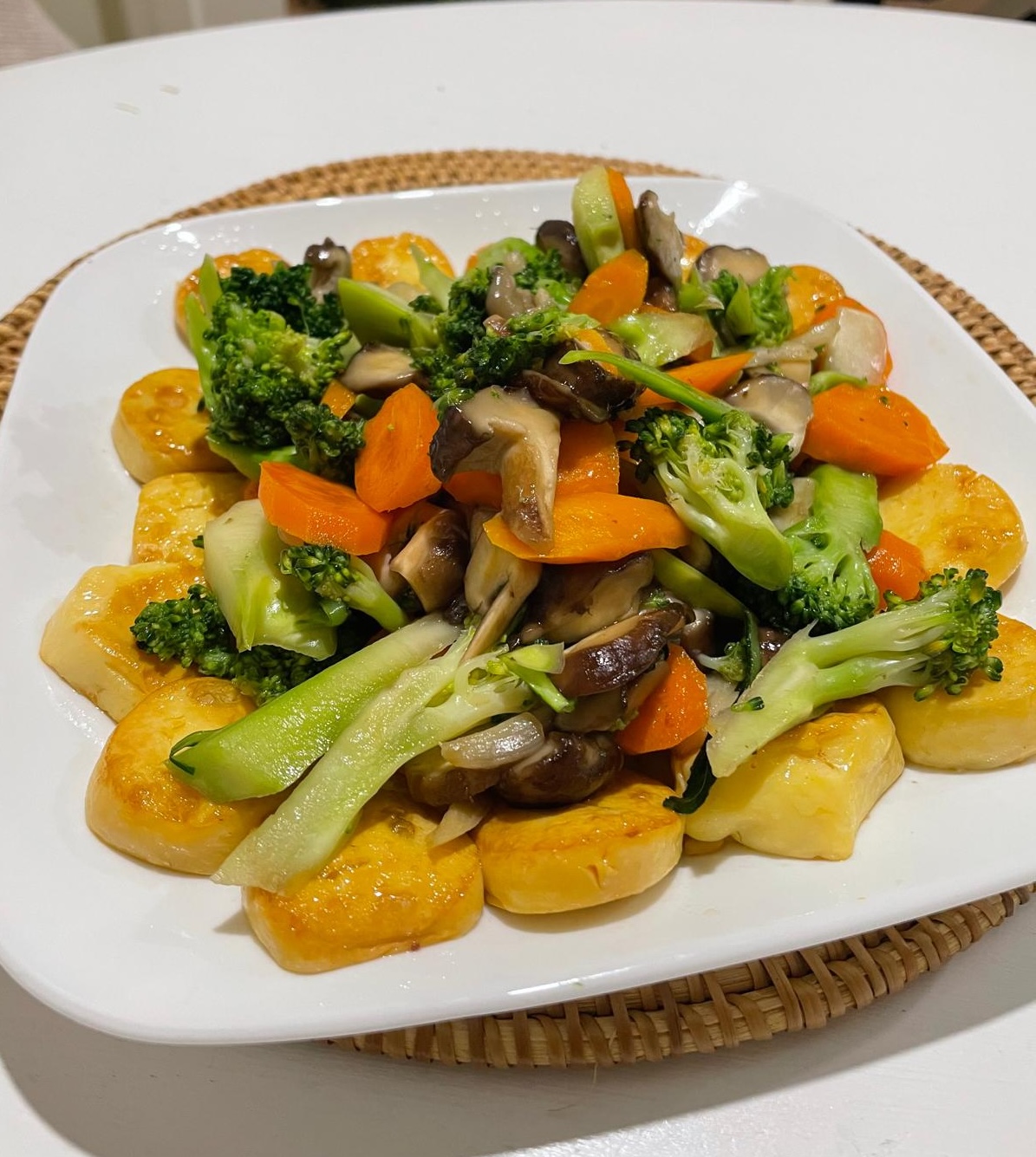
Main ingredientsStir-fried mixed vegetables with broccoli, carrot and mushrooms
VariationsCap cai kuah (soupy) and Cap cai goreng (dry)

Cap cai, sometimes spelled cap cay, (Chinese: 雜菜; pinyin: zácài; Pe̍h-ōe-jī: cha̍p-chhài; lit. 'mixed vegetables') is the Hokkien-derived term for a popular Chinese Indonesian and Peranakan stir fried vegetable dish that originates from Fujian cuisine.[1]

History

[edit]

According to Aji Bromokusumo, an expert on Chinese Peranakan cuisine in Indonesia, the stir fried mixed vegetables has its origin from the Chinese imperial kitchen. According to the royal etiquette, the Chinese emperor should always consume high quality food made of fresh ingredients daily, thus there are a lot of leftover vegetables in the palace kitchen. This led the chef to salvage the leftover vegetables, mixed and stir-fried it as a new dish, which led to the creation of Chinese stir-fried mixed vegetables.[2] This stir-fried leftover vegetables of course, was not meant for the emperor or the royal family, but is served to feed the palace servants, eunuch and courtiers.

Cap cai was brought to Indonesia from the Fujian area, where the Hokkien people originated. Subsequently, the Hokkien people are the dominant Chinese ethnic group in Indonesia. According to a culinary history expert, Chinese immigrants who arrived in Indonesia cooked cap cai because Indonesia is rich in various types of vegetables. On the other hand, meat was not affordable for the struggling early immigrants. This is also the reason why cap cai does not have a rigid recipe regarding the types of vegetables contained in it.[2]

Ingredients

[edit]

Various vegetables such as cauliflower, cabbage, Chinese cabbage, Napa cabbage, carrot, baby corn, mushrooms, and leeks are chopped and stir-fried in a wok with small amount of cooking oil and water. Chopped garlic and onion with salt, sugar, soy sauce, ang ciu Chinese cooking wine and oyster sauce are added for flavour. The liquid sauces are thickened using corn starch.[3]

Cap cai can be made as a vegetarian dish, or mixed with meats such as chicken, liver or gizzard, beef, fish, shrimp or cuttlefish, and slices of beef or fish bakso (meatballs). The type and numbers of vegetables differ according to recipe variations and the availability of vegetables in each household, but the most common vegetables in simple cap cai are cauliflower, cabbage and carrot.[4]

See also

[edit]

References

[edit]
Revisions and contributorsEdit on WikipediaRead on Wikipedia
from Grokipedia
Cap cai, also known as cap cay or cap chay, is a traditional Chinese-Indonesian stir-fry dish featuring a colorful medley of mixed vegetables, often combined with meat, seafood, or tofu, and simmered in a savory, thick gravy seasoned with oyster sauce and soy sauce.[1] Originating from Hokkien Chinese immigrants in Indonesia, the name "cap cai" derives from the Hokkien term for "mixed vegetables," reflecting its emphasis on a variety of fresh produce such as broccoli, cauliflower, carrots, cabbage, and mushrooms.[1] This versatile one-pan meal is a staple in Indonesian cuisine, commonly served as a comforting, healthy side or main dish in homes, street stalls, and restaurants across the archipelago.[2] The dish's popularity stems from its adaptability to local ingredients and dietary preferences, with vegetarian versions using only vegetables and eggs, while non-vegetarian preparations incorporate chicken, shrimp, or beef for added protein.[3] Typically prepared by stir-frying the ingredients briefly over high heat before thickening the sauce with cornstarch slurry, cap cai balances crisp textures with umami flavors, making it a quick yet nutritious option ready in under 45 minutes.[3] Its cultural significance lies in blending Chinese stir-fry techniques with Indonesian tastes, evolving into a beloved comfort food that highlights the fusion heritage of Chinese-Indonesian cuisine in Southeast Asia.[4]

Etymology and Origins

Name and Linguistic Roots

Cap cai, also known as capcay, derives its name from the Hokkien Chinese dialect, from 雜菜 (cha̍p-chhài; literally "mixed vegetables"), denoting a stir-fried assortment of multiple vegetables.[5] This etymology underscores the dish's roots in Fujianese cuisine from southern China, reflecting a simple yet diverse preparation of seasonal produce.[6] The spelling of the name has evolved through transliteration in colonial and postcolonial contexts, influenced by Dutch orthography during Indonesia's time as the Dutch East Indies. Common variations include "cap cay," "cap chay," and the older form "tjap tjoy," which was prevalent in early European-language texts and menus before standardizing to "cap cai" in modern Indonesian usage.[4] These adaptations arose from efforts to phonetically render Hokkien pronunciation using Latin script, shaped by both colonial administrators and local Chinese communities.[7] As a hallmark of Chinese-Indonesian culinary fusion, cap cai exemplifies the broader influences of Hokkien-speaking migrants who integrated their traditions into Indonesian foodways during the late colonial era.[4]

Historical Introduction to Indonesia

Cap cai, a stir-fried mixed vegetable dish, was introduced to Indonesia by Chinese immigrants primarily from Fujian province during the late 19th and early 20th centuries under Dutch colonial rule. These migrants, often Hokkien speakers fleeing economic hardships in southern China, settled in port cities and brought culinary practices that blended with local ingredients and cooking methods.[8][9] The dish's name derives from Hokkien roots meaning "mixed vegetables," reflecting its simple, resourceful preparation using available produce.[9] The dish quickly gained traction in urban centers like Jakarta (formerly Batavia) and Surabaya, where Chinese communities formed enclaves such as Glodok and became integral to the colonial economy as traders and laborers. Cap cai emerged as an economical option, utilizing inexpensive vegetables and minimal protein, making it accessible to working-class immigrants and local populations amid the demands of colonial labor systems.[10] By the early 20th century, it had integrated into everyday meals in these bustling ports, symbolizing the fusion of Fujianese traditions with Indonesian staples like cabbage and carrots.[10] The Japanese occupation of Indonesia from 1942 to 1945 disrupted Chinese communities and supply chains more broadly. Under President Suharto's New Order regime (1966–1998), anti-Chinese policies, including Presidential Instruction No. 14/1967, suppressed Chinese cultural expressions, affecting the visibility of Chinese cuisine.[10] Following the fall of Suharto in 1998 and the lifting of restrictions in 2000, Chinese-Indonesian cuisine, including cap cai, experienced a revival and became more openly celebrated nationwide.[10] By this period, it had transcended its immigrant roots to become a fixture in Indonesian culinary identity, bridging colonial legacies with modern adaptations.[9]

Ingredients

Core Vegetables

Cap cai, a staple in Indonesian-Chinese cuisine, features a medley of core vegetables that form the foundation of its vibrant, textured profile. The essential plant-based components typically include white cabbage, Chinese cabbage (also known as Napa cabbage), carrots, cauliflower, broccoli, bok choy, mushrooms, and baby corn, selected for their widespread availability in Indonesian markets and their capacity to absorb surrounding flavors while retaining distinct textures.[11][1] These vegetables are often prepared in roughly equal proportions to create balance, ensuring quick cooking and even distribution in the dish.[2][12] This combination not only provides structural variety—crisp carrots contrasting with tender leafy greens—but also contributes significant nutritional value, emphasizing cap cai's role as a healthful meal in traditional contexts. The colorful mix is particularly high in dietary fiber, which supports digestive health, alongside vitamins A and C that bolster immunity and skin integrity; for instance, carrots supply beta-carotene for vitamin A, while cauliflower, broccoli, and cabbages offer ample vitamin C.[11][13] While the dish may incorporate optional proteins such as chicken or shrimp for added substance, the vegetables remain the defining element.[3]

Proteins and Seasonings

In non-vegetarian versions of cap cai, proteins such as thinly sliced chicken (typically 100 grams per serving), peeled shrimp (around 6-8 medium pieces), or sliced meatballs and fish balls (50-100 grams total) are commonly incorporated to add substance and flavor to the dish. These elements are often stir-fried briefly with the vegetable medley before the sauce is added, providing a balance of texture and nutrition.[2][14][15] The flavor profile of cap cai relies on key seasonings that enhance umami and aroma, including 2-3 tablespoons of oyster sauce for depth, soy sauce for saltiness, minced garlic (4-6 cloves), and grated ginger (1-2 cm piece) for pungency. A cornstarch slurry (1 tablespoon cornstarch mixed with water) is frequently used to thicken the gravy, creating a glossy consistency that coats the ingredients evenly.[2][14][16] For vegetarian adaptations, proteins like firm tofu cubes or sliced mushrooms (50-100 grams per serving) serve as substitutes, maintaining the dish's hearty quality while requiring seasoning adjustments such as replacing oyster sauce with vegetarian mushroom sauce and using vegetable broth instead of chicken stock to preserve balance and authenticity.[14][17][18]

Preparation Methods

Traditional Stir-Fry Technique

The traditional stir-fry technique for cap cai emphasizes high-heat cooking in a wok to preserve the vibrant colors, textures, and nutrients of the vegetables while achieving a glossy, flavorful gravy. This method, rooted in Chinese-Indonesian culinary practices, involves brief pre-cooking of vegetables to ensure even doneness without sogginess, followed by rapid stir-frying to integrate flavors efficiently.[2][3] Proteins like chicken, shrimp, or meatballs are typically marinated lightly and par-cooked if needed.[2][14] In a preheated wok over high heat, 2-3 tablespoons of neutral oil, such as vegetable or canola, are added to create a smoking-hot surface for the Maillard reaction that builds depth. Aromatics including minced garlic (2-3 cloves) and ginger (1-inch piece, grated) are stir-fried for 30-60 seconds until fragrant, releasing essential oils without burning. Proteins are then added and stir-fried for 2-3 minutes until partially cooked, followed by the blanched vegetables introduced in sequence based on cooking time: denser items like carrots and cauliflower first (3-4 minutes), then quicker-cooking ones like bok choy or snow peas (1-2 minutes).[3][2][14] The sauce components—typically including oyster sauce for umami, soy sauce, chicken or vegetable broth, and a pinch of white pepper—are poured in next, deglazing the wok and coating the ingredients as they simmer for 2 minutes. To achieve the characteristic semi-thick gravy, a cornstarch slurry (1 tablespoon cornstarch mixed with 2 tablespoons water) is stirred in last, cooking for an additional 1 minute until the mixture thickens and clings to the components without becoming gluey. The entire stir-fry process takes 10-15 minutes on high flame to maintain vegetable crispness and prevent nutrient loss.[3][2][14] A well-seasoned carbon steel or cast-iron wok is essential for this technique, as its rounded shape and high thermal conductivity enable constant tossing and even heat distribution, ensuring no part of the dish overcooks. Chefs recommend using long-handled utensils like a wok spatula for vigorous stirring, and tasting midway to adjust seasoning, always keeping the flame high to evaporate excess moisture and concentrate flavors. Overcrowding the wok should be avoided by cooking in batches if necessary, promoting the ideal balance of tender-crisp vegetables in a savory gravy.[2][14]

Modern Adaptations and Tips

In contemporary cooking, capcay has seen adaptations aimed at reducing oil content for health-conscious preparations, such as sautéing vegetables without added fat by using a hot pan and a splash of water or vegetable stock to prevent sticking. This method maintains the dish's vibrant flavors while minimizing calories from oil, as demonstrated in low-oil recipes where aromatics like garlic and onions are dry-sautéed first before incorporating denser vegetables.[19][20] Vegan versions of capcay substitute traditional oyster sauce with plant-based alternatives like soy sauce enhanced with sugar for umami and sweetness, or mushroom-based "oyster" sauce made from dried shiitake mushrooms, soy, and cornstarch to replicate the savory depth without animal products. Vegetable broth can replace chicken stock, paired with tofu or plant-based proteins like shroom balls for a fully vegan profile that aligns with dietary restrictions while preserving the stir-fry's textural contrast.[21][18] For serving 4-6 people, a balanced ratio of approximately 2:1 vegetables to protein—such as 7 cups total vegetables (e.g., 2 cups each of broccoli, cabbage, and carrots, plus 1 cup mushrooms) to 3 cups protein (e.g., cubed chicken, tofu, or fish balls)—ensures even distribution and nutritional variety without overwhelming the dish. Scale seasonings accordingly, using about 2 tablespoons each of soy and oyster (or vegan substitute) sauces to coat without excess liquid.[15] Common pitfalls in capcay preparation include overcooking, which leads to soggy textures; to avoid this, add vegetables in stages based on cooking time—harden ones like carrots and cauliflower first for 2-3 minutes over high heat, followed by softer greens like bok choy for just 1 minute—to retain crispness. Another issue is uneven sauce distribution, fixed by tossing ingredients vigorously after adding a cornstarch slurry for quick thickening. For leftovers, store in an airtight container in the refrigerator for up to 2 days, reheating gently on the stovetop with a bit of water to revive moisture without further softening.[14]

Variations and Regional Styles

Indonesian Variations

In Indonesia, cap cai exhibits regional adaptations that reflect local ingredients and preferences, particularly within Java, Bali, and urban street food scenes. The Javanese style prioritizes abundant cabbage and sliced carrots as core vegetables, providing substantial texture and volume to the dish, while incorporating sweet soy sauce (kecap manis) for a distinctive caramelized sweetness that balances the savory elements.[22] This version is typically prepared as a hearty stir-fry and paired with steamed rice to form a complete meal, often enjoyed during fasting periods like sahur for its nutritional profile rich in fiber and vitamins.[22] On Bali, cap cay ayam distinguishes itself by centering on chicken as the primary protein, combined with local greens such as bok choy for added freshness and crunch in the stir-fry.[23] The dish is infused with a stock base seasoned by ginger, garlic, and pepper, then finished with oyster sauce, resulting in a flavorful medley suitable as a main lunch option that highlights Balinese adaptations of Chinese-Indonesian influences.[23] Urban street food iterations of cap cai, prevalent in Indonesian markets, emphasize a thicker, gravy-like sauce achieved through cornstarch thickening and abundant stock, which clings to the vegetables and proteins for enhanced portability and appeal.[2] These versions frequently incorporate hard-boiled quail eggs alongside meatballs or fishcakes, adding a protein boost and textural contrast that has made them a staple in bustling city eateries.[15]

Influences from Other Cuisines

In the Malaysian and Peranakan cuisines, cap cai evolves into chap chye, a braised mixed vegetable stew that incorporates local flavors while retaining its Chinese roots. This version often includes prawns as a protein addition for enhanced savoriness, alongside traditional vegetables like cabbage, black fungus, and glass noodles, braised in a flavorful stock.[14][24] Some preparations introduce tamarind or asam keping to impart a tangy sourness, balancing the dish's earthiness from fermented bean paste and dried shrimp, making it a staple in Singaporean Peranakan households and festive meals like Chinese New Year.[25] This adaptation reflects the fusion of Chinese immigrant traditions with Malay ingredients, resulting in a slower-cooked, soupier profile compared to the quick stir-fry of its Indonesian counterpart.[26] The Filipino adaptation, known as chop suey, emerged through Chinese migration to the Philippines in the early 1900s, where immigrants from Guangdong province adapted the vegetable stir-fry using local produce and seafood abundance. While sharing the core mix of bok choy, carrots, and cauliflower, the Filipino version emphasizes more seafood elements, such as shrimp, squid, and occasionally fish balls or quail eggs, simmered in a cornstarch-thickened sauce for a glossy, hearty texture.[27][28] This seafood-forward twist distinguishes it from meatier or vegetarian originals, turning it into a ubiquitous everyday dish in Filipino homes and restaurants, often served with rice to absorb the savory gravy.[29]

Cultural and Culinary Role

Place in Indonesian-Chinese Fusion

Cap cai exemplifies the assimilation of Chinese culinary techniques with indigenous Indonesian ingredients, emerging as a hallmark of Peranakan culture through centuries of Chinese immigration and acculturation, with adaptations continuing through the 19th and 20th centuries. This fusion reflects the adaptation of Hokkien stir-fry methods—originally emphasizing a variety of vegetables—to incorporate local produce such as kangkung and sawi, creating a dish that symbolizes cultural integration within Chinese-Indonesian communities.[1][14] As Peranakan identity formed through intermarriage and acculturation, cap cai became a staple that bridged immigrant traditions with archipelago flavors, highlighting the hybrid nature of Indonesian Chinese heritage.[4] Economically, cap cai holds significance as an accessible and budget-friendly option in Chinese-Indonesian households, particularly during festivals like Imlek (Chinese New Year), where it serves as a communal dish prepared in large quantities without straining resources. Its simplicity—relying on inexpensive, seasonal vegetables and minimal proteins—makes it ideal for both celebratory feasts and routine meals, reinforcing its role in sustaining community bonds amid historical economic challenges faced by immigrants.[30][31] In contemporary Indonesian diets, cap cai is increasingly promoted for its vegetable-centric composition, aligning with wellness trends that gained momentum in the 2000s amid rising concerns over nutrition and lifestyle diseases. Health advocates highlight its nutrient density from diverse greens and low-calorie profile, positioning it as a modern healthy choice in urban settings where vegetable consumption is encouraged to counter processed food dominance.[2][32][33]

Serving Traditions and Popularity

Cap cai is traditionally served hot, immediately after stir-frying to preserve the crispness of the vegetables, and is commonly paired with steamed rice or noodles for a complete meal.[14] In family-style settings, it is often portioned generously in a central dish, allowing diners to share, with optional garnishes like crispy fried shallots adding texture and aroma.[4] This presentation reflects its roots as a comforting, communal dish in Indonesian-Chinese households and eateries. The dish enjoys widespread popularity across Indonesia, appearing frequently on menus in warungs—small street-side stalls—and Chinese restaurants, where it is valued for its versatility and nutritional appeal as a vegetable-forward option.[1] In regions like Bali and Java, cap cai is a go-to choice in casual dining spots, often customized with proteins like chicken or shrimp to suit local tastes.[34] In contemporary contexts, cap cai has adapted to modern culinary scenes, featuring in fusion menus that blend it with international elements, such as Western proteins or spice profiles, while remaining a staple in online recipes that encourage home preparation.[31] Platforms like Cookpad host numerous user-shared variations, highlighting its ease for everyday cooking and broad accessibility.[35]

References

User Avatar
No comments yet.