


Community hub
Recent from talks
Contribute something
Nothing was collected or created yet.
Chili pepper
View on Wikipedia

Chili peppers, also spelled chile or chilli (from Classical Nahuatl chīlli [ˈt͡ʃiːlːi] ⓘ), are varieties of berry-fruit plants from the genus Capsicum, which are members of the nightshade family Solanaceae, cultivated for their pungency (spicy heat). They are used as a spice to add pungency in many cuisines. Capsaicin and the related capsaicinoids give chili peppers their intensity when ingested or applied topically. Chili peppers exhibit a range of heat and flavors. This diversity is the reason behind the availability of different types of chili powder, each offering its own taste and heat level.
Chili peppers originated in Central or South America and were first cultivated in Mexico. European explorers brought chili peppers back to the Old World in the late 16th century as part of the Columbian Exchange, which led to the cultivation of multiple varieties across the world for food and traditional medicine. Five Capsicum species have been widely cultivated: annuum, baccatum, chinense, frutescens, and pubescens.
History
[edit]Origins
[edit]Capsicum plants originated in modern-day Peru and Bolivia, and have been a part of human diets since about 7,500 BC.[1][2] They are one of the oldest cultivated crops in the Americas.[2] Chili peppers were cultivated in east-central Mexico some 6,000 years ago,[3][4] and independently across different locations in the Americas including highland Peru and Bolivia, central Mexico, and the Amazon.[5] They were among the first self-pollinating crops cultivated in those areas.[6][2]
Peru has the highest diversity of cultivated Capsicum; it is a center of diversification where varieties of all five domesticates were introduced, grown, and consumed in pre-Columbian times.[7] The largest diversity of wild Capsicum peppers is consumed in Bolivia. Bolivian consumers distinguish two basic forms: ulupicas, species with small round fruits including C. eximium, C. cardenasii, C. eshbaughii, and C. caballeroi landraces; and arivivis with small elongated fruits including C. baccatum var. baccatum and C. chacoense varieties.[7]
.jpg)
Distribution to Europe
[edit]When Christopher Columbus and his crew reached the Caribbean, they were the first Europeans to encounter Capsicum fruits. They called them "peppers" because, like black pepper (Piper nigrum), which had long been known in Europe, they have a hot spicy taste unlike other foods.[8][9] Chilies were first brought back to Europe by the Spanish, who financed Columbus's voyages, at the start of the large-scale interchange of plants and culture between the New World and the Old World called the Columbian exchange. Chilies appear in Spanish records by 1493. Unlike Piper vines, which grow naturally only in the tropics, chilies could be grown in temperate climates. By the mid-1500s, they had become a common garden plant in Spain and were incorporated into numerous dishes. By 1526, they had appeared in Italy, in 1543 in Germany, and by 1569 in the Balkans, where they came to be processed into paprika.[10][11]
Distribution to the rest of the world
[edit]The rapid introduction of chilies to Africa and Asia was likely through Portuguese and Spanish traders in the 16th century, though the details are unrecorded. The Portuguese introduced them first to Africa and Arabia, and then to their colonies and trading posts in Asia, including Goa, Sri Lanka, and Malacca. From there, chilies spread to neighboring regions in South Asia and western Southeast Asia via local trade and natural dispersal. Around the same time, the Spanish also introduced chilies to the Philippines, where they spread to Melanesia, Micronesia, and other Pacific Islands via their monopoly of the Manila galleons. Their spread to East Asia in the late 16th century is less clear, but was likely also through local trade or through Portuguese and Spanish trading ports in Canton, China, and Nagasaki, Japan.[12][13][14][15] The earliest known mention of the chili pepper in Chinese writing dates to 1591, though the pepper is thought to have entered the country in the 1570s.[16]
Producing chili peppers
[edit]Cultivation
[edit]Chili peppers are the shiny, brightly coloured fruits of species of Capsicum.[17][18] Botanically they are berries. The plants are small, 20 to 60 centimetres (7.9 to 23.6 in) depending on variety, making them suitable for growing in pots, greenhouses, or commercially in polytunnels. The plants are perennial, provided they are protected from cold. The fruits can be green, orange, red, or purple, and vary in shape from round and knobbly to smooth and elongated. If the fruits are picked green and unripe, more flowers develop, yielding more fruit; fruits left on the plant can become hotter in taste, and acquire their ripe coloration, at the price of a reduced harvest.[17]
Ideal growing conditions for peppers include a sunny position with warm, loamy soil, ideally 21 to 29 °C (70 to 84 °F), that is moist but not waterlogged.[19] The seeds germinate only when warm, close to 21 °C (70 °F).[17] The plants prefer warm conditions, but can tolerate temperatures down to 12 °C (54 °F); and are sensitive to cold.[17] The flowers can self-pollinate. However, at extremely high temperatures, 30 to 38 °C (86 to 100 °F), pollen loses viability, and its flowers are much less likely to result in fruit.[20] For flowering, Capsicum is a non-photoperiod-sensitive crop.[21]
Chilies are vulnerable to pests including aphids, glasshouse red spider mite, and glasshouse whitefly, all of which feed on plant sap.[17] Common diseases include grey mould caused by Botrytis cinerea; this rots the tissues and produces a brownish-grey mould on the surface.[17]
- Cultivation
-
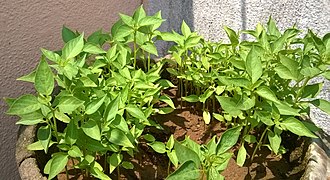 Young plants
 -
 Buds and flowers
 -
 Immature chilies in the field
 -
 Ripe chilies in the field, Myanmar
 -
 Leaf damaged by aphids
 -
 Ripe chili pepper with seeds


Preparation
[edit]Harvested chilies may be used fresh, or dried, typically on the ground in hot countries, to make a variety of products. Drying enables chilies grown in temperate regions to be used in winter. For home use, chilies can be dried by threading them with cotton and hanging them up in a warm dry place to dry.[22]
- Drying chilies
-
 Chili peppers drying in Kathmandu, Nepal
 -
 Guntur chilli drying in the sun, Andhra Pradesh, India
 -
 New Mexico chiles dried on the plant in Mesilla, New Mexico


-
 Sundried chili at Imogiri, Yogyakarta, Indonesia
 -

-
 Removing seeds and pith from dried chilies in San Pedro Atocpan, Mexico
 -
 Smoke-dried chipotle


Products include whole dried chilies, chili flakes, and chili powder,[23] Fresh or dried chilies are used to make hot sauce, a liquid condiment—usually bottled for commercial use—that adds spice to other dishes.[24] Dried chilies are used to make chili oil, cooking oil infused with chili.[25]
- Products
-
 Dried chili pepper flakes, Myanmar
 -
 Chili powder, India
 -
 Brands of hot sauce, California
 -
 Chili oil
_pepper,_Capsicum_annuum,_Myanmar.jpg)
.jpg)
.jpeg)
.jpg)
Annual production
[edit] China China
|
16.7 |
 Mexico Mexico
|
2.8 |
 Indonesia Indonesia
|
2.8 |
 Turkey Turkey
|
2.6 |
 Spain Spain
|
1.5 |
| World | 36.1 |
| Source: FAOSTAT of the United Nations[26] | |
In 2020, 36 million tonnes of green chilies and peppers (counted as any Capsicum or Pimenta fruits) were produced worldwide, with China producing 46% of the total.[26]
Species and cultivars
[edit]Species of Capsicum that produce chili peppers are shown on the simplified phylogenetic tree,[27] with examples of cultivars:[28] The World Vegetable Center has one of the largest collection of chili peppers in the world. It has researched climate change resistant cultivars.[29]
| Capsicum |
| ||||||||||||||||||||||||||||||||||||


- Cultivars
-
 Cayenne peppers, a cultivar of Capsicum annuum
 -
 Tabasco peppers, a cultivar of Capsicum frutescens, fruits pointing upwards
 -
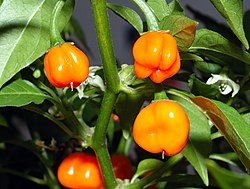 Habanero peppers, a cultivar of Capsicum chinense
 -
 Cubanelle peppers,
United States -
 Scotch bonnets,
Caribbean -
 Bird's eye chilies,
Thailand -
 Cheongyang peppers,
South Korea


.jpg)


-
 Black Pearl cultivar of C. annuum
 -
 Choricero,
Spain -
 Purple chilies,
Myanmar


Intensity
[edit]Capsaicin
[edit]

The substances that give chili peppers their pungency (spicy heat) when ingested or applied topically are capsaicin (8-methyl-N-vanillyl-6-nonenamide) and several related chemicals, collectively called capsaicinoids.[31][32] Pure capsaicin is a hydrophobic, colorless, odorless, and crystalline-to-waxy solid at room temperature.[33] The quantity of capsaicin varies by variety, and depends on growing conditions. Water-stressed peppers usually produce stronger fruits. When a habanero plant is stressed, for example by shortage of water, the concentration of capsaicin increases in some parts of the fruit.[34]
When peppers are consumed by mammals such as humans, capsaicin binds with pain receptors in the mouth and throat, potentially evoking pain via spinal relays to the brainstem and thalamus where heat and discomfort are perceived.[35] However, birds are unable to perceive the hotness and so they can eat some of the hottest peppers.[36] The intensity of the "heat" of chili peppers is commonly reported in Scoville heat units (SHU), invented by American pharmacist Wilbur Scoville in 1912. Historically, it was a measure of the dilution of an amount of chili extract added to sugar syrup before its heat becomes undetectable to a panel of tasters; the more it has to be diluted to be undetectable, the more powerful the variety, and therefore the higher the rating.[37] Since the 1980s, spice heat has been assessed quantitatively by high-performance liquid chromatography (HPLC), which measures the concentration of heat-producing capsaicinoids, typically with capsaicin content as the main measure.[38]
Capsaicin is produced by the plant as a defense against mammalian predators. A study suggests that by protecting against attack by a hemipteran bug, the risk of disease caused by a Fusarium fungus carried by the insects is reduced.[39] As evidence, the study notes that peppers increased the quantity of capsaicin in proportion to the damage caused by fungi on the plant's seeds.[39]
Intensity range of commonly used cultivars
[edit]A wide range of intensity is found in commonly used peppers:
| Bell pepper | 0 SHU |
| Fresno, jalapeño | 3,500–10,000 SHU |
| Cayenne | 30,000–50,000 SHU |
| Piri piri, bird's eye | 50,000–100,000 SHU |
| Habanero, Scotch bonnet | 100,000–350,000 SHU[40] |
Hottest by country
[edit]The top 9 world's hottest chili peppers (by country) are:
| Country | Type | Heat (SHU) |
|---|---|---|
| United States | Pepper X | 2.69M[41] |
| Wales | Dragon's Breath | 2.48M[42] |
| United States | Carolina Reaper | 2.2M[43] |
| Trinidad and Tobago | Trinidad moruga scorpion | 2.0M[44] |
| India | Ghost pepper (Bhut jolokia) | 1.58M[45] |
| Trinidad and Tobago | Trinidad Scorpion Butch T | 1.46M[46] |
| England | Naga Viper | 1.38M[47] |
| England | Armageddon | 1.3M[48] |
| England | Infinity chili | 1.07M[49] |
As food
[edit]Nutritional value
[edit]| Nutritional value per 100 g (3.5 oz) | |||||||||||||||||||||||||
|---|---|---|---|---|---|---|---|---|---|---|---|---|---|---|---|---|---|---|---|---|---|---|---|---|---|
| Energy | 166 kJ (40 kcal) | ||||||||||||||||||||||||
8.8 g | |||||||||||||||||||||||||
| Sugars | 5.3 g | ||||||||||||||||||||||||
| Dietary fiber | 1.5 g | ||||||||||||||||||||||||
0.4 g | |||||||||||||||||||||||||
1.9 g | |||||||||||||||||||||||||
| |||||||||||||||||||||||||
| Other constituents | Quantity | ||||||||||||||||||||||||
| Water | 88 g | ||||||||||||||||||||||||
| Capsaicin | 0.01g – 6 g | ||||||||||||||||||||||||
| †Percentages estimated using US recommendations for adults,[50] except for potassium, which is estimated based on expert recommendation from the National Academies.[51] | |||||||||||||||||||||||||
Red hot chili peppers are 88% water, 9% carbohydrates, 2% protein, and 0.4% fat (table). In a 100 gram reference amount, chili peppers supply 40 calories, and are a rich source of vitamin C and vitamin B6.[52]
Pungency
[edit]Due to their unique pungency (spicy heat), chili peppers constitute a crucial part of many cuisines around the world, particularly in Chinese (especially in Sichuanese food), Mexican, Thai, Indian, Yoruba, New Mexican cuisine and many other South American, Caribbean and East Asian cuisines. In 21st-century Asian cuisine, chili peppers are commonly used across many regions.[53][54] Chili is a key ingredient in many curries, providing the desired amount of heat; mild curries may be flavoured with many other spices, and may omit chili altogether.[55]
Cooking
[edit]Chilies with a low capsaicin content can be cooked like bell peppers, for example stuffing and roasting them. Hotter varieties need to be handled with care to avoid contact with skin or eyes; washing does not efficiently remove capsaicin from skin. Chilies can be roasted over very hot coals or grilled for a short time, as they break up if overcooked.[56]
The leaves of every species of Capsicum are edible, being mildly bitter and nowhere near as hot as the fruits. They are cooked as greens in Filipino cuisine, where they are called dahon ng sili (literally "chili leaves"). They are used in the chicken soup tinola.[57] In Korean cuisine, the leaves may be used in kimchi.[58]
Regional cuisines
[edit]Chilies are present in many cuisines. In Peru, Papa a la huancaina is a dish of potatoes in a sauce of fresh cheese and aji amarillo chilies.[59] In Thailand, kaeng tai pla fish curry is flavoured with a tai pla sauce made with garlic, shallots, galangal, kaffir lime, turmeric, fish paste, and bird's eye chilies.[59] In Jamaica, jerk chicken is spiced with powerful habanero chilies and allspice.[59] Goan vindaloo curry uses the extremely hot ghost pepper or bhut jolokia to create "perhaps [India's] hottest dish".[59] In Bhutan, ema datshi, entirely made of chili mixed with local cheese, is the national dish.[60][61] Many Mexican dishes use chilies of different types, including the jalapeño, poblano, habanero, serrano, chipotle, ancho, pasilla, guajillo, de árbol, cascabel and mulato. These offer a wide range of flavours including citrus, earthy, fruity, and grassy. They are used in many dishes and the spicy mole sauce and Mexican salsa sauces.[62] In Yoruba cuisine, chillies are well used in many dishes including Ewa Agoyin[63] and Obe ata.
- Dishes
-
 Mexican lamb chops with guajillo chili sauce and charro beans
 -
 Lamb Madras curry
 -
 Pickled chili in India
 -
 Chili pepper dip in a traditional restaurant in Amman, Jordan
 -

.jpg)


Other uses
[edit]Ornamental plants
[edit]
The contrast in color and appearance makes chili plants interesting to some as a purely decorative garden plant.
- Black pearl pepper: small cherry-shaped fruits and dark brown to black leaves[64]
- Black Hungarian pepper: green foliage, highlighted by purple veins and purple flowers, jalapeño-shaped fruits[65]
- Bishop's crown pepper, Christmas bell pepper: named for its distinct three-sided shape resembling a red bishop's crown or a red Christmas bell[66]
Constrained risk-taking
[edit]Psychologist Paul Rozin suggests that eating ordinary chilies is an example of a "constrained risk" like riding a roller coaster, in which extreme sensations like pain and fear can be enjoyed because individuals know that these sensations are not actually harmful. This method lets people experience extreme feelings without any significant risk of bodily harm.[67]
Topical use and health research
[edit]Capsaicin, the pungent chemical in chili peppers, is used as an analgesic in topical ointments, nasal sprays, and dermal patches to relieve pain.[68] A 2022 review of preliminary research indicated that regular consumption of chili peppers was associated with weak evidence for a lower risk of death from cardiovascular diseases and cancer.[69]
Chemical irritants
[edit]Capsaicin extracted from chilies is used in pepper sprays and some tear gas formulations as a chemical irritant, for use as less-lethal weapons for control of unruly individuals or crowds.[70] Such products have considerable potential for misuse, and may cause injury or death.[70]
Conflicts between farmers and elephants have long been widespread in African and Asian countries, where elephants nightly destroy crops, raid grain houses, and sometimes kill people. Farmers have found the use of chilies effective in crop defense against elephants. Elephants do not like capsaicin due to their large and sensitive olfactory and nasal system. The smell of chili causes them discomfort and deters them from feeding on the crops. By planting a few rows of the fruit around valuable crops, farmers create a buffer zone through which the elephants are reluctant to pass. Chili dung bombs are also used for this purpose. They are bricks made of mixing dung and chili, and are burned, creating a noxious smoke that keeps hungry elephants out of farmers' fields. This can lessen dangerous physical confrontation between people and elephants.[71]
Birds do not have the same sensitivity to capsaicin as mammals, as they lack a specific pain receptor. Chili peppers are eaten by birds living in the chili peppers' natural range, possibly contributing to seed dispersal and evolution of the protective capsaicin in chili peppers, as a bird in flight can spread the seeds further away from the parent plant after they pass through its digestive system than any land or tree dwelling mammal could do so under the same circumstances, thus reducing competition for resources.[36]
Etymology and spelling
[edit]The English word is from Classical Nahuatl chīlli with the same meaning.[72] The name of the plant is unrelated to that of the country Chile.[73] While pepper originally meant the genus Piper, not Capsicum, the Oxford English Dictionary and Merriam-Webster record both usages.[74][75]
The three primary spellings are chili, chile and chilli, all recognized by dictionaries.
- Chili is widely used in English of the United States[76] and optionally in Canada.[77]
- Chile is the most common Spanish spelling in Mexico and several other Latin American countries,[78] and some parts of the United States.[79]
- Chilli was the original Romanization of the Náhuatl language word for the fruit (chīlli),[73] and is the preferred British spelling according to the Oxford English Dictionary.[73] Chilli (and its plural chillies) is the most common spelling in former British colonies such as India[80] and Sri Lanka.[81]
Safety
[edit]The volatile oil in chili peppers may cause skin irritation, requiring hand washing and care when touching the eyes or any sensitive body parts.[82] Consuming hot peppers may cause stomach pain, hyperventilation, sweating, vomiting, and symptoms possibly requiring hospitalization.[83]
Unscrupulous traders have illegally added at least eight different synthetic dyes, including Auramine O, Chrysoidine, Sudan stains I to IV, Para red, and Rhodamine B to chili products. All these chemicals are harmful. They can be detected by liquid chromatography used together with mass spectrometry.[84]
In popular culture
[edit]
The 16th century Spanish missionary and naturalist José de Acosta noted the supposed aphrodisiac power of chilies, but wrote that they were harmful to people's spiritual health.[85] In the 1970s, the government of Peru forbade prison inmates to consume chilies, their explanation being that these were "not appropriate for men forced to live a limited lifestyle."[85]
See also
[edit]- Food and drink prohibitions – which in some cultures includes chili peppers
- Hatch, New Mexico – known as the "Chile Capital of the World"
- History of chocolate – which the Maya drank with ground chili peppers
- International Connoisseurs of Green and Red Chile – organization for the promotion of chili peppers
- Peppersoup
- Salsa (sauce)
- Sweet chili sauce – a condiment for adding a sweet, mild heat taste to food
Notes
[edit]References
[edit]- ^ B Pickersgill (December 1971). "Relationships Between Weedy and Cultivated Forms in Some Species of Chili Peppers (Genus Capsicum)". Evolution; International Journal of Organic Evolution. 25 (4): 683–691. doi:10.1111/j.1558-5646.1971.tb01926.x. PMID 28564789. S2CID 205772121.
- ^ a b c PW Bosland (1998). "Capsicums: Innovative uses of an ancient crop". In Janick J (ed.). Progress in New Crops. Arlington, Virginia: ASHS Press. pp. 479–487. Retrieved 23 December 2010.
- ^ "Birthplace of the domesticated chili pepper identified in Mexico". EurekaAlert, American Association for the Advancement of Science. 21 April 2014.
- ^ Kraft KH, Brown CH, Nabhan GP, Luedeling E, Luna Ruiz J, d'Eeckenbrugge GC, Hijmans RJ, Gepts P (April 2014). "Multiple lines of evidence for the origin of domesticated chili pepper, Capsicum annuum, in Mexico". Proceedings of the National Academy of Sciences of the United States of America. 111 (17): 6165–6170. Bibcode:2014PNAS..111.6165K. doi:10.1073/pnas.1308933111. PMC 4035960. PMID 24753581.
- ^ Chiou KL, Hastorf CA (16 December 2014). "A Systematic Approach to Species-Level Identification of Chile Pepper (Capsicum spp.) Seeds: Establishing the Groundwork for Tracking the Domestication and Movement of Chile Peppers through the Americas and Beyond". Economic Botany. 68 (3). New York Botanical Garden Press: 316–336. Bibcode:2014EcBot..68..316C. doi:10.1007/s12231-014-9279-2. JSTOR 43305668. S2CID 36556206.
- ^ Carrizo García C, Barfuss MH, Sehr EM, Barboza GE, Samuel R, Moscone EA, Ehrendorfer F (July 2016). "Phylogenetic relationships, diversification and expansion of chili peppers ( Capsicum, Solanaceae)". Annals of Botany. 118 (1): 35–51. doi:10.1093/aob/mcw079. ISSN 0305-7364. PMC 4934398. PMID 27245634.
- ^ a b Maarten van Zonneveld; Marleni Ramirez; David E. Williams; Michael Petz; Sven Meckelmann; Teresa Avila; Carlos Bejarano; Llermé Ríos; Karla Peña; Matthias Jäger; Dimary Libreros; Karen Amaya; Xavier Scheldeman (2015). "Screening Genetic Resources of Capsicum Peppers in Their Primary Center of Diversity in Bolivia and Peru". PLOS ONE. 10 (9) e0134663. Bibcode:2015PLoSO..1034663V. doi:10.1371/journal.pone.0134663. PMC 4581705. PMID 26402618.
- ^ Bosland PW, Votava E (2000). Peppers: Vegetable and Spice Capsicums. New York City: CABI. p. 1. ISBN 978-0-85199-335-5. Retrieved 29 November 2018.
- ^ "The Story of Chile Peppers". New Mexico State University Chile Pepper Institute. Retrieved 7 August 2024.
- ^ Sauer JD (2017). Historical Geography of Crop Plants A Select Roster. CRC Press. p. 161. ISBN 978-1-351-44062-2.
- ^ S Raghavan (2006). Handbook of Spices, Seasonings, and Flavorings. CRC Press. p. 8. ISBN 978-1-4200-0436-6.
- ^ Wallin, Nils-Bertil (11 June 2004). "Chili: Small Fruit Sets Global Palettes on Fire". YaleGlobal Online. Yale University. Retrieved 5 January 2024.
- ^ DeWitt D (2020). Chile Peppers A Global History. University of New Mexico Press. ISBN 978-0-8263-6180-6.
- ^ Collingham E (February 2006). Curry. Oxford University Press. ISBN 978-0-09-943786-4.
- ^ Raj NM, Peter KV, Nybe EV (1 January 2007). Spices. New India Publishing. pp. 107–. ISBN 978-81-89422-44-8.
- ^ Brian R. Dott (2020). The Chile Pepper in China. Columbia University Press. p. 21. ISBN 978-0-231-55130-4.
The earliest known record for chiles in a Chinese source is from Hangzhou, Zhejiang, in 1591
- ^ a b c d e f "How to grow chilli pepper / RHS Gardening".
- ^ "HORT410. Peppers – Notes". Purdue University Department of Horticulture and Landscape Architecture. Archived from the original on 26 December 2018. Retrieved 20 October 2009.
Common name: pepper. Latin name: Capsicum annuum L. ... Harvested organ: fruit. Fruit varies substantially in shape, pericarp thickness, color and pungency.
- ^ "Growing Peppers: The Important Facts". GardenersGardening.com. Archived from the original on 27 January 2013. Retrieved 10 January 2013.
- ^ "The Effect of Extreme Temperatures on the Tomato and Pepper Crop". King's Printer for Ontario, 2012–24, Canada.
- ^ Hui YH, ed. (2005). Handbook of Food Science, Technology, and Engineering. Taylor & Francis. pp. 20–13. ISBN 978-1-4665-0787-6.
- ^ "How to dry chillies". BBC Gardeners' World Magazine. 4 September 2019. Retrieved 12 October 2024.
- ^ Farrell KT (1998). Spices, Condiments and Seasonings. Chapman & Hall. pp. 215–217. ISBN 978-0-8342-1337-1.
- ^ Thompson JT (24 April 2012). Hot Sauce!. North Adams, Massachusetts: Storey Publishers. p. 15. ISBN 978-1-60342-813-2.
- ^ "What is chili crisp? This spicy condiment belongs on everything — even dessert". Today.com. 3 June 2021. Retrieved 28 April 2022.
- ^ a b "Green chili production in 2020; Crops/World Regions/Production Quantity/Green Chillies and Peppers from pick lists". UN Food and Agriculture Organization, Statistics Division (FAOSTAT). 2022. Retrieved 17 May 2022.
- ^ Shiragaki K, Yokoi S, Tezuka T (20 November 2020). "Phylogenetic Analysis and Molecular Diversity of Capsicum Based on rDNA-ITS Region". Horticulturae. 6 (4): 87. doi:10.3390/horticulturae6040087.
- ^ Normah MN, Chin HF, Reed BM (2013). Conservation of tropical plant species. New York: Springer. p. 397. ISBN 978-1-4614-3775-8. Retrieved 28 November 2018.
- ^ Wei, Clarissa. "The Quest to Save Chili Peppers". newyorker.com. The New Yorker. Retrieved 17 June 2023.
- ^ Heiser CB, Smith PG (15 October 1958). "New Species of Capsicum from South America". Brittonia. 10 (4): 194–201. Bibcode:1958Britt..10..194H. doi:10.2307/2804950. JSTOR 2804950.
- ^ a b Kosuge S, Inagaki Y, Okumura H (1961). "Studies on the pungent principles of red pepper. Part VIII. On the chemical constitutions of the pungent principles". Nippon Nogeikagaku Kaishi. 35: 923–927. doi:10.1271/nogeikagaku1924.35.10_923. Chem. Abstr. 1964, 60, 9827g.
- ^ Kosuge S, Inagaki Y (1962). "Studies on the pungent principles of red pepper. Part XI. Determination and contents of the two pungent". Journal of the Agricultural Chemical Society of Japan (in Japanese). 36: 251–254.
- ^ "Capsaicin". PubChem, US National Library of Medicine. 27 May 2023. Retrieved 1 June 2023.
- ^ Ruiz-Lau N, Medina-Lara F, Minero-García Y, Zamudio-Moreno E, Guzmán-Antonio A, Echevarría-Machado I, Martínez-Estévez M (1 March 2011). "Water Deficit Affects the Accumulation of Capsaicinoids in Fruits of Capsicum chinense Jacq". HortScience. 46 (3): 487–492. doi:10.21273/HORTSCI.46.3.487.
- ^ O'Neill J, Brock C, Olesen AE, Andresen T, Nilsson M, Dickenson AH (October 2012). "Unravelling the mystery of capsaicin: a tool to understand and treat pain". Pharmacological Reviews. 64 (4): 939–971. doi:10.1124/pr.112.006163. PMC 3462993. PMID 23023032.
- ^ a b Tewksbury JJ, Nabhan GP (July 2001). "Seed dispersal. Directed deterrence by capsaicin in chilies". Nature. 412 (6845): 403–404. Bibcode:2001Natur.412..403T. doi:10.1038/35086653. PMID 11473305. S2CID 4389051.
- ^ "History of the Scoville Scale | FAQS". Tabasco.Com. Archived from the original on 23 August 2010. Retrieved 23 December 2010.
- ^ Guzmán I, Bosland PW (2017). "Sensory properties of chili pepper heat - and its importance to food quality and cultural preference". Appetite. 117: 186–190. doi:10.1016/j.appet.2017.06.026. PMID 28662907.
- ^ a b Tewksbury JJ, Reagan KM, Machnicki NJ, Carlo TA, Haak DC, Peñaloza AL, Levey DJ (August 2008). "Evolutionary ecology of pungency in wild chilies". Proceedings of the National Academy of Sciences of the United States of America. 105 (33): 11808–11811. Bibcode:2008PNAS..10511808T. doi:10.1073/pnas.0802691105. PMC 2575311. PMID 18695236.
- ^ Filippone PT (11 October 2000). "Chile Pepper Heat Scoville Scale". Homecooking.about.com. Archived from the original on 26 February 2012. Retrieved 14 April 2013.
- ^ Atwal S (16 October 2023). "Pepper X dethrones Carolina Reaper as world's hottest chilli pepper". Guinness World Records. Retrieved 16 October 2023.
- ^ Morris L (22 January 2018). "The Hottest Chilli in the World was Created in Wales Accidentally". National Geographic. Archived from the original on 18 February 2018. Retrieved 17 February 2018.
- ^ Lynch K (19 November 2013). "Confirmed: Smokin Ed's Carolina Reaper sets new record for hottest chilli". Guinness World Records. Retrieved 8 November 2014.
- ^ Bryan SM (16 February 2012). "Trinidad Moruga Scorpion wins hottest pepper title". Yahoo! News. Associated Press. Archived from the original on 1 April 2012. Retrieved 11 May 2013.
- ^ Joshi M (11 March 2012). "Chile Pepper Institute studies what's hot". Your life. USA Today. Archived from the original on 14 March 2012.
- ^ Da Silva M (12 April 2011). "Aussies grow world's hottest chilli". Australian Geographic. Archived from the original on 28 October 2011. Retrieved 12 April 2011.
- ^ "Title of world's hottest chili pepper stolen – again". The Independent. London. 25 February 2011. Retrieved 27 February 2011.
- ^ "Armageddon chilli". The London Standard.
- ^ Henderson N (19 February 2011). ""Record-breaking" chilli is hot news". BBC News. Retrieved 20 February 2011.
- ^ United States Food and Drug Administration (2024). "Daily Value on the Nutrition and Supplement Facts Labels". FDA. Archived from the original on 27 March 2024. Retrieved 28 March 2024.
- ^ "TABLE 4-7 Comparison of Potassium Adequate Intakes Established in This Report to Potassium Adequate Intakes Established in the 2005 DRI Report". p. 120. In: Stallings, Virginia A.; Harrison, Meghan; Oria, Maria, eds. (2019). "Potassium: Dietary Reference Intakes for Adequacy". Dietary Reference Intakes for Sodium and Potassium. pp. 101–124. doi:10.17226/25353. ISBN 978-0-309-48834-1. PMID 30844154. NCBI NBK545428.
- ^ Link to USDA Database entry
- ^ Robinson S (14 June 2007). "Chili Peppers: Global Warming". Time. Retrieved 25 May 2019.
- ^ McQuaid J (20 February 2015). "What's driving the global chili pepper craze?". Forbes Media. Retrieved 25 May 2019.
- ^ Jaffrey M (1982). Madhur Jaffrey's Indian Cookery. BBC. pp. 7–10. ISBN 978-0-563-16491-3.
- ^ Pratt J. "Chili recipes". BBC Food.
- ^ "Dahon ng Sili (Chili pepper leaves)". Tribo ความสุขบนเตียง. Archived from the original on 12 March 2007.
- ^ "Vitamin Rich Chili pepper Leaf Kimchi". Ssoft International Corporation. Archived from the original on 14 November 2009.
- ^ a b c d Eugenio R (18 February 2024). "Some like it hot: searching the seven continents for the best spicy dishes". Cathay Pacific. Retrieved 12 October 2024.
- ^ Subramanian S (23 October 2023). "This is what it's like hiking the newly reopened Trans-Bhutan Trail". Condé Nast Traveller India. Retrieved 12 October 2024.
the stew of green peppers and cheese, fiery as arson, that is the national dish
- ^ Ramesh N. "Ema Datshi". 196 Flavors. Retrieved 12 October 2024.
- ^ "Ancho to serrano: a guide to Mexican chillies". Great British Chefs. Retrieved 12 October 2024.
- ^ Chidi, Chef (19 November 2017). "Ewa Agoyin - Yoruba Pepper Sauce for Beans". All Nigerian Foods. Retrieved 9 March 2025.
- ^ "New Ornamental Pepper Wins Prestigious Award". The United States National Arboretum. 2006. Archived from the original on 1 July 2007. Retrieved 11 October 2024.
- ^ "Chilies as Ornamental Plants". Seedsbydesign. Archived from the original on 15 May 2013.
- ^ Datiles, MJ; Acevedo-Rodriguez, P (2014). "Capsicum baccatum (pepper)". CABI Digital Library. doi:10.1079/cabicompendium.120109. Retrieved 17 October 2024.
- ^ Rozin P, Schiller D (1980). "The Nature and Acquisition of a Preference for Chili Pepper by Humans". Motivation and Emotion. 4 (1): 77–101. doi:10.1007/BF00995932. S2CID 143848453.
- ^ Fattori V, Hohmann MS, Rossaneis AC, Pinho-Ribeiro FA, Verri WA (June 2016). "Capsaicin: Current Understanding of Its Mechanisms and Therapy of Pain and Other Pre-Clinical and Clinical Uses". Molecules. 21 (7): 844. doi:10.3390/molecules21070844. PMC 6273101. PMID 27367653.
- ^ Kaur M, Verma BR, Zhou L, Lak HM, Kaur S, Sammour YM, et al. (March 2022). "Association of pepper intake with all-cause and specific cause mortality - A systematic review and meta-analysis". American Journal of Preventive Cardiology. 9 100301. doi:10.1016/j.ajpc.2021.100301. PMC 8688560. PMID 34977833.
- ^ a b Haar RJ, Iacopino V, Ranadive N, Weiser SD, Dandu M (October 2017). "Health impacts of chemical irritants used for crowd control: a systematic review of the injuries and deaths caused by tear gas and pepper spray". BMC Public Health. 17 (1): 831. doi:10.1186/s12889-017-4814-6. PMC 5649076. PMID 29052530.
- ^ Mott M. "Elephant Crop Raids Foiled by Chili Peppers, Africa Project Finds". National Geographic. Archived from the original on 29 October 2013. Retrieved 23 October 2013.
- ^ "chili (n.)". Online Etymology Dictionary. Retrieved 11 October 2024.
- ^ a b c "Chilli, chilly". Oxford English Dictionary. Vol. 2 C (1 Corrected re-issue ed.). Oxford, UK: Clarendon Press. 1933. p. 346. Retrieved 19 July 2021.
- ^ "Pepper". Oxford English Dictionary. Vol. 7 N–Poy (1 Corrected re-issue ed.). Oxford, UK: Clarendon Press. 1913. p. 663. Retrieved 19 July 2021. (sense 2b of pepper)
- ^ "pepper". Merriam-Webster.com Dictionary. Merriam-Webster. Retrieved 21 July 2021.
- ^ "Chili". Merriam-Webster.com Dictionary. Merriam-Webster. Retrieved 21 July 2021.
- ^ The Canadian Oxford Dictionary lists chili as the main entry.
- ^ Heiser C (August 1990). Seed To Civilization: The Story of Food. Cambridge, Massachusetts: Harvard University Press. ISBN 978-0-674-79681-2.
- ^ "chile". Merriam-Webster.com Dictionary. Merriam-Webster. Retrieved 21 July 2021.
- ^ Usage example: "Fall in exports crushes chilli prices in Guntur". Thehindubusinessline.com. Retrieved 21 April 2012.
- ^ Usage example: "Chilli, Capsicum and Pepper are spicy plants grown for the pod. Green chilli is a culinary requirement in any Sri Lankan household". The Sunday Times. Retrieved 21 April 2012.
- ^ Beck A (8 May 2019). "How to Handle Hot Peppers and Chiles Safely". Better Homes and Gardens. Retrieved 23 July 2022.
- ^ Goldfrank LR, ed. (23 March 2007). Goldfrank's Toxicologic Emergencies. New York, New York: McGraw-Hill. p. 1167. ISBN 978-0-07-144310-4.
- ^ Li J, Ding X-M, Liu D-D, Guo F, Chen Y, Zhang Y-B, Liu H-M (2013). "Simultaneous determination of eight illegal dyes in chili products by liquid chromatography–tandem mass spectrometry". Journal of Chromatography B. 942–943: 46–52. doi:10.1016/j.jchromb.2013.10.010. PMID 24212142.
- ^ a b Hospodar M (2004). "Aphrodisiac Foods: Bringing Heaven to Earth". Gastronomica. 4 (4): 82–93. doi:10.1525/gfc.2004.4.4.82. JSTOR 10.1525/gfc.2004.4.4.82.
External links
[edit]


- Plant Cultures: Chilli pepper botany, history and uses
- The Chile Pepper Institute of New Mexico State University
- Capsicums: Innovative Uses of an Ancient Crop
- Chilli: La especia del Nuevo Mundo (Article from Germán Octavio López Riquelme about biology, nutrition, culture and medical topics. In Spanish)
- The Hot Pepper List List of chili pepper varieties ordered by heat rating in Scoville Heat Units (SHU)


| C. annuum var. annuum |
|
|---|---|
| C. annuum var. glabriusculum | |
| C. chinense |
|
| C. frutescens | |
| C. baccatum | |
| C. pubescens | |
| Authority control databases: National |
|---|

Chili pepper
View on GrokipediaBiology and taxonomy
Genus and species
The chili pepper belongs to the genus Capsicum within the family Solanaceae, commonly known as the nightshade family, which also includes crops such as tomatoes and potatoes.[14] The genus comprises approximately 43 species in total, with around 38 being wild and five domesticated, all native to the tropical and temperate regions of the Americas from the southern United States to central Argentina and Brazil, where the highest diversity occurs in the northern and central Andes.[14] These plants are herbaceous perennials or shrubs characterized by truncate calyces, often with appendages, and berries that may produce capsaicinoids responsible for pungency.[14] The five domesticated species are Capsicum annuum, C. chinense, C. frutescens, C. baccatum, and C. pubescens, each with distinct morphological traits, fruit characteristics, and native regions that reflect their adaptation to specific environments. C. annuum, the most widely cultivated species, originates from semi-tropical Mexico and features 1–5 flowers per node, a white to dingy white corolla, blue-purple anthers, and straw-colored seeds; its fruits vary widely in shape (from blocky to elongated), size (1–32.5 cm), and color (green to red or purple), ranging from sweet bell peppers to pungent jalapeños.[15] Its wild ancestor is C. annuum var. glabriusculum, a semi-wild form found in northeastern and central-eastern Mexico.[16] C. chinense, native to northern Amazonia, produces 1–2(–5) flowers per node with an annular calyx ring, a greenish-white corolla, and blue anthers; its wrinkled, pungent fruits vary in shape and are exemplified by habanero peppers.[15] C. frutescens, from western Amazonia and parts of Central America, has 2–4(–6) flowers per node, a greenish-white corolla, and straw seeds, yielding small, often erect, highly pungent fruits like those in tabasco peppers.[15] C. baccatum, domesticated in Bolivia, bears 1(–2) flowers per node, a white or cream corolla with yellow-green spots at the base, and straw seeds; its elongated, pendant fruits are typically pungent and yellow to orange, as seen in aji peppers.[15] C. pubescens, native to mid-elevation Andean regions from Colombia to Bolivia, is distinguished by one flower per node, a purple or purple-white corolla, purple anthers, and black or brown-black seeds; its thick-walled, round to oblong fruits are pungent and juicy, resembling tomatoes in texture, as in rocoto peppers.[15][17] Evolutionarily, the Capsicum genus diversified within Solanaceae starting in the mid- to upper Miocene around 13.65 million years ago, with extant species radiating from the early Pliocene about 5 million years ago and continuing through the Pleistocene, originating in the Andean region of South America.[18] The domesticated species belong to derived clades (Annuum, Baccatum, and Pubescens), arising from wild ancestors in the Central Andes, such as C. chacoense in the Annuum group, which exhibits polymorphism for capsaicinoid production and may represent an unmodified descendant of early lineages.[18][19] This evolutionary history underscores the genus's adaptation to diverse American ecosystems before human domestication enhanced fruit traits for larger size and varied pungency.[18]Plant morphology and growth
Chili pepper plants (Capsicum spp.) are herbaceous perennials native to tropical regions, though they are frequently grown as annuals in temperate climates owing to their frost sensitivity. These plants typically exhibit an upright to spreading bushy habit, with heights varying from 0.5 to 1.5 meters in most cultivated varieties, though some species can reach up to 4 meters under optimal tropical conditions. The stems are slender and branching, becoming semi-woody with age, while the leaves are simple, alternate, lanceolate to ovate, measuring 5–15 cm in length, and glossy dark green. Flowers are small (less than 1 cm across), star-shaped, and usually white to pale yellow, occasionally purplish in certain cultivars, emerging singly or in clusters from leaf axils. The fruits develop as pendulous berries, initially green and maturing to vibrant hues such as red, yellow, orange, or purple; shapes range from elongated and conical to rounded and blocky, with sizes from 2–30 cm long depending on the variety.[20] The growth cycle of chili peppers begins with seed germination, which occurs in 7–21 days under warm conditions (optimal soil temperature 25–30°C), producing hypocotyls and cotyledons that emerge to form the seedling stage. Vegetative growth follows, with true leaves developing within 2–4 weeks, leading to flowering typically 60–90 days after sowing, though this varies by species and environmental factors. Fruit set happens shortly after pollination, with maturation requiring an additional 70–210 days from seed to full ripeness, influenced by cultivar heat level and climate; for instance, early-maturing types like jalapeños reach harvest in about 70–80 days total, while super-hot varieties may take over 150 days. Some species, such as Capsicum chinense, exhibit mild photoperiod sensitivity, with flowering delayed under short days, whereas most domesticated types are day-neutral.[21][22][23] Chili peppers demonstrate adaptations to warm environments, thriving at daytime temperatures of 21–27°C and nighttime lows of 16–21°C, with growth ceasing below 13°C and optimal rates between 20–30°C. They are highly sensitive to frost, suffering damage at 0°C or below, which limits perennial growth in non-tropical areas. The root system is fibrous and extensive, with primary roots penetrating 60–70 cm deep and lateral roots spreading 30–50 cm horizontally to efficiently absorb water and nutrients from shallow tropical soils. Pollination occurs primarily through self-pollination via anthers touching the stigma, though bees and wind facilitate cross-pollination in open fields, enhancing fruit set under diverse conditions.[22][24][25]Etymology and nomenclature
Origin of the term
The term "chili" originates from the Nahuatl word chīlli, spoken by the Aztecs and other indigenous peoples of Mesoamerica, referring to the pungent fruits of plants in the genus Capsicum that they cultivated for millennia.[26][27] In Nahuatl, chīlli denoted these spicy pods, likely evoking their pointed shape or sharp flavor, and was used descriptively in Aztec texts and daily language to distinguish them from other foods.[28] The term chīlli was introduced to Europe by Spanish explorers following their contact with Nahuatl speakers in Mexico beginning in 1519, who adapted it into "chile" or "chilli" and incorporated it into their lexicon by the early 16th century, with early botanical records like those of Gonzalo Fernández de Oviedo y Valdés in 1535 preserving the Nahuatl root.[26] Separately, Christopher Columbus first encountered the plants among the Taíno people of the Caribbean during his voyage in 1492, describing their heat as akin to known spices and thus dubbing them "peppers" in his journals.[29][30] This naming also created a linguistic distinction from the unrelated black pepper (Piper nigrum), a prized Asian import long known in Europe for its pungency. Columbus and subsequent explorers applied the European term "pepper" to Capsicum species due to the shared spicy sensation, leading to English adoption as "chili pepper" by the 17th century to clarify the New World origin while highlighting the flavor similarity.[31][32] This fusion of indigenous and colonial terminology has persisted, evolving into variants like "chili" in English while retaining the core Nahuatl essence.[26]Spelling and regional variations
The spelling of the word referring to chili peppers exhibits regional variations influenced by linguistic traditions. In the United States, "chili" is the predominant form in American English, commonly used for both the plant and derived products. British English typically employs "chilli," featuring a double 'l' to reflect phonetic adaptations. In Spanish-influenced areas, such as New Mexico and other parts of the southwestern United States, "chile" prevails, aligning closely with the original Nahuatl term and omitting the final 'i'. These differences arise from post-colonial adaptations of the Nahuatl word "chilli," which entered European languages through Spanish explorers.[33][34] In Latin America, indigenous languages contribute to diverse terminology, particularly in Andean regions where "ají" serves as a common name for chili peppers in countries like Peru, Bolivia, and Colombia. This term, pronounced "ah-hee," originates from the Taíno language of the Caribbean and has spread across South America and the Caribbean as a general descriptor for hot peppers, reflecting pre-colonial naming practices. Such local names highlight the cultural embedding of chili peppers in regional cuisines and traditions.[35] Scientifically, chili peppers are classified under the genus Capsicum within the Solanaceae family, a term used universally in botany to denote species such as Capsicum annuum and Capsicum frutescens, regardless of common spellings. In everyday language, however, they are often called "hot peppers" to emphasize their pungency, or by descriptive names like "bird's eye" for small, potent varieties, which bypass formal taxonomy. This distinction between scientific and vernacular nomenclature can lead to confusion in non-specialized contexts.[36] To address inconsistencies in international trade and research, standardization efforts employ unified terminology. The International Organization for Standardization (ISO) designates "chillies and capsicums" in ISO 972:1997, outlining quality specifications for whole or ground forms of Capsicum annuum and C. frutescens to ensure consistency in global markets. Complementing this, ISO 676:1995 compiles botanical and common names for spices, including entries for Capsicum species, promoting clarity in commerce and scientific exchange.History
Origins and domestication
The chili pepper (Capsicum spp.) was independently domesticated in multiple regions of the Americas, with archaeological evidence indicating initial cultivation at least 10,000 years ago (ca. 8000 BCE) in southern Mexico, particularly the Yucatán Peninsula and coastal Guerrero, for Capsicum annuum. Recent interdisciplinary research, integrating ecological niche modeling, archaeology, genetics, and linguistics, supports a protracted and geographically diffuse model of domestication with at least two asynchronous events in lowland regions, challenging earlier highland hypotheses.[37] In the Andean region of Bolivia and Peru, species like Capsicum baccatum were domesticated around 4,000–6,000 years ago. In Mexico, macroremains of chili peppers recovered from Coxcatlán Cave in the Tehuacán Valley, Puebla, dated to approximately 6100 BP, represent significant early evidence of cultivation, showing a transition from wild forms to cultivated varieties. Similarly, sites in the Andean highlands, such as Guitarrero Cave in Peru, yield chili pepper remains dating back to around 10,000 BP, though full domestication signatures appear later, around 4,000–6,000 years ago, supporting multiregional origins across Mesoamerica and the Andes.[16][38][39] Genetic analyses reveal key shifts during domestication, where indigenous peoples selected for traits enhancing utility, transforming wild chilies—characterized by small, erect, bitter fruits with variable but often high pungency—into larger, pendulous varieties with moderated capsaicin levels in some lineages to suit culinary preferences. For C. annuum in Mexico, genomic studies identify regulatory variations in genes controlling fruit size and shape, with domesticated forms exhibiting increased pericarp thickness and overall mass compared to wild progenitors. In the Andes, similar selection pressures on C. baccatum led to diversified fruit morphology, driven by gene flow between wild and cultivated populations. These changes were facilitated by groups such as the Maya in Mesoamerica and the Inca in the Andes, who integrated chili cultivation into complex agricultural systems.[40][41][42] Prior to European contact, chili peppers held multifaceted roles in pre-Columbian societies, particularly in Mesoamerica, where they served as a staple food for flavoring maize-based dishes, a medicinal remedy for ailments like digestive issues and infections under humoral healing traditions, and even as a form of currency or tribute among the Aztecs and Maya. The Nahuatl term chīlli, denoting the plant's perceived sharpness, underscores its cultural significance in these contexts. Archaeological residues from sites like Chiapas de Corzo confirm consistent use from 400 BCE to 300 CE, highlighting chilies' integral place in daily and ritual life.[43][44][45]Spread to Europe
The chili pepper, domesticated in the Americas millennia earlier, first reached Europe through the voyages of Christopher Columbus. During his second expedition in 1493, Columbus encountered the plant among the Taíno people of the Caribbean islands, such as Hispaniola, where it was known as axí and used for its pungent flavor; mistaking its heat for that of black pepper, he collected samples and transported them back to Spain upon his return.[29] Subsequent explorers, including Hernán Cortés during his 1519 conquest of the Aztec Empire in Mexico, further facilitated the transfer by sending live plants and seeds to the Iberian Peninsula, where they were presented as novel botanical curiosities to the Spanish court.[46] By the early 16th century, chili peppers had taken root in cultivation across the Iberian Peninsula, particularly in southern Spain and Portugal, where the Mediterranean climate proved suitable for their growth. Initially grown as ornamental plants in monastic and aristocratic gardens, they quickly transitioned to practical uses, with farmers propagating varieties for local consumption. Portuguese traders played a pivotal role in their early dissemination beyond Europe, carrying seeds along established maritime routes to coastal Africa and the Indian subcontinent as early as the 1540s, integrating the plant into emerging colonial trade networks.[47][48] In early modern Europe, chili peppers were perceived primarily as an exotic spice, valued for providing intense flavor at a fraction of the cost of imported black pepper, though their adoption varied regionally. German botanist and physician Leonhart Fuchs documented the plant in his influential 1542 herbal De historia stirpium commentarii insignes, illustrating three varieties and describing their medicinal applications, such as treating ailments like rheumatism and as a digestive aid, based on emerging empirical observations. However, the unfamiliar scorching heat led to resistance in northern European cuisines, where they were often dismissed as overly harsh or suitable only for the lower classes, contrasting with the more balanced pungency of established spices like ginger.[49][50]Global dissemination
Following the initial introduction to Europe by Spanish explorers in the late 15th century, chili peppers rapidly disseminated across the globe through colonial trade networks. Portuguese traders played a pivotal role in this expansion, introducing the plant to Asia starting in the early 16th century. In India, chilies arrived via Portuguese colonies such as Goa, where they quickly gained popularity among local cooks; by the 1540s, they had largely supplanted black pepper as the dominant heat source in many dishes due to their affordability and intense pungency.[51][52] The Portuguese also facilitated the spread to East Asia, with chili peppers reaching China in the late 16th century through a combination of direct trade and the Spanish-controlled Manila galleons, which carried the crop from the Americas via the Philippines to Portuguese and Spanish ports in southern China.[53][54] In Africa, adoption occurred concurrently through Portuguese slave trade routes along the coasts and into the interior; by the 16th century, chilies had integrated into local diets, becoming essential enough that traders provisioned enslaved people with dried peppers during transatlantic voyages to sustain them.[55][56] During the 19th and 20th centuries, chili peppers continued to expand into regions like the Middle East—where Ottoman trade networks amplified their presence from earlier Portuguese introductions to Arabia—and Australia, introduced by British settlers in the early 1800s for both culinary and ornamental use.[57] In tropical climates such as Southeast Asia, local hybridization efforts adapted imported varieties to new environments; for instance, Thai chilies (prik kee noo), derived from Capsicum frutescens, emerged through selective breeding and cross-pollination, yielding compact plants suited to humid conditions and yielding high capsaicin levels ranging from 0.76 to 3.76 mg/g in select cultivars.[58][59] This global dissemination profoundly influenced agriculture, as chili peppers integrated into diverse staple crops and farming systems, fostering widespread cultivation and breeding programs that have resulted in over 3,000 cultivars today, reflecting adaptations to varied soils, climates, and culinary preferences.[60][7]Cultivation and production
Growing conditions and methods
Chili peppers thrive in warm climates with well-drained sandy loam soils having a pH range of 6.0 to 7.0, which supports optimal root development and nutrient uptake. Soil drainage can be assessed at home via a percolation test: dig a hole approximately 30 cm deep and 15 cm wide, fill with water and allow it to drain completely to saturate the soil, then refill and measure the drop in water level, with good drainage indicated by a rate of 5-10 cm per hour. Slow drainage suggests amending the soil with sand or compost to enhance percolation and prevent root rot from pathogens like Phytophthora. These plants require full sun exposure, ideally 6 to 8 hours daily, to promote vigorous growth and fruit production. Daytime temperatures between 21°C and 27°C are ideal, while nighttime lows of 10°C to 15°C prevent stress; frost can damage or kill young plants, necessitating protection in cooler regions. Irrigation is crucial during dry periods, with drip systems commonly used to deliver consistent moisture—about 25 to 50 mm per week—while avoiding waterlogging that could lead to root rot. Cultivation typically begins with starting seeds indoors 8 to 10 weeks before the last frost date. Germination, which takes 7 to 14 days, can be achieved using a sterile growing medium at 21°C to 29°C or the paper towel method: after soaking, place seeds between damp paper towels in a ziplock bag or sealed container; keep at 25–32°C (ideal 28–30°C); check daily to maintain moisture; sprouts expected in 7–14 days (up to 3–4 weeks for stubborn varieties)[61]. Seedlings are transplanted outdoors after the soil warms to at least 18°C and frost risk passes, spaced 45 to 60 cm apart in rows to allow air circulation and reduce disease spread. Conventional methods often involve synthetic fertilizers like nitrogen-phosphorus-potassium blends applied at planting and during flowering, whereas organic practices emphasize compost, manure, or biofertilizers to maintain soil health. Pest management integrates cultural controls, such as crop rotation, with biological agents; for instance, neem oil applications effectively deter aphids without harming beneficial insects. Challenges in chili pepper cultivation include varying drought tolerance among types, with some varieties enduring short dry spells through deep root systems, though consistent watering is essential for yield. Diseases pose significant risks, particularly bacterial wilt caused by Ralstonia solanacearum, which thrives in warm, moist soils and can devastate crops in poorly drained fields; preventive measures include using resistant rootstocks and soil solarization. The plant's growth cycle, spanning 60 to 90 days from transplant to harvest, underscores the need for timely interventions to maximize productivity.Harvesting and processing
Chili peppers are typically harvested 60 to 150 days after transplanting, depending on the variety and desired maturity stage, with green fruits picked earlier for fresh markets and red fruits allowed to ripen longer for processing.[25] Harvesting is predominantly done by hand to avoid damage to the plants and fruits, often in multiple picks spaced 10 to 15 days apart to capture successive ripening waves, particularly for fresh market chiles.[62] This selective picking ensures optimal quality, as mechanical harvesting is less common due to the delicacy of the pods and the need for precise timing.[63] Yields per plant generally range from 0.5 to 2 kg of fresh fruit, influenced by cultivar, growing conditions, and management practices, with higher yields achievable in optimal environments for varieties like jalapeños or cayennes.[64] After harvest, peppers are sorted to remove damaged or immature fruits, and for those destined for drying, they are spread in thin layers under the sun or in mechanical dryers to reduce moisture content to 10-15%, preventing spoilage while preserving color and pungency for powder production.[65] Other processing methods include pickling in vinegar or brine solutions to extend shelf life and enhance flavor, often after blanching or roasting, and freezing whole or chopped for retention of heat and nutrients.[66] To reduce pungency in milder products, seeds and placental tissue—primary sites of capsaicin concentration—are manually removed before further processing.[67] Quality control begins with grading based on size, color uniformity, and absence of defects, as uniform fruits command higher market value without formal U.S. standards for chiles. Post-harvest treatments focus on rapid cooling to 7-10°C and humidity control at 85-90% to inhibit mold growth, with ethylene inhibitors like 1-methylcyclopropene applied to delay ripening and senescence in fresh peppers.[68] These measures minimize losses from fungal pathogens such as Aspergillus species, ensuring safe transport and storage.[69]Major producers and economic impact
China is the world's leading producer of chili peppers, accounting for about 45% of global output with approximately 16.8 million tonnes produced in 2022.[70] India ranks second overall and dominates dry chili production, yielding 1.87 million tonnes of dry chilies in 2022.[71] Other major producers include Mexico, with around 3.7 million tonnes of green chilies and peppers in 2023,[72] and Bangladesh, which produced about 0.62 million tonnes of chilies and dry chilies combined in 2022.[73] Global production of chili peppers, encompassing fresh green and dry forms, reached approximately 37 million tonnes in 2022.[11] The economic impact of chili pepper production is profound, supporting rural livelihoods and international trade in key growing regions. It generates employment for millions of smallholder farmers and laborers, particularly in Asia and Latin America, where cultivation drives local economies through direct farming, processing, and export activities. The global chili pepper market was valued at about $1.4 billion USD in 2024,[74] with exports playing a vital role in foreign exchange earnings for producer countries. In India, red chili cultivation serves as a significant cash crop, particularly in regions like Andhra Pradesh and the Guntur area, which acts as a major export hub. It supports the livelihoods of over one million smallholder farmers, including a substantial number of women in the agricultural workforce, generates employment for two million agricultural laborers, and contributes to rural income improvement and equitable wealth distribution. National red chili exports were worth over $1.5 billion USD in FY2023–24, sustaining over one million farmers and laborers.[75][76][77] Emerging trends in chili production include a shift toward high-value hybrid varieties, which offer 40-50% higher yields and better disease resistance compared to traditional types, enhancing farmer profitability and market competitiveness. However, climate change poses significant challenges, with extreme weather events like droughts and heatwaves reducing yields by up to 25% in major regions and altering fruit quality, including pungency levels. Adaptation strategies, such as stress-tolerant hybrids and improved irrigation, are increasingly adopted to mitigate these impacts.[78][79][80]Varieties and cultivars
Classification of types
Chili peppers are primarily classified within the genus Capsicum, encompassing five main domesticated species: C. annuum, C. chinense, C. frutescens, C. baccatum, and C. pubescens, each exhibiting distinct morphological traits that influence fruit appearance and growth habits.[81] Among these, C. annuum represents the most widely cultivated group, featuring a broad range of fruit morphologies from elongated and conical to blocky and campanulate shapes, with mature colors spanning yellow, orange, red, and purple; this species includes both pungent and non-pungent variants.[82] In contrast, C. chinense typically produces subglobose to blocky fruits with an annular constriction at the pedicel junction and often wrinkled surfaces, alongside greenish-white flowers in clusters of 2-4 per axil, contributing to its adaptation in tropical environments.[82] C. baccatum is characterized by pendant flowers with pale green corollas spotted purple and fruits that often have a citrusy flavor, commonly cultivated in South America. C. pubescens features black seeds, purple flowers, and thick-walled, apple-shaped fruits adapted to cooler Andean climates. Non-pungent variants, such as those used for paprika, fall under C. annuum and lack capsaicinoids due to recessive alleles at the Pun1 locus, resulting in sweet, mild fruits suitable for grinding into spices.[15] Classification by heat levels further categorizes chili peppers based on pungency, measured in Scoville Heat Units (SHU), reflecting capsaicin content variations across species and cultivars. Mild types, exemplified by bell peppers (C. annuum), register 0 SHU and serve as non-spicy staples in cuisine.[83] Medium-heat varieties, such as jalapeños (C. annuum), range from 2,500 to 8,000 SHU, offering noticeable warmth without overwhelming intensity.[83] Hot peppers, like habaneros (C. chinense), achieve 100,000 to 350,000 SHU, delivering intense burning sensations due to higher capsaicin concentrations.[83] Superhot categories exceed 1 million SHU, often derived from C. chinense or interspecific crosses, representing extreme pungency levels that challenge sensory limits.[84] Breeding categories distinguish chili peppers as open-pollinated varieties, which naturally self-pollinate or cross via insects to maintain genetic stability over generations, versus F1 hybrids produced by controlled crosses of inbred lines for enhanced vigor and traits like disease resistance.[85] Open-pollinated types allow seed saving while preserving core characteristics, though they may vary in performance across environments.[86] F1 hybrids, conversely, incorporate resistance genes—such as those against Phytophthora capsici root rot—from wild relatives or elite parents, providing uniform yields and reduced susceptibility to pathogens in commercial production.[87] This hybrid approach has become prevalent for overcoming disease pressures in intensive cultivation systems.[86]Common cultivars and their traits
Common chili pepper cultivars vary widely in pod morphology, maturation patterns, and environmental adaptations, reflecting their domestication across different regions and species such as Capsicum annuum, C. chinense, C. frutescens, C. baccatum, and C. pubescens. These traits influence their suitability for fresh use, storage, and regional agriculture, with many cultivars exhibiting color shifts from green to red or other hues as they ripen, enhancing visual appeal and flavor development. Shelf life for fresh pods typically ranges from 1 to 2 weeks when refrigerated, though this can vary based on thickness and handling.[88][89] The Jalapeño (C. annuum) is a staple cultivar originating from Mexico, featuring cylindrical pods measuring 5-8 cm in length and 2-3 cm in width, with thick, fleshy walls that provide durability during harvest and transport. Pods start dark green and mature to red, often harvested immature for a firm texture ideal for fresh markets. It adapts well to warm climates in Mexico and the southwestern United States, where it is grown extensively for its robust growth and resistance to certain pests. When smoked and dried, it becomes chipotle, extending usability, though fresh pods maintain quality for about 1-2 weeks in refrigeration.[90][91][89] Habanero (C. chinense), native to the Amazon region and widely cultivated in the Caribbean and Yucatán Peninsula, produces small, lantern-shaped pods 2.5-6 cm long with wrinkled skin and thin walls. These pods transition from green to bright orange, red, or yellow upon ripening, offering a distinctive fruity aroma alongside their compact form that suits container growing in tropical adaptations. Regional varieties thrive in humid, lowland conditions, with good shelf life of up to 2 weeks when stored cool and dry due to their waxy exterior.[92][89] Bird's eye chili (C. frutescens), prevalent in Southeast Asia particularly Thailand and Indonesia, yields tiny, erect pods 2-5 cm long that are slender and slightly pointed, ripening from green to vivid red. This cultivar's prolific bushy growth and small size make it adaptable to small-scale farming in humid, tropical environments, where it clusters densely on plants for efficient harvesting. Fresh pods have a relatively short shelf life of about 1 week in the fridge but dry well for extended storage in regional cuisines.[93][94] Poblano (C. annuum), a Mexican heirloom variety, features large, heart-shaped pods 10-13 cm long and 5-7 cm wide, with thick walls that allow for roasting and stuffing applications. Pods mature from dark green to deep red, and the plant's upright habit suits high-altitude regions like Puebla, Mexico, where it shows resilience to cooler nights. Its substantial flesh contributes to a shelf life of 1-2 weeks under refrigeration, longer than thinner-walled types.[95][89] Scotch bonnet (C. chinense), a Caribbean adaptation closely related to habanero, forms squashed, bonnet-like pods 2-4 cm in diameter, ripening from green to yellow, orange, or red, with a wrinkled surface. Originating in Jamaica and surrounding islands, it excels in hot, humid coastal climates, producing abundantly on compact plants suited to smallholder farming. The pods' durability provides a refrigeration shelf life of around 10-14 days.[96][94] Aji Amarillo (C. baccatum), a traditional Peruvian cultivar, produces elongated, cone-shaped pods 12-15 cm long with smooth, glossy skin that ripens from yellow-green to bright orange. Known for its fruity, berry-like flavor, it thrives in Andean valleys and is essential in Peruvian cuisine, with a shelf life of 1-2 weeks when refrigerated.[97][89] Rocoto (C. pubescens), native to the high altitudes of the Andes in Peru and Bolivia, features round to oval pods 4-10 cm in diameter with thick, juicy flesh and black seeds, ripening from green to red or yellow. Adapted to cooler temperatures (down to 10°C), it offers a sweet-tart taste with moderate heat, suitable for stuffing, and maintains freshness for up to 2 weeks in cool storage.[98][99] Modern developments include the Ghost pepper, or Bhut Jolokia, a hybrid (C. chinense × C. frutescens) from Northeast India, with tapered, wrinkled pods 5-8 cm long that shift from green to red. This cultivar's rugged growth adapts to subtropical Indian conditions, with pods featuring a thin but resilient skin for moderate shelf life of 1 week fresh.[100][101] The Carolina Reaper, a U.S.-developed hybrid (C. chinense base, crossed with ghost pepper influences) from South Carolina, produces bumpy, tail-ended pods 3-5 cm long, maturing from green to bright red. Bred for greenhouse and field cultivation in temperate to subtropical zones, its unique gnarled texture and vigorous vines allow adaptation to controlled environments, with fresh shelf life similar to other C. chinense types at 1-2 weeks.[102][103]Heat and pungency
Capsaicin and bioactive compounds
Capsaicin, with the molecular formula C18H27NO3, serves as the primary compound responsible for the pungency in chili peppers, acting as the main bioactive agent that produces the characteristic heat sensation.[104] This lipophilic alkaloid is structurally characterized as trans-8-methyl-N-vanillyl-6-nonenamide, featuring a vanillyl amide group derived from vanillylamine and a branched-chain fatty acid.[105] It is predominantly concentrated in the placental tissue of the fruit, where it accumulates in glandular cells attached to the seeds.[106] Capsaicin belongs to a family of related compounds known as capsaicinoids, which collectively contribute to the peppers' heat. The most significant among these are dihydrocapsaicin, the primary contributor to total pungency often comprising up to 50% of capsaicinoid content, and nordihydrocapsaicin, a minor homolog.[107] Together, these capsaicinoids typically constitute 0.1-2% of the dry weight in pungent varieties, though levels vary by cultivar.[108] The biosynthesis of capsaicin occurs through the phenylpropanoid pathway, initiating from the amino acid phenylalanine. Key enzymes include phenylalanine ammonia-lyase (PAL), which catalyzes the deamination of phenylalanine to form cinnamic acid, and capsaicin synthase (encoded by the Pun1 gene), which facilitates the final condensation of vanillylamine with 8-methyl-6-nonenoyl-CoA.[109] Genetic factors, such as variations in the Pun1 locus, significantly influence capsaicinoid levels across different pepper varieties.[110]Measurement scales
The pungency of chili peppers, primarily attributed to capsaicin and related capsaicinoids, is quantified using the Scoville scale, which measures spiciness in Scoville Heat Units (SHU). The original organoleptic method, developed in 1912, involves preparing an extract from dried peppers and diluting it with sugar water until the heat sensation is undetectable by a trained panel of tasters. The dilution factor at this threshold defines the SHU value, where 1 SHU corresponds to the dilution required to eliminate perceptibility of 1 part capsaicin per 1 million parts of the solution.[111] Due to the inherent subjectivity of relying on human tasters, whose sensitivity can vary, modern assessments predominantly employ high-performance liquid chromatography (HPLC) for objective measurement. In this technique, pepper samples are dried, ground, and analyzed to determine the concentration of total capsaicinoids in parts per million (ppm). The resulting value is converted to SHU by multiplying the ppm concentration by 16, providing a standardized and reproducible metric that aligns with the original scale while minimizing variability.[112][113] The traditional Scoville method's limitations, including dependence on taster palate and the practical constraint of testing only a limited number of samples per session, have prompted the development of formalized standards. The American Society for Testing and Materials (ASTM) has established guidelines such as ASTM E1083 for sensory evaluation of red pepper heat, which outlines procedures for consistent organoleptic testing, and related methods like E2422 for chromatographic analysis of capsaicinoids to ensure accuracy across applications.[111][114]Record-breaking varieties
The pursuit of the hottest chili peppers has led to remarkable achievements in selective breeding, with records certified by Guinness World Records based on verified Scoville Heat Units (SHU) from accredited laboratories, requiring stable cultivars and averaged measurements from multiple samples.[115] In 2023, Pepper X, developed by American chili breeder Ed Currie in South Carolina, was officially recognized as the world's hottest chili pepper, averaging 2.693 million SHU after testing by Winthrop University. This surpassed the previous record holder, the Carolina Reaper—also created by Currie—which achieved an average of 2.2 million SHU in 2017 and held the title for over five years.[116][117] Various countries have contributed to this competitive landscape of extreme heat. India's Bhut Jolokia, commonly known as the ghost pepper, was certified by Guinness in 2007 as the hottest at the time, measuring over 1.04 million SHU and originating from northeastern India. In the United Kingdom, the experimental Dragon's Breath pepper, developed by horticulturist Mike Smith in Wales, unofficially reached 2.48 million SHU in preliminary tests but has not achieved full Guinness recognition due to variability in the cultivar. Mexico has advanced extreme varieties through Trinidad Scorpion hybrids, such as the Butch T variant, which briefly held the world record in 2011 at 1.463 million SHU.[118][119][120] Breeding for these record-breaking extremes often involves cross-pollination of superhot Capsicum chinense varieties to amplify capsaicin content. For instance, the UK's Naga Viper, a hybrid of Trinidad Scorpion, Bhut Jolokia, and other strains created by Gerald Fowler, secured the Guinness record in 2011 with 1.349 million SHU before being eclipsed. Such efforts highlight ongoing innovation in chili cultivation to push the boundaries of pungency.[121]Culinary uses
Nutritional composition
Chili peppers, particularly raw red varieties, provide approximately 40 kcal per 100 g serving, consisting primarily of water (about 88%) with low macronutrient density.[122] The composition includes 1.87 g of protein, 8.81 g of carbohydrates (of which 5.3 g are sugars and 1.5 g is dietary fiber), and 0.44 g of total fat, rendering them a low-fat food suitable for various dietary patterns.[122] In terms of micronutrients, chili peppers are notably rich in several vitamins. They contain 143.7 mg of vitamin C per 100 g, exceeding 150% of the daily value (DV), along with 0.506 mg of vitamin B6 (about 30% DV).[122] Vitamin A activity, derived mainly from provitamin A carotenoids, is present at 48 μg RAE per 100 g (5% DV), contributing to their role as a source of this essential nutrient.[122] Key antioxidants in chili peppers include beta-carotene, a carotenoid responsible for much of the vitamin A content, and quercetin, a flavonoid with potential protective properties.[123] Capsaicin, while a bioactive compound, constitutes only a minor portion of the overall nutritional profile.[123] Nutritional content varies by ripeness, with red (mature) chili peppers generally exhibiting higher levels of carotenoids, such as beta-carotene, compared to green (immature) counterparts, while green peppers have higher vitamin C levels; for instance, green hot chili peppers have 242.5 mg of vitamin C per 100 g.[124][125]| Nutrient (per 100 g raw red chili peppers) | Amount | % Daily Value* |
|---|---|---|
| Energy | 40 kcal | 2% |
| Protein | 1.87 g | 4% |
| Total Carbohydrate | 8.81 g | 3% |
| Dietary Fiber | 1.5 g | 5% |
| Total Fat | 0.44 g | 1% |
| Vitamin C | 143.7 mg | 160% |
| Vitamin A (RAE) | 48 μg | 5% |
| Vitamin B6 | 0.506 mg | 30% |