


Chinese emigration
View on Wikipedia
| Chinese emigration | |
|---|---|
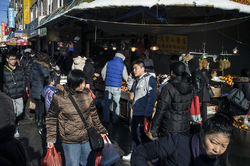
 Typical grocery store on 8th Avenue in one of the Brooklyn Chinatowns (布鲁克林華埠) on Long Island, New York. New York City's multiple Chinatowns in Queens (法拉盛華埠), Manhattan (紐約華埠), and Brooklyn are thriving as traditionally urban enclaves, as large-scale Chinese immigration continues into New York,[1][2][3][4] with the largest metropolitan Chinese population outside Asia,[5] The New York metropolitan area contains the largest ethnic Chinese population outside of Asia, comprising an estimated 893,697 uniracial individuals as of 2017.[6] |
Waves of Chinese emigration have happened throughout history. They include the emigration to Southeast Asia beginning from the 10th century during the Tang dynasty, to the Americas during the 19th century, particularly during the California gold rush in the mid-1800s; general emigration initially around the early to mid 20th century which was mainly caused by corruption, starvation, and war due to the Warlord Era, the Second Sino-Japanese War and the Chinese Civil War; and finally elective emigration to various countries. Most emigrants were peasants and manual laborers, although there were also educated individuals who brought their various expertises to their new destinations.
Chronology of historical periods
[edit]
11th century BCE to 3rd century BCE
[edit]- The Zhou dynasty overthrew the Shang dynasty in 1046 BCE. This conquest marked the beginning of the Zhou rule and the expansion of their territorial control.[7]
- Western Zhou: The Zhou people engaged in active military campaigns to expand their territory. As they conquered new regions, there was likely a movement of people to settle and administer these newly acquired lands.[8]
- Eastern Zhou period: The Eastern Zhou period is characterized by the Spring and Autumn period (770–476 BCE) and the Warring States period (475–221 BCE). During this time, the exchange of ideas and cultures between different states led to migration of scholars, artisans, and officials.[7]
- From the Han dynasty onwards, Chinese military and agricultural colonies (Chinese: 屯田) were established at various times in the Western Regions, which in the early periods were lands largely occupied by an Indo-European people called the Tocharians.
10–15th century
[edit]- Many Chinese merchants chose to settle down[when?] in the Southeast Asian ports such as Champa, Cambodia, Java, and Sumatra, and married the native women. Their children carried on trade.[9][10]
- Borneo: Many Chinese lived in Borneo as recorded by Zheng He.
- Cambodia: Envoy of Yuan dynasty, Zhou Daguan (Chinese: 周达观) recorded in his The Customs of Chenla (Chinese: 真腊风土记), that there were many Chinese, especially sailors, who lived there. Many intermarried with the local women.
- Champa: the Daoyi Zhilüe documents Chinese merchants who went to Cham ports in Champa, married Cham women, to whom they regularly returned to after trading voyages.[11] A Chinese merchant from Quanzhou, Wang Yuanmao, traded extensively with Champa, and married a Cham princess.[12]
- Han Chinese settlers came during the Malacca Sultanate in the early 15th century. The friendly diplomatic relations between China and Malacca culminated during the reign of Sultan Mansur Syah, who married the Chinese princess Hang Li Po. A senior minister of state and five hundred youths and maids of noble birth accompanied the princess to Malacca.[13] Admiral Zheng He had also brought along 100 bachelors to Malacca.[14] The descendants of these two groups of people, mostly from Fujian province, are called the Baba (men) and Nyonya (women).
- Java: Zheng He's 鄭和 compatriot Ma Huan (Chinese: 馬歡) recorded in his book Yingya Shenglan (Chinese: 瀛涯胜览) that large numbers of Chinese lived in the Majapahit Empire on Java, especially in Surabaya (Chinese: 泗水). The place where the Chinese lived was called New Village (新村), with many originally from Canton, Zhangzhou and Quanzhou.
- Ryūkyū Kingdom: Many Chinese moved to Ryukyu to serve the government or engage in business during this period. The Ming dynasty sent from Fujian 36 Chinese families at the request of the Ryukyuan King to manage oceanic dealings in the kingdom in 1392 during the Hongwu Emperor's reign. Many Ryukyuan officials were descended from these Chinese immigrants, being born in China or having Chinese grandfathers.[15] They assisted in the Ryukyuans in advancing their technology and diplomatic relations.[16][17][18]
- Siam: According to the clan chart of family name Lim, Gan, Ng, Khaw, Cheah, many Chinese traders lived there. They were amongst some of the Siamese envoys sent to China.
- In 1405, under the Ming dynasty, Tan Sheng Shou, the Battalion Commander Yang Xin (Chinese: 杨欣) and others were sent to Java's Old Port (Palembang; 旧港) to bring the absconder Liang Dao Ming (Chinese: 梁道明) and others to negotiate pacification. He took his family and fled to live in this place, where he remained for many years. Thousands of military personnel and civilians from Guangdong and Fujian followed him there and chose Dao Ming as their leader.
- On Lamu Island off the Kenyan coast, local oral tradition maintains that 20 shipwrecked Chinese sailors, possibly part of Zheng's fleet, washed up on shore there hundreds of years ago. Given permission to settle by local tribes after having killed a dangerous python, they converted to Islam and married local women. Now, they are believed to have just six descendants left there; in 2002, DNA tests conducted on one of the women confirmed that she was of Chinese descent. Her daughter, Mwamaka Sharifu, later received a PRC government scholarship to study traditional Chinese medicine (TCM) in China.[19][unreliable source?][20] On Pate Island, Frank Viviano described in a July 2005 National Geographic article how ceramic fragments had been found around Lamu which the administrative officer of the local Swahili history museum claimed were of Chinese origin, specifically from Zheng He's voyage to East Africa. The eyes of the Pate people resembled Chinese and Famao and Wei were some of the names among them which were speculated to be of Chinese origin. Their ancestors were said to be from indigenous women who intermarried with Chinese Ming sailors when they were shipwrecked. Two places on Pate were called "Old Shanga", and "New Shanga", which the Chinese sailors had named. A local guide who claimed descent from the Chinese showed Frank a graveyard made out of coral on the island, indicating that they were the graves of the Chinese sailors, which the author described as "virtually identical", to Chinese Ming dynasty tombs, complete with "half-moon domes" and "terraced entries".[21][better source needed]
- According to Melanie Yap and Daniel Leong Man in their book Colour, Confusions and Concessions: the History of Chinese in South Africa, Chu Ssu-pen, a Yuan mapmaker, had southern Africa drawn on one of his maps in 1320.[dubious – discuss] Ceramics found in Zimbabwe and South Africa dated back to the era of the Song dynasty in China.[dubious – discuss] Some tribes to Cape Town's north claimed descent from Chinese sailors during the 13th century, their physical appearance is similar to Chinese with paler skin and a Mandarin-sounding tonal language; they call themselves Awatwa ("abandoned people").[22][better source needed] Most early Chinese ceramics and coins found in Africa are not from Chinese mariners or traders, but were carried by earlier Southeast Asian Austronesian trade ships which established routes to the western Indian Ocean from as early as the 5th century AD and colonized Madagascar.[23]
15th–19th century
[edit]- When the Ming dynasty in China fell, Chinese refugees fled south and extensively settled in the Cham lands and Cambodia.[24] Most of these Chinese were young males, and they took Cham women as wives. Their children identified more with Chinese culture. This migration occurred in the 17th and 18th centuries.[25]
- Early European colonial powers in Asia encountered Chinese communities already well-established in various locations. The Kapitan Cina in various places was the representative of such communities towards the colonial authorities.
- The Qing conquest of the Ming caused the Fujian refugees of Zhangzhou to resettle on the northern part of the Malay peninsula and Singapore, while those of Amoy and Quanzhou resettled on the southern part of the peninsula. This group forms the majority of the Straits Chinese who were English-educated. Others moved to Taiwan at this time as well.
19th–early 20th century
[edit]

- In the mid-1800s, outbound migration from China increased as a result of the European colonial powers opening up treaty ports.[30]: 137 The British colonization of Hong Kong further created the opportunity for Chinese labor to be exported to plantations and mines.[30]: 137
- Chinese immigrants, mainly from the controlled ports of Fujian and Guangdong provinces, were attracted by the prospect of work in the tin mines, rubber plantations or the possibility of opening up new farmlands at the beginning of the 19th century until the 1930s in British Malaya.
- After Singapore became the capital of the Straits Settlements in 1832, the free trade policy attracted many Chinese merchants from Mainland China to trade, and many settled down in Singapore. Because of booming commerce which required a large labor force, the indentured Chinese coolie trade also appeared in Singapore. Coolies were contracted by traders and brought to Singapore to work. The large influx of coolies into Singapore only stopped after William Pickering became the Protector of Chinese. In 1914, the coolie trade was abolished and banned in Singapore. These populations form the basis of the Chinese Singaporeans.
- Peranakans, or those descendants of Chinese in Southeast Asia for many generations who were generally English-educated were typically known in Singapore as "Laokuh" (老客 – Old Guest) or "Straits Chinese". Most of them paid loyalty to the British Empire and did not regard themselves as "Huaqiao". From the 19th till the mid-20th century, migrants from China were known as "Sinkuh" (新客 – New Guest). A majority of them were coolies, workers on steamboats, etc. Some of them came to Singapore for work, in search of better living conditions or to escape poverty in China. Many of them also escaped to Singapore due to chaos and wars in China during the first half of the 20th century. They came mostly from the Fujian, Guangdong and Hainan provinces and, unlike Peranakans, paid loyalty to China and regarded themselves as "Huaqiao".
- At the end of the 19th century, the Chinese government realized that overseas Chinese could be an asset, a source of foreign investment, and a bridge to overseas knowledge; thus, it encouraged the use of the term "Overseas Chinese" (华侨).[31]
- Among the provinces, Guangdong had historically supplied the largest number of emigrants, estimated at 8.2 million in 1957; about 68% of the total overseas Chinese population at that time. Within Guangdong, the main emigrant communities were clustered in eight districts in the Pearl River Delta (珠江三角洲): four districts known as Sze Yup (四邑; 'four counties'); three counties known as Sam Yup (三邑; 'three counties'); and the district of Zhongshan (中山).[32] Because of its limited arable lands, with much of its terrain either rocky or swampy; Sze Yup was the "pre-eminent sending area" of emigrants during this period.[33] Most of the emigrants from Sze Yup went to North America, making Toishanese a dominant variety of the Chinese language spoken in Chinatowns in Canada and the United States.
- In addition to being a region of major emigration abroad, Siyi (Sze Yup) was a melting pot of ideas and trends brought back by overseas Chinese, (華僑; Huáqiáo). For example, many tong lau in Chikan, Kaiping (Cek Ham, Hoiping in Cantonese) and diaolou (formerly romanized as Clock Towers) in Sze Yup built in the early 20th century featured Qiaoxiang (僑鄉) architecture, i.e., incorporating architectural features from both the Chinese homeland and overseas.[34]
- The first major immigration to America was during the California gold rush of 1848–1855. Many Chinese, as well as people from other Asian countries, were prevented from moving to the United States as part of the Chinese Exclusion Act of 1882. A similar law though less severe in scope was passed in Canada in 1885, imposing a head tax instead of prohibiting immigration to Canada entirely. However, a 1923 law in Canada prohibited Chinese immigration completely. The Chinese Exclusion Act would only be fully repealed in the US in 1965 and in Canada de jure in 1947 but de facto in the 1960s with the opening up of immigration to Canada.
- From 1853 until the end of the 19th century, about 18,000 Chinese were brought as indentured workers to the British West Indies, mainly to British Guiana (now Guyana), Trinidad and Jamaica.[35] Their descendants today are found among the current populations of these countries, but also among the migrant communities with Anglo-Caribbean origins residing mainly in the United Kingdom, the United States and Canada.
- In the first half of the 20th century, war and revolution accelerated the pace of migration out of China.[30]: 127 The Kuomintang and the Communist Party competed for political support from overseas Chinese.[30]: 127–128
- The Kuomintang retreat to Taiwan in 1949 saw an emigration of approximately 2 million mainland Chinese to Taiwan.
- Some Nationalist refugees fled to Singapore, Sarawak, North Borneo and Malaya after the Nationalists lost the civil war to avoid persecution or execution by the Chinese Communist Party.[36]
- Parts of the defeated Nationalist army retreated south and crossed the border into Burma as the People's Liberation Army entered Yunnan.[30]: 65 Beginning in 1953, several rounds of withdrawals of the Nationalist forces and their families were carried out.[30]: 65 In 1960, joint military action by China and Burma expelled the remaining Nationalist forces from Burma, although some went on to settle in the Burma-Thailand borderlands.[30]: 65–66
Modern emigration (late 20th century–present)
[edit]
Due to the political dynamics of the Cold War, there was relatively little migration from the People's Republic of China to southeast Asia from the 1950s until the mid-1970s.[30]: 117
In the early 1960s, about 100,000 people were allowed to enter Hong Kong. In the late 1970s, vigilance against illegal migration to Hong Kong (香港) was again relaxed. Perhaps as many as 200,000 reached Hong Kong in 1979, but in 1980 authorities on both sides resumed concerted efforts to reduce the flow.[citation needed]
More liberalized emigration policies enacted in the 1980s as part of the Opening of China facilitated the legal departure of increasing numbers of Chinese who joined their overseas Chinese relatives and friends. The Four Modernizations program, which required Chinese students and scholars, particularly scientists, to be able to attend foreign education and research institutions, brought about increased contact with the outside world, particularly the industrialized nations.[citation needed]
In 1983, emigration restrictions were eased as a result in part of the economic open-door policy.[citation needed] In 1984, more than 11,500 business visas were issued to Chinese citizens, and in 1985, approximately 15,000 Chinese scholars and students were in the United States alone. Any student who had the economic resources could apply for permission to study abroad. United States consular offices issued more than 12,500 immigrant visas in 1984, and there were 60,000 Chinese with approved visa petitions in the immigration queue.[citation needed]
The signing of the United States–China Consular Convention in 1983 demonstrated the commitment to more liberal emigration policies.[citation needed] Both sides agreed to permit travel for the purpose of family reunification and to facilitate travel for individuals who claim both Chinese and United States citizenship. However, emigrating from China remained a complicated and lengthy process mainly because many countries were unwilling or unable to accept the large numbers of people who wished to emigrate. Other difficulties included bureaucratic delays and, in some cases, a reluctance on the part of Chinese authorities to issue passports and exit permits to individuals making notable contributions to the modernization effort.[citation needed]
New York City's multiple Chinatowns in Queens (法拉盛華埠), Manhattan (紐約華埠), and Brooklyn (布鲁克林華埠) are successful as traditionally urban enclaves, as large-scale Chinese immigration continues into New York during the late 20th century[1][2][38][4] with the largest metropolitan Chinese population outside Asia,[39] The New York metropolitan area contains the largest ethnic Chinese population outside of Asia, comprising an estimated 893,697 uniracial individuals as of 2017.[40] There has additionally been a significant element of illegal Chinese emigration to Brooklyn and Queens, most notably Fuzhou immigrants from Fujian Province and Wenzhou immigrants from Zhejiang Province in mainland China.[41]
A much smaller wave of Chinese immigration to Singapore came after the 1990s, holding the citizenship of the People's Republic of China and mostly Mandarin-speaking Chinese from northern China. The only significant immigration to China has been by the overseas Chinese, who in the years since 1949 have been offered various enticements to repatriate to their homeland.[citation needed]
During CCP general secretary Xi Jinping's administration, the number of Chinese asylum seekers abroad increased to 613,000 people as of 2020.[42] As of 2023, illegal Chinese immigration to New York City has accelerated, and its Flushing (法拉盛), Queens neighborhood has become the present-day global epicenter receiving Chinese immigration as well as the international control center directing such migration.[37] Additionally, as of 2024, a significant new wave of Chinese Uyghur Muslims is fleeing religious persecution in northwestern China's Xinjiang Province and seeking religious freedom in New York, and concentrating in Queens.[43]
In the early 2020s, there has been an influx of Chinese migrants using Mexico's northern border to enter America and advance to New York City, termed "ZouXian", translated in English to "walk the line".[44] The People's Republic of China maintains a broad definition of "illegal border crossing" and can prosecute its nationals for illegally crossing the border of other countries.[45] The number of such immigrants declined significantly in 2025 during the second presidency of Donald Trump, with only 80 Chinese nationals crossing the border in July 2025.[46]
A January 2025 report by the international human rights organization Safeguard Defenders, using United Nations High Commissioner for Refugees data, reveals that over one million Chinese citizens have applied for asylum abroad since Xi Jinping took leadership in 2012. Asylum applications in 2024 have increased by 1,426% compared to 2012.[47][48]
See also
[edit]- Chinese Clan Association
- Chinese immigration to Mexico
- Chinese Protectorate
- Haijin (海禁)
- History of Chinese Americans
- History of Chinese immigration to Canada
- Chinese Caribbeans
- History of Chinese Indonesians
- History of Fuzhounese Americans
- Hui
- Immigration to Singapore
- Migration in China
- New immigrants in Hong Kong
- Overseas Chinese
- Peranakan
- Sangley (生理人 or 常來人) ("Sengli": business)
- Tong
References
[edit]Citations
[edit]- ^ a b "Yearbook of Immigration Statistics: 2013 Supplemental Table 2". U.S. Department of Homeland Security. Retrieved 14 April 2016.
- ^ a b "Yearbook of Immigration Statistics: 2012 Supplemental Table 2". U.S. Department of Homeland Security. Archived from the original on 22 December 2014. Retrieved 14 April 2016.
- ^ "Yearbook of Immigration Statistics: 2011 Supplemental Table 2". U.S. Department of Homeland Security. Retrieved 14 April 2016.
- ^ a b John Marzulli (9 May 2011). "Malaysian man smuggled illegal Chinese immigrants into Brooklyn using Queen Mary 2: authorities". Daily News. New York. Retrieved 14 April 2016.
- ^ "Chinese New Year 2012 in Flushing". QueensBuzz.com. 25 January 2012. Retrieved 14 April 2016.
- ^ "SELECTED POPULATION PROFILE IN THE UNITED STATES 2017 American Community Survey 1-Year Estimates New York-Newark, NY-NJ-CT-PA CSA Chinese alone". United States Census Bureau. Archived from the original on 14 February 2020. Retrieved 27 January 2019.
- ^ a b Miščević, Dušanka (4 February 2013). "China: Ancient era migrations". The Encyclopedia of Global Human Migration. Wiley. doi:10.1002/9781444351071.wbeghm122. ISBN 978-1-4443-5107-1.
- ^ Huang, Chun Chang; Su, Hongxia (1 April 2009). "Climate change and Zhou relocations in early Chinese history". Journal of Historical Geography. 35 (2): 297–310. doi:10.1016/j.jhg.2008.08.006.
- ^ James D. Tracy (1993). The Rise of merchant empires: long-distance trade in the early modern world, 1350-1750. Cambridge University Press. p. 405. ISBN 0-521-45735-1. Retrieved 28 November 2010.
- ^ Ho Khai Leong, Khai Leong Ho (2009). Connecting and Distancing: Southeast Asia and China. Institute of Southeast Asian Studies. p. 11. ISBN 978-981-230-856-6. Retrieved 28 November 2010.
- ^ Derek Heng (2009). Sino-Malay Trade and Diplomacy from the Tenth Through the Fourteenth Century. Ohio University Press. p. 133. ISBN 978-0-89680-271-1. Retrieved 28 June 2010.
- ^ Robert S. Wicks (1992). Money, markets, and trade in early Southeast Asia: the development of indigenous monetary systems to AD 1400. SEAP Publications. p. 215. ISBN 0-87727-710-9. Retrieved 28 June 2010.
- ^ Malaysia-Singapore-6th-Footprint-Travel, Steve Frankham, ISBN 978-1-906098-11-7
- ^ "Li impressed with Malacca's racial diversity and cendol - Nation - The Star Online". The Star. Malaysia. 23 November 2015.
- ^ Shih-shan Henry Tsai (1996). The eunuchs in the Ming dynasty. SUNY Press. p. 145. ISBN 0-7914-2687-4. Retrieved 4 February 2011.
- ^ Angela Schottenhammer (2007). The East Asian maritime world 1400-1800: its fabrics of power and dynamics of exchanges. Otto Harrassowitz Verlag. p. xiii. ISBN 978-3-447-05474-4. Retrieved 4 February 2011.
- ^ Gang Deng (1999). Maritime sector, institutions, and sea power of premodern China. Greenwood Publishing Group. p. 125. ISBN 0-313-30712-1. Retrieved 4 February 2011.
- ^ Katrien Hendrickx (2007). The Origins of Banana-fibre Cloth in the Ryukyus, Japan. Leuven University Press. p. 39. ISBN 978-90-5867-614-6. Retrieved 11 February 2011.
- ^ "Is this young Kenyan Chinese descendant?", China Daily, 11 July 2005, retrieved 30 March 2009
- ^ York, Geoffrey (18 July 2005), "Revisiting the history of the high seas", The Globe and Mail, archived from the original on 26 July 2020, retrieved 30 March 2009
- ^ Frank Viviano (July 2005). "China's Great Armada, Admiral Zheng He". NATIONAL GEOGRAPHIC. p. 6. Archived from the original on 17 November 2012. Retrieved 29 September 2011.
- ^ Alex Perry (1 August 2008). "A Chinese Color War". Time. Archived from the original on 6 August 2008. Retrieved 29 September 2011.
- ^ Zhao, Bing (25 December 2015). "Chinese-style ceramics in East Africa from the 9th to 16th century: A case of changing value and symbols in the multi-partner global trade". Afriques. 06 (6). doi:10.4000/afriques.1836.
- ^ Encyclopædia Britannica, inc (2003). The New Encyclopædia Britannica, Volume 8. Encyclopædia Britannica. p. 669. ISBN 0-85229-961-3. Retrieved 28 June 2010.
- ^ Barbara Watson Andaya (2006). The flaming womb: repositioning women in early modern Southeast Asia. University of Hawaii Press. p. 146. ISBN 0-8248-2955-7. Retrieved 28 June 2010.
- ^ "Chinatown Melbourne". Retrieved 23 January 2014.
- ^ "Melbourne's multicultural history". City of Melbourne. Retrieved 23 January 2014.
- ^ "World's 8 most colourful Chinatowns". Retrieved 23 January 2014.
- ^ "The essential guide to Chinatown". Melbourne Food and Wine Festival. Food + Drink Victoria. 3 February 2021. Retrieved 11 February 2022.
- ^ a b c d e f g h Han, Enze (2024). The Ripple Effect: China's Complex Presence in Southeast Asia. New York, NY: Oxford University Press. ISBN 978-0-19-769659-0.
- ^ Wang, Gungwu (1994). "Upgrading the migrant: neither huaqiao nor huaren". Chinese America: History and Perspectives. Chinese Historical Society of America. p. 4. ISBN 0-9614198-9-X.
In its own way, it [Chinese government] has upgraded its migrants from a ragbag of malcontents, adventurers, and desperately poor laborers to the status of respectable and valued nationals whose loyalty was greatly appreciated.
- ^ Peter Kwong and Dusanka Miscevic (2005). Chinese America: the untold story of America's oldest new community. The New Press. ISBN 978-1-56584-962-4.
- ^ Pan, Lynn (1999). The Encyclopedia of the Chinese Overseas. Cambridge, MA, US: Harvard University Press. p. 36. ISBN 0674252101.
- ^ Pan, Lynn (1999). The Encyclopedia of the Chinese Overseas. Cambridge, MA: Harvard University Press. pp. 28–29. ISBN 0674252101.
- ^ Displacements and Diaspora. Rutgers University Press. 2005. ISBN 9780813536101. JSTOR j.ctt5hj582.
- ^ "Chiang Kai Shiek". Sarawakiana. Retrieved 28 August 2012.
- ^ a b Eileen Sullivan (24 November 2023). "Growing Numbers of Chinese Migrants Are Crossing the Southern Border". The New York Times. Retrieved 24 November 2023.
Most who have come to the United States in the past year were middle-class adults who have headed to New York after being released from custody. New York has been a prime destination for migrants from other nations as well, particularly Venezuelans, who rely on the city's resources, including its shelters. But few of the Chinese migrants are staying in the shelters. Instead, they are going where Chinese citizens have gone for generations: Flushing, Queens. Or to some, the Chinese Manhattan..."New York is a self-sufficient Chinese immigrants community," said the Rev. Mike Chan, the executive director of the Chinese Christian Herald Crusade, a faith-based group in the neighborhood.
- ^ "Yearbook of Immigration Statistics: 2011 Supplemental Table 2". U.S. Department of Homeland Security. Retrieved 14 April 2016.
- ^ "Chinese New Year 2012 in Flushing". QueensBuzz.com. 25 January 2012. Retrieved 14 April 2016.
- ^ "SELECTED POPULATION PROFILE IN THE UNITED STATES 2010American Community Survey 1-Year Estimates New York-Newark, NY-NJ-CT-PA CSA Chinese alone". United States Census Bureau. Archived from the original on 14 February 2020. Retrieved 27 January 2019.
- ^ John Marzulli (9 May 2011). "Malaysian man smuggled illegal Chinese immigrants into Brooklyn using Queen Mary 2: authorities". Daily News. New York. Archived from the original on 23 June 2012. Retrieved 29 March 2016.
- ^ "Under Xi Jinping, the number of Chinese asylum-seekers has shot up". The Economist. 28 July 2021. Retrieved 25 January 2022.
- ^ Tara John and Yong Xiong (17 May 2024). "Caught between China and the US, asylum seekers live in limbo in New York City". CNN. Retrieved 9 June 2024.
- ^ "Fleeing China's Covid lockdowns for the US - through a Central American jungle". BBC News. 21 December 2022. Retrieved 27 November 2023.
- ^ Chen, Alicia (3 August 2025). "Some Chinese Weigh Painful Question: Stay or Flee Under Trump?". The New York Times. Retrieved 18 August 2025.
China has a broad definition of illegal border crossing, so entering the United States without authorization can be prosecuted as a crime. One of his client's family members, deported back to China late last year, was later convicted.
- ^ "Chinese migrants risked their lives to reach America. For what?". The Economist. ISSN 0013-0613. Retrieved 4 September 2025.
- ^ In, Cindy (6 January 2025). "1 Million Chinese Citizens Apply for Asylum During Xi's Rule, As Repression Increases". MSN. Retrieved 11 January 2025.
- ^ "China's mass exodus: number of asylum seekers surpasses one million under Xi | Safeguard Defenders". safeguarddefenders.com. 9 January 2025. Retrieved 11 January 2025.
Sources
[edit]- Amrith, Sunil S. Migration and diaspora in modern Asia (Cambridge University Press, 2011).
- Benton, Gregor, and Hong Liu. Dear China: emigrant letters and remittances, 1820–1980. (U of California Press, 2018).
- Chan, Shelly. "The case for diaspora: A temporal approach to the Chinese experience." Journal of Asian Studies (2015): 107–128. online
- Cooke, Nola; Li, Tana; Anderson, James, eds. (2011). The Tongking Gulf Through History (illustrated ed.). University of Pennsylvania Press. ISBN 978-0812243369. Retrieved 4 January 2013.
- Ho, Elaine Lynn-Ee. Citizens in Motion: Emigration, Immigration, and Re-migration Across China's Borders (Stanford UP, 2018).
- Lary, Diana (2007). Lary, Diana (ed.). The Chinese State at the Borders (illustrated ed.). UBC Press. ISBN 978-0774813334. Retrieved 4 January 2013.
- McKeown, Adam. "Chinese emigration in global context, 1850–1940." Journal of Global History 5.1 (2010): 95–124.
- Pan, Lynn (1994). Sons of the Yellow Emperor: A History of the Chinese Diaspora. New York, NY: Kodansha America. ISBN 1-56836-032-0.
- Pan, Lynn, ed. (1999). The Encyclopedia of the Chinese Overseas. Cambridge, MA: Harvard University Press. ISBN 0674252101.
- Tsai, Shih-Shan Henry (1996). The Eunuchs in the Ming Dynasty (Ming Tai Huan Kuan) (illustrated ed.). SUNY Press. ISBN 0791426874. Retrieved 5 January 2013.
- Wade, Geoff (2005), Southeast Asia in the Ming Shi-lu: an open access resource, Asia Research Institute and the Singapore E-Press, National University of Singapore, retrieved 6 November 2012
 This article incorporates text from this source, which is in the public domain. Country Studies. Federal Research Division. [1]

External links
[edit]
- The Rocky Road to Liberty: A Documented History of Chinese American Immigration and Exclusion
- [2]
- Chinese Canadians – A visual history from the UBC Library Digital Collections documenting Chinese settlement in British Columbia


| National | |
|---|---|
| Other | |

Chinese emigration
View on GrokipediaHistorical Emigration
Pre-Modern Periods (Antiquity to 18th Century)
Chinese emigration from antiquity through the 18th century remained sporadic and small-scale, primarily involving merchants, artisans, and fishermen from coastal provinces such as Fujian and Guangdong who engaged in trade rather than permanent mass settlement. Imperial policies, including bans on overseas travel enforced by the Ming (1368–1644) and early Qing (1644–1912) dynasties, restricted large movements, favoring sojourning networks over colonization; these prohibitions stemmed from concerns over resource drain, loyalty, and control of maritime activities following official expeditions like those of Zheng He (1405–1433).[10] Early overland migrations via the Silk Road during the Han dynasty (206 BCE–220 CE) connected China to Central Asia, but permanent Chinese settlements abroad were negligible, with traders typically returning home.[11] Maritime contacts intensified from the Tang dynasty (618–907 CE) onward, with Chinese goods appearing in Southeast Asian archaeological sites, laying groundwork for trade links that expanded under the Song dynasty (960–1279 CE) through ports like Quanzhou.[12] By around 1000 CE, southern Chinese maritime traders and fishers began forming temporary communities in Southeast Asia to exploit opportunities in commerce, tin mining, and gold extraction, often intermarrying locals and dominating local economies without large influxes from China.[12] These networks linked Chinese ports to regional entrepôts by 1400 CE, fostering hybrid cultural brokers rather than expansive diasporas.[12] In the early modern period (1500–1740), evasion of Ming maritime bans after their partial lifting in 1567 enabled Hokkien merchant diasporas to establish footholds in destinations like the Philippines, where Manila hosted approximately 20,000 Chinese by 1603; Vietnam's Hoi An had about 5,000 in 1642; and Dutch Batavia (modern Jakarta) counted 3,000–4,000 in its walled city by the late 17th century.[10] European colonial expansion in the late 16th century amplified demand for Chinese labor and skills, spurring Chinatowns in Sumatra and Java by the early 15th century that grew to house thousands.[11] By the early 17th century, Southeast Asia sheltered roughly 100,000 overseas Chinese, with 20,000–30,000 in Japan focused on trade and crafts, though Japanese restrictions limited permanence.[11] The 18th century marked a "Chinese century" of economic influence in Southeast Asia around 1700–mid-1800s, as migrants pioneered infrastructure like roads and land reclamation amid Qing policies that initially reinforced bans but gradually tolerated trade.[12][11] These communities, often numbering in the thousands per site, sustained cultural ties to China while adapting locally, setting precedents for later expansions without constituting demographic shifts comparable to 19th-century labor migrations.[10]19th Century Labor Migrations
The 19th-century labor migrations of Chinese workers were primarily driven by domestic upheavals in Qing China, including the Opium Wars (1839–1842 and 1856–1860), which imposed unequal treaties and economic strain, and the Taiping Rebellion (1850–1864), a civil war that resulted in 20 to 30 million deaths from famine, disease, and combat, exacerbating rural poverty in southern provinces like Guangdong and Fujian.[13] These factors, combined with population pressures and limited arable land, prompted millions of peasants—predominantly young men—to seek overseas opportunities, often through indentured contracts that promised wages but frequently devolved into exploitative conditions akin to coerced labor.[14] Emigration accelerated after 1842 with the opening of treaty ports like Guangzhou and Amoy, facilitating recruitment by foreign agents despite Qing prohibitions on overseas travel until the 1860s.[15] The "coolie trade," an organized system of indentured labor recruitment, emerged around 1847 as a response to labor shortages in post-slavery economies, transporting over 2 million Chinese workers globally by the 1870s, though estimates vary due to clandestine voyages and incomplete records.[16] Initial shipments targeted Peru and Cuba, where approximately 90,000 coolies arrived in Peru between 1849 and 1874 for guano mining and agriculture, enduring mortality rates exceeding 20% during voyages and on plantations from disease, malnutrition, and abuse.[17] In Cuba, around 140,000 Chinese laborers were imported from 1847 to 1874 primarily for sugar plantations, often under eight-year contracts secured through deception or kidnapping in Chinese ports, with conditions including physical punishments and extensions beyond terms that mirrored slavery despite legal distinctions.[17][18] These migrations filled voids left by the abolition of the Atlantic slave trade, but reports from consular investigations, such as the 1874 Cuba Commission, documented systemic violence, leading to international bans on the trade by the mid-1870s.[19] In the United States, migrations began as voluntary responses to the California Gold Rush starting in 1848, with over 20,000 Chinese arriving by 1852, mainly from Guangdong, to mine claims after initial successes by earlier arrivals in 1849.[20] By 1870, the Chinese population reached 63,000 nationwide, with 77% in California, contributing over $5 million annually in mining taxes amid declining gold yields that pushed many into urban labor or agriculture.[21] Labor recruitment intensified for the Transcontinental Railroad, where the Central Pacific Railroad hired about 15,000 Chinese workers from 1864 onward for the Sierra Nevada sections, performing hazardous tasks like blasting tunnels and laying tracks in freezing conditions, with estimates of 1,000–1,200 deaths from accidents, avalanches, and explosions.[22] These workers, earning $26–$35 monthly plus board—less than white counterparts—faced racial hostility but completed the western leg by 1869, enabling the railroad's linkage at Promontory Summit on May 10.[20] Australia saw similar patterns during its gold rushes of the 1850s, with around 40,000 Chinese miners arriving by 1861, primarily in Victoria and New South Wales, where they endured riots and restrictions like poll taxes due to competition fears, yet contributed to peak gold outputs before shifting to market gardening.[14] In Southeast Asia, including Singapore and the Dutch East Indies, hundreds of thousands of coolies were contracted for plantations and infrastructure from the 1860s, often via Straits Settlements hubs, with high remigration rates but persistent exploitation under colonial overseers.[23] Overall, these migrations formed diaspora communities but were marked by return flows, with many sending remittances home, though mortality and failed contracts underscored the trade's human costs, prompting Qing diplomatic protests and eventual emigration regulations in 1893.[24]Early 20th Century Disruptions
The Xinhai Revolution of 1911, which overthrew the Qing Dynasty and established the Republic of China, initially disrupted organized emigration through widespread political upheaval, including the closure of key southern ports like Guangzhou amid revolutionary violence and administrative breakdown.[25] This chaos fragmented recruitment networks for overseas labor, previously reliant on imperial stability, leading to a temporary decline in departures as potential emigrants faced unsafe travel conditions and economic uncertainty in southern provinces.[5] Emigration resumed unevenly during the subsequent warlord era (1916–1928), but regional conflicts and fragmented control over transportation infrastructure further hampered large-scale movements, shifting patterns from steady contract labor to more opportunistic sojourning primarily toward Southeast Asia.[14] By the 1930s, escalating Japanese aggression compounded these internal disruptions; the invasion of Manchuria in 1931 and the full-scale Second Sino-Japanese War from 1937 onward occupied major coastal emigration hubs, including Shanghai and Hong Kong transit points, severely curtailing maritime outflows for over a decade.[26] Japanese control of ports and shipping lanes, combined with wartime blockades and requisitioning of vessels, reduced annual emigrant numbers significantly, with estimates indicating a sharp drop from pre-war peaks of hundreds of thousands to minimal organized flows amid hyperinflation and famine in occupied areas.[14] This period marked a pivot from economic migration to sporadic refugee-like escapes, though total departures remained low due to the prioritization of internal displacement over overseas flight.[5] The Chinese Civil War (1945–1949), erupting immediately after World War II, intensified disruptions through nationwide combat, infrastructure destruction, and competing Nationalist-Communist blockades on key routes, effectively halting most civilian emigration until the conflict's resolution.[26] While this chaos eventually propelled an exodus of approximately 2 million Nationalists and sympathizers to Taiwan and surges to Hong Kong and Southeast Asia, the preceding years saw emigration volumes plummet as ports alternated between control by warring factions, rendering systematic departure nearly impossible.[27] Overall, these events transformed early 20th-century Chinese emigration from the 19th-century model of volume-driven labor export—totaling around 20 million from 1840 to 1940—into erratic, survival-oriented movements overshadowed by domestic survival imperatives.[5]Emigration During the Early People's Republic (1949–1978)
Policy-Imposed Restrictions
Following the proclamation of the People's Republic of China on October 1, 1949, the new government rapidly enacted policies to curtail emigration, prioritizing national consolidation, ideological conformity, and retention of skilled labor amid fears of capital flight and defection to capitalist or Nationalist-held territories. Private citizens were effectively barred from obtaining passports or exit visas, with approvals reserved almost exclusively for state-sanctioned activities such as diplomatic delegations, official trade missions, or rare athletic and cultural exchanges.[28][29] In 1951, the Provisional Measures on the Entry and Exit of National Borders for Overseas Chinese imposed stringent rules on returnees, often denying re-emigration permits to prevent reverse flows and reinforcing the one-way repatriation encouraged during the early 1950s campaign to "return to the motherland." By 1956, the State Council established specialized exit-entry offices in coastal provinces like Guangdong and Fujian to monitor and regulate border crossings, particularly to counter smuggling or flight toward Hong Kong, Macau, or Taiwan. The following year, 1957, the Ministry of Public Security centralized control over private-purpose passports, subjecting applications to multilayered political scrutiny that rarely succeeded outside elite or official contexts.[30][29] The 1958 Household Registration Regulations (hukou system), promulgated under Mao Zedong on January 9, bound citizens to rural or urban locales via mandatory registration, indirectly bolstering emigration controls by criminalizing unapproved internal mobility essential for reaching borders or ports. During the Great Leap Forward (1958–1962) and subsequent periods of economic upheaval, these measures were intensified to maintain labor allocation and suppress dissent, with unauthorized attempts to leave classified as counterrevolutionary acts punishable by imprisonment or worse. The Cultural Revolution (1966–1976) exacerbated restrictions, politicizing foreign contacts and halting most international student exchanges—previously limited to Soviet-aligned programs—while border surveillance in southern regions escalated to deter escapes.[28][29] Spontaneous or family-based emigration was ideologically condemned as "betrayal and flight" to imperialist spheres, resulting in outflows that were minimal and state-directed, typically numbering in the low thousands annually and comprising officials, performers, or ping-pong diplomats rather than ordinary settlers. No comprehensive official statistics were released, but scholarly estimates indicate net emigration remained negligible compared to pre-1949 levels, with illegal departures—often via perilous sea routes from Fujian—facing severe reprisals against families left behind. These policies reflected a broader doctrine of self-reliance (zili gengsheng), subordinating individual mobility to collective security and anti-imperialist goals.[29][28]Post-Reform Emigration Waves (1978–Present)
Deng Era Openings and Student Flows
Following Deng Xiaoping's initiation of economic reforms and opening-up policies in late 1978, China reversed decades of restrictive emigration controls by establishing a state-sponsored program to send students and scholars abroad for advanced training in science, technology, and other fields deemed essential for modernization. This decision prioritized acquiring foreign expertise over ideological isolation, with Deng explicitly instructing officials to "send more students abroad to study." The program began modestly: on December 27, 1978, the first contingent of 50 Chinese students arrived in the United States under bilateral agreements, focusing initially on graduate-level studies in engineering, physics, and related disciplines. Annual targets were set at up to 3,000 participants, primarily funded by the government through scholarships and exchange programs coordinated by the Ministry of Education.[31][32][33] The outflow accelerated through the 1980s, transitioning from elite, state-selected cohorts to include growing numbers of self-financed applicants amid economic liberalization. Between 1978 and 1984, China dispatched 26,800 students and scholars to over 20 countries, with the United States receiving 12,000—about 45% of the total—and hosting the largest share due to established academic ties and visa policies. By the late 1980s, destinations diversified to include Japan (emphasizing applied sciences), the United Kingdom, and Canada, while self-funded students rose from negligible numbers to comprise over half of outflows by 1989, reflecting rising household wealth and perceived prestige of Western degrees. This expansion aligned with Deng's pragmatic emphasis on "learning from abroad" to bolster domestic capabilities, though it lacked stringent initial enforcement of return obligations.[34][34][33] Student flows transitioned into sustained emigration patterns due to persistently low repatriation rates and external policy responses. Official expectations mandated returns to apply acquired knowledge domestically, with some institutions dismissing non-returnees, but compliance was weak amid economic disparities and political uncertainties. By 1997, only 32% of the 293,000 participants sent abroad since 1978 had repatriated, contributing to a net brain drain of skilled talent—estimated at over 200,000 by the early 1990s— as many secured employment or permanent residency in host countries. The 1989 Tiananmen Square suppression intensified this, triggering asylum claims and legislative protections abroad; the U.S. Chinese Student Protection Act of 1992 alone enabled approximately 54,000 Chinese nationals (mostly students and researchers present before June 1990) to gain lawful permanent residency without returning. Analogous amnesties in Australia and Europe further embedded student migration as a conduit for family reunification and professional settlement, shifting the program's demographic impact from temporary knowledge transfer to long-term diaspora formation.[31][35][36]1990s–2010s: Elite and Investment Migration
During the 1990s and 2000s, Chinese emigration patterns shifted toward affluent elites and high-net-worth individuals, who leveraged investment-based pathways to secure residency in Western countries. This era marked a departure from earlier labor and student flows, with wealthy business owners, professionals, and entrepreneurs prioritizing asset protection, superior educational opportunities for offspring, and political stability amid China's post-Tiananmen uncertainties and rapid economic liberalization. Emigration rates among China's highly educated population reached five times the national average, reflecting a concentration of outflows among the upper socioeconomic strata. Overall Chinese emigration surged, with an estimated 10.5 million individuals departing for over 180 destinations between 1990 and 2010, though elite migrants formed a growing subset driven by capital mobility rather than low-skilled labor needs.[37][7] Investment migration programs became central to this wave, particularly the U.S. EB-5 Immigrant Investor Program established in 1990, which required a minimum investment of $500,000 to $1 million to create jobs and granted permanent residency. Chinese nationals dominated EB-5 demand by the late 2000s; in fiscal year 2010, they filed 66% of I-526 petitions (the initial approval step), rising to account for the majority of visas issued from 2010 to 2019. Canada's Federal Investor Immigrant Program similarly attracted Chinese capital, with 58% of investor admissions being Chinese nationals in 2010, following Taiwan at 8%, as applicants invested CAD 800,000 or more in government bonds or ventures. Australia’s business migration categories, including significant investor streams, also drew Chinese funds, contributing to a pattern where Chinese accounted for substantial shares of such visas across these nations throughout the 2000s. These programs facilitated the transfer of billions in capital, with total EB-5 visas issued from 1992 to 2018 reaching 83,568, a portion increasingly from China.[38][39][37] Key drivers included safeguarding personal wealth against domestic risks like policy volatility and corruption crackdowns, alongside aspirations for high-quality international schooling and retirement planning in stable environments. Surveys of Chinese millionaires in the early 2010s indicated that 60% were contemplating emigration or had already dispatched family members abroad for education, underscoring motivations tied to long-term security over immediate economic gain. Primary destinations encompassed North America and Oceania, where rule-of-law protections and familial networks amplified appeal, though this elite exodus raised concerns in China about brain drain and capital flight.[37][6]2020s Surge: Post-Zero-COVID Exodus
The abrupt termination of China's zero-COVID policy in December 2022, following widespread protests against prolonged lockdowns, triggered a significant uptick in outbound emigration starting in early 2023. This shift allowed pent-up travel demand to manifest, but for many, it evolved into permanent relocation amid economic stagnation and eroded trust in state controls. Official data indicate a sharp rise in irregular crossings, with U.S. Customs and Border Protection recording over 24,000 encounters with Chinese nationals at the southern border in fiscal year 2023, a more than tenfold increase from the prior year, driven by migrants traversing routes like the Darién Gap.[40] [8] Emigration patterns extended beyond the U.S., with global asylum applications from Chinese nationals surging to 137,143 in 2023, over five times the previous year's figure, per United Nations High Commissioner for Refugees data, reflecting routes to Europe via the Balkans and elsewhere. In Southeast Asia, Thailand hosted an estimated 130,000 recent Chinese migrants by 2024, often on long-stay visas amid relaxed entry policies. Legal channels also expanded, contributing to a partial rebound in overall Chinese immigrant stocks, such as the 2.4 million in the U.S. by 2023, though irregular flows highlighted desperation over established pathways.[41] [42] [43] Principal drivers included post-lockdown economic fallout, with youth unemployment exceeding 20% in mid-2023 and a property sector crisis eroding household wealth, prompting middle-class families to seek stability abroad. Disillusionment with authoritarian measures—evident in the "white paper" protests of late 2022—fostered a perception of curtailed personal freedoms, as articulated by migrants citing government overreach during the pandemic. While state media downplayed outflows, attributing them to temporary travel, independent analyses link the exodus to systemic failures in balancing control with prosperity, accelerating brain drain among skilled professionals and students.[44] [45]Drivers of Chinese Emigration
Internal Push Factors
High youth unemployment has emerged as a primary internal driver of emigration, particularly among urban graduates aged 16-24, whose official rate reached a record 21.3% in June 2023 before methodological changes excluded students, yet remained elevated at around 18-19% through 2025.[46][47] This stems from structural mismatches between an oversupply of degree-holders and shrinking opportunities in tech, real estate, and private sectors amid regulatory crackdowns, exacerbating disillusionment and prompting skilled youth to seek prospects abroad.[48] The abrupt end of zero-COVID policies in December 2022 triggered a surge in emigration intent, as prolonged lockdowns, mass testing, and quarantines from 2020-2022 inflicted widespread economic hardship, business closures, and personal trauma, eroding public trust in governance and accelerating the "run" phenomenon among professionals fleeing uncertainty.[45][43][49] China's GDP growth slowed to 3% in 2022—the lowest in decades outside the pandemic onset—compounded by a property sector crisis where developers like Evergrande defaulted on debts exceeding $300 billion by 2021, trapping middle-class savings in devalued assets and fueling capital flight.[50] Intensifying political controls under Xi Jinping, including censorship, surveillance expansion, and crackdowns on private enterprise since 2018, have driven emigration by limiting personal freedoms and economic autonomy, with middle-class citizens citing fears of arbitrary detention or asset seizures as motivations to relocate wealth and families.[48][49] Exit bans, applied to over 100,000 individuals annually by 2024 for alleged infractions like unpaid taxes or investigations, further underscore restrictions on mobility, paradoxically intensifying push dynamics for those able to circumvent them.[51][52] These factors disproportionately affect urban elites and youth, who view emigration as a hedge against systemic risks rather than mere opportunity-seeking.[6]External Pull Factors
Educational opportunities in developed countries serve as a primary external pull for Chinese emigrants, particularly for students and their families seeking access to prestigious universities and advanced research environments. In the 2023-2024 academic year, the United States alone hosted 277,398 Chinese international students, representing the second-largest cohort after India and underscoring the appeal of institutions like those in the Ivy League and STEM-focused programs.[53] These migrants are motivated by factors such as superior academic quality, innovative curricula, and post-graduation employment prospects in knowledge economies, with surveys indicating that tuition affordability and living costs in destinations like the UK and Australia also influence choices over domestic alternatives.[54] Many such students transition to permanent residency, leveraging skills in fields like technology and engineering where Chinese immigrants demonstrate high educational attainment and subsequent economic mobility.[55] Economic prospects, including higher wages and business freedoms, further incentivize emigration among skilled professionals and entrepreneurs. Chinese emigrants to the United States, for instance, often outperform other immigrant groups in income due to selective migration favoring those with tertiary education, enabling integration into sectors like finance and tech hubs in Silicon Valley.[56] Investment migration programs amplify this pull for affluent Chinese, who view them as pathways to asset diversification and stable markets amid domestic uncertainties; the U.S. EB-5 visa program, requiring a minimum investment of $800,000 in targeted employment areas, has attracted over 70% of its participants from China since inception, with cumulative investments exceeding tens of billions.[39][57] Similarly, Australia's now-defunct Business Innovation and Investment Program saw approximately 2,063 Chinese principal applicants in 2021, drawn by opportunities in real estate and trade.[58] These routes appeal to elites prioritizing rule-of-law protections for capital and family futures over repatriation risks. Perceptions of enhanced quality of life, encompassing cleaner environments, reliable healthcare, and personal security, constitute another key attractor, particularly for middle-class families. Surveys of Asian immigrants, including those from China, reveal that 77% report a higher standard of living than their parents' generation, citing factors like access to public services and reduced pollution compared to urban China.[59] In destinations such as Canada and Australia, emigrants value systemic stability and safety nets, with data showing positive post-migration assessments of overall well-being despite initial adaptation challenges.[60] For recent cohorts, including those via irregular routes, pulls include perceived safety from geopolitical tensions and job availability in service economies, though economic motives predominate over ideological freedoms in most empirical accounts.[61] Post-COVID interest in such programs has risen, with a 22% uptick in Chinese inquiries for investment migration reflecting desires for diversified living standards.[62]Destinations and Emigrant Demographics
Key Host Countries and Regions
Top destinations for mainland Chinese to live abroad in 2026 include Canada, Australia, the United States, and Japan, offering welcoming immigration policies, strong economies, skilled worker programs, and large Chinese communities. Japan is increasingly popular for professionals due to cultural similarities, affordable living, and labor shortages.[63] The United States hosts the largest population of recent Chinese immigrants, with approximately 2.4 million individuals born in mainland China residing there as of 2023, reflecting a partial recovery from pandemic-era disruptions in migration flows.[43] This figure encompasses diverse entrants via student visas, employment-based pathways, family reunification, and investment programs, with significant concentrations in California, New York, and Texas. Canada ranks as a major destination, attracting Chinese emigrants through skilled worker programs and investor immigration streams, contributing to its Chinese-born population exceeding 700,000 by mid-2020s estimates derived from national census trends.[64] Australia has emerged as a key host in Oceania, with nearly 600,000 Chinese-born residents recorded by mid-2022, driven by post-2000s expansions in student and skilled migration visas amid housing and education pull factors.[65] The United Kingdom, particularly post-Brexit via graduate and investor routes, has seen rising inflows, though exact China-born figures hover around 200,000-300,000, bolstered by London's established Chinese communities. In Asia, Singapore stands out for high-net-worth and professional migrants, hosting over 500,000 ethnic Chinese with a growing share of recent PRC arrivals due to its business-friendly policies and proximity.[66] Japan and South Korea have gained prominence in the 2020s as secondary destinations, particularly for middle-class families fleeing domestic pressures, with Japan issuing over 100,000 long-term visas to Chinese nationals annually in recent years and South Korea accommodating similar scales through work and study channels.[64] European countries like Germany and the Netherlands attract smaller but growing numbers via EU Blue Card schemes and university exchanges, totaling under 500,000 China-born across the continent outside the UK. Southeast Asian nations such as Malaysia and Thailand continue to receive investment-driven migration, though these build on historical ethnic networks rather than mass post-reform exodus. Overall, North America and Oceania account for over half of recent Chinese emigrant destinations, per patterns in global migration outlooks.[6]| Country/Region | Approximate China-Born Population (Recent Data) | Primary Migration Pathways |
|---|---|---|
| United States | 2.4 million (2023) | Student, employment, family, EB-5 investment[43] |
| Canada | ~700,000+ (2020s) | Skilled worker, investor programs[64] |
| Australia | ~600,000 (2022) | Student, skilled visas[65] |
| Singapore | Significant share of 500,000+ ethnic Chinese (recent growth) | Business, professional employment[66] |
| Japan/South Korea | 100,000+ annual visas (2020s) | Work, study for middle-class migrants[64] |