Hubbry Logo
DessertDessertMain
Open search
Dessert
Community hub
Dessert
logo
8 pages, 0 posts
0 subscribers
Be the first to start a discussion here.
Dessert
Dessert
from Wikipedia

Dessert
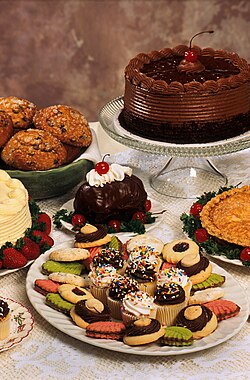
Various desserts, including numerous varieties of cake, biscuits and pies
TypeSweet
VariationsNumerous (biscuits, cakes, tarts, cookies, sandeshs, gelatins, ice creams, pastries, pies, puddings, custards, sweet soups, fruits etc.)
  • Cookbook: Dessert
  •   Media: Dessert

Dessert is a course that concludes a meal; the course consists of sweet foods, such as cake, biscuit, ice cream, and possibly a beverage, such as dessert wine or liqueur. Some cultures sweeten foods that are more commonly savory to create desserts. In some parts of the world, there is no tradition of a dessert course to conclude a meal.

Historically, the dessert course consisted entirely of foods 'from the storeroom' (de l'office), including fresh, stewed, preserved, and dried fruits; nuts; cheese and other dairy dishes; dry biscuits (cookies) and wafers; and ices and ice creams.[1] Sweet dishes from the kitchen, such as freshly prepared pastries, meringues, custards, puddings, and baked fruits, were served in the entremets course, not in the dessert course. By the 20th century, though, sweet entremets had come to be included among the desserts.[2][3]

The modern term dessert can apply to many sweets, including fruit, custards, gelatins, puddings, biscuits, cookies, macaroons, pastries, pies, tarts, cakes, ice creams, and sweet soups.

Etymology

[edit]

The term "dessert" originated from the French word desservir, meaning "to clear the table",[a] and it referred to the final course of the meal, presented after the table was "cleared" (deservi).

One of the earliest uses of the term in a culinary context is in the Ménagier de Paris (1393), which includes a course of "desserte" in three of the menus,[b] one of which includes sweet pastries and fruits, another of which includes savory frumenty and venison.

In later centuries, the term continued to refer to the last course of the meal. In the late 19th century, the word "desserts" also came to refer to the dishes served in the dessert course.[4]

Other names

[edit]

The word "dessert" is most commonly used for this course in Australia, Canada, Ireland, New Zealand, and the United States, while its use exists alongside several synonyms, including "pudding", "sweet" and "afters", in the United Kingdom and some other Commonwealth countries.[5][6]

History

[edit]
The spread of sugarcane from ancient India to the world

Sweets were fed to the gods in ancient Mesopotamia and ancient India[7] and other ancient civilizations.[8] Herodotus mentions that Persian meals featured many desserts, and were more varied in their sweet offerings than the main dishes.[9][10] German army officer Helmuth von Moltke whilst serving in the Ottoman Empire noted the unusual presentation of courses with the sweet courses served between roasts and other savory dishes.[11]

Dried fruit and honey were probably the first sweeteners used in most of the world, but the spread of sugarcane around the world was essential to the development of dessert.[12] Sugarcane was grown and refined in India before 500 BC[13] and was crystallized, making it easy to transport, by AD 500. Sugar and sugarcane were traded, making sugar available to Macedonia by 303 BC and China by AD 600. In the Indian subcontinent, the Middle East, and China, sugar has been a staple of cooking and desserts for over a thousand years.

Sugarcane and sugar were little known and rare in Europe until the twelfth century or later when the Crusades and then colonization spread its use. Europeans began to manufacture sugar in the Middle Ages, and more sweet desserts became available.[14] Even then sugar was so expensive usually only the wealthy could indulge on special occasions. The first apple pie recipe was published in 1381;[15] The earliest documentation of the term cupcake was in "Seventy-five Receipts for Pastry, Cakes, and Sweetmeats" in 1828 in Eliza Leslie's Receipts cookbook.[16]

The Industrial Revolution in Europe and later America led to the mass-production of foodstuffs, including desserts, that could be processed, preserved, canned, and packaged. Frozen foods, including desserts, became very popular starting in the 1920s.[17]

Ingredients

[edit]

Sweet desserts usually contain cane sugar, palm sugar, brown sugar, honey, or some types of syrup such as molasses, maple syrup, treacle, or corn syrup. Other common ingredients in Western-style desserts are flour or other starches, cooking fats such as butter or lard, dairy, eggs, salt, acidic ingredients such as lemon juice, and spices and other flavoring agents such as chocolate, coffee, peanut butter, fruits, and nuts. The proportions of these ingredients, along with the preparation methods, play a major part in the consistency, texture, and flavor of the end product.

Sugars contribute moisture and tenderness to baked goods. Flour or starch components serves as a protein and gives the dessert structure. Fats contribute moisture and can enable the development of flaky layers in pastries and pie crusts. The dairy products in baked goods keep the desserts moist. Many desserts also contain eggs, in order to form custard or to aid in the rising and thickening of a cake-like substance. Egg yolks specifically contribute to the richness of desserts. Egg whites can act as a leavening agent[18] or provide structure. Further innovation in the healthy eating movement has led to more information being available about vegan and gluten-free substitutes for the standard ingredients, as well as replacements for refined sugar.

Desserts can contain many spices and extracts to add a variety of flavors. Salt and acids are added to desserts to balance sweet flavors and create a contrast in flavors. Some desserts are coffee-flavored, for example an iced coffee soufflé or coffee biscuits.[19] Alcohols and liqueurs can also be used as an ingredient, to make alcoholic desserts.[20]

Varieties and elements

[edit]

Desserts consist of variations of tastes, textures, and appearances. Desserts can be defined as a usually sweeter course that concludes a meal.[a] This definition includes a range of courses ranging from fruits or dried nuts to multi-ingredient cakes and pies. Many cultures have different variations of dessert. In modern times the variations of desserts have usually been passed down or come from geographical regions. This is one cause for the variation of desserts. These are some major categories in which desserts can be placed.[21]

Cakes

[edit]
German chocolate cake, a layered cake filled and topped with a coconut-pecan frosting

Cakes are sweet tender breads made with sugar and delicate flour. Cakes can vary from light, airy sponge cakes to dense cakes with less flour. Common flavorings include dried, candied or fresh fruit, nuts, cocoa or extracts. They may be filled with fruit preserves or dessert sauces (like pastry cream), iced with buttercream or other icings, and decorated with marzipan, piped borders, or candied fruit. Cake is often served as a celebratory dish on ceremonial occasions, for example weddings, anniversaries, and birthdays. Small-sized cakes have become popular, in the form of cupcakes and petits fours, an example of which can be the Portuguese "bolo de arroz".

Puddings

[edit]

Puddings are similar to custards in that their base is cream or milk. However, their primary difference is that puddings are thickened with starches such as corn starch or tapioca. On the other hand, custards are thickened using only eggs and are usually more firm.[22]

Small cakes and pastries

[edit]

Biscuits or cookies are small disks of sweetened dough, similar in composition to a cake. The term "biscuit" is a derivation of Latin for twice-baked,[23][c] while the term "cookie" is a Dutch diminutive for koek, meaning cake. Some examples of this dessert include a ginger nut, shortbread biscuit and chocolate chip cookie. In Commonwealth English, the term "biscuit" refers to this type of dessert in general, with "cookie" reserved for a specific type of drop cookie; in North America, the term "cookie" typically refers to all forms of this dessert, with "biscuit" more commonly referring to a type of bread.

Other small cakes and pastries can also be counted as under these terms, due to their size and relative similarity to cookies and biscuits, such as jaffa cakes and Eccles cakes.

Confection

[edit]
Valentine's Day chocolates

Confection, also called candy, sweets or lollies, features sugar or honey as a principal ingredient.

Many involve sugar heated into crystals with subtle differences. Dairy and sugar based include caramel, fudge and toffee or taffy. There are multiple forms of egg and sugar meringues and similar confections. Unheated sugar dissolves into icings, preservatives and sauces with other ingredients.

Chocolate

[edit]

Theobroma cacao beans are commonly mixed with sugar to form chocolate. Pure, unsweetened dark chocolate contains primarily cocoa solids. Cocoa butter is also added in varying proportions. Much of the chocolate currently consumed is in the form of sweet chocolate, combining chocolate with sugar. Milk chocolate is sweet chocolate that additionally contains milk powder or condensed milk. White chocolate contains cocoa butter, sugar, and milk, but no cocoa solids. Dark chocolate is produced by adding fat and sugar to the cacao mixture, with no milk or much less than milk chocolate.

Mithai (sweets)

[edit]

Mithai, derived from the Sanskrit word 'sharkara', represents the range of Indian desserts.[24]

Custards

[edit]
Kheer
Kheer
Phirni
Phirni
Phirni and Kheer are two of the most popular puddings in the Indian subcontinent.

These kinds of desserts usually include a thickened dairy base. Custards are cooked and thickened with eggs. Baked custards include crème brûlée and flan. They are often used as ingredients in other desserts, for instance as a filling for pastries or pies.

Deep-fried

[edit]
Gulab jamun topped with almond slivers is one of the most popular sweets from the Indian subcontinent.

Many cuisines include a dessert made of deep-fried starch-based batter or dough. In many countries, a doughnut is a flour-based batter that has been deep-fried. It is sometimes filled with custard or jelly. Fritters are fruit pieces in a thick batter that have been deep fried. Gulab jamun is an Indian dessert made of milk solids kneaded into a dough, deep-fried, and soaked in honey. Churros are a deep-fried and sugared dough that is eaten as dessert or a snack in many countries.

Frozen

[edit]
Kulfi inside a matka pot from India

Ice cream, gelato, sorbet and shaved-ice desserts fit into this category. Ice cream is a cream base that is churned as it is frozen to create a creamy consistency. Gelato uses a milk base and has less air whipped in than ice cream, making it denser. Sorbet is made from churned fruit and is not dairy based. Shaved-ice desserts are made by shaving a block of ice and adding flavored syrup or juice to the ice shavings.

Gelatin

[edit]

Jellied desserts are made with a sweetened liquid thickened with gelatin or another gelling agent. They are traditional in many cultures. Yōkan is a Japanese jellied dessert. In English-speaking countries, many dessert recipes are based on gelatin with fruit or whipped cream added. The vegetarian substitute for gelatin is agar agar. Marshmallow is also most commonly made with gelatin.

Pastries

[edit]
Croissants au beurre

Pastries are sweet baked pastry products. Pastries can either take the form of light and flaky bread with an airy texture, such as a croissant or unleavened dough with a high fat content and crispy texture, such as shortbread. Pastries are often flavored or filled with fruits, chocolate, nuts, and spices. Pastries are sometimes eaten with tea or coffee as a breakfast food.

Pies, cobblers, and clafoutis

[edit]

Pies and cobblers consist of a filling enclosed by a crust, which can be made from either pastry or crumbs. The fillings of pies can vary from fruits to puddings, whereas cobbler fillings are mostly fruit-based. On the other hand, clafoutis is a dessert in which batter is poured over a fruit-based filling before being baked.

Sweet soups

[edit]
Egg tong sui

Tong sui, literally translated as "sugar water" and also known as tim tong, is a collective term for any sweet, warm soup or custard served as a dessert at the end of a meal in Cantonese cuisine. Tong sui are a Cantonese specialty and are rarely found in other regional cuisines of China. Outside of Cantonese-speaking communities, soupy desserts generally are not recognized as a distinct category, and the term tong sui is not used.

Wines

[edit]

Dessert wines are sweet wines typically served with dessert. There is no simple definition of a dessert wine. In the UK, a dessert wine is considered to be any sweet wine drunk with a meal, as opposed to the white[25] fortified wines (fino and amontillado sherry) drunk before the meal, and the red fortified wines (port and madeira) drunk after it. Thus, most fortified wines are regarded as distinct from dessert wines, but some of the less strong fortified white wines, such as Pedro Ximénez sherry and Muscat de Beaumes-de-Venise, are regarded as honorary dessert wines. In the United States, by contrast, a dessert wine is legally defined as any wine over 14% alcohol by volume, which includes all fortified wines - and is taxed at higher rates as a result. Examples include Sauternes and Tokaji Aszú.

[edit]

By region

[edit]
Grass jelly is a jelly-like dessert eaten in several Asian countries.

Africa

[edit]

Throughout much of central and western Africa, there is no tradition of a dessert course following a meal.[26][27] Fruit or fruit salad would be eaten instead, which may be spiced, or sweetened with a sauce. In some former colonies in the region, the colonial power has influenced desserts – for example, the Angolan cocada amarela (yellow coconut) resembles baked desserts in Portugal.[27]

Asia

[edit]
Cendol Akaka in Malaysia
Bubble tea is famous for its varieties of flavors with bubbles and jellies.

In Asia, desserts are often eaten between meals as snacks rather than as a concluding course. There is widespread use of rice flour in East Asian desserts, which often include local ingredients such as coconut milk, palm sugar, and tropical fruit.[28] In India, where sugarcane has been grown and refined since before 500 BC, desserts have been an important part of the diet for thousands of years; types of desserts include burfis, halvahs, jalebis, and laddus.[29]

Bubble tea, which originated in Taiwan, is a kind of dessert made with flavored tea or milk and tapioca. It is well known across the world.[30]

Laddu is often served on Indian festivals such as Raksha Bandhan and Diwali.

Europe

[edit]
German desserts and pastries

In Ukraine and Russia, breakfast foods such as nalysnyky or blintz or oladi (pancake), and syrniki are served with honey and jam as desserts.

In the Netherlands vla is a popular dessert. It is a custard-like dessert that is served cold. Popular flavours are: vanilla, chocolate, caramel, and several fruit flavours. There is also hopjesvla which is flavoured like a Hopje, a Dutch coffee and caramel sweet.

France

[edit]
Early use of the term
[edit]

The word dessert as a culinary term appears as early as 1393 in the Ménagier de Paris, where "desserte" is included in three of the twenty-nine menus.[b] The desserte comes near the end of the meal, but before the issue (departure) of hypocras and wafers, included in ten of the menus; and before the boute-hors (sendoff) of wines and spices, included in four of the menus. The desserte was the last cooked course of the meal, but the boute-hors was the true final course of the meal.[31]

In the later printed book Petit traicté auquel verrez la maniere de faire cuisine (c. 1536), more widely known from the edition titled Livre fort excellent de cuisine (1542),[32] the menus at the end of the book present the meal in four stages : the entree de table (entrance to the table), potaiges (foods boiled or simmered "in pots"), services de rost (meat or fowl "roasted" in dry heat), and issue de table (departure from the table). The issue de table includes fruit, nuts, pastries, jellies, cheese, and cream. The menus do not mention "dessert".[33][34]

Dessert in the "Classical Order" of table service
[edit]

Between the mid-16th and mid-17th century, the stages of the meal underwent several significant changes. Notably, potage became the first stage of the meal, the entrée became the second stage, entremets came to be served in their own distinct stage after the roast, and the last course of the meal came to be called "dessert".[35]

In the 17th, 18th, and 19th centuries, the dessert stage of the meal consisted entirely of foods "from the storeroom" (de l'office), such as fresh, stewed, preserved, and dried fruits; fruit jellies; nuts; cheese and other dairy dishes; dry biscuits (cookies) and wafers; and, beginning in the mid-18th century, ices and petits fours.[1][36]

On lean days out of Lent,[d] the dishes in the dessert stage of the meal were the same as those served on meat days. In Lent, though, eggs were never served at any meal, and only dishes that did not include eggs were appropriate for the dessert stage.[37]

Despite the significance of dessert in the structured meals of the time, the dessert course was often not included on the menus or bills of fare of the 17th and 18th centuries.[38]

Changes in the 19th and 20th centuries
[edit]

In the late 19th century, the word dessert, which properly referred to the last stage of the meal, came to refer also to the dishes that were served in that stage.[39]

In the 20th century, cheeses came to be served in their own course just before the dessert course.[40]

Also in the 20th century, sweet dishes from the kitchen, such as freshly prepared pastries, meringues, custards, puddings, and baked fruits, which had traditionally been served in the entremets course, came to be included among the desserts.[2][41]

North America

[edit]

Ice cream in The United States is popular.[42] Pie and Cheesecake is also fairly popular in the US.[43] Some of Mexicos favorite desserts are Flan, Paletas, and Pastel de Tres Leches.[44]

South America

[edit]
Cocadas are a traditional coconut candy or confectionery found in many parts of Latin America, made with eggs and shredded coconut.

Dulce de leche is a very common confection in Argentina.[45] In Bolivia, sugarcane, honey and coconut are traditionally used in desserts.[46] Tawa tawa is a Bolivian sweet fritter prepared using sugar cane, and helado de canela is a dessert that is similar to sherbet which is prepared with cane sugar and cinnamon.[46] Coconut tarts, puddings cookies and candies are also consumed in Bolivia.[46] Brazil has a variety of candies such as brigadeiros (chocolate fudge balls), cocada (a coconut sweet), beijinhos (coconut truffles and clove) and Romeu e Julieta (cheese with a guava jam known as goiabada). Peanuts are used to make paçoca, rapadura and pé-de-moleque. Local common fruits are turned in juices and used to make chocolates, ice pops and ice cream.[47] In Chile, kuchen has been described as a "trademark dessert".[48] Several desserts in Chile are prepared with manjar, (caramelized milk), including alfajor, flan, cuchufli and arroz con leche.[48] Desserts consumed in Colombia include dulce de leche, waffle cookies,[49] puddings, nougat, coconut with syrup and thickened milk with sugarcane syrup.[50] Desserts in Ecuador tend to be simple, and desserts are a moderate part of the cuisine.[51] Desserts consumed in Ecuador include tres leches cake, flan, candies and various sweets.[51]

Oceania

[edit]

In Australia, meals are often finished with dessert. This includes various fruits. More complex desserts include cakes, pies and cookies, which are sometimes served during special occasions.[52]

New Zealand and Australia have a long-standing debate over which country invented the Pavlova. The pavlova is named after Anna Pavlova, who visited both countries in the 1920s.

Market

[edit]

The market for desserts has grown over the last few decades, being greatly increased by the commercialization of baking desserts and the rise of food productions. Desserts are served in most restaurants as their popularity has increased. Many commercial stores have been established as solely dessert stores. Ice cream parlors have been around since before 1800.[53] Many businesses have started advertising campaigns focusing solely on desserts. The tactics used to market desserts are very different depending on the audience; for example, desserts can be advertised with popular movie characters to target children.[54] The rise of companies such as Food Network has produced many shows which feature desserts and their creation. Shows like these have displayed extreme desserts and made a game show atmosphere to make desserts a more competitive field.[55]

Desserts are a standard staple in restaurant menus, with different degrees of variety. Pie and cheesecake were among the most popular dessert courses ordered in U.S. restaurants in 2012.[56]

Nutrition

[edit]

Dessert foods often contain relatively high amounts of sugar and fats and, as a result, higher calorie counts per gram than other foods. Fresh or cooked fruit with minimal added sugar or fat is an exception.[57]

See also

[edit]

List articles

[edit]

Notes, references, and sources

[edit]

Further reading

[edit]
Revisions and contributorsEdit on WikipediaRead on Wikipedia
from Grokipedia
Dessert is a usually sweet course or dish, such as , , or , served at the end of a . The term derives from the mid-16th-century French word dessert, denoting the final course of a , which itself stems from the verb desservir, meaning "to clear the table" by removing the preceding savory dishes. The practice of serving a dedicated sweet course originated in 17th-century , where it marked a shift from medieval entremets—intermittent savory or sweet dishes served during banquets—to a structured post- finale often featuring preserved , confections, or early frozen treats like sorbets. By the 18th century, French culinary innovation elevated desserts with elaborate sculptures and , though post-Revolutionary accessibility democratized them through simpler, shareable forms such as cakes and cream puffs, coinciding with increased production from colonial trade. This evolution reflected broader cultural values, positioning desserts as symbols of hospitality, celebration, and across European courts and emerging middle-class tables. Globally, desserts encompass diverse forms shaped by local ingredients and traditions, from the creamy custards and tarts of European cuisines to the honey-sweetened pastries of the and the rice-based sweets like mochi in . Common categories include baked goods like cakes and pies, chilled options such as and , and confections featuring nuts, fruits, or , often adapted to reflect regional flavors and seasonal availability. In contemporary cuisine, desserts continue to innovate with health-conscious variations, incorporating reduced sugars or plant-based alternatives while maintaining their role as a pleasurable conclusion to dining.

Etymology and Terminology

Etymology

The term "dessert" originates from the Old French verb desservir, meaning "to clear the table" or "to unserve," reflecting its initial association with the removal of the main meal's dishes to make way for a final course. This concept first appeared in culinary literature in 1393 in Le Ménagier de Paris, a medieval French household management guide, where it described a concluding course featuring fruits, nuts, and simple sweets served after the savory dishes had been cleared. By the , the term had evolved in French dining customs to specifically denote a sweet course positioned after the main meal, often incorporating -enhanced confections, pastries, and spiced fruits as became more accessible in . The English adoption of "dessert" occurred around 1600, borrowed directly from the French dessert as the past participle of desservir, and gained prominence in the late through the British aristocracy's embrace of French culinary influences following the Restoration of Charles II in 1660, who introduced continental dining styles to the royal court. Historically, "dessert" was distinguished from terms like "" or "" in English contexts; while "" often referred to a specific boiled or steamed sweet dish (or the broader sweet course in British usage), and "sweet" denoted any sugary item interspersed earlier in meals, "dessert" emphasized the post-clearance fruit-based or lightly sweetened finale. This shifted in the , particularly with the rise of industrial food production and Victorian opulence, when "dessert" increasingly signified elaborate prepared sweets—such as molded jellies, iced creams, and layered cakes—rather than simple platters, transforming it into a showcase of refined artistry in formal dining.

Regional Names

In English-speaking regions, terminology for the final sweet course varies by dialect. In British English, "pudding" commonly refers to any dessert, encompassing a broad range of sweet dishes served after the main meal. An informal alternative, "afters," is also used in the UK to denote the same course, often in casual or familial contexts. In American English, "dessert" is the predominant term. Across other cultures, local terms for dessert often reflect unique culinary traditions and ingredients. In and broader Indian contexts, "mithai" denotes traditional confections made from solids, sugar, nuts, and flavors like , central to festivals and celebrations. employs "" for its refined, seasonal sweets crafted from , , and , emphasizing artistry and harmony with nature. In Spanish-speaking regions, "postre" universally signifies the after-dinner sweet, from creamy to fruit-based treats, underscoring a light conclusion to meals. The French word "dessert," derived from "desservir" meaning to clear the table, has shaped global nomenclature through culinary exchange. This influence appears in , such as Italian "dolce," which broadly means "sweet" but specifically applies to post-meal indulgences like or pastries. Similarly, in , "sobremesa" refers to both the dessert itself and the leisurely table conversation that accompanies it, highlighting social aspects of dining in and .

History

Origins in Ancient Civilizations

In ancient , around 2000 BCE, early forms of sweet pastries emerged as integral to religious rituals, often offered to deities as sustenance for the divine. These confections, such as date cakes and a "palace cake" made with dates, raisins, , and cheese, were prepared using date syrup as the primary sweetener, reflecting the region's reliance on abundant date palms for caloric and symbolic nourishment. Such sweets were presented in temple offerings, symbolizing abundance and , with recipes preserved on tablets dating to approximately 1700 BCE. Similarly, compotes combining dates, figs, and grapes, softened and sweetened with date syrup and , served as votive gifts to gods like in , underscoring sweets' role in bridging the mortal and divine realms. In ancient Egypt, by around 1500 BCE during the New Kingdom, honey and dates featured prominently in funerary sweets, intended to nourish the deceased in the afterlife. Honey, harvested from wild bees and valued for its preservative qualities, was mixed with dates—a staple fruit—to create simple confections like honey-sweetened date balls or cakes, often included among tomb offerings alongside bread and beer. These sweets symbolized eternal sustenance, with honey's antimicrobial properties allowing it to remain viable in sealed jars for millennia. Temple reliefs from pharaohs like Seti I (c. 1290–1279 BCE) depict honey as a sacred offering, highlighting its ritualistic use in sweet preparations for both living celebrations and funerary rites. The refinement of into crystalline in ancient by approximately 350 CE marked a pivotal advancement in , enabling more stable and versatile sweets beyond perishable honey or syrups. Drawing from Vedic texts like the Atharva Veda (c. 800 BCE), which reference cultivation, Indians developed "sarkara"—gravel-like crystals—through boiling and crystallization processes, a technique noted by Greek observers during Alexander the Great's invasion in 327 BCE. This innovation facilitated early confections such as payasam, a precursor to , documented in Buddhist and around 400 BCE, where rice was simmered in milk and sweetened with or early forms for temple rituals and feasts. Payasam, often flavored with and nuts, exemplified sweets' ceremonial importance in Hindu and Buddhist traditions. Greek and Roman cuisines, by the 1st century CE, incorporated these Eastern influences into banquet desserts, where "tragema"—Greek for chewable sweetmeats or dried fruits—evolved into elaborate post-meal treats. In , tragema referred to confections like honey-glazed dried fruits and nuts, served to aid digestion after symposia, while Romans adapted this into "dulcia domestica," stuffed dates with nuts, pepper, and , as detailed in ' De Re Coquinaria. Roman innovations included garum-enhanced fruit dishes, such as a patina of pears poached in wine and with a garum-spiked , blending savory with sweetness for elite banquets, reflecting the empire's fusion of Mediterranean and imported flavors. These desserts, often concluding multi-course meals, emphasized fruits like figs and sweetened with or defrutum (reduced grape must).

Development in Medieval and Early Modern Periods

During the medieval period, the introduction of to marked a pivotal shift in dessert preparation, transforming it from a rarity reserved for the to a more accessible luxury ingredient over time. Originating from cultivated in regions like and Persia, reached primarily through Islamic trade networks that flourished after the , which began in the late and continued into the 13th. European Crusaders encountered refined production in the , particularly in after its capture in 1099, where it was processed into forms like loaves and used in confections for medicinal and celebratory purposes. By the , Venetian merchants, leveraging pre-existing ties with Muslim traders, dominated the importation of from Mediterranean production centers such as and , making it available—albeit expensively—in apothecaries and royal kitchens across . This influx spurred innovations in sweet dishes, with often combined with spices like ginger and to create boiled sweets and preserves. In , the earliest documented recipes incorporating appear in , a compiled around 1390 by the master cooks of King Richard II. One such recipe, for a simple boiled confection known as a "sugarp" or pot , involved melting coarse into a , sometimes colored with ingredients like saunders for red hues, to form chewy candies or coatings for nuts and spices. These early sweets reflected 's status as a spice-like import, costing up to three times its weight in gold, and were typically prepared for feasts or as gifts rather than daily consumption. Similar advancements occurred in and , where enabled the refinement of fruit-based tarts and pastes, drawing on Arab culinary influences transmitted through translated texts. Parallel developments in medieval highlighted regional ingenuity in dessert-making, independent of European trends but equally shaped by trade and cultural exchange. In the Persian and broader Mesopotamian sphere, early layered pastries with nuts and , precursors to , evolved through Persian and Byzantine influences by the medieval Islamic (8th-10th centuries CE), incorporating syrups flavored with rosewater and . Meanwhile, in , mooncakes—a dense, round symbolizing the full moon—trace their origins to the (618–907 CE), when they were first gifted by emperors during the on the 15th day of the eighth lunar month. Initially simple wheat cakes filled with nuts, seeds, and lotus paste, mooncakes incorporated emerging sweeteners like and became integral to harvest rituals, with recipes preserved in palace records. The early modern period, spanning the 14th to 17th centuries, saw further milestones in European dessert evolution, particularly in courtly settings where innovation met abundance. A notable example is the 1381 recipe for "tartys in applis" (apple tarts) in an early version of The Forme of Cury, which layered apples with figs, raisins, pears, saffron, and a touch of sugar inside a sturdy pastry coffin, baked until crisp. This marked one of the first fruit-based pies in English cuisine, blending local produce with exotic imports to create a savory-sweet hybrid suitable for banquets. In France, custard techniques—rooted in medieval egg-based creams—advanced in the 16th century at royal courts, leading to precursors of crème brûlée. By the late 1600s, these evolved into the caramelized custard documented in François Massialot's 1691 Le Cuisinier Royal et Bourgeois, where a rich egg yolk and cream base was topped with a burnt sugar crust, achieved via a hot iron, reflecting the opulence of Versailles under Louis XIV. These innovations underscored how trade-fueled ingredient access and culinary experimentation elevated desserts from simple endings to elaborate displays of status.

Modern Evolution and Globalization

The significantly transformed dessert production by introducing mechanization and portability, enabling wider accessibility and commercialization. In 1828, the term "" was first documented in Eliza Leslie's cookbook Seventy-Five Receipts for Pastry, Cakes, and Sweetmeats, describing small cakes baked in cups for convenience, which reflected the era's shift toward efficient, individual-sized baked goods suitable for industrial baking scales. By the 1920s, advancements in refrigeration technology revolutionized frozen desserts, particularly ; the 1926 invention of the continuous-process freezer allowed for , dramatically increasing output and affordability while establishing the modern ice cream industry. The saw accelerate through colonization, trade, and post-war economic booms, leading to the widespread adoption of packaged and fusion desserts. , invented in 1897 by Pearle Bixby Wait as a fruit-flavored gelatin dessert, gained immense popularity after , peaking in the 1950s as an affordable, versatile option symbolizing postwar prosperity and convenience in American households. This era's emphasis on processed foods facilitated cultural exchanges, exemplified by the of in the , when the Italian coffee-flavored dessert surged in U.S. popularity, often adapted with stabilized creams and larger portions to suit broader palates and restaurant menus. Contemporary trends from the late to 2025 have emphasized innovation and sustainability, driven by scientific advancements and shifting consumer preferences. , pioneered by chef at in the 1990s, introduced techniques like —encapsulating dessert liquids in gel-like spheres for burst-in-the-mouth textures—redefining desserts as interactive, sensory experiences in high-end . Amid the vegan boom, plant-based desserts have risen prominently, fueled by environmental and concerns; the global vegan dessert market reached an estimated $3.75 billion in 2024, representing rapid growth within the broader $140 billion desserts sector as of 2024, with alternatives like coconut-based ice creams and agar-set puddings gaining mainstream traction.

Ingredients

Traditional Sweeteners and Bases

Traditional sweeteners form the cornerstone of dessert preparation, providing the primary source of sweetness that balances flavors and textures. Cane sugar, derived from (), is the most prevalent refined sweetener, consisting chemically of with the formula C12H22O11C_{12}H_{22}O_{11}. Originating in around 6000 BCE and cultivated in by 1000 BCE, sugarcane spread westward through Arab traders to the Mediterranean by the 8th century CE. In 1493, introduced sugarcane to the on his second voyage, establishing plantations in that fueled the crop's expansion across the and enabled widespread production by the 1700s. This historical dissemination transformed desserts globally, as refined allowed for consistent sweetness in confections and baked goods. Honey, a natural alternative produced by bees from , has served as a since antiquity, with evidence of its use dating back to around 7000 BCE and integral to early desserts in civilizations like from approximately 2400 BCE. Valued for its floral notes and qualities, honey was integral to early desserts in civilizations like the and Romans, where it sweetened pastries and fruit-based treats before the dominance of refined . Byproducts of sugar processing, such as and syrups, also emerged as traditional sweeteners; , a dark viscous residue from boiling , was commonly used in colonial American desserts like due to its robust caramel flavor and affordability. These unrefined options provided depth and moisture, contrasting the purity of . Dessert bases rely on structural and flavor-enhancing ingredients to create cohesive forms, with serving as the primary agent for texture. , rich in gluten-forming proteins like and glutenin, provides elasticity and gas retention essential for the rise and structure in baked desserts such as cakes and pastries, a role it has played since ancient Mesopotamian flatbreads around 6000 BCE. , prevalent in Asian traditions, offers a gluten-free alternative that imparts a tender, crumbly consistency to steamed or fried desserts like , valued historically for its digestibility in rice-dependent cultures. Fruits contribute natural sweetness and acidity to balance richness in desserts, with apples and berries exemplifying this dual role since medieval . Apples (Malus domestica), cultivated for over 4,000 years, were stewed or baked into pies for their tart acidity that cuts through sweetness, as seen in 14th-century English recipes. Berries, such as strawberries and blueberries, provide bursts of inherent sugars and , enhancing freshness in fools and compotes, a practice rooted in ancient Roman conserves. Spices like and elevate these bases by adding aromatic complexity; (Cinnamomum verum), sourced from Sri Lankan bark since 2000 BCE, imparts warm, woody notes to desserts, while (Vanilla planifolia), domesticated by Mesoamerican peoples around 1200 CE, infuses creamy floral undertones that became staples in European sweets post-16th century. Chocolate, derived from cacao beans (Theobroma cacao) domesticated in Mesoamerica around 1900 BCE, serves as a key flavoring and base in desserts worldwide, introduced to Europe in the 16th century and enabling confections like truffles and cakes. Nuts, such as almonds and hazelnuts, add texture and richness, used in European pastries since Roman times for their emulsifying oils.

Dairy, Fats, and Modern Alternatives

Dairy products and fats play a crucial role in providing richness, texture, and structure to desserts through their emulsifying and binding properties. Butter, composed of approximately 82% fat along with water and milk solids, contributes to the creamy mouthfeel and stability in baked goods by forming an emulsion of fat and water that prevents separation and enhances tenderness. Cream, with its high fat content typically ranging from 18% to 36%, imparts luxurious smoothness and richness to frozen desserts like ice cream, where it stabilizes the mixture and improves melt resistance for a velvety texture. Eggs serve as natural leavening agents in custard-based desserts, with their proteins forming a foam that traps air when whipped, expanding during cooking to create light, airy structures while also thickening the mixture through coagulation. In response to dietary restrictions, ethical concerns, and environmental pressures, modern alternatives have emerged to replicate these functions without animal-derived ingredients. Plant-based milks such as and varieties offer creamy bases for desserts, with the global plant-based milk market growing from around USD 4.5 billion in 2015 to USD 21 billion by , reflecting a exceeding 15% driven by demand for vegan and lactose-free options. functions as a versatile vegan fat substitute in , providing a solid texture at similar to due to its high content (about 90%), which supports structure in and cakes while adding subtle flavor. For allergen avoidance, particularly gluten intolerance affecting an estimated 1% of the with celiac disease, serves as a nutrient-dense, gluten-free alternative in desserts, lending moisture and a fine crumb to items like cakes and macarons without requiring wheat-based binders. Innovations in the 2020s have further accelerated the shift toward sustainable, inclusive dessert formulations. , the viscous liquid from cooked chickpeas, was developed as an egg replacer in 2014 by French chef Joël Roessel, enabling the creation of stable foams for vegan meringues and mousses through its protein content that mimics egg white's whipping properties. Sustainability initiatives have reduced dairy reliance in desserts, with plant-based alternatives lowering by up to 70% compared to traditional dairy products such as , as reported in industry analyses promoting eco-friendly sourcing and reduced water usage in response to climate goals. These developments allow for desserts that maintain sensory appeal while addressing vegan, allergen-free, and environmental needs.

Dessert Types

Baked Goods

Baked goods form a cornerstone of dessert traditions worldwide, encompassing a diverse array of oven-baked items that rely on or batter structures to achieve their characteristic textures and flavors. These desserts typically involve flour-based mixtures leavened by chemical agents, air incorporation, or , baked in dry heat to develop crisp exteriors and tender interiors. From humble to multi-layered confections, baked goods emphasize the transformation of simple ingredients through precise heat application, making them staples in both home and professional . Cakes represent one of the most versatile categories within baked goods, often featuring layered structures that allow for creative fillings and frostings. Layered cakes, in particular, employ the creaming method, where softened and sugar are beaten together to create small air pockets that expand during , contributing to a light, even crumb. This technique, standard for many modern cakes, contrasts with methods that rely on whipped eggs, but it excels in producing rich, moist results suitable for elaborate assemblies. A notable example is the cake, or Schwarzwälder Kirschtorte, a German layered cake combining , , cherries, and liqueur, invented by pastry chef Josef Keller in 1915 at Café Ahrend in , . Keller's creation, initially called Schwarzwälder , drew inspiration from the region's cherries and distilled spirits, evolving into a global icon of layered cake artistry by the mid-20th century. Pastries and pies extend the baked goods spectrum into fruit-enclosed or topped formats, where the crust provides structure and contrast to sweet fillings. , favored for its tender, crumbly texture in items like , typically follows a 3:1 of flour to fat (such as ), rubbed together to form pea-sized pieces before adding minimal for cohesion. In , this shortcrust encases spiced fruit, with an ideal crust-to-filling of approximately 1:2 by volume to ensure the flaky layers complement rather than overwhelm the juicy interior, preventing a soggy base while highlighting the apples' tartness. Regional variations include cobblers, a Southern American dessert with origins in the early , featuring fruit baked under a dropped biscuit topping rather than an enclosed crust, born from frontier cooks adapting pie-making with limited tools. Baking techniques for these goods prioritize controlled heat to promote even rising and prevent cracking or density issues. A standard temperature of 350°F (177°C) allows batters and doughs to rise uniformly by balancing leavening gas expansion with structure setting, applicable to most cakes and pies for optimal dome-free results. This precision became more accessible in the 1920s, as households shifted from inconsistent wood-fired ovens—reliant on manual fuel stoking and variable heat—to electric models, which offered reliable temperature control through resistor coils and marked the rise of consistent home baking. By the late 1920s, electric ovens began competing effectively with gas counterparts, enabling bakers to replicate professional outcomes with greater ease and uniformity.

Custard and Pudding-Based Desserts

Custard and pudding-based desserts are heat-set confections that achieve their signature creamy textures through the of proteins or starches, distinguishing them from flour-based baked goods. These desserts typically rely on a liquid base of , , or a combination thereof, thickened either by eggs or starches like or , and often sweetened with or . Baked or stirred varieties set via gentle heating, while chilled options use additional stabilizers for firmness. Custards represent a core category, prepared by slowly heating a mixture of eggs, , and to form a smooth, silky consistency. The Spanish flan, a caramel-topped baked , emerged in the when Spanish cooks incorporated caramelized into earlier Roman-inspired custards, creating the inverted mold presentation still iconic today. Similarly, the French crème brûlée, featuring a rich base topped with a torched crust for contrasting crunch, first appeared in a 1691 by François Massialot, chef to the French court, marking its refinement in 17th-century . Stirred custards, like English custard sauce, avoid baking by constant whisking over low heat to prevent curdling. Pudding-based desserts, often starch-thickened for a denser, more gelatinous set, trace roots to ancient traditions. , known as payasam in , has origins in Buddhist and dating to around 400 BCE, where it was prepared by slow-cooking in with sweeteners like , offering a comforting, spiced dish still served in temples. , derived from the extracted from roots native to , gained popularity in the as a quicker alternative to sago-based puddings; the absorbs liquid to form translucent, chewy pearls that contribute to the dessert's unique bouncy texture when boiled in and sugar. The science behind these desserts centers on , where proteins denature and bond at temperatures between 160–180°F (71–82°C), transforming the mixture from liquid to semisolid without separating. In starch-based puddings, the starches gelatinize similarly under , trapping water for stability. Variations like Italian diverge by chilling a sweetened cream mixture stabilized with —derived from —for a wobbly set, with origins in the , though its modern form solidified in the . This addition allows setting at cooler temperatures, preventing the need for .

Frozen Desserts

Frozen desserts encompass a variety of chilled and frozen treats that rely on low temperatures to achieve their signature textures, ranging from creamy and aerated to icy and refreshing. These confections typically involve freezing a base—often incorporating air through churning or rapid cooling—to create structures that melt smoothly at . The of freezing techniques, from manual and salt methods to modern mechanical and cryogenic processes, has enabled diverse forms that cater to different palates and dietary needs. Ice cream, one of the most iconic frozen desserts, is produced by churning a custard base of milk, cream, sugar, and often egg yolks while freezing it to incorporate air and form small ice crystals, resulting in a smooth, scoopable texture. The mixture is partially frozen during churning to around 20°F (-7°C), then fully hardened in storage at -10°F (-23°C) or lower to maintain quality. Industrial production surged in the 1920s with the rise of electric freezers and ice cream parlors, fueled by Prohibition-era demand for non-alcoholic treats, leading to widespread commercialization in the United States. By 2023, global ice cream production reached approximately 14.7 million metric tons (equivalent to about 25 billion liters), reflecting its enduring popularity despite varying per capita consumption rates across regions, such as 20.8 liters in the US. Sorbets offer a lighter, non-dairy alternative, made primarily from purée or , water, and , frozen into a granular yet smooth consistency without any products, emphasizing pure flavors like or . In contrast, —an Italian-style —starts with a similar base to but achieves a denser, silkier texture through slower churning at higher temperatures, which incorporates less air (typically 20-35% overrun compared to 50% or more in ) and allows for more intense flavor release. While sorbets trace roots to ancient ices, gained broader traction in the during the late , with artisanal shops proliferating from the onward amid growing interest in authentic . Innovations in the have expanded s through rapid-freezing methods, such as , which instantly freezes the base at -320°F (-196°C) to minimize ice crystals and yield ultra-creamy results, popularized by specialty shops like Sub Zero Nitrogen founded in the early 2000s. Plant-based options, including those using cashew milk for a nutty, creamy profile without , have also surged, with the global plant-based market valued at USD 732.6 million in 2024 and projected to reach USD 1.1 billion by 2034, driven by vegan demand and representing a growing segment of the overall industry.

Confections and Candies

Confections and candies represent a diverse category of desserts centered on and molding techniques, producing non-baked treats with varied textures from smooth ganaches to hard shells. These sweets emphasize the manipulation of syrups and fats to achieve desirable qualities like chewiness or brittleness, often without reliance on or freezing processes. , a cornerstone of this category, exemplifies the interplay of crystallization for structural integrity, while other candies like and gummies highlight and gelling agents. Chocolate's origins trace back to the in the 1500s, where it was consumed as a bitter beverage called xocoatl, made from ground cacao beans mixed with water, spices, and sometimes chili, valued more than gold in their society. European adaptation began after Spanish colonization introduced cacao to the continent in the , evolving into sweetened forms by the . A pivotal occurred in 1875 when Swiss chocolatier invented by combining cacao with developed by , creating a creamier, more accessible product that popularized globally. The signature snap of tempered results from controlled crystallization during the tempering process, where melted is cooled and reheated to 88–90°F (31–32°C) for dark varieties, stabilizing the crystals for a glossy finish and firm break. Other candies rely on sugar's physical properties for their appeal. achieves its creamy texture through , where a hot is boiled to dissolve excess beyond normal limits, then cooled undisturbed to form a supersaturated solution; agitation during cooling seeds small crystals, preventing large, grainy ones for smoothness. Gummies, conversely, use as a gelling agent, requiring a bloom time of 5–10 minutes in cold water to hydrate the protein fully before heating and molding into chewy shapes infused with fruit flavors. Regionally, confections adapt to local ingredients and traditions, as seen in Indian mithai, where sweets like consist of balls made from milk solids and , soaked in aromatic sugar syrup flavored with and . Global fusion has further diversified this category since the 2000s, with innovations like truffles emerging from pairings of Japanese green tea powder with Western , as pioneered by Parisian patissier Sadaharu Aoki in the early 2000s for a bittersweet contrast.

Fried and Steamed Desserts

Fried and steamed desserts represent a diverse category of sweets prepared through immersion in hot or , yielding distinctive crispy exteriors or soft, moist interiors, respectively. These methods, prevalent in various non-Western culinary traditions, transform simple doughs or batters into indulgent treats by leveraging heat to develop flavor and texture without relying on or chilling as primary techniques. Fried desserts often achieve their appeal through rapid cooking that seals in sweetness, while steamed varieties emphasize gentle heat to maintain hydration and natural flavors. Among fried desserts, doughnuts exemplify the technique's evolution, tracing their roots to Dutch "olykoeks" or oil cakes introduced to America by settlers in the and widely adapted in the 1800s. These ring-shaped or ball-like pastries are deep-fried in oil heated to approximately 375°F (190°C), allowing the to puff and form a golden crust while the interior remains tender. The process promotes the , a non-enzymatic browning between and reducing sugars that generates complex aromas and flavors essential to the treat's appeal. Similarly, churros, elongated pastries originating from Spanish traditions possibly influenced by earlier Moorish recipes dating to the , are piped into hot oil, fried until crisp, and traditionally finished with a dusting of sugar to enhance their subtle sweetness. Steamed desserts, by contrast, cook via moist heat that preserves the inherent moisture in ingredients without the addition of oil, resulting in light, pillowy textures ideal for tropical climates. In , mantou—plain steamed buns—often serve as a base filled with sweet , a paste made from boiled adzuki beans sweetened with , yielding dou sha bao that for about 15-20 minutes to achieve fluffiness. Idli-based sweets, adapted from South Indian fermented and batters, include variations like Mauritian sweet idlis made with , , and , steamed in small molds for a soft, cake-like consistency. Southeast Asian kueh, a broad category of steamed cakes with origins flourishing around the through blends of indigenous, Chinese, and Malay influences, exemplify this method's versatility; examples like kueh lapis layer flavored batters steamed sequentially to create multicolored, moist stacks without oil. This steaming approach not only retains moisture but also highlights natural ingredients like and pandan, contributing to the desserts' subtle sweetness and digestibility.

Cultural and Regional Variations

Africa and Middle East

In the Middle East, desserts often emphasize nuts and syrups, reflecting nomadic traditions and abundant harvests of pistachios, walnuts, and almonds in arid regions. , a layered pastry consisting of thin phyllo dough filled with chopped nuts and soaked in or , originated during the in the , evolving from earlier Byzantine influences into a staple of imperial . , a dense confection made from combined with and sometimes flavored with nuts or spices, traces its roots to ancient Persian and traditions dating back over a millennium, serving as a portable sweet for travelers and celebrations. North African cuisines feature -based sweets that highlight local grains and floral essences, often prepared during harvest festivals. , a moist cake soaked in rosewater or syrup and topped with almonds, has its origins in and is widely enjoyed across the for its simplicity and ties to communal gatherings. In , formal dessert courses are less common, with post-meal indulgences typically consisting of fresh fruit platters that celebrate seasonal harvests and natural from indigenous sources. Mangoes, pineapples, and papayas are commonly arranged in simple platters, enhanced by the tangy pulp of baobab fruit, which provides a citrus-like derived from its vitamin-rich . Amid rising and demand for plant-based options in the , Middle Eastern desserts are adapting with fusions like vegan kunefe, where traditional shredded phyllo and cheese filling are replaced by cashew-based creams or plant milks such as or to address dietary preferences and supply challenges in production.

Asia

Asian desserts are renowned for their diversity, often incorporating staple ingredients like rice, , and aromatic spices, which are influenced by the region's monsoon-driven and seasonal festivals. These sweets emphasize natural sweetness from fruits and syrups, contrasting with heavier Western counterparts, and play central roles in celebrations that honor harvests, religious observances, and family gatherings. In , particularly , stands as a beloved confection made from khoya—reduced milk solids—mixed with flour, deep-fried into soft balls, and soaked in a fragrant sugar syrup flavored with and . Originating during the Mughal era from the Persian dish luqmat al-qadi, it has evolved into a staple at festivals like , symbolizing prosperity and joy during the festival of lights. Similarly, in , Thai features steamed and infused with , served with ripe slices and a drizzle of sweetened coconut cream, highlighting the tropical bounty of the region. This dessert traces its roots to the late Ayutthaya period (1351–1767) and remains a , often enjoyed during summer harvests and special occasions to evoke communal harmony. East Asian traditions showcase innovative uses of rice and fruit in desserts tied to seasonal rituals. Japanese mochi consists of that is steamed and pounded into a chewy paste, then shaped into rounds or filled with sweet pastes like , originating in the (794–1185) as a offering. It holds profound significance in New Year's celebrations, where stacks symbolize longevity and good fortune, consumed to usher in prosperity. In , tanghulu features skewers of hawthorn berries or other fruits coated in a hard shell of melted , creating a crisp exterior that contrasts the juicy interior. Dating back to the (960–1279), it began as a medicinal treat in northern and has become a popular , especially during winter festivals. Amid rising concerns, Asian dessert trends in reflect a shift toward low-sugar innovations, with -derived jellies gaining prominence due to their base, which provides a gelatinous texture without animal products. The global low-calorie jelly market reached approximately USD 3.6 billion in , driven by demand in where affects over 60% of the world's cases, particularly in South and with prevalence rates nearing 10%. These jellies, often flavored with fruits and minimal sweeteners, address the type 2 diabetes epidemic by leveraging 's natural that help regulate blood glucose, as evidenced in Korean cohort studies showing reduced risk with regular intake.

Europe

European desserts are renowned for their elegance and sophistication, often featuring multi-course presentations that highlight seasonal fruits, delicate pastries, and cream-based confections developed in royal courts. These sweets emerged from the opulent banquets of the 17th and 18th centuries, where elaborate displays of patisserie symbolized wealth and refinement, evolving into refined techniques that emphasized balance and artistry. In , the foundation of modern dessert culture traces back to the lavish banquets at of Versailles under , where multi-tiered pastries and creams were integral to ceremonial meals, setting the stage for later innovations in patisserie. By the , this tradition culminated in creations like the , a slender filled with cream and topped with icing, attributed to the renowned chef , who refined techniques originally introduced in the but popularized through royal influences. Carême's , first known as "pain à la Duchesse," represented a pinnacle of French culinary precision, combining light dough with rich fillings to create an iconic treat that remains a staple in patisseries worldwide. Across the Channel in the , the exemplifies 18th-century ingenuity, consisting of layers of soaked in or , topped with , fruit, and , originally devised as a practical way to repurpose stale cake and biscuits. This dessert, documented in mid-18th-century English cookbooks, became a festive staple for its visual appeal and adaptability with seasonal berries or . In , the gâteau, or Schwarzwälder Kirschtorte, honors the region's sour cherries and kirschwasser (cherry brandy), featuring sponge layers interspersed with and cherries, first created in 1915 by pastry chef Josef Keller in the Black Forest area. This gâteau gained international acclaim post-World War II, blending local liqueurs with for a decadent, fruit-forward profile. In the 2020s, European dessert production has increasingly prioritized , with the Deforestation Regulation (EUDR), which entered into force on June 29, 2023, with compliance obligations applying from December 30, 2025, mandating that —commonly used in pastries for its emulsifying properties—must be sourced from deforestation-free plots after December 31, 2020, to curb environmental impact and ensure traceability in supply chains. This regulation applies to commodities like in baked goods, prompting bakers to adopt certified sustainable alternatives and transparent sourcing practices across the continent.

Americas

In the Americas, desserts reflect a rich fusion of indigenous ingredients like corn, tropical fruits, and cacao with European techniques such as baking and custards, alongside African influences from the transatlantic slave trade, including nuts and sweetened confections adapted to local resources. North American examples highlight this blend, particularly where European-style evolved using American innovations. The New York-style cheesecake, a dense, baked dessert with a filling on a , originated in the and in New York City's Jewish delis and bakeries, building on Eastern European recipes but incorporating accidentally developed by dairyman William Lawrence in 1872. This adaptation created a richer texture, popularized by establishments like and , and became an iconic symbol of American indulgence by the mid-20th century. Similarly, key lime pie exemplifies Florida's tropical heritage combined with practical innovations, featuring a tangy filling of key lime juice, egg yolks, and sweetened condensed milk in a graham cracker crust. Developed in the Florida Keys in the late 19th century but widely promoted in the 1930s through contests and advertising by the Borden Company, the pie relied on condensed milk—patented in 1856 by Gail Borden—as fresh dairy was scarce in the humid climate, while key limes, introduced by Spanish explorers, provided the indigenous citrus element. In South America, Brazilian brigadeiros showcase African-derived chocolate and European condensed milk in a simple fudge, rolled into balls and coated in sprinkles. Invented in the 1940s during the presidential campaign of Brigadier Eduardo Gomes, the treat used readily available Nestlé condensed milk and cocoa powder, becoming a staple at parties and a national confection by the postwar era. Peruvian suspiro a la limeña further illustrates colonial Spanish influences on indigenous sweets, consisting of manjar blanco—a dulce de leche-like caramel custard—topped with a port wine-infused meringue. Created in the mid-19th century in Lima by Amparo Ayarza, wife of poet José Gálvez, who poetically named it "sigh of a Limeña" for its airy lightness, the dessert draws from Spanish manjar traditions but incorporates local milk reduction techniques. By 2025, climate-driven challenges like heat stress on dairy cattle, projected to reduce Mexican milk yields amid rising temperatures and droughts, have spurred plant-based adaptations across the region. In Mexico, traditional tres leches cake—soaked in three milks—has seen innovations like oat milk versions, aligning with the Latin American plant-based dairy market's approximately 10.7% CAGR from 2024 to 2030, driven by sustainability concerns and lower environmental impacts of oat production compared to dairy. These shifts emphasize creamy textures without animal products, reflecting broader economic pressures on dairy farming in vulnerable areas.

Oceania and Pacific Islands

In Oceania and Pacific Islands, desserts emphasize light, tropical flavors derived from native ingredients such as kiwi fruit, , and , reflecting the region's maritime and island cultures. These treats often incorporate fresh, seasonal produce and simple baking techniques influenced by European colonial histories and indigenous Polynesian traditions. A quintessential dessert in and is the pavlova, a meringue-based cake topped with and kiwi fruit or other soft fruits, celebrated for its crisp exterior and soft, airy interior. Named after Russian ballerina during her 1926 tours of both countries, the dessert's invention is claimed by Australians, with early similar recipes dating to 1906, and New Zealanders, who cite a 1920s hotel creation in ; this ongoing rivalry underscores national identities in both nations. Another iconic Australian treat is the , consisting of cubes coated in icing and desiccated coconut, often served as bite-sized squares. Originating in around the early 1900s, it is named after Charles Cochrane-Baillie, Baron Lamington, who served as from 1896 to 1901, with legends attributing its creation to a chef's using stale and available ingredients. In the Pacific Islands, Hawaiian cuisine features sweet variants of poi, a traditional fermented paste, adapted into desserts like 'uala poi made from Okinawan sweet potatoes mashed with to create a pudding-like texture. This innovation arose during taro shortages, blending indigenous staples with subtle sweetness for a chilled treat. Similarly, Samoan panipopo consists of soft yeast buns baked in a sweetened sauce, resulting in golden, syrupy rolls that absorb the tropical flavors during cooking. By the mid-2020s, has begun impacting these desserts' key ingredients, particularly in low-lying Pacific atolls where rising sea levels—projected to reach at least 15 centimeters in nations like and over the next three decades—exacerbate salinization and , threatening coconut palm productivity essential for panipopo and other coconut-based sweets.

Economic Aspects

The global desserts market was valued at approximately USD 140.2 billion in 2024 and is projected to reach USD 204.21 billion by 2032, reflecting a (CAGR) of 5.11% through the forecast period. As of 2025, the market is estimated at approximately USD 147 billion. This growth is driven by increasing consumer demand for indulgent treats amid rising disposable incomes and evolving lifestyles worldwide. Within this market, the segment remains a dominant category due to its versatility and widespread appeal across age groups. Key trends shaping the industry include a surge in and delivery services following the 2020 pandemic, which accelerated and boosted home consumption of desserts by enhancing accessibility through apps. Premiumization has also gained momentum, with consumers favoring artisanal and high-quality products that emphasize unique flavors, natural ingredients, and craftsmanship, as seen in the rising popularity of and . Regionally, the area is the fastest-growing market, with a projected CAGR of around 6% from 2025 to 2030, fueled by rapid , expanding middle-class populations, and greater exposure to Western dessert influences in emerging economies like and . initiatives are increasingly prominent, particularly in chocolate-based desserts, to support ethical sourcing and environmental practices amid concerns over cocoa supply chains.

Production and Consumption Patterns

Dessert production encompasses both large-scale industrial manufacturing and smaller artisanal operations, with the latter often emphasizing handmade techniques and premium ingredients. dominate the sector, utilizing automated lines for efficiency; for instance, rotary formers and wire cutters in production can output between 1,000 and 10,000 units per minute, depending on cookie size and complexity. In the United States, most is factory-produced through high-volume methods involving , homogenization, and freezing in continuous systems, while artisanal production focuses on small-batch churning for unique flavors. Consumption patterns vary globally, influenced by cultural preferences and economic factors, with higher per capita intake in certain regions. exhibited one of the highest per capita consumption rates at around 44 kg per person annually as of 2021, much of which derives from sweets and desserts, reflecting a strong affinity for . In the United States, dessert and sales experience significant spikes, with winter confectionery sales reaching nearly $7 billion in 2023, representing a substantial portion of annual totals and driven by seasonal gifting and celebrations. Emerging patterns in 2025 highlight a shift toward ready-to-eat desserts facilitated by meal kits, as busy lifestyles boost demand for convenient, home-preparable options; a survey indicates 30% of consumers are more inclined to buy dessert meal kits this year. Additionally, reduction initiatives are advancing, with global efforts targeting increased recyclability; for example, signatories to the New Plastics Economy Global Commitment, representing 20% of plastic production, reported progress toward 100% reusable, recyclable, or compostable by 2025, including enhanced rates achieved by 2024.

Health and Nutrition

Nutritional Composition

Desserts generally feature a macronutrient composition high in carbohydrates from sugars and flours, moderate in fats from , oils, or creams, and low in protein. A typical slice of (approximately 64 grams) contains about 340 calories, with 40 grams of carbohydrates (primarily from sugars and starches), 19 grams of fat, and 4 grams of protein. The sugars in many desserts, such as , contribute to a high of 65–70, leading to rapid blood sugar elevation. Micronutrient content in desserts depends on added ingredients like fruits and nuts, which can enhance nutritional value beyond basic macros. For example, fruits in a serving can provide , with approximately 22 mg from the berries' natural content. Similarly, nuts in , such as walnuts, supply healthy polyunsaturated fats, including omega-3 fatty acids like alpha-linolenic acid (ALA) at about 2.5 grams per of nuts. Dessert variations show significant differences in fat content while maintaining similar calorie and carb profiles. typically offers lower fat at about 3 grams per 1/2-cup serving due to its base, in contrast to full-cream , which contains about 7 grams of fat per equivalent 1/2-cup serving from its higher dairy fat content.

Dietary Considerations and Health Impacts

Desserts, while enjoyable, pose several health concerns primarily due to their high and acidity content. Excessive consumption of added sugars in desserts has been linked to , as diets high in free sugars contribute to and increased body fat accumulation. The (WHO) recommends limiting free sugars to less than 10% of total daily energy intake, equivalent to about 50 grams for an average adult on a 2,000-calorie diet. However, a single serving of popular desserts like a commercial often contains 30-40 grams of , potentially exceeding or approaching this limit in one portion. Additionally, the acidity in many desserts, such as fruit-based custards with pH levels around 4-5, can erode , leading to when the oral pH drops below the critical threshold of 5.5. To address these health impacts, dietary adaptations in dessert formulations have gained popularity, particularly for specific diets like low-carb ketogenic (keto) and vegan lifestyles. Keto desserts frequently incorporate , a zero-calorie that provides sweetness without raising blood sugar levels or contributing calories, allowing for low-net-carb treats like cheesecakes and brownies. Vegan dessert options replace and animal fats with plant-based alternatives such as or nut butters, reducing content compared to traditional versions while maintaining texture and flavor. These adaptations not only mitigate risks associated with high s and sugars but also cater to concerns, such as intolerance. In response to broader sustainability challenges, 2025 dessert trends emphasize eco-friendly nutritional shifts to combat food waste and . Upcycled desserts, utilizing byproducts like pulp from production or imperfect produce, help reduce global food loss, which includes about 14% occurring post-harvest, by transforming scraps into viable ingredients for pies, sorbets, and jams. Furthermore, climate-resilient ingredients like are increasingly substituted for in dessert bases, such as cookies and cakes, due to quinoa's tolerance to , , and —conditions exacerbated by —while offering comparable binding properties and higher nutritional density. These innovations promote healthier, more patterns without compromising indulgence.

References

Add your contribution
Related Hubs
User Avatar
No comments yet.