.jpg/1600px-Official_Presidential_Portrait_of_President_Donald_J._Trump_(2025).jpg)

Donald Trump
View on Wikipedia
Key Information

.jpg)

_(3x4_close_cropped).jpg)
Donald John Trump (born June 14, 1946) is an American politician, media personality, and businessman who is the 47th president of the United States. A member of the Republican Party, he served as the 45th president from 2017 to 2021.
Born into a wealthy family in New York City, Trump graduated from the University of Pennsylvania in 1968 with a bachelor's degree in economics. He became the president of his family's real estate business in 1971, renamed it the Trump Organization, and began acquiring and building skyscrapers, hotels, casinos, and golf courses. He launched side ventures, many licensing the Trump name, and filed for six business bankruptcies in the 1990s and 2000s. From 2004 to 2015, he hosted the reality television show The Apprentice, bolstering his fame as a billionaire. Presenting himself as a political outsider, Trump won the 2016 presidential election against Democratic Party nominee Hillary Clinton.
During his first presidency, Trump imposed a travel ban on seven Muslim-majority countries, expanded the Mexico–United States border wall, and enforced a family separation policy on the border. He rolled back environmental and business regulations, signed the Tax Cuts and Jobs Act, and appointed three Supreme Court justices. In foreign policy, Trump withdrew the U.S. from agreements on climate, trade, and Iran's nuclear program, and initiated a trade war with China. In response to the COVID-19 pandemic from 2020, he downplayed its severity, contradicted health officials, and signed the CARES Act. After losing the 2020 presidential election to Joe Biden, Trump attempted to overturn the result, culminating in the January 6 Capitol attack in 2021. He was impeached in 2019 for abuse of power and obstruction of Congress, and in 2021 for incitement of insurrection; the Senate acquitted him both times.
In 2023, Trump was found liable in civil cases for sexual abuse and defamation and for business fraud. He was found guilty of falsifying business records in 2024, making him the first U.S. president convicted of a felony. After winning the 2024 presidential election against Kamala Harris, he was sentenced to a penalty-free discharge, and two felony indictments against him for retention of classified documents and obstruction of the 2020 election were dismissed without prejudice. A racketeering case related to the 2020 election in Georgia is pending.
Trump began his second presidency by initiating mass layoffs of federal workers. He imposed tariffs on nearly all countries at the highest level since the Great Depression and signed the One Big Beautiful Bill Act. His administration's actions—including intimidation of political opponents and civil society, reversing of pro-diversity policies, targeting of transgender people, deportations of immigrants, extensive use of executive orders, and his broad interpretation of the unitary executive theory—have drawn over 300 lawsuits challenging the legality and constitutionality of the actions.
Since 2015, Trump's leadership style and political agenda—often referred to as Trumpism—have reshaped the Republican Party's identity. Many of his comments and actions have been characterized as racist or misogynistic, and he has made false or misleading statements and promoted conspiracy theories to a degree unprecedented in American politics. Trump's actions, especially in his second term, have been described as authoritarian and contributing to democratic backsliding. After his first term, scholars and historians ranked him as one of the worst presidents in American history.
Early life and education
[edit]
Donald John Trump was born on June 14, 1946, at Jamaica Hospital in the New York City borough of Queens, the fourth child of Fred Trump and Mary Anne MacLeod Trump.[1] He is of German and Scottish descent.[2] He grew up with his older siblings, Maryanne, Fred Jr., and Elizabeth, and his younger brother, Robert, in a 23-room mansion in the Jamaica Estates neighborhood of Queens.[3] Fred Trump paid his children each about $20,000 a year, equivalent to $265,000 a year in 2024. Trump was a millionaire in inflation-adjusted dollars by age eight.[4][a]
Trump attended the private Kew-Forest School through seventh grade. He was a difficult child and showed an early interest in his father's business. His father enrolled him in New York Military Academy, a private boarding school, to complete secondary school.[5] The academy pushed students into sports[6] and taught the imperative of winning.[7] In high school, he earned a B average.[8][b]
Trump considered a show business career but instead, to be closer to home, enrolled at Fordham University in 1964.[10] He participated in the Reserve Officers' Training Corps program during his first year, attending classes in a military uniform every Wednesday, but dropped it in his second year.[11] He dropped football after three or four weeks and was a mediocre squash and tennis player.[12] His Fordham friends introduced him to golf.[13] His junior year, he transferred to the Wharton School of the University of Pennsylvania, most often commuting to his father's office on weekends, and graduating in May 1968 with a Bachelor of Science in economics.[14][15] In college[16] he was not the top student he sometimes claimed to be.[17] By the time he went to Wharton—where he does not appear in a list of those receiving honors[c]—he was eyeing a career in real estate.[16] He was exempted from the draft during the Vietnam War due to a claim of bone spurs in his heels.[18] Notwithstanding five years in military school,[16] he had no interest in going to war.[18]
Growing up, he regarded his father and the family's pastor, Norman Vincent Peale,[19] as mentors.[20] His father told him repeatedly that he was "a king" and to be "a killer".[21] Peale preached self-confidence as the impetus for prosperity.[22][d]
Business career
[edit]Real estate
[edit]Starting in 1968, Trump was employed at Trump Management, his father's real estate company,[24] which managed the middle-class apartment complexes Fred had built in Queens, Staten Island, and Brooklyn.[25] His main tasks were collecting rent and making repairs[26] for about five years.[27] Captivated by its glamor and riches,[28] Trump asked his father to expand to Manhattan where prices were higher, but his father was content in the outer boroughs.[27] In 1971, he moved to Manhattan where he planned to move the business[29] and commuted to his father's office.[30] That year, his father made himself chairman and Trump president, overseeing 48 private corporations and 15 family partnerships.[16] Trump began using The Trump Organization as an umbrella for the corporate names of his father's businesses.[31]
Roy Cohn, Trump's most important early influence after his father,[32] was his fixer, lawyer, and mentor[33] for 13 years in the 1970s and 1980s.[34] Cohn taught Trump to think that life is transactional.[35] In 1973, Cohn helped Trump countersue the U.S. government for $100 million (equivalent to $708 million in 2024[36]) over its charges that Trump's properties had discriminated against Black applicants and tenants. Trump's counterclaims were dismissed, and the government's case was settled with the Trumps signing a consent decree agreeing to desegregate. Four years later, the Trumps again faced the courts when they were found in contempt of the decree.[37] Helping Trump projects,[38] Cohn was a consigliere whose Mafia connections controlled construction unions.[39] In 1979, Cohn introduced political consultant Roger Stone to Trump, who enlisted Stone's services to deal with the federal government.[40]
Trump moved from his studio to a penthouse with a view and got a real estate broker's license in the mid-1970s.[41] Before age thirty, he showed his propensity for litigation, no matter the outcome and cost; even when he lost, he described the case as a win.[42] Over three decades as of 2018, Trump had been involved in more than 4,000 lawsuits,[43] liens, and other filings, often filed for nonpayment against him by employees, contractors, real estate brokers, and his own attorneys.[44] Between 1991 and 2009, Trump filed for Chapter 11 bankruptcy protection for six of his businesses: the Plaza Hotel in Manhattan, the casinos in Atlantic City, New Jersey, and the Trump Hotels & Casino Resorts company.[45][46]
In 1992, Trump, his siblings Maryanne, Elizabeth, and Robert, and his cousin John W. Walter formed All County Building Supply & Maintenance Corp, each with a 20 percent share. The company had no offices and is alleged to have been a shell company for paying the vendors providing services and supplies for Trump's rental units, then billing those services and supplies to Trump Management with markups of 20–50 percent and more. The owners shared the proceeds generated by the markups. The increased costs were used to get state approval for increasing the rents of his rent-stabilized units. In January 1994, the siblings formed Apartment Management Associates and took over the management fees formerly collected by Trump Management. As well as inflating rents, the schemes served to transfer assets from Fred Trump to his children and nephew and lower the tax burden.[47]
Manhattan and Chicago developments
[edit]
Trump attracted public attention in 1978 with the launch of his family's first Manhattan venture: the renovation of the derelict Commodore Hotel, adjacent to Grand Central Terminal.[49] The financing was facilitated by a $400 million city property tax abatement arranged for him by his father who also, jointly with Hyatt, guaranteed a $70 million bank construction loan.[50][51] The hotel reopened in 1980 as the Grand Hyatt Hotel,[52] and that same year, he obtained rights to develop Trump Tower, a mixed-use skyscraper in Midtown Manhattan.[53] The building houses the headquarters of the Trump Corporation and Trump's PAC and was his primary residence until 2019.[54] In 1988, Trump acquired the Plaza Hotel with a loan from a consortium of 16 banks.[55] The hotel filed for bankruptcy protection in 1992, and a reorganization plan was approved a month later, with the banks taking control of the property.[56]
In 1995, Trump defaulted on over $3 billion of bank loans, and the lenders seized the Plaza Hotel along with most of his other properties in a "vast and humiliating restructuring" that allowed him to avoid personal bankruptcy.[57][58] The lead bank's attorney said of the banks' decision that they "all agreed that he'd be better alive than dead".[57] In 1996, Trump acquired and renovated the mostly vacant 71-story skyscraper at 40 Wall Street, later rebranded as the Trump Building.[59] In the early 1990s, he won the right to develop a 70-acre (28 ha) tract in the Lincoln Square neighborhood near the Hudson River. Struggling with debt from other ventures in 1994, he sold most of his interest in the project to Asian investors, who financed the project's completion, Riverside South.[60] Trump's last major construction project was the 92-story mixed-use Trump International Hotel and Tower in Chicago, which opened in 2008. In 2024, The New York Times and ProPublica reported that the Internal Revenue Service was investigating whether he had twice written off losses incurred through construction cost overruns and lagging sales of residential units in the building he had declared to be worthless on his 2008 tax return.[61]
Atlantic City casinos
[edit]
In 1984, Trump opened Harrah's at Trump Plaza, a hotel and casino, with financing and management help from the Holiday Corporation.[62] It was unprofitable, and he paid Holiday $70 million in May 1986 to take sole control.[63] In 1985, he bought the unopened Atlantic City Hilton Hotel and renamed it Trump's Castle.[64][65] Both casinos filed for Chapter 11 bankruptcy protection in 1992.[66] Trump bought a third Atlantic City venue in 1988, the Trump Taj Mahal. It was financed with $675 million in junk bonds and completed for $1.1 billion, opening in April 1990.[62] He filed for Chapter 11 bankruptcy protection in 1991. Under the provisions of the restructuring agreement, he gave up half his initial stake and personally guaranteed future performance.[67] To reduce his $900 million of personal debt, he sold the Trump Shuttle airline; his megayacht, the Trump Princess, which had been leased to his casinos and kept docked; and other businesses.[68] In 1995, Trump founded Trump Hotels & Casino Resorts (THCR), which assumed ownership of the Trump Plaza.[69] THCR purchased the Taj Mahal and the Trump Castle in 1996 and went bankrupt in 2004 and 2009, leaving him with 10 percent ownership.[62] He remained chairman until 2009.[70]
Golf clubs
[edit]In 1985, Trump acquired the Mar-a-Lago estate in Palm Beach, Florida.[71] In 1995, he converted the estate into a private club with an initiation fee and annual dues. He continued to use a wing of the house as a private residence.[72] He declared the club his primary residence in 2019.[54] He began building and buying golf courses in 1999, owning 17 golf courses by 2016.[73]
Licensing the Trump name
[edit]The Trump Organization often licensed the Trump name for consumer products and services, including foodstuffs, apparel, learning courses, and home furnishings.[74] Over 50 licensing or management deals involved Trump's name, generating at least $59 million for his companies.[75] By 2018, only two consumer goods companies continued to license his name.[74] During the 2000s, Trump licensed his name to residential property developments worldwide, 40 of which were never built.[76]
Side ventures
[edit]
In 1970, Trump invested $70,000 of his father's wealth to receive billing as coproducer of a Broadway comedy—and lost the money.[77] After making low-ball bids for the New York Mets and the Cleveland Indians baseball teams, in 1983 for about $6 million, he purchased the New Jersey Generals, a team in the United States Football League.[78] The league folded after the 1985 season, largely due to his attempt to move to a fall schedule (when it would have competed with the National Football League for audience) and his attempt to force a merger with the NFL by bringing an antitrust suit.[79] Trump and his Plaza Hotel hosted several boxing matches at the Atlantic City Convention Hall.[62][80] In 1989 and 1990, he lent his name to the Tour de Trump cycling stage race, an attempt to create an American equivalent of European races such as the Tour de France or the Giro d'Italia.[81]
From 1986 to 1988, he purchased significant blocks of shares in various public companies while suggesting that he intended to take over the company and then sold his shares for a profit,[82] leading some observers to think he was engaged in greenmail.[83] The New York Times found that he initially made millions of dollars in such stock transactions, but "lost most, if not all, of those gains after investors stopped taking his takeover talk seriously".[82]

In 1988, Trump purchased the Eastern Air Lines Shuttle, financing the purchase with $380 million (equivalent to $1.01 billion in 2024[36]) in loans from a syndicate of 22 banks. He renamed the airline Trump Shuttle and operated it until 1992.[84] He defaulted on his loans in 1991, and ownership passed to the banks.[85] In 1996, he purchased the Miss Universe pageants, including Miss USA and Miss Teen USA.[86] Due to disagreements with CBS about scheduling, he took both pageants to NBC in 2002.[87][88] In 2007, he received a star on the Hollywood Walk of Fame for his work as producer of Miss Universe.[89] NBC and Univision dropped the pageants in June 2015 in reaction to his comments about Mexican immigrants.[90]
In 2005, Trump cofounded Trump University, a company that sold real estate seminars for up to $35,000. After New York State authorities notified the company that its use of "university" violated state law (as it was not an academic institution), its name was changed to the Trump Entrepreneur Initiative in 2010.[91] In 2013, the State of New York filed a $40 million civil suit against Trump University, alleging that the company made false statements and defrauded consumers. Additionally, two class actions were filed in federal court against Trump and his companies. Internal documents revealed that employees were instructed to use a hard-sell approach, and former employees testified that Trump University had defrauded or lied to its students.[92] Shortly after he won the 2016 presidential election, he agreed to pay a total of $25 million to settle the three cases.[93]
Foundation
[edit]The Donald J. Trump Foundation was a private foundation established in 1988.[94] From 1987 to 2006, Trump gave his foundation $5.4 million, which had been spent by the end of 2006. After donating a total of $65,000 in 2007–2008, he stopped donating any personal funds to the charity,[95] which received millions from other donors, including $5 million from Vince McMahon.[96] The foundation gave to health- and sports-related charities, conservative groups,[97] and charities that held events at Trump properties.[95] In 2016, The Washington Post reported that the charity had committed several potential legal and ethical violations, including self-dealing and tax evasion.[98] Also in 2016, the New York attorney general stated the foundation had violated state law by soliciting donations without submitting to required annual external audits and ordered it to cease its fundraising activities in New York immediately.[99] Trump's team announced in December 2016 that the foundation would be dissolved.[100] In June 2018, the New York attorney general's office filed a civil suit against the foundation, Trump, and his adult children, seeking $2.8 million in restitution and additional penalties.[101] In December 2018, the foundation ceased operation and disbursed its assets to other charities.[102] In November 2019, a New York state judge ordered Trump to pay $2 million to a group of charities for misusing the foundation's funds, in part to finance his presidential campaign.[103]
Legal affairs and bankruptcies
[edit]According to a review of state and federal court files conducted by USA Today in 2018, Trump and his businesses had been involved in more than 4,000 state and federal legal actions.[104] While he has not filed for personal bankruptcy, his over-leveraged hotel and casino businesses in Atlantic City and New York filed for Chapter 11 bankruptcy protection six times between 1991 and 2009.[46] They continued to operate while the banks restructured debt and reduced his shares in the properties.[46] During the 1980s, more than 70 banks had lent Trump $4 billion.[105] After his corporate bankruptcies of the early 1990s, most major banks, with the exception of Deutsche Bank, declined to lend to him.[106] After the January 6 Capitol attack, the bank decided not to do business with him or his affiliated company in the future.[107]
Wealth
[edit]
Trump has said he began his career with "a small loan of a million dollars" from his father and that he had to pay it back with interest.[108] He borrowed at least $60 million from his father, largely did not repay the loans, and received another $413 million (2018 equivalent, adjusted for inflation) from his father's company.[109][47] Posing as a Trump Organization official named "John Barron", Trump called journalist Jonathan Greenberg in 1984, trying to get a higher ranking on the Forbes 400 list of wealthy Americans.[110] Trump self-reported his net worth over a wide range: from minus $900 million in 1990[111] to $10 billion in 2015.[112] In 2015, Forbes estimated his net worth at $4.5 billion, based on interviews with more than 80 sources.[113] In 2025, the magazine estimated his net worth at $5.1 billion and ranked him the 700th wealthiest person in the world.[114]
Media career
[edit]Trump has published 19 books under his name, most written or cowritten by ghostwriters.[115] His first book, The Art of the Deal (1987), was a New York Times Best Seller, and was credited by The New Yorker with making Trump famous as an "emblem of the successful tycoon".[116] The book was ghostwritten by Tony Schwartz, who is credited as a coauthor. Trump had cameos in many films and television shows from 1985 to 2001.[117] Trump acquired his style of politics from professional wrestling—with its staged fights and name-calling.[118] He sporadically appeared for the professional wrestling company WWE from the late 1980s including WrestleMania 23 in 2007.[119][120] Starting in the 1990s, Trump appeared 24 times as a guest on the nationally syndicated Howard Stern Show.[121] He had his own short-form talk radio program, Trumped!, from 2004 to 2008.[122] From 2011 until 2015, he was a guest commentator on Fox & Friends.[123] In 2021, Trump, who had been a member since 1989, resigned from SAG-AFTRA to avoid a disciplinary hearing regarding the January 6 attack.[124] Two days later, the union permanently barred him.[125]
The Apprentice and The Celebrity Apprentice
[edit]Producer Mark Burnett made Trump a television star[126] when he created The Apprentice, which Trump hosted from 2004 to 2015 (including variant The Celebrity Apprentice). On the shows, he was a superrich chief executive who eliminated contestants with the catchphrase "you're fired". The New York Times called his portrayal "a highly flattering, highly fictionalized version" of himself.[127] The shows remade Trump's image for millions of viewers nationwide.[127][128] With the related licensing agreements, they earned him more than $400 million.[129]
Early political aspirations
[edit]Trump registered as a Republican in Queens in 1969 and in Manhattan in 1987;[16][130] a member of the Independence Party, the New York state affiliate of the Reform Party, in 1999; a Democrat in 2001; a Republican in 2009; unaffiliated in 2011; and a Republican in 2012.[131]

In 1987, Trump placed full-page advertisements in major newspapers[132] expressing his views on foreign policy and how to eliminate the federal budget deficit.[133] In 1988, he approached Lee Atwater, asking to be put into consideration to be Republican nominee George H. W. Bush's running mate. Bush found the request "strange and unbelievable".[134][135] Trump was a candidate in the 2000 Reform Party presidential primaries for three months before he withdrew in February 2000.[136][137][138] In 2011, Trump considered challenging President Barack Obama in the 2012 election. He spoke at the Conservative Political Action Conference in February and gave speeches in states with early primaries.[139][140] In May 2011, he announced that he would not run.[139]
2016 presidential election
[edit]Trump announced his candidacy for the 2016 election in June 2015.[141][142] He campaigned as a rich, successful businessman and an outsider without political experience,[143][144][145] and claimed media bias against him.[146][147] His campaign statements were often opaque and suggestive,[148] and a record number were false.[149][150][151] He became the Republican front-runner in March 2016[152] and was declared the presumptive Republican nominee in May.[153]

Trump described NATO as "obsolete"[154][155] and espoused views described by The Washington Post as noninterventionist and protectionist.[156] His campaign platform emphasized renegotiating U.S.–China relations and free trade agreements such as NAFTA and strongly enforcing immigration laws. Other campaign positions included pursuing energy independence while opposing climate change regulations, modernizing services for veterans, repealing and replacing the Affordable Care Act, abolishing Common Core education standards, investing in infrastructure, simplifying the tax code while reducing taxes, and imposing tariffs on imports by companies that offshore jobs. He advocated increasing military spending and extreme vetting or banning of immigrants from Muslim-majority countries.[157] He promised to build a wall on the Mexico–U.S. border and vowed that Mexico would pay for it.[158] He pledged to deport millions of illegal immigrants residing in the U.S.,[159] and criticized birthright citizenship for incentivizing "anchor babies".[160] According to an analysis in Political Science Quarterly, Trump made "explicitly racist and sexist appeals to win over white voters" during his 2016 presidential campaign.[161] In particular, his campaign launch speech drew criticism for claiming Mexican immigrants were "bringing drugs, they're bringing crime, they're rapists";[162] in response, NBC fired him from Celebrity Apprentice.[163]
Trump's FEC-required reports listed assets above $1.4 billion and outstanding debts of at least $315 million.[164][165] He did not release his tax returns, contrary to the practice of every major candidate since 1976 and his promises in 2014 and 2015 to do so if he ran for office.[166][167] He said his tax returns were being audited, and that his lawyers had advised him against releasing them.[168] After a lengthy court battle to block release of his tax returns and other records to the Manhattan district attorney for a criminal investigation, including two appeals by Trump to the U.S. Supreme Court, in February 2021 the high court allowed the records to be released to the prosecutor for review by a grand jury.[169][170] In October 2016, portions of Trump's state filings for 1995 were leaked to a reporter from The New York Times. They show that he had declared a loss of $916 million that year, which could have let him avoid taxes for up to 18 years.[171]
Trump won 306 pledged electoral votes versus 232 for Democratic candidate Hillary Clinton. After elector defections on both sides, the official count was 304 to 227.[172] The fifth person to be elected president despite losing the popular vote,[e] he received nearly 2.9 million fewer votes than Clinton, 46.3% to her 48.25%.[173] He was the only president who neither served in the military nor held any government office prior to becoming president.[174] His election marked the return of a Republican undivided government.[f][175] Trump's victory sparked protests in major U.S. cities.[176][177]
First presidency (2017–2021)
[edit]

Early actions
[edit]Trump was inaugurated on January 20, 2017. The day after his inauguration, an estimated 2.6 million people worldwide, including 500,000 in Washington, D.C., protested against him in the Women's Marches.[178] During his first week in office, Trump signed six executive orders, including authorizing procedures for repealing the Patient Protection and Affordable Care Act ("Obamacare"), withdrawal from the Trans-Pacific Partnership negotiations, advancement of the Keystone XL and Dakota Access Pipeline projects, and planning for a wall along the U.S. border with Mexico.[179]
Conflicts of interest
[edit]Before being inaugurated, Trump moved his businesses into a revocable trust,[180][181] rather than a blind trust or equivalent arrangement "to cleanly sever himself from his business interests".[182] He continued to profit from his businesses and knew how his administration's policies affected them.[181][183] Although he said he would eschew "new foreign deals", the Trump Organization pursued operational expansions in Scotland, Dubai, and the Dominican Republic.[181][183] Lobbyists, foreign government officials, and Trump donors and allies generated hundreds of millions of dollars for his resorts and hotels.[184] Trump was sued for violating the Domestic and Foreign Emoluments Clauses of the U.S. Constitution, the first time that the clauses had been substantively litigated.[185] One case was dismissed in lower court.[186] Two were dismissed by the Supreme Court as moot after his term.[187]
During the campaign, Trump had pledged to donate his presidential salary[188] and profits from foreign patronage[189] to the U.S. government. He donated his salary to federal agencies and publicized each donation until July 2020. Federal agencies surveyed by The Washington Post in July 2021 reported not having received any gifts after that month.[190] Citizens for Responsibility and Ethics in Washington reported in 2024 that he had donated $448,000 of an estimated $13.6 million in payments from foreign governments in his first term.[191]
Domestic policy
[edit]Trump took office at the height of the longest economic expansion in American history,[192] which began in 2009 and continued until February 2020, when the COVID-19 recession began.[193] In December 2017, he signed the Tax Cuts and Jobs Act of 2017. It reduced tax rates for businesses and individuals and eliminated the penalty associated with the Affordable Care Act's individual mandate.[194][195] The Trump administration claimed that the act would not decrease government revenue, but 2018 revenues were 7.6 percent lower than projected.[196] Under Trump, the federal budget deficit increased by almost 50 percent, to nearly $1 trillion in 2019.[197] By the end of his term, the U.S. national debt increased by 39 percent, reaching $27.75 trillion, and the U.S. debt-to-GDP ratio hit a post-World War II high.[198] Trump also failed to deliver on his campaign promise of a $1 trillion infrastructure spending plan.[199]
Trump is the only modern U.S. president to leave office with a smaller workforce than when he took office, by three million people.[192][200] He rejects the scientific consensus on climate change.[201] He reduced the budget for renewable energy research by 40 percent and reversed Obama-era policies directed at curbing climate change.[202] He withdrew from the Paris Agreement, making the U.S. the only nation to not ratify it.[203] He aimed to boost the production and exports of fossil fuels.[204][205] Natural gas expanded under Trump, but coal continued to decline.[206][207] He rolled back more than 100 federal environmental regulations, including those that curbed greenhouse gas emissions, air and water pollution, and the use of toxic substances. He weakened protections for animals and environmental standards for federal infrastructure projects, and expanded permitted areas for drilling and resource extraction, such as allowing drilling in the Arctic Refuge.[208]
Trump dismantled federal regulations on health,[209][210] labor,[210] the environment,[211][210] and other areas, including a bill that revoked the Obama-era regulation restricting the sale of firearms to severely mentally ill people.[212] During his first six weeks in office, he delayed, suspended, or reversed ninety federal regulations,[213] often "after requests by the regulated industries".[214] The Institute for Policy Integrity found that 78 percent of his proposals were blocked by courts or did not prevail over litigation.[215] During his campaign, Trump vowed to repeal and replace the Affordable Care Act.[216] In office, he scaled back the Act's implementation through executive orders.[217][218] He expressed a desire to "let Obamacare fail"; his administration halved the enrollment period and drastically reduced funding for enrollment promotion.[219][220] In June 2018, the Trump administration joined 18 Republican-led states in arguing before the Supreme Court that the elimination of the financial penalties associated with the individual mandate had rendered the Act unconstitutional.[221][222] Their pleading would have eliminated health insurance coverage for up to 23 million Americans, but was unsuccessful.[221] During the 2016 campaign, Trump promised to protect funding for Medicare and other social safety-net programs. In January 2020, he expressed willingness to consider cuts to them.[223]
In response to the opioid epidemic, Trump signed legislation in 2018 to increase funding for drug treatments, but was widely criticized for failing to make a concrete strategy.[224] He barred organizations that provide abortions or abortion referrals from receiving federal funds.[225] He said he supported "traditional marriage", but considered the nationwide legality of same-sex marriage "settled".[226] His administration rolled back key components of the Obama administration's workplace protections against discrimination of LGBTQ people.[227] His attempted rollback of anti-discrimination protections for transgender patients in August 2020 was halted by a federal judge after a Supreme Court ruling extended employees' civil rights protections to gender identity and sexual orientation.[228] Trump has said he is opposed to gun control, although his views have shifted over time.[229] His administration took an anti-marijuana position, revoking Obama-era policies that provided protections for states that legalized marijuana.[230] He is a long-time advocate of capital punishment,[231][232] and his administration oversaw the federal government execute 13 prisoners, more than in the previous 56 years combined, ending a 17-year moratorium.[233] In 2016, he said he supported the use of interrogation torture methods "a hell of a lot worse than waterboarding."[234][235]
Race relations
[edit]Trump's comments on the 2017 Unite the Right rally, condemning "this egregious display of hatred, bigotry and violence on many sides" and stating that there were "very fine people on both sides", were criticized as implying a moral equivalence between the white supremacist demonstrators and the counter-protesters.[236] In a January 2018 discussion of immigration legislation, he reportedly referred to El Salvador, Haiti, Honduras, and African nations as "shithole countries".[237] His remarks were condemned as racist.[238]
.jpg)
In July 2019, Trump tweeted that four Democratic congresswomen—all minorities, three of whom are native-born Americans—should "go back" to the countries they "came from".[239] Two days later the House of Representatives voted 240–187, mostly along party lines, to condemn his "racist comments".[240] White nationalist publications and social media praised his remarks, which continued over the following days.[241] He continued to make similar remarks during his 2020 campaign.[242] In June 2020, during the George Floyd protests, federal law-enforcement officials used tear gas and other crowd control tactics to remove a largely peaceful crowd of lawful protesters from Lafayette Square, outside the White House.[243][244] Trump then posed with a Bible for a photo-op at the nearby St. John's Episcopal Church,[243][245][246] with religious leaders condemning both the treatment of protesters and the photo opportunity itself.[247] Many retired military leaders and defense officials condemned his proposal to use the U.S. military against anti-police-brutality protesters.[248]
Pardons and commutations
[edit]During his first term, Trump granted 237 requests for clemency, fewer than all presidents since 1900 with the exception of George H. W. Bush and George W. Bush.[249] Only 25 of them had been vetted by the Justice Department's Office of the Pardon Attorney; the others were granted to people with personal or political connections to him, his family, and his allies, or recommended by celebrities.[250][251] In his last full day in office, he granted 73 pardons and commuted 70 sentences.[252] Several Trump allies were not eligible for pardons under Justice Department rules, and in other cases the department had opposed clemency.[250] The pardons of three military service members convicted of or charged with violent crimes were opposed by military leaders.[253]
Immigration
[edit]
As president, Trump described illegal immigration as an "invasion" of the United States[254] and drastically escalated immigration enforcement.[255][256] He implemented harsh policies against asylum seekers[256] and deployed nearly 6,000 troops to the U.S.–Mexico border to stop illegal crossings.[257] He reduced the number of refugees admitted to record lows, from an annual limit of 110,000 before he took office to 15,000 in 2021.[258][259][260] Trump also increased restrictions on granting permanent residency to immigrants needing public benefits.[261] One of his central campaign promises was to build a wall along the U.S.–Mexico border;[262] during his first term, the U.S. built 73 miles (117 km) of wall in areas without barriers and 365 miles (587 km) to replace older barriers.[263] In 2018, Trump's refusal to sign any spending bill unless it allocated funding for the border wall[264] resulted in the longest-ever federal government shutdown, for 35 days from December 2018 to January 2019.[265][266] The shutdown ended after he agreed to fund the government without any funds for the wall.[265] To avoid another shutdown, Congress passed a funding bill with $1.4 billion for border fencing in February.[267] Trump later declared a national emergency on the southern border to divert $6.1 billion of funding to the border wall[267] despite congressional disagreement.[268]
In January 2017, Trump signed an executive order that denied entry to citizens from six Muslim-majority countries for four months and from Syria indefinitely.[269][270] The order caused many protests and legal challenges that resulted in nationwide injunctions.[269][270][271] A revised order giving some exceptions was also blocked by courts,[272][273] but the Supreme Court ruled in June that the ban could be enforced on those lacking "a bona fide relationship with a person or entity" in the U.S.[274] Trump replaced the ban in September with a presidential proclamation extending travel bans to North Koreans, Chadians, and some Venezuelan officials, but excluded Iraq and Sudan.[275] The Supreme Court allowed that version to go into effect in December 2017,[276] and ultimately upheld the ban in 2019.[277] From 2017 to 2018, the Trump administration had a policy of family separation that separated over 4,400 children of illegal immigrants from their parents at the U.S.–Mexico border,[278][279] an unprecedented[280] policy sparked public outrage in the country.[281] Despite Trump initially blaming Democrats[282][283] and insisting he could not stop the policy with an executive order, he acceded to public pressure in June 2018 and mandated that illegal immigrant families be detained together unless "there is a concern" of risk for the child.[284][285] A judge later ordered that the families be reunited and further separations stopped except in limited circumstances,[286][287] though over 1,000 additional children were separated from their families after the order.[279]
Foreign policy
[edit].jpg)
Trump described himself as a "nationalist"[288] and his foreign policy as "America First".[289] He supported populist, neo-nationalist, and authoritarian governments.[290] Unpredictability, uncertainty, and inconsistency characterized foreign relations during his tenure.[289][291] Relations between the U.S. and its European allies were strained under Trump.[292] He criticized NATO allies and privately suggested that the U.S. should withdraw from NATO.[293][294] Trump supported many of the policies of Israeli prime minister Benjamin Netanyahu.[295] In 2020, Trump hosted the signing of the Abraham Accords between Israel and the United Arab Emirates and Bahrain to normalize their foreign relations.[296]
.jpg)
Trump began a trade war with China in 2018 after imposing tariffs and other trade barriers he said would force China to end longstanding unfair trade practice and intellectual property infringement.[297] Trump weakened the toughest U.S. sanctions imposed after the 2014 Russian annexation of Crimea.[298][299] Trump praised and, according to some critics, rarely criticized Russian president Vladimir Putin,[300][301] though he opposed some actions of Russia's government.[302] He withdrew the U.S. from the Intermediate-Range Nuclear Forces Treaty, citing alleged Russian noncompliance,[303] and supported Russia's possible return to the G7.[304] As North Korea's nuclear weapons were increasingly seen as a serious threat,[305] Trump became the first sitting U.S. president to meet a North Korean leader, meeting Kim Jong Un three times: in Singapore in June 2018, in Hanoi in February 2019, and in the Korean Demilitarized Zone in June 2019.[306] Talks in October 2019 broke down and no denuclearization agreement was reached.[307][308]
Personnel
[edit]By the end of Trump's first year in office, 34 percent of his original staff had resigned, been fired, or been reassigned.[309] By July 2018, 61 percent of his senior aides had left[310] and 141 staffers had left in the previous year.[311] Both figures set a record for recent presidents.[312] Close personal aides to Trump quit or were forced out.[313] He publicly disparaged several of his former top officials.[314]
Trump had four White House chiefs of staff, marginalizing or pushing out several.[315] In May 2017, he dismissed FBI director James Comey, saying a few days later that he was concerned about Comey's role in the Trump–Russia investigations.[316][317] Three of Trump's 15 original cabinet members left or were forced to resign within his first year.[318][313] Trump was slow to appoint second-tier officials in the executive branch, saying many of the positions are unnecessary. In October 2017, there were hundreds of sub-cabinet positions without a nominee.[319] By January 8, 2019, of 706 key positions, 433 had been filled and he had no nominee for 264.[320]
Judiciary
[edit]Trump appointed 226 federal judges, including 54 to the courts of appeals and three to the Supreme Court: Neil Gorsuch, Brett Kavanaugh, and Amy Coney Barrett.[321] His Supreme Court appointments politically shifted the Court to the right.[322][323][324] In the 2016 campaign, he pledged that Roe v. Wade would be overturned "automatically" if he were elected and given the opportunity to appoint two or three anti-abortion justices. He later took credit when Roe was overturned by Dobbs v. Jackson Women's Health Organization in 2022; all three of his Supreme Court nominees voted with the majority.[325][326] Trump disparaged courts and judges he disagreed with, often in personal terms, and questioned the judiciary's constitutional authority. His attacks on courts drew rebukes from observers, including sitting federal judges, concerned about the effect of his statements on the judicial independence and public confidence in the judiciary.[327][328]
COVID-19 pandemic
[edit].jpg)
Trump initially ignored public health warnings and calls for action from health officials within his administration.[329] Trump established the White House Coronavirus Task Force on January 29.[330] On March 27, he signed into law the CARES Act—a $2.2 trillion bipartisan economic stimulus bill—the largest stimulus in U.S. history.[331][332] After weeks of attacks to draw attention away from his slow response, Trump halted funding of the World Health Organization in April.[333] In April 2020, Republican-connected groups organized anti-lockdown protests against the measures state governments were taking to combat the pandemic;[334][335] Trump encouraged the protests on Twitter,[336] although the targeted states did not meet his administration's guidelines for reopening.[337] He repeatedly pressured federal health agencies to take actions he favored,[338] such as approving unproven treatments.[339][340] In October, Trump was hospitalized at Walter Reed National Military Medical Center for three days with a severe case of COVID-19.[341]
Investigations
[edit]After he assumed office, Trump was the subject of increasing Justice Department and congressional scrutiny, with investigations covering his election campaign, transition, and inauguration, actions taken during his presidency, his private businesses, personal taxes, and charitable foundation.[342] There were ten federal criminal investigations, eight state and local investigations, and twelve congressional investigations.[343]
In July 2016, the FBI launched Crossfire Hurricane, an investigation into possible links between Russia and Trump's 2016 campaign.[344] After Trump fired Comey in May 2017, the FBI opened a second investigation into Trump's personal and business dealings with Russia.[345] In January 2017, three U.S. intelligence agencies jointly stated with "high confidence" that Russia interfered in the 2016 presidential election to favor Trump.[346][347] Many suspicious[348] links between Trump associates and Russian officials were discovered.[349][350][351] Trump told Russian officials he was unconcerned about Russia's election interference.[352] Crossfire Hurricane was later transferred to Robert Mueller's special counsel investigation;[353] the investigation into Trump's ties to Russia was ended by Deputy Attorney General Rod Rosenstein after he told the FBI that Mueller would pursue the matter.[354][355] At the request of Rosenstein, the Mueller investigation examined criminal matters "in connection with Russia's 2016 election interference".[354] Mueller submitted his final report in March 2019.[356] The report found that Russia did interfere in 2016 to favor Trump[357] and that Trump and his campaign welcomed and encouraged the effort,[358][359][360] but that the evidence "did not establish" that Trump campaign members conspired or coordinated with Russia.[361][362] Trump claimed the report exonerated him despite Mueller writing that it did not.[363] The report also detailed potential obstruction of justice by Trump but "did not draw ultimate conclusions"[364][365] and left the decision to charge the laws to Congress.[366]
In April 2019, the House Oversight Committee issued subpoenas seeking financial details from Trump's banks, Deutsche Bank and Capital One, and his accounting firm, Mazars USA. He sued the banks, Mazars, and committee chair Elijah Cummings to prevent the disclosures.[367] In May, two judges ruled that both Mazars and the banks must comply with the subpoenas;[368][369][370] Trump's attorneys appealed.[371] In September 2022, Trump and the committee agreed to a settlement regarding Mazars, and the firm began turning over documents.[372]
Impeachments
[edit].jpg)
Trump was impeached twice by the House of Representatives, though acquitted by the Senate on both occasions. The first impeachment arose from a whistleblower complaint that in July 2019 Trump had pressured Ukrainian president Volodymyr Zelenskyy to investigate Joe and Hunter Biden,[373] in an attempt to gain an advantage in the 2020 presidential election.[374] In December 2019, the House voted to impeach Trump for abuse of power and obstruction of Congress,[375] and the Senate acquitted him in February 2020.[376]
The second impeachment came after the January 6 Capitol attack, for which the House charged Trump with incitement of insurrection on January 13, 2021.[377] Trump left office on January 20, and was acquitted on February 13. Seven Republican senators voted for conviction.[378]
2020 presidential election
[edit]Trump filed to run for reelection only a few hours after becoming president in 2017.[379] He held his first reelection rally less than a month after taking office[380] and officially became the Republican nominee in August 2020.[381] Trump's campaign focused on crime, claiming that cities would descend into lawlessness if Democratic nominee Joe Biden won.[382] He repeatedly misrepresented Biden's positions[383][384] and appealed to racism.[385] Starting in early 2020, Trump sowed doubts about the election, claiming without evidence that it would be rigged and that widespread use of mail balloting would produce massive election fraud.[386][387] He blocked funding for the U.S. Postal Service, saying he wanted to prevent any increase in voting by mail.[388] He repeatedly refused to say whether he would accept the results if he lost and commit to a peaceful transition of power.[389][390]
Loss to Biden and rejection of outcome
[edit]Biden won the November 2020 election, receiving 81.3 million votes (51.3 percent) to Trump's 74.2 million (46.8 percent)[391][392] and 306 electoral votes to Trump's 232.[393] The Electoral College formalized Biden's victory on December 14.[393] Trump declared victory before the results were known on the morning after the election.[394] Days later, when Biden was projected the winner, Trump baselessly alleged election fraud.[395] As part of an effort to overturn the results, Trump and his allies filed many lawsuits challenging the results, which were rejected by at least 86 judges in both state and federal courts for having no factual or legal basis.[396][397]
Trump's allegations were also refuted by state election officials,[398] and the Supreme Court declined to hear a case asking it to overturn the results in four states won by Biden.[399] Trump repeatedly sought help to overturn the results, personally pressuring Republican local and state office-holders,[400] Republican legislators,[401] the Justice Department,[402] and Vice President Pence,[403] urging actions such as replacing presidential electors,[401] or that Georgia officials "find" votes and announce a "recalculated" result.[400] In the weeks after the election, Trump withdrew from public activities.[404] He initially blocked government officials from cooperating in Biden's presidential transition.[405][406] After three weeks, the administrator of the General Services Administration declared Biden the "apparent winner" of the election, allowing the disbursement of transition resources to his team.[407] While Trump said he recommended that the GSA begin transition protocols, he still did not formally concede.[408][409] Trump did not attend Biden's inauguration on January 20.[410]
January 6 Capitol attack
[edit]In December 2020, reports emerged that U.S. military leaders were on high alert, and ranking officers had discussed what to do if Trump declared martial law.[411] CIA director Gina Haspel and Army general Mark Milley, chairman of the Joint Chiefs of Staff, grew concerned that Trump might attempt a coup or military action against China or Iran.[412][413] Milley insisted that he be consulted about any military orders from Trump, including the use of nuclear weapons.[414][415]
_(retouched).jpg)
At noon on January 6, 2021, while Congress was certifying the presidential election results in the U.S. Capitol, Trump held a rally at the nearby Ellipse. Speaking from behind a glass barrier,[416] he called for the election to be overturned and urged his supporters to "fight like hell" and "take back our country" by marching to the Capitol.[417] His supporters then formed a mob that broke into the building, disrupting certification and causing the evacuation of Congress.[418] During the attack, Trump posted on social media but did not ask the rioters to disperse. In a tweet at 6 p.m., he told them to "go home with love & in peace", called them "great patriots", and restated that he had won the election.[419] Congress later reconvened and confirmed Biden's victory in the early hours of January 7.[420]
More than 140 police officers were injured, and five people died during or after the attack.[421][422] The event has been described as an attempted self-coup by Trump.[g]
Between presidencies (2021–2025)
[edit]Upon leaving the White House, Trump began living at Mar-a-Lago, establishing an office there as provided for by the Former Presidents Act.[426] His continuing false claims concerning the 2020 election were commonly referred to as the "big lie" by his critics, although in May 2021, he and many of his supporters began using the term to refer to the election itself.[427][428] The Republican Party used his false claims about the election to justify imposing new voting restrictions in its favor.[429][430][431] He continued to pressure state legislators to overturn the election.[432] Unlike other former presidents, Trump continued to dominate his party; a 2022 profile in The New York Times described him as a modern party boss.[433] He continued fundraising, raising a war chest containing more than twice that of the Republican Party, and profited from fundraisers many Republican candidates held at Mar-a-Lago. Much of his focus was on party governance and installing in key posts officials loyal to him.[433] In the 2022 midterm elections, he endorsed over 200 candidates for various offices.[434] In February 2021, he registered a new company, Trump Media & Technology Group (TMTG), for providing "social networking services" to U.S. customers.[435][436] In March 2024, TMTG merged with special-purpose acquisition company Digital World Acquisition and became a public company.[437] In February 2022, TMTG launched Truth Social, a social media platform.[438]
Legal issues
[edit]In 2019, journalist E. Jean Carroll accused Trump of raping her in the 1990s and sued him for defamation over his denial.[439] Carroll sued him again in 2022 for battery and more defamation.[440] He was found liable for sexual abuse and defamation and ordered to pay $5 million in one case[441] and $83.3 million in the other.[442] Federal appeals courts upheld both findings and awards in December 2024 and September 2025, respectively.[443][442]
In 2022, New York filed a civil lawsuit against Trump accusing him of inflating the Trump Organization's value to gain an advantage with lenders and banks.[444][445] He was found liable and ordered to pay nearly $355 million plus interest.[445] In August 2025, the appeals court upheld his liability and nonmonetary penalties but voided the monetary penalty as excessive.[446]

In connection with Trump's efforts to overturn the 2020 election and his involvement in the January 6 attack, in December 2022 the U.S. House committee on the attack recommended criminal charges against him for obstructing an official proceeding, conspiracy to defraud the United States, and inciting or assisting an insurrection.[447] In August 2023, a grand jury in Fulton County, Georgia, indicted him on 13 charges, including racketeering, for his efforts to subvert the 2020 election in the state.[448][449]
In January 2022, the National Archives and Records Administration retrieved 15 boxes of documents Trump had taken to Mar-a-Lago after leaving the White House, some of which were classified.[450] In the ensuing Justice Department investigation, officials retrieved more classified documents from his lawyers.[450] On August 8, 2022, FBI agents searched Mar-a-Lago for illegally held documents, including those in breach of the Espionage Act, collecting 11 sets of classified documents, some marked top secret.[451][452] A federal grand jury constituted by Special Counsel Jack Smith indicted Trump in June 2023 on 31 counts of "willfully retaining national defense information" under the Espionage Act, among other charges.[450][453][454] Trump pleaded not guilty.[455] In July 2024, judge Aileen Cannon dismissed the case, ruling Smith's appointment as special prosecutor was unconstitutional.[456] After his reelection, the 2020 election obstruction case and the classified documents case were dismissed without prejudice due to Justice Department policy against prosecuting sitting presidents.[457]
In May 2024, Trump was convicted on 34 felony counts of falsifying business records.[458] The case stemmed from evidence that he booked Michael Cohen's hush-money payments to adult film actress Stormy Daniels as business expenses to cover up his alleged 2006–2007 affair with Daniels during the 2016 election.[458][459] On January 10, 2025, the judge gave Trump a no-penalty sentence known as an unconditional discharge, saying that punitive requirements would have interfered with presidential immunity.[460]
2024 presidential election
[edit].jpg)
In November 2022, Trump announced his candidacy for the 2024 presidential election and created a fundraising account.[461][462] In March 2023, the campaign began diverting ten percent of the donations to his leadership PAC. His campaign had paid $100 million towards his legal bills by March 2024.[463][464]
During the campaign, Trump made increasingly violent and authoritarian statements.[465] He said that he would weaponize the FBI and the Justice Department against his political opponents[466][467] and use the military to target Democratic politicians and those that did not support his candidacy.[468][469] He used harsher and more dehumanizing anti-immigrant rhetoric than during his presidency.[470] His rhetoric, calling his political opponents "the enemy", vermin, and fascists, has been described by some historians and scholars as authoritarian, fascist,[471] and unlike anything a political candidate has ever said in American history.[472][469][473] Age and health concerns also arose during the campaign, with several medical experts highlighting an increase in rambling, tangential speech and behavioral disinhibition.[474]
Trump mentioned "rigged election" and "election interference" earlier and more frequently than in the 2016 and 2020 campaigns and refused to commit to accepting the 2024 election results.[475][476] Analysts for The New York Times described this as an intensification of his "heads I win; tails you cheated" rhetorical strategy; the newspaper stated that the claim of a rigged election had become the backbone of the campaign.[476]
On July 13, 2024, Trump was shot in the ear in an assassination attempt at a campaign rally in Butler Township, Pennsylvania.[477][478][479] Two days later, the 2024 Republican National Convention nominated him as their presidential candidate.[480] In September, he was targeted but unharmed in an assassination attempt in Florida.[481] Trump won the election in November 2024 with 312 electoral votes to incumbent vice president Kamala Harris's 226.[482] He also won the popular vote with 49.8% to Harris's 48.3%.[483] His victory in 2024 was part of a global backlash against incumbent parties,[484][485] in large part due to the 2021–2023 inflation surge.[486][487] Several outlets described his reelection as an extraordinary comeback.[488][489]
Second presidency (2025–present)
[edit]_(alternate).jpg)
Trump began his second term upon his inauguration on January 20, 2025.[490] He became the oldest individual to assume the presidency,[491] the first president with a felony conviction, and the second person to serve two nonconsecutive terms as president.[492] His attempts to expand presidential power and conflict with the courts have been described as a defining characteristic of his second term.[493]
Early actions, 2025–present
[edit]Upon taking office, Trump signed a series of executive orders. Many of these tested his legal authority, and drew immediate legal action.[494] He issued more executive orders on his first day than any other president.[495] Four days into his second term, analysis conducted by Time found that nearly two-thirds of his executive actions "mirror or partially mirror" proposals from Project 2025.[496] In his first weeks, several of his actions ignored or violated federal laws, regulations, and the Constitution according to American legal scholars.[497][498][499] In his administration's first month, Trump issued ninety executive orders, memorandums, and directives.[500] His orders and actions were challenged by over 300 lawsuits nationwide, with most of them still moving through the courts by July 2.[501][502]
Conflicts of interest, 2025–present
[edit]Trump's second presidency was described as having fewer guardrails against conflicts of interest than his first,[503] and breaking with decades of ethical norms.[504] He maintained a publicly traded company in Trump Media & Technology Group, and diversified it into financial services.[505] He pursued new overseas real estate deals involving state-affiliated entities, and had several branding and licensing deals selling Trump-branded merchandise.[503] He profited from events held at his hotels and golf courses and did not place his assets in a blind trust, as previous presidents had done.[506] In August 2025, Trump's mandatory disclosure of investment showed that, since taking office, he had made 690 purchases of municipal bonds and corporate stock totaling around at least $104 million. Included was stock in companies affected by his changes to federal policies.[507]
Trump repealed the previous administration's ethics guidelines and enforcement of laws prohibiting bribery[508][509] without establishing formal ethics guidelines for his political appointees, many of whom entered his administration with an "uncharacteristically large list of potential conflicts of interest".[510] He dropped corruption charges against politicians with ties to him[511] and paused enforcement of the law prohibiting companies operating in the U.S. to bribe foreign governments.[512]
Trump launched, promoted, and personally benefited from two cryptocurrency tokens ("meme coins"), $Trump and $Melania.[508][513] He also directly benefited from his family's cryptocurrency company World Liberty Financial, which engaged in an unprecedented mixing of private enterprise and government policy.[514]
In July 2025, the Trump administration accepted a $400 million luxury jet from Qatar. The aircraft will serve as Air Force One until the end of his second term, when it will be transferred to his presidential library. The retrofitting as Air Force One is estimated to cost up to $1 billion.[515]
Mass terminations of federal employees
[edit]Trump implemented a hiring freeze across the federal government and ordered telework of federal employees to be discontinued within 30 days.[516][517] He ordered a review of many career civil service positions with the intention of reclassifying them into at-will positions without job protections.[517][518][519] He initiated mass job terminations of federal employees,[520] which were described by legal experts as unprecedented or in violation of federal law,[521] with the intent of replacing them with workers more aligned with his agenda.[522] By late February, the administration had fired more than 30,000 people.[523] To facilitate further terminations, it adopted a novel legal interpretation that vastly expands the range of departments and agencies considered as having national security for their primary function,[524][525][526] declaring various federal workers' unions "hostile".[527][528] A late March executive order based on this interpretation excluded dozens of departments and agencies from federal labor-management relations programs, prompting them to sue to invalidate their collective bargaining agreements,[529][526] which could remove union protections from one million federal employees.[527][530] He ordered an end to diversity, equity, and inclusion (DEI) projects in the federal government and placed employees in DEI offices on leave. He rescinded Lyndon B. Johnson's 1965 Executive Order 11246, which mandated that federal contractors take affirmative action to end racial discrimination.[531][532]
Trump and Elon Musk's Department of Government Efficiency largely dismantled several federal agencies including USAID and the Department of Education, unilaterally fired several thousand staff, and reduced administrative functions to statutory minimums.[533][534][535] Some actions, such as attempts to dismantle the Consumer Financial Protection Bureau, were paused by federal courts.[536] Many of his actions attempted to bring historically independent institutions under direct executive branch control in diminished forms.[537]
Targeting political opponents
[edit]During his second presidency, the Trump administration took a series of actions using the government to target political opponents and civil society. His actions were described by the media as part of his promised "retribution" and "revenge" campaign, within the context of a strongly personalist and leader-centered conception of politics.[538][520][539] He threatened, signed executive actions, and ordered investigations into his political opponents, critics, and organizations aligned with the Democratic Party.[540] He ended the post-Watergate norm of Justice Department independence, weaponizing it and agencies across the federal government to target his political enemies.[541][542] He continued filing personal lawsuits against his political opponents, companies, and news organizations that angered him.[543] By July 2025, Trump had extracted more than $1.2 billion in settlements in a "cultural crackdown" against a variety of institutions that largely chose to settle rather than fight back.[544] Trump's actions against civil society were described by hundreds of legal experts and political scientists as authoritarian, contributing to democratic backsliding, and negatively impacting the rule of law.[545][546][547]
Pardons and commutations, 2025–present
[edit]As in his first presidency, Trump frequently bypassed the Office of the Pardon Attorney.[548] He installed political loyalist Ed Martin who described the rationale for granting pardons as "No MAGA left behind".[549] Trump's pardons and grants of clemency favored political allies and loyalists,[550][551] and disproportionately pardoned "the powerful, famous, well-connected and wealthy" accused of white-collar crime.[551] Trump granted clemency to all January 6 rioters convicted or charged on his first day in office, including those who violently attacked police, by pardoning more than 1,500 and commuting the sentences of 14.[552][553]
Domestic policy, 2025–present
[edit]Trump inherited a resilient economy from the Biden administration, with increasing economic growth, low unemployment, and declining inflation.[554] He ordered agencies to stop enforcement of disfavored rules in an attempt at large-scale deregulation that legal experts described as illegal and contrary to decades of federal law.[555][556] He sought greater government control over private businesses and abandoned traditional conservative free market orthodoxy,[557] instead favoring state capitalism by taking direct government equity stakes in major U.S. corporations.[558][559][560]
Trump canceled and paused federal grants and made large cuts to scientific research,[561] several of which were found by judges and the Government Accountability Office as being illegal and unconstitutional.[562][563] Trump and his administration's Make America Healthy Again agenda promoted anti-science and anti-vaccine activism, resulting in a resurgence of whooping cough and measles.[564][565]
He promoted climate change denial and misinformation,[566] and appointed oil, gas, and chemical lobbyists to the EPA to reverse climate regulations and pollution controls.[567] Trump relied on declaring national emergencies to justify hundreds of actions and bypass congressional approval or regulatory review.[568] For instance, he declared a national energy emergency, allowing the suspension of environmental regulations, loosening the rules for fossil fuel extraction and limiting renewable energy projects.[569][570] He initiated a review of the "legality and continued applicability" of the EPA endangerment finding, which is the basis of most federal regulations on greenhouse gases,[571] and again withdrew the U.S. from the Paris Agreement on climate change.[572]
Dismantling government agencies enforcing the laws against political corruption and white-collar fraud,[573] Trump reduced the Department of Justice's Public Integrity Section from 30 to five lawyers,[574][575] dismissed 17 independent inspectors general at government agencies[576] and 12 members of independent oversight boards and watchdog agencies,[577] and disbanded the squad in the FBI's Washington field office that investigated allegations of fraud and corruption against government officials and members of Congress.[578][579] He pardoned or dropped charges against officials accused of corruption.[578]
Trump attributed societal problems to diversity, equity, and inclusion (DEI) initiatives and wokeness.[580] Equating diversity with incompetence,[580] he reversed pro-diversity policies in the federal government.[581][582] He sought to remake civil society to his preferences by executive order.[583][584] On DEI and antisemitism grounds, he threatened cultural institutions[585] and sixty universities,[586] and forced law firms to capitulate to his political agenda.[584]
Trump expanded the domestic use of the military and ordered military deployments to several Democratic Party-led cities, and threatened to expand his deployments further.[587][588]
Anti-LGBTQ+ policies
[edit]Trump launched an aggressive campaign of anti-LGBTQ+ and especially anti-transgender policies both domestically and internationally.[589][590] His policies sought to eliminate federal recognition of transgender people, strip transgender people of legal protections, and erase trans identities from public life.[591] Through a series of executive orders and other actions, his administration defined sex strictly by birth biology, banned trans people from the military,[592] restricted or defunded gender-affirming healthcare, opposed inclusive language,[593] censored research and education materials,[594] and targeted schools, universities, and cultural institutions accused of promoting what his government calls "gender ideology".[595]
Additional measures barred transgender athletes from sports, limited passport access,[596] and fueled international efforts to undermine trans rights. Accompanied by rhetoric portraying transgender people as a societal threat, these policies triggered widespread legal challenges, condemnation from human rights groups, and a surge in emigration and asylum claims by transgender Americans.[591]
One Big Beautiful Bill Act
[edit]In July 2025, Trump signed the One Big Beautiful Bill Act into law. The bill made the tax cuts of the 2017 Tax Cuts and Jobs Act permanent and added additional tax deductions for a total of around $4.5 trillion, mostly benefiting the highest income brackets and costing people in the lowest income bracket $1,600 per year; increased funding for national defense, deportations, the border wall, and a missile shield; and removed tax credits for clean energy projects using renewable energy sources such as wind and solar power and for buyers of electric vehicles. The bill cut funding for Medicaid and SNAP and added additional work requirements for eligibility and a $35 co-payment for some Medicaid services; the cuts and additional requirements will take effect after the 2026 general election. The bill was projected by the Congressional Budget Office to increase the budget deficit by $3.4 trillion by 2034, cause 11.8 million people to lose Medicaid coverage, and eliminate SNAP benefits for three million people.[597][598]
Immigration, 2025–present
[edit]In his first days in office, Trump instructed Border Patrol agents to summarily deport illegal immigrants crossing the border, disabling the CBP One app that was being used to schedule border crossings. He resumed the remain in Mexico policy, designated drug cartels as terrorist groups, and ordered construction to be resumed on a border wall.[599][600]
Deportation operations first focused on "target lists" of criminals formed prior to Trump's second term.[601] Then his administration removed asylum applicants who failed to meet requirements,[602] revoked the parole status of immigrants who entered the U.S. under CBP One and CHNV humanitarian parole,[600] attempted to remove birthright citizenship,[603] and suspended the Refugee Admissions Program.[604] In March, he used the Alien Enemies Act of 1798 to imprison illegal immigrants without trial—one by "administrative error"[605] and most without criminal records[h]—at the Terrorism Confinement Center in El Salvador.[607] He targeted activists, legal immigrants, tourists, and students with visas who expressed criticism of his policies or pro-Palestinian advocacy.[608] Several American citizens were detained and deported.[609]
Foreign policy, 2025–present
[edit]Trump's second term foreign policy has been variously described as imperialist, expansionist,[610][611] isolationist, and autarkist, employing the "America First" ideology as its cornerstone.[612] His administration favored hard power to achieve foreign policy goals,[613] and dismantled or withdrew support from domestic and international organizations dedicated to advancing American soft power.[614][615] The moves were described as ceding American global influence and creating a void filled by Russia and China.[616][i] Trump's relations with allies were transactional and ranged from indifference to hostility, including threats of annexation.[618][619]
In February 2025, Trump and Vice President Vance berated Ukrainian president Volodymyr Zelenskyy in a highly contentious televised meeting. Media outlets described it as an unprecedented public confrontation between an American president and a foreign head of state.[620][621]
Trump and his incoming administration helped broker a Gaza war ceasefire alongside the Biden administration, enacted a day prior to his inauguration.[622][623][624] In March, Israel broke the ceasefire.[624] On October 9, 2025, Israel and Hamas signed an agreement to cease fire and exchange Israeli hostages for Palestinian prisoners as part of the first phase of Trump's initiative to end the Gaza war.[625]
Trump's economic policies have been described as protectionist,[626] with Trump imposing tariffs on most countries, including large tariffs on major trading partners China, Canada, and Mexico.[627] He started a global trade war, imposing tariffs at the highest level since the 1930 Smoot–Hawley Tariff Act at the onset of the Great Depression.[628][629] Economists argued that the administration misunderstood the relationship between trade deficits and tariffs, using flawed assumptions.[630] Trump suspended American financial contributions to the World Trade Organization.[631]
Personnel, 2025–present
[edit]In his second term, Trump selected cabinet members with personal loyalty to him,[632][633] with the "focus on loyalty over subject-matter expertise".[633] In February 2025, the White House stated that Elon Musk was a special government employee.[634] Trump gave Musk's Department of Government Efficiency (DOGE) access to many federal government agencies.[634] Musk's teams operated in eighteen departments and agencies in the administration's first month,[635] including in the Treasury Department's $5 trillion payment system,[636] the Small Business Administration, the Office of Personnel Management, and the General Services Administration.[637] He nominated or appointed 23 former Fox News employees to his administration.[638] By August 2025, Trump had dismissed or fired several of his own nominees,[639] and gave existing personnel multiple jobs.[640]
Judiciary, 2025–present
[edit]Federal judges found many of the administration's actions to be illegal.[641] Following legal setbacks, Trump increased his criticism of the judiciary and called for impeachment of federal judges who ruled against him.[642] By mid-July, a Washington Post analysis found he defied judges and the courts in roughly one third of all cases against him, actions which were described by legal experts as unprecedented for any presidential administration.[643] His defiance of court orders and a claimed right to disobey the courts raised fears among legal experts of a constitutional crisis.[644]
Multiple analyses conducted by academic scholars and The New York Times found that both Republican and Democratic judicial appointees have found numerous constitutional and statutory flaws with Trump administration policies.[645] His administration asserted a constitutional right to ignore federal law in its justification of several actions such as in his refusal to enforce a federal ban on TikTok, with legal experts describing it as claiming a "constitutional power to immunize private parties to commit otherwise illegal acts with impunity".[646] He also engaged in an unprecedented targeting of law firms and lawyers that previously represented positions adverse to himself.[647][648]
Political practice and rhetoric
[edit]Beginning with his 2016 campaign, Trump's politics and rhetoric led to the creation of a political movement known as Trumpism.[649] His political positions are populist,[650][651] more specifically described as right-wing populist.[652][653] He has been described as embracing far-right extremism,[654][655] and he helped bring far-right fringe ideas and organizations into the mainstream.[656] Many of his actions and rhetoric have been described as authoritarian and contributing to democratic backsliding.[657][658] Trump pushed for an expansion of presidential power under a maximalist interpretation of the unitary executive theory.[659][660] His political base has been compared to a cult of personality.[j]
Trump's rhetoric and actions have been accused of creating and exacerbating anger and distrust through the use of an "us" versus "them" narrative.[668] He explicitly and routinely disparages racial, religious, and ethnic minorities,[669] and scholars consistently find that racial animus regarding blacks, immigrants, and Muslims are the best predictors of support for Trump.[670] His rhetoric has been described as using fearmongering and demagogy which intensified during his 2024 presidential campaign.[671] He has said that he believes real power comes from fear.[672] The alt-right movement coalesced around and supported his candidacy, due in part to its opposition to multiculturalism and immigration.[673][674][675] He has a strong appeal to evangelical Christian voters and Christian nationalists,[676] and his rallies take on the symbols, rhetoric, and agenda of Christian nationalism.[677] Trump has also used anti-communist sentiment in his rhetoric, regularly calling his opponents "communists" and "Marxists".[678][679]
Racial and gender views
[edit]Many of Trump's comments and actions have been characterized as racist.[680] In a 2018 national poll, about half of respondents said he is racist; a greater proportion believed that he emboldened racists.[681] Several studies and surveys found that racist attitudes fueled his political ascent and were more important than economic factors in determining the allegiance of Trump voters.[682] Racist and Islamophobic attitudes are strong indicators of support for Trump.[683] He has been accused of racism for insisting a group of five black and Latino teenagers were guilty of raping a white woman in the 1989 Central Park jogger case, even after they were exonerated in 2002.[684]
In 2011, Trump became the leading proponent of the racist "birther" conspiracy theory that Barack Obama, the first black U.S. president, was not born in the United States.[685] He claimed credit for pressuring the government to publish Obama's birth certificate, which he considered fraudulent.[686] He acknowledged that Obama was born in the U.S. in September 2016,[687] though reportedly expressed birther views privately in 2017.[688] During the 2024 presidential campaign, he made false attacks against the racial identity of his opponent, Kamala Harris, that were described as reminiscent of the birther conspiracy theory.[689] His 2024 campaign made extensive use of dehumanizing language and racial stereotypes.[690] In 2025, he promoted false claims of white genocide in South Africa[691] and created the White South African refugee program.[692]
Trump has a history of belittling women when speaking to the media and on social media.[693][694] He made lewd comments, disparaged women's physical appearances, and referred to them using derogatory epithets.[694] As of 2020, 26 women have publicly accused him of sexual misconduct, including rape, kissing without consent, groping, looking under women's skirts, and walking in on naked teenage pageant contestants. He has denied the allegations.[695] In October 2016, a 2005 "hot mic" recording surfaced in which he bragged about kissing and groping women without their consent, saying that, "when you're a star, they let you do it. You can do anything. ... Grab 'em by the pussy."[696] He characterized the comments as "locker-room talk".[697][698] The incident's widespread media exposure led to his first public apology, videotaped during his 2016 presidential campaign.[699]
Link to violence and hate crimes
[edit]Trump has been identified as a key figure in increasing political violence in the U.S., both for and against him.[700][701][702] He is described as embracing extremism, conspiracy theories such as Q-Anon, and far-right militia movements to a greater extent than any modern American president,[654][703] and engaging in stochastic terrorism.[704][705]
Research suggests Trump's rhetoric is associated with an increased incidence of hate crimes,[706][707] and that he has an emboldening effect on expressing prejudicial attitudes due to his normalization of explicit racial rhetoric.[708] During his 2016 campaign, he urged or praised physical attacks against protesters or reporters.[709][710] Numerous defendants investigated or prosecuted for violent acts and hate crimes cited his rhetoric in arguing that they were not culpable or should receive leniency.[711][712] A nationwide review by ABC News in May 2020 identified at least 54 criminal cases, from August 2015 to April 2020, in which he was invoked in direct connection with violence or threats of violence mostly by white men and primarily against minorities.[713] Trump's refusal to condemn the white supremacist Proud Boys during a 2020 presidential debate[714] and his comment, "Proud Boys, stand back and stand by", were said to have led to increased recruitment for the pro-Trump group.[715] Counterterrorism researchers described his normalization and revisionist history of the January 6 Capitol attack, and grant of clemency to all January 6 rioters, as encouraging future political violence.[716][717]
Conspiracy theories
[edit]Since before his first presidency, Trump has promoted numerous conspiracy theories, including Obama "birtherism", climate change denial, and alleged Ukrainian interference in U.S. elections.[718][719][720] After the 2020 presidential election, he promoted conspiracy theories for his defeat that were characterized as "the big lie".[721][722]
False or misleading statements
[edit]
Trump frequently makes false statements in public remarks,[726][149] to an extent unprecedented in American politics.[726][727][728] His falsehoods are a distinctive part of his political identity[727] and have been described as firehosing.[729] His false and misleading statements were documented by fact-checkers, including at The Washington Post, which tallied 30,573 false or misleading statements made by him during his first presidency,[723] increasing in frequency over time.[730]
Some of Trump's falsehoods were inconsequential,[731][732] while others had more far-reaching effects, such as his unproven promotion of antimalarial drugs as a treatment for COVID-19,[733][734] causing a U.S. shortage of these drugs and panic-buying in Africa and South Asia.[735][736] Other misinformation, such as misattributing a rise in crime in England and Wales to the "spread of radical Islamic terror", served his domestic political purposes.[737] His attacks on mail-in ballots and other election practices weakened public faith in the integrity of the 2020 presidential election,[738][739] while his disinformation about the pandemic delayed and weakened the national response to it.[740][741][742] He habitually does not apologize for his falsehoods.[743] Until 2018, the media rarely referred to his falsehoods as lies, including when he repeated demonstrably false statements.[744][745][746]
Social media
[edit]Trump's social media presence attracted worldwide attention after he joined Twitter in 2009. He posted frequently during his 2016 campaign and as president until Twitter banned him after the January 6 attack.[747] He often used Twitter to communicate directly with the public and sideline the press;[748] in 2017, his press secretary said that his tweets constituted official presidential statements.[749] During his 2024 campaign and second presidency he frequently posted AI-generated content of himself as pop-culture icons or mocking immigrants.[750][751]
After years of criticism for allowing Trump to post misinformation and falsehoods, Twitter began to tag some of his tweets with fact-checks in May 2020.[752] In response, he said social media platforms "totally silence" conservatives and he would "strongly regulate, or close them down".[753] After the January 6 attack, he was banned from Facebook, Instagram, Twitter, and other platforms.[754] The loss of his social media presence diminished his ability to shape events[755][756] and correlated with a dramatic decrease in the volume of misinformation on Twitter.[757] In February 2022, he launched social media platform Truth Social where he attracted a fraction of his Twitter following.[758] Elon Musk, after acquiring Twitter, reinstated his Twitter account in November 2022.[759][760] The two-year ban at Meta Platforms lapsed in January 2023, allowing him to return to Facebook and Instagram.[761]
Relationship with the press
[edit].jpg)
Trump sought media attention throughout his career, maintaining a "love-hate" relationship with the press.[762] In the 2016 campaign, he benefited from a record amount of free media coverage,[763] estimated at $2 billion.[764] As a candidate and as president, he frequently accused the press of bias, calling it the "fake news media" and "the enemy of the people".[765]
The first Trump presidency reduced formal press briefings from about one hundred in 2017 to about half that in 2018 and to two in 2019; they also revoked the press passes of two White House reporters, which were restored by the courts.[766] Trump's 2020 presidential campaign sued The New York Times, The Washington Post, and CNN for defamation in opinion pieces about his stance on Russian election interference. All the suits were dismissed.[767][768] By 2024, Trump repeatedly voiced support for outlawing political dissent and criticism,[769] and said that reporters should be prosecuted for not divulging confidential sources and media companies should possibly lose their broadcast licenses for unfavorable coverage of him.[770]
In his second term, Trump's actions against the media were unprecedented in modern American history,[771] and historians described them as mirroring actions by authoritarian leaders to censor political opponents and negatively impacting the freedom of speech and free press.[772][773] The campaign to police speech drew comparisons to cancel culture, government censorship, and McCarthyism.[774][775][776] Some were sued and many social media companies,[777] broadcasters, and newspapers capitulated to the Trump agenda.[778] Trump launched lawsuits and created blacklists against certain media outlets, took over the process run by the White House Correspondents' Association to choose what outlets have access to him and made a policy of limited access for all wire services.[779][780] The Federal Communications Commission launched investigations into media outlets accused of bias against him.[781] As a result of Trump's threats, media executives instructed journalists and their staff to self-censor and reduce criticism of Trump,[782] and CBS agreed to create an Ombudsman to monitor its news channels to root out "bias" at CBS News.[783]
Personal life
[edit]Family
[edit]In 1977, Trump married Ivana Zelníčková.[784] They had three children: Donald Jr. (b. 1977), Ivanka (b. 1981), and Eric (b. 1984). The couple divorced in 1990, following his affair with model and actress Marla Maples.[785] He and Maples married in 1993 and divorced in 1999. They have one daughter, Tiffany (b. 1993), whom Maples raised in California.[786] In 2005, he married Slovenian model Melania Knauss.[787] They have one son, Barron (b. 2006).[788]
Relationship with Jeffrey Epstein
[edit]Trump had a 15-year friendship with Jeffrey Epstein; persons who knew them at the time said they frequently hit on and competed for women.[789] Media attention and public pressure mounted in 2025, when his administration did not release files relating to Epstein, despite Trump's promise to do so during the 2024 campaign.[790]
Health
[edit]Trump says he has never drunk alcohol, smoked cigarettes, or used drugs.[791][792] He sleeps about four or five hours a night.[793][794] He has called golfing his "primary form of exercise", but usually does not walk the course.[795] He considers exercise a waste of energy because he believes the body is "like a battery, with a finite amount of energy", which is depleted by exercise.[796][797] In 2015, his campaign released a letter from his longtime personal physician, Harold Bornstein, stating that he would "be the healthiest individual ever elected to the presidency".[798] In 2018, Bornstein said Trump had dictated the contents of the letter and that three of Trump's agents had seized his medical records in a February 2017 raid on Bornstein's office.[798][799]
Religion
[edit]Trump said in 2016 that he was a Presbyterian and a Protestant.[800][801] In 2020, he said he was a nondenominational Christian.[802] However, many have questioned the depth of these religious affiliations. A survey during Trump's first presidency (2017–2021) showed that 63 percent of Americans did not believe that he was religious, despite his professed Christian affiliation, and that only 44 percent of Americans believed that Trump was a Christian.[803] Some of Trump's comments on the Bible or Christian practice have led critical observers to suggest that his knowledge of Christianity is superficial or erroneous, and few biographers have described Trump as deeply or even particularly religious.[804][805]
In his first term, Trump appointed his personal pastor[806] and spiritual advisor,[807] millionaire televangelist Paula White-Cain, to the White House Office of Public Liaison.[808] In his second term, he appointed her senior advisor of the newly created White House Faith Office.[809][810]
Assessments
[edit]Public image
[edit]In Trump's first term, from 2017 to 2020, international approval ratings of U.S. leadership dropped from about 22 percent in a Gallup poll[811] of 134 countries to just 16 percent—lower than China's Xi Jinping and Russia's Vladimir Putin—in a Pew Research poll[812] of 13 countries. In 2017, estimation of U.S. leadership declined most among allies.[813]
Domestically, in his first term, Trump had chiefly partisan support: 88 percent among Republicans and 7 percent among Democrats.[814] In a 2021 Gallup poll, he was the only president never to reach a 50 percent approval rating, and he was the first not to be named most admired in his first year in office.[815]
In his second term's first quarter according to Gallup, Trump's approval rating was 45 percent—somewhat better than his first term, and far below the 60 percent average of other presidents. Support remained polarized; he had the approval of 90 percent among Republicans, 37 percent among independents, and 4 percent among Democrats.[816] His second term also saw large drops in global public opinion of the United States.[817]
Scholarly rankings
[edit]After Trump's first term, historians ranked Trump as the fourth-worst president in C-SPAN's 2021 survey of presidential historians.[818] He rated lowest in the leadership characteristics categories for moral authority and administrative skills.[819][820] The Siena College Research Institute's 2022 survey ranked him third-worst. He was ranked near the bottom in all categories except for luck, willingness to take risks, and party leadership, and ranked last in several categories.[821] In 2018 and 2024, members of the American Political Science Association ranked him the worst president.[822][823]
See also
[edit]Notes
[edit]- ^ Beginning when Trump was three years old, his father gave each of his children $6,000 every year, the maximum allowed without incurring a gift tax. To avoid taxes, Fred made them landlords of two of his housing developments, paying each $13,928 in rent every year.
- ^ Later, in 2015, he threatened his high school, colleges, and the College Board with legal action if they released his academic records.[9]
- ^ UPenn's 1968 commencement program lists Trump as a recipient of a Bachelor's of Science in Economics and not a recipient of Academic Honors.[15]
- ^ Later Trump would emulate Peale's The Power of Positive Thinking in The Art of the Deal.[23]
- ^ Presidential elections in the U.S. are decided by the Electoral College. Each state names a number of electors equal to its representation in Congress and (in most states) all electors vote for the winner of their state's popular vote.
- ^ A Republican president combined with Republican control of both chambers of Congress
- ^ Several sources:[423][424][425]
- ^ CBS could find no criminal records for 75% of the Venezuelans detained.[606]
- ^ In 2025, Pew Research found persons in a majority of countries (12 of 20 plus 4 ties) viewed China as the world's foremost economy.[617]
- ^ Multiple sources:[661][662][663][664][665][666][667]
References
[edit]- ^ Kranish & Fisher 2017, pp. 30, 37.
- ^ Kranish & Fisher 2017, p. v.
- ^ Horowitz, Jason (September 22, 2015). "Donald Trump's Old Queens Neighborhood Contrasts With the Diverse Area Around It". The New York Times. Retrieved November 7, 2018.
- ^ Buettner & Craig 2024, pp. 30–31.
- ^ Kranish & Fisher 2017, pp. 33, 38, 45.
- ^ Buettner & Craig 2024, p. 66.
- ^ Kranish & Fisher 2017, p. 42.
- ^ Barrett 2016, p. 73.
- ^ Ashford, Grace (February 27, 2019). "Michael Cohen Says Trump Told Him to Threaten Schools Not to Release Grades". The New York Times.
- ^ Kranish & Fisher 2017, pp. 45–47.
- ^ Buettner & Craig 2024, p. 99.
- ^ Barrett 2016, p. 74.
- ^ Buettner & Craig 2024, p. 98.
- ^ Kranish & Fisher 2017, pp. 47–50.
- ^ a b "Two Hundred and Twelfth Commencement for the Conferring of Degrees" (PDF). University of Pennsylvania. May 20, 1968. pp. 19–21. Retrieved March 31, 2023.
- ^ a b c d e Barrett 2016, p. 75.
- ^ Kranish & Fisher 2017, p. 47.
- ^ a b Kranish & Fisher 2017, p. 48.
- ^ O'Brien 2005a, p. 48.
- ^ Kranish & Fisher 2017, pp. 81.
- ^ Hurt III 1993, pp. 13.
- ^ Haberman 2022, p. 9.
- ^ Kranish & Fisher 2017, p. 99.
- ^ Kranish & Fisher 2017, pp. 50–51.
- ^ Kranish & Fisher 2017, pp. 52–53.
- ^ Barrett 2016, p. 76.
- ^ a b O'Brien 2005a, p. 51.
- ^ Kranish & Fisher 2017, p. 58.
- ^ Barrett 2016, p. 79.
- ^ Kranish & Fisher 2017, p. 59.
- ^ Blair 2015, p. 250.
- ^ Barrett 2016, p. 81.
- ^ Barrett 2016, p. 126.
- ^ Mahler, Jonathan; Flegenheimer, Matt (June 20, 2016). "What Donald Trump Learned From Joseph McCarthy's Right-Hand Man". The New York Times. Retrieved May 26, 2020.
- ^ Haberman 2022, p. 33.
- ^ a b 1634–1699: McCusker, J. J. (1997). How Much Is That in Real Money? A Historical Price Index for Use as a Deflator of Money Values in the Economy of the United States: Addenda et Corrigenda (PDF). American Antiquarian Society. 1700–1799: McCusker, J. J. (1992). How Much Is That in Real Money? A Historical Price Index for Use as a Deflator of Money Values in the Economy of the United States (PDF). American Antiquarian Society. 1800–present: Federal Reserve Bank of Minneapolis. "Consumer Price Index (estimate) 1800–". Retrieved February 29, 2024.
- ^ Barrett 2016, p. 82–84.
- ^ Barrett 2016, pp. 190–191.
- ^ Johnston 2016, pp. 45–46.
- ^ Brenner, Marie (June 28, 2017). "How Donald Trump and Roy Cohn's Ruthless Symbiosis Changed America". Vanity Fair. Retrieved May 26, 2020.
- ^ Barrett 2016, pp. 78–80, 84.
- ^ Buettner & Craig 2024, p. 126.
- ^ Penzenstadler, Nick; Reilly, Steve; Wilson, David; Yi, Karen; Linders, Pim; Kelly, John; Dionise, Jeff. "Donald Trump: Three decades: 4,095 lawsuits". USA Today. Retrieved August 26, 2025.
- ^ Reilly, Steve (April 25, 2018). "USA Today exclusive: Hundreds allege Donald Trump doesn't pay his bills". USA Today.
- ^ Qiu, Linda (June 21, 2016). "Yep, Donald Trump's companies have declared bankruptcy...more than four times". PolitiFact. Retrieved May 25, 2023.
- ^ a b c Winter, Tom (June 24, 2016). "Trump Bankruptcy Math Doesn't Add Up". NBC News. Retrieved February 26, 2020.
- ^ a b Barstow, David; Craig, Susanne; Buettner, Russ (October 2, 2018). "Trump Engaged in Suspect Tax Schemes as He Reaped Riches From His Father". The New York Times. Retrieved October 2, 2018.
- ^ Handy, Bruce (April 1, 2019). "Trump Once Proposed Building a Castle on Madison Avenue". The Atlantic. Retrieved July 28, 2024.
- ^ Nevius, James (April 3, 2019). "The winding history of Donald Trump's first major Manhattan real estate project". Curbed.
- ^ Rich, Frank (April 30, 2018). "The Original Donald Trump". New York. Retrieved May 8, 2018.
- ^ Kessler, Glenn (March 3, 2016). "Trump's false claim he built his empire with a 'small loan' from his father". The Washington Post. Retrieved September 29, 2021.
- ^ Kranish & Fisher 2017, p. 84.
- ^ Geist, William E. (April 8, 1984). "The Expanding Empire of Donald Trump". The New York Times Magazine. Retrieved September 29, 2021.
- ^ a b Haberman, Maggie (October 31, 2019). "Trump, Lifelong New Yorker, Declares Himself a Resident of Florida". The New York Times. Retrieved January 24, 2020.
- ^ "Trump Revises Plaza Loan". The New York Times. November 4, 1992. Retrieved May 23, 2023.
- ^ "Trump's Plaza Hotel Bankruptcy Plan Approved". The New York Times. Reuters. December 12, 1992. Retrieved May 24, 2023.
- ^ a b Segal, David (January 16, 2016). "What Donald Trump's Plaza Deal Reveals About His White House Bid". The New York Times. Retrieved May 3, 2022.
- ^ Stout, David; Gilpin, Kenneth N. (April 12, 1995). "Trump Is Selling Plaza Hotel To Saudi and Asian Investors". The New York Times. Retrieved July 18, 2019.
- ^ Kranish & Fisher 2017, p. 298.
- ^ Bagli, Charles V. (June 1, 2005). "Trump Group Selling West Side Parcel for $1.8 billion". The New York Times. Retrieved May 17, 2016.
- ^ Kiel, Paul; Buettner, Russ (May 11, 2024). "IRS Audit of Trump Could Cost Former President More Than $100 Million". ProPublica. Retrieved August 26, 2024.
- ^ a b c d McQuade, Dan (August 16, 2015). "The Truth About the Rise and Fall of Donald Trump's Atlantic City Empire". Philadelphia. Retrieved March 21, 2016.
- ^ Kranish & Fisher 2017, p. 128.
- ^ Saxon, Wolfgang (April 28, 1986). "Trump Buys Hilton's Hotel in Atlantic City". The New York Times. Retrieved May 25, 2023.
- ^ Blair 2015, p. 351.
- ^ "Trump's Castle and Plaza file for bankruptcy". UPI News. March 9, 1992. Retrieved May 25, 2023.
- ^ "Company News; Taj Mahal is out of Bankruptcy". The New York Times. October 5, 1991. Retrieved May 22, 2008.
- ^ O'Connor, Claire (May 29, 2011). "Fourth Time's A Charm: How Donald Trump Made Bankruptcy Work For Him". Forbes. Retrieved January 27, 2022.
- ^ Norris, Floyd (June 7, 1995). "Trump Plaza casino stock trades today on Big Board". The New York Times. Retrieved December 14, 2014.
- ^ Tully, Shawn (March 10, 2016). "How Donald Trump Made Millions Off His Biggest Business Failure". Fortune. Retrieved May 6, 2018.
- ^ Peterson-Withorn, Chase (April 23, 2018). "Donald Trump Has Gained More Than $100 Million On Mar-a-Lago". Forbes. Retrieved July 4, 2018.
- ^ Dangremond, Sam; Kim, Leena (December 22, 2017). "A History of Mar-a-Lago, Donald Trump's American Castle". Town & Country. Retrieved July 3, 2018.
- ^ Garcia, Ahiza (December 29, 2016). "Trump's 17 golf courses teed up: Everything you need to know". CNN Business. Retrieved January 23, 2025.
- ^ a b Anthony, Zane; Sanders, Kathryn; Fahrenthold, David A. (April 13, 2018). "Whatever happened to Trump neckties? They're over. So is most of Trump's merchandising empire". The Washington Post. Retrieved September 29, 2021.
- ^ Williams, Aaron; Narayanswamy, Anu (January 25, 2017). "How Trump has made millions by selling his name". The Washington Post. Retrieved December 12, 2017.
- ^ Buettner & Craig 2024, p. 410.
- ^ Buettner & Craig 2024, p. 109.
- ^ Kranish & Fisher 2017, p. 175.
- ^ Markazi, Arash (July 14, 2015). "5 things to know about Donald Trump's foray into doomed USFL". ESPN. Retrieved September 30, 2021.
- ^ O'Donnell & Rutherford 1991, p. 137–143.
- ^ Hogan, Kevin (April 10, 2016). "The Strange Tale of Donald Trump's 1989 Biking Extravaganza". Politico Magazine. Retrieved April 12, 2016.
- ^ a b Buettner, Russ; Craig, Susanne (May 7, 2019). "Decade in the Red: Trump Tax Figures Show Over $1 Billion in Business Losses". The New York Times. Retrieved May 8, 2019.
- ^ Mattingly, Phil; Jorgensen, Sarah (August 23, 2016). "The Gordon Gekko era: Donald Trump's lucrative and controversial time as an activist investor". CNN. Retrieved September 14, 2022.
- ^ Peterson, Barbara (April 13, 2017). "The Crash of Trump Air". The Daily Beast. Retrieved May 17, 2023.
- ^ "10 Donald Trump Business Failures". Time. October 11, 2016. Retrieved May 17, 2023.
- ^ Haberman 2022, pp. 129–130.
- ^ Rutenberg, Jim (June 22, 2002). "Three Beauty Pageants Leaving CBS for NBC". The New York Times. Retrieved August 14, 2016.
- ^ de Moraes, Lisa (June 22, 2002). "There She Goes: Pageants Move to NBC". The Washington Post. Retrieved August 14, 2016.
- ^ Zara, Christopher (October 26, 2016). "Why the heck does Donald Trump have a Walk of Fame star, anyway? It's not the reason you think". Fast Company. Retrieved June 16, 2018.
- ^ Puente, Maria (June 29, 2015). "NBC to Donald Trump: You're fired". USA Today. Retrieved July 28, 2015.
- ^ D'Antonio 2015, pp. 281–282.
- ^ D'Antonio 2015, pp. 282–283.
- ^ Eder, Steve (November 18, 2016). "Donald Trump Agrees to Pay $25 Million in Trump University Settlement". The New York Times. Retrieved November 18, 2016.
- ^ Tigas, Mike; Wei, Sisi (May 9, 2013). "Nonprofit Explorer". ProPublica. Retrieved September 9, 2016.
- ^ a b Fahrenthold, David A. (September 10, 2016). "How Donald Trump retooled his charity to spend other people's money". The Washington Post. Retrieved March 19, 2024.
- ^ Pallotta, Frank (August 18, 2022). "Investigation into Vince McMahon's hush money payments reportedly turns up Trump charity donations". CNN. Retrieved March 19, 2024.
- ^ Solnik, Claude (September 15, 2016). "Taking a peek at Trump's (foundation) tax returns". Long Island Business News. Retrieved September 30, 2021.
- ^ Cillizza, Chris; Fahrenthold, David A. (September 15, 2016). "Meet the reporter who's giving Donald Trump fits". The Washington Post. Retrieved June 26, 2021.
- ^ Fahrenthold, David A. (October 3, 2016). "Trump Foundation ordered to stop fundraising by N.Y. attorney general's office". The Washington Post. Retrieved May 17, 2023.
- ^ Jacobs, Ben (December 24, 2016). "Donald Trump to dissolve his charitable foundation after mounting complaints". The Guardian. Retrieved December 25, 2016.
- ^ Thomsen, Jacqueline (June 14, 2018). "Five things to know about the lawsuit against the Trump Foundation". The Hill. Retrieved June 15, 2018.
- ^ Goldmacher, Shane (December 18, 2018). "Trump Foundation Will Dissolve, Accused of 'Shocking Pattern of Illegality'". The New York Times. Retrieved May 9, 2019.
- ^ Katersky, Aaron (November 7, 2019). "President Donald Trump ordered to pay $2M to collection of nonprofits as part of civil lawsuit". ABC News. Retrieved November 7, 2019.
- ^ "Donald Trump: Three decades, 4,095 lawsuits". USA Today. Retrieved April 17, 2018.
- ^ Flitter, Emily (July 17, 2016). "Art of the spin: Trump bankers question his portrayal of financial comeback". Reuters. Retrieved October 14, 2018.
- ^ Smith, Allan (December 8, 2017). "Trump's long and winding history with Deutsche Bank could now be at the center of Robert Mueller's investigation". Business Insider. Retrieved October 14, 2018.
- ^ Riley, Charles; Egan, Matt (January 12, 2021). "Deutsche Bank won't do any more business with Trump". CNN. Retrieved September 14, 2022.
- ^ Stump, Scott (October 26, 2015). "Donald Trump: My dad gave me 'a small loan' of $1 million to get started". CNBC. Retrieved November 13, 2016.
- ^ Barstow, David; Craig, Susanne; Buettner, Russ (October 2, 2018). "11 Takeaways From The Times's Investigation into Trump's Wealth". The New York Times. Retrieved October 3, 2018.
- ^ Stracqualursi, Veronica (April 20, 2018). "Ex-Forbes reporter says Trump posed as executive, lied to him to crack Forbes 400 list". CNN. Retrieved December 25, 2024.
- ^ Hilzenrath, David S.; Singletary, Michelle (November 29, 1992). "Trump went broke, but stayed on top". The Washington Post. Retrieved June 19, 2025.
- ^ Johnston 2021, p. 20.
- ^ Lane, Randall (September 29, 2015). "Inside The Epic Fantasy That's Driven Donald Trump For 33 Years". Forbes. Retrieved April 3, 2025.
- ^ Peterson-Withorn, Chase; Chung, Grace; Durot, Matt (2025). "Forbes World's Billionaires List - The Richest in 2025". Forbes. Retrieved April 2, 2025. - Scroll down and enter "trump" in the search box.
- ^ Buncombe, Andrew (July 4, 2018). "Trump boasted about writing many books – his ghostwriter says otherwise". The Independent. Retrieved October 11, 2020.
- ^ Mayer, Jane (July 18, 2016). "Donald Trump's Ghostwriter Tells All". The New Yorker. Retrieved June 19, 2017.
- ^ LaFrance, Adrienne (December 21, 2015). "Three Decades of Donald Trump Film and TV Cameos". The Atlantic.
- ^ Klein 2017, pp. 51–52, Excerpt reprinted in Harper's.
- ^ Gaufman & Ganesh 2024, pp. 69–70.
- ^ O'Brien 2020.
- ^ Kranish & Fisher 2017, p. 166.
- ^ Massie, Christopher; Kaczynski, Andrew (March 16, 2016). "There Are Hours Of Audio Of Donald Trump's Nationally Syndicated Radio Show In The 2000s". BuzzFeed. Retrieved December 6, 2024.
- ^ Grossmann, Matt; Hopkins, David A. (September 9, 2016). "How the conservative media is taking over the Republican Party". The Washington Post. Retrieved October 19, 2018.
- ^ Rao, Sonia (February 4, 2021). "Facing expulsion, Trump resigns from the Screen Actors Guild: 'You have done nothing for me'". The Washington Post. Retrieved February 5, 2021.
- ^ Harmata, Claudia (February 7, 2021). "Donald Trump Banned from Future Re-Admission to SAG-AFTRA: It's 'More Than a Symbolic Step'". People. Retrieved February 8, 2021.
- ^ Buettner & Craig 2024, p. 7, "Mark Burnett, the television producer who made Trump a star, did not just hand him a fortune.".
- ^ a b Grynbaum, Michael M.; Parker, Ashley (July 16, 2016). "Donald Trump the Political Showman, Born on 'The Apprentice'". The New York Times. Retrieved July 8, 2018.
- ^ Nussbaum, Emily (July 24, 2017). "The TV That Created Donald Trump". The New Yorker. Retrieved October 18, 2023.
- ^ Poniewozik, James (September 28, 2020). "Donald Trump Was the Real Winner of 'The Apprentice'". The New York Times. Retrieved October 18, 2023.
- ^ Gillin, Joshua (August 24, 2025). "Bush says Trump was a Democrat longer than a Republican 'in the last decade'". PolitiFact. Retrieved September 23, 2025.
- ^ Hall, Amy (July 25, 2024). "Donald Trump was once a registered Democrat and party donor. So why did he jump ship?". SBS News. Retrieved March 29, 2025.
- ^ Oreskes, Michael (September 2, 1987). "Trump Gives a Vague Hint of Candidacy". The New York Times. Retrieved February 17, 2016.
- ^ Butterfield, Fox (November 18, 1987). "Trump Urged To Head Gala Of Democrats". The New York Times. Retrieved October 1, 2021.
- ^ Meacham 2016, p. 326.
- ^ Gass, Nick (November 6, 2015). "George W. Bush 'surprised' by dad's criticism, author says". Politico. Retrieved December 20, 2024.
- ^ Winger, Richard (December 25, 2011). "Donald Trump Ran For President in 2000 in Several Reform Party Presidential Primaries". Ballot Access News. Retrieved October 1, 2021.
- ^ Clift, Eleanor (July 18, 2016). "The Last Time Trump Wrecked a Party". The Daily Beast. Retrieved October 14, 2021.
- ^ Nagourney, Adam (February 14, 2000). "Reform Bid Said to Be a No-Go for Trump". The New York Times. Retrieved December 26, 2020.
- ^ a b MacAskill, Ewen (May 16, 2011). "Donald Trump bows out of 2012 US presidential election race". The Guardian. Retrieved February 28, 2020.
- ^ Bobic, Igor; Stein, Sam (February 22, 2017). "How CPAC Helped Launch Donald Trump's Political Career". HuffPost. Retrieved February 28, 2020.
- ^ Lerner, Adam B. (June 16, 2015). "The 10 best lines from Donald Trump's announcement speech". Politico. Retrieved June 7, 2018.
- ^ Graham, David A. (May 13, 2016). "The Lie of Trump's 'Self-Funding' Campaign". The Atlantic. Retrieved June 7, 2018.
- ^ Terris, Ben (June 16, 2015). "Donald Trump begins 2016 bid, citing his outsider status". The Washington Post. Retrieved April 26, 2025.
- ^ "Outsider Sentiment Leaves Its Mark on 2016 Races (Poll)". ABC News. December 19, 2015. Retrieved April 26, 2025.
- ^ Newport, Frank; Saad, Lydia (March 4, 2016). "Trump Support Built on Outsider Status, Business Experience". Gallup, Inc. Retrieved April 26, 2025.
- ^ Walsh, Kenneth T. (August 15, 2016). "Trump: Media Is 'Dishonest and Corrupt'". U.S. News & World Report. Retrieved October 1, 2021.
- ^ Blake, Aaron (July 6, 2016). "Donald Trump is waging war on political correctness. And he's losing". The Washington Post. Retrieved October 1, 2021.
- ^ McCammon, Sarah (August 10, 2016). "Donald Trump's controversial speech often walks the line". NPR News. Retrieved October 1, 2021.
- ^ a b "The 'King of Whoppers': Donald Trump". FactCheck.org. December 21, 2015. Retrieved March 4, 2019.
- ^ Holan, Angie Drobnic; Qiu, Linda (December 21, 2015). "2015 Lie of the Year: the campaign misstatements of Donald Trump". PolitiFact. Retrieved October 1, 2021.
- ^ Farhi, Paul (February 26, 2016). "Think Trump's wrong? Fact checkers can tell you how often. (Hint: A lot.)". The Washington Post. Retrieved October 1, 2021.
- ^ Bump, Philip (March 23, 2016). "Why Donald Trump is poised to win the nomination and lose the general election, in one poll". The Washington Post. Retrieved October 1, 2021.
- ^ Ohlemacher, Stephen (May 26, 2016). "Mister 1,237: North Dakota delegate puts Trump over the top". AP News. Retrieved January 28, 2025.
- ^ Johnson, Jenna (April 12, 2017). "Trump on NATO: 'I said it was obsolete. It's no longer obsolete.'". The Washington Post. Retrieved November 26, 2019.
- ^ Edwards 2018, "On the campaign trail, Trump repeatedly called North Atlantic Treaty Organization (NATO) 'obsolete'".
- ^ Rucker, Philip; Costa, Robert (March 21, 2016). "Trump questions need for NATO, outlines noninterventionist foreign policy". The Washington Post. Retrieved August 24, 2021.
- ^ "Trump's promises before and after the election". BBC News. September 19, 2017. Retrieved October 1, 2021.
- ^ "Donald Trump's Mexico wall: Who is going to pay for it?". BBC News. February 6, 2017. Retrieved December 9, 2017.
- ^ "Donald Trump emphasizes plans to build 'real' wall at Mexico border". CBC News. August 19, 2015. Retrieved September 29, 2015.
- ^ Oh, Inae (August 19, 2015). "Donald Trump: The 14th Amendment is Unconstitutional". Mother Jones. Retrieved November 22, 2015.
- ^ Schaffner, Macwilliams & Nteta 2018, p. 31.
- ^ Wolf, Z. Byron (April 6, 2018). "Trump basically called Mexicans rapists again". CNN. Retrieved June 28, 2022.
- ^ "NBC officially fires Trump from 'Celebrity Apprentice'". AP News. August 13, 2015. Retrieved August 27, 2025.
- ^ Diamond, Jeremy; Frates, Chris (July 22, 2015). "Donald Trump's 92-page financial disclosure released". CNN. Retrieved September 14, 2022.
- ^ Executive Branch Personnel Public Financial Disclosure Report (U.S. OGE Form 278e) (PDF) (Report). United States Office of Government Ethics. July 15, 2015. Archived from the original (PDF) on July 23, 2015. Retrieved December 21, 2023 – via Bloomberg Businessweek.
- ^ Rappeport, Alan (May 11, 2016). "Donald Trump Breaks With Recent History by Not Releasing Tax Returns". The New York Times. Retrieved July 19, 2016.
- ^ Qiu, Linda (October 5, 2016). "Pence's False claim that Trump 'hasn't broken' tax return promise". PolitiFact. Retrieved April 29, 2020.
- ^ Isidore, Chris; Sahadi, Jeanne (February 26, 2016). "Trump says he can't release tax returns because of audits". CNN. Retrieved March 1, 2023.
- ^ de Vogue, Ariane (February 22, 2021). "Supreme Court allows release of Trump tax returns to NY prosecutor". CNN. Retrieved September 14, 2022.
- ^ Gresko, Jessica (February 22, 2021). "Supreme Court won't halt turnover of Trump's tax records". AP News. Retrieved October 2, 2021.
- ^ Eder, Steve; Twohey, Megan (October 10, 2016). "Donald Trump Acknowledges Not Paying Federal Income Taxes for Years". The New York Times. Retrieved October 2, 2021.
- ^ Schmidt, Kiersten; Andrews, Wilson (December 19, 2016). "A Historic Number of Electors Defected, and Most Were Supposed to Vote for Clinton". The New York Times. Retrieved January 31, 2017.
- ^ Desilver, Drew (December 20, 2016). "Trump's victory another example of how Electoral College wins are bigger than popular vote ones". Pew Research Center. Retrieved October 2, 2021.
- ^ Crockett, Zachary (November 11, 2016). "Donald Trump will be the only US president ever with no political or military experience". Vox. Retrieved January 3, 2017.
- ^ Phillips, Amber (November 9, 2016). "Republicans are poised to grasp the holy grail of governance". The Washington Post. Retrieved October 2, 2021.
- ^ Blau, Max; McKirdy, Euan; Yan, Holly (November 11, 2016). "Protesters target Trump buildings in massive street rallies". CNN. Retrieved January 21, 2025.
- ^ Mele, Christopher; Correal, Annie (November 9, 2016). "'Not Our President': Protests Spread After Donald Trump's Election". The New York Times. Retrieved May 10, 2024.
- ^ Przybyla, Heidi M.; Schouten, Fredreka (January 21, 2017). "At 2.6 million strong, Women's Marches crush expectations". USA Today. Retrieved January 22, 2017.
- ^ Quigley, Aidan (January 25, 2017). "All of Trump's executive actions so far". Politico. Retrieved January 28, 2017.
- ^ Geewax, Marilyn (January 20, 2018). "Trump Has Revealed Assumptions About Handling Presidential Wealth, Businesses". NPR News. Retrieved October 2, 2021.
- ^ a b c "Donald Trump: A list of potential conflicts of interest". BBC News. April 18, 2017. Retrieved October 2, 2021.
- ^ Yourish, Karen; Buchanan, Larry (January 12, 2017). "It 'Falls Short in Every Respect': Ethics Experts Pan Trump's Conflicts Plan". The New York Times. Retrieved September 3, 2024.
- ^ a b Venook, Jeremy (August 9, 2017). "Trump's Interests vs. America's, Dubai Edition". The Atlantic. Retrieved October 2, 2021.
- ^ Stone, Peter (July 19, 2019). "How Trump's businesses are booming with lobbyists, donors and governments". The Guardian. Retrieved November 20, 2024.
- ^ In Focus: The Emoluments Clauses of the U.S. Constitution (PDF) (Report). Congressional Research Service. August 19, 2020. Retrieved October 2, 2021.
- ^ LaFraniere, Sharon (January 25, 2018). "Lawsuit on Trump Emoluments Violations Gains Traction in Court". The New York Times. Retrieved January 25, 2018.
- ^ de Vogue, Ariane; Cole, Devan (January 25, 2021). "Supreme Court dismisses emoluments cases against Trump". CNN. Retrieved September 14, 2022.
- ^ Loe, Megan (December 5, 2024). "What we can verify about Trump's presidential salary donations". KGW.
- ^ Condon, Bernard (February 25, 2019). "Trump Org donates nearly $200k to cover foreign profits". AP News.
- ^ Fahrenthold, David A. (July 30, 2021). "Did Trump follow his pledge to donate the last 6 months of his presidential pay? It's a mystery". The Washington Post. Retrieved May 27, 2025.
- ^ Maguire, Robert; Jacobs, Rebecca (September 17, 2024). "Trump likely benefited from $13.6 million in payments from foreign governments during his presidency". Citizens for Responsibility and Ethics in Washington.
- ^ a b Van Dam, Andrew (January 8, 2021). "Trump will have the worst jobs record in modern U.S. history. It's not just the pandemic". The Washington Post. Retrieved October 2, 2021.
- ^ Smialek, Jeanna (June 8, 2020). "The U.S. Entered a Recession in February". The New York Times. Retrieved June 10, 2020.
- ^ Long, Heather (December 15, 2017). "The final GOP tax bill is complete. Here's what is in it". The Washington Post. Retrieved July 31, 2021.
- ^ Andrews, Wilson; Parlapiano, Alicia (December 15, 2017). "What's in the Final Republican Tax Bill". The New York Times. Retrieved December 22, 2017.
- ^ Gale, William G. (February 14, 2020). "Did the 2017 tax cut—the Tax Cuts and Jobs Act—pay for itself?". Brookings Institution. Retrieved July 31, 2021.
- ^ Long, Heather; Stein, Jeff (October 25, 2019). "The U.S. deficit hit $984 billion in 2019, soaring during Trump era". The Washington Post. Retrieved June 10, 2020.
- ^ Sloan, Allan; Podkul, Cezary (January 14, 2021). "Donald Trump Built a National Debt So Big (Even Before the Pandemic) That It'll Weigh Down the Economy for Years". ProPublica. Retrieved October 3, 2021.
- ^ Bliss, Laura (November 16, 2020). "How Trump's $1 Trillion Infrastructure Pledge Added Up". Bloomberg News. Retrieved December 29, 2021.
- ^ Burns, Dan (January 8, 2021). "Trump ends his term like a growing number of Americans: out of a job". Reuters. Retrieved May 10, 2024.
- ^ Multiple sources:
- Parker, Ashley; Davenport, Coral (May 26, 2016). "Donald Trump's Energy Plan: More Fossil Fuels and Fewer Rules". The New York Times. Retrieved October 3, 2021.
- Samenow, Jason (March 22, 2016). "Donald Trump's unsettling nonsense on weather and climate". The Washington Post. Retrieved October 3, 2021.
- Lemire, Jonathan; Madhani, Aamer; Weissert, Will; Knickmeyer, Ellen (September 15, 2020). "Trump spurns science on climate: 'Don't think science knows'". AP News. Retrieved May 11, 2024.
- Plumer, Brad; Davenport, Coral (December 28, 2019). "Science Under Attack: How Trump Is Sidelining Researchers and Their Work". The New York Times. Retrieved May 11, 2024.
- ^ "Trump proposes cuts to climate and clean-energy programs". National Geographic Society. May 3, 2019. Retrieved November 24, 2023.
- ^ Dennis, Brady (November 7, 2017). "As Syria embraces Paris climate deal, it's the United States against the world". The Washington Post. Retrieved May 28, 2018.
- ^ Gardner, Timothy (December 3, 2019). "Senate confirms Brouillette, former Ford lobbyist, as energy secretary". Reuters. Retrieved December 15, 2019.
- ^ Brown, Matthew (September 15, 2020). "Trump's fossil fuel agenda gets pushback from federal judges". AP News. Retrieved October 3, 2021.
- ^ Lipton, Eric (October 5, 2020). "'The Coal Industry Is Back,' Trump Proclaimed. It Wasn't". The New York Times. Retrieved October 3, 2021.
- ^ Subramaniam, Tara (January 30, 2021). "From building the wall to bringing back coal: Some of Trump's more notable broken promises". CNN. Retrieved October 3, 2021.
- ^ Popovich, Nadja; Albeck-Ripka, Livia; Pierre-Louis, Kendra (January 20, 2021). "The Trump Administration Rolled Back More Than 100 Environmental Rules. Here's the Full List". The New York Times. Retrieved December 21, 2023.
- ^ Thompson, Frank W. (October 9, 2020). "Six ways Trump has sabotaged the Affordable Care Act". Brookings Institution. Retrieved January 3, 2022.
- ^ a b c Arnsdorf, Isaac; DePillis, Lydia; Lind, Dara; Song, Lisa; Syed, Moiz; Osei, Zipporah (November 25, 2020). "Tracking the Trump Administration's "Midnight Regulations"". ProPublica. Retrieved January 3, 2022.
- ^ Baker, Cayli (December 15, 2020). "The Trump administration's major environmental deregulations". Brookings Institution. Retrieved January 29, 2022.
- ^ Siemaszko, Corky (August 6, 2017). "Trump made it easier for the mentally ill to get guns when he rolled back Obama regulation". NBC News. Retrieved August 21, 2025.
- ^ Lipton, Eric; Appelbaum, Binyamin (March 5, 2017). "Leashes Come Off Wall Street, Gun Sellers, Polluters and More". The New York Times. Retrieved January 29, 2022.
- ^ "Trump-Era Trend: Industries Protest. Regulations Rolled Back. A Dozen Examples". The New York Times. March 5, 2017. Retrieved January 29, 2022 – via DocumentCloud.
- ^ Roundup: Trump-Era Agency Policy in the Courts (Report). Institute for Policy Integrity. April 25, 2022. Retrieved January 8, 2022.
- ^ Kodjak, Alison (November 9, 2016). "Trump Can Kill Obamacare With Or Without Help From Congress". NPR News. Retrieved January 12, 2017.
- ^ Davis, Julie Hirschfeld; Pear, Robert (January 20, 2017). "Trump Issues Executive Order Scaling Back Parts of Obamacare". The New York Times. Retrieved January 23, 2017.
- ^ Luhby, Tami (October 13, 2017). "What's in Trump's health care executive order?". CNN. Retrieved October 14, 2017.
- ^ Nelson, Louis (July 18, 2017). "Trump says he plans to 'let Obamacare fail'". Politico. Retrieved September 29, 2017.
- ^ Young, Jeffrey (August 31, 2017). "Trump Ramps Up Obamacare Sabotage With Huge Cuts To Enrollment Programs". HuffPost. Retrieved September 29, 2017.
- ^ a b Stolberg, Sheryl Gay (June 26, 2020). "Trump Administration Asks Supreme Court to Strike Down Affordable Care Act". The New York Times. Retrieved October 3, 2021.
- ^ Katkov, Mark (June 26, 2020). "Obamacare Must 'Fall,' Trump Administration Tells Supreme Court". NPR News. Retrieved September 29, 2021.
- ^ Rappeport, Alan; Haberman, Maggie (January 22, 2020). "Trump Opens Door to Cuts to Medicare and Other Entitlement Programs". The New York Times. Retrieved January 24, 2020.
- ^ Mann, Brian (October 29, 2020). "Opioid Crisis: Critics Say Trump Fumbled Response To Another Deadly Epidemic". NPR News. Retrieved December 13, 2020.
- ^ "Abortion: How do Trump and Biden's policies compare?". BBC News. September 9, 2020. Retrieved July 17, 2023.
- ^ de Vogue, Ariane (November 15, 2016). "Trump: Same-sex marriage is 'settled', but Roe v Wade can be changed". CNN. Retrieved November 30, 2016.
- ^ O'Hara, Mary Emily (March 30, 2017). "LGBTQ Advocates Say Trump's New Executive Order Makes Them Vulnerable to Discrimination". NBC News. Retrieved July 30, 2017.
- ^ Luthi, Susannah (August 17, 2020). "Judge halts Trump's rollback of transgender health protections". Politico. Retrieved November 8, 2023.
- ^ Krieg, Gregory (June 20, 2016). "The times Trump changed his positions on guns". CNN. Retrieved October 3, 2021.
- ^ Bures, Brendan (February 21, 2020). "Trump administration doubles down on anti-marijuana position". Chicago Tribune. Retrieved October 3, 2021.
- ^ Wolf, Zachary B. (July 27, 2019). "Trump returns to the death penalty as Democrats turn against it". CNN. Retrieved September 18, 2022.
- ^ Honderich, Holly (January 16, 2021). "In Trump's final days, a rush of federal executions". BBC News. Retrieved September 18, 2022.
- ^ Tarm, Michael; Kunzelman, Michael (January 15, 2021). "Trump administration carries out 13th and final execution". AP News. Retrieved January 30, 2022.
- ^ McCarthy, Tom (February 7, 2016). "Donald Trump: I'd bring back 'a hell of a lot worse than waterboarding'". The Guardian. Retrieved February 8, 2016.
- ^ "Ted Cruz, Donald Trump Advocate Bringing Back Waterboarding". ABC News. February 6, 2016. Retrieved February 9, 2016.
- ^ Kessler, Glenn (May 8, 2020). "The 'very fine people' at Charlottesville: Who were they?". The Washington Post. Retrieved October 23, 2021.
- ^ Beauchamp, Zack (January 11, 2018). "Trump's "shithole countries" comment exposes the core of Trumpism". Vox. Retrieved January 11, 2018.
- ^ Wintour, Patrick; Burke, Jason; Livsey, Anna (January 13, 2018). "'There's no other word but racist': Trump's global rebuke for 'shithole' remark". The Guardian. Retrieved January 13, 2018.
- ^ Rogers, Katie; Fandos, Nicholas (July 14, 2019). "Trump Tells Congresswomen to 'Go Back' to the Countries They Came From". The New York Times. Retrieved September 30, 2021.
- ^ Mak, Tim (July 16, 2019). "House Votes To Condemn Trump's 'Racist Comments'". NPR News. Retrieved July 17, 2019.
- ^ Simon, Mallory; Sidner, Sara (July 16, 2019). "Trump said 'many people agree' with his racist tweets. These white supremacists certainly do". CNN. Retrieved July 20, 2019.
- ^ Choi, Matthew (September 22, 2020). "'She's telling us how to run our country': Trump again goes after Ilhan Omar's Somali roots". Politico. Retrieved October 12, 2021.
- ^ a b Leonnig, Carol D.; Zapotosky, Matt; Dawsey, Josh; Tan, Rebecca (June 2, 2020). "Barr personally ordered removal of protesters near White House, leading to use of force against largely peaceful crowd". The Washington Post. Retrieved June 3, 2020.
- ^ Bump, Philip (June 2, 2020). "Timeline: The clearing of Lafayette Square". The Washington Post. Retrieved June 6, 2020.
- ^ Gittleson, Ben; Phelps, Jordyn (June 3, 2020). "Police use munitions to forcibly push back peaceful protesters for Trump church visit". ABC News. Retrieved June 29, 2021.
- ^ O'Neil, Luke (June 2, 2020). "What do we know about Trump's love for the Bible?". The Guardian. Retrieved June 11, 2020.
- ^ Stableford, Dylan; Wilson, Christopher (June 3, 2020). "Religious leaders condemn teargassing protesters to clear street for Trump". Yahoo! News. Retrieved June 8, 2020.
- ^ "Scores of retired military leaders publicly denounce Trump". AP News. June 6, 2020. Retrieved June 8, 2020.
- ^ Gramlich, John (January 22, 2021). "Trump used his clemency power sparingly despite a raft of late pardons and commutations". Pew Research Center. Retrieved July 23, 2023.
- ^ a b Vogel, Kenneth P. (March 21, 2021). "The Road to Clemency From Trump Was Closed to Most Who Sought It". The New York Times. Retrieved July 23, 2023.
- ^ Olorunnipa, Toluse; Dawsey, Josh (December 24, 2020). "Trump wields pardon power as political weapon, rewarding loyalists and undermining prosecutors". The Washington Post. Retrieved October 3, 2021.
- ^ Johnson, Kevin; Jackson, David; Wagner, Dennis (January 19, 2021). "Donald Trump grants clemency to 144 people (not himself or family members) in final hours". USA Today. Retrieved July 23, 2023.
- ^ Phillips, Dave (November 22, 2019). "Trump Clears Three Service Members in War Crimes Cases". The New York Times. Retrieved April 18, 2024.
- ^ Fritze, John (August 8, 2019). "A USA Today analysis found Trump used words like 'invasion' and 'killer' at rallies more than 500 times since 2017". USA Today. Retrieved August 9, 2019.
- ^ Johnson 2017a.
- ^ a b Johnson & Cuison-Villazor 2019.
- ^ Mitchell, Ellen (January 29, 2019). "Pentagon to send a 'few thousand' more troops to southern border". The Hill. Retrieved June 4, 2020.
- ^ Kanno-Youngs, Zolan; Shear, Michael D. (October 1, 2020). "Trump Virtually Cuts Off Refugees as He Unleashes a Tirade on Immigrants". The New York Times. Retrieved September 30, 2021.
- ^ "Donald Trump has cut refugee admissions to America to a record low". The Economist. November 4, 2019. Retrieved June 25, 2020.
- ^ Hesson, Ted (October 11, 2019). "Trump ending U.S. role as worldwide leader on refugees". Politico. Retrieved June 25, 2020.
- ^ Snow, Anita (February 25, 2020). "Crackdown on immigrants who use public benefits takes effect". AP News. Retrieved June 4, 2020.
- ^ Timm, Jane C. (January 13, 2021). "Fact check: Mexico never paid for it. But what about Trump's other border wall promises?". NBC News. Retrieved December 21, 2021.
- ^ Farley, Robert (February 16, 2021). "Trump's Border Wall: Where Does It Stand?". FactCheck.org. Retrieved December 21, 2021.
- ^ Davis, Julie Hirschfeld; Tackett, Michael (January 2, 2019). "Trump and Democrats Dig in After Talks to Reopen Government Go Nowhere". The New York Times. Retrieved January 3, 2019.
- ^ a b Gambino, Lauren; Walters, Joanna (January 26, 2019). "Trump signs bill to end $6bn shutdown and temporarily reopen government". The Guardian. Retrieved May 31, 2020.
- ^ Pramuk, Jacob (January 25, 2019). "Trump signs bill to temporarily reopen government after longest shutdown in history". CNBC. Retrieved May 31, 2020.
- ^ a b Pramuk, Jacob; Wilkie, Christina (February 15, 2019). "Trump declares national emergency to build border wall, setting up massive legal fight". CNBC. Retrieved May 31, 2020.
- ^ Carney, Jordain (October 17, 2019). "Senate fails to override Trump veto over emergency declaration". The Hill. Retrieved May 31, 2020.
- ^ a b Walters, Joanna; Helmore, Edward; Dehghan, Saeed Kamali (January 28, 2017). "US airports on frontline as Donald Trump's travel ban causes chaos and protests". The Guardian. Retrieved July 19, 2017.
- ^ a b "Protests erupt at airports nationwide over immigration action". CBS News. January 28, 2017. Retrieved March 22, 2021.
- ^ Barrett, Devlin; Frosch, Dan (February 4, 2017). "Federal Judge Temporarily Halts Trump Order on Immigration, Refugees". The Wall Street Journal. Retrieved October 3, 2021.
- ^ Levine, Dan; Rosenberg, Mica (March 15, 2017). "Hawaii judge halts Trump's new travel ban before it can go into effect". Reuters. Retrieved October 3, 2021.
- ^ "Trump signs new travel ban directive". BBC News. March 6, 2017. Retrieved March 18, 2017.
- ^ Sherman, Mark (June 26, 2017). "Limited version of Trump's travel ban to take effect Thursday". Chicago Tribune. Associated Press. Retrieved August 5, 2017.
- ^ Laughland, Oliver (September 25, 2017). "Trump travel ban extended to blocks on North Korea, Venezuela and Chad". The Guardian. Retrieved October 13, 2017.
- ^ Hurley, Lawrence (December 4, 2017). "Supreme Court lets Trump's latest travel ban go into full effect". Reuters. Retrieved October 3, 2021.
- ^ Wagner, Meg; Ries, Brian; Rocha, Veronica (June 26, 2018). "Supreme Court upholds travel ban". CNN. Retrieved June 26, 2018.
- ^ Pearle, Lauren (February 5, 2019). "Trump administration admits thousands more migrant families may have been separated than estimated". ABC News. Retrieved May 30, 2020.
- ^ a b Spagat, Elliot (October 25, 2019). "Tally of children split at border tops 5,400 in new count". AP News. Retrieved May 30, 2020.
- ^ Domonoske, Camila; Gonzales, Richard (June 19, 2018). "What We Know: Family Separation And 'Zero Tolerance' At The Border". NPR News. Retrieved May 30, 2020.
- ^ Epstein, Jennifer (June 18, 2018). "Donald Trump's family separations bedevil GOP as public outrage grows". Bloomberg News. Retrieved May 30, 2020 – via The Sydney Morning Herald.
- ^ Sarlin, Benjy (June 15, 2018). "Despite claims, GOP immigration bill would not end family separation, experts say". NBC News. Retrieved June 18, 2018.
- ^ Davis, Julie Hirschfeld; Nixon, Ron (May 29, 2018). "Trump Officials, Moving to Break Up Migrant Families, Blame Democrats". The New York Times. Retrieved December 29, 2020.
- ^ Beckwith, Ryan Teague (June 20, 2018). "Here's What President Trump's Immigration Order Actually Does". Time. Retrieved May 30, 2020.
- ^ Shear, Michael D.; Goodnough, Abby; Haberman, Maggie (June 20, 2018). "Trump Retreats on Separating Families, but Thousands May Remain Apart". The New York Times. Retrieved June 20, 2018.
- ^ Hansler, Jennifer (June 27, 2018). "Judge says government does a better job of tracking 'personal property' than separated kids". CNN. Retrieved May 30, 2020.
- ^ Walters, Joanna (June 27, 2018). "Judge orders US to reunite families separated at border within 30 days". The Guardian. Retrieved May 30, 2020.
- ^ Cummings, William (October 24, 2018). "'I am a nationalist': Trump's embrace of controversial label sparks uproar". USA Today. Retrieved August 24, 2021.
- ^ a b Bennhold, Katrin (June 6, 2020). "Has 'America First' Become 'Trump First'? Germans Wonder". The New York Times. Retrieved August 24, 2021.
- ^ Carothers, Thomas; Brown, Frances Z. (October 1, 2018). "Can U.S. Democracy Policy Survive Trump?". Carnegie Endowment for International Peace. Retrieved October 19, 2019.
- ^ McGurk 2020.
- ^ Swanson, Ana (March 12, 2020). "Trump Administration Escalates Tensions With Europe as Crisis Looms". The New York Times. Retrieved October 4, 2021.
- ^ Baker, Peter (May 26, 2017). "Trump Says NATO Allies Don't Pay Their Share. Is That True?". The New York Times. Retrieved October 4, 2021.
- ^ Barnes, Julian E.; Cooper, Helene (January 14, 2019). "Trump Discussed Pulling U.S. From NATO, Aides Say Amid New Concerns Over Russia". The New York Times. Retrieved April 5, 2021.
- ^ Sommer, Allison Kaplan (July 25, 2019). "How Trump and Netanyahu Became Each Other's Most Effective Political Weapon". Haaretz. Retrieved August 2, 2019.
- ^ Crowley, Michael (September 15, 2020). "Israel, U.A.E. and Bahrain Sign Accords, With an Eager Trump Playing Host". The New York Times. Retrieved February 9, 2024.
- ^ Swanson, Ana (July 5, 2018). "Trump's Trade War With China Is Officially Underway". The New York Times. Retrieved May 26, 2019.
- ^ Zengerle, Patricia (January 16, 2019). "Bid to keep U.S. sanctions on Russia's Rusal fails in Senate". Reuters. Retrieved October 5, 2021.
- ^ Whalen, Jeanne (January 15, 2019). "In rare rebuke of Trump administration, some GOP lawmakers advance measure to oppose lifting Russian sanctions". The Washington Post. Retrieved October 5, 2021.
- ^ Baker, Peter (August 10, 2017). "Trump Praises Putin Instead of Critiquing Cuts to U.S. Embassy Staff". The New York Times. Retrieved June 7, 2020.
- ^ Nussbaum, Matthew (April 8, 2018). "Trump blames Putin for backing 'Animal Assad'". Politico. Retrieved October 5, 2021.
- ^ "Nord Stream 2: Trump approves sanctions on Russia gas pipeline". BBC News. December 21, 2019. Retrieved October 5, 2021.
- ^ Bugos, Shannon (September 2019). "U.S. Completes INF Treaty Withdrawal". Arms Control Association. Retrieved October 5, 2021.
- ^ Panetta, Grace (June 14, 2018). "Trump reportedly claimed to leaders at the G7 that Crimea is part of Russia because everyone there speaks Russian". Business Insider. Retrieved February 13, 2020.
- ^ Taylor, Adam; Meko, Tim (December 21, 2017). "What made North Korea's weapons programs so much scarier in 2017". The Washington Post. Retrieved July 5, 2019.
- ^ Baker, Peter; Crowley, Michael (June 30, 2019). "Trump Steps Into North Korea and Agrees With Kim Jong-un to Resume Talks". The New York Times. Retrieved October 5, 2021.
- ^ Sanger, David E.; Sang-Hun, Choe (June 12, 2020). "Two Years After Trump-Kim Meeting, Little to Show for Personal Diplomacy". The New York Times. Retrieved October 5, 2021.
- ^ Tanner, Jari; Lee, Matthew (October 5, 2019). "North Korea Says Nuclear Talks Break Down While U.S. Says They Were 'Good'". AP News. Retrieved July 21, 2021.
- ^ Trimble, Megan (December 28, 2017). "Trump White House Has Highest Turnover in 40 Years". U.S. News & World Report. Retrieved March 16, 2018.
- ^ Wise, Justin (July 2, 2018). "AP: Trump admin sets record for White House turnover". The Hill. Retrieved July 3, 2018.
- ^ "Trump White House sets turnover records, analysis shows". NBC News. Associated Press. July 2, 2018. Retrieved July 3, 2018.
- ^ Keith, Tamara (March 7, 2018). "White House Staff Turnover Was Already Record-Setting. Then More Advisers Left". NPR News. Retrieved March 16, 2018.
- ^ a b Tenpas, Kathryn Dunn (March 16, 2018). "Tracking Turnover in the Trump Administration". Brookings Institution. Retrieved March 16, 2018.
- ^ Cillizza, Chris (June 19, 2020). "Donald Trump makes terrible hires, according to Donald Trump". CNN. Retrieved June 24, 2020.
- ^ Keith, Tamara (March 6, 2020). "Mick Mulvaney Out, Mark Meadows in As White House Chief Of Staff". NPR News. Retrieved October 5, 2021.
- ^ Stanek, Becca (May 11, 2017). "President Trump just completely contradicted the official White House account of the Comey firing". The Week. Retrieved May 11, 2017.
- ^ Schmidt, Michael S.; Apuzzo, Matt (June 7, 2017). "Comey Says Trump Pressured Him to 'Lift the Cloud' of Inquiry". The New York Times. Retrieved November 2, 2021.
- ^ Jones-Rooy, Andrea (November 29, 2017). "The Incredibly And Historically Unstable First Year Of Trump's Cabinet". FiveThirtyEight. Retrieved March 16, 2018.
- ^ Keith, Tamara (October 12, 2017). "Trump Leaves Top Administration Positions Unfilled, Says Hollow Government By Design". NPR News. Retrieved March 16, 2018.
- ^ "Tracking how many key positions Trump has filled so far". The Washington Post. January 8, 2019. Retrieved October 6, 2021.
- ^ Gramlich, John (January 13, 2021). "How Trump compares with other recent presidents in appointing federal judges". Pew Research Center. Retrieved May 30, 2021.
- ^ Kumar, Anita (September 26, 2020). "Trump's legacy is now the Supreme Court". Politico.
- ^ Farivar, Masood (December 24, 2020). "Trump's Lasting Legacy: Conservative Supermajority on Supreme Court". Voice of America. Retrieved December 21, 2023.
- ^ Biskupic, Joan (June 2, 2023). "Nine Black Robes: Inside the Supreme Court's Drive to the Right and Its Historic Consequences". WBUR-FM. Retrieved December 21, 2023.
- ^ Quay, Grayson (June 25, 2022). "Trump takes credit for Dobbs decision but worries it 'won't help him in the future'". The Week. Retrieved October 2, 2023.
- ^ Kapur, Sahil (May 17, 2023). "Trump: 'I was able to kill Roe v. Wade'". NBC News. Retrieved December 21, 2023.
- ^ Phillip, Abby; Barnes, Robert; O'Keefe, Ed (February 8, 2017). "Supreme Court nominee Gorsuch says Trump's attacks on judiciary are 'demoralizing'". The Washington Post. Retrieved October 6, 2021.
- ^ Shepherd, Katie (November 8, 2019). "Trump 'violates all recognized democratic norms,' federal judge says in biting speech on judicial independence". The Washington Post. Retrieved October 6, 2021.
- ^ Cloud, David S.; Pringle, Paul; Stokols, Eli (April 19, 2020). "How Trump let the U.S. fall behind the curve on coronavirus threat". Los Angeles Times. Retrieved November 27, 2024.
- ^ "Trump creates task force to lead U.S. coronavirus response". CBS News. January 30, 2020. Retrieved October 10, 2020.
- ^ Hulse, Carl; Cochrane, Emily (March 26, 2020). "As Coronavirus Spread, Largest Stimulus in History United a Polarized Senate". The New York Times. Retrieved November 27, 2024.
- ^ Taylor, Andrew; Fram, Alan; Kellman, Laurie; Superville, Darlene (March 28, 2020). "Trump signs $2.2T stimulus after swift congressional votes". AP News. Retrieved November 27, 2024.
- ^ Ollstein, Alice Miranda (April 14, 2020). "Trump halts funding to World Health Organization". Politico. Retrieved September 7, 2020.
- ^ Wilson, Jason (April 17, 2020). "The rightwing groups behind wave of protests against Covid-19 restrictions". The Guardian. Retrieved April 18, 2020.
- ^ Andone, Dakin (April 16, 2020). "Protests Are Popping Up Across the US over Stay-at-Home Restrictions". CNN. Retrieved October 7, 2021.
- ^ Shear, Michael D.; Mervosh, Sarah (April 17, 2020). "Trump Encourages Protest Against Governors Who Have Imposed Virus Restrictions". The New York Times. Retrieved April 19, 2020.
- ^ Chalfant, Morgan; Samuels, Brett (April 20, 2020). "Trump support for protests threatens to undermine social distancing rules". The Hill. Retrieved July 10, 2020.
- ^ Valencia, Nick; Murray, Sara; Holmes, Kristen (August 26, 2020). "CDC was pressured 'from the top down' to change coronavirus testing guidance, official says". CNN. Retrieved August 26, 2020.
- ^ McGinley, Laurie; Johnson, Carolyn Y. (June 15, 2020). "FDA pulls emergency approval for antimalarial drugs touted by Trump as covid-19 treatment". The Washington Post. Retrieved October 7, 2021.
- ^ LaFraniere, Sharon; Weiland, Noah; Shear, Michael D. (September 12, 2020). "Trump Pressed for Plasma Therapy. Officials Worry, Is an Unvetted Vaccine Next?". The New York Times. Retrieved September 13, 2020.
- ^ Weiland, Noah; Haberman, Maggie; Mazzetti, Mark; Karni, Annie (February 11, 2021). "Trump Was Sicker Than Acknowledged With Covid-19". The New York Times. Retrieved February 16, 2021.
- ^ Woodward, Calvin; Pace, Julie (December 16, 2018). "Scope of investigations into Trump has shaped his presidency". AP News. Retrieved December 19, 2018.
- ^ Buchanan, Larry; Yourish, Karen (September 25, 2019). "Tracking 30 Investigations Related to Trump". The New York Times. Retrieved October 4, 2020.
- ^ Apuzzo, Matt; Goldman, Adam; Fandos, Nicholas (May 16, 2018). "Code Name Crossfire Hurricane: The Secret Origins of the Trump Investigation". The New York Times. Retrieved December 21, 2023.
- ^ Dilanian, Ken (September 7, 2020). "FBI agent who helped launch Russia investigation says Trump was 'compromised'". NBC News. Retrieved December 21, 2023.
- ^ Rosenberg, Matthew (July 6, 2017). "Trump Misleads on Russian Meddling: Why 17 Intelligence Agencies Don't Need to Agree". The New York Times. Retrieved October 7, 2021.
- ^ Sanger, David E. (January 6, 2017). "Putin Ordered 'Influence Campaign' Aimed at U.S. Election, Report Says". The New York Times. Retrieved October 4, 2021.
- ^ Harding, Luke (November 15, 2017). "How Trump walked into Putin's web". The Guardian. Retrieved May 22, 2019.
- ^ McCarthy, Tom (December 13, 2016). "Trump's relationship with Russia – what we know and what comes next". The Guardian. Retrieved March 11, 2017.
- ^ Bump, Philip (March 3, 2017). "The web of relationships between Team Trump and Russia". The Washington Post. Retrieved March 11, 2017.
- ^ Nesbit, Jeff (August 2, 2016). "Donald Trump's Many, Many, Many, Many Ties to Russia". Time. Retrieved February 28, 2017.
- ^ Harris, Shane; Dawsey, Josh; Nakashima, Ellen (September 27, 2019). "Trump told Russian officials in 2017 he wasn't concerned about Moscow's interference in U.S. election". The Washington Post. Retrieved October 8, 2021.
- ^ Pearson, Nick (May 17, 2018). "Crossfire Hurricane: Trump Russia investigation started with Alexander Downer interview". Nine News. Retrieved December 21, 2023.
- ^ a b Schmidt, Michael S. (August 30, 2020). "Justice Dept. Never Fully Examined Trump's Ties to Russia, Ex-Officials Say". The New York Times. Retrieved October 8, 2021.
- ^ "Rosenstein to testify in Senate on Trump-Russia probe". Reuters. May 27, 2020. Retrieved October 19, 2021.
- ^ Breuninger, Kevin (March 22, 2019). "Mueller probe ends: Special counsel submits Russia report to Attorney General William Barr". CNBC. Retrieved March 22, 2019.
- ^ "Main points of Mueller report". Agence France-Presse. January 16, 2012. Archived from the original on April 20, 2019. Retrieved April 20, 2019.
- ^ Mazzetti, Mark (July 24, 2019). "Mueller Warns of Russian Sabotage and Rejects Trump's 'Witch Hunt' Claims". The New York Times. Retrieved March 4, 2020.
- ^ Bump, Philip (May 30, 2019). "Trump briefly acknowledges that Russia aided his election – and falsely says he didn't help the effort". The Washington Post. Retrieved March 5, 2020.
- ^ Polantz, Katelyn; Kaufman, Ellie; Murray, Sara (June 19, 2020). "Mueller raised possibility Trump lied to him, newly unsealed report reveals". CNN. Retrieved October 30, 2022.
- ^ Ostriker, Rebecca; Puzzanghera, Jim; Finucane, Martin; Datar, Saurabh; Uraizee, Irfan; Garvin, Patrick (April 18, 2019). "What the Mueller report says about Trump and more". The Boston Globe. Retrieved April 22, 2019.
- ^ Law, Tara (April 18, 2019). "Here Are the Biggest Takeaways From the Mueller Report". Time. Retrieved April 22, 2019.
- ^ Yen, Hope; Woodward, Calvin (July 24, 2019). "AP Fact Check: Trump falsely claims Mueller exonerated him". AP News. Retrieved October 8, 2021.
- ^ Barrett, Devlin; Zapotosky, Matt (April 17, 2019). "Mueller report lays out obstruction evidence against the president". The Washington Post. Retrieved April 20, 2019.
- ^ Farley, Robert; Robertson, Lori; Gore, D'Angelo; Spencer, Saranac Hale; Fichera, Angelo; McDonald, Jessica (April 18, 2019). "What the Mueller Report Says About Obstruction". FactCheck.org. Retrieved April 22, 2019.
- ^ Mascaro, Lisa (April 18, 2019). "Mueller drops obstruction dilemma on Congress". AP News. Retrieved April 20, 2019.
- ^ Fahrenthold, David A.; Bade, Rachael; Wagner, John (April 22, 2019). "Trump sues in bid to block congressional subpoena of financial records". The Washington Post. Retrieved May 1, 2019.
- ^ Savage, Charlie (May 20, 2019). "Accountants Must Turn Over Trump's Financial Records, Lower-Court Judge Rules". The New York Times. Retrieved September 30, 2021.
- ^ Merle, Renae; Kranish, Michael; Sonmez, Felicia (May 22, 2019). "Judge rejects Trump's request to halt congressional subpoenas for his banking records". The Washington Post. Retrieved September 30, 2021.
- ^ Flitter, Emily; McKinley, Jesse; Enrich, David; Fandos, Nicholas (May 22, 2019). "Trump's Financial Secrets Move Closer to Disclosure". The New York Times. Retrieved September 30, 2021.
- ^ Hutzler, Alexandra (May 21, 2019). "Donald Trump's Subpoena Appeals Now Head to Merrick Garland's Court". Newsweek. Retrieved August 24, 2021.
- ^ Broadwater, Luke (September 17, 2022). "Trump's Former Accounting Firm Begins Turning Over Documents to Congress". The New York Times. Retrieved January 28, 2023.
- ^ Bump, Philip (September 25, 2019). "Trump wanted Russia's main geopolitical adversary to help undermine the Russian interference story". The Washington Post. Retrieved October 1, 2019.
- ^ "Document: Read the Whistle-Blower Complaint". The New York Times. September 24, 2019. Retrieved October 2, 2019.
- ^ Gregorian, Dareh (December 18, 2019). "Trump impeached by the House for abuse of power, obstruction of Congress". NBC News. Retrieved December 18, 2019.
- ^ Wilkie, Christina; Breuninger, Kevin (February 5, 2020). "Trump acquitted of both charges in Senate impeachment trial". CNBC. Retrieved February 2, 2021.
- ^ Fandos, Nicholas (January 13, 2021). "Trump Impeached for Inciting Insurrection". The New York Times. Retrieved January 14, 2021.
- ^ Levine, Sam; Gambino, Lauren (February 13, 2021). "Donald Trump acquitted in impeachment trial". The Guardian. Retrieved February 13, 2021.
- ^ Morehouse, Lee (January 31, 2017). "Trump breaks precedent, files as candidate for re-election on first day". KTVK. Archived from the original on February 2, 2017. Retrieved February 19, 2017.
- ^ Graham, David A. (February 15, 2017). "Trump Kicks Off His 2020 Reelection Campaign on Saturday". The Atlantic. Retrieved February 19, 2017.
- ^ Martin, Jonathan; Burns, Alexander; Karni, Annie (August 24, 2020). "Nominating Trump, Republicans Rewrite His Record". The New York Times. Retrieved August 25, 2020.
- ^ Haberman, Maggie; Corasaniti, Nick; Karni, Annie (July 21, 2020). "As Trump Pushes into Portland, His Campaign Ads Turn Darker". The New York Times. Retrieved July 25, 2020.
- ^ Bump, Philip (August 28, 2020). "Nearly every claim Trump made about Biden's positions was false". The Washington Post. Retrieved October 9, 2021.
- ^ Dale, Daniel; Subramaniam, Tara; Lybrand, Holmes (August 31, 2020). "Fact check: Trump makes more false claims about Biden and protests". CNN. Retrieved October 9, 2021.
- ^ Hopkins, Dan (August 27, 2020). "Why Trump's Racist Appeals Might Be Less Effective In 2020 Than They Were In 2016". FiveThirtyEight. Retrieved May 28, 2021.
- ^ Kumar, Anita (August 8, 2020). "Trump aides exploring executive actions to curb voting by mail". Politico. Retrieved August 15, 2020.
- ^ Saul, Stephanie; Epstein, Reid J. (August 31, 2020). "Trump Is Pushing a False Argument on Vote-by-Mail Fraud. Here Are the Facts". The New York Times. Retrieved October 8, 2021.
- ^ Bogage, Jacob (August 12, 2020). "Trump says Postal Service needs money for mail-in voting, but he'll keep blocking funding". The Washington Post. Retrieved August 14, 2020.
- ^ Sonmez, Felicia (July 19, 2020). "Trump declines to say whether he will accept November election results". The Washington Post. Retrieved October 8, 2021.
- ^ Browne, Ryan; Starr, Barbara (September 25, 2020). "As Trump refuses to commit to a peaceful transition, Pentagon stresses it will play no role in the election". CNN. Retrieved October 8, 2021.
- ^ "Presidential Election Results: Biden Wins". The New York Times. December 11, 2020. Retrieved December 11, 2020.
- ^ "2020 US Presidential Election Results: Live Map". ABC News. December 10, 2020. Retrieved December 11, 2020.
- ^ a b Holder, Josh; Gabriel, Trip; Paz, Isabella Grullón (December 14, 2020). "Biden's 306 Electoral College Votes Make His Victory Official". The New York Times. Retrieved October 9, 2021.
- ^ "With results from key states unclear, Trump declares victory". Reuters. November 4, 2020. Retrieved November 10, 2020.
- ^ King, Ledyard (November 7, 2020). "Trump revives baseless claims of election fraud after Biden wins presidential race". USA Today. Retrieved November 7, 2020.
- ^ Helderman, Rosalind S.; Viebeck, Elise (December 12, 2020). "'The last wall': How dozens of judges across the political spectrum rejected Trump's efforts to overturn the election". The Washington Post. Retrieved October 9, 2021.
- ^ Blake, Aaron (December 14, 2020). "The most remarkable rebukes of Trump's legal case: From the judges he hand-picked". The Washington Post. Retrieved October 9, 2021.
- ^ Woodward, Calvin (November 16, 2020). "AP Fact Check: Trump conclusively lost, denies the evidence". AP News. Retrieved November 17, 2020.
- ^ Liptak, Adam (December 11, 2020). "Supreme Court Rejects Texas Suit Seeking to Subvert Election". The New York Times. Retrieved October 9, 2021.
- ^ a b Gardner, Amy (January 3, 2021). "'I just want to find 11,780 votes': In extraordinary hour-long call, Trump pressures Georgia secretary of state to recalculate the vote in his favor". The Washington Post. Retrieved January 20, 2021.
- ^ a b Kumar, Anita; Orr, Gabby; McGraw, Meridith (December 21, 2020). "Inside Trump's pressure campaign to overturn the election". Politico. Retrieved December 22, 2020.
- ^ Cohen, Marshall (November 5, 2021). "Timeline of the coup: How Trump tried to weaponize the Justice Department to overturn the 2020 election". CNN. Retrieved November 6, 2021.
- ^ Haberman, Maggie; Karni, Annie (January 5, 2021). "Pence Said to Have Told Trump He Lacks Power to Change Election Result". The New York Times. Retrieved January 7, 2021.
- ^ Smith, David (November 21, 2020). "Trump's monumental sulk: president retreats from public eye as Covid ravages US". The Guardian. Retrieved October 9, 2021.
- ^ Lamire, Jonathan; Miller, Zeke (November 9, 2020). "Refusing to concede, Trump blocks cooperation on transition". AP News. Retrieved November 10, 2020.
- ^ Timm, Jane C.; Smith, Allan (November 14, 2020). "Trump is stonewalling Biden's transition. Here's why it matters". NBC News. Retrieved November 26, 2020.
- ^ Rein, Lisa (November 23, 2020). "Under pressure, Trump appointee Emily Murphy approves transition in unusually personal letter to Biden". The Washington Post. Retrieved November 24, 2020.
- ^ Naylor, Brian; Wise, Alana (November 23, 2020). "President-Elect Biden To Begin Formal Transition Process After Agency OK". NPR News. Retrieved December 11, 2020.
- ^ Ordoñez, Franco; Rampton, Roberta (November 26, 2020). "Trump Is In No Mood To Concede, But Says Will Leave White House". NPR News. Retrieved December 11, 2020.
- ^ Haberman, Maggie (January 20, 2021). "Trump Departs Vowing, 'We Will Be Back in Some Form'". The New York Times. Retrieved January 25, 2021.
- ^ Arkin, William M. (December 24, 2020). "Exclusive: Donald Trump's martial-law talk has military on red alert". Newsweek. Retrieved September 15, 2021.
- ^ Gangel, Jamie; Herb, Jeremy; Cohen, Marshall; Stuart, Elizabeth; Starr, Barbara (July 14, 2021). "'They're not going to f**king succeed': Top generals feared Trump would attempt a coup after election, according to new book". CNN. Retrieved September 15, 2021.
- ^ Breuninger, Kevin (July 15, 2021). "Top U.S. Gen. Mark Milley feared Trump would attempt a coup after his loss to Biden, new book says". CNBC. Retrieved September 15, 2021.
- ^ Gangel, Jamie; Herb, Jeremy; Stuart, Elizabeth (September 14, 2021). "Woodward/Costa book: Worried Trump could 'go rogue,' Milley took top-secret action to protect nuclear weapons". CNN. Retrieved September 15, 2021.
- ^ Schmidt, Michael S. (September 14, 2021). "Fears That Trump Might Launch a Strike Prompted General to Reassure China, Book Says". The New York Times. Retrieved September 15, 2021.
- ^ Nickeas, Peter (January 6, 2021). "Pro-Trump supporters have flooded DC to protest president's election loss". CNN. Retrieved March 28, 2025.
- ^ Savage, Charlie (January 10, 2021). "Incitement to Riot? What Trump Told Supporters Before Mob Stormed Capitol". The New York Times. Retrieved January 11, 2021.
- ^ Tan, Shelley; Shin, Youjin; Rindler, Danielle (January 9, 2021). "How one of America's ugliest days unraveled inside and outside the Capitol". The Washington Post. Retrieved May 2, 2021.
- ^ Panetta, Grace; Lahut, Jake; Zavarise, Isabella; Frias, Lauren (December 21, 2022). "A timeline of what Trump was doing as his MAGA mob attacked the US Capitol on Jan. 6". Business Insider. Retrieved June 1, 2023.
- ^ Gregorian, Dareh; Gibson, Ginger; Kapur, Sahil; Helsel, Phil (January 6, 2021). "Congress confirms Biden's win after pro-Trump mob's assault on Capitol". NBC News. Retrieved January 8, 2021.
- ^ Rubin, Olivia; Mallin, Alexander; Steakin, Will (January 4, 2022). "By the numbers: How the Jan. 6 investigation is shaping up 1 year later". ABC News. Retrieved June 4, 2023.
- ^ Cameron, Chris (January 5, 2022). "These Are the People Who Died in Connection With the Capitol Riot". The New York Times. Retrieved January 29, 2022.
- ^ Pion-Berlin, Bruneau & Goetze 2022.
- ^ Harvey 2022, p. 3, "Unlike Hitler's coup attempt, Trump already held the top of the office, so he was attempting to hold onto power, not seize it (the precise term for Trump's intended action is a 'self-coup' or 'autogolpe'). Thus, Trump was able to plan for the event well in advance and with much greater control, including developing the legal arguments that could be used to justify rejecting the election's results".
- ^ Castañeda & Jenks 2023, p. 246, "What the United States went through on January 6th was an attempt at a self-coup, where Trump would use force to stay as head of state even if abandoning democratic practices in the U.S. Some advised Trump to declare martial law to create a state of emergency and use that as an excuse to stay in power".
- ^ Wolfe, Jan (January 27, 2021). "Explainer: Why Trump's post-presidency perks, like a pension and office, are safe for the rest of his life". Reuters. Retrieved February 2, 2021.
- ^ Solender, Andrew (May 3, 2021). "Trump Says He'll Appropriate 'The Big Lie' To Refer To His Election Loss". Forbes. Retrieved October 10, 2021.
- ^ Wolf, Zachary B. (May 19, 2021). "The 5 key elements of Trump's Big Lie and how it came to be". CNN. Retrieved October 10, 2021.
- ^ Balz, Dan (May 29, 2021). "The GOP push to revisit 2020 has worrisome implications for future elections". The Washington Post. Retrieved June 18, 2021.
- ^ Izaguirre, Anthony; Coronado, Acacia (January 31, 2021). "GOP lawmakers seek tougher voting rules after record turnout". AP News. Retrieved January 17, 2023.
- ^ McCaskill, Nolan D. (March 15, 2021). "After Trump's loss and false fraud claims, GOP eyes voter restrictions across nation". Politico. Retrieved January 17, 2023.
- ^ Bender, Michael C.; Epstein, Reid J. (July 20, 2022). "Trump Recently Urged a Powerful Legislator to Overturn His 2020 Defeat in Wisconsin". The New York Times. Retrieved August 13, 2022.
- ^ a b Goldmacher, Shane (April 17, 2022). "Mar-a-Lago Machine: Trump as a Modern-Day Party Boss". The New York Times. Retrieved July 31, 2022.
- ^ Paybarah, Azi (August 2, 2022). "Where Trump's Endorsement Record Stands Halfway through Primary Season". The New York Times. Retrieved August 3, 2022.
- ^ Lyons, Kim (December 6, 2021). "SEC investigating Trump SPAC deal to take his social media platform public". The Verge. Retrieved December 30, 2021.
- ^ "Trump Media & Technology Group Corp". Bloomberg News. Retrieved December 30, 2021.
- ^ Harwell, Drew (March 26, 2024). "Trump Media soars in first day of public tradings". The Washington Post. Retrieved March 28, 2024.
- ^ Bhuyian, Johana (February 21, 2022). "Donald Trump's social media app launches on Apple store". The Guardian. Retrieved May 7, 2023.
- ^ Ransom, Jan (November 4, 2019). "E. Jean Carroll, Who Accused Trump of Rape, Sues Him for Defamation". The New York Times. Retrieved January 24, 2024.
- ^ Weiser, Benjamin (November 17, 2022). "Writer Who Accused Trump of Rape to File New Defamation Lawsuit". The New York Times. Retrieved January 24, 2025.
- ^ Sullivan, Becky; Bernstein, Andrea; Marritz, Ilya; Lawrence, Quil (May 9, 2023). "A jury finds Trump liable for battery and defamation in E. Jean Carroll trial". NPR News. Retrieved May 10, 2023.
- ^ a b Offenhartz, Jake (September 8, 2025). "Appeals court upholds E. Jean Carroll's $83.3M defamation judgment against Trump". AP News. Retrieved September 11, 2025.
- ^ Neumeister, Larry; Sisak, Michael R. (December 30, 2024). "An appeals court upholds a $5 million award in a sexual abuse verdict against President-elect Trump". AP News. Retrieved December 31, 2024.
- ^ Scannell, Kara (September 21, 2022). "New York attorney general files civil fraud lawsuit against Trump, some of his children and his business". CNN. Retrieved September 21, 2022.
- ^ a b Bromwich, Jonah E.; Protess, Ben (February 17, 2024). "Trump Fraud Trial Penalty Will Exceed $450 Million". The New York Times. Retrieved February 17, 2024.
- ^ Bromwich, Jonah E.; Protess, Ben (August 21, 2025). "Divided Court Eliminates Trump's Half-Billion-Dollar Fine in Fraud Case". The New York Times. Retrieved August 26, 2025.
- ^ Feuer, Alan (December 19, 2022). "It's Unclear Whether the Justice Dept. Will Take Up the Jan. 6 Panel's Charges". The New York Times. Retrieved March 25, 2023.
- ^ Lowell, Hugo; Wicker, Jewel (August 15, 2023). "Donald Trump and allies indicted in Georgia over bid to reverse 2020 election loss". The Guardian. Retrieved December 22, 2023.
- ^ Drenon, Brandon (August 25, 2023). "What are the charges in Trump's Georgia indictment?". BBC News. Retrieved December 22, 2023.
- ^ a b c Lybrand, Holmes; Cohen, Marshall; Rabinowitz, Hannah (August 12, 2022). "Timeline: The Justice Department criminal inquiry into Trump taking classified documents to Mar-a-Lago". CNN. Retrieved August 14, 2022.
- ^ Barrett, Devlin; Dawsey, Josh (August 12, 2022). "Agents at Trump's Mar-a-Lago seized 11 sets of classified documents, court filing shows". The Washington Post. Retrieved August 12, 2022.
- ^ Haberman, Maggie; Thrush, Glenn; Savage, Charlie (August 12, 2022). "Files Seized From Trump Are Part of Espionage Act Inquiry". The New York Times. Retrieved August 13, 2022.
- ^ Barrett, Devlin; Dawsey, Josh; Stein, Perry; Alemany, Jacqueline (June 9, 2023). "Trump Put National Secrets at Risk, Prosecutors Say in Historic Indictment". The Washington Post. Retrieved June 10, 2023.
- ^ Schonfeld, Zach (July 28, 2023). "5 revelations from new Trump charges". The Hill. Retrieved August 4, 2023.
- ^ Greve, Joan E.; Lowell, Hugo (June 14, 2023). "Trump pleads not guilty to 37 federal criminal counts in Mar-a-Lago case". The Guardian. Retrieved June 14, 2023.
- ^ Tucker, Eric (July 15, 2024). "Federal judge dismisses Trump classified documents case over concerns with prosecutor's appointment". AP News. Retrieved July 15, 2024.
- ^ Stein, Perry; Hsu, Spencer S. (November 25, 2024). "With D.C. case dismissed, Trump is no longer under federal indictment". The Washington Post. Retrieved November 26, 2024.
- ^ a b Protess, Ben; Bromwich, Jonah E.; Haberman, Maggie; Christobek, Kate; McKinley, Jesse; Rashbaum, William K. (May 30, 2024). "Trump Convicted on All Counts to Become America's First Felon President". The New York Times. Retrieved January 22, 2024.
- ^ Bump, Philip (August 21, 2018). "How the campaign finance charges against Michael Cohen implicate Trump". The Washington Post. Retrieved July 25, 2019.
- ^ Hawkins, Derek; Jacobs, Shayna; Berman, Mark (January 10, 2025). "What Trump's unconditional discharge sentence means in the hush money case". The Washington Post. Retrieved January 11, 2025.
- ^ Arnsdorf, Isaac; Scherer, Michael (November 15, 2022). "Trump, who as president fomented an insurrection, says he is running again". The Washington Post. Retrieved December 5, 2022.
- ^ Schouten, Fredreka (November 16, 2022). "Questions about Donald Trump's campaign money, answered". CNN. Retrieved December 5, 2022.
- ^ Goldmacher, Shane; Haberman, Maggie (June 25, 2023). "As Legal Fees Mount, Trump Steers Donations Into PAC That Has Covered Them". The New York Times. Retrieved June 25, 2023.
- ^ Escobar, Molly Cook; Sun, Albert; Goldmacher, Shane (March 27, 2024). "How Trump Moved Money to Pay $100 Million in Legal Bills". The New York Times. Retrieved April 3, 2024.
- ^ Multiple sources:
- Bender, Michael C.; Gold, Michael (November 20, 2023). "Trump's Dire Words Raise New Fears About His Authoritarian Bent". The New York Times.
- Stone, Peter (November 22, 2023). "'Openly authoritarian campaign': Trump's threats of revenge fuel alarm". The Guardian.
- Colvin, Jill; Barrow, Bill (December 7, 2023). "Trump's vow to only be a dictator on 'day one' follows growing worry over his authoritarian rhetoric". AP News.
- LeVine, Marianne (November 12, 2023). "Trump calls political enemies 'vermin', echoing dictators Hitler, Mussolini". The Washington Post.
- ^ Levine, Sam (November 10, 2023). "Trump suggests he would use FBI to go after political rivals if elected in 2024". The Guardian.
- ^ Vazquez, Maegan (November 10, 2023). "Trump says on Univision he could weaponize FBI, DOJ against his enemies". The Washington Post.
- ^ Stracqualursi, Veronica (October 14, 2024). "Trump suggests using military against 'enemy from within' on Election Day". CNN.
- ^ a b Lerer, Lisa; Gold, Michael (October 15, 2024). "Trump Escalates Threats to Political Opponents He Deems the 'Enemy'". The New York Times.
- ^ Multiple sources:
- Gold, Michael; Huynh, Anjali (April 2, 2024). "Trump Again Invokes 'Blood Bath' and Dehumanizes Migrants in Border Remarks". The New York Times. Retrieved April 3, 2024.
- Savage, Charlie; Haberman, Maggie; Swan, Jonathan (November 11, 2023). "Sweeping Raids, Giant Camps and Mass Deportations: Inside Trump's 2025 Immigration Plans". The New York Times.
- Layne, Nathan; Slattery, Gram; Reid, Tim (April 3, 2024). "Trump calls migrants 'animals', intensifying focus on illegal immigration". Reuters. Retrieved April 3, 2024.
- Philbrick, Ian Prasad; Bentahar, Lyna (December 5, 2023). "Donald Trump's 2024 Campaign, in His Own Menacing Words". The New York Times. Retrieved May 10, 2024.
- ^ Multiple sources:
- Basu, Zachary (November 13, 2023). "Trump campaign defends "vermin" speech amid fascist comparisons". Axios. Retrieved December 8, 2023.
- Browning, Christopher R. (July 25, 2023). "A New Kind of Fascism". The Atlantic. Retrieved December 8, 2023.
- Kim, Soo Rin; Ibssa, Lalee (November 13, 2023). "Trump compares political opponents to 'vermin' who he will 'root out', alarming historians". ABC News. Retrieved December 8, 2023.
- Ward, Myah (October 12, 2024). "We watched 20 Trump rallies. His racist, anti-immigrant messaging is getting darker". Politico. Retrieved October 12, 2024.
- ^ Homans, Charles (April 27, 2024). "Donald Trump Has Never Sounded Like This". The New York Times Magazine. Retrieved April 27, 2024.
- ^ Applebaum, Anne (October 18, 2024). "Trump Is Speaking Like Hitler, Stalin, and Mussolini". The Atlantic. Retrieved October 18, 2024.
- ^ Baker, Peter; Freedman, Dylan (October 6, 2024). "Trump's Speeches, Increasingly Angry and Rambling, Reignite the Question of Age". The New York Times. Retrieved November 6, 2024.
- ^ Lane, Nathan; Ulmer, Alexandra (May 16, 2024). "Trump, allies are laying the groundwork to contest potential election loss". Reuters. Retrieved September 12, 2024.
- ^ a b Yourish, Karen; Smart, Charlie (May 24, 2024). "Trump's Pattern of Sowing Election Doubt Intensifies in 2024". The New York Times. Retrieved August 30, 2024.
- ^ Browne, Malachy; Lum, Devon; Cardia, Alexander (July 26, 2024). "Speculation Swirls About What Hit Trump. An Analysis Suggests It was a Bullet". The New York Times. Retrieved July 29, 2024.
- ^ Hutchinson, Bill; Cohen, Miles (July 16, 2024). "Gunman opened fire at Trump rally as witnesses say they tried to alert police". ABC News. Retrieved July 17, 2024.
- ^ "AP Photos: Shooting at Trump rally in Pennsylvania". AP News. July 14, 2024. Retrieved July 23, 2024.
- ^ Astor, Maggie (July 15, 2024). "What to Know About J.D. Vance, Trump's Running Mate". The New York Times. Retrieved July 15, 2024.
- ^ Debusmann, Bernd Jr; Yousif, Nadine (September 23, 2024). "Suspect described Trump 'assassination attempt' in pre-written note". BBC News. Retrieved November 21, 2024.
- ^ "2024 Presidential Election Results". AP News. November 25, 2024. Retrieved November 25, 2024.
- ^ "2024 Presidential Election Results" (PDF). Federal Election Commission. January 16, 2025. Retrieved January 16, 2025.
- ^ Burn-Murdoch, John (November 7, 2024). "Democrats join 2024's graveyard of incumbents". Financial Times. Retrieved December 5, 2024.
- ^ Beauchamp, Zack (November 6, 2024). "The global trend that pushed Donald Trump to victory". Vox.
Incumbents everywhere are doing poorly. America just proved it's not exceptional.
- ^ Benoit, Bertrand; Luhnow, David; Monga, Vipal (December 27, 2024). "The Progressive Moment in Global Politics is Over". The Wall Street Journal. Retrieved December 27, 2024.
Weak economic growth and record immigration are driving gains by the right, especially populists.
- ^ Burn-Murdoch, John (December 29, 2024). "What the 'year of democracy' taught us, in 6 charts". Financial Times. Retrieved December 30, 2024.
The billions who voted in 2024 sent an angry message to incumbents, and warmed to populists on left and right
- ^ Sheerin, Jude; Murphy, Matt (November 6, 2024). "Trump pulls off historic White House comeback". BBC News. Retrieved November 9, 2024.
- ^ Miller, Zeke; Price, Michelle L.; Weissert, Will; Colvin, Jill (November 6, 2024). "Trump wins the White House in political comeback rooted in appeals to frustrated voters". AP News. Retrieved November 9, 2024.
- ^ Morgan, David; Borter, Gabriella; Mason, Jeff; Ax, Joseph (January 20, 2025). "Trump sworn in a second time, says he was 'saved by God' to rescue America". Reuters. Retrieved January 20, 2025.
- ^ Hussein, Mohamed H. (January 20, 2025). "How does Trump's age at inauguration compare with other presidents?". Al Jazeera. Retrieved January 20, 2025.
- ^ Ogwude, Haadiza; Page, Susan (January 20, 2025). "Is Donald Trump the oldest president sworn into office? A look at his historic feats". USA Today. Retrieved January 20, 2025.
- ^ Green, Erica L.; Kanno-Youngs, Zolan; Haberman, Maggie (March 20, 2025). "How Trump Is Trying to Consolidate Power Over Courts, Congress and More". The New York Times. Retrieved March 20, 2025.
President Trump's expansive interpretation of presidential power has become the defining characteristic of his second term.
- ^ Wootson Jr., Cleve R. (January 21, 2025). "Trump's executive orders already face pushback, legal challenges". The Washington Post. Retrieved January 23, 2025.
- ^ Rakich, Nathaniel (January 21, 2025). "No, Trump can't cancel the 2028 election. But he could still weaken democracy". FiveThirtyEight. Retrieved January 24, 2025.
He issued more executive orders on Day 1 than any previous president
- ^ Popli, Nik (January 24, 2025). "Trump's Early Actions Mirror Project 2025". Time. Retrieved January 25, 2025.
- ^ Savage, Charlie (February 5, 2025). "Trump Brazenly Defies Laws in Escalating Executive Power Grab". The New York Times. Retrieved February 5, 2025.
- ^ Rein, Lisa (January 29, 2025). "How Trump is stretching laws to make the federal government more political". The Washington Post. Retrieved February 4, 2025.
- ^ Pereira, Ivan (January 28, 2025). "Trump funding freeze a blatant violation of Constitution, federal law: Legal experts". ABC News. Retrieved February 4, 2025.
- ^ Mordock, Jeff (February 16, 2025). "Trump's record-breaking start rattles Washington, rankles rivals, but earns raves from voters". The Washington Times. Retrieved February 17, 2025.
- ^ Juvenal, Justin; Marimow, Ann E. (July 2, 2025). "Tracking Trump's wins and losses in court cases over his executive orders". The Washington Post. Retrieved July 8, 2025.
- ^ Tillman, Zoe; Cannon, Christopher (May 8, 2025). "In Court, Trump Is Losing More Than He's Winning". Bloomberg Politics. Retrieved May 11, 2025.
- ^ a b Yourish, Karen; Lipton, Eric; Gamio, Lazaro (January 17, 2025). "An Illustrated Guide to Trump's Conflict of Interest Risks". The New York Times.
- ^ Lipton, Eric; Haberman, Maggie (February 17, 2025). "With Congress Pliant, an Emboldened Trump Pushes His Business Interests". The New York Times.
- ^ "Trump Media launches FinTech services brand amid crypto boom". Reuters. January 29, 2025.
- ^ Schouten, Fredreka (January 23, 2025). "'The gloves are off': Trump appears poised to cash in from his presidency in new ways". CNN.
- ^ Allison, Bill (August 20, 2025). "Trump Embarks on $104 Million Bond-Buying Spree in Office". Bloomberg Law. Retrieved August 26, 2025 – via Yahoo! Finance.
- ^ a b Weissert, Will (January 22, 2025). "Trump has canceled Biden's ethics rules. Critics call it the opposite of 'drain the swamp'". AP News.
- ^ Holland, Steve; Bose, Nandita (February 11, 2025). "Trump loosens enforcement of US law banning bribery of foreign officials". Reuters.
- ^ Lipton, Eric (February 1, 2025). "Ethics Pledges by Trump Cabinet Draw Questions and Skepticism". The New York Times. Retrieved May 10, 2025.
- ^ Baker, Peter (February 12, 2025). "Trump and Musk Hunt for Corruption, Very Selectively". The New York Times.
- ^ Kwai, Isabella (February 11, 2025). "Trump Pauses Enforcement of Law Banning Foreign Bribery". The New York Times. Retrieved May 10, 2025.
- ^ Suderman, Alan (January 19, 2025). "Trump promotes new meme coin before taking office on pro-crypto agenda". AP News. Retrieved May 10, 2025.
- ^ Lipton, Eric; Yaffe-Ballany, David; Protess, Ben (April 29, 2025). "Secret Deals, Foreign Investments, Presidential Policy Changes: The Rise of Trump's Crypto Firm". The New York Times.
- ^ Flaherty, Anne (July 28, 2025). "US accepts 'unconditional donation' of Qatari jet, cost of retrofitting is classified: Sources". ABC News. Retrieved August 2, 2025.
- ^ Davies, Emily (January 23, 2025). "On Day 4 of President Trump, telework is on the chopping block". The Washington Post. Retrieved February 5, 2025.
- ^ a b Green, Erica L.; Robertson, Campbell; Scheiber, Noam (January 25, 2025). "Trump's Moves to Upend Federal Bureaucracy Touch Off Fear and Confusion". The New York Times. Retrieved January 28, 2025.
- ^ Doyle, Michael (January 27, 2025). "Trump plan to upend civil service advances under new name". Politico. Retrieved January 28, 2025.
- ^ Shalal, Andrea; Spetalnick, Matt (January 23, 2025). "Trump accelerates campaign to remake federal bureaucracy". Reuters. Retrieved January 28, 2025.
- ^ a b Collinson, Stephen (January 28, 2025). "Trump sets about his retribution agenda with relish". CNN. Retrieved January 28, 2025.
- ^ Savage, Charlie (January 27, 2025). "Fired Inspectors General Raise Alarms as Trump Administration Moves to Finalize Purge". The New York Times. Retrieved January 28, 2025.
- ^ Basu, Zachary; Lawler, Dave (January 27, 2025). "Trump's bureaucracy goes to war". Axios. Retrieved January 28, 2025.
- ^ Desjardins, Lisa (February 28, 2025). "DOGE continues to hollow federal workforce after already firing more than 30,000". PBS Newshour.
- ^ Wagner, Erich (March 28, 2025). "Trump order aims to outlaw most government unions on 'national security' grounds". Government Executive. Retrieved March 31, 2025.
Trump cited a rarely used provision of the 1978 Civil Service Reform Act allowing the president to exclude agencies and agency subcomponents from collective bargaining rules if the rules 'cannot be applied to that agency or subdivision in a manner consistent with national security requirements.'
- ^ Druker, Simon (March 28, 2025). "Executive order would ban federal employee unionization, collective bargaining". UPI News. Retrieved March 31, 2025.
- ^ a b Kanu, Hassan Ali (March 28, 2025). "Trump administration sues to end some federal workers' union contracts". Politico. Retrieved March 31, 2025.
The Trump administration is asking Albright for a reinterpretation of federal law that would permit the agencies to rescind union contracts, rather than alleging any particular legal violations on the unions' part.
- ^ a b O'Brien, Rebecca Davis (March 29, 2025). "Trump Order Could Cripple Federal Worker Unions Fighting DOGE Cuts". The New York Times. Retrieved March 31, 2025.
- ^ Hsu, Andrea (March 28, 2025). "Trump signs order ending union bargaining rights for wide swaths of federal employees". NPR News. Retrieved March 31, 2025.
- ^ Wiessner, Daniel (March 28, 2025). "Trump administration sues to invalidate dozens of union contracts". Reuters. Retrieved March 31, 2025.
- ^ Iyer, Kaanita; Luhby, Tami (March 28, 2025). "Trump signs executive order ending collective bargaining rights for many federal workers". CNN. Retrieved March 31, 2025.
- ^ Reid, Tim (January 24, 2025). "Trump's rapid changes in US government stun federal workers". Reuters. Retrieved January 28, 2025.
- ^ Mark, Julian; Telford, Taylor; Svrluga, Susan (January 23, 2025). "In first days, Trump deals 'death blow' to DEI and affirmative action". The Washington Post.
- ^ Brownstein, Ronald (March 20, 2025). "Trump's moves to hollow out government could be difficult to undo". CNN. Retrieved April 3, 2025.
- ^ Pager, Tyler (March 15, 2025). "Trump Orders Gutting of 7 Agencies, Including Voice of America's Parent". The New York Times. Retrieved April 3, 2025.
- ^ Knickmeyer, Ellen; Amiri, Farnoush; Gomez Licon, Adriana (February 3, 2025). "Trump and Musk move to dismantle USAID, igniting battle with Democratic lawmakers". AP News. Retrieved February 5, 2025.
- ^ Gillison, Douglas (March 28, 2025). "Federal judge orders halt to Trump administration efforts to dismantle consumer agency". Reuters. Retrieved April 3, 2025.
- ^ Kavi, Aishvarya; Wong, Edward (April 2, 2025). "Musk's Task Force Begins Shutting Down Foreign Policy Research Center". The New York Times. Retrieved April 3, 2025.
The apparent gutting of the Wilson Center would be the latest attempt by the Trump administration to bring federally funded institutions that have historically been independent under executive branch control, and in much diminished forms. Mr. Musk and his task force have helped lead efforts at slashing those institutions and various federal agencies.
- ^ Mazaetti, Mark; Swan, Jonathan; Haberman, Maggie; Schmidt, Michael S. (January 28, 2025). "In Exacting Retribution, Trump Aims at the Future as Well as the Past". The New York Times. Retrieved January 28, 2025.
- ^ Moynihan, Donald (July 10, 2025). "Trump, Personalism, and US Administrative Capacity". Politics and Policy. 53 (4) e70059. ISSN 1555-5623. Retrieved October 5, 2025.
- ^ Vogel, Kenneth P.; Goldmacher, Shane (March 19, 2025). "With Orders, Investigations and Innuendo, Trump and G.O.P. Aim to Cripple the Left". The New York Times. Retrieved March 20, 2025.
- ^ Cooper, Jonathan J. (September 6, 2025). "How Donald Trump is weaponizing the government to settle personal scores and pursue his agenda". AP News. Retrieved September 7, 2025.
- ^ Savage, Charlie (April 30, 2025). "Trump's Maximalist Assertion of Presidential Power Tests the Rule of Law". The New York Times. Retrieved May 4, 2025.
- ^ Dreisbach, Tom (April 28, 2025). "Trump has used government powers to target more than 100 perceived enemies". NPR News. Retrieved April 29, 2025.
- ^ Basu, Zachary (July 30, 2025). "Trump's billion-dollar settlement spree". Axios. Retrieved July 30, 2025.
- ^ Riccardi, Nicholas (March 1, 2025). "Trump's moves test the limits of presidential power and the resilience of US democracy". AP News. Retrieved April 13, 2025.
- ^ Leingang, Rachel; Noor, Dharna (April 10, 2025). "Fear spreads as Trump targets lawyers and non-profits in 'authoritarian' takedown". The Guardian. Retrieved April 13, 2025.
- ^ Mascaro, Lisa (April 18, 2025). "Law firms, universities and now civil society groups are in Trump's sights for punitive action". AP News. Retrieved April 25, 2025.
- ^ Tucker, Eric (May 29, 2025). "Trump's latest pardons benefit an array of political allies and public figures". The Washington Post. Retrieved May 31, 2025.
- ^ Blake, Aaron (May 28, 2025). "'No MAGA left behind': Trump's pardons get even more political". CNN. Retrieved May 31, 2025.
- ^ Lotz, Avery (May 28, 2025). "Trump pardons criminals with MAGA credentials or big money". Axios. Retrieved May 31, 2025.
- ^ a b Thrush, Glenn (May 29, 2025). "Trump's Flurry of Pardons Signals a Wholesale Effort to Redefine Crime". The New York Times. Retrieved May 31, 2025.
- ^ Reilly, Ryan J. (January 21, 2025). "Trump pardons roughly 1,500 criminal defendants charged in the Jan. 6 Capitol attack". NBC News. Retrieved January 23, 2025.
- ^ "The Jan. 6 attack: The cases behind the biggest criminal investigation in U.S. history". NPR News. March 14, 2025. Retrieved April 14, 2025.
- ^ Multiple sources describe the economy inherited by the Trump administration as resilient and strong:
- Horsley, Scott; Simon, Scott (January 25, 2025). "Trump inherits a strong economy by the numbers. What's his plan to lower prices?". NPR News.
Mark Zandi: The numbers speak for themselves. Growth is strong. Lots of jobs. Unemployment is low. If you take the economy on the whole, it really is about as good as it gets. So President Trump is inheriting a fantastic economy.
- Rugaber, Christopher (January 23, 2025). "Trump's inheriting a solid economy, making it harder to lower borrowing costs or inflation". AP News. Retrieved January 23, 2025.
- Ryssdal, Kai; Terenzio, Sofia (November 6, 2024). "Trump inherits a sturdy economy". Marketplace. Retrieved January 23, 2025.
- Casselman, Ben (December 18, 2024). "The Economy Is Finally Stable. Is That About to Change?". The New York Times. Retrieved January 23, 2025.
- Smart, Tim (January 9, 2025). "Trump Will Inherit a Better Economy Than He Left Behind". U.S. News & World Report. Retrieved January 23, 2025.
- Baker, Peter (January 5, 2025). "Trump Sees the U.S. as a 'Disaster.' The Numbers Tell a Different Story". The New York Times. Retrieved January 23, 2025.
- Horsley, Scott; Simon, Scott (January 25, 2025). "Trump inherits a strong economy by the numbers. What's his plan to lower prices?". NPR News.
- ^ Plumer, Brad; Friedman, Lisa (April 11, 2025). "Trump's New Way to Kill Regulations: Because I Say So". The New York Times. Retrieved August 23, 2025.
In another order, he directed a rollback of federal rules that limit the water flow in shower heads with a highly unusual legal justification: Because I say so. "Notice and comment is unnecessary because I am ordering the repeal," Mr. Trump's order said. Legal experts called that sentence astonishing and contrary to decades of federal law.
- ^ Joselow, Maxine; Natanson, Hannah; Duncan, Ian (May 18, 2025). "Trump orders the government to stop enforcing rules he doesn't like". The Washington Post. Retrieved August 23, 2025.
- ^ Multiple sources:
- Aspan, Maria (August 14, 2025). "Trump is tightening the screws on corporate America — and CEOs are staying mum". NPR News. Retrieved August 24, 2025.
By demanding a cut of a private company's sales, in exchange for the right to do business, Trump is defying the traditionally Republican gospel of free-market capitalism.
- Morrow, Allison; Mattingly, Phil (August 20, 2025). "Corporate America is silent as Trump abandons free-market principles". CNN. Retrieved August 24, 2025.
- Wile, Rob (August 22, 2025). "U.S. takes 10% stake in Intel as Trump flexes more power over big business". NBC News. Retrieved August 24, 2025.
Trump continues to bulldoze through long-held norms regarding government and business, departing from the free-market ethos that has long prevailed in both major U.S. political parties.
- Sutton, Sam; Guida, Victoria (August 22, 2025). "Trump is turning the government into an investment firm". Politico. Retrieved August 24, 2025.
From tariff carveouts to pro bono legal work from white-shoe law firms, Trump is exerting power over U.S. businesses in ways that go beyond even Sen. Bernie Sanders's (I-Vt.) aspirations. His ability to inject his agenda into private enterprises and dealmaking has shaken the guardrails that protect businesses from sudden political shifts and defied the free-market orthodoxy that was a hallmark of Republican economic policymaking.
- Aspan, Maria (August 14, 2025). "Trump is tightening the screws on corporate America — and CEOs are staying mum". NPR News. Retrieved August 24, 2025.
- ^ Johnson, Keith; Lu, Christina (July 16, 2025). "Trump Embraces State Capitalism". Foreign Policy. Retrieved August 24, 2025.
- ^ "Trump wants to command bosses like Xi does. He is failing". The Economist. August 13, 2025. Retrieved August 24, 2025.
Thankfully, Mr Trump only dabbles in state capitalism. Even so, his approach is damaging.
- ^ Morrow, Allison (August 13, 2025). "Trump is tightening his grip on the economy, taking a page from China". CNN. Retrieved August 24, 2025.
Trump's realignment of American business also bears similarities to China's model of "state capitalism" — a mix between socialism and classic free-market capitalism in which the state is involved in, but doesn't directly own, private businesses.
- ^ Casselman, Ben (March 31, 2025). "Trump's Science Policies Pose Long-Term Risk, Economists Warn". The New York Times. Retrieved April 3, 2025.
- ^ Waldman, Annie (June 17, 2025). "Federal Judge Deems Trump Administration's Termination of NIH Grants Illegal". ProPublica. Retrieved August 16, 2025.
- ^ Fischler, Jacob (August 7, 2025). "Trump illegally froze 1,800 NIH medical research grants, Congress' watchdog says". Government Executive.
The failure to fund grant awards violated the Impoundment Control Act and the Constitution, which certified Congress as the branch of government responsible for funding decisions, said GAO. If a law is passed by Congress and signed by a president, it must be carried out by the executive branch, the watchdog said.
- ^ Smith, Michelle R.; Ungar, Laura (October 21, 2025). "Anti-science bills hit statehouses, stripping away public health protections built over a century". AP News. Retrieved October 22, 2025.
- ^ Sun, Lena H.; Diamond, Dan (September 23, 2025). "Trump's escalating attacks on vaccines shock public health leaders". The Washington Post. Retrieved October 22, 2025.
- ^ Joselow, Maxine; Plumer, Brad (July 31, 2025). "Energy Dept. Attacks Climate Science in Contentious Report". The New York Times. Retrieved August 3, 2025.
- ^ Friedman, Lisa; Tabuchi, Hiroko; Davenport, Coral (January 25, 2025). "Trump Stocks E.P.A. With Oil, Gas and Chemical Lobbyists". The New York Times. Retrieved January 26, 2025.
- ^ Yourish, Karen; Smart, Charlie (August 22, 2025). "How Trump Used 10 Emergency Declarations to Justify Hundreds of Actions". The New York Times. Retrieved August 23, 2025.
- ^ Elliott, Rebecca F. (January 27, 2025). "Oil Companies Embrace Trump, but Not 'Drill, Baby, Drill'". The New York Times. Retrieved February 16, 2025.
- ^ Brady, Jeff (January 22, 2025). "Trump's energy emergency is a gift to fossil fuel firms. It's likely headed to court". NPR News. Retrieved February 16, 2025.
- ^ Zraick, Karen; Friedman, Lisa (January 28, 2025). "Inside Trump's Renewed Effort to Undo a Major Climate Rule". The New York Times. Retrieved February 16, 2025.
- ^ Daly, Matthew; Borenstein, Seth (January 20, 2025). "Trump signs executive order directing US withdrawal from the Paris climate agreement — again". AP News. Retrieved January 23, 2025.
- ^ Delanian, Ken (June 3, 2025). "Firings, pardons and policy changes have gutted DOJ anti-corruption efforts, experts say". NBC News. Retrieved July 13, 2025.
- ^ Richer, Alanna Durkin; Tucker, Eric (March 12, 2025). "Justice Department is expected to slash public corruption unit, AP sources say". AP News. Retrieved July 13, 2025.
- ^ Lynch, Sarah N.; Parker, Ned; Eisler, Peter; Goudsward, Andres (June 9, 2025). "How Trump defanged the Justice Department's political corruption watchdogs". Reuters. Retrieved July 13, 2025.
- ^ Miller, Zeke; Tucker, Eric; Weissert, Will (January 26, 2025). "Trump uses mass firing to remove independent inspectors general at a series of agencies". AP News. Retrieved July 13, 2025.
- ^ Shao, Elena (May 22, 2025). "In Firing Watchdogs, Trump Sidesteps Laws and Moves to Expand Power". The New York Times. Retrieved July 13, 2025.
- ^ a b Goldman, Adam; Thrush, Glenn; Barrett, Devlin (May 22, 2025). "F.B.I. Dismantles Elite Public Corruption Squad". The New York Times. Retrieved July 13, 2025.
- ^ Tucker, Eric (March 12, 2025). "The FBI is disbanding one of its public corruption squads in its Washington office, AP sources say". AP News. Retrieved July 13, 2025.
- ^ a b Green, Erica L. (February 3, 2025). "As Trump Attacks Diversity, a Racist Undercurrent Surfaces". The New York Times. Retrieved February 4, 2025.
- ^ Green, Erica L.; Aleaziz, Hamed (January 22, 2025). "Federal Workers Ordered to Report on Colleagues Over D.E.I. Crackdown". The New York Times. Retrieved February 4, 2025.
- ^ Hurley, Lawrence (February 3, 2025). "Under Trump, conservatives reignite a battle over race and the Constitution". NBC News. Retrieved February 4, 2025.
- ^ Rogers, Katie (August 30, 2025). "From Cracker Barrel to Sydney Sweeney, Trump Has an Opinion to Share". The New York Times. Retrieved September 7, 2025.
But now, not even something as low stakes as a company's logo can escape the gaze of a president bent on changing — or forcing — American life to reflect his own views and tastes, which often mirror the far-right ideological movement that fueled his rise. (...) The logo debacle seems like a small thing, but really, it shows how Mr. Trump is now using his power to reshape all aspects of American culture, not just American policy. He has not hesitated to retaliate against those who disagree.
- ^ a b Tucker, Eric (April 11, 2025). "Trump reaches deals with 5 law firms, allowing them to avoid prospect of punishing executive orders". AP News.
The spate of executive orders directed at the legal community and top law firms over the last two months has been part of a broader effort by Trump to reshape civil society and to extract concessions from entities whose work he opposes.
- ^ Blair, Elizabeth; Simon, Scott (March 29, 2025). "Trump's changes to the Smithsonian are the latest in his takeover of the arts". NPR News.
- ^ Whyte, Liz Essley; Belkin, Douglas; Randazzo, Sara (April 14, 2025). "The Little-Known Bureaucrats Tearing Through American Universities". The Wall Street Journal.
- ^ Broadwater, Luke (June 11, 2025). "Suggesting More Troops in More Cities, Trump Bends Military's Role". The New York Times. Retrieved September 6, 2025.
- ^ Kim, Juliana; Wise, Alana; Lonsdorf, Kat (September 6, 2025). "Trump threatens 'Apocalypse Now'-style action against Chicago to boost deportations". NPR News. Retrieved September 6, 2025.
President Trump threatened the city of Chicago on Saturday with the deportation of suspected undocumented immigrants, as Illinois' most populous city — along with Baltimore and New Orleans — prepared for the potential arrival of National Guard troops.
- ^ Song, Lisa (August 5, 2025). "The Trump Administration Is Promoting Its Anti-Trans Agenda Globally at the United Nations". ProPublica. Retrieved October 1, 2025.
- ^ Kurtzleben, Danielle (February 7, 2025). "Trump's executive actions curbing transgender rights focus on 'gender ideology'". NPR News. Retrieved February 16, 2025.
- ^ a b Kassam, Ashif (September 7, 2025). "LGBTQ+ Americans consider move to Canada to escape Trump: 'I'm afraid of living here'". The Guardian. Retrieved September 10, 2025.
- ^ Neff, Cy (May 9, 2025). "US to begin immediate removal of up to 1,000 trans military members". The Guardian. Retrieved October 1, 2025.
- ^ Yourish, Karen; Daniel, Annie; Datar, Saurabh; White, Isaac; Gamio, Lazaro (March 7, 2025). "These Words Are Disappearing in the New Trump Administration". The New York Times. Retrieved September 10, 2025.
- ^ Hansford, Amelia (August 27, 2025). "US government orders 46 states to destroy trans education materials". PinkNews. Retrieved September 1, 2025.
- ^ Kurtzleben, Danielle (February 7, 2025). "Trump's executive actions curbing transgender rights focus on 'gender ideology'". NPR News. Retrieved September 13, 2025.
- ^ Raymond, Nate (June 18, 2025). "Judge blocks Trump passport policy targeting transgender people". Reuters. Retrieved October 1, 2025.
- ^ Freking, Kevin; Mascaro, Lisa (July 3, 2025). "What's in the tax and spending bill that Trump has signed into law". AP News. Retrieved July 12, 2025.
- ^ Romm, Tony; Duehren, Andrew; Sanger-Katz, Margot; Plumer, Brad; Wood, Daniel (July 2, 2025). "Tax Cuts Now, Benefit Cuts Later: The Timeline in the Republican Megabill". The New York Times. Retrieved July 12, 2025.
- ^ Bustillo, Ximena (January 20, 2025). "Trump signs sweeping actions on immigration and border security on Day 1". NPR News. Retrieved February 16, 2025.
- ^ a b Montoya-Galvez, Camilo (January 28, 2025). "Trump's sweeping immigration crackdown targets some legal means to enter U.S., too". CBS News. Retrieved February 16, 2025.
- ^ Hackman, Michelle (January 28, 2025). "Trump Ramps Up Deportation Effort After Slow Start". The Wall Street Journal.
- ^ Contreras, Russell; Gibson, Brittany (January 20, 2025). "Trump's orders unleash sweeping limits on immigration, asylum". Axios.
- ^ Sneed, Tierney (January 23, 2025). "Judge blocks Trump's 'blatantly unconstitutional' executive order that aims to end birthright citizenship". CNN. Retrieved January 23, 2025.
- ^ Johnson, Gene (February 25, 2025). "Things to know about the ruling blocking President Trump's refugee ban". AP News.
- ^ Kunzelman, Michael; Finley, Ben (April 15, 2025). "US judge presses Trump administration on its refusal to return Kilmar Abrego Garcia". AP News.
- ^ Vega, Cecilia (April 6, 2025). "U.S. sent 238 migrants to Salvadoran mega-prison; documents indicate most have no apparent criminal records". CBS 60 Minutes.
- ^ Renteria, Nelson; O'Boyle, Brendan; Cortes, Raul (March 20, 2025). "Explainer: What is El Salvador's mega-prison holding Venezuelans deported from the US?". Reuters. Retrieved April 12, 2025.
- ^ Kanno-Youngs, Zolan; Pager, Tyler; Aleaziz, Hamed (March 21, 2025). "As Trump Broadens Crackdown, Focus Expands to Legal Immigrants and Tourists". The New York Times. Retrieved March 29, 2025.
- ^ Danner, Chas (May 3, 2025). "All the U.S. Citizens Who've Been Caught Up in Trump's Immigration Crackdown". New York. Retrieved May 4, 2025.
- ^ Colvin, Jill; Gillies, Rob (January 9, 2025). "Trump, the 'America First' candidate, has a new preoccupation: Imperialism". AP News. Retrieved January 28, 2025.
- ^ Collinson, Stephen (January 8, 2025). "Trump's threats to Greenland, Canada and Panama explain everything about America First". CNN. Retrieved January 28, 2025.
- ^ Blaxland, John (February 18, 2025). "Trump's view of the world is becoming clear: America's allies come second to its own interests". The Conversation. Retrieved February 28, 2025.
- ^ Baker, Peter (February 2, 2025). "Trump Favors Blunt Force in Dealing With Foreign Allies and Enemies Alike". The New York Times. Retrieved September 7, 2025.
- ^ Hvistendahl, Mar (July 23, 2025). "China Flexes Muscles at U.N. Cultural Agency, Just as Trump Walks Away". The New York Times. Retrieved September 7, 2025.
- ^ Basu, Zachary; Lawler, Dave (July 17, 2025). "Trump's soft-power retreat scrambles U.S.-China race". Axios (website). Retrieved September 7, 2025.
- ^ Hsu, Tiffany (June 24, 2025). "As U.S. Dismantles Voice of America, Rival Powers Hope to Fill the Void". The New York Times. Retrieved September 7, 2025.
- ^ Wike, Richard; Poushter, Jacob; Silver, Laura; Fetterolf, Janell (June 11, 2025). "U.S. Image Declines in Many Nations Amid Low Confidence in Trump: 1. Views of the United States". Pew Research Center.
- ^ Erlanger, Steven (February 27, 2025). "Indifference or Hostility? Trump's View of European Allies Raises Alarm". The New York Times. Retrieved February 28, 2025.
- ^ Broadwater, Luke (February 27, 2025). "With Trump, Alliances Come With Strings Attached". The New York Times. Retrieved February 28, 2025.
- ^ Liptak, Kevin; Zeleny, Jeff; Maher, Kit; Collins, Kaitlan (February 28, 2025). "Trump and Vance erupt at Zelensky in tense Oval Office meeting". CNN. Retrieved March 20, 2025.
Never before has an American president verbally attacked his visitor like Trump did Zelensky, leading to an almost real-time breakdown in relations between Washington and Kyiv.
- ^ De Luce, Dan (March 1, 2025). "Trump-Zelenskyy clash marks a defining turn away from U.S. defense of democracies". NBC News. Retrieved March 27, 2025.
An ugly and unprecedented confrontation in the Oval Office … Previous American presidents have had plenty of tense exchanges with allies, but often in private and never like this.
- ^ Sanger, David E.; Shear, Michael D. (January 15, 2025). "How the Cease-Fire Push Brought Together Biden and Trump's Teams". The New York Times. Retrieved January 20, 2025.
- ^ Liptak, Kevin; Williams, Michael; Carvajal, Nikki; Treene, Alayna; Saenz, Arlette (January 15, 2025). "How the Biden and Trump teams worked together to get the Gaza ceasefire and hostages deal done". CNN. Retrieved January 20, 2025.
- ^ a b Krauss, Joseph (March 18, 2025). "Why did Netanyahu end the Gaza ceasefire?". AP News. Retrieved March 22, 2025.
- ^ Lubell, Maayan; Al-Mughrabi, Nidal (October 9, 2025). "Israel and Hamas sign Gaza ceasefire and hostage deal". Reuters. Retrieved October 9, 2025.
- ^ Douglas, Jason; Fairless, Tom (March 24, 2025). "Trade War Explodes Across World at Pace Not Seen in Decades". The Wall Street Journal. Retrieved March 25, 2025.
Economists and historians say the flurry of recent moves suggest the world could be heading toward the largest, broadest surge in protectionist activity since the U.S. Smoot-Hawley Tariff Act of 1930 touched off a global retreat behind tariff walls that lasted until after World War II.
- ^ Swanson, Ana; Austen, Ian; Romero, Simon (March 4, 2025). "Trump's Tariffs on Canada, Mexico and China Snap Into Effect". The New York Times. Retrieved March 4, 2025.
- ^ Goldman, David (August 1, 2025). "Trump's new tariffs have no precedent in the modern era". CNN. Retrieved August 8, 2025.
- ^ Romm, Tony (August 7, 2025). "Staggering U.S. Tariffs Begin as Trump Widens Trade War". The New York Times. Retrieved August 9, 2025.
- ^ Weissmann, Jordan (April 6, 2025). "The White House cited these economists to justify its tariffs. They aren't thrilled". Yahoo Finance.
- ^ Farge, Emma (March 28, 2025). "Exclusive: US pauses financial contributions to WTO, trade sources say". Reuters. Retrieved March 28, 2025.
- ^ Griffiths, Brent D. (November 13, 2024). "Trump's early Cabinet picks show how much he values loyalty in his second term". Business Insider. Retrieved February 23, 2025.
- ^ a b Slattery, Gram; Ulmer, Alexander (November 11, 2024). "As Trump staffs up for second term, only MAGA loyalists need apply". Reuters. Retrieved February 23, 2025.
- ^ a b Picchi, Aimee (February 4, 2025). "The White House says Elon Musk is a "special government employee." Here's what that means". CBS News. Retrieved February 5, 2025.
- ^ "Meet the Press – February 23, 2025". NBC News. February 23, 2025.
- ^ Duehren, Andrew; Haberman, Maggie; Schleifer, Theodore; Rappeport, Alan (February 1, 2025). "Elon Musk's Team Now Has Access to Treasury's Payments System". The New York Times. Retrieved February 2, 2025.
- ^ Narea, Nicole (February 5, 2025). "Elon Musk's secretive government IT takeover, explained". Vox. Retrieved February 5, 2025.
- ^ Baragona, Justin (May 9, 2025). "Trump gets the Fox News band back together for his second administration". The Independent.
- ^ Beavers, Olivia; Dawsey, Josh; Parti, Tarini (August 29, 2025). "Trump Is Starting to Turn on the People He Handpicked". The Wall Street Journal. Retrieved September 6, 2025.
- ^ Nicholas, Peter; Shannon, Megan (May 19, 2025). "Trump taps his most trusted officials to do as many as four jobs — at the same time". NBC News. Retrieved September 6, 2025.
- ^ Savage, Charlie (May 23, 2025). "Judges Keep Calling Trump's Actions Illegal, but Undoing Them Is Hard". The New York Times. Retrieved August 16, 2025.
- ^ Riccardi, Nicholas (March 16, 2025). "Trump administration ramps up rhetoric targeting the courts amid mounting legal setbacks". AP News. Retrieved March 20, 2025.
- ^ Jouvenal, Justin (July 21, 2025). "Trump officials accused of defying 1 in 3 judges who ruled against him". The Washington Post. Retrieved August 1, 2025.
A comprehensive analysis of hundreds of lawsuits against Trump policies shows dozens of examples of defiance, delay and dishonesty, which experts say pose an unprecedented threat to the U.S. legal system. [...] The Post examined 337 lawsuits filed against the administration since Trump returned to the White House and began a rapid-fire effort to reshape government programs and policy. As of mid-July, courts had ruled against the administration in 165 of the lawsuits. The Post found that the administration is accused of defying or frustrating court oversight in 57 of those cases — almost 35 percent. Legal experts said the pattern of conduct is unprecedented for any presidential administration and threatens to undermine the judiciary's role as a check on an executive branch asserting vast powers that test the boundaries of the law and Constitution.
- ^ Liptak, Adam (March 19, 2025). "Defiance and Threats in Deportation Case Renew Fear of Constitutional Crisis". The New York Times. Retrieved March 20, 2025.
- ^ Multiple sources:
- Parker, Ned; Spector, Mike; Eisler, Peter; So, Linda; Raymond, Nate (May 2, 2025). "These judges ruled against Trump. Then their families came under attack". Reuters. Retrieved August 9, 2025.
Since Trump returned to power in January, at least 60 judges or appeals courts have slowed or blocked some of his administration's initiatives. [...] They included jurists appointed by both Republican and Democratic presidents.
- Blake, Aaron (April 24, 2025). "Analysis | It's not just 'leftist' judges. GOP appointees have many sharp words for Trump". The Washington Post. Retrieved August 9, 2025.
[...] a recent review by Georgetown law scholar Stephen I. Vladeck found that Republican judges have ruled against Trump at a striking clip.
- Board, The Editorial (July 12, 2025). "Opinion | 'Egregious.' Brazen.' 'Lawless.' How 48 Judges Describe Trump's Actions, in Their Own Words". The New York Times. Retrieved August 9, 2025.
Dozens of judges, appointed by both Democratic and Republican presidents have ruled against the administration. [...] 'Judges from across the ideological spectrum are ruling against administration policies at remarkable rates,' said Adam Bonica, a political scientist at Stanford University.
- Edsall, Thomas (August 5, 2025). "Opinion | The Supreme Court Has Finally Found a President It Likes". The New York Times. Retrieved August 9, 2025.
Mark Graber, a law professor at the University of Maryland, described the situation, writing by email, 'Both Republican and Democratic judicial appointees have found numerous constitutional and statutory flaws with Trump administration policies.'
- Parker, Ned; Spector, Mike; Eisler, Peter; So, Linda; Raymond, Nate (May 2, 2025). "These judges ruled against Trump. Then their families came under attack". Reuters. Retrieved August 9, 2025.
- ^ Savage, Charlie (July 3, 2025). "Trump Claims Sweeping Power to Nullify Laws, Letters on TikTok Ban Show". The New York Times. Retrieved August 23, 2025.
Essentially, legal experts said, Mr. Trump is claiming a constitutional power to immunize private parties to commit otherwise illegal acts with impunity.
- ^ Lucas, Ryan (March 19, 2025). "Experts say Trump's targeting of law firms is unprecedented". All Things Considered. Retrieved April 13, 2025.
- ^ Scarcella, Mike; Merken, Sara; Sloan, Karen (March 21, 2025). "Law firm Paul Weiss defends deal with Trump as lawyers sound alarm". Reuters. Retrieved April 13, 2025.
[...] marked an unprecedented attack on their ability to do business.
- ^ O'Brien, Timothy L. (November 1, 2024). "The Peculiarly American Roots of Trumpism". Bloomberg News. Retrieved November 26, 2024.
- ^ Ross 2024, p. 298, "In 2016, a populist won the presidential election in the United States.".
- ^ Urbinati 2019.
- ^ Campani et al. 2022.
- ^ Chotiner, Isaac (July 29, 2021). "Redefining Populism". The New Yorker. Retrieved October 14, 2021.
- ^ a b Baker, Peter (December 1, 2022). "Trump Embraces Extremism as He Seeks to Reclaim Office". The New York Times. Retrieved January 20, 2025.
Analysts and strategists see Mr. Trump's pivot toward the far right as a tactic to re-create political momentum [...] Mr. Trump has long flirted with the fringes of American society as no other modern president has, openly appealing to prejudice based on race, religion, national origin and sexual orientation, among others [...] Mr. Trump's expanding embrace of extremism has left Republicans once again struggling to figure out how to distance themselves from him.
- ^ Oreskes, Benjamin (May 23, 2024). "Trump and GOP repeatedly echo Nazi and far-right ideology as they aim to retake White House". Los Angeles Times. Retrieved July 27, 2025.
- ^ Bierman, Noah (August 22, 2016). "Donald Trump helps bring far-right media's edgier elements into the mainstream". Los Angeles Times. Retrieved October 7, 2021.
- ^ Kaufman & Haggard 2019.
- ^ Savage, Charlie (January 22, 2025). "Trump Seeks to Paralyze Independent Privacy and Civil Liberties Watchdog". The New York Times. Retrieved January 25, 2025.
Advisers to Mr. Trump subscribe to a strong view of presidential power called the unitary executive theory, under which the Constitution should be interpreted as giving presidents exclusive control of the executive branch and independent agencies are considered illegitimate. During the campaign, Trump allies vowed to stomp out pockets of independence in the executive branch if he won the election.
- ^ Savage, Charlie (January 22, 2025). "How Trump Is Pushing at Limits of Presidential Power in Early Orders". The New York Times. Retrieved January 28, 2025.
After President Trump left the White House in 2021, critics of his norm-breaking use of executive power implored Congress to tighten legal limits on when presidents can unilaterally reshape American government with the stroke of a pen. But lawmakers largely did not act. On Monday, as Mr. Trump took the oath of office to begin his second term, he asserted a muscular vision of presidential power. He not only revived some of the same expansive understandings of executive authority that were left unaddressed, but went even further with new claims of sweeping and inherent constitutional clout.
- ^ Franks & Hesami 2021, "Results of the current study... may lend credence to accusations that some Trump supporters have a cult-like loyalty to the 45th president".
- ^ Adams 2021, p. 256.
- ^ Reyes 2020, p. 869.
- ^ Hassan 2024, p. xviii, "...Trump employs many of the same techniques as prominent cult leaders".
- ^ Ben-Ghiat, Ruth (December 19, 2020). "Op-Ed: Trump's formula for building a lasting personality cult". Los Angeles Times. Retrieved October 4, 2023.
- ^ Ross 2024, p. 299, "Through his rhetoric and action, Trump inflamed anger and exacerbated distrust in a way that deepened the divide between the "us" and the "them"".
- ^ Stephens-Dougan 2021, p. 302, "Trump, however, managed to achieve electoral success in 2016 despite routinely using racial appeals that openly and categorically disparaged racial, religious, and ethnic minorities, or what the racial priming literature refers to as explicit racial appeals. ... Throughout his campaign and subsequent presidency, Trump continued to traffic in similar explicit racial appeals".
- ^ Berman 2021, p. 76, "In the United, States scholars consistently find that "racial animus," or attitudes regarding "blacks, immigrants, Muslims" are the best predictors of support for President Trump".
- ^ Haberman, Maggie (September 11, 2024). "'The End of Our Country': Trump Paints Dark Picture at Debate". The New York Times. Retrieved September 25, 2024.
Fear-mongering, and demagoguing on the issue of immigrants, has been Mr. Trump's preferred speed since he announced his first candidacy for the presidency in June 2015, and he has often found a receptive audience for it.
- ^ Tackett, Michael; Haberman, Maggie (February 4, 2019). "Trump Once Said Power Was About Instilling Fear. In That Case, He Should Be Worried". The New York Times. Retrieved March 29, 2025.
- ^ Weigel, David (August 20, 2016). "'Racialists' are cheered by Trump's latest strategy". The Washington Post. Retrieved June 23, 2018.
- ^ Krieg, Gregory (August 25, 2016). "Clinton is attacking the 'Alt-Right' – What is it?". CNN. Retrieved August 25, 2016.
- ^ Pierce, Matt (September 20, 2020). "Q&A: What is President Trump's relationship with far-right and white supremacist groups?". Los Angeles Times. Retrieved October 7, 2021.
- ^ Perry, Whitehead & Grubbs 2021, p. 229.
- ^ Smith, Peter (May 18, 2024). "Jesus is their savior, Trump is their candidate. Ex-president's backers say he shares faith, values". AP News. Retrieved November 23, 2024.
- ^ Sarat, Austin (June 22, 2023). "Why Donald Trump Says His Enemies Are 'Communists'". Politico. Retrieved March 30, 2025.
Calling his political opponents communists has become a regular feature of Trump's attacks on the Biden administration, the Democratic Party, and the likes of George Soros.
- ^ Santana, Rebecca; Swenson, Ali (June 28, 2023). "Trump wants to keep 'communists' and 'Marxists' out of the US. Here's what the law says". AP News. Retrieved March 30, 2025.
[...] these attacks have helped him target voters' emotions in a country with a long history of anti-communist sentiment. The tactic has also helped Trump appeal to some immigrants whose families faced oppression and political persecution under Communist regimes [...]
- ^ Multiple sources:
- Lopez, German (February 14, 2019). "Donald Trump's long history of racism, from the 1970s to 2019". Vox. Retrieved June 15, 2019.
- Desjardins, Lisa (January 12, 2018). "Every moment in Trump's charged relationship with race". PBS NewsHour. Retrieved January 13, 2018.
- Dawsey, Josh (January 11, 2018). "Trump's history of making offensive comments about nonwhite immigrants". The Washington Post. Retrieved January 11, 2018.
- Weaver, Aubree Eliza (January 12, 2018). "Trump's 'shithole' comment denounced across the globe". Politico. Retrieved January 13, 2018.
- Stoddard, Ed; Mfula, Chris (January 12, 2018). "Africa calls Trump racist after 'shithole' remark". Reuters. Retrieved October 1, 2019.
- ^ "Harsh Words For U.S. Family Separation Policy, Quinnipiac University National Poll Finds; Voters Have Dim View Of Trump, Dems On Immigration". Quinnipiac University Polling Institute. July 3, 2018. Retrieved July 5, 2018.
- ^ Lopez, German (December 15, 2017). "The past year of research has made it very clear: Trump won because of racial resentment". Vox. Retrieved January 14, 2018.
- ^ Lajevardi & Oskooii 2018.
- ^ Diaz, Jaclyn (October 21, 2024). "The Central Park 5 are suing Trump over Philly debate comments". NPR News. Retrieved November 27, 2024.
- ^ John, Arit (June 23, 2020). "From birtherism to 'treason': Trump's false allegations against Obama". Los Angeles Times. Retrieved February 17, 2023.
- ^ Keneally, Meghan (September 18, 2015). "Donald Trump's History of Raising Birther Questions About President Obama". ABC News. Retrieved August 27, 2016.
- ^ Haberman, Maggie; Rappeport, Alan (September 16, 2016). "Trump Drops False 'Birther' Theory, but Floats a New One: Clinton Started It". The New York Times. Retrieved October 12, 2021.
- ^ Haberman, Maggie; Martin, Jonathan (November 28, 2017). "Trump Once Said the 'Access Hollywood' Tape Was Real. Now He's Not Sure". The New York Times. Retrieved June 11, 2020.
- ^ Doherty, Erin; Cai, Sophia (July 31, 2024). "Trump doubles down after false attack on Kamala Harris". Axios. Retrieved July 31, 2024.
- ^ Multiple sources:
- Shear, Michael D.; Aleaziz, Hamed; Ulloa, Jazmine (September 11, 2024). "How Trump Uses Vitriol for Migrants to Sideline Other Issues". The New York Times. Retrieved July 27, 2025.
- Gold, Michael; Huynh, Anjali (April 2, 2024). "Trump Again Invokes 'Blood Bath' and Dehumanizes Migrants in Border Remarks". The New York Times. Retrieved July 27, 2025.
- Sullivan, Kate (October 6, 2023). "Trump's anti-immigrant comments draw rebuke". CNN. Retrieved July 27, 2025.
- Ward, Myah (October 12, 2024). "We watched 20 Trump rallies. His racist, anti-immigrant messaging is getting darker". Politico. Retrieved July 27, 2025.
- ^ Hutzler, Alexandra; Walsh, Kelsey (May 21, 2025). "Trump confronts South Africa's president in Oval Office, pushes false claims of white genocide". ABC News. Retrieved May 21, 2025.
- ^ Gumede, Michelle (June 2, 2025). "More white South Africans arrive in the US under a new refugee program". AP News. Retrieved June 4, 2025.
- ^ Rothe & Collins 2019.
- ^ a b Shear, Michael D.; Sullivan, Eileen (October 16, 2018). "'Horseface,' 'Lowlife,' 'Fat, Ugly': How the President Demeans Women". The New York Times. Retrieved August 5, 2020.
- ^ Osborne, Lucy (September 17, 2020). "'It felt like tentacles': the women who accuse Trump of sexual misconduct". The Guardian. Retrieved June 6, 2024.
- ^ Timm, Jane C. (October 7, 2016). "Trump caught on hot mic making lewd comments about women in 2005". NBC News. Retrieved June 10, 2018.
- ^ Pennington, Bill (October 11, 2016). "What Exactly Is 'Locker-Room Talk'? Let an Expert Explain". The New York Times. Retrieved December 14, 2024.
- ^ Fahrenthold, David. "Trump recorded having extremely lewd conversation about women in 2005". The Washington Post. Retrieved December 14, 2024.
- ^ Burns, Alexander; Haberman, Maggie; Martin, Jonathan (October 7, 2016). "Donald Trump Apology Caps Day of Outrage Over Lewd Tape". The New York Times. Retrieved October 8, 2016.
- ^ Baker, Peter (September 16, 2024). "Trump, Outrage and the Modern Era of Political Violence". The New York Times. Retrieved January 20, 2025.
At the heart of today's eruption of political violence is Mr. Trump, a figure who seems to inspire people to make threats or take actions both for him and against him. He has long favored the language of violence in his political discourse, encouraging supporters to beat up hecklers, threatening to shoot looters and undocumented migrants, mocking a near-fatal attack on the husband of the Democratic House speaker and suggesting that a general he deemed disloyal be executed.
- ^ Nacos, Shapiro & Bloch-Elkon 2020.
- ^ Piazza & Van Doren 2022.
- ^ Swenson, Ali; Kunzelman, Michael (November 18, 2023). "Fears of political violence are growing as the 2024 campaign heats up and conspiracy theories evolve". AP News. Retrieved January 20, 2025.
Trump has amplified social media accounts that promote QAnon, which grew from the far-right fringes of the internet to become a fixture of mainstream Republican politics [...] In his 2024 campaign, Trump has ramped up his combative rhetoric with talk of retribution against his enemies. He recently joked about the hammer attack on Paul Pelosi and suggested that retired Gen. Mark Milley, a former Joint Chiefs of Staff chairman, should be executed for treason.
- ^ Yousef, Odette (September 17, 2024). "The U.S. has had a long history of political violence, but experts see a new trend". NPR News. Retrieved January 20, 2025.
- ^ Metych, Michele (April 9, 2024). "stochastic terrorism". Encyclopædia Britannica. Retrieved January 20, 2025.
Since the start of his U.S. presidential campaign in 2016, former president Donald Trump has frequently used language that encourages violence or threats of violence against a wide range of persons, groups, and communities [...] One of the most cited examples of stochastic terrorism is then president Trump's news conferences, public speeches, and social-media communications in the weeks leading up to the January 6, 2021, storming of the U.S. Capitol.
- ^ Kunzelman, Michael; Galvan, Astrid (August 7, 2019). "Trump words linked to more hate crime? Some experts think so". AP News. Retrieved October 7, 2021.
- ^ Feinberg, Ayal; Branton, Regina; Martinez-Ebers, Valerie (March 22, 2019). "Counties that hosted a 2016 Trump rally saw a 226 percent increase in hate crimes". The Washington Post. Retrieved October 7, 2021.
- ^ Stephens-Dougan 2021, p. 306, "The election of President Donald Trump, however, indicates that a candidate who utilizes explicit racial rhetoric is not necessarily penalized. In fact, some research suggests that Trump's 2016 presidential campaign may have had an emboldening effect, such that some voters felt more comfortable expressing prejudicial attitudes because of Trump's normalization of racist rhetoric".
- ^ White, Daniel (February 1, 2016). "Donald Trump Tells Crowd To 'Knock the Crap Out Of' Hecklers". Time. Retrieved August 9, 2019.
- ^ Koerner, Claudia (October 18, 2018). "Trump Thinks It's Totally Cool That A Congressman Assaulted A Journalist For Asking A Question". BuzzFeed News. Retrieved October 19, 2018.
- ^ Tracy, Abigail (August 8, 2019). ""The President of the United States Says It's Okay": The Rise of the Trump Defense". Vanity Fair. Retrieved October 7, 2021.
- ^ Helderman, Rosalind S.; Hsu, Spencer S.; Weiner, Rachel (January 16, 2021). "'Trump said to do so': Accounts of rioters who say the president spurred them to rush the Capitol could be pivotal testimony". The Washington Post. Retrieved September 27, 2021.
- ^ Levine, Mike (May 30, 2020). "'No Blame?' ABC News finds 54 cases invoking 'Trump' in connection with violence, threats, alleged assaults". ABC News. Retrieved February 4, 2021.
- ^ Olorunnipa, Toluse; Wootson, Cleve R. Jr. (September 30, 2020). "Trump refused to condemn white supremacists and militia members in presidential debate marked by disputes over race". The Washington Post. Retrieved December 25, 2024.
- ^ Cheney, Kyle (September 5, 2023). "Enrique Tarrio, Proud Boys leader on Jan. 6, sentenced to 22 years for seditious conspiracy". Politico. Retrieved December 25, 2024.
- ^ Hsu, Spencer S.; Silverman, Ellie; Zakrzewski, Cat (January 22, 2025). "Clemency for Oath Keepers, Proud Boys fuels extremism threat, experts say". The Washington Post. Retrieved January 22, 2025.
- ^ Feuer, Alan; Haberman, Maggie (April 13, 2024). "Inside Donald Trump's Embrace of the Jan. 6 Rioters". The New York Times. Retrieved January 20, 2025.
Recently, however, his celebrations of the Capitol riot and those who took part in it have become more public as he has promoted a revisionist history of the attack and placed it at the heart of his 2024 presidential campaign.
- ^ Fichera, Angelo; Spencer, Saranac Hale (October 20, 2020). "Trump's Long History With Conspiracy Theories". FactCheck.org. Retrieved September 15, 2021.
- ^ Haberman, Maggie (February 29, 2016). "Even as He Rises, Donald Trump Entertains Conspiracy Theories". The New York Times. Retrieved October 11, 2021.
- ^ Bump, Philip (November 26, 2019). "President Trump loves conspiracy theories. Has he ever been right?". The Washington Post. Retrieved October 11, 2021.
- ^ McEvoy, Jemima (December 17, 2020). "These Are The Voter Fraud Claims Trump Tried (And Failed) To Overturn The Election With". Forbes. Retrieved September 13, 2021.
- ^ Block, Melissa (January 16, 2021). "Can The Forces Unleashed By Trump's Big Election Lie Be Undone?". NPR News. Retrieved December 25, 2024.
- ^ a b Kessler, Glenn; Kelly, Meg; Rizzo, Salvador; Lee, Michelle Ye Hee (January 20, 2021). "In four years, President Trump made 30,573 false or misleading claims". The Washington Post. Retrieved October 11, 2021.
- ^ Dale, Daniel (June 5, 2019). "Donald Trump has now said more than 5,000 false things as president". Toronto Star. Retrieved October 11, 2021.
- ^ Dale, Daniel; Subramiam, Tara (March 9, 2020). "Fact check: Donald Trump made 115 false claims in the last two weeks of February". CNN. Retrieved November 1, 2023.
- ^ a b Finnegan, Michael (September 25, 2016). "Scope of Trump's falsehoods unprecedented for a modern presidential candidate". Los Angeles Times. Retrieved October 10, 2021.
- ^ a b Glasser, Susan B. (August 3, 2018). "It's True: Trump Is Lying More, and He's Doing It on Purpose". The New Yorker. Retrieved January 10, 2019.
- ^ Konnikova, Maria (January 20, 2017). "Trump's Lies vs. Your Brain". Politico Magazine. Retrieved March 31, 2018.
- ^ Kakutani 2018, pp. 94–104.
- ^ Kessler, Glenn; Kelly, Meg; Rizzo, Salvador; Shapiro, Leslie; Dominguez, Leo (January 23, 2021). "A term of untruths: The longer Trump was president, the more frequently he made false or misleading claims". The Washington Post. Retrieved October 11, 2021.
- ^ Qiu, Linda (January 21, 2017). "Donald Trump had biggest inaugural crowd ever? Metrics don't show it". PolitiFact. Retrieved March 30, 2018.
- ^ Rein, Lisa (March 6, 2017). "Here are the photos that show Obama's inauguration crowd was bigger than Trump's". The Washington Post. Retrieved March 8, 2017.
- ^ Wong, Julia Carrie (April 7, 2020). "Hydroxychloroquine: how an unproven drug became Trump's coronavirus 'miracle cure'". The Guardian. Retrieved June 25, 2021.
- ^ Spring, Marianna (May 27, 2020). "Coronavirus: The human cost of virus misinformation". BBC News. Retrieved June 13, 2020.
- ^ Rowland, Christopher (March 23, 2020). "As Trump touts an unproven coronavirus treatment, supplies evaporate for patients who need those drugs". The Washington Post. Retrieved March 24, 2020.
- ^ Parkinson, Joe; Gauthier-Villars, David (March 23, 2020). "Trump Claim That Malaria Drugs Treat Coronavirus Sparks Warnings, Shortages". The Wall Street Journal. Retrieved March 26, 2020.
- ^ Zurcher, Anthony (November 29, 2017). "Trump's anti-Muslim retweet fits a pattern". BBC News. Retrieved June 13, 2020.
- ^ Siders, David (May 25, 2020). "Trump sees a 'rigged election' ahead. Democrats see a constitutional crisis in the making". Politico. Retrieved October 9, 2021.
- ^ Riccardi, Nicholas (September 17, 2020). "AP Fact Check: Trump's big distortions on mail-in voting". AP News. Retrieved October 7, 2020.
- ^ Lipton, Eric; Sanger, David E.; Haberman, Maggie; Shear, Michael D.; Mazzetti, Mark; Barnes, Julian E. (April 11, 2020). "He Could Have Seen What Was Coming: Behind Trump's Failure on the Virus". The New York Times. Retrieved April 11, 2020.
- ^ Guynn, Jessica (October 5, 2020). "From COVID-19 to voting: Trump is nation's single largest spreader of disinformation, studies say". USA Today. Retrieved October 7, 2020.
- ^ Bergengruen, Vera; Hennigan, W.J. (October 6, 2020). "'You're Gonna Beat It.' How Donald Trump's COVID-19 Battle Has Only Fueled Misinformation". Time. Retrieved October 7, 2020.
- ^ Allen, Jonathan (December 31, 2018). "Does being President Trump still mean never having to say you're sorry?". NBC News. Retrieved June 14, 2020.
- ^ Greenberg, David (January 28, 2017). "The Perils of Calling Trump a Liar". Politico Magazine. Retrieved June 13, 2020.
- ^ Bauder, David (August 29, 2018). "News media hesitate to use 'lie' for Trump's misstatements". AP News. Retrieved September 27, 2023.
- ^ Farhi, Paul (June 5, 2019). "Lies? The news media is starting to describe Trump's 'falsehoods' that way". The Washington Post. Retrieved April 11, 2024.
- ^ Conger, Kate; Isaac, Mike (January 16, 2021). "Inside Twitter's Decision to Cut Off Trump". The New York Times. Retrieved October 10, 2021.
- ^ Madhani, Aamer; Colvin, Jill (January 9, 2021). "A farewell to @realDonaldTrump, gone after 57,000 tweets". AP News. Retrieved October 10, 2021.
- ^ Landers, Elizabeth (June 6, 2017). "White House: Trump's tweets are 'official statements'". CNN. Retrieved October 10, 2021.
- ^ Bond, Shannon (August 30, 2024). "How AI-generated memes are changing the 2024 election". NPR News. Retrieved September 7, 2025.
- ^ Samuels, Brett (September 7, 2025). "Trump's social media team gets aggressive with memes, AI". The Hill. Retrieved September 7, 2025.
- ^ Dwoskin, Elizabeth (May 27, 2020). "Twitter labels Trump's tweets with a fact check for the first time". The Washington Post. Retrieved July 7, 2020.
- ^ Dwoskin, Elizabeth (May 27, 2020). "Trump lashes out at social media companies after Twitter labels tweets with fact checks". The Washington Post. Retrieved May 28, 2020.
- ^ Fischer, Sara; Gold, Ashley (January 11, 2021). "All the platforms that have banned or restricted Trump so far". Axios. Retrieved January 16, 2021.
- ^ Timberg, Craig (January 14, 2021). "Twitter ban reveals that tech companies held keys to Trump's power all along". The Washington Post. Retrieved February 17, 2021.
- ^ Alba, Davey; Koeze, Ella; Silver, Jacob (June 7, 2021). "What Happened When Trump Was Banned on Social Media". The New York Times. Retrieved December 21, 2023.
- ^ Dwoskin, Elizabeth; Timberg, Craig (January 16, 2021). "Misinformation dropped dramatically the week after Twitter banned Trump and some allies". The Washington Post. Retrieved February 17, 2021.
- ^ Harwell, Drew; Dawsey, Josh (November 7, 2022). "Trump once reconsidered sticking with Truth Social. Now he's stuck". The Washington Post. Retrieved May 7, 2023.
- ^ Mac, Ryan; Browning, Kellen (November 19, 2022). "Elon Musk Reinstates Trump's Twitter Account". The New York Times. Retrieved November 21, 2022.
- ^ Dang, Sheila; Coster, Helen (November 20, 2022). "Trump snubs Twitter after Musk announces reactivation of ex-president's account". Reuters. Retrieved May 10, 2024.
- ^ Bond, Shannon (January 23, 2023). "Meta allows Donald Trump back on Facebook and Instagram". NPR News.
- ^ Parnes, Amie (April 28, 2018). "Trump's love-hate relationship with the press". The Hill. Retrieved July 4, 2018.
- ^ Cillizza, Chris (June 14, 2016). "This Harvard study is a powerful indictment of the media's role in Donald Trump's rise". The Washington Post. Retrieved October 1, 2021.
- ^ Confessore, Nicholas; Yourish, Karen (March 15, 2016). "$2 Billion Worth of Free Media for Donald Trump". The New York Times.
- ^ Hetherington, Marc; Ladd, Jonathan M. (May 1, 2020). "Destroying trust in the media, science, and government has left America vulnerable to disaster". Brookings Institution. Retrieved October 11, 2021.
- ^ Grynbaum, Michael M. (December 30, 2019). "After Another Year of Trump Attacks, 'Ominous Signs' for the American Press". The New York Times. Retrieved October 11, 2021.
- ^ "US judge throws out Donald Trump's lawsuit against New York Times". The Guardian. May 3, 2023. Retrieved November 25, 2024.
- ^ Geltzer, Joshua A.; Katyal, Neal K. (March 11, 2020). "The True Danger of the Trump Campaign's Defamation Lawsuits". The Atlantic. Retrieved October 1, 2020.
- ^ Kapur, Sahil (October 13, 2024). "'Totally illegal': Trump escalates rhetoric on outlawing political dissent and criticism". NBC News. Retrieved November 23, 2024.
- ^ Folkenflik, David (October 21, 2024). "Could Trump's threats against news outlets carry weight if he wins the presidency?". NPR News. Retrieved November 23, 2024.
- ^ Spike, Justin; Riccardi, Nicholas (September 18, 2025). "Trump's moves against the media mirror approaches by authoritarian leaders to silence dissent". AP News. Retrieved September 18, 2025.
Since taking office in January, President Donald Trump has waged an aggressive campaign against the media unlike any in modern U.S. history, making moves similar to those of authoritarian leaders that he has often praised.
- ^ Abels, Grace; Sherman, Amy (April 29, 2025). "President Trump said he 'brought back free speech.' His first 100 days tell a different story". PolitiFact. Retrieved May 4, 2025.
- ^ Gilliand, Olivia; Dumalaon, Janelle (April 26, 2025). "Trump's attacks on media test US press freedom rules". Deutsche Welle. Retrieved May 4, 2025.
- ^ Riccardi, Nicholas; Konstantin, Toropin (September 15, 2025). "Trump administration joins Republicans' campaign to police speech in reaction to Kirk's murder". AP News. Retrieved September 15, 2025.
- ^ Chidi, George (September 16, 2025). "Progressive groups fear 'McCarthy era' attacks in wake of Charlie Kirk shooting". The Guardian. Retrieved September 18, 2025.
- ^ Yerushalmy, Jonathan (September 18, 2025). "'Censoring you in real time': suspension of Jimmy Kimmel show sparks shock and fears for free speech". The Guardian. Retrieved September 18, 2025.
- ^ Whisnant, Gabe (September 29, 2025). "Trump Gets $24.5M Settlement from YouTube Over Account Suspension". Newsweek.
- ^ Fu, Angela (September 19, 2025). "Media consolidation is shaping who folds under political pressure — and who could be next". Poynter Institute.
- ^ VendeHei, Jim; Allen, Mike (February 26, 2025). "Behind the Curtain: Trump's media-control strategy". Axios. Retrieved March 20, 2025.
- ^ Stelter, Brian; Waldenberg, Samantha (April 16, 2025). "The Trump White House is axing the wire service spot from the coverage pool, the latest salvo in its battle with the AP". CNN.
- ^ Brodkin, Jon (January 23, 2025). "Trump's FCC chair gets to work on punishing TV news stations accused of bias". Ars Technica. Retrieved March 20, 2025.
- ^ Fischer, Sara; Wang, Christine (May 27, 2025). "Journalism under pressure amid fear of retribution". Axios. Retrieved May 31, 2025.
- ^ Reilly, Liam (July 23, 2025). "Skydance pledges to Trump's FCC it'll eliminate DEI, install 'ombudsman' to root out 'bias' at CBS News". CNN. Retrieved July 30, 2025.
- ^ Blair 2015, p. 300.
- ^ Barron, James (December 12, 1990). "Trumps Get Divorce; Next, Who Gets What?". The New York Times. Retrieved March 5, 2023.
- ^ Hafner, Josh (July 19, 2016). "Get to know Donald's other daughter: Tiffany Trump". USA Today. Retrieved July 10, 2022.
- ^ Kranish & Fisher 2017, p. 266.
- ^ "Donald Trump Fast Facts". CNN. July 2, 2021. Retrieved September 29, 2021.
- ^ Feuer, Alan; Goldstein, Matthew (July 19, 2025). "Inside the Long Friendship Between Trump and Epstein". The New York Times. Retrieved August 27, 2025.
- ^ Bisset, Victoria; Wells, Dylan (August 2, 2025). "A timeline of how the Epstein controversy became a headache for Trump". The Washington Post. Retrieved August 27, 2025.
- ^ Nagourney, Adam (October 30, 2020). "In Trump and Biden, a Choice of Teetotalers for President". The New York Times. Retrieved February 5, 2021.
- ^ Parker, Ashley; Rucker, Philip (October 2, 2018). "Kavanaugh likes beer — but Trump is a teetotaler: 'He doesn't like drinkers.'". The Washington Post. Retrieved February 5, 2021.
- ^ Dangerfield, Katie (January 17, 2018). "Donald Trump sleeps 4–5 hours each night; he's not the only famous 'short sleeper'". Global News. Retrieved February 5, 2021.
- ^ Almond & Du 2020.
- ^ Ballengee, Ryan (July 14, 2018). "Donald Trump says he gets most of his exercise from golf, then uses cart at Turnberry". Golf News Net. Retrieved July 4, 2019.
- ^ Rettner, Rachael (May 14, 2017). "Trump thinks that exercising too much uses up the body's 'finite' energy". The Washington Post. Retrieved September 29, 2021.
- ^ O'Donnell & Rutherford 1991, p. 133.
- ^ a b Marquardt, Alex; Crook, Lawrence III (May 1, 2018). "Exclusive: Bornstein claims Trump dictated the glowing health letter". CNN. Retrieved May 20, 2018.
- ^ Schecter, Anna (May 1, 2018). "Trump doctor Harold Bornstein says bodyguard, lawyer 'raided' his office, took medical files". NBC News. Retrieved June 6, 2019.
- ^ Campbell, Colin (January 23, 2016). "Trump: If I'm president, 'Christianity will have power' in the US". Business Insider. Retrieved January 20, 2025.
- ^ Engel, Pamela (June 8, 2016). "Trump on God: 'Hopefully I won't have to be asking for much forgiveness'". Business Insider. Retrieved January 20, 2025.
- ^ Jenkins, Jack; Mwaura, Maina (October 24, 2020). "Trump, confirmed a Presbyterian, now identifies as 'non-denominational Christian'". America. Retrieved January 20, 2025.
- ^ Fahmy, Dalia (March 25, 2020). "Most Americans don't see Trump as religious; fewer than half say they think he's Christian". Pew Research Center. Retrieved April 21, 2023.
- ^ Friedman, Ann (April 19, 2017). "Op-Ed: Is Trump religious? Who cares?". Los Angeles Times. Retrieved March 31, 2025.
"Has Trump found religion in the Oval Office?" a headline asked. The answer from several of Trump's biographers was no. "Donald has never been a spiritually or religiously serious person," Timothy O'Brien, author of "TrumpNation: The Art of Being Donald," told Politico.
- ^ Taylor, Jessica (January 18, 2016). "Citing 'Two Corinthians,' Trump Struggles To Make The Sale To Evangelicals". NPR News. Retrieved March 31, 2025.
- ^ Peters, Jeremy W.; Dias, Elizabeth (November 2, 2019). "Paula White, Newest White House Aide, Is a Uniquely Trumpian Pastor". The New York Times. Retrieved August 14, 2025.
- ^ Shellnut, Faith (February 10, 2025). "Trump Appoints Paula White to Oversee Faith Office". Christianity Today. Retrieved August 14, 2025.
- ^ Peters, Jeremy W.; Haberman, Maggie (October 31, 2019). "Paula White, Trump's Personal Pastor, Joins the White House". The New York Times. Retrieved September 29, 2021.
- ^ Gabbatt, Adam (April 5, 2025). "'False teacher': Trump's pick to head the 'White House faith office' roils some fellow Christians". The Guardian. Retrieved August 14, 2025.
- ^ Bridges, C. A.; Walker, Diamond (February 20, 2025). "Trump's new faith office. What to know about controversial Florida pastor Paula White". The Palm Beach Post. Retrieved August 14, 2025.
- ^ Datta, Monti (September 16, 2019). "3 countries where Trump is popular". The Conversation. Retrieved October 3, 2021.
- ^ Wike, Richard; Fetterolf, Janell; Mordecai, Mara (September 15, 2020). "U.S. Image Plummets Internationally as Most Say Country Has Handled Coronavirus Badly". Pew Research Center. Retrieved December 24, 2020.
- ^ "Rating World Leaders: 2018 The U.S. vs. Germany, China and Russia". Gallup, Inc. Retrieved October 3, 2021 – via Politico. Page 9
- ^ Jones, Jeffrey M. (January 18, 2021). "Last Trump Job Approval 34%; Average Is Record-Low 41%". Gallup, Inc. Retrieved October 3, 2021.
- ^ Bach, Natash (December 28, 2017). "Trump Is the Only Elected U.S. President Not to Be Named America's Most Admired Man In His First Year". Fortune. Retrieved November 19, 2024.
- ^ Brenan, Megan (January 29, 2025). "Trump's Inaugural Approval Rating Is Historically Low Again". Gallup, Inc. Retrieved January 29, 2025.
- ^ Henley, Jon (June 11, 2025). "Opinion of US has worsened in countries around world in last year, survey shows". The Guardian. Retrieved September 7, 2025.
- ^ "Presidential Historians Survey 2021". C-SPAN. 2021. Retrieved June 30, 2021.
- ^ Sheehey, Maeve (June 30, 2021). "Trump debuts at 41st in C-SPAN presidential rankings". Politico. Retrieved March 31, 2023.
- ^ Brockell, Gillian (June 30, 2021). "Historians just ranked the presidents. Trump wasn't last". The Washington Post. Retrieved July 1, 2021.
- ^ "American Presidents: Greatest and Worst". Siena College Research Institute. June 22, 2022. Retrieved July 11, 2022.
- ^ Rottinghaus, Brandon; Vaughn, Justin S. (February 19, 2018). "Opinion: How Does Trump Stack Up Against the Best—and Worst—Presidents?". The New York Times. Retrieved July 13, 2024.
- ^ Chappell, Bill (February 19, 2024). "In historians' Presidents Day survey, Biden vs. Trump is not a close call". NPR News.
Works cited
[edit]Books
[edit]- Barrett, Wayne (2016) [1992]. Trump: The Greatest Show On Earth: The Deals, the Downfall, the Reinvention. Regan Arts. ISBN 978-1-68245-079-6.
- Blair, Gwenda (2015) [2001]. The Trumps: Three Generations That Built an Empire. Simon & Schuster. ISBN 978-1-5011-3936-9.
- Buettner, Russ; Craig, Susanne (2024). Lucky Loser: How Donald Trump Squandered His Father's Fortune And Created The Illusion of Success. Penguin Press. ISBN 978-0-593-29864-0.
- D'Antonio, Michael (2015). Never enough : Donald Trump and the pursuit of success. Thomas Dunne Books, St. Martin's Press. ISBN 978-1-250-04238-5.
- Haberman, Maggie (2022). Confidence Man: The Making of Donald Trump and the Breaking of America. Penguin Press. ISBN 978-0-593-29734-6.
- Harvey, Michael (2022). "Introduction: History's Rhymes". In Harvey, Michael (ed.). Donald Trump in Historical Perspective. Routledge. doi:10.4324/9781003110361-1. ISBN 978-1-003-11036-1.
- Hassan, Steven (2024) [2019]. The Cult of Trump. Simon & Schuster. ISBN 978-1-9821-2734-3.
- Hurt III, Harry (1993). Lost Tycoon. W. W. Norton Company, Inc. p. 447. ISBN 0-393-03029-6.
- Johnston, David Cay (2016). The Making of Donald Trump. Melville House Publishing. ISBN 978-1-61219-658-9.
- Johnston, David Cay (2021). The Big Cheat: How Donald Trump Fleeced America And Enriched Himself And His Family. Simon & Schuster. ISBN 978-1-9821-7804-8.
- Kakutani, Michiko (2018). "The Firehose of Falsehood: Propaganda and Fake News". The Death of Truth: Notes on Falsehood in the Age of Trump. Crown/Archetype. ISBN 978-0-525-57484-2.
- Klein, Naomi (2017). No Is Not Enough. Penguin Books. ISBN 978-0-14-198679-1.
- Kranish, Michael; Fisher, Marc (2017) [2016]. Trump Revealed: The Definitive Biography of the 45th President. Simon & Schuster. ISBN 978-1-5011-5652-6.
- Meacham, Jon (2016). Destiny and Power: The American Odyssey of George Herbert Walker Bush. Random House. ISBN 978-0-8129-7947-3.
- O'Brien, Timothy L. (2005a). TrumpNation: The Art of Being The Donald. Grand Central Publishing. ISBN 978-0-446-69617-3.
- O'Donnell, John R.; Rutherford, James (1991). Trumped!. Crossroad Press Trade Edition. ISBN 978-1-946025-26-5.
Journals
[edit]- Adams, Kenneth Alan (Spring 2021). "The Trump Death Cult". Journal of Psychohistory. 48 (4): 256–276. ISSN 0145-3378. Retrieved November 6, 2024.
- Almond, Douglas; Du, Xinming (December 2020). "Later bedtimes predict President Trump's performance". Economics Letters. 197 109590. doi:10.1016/j.econlet.2020.109590. ISSN 0165-1765. PMC 7518119. PMID 33012904.
- Berman, Sheri (May 2021). "The Causes of Populism in the West". Annual Review of Political Science. 24: 71–88. doi:10.1146/annurev-polisci-041719-102503. ISSN 1094-2939.
- Campani, Giovanna; Concepción, Sunamis Fabelo; Soler, Angel Rodriguez; Savín, Claudia Sánchez (November 2, 2022). "The Rise of Donald Trump Right-Wing Populism in the United States: Middle American Radicalism and Anti-Immigration Discourse". Societies. 12 (6): 154. doi:10.3390/soc12060154.
- Castañeda, Ernesto; Jenks, Daniel (April 17, 2023). Costa, Bruno Ferreira; Parton, Nigel (eds.). "January 6th and De-Democratization in the United States". Social Sciences. 12 (4). MDPI: 238–253. doi:10.3390/socsci12040238. ISSN 2076-0760.
- Diamond, Michael J. (February 22, 2023). "Perverted Containment: Trumpism, Cult Creation, and the Rise of Destructive American Populism". Psychoanalytic Inquiry. 43 (2): 96–109. doi:10.1080/07351690.2023.2163147.
- Edwards, Jason A. (2018). "Make America Great Again: Donald Trump and Redefining the U.S. Role in the World". Communication Quarterly. 66 (2): 176. doi:10.1080/01463373.2018.1438485.
- Franks, Andrew S.; Hesami, Farhang (September 18, 2021). "Seeking Evidence of The MAGA Cult and Trump Derangement Syndrome: An Examination of (A)symmetric Political Bias". Societies. 11 (3): 113. doi:10.3390/soc11030113.
- Gaufman, Elizaveta; Ganesh, Bharath (2024). "The Trump Carnival: Populism, Transgression and the Far Right Bias - Chapter 6: Laughing Culture". De Gruyter Contemporary Social Sciences. 35: 69–70. doi:10.1515/9783111238135-006.
- Johnson, Kevin R. (2017a). "Immigration and civil rights in the Trump administration: Law and policy making by executive order". Santa Clara Law Review. 57 (3): 611–665.
- Johnson, Kevin R.; Cuison-Villazor, Rose (May 2, 2019). "The Trump Administration and the War on Immigration Diversity". Wake Forest Law Review. 54 (2): 575–616.
- Kaufman, Robert R.; Haggard, Stephan (2019). "Democratic Decline in the United States: What Can We Learn from Middle-Income Backsliding?". Perspectives on Politics. 17 (2): 417–432. doi:10.1017/S1537592718003377. S2CID 149457724.
- Lajevardi, Nazita; Oskooii, Kassra A. R. (2018). "Old-Fashioned Racism, Contemporary Islamophobia, and the Isolation of Muslim Americans in the Age of Trump". Journal of Race, Ethnicity, and Politics. 3 (1): 112–152. doi:10.1017/rep.2017.37.
- McGurk, Brett (January 22, 2020). "The Cost of an Incoherent Foreign Policy: Trump's Iran Imbroglio Undermines U.S. Priorities Everywhere Else". Foreign Affairs.
- Nacos, Brigitte L.; Shapiro, Robert Y.; Bloch-Elkon, Yaeli (2020). "Donald Trump: Aggressive Rhetoric and Political Violence". Perspectives on Terrorism. 14 (5): 2–25. ISSN 2334-3745. JSTOR 26940036. Retrieved January 20, 2025.
- O'Brien, Shannon (July 22, 2020). "Donald Trump and the Kayfabe Presidency - Wrestling with the Presidency: How Donald Trump Uses Wrestling and Theatrical Tactics in the Public Sphere". Rhetoric, Politics and Society: 39–58. doi:10.1007/978-3-030-50551-6_3.
- Parker, Christopher Sebastian; Towler, Christopher C. (May 2019). "Race and Authoritarianism in American Politics". Annual Review of Political Science. 22: 503–519. doi:10.1146/annurev-polisci-050317-064519. ISSN 1094-2939.
- Perry, Samuel L.; Whitehead, Andrew L.; Grubbs, Joshua B. (April 21, 2021). "The Devil That You Know: Christian Nationalism and Intent to Change One's Voting Behavior For or Against Trump in 2020". Politics and Religion. 15 (2): 229–246. doi:10.1017/S175504832100002X. hdl:11244/334967.
- Piazza, James; Van Doren, Natalia (October 8, 2022). "It's About Hate: Approval of Donald Trump, Racism, Xenophobia and Support for Political Violence". American Politics Research. 51 (3): 299–314. doi:10.1177/1532673X221131561. ISSN 1532-673X. PMC 12333664. PMID 40787175.
- Pion-Berlin, David; Bruneau, Thomas; Goetze, Richard B. Jr. (April 7, 2022). "The Trump self-coup attempt: comparisons and civil–military relations". Government and Opposition. FirstView (4): 789–806. doi:10.1017/gov.2022.13. S2CID 248033246.
- Reyes, Antonio (May 4, 2020). "I, Trump The cult of personality, anti-intellectualism and the Post-Truth era". Journal of Language and Politics. 19 (6): 869–892. doi:10.1075/jlp.20002.rey. ISSN 1569-2159.
- Rothe, Dawn L.; Collins, Victoria E. (November 17, 2019). "Turning Back the Clock? Violence against Women and the Trump Administration". Victims & Offenders. 14 (8): 965–978. doi:10.1080/15564886.2019.1671284.
- Ross, Bertrall L. (October 2024). "Polarization, Populism, and the Crisis of American Democracy". Annual Review of Law and Social Science. 20: 293–308. doi:10.1146/annurev-lawsocsci-041922-035113. ISSN 1550-3631. Retrieved December 20, 2024.
- Schaffner, Brian F.; Macwilliams, Matthew; Nteta, Tatishe (March 2018). "Understanding White Polarization in the 2016 Vote for President: The Sobering Role of Racism and Sexism". Political Science Quarterly. 133 (1): 9–34. doi:10.1002/polq.12737.
- Stephens-Dougan, LaFluer (May 2021). "The Persistence of Racial Cues and Appeals in American Elections". Annual Review of Political Science. 24: 301–320. doi:10.1146/annurev-polisci-082619-015522. ISSN 1094-2939.
- Sundahl, Anne-Mette Holmgård (May 4, 2022). "Personality Cult or a Mere Matter of Popularity?". International Journal of Politics, Culture, and Society. 36 (4): 431–458. doi:10.1007/s10767-022-09423-0. PMC 9066393. PMID 35528318.
- Urbinati, Nadia (May 2019). "Political Theory of Populism". Annual Review of Political Science. 22: 111–127. doi:10.1146/annurev-polisci-050317-070753. ISSN 1094-2939. Retrieved December 20, 2024.
Further reading
[edit]External links
[edit]- Archive of Donald Trump's tweets (Enter 2021-01-09 into the End Date field to view tweets from before the suspension.)
- Appearances on C-SPAN
- Donald Trump at IMDb
- Donald Trump on the Internet Archive

| |||||||||
| Life and politics |
|   | |||||||
| Family |
| ||||||||
| Books |
| ||||||||
| Campaigns |
| ||||||||
| Legal affairs |
| ||||||||
| Related |
| ||||||||

Second presidency of Donald Trump (2025–present) | |||||||||||||||
|---|---|---|---|---|---|---|---|---|---|---|---|---|---|---|---|
| General | |||||||||||||||
| Events |
| ||||||||||||||
| Policies |
| ||||||||||||||
| Democratic backsliding |
| ||||||||||||||
| Protests | |||||||||||||||
| Related |
| ||||||||||||||
First presidency of Donald Trump (2017–2021) | |||||||||||
|---|---|---|---|---|---|---|---|---|---|---|---|
| |||||||||||
| General |
| ||||||||||
| Events |
| ||||||||||
| Policies |
| ||||||||||
| Protests |
| ||||||||||
| Related |
| ||||||||||
| ||||||||||||||||||||||||||||||||||||||||||||||||||||||||||||||||||||||||||||||||||||||||||||||||||||||||||||||||||||||||||||||||||||||||||||||||||||||||||||||||


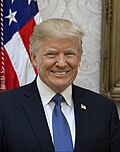


| International | |
|---|---|
| National | |
| Academics | |
| Artists | |
| People | |
| Other | |