


Community hub
Recent from talks
Contribute something
Nothing was collected or created yet.
The Hague
View on Wikipedia
The Hague[b] (Dutch: Den Haag,[c] short for 's-Gravenhage)[d] is the capital city of the South Holland province of the Netherlands. With a population of over half a million, it is the third-largest city in the Netherlands. Situated on the west coast facing the North Sea, The Hague is the country's administrative centre and its seat of government, and has been described as the country's de facto capital since the time of the Dutch Republic, while Amsterdam is the official capital of the Netherlands.[7]
Key Information


.png)


The Hague is the core municipality of the Greater The Hague urban area containing over 800,000 residents, and is also part of the Rotterdam–The Hague metropolitan area, which, with a population of approximately 2.6 million, is the largest metropolitan area of the Netherlands. The city is also part of the Randstad region, one of the largest conurbations in Europe.
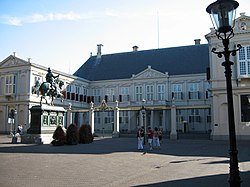
The Hague is the seat of the Cabinet, the States General, the Supreme Court, and the Council of State of the Netherlands.[8] King Willem-Alexander officially lives in the Huis ten Bosch and works at the Noordeinde Palace together with Queen Máxima.[9] Most foreign embassies in the Netherlands are in the city. The Hague is also home to the headquarters of many Dutch companies, with Shell plc having major offices in the city as well. The Royal Library of the Netherlands is also located there. The Hague's coastal area includes the popular seaside resort Scheveningen.
The Hague is known as the global hub of international law and arbitration. The International Court of Justice, the main judicial arm of the United Nations, is based in the city, as are the International Criminal Court, the Permanent Court of Arbitration, the Organisation for the Prohibition of Chemical Weapons, Europol, and approximately 200 other international governmental organizations.[10] The name "The Hague" is commonly used metonymically to refer to either of the international courts that reside in the city. The city has hosted several major international conferences, including the 2014 Nuclear Security Summit and the 2025 NATO Summit.
Etymology
[edit]The name Den Haag (anglicised as The Hague and gallicised as La Haye) derives from the Middle Dutch word hag(h)e, meaning "hedge", "enclosure", or "hunting ground".[11] It first appeared in 1242. The fuller form 's-Gravenhage, meaning "the count's enclosure", first appeared in 1347.[12][e] The count in question was the Count of Holland (as is the case with nearby 's-Gravenzande).
In deference to common usage, the municipal government adopted the shorter name in 1990, reserving the long-form name for official documents.[13] The post office specifies that letters should be addressed to 's-Gravenhage, but a letter to Den Haag will be delivered just as well. The railway stations use the name Den Haag, as do signposts.
History
[edit]Ancient history
[edit]The area was part of the Roman province of Germania Inferior and was close to the border of the empire, the Upper Germanic-Rhaetian Limes. In 1997, four Roman milestones were discovered at Wateringse Veld. The originals are in the "Museon" museum. The milestones indicate the distance from the nearest Roman city, Forum Hadriani (modern Voorburg), and can be dated to the reign of the emperors Antoninus Pius (138–161; the column is dated 151), Caracalla (211–217), Gordian III (238–244), and Decius (249–251).
Early history
[edit]

Little is known about the origin of The Hague. There are no contemporary documents describing it, and later sources are often of dubious reliability. What is certain is that The Hague was founded by the last counts of the House of Holland. Floris IV already owned two residences in the area, but presumably purchased a third court situated by the present-day Hofvijver in 1229, previously owned by a woman called Meilendis. Presumably, Floris IV intended to rebuild the court into a large castle, but he died in a tournament in 1234, before anything was built.[14] His son and successor William II lived in the court, and after he was elected King of the Romans in 1248, he promptly returned to The Hague, and had builders turn the court into a "royal palace" (regale palacium), which would later be called the Binnenhof ("Inner Court"). He died in 1256 before this palace was completed, but parts of it were finished during the reign of his son Floris V, of which the Ridderzaal ("Knights' Hall"), still intact, is the most prominent.[15][16] It is still used for political events, such as the annual speech from the throne by the Dutch monarch. From the 13th century onward, the counts of Holland used The Hague as their administrative center and residence when in Holland.
The village that originated around the Binnenhof was first mentioned as Die Haghe in a charter dating from 1242. It became the primary residence of the Counts of Holland in 1358 and thus became the seat of many government institutions. This status allowed the village to grow; by the Late Middle Ages, it had grown to the size of a city, although it did not receive city rights.[17] In its early years, the village was in the ambacht, or rural district, of Monster, which was governed by the Lord of Monster. Seeking to exercise more direct control over the village, however, the Count split the village off and created a separate ambacht called Haagambacht, governed directly by the Counts of Holland. The territory of Haagambacht was considerably expanded during the reign of Floris V.[18]
When the House of Burgundy inherited the counties of Holland and Zeeland in 1432, they appointed a stadtholder to rule in their stead with the States of Holland and West Friesland as an advisory council. Although their seat was in The Hague, the city became subordinate to more important centres of government such as Brussels and Mechelen, from where the sovereigns ruled over the increasingly centralised Burgundian Netherlands.[17]
At the beginning of the Eighty Years' War, the absence of city walls proved disastrous, as it allowed Spanish troops to easily occupy the town. In 1575, the States of Holland, temporarily based in Delft, even considered demolishing the city, but this proposal was abandoned after mediation by William the Silent. In 1588, The Hague became the permanent seat of the States of Holland as well as the States General of the Dutch Republic.[19] For the administration to maintain control over city matters, The Hague never received official city status, although it did have many of the privileges normally granted only to cities. In modern administrative law, "city rights" have no place anymore.
Modern history
[edit]
In 1806, when the Kingdom of Holland was a puppet state of the First French Empire, the settlement was granted city rights by Louis Bonaparte.[20] After the Napoleonic Wars, modern-day Belgium and the Netherlands were combined in the United Kingdom of the Netherlands to form a buffer against France. As a compromise, Brussels and Amsterdam alternated as capital every two years, with the government remaining in The Hague. After the separation of Belgium in 1830, Amsterdam remained the capital of the Netherlands, while the government was situated in The Hague. When the government started to play a more prominent role in Dutch society after 1850, The Hague quickly expanded. Many streets were specifically built for the large number of civil servants employed in the country's government and for the Dutchmen who were retiring from the administration of the Netherlands East Indies. The growing city amalgamated the rural municipality of Loosduinen partly in 1903 and completely in 1923.[21]
The city sustained heavy damage during World War II. Many Jews were killed during the German occupation. Additionally, the Atlantic Wall was built through the city,[22] causing a large quarter to be torn down by the Nazi occupants. On 3 March 1945, the Royal Air Force mistakenly bombed the Bezuidenhout quarter. The target was an installation of V-2 rockets in the nearby Haagse Bos park, but because of navigational errors, the bombs fell on a heavily populated and historic part of the city.[23] The bombardment wreaked widespread destruction in the area[24] and caused 511 fatalities.[25]
Because of uncertainty about what to do after the destruction of the bombing, nobody attempted to plan a reconstruction of Bezuidenhout. In 1962, David Jokinen saw an opportunity to put an end to the situation where two main stations each served only part of the rail traffic. The Jokinen Plan included the intent to demolish the Staatsspoor Station, with Hollands Spoor becoming the central station. Jokinen's plan sparked fierce discussions. The plan was not implemented, in part because it was only presented when decision-making had finally reached an advanced stage. In the place of the Staatsspoor station now stands the Den Haag Centraal railway station.

After the war, The Hague became at one time the largest building site in Europe. The city expanded massively to the southwest, and the destroyed areas were quickly rebuilt. The population peaked at 600,000 inhabitants around 1965. In the 1970s and 1980s, mostly white middle-class families moved to neighbouring towns such as Voorburg, Leidschendam, Rijswijk and (most of all) Zoetermeer. This led to the traditional pattern of an impoverished inner city and more prosperous suburbs. Attempts to include parts of these municipalities in the city of The Hague were highly controversial. In the 1990s, with the consent of the Dutch Parliament, The Hague annexed large areas from neighboring and non-adjacent towns to build new residential areas, which are still being developed today.
Geography
[edit]

.jpg)
The Hague is the largest Dutch city on the North Sea in the Netherlands and forms the centre of the Greater The Hague urban area. Westland and Wateringen lie to the south, Rijswijk, Delft and the Rotterdam conurbation (known as Rijnmond) to the southeast, Pijnacker-Nootdorp and Zoetermeer to the east, Leidschendam-Voorburg, Voorschoten and the Leiden conurbation to the northeast and Wassenaar to the north.
The conurbations around The Hague and Rotterdam are close enough to be seen as a single conurbation in some contexts. For example, they share the Rotterdam The Hague Airport and a light rail system called RandstadRail. This led to the creation of the Rotterdam-The Hague metropolitan area. This large conurbation centred on The Hague and Rotterdam is, in turn, part of the Randstad—specifically a band of municipalities called the South Wing (Zuidvleugel). The Randstad, which also includes, among others, Amsterdam and Utrecht, has a population of 6,659,300. The Hague lies at the southwestern corner of the second-largest conurbation in the European Union.
The Hague is divided into eight official districts, which are, in turn, divided into neighbourhoods.[26] Some of the most prosperous and some of the poorest neighbourhoods of the Netherlands can be found in The Hague. The wealthier areas such as Statenkwartier, Belgisch Park, Marlot, Benoordenhout and Archipelbuurt are generally in the northwestern part of the city, closer to the sea, whereas the southeastern neighbourhoods such as Transvaal, Moerwijk, and the Schilderswijk are significantly poorer, except the Vinex-locations of Leidschenveen-Ypenburg and Wateringse Veld. This division is reflected in the local accent: The more affluent citizens are usually called "Hagenaars" and speak so-called bekakt Haags ("posh"), this contrasts with the Hagenezen, who speak plat Haags ("vulgar"); see Demographics below.
The districts are:
- Centrum (110,000 inhabitants)[27] forms the heart of The Hague. The Binnenhof, the Noordeinde Palace, the Mauritshuis museum, the Nieuwe Kerk, the Grote Kerk, the Old City Hall and the City Hall are located here. Architecture varies from medieval to the 20th century.
- Escamp (131,000 inhabitants)[27] is the most populous district of The Hague, built largely after World War II as part of The Hague's large expansion to the southeast. One railway station can be found here: Den Haag Moerwijk. The district is divided into six neighbourhoods.
- Haagse Hout (51,000 inhabitants)[27] is a wealthy district in the northeast of the city and the location of the Haagse Bos, a large forest. The King of the Netherlands lives in the royal palace Huis ten Bosch, in this forest. The district also includes the financial centre of the city, the Beatrixkwartier.
- Laak (46,000 inhabitants)[27] is the smallest district of the city, southeast of its centre, for the most part, built in the 20th and 21st centuries. The area used to be part of Rijswijk until the municipality of The Hague bought the land in 1844. The Hollands Spoor railway station and The Hague University are located here, as well as the site of the planned mixed-use development Nieuw Binckhorst.
- Leidschenveen-Ypenburg (48,000 inhabitants)[27] is an early 21st-century Vinex-location southeast of the city, geographically connected to the main body of the city only by a narrow corridor. The district is divided into Leidschenveen and Ypenburg, which were part of Leidschendam, Nootdorp, and Rijswijk before the areas were annexed by The Hague in 2002. This area was the site of Ypenburg Airport, which was a military airport during World War II.
- Loosduinen (53,000 inhabitants)[27] is the westernmost district of The Hague. It was a village unto itself until 1923, when it was annexed by The Hague. The less popular of the city's two seaside resorts, Kijkduin, is located here. The district is divided into four neighbourhoods.
- Scheveningen (61,000 inhabitants)[27] is the wealthy northernmost district of The Hague. A modern beach resort, Scheveningen is a popular tourist destination. It has a long sandy beach and its own esplanade, pier, and lighthouse, but also a Pathé cinema, a musical theatre, a casino, and a special Museum for Scheveningen. The district also includes a fishing harbour. Notable buildings include the Kurhaus and, farther inland, the Peace Palace.
- Segbroek (63,000 inhabitants)[27] is a district located between Scheveningen and Loosduinen. The population decreased until around 2005, but since then has begun to grow again, driven by students and Eastern European immigrants. It became a district of The Hague in 1988 and is divided into five neighbourhoods.
Climate
[edit]The Hague experiences a temperate oceanic climate (Köppen: Cfb) similar to almost all of the Netherlands. Because of its location on the coast, it experiences milder winters and cooler summers than more inland locations. However, because of its location, it can also be extremely windy in the winter and humid in the summer. It also gets more sunshine.[citation needed]
| Climate data for Valkenburg Naval Air Base | |||||||||||||
|---|---|---|---|---|---|---|---|---|---|---|---|---|---|
| Month | Jan | Feb | Mar | Apr | May | Jun | Jul | Aug | Sep | Oct | Nov | Dec | Year |
| Record high °C (°F) | 13.8 (56.8) |
15.9 (60.6) |
20.8 (69.4) |
25.9 (78.6) |
29.7 (85.5) |
33.5 (92.3) |
36.5 (97.7) |
34.6 (94.3) |
31.7 (89.1) |
24.5 (76.1) |
17.5 (63.5) |
15.4 (59.7) |
36.5 (97.7) |
| Mean daily maximum °C (°F) | 6.4 (43.5) |
6.9 (44.4) |
9.8 (49.6) |
13.6 (56.5) |
17.0 (62.6) |
19.6 (67.3) |
21.6 (70.9) |
21.8 (71.2) |
18.9 (66.0) |
14.7 (58.5) |
10.2 (50.4) |
7.1 (44.8) |
14.0 (57.2) |
| Daily mean °C (°F) | 4.1 (39.4) |
4.2 (39.6) |
6.4 (43.5) |
9.4 (48.9) |
12.8 (55.0) |
15.6 (60.1) |
17.8 (64.0) |
17.8 (64.0) |
15.0 (59.0) |
11.4 (52.5) |
7.6 (45.7) |
4.8 (40.6) |
10.6 (51.1) |
| Mean daily minimum °C (°F) | 1.5 (34.7) |
1.2 (34.2) |
2.7 (36.9) |
4.8 (40.6) |
8.3 (46.9) |
11.2 (52.2) |
13.5 (56.3) |
13.4 (56.1) |
10.9 (51.6) |
7.9 (46.2) |
4.7 (40.5) |
2.1 (35.8) |
6.8 (44.2) |
| Record low °C (°F) | −16.4 (2.5) |
−14.0 (6.8) |
−11.1 (12.0) |
−4.4 (24.1) |
−1.5 (29.3) |
1.7 (35.1) |
5.4 (41.7) |
5.5 (41.9) |
1.2 (34.2) |
−4.4 (24.1) |
−7.1 (19.2) |
−10.6 (12.9) |
−16.4 (2.5) |
| Average precipitation mm (inches) | 70.0 (2.76) |
59.4 (2.34) |
52.8 (2.08) |
41.6 (1.64) |
52.7 (2.07) |
62.8 (2.47) |
72.7 (2.86) |
84.0 (3.31) |
89.2 (3.51) |
89.9 (3.54) |
90.4 (3.56) |
76.4 (3.01) |
841.9 (33.15) |
| Average precipitation days (≥ 1 mm) | 12 | 10 | 11 | 9 | 9 | 9 | 10 | 10 | 12 | 13 | 14 | 13 | 132 |
| Average snowy days | 5 | 5 | 3 | 1 | 0 | 0 | 0 | 0 | 0 | 0 | 2 | 4 | 20 |
| Average relative humidity (%) | 86 | 84 | 83 | 79 | 78 | 79 | 80 | 80 | 83 | 84 | 87 | 87 | 83 |
| Mean monthly sunshine hours | 71.7 | 96.7 | 152.0 | 207.2 | 240.5 | 229.3 | 237.5 | 213.4 | 160.0 | 116.7 | 68.2 | 56.5 | 1,849.7 |
| Source 1: Royal Netherlands Meteorological Institute (1981–2010 normal, snowy days normal for 1971–2000)[28] | |||||||||||||
| Source 2: Royal Netherlands Meteorological Institute (1971–2000 extremes)[29] | |||||||||||||
Cityscape
[edit]
City life concentrates around the Hofvijver and the Binnenhof, where the States General of the Netherlands is located. Because of its history, the historical inner city of The Hague differs in various aspects from the nearby smaller cities of Leiden and Delft. It does not have a cramped inner city, bordered by canals and walls. Instead, it has some small streets in the town centre that may be dated from the late Middle Ages and several spacious streets boasting large and luxurious 18th-century residences built for diplomats and affluent Dutch families. It has a large church dating from the 15th century, a City Hall (built as such) from the 16th century, several large 17th-century palaces, a 17th-century Protestant church built in what was then a modern style, and many important 18th-century buildings.


The city is becoming more student-friendly with the introduction of a new campus in 2012 of Leiden University as well as Leiden University College The Hague, which was established in 2010. The Royal Conservatory of The Hague and the Royal Academy of Art are also located there, as well as The Hague University, a vocational university, and a branch of The Open University of the Netherlands. The city has many civil servants and diplomats.[30] In fact, the number and variety of foreign residents (especially the expatriates) make the city quite culturally diverse, with many foreign pubs, shops and cultural events.
The Hague is the largest Dutch city on the North Sea and includes two distinct beach resorts. The main beach resort Scheveningen, in the northwestern part of the city, is a popular destination for tourists as well as for inhabitants. With 10 million visitors a year, it is the most popular beach town in the Benelux area. Kijkduin, in the southwest, is The Hague's other beach resort. It is significantly smaller and attracts mainly local residents.
The former Dutch colony of the East Indies, now Indonesia, has left its mark on The Hague. Since the 19th century, high-level civil servants from the Dutch East Indies often spent long-term leave and vacations in The Hague. Many streets are named after places in the Netherlands East Indies (as well as other former Dutch colonies such as Suriname), and there is a sizable "Indo" (i.e., mixed Dutch-Indonesian) community. Since the loss of these Dutch possessions in December 1949, "Indo people" also known as "Indische people" often refer to The Hague as "the Widow of the Indies".[31]
The older parts of the town have many characteristically wide and long streets. Houses are generally low-rise (often not more than three floors). A large part of the southwestern city was planned by the progressive Dutch architect H.P. Berlage about 1910. This 'Plan Berlage' decided the spacious and homely streets for several decades. In World War II, a large portion of the western portion of The Hague was destroyed by the Germans. Afterward, modernist architect W.M. Dudok planned its renewal, putting apartment blocks for the middle class in open park-like settings.
The layout of the city is more spacious than other Dutch cities, and because of the incorporation of large and old nobility estates, the creation of various parks, and the use of green zones around natural streams, it is a much greener city than any other in the Netherlands. That is, excepting some medieval close-knitted streets in the centre. The Hague has a canal system around the old city center, which is mainly used for boat tours around the city. Most of the canals were drained in the late 19th century, and some were filled between 1910 and 1970,[32] but many have been restored recently.[when?]
The tallest buildings of The Hague are both 146-meter-tall ministries of Justice and Security and the Interior and Kingdom Relations of the Netherlands, designed by Hans Kollhoff. Other significant skyscrapers include the Hoftoren, Het Strijkijzer and De Kroon.
Demographics
[edit]
|
|
| ||||||||||||||||||||||||||||||||||||||||||||||||||||||||||||||||||||||||||||||||||||||||||
| Source: Lourens & Lucassen 1997, pp. 108–110 (1369–1795) buurtmonitor.nl (1795–present) Statistics Netherlands[33] | ||||||||||||||||||||||||||||||||||||||||||||||||||||||||||||||||||||||||||||||||||||||||||||
| Country/Territory | Population |
|---|---|
 Netherlands Netherlands
|
246,633 (43%) |
 Suriname Suriname
|
46,346 (8.70%) |
 Turkey Turkey
|
40,064 (7.52%) |
 Morocco Morocco
|
31,455 (5.91%) |
 Indonesia Indonesia
|
17,635 (3.31%) |
 Poland Poland
|
14,094 (2.65%) |
| Dutch Caribbean
|
13,218 (2.48%) |
| Other | 123,116 (26%) |
- Irreligion (49.6%)
- Roman Catholic (14.9%)
- Protestant Church in the Netherlands (9.40%)
- Other Christian denominations (5.70%)
- Islam (14.7%)
- Hinduism (4.80%)
- Buddhism (0.80%)
- Judaism (0.20%)
As of 1 January 2021, The Hague counts 549,163 inhabitants, making it the third-largest city in the Netherlands. Between 1800 and 1960, the city saw considerable growth from 40,000 in 1800 to 200,000 in 1900 and eventually 600,000 in 1960. The growth following 1900 was partially caused by the Housing Act of 1901, which stimulated the expansion of cities such as The Hague. In the period between 1960 and 1980, The Hague saw a shrinkage from 600,000 to 440,000 inhabitants, caused mostly by spatial policy, demographic processes, and lack of space. After several annexations and housing constructions, The Hague has since grown again, celebrating its 500,000th inhabitant in 2011. The municipality expects the growth to continue to just over 600,000 inhabitants by 2030.[36]
The demonym of The Hague officially is Hagenaar, but the term Hagenees is informally used for someone who was born and raised in The Hague.[37] The usage of these demonyms appears to be class-bound, with Hagenaar being the upper-class term and Hagenees being that of the lower-class.[38]
Origin make-up
[edit]43% of the population of The Hague has two parents that were born in the Netherlands, while 15.6% have at least one parent who was born abroad in a Western country, and 34.4% have at least one parent that was born in a non-Western country.[39]
Inhabitants by birthplace
[edit]| 2020[40] | Numbers | % |
|---|---|---|
| Both parents born in NL | 242,441 | 44.42% |
| Western migration background | 105,315 | 19.29% |
| Non-Western migration background | 198,082 | 36.29% |
| Suriname | 45,783 | 8.39% |
| Turkey | 41,122 | 7.53% |
| Morocco | 32,355 | 5.93% |
| Indonesia | 17,187 | 3.15% |
| Netherlands Antilles and Aruba | 14,037 | 2.57% |
| Total | 545,838 | 100% |
Religion
[edit]Just under half of The Hague's population identifies with a religious group. The two most popular religions are Christianity (29%) and Islam (14.1%). Religiosity is higher among people with a recent migration background from Indonesia, Turkey, Morocco, and Suriname. Islam is the most common religion among people with a Turkish or Moroccan migration background. Among people of Surinamese heritage, there is more religious diversity, with Hinduism being the most common. Of The Hague's native Dutch population, most religious people adhere to Christianity. Just under 40% of the population of The Hague regularly attends a house of worship.[41]
Politics
[edit]Municipal government
[edit]
Following the 2022 municipal election, the municipal council of The Hague currently contains fourteen groups, most notably Heart for The Hague (HvDH; 11 seats), Democrats 66 (D66; 8 seats), the People's Party for Freedom and Democracy (VVD; 6 seats) and GroenLinks (5 seats).[42]
| Group | Seats | |
|---|---|---|
| Heart for The Hague | 12 / 45 | |
| Democrats 66 | 8 / 45 | |
| People's Party for Freedom and Democracy | 6 / 45 | |
| GroenLinks | 5 / 45 | |
| Party for the Animals | 3 / 45 | |
| Labour Party | 2 / 45 | |
| Christian Democratic Appeal | 2 / 45 | |
| DENK | 2 / 45 | |
| The Hague City Party | 1 / 45 | |
| Socialist Party | 1 / 45 | |
| Party for Freedom | 1 / 45 | |
| Christian Union – Reformed Political Party | 1 / 45 | |
| Forum for Democracy | 1 / 45 | |
| Source: Municipal Council[43] | ||
Since 2023, the municipal executive has comprised D66, GroenLinks, PvdD, PvdA, CDA, and DENK. The chairman of the college is Mayor Jan van Zanen (VVD), and the city has seven aldermen: Robert van Asten, Saskia Bruines (both D66), Mariëlle Vavier, Arjen Kapteijns (both GroenLinks), Robert Barker (PvdD), Hilbert Bredemeijer (CDA), and Nur Ican (DENK). Each alderman is responsible for many particular policy areas and one of the city's eight districts.[44]
On 1 October 2019, the National Department of Criminal Investigation (Rijksrecherche) performed a raid on the homes and offices of then-aldermen Richard de Mos and Rachid Guernaoui, as part of an investigation of alleged administrative corruption, bribery, and violation of confidentiality. The offices of several municipal civil servants and the homes of three entrepreneurs were also searched for the investigation. The aldermen were suspected of receiving bribes in exchange for granting permits.[45] In April 2023, De Mos and Guernaoui were acquitted of all charges.[46][47][48]
International politics
[edit]


The Hague is home to many different international judicial bodies, such as the International Court of Justice (ICJ), the International Criminal Court (ICC), and the International Residual Mechanism for Criminal Tribunals (IRMCT). It houses Scheveningen Prison, the ICC's detention center for those suspected of war crimes and other violations of international law.[49] The Hague is the fourth major centre for the United Nations, after New York, Geneva and Vienna.[50]
The foundation of The Hague as an "international city of peace and justice" started at the end of the 19th century, when the first global peace conference took place in The Hague on Tobias Asser's initiative, with a second one a few years later. A direct result of these meetings was the establishment of the world's first organisation for the settlement of international disputes, the Permanent Court of Arbitration (PCA). Shortly thereafter, the Scottish-American millionaire Andrew Carnegie made the necessary funds available to build the Peace Palace to house the PCA. After the establishment of the League of Nations, The Hague became the seat of the Permanent Court of International Justice, which was replaced (after World War II) by the UN's International Court of Justice. The establishments of the Iran–United States Claims Tribunal (1981), the International Criminal Tribunal for the former Yugoslavia (1993), and the International Criminal Court (2002) in the city further consolidated its role as a centre for international legal arbitration. Most recently, on 1 March 2009, the Special Tribunal for Lebanon, a UN tribunal to investigate and prosecute suspects in the 2005 assassination of Lebanese Prime Minister Rafik Hariri, opened in the former headquarters of the Dutch General Intelligence and Security Service in Leidschendam, a town within the greater area of The Hague.
Other major international and European organisations based in The Hague include:
- Europol, European Union Agency for Law Enforcement Cooperation
- Eurojust, European Union Agency for Criminal Justice Cooperation
- Europeana, European Union digital platform for cultural heritage.
- The Hague Academy of International Law, centre for high-level education in both public and private international law
- Hague Conference on Private International Law (HCCH), the oldest and preeminent private international law harmonisation institution
- International Commission on Missing Persons (ICMP)
- European Patent Office
- Unrepresented Nations and Peoples Organization
- NATO Communications and Information Agency, (NCI Agency)
- Organisation for the Prohibition of Chemical Weapons (OPCW)
- The European Library[51]
Many academic institutions in the fields of international relations, international law, and international development are based in The Hague. The Hague Academic Coalition (HAC) is a consortium of those institutions.
Its member institutions are:
- Carnegie Foundation
- Hague Institute for the Internationalisation of Law (HiiL)
- International Institute of Social Studies (ISS) of Erasmus University Rotterdam
- Leiden University College The Hague
- Netherlands Institute of International Relations 'Clingendael'
- The Hague Academy of International Law
- The Hague University of Applied Sciences
- T.M.C. Asser Instituut
In 1948, the Congress of Europe was held with 750 delegates from 26 European governments, providing them with the opportunity to discuss ideas about the development of European integration, which eventually culminated in the creation of the modern-day European Union.
Economy
[edit]
The Hague has a service-oriented economy. A professional life in the city is dominated by a large number of civil servants and diplomats working in the city; as of 2006[update], 26% of the jobs in The Hague are those offered by the Dutch government or the international institutions. Large employers in this sector include the ministries of Defence, Justice, Housing, Spatial Planning and the Environment, Foreign Affairs, the Ministry of the Interior and Kingdom Relations and Transport, Public Works and Water Management.
Several large international businesses have their headquarters in The Hague. Significant companies headquartered in The Hague include Aegon, APM Terminals, Damco, NIBC Bank, Chicago Bridge & Iron Company and PostNL. The city is also host to the regional headquarters of Siemens, T-Mobile, AT&T, Huawei, Kuwait Petroleum Corporation, McDermott International, Saudi Aramco, TotalEnergies and Worley. There has never been any large-scale industrial activity in The Hague, with the possible exception of the fishing activities of the harbour in Scheveningen. Many of the city's logistical and minor-industrial services are in the Binckhorst in the Laak district, which contains many sizeable warehouses.
The city is the second biggest Dutch tourist destination after Amsterdam. In 2012, The Hague welcomed 1.2 million tourists, half of whom came from abroad. Tourists spend an average of €2 billion a year in the local economy. 1 in 10 residents makes their living in the tourism sector.[52][53]
Culture
[edit] | This section needs additional citations for verification. (May 2022) |
The Hague originated around the 13th century Binnenhof, and this is still considered the cultural centre of the city. Nightlife centres around the three main squares in the city centre. The Plein (meaning "Plaza" or "Town square") is taken by several large sidewalk cafés, where often politicians may be spotted. The Grote Markt (literally "Big Market") is completely strewn with chairs and tables, summer or winter. The Buitenhof (literally "Outer Courtyard", located just outside the Binnenhof) contains a six-screen Pathé cinema and a handful of bars and restaurants in the immediate vicinity. Adjacent to the Buitenhof is De Passage, the country's first covered shopping mall. Dating from the late 19th century,[54] it contains many expensive and speciality shops. One of the country's largest music venues, Paard van Troje, can be found in the centre of The Hague. Another popular music venue in The Hague is Muziekcafé de Paap.

The Spuiplein is a modern fourth square in the city centre, opposite the Nieuwe Kerk. Besides the City Hall, this was also the location of the Anton Philipszaal, home to the Residentie Orchestra, and the Lucent Danstheater, home to the internationally celebrated modern dance company Nederlands Dans Theater. These buildings, designed by Rem Koolhaas in 1988, have been demolished to make space for a new theatre, Amare, which would house both institutes as well as the Royal Conservatory. Despite the efforts of the municipality, public support for the proposed theatre remains low. At the heart of the city centre, across the palace gardens, is the home of Summerschool Den Haag, an international school for dance with guest teachers such as Valentina Scaglia, Igone de Jongh, and Maia Makhateli. The Koninklijke Schouwburg, home to Het Nationale Theater, can also be found in the city centre – on the Korte Voorhout. New European Ensemble is a collective for contemporary music consisting on international musicians. The ensemble has its main base in the city.
Scheveningen forms a second cultural centre of The Hague, having its own Pathé cinema as well as the musical theatre Circustheater, although, especially in the summer, most nightlife concentrates around the sea-front boulevard with its bars, restaurants, and gambling halls. Several other attractions can be found in Scheveningen, such as the miniature park Madurodam, the Beelden aan Zee museum, and a Sea Life Centre.
The Hague is the residence of the Dutch monarch, and several (former) royal palaces can be found in the city. King Willem-Alexander of the Netherlands and Queen Máxima of the Netherlands live in Huis ten Bosch in the Haagse Bos and work in the Noordeinde Palace in the city centre. Moreover, there are two former royal palaces in The Hague. The Kneuterdijk Palace, built in 1716, is now home to the Council of State of the Netherlands, and the Lange Voorhout Palace is now occupied by the Escher Museum, dedicated to Dutch graphical artist M. C. Escher.

The Hague has numerous museums, most notably the Mauritshuis, located next to the Binnenhof, which exhibits many paintings by old masters up to 1800, such as Johannes Vermeer, Rembrandt van Rijn and Paulus Potter. The art museum Kunstmuseum, housed in a striking building by architect HP Berlage, exhibits art from after 1800, including the world's large collection of paintings by Piet Mondrian.[55] Other museums include the science museum Museon, the historic museum Haags Historisch Museum, the national postal museum Museum voor Communicatie, the Museum Bredius, the Louis Couperus Museum, the museum Beelden aan Zee in Scheveningen, Panorama Mesdag, and the Gevangenpoort, a former prison housed in a 15th-century gatehouse.
Since early times, possibly as far back as the 16th century, the stork has been the symbol of The Hague.[56] Several films have been (partially) shot in The Hague, including Mindhunters (2004), Hum Tum (2004), Ocean's Twelve (2004), Black Book (2006) and Sonny Boy (2011). Parts of the second season of the Netflix series Sense8 were filmed in The Hague.[57] Notable actors and filmmakers from The Hague include Martin Koolhoven, Georgina Verbaan, Carel Struycken, Frederique van der Wal, Marwan Kenzari, Anna Drijver, Renée Soutendijk and Paul Verhoeven, who grew up in the city from an early age.
-
 The Ridderzaal inside the Binnenhof, the political centre of the Netherlands
 -
 Monument commemorating the founding of the Kingdom of the Netherlands at Plein 1813
 -
-

-
 Huis ten Bosch is the residence of the king.
 -
 Louwman Museum is a museum for historic cars, coaches, and motorcycles.
 -
 the Lange Voorhout is a street in the old city centre
 -

-
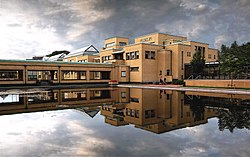 View of the Kunstmuseum Den Haag, Designed by H. P. Berlage, and opened in 1935


_(5).jpg)


Sports
[edit]
The city's major football club is ADO Den Haag, which competes in the Eerste Divisie, the second-highest tier of football in the Netherlands. ADO Den Haag has won the KNVB Cup twice and won the League twice in the era before professional football. They play their matches at the 15,000-seat ADO Den Haag Stadium. Amateur team HVV is also based in the city. Before the professional era, the club won 10 national titles and one KNVB Cup, and they remain fourth in the all-time list of national title winners.[58] HBS Craeyenhout is another amateur club in the city, which won three national titles before the establishment of the Eredivisie.[58] On 13 May 2021, football club ADO Den Haag was relegated from the Eredivisie as they lost their final game of the season against Willem II. In effect, ADO Den Haag no longer holds a position in the top division of professional Dutch football.[59]
Since 2020, the basketball club The Hague Royals has played in the professional Dutch Basketball League (DBL). Home games are played at the Sportcampus Zuiderpark.
The local rugby union team is Haagsche Rugby Club (a.k.a. HRC). The ice hockey team is HYS The Hague and the local American football team is Den Haag Raiders '99.
Darts is another sport played in The Hague; its popularity was increased by Raymond van Barneveld winning several World Championships.
The half-marathon race CPC Loop Den Haag is held annually in The Hague. In 1994, The Hague held the FEI World Equestrian Games.
Annual events
[edit]Koningsdag, or King's Day, is held annually on 27 April. It is traditionally celebrated with fairs and flea markets throughout the city. On this day, the colour orange predominates at a funfair (which sells orange cotton candy) and scores of informal street markets. The day is a vrijmarkt (literally "free market"), which means no licence is needed for street vending; children traditionally use this day to sell old, unwanted toys. Since King's Day is a national holiday and thus a day off, many people also go out and party on the evening before King's Day. This evening is called King's Night, or Koningnacht in The Hague. The "t" is left out because nacht is pronounced as nach in The Hague. Outdoor concerts throughout the city centre of The Hague draw tens of thousands of visitors every year.[60][61]
Every third Tuesday in September is Prinsjesdag, or Prince's Day, the opening of the Dutch parliament. On a festive day, children in The Hague are free from school so they may watch the procession of the Golden Coach. The King is driven in the coach from Noordeinde Palace to the Ridderzaal in the Binnenhof. Here, the King reads the Speech from the Throne, written jointly by the Ministers and Secretaries of State. This troonrede outlines the government's plans for the coming year. As the procession returns to the Noordeinde Palace, the road is lined with members of the Dutch Royal Armed Forces, and in the afternoon, the Royal Family appears on the palace balcony to address an adoring and often frenzied public (balkonscène).[62]
Vlaggetjesdag (nl), literally Flag Day, is the annual celebration of the arrival of the year's first herring (Hollandse Nieuwe) in Scheveningen. Hundreds of thousands of people gather in Scheveningen for the festivities, and the fishing boats are decorated specially for the occasion. In addition to the omnipresent herring, this day also features several activities unrelated to fish. In Scheveningen, the first barrel of herring is traditionally sold at an auction on the Thursday preceding the official Vlaggetjesdag, and the proceeds go to charity. Vlaggetjesdag was made official in 1947, although the festive tradition around the beginning of herring season is much older: in the 18th century, the villages along the coast, including Scheveningen, were forbidden to gut the caught herring. Since herring was most appropriate for smoking around September, most fishing boats caught flatfish or round-bodied fish during part of the summer, to avoid a surplus of fresh herring.[63] In July or August, The Hague hosts a series of weekly firework displays by the sea front in Scheveningen, as part of an international fireworks festival and competition.
Tong Tong Fair, formerly Pasar Malam Besar, is the largest festival in the world for Indo culture. Established in 1959, it is one of the oldest festivals and the fourth-largest grand fair in the Netherlands. It is also the annual event with the highest number of paying visitors to The Hague, having consistently attracted more than 100,000 visitors since 1993. The Milan Festival is Europe's biggest Hindustani open-air event, annually held in Zuiderpark. The Hague also hosts several annual music festivals; on the last Sunday in June, the city hosts Parkpop, the largest free open-air pop concert in Europe. Crossing Border Festival, State-X and The Hague Jazz festival are among other music festivals in The Hague.[64]
Crossing Border Festival is an annual festival in November, focusing on music and literature.[65] The first edition took place in 1993.
Movies That Matter[66] is an international film and debate festival about peace and justice that takes place every year at the end of March; nine days filled with screenings of fiction films and documentaries, daily talk-shows, music performances, and exhibitions. The first such event took place in 2006.
Moreover, the Hague International Model United Nations, annually held in January, is a five-day conference held at the World Forum, gathering over 4,000 students from over 200 secondary schools across the globe. It is the oldest and largest high school United Nations simulation in the world. Den Haag Sculptuur is an open-air exhibition of sculptures; the tenth such event, in 2007, celebrated the 400 years of the relationship between the Netherlands and Australia. Since 2009, the city of The Hague has also annually presented an LGBTQ+ emancipation award, called the John Blankenstein Award. The exact date of the ceremony varies each year.
Notable people
[edit]Transport
[edit]
Air
[edit]The Hague shares an airport with Rotterdam. It can be reached from Central Station by RandstadRail Line E, with an Airport Shuttle to and from Meijersplein Station. However, with several direct trains per hour from the railway stations Hollands Spoor and Centraal, Amsterdam Airport Schiphol is more frequently used by people travelling to and from The Hague by air.
Rail
[edit]
There are two main railway stations in The Hague: Hollands Spoor and Centraal Station, 1.5 km (1 mi) apart from each other. Because the two stations were built and run by two different railway companies in the 19th century, services have traditionally been split between the two: east–west lines terminate at Centraal Station, whereas north–south lines run through Hollands Spoor. However, Centraal Station now offers direct services to most major Dutch cities, such as Amsterdam, Rotterdam, and Utrecht.
Other destinations include Leiden, Haarlem, Zwolle, Groningen, Leeuwarden, Amersfoort, Enschede, Breda, Tilburg and Eindhoven. International travellers for Antwerp and Brussels have to change trains at Rotterdam.
Urban transport
[edit]Public transport in The Hague consists of a tramway network and a sizeable number of bus routes, operated by HTM Personenvervoer.[67] Plans for a subway were shelved in the early 1970s. However, in 2004, a tunnel was built under the city centre with two underground tram stations (Spui and Grote Markt); it is shared by RandstadRail lines 3 and 4 and tram routes 2 and 6.
RandstadRail connects The Hague to nearby cities, Zoetermeer, Rotterdam, and Leidschendam-Voorburg. It consists of four light rail lines (3, 4, and 19 to Zoetermeer, Rijswijk, Delft, and Leidschendam-Voorburg) and one subway line (E to Rotterdam).
Road
[edit]Major motorways connecting to The Hague include the A12, running to Utrecht and the German border. The A12 runs directly into the heart of the city in a cutting. Built in the 1970s, this section of the motorway (the "Utrechtsebaan") is now heavily overburdened. Plans were made in the late 1990s for a second artery road into the city (the "Rotterdamsebaan", previously called the "Trekvliettracé"), which was completed in 2021.[68] Other connecting motorways are the A4, which connects the city with Amsterdam, and the A13, which runs to Rotterdam and connects to motorways towards the Belgian border. There is also the A44 that connects the city to Leiden, Haarlem and Amsterdam. In the 1970s, plans for building another motorway to Leiden existed. This "Leidsebaan" was supposed to start in the city centre and then follow the railway line from The Hague to Amsterdam. Some works had been executed but had been removed by the 1980s.[citation needed]
See also
[edit]Notes
[edit]- ^ Counted as one with the city of Rotterdam, its seaport and industrial area, and its suburbs / metro area.
- ^ English pronunciation: /heɪɡ/ HAYG.
- ^ Dutch pronunciation: [dɛn ˈɦaːx] ⓘ.
- ^ Dutch pronunciation: [ˌsxraːvə(n)ˈɦaːɣə] ⓘ.
- ^ 's is an abbreviated form of the genitive article des, while den is a fossilised dative article (see archaic Dutch declension). The name is grammatically masculine even though the word haag is normally feminine.
References
[edit]Citations
[edit]- ^ "College van burgemeester en wethouders" [Municipal executive] (in Dutch). Gemeente Den Haag. Archived from the original on 12 October 2019. Retrieved 28 August 2021.
- ^ "Kerncijfers wijken en buurten 2020" [Key figures for neighbourhoods 2020]. StatLine (in Dutch). CBS. 24 July 2020. Retrieved 19 September 2020.
- ^ a b Anita Bouman–Eijs; Thijmen van Bree; Wouter Jonkhoff; Olaf Koops; Walter Manshanden; Elmer Rietveld (17 December 2012). De Top 20 van Europese grootstedelijke regio's 1995–2011; Randstad Holland in internationaal perspectief [Top 20 of European metropolitan regions 1995–2011; Randstad Holland compared internationally] (PDF) (Technical report) (in Dutch). Delft: TNO. Archived from the original (PDF) on 3 March 2014. Retrieved 25 July 2013.
- ^ "Postcodetool for 2511BT". Actueel Hoogtebestand Nederland (in Dutch). Het Waterschapshuis. Archived from the original on 21 September 2013. Retrieved 23 July 2013.
- ^ "Bevolkingsontwikkeling; regio per maand" [Population growth; regions per month]. CBS Statline (in Dutch). CBS. 1 January 2021. Retrieved 2 January 2022.
- ^ "Bevolkingsontwikkeling; Regionale kerncijfers Nederland" [Regional core figures Netherlands]. CBS Statline (in Dutch). CBS. 1 January 2020. Retrieved 8 March 2021.
- ^ Kaufmann, David (2018). Varieties of Capital Cities: The Competitiveness Challenge for Secondary Capitals. Cheltenham, UK: Edward Elgar Publishing. ISBN 978-1-78811-643-5. OCLC 1049802517.
- ^ Daum, Andreas (2005). Berlin – Washington, 1800–2000 Capital Cities, Cultural Representation, and National Identities. Cambridge University Press. pp. 13, 38. ISBN 0521841178. Archived from the original on 3 May 2016. Retrieved 23 October 2015.
Amsterdam is the statuary capital of the Netherlands, while the Dutch government resides in De Hague. (sic) (p. 13) The Dutch seat of government is The Hague but its capital is bustling Amsterdam, the national cultural centre. (p. 38)
- ^ Huis ten Bosch Palace Archived 31 July 2017 at the Wayback Machine at "The Official Website of the Dutch Royal House in English", maintained by the Netherlands Government Information Service.
- ^ "Internationale organisaties in Den Haag". Gemeente Den Haag (in Dutch). Archived from the original on 4 February 2019. Retrieved 3 February 2019.
- ^ "Haag – (omheining met struiken, heg)". etymologiebank.nl. Retrieved 14 July 2025.
- ^ "'s-Gravenhage – (geografische naam)". etymologiebank.nl. Retrieved 14 July 2025.
- ^ "'s-Gravenhage / Den Haag". Taaladvies.net. Archived from the original on 16 January 2013. Retrieved 16 November 2012.
- ^ "De geschiedenis van den Haag: graaf Floris IV". Geschiedenis van Den Haag (in Dutch). Archived from the original on 24 April 2019. Retrieved 16 June 2018.
- ^ "Den Haag en graaf Willem II". Geschiedenis van Den Haag (in Dutch). Archived from the original on 24 April 2019. Retrieved 16 June 2018.
- ^ "Het Binnenhof: ontstaat". Geschiedenis van Den Haag (in Dutch). Archived from the original on 24 April 2019. Retrieved 16 June 2018.
- ^ a b "Geschiedenis van Den Haag". Geschiedenis van Zuid-Holland (in Dutch). Archived from the original on 16 June 2018. Retrieved 16 June 2018.
- ^ "Het dorp Die Haghe: het ontstaan". Geschiedenis van Den Haag (in Dutch). Archived from the original on 24 April 2019. Retrieved 16 June 2018.
- ^ "De allerkortste geschiedenis van Den Haag". Merkboek Den Haag (in Dutch). Archived from the original on 16 June 2018. Retrieved 16 June 2018.
- ^ "A short history of The Hague". Denhaag.nl. 28 November 2011. Archived from the original on 13 April 2014. Retrieved 9 April 2014.
- ^ Ad van der Meer and Onno Boonstra, Repertorium van Nederlandse gemeenten, KNAW, 2011.
- ^ Jack Oosthoek (18 October 2022). "'Vitaal onderdeel geschiedenis van bezet Nederland'". Defensiekrant. Defensie.nl.
- ^ "Bombardement op Bezuidenhout maart 1945" [Bombing of the Bezuidenhout March 1945] (in Dutch). Koninklijke Bibliotheek. Archived from the original on 15 December 2013. Retrieved 5 December 2013.
- ^ Stichting Ons Erfdeel (1998). The Low Countries: arts and society in Flanders and the Netherlands, a yearbook. Vol. 9. Flemish-Netherlands Foundation. p. 113. ISBN 9789075862287. Archived from the original on 17 June 2016. Retrieved 23 October 2015.
- ^ (in Dutch) Bombardement Bezuidenhout 3 maart '45 Voor velen stortte in luttele minuten de wereld in elkaar Archived 15 December 2013 at the Wayback Machine, Amigoe di Curacao, 4 March 1965
- ^ "Stadsdelen" (in Dutch). Denhaag.nl. 18 October 2010. Archived from the original on 28 September 2011. Retrieved 31 August 2011.
- ^ a b c d e f g h Den Haag in Cijfers (in Dutch)
- ^ "Klimaattabel Valkenburg, langjarige gemiddelden, tijdvak 1981–2010" (PDF) (in Dutch). Royal Netherlands Meteorological Institute. Archived (PDF) from the original on 10 October 2017. Retrieved 10 September 2013.
- ^ "Klimaattabel Valkenburg, langjarige extremen, tijdvak 1971–2000" (PDF) (in Dutch). Royal Netherlands Meteorological Institute. Retrieved 10 September 2013.[permanent dead link]
- ^ Haag, Den. "Diplomatic Corps and embassies". Gemeente Den Haag. Archived from the original on 28 February 2019. Retrieved 27 February 2019.
- ^ Dutch: 'de Weduwe van Indie'. As per song text by the famous singer Wieteke van Dort, see text of the song "Arm Den Haag" ("Pity The Hague"): [1] Archived 20 July 2011 at the Wayback Machine
- ^ "The Hague Canals". MVRDV.
- ^ "Population dynamics; birth, death and migration per region". Statistics Netherlands.
- ^ "Bevolking; leeftijd, herkomstgroepering, geslacht en regio, 1 januari". CBS StatLine. Archived from the original on 30 June 2017. Retrieved 4 July 2017.
- ^ "Kerkelijke gezindte en kerkbezoek naar gemeenten 2010/2015" (XLSX). Centraal Bureau voor de Statistiek. Archived from the original on 21 June 2020. Retrieved 19 June 2020.
- ^ "Aantal personen prognose WBP - Gemeenten". Den Haag in Cijfers (in Dutch). Retrieved 7 February 2022.
- ^ Stam, Niek (17 December 2013). "Kaakstand maakt verschil tussen Hagenaar en Hagenees". Reformatorisch Dagblad (in Dutch). Archived from the original on 16 July 2018. Retrieved 15 July 2018.
- ^ Jaspers, Klaartje (30 March 2016). "Den Haag: uitvergrote versie van Keeping Up Appearances?". HAACS (in Dutch). Archived from the original on 16 July 2018. Retrieved 15 July 2018.
- ^ (in Dutch) Den Haag in Cijfers Archived 4 May 2013 at the Wayback Machine.
- ^ "CBS Statline". opendata.cbs.nl (in Dutch). Retrieved 28 June 2023.
- ^ "Burgerschapsmonitor (2009)". DenHaag.nl (in Dutch). 28 September 2009. Archived from the original on 2 December 2013. Retrieved 25 November 2013.
- ^ "Gemeenteraad 16 maart 2022". Verkiezingsuitslagen (in Dutch). Archived from the original on 26 March 2022. Retrieved 25 March 2022.
- ^ Politieke partijen in de gemeenteraad (in Dutch).
- ^ "Nieuwe Haagse coalitie presenteert haar coalitieakkoord". Den Haag (in Dutch). 29 May 2018. Archived from the original on 12 June 2018. Retrieved 7 June 2018.
- ^ "Invallen bij wethouders Den Haag wegens verdenking omkoping en corruptie" (in Dutch). Nederlandse Omroep Stichting. 1 October 2019. Archived from the original on 1 October 2019. Retrieved 1 October 2019.
- ^ "Vrijspraak voor Richard de Mos in corruptiezaak". Rechtspraak.nl. Retrieved 23 April 2023.
- ^ ECLI:NL:RBROT:2023:3199
- ^ ECLI:NL:RBROT:2023:3267
- ^ "Profile: Scheveningen prison". BBC News. 16 May 2012. Retrieved 23 April 2022.
- ^ Slager, Seije (11 March 2009). "Beveiliging is routine voor Haagse autoriteiten". Trouw (in Dutch). Archived from the original on 20 October 2012. Retrieved 31 August 2011.
- ^ "TheEuropeanLibrary.org". TheEuropeanLibrary.org. Archived from the original on 17 June 2008. Retrieved 4 July 2010.
- ^ More tourists visiting The Hague Archived 29 October 2013 at the Wayback Machine. Denhaag.nl. 7 May 2013 (last update 18 July 2013). Retrieved 25 October 2013.
- ^ Tourism sector growing in The Hague Archived 29 October 2013 at the Wayback Machine. Denhaag.nl. 24 October 2013. Retrieved 25 October 2013.
- ^ "Passage | DenHaag.com". denhaag.com.
- ^ "Mondrian | Kunstmuseum Den Haag". www.kunstmuseum.nl. Retrieved 10 March 2025.
- ^ "Den Haag – Haagse weetjes". Denhaag.nl. 12 July 2010. Archived from the original on 2 June 2016. Retrieved 16 November 2012.
- ^ "Opnamen Netflix-serie 'Sense8' dit weekend in Den Haag". DenhaagFM.nl. 10 July 2016. Archived from the original on 10 July 2016. Retrieved 20 May 2018.
- ^ a b "Netherlands – Champions". RSSSF. Archived from the original on 8 June 2017. Retrieved 6 October 2017.
- ^ "ADO and VVV relegated from Eredivisie as Willem II and Emmen win". 13 May 2021.
- ^ "King's Day (Koningsdag)". Denhaag.nl. 11 November 2013. Archived from the original on 19 April 2014. Retrieved 19 April 2013.
- ^ "The Hague turns Orange on King's Day!)". Denhaag.nl. 26 March 2014. Archived from the original on 19 April 2014. Retrieved 19 April 2013.
- ^ "Prince's Day (Prinsjesdag)". Denhaag.nl. 26 August 2013. Archived from the original on 19 April 2014. Retrieved 19 April 2013.
- ^ "Vlaggetjesdag (Flag Day)". Denhaag.nl. 19 July 2013. Archived from the original on 19 April 2014. Retrieved 19 April 2013.
- ^ "Music City The Hague". Denhaag.nl. 23 August 2012. Archived from the original on 19 April 2014. Retrieved 19 April 2013.
- ^ "Crossing Border Festival". Archived from the original on 15 September 2014. Retrieved 5 September 2014.
- ^ "Moviesthatmatter.nl". Archived from the original on 15 April 2017. Retrieved 8 April 2017.
- ^ Public transport map Archived 20 May 2009 at the Wayback Machine (from HTM)
- ^ "Rotterdamsebaan – Wegenwiki". www.wegenwiki.nl. Archived from the original on 5 October 2013. Retrieved 2 October 2013.
Sources
[edit]- Lourens, Piet; Lucassen, Jan (1997). Inwonertallen van Nederlandse steden ca. 1300–1800. Amsterdam: NEHA. ISBN 9057420082.
External links
[edit] Definitions from Wiktionary
 Media from Commons
 News from Wikinews
 Travel information from Wikivoyage


- City of The Hague.
- The largest painting in the Netherlands Archived 11 January 2016 at the Wayback Machine.
Places adjacent to The Hague | |
|---|---|


World Games host cities | |
|---|---|


| International | |
|---|---|
| National | |
| Geographic | |
| Other | |

The Hague
View on GrokipediaHistory
Etymology and Early Settlement
The name Den Haag, the Dutch designation for The Hague, originates from Middle Dutch Die Hāge, denoting "the enclosure" or "the hedge," referring to a wooded hunting ground fenced off for the exclusive use of the counts of Holland.[10] The extended form 's-Gravenhage explicitly means "the count's hedge" or "the count's enclosure," emphasizing its association with noble game preserves, and entered usage by the 15th century.[11] In English, "The Hague" retains the definite article from Den Haag, deriving from the same Middle Dutch root linked to Proto-Germanic hagô for hedge or boundary.[11] Archaeological evidence reveals sporadic human activity in the region predating medieval settlement, with Late Iron Age finds indicating small, unenclosed farmsteads amid dunes and wetlands, but no evidence of organized prehistoric communities forming a proto-urban center.[12] Roman presence, from the 1st to 3rd centuries AD, manifested in minor outposts such as the Vicus van Ockenburgh, a civilian settlement with possible temporary military elements near modern dunes, established around 150–180 AD to support logistics along the Rhine frontier; however, these sites remained peripheral and declined by the 3rd century without evolving into enduring towns.[13] The site's first documented reference as Die Haghe appears in a 1242 charter during the reign of Count William II of Holland (r. 1234–1256), describing a feudal land grant encompassing the enclosed hunting woods near the Binnenhof, which served as an administrative and residential outpost rather than a chartered town.[14] This marked the transition from informal noble estate to nascent settlement, grounded in practical enclosure for game management rather than mythic origins, with William II initiating expansions like a moated house by 1247 to consolidate control over the county's western territories.[15]Medieval and Early Modern Growth
The Hague emerged as a key residence for the Counts of Holland in the mid-13th century, when Count William II, crowned King of the Romans in 1248, commissioned a royal palace at the Binnenhof upon his return, marking the site's transformation into a fortified administrative complex.[16] Archaeological evidence from recent excavations confirms the Binnenhof functioned as a count's power base by this period, with foundational structures predating later Gothic expansions, such as the Ridderzaal completed around 1290 under Count Floris V.[17] This development stemmed from the counts' strategic preference for the area's enclosed hunting grounds and defensibility, elevating the settlement—initially a modest village known as 's-Gravenhage (the Count's Hedge)—from a peripheral estate to the county's de facto political nucleus.[16] During the Dutch Golden Age in the 17th century, The Hague's growth accelerated as the political epicenter of the Dutch Republic, housing the States General, the stadtholders' court, and judicial bodies like the High Court of Holland and Zeeland, which drew nobles, diplomats, and administrators seeking proximity to decision-making.[18] Royal and stadtholder patronage, exemplified by the Oranje-Nassau family's continued use of palaces such as the Binnenhof and Noordeinde, spurred residential and infrastructural expansion, with the city's population swelling from administrative influx rather than primary commercial activity.[18] Its location near the Scheveningen harbor supported secondary trade links to Baltic and Atlantic routes, complementing the Republic's maritime dominance without the flood vulnerabilities of delta ports like Amsterdam.[19] This era's urban development emphasized resilient rebuilding after localized setbacks, reinforcing The Hague's role as a stable inland hub amid the Republic's decentralized governance, where political centrality outweighed economic primacy.[20] By the late 17th century, the accumulation of elite residences and public edifices underscored causal ties to governance patronage over speculative trade booms elsewhere in Holland.[18]Nineteenth-Century Expansion and Royal Residence
Following the establishment of the Kingdom of the Netherlands in 1815 after the Napoleonic Wars, The Hague was designated as the principal royal residence and administrative center under King William I, who had been born there in 1772 and prioritized its development to consolidate monarchical authority.[21] Noordeinde Palace, with roots in the 16th century but expanded and restored under William I after 1813, served as a key working residence for the monarch, reinforcing the city's role amid the alternation between The Hague and Brussels prior to Belgian independence in 1830.[22] [18] This designation facilitated administrative growth, as the Binnenhof complex housed government functions, drawing civil servants and supporting a burgeoning bureaucracy tied to royal oversight. Population expansion accelerated in the mid- to late 19th century, rising from approximately 72,000 residents in 1850 to 206,000 by 1900, attributable to influxes from rural areas and nearby regions seeking employment in expanding sectors.[23] The fishing industry in adjacent Scheveningen, active since the 14th century, underwent modernization with steam-powered vessels and increased North Sea catches, correlating with urban spillover and labor demand that extended into The Hague proper.[24] While textile manufacturing played a lesser role locally compared to regions like Leiden or Twente, ancillary processing and trade contributed to economic diversification, alongside royal initiatives that promoted stability over heavy industrialization.[25] Infrastructure enhancements under William I and successors improved connectivity, including canal maintenance and early railway integration; The Hague's first rail link, via the Haagsche Courant line, opened in 1842, facilitating goods transport from Scheveningen's fisheries and easing administrative logistics.[26] This spurred suburbanization, evident in the transformation of estates like Zorgvliet—originally a 17th-century property linked to poet Jacob Cats—into planned bourgeois enclaves by the late 19th century, where affluent professionals and officials established segregated residential zones reflecting socioeconomic stratification without broader ideological impositions.[27]World Wars and Postwar Reconstruction
The Netherlands' neutrality during World War I, upheld through diplomatic efforts and military preparedness, ensured The Hague experienced no combat damage or occupation, maintaining its prewar infrastructure and administrative functions intact.[28] In contrast, World War II shattered this neutrality when Nazi Germany invaded the Netherlands on May 10, 1940, as part of Fall Gelb, rapidly occupying The Hague and establishing it as a key administrative hub for the occupation regime under Reich Commissar Arthur Seyss-Inquart.[29] [30] The occupation imposed severe restrictions, including forced labor, rationing, and the deportation of approximately 102,000 of the city's 14,000 Jewish residents to concentration camps, with survival rates below 30 percent due to efficient Nazi-Dutch collaboration in registries and transports.[31] Resistance activities, such as sabotage and intelligence gathering, persisted but faced brutal reprisals, including executions at sites like the Oranjehotel prison. Allied efforts to disrupt V-2 rocket launches from nearby Haagsche Bosch culminated in a catastrophic RAF bombing error on March 3, 1945, targeting the Bezuidenhout district; 99 bombers dropped 241 tons of explosives off-course, killing 511-532 civilians, wounding over 300, and razing 3,300 homes plus 250 businesses, displacing 20,000-30,000 residents in an area already strained by five years of deprivation.[32] [33] Liberation arrived on May 7-8, 1945, as elements of the First Canadian Army, advancing from the south and east, accepted German surrenders in western Netherlands, including The Hague, amid minimal further fighting due to the regime's collapse; Canadian forces distributed food aid to famine-stricken populations, mitigating the "Hunger Winter" of 1944-1945 that had claimed 20,000 Dutch lives nationwide through starvation and hypothermia.[34] [35] Postwar reconstruction confronted acute housing shortages—exacerbated by occupation demolitions, the Bezuidenhout devastation, and returning displaced persons—with The Hague facing deficits of tens of thousands of units amid national figures exceeding 300,000 by 1946. Government-led initiatives prioritized prefabricated concrete construction and modernist slab blocks influenced by CIAM principles, erecting over 50,000 social housing units nationwide by 1950 using standardized designs to accelerate output; however, empirical outcomes revealed flaws in centralized planning, including poor site selection, inadequate ventilation leading to dampness issues, and social isolation from high-density layouts that prioritized quantity over durability and community integration, as evidenced by later renovation costs averaging 20-30 percent above projections in similar Dutch projects. Economic revival accelerated through Marshall Plan infusions of $1.1 billion to the Netherlands (1948-1952), funding infrastructure repairs and industrial restarts, while The Hague's hosting of the International Court of Justice (operational from 1946 in the prewar Peace Palace) drew diplomatic traffic, bolstering service sectors without displacing domestic priorities.[36] [37] [38]Recent Developments and Urban Challenges
The 2025 NATO Summit occurred in The Hague on June 24–25 at the World Forum convention center, convening heads of state from all 32 member countries and culminating in a commitment to raise collective defense spending to 5% of GDP by 2035, a sharp increase from the longstanding 2% guideline.[39][40] This decision, influenced by documented aggressions such as Russia's invasion of Ukraine, prioritized capability enhancements like missile defenses and munitions stockpiles over prior emphases on burden-sharing rhetoric, with only three allies projected to meet an interim 3.5% threshold in 2025.[41][42] The event, attended by over 6,000 delegates, underscored The Hague's role as a hub for realist security deliberations amid eroding multilateral assumptions.[43] Urban tensions intensified in September 2025 when an anti-immigration demonstration drew around 1,500 participants who blockaded a highway near central The Hague, leading to clashes with police, the torching of a patrol car, and dispersal via water cannons and tear gas, with 30 arrests reported.[44][45] Protesters demanded stricter asylum controls, reflecting empirical patterns where non-Western immigrants and their descendants exhibit crime suspect rates 2–2.5 times higher than natives, especially in high-density ethnic enclaves like Schilderswijk, where property crimes and violence correlate with socioeconomic factors tied to rapid demographic inflows.[46][47] These incidents highlight causal pressures from unchecked migration on public safety, as police data indicate second-generation migrants often exceed first-generation offending rates despite integration programs.[48] Efforts to mitigate growth-related strains include the October 2025 municipal plan to transform Plein 1813 by substituting 2,500 m² of asphalt with greenery, aiming to boost aesthetic appeal and monument prominence while countering urban heat from densification.[49] Public transit enhancements, such as the September 2025 debut of the fully accessible TINA low-floor tram and track redesigns at The Hague Central for higher speeds and reliability, seek to accommodate rising ridership from a population exceeding 560,000, swelled by net immigration.[50][51] Yet these initiatives contend with fiscal burdens, as immigration-fueled expansion inflates redistributive expenditures on housing and welfare, projecting disproportionate municipal costs amid national infrastructure overload.[52][53]Geography
Location and Physical Features
The Hague lies at geographic coordinates approximately 52°05′N 4°19′E, positioned about 53 kilometers southwest of Amsterdam within South Holland province.[54][55][4] This location places it in the densely populated Randstad conurbation, on terrain historically characterized by low-lying marshlands progressively reclaimed through polder drainage systems dating back centuries.[56] The city's topography remains predominantly flat, with average elevations near 8 meters above mean sea level, interspersed by coastal dunes that form a natural barrier against inundation.[57] An extensive canal network and engineered waterways further aid in flood mitigation, channeling excess water and maintaining hydrological balance in this subsidence-prone deltaic environment.[58] The 1953 North Sea flood, which devastated parts of the Netherlands and killed over 1,800 people, catalyzed comprehensive national defenses, including reinforcements to dune systems and contributions from the Delta Works project that indirectly bolster protections around The Hague through integrated coastal management.[59][60] Bordering the North Sea to the west via the Scheveningen district, approximately 4 kilometers from the city center to the coastline, The Hague's geography imposes limits on radial urban expansion, preserving dune reserves essential for erosion control and groundwater recharge.[61] This proximity heightens vulnerability to storm surges, despite dike reinforcements, with much of the urban area below or near sea level.[62] Ongoing sea-level rise, accelerating at 3 millimeters annually along Dutch coasts, poses persistent threats to The Hague's infrastructure, necessitating adaptive strategies beyond current Delta Programme safeguards to avert heightened flood probabilities in low-elevation zones like Scheveningen.[63][64][65] Projections indicate that without further interventions, coastal flooding risks could intensify tenfold in susceptible areas within decades, underscoring the causal interplay between subsidence, eustatic rise, and engineered resilience in this reclaimed landscape.[66]Climate Patterns
The climate of The Hague is classified under the Köppen system as Cfb, indicative of an oceanic temperate regime with no dry season and the coldest month under 0°C but above -3°C on average. Winters are mild, with monthly mean temperatures typically ranging from 2°C to 6°C in January and February, while summers remain cool, averaging 17°C to 20°C in July and August. Annual precipitation averages around 800-850 mm, falling mostly as light rain influenced by westerly maritime air flows from the North Sea, with no pronounced wet or dry season.[67][68][69] Seasonal weather patterns feature frequent overcast skies and fog, particularly in autumn and winter, due to the flat terrain and coastal location, which can reduce visibility and impact air and sea transport. Storms from Atlantic depressions occasionally bring gale-force winds exceeding 100 km/h, as seen in historical North Sea events, though their frequency aligns with multi-decennial variability rather than novel intensification. Empirical records indicate that while precipitation events have shown modest increases in intensity since the mid-20th century, they do not exceed thresholds observed in 19th-century gales and floods, such as those documented in Dutch archives predating modern instrumentation.[70][71] Long-term observations from the Royal Netherlands Meteorological Institute, covering over 150 years, demonstrate temperature trends of approximately 2°C warming since 1901, attributable in part to global patterns but modulated by regional factors like urbanization and North Atlantic Oscillation cycles. Claims of unprecedented extremes often overlook proxy data and early instrumental records showing comparable heatwaves and wet spells in the 18th and 19th centuries, with sources like academic projections prone to overemphasis on worst-case scenarios without sufficient validation against unadjusted historical baselines. These patterns underscore a stable maritime regime where variability persists within observable bounds, aided by coastal topography that tempers extremes.[72][73]Urban Layout and Architecture
The urban layout of The Hague centers on a compact historic core encompassing the Binnenhof complex, a 13th-century Gothic ensemble originally constructed as a residence for the counts of Holland and now serving as the seat of the Dutch parliament, adjacent to the 17th-century Mauritshuis, a classical mansion built by John Maurice of Nassau to house royal art collections.[74][75] This core contrasts with radial expansions into surrounding districts, structured around eight administrative stadsdelen that integrate dense residential zones with planned open spaces, achieving an overall population density of approximately 5,700 inhabitants per square kilometer across 98 square kilometers of land area as of 2023.[4] Nineteenth-century growth spurred speculative developments like the Schilderswijk district, initially designed as affordable housing for industrial workers with narrow streets and multi-story row houses, which later incorporated postwar superblocks such as De 444, a large-scale concrete complex erected in the 1970s to replace war-damaged structures and accommodate population influx.[76][77] These functionalist interventions prioritized high-density housing efficiency over traditional street grids, leading to critiques from architects and residents for diminishing social cohesion through isolated high-rises that hindered pedestrian-scale interactions and community oversight.[78] Architectural styles evolved from medieval Gothic in the Binnenhof's Ridderzaal to Renaissance influences in the Mauritshuis, transitioning in the interwar period to modernist concrete frames, as seen in early 20th-century buildings that introduced non-load-bearing walls for larger interiors.[79][80] Postwar reconstruction emphasized rapid, utilitarian construction with prefabricated elements to address bombing damage from 1940-1945, but subsequent evaluations highlighted failures in aesthetic integration and liveability, prompting 1980s renewal efforts involving citizen input to retrofit blocks with better communal facilities.[81][76] Peripheral zones incorporate green buffers for flood resilience, particularly in the coastal Scheveningen district, where the beachfront serves as a recreational expanse amid the city's below-sea-level vulnerability, integrated into national delta defenses and local plans for nature-based adaptations like inland green networks to absorb rising waters and mitigate urban heat.[82][83] This zoning balances high-density cores with such open areas, reflecting pragmatic engineering priorities in a low-lying delta environment prone to storm surges.[84]Demographics
Population Trends and Statistics
The municipality of The Hague recorded a population of 568,945 residents as of 2025, marking a significant increase from 546,335 in 2020 and approximately 487,000 in 2010, according to data compiled from official statistics.[85][86] This growth, averaging around 4% over the past five years, has been primarily propelled by net international migration rather than natural population increase, mirroring national trends where immigration consistently outpaces emigration amid a negative birth-death balance.[87][88] With a land area of roughly 98 square kilometers, The Hague exhibits a population density exceeding 5,800 inhabitants per square kilometer, positioning it among the most densely populated municipalities in the Netherlands and contributing to strains on urban infrastructure and public services.[4] Empirical evidence links persistent housing shortages—manifesting in elevated rents and construction backlogs—to stringent zoning regulations and environmental policies that constrain new residential development, exacerbating supply-demand imbalances despite rising demand from population inflows.[89] Demographic aging among the native-born cohort, characterized by a rising proportion of residents over 65 (around 14% as of 2020), is partially counterbalanced by the influx of younger migrants, sustaining overall vitality but underscoring dependencies on external demographic inputs for growth.[90] CBS projections indicate continued expansion to approximately 601,400 by 2031, contingent on sustained migration and policy adjustments to housing constraints.[91]Ethnic Diversity and Immigration Patterns
As of 2023, approximately 57% of The Hague's residents have a migration background, defined by Statistics Netherlands as individuals born abroad or with at least one parent born abroad, compared to 43% with native Dutch origins; this proportion continues to rise amid ongoing immigration.[92] [4] Major non-Western groups include those tracing origins to Morocco (around 7-8% of the population), Turkey (similar scale), and Suriname (notably due to colonial ties), alongside growing shares from Indonesia, Poland, and other EU states; non-EU inflows have included asylum seekers from Syria, Eritrea, and Afghanistan in recent years.[93] [94] Immigration patterns in The Hague accelerated from the 1960s through guest worker recruitment programs addressing postwar labor shortages in industry and construction, drawing primarily from Turkey (via 1964 bilateral agreement) and Morocco, with initial contracts intended as temporary but evolving into chain migration through family reunification after the 1973 oil crisis recruitment halt.[95] [96] Surinamese migration intensified post-1975 independence from the Netherlands, as many opted for Dutch citizenship and relocation, contributing to established communities.[95] Subsequent waves encompass EU free movement (e.g., Poles post-2004 enlargement) and non-EU entries via humanitarian channels, with net migration sustaining population growth amid low native birth rates.[97] Empirical indicators reveal elevated integration costs, including disproportionate welfare dependency among non-Western migrant groups, where register data show higher participation in social assistance, disability, and unemployment benefits relative to natives, straining municipal resources in concentrated neighborhoods.[98] [99] Police reports correlate high migrant-background concentrations with localized crime elevations, such as non-Dutch ethnic individuals comprising 46% of minor suspects despite their smaller demographic share, particularly among Moroccan and Turkish-origin youth in overrepresentation for offenses like theft and violence.[100] [101] These patterns underscore challenges from state multiculturalism policies, which prioritized cultural preservation over assimilation, fostering parallel societies with limited inter-ethnic interaction, persistent socioeconomic segregation, and second-generation disparities as noted by local officials and empirical reviews.[102] [103]Religious Composition and Social Integration
The religious landscape of The Hague reflects broader Dutch secularization, with approximately 50% of residents identifying as non-religious in recent surveys, surpassing the national average of 58% irreligion reported by Statistics Netherlands (CBS) in 2023 due to the city's urban and international character. Roman Catholics make up about 15% of the population, Protestants around 10%, and Muslims roughly 15%, concentrations higher than national figures of 17% Catholic, 13% Protestant, and 6% Muslim, attributable to immigration patterns from Morocco, Turkey, and more recent Middle Eastern sources. Smaller Jewish and Hindu communities maintain synagogues and temples, such as the Liberal Jewish Congregation on Prinsessegracht, alongside over 30 mosques serving the Muslim population.[104][105][106] Church attendance among Christians has declined sharply, mirroring national trends where only 18% of religious individuals attended services weekly in 2023, down from 50% regular attendance among church members in 1966. In The Hague, Protestant and Catholic congregations have seen membership drops, with modern evangelical churches like those in Scheveningen struggling against the secular tide, though some report stable niches among internationals. Conversely, Islam shows resilience and slight growth, particularly among youth aged 18-25, where it has emerged as the fastest-expanding affiliation, challenging the dominance of secular liberalism through demands for faith accommodations like halal provisions in public spaces.[107][108][109][110] Social integration faces strains from Islamist ideologies imported via migration, where honor-based norms from tribal cultures in origin countries conflict with Dutch emphases on individual autonomy and gender equality. Incidents in The Hague's Schilderswijk neighborhood, dubbed a "Sharia triangle" in media reports, have highlighted extremism risks, including youth radicalization linked to groups like the Hofstad Network in the early 2000s and ongoing concerns over salafist preaching in mosques. Studies attribute integration failures to cultural mismatches, with Muslim immigrants in Christian-heritage societies like the Netherlands exhibiting lower assimilation rates due to religious doctrinal resistance to secular norms, evidenced by higher rates of parallel societies and occasional violence over perceived insults to honor. Dutch authorities have responded with deradicalization programs, yet persistent overrepresentation of Muslim youth in extremism cases underscores causal tensions between imported supremacist views and liberal pluralism.[111][112][113]Government and Politics
Municipal Administration
The municipal council (gemeenteraad) of The Hague comprises 45 elected members serving four-year terms, responsible for adopting bylaws, approving the budget, and overseeing the municipal executive. In the March 2022 elections, the local party Hart voor Den Haag/Groep de Mos, led by Richard de Mos, emerged as the largest with 7 seats, gaining support amid public frustration with housing shortages exceeding 10,000 units and rising urban densities straining infrastructure.[114] This outcome reflected a shift toward parties emphasizing local accountability over expansive welfare expansions, with the coalition government subsequently prioritizing enforcement against illegal occupations and speculative building.[115] The mayor (burgemeester), appointed by royal decree for a renewable six-year term on the recommendation of the municipal council and the King's Commissioner, chairs the council and holds primary responsibility for public order and safety.[116] Jan van Zanen, appointed in October 2020, exemplifies this process, focusing on coordinating with the police to maintain order following incidents like the violent anti-immigration protests of September 2025, where water cannons and tear gas dispersed crowds after attacks on officers.[44] The executive board (college van burgemeester en wethouders), comprising the mayor and elected aldermen (wethouders), implements council policies, with recent priorities including bolstering local policing budgets to address recurrent unrest from farmer demonstrations in 2022–2023 and urban disturbances, rather than increasing allocations for non-essential social programs.[45] Municipal services such as waste management operate under decentralized authority, with The Hague contracting private firms for collection while meeting national targets derived from EU directives requiring 55% municipal waste recycling by 2025. These supranational quotas have imposed additional compliance costs on local budgets, estimated at millions annually for separation infrastructure and fines avoidance, diverting funds from core fiscal responsibilities like infrastructure maintenance and constraining taxpayer-driven priorities.[117] The council's oversight ensures executive accountability through annual budget reviews, emphasizing empirical cost-benefit analyses over ideologically driven expansions, as evidenced by restrained social spending amid a €1.2 billion municipal budget in 2024 focused on essential services.[4]Role in Dutch National Governance
The Hague functions as the de facto seat of the Dutch national government, housing the States General, the Council of State, and the Supreme Court, while Amsterdam holds the nominal title of capital under a 1983 statutory designation.[18] This arrangement stems from historical preferences for a neutral administrative hub; The Hague, lacking early municipal autonomy and commercial rivalries, was selected in the late 16th century as a stable venue for the States General to avoid dominance by trading cities like Amsterdam.[18] The Binnenhof complex, dating to the 13th century, has served as the primary nexus for legislative deliberations since 1586, enabling efficient governance insulated from urban commercial disruptions.[118] The House of Representatives (Tweede Kamer) and Senate (Eerste Kamer), collectively the States General, convene within the Binnenhof, where bills are debated and passed into law.[118] The Supreme Court (Hoge Raad der Nederlanden), established on October 1, 1838, as the highest appellate authority in civil, criminal, and tax matters, is also based in The Hague, ensuring judicial oversight of national legal consistency.[119] This centralization supports causal stability in decision-making, as evidenced by the site's role in annual Princjesdag ceremonies where the monarch delivers the government's policy agenda.[118] Recent national governance dynamics underscore The Hague's pivotal role; following the November 2023 elections, coalition negotiations in the Binnenhof led to the July 2024 Schoof cabinet, which prioritized border controls and asylum restrictions amid rising migration pressures, aligning with voter demands for reduced inflows reported at 332,863 in 2023.[120] [121] These policy shifts, including tightened citizenship requirements and language proficiency mandates, reflect empirical responses to integration challenges, with deliberations centered in The Hague despite subsequent coalition tensions culminating in the government's June 2025 collapse over immigration disputes.[122] [123]Domestic Policy Issues and Public Safety
In recent years, The Hague has experienced elevated rates of violent crime compared to national trends, with 11 homicides recorded in 2023, a sharp rise from three in 2022, positioning the city ahead of Amsterdam and Rotterdam in per capita murders that year.[124] This uptick contributed to eight murders in the city in 2024, amid a national total of 120 homicides, where large urban areas like The Hague accounted for disproportionate shares.[125] Youth involvement in knife-related incidents has also intensified, as evidenced by multiple fatal stabbings linked to teenagers in The Hague, part of a broader national pattern of 67 youth-accused stabbings in 2022, including 10 fatalities.[126] Public safety concerns have fueled anti-immigration protests, such as the violent clashes in September 2025, where hundreds demonstrated against perceived links between migration and rising insecurity, prompting police use of tear gas and water cannons.[44] These events reflect causal pressures from demographic shifts in diverse neighborhoods, where empirical correlations between non-Western immigration and localized petty and violent offenses have been documented in Dutch police analyses, though mainstream reporting often downplays such patterns due to institutional biases favoring equity narratives over data-driven causality. Housing policy in The Hague grapples with acute shortages, exacerbated by restrictive green belt regulations that limit urban expansion and high demand from ongoing immigration.[127] Average waiting lists for social housing nationwide exceed seven years, with The Hague's urban density amplifying delays to similar or longer durations, particularly for low-income applicants competing against prioritized urgent cases like refugees.[128] Migratory inflows have intensified this strain, as non-EU asylum seekers and family reunifications add to the backlog without corresponding infrastructure growth, a dynamic rooted in post-2015 policy expansions rather than native population pressures alone. Municipal efforts to address affordability, such as zoning reforms, remain hampered by national environmental mandates preserving open spaces, resulting in persistent rent controls that discourage private development. Welfare provisions in The Hague align with national shifts under the 2024 coalition government, incorporating PVV-influenced priorities to impose stricter eligibility and work requirements, moving away from expansive universal benefits. The framework agreement emphasizes reliability and legal certainty while curtailing asylum-related payouts, reflecting PVV demands for an asylum freeze and reduced migrant welfare access to prioritize Dutch citizens.[129] [130] These reforms aim to counter disincentives in prior systems, where high immigrant uptake—often exceeding 50% in urban welfare rolls—has strained municipal budgets, prompting targeted enforcement of employment mandates over indefinite support. Implementation at the local level has included enhanced fraud detection, yielding measurable reductions in improper claims, though critics from left-leaning institutions decry the measures as discriminatory without engaging underlying fiscal unsustainability.[131]International Role
Hosting Key Diplomatic Institutions
The Hague serves as the seat of the International Court of Justice (ICJ), the United Nations' principal judicial organ, established by the UN Charter in 1945 and operational since 1946 in the Peace Palace.[132] The ICJ resolves legal disputes between states and delivers advisory opinions on matters referred by UN bodies, with its 15 judges elected for nine-year terms by the UN General Assembly and Security Council.[133] Prominent among other diplomatic bodies is the Organisation for the Prohibition of Chemical Weapons (OPCW), headquartered at Johan de Wittlaan 32 since 1997, which verifies compliance with the 1993 Chemical Weapons Convention across 193 member states and has overseen the destruction of over 98% of declared stockpiles.[134] The European Union Agency for Law Enforcement Cooperation (Europol) maintains its headquarters at Eisenhowerlaan 73, established in 1999 to coordinate cross-border crime investigations among EU member states' authorities, employing over 1,000 staff as of 2023.[135] [136] These entities, part of over 200 international organizations in the city, sustain roughly 20,000 direct jobs in diplomacy, administration, and support services, while collectively injecting nearly €2.7 billion annually into the local economy through salaries, procurement, and operations—equivalent to about 11% of The Hague's GDP.[137] [138] Yet, the extraterritorial privileges granted to such supranational institutions—often exempting them from full national jurisdiction—prompt concerns over incremental sovereignty dilution, as international mandates can preempt or override Dutch legal processes without equivalent domestic recourse.[139] The city hosted the 2025 NATO Summit on 24–25 June at the World Forum convention center, drawing 32 allied heads of state and marking the alliance's largest gathering in the Netherlands, which spiked hotel bookings by over 90% and stimulated short-term commerce but overburdened traffic, security, and public services for residents during preparations and the event.[140] [141]International Court of Justice and Arbitration Bodies
The International Court of Justice (ICJ), the principal judicial organ of the United Nations, is headquartered in the Peace Palace in The Hague and adjudicates legal disputes between states in contentious cases or provides advisory opinions to UN organs and specialized agencies.[142] Established by the UN Charter in 1945 and commencing operations in 1946, the ICJ has handled 201 cases entered into its General List from May 1947 to September 2025, comprising both contentious proceedings—where judgments are binding on consenting states—and non-binding advisory opinions.[143] Contentious cases require state consent for jurisdiction, typically via special agreements, treaties, or optional clause declarations under Article 36 of the ICJ Statute, limiting the court's reach to willing parties and underscoring its consensual foundation. A notable recent contentious case is Application of the Convention on the Prevention and Punishment of the Crime of Genocide in the Gaza Strip (South Africa v. Israel), instituted by South Africa on December 29, 2023, alleging violations of the 1948 Genocide Convention.[144] The ICJ issued provisional measures on January 26, 2024, ordering Israel to take all measures to prevent genocidal acts and ensure humanitarian aid, followed by additional orders on March 28 and May 24, 2024, to halt military operations in Rafah and facilitate unimpeded aid access; these measures aim to preserve rights pending a merits decision but are not final judgments.[145] Such provisional orders highlight the ICJ's role in urgent interim relief, though enforcement relies on UN Security Council action, which has faced vetoes in practice. The Permanent Court of Arbitration (PCA), established by the 1899 Hague Convention during the First Hague Peace Conference, serves as an intergovernmental body facilitating voluntary arbitration, mediation, and inquiry for disputes involving states, international organizations, or private parties.[146] Unlike a standing court, the PCA administers ad hoc tribunals under agreed rules, with awards binding only on consenting parties, and has overseen over 150 cases since inception, including state-to-state territorial and maritime delimitations.[147] In Pacific disputes, the PCA administered the 2013-2016 South China Sea Arbitration (Philippines v. China) under UNCLOS Annex VII, where the tribunal ruled on maritime entitlements and rejected China's nine-dash line claims, demonstrating procedural efficacy despite non-compliance by one party. The Hague's appeal as a venue for these bodies stems from the Netherlands' historical role in hosting the 1899 and 1907 Hague Peace Conferences, which initiated the PCA and constructed the Peace Palace in 1913 as its seat; the ICJ relocated there in 1946, perpetuating a tradition of neutrality rooted in diplomatic precedent rather than any intrinsic institutional impartiality.[148] This location has enabled empirical resolution in cases like maritime boundary arbitrations, where tribunals have delimited exclusive economic zones based on equitable principles and international law.[149]International Criminal Court Operations
The International Criminal Court (ICC), located in The Hague, Netherlands, operates as a permanent tribunal to prosecute individuals for the most serious international crimes, including genocide, crimes against humanity, war crimes, and the crime of aggression, as defined under the Rome Statute. The Statute, adopted in 1998, entered into force on 1 July 2002 following ratification by 60 states, enabling the court's jurisdictional activation over crimes committed after that date in member states or by their nationals.[150] The ICC's structure comprises the Presidency, Judicial Divisions with 18 judges elected for nine-year terms, the Office of the Prosecutor, and the Registry, which handles administrative functions including victim participation and witness protection. By October 2025, the court has opened 33 situations, issuing arrest warrants for 54 individuals since inception, though many remain at large or cases ongoing.[151] This limited output reflects operational challenges, such as reliance on state cooperation for arrests and evidence collection, with only a fraction advancing to trial.[152] A defining feature of ICC operations has been the disproportionate focus on African situations, accounting for approximately 87% of indictments (47 out of 54 individuals as of 2024 data, with minimal shift by 2025).[153] Nine of the court's first ten investigations targeted African states or conflicts, including Uganda, the Democratic Republic of Congo, and Sudan, often initiated via state referrals or UN Security Council action. This pattern has fueled empirical critiques of selectivity, as non-African situations like those in Afghanistan or Ukraine represent outliers despite comparable atrocity reports elsewhere; causal analysis suggests prosecutorial prioritization driven by accessibility of evidence and political referrals rather than uniform global application. Recent expansions include warrants issued on 21 November 2024 for Israeli Prime Minister Benjamin Netanyahu and former Defense Minister Yoav Gallant over alleged war crimes and crimes against humanity in Gaza, marking the court's first against Western-aligned leaders but amid disputes over jurisdiction and evidence standards.[154] Procedural elements, such as the use of anonymous witnesses under Rule 81 of the Rules of Procedure and Evidence, have drawn criticism for potentially violating confrontation rights and adversarial principles, as anonymous testimony hinders defense cross-examination and reliability assessment.[155] The ICC's track record reveals inefficiencies, with just 11 convictions secured by early 2025 out of dozens of indictments, alongside four acquittals and 21 detentions, yielding an effective trial success rate below 25% when factoring ongoing and dismissed cases.[152] This low yield persists despite substantial resources: the Assembly of States Parties approved a 2025 budget of 195 million euros (approximately $206 million USD), funding investigations, trials, and outreach, yet per-case costs remain high due to prolonged proceedings averaging years per trial. Assembly reports highlight budgetary pressures from expanding dockets without proportional enforcement gains, underscoring causal disconnects between input expenditures and outputs in delivering accountability.[156] Such metrics question the court's operational scalability for a mandate covering 125 member states.Criticisms of Bias and Selectivity in International Justice
Critics of the International Criminal Court (ICC), headquartered in The Hague, have highlighted its selective prosecution, particularly a disproportionate emphasis on African conflicts in its early years. Prior to 2010, nine of the ten situations under ICC investigation involved African states or actors, including cases from Uganda, the Democratic Republic of Congo, Sudan, and Kenya, while investigations into atrocities in non-African contexts, such as those involving Western allies, were notably absent.[157] This pattern prompted accusations from African Union leaders and scholars that the court functioned as a neocolonial tool, targeting weaker states unable to shield themselves through diplomatic leverage, rather than universally applying justice based on gravity and complementarity with national courts.[158] The United States' refusal to ratify the Rome Statute, formalized by unsigning it on May 6, 2002, exemplifies rational deterrence against perceived overreach by supranational bodies. In response to the ICC's potential jurisdiction over American personnel, Congress enacted the American Service-Members' Protection Act—commonly known as the Hague Invasion Act—on August 2, 2002, authorizing the president to use "all means necessary," including military force, to liberate any U.S. or allied nationals detained by the court.[159] This legislation underscores concerns over the erosion of state sovereignty, where unelected prosecutors in The Hague could prosecute nationals of non-party states for actions deemed legitimate under domestic law, prioritizing international bureaucracy over national accountability mechanisms. Recent scandals have further undermined the ICC's credibility, exemplified by allegations of sexual misconduct against chief prosecutor Karim Khan. In May 2024, an anonymous complaint initiated an internal investigation into Khan's conduct toward an ICC staff member, followed by a second accusation in August 2025 from a lawyer who alleged prolonged pressure and misconduct between 2023 and 2024 while working under him.[160] Khan denied the claims, attributing them to efforts to discredit his office amid high-profile cases, but former ICC judges criticized the handling of the probe as procedurally flawed, amplifying perceptions of institutional opacity and double standards.[161] Perceptions of anti-Western and anti-Israel bias have intensified scrutiny of rulings from The Hague's international courts. In the International Court of Justice (ICJ) case brought by South Africa in December 2023 alleging Israeli genocide in Gaza, the court's January 2024 provisional measures ordered Israel to prevent genocidal acts without a full merits assessment or stringent evidence thresholds, drawing criticism for prematurely validating plausibility based on public statements rather than causal links to intent or systematic policy.[162] Similarly, the ICC's May 2024 arrest warrant applications equating Israeli leaders like Benjamin Netanyahu with Hamas officials for war crimes ignored contextual asymmetries, such as Hamas's initiation of the October 7, 2023, attacks, fueling arguments that these institutions selectively amplify narratives against stronger states while downplaying atrocities by non-state actors or adversaries of Western interests.[163] Such selectivity, critics contend, prioritizes ideological agendas over empirical adjudication, justifying preferences for sovereign enforcement over The Hague's supranational model.Economy
Major Sectors and Employment
The Hague's economy is predominantly oriented toward services, encompassing public administration, legal services, professional business services, and international organizations, which together form the backbone of local employment. Professional and business services alone account for over 37% of employees in the broader Rotterdam-The Hague metropolitan area, with public sector roles amplified by the city's status as the Dutch seat of government and host to global diplomatic entities. The international non-profit sector, including diplomatic missions and judicial bodies, supports approximately 22,000 direct and indirect jobs within the municipality, equivalent to about 11% of total employment, generating an added value of €5.6 billion through spending and operations.[164][165][137] These service-driven sectors contribute to a low unemployment rate, which stood at around 3.7% in late 2024, aligning with national figures amid stable labor demand in administrative and legal fields. However, the economic footprint of diplomatic and international jobs, while boosting local GDP through expatriate spending and institutional procurement, remains dependent on foreign government contributions and multilateral funding, rendering it susceptible to geopolitical fluctuations or budget reallocations. Economic analyses of the sector highlight direct effects from salaries and operations alongside indirect spillovers in hospitality and retail, but underscore the non-domestic origins of much of this revenue.[166][167] Traditional sectors such as fishing, historically centered in the Scheveningen district, have experienced marked decline since the 1970s due to overfishing, regulatory pressures, and industry relocation, shifting workforce reliance toward tourism and services. This transition reflects broader deindustrialization trends, with minimal manufacturing presence today compared to the service dominance that now structures labor markets around knowledge-based and administrative roles.[168][169]Business Environment and Innovation
The business environment in The Hague benefits from the Netherlands' overall regulatory framework, which scores 76.2 out of 100 in the World Bank's legacy Ease of Doing Business indicators, placing it 42nd globally among 190 economies, reflecting moderate efficiency in starting and operating firms despite bureaucratic hurdles.[170] The city's strategic position as a hub for international law and security enhances its appeal for specialized enterprises, with initiatives like the Hague Investment Platform promoting streamlined permitting and networking for foreign investors. However, Dutch regulations, including stringent labor and environmental rules, have been criticized by tech entrepreneurs for overwhelming startups with compliance costs, leading to innovative firms "dying as startups" due to excessive administrative burdens.[171] A key strength lies in innovation clusters, particularly in cybersecurity through the Hague Security Delta (HSD), established in 2013 as a partnership of over 400 businesses, governments, and knowledge institutions by 2023, fostering collaboration on national security challenges.[172] This cluster has driven post-2010 growth in the Dutch cybersecurity sector, with market turnover expanding at an annual rate of 14.5% from 2010 to 2014, supported by the presence of entities like Europol's European Cybercrime Centre.[173] Complementing this, The Hague's arbitration services cluster leverages institutions such as the Permanent Court of Arbitration (PCA), which administers international commercial and state disputes, and the 2019 Hague Rules on Business and Human Rights Arbitration, providing tailored frameworks for resolving complex transnational conflicts.[174] [175] High taxation remains a deterrent, with the top marginal income tax rate of 49.5% on personal income exceeding €75,518 applying nationwide, including in The Hague, potentially discouraging high-earning entrepreneurs and investors compared to lower-tax jurisdictions.[176] [177] EU-level regulations further complicate entrepreneurship by imposing uniform standards that increase compliance costs without proportionally boosting innovation, as evidenced by broader analyses showing regulatory burdens stifling EU-wide technological advancement. While EU subsidies, such as those under cohesion policies, channel funds to Dutch regions including South Holland, empirical trade studies indicate that such interventions can distort competitive markets by artificially supporting less efficient actors, though the Netherlands' net contributor status limits direct inflows.[178]Economic Challenges Including Housing and Fiscal Pressures
Housing affordability in The Hague has deteriorated significantly, with property prices in the surrounding Randstad region more than doubling since 2015 amid persistent supply constraints.[179] This surge reflects broader Dutch trends where house prices rose by approximately 8.7% year-on-year in 2024, driven by demand outpacing construction despite policy efforts to boost supply. High immigration levels exacerbate the shortage, as net population growth in the Netherlands is now solely due to migration, with 336,000 immigrants arriving nationally in 2023 alone, intensifying competition for limited housing stock in urban centers like The Hague.[87][180] Empirical analyses link this influx—estimated at tens of thousands annually to the city, given its administrative and international appeal—to prolonged waiting lists for social housing and elevated rental costs, countering claims that migration plays no causal role by highlighting direct demand pressures on infrastructure.[181][182] Fiscal strains compound these challenges, as municipal expenditures on welfare and integration programs rise to accommodate non-integrating migrant cohorts with higher dependency rates. Non-Western immigrants in the Netherlands generate substantial net lifetime fiscal costs, averaging €167,000 per person due to elevated welfare utilization and lower employment contributions compared to natives or Western migrants.[52] In The Hague, where demographic shifts mirror national patterns of disproportionate non-Western inflows, these dynamics contribute to budgetary pressures, with second-generation non-Western groups exhibiting welfare participation rates roughly twice that of Western immigrants.[99] Nationally, non-Western immigration imposes an annual net cost of €17 billion, underscoring how unselective policies amplify local fiscal burdens without corresponding economic offsets from integration.[183] Policy responses, such as the city's September 2024 ordinance banning fossil fuel advertising—effective January 1, 2025—illustrate misallocated priorities amid these pressures, targeting negligible local emissions contributions (fossil ads represent a fractional share of city-wide carbon output) while incurring enforcement costs and legal challenges over commercial speech limits.[184][185] The measure, upheld against industry suits in 2025, prioritizes ideological signaling over addressing root fiscal drivers like welfare dependencies, with critics arguing it diverts resources from housing construction incentives or integration mandates that could yield measurable economic relief.[186]Culture and Society
Historical and Artistic Heritage
The Binnenhof, the historic courtyard complex serving as the seat of the Dutch parliament, traces its origins to the 13th century when Count Floris IV acquired land adjacent to the Hofvijver pond for a residence, with major construction under his successor William II around 1250.[187] Key Gothic architectural elements, including the Ridderzaal (Knights' Hall) and the Hofkapel (Court Chapel), were erected during this period, exemplifying early medieval stone construction techniques adapted from regional precedents like those in France and England.[188] These structures, with their pointed arches and ribbed vaults, represent the provenance of Holland's comital power center, preserved through ongoing restorations that balance functional use with historical integrity despite periodic damage from events like the 1566 Iconoclastic Fury and 19th-century renovations.[189] The Mauritshuis, originally constructed as a residence for John Maurice of Nassau between 1636 and 1641, preserves a collection of Dutch Golden Age artifacts with documented provenance from royal and private acquisitions.[74] It prominently features Johannes Vermeer's Girl with a Pearl Earring (c. 1665), a tronie depicting an imagined figure in exotic attire using ultramarine blue pigment sourced from Afghan lapis lazuli, and View of Delft (c. 1660–1661), a cityscape verified through X-ray analysis revealing underdrawings consistent with Vermeer's methodical layering technique.[190] These paintings, acquired via 18th- and 19th-century auctions and bequests, underscore the economic incentives for preservation, as their cultural capital drives tourism revenue estimated to contribute significantly to the museum's €10–15 million annual operating budget while funding conservation efforts against environmental degradation.[191] The Peace Palace, built from 1907 to 1913 with funding from American philanthropist Andrew Carnegie, embodies early 20th-century Beaux-Arts architecture symbolizing international arbitration, housing institutions like the Permanent Court of Arbitration with artifacts such as the library's 1.5 million volumes on jurisprudence.[192] Despite proposals for enhanced recognition, it lacks UNESCO World Heritage designation, prioritizing operational judicial functions over heritage tourism, though visitor access generates ancillary economic benefits amid debates on whether such sites overemphasize symbolic appeal at the expense of substantive global impact.[193] Traditional local crafts in The Hague, including silverwork and lace production tied to courtly patronage during the 17th century, declined post-1800 industrialization as mechanized factories in regions like Twente displaced artisanal guilds, reducing guild memberships from thousands to negligible numbers by 1900 and shifting economic value toward mass-produced goods.[194] Preservation of these heritage elements now relies on targeted funding, with Dutch cultural policy allocating resources to mitigate decay, as evidenced by multi-million-euro backlogs for under-maintained sites emphasizing long-term economic returns from authenticity over commodified replicas.[195]Museums and Cultural Institutions
The Kunstmuseum Den Haag, formerly known as the Gemeentemuseum, houses the world's largest collection of Piet Mondrian's works, comprising over 300 pieces spanning his entire career from early landscapes to abstract compositions.[196][197] This collection, acquired through strategic purchases starting in the early 20th century, forms a core empirical asset for studying the artist's evolution toward neoplasticism, with holdings including rare early drawings and major oils like Victory Boogie Woogie. The museum attracted 361,922 visitors in 2023, reflecting a recovery toward pre-pandemic levels amid broader Dutch museum trends exceeding 9.5 million Museumkaart entries nationwide that year.[198][199] The Peace Palace serves as a cultural institution through its Visitors Centre, offering guided tours that empirically detail the building's role in arbitration history since its 1913 opening, funded by Andrew Carnegie to house the Permanent Court of Arbitration. Tours, lasting 30 minutes and available in 10 languages, access restricted areas like the Great Hall, showcasing artifacts from global donors and exhibits on early 20th-century peace efforts, though public access is limited during International Court of Justice sessions. Visitor numbers remain modest, with the associated library registering 3,848 external visits in 2022, prioritizing educational value over mass attendance in line with its diplomatic mandate.[200][201] Other notable institutions include the Mauritshuis, with its focused collection of 17th-century Dutch Golden Age masters like Vermeer's Girl with a Pearl Earring, drawing sustained interest through targeted exhibitions, and the Escher in Het Paleis, which displays M.C. Escher's mathematical prints in a former royal palace setting. These collections emphasize verifiable artistic outputs and historical contexts, with attendance data indicating resilience despite fluctuating subsidies.[74] Municipal and national funding for The Hague's cultural institutions, totaling millions in annual subsidies, faces scrutiny amid proposed budget reductions, including a 5-10% cut to cultural allocations debated in recent Dutch policy reviews. Empirical assessments highlight tensions between visitor-driven revenue—recovering post-2020 disruptions—and taxpayer support, as institutions like the Kunstmuseum rely on public grants covering operational shortfalls not offset by ticket sales, prompting debates on efficiency where attendance per euro subsidized varies widely across venues. Critics argue such dependencies risk over-reliance on state priorities vulnerable to fiscal tightening, as seen in the 2025 coalition's broader austerity measures targeting perceived elitist sectors.[202][203]Sports, Events, and Public Life
ADO Den Haag, the principal professional football club in The Hague, competes in the Eerste Divisie, the second tier of Dutch football, and hosts matches at the Cars Jeans Stadion with a capacity of 15,000.[204] The club draws local participation through fan attendance and youth academies, fostering community engagement in team sports despite relegation from the Eredivisie in recent seasons.[205] In Scheveningen, the beach district of The Hague, volleyball tournaments attract significant recreational involvement, including the annual Dutch Beach Volleyball Championship held at The Hague Beach Stadium, where elite national players compete.[206] The Dutch Volleyball Federation organized the world's largest beach volleyball event there, involving 2,355 participants across multiple categories.[207] Such events promote inclusive participation for amateurs and professionals alike, with summer tournaments like BeachLife Volleyball spanning weekends on the boulevard near the pier, though they entail costs for beach court setup and safety measures borne by organizers and local authorities.[208] King's Day celebrations on April 27 draw substantial crowds to The Hague for free markets, music, and parades, enhancing public recreation and social bonding among residents.[209] Yet, integration of protests into public events has underscored social fractures, as evidenced by the violent anti-immigration demonstrations in September 2025, where thousands clashed with police, resulting in arrests and injuries amid demands for stricter migration policies.[44] [210] These incidents reveal tensions in communal gatherings, balancing recreational benefits against risks of disruption and policing expenses. Cycling forms a core element of daily public life in The Hague, supported by dense infrastructure of bike lanes and paths, aligning with national patterns where residents average 3.0 kilometers cycled per day.[211] Empirical studies attribute nationwide cycling participation to preventing around 6,500 deaths annually and extending life expectancy by half a year, yielding health-related economic benefits estimated at €19 billion yearly through reduced mortality and morbidity.[212] Local usage correlates with lower healthcare costs from physical activity, though maintaining cycling networks involves ongoing municipal investments that must be weighed against direct health gains for participants.[213]Transportation
Aviation Connectivity
Rotterdam The Hague Airport (RTM), located approximately 10 kilometers north of The Hague city center, serves as the primary airport for regional and short-haul connectivity, handling 2.3 million passengers in 2024.[214] It focuses on efficient European routes, offering direct flights to over 50 destinations including Alicante, Barcelona, London City, Málaga, and Istanbul Sabiha Gökçen, primarily operated by low-cost carriers like Transavia.[215] The airport's short runway and streamlined operations enable quick turnarounds, making it suitable for business travelers and minimizing delays, with typical access times from The Hague under 20 minutes by car or public transport.[216] For long-haul and broader international access, Amsterdam Schiphol Airport (AMS), the Netherlands' main hub, lies about 50 kilometers northeast of The Hague, connected by direct intercity trains departing every 20 minutes and taking 27 to 48 minutes to reach Den Haag Centraal station.[217] Schiphol handled over 70 million passengers in 2024, providing extensive global routes, though its capacity has faced constraints from ongoing noise abatement measures following court rulings mandating reductions in flights to protect nearby residents from excessive disturbance.[218] These limits, including a cap of 478,000 annual movements starting in 2025, prioritize environmental compliance but have raised concerns about potential connectivity bottlenecks for The Hague's international visitors.[219] Given The Hague's role as a diplomatic center hosting international courts and embassies, private aviation supports discreet and flexible travel for officials, with Rotterdam The Hague Airport featuring fixed-base operations (FBO) for executive jets, including on-site customs and lounges tailored for high-profile users.[220] This complements scheduled services by enabling rapid, customized arrivals without the congestion of larger hubs.Rail and Intercity Links
The primary intercity rail hub in The Hague is Den Haag Centraal station, which handles NS (Nederlandse Spoorwegen) Intercity services to key destinations such as Amsterdam Centraal, with typical journey times of 49-55 minutes depending on stops and service type.[221] These trains utilize segments of the HSL-Zuid high-speed line between Rotterdam and Amsterdam Schiphol Airport, enabling speeds up to 300 km/h on dedicated tracks, though the full route from The Hague branches via conventional rail from Rotterdam.[222] Frequencies reach up to four trains per hour during peak periods, integrating with the broader Randstad network that links The Hague to Utrecht, Eindhoven, and international connections via Rotterdam to Antwerp and Brussels.[223] Den Haag Hollands Spoor provides supplementary intercity access, primarily for eastern routes. The HSL-Zuid, opened in 2009 at a cost exceeding €7 billion, was intended to boost capacity and speeds across the southern Netherlands but has underperformed in ridership relative to projections, with standard NS Intercity fares applying to most The Hague-Amsterdam services rather than premium high-speed supplements.[224] Regional intercity and Sprinter services originating or terminating in The Hague contribute to over 100 million annual passenger trips across the Randstad conurbation, reflecting dense usage driven by commuting to economic centers like Amsterdam and Rotterdam, though precise intercity attribution blends into NS's national total of approximately 400 million passengers in 2023.[225] NS operations, as the state monopoly, rely on substantial government subsidies—totaling around €5 billion annually across operator and infrastructure manager ProRail budgets—to cover losses and maintenance, yet infrastructure underfunding has led to persistent delays from track defects and signaling failures.[226] Intercity punctuality rates, defined as arriving within three minutes of schedule, averaged 76% in recent years, with critics attributing shortfalls to deferred maintenance despite subsidy increases post-pandemic, as aging conventional lines feeding into HSL-Zuid bottlenecks exacerbate disruptions.[226] This has fueled debates on subsidy efficiency, given NS's occasional profitability from fares but reliance on public funds for non-commercial obligations like regional connectivity.Urban and Road Transport Systems
The Hague's urban public transport is managed by HTM Personenvervoer, which operates an extensive network of trams, buses, and RandstadRail light rail services across the city and surrounding Haaglanden region, serving approximately 90-100 million passengers annually based on pre- and post-pandemic recovery trends, with ridership rising nearly 6% in 2023 from the previous year.[227][228] These services facilitate intra-city connectivity, with trams alone handling around 254,000 daily passengers as of early 2020s estimates, though overall volumes remain below peak pre-COVID levels at about 97% recovery by mid-decade.[229][230] Cycling dominates non-motorized intra-city mobility, supported by over 370 kilometers of dedicated cycle paths and accounting for 31% of all journeys within the municipality, reflecting the Netherlands' national emphasis on bicycle infrastructure that prioritizes separated lanes and direct routing.[231] Despite this, road networks including the A4 motorway from Amsterdam and the A12 from Utrecht experience heavy urban ingress volumes, with frequent congestion exacerbated by a 15% national rise in traffic jams during the first half of 2023 compared to 2019 baselines, as car trips rebounded post-COVID while public transport lagged.[232] Municipal policies have intensified parking constraints to curb car dependency, imposing a €50 flat fee for on-street parking in high-demand zones like Scheveningen beach areas since May 2023 to discourage short-term drivers, alongside explorations of higher fees for larger vehicles such as SUVs and limits on additional permits.[233][234] These measures, combined with paid on-street parking across much of the city and promotion of garages or P+R facilities, have led to reported shortages in central districts, channeling more traffic onto limited roads and highlighting tensions between anti-car urban planning and persistent personal vehicle use amid rising post-pandemic volumes.[235]References
- https://en.wiktionary.org/wiki/Den_Haag
- https://commons.wikimedia.org/wiki/File:The_Hague_historical_population.svg