


Community hub
Recent from talks
Contribute something
Nothing was collected or created yet.
Apartment
View on Wikipedia

An apartment (North American English), flat (British English, Indian English, South African English),[a] tenement (Scots English), or unit (Australian English) is a self-contained housing unit (a type of residential real estate) that occupies part of a building, generally on a single story. There are many names for these overall buildings (see below). The housing tenure of apartments also varies considerably, from large-scale public housing, to owner occupancy within what is legally a condominium (strata title or commonhold) or leasehold, to tenants renting from a private landlord.
Terminology
[edit]
The term apartment is favoured in North America (although in some Canadian cities, flat is used for a unit which is part of a house containing two or three units, typically one to a floor[1]). In the UK and Australia, the term apartment is more usual in professional real estate and architectural circles where otherwise the term flat is used commonly, but not exclusively, for an apartment on a single level (hence a "flat" apartment).
In some countries, the word "unit" is a more general term referring to both apartments and rental business suites. The word 'unit' is generally used only in the context of a specific building.
"Mixed-use buildings" combine commercial and residential uses within the same structure. Typically, mixed-use buildings consist of businesses on the lower floors (often retail in street-facing ground floor and supporting subterranean levels) and residential apartments on the upper floors.
By housing tenure
[edit]
Tenement law refers to the feudal basis of permanent property such as land or rents. It may be found combined as in "Messuage or Tenement" to encompass all the land, buildings and other assets of a property.
In the United States, some apartment-dwellers own their units, either as a housing cooperative, in which the residents own shares of a corporation that owns the building or development; or in a condominium, whose residents own their apartments and share ownership of the public spaces. Most apartments are in buildings designed for the purpose, but large older houses are sometimes divided into apartments. The word apartment denotes a residential unit or section in a building. In some locations, particularly the United States, the word connotes a rental unit owned by the building owner, and is not typically used for a condominium.
In England and Wales, some flat owners own shares in the company that owns the freehold of the building as well as holding the flat under a lease. This arrangement is commonly known as a "share of freehold" flat. The freehold company has the right to collect annual ground rents from each of the flat owners in the building. The freeholder can also develop or sell the building, subject to the usual planning and restrictions that might apply. This situation does not happen in Scotland, where long leasehold of residential property was formerly unusual, and is now impossible.[2]
By size of the building
[edit]
Apartment buildings are multi-story buildings where three or more residences are contained within one structure. Such a building may be called an apartment building, apartment complex, flat complex, block of flats, tower block, high-rise or, occasionally, mansion block (in British English), especially if it consists of many apartments for rent. A high-rise apartment building is commonly referred to as a residential tower, apartment tower, or block of flats in Australia.
A high-rise building is defined by its height differently in various jurisdictions. It may be only residential, in which case it might also be called a tower block, or it might include other functions such as hotels, offices, or shops. There is no clear difference between a tower block and a skyscraper, although a building with fifty or more stories is generally considered a skyscraper.[3] High-rise buildings became possible with the invention of the elevator (lift) and cheaper, more abundant building materials. Their structural system usually is made of reinforced concrete and steel.
A low-rise building and mid-rise buildings have fewer stories, but the limits are not always clear. Emporis defines a low-rise as "an enclosed structure below 35 metres [115 feet] which is divided into regular floor levels."[4] The city of Toronto defines a mid-rise as a building between 4 and 12 stories.[5]
By country
[edit].jpg)
In American English, the distinction between rental apartments and condominiums is that while rental buildings are owned by a single entity and rented out to many, condominiums are owned individually, while their owners still pay a monthly or yearly fee for building upkeep. Condominiums are often leased by their owner as rental apartments. A third alternative, the cooperative apartment building (or "co-op"), acts as a corporation with all of the tenants as shareholders of the building. Tenants in cooperative buildings do not own their apartment, but instead own a proportional number of shares of the entire cooperative. As in condominiums, cooperators pay a monthly fee for building upkeep. Co-ops are common in cities such as New York, and have gained some popularity in other larger urban areas in the U.S.
In British English the usual word is "flat", but apartment is used by property developers to denote expensive "flats" in exclusive and expensive residential areas in, for example, parts of London such as Belgravia and Hampstead. In Scotland, it is called a block of flats or, if it is a traditional sandstone building, a tenement, a term which has a negative connotation elsewhere.
In India and South Africa, the words "flat" and "apartment" are interchangeably used to refer to a housing unit in a building. The word "flat" is also used to refer to multi-story dwellings that have lifts.

Australian English and New Zealand English traditionally used the term flat (although it also applies to any rental property), and more recently also use the terms unit or apartment. In Australia, a 'unit' refers to flats, apartments or even semi-detached houses. In Australia, the terms "unit", "flat" and "apartment" are largely used interchangeably. Newer high-rise buildings are more often marketed as "apartments", as the term "flats" carries colloquial connotations. The term condominium or condo is rarely used in Australia despite attempts by developers to market it.
In Malaysian English, flat often denotes a housing block of two rooms with walk-up, no lift, without facilities, typically five stories tall, and with outdoor parking space,[6] while apartment is more generic and may also include luxury condominiums.
In Japanese English loanwords (Wasei-eigo), the term apartment (アパート apaato) is used for lower-income housing and mansion (マンション manshon) is used for high-end apartments; but both terms refer to what English-speakers regard as an apartment. This use of the term mansion has a parallel with British English's mansion block, a term denoting prestigious apartment buildings from the Victorian and Edwardian, which usually feature an ornate facade and large, high-ceilinged flats with period features. Danchi is the Japanese word for a large cluster of apartment buildings of a particular style and design, typically built as public housing by government authorities. See Housing in Japan.
Types and characteristics
[edit]Studio apartment
[edit]
The smallest self-contained apartments are referred to as studio, efficiency or bachelor apartments in the US and Canada, or studio flat in the UK. These units usually consist of a large single main room which acts as the living room, dining room and bedroom combined and usually also includes kitchen facilities, with a separate bathroom. In Korea, the term "one room" (wonroom) refers to a studio apartment.[7]
A bedsit is a UK variant on single room accommodation: a bed-sitting room, probably without cooking facilities, with a shared bathroom. A bedsit is not self-contained and so is not an apartment or flat as this article uses the terms; it forms part of what the UK government calls a house in multiple occupation.[8]
The American variant of the bedsit is the single room occupancy.
Garden apartment (US)
[edit]Merriam-Webster defines a garden apartment in American English as "a multiple-unit low-rise dwelling having considerable lawn or garden space."[9] The apartment buildings are often arranged around courtyards that are open at one end. Such a garden apartment shares some characteristics of a townhouse: each apartment has its own building entrance, or shares that entrance via a staircase and lobby that adjoins other units immediately above and/or below it. Unlike a townhouse, each apartment occupies only one level. Such garden apartment buildings are almost never more than three stories high, since they typically lack elevators. However, the first "garden apartment" buildings in New York, US, built in the early 1900s, were constructed five stories high.[10][11] Some garden apartment buildings place a one-car garage under each apartment. The interior grounds are often landscaped.
In Chicago, a garden apartment refers to a basement apartment.[12]
Garden flat (UK)
[edit]
The Oxford English Dictionary defines the use of "garden flat" in British English as "a basement or ground-floor flat with a view of and access to a garden or lawn", although its citations acknowledge that the reference to a garden may be illusory. "Garden flat" can serve simply as a euphemism for a basement. The large Georgian or Victorian townhouse was built with an excavated subterranean space around its front known as an area, often surrounded by cast iron railings. This lowest floor housed the kitchen, the main place of work for the servants, with a "tradesman's entrance" via the area stairs. This "lower ground floor" (another euphemism) has proven ideal for conversion to a self-contained "garden flat". One American term for this arrangement is an English basement.
Basement apartment
[edit]Generally on the lowest (below ground) floor of a building.
Garret apartment
[edit]A unit in the attic of a building and usually converted from domestic servants' quarters. These apartments are characterized by their sloping walls, which can restrict the usable space; the resultant stair climb in buildings that do not have elevators and the sloping walls can make garret apartments less desirable than units on lower floors. However, because these apartments are located on the top floors of their buildings, they can offer the best views and are quieter because of the lack of upstairs neighbours.
Secondary suite
[edit]When part of a house is converted for the ostensible use of the owner's family member, the self-contained dwelling may be known as an "in-law apartment", "annexe", or "granny flat", though these (sometimes illegally) created units are often occupied by ordinary renters rather than the landlord's relative. In Canada these are commonly located below the main house and are therefore "basement suites".[citation needed] Another term is an "accessory dwelling unit", which may be part of the main house, or a free-standing structure in its grounds.
Salon apartment
[edit]Salon apartment is a term linked to the exclusive apartments built as part of multi-family houses in Belgrade and in certain towns in Yugoslavia in the first decades of the 20th century.[13] The structure of the apartments included centrally located anteroom with a combined function of the dining room and one or more salon areas. Most of these apartments were built in Belgrade (Serbia), along with the first examples of apartments popularly named 'salon apartments', with the concept of spatial and functional organization later spreading to other larger urban centers in Yugoslavia.[14]
Maisonette
[edit]Maisonette (from maisonnette, French for "little house" and originally the spelling in English as well, but it has since fallen into disuse) has no strict definition, but the OED suggests "a part of a residential building which is occupied separately, usually on more than one floor and having its own outside entrance." It differs from a flat in having usually more than one floor, with a staircase internal to the dwelling leading from the entrance floor to the upper (or, in some cases, lower) other floor. It is a very common arrangement in much post-war British housing (especially but not exclusively public housing) and serves both to reduce costs by reducing the amount of space given to access corridors and to emulate the 'traditional' two-storey terraced house to which many of the residents had been accustomed. It also allows for apartments, even when they are accessed by a corridor, to have windows on both sides of the building.
A maisonette could encompass Tyneside flats, pairs of single-storey flats within a two-storey terrace. Their distinctive feature is their use of two separate front doors onto the street, each door leading to a single flat.[15] "Maisonette" could also stretch to cottage flats, also known as 'four-in-a-block flats', a style of housing common in Scotland.
One dwelling with two storeys
[edit]
The vast majority of apartments are on one level, hence "flat". Some, however, have two storeys joined internally by stairs, just like many houses. One term for this is "maisonette", as above. Some housing in the United Kingdom, both public and private, was designed as scissor section flats. On a grander level, penthouses may have more than one storey to emphasise the idea of space and luxury. Two-storey units in new construction are sometimes referred to as "townhouses" in some countries (though not usually in Britain).
Small buildings with a few one-storey dwellings
[edit]
"Duplex" refers to two separate units horizontally adjacent, with a common demising wall, or vertically adjacent, with a floor-ceiling assembly.
Duplex description can be different depending on the part of the US, but generally has two to four dwellings with a door for each and usually two front doors close together but separate—referred to as 'duplex', indicating the number of units, not the number of floors, as in some areas of the country they are often only one storey. Groups of more than two units have corresponding names (Triplex, etc.).[citation needed] Those buildings that have a third storey are known as triplexes. See Three-decker (house)
In the United States, regional forms have developed, see vernacular architecture. In Milwaukee, a Polish flat or "raised cottage" is a small house that has been lifted up to accommodate a basement floor housing a separate apartment, then set down again, thus becoming a modest pair of dwellings.[16] In the Sun Belt, boxy small apartment buildings called dingbats, often with carports below, sprang up from the 1950s.
In the United Kingdom the term duplex is usually applied to an apartment with two storeys (with an internal staircase), neither of which is located at ground level. Such homes are frequently found in low-cost rental housing, in apartment blocks constructed by local authorities, or above street-level retail units, where they may be occupied by the occupier of the retail unit or rented out separately. Buildings containing two dwellings with a common vertical wall are known as semi-detached, or colloquially semis. This form of construction is very common and built as such rather than being a later conversion.
Loft apartment
[edit]
This type of apartment developed in the US during the middle of the 20th century. The term initially described a living space created within a former industrial building, usually 19th century. These large apartments found favor with artists and musicians wanting accommodation in large cities (New York for example) and are related to unused buildings in the decaying parts of such cities being occupied illegally by people squatting.
These loft apartments were usually located in former high-rise warehouses and factories left vacant after town planning rules and economic conditions in the mid 20th century changed. The resulting apartments created a new bohemian lifestyle and were arranged in a completely different way from most urban living spaces, often including workshops and art studio spaces. As the supply of old buildings of a suitable nature has dried up, developers have responded by constructing new buildings in the same aesthetic with varying degrees of success.[17]
An industrial, warehouse, or commercial space converted to an apartment is commonly called a loft, although some modern lofts are built by design.
Penthouse
[edit]A penthouse is an apartment usually located on the top floor of a high-rise apartment building. This type of house has exclusive features like private elevators, landscaped terraces, and high ceilings.
Communal apartment
[edit]In Russia, a communal apartment («коммуналка») is a room with a shared kitchen and bath. A typical arrangement is a cluster of five or so room-apartments with a common kitchen and bathroom and separate front doors, occupying a floor in a pre-Revolutionary mansion. Traditionally a room is owned by the government and assigned to a family on a semi-permanent basis.[18]
Serviced apartment
[edit]
A serviced apartment is any-size space for residential living that includes regular maid and cleaning services provided by the rental agent. Serviced apartments or serviced flats developed in the early part of the 20th century and were briefly fashionable in the 1920s and 30s. They are intended to combine the best features of luxury and self-contained apartments, often being an adjunct of a hotel. Like guests semi-permanently installed in a luxury hotel, residents could enjoy the additional facilities such as house keeping, laundry, catering and other services if and when desired.[citation needed]
A feature of these apartment blocks was quite glamorous interiors with lavish bathrooms but no kitchen or laundry spaces in each flat. This style of living became very fashionable as many upper-class people found they could not afford as many live-in staff after the First World War and revelled in a "lock-up and leave" life style that serviced apartment hotels supplied. Some buildings have been subsequently renovated with standard facilities in each apartment, but serviced apartment hotel complexes continue to be constructed. Recently[when?] a number of hotels have supplemented their traditional business model with serviced apartment wings, creating privately owned areas within their buildings - either freehold or leasehold.[citation needed]
Facilities
[edit]
Apartments may be available for rent furnished, with furniture, or unfurnished into which a tenant moves in with his own furniture. Serviced apartments, intended to be convenient for shorter stays, include soft furnishings and kitchen utensils, and maid service.[citation needed]
Laundry facilities may reside in a common area accessible to all building tenants, or each apartment may have its own facilities. Depending on when the building was built and its design, utilities such as water, heating, and electricity may be common for all of the apartments, or separate for each apartment and billed separately to each tenant. (Many areas in the US have ruled it illegal to split a water bill among all the tenants, especially if a pool is on the premises.) Outlets for connection to telephones are typically included in apartments. Telephone service is optional and is almost always billed separately from the rent payments. Cable television and similar amenities also cost extra. Parking space(s), air conditioning, and extra storage space may or may not be included with an apartment. Rental leases often limit the maximum number of residents in each apartment.[citation needed]
On or around the ground floor of the apartment building, a series of mailboxes are typically kept in a location accessible to the public and, thus, to the mail carrier. Every unit typically gets its own mailbox with individual keys to it. Some very large apartment buildings with a full-time staff may take mail from the carrier and provide mail-sorting service. Near the mailboxes or some other location accessible by outsiders, a buzzer (equivalent to a doorbell) may be available for each individual unit. In smaller apartment buildings such as two- or three-flats, or even four-flats, rubbish is often disposed of in trash containers similar to those used at houses. In larger buildings, rubbish is often collected in a common trash bin or dumpster. For cleanliness or minimizing noise, many lessors will place restrictions on tenants regarding smoking or keeping pets in an apartment.[citation needed]
Various
[edit]
In more urban areas, apartments close to the downtown (British English town- or city-centre area have the benefits of proximity to jobs and/or public transportation. However prices per square foot/meter are often much higher than in suburban areas.
Moving up in size from studio flats are one-bedroom apartments, which contain a bedroom enclosed from the other rooms of the apartment, usually by an internal door. This is followed by two-bedroom, three-bedroom, etc. Apartments with more than three bedrooms are rare.
Small apartments often have only one entrance.[citation needed] Large apartments often have two entrances, perhaps a door in the front and another in the back, or from an underground or otherwise attached parking structure. Depending on the building design, the entrance doors may be connected directly to the outside or to a common area inside, such as a hallway or a lobby.[citation needed]
In many American cities, the one-plus-five style of mid-rise, wood-framed apartments have gained significant popularity following a 2009 revision to the International Building Code; these buildings typically feature four wood-framed floors above a concrete podium and are popular with developers due to their high density and relatively lower construction costs.[19]
Historical examples
[edit]Pre-Columbian Americas
[edit]The Puebloan peoples of what is now the Southwestern United States have constructed large, multi-room dwellings, some comprising more than 900 rooms, since the 10th century.
In the Classic Period Mesoamerican city of Teotihuacan,[20] apartments were not only the standard means of housing the city's population of over 200,000 inhabitants, but show a remarkably even wealth distribution for the entire city, even by contemporary standards.[21] Furthermore, the apartments were inhabited by the general populace as a whole,[22] in contrast to other Pre-Modern societies, where apartments were limited to housing the lower class members of the society, as with the somewhat contemporary Roman insulae.
Ancient Rome
[edit]
In ancient Rome, the insulae (singular insula) were large apartment buildings where the lower and middle classes of Romans dwelled. The floor at ground level was used for tabernae, shops and businesses, with living space on the higher floors. Insulae in Rome and other imperial cities reached up to ten or more stories,[23] some with more than 200 stairs.[24] Several emperors, beginning with Augustus (r. 30 BC – 14 AD), attempted to establish limits of 20–25 m for multi-story buildings, but met with only limited success.[25][26] The lower floors were typically occupied by either shops or wealthy families, while the upper stories were rented out to the lower classes.[23] Surviving Oxyrhynchus Papyri indicate that seven-story buildings even existed in provincial towns, such as in 3rd century Hermopolis in Roman Egypt.[27]
Ancient and medieval Egypt
[edit]During the medieval Arabic-Islamic period, the Egyptian capital of Fustat (Old Cairo) housed many high-rise residential buildings, some seven stories tall that could reportedly accommodate hundreds of people. In the 10th century, Al-Muqaddasi described them as resembling minarets,[28] and stated that the majority of Fustat's population lived in these multi-story apartment buildings, each one housing more than 200 people.[29] In the 11th century, Nasir Khusraw described some of these apartment buildings rising up to fourteen stories, with roof gardens on the top story complete with ox-drawn water wheels for irrigating them.[28]
By the 16th century, the current Cairo also had high-rise apartment buildings, in which the two lower floors were for commercial and storage purposes and the multiple stories above them were rented out to tenants.[30]
Yemen
[edit]
High-rise apartment buildings were built in the Yemeni city of Shibam in the 16th century. The houses of Shibam are all made out of mud bricks, but about 500 of them are tower houses, which rise 5 to 11 stories high,[31] with each floor having one or two apartments.[32][33] Shibam has been called "Manhattan of the desert".[33] Some of them were over 100 feet (30 m) high, thus being the tallest mudbrick apartment buildings in the world to this day.[34]
Ancient China
[edit]The Hakka people in southern China adopted communal living structures designed to be easily defensible, in the form of Weilongwu (围龙屋) and Tulou (土楼). The latter are large, enclosed and fortified earth buildings, between three and five stories high and housing up to eighty families.[citation needed]
Current examples
[edit]England
[edit]In London, by the time of the 2011 census, 52 per cent of all homes were flats.[35] Many of these were built as Georgian or Victorian houses and subsequently divided up. Many others were built as council flats. Many tower blocks were built after the Second World War. A number of these have been demolished and replaced with low-rise buildings or housing estates.
In the late 19th and early 20th centuries, the concept of the flat was slow to catch on amongst the British middle classes, which generally followed the north European standard of single-family houses dating far back into history. Those who lived in flats were assumed to be lower class and somewhat itinerant, renting for example a "flat above a shop" as part of a lease agreement for a tradesman. In London and most of Britain, everyone who could afford to do so occupied an entire house—even if this was a small terraced house—while the working poor continued to rent rooms in often overcrowded properties, with one (or more) families per room.
During the last quarter of the 19th century, as wealth increased, ideas began to change. Both urban growth and the increase in population meant that more imaginative housing concepts would be needed if the middle and upper classes were to maintain a pied-à-terre in the capital. The traditional London town house was becoming increasingly expensive to maintain. For bachelors and unmarried women in particular, the idea of renting a modern mansion flat became increasingly popular.
The first mansion flats in England were:
- Albert Mansions, which Philip Flower constructed and James Knowles designed. These flats were constructed between 1867 and 1870, and were one of the earliest blocks of flats to fill the vacant spaces of the newly-laid out Victoria Street at the end of the 1860s. Today, only a sliver of the building remains, next to the Victoria Palace Theatre. Albert Mansions was really 19 separate "houses", each with a staircase serving one flat per floor. Its tenants included Sir Arthur Sullivan and Lord Alfred Tennyson, whose connections with the developer's family were long-standing. Philip Flower's son, Cyril Flower, developed most of the mansion blocks on Prince of Wales Drive, London.
- Albert Hall Mansions, designed by Richard Norman Shaw in 1876. Because this was a new type of housing, Shaw reduced risks as much as possible; each block was planned as a separate project, with the building of each part contingent on the successful occupation of every flat in the previous block. The gamble paid off and was a success.
Scotland
[edit]

In Scotland, the term "tenement" lacks the pejorative connotations it carries elsewhere and refers simply to any block of flats sharing a common central staircase and lacking an elevator, particularly those constructed before 1919. Tenements were, and continue to be, inhabited by a wide range of social classes and income groups. Tenements today are bought by a wide range of social types, including young professionals, older retirees, and by absentee landlords, often for rental to students after they leave halls of residence managed by their institution. The Tenement House is a historic house museum operated by the National Trust for Scotland which offers an insight into the lifestyle of tenement dwellers as it was generations ago.
During the 19th century, tenements became the predominant type of new housing in Scotland's industrial cities, although they were very common in the Old Town in Edinburgh from the 15th century, where they reached ten or eleven stories and in one case fourteen stories. Built of sandstone or granite, Scottish tenements are usually three to five stories in height, with two to four flats on each floor. (In contrast, industrial cities in England tended to favour "back-to-back" terraces of brick.) Scottish tenements are constructed in terraces, and each entrance within a block is referred to as a close or stair—both referring to the shared passageway to the individual flats. Flights of stairs and landings are generally designated common areas, and residents traditionally took turns to sweep clean the floors and, in Aberdeen in particular, took turns to make use of shared laundry facilities in the "back green" (garden or yard). It is now more common for cleaning of the common ways to be contracted out through a managing agent or "factor".
In Glasgow, where Scotland's highest concentration of tenement dwellings can be found, the urban renewal projects of the 1950s, 1960s and 1970s brought an end to the city's slums, which had primarily consisted of older tenements built in the early 19th century in which large extended families would live together in cramped conditions. They were replaced by high-rise blocks that, within a couple of decades, became notorious for crime and poverty. The Glasgow Corporation made many efforts to improve the situation, most successfully with the City Improvement Trust, which cleared the slums of the old town, replacing them with what they thought of as a traditional high street, which remains an imposing townscape. (The City Halls and the Cleland Testimonial were part of this scheme.) National government help was given following World War I when Housing Acts sought to provide "homes fit for heroes". Garden suburb areas, based on English models, such as Knightswood, were set up. These proved too expensive, so a modern tenement, three stories high, slate roofed and built of reconstituted stone, was re-introduced and a slum clearance programme initiated to clear areas such as the Calton and the Garngad.
After World War II, more ambitious plans, known as the Bruce Plan, were made for the complete evacuation of slums for modern mid-rise housing developments on the outskirts of the city. However, the central government refused to fund the plans, preferring instead to depopulate the city to a series of New Towns.[36][37] Again, economic considerations meant that many of the planned "New Town" amenities were never built in these areas. These housing estates, known as "schemes", came therefore to be widely regarded as unsuccessful; many, such as Castlemilk, were just dormitories well away from the centre of the city with no amenities, such as shops and public houses ("deserts with windows", as Billy Connolly once put it). High-rise living too started off with bright ambition—the Moss Heights, built in the 1950s, are still desirable—but fell prey to later economic pressure. Many of the later tower blocks were poorly designed and cheaply built and their anonymity caused some social problems. The demolition of the tower blocks in order to build modern housing schemes has in some cases led to a re-interpretations of the tenement.
In 1970, a team from Strathclyde University demonstrated that the old tenements had been basically sound, and could be given new life with replumbing providing modern kitchens and bathrooms.[36] The Corporation acted on this principle for the first time in 1973 at the Old Swan Corner, Pollokshaws. Thereafter, Housing Action Areas were set up to renovate so-called slums. Later, privately owned tenements benefited from government help in "stone cleaning", revealing a honey-coloured sandstone behind the presumed "grey" tenemental facades. The policy of tenement demolition is now considered to have been short-sighted, wasteful and largely unsuccessful. Many of Glasgow's worst tenements were refurbished into desirable accommodation in the 1970s and 1980s[38][39] and the policy of demolition is considered to have destroyed fine examples of a "universally admired architectural" style. The Glasgow Housing Association took ownership of the public housing stock from the city council on 7 March 2003, and has begun a £96 million clearance and demolition programme to clear and demolish many of the high-rise flats.[40][41]
United States
[edit]


In 1839, the first New York City tenement was built, and soon they became breeding grounds for outlaws, juvenile delinquents, and organized crime. Tenements, or their slum landlords, were also known for their price gouging rent. How the Other Half Lives notes one tenement district:
Blind Man's Alley bear its name for a reason. Until little more than a year ago its dark burrows harbored a colony of blind beggars, tenants of a blind landlord, old Daniel Murphy, whom every child in the ward knows, if he never heard of the President of the United States. "Old Dan" made a big fortune—he told me once four hundred thousand dollars—out of his alley and the surrounding tenements, only to grow blind himself in extreme old age, sharing in the end the chief hardship of the wretched beings whose lot he had stubbornly refused to better that he might increase his wealth. Even when the Board of Health at last compelled him to repair and clean up the worst of the old buildings, under threat of driving out the tenants and locking the doors behind them, the work was accomplished against the old man's angry protests. He appeared in person before the Board to argue his case, and his argument was characteristic. "I have made my will," he said. "My monument stands waiting for me in Calvary. I stand on the very brink of the grave, blind and helpless, and now (here the pathos of the appeal was swept under in a burst of angry indignation) do you want me to build and get skinned, skinned? These people are not fit to live in a nice house. Let them go where they can, and let my house stand." In spite of the genuine anguish of the appeal, it was downright amusing to find that his anger was provoked less by the anticipated waste of luxury on his tenants than by distrust of his own kind, the builder. He knew intuitively what to expect. The result showed that Mr. Murphy had gauged his tenants correctly.[42]
Many campaigners, such as Upton Sinclair and Jacob Riis, pushed for reforms in tenement dwellings. As a result, the New York State Tenement House Act was passed in 1901 to improve the conditions. More improvements followed. In 1949, President Harry S. Truman signed the Housing Act of 1949 to clean slums and reconstruct housing units for the poor.
The Dakota (1884) was one of the first luxury apartment buildings in New York City. The majority, however, remained tenements.
Some significant developments in architectural design of apartment buildings came out of the 1950s and 1960s. Among them were groundbreaking designs in Chicago: the 860-880 Lake Shore Drive Apartments (1951), Marina City (1964) and Lake Point Tower (1968).
In the United States, "tenement" is a label usually applied to the less expensive, more basic rental apartment buildings in older sections of large cities. Many of these apartment buildings are "walk-ups"[43] without an elevator, and some have shared bathing facilities, though this is becoming less common. The slang term "dingbat" is used to describe cheap urban apartment buildings from the 1950s and 1960s with unique and often wacky façades to differentiate themselves within a full block of apartments. They are often built on stilts, and with parking underneath.
Canada
[edit]
Apartments were popular in Canada, particularly in urban centres like Vancouver, Toronto, Ottawa, Montreal, and Hamilton in the 1950s to 1970s. By the 1980s, many multi-unit buildings were being constructed as condominiums instead of apartments—both are now very common. In Toronto and Vancouver, high-rise apartments and condominiums have been spread around the city, giving even the major suburbs a skyline. The robustness of the condo markets in Toronto and Vancouver are based on the lack of land availability.[44] The average capitalization rate in the Greater Toronto Area for Q3 2015 hit its lowest level in 30 years: in Q3 2015 it stood at 3.75 per cent, down from 4.2 per cent in Q2 2015 and down almost 50 per cent from the 6.3 per cent posted in Q3 2010.[45]
Australia
[edit]Apartment buildings in Australia are typically managed by a body corporate in which owners pay a monthly fee to provide for maintenance of common premises. Many apartments are owned through strata title. Australian legislation enforces a minimum 2.4 m floor-ceiling height which differentiates apartment buildings from office buildings.
Australia has a relatively recent history in apartment buildings. Terrace houses were the early response to density development, though the majority of Australians lived in fully detached houses. Apartments of any kind were legislated against in the Parliament of Queensland as part of the Undue Subdivision of Land Prevention Act 1885.
The earliest apartment buildings were in the major cities of Sydney and Melbourne as the response to fast rising land values–both cities are home to the two oldest surviving apartment buildings in the country, Kingsclere in Potts Point, and The Canterbury Flats in St Kilda. Melbourne Mansions on Collins Street, Melbourne (now demolished), built in 1906 for mostly wealthy residents is believed by many to be the earliest. Today the oldest surviving self-contained apartment buildings are in the St Kilda area including the Fawkner Mansions (1910), Majestic Mansions (1912 as a boarding house) and the Canterbury (1914—the oldest surviving buildings contained flats).[46] Kingsclere, built in 1912 is believed to be the earliest apartment building in Sydney and still survives.[47]
During the interwar years, apartment building continued in inner Melbourne (particularly in areas such as St Kilda and South Yarra), Sydney (particularly in areas such as Potts Point, Darlinghust and Kings Cross) and in Brisbane (in areas such as New Farm, Fortitude Valley and Spring Hill).
Post–World War II, with the Australian Dream apartment buildings went out of vogue and flats were seen as accommodation only for the poor. Walk-up flats (without a lift) of two to three stories however were common in the middle suburbs of cities for lower income groups. The main exceptions were Sydney and the Gold Coast, Queensland where apartment development continued for more than half a century. In Sydney a limited geography and highly sought after waterfront views (Sydney Harbour and beaches such as Bondi) made apartment living socially acceptable. Since the 1960s, these cities maintained much higher population densities than the rest of Australia through the acceptance of apartment buildings.
In other cities, apartment building was almost solely restricted to public housing. Public housing in Australia was common in the larger cities, particularly in Melbourne (by the Housing Commission of Victoria) where a number of high-rise housing commission flats were built between the 1950s and 1970s by successive governments as part of an urban renewal program. Areas affected included Fitzroy, Flemington, Collingwood, Carlton, Richmond and Prahran. Similar projects were run in Sydney's lower socio-economic areas like Redfern.
In the 1980s, modern apartment buildings sprang up in riverside locations in Brisbane (along the Brisbane River) and Perth (along the Swan River).
In Melbourne, in the 1990s, a trend began for apartment buildings without the requirement of spectacular views. As a continuation of the gentrification of the inner city, a fashion became New York "loft" style apartments (see above) and a large stock of old warehouses and old abandoned office buildings in and around the central business district became the target of developers. The trend of adaptive reuse extended to conversion of old churches and schools. Similar warehouse conversions and gentrification began in Brisbane suburbs such as Teneriffe, Queensland and Fortitude Valley and in Sydney in areas such as Ultimo. As the supply of buildings for conversion ran out, reproduction and modern high-rise apartments followed. This was particularly the case in Melbourne thanks to official planning policies (Postcode 3000), making the CBD the fastest growing, population wise in the country. Apartment building in the Melbourne metropolitan area has also escalated with the advent of the Melbourne 2030 planning policy. Urban renewal areas like Docklands, Southbank, St Kilda Road and Port Melbourne are now predominantly apartments. There has also been a sharp increase in the number of student apartment buildings in areas such as Carlton in Melbourne.
Despite their size, other smaller cities including Canberra, Darwin, Townsville, Cairns, Newcastle, Wollongong, Adelaide and Geelong have begun building apartments in the 2000s.
Today, residential buildings such as the Eureka Tower and Q1 are among the tallest in the country.
-
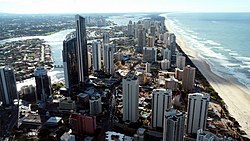 The skyline of the Gold Coast in Queensland is dominated by apartments.
 -
 The Canterbury in St Kilda, Victoria is one of the earliest surviving apartment buildings in Australia.
 -


One_Central_Park.jpg)
South Korea
[edit]As of 2019, a majority of Koreans live in apartments.[48] Since the 1980s, the number of apartment residents has soared, and as the number of apartments has steadily increased, apartments have become a representative form of residence where more than half of the Korean population resides.
It is the most common house in small and medium-sized cities in Korea, and even these days, apartments are quite visible in rural areas such as remote areas. This is because small and medium-sized construction companies have technology, but they lack the capital to build large complexes in large cities. The better the location, the more expensive the apartment is, and the more expensive the apartment complex built by a large construction company[49] and with a large number of households. Also, even the same type of flat in the same complex is not all of the same price. Due to problems such as the right to sunlight and prospects, the low-rise households on the first and third floors are generally the cheapest, and the higher they go, the more expensive they become.[50] In addition, the price varies depending on other conditions such as the viewing area and the direction of the house, such as south, east, west, and north. The upper floors with a south-facing view are the most expensive. Apartment sales and lease prices are actually the largest and most stable assets owned by a middle-class family in Korea, symbolizing the social status of a family, which forms a class and determines life satisfaction. For this reason, the Korean people have no choice but to react very sensitively to apartment prices.[51]
-
 An apartment in Songdo International City, Incheon
 -
 Cloud behind two apartments
,_Sharp_Prime_View_appartments.jpg)

Notes
[edit]See also
[edit]
- Condominium
- Kamienica in Poland
- List of house types
- Polykatoikia in Greece
References
[edit]- ^ "Apartment | Meaning of Apartment by Lexico". Lexico Dictionaries | English. Archived from the original on 22 October 2020. Retrieved 22 January 2020.
- ^ "Long Leases (Scotland) Act 2012". UK Legislation. 2012. Retrieved 9 March 2015.
- ^ "skyscraper". Encyclopædia Britannica, Inc. Retrieved 19 September 2012.
- ^ "Data Standards: Structures - low-rise building". Emporis Standards. Archived from the original on 10 July 2011. Retrieved 10 June 2009.
- ^ "Microsoft PowerPoint - 3-Lorna [Compatibility Mode]" (PDF). Archived (PDF) from the original on 16 August 2011. Retrieved 8 March 2022.
- ^ "Categories of Homes in Malaysia". PropSocial. Archived from the original on 5 December 2024. Retrieved 4 June 2025.
- ^ "'Konglish' Not Spoken Here: Asia Society Korea Center Targets Signs and Schoolbooks". Asia Society. 11 October 2012. Retrieved 5 February 2015.
- ^ "Private renting: Houses in multiple occupation - GOV.UK". www.gov.uk. Retrieved 16 April 2018.
- ^ "Garden apartment". Merriam-Webster Dictionary. Retrieved 29 August 2018.
- ^ Popik, Barry (5 July 2004). "New York City Garden Apartments". barrypopik.com. Retrieved 17 October 2009.
- ^ Hogan, Meghan (22 September 2006). "Eden in the City". Preservation Magazine. – Article on preservation of early United States garden apartment buildings.
- ^ "Tenants are high on garden apartments". Chicago Tribune. 15 August 2003. Archived from the original on 11 August 2024. Retrieved 11 August 2024.
- ^ Alfirević, Đorđe; Simonović, Alfirević Sanja (2017). "'Salon' apartment in Serbia between the two world wars: Reassessing the rationale behind the term". Arhitektura i urbanizam (44): 7–13. doi:10.5937/a-u0-11638. ISSN 0354-6055.
- ^ Keković, A., Petrović, M. (2011) Functional zones of flats in the period of Art Moderne in Niš (1930-1941). Facta universitatis - series: Architecture and Civil Engineering, vol. 9, br. 3, str. 495-499
- ^ "Housing in Gateshead" (PDF). Gateshead Council. 2006. Archived from the original (PDF) on 26 May 2012. Retrieved 16 April 2018.
- ^ McMurray, Sally, ed. (2000). People, Power, Places (1st ed.). Knoxville: University of Tennessee Press. p. 40. ISBN 9781572330757.
- ^ "Demand spurs new trend: Construction of `faux' lofts". www.bizjournals.com. Retrieved 4 June 2025.
- ^ "Naherholung gleich ums Eck" (in German). terrafinanz.de. Retrieved 17 June 2013.
- ^ Sissom, Patrick (4 December 2018). "Why do all new apartment buildings look the same?". Curbed. Retrieved 23 February 2019.
- ^ Jarus, Owen (20 August 2012). "Teotihuacan: Ancient City of Pyramids". Livescience. Retrieved 19 March 2016.
- ^ Smith, Michael E. (22 October 2014). "Living the good life in Teotihuacan". Retrieved 19 March 2016.
- ^ "Teotihuacan". Mexican History. Retrieved 19 March 2016.
- ^ a b Gregory S. Aldrete: Daily Life in the Roman City: Rome, Pompeii and Ostia, 2004, ISBN 978-0-313-33174-9, p.79f.
- ^ Martial, Epigrams, 27
- ^ Strabo, 5.3.7
- ^ Alexander G. McKay: Römische Häuser, Villen und Paläste, Feldmeilen 1984, ISBN 3-7611-0585-1 p. 231
- ^ Papyrus Oxyrhynchus 2719, in: Katja Lembke, Cäcilia Fluck, Günter Vittmann: Ägyptens späte Blüte. Die Römer am Nil, Mainz 2004, ISBN 3-8053-3276-9, p.29
- ^ a b Behrens-Abouseif, Doris (1992), Islamic Architecture in Cairo, Brill Publishers, p. 6, ISBN 90-04-09626-4
- ^ Lindsay, James E. (2005), Daily Life in the Medieval Islamic World, Greenwood Publishing Group, p. 122, ISBN 0-313-32270-8
- ^ Mortada, Hisham (2003), Traditional Islamic principles of built environment, Routledge, p. viii, ISBN 0-7007-1700-5
- ^ Helfritz, Hans (April 1937), "Land without shade", Journal of the Royal Central Asian Society, 24 (2): 201–16, doi:10.1080/03068373708730789
- ^ Pamela Jerome, Giacomo Chiari, Caterina Borelli (1999), "The Architecture of Mud: Construction and Repair Technology in the Hadhramaut Region of Yemen", APT Bulletin, 30 (2–3): 39–48, 44, doi:10.2307/1504639, JSTOR 1504639
- ^ a b Centre, UNESCO World Heritage. "Old Walled City of Shibam". UNESCO World Heritage Centre. Retrieved 4 June 2025.
- ^ Shipman, J. G. T. (June 1984), "The Hadhramaut", Asian Affairs, 15 (2): 154–62, doi:10.1080/03068378408730145
- ^ "Housing in London - The evidence base for The London Housing strategy - December 2012" (PDF). Archived from the original (PDF) on 13 March 2013.
- ^ a b Williamson, E., Riches, A. & Higgs, M. The Buildings of Scotland: Glasgow. London: Penguin Books, 1990 ISBN 0-14-071069-8
- ^ Houses and Mansions: Domestic Architecture of Glasgow's South Side 2008-06-03
- ^ Scott, Susan (11 August 2005). "Demolition of tenements in Gourlay Street, 1975". Glasgow City Archives. Retrieved 4 June 2025.
- ^ Glasgow Digital Library: Demolition of tenements in Gourlay Street, 1975
- ^ Glasgow announces a revolution in house-building Wednesday 31 May 2006.
- ^ "housing revolution announced". www.glasgow.gov.uk. Archived from the original on 5 January 2009. Retrieved 4 June 2025.
- ^ Riis, Jacob A. (1890). How the other half lives : studies among the tenements of New York (1st ed.). New York: Charles Scribner's Sons. pp. 31–32. ISBN 9111562986. Retrieved 2 January 2017.
{{cite book}}: ISBN / Date incompatibility (help) - ^ "What is a walk-up apartment?". 25 November 2020. Archived from the original on 1 December 2020. Retrieved 25 November 2020.
- ^ Wang, Sissi (8 July 2015). "The latest threat to the condo market: apartment buildings rise again". Canadian Business. Archived from the original on 28 September 2021. Retrieved 17 October 2015.
- ^ DiGianfelice, Lorenzo (9 October 2015). "GTA cap rate hits new benchmark low". Canadian Apartment Magazine. Retrieved 17 October 2015.
- ^ Peterson, Richard (2005). "The Canterbury (Flats) - 236 Canterbury Road, St Kilda West" (PDF). A Place of Sensuous Resort: Buildings of St Kilda and Their People. St Kilda Historical Society. Archived (PDF) from the original on 19 June 2005. Retrieved 17 October 2015.
- ^ "High Rise has a past too". Heritage.nsw.gov.au. Archived from the original on 28 June 2002. Retrieved 25 November 2008.
- ^ 인구총조사 | 통계청 [the census | National Statistical Office]. kostat.go.kr. Archived from the original on 18 May 2021. Retrieved 25 November 2022.
- ^ [2021아파트브랜드대상] 브랜드의 차이가 집값을 가른다 [The difference in the brand determines the price of the house]. 아시아경제 (in Korean). 28 May 2021. Retrieved 25 November 2022.
- ^ 같은 동·같은 평형인데…1층부터 9층까지 분양가 다 다르네 [It's the same equilibrium, but...From the 1st to the 9th floors, the prices are all different]. 한경닷컴 (in Korean). 27 April 2016. Retrieved 25 November 2022.
- ^ [경제신문은 내친구] 한국은 왜 아파트공화국이 됐나요 [Why did Korea become an apartment republic?]. 매일경제 (in Korean). 25 July 2012. Retrieved 25 November 2022.
External links
[edit]
 The dictionary definition of apartment at Wiktionary


| By location | |
|---|---|
| Types | |
| Sectors | |
| Law and regulation |
|
| Economics, financing and valuation |
|
| Parties | |
| Other | |


| International | |
|---|---|
| National | |
| Other | |

Apartment
View on GrokipediaDefinition and Terminology
Core Definition
An apartment is a self-contained residential unit within a multi-unit building, consisting of one or more rooms equipped with private facilities for sleeping, cooking, bathing, and sanitation, designed for independent occupancy by individuals or households.[1][4] Such units typically feature separate entrances and utility connections, distinguishing them from shared-room accommodations like boarding houses.[11] In standard usage, apartments are most often leased by tenants from a building owner or management entity, rather than owned outright by occupants, though the term can apply to units in owner-occupied contexts depending on regional conventions.[2][12] Legally and in building codes, apartment buildings are structures containing three or more dwelling units, each with independent cooking and bathroom facilities to ensure habitability and fire safety compliance.[13][11] This configuration supports efficient land use in densely populated areas, where vertical construction allows multiple households to share common infrastructure such as foundations, roofs, and utilities while maintaining privacy through partitioned interiors.[14] Empirical data from urban planning indicates that apartments constitute a significant portion of housing stock in cities, with over 40% of U.S. rental units in multi-family buildings as of 2023, driven by economic factors like land scarcity and construction cost efficiencies.[4] The core functionality of an apartment emphasizes autonomy within a collective framework, with units varying in size from studios (single-room layouts) to multi-bedroom configurations, but always prioritizing essential domestic amenities over luxury or commercial elements unless specified otherwise.[2] This definition holds across jurisdictions, though enforcement varies; for instance, some codes exclude single-family conversions or duplexes from strict apartment classifications to regulate density and maintenance standards.[15]Etymological and Linguistic Variations
The English word "apartment," denoting a self-contained residential unit, entered the language in the 1640s from French appartement, referring to a suite of private rooms separated from the rest of a larger residence.[16][1] This French term derives from Italian appartamento, a diminutive form of appartamento meaning "a separated place," stemming from the verb appartare ("to separate" or "isolate"), ultimately traceable to Latin ad partem ("to the part" or "aside").[16] The concept emphasized partitioning space within a building for individual occupancy, contrasting with undivided communal living.[17] In British English and Commonwealth variants such as Australian and New Zealand English, the equivalent term is "flat," which gained currency in the 19th century to describe a level residential unit on a single story within a multi-story building.[18] "Flat" originates from Old English flett (or Scottish flet), meaning a dwelling hall or floor level, from Proto-Germanic roots denoting something spread out or level, highlighting the horizontal expanse rather than vertical separation.[19][20] While "apartment" and "flat" are functionally interchangeable—both referring to independent housing units in multi-unit structures—"apartment" sometimes carries connotations of modern or upscale design in British usage, whereas "flat" may evoke simpler or traditional accommodations.[21] Linguistic equivalents in other languages often reflect either separation or level-based dwelling. French retains appartement, mirroring the English etymology, while Italian uses appartamento for similar self-contained units.[22] German employs Wohnung, meaning "dwelling" or "residence," without direct reference to partitioning, emphasizing habitation over structure.[23] In Spanish, piso (from Latin planum, "plane" or "level") predominates in Spain for a floor-level unit, whereas Latin American Spanish favors departamento or apartamento, aligning more closely with the separation motif.[24] These variations underscore how terminology adapts to cultural emphases on either isolation (apartment-like) or planar layout (flat- or piso-like).[20]Classifications by Tenure, Size, and Location
Apartments are classified by tenure into rental units, where occupants lease space from a landlord or property owner on a temporary basis, and ownership models such as condominiums, in which individuals hold title to specific units while sharing ownership of common areas like hallways and grounds.[25] Cooperatives represent another ownership form, wherein residents purchase shares in a corporation that owns the entire building, receiving a proprietary lease for their unit in exchange, which often involves board approval and collective decision-making on building operations.[26] Globally, rental tenure predominates in apartment-heavy markets like urban Europe and Asia, with OECD data from 2024 indicating that tenancy at market prices accounts for 20-30% of housing in many member countries, though ownership via condos or co-ops is more common in North American cities where individual unit titles facilitate financing.[27] Size classifications typically denote the number of bedrooms and overall floor area, with studios featuring a single open space for living, sleeping, and often cooking, averaging 300 to 600 square feet to suit single occupants or couples.[28] One-bedroom apartments include a dedicated bedroom separate from living areas, spanning 550 to 1,000 square feet, while two- and three-bedroom units expand accordingly to 800-1,500 square feet or more, accommodating families and allowing for distinct functional zones.[29] These standards vary by region; for instance, U.S. averages hover around 600-850 square feet for one-bedrooms per 2025 real estate analyses, reflecting zoning minima that ensure habitability, such as minimum bedroom dimensions of 80 square feet in many municipalities.[30] Location-based classifications distinguish apartments by urban density, suburban sprawl, and rarer rural settings, with high-rise structures (over 12 stories) clustered in city centers to maximize vertical space amid land scarcity, as seen in metropolises where elevators and amenities support dense populations.[31] Low-rise or garden-style apartments, limited to 1-4 stories, prevail in suburbs, offering ground-level access, parking, and green space at lower construction costs, while mid-rise variants (5-12 stories) bridge these in transitional zones.[32] Rural apartments, though uncommon due to ample land for single-family homes, exist in small multi-unit buildings near agricultural hubs, but urban and suburban forms dominate globally, comprising over 90% of multi-family housing stock in developed nations per 2024 housing reports.[33]Historical Development
Ancient and Pre-Modern Origins
The earliest known apartment buildings emerged in ancient Rome during the late Republic and early Empire periods, around the 2nd century BCE, as urban population growth in cities like Rome necessitated dense housing solutions amid high land values.[34] These structures, termed insulae (Latin for "islands"), were multi-story tenements primarily housing the plebeian classes—artisans, laborers, and lower-status citizens—who could not afford single-family domus homes reserved for the elite. Typically constructed from unreinforced brick or opus caementicium (Roman concrete) with timber floors and stairs, insulae rose to four or five stories, though some reached up to eight, limited by building regulations under Augustus in 27 BCE capping heights at 70 Roman feet (about 20 meters) to prevent collapses and fires.[34] Ground floors often featured shops (tabernae) facing the street, generating rental income for owners, while upper levels contained cramped, dimly lit apartments lacking running water, sanitation, or heating, relying on shared latrines and rainwater collection. Frequent fires and structural failures plagued these edifices, as documented in historical accounts like those of Pliny the Elder, underscoring the trade-offs of vertical density without modern engineering.[35] Beyond Rome, similar multi-story residential blocks appeared in other Roman provincial cities, such as Ostia Antica, where archaeological remains reveal insulae adapted to port-city commerce, with up to 100,000 inhabitants crammed into such housing by the 2nd century CE.[34] Evidence for pre-Roman antecedents is scant; while Mesopotamian ziggurats and Egyptian multi-level dwellings existed, they served elite or temple functions rather than mass rental housing, lacking the apartment model's causal driver of urban proletarian density. In pre-modern non-Western contexts, the Yemeni city of Shibam exemplifies vertical residential architecture predating industrialization, with its mud-brick tower houses rebuilt en masse after a 1532–1533 flood and reaching seven to eleven stories by the 16th century.[36] Inhabited continuously for over 1,700 years along trade routes, Shibam's clustered high-rises—housing extended families in self-contained units with storage and livestock space—arose from defensive needs against floods and raids, as well as land scarcity in the Wadi Hadramaut, using sun-dried adobe reinforced annually with new mud layers for durability in arid conditions.[37] This organic verticalism, dubbed the "Manhattan of the Desert," contrasts Roman insulae by integrating family compounds rather than anonymous rentals, yet shares the imperative of stacking living spaces to accommodate population pressures without sprawling footprints.[38] European medieval and early modern towns featured rudimentary multi-tenant structures, such as timber-framed row houses with subdivided upper floors in cities like Paris or Edinburgh, but these lacked the scale and purpose-built design of true apartments until 18th-century innovations.[39] Overall, ancient and pre-modern apartments reflected causal responses to urbanization—Roman insulae to imperial expansion and grain-dole populations, Shibam to oasis constraints—prioritizing capacity over comfort, with empirical persistence tied to material limits and socioeconomic demands rather than ideological constructs.[34]Industrial Revolution and Early Modern Urbanization
The Industrial Revolution, beginning in Britain around 1760, triggered unprecedented rural-to-urban migration as mechanized factories concentrated labor in cities, outpacing housing supply and fostering the emergence of multi-occupancy dwellings. In industrial hubs like Manchester, where the population surged from 75,000 in 1801 to over 300,000 by 1851, workers initially resided in rudimentary back-to-back houses—narrow, unventilated structures sharing party walls to maximize density on small lots. These evolved into Scottish tenements, multi-story stone buildings with one- or two-room flats per family, accommodating Glasgow's population growth to 760,000 by 1901, where such housing sheltered the majority of residents amid chronic overcrowding averaging 4-5 persons per room.[40] In continental Europe, similar pressures yielded purpose-built apartment blocks by the late 19th century, integrating residential, commercial, and storage functions in multistory constructions, as seen in expanding cities like Paris and Berlin, where urbanization rates exceeded 50% of the population by 1900. These structures prioritized vertical density over single-family homes, driven by land scarcity and the need for proximity to rail and factory infrastructure, though early designs often compromised on sanitation, with shared privies and inadequate light.[41] Across the Atlantic, America's Gilded Age industrialization from the 1870s amplified tenement proliferation, particularly in New York City, where immigrant inflows—over 12 million arrivals between 1870 and 1900—necessitated cheap rental units near ports and mills. Tenements emerged as five- to seven-story brick walk-ups on 25-by-100-foot lots, subdivided into dim, airless apartments housing multiple families per floor, with conditions so severe that by 1890, half of Manhattan's population endured them, prompting the 1867 Tenement House Act to mandate rudimentary fire escapes and windows, though enforcement lagged.[42] This era's apartment precursors underscored causal links between economic dislocation and housing innovation: factories' demand for clustered labor compelled vertical, communal living, yet profit-driven construction by absentee landlords perpetuated squalor, with mortality rates in tenements double the national average due to tuberculosis and cholera outbreaks from poor plumbing and ventilation. Reforms gained traction only post-1900, but the tenement model laid foundational precedents for standardized urban multifamily housing.[43][44]20th Century Expansion and Standardization
The early 20th century marked the widespread adoption of modern apartment buildings in urban centers, facilitated by technological advancements such as steel-frame construction, elevators, and central heating systems, which enabled multi-story structures beyond the limitations of load-bearing masonry. In the United States, this period saw a surge in apartment construction amid industrial urbanization, with cities like New York constructing thousands of units to accommodate growing populations; for instance, between 1921 and 1929, the city experienced its largest housing boom ever, adding high-rise apartments, garden apartments, and other multi-family dwellings at unprecedented rates.[45][46] Post-World War II housing shortages, exacerbated by wartime construction halts and population influxes from returning veterans and immigrants, propelled further expansion of multi-family housing globally. In North America, this led to rapid development of mid-century apartment towers; Toronto alone saw the construction of approximately 500,000 rental apartments between the late 1940s and 1960s to address demand from immigration and urban growth.[47] In Europe, reconstruction efforts post-war emphasized large-scale multi-family estates using prefabricated components, as seen in Slovenia and broader Eastern Bloc countries where state-driven programs standardized block-like complexes to house millions efficiently.[48] Despite suburban single-family preferences in the U.S.—bolstered by policies like the GI Bill—urban multi-family units proliferated, with New York adding high-rises along transit corridors to utilize underused land.[49][50] Standardization emerged as a key response to these scales, driven by evolving building codes, zoning regulations, and economic pressures for efficiency. Early 20th-century U.S. zoning, beginning with New York's 1916 ordinance, imposed height and density limits that shaped uniform apartment layouts, while the 1920s introduction of standardized building dimensions—pioneered by architects like Ernst Neufert—influenced global floor plans for cost-effective replication.[51][52] Post-war, prefabrication techniques standardized components like modular walls and units, reducing construction times; in the U.S., federal guidelines under programs like the Housing Act of 1949 promoted repeatable designs for public and private multi-family projects, though implementation varied by locality.[53] This shift from bespoke early-century plans to modular, code-compliant formats improved scalability but often prioritized density over variety, reflecting causal pressures from land scarcity and mass production imperatives.[54]Types and Designs
Layout-Based Types
Apartment layouts are classified primarily by the number of bedrooms, the separation of living spaces, and the overall configuration of rooms, which determines functionality and occupancy suitability. Standard types include studios, one-bedrooms, and multi-bedroom units, with variations such as alcove or convertible designs that offer partial spatial division without full enclosure. These classifications influence rental pricing, with studios typically under 500 square feet and larger units scaling accordingly; for instance, a one-bedroom often ranges from 600 to 800 square feet.[55][56] Studio apartments feature a single open room combining living, sleeping, and kitchen areas, with only a separate bathroom providing privacy; this compact design suits single occupants or couples prioritizing affordability over space. Efficiency apartments, sometimes distinguished as a subset, emphasize minimalism with a kitchenette rather than a full kitchen, often under 400 square feet, though the terms overlap in common usage.[28][56][55] Alcove studios extend the basic studio with an indented nook or L-shaped extension for a sleeping area, offering semi-separation via partial walls or architectural recesses without qualifying as a full bedroom under zoning standards that require door-enclosed rooms of specific dimensions. Convertible or flex apartments build on this by incorporating adaptable spaces, such as a den or alcove that can function as an additional bedroom with temporary dividers, appealing to those needing versatility in urban markets where true multi-room units command higher rents.[57][58][59] One-bedroom apartments provide a dedicated bedroom separated from the living and kitchen areas, typically including one bathroom, enabling greater privacy and suitability for individuals or small families; layouts may vary from linear arrangements to open-plan designs with island counters. Two- and three-bedroom units follow similarly, adding enclosed bedrooms (e.g., two bedrooms sharing one bath or each with private baths) and often a second full bathroom, accommodating families with square footage exceeding 900 feet for three-bedrooms. Junior one-bedrooms represent a transitional layout, featuring a small partitioned bedroom smaller than standard (e.g., under 100 square feet), bridging studios and full one-bedrooms in cost and space.[60][55][61]Scale and Site-Specific Types
Low-rise apartments, typically defined as buildings with four or fewer stories, emphasize horizontal sprawl and accessibility without elevators, often featuring walk-up access and communal green spaces known as garden apartments. These structures prioritize integration with surrounding landscapes, providing residents with private or shared outdoor areas that enhance livability in less dense settings; for instance, garden apartments emerged prominently in the United States from the mid-1930s to the mid-1960s as a response to urban expansion needs, with examples like those in Los Angeles built specifically for World War II defense workers to accommodate rapid housing demands.[50] [62] Low-rise designs suit suburban or peripheral urban sites where land availability allows for lower density, reducing construction costs associated with vertical engineering while minimizing visual intrusion on neighborhoods.[31] Mid-rise apartments, ranging from five to twelve stories, bridge low- and high-rise scales by incorporating elevators for practicality while maintaining a relatively modest footprint suitable for transitional urban zones. These buildings often feature mixed layouts with ground-level amenities, enabling efficient land use in areas with moderate density pressures; elevators distinguish them from low-rise walk-ups, improving accessibility for upper floors without the full infrastructure demands of taller structures.[63] Examples include five-to-eight-story complexes in growing suburbs or infill urban sites, where they balance cost with height restrictions imposed by local zoning to preserve neighborhood character.[32] High-rise apartments, exceeding twelve stories and often reaching dozens or hundreds of floors in skyscrapers, dominate dense urban cores by maximizing vertical space through advanced structural systems like steel framing and core-shear wall designs. These require sophisticated fire safety, wind resistance, and mechanical systems, with elevators as essential vertical transport; in regulatory contexts like the United States, mid-rise "blocks" prevail due to zoning limits on height, whereas countries like China favor tower blocks for rapid urbanization, as seen in high-density developments housing millions.[64] [65] High-rises exemplify scale-driven efficiency in land-scarce sites, though they demand higher per-unit costs and energy for maintenance.[66] Site-specific adaptations further tailor apartment scales to environmental and locational constraints. In suburban contexts, low- to mid-rise garden or townhouse-style apartments mimic single-family aesthetics with textured facades and street-level integration to blend with low-density surroundings, as in designs that incorporate urban streetscape elements without overwhelming scale.[67] Coastal sites often elevate structures on pilings or incorporate resilient materials to mitigate flood risks, with mid- to high-rise examples in areas like Vancouver's English Bay featuring setback designs for views and erosion buffers. Mountainous terrains necessitate sloped foundations and compact footprints in low- to mid-rise forms to navigate rugged topography while preserving natural contours, prioritizing seismic reinforcements and minimal site disturbance over expansive horizontal layouts.[68] Urban infill sites, conversely, leverage high-rise towers to optimize constrained lots, as in Sydney's One Central Park, which integrates vertical greening for site-specific sustainability amid dense surroundings.[32] ![Toronto CityPlace, a high-rise apartment complex in an urban setting][float-right] These variations reflect causal trade-offs: smaller scales favor affordability and community feel in expansive sites but limit capacity, while larger vertical forms enable population density in compact areas at the expense of per capita green space and construction complexity. Empirical data from real estate analyses confirm low-rise buildings' lower operational costs in suburbs versus high-rises' premium rents in city centers driven by scarcity.[31][64]Specialized and Hybrid Types
Specialized apartments target specific demographics or lifestyles, incorporating design and amenity features tailored to their needs rather than general occupancy. Special-purpose housing includes properties where at least 50% of units serve students enrolled at nearby institutions, often featuring communal study areas, high-speed internet, and shuttle services to campuses to support academic routines.[69] Senior housing prioritizes accessibility with features like ground-level units, wide doorways, emergency call systems, and on-site health services to accommodate age-related mobility and medical requirements.[69] Subsidized apartments enforce income restrictions and integrate support for low-income or special-needs residents, such as case management in supportive models for those with disabilities or mental health challenges.[69][70] Serviced apartments function as hybrid residential-hotel units, providing fully furnished, self-contained spaces with kitchens for short- or long-term stays, augmented by hotel-style services including daily housekeeping, concierge, and linen changes to appeal to business travelers or temporary relocators seeking home-like independence with convenience.[71][72] Micro-apartments, typically under 400 square feet, optimize compact urban footprints with multifunctional furniture and efficient storage to offer affordable solo living in high-density cities where space scarcity drives up costs.[69][64] Hybrid types blend residential apartments with non-residential elements to enhance urban functionality and economic viability. Mixed-use buildings stack apartments above retail outlets, offices, or restaurants, as seen in developments like Toronto's CityPlace, which integrates residential towers with commercial podiums to minimize commute times, boost local commerce, and increase land-use efficiency in dense areas.[73][74] Co-living arrangements combine private bedrooms with extensive shared kitchens, lounges, and event spaces, fostering community among young professionals while reducing per-person costs compared to traditional solo leases—often by 20-30% in major cities—through economies of shared utilities and bulk amenities.[75][76] Live-work units permit zoning-compliant home occupations, featuring ground-floor workspaces adjacent to upper living areas, which support entrepreneurs by eliminating separation between residence and business operations.[77]Architectural and Functional Features
Structural and Design Elements
Framed structures dominate modern apartment construction, utilizing a skeletal system of columns, beams, and slabs to bear vertical and lateral loads, which permits open floor plans, multi-story heights exceeding four levels, and easier modifications compared to load-bearing systems limited by wall thickness and material compression capacity.[78][79] In load-bearing designs, prevalent in low-rise apartments up to three or four stories, masonry or concrete walls directly transmit loads to foundations, offering simplicity and lower initial costs but restricting spans and requiring thicker walls that reduce usable interior space.[78][80] Foundations in apartment buildings typically feature reinforced concrete footings, mat slabs, or deep piles driven to bedrock, engineered to handle combined dead loads (e.g., 10-19 pounds per square foot for floors, 15 psf for roofs) and live loads (30-40 psf for residential floors) while accounting for soil bearing capacity and settlement.[79][80] The superstructure comprises vertical columns spaced 20-30 feet apart in framed systems, horizontal beams supporting floor slabs of reinforced concrete or composite steel-concrete, and shear walls or bracing for lateral stability against wind pressures up to 55 psf or seismic accelerations.[79][80] Reinforced concrete, combining aggregate, cement, and steel rebar for tensile reinforcement, forms slabs, walls, and cores due to its high compressive strength (typically 2,500-3,000 psi after 28 days) and fire resistance; steel framing supplements in high-rises for its superior strength-to-weight ratio, enabling spans over 40 feet, while wood joists and studs suit low-rise wood-framed apartments for thermal insulation and vibration damping.[81][80] Brick or concrete masonry units provide infill walls with compressive strengths of 1,900 psi, enhancing durability but adding weight that demands robust foundations.[80][81] Design principles emphasize redundancy and ductility, with computer modeling simulating wind tunnel effects or earthquake base shears calculated as (where reaches 3g in high-seismic zones and for wood shear walls), ensuring deflections stay below L/360 for floors to minimize vibrations.[79][80] Sustainability integrations, such as optimized column grids for daylight penetration and insulated envelopes, reduce energy demands without compromising structural integrity.[79]| Structural Element | Common Materials | Key Load Considerations |
|---|---|---|
| Foundations | Reinforced concrete with steel rebar | Soil bearing, dead/live loads up to 40 psf |
| Columns/Beams | Steel or reinforced concrete | Axial loads, wind shear up to 55 psf |
| Floor Slabs | Reinforced concrete or wood joists | Live loads 30-40 psf, deflection L/360 |
| Shear Walls | Concrete masonry (1,900 psi) or wood panels | Seismic base shear, lateral forces |
Amenities and Infrastructure
Apartment buildings rely on core infrastructure systems—mechanical, electrical, and plumbing (MEP)—to ensure functionality and safety across multiple units. Plumbing systems generally consist of vertical risers and horizontal branches that distribute potable water from municipal mains or on-site sources to individual fixtures, while conveying wastewater and stormwater via stack pipes to building drains connected to public sewers or septic systems; these setups minimize cross-contamination risks through separate supply and waste lines, with backflow preventers required by code in most jurisdictions.[82] Electrical infrastructure features main service panels feeding sub-panels for common areas and tenant units, supporting lighting, appliances, and increasingly electric vehicle charging stations, often designed at 277/480-volt three-phase for efficiency in larger complexes.[83] HVAC systems, whether central boilers with radiators, individual unit air conditioners, or district cooling, provide heating, ventilation, and cooling while integrating with fire dampers and smoke control for compartmentalization.[84] Fire safety infrastructure is integral, with modern multi-family buildings typically equipped with automatic sprinkler systems, smoke detectors, and fire alarms in corridors and units, achieving fire death rates one-fourth those of contemporary single-family homes due to enhanced containment and early detection.[85] Elevators, required in buildings over three stories per International Building Code standards, incorporate safety brakes and emergency power backups, while waste management often includes chutes or compactors linked to ground-level collection.[86] Shared amenities extend beyond essentials to enhance resident retention and command rental premiums, with fitness centers available in 82% of new properties and swimming pools in a majority, though surveys indicate declining emphasis on these in favor of pet areas, social lounges, and experiential features like organized events.[87] In-unit preferences, per a 2024 survey of over 90,000 responses, prioritize walk-in closets (desired by 90%) and covered parking (84%), reflecting practical needs over luxury; community outdoor spaces like pools remain valued in warmer climates but show underperformance in search metrics compared to off-street parking and in-unit laundry.[88][89] Emerging infrastructure trends include high-speed broadband conduits and smart building controls for energy management, driven by renter demands for connectivity and sustainability.[90]Construction Methods and Materials
Apartment buildings are constructed using structural systems designed to distribute vertical and lateral loads across multiple stories, with methods varying by building height, seismic requirements, and cost considerations. Low- to mid-rise apartments (typically under 12 stories) frequently employ light-frame wood construction with dimensional lumber studs and engineered wood products like cross-laminated timber (CLT) for walls, floors, and roofs, offering rapid assembly and renewability but limited to heights constrained by fire codes.[91][92] For greater heights, reinforced concrete prevails due to its compressive strength and inherent fire resistance; cast-in-place concrete forms slabs and shear walls poured on-site, while precast concrete panels enable off-site fabrication and faster erection, reducing labor exposure to weather.[93][94] High-rise apartments (over 12 stories) rely on advanced systems such as core-and-outrigger frameworks, where a central concrete core provides stiffness against wind and seismic forces, augmented by steel or concrete outriggers connecting to perimeter columns, allowing spans up to 10 meters between supports.[95][96] Braced-frame and rigid-frame steel systems are alternatives, with steel's high tensile strength enabling lighter, quicker assembly via bolted connections, though often combined with concrete-filled tubes for enhanced stability.[97] Cross-wall systems, leveraging load-bearing demising walls between units, are particularly suited to apartment layouts, minimizing material use by integrating partitions into the structure.[95] Key materials include Portland cement-based concrete reinforced with steel rebar or prestressing tendons, achieving compressive strengths of 20-40 MPa for typical residential use, valued for longevity exceeding 50 years under standard loading.[98] Structural steel, such as ASTM A992 wide-flange beams, provides yield strengths around 345 MPa and supports modular prefabrication, cutting on-site time by up to 30% compared to traditional methods.[99] Masonry units like concrete blocks or bricks serve for non-load-bearing infill or low-rise exteriors, while emerging mass timber panels reduce embodied carbon by substituting wood for concrete in mid-rise applications, compliant with International Building Code provisions up to 18 stories in non-sprinklered designs.[100][91] Innovative methods like insulating concrete formwork (ICF) integrate expanded polystyrene forms with poured concrete for enhanced thermal performance, yielding R-values of 20-30 per wall assembly, and 3D-printed components for custom elements, though scalability remains limited to prototypes as of 2023.[101] Modular construction, assembling factory-built volumetric units (e.g., 70-80% complete off-site), accelerates timelines by 20-50% and minimizes waste to under 5%, but requires precise tolerances to avoid cumulative errors in stacking.[102] Site-specific factors, such as soil bearing capacity (typically requiring piles for loads over 100 kPa), dictate foundations like mat slabs or driven piles, ensuring differential settlement below 1/500 of span length.Socioeconomic Dimensions
Economic Role in Housing Markets
Apartments, primarily in the form of multi-family buildings, serve as a key mechanism for expanding housing supply in high-demand urban and suburban markets, where land constraints limit single-family home development. By enabling vertical density, they reduce per-unit land costs and construction expenses relative to detached homes, potentially lowering overall housing prices when regulatory barriers are minimal. In the United States, addressing the current housing shortage—estimated at 3-4 million units—relies heavily on increased multi-family construction, as single-family homes alone cannot meet demand efficiently in populated areas.[103] Empirical analyses indicate that new apartment supply moderates rent increases, with studies showing the strongest dampening effects on growth in older, lower-rent units, thereby supporting affordability for middle- and low-income renters without relying solely on subsidies.[104] [105] In rental-dominated markets, apartments underpin economic mobility by offering flexible, lower-commitment housing options compared to homeownership, which ties up capital in equity and maintenance. Renters in multi-family units, who comprise about 36% of U.S. households as of 2023, typically earn median annual incomes of $41,000 versus $78,000 for owners, reflecting apartments' role in accommodating transient populations, young adults, and lower-wage workers.[106] However, persistent supply shortages—exacerbated by zoning restrictions and local opposition—have driven rents up faster than incomes since 2000, with cost burdens (rent exceeding 30% of income) affecting 49% of renter households in 2023, up from prior decades.[107] [108] Market-rate apartments, rather than filtered-down units, often provide the supply elasticity needed to counteract these pressures, as evidenced by metropolitan areas where upzoning correlates with stabilized or declining rents per empirical models.[109] Fiscally, apartments generate positive net impacts for municipalities through property taxes and fees that often exceed incremental service costs, challenging narratives of undue burdens on infrastructure. A review of suburban case studies found multi-family developments yield surplus revenues, supporting schools and services without proportional population-driven expenses, due to shared amenities and lower per-capita demands than equivalent single-family sprawl.[110] [111] As investment assets, apartments attract capital for development but face volatility; for instance, multi-family property values peaked amid low interest rates post-2020 before declining 20-30% by mid-2024 due to rising rates and oversupply in select markets, influencing broader credit availability and construction financing.[112] Zoning-induced scarcity, however, artificially inflates values across housing types, with growth controls empirically linked to 10-20% higher suburban prices by restricting multi-family entry.[111]Impacts of Density on Livability and Crime
High population density in apartment complexes, often exceeding 10,000 residents per square kilometer in urban high-rises, can compromise privacy and amplify noise pollution, leading to elevated stress levels and reduced subjective well-being among residents.[113] A 2021 study across European cities found direct negative associations between density and perceived quality of life, mediated by nuisances such as traffic congestion and interpersonal conflicts, with residents reporting up to 15% higher dissatisfaction in areas above 5,000 persons per square kilometer.[113] Conversely, density facilitates proximity to amenities like public transit and services, potentially enhancing convenience and reducing commute times by 20-30% in well-planned districts, though these benefits diminish without adequate infrastructure.[114] Empirical analyses indicate that unchecked high density exacerbates social isolation and mental health challenges, particularly in vertically stacked apartments where limited green space—often below 10 square meters per capita—correlates with increased anxiety and depression rates.[115] In a 2025 examination of global urban patterns, higher residential densities were linked to diminished community satisfaction due to overcrowding and income disparities, with quality-of-life indices dropping by 10-25% in megacity apartment zones absent compensatory features like communal areas.[116] Mitigating factors, such as integrated green infrastructure, can offset these effects; for instance, districts with vertical gardens or nearby parks report 12% higher resident health perceptions despite densities over 20,000 per square kilometer.[117] Poorly designed high-rises, however, intensify issues like poor air quality and heat islands, amplifying respiratory ailments by up to 8% in dense clusters.[117] Regarding crime, residential density exhibits a complex, non-linear relationship with incidence rates, where moderate increases may deter offenses through heightened natural surveillance, but extreme levels foster anonymity and resource strain conducive to victimization.[118] A NBER analysis of U.S. and international data attributes urban crime premiums partly to density, estimating 10-20% higher per capita rates in dense cores under adverse social conditions, though low-crime examples like Tokyo (density ~6,000/km²) demonstrate that cultural norms and policing can invert this dynamic.[119] In apartment-specific contexts, high-density subsidized housing correlates with elevated violent crime; a 2016 study of U.S. projects found densities above 50 units per acre associated with 25% higher aggravated assault rates compared to low-density counterparts, attributable to concentrated poverty rather than density per se.[120] Property crimes show less consistent density linkages, with some neighborhood-level regressions indicating inverse correlations—higher densities yielding 5-15% lower rates due to reduced burglary opportunities in surveilled multifamily structures—yet violent offenses rise in unmanaged high-rises via defensible-space deficits.[121] Public housing towers, averaging densities of 100+ units per acre, have historically recorded violent crime victimization 2-3 times the urban average, as documented in U.S. Department of Justice reviews from the 1990s onward, prompting design reforms like ground-level access controls.[122] Mixed-use developments integrating apartments with commercial spaces at densities up to 15,000/km² exhibit 20-30% lower overall crime than residential-only zones, per econometric models, underscoring that land-use diversity mediates density's criminogenic potential.[123] Causal inference remains confounded by socioeconomic variables, with income inequality explaining up to 40% of density-crime variance in meta-level assessments.| Study/Source | Density Metric | Crime Impact | Key Finding |
|---|---|---|---|
| Twinam (2017) | Residential units/acre >50 | Lower per capita rates | High density reduces crime externalities by 10-15% in mixed areas[123] |
| HUD Analysis (2016) | Affordable projects >50 units/acre | Higher violent crime | 25% increase in assaults vs. low-density[120] |
| Glaser & Sacerdote (1994) | Urban cores >10,000/km² | Variable, context-dependent | Social controls can yield low crime despite density[119] |
Empirical Pros and Cons
Apartment buildings, characterized by multifamily housing density, demonstrate superior energy efficiency compared to single-family detached homes. Data from the U.S. Energy Information Administration indicate that households in apartments with five or more units consume less total energy per household than those in detached homes, with space heating and air conditioning accounting for a smaller share of energy use in apartments due to shared walls and centralized systems.[124][125] Apartments also exhibit lower per-unit energy intensity, as townhouses and multifamily units use significantly less energy overall than detached houses, supporting reduced environmental footprints in urban settings.[126] Higher residential density in apartments correlates with lower per capita crime rates, mitigating some externalities from nearby commercial activity, according to causal analyses of urban zoning variations. This density enables efficient land use and infrastructure sharing, potentially lowering public costs for utilities and transportation per resident, though direct empirical quantification varies by locale. Crime rates in higher-density developments often prove comparable to lower-density areas when controlling for socioeconomic factors.[127] Conversely, multifamily housing residents face elevated odds of mental health issues relative to single-family home occupants, with studies showing increased prevalence of problems such as anxiety and depression linked to density-related stressors.[128] Neighbor noise in multi-story apartments strongly associates with multiple physical and mental health symptoms, including psychiatric risks, exacerbated by thin walls and proximity.[129][130] High-density environments can diminish sense of community and privacy, contributing to dissatisfaction and reduced livability, as evidenced by resident preference surveys favoring lower-density options for long-term well-being.[131] Certain high-density configurations, particularly affordable housing projects, link to higher rates of aggravated assault, underscoring place-based effects of poor design or location on interpersonal violence.[120] Privacy erosion and noise pollution in apartments further impair sleep and cognitive function, with chronic exposure above 40-54 decibels tied to broader health detriments like cardiovascular strain, independent of conscious annoyance.[132] These factors highlight causal trade-offs where density efficiencies contrast with amplified human-scale conflicts in shared vertical spaces.Legal and Regulatory Framework
Property Ownership and Tenure Models
Condominium ownership, prevalent in the United States and many other jurisdictions, grants individual owners fee simple title to their specific apartment unit—encompassing the interior airspace and any exclusive-use elements like balconies—while establishing an undivided proportional interest in shared common areas such as hallways, elevators, and exterior grounds.[133][134] This model is enabled by statutes like the Uniform Condominium Act in the U.S., which mandates the creation of a homeowners' association (HOA) to manage maintenance, enforce rules, and collect fees from owners based on unit size or value.[135] Owners bear responsibility for interior upkeep but contribute to collective costs, fostering shared governance but potential disputes over assessments, as evidenced by litigation rates in HOA-governed properties exceeding 10% annually in some states.[133] Cooperative (co-op) ownership differs fundamentally, as residents do not hold direct title to units but instead purchase shares in a nonprofit corporation that holds fee simple ownership of the entire building and land; in exchange, shareholders receive a proprietary lease conferring occupancy rights to a designated apartment.[26][135] This structure, originating in New York City in the early 20th century and comprising about 75% of Manhattan's market-rate apartments as of 2023, empowers a co-op board to vet prospective buyers based on financial stability and references, often rejecting applicants to preserve community standards—a process that can extend approval times to months and impose transfer fees up to 2-3% of the sale price.[26] Financing challenges arise, as co-op shares are harder to mortgage than condo titles, with lenders requiring board approval and limiting loan-to-value ratios to 75-80%.[26] Leasehold tenure applies where apartment owners or tenants hold rights to the structure for a fixed term—typically 99 years, renewable—while the underlying land remains owned by a separate lessor, such as a government or private entity.[136][137] Common in the United Kingdom, where over 40% of properties were leasehold as of 2021, and in U.S. states like Hawaii, this model reduces upfront costs but introduces risks of lease expiration, ground rent escalations (averaging £300-£500 annually in England), and forfeiture for non-payment, prompting reforms like the UK's Leasehold and Freehold Reform Act 2024 to cap rents and extend terms.[136][138] In multi-family contexts, leasehold condos bundle unit ownership with the land lease, complicating resale values that depreciate toward term end absent renewal.[138] Rental tenure dominates non-owner-occupied apartments globally, with tenants securing occupancy via fixed-term or periodic leases from private landlords or public housing providers, without equity accrual or control over the property.[139] In OECD countries, private rentals account for 20-30% of housing stock on average, rising to over 50% in urban centers like Berlin and Zurich, where secure tenancy laws—such as Germany's unlimited-duration contracts with rent caps tied to local indices—prioritize eviction protections over landlord flexibility.[140][27] Public or social rentals, comprising 5-10% of tenure in nations like the Netherlands, involve government-subsidized units allocated by income criteria, often with waiting lists exceeding five years and regulations limiting subletting to maintain affordability.[139][140] This model supports mobility but correlates with lower household wealth accumulation, as renters forgo principal paydown and face annual rent hikes averaging 3-5% in inflationary environments.[141][27]Zoning Laws and Development Controls
Zoning laws allocate land into districts that dictate permissible uses, densities, and building forms, often segregating apartments into multi-family zones separate from single-family residential areas to mitigate perceived nuisances like traffic and noise. In the United States, the Supreme Court's 1926 ruling in Village of Euclid v. Ambler Realty Co. affirmed the validity of such ordinances, rejecting claims that they constituted a taking without compensation and enabling widespread exclusion of industrial or high-density uses from residential zones.[142] This framework, rooted in early 20th-century efforts to stabilize property values amid rapid urbanization, has persisted, with many municipalities designating over 75% of residential land for single-family homes only, effectively barring apartment construction in vast swaths of urban and suburban territory.[143] Development controls further shape apartment feasibility through quantitative metrics: floor area ratio (FAR) caps total buildable space as a multiple of lot size (e.g., FAR of 1.0 allows floor area equal to the lot, limiting mid-rise apartments in low-density zones); setbacks mandate minimum distances from property lines and streets, shrinking usable footprints; and height limits restrict stories or elevations, often to three or fewer in residential districts to preserve "open space" aesthetics.[144][145] These rules interact cumulatively—for instance, a low FAR combined with generous setbacks can halve potential units on a parcel—requiring developers to secure variances or rezonings, processes prone to delay and community veto via public hearings. Empirical analysis of U.S. markets shows such constraints correlate with 20-50% reductions in feasible multifamily projects, as measured by regulatory stringency indices.[146] Causal evidence links restrictive zoning to diminished apartment supply and inflated costs, independent of demand or material expenses. Glaeser and Gyourko's 2003 study of 48 large U.S. markets concluded that zoning-induced supply inelasticity accounts for price-to-construction-cost ratios exceeding 5:1 in places like San Francisco, where multifamily approvals lag population growth by decades.[147] Similarly, cross-metro regressions indicate that easing density controls boosts housing starts by 10-15% without commensurate rises in infrastructure strain, countering claims of inevitable negative externalities.[148] While proponents cite zoning's role in averting overcrowding—evidenced by lower density in zoned vs. unregulated historic districts—rigorous controls empirically exacerbate shortages, with apartment vacancy rates below 5% in high-regulation cities versus national averages near 7%.[149] Reforms like minimum lot size reductions or FAR bonuses for affordable units have yielded measurable supply gains in jurisdictions such as Minneapolis, where 2019 upzoning increased multifamily permits by 25% within two years.[150]Regulatory Controversies and Market Distortions
Rent control policies, intended to protect tenants from price increases, have generated significant controversy due to their empirical effects on apartment markets. A 2018 NBER study on San Francisco's 1994 rent control expansion found that while it benefited existing tenants by reducing their rents, it decreased rental housing supply by incentivizing conversions to condos and owner-occupied units, resulting in a net loss of $2.9 billion to all renters from higher market rents and reduced supply.[151] Similarly, a meta-analysis of empirical literature indicated that rent control typically lowers supply of rental units, reduces new construction, and leads to misallocation of housing, with 11 of 16 studies showing negative effects on housing quality and maintenance.[152] Critics argue these distortions exacerbate shortages, as landlords defer investments, while proponents claim short-term affordability gains; however, long-term evidence from Brookings Institution analysis confirms decreased overall affordability and fueled gentrification.[153] Zoning and land-use regulations have drawn scrutiny for artificially constraining apartment development, contributing to housing shortages in urban areas. Research from the U.S. Department of Housing and Urban Development highlights that zoning often limits multifamily construction and enforces low-density requirements, reducing feasible sites for apartments and elevating land costs.[154] In high-demand cities, such restrictions correlate with supply shortfalls; for instance, a 2024 Urban Land Institute report notes that zoning codes block denser housing, mandating features like minimum lot sizes or parking minima that inflate development expenses by up to 20-30% in some markets.[155] These barriers, often justified as preserving neighborhood character, empirically drive up rents and prices by limiting competition, with studies linking deregulation in select areas to increased multifamily permits and moderated price growth.[156] Beyond zoning, broader regulatory requirements—such as permitting delays, environmental reviews, and building codes—impose substantial costs on multifamily projects. A 2022 joint NAHB-NMHC study quantified regulations at 40.6% of apartment development costs nationwide, including impact fees averaging $17,000 per unit and compliance with energy standards adding 5-10% to expenses.[157][158] These layers, while aimed at safety and sustainability, create delays of 12-24 months in some jurisdictions, deterring smaller developers and favoring large firms, thus distorting market entry and concentrating supply among incumbents. Controversies arise over their necessity, with evidence suggesting many exceed proven safety thresholds, prioritizing regulatory capture over efficient housing delivery.[159] Government subsidies for low-income apartments, such as the Low-Income Housing Tax Credit (LIHTC), have also sparked debate for market distortions. LIHTC, which allocated $13.3 billion in 2023 credits, requires below-market rents for 30 years, crowding out unsubsidized units by tying capital to restricted projects and inflating soft costs through compliance bureaucracy.[160] Empirical critiques note it raises effective costs per unit by 10-20% compared to market-rate builds, while failing to address broader supply issues, as subsidized units represent under 10% of new rentals yet divert financing from competitive developments.[161] Proponents view it as essential for targeting vulnerable populations, but causal analysis indicates it sustains dependency without resolving underlying shortages from supply constraints.[162]Global and Regional Variations
Europe and Historical Influences
The origins of apartment buildings in Europe trace back to ancient Rome, where insulae served as multi-story residential structures housing the majority of the urban population, particularly the plebeian classes, in densely populated cities like Rome.[34] These concrete-framed buildings, often reaching four to six stories and occasionally up to eight before height restrictions were imposed after the Great Fire of 64 AD, accommodated lower- and middle-class residents amid high land values and rapid urbanization, with Rome's population estimated at around 1 million by the 1st century AD.[163] Insulae typically featured ground-floor shops, upper-level apartments accessed by external stairs, and lacked modern amenities like plumbing, relying on public facilities, which underscored their role in enabling vertical density to support imperial urban growth.[164] Following the fall of the Western Roman Empire in 476 AD, multi-family housing largely declined in Europe, giving way to single-family dwellings, longhouses, or basic townhouses in medieval urban centers, as feudal economies and lower population densities reduced the need for high-rise accommodations.[39] In medieval towns, housing often consisted of one- or two-story structures shared by extended families or apprentices, with commercial activities on lower levels, but systematic apartment blocks were rare until the 18th century, when Enlightenment-era urban planning in cities like Paris began reintroducing divided flats initially for nobility before mass adoption.[165] The Industrial Revolution from the late 18th to 19th centuries revived and expanded apartment-style tenements across Europe to house swelling working-class populations migrating to industrial hubs, with structures in Glasgow and Edinburgh featuring four- to five-story sandstone buildings around shared closes, dating back to the 1700s but proliferating post-1800.[166] In Berlin and other German cities, Mietskasernen (rental barracks) emerged in the mid-19th century, dense rear courtyards of five- to six-story blocks housing laborers amid rapid industrialization, often criticized for poor sanitation until reforms like the 1894 Tenement Ordinance improved ventilation and light.[167] These developments drew implicit influence from Roman insulae in prioritizing verticality for affordability and density, while adapting to local materials like brick and responding to causal pressures of factory proximity and urban land scarcity, shaping Europe's enduring model of collective housing over detached homes prevalent elsewhere.[41]North America and Urban Centers
Apartment buildings in North America emerged prominently in the late 19th century, driven by urbanization, industrialization, and immigration in major cities such as New York and Chicago. Early developments included tenement housing for working-class immigrants, often characterized by overcrowding and poor conditions, which prompted regulatory reforms like New York's 1901 Tenement House Act mandating light, ventilation, and sanitation standards. The Stuyvesant Apartments, constructed between 1869 and 1870 in New York City, represented an initial shift toward luxury multi-unit residences with amenities like elevators and shared facilities, catering to affluent renters averse to suburban commutes.[168] [169] By the early 20th century, apartment construction expanded with innovations like steel-frame high-rises, enabling denser urban forms; for instance, New York City's zoning resolution of 1916 introduced height and setback regulations to balance density with light and air access. In the United States, multi-family structures now account for 31.4% of the total housing inventory, totaling 43.9 million units, with disproportionate prevalence in urban centers where single-family homes dominate suburbs due to exclusionary zoning practices. Small and medium multi-family properties (2-49 units) alone comprise 21% of the national housing stock, serving as key affordable options in cities but often facing maintenance challenges and conversion pressures.[170] [171] Canadian urban apartments share similar high-density traits, concentrated in metropolises like Toronto and Vancouver, where purpose-built rental vacancy rates hit a record low of 1.5% in 2023 amid supply constraints and population growth, driving average rent increases of 8.0%. Developments range from mid-rise walk-ups to skyscraper condos, influenced by federal incentives for rental construction, though high land costs and regulatory hurdles limit ground-oriented options compared to U.S. counterparts. Empirical data indicate urban apartments facilitate economic agglomeration benefits, such as proximity to jobs, but correlate with elevated per-unit construction costs—often exceeding $300 per square foot in major U.S. cities—exacerbated by parking mandates and impact fees that inflate prices without proportional livability gains.[172] [173] Regional variations persist: Northeastern U.S. cities retain the oldest rental stock, with over 20 buildings predating 1890 still operational, reflecting durable masonry construction suited to cold climates. Western cities like Los Angeles favor low-rise garden apartments post-1920s, while prairie provinces in Canada emphasize energy-efficient designs amid harsh winters. Overall, North American urban apartments prioritize vertical density to accommodate 80% urbanized populations, yet face criticism for fostering isolation in car-dependent designs, contrasting denser, pedestrian-oriented European models.[174][175]Asia and Emerging Markets
Rapid urbanization in Asia has driven extensive apartment construction to accommodate growing populations in densely packed cities. By 2050, the urban population in Asia and the Pacific is projected to increase by 50%, adding 1.2 billion people, necessitating high-density housing solutions like multi-story apartments.[176] In the Asia-Pacific condominiums and apartments market, growth is fueled by rising disposable incomes and urban migration, with demand concentrated in major cities where land scarcity favors vertical development.[177] In China, apartments dominate urban housing, but the sector faces a prolonged slump amid overbuilding and debt issues. Residential project starts fell 22.55% year-on-year in 2024 to 536.6 million square meters, reflecting reduced investment following a property crisis that began in 2021.[178] New home prices across 70 cities declined 2.2% year-on-year in September 2025, the mildest drop since March 2025, as secondary sales stabilize the market somewhat.[179] The residential real estate market was valued at USD 649.22 billion in 2024, underscoring its scale despite challenges like unsold inventory and developer insolvencies.[180] Singapore's public housing model, managed by the Housing & Development Board (HDB), exemplifies effective apartment provision, with over 1 million flats housing about 80% of residents across 24 towns.[181] HDB apartments range from subsidized rentals to ownership units, designed for diverse household sizes and integrated with amenities to promote social cohesion.[182] This system has maintained high occupancy and stability, contrasting with private markets elsewhere, though resale prices for mature flats can exceed SGD 1 million due to location premiums.[183] In India, high-rise apartments are redefining urban landscapes in metros like Mumbai, Bengaluru, and Hyderabad, driven by land constraints and buyer preferences for amenities and views.[184] Developers focus on efficient land use, with projects incorporating security, pools, and gyms to attract middle-class buyers amid population growth.[185] Tier-2 cities see rising luxury apartment investments, offering higher ROI potential than saturated metros.[186] Southeast Asia's apartment boom centers on affordable and luxury high-rises in cities like Bangkok, Kuala Lumpur, and Manila, where urban populations are projected to reach 373 million by mid-century.[187] Thailand leads in luxury developments targeting affluent inflows, while regulatory improvements in Indonesia and Vietnam spur mid-tier condos.[188] Challenges persist in affordability, with informal settlements competing against formal apartments in less regulated markets. Emerging markets outside Asia, such as in Latin America, mirror these trends with residential construction expanding via high-rises to address urbanization and housing deficits. In countries like Colombia and Mexico, urban apartment projects concentrate in city centers, supported by middle-class growth and foreign investment.[189] Government initiatives aim to reduce backlogs, though quality and financing gaps hinder scalability compared to Asia's state-led models.[190]