
.png/250px-Veliky_Novgorod_montage_(2015).png)


.png)
Community hub
Recent from talks
Contribute something
Nothing was collected or created yet.
Veliky Novgorod
View on Wikipedia
Veliky Novgorod (/vəˈliːki ˈnɒvɡərɒd/ ⓘ və-LEE-kee NOV-gə-rod; Russian: Великий Новгород, IPA: [vʲɪˈlʲikʲɪj ˈnovɡərət]; lit. 'Great Newtown'),[10] also known simply as Novgorod (Новгород), is the largest city and administrative centre of Novgorod Oblast, Russia. It is one of the oldest cities in Russia,[11] being first mentioned in the 9th century. The city lies along the Volkhov River just downstream from its outflow from Lake Ilmen and is situated on the M10 federal highway connecting Moscow and Saint Petersburg. UNESCO recognized Novgorod as a World Heritage Site in 1992. The city has a population of 224,286 (2021 Census).[12]
Key Information

.png)


.svg)


| Year | Pop. | ±% |
|---|---|---|
| 1897 | 25,736 | — |
| 1926 | 32,764 | +27.3% |
| 1939 | 39,758 | +21.3% |
| 1959 | 60,669 | +52.6% |
| 1970 | 127,944 | +110.9% |
| 1979 | 186,003 | +45.4% |
| 1989 | 229,126 | +23.2% |
| 2002 | 223,263 | −2.6% |
| 2010 | 218,717 | −2.0% |
| 2021 | 224,286 | +2.5% |
| Source: Census data | ||
At its peak during the 14th century, the city was the capital of the Novgorod Republic and was one of Europe's largest cities.[13] The "Великий" (Veliky) part was added to the city's name in 1999.[14]
Climate
[edit]Veliky Novgorod has a humid continental climate (Köppen Dfb). The city has warm summers with temperatures reaching over 30 °C (86 °F) and relatively cold winters with frequent snowfall. The lowest air temperature ever recorded is -45 °C (-49 °F). The warmest month is July with a daily mean of 18.7 °C (65 °F), the coldest month is February with a daily mean of -6 °C (21 °F).[15] The highest amount of precipitation is on average in June with 73 mm (2.9 inches) of precipitation, the driest is March with 30 mm (1.2 inches) of precipitation. The annual amount of precipitation is 603 mm (23.7 inches) .[15]
History
[edit]Early developments
[edit]
The Sofia First Chronicle makes initial mention of it in 859, while the Novgorod First Chronicle first mentions it in 862, when it was purportedly already a major Baltic-to-Byzantium station on the trade route from the Varangians to the Greeks.[16] The Charter of Veliky Novgorod recognizes 859 as the year when the city was first mentioned.[3] Novgorod is traditionally considered to be a cradle of Russian statehood.[17]
However, chronicles may have attributed the city's existence to this period retrospectively, since the reliably dated archaeological layers of Novgorod date back no earlier than the 930s. Novgorod appeared around the turn of the 9th and 10th centuries[18][19] or at the beginning of the 10th century [20].
The archaeological excavations in the middle to late 20th century found cultural layers dating back to the late 10th century, the time of the Christianization of Rus' and a century after it was allegedly founded.[21] Archaeological dating is fairly easy and accurate to within 15–25 years, as the streets were paved with wood, and most of the houses made of wood, allowing tree ring dating.[22]
The Varangian name of the city, Holmgård or Holmgard (Holmgarðr or Holmgarðir), is used in Norse Sagas at a yet earlier stage, but the correlation of this reference with the actual city is uncertain.[23] Originally, Holmgård referred to the stronghold, now only 2 km (1.2 miles) to the south of the center of the present-day city, Rurikovo Gorodische (named in comparatively modern times after the Varangian chieftain Rurik, who supposedly made it his "capital" around 860). Archaeological data suggests that the Gorodishche, the residence of the knyaz (prince), dates from the mid-9th century,[24] whereas the town itself dates only from the end of the 10th century; hence the name Novgorod, "new city", from Old East Slavic новъ and городъ (nov and gorod); the Old Norse term Nýgarðr is a calque of an Old Russian word. First mention of this Norse etymology to the name of the city of Novgorod (and that of other cities within the territory of the then Kievan Rus') occurs in the 10th-century policy manual De Administrando Imperio by Byzantine emperor Constantine VII.[citation needed]
Princely state within Kievan Rus'
[edit]
In 882, Rurik's successor, Oleg of Novgorod, conquered Kiev and founded the state of Kievan Rus'. Novgorod's size as well as its political, economic, and cultural influence made it the second most important city in Kievan Rus'. According to a custom, the elder son and heir of the ruling Kievan monarch was sent to rule Novgorod even as a minor. When the ruling monarch had no such son, Novgorod was governed by posadniks, such as the legendary Gostomysl, Dobrynya, Konstantin, and Ostromir.[25]
Yaroslav the Wise was Prince of Novgorod from 1010 to 1019, while his father, Vladimir the Great, was a prince in Kiev. Yaroslav promulgated the first written code of laws (later incorporated into Russkaya Pravda) among the Eastern Slavs and is said to have granted the city a number of freedoms or privileges, which they often referred to in later centuries as precedents in their relations with other princes. His son, Vladimir of Novgorod, sponsored construction of the great Saint Sophia Cathedral, more accurately translated as the Cathedral of Holy Wisdom, which stands to this day.
Early foreign ties
[edit]In Norse sagas the city is mentioned as the capital of Gardariki.[26][27][28] Many Viking kings and yarls came to Novgorod seeking refuge or employment, including Olaf I of Norway, Olaf II of Norway, Magnus I of Norway, and Harald Hardrada.[29] No more than a few decades after the 1030 death and subsequent canonization of Olaf II of Norway, the city's community had erected in his memory Saint Olaf's Church in Novgorod.[30]: 147 : 158
The Gotland town of Visby functioned as the leading trading center in the Baltic Sea region before the Hanseatic League. In 1080, Visby merchants established a trading post at Novgorod which they named Gutagard (a.k.a. Gotenhof).[31] Later, in the first half of the 13th century, merchants from northern Germany also established their own trading station in Novgorod, known as the Peterhof.[32] At about the same time, in 1229, German merchants at Novgorod were granted certain privileges, which made their position more secure.[33]
Novgorod Republic
[edit]

In 1136, the Novgorodians dismissed their prince Vsevolod Mstislavich. The year is seen as the traditional beginning of the Novgorod Republic. The city was able to invite and dismiss a number of princes over the next two centuries, but the princely office was never abolished and powerful princes, such as Alexander Nevsky, could assert their will in the city regardless of what Novgorodians said.[34] The city state controlled most of Europe's northeast, from lands east of today's Estonia to the Ural Mountains, making it one of the largest states in medieval Europe, although much of the territory north and east of Lakes Ladoga and Onega was sparsely populated and never organized politically.[citation needed]
One of the most important local figures in Novgorod was the posadnik, or mayor, an official elected by the public assembly (called the Veche) from among the city's boyars, or aristocracy. The tysyatsky, or "thousandman", originally the head of the town militia but later a commercial and judicial official, was also elected by the Veche. Another important local official was the Archbishop of Novgorod who shared power with the boyars.[35] Archbishops were elected by the Veche or by the drawing of lots, and after their election, were sent to the metropolitan for consecration.[36]
While a basic outline of the various officials and the Veche can be drawn up, the city-state's exact political constitution remains unknown. The boyars and the archbishop ruled the city together, although where one official's power ended and another's began is uncertain. The prince, although his power was reduced from around the middle of the 12th century, was represented by his namestnik, or lieutenant, and still played important roles as a military commander, legislator and jurist. The exact composition of the Veche, too, is uncertain, with some historians, such as Vasily Klyuchevsky, claiming it was democratic in nature, while later scholars, such as Valentin Yanin and Aleksandr Khoroshev, see it as a "sham democracy" controlled by the ruling elite.[37]
In the 13th century, Novgorod, while not a member of the Hanseatic League, was the easternmost kontor, or entrepôt, of the league, being the source of enormous quantities of luxury (sable, ermine, fox, marmot) and non-luxury furs (squirrel pelts).[38]
Throughout the Middle Ages, the city thrived culturally. A large number of birch bark letters have been unearthed in excavations, perhaps suggesting widespread literacy. It was in Novgorod that the Novgorod Codex, the oldest Slavic book written north of Bulgaria, and the oldest inscription in a Finnic language (Birch bark letter no. 292) were unearthed. Some of the most ancient Russian chronicles (Novgorod First Chronicle) were written in the scriptorium of the archbishops who also promoted iconography and patronized church construction. The Novgorod merchant Sadko became a popular hero of Russian folklore.[citation needed]
Novgorod was never conquered by the Mongols during the Mongol invasion of Rus. The Mongol army turned back about 200 kilometers (120 mi) from the city, not because of the city's strength, but probably because the Mongol commanders did not want to get bogged down in the marshlands surrounding the city. However, the grand princes of Moscow, who acted as tax collectors for the khans of the Golden Horde, did collect tribute in Novgorod, most notably Yury Danilovich and his brother, Ivan Kalita.[citation needed]

In 1259, Mongol tax-collectors and census-takers arrived in the city, leading to political disturbances and forcing Alexander Nevsky to punish a number of town officials (he cut off their noses) for defying him as Grand Prince of Vladimir (soon to be the khan's tax-collector in Russia) and his Mongol overlords. In the 14th century, raids by Novgorod pirates, or ushkuiniki,[39] sowed fear as far as Kazan and Astrakhan, assisting Novgorod in wars with the Grand Duchy of Moscow.[40]
During the era of Old Rus' State, Novgorod was a major trade hub at the northern end of both the Volga trade route and the "route from the Varangians to the Greeks" along the Dnieper river system. A vast array of goods were transported along these routes and exchanged with local Novgorod merchants and other traders. The farmers of Gotland retained the Saint Olof trading house well into the 12th century. Later German merchantmen also established tradinghouses in Novgorod. Scandinavian royalty would intermarry with Russian princes and princesses.[citation needed]
After the great schism, Novgorod struggled from the beginning of the 13th century against Swedish, Danish, and German crusaders. During the Swedish-Novgorodian Wars, the Swedes invaded lands where some of the population had earlier paid tribute to Novgorod. The Germans had been trying to conquer the Baltic region since the late 12th century. Novgorod went to war 26 times with Sweden and 11 times with the Livonian Brothers of the Sword. The German knights, along with Danish and Swedish feudal lords, launched a series of uncoordinated attacks between 1240 and 1242. Novgorodian sources mention that a Swedish army was defeated in the Battle of the Neva in 1240. The Baltic German campaigns ended in failure after the Battle on the Ice in 1242. After the foundation of the castle of Viborg in 1293 the Swedes gained a foothold in Karelia. On 12 August 1323, Sweden and Novgorod signed the Treaty of Nöteborg, regulating their border for the first time.[41]
In the 15th century, Novgorod faced significant struggles with food scarcity, which lasted for a decade in the mid-15th century.[42] This scarcity had profound implications for the population and the city's stability during that time, including its downfall. Novgorod was a hub for trade, attracting German merchants in substantial numbers, around 200 German merchants resided in the trade city in the 1430s, comprising about 1% of the total population of Novgorod at that time.[43] The interactions between these merchants and the local population contributed to the nature of Novgorod during that time, influencing its economic prosperity and cultural diversity.
The city's downfall occurred partially as a result of its inability to feed its large population, making it dependent on the Vladimir-Suzdal region for grain. The main cities in the area, Moscow and Tver, used this dependence to gain control over Novgorod. Eventually Ivan III forcibly annexed the city to the Grand Duchy of Moscow in 1478. The Veche was dissolved and a significant part of Novgorod's aristocracy, merchants and smaller landholding families was deported to central Russia. The Hanseatic League kontor was closed in 1494 and the goods stored there were seized by Muscovite forces.[44][45]
Tsardom of Russia
[edit]
_%D0%BD%D0%B0%D1%87.XX%D0%B2%D0%B5%D0%BA%D0%B0_KpbFNhNzn0Q_e1.jpg)
At the time of annexation, Novgorod became the third largest city under Muscovy and then the Tsardom of Russia (with 5,300 homesteads and 25–30 thousand inhabitants in the 1550s)[46] and remained so until the famine of the 1560s and the Massacre of Novgorod in 1570. In the Massacre, Ivan the Terrible sacked the city, slaughtered thousands of its inhabitants, and deported the city's merchant elite and nobility to Moscow, Yaroslavl and elsewhere. The last decade of the 16th century was a comparatively favourable period for the city as Boris Godunov restored trade privileges and raised the status of Novgorod bishop. The German trading post was reestablished in 1603.[47] Even after the incorporation into the Russian state Novgorod land retained its distinct identity and institutions, including the customs policy and administrative division. Certain elective offices were quickly restored after having been abolished by Ivan III.[48]
During the Time of Troubles, Novgorodians submitted to Swedish troops led by Jacob De la Gardie in the summer of 1611. The city was restituted to Muscovy six years later by the Treaty of Stolbovo. The conflict led to further depopulation: the number of homesteads in the city decreased from 1158 in 1607 to only 493 in 1617, with the Sofia side described as 'deserted'.[49][50] Novgorod only regained a measure of its former prosperity towards the end of the century, when such ambitious buildings as the Cathedral of the Sign and the Vyazhischi Monastery were constructed. The most famous of Muscovite patriarchs, Nikon, was active in Novgorod between 1648 and 1652. The Novgorod Land became one of the Old Believers' strongholds after the Schism.[47] The city remained an important trade centre even though it was now eclipsed by Arkhangelsk, Novgorodian merchants were trading in the Baltic cities and Stockholm while Swedish merchants came to Novgorod where they had their own trading post since 1627.[51] Novgorod continued to be a major centre of crafts which employed the majority of its population. There were more than 200 distinct professions in 16th century. Bells, cannons and other arms were produced in Novgorod; its silversmiths were famous for the skan' technique used for religious items and jewellery. Novgorod chests were in widespread use all across Russia, including the Tsar's household and the northern monasteries.[52]
Russian Empire
[edit]In 1727, Novgorod was made the administrative center of Novgorod Governorate of the Russian Empire, which was detached from Saint Petersburg Governorate (see Administrative divisions of Russia in 1727–1728). This administrative division existed until 1927. Between 1927 and 1944, the city was a part of Leningrad Oblast, and then became the administrative center of the newly formed Novgorod Oblast.[citation needed]
Modern era
[edit]On 15 August 1941, during World War II, the city was occupied by the German Army. Its historic monuments were systematically obliterated. The Red Army liberated the city on 19 January 1944. Out of 2,536 stone buildings, fewer than forty remained standing. After the war, thanks to plans laid down by Alexey Shchusev, the central part was gradually restored. In 1992, the chief monuments of the city and the surrounding area were inscribed on the UNESCO World Heritage Site list as the Historic Monuments of Novgorod and Surroundings. As of 2025, regular archeological rescue work continues across the site.[53] In 1999, the city was officially renamed Veliky Novgorod (literally 'Great Novgorod'),[14] thus partly reverting to its medieval title "Lord Novgorod the Great". This reduced the temptation to confuse Veliky Novgorod with Nizhny Novgorod, a larger city to the east of Moscow.
Administrative and municipal status
[edit]Veliky Novgorod is the administrative center of the oblast and, within the framework of administrative divisions, it also serves as the administrative center of Novgorodsky District, even though it is not a part of it.[2] As an administrative division, it is incorporated separately as the city of oblast significance of Veliky Novgorod—an administrative unit with status equal to that of the districts.[2] As a municipal division, the city of oblast significance of Veliky Novgorod is incorporated as Veliky Novgorod Urban Okrug.[7]
Sights
[edit]
The city is known for the variety and age of its medieval monuments. The foremost among these is the Saint Sophia Cathedral, built between 1045 and 1050 under the patronage of Vladimir Yaroslavich, the son of Yaroslav the Wise; Vladimir and his mother, Anna Porphyrogenita, are buried in the cathedral.[54] It is one of the best preserved churches from the 11th century. It is also probably the oldest structure still in use in Russia and the first one to represent original features of Russian architecture (austere stone walls, five helmet-like domes). Its frescoes were painted in the 12th century originally on the orders of Bishop Nikita (died 1108) (the "porches" or side chapels were painted in 1144 under Archbishop Nifont) and renovated several times over the centuries, most recently in the nineteenth century.[55] The cathedral features famous bronze gates, which now hang in the west entrance, allegedly made in Magdeburg in 1156 (other sources see them originating from Płock in Poland) and reportedly snatched by Novgorodians from the Swedish town of Sigtuna in 1187. More recent scholarship has determined that the gates were most likely purchased in the mid-15th century, apparently at the behest of Archbishop Euthymius II (1429–1458), a lover of Western art and architectural styles.[56]
The Novgorod Kremlin, traditionally known as the Detinets, also contains the oldest palace in Russia (the so-called Chamber of the Facets, 1433), which served as the main meeting hall of the archbishops; the oldest Russian bell tower (mid-15th century), and the oldest Russian clock tower (1673). The Palace of Facets, the bell tower, and the clock tower were originally built on the orders of Archbishop Euphimius II, although the clock tower collapsed in the 17th century and had to be rebuilt and much of the palace of Euphimius II is no longer standing. Among later structures, the most remarkable are a royal palace (1771) and a bronze monument to the Millennium of Russia, representing the most important figures from the country's history (unveiled in 1862).

Outside the Kremlin walls, there are three large churches constructed during the reign of Mstislav the Great. St. Nicholas Cathedral (1113–1123), containing frescoes of Mstislav's family, graces Yaroslav's Court (formerly the chief square of Novgorod). The Yuriev Monastery (one of the oldest in Russia, 1030) contains a tall, three-domed cathedral from 1119 (built by Mstislav's son, Vsevolod, and Kyurik, the head of the monastery). A similar three-domed cathedral (1117), probably designed by the same masters, stands in the Antoniev Monastery, built on the orders of Antony, the founder of that monastery.
There are now some fifty medieval and early modern churches scattered throughout the city and its surrounding areas.[57] Some of them were blown up by the Nazis and subsequently restored. The most ancient pattern is represented by those dedicated to Saints Pyotr and Pavel (on the Swallow's Hill, 1185–1192), to Annunciation (in Myachino, 1179), to Assumption (on Volotovo Field, 1180s) and to St. Paraskeva-Piatnitsa (at Yaroslav's Court, 1207). The greatest masterpiece of early Novgorod architecture is the Savior church at Nereditsa (1198).
In the 13th century, tiny churches of the three-paddled design were in vogue. These are represented by a small chapel at the Peryn Monastery (1230s) and St. Nicholas' on the Lipnya Islet (1292, also notable for its 14th-century frescoes). The next century saw the development of two original church designs, one of them culminating in St Theodor's church (1360–1361, fine frescoes from 1380s), and another one leading to the Savior church on Ilyina street (1374, painted in 1378 by Feofan Grek). The Savior' church in Kovalevo (1345) was originally frescoed by Serbian masters, but the church was destroyed during the war. While the church has since been rebuilt, the frescoes have not been restored.
During the last century of the republican government, some new churches were consecrated to Saints Peter and Paul (on Slavna, 1367; in Kozhevniki, 1406), to Christ's Nativity (at the Cemetery, 1387), to St. John the Apostle's (1384), to the Twelve Apostles (1455), to St Demetrius (1467), to St. Simeon (1462), and other saints. Generally, they are not thought[by whom?] to be as innovative as the churches from the previous period. Several shrines from the 12th century (i.e., in Opoki) were demolished brick by brick and then reconstructed exactly as they used to be, several of them in the mid-fifteenth century, again under Archbishop Yevfimy II (Euthymius II), perhaps one of the greatest patrons of architecture in medieval Novgorod.
Novgorod's conquest by Ivan III in 1478 decisively changed the character of local architecture. Large commissions were thenceforth executed by Muscovite masters and patterned after cathedrals of Moscow Kremlin: e.g., the Savior Cathedral of Khutyn Monastery (1515), the Cathedral of the Mother of God of the Sign (1688), the St. Nicholas Cathedral of Vyaschizhy Monastery (1685). Nevertheless, the styles of some parochial churches were still in keeping with local traditions: e.g., the churches of Myrrh-bearing Women (1510) and of Saints Boris and Gleb (1586).
In Vitoslavlitsy, along the Volkhov River and the Myachino Lake, close to the Yuriev Monastery, a museum of wooden architecture was established in 1964. Over twenty wooden buildings (churches, houses and mills) dating from the 14th to the 19th century were transported there from all around the Novgorod region.
11,400 graves of the German 1st Luftwaffe Field Division are found at the war cemetery in Novgorod, and 1,900 soldiers of the Spanish Blue Division are buried there.[58]
-
 Bronze monument to the Millennium of Russia (1862)
 -
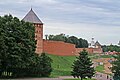 Walls of the Novgorod Kremlin
 -
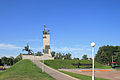 War Memorial
 -
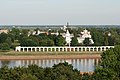 View of the Yaroslav's Court
 -
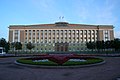 Government Building


Transportation
[edit]Intercity transport
[edit]
Novgorod has connections to Moscow (531 km) and St. Petersburg (189 km) by the federal highway M10. There are public buses to Saint Petersburg and other destinations.
The city has direct railway passenger connections with Moscow (Leningradsky Rail Terminal, by night trains), St. Petersburg (Moscow Rail Terminal and Vitebsk Rail Terminal, by suburban trains), Minsk (Belarus) (Minsk Passazhirsky railway station, by night trains) and Murmansk.
The city's former commercial airport Yurievo was decommissioned in 2006, and the area has now been redeveloped into a residential neighbourhood. The still existing Krechevitsy Airport does not serve any regular flights since mid-1990s although there is a plan to turn Krechevitsy into a new operational airport by 2025.[59] The nearest international airport is St. Petersburg's Pulkovo, some 180 kilometres (112 miles) north of the city.
Local transportation
[edit]
Local transportation consists of a network of buses and trolleybuses. The trolleybus network, which currently consists of five routes, started operating in 1995 and is the first trolley system opened in Russia after the fall of the Soviet Union.
-
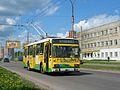 trolleybus Skoda-VMZ-14Tr
 -
 Trolleybuses ZiU-9
 -
 Bus LiAZ-5256


Honours
[edit]A minor planet, 3799 Novgorod, discovered by the Soviet astronomer Nikolai Stepanovich Chernykh in 1979, is named after the city.[60]
Notable people
[edit] |
- Onfim (1220-60) was a Russian artist and student, renowned for his notes, drawings and homework exercises scratched onto soft birch bark.
- Anton Stepanovich Arensky (1861-1906) was an outstanding Russian composer, pianist and conductor. He became one of the prominent representatives of the Russian musical culture of the late 19th century. Arensky composed symphonic and chamber music, as well as music for the theater.
- Sergei Vasilyevich Rachmaninoff (1873-1943) was a great Russian composer, pianist and conductor, whose work occupies one of the central places in the history of music. His works, such as the Second and Third Piano Concertos, are considered masterpieces and are performed all over the world.
- Gavrila Romanovich Derzhavin (1743-1816) was an outstanding Russian poet, statesman, and representative of Russian classicism. His poetic works are known for their greatness and deep patriotic themes.
- Vsevolod Anisimovich Kochetov (1912-1973) was a Soviet writer, editor and journalist. He is known as the author of novels about life in the Soviet Union, including "Zhurbiny" and "What do you Want?".
- Igor Alexandrovich Kaberov (1917-1995) — ace pilot of WWII, Hero of the Soviet Union. He has many successful aerial battles and victories to his credit.
- Nicholas Miklouho-Maclay (1846-1888) was a famous Russian traveler, ethnographer, anthropologist and humanist. He studied the life and way of life of the peoples of Southeast Asia, Oceania and Australia and made significant contributions to ethnography.
- Vitaly Valentinovich Bianki (1894-1959) was a Russian writer, the author of many works about nature, famous for short stories and fairy tales for children. His books help to develop children's love and interest in the world around them.
Twin towns – sister cities
[edit] | This article needs to be updated. (November 2024) |
Veliky Novgorod is twinned with:[61][62]
 Bielefeld, Germany
 Kohtla-Järve, Estonia
 Moss, Norway
 Nanterre, France
- Strasbourg, France
 Rochester, New York, USA
 Uusikaupunki, Finland
 Watford, UK
- Valga, Estonia
 Zibo, China


See also
[edit]Sources
[edit]- ^ Resolution #121
- ^ a b c d e f Law #559-OZ
- ^ a b Charter of Veliky Novgorod, Article 1.
- ^ a b Charter of Veliky Novgorod, Article 6
- ^ a b Official website of Veliky Novgorod. Geographic Location (in Russian)
- ^ Russian Federal State Statistics Service (2011). Всероссийская перепись населения 2010 года. Том 1 [2010 All-Russian Population Census, vol. 1]. Всероссийская перепись населения 2010 года [2010 All-Russia Population Census] (in Russian). Federal State Statistics Service.
- ^ a b c d Oblast Law #284-OZ
- ^ "Об исчислении времени". Официальный интернет-портал правовой информации (in Russian). June 3, 2011. Retrieved January 19, 2019.
- ^ Почта России. Информационно-вычислительный центр ОАСУ РПО. (Russian Post). Поиск объектов почтовой связи (Postal Objects Search) (in Russian)
- ^ Benedictow, Ole Jørgen (2008). The black death, 1346 - 1353: the complete history (repr. in paperback ed.). Woodbridge: Boydell Press. p. 23. ISBN 9781843832140.
- ^ The Archaeology of Novgorod, by Valentin L. Yanin, in Ancient Cities, Special Issue, (Scientific American), pp. 120–127, c. 1994. Covers, History, Kremlin of Novgorod, Novgorod Museum of History, preservation dynamics of the soils, and the production of Birch bark documents.
- ^ Russian Federal State Statistics Service. Всероссийская перепись населения 2020 года. Том 1 [2020 All-Russian Population Census, vol. 1] (XLS) (in Russian). Federal State Statistics Service.
- ^ Crummey, R.O. (2014). The Formation of Muscovy 1300 - 1613. Taylor & Francis. p. 23. ISBN 9781317872009. Retrieved September 10, 2015.
- ^ a b "Федеральный закон от 11.06.1999 г. № 111-ФЗ". kremlin.ru.
- ^ a b "Climate norms" (in Russian). Retrieved February 10, 2025.
- ^ Тихомиров, М.Н. (1956). Древнерусские города (in Russian). Государственное издательство Политической литературы. Retrieved June 13, 2012.
- ^ Ketola, Kari; Vihavainen, Timo (2014). Changing Russia? : history, culture and business (1st ed.). Helsinki: Finemor. p. 1. ISBN 978-952712401-7.
- ^ Носов Е. Н. Новгород и новгородская округа IX—X вв. в свете новейших археологических данных (к вопросу о возникновении Новгорода) // Новгородский исторический сборник. — 1984. — Вып. 2 (12). — С. 3—38.
- ^ Янин В. Л. Новгород // Великий Новгород. История и культура IX—XVII веков. Энциклопедический словарь. — СПб.: Нестор-История, 2007. — С. 352.
- ^ Куза А. В. Новгородская земля // Древнерусские княжества X—XIII вв. — М.: Наука, 1975. — С. 172.
- ^ Valentin Lavrentyevich Ianin and Mark Khaimovich Aleshkovsky. "Proskhozhdeniye Novgoroda: (k postanovke problemy)," Istoriya SSSR 2 (1971): 32-61.
- ^ Tarabardina, O. A. (2009). "ENVIRONMENT AND HUMAN BEHAVIOR IN NORTHERN DENDROCHRONOLOGICAL STUDIES OF MEDIEVAL NOVGOROD: (Based on the Findings of Archaeological Excavations 1991–2006)". Archaeology, Ethnology and Anthropology of Eurasia. 37 (1): 77.
- ^ The name Holmgard is a Norse toponym meaning Islet town or Islet grad, and there are various explanations for why they gave this name. According to Rydzevskaya, the Norse name is derived from the Slavic Holmgrad which means "town on a hill" and may allude to the "old town" preceding the "new town", or Novgorod.
- ^ "Vnovgorod.info" Городище (in Russian). Великий Новгород. Retrieved March 27, 2013.
- ^ Янин, Валентин, ed. (2007). Великий Новгород. Энциклопедический словарь. Вектор-История. pp. 395–396. ISBN 978-5981872365.
- ^ Jackson, Tatjana (2015). "Garðaríki and Its Capital: Novgorod on the Mental Map of Medieval Scandinavians". Slověne (in Russian). 4 (1). Moscow: 170–179. doi:10.31168/2305-6754.2015.4.1.9. Retrieved June 24, 2022. p. 175: "в сознании авторов и их слушателей Хольмгард на всем протяжении сложения и записи саг оставался столицей лежащей за Балтийским морем страны Гарды/Гардарики" [throughout the composition and recording of the sagas, in the minds of the authors and their listeners, Hólmgarðr remained the capital of the country Garðar/Garðaríki across the Baltic Sea]
- ^ Mägi, Marika (2018). In Austrvegr: The Role of the Eastern Baltic in Viking Age Communication across the Baltic Sea. Brill. pp. 160–161. ISBN 9789004363816.
- ^ Rafn, Carl Christian, ed. (1830). "Gaungu-Hrólf Saga". Fornaldar sögur Nordrlanda eptir gömlum handritum (in Icelandic). Kaupmannahöfn: Popp. p. 362:
í Hólmgarðaborg er mest atsetr Garðakonúngs, þat er nú kallat Nógarðar
[The main residence of the king of Garðar is in Hólmgarðaborg, which is now called Nógarðar] - ^ Franklin, Simon; Shepard, Jonathan (2014). The Emergence of Russia 750-1200. Routledge. p. 201. ISBN 9781317872245.
- ^ Jackson, Tatjana (2010). "The Cult of St Olaf and Early Novgorod". In Antonsson, Haki; Garipzanov, Ildar H. (eds.). Saints and their Lives on the Periphery: Veneration of Saints in Scandinavia and Eastern Europe (c.1000-1200). Cursor Mundi. Vol. 9. Brepols. pp. 147–167. ISBN 978-2-503-53033-8.
- ^ "The Cronicle of the Hanseatic League". european-heritage.org. Archived from the original on March 7, 2012. Retrieved September 10, 2015.
- ^ Justyna Wubs-Mrozewicz, Traders, ties and tensions: the interactions of Lübeckers, Overijsslers and Hollanders in Late Medieval Bergen, Uitgeverij Verloren, 2008 p. 111
- ^ Translation of the grant of privileges to merchants in 1229: "Medieval Sourcebook: Privileges Granted to German Merchants at Novgorod, 1229". Fordham.edu. Retrieved July 20, 2009.
- ^ Michael C. Paul, "The Iaroslavichi and the Novgorodian Veche 1230–1270: A Case Study on Princely Relations with the Veche", Russian History/ Histoire Russe 31, No. 1-2 (Spring-Summer 2004): 39-59.
- ^ Michael C. Paul, "Secular Power and the Archbishops of Novgorod Before the Muscovite Conquest". Kritika: Explorations in Russian and Eurasian History 8, no. 2 (Spring 2007): 231-270.
- ^ Michael C. Paul, "Episcopal Election in Novgorod, Russia 1156–1478". Church History: Studies in Christianity and Culture 72, No. 2 (June 2003): 251-275.
- ^ Янин, Валентин, ed. (2007). Великий Новгород. Энциклопедический словарь (in Russian). Вектор-История. p. 114. ISBN 978-5981872365.
- ^ Janet Martin, Treasure of the Land of Darkness: the Fur Trade and its Significance for Medieval Russia. (Cambridge: Cambridge University Press, 1985).
- ^ Janet Martin, “Les Uškujniki de Novgorod: Marchands ou Pirates.” Cahiers du Monde Russe et Sovietique 16 (1975): 5-18.
- ^ Appanage and Muscovite Russia. Companion to Russian Studies: An Introduction to Russian History. Cambridge University Press. July 1976. pp. 78–120. Retrieved March 1, 2025.
- ^ "Hakutulos/Sökresultat". September 27, 2007. Archived from the original on September 27, 2007. Retrieved March 1, 2025.
- ^ Ljungqvist, Fredrik Charpentier; Seim, Andrea; Huhtamaa, Heli (November 19, 2020). "Climate and society in European history". WIREs Climate Change. 12 (2). doi:10.1002/wcc.691. ISSN 1757-7780.
- ^ Lukin, Pavel V. (2022), Nauman, Sari; Jezierski, Wojtek; Reimann, Christina; Runefelt, Leif (eds.), "German Merchants in Novgorod: Hospitality and Hostility, Twelfth–Fifteenth Centuries", Baltic Hospitality from the Middle Ages to the Twentieth Century: Receiving Strangers in Northeastern Europe, Cham: Springer International Publishing, pp. 117–142, doi:10.1007/978-3-030-98527-1_5, ISBN 978-3-030-98527-1
- ^ Kollmann, Nancy Shields (2017). The Russian Empire 1450-1801. Oxford University Press. p. 50.
- ^ Kazakova, N. A. (1984). "Еще раз о закрытии Ганзейского двора в Новгороде в 1494 г.". Новгородский исторический сборник. 2 (12): 177.
- ^ Boris Zemtsov, Откуда есть пошла... российская цивилизация, Общественные науки и современность. 1994. № 4. С. 51-62. p. 9 (in Russian)
- ^ a b Kovalenko, Guennadi (2010). Великий Новгород. Взгляд из Европы XV-XIX centuries (in Russian). Европейский Дом. pp. 48, 72, 73. ISBN 9785801502373.
- ^ Варенцов, В. А.; Коваленко, Г. М. (1999). В составе Московского государства: очерки истории Великого Новгорода конца XV-начала XVIII в (in Russian). Русско-Балтийский информационный центр БЛИЦ. ISBN 9785867891008.
- ^ J.T., Russia's Foreign Trade and Economic Expansion in the Seventeenth Century: Windows on the World (2005). Kotilaine. Brill. p. 30. ISBN 9789004138964.
- ^ Варенцов, В. А.; Коваленко, Г. М. (1999). В составе Московского государства: очерки истории Великого Новгорода конца XV-начала XVIII в (in Russian). Русско-Балтийский информационный центр БЛИЦ. pp. 44, 45. ISBN 9785867891008.
- ^ Варенцов, В. А.; Коваленко, Г. М. (1999). В составе Московского государства: очерки истории Великого Новгорода конца XV-начала XVIII в (in Russian). Русско-Балтийский информационный центр БЛИЦ. p. 71. ISBN 9785867891008.
- ^ Варенцов, В. А.; Коваленко, Г. М. (1999). В составе Московского государства: очерки истории Великого Новгорода конца XV-начала XVIII в (in Russian). Русско-Балтийский информационный центр БЛИЦ. pp. 52–60. ISBN 9785867891008.
- ^ Vdovichenko, Marina (February 28, 2020). "Medieval Churches in Novgorod: Aspects of archaeological investigations and museum presentation". Internet Archaeology (54). doi:10.11141/ia.54.10. ISSN 1363-5387. S2CID 213325311.
- ^ Tatiana Tsarevskaia, St. Sophia's Cathedral in Novgorod (Moscow: Severnyi Palomnik, 2005), 3.
- ^ Tsarevskaia, 14, 19-22, 24, 29, 35.
- ^ Jadwiga Irena Daniec, The Message of Faith and Symbol in European Medieval Bronze Church Doors (Danbury, CT: Rutledge Books, 1999), Chapter III "An Enigma: The Medieval Bronze Church Door of Płock in the Cathedral of Novgorod," 67-97; Mikhail Tsapenko, ed., Early Russian Architecture (Moscow: Progress Publisher, 1969), 34-38
- ^ Vdovichenko, Marina (2020). "Medieval Churches in Novgorod: Aspects of archaeological investigations and museum presentation". Internet Archaeology (54). doi:10.11141/ia.54.10.
- ^ de:Kriegsgräberstätte Nowgorod
- ^ "Аэропорт Кречевицы начнёт работать в 2025 году". September 4, 2019.
- ^ Schmadel, Lutz D. (2003). Dictionary of Minor Planet Names (5th ed.). New York: Springer Verlag. p. 321. ISBN 3-540-00238-3.
- ^ "Международные культурные связи". adm.nov.ru (in Russian). Veliky Novgorod. Retrieved February 5, 2020.
- ^ "Ystävyyskaupungit". seinajoki.fi (in Finnish). Seinäjoki. Retrieved February 5, 2020.
External links
[edit] Media related to Velikiy Novgorod at Wikimedia Commons


- Official website of Veliky Novgorod (in Russian)
- Veliky Novgorod City Portal
- Veliky Novgorod for tourists
- The Faceted Palace of the Kremlin in Novgorod the Great site
- Veliky Novgorod's architecture and buildings history
- William Coxe (1784). "Novogorod". Travels into Poland, Russia, Sweden and Denmark. London: Printed by J. Nichols, for T. Cadell. OCLC 654136. OL 23349695M.
- Annette M. B. Meakin (1906). "Novgorod the Great". Russia, Travels and Studies. London: Hurst and Blackett. OCLC 3664651. OL 24181315M.
- Kropotkin, Peter Alexeivitch; Bealby, John Thomas a (1911). . Encyclopædia Britannica. Vol. 19 (11th ed.). p. 839.
- Kropotkin, Peter Alexeivitch; Bealby, John Thomas (1911). . Encyclopædia Britannica. Vol. 19 (11th ed.). pp. 839–840.
- Дума Великого Новгорода. Решение №116 от 28 апреля 2005 г. «Устав муниципального образования – городского округа Великий Новгород», в ред. Решения №515 от 11 июня 2015 г. «О внесении изменений в Устав муниципального образования – городского округа Великий Новгород». Вступил в силу со дня официального опубликования, но не ранее 1 января 2006 года, за исключением статей, для которых подпунктом 5.1 установлены иные сроки вступления в силу. (Duma of Veliky Novgorod. Decision #116 of April 28, 2005 Charter of the Municipal Formation–Veliky Novgorod Urban Okrug, as amended by the Decision #515 of June 11, 2015 On Amending the Charter of the Municipal Formation–Veliky Novgorod Urban Okrug. Effective as of the day of official publication but not earlier than January 1, 2006, with the exception of the clauses for which subitem 5.1 establishes other dates of taking effect.).
- Администрация Новгородской области. Постановление №121 от 8 апреля 2008 г. «Об реестре административно-территориального устройства области», в ред. Постановления №408 от 4 августа 2014 г. «О внесении изменений в реестр административно-территориального устройства области». Опубликован: "Новгородские ведомости", №49–50, 16 апреля 2008 г. (Administration of Novgorod Oblast. Resolution #121 of April 8, 2008 On the Registry of the Administrative-Territorial Structure of Novgorod Oblast, as amended by the Resolution #408 of August 4, 2014 On Amending the Registry of the Administrative-Territorial Structure of Novgorod Oblast. ).
- Новгородская областная Дума. Областной закон №284-ОЗ от 7 июня 2004 г. «О наделении сельских районов и города Великий Новгород статусом муниципальных районов и городского округа Новгородской области и утверждении границ их территорий», в ред. Областного закона №802-ОЗ от 31 августа 2015 г. «О внесении изменений в некоторые областные Законы, устанавливающие границы муниципальных образований». Вступил в силу со дня, следующего за днём официального опубликования. Опубликован: "Новгородские ведомости", №86, 22 июня 2004 г. (Novgorod Oblast Duma. Oblast Law #284-OZ of June 7, 2004 On Granting the Status of Municipal Districts and Urban Okrug of Novgorod Oblast to the Rural Districts and the City of Veliky Novgorod and on Establishing the Borders of Their Territories, as amended by the Oblast Law #802-OZ of August 31, 2015 On Amending Various Oblast Laws Establishing the Borders of the Municipal Formations. Effective as of the day following the day of the official publication.).
- Государственная Дума Российской Федерации. Федеральный закон №111-ФЗ от 11 июня 1999 г. «О переименовании города Новгорода — административного центра Новгородской области в город Великий Новгород». Вступил в силу со дня официального опубликования. Опубликован: "Собрание законодательства РФ", No.24, ст. 2892, 14 июня 1999 г. (State Duma of the Russian Federation. Federal Law #111-FZ of June 11, 1999 On Renaming the City of Novgorod—the Administrative Center of Novgorod Oblast—the City of Veliky Novgorod. Effective as of the day of official publication.).
- William Craft Brumfield. A History of Russian Architecture (Seattle: Univ. of Washington Press, 2004) ISBN 978-0-295-98394-3
- Peter Bogucki. Novgorod (in Lost Cities; 50 Discoveries in World Archaeology, edited by Paul G. Bahn: Barnes & Noble, Inc., 1997) ISBN 0-7607-0756-1
| History |  | ||
|---|---|---|---|
| Expansion |
| ||
| Paganism and mythology | |||
| Cosmology | |||
| Rituals and worship | |||
| Society | |||
| Events | |||
| Sources | |||
| Settlements | |||
Names in italics are settlements whose Norse names are not recorded | ||
| Volkhov-Volga trade route |  | |
| Dvina-Dnieper trade route | ||
| Other locations | ||
Members of the Hanseatic League by quarter, and trading posts of the Hanseatic League | ||||
|---|---|---|---|---|
| ||||
| Wendish |
|   | ||
| Saxon | ||||
| Baltic | ||||
| Westphalian | ||||
| Kontore | ||||
| Vitten | ||||
| Factories | ||||
| International | |
|---|---|
| National | |
| Geographic | |
| Other | |
Veliky Novgorod
View on GrokipediaGeography
Location and physical features
Veliky Novgorod is located in northwestern Russia, at the administrative center of Novgorod Oblast within the North-Western Federal District.[4] Its geographical coordinates are approximately 58°31′N latitude and 31°16′E longitude.[5] The city occupies an area of 8,829 hectares along the right bank of the Volkhov River, positioned just downstream from the river's outflow from Lake Ilmen.[6] [1] The terrain around Veliky Novgorod forms part of the East European Plain, characterized by flat to gently rolling landscapes with low hills.[7] The city's average elevation is about 30 meters above sea level, rising slightly to accommodate the historic Kremlin on a promontory overlooking the Volkhov.[8] [9] The Volkhov River, which spans 224 kilometers and drains a basin of 80,200 square kilometers, provides a navigable waterway linking the city to Lake Ladoga in the north.[10] The surrounding Novgorod Oblast features a mix of peat bogs, reed marshes, small lakes, and mixed forests, with the Valdai Hills reaching up to 296 meters in the region's southern extremities.[4]Climate
Veliky Novgorod experiences a humid continental climate (Köppen Dfb), characterized by cold, snowy winters, mild summers, and moderate precipitation distributed fairly evenly throughout the year, though with a slight summer maximum.[11][12] The climate is moderated somewhat by the city's location near Lake Ilmen and the Baltic Sea region, resulting in less extreme temperatures than in more inland parts of European Russia, but it remains distinctly continental with significant seasonal variation.[13] The average annual temperature is 6.3 °C, with winters featuring persistent sub-zero conditions and summers rarely exceeding comfortable levels.[11] January, the coldest month, has average highs of -4 °C and lows of -10 °C, while July, the warmest, sees highs around 23 °C and lows near 13 °C.[8] Temperatures typically range from -11 °C in winter to 24 °C in summer, with extremes rarely falling below -24 °C or rising above 29 °C.[8] Annual precipitation averages 840 mm, predominantly as rain in summer and snow in winter, with June being the wettest month at about 76 mm and February the driest at 10 mm.[11] Snow cover lasts from late November to early April, accumulating to depths of 20-40 cm on average. Humidity remains relatively high year-round, averaging 80-90% in winter due to overcast skies, while cloud cover is densest from October to March (over 80% overcast days). Wind speeds are moderate, peaking at 9 km/h in winter from southerly directions.[8]| Month | Avg. High (°C) | Avg. Low (°C) | Precipitation (mm) |
|---|---|---|---|
| Jan | -4 | -10 | 13 |
| Feb | -3 | -10 | 10 |
| Mar | 2 | -6 | 16 |
| Apr | 10 | 1 | 33 |
| May | 18 | 8 | 51 |
| Jun | 21 | 11 | 76 |
| Jul | 23 | 13 | 71 |
| Aug | 21 | 11 | 71 |
| Sep | 14 | 7 | 61 |
| Oct | 7 | 3 | 51 |
| Nov | 1 | -3 | 41 |
| Dec | -2 | -8 | 15 |
History
Early settlement and integration into Kievan Rus'
Archaeological excavations in Veliky Novgorod reveal evidence of permanent Slavic settlement beginning in the second quarter of the 10th century, around 925–950 CE, with no confirmed artifacts predating this period despite legendary accounts of earlier foundations.[14] The site, located on the Volkhov River, featured wooden structures and trade goods indicative of early East Slavic communities engaged in riverine commerce, including amber, furs, and honey, which facilitated connections between Baltic and Black Sea routes.[15] The Primary Chronicle, compiled in the early 12th century, records the first documentary mention of Novgorod in 859 CE, associating it with tribute demands by Varangians (Scandinavian Vikings) on local Slavic and Finnic tribes, though this entry likely reflects later monastic interpolation rather than contemporary evidence.[16] In 862 CE, according to the same source, the tribes of the region invited the Varangian leader Rurik and his brothers to rule over Novgorod to end internecine strife, establishing the first dynastic foothold of the Rus' people; Rurik settled in the nearby Rurikovo Gorodishche hillfort, dated archaeologically to circa 850–900 CE through finds like combs and rivets of Finno-Ugric and Slavic origin.[17] This event marks the onset of Varangian influence, blending Scandinavian military organization with local Slavic agrarian and trading networks, as evidenced by birch-bark letters and Scandinavian-style artifacts uncovered in Novgorod's strata.[18] Integration into the emerging Kievan Rus' state accelerated under Rurik's kinsman Oleg, who in 882 CE transferred the Rus' capital southward to Kiev while retaining Novgorod as a key northern principality under Rurikid governance.[19] Novgorod's role as a veche-governed outpost provided tribute, warriors, and trade access, solidifying its position within the loose federation of Rus' principalities centered on Kiev; by the late 10th century, under Vladimir the Great's Christianization campaigns (circa 988 CE), Novgorod transitioned from pagan resistance—exemplified by the destruction of the idol of Perun—to Orthodox adherence, aligning culturally and politically with the Kievan realm.[16] This incorporation fostered economic interdependence, with Novgorod exporting northern commodities to Byzantine and Arab markets via Kiev, though archaeological layers confirm urban consolidation only from the 11th century onward, underscoring a gradual rather than abrupt process.The Novgorod Republic: Autonomy and trade dominance
The Novgorod Republic established its autonomy in the context of Kievan Rus' fragmentation, with a pivotal assertion of independence occurring in 1136 when the veche expelled Prince Vsevolod Mstislavich and barred his family's return to power.[20] This event marked the transition to a republican system where the veche, an assembly comprising free male residents but effectively controlled by wealthy boyars, held supreme legislative, judicial, and executive authority.[21] The veche elected key officials, including the posadnik, who managed administrative and judicial functions such as tax collection and court proceedings, and the tysyatsky, responsible for military organization and trade oversight, with terms typically lasting one year to prevent power consolidation.[22] Princes were invited from external principalities under strict contractual limitations, restricting their roles to military defense and diplomacy while prohibiting interference in internal affairs, land ownership, or judicial decisions, thereby preserving Novgorod's self-governance.[23] This governance structure underpinned Novgorod's trade dominance, as the city's strategic position on northern river routes facilitated control over extensive territories stretching from the Baltic Sea to the Ural Mountains, extracting tribute in furs, honey, and wax from over 50 volosts.[24] As the easternmost outpost of the [Hanseatic League](/page/Hanseatic League) from the 13th century, Novgorod hosted a dedicated German merchant courtyard (Peterhof) where Hanseatic traders monopolized exchanges, importing vast quantities of silver—estimated at thousands of hryvnias annually—along with cloth, salt, and metals in return for Russian exports of squirrel and beaver furs, which comprised up to 80% of the League's fur trade volume.[25][26] This commerce-driven prosperity, peaking in the 14th century, generated sufficient wealth to fund fortifications, churches, and military campaigns, reinforcing autonomy by reducing dependence on princely subsidies and enabling diplomatic leverage against rivals like Moscow and Tver.[27] The boyar elite, deriving power from mercantile interests, further entrenched trade priorities, with archaeological evidence from birchbark letters confirming widespread commercial literacy and contract enforcement among citizens.[21]Conflicts, subjugation, and the 1570 massacre
The Novgorod Republic faced escalating conflicts with the rising Grand Duchy of Moscow in the mid-15th century, driven by Novgorod's commercial ties to the Baltic and occasional overtures to Lithuania for protection against Muscovite expansionism. A pro-Lithuanian faction within Novgorod's veche (assembly) intensified these tensions by negotiating alliances that threatened Moscow's territorial ambitions, prompting Grand Prince Ivan III to launch military campaigns to assert dominance.[28][29] The decisive clash occurred at the Battle of the Shelon River on July 14, 1471, where Ivan III's forces, commanded by Prince Dmitry Kholmsky, routed a Novgorodian army of approximately 40,000, largely comprising disorganized civilian militia. Moscow's professional troops inflicted heavy casualties, killing over 12,000 Novgorodians and capturing about 2,000, while suffering minimal losses themselves. This victory curtailed Novgorod's diplomatic autonomy and access to key trade routes like the Volga, marking a pivotal step toward subjugation without immediate full annexation.[30] Subjugation culminated in 1478 when Ivan III directly intervened, dismantling the veche by confiscating its symbolic bell and installing Muscovite governors, thereby ending Novgorod's republican institutions and integrating its lands into Moscow's domain. This followed years of economic pressure, including the seizure of boyar properties and monasteries, which eroded local elites' resistance and facilitated centralized control. Novgorod retained nominal privileges initially, but these were progressively stripped, reflecting Moscow's strategy of absorbing rival principalities through military coercion and administrative overhaul.[31][32] Under Ivan IV (Ivan the Terrible), paranoia over perceived treason—fueled by rumors of Novgorod clergy and elites conspiring with Poland-Lithuania amid the Livonian War—triggered the 1570 massacre during the Oprichnina's repressive phase. In late December 1569, Ivan mobilized oprichniki forces under Alexei Basmanov and Malyuta Skuratov, arriving in Novgorod on January 8, 1570; over five weeks, they subjected residents to systematic torture, including drowning in the Volkhov River during frozen conditions, public executions, and looting. Contemporary accounts, though biased against Ivan, describe the sack as devastating, with estimates of deaths ranging from several thousand to tens of thousands, severely depopulating the city and targeting its merchant class and church hierarchy.[33][34] The massacre's rationale stemmed from Ivan's unsubstantiated suspicions of a pro-Polish plot, verified through coerced confessions, but its scale reflected Oprichnina tactics of terror to enforce loyalty, ultimately weakening Novgorod's residual influence and exemplifying Ivan's erratic rule. Post-event audits revealed plundered wealth funneled to Moscow, while the city's recovery was protracted, underscoring the causal link between autocratic insecurity and localized devastation in consolidating tsarist power.[35][36]Imperial era under the Russian Empire
Following its subjugation, Veliky Novgorod transitioned into a provincial administrative center within the expanding Russian state, with its veche institutions abolished and governance centralized under appointed officials. By 1727, the city was designated the seat of Novgorod Governorate, carved out from the broader St. Petersburg administrative region as part of Peter I's reforms to streamline provincial management.[37] This status persisted through the 18th and 19th centuries, positioning Novgorod as a key hub for local bureaucracy and military oversight in northwestern Russia, though its economic prominence waned in favor of emerging capitals like St. Petersburg.[38] Throughout the 18th century, under rulers including Catherine II, the city saw modest infrastructural improvements and the preservation of its ancient kremlin and religious sites, which escaped major destruction due to its diminished strategic role post-conquest. Secularization policies in 1764 impacted local monasteries, redistributing church lands to state control and altering ecclesiastical influence.[39] The population remained stable but small, reflecting agricultural dominance in the governorate rather than urban industrialization. The 19th century marked a cultural revival, highlighted by the unveiling of the Millennium of Russia monument on September 8, 1862, in the kremlin, designed by sculptor Mikhail Mikeshin to honor the thousandth anniversary of Rurik's arrival and the founding of Russian statehood. The 16-meter bronze sculpture, cast from over 100 tonnes of metal, featured 129 figures from Russian history and was attended by Emperor Alexander II, symbolizing imperial pride in Novgorod's ancient legacy.[40] [41] Improved transportation came with the opening of the Novgorod railway station on May 18, 1871 (Julian calendar), linking the city to Moscow (531 km) and St. Petersburg (189 km), facilitating trade in timber, flax, and agricultural goods from the surrounding oblast.[42] This connectivity modestly boosted the local economy, though the city's population hovered around 27,000 by 1900, underscoring its role as a historical rather than industrial powerhouse.) By the early 20th century, Novgorod's imperial era ended amid revolutionary upheavals, with its governorate structures dismantled following the 1917 February Revolution.Soviet period, including World War II impacts
During the interwar Soviet period, Veliky Novgorod served as an administrative center in the Leningrad Oblast of the Russian SFSR, undergoing collectivization of agriculture and limited industrialization amid broader Stalinist policies.[31] The city's economy emphasized forestry, food processing, and nascent manufacturing, with population stabilizing around 30,000–40,000 residents by the late 1930s, reflecting rural-to-urban migration patterns common in non-industrial Soviet regions.[43] World War II brought severe devastation when German Army Group North occupied Veliky Novgorod on August 19, 1941, following rapid advances in Operation Barbarossa.[44] The occupation lasted until liberation by Soviet forces on January 20, 1944, during the Leningrad–Novgorod Offensive, which involved intense fighting that broke German defenses north and south of the city.[45] [46] German forces systematically damaged or destroyed cultural sites, including the Cathedral of St. Sophia, with overall urban destruction leaving fewer than 40 of 2,536 pre-war stone buildings intact and causing an estimated 48 trillion rubles in contemporary-equivalent damages from plunder and infrastructure loss.[31] [47] [48] Civilian casualties were high, with Nazi atrocities in the region prompting later Russian legislative efforts to classify them as genocide.[48] Post-liberation reconstruction prioritized restoring medieval monuments as symbols of Russian heritage, with Soviet authorities investing in sites like the kremlin despite ideological tensions with Orthodox structures.[31] [49] Novgorod Oblast was established on July 5, 1944, elevating the city's regional status.[31] By the 1950s–1980s, light industry expanded, positioning Veliky Novgorod as a key producer of televisions and radios, contributing to population growth to 229,126 by the 1989 census.[43] [50] This development aligned with centralized planning but remained secondary to heavy industry elsewhere, preserving the city's historical focus amid Soviet modernization.[43]Post-Soviet revival and recent developments (1991–present)
Following the dissolution of the Soviet Union in 1991, Veliky Novgorod underwent a challenging transition to a market economy, marked by industrial contraction and a population decline from 229,126 in the 1989 census to 216,856 in 2002, reflecting broader Russian demographic trends driven by out-migration and economic uncertainty.[51] The city's medieval heritage, including its kremlin and churches, positioned it for revival through cultural preservation and tourism, with the designation of its historic center as a UNESCO World Heritage Site in 1992 enhancing international visibility and attracting restoration funding.[2] This shift emphasized service-oriented growth over Soviet-era heavy industry, though chemical production via Acron Group persisted and expanded, completing a 50 kt urea-5 unit upgrade in 2018 to bolster export capabilities.[52] Tourism emerged as a cornerstone of economic recovery, supported by initiatives like the EU's Strategic Action in Tourism and Urban Reforms in Novgorod's Economy (SATURNE) project, finalized in 2001, which facilitated infrastructure improvements and marketing of the city's archaeological and architectural assets.[53] Visitor numbers grew steadily, contributing to regional GDP through heritage sites and events, with annual tourism inflows reaching tens of thousands by the 2010s, aided by proximity to St. Petersburg and restored transport links.[54] Population stabilized post-2000s, rising slightly to 218,717 by the 2010 census and an estimated 222,340 in 2024, indicating adaptation via service sector jobs despite ongoing rural-urban outflows in Novgorod Oblast.[51] Recent developments have diversified the economy toward high-tech and logistics, including construction of a "smart" plant in 2025 for ballastless track slabs to support Russia's inaugural Moscow-St. Petersburg high-speed rail line, which traverses the region and promises enhanced connectivity.[55] A full-cycle semiconductor facility, from design to packaging, advanced to groundbreaking in 2025 within the Novgorod special economic zone, targeting electronics innovation.[56] Acron further invested in hospitality with the 2024 opening of the city's first 5-star hotel, while a fish feed production plant commenced in Q2 2024 to serve aquaculture demands; these projects, alongside oblast-level fixed-asset renovations, underscore a focus on sustainable industrialization amid federal infrastructure pushes.[57][58][59]Demographics
Population dynamics and trends
The population of Veliky Novgorod reached approximately 229,000 in the 1989 Soviet census, reflecting growth from industrialization and urbanization in the mid-20th century.[60] Following the Soviet collapse, it declined to 216,856 by the 2002 census amid economic disruption, high mortality, and outmigration to larger centers like Moscow and Saint Petersburg.[60] A modest recovery occurred, with the figure rising to 218,717 in 2010 and 224,286 in the 2021 census, driven partly by the city's role as an administrative hub attracting internal migrants.[60] Recent trends show stabilization followed by slight decline, with an estimated 222,340 residents as of January 2024, reflecting an annual decrease of about 0.39%.[60] [61] This pattern stems from persistent natural population loss—birth rates at 8.5 per 1,000 and death rates at 19.3 per 1,000 in 2021, yielding a net natural decrease of 10.8 per 1,000—offset in part by positive net migration of 2,287 that year.[62] In 2020, migration gains exceeded natural losses, resulting in a net increase of 639 residents. Unlike the broader Novgorod Oblast, which has seen sharper declines due to rural depopulation, the city benefits from its economic and cultural centrality, though aging demographics and low fertility—mirroring national patterns—continue to pressure growth.[62]| Census Year | Population |
|---|---|
| 1989 | 229,126 |
| 2002 | 216,856 |
| 2010 | 218,717 |
| 2021 | 224,286 |
Ethnic composition and languages
The ethnic composition of Veliky Novgorod is predominantly Russian, reflecting the broader homogeneity of Novgorod Oblast. According to the 2020 Russian national census data, ethnic Russians comprise 95.43% of the oblast's population, with the city's demographics aligning closely due to minimal rural-urban ethnic divergence in the region.[4] Smaller minorities include Ukrainians at approximately 1.5%, Belarusians at 0.76%, Roma at 0.49%, and Tatars or other groups totaling under 2% combined, based on patterns from the 2010 census adjusted for stability in subsequent counts.[63] These proportions have remained stable over decades, influenced by historical Slavic settlement and limited post-Soviet migration into the area.| Ethnic Group | Percentage (Novgorod Oblast, 2020/approx. for city) |
|---|---|
| Russians | 95.43% |
| Others | 4.57% |
Religious demographics and social structure
The predominant religion in Veliky Novgorod and Novgorod Oblast is Russian Orthodoxy, with the city serving as a historical cradle of Orthodox Christianity in Russia, exemplified by institutions like the Cathedral of Saint Sophia established in 1045. As of April 2018, 135 religious organizations were registered in the oblast, the vast majority comprising Orthodox parishes, underscoring Orthodoxy's institutional dominance.[65] Smaller communities include Protestant groups (20 organizations, representing 15.5% of total registered religious entities), Old Believers (4 organizations, 3.1%), Muslims (1 organization, 0.8%), and Jewish congregations.[66] These minority faiths maintain limited presence, with no large-scale communities reported in recent surveys, aligning with national patterns where Orthodox identification often exceeds active religiosity—around 71% self-identify nationally per 2022 polling, though practice rates are lower.[67] Historically, Veliky Novgorod's social structure during the Novgorod Republic (12th–15th centuries) emphasized merchant and boyar elites alongside free commoners, fostering relative autonomy through the veche assembly and trade guilds, which distinguished it from serf-heavy principalities elsewhere in Rus'. Boyars held land and political sway, while "zhitye lyudi" (prosperous merchants and artisans) and "chernye lyudi" (free urban dwellers) formed a broad taxable base with participatory rights, enabling economic vitality via Hanseatic ties.[68] This stratification supported a non-feudal, commerce-driven society less reliant on princely autocracy. In the modern era, social structure reflects a typical Russian regional urban center, with the population of approximately 224,000 (2021 estimate) concentrated in administration, education, and services; the presence of Yaroslav-the-Wise Novgorod State University bolsters higher education attainment, contributing to a professional class amid broader oblast depopulation trends. Income levels and occupational distribution mirror national averages, with tourism and light industry providing employment stability, though rural-urban divides persist in the oblast's 571,000 total residents as of 2024. Stratification remains moderate, with limited evidence of extreme inequality compared to larger metropolises, sustained by state employment and heritage-driven economy.[69]Government and administration
Administrative divisions and status
Veliky Novgorod is the administrative center of Novgorod Oblast in Russia.[70] As a city of oblast significance, it operates independently from the oblast's districts and directly under oblast jurisdiction.[71] Municipally, it forms the Veliky Novgorod Urban Okrug, a single territorial unit encompassing the city and its adjacent areas without internal administrative subdivisions into districts or territories.[72] This structure aligns with the oblast's administrative-territorial law, which permits but does not mandate further division of the city.[73] The city's governance integrates administrative and municipal functions, with the mayor and city council overseeing local affairs within this unified framework.[4]Local governance, politics, and electoral history
The municipal governance of Veliky Novgorod features a dual structure comprising the City Duma as the representative legislative body and the mayor as the head of the executive administration. The Duma, chaired by Konstantin Somov, approves local budgets, regulations, and executive proposals, including salary adjustments for officials.[74] [75] The mayor, currently Alexander Rozbaum, manages day-to-day administration, infrastructure projects, and policy implementation, with decisions subject to Duma oversight; Rozbaum has proposed significant salary increases for himself and other officials, estimated at up to 480,000 rubles monthly for the mayoral position, amid opposition from parties like Yabloko.[74] Local politics align closely with national patterns, dominated by United Russia, which holds the majority in the City Duma, alongside representation from systemic opposition parties such as the Communist Party and Liberal Democratic Party, as well as limited seats for non-systemic groups like Yabloko.[76] [77] Electoral history reflects quinquennial cycles for Duma deputies, typically via a mixed system of party lists and single-mandate districts. The September 10, 2023, elections saw Yabloko retain seats through party-list and direct wins, despite pre-voting challenges including police seizures of campaign materials, enabling the party to continue legislative participation.[78] [79] Earlier, Yuri Bobryshev was elected and inaugurated as mayor on September 24, 2013.[80] Voter turnout and party competition remain constrained by administrative factors common in Russian municipal elections.[77]Economy
Primary industries and historical continuity
Veliky Novgorod's economy in the medieval period relied heavily on the extraction and trade of natural resources from its surrounding forests, fields, and waterways, serving as a key node in northern European commerce. Primary products included furs from hunting, beeswax and honey from beekeeping, flax for textiles, fish from Lake Ilmen and the Volkhov River, and hops for brewing, which were exported via the Hanseatic League to markets in Scandinavia and the Baltic.[81] This extractive base supported the city's role as one of Europe's largest marketplaces by the 12th century, with over 1,800 stalls facilitating barter and sales of rural goods.[82] This historical dependence on forestry and agriculture exhibits continuity in the modern economy of Novgorod Oblast, where Veliky Novgorod remains the administrative hub. Forestry and wood processing, including pulp and paper production, draw from the region's extensive taiga and mixed forests, echoing medieval exploitation of woodland resources for furs and timber derivatives.[4] Agriculture sustains food processing industries, focusing on crops like grains, potatoes, and dairy, which parallel earlier agrarian outputs such as flax and honey; these sectors contribute to the oblast's rural employment and GDP, though challenged by soil limitations in the poozer'ye landscapes around Lake Ilmen.[83] While secondary processing has expanded, the primary extractive foundation persists, with forestry historically intertwined with agrarian activities in sustaining local populations.[84] In contrast, Veliky Novgorod's urban economy has diversified into chemicals, with Acron Group's facilities producing fertilizers like ammonium nitrate and urea since the Soviet era, accounting for a significant share of industrial output but lacking direct medieval precedents.[85] This modern emphasis on chemical manufacturing, which utilizes imported raw materials, represents a departure from resource-based primaries, though regional policies aim to integrate it with agricultural needs for fertilizers.[86] Overall, industrial output constitutes about 40% of the oblast's GDP, underscoring a shift toward value-added processing while retaining ties to historical natural endowments.[4]Tourism, services, and modern growth sectors
Tourism forms a vital component of Veliky Novgorod's economy, leveraging the city's status as a repository of medieval Russian heritage, including the UNESCO-listed Historic Monuments of Novgorod and its surrounding areas. The Novgorod Kremlin, Saint Sophia Cathedral, and related sites attract primarily domestic visitors, with the sector positioned as a promising avenue for regional development amid constraints on international travel following 2022 geopolitical shifts.[54] Efforts to enhance domestic tourism infrastructure have emphasized cultural and historical routes, contributing to service-oriented economic activity in hospitality and guided excursions.[87] The services sector, encompassing retail, finance, and administrative functions, supports the city's role as the administrative center of Novgorod Oblast, where non-industrial activities account for approximately 60% of regional GDP. Modern growth initiatives include the Novgorodskaya Special Economic Zone, an industrial-production type facility established near Veliky Novgorod in 2021 to draw investments through tax incentives and infrastructure, targeting manufacturing and technology-based enterprises.[88][89] This zone, supported by federal decisions since 2018, facilitates job creation and production diversification, with associated projects like a technical school for smart electronics training bolstering high-tech skills development.[90][91] Regional programs under the "Personnel for the Digital Economy" framework further promote IT sector expansion, aligning with broader efforts to integrate digital competencies into local industries.[92]Cultural heritage
Architectural monuments and the kremlin
The Veliky Novgorod Kremlin, or Detinets, originated as a fortified settlement with its earliest stone structures erected in the mid-11th century under Prince Vladimir Yaroslavovich, son of Yaroslav the Wise.[93] The complex, situated on a hill overlooking the Volkhov River, served as the administrative and religious center of medieval Novgorod, encompassing churches, palaces, and defensive walls.[2] As part of the Historic Monuments of Novgorod and Surroundings, it was inscribed on the UNESCO World Heritage List in 1990 for exemplifying early Russian architectural and urban development.[2] Central to the Kremlin is the Cathedral of Saint Sophia, constructed between 1045 and 1050 as one of the earliest extant stone buildings in northern Russia.[94] Commissioned by Prince Vladimir, the five-domed cathedral stands 38 meters tall, featuring robust limestone walls up to 1.5 meters thick and interiors adorned with 12th-century frescoes and icons, including works attributed to Byzantine influences.[95] Its design, with three apses and a prominent central dome, influenced subsequent Kievan Rus' ecclesiastical architecture.[96] The Kremlin's defensive walls, rebuilt in the late 15th century, measure 3.5 to 6.5 meters thick and 8 to 15 meters high, constructed from limestone and cobblestone with nine surviving towers adapted for artillery.[97] These fortifications, initially wooden and later reinforced with stone, were further strengthened in the 17th century amid regional conflicts.[2] Key gateways include the Znamensky and Volkhov Gates, flanked by towers such as the Kokui and Precursor. Among other monuments, the Vladychnaya (Faceted) Chamber, a 15th-century brick structure in Gothic style, functioned as the archbishop's residence with ribbed vaults and decorative facades.[98] The Granovitaya Palata, or Palace of Facets, dates to the same era and hosted veche assemblies, reflecting Novgorod's republican governance. The 19th-century Millennium of Russia Monument, unveiled in 1862, commemorates the 1,000th anniversary of Russia's statehood with bronze figures of historical rulers atop a 8-meter granite pedestal.[99] These elements collectively preserve Novgorod's layered architectural heritage from Kievan Rus' through the imperial period.[100]Archaeological discoveries and birch bark letters
Archaeological excavations in Veliky Novgorod have uncovered multilayered evidence of continuous urban habitation from the 10th century onward, preserved by the city's waterlogged clay soils that inhibit decay of organic materials. Systematic digs began in earnest after World War II under Artem V. Artsikhovsky, with major work from 1951 to 1962 revealing over 30 layers of wooden street pavements, bridges, and house foundations, often rebuilt every few decades due to flooding and wear. These findings include structural timber from local pine and imported oak, demonstrating organized infrastructure maintenance and resource access in a trade-oriented settlement.[101][102] The excavations have yielded tens of thousands of artifacts, such as wooden tools, locks, combs, footwear, and gaming pieces, alongside leather goods and bone implements, attesting to diverse crafts like woodworking, tanning, and metalworking within the medieval economy. Post-1950s efforts at sites like Yaroslav's Court exposed log cabins, wells, and industrial waste, confirming Novgorod's role as a densely populated center with specialized districts for commerce and production by the 11th century.[103][104] Birch bark letters represent the most groundbreaking discovery, with the first found on July 26, 1951, by Nina F. Akulova during Artsikhovsky's campaign at the Trinity site. By recent counts, over 1,100 such documents have been recovered, 923 from Novgorod alone, inscribed in Old East Slavic using a stylus on inner birch bark layers and dating mainly from the late 11th to early 15th centuries.[105][106] These letters, often mundane notes on business deals, loans, lawsuits, and domestic instructions, reveal widespread functional literacy among merchants, clergy, and even lower strata, contradicting underestimations of pre-Mongol Slavic education levels. For example, approximately 678 of 762 dated letters from circa 1100–1300 originate from Novgorod, with content spanning administrative orders to personal curses, preserved in anaerobic deposits up to 8 meters deep. Children's writings, like those of 13th-century Onfim—including alphabet practice and drawings—further evidence early instruction in Cyrillic script.[107][108] The corpus's authenticity stems from stratigraphic context and paleographic analysis, providing causal evidence of causal mechanisms in medieval governance, such as direct debt enforcement without intermediaries, and economic resilience amid regional upheavals. While some interpretations attribute biases to Soviet-era excavations favoring Slavic exceptionalism, the raw data—cross-verified by international scholars—supports Novgorod's distinct preservation of vernacular records unmatched in contemporary Western Europe.[109][110]Cultural institutions, traditions, and UNESCO recognition
The Novgorod State United Museum-Reserve, founded on May 4, 1865, as the Museum of Antiquities, functions as the city's principal cultural institution, managing a collection exceeding 1.5 million items and overseeing key architectural sites such as the Novgorod Kremlin and the Vitoslavlitsy Museum of Wooden Architecture, an open-air exhibit of 22 wooden structures dating from the 16th century onward.[111][112] The reserve also includes the Museum of Fine Arts within the Kremlin, displaying works by Russian painters from the 19th and 20th centuries.[113] Additional venues encompass the Novgorod Academic Drama Theatre, established for professional performances, and various music halls supporting local ensembles.[114] Veliky Novgorod maintains traditions rooted in its medieval heritage, including bell ringing, recognized as originating in the city and integral to Russian Orthodox practices since the 11th century, alongside folk crafts such as wood carving, lace making, and icon painting preserved through annual artisan demonstrations.[115] The city hosts recurring festivals like the "Knyazh'ya Bratchina," a medieval music, martial arts, and crafts event held annually since at least 2019, and the International Festival of Musical Antiquities "Slovisha," featuring reconstructions of ancient instruments such as the gusly lyre discovered in 1975 archaeological digs.[116] Other events include the "Tsar Fairy-Tale" International Theater Festival, Medieval War Games in April, and Hansa Days commemorating historical trade links.[117] Folk gaming festivals like "Games and People" and bell-ringing contests further animate these traditions at sites such as Yaroslav's Court.[118] The Historic Monuments of Novgorod and Surroundings, encompassing medieval churches, monasteries, and archaeological strata from the 10th to 17th centuries spanning 347 hectares, received UNESCO World Heritage designation in 1990 under criteria (ii) for influencing Russian art and architecture, (iv) as an exemplar of medieval stone building techniques, and (vi) for its role as a center of Orthodox spirituality and early Russian historiography.[2] This listing highlights sites like Saint Sophia Cathedral and the Church of the Transfiguration, preserving 14th-century frescoes by Theophanes the Greek. In 2023, Veliky Novgorod joined the UNESCO Creative Cities Network in the music category, acknowledging its contributions to local musical culture, including traditional ensembles and concert halls.[115][119]Infrastructure and transportation
Road, rail, and urban transport
Veliky Novgorod lies on the M10 federal highway, providing road connections to Moscow roughly 530 kilometers to the south and Saint Petersburg about 190 kilometers to the northwest.[120] The route facilitates both passenger and freight transport, with regular bus services operating between the city and these hubs.[121] Construction of the M11 Moscow–Saint Petersburg motorway, a parallel toll road, is underway through Novgorod Oblast, aiming to reduce travel times once completed.[122] The Veliky Novgorod railway station serves as the primary rail hub, with lines connecting to Moscow via the October Railway network.[123] Daily passenger trains, including overnight services, run to the capital, while regional routes link to Saint Petersburg, often requiring transfers at nearby Chudovo station for direct expresses.[124] Desiro electric trains provide faster daytime service to Saint Petersburg, covering the distance in under three hours.[125] Future integration with the Moscow–Saint Petersburg high-speed rail line, passing through the oblast, promises further enhancements to connectivity.[126] Local urban transport relies on an extensive bus network supplemented by trolleybus lines, which cover key districts and operate frequently to the railway station and central areas.[127] Trolleybuses, reintroduced after the Soviet era's end, represent an early post-USSR revival of electric public transit in Russia, with routes mapped across the city.[128] Buses and trolleybuses typically run every few minutes during peak hours, supporting daily commuting in a city of around 220,000 residents.[129]Airport, river access, and connectivity
Veliky Novgorod does not operate a commercial airport with scheduled passenger flights. The Krechevitsy airfield, situated 11 km northeast of the city center, functions primarily for general aviation and military use but was transferred to federal ownership in May 2025, accompanied by a Federal Air Transport Agency contract to revise infrastructure for potential civilian development.[130] The nearest major airport is Pulkovo International Airport in Saint Petersburg, approximately 190 km northwest, with direct bus connections available from the airport to Veliky Novgorod's bus station.[131] The Volkhov River, which traverses the city and serves as the sole outlet from Lake Ilmen, provides navigational access integrated into the Volga-Balt Waterway system. This enables commercial freight transport, with routes extending upstream from Lake Ladoga through towns like Kirishi and Staraya Ladoga to reach Veliky Novgorod and Lake Ilmen.[132] A key bridge over the Volkhov in the city incorporates a navigation span of 9 meters in height and 90 meters in width, adhering to Volgo-Balt Shipping Company technical standards to accommodate passing vessels.[133] Passenger services on the river are limited, typically confined to seasonal tourist boats or small craft from piers near the Kremlin, rather than routine commercial operations. Airport and river infrastructure thus offer constrained connectivity compared to road and rail networks, with air travel dependent on Saint Petersburg's hub and river access focused on bulk cargo linking to Baltic and inland waterways. Ongoing airfield revisions may enhance aviation links, but as of October 2025, no regular flights serve the city directly.[130]Recent infrastructure investments
In recent years, Veliky Novgorod has prioritized road repairs and reconstructions through regional initiatives and the national project "Infrastructure for Life," which succeeded earlier road safety programs starting in 2025. The "Doroga k domu" project, launched in 2019, has repaired residential access roads with funding from the regional budget supplemented by resident contributions; in 2025, it expanded to include six additional sections.[134] Citywide, 2024 efforts targeted 13 road segments totaling 8 km for repair and resurfacing.[135] By mid-2025, five urban sections proceeded, encompassing ul. Dachnaya from Yuzhnaya to Lesnaya streets and other local arteries.[136] Regional allocations for 2025 reached 6.5 billion rubles for road maintenance and new builds, including 350 million rubles for construction extensions benefiting the oblast capital.[137] Under the national framework, over 100 km of oblast roads, including city approaches, were slated for normalization in 2025 to achieve 85% compliance on federal routes.[138] Specific reconstructions emphasize multimodal upgrades; for instance, ul. 20 Yanvarya underwent widening of the carriageway, installation of stormwater drainage, and dedicated pedestrian and bicycle facilities starting in recent phases.[139] The oblast's adoption of "infrastructure menu" mechanisms via the national project has facilitated targeted enhancements in populated areas, including bridges and utilities tied to housing growth.[140] Complementing these, the city's 2017–2025 social infrastructure program has invested in public facilities, while urban renewal projects updated water supply, sewerage, and street lighting systems to support modernization.[141][142] A draft general plan released in September 2025 outlines 20-year expansions in housing-linked roads, schools, kindergartens, and green spaces, integrating these with ongoing transport investments.[143]Notable figures
Medieval and early modern contributors
Prince Alexander Nevsky (c. 1221–1263) served as Prince of Novgorod from 1238 to 1252 (with interruptions due to conflicts with the veche), leading the city's defense against Swedish and Teutonic incursions; his victory at the Battle of the Neva in 1240 halted Swedish expansion, while the Battle on the Ice in 1242 repelled the Livonian Order, preserving Novgorod's northern frontiers amid the Mongol yoke elsewhere in Rus'.[144][145] These campaigns, documented in the Novgorod Chronicle, underscored the prince's role in maintaining the republic's autonomy and trade routes, though his policies often clashed with local boyar interests, leading to his temporary exile.[146] Earlier, Yaroslav the Wise (c. 978–1054), as Prince of Novgorod from 1010 to 1019, advanced the city's cultural foundations by establishing a school in the 1030s to educate 300 children in literacy and church canons, fostering early administrative and ecclesiastical literacy in the region.[147] His tenure also saw the fortification of the kremlin and the development of Yaroslav's Court as a princely residence, contributing to Novgorod's emergence as a key center in Kievan Rus' before his ascension to Grand Prince of Kiev. These initiatives laid groundwork for the republic's veche-based governance, blending princely authority with local traditions. Posadniks, as elected mayors wielding executive power, were pivotal in Novgorod's republican structure; Dobrynya (fl. late 10th century), uncle to Vladimir the Great, governed as posadnik around 980–990, enforcing Christianization by erecting churches and suppressing pagan resistance, including the destruction of the idol Perun, as recorded in the Primary Chronicle.[148] His successor, likely his son Konstantin Dobrynich, and grandson Ostromir (d. c. 1057), extended this lineage; Ostromir commissioned the Ostromir Gospels (1056–1057), a landmark in Slavic paleography that influenced Orthodox liturgical texts across Rus'.[19] Archbishops held symbolic and practical sovereignty, often mediating between prince, veche, and external powers; Luka Zhidyata (bishop 1036–1060) oversaw the completion of Saint Sophia Cathedral (dedicated 1052), symbolizing Novgorod's ecclesiastical prominence and serving as a repository for chronicles.[149] In the 14th century, Vasilii Kalika (archbishop 1330–1352) fortified border outposts like Orekhov against Catholic threats, blending spiritual leadership with military oversight to defend Orthodox identity.[150] Following Moscow's conquest in 1478, early modern contributors shifted toward integration with the tsardom; Gennadius of Novgorod (archbishop 1484–1504), appointed under Ivan III, compiled the first printed books in Rus' (e.g., his 1499 Psalter) and combated the Judaizer heresy through inquisitorial measures, reinforcing Moscow's ideological control while preserving Novgorod's scribal traditions.[151] Local posadniks waned in influence, but figures like the Boretsky family, including Marfa Boretskaya (posadnitsa c. 1470s), resisted centralization until their execution, marking the end of republican autonomy.[81]19th–21st century residents and achievers
Anton Stepanovich Arensky (1861–1906), born in Veliky Novgorod to a family of amateur musicians, emerged as a leading Russian composer, pianist, and conductor of the late 19th century.[152] He studied under Nikolai Rimsky-Korsakov at the Saint Petersburg Conservatory, graduating in 1882, and later directed the Moscow Conservatory's choir while composing operas like Raphael (1894) and symphonies influenced by Tchaikovsky.[153] Arensky's works, including chamber music and piano pieces such as the Variations on a Theme of Tchaikovsky, reflected Romantic lyricism but were critiqued for lacking depth, contributing to his early death from tuberculosis at age 44.[154] Olga Nikolaevna Chyumina (1865–1909), also born in Veliky Novgorod, was a Russian poet and translator known for her verses on love and nature, published in collections like Waiting for the Optimist (1900).[155] Her translations of Walter Scott's poetry and other Western authors introduced Romantic literature to Russian readers during the Silver Age, though her work received mixed reception for its sentimental tone amid Symbolist dominance.[155] Chyumina's literary activity spanned the 1880s to early 1900s, influenced by her upbringing in Finland where her father served.[155] Mstislav Valerianovich Dobuzhinsky (1875–1957), born in Veliky Novgorod to a Lithuanian noble family with an army officer father, was a prominent painter and graphic artist associated with the Mir Iskusstva movement.[156] Renowned for urban landscapes depicting Vilnius, St. Petersburg, and Munich, his works captured architectural decay and modernity's encroachment, as in Last Day of Pompeii in St. Petersburg (1905).[157] Dobuzhinsky illustrated books, designed sets for Diaghilev's Ballets Russes, and emigrated after the 1917 Revolution, continuing to produce art in Lithuania and the United States until his death.[157] While Veliky Novgorod produced these cultural contributors in the 19th and early 20th centuries, verifiable global achievers from the city in the late 20th and 21st centuries remain limited in prominent records, with local figures often tied to regional administration or academia rather than international recognition.[31]International relations
Historical trade networks
The Novgorod Republic's economy from the 10th to 15th centuries relied heavily on international trade networks that positioned Veliky Novgorod as a northern terminus for routes connecting the forests and rivers of Russia to the Baltic Sea and Western Europe. These networks facilitated the exchange of raw materials from the hinterlands for manufactured goods from abroad, with riverine transport via the Volkhov River to Lake Ladoga and the Neva River serving as primary arteries to Baltic ports. By the late 10th century, Novgorod had emerged as a major commercial hub, evidenced by archaeological layers dating to around 940 AD, underscoring its role in early East-West exchanges.[158] Central to these networks was the partnership with the Hanseatic League, beginning with Swedish and Gotland traders in the 10th century and expanding through German merchants who established the Peterhof (German Court) trading post in Novgorod by the late 12th century. The Peterhof functioned as the League's easternmost kontor, operating from approximately 1180 until its closure in 1494, and regulated trade under the 13th-century Scra code, which restricted non-Hanseatic participation and outlined merchant rights. Novgorod exported primarily furs such as sable, squirrel, and fox—key commodities that drove demand and even motivated Swedish military campaigns—as well as wax, honey, hides, leather, flax, and fish. In return, imports included woolen and linen cloth, metals like copper and tin, salt, herring, wine, and silver bullion, with disputes over quality (e.g., short cloth measures in 1402) periodically straining relations.[159][160][161] Trade routes extended beyond the Hanseatic core to Swedish, Danish, and Livonian partners, secured by treaties such as those with Riga and Lübeck that guaranteed safe passage along three land and one water itinerary. Conflicts arose, including a trade embargo by the Livonian Order in the 1260s over alleged violations, resolved by 1270, and robberies at the Gothic courtyard, highlighting tensions amid mutual economic dependence. A 1269 Novgorod-Hansa agreement formalized protections, enabling sustained volume despite interruptions.[159][162] The networks declined after Ivan III's conquest of Novgorod in 1478, which curtailed the republic's autonomy and redirected trade southward under Muscovite control, though limited Hanseatic ties persisted until the Peterhof's demolition in 1494 amid ongoing disputes. This shift reflected broader geopolitical realignments, with Moscow favoring overland routes to the Black Sea over Baltic access, diminishing Novgorod's pivotal role in Eurasian exchanges.[159]Modern twin towns and partnerships
Veliky Novgorod has formalized twin city and partnership agreements with nine international cities since 1965, aimed at promoting cultural exchanges, economic cooperation, and tourism through shared historical and industrial ties.[163] These relationships span Europe, Asia, and North America, with the earliest link to Uusikaupunki, Finland, and the most recent international addition being Polotsk, Belarus, in 2006.[163] The partnerships are as follows:| City | Country | Year Established |
|---|---|---|
| Uusikaupunki | Finland | 1965 |
| Moss | Norway | 1970 |
| Nanterre | France | 1974 |
| Watford | United Kingdom | 1984 |
| Bielefeld | Germany | 1987 |
| Rochester | United States | 1990 |
| Zibo | China | 1995 |
| Kohtla-Järve | Estonia | 2004 |
| Polotsk | Belarus | 2006 |
References
- https://www.wikidata.org/wiki/Q4322471