Hubbry Logo
NuncioNuncioMain
Open search
Nuncio
Community hub
Nuncio
logo
8 pages, 0 posts
0 subscribers
Be the first to start a discussion here.
Contribute something
Nuncio
Nuncio
from Wikipedia
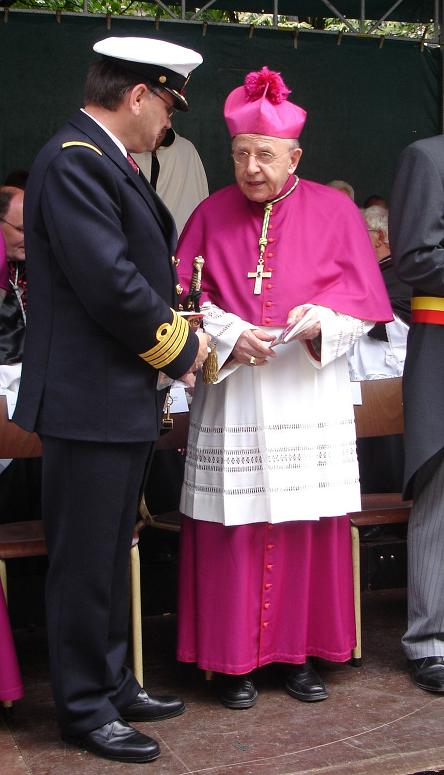
Archbishop Karl-Josef Rauber, former nuncio to Belgium and Luxembourg

An apostolic nuncio (Latin: nuntius apostolicus; also known as a papal nuncio or simply as a nuncio) is an ecclesiastical diplomat, serving as an envoy or a permanent diplomatic representative of the Holy See to a state or to an international organization. A nuncio is appointed by and represents the Holy See, and is the head of the diplomatic mission, called an apostolic nunciature, which is the equivalent of an embassy. The Holy See is legally distinct from the Vatican City or the Catholic Church. In modern times, a nuncio is usually an Archbishop.

An apostolic nuncio is generally equivalent in rank to that of ambassador extraordinary and plenipotentiary, although in Catholic countries the nuncio often ranks above ambassadors in diplomatic protocol. A nuncio performs the same functions as an ambassador and has the same diplomatic privileges. Under the 1961 Vienna Convention on Diplomatic Relations, to which the Holy See is a party, a nuncio is an ambassador like those from any other country. The Vienna Convention allows the host state to grant seniority of precedence to the nuncio over others of ambassadorial rank accredited to the same country, and may grant the deanship of that country's diplomatic corps to the nuncio regardless of seniority.[1] The representative of the Holy See in some situations is called a Delegate or, in the case of the United Nations, Permanent Observer. In the Holy See hierarchy, these usually rank equally to a nuncio, but they do not have formal diplomatic status, though in some countries they have some diplomatic privileges.

In addition, the nuncio serves as the liaison between the Holy See and the Church in that particular nation, supervising the diocesan episcopate (usually a national or multinational conference of bishops which has its own chairman, elected by its members). The nuncio has an important role in the selection of bishops.

Terminology and history

[edit]

The name "nuncio" derived from the ancient Latin word nuntius, meaning "envoy" or "messenger". Since such envoys are accredited to the Holy See as such and not to the State of Vatican City, the term "nuncio" (versus "ambassador") emphasizes the unique nature of the diplomatic mission.[2] The 1983 Code of Canon Law claims the "innate right" to send and receive delegates independent from interference of non-ecclesiastical civil power. Canon law only recognizes international law limitations on this right.[2]

Article 16 of the Vienna Convention on Diplomatic Relations provides:

  1. Heads of mission shall take precedence in their respective classes in the order of the date and time of taking up their functions in accordance with Article 13.
  2. Alterations in the credentials of a head of mission not involving any change of class shall not affect his precedence.
  3. This article is without prejudice to any practice accepted by the receiving State regarding the precedence of the representative of the Holy See.

In accordance with this article, many states (even not predominantly Catholic ones such as Germany and Switzerland and including the great majority in central and western Europe and in the Americas) give precedence to the nuncio over other diplomatic representatives, according him the position of Dean of the Diplomatic Corps reserved in other countries for the longest-serving resident ambassador.

Multilateral

[edit]

Holy See representatives called permanent observers are accredited to several international organisations, including offices or agencies of the United Nations, and other organizations either specialized in their mission or regional or both. A permanent observer of the Holy See is always a cleric, often a titular archbishop with the rank of nuncio, but there has been considerable variation between offices and over time.[clarification needed]

See also

[edit]

References

[edit]
[edit]
Revisions and contributorsEdit on WikipediaRead on Wikipedia
from Grokipedia
An apostolic nuncio is an ordinary and permanent representative of the pope, accredited to the court of a sovereign and vested with both political and ecclesiastical powers. Typically an archbishop, the nuncio serves as the Holy See's ambassador to governments maintaining diplomatic relations with the Vatican, facilitating communication between the pope and the host nation while promoting ecclesiastical interests. In this dual role, the nuncio reports on the conditions of the Catholic Church in the country, assists in episcopal appointments, and often acts as dean of the diplomatic corps, particularly in nations with Catholic majorities. The institution traces its origins to the early 16th century, with the first stable papal representations established around 1500 to Venice and other European courts, evolving into the modern system of permanent diplomatic missions. Today, apostolic nuncios represent the Holy See in over 180 countries, underscoring the Vatican's unique status as a sovereign entity focused on moral and spiritual diplomacy rather than territorial expansion.

Definition and Terminology

Etymology and Canonical Basis

The term nuncio originates from the Latin nūntius (or nuntius), denoting a "messenger" or "envoy," a root that underscores the role's function as a bearer of papal communications. This etymology entered Romance languages via Medieval Latin and Italian nunzio, with the earliest recorded English usage appearing around 1512 in diplomatic correspondence. In ecclesiastical context, "apostolic nuncio" specifically qualifies the envoy as representing the apostolic see of Rome, emphasizing the Pope's authority as successor to Saint Peter. The canonical basis for the nuncio resides in the Roman Pontiff's inherent right to appoint legates, explicitly articulated in Canon 362 of the 1983 Code of Canon Law: "An apostolic legate is either a nuncio, a pro-nuncio, an apostolic delegate, or other official entrusted with a pontifical mission; the Roman Pontiff has the innate and independent right to appoint, send, transfer, and recall such legates according to the needs of the Church." This provision formalizes a longstanding tradition of papal representation, traceable to early Church practices of dispatching envoys for governance and diplomacy, though the permanent nunciature as a distinct institution emerged in the 16th century under popes like Alexander VI. The scriptural foundation lies in the Church's evangelistic mandate (e.g., Matthew 28:18-20) and the Petrine primacy (Matthew 16:18-19), enabling the Pope to extend jurisdiction through accredited agents amid temporal powers.

Distinction from Other Papal Representatives

The apostolic nuncio holds the highest rank among permanent papal diplomatic representatives to sovereign states, functioning as the Holy See's ambassador extraordinary and plenipotentiary with full accreditation to the head of state or government. This status grants the nuncio diplomatic privileges and immunities under international law, including participation in the local diplomatic corps, where the nuncio often serves as dean by right of precedence in Catholic or traditionally Catholic nations. In distinction, the apostolic delegate operates without formal diplomatic recognition from the host state, typically in countries lacking full diplomatic ties with the Holy See, such as those with restrictive policies toward the Catholic Church. The delegate's mandate centers on internal ecclesiastical affairs, including oversight of the local episcopate, pastoral coordination, and reporting to the Holy See on Church matters, rather than engaging in bilateral state diplomacy or representing the Holy See to civil authorities. A pro-nuncio exercises functions analogous to those of a nuncio, including both diplomatic and ecclesial responsibilities, but in jurisdictions where the receiving state does not accord the See's representative precedence as dean of the . This reflects protocol variations rather than substantive differences in or duties. The apostolic internuncio, a rank now rarely employed, denotes a papal envoy with the diplomatic standing of a minister plenipotentiary, accredited to governments but ranked below a nuncio or pro-nuncio in precedence and typically assigned to secondary postings. Unlike nuncios, who are invariably titular archbishops, internuncios may hold lower episcopal status, underscoring the hierarchy's alignment with diplomatic gradations.

Historical Development

Medieval Origins and Early Practices

The practice of dispatching papal representatives, which evolved into the office of apostolic nuncio, originated with legates in the early Church and formalized during the medieval period as a means to extend Rome's spiritual and temporal authority amid fragmented Christendom. The earliest documented legate appeared in 314 at the Synod of Arles, representing Pope Silvester I (314–335) in combating the Donatist schism and consolidating doctrinal unity post-Edict of Milan (313). By the late 4th century, Pope Damasus I (366–384) appointed apostolic vicars, such as Acolius of Thessalonica for Illyria Orientalis, to oversee vast regions and enforce papal directives. In the 5th century, permanent apocrisiarii emerged under Pope Leo I (440–461) at the Byzantine court, serving as ongoing liaisons during theological and political tensions; this role included future Pope Gregory the Great (579–585), who managed relations until the office's suspension in 743 amid Iconoclasm. Legati a latere—typically cardinals with plenary powers—became prominent by the 5th century for high-stakes missions, such as adjudicating disputes or negotiating with secular rulers, with their authority codified in Gratian's Decretum (mid-12th century) distinguishing them from temporary legati missi and local nati. These envoys bridged ecclesiastical governance and emerging diplomacy, inspecting orders, granting indults, and intervening in royal successions, as seen in 11th-century legations under Gregory VII to enforce reforms like lay investiture bans. The term nuncio (from Latin nuntius, "messenger") applied to legati missi by the 13th century, denoting envoys for targeted tasks like tax collection or doctrinal enforcement, though retaining temporary status unlike later permanent postings. Early practices centered on symbolic embodiment of papal plenitude, with legates arriving via ritual adventus processions, donning apostolic regalia (e.g., mitres, red shoes under Innocent IV), and wielding faculties for excommunications or graces, as in Hugh of Die's extended legation (1073–1106) confirming disciplinary acts across France. Ceremonies adapted to local norms—more elaborate in urban centers—to project authority, fostering causal links between papal prestige and regional compliance without full diplomatic reciprocity, which awaited Renaissance developments.

Reformation to Enlightenment Era

The Protestant Reformation prompted the Holy See to institutionalize permanent diplomatic representations abroad, evolving nuncios from temporary legates into fixed envoys to Catholic courts for countering heresy and coordinating defenses. Influenced by secular states' adoption of resident ambassadors, Pope Julius II dispatched Lorenzo Campeggio as the first nuncio to the Holy Roman Empire in 1511, a post ratified by Pope Leo X in 1513 and made permanent from 1530 amid escalating religious divisions. Similarly, early nunciatures were established in France starting with Leone Ludovico di Canossa in 1514 and in Spain from 1506 to 1519 under Giovanni Ruffo dei Teodoli, enabling sustained papal influence over monarchs like Francis I and Charles V. During the Counter-Reformation, nuncios served as primary agents for enforcing the Council of Trent's decrees (1545–1563), investigating local clergy, promoting seminaries, and gathering intelligence on Protestant activities. Pope Paul III formalized their role by centralizing political correspondence under Cardinal Alessandro Farnese in 1537 and dispatching nuncios to oversee reform implementation, such as in Germany where they supported Catholic alliances against the Schmalkaldic League. Post-Trent expansion included new permanent nunciatures in Poland, Portugal, and Italian states like Piedmont, Milan, Tuscany, and Naples by the late 1560s, with southern German sees like Salzburg receiving one in 1573; these envoys negotiated concordats, suppressed heterodoxy, and liaised with Jesuit missions to reclaim territories. By the 17th century, nuncios balanced diplomatic negotiation with ecclesiastical oversight, treating with sovereigns on alliances like the Catholic League during the Thirty Years' War while asserting papal primacy against Gallicanism in France and similar autonomy movements. Their dual mandate—political advocacy for Catholic interests and spiritual reporting—faced resistance in absolutist courts, yet they maintained precedence in diplomatic corps, underscoring the Holy See's status as a sovereign entity. In Venice, Angelo Leonini acted as nuncio from 1500 under Pope Alexander VI, exemplifying early adaptation to republican governance. Entering the Enlightenment , nuncios confronted secularizing trends and state encroachments on Church , including Febronianist doctrines in the that curtailed their appellate over bishops. The 1785 establishment of a nunciature by provoked disputes with German archbishops over overlapping powers, resolved only by a 1789 papal brief affirming nuncio faculties; this reflected tensions with , as rulers like II of suppressed monasteries and papal interventions. The (1789) expelled the nuncio from , terminating the historic French nunciature, while Poland's partitions (1772–1795) dissolved its post, highlighting vulnerabilities to revolutionary and territorial upheavals amid declining confessional politics.

19th and 20th Century Evolution

In the early 19th century, following the Napoleonic Wars, the Congress of Vienna in 1815 formalized the diplomatic precedence of apostolic nuncios through its Regulation concerning the Precedence of Diplomatic Agents, granting them the position of dean of the diplomatic corps in signatory states, a status rooted in the papacy's historical role as a supranational moral authority. This arrangement affirmed the nuncio's seniority over other ambassadors of equal rank, reflecting a restoration of pre-revolutionary norms amid efforts to stabilize Europe under conservative monarchies allied with the Holy See. Nunciatures thus served as key channels for negotiating concordats and safeguarding Catholic interests against liberal secularization, as seen in diplomatic engagements during the Kulturkampf in Germany, where nuncios reported on anti-clerical policies under Bismarck from the 1870s onward. The capture of Rome and dissolution of the Papal States in 1870 marked a pivotal shift, stripping the Holy See of temporal sovereignty and confining Pope Pius IX to the Vatican as a self-proclaimed "prisoner," yet nuncios adapted by emphasizing ecclesiastical oversight and moral influence over political leverage. Diplomatic continuity persisted, with the number of foreign missions accredited to the Holy See rising from 16 in 1870 to 27 by 1929, underscoring the papacy's enduring international relevance despite territorial loss. In non-European contexts, such as the United States, the Holy See established an apostolic delegation in 1893 under Archbishop Francesco Satolli to facilitate communication with the growing Catholic population, bypassing full nunciature status due to the republic's non-adherence to Vienna protocols. The 20th century saw nunciatures evolve toward global outreach and humanitarian mediation, exemplified by Eugenio Pacelli's tenure as nuncio to and (), where he negotiated prisoner exchanges during and reported on rising totalitarianism. The of , , between the and resolved the by creating State, affirming the 's sovereignty and enabling nuncios to operate with unambiguous international legal standing as equivalents to ambassadors. This treaty enhanced the nuncio's dual role in promoting concordats—such as those with in under Pacelli, now —and fostering Catholic unity amid interwar instability, while the network expanded to address emerging nations post-. By mid-century, nuncios increasingly prioritized reporting on ideological threats like communism, reflecting a diplomacy grounded in spiritual authority rather than territorial power.

Post-Vatican II Reforms and Modern Adaptations

The Second Vatican Council (1962–1965) prompted adaptations in the apostolic nunciature system to align with its emphasis on the Church's engagement with the modern world, as articulated in documents such as Gaudium et Spes and Unitatis Redintegratio, which called for dialogue with civil society, ecumenism, and collegiality among bishops. Nuncios, as papal representatives, were tasked with facilitating the implementation of these principles locally, including reporting on episcopal conferences' adherence to conciliar reforms and promoting interreligious dialogue, thereby shifting their functions from primarily political brokerage to pastoral oversight in diverse cultural contexts. Pope Paul VI's apostolic constitution Regimini Ecclesiae Universae (15 August 1967) reorganized the Roman Curia, centralizing diplomatic coordination under the Secretariat of State and clarifying nuncios' duties in gathering information for the Holy See while maintaining their independence from local hierarchies. This reform addressed post-conciliar needs for streamlined communication amid decolonization, which saw the establishment of over 50 new nunciatures in Africa and Asia between 1965 and 1980 to serve emerging nations. The 1983 Code of Canon Law, promulgated by John Paul II on 25 January 1983, codified papal legates' roles in canons 362–367, affirming the Roman Pontiff's prerogative to appoint nuncios as permanent observers or ambassadors, with mandates to represent the Holy See, consult local bishops, and ensure doctrinal unity without interfering in internal diocesan governance. These provisions reflected Vatican II's ecclesiology by prioritizing nuncios' service to universal communion over territorial jurisdiction. John Paul II's apostolic constitution Pastor Bonus (28 June 1988) further delineated the Secretariat of State's Section for Relations with States, enhancing nuncios' involvement in multilateral negotiations on and , as evidenced by their roles in observer status at the since 1964 and subsequent accords like the 1993 Fundamental Agreement with . In contemporary adaptations, nuncios have incorporated digital tools for reporting and crisis response, while Francis's chirograph of 15 April 2025 reformed the —training ground for future nuncios—into a degree-granting emphasizing spiritual formation and over mere administrative skills. This underscores an ongoing of evangelization amid , with nuncios often serving as deans of in 70% of host due to protocol dating to 1961 conventions.

Appointment and Qualifications

Selection by the Holy See

The selection of apostolic nuncios is a prerogative of the Roman Pontiff, who holds the inherent right to appoint legates, including nuncios, to represent the Holy See in particular churches or states, in accordance with international law norms. This appointment process is not detailed in canon law but operates through the internal mechanisms of the Holy See's diplomatic service, primarily under the guidance of the Secretariat of State. Candidates are typically drawn from priests who have demonstrated exceptional qualifications in theology, canon law, languages, and interpersonal skills, often after nomination by their diocesan bishops for specialized training. Prospective nuncios undergo formation at the Pontifical Ecclesiastical Academy (now elevated to the Pontifical Institute of Ecclesiastical Diplomacy), established in 1701 and reformed by Pope Francis in April 2025 to align with international academic standards, granting degrees in diplomatic sciences. Priests selected for the academy—usually in their late 20s or early 30s—complete a rigorous multi-year program emphasizing canon law, theology, modern languages (at least three, including English, French, and often Spanish or Arabic), history, and diplomatic protocol, while residing in community to foster spiritual discipline. Upon graduation, they enter the Holy See's diplomatic corps, serving initially as attachés or secretaries in nunciatures worldwide or in the Secretariat of State, accumulating 10–20 years of experience in roles such as counselor or chargé d'affaires before consideration for nuncio positions. The final selection involves confidential by the Secretariat of State, which proposes ternas ( of three candidates) to the based on , linguistic proficiency, cultural adaptability, and alignment with papal priorities, such as or geopolitical acumen. Appointees are almost invariably ordained as titular archbishops prior to or concurrent with their posting, ensuring episcopal status for both diplomatic precedence and . While traditionally dominated by , recent appointments under Popes John Paul II, Benedict XVI, and Francis have diversified nationalities to reflect global Church demographics, with over 100 nuncios serving as of across 180+ diplomatic missions. The process prioritizes to the See's mission over national origins, though critics note occasional influences from curial or ideological alignments in .

Required Background and Training

Apostolic nuncios are invariably selected from among ordained Catholic priests who have demonstrated aptitude for diplomacy within the Holy See's service. Candidates typically possess advanced degrees in theology, canon law, or related fields, often obtained from pontifical universities, prior to entering specialized training. This background ensures familiarity with ecclesiastical governance and doctrine, essential for representing the Holy See's interests abroad. Practical prerequisites include several years of service in Vatican dicasteries or nunciatures, where individuals progress from roles such as secretaries or counselors, honing skills in negotiation and cultural adaptation. The of nuncio preparation is the in , established in 1701 by to form for the See's . This delivers a rigorous, multi-year program emphasizing , , modern languages (typically including French, English, and the host country's tongue), and diplomatic protocol, alongside to align service with priorities. Graduates earn ecclesiastical qualifications, such as a licentiate or in , while engaging in simulations of diplomatic scenarios and studies of global affairs. The academy's curriculum integrates theoretical instruction with mentorship from seasoned diplomats, preparing alumni for postings that build toward nuncio eligibility after 10–20 years of cumulative experience. In April 2025, Pope Francis issued a chirograph reforming the academy to enhance its focus on holistic formation, incorporating greater emphasis on missionary outreach, interreligious dialogue, and ethical diplomacy amid contemporary geopolitical challenges. This update mandates extended spiritual retreats and pastoral evaluations to ensure nuncios embody evangelical witness over mere bureaucratic efficiency. Upon appointment, prospective nuncios—elevated to titular archbishops—are consecrated as bishops, underscoring the blend of sacramental authority and diplomatic mandate, though no formal canonical mandate specifies nuncio training beyond general episcopal suitability under Canon 378.

Tenure and Recall Procedures

Apostolic nuncios are appointed to their posts for an indefinite duration, serving at the discretion of the Supreme Pontiff without a predetermined term limit established in canon law or Vatican diplomatic norms. Their tenure typically concludes through transfer to a different nunciature, acceptance of retirement, or recall by the Holy See, often influenced by factors such as the election of a new pope, evolving bilateral relations, or the nuncio's performance in diplomatic and ecclesiastical duties. Historical examples illustrate variability, with some nuncios serving four to ten years before reassignment, though longer tenures occur when stability in representation is prioritized. As titular archbishops, nuncios are subject to the retirement provisions for bishops under Canon 401 §1 of the 1983 Code of Canon Law, requiring submission of resignation from office upon attaining age 75, with the Pope retaining discretion over acceptance. This norm ensures periodic renewal in Vatican diplomacy, though exceptions exist; for instance, popes may extend service for experienced nuncios in critical postings until a suitable successor is identified or geopolitical conditions shift. Resignations may also be tendered voluntarily due to health, personal reasons, or mutual agreement with the Secretariat of State, but acceptance remains papal prerogative. Recall from a nunciature, distinct from or , proceeds at the initiative of the , typically coordinated through the Section for Diplomatic Relations of the Secretariat of State, without formalized public procedures akin to those for diocesan bishops. Grounds include diplomatic ineffectiveness, to advance interests, or personal , such as sexual impropriety or financial irregularity, evaluated internally via reports from the nuncio's staff, host governments, or apostolic visitations. A prominent case occurred in August 2013, when Archbishop Jozef Wesolowski was abruptly recalled as nuncio to the Dominican Republic following credible accusations of abusing minors, prompting Vatican cooperation with local authorities and his eventual laicization in 2014 after a canonical trial. In less severe instances, recalls facilitate quiet reassignments, as with Archbishop Carlo Maria Viganò's 2016 transfer from Washington, D.C., amid tensions over his public criticisms, underscoring the 's absolute authority under canon law to remove legates ad nutum Sanctae Sedis. For allegations involving abuse of minors or vulnerable adults, post-2019 norms under the motu proprio Vos estis lux mundi mandate reporting and investigation, potentially leading to precautionary suspension and removal from office. Such actions prioritize ecclesiastical accountability while navigating diplomatic immunities, with the occasionally waiving privileges for criminal proceedings in host states lacking extradition treaties.

Core Functions and Responsibilities

Diplomatic Representation and Negotiation

Apostolic nuncios act as the diplomatic envoys of the to sovereign states, heading apostolic nunciatures that operate equivalently to embassies in facilitating bilateral relations. They represent the directly to host governments, conveying official communications, attending state ceremonies, and often serving as dean of the diplomatic corps by virtue of , which entails additional responsibilities such as coordinating collective responses to governmental actions affecting foreign missions. This representational extends to promoting on issues of mutual , including religious and humanitarian concerns, while maintaining the See's independence from national partisan interests. In negotiation, nuncios conduct talks on behalf of the Holy See to establish or amend agreements regulating church-state interactions, such as concordats or modus vivendi arrangements that address practical matters like clerical privileges, church property rights, access to worship sites, religious education, and cooperation in healthcare and social services. These pacts, formalized in over 50 countries as of 2010, typically involve drafting proposals in consultation with local episcopal conferences before securing papal approval and state ratification. Nuncios also mediate in disputes over ecclesiastical jurisdiction or diplomatic protocol, fostering ongoing cooperation without compromising the Holy See's moral positions on issues like peace and justice. For instance, they negotiate protocols for papal visits or visa exemptions for clergy, ensuring operational continuity for Catholic activities amid varying political contexts. The emphasizes and , with nuncios leveraging personal with state officials to advance agreements that safeguard Catholic institutional while respecting host . In cases of tension, such as during regime changes or conflicts, they prioritize through discreet channels, aligning with the See's broader commitment to Gospel-inspired that seeks over . This dual representational and negotiatory mandate positions nuncios as pivotal in sustaining the See's global diplomatic across more than 100 missions.

Ecclesiastical Oversight and Reporting

Apostolic nuncios exercise oversight by serving as the primary liaison between the and the local in their of , ensuring fidelity to papal and . This involves monitoring the of Vatican directives, assessing the spiritual and administrative of dioceses, and fostering unity amid local challenges such as declining vocations or doctrinal disputes. Nuncios conduct periodic visits to dioceses, consult with bishops on matters, and address issues like liturgical abuses or catechetical shortcomings to maintain . Central to their oversight is of detailed reports transmitted to the Vatican's Secretariat of State, which detail the state of the Church, including on sacraments administered, seminary enrollments, and lay involvement in evangelization. These reports, often compiled annually or in response to specific , the Pope's decisions on and ; for instance, they highlight regions needing apostolic visitations or financial from . In handling matters, such as credible allegations of clerical , nuncios initiate preliminary assessments and forward findings to the for the of the or other relevant bodies, ensuring ecclesiastical response. A key responsibility within oversight is facilitating of bishops, a governed by norms outlined in the Pastor Bonus and subsequent updates. Upon a see becoming vacant, the nuncio consults the metropolitan and suffragan bishops, soliciting a terna—a list of three candidates—while gathering confidential evaluations from clergy, laity, and civil authorities on candidates' orthodoxy, governance skills, and personal integrity. The nuncio then conducts further inquiries, including background checks for any canonical impediments, before submitting the vetted terna with a personal recommendation to the Dicastery for Bishops, which reviews it under pontifical secrecy before papal approval. This mechanism allows the Holy See to appoint shepherds aligned with universal Church priorities, as evidenced in the 2023 appointment of over 100 bishops worldwide where nuncios' inputs shaped final choices.

Promotion of Catholic Interests

Apostolic nuncios promote Catholic interests by negotiating concordats and bilateral agreements that safeguard the Church's legal status, property rights, and freedoms in host countries. These pacts often include clauses ensuring Catholic religious instruction in public schools, recognition of Church marriages, and autonomy for ecclesiastical institutions, as exemplified in the 1984 revision of the Italian concordat which guaranteed the right to Catholic teaching in state education systems. In Romania, the apostolic nuncio in Bucharest advocated for a 1927-1929 concordat process that supported Church privileges amid interwar negotiations. They advocate for religious freedom by engaging civil authorities to counter persecution, defend human dignity, and oppose policies conflicting with Church doctrine on life, family, and conscience rights. In addresses to diplomats, Pope Francis has emphasized that nuncios must prioritize promoting religious freedom alongside justice and peace, working to heal societal divisions. For instance, in the United States, nuncios have highlighted threats to religious liberty from mandates requiring Catholic entities to fund procedures against Church teaching, such as contraception, arguing that internal Catholic discord weakens broader advocacy efforts. Nuncios support Catholic education and institutions by ensuring doctrinal fidelity and resisting secular encroachments, as when they stress that school orientations must derive from Christ and the Church rather than external influences like funding pressures. They also foster vocations, lay apostolates, and liturgical practices aligned with Vatican norms, intervening in local issues like commercialization of sacraments to preserve , as noted in Nigerian contexts in 2025. In crisis situations, such as state restrictions on clergy, nuncios mediate for releases and , strengthening Church resilience while respecting episcopal authority.

Multilateral and International Engagement

Nuncios to Supranational Bodies

The Apostolic Nunciature to the , based in , serves as the 's principal diplomatic mission to this supranational , facilitating on policies impacting Catholic teachings and global issues. Diplomatic relations between the and the —predecessor to the —were established in 1970 under , with the appointment of an apostolic nuncio to represent Vatican interests amid the bloc's emerging integration. This mission addresses supranational governance structures where sovereignty is pooled among member states, distinguishing it from bilateral nunciatures by focusing on collective decision-making in areas like migration, , and religious . Archbishop Bernardito Auza, appointed apostolic nuncio to the EU on March 22, 2025, by , currently heads the nunciature, succeeding figures like Aldo Giordano, who held the post until his in 2023. Auza, a Filipino with prior as nuncio to , emphasizes priorities such as transmitting within families, fostering amid conflicts, and engaging EU on spiritual matters, reflecting the Holy See's aim to influence supranational agendas without formal membership. The nuncio participates in consultations with EU institutions, advocating for positions aligned with Catholic social doctrine, including critiques of policies perceived as undermining human dignity or traditional values. Beyond the EU, the Holy See employs similar representations to other regional bodies with supranational elements, such as the Apostolic Representative to the in , though these are typically not styled as full nunciatures and focus on observer roles in continental forums. These positions enable the Holy See to monitor and intervene in multilateral decisions affecting Catholic communities, prioritizing ethical considerations like alleviation and over geopolitical alignments. The nuncios' work underscores the Vatican's of moral diplomacy in supranational arenas, where empirical assessments of policy impacts—such as demographic declines in linked to low birth rates—inform rather than ideological .

Role in Global Conferences and Observerships

Apostolic Nuncios appointed as Permanent Observers to international organizations represent the in capacities that include active participation in global conferences and assemblies, leveraging the entity's to advocate for principles rooted in , such as , , and development. The obtained permanent at the on April 6, 1964, enabling its delegates—frequently titled Apostolic Nuncios—to address sessions without voting rights, focusing instead on moral and ethical interventions. This extends to specialized UN agencies and other bodies like the and the , where Nuncios coordinate with Vatican dicasteries to align positions on issues ranging from to . In practice, these Nuncios head delegations to high-level summits and thematic discussions, delivering statements that critique secular ideologies while promoting and the . For instance, Gabriele Giordano , appointed Permanent Observer to the UN in New York on November 16, 2019, addressed the General Assembly's thematic discussion on autonomous weapons systems on October 24, 2025, emphasizing that "machines cannot make decisions over life and death" and supporting negotiations for a legally binding instrument on lethal autonomous weapons. Similarly, on October 14, 2025, Caccia highlighted the "ecological " owed to developing nations in a statement on sustainable development, underscoring the Holy See's commitment to integral human ecology over purely technocratic solutions. Beyond the UN, Nuncios lead delegations to global conferences on , migration, and . Piero Pioppo, then Apostolic Nuncio to , headed the delegation to the of the Peoples Forum on Interreligious and Intercultural and for and Development in on October 30, 2018, where he stressed the need for grounded in transcendent values amid rising . Historical precedents include Celestino Migliore, as Permanent Observer, speaking at the UN Economic and Social on July 1, 2005, on eradication and ethical . These engagements allow Nuncios to influence outcomes indirectly, often forging coalitions with like-minded states while resisting provisions conflicting with Church doctrine, such as those promoting abortion or gender ideology in human rights frameworks. Such participation underscores the 's strategy of "diplomacy of conscience," prioritizing truth over consensus.

Notable Examples and Case Studies

Influential Historical Nuncios

Eugenio Pacelli served as apostolic nuncio to Bavaria from 1917 and extended his to the Weimar Republic in 1920, becoming the first permanent papal representative to unified . During his tenure until 1929, he negotiated concordats with Bavarian states to protect Catholic amid post-World War I and anti-clerical sentiments, fostering diplomatic relations that stabilized Church-State interactions in a Protestant-majority . His efforts emphasized legal safeguards for ecclesiastical , influencing subsequent Vatican agreements like the 1933 , though critics later debated the long-term implications for Catholic resistance under Nazi rule. Giovanni Battista Rinuccini, of , was appointed papal nuncio to in 1645 by to Confederate Catholics against English Protestant forces during of . He arrived with substantial funds—estimated at 50,000 crowns—and supplies, including 20,000 arms, to unify disparate Irish factions under papal directives rejecting with royalists or parliamentarians. Rinuccini's involved excommunicating moderate Confederates who signed the 1646 Cessation with the of Ormond, aiming to preserve Catholic ; his mission ultimately failed to internal divisions, leading to his departure in 1649 amid English reconquest, but it highlighted the nuncio's in transnational Catholic . Flavio Chigi held the position of apostolic nuncio to France from 1868 to 1871, navigating the Franco-Prussian War and the fall of the Second Empire under Napoleon III. As a key Vatican intermediary, he managed relations with French authorities amid the loss of the Papal States in 1870, conveying papal concerns over Italian unification's threats to temporal power while reporting on Gallican tensions within the French Church. His tenure involved delicate negotiations with Prussian Chancellor Otto von Bismarck during the Siege of Paris, positioning the Holy See as a neutral actor seeking to mitigate conflict's impact on Catholic institutions, though French government records portrayed him as occasionally contentious due to his defense of ultramontane principles.

Recent Appointments and Developments

In the wake of Leo XIV's on May 8, 2025, several apostolic nuncio appointments have been announced, signaling an stabilization of the See's amid the papal transition. On September 12, 2025, Soviguidi, previously apostolic nuncio to and titular archbishop of Cerenzia, was appointed apostolic nuncio to , reflecting ongoing efforts to address diplomatic needs in where challenges persist. Three days later, on September 15, 2025, Piero Pioppo, who had served as apostolic nuncio to 2017 and to the Association of Southeast Asian Nations () since 2018, was named apostolic nuncio to and the Principality of Andorra, succeeding the prior incumbent in a key European posting amid 's evolving church-state dynamics. These appointments represent Pope Leo XIV's first major diplomatic moves, with two significant postings confirmed by early 2025, though broader reshuffles remain pending. The vacancy in the United States nunciature, held previously by Christophe Pierre since 2016, stands out as a priority, given Leo XIV's American birth and potential implications for with the U.S. on issues like religious and international . Additionally, in June 2025, Pope Leo XIV addressed 14 candidates undergoing a specialized "mission year" training program for future nuncios, emphasizing pastoral fieldwork over bureaucratic roles—a continuity from Pope Francis's reforms aimed at enhancing on-the-ground ecclesiastical oversight. Earlier in 2025, prior to the conclave, appointments included Brian Ngozi Udaigwe's designation as apostolic nuncio to on , underscoring the See's focus on African dioceses amid regional conflicts and migration pressures. These developments highlight a pragmatic approach to filling vacancies while aligning nuncios' roles with the Holy See's dual diplomatic and mandates, without evident shifts in doctrinal orientation as of late 2025.

Controversies and Criticisms

Challenges to Political Neutrality

Apostolic nuncios, as representatives of the , are bound by diplomatic conventions and ecclesiastical norms to uphold political neutrality, focusing on spiritual and humanitarian concerns rather than partisan alignment. However, this is frequently tested in nations with deep political divisions, where nuncios' public engagements or silences are interpreted as endorsements or biases by opposing factions. Critics, including Catholic commentators, argue that the Vatican's emphasis on can appear to equivocate on clear failings, such as or authoritarian repression, thereby undermining perceived . In Venezuela, for instance, the appointment of new nuncios amid contested elections has drawn ; the 2024 meeting between the newly appointed nuncio and President was criticized as premature legitimization of a accused of abuses and electoral irregularities, despite the Vatican's stated policy of engaging all parties for . Opposition voices and analysts contended this reflected a of "both-sides-ism," where Vatican envoys prioritize access over condemnation of documented , as seen in the July 2024 presidential vote marred by irregularities reported by international observers. Similarly, in , the 2022 expulsion of the apostolic nuncio by the Ortega government was framed by the as a response to alleged interference, though independent reports highlighted it as retaliation for the Church's defense of detained clergy and civil liberties, straining Holy See relations without the nuncio taking explicit partisan stances. Historical precedents further illustrate these tensions; during the 1989 Panama crisis, the apostolic nuncio actively urged General Manuel Noriega to surrender amid U.S. intervention, prompting Vatican protests against the invasion while navigating accusations of meddling from both the Panamanian dictator and American officials. Such interventions, intended as mediation, risk perceptions of partiality, particularly when nuncios advocate for Catholic bishops' rights or humanitarian access in conflict zones. These episodes underscore a causal dynamic: while nuncios' moral advocacy stems from doctrinal imperatives, it collides with host governments' expectations of strict non-interference, leading to diplomatic expulsions or public rebukes that question the feasibility of absolute neutrality in politically charged environments.

Accusations of Regime Legitimization

Critics have accused apostolic nuncios of legitimizing authoritarian or disputed s through routine diplomatic engagements, such as presenting credentials or maintaining formal relations, arguing that such actions implicitly endorse the ruling government's despite documented abuses or electoral irregularities. These accusations often stem from conservative Catholic commentators and opposition figures who contend that the Holy See's diplomatic presence prioritizes pastoral access over condemnation, potentially emboldening repressive leaders. A prominent recent case occurred in Venezuela, where Archbishop Alberto Ortega Martín, appointed apostolic nuncio in May 2024, presented his letters of credence to President on , 2024—mere days after national elections marred by allegations of and lack of transparency, as documented by international observers including a panel. Critics, including Venezuelan opposition and Catholic analysts, charged that the effectively validated Maduro's claim to power amid widespread protests and the Venezuelan bishops' conference's prior assertions of governmental illegitimacy. The timing drew particular scrutiny, as the Holy See had remained relatively silent on post-election repression, contrasting with its historical mediation efforts in the country. Historically, similar criticisms arose during engagements with Fidel Castro's regime in . In 1967, the apostolic nuncio, Cesare Zacchi, warmly received Castro and publicly advised Western nations to lift , a stance interpreted by detractors as softening opposition to the communist government's suppression of religious freedoms and seizures following the 1959 . Zacchi, who served from 1961 to 1975, facilitated partial accommodations between the Church and the state, including the resumption of diplomatic ties in the 1970s, which critics argued granted undue legitimacy to a that had expelled and curtailed Catholic activities. Such actions were seen by traditionalist observers as part of a broader Vatican policy of dialogue that risked compromising ecclesiastical independence for limited concessions. These accusations highlight tensions between the nuncio's in Catholic communities—often requiring pragmatic —and demands for unequivocal of host regimes. Proponents of the engagements counter that severing ties could isolate believers further, but critics maintain that ceremonial recognition, even if protocol-driven, signals in the eyes of oppressed populations and international actors.

Internal Vatican and Doctrinal Tensions

, who served as apostolic nuncio to the from to , exemplifies tensions arising when a high-ranking Vatican publicly challenges post-conciliar doctrinal developments and papal . Following his diplomatic posting, Viganò issued statements rejecting the Second Vatican as the origin of an "ideological " that the Church and introduced a parallel "false church," while denying the legitimacy of Pope Francis's pontificate. These views positioned him in opposition to the Vatican's official affirmation of the 's continuity with tradition and the binding nature of subsequent magisterial teachings. In response, the for the of the initiated an extrajudicial penal against Viganò in 2024, charging him with for refusing communion with the successor of Peter and those submitting to him. Viganò rejected the tribunal's , asserting it represented a "conciliar church" detached from authentic Catholicism. On , 2024, the declared him guilty of and imposed latae sententiae, emphasizing his separation from the hierarchical unity. This canonical action highlighted the Vatican's enforcement of doctrinal unity against dissent from figures with diplomatic experience, who argue that pragmatic adaptations in liturgy, ecumenism, and pastoral practice erode foundational teachings on and morals. Nuncios' involvement in episcopal nominations further amplifies such frictions, as their recommendations influence of bishops tasked with upholding and interpreting locally. Traditionalist observers have criticized appointments under —facilitated by nuncios—for favoring candidates perceived as accommodating modernist influences over strict adherence to pre-conciliar norms, potentially widening rifts between the Secretariat of State and doctrinally conservative sectors. Conversely, progressive elements within the Vatican have faulted nuncios aligned with traditionalist leanings, such as the 2015 appointment to , for hindering synodal processes aimed at doctrinal development through . These dynamics reveal underlying causal strains: diplomatic imperatives for institutional stability often with demands for unyielding to immutable truths, as nuncios bridge external relations and internal .

Achievements and Broader Impact

Successes in Conflict Mediation and Humanitarian Efforts

Apostolic nuncios, as the Holy See's chief diplomats, have facilitated conflict mediation by leveraging the Vatican's perceived neutrality to broker dialogues and de-escalate tensions in various hotspots. In the Beagle Channel dispute (1978–1984), the Holy See's intervention, channeled through its diplomatic apparatus including nuncios in Argentina and Chile, helped resolve territorial claims over islands in the southern Atlantic, leading to the signing of the Treaty of Peace and Friendship on 29 November 1984, which averted war and established permanent boundaries. Similarly, in Mozambique's civil war, Vatican diplomacy, supported by nuncios, contributed to the 1992 Rome General Peace Accords by engaging rebel groups and government representatives, enabling a transition to multiparty democracy and reducing violence that had claimed over one million lives since 1977. In humanitarian efforts, nuncios have coordinated relief operations in protracted crises, often bridging local churches with international aid networks. During Syria's civil war, Apostolic Nuncio Cardinal Mario Zenari oversaw the synchronization of over 50 Catholic agencies delivering aid to address war-induced poverty, displacement affecting 13 million people by 2021, and compounded challenges from the COVID-19 pandemic, emphasizing charity as a tool for physical, economic, and social reconstruction. In South Sudan, where conflict since 2013 has displaced over four million and caused famine, outgoing Apostolic Nuncio Archbishop Hugo Nicolás Martínez praised for his role in fostering intercommunal understanding and distributing essentials like food and medical supplies, bolstering local resilience amid ongoing instability. Nuncios have also advanced humanitarian access in Asia's conflict zones. In Myanmar, following the 2021 military coup and ensuing violence that displaced over one million, the Apostolic Nuncio facilitated Church-led assistance to internally displaced persons, including shelter, nutrition, and psychosocial support, in coordination with local dioceses serving ethnic minorities and Rohingya refugees. In Sudan, amid the 2023–present civil war between the Sudanese Armed Forces and Rapid Support Forces, which has killed tens of thousands and displaced nine million, the nuncio's 2025 visit conveyed papal solidarity to Christian communities, enabling the delivery of emergency aid and advocacy for humanitarian corridors despite access restrictions. These efforts underscore nuncios' operational focus on impartial aid distribution, often yielding measurable outcomes like sustained relief pipelines in environments hostile to neutral actors.

Long-Term Influence on International Relations

The establishment of permanent apostolic nunciatures beginning with in marked a pivotal development in the Holy See's diplomatic apparatus, enabling sustained engagement with European monarchies during the and eras. Nuncios served as conduits for papal influence, negotiating concordats, gathering intelligence on confessional loyalties, and advising on alliances that preserved Catholic interests amid religious wars and state consolidations. This network, one of the oldest in continuous operation, allowed the papacy to project beyond , shaping outcomes such as the in 1604 through Venetian nuncio interventions and facilitating Habsburg-papal coordination against Protestant expansion. By embedding ecclesiastical representatives within secular courts, nuncios embedded moral and doctrinal considerations into interstate bargaining, fostering a hybrid diplomacy that prioritized long-term ecclesiastical survival over short-term territorial gains. In the 20th century, apostolic nuncios adapted to global upheavals, maintaining the See's non-aligned stance during and the while providing critical and channels. Eugenio Pacelli, as nuncio to from to , negotiated the , which secured Catholic institutional protections amid rising and informed Vatican assessments of Nazi policies. During the , nuncios in countries relayed reports on communist persecutions, supporting underground networks that bolstered resistance and contributed to the of Soviet influence, as evidenced by their in facilitating John Paul II's 1979 visit, which galvanized and accelerated regime collapses by 1989. This pragmatic realism—engaging adversaries to protect religious freedoms—extended to , where nuncios since the mediated church-state tensions post-independence, influencing transitions from rule to stable concordats in nations like Argentina and Brazil. Over centuries, the nunciature has entrenched the See's in , consistent for principles that transcend ideological divides and informing global norms on issues like religious and . With diplomatic ties to over 180 states as of , nuncios—often holding precedence as deans of —facilitate bilateral treaties and observer roles in bodies like the , amplifying Vatican input on humanitarian crises without leverage. This enduring framework has yielded causal effects, such as de-escalating ethnic conflicts through and sustaining Catholic institutional resilience, thereby countering secularization trends and preserving a to state-centric power dynamics in multipolar geopolitics.

References

Add your contribution
Related Hubs
Contribute something
User Avatar
No comments yet.