


Community hub
Recent from talks
Contribute something
Nothing was collected or created yet.
Peekskill, New York
View on Wikipedia
Peekskill is a city in northwestern Westchester County, New York, United States, 35 miles (56 km) north of New York City. Established as a village in 1816, it was incorporated as a city in 1940. It lies on a bay along the east side of the Hudson River, across from Jones Point in Rockland County. The population was 25,431 at the 2020 U.S. census, up from 23,583 at the 2010 census. It is the third-largest municipality in northern Westchester County, after Cortlandt and Yorktown.
Key Information


The area was an early American industrial center, primarily for iron plow and stove products. The Binney & Smith Company, now named Crayola LLC and makers of Crayola products, is linked to the Peekskill Chemical Company founded by Joseph Binney at Annsville in 1864, and succeeded by a partnership by his son Edwin and nephew Harold Smith in 1885.
The well-publicized Peekskill Riots of 1949 involved attacks and a lynching-in-effigy occasioned by Paul Robeson's benefit concerts for the Civil Rights Congress, although the main assault following the September concert properly took place in nearby Van Cortlandtville. The mayor at the time was John N. Schnieder, a Democrat. Nevertheless, the city of Peekskill has since had multiple African American mayors since 1984.[2][3][4][5]
History
[edit]Pre-Revolution
[edit]In September 1609, English explorer Henry Hudson, captain of the Half Moon, anchored along the reach of the Hudson River at Peekskill. His first mate noted in the ship's log that it was a "very pleasant place to build a town".[6] After the establishment of the province of New Netherland, New Amsterdam resident Jan Peeck made the first recorded contact with the Lenape people of this area, then identified as "Sachoes".[citation needed] The date is not certain (possibly early 1640s), but agreements and merchant transactions took place, formalized in the Ryck's Patent Deed of April 21, 1685.

Peekskill derives from a combination of Peeck's surname and the Dutch word for stream, kil or kill.
Indian Village of Sachoes
[edit]Not much is currently known about the village of the Sachoes or their origin. It was suggested by city historian Charles Arthur Clark that the grove of tall pine trees that the Sachoes lived amongst were "not a native of this region, so it is believed that Indians must have brought them from somewhere, and planted them. The same may be believed about the cluster of weeping willow trees indicated."[7]
The last known Sachem (chief) of the Sachoes at the time of the signing of Ryck's Patent was named Sirham.[8] After trading with Jan Peeck for a considerable amount of the time, the Sachoes began calling the creek where he set up his trading post as "John Peek's Creek" and is likely how the city's name came to be.[9]
Some early writings regarding the Natives and Peekskill refer to the last Sachem as "Saham." Other names quoted as the locality now known as Peekskill were Sachus, Sackhoes and Sackock. They are equivalents and refer to the outlet of Magregere's Brook and have the same meaning - "at the mouth or outlet of a creek or river." Their territory extended from this brook to Dickey Brook which runs through Depew Park and Blue Mountain Reservation. Sachus is regarded as the first Sachem of Sachoes. This name can be translated "black kettle".[10] After the signing of the patent, portions of then Van Cortlandt Manor, north of Magregories brook remained in its wilderness state and the natives roamed the entire section until approximately 1742.[11][12]
Appearance in World's End
[edit]The Sachoe tribe play a prominent role in World's End, a novel by T. C. Boyle which takes place in a fictitious version of Peekskill named Peterskill.[citation needed]
Fort Independence
[edit]

On the north bank of Annsville Creek as it empties into the Hudson, Fort Independence combined with Forts Montgomery and Clinton to defend the Hudson River Valley. Fort Independence was built in August 1776, while Forts Montgomery and Clinton were started in June.[13]: 18 Fort Hill Park, the site of Camp Peekskill, contained five barracks and two redoubts.[14][15]
Settlement was slow in the early 18th century. By the time of the American Revolution, the tiny community was an important manufacturing center, which made it attractive to the Continental Army, which established an outpost here in 1776.[citation needed] Several creeks and streams powered mills, which provided gunpowder, leather, planks, and flour. Slaughterhouses provided fresh meat, easily shipped from docks along the river. Much was needed to support several other forts and garrisons located to support the Hudson River Chains between Bear Mountain Bridge and Anthony's Nose during the Revolution to prevent British naval passage upriver.
Though Peekskill's terrain and mills were beneficial to the Patriot cause, they also made tempting targets for British raids. The most damaging attack took place in early spring of 1777, when an invasion force of a dozen vessels led by a warship and supported by infantry overwhelmed the American defenders. On leaving New Windsor in June 1781, Washington briefly established his quarters at Peekskill.[16]
Post-Revolution
[edit] | This section needs additional citations for verification. (April 2024) |

Peekskill's first legal incorporation of 1816 was reactivated in 1826 when Village elections took place. The Village was further incorporated within the Town of Cortlandt in 1849 and remained so until separating as a city in 1940.
In 1859, Henry Ward Beecher bought a 36-acre farm at Peekskill. He made many improvements and established a summer home for his family.[17] In 1902, the locally prominent McFadden family bought the property. In 1987, the Beecher-McFadden Estate was added to the National Register of Historic Places.
In August 1949, following reports misquoting Paul Robeson's speech to the World Peace Conference in Paris as saying that African Americans would not fight for the United States in any prospective war against the Soviet Union, a planned benefit concert for the Civil Rights Congress in Peekskill was canceled amid White Nationalist and anti-communist violence. An effigy of Robeson was lynched in the town. The artists planned a second concert in nearby Van Cortlandtville[18] on a farm owned by a Holocaust survivor. (His house was subsequently shot into and brickbats thrown through his windows.) The publicity drew a crowd of around 20,000, and two men with rifles were discovered and removed before any violence during the concert. It was one of the earliest performances of Pete Seeger's "If I Had a Hammer"; Robeson sang surrounded by union guards and volunteers from the audience as protection against snipers. Afterward, area police and state troopers directed exiting traffic down a single road into an ambush where rocks were thrown through car windows (even at cars with small children). Some were overturned and their occupants beaten without police intervention. These Peekskill Riots were subsequently well-publicized in news reports and folk songs and formed a major event in E.L. Doctorow's historical fiction novel The Book of Daniel.
Peekskill was the landing point of a fragment of the Peekskill Meteorite, just before midnight on October 9, 1992. At least 16 people recorded the meteoric trail on film.[19] This was only the fourth meteorite in history for which an exact orbit is known. The rock had a mass of 27.7 pounds (12.6 kg) and punched through the trunk of a Peekskill resident's automobile upon impact.
The Peekskill Evening Star and the Peekskill Highland Democrat were two of the city's daily newspapers through much of the city's history. The Evening Star published under various mastheads from the 19th century on, and as the Evening Star from 1939 until 1985, when the paper folded into what became the nexus of the Journal News, a conglomeration of local papers throughout Westchester County.[20] But the Journal News focused more on statewide and New York City issues, which led to the founding of the Peekskill Herald in 1986.[21] Although numerous prominent citizens came together to try to keep the paper afloat after a series of New York Times articles about the paper's foundering fiscal situation, it folded in 2005, replaced by the Peekskill Daily in 2009.[22][23]
The Centennial Firehouse, built in 1890, was under a U.S. Route 9 bridge. During the bridge's original construction in 1932, part of the roof of the firehouse was removed. As part of a 2008 highway reconstruction project it was to be relocated to a new historic district.[24] The city spent $150,000 in grant money in preparing the building. Unfortunately a mechanical failure during a turn caused the building to collapse.[25]
In 1984, Richard E. Jackson became Peekskill's first African American mayor.[2][3]
Geography
[edit]Peekskill is located at 41°17′N 73°55′W / 41.283°N 73.917°W (41.2889, −73.9200)[26] in northwestern Westchester County.
According to the United States Census Bureau, the city has an area of 5.5 square miles (14 km2), of which 4.3 square miles (11 km2) is land and 1.1 square miles (2.8 km2) (20.99%) is water. The city's eastern border is the Town of Cortlandt and its western border is the Hudson River.[clarification needed]
Demographics
[edit]| Census | Pop. | Note | %± |
|---|---|---|---|
| 1870 | 6,560 | — | |
| 1880 | 6,893 | 5.1% | |
| 1890 | 9,676 | 40.4% | |
| 1900 | 10,358 | 7.0% | |
| 1910 | 15,245 | 47.2% | |
| 1920 | 15,868 | 4.1% | |
| 1930 | 17,125 | 7.9% | |
| 1940 | 17,311 | 1.1% | |
| 1950 | 17,731 | 2.4% | |
| 1960 | 18,737 | 5.7% | |
| 1970 | 19,283 | 2.9% | |
| 1980 | 18,236 | −5.4% | |
| 1990 | 19,536 | 7.1% | |
| 2000 | 22,441 | 14.9% | |
| 2010 | 23,583 | 5.1% | |
| 2020 | 25,431 | 7.8% | |
| U.S. Decennial Census[27] | |||
As of the 2010 United States census, there were 23,583 people living in the city. The racial makeup of the city was 35.8% White, 21.4% Black, 0.2% Native American, 2.9% Asian, <0.1% Pacific Islander, 0.3% from some other race and 2.5% from two or more races. 36.9% were Hispanic or Latino of any race. The American Community Survey in 2020, the city was 13.8% Ecuadorian, 10.4% was Puerto Rican, 4.9% Guatemalan.
As of the census[28] of 2000, there were 22,441 people, 8,696 households, and 5,348 families living in the city. The population density was 5,189.7 inhabitants per square mile (2,003.8/km2). There were 9,053 housing units at an average density of 2,093.6 units per square mile (808.3 units/km2). The racial makeup of the city was 57.12% White, 25.54% African American, 0.42% Native American, 2.38% Asian, 0.06% Pacific Islander, 9.83% from other races, and 4.64% from two or more races. Hispanic or Latino of any race were 21.92% of the population.
There were 8,696 households, out of which 30.5% had children under the age of 18 living with them, 39.7% were married couples living together, 16.3% had a female householder with no husband present, and 38.5% were non-families. 31.3% of all households were made up of individuals, and 10.8% had someone living alone who was 65 years of age or older. The average household size was 2.55 and the average family size was 3.18.
In the city, the population was spread out, with 24.4% under the age of 18, 8.3% from 18 to 24, 34.9% from 25 to 44, 20.9% from 45 to 64, and 11.5% who were 65 years of age or older. The median age was 35 years. For every 100 females, there were 94.2 males. For every 100 females age 18 and over, there were 91.0 males.
The median income for a household in the city was $47,177, and the median income for a family was $52,645. Males had a median income of $38,091 versus $34,757 for females. The per capita income for the city was $22,595. About 10.3% of families and 13.7% of the population were below the poverty line.

Arts and culture
[edit]Some local art-related highlights included Paramount Center for the Arts, a restored 1930 movie palace that served as the area's cultural hub, offering music, comedy, drama and independent films before suspending operations in 2012 and reopening in 2013 as the Paramount Hudson Valley Theater; STUDIO No.9 Gallery and Workshops; and the Peekskill Coffee House, which showcases local acts. The Bean Runner Cafe, on South Division Street, and 12 Grapes, on North Division Street, also showcase local artists and musicians.
The Hudson Valley Museum of Contemporary Art (Hudson Valley MOCA), formerly known as the Hudson Valley Center for Contemporary Art, has a 12,000-foot exhibition space and an artist-in-residence program.[29]
Media
[edit]Locally owned WLNA 1420 AM has served the community since 1948.
Parks
[edit]The town has several parks and recreation areas, including Charles Point, with bay and river views; Depew Park, which has pools and a pond in addition to ballfields and trails and is the home of the Recreation Department headquarters; Franklin Park; Lepore Park; Fort Hill Park; Peekskill Dog Park; Peekskill Stadium; Riverfront Green Park; and Tompkins Park (home of Little League).[30]
Education
[edit]Primary and secondary schools
[edit]The Peekskill City School District is the local school district, covering the entire city,[31] with Peekskill High School the main high school.
The Roman Catholic Archdiocese of New York operates Catholic schools in Westchester County. Our Lady of the Assumption School in Peekskill closed in 2013.[32] The closest Catholic school to Peekskill is St. Columbanus School, which is in Cortlandt Manor.[33]
Healthcare
[edit]Peekskill is served by the Hudson Valley Hospital Center (HVHC), founded in 1889 as Peekskill Hospital on lower South Street. In 2014, the hospital began an affiliation with New York-Presbyterian Hospital and is now called New York Presbyterian – Hudson Valley Hospital.
The hospital has 128 inpatient beds and includes a comprehensive cancer center, maternity center, neonatal intensive care unit, and surgery center, among other patient care services.[34][35][36]
The city also has an emergency medical service staffed by EMTs and paramedics from the city's fire department and volunteer ambulance corps. The fire department staffs seven EMTs and eight paramedics whereas the volunteer corps has 60 active riding members. Most patients are transported to NYP-Hudson Valley Hospital.[37][38]
Sports
[edit]The original Peekskill Stadium served as the home of the Peekskill Highlanders minor league baseball team from 1946 until 1949. After baseball left Peekskill, the facility hosted stock car racing and wrestling until 1957 when the property was transitioned to a shopping center.[39][40][41][Note 1]
In 2004 the new Peekskill Stadium was constructed on a former Louisa Street dump site. The $2.6 million professional grade facility has a center field as deep as many major league stadiums.[42]
Transportation
[edit]
Peekskill train station provides commuter service to New York City, 41 miles (66 km) away via Metro-North Railroad. The Bee-Line Bus System provides bus service to Peekskill on routes 14, 15, 16, 17, 18, and 31. The Bear Mountain Bridge, five miles (8.0 km) to the northwest, gives road access to Bear Mountain State Park across the Hudson River, Palisades Interstate Parkway and to the United States Military Academy at West Point via US 6 and US 202. The Croton Expressway portion of US 9 ends here. NY 9A and NY 35 also run through the city.
Notable people
[edit]
- Hilton Armstrong, NBA basketball professional, is a Peekskill High School graduate.[43]
- Reggie Austin, an actor, was born in Peekskill and is a Peekskill High School Graduate.
- Peter Bagge, a noted cartoonist, was born and brought up in Peekskill.
- Becca Balint, Congresswoman for Vermont's at-large congressional district, raised in Peekskill[44]
- Moses S. Beach, politician, New York Sun's owner, friend of Mark Twain
- Henry Ward Beecher was an influential Civil War-era minister who built his family mansion on East Main Street in 1878.[43]
- T. C. Boyle, a novelist, is a former Peekskill resident.[43]
- Elton Brand, an NBA All-Star basketball professional, is a Peekskill High School graduate.[43] Brand is now General Manager of the Philadelphia 76ers.
- Benjamin Civiletti, a former United States Attorney General and attorney, was born in Peekskill.
- Harriet Redfield Cobb, longtime math professor at Smith College, born in Peekskill
- Peter Cooper, industrialist, inventor and founder of Cooper Union, lived in Peekskill during his childhood and teenage years.
- Chauncey Depew was chairman of the board of the New York Central Railroad and then served as a United States senator for New York.[43]
- Abel Ferrara, an independent filmmaker, was born in the Bronx, moved to Peekskill as a child and graduated from high school there.
- Mel Gibson, actor, director, producer and screenwriter, was born in Peekskill.[45]
- Jackie Gleason, actor and comedian, lived in Peekskill from 1959 to 1963.[46][47][48]
- Theodore Haupt, American modernist artist, lived in Peekskill from 1941 until 1948.
- Samuel Frost Haviland, established first bank in Chile.
- James William Husted was a U.S. Representative from New York.
- Richard E. Jackson, a former Peekskill mayor, was the first African-American mayor in New York State.[43]
- Tre Johnson, a former NFL lineman, graduated from Peekskill High School, and had a nine-year NFL career highlighted by his selection to the 2000 Pro Bowl with the Washington Redskins.
- Malcolm Koonce, NFL Defensive End for the Las Vegas Raiders
- Sean Murphy, MLB catcher for the Atlanta Braves
- George Pataki, former New York Governor was born in Peekskill. He served as Peekskill's mayor from 1981 to 1984.[43]
- Cornelius A. Pugsley was a congressman and preservationist whose name is still attached to a national preservation award for public parks.[43]
- Paul Reubens, an entertainer (aka Pee-wee Herman) [43]
- Kirtanananda Swami Bhaktipada (born Keith Gordon Ham), Hare Krishna guru[49]
- Herb Trimpe, a longtime Marvel Comics artist (The Incredible Hulk) was raised in Peekskill.[50]
- Stanley Tucci, an actor, was born in Peekskill.[43]
Popular culture
[edit]The 1980s American sitcom The Facts of Life was about teenagers and young women who attend a fictional all-girls' boarding school in Peekskill, Eastland School for Girls (inspired by a now-defunct all-girls school that still overlooks the city) and similarly fictional Langley College.
See also
[edit]Notes
[edit]- ^ Geolocation of Peekskill Speedway: 41°16′16″N 73°56′10″W / 41.2711°N 73.9361°W
References
[edit]- ^ "ArcGIS REST Services Directory". United States Census Bureau. Retrieved September 20, 2022.
- ^ a b Williams, Lena (December 23, 1984). "Peekskill Mayor Looks to Growth". The New York Times. Retrieved May 21, 2022.
- ^ a b "Mayor Andre Rainey". City of Peekskill. Retrieved May 21, 2022.
- ^ Bailey, A. Peter (April 1985). "Richard E. Jackson: The New Man On Top In Peekskill". Ebony – via Google Books.
- ^ "Vivian McKenzie declares victory in Peekskill mayoral race". News 12 Brooklyn. November 2, 2021. Retrieved May 21, 2022.
- ^ Sandler, Corey (2007), Henry Hudson Dreams and Obsession, Citadel Press, ISBN 978-0806528533
- ^ Indian Village of Sachoes, fultonhistory.com. Accessed April 11, 2024.
- ^ "Ryck's Patent".
- ^ Peekskill history, fultonhistory.com. Accessed April 11, 2024.
- ^ "Pioneers, patriots, and people, past and present; a history of Peekskill, New York ---".
- ^ "Pioneers, patriots, and people, past and present; a history of Peekskill, New York ---".
- ^ "1906 Proceedings NY Hist. Asoc".
- ^ Dunwell, F.F., 1991, The Hudson River highlands, New York: Columbia University Press; ISBN 0231070438
- ^ "History and Events in Peekskill | Peekskill History Summary". The Peekskill Museum. July 29, 1940. Archived from the original on January 9, 2016. Retrieved January 8, 2016.
- ^ "Peekskill officials dot historic mountain with plaques" (PDF). Hudsonrivervalley.org. Archived from the original (PDF) on January 13, 2016. Retrieved January 8, 2016.
- ^ Lossing, Benson (1859). The Pictorial Field-Book of the Revolution. Harper & Brothers, Publishers. pp. 734, 681.
- ^ Beecher, William C.; Scoville, Rev. Samuel (1891). A biography of Rev. Henry Ward Beecher. London: Sampson Low, Marston & Co. pp. 619–623; with the assistance of Mrs. Henry Ward Beecher
{{cite book}}: CS1 maint: postscript (link) - ^ Ford, Carin T. Paul Robeson: I Want to Make Freedom Ring, Ch. 9, p. 97. 2008.
- ^ Nemiroff, R.; Bonnell, J., eds. (November 19, 2006). "The Car, the Hole, and the Peekskill Meteorite". Astronomy Picture of the Day. NASA. Retrieved November 30, 2010.
- ^ "Westchester County Newspaper Collections". Rootsweb.ancestry.com. May 27, 2001. Retrieved April 25, 2014.
- ^ "New owner has ambitious plans for Peekskill Herald". Westchester County Business Journal. 1998. Archived from the original on June 29, 2014.
- ^ "peekskilldaily.com". peekskilldaily.com. Archived from the original on December 18, 2014. Retrieved April 25, 2014.
- ^ Rowe, Claudia (June 8, 1997). "Paper Fights To Stay Alive". The New York Times. Retrieved May 22, 2010.
- ^ "A Peekskill Firehouse on the Move". The New York Times. August 9, 2008.
- ^ "Historic Peekskill firehouse collapses in move". Lohud.com.
- ^ "US Gazetteer files: 2010, 2000, and 1990". United States Census Bureau. February 12, 2011. Retrieved April 23, 2011.
- ^ "Census of Population and Housing". Census.gov. Retrieved June 4, 2015.
- ^ "U.S. Census website". United States Census Bureau. Retrieved January 31, 2008.
- ^ "Hudson Valley Museum of Contemporary Art". Sotheby's. Archived from the original on December 16, 2023. Retrieved March 13, 2024.
- ^ "Depew Park | Peekskill NY". www.cityofpeekskill.com. Retrieved January 18, 2017.
- ^ "2020 CENSUS - SCHOOL DISTRICT REFERENCE MAP: Westchester County, NY" (PDF). U.S. Census Bureau. Retrieved October 16, 2024. - Text list
- ^ Otterman, Sharon (January 23, 2013). "New York Archdiocese to Close 24 Schools". The New York Times. Retrieved January 25, 2014.
- ^ "St. Columbanus School". St. Columbanus School. Retrieved September 1, 2021.
- ^ "Hospital Is Haunted by History of Deals With Board Members". The New York Times. March 14, 1999. Retrieved April 26, 2016.
- ^ "Patient Services in Yorktown Heights, Peekskill & More – NewYork-Presbyterian/Hudson Valley Hospital". Retrieved April 26, 2016.
- ^ "History – NewYork-Presbyterian/Hudson Valley Hospital". Retrieved April 26, 2016.
- ^ "Peekskill Community Volunteer Ambulance". Retrieved April 26, 2016.
- ^ "Emergency Medical Services". Retrieved April 26, 2016.
- ^ "Stock car races to resume next month at Peekskill Stadium". New Castle Tribune. NY. April 18, 1952. p. 8. Retrieved October 27, 2025 – via NYS Historic Newspapers.
- ^ "Mr. America wrestles at Peekskill July 19". Rockland County Times. Nanuet NY. July 10, 1952. p. 4. Retrieved October 27, 2025 – via NYS Historic Newspapers.
- ^ Carlin, Bob (2022). New York's Great Lost Ballparks. State University of New York Press. ISBN 9781438490236.
- ^ Robert, Jim (June 24, 2024). "Newsworthy Notes from the week". Peekskill Herald. NY. Retrieved October 27, 2025.
- ^ a b c d e f g h i j "Prominent Peekskill People". Peekskill Arts Council. 2007. Archived from the original on August 14, 2007. Retrieved December 10, 2012.
- ^ Condos, James (2014). Biographical Sketches of Federal and State Officers and Members of the General Assembly of 2015–2016 (PDF). Montpelier, VT: Vermont Secretary of State. p. 20.
- ^ "Passion player". The Guardian. February 29, 2004. Retrieved May 1, 2021.
- ^ "Jackie Gleason's Round House". Popular Mechanix. April 1960. Archived from the original on December 31, 2010. Retrieved November 21, 2010.
- ^ Statham, Richard (July 31, 1963). "Jackie Gleason's fabulous home is now up for sale". Ottawa Citizen. Retrieved November 21, 2010.
- ^ "Here's House For Sale, Jackie Gleason Special". St. Petersburg Times. Retrieved November 21, 2010.
- ^ "New Vrindaban: The Black Sheep of ISKCON". Henrydoktorski.com. Retrieved April 25, 2014.
- ^ "Green Skin's Grab-Bag: "An Interview with Herb Trimpe"". Webcitation.org. Archived from the original on October 26, 2009. Retrieved April 25, 2014.
External links
[edit]
- Official website
- Article about Peekskill which includes St. Mary's as being influential to The Facts of Life
- Tocqueville in Peekskill – Segment from C-SPAN's Alexis de Tocqueville Tour
Municipalities and communities of Westchester County, New York, United States | ||
|---|---|---|
| Cities | 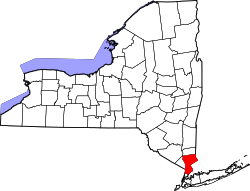 | |
| Towns | ||
| Villages | ||
| CDPs |
| |
| Other hamlets | ||
| Footnotes | ‡This populated place also has portions in an adjacent county or counties | |

| International | |
|---|---|
| National | |
| Geographic | |
| Other | |

Peekskill, New York
View on GrokipediaHistory
Indigenous and Early Colonial Period
The region encompassing modern Peekskill was originally inhabited by the Kitchawank (also spelled Kichawank), a Native American band affiliated with the Wappinger Confederacy of Algonquian-speaking peoples, who occupied territories along the eastern Hudson River from Croton Point northward into what is now Westchester County.[6][7] The Kitchawank referred to the local area, particularly the landing site on the Hudson, as Sachoes, utilizing the landscape for fishing, hunting, and seasonal gatherings, with evidence of their presence including shell middens and trails that later influenced European roadways.[8] These communities maintained semi-permanent villages and participated in broader intertribal networks, though population estimates for the Wappinger bands in the Hudson Highlands remain approximate at several hundred individuals per group prior to extensive European contact.[7] European exploration of the area began in 1609 when English navigator Henry Hudson, sailing for the Dutch East India Company aboard the Half Moon, anchored near present-day Peekskill while charting the river that now bears his name, noting fertile lands and Native American presence in his logs.[9] Sustained colonial interaction commenced in the mid-17th century through Dutch traders from New Amsterdam; Jan Peeck, a tobacco farmer and merchant, is recorded as the first European to make direct contact with the Kitchawank around the 1640s, trading goods at the site that became known as Peeck's Kill (from the Dutch kil for creek), the origin of the name Peekskill.[2][10] This contact facilitated initial land explorations but preceded formal settlement, as Dutch claims in the Hudson Valley focused more on fur trade than immediate colonization. Permanent European settlement emerged gradually in the early 18th century following English acquisition of New Netherland in 1664 and the granting of the expansive Philipse Patent in 1693, which encompassed over 52,000 acres including the Peekskill vicinity under Adolph Philipse, enabling leasehold farming by tenant settlers primarily of Dutch, English, and Huguenot descent.[2] By the 1720s, small homesteads dotted the landscape along brooks like MacGregor's, supporting agriculture and nascent milling operations, though the population remained sparse—fewer than 100 families—due to rugged terrain and ongoing Native land use under treaty arrangements that often favored colonial expansion.[11] Interactions between settlers and Kitchawank involved both trade and displacement, with the latter's numbers declining from disease and land alienation by the mid-1700s, as documented in colonial deeds and Philipses' estate records.[8]Revolutionary War Involvement
Peekskill served as a key Continental Army supply depot and military outpost in the Hudson Highlands during the Revolutionary War, leveraging its position along the Hudson River for logistics and defense against British naval threats.[12] In late 1776, General George Washington positioned forces there to secure the river valley, establishing temporary headquarters at the Birdsall House where he commissioned Benedict Arnold to major general on September 15, 1776.[12] The area's mills and terrain supported Patriot manufacturing and fortifications, including Fort Independence on Roa Hook and redoubts at Fort Hill Park, which housed barracks for up to 3,300 troops by November 1776.[2][13] On March 23, 1777, British forces under Brigadier General William Tryon launched a raid on Peekskill, landing approximately 500 regulars and Hessian troops from ten ships at Lents Cove, about 1.5 miles south of the town.[14] Supported by naval artillery, they bombarded American positions at Fort Independence, prompting Brigadier General Alexander McDougall's 250-man force to withdraw after a brief skirmish to avoid encirclement.[14][15] The raiders destroyed military stores, mills, and infrastructure but inflicted minimal casualties, with the action serving primarily as a probe of Patriot resolve rather than a decisive assault; American reports noted the destruction of flour, salt, and tools vital to the war effort.[16][17] Earlier that year, on February 19, 1777, Brigadier General Seth Pomeroy, the Continental Army's first appointee to that rank and a veteran of the French and Indian War, died of pneumonia in Peekskill while en route to reinforce Washington's forces.[18] His presence underscored the site's role in mobilizing veteran leadership amid ongoing British threats along the Hudson. Peekskill's fortifications and depots continued to factor in later campaigns, though repeated raids highlighted vulnerabilities in defending extended supply lines.[2]19th-Century Industrial Expansion
During the early to mid-19th century, Peekskill's industrial base expanded significantly, driven by its strategic location along the Hudson River, which provided transportation, water power, and access to raw materials like clay and iron ore. The arrival of the New York and Hudson River Railroad in 1849 connected the village to broader markets, facilitating the shipment of goods to New York City and beyond.[19] This infrastructure development, combined with local foundries, positioned Peekskill as a key manufacturing hub in Westchester County.[12] Stove and iron production formed the cornerstone of this expansion, with the Union Stove Works established in 1834 at 424 Central Avenue, exemplifying the shift toward large-scale metalworking. By mid-century, Peekskill hosted eight foundries that collectively produced up to 200,000 stoves annually at their peak, alongside plows and other cast-iron implements essential for agricultural and domestic use. These operations employed skilled laborers and capitalized on the village's proximity to iron deposits, contributing to national demand during the antebellum period. Brick manufacturing also surged in the 1850s, leveraging abundant local clay deposits to produce pavers and building materials, which attracted waves of Irish immigrant workers and spurred residential construction.[20][21][22] Post-Civil War growth diversified the economy further, with the incorporation of the Peekskill Hat Manufacturing Company in 1895 marking the rise of textile-related industries, including hats, shirts, and underwear produced in dedicated factories. The village maintained three active docks on the Hudson for loading heavy goods, underscoring riverine logistics as a causal driver of sustained expansion. This industrial momentum tripled the population from 1,131 in 1830 to 3,560 by 1861, reflecting influxes of workers and their families amid economic opportunities.[23][24][21]Early 20th-Century Growth and Challenges
In the early 20th century, Peekskill's population grew substantially, from 10,358 residents in 1900 to 15,245 by 1910, reflecting its status as Westchester County's fastest-growing area during this period.[22][21] This expansion was fueled by waves of immigration from Central and Southern Europe, particularly Hungarians and Poles, who sought employment in the city's expanding factories.[22] Industrial diversification drove much of this growth, as Peekskill transitioned from its 19th-century reliance on iron foundries toward newer sectors. The Peekskill Hat Manufacturing Company, established in 1895, expanded rapidly to employ 500 workers by 1912, becoming the city's largest employer and producing hats alongside underwear and other apparel.[21][22] In 1900, Charles Fleischmann founded a yeast and distilling plant at Charles Point, which grew into a 125-building complex employing over 1,000 workers and establishing Peekskill as a global leader in yeast production.[21][8] Brickyards at Verplanck's Point, including the Hudson River Brick Company, operated at peak capacity, producing over 400,000 bricks daily to support regional construction.[22] These developments, supported by rail access and the Hudson River waterfront, sustained manufacturing output despite national economic fluctuations. Challenges emerged from the decline of traditional industries and rapid demographic shifts. Around 1900, Peekskill's foundries, which had produced 200,000 stoves annually in the late 19th century, began winding down, necessitating economic adaptation to newer enterprises like yeast processing and hat production.[8] Social tensions arose from anti-Catholic prejudice directed at the influx of European immigrants, many of whom were Catholic, prompting community institutions like the Church of the Assumption to acquire dedicated spaces for worship and gatherings by 1913.[21] Infrastructure strains also intensified; for instance, the Drum Hill School required a new building constructed between 1909 and 1911 to comply with elevated New York State educational standards amid surging enrollment.[22] By 1930, the population reached 17,758, underscoring ongoing growth but highlighting the need for sustained industrial reinvention.[25]Mid-20th-Century Events and the Peekskill Riots
Peekskill was incorporated as a city on April 23, 1940, transitioning from village status amid ongoing industrial expansion in manufacturing and river trade, which employed much of the local workforce.[10] During World War II, the city's factories contributed to the national war effort by producing military supplies, including components for naval vessels and ammunition, leveraging its established metalworking and ceramics industries.[26] Postwar years saw economic adjustments as demobilization affected employment, but Peekskill maintained a population of around 19,000 by 1950, with labor unions active in local politics.[10] The Peekskill Riots of 1949 emerged from heightened Cold War tensions over communism, centered on planned concerts by singer and actor Paul Robeson, a vocal supporter of the Soviet Union who had praised its policies in a April 20, 1949, speech in Paris, stating that the USSR exemplified racial equality absent in the United States.[27] The events were organized by the Civil Rights Congress (CRC), a group with documented ties to the Communist Party USA, aimed at funding legal defenses for left-wing activists.[28] Robeson had performed in Peekskill multiple times previously without major incident, but opposition grew from local veterans' groups like the American Legion and Veterans of Foreign Wars, who viewed the concerts as platforms for communist propaganda amid fears of Soviet influence.[29] On August 27, 1949, the first concert at Lakeland Acres in Cortlandt Manor, north of Peekskill, drew about 1,500 attendees before being disrupted by a crowd of several hundred protesters who threw rocks, overturned chairs, and burned an effigy of Robeson while chanting anti-communist slogans; the event was canceled without Robeson performing, and no serious injuries were reported.[27] Organizers rescheduled for September 4 at a farm on Hollow Brook Road, attracting an estimated 20,000 to 25,000 supporters, including union members providing security, under state police oversight.[30] Robeson performed for two hours, joined by folk singer Pete Seeger, but as attendees departed along the narrow Route 202, a mob of 5,000 to 10,000 locals—primarily anti-communist residents, including veterans—assaulted vehicles with rocks, clubs, and bottles, injuring over 140 people, many of whom were Jewish or Black; police response was delayed, with accusations of complicity from both sides.[31] [32] Investigations by New York State, including a grand jury, attributed violence to provocations by both communist organizers and unruly protesters, resulting in 13 arrests from the second event but no convictions for major assaults; the riots underscored divisions over loyalty in the early Red Scare, with protesters framing their actions as patriotic resistance to subversion rather than racial animus, though ethnic slurs were documented.[33] The events drew national attention, inspiring folk songs like Seeger's "Hold the Line" and later symbolizing free speech clashes, though contemporary accounts from veterans emphasized anti-Soviet motivations over bigotry.[29] By the 1950s, Peekskill's focus shifted to urban renewal amid suburbanization pressures, but the riots left a legacy of polarized memory, often amplified in left-leaning narratives as a precursor to McCarthyism while downplaying the geopolitical context.[34]Geography and Environment
Location and Topography
Peekskill is situated in the northwestern portion of Westchester County, New York, on the eastern bank of the Hudson River.[35] Its geographic coordinates are approximately 41°17′N 73°55′W.[36] The city lies about 40 miles north of Manhattan, marking the southern threshold of the Hudson Highlands region.[37] The topography of Peekskill features a relatively level floodplain along the Hudson River shoreline, where much of the urban development is concentrated, with an approximate elevation of 128 feet (39 meters) at the city center.[36] Elevations across the city average 220 feet (67 meters), transitioning abruptly to steeper hills and ridges inland and to the north, characteristic of the Appalachian foothills in the Hudson Highlands.[38] These elevated terrains, rising several hundred feet, consist of resistant metamorphic and igneous rocks that form the rugged backbone of the surrounding landscape.[37] The Hudson River at this point forms Peekskill Bay, providing a natural harbor that has historically influenced settlement patterns.[39]Climate and Natural Features
Peekskill experiences a humid continental climate classified as Dfa under the Köppen system, featuring hot, humid summers and cold, snowy winters.[40] The average annual temperature in nearby Westchester County, representative of Peekskill, is 50.8°F based on 1981-2010 normals, with summer highs reaching an average of 83°F in July and winter lows averaging 23°F in January.[41] [42] Annual precipitation totals approximately 45.8 inches, distributed relatively evenly but with higher snowfall in winter averaging around 30 inches.[41] The city's natural features are shaped by its position on the east bank of the Hudson River estuary within the Hudson Highlands region. Topography includes low-lying waterfront areas at near sea level rising to hilly uplands with average elevations around 220 feet and peaks exceeding 400 feet.[38] The Hudson River, a tidal estuary influenced by ocean tides, provides coastal and shoreline habitats essential for fish migration and waterfowl.[43] Inland, Peekskill encompasses diverse habitats such as wetlands, riparian zones along streams, deciduous forests, grasslands, and shrublands, supporting significant biodiversity including rare plant and animal species in unfragmented blocks.[44] These features contribute to ecological connectivity in the Hudson Valley, though urban development has fragmented some areas. Local parks like Fort Hill preserve forested hills and scenic overlooks, integrating natural elements into the urban landscape.[44]Demographics
Population Dynamics
The population of Peekskill has exhibited modest growth over the mid-to-late 20th century, accelerating slightly in the early 21st century amid economic revitalization and its role as a commuter community for New York City. U.S. Census Bureau decennial data record 17,746 residents in 1950, rising to 19,283 by 1970—a 8.6% increase driven by sustained manufacturing employment and Hudson River Valley accessibility via rail lines established in the 19th century.[45][46] Growth slowed during periods of industrial contraction in the 1960s and 1970s, when factory closures in sectors like metalworking and ceramics reduced job opportunities, contributing to economic stagnation that limited inflows.[24] By 2000, the population reached 22,441, reflecting a 16.4% gain from 1970 as suburbanization patterns drew residents seeking affordable housing near urban centers.[47] The 2010 census counted 23,583 inhabitants, followed by 25,431 in 2020—an annual growth rate of approximately 0.77% over the decade, outpacing many Rust Belt-adjacent cities due to multifamily housing developments and Metro-North Railroad connectivity facilitating daily commutes to Manhattan. Recent estimates indicate further expansion to 25,484 by 2023, with a 0.327% year-over-year increase from 2022, though minor dips occurred, such as a net loss of 103 residents between 2017 and 2018 amid broader Westchester County fluctuations.[48][49]| Census Year | Population | Percent Change from Prior Decade |
|---|---|---|
| 1950 | 17,746 | - |
| 1970 | 19,283 | +8.6% (over 20 years) |
| 2000 | 22,441 | +16.4% (over 30 years) |
| 2010 | 23,583 | +5.1% |
| 2020 | 25,431 | +7.8% |
Ethnic and Socioeconomic Composition
As of the 2020 United States Census, Peekskill's population of 25,431 residents included 46.2% identifying as Hispanic or Latino of any race, with non-Hispanic Whites comprising 32.0%, non-Hispanic Blacks or African Americans 17.4%, Asians 2.0%, and the remainder distributed among American Indians, Native Hawaiians, Pacific Islanders, and those reporting two or more races (13.8% in multiracial categories).[52][53]| Racial/Ethnic Group | Percentage (2020 Census) |
|---|---|
| Hispanic or Latino (any race) | 46.2% |
| White (non-Hispanic) | 32.0% |
| Black or African American (non-Hispanic) | 17.4% |
| Asian | 2.0% |
| Two or more races | 13.8% (overlapping) |
| Other groups (e.g., Native American, Pacific Islander) | <2% combined |
Government and Economy
Municipal Governance
Peekskill operates under a council-manager form of government, with the seven-member Common Council functioning as the legislative body responsible for enacting local ordinances, approving budgets, and overseeing policy.[57] The mayor presides over council meetings and votes on legislation, while the appointed city manager serves as the chief administrative officer, managing daily operations, department heads, and implementation of council directives.[58][59] This structure emphasizes professional administration separate from elected officials, a model adopted to enhance efficiency in municipal services such as public safety, infrastructure, and fiscal management.[60] The Common Council comprises the mayor, elected citywide to a two-year term, and six council members elected at-large to staggered four-year terms, ensuring continuity with three seats typically up for election biennially.[57][61] As of October 2025, Vivian McKenzie holds the mayoral position, having been first elected in 2021; she presides as the council's leader and represents the city in ceremonial and intergovernmental roles.[62] The current council members include Deputy Mayor Patricia Riley, Kathleen Talbot, Ramon A. Fernandez, Dwight H. Douglas, Robert Scott, and Brian Fassett, all serving Democratic affiliations in a predominantly one-party local political landscape.[57] Matthew Alexander serves as city manager, appointed by the council to direct executive functions including budget preparation, personnel, and service delivery across departments like police, fire, public works, and finance.[59] The council holds regular meetings on the first through fourth Mondays of each month (except reduced in July and August), often beginning with committee work sessions followed by formal sessions open to the public, with agendas focusing on zoning, taxation, and community development.[57] Elections occur in odd-numbered years, with voters selecting candidates via partisan primaries and general ballots administered by Westchester County.[63] This governance framework supports Peekskill's priorities in urban revitalization and fiscal restraint, though property tax adjustments, such as the 4.65% proposed increase in 2024, reflect ongoing debates over revenue needs amid state caps.[64]Economic History and Sectors
Peekskill's economy originated in the colonial era, leveraging water power from local creeks and streams to establish mills that produced essential goods such as gunpowder, leather, and lumber, which supported the Continental Army during the American Revolution when the area served as a military headquarters in 1776.[2] British raids in 1777 destroyed much of this early industrial infrastructure, prompting a relocation of military operations to West Point.[2] By the early 19th century, Peekskill emerged as a significant manufacturing hub, particularly in iron products, with Stephen Gregory founding a small forge on Main Street in 1820 that initiated local stove and plow production amid abundant regional iron supplies.[8] The city hosted eight foundries that peaked at producing 200,000 stoves annually, including operations like the Union Stove Works established in 1834, which employed hundreds until a 1923 fire destroyed the facility and idled 600 workers.[65][21] Textile manufacturing also flourished, exemplified by the Peekskill Hat Factory, incorporated in 1895 after relocating from Yonkers; by 1912, it employed 479 workers producing hats—including military variants during World War I—on 10-hour shifts for $1 daily wages, though a 1921 labor strike contributed to its relocation to Danbury, Connecticut, in 1923.[23] Food processing became a dominant sector in the 20th century, with the Fleischmann Company establishing a major plant in 1900 that grew into the world's largest yeast factory and the U.S.'s second-largest vinegar producer, encompassing 160 buildings and supplying 93% of the nation's yeast by the late 1920s alongside gin, vodka, and baking powder.[66][67] The facility's closure in 1977 eliminated over 800 jobs, delivering a severe blow to the local economy and highlighting broader deindustrialization trends.[68] Other 19th-century outputs included underwear, underscoring Peekskill's diverse light manufacturing base tied to Hudson River access for raw materials and shipping.[12] Contemporary sectors reflect a shift from heavy industry, with remaining manufacturing including BASF's chemical operations (110 employees as of mid-2010s) and Wheelabrator Westchester's waste-to-energy facility (67 employees).[69] Healthcare, via providers like HRH Care (129 jobs), and linen services at White Plains Linen (600 jobs) represent key employers, alongside efforts in economic development focusing on business retention, expansion, and attraction through incentives from the city's Industrial Development Agency.[69][70] Retail and service growth have supplemented these, though the legacy of manufacturing continues to influence adaptive reuse of industrial sites like the former Hat Factory for modern commercial purposes.[23]Contemporary Economic Trends
Peekskill's economy has exhibited steady expansion in the early 2020s, with total employment rising 2.34% from 13,400 to 13,700 workers between 2022 and 2023.[48] Median household income increased to $91,042 in 2023, reflecting improved earnings amid broader Westchester County trends.[48] The local unemployment rate stood at 3.6% as of 2025, aligning with regional recovery from pandemic disruptions.[71] These metrics indicate resilience in a commuter-oriented economy, bolstered by proximity to New York City, though challenges like pockets of vacant commercial buildings persist in certain areas.[72] Major employers underscore a mix of legacy manufacturing and service sectors, including White Plains Linen with 600 jobs, HRH Care at 129 positions, BASF employing 110 in chemicals, and Wheelabrator Westchester with 67 in waste management.[69] Contemporary shifts emphasize diversification into creative industries and tourism, supported by the city's Hudson River waterfront and arts initiatives.[73] In 2018, Peekskill received $10 million from New York State's Downtown Revitalization Initiative to fund projects enhancing walkability, housing, and public spaces across 100 acres, aiming to attract private investment and spur job creation.[73] By 2024, new residential developments featuring modern amenities contributed to renewed economic vitality downtown.[74] Ongoing efforts through the Office of Economic Development focus on business retention, expansion, and attraction, leveraging industrial development agency incentives for qualified projects.[70] Population growth of 0.15% annually supports demand for retail and services, with emerging trends in arts-driven commerce and sustainable infrastructure positioning Peekskill for sustained, albeit modest, progress amid regional competition.[75] However, uneven revitalization highlights risks of stagnation in underinvested zones, necessitating targeted interventions to maintain momentum.[72]
Education and Healthcare
Primary and Secondary Education
The Peekskill City School District (PCSD) administers public primary and secondary education for the city's approximately 3,520 K-12 students across six schools, including four elementary schools serving pre-kindergarten through grade 5, one middle school for grades 6-8, and one high school for grades 9-12.[76] The district's student body is predominantly minority, with 90% non-white enrollment, reflecting Peekskill's demographic composition, and 37.8% of students classified as economically disadvantaged.[77] Elementary education is provided by Hillcrest Elementary School (grades 3-5), Oakside Elementary School (pre-K-2), Uriah Hill Elementary School (pre-K-2), and Woodside Elementary School (pre-K-2), which collectively emphasize foundational literacy, mathematics, and social-emotional development in a diverse urban setting.[78] These schools integrate state-mandated curricula with district initiatives for interactive learning environments tailored to high-needs populations.[79] Peekskill Middle School serves grades 6-8, focusing on transitional skills, core academics, and extracurricular preparation amid a student body with similar socioeconomic challenges as the district average.[78] Peekskill High School, established in 1929 and located at 1072 Elm Street, enrolls 1,109 students and reports a 79% four-year graduation rate, with per-pupil expenditures of $29,266.[80] State assessments indicate 79% proficiency in mathematics and 55% in reading, though the school ranks in the bottom half statewide (850-1021 out of approximately 1,700 high schools over the past decade) and low nationally (13,427-17,901).[81][82][83] The high school offers Advanced Placement courses and athletics, serving a student population that is 71% Hispanic, 20% Black, 7% white, and 1% Asian as of recent profiles.[84] Private or parochial options within Peekskill city limits are limited, with most families relying on the public district.[85]Higher Education and Libraries
Peekskill is served by the Peekskill campus of SUNY Westchester Community College, located at 27 North Division Street.[86] This extension site provides credit-bearing courses toward associate degrees, alongside non-credit options including workforce development training, English as a Second Language instruction, personal enrichment classes, and specialized programs in digital arts such as graphic design, animation, interactive multimedia, and digital filmmaking.[86] Facilities include state-of-the-art post-production studios with two digital video editing suites, a Maker Space, computer labs, and exhibition venues, supporting small class sizes with personalized instruction and flexible evening or weekend scheduling.[86] Student services encompass academic and financial aid counseling, career and transfer advisement, clubs, and workshops, with classes taught by faculty from the main Valhalla campus.[86] The Field Library serves as the principal public library for Peekskill and the adjacent Town of Cortlandt, situated at 4 Nelson Avenue.[87] Established in 1887, it ranks among Westchester County's oldest public libraries and marked its 125th anniversary in 2012.[88] The library maintains collections of books, magazines, newspapers, DVDs, eBooks, audiobooks, and music CDs, complemented by free programs and events for all ages, including children's activities, adult education classes, and local history resources such as an obituary index and digitized newspaper archives.[87] Special collections include the Lincoln Memorial in Books, founded in 1925 to commemorate Abraham Lincoln with related volumes and materials.[89] Directed by Laura Wolven, it operates under municipal oversight and partners with regional archives for genealogical and historical preservation efforts.[90][91]Healthcare Facilities
NewYork-Presbyterian Hudson Valley Hospital, a 128-bed acute care facility, serves Peekskill as the primary hospital in the surrounding Hudson Valley region, offering inpatient, outpatient, and ambulatory services across more than 60 specialties including cardiology, orthopedics, cancer care, and robotic surgery.[92] Originally founded in 1889 by the Helping Hand Association in Peekskill itself, the hospital relocated to Cortlandt Manor in Westchester County while maintaining a focus on the local community; it affiliated with the NewYork-Presbyterian health system in 2015, enhancing access to advanced care.[93] The facility is fully accredited as a non-profit and has been rated high-performing in one adult specialty and one procedure by U.S. News & World Report as of 2025.[94] Within Peekskill city limits, the Peekskill Health Center, operated by Sun River Health (formerly HRHCare), provides comprehensive community-based primary care including medical, dental, pediatric, and women's health services at 1037 Main Street.[95] This federally qualified health center also features an on-site urgent care unit for non-emergency needs, accepting most insurance plans and serving patients regardless of ability to pay.[95] [96] NewYork-Presbyterian Hudson Valley Medical Group maintains an outpatient office at 211 South Division Street in Peekskill, specializing in internal medicine and other primary care services to support local residents.[97] These facilities collectively address routine and specialized healthcare demands, with the hospital handling acute cases and clinics focusing on preventive and ambulatory needs.Culture and Community
Arts and Cultural Institutions
Peekskill maintains a modest yet vibrant array of arts and cultural institutions, emphasizing contemporary visual arts, historic preservation, and live performances amid its Hudson Valley setting. These venues contribute to the city's reputation as an artist hub, supported by nonprofit organizations and adaptive reuse of industrial and historic structures.[98][99] The Hudson Valley Center for Contemporary Art (HVCCA), a 501(c)(3) nonprofit founded in 2004 by Marc and Livia Strauss, occupies a 12,000-square-foot former home improvement warehouse at 1701 Main Street and exhibits works by emerging regional artists alongside international contemporaries, often featuring site-specific installations and educational programs like poetry and movement workshops.[99][100][101] It has hosted over 18 years of programming, including the Peekskill Waterfront Sculpture Trail hikes, fostering community engagement with modern art.[99] The Paramount Hudson Valley Theater, constructed in 1929 as an Art Deco movie palace by Publix Theatres (a Paramount subsidiary) and opened on June 17, 1930, with 1,485 seats, originally screened first-run films equipped with a Wurlitzer organ and air conditioning.[102][103] Restored for live events, it now presents concerts, theater productions, and family shows, drawing on its historic architecture including an opulent lounge.[104][105] Local history-focused museums include the Peekskill Museum, established in 1946 within the 1878 Herrick House at 124 Union Avenue, which houses Victorian-era artifacts, cast-iron stoves, and a giant ball of string among exhibits on Peekskill's industrial and domestic past.[106] The Lincoln Depot Museum, situated in a 3,000-square-foot 19th-century freight and passenger rail depot by Peekskill Bay, documents Abraham Lincoln's February 19, 1861, speech en route to his inauguration, with preserved architecture and interpretive displays.[107] Supporting these are galleries and alliances like Third Eye Arts Studio and the Peekskill Arts Alliance, the latter organizing the annual Peekskill Open Studios event since at least 1999 to showcase member artists and connect with local businesses and officials.[108][109] Additional spaces such as 925 South and Arts 10566 host exhibitions, contributing to over a dozen art nonprofits and galleries citywide.[98][109]Media and Local Events
Peekskill's media landscape includes a legacy of local newspapers preserved in collections at the Field Library, spanning from the 1800s to contemporary publications.[110] The Peekskill Evening Star, a prominent daily newspaper, operated from 1922 to 1985, serving as a primary source of hometown news under editor and publisher E. Joe Albertson.[111] Today, digital outlets dominate local coverage, with the Peekskill Herald providing reporting on news, arts, entertainment, government, and events as a successor to earlier print traditions.[112] Community-focused platforms such as Peekskill Daily Voice deliver updates on local incidents, sports, and developments through award-winning editors and reporters.[113] Similarly, Patch offers hyper-local headlines for Peekskill and nearby Cortlandt, including crime, events, and civic matters.[114] Regional television and online news from News 12 Westchester extends coverage to Peekskill, emphasizing Hudson Valley stories like weather and government impacts.[115] No dedicated local radio or television stations operate exclusively in Peekskill, with residents relying on broader Westchester-area broadcasts.[116] Local events in Peekskill feature recurring festivals that draw community participation, often centered on the riverfront and downtown areas. The Cherry Blossom Festival, organized annually by the Rotary Club of Peekskill, takes place on May 3 from 10:00 a.m. to 5:00 p.m. at Riverfront Green Park, including plant sales, food trucks, live music, and family activities.[117] The Juneteenth Parade and Festival occurs on June 21 from 12:00 p.m. to 7:00 p.m. in downtown Peekskill, commemorating emancipation with parades and cultural programming.[118] The Italian Feast, a longstanding tradition at 1000 Brown Street, highlights community heritage through food, vendors, and entertainment.[119] Seasonal gatherings like the Peekskill Riverfront Festival, held on October 4 from 11:00 a.m. to 5:00 p.m., offer free admission with live music, chili cook-offs, pumpkin painting, and shopping.[120] The city's official calendar lists additional civic events, such as the Fire Department's Open House on October 25 from 12:00 p.m. to 3:00 p.m. at 1141 Main Street, promoting public safety awareness.[121] These events, promoted via local media and platforms like Eventbrite, foster resident engagement without reliance on larger regional draws.[122]Parks and Recreation
The City of Peekskill Parks and Recreation Department manages multiple public parks and facilities, emphasizing health, inspiration, and recreational access for residents through maintained green spaces and organized activities.[123] Key city parks include Riverfront Green Park, offering Hudson River waterfront access with a municipal boat launch for kayaking and fishing; Depew Park, featuring sports fields, tennis courts, picnic areas, and a swimming pool; and Charles Point/Fleischmann Pier, providing scenic views and pier-based recreation.[124] [125] Additional facilities encompass Franklin Park, Lepore Park, Tompkins Park, Peekskill Dog Park for off-leash activities, and Peekskill Stadium for organized sports events.[124] Nearby Westchester County parks supplement local options, notably Blue Mountain Reservation, which spans over 1,600 acres with hiking trails, picnic areas, and a summit reservoir, open daily from 8 a.m. to dusk.[126] Fort Hill Park preserves historical sites including remnants of Revolutionary War fortifications and monuments, serving as a site for passive recreation and educational visits.[124] The department administers diverse programs, including SPARK Summer Camps for youth, seasonal sports such as tennis, soccer, flag football, and basketball, and adult offerings like pickleball lessons at the Kiley Center.[127] Community events and special programs, such as Mother Nature's Playgroup and online registration for classes, promote inclusive participation across age groups, with adherence to public health protocols as needed.[123] [127] These initiatives utilize city parks and centers to foster physical activity and social engagement, supported by facilities like the Charles J. Cook Recreational Center for swimming and tennis.[128]Infrastructure and Transportation
Public Transportation
Peekskill is served primarily by the Metro-North Railroad's Hudson Line, with the Peekskill station located at 300 Railroad Avenue functioning as the northernmost stop in Westchester County.[129] This commuter rail line provides hourly service to Grand Central Terminal in New York City, with travel times averaging 59 minutes to one hour and one-way fares ranging from $12 to $19 depending on peak or off-peak periods.[130] The station features three ticket vending machines but no staffed ticket office, and it accommodates connections to local Bee-Line buses.[129] Local bus service in Peekskill is operated by the Bee-Line Bus System, Westchester County's public transit network, which includes several routes connecting the city to neighboring areas.[131] Key routes include the 14, which runs from Peekskill to Ossining and White Plains; the 15, serving Peekskill to Yorktown and White Plains with 95 stops in the local direction; and the 17, an express route from Peekskill to Cortlandt Town Center at Walmart.[132] [133] [134] Additional routes such as the 16 provide local service, with fares at $2.75 for a one-way ride including transfers to other Bee-Line buses, New York City buses, or subways.[135] These services operate daily, with schedules updated as of June 2025 for system maps and timetables.[132] No subway or light rail directly serves Peekskill, and ferry options are limited to regional Hudson River services not originating within the city.[136] The integration of rail and bus at the Peekskill station facilitates commuting to Manhattan and intra-county travel, supporting the area's role as a commuter hub.[129]Road Networks and Accessibility
Peekskill is served by U.S. Route 9, a major north-south highway paralleling the Hudson River that enters the city from the south via the Croton Expressway, a 9.2-mile limited-access segment extending from Ossining to Peekskill.[137] This route provides direct connectivity to New York City, approximately 40 miles south, and facilitates freight and commuter traffic through Westchester County.[138] U.S. Route 6 overlays Main Street through downtown Peekskill, serving as a key east-west corridor that links local businesses and residential areas while extending westward to the Bear Mountain Bridge.[139] The Bear Mountain Bridge, spanning the Hudson River and carrying U.S. Routes 6 and 202 along with the Appalachian Trail, connects Peekskill to Orange County and points west, with its eastern approach via the narrow, two-lane Bear Mountain Bridge Road from U.S. 9.[140] Constructed in 1924 and undergoing deck replacement as of 2023, the bridge handles significant daily traffic, including trucks, though detours via Routes 9D, 403, and 9 are posted during closures for maintenance.[140] [141] The Bear Mountain Parkway branches eastward from U.S. 9 at Peekskill's northern edge, providing access to the Taconic State Parkway and reducing congestion on parallel arterials.[142] New York State Route 9A, known as the Briarcliff-Peekskill Parkway, terminates at U.S. 9 in Peekskill and functions as an alternate to Route 9, offering a parkway-style route with ongoing NYSDOT modernization efforts to address aging infrastructure and improve safety.[143] State Route 35, concurrent with U.S. 202 along Crompond Road, supports local and regional travel but faces challenges from commercial truck volumes exacerbating pedestrian risks and emissions in downtown areas.[144] Road accessibility in Peekskill is enhanced by these corridors, which integrate with the regional network for efficient access to Metro-North rail hubs and Hudson River crossings, though crash-prone intersections like Route 6 ramps to the Bear Mountain Parkway highlight ongoing safety needs.[139] In 2024, studies initiated rerouting proposals for Routes 6 and 202/35 to mitigate truck traffic through the city center.[144] The U.S. Department of Transportation granted Peekskill $300,000 in 2023 for a comprehensive traffic safety action plan, including demonstration projects for signal repairs and pedestrian infrastructure along Route 6.[145] Maintenance responsibilities are divided between the New York State Department of Transportation, which oversees resurfacing of U.S. Route 9 from the Yonkers line northward, and the city's Department of Public Works, handling local street paving, snow plowing, and storm drain upkeep to ensure year-round accessibility.[138] [146] These efforts address periodic congestion and weather-related disruptions, with real-time advisories available through NYSDOT's 511 system for incidents on key routes.[147]Notable Figures
Historical Figures
Seth Pomeroy (May 20, 1706 – February 19, 1777), a gunsmith, soldier, and early American military leader from Northampton, Massachusetts, died in Peekskill while serving in the Continental Army during the Revolutionary War. Pomeroy participated in the French and Indian War, including the capture of Fort Ticonderoga in 1755, and at age 69 volunteered for service in the Revolution, fighting at Bunker Hill where he reportedly declined promotion to major general in favor of younger officers. Commissioned by George Washington as the first brigadier general of the Continental Army on June 22, 1775, he marched to reinforce the army in 1777 but succumbed to pneumonia en route through Peekskill.[18][148] He was initially buried in Peekskill's Old Cemetery at Van Cortlandtville in an unmarked grave, later commemorated by a monument erected in 1905 featuring an anvil symbolizing his blacksmith background.[149][150] Peter Cooper (1791–1883), philanthropist, inventor, and founder of the Cooper Union, spent part of his early years in Peekskill, working in local manufacturing establishments that shaped his later industrial innovations, including the Tom Thumb locomotive in 1830. As a youth, Cooper apprenticed in a Peekskill cloth-shearing shop and a nearby glue factory, experiences that honed his mechanical skills and business acumen before he moved to New York City.[8] Henry Ward Beecher (1813–1887), influential Congregationalist minister, abolitionist, and social reformer, taught school in Peekskill during his early career, residing there briefly and contributing to the area's educational development amid growing 19th-century intellectual circles. Beecher, brother of Harriet Beecher Stowe, used his platform in Brooklyn's Plymouth Church to advocate against slavery, drawing on formative experiences like those in Peekskill.[8] Chauncey Mitchell Depew (1834–1928), attorney, railroad executive, and U.S. Senator from New York (1899–1911), was born in Peekskill and educated at the local Peekskill Military Academy, which instilled discipline influencing his rise to president of the New York Central Railroad from 1885 to 1898. Depew's oratory skills and political connections made him a prominent Gilded Age figure, delivering keynote addresses at Republican conventions and serving as a director for over 70 corporations.[151]Modern Notables
Actor and filmmaker Mel Gibson was born in Peekskill on January 3, 1956, as the sixth of eleven children; his family relocated to Australia soon after, where he developed his career, directing and starring in the Academy Award-winning Braveheart (1995).[152][153]Stanley Tucci, born in Peekskill on November 11, 1960, is an actor, producer, and director recognized for supporting roles in films including The Devil Wears Prada (2006) and Spotlight (2015), earning an Academy Award nomination for the latter; he grew up nearby in Katonah and graduated from John Jay High School.[154][155]
Former New York Governor George Pataki was born in Peekskill on June 24, 1945, to Hungarian immigrant grandparents; he served three terms from January 1, 1995, to December 31, 2006, after earlier roles as Peekskill's mayor (1981–1984) and state assemblyman.[156][157]
Comedian and actor Paul Reubens, born Paul Rubenfeld in Peekskill on August 27, 1952, created the character Pee-wee Herman, starring in Pee-wee's Big Adventure (1985) and the CBS series Pee-wee's Playhouse (1986–1990); his family moved to Oneonta, New York, when he was two.
NBA player Elton Brand, a Peekskill High School graduate from the class of 1997, was drafted first overall in 1999 and played 18 seasons, earning All-Star honors in 2006 and retiring in 2016 after stints with teams including the Chicago Bulls and Philadelphia 76ers.[158]