
Polygon
View on Wikipedia

In geometry, a polygon (/ˈpɒlɪɡɒn/) is a plane figure made up of line segments connected to form a closed polygonal chain.
The segments of a closed polygonal chain are called its edges or sides. The points where two edges meet are the polygon's vertices or corners. An n-gon is a polygon with n sides; for example, a triangle is a 3-gon.
A simple polygon is one which does not intersect itself. More precisely, the only allowed intersections among the line segments that make up the polygon are the shared endpoints of consecutive segments in the polygonal chain. A simple polygon is the boundary of a region of the plane that is called a solid polygon. The interior of a solid polygon is its body, also known as a polygonal region or polygonal area. In contexts where one is concerned only with simple and solid polygons, a polygon may refer only to a simple polygon or to a solid polygon.
A polygonal chain may cross over itself, creating star polygons and other self-intersecting polygons. Some sources also consider closed polygonal chains in Euclidean space to be a type of polygon (a skew polygon), even when the chain does not lie in a single plane.
A polygon is a 2-dimensional example of the more general polytope in any number of dimensions. There are many more generalizations of polygons defined for different purposes.
Etymology
[edit]The word polygon derives from the Greek adjective πολύς (polús) 'much', 'many' and γωνία (gōnía) 'corner' or 'angle'. It has been suggested that γόνυ (gónu) 'knee' may be the origin of gon.[1]
Classification
[edit]
Number of sides
[edit]Polygons are primarily classified by the number of sides.
Convexity and intersection
[edit]Polygons may be characterized by their convexity or type of non-convexity:
- Convex: any line drawn through the polygon (and not tangent to an edge or corner) meets its boundary exactly twice. As a consequence, all its interior angles are less than 180°. Equivalently, any line segment with endpoints on the boundary passes through only interior points between its endpoints. This condition is true for polygons in any geometry, not just Euclidean.[2]
- Non-convex: a line may be found which meets its boundary more than twice. Equivalently, there exists a line segment between two boundary points that passes outside the polygon.
- Simple: the boundary of the polygon does not cross itself. All convex polygons are simple.
- Concave: Non-convex and simple. There is at least one interior angle greater than 180°.
- Star-shaped: the whole interior is visible from at least one point, without crossing any edge. The polygon must be simple, and may be convex or concave. All convex polygons are star-shaped.
- Self-intersecting: the boundary of the polygon crosses itself. The term complex is sometimes used in contrast to simple, but this usage risks confusion with the idea of a complex polygon as one which exists in the complex Hilbert plane consisting of two complex dimensions.
- Star polygon: a polygon which self-intersects in a regular way. A polygon cannot be both a star and star-shaped.
Equality and symmetry
[edit]- Equiangular: all corner angles are equal.
- Equilateral: all edges are of the same length.
- Regular: both equilateral and equiangular.
- Cyclic: all corners lie on a single circle, called the circumcircle.
- Tangential: all sides are tangent to an inscribed circle.
- Isogonal or vertex-transitive: all corners lie within the same symmetry orbit. The polygon is also cyclic and equiangular.
- Isotoxal or edge-transitive: all sides lie within the same symmetry orbit. The polygon is also equilateral and tangential.
The property of regularity may be defined in other ways: a polygon is regular if and only if it is both isogonal and isotoxal, or equivalently it is both cyclic and equilateral. A non-convex regular polygon is called a regular star polygon.
Miscellaneous
[edit]- Rectilinear: the polygon's sides meet at right angles, i.e. all its interior angles are 90 or 270 degrees.
- Monotone with respect to a given line L: every line orthogonal to L intersects the polygon not more than twice.
Properties and formulas
[edit]
Euclidean geometry is assumed throughout.
Angles
[edit]Any polygon has as many corners as it has sides. Each corner has several angles. The two most important ones are:
- Interior angle – The sum of the interior angles of a simple n-gon is (n − 2) × π radians or (n − 2) × 180 degrees. This is because any simple n-gon ( having n sides ) can be considered to be made up of (n − 2) triangles, each of which has an angle sum of π radians or 180 degrees. The measure of any interior angle of a convex regular n-gon is radians or degrees. The interior angles of regular star polygons were first studied by Poinsot, in the same paper in which he describes the four regular star polyhedra: for a regular -gon (a p-gon with central density q), each interior angle is radians or degrees.[3]
- Exterior angle – The exterior angle is the supplementary angle to the interior angle. Tracing around a convex n-gon, the angle "turned" at a corner is the exterior or external angle. Tracing all the way around the polygon makes one full turn, so the sum of the exterior angles must be 360°. This argument can be generalized to concave simple polygons, if external angles that turn in the opposite direction are subtracted from the total turned. Tracing around an n-gon in general, the sum of the exterior angles (the total amount one rotates at the vertices) can be any integer multiple d of 360°, e.g. 720° for a pentagram and 0° for an angular "eight" or antiparallelogram, where d is the density or turning number of the polygon.


Area
[edit]
In this section, the vertices of the polygon under consideration are taken to be in order. For convenience in some formulas, the notation (xn, yn) = (x0, y0) will also be used.

Simple polygons
[edit]If the polygon is non-self-intersecting (that is, simple), the signed area is

or, using determinants
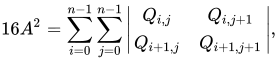
where is the squared distance between and [4][5]


The signed area depends on the ordering of the vertices and of the orientation of the plane. Commonly, the positive orientation is defined by the (counterclockwise) rotation that maps the positive x-axis to the positive y-axis. If the vertices are ordered counterclockwise (that is, according to positive orientation), the signed area is positive; otherwise, it is negative. In either case, the area formula is correct in absolute value. This is commonly called the shoelace formula or surveyor's formula.[6]
The area A of a simple polygon can also be computed if the lengths of the sides, a1, a2, ..., an and the exterior angles, θ1, θ2, ..., θn are known, from:
![{\displaystyle {\begin{aligned}A={\frac {1}{2}}(a_{1}[a_{2}\sin(\theta _{1})+a_{3}\sin(\theta _{1}+\theta _{2})+\cdots +a_{n-1}\sin(\theta _{1}+\theta _{2}+\cdots +\theta _{n-2})]\\{}+a_{2}[a_{3}\sin(\theta _{2})+a_{4}\sin(\theta _{2}+\theta _{3})+\cdots +a_{n-1}\sin(\theta _{2}+\cdots +\theta _{n-2})]\\{}+\cdots +a_{n-2}[a_{n-1}\sin(\theta _{n-2})]).\end{aligned}}}](https://wikimedia.org/api/rest_v1/media/math/render/svg/782046e07ca487a9d555c83a434d7c13aaf01c31)
The formula was described by Lopshits in 1963.[7]
If the polygon can be drawn on an equally spaced grid such that all its vertices are grid points, Pick's theorem gives a simple formula for the polygon's area based on the numbers of interior and boundary grid points: the former number plus one-half the latter number, minus 1.
In every polygon with perimeter p and area A , the isoperimetric inequality holds.[8]

For any two simple polygons of equal area, the Bolyai–Gerwien theorem asserts that the first can be cut into polygonal pieces which can be reassembled to form the second polygon.
The lengths of the sides of a polygon do not in general determine its area.[9] However, if the polygon is simple and cyclic then the sides do determine the area.[10] Of all n-gons with given side lengths, the one with the largest area is cyclic. Of all n-gons with a given perimeter, the one with the largest area is regular (and therefore cyclic).[11]
Regular polygons
[edit]Many specialized formulas apply to the areas of regular polygons.
The area of a regular polygon is given in terms of the radius r of its inscribed circle and its perimeter p by
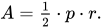
This radius is also termed its apothem and is often represented as a.
The area of a regular n-gon can be expressed in terms of the radius R of its circumscribed circle (the unique circle passing through all vertices of the regular n-gon) as follows:[12][13]

Self-intersecting
[edit]The area of a self-intersecting polygon can be defined in two different ways, giving different answers:
- Using the formulas for simple polygons, we allow that particular regions within the polygon may have their area multiplied by a factor which we call the density of the region. For example, the central convex pentagon in the center of a pentagram has density 2. The two triangular regions of a cross-quadrilateral (like a figure 8) have opposite-signed densities, and adding their areas together can give a total area of zero for the whole figure.[14]
- Considering the enclosed regions as point sets, we can find the area of the enclosed point set. This corresponds to the area of the plane covered by the polygon or to the area of one or more simple polygons having the same outline as the self-intersecting one. In the case of the cross-quadrilateral, it is treated as two simple triangles.[citation needed]
Centroid
[edit]Using the same convention for vertex coordinates as in the previous section, the coordinates of the centroid of a solid simple polygon are


In these formulas, the signed value of area must be used.

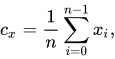
For triangles (n = 3), the centroids of the vertices and of the solid shape are the same, but, in general, this is not true for n > 3. The centroid of the vertex set of a polygon with n vertices has the coordinates

Generalizations
[edit]The idea of a polygon has been generalized in various ways. Some of the more important include:
- A spherical polygon is a circuit of arcs of great circles (sides) and vertices on the surface of a sphere. It allows the digon, a polygon having only two sides and two corners, which is impossible in a flat plane. Spherical polygons play an important role in cartography (map making) and in Wythoff's construction of the uniform polyhedra.
- A skew polygon does not lie in a flat plane, but zigzags in three (or more) dimensions. The Petrie polygons of the regular polytopes are well known examples.
- An apeirogon is an infinite sequence of sides and angles, which is not closed but has no ends because it extends indefinitely in both directions.
- A skew apeirogon is an infinite sequence of sides and angles that do not lie in a flat plane.
- A polygon with holes is an area-connected or multiply-connected planar polygon with one external boundary and one or more interior boundaries (holes).
- A complex polygon is a configuration analogous to an ordinary polygon, which exists in the complex plane of two real and two imaginary dimensions.
- An abstract polygon is an algebraic partially ordered set representing the various elements (sides, vertices, etc.) and their connectivity. A real geometric polygon is said to be a realization of the associated abstract polygon. Depending on the mapping, all the generalizations described here can be realized.
- A polyhedron is a three-dimensional solid bounded by flat polygonal faces, analogous to a polygon in two dimensions. The corresponding shapes in four or higher dimensions are called polytopes.[15] (In other conventions, the words polyhedron and polytope are used in any dimension, with the distinction between the two that a polytope is necessarily bounded.[16])
Naming
[edit]The word polygon comes from Late Latin polygōnum (a noun), from Greek πολύγωνον (polygōnon/polugōnon), noun use of neuter of πολύγωνος (polygōnos/polugōnos, the masculine adjective), meaning "many-angled". Individual polygons are named (and sometimes classified) according to the number of sides, combining a Greek-derived numerical prefix with the suffix -gon, e.g. pentagon, dodecagon. The triangle, quadrilateral and nonagon are exceptions.
Beyond decagons (10-sided) and dodecagons (12-sided), mathematicians generally use numerical notation, for example 17-gon and 257-gon.[17]
Exceptions exist for side counts that are easily expressed in verbal form (e.g. 20 and 30), or are used by non-mathematicians. Some special polygons also have their own names; for example the regular star pentagon is also known as the pentagram.
| Name | Sides | Properties |
|---|---|---|
| monogon | 1 | Not generally recognised as a polygon,[18] although some disciplines such as graph theory sometimes use the term.[19] |
| digon | 2 | Not generally recognised as a polygon in the Euclidean plane, although it can exist as a spherical polygon.[20] |
| triangle (or trigon) | 3 | The simplest polygon which can exist in the Euclidean plane. Can tile the plane. |
| quadrilateral (or tetragon) | 4 | The simplest polygon which can cross itself; the simplest polygon which can be concave; the simplest polygon which can be non-cyclic. Can tile the plane. |
| pentagon | 5 | [21] The simplest polygon which can exist as a regular star. A star pentagon is known as a pentagram or pentacle. |
| hexagon | 6 | [21] Can tile the plane. |
| heptagon (or septagon) | 7 | [21] The simplest polygon such that the regular form is not constructible with compass and straightedge. However, it can be constructed using a neusis construction. |
| octagon | 8 | [21] |
| nonagon (or enneagon) | 9 | [21]"Nonagon" mixes Latin [novem = 9] with Greek; "enneagon" is pure Greek. |
| decagon | 10 | [21] |
| hendecagon (or undecagon) | 11 | [21] The simplest polygon such that the regular form cannot be constructed with compass, straightedge, and angle trisector. However, it can be constructed with neusis.[22] |
| dodecagon (or duodecagon) | 12 | [21] |
| tridecagon (or triskaidecagon) | 13 | [21] |
| tetradecagon (or tetrakaidecagon) | 14 | [21] |
| pentadecagon (or pentakaidecagon) | 15 | [21] |
| hexadecagon (or hexakaidecagon) | 16 | [21] |
| heptadecagon (or heptakaidecagon) | 17 | Constructible polygon[17] |
| octadecagon (or octakaidecagon) | 18 | [21] |
| enneadecagon (or enneakaidecagon) | 19 | [21] |
| icosagon | 20 | [21] |
| icositrigon (or icosikaitrigon) | 23 | The simplest polygon such that the regular form cannot be constructed with neusis.[23][22] |
| icositetragon (or icosikaitetragon) | 24 | [21] |
| icosipentagon (or icosikaipentagon) | 25 | The simplest polygon such that it is not known if the regular form can be constructed with neusis or not.[23][22] |
| triacontagon | 30 | [21] |
| tetracontagon (or tessaracontagon) | 40 | [21][24] |
| pentacontagon (or pentecontagon) | 50 | [21][24] |
| hexacontagon (or hexecontagon) | 60 | [21][24] |
| heptacontagon (or hebdomecontagon) | 70 | [21][24] |
| octacontagon (or ogdoëcontagon) | 80 | [21][24] |
| enneacontagon (or enenecontagon) | 90 | [21][24] |
| hectogon (or hecatontagon)[25] | 100 | [21] |
| 257-gon | 257 | Constructible polygon[17] |
| chiliagon | 1000 | Philosophers including René Descartes,[26] Immanuel Kant,[27] David Hume,[28] have used the chiliagon as an example in discussions. |
| myriagon | 10,000 | |
| 65537-gon | 65,537 | Constructible polygon[17] |
| megagon[29][30][31] | 1,000,000 | As with René Descartes's example of the chiliagon, the million-sided polygon has been used as an illustration of a well-defined concept that cannot be visualised.[32][33][34][35][36][37][38] The megagon is also used as an illustration of the convergence of regular polygons to a circle.[39] |
| apeirogon | ∞ | A degenerate polygon of infinitely many sides. |
To construct the name of a polygon with more than 20 and fewer than 100 edges, combine the prefixes as follows.[21] The "kai" term applies to 13-gons and higher and was used by Kepler, and advocated by John H. Conway for clarity of concatenated prefix numbers in the naming of quasiregular polyhedra,[25] though not all sources use it.
| Tens | and | Ones | final suffix | ||
|---|---|---|---|---|---|
| -kai- | 1 | -hena- | -gon | ||
| 20 | icosi- (icosa- when alone) | 2 | -di- | ||
| 30 | triaconta- (or triconta-) | 3 | -tri- | ||
| 40 | tetraconta- (or tessaraconta-) | 4 | -tetra- | ||
| 50 | pentaconta- (or penteconta-) | 5 | -penta- | ||
| 60 | hexaconta- (or hexeconta-) | 6 | -hexa- | ||
| 70 | heptaconta- (or hebdomeconta-) | 7 | -hepta- | ||
| 80 | octaconta- (or ogdoëconta-) | 8 | -octa- | ||
| 90 | enneaconta- (or eneneconta-) | 9 | -ennea- | ||
History
[edit]
Polygons have been known since ancient times. The regular polygons were known to the ancient Greeks, with the pentagram, a non-convex regular polygon (star polygon), appearing as early as the 7th century B.C. on a krater by Aristophanes, found at Caere and now in the Capitoline Museum.[40][41]
The first known systematic study of non-convex polygons in general was made by Thomas Bradwardine in the 14th century.[42]
In 1952, Geoffrey Colin Shephard generalized the idea of polygons to the complex plane, where each real dimension is accompanied by an imaginary one, to create complex polygons.[43]
In nature
[edit]
Polygons appear in rock formations, most commonly as the flat facets of crystals, where the angles between the sides depend on the type of mineral from which the crystal is made.
Regular hexagons can occur when the cooling of lava forms areas of tightly packed columns of basalt, which may be seen at the Giant's Causeway in Northern Ireland, or at the Devil's Postpile in California.
In biology, the surface of the wax honeycomb made by bees is an array of hexagons, and the sides and base of each cell are also polygons.
Computer graphics
[edit] | This section needs additional citations for verification. (October 2018) |
In computer graphics, a polygon is a primitive used in modelling and rendering. They are defined in a database, containing arrays of vertices (the coordinates of the geometrical vertices, as well as other attributes of the polygon, such as color, shading and texture), connectivity information, and materials.[44][45]
Any surface is modelled as a tessellation called polygon mesh. If a square mesh has n + 1 points (vertices) per side, there are n squared squares in the mesh, or 2n squared triangles since there are two triangles in a square. There are (n + 1)2 / 2(n2) vertices per triangle. Where n is large, this approaches one half. Or, each vertex inside the square mesh connects four edges (lines).
The imaging system calls up the structure of polygons needed for the scene to be created from the database. This is transferred to active memory and finally, to the display system (screen, TV monitors etc.) so that the scene can be viewed. During this process, the imaging system renders polygons in correct perspective ready for transmission of the processed data to the display system. Although polygons are two-dimensional, through the system computer they are placed in a visual scene in the correct three-dimensional orientation.
In computer graphics and computational geometry, it is often necessary to determine whether a given point lies inside a simple polygon given by a sequence of line segments. This is called the point in polygon test.[46]

See also
[edit]References
[edit]Bibliography
[edit]- Coxeter, H.S.M.; Regular Polytopes, Methuen and Co., 1948 (3rd Edition, Dover, 1973).
- Cromwell, P.; Polyhedra, CUP hbk (1997), pbk. (1999).
- Grünbaum, B.; Are your polyhedra the same as my polyhedra? Discrete and comput. geom: the Goodman-Pollack festschrift, ed. Aronov et al. Springer (2003) pp. 461–488. (pdf)
Notes
[edit]- ^ Craig, John (1849). A new universal etymological technological, and pronouncing dictionary of the English language. Oxford University. p. 404. Extract of p. 404
- ^ Magnus, Wilhelm (1974). Noneuclidean tesselations and their groups. Pure and Applied Mathematics. Vol. 61. Academic Press. p. 37.
- ^ Kappraff, Jay (2002). Beyond measure: a guided tour through nature, myth, and number. World Scientific. p. 258. ISBN 978-981-02-4702-7.
- ^ B.Sz. Nagy, L. Rédey: Eine Verallgemeinerung der Inhaltsformel von Heron. Publ. Math. Debrecen 1, 42–50 (1949)
- ^ Bourke, Paul (July 1988). "Calculating The Area And Centroid Of A Polygon" (PDF). Archived from the original (PDF) on 16 September 2012. Retrieved 6 Feb 2013.
- ^ Bart Braden (1986). "The Surveyor's Area Formula" (PDF). The College Mathematics Journal. 17 (4): 326–337. doi:10.2307/2686282. JSTOR 2686282. Archived from the original (PDF) on 2012-11-07.
- ^ A.M. Lopshits (1963). Computation of areas of oriented figures. translators: J Massalski and C Mills Jr. D C Heath and Company: Boston, MA.
- ^ "Dergiades, Nikolaos, "An elementary proof of the isoperimetric inequality", Forum Mathematicorum 2, 2002, 129–130" (PDF).
- ^ Robbins, "Polygons inscribed in a circle", American Mathematical Monthly 102, June–July 1995.
- ^ Pak, Igor (2005). "The area of cyclic polygons: recent progress on Robbins' conjectures". Advances in Applied Mathematics. 34 (4): 690–696. arXiv:math/0408104. doi:10.1016/j.aam.2004.08.006. MR 2128993. S2CID 6756387.
- ^ Chakerian, G. D. "A Distorted View of Geometry." Ch. 7 in Mathematical Plums (R. Honsberger, editor). Washington, DC: Mathematical Association of America, 1979: 147.
- ^ Area of a regular polygon – derivation from Math Open Reference.
- ^ A regular polygon with an infinite number of sides is a circle: .
- ^ De Villiers, Michael (January 2015). "Slaying a geometrical 'Monster': finding the area of a crossed Quadrilateral" (PDF). Learning and Teaching Mathematics. 2015 (18): 23–28.
- ^ Coxeter (3rd Ed 1973)
- ^ Günter Ziegler (1995). "Lectures on Polytopes". Springer Graduate Texts in Mathematics, ISBN 978-0-387-94365-7. p. 4.
- ^ a b c d Mathworld
- ^ Grunbaum, B.; "Are your polyhedra the same as my polyhedra", Discrete and computational geometry: the Goodman-Pollack Festschrift, Ed. Aronov et al., Springer (2003), p. 464.
- ^ Hass, Joel; Morgan, Frank (1996). "Geodesic nets on the 2-sphere". Proceedings of the American Mathematical Society. 124 (12): 3843–3850. doi:10.1090/S0002-9939-96-03492-2. JSTOR 2161556. MR 1343696.
- ^ Coxeter, H.S.M.; Regular polytopes, Dover Edition (1973), p. 4.
- ^ a b c d e f g h i j k l m n o p q r s t u v w x y Salomon, David (2011). The Computer Graphics Manual. Springer Science & Business Media. pp. 88–90. ISBN 978-0-85729-886-7.
- ^ a b c Benjamin, Elliot; Snyder, C (May 2014). "On the construction of the regular hendecagon by marked ruler and compass". Mathematical Proceedings of the Cambridge Philosophical Society. 156 (3): 409–424. Bibcode:2014MPCPS.156..409B. doi:10.1017/S0305004113000753.
- ^ a b Arthur Baragar (2002) Constructions Using a Compass and Twice-Notched Straightedge, The American Mathematical Monthly, 109:2, 151–164, doi:10.1080/00029890.2002.11919848
- ^ a b c d e f The New Elements of Mathematics: Algebra and Geometry by Charles Sanders Peirce (1976), p.298
- ^ a b "Naming Polygons and Polyhedra". Ask Dr. Math. The Math Forum – Drexel University. Retrieved 3 May 2015.
- ^ Sepkoski, David (2005). "Nominalism and constructivism in seventeenth-century mathematical philosophy". Historia Mathematica. 32: 33–59. doi:10.1016/j.hm.2003.09.002.
- ^ Gottfried Martin (1955), Kant's Metaphysics and Theory of Science, Manchester University Press, p. 22.
- ^ David Hume, The Philosophical Works of David Hume, Volume 1, Black and Tait, 1826, p. 101.
- ^ Gibilisco, Stan (2003). Geometry demystified (Online-Ausg. ed.). New York: McGraw-Hill. ISBN 978-0-07-141650-4.
- ^ Darling, David J., The universal book of mathematics: from Abracadabra to Zeno's paradoxes, John Wiley & Sons, 2004. p. 249. ISBN 0-471-27047-4.
- ^ Dugopolski, Mark, College Algebra and Trigonometry, 2nd ed, Addison-Wesley, 1999. p. 505. ISBN 0-201-34712-1.
- ^ McCormick, John Francis, Scholastic Metaphysics, Loyola University Press, 1928, p. 18.
- ^ Merrill, John Calhoun and Odell, S. Jack, Philosophy and Journalism, Longman, 1983, p. 47, ISBN 0-582-28157-1.
- ^ Hospers, John, An Introduction to Philosophical Analysis, 4th ed, Routledge, 1997, p. 56, ISBN 0-415-15792-7.
- ^ Mandik, Pete, Key Terms in Philosophy of Mind, Continuum International Publishing Group, 2010, p. 26, ISBN 1-84706-349-7.
- ^ Kenny, Anthony, The Rise of Modern Philosophy, Oxford University Press, 2006, p. 124, ISBN 0-19-875277-6.
- ^ Balmes, James, Fundamental Philosophy, Vol II, Sadlier and Co., Boston, 1856, p. 27.
- ^ Potter, Vincent G., On Understanding Understanding: A Philosophy of Knowledge, 2nd ed, Fordham University Press, 1993, p. 86, ISBN 0-8232-1486-9.
- ^ Russell, Bertrand, History of Western Philosophy, reprint edition, Routledge, 2004, p. 202, ISBN 0-415-32505-6.
- ^ Heath, Sir Thomas Little (1981). A History of Greek Mathematics, Volume 1. Courier Dover Publications. p. 162. ISBN 978-0-486-24073-2. Reprint of original 1921 publication with corrected errata. Heath uses the Latinized spelling "Aristophonus" for the vase painter's name.
- ^ Cratere with the blinding of Polyphemus and a naval battle Archived 2013-11-12 at the Wayback Machine, Castellani Halls, Capitoline Museum, accessed 2013-11-11. Two pentagrams are visible near the center of the image,
- ^ Coxeter, H.S.M.; Regular Polytopes, 3rd Edn, Dover (pbk), 1973, p. 114
- ^ Shephard, G.C.; "Regular complex polytopes", Proc. London Math. Soc. Series 3 Volume 2, 1952, pp 82–97
- ^ "opengl vertex specification".
- ^ "direct3d rendering, based on vertices & triangles". 6 January 2021.
- ^ Schirra, Stefan (2008). "How Reliable Are Practical Point-in-Polygon Strategies?". In Halperin, Dan; Mehlhorn, Kurt (eds.). Algorithms - ESA 2008: 16th Annual European Symposium, Karlsruhe, Germany, September 15-17, 2008, Proceedings. Lecture Notes in Computer Science. Vol. 5193. Springer. pp. 744–755. doi:10.1007/978-3-540-87744-8_62. ISBN 978-3-540-87743-1.

External links
[edit]

- Weisstein, Eric W. "Polygon". MathWorld.
- What Are Polyhedra?, with Greek Numerical Prefixes
- Polygons, types of polygons, and polygon properties, with interactive animation
- How to draw monochrome orthogonal polygons on screens, by Herbert Glarner
- comp.graphics.algorithms Frequently Asked Questions, solutions to mathematical problems computing 2D and 3D polygons
- Comparison of the different algorithms for Polygon Boolean operations, compares capabilities, speed and numerical robustness
- Interior angle sum of polygons: a general formula, Provides an interactive Java investigation that extends the interior angle sum formula for simple closed polygons to include crossed (complex) polygons
| International | |
|---|---|
| National | |
| Other | |

Polygon
View on GrokipediaFundamentals
Etymology
The term "polygon" derives from the Ancient Greek πολύγωνον (polúgōnon), formed by combining πολύς (polús, meaning "many") and γωνία (gōnía, meaning "angle" or "corner"), literally translating to "many-angled."[9] This etymology reflects the geometric essence of a closed plane figure bounded by straight line segments meeting at angles.[4] The Greek compound entered Late Latin as polygonum, appearing in mathematical contexts to denote multi-angled figures, and was subsequently borrowed into English around the 1570s during the Renaissance revival of classical learning.[4] Prior to this adoption, medieval Latin texts on geometry, often translations of Greek works, typically employed descriptive phrases like figura plana multangula (many-angled plane figure) rather than a standardized term, marking a shift toward more concise nomenclature in early modern Europe.[4] Related terminology follows similar patterns rooted in Greek and Latin. For instance, "triangle" stems from Late Latin triangulus (c. 1300 in English), a blend of tri- ("three") and angulus ("angle"), echoing the Greek τρίγωνον (trígōnon). Other polygonal names, such as "pentagon" from Greek πεντάγωνον (pentágōnon, "five-angled"), illustrate the consistent use of numerical prefixes with -gōnon or -gon to specify the number of angles or sides.Definition
A polygon is a fundamental concept in Euclidean geometry, defined within the framework of the Euclidean plane, which is a two-dimensional, flat surface where straight lines are the shortest paths between points and parallel lines never intersect.[10] In this plane, a line segment is a straight path connecting two distinct endpoints, having a finite length and no width.[11] A polygon is a plane figure bounded by a finite chain of such line segments connected end-to-end to form a closed chain, with the endpoints of the segments meeting at vertices.[2] It requires at least three line segments (sides) to enclose a region, where each vertex connects exactly two sides, and the entire figure lies in a single plane without curving. The term "polygon" originates from the Greek words poly (many) and gonia (angle), reflecting its composition of multiple angles formed at the vertices.[2] Polygons are distinguished as simple or complex based on whether their sides intersect. A simple polygon has non-intersecting sides that form a single boundary without crossing, such as a triangle, which encloses a region without self-overlap.[12] In contrast, a complex polygon features self-intersecting sides, creating multiple regions or crossings, as exemplified by a pentagram, where the line segments intersect at points other than the vertices.[12]Classification
By Number of Sides
Polygons are classified primarily by the number of sides (and equivalently, vertices), denoted as n-gons, where n is an integer greater than or equal to 3 in standard Euclidean geometry.[2] This classification begins with the simplest non-degenerate forms and extends to more complex shapes with increasing n. Special theoretical or degenerate cases exist for n < 3. A digon, or 2-gon, consists of two sides connecting two vertices, forming a degenerate polygon in the Euclidean plane that collapses to a line segment but appears in spherical or projective geometries.[2] A henagon, or 1-gon, is a theoretical construct with a single edge and vertex, often discussed in abstract topological or orbifold contexts but not realizable as a closed figure in the plane. For n ≥ 3, common polygons are named as follows:| Number of Sides (n) | Name |
|---|---|
| 3 | Triangle |
| 4 | Quadrilateral |
| 5 | Pentagon |
| 6 | Hexagon |
| 7 | Heptagon |
| 8 | Octagon |
| 9 | Nonagon |
| 10 | Decagon |
By Convexity and Intersection
Polygons are classified by convexity, which describes the curvature of their boundaries, and by whether their edges intersect themselves, affecting their topological simplicity. A convex polygon is a simple closed polygonal chain where every interior angle measures less than 180° and the line segment between any two points on the boundary or interior lies entirely within the polygon.[14] This property ensures that the polygon lies entirely on one side of each of its edges.[15] Convex polygons form the boundary of a convex set in the plane.[14] For example, any regular polygon, such as a convex quadrilateral like a square, satisfies these conditions. In contrast, a concave polygon is a simple polygon that is not convex, featuring at least one interior angle greater than 180°, called a reflex angle.[16] These reflex angles cause the boundary to "dent" inward, such that some line segments connecting interior points may extend outside the polygon.[17] Concave polygons must have at least four sides and remain non-self-intersecting.[18] A representative example is the dart quadrilateral, also known as an arrowhead, where one vertex indents sharply, creating a reflex angle.[19] Self-intersecting polygons, sometimes termed complex or crossed polygons, occur when two or more non-adjacent edges cross at points other than vertices, violating the simplicity of the boundary.[2] These intersections divide the plane into multiple regions, complicating the notion of an interior, which is often resolved using the winding number—a topological invariant measuring the net number of counterclockwise turns the boundary makes around a point.[20] The winding number is zero outside the figure and non-zero inside, with values potentially exceeding 1 in overlapped areas due to multiple windings.[20] A classic example is the pentagram, a five-pointed star formed by extending the sides of a regular pentagon, where edges intersect to create a central pentagonal region with a winding number of 2.[21]By Equality and Symmetry
Polygons can be classified based on the equality of their sides and angles. An equilateral polygon is one in which all sides have equal length.[22] Unlike triangles, equilateral polygons with more sides are not necessarily equiangular or regular.[22] An equiangular polygon, on the other hand, has all interior angles equal.[23] A regular polygon combines both properties, featuring equal side lengths and equal interior angles, with sides symmetrically arranged around a central point.[13] Further classifications arise from symmetry properties, particularly transitivity under the polygon's symmetry group. An isogonal polygon is vertex-transitive, meaning its symmetries map any vertex to any other, resulting in equivalent angles at all vertices.[24] For example, certain hexagons with alternating edge lengths but equal 120° angles are isogonal under the dihedral group .[24] An isotoxal polygon is edge-transitive, where symmetries map any edge to any other, typically featuring equal edge lengths but varying angles.[24] Representative cases include even-sided polygons like rhombi, which are isotoxal but not necessarily isogonal.[24] Isohedral polygons relate to tiling symmetry, serving as prototiles in isohedral tilings where the tiling's symmetry group acts transitively on all tiles, ensuring all instances of the polygon are equivalent under the tiling symmetries.[25] Equality among polygons can be assessed through congruence or similarity. Two polygons are congruent if they have the same size and shape, achievable via rigid transformations like rotations and translations that preserve distances.[26] In contrast, similar polygons share the same shape but may differ in size, with corresponding angles equal and sides proportional by a constant scale factor.[26] Regular polygons of the same number of sides are always similar, but congruence requires matching side lengths.[26] The symmetries of polygons, especially regular ones, are captured by symmetry groups including rotational and reflectional transformations. Rotational symmetries involve turns by multiples of around the center for an -gon, while reflectional symmetries flip across axes through vertices or midpoints of opposite sides.[27] The full set of these symmetries forms the dihedral group , a non-abelian group of order generated by a rotation of order and a reflection satisfying , , and .[28] For instance, describes the eight symmetries of a square.[27]Other Types
Irregular polygons are the most general form of polygons, lacking the uniformity of regular polygons by having sides of unequal lengths and interior angles of varying measures. Unlike equilateral or equiangular polygons, irregular polygons do not exhibit rotational symmetry or consistent side-angle relationships, allowing for a wide variety of shapes such as scalene triangles or non-rhomboidal quadrilaterals. They form the basis for many practical applications in design and modeling, where symmetry is not required.[29][30] Degenerate polygons represent limiting cases where the standard polygon structure collapses, typically when all vertices lie on a single straight line, resulting in zero enclosed area and effectively reducing the figure to a line segment or point. For instance, three collinear points can be viewed as a degenerate triangle with no interior. These forms are useful in theoretical contexts to analyze boundary conditions in polygon algorithms, though they deviate from the non-degenerate requirement of forming a closed, bounded region with positive area.[31][32] Skew polygons extend the concept beyond the plane, with vertices not all coplanar, creating a non-planar chain of line segments that zigzag through three-dimensional space. This contrasts with planar polygons and introduces challenges in embedding and visualization, serving as a bridge to higher-dimensional geometry; examples include the Petrie polygons of regular polyhedra, which trace skew paths around their vertices.[33][34] Orthogonal polygons, also called rectilinear or axis-aligned polygons, feature edges that are exclusively horizontal or vertical, aligned with a pair of perpendicular coordinate axes. This restriction simplifies computations in areas like computer graphics and geographic information systems, where such polygons model rectilinear layouts such as city blocks or VLSI chip designs; they may be convex or concave but maintain the orthogonal edge property throughout.[35][36]Geometric Properties
Angles
The sum of the interior angles of a polygon with sides, known as an -gon, is or radians.[37][2] This formula holds for any simple polygon, regardless of the specific measures of its individual angles.[37] The derivation of this sum relies on triangulation, a process that divides the polygon into non-overlapping triangles by drawing diagonals from one vertex to all non-adjacent vertices.[37][2] Each triangle has an interior angle sum of or radians, so the total sum for the polygon is or radians; this accounts for the fact that the triangulation covers the entire interior without overlap.[37][2] In a regular -gon, where all interior angles are equal due to symmetry, each interior angle measures or radians.[37][2] This follows directly from dividing the total interior angle sum by .[37] The exterior angle at each vertex of a polygon is the supplement of the corresponding interior angle, formed by extending one side.[38] The sum of all exterior angles, taken in a consistent direction (e.g., all clockwise), is always or radians for any simple polygon, independent of .[37][2] For a regular -gon, each exterior angle is equal and measures or radians.[37][2]Area
The area of a simple polygon, which does not intersect itself, can be computed using methods that divide it into basic shapes or apply coordinate geometry. One fundamental approach is triangulation, where the polygon is partitioned into non-overlapping triangles by drawing non-intersecting diagonals from a single vertex or using ears in an ear-clipping algorithm; the total area is then the sum of the areas of these triangles.[39] This method leverages the known area formula for triangles and ensures computational efficiency for polygons with vertices, as triangulation can be achieved in time using advanced algorithms.[40] A coordinate-based method for simple polygons is the shoelace formula, which calculates the signed area directly from the Cartesian coordinates of the vertices listed in counterclockwise order. For a polygon with vertices , where , the area is given byCentroid
The centroid of a polygon, assuming uniform mass density, is the geometric center of mass that balances the figure. For a planar simple polygon defined by vertices for to , with , the centroid coordinates are given byRegular Polygons
Specific Properties
Regular polygons possess distinct geometric attributes that distinguish them from irregular forms, particularly in their radial measurements and boundary characteristics. The inradius, or apothem (denoted $ r $), represents the distance from the center to the midpoint of a side and is given by the formula $ r = \frac{s}{2 \tan(\pi/n)} $, where $ s $ is the side length and $ n $ is the number of sides.[13] Similarly, the circumradius $ R $, the distance from the center to a vertex, is expressed as $ R = \frac{s}{2 \sin(\pi/n)} $.[13] These relations highlight the uniform symmetry inherent in regular polygons, enabling precise calculations for inscribed or circumscribed circles. The perimeter of a regular polygon is simply the product of the number of sides and the side length, $ P = n s n=3 n=4 n=6 $)—can achieve such monohedral tiling, as their interior angles (60°, 90°, and 120°, respectively) sum to exactly 360° at each vertex. In terms of symmetry, regular polygons exhibit the full dihedral group $ D_n $, which encompasses $ n $ rotations and $ n $ reflections, totaling $ 2n $ elements.[28] This group captures all isometries preserving the polygon's structure, reflecting its rotational and reflectional invariance. As $ n $ increases, a regular polygon asymptotically approaches a circle. For a fixed circumradius $ R $, the perimeter $ P = n \cdot 2R \sin(\pi/n) $ converges to $ 2\pi R $, the circumference of the circle.[13] Likewise, the area tends toward $ \pi R^2 $, illustrating the circle as the limiting case of infinite sides.[13]Construction Methods
The construction of regular polygons using compass and straightedge, as outlined in Euclidean geometry, allows for the creation of certain polygons by inscribing them in a circle or building them from given side lengths. The equilateral triangle is one of the simplest, achieved by drawing a base segment, then using the compass to mark equal arcs from each endpoint to intersect above the base, forming the third vertex.[48] Similarly, a square can be constructed by erecting perpendiculars at the endpoints of a given side using intersecting arcs, then completing the sides with the straightedge.[49] The regular pentagon requires more steps, involving the golden ratio , which is first constructed by creating a right triangle with legs of length 1 and 2, then using the resulting hypotenuse and further intersections to derive the side length for inscription in a circle.[50] Carl Friedrich Gauss's theorem from 1796 provides the precise condition for constructibility: a regular -gon is constructible with compass and straightedge if and only if , where and the are distinct Fermat primes (primes of the form ).[51] Known Fermat primes include 3, 5, 17, 257, and 65537, enabling constructions like the 17-gon, which Gauss explicitly demonstrated through successive quadratic extensions of the field of rational numbers.[52] This theorem limits classical constructions to a finite set of polygons, despite the infinite possibilities for . Polygons like the regular heptagon () are non-constructible under these rules because 7 is not a product of 2 and Fermat primes, requiring solutions to irreducible cubic equations over the rationals.[51] However, it can be approximated or exactly constructed using a marked ruler (neusis construction), where the ruler is slid and rotated to align a marked segment with given points and a line.[53] In modern contexts, beyond classical tools, regular polygons can be generated through iterative angle bisection algorithms, which repeatedly halve central angles (starting from 360°/n) using numerical methods to compute vertex coordinates, or via computer-aided design (CAD) software commands like AutoCAD's POLYGON tool, which directly inputs the number of sides and radius for precise digital rendering.[54]Generalizations
Star and Complex Polygons
Star polygons extend the concept of regular polygons to self-intersecting figures, constructed by connecting every k-th vertex among n equally spaced points on a circle, denoted by the Schläfli symbol {n/k}, where n and k are positive integers with 1 < k < n/2 and gcd(n, k) = 1 for non-compound forms.[55] This notation, introduced by Ludwig Schläfli in his foundational work on higher-dimensional geometry, captures the structure where the path traces a single connected component.[56] A classic example is the pentagram {5/2}, formed by linking every second vertex of a regular pentagon, resulting in a five-pointed star with intersecting edges.[21] When gcd(n, k) > 1, the figure degenerates into a compound polygon consisting of multiple interlocked regular or star polygons. For instance, {6/2} yields a compound of two equilateral triangles rotated by 180 degrees relative to each other, known as the hexagram or Star of David.[55][57] In general, such a compound comprises d = gcd(n, k) copies of the star polygon {n/d / k/d}, each rotated by 360°/n increments, as detailed in standard treatments of regular polytopes.[58] The density of a star polygon {n/k}, equal to k, measures the winding number of its boundary around the center—the number of times the polygonal path encircles the interior point before closing.[55] This topological invariant generalizes the simple polygon's density of 1, reflecting the complexity of self-intersections; for the pentagram {5/2}, the density of 2 indicates two windings.[55] In compounds, the overall density equals k from the Schläfli symbol, which is the number of components times the density of each primitive component, accounting for their interlaced arrangement. Area calculations for star polygons adjust for self-intersections and overlaps. For a simple star like {5/2} with circumradius R, the area is derived from triangulating the figure from the center while accounting for the density and intersections, with exact expressions involving the golden ratio.[55] In compounds with overlaps, such as the hexagram {6/2} formed by two triangles of side length a, the total area uses the inclusion-exclusion principle: $ A = 2 \times \frac{\sqrt{3}}{4} a^2 - \frac{\sqrt{3}}{6} a^2 = \frac{\sqrt{3}}{3} a^2 $, subtracting the area of the central hexagonal intersection with side $ a/3 $ to avoid double-counting.[57] This approach ensures accurate measurement of the union's enclosed space in multi-component figures.[58]Higher-Dimensional Analogues
Polyhedra serve as the three-dimensional analogues of polygons, consisting of flat polygonal faces joined along their edges to enclose a bounded volume. In this generalization, the faces of a polyhedron are polygons, with edges and vertices shared among multiple faces, forming a closed surface.[59] Among regular polyhedra, the five Platonic solids exemplify this extension: the tetrahedron, with four equilateral triangular faces, directly corresponds to the regular triangle in two dimensions, while the cube uses square faces analogous to the square polygon. These solids maintain regularity by having congruent regular polygonal faces and the same number of faces meeting at each vertex.[60][61] Polytopes extend this concept to arbitrary dimensions, where an n-dimensional polytope is bounded by (n-1)-dimensional facets, which themselves are polytopes; in three dimensions, these facets reduce to polygonal faces.[62] Regular polytopes generalize the Platonic solids, with only three types existing in dimensions greater than or equal to five: the n-simplex (analogous to the tetrahedron), the n-hypercube, and the n-orthoplex (cross-polytope).[62] For instance, the four-dimensional hypercube, or tesseract, features eight cubic cells and 24 square faces, and its projections onto lower dimensions reveal polygonal outlines and internal structures that preserve combinatorial properties.[61] This hierarchical structure underscores how polygons serve as the foundational two-dimensional elements within higher-dimensional polytopes, as detailed in Coxeter's seminal work on regular polytopes.[62] Skew polytopes introduce non-planar embeddings, allowing elements like faces or vertex figures to be skew polygons that do not lie in a single hyperplane, yet maintain regularity through uniform edge lengths and angles. Coxeter identified such structures in four-dimensional space, including regular skew polyhedra where vertex figures form skew polygons, extending beyond convex realizations.[63] Abstract polytopes further abstract this by focusing on combinatorial incidence structures, represented as partially ordered sets of faces with ranks corresponding to dimensions, independent of geometric embedding. These capture the symmetry and connectivity of classical polytopes without requiring a specific space, as formalized by McMullen and Schulte.[64] Topological generalizations of polygons manifest as simple closed chains—sequences of edges forming a loop without self-intersections—embedded in higher-dimensional manifolds, where they divide the space analogously to the Jordan curve theorem in the plane. In combinatorial topology, such chains appear as connected components of one-dimensional manifolds, generalizing polygonal boundaries to arbitrary topological spaces.[65] This perspective emphasizes the intrinsic properties of polygons as cycles in graph-theoretic or simplicial complexes, applicable to non-Euclidean settings.Naming Conventions
Common Naming
Polygons are commonly named based on the number of sides, using numerical prefixes derived primarily from Greek roots combined with the suffix "-gon," meaning "angle" or "corner." This convention provides straightforward verbal identifiers for polygons with a small number of sides, while higher-sided polygons often follow systematic combining forms or revert to the generic term "n-gon."[66][67] For polygons with three or four sides, Latin-derived names are traditionally used in English: a three-sided polygon is called a triangle, and a four-sided one a quadrilateral.[68] From five sides onward, Greek prefixes predominate, yielding names such as pentagon (five sides), hexagon (six), heptagon (seven), octagon (eight), nonagon or enneagon (nine), decagon (ten), hendecagon or undecagon (eleven), dodecagon (twelve), tridecagon (thirteen), tetradecagon (fourteen), pentadecagon (fifteen), hexadecagon (sixteen), heptadecagon (seventeen), octadecagon (eighteen), enneadecagon (nineteen), and icosagon (twenty).[67][66] The following table summarizes these standard English names for polygons up to twenty sides:| Number of Sides | Name |
|---|---|
| 3 | Triangle |
| 4 | Quadrilateral |
| 5 | Pentagon |
| 6 | Hexagon |
| 7 | Heptagon |
| 8 | Octagon |
| 9 | Nonagon (or Enneagon) |
| 10 | Decagon |
| 11 | Hendecagon (or Undecagon) |
| 12 | Dodecagon |
| 13 | Tridecagon |
| 14 | Tetradecagon |
| 15 | Pentadecagon |
| 16 | Hexadecagon |
| 17 | Heptadecagon |
| 18 | Octadecagon |
| 19 | Enneadecagon |
| 20 | Icosagon |