Respect all members: no insults, harassment, or hate speech.
Be tolerant of different viewpoints, cultures, and beliefs. If you do not agree with others, just create separate note, article or collection.
Clearly distinguish between personal opinion and fact.
Verify facts before posting, especially when writing about history, science, or statistics.
Promotional content must be published on the “Related Services and Products” page—no more than one paragraph per service. You can also create subpages under the “Related Services and Products” page and publish longer promotional text there.
Do not post materials that infringe on copyright without permission.
Always credit sources when sharing information, quotes, or media.
Be respectful of the work of others when making changes.
Discuss major edits instead of removing others' contributions without reason.
If you notice rule-breaking, notify community about it in talks.
Do not share personal data of others without their consent.
Book with moving parts, commonly directed at children
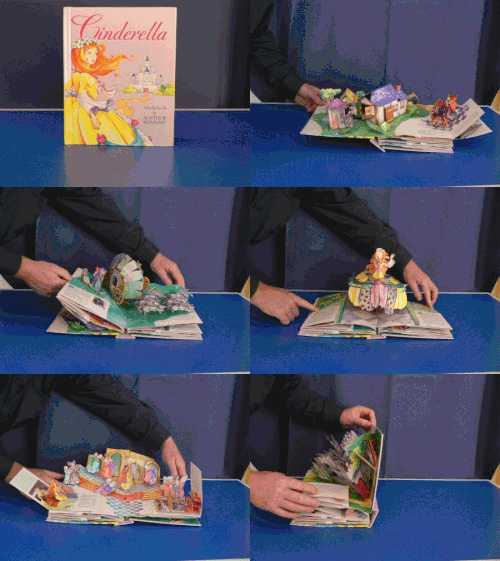
A page from a pop-up book, with a character "popping up" out of the bookDemonstration of the action of a pop-up book.
A pop-up book is any book with three-dimensional pages, often with elements that pop up as a page is turned. The terminology serves as an umbrella term for movable book, pop-ups, tunnel books, transformations, volvelles, flaps, pull-tabs, pop-outs, pull-downs, and other features each performing in a different manner. Three-dimensional greeting cards use the same principles.[1]
Design and creation of such books in arts is sometimes called "paper engineering". This usage should not be confused with traditional paper engineering, the engineering of systems to mass-produce paper products.
Animated books combine three elements: story, colored illustrations which include text, and "two or more animated illustrations with their movement mechanisms working between a doubled page".[2] In 1938, Julian Wehr's animations for children's books were patented as "moving illustrations" that move the picture up and down and horizontally at the same time with a single movement.[3][4][5]
Transformations show a scene made up of vertical slats. When a reader pulls a tab on the side, the slats slide under and over one another to "transform" into a totally different scene. Ernest Nister, one of the early English children's book authors, often produced books solely of transformations. Many of these have been reproduced by the Metropolitan Museum of Art.[citation needed]
Tunnel books (also called peepshow books) consist of a set of pages bound with two folded concertina strips on each side and viewed through a hole in the cover. Openings in each page allow the viewer to see through the entire book to the back, and images on each page work together to create a dimensional scene inside. This type of book dates from the mid-18th century and was inspired by theatrical stage sets. Traditionally, these books were often created to commemorate special events or sold as souvenirs of tourist attractions. The term "tunnel book" derives from the fact that many of these books were made to commemorate the building of the tunnel under the Thames River in London in the mid-19th century. In the United States, tunnel books were made for such attractions as World's Fairs and the New York Botanical Gardens.
Recently the tunnel book format has been resurrected by book artist Carol Barton and others as a sculptural book form. Artists are interested not only in the book's interior views, but also in treating the side accordions and covers as informational and visual surfaces.
A selection of tunnel books by Carol Barton is archived in the special collections of Virginia Commonwealth University's James Branch Cabell Library.
Volvelles are paper constructions with rotating parts. An early example is the Astronomicum Caesareum, by Petrus Apianus, which was made for the Holy Roman EmperorCharles in 1540. The book is full of nested circular pieces revolving on grommets.
Metamorphosis (a Harlequinades booklet), 1814 by Benjamin SandsComparison of two of Benjamin Sands's transformation books: Metamorphosis
About 1765, English printer Robert Sayer began experimenting with a novelty format for the juvenile book market, an early forerunner to interactive movable books, according to book historian Peter Haining. The outcome was the creation of the "metamorphoses" format, "a thin book of four sections each with two flaps which folded over, and on each section an interchangeable picture. Beneath those pictures appeared some descriptive lines of verse, and as the reader turned up the flaps in the correct order in the text difference scenes were revealed".[6]
Sayer created books featuring the "Harlequins" from popular theater pantomimes. The black and white publications, which were also called Harlequinades or turn-up books, sold for sixpence and the hand-colored ones for one shilling.[6]
By late 1770, Sayer had published four turn-up or metamorphosis books, which became a "craze with children".[7] Rival booksellers, such as Thomas Hughes and George Martin soon copied the "turn-up" format.[7] In the United States, Joseph Rakestraw published "Metamorphosis; or, a Transformation of Pictures, with Poetical Explanations, for the Amusement of Young Persons", by Benjamin Sands.
The audience for early movable books were adults, not children.[8] The first known movable in a book was created by Benedictine monk Matthew Paris in his Chronica Majora, which covers a period beginning in 1240. Paris attached volvelles onto some of the pages which were used by the monks to help calculate holy days. It is speculated that the Catalan mystic and poet Ramon Llull, of Majorca, also used volvelles to illustrate his theories in the early 14th century,[9] but no physical example of a paper volvelle created by him has ever been documented. Throughout the centuries volvelles have been used for such diverse purposes as teaching anatomy, making astronomical predictions, creating secret code, and telling fortunes. By 1564 another movable astrological book titled Cosmographia Petri Apiani had been published. In the following years, the medical profession made use of this format, illustrating anatomical books with layers and flaps showing the human body. The English landscape designer Capability Brown made use of flaps to illustrate "before and after" views of his designs.
While it can be documented that books with movable parts had been used for centuries, they were almost always used in scholarly works. In 1775 Thomas Malton, the elder published A Compleat Treatise on Perspective in Theory and Practice, on the Principles of Dr. Brook Taylor. A Compleat Treatise on Perspective is the earliest known commercially produced pop-up book since it contains three-dimensional paper mechanisms. The pop-ups are activated by pulling string and form geometric shapes used to aid the reader in understanding the concept of perspective.
It was not until the very late 18th century that these techniques were applied to books designed for entertainment, particularly for children.[10]
Some of the first three-dimensional and tab activated books were produced by Ernest Nister and Lothar Meggendorfer. These books were popular in Germany and Britain during the 19th century.
A geometric diagram of the basic principle of a pop-up book: the parallelogram
A significant development in the field of pop-up books came in 1929 with the publication of the Daily Express Children's Annual Number 1, "with pictures that spring up in model form". This was produced by Louis Giraud and Theodore Brown. Four more Daily Express Annuals followed, and Giraud set up his own publishing house, Strand Publications, which produced the groundbreaking series of Bookano books. The Bookano books are considered the first, true pop-up books for children[citation needed] because the pop-ups can be viewed from a full 360 degrees, not just the front side facing the viewer. There were seventeen Bookanos before the series came to an end with the death of Giraud in 1949.
One of the notable early examples of movable books in the United States is The Moving Picture Books, published in the early 20th century. These books featured mechanical illustrations that could move or change scenes with the pull of a tab. Initially published by Sully and Kleinteich, and later by The New York Book Company and the Pictorial Color Book Company, they became popular for their interactive storytelling and vibrant illustrations.[11]
Another unusual type of pop-up during this time was the tissue paper honeycomb style introduced by United States publisher Bernard Wilmsen, often known by the publishing name B. Wilmsen, in his Tunnel Books.[12]
In the United States, in the 1930s, Harold Lentz followed Giraud's lead with the production of the Blue Ribbon books in New York.[13][14] In the United States, in the 1930s, Blue Ribbon Books in New York was the first publisher to use the term pop-up to describe their movable illustrations, and they became well known for their collaboration with Disney, producing popular pop-up editions such as The "Pop-Up" Mickey Mouse and The "Pop-Up" Donald Duck.[15]
The next advance in the field was made by Vojtěch Kubašta working in Prague in the 1960s. His lead was followed by Waldo Hunt in the US with his founding of Graphics International.[13][16] He and two companies he established, Graphics International and Intervisual Communications (which also produced pop-up advertisements),[17] produced hundreds of pop-up books for children between the 1960s and 1990s. Although intended for US audiences, these books were assembled in areas with lower labor costs, initially Japan and later Singapore and Latin American countries such as Colombia and Mexico. Hunt's first pop-up book was Bennett Cerf's Pop-Up Riddle Book, published by Random House as a promotion for Maxwell House Coffee and showcasing the work of humorist Bennett Cerf, who was then president of Random House.[13][16] The team of Waldo Hunt and Christopher Cerf created a total of 30 more children's pop-up books for publication by Random House, including books that featured Sesame Street characters. According to Bennett Cerf (in his book At Random), pop-up books were profitable for Random House.[13]
In addition to his collaborations with Christopher Cerf at Random House, Hunt produced pop-up books for Walt Disney, a series of pop-up books based on Babar, and titles such as Haunted House by Jan Pienkowski and The Human Body by David Pelham.[13][16]
Some pop-up books receive attention as literary works for the degree of artistry or sophistication which they entail. The 1967 Random House publication Andy Warhol's Index, was produced by Andy Warhol, Chris Cerf and Alan Rinzler, and included photos of celebrities together with pop-up versions of Warholesque images such as a cardboard can of tomato paste,[13] as well as a plastic tear-out recording, an inflatable silver balloon, and other novelties. Pop-up book artist Colette Fu designed China's largest pop-up book. In 2008, she was awarded a Fulbright Fellowship to create pop-up books of the 25 ethnic minorities residing in Yunnan Province, China. Her work can be found in the Library of Congress, Metropolitan Museum of Art and National Museum of Women in the Arts.[18]
David A. Carter, who created many bug themed pop-ups, and Robert Sabuda are other prominent pop-up book authors. Star Wars: A Pop-Up Guide to the Galaxy, by Matthew Reinhart. This book received literary attention for its elaborate pop-ups, and the skill of its imagery, with The New York Times saying that "calling this sophisticated piece of engineering a 'pop-up book' is like calling the Great Wall of China a partition".[19]
Bowdoin College, the George J. Mitchell Department of Special Collections & Archives in Brunswick, Maine holds the Harold M. Goralnick Pop-up Book Collection, which contains 1,900 volumes.[21]
The North Carolina State University Libraries Research and Study Collection of Pop-Up Books 1960–2009 contains 7.5 linear feet of pop-up books, catalogs, newspaper clippings and other related ephemera pop-up book materials, many donated by Sara Frooman.[22]
The University of Iowa Special Collections Library in Iowa City includes the Matthew Reinhart Pop-up Book Collection[23] and the Emily Martin Collection,[24] two noted paper engineers.
The University of New Hampshire Dimond Library in Durham, New Hampshire holds the Carel Chapman Movable Book Collection, which contains over 1,800 pop-up and movable books.[25]
Le Chateau d'Edinbourg Das Schloss zu Edinburg The Castle of Edinburgh from Edinburgh University Heritage CollectionsPeep hole in the Le Chateau d'Edinbourg Das Schloss zu Edinburg The Castle of Edinburgh from Edinburgh University Heritage CollectionsVirginia Commonwealth University Libraries Special Collections and Archives holds the Betty Tisinger Collection and many other examples of pop-up and movable books.
Since 1993, the Movable Book Society has provided a forum for artists, book sellers, book producers, collectors, curators, and others to share enthusiasm and exchange information about pop-up and movable books. The organization also awards industry prizes for best paper engineer (trade and artists’ book) and excellence in paper engineering by an undergraduate or graduate student.[28][29]
The central plot of the film Paddington 2 (2017) revolves around trying to retrieve 'Mrs. Kozlovas Pop-Up Book', a pop-up book containing clues that lead to a treasure.
The children's animated television series Zack and Quack takes place in a world on the pages of a pop-up book. The nine-year-old boy Zack and his duck friend Quack go on adventures involving paper and pulling tabs to transform scenes.
^ abQuayle, Eric (1971). The collector's book of children's books. C.N. Potter; distributed by Crown Publishers. pp. 129–130. OCLC577286008.
^Ideas in motion: the history of pop-up and movable books : books & ephemera from the collection of Ellen G.K. Rubin. State University of New York, New Paltz. 2005. OCLC60524750.
^Allie Townsend, Pop-Up Book, in "All-TIME 100 Greatest Toys", Time, February 16, 2011.
^Montanaro, Ann R (1993). Pop-up and movable books: a bibliography. Metuchen, NJ: Scarecrow Press. p. xiii. ISBN978-0-8108-2650-2. OCLC1031620828.
^Walker, Gay (1988). Eccentric books: Arts of the Book, Yale University Library January-March 1988, an exhibit : eccentric books from the Yale University Library collections. Yale University Library. p. 62. OCLC18039509.
^Hicks, Kyra E (27 October 2019). The Movable Book Society Meggendorfer Awards: celebrating paper engineers, book artists & pop-up books, 1998-2018. ISBN978-0-9746775-1-4. OCLC1127650879.
A pop-up book, also known as a movable book, is an interactive printed work featuring mechanical devices such as flaps, wheels, and pull-tabs that create three-dimensional elements emerging from the page when opened, enhancing visual storytelling through paper engineering.[1][2][3]The origins of pop-up books trace back to the 12th century with early flap mechanisms in a 1121 manuscript, followed in the early 13th century when scholars like Matthew Paris and Ramon Llull developed movable elements such as volvelles—rotating paper dials—for astronomical, philosophical, and scientific purposes in manuscripts, including the first known volvelle in 1250.[1] By the 15th century, printed books incorporated these interactive features, primarily serving educational and navigational needs for adults.[3] The form evolved significantly in the 19th century, shifting toward children's entertainment; the first recognized pop-up book was The Story of Little Red Riding Hood (1855), published by Dean & Son in London as a "scenic book" with ribbon-activated pop-ups.[1]A golden age of pop-up books emerged in the late 19th and early 20th centuries, driven by innovators like German paper engineer Lothar Meggendorfer and British publisher Ernest Nister, who introduced complex mechanisms such as dissolving scenes and pull-out panoramas in works like Meggendorfer's Lebende Thierbilder (1880).[1] In the 1930s, S. Louis Giraud and engineer Theodore Brown revitalized the genre with affordable, mass-produced titles under the "Blue Ribbon Books" series, featuring intricate pop-ups that influenced modern designs.[1] Today, pop-up books blend artistry and engineering and are used in literature, education—where recent studies (2021–2025) in Indonesia have demonstrated that pop-up book media, including technology-based and augmented reality-integrated versions, positively affect reading fluency, early reading skills, interest in reading, and competencies such as retelling texts among elementary school students in Indonesian language learning—and exhibitions—such as the Smithsonian's Fold, Pull, Pop & Turn (2008) and the Newberry Library's Pop-Up Books through the Ages (2023)—showcasing everything from historical volvelles to contemporary sculptural narratives by artists like Robert Sabuda and Matthew Reinhart.[2][3][4][5][6]
Overview
Definition and Characteristics
A pop-up book is a form of movable book characterized by three-dimensional elements that activate or emerge when pages are turned or manipulated, serving as an umbrella term for various interactive book formats.[7][8] These books incorporate mechanical features that transform static illustrations into dynamic, spatial experiences, distinguishing them from traditional flat books that rely solely on printed text and images.[7]Central to pop-up books is the art of paper engineering, which involves precise techniques such as cutting, folding, gluing, and layering to create pop-outs, pull-tabs, flaps, and wheels.[9][10][7] These components enable interactivity, allowing readers to physically engage with the book—pulling tabs to reveal hidden details or turning wheels to rotate elements—thereby enhancing visual storytelling and narrative immersion. Simple designs may feature basic flaps that lift to uncover information, while complex ones build multi-layered structures that unfold into intricate scenes, emphasizing the tactile joy of discovery.[9][10][7]Unlike digital media, which uses electronic interfaces for similar effects, pop-up books depend on physical paper mechanisms to produce their kinetic surprises, offering a hands-on, analog experience that fosters direct sensory interaction.[11][10][9] Over time, this format has evolved from scholarly and educational tools, such as anatomical diagrams, to a primary mode of entertainment, particularly appealing for its ability to captivate through movement and surprise.[10][9]
Basic Mechanisms and Engineering
Pop-up books rely on a variety of core engineering techniques to create three-dimensional effects from flat paper surfaces, including folds, cuts, levers, and pull-tabs constructed from paper, cardstock, or glue.[12][13] Folds form the structural hinges that enable expansion when the book is opened, while cuts allow elements to move or pivot. Levers and pull-tabs, often fashioned from folded cardstock strips, translate linear motion from the page spread into rotational or oscillatory movements. These components are interconnected to produce synchronized actions, such as a figure rising or swinging, all without external power.[12][13]Assembly of these mechanisms follows a systematic process to ensure stability and functionality. First, scoring involves lightly creasing the paper or cardstock along designated lines using a blunt tool like a bone folder or the edge of a ruler, which prevents tearing and creates sharp, reliable folds. Next, cutting is performed along solid lines with scissors or a craft knife to form tabs and shapes, taking care to align cuts precisely for smooth operation. Layering then builds depth by gluing or taping multiple elements—such as V-folds for angled supports or box layers for parallelogram-based height—in sequential order, starting from the base page and adding reinforcements like extra cardstock for load-bearing parts. Finally, testing the assembly by repeatedly opening and closing simulates book use, allowing adjustments for alignment and friction reduction.[12][14]Materials for pop-up books have evolved significantly, transitioning from durable vellum in medieval constructions, which provided flexibility and longevity for early volvelles and flaps, to modern cardstock and specialized adhesives that enhance precision and scalability.[10][1] Vellum, a translucent animal skin material, was favored in pre-19th-century works for its resistance to cracking under repeated manipulation. By the 19th century, heavier paper stocks replaced vellum, paired with chromolithography for color, but glue quality often limited durability.[10][1] Contemporary production uses 65- to 110-pound cardstock for structural rigidity, acid-free adhesives like PVA glue for secure, non-yellowing bonds, and digital printing aids such as laser-cut templates to streamline fabrication while maintaining intricate details.[15]Key challenges in pop-up book engineering include achieving long-term durability against wear from frequent handling and scaling mechanisms for mass production without compromising precision. Mechanisms must withstand thousands of open-close cycles, but paper fatigue, glue weakening, or misalignment can cause failures, necessitating reinforcements like metal rivets or elastic bands in complex designs. Mass production historically relied on skilled manual assembly, leading to high costs and variability, though modern printers use automated die-cutting and proofing stages—such as white mock-ups and color flats—to minimize errors. Innovations for mechanisms, such as those developed by Lothar Meggendorfer in the late 19th century for lever-based pull-tabs and multi-directional animations, addressed these issues by standardizing components for reproducible effects, influencing durable constructions in subsequent eras.[16][14][13]
Types
Animated Books
Animated books represent a dynamic subset of pop-up literature, where mechanical devices enable motion within the pages to bring illustrations to life. These books employ pull-tabs, wheels, or strings to generate movements such as flapping wings on birds or rotating figures, distinguishing them from static designs by introducing interactivity that unfolds as the reader engages with the book.[17]Key techniques in animated pop-ups include crank mechanisms, which use camshafts and sliders to produce circular or oscillating motions, allowing elements to bob or flap realistically. Dissolving scenes facilitate smooth transitions between images through interlocking paper leaves or cross-fade overlays, creating the illusion of evolving visuals without abrupt changes. Multi-part assemblies integrate these components—such as layered tabs and levers—into cohesive systems that support synchronized movements across a spread.[17]Representative effects include rising castles that emerge via expandable frameworks, simulating architectural ascension, and dancing characters animated by tensioned strings or geared rotations. Flapping wings achieve lifelike oscillation through scored folds connected to pull mechanisms, while rotating figures leverage wheel-based pivots, akin to traditional volvelles for rotational display.[17][18]These animated elements excel in storytelling by mimicking kinetic actions inherent to narratives, such as a character's leap or a scene's progression, thereby heightening immersion and aiding comprehension of sequential events. The tangible motion fosters active participation, transforming passive reading into an experiential journey that reinforces plot dynamics and emotional beats.[17]
Transformation Books
Transformation books represent a category of pop-up designs where pages or elements undergo reconfiguration to alter visual scenes, often through interactive mechanisms that reveal new images or narratives. These books employ techniques such as flaps, pull-tabs, and dissolving panels to create transformations, allowing a single illustration to morph—for instance, from a serene landscape to a bustling cityscape via layered reveals. This core concept emphasizes static shape changes rather than continuous motion, focusing on the surprise of reconfiguration to engage the reader.[19][20]Specific techniques in transformation books include slit-and-slide mechanisms, where two illustrations are cut like Venetian blinds and interleaved, then pulled via a tab or ribbon to dissolve one image into another, producing optical illusions of seamless change. Accordion folds, as in fanfolded pop-ups, enable extended reveals by unfolding layered panels that progressively transform the scene, while sliding panels and gatefolds allow horizontal or vertical extensions to reconfigure elements for narrative depth. Layered reveals, often combined with flaps glued at one edge, uncover underlying illustrations to depict "before and after" transformations, enhancing conceptual understanding through tactile interaction.[19][21][20]Historical precursors to modern transformation books emerged in 19th-century metamorphoses, building on earlier flap-based designs but incorporating advanced printing like chromolithography for more vivid scene alterations. Publishers such as Dean & Son produced dissolving views in books like Dean's New Book of Dissolving Views (1860), where tabs pulled to shift contrasting scenes, often illustrating fairy tales or moral lessons through metamorphic imagery. These 19th-century works, exemplified by Lothar Meggendorfer's pull-tab mechanisms in Neue Lebende Bilder (1880), refined techniques for smoother transformations, influencing later paper engineering.[20][21]Artistically, transformation books leverage these mechanisms for surprise and narrative progression, using reconfiguration to punctuate story beats and evoke wonder, as seen in adaptations where flaps reveal evolving character arcs or environmental shifts. This approach overlaps briefly with harlequinades' visual tricks but prioritizes form alteration over theatrical flips. By prioritizing interactive reveals, these books foster deeper engagement with themes, turning passive reading into an exploratory experience.[22][20]
Tunnel Books
Tunnel books, also known as peep shows, consist of a series of cut-paper panels arranged one behind the other to create an illusion of depth and perspective, forming a tunnel-like effect when viewed through a front peephole or frame.[23][24] These multi-layered structures typically feature progressively smaller cutouts in each panel, allowing the viewer to peer through to the receding scenes, simulating three-dimensional space within a compact, foldable format.[25]In construction, the panels are connected by accordion-style folds, tissue-paper hinges, or parallel strings that hold them at fixed intervals, enabling the book to collapse flat for storage while expanding into a freestanding tunnel when opened.[24][26] Materials often include hand-colored lithographs or engravings on cardstock or lightweight paper, with cuts and slits facilitating the layered visibility, similar to basic pop-up mechanisms but emphasizing static depth over movement.[23] These books are commonly designed to depict landscapes, architectural wonders, or scenic vistas, such as panoramic views of gardens or urban scenes, where the parallel panels build a sense of recession into the distance.[25]Tunnel books originated as popular 19th-century souvenirs and peep show entertainments, evolving from earlier 18th-century optical devices like perspective theaters patented by Martin Engelbrecht in 1719.[25] By the 1820s, they proliferated in Austria and Germany as affordable, portable mementos of landmarks and events, spreading to Britain and France; notable examples include over 50 designs commemorating the Thames Tunnel (1825–1843), an engineering feat viewed as the "Eighth Wonder of the World," and depictions of the Crystal Palace at the Great Exhibition of 1851.[27][24][26]The format achieves effects of perspective and immersion by scaling figures and scenes to diminish in size across layers, drawing the viewer into a theatrical, window-like vista that contrasts with the planar pop-outs of traditional movable books.[25][23] This layered approach fosters a sense of spatial extension and narrative depth, often enhanced by colored details that evoke distant atmospheres, making the experience intimate and exploratory when held to the eye.[24]
Volvelles
A volvelle is a circular paper or parchment device consisting of one or more rotating discs or wheels that align information or images through manipulation, often serving as an interactive element within books.[28] Derived from the Latin verb volvere, meaning "to turn," volvelles have been incorporated into printed works for over 800 years to facilitate dynamic visualization and computation.[28] Unlike static illustrations, these mechanisms allow users to spin layers to reveal relationships between variables, such as dates, celestial positions, or anatomical features.[29]Construction techniques for volvelles typically involve layered discs fastened at a central pivot, enabling independent rotation, with overlays of printed or inscribed elements that align through cut-out windows or slots.[30] Pivots are commonly created using a string, thread, or modern brad fastener to secure the layers while permitting smooth movement.[28] Pointers, in the form of fixed arrows or keys on the outermost layer, guide alignment, often for practical applications in fields like astronomy, medicine, or navigation, where users rotate components to match scales or diagrams.[31] These elements create a form of paper analog computing, simulating complex interactions without mechanical power.[32]In medieval Europe, volvelles found early applications as educational tools for calendars and astronomical diagrams, introduced around 1274 by scholar Ramón Llull to aid in calculations of celestial movements.[33] For instance, concentric discs allowed users to determine lunar phases, solar positions, or astrological signs by aligning pointers with graduated circles representing time or stars, as seen in a 1386 manuscript preserved at the J. Paul Getty Museum.[33] Medical volvelles depicted human organs or diagnostic wheels, while navigational versions plotted courses using rotatable scales, enhancing the interactivity of scholarly texts.[28]In contemporary contexts, volvelles appear in playful forms within children's books and activity materials, such as spinning selectors for decision-making games or image-revealing wheels in pop-up designs.[34] Examples include educational pop-up books using volvelles to cycle through animal facts or outfit choices, and craft templates for creating personalized spinners in greeting cards or games.[35] Modern paper engineering adapts these for entertainment, like food-pairing wheels in magazines or interactive elements in music-themed publications, emphasizing fun over utility.[34] This rotational interactivity echoes animated book mechanisms but focuses on selective alignment rather than sequential motion.[36]
Harlequinades and Turn-up Books
Harlequinades, also known as turn-up books, flap-books, or metamorphoses, were popular toy books in 18th- and 19th-century England, typically consisting of one or two engraved sheets folded into four panels to form a narrow octavopamphlet. These books featured interchangeable flaps that, when lifted or turned over, created humorous and absurd visual combinations, such as placing an animal head on a human body or transforming a serene scene into chaos, often centered around the mischievous character Harlequin from pantomime theater. Devised around 1765 by publisher Robert Sayer, they represented an early form of interactive children's literature, with production peaking in the 1770s and declining by the early 1800s.[37][38][39]The techniques employed in harlequinades relied on simple yet effective paper engineering, where the base sheet provided a foundational image divided into horizontal sections, and attached flaps—cut from a second sheet and hinged with glue or thread—covered portions that could be lifted to reveal alternative illustrations below. This lift-up or turn-over mechanism allowed for rapid scene changes, mimicking the quick transformations in stage harlequinades, and was often accompanied by rhyming verses or doggerel that guided the reader through the narrative. For instance, in Harlequin Skeleton (1772), lifting flaps reveals escalating comedic horrors, turning a everyday figure into a skeletal prankster. Sold affordably at six pence for plain versions or one shilling for colored ones, these books were designed for easy manipulation by young hands, building on basic flap mechanisms to encourage active participation.[37][39][40]Culturally, harlequinades played a significant role in children's entertainment during the late 18th century, bridging the gap between popular theater and print media by adapting pantomime's slapstick humor and visual spectacles for home use. They targeted young audiences, including apprentices and working-class children, offering moral lessons wrapped in satire—such as subverting expectations through absurd outcomes to highlight the folly of appearances, as seen in The Falshood of External Appearances (ca. 1790). These books fostered interactive play, inviting readers to "perform" the story by manipulating flaps, which cultivated early literacy through visual and tactile engagement rather than passive reading. Their satirical edge often poked fun at social norms, reflecting the era's festive Christmas traditions tied to harlequin performances.[38][40][39]Harlequinades influenced subsequent transformation designs in pop-up books by establishing the flap as a tool for metamorphic storytelling, paving the way for more complex interactive formats in 19th-century toy books that emphasized whimsy and surprise. Their legacy lies in popularizing the idea of books as playful, participatory objects, which later evolved into broader metamorphic narratives while retaining the core appeal of absurd, flap-driven changes.[40][37]
History
Medieval and Early Origins
The earliest precursors to pop-up books emerged in medieval manuscripts as interactive elements designed to enhance scholarly understanding, long before the widespread adoption of printing. Compiled between 1090 and 1120 by Lambert, canon of Saint-Omer, the Liber Floridus is recognized as one of the first encyclopedias to incorporate movable features, including a gatefold flap that unfolds to illustrate the Globus Terre, providing a layered view of the Earth's structure for cosmological study.[41] Similarly, the Chronica Majora, a comprehensive chronicle authored by the Benedictine monk Matthew Paris around 1240, employed flaps and folded appendages in its diagrams, such as wind roses and pilgrimage itineraries, to dynamically represent geographical and meteorological data.[42] These hand-crafted mechanisms, produced in monastic scriptoria, allowed users to manipulate pages for interactive exploration, distinguishing them from static illustrations.[3]These medieval innovations served educational purposes for adult scholars, functioning as aids in anatomy, astronomy, and philosophy rather than entertainment. For instance, flaps in anatomical manuscripts enabled the visualization of bodily layers, while astronomical diagrams used movables to simulate celestial movements, addressing the limitations of two-dimensional representation in complex subjects.[43] Predating Johannes Gutenberg's printing press by centuries, such books were labor-intensive artifacts, often customized for monastic or university use to promote deeper conceptual comprehension among learned readers.[44] Their design emphasized utility over ornamentation, reflecting the era's focus on empirical and theological inquiry.The Renaissance transitioned these manuscript traditions into printed formats, integrating movables with the efficiency of the press. A pivotal example is the Astronomicum Caesareum (1540), crafted by printer Michael Ostendorfer from designs by astronomer Petrus Apianus, which featured intricate volvelles—multi-layered rotating disks—to model planetary orbits and eclipses for imperial patronage.[45] Complementing this, Andreas Vesalius's De Humani Corporis Fabrica (1543) and its abridged companion, the Epitome, advanced anatomical interactivity through layered flaps that could be assembled to reveal progressive dissections of the human body, transforming static woodcuts into dissectible models for medical instruction.[46] These printed innovations democratized access to interactive learning, bridging medieval scholarly tools with the burgeoning scientific revolution and setting the stage for broader applications in early modern books.[47]
18th to 19th Century Developments
In the 18th century, pop-up books transitioned toward commercial production aimed at children during the Enlightenment, with London printer and bookseller Robert Sayer pioneering the format through his harlequinades and turn-up books starting around 1765.[38] These works featured simple paper engineering, such as flaps and split pages that allowed images to transform, often depicting pantomime characters like Harlequin in humorous, sequential adventures.[7] Sayer produced at least sixteen such titles, which combined entertainment with educational content, including nursery rhymes and alphabet lessons to teach literacy and morals to young readers.[48]The 19th century marked significant advancements in movable book design, driven by the Industrial Revolution's emphasis on children's education and leisure. Dean & Son, a London firm established around 1800, became the leading producer of pop-up and movable books, publishing around 50 titles with innovative features like ribbon-pulled cutouts and tab mechanisms before 1900.[49] Their works, such as the Dean's Toy Books series from the 1840s, integrated pop-up elements into stories like fairy tales and everyday scenes, making interactive books a staple for nursery education.[49]German illustrator Lothar Meggendorfer elevated the technical sophistication of pop-up books in the late 19th century, creating intricate mechanisms that enabled multiple simultaneous movements through single pull-tabs and delayed actions.[13] Based in Munich, Meggendorfer produced dozens of titles, including satirical scenes and circus depictions, which showcased his patented designs for enhanced paper engineering, influencing the genre's mechanical complexity.[50]Lithography, invented in 1798 and refined into chromolithography by the mid-19th century, revolutionized pop-up book production by allowing vibrant, multicolored illustrations to be mass-printed at lower costs, thereby increasing accessibility for middle-class families.[51] This technological shift, combined with steam-powered presses, enabled publishers like Dean & Son to scale output, transforming pop-up books from handmade novelties into affordable children's staples during the era.[52]
20th Century Renaissance and Modern Era
The pop-up book experienced a significant renaissance in the 1930s amid the Great Depression, driven by efforts to produce affordable, mass-market editions that revitalized the format's popularity. S. Louis Giraud, a British publisher and designer, played a pivotal role through his Bookano series, launched in collaboration with the Daily Express newspaper, which featured innovative "living models" offering 360-degree views and photolithographic printing for vibrant colors at low cost.[53] These annual volumes, such as Bookano Stories (1934), emphasized mechanical simplicity and narrative integration, helping to re-energize the industry after a post-World War I decline.[54] In the United States, the Blue Ribbon Books series, including titles like The Pop-up Mother Goose (1934) illustrated by Harold B. Lentz, mirrored this trend by adapting European techniques for American audiences, achieving widespread distribution through department stores.[55]Following World War II, pop-up books saw further resurgence in Europe, particularly in Czechoslovakia, where architect-turned-artist Vojtěch Kubašta pioneered intricate, folkloric designs for the state publisher Artia starting in the late 1940s. Kubašta's works, blending architectural precision with colorful lithography, included over 300 titles translated into 27 languages, with his adaptation of Little Red Riding Hood (1956) as a notable example.[53] His post-war innovations, such as multi-layered scenes and pull-tab mechanisms, catered to international markets during the Cold War, exporting millions of volumes and influencing global perceptions of Czech graphic arts.[56] By the 1960s, Kubašta's output had reached 35 million copies across his catalog, underscoring the format's commercial viability in rebuilding cultural industries.[56]The modern era, from the 1980s to 2025, marked a surge in artistic and technical sophistication, propelled by creators like Robert Sabuda and Matthew Reinhart, who elevated pop-ups into high-end collectibles. Sabuda's debut series, including The Christmas Alphabet (1994), introduced layered, symmetrical engineering for classics like The Wonderful Wizard of Oz (2001), achieving bestseller status through intricate paper folding without digital prototyping.[57] Reinhart, collaborating with Sabuda early on, expanded the genre with anatomical precision in works like Encyclopedia Prehistorica (2005–2007), while his franchise tie-ins, such as Harry Potter: A Pop-Up Guide to Hogwarts (2018) and Harry Potter: A Pop-Up Guide to Diagon Alley and Beyond (2020), integrated licensed narratives with five-spread 3D models, selling hundreds of thousands of units.[58] Digital aids, including computer-assisted drafting for prototypes, have facilitated this complexity since the 1990s, enabling precise simulations of mechanisms before physical assembly.[59]Recent developments from 2024 to 2025 highlight sustainability and commercialization, with publishers adopting eco-friendly materials like recycled paper and soy-based inks to reduce environmental impact in response to consumer demand.[60] Franchise tie-ins continue to dominate, exemplified by expanded Harry Potter pop-up editions featuring interactive wizarding elements, alongside niche releases for adults like art-inspired volumes.[61] The Meggendorfer Prize, administered by the Movable Book Society, has grown in scope, adding categories for artist books and international entries in 2024–2025, with 2025 finalists including Keith Haring Pop-Up Book for innovative engineering.[62] This evolution reflects pop-ups' adaptation to contemporary markets, balancing tradition with accessible innovation.[63]
Notable Works
Historical Examples
One of the earliest known examples of interactive book elements appears in the Chronica Majora, a medieval chronicle compiled by the English Benedictine monk Matthew Paris starting around 1240. This manuscript, intended as a universal history from creation to contemporary events, incorporates liftable flaps over illustrations and rudimentary volvelles—rotating paper wheels—for calculating lunar cycles and ecclesiastical dates, allowing readers to interact with the content practically. Housed in the Corpus Christi College Library in Cambridge, the work's innovative use of flaps to reveal or conceal images marked a foundational step in movable book design, transitioning static manuscripts toward dynamic visualization for educational purposes.In the Renaissance, the Astronomicum Caesareum (1540), produced by German mathematician Petrus Apianus and printed in Ingolstadt for Holy Roman Emperor Charles V, elevated paper engineering to artistic and scientific heights. This astronomical atlas features over 20 elaborate volvelles with layered, hand-colored discs fastened by grommets, enabling users to simulate planetary motions, eclipses, and celestial alignments through rotation and alignment. Renowned for its opulent woodcuts and gold-embossed details, it exemplifies the era's fusion of art and astronomy, influencing subsequent scientific treatises by demonstrating how movable components could model complex phenomena accessibly. The book's rarity—approximately 100 copies survive worldwide—underscores its cultural prestige as a pinnacle of early modern printing innovation.[64]The 19th century saw mechanical ingenuity flourish with the works of German illustrator Lothar Meggendorfer, whose International Circus (1887) introduced advanced pull-tab and lever systems for animated scenes. Published by J.F. Schreiber in Esslingen, Germany, this volume uses hidden ribbons, wire mechanisms, and cardboard tabs to activate lifelike movements, such as dancing figures or unfolding landscapes, all engineered without glue to ensure smooth operation. Meggendorfer, who created over 200 such titles between the 1870s and 1910s, transformed pop-up books from novelties into sophisticated entertainments, emphasizing humor and narrative depth; his designs, often priced at a premium due to their complexity, set standards for durability and interactivity that persisted into the 20th century. English editions followed from Dean & Son in London.[65][66]Bridging to the early 20th century, S. Louis Giraud's Daily Express Children's Annuals series (1929–1933) popularized pop-up formats for mass audiences through affordable, self-erecting models and pull-tab activations. Edited for the British newspaper Daily Express, these annuals featured colorful, three-dimensional scenes—like rising castles or animated adventures—crafted with V-fold and slit mechanisms that sprang into view upon opening, often illustrating stories with characters such as Rupert Bear. Giraud's innovations, including 360-degree viewable pop-ups, democratized the genre by producing six editions that sold widely during the interwar period, fostering a cultural boom in children's interactive literature and paving the way for postwar pop-up revivals.[54]These historical works collectively drove the evolution of pop-up books from utilitarian aids in medieval scholarship to elaborate mechanical entertainments by the 1930s, expanding their role in education, science, and leisure while inspiring generations of paper engineers.[53]
Modern and Contemporary Creations
In the mid-20th century, Czech artist and paper engineer Vojtěch Kubašta pioneered a series of innovative pop-up books based on fairy tales, produced primarily in the 1950s and 1960s through publishers like ARTIA and Bancroft & Co.[67] His works featured panoramic, layered constructions with vibrant colors and whimsical illustrations, transforming classic stories into interactive experiences. A notable example is his 1960 adaptation of Alice's Adventures in Wonderland by Lewis Carroll, which includes two double-page pop-up spreads depicting key scenes like the Mad Tea Party and the Queen of Hearts' croquet game, along with a central lift-the-flap element.[68][69]Transitioning into the late 20th and early 21st centuries, American paper engineer Robert Sabuda elevated pop-up design with architectural precision and intricate mechanics. His 2001 commemorative edition of The Wonderful Wizard of Oz by L. Frank Baum, published by Simon & Schuster, condenses the narrative into seven pages with six large double-page pop-ups and additional flaps featuring smaller elements.[70] Standout features include a towering Emerald City with crystalline facets and a functional hot-air balloon pop-up, showcasing Sabuda's signature use of white space, metallic inks, and multi-layered structures to mimic the story's fantastical landscapes.[70]Contemporary creators have expanded pop-ups into educational and artistic realms, blending factual content with elaborate engineering. Matthew Reinhart, often collaborating with Sabuda, co-authored the Encyclopedia Prehistorica series in the mid-2000s, published by Candlewick Press, which explores prehistoric life through dynamic pop-ups.[71] The 2005 Dinosaurs volume features six major spreads, such as a roaring Tyrannosaurus rex with articulated jaws and a flock of flying raptors, supplemented by pull-out booklets containing additional facts and mini-pop-ups, making complex paleontology accessible to young readers.[71]Artist Colette Fu has produced pop-up works as fine art objects in the 2010s, focusing on cultural documentation through photography and sculpture-like paper engineering. Her series We Are Tiger Dragon People, initiated during a 2008 Fulbright fellowship and exhibited throughout the decade, consists of oversized pop-up books portraying the ethnic minorities of China's Yunnan Province, including the Nuosu Yi.[72][73] These pieces integrate vibrant, layered photographs of traditional costumes and festivals into accordion-fold structures that unfold to reveal immersive, circus-like tableaux of cultural diversity and heritage.[74][75]Recent years have seen pop-up books embrace eco-themes and franchise adaptations, alongside accolades for engineering excellence. In 2024, DK released Pop-Up Peekaboo! Star Wars: Young Jedi Adventures, a board book with interactive flaps and pop-ups introducing characters like Yoda and Grogu in simple scenes from the animated series, appealing to young fans through licensed content.[76] Eco-focused releases, such as Usborne's Pop-Up Seasons by Anna Milbourne (2020), use seasonal pop-ups to illustrate environmental cycles and conservation, aligning with rising trends in sustainable storytelling.[77] The 2025 Meggendorfer Prize, awarded by the Movable Book Society, recognized Ma Mengxin's Pop Up A to Z: Structures Study to Creative Design (Zhejiang University Press) for its comprehensive exploration of pop-up techniques, including instructional pop-ups on folds and mechanisms, highlighting ongoing innovation in the field.[63][62]
Collections and Preservation
Library Collections
The British Library maintains one of the most significant collections of early movable books, including volvelles from medieval manuscripts such as Ramon Llull's Ars Magna (c. 1305), which contains the oldest surviving example of a manuscript volvelle.[78] These holdings provide researchers with access to foundational paper engineering techniques used for astronomical, astrological, and philosophical illustrations.[78]In the United States, the Library of Congress holds extensive collections of 19th-century toy books featuring pop-up and movable elements, reflecting the era's surge in interactive children's literature produced by publishers like Dean & Son.[1] A 2023 preservation blog post from the Library highlights ongoing efforts to protect these items, emphasizing their role in studying the evolution of printed entertainment for young audiences.[1]University collections also play a vital role, with the University of North Texas Rare Books and Texana Collections curating dedicated exhibits on pop-up and movable books spanning from medieval volvelles to modern examples, facilitating scholarly access through digital and physical displays.[7] These exhibits often feature representative historical works, underscoring the format's enduring appeal in research and education.Digitization initiatives have expanded access to fragile pop-up books, including high-resolution scans of early movable elements in Matthew Paris's Chronica Majora (c. 1240–1253), hosted by the Parker Library at Corpus Christi College, Cambridge, via IIIF technology for non-destructive viewing.[79] Such efforts preserve intricate mechanisms like flaps and dials that would degrade under frequent handling.Conservation poses significant challenges for library holdings, as the paper-based mechanisms in pop-up books—such as tabs, strings, wheels, and folds—are prone to wear, breakage, and detachment from repeated use or environmental factors like humidity.[1] Specialized techniques, including custom enclosures and minimal manipulation protocols, are employed to mitigate these risks while supporting research access.[1]
Museum and Archival Collections
Several major museums house significant collections of pop-up books, emphasizing their historical and artistic value through dedicated exhibitions that engage the public with interactive displays. The Newberry Library in Chicago presented the exhibition "Pop-Up Books through the Ages" from March 21 to July 15, 2023, showcasing over 100 items from its collection, including books, maps, and ephemera spanning an 800-year history of movable books from medieval origins to contemporary works.[80][81] This exhibit highlighted the tactile evolution of paper engineering, allowing visitors to interact with flaps, volvelles, and pop-ups that demonstrate hands-on reading experiences across centuries.[3]The Smithsonian Institution Libraries has long featured pop-up and movable books in its displays on paper engineering, with the 2010 exhibition "Paper Engineering: Fold, Pull, Pop & Turn" presenting more than 50 examples from the mid-16th to early 21st centuries, including scientific and artistic constructions that illustrate mechanical ingenuity.[82][83] These collections underscore the Smithsonian's role in preserving rare volumes that blend artistry with technical innovation, often drawing crowds to explore the three-dimensional mechanics of historical texts.[84]The Eric Carle Museum of Picture Book Art in Amherst, Massachusetts, focuses on modern pop-up books through its permanent and rotating displays, notably the exhibition "Pop-ups and Palettes: The Many Dimensions of Robert Sabuda," which celebrated the contemporary paper engineer Robert Sabuda's intricate designs inspired by classic literature.[85] The museum's collection emphasizes pop-ups as a vital form of picture book art, offering workshops and interactive sessions where visitors create their own movable elements, fostering public appreciation for this medium's role in children's literature.[86] In 2025, the museum continued this engagement with a Halloween-themed pop-up art project running through November 23, encouraging hands-on storytelling.[87]Archival collections in medical history museums preserve pop-up books that served educational purposes in anatomy and related sciences, with flaps and layers revealing the human body's interior. The International Museum of Surgical Science in Chicago holds "The Portfolio of Life" (1891) by Henry H. Rassweiler, a rare pop-up volume that combines medical illustration with interactive paper mechanisms to depict physiological processes, featured in public displays and social media highlights in 2025.[88] Similarly, astronomical pop-ups, such as volvelles tracking celestial movements, appear in scientific archives within institutions like the Smithsonian, where they illustrate early applications of paper engineering in education.[82]Recent exhibitions in 2024 and 2025 have further promoted public interaction with pop-up books, building on these archival strengths. Bowdoin College's December 2024 pop-up exhibition in its Special Collections Learning Lab displayed student-created pop-ups alongside historical printmaking examples, emphasizing community involvement in preserving movable book traditions.[89] The Edward Gorey House in Yarmouth Port, Massachusetts, hosted "Exquisite Corpse: Edward Gorey's Moveable Books" throughout 2024, exploring the artist's innovative use of pop-ups and flaps in his macabre narratives.[90] These shows highlight ongoing curatorial efforts to make archival pop-up collections accessible, often through temporary displays that invite tactile exploration.
Organizations and Events
Key Associations
The Movable Book Society, founded in 1993 by Ann R. Montanaro, serves as a primary nonprofit organization dedicated to the creation, study, and promotion of pop-up and movable books.[91] Established in response to interest from her bibliography Pop-up and Movable Books: A Bibliography, the society provides a dedicated forum for enthusiasts worldwide.[91]With nearly 450 members globally, including artists, collectors, book producers, sellers, and curators, the organization emphasizes community among those involved in paper engineering and book arts.[91] Its newsletter, Movable Stationery, edited by paper engineer Bruce Foster, facilitates the exchange of information on new releases, techniques, and historical insights, supporting both novice and experienced members.[91] The society's international reach extends to members in Europe and Asia, fostering cross-continental connections without formal regional chapters.[91]Key roles of the Movable Book Society include networking opportunities that connect creators and collectors, promotion of high standards in craftsmanship through shared knowledge and resources, and advocacy for the preservation of movable book heritage as a unique form of artistic expression.[91] Members benefit from access to specialized resources, such as bibliographies and expert advice on sourcing rare materials, as well as opportunities for collaborations on projects and exhibitions.[91] The organization also sponsors awards, such as the Meggendorfer Prize for outstanding paper engineering, to recognize excellence in the field.[63]
Awards and Exhibitions
The Meggendorfer Prize, established in 1996 by the Movable Book Society, honors outstanding achievements in paper engineering for commercially published pop-up and movable books, as well as artist books. Awarded biennially, it features categories such as Best Paper Engineering for trade publications and Best Artist Book, recognizing innovation in mechanisms, design, and storytelling through interactive formats.[63]In 2025, the Best Paper Engineering award was given to Ma Mengxin for Pop Up A to Z: Structures Study to Creative Design, a comprehensive guide blending technical instruction with artistic application, published by Zhejiang University Press. The Best Artist Book category went to Emily Martin for Navigational Tools for the Willfully Lost, an intricate work exploring themes of direction and discovery via layered pop-up elements. Finalists highlighted innovative approaches, such as Heather Clements' Pull Me Apart, a nature-inspired interactive art book featuring pull-tab interactions, flaps, wheels, and movable mechanisms to manipulate watercolor scenes.[63][62][92]The Movable Book Society also administers the Emerging Paper Engineer Prize, a biennial award for undergraduate and graduate students worldwide, which Ma Mengxin additionally received in 2025 for the same work, underscoring its role in fostering young talent. Complementing these, the society's Lifetime Achievement Award recognizes lifelong contributions, such as those honored to Tor Lokvig and James Diaz in 2023 for advancing movable book techniques.[63]These recognition programs elevate the craft of pop-up books by spotlighting technical mastery and creative risk-taking, thereby inspiring new creators and expanding the genre's audience.[63]Public exhibitions further amplify the visibility of pop-up books, often hosted by libraries, museums, and associations to showcase historical and contemporary examples. The Newberry Library's "Pop-Up Books through the Ages" exhibition, running from March 21 to July 15, 2023, displayed over 100 items from its collection, including medieval volvelles, 19th-century toy books, and modern paper-engineered volumes, illustrating the medium's evolution from educational tools to artistic expressions.[80]In late 2024, Bowdoin College Library presented a pop-up exhibition integrating pop-up books with printmaking, featuring interactive installations that demonstrated sculptural pop-up techniques and their intersections with visual arts, held in December to engage visitors with hands-on exploration. The Movable Book Society's biennial conferences routinely incorporate exhibitions, such as the 2025 event in St. Louis (September 25–28), which included curated displays and tours of special collections at Washington University, highlighting member-created works and rare antiquarian pieces. International pop-up fairs, like the LA Art Book Fair (May 15–18, 2025), dedicated sections to pop-up books among artist publications, fostering global exchange and sales opportunities for creators.[89][93][94]Such awards and exhibitions collectively enhance the market for pop-up books by driving publicity and collector interest, with prizewinners often experiencing increased demand; for example, past Meggendorfer recipients like David A. Carter's works have seen sales exceeding millions of units, while events inspire collaborative projects among artists and engineers.[95][96]
Cultural and Educational Impact
In Literature and Media
Pop-up editions of classic literary works have integrated three-dimensional mechanics to deepen narrative immersion, transforming static text into interactive experiences. A prominent example is Lewis Carroll's Alice's Adventures in Wonderland, which has inspired multiple pop-up adaptations since the 1980s, including the 1980 Delacorte Press edition illustrated by Jenny Thorne after John Tenniel, featuring intricate paper engineering to depict the story's whimsical scenes.[97] Later versions, such as Robert Sabuda's 2003 adaptation published by Little Simon, employ layered pop-ups to recreate iconic moments like the Mad Tea Party, emphasizing the tale's surreal elements through visual surprise.In film and television, pop-up books extend storytelling beyond pages into broader media landscapes, often as promotional tie-ins or featured crafting elements. Adaptations of cinematic universes, like the Harry Potter series, include pop-up books such as Harry Potter: A Pop-Up Guide to Hogwarts (2019, Insight Editions), which recreates film locations like the Great Hall with pull-tabs and flaps, bridging the movies' visual spectacle with tactile interaction. On television, crafting programs highlight pop-up techniques; for instance, the PBS series Craft in America (upcoming "EAST" episode featuring artist Colette Fu, premiering December 19, 2025) demonstrates the construction of large-scale pop-up books, illustrating their role in contemporary media production.[98]Collaborative efforts between artists and paper engineers have produced notable pop-up art books that blend fine art with mechanical innovation. Andy Warhol's Index (Book) (1967, Random House), co-created with contemporaries like Billy Name, incorporates pop-up features such as a fold-out castle and a biplane, reflecting the Pop Art movement's playful disruption of traditional formats.[99] These works exemplify how pop-ups foster interdisciplinary partnerships, merging visual artistry with engineering to challenge conventional book structures.
Educational and Artistic Applications
Pop-up books enhance interactive learning in STEM subjects by providing three-dimensional visualizations that make complex concepts accessible to children. For instance, anatomy pop-up books, such as those featuring layered flaps to reveal human body structures, allow young learners to explore organs and systems in a hands-on manner, transforming static diagrams into dynamic models that support comprehension of biological processes.[100] Similarly, titles like Pop-Up Volcano! illustrate geological formations and eruptions through erupting mechanisms, fostering understanding of earth sciences for students in grades 1-5.[101] In literacy development, these books promote engagement among reluctant readers aged 3-12 by encouraging page-turning and repeated interactions, which build vocabulary through rereading and train visualization skills essential for transitioning to text-heavy narratives.[102]Pop-up books play a role in thematic eco-education, aligning with broader shifts toward interactive formats that address environmental awareness in children's literature. Books like Pop-Up Earth (2021, Thames & Hudson) demonstrate interconnected ecosystems through pop-up illustrations of planetary changes and biodiversity, helping children grasp conservation concepts in an engaging way.[103] Environmental educators, such as Shawn Sheehy, utilize pop-up designs to teach ecology, creating layered depictions of natural habitats that highlight sustainability for young audiences.[104]In the artistic realm, pop-up books serve as sculptural art forms, elevating paper engineering to gallery-worthy installations. Artist Colette Fu exemplifies this by crafting oversized, photo-based pop-ups that explore cultural narratives, such as ethnic minorities in China's Yunnan Province in We Are Tiger Dragon People, where intricate folds and vibrant imagery create immersive, three-dimensional sculptures.[73] Her works have been exhibited at venues like the National Museum of Women in the Arts, showcasing pop-ups as dynamic art objects that blend photography, mythology, and personal storytelling.[105]Pop-up books also play therapeutic roles by facilitating sensory engagement for neurodiverse learners, particularly those with autism. Interactive elements like flaps and pop-ups stimulate tactile and visual senses, promoting focus and object recognition; a study on augmented reality pop-up books reported a 52.5% overall improvement in engagement among autistic children, with gains in curiosity exploration (43.75%) and communication (43.75%).[106] These features encourage cause-and-effect understanding through physical manipulation, aiding emotional regulation and social interaction in therapeutic settings.[107]Recent integrations of digital-hybrid pop-ups in 2024 have expanded their applications, merging physical books with augmented reality (AR) via apps to create enhanced interactive experiences. A study involving 38 children aged 8-10 found that AR pop-up books elicited positive affective responses in 37 participants, improved cognitive comprehension through dynamic animations in 21 cases, and boosted social sharing in 32 instances, marking a hybrid evolution that augments traditional pop-ups with digital overlays for deeper engagement.[108]Several research studies published between 2021 and 2025 have investigated the use of pop-up book media, including technology-based and augmented reality-integrated versions, in Indonesian language learning to improve reading abilities among elementary school (SD) students. Key findings from these studies indicate positive effects on reading fluency, early reading skills, interest in reading, and competencies such as retelling texts. These applications highlight the versatility of pop-up books in diverse cultural and technological contexts, particularly for supporting literacy development in non-Western educational settings.[109][110][111]



.jpg)

.jpg)


