Hubbry Logo
Noble Eightfold PathNoble Eightfold PathMain
Open search
Noble Eightfold Path
Community hub
Noble Eightfold Path
logo
8 pages, 0 posts
0 subscribers
Be the first to start a discussion here.
Noble Eightfold Path
from Wikipedia

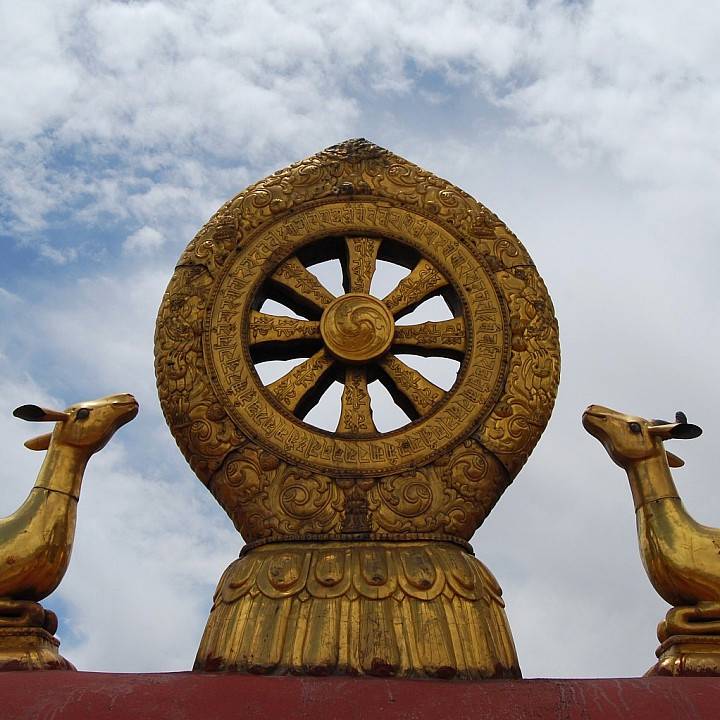
The eight spoke Dharma wheel symbolizes the Noble Eightfold Path.
Translations of
The Noble Eightfold Path
Sanskritआर्याष्टाङ्गमार्ग
(IAST: āryāṣṭāṅgamārga)
Paliअरिय अट्ठङ्गिक मग्ग
(ariya aṭṭhaṅgika magga)
Bengaliঅষ্টাঙ্গিক আর্য মার্গ
(Astangik ārya mārga
Oșŧangik Azzo Maggo
Oșŧangik Arzo Margo
)
Burmeseမဂ္ဂင်ရှစ်ပါး
(MLCTS: mɛʔɡɪ̀ɰ̃ ʃɪʔ pá)
Chinese八正道
(Pinyin: bā zhèngdào)
Japanese八正道
(Rōmaji: Hasshōdō)
Khmerអរិយដ្ឋង្គិកមគ្គ
(UNGEGN: areyadthangkikameak)
Korean팔정도
八正道

(RR: Paljeongdo)
Mongolianᠣᠦᠲᠦᠶᠲᠠᠨᠦ ᠨᠠᠢᠮᠠᠨ ᠭᠡᠰᠢᠭᠦᠨᠦ ᠮᠥᠷ
Найман гишүүт хутагт мөр

(qutuγtan-u naiman gesigün-ü mör)
Sinhalaආර්ය අෂ්ඨාංගික මාර්ගය
Tibetanའཕགས་པའི་ལམ་ཡན་ལག་བརྒྱད་པ
(Wylie: 'phags pa’i lam yan lag brgyad pa
THL: pakpé lam yenlak gyépa
)
Tamilஉன்னத எட்டு மடங்கு பாதை
TagalogWaluhang Mahal na Landas
ᜏᜎᜓᜑᜅ᜔ᜋᜑᜎ᜔ᜈᜎᜈ᜔ᜇᜐ᜔
Thaiอริยมรรคมีองค์แปด
(RTGS: Ariya Mak Mi Ong Paet)
VietnameseBát chính đạo
八正道
Glossary of Buddhism

The Noble Eightfold Path (Sanskrit: आर्याष्टाङ्गमार्ग, romanizedāryāṣṭāṅgamārga)[1][2] or Eight Right Paths (Sanskrit: अष्टसम्यङ्मार्ग, romanizedaṣṭasamyaṅmārga)[3] is an early summary of the path of Buddhist practices leading to liberation from samsara, the painful cycle of rebirth,[4][5] in the form of nirvana.[6][7]

The Eightfold Path consists of eight practices: right view, right resolve, right speech, right conduct, right livelihood, right effort, right mindfulness, and right samadhi ('meditative absorption or union'; alternatively, equanimous meditative awareness).[8]

In early Buddhism, these practices started with understanding that the body-mind works in a corrupted way (right view), followed by entering the Buddhist path of self-observance, self-restraint, and cultivating kindness and compassion; and culminating in dhyana or samadhi, which reinforces these practices for the development of the body-mind.[9] In later Buddhism, insight (prajñā) became the central soteriological instrument, leading to a different concept and structure of the path,[9][10] in which the "goal" of the Buddhist path came to be specified as ending ignorance and rebirth.[11][12][13][5][14]

The Noble Eightfold Path is one of the principal summaries of the Buddhist teachings, taught to lead to Arhatship.[15] In the Theravada tradition, this path is also summarized as sila (morality), samadhi (meditation) and prajna (insight). In Mahayana Buddhism, this path is contrasted with the Bodhisattva path, which is believed to go beyond Arhatship to full Buddhahood.[15]

In Buddhist symbolism, the Noble Eightfold Path is often represented by means of the dharma wheel (dharmachakra), in which its eight spokes represent the eight elements of the path.

Etymology and nomenclature

[edit]

The Pali term ariya aṭṭhaṅgika magga (Sanskrit: āryāṣṭāṅgamārga) is typically translated in English as 'Noble Eightfold Path'. This translation is a convention started by the early translators of Buddhist texts into English, just like ariya sacca is translated as 'Four Noble Truths'.[16][17] However, the phrase does not mean the path is noble, rather that the path is of the noble people (Pali: ariya, meaning 'enlightened, noble, precious people').[18] The term magga (Sanskrit: mārga) means 'path', while aṭṭhaṅgika (Sanskrit: aṣṭāṅga) means 'eightfold'. Thus, an alternate rendering of ariya aṭṭhaṅgika magga is 'eightfold path of the noble ones',[5][19][20] or 'Eightfold Ariya Path'.[21][22][23]

All eight elements of the Path begin with the word samyañc (in Sanskrit) or sammā (in Pāli) which means 'right, proper, as it ought to be, best'.[21] The Buddhist texts contrast samma with its opposite, miccha.[21]

The Noble Eightfold Path, in the Buddhist traditions, is the direct means to nirvana and brings a release from the cycle of life and death in the realms of samsara.[24][25]

The eight divisions

[edit]

Origins: the Middle Way

[edit]

According to Indologist Tilmann Vetter, the description of the Buddhist path may initially have been as simple as the term the Middle Way.[9] In time, this short description was elaborated, resulting in the description of the Eightfold Path.[9] Tilmann Vetter and historian Rod Bucknell both note that longer descriptions of "the path" can be found in the early texts, which can be condensed into the Eightfold Path.[9][26][note 1]

Tenfold path

[edit]

In the Mahācattārīsaka Sutta[29][30] which appears in the Chinese and Pali canons, the Buddha explains that cultivation of the noble eightfold path of a learner leads to the development of two further paths of the Arahants, which are right knowledge, or insight (sammā-ñāṇa), and right liberation, or release (sammā-vimutti).[31] These two factors fall under the category of wisdom (paññā).[32]

Short description of the eight divisions

[edit]

The eight Buddhist practices in the Noble Eightfold Path are:

  1. Right View: various summaries of "right view" can be found in the sutras. A stock phrase is the opening of the dhamma-eye, in which knowledge arises: "all that has the nature of arising has the nature of ending";[33][note 2] showing the futility of striving after worldly fullfilment. More extensive treatments state that our actions have consequences, death is not the end, and our actions and beliefs have consequences after death. The Buddha followed and taught a successful path out of this world and the other world (heaven and underworld/hell),[36][37][38][web 2] and his example is to be followed. Later on, right view came to explicitly include karma and rebirth, and the importance of the Four Noble Truths, when "insight" became central to Buddhist soteriology, especially in Theravada Buddhism.[39][40]
  2. Right Resolve (samyaka-saṃkalpa/sammā-saṅkappa) can also be known as "right thought", "right aspiration", or "right motivation".[41] In this factor, one resolves to leave home, renounce the worldly life and follow the Buddhist path.[42] The practitioner resolves to strive toward non-violence (ahimsa) and avoid violent and hateful conduct.[40]
  3. Right Speech: no lying, no abusive speech, no divisive speech, no idle chatter.[43][44]
  4. Right Conduct or Action: no killing or injuring, no taking what is not given, no sexual misconduct, no material desires.
  5. Right Livelihood: no trading in weapons, living beings, meat, liquor, or poisons.
  6. Right Effort: preventing the arising of unwholesome states, and generating wholesome states, the bojjhaṅgā (Seven Factors of Awakening). This includes indriya-samvara, "guarding the sense-doors", restraint of the sense faculties.[45][46]
  7. Right Mindfulness (sati; Satipatthana; Sampajañña): a quality that guards or watches over the mind;[47] the stronger it becomes, the weaker unwholesome states of mind become, weakening their power "to take over and dominate thought, word and deed."[48][note 3] In the vipassana movement, sati is interpreted as "bare attention": never be absent minded, being conscious of what one is doing; this encourages the awareness of the impermanence of body, feeling and mind, as well as to experience the five aggregates (skandhas), the five hindrances, the four True Realities and seven factors of awakening.[46]
  8. Right samadhi (passaddhi; ekaggata; sampasadana): practicing four stages of dhyāna ("meditation"), which includes samadhi proper in the second stage, and reinforces the development of the bojjhaṅgā, culminating into upekkhā (equanimity) and mindfulness.[50] In the Theravada tradition and the vipassana movement, this is interpreted as ekaggata, concentration or one-pointedness of the mind, and supplemented with vipassana meditation, which aims at insight.

Right view

[edit]

The purpose of "right view" (samyak-dṛṣṭi / sammā-diṭṭhi) or "right understanding"[51] is to clear one's path from confusion, misunderstanding, and deluded thinking. It is a means to gain right understanding of reality.[52]

Sequences in the suttas

[edit]

The Pali canon and the Agamas contain various "definitions" or descriptions of "right view." The Mahasatipatthana Sutta (Digha Nikaya 22), compiled from elements from other suttas possibly as late as 20 BCE,[53] defines right view summarily as the Four Noble Truths:

And what is right view? Knowing about suffering, the origin of suffering, the cessation of suffering, and the practice that leads to the cessation of suffering. This is called right view.[54]

In this, right view explicitly includes karma and rebirth, and the importance of the Four Noble Truths. This view of "right view" gained importance when "insight" became central to Buddhist soteriology,[39] and still plays an essential role in Theravada Buddhism.[40]

Mahācattārīsaka Sutta
And what is right view? Right view is twofold, I say. There is right view that is accompanied by defilements, has the attributes of good deeds, and ripens in attachment. And there is right view that is noble, undefiled, transcendent, a factor of the path.

And what is right view that is accompanied by defilements, has the attributes of good deeds, and ripens in attachment? ‘There is meaning in giving, sacrifice,[note 4] and offerings. There are fruits and results of good and bad deeds. There is an afterlife. There are such things as [serving] mother and father, and beings [devas] that are reborn spontaneously. And there are ascetics and Brahmins who are well attained and practiced, and who describe the afterlife after realizing it with their own insight.’ This is right view that is accompanied by defilements, has the attributes of good deeds, and ripens in attachment.

And what is right view that is noble, undefiled, transcendent, a factor of the path? It's the wisdom—the faculty of wisdom, the power of wisdom, the awakening factor of investigation of principles [dhamma vicaya], and right view as a factor of the path—in one of noble mind and undefiled mind, who possesses the noble path and develops the noble path. This is called right view that is noble, undefiled, transcendent, a factor of the path.

They make an effort to give up wrong view and embrace right view: that's their right effort. Mindfully they give up wrong view and take up right view: that's their right mindfulness. So these three things keep running and circling around right view, namely: right view, right effort, and right mindfulness.[56][note 5]

Other suttas give a more extensive overview, stating that our actions have consequences, that death is not the end, that our actions and beliefs also have consequences after death, and that the Buddha followed and taught a successful path out of this world and the other world (heaven and underworld or hell).[36][37][38][web 2] The Mahācattārīsaka Sutta ("The Great Forty," Majjhima Nikaya 117) gives an extensive overview, describing the first seven practices as requisites of right samadhi c.q. dhyana. It makes a distinction between mundane right view (karma, rebirth) and noble right view as a path-factor, relating noble right view to dhamma vicaya ("investigation of principles), one of the bojjhanga, the "seven factors of awakening" which give an alternate account of right effort and dhyana.[58]

Alternatively, right view (together with right resolve) is expressed in the stock phrase of dhammalsaddhalpabbajja: "A layman hears a Buddha teach the Dhamma, comes to have faith in him, and decides to take ordination as a monk."[9][note 6]

Sammādiṭṭhi Sutta
The venerable Sāriputta said to the venerable Mahākotthita: "Just ask, friend, knowing I shall answer." The venerable Mahākotthita said to the venerable Sāriputta: "Having accomplished what factors is a learned noble disciple in this teaching and discipline reckoned to be endowed with [right] view, to have accomplished straight view, to have accomplished unshakeable confidence in the Buddha, to have come to and arrived at the right teaching, to have attained this right Dharma and awoken to this right Dharma?"

The venerable Sāriputta said: "Venerable Mahākotthita, [this takes place if] a learned noble disciple understands unwholesome states as they really are, understands the roots of unwholesomeness as they really are, understands wholesome states as they really are and understands the roots of wholesomeness as they really are.

"How does [a learned noble disciple] understand unwholesome states as they really are? Unwholesome bodily actions, verbal actions and mental actions − these are reckoned unwholesome states. In this way unwholesome states are understood as they really are.

"How does [a learned noble disciple] understand the roots of unwholesomeness as they really are? There are three roots of unwholesomeness: greed is a root of unwholesomeness, hatred is a root of unwholesomeness, and delusion is a root of unwholesomeness − these are reckoned the roots of unwholesomeness. In this way the roots of unwholesomeness are understood as they really are.

"How does [a learned noble disciple] understand wholesome states as they really are? Wholesome bodily actions, verbal actions and mental actions − these are reckoned wholesome states. In this way wholesome states are understood as they really are.

"How does [a learned noble disciple] understand the roots of wholesomeness as they really are? That is, there are three roots of wholesomeness: non-greed, non-hatred and non-delusion − these are reckoned the roots of wholesomeness. In this way the roots of wholesomeness are understood as they really are.

"Venerable Mahākotthita, [if] in this way a learned noble disciple understands unwholesome states as they really are, understands the roots of unwholesomeness as they really are, understands wholesome states as they really are and understands the roots of wholesomeness as they really are; then, for this reason, [a learned noble disciple] in this teaching and discipline is endowed with right view, has accomplished straight view, has accomplished unshakeable confidence in the Buddha, has come to and arrived at the right teaching, has attained this right Dharma and awoken to this right Dharma."[59]

Likewise, the Sammādiṭṭhi Sutta (Majjhima Nikaya 9), and its parallel in the Samyukta-āgama, refer to faith in the Buddha and understanding (dhamma vicaya) the path-factors of wholesome bodily actions, verbal actions and mental actions.[59]

Theravada

[edit]

Right View can be further subdivided, states translator Bhikkhu Bodhi, into mundane right view and superior or supramundane right view:[60][61]

  1. Mundane right view, knowledge of the fruits of good behavior (karma). Having this type of view will bring merit and will support the favourable rebirth of the sentient being in the realm of samsara.
  2. Supramundane (world-transcending) right view, the understanding of the Four Noble Truths, leading to awakening and liberation from rebirths and associated dukkha in the realms of samsara.[60][62][40] According to Bhikkhu Bodhi, this kind of right view comes at the end of the path, not at the beginning.[60]

According to Theravada Buddhism, mundane right view is a teaching that is suitable for lay followers, while supramundane right view, which requires a deeper understanding, is suitable for monastics.[note 5] Mundane and supramundane right view involve accepting the following doctrines of Buddhism:[63][64]

  1. Karma: Every action of body, speech, and mind has karmic results, and influences the kind of future rebirths and realms a being enters into.
  2. Three marks of existence: everything, whether physical or mental, is impermanent (anicca), a source of suffering (dukkha), and lacks a self (anatta).
  3. The Four Noble Truths are a means to gaining insights and ending dukkha.

A-ditthi

[edit]

Gombrich notes that there is a tension in the suttas between "right view" and 'no view', release by not clinging to any view at all.[65] According to Chryssides and Wilkins, "right view is ultimately non-view: though the Enlightened One sees things as they really are, 'he has a "critical awareness" of the impossibility of giving full and final expression to his conviction in fixed conceptual terms'. One therefore cannot cling to any particular formulation in a rigid and dogmatic manner."[52]

Right resolve

[edit]

Right Resolve (samyak-saṃkalpa / sammā-saṅkappa) can also be known as "right thought", "right aspiration", or "right motivation".[41] In section III.248, the Majjhima Nikaya states,

And what is right resolve? Being resolved on renunciation, on freedom from ill will, on harmlessness: This is called right resolve.[66]

Like right view, this factor has two levels. At the mundane level, the resolve includes being harmless (ahimsa) and refraining from ill will (avyapadha) to any being, as this accrues karma and leads to rebirth.[40][67] At the supramundane level, the factor includes a resolve to consider everything and everyone as impermanent, a source of suffering and without a Self.[67]

Right speech

[edit]

Right speech (samyag-vāc / sammā-vācā) in most Buddhist texts is presented as four abstentions, such as in the Pali Canon thus:[29][68]

And what is right speech? Abstaining from lying, from divisive speech, from abusive speech, and from idle chatter: This is called right speech.

Instead of the usual "abstention and refraining from wrong" terminology, a few texts such as the Samaññaphala Sutta and Kevata Sutta in Digha Nikaya explain this virtue in an active sense, after stating it in the form of an abstention.[69] For example, Samaññaphala Sutta states that a part of a monk's virtue is that "he abstains from false speech. He speaks the truth, holds to the truth, is firm, reliable, no deceiver of the world."[69] Similarly, the virtue of abstaining from divisive speech is explained as delighting in creating concord.[69] The virtue of abstaining from abusive speech is explained in this Sutta to include affectionate and polite speech that is pleasing to people. The virtue of abstaining from idle chatter is explained as speaking what is connected with the Dhamma goal of his liberation.[69][40]

In the Abhaya-raja-kumara Sutta, the Buddha explains the virtue of right speech in different scenarios, based on its truth value, utility value and emotive content.[70][71] The Tathagata, states Abhaya Sutta, never speaks anything that is unfactual or factual, untrue or true, disagreeable or agreeable, if that is unbeneficial and unconnected to his goals.[71][72] Further, adds Abhaya Sutta, the Tathagata speaks the factual, the true, if in case it is disagreeable and unendearing, only if it is beneficial to his goals, but with a sense of proper time.[71][73] Additionally, adds Abhaya Sutta, the Tathagata, only speaks with a sense of proper time even when what he speaks is the factual, the true, the agreeable, the endearing and what is beneficial to his goals.[71][72][74]

The Buddha thus explains right speech in the Pali Canon, according to Ganeri, as never speaking something that is not beneficial; and, only speaking what is true and beneficial, "when the circumstances are right, whether they are welcome or not".[74]

Right action

[edit]

Right action (samyak-karmānta / sammā-kammanta) is like right speech, expressed as abstentions but in terms of bodily action. In the Pali Canon, this path factor is stated as:

And what is right action? Abstaining from killing, abstaining from stealing, abstaining from sexual misconduct. This is called right action.[75]

The prohibition on killing precept in Buddhist scriptures applies to all living beings, states Christopher Gowans, not just human beings.[76] Bhikkhu Bodhi agrees, clarifying that the more accurate rendering of the Pali canon is a prohibition on "taking life of any sentient being", which includes human beings, animals, birds, insects but excludes plants because they are not considered sentient beings. Further, adds Bodhi, this precept refers to intentional killing, as well as any form of intentional harming or torturing any sentient being. This moral virtue in early Buddhist texts, both in context of harm or killing of animals and human beings, is similar to ahimsa precepts found in the texts particularly of Jainism as well as of Hinduism,[77][78] and has been a subject of significant debate in various Buddhist traditions.

The prohibition on stealing in the Pali Canon is an abstention from intentionally taking what is not voluntarily offered by the person to whom that property belongs. This includes taking by stealth, by force, by fraud or by deceit. Both the intention and the act matters, as this precept is grounded on the impact on one's karma.

The prohibition on sexual misconduct in the Noble Eightfold Path refers to "not performing sexual acts".[79] This virtue is more generically explained in the Cunda Kammaraputta Sutta, which teaches that one must abstain from all sensual misconduct, including getting sexually involved with someone unmarried (anyone protected by parents or by guardians or by siblings), and someone married (protected by husband), and someone betrothed to another person, and female convicts or by dhamma.[80]

For monastics, the abstention from sensual misconduct means strict celibacy while for lay Buddhists this prohibits adultery as well as other forms of sensual misconduct.[81][82][83] Later Buddhist texts state that the prohibition on sexual conduct for lay Buddhists includes any sexual involvement with someone married, a girl or woman protected by her parents or relatives, and someone prohibited by dhamma conventions (such as relatives, nuns and others).

Right livelihood

[edit]

Right livelihood (samyag-ājīva / sammā-ājīva) precept is mentioned in many early Buddhist texts, such as the Mahācattārīsaka Sutta in Majjhima Nikaya as follows:[29]

And what is right livelihood? Right livelihood, I tell you, is of two sorts: There is right livelihood with effluents, siding with merit, resulting in acquisitions; there is right livelihood that is noble, without effluents, transcendent, a factor of the path.

And what is the right livelihood with effluents, siding with merit, resulting in acquisitions? There is the case where a disciple of the noble ones abandons wrong livelihood and maintains his life with right livelihood. This is the right livelihood with effluents, siding with merit, resulting in acquisitions.

And what is the right livelihood that is noble, without effluents, transcendent, a factor of the path? The abstaining, desisting, abstinence, avoidance of wrong livelihood in one developing the noble path whose mind is noble, whose mind is without effluents, who is fully possessed of the noble path. (...)

The early canonical texts state right livelihood as avoiding and abstaining from wrong livelihood. This virtue is further explained in Buddhist texts, states Vetter, as "living from begging, but not accepting everything and not possessing more than is strictly necessary".[79] For lay Buddhists, this precept requires that the livelihood avoid causing suffering to sentient beings by cheating them, or harming or killing them in any way.[46]

The Anguttara Nikaya III.208 asserts that the right livelihood does not trade in weapons, living beings, meat, alcoholic drink or poison.[46][84] The same text, in section V.177, asserts that this applies to lay Buddhists.[85] This has meant, states Harvey, that raising and trading cattle livestock for slaughter is a breach of "right livelihood" precept in the Buddhist tradition, and Buddhist countries lack the mass slaughter houses found in Western countries.[86]

Right effort

[edit]

Right effort (samyag-vyāyāma / sammā-vāyāma) is preventing the arising of unwholesome states, and the generation of wholesome states. This includes indriya-samvara, "guarding the sense-doors", restraint of the sense faculties.[45] Right effort is presented in the Pali Canon, such as the Sacca-vibhanga Sutta, as follows:[68][75]

And what is right effort?

Here the monk arouses his will, puts forth effort, generates energy, exerts his mind, and strives to prevent the arising of evil and unwholesome mental states that have not yet arisen.
He arouses his will... and strives to eliminate evil and unwholesome mental states that have already arisen. He arouses his will... and strives to generate wholesome mental states that have not yet arisen.
He arouses his will, puts forth effort, generates energy, exerts his mind, and strives to maintain wholesome mental states that have already arisen, to keep them free of delusion, to develop, increase, cultivate, and perfect them.

This is called right effort.

The unwholesome states (akusala) are described in the Buddhist texts are related to thoughts, emotions, intentions. These include the pancanivarana (five hindrances), that is, sensual thoughts, doubts about the path, restlessness, drowsiness, and ill will of any kind.[79] Of these, the Buddhist traditions consider sensual thoughts and ill will needing more right effort. Sensual desire that must be eliminated by effort includes anything related to sights, sounds, smells, tastes and touch. This is to be done by restraint of the sense faculties (indriya-samvara). Ill will that must be eliminated by effort includes any form of aversion including hatred, anger, resentment towards anything or anyone.

Right mindfulness

[edit]

While originally, in Yogic practice, sati may have meant to remember the meditation object, to cultivate a deeply absorbed, secluded state of mind,[87] in the oldest Buddhism it has the meaning of "retention", being mindful of the dhammas (both wholesome states of mind, and teachings and practices that remind of those wholesome states of mind) that are beneficial to the Buddhist path.[88] According to Gethin, sati is a quality that guards or watches over the mind;[47] the stronger it becomes, the weaker unwholesome states of mind become, weakening their power "to take over and dominate thought, word and deed."[48] According to Frauwallner, mindfulness was a means to prevent the arising of craving, which resulted simply from contact between the senses and their objects. According to Frauwallner this may have been the Buddha's original idea.[49] According to Trainor, mindfulness aids one not to crave and cling to any transitory state or thing, by complete and constant awareness of phenomena as impermanent, suffering and without self.[89] Gethin refers to the Milindapanha, which states that sati brings to mind the dhammas and their beneficial or unbeneficial qualities, aiding the removal of unbeneficial dhammas and the strengthening of beneficial dhammas.[90] Gethin further notes that sati makes one aware of the "full range and extent of dhammas", that is, the relation between things, broadening one's view and understanding.[91]

The Satipatthana Sutta describes the contemplation of four domains, namely body, feelings, mind and phenomena.[note 7] The Satipatthana Sutta is regarded by the vipassana movement as the quintessential text on Buddhist meditation, taking cues from it on "bare attention" and the contemplation on the observed phenomena as dukkha, anatta and anicca.[92][93][note 8][note 9] According to Grzegorz Polak, the four upassanā have been misunderstood by the developing Buddhist tradition, including Theravada, to refer to four different foundations. According to Polak, the four upassanā do not refer to four different foundations of which one should be aware, but are an alternate description of the jhanas, describing how the samskharas are tranquilized:[95]

In the vipassana movement, mindfulness (samyak-smṛti / sammā-sati) is interpreted as "bare attention": never be absent minded, being conscious of what one is doing.[96] Rupert Gethin notes that the contemporary vipassana movement interprets the Satipatthana Sutta as "describing a pure form of insight (vipassanā) meditation" for which samatha (calm) and dhyāna are not necessary. Yet, in pre-sectarian Buddhism, the establishment of mindfulness was placed before the practice of the Dhyāna, and associated with the abandonment of the five hindrances and the entry into the first Dhyāna.[28][note 11]

The dhyāna-scheme describes mindfulness also as appearing in the third and fourth dhyāna, after initial concentration of the mind.[97][note 12] Gombrich and Wynne note that, while the second dhyāna denotes a state of absorption, in the third and fourth dhyāna one comes out of this absorption, being mindfully aware of objects while being indifferent to them.[note 13] According to Gombrich, "the later tradition has falsified the jhana by classifying them as the quintessence of the concentrated, calming kind of meditation, ignoring the other – and indeed higher – element".

Right samadhi (unification of mind)

[edit]

Samadhi

[edit]

Samadhi (samyak-samādhi / sammā-samādhi) is a common practice or goal in Indian religions. The term samadhi derives from the root sam-a-dha, which means 'to collect' or 'bring together',[citation needed] and thus it is often translated as 'concentration' or 'unification of mind'. In the early Buddhist texts, samadhi is also associated with the term "samatha" (calm abiding).[citation needed]

Dhyana

[edit]

Bronkhorst notes that neither the Four Noble Truths nor the Noble Eightfold Path discourse provide details of right samadhi.[98] Several Suttas, such as the following in Saccavibhanga Sutta, equate it with dhyana:[68][75]

And what is right concentration?

[i] Here, the monk, detached from sense-desires, detached from unwholesome states, enters and remains in the first jhana (level of concentration, Sanskrit: dhyāna), in which there is applied and sustained thinking, together with joy and pleasure born of detachment;
[ii] And through the subsiding of applied and sustained thinking, with the gaining of inner stillness and oneness of mind, he enters and remains in the second jhana, which is without applied and sustained thinking, and in which there are joy and pleasure born of concentration;
[iii] And through the fading of joy, he remains equanimous, mindful and aware, and he experiences in his body the pleasure of which the Noble Ones say: "equanimous, mindful and dwelling in pleasure", and thus he enters and remains in the third jhana;
[iv] And through the giving up of pleasure and pain, and through the previous disappearance of happiness and sadness, he enters and remains in the fourth jhana, which is without pleasure and pain, and in which there is pure equanimity and mindfulness.

This is called right concentration.[75][99]

Bronkhorst has questioned the historicity and chronology of the description of the four jhanas. Bronkhorst states that this path may be similar to what the Buddha taught, but the details and the form of the description of the jhanas in particular, and possibly other factors, is likely the work of later scholasticism.[100][101] Bronkhorst notes that description of the third jhana cannot have been formulated by the Buddha, since it includes the phrase "Noble Ones say", quoting earlier Buddhists, indicating it was formulated by later Buddhists.[100] It is likely that later Buddhist scholars incorporated this, then attributed the details and the path, particularly the insights at the time of liberation, to have been discovered by the Buddha.[100]

Concentration

[edit]

In the Theravada tradition, samadhi is interpreted as concentration on a meditation object. Buddhagosa defines samadhi as "the centering of consciousness and consciousness concomitants evenly and rightly on a single object...the state in virtue of which consciousness and its concomitants remain evenly and rightly on a single object, undistracted and unscattered."[102]

According to Henepola Gunaratana, in the suttas samadhi is defined as one-pointedness of mind (Cittass'ekaggatā).[103] According to Bhikkhu Bodhi, the right concentration factor is reaching a one-pointedness of mind and unifying all mental factors, but it is not the same as "a gourmet sitting down to a meal, or a soldier on the battlefield" who also experience one-pointed concentration. The difference is that the latter have a one-pointed object in focus with complete awareness directed to that object – the meal or the target, respectively. In contrast, right concentration meditative factor in Buddhism is a state of awareness without any object or subject, and ultimately unto no-thingness and emptiness, as articulated in apophatic discourse.

Development into equanimity

[edit]

Although often translated as "concentration", as in the limiting of the attention of the mind on one object, in the fourth dhyana "equanimity and mindfulness remain",[104] and the practice of concentration-meditation may well have been incorporated from non-Buddhist traditions.[105] Vetter notes that samadhi consists of the four stages of awakening, but

...to put it more accurately, the first dhyana seems to provide, after some time, a state of strong concentration, from which the other stages come forth; the second stage is called samadhija.[97]

Gombrich and Wynne note that, while the second jhana denotes a state of absorption, in the third and fourth jhana one comes out of this absorption, being mindfully awareness of objects while being indifferent to it.[106] According to Gombrich, "the later tradition has falsified the jhana by classifying them as the quintessence of the concentrated, calming kind of meditation, ignoring the other – and indeed higher – element."

Liberation

[edit]

Following the Noble Eightfold Path leads to liberation in the form of nirvana:[6][7]

And what is that ancient path, that ancient road, traveled by the Rightly Self-awakened Ones of former times? Just this noble eightfold path: right view, right aspiration, right speech, right action, right livelihood, right effort, right mindfulness, right concentration. That is the ancient path, the ancient road, traveled by the Rightly Self-awakened Ones of former times. I followed that path. Following it, I came to direct knowledge of aging & death, direct knowledge of the origination of aging & death, direct knowledge of the cessation of aging & death, direct knowledge of the path leading to the cessation of aging & death. I followed that path. Following it, I came to direct knowledge of birth... becoming... clinging... craving... feeling... contact... the six sense media... name-&-form... consciousness, direct knowledge of the origination of consciousness, direct knowledge of the cessation of consciousness, direct knowledge of the path leading to the cessation of consciousness. I followed that path.

— The Buddha, Nagara Sutta, Samyutta Nikaya ii.124, Translated by Thanissaro Bhikkhu[107][108]

Practice

[edit]

Order of practice

[edit]

Vetter notes that originally the path culminated in the practice of dhyana/samadhi as the core soteriological practice.[9] According to the Pali and Chinese canon, the samadhi state (right concentration) is dependent on the development of preceding path factors:[29][109][110]

The Blessed One said: "Now what, monks, is noble right concentration with its supports and requisite conditions? Any singleness of mind equipped with these seven factors – right view, right resolve, right speech, right action, right livelihood, right effort, and right mindfulness – is called noble right concentration with its supports and requisite conditions.

— Maha-cattarisaka Sutta

According to the discourses, right view, right resolve, right speech, right action, right livelihood, right effort, and right mindfulness are used as the support and requisite conditions for the practice of right concentration. Understanding of the right view is the preliminary role, and is also the forerunner of the entire Noble Eightfold Path.[29][111]

According to the modern Theravada monk and scholar Walpola Rahula, the divisions of the noble eightfold path "are to be developed more or less simultaneously, as far as possible according to the capacity of each individual. They are all linked together and each helps the cultivation of the others."[112] Bhikkhu Bodhi explains that these factors are not sequential, but components, and "with a certain degree of progress all eight factors can be present simultaneously, each supporting the others. However, until that point is reached, some sequence in the unfolding of the path is inevitable."[113]

The stage in the Path where there is no more learning in Yogachara Abhidharma, state Buswell and Gimello, is identical to Nirvana or Buddhahood, the ultimate goal in Buddhism.[114][115]

Sila-samadhi-prajna

[edit]

The Noble Eightfold Path is sometimes divided into three basic divisions, with right view and right resolve concluding the sequence:[116]

Division Eightfold Path factors
Moral virtue[117] (Sanskrit: śīla, Pāli: sīla) 1. Right speech
2. Right action
3. Right livelihood
Meditation[117] (Sanskrit and Pāli: samādhi) 4. Right effort
5. Right mindfulness
6. Right concentration
Insight, wisdom (Sanskrit: prajñā, Pāli: paññā) 7. Right view
8. Right resolve

This order is a later development, when discriminating insight (prajna) became central to Buddhist soteriology, and came to be regarded as the culmination of the Buddhist path.[97] Yet, Majjhima Nikaya 117, Mahācattārīsaka Sutta, describes the first seven practices as requisites for right samadhi. According to Vetter, this may have been the original soteriological practice in early Buddhism.[9]

The "moral virtues" (Sanskrit: śīla, Pāli: sīla) group consists of three paths: right speech, right action and right livelihood.[117] The word sīla, though translated by English writers as linked to "morals or ethics", states Bhikkhu Bodhi, is in ancient and medieval Buddhist commentary tradition closer to the concept of discipline and disposition that "leads to harmony at several levels – social, psychological, karmic and contemplative". Such harmony creates an environment to pursue the meditative steps in the Noble Eightfold Path by reducing social disorder, preventing inner conflict that result from transgressions, favoring future karma-triggered movement through better rebirths, and purifying the mind.[118]

The meditation group ("samadhi") of the path progresses from moral restraints to training the mind.[119] Right effort and mindfulness calm the mind-body complex, releasing unwholesome states and habitual patterns and encouraging the development of wholesome states and non-automatic responses, the bojjhaṅga (seven factors of awakening). The practice of dhyāna reinforces these developments, leading to upekkhā (equanimity) and mindfulness.[50] According to the Theravada commentarial tradition and the contemporary vipassana movement, the goal in this group of the Noble Eightfold Path is to develop clarity and insight into the nature of reality – dukkha, anicca and anatta, discard negative states and dispel avidya (ignorance), ultimately attaining nirvana.[89]

In the threefold division, prajna (insight, wisdom) is presented as the culmination of the path, whereas in the eightfold division the path starts with correct knowledge or insight, which is needed to understand why this path should be followed.[120]

Schools of Buddhism and their views of the Eightfold Path

[edit]

Theravada presentations of the path

[edit]

Theravada Buddhism is a diverse tradition and thus includes different explanations of the path to awakening. However, the teachings of the Buddha are often encapsulated by Theravadins in the basic framework of the Four Noble Truths and the Eighthfold Path.[121][122]

Some Theravada Buddhists also follow the presentation of the path laid out in Buddhaghosa's Visuddhimagga. This presentation is known as the "Seven Purifications" (satta-visuddhi).[123] This schema and its accompanying outline of "insight knowledges" (vipassanā-ñāṇa) is used by modern influential Theravadin scholars, such Mahasi Sayadaw (in his "The Progress of Insight") and Nyanatiloka Thera (in "The Buddha's Path to Deliverance").[124][125]

Mahayana presentations of the path

[edit]

Mahāyāna Buddhism is based principally upon the path of a Bodhisattva.[126] A Bodhisattva refers to one who is on the path to buddhahood.[127] The term Mahāyāna was originally a synonym for Bodhisattvayāna or "Bodhisattva Vehicle".[128][129][130]

In the earliest texts of Mahāyāna Buddhism, the path of a bodhisattva was to awaken the bodhicitta.[131] Between the 1st and 3rd century CE, this tradition introduced the Ten Bhumi doctrine, which means ten levels or stages of awakening.[131] This development was followed by the acceptance that it is impossible to achieve Buddhahood in one (current) lifetime, and the best goal is not nirvana for oneself, but Buddhahood after climbing through the ten levels during multiple rebirths.[132] Mahāyāna scholars then outlined an elaborate path, for monks and laypeople, and the path includes the vow to help teach Buddhist knowledge to other beings, so as to help them cross samsara and liberate themselves, once one reaches the Buddhahood in a future rebirth.[126] One part of this path are the pāramitā (perfections, to cross over), derived from the Jatakas tales of Buddha's numerous rebirths.[133][134]

The doctrine of the bodhisattva bhūmis was also eventually merged with the Sarvāstivāda Vaibhāṣika schema of the "five paths" by the Yogacara school.[135] This Mahāyāna "five paths" presentation can be seen in Asanga's Mahāyānasaṃgraha.[135]

The Mahāyāna texts are inconsistent in their discussion of the pāramitās, and some texts include lists of two, others four, six, ten and fifty-two.[136][137][138] The six paramitas have been most studied, and these are:[133][138][139]

  1. Dāna pāramitā: perfection of giving; primarily to monks, nuns and the Buddhist monastic establishment dependent on the alms and gifts of the lay householders, in return for generating religious merit;[140] some texts recommend ritually transferring the merit so accumulated for better rebirth to someone else
  2. Śīla pāramitā: perfection of morality; it outlines ethical behaviour for both the laity and the Mahayana monastic community; this list is similar to Śīla in the Eightfold Path (i.e. Right Speech, Right Action, Right Livelihood)[141]
  3. Kṣānti pāramitā: perfection of patience, willingness to endure hardship
  4. Vīrya pāramitā: perfection of vigour; this is similar to Right Effort in the Eightfold Path[141]
  5. Dhyāna pāramitā: perfection of meditation; this is similar to Right Concentration in the Eightfold Path
  6. Prajñā pāramitā: perfection of insight (wisdom), awakening to the characteristics of existence such as karma, rebirths, impermanence, no-self, dependent origination and emptiness;[138][142] this is complete acceptance of the Buddha teaching, then conviction, followed by ultimate realisation that "dharmas are non-arising".[133]

In Mahāyāna Sutras that include ten pāramitā, the additional four perfections are "skillful means, vow, power and knowledge".[137] The most discussed pāramitā and the highest rated perfection in Mahayana texts is the "Prajna-paramita", or the "perfection of insight".[137] This insight in the Mahāyāna tradition, states Shōhei Ichimura, has been the "insight of non-duality or the absence of reality in all things".[143][144]

East Asian Buddhism

[edit]

East Asian Buddhism is influenced by both the classic Indian Buddhist presentations of the path such as the Eightfold Path as well as classic Indian Mahāyāna presentations such as that found in the Da zhidu lun.[145]

There are many different presentations of soteriology, including numerous paths and vehicles (yanas) in the different traditions of East Asian Buddhism.[146] There is no single dominant presentation. In Zen Buddhism for example, one can find outlines of the path such as the Two Entrances and Four Practices, The Five ranks, The Ten Ox-Herding Pictures and The Three mysterious Gates of Linji.

Indo-Tibetan Buddhism

[edit]

In Indo-Tibetan Buddhism, the path to liberation is outlined in the genre known as Lamrim ("Stages of the Path"). All the various Tibetan schools have their own Lamrim presentations. This genre can be traced to Atiśa's 11th-century A Lamp for the Path to Enlightenment (Bodhipathapradīpa).[147]

Cognitive psychology

[edit]

The noble eightfold path has been compared to cognitive psychology; Gil Fronsdal says the right view factor can be interpreted to mean how one's mind views the world, and how that leads to patterns of thought, intention and actions.[148] Peter Randall states that it is the seventh factor or right mindfulness that may be thought in terms of cognitive psychology, wherein the change in thought and behavior are linked.[149]

See also

[edit]

Notes

[edit]

References

[edit]

Sources

[edit]

Primary sources

[edit]

Secondary sources

[edit]
Web-sources
[edit]
Revisions and contributorsEdit on WikipediaRead on Wikipedia
from Grokipedia
The Noble Eightfold Path (Pāli: ariyo aṭṭhaṅgiko maggo; : āryāṣṭāṅgamārga) is the foundational practical framework in for attaining liberation from (dukkha), as taught by in his first sermon and enshrined in the . It constitutes the fourth of the Four Noble Truths, providing a systematic path to eradicate craving—the root cause of —through interconnected practices of ethical conduct, mental discipline, and wisdom, ultimately leading to enlightenment (nibbāna). The path comprises eight interdependent factors, often grouped into three trainings: (paññā), ethical conduct (sīla), and concentration (samādhi). Under wisdom are right view—a correct understanding of the , impermanence, and karma—and right intention, which involves renunciation of attachment, goodwill toward others, and commitment to harmlessness. Ethical conduct includes right speech (abstaining from lying, divisive talk, harsh words, and idle chatter), right action (refraining from killing, stealing, and ), and right livelihood (pursuing an occupation that avoids harm, such as trading in weapons or intoxicants). These moral precepts establish a foundation of and non-harm, aligning with the five precepts (pañcasīla) central to lay Buddhist practice. The concentration training encompasses right effort (diligently preventing unwholesome states, abandoning them, generating wholesome ones, and maintaining them), right mindfulness (clear awareness of the body, feelings, mind, and mental phenomena, as detailed in the Satipaṭṭhāna Sutta), and right concentration (cultivating unified, tranquil states of mind through meditative absorption, or jhānas). Together, these factors form a progressive discipline: ethical conduct purifies behavior, concentration unifies and clarifies the mind, and wisdom yields penetrating insight into reality's true nature—marked by impermanence (anicca), suffering (dukkha), and non-self (anattā). In , the path is described as "noble" because it leads noble ones—those who realize its truths—to supramundane stages of awakening, from stream-entry to arahantship. While presented sequentially, the factors are mutually supportive and practiced simultaneously in daily life and , adapting to both monastic and lay contexts across Buddhist traditions. This holistic approach has influenced modern applications, including mindfulness-based therapies that draw on its elements for psychological well-being.

Etymology and Terminology

Noble

In Buddhist terminology, the word "noble" translates the Pali term ariya (Sanskrit ārya), derived from ancient Vedic roots where it originally denoted individuals of high social standing or refined character, but in early Buddhism, it evolved to signify spiritual excellence and enlightenment, transcending caste or worldly status. This etymological shift emphasizes qualities such as purity, superiority, and non-ordinariness, marking a departure from conventional societal notions of nobility. The designation "noble" in the context of the Eightfold Path highlights its supramundane nature, distinguishing it from ordinary ethical conduct that governs daily life without leading to ultimate liberation. Unlike mundane morality, which addresses external behaviors and social harmony, ariya refers to profound insights into —such as the impermanence of phenomena and the absence of —that require direct experiential realization, elevating the path to a transformative practice beyond mere virtue. This concept is closely associated with the Four Noble Truths (ariya-sacca), as articulated in the Dhammacakkappavattana Sutta, the Buddha's first discourse, where the truths of suffering, its origin, cessation, and the path to cessation are described as "noble" because they are discerned by spiritually awakened individuals rather than through ordinary perception. Here, the Noble Eightfold Path emerges as the fourth noble truth, embodying these elevated realizations that guide practitioners toward the extinguishment of suffering. Furthermore, "noble" connects to the notion of noble persons (ariya-puggala), who represent stages of awakening—such as stream-enterers and arahants—attained by penetrating the , thereby embodying the path's supramundane qualities and serving as exemplars of its potential for full enlightenment. The "noble" qualifier thus positions the Eightfold Path's divisions as factors culminating in nibbana, the unconditioned state of liberation.

Eightfold Path

The Pali term ariya aṭṭhaṅgika magga, translating to "noble eightfold path," originates in the early Buddhist suttas as the fourth of the , delineating the practical course to end through enlightenment. It is prominently derived and expounded in discourses such as the (SN 56.11), where describes it as comprising eight specific factors functioning as interconnected limbs of a singular path, rather than discrete elements. This formulation underscores the path's role as a unified system for realizing nibbana, rooted directly in the Buddha's awakening experience. Historical enumerations of the eightfold path appear in key texts like the (DN 16), which presents it as the essential teaching distinguishing the Buddha's dispensation from other ascetic traditions lacking such a complete structure. In this sutta, the path is invoked as the foundation for genuine spiritual progress, ensuring the persistence of enlightened practitioners across stages from stream-entry to arahantship. This contrasts with alternative formulations, such as the tenfold path referenced in the (e.g., AN 10.103), which extends the eight factors by adding right knowledge and right deliverance to denote the full eradication of defilements in advanced practice. Conceptually, the "eightfold" designation emphasizes the interdependence of its factors, which mutually reinforce one another like the intertwined strands of a cable, forming an integrated whole rather than a linear sequence of steps. Grouped into the three trainings of wisdom (factors one and two), ethical conduct (factors three to five), and concentration (factors six to eight), this unity enables the path's efficacy in transcending without fragmentation. The noble quality elevates this structure to a supramundane level, transcending ordinary ethical systems. In the , known as the Tipitaka, the term magga refers to "path," specifically denoting the course leading to the cessation of suffering, as articulated in various suttas where it encompasses the Noble Eightfold Path. The prefix sammā (Sanskrit: samyak), meaning "right," "proper," or "perfect," qualifies each of the path's divisions, emphasizing alignment with wholesome qualities and discernment, appearing repeatedly in texts like the Samyutta Nikaya. In the Chinese Agamas, early Buddhist scriptures parallel to the Tipitaka, equivalent terms such as dao (path) and zheng (right/correct) convey similar connotations, preserving the conceptual framework of the path in discourses akin to the Pali suttas. The is presented as the fourth of the , the truth of the path to the cessation of , in the foundational (SN 56.11), where declares it as the means to end dukkha through ethical, mental, and wisdom-based practices. This sutta, the Buddha's first discourse, explicitly identifies the path as "this noble eightfold path: right view, right intention, right speech, right action, right livelihood, right effort, right mindfulness, right concentration," integrating it directly with the truths of , its origin, and its cessation. The Noble Eightfold Path overlaps with the 37 Factors of Enlightenment (bodhipakkhiya dhamma), a broader set of aids to awakening that includes the path as one of its seven groups, alongside the four foundations of mindfulness, four right efforts, four bases of power, five faculties, , and , though the path remains distinct as the culminating framework for liberation. These factors collectively support enlightenment but are not synonymous with the path, which serves as the streamlined, noble formulation within the canon. The terms "noble" (ariya) and "eightfold" (aṭṭhaṅgika) frame the path as an exalted, multifaceted way, underscoring its role in canonical teachings without altering its core lexical structure.

Historical Development

Origins in Early Buddhism

The Noble Eightfold Path was first proclaimed by the Buddha in the Dhammacakkappavattana Sutta (SN 56.11), delivered to his five former ascetic companions at in shortly after his enlightenment. In this , known as the "Setting in Motion the of the Dhamma," the path forms the fourth of the , identified as the truth of the path leading to the cessation of suffering (dukkhanirodhagāminī paṭipadā). The sutta explicitly lists the path's components—right view, right intention, right speech, right action, right livelihood, right effort, right mindfulness, and right concentration—as the practical method for realizing the end of craving and rebirth. This teaching arose within the diverse sramana traditions of ancient , where wandering ascetics pursued liberation (mokṣa) from the through rigorous practices such as extreme , breath control, and , as exemplified in early Jain methods aimed at halting karmic influx. , having experimented with these ascetic extremes during his own spiritual quest, rejected them as unproductive, innovating a balanced approach that integrates ethical discipline, meditative cultivation, and insight into impermanence without relying on self-mortification or eternalist views of the self. This innovation distinguished the Eightfold Path from prevailing sramana doctrines, emphasizing a "middle way" of moderation as its doctrinal basis. The Eightfold Path's origins are evidenced in pre-sectarian layers of , preserved in the and paralleled in the Chinese Āgamas, which reflect shared oral traditions predating Buddhist schisms. Scholarly consensus dates these teachings, including the , to the 5th–4th century BCE, aligning with the historical Buddha's lifetime in northern and supported by linguistic, doctrinal, and comparative analyses across canons.

The Middle Way as Foundation

The , known in Pali as majjhimā paṭipadā, serves as the foundational principle of the , emphasizing a balanced approach to that avoids the extremes of sensual indulgence and self-mortification. In the , the Buddha declares these extremes unprofitable: indulgence in sense pleasures is described as "low, crude, ordinary, ignoble, and pointless," while devotion to self-mortification is "painful, ignoble, and pointless." He presents the as the , which "gives vision, gives , and leads to , to direct knowledge, to enlightenment, and to nibbāna." This , introduced in one of the earliest Buddhist discourses, establishes the Path as a moderate course between excess and deprivation, fostering ethical conduct, mental cultivation, and wisdom without the pitfalls of imbalance. The Buddha's own life exemplifies how the Middle Way informs the ethical and meditative balance central to the Path. After renouncing his princely life of luxury—marked by sensual pleasures—he joined ascetic groups and practiced severe austerities, such as holding his breath until his body convulsed and consuming minimal food, reducing himself to a emaciated state where his spine resembled a string of beads. Realizing these practices yielded no states despite surpassing contemporaries, he rejected them as fruitless and recalled a childhood experience of meditative joy during a plow-turning . Adopting moderate nourishment, such as a bowl of milk rice from Sujata, he regained strength and entered the first jhana under the Bodhi tree, progressing through balanced meditative absorptions to enlightenment. This personal discovery underscored the 's role in integrating ethical restraint with serene concentration, avoiding the exhaustion of extremes. Post-enlightenment, in his first discourse at , the Buddha taught this principle to his former ascetic companions, urging them to abandon both and mortification for the Path's harmonious practice. The distinctly positions as a reformist tradition, diverging from the severe of and the ritualistic indulgences of Vedic Brahmanism. Unlike 's emphasis on extreme —such as prolonged fasting and bodily mortification to eradicate karma— advocates moderate , prioritizing mental development over physical torment to achieve liberation. In contrast to Vedic traditions, which often involved elaborate sacrifices and sensory attachments tied to efficacy and worldly gains, the promotes non-violent ethics and introspective , rejecting violence and caste-based indulgences in favor of universal accessibility to enlightenment. This balanced foundation, rooted in the movement's anti-istic ethos, highlights 's innovative synthesis of ethical purity and contemplative insight.

From Tenfold to Eightfold Formulation

In early Buddhist discourses, the path to liberation is occasionally presented in a tenfold formulation, extending beyond the standard eight factors by including right knowledge (sammā ñāṇa) and right liberation (sammā vimutti) as culminating elements. This version appears prominently in the Micchattasutta (AN 10.103), where the Buddha describes the tenfold right path—comprising right view, right intention, right speech, right action, right livelihood, right effort, right mindfulness, right concentration, right knowledge, and right liberation—as leading to success, in contrast to the corresponding tenfold wrong path that results in failure. Similar enumerations occur in other texts, such as the Mahācattārīsaka Sutta (MN 117), which distinguishes the tenfold noble path as superior for advanced practitioners, emphasizing its role in fully eradicating defilements through insight and release. The consolidation into the familiar eightfold formulation is evident in foundational discourses that form the core of early Buddhist teachings. For instance, the (SN 56.11), the Buddha's first sermon, introduces the noble eightfold path—right view, right intention, right speech, right action, right livelihood, right effort, right , and right concentration—as the direct means to the cessation of . Likewise, the Mahāsatipaṭṭhāna Sutta (DN 22) integrates the eightfold path within instructions on practice, presenting it as the complete training for ethical conduct, mental development, and wisdom without the additional factors. This eightfold structure predominates across the Nikāyas, appearing over 50 times in the alone, while the tenfold is less frequent but retained in contexts highlighting fruition. Scholars attribute the standardization to the eightfold path to practical considerations, such as mnemonic simplicity and pedagogical efficiency, enabling easier and transmission of the teachings to diverse audiences. The tenfold version, by appending right knowledge and right liberation as outcomes of the preceding factors, may represent a more detailed exposition suited for monastics or advanced stages, but the eightfold form encapsulates the essential progressive training. This aligns briefly with the as the foundational principle guiding both formulations toward balanced practice. 20th-century scholarly analyses, including those by , debate whether the tenfold enumeration reflects pre-canonical or evolving teachings prior to the final eightfold standardization, suggesting it captures transitional developments in the Buddha's doctrinal articulation. Such views highlight how preserve variant lists to accommodate interpretive nuances without contradicting the path's core aim of liberation.

Core Components of the Path

Overview of the Eight Divisions

The Noble Eightfold Path, as outlined in early Buddhist teachings, consists of eight interconnected factors designed to guide practitioners toward the cessation of . These factors are right view, right intention, right speech, right action, right livelihood, right effort, right , and right concentration. They are not sequential steps but interdependent elements that reinforce one another in a holistic practice. The path is traditionally grouped into three divisions corresponding to the in Buddhist doctrine: (paññā), (sīla), and concentration (samādhi). The group includes right view and right intention, which foster an understanding of and wholesome motivations. The group encompasses right speech, right action, and right livelihood, emphasizing moral conduct in daily life. The concentration group comprises right effort, right , and right concentration, which develop mental discipline and insight. This structure is evident in the analytical breakdown provided in the .
DivisionFactors
Right view, right intention
Right speech, right action, right livelihood
ConcentrationRight effort, right mindfulness, right concentration
These groupings illustrate the path's interconnections, where ethical conduct establishes a stable foundation that supports the development of concentration, enabling deeper to arise. In turn, wisdom refines ethical behavior and strengthens concentration, creating a synergistic progression. For instance, ethical restraint prevents mental disturbances that hinder focus, while sustained concentration clarifies understanding of impermanence and non-self. Ultimately, the Noble Eightfold Path culminates in enlightenment, or nibbāna, by eradicating the roots of suffering through the progressive abandonment of defilements. This integrated practice leads to the direct realization of the Four Noble Truths, freeing the mind from the cycle of rebirth and dukkha.

Right View

Right View (Pāli: sammā-diṭṭhi), the first factor of the Noble Eightfold Path, constitutes the cognitive foundation of Buddhist practice by providing a correct understanding of reality as taught in the foundational doctrines. It encompasses knowledge of the Four Noble Truths—suffering (dukkha), its origin (samudaya), its cessation (nirodha), and the path leading to its cessation (magga)—which form the core content of this wisdom. This understanding reveals the nature of existence through the three marks: impermanence (anicca), where all conditioned phenomena arise and pass away; suffering (dukkha), the inherent unsatisfactoriness in all formations due to their instability; and non-self (anattā), the absence of a permanent, independent self in any aggregate of experience. In the Saccavibhanga Sutta (MN 141), Right View is elaborated as progressing from a mundane level (lokiya sammā-diṭṭhi), which involves intellectual comprehension of the through study, reflection, or faith, to a supramundane level (lokuttara sammā-diṭṭhi), achieved via direct insight that penetrates these truths and aligns with the path to liberation. The mundane form fosters ethical conduct and preliminary by grasping concepts like the stress of birth, aging, death, and the role of in perpetuating , while the supramundane variant integrates this knowledge as a liberating factor, uprooting and conceit. This sequence underscores Right View's role in transitioning from conventional understanding to transcendent realization. Within the tradition, Right View is emphasized as the doctrinal entry point to the path, initiating practice through systematic comprehension of as expounded in the suttas, serving as the foundation for all subsequent factors. It functions alongside Right Intention as its motivational counterpart, directing the mind toward and ethical resolve.

Right Intention

Right intention, known in Pali as sammā saṅkappa, constitutes the second factor of the Noble Eightfold Path and belongs to its wisdom division, serving as the volitional foundation that directs the mind toward ethical and liberating actions. It represents the resolute aspiration to align one's thoughts with the path to enlightenment, emerging as a committed mental orientation that transforms understanding into purposeful resolve. Unlike mere fleeting thoughts, right intention involves a sustained of the mind in wholesome volitions, fostering detachment from unskillful states and promoting with the principles of liberation. The sutta texts delineate three core aspects of right intention, particularly in its noble, supramundane form: the intention of (nekkhamma-saṅkappa), the intention of non-ill will or good will (abyāpāda-saṅkappa), and the intention of non-harm or harmlessness (avihiṃsā-saṅkappa). The intention of counters greed by directing the mind away from sensual desires and attachments, encouraging a deliberate turning toward freedom from craving. The intention of good will opposes by cultivating thoughts of benevolence and toward all beings, thereby dissolving aversion and fostering unity. The intention of harmlessness addresses delusion-rooted cruelty by instilling a commitment to non-violence, promoting clarity and that prevent harmful impulses. These aspects are explicitly outlined in the Mahācattārīsaka Sutta (MN 117), where they are described as the "thinking, placing of the mind... in one intent on the noble, intent on the undefiled, who possesses the noble path and develops the noble path." Right intention functions as a direct antidote to the three unwholesome roots—greed, hatred, and delusion—by replacing their corresponding wrong intentions with wholesome counterparts. For instance, in the Dvedhāvitakka Sutta (MN 19), the Buddha recounts how, prior to his enlightenment, he actively divided his thoughts into two categories: those driven by sensuality (greed), ill will (hatred), and harm (delusion), which he abandoned, and those of renunciation, non-ill will, and non-harm, which he developed to purify his mind. This process illustrates how right intention actively counters these defilements, preventing the proliferation of unskillful states and paving the way for ethical conduct and concentration. By embodying these volitions, right intention ensures that actions stem from a purified motivational base, free from the distortions of the three poisons. This factor develops organically from right view, where intellectual comprehension of the gives rise to a resolute aspiration to embody those truths in , bridging with ethical and meditative .

Right Speech

Right speech (sammā vācā), the third factor of the Noble Eightfold Path, entails ethical communication through from harmful verbal actions. In the , it is defined as abstaining from four types of wrong speech: false speech, divisive speech, harsh speech, and idle chatter. Complementing these abstinences, the Anguttara Nikaya (AN 5.198) describes five factors of a well-spoken statement: spoken at the right time, in truth, affectionately, beneficially, and with good-will. This practice cultivates verbal conduct that promotes harmony, truth, and benefit, guided briefly by right intention to ensure motivations align with non-harm. The four abstinences form the core of right speech. Abstinence from false speech involves refraining from lying, , or , whether for personal gain or to mislead others. Abstinence from divisive speech means avoiding words that create , such as or rumors intended to pit individuals or groups against one another. Abstinence from harsh speech prohibits abusive, rude, or cutting that causes emotional pain, even if factually true. Finally, abstinence from idle chatter discourages frivolous or meaningless talk that wastes time and distracts from wholesome pursuits. These guidelines apply universally but manifest differently in practice. In monastic contexts, right speech is enforced through specific rules in the Pātimokkha, the code of monastic discipline. For instance, intentional lying incurs a pācittiya offense, requiring and to maintain communal trust. Reviling or abusive speech toward another also constitutes a pācittiya, as does malicious tale-bearing that sows division within the . Idle chatter, such as discussing sensual pleasures or criticizing food, is similarly penalized to foster disciplined . These rules exemplify truthfulness and restraint, ensuring monastic life supports mutual respect and spiritual progress. For lay practitioners, right speech integrates into daily interactions, such as , work, and social settings, often through adherence to the five precepts, where the fourth precept mirrors abstinence from false speech. Examples include speaking honestly in dealings to avoid deceit, refraining from arguments fueled by harsh words, or resisting office that divides colleagues. In these scenarios, right speech builds reliable relationships and prevents regret from verbal missteps. Right speech generates wholesome karma (kusala kamma), contributing to favorable results in this life and future existences. As part of the ten courses of wholesome action outlined in the Cunda Sutta, abstaining from the four wrong speeches leads to rebirth in higher realms, such as among devas, and yields immediate benefits like a pleasant voice, respectful listeners, and eloquent expression. Conversely, unwholesome speech produces through karmic retribution, underscoring its role in the path to liberation by purifying verbal karma.

Right Action

Right Action, the fourth factor of the Noble Eightfold Path, constitutes the ethical dimension of bodily conduct, emphasizing restraint from actions that cause harm to oneself or others. In the Saleyyaka Sutta (MN 41), the Buddha defines right action as abstaining from three primary forms of misconduct: the destruction of life, taking what is not given, and sexual misconduct. Abstaining from killing involves refraining from intentionally causing harm or death to any living being, promoting a foundation of non-violence that extends to all sentient creatures. Refraining from stealing means avoiding the taking of others' property without permission, whether through theft, deceit, or exploitation, thereby fostering respect for possessions and boundaries. Abstaining from sexual misconduct entails avoiding sexual relations with individuals protected by family, guardians, or vows, such as those under the care of parents, siblings, or religious commitments, to prevent relational harm and emotional distress. For lay practitioners, the Sigalovada Sutta (DN 31) illustrates right action through practical guidance on non-harm, advising householders to avoid these impure deeds—harming living beings, taking what is not given, and —as essential to harmonious social and domestic life. This sutta portrays right action as a daily ethic that safeguards relationships and community well-being, urging laypeople to cultivate and in their physical interactions. Bodily actions generate karma, the volitional formations that shape future experiences, with wholesome physical deeds purifying the mind by reducing defilements like and aversion. Through consistent right action, practitioners accumulate positive karma that calms the body and mind, creating the mental clarity necessary for deeper meditative states and into the nature of . This ethical foundation aligns briefly with the principles of right speech, sharing a common base in non-harming through verbal and physical means.

Right Livelihood

Right Livelihood, the fifth factor of the Noble Eightfold Path, involves earning one's living in a manner that avoids harm to oneself and others, ensuring ethical conduct in occupational activities. In early Buddhist teachings, it emphasizes abstaining from professions that promote , exploitation, or , thereby supporting moral integrity and the path to liberation. A key teaching on Right Livelihood for lay followers appears in the Vanijja Sutta (AN 5.177), where specifies five types of to avoid: in weapons, which fosters killing; in human beings, such as or trafficking; in meat, involving the slaughter of animals; in intoxicants, leading to heedlessness; and in poisons, which causes harm or death. These prohibitions highlight occupations that directly or indirectly violate the principle of non-harming (), extending personal ethics into professional life. The application of Right Livelihood differs between lay practitioners and monastics. For laypeople, it permits engagement in worldly professions as long as they remain harmless, such as , craftsmanship, or in non-injurious , allowing integration of ethical living with societal responsibilities. In contrast, monastics pursue Right Livelihood through , relying on (pindapata) without engaging in any or economic scheming, which ensures a life free from worldly entanglements and focused on . The Vanijja Sutta addresses lay followers specifically, underscoring that even beneficial societal roles must exclude the five prohibited trades to qualify as right. In early Buddhism, Right Livelihood embodies broader economic ethics by promoting professions that generate wealth peacefully, honestly, and without exploitation, as elaborated in teachings like the Maha-cattarisaka Sutta (MN 117). This approach discourages deceitful practices such as trickery or , favoring livelihoods that align with non-violence and support communal harmony, thus contributing to individual and societal well-being. By prioritizing harmless occupations, it builds on the personal ethics of Right Action, applying them to vocational choices.

Right Effort

Right effort (sammā vāyāma), the sixth factor of the , involves the energetic and persistent application of the mind to cultivate wholesome qualities and abandon unwholesome ones, serving as a key element in the concentration division of the path. It is defined through four specific exertions that guide the practitioner in purifying the mind from defilements. These exertions emphasize proactive mental discipline, ensuring that effort is directed toward spiritual development without excess or deficiency. The four right efforts, as outlined in the , are: (1) the to prevent unarisen unwholesome states from arising, such as guarding the senses against covetousness and displeasure; (2) the to abandon unwholesome states that have already arisen, by dispelling thoughts of sensuality, malice, or ; (3) the to generate and develop unarisen wholesome states, including the seven factors of awakening like and ; and (4) the to maintain and increase arisen wholesome states, such as sustaining perceptions conducive to immersion. This framework, taught by as the "four kinds of striving," directly supports the path's aim of ending when applied with keen resolve. In the context of the Noble Eightfold Path, right effort balances diligent striving with a measured approach that avoids overexertion or laxity, fostering sustainable progress toward liberation. Sutta illustrations highlight its role in overcoming the five hindrances—sensual desire, ill will, and , restlessness and , and —through targeted applications of these exertions. For instance, to counter sensual desire, one prevents its arising by meditating on the repulsiveness of forms, and abandons it by redirecting to wholesome objects; similarly, and are addressed by rousing and maintaining . Such practices demonstrate right effort's function in clearing mental obstacles, thereby preparing the ground for right .

Right Mindfulness

Right Mindfulness (sammā-sati), the seventh factor of the Noble Eightfold Path, involves the cultivation of clear, sustained awareness of present-moment phenomena to foster into the true of experience. This practice emphasizes ardent observation without attachment or aversion, serving as a foundation for by revealing the impermanent, unsatisfactory, and non-self characteristics of all conditioned things. Unlike ordinary attention, which may be fleeting or goal-oriented, right mindfulness establishes a non-reactive presence that penetrates beyond surface perceptions to discern underlying realities. The delineates right mindfulness through the four foundations (satipaṭṭhāna), as detailed in the (MN 10), where a practitioner contemplates the body, feelings, mind, and dhammas with diligence, clear comprehension, and detachment from covetousness and distress. Contemplation of the body includes awareness of breathing, postures (standing, walking, sitting, lying down), bodily parts and elements, and the process of decay, fostering an understanding of the body's impermanence and impurity. For instance, of breathing involves knowing "I breathe in long" or "I breathe out short," maintaining awareness of the entire body during inhalation and exhalation. The second foundation, feelings (vedanā), entails observing sensations as pleasant, painful, or neutral, whether arising from worldly experiences or spiritual practice, without identifying with them as "mine." A practitioner notes, for example, "This is a pleasant feeling" when it arises internally or externally, recognizing its origination and dissolution to avoid clinging. The third foundation, the mind (citta), involves monitoring states of consciousness, such as whether the mind is accompanied by lust, free from lust, angry, or concentrated, thereby illuminating its transient and conditioned nature. The fourth foundation, dhammas (mental objects or phenomena), encompasses contemplation of the five hindrances (sensual desire, ill will, sloth-torpor, restlessness-worry, and doubt), the five aggregates, the six sense bases, the seven factors of enlightenment, and the , discerning their presence, absence, arising, and passing. This systematic observation cultivates discernment, distinguishing right from mere attention by integrating ethical restraint and energetic effort to generate penetrating insight rather than passive noticing. In suttas such as the Saññā Sutta (AN 7.46), the progressive development of unfolds through seven perceptions—such as the unattractive, , and impermanence—that build sequentially to deepen awareness and reduce defilements, leading toward dispassion and . Supported by the energy of right effort, this progression ensures mindfulness remains vigilant and insightful across all activities.

Right Concentration

Right concentration, or sammā-samādhi, refers to the mental unification of the mind through deep meditative absorption, serving as the eighth factor of the Noble Eightfold Path. In the , it is defined as the attainment of the four jhānas, progressive states of meditative concentration that purify the mind from distractions and unskillful qualities. This unification, known as samādhi, fosters a stable focus that supports the development of insight into the nature of reality. The progression through the four jhānas begins with the first jhāna, characterized by seclusion from sensual pleasures and unskillful states, accompanied by rapture (pīti) and bliss (sukha) born of detachment, with the mind actively directed and sustained. In the second jhāna, the mind achieves greater unification through internal clarity and confidence, free from applied and sustained thought, while rapture and bliss arise from this concentrated state. The third jhāna refines this further, with the fading of rapture leading to equanimous observation of bliss, marked by mindfulness and clear comprehension. Finally, the fourth jhāna establishes pure equanimity and mindfulness, neither painful nor pleasant, providing a balanced foundation for higher mental clarity. While mundane concentration (lokiya samādhi) can produce temporary states of absorption useful for calming the mind, the path-integrated form—supramundane concentration (lokuttara samādhi)—arises in conjunction with the noble paths, directly contributing to liberation by aligning absorption with ethical and wisdom factors. This distinction, elaborated in the Visuddhimagga, emphasizes that only when concentration is unified with right view and right effort does it transcend mere tranquility to facilitate profound insight. The development of (upekkhā) in the higher jhānas, particularly the third and fourth, cultivates an impartial balance that dispels mental agitation, paving the way for vipassanā or into impermanence, , and non-self. This , emerging from sustained mental unification, allows the meditator to observe phenomena without attachment or aversion, directly supporting the path's goal of enlightenment.

Practice and Implementation

Sequential and Simultaneous Approaches

In , the sequential model of practicing the emphasizes a gradual progression beginning with ethical conduct, advancing to mental concentration, and culminating in , as outlined in the Culavedalla Sutta (MN 44). Here, the path's factors are mapped to three s: right speech, right action, and right livelihood form the basis of (sīla), providing the moral foundation necessary for further development; right effort, right , and right concentration constitute the in concentration (samādhi), building mental stability upon ethical restraint; and right view and right represent (paññā), which arises as once concentration is established. This structured approach reflects the path's role as a conditioned process, where each stage supports the next, preventing hasty advancement that could undermine progress. Contrasting this, certain suttas present a simultaneous view, particularly in advanced stages where the path factors mutually reinforce one another rather than unfolding linearly. In the Samādhi Sutta (SN 45.28), noble right concentration is described as emerging through the unification of mind, with the preceding seven factors—right view through right mindfulness—serving as vital conditions that arise interdependently to enable this culmination. Scholarly interpretations, such as those by Walpola Rahula, reinforce this by noting that the eight factors "are to be developed more or less simultaneously, as far as possible according to the capacity of each individual," highlighting their interconnected nature over rigid sequencing. For practical application, beginners are advised to prioritize the , commencing with ethical factors to cultivate restraint and clarity, as this establishes a stable base amid worldly distractions, according to expositions. Adepts, however, benefit from the simultaneous approach, integrating all factors in and daily life to accelerate , as the path's components become mutually sustaining at higher levels of proficiency. This distinction addresses ongoing debates in practice, where strict linearity is critiqued as overly mechanical for experienced practitioners, while simultaneous cultivation risks ethical lapses without foundational ethics; balanced guidance from texts like Bhikkhu Bodhi's analyses recommends adapting the method to the individual's readiness to avoid common pitfalls such as impatience or imbalance.

Integration with Threefold Training

The Noble Eightfold Path integrates with the threefold training (tisikkhā) by categorizing its eight factors into three interconnected domains: sīla (ethical conduct), samādhi (concentration), and paññā (wisdom). Under sīla fall right speech, right action, and right livelihood, which establish moral discipline by promoting harmlessness and integrity in daily interactions and occupations. Samādhi encompasses right effort, right mindfulness, and right concentration, fostering mental cultivation through sustained attention and tranquility. Paññā includes right view and right intention, cultivating insight into reality and wholesome motivations. This structural alignment is explicitly outlined in the Saccavibhaṅga Sutta (MN 141), where the Buddha, through Sāriputta, delineates these groupings as essential to realizing the path within the Four Noble Truths. In Theravāda texts, particularly the and its commentaries, the reveals an interdependence where each domain supports and reinforces the others, progressing holistically rather than in strict sequence. For instance, ethical conduct (sīla) generates non-remorse, which facilitates joy and tranquility leading to concentration (samādhi), while concentrated refines (paññā), which in turn purifies ethical intentions. This reciprocal dynamic is evident in the , where support conditions (paccaya) illustrate how safeguards concentration and wisdom informs moral action, ensuring integrated development across the path factors. This framework aids balanced development by preventing overemphasis on any single aspect, as demonstrated in suttas like the Sāmaññaphala Sutta (DN 2), where describes the gradual co-emergence of ethical purity, mental composure, and liberating knowledge in the life of a practitioner, culminating in enlightenment. Similarly, the Mahācattārīsaka Sutta (MN 117) highlights how right view under paññā sustains right concentration under samādhi, promoting comprehensive purification. Such integration ensures that ethical stability grounds mental discipline, which illuminates wisdom, fostering holistic liberation from .

Path to Liberation

The Noble Eightfold Path culminates in liberation from by guiding practitioners through four stages of supramundane awakening, known as stream-entry (sotāpatti), once-returner (sakadāgāmī), non-returner (anāgāmī), and arahantship (arahatta). Each stage marks a irreversible penetration into the truth of Nibbāna, the unconditioned cessation of , achieved via momentary impulses of supramundane that eradicate specific defilements. This progression transforms the path factors—right view, , speech, action, , effort, , and concentration—from mundane supports into supramundane instruments directly conjoined with the realization of enlightenment. In the Theravada tradition, these stages arise through path moments of (vipassanā-ñāṇa), systematically analyzed in the Patisambhidāmagga as discriminative knowledges leading to the abandonment of the ten fetters that bind beings to saṃsāra. The stream-entry path moment, the first breakthrough, severs the lower three fetters—identity view, skeptical doubt, and attachment to precepts and practices—granting unshakeable confidence in the Buddha, Dhamma, and Saṅgha, with no more than seven rebirths possible thereafter. The once-returner path moment weakens the coarser fetters of sensual desire, ill will, and , reducing rebirth to one more return to the human realm. The non-returner path moment fully uproots sensual desire and ill will, preventing any return to sensuous existence and directing rebirth to the pure abodes. Finally, the arahantship path moment eliminates the remaining five higher fetters—desire for fine-material and immaterial existence, conceit, restlessness, and ignorance—yielding complete liberation with no further rebirth. The path's soteriological outcome is the total cessation of (dukkha-nirodha) through the progressive abandonment of all defilements, as the supramundane Eightfold Path, defined as the "" in SN 55.5, channels insight toward the unconditioned. In advanced stages, the path factors operate supramundanely, simultaneously comprehending the and inclining the mind exclusively toward Nibbāna, thereby extinguishing the roots of rebirth and affliction. This fruition integrates with the of morality, concentration, and wisdom as the foundational structure enabling such discriminative penetration.

Interpretations Across Buddhist Schools

Theravada Perspectives

In Buddhism, the Noble Eightfold Path represents the orthodox framework for liberation, rooted in the Pali Canon's suttas and meticulously expounded in the commentarial tradition to ensure fidelity to the Buddha's original teachings. Buddhaghosa's (Path of Purification), composed in the 5th century CE, serves as the seminal text systematizing the path's practice, integrating it into the broader structure of spiritual development while emphasizing direct insight into as the means to eradicate defilements. This approach underscores Theravada's commitment to textual authenticity, where the path is not merely ethical guidelines but a progressive discipline leading to arahantship, the complete cessation of . Central to this perspective is the path's embedding within the 37 aids to awakening (bodhipakkhiya dhamma), comprising sets such as the four foundations of , four right efforts, five spiritual faculties, five powers, seven factors of enlightenment, and the eight path factors themselves. In the Visuddhimagga, delineates these aids as interconnected supports culminating in the Noble Eightfold Path, with detailed instructions on objects and purifications that guide practitioners from moral restraint (sīla) through concentration (samādhi) to (paññā). Theravada prioritizes vipassana (insight ) over standalone samatha (tranquility ), viewing the latter as a preparatory tool for developing the penetrating discernment of impermanence (anicca), (dukkha), and non-self (anatta) essential for liberation, rather than an independent goal. The doctrinal focus of right view exemplifies Theravada's interpretive depth, encompassing both mundane understanding of kamma and ethical causality and supramundane penetration of the , dependent origination, and the . This factor, as the forerunner of the path, evolves from intellectual comprehension—drawn from suttas like the Mahāsatipaṭṭhāna Sutta—to direct experiential , countering and guiding the other seven factors toward path fruition. Monastic practice models this fully, with bhikkhus observing the 227 Pātimokkha rules for right speech, action, and livelihood, while dedicating time to jhāna absorption and vipassana analysis under the Vinaya's framework, as outlined in commentarial guides. Lay applications in modern Theravada countries like , , and adapt the path to worldly life, with practitioners upholding the five precepts for ethical conduct, attending observances on full and new days, and participating in intensive vipassana retreats at centers influenced by traditions such as the Burmese Mahasi method. These practices foster stream-entry and higher stages for householders, blending daily with monastic guidance to cultivate the path's wisdom amid societal demands. Theravada favors a sequential approach to implementation, commencing with before advancing to concentration and .

Mahayana Adaptations

In Buddhism, the Noble Eightfold Path, originally outlined in as a guide to personal liberation, is reframed to align with the ideal, emphasizing the cultivation of enlightenment not only for oneself but for the benefit of all sentient beings. This adaptation integrates the path's ethical, meditative, and wisdom components into a broader framework of altruistic practice, where the bodhisattva vows to delay full nirvana until all beings are liberated. A key text in this reframing is Asanga's Bodhisattvabhumi, part of the Yogacarabhumi-sastra, which extends the eightfold path's principles into the bodhisattva's progressive stages (bhumis) by incorporating the six paramitas—generosity (dana), ethics (sila), patience (ksanti), effort (virya), concentration (dhyana), and wisdom ()—as essential perfections to be cultivated over countless lifetimes. These paramitas encompass and expand upon the path's factors; for instance, ethics (sila) aligns with right speech, right action, and right livelihood, while wisdom () deepens right view and right intention to include insight into (sunyata). In some traditions, this is further elaborated into ten paramitas by adding skillful means (), vow (pranidhana), power (bala), and knowledge (jñana), providing a comprehensive structure for the bodhisattva's path to . Mahayana interpretations further emphasize , or skillful means, within the path's factors, particularly right speech, to serve the universal welfare of beings rather than strict adherence to rules. For example, a may employ provisional or even deceptive speech if it leads to greater and awakening for others, adapting the path's ethical dimensions to contextual needs while rooted in the motivation of (the altruistic aspiration for enlightenment). This flexible application underscores the path's role in embodying and interdependence, contrasting with more literal interpretations. In East Asian developments, particularly Zen (Chan) Buddhism, the Noble Eightfold Path is adapted through a non-gradual approach, as articulated in the Platform Sutra of the Sixth Patriarch Huineng, which prioritizes sudden enlightenment via direct insight into one's innate Buddha-nature over sequential practice. Huineng teaches that realization and practice occur instantaneously, without stages, stating, "Since the realization and the practice of the Law are both done instantaneously, and not gradually or stage by stage, the formulation of any system of Law is unnecessary." This integrates the path's elements—such as mindfulness and concentration—into an immediate, mind-to-mind transmission, emphasizing no-mind (wuxin) and the inherent purity of the self-nature to achieve liberation in the present moment.

Vajrayana Emphases

In Buddhism, particularly within Indo-Tibetan traditions, the Noble Eightfold Path serves as the foundational ethical and meditative framework, which is integrated with tantric practices to expedite spiritual realization. These tantric methods, such as the six yogas of —encompassing inner heat (), illusory body, , , transference of consciousness, and intermediate state () yoga—align with the path's factors by enhancing right effort, , and concentration through advanced yogic techniques that transform ordinary perception into enlightened awareness. A key element of this integration is , where practitioners visualize the guru as the embodiment of the path's wisdom, combined with deity visualization practices that accelerate right concentration by cultivating single-pointed focus on enlightened qualities. In the Hevajra Tantra, an 8th-century Highest Yoga Tantra text, these visualizations are emphasized as methods to dissolve dualistic perceptions, allowing the practitioner to directly experience the non-dual nature of reality and thereby intensify the meditative absorption central to right concentration. Vajrayana's ultimate aim is swift enlightenment in a single lifetime, distinguishing it from the gradual paths of earlier traditions by employing these esoteric rituals and empowerments to bypass extended accumulations of merit and wisdom. This rapid approach relies on the transformative power of tantric vows and initiations, enabling practitioners to actualize more directly while rooted in the bodhisattva aspiration.

Modern and Interdisciplinary Views

Cognitive and Psychological Insights

The Noble Eightfold Path's elements, particularly right mindfulness and right view, have been analyzed through contemporary cognitive psychology, revealing parallels with evidence-based therapeutic practices that foster mental clarity and emotional regulation. Right mindfulness (sammā sati), emphasizing sustained, non-judgmental awareness of mental and physical phenomena, aligns closely with metacognitive processes in modern therapies, where individuals observe thoughts and emotions without identification. This aspect is central to Mindfulness-Based Cognitive Therapy (MBCT), an eight-week program integrating mindfulness practices with cognitive techniques to prevent depressive relapse by cultivating metacognitive awareness— the ability to view thoughts as transient mental events rather than facts. Developed from Jon Kabat-Zinn's Mindfulness-Based Stress Reduction (MBSR) framework introduced in the late 1970s, MBCT has demonstrated efficacy in reducing relapse rates from approximately 70% to 39% over 12 months in recurrent depression patients, as shown in randomized controlled trials. Studies attribute these outcomes to enhanced metacognition, allowing participants to disengage from rumination patterns akin to Buddhist sati's role in interrupting unwholesome mental states. Kabat-Zinn's foundational work underscores mindfulness as a secular adaptation of vipassanā meditation, promoting psychological flexibility without doctrinal elements. Right view (sammā diṭṭhi), involving an accurate understanding of reality including impermanence and non-self, parallels cognitive restructuring techniques in Cognitive Behavioral Therapy (CBT), which target distorted thinking to alleviate suffering from biases like overgeneralization or delusion-like misperceptions. In CBT, pioneered by Aaron Beck in the 1960s, clients identify and challenge cognitive distortions to reframe beliefs, much as right view counters ignorance (avijjā) by promoting insight into causal interdependence. Scholarly integrations of Buddhist principles into CBT highlight right view's therapeutic potential in reducing emotional distress by fostering realistic appraisals, with empirical support from adapted protocols showing decreased symptom severity in anxiety and mood disorders. For instance, Buddhist-informed CBT manuals emphasize right view as a tool for deconstructing self-referential delusions, leading to improved emotional regulation comparable to standard CBT outcomes. Neuroscientific research further elucidates these cognitive mechanisms, with studies on practices linked to the Eightfold Path revealing structural and functional brain changes. Davidson's 2003 investigation into MBSR participants demonstrated that an eight-week program increased left activation, associated with positive affect and , alongside enhanced via higher antibody production to . This prefrontal enhancement, measured through EEG, correlates with reduced reactivity to negative stimuli, mirroring right mindfulness's cultivation of and supporting against stress. Subsequent fMRI extensions of this work confirm -induced prefrontal thickening and modulation, providing empirical validation for the path's role in adaptive cognition.

Contemporary Applications and Scholarship

In recent decades, elements of the Noble Eightfold Path have been adapted into secular wellness programs to promote and in non-religious contexts. For instance, Google's Search Inside Yourself (SIY) initiative, launched in the , incorporates principles akin to right effort and right through mindfulness training aimed at reducing workplace stress and enhancing , drawing from Buddhist-inspired practices while emphasizing neuroscience-backed outcomes. Similarly, modern programs integrate aspects of the path, such as right effort for cultivating sustained attention and resilience, to address contemporary issues like anxiety, viewing these as practical tools for personal well-being without doctrinal commitment. Recent scholarship has advanced comparative analyses of the path's components, particularly through evolutions in satipaṭṭhāna (foundations of ), a key element of right mindfulness. Analayo's works in the 2020s, building on earlier studies, explore the historical development and practical applications of satipaṭṭhāna across and modern contexts, offering insights into its adaptive potential for contemporary practitioners. Scholars have also critiqued Western appropriations of the path, arguing that secular adaptations often strip away ethical and interdependent dimensions, leading to individualistic interpretations that align with neoliberal values rather than holistic liberation. These critiques highlight how such reinterpretations can dilute the path's original emphasis on interconnected while commodifying for profit. Efforts toward inclusivity have expanded the path's accessibility for diverse practitioners, addressing and cultural barriers in modern Buddhist communities post-2020. In American Buddhism, scholars advocate reimagining gendered monastic practices, such as challenging the eight gurudharmas (special rules for ), to foster equity while preserving the path's ethical core. Cultural adaptations emphasize right as a tool for inclusion beyond binary frameworks, as seen in Vietnamese communities where it supports social and diverse identities, countering Western-centric exclusions. These developments promote the path's relevance across genders and cultures, integrating it with global goals like and equality.

References

Add your contribution
Related Hubs
User Avatar
No comments yet.