


Community hub
Recent from talks
Contribute something
Nothing was collected or created yet.
Buddhaghosa
View on WikipediaKey Information

_-_Geographicus_-_Taprobane-mallet-1686.jpg)

| Part of a series on |
| Theravāda Buddhism |
|---|
 |
| Buddhism |
Buddhaghosa was a 5th-century Sinhalese Theravādin Buddhist commentator, translator, and philosopher.[1][2] He worked in the great monastery (mahāvihāra) at Anurādhapura, Sri Lanka and saw himself as being part of the Vibhajyavāda school and in the lineage of the Sinhalese mahāvihāra.[3]
His best-known work is the Visuddhimagga ("Path of Purification"), a comprehensive summary of older Sinhala commentaries on the scriptural canon of the Theravāda school. According to Sarah Shaw, in Theravāda Buddhism this systematic work is "the principal text on the subject of meditation."[4] The interpretations provided by Buddhaghosa have generally constituted the orthodox understanding of Theravādin scriptures since at least the 12th century CE.[5][6]
Buddhaghosa is generally recognized by both Western scholars and Theravādin Buddhists as the most important philosopher and commentator of the Theravāda school.[2][7]
Name
[edit]The name Buddhaghosa means "Voice of the Buddha" (Buddha+ghosa) in Pāli,[8] the language in which Buddhaghosa composed. In Sanskrit, the name would be spelled Buddhaghoṣa (Devanagari बुद्धघोष), but there is no retroflex ṣ sound in Pali, and the name is not found in Sanskrit works.[9]
Biography
[edit]Limited reliable information is available about the life of Buddhaghōsa. Three primary sources of information exist: short prologues and epilogues attached to Buddhaghosa's works; details of his life recorded in the Cūlavamsa, a Sri Lankan chronicle written in about the 13th century; and a later biographical work called the Buddhaghosuppatti.[10][11] A few other sources discuss the life of Buddhaghosa, but do not appear to add any reliable material.[7]
The biographical excerpts attached to works attributed to Buddhaghosa reveal relatively few details of his life, but were presumably added at the time of his actual composition.[7][12] Largely identical in form, these short excerpts describe Buddhaghosa as having come to Sri Lanka from India and settled in Anuradhapura.[13] Besides this information, they provide only short lists of teachers, supporters, and associates of Buddhaghosa, whose names are not generally to be found elsewhere for comparison.[13]
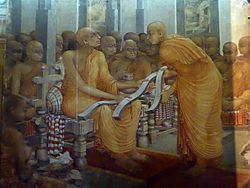
Culavamsa, which is regarded as the second part of Mahavamsa and was written in around the thirteenth century, records that Buddhaghosa was born into a Brahmin family in the kingdom of Magadha.[2] He is said to have been born near Bodh Gaya, and to have been a master of the Vedas, traveling through India engaging in philosophical debates.[14] Only upon encountering a Buddhist monk named Revata was Buddhaghosa bested in debate, first being defeated in a dispute over the meaning of a Vedic doctrine and then being confounded by the presentation of a teaching from the Abhidhamma.[14] Impressed, Buddhaghosa became a bhikkhu (Buddhist monk) and undertook the study of the Tipiṭaka and its commentaries. On finding a text for which the commentary had been lost in India, Buddhaghosa determined to travel to Sri Lanka to study a Sinhala commentary that was believed to have been preserved.[14]
In Sri Lanka, Buddhaghosa began to study what was apparently a very large volume of Sinhala commentarial texts that had been assembled and preserved by the monks of the Anuradhapura Maha Viharaya.[15] Buddhaghosa sought permission to synthesize the assembled Sinhala-language commentaries into a comprehensive single commentary composed in Pali.[16] Traditional accounts hold that the elder monks sought to first test Buddhaghosa's knowledge by assigning him the task of elaborating the doctrine regarding two verses of the suttas; Buddhaghosa replied by composing the Visuddhimagga.[17] His abilities were further tested when deities intervened and hid the text of his book, twice forcing him to recreate it from scratch.[18] When the three texts were found to completely summarize all of the Tipiṭaka and match in every respect, the monks acceded to his request and provided Buddhaghosa with the full body of their commentaries.[16]
Buddhaghosa went on to write commentaries on most of the other major books of the Pali Canon, with his works becoming the definitive Theravadin interpretation of the scriptures.[2] Having synthesized or translated the whole of the Sinhala commentary preserved at the Anuradhapura Maha Viharaya, Buddhaghosa reportedly returned to India, making a pilgrimage to Bodh Gaya to pay his respects to the Bodhi Tree.[16]
The details of the Mahavamsa account cannot readily be verified; while it is generally regarded by Western scholars as having been embellished with legendary events (such as the hiding of Buddhaghosa's text by the gods), in the absence of contradictory evidence it is assumed to be generally accurate.[16] While the Mahavamsa claims that Buddhaghosa was born in northern India near Bodh Gaya, the epilogues to his commentaries make reference to only one location in India as being a place of at least temporary residence: Kanci in southern India.[7] Some scholars thus conclude (among them Oskar von Hinüber and Polwatte Buddhadatta Thera) that Buddhaghosa was actually born in Amaravati, Andhra Pradesh[19] and was relocated in later biographies to give him closer ties to the region of the Buddha.[7]
The Buddhaghosuppatti, a later biographical text, is generally regarded by Western scholars as being legend rather than history.[20] It adds to the Mahavamsa tale certain details, such as the identity of Buddhaghosa's parents and his village, as well as several dramatic episodes, such as the conversion of Buddhaghosa's father and Buddhaghosa's role in deciding a legal case.[21] It also explains the eventual loss of the Sinhala originals that Buddhaghosa worked from in creating his Pali commentaries by claiming that Buddhaghosa collected and burnt the original manuscripts once his work was completed.[22]
Commentarial style
[edit]Buddhaghosa was reputedly responsible for an extensive project of synthesizing and translating a large body of ancient Sinhala commentaries on the Pāli Canon. His Visuddhimagga (Pāli: Path of Purification) is a comprehensive manual of Theravada Buddhism that is still read and studied today.[23][24][25] Maria Heim notes that, while Buddhaghosa worked by using older Sinhala commentarial tradition, he is also "the crafter of a new version of it that rendered the original version obsolete, for his work supplanted the Sinhala versions that are now lost to us".[26]
Writing style
[edit]Ñāṇamoli Bhikkhu writes that Buddhaghosa's work is "characterized by relentless accuracy, consistency, and fluency of erudition, and much dominated by formalism."[27] According to Richard Shankman, the Visuddhimagga is "meticulous and specific," in contrast to the Pali suttas, which "can be vague at times, without a lot of explanatory detail and open to various interpretations."[28]
Method
[edit]According to Maria Heim, Buddhaghosa is explicitly clear and systematic regarding his hermeneutical principles and exegetical strategies in his commentaries. He writes and theorizes on texts, genre, registers of discourse, reader response, Buddhist knowledge and pedagogy.[29] Buddhaghosa considers each Pitaka of the Buddhist canon a kind of method (naya) that requires different skills to interpret. One of his most important ideas about exegesis of the buddha's words (buddhavacana) is that these words are immeasurable, that is to say, there are innumerable ways and modes to teach and explain the Dhamma and likewise there are innumerable ways in which to receive these teachings.[30] According to Heim, Buddhaghosa considered the dhamma to be "well-spoken [...] visible here and now, timeless,"[30] visible meaning that the fruits of the path can be seen in the behavior of the noble ones, and that comprehending the dhamma is a transformative way of seeing, which has immediate impact.[31] According to Heim, this idea of the transformative and immediate impact of the scriptures is "vital to Buddhaghosa's interpretative practice," concerned as he is with the immediate and transformative impact of the Buddha's words on his audiences, as attested in the suttas[32]
Regarding his systematic thought, Maria Heim and Chakravarthi Ram-Prasad see Buddhaghosa's use of Abhidhamma as part of a phenomenological "contemplative structuring" which is expressed in his writings on Buddhist praxis.[33] They argue that "Buddhaghosa’s use of nāma-rūpa should be seen as the analytic by which he understands how experience is undergone, and not his account of how some reality is structured."[33]
Yogacara influences
[edit]Some scholars have argued that Buddhaghosa's writing evinces a strong but unacknowledged Yogācāra Buddhist influence, which subsequently came to characterize Theravada thought in the wake of his profound influence on the Theravada tradition.[34] According to Kalupahana, Buddhaghosa was influenced by Mahayana-thought, which were subtly mixed with Theravada orthodoxy to introduce new ideas. According to Kalupahana, this eventually led to the flowering of metaphysical tendencies, in contrast to the original stress on anattā in early Buddhism.[35] According to Jonardon Ganeri, though Buddhaghosa may have been influenced by Yogacara Vijñānavāda, "the influence consists not in endorsement but in creative engagement and refutation."[36]
Theory of consciousness
[edit]The philosopher Jonardon Ganeri has called attention to Buddhaghosa's theory of the nature of consciousness and attention. Ganeri calls Buddhaghosa's approach a kind of "attentionalism", which places primacy on the faculty of attention in explaining activities of thought and mind and is against representationalism.[37] Ganeri also states that Buddhaghosa's treatment of cognition "anticipates the concept of working memory, the idea of mind as a global workplace, subliminal orienting, and the thesis that visual processing occurs at three levels."[37] Ganeri also states:
Buddhaghosa is unlike nearly every other Buddhist philosopher in that he discusses episodic memory and knows it as a reliving of experience from one’s personal past; but he blocks any reduction of the phenomenology of temporal experience to the representation of oneself as in the past. The alternative claim that episodic memory is a phenomenon of attention is one he develops with greater sophistication than has been done elsewhere.[37]
Ganeri sees Buddhaghosa's work as being free from a mediational picture of the mind and also free of the Myth of the Given, two views he sees as having been introduced by the Indian philosopher Dignāga.[38]
Meditation
[edit]The Visuddhimagga's doctrine reflects Theravada Abhidhamma scholasticism, which includes several innovations and interpretations not found in the earliest discourses (suttas) of the Buddha.[39][40] Buddhaghosa's Visuddhimagga includes non-canonical instructions on Theravada meditation, such as "ways of guarding the mental image (nimitta)," which point to later developments in Theravada meditation.[4] According to Thanissaro Bhikkhu, "the Visuddhimagga uses a very different paradigm for concentration from what you find in the Canon."[41]
Bhante Henepola Gunaratana also notes that what "the suttas say is not the same as what the Visuddhimagga says [...] they are actually different," leading to a divergence between a [traditional] scholarly understanding and a practical understanding based on meditative experience.[42] Gunaratana further notes that Buddhaghosa invented several key meditation terms which are not to be found in the suttas, such as "parikamma samadhi (preparatory concentration), upacara samadhi (access concentration), appanasamadhi (absorption concentration)."[43] Gunaratana also notes that the Buddhaghosa's emphasis on kasina-meditation is not to be found in the suttas, where dhyana is always combined with mindfulness.[44][note 1]
Bhikkhu Sujato has argued that certain views regarding Buddhist meditation expounded in the Visuddhimagga are a "distortion of the Suttas" since it denies the necessity of jhana.[45]
The Australian monk Shravasti Dhammika is also critical of contemporary practice based on this work.[46] He concludes that Buddhaghosa did not believe that following the practice set forth in the Visuddhimagga will really lead him to Nirvana, basing himself on the postscript (colophon) to the text which states the author hopes to be reborn in heaven and wait until Metteyya (Maitreya) appears to teach the Dharma.[46][note 2] However, according to the Burmese scholar Venerable Pandita, the colophon to the Visuddhimagga is not by Buddhaghosa.[49]
According to Sarah Shaw, "it is unlikely that the meditative tradition could have survived in such a healthy way, if at all, without his detailed lists and exhaustive guidance."[4] Yet, according to Buswell, by the 10th century vipassana was no longer practiced in the Theravada tradition, due to the belief that Buddhism had degenerated, and that liberation was no longer attainable until the coming of Maitreya.[50] It was re-introduced in Myanmar (Burma) in the 18th century by Medawi (1728–1816), leading to the rise of the Vipassana movement in the 20th century, re-inventing vipassana-meditation and developing simplified meditation techniques, based on the Satipatthana sutta, the Visuddhimagga, and other previous texts, emphasizing satipatthana and bare insight.[51][52]
Attributed works
[edit]The Mahavamsa ascribes a great many books to Buddhaghosa, some of which are believed not to have been his work, but composed later and attributed to him.[53] Below is a listing of the fourteen commentaries (Aṭṭhakathā) on the Pāli Canon traditionally ascribed to Buddhaghosa[54]
| Tipitaka | Buddhaghosa's commentary | ||
|---|---|---|---|
| from the Vinaya Pitaka |
Vinaya (general) | Samantapasadika | |
| Patimokkha | Kankhavitarani | ||
| from the Sutta Pitaka |
Digha Nikaya | Sumangalavilasini | |
| Majjhima Nikaya | Papañcasūdanī | ||
| Samyutta Nikaya | Saratthappakasini | ||
| Anguttara Nikaya | Manorathapūraṇī | ||
| from the Khuddaka Nikaya |
Khuddakapatha | Paramatthajotika (I) | |
| Dhammapada | Dhammapadaṭṭhakathā | ||
| Sutta Nipata | Paramatthajotika (II), Suttanipata-atthakatha | ||
| Jataka | Jatakatthavannana, Jātakaṭṭhakathā | ||
| from the Abhidhamma Pitaka |
Dhammasangani | Atthasālinī | |
| Vibhanga | Sammohavinodani | ||
| Dhatukatha | Pañcappakaranatthakatha | ||
| Puggalapaññatti | |||
| Kathavatthu | |||
| Yamaka | |||
| Patthana | |||
While traditional accounts list Buddhaghosa as the author of all of these works, some scholars hold that only the Visuddhimagga and the commentaries on the first four Nikayas as Buddhaghosa's work.[55] Meanwhile, Maria Heim holds that Buddhaghosa is the author of the commentaries on the first four Nikayas, the Samantapasadika, the Paramatthajotika, the Visuddhimagga and the three commentaries on the books of the Abhidhamma.[56]
Maria Heim also notes that some scholars hold that Buddhaghosa was the head of a team of scholars and translators, and that this is not an unlikely scenario.[57]
Influence and legacy
[edit]In the 12th century, the Sri Lankan (Sinhalese) monk Sāriputta Thera became the leading scholar of the Theravada following the reunification of the Sri Lankan (Sinhala) monastic community by King Parakramabahu I.[5] Sariputta incorporated many of the works of Buddhaghosa into his own interpretations.[5] In subsequent years, many monks from Theravada traditions in Southeast Asia sought ordination or re-ordination in Sri Lanka because of the reputation of the Sri Lankan (Sinhala) Mahavihara lineage for doctrinal purity and scholarship.[5] The result was the spread of the teachings of the Mahavihara tradition — and thus Buddhaghosa — throughout the Theravada world.[5] Buddhaghosa's commentaries thereby became the standard method by which the Theravada scriptures were understood, establishing Buddhaghosa as the definitive interpreter of Theravada doctrine.[17]
In later years, Buddhaghosa's fame and influence inspired various accolades. His life story was recorded, in an expanded and likely exaggerated form, in a Pali chronicle known as the Buddhaghosuppatti, or "The Development of the Career of Buddhaghosa".[17] Despite the general belief that he was Indian by birth, he later may have been claimed by the Mon people of Burma as an attempt to assert primacy over Sri Lanka in the development of Theravada tradition.[58] Other scholars believe that the Mon records refer to another figure, but whose name and personal history are much in the mold of the Indian Buddhaghosa.[20]
Finally, Buddhaghosa's works likely played a significant role in the revival and preservation of the Pali language as the scriptural language of the Theravada, and as a lingua franca in the exchange of ideas, texts, and scholars between Sri Lanka and the Theravada countries of mainland Southeast Asia. The development of new analyses of Theravada doctrine, both in Pali and Sinhala, seems to have dried up prior to Buddhaghosa's emergence in Sri Lanka.[59] In India, new schools of Buddhist philosophy (such as the Mahayana) were emerging, many of them making use of classical Sanskrit both as a scriptural language and as a language of philosophical discourse.[59] The monks of the Mahavihara may have attempted to counter the growth of such schools by re-emphasizing the study and composition in Pali, along with the study of previously disused secondary sources that may have vanished in India, as evidenced by the Mahavamsa.[60] Early indications of this resurgence in the use of Pali as a literary language may be visible in the composition of the Dipavamsa and the Vimuttimagga, both dating to shortly before Buddhaghosa's arrival in Sri Lanka.[10] The addition of Buddhaghosa's works — which combined the pedigree of the oldest Sinhala commentaries with the use of Pali, a language shared by all of the Theravada learning centers of the time — provided a significant boost to the revitalization of the Pali language and the Theravada intellectual tradition, possibly aiding the Theravada school in surviving the challenge to its position posed by emerging Buddhist schools of mainland India.[61]
According to Maria Heim, he is "one of the greatest minds in the history of Buddhism" and British philosopher Jonardon Ganeri considers Buddhaghosa "a true innovator, a pioneer, and a creative thinker."[62][63] Yet, according to Buddhadasa, Buddhaghosa was influenced by Hindu thought, and the uncritical respect for the Visuddhimagga has even hindered the practice of authentic Buddhism.[64][65]
Notes
[edit]- ^ See also Bronkhorst (1993), Two Traditions of Meditation in ancient India; Wynne (2007), The Origin of Buddhist Meditation; and Polak (2011), Reexaming Jhana
- ^ Devotion to Metteya was common in South Asia from early in the Buddhist era, and is believed to have been particularly popular during Buddhaghosa's era.[47][48]
References
[edit]- ^ (Hinüber 1996, p. 103) is more specific, estimating dates for Buddhaghosa of 370–450 CE based on the Mahāvamsa and other sources. Following the Mahāvamsa, (Bhikkhu Ñāṇamoli 1999, p. xxvi) places Buddhaghosa's arrival as coming during the reign of King Mahanama, between 412 and 434 CE.
- ^ a b c d Strong 2004, p. 75.
- ^ Gethin, Rupert, Was Buddhaghosa a Theravādin? Buddhist Identity in the Pali Commentariesand Chronicles, 2012.
- ^ a b c Shaw 2006, p. 5.
- ^ a b c d e (Crosby 2004, p. 837)
- ^ Gombrich 2012, p. 51.
- ^ a b c d e (Hinüber 1996, p. 102)
- ^ Rhys Davids & Stede, 1921-25, Pali-English Dictionary, Pali Text Society.
- ^ "Sanskrit Dictionary". Retrieved July 23, 2016.
- ^ a b Bhikkhu Ñāṇamoli 1999, p. xxviii.
- ^ Gray 1892.
- ^ (Bhikkhu Ñāṇamoli 1999, p. xxix)
- ^ a b Bhikkhu Ñāṇamoli 1999, p. xxix-xxx.
- ^ a b c Bhikkhu Ñāṇamoli 1999, p. xxxiv.
- ^ Bhikkhu Ñāṇamoli 1999, p. xxxii.
- ^ a b c d Bhikkhu Ñāṇamoli 1999, p. xxxv.
- ^ a b c Strong 2004, p. 76.
- ^ Bhikkhu Ñāṇamoli 1999, p. xxxc.
- ^ "Amaravati to retain its slice of history | Hyderabad News - Times of India". The Times of India. 20 April 2016.
- ^ a b Bhikkhu Ñāṇamoli 1999, p. xxxix.
- ^ Bhikkhu Ñāṇamoli 1999, p. xxxvii-xxxviii.
- ^ Bhikkhu Ñāṇamoli 1999, p. xxxviii.
- ^ Stede, W. (October 1951). "The Visuddhimagga of Buddhaghosācariya by Henry Clarke Warren; Dharmananda Kosambi". The Journal of the Royal Asiatic Society of Great Britain and Ireland. 83 (3/4): 210–211. doi:10.1017/S0035869X00104873. JSTOR 25222520. S2CID 162298602.
- ^ Stede, D. A. L. (1953). "Visuddhimagga of Buddhaghosācariya by Henry Clarke Warren; Dharmananda Kosambi". Bulletin of the School of Oriental and African Studies, University of London. 15 (2): 415. doi:10.1017/s0041977x00111346. JSTOR 608574. S2CID 177287397.
- ^ Edgerton, Franklin (January 1952). "Visuddhimagga of Buddhaghosācariya by Henry Clarke Warren; Dharmananda Kosambi". Philosophy East and West. 1 (4): 84–85. doi:10.2307/1397003. JSTOR 1397003.
- ^ Heim 2013, p. 7.
- ^ Ñāṇamoli, 1999, Introduction p. xxxvii
- ^ Shankman 2008, p. 54.
- ^ Heim 2018, p. 5-6.
- ^ a b Heim 2018, p. 9.
- ^ Heim 2018, p. 13.
- ^ Heim 2018, p. 14.
- ^ a b Heim, Ram-Prasad, In a Double Way: Nāma-rūpa in Buddhaghosa’s Phenomenology, Philosophy East and West, University of Hawai'i Press.
- ^ Buddhist Phenomenology: A Philosophical Investigation of Yogācāra Buddhism by Dan Lusthaus. RoutledgeCurzom: 2002 ISBN 0700711864 pg 106 n 30
- ^ Kalupahana 1994.
- ^ Ganeri, 2018, 32.
- ^ a b c Ganeri, 2018, 31.
- ^ Ganeri, 2018, 34.
- ^ Kalupahana, David J. (1994), A history of Buddhist philosophy, Delhi: Motilal Banarsidass Publishers Private Limited
- ^ Sujato, Bhante (2012), A History of Mindfulness (PDF), Santipada, p. 329, ISBN 9781921842108
- ^ Shankman 2008, p. 117.
- ^ Shankman 2008, p. 136.
- ^ Shankman 2008, p. 137.
- ^ Shankman 2008, p. 137-138.
- ^ Sujato, Bhante (2012), A History of Mindfulness (PDF), Santipada, p. 332, ISBN 9781921842108
- ^ a b The Broken Buddha by S. Dhammika, see p.13 of 80
- ^ Sponberg 2004, p. 737–738.
- ^ "Maitreya (Buddhism) -- Britannica Online Encyclopedia". Retrieved 2009-01-28.
- ^ Ven. Pandita (2018). The Authorship of the Vinaya and Abhidhamma Commentaries: A Response to von Hinüber. Journal of Buddhist ethics 25:269-332. University of Kelaniya.
- ^ Buswell 2004, p. 889.
- ^ Buswell 2004, p. 890.
- ^ McMahan 2008, p. 189.
- ^ (Hinüber 1996, p. 103)
- ^ Table based on (Bullitt 2002) For translations see Atthakatha
- ^ For instance, regarding the Khuddha Nikaya commentaries, (Hinüber 1996, pp. 130–1) writes:
- Neither Pj [Paramatthajotikā] I nor Pj II can be dated, not even in relation to each other, except that both presuppose Buddhaghosa. In spite of the 'Buddhaghosa colophon' added to both commentaries ... no immediate relation to Buddhaghosa can be recognized.... Both Ja [Jataka-atthavannana] and Dhp-a [Dhammapada-atthakatha] are traditionally ascribed to Buddhaghosa, an assumption which has been rightly questioned by modern research....
- ^ Heim 2018, p. 19.
- ^ Heim 2013, p. 9.
- ^ (Pranke 2004, p. 574)
- ^ a b Bhikkhu Ñāṇamoli 1999, p. xxvii.
- ^ Bhikkhu Ñāṇamoli 1999, p. xxvii-xxviii.
- ^ Bhikkhu Ñāṇamoli 1999, p. xxxix-x.
- ^ Heim 2013, p. 4.
- ^ Ganeri, 2018, p. 30.
- ^ S. Payulpitack (1991), Buddhadasa and His Interpretation of Buddhism
- ^ Buddhadasa, Paticcasamuppada: Practical Dependent Origination
Sources
[edit]- Bhikkhu Ñāṇamoli (1999), "Introduction", in Buddhaghosa (ed.), Visuddhimagga: The Path of Purification, translated by Bhikkhu Ñāṇamoli, Seattle: Buddhist Publication Society, ISBN 1-928706-01-0
- Bullitt, John T. (2002), Beyond the Tipitaka: A Field Guide to Post-canonical Pali Literature, archived from the original on 2009-05-09, retrieved 2009-04-07
- Buswell, Robert, ed. (2004), Encyclopedia of Buddhism, MacMillan
- Crosby, Kate (2004), "Theravada", in Buswell, Robert E. Jr. (ed.), Macmillan Encyclopedia of Buddhism, USA: Macmillan Reference USA, pp. 836–841, ISBN 0-02-865910-4
- Ganeri, Jonardon (2017), Attention, Not Self, Oxford University Press
- Gombrich, Richard F. (12 November 2012). Buddhist Precept & Practice. London: Routledge. ISBN 978-1-136-15623-6.
- Gray, James, trans. (1892), Buddhaghosuppatti or the Historical Romance of the Rise and Career of Buddhaghosa, London: Luzac
{{citation}}: CS1 maint: multiple names: authors list (link) - Heim, Maria (2013), The Forerunner of All Things: Buddhaghosa on Mind, Intention, and Agency, USA: OUP USA
- Heim, Maria (2018), Voice of the Buddha: Buddhaghosa on the Immeasurable Words, Oxford University Press
- Hinüber, Oskar von (1996), A Handbook of Pali Literature, New Delhi: Munshiram Manoharal Publishers Pvt. Ltd., ISBN 81-215-0778-2
- Kalupahana, David J. (1994), A history of Buddhist philosophy, Delhi: Motilal Banarsidass Publishers Private Limited
- McMahan, David L. (2008), The Making of Buddhist Modernism, Oxford University Press, ISBN 9780195183276
- Pranke, Patrick A. (2004), "Myanmar", in Buswell, Robert E. Jr. (ed.), Macmillan Encyclopedia of Buddhism, USA: Macmillan Reference USA, pp. 574–577, ISBN 0-02-865910-4
- Rogers, Henry Thomas, trans. (1870): Buddhaghosha's Parables / translated from Burmese. With an Introduction, containing Buddha's Dhammapada, or "Path of Virtue" / transl. from Pâli by F. Max Müller, London: Trübner.
- Shankman, Richard (2008), The Experience of Samadhi: An In-depth Exploration of Buddhist Meditation, Shambhala
- Shaw, Sarah (2006), Buddhist Meditation: An Anthology of Texts from the Pali Canon, Routledge
- Sponberg, Alan (2004), "Maitreya", in Buswell, Robert E. Jr. (ed.), Macmillan Encyclopedia of Buddhism, USA: Macmillan Reference USA, ISBN 0-02-865910-4
- Strong, John (2004), "Buddhaghosa", in Buswell, Robert E. Jr. (ed.), Macmillan Encyclopedia of Buddhism, USA: Macmillan Reference USA, p. 75, ISBN 0-02-865910-4
Further reading
[edit]- Law, Bimala Charan (1923). The life and work of Buddhaghosa, Calcutta, Thacker, Spink.
- Pe Maung Tin (1922). The path of purity; being a translation of Buddhaghosa's Visuddhimagg. London, Published for the Pali Text Society by Oxford University Press.
External links
[edit] Quotations from Wikiquote
 Texts from Wikisource
 Data from Wikidata


| Foundations | |
|---|---|
| The Buddha | |
| Bodhisattvas | |
| Disciples | |
| Key concepts |
|
| Cosmology | |
| Branches | |
| Practices |
|
| Nirvana | |
| Monasticism | |
| Major figures |
|
| Texts | |
| Countries |
|
| History |
|
| Philosophy | |
| Culture | |
| Miscellaneous | |
| Comparison | |
| Lists | |


.svg)

Buddhaghosa
View on GrokipediaName and Identity
Etymology and Meaning
The name Buddhaghosa derives from the Pali compound consisting of Buddha, signifying "the enlightened one" or "awakened," and ghosa, denoting "voice," "sound," or "proclamation." This etymological structure renders the name as "Voice of the Buddha" or, alternatively, "Proclaimer of the Buddha's Teaching," reflecting a direct linguistic connection to the dissemination of Buddhist doctrine.[3] In Theravada traditions, particularly as elaborated in texts like the Buddhaghosuppāṭi, the name carries symbolic weight, portraying Buddhaghosa as the instrumental voice that revives and elucidates the Buddha's original teachings through systematic exegesis and commentary, thereby ensuring their preservation amid potential decline. This interpretation underscores his function as a doctrinal restorer, aligning his identity with the broader Theravada emphasis on authoritative transmission of the Tipiṭaka.[4] The Sanskrit counterpart to the name is Buddhaghoṣa, where ghoṣa similarly conveys "voice," "cry," or "announcement," maintaining the connotative essence across Indo-Aryan languages while adapting to phonetic and orthographic conventions in ancient Indian texts. Variations in spelling or transcription appear in medieval manuscripts, such as Buddhaghosha in some Sinhalese and Burmese sources, but the core meaning remains consistent with the Pali form.[5]Historical Identification
The historical identification of Buddhaghosa remains a subject of scholarly debate, particularly regarding his ethnic origins and whether the name refers to a single individual or a collective tradition. Traditional accounts in the Mahāvaṃsa portray him as a Brahmin born in northern India, specifically in the kingdom of Magadha near Bodh Gaya, who later converted to Buddhism and traveled to Sri Lanka.[6] In contrast, some scholarly analyses suggest a South Indian origin, possibly from the city of Kañcipura (modern Kanchipuram), indicating a Tamil or Dravidian background, while some later Burmese traditions link him to the Mon region of lower Burma. These discrepancies have led scholars like Oskar von Hinüber to argue for a South Indian origin, citing linguistic and stylistic features in his works that align more closely with South Indian Buddhist traditions than with indigenous Sinhalese ones. Textual evidence supporting Buddhaghosa's existence and activity in 5th-century Sri Lanka comes primarily from colophons appended to his commentaries, which consistently state that the works were composed at the Mahāvihāra monastery in Anurādhapura during the reign of King Mahānāma (c. 412–434 CE, though the dating of the colophons themselves is debated).[7] No direct archaeological inscriptions from this period explicitly name Buddhaghosa, but the colophons' references to the Mahāvihāra—Sri Lanka's premier Theravāda institution—corroborate his role as a resident monk there, aligning with the institutional context of Pali commentarial production. This evidence positions him firmly within the 5th-century CE Theravāda revival under royal patronage, though the exact chronology relies on these self-referential textual claims rather than independent epigraphic corroboration. Modern scholarship has raised hypotheses of pseudonymity or multiple authorship under the name Buddhaghosa, based on stylistic inconsistencies across the attributed corpus. For instance, the Visuddhimagga exhibits a more systematic and original exegetical style compared to the atthakathā commentaries, which often appear more compilatory and uniform, suggesting possible contributions from a team of Mahāvihāra scholars.[2] Oskar von Hinüber posits that "Buddhaghosa" may function as a honorific or collective signifier for the Mahāvihāra's commentarial project, with individual works redacted by editors rather than a sole author, a view supported by the anonymity of many passages and variations in doctrinal emphasis.[8] Such interpretations draw on philological analysis rather than hagiographic narratives like the Buddhaghosuppatti, emphasizing the collaborative nature of early Theravāda scholarship.[7]Biography
Traditional Narratives
According to the Cūḷavaṃsa, one of the earliest Theravāda chronicles, Buddhaghosa was born in northern India to a Brahman family near the Bodhi Tree at Bodh Gayā.[9] Renowned for his intellectual prowess from a young age, he mastered Vedic scriptures and engaged in scholarly pursuits, but his path shifted dramatically when he debated Buddhist doctrine with a monk. Defeated in the exchange, he underwent a profound conversion to Buddhism, renouncing his Brahmanical heritage and embracing the monastic life.[10] Drawn by the reputation of Sri Lanka's Mahāvihāra monastery as a center of Theravāda learning, Buddhaghosa journeyed there during the reign of King Mahānāma (c. 412–434 CE).[9] Ordained as a bhikkhu at the Mahāvihāra, he received royal patronage to undertake the monumental task of rendering the ancient Sinhala commentaries (aṭṭhakathā) into Pāli, aiming to preserve and purify the Buddha's teachings for wider dissemination. To dispel doubts among the elders about the fidelity of his translations, he vowed that his Pāli versions would stand alone as authoritative; in a dramatic hagiographic flourish, the narratives recount how he burned the original Sinhala texts upon completion, ensuring no discrepancies could arise and symbolizing the unadulterated transmission of the Dhamma.[10] The Cūḷavaṃsa further states that he returned to India after completing his work.[9] The Buddhaghosuppatti, a 14th-century Pāli biography, embellishes these events with prophetic elements, portraying Buddhaghosa as a destined figure foretold by the Buddha himself during his lifetime, who would arise as the "Voice of the Buddha" (Buddhaghosa) to revive the sāsana in a time of doctrinal fragmentation.[10]Scholarly Perspectives
Scholars generally date Buddhaghosa's life to approximately 370–450 CE, an estimate derived from colophons in his works, cross-references with Sri Lankan chronicles such as the Mahāvaṃsa, and alignments with the reign of King Mahānāma (c. 412–434 CE).[11] This timeframe places his primary activities in the early fifth century, though no contemporary records exist to confirm biographical details, leaving his life largely undocumented beyond later traditional accounts.[11] Debates persist regarding Buddhaghosa's origins, with traditional narratives portraying him as an Indian Brahmin scholar from near Bodh Gayā who traveled to Sri Lanka, while some analyses suggest this may be legendary, proposing instead a possible Sinhalese or local Theravādin background. Other traditions, such as in Burma, claim origins in Thaton, though discredited by most scholars.[12][13] Evidence from linguistic and doctrinal layers in Pāli texts, including his commentaries, points to fifth-century intellectual activity centered at the Mahāvihāra monastery in Anuradhapura, supporting his embedded role in Sri Lankan monastic circles rather than a purely external provenance. Modern scholarship has refined these assessments through epigraphy, comparative philology, and textual analysis, with studies highlighting variations in style and content across attributed works, suggesting possible multiple authors, later interpolations, or collaborative efforts at Mahāvihāra, rather than a singular figure.[14] Archaeological findings from Anuradhapura, including inscriptions and structural evidence of monastic expansions under royal patronage during the fifth century, provide indirect corroboration for this era's doctrinal consolidation but underscore evidential gaps in personal historicity.[15]Works
The Visuddhimagga
The Visuddhimagga, often translated as "The Path of Purification," is Buddhaghosa's magnum opus, composed around 430 CE in Sri Lanka as a synthesis of Theravada doctrine, ethics, and meditation practices. This encyclopedic work serves as a comprehensive manual to guide practitioners along the path to enlightenment, drawing extensively from the Pali suttas and Abhidhamma texts while integrating earlier Sinhala commentaries known as atthakathā. During the reign of King Mahānāma, Buddhaghosa undertook the project to translate and preserve these Sinhala atthakathā into Pali, ensuring the doctrinal heritage of Theravada Buddhism was standardized and accessible for future generations amid efforts to revive Pali scholarship.[16][17] The text is systematically divided into 23 chapters, organized into three primary sections that mirror the three trainings of the Noble Eightfold Path: sīla (morality or virtue) in Chapters I–II, samādhi (concentration) in Chapters III–XIII, and paññā (wisdom or understanding) in Chapters XIV–XXIII. This structure outlines a progressive framework for spiritual development, beginning with ethical foundations such as the confession of offenses and ascetic practices, advancing through meditative absorptions and supernormal attainments, and culminating in insightful knowledge of reality. By synthesizing canonical sources, the Visuddhimagga provides a practical roadmap for monks and lay practitioners to cultivate the necessary purifications leading to liberation from suffering.[16][18] Among its unique features is the systematic progression through seven stages of purification, starting from the purification of views and extending to the supramundane paths of stream-entry, once-returning, non-returning, and arahantship. To aid memorization and visualization, the work incorporates mnemonic verses drawn from canonical texts like the Dhammapada and Sutta Nipāta, as well as diagrams illustrating concepts such as dependent origination, the extension of meditation objects like the earth kasina, and the cognitive processes of consciousness. These elements underscore the Visuddhimagga's role as both a theoretical exposition and a practical guide, influencing the standardization of Theravada meditation traditions in subsequent centuries.[16]Commentaries on the Canon
Buddhaghosa is traditionally credited with authoring a series of atthakathā (commentaries) on the Tipiṭaka, the foundational scriptures of Theravāda Buddhism, totaling fourteen major texts that interpret and expand upon the Pāli Canon. These works represent a systematic effort to render into Pāli the earlier Sinhala commentaries preserved at the Mahāvihāra in Sri Lanka, a process involving translation, critical editing, and expansion to ensure doctrinal consistency and accessibility for a broader audience. Completed by the mid-fifth century CE, this project preserved and standardized interpretations that had been orally transmitted or recorded in Sinhala since the third century BCE.[19][20] The commentaries focus on clarifying ambiguities in the suttas and vinaya rules by drawing on Abhidhamma categories to elucidate psychological, ethical, and metaphysical concepts, often resolving apparent contradictions through detailed analysis. For instance, the Samantapāsādikā, the commentary on the Vinaya Piṭaka, defends the Mahāvihāra's orthodoxy against rival interpretations, such as those from the Abhayagiri vihāra, by emphasizing monastic discipline and doctrinal purity. Similarly, the works on the Sutta Piṭaka highlight etymological breakdowns of key terms and extensive cross-references to other canonical sections, enhancing the interconnectedness of the teachings. These texts cover all four major Nikāyas (Dīgha, Majjhima, Saṃyutta, and Aṅguttara) and the Vinaya, along with selected portions of the Khuddaka Nikāya and the entire Abhidhamma Piṭaka, though some minor Khuddaka texts like the Nettippakaraṇa lack dedicated commentaries.[19][20] The following table summarizes the principal commentaries attributed to Buddhaghosa, grouped by canonical division:| Canonical Division | Commentary Title | Focus |
|---|---|---|
| Vinaya Piṭaka | Samantapāsādikā | Interpretation of monastic rules and procedures.[21] |
| Dīgha Nikāya | Sumaṅgalavilāsinī | Exegesis of the Buddha's long discourses.[21] |
| Majjhima Nikāya | Papañcasūdanī | Analysis of the middle-length suttas, clarifying doctrinal complexities.[21] |
| Saṃyutta Nikāya | Sāratthappakāsinī | Commentary on thematically grouped suttas.[21] |
| Aṅguttara Nikāya | Manorathapūraṇī | Elucidation of numerically patterned discourses.[21] |
| Abhidhamma Piṭaka | Atthasālinī, Sammohavinodanī, and five Pañcappakaraṇa-aṭṭhakathā texts | Detailed breakdowns of Abhidhamma treatises using analytical frameworks.[21][19] |