


Community hub
Recent from talks
Contribute something
Nothing was collected or created yet.
Royal Ballet of Cambodia
View on Wikipedia | This article has multiple issues. Please help improve it or discuss these issues on the talk page. (Learn how and when to remove these messages)
|

| Royal Ballet of Cambodia របាំព្រះរាជទ្រព្យ | |
|---|---|
 Cambodia Royal Ballet | |
| Medium | Dance |
| Originating culture | Khmer |
| Royal Ballet of Cambodia | |
|---|---|
| Country | Cambodia |
| Reference | 00060 |
| Region | Asia and the Pacific |
| Inscription history | |
| Inscription | 2008 (3rd session) |
| List | Representative |

The Royal Ballet of Cambodia (Khmer: របាំព្រះរាជទ្រព្យ, Robam Preah Reach Troap, lit. 'Dance of Royal Wealth') is a classical Khmer dance known for its intricate hand movements and elaborate costumes. Historically linked to the Khmer court, it has been performed at various royal ceremonies such as coronations, weddings, funerals, and Khmer holidays. The repertoire includes various ancient Khmer legends.[1]
The ballet faced near extinction during the Khmer Rouge regime in the 1970s but continues to be a significant cultural heritage of Cambodia, reflecting traditional values of refinement, respect, and spirituality of the Khmer people.[1] It has been inscribed on the UNESCO Intangible Cultural Heritage Lists since 2003.
Etymology
[edit]Western names for this dance tradition, such as Cambodian court dance, often make reference to the royal court, as the tradition was performed and maintained by attendants of the royal palaces.[2][3] As a performing art, it is formally referred to as the Royal Ballet of Cambodia (le Ballet royal du Cambodge in French) by UNESCO, Cravath, Brandon, and others in the academic field,[1][4][5] although this term may also refer to the National Dance Company of Cambodia. The term Khmer classical dance is also used alongside "Royal Ballet of Cambodia" in publications by UNESCO and the above-mentioned authors.[1]
In Khmer, it is formally known as Robam Preah Reach Trop (របាំព្រះរាជទ្រព្យ), lit. "dances of royal wealth") or Lakhon Preah Reach Trop (ល្ខោនព្រះរាជទ្រព្យ), lit. "theatre of royal wealth").[unver. 1] It is also referred to as Lakhon Luong (ល្ខោនហ្លួង, lit. "the king's theatre").[6][7] During the Lon Nol regime of Cambodia, the dance tradition was referred to as Lakhon Kbach Boran Khmer (ល្ខោនក្បាច់បូរាណខ្មែរ), lit. "Khmer theatre of the ancient style"), a term alienating it from its royal legacy.[7][8]
Khmer classical dancers, as a whole, are frequently referred to as apsara dancers by laymen; this usage would be incorrect with the modern form of the dance, as the apsara is just one type of character among others in the repertoire. Regardless, the tradition's romanticized affiliation with the apsaras and devatas of the ruins of Angkor still persists.[citation needed]
History
[edit]Angkor and pre-Angkor era
[edit]One of the earliest records of dance in Cambodia is from the 7th century, where performances were used as a funeral rite for kings.[9] During the Angkor period, dance was ritually performed at temples.[7] The temple performers came to be considered as apsaras, who served as entertainers and messengers to divinities.[10] Ancient stone inscriptions describe thousands of apsara dancers assigned to temples and performing divine rites as well as for the public.[7] The tradition of temple dancers declined during the 15th century, as the Siamese kingdom of Ayutthaya raided Angkor. When Angkor fell, its artisans, Brahmins, and dancers were taken captive to Ayutthaya.[7]
Post-Angkorian era
[edit]During the mid 19th century, King Ang Duong, spent much of his childhood in Bangkok, and ruled Cambodia as a vassal of Siam. Upon Ang Duong's rule in Cambodia, the court of Bangkok provided dancers to Ang Duong's court due to declining numbers of ballet dancers in Cambodia.[11]
During the reigns of Ang Duong, Norodom, and Sisowath, dances were based on the Reamker, Khmer melodramas, and folk legends. In a process of cultural exchange, some dances from this period were based on Khmer adaptations of popular Siamese works such as Inao, Phra Aphai Mani, and Krai Thong.[12]
Lakhon Khol plays were codified during the reign of Ang Duong based on the Reamker depicted in 12th century bas-reliefs in Angkor Wat.[13]
The writer and dancer, Prumsodun Ok, differs with this view that the number of ballet dancers in Cambodia is declining. In his book, The Serpent's Tail: A Brief History of Khmer Classical Dance, he points out that "dancers were granted the opportunity to leave court with the death or transition of a monarch" and concludes that the low numbers given by King Ang Duong may be "a reflection of this custom." Ok also notes that August Pavie’s 1880s account made shortly after in the king's death "mentioned dancers at the palace, troupes of provincial governors, as well as traveling groups.”[14] He goes on to propose that the king's predecessor, the Vietnamese-installed Queen Ang Mey is a "reflection of the king’s political erasure of his predecessor, one with a precursor in the destruction of Buddhist images following the reign of King Jayavarmann VII and subsequently in the Khmer Rouge’s destruction of pagodas built by King Ang Duong himself.”[15] The historian,Trude Jacobsen, writes in her book Lost Goddesses: The Denial of Female Power in Cambodian History, that the chronicles of Cambodia that were written after Ang Duong assumed the throne characterize Ang Mei as a "lesson, bitterly learned, in the consequences of women exercising direct power in the political arena", and that Ang Duong and his descendants and courts sought to represent Ang Mei as an ineffectual ruler.”[16]
French colonial era
[edit]
Cambodia became a French protectorate in 1863. Since then, dancers began performing for foreign dignitaries and for the public on the monarch's birthday. Dance was thereby, promoted as national identity.[17]
Dancers of the court of King Sisowath were exhibited at the 1906 Colonial Exposition in Marseille at the suggestion of George Bois, a French representative in the Cambodian court.[18] Auguste Rodin was captivated by the Cambodian dancers and created at least 150 watercolour paintings of the dancers.[19] He followed the Khmer ballet dancers from Paris to Marseille with their return to Phnom Penh.[20] Rodin interpreted the performance as ballet dance.[19][21]

Post-independent Cambodia
[edit]Queen Sisowath Kossamak became a patron of the Royal Ballet of Cambodia. Under the Queen's guidance, several reforms were made to the royal ballet, including choreography. Dance dramas were dramatically shortened from all-night spectacles to about one hour in length.[22] Prince Norodom Sihanouk featured the dances of the royal ballet in his films. Though the Royal Ballet originally had no men due to the perception that male dancers did not perform with the refinement of women, contemporary performances include men in livelier roles such as a monkey and Moni Ey-Sey.

Cultural diplomacy
[edit]Under the Sangkum period, Cambodia underwent its cultural and artistic transformation spearheaded by prince (later, King) Norodom Sihanouk. Crowned in 1941 while the country was still a French Protectorate, he witnessed the World War II and subsequent collapse of French colonialism. While supporting neutrality of new post-colonial countries during the early Cold War period, he was aware that Cambodia was dependent on foreign aid. As a diplomatic design, he promoted symbols of the country's national culture that had entered the consciousness of people across the world: temples, and the ballet.[23]
After Cambodia's independence in 1953, Queen Sisowath Kossamak began revamping the ballet incorporating the tastes and inclinations of international audiences. She commissioned short dance pieces tailored especially for diplomatic events. They were mostly extracted from long, traditional performances such as, Robam Tep Monorom (Welcome Dance), Robam Apsara, Robam Chhun Por (Blessing Dance), Robam Moni Mekhala and Robam Ream Eyso. During these performances, western guests were provided a booklet to explain the dances in their respective languages.[23]
In 1959, Queen Sisowath Kossamak visited the United States to introduce Khmer national culture through exhibition performances of the Khmer-American Friendship Ballet, originally titled The Ballet of Khmero-American Friendship.[24][25] The following year, the cultural ambassadorship programme continued in China under similar name, The Ballet of Khmer-Chinese Friendship.[26] When Sihanouk visited France in 1964, the dance was performed for the first time at Palais Garnier after colonial independence.[27] Over the years, the ballet performances were important part of the itinerary for international head of states visiting the country. The list included, Indian prime minister Nehru, Indonesian president Sukarno, Yugoslavian president Tito, French president de Gaulle. Other famous figures included, Princess Margaret, and Jacqueline Kennedy.[23]
Norodom Buppha Devi, the granddaughter of the queen and daughter of King Norodom Sihanouk, was already elevated as the premier dancer of the ballet in 1958. When she turned eighteen in 1961, she was appointed the lead dancer for the roles of a princess. Thereby, she performed as several diplomatic events.[23]
Khmer Rouge
[edit]The dance tradition suffered setbacks during the Khmer Rouge regime, during which many dancers were put to death in the genocide.[unver. 2] 90 percent of all Cambodian classical artists perished between 1975 and 1979 due to execution, torture, starvation, and exhaustion.[17] After the Vietnamese ousted the Khmer Rouge in 1979, dancers gathered to collectively reconstruct the repertoire.[17] Those who survived wandered out from hiding, found one another, and formed "colonies" in order to revive their sacred traditions, under the leadership of former prima ballerina Voan Savay.[unver. 3]
Present time
[edit]Khmer classical dance training was resurrected in the refugee camps in eastern Thailand with the few surviving Khmer dancers. Many dances and dance dramas were also recreated at the Royal University of Fine Arts in Cambodia.
In 2003 it was inducted into the UNESCO Intangible Cultural Heritage Lists.
In 2023 director Xavier de Lauzanne released The Perfect Motion, [‘La beauté du geste’ in French, and ‘Tep Hattha’ in Khmer] an 86-minute documentary film on the dance form. It follows two storylines: the Metamorphosis show created by Princess Norodom Buppha Devi, and traces the history of the Royal Ballet from 1906.[28]
Teacher Salute Ceremony in Royal Ballet
[edit]Performed before the dance troupe enters the stage, the Teacher Salute Ceremony is a tribute to the teachers who trained them and is dedicated to the spirit that controls the spirit in each of the characters of the Royal Ballet, bidding them to ensure that their performances are smooth, confident and unobstructed. This ceremony originates from an ancient forerunner when the royal dance troupe had to offer blessings before they took the stage.[29][30][31]
The three groups of the Cambodia Royal Ballet
[edit]Four main types of roles exist in Khmer classical dance: neay rong (male), neang (female), yeak (rakshasa), and the sva (monkeys).[32] These four basic roles contain sub-classes to indicate character rank; a neay rong ek, for example, would be a leading male role and a neang kamnan (or philieng) would be a maiden-servant.[32] The sub-classes of the four main roles all perform in the same type of dancing style of the class they belong to. However, the yeakheney, or female Yeak, is performed with a feminized dancing style of the male counterpart. Other female character types, such as the apsara, kinnari, or mermaid, follow the same dancing style as the neang role but with subtle differences in gestures; the main difference being costume. The ngoh character type, although male, is presented with a different dancing style than the neay rong.
Most roles are performed by female dancers, but the role of monkeys was transferred to men under the guidance of Queen Sisowath Kosssamak. Other roles performed by men include hermits and animals such as horses and mythical lions.
The Cast
[edit]The cast is divided into two forms, Neang as the female characters and Neay Rong as the male characters, which are described as follows:
| Neang Character | Neang or Female Character |

|
Neang characters represent women, who are divided into eight categories:
- usually has a pre-eminent position; deities, queens or princesses (e.g. Sita & Robam Moni Mekhala)
- these mythical creatures live in Mount Hem Pean in (Khmer Language) means deep in the Forest Mountain Himalayas (e.g. Robam Kenorei)
|
| Neay Rong Character | Neay Rong or Male Character |

|
Neay Rong characters represent men, who are divided into eleven categories:
- usually has a pre-eminent position; deities, kings, or princes (e.g. Rama)
|
Pin Peat musical band
[edit]| ភ្លេងពិណពាទ្យ | Pin Peat Musician |
|---|---|

|
Vong Phleng Pin Peat or Pin Peat Musician has 34 Tracks in the Royal Ballet, which are divided into two types. The first is the Mohoari Orchestra (Small drum style) and the second is the Royal Theatre (Big drum style)
The music used for Khmer classical dance is played by a pin peat ensemble. This type of orchestra consists of several types of xylophones, drums, oboes, gongs, and other musical instruments. The chorus consists of several singers who mainly sing in the absence of music. The lyrics are in poetry form and are sung interspersed with the grammatical particles EU [əː], Eung [əːŋ], and Ery [əːj] in various patterns. |

Musical instruments
[edit]- Roneat ek : The lead xylophone with bamboo or teak wood keys
- Roneat thung : A xylophone with bamboo or teak wood keys; low
- Roneat dek : A metallophone of brass keys
- Roneat thong : A metallophone (now rarely used)
- Kong thom : A set of 16 gongs arranged in a circle
- Kong toch : Like the gongs above, but smaller
- Chhing : A pair of finger cymbals
- Krap : A pair of wood clappers (now rarely used)
- Sralai : A type of shawm; there are two sizes
- Khloy : A type of flute made from bamboo (now rarely used)
- Skor thom : A pair of drums played with a percussion mallet
- Sampho : A type of drum played with the hands
Music pieces
[edit]Khmer classical dance uses particular pieces of music for certain events, such as when a dancer enters or leaves a scene, or performs certain actions, such as flying or walking. These musical pieces are arranged to form a suite. New pieces of music are rarely created.
Below is a select list of music pieces used in the repertoire:
- Sathukar : (សាធុការ) a song of blessing used for propitiation, often used to commence a performance
- Krao nai : (ក្រៅណៃ), also known as santheuk knong (សន្ធឹកក្នុង), overture of the yeak (ogre) characters, a display of power as they go into combat or battle
- Smaeu : (ស្មើ) used for the introduction of a character or a group of dancers in a scene
- Lea : (លា) used to present a character's departure from the scene; leaving the stage
- Cheut chhing : (ជើតឈិង) lit., euphonic chhing; music characterized by the constant percussion of drums and small cup-shaped cymbals;[unver. 4] used to present an action such as commencing a journey or flying
- Lo : (លោ) music used in tune with aquatic recreation (e.g. dancers miming the action of rowing a boat)
- Long song mon : (លងស៊ងមន) lit., "royal bathing of the Mon"; a song used to represent a character dressing up their appearance
- Phya deun : (ផ្យាឌើន); also known as ponhea daeur (ពញ្ញាដើរ), a music piece used to present dancers marching (e.g. the beginning of robam tep monorom)
- Klom : (ក្លុម) used to show the grace and beauty of a character wielding his weapon
- Sinuon : (ស៊ីនួន) - lit., "cream color", in reference to complexion, a soft and slow feminine melody
- Salamar : (សលមារ) - a music characterized by the sralai, often used for certain actions such as combat, but not limited to such
- Preah Thong (ព្រះថោង)
- Bao Lut (បោលុត)
- Sarak Burong (សរៈប៊ុរង)
- Balim (បលិម)
Singing group
[edit]| ក្រុមចម្រៀង នៃរបាំព្រះរាជទ្រព្យ | The Singing Group of the Royal Ballet of Cambodia |
|---|---|
| The singing group divided into three forms, women singing to Neang as female character and Men singing to Neay Rong as male character singing along the activities of the Royal Ballet, the third forms is a teams singer of the chorus of the song. all singer singing including with the Body language of the dancer of the Royal Ballet. |
Performance
[edit]
During the era of the French Protectorate of Cambodia and before, it was customary for guests of the royal palace to receive a performance of the royal ballet.[18] In propitiation ceremonies (បួងសួង, buong suong), it was performed at Wat Phnom and the Silver Pagoda and Throne Hall of the Royal Palace.[unver. 5] For entertainment, performances were often staged inside the pavilions of royal palaces.[18]
In Phnom Penh, the Moonlight Pavilion was built for and is still used occasionally for classical dance performances. Nowadays, venues for performances by the Royal Ballet include the Chenla Theatre and the Chaktomuk Conference Hall, designed by architect Vann Molyvann during the Sangkum Reastr Niyum era.[unver. 6] Tourist restaurants in Cambodia, notably in Siem Reap, also serve as venues for classical dance performances by amateur troupes.[unver. 7]
Today, some dancers are linked to government and work at the Royal University of Fine Arts and Secondary School of Fine Arts as teachers. Ministry of Culture and Fine Arts (Cambodia)'s Department of Performing Arts also engage dancers to perform on state visits. Many dancers work in the tourism, art, and corporate sectors.[17]
Stage and props
[edit]The traditional stage for classical dance drama performances contains a table with a decorative pillow, sometimes laid on an Oriental rug or carpet.[unver. 8] This table of low stature, called a krae (គ្រែ, lit. "bed"), is constant throughout the performance and thus is used as a prop that represents many places and things (a bed, a throne, living quarters, etc.).[unver. 9]
In many dance dramas, characters often wield weapons such as bows, swords, staves, and clubs.[unver. 10] In some dances, dancers hold items such as flower garlands, fans, and gold and silver flowers as a tribute (see bunga mas).[unver. 11] Performances of robam makar (the makara dance) entail devas dancing in leisure and using fans to represent the scales of the mythical makara while the goddess Manimekhala leads the mimicry with her crystal ball of magic.[unver. 12]
Movement and gestures
[edit]Khmer classical dancers use stylized movements and gestures to convey meaning and tell a story. These gestures are often vague and abstract, though some may be easily understood. Dancers do not sing or generally speak, except in some dance dramas where there are brief instances of speech by the dancers.
Hand gestures in Khmer classical dance are called kbach (meaning "style"). These hand gestures form a sort of alphabet and represent various things from nature such as fruit, flowers and leaves. They are used in different combinations and transitions with accompanying movement of the legs and feet to convey different thoughts and concepts.[7] The way gestures are presented, the position of the arm, and the position of the hand relative to the arm can affect their meaning. Gestures are performed in different manners depending on the character type.
Costume
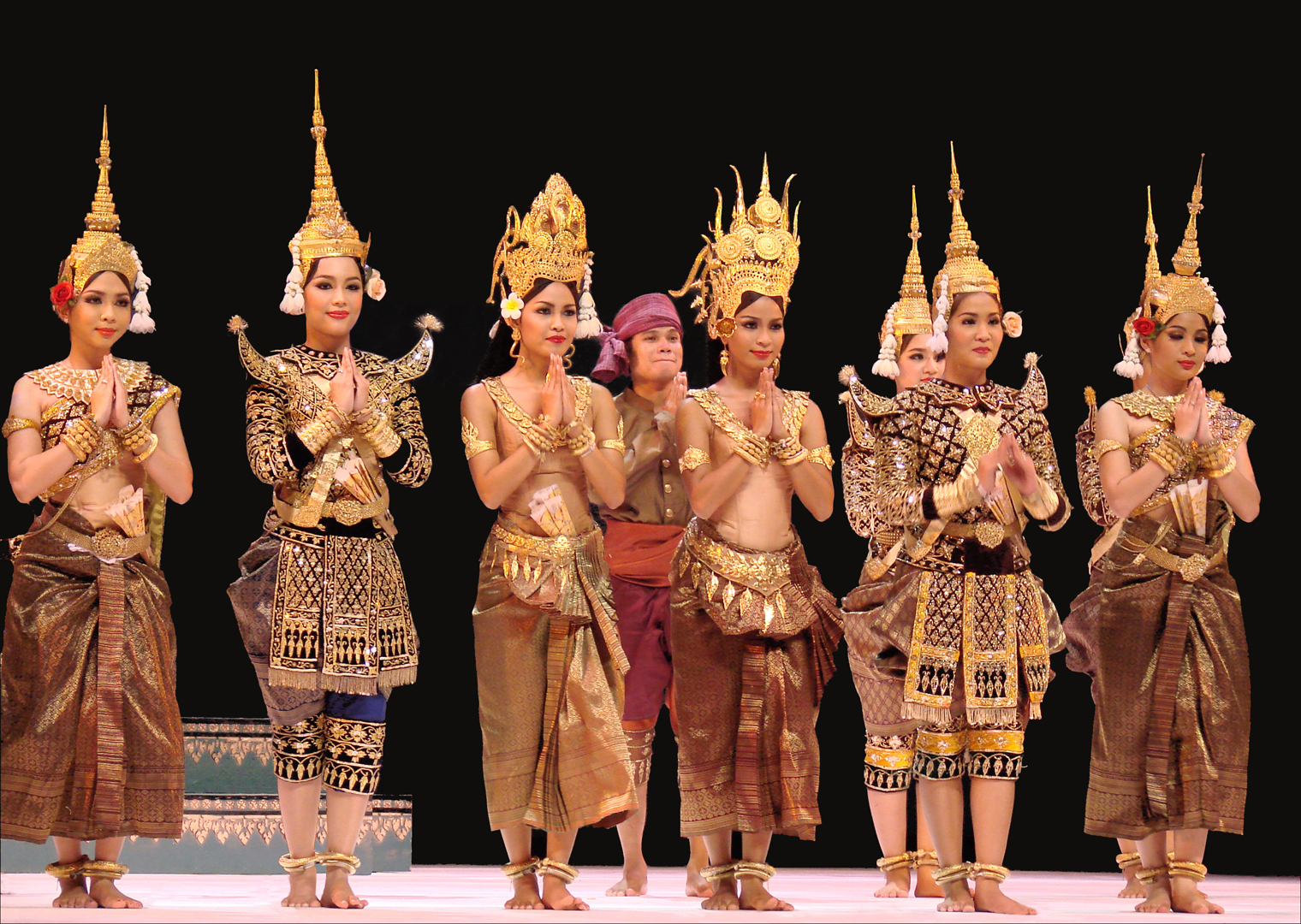
[edit]Classical dance costumes are highly ornate and heavily embroidered, sometimes including sequins and even semi-precious gems. Most of the costumes are thought to be representative of what divinities wear, as reflected in the art style of the post-Angkor period. Various pieces of the costume (such as shirts) have to be sewn onto the dancers for a tight fit.
Female costume
[edit]The typical female, or neang, costume consists of a sampot sarabap (or charabap), a type of woven fabric with two contrasting silk threads along with a metallic thread (gold or silver in color). The sampot is wrapped around the lower body in a sarong-like fashion, then pleated into a band in the front and secured with a gold or brass belt. In the current style, part of the pleated brocade band hangs over the belt on the left side of the belt buckle, which is a clear distinction from Thai classical dance costumes where this pleated band is tucked into the belt to the right of the belt buckle. Worn over the left shoulder is a shawl-like garment called a sbai (also known as the robang khnang, literally "back cover"); it is the most decorative part of the female costume, embroidered extensively with tiny beads and sequins. The usual embroidery pattern for the sbai these days is a diamond-shaped floral pattern, but in the past there were more variations of floral patterns. Under the sbai is a silk undershirt or bodice worn with a short sleeve exposed on the left arm. Around the neck is an embroidered collar called a srang kar.
Jewelry for the female role includes a large, filigree square pendant of which is hung by the corner, various types of ankle and wrists bracelets and bangles, an armlet on the right arm, and body chains of various styles.
Male costume
[edit]Male characters wear costumes that are more intricate than the females, as they require pieces, like sleeves, to be sewn together while being put on. They are dressed in a sampot sarabap like their female counterpart; however, it is worn differently. For the male, or neay rong, the sampot is worn in the chang kben fashion, where the front is pleated and pulled under, between the legs, then tucked in the back and the remaining length of the pleat is stitched to the sampot itself to form a draping 'fan' in the back. Knee-length pants are worn underneath, displaying a wide, embroidered hem around the knees. For the top, they wear long-sleeved shirts with rich embroidering, along with a collar, or srang kar, around their neck. On the end of their shoulders are a sort of epaulette that arches upwards like Indra's bow (known as inthanu). Other components of the male costumes are three richly embroidered banners worn around the front waist. The center piece is known as a robang muk while the two side pieces are known as a cheay kraeng; monkeys and yaksha characters wear another piece in the back called a robang kraoy.
Male characters also wear an X-like strap around the body called a sangvar; it may be made of gold-colored silk or chains of gold with square ornaments, the latter being reserved for more important characters. Males wear the same ankle and wrist jewelry as females, but with the addition of an extra set of bangles on the wrist and no armlets. They also wear a kite-shaped ornament called a sloek po (named after the bo tree leaf), which serves as a center point for their sangvar.
Headdress
[edit]There are several types of crowns that denote characters' ranks. Commonly worn by female characters of the lowest rank is the kbang; it is also worn by Brahmin characters with ornaments around a bun of hair. Divinities and royal characters of the highest ranks wear a tall single-spire crown called a mokot ksat for male characters and a mokot ksatrey for female characters. The panchuret (Groslier romanizes this as panntiereth), reserved for princes and generals (sena), is a circlet-like crown with a faux knot in the back. The rat klao is worn by princesses and often by maidens of significance in a dance if they happen to not be of royal rank. Some characters' headdressings include ear ornaments as well as earrings. Characters such as the yahks and the monkeys wear masks. Yahks and monkeys of royal rank wear masks with a mokot attached.
Floral adornments
[edit]Dancers are traditionally adorned with fragrant flowers, although sometimes fresh flowers are substituted with faux flowers. The floral tassel is traditionally made of Jasminum sambac strung together with Michelia flowers, being either Michelia × alba or Michelia champaca. The neang (female) role wears a rose above the right ear and a floral tassel attached to the left side of the crown while the neay rong (male) role wears a rose on the left ear and a floral tassel to the right side. Sometimes, dancers will wear jasmine garlands fit for the wrists. The apsara role is most often adorned with the flowers of either Plumeria obtusa or white cultivars of Plumeria rubra; sometimes plumerias are tied along the back of their hair.
Repertoire
[edit]According to The Cambridge Guide to Asian Theatre (1997), the Royal Ballet's repertoire contained approximately 40 dances and 60 dance dramas. Since the restoration of the Royal Ballet in the 1979, some of the old repertoire was recreated and several new dances were also created, most notably robam monosanhchettana by the late Chea Samy. As of recent years, new dance dramas have been created by the Royal Ballet, such as Apsara Mera. Sophiline Cheam Shapiro has also introduced new repertory to Khmer classical dance, although they are not part of the traditional royal repertoire and mainly have been performed in Western venues. Her works include dramas such as Samritechak, an adaptation of Shakespeare's Othello and Pamina Devi, an adaptation of Mozart's The Magic Flute.
Dance dramas
[edit]The repertoire of dance dramas (រឿង, roeung) consists of a myriad of stories, unlike the lakhon khol, which is limited only to the Ramayana. Many of the dance dramas have analogs in the lakhon nai dance genre of Thailand but do not share the same choreography or exact storyline. During the time of Queen Kossamak, several dance dramas were re-choreographed and shortened such as Roeung Preah Thong-Neang Neak; this drama, among others, would be recreated in 2003.
The plots of many dance dramas often concern a male character who rescues a damsel in distress or destined love presented with obstacles. The traditional repertoire portrays mythology or traditional tales and may sometimes include religious concepts such as karma.
Select repertory of dance dramas
[edit]- Reamker (Ramakerti, រាមកេរ្តិ៍): Ramayana
- Preah Sothon-Neang Monorea (ព្រះសូធន-នាងមនោហ៍រា): Sudhana-Jataka, formerly referred to as Kailas (កៃលាស), recreated in 2003
- Krai Thong (ក្រៃថោង)
- Inao (ឥណាវ): Panji
- Kakey (កាកី): Kakati-Jataka
- Preah Anoruth-Neang Usa (ព្រះអនុរុទ្ធ-នាងឧសា): Aniruddha
- Sopheak Leak (សុភលក្ខណ៍): Chitralekha
- Preah Samot (ព្រះសមុទ្រ)
- Sovannahong (សុវណ្ណហង្ស)
- Preah Sang (ព្រះស័ង្ខ)
Dances
[edit]In contrast to the dance dramas are shorter dances known as robam. They can serve several purposes, such as honoring, ritualistic functions (e.g. securing the kingdom's fortune and prosperity), and blessing. Spanning several minutes or so, not all these dances have storylines, although many robam are indeed excerpts from dance dramas such as robam mekhala-reamso and robam sovan macchha (the latter being from the Reamker).
The 'apsara dance' of today was created under the guidance of Queen Kossamak Nearireath. Its costume is based on the bas-relief of apsaras on temple ruins but much of it, including its music and gesture, is not unique from other classical Khmer dances that probably do not date back to the Angkor period.
Select repertory of dances
[edit]- Robam Apsara (របាំអប្សរា)
- Robam Tep Monorom (របាំទេពមនោរម្យ)
- Robam Chun Por (របាំជូនពរ)
- Robam Makar (របាំមករ)
- Robam Sovann Maccha (របាំសុវណ្ណមច្ឆា)
- Robam Moni Mekhala or Mekhala-Reamesor (របាំមណីមេខលា)
Glossary
[edit]- kbach (ក្បាច)
- (lit., "style" or "motif") referring to a pose or gesture used in Khmer classical dance
- lakhon (ល្ខោន)
- (lit., "theatre"; also romanized as lakhaon and lkhaon), referring to different genres of theatrical performances
- lakhon preah reach trop (ល្ខោនព្រះរាជទ្រព្យ)
- (lit., "theatre of royal wealth") the Khmer name for the main classical dance drama of Cambodia; the royal ballet of Cambodia, in this case, the term lakhon may be substituted with robam
- robam (របាំ)
- (lit., "dance"), a term used to refer to dances and in some contexts, all classical dances
- robam kbach boran (របាំក្បាច់បូរាណ)
- (lit., "dance of the ancient style") a term referring to classical dance that is used in the genres of theatre including lakhon khol, lakhon pol srey, and lakhon preah reach trop. Not to be confused with the term devised in the Lon Nol era.
- roeung (រឿង)
- (lit., "story"); referring to dance dramas
- yeak (យក្ខ)
- yaksha; a class of characters representing asuras and ogres, commonly translated as "giants"
Media
[edit]Gallery
[edit]
-
 Princess Buppha Devi performs a dance in Cambodian Royal Palace.
 -


Non-fiction
[edit]- Cravath, Paul (2008). Earth in Flower - The Divine Mystery of the Cambodian Dance Drama, DatAsia Press
- Groslier, George et al. (2011). Cambodian Dancers - Ancient and Modern, DatAsia Press
- Heywood, Denise (2009). Cambodian Dance Celebration of the Gods, River Books
- Loviny, Christophe (2003). The Apsaras of Angkor, Sipar: Jazz Editions
Fiction
[edit]- Meyer, Charles (2009). Saramani: Cambodian Dance, DatAsia Press
- Lee, Jeanne M. (1994). Silent Lotus, Farrar, Straus and Giroux
- Lord, Michael (2006). Little Sap and Monsieur Rodin, Lee & Low Books
Selected discography
[edit]- Musical Sources – Royal Music Of Cambodia (1971) by Jacques Brunet; contains a condensed recording of the Buong Suong dance drama featuring the goddess Manimekhala
- Homrong: Classical Music From Cambodia (2004) by Chum Ngek; contains music pieces and suites used by the royal ballet
See also
[edit]References
[edit]Bibliography
[edit]- Banham, Martin (1995). The Cambridge Guide to Theater, Cambridge University Press
- Becker, Elizabeth (1998). When the War Was Over: Cambodia and the Khmer Rouge Revolution, PublicAffairs
- Bois, George (1913). Les Danseuses cambodgiennes en France, Imprimerie d'Extrême-Orient
- Bowers, Faubion. (1956). Theatre in the East, New York T. Nelson
- Brandon, James R. (1967). Theatre in Southeast Asia. Harvard University Press
- Cravath, Paul (1968). The Ritual Origins of the Classical Dance Drama of Cambodia, Asian Theatre Journal, Vol. 3, No. 2 (Autumn, 1986), pp. 179–203
- Fletcher, Peter (2001). World Musics in Context: A Comprehensive Survey of the World's Major Musical Cultures, Oxford University
- Jacobsen, Trudy (2008). Lost Goddesses: Denial of Female Power in Cambodian History, Nordic Institute of Asian Studies
- Sasagawa, Hideo (2005). Post/colonial Discourses on the Cambodian Court Dance, Southeast Asian Studies, Vol. 42, No. 4, March 2005
- Falser, Michael (2013). From a colonial reinvention to postcolonial heritage and a global commodity: performing and re-enacting Angkor Wat and the Royal Khmer Ballet, International Journal of Heritage Studies, May 2013
Notes
[edit]Notes in this section are referenced from the bibliography above.
- ^ a b c d UNESCO: Royal ballet of Cambodia - Intangible Heritage
- ^ Banham 1995, p. 154, "performers were wives, concubines, and relatives of the ruler"
- ^ Brandon 1967, p. 59 "Cambodian court dance"
- ^ Cravath 1968 mentions a variation: "Royal Cambodian Ballet".
- ^ Brandon 1967 mentions "Royal Cambodian Ballet".
- ^ Cravath; romanized as lakhon lueng ("the king's dancers")
- ^ a b c d e f Fletcher 2001, p. 306
- ^ Sasagawa 2005, p. 437
- ^ Brandon 1967, p. 20
- ^ Becker 1998, p. 330
- ^ "Reconstructing Angkor - Images of the Past and Their Impact on Thai-Cambodian Relations" (PDF). Archived from the original (PDF) on 2025-04-28.
- ^ "ดำรงวิชาการ".
- ^ "The Legacy of Angkor | Asia Society". 25 July 2017.
- ^ Ok, Prumsodun (2018). The Serpent's Tail: A Brief History of Khmer Classical Dance. p. 55.
- ^ Ok, Prumsodun (2018). The Serpent's Tail: A Brief History of Khmer Classical Dance. p. 55.
- ^ Jacobsen, Trude (2008). Lost goddesses: the denial of female power in Cambodian history. p. 125.
- ^ a b c d Rogers, Amanda (2020). "Transforming the national body: choreopolitics and disability in contemporary Cambodian dance". Cultural Geographies. 27 (4): 527–543. Bibcode:2020CuGeo..27..527R. doi:10.1177/1474474019892000. ISSN 1474-4740. S2CID 213746487.
- ^ a b c Jacobsen, p. 156
- ^ a b Auguste Rodin (1906). Rodin and the Cambodian Dancers: His Final Passion. Éditions du musée Rodin, 2006. p. 179. ISBN 2901428959.
{{cite book}}: ISBN / Date incompatibility (help) - ^ Trudy Jacobsen (2008). Lost Goddesses: The Denial of Female Power in Cambodian History Issue 4 of Gendering Asia. NIAS Press. p. 179. ISBN 978-8776940010.
- ^ "RODIN ET LES DANSEUSES CAMBODGIENNES". musee-rodin.fr. DU 16 JUIN AU 17 SEPTEMBRE 2006.
- ^ Sasagawa 2005
- ^ a b c d Nut, Suppya Hélène; Ly, Boreth (2020). "Princess Norodom Buppha Devi (1943–2019): A Life in Dance". Asian Theatre Journal. 37 (2): 311–327. doi:10.1353/atj.2020.0031. ISSN 1527-2109. S2CID 243049795.
- ^ Stedelijk Studies Journal National Archives Box 311.
- ^ "Pathways in Performance (in and around Cambodia)? - Stedelijk Studies". 2015-12-01. Retrieved 2025-08-26.
- ^ Toni Shapiro (1994). Dance and the Spirit of Cambodia. Cornell University, 2008 the University of Michigan. p. 470. ISBN 978-0804845168.
- ^ Falser, Michael S. (2014-11-17). "From a colonial reinvention to postcolonial heritage and a global commodity: performing and re-enacting Angkor Wat and the Royal Khmer Ballet". International Journal of Heritage Studies. 20 (7–8): 702–723. doi:10.1080/13527258.2013.794746. ISSN 1352-7258. S2CID 161766914.
- ^ Olszewski, Peter (2023-04-05). "Movie steps up love for Royal Ballet". Khmer Times. Retrieved 2024-06-23.
- ^ Martin Banham, James R. Brandon (1995). The Cambridge Guide to Theatreur. Cambridge University Press. p. 1233. ISBN 9780521434379.
- ^ Ceremony to pay homage to the Queen's dance teacher Sisowath Kossamak at the Chanchaya temple in the Royal Palace, 1957 Record by France
- ^ Khmer Classical Dance Radio France rfi.fr.kh 11.05.2018
- ^ a b Bois, p. 4
- ^ "Cambodia reorienting its methods of inventorying living heritage - intangible heritage - Culture Sector - UNESCO". ich.unesco.org. Retrieved 2017-08-01.
- ^ "Search within UNESCO ICH website - intangible heritage - Culture Sector - UNESCO". ich.unesco.org. Retrieved 2017-08-01.
Unverified notes
[edit]Notes in this section reference material produced by laymen or reference material not generally considered a legitimate source on the subject matter at hand. They are unverified and not peer-reviewed.
- ^ UNESCO mentions lakhaon preah reach troap, while it is also written as 'របាំព្រះរាជទ្រព្យ' (robam preah reach trop) on websites of the government of Cambodia, including the Ministry of Culture and Fine Arts. For example, see:<"របាំព្រះរាជទ្រព្យ |". Archived from the original on 2011-09-28. Retrieved 2011-06-10.>
- ^ jumpcut.com Cambodian Royal Court Dancing. Retrieved July 21, 2007. [dead link]
- ^ Alliance for California Traditional Arts Classical Cambodian Dance Sophiline Cheam Shapiro and Socheata Heng. Retrieved July 21, 2007. Archived July 8, 2007, at the Wayback Machine
- ^ Robert K. Headley 1997, Cambodian-English Dictionary
- ^ This can be noted in vintage photographs and film. UNESCO's video presentation of the Royal Ballet of Cambodia depicts a modern-day propitiation ceremony at Wat Phnom.
- ^ These venues have been mentioned on news reels on Cambodian news programs. See this article for an example: http://www.phnompenhpost.com/index.php/2011031447331/Lifestyle/discover-classic-dance-outdoors-by-chaktomuk.html
- ^ This can be seen in many photographs posted on Flickr and videos on Youtube. Restaurants include 'Jasmine Angkor' and 'Koulen'. Canby Publications has a section on this at <http://www.canbypublications.com/siemreap/srothersr.htm#PerformSR>.
- ^ As seen in this photograph: <https://www.flickr.com/photos/13476480@N07/5374895656/> and as depicted in other photographs and video.
- ^ Cravath romanizes this term as kré. In this photo of the Reamker File:Cambodian dance Reamker.png, parts of the krae can be seen behind the main group of dancers.
- ^ This is notable in many media provided by laymen online as well as photos provided in this article. See http://www.jiras.se/preahsamuth/index.html, which shows the dance drama Preah Samut and characters wielding bows and staves.
- ^ See [File:Cambodian_Classical_Dance_of_Tribute.ogv] as an example where dancers hold gold flowers as a tribute.
- ^ As seen in the Khmer classical dance video posted on this webpage: <http://danceinteractive.jacobspillow.org/dance/dance-spirit-cambodia> and many others.
External links
[edit]General information
[edit]- Cambodian Classical Dance by Chamroeun Yin
- Nginn-Karet Foundation Teaches Sacred Dance at Banteay Srey
- The Language of Khmer Classical Dance | The Cambodia Daily
- The Near Extinction of Cambodian Classical Dance | UCLA Center for Southeast Asian Studies
- The Khmer Dance Project
- NY Times | Auguste Rodin and the Royal Ballet of Cambodia
- Khmer Arts | Founded by Sophiline Cheam Shapiro
Image galleries
[edit]- Anders Jiras | Photography of Cambodian dance performances
- Earth in Flower | Photo gallery of 186 Cambodian dance photos arranged by chronology and topic
- Cambodian Dancers | Historical info and 169 original etchings from George Groslier's 1913 book Danseuses Cambodgiennes

Royal Ballet of Cambodia
View on GrokipediaOrigins and Early Development
Etymology and Terminology
The Royal Ballet of Cambodia is formally designated in Khmer as Robam Preah Reach Trop (របាំព្រះរាជទ្រព្យ), a compound term literally translating to "dances of royal wealth," reflecting its historical status as an exclusive courtly art form embodying the kingdom's cultural treasures.[3][1] The word robam specifically denotes a stylized traditional dance, while preah reach trop combines preah (divine or royal), reach (realm or sovereign), and trop (property or treasure), underscoring the form's sacred and regal connotations derived from Khmer linguistic roots influenced by ancient Indian and indigenous Southeast Asian traditions.[4] An alternative Khmer designation, Lakhon Preah Reach Trop (ល្ខោនព្រះរាជទ្រព្យ), translates to "theatre of royal wealth," emphasizing the dramatic and narrative elements when the dance incorporates storytelling from epics like the Reamker (Khmer Ramayana).[3] In English, it is commonly termed Khmer classical dance or Cambodian court dance, terms that highlight its refined aesthetics and origins in palace performances reserved for royalty.[1] During the French colonial era (1863–1953), it was referred to as Le Ballet Royal du Cambodge, a designation that persisted in international contexts and official French-language documentation.[5] Key terminological distinctions include kbach, referring to the intricate hand gestures and stylized motifs that convey symbolic meanings such as emotions, nature, or mythological figures, forming the core vocabulary of the dance's expressive grammar.[6] Colloquial usage often equates the form with "Apsara dance," alluding to the celestial nymphs (apsaras) from Hindu-Buddhist mythology who inspire the ethereal movements and costumes, though this term technically applies to specific repertoire pieces rather than the entirety of the tradition.[7] These terms collectively distinguish the Royal Ballet from vernacular folk dances (robam boran khmer) or masked theatrical forms like lkhon khol, maintaining its elite, codified status as inscribed on UNESCO's Representative List of the Intangible Cultural Heritage of Humanity in 2008.[1]Pre-Angkor and Angkor Influences
The Pre-Angkor period, spanning the Funan kingdom from approximately the 1st to 6th centuries CE and the subsequent Chenla kingdom from the 6th to 9th centuries CE, introduced foundational elements of Khmer dance through Indian cultural diffusion via trade routes and religious missions. These eras saw the adoption of Hindu-Buddhist rituals, including performative arts inferred from literary references to dramatic enactments and inscriptions alluding to female performers (nāṭikāḥ), laying the groundwork for courtly traditions despite limited direct artifacts. Evidence points to ritual dances serving ceremonial functions in royal and temple contexts, blending indigenous animistic practices with imported Indian gesture systems akin to those in the Natya Shastra.[8][9] During the Angkor period (802–1431 CE), Khmer classical dance evolved into a sophisticated court art form, prominently featured in royal patronage and religious observances as evidenced by extensive temple iconography. Bas-reliefs at Angkor Wat, constructed between 1113 and 1150 CE under King Suryavarman II, illustrate over 1,800 Apsaras—celestial nymphs—in stylized poses with arched backs, raised legs, and intricate hand gestures (mudras) that parallel contemporary Khmer ballet movements, such as those in the roam vong circular dance. Additional carvings depict sacred dancers in processions, martial sequences from the Mahabharata's Kurukshetra War, and secular performances with instruments like cymbals, indicating diverse functions from divine invocations to entertainment for the elite. These representations, alongside inscriptions referencing dances (rmāṃ, rnaṃ) as offerings to deities like Shiva, underscore the integration of dance drama narrating epics like the Ramayana (Khmer Reamker), cementing its role in imperial cosmology and state rituals.[10][11][1] The continuity from Pre-Angkor rituals to Angkorian elaboration reflects causal adaptations to Khmer environmental and social structures, prioritizing elongated finger extensions and slow, angular motions suited to sandstone temple aesthetics and monarchical symbolism, distinct yet indebted to Indian prototypes. Archaeological consensus holds that while Indian influences provided mythic repertoires and gestural vocabularies, uniquely Khmer stylizations emerged through local synthesis, as seen in the prevalence of Apsara motifs across sites like Angkor Thom and Bayon, affirming dance's enduring prestige in royal ballet lineages.[12][13]Ritual and Courtly Foundations
The Royal Ballet of Cambodia, encompassing Khmer classical dance, originated as a sacred ritual practice intertwined with courtly functions, tracing its foundations to Hindu temple ceremonies in the Angkor era where performances served as prayers to secure divine favor for agricultural prosperity, protection from calamities, and societal harmony.[14] Dancers functioned as intermediaries, believed to channel supernatural entities through codified gestures that mimicked celestial apsaras depicted in Angkorian bas-reliefs, thereby bridging the mortal realm with the divine.[14] [15] Within the Khmer royal court, the dance evolved into an exclusive courtly art form, performed by palace troupes to accompany pivotal ceremonies including coronations, royal weddings, funerals, and Khmer holidays, thereby affirming the monarch's legitimacy and spiritual authority.[1] [16] The annual buong suong ritual, presided over by the king, exemplified this integration, invoking deities to avert floods, droughts, wars, and diseases through dance enactments that reinforced cosmological order.[14] Historical inscriptions dating to the 7th century reference dancers in ritual contexts, underscoring the tradition's antiquity and continuity from pre-Angkorian periods into the courtly domain, where access was restricted to royalty, nobles, and courtiers.[17] [15] The repertory preserved mythic narratives central to Khmer ethnogenesis, such as legends of founding ancestors, embedding the dance as an emblem of cultural and spiritual identity sustained through unbroken transmission in the royal palace.[1]Historical Evolution
Post-Angkor Decline and Adaptation
Following the sacking of Angkor by Ayutthaya forces in 1431, the Khmer Empire's collapse led to significant disruption of classical dance traditions, as Siamese invaders looted cultural artifacts and abducted numerous dancers and musicians to Thailand, depleting the pool of skilled performers and weakening institutional support.[5] Temple-based devadasi practices, central to Angkor-era rituals, waned amid political fragmentation and the southward migration of the royal court to regions near modern Phnom Penh, reducing the dance's scale and visibility for centuries.[18] This period marked a transition from sacred, god-oriented performances to more secular courtly functions, with surviving troupes adapting to serve monarchs directly rather than religious institutions.[5] Under King Ponhea Yat (r. 1405–1467), who established the new capital at Chaktomuk, the dance was preserved in close proximity to the royal household, evolving into what became known as lkhon luong or royal ballet, emphasizing entertainment for the king over divine invocation.[5] Subsequent rulers, such as Ang Chan I (r. 1516–1566), further promoted the form during the Lovek period, integrating it into court life despite ongoing Thai and Vietnamese incursions that periodically destabilized patronage.[5] By the 18th and early 19th centuries, chronic instability from civil wars and foreign pressures (1806–1840) further marginalized the tradition, confining it to palace enclaves with limited transmission outside elite circles.[5] A notable adaptation occurred under King Ang Duong (r. 1841–1860), who, after exile in Thailand, revitalized the ballet by standardizing repertoires, refining costumes, and drawing on Khmer narratives like the Reamker to assert cultural distinctiveness amid Siamese influences.[18][19] This revival shifted emphasis toward narrative theater with elaborate gestures and pin peat accompaniment, laying groundwork for its institutionalization, though records indicate intermittent lulls due to resource scarcity and royal priorities.[20] The form's resilience stemmed from oral transmission by court achary (masters), ensuring core mudras and poses endured despite the loss of temple patronage.[5]French Colonial Period
Cambodia established a French protectorate in 1863 under King Norodom I, who signed the treaty granting France control over foreign affairs while retaining internal sovereignty, including patronage of the royal court dance troupe.[21] The troupe, comprising female dancers trained in palace traditions, continued performances for royal ceremonies, but its repertoires remained predominantly Siamese-influenced, drawing from lakon bassac (epic theater) like the Rama-kêan (Khmer adaptation of Ramayana) and Eynao, which had entered Khmer courts via Siamese tutors since the 19th century.[21] This reflected Cambodia's prior vassalage to Siam, with provinces like Battambang and Siem Reap under Siamese administration until 1907, when France negotiated their return, shifting colonial emphasis toward Khmer antiquity.[21] French colonial administrators and scholars, seeking to legitimize rule by evoking a glorious Khmer past, reframed the court dance as an unbroken Angkorean legacy, downplaying Siamese elements evident in gestures, costumes, and narratives.[21] George Groslier, a French artist and conservator appointed to the Service des Arts Cambodgiens, advanced this view in his 1913 publication Danseuses Cambodgiennes Anciennes et Modernes, portraying the dance as a sacred, declining art form requiring colonial protection from modernization.[21] He influenced the founding of the École des Arts Cambodgiens in 1917 under royal patronage, institutionalizing training and documentation, though funding fluctuations in the 1920s raised concerns over troupe viability.[22] A pivotal event was the 1906 Colonial Exhibition in Marseille, where King Sisowath I's newly ascended court—following his 1904 coronation—performed excerpts, marking the troupe's first European showcase as exotic imperial spectacle; a subsequent Paris garden party drew sketches from Auguste Rodin, who produced around 150 drawings emphasizing fluid poses.[23] Similar displays occurred at the 1931 Paris Exposition with a substitute troupe led by Soy Sangvong.[21] Under King Monivong (r. 1927–1941), efforts intensified to "re-Khmerize" the repertory, reducing overt Siamese traits through royal reconstruction, while Groslier briefly oversaw the troupe from 1927 to 1930 via ordinance.[21] These initiatives, blending Khmer royal initiative with French curation, elevated the ballet from ritual exclusivity to a symbol of national heritage under colonial oversight, though the constructed Angkorean purity served propaganda by associating French stewardship with Khmer revival post-Siamese dominance.[21] By independence in 1953, the troupe had performed internationally over a dozen times, fostering documentation but also hybridizing traditions amid budgetary constraints and administrative shifts.[21]Independence and Pre-Khmer Rouge Expansion
Following Cambodia's independence from France on November 9, 1953, Queen Sisowath Kossamak, consort of King Norodom Suramarit and mother of Prince Norodom Sihanouk, assumed leadership of the Royal Ballet, initiating reforms to adapt the tradition for broader audiences.[8] She oversaw the creation of shorter performance pieces, such as the Apsara dance in 1962, designed to appeal to international visitors while preserving core stylistic elements.[24] These changes elevated the ballet from an exclusively courtly ritual to a symbol of national identity, with regular performances at state functions and for foreign dignitaries, including at Angkor Wat sites like the November 22, 1956, show for Chinese Premier Zhou Enlai.[24][25] Under Sihanouk's rule, who became prime minister in 1955 and later king, the Royal Ballet expanded through diplomatic outreach, serving as a tool to assert Cambodia's neutrality amid Cold War tensions.[24] Troupes toured abroad, notably to China in 1957 where Princess Norodom Buppha Devi, Sihanouk's daughter and a principal dancer, performed for Mao Zedong, and featured in the 1961 film L’Oiseau de Paradis to promote Khmer culture.[24] Domestic promotion included broadcasts on national radio and television in the 1950s and 1960s, alongside integration of folk elements into repertoires to foster inclusivity and nationalism.[26] By the late 1960s, the ensemble had grown in prominence, performing for leaders from Indonesia (e.g., Sukarno on June 20, 1959) and other Asian nations to build cordial relations.[24][16] After Sihanouk's ouster in the March 18, 1970, coup that installed Lon Nol's Khmer Republic, the ballet persisted under the renamed Lakhon Kbach Boran Khmer, continuing international engagements such as its United States debut on October 19, 1971.[27][5] Despite political instability, the troupe maintained operations until the Khmer Rouge advance in early 1975, reflecting resilience amid expanding civil conflict.[28] This era marked the ballet's peak institutional reach prior to near-total destruction, with Princess Buppha Devi's involvement underscoring its royal continuity.[29]Khmer Rouge Era Destruction
The Khmer Rouge seized control of Cambodia on April 17, 1975, initiating a radical agrarian restructuring that systematically dismantled urban and cultural institutions, including the Royal Ballet of Cambodia, which they condemned as a relic of monarchical and religious feudalism.[30] Performers, associated with the royal court and elite traditions, faced immediate persecution; the regime banned classical dance performances, evacuated artists from cities like Phnom Penh to rural labor camps, and executed or worked many to death under policies aimed at eradicating intellectual and artistic classes.[31] This destruction extended to physical artifacts, with costumes, instruments, and theater structures confiscated, repurposed, or abandoned, severing the ballet's institutional continuity.[32] Estimates indicate that 80 to 90 percent of the Royal Ballet's approximately 300 to 400 members—primarily dancers, musicians, and teachers—perished during the regime's four-year rule from 1975 to 1979, succumbing to execution, starvation, disease, or overwork in forced labor.[30] [31] [33] Survivors, numbering around 10 percent, often concealed their identities by claiming unrelated occupations such as farming or sewing to evade targeting, mentally rehearsing choreography and gestures in secret to preserve knowledge amid isolation.[34] [35] The regime's ideological purge prioritized Year Zero collectivism, viewing courtly arts like robam prek thom (classical dance) as bourgeois distractions from rice production, resulting in the near-total loss of master teachers and repertoires by January 7, 1979, when Vietnamese forces ousted Pol Pot's government.[36] [37] This decimation reflected broader Khmer Rouge tactics against cultural heritage, where an estimated 1.7 to 2 million Cambodians died overall, with performing artists disproportionately affected due to their visibility and skills marking them as "new people" for elimination.[31] No formal troupes operated during the period, and transmission halted as families were separated and elders killed, leaving fragmented oral memories as the primary remnant.[30] Post-regime assessments by survivors confirmed the ballet's effective extinction, with reconstruction reliant on the few who endured, such as lead dancers who later documented lost techniques from recollection.[36] The era's legacy underscores the regime's causal intent to engineer societal amnesia, privileging empirical survival rates over ideological narratives of cultural resilience.[33]Revival and Reconstruction Post-1979
Following the overthrow of the Khmer Rouge regime by Vietnamese forces in January 1979, approximately 90 percent of Cambodia's classical dancers had perished through execution, starvation, or forced labor, leaving an estimated 20 to 30 survivors from the pre-1975 ensemble of several hundred.[38][31][28] These individuals, having concealed their identities during the genocide by posing as laborers or farmers, began converging in Phnom Penh to salvage the tradition.[39] The nascent People's Republic of Kampuchea provided modest state support for cultural recovery, reopening the University of Fine Arts (formerly the Royal University of Fine Arts) as a training center where survivors could instruct young recruits.[38] Reconstruction relied entirely on oral transmission and personal recollection, as no written notations, costumes, or musical scores had endured the regime's iconoclasm.[39] Veteran performers like Chea Samy, a prewar prima ballerina who survived by feigning illiteracy in dance, led intensive sessions to revive movements, gestures, and narratives through demonstration and repetition.[38][40] By the mid-1980s, rudimentary troupes had reformed, staging initial performances of core repertory such as Apsara dances for state events, though adaptations were necessary due to gaps in knowledge and the physical frailty of elders.[1] Princess Norodom Buppha Devi, a former lead dancer exiled during the Khmer Rouge era, returned to Cambodia in the early 1990s and assumed a pivotal role in institutionalizing the revival as director of the Royal Ballet.[41][42] Her efforts, including choreography refinement and international advocacy, aligned with the 1993 restoration of the monarchy and Paris Peace Accords, which facilitated foreign aid and training exchanges.[43] Between 1979 and 2002, 22 classical dance dramas were systematically reinstated from fragments of memory, restoring much of the prewar corpus despite persistent challenges like aging instructors and resource scarcity.[3] The revival gained momentum in the 2000s through UNESCO's 2008 inscription of the Royal Ballet as Intangible Cultural Heritage, underscoring its near-extinction and subsequent resilience.[1] Performances expanded domestically and abroad, with troupes like the Royal Ballet of Cambodia touring to preserve authenticity while adapting to modern stages, though debates persist over balancing fidelity to tradition against innovative interpretations amid generational shifts.[44]Institutional Framework
Performing Troupes and Roles
The Royal Ballet of Cambodia functions as the principal performing troupe for Khmer classical dance, comprising a core ensemble of professional dancers under royal patronage and state support.[1] Dancers, predominantly female, are selected and trained rigorously from childhood at institutions like the University of Fine Arts in Phnom Penh, with the troupe numbering around 50-60 performers for major productions, supplemented by apprentice groups for transmission.[45] Performances occur in contexts such as royal ceremonies, national events, and international tours, emphasizing precision in gesture and narrative embodiment.[1] Central to the troupe's repertoire are four archetypal roles derived from Hindu-Buddhist mythology and epics like the Reamker (Khmer Ramayana): neang (women), neay rong (men), yeak (giants or demons), and sva or Hanuman (monkeys).[1] All roles are enacted by female dancers, a tradition rooted in courtly aesthetics where women convey masculine vigor, ferocity, or agility through stylized movements, masks for non-human characters, and gender-specific costuming adaptations.[45]- Neang (female characters): Represent elegant, modest figures such as princesses or apsaras, characterized by graceful, fluid gestures expressing emotions like sorrow or joy; performers wear ornate silk sampots, headdresses, and jewelry to evoke refinement.[45]
- Neay rong (male characters): Depict kings, princes, or heroes with strong, angular postures mimicking male strength and nobility; costumes feature broader silhouettes and sparkling elements, demanding flexibility to simulate authoritative strides.[45]
- Yeak (giants/demons): Portray antagonistic forces like Ravana, using masks, exaggerated body proportions, and aggressive, bending motions to convey power and ambition, as seen in dances like Mony Mekala.[45]
- Sva/Hanuman (monkeys): Embody clever, acrobatic allies from the Reamker, with white-gold costumes, masks, and imitative leaps requiring exceptional stamina and precision to mimic animal traits.[45]
Pin Peat Orchestra and Instruments
The Pin Peat orchestra serves as the foundational musical ensemble for the Royal Ballet of Cambodia, delivering ceremonial and theatrical accompaniment rooted in Khmer classical traditions. Comprising primarily percussion and a single wind instrument type, the ensemble typically features eight core instruments played by a small group of musicians seated in a semicircle, emphasizing intricate rhythms over harmonic progression to guide dancers' precise movements and narrative pacing.[46][47] Central to the Pin Peat's function is its cyclical structure, where a repeating melodic-rhythmic pattern—derived from ancient modes—allows for improvised elaborations that synchronize with the ballet's gestures, transitions, and dramatic climaxes, such as in Reamker-inspired dance dramas. The sralai's shrill tones often lead melodic lines to heighten tension, while percussion layers provide punctuation for actions like leaps or combat sequences, ensuring the music remains subordinate yet integral to the visual storytelling.[47] This approach, preserved from royal court practices dating to at least the 12th century as evidenced by Angkor Wat bas-reliefs, underscores the orchestra's role in maintaining cultural continuity amid historical upheavals.[46] The ensemble's instruments are predominantly non-tunable percussion for consistency in ritual contexts, with only select elements like xylophones adjustable via movable bars or wedges:- Roneat ek: High-pitched bamboo-barred xylophone serving as the lead melodic voice, struck with mallets to articulate core themes.[46][47]
- Roneat thung: Lower-pitched counterpart to the roneat ek, adding depth and counter-melodies through sustained resonances.[46]
- Kong thom: Circle of large suspended bronze gongs providing bass harmonic undertones and rhythmic emphasis.[46]
- Kong toch: Smaller gong circle for higher-pitched punctuations and textural variety.[46]
- Sralai: Quadruple-reed oboe (often in thom large and toch small variants), the ensemble's primary aerophone, delivering piercing, nasal melodies that dominate timbral color.[46][47]
- Skor thom: Paired large barrel drums, played with hands or sticks to mark dynamic shifts and accentuate physical exertion in dance.[47]
- Samphor: Small lap-held barrel drum, furnishing a steady ostinato beat to anchor the overall tempo.[46]
- Chhing: Paired finger cymbals that delineate the basic pulse and signal phrase beginnings or endings.[46]