Hubbry Logo
SitatapatraSitatapatraMain
Open search
Sitatapatra
Community hub
Sitatapatra
logo
8 pages, 0 posts
0 subscribers
Be the first to start a discussion here.
Sitatapatra
Sitatapatra
from Wikipedia
Sitatapatra
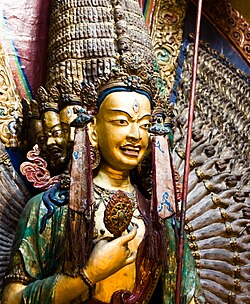
Statue of 1000 arm Sitātapatrā in Leh, Ladakh, India
Chinese name
Chinese白傘蓋佛頂
Transcriptions
Standard Mandarin
Hanyu PinyinBái Sǎngài Fódǐng
Wade–GilesPai2 San3-kai4 Fo2-ting3
Tibetan name
Tibetanགདུགས་དཀར་མོ།
Transcriptions
Wyliegdugs dkar mo
Korean name
Hangul시타타파트라
Transcriptions
Revised Romanizationsitatapateura
Mongolian name
Mongolian CyrillicЦагаан шүхэрт
Tsagaan shühert
Japanese name
Kanji白傘蓋仏頂
Kanaびゃくさんがいぶっちょう
シタータパトラー
Transcriptions
RomanizationByaku Sangai Butchō
Shitātapatorā
Filipino name
TagalogSitatapatla
Tamil name
Tamilசீதாதபத்திரை
Sanskrit name
Sanskritसितातपत्रा (Sitātapatrā)
Pali name
PaliSitātapattā

Sitātapatrā (Sanskrit: "White Parasol"[1]) is a bodhisattva and protector against supernatural danger in Buddhism. She is venerated in both the Mahayana and Vajrayana traditions. She is also known as Usnisasitatapatra or Uṣṇīṣa Sitātapatrā. It is believed that Sitātapatrā is a powerful independent deity emanated by Gautama Buddha from his Uṣṇīṣa. Whoever practices her mantra will be reborn in Amitābha's pure land of Sukhāvatī as well as gaining protection against supernatural danger and witchcraft.[citation needed]

Name

[edit]

Her name is composed of sita ("white") and ātapatrā ("parasol" or "umbrella").[2]

Forms

[edit]

There are several different forms of Sitatapatra including: with one face and two arms; with three faces and six arms; with three faces and eight arms; with three faces and ten arms; with five faces and ten arms; and, with 1000 faces, 1000 arms and 1000 legs.[3]

Mantras

[edit]

ཧཱུཾ་མ་མ་ཧཱུཾ་ནི་སྭཱཧཱ། Hum ma ma hum ni svaha

The Śūraṅgama Mantra of the Śūraṅgama Sūtra is the most commonly practiced mantra invoking her.[citation needed] According to Thubten Zopa Rinpoche, the "Great White Umbrella" is a sādhanā for healing illness, dispelling interferences and spirit possession, quelling disasters, and bringing auspiciousness. To do practice in full requires a kriyātantra abhiṣeka of Sitātapatrā for the Vajrayana practitioners. The dhāraṇī "ārya-tathāgatoṣṇīṣa-sitātapatrāparājita-mahāpratyaṅgirāparama-siddhā-nāma-dhāraṇī" (English: "The Noble Dhāraṇī of Sitātapatrā Born from the Tathāgata’s Uṣṇīṣa, Great Dispeller of Invincible Might and Supreme Accomplishment") is a common action tantra practice of Sitātapatrā.

Symbolism

[edit]
Sitatapatra

Sitātapatrā is one of the most complex Vajrayana goddesses.[4] According to Miranda Shaw in the Buddhist Goddesses of India, Sitātapatrā emerged from Buddha's uṣṇīṣa when he was in the Trāyastriṃśa heaven.[citation needed] The Buddha announced her role to "cut asunder completely all malignant demons, to cut asunder all the spells of others...to turn aside all enemies and dangers and hatred." Sitātapatrā's benign and beautiful form belies her ferocity as she is a "fierce, terrifying goddess, garlanded by flames, a pulverizer of enemies and demons."[5]

In the Mahayana Sitatapatra Sutra, she is called Aparājita "Undefeatable, Unconquerable" and is also identified as a form of goddess Tārā.[citation needed]

In other sutras, she is regarded as a female counterpart to Avalokiteśvara, the bodhisattva of compassion. Like him, Sitātapatrā manifests in many elaborate forms: having a thousand faces, arms and legs, or simply as a feminine deity of great beauty. Known foremost for her "white parasol" she is most frequently attributed with the "golden wheel". The auspiciousness of the turning of the dharma wheel is symbolic of Buddhism, both in its teachings and realizations.[citation needed]

Chinese and Vietnamese Buddhist often recite her a Sino rendering of her Sanskrit title (Maha, meaning "great") Sitātapatrā (Ma Ha Tất Đát Đa Bát Đát Ra 摩訶悉怛多缽怛囉) as a protection mantra, often alongside a starting Om and then svaha but sometimes just the name by itself.

See also

[edit]

References

[edit]
[edit]
Revisions and contributorsEdit on WikipediaRead on Wikipedia
from Grokipedia
Sitatapatra, also known as the White Umbrella Goddess or Ushnisha Sitatapatra, is a powerful female in and , revered as a supreme protector against dangers, forces, and obstacles to . She is classified within the Kriya Tantra tradition and practiced across Tibetan Buddhist schools, including the Sarma lineages of , , , , and the school, and is invoked through her and rituals to avert calamities, purify defilements, and shield practitioners from malignant beings. According to traditional accounts in the Dergé , Sitatapatra originated from the (the protuberance on the crown of the Buddha's head) during a teaching in the Trayastrimsa heaven, where she manifested from rays of light and syllables to combat demonic threats. Her name, derived from for "white ," symbolizes the protective canopy she provides, akin to ancient Buddhist goddesses who safeguarded royalty and the . She is sometimes regarded as a form of Tara or linked to Avalokiteshvara, embodying compassion and invincible defense, often called , the "Undefeatable One." In , Sitatapatra is most famously depicted in her thousand-faced, thousand-armed, and thousand-legged form, with her brilliant white body radiating the 's enlightening light; each hand holds weapons or ritual objects, including a central white and wheel, while her feet trample inner and outer enemies such as , , and . Less common forms include one-faced, three-faced, or eight-armed variations, all emphasizing her all-seeing wisdom through numerous eyes on her hands, feet, and faces. These depictions appear in Tibetan thangkas, sculptures, and amulets from the 18th to 20th centuries, often surrounded by wisdom fire, wrathful attendants like , and a small image of Shakyamuni above. Her practices, drawn from tantric texts, involve reciting her potent —said to alter weather, neutralize poisons, and provide immediate protection when worn or visualized—which is especially popular across Tibetan Buddhist lineages for rituals like fire offerings, torma presentations, and mandala constructions during times of peril. By subduing both external threats and internal afflictions, Sitatapatra aids meditators in overcoming personal flaws, facilitating progress toward enlightenment and embodying the transformative power of Buddhist protection.

Etymology and Names

Origin of the Name

The name Sitātapatra originates from , composed of sītā, meaning "white" or "pure," and ātapatra, denoting a or umbrella that provides shade from heat. Together, these elements translate to "White Umbrella" or "White Parasol," evoking imagery of purity and shelter. The term's linguistic form emerged within Buddhist Sanskrit literature, with its earliest known attestation in the Mañjuśrīmūlakalpa, a tantric text from the CE, where it describes a protective deity associated with the Buddha's uṣṇīṣa. It subsequently appears in other and tantras, such as the Sādhanamālā, maintaining its compound structure through transliteration into regional languages without major phonetic shifts. In terms of pronunciation, the Sitātapatra is rendered approximately as "see-TAH-tah-puh-TRAH." The Tibetan equivalent, Dugkar mo (གདུགས་དཀར་མོ), is pronounced roughly as "doog-kar mo." In Chinese, it is transliterated as Bái Sǎngài Fó Dǐng (白傘蓋佛頂), meaning "White Umbrella Buddha Crown." This nomenclature reflects broader Indian cultural associations of the white parasol with royal protection from environmental extremes.

Epithets and Titles

Sitatapatra is known by the epithet , meaning "The Unconquerable" or "Invincible," which signifies her supreme ability to overcome all malevolent forces and protect devotees from harm. This title underscores her role as an unyielding guardian, particularly against supernatural threats, as described in protective dharanis where her power averts evil influences before they manifest. Another key epithet, Sitatapatra, translates to "Crown Protrusion White Umbrella," highlighting her manifestation from the ushnisha of enlightened beings, symbolizing ultimate protective authority. In Tibetan traditions, she is commonly referred to as Dugkar mo, or "White ," a name that evokes her primary attribute as a shield against calamities and malignant entities. This title, along with , portrays her as "She Who Averts the " and "Protectress from Supernatural Dangers," emphasizing her function in warding off curses, , and adversarial spirits through . Across East Asian adaptations, her names vary while retaining the core symbolism of the white umbrella. In Chinese Buddhism, she is called Bái Sǎngài Fúdǐng (白伞盖佛顶), meaning "White Umbrella Buddha Crown," reflecting her exalted status as a crown emanation. The Japanese equivalent is Byakusangai Butcho (白伞盖佛顶), using the same kanji to denote her protective essence. In Mongolian traditions, the name Tsagaan Shükhert (Цагаан шүхэрт), or "White Umbrella," parallels the Tibetan Dugkar mo, adapting the motif to local linguistic and cultural contexts for invoking her safeguarding powers.

Origins and Scriptural Basis

Scriptural Foundations

Sitatapatra's scriptural origins are rooted in Buddhist texts, particularly the sutras associated with the (crown protrusion) of . The core text is the Ārya Tathāgatoṣṇīṣa Sitātapatrā Aparājita Mahāpratyaṅgirā Parama Siddhā Nāma Dhāraṇī, commonly known as the Sitatapatra Sutra, cataloged as Toh 590 in the Tibetan Kangyur and part of the broader collection of protective . This sutra presents Sitatapatra as a powerful female deity emanating directly from the Buddha Śākyamuni's while he abides in profound in the Heaven of the Thirty-Three. The narrative describes how, upon entering this meditative state, "the words of this formula issued from the center of the Blessed One’s uṣṇīṣa," establishing her as an embodiment of the Buddha's enlightened power for averting harm. In the sutra, Sitatapatra is depicted as the "invincible queen of vidyās for averting," a greatly terrifying and immensely powerful figure with a thousand heads, arms, and eyes, symbolizing her all-encompassing protective capacity. Key passages emphasize her role as a supreme protectress against supernatural dangers, diseases, and adversities, declaring her "invincible and greatly terrifying, immensely powerful and rich in splendor." The text promises that those who uphold and recite her dharani will be safeguarded from a vast array of calamities, including 84,000 types of fears induced by grahas (seizing spirits), the influences of 28 lunar mansions, eight great celestial bodies, poisons, strife, and the eight types of untimely death. For instance, it assures protection from premature demise and the pacification of conflicts, ensuring the practitioner's safety and spiritual progress. The Śūraṅgama Sūtra references Sitatapatra in its title and glossary as a symbol of the pure, immaculate One Mind, linked to protective dharanis emanating from the Buddha's , reinforcing her role in safeguarding against defilements and negative influences through recitation. These foundational texts introduce her primary dharanis, which serve as the basis for subsequent protective rituals in Buddhist traditions.

Historical Emergence

The veneration of Sitatapatra first emerged in ancient during the 7th century CE, with her earliest references appearing in tantric scriptures such as the Mañjuśrīmūlakalpa (Toh. 543), where she is depicted initially as a male deity before transitioning to a prominent female form amid the rising prominence of feminine deities in Buddhist . This period aligns with the development of kriya , including four canonical texts on Sitatapatra (Toh. 590–593) that describe her as emanating from the uṣṇīṣa (crown protuberance) of to offer protection against obstacles and malevolent forces. These Indian and sutras established her as an independent protector deity, emphasizing her role in esoteric practices that gained traction across Buddhist traditions by the 8th century. Sitatapatra's cult spread from via the trade routes and cultural exchanges, reaching by the , where she was integrated into the burgeoning traditions. This dissemination coincided with the second diffusion of (late 10th–12th centuries), a period of renewed tantric transmission from Indian masters like Atisha to Tibetan scholars, facilitating her adoption in key lineages such as , where she is revered as a significant protector, and , particularly in practices involving longevity rituals and obstacle aversion. Although earlier introductions occurred during the under King Tri Songdetsen's patronage and Guru Padmasambhava's influence, including translations of her dhāraṇīs (Toh. 591) among the Ten Royal Sūtras, the second diffusion solidified her enduring role in Tibetan esoteric . In , Sitatapatra was introduced to during the (618–907 CE), particularly through the efforts of Indian tantric masters like Śubhakarasiṃha (637–735 CE) and (705–774 CE), who translated key esoteric texts between 713 and 765 CE that incorporated her dhāraṇīs for protection. This integration occurred amid the flourishing of (mijiao), where Sitatapatra's white parasol symbolism resonated with imperial protective rites and was preserved in sutra collections like the Uṣṇīṣa-sitatapatra-vidyārāja-sūtra. Her presence endured in Chinese traditions, influencing later developments in Japanese via transmissions from the Tang era, though her veneration remained more prominent in esoteric circles rather than mainstream practice.

Iconography and Forms

Core Iconographic Elements

Sitatapatra is characteristically depicted with a radiant white body, embodying purity and the capacity to ward off malevolent forces. This coloration draws from her association with the luminous white , a key of unassailable in Buddhist . In her standard two-armed form, she possesses one face featuring three eyes, conveying vigilance and across the three realms of existence. Her two arms extend in gestures of benevolence: the right hand holds a Dharma wheel in a of protection, while the left holds a white parasol at her heart, signifying shelter from calamities. She is seated in the vajra posture upon a , often supported by a disc and sun cushion, evoking stability and enlightenment. Adorned with silken garments, jeweled ornaments, and a crown, her expression blends serene with subtle ferocity. Occasionally, an additional hovers above her head, reinforcing her role as a supreme guardian. While the core two-armed depiction emphasizes simplicity and direct , multi-armed variations expand her attributes with additional eyes and implements for amplified efficacy.

Variations Across Forms

Sitatapatra manifests in a basic two-armed form as a white female with one face and a on the forehead, seated in vajra posture on a lotus, moon disc, and sun seat. In this configuration, her right hand holds a symbolizing the , while the left hand grasps a white at the heart, representing from harm; she is adorned with silken garments and jewel ornaments, displaying a slightly peaceful yet fierce expression. This simpler serves as an accessible representation for foundational protective practices. More complex multi-armed forms expand her protective capacity through additional faces and limbs. In the three-faced, six-armed variation, Sitatapatra appears white in color with a central white face, a blue right face, and a red left face, each bearing three eyes; the principal hands hold a vajra and white wheel, while the remaining arms wield a wheel, arrow, bow, noose, and hook, often seated in vajra or half-vajra posture amid jewel adornments. A related three-faced, eight-armed form similarly features tricolored faces with three eyes each, but with the arms holding a white parasol, wheel, hook, arrow, victory banner, vajra, noose, and bow, emphasizing her dominion over obstacles. Further elaborations include a five-faced, ten-armed manifestation, though descriptions prioritize the proliferation of attributes like weapons and ritual implements to denote escalating protective power. The pinnacle of her multiplicity is the thousand-faced form, the most prevalent in artistic depictions, where Sitatapatra possesses one thousand arms, one thousand legs, and faces in five colors—white, yellow, red, green, and blue—each with three eyes and adorned by a wrathful vajra; she wields an array of one thousand attributes including Dharma wheels, parasols, arrows, bows, swords, nooses, hooks, vajras, jewels, and lotuses, standing on a lotus base encircled by wisdom fire. This form, detailed in Sarma tantric lineages, incorporates 10,100,000 eyes across her body for omniscient vigilance, underscoring ultimate defense against malevolent forces. Specialized manifestations adapt her iconography for specific emphases. Ushnisha Sitatapatra, emerging from the Buddha's crown protuberance (), integrates a blazing crown and is typically rendered in the thousand-limbed form to embody enlightened wisdom's radiant protection, with primary hands brandishing the white and Dharma wheel amid a halo of weapons. In Tibetan artistic traditions, a hybrid form blending Sitatapatra with Tara—known as White Umbrella Tara—combines the parasol and wheel with Tara's seven-eye motif and compassionate posture, highlighting intertwined themes of salvation and shielding.

Mantras and Protective Practices

Key Mantras and Dharanis

Sitatapatra is invoked through several key mantras and dharanis that form the core of her protective practices in and . The principal dharani, known as the Uṣṇīṣa Sitatapatra Dharani, originates from the canonical text Ārya Tathāgatoṣṇīṣasitātapatrāparājita Mahāpratyaṅgirāparamasiddha Nāma Dhāraṇī, which describes her emergence from the Buddha's crown protuberance. Its full Sanskrit transliteration, as preserved in Tibetan traditions (Toh. 591), includes an extensive heart structured as follows: Oṃ asita anala arka prabhā sphuṭa vika sitātapatre | Oṃ jvāla jvāla | khada khada | hana hana | daha daha | dara dara | vidara vidara | cchinda cchinda | bhinda bhinda | hūṃ hūṃ phaṭ svāhā | he he phaṭ | ho ho phaṭ | amogha phaṭ | apratīhata phaṭ | vara-pradā phaṭ | vidrāpanakā phaṭ... [continuing with repetitions targeting various obstructive forces such as yakṣas, piśācas, and planetary influences, culminating in sarva devebhyaḥ phaṭ]. This emphasizes binding and repelling malevolent entities through phonetic sequences evoking fiery destruction and unbreakable protection. A shorter commonly used for immediate protection is "Oṃ sitātapatrā hūṃ phaṭ," which directly calls upon Sitatapatra's essence to dispel obstacles and negative influences. This concise form appears in various sadhanas and is recited for swift during daily practice or emergencies. Variations of these mantras exist across traditions. In , an extended version of the principal 's essence is rendered phonetically as "Oṃ sarva uṣṇīṣa sitātapatrā hūṃ peḥ hūṃ mā ma hūṃ ni svāhā," incorporating seed syllables like hūṃ peḥ to amplify repelling power; this draws from the same scriptural basis but adapts for recitation. In contexts, particularly within the (as part of its protective dhāraṇīs in the Fourth Assembly), the is integrated into the larger Shurangama Mantra and recited using traditional Sino-Xenic , preserving the protective intent for East Asian practitioners. These and dharanis stem primarily from the Sitātapatrā Uṣṇīṣa Sūtra (Toh. 590-592 in the Tibetan Kangyur), where teaches them as supreme means for averting harm.

Ritual Applications

In Buddhist traditions, practitioners engage in daily recitations of Sitatapatra's mantras and dharanis to avert obstacles, illnesses, and malevolent spirits, often performing 108 repetitions while visualizing the deity's radiant white form emanating protective light to purify negative influences. This practice, drawn from Kriya Tantra sadhanas, fosters a shield against adversities by invoking her emanation, with the mantra syllables imagined at the practitioner's heart center on a moon disc. Empowerment rituals, known as , form a core component of Sitatapatra's practices, where a qualified master confers through vase water and visualization, purifying karmic stains and granting permission for full . These ceremonies, classified under , often incorporate fire pujas (homa) for purification and , involving offerings into consecrated flames to dispel interferences and invoke her safeguarding energies against illness and evil forces. Sitatapatra's is inscribed on protective talismans, such as amulets or umbrellas, in both Tibetan and Chinese Buddhist traditions, providing portable safeguards when worn or carried to ward off calamities, malignant beings, and environmental hazards. In these contexts, the inscribed text—often on bark, cloth, or metal—serves as a dharmakaya relic, offering immediate purification and defense during travel or adversity.

Symbolism and Attributes

Protective Symbolism

Sitatapatra's white umbrella serves as a primary symbol of , functioning as a shield against calamities such as natural disasters, diseases, and malevolent forces, while embodying the purity and all-encompassing shelter of the . This attribute, often depicted alongside the wheel of in her primary hands, underscores her role in safeguarding practitioners under the Buddhist teachings, warding off spiritual and physical harms to foster an environment conducive to enlightenment. Her multiple arms and eyes—typically numbering in the thousands, with eyes on the palms, soles, and three per head—represent and the capacity to perceive and avert dangers from simultaneously. This iconographic feature highlights her boundless vigilance and compassionate intervention, enabling her to protect innumerable beings at once by countering afflictions like , , and that threaten spiritual progress. As Sitatapatra, her name and form are intrinsically linked to the , the cranial protuberance on the Buddha's head symbolizing supreme wisdom and enlightenment. This association emphasizes her embodiment of transcendent insight, through which she dispels and obstacles, guiding devotees toward the purity of awakened mind.

Connections to Other Deities

Sitatapatra is regarded as an emanation of the Avalokiteshvara, embodying his compassionate protective qualities in a fierce feminine form. This connection is evident in her multi-armed and multi-eyed , which mirrors Avalokiteshvara's thousand-armed manifestation, symbolizing the boundless reach of compassion to safeguard sentient beings from harm. In Tibetan Buddhist traditions, she arises from the Buddha's uṣṇīṣa (crown protuberance), emphasizing her role as a direct extension of enlightened activity. In certain Tibetan lineages, Sitatapatra is identified as a protective manifestation of White Tara, integrating Tara's attributes of , , and maternal with intensified energy against obstacles. This association positions her within the broader Tara cycle, where she functions as an invincible guardian. Her white coloration and parasol emblem further align her with Tara's serene yet potent protective essence, distinguishing her as a specialized form for averting supernatural threats.

Role in Buddhist Traditions

In Mahayana Buddhism

In Mahayana Buddhism, Sitatapatra is revered as a powerful protective bodhisattva emanating from the uṣṇīṣa (crown protuberance) of the Buddha, primarily through the sutra Sitātapatrā Born from the Uṣṇīṣa of All Tathāgatas (Sanskrit: Ārya sarvatathāgatoṣṇīṣasitātapatrā nāmā parājayaprati­yaṅgirā mahāvidyārājñī; Toh 590), a key text translated into Chinese as Taishō 976 and integrated into East Asian canonical collections. This sutra describes her dharani as a supreme means for averting calamities, including supernatural threats like malevolent spirits, black magic, and disasters, while promoting healing from illnesses and extending lifespan through the Buddha's compassionate power. Practitioners who recite the dharani are promised purification of negative karma, safeguarding from harm, and eventual rebirth in pure lands or buddha-fields, aligning her veneration with broader Mahayana aspirations for enlightenment in a buddha-field. In non-tantric contexts, her practice emphasizes devotional recitation as a foundational protective rite, distinct from esoteric elaborations. In East Asian traditions, particularly in , Sitatapatra's is commonly recited in temples as part of daily or periodic rituals to invoke , , and general , often alongside other protective mantras in the monastic routine. This sutra-based devotion integrates her protective qualities into everyday lay and clerical practices, where her shields against environmental perils and personal afflictions, reflecting 's emphasis on universal and accessibility. In Vietnamese and Korean communities, similar recitation practices draw on the sutra's assurances to avert supernatural harms such as ghostly interferences and , serving as a communal rite for communal safety and merit accumulation during festivals or crises. Artistically, Sitatapatra appears in simpler two-armed forms in Japanese esoteric-influenced art from the (794–1185) onward, where she is known as Byakusangai Butchō (白傘蓋仏頂), one of the Five Buddha Crowns (Gobutchō) in Shingon and . These depictions typically show her as a serene white figure holding a dharma wheel and white , symbolizing unassailable protection, and were incorporated into mandalas and temple murals to embody sutra-derived safeguards without the multi-limbed complexity of later tantric variants.

In Vajrayana Buddhism

In , Sitatapatra serves as a prominent , particularly within the , , , , and lineages of , where her practices are integrated into advanced across these traditions. These sadhanas, classified under , involve elaborate visualizations of her multi-armed and multi-faced forms, such as the eighteen-armed or thousand-armed variants, to generate protective energies and overcome obstacles for initiated practitioners. In the tradition, for instance, the sadhana requires prior and includes self-generation as the , with recitations of her heart to invoke her wrathful yet compassionate presence from the of . Similarly, in practices, her sadhanas emphasize her role as a meditational for averting calamities, drawing from canonical texts in the Dergé , while , , and lineages incorporate her in similar rituals for protection and purification. Sitatapatra is invoked in wrathful tantric protections, including rituals performed by ngakpas—non-monastic tantric specialists—in Himalayan regions to counter , malevolent spirits, and environmental obstacles. These ngakpa-led ceremonies often incorporate her for repelling negative forces, such as in fire offerings and rituals that establish protective boundaries, ensuring the safety of communities amid adversarial conditions. Her thousand-eyed form symbolizes omniscient vigilance, enabling practitioners to neutralize supernatural threats through recitation and visualization. Following the 1959 Chinese occupation of , Sitatapatra's empowerment ceremonies have persisted in exile Tibetan communities, particularly in and , where lineages like , , , and maintain transmission through teachers such as those in the FPMT network. These adaptations ensure the continuity of her tantric practices, with empowerments bestowed during retreats to empower lay and monastic practitioners against modern-day hindrances.

References

Add your contribution
Related Hubs
User Avatar
No comments yet.