



Community hub
Recent from talks
Contribute something
Nothing was collected or created yet.
Spectral density estimation
View on Wikipedia | This article needs editing to comply with Wikipedia's Manual of Style. In particular, it has problems with MOS:FORMULA - avoid mixing <math>...</math> and {{math}} in the same expression. (July 2025) |
In statistical signal processing, the goal of spectral density estimation (SDE) or simply spectral estimation is to estimate the spectral density (also known as the power spectral density) of a signal from a sequence of time samples of the signal.[1] Intuitively speaking, the spectral density characterizes the frequency content of the signal. One purpose of estimating the spectral density is to detect any periodicities in the data, by observing peaks at the frequencies corresponding to these periodicities.
Some SDE techniques assume that a signal is composed of a limited (usually small) number of generating frequencies plus noise and seek to find the location and intensity of the generated frequencies. Others make no assumption on the number of components and seek to estimate the whole generating spectrum.
Overview
[edit] | This article may need to be cleaned up. It has been merged from Frequency domain. |


Spectrum analysis, also referred to as frequency domain analysis or spectral density estimation, is the technical process of decomposing a complex signal into simpler parts. As described above, many physical processes are best described as a sum of many individual frequency components. Any process that quantifies the various amounts (e.g. amplitudes, powers, intensities) versus frequency (or phase) can be called spectrum analysis.
Spectrum analysis can be performed on the entire signal. Alternatively, a signal can be broken into short segments (sometimes called frames), and spectrum analysis may be applied to these individual segments. Periodic functions (such as ) are particularly well-suited for this sub-division. General mathematical techniques for analyzing non-periodic functions fall into the category of Fourier analysis.

The Fourier transform of a function produces a frequency spectrum which contains all of the information about the original signal, but in a different form. This means that the original function can be completely reconstructed (synthesized) by an inverse Fourier transform. For perfect reconstruction, the spectrum analyzer must preserve both the amplitude and phase of each frequency component. These two pieces of information can be represented as a 2-dimensional vector, as a complex number, or as magnitude (amplitude) and phase in polar coordinates (i.e., as a phasor). A common technique in signal processing is to consider the squared amplitude, or power; in this case the resulting plot is referred to as a power spectrum.
Because of reversibility, the Fourier transform is called a representation of the function, in terms of frequency instead of time; thus, it is a frequency domain representation. Linear operations that could be performed in the time domain have counterparts that can often be performed more easily in the frequency domain. Frequency analysis also simplifies the understanding and interpretation of the effects of various time-domain operations, both linear and non-linear. For instance, only non-linear or time-variant operations can create new frequencies in the frequency spectrum.
In practice, nearly all software and electronic devices that generate frequency spectra utilize a discrete Fourier transform (DFT), which operates on samples of the signal, and which provides a mathematical approximation to the full integral solution. The DFT is almost invariably implemented by an efficient algorithm called fast Fourier transform (FFT). The array of squared-magnitude components of a DFT is a type of power spectrum called periodogram, which is widely used for examining the frequency characteristics of noise-free functions such as filter impulse responses and window functions. But the periodogram does not provide processing-gain when applied to noiselike signals or even sinusoids at low signal-to-noise ratios[why?]. In other words, the variance of its spectral estimate at a given frequency does not decrease as the number of samples used in the computation increases. This can be mitigated by averaging over time (Welch's method[2]) or over frequency (smoothing). Welch's method is widely used for spectral density estimation (SDE). However, periodogram-based techniques introduce small biases that are unacceptable in some applications. So other alternatives are presented in the next section.
Techniques
[edit]Many other techniques for spectral estimation have been developed to mitigate the disadvantages of the basic periodogram. These techniques can generally be divided into non-parametric, parametric, and more recently semi-parametric (also called sparse) methods.[3] The non-parametric approaches explicitly estimate the covariance or the spectrum of the process without assuming that the process has any particular structure. Some of the most common estimators in use for basic applications (e.g. Welch's method) are non-parametric estimators closely related to the periodogram. By contrast, the parametric approaches assume that the underlying stationary stochastic process has a certain structure that can be described using a small number of parameters (for example, using an auto-regressive or moving-average model). In these approaches, the task is to estimate the parameters of the model that describes the stochastic process. When using the semi-parametric methods, the underlying process is modeled using a non-parametric framework, with the additional assumption that the number of non-zero components of the model is small (i.e., the model is sparse). Similar approaches may also be used for missing data recovery[4] as well as signal reconstruction.
Following is a partial list of spectral density estimation techniques:
- Non-parametric methods for which the signal samples can be unevenly spaced in time (records can be incomplete)
- Least-squares spectral analysis, based on least squares fitting to known frequencies
- Lomb–Scargle periodogram, an approximation of the Least-squares spectral analysis
- Non-uniform discrete Fourier transform
- Non-parametric methods for which the signal samples must be evenly spaced in time (records must be complete):
- Periodogram, the modulus squared of the discrete Fourier transform
- Bartlett's method is the average of the periodograms taken of multiple segments of the signal to reduce variance of the spectral density estimate
- Welch's method a windowed version of Bartlett's method that uses overlapping segments
- Multitaper is a periodogram-based method that uses multiple tapers, or windows, to form independent estimates of the spectral density to reduce variance of the spectral density estimate
- Singular spectrum analysis is a nonparametric method that uses a singular value decomposition of the covariance matrix to estimate the spectral density
- Short-time Fourier transform
- Critical filter is a nonparametric method based on information field theory that can deal with noise, incomplete data, and instrumental response functions
- Parametric techniques (an incomplete list):
- Autoregressive model (AR) estimation, which assumes that the nth sample is correlated with the previous p samples.
- Moving-average model (MA) estimation, which assumes that the nth sample is correlated with noise terms in the previous p samples.
- Autoregressive moving-average (ARMA) estimation, which generalizes the AR and MA models.
- MUltiple SIgnal Classification (MUSIC) is a popular superresolution method.
- Estimation of signal parameters via rotational invariance techniques (ESPRIT) is another superresolution method.
- Maximum entropy spectral estimation is an all-poles method useful for SDE when singular spectral features, such as sharp peaks, are expected.
- Semi-parametric techniques (an incomplete list):

Parametric estimation
[edit]In parametric spectral estimation, one assumes that the signal is modeled by a stationary process which has a spectral density function (SDF) that is a function of the frequency and parameters .[8] The estimation problem then becomes one of estimating these parameters.



The most common form of parametric SDF estimate uses as a model an autoregressive model of order .[8]: 392 A signal sequence obeying a zero mean process satisfies the equation


where the are fixed coefficients and is a white noise process with zero mean and innovation variance . The SDF for this process is


with the sampling time interval and the Nyquist frequency.


There are a number of approaches to estimating the parameters of the process and thus the spectral density:[8]: 452-453

- The Yule–Walker estimators are found by recursively solving the Yule–Walker equations for an process
- The Burg estimators are found by treating the Yule–Walker equations as a form of ordinary least squares problem. The Burg estimators are generally considered superior to the Yule–Walker estimators.[8]: 452 Burg associated these with maximum entropy spectral estimation.[9]
- The forward-backward least-squares estimators treat the process as a regression problem and solves that problem using forward-backward method. They are competitive with the Burg estimators.
- The maximum likelihood estimators estimate the parameters using a maximum likelihood approach. This involves a nonlinear optimization and is more complex than the first three.
Alternative parametric methods include fitting to a moving-average model (MA) and to a full autoregressive moving-average model (ARMA).
Frequency estimation
[edit]Frequency estimation is the process of estimating the frequency, amplitude, and phase-shift of a signal in the presence of noise given assumptions about the number of the components.[10] This contrasts with the general methods above, which do not make prior assumptions about the components.
Single tone
[edit]If one only wants to estimate the frequency of the single loudest pure-tone signal, one can use a pitch detection algorithm.
If the dominant frequency changes over time, then the problem becomes the estimation of the instantaneous frequency as defined in the time–frequency representation. Methods for instantaneous frequency estimation include those based on the Wigner–Ville distribution and higher order ambiguity functions.[11]
If one wants to know all the (possibly complex) frequency components of a received signal (including transmitted signal and noise), one uses a multiple-tone approach.
Multiple tones
[edit]A typical model for a signal consists of a sum of complex exponentials in the presence of white noise,


- .

The power spectral density of is composed of impulse functions in addition to the spectral density function due to noise.
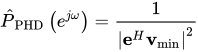
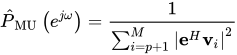
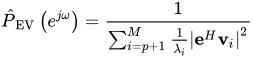
The most common methods for frequency estimation involve identifying the noise subspace to extract these components. These methods are based on eigendecomposition of the autocorrelation matrix into a signal subspace and a noise subspace. After these subspaces are identified, a frequency estimation function is used to find the component frequencies from the noise subspace. The most popular methods of noise subspace based frequency estimation are Pisarenko's method, the multiple signal classification (MUSIC) method, the eigenvector method, and the minimum norm method.
- Pisarenko's method
- MUSIC
- Eigenvector method
- Minimum norm method

Example calculation
[edit]Suppose , from to is a time series (discrete time) with zero mean. Suppose that it is a sum of a finite number of periodic components (all frequencies are positive):


where
![{\displaystyle {\begin{aligned}x_{n}&=\sum _{k}A_{k}\sin(2\pi \nu _{k}n+\phi _{k})\\&=\sum _{k}A_{k}\left[\sin(\phi _{k})\cos(2\pi \nu _{k}n)+\cos(\phi _{k})\sin(2\pi \nu _{k}n)\right]\\&=\sum _{k}\left[a_{k}\cos(2\pi \nu _{k}n)+b_{k}\sin(2\pi \nu _{k}n)\right]\end{aligned}}}](https://wikimedia.org/api/rest_v1/media/math/render/svg/cae1e947577348626c3f93747cfc11da2568b296)

The variance of is, for a zero-mean function as above, given by

If these data were samples taken from an electrical signal, this would be its average power (power is energy per unit time, so it is analogous to variance if energy is analogous to the amplitude squared).
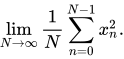
Now, for simplicity, suppose the signal extends infinitely in time, so we pass to the limit as If the average power is bounded, which is almost always the case in reality, then the following limit exists and is the variance of the data.

Again, for simplicity, we will pass to continuous time, and assume that the signal extends infinitely in time in both directions. Then these two formulas become

and

The root mean square of is , so the variance of is Hence, the contribution to the average power of coming from the component with frequency is All these contributions add up to the average power of


Then the power as a function of frequency is and its statistical cumulative distribution function will be


is a step function, monotonically non-decreasing. Its jumps occur at the frequencies of the periodic components of , and the value of each jump is the power or variance of that component.


The variance is the covariance of the data with itself. If we now consider the same data but with a lag of , we can take the covariance of with , and define this to be the autocorrelation function of the signal (or data) :


If it exists, it is an even function of If the average power is bounded, then exists everywhere, is finite, and is bounded by , which is the average power or variance of the data.


It can be shown that can be decomposed into periodic components with the same periods as :

This is in fact the spectral decomposition of over the different frequencies, and is related to the distribution of power of over the frequencies: the amplitude of a frequency component of is its contribution to the average power of the signal.
The power spectrum of this example is not continuous, and therefore does not have a derivative, and therefore this signal does not have a power spectral density function. In general, the power spectrum will usually be the sum of two parts: a line spectrum such as in this example, which is not continuous and does not have a density function, and a residue, which is absolutely continuous and does have a density function.
See also
[edit]References
[edit]- ^ P Stoica and R Moses, Spectral Analysis of Signals, Prentice Hall, 2005.
- ^ Welch, P. D. (1967), "The use of Fast Fourier Transform for the estimation of power spectra: A method based on time averaging over short, modified periodograms", IEEE Transactions on Audio and Electroacoustics, AU-15 (2): 70–73, Bibcode:1967ITAE...15...70W, doi:10.1109/TAU.1967.1161901, S2CID 13900622
- ^ a b Stoica, Petre; Babu, Prabhu; Li, Jian (January 2011). "New Method of Sparse Parameter Estimation in Separable Models and Its Use for Spectral Analysis of Irregularly Sampled Data". IEEE Transactions on Signal Processing. 59 (1): 35–47. Bibcode:2011ITSP...59...35S. doi:10.1109/TSP.2010.2086452. ISSN 1053-587X. S2CID 15936187.
- ^ Stoica, Petre; Li, Jian; Ling, Jun; Cheng, Yubo (April 2009). "Missing data recovery via a nonparametric iterative adaptive approach". 2009 IEEE International Conference on Acoustics, Speech and Signal Processing. IEEE. pp. 3369–3372. doi:10.1109/icassp.2009.4960347. ISBN 978-1-4244-2353-8.
- ^ Sward, Johan; Adalbjornsson, Stefan Ingi; Jakobsson, Andreas (March 2017). "A generalization of the sparse iterative covariance-based estimator". 2017 IEEE International Conference on Acoustics, Speech and Signal Processing (ICASSP). IEEE. pp. 3954–3958. doi:10.1109/icassp.2017.7952898. ISBN 978-1-5090-4117-6. S2CID 5640068.
- ^ Yardibi, Tarik; Li, Jian; Stoica, Petre; Xue, Ming; Baggeroer, Arthur B. (January 2010). "Source Localization and Sensing: A Nonparametric Iterative Adaptive Approach Based on Weighted Least Squares". IEEE Transactions on Aerospace and Electronic Systems. 46 (1): 425–443. Bibcode:2010ITAES..46..425Y. doi:10.1109/TAES.2010.5417172. hdl:1721.1/59588. ISSN 0018-9251. S2CID 18834345.
- ^ Panahi, Ashkan; Viberg, Mats (February 2011). "On the resolution of the LASSO-based DOA estimation method". 2011 International ITG Workshop on Smart Antennas. IEEE. pp. 1–5. doi:10.1109/wsa.2011.5741938. ISBN 978-1-61284-075-8. S2CID 7013162.
- ^ a b c d Percival, Donald B.; Walden, Andrew T. (1992). Spectral Analysis for Physical Applications. Cambridge University Press. ISBN 9780521435413.
- ^ Burg, J.P. (1967) "Maximum Entropy Spectral Analysis", Proceedings of the 37th Meeting of the Society of Exploration Geophysicists, Oklahoma City, Oklahoma.
- ^ Hayes, Monson H., Statistical Digital Signal Processing and Modeling, John Wiley & Sons, Inc., 1996. ISBN 0-471-59431-8.
- ^ Lerga, Jonatan. "Overview of Signal Instantaneous Frequency Estimation Methods" (PDF). University of Rijeka. Retrieved 22 March 2014.
Further reading
[edit]- Porat, B. (1994). Digital Processing of Random Signals: Theory & Methods. Prentice Hall. ISBN 978-0-13-063751-2.
- Priestley, M.B. (1991). Spectral Analysis and Time Series. Academic Press. ISBN 978-0-12-564922-3.
- Stoica, P.; Moses, R. (2005). Spectral Analysis of Signals. Prentice Hall. ISBN 978-0-13-113956-5.
- Thomson, D. J. (1982). "Spectrum estimation and harmonic analysis". Proceedings of the IEEE. 70 (9): 1055–1096. Bibcode:1982IEEEP..70.1055T. CiteSeerX 10.1.1.471.1278. doi:10.1109/PROC.1982.12433. S2CID 290772.


Spectral density estimation
View on GrokipediaFundamentals
Definition and Motivation
Spectral density estimation refers to the process of estimating the power spectral density (PSD) of a signal from a finite-length time series to uncover its frequency-domain characteristics, such as the distribution of power across different frequencies.[3] This technique is fundamental in statistical signal processing, where the PSD quantifies how the power of a signal or a time series is spread over frequency, enabling the identification of dominant frequency components and underlying periodicities.[4] For wide-sense stationary processes, the PSD provides a mathematical foundation as the Fourier transform of the signal's autocorrelation function , expressed as where denotes frequency and captures the statistical dependence between signal values at different time lags.[5] This relationship, rooted in the Wiener–Khinchin theorem, transforms time-domain correlation into a frequency-domain representation, offering insights into the signal's second-order statistics without requiring infinite data.[4] The practical significance of spectral density estimation spans diverse fields in signal processing, including noise characterization in communication systems, where it aids in designing filters to mitigate interference; vibration monitoring in mechanical engineering for detecting structural faults; and analysis of geophysical data, such as identifying periodic seismic events through PSD peaks.[3] In audio processing, it facilitates noise power estimation in speech signals, enhancing clarity in environments with background interference.[6] Similarly, in seismic applications, PSD estimation reveals subtle periodic components in noise-dominated recordings, supporting earthquake detection and source characterization.[7] However, estimating the PSD from finite data introduces inherent challenges, primarily bias and variance in the estimates, as the limited observation length fails to fully capture the underlying stationary process, leading to inconsistent results that degrade with increasing frequency resolution.[8] These issues motivate the development of refined estimation techniques to balance resolution, bias reduction, and variance control, ensuring reliable frequency-domain analysis in real-world scenarios.[4]Historical Context
The foundations of spectral density estimation trace back to the early 19th century with Joseph Fourier's development of Fourier analysis, which introduced the decomposition of functions into sums of sinusoids to model heat propagation in solids.[9] Although Fourier's work laid the theoretical groundwork for frequency-domain representations, practical methods for estimating spectral densities from finite data emerged in the late 19th century. In 1898, Arthur Schuster introduced the periodogram as a tool for detecting hidden periodicities in astronomical and meteorological time series, marking the beginning of empirical spectral estimation techniques.[10] The mid-20th century saw significant advancements in refining periodogram-based estimators to address issues like variance and bias. In 1948, Maurice S. Bartlett proposed smoothing the periodogram by averaging over adjacent frequency bands or data segments, reducing variability in estimates for continuous spectra.[11] This was followed in 1958 by the Blackman-Tukey method, which employed lagged autocorrelation products windowed in the time domain to produce smoothed spectral estimates, emphasizing statistical reliability in communications engineering.[12] The advent of digital computing further propelled progress; the 1965 Cooley-Tukey fast Fourier transform (FFT) algorithm enabled efficient computation of periodograms, shifting spectral analysis from analog to digital paradigms.[13] Building on this, Peter D. Welch's 1967 method introduced overlapped segment averaging with windowing to balance bias and variance, while John P. Burg's maximum entropy approach in the same year extended autoregressive modeling for higher resolution from short data records.[14][15] In the modern era, David J. Thomson's 1982 multitaper method advanced non-parametric estimation by using orthogonal tapers to minimize spectral leakage and improve bias-variance trade-offs, particularly for geophysical signals.[16] Post-2000 developments have increasingly addressed non-stationary signals through time-frequency methods, such as evolutionary spectral density frameworks and wavelet-based estimators, enabling adaptive analysis of varying frequency content in fields like seismology and biomedical signal processing.[17]Theoretical Foundations
Power Spectral Density for Stationary Processes
A wide-sense stationary (WSS) process is defined as a stochastic process whose mean is constant over time and whose autocorrelation function depends only on the time lag , rather than on absolute time.[18] This assumption simplifies the analysis of random signals by ensuring that statistical properties relevant to second-order moments remain invariant under time shifts.[18] For a continuous-time WSS process with autocorrelation function , the power spectral density (PSD) is the Fourier transform of : The inverse relation, which recovers the autocorrelation from the PSD, is given by the Wiener-Khinchin theorem: This theorem establishes a duality between time-domain correlations and frequency-domain power distribution for WSS processes.[19][20] Key properties of the PSD for WSS processes include non-negativity, for all frequencies , which follows from the positive semi-definiteness of the autocorrelation function.[21] Additionally, the total power equals the variance plus the squared mean, expressed as .[21] For discrete-time WSS processes , the PSD is defined using the discrete-time Fourier transform (DTFT): with analogous properties holding, including non-negativity and the integral over one period equaling R_X{{grok:render&&&type=render_inline_citation&&&citation_id=0&&&citation_type=wikipedia}}.[21] Under stationarity assumptions, spectral density estimators, such as the periodogram, exhibit asymptotic unbiasedness as the sample size increases to infinity, meaning their expected value converges to the true PSD.[22] This property relies on the ergodicity and mixing conditions inherent in WSS processes, enabling consistent recovery of the underlying spectrum in the large-sample limit.[22]The Periodogram and Its Limitations
The periodogram serves as the foundational non-parametric estimator of the power spectral density (PSD) for a discrete-time stationary process, originally introduced by Arthur Schuster in 1898 to detect hidden periodicities in time series data such as meteorological phenomena.[23] For a finite sequence of observations , , the discrete periodogram is defined as where is the normalized frequency (in cycles per sample), and . This expression represents the squared magnitude of the discrete Fourier transform (DFT) of the data sequence, scaled by , providing an estimate of the PSD at frequency . Equivalently, it can be computed directly from the DFT coefficients as , where for integer , assuming the process is weakly stationary as defined in the theoretical foundations of PSD for stationary processes.[22] Under the assumptions of a stationary process, the periodogram exhibits desirable asymptotic properties for large . It is asymptotically unbiased, meaning its expected value converges to the true PSD as . For white noise processes, this unbiasedness holds exactly, independent of . However, the estimator is inconsistent because its variance does not diminish with increasing sample size; specifically, for large at frequencies away from 0 and the Nyquist frequency. This high variance arises from the lack of any averaging mechanism in the raw periodogram, resulting in a noisy estimate that fluctuates significantly around the true spectrum, akin to a scaled chi-squared distribution with two degrees of freedom.[24] Despite its simplicity, the periodogram suffers from several practical limitations that degrade its reliability as a PSD estimator. The primary issue is spectral leakage, caused by the implicit rectangular windowing of the finite data segment, which introduces discontinuities at the edges and convolves the true spectrum with the Fourier transform of the rectangular window—a sinc function with broad sidelobes. This broadening spreads energy from a true frequency component across neighboring frequencies, obscuring sharp spectral features and reducing the ability to resolve closely spaced frequencies, where the effective resolution is limited to approximately . Additionally, edge effects in computation exacerbate leakage, as the abrupt truncation at and creates artificial high-frequency components; improper normalization, such as omitting the scaling, can further bias the estimate away from the integrated PSD properties. These shortcomings make the raw periodogram unsuitable for precise spectral analysis without modifications.[25]Non-Parametric Estimation Methods
Bartlett's Method
Bartlett's method is a non-parametric technique for estimating the power spectral density (PSD) of a stationary time series by averaging periodograms computed from non-overlapping data segments, thereby reducing the high variance inherent in the raw periodogram estimate. Introduced by Maurice Bartlett in 1950, this approach addresses the statistical instability of the periodogram while preserving an unbiased estimate under asymptotic conditions. It is particularly effective for long datasets where sufficient length allows segmentation without excessive loss of frequency resolution.[1] The procedure begins by dividing a time series of length into non-overlapping segments, each of length , such that . For the -th segment, denoted , the periodogram is calculated as where is the angular frequency. The Bartlett estimate is then the average of these periodograms: This averaging yields a smoothed PSD estimate evaluated at discrete frequencies for , though the effective frequency resolution is determined by the segment length, approximately .[1] Computationally, the periodogram for each segment is efficiently obtained via the fast Fourier transform (FFT), followed by simple averaging of the resulting spectra across segments; this requires FFTs of size , making it suitable for implementation in standard signal processing software.[1] A key advantage of Bartlett's method is the reduction in variance achieved through averaging. For a stationary process with true PSD , the variance of the estimate is approximately compared to the raw periodogram's variance of roughly , assuming the segments are sufficiently separated or the process has short correlation.[1] This reduction by a factor of enhances reliability, especially at frequencies away from zero and the Nyquist limit, but comes at the cost of coarser resolution due to the shorter segment length . Segmentation introduces some bias into the estimate, primarily through implicit smoothing equivalent to convolving the true PSD with a triangular (Fejér) kernel of width proportional to , which smears sharp spectral features.[1] The method remains asymptotically unbiased as with fixed , and it is well-suited to long, stationary time series where the data length permits multiple segments without violating stationarity assumptions. For shorter records, the bias-variance trade-off may limit its utility, favoring alternative methods with overlap or windowing.[1]Welch's Overlapped Segment Averaging
Welch's overlapped segment averaging method enhances the Bartlett method by introducing overlap between segments and applying a tapering window to each, allowing for more efficient use of data to reduce variance in the power spectral density (PSD) estimate while mitigating spectral leakage. Developed by Peter D. Welch, the approach divides a finite-length signal of length into overlapping segments , each of length , with an overlap of samples between consecutive segments (commonly for 50% overlap). A window function , such as the Hamming or Hanning window, is applied to each segment to taper the edges and reduce sidelobe effects, followed by computation of the discrete Fourier transform (DFT) for each windowed segment. The modified periodogram for the -th segment is then formed, and the PSD estimate is obtained by averaging these periodograms across all segments.[14][26] The mathematical formulation of the Welch PSD estimator at frequency is given by where the modified periodogram for the -th segment is with the normalization factor ensuring unbiased estimation for white noise inputs. The fast Fourier transform (FFT) is typically used to compute the DFTs efficiently, making the method practical for large . This averaging over overlapping segments increases the effective number of independent estimates, with the degrees of freedom approximately for non-overlapping cases but higher (e.g., up to 1.8 times more for 50% overlap with Hanning windows) when overlap is incorporated, as it decorrelates adjacent periodograms.[26][14] The primary benefits of overlap in Welch's method include substantial variance reduction compared to non-overlapping segmentation, as it allows for a greater number of segments without discarding data, effectively halving the loss in resolution for 50% overlap while maintaining similar bias levels. Windowing further mitigates spectral leakage by suppressing discontinuities at segment edges, improving estimate reliability for signals with discontinuities or non-periodic extensions. For common windows like the Hanning, an overlap of around 50% is often optimal, balancing variance reduction and computational correlation between segments, leading to smoother PSD estimates with lower noise floors in applications such as signal processing and vibration analysis.[26][14] However, these improvements come with trade-offs: the overlap and windowing increase computational demands, as each of the FFTs requires operations, scaling with which grows with overlap fraction. Additionally, the choice of window introduces bias, as tapering broadens the mainlobe (reducing frequency resolution) and the degree of bias-variance trade-off depends on the window's equivalent noise bandwidth and sidelobe attenuation, requiring careful selection based on signal characteristics.[26]Parametric Estimation Methods
Autoregressive Modeling
Autoregressive (AR) modeling represents a parametric approach to spectral density estimation, where the underlying signal is assumed to follow an AR process driven by white noise innovation. In this framework, the AR(p) model of order p describes the time series as a linear combination of its previous p values plus a white noise term , expressed as where are the AR coefficients and is zero-mean white noise with variance . This model assumes the process is stationary, as detailed in the theoretical foundations of power spectral density for stationary processes. The power spectral density (PSD) of an AR(p) process derives directly from the model's transfer function, given by where is the normalized frequency. This rational form concentrates spectral power at the poles defined by the roots of the denominator polynomial, enabling sharp peaks for resonant frequencies even with limited data. Estimation of the AR coefficients typically relies on the Yule-Walker equations, which relate the coefficients to the autocorrelation function of the process via the system of linear equations with r{{grok:render&&&type=render_inline_citation&&&citation_id=0&&&citation_type=wikipedia}} = \sigma^2 + \sum_{k=1}^p a_k r. These equations form a Toeplitz matrix solved using the Levinson-Durbin recursion, an efficient algorithm that computes the coefficients iteratively in O(p^2) time while ensuring numerical stability for autoregressive structures. A key advantage of AR modeling is its ability to achieve super-resolution in spectral estimation, resolving frequencies separated by less than the Rayleigh limit of (where N is the data length), unlike non-parametric methods limited by finite data duration. This is particularly useful for short time series, such as in geophysical or biomedical signals, where the parametric assumption extrapolates beyond the raw resolution. However, model stability requires coefficients yielding poles inside the unit circle, addressed by Burg's method, which minimizes forward and backward prediction errors jointly to estimate coefficients via lattice reflections, promoting minimum-phase stability without explicit autocorrelation computation. Selecting the appropriate model order p is crucial to balance fit and overfitting; criteria like the Akaike Information Criterion (AIC), defined as (where L is the likelihood), penalize complexity while favoring predictive accuracy, and the Bayesian Information Criterion (BIC), , impose a stronger penalty for larger N to favor parsimony. These information-theoretic approaches guide order choice by evaluating candidate models on the estimated residuals.Maximum Likelihood Approaches
Maximum likelihood (ML) approaches to spectral density estimation treat the power spectral density (PSD) as a parametric function determined by a model, such as an autoregressive moving average (ARMA) process, and seek to maximize the likelihood of the observed data under a Gaussian assumption. These methods are particularly useful for complex models where the PSD form incorporates both autoregressive and moving average components, providing a framework for efficient parameter estimation in the frequency domain. Unlike simpler autoregressive modeling, ML for ARMA allows for more flexible representations of the spectrum, capturing both poles and zeros in the transfer function.[27] A foundational technique in these approaches is Whittle's approximation, which simplifies the exact Gaussian likelihood for a stationary time series by expressing it in terms of the periodogram and the hypothesized PSD. Under the assumption that the time series is Gaussian and stationary, the approximate log-likelihood is proportional to the negative of the integral over frequencies of , where is the parametric PSD and is the periodogram; maximization involves minimizing this integral, often discretized as a sum over Fourier frequencies for computational tractability. This approximation, originally derived for estimating spectral parameters, facilitates iterative optimization and is asymptotically equivalent to the exact likelihood as the sample size grows.[27][28] For ARMA models, the PSD takes the form , where and are the moving average and autoregressive polynomials, respectively, and is the innovation variance; ML estimation proceeds by iteratively optimizing the parameters of , , and to maximize the Whittle likelihood or an exact time-domain equivalent. This involves numerical methods such as Newton-Raphson or expectation-maximization algorithms to solve the nonlinear optimization, often starting from initial estimates obtained via simpler techniques like Yule-Walker equations. The approach extends naturally to vector ARMA processes for multivariate spectral estimation.[29] Asymptotically, ML estimators based on Whittle's approximation achieve the Cramér-Rao lower bound for large sample sizes , demonstrating efficiency under mild regularity conditions on the spectral density, such as continuity and positivity. This efficiency holds even in the presence of colored noise, where extensions incorporate a pre-whitening step to normalize the spectrum before estimation. For ARMA models, the estimators are consistent and normally distributed with variance inversely proportional to the Fisher information matrix, enabling reliable inference on spectral features like peaks and bandwidths.[30] Despite these strengths, ML approaches face challenges including high computational intensity, as the optimization requires evaluating the PSD at multiple frequencies and iterating until convergence, which can be prohibitive for high-order models or long series. Additionally, the estimators are sensitive to model misspecification, such as incorrect ARMA orders, leading to biased PSD estimates that fail to capture true spectral structure; diagnostic tools like information criteria are often employed to mitigate this.[31]Specialized Techniques
Multitaper Spectral Analysis
Multitaper spectral analysis, introduced by David J. Thomson in 1982, is a non-parametric method for estimating the power spectral density (PSD) of stationary time series data by applying multiple orthogonal data windows, known as tapers, to reduce spectral leakage and optimize the bias-variance trade-off.[32] The core idea involves using discrete prolate spheroidal sequences (DPSS), also called Slepian windows, which are derived as the eigenvectors of a concentration problem that maximizes energy within a specified bandwidth while minimizing leakage outside it.[33] For a time series of length , the number of effective tapers is typically chosen as , where is the time-bandwidth product that controls the resolution and the degrees of freedom in the estimate.[34] Each taper is applied to the data, and the Fourier transforms of the tapered series, denoted for , are computed efficiently using the fast Fourier transform (FFT). The PSD estimate is formed by a weighted average of the squared magnitudes of these eigencoefficients, incorporating the eigenvalues associated with each DPSS taper to account for their energy concentration properties: where and are the DPSS tapers normalized such that .[32] This formulation provides an unbiased estimate under white noise assumptions, with the eigenvalues (close to 1 for the first tapers and decaying rapidly thereafter) ensuring that only the most concentrated tapers contribute significantly, thereby reducing bias from sidelobe leakage that plagues single-taper periodograms.[34] A key advantage of the multitaper approach is its superior control over spectral leakage, as the orthogonal DPSS tapers concentrate over 99% of their energy within the bandwidth for the leading eigenvalues, minimizing broadband contamination from distant frequencies.[33] The method achieves a variance reduction equivalent to approximately independent periodogram estimates without sacrificing frequency resolution, offering a favorable bias-variance trade-off compared to segmented methods like Welch's overlapped averaging, which rely on a single window type across segments.[34] This makes it particularly effective for short or noisy datasets, where traditional estimators suffer from high variance or poor localization. For non-white or line-plus-continuum spectra, adaptive weighting refines the estimate by adjusting the weights to downweight tapers contaminated by strong spectral lines, using statistical tests based on the chi-squared distribution with degrees of freedom to assess significance at each frequency.[32] These weights are computed iteratively to minimize the mean-squared error, enhancing dynamic range and handling mild non-stationarities better than fixed-window techniques by suppressing contributions from outlier eigencoefficients.[34] Overall, multitaper analysis has become a standard in fields like geophysics and neuroscience for its robustness and ability to resolve fine spectral structure.[32]Subspace-Based Methods for Frequency Estimation
Subspace-based methods for frequency estimation model the observed signal as a sum of complex sinusoids embedded in additive noise, typically represented as , where are amplitudes, are the sinusoids at frequencies , and is noise.[35] The covariance matrix is formed from the data, exhibiting an eigendecomposition into signal and noise subspaces, where the signal subspace spans the directions of the sinusoids and the noise subspace is orthogonal to it under the assumption of uncorrelated white noise.[1] These methods achieve super-resolution by exploiting this orthogonality, resolving frequencies closer than the Rayleigh limit of traditional Fourier-based techniques like the periodogram. The MUSIC (MUltiple Signal Classification) algorithm, introduced by Schmidt, performs eigendecomposition of the sample covariance matrix to obtain the noise subspace eigenvectors , corresponding to the smallest eigenvalues.[35] The pseudospectrum is then estimated as where is the steering vector for an -element sensor array or data snapshot, and peaks in indicate the true frequencies .[35] Frequency estimates are obtained by searching for the highest peaks, assuming the number of sinusoids is known a priori. This approach provides asymptotically unbiased estimates and high resolution, particularly for closely spaced frequencies.[36] ESPRIT (Estimation of Signal Parameters via Rotational Invariance Techniques), developed by Roy and Kailath, extends subspace methods by exploiting the shift-invariance property of the signal subspace without requiring a full spectral search.[37] It partitions the array into two identical subarrays with a translational shift, yielding subspaces and related by a rotation matrix such that . The frequencies are estimated from the eigenvalues of , solved via least-squares as , where denotes the pseudoinverse, with angles of the eigenvalues giving .[37] This root-finding approach avoids the computational cost of scanning the entire frequency range in MUSIC and achieves similar resolution while being more efficient for uniform linear arrays.[38] These methods demonstrate super-resolution capabilities, resolving frequencies separated by less than (where is the data length) even at low signal-to-noise ratios (SNRs below 0 dB), outperforming DFT-based estimators in scenarios with few closely spaced tones.[39] However, performance relies on accurate estimation of , white Gaussian noise, and uncorrelated sources; deviations, such as colored noise, degrade resolution and require preprocessing like whitening.[1] In simulations with two tones at SNR = -10 dB and separation of 0.05/N, MUSIC and ESPRIT achieve mean squared errors orders of magnitude lower than the periodogram.[39]Practical Implementation and Examples
Computational Considerations
The Fast Fourier Transform (FFT) serves as the computational backbone for most spectral density estimation methods, enabling efficient calculation of the periodogram and its variants by reducing the complexity of the discrete Fourier transform from O(N²) to O(N log N), where N is the signal length.[40] This efficiency is crucial for non-parametric approaches like the periodogram, Bartlett's method, and Welch's method, as well as for evaluating parametric models on frequency grids.[2] To achieve finer frequency resolution without increasing the original data length, zero-padding—appending zeros to the signal before applying the FFT—interpolates additional points on the underlying continuous Fourier transform, providing a denser grid for power spectral density (PSD) visualization while preserving the estimate's variance properties.[41] For large datasets, memory usage and scalability pose significant challenges, particularly in methods requiring full-signal transforms or multiple computations. In Welch's method, segmenting the signal into overlapping windows reduces memory demands by processing subsets independently, trading off some frequency resolution for feasibility with N exceeding available RAM, as direct FFTs on entire long sequences can lead to out-of-memory errors.[42] Similarly, multitaper spectral analysis, which involves K orthogonal tapers (often K ≈ 2NW - 1 for time-bandwidth product NW), amplifies memory needs due to repeated FFTs, but GPU acceleration can mitigate this by parallelizing the transforms.[2] Practical implementations rely on established software libraries that optimize these computations. In Python, SciPy's signal module provides functions likeperiodogram for basic PSD estimates and welch for overlapped segment averaging, leveraging NumPy's FFT backend for O(N log N) performance on large arrays.[43] MATLAB's Signal Processing Toolbox offers pwelch for Welch's method and pyulear for autoregressive PSD via Yule-Walker equations, with built-in support for GPU execution via Parallel Computing Toolbox on compatible hardware.[44] Open-source alternatives include Octave's signal package, which mirrors MATLAB functionality, and R's spectrum function in the stats package for basic periodogram and Welch estimates.
Numerical stability is a key concern in parametric methods. Solving the Yule-Walker equations for autoregressive (AR) coefficients via the normal equations can suffer from ill-conditioning, especially for high orders where small perturbations in autocorrelation estimates amplify errors in the Toeplitz matrix inversion, leading to unstable PSD peaks or line splitting in the spectrum.[45] In subspace-based methods for frequency estimation, such as MUSIC or ESPRIT, eigenvalue decomposition of the sample covariance matrix requires high precision to distinguish signal from noise subspaces; inaccuracies in eigenvalue estimates due to finite sample size or floating-point arithmetic can degrade resolution, particularly for closely spaced frequencies.[46]
Worked Example of PSD Estimation
To illustrate the practical application of power spectral density (PSD) estimation, consider a synthetic dataset consisting of samples generated from a discrete-time sinusoid with frequency (where is the sampling frequency) embedded in additive white Gaussian noise (AWGN) at a signal-to-noise ratio (SNR) of 10 dB. The sinusoid is defined as for , with amplitude and random phase ; the noise component is , where is chosen such that the SNR, defined as , equals 10 dB. This setup mimics a common scenario in signal processing where a periodic component must be detected amid noise. The periodogram provides a baseline nonparametric estimate of the PSD. Compute the discrete Fourier transform (DFT) of the signal for , then form the periodogram as , where . This yields a one-sided PSD plot (for to ) that reveals a prominent peak near amid broadband noise, but with high variance due to the inherent inconsistency of the periodogram estimator—evident as spurious fluctuations across realizations. For visualization, the peak height approximates the sinusoid power , though sidelobes and noise cause scalloping loss. To mitigate the periodogram's variance, apply Welch's overlapped segment averaging method with 50% overlap, a Hamming window, and segments. Divide the signal into overlapping segments of length (so overlap is or 128 samples), apply the Hamming window to each segment for and , compute the DFT , and form the modified periodogram for each as (normalizing for window energy). The Welch PSD is then the average , with frequency resolution . This smoothed spectrum shows a narrower, more stable peak at with reduced variance (by a factor of approximately ), though at the cost of slightly broader mainlobe width due to windowing and shorter segments. Compared to the raw periodogram, the Welch estimate suppresses noise fluctuations by about 9 dB in the sidelobe regions. From the Welch PSD, interpret the results by locating the peak frequency (with estimation error under 1% for this SNR), and estimating the sinusoid power via numerical integration (total power, including noise floor). The noise floor level provides an implicit variance estimate average PSD away from the peak. This example demonstrates how Welch's method enhances reliability for frequency and power recovery in noisy signals. For implementation, the following pseudocode (in a MATLAB-like syntax) computes both estimates:% Synthetic data generation
N = 1024; fs = 1; f0 = 0.1; A = 1; phi = 2*pi*rand;
n = 0:N-1; x_clean = A * cos(2*pi*f0*n + phi);
SNR_dB = 10; sigma2 = A^2 / (2 * 10^(SNR_dB/10));
w = sqrt(sigma2) * randn(1, N); x = x_clean + w;
% Periodogram
X = fft(x, N); P_period = (1/N) * abs(X(1:N/2+1)).^2;
f = (0:N/2)/N * fs; P_period(2:end-1) = 2 * P_period(2:end-1); % One-sided
% Welch's method
K = 7; M = 256; overlap = 0.5 * M;
w_hamm = hamming(M)'; U = sum(w_hamm.^2) / M; % Window normalization
P_welch = zeros(1, M/2+1);
for l = 0:K-1
start_idx = 1 + l * (M - overlap);
seg = x(start_idx:start_idx+M-1) .* w_hamm;
X_seg = fft(seg, M);
P_seg = (1/M) * abs(X_seg(1:M/2+1)).^2 / U;
P_seg(2:end-1) = 2 * P_seg(2:end-1);
P_welch = P_welch + P_seg;
end
P_welch = P_welch / K;
f_welch = (0:M/2)/M * fs;
% Plot and interpret (omitted for brevity)
% Synthetic data generation
N = 1024; fs = 1; f0 = 0.1; A = 1; phi = 2*pi*rand;
n = 0:N-1; x_clean = A * cos(2*pi*f0*n + phi);
SNR_dB = 10; sigma2 = A^2 / (2 * 10^(SNR_dB/10));
w = sqrt(sigma2) * randn(1, N); x = x_clean + w;

% Periodogram
X = fft(x, N); P_period = (1/N) * abs(X(1:N/2+1)).^2;
f = (0:N/2)/N * fs; P_period(2:end-1) = 2 * P_period(2:end-1);  % One-sided

% Welch's method
K = 7; M = 256; overlap = 0.5 * M;
w_hamm = hamming(M)'; U = sum(w_hamm.^2) / M;  % Window normalization
P_welch = zeros(1, M/2+1);
for l = 0:K-1
    start_idx = 1 + l * (M - overlap);
    seg = x(start_idx:start_idx+M-1) .* w_hamm;
    X_seg = fft(seg, M);
    P_seg = (1/M) * abs(X_seg(1:M/2+1)).^2 / U;
    P_seg(2:end-1) = 2 * P_seg(2:end-1);
    P_welch = P_welch + P_seg;
end
P_welch = P_welch / K;
f_welch = (0:M/2)/M * fs;

% Plot and interpret (omitted for brevity)