Respect all members: no insults, harassment, or hate speech.
Be tolerant of different viewpoints, cultures, and beliefs. If you do not agree with others, just create separate note, article or collection.
Clearly distinguish between personal opinion and fact.
Verify facts before posting, especially when writing about history, science, or statistics.
Promotional content must be published on the “Related Services and Products” page—no more than one paragraph per service. You can also create subpages under the “Related Services and Products” page and publish longer promotional text there.
Do not post materials that infringe on copyright without permission.
Always credit sources when sharing information, quotes, or media.
Be respectful of the work of others when making changes.
Discuss major edits instead of removing others' contributions without reason.
If you notice rule-breaking, notify community about it in talks.
Do not share personal data of others without their consent.
Jewish prayer (Hebrew: תְּפִילָּה, tefilla[tfiˈla]; plural תְּפִילּוֹת tefillot[tfiˈlot]; Yiddish: תּפֿלה, romanized: tfile[ˈtfɪlə], plural תּפֿלותtfilles[ˈtfɪləs]; Yinglish: davening/ˈdɑːvənɪŋ/ from Yiddish דאַווןdavn 'pray') is the prayer recitation that forms part of the observance of Rabbinic Judaism. These prayers, often with instructions and commentary, are found in the Siddur, the traditional Jewish prayer book.
Prayer, as a "service of the heart," is in principle a Torah-based commandment.[1] It is mandatory for Jewish women and men.[2] However, the rabbinic requirement to recite a specific prayer text does differentiate between men and women: Jewish men are obligated to recite three prayers each day within specific time ranges (zmanim), while, according to many approaches, women are only required to pray once or twice a day, and may not be required to recite a specific text.[3]
Traditionally, three prayer services are recited daily:
Morning prayer: Shacharit or Shaharit (שַחֲרִית, "of the dawn")
Afternoon prayer: Mincha or Minha (מִנְחָה), named for the flour offering that accompanied sacrifices at the Temple in Jerusalem,
Evening prayer:[4]Arvit (עַרְבִית, "of the evening") or Maariv (מַעֲרִיב, "bringing on night")
Two additional services are recited on Shabbat and holidays:
Ne'ila (נְעִילָה, "closing"), was traditionally recited on communal fast days and is now recited only on Yom Kippur.
A distinction is made between individual prayer and communal prayer, which requires a quorum known as a minyan, with communal prayer being preferable as it permits the inclusion of prayers that otherwise would be omitted.[5]
According to tradition, many of the current standard prayers were composed by the sages of the Great Assembly in the early Second Temple period (516 BCE – 70 CE). The language of the prayers, while clearly from this period, often employs biblical idiom. The main structure of the modern prayer service was fixed in the Tannaic era (1st–2nd centuries CE), with some additions and the exact text of blessings coming later. Jewish prayerbooks emerged during the early Middle Ages during the period of the Geonim of Babylonia (6th–11th centuries CE).[6]
Over the last 2000 years, traditional variations have emerged among the traditional liturgicalcustoms of different Jewish communities, such as Ashkenazic, Sephardic, Yemenite, Eretz Yisrael and others, or rather recent liturgical inventions such as Nusach Sefard and Nusach Ari. However the differences are minor compared with the commonalities. Much of the Jewish liturgy is sung or chanted with traditional melodies or trope. Synagogues may designate or employ a professional or lay hazzan (cantor) for the purpose of leading the congregation in prayer, especially on Shabbat or holy holidays.
You shall serve God with your whole heart'[7] – What service is performed with the heart? This is prayer.[8]
Based on this passage, Maimonides categorizes daily prayer as one of the 613 commandments.[9] He rules that the commandment is fulfilled by any prayer at any time in the day, not a specific text; and thus is not time-dependent, and is mandatory for both Jewish men and women.[2] In contrast, the requirement to say specific prayers at specific times is based not on biblical law, but rather rabbinic decree.[10]
Additional references in the Hebrew Bible have been interpreted to suggest that King David and the prophet Daniel prayed three times a day. In Psalms, David states:
Evening, morning, and noontime, I speak and moan, and He hearkened to my voice.[11]
And Daniel, when he knew that a writ had been inscribed, came to his house, where there were open windows in his upper chamber, opposite Jerusalem, and three times a day he kneeled on his knees and prayed and offered thanks before his God just as he had done prior to this.[12]
The Talmud gives two reasons why there are three basic prayers each day:[13]
Each service was instituted parallel to a sacrificial act in the Temple in Jerusalem: the morning Tamidoffering, the afternoon Tamid offering, and the overnight burning of this last offering.
According to Rabbi Jose bar Hanina, each of the Patriarchs instituted one prayer: Abraham the morning, Isaac the afternoon and Jacob the evening prayers. This view is supported with biblical quotes indicating that the Patriarchs prayed at the times mentioned. However, even according to this view, the exact times of when the services are held, and moreover the entire concept of a mussaf service, are still based on the sacrifices.
Maimonides asserts that until the Babylonian exile, all Jews composed their own prayers. After the exile, however, when the exiles' understanding of Hebrew diminished and they found it difficult to compose prayers in Hebrew, Ezra and his court composed the Amidah prayer.[10] Modern scholarship dating from the Wissenschaft des Judentums movement of 19th-century Germany, as well as textual analysis influenced by the 20th-century discovery of the Dead Sea Scrolls, suggests that dating from the Second Temple period there existed "liturgical formulations of a communal nature designated for particular occasions and conducted in a centre totally independent of Jerusalem and the Temple, making use of terminology and theological concepts that were later to become dominant in Jewish and, in some cases, Christian prayer."[15]
The structure of the modern Jewish prayer service was established during the period of the Tannaim, "from their traditions, later committed to writing, we learn that the generation of rabbis active at the time of the destruction of the Second Temple (70 CE) gave Jewish prayer its structure and, in outline form at least, its contents."[16] This liturgy included the twice-daily recitation of the Shema, the Amidah, and the cycle of public Torah reading.[16]
The Amidah (or Shemoneh Esreh) prayer is traditionally ascribed to the Great Assembly (in the time of Ezra, near the end of the biblical period),[17] though other sources suggest it was established by Simeon HaPakoli in the late 1st century. Even in the 1st century, though, the precise wording of the blessings was not yet fixed, and varied from locale to locale. By the Middle Ages the texts of the blessings was nearly fixed, and in the form in which they are still used today.
Readings from the Torah (five books of Moses) and the Nevi'im ("Prophets") are specified in the Mishnah and Talmud, as are the order of blessings surrounding the Shema. Other parts of the service, such as Pesukei dezimra, have little mention in early sources, but became established by custom.
The oldest prayer books date from the time of the Geonim of Babylonia; "some were composed by respected rabbinic scholars at the request of far-flung communities seeking an authoritative text of the required prayers for daily use, Shabbat, and holidays."[16] The earliest existing codification of the prayerbook was drawn up by Rav Amram Gaon of Sura, Babylon, about 850 CE. Half a century later Rav Saadia Gaon, also of Sura, composed a siddur, in which the rubrical matter is in Arabic. These were the basis of Simcha ben Samuel's Machzor Vitry (11th-century France), which was based on the ideas of his teacher, Rashi. Another formulation of the prayers was that appended by Maimonides to the laws of prayer in his Mishneh Torah: this forms the basis of the Yemenite liturgy, and has had some influence on other rites. From this point forward, all Jewish prayerbooks had the same basic order and contents.
The siddur was printed by Soncino in Italy as early as 1486, though a siddur was first mass-distributed only in 1865. The siddur began appearing in the vernacular as early as 1538. The first English translation, by Gamaliel ben Pedahzur (a pseudonym), appeared in London in 1738; a different translation was released in the United States in 1837.[18]
Over the last 2000 years, the various branches of Judaism have resulted in small variations in the Rabbinic liturgy customs among different Jewish communities, with each community having a slightly different nusach (customary liturgy). The principal difference is between Ashkenazic and Sephardic customs, although there are other communities (e.g., Yemenite and Italian Jews, and in the past Eretz Yisrael), and rather recent liturgical inventions such as Hassidic, Chabad and other communities also have distinct customs, variations, and special prayers. However, the differences between all these customs are quite minor compared with the commonalities. Reform Judaism also has its own version.
According to halakha, all individual prayers and virtually all communal prayers may be said in any language that the person praying understands. For example, the Mishnah mentions that the Shema need not be said in Hebrew.[19] A list of prayers that must be said in Hebrew is given in the Mishna,[20] and among these only the Priestly Blessing is in use today, as the others are prayers that are to be said only in a Temple in Jerusalem, by a priest, or by a reigning King.
Despite this, the tradition of most AshkenaziOrthodox synagogues is to use Hebrew for all except a small number of prayers, including Kaddish and Yekum Purkan in Aramaic, and Gott Fun Avraham, which was written in Yiddish. In other streams of Judaism there is considerable variability: Sephardic communities may use Ladino or Portuguese for many prayers, although usually only for added prayers and not for the established prayers; Conservative synagogues tend to use the local language to a varying degree; and at some Reform synagogues almost the whole service may be in the local language.
The language of the prayers, while clearly being from the Second Temple period,[21] often employs biblical idiom, and according to some authorities it should not contain rabbinic or Mishnaic idiom apart from in the sections of Mishnah that are featured.
Conservative services generally use the same basic format for services as Orthodox Judaism, with some doctrinal leniencies and some prayers in English. In practice, there is wide variation among Conservative congregations. In traditionalist congregations the liturgy can be almost identical to that of Orthodox Judaism, almost entirely in Hebrew (and Aramaic), with a few minor exceptions, including excision of a study session on Temple sacrifices, and modifications of prayers for the restoration of the sacrificial system. In more liberal Conservative synagogues there are greater changes to the service, with up to a third of the service in English; abbreviation or omission of many of the preparatory prayers; and replacement of some traditional prayers with more contemporary forms. There are some changes for doctrinal reasons, including egalitarian language, fewer references to restoring sacrifices in the Temple in Jerusalem, and an option to eliminate special roles for Kohanim and Levites.
The liturgies of Reform and Reconstructionist are based on traditional elements, but contain language more reflective of liberal belief than the traditional liturgy. Doctrinal revisions generally include revising or omitting references to traditional doctrines such as bodily resurrection, a personal Jewish Messiah, and other elements of traditional Jewish eschatology, Divine revelation of the Torah at Mount Sinai, angels, conceptions of reward and punishment, and other personal miraculous and supernatural elements. Services are often from 40% to 90% in the vernacular.
Reform Judaism has made greater alterations to the traditional service in accord with its more liberal theology including dropping references to traditional elements of Jewish eschatology such as a personal Messiah, a bodily resurrection of the dead, and others. The Hebrew portion of the service is substantially abbreviated and modernized and modern prayers substituted for traditional ones. In addition, in keeping with their view that the laws of Shabbat (including a traditional prohibition on playing instruments) are inapplicable to modern circumstances, Reform services often play instrumental or recorded music with prayers on the Jewish Sabbath. All Reform synagogues are Egalitarian with respect to gender roles.
An Israeli soldier lays tefillin at the Western Wall prior to prayer.
In Jewish philosophy and in Rabbinic literature, it is noted that the Hebrew verb for prayer—hitpallel (התפלל)—is in fact the reflexive form of palal (פלל), to judge. Thus, "to pray" conveys the notion of "judging oneself":[a] ultimately, the purpose of prayer—tefillah (תפלה)—is to transform oneself.[22][23]
This etymology is consistent with the Jewish conception of divine simplicity. It is not God that changes through one's prayer—man does not influence God as a defendant influences a human judge who has emotions and is subject to change—rather it is man himself who is changed.[24] It is further consistent with Maimonides' view on Divine Providence. Here, Tefillah is the medium which God gave to man by means of which he can change himself, and thereby establish a new relationship with God—and thus a new destiny for himself in life;[24][25] see also under Psalms.
Kabbalah (esoteric Jewish mysticism) uses a series of kavanot, directions of intent, to specify the path the prayer ascends in the dialogue with God, to increase its chances of being answered favorably. Kabbalism ascribes a higher meaning to the purpose of prayer, which is no less than affecting the very fabric of reality itself, restructuring and repairing the universe in a real fashion. In this view, every word of every prayer, and indeed, even every letter of every word, has a precise meaning and a precise effect. Prayers thus literally affect the mystical forces of the universe, and repair the fabric of creation.
Hassidism, although incorporating the kabbalistic worldview and its corresponding kavanot, also emphasized straightforward sincerity and depth of emotional engagement in prayer.[26] The Baal Shem Tov's great-grandson, Rebbe Nachman of Breslov, particularly emphasized speaking to God in one's own words, which he called Hitbodedut (self-seclusion) and advised setting aside an hour to do this every day.[27]
Chabad-Lubavitch developed a distinctive approach to prayer that diverged from prevailing Hasidic norms by prioritizing contemplative intellect hitbonenut over spontaneous emotional fervor. Rooted in the teachings of Shneur Zalman of Liadi, this method emphasized sustained meditation on divine unity as a necessary precursor to meaningful supplication. Rather than viewing prayer as primarily expressive, Chabad redefined it as a disciplined internal practice, wherein intellectual grasp of mystical principles evokes authentic emotional response. This innovation is codified in the Tanya and operationalized through the Siddur Im Dach, which interweaves liturgy with Hasidic discourse to structure inner focus. The movement further distinguished itself by articulating dual meditative pathways—the “long way” of rational contemplation and the “short way” of faith-based intensity—both aimed at producing kavanah (intention) rooted in cognitive awareness.[28][29][30]
Daven is the originally exclusively Eastern Yiddish verb meaning "pray"; it is widely used by Ashkenazic Orthodox Jews. In Yinglish, this has become the Angliciseddavening.
The origin of the word is obscure, but is thought by some to have come from Arabic (from diwan, a collection of poems or prayers), French (from devoner, 'to devote' or 'dedicate' or possibly from the French 'devant'- 'in front of' with the idea that the person praying is mindful of before whom they stand), Latin (from divin, 'divine') or even English (from dawn).[31] Others believe that it derives from a Slavic word meaning "to give" (Russian: давать, romanized: davat'). Some claim that it originates from an Aramaic word, de'avuhon or d'avinun, meaning 'of their/our forefathers', as the three prayers are said to have been invented by Abraham, Isaac and Jacob. Another Aramaic derivation, proposed by Avigdor Chaikin, cites the Talmudic phrase, "ka davai lamizrach", 'gazing wistfully to the east'.[32] Kevin A. Brook[33] cited Zeiden's suggestion[34] that the word daven comes from the Turkic root tabun- meaning 'to pray', and that in Kipchak Turkic, the initial t morphs into d, but also cited Beider's opinion that Zeiden's etymology is unlikely.[35]
In Western Yiddish, the term for pray is oren, a word with clear roots in Romance languages, similar to Spanish and Portuguese orar and Latin orare.[36]
Members of the Israel Defense Forces' Givati Brigade pray the Evening Service (Ma'ariv) at the Western Wall, October 2010.
Individual prayer is considered acceptable, but prayer with a quorum of ten Jewish adults—a minyan—is the most highly recommended form of prayer and is required for some prayers. An adult in this context means over the age of 12 or 13 (bat or bar mitzvah). Judaism had originally counted only men in the minyan for formal prayer, on the basis that one does not count someone who is not obligated to participate. The rabbis had exempted women from almost all time-specific positive mitzvot (commandments), including those parts of the prayer that cannot be recited without a quorum, due to women in the past being bound up in an endless cycle of pregnancy, birthing and nursing from a very early age. Orthodox Judaism still follows this reasoning and excludes women from the minyan.
Since 1973, Conservative congregations have overwhelmingly become egalitarian and count women in the minyan. A very small number of congregations that identify themselves as Conservative have resisted these changes and continue to exclude women from the minyan. Those Reform and Reconstructionist congregations that consider a minyan mandatory for communal prayer, count both men and women for a minyan. All denominations of Judaism except for Orthodox Judaism ordain female rabbis and cantors.[37]
There is a publicly said prayer, called Birkhat HaGomel, for giving thanks for surviving an illness or danger.[38] which, in addition to needing a Minyan, also needs a Torah scroll taken out for a scheduled Torah reading.
Head covering. In most synagogues, it is considered a sign of respect for male attendees to wear a head covering, either a dress hat or a kippa (skull cap, plural kipot, also known by the Yiddish term yarmulke). It is common practice for both Jews and non-Jews who attend a synagogue to wear a head covering.[39] Some Conservative synagogues may also encourage (but rarely require) women to cover their heads. Many Reform and Progressive temples do not require people to cover their heads, although individual worshipers, both men and women, may choose to. Many Orthodox and some conservative men and women wear a head covering throughout their day, even when not attending religious services.
Tallit (prayer shawl) is traditionally worn during all morning services (with the exception of Tisha B'av in many communities), during Aliyah to the Torah, as well as during all the services of Yom Kippur. In many communities, the hazzan alone wears a tallit during the daily afternoon and evening services. In Orthodox synagogues they are expected to be worn only by men who are halakhically Jewish and though in some Conservative synagogues they should be worn only by men, in other Conservative synagogues both men and women who are halakhically Jewish should wear a tallit. In most Orthodox Ashkenazi synagogues (except for those who follow German or Hungarian customs) they are worn only by men who are or have been married.[40][41]
IDF soldier Asael Lubotzky prays with tefillin.Tefillin (phylacteries) are a set of small cubic leather boxes painted black, containing scrolls of parchment inscribed with verses from the Torah. They are tied to the head and arm with leather straps dyed black, and worn by Jews only, during weekday morning prayers. In Orthodox synagogues they are expected to be worn only by men; in Conservative synagogues they are also worn by some women. The Karaite Jews, however, do not don tefillin.
Tzeniut (modesty) applies to men and women. When attending Orthodox synagogues, women will likely be expected to wear long sleeves (past the elbows), long skirts (past the knees), a high neckline (to the collar bone), and if married, to cover their hair with a wig, scarf, hat or a combination of the above. For men, short pants or sleeveless shirts are generally regarded as inappropriate. In some Conservative and Reform synagogues the dress code may be more lax, but still respectful.
In the event one of the prayers was missed inadvertently, the Amidah prayer is said twice in the next service—a procedure known as tefillat tashlumin.[42]
Many Jews sway their body back and forth during prayer. This practice, referred to as shuckling in Yiddish, is not mandatory.
Many are accustomed to giving charity before, during (especially during Vayivarech David) or after prayer, in the hopes that this will make their prayer more likely to be heard.
According to the Talmud, during prayer one should face toward Jerusalem, and specifically the site of the Temple in Jerusalem. This is based on Solomon's prayer "...and they will pray to You toward their land, which You gave to their fathers; the city which You have chosen; and the house which I have built for Your name" (1 Kings 8:48).[43]
The Shacharit (from shachar, morning light) prayer is recited in the morning. Halacha limits parts of its recitation to the first three (Shema) or four (Amidah) hours of the day, where "hours" are 1/12 of daylight time, making these times dependent on the season.[44]
Shacharit is generally the lengthiest prayer of the day. Its components include Birkot hashachar, Korbanot, Pesukei dezimra, the Shema Yisrael and its blessings, the Amidah, and Tachanun. Of these, the recitation of Shema Yisrael and the Amidah constitute the core of the Shacharit service. Those Jews who wear tallit and tefillin generally only do so during the Shacharit prayer.[45]
Mincha or Minha may be recited from half an hour after halachic noontime, until sunset. Sephardim and Italian Jews start the Mincha prayers with Psalm 84 and Korbanot,[46] and usually continue with the Pittum hakketoret. The opening section is concluded with Malachi 3:4.[47]
Ashrei is recited, followed by half-Kaddish, the Amidah (including repetition), Tachanun, and then the full Kaddish. Sephardim insert a Psalm,[48] followed by the Mourner's Kaddish. After this follows, in most modern rites, the Aleinu. Most Ashkenazim then conclude with the Mourner's Kaddish. In Ashkenazic, Italian and Yemenite communities, the service leaders often wears a tallit.
Generally, the time when Maariv can first be recited is when the time for reciting Mincha ends. But there are varying opinions on this. Maariv should not begin before 1¼ hours before sunset. Others delay Maariv until after sunset or after dusk. If Maariv is recited prior to dusk, individuals repeat the Shema later in the evening.[49]
The main components of Maariv are the recitation of the Shema (with two blessings before it and two after it), followed by the Amidah (which is not repeated, unlike with other recitations of the Amidah). Some communities add a third blessing between the Shema and Amidah. Some additional prayers and biblical verses are recited as well; these vary by community and occasion.
On Shabbat (the Sabbath), prayers are similar in structure to those on weekdays, although almost every part is lengthened. One exception is the Amidah, the main prayer, which is abridged. The first three and last three blessings are recited as usual, but the middle thirteen are replaced with a single blessing known as "sanctity of the day," describing the Sabbath. Atypically, this middle blessing is different for each of the prayers.
Shabbat services begin on Friday afternoon with the weekday Mincha. Tachnun is omitted. In some Ashkenazic communities, Aleinu is omitted since it will be followed immediately by Kabbalat Shabbat. In recent times, some prefer to daven early mincha on Friday.
Some communities recite the Song of Songs, and then in most communities followed by the Kabbalat Shabbat, the mystical prelude to Shabbat services composed by 16th-century Kabbalists. Although the service was composed in the 16th century, some communities did not adopt it until much later; for example, it was not recited in the main synagogue in Frankfurt am Main until the mid-19th century,[50] and it was not recited in Worms even later.[51] This Hebrew term literally means "Receiving the Sabbath". In recent decades, some communities have adopted the practice to sing the piyut Yedid Nefesh before (or occasionally after) the Kabbalat Shabbat prayers.
In Ashkenazic and some Sephardic communities, Kabbalat Shabbat is begins with six Psalms,[52] representing the six weekdays.[53] In Italian Nusach and many Sephardic communinties (including Spanish and Portuguese Jews and many Middle Eastern Sephardic communities) only Psalm 29 is recited (some add Psalm 100).[54] Some then recite Ana BeKoach. After that, the poem Lekha Dodi is recited. It based on the words of the Talmudic sage Hanina: "Come, let us go out to meet the Queen Sabbath".[55] Kabbalat Shabbat is concluded by Psalm 92[56] (in most communities, the recital of which constitutes acceptance of the current Shabbat with all its obligations) and Psalm 93.[57] Many add a study section here, including Bameh Madlikin and Amar rabbi El'azar and the concluding Kaddish deRabbanan (in the Western Ashkenazic rite, a mourners kaddish is instead recited after Bameh Madlikin) and is then followed by the Maariv service; other communities delay the study session until after Maariv. According to Nusach Sefard, a passage from the Zohar, entitled Kegavna is recited instead of Bameh Madlikin. In modern times the Kabbalat Shabbat has been set to music by many composers including: Robert Strassburg[58] and Samuel Adler[59]
The Shema section of the Friday night service varies in some details from the weekday services—mainly in the different ending of the Hashkivenu prayer and the omission of Baruch HaShem Le'Olam prayer in those traditions where this section is otherwise recited. In the Italian rite, there are also different versions of the Ma'ariv aravim prayer (beginning asher killah) and the Emet Ve-Emunah prayer.
Most commemorate the Shabbat at this point with VeShameru.[60] The custom to recite these verses appears in many early sources such as Siddur Rav Saadya Gaon (who recited the blessing Yiru Eineinu after these verses) and is found in the vast majority of old prayer books of a variety of rites. However, it is absent from the YemeniteBaladi tradition (although has been added in most Baladi communities in the last few hundred years), and it is not recited according to the traditions of the Vilna Gaon or Chabad who are opposed to adding additional readings to the siddur which are not mentioned in the Talmud.
On Friday night, the middle blessing of the Amidah discusses the conclusion of creation, quoting the relevant verses from Genesis. The Amidah is then followed by the Seven-Faceted Blessing, the hazzan's mini-repetition of the Amidah. In some Ashkenazi Orthodox synagogues the second chapter of Mishnah tractate Shabbat, Bameh Madlikin, is read at this point, instead of earlier. Kiddush is recited in the synagogue in many Ashkenazic Italian communities. Some communities recite Psalm 23 and the service then follows with Aleinu. Most Sephardic and many Ashkenazic synagogues end with the singing of Yigdal, a poetic adaptation of Maimonides' 13 principles of Jewish faith. Other Ashkenazic synagogues end with Adon Olam instead, and some do not recite either poem.
Shabbat morning prayers differ from weekday morning prayers in several ways: an expanded version of Pesukei dezimra, a longer version of the Yotzer ohr blessing (in most communities), the seven-blessing Shabbat version of the Amidah, no Tachanun, a longer Torah reading including the reading of the Haftarah, and some additional prayers after the Torah reading. In many communities, the rabbi (or a learned member of the congregation) delivers a sermon at the very end of Shacharit and before Mussaf, usually on the topic of the Torah reading.
The Musaf service starts with the silent recitation of the Amidah. The middle blessing includes the Tikanta Shabbat reading on the holiness of Shabbat (in Yemenite communities, as well as some Sephardic communities Le-Mosheh Tsivita is recited instead of Tikanta Shabbat), and then by a reading from the biblical Book of Numbers about the sacrifices that used to be performed in the Temple in Jerusalem. Next comes Yismechu, "They shall rejoice in Your sovereignty", and Eloheynu, "Our God and God of our Ancestors, may you be pleased with our rest" (which is recited during all Amidahs of the Sabbath). After the silent prayer, the leader repeats the prayer, adding an expanded version of Kedushah. In some Sephardic and Yemenite communities, rather than the silent prayer and repetition, the leader recited his own prayer aloud and the congregation prays along with him.
After the Amidah comes the full Kaddish, followed by Ein keloheinu. In Orthodox Judaism this is followed by a reading from the Talmud on the incense offering called Pittum Haketoreth and daily psalms that used to be recited in the Temple in Jerusalem. These readings are usually omitted by Conservative Jews, and are always omitted by Reform Jews.
The Musaf service culminates with the Rabbi's Kaddish (in the Western Ashkenazic rite, the Mourners Kaddish is recited instead), the Aleinu, followed in many communities by the Mourner's Kaddish. Some synagogues conclude with the reading of Shir Hayichud, Anim Zemirot (sometimes followed by a Mourner's Kaddish), the Psalm of the Day (sometimes followed by a Mourner's Kaddish) - in some communities, these are recited before the Torah reading or at the beginning of services instead. Many communities conclude with either Adon Olam or Yigdal.
Mincha commences with Ashrei and the prayer Uva letzion, after which the first section of the next weekly portion is read from the Torah scroll. The Amidah follows the same pattern as the other Shabbat Amidah prayers, with the middle blessing starting Attah Echad. The short prayer Tzidkatcha is recited after the Amidah, followed by Kaddish and Aleinu.[61]
At the conclusion of the Sabbath, the weekday Ma'ariv is recited. Some communities recite (sometimes sing) Psalm 144 and Psalm 67.[62] In the amidah, ata chonantanu is added in the fourth blessing. After the conclusion of the Amidah, Vihi No'am, Veyiten Lecha, and Havdalah are recited, followed by Aleinu; some delay the recitation of Ve-Yitten lekha until after the recitation of Havdalah at home.[63]
The services for the Days of Awe, Rosh Hashana and Yom Kippur, take on a solemn tone as befits these days. Traditional solemn tunes are used in the prayers.
The musaf service on Rosh Hashana has nine blessings; the three middle blessings include biblical verses attesting to sovereignty, remembrance and the shofar, which is sounded during the service.
Yom Kippur is the only day in the year when there are five prayer services. The evening service, containing the Ma'ariv prayer, is widely known as "Kol Nidrei", the opening declaration made preceding the prayer. During the daytime, shacharit, musaf (which is recited on Shabbat and all festivals) and mincha are followed, as the sun begins to set, by Ne'ila, which is recited just this once a year.
The services for the three festivals of Pesach ("Passover"), Shavuot ("Feast of Weeks" or "Pentecost"), and Sukkot ("Feast of Tabernacles") are alike, except for interpolated piyyutim and readings for each individual festival.[64] The preliminaries and conclusions of the prayers are the same as on Shabbat. The Amidah on these festivals only contains seven benedictions, with Attah Bechartanu as the main one. After the Shacharit Amidah, Hallel (communal recitation of Psalms 113–118) follows; on the last six days of Passover, Hallal is recited in its abbreviated form and customs vary as to whether a blessing is recited.[65]
The Musaf service includes Umi-Penei Hata'enu, with reference to the special festival and Temple sacrifices on the occasion.
The Priestly Blessing ("dukhening") is pronounced during the repetition of the Amidah. While this occurs daily in Israel and most Sephardic congregations, it occurs only on Pesach, Shavuot, Sukkot, Rosh Hashanah, and Yom Kippur in Ashkenazic (and some Sephardic communities) congregations of the Jewish diaspora. Even when it is omitted, or when there are no kohanim present, a special prayer is instead recited by the hazzan after the Modim ("Thanksgiving") prayer) in commemoration of the priestly blessing. (American Reform Jews omit the Musaf service.)
According to halakha, Jewish men are obligated to perform public prayer three times a day, within specific time ranges (zmanim), plus additional services on Jewish holidays.
According to the Talmud, women are generally exempted from obligations that have to be performed at a certain time. (This has interpreted as being due to the need to constantly care for small children, or due to women's alleged higher spiritual level which makes it unnecessary for them to connect to God at specific times, since they are always connected to God.) In accordance with the general exemption from time-bound obligations, women are not required to recite the morning and evening Shema[66] (though Mishnah Berurah suggests that they say it anyway), and most Orthodox authorities have exempted women from reciting Maariv.[67]
Authorities have disagreed on whether this exemption applies to additional prayers. According to (Ashkenazi) Magen Avraham[68] and more recently (Sephardi) Rabbi Ovadia Yosef,[69] women are only required to pray once a day, in any form they choose, so long as the prayer contains praise of (brakhot), requests to (bakashot), and thanks of (hodot) God.[70] However, most Orthodox authorities agree that women are not completely exempt from time-bound prayer.[71] The Mishnah Berurah, an important code of Ashkenazic Jewish law, holds that the Men of the Great Assembly obligated women to recite Shacharit and Minchah each day, "just like men". Nonetheless, even the most liberal Orthodox authorities hold that women cannot count in a minyan for purposes of public prayer.
Traditionally, women were also reciting individual tkhine prayers in Yiddish.
Conservative Judaism regards the halakhic system of multiple daily services as mandatory. Since 2002, Jewish women from Conservative congregations have been regarded as having undertaken a communal obligation to pray the same prayers at the same times as men, with traditional communities and individual women permitted to opt out.[72]Reform and Reconstructionist congregations do not regard halakha as binding and hence regard appropriate prayer times as matters of personal spiritual decision rather than a matter of religious requirement.
Throughout Orthodox Judaism, including its most liberal forms, men and women are required to sit in separate sections with a mechitza (partition) separating them. Historically, a learned woman in the weibershul (women's section or annex) of a synagogue took on the informal role of precentress or firzogerin for the women praying in parallel to the main service led in the men's section. Conservative/Masorti Judaism permits mixed seating (almost universally in the United States, but not in all countries). All Reform and Reconstructionist congregations have mixed seating.
Haredi and the vast majority of Modern Orthodox Judaism has a blanket prohibition on women leading public congregational prayers. Conservative Judaism has developed a blanket justification for women leading all or virtually all such prayers, holding that although only obligated individuals can lead prayers and women were not traditionally obligated, Conservative Jewish women in modern times have as a collective whole voluntarily undertaken such an obligation.[73] Reform and Reconstructionist congregations permit women to perform all prayer roles because they do not regard halakha as binding.
A small liberal wing within Modern Orthodox Judaism, particularly rabbis friendly to the Jewish Orthodox Feminist Alliance (JOFA), has begun re-examining the role of women in prayers based on an individual, case-by-case look at the historical role of specific prayers and services, doing so within classical halakhic interpretation. Accepting that where obligation exists only the obligated can lead, this small group has typically made three general arguments for expanded women's roles:
Because women were required to perform certain korbanot (sacrifices) in the Temple in Jerusalem, women today are required to perform, and hence can lead (and can count in the minyan for if required), the specific prayers substituting for these specific sacrifices. Birchat Hagomel falls in this category.
Because certain parts of the service were added after the Talmud defined mandatory services, such prayers are equally voluntary on everyone and hence can be led by women (and no minyan is required). Pseukei D'Zimrah in the morning and Kabbalat Shabbat on Friday nights fall in this category.
In cases where the Talmud indicates that women are generally qualified to lead certain services but do not do so because of the "dignity of the congregation", modern congregations are permitted to waive such dignity if they wish. Torah reading on Shabbat falls in this category. An argument that women are permitted to lead the services removing and replacing the Torah in the Ark on Shabbat extends from their ability to participate in Torah reading then.
A very small number of Modern Orthodox congregations accept some such arguments, but very few Orthodox congregations or authorities accept all or even most of them. Many of those who do not accept this reasoning point to kol isha, the tradition that prohibits a man from hearing a woman other than his wife or close blood relative sing. JOFA refers to congregations generally accepting such arguments as Partnership Minyanim. On Shabbat in a Partnership Minyan, women can typically lead Kabbalat Shabbat, the P'seukei D'Zimrah, the services for removing the Torah from and replacing it to the Ark, and Torah reading, as well as give a D'Var Torah or sermon.
Ephraim Mirvis, an Orthodox rabbi who serves as the Chief Rabbi of the United Hebrew Congregations of the Commonwealth, supports Shabbat prayer groups for Orthodox women, saying, "Some of our congregations have women prayer groups for Friday night, some Saturday mornings. This is without women reading from the Torah. But for women to come together as a group to pray, this is a good thing."[75]
However, many Modern Orthodox rabbis, including Rabbi Hershel Schachter, Rabbi Mordechai Willig, Rabbi Nisson Alpert and others have ruled that this practice is not permitted.[76] These practices are also unheard of in the Hareidi world
In most divisions of Judaism boys prior to bar mitzvah cannot act as a Chazzen for prayer services that contain devarim sheb'kidusha, i.e. Kaddish, Barechu, the amida, etc., or receive an aliya or chant the Torah for the congregation. Since Kabbalat Shabbat and Pesukei D'zimra do not technically require a chazzan at all, it is possible for a boy prior to bar mitzvah to lead these services. The conclusion of the service on Shabbat and chagim may also be led by children. Under the Moroccan, Yemenite, and Mizrachi customs, a boy prior to bar mitzvah may lead certain prayers, read the Torah, and have an aliyah.[77] It is customary among many Ashkenazim to have children sing "Adon 'Olam" after Mussaf and "Yigdal" after Shabbat and Holiday Maariv. Among Sefardim, Mizrachim, Yemenites, and some Askenazim, a child leads the congregation in Kiryat Shema.
Conservative services generally use the same basic format for services as in Orthodox Judaism, with some doctrinal leniencies and some prayers in English. In practice, there is wide variation among Conservative congregations. In traditionalist congregations the liturgy can be almost identical to that of Orthodox Judaism, almost entirely in Hebrew (and Aramaic), with a few minor exceptions, including excision of a study session on Temple sacrifices, and modifications of prayers for the restoration of the sacrificial system. In more liberal Conservative synagogues there are greater changes to the service, with up to a third of the service in English; abbreviation or omission of many of the preparatory prayers; and replacement of some traditional prayers with more contemporary forms. There are some changes for doctrinal reasons, including egalitarian language, fewer references to restoring sacrifices in the Temple in Jerusalem, and an option to eliminate special roles for Kohanim and Levites.
The liturgies of Reform and Reconstructionist are based on traditional elements, but contains language more reflective of liberal belief than the traditional liturgy. Doctrinal revisions generally include revising or omitting references to traditional doctrines such as bodily resurrection, a personal Jewish Messiah, and other elements of traditional Jewish eschatology, Divine revelation of the Torah at Mount Sinai, angels, conceptions of reward and punishment, and other personal miraculous and supernatural elements. Services are often from 40% to 90% in the vernacular.
Reform Judaism has made greater alterations to the traditional service in accord with its more liberal theology including dropping references to traditional elements of Jewish eschatology such as a personal Messiah, a bodily resurrection of the dead, and others. The Hebrew portion of the service is substantially abbreviated and modernized and modern prayers substituted for traditional ones. In addition, in keeping with their view that the laws of Shabbat (including a traditional prohibition on playing instruments) are inapplicable to modern circumstances, Reform services often play instrumental or recorded music with prayers on the Jewish Sabbath. All Reform synagogues are egalitarian with respect to gender roles.
^This interpretation is homiletic rather than scholarly, as it is historically more likely that the root meaning of hitpallel is "to seek judgement for oneself", in other words to present a legal pleading.[citation needed]
^"Some explain that this means that prayers were instituted[...] after the destruction of the Temple to replace the offerings. However, these prayers were already extant throughout the Second Temple era with virtually the same formula that was instituted later, with certain known differences. Furthermore, there were already synagogues at that time, some even in close proximity to the Temple. There is a dispute in the Talmud about whether the prayers were instituted to parallel the offerings, or whether they have an independent source, unrelated to the Temple service." Weinreb, Tzvi Hersh; Berger, Shalom Z.; Schreier, Joshua, eds. (2012). [Talmud Bavli] = Koren Talmud Bavli. Even-Israel (Steinsaltz), Adin (1st Hebrew/English ed.). Jerusalem: Shefa Foundation. pp. 175 ff. ISBN9789653015630. Retrieved 25 April 2016.
^Loewenthal, Naftali. Communicating the Infinite: The Emergence of the Habad School. University of Chicago Press, 1990, pp. 182–186. ISBN 9780226490450.
^Ross, Tamar. Expanding the Palace of Torah: Orthodoxy and Feminism. Brandeis University Press, 2004, p. 193. ISBN 9781584654622.
^Rubin, Benjamin. “Contemplative Prayer in 20th-Century Chabad: Rationalism and Emotion in Hasidic Spirituality.” Nashim, no. 38, Fall 2020, pp. 60–85. Indiana University Press. https://www.jstor.org/stable/10.2979/nashim.38.1.07
^Divre Kehilot testifies that in 1818 it was not recited in the main synagogue in Frankfurt, and it is said to have been introduced by Rabbi Samson Raphael Hirsch when he was appointed the rabbi of Frankfurt
^Seder Avodat Yisael says that it "is not recited in Worms" in present tense.
^The recitation of these Psalms is first mentioned by Rabbi Moses Cordovero.
^In the writings of Rabbi Isaac Luria, it does not mentioned that he recited the additional Psalms, and therefore this would appear to be his practice.
^For example: the 19th-century posekYechiel Michel Epstein, author of the Arukh HaShulkhan, notes: "Even though the rabbis set prayer at fixed times in fixed language, it was not their intention to issue a leniency and exempt women from this ritual act".
^Be'ikve ha-tson, pages 21-37 (The link is to Otzar Hachochmah, for which the first 40 pages of the file are available to all and the rest is available to subscribers only, such that the Teshuva cuts off in the middle to non-subscribers).
^Epstein, Morris. All About Jewish Holidays and Customs. Ktav Publishing House, 1959. p. 89
Hilchot Tefilla: A Comprehensive Guide to the Laws of Daily Prayer, David Brofsky, KTAV Publishing House/OU Press/Yeshivat Har Etzion. 2010. (ISBN978-1-60280-164-6)
Jewish prayer, termed tefillah in Hebrew and derived from the root meaning to judge or self-reflect, constitutes the primary mode of divine service in Judaism following the destruction of the Second Temple, substituting for ancient sacrificial rites with structured verbal petitions, praises, and affirmations of faith directed toward God.[1][2] Obligatory communal prayer occurs three times daily—morning (Shacharit), afternoon (Mincha), and evening (Maariv)—as codified in rabbinic law to align with biblical precedents of patriarchal devotion and Temple schedules, though exact timing and form were formalized post-exile.[3][4] The core silent prayer, the Amidah or Shemoneh Esrei ("Eighteen Blessings"), stands as the foundational element across services, recited while standing and facing Jerusalem, ideally within a minyan of ten adult males to fulfill communal requirements under halakha.[1][3] Additional prayers mark Shabbat, festivals, and personal supplications, drawn from the siddur (prayer book), emphasizing themes of creation, revelation, redemption, and gratitude, with historical development attributed to rabbinic sages who adapted pre-Temple practices amid diaspora realities.[2][4] While Orthodox observance mandates Hebrew recitation and ritual accoutrements like tefillin for men during weekday Shacharit, denominational variations exist, with Conservative and Reform movements often permitting vernacular languages and egalitarian participation, reflecting interpretive divergences from traditional sources.[3] This framework underscores prayer's role not merely as ritual but as a disciplined avenue for self-accounting and covenantal renewal, sustained through millennia despite external suppressions.[1]
Origins and Historical Development
Biblical Foundations
In the Hebrew Bible, prayer manifests primarily as spontaneous verbal communication with God, arising from personal distress, intercession for others, or covenantal dialogue rather than as a predetermined ritual. These instances emphasize direct petition tied to immediate circumstances, reflecting a relational dynamic where humans appeal to God's sovereignty amid observable divine actions, such as promises to the patriarchs or responses to communal crises.[5][6]Patriarchal examples illustrate this ad hoc nature. In Genesis 18:22–33, Abraham engages in dialogic bargaining with God to avert destruction on Sodom, invoking God's justice and mercy within the Abrahamic covenant framework, where prior divine revelations (e.g., Genesis 12:1–3) establish the basis for such appeals.[7] Similarly, in 1 Samuel 1:9–18, Hannah pours out her soul in silent supplication at the Shiloh sanctuary for a son, vowing dedication to divine service; her raw emotional plea, mistaken for drunkenness by Eli, yields God's affirmative response through Samuel's birth, underscoring prayer's role in eliciting intervention without scripted forms.[8][9]Prophetic precedents further link prayer to directional orientation and institutional contexts. During the Temple's dedication in 1 Kings 8:22–53, Solomon prays facing the sanctuary, petitioning God to heed supplications directed toward "this place" in scenarios of sin, drought, famine, or foreign oppression, thereby associating prayer with the centralized cult but still as responsive invocation rather than liturgy.[10] This model integrates prayer with sacrificial offerings, as seen in contemporaneous practices where petitions accompany burnt offerings during national assemblies or prophetic confrontations (e.g., Elijah in 1 Kings 18), highlighting its function as accompaniment to empirical rites amid historical contingencies.[11]The Tanakh records no standardized prayer texts or obligatory daily recitations, with instances confined to pivotal events—personal vows, battles, or theophanies—where prayer serves as a causal mechanism for invoking God's historically demonstrated fidelity, such as sparing Noah (Genesis 8:20–22) or relenting from plagues (Exodus 32:11–14). This pattern prioritizes unadorned entreaty over formulaic observance, aligning prayer with divine-human reciprocity evidenced by tangible outcomes like fertility, victory, or averted judgment.[6][11]
Talmudic Establishment
The Talmud, particularly in Tractate Berakhot, codifies the thrice-daily obligation of statutory prayer (tefillah), attributing its origins to the patriarchs while grounding it in the twice-daily Tamid sacrifices of the Temple. The morning prayer (Shacharit) corresponds to Abraham's devotion, the afternoon (Mincha) to Isaac's, and the evening (Maariv) to Jacob's, as stated by Rabbi Yose bar Rabbi Hanina in Berakhot 26b, which derives these from scriptural verses depicting their prayer practices (Genesis 19:27 for Abraham, 24:63 for Isaac, and 28:11 for Jacob).[12] This framework links prayers empirically to the Tamid offerings—morning prayer to the morning lamb (Numbers 28:4) and afternoon to the afternoon lamb—establishing fixed times via halachic analysis rather than ad hoc recitation.[13]Central to this codification is the Amidah (also Shemoneh Esrei, "Eighteen"), formalized as the core silent standing prayer recited amid these services, comprising eighteen blessings (later expanded to nineteen with an added curse against heretics). The Mishnah in Berakhot (4:3) outlines its structure, with the Gemara in Berakhot elaborating on its derivation from Temple liturgy, where the first three blessings praise God, the middle petition for needs, and the final three express thanksgiving, mirroring priestly recitations.[14][15] This standardization, discussed in Berakhot, ensures uniformity, with the prayer's wording fixed by rabbinic consensus to prevent deviation, as the Gemara notes variations risked invalidation.Following the Temple's destruction in 70 CE, Talmudic discourse in Berakhot frames prayer as a halachic continuance of sacrificial service, not mere emotional substitute, by interpreting prophetic verses like Hosea 14:3 ("we will render the calves of our lips") as equating verbal supplication with offerings. Rabbinic debates, such as those between the Sages and Rabbi Yehuda on prayer timings (Berakhot 26b), emphasize obligatory recitation to preserve ritual efficacy, deriving authority from pre-destruction practices while adapting to exile through communal recitation and fixed texts in the Mishnah (c. 200 CE). This reasoning prioritizes causal continuity—prayer effecting atonement and divine connection akin to sacrifices—over voluntarism, as evidenced by the Gemara's rejection of purely spontaneous prayer in favor of structured obligation.[13]
Post-Talmudic and Medieval Developments
In the Geonic period (c. 589–1038 CE), Jewish authorities in Babylonia sought to standardize prayer practices amid diaspora fragmentation, compiling fixed liturgical texts to align with Talmudic prescriptions. Rav Amram Gaon, head of the Sura academy around 852–875 CE, produced the Seder Rav Amram Gaon, the earliest extant comprehensive prayer order, responding to queries from Spanish Jews for a unified annual cycle including laws and customs.[16][17] This work emphasized statutory prayers like the Amidah while incorporating early poetic elements, countering ad hoc regional improvisations that risked deviating from core halakhic norms.[18]Medieval developments saw the emergence of distinct nusach variants, reflecting empirical transmission of oral traditions in Ashkenazic (Northern European) and Sephardic (Iberian and Provençal) communities, each claiming fidelity to ancient Babylonian roots. Ashkenazic liturgy, codified through Rashi (1040–1105 CE) and his Tosafist successors in France and Germany, incorporated dialectical refinements to Talmudic prayer discussions, preserving elements like specific Amidah formulations tied to local minhagim while rejecting extraneous alterations.[19] Sephardic rites, influenced by Geonic models, diverged in wording, psalm insertions, and sequence—such as varying the order of blessings in the Shema—yet maintained structural consistency with Talmudic mandates against arbitrary changes.[20] These commentaries prioritized halakhic precision over poetic expansion, viewing nusach stability as essential to communal uniformity.Persecutions, notably the First Crusade (1096 CE), spurred additions of piyyutim (liturgical poems) to express communal trauma, with Rhineland poets composing hymns likening massacres to biblical calamities, recited on intervening Sabbaths like those between Passover and Shavuot.[21] While these enriched emotional depth, rabbinic critiques, rooted in Talmudic emphasis on concise statutory prayer (e.g., Berakhot 34a), deemed excessive embellishments potential distractions from obligatory tefillah as avodah shebalev (service of the heart), favoring core texts over non-halachic flourishes.[22] Thus, medieval codifications like those of the Mahzor Vitry (c. 1200 CE) balanced preservation of Talmudic intent with cautious integration of such responses to historical exigencies.[23]
Early Modern and Enlightenment Era Changes
The Hasidic movement, originating in mid-18th-century Eastern Europe under the influence of Israel Baal Shem Tov (c. 1698–1760), elevated devekut—an intense, emotional cleaving to God—as central to prayer, fostering ecstatic expressions through melody, swaying, and communal fervor that diverged from the era's predominant scholarly recitation styles. This approach, which prioritized heartfelt devotion over rote intellectualism, empirically expanded prayer participation among the masses, as Hasidic communities proliferated rapidly in Poland, Ukraine, and Lithuania by the 1770s, drawing adherents disillusioned with elitist rabbinic study.[24][25][26]In parallel, the Haskalah movement, emerging in the 1770s among German-Jewish intellectuals known as Maskilim, sought to align Jewish practice with Enlightenment rationalism, advocating modest liturgical adjustments such as vernacular explanations or abbreviations to combat perceived obscurantism and facilitate integration into secular society. These initiatives, influenced by figures like Moses Mendelssohn (1729–1786), laid groundwork for early 19th-century experiments in Central Europe, where synagogue services began incorporating local languages like German alongside Hebrew to enhance accessibility amid rising emancipation edicts, such as those in Prussia from 1812 onward.[27][28]Such reforms provoked sharp Orthodox opposition, exemplified by rejections of shortened prayer books like the 1820s proto-Reform siddurim that excised repetitions and piyyutim (liturgical poems), which traditionalists contended diluted the halachically mandated structure essential for prayer's spiritual potency and communal uniformity. In Eastern Europe, the legacy of the Vilna Gaon (Elijah ben Solomon Zalman, 1720–1797) bolstered this resistance through his disciples' codifications, including precise emendations to prayer texts in works like the 1803 Vilna edition of the Shulchan Aruch, which reinforced textual fidelity against both Hasidic innovations and assimilatory pressures from Haskalah-influenced urban centers by the 1820s.[29][30][31]
Theological Foundations
Purpose and Nature of Prayer
In Jewish tradition, prayer, known as tefillah, constitutes avodah shebalev, or "service of the heart," a form of worship emphasizing internal devotion and alignment with divine will rather than external ritual action alone. This characterization, articulated in the Talmud, positions prayer as the post-Temple substitute for sacrificial avodah, fulfilling the biblical imperative to serve God wholeheartedly, as in Deuteronomy 10:20's call to "cleave to Him."[32] The obligation derives from rabbinic interpretation of scriptural precedents, such as Hannah's heartfelt outpouring in 1 Samuel 1:10-15, which models prayer as sincere verbalization of the soul's dependency on God for sustenance and redemption.[33]The primary purpose of tefillah lies in fostering spiritual discipline and communal cohesion through fixed liturgical recitation, countering human tendencies toward self-centered supplication that could veer into superstition or presumption upon divine causality. Rabbinic sources, including the Talmud, describe prayer as capable of averting or overturning divine decrees, often in conjunction with repentance (teshuvah) and charity (tzedakah), as in the High Holy Day liturgy's assertion that these practices annul severe judgments.[34] Maimonides, in his Mishneh Torah (Hilchot Tefillah 1:1-2), codifies prayer as a biblically mandated act of intellectual and emotional submission, cautioning that it cultivates ethical consciousness in the supplicant rather than coercing supernatural interventions, as unwarranted expectations of efficacy mimic idolatrous magic forbidden by Torah.[35] Biblical accounts link prayer to miracles, such as Elijah's invocation restoring rain in 1 Kings 18:41-45, yet these serve as exceptional validations of prophetic authority, not reliable causal mechanisms for routine outcomes, aligning with causal realism that attributes events to natural and divine orders over ritualistic compulsion.[36]Tefillah balances petitionary elements—requests for physical and national needs—with predominance of praise and thanksgiving, ensuring halachic intent prioritizes acknowledgment of God's sovereignty over subjective fulfillment or anthropomorphic bargaining.[37] This structure, formalized in the Amidah, mitigates risks of viewing prayer as transactional efficacy, as Maimonides warns against petitions implying change in an immutable divine will, instead promoting self-transformation through contemplative focus on creation's contingencies.[38] Empirical scrutiny reveals no verifiable data supporting prayer as a direct causal agent for material alterations beyond psychological effects on the practitioner, underscoring its role in reinforcing identity and resilience amid human finitude.[39]
Views from Sages and Philosophers
The Talmudic sages prioritized kavanah (intention or focused devotion) in prayer, deeming rote recitation without heartfelt engagement insufficient for fulfillment of the mitzvah. In Berakhot 7a, the discussion of divine prayer underscores the necessity of aligning one's inner state with the words uttered, implying that mechanical performance fails to achieve the transformative purpose of tefillah.[40] This emphasis on mental concentration over mere verbalization reflects a causal understanding that prayer's efficacy stems from the supplicant's self-examination and alignment with divine will, rather than superstitious formulaic acts. Talmudic literature further presents prayer as a means to influence divine decrees, with examples of supplications averting calamity through sincere petition combined with ethical action.Maimonides, in his 12th-century Mishneh Torah (Hilchot Tefillah), codifies prayer as a structured discipline comprising praise, petition, and thanksgiving, designed to cultivate moral rectitude and reinforce strict monotheism by directing the mind away from corporeal conceptions of the divine. He critiques anthropomorphic views of prayer as entreaties to an anthropoid deity susceptible to emotional sway, arguing instead that it reforms the pray-er's character and habits, preventing descent into idolatry—a pitfall he traces to primitive sacrificial rites accommodated in Torah to wean nations from paganism. This rationalist framework posits prayer's intellectual justification in its role fostering ethical discipline, with historical Jewish persistence amid surrounding polytheistic empires providing empirical attestation to its efficacy in sustaining monotheistic fidelity over millennia.[41]Nachmanides (Ramban), in his Torah commentaries, integrates prayer within the natural order, viewing divine responses not as suspensions of causality but as interventions through concealed mechanisms or providential alignments, thereby rejecting unmediated mystical disruptions of empirical reality.[42] He maintains that while prayer engages transcendent forces, it operates compatibly with observable laws—such as human agency in warfare or agriculture—emphasizing that compulsory recitation arises from communal need rather than inherent compulsion, thus grounding tefillah in realistic causal chains over purely supernatural expectations.[43] This perspective critiques overly anthropomorphic or esoteric interpretations by insisting on harmony between petition and the world's intelligible structure, preserving prayer's legitimacy without positing violations of natural consistency.
Mystical Dimensions
In the Zohar, a foundational Kabbalistic text compiled in the late 13th century by Moses de León in Spain, prayer is depicted as a theurgic act that unifies the sefirot—the ten divine emanations—facilitating tikkun, or the rectification of cosmic disruptions stemming from primordial shattering.[44] This view posits that recited words and intentions during prayer causally ascend to influence supernal structures, drawing divine light (or) to repair imbalances between sefirot such as Chesed (kindness) and Gevurah (severity), thereby sustaining creation's harmony.[45] Such interpretations, while esoteric, empirically shaped meditative practices among select medieval Jewish circles in Provence and Castile, evidenced by contemporaneous manuscripts integrating Zoharic kavanot (intentions) into liturgy.[46]The 16th-century innovations of Isaac Luria (1534–1572), known as the Arizal, extended these ideas through yichudim—structured meditations visualizing unifications of divine names and sefirot during prayer to elevate "sparks" trapped in material realms post-shevirat ha-kelim (vessels' shattering).[47] Luria's oral teachings, recorded by disciples like Chaim Vital, prescribed specific kavanot for liturgy, altering recitation orders and emphases to align with cosmic repair, as seen in the development of Nusach Ari prayer rites.[48] These practices spread verifiably from Safed's Kabbalistic academy, influencing siddur compilations by the 17th century, though their complexity limited adoption to initiated scholars rather than broad observance.[49]Hasidic movements from the 18th century onward incorporated Lurianic elements, such as ecstatic devekut (cleaving to God) infused with yichudim, adapting them for communal prayer to democratize mystical access, as promoted by founders like Israel Baal Shem Tov.[50] This adoption empirically altered Eastern European Jewish liturgy, with Hasidic siddurim retaining Arizal-inspired insertions, yet elicited traditionalist reservations from opponents like the Mitnagdim, who argued such meditations distracted from halachic precision and simple devotion mandated by Talmudic sources.[51] Rationalist critics, including Leon Modena (1571–1648), warned against excessive esotericism in prayer, viewing it as prone to misinterpretation and diversion from rational Torah study, a caution echoed in ongoing debates over prioritizing experiential mysticism versus normative ritual.[52] These enhancements, while influential in orthodox subsets, remain non-essential to core prayer obligations, with their causal efficacy unverified beyond subjective reports.
Core Elements and Requirements
Prayer Times and Structure
Jewish tradition prescribes three obligatory daily prayer services—Shacharit in the morning, Mincha in the afternoon, and Maariv in the evening—each aligned with fixed halachic time periods derived from the daily Tamid offerings in the Temple, as expounded in the Talmud.[53][54] Shacharit begins at dawn (alot hashachar, approximately 72 minutes before sunrise) and must conclude by halachic midday (chatzot, when the sun reaches its zenith), though it is ideally recited after sunrise and before the fourth proportional hour of daylight.[3] Mincha commences immediately after chatzot and extends until nightfall (tzeit hakochavim, emergence of three stars), reflecting the afternoon Tamid's timing.[54] Maariv starts at nightfall and concludes at astronomical midnight (chatzot halaya), prioritizing observable celestial transitions over human convenience to maintain causal alignment with natural diurnal cycles.[55] In high-latitude regions where solar sunset is prolonged or absent, such as during Arctic summers, the midnight cutoff persists as the normative boundary, with provisions for dawn recitation only as a leniency if missed, underscoring halacha's adherence to solar realism rather than local adaptations.[55]The core structure of these services mandates a prescribed sequence, with the Amidah— a silent, standing recitation of 19 blessings on weekdays—serving as the obligatory nucleus that substitutes for the Temple sacrifices.[14] In Shacharit and Maariv, the Amidah is flanked by the Shema (recitation of Deuteronomy 6:4–9, 11:13–21, and Numbers 15:37–41) and its attendant blessings, which affirm monotheism and commandments; these elements form a biblically rooted framework prohibiting omissions under penalty of invalidation.[54] Mincha, lacking the Shema, centers on the Amidah preceded by Psalm 145 (Ashrei) and select verses, ensuring a streamlined yet complete petitionary rite.[4] Halachic sources strictly enforce this order, deriving from Talmudic analysis that any deliberate excision of the Amidah nullifies the service, while the Shema's rabbinic status demands recitation within its temporal windows to fulfill experiential acceptance of divine sovereignty.[53][14]These timings and sequences emphasize empirical observance of solar phenomena—dawn, zenith, sunset, and midnight—as proxies for the original sacrificial rhythm, with computations varying by location but always anchored in proportional daylight divisions for universal applicability.[56]
The Siddur and Liturgy
The Siddur, derived from the Hebrew root meaning "order," serves as the authoritative compilation for Jewish statutory prayers, integrating selections from biblical sources such as Psalms and Deuteronomy, rabbinic blessings formulated in the Mishnah and Talmud, and piyyutim—liturgical poems composed by early medieval paytanim. This anthology preserves core elements like the Shema Yisrael declaration and the Amidah's eighteen benedictions, which trace origins to Second Temple practices and post-destruction rabbinic codification around 90-200 CE.[57][58]The first known complete Siddur was authored by Rav Amram Gaon, head of the Sura academy in Babylonia, circa 875 CE, at the request of a correspondent seeking a fixed order amid regional variations; this was followed by Saadia Gaon's expanded version around 930 CE, which incorporated Aramaic elements and further biblical excerpts to unify diaspora practice. By the 9th-10th centuries, these texts achieved broad standardization across Babylonian and Palestinian rites, resisting ad hoc alterations through manuscript transmission and gaonic responsa that emphasized fidelity to ancestral formulas.[59][60]Exemplary inclusions underscore this preservative function: the Aleinu prayer, originating as the introduction to the Rosh Hashanah Musaf's malkhuyot section proclaiming divine kingship, was incorporated into daily services by the 12th century, with manuscript evidence from the Cairo Genizah attesting its medieval composition and explicit rejection of idolatry—"for they bow to vanity and emptiness, but we bend the knee to You"—serving as a bulwark against assimilation in persecution eras. Similarly, Adon Olam, a piyyut attributed to 11th-century poet Solomon ibn Gabirol, affirms God's pre-creation eternity and was integrated into Sabbath and holiday conclusions, its acrostic structure and theistic assertions preserved intact in siddurim despite later melodic adaptations.[61][62][63]Textual integrity has been maintained through mechanisms like genizah storage for worn manuscripts containing divine names and resistance to external censorship, as in medieval Europe where passages deemed provocative—such as Aleinu's anti-idolatry lines—faced temporary self-editing to avert book burnings, yet core phrasing endured via underground copying and later restorations. The predominance of Hebrew and Aramaic ensures precise recitation for kavanah, or directed intention, with historical records showing vernacular glosses as secondary aids rather than substitutes, thereby safeguarding phonetic and semantic fidelity against dilutions observed in non-Hebrew liturgical experiments.[64][65][66]
Communal Aspects: Minyan and Leadership
The minyan constitutes a quorum of ten adult Jewish males required for the recitation of certain prayers classified as devarim sheb'klal (public matters), including the Kedushah, Kaddish, and Torah reading during services. This obligation originates in the Babylonian Talmud, Tractate Megillah 23b, which derives the necessity of ten from biblical precedents such as the ten spies in Numbers 14:27, interpreting communal sanctity as demanding a representative assembly akin to a judicial or advisory body.[67] Halachic codifications specify that participants must be bar mitzvah males—reaching religious adulthood at age thirteen—who are obligated in mitzvot and of sound mind, excluding minors, women, and non-Jews to uphold the quorum's validity for obligatory communal rites.[68][69] Without a minyan, such elements cannot be performed, rendering individual prayer insufficient for these aspects and emphasizing the causal role of collective presence in invoking divine response as per rabbinic interpretation.[70]The chazzan, or shaliach tzibbur (emissary of the congregation), leads the service by vocalizing the liturgy on behalf of the assembly, fulfilling the Talmudic principle in Berachot 34b that communal prayer through an intermediary enhances acceptance. Any qualified adult male may serve as chazzan provided he possesses accurate knowledge of the prayers and a suitable voice for clear enunciation, though tradition favors selection of the most pious and vocally adept to spiritually elevate the group and model devotion.[71] In practice, the congregation often elevates (hazarat hashatz) the chazzan by responding amen to his repetitions of the Amidah, reinforcing communal unity and the emissary's role in aggregating individual intentions into a unified supplication.[71]This framework of minyan and chazzan preserves the halachic covenantal order by adhering strictly to the male quorum composition, as deviations undermine the ritual's efficacy and the biblical-talmudic mandate for structured public worship, ensuring continuity of sanctity without dilution.[69][68]
Physical and Attire Customs
In Jewish prayer, participants direct themselves toward Jerusalem, and within synagogues, specifically toward the Torah ark containing the scrolls, as this orientation aligns with the biblical directive to pray facing the chosen city.[72][73] This practice applies during the Amidah, the central standing prayer, where individuals stand with feet together and perform specific physical acts, including bending the knees and bowing at designated points to express reverence.[74]Bowing occurs four times: at the start and conclusion of the first blessing, and similarly for the Modim blessing of thanksgiving, with the body inclining sufficiently to protrude the spine's vertebrae while keeping the head above waist level.[75][76]Adult males fulfill the obligation to don tefillin—leather boxes containing Torah verses strapped to the arm and head—during the weekday Shacharit service, serving as a physical reminder of the Exodus from Egypt as commanded in Exodus 13:9 and Deuteronomy 6:8.[77][78] Similarly, the tallit gadol, a fringed prayer shawl fulfilling the tzitzit commandment from Numbers 15:38-39, is worn by adult males over garments during Shacharit to promote mindfulness of divine precepts.[54] These items are applied before commencing the core prayers, with tefillin removed only after their completion, ensuring the physical acts reinforce concentration.[79]General attire for prayer requires cleanliness and modesty, akin to appearing before a sovereign, prohibiting soiled or overly casual clothing that could undermine the discipline of reverence.[80] Halachic sources mandate an outer garment over underclothing, avoiding items like raincoats or boots during services, as such informality detracts from the posture of respect essential to effective supplication.[81][82] This standard extends to maintaining personal hygiene, with prayer invalidated if undertaken in impure states, thereby linking physical preparation causally to heightened intentionality.[83]
Standard Prayer Services
Daily Prayers: Shacharit, Mincha, Maariv
The three daily weekday prayer services—Shacharit, Mincha, and Maariv—fulfill the biblical and rabbinic obligation for Jews to pray thrice daily, corresponding to the morning, afternoon, and evening Tamid offerings in the Temple as detailed in the Talmud (Berakhot 26a-b).[3]Shacharit is recited from dawn until the fourth halachic hour of the day, Mincha from after midday until sunset, and Maariv from nightfall onward.[54] These services emphasize the recitation of the Amidah (standing prayer) as the core statutory element, with additional components varying by time to accommodate practical needs amid daily labor, as the Talmud notes concessions for brevity in Mincha and Maariv to prevent undue burden on workers (Berakhot 27b).[12]Shacharit, the morning service, comprises Pesukei Dezimra (verses of praise from Psalms), the Shema with its surrounding blessings, and the Amidah of 19 blessings on weekdays.[3] This fuller structure reflects its alignment with the dawn Tamid, allowing time before daily activities commence.[54] Recitation requires kavanah (intentional concentration), as codified in the Shulchan Aruch (Orach Chaim 101:1), which mandates clearing the mind of distractions; failure to concentrate on the first blessing of the Amidah (Avot) invalidates the entire prayer, necessitating repetition.[84]Mincha, the afternoon service, is notably concise, consisting primarily of Ashrei (Psalm 145), the Amidah, and concluding elements like Aleinu, omitting Pesukei Dezimra to facilitate prayer during work hours as per Talmudic rationale for practicality (Berakhot 28a).[12] Performed after the sixth halachic hour until sunset, it underscores efficiency, yet retains the kavanah requirement for the Amidah, where extraneous thoughts render it invalid per Shulchan Aruch (Orach Chaim 101:2).[84]Maariv, the evening service, includes the Shema with blessings and the Amidah, structured briefly like Mincha to suit post-labor timing, with the Talmud attributing its relative flexibility to its post-Temple institution by Jacob (Berakhot 26b).[54] Recitable throughout the night, it demands the same kavanah as other services; the Shulchan Aruch specifies that without focus on the Amidah's petitions, the prayer lacks efficacy and may require re-performance (Orach Chaim 101:1).[84] Across all three, kavanah ensures the prayer's validity as "service of the heart" (Ta'anit 2a), with empirical halachic rulings prioritizing mental presence over rote recitation.[85]
Sabbath Prayers
The Sabbath prayer services incorporate enhancements to the weekday liturgy, designed to underscore the seventh day's sanctity and prohibition on labor as delineated in halachic sources. These modifications align with the biblical mandate for Shabbat observance as an eternal covenant between God and Israel, as stated in Exodus 31:16: "Wherefore the children of Israel shall keep the sabbath, to observe the sabbath throughout their generations, for a perpetual covenant."[86] This covenantal sign, reiterated in prayers like V'shamru, emphasizes rest as a distinct temporal category separate from profane weekdays, omitting references to daily toil or personal petitions found in weekday Amidot.[87]The Friday evening Maariv service initiates Shabbat with Kabbalat Shabbat, a sequence of six Psalms corresponding to the week's days, followed by the hymnLecha Dodi, which poetically greets the Sabbath as a bride, drawing on 16th-century Safed kabbalistic traditions while rooted in earlier Talmudic precedents for enhanced evening praise.[88] This addition transforms the standard Maariv into a celebratory welcome, recited communally to evoke the joy of divine rest.[89]On Saturday morning, Shacharit extends into the Mussaf service, which replicates the additional Tamid sacrifice offered in the Temple on Shabbat, as prescribed in Numbers 28:9-10. The Mussaf Amidah features a unique middle blessing sanctifying the day, consisting of a single expanded petition on Shabbat's holiness rather than the weekday's thirteen requests for needs like healing or prosperity, thereby preserving the causal boundary between sacred repose and mundane activity.[90][14] Mincha similarly adapts the Amidah with Shabbat-specific insertions, concluding the day's formal prayers without weekday labor allusions, reinforcing empirical observance of the rest covenant.[91]
Holiday and High Holy Day Prayers
Jewish holiday prayers incorporate distinct liturgical elements for festivals (Pesach, Shavuot, and Sukkot) and the High Holy Days (Rosh Hashanah and Yom Kippur), reflecting themes of communal joy in remembrance of divine deliverance and solemn atonement for transgressions. These insertions build upon the standard services but derive from biblical mandates and ancient Temple rituals, such as processions and offerings that emphasized gratitude and purification.[92][93]On Rosh Hashanah, the Mussaf service features three central blessings—Malchiyot (proclaiming God's sovereignty), Zichronot (recalling divine remembrances from Genesis), and Shofrot (commemorating shofar sounds from Sinai and Jubilee)—each accompanied by scriptural verses and shofar blasts totaling 100 sounds over the day.[94] These elements underscore kingship and judgment, with the shofar serving as a call to repentance rooted in Numbers 29:1's prescribed "teruah" sounding. The Unetaneh Tokef prayer, inserted during Mussaf, vividly depicts the day's awe: all humanity passes before God for inscription in the Book of Life, determining fates by birth, death, and decree, yet mitigated through repentance, prayer, and charity—affirming causal accountability where actions influence outcomes without negating divine sovereignty.[95] Traditional interpretations maintain this prayer's stark realism of judgment, contrasting with non-Orthodox revisions that soften mortality and calamity descriptions, arguably diminishing the impetus for rigorous self-examination.[96]Yom Kippur extends atonement through repeated Vidui confessions in each of the five services, recited ten times collectively, enumerating sins from aleph to tav in communal "we have sinned" form to foster collective responsibility, as derived from Leviticus 16's scapegoat rite symbolizing expiation.[97][98] The extended Vidui in the Amidah includes personal and priestly elements, emphasizing empirical self-reckoning over abstract forgiveness.For the pilgrimage festivals, Hallel (Psalms 113–118) is recited in full during Shacharit and Mussaf on Pesach, Shavuot, and Sukkot's first days (extended in diaspora), praising God for exodus miracles and harvest gratitude, mandated by the Mishnah as a Temple-era accompaniment to sacrifices.[99] Sukkot uniquely adds Hoshanot processions, where congregants circle the bimah (recalling altar circuits) while waving lulav and etrog, reciting pleas for salvation from Psalms 118:25–29, directly emulating Second Temple rituals of willow-beating and libations for rain, linking joy to agricultural dependence on divine providence.[92][100] These practices preserve causal ties to historical Temple empirics, where processions empirically invoked rain cycles observed over centuries.[93]
Participation by Gender and Age
Obligations for Men and Women
In traditional halacha, men are obligated to recite the Amidah three times daily—at Shacharit (morning), Mincha (afternoon), and Maariv (evening)—as a rabbinic enactment substituting for the Temple sacrifices, with elements tracing to biblical mandates. This obligation binds men to specific times, classifying prayer as a time-bound positive mitzvah from which women are exempt, per the Talmudic principle in Kiddushin 29a that "all positive commandments that are time-bound, men are obligated but women are exempt."[101] Women thus lack the strict halachic requirement for timed prayer, though customarily they recite a shorter form or pray as circumstances allow, prioritizing flexibility for domestic responsibilities.[102]This exemption reflects pragmatic adaptation to causal realities of family life, where women's primary halachic duties—such as niddah observance, kosher preparation, and child-rearing—demand variable attention, unlike men's more fixed communal roles. Historical Jewish communities, from medieval Ashkenaz to pre-modern shtetls, sustained high family cohesion and demographic resilience under these divisions, with roles enabling male Torah study while women managed households, contributing to cultural continuity amid external pressures.[103] Imposing uniform obligations disregards this evidenced structure, introducing ahistorical strains on familial stability observed in traditional settings.In synagogues, gender separation via mechitzah (partition) enforces tzniut (modesty), positioning women in dedicated sections to preclude intermingling and lightheadedness during services, thereby enhancing prayer focus by eliminating visual distractions from the opposite sex.[104] This arrangement, rooted in Temple-era precedents and codified in codes like the Shulchan Aruch, empirically supports undivided concentration on liturgy, as mingled settings risk diverting attention toward social dynamics rather than devotion.[105]
Children's Role in Prayer
In traditional Jewish law, children below the age of majority are exempt from the full obligations of prayer (tefillah) but are subject to parental education (chinuch) to foster familiarity and habituation from an early age, typically beginning around 6 to 9 years old depending on the child's intellectual capacity. The Shulchan Aruch (Orach Chaim 70:2) states that while minors are exempt from reciting the Shema due to lack of consistent comprehension, parents must train those who have reached the age of chinuch to recite the Amidah (Shemoneh Esrei), the core standing prayer, to ingrain the practice before full maturity. This approach emphasizes gradual exposure without imposing the stringent requirements of adult observance, such as precise timing or communal quorum participation.[106]Boys formally assume prayer obligations at age 13, coinciding with bar mitzvah, when they become responsible for independent fulfillment of time-bound mitzvot including the three daily services.[107] Prior to this, education focuses on recitation and basic understanding rather than enforcement, with many communities encouraging boys to join synagogue services from age 6 or 7 to observe and participate partially. Girls receive similar home-based or communal instruction per local custom (minhag), reaching accountability at age 12, though their training aligns with the exemptions women generally hold from certain public or time-specific prayers.[108] In both cases, the goal is habitual formation without the full halachic burden, as evidenced by poskim like the Pri Megadim who recommend starting Amidah training at 6 or 7 to build lifelong adherence.[109]Children do not count toward the minyan, the quorum of ten adult males required for congregational prayer, a rule derived from the principle that only those halachically obligated can constitute the group.[108] Their services are often abbreviated—omitting repetitions, Torah readings, or extended sections—to suit shorter attention spans and avoid overwhelming them, with full kavanah (mental concentration) not demanded until physical and intellectual maturity around puberty.[110] This distinction preserves the sanctity of adult prayer while promoting voluntary engagement, as later authorities like the Mishnah Berurah affirm that incomplete focus by minors does not invalidate their educational efforts.[111]
Denominational Variations
Orthodox Practices
Orthodox Jewish prayer maintains unwavering fidelity to the halachic prescriptions outlined in the Shulchan Aruch, particularly its Orach Chaim division, which codifies the times, postures, and textual requirements for supplication as derived from Talmudic sources.[112] This adherence ensures that prayer—termed tefillah—functions not as optional devotion but as a biblically mandated substitute for Temple sacrifices, performed with physical elements such as bowing at specified points to embody humility and submission.[72] Communal services demand a minyan comprising ten adult males, with gender separation enforced via a mechitzah partition to uphold standards of modesty (tzniut) and prevent distraction, reflecting halachic realism that mixed settings impair spiritual concentration.[113]The liturgy employs established nuscha'ot—textual variants like Ashkenazi or Sephardi—recited predominantly in Hebrew, the language of revelation, to safeguard doctrinal purity and communal cohesion amid historical dispersions.[114] While Ashkenazi rites emphasize certain piyyutim (liturgical poems) and Sephardi customs incorporate distinct melodies and insertions, these divergences remain subordinate to unifying halachic norms, such as the core eighteen benedictions (Shemoneh Esrei), preventing fragmentation and affirming prayer's role in covenantal continuity.[19] Instrumental music is categorically barred during Shabbat and yom tov services, as its production constitutes forbidden creative labor (melachah) under the Torah's Shabbat prohibitions, causally linked to the imperative of total cessation from weekday activities as commanded in Exodus 20:10.[115]This rigorous framework has empirically underpinned the resurgence of Orthodox prayer life following the Holocaust's devastation of European centers, with survivor-led communities in Israel and North America—numbering over 1.5 million strictly observant Jews by the late 20th century—revitalizing daily minyanim and yeshiva study halls through unaltered transmission of received tradition.[116] Such preservation counters dilutions elsewhere, empirically correlating with sustained demographic growth rates exceeding 3.3% annually in Hasidic subgroups, as verified by longitudinal studies of ritual observance.[117]
Conservative Adaptations
Conservative Judaism adapts traditional prayer practices through a positive-historical approach, incorporating modern scholarship while affirming the binding nature of halakha, though interpretations evolve to address contemporary realities. Synagogues generally employ mixed seating, eliminating the Orthodox mechitza to promote family unity during services, a shift that gained traction in the mid-20th century amid American suburbanization and demands for egalitarian worship spaces.[118]Gender participation reflects partial egalitarianism: in 1973, the Committee on Jewish Law and Standards voted 9-4 to count women toward the minyan of ten adults required for communal prayer, enabling fuller involvement without initially providing comprehensive halakhic rationale until later responsa.[119] Women may lead services, receive aliyot to the Torah, and serve as rabbis—ordained since 1985—yet certain rituals like some brachot retain gender-specific formulations to preserve traditional liturgy.[120] Core Hebrew texts of the siddur, such as the Amidah and Shema, remain largely intact, but siddurim include extensive English translations, commentaries, and minor emendations, such as shifting Temple sacrifice references from future to past tense to align with post-70 CE historical reality.[121]Practical allowances distinguish Conservative prayer from stricter Orthodox norms; a 1950 responsum by the Rabbinical Assembly permitted driving to synagogue on Shabbat—limited to direct travel without errands—to accommodate dispersed communities, deeming it a lesser violation than forgoing prayer altogether.[122] This selective adaptation, critiqued for prioritizing accessibility over uniform halakhic observance, retains obligatory thrice-daily prayers (Shacharit, Mincha, Maariv) and Shabbat services but permits such concessions, fostering tensions with unchanging traditional standards.Empirical data underscore challenges in sustaining these adaptations: the Pew Research Center's 2020 survey of Jewish Americans found Conservative Jews comprise 17% of the community, down from higher shares in prior decades, with only 22% keeping kosher in the home compared to 81% of Modern Orthodox.[123] Retention rates lag, as 14% of those raised Conservative disaffiliate entirely, versus near-total Orthodox continuity, reflecting broader assimilation trends amid partial halakhic flexibility.[124]
Reform Innovations
Reform Judaism's prayer innovations, emerging in early 19th-century Europe and solidifying in America, emphasized ethical and personal dimensions over halachic mandates, viewing liturgy as an evolving tool for spiritual expression amid modernization. The 1885 Pittsburgh Platform formalized this shift by rejecting "the Talmudic-Mohammedan code of laws" that bound ritual to outdated forms, prioritizing universal ethics and declaring Jews a religious community rather than a nation tied to ceremonial obligations, which implicitly reframed prayer from divine command to voluntary upliftment.[125] These changes responded to emancipation and urbanization, where empirical data from 19th-century Jewish demographics showed declining traditional observance rates, prompting adaptations to retain affiliation through accessibility.[126]Services were substantially abbreviated, condensing traditional siddurim—often exceeding two hours for daily prayers—into streamlined formats focusing on key petitions like the Shema and Amidah, as seen in the 1819 Hamburg Temple prayer book, the first Reform siddur with shortened Hebrew texts.[127] This brevity aimed to accommodate working schedules and reduce perceived archaisms, though it excised elements like repetitive piyyutim deemed non-essential to moral insight. Vernacular languages supplanted Hebrew dominance; early American Reform prayer books, such as the 1824 Sabbath Service of the Reformed Society of Israelites, incorporated English translations alongside Hebrew to foster congregational understanding and engagement, diverging from the sacred tongue's exclusivity in Orthodox practice.[126][128]Instrumental accompaniment marked a radical aesthetic departure, with pipe organs introduced in Reform synagogues from 1810 in Seesen, Germany, and widespread by mid-century, enhancing choral elements and sermons to evoke emotional resonance despite halachic bans on instruments during sacred times rooted in Second Temple-era precedents.[129] Full gender parity in prayer roles solidified in the 1970s, building on mixed seating adopted in the 1800s; the 1972 ordination of Sally Priesand as the first female rabbi by Hebrew Union College enabled women to lead services, don tefillin, and form minyanim equally, reflecting Reform's ethical commitment to equity over gender-based ritual distinctions.[130]Reform theology posits prayer as "service of the heart"—a Talmudic ideal reinterpreted for individual authenticity rather than obligatory recitation—allowing flexible participation that aligns with personal conscience, as articulated in modern siddurim like Gates of Prayer (1975), which prioritize inspirational language over prescriptive duty.[131] Traditionalist critiques, drawing from halachic sources like Maimonides' emphasis on prayer as a fixed mitzvah, contend these reforms dismantle the covenantal framework, evidenced by verifiable post-Pittsburgh declines in daily prayer adherence among Reform Jews compared to Orthodox cohorts in longitudinal surveys.[126]
Other Movements
Reconstructionist Judaism, established by Mordecai Kaplan in the 1920s as an extension of Conservative thought but diverging toward viewing Judaism as an evolving civilization, treats prayer primarily as a cultural and ethical practice rather than a petition to a supernaturaldeity.[132] Kaplan's 1945 Sabbath Prayer Book exemplifies this by adapting traditional liturgy to emphasize communal values and personal meaning, allowing participants to interpret prayers naturalistically without requiring literal theism.[133] This approach, formalized in the movement's post-1930s development, prioritizes experiential ritual over dogmatic belief, with services often incorporating contemporary poetry and ethical reflections to foster group identity.[134][135]Karaite Judaism, originating around 760 CE and adhering strictly to the written Torah while rejecting the rabbinic Oral Law and fixed siddurim, structures prayer around biblical mandates without Talmudic interpolations.[136] Karaites maintain a sequence echoing ancient Temple worship—such as facing Jerusalem and reciting scriptural psalms—but eschew rabbinic blessings like the Amidah's standardized form, opting for personal or Torah-derived supplications.[137] This scripture-only liturgy, which diverged sharply from Rabbanite practices by the medieval period, has sustained a small global community of fewer than 50,000 adherents as of recent estimates, concentrated in Israel and Eastern Europe.[138]Within Orthodox Judaism, Hasidic communities—emerging in the 18th century under the Baal Shem Tov—integrate niggunim, wordless melodic chants, into prayer to elevate devotion without altering halachic requirements.[139] These tunes, sung repetitively during services like the morning Shacharit, serve as mystical tools to transcend verbal liturgy and achieve devekut (cleaving to God), distinguishing Hasidic prayer's emotional intensity from non-Hasidic Orthodox restraint while adhering to traditional texts and times.[140] Specific dynasties, such as Chabad or Breslov, vary in niggun styles but preserve Orthodox liturgy's integrity, using melody to deepen experiential focus amid communal gatherings.[141]
Modern Controversies and Adaptations
Gender Equality Debates
In Orthodox Judaism, traditional halachic rulings exempt women from leading communal prayers such as serving as chazzan for obligatory services or counting toward a minyan, based on their exemption from time-bound positive commandments and concerns over modesty, including the principle of kol ishah ervah (a woman's voice being potentially distracting during recitation).[142] These positions prioritize the efficacy of public prayer obligations, which require full communal participation by those halachically bound, over egalitarian participation; rabbinic authorities argue that altering these roles risks undermining the empirical structure of Jewish communal practice preserved across centuries.[143]Non-Orthodox denominations introduced women's leadership in prayer amid 20th-century feminist influences. Reform Judaism ordained Sally Priesand as its first female rabbi on June 3, 1972, enabling women to serve as chazzanim in egalitarian services that blend traditional liturgy with gender-neutral roles.[144]Conservative Judaism followed, ordaining Amy Eilberg in 1985 after internal debates, allowing women to lead prayers and participate fully in minyanim.[145] Orthodox critics contend these adaptations import secular ideologies of uniformity, diverging from halachic precedents that differentiate gender roles to maintain spiritual focus and historical continuity, potentially eroding the causal mechanisms—such as distinct obligations—that have sustained Jewish observance.[146]The Women of the Wall organization, founded in 1988, exemplifies ongoing disputes by advocating for women to pray at the Western Wall wearing tallit and tefillin and reading from a Torah scroll, practices restricted in the main plaza to preserve traditional gender separations.[147] This has led to repeated clashes, including the arrest of 10 women on February 11, 2013, for donning prayer shawls, and Anat Hoffman's detention in June 2010 for holding a Torah; over dozens of incidents since the 1980s, such actions have resulted in at least 20 documented arrests or detentions by 2016, underscoring causal tensions between demands for expanded women's roles and the enforcement of site-specific norms by Orthodox overseers to prevent disruptions at Judaism's holiest site.[148][149][150] Traditionalists view these protests as provocative challenges to halachic primacy rather than organic evolution, while advocates frame them as rights-based assertions against institutional bias.[151]![Women praying at the Western Wall][center]
Virtual and Technological Prayer
During the COVID-19 pandemic from March 2020 to mid-2022, public health restrictions on gatherings prompted widespread adoption of virtual prayer services among non-Orthodox Jewish communities, with platforms like Zoom enabling remote participation in services and attempts to assemble online minyanim—quorums of ten adults required for certain prayers.[153][154] These adaptations allowed continuity for isolated individuals but raised questions about halachic validity, particularly regarding whether digital connectivity could substitute for physical assembly.In Orthodox halacha, leading poskim rejected virtual minyanim as invalid, emphasizing that the Talmudic requirement for a minyan (e.g., Berakhot 21b) demands ten adult Jewish males in physical proximity to hear and respond to one another during devarim shebikdusha (matters of sanctity) like the Kedushah, where the congregation collectively sanctifies God's name.[155][154]Rabbi Hershel Schachter, a prominent roshe yeshiva at Yeshiva University, ruled that individuals could join a physical minyan remotely via phone or video to answer amen but could not form or count toward the minyan itself, as electronic mediation fails to create the requisite unified presence.[156] This position reflects a causal understanding that halachic efficacy in communal prayer derives from tangible interpersonal interaction, not mere audio-visual transmission.Historical precedents reinforce this view: mid-20th-century proposals for radio broadcasts or telephone-linked services to enable remote tefillin or minyan participation were dismissed by poskim, who held that such technologies cannot fulfill the spatial contiguity essential for the minyan's interactive obligations.[157] Non-Orthodox movements, by contrast, often deemed virtual minyanim permissible under emergency leniencies, though even Conservative rabbis like Avram Reisner noted the lack of precedent for equating digital links with physical ones.[154][157]Post-2022, as restrictions lifted, synagogue attendance rebounded empirically, with U.S. religious service participation among Jews rising from pandemic lows to 28% monthly in-person by 2023, approximating pre-2020 norms despite hybrid options.[158][159] Critics, including within Conservative circles, contend that normalizing virtual prayer erodes the communal bonds central to Jewish liturgy, fostering individualism over the collective discipline and social reinforcement of in-person gatherings, which historically sustain observance amid challenges.[160] This perspective prioritizes the observable outcomes of physical proximity in maintaining prayer's motivational and transmissive functions over technological conveniences.
Liturgical Reforms and Traditionalist Critiques
In Reform Judaism, the 1975 publication of Gates of Prayer by the Central Conference of American Rabbis marked a pivotal shift, introducing gender-neutral language for God—alternating masculine and feminine descriptors—and omitting or rephrasing patriarchal elements, such as blessings thanking God "for not making me a woman," to foster inclusivity amid feminist influences emerging in the 1970s.[161] These alterations extended to later siddurim like Mishkan T'filah (2007), which retained some traditional Hebrew while adapting English translations for contemporary sensibilities, including reduced emphasis on messianic themes and ritual sacrifices.[162]Conservative Judaism pursued parallel reforms, with the 1985 Siddur Sim Shalom incorporating matriarchs alongside patriarchs in the Amidah and shifting sacrificial references from future to past tense to reflect post-Temple theology; subsequent editions, such as Lev Shalem (2010), further diversified God-language beyond "Lord," "Father," or "King" and accelerated inclusion of biblical women, prioritizing egalitarian accessibility over verbatim fidelity.[121][163]Orthodox authorities critique these modifications as eroding kavanah—the devotional intention and mental focus deemed indispensable for prayer's validity in talmudic and codificatory sources, where the siddur's fixed wording channels collective spiritual discipline and precludes subjective reinterpretation.[85][164] Preservation of the unaltered liturgy, as practiced in Orthodox siddurim like the ArtScroll or traditional nusach variants, is defended as halakhically mandated to safeguard efficacy against assimilation, with figures such as Rabbi Joseph B. Soloveitchik underscoring adherence to inherited forms for sustaining covenantal identity.[29][165]Empirical patterns reinforce traditionalist concerns: the Pew Research Center's 2020 survey of U.S. Jews found intermarriage rates at roughly 9% among Orthodox respondents—correlating with rigorous liturgical observance—versus 58% in Reform and 30% in Conservative households, where adapted texts coincide with elevated denominational attrition and diluted transmission of practice to offspring.[166][167] Proponents of reform counter that such changes enhance relevance, yet critics attribute rising assimilation metrics to the causal weakening of liturgy's role as an unyielding anchor for ethnic-religious continuity.[166]
Site-Specific Disputes
Disputes over Jewish prayer practices at sacred sites in Jerusalem have centered on the tension between traditional halachic requirements for gender separation and demands for egalitarian access, as well as security considerations overriding religious expression. At the Western Wall, known as the Kotel, Orthodox authorities maintain that the site's sanctity demands a mechitza—a physical partition separating men and women—during prayer to uphold halachic norms against mixed-gender services.[168] Efforts to establish an adjacent egalitarian plaza for non-Orthodox prayer culminated in a 2016 Israeli government agreement allocating space south of the main plaza, but the plan stalled amid ultra-Orthodox political opposition, leading Prime MinisterBenjamin Netanyahu to freeze it in June 2017.[169][170]Advocates for egalitarian prayer, including groups like Women of the Wall, have faced arrests for conducting services with women wearing tallitot (prayer shawls) traditionally reserved for men in the main plaza, with incidents including the detention of 10 women on February 11, 2013, and five more on April 11, 2013.[148][171] These actions, enforced under site regulations prioritizing Orthodox custom, have sparked protests and clashes, such as those on November 2, 2016, over the stalled agreement.[172] Halachically, the Western Wall's proximity to the ancient Temple's Holy of Holies underscores its sanctity, yet Orthodox rabbis argue that innovations like mixed prayer desecrate this by violating prohibitions on gender intermingling in worship spaces.[173]On the Temple Mount, Israel's post-1967 policy permits Jewish visits but prohibits overt prayer—such as bowing, reciting aloud, or using religious articles—to preserve a status quo arrangement with Muslim authorities administering the site via the Jordanian Waqf, primarily to prevent violence.[174] This restriction, rooted in Defense Minister Moshe Dayan's 1967 decision to avoid escalating conflict after Israel's capture of the site, prioritizes geopolitical stability over full exercise of sovereignty, despite the Mount's supreme halachic status as the location of the First and Second Temples.[175] Critics, including some religious Zionists, contend this yields to political expediency rather than affirming Jewish rights to the holiest site, where halacha deems even minimal prayer acts permissible for prepared individuals amid rabbinic debates on ritual impurity.[176][177]These disputes have empirically heightened inter-communal tensions, with sporadic arrests and protests at the Wall leading to court challenges and temporary closures, while Temple Mount incidents have triggered broader unrest, including access bans during escalations.[178] Nonetheless, traditional Orthodox prayer at the Kotel persists without structural changes, accommodating millions annually under mechitza protocols, demonstrating the resilience of halachic norms amid pressures for adaptation.[179]

.jpg/250px-Flickr_-_Israel_Defense_Forces_-_The_Evacuation_of_Bedolach_(26).jpg)


.jpg)


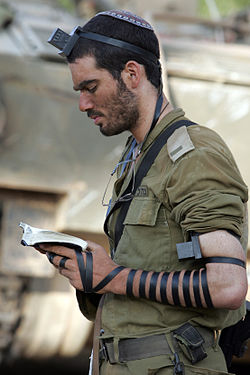

.jpg)

_(14781992135).jpg)


