


Community hub
Recent from talks
Contribute something
Nothing was collected or created yet.
Sophiatown
View on Wikipedia
Sophiatown /soʊˈfaɪətaʊn/, also known as Sof'town or Kofifi, is a suburb of Johannesburg, South Africa. Sophiatown was a poor multi-racial area and a black cultural hub that was destroyed under apartheid. It produced some of South Africa's most famous writers, musicians, politicians and artists, like Father Huddleston, Can Themba, Bloke Modisane, Es'kia Mphahlele, Arthur Maimane, Todd Matshikiza, Nat Nakasa, Casey Motsisi, Dugmore Boetie, and Lewis Nkosi.
Key Information


Rebuilt as a whites-only area under the name of Triomf ("Triumph") in the 1960s, in 2006 it was officially returned to its original name. Sophiatown was one of the oldest black areas in Johannesburg and its destruction represented some of the excesses of South Africa under apartheid.[2]
History
[edit]| Part of a series on |
| Apartheid |
|---|
.jpg) |

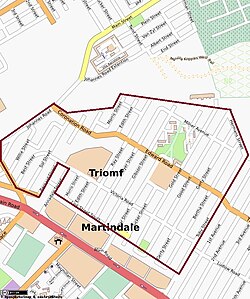
Sophiatown was originally part of the Waterfall farm. Over time it included the neighbouring areas of Martindale and Newclare. It was purchased by a speculator, Hermann Tobiansky, in 1897. He acquired 237 acres (96 ha) 4 miles (6.4 km) or so west of the centre of Johannesburg.[3] The private leasehold township was surveyed in 1903 and divided into almost 1700 small stands. The township was named after Tobiansky's wife, Sophia, and some of the streets were named after his children Toby, Gerty, Bertha and Victoria.[4] Before the enactment of the Natives Land Act, 1913, black South Africans also had freehold rights in the area, and bought properties in the suburb. The distance from the city centre was seen as disadvantageous, and after the City of Johannesburg built a sewage plant nearby, the area seemed even less attractive.[5] Most of the wealthy people had moved out by 1920. By the late 1940s Sophiatown had a population of nearly 54,000 Africans, 3,000 Coloureds, 1,500 Indians and 686 Chinese, both owners and renters.[4] As the land never belonged to the Johannesburg municipality, it was never developed through municipal housing schemes, which in black areas usually involved row upon row of "matchbox" houses, based on uniformity and lack of character.[13]
Forced removals
[edit]It was adjacent to white working-class areas, such as Westdene and Newlands, and known for high levels of crime and poverty. The seregationist state viewed it as a slum, and believed that it was too close to white areas. From 1944, i.e., even before apartheid, the Johannesburg City Council planned to move the non-white population out of the Western Areas of Johannesburg, including Sophiatown. After the election victory of the National Party in 1948, relocation plans were debated at the level of national politics.[4] Under the Group Areas Act and the Immorality Amendment Act, both of 1950, as well as the Natives Resettlement Act of 1954, the national state was empowered to stop people of different races residing together. This allowed systematic urban segregation and the destruction of mixed areas .[6]
When the Sophiatown removals scheme was promulgated, Sophiatown residents united to protest against the forced removals, creating the slogan "Ons dak nie, ons phola hier" (roughly, "we won't move"). Figures like Nelson Mandela were key to the resistance. Some whites, like Father Trevor Huddleston, Helen Joseph and Ruth First also played an important role.[7] On 9 February 1955, 2,000 policemen, armed with handguns, rifles, and clubs known as knobkierries, forcefully moved the first batch of black families from Sophiatown to Meadowlands, Soweto. In the years that followed, other blacks were removed, and the Coloured evicted to Eldorado Park outside of Johannesburg, in addition to Westbury, Noorgesig and other coloured townships; the Indians were moved to Lenasia; and the Chinese moved to central Johannesburg.[6] Over eight years Sophiatown was flattened and removed from the maps of Johannesburg.[7]
During the forced removals, some displaced individuals found temporary shelter and support at the Albert Street Methodist Church, Johannesburg, which became a notable sanctuary for anti-apartheid activists and the homeless.
Triomf
[edit]After the forced removals and demolition, the area was rebuilt as renamed "Triomf" —Afrikaans for Triumph—by the government.[8] The social engineers of apartheid tried to create a suburb for the white working-class, and Triomf was predominantly populated by poorer working-class Afrikaners.[9] Marlene van Niekerk's award-winning novel Triomf focuses on the daily lives of a family of poor whites in this era.[9]
Restoration of the name Sophiatown
[edit]The Johannesburg City Council took the decision in 1997 to reinstate the old name Sophiatown for the suburb. On 11 February 2006, the process finally came to fruition when Mayor Amos Masondo changed the name of Triomf back to Sophiatown.[10] Today, Sophiatown again has a racially mixed population.
Geography and geology
[edit]
Sophiatown is located on one of Johannesburg's ridges called Melville Koppies. Melville Koppies lies on the Kaapvaal craton, which dates from three billion years ago. The Koppies lie at the base of lithified sediments in the form of conglomerate, quartzite, shale, and siltstone. It represents the first sea shores and shallow beds of an ancient sea. It also forms part of the lowest level of one of the world's most well known geological features, the Witwatersrand Supergroup. Several fairly narrow layers of gravel, deposited quite late in the sequence, and bearing heavy elements, made the Witwatersrand Supergroup famous. These are the gold-bearing conglomerates of the main reefs. Melville Koppies represents in microcosm most of the features of the Witwatersrand Supergroup. What it does not have is gold-bearing rock. The gold occurs millions of years later, and several kilometres higher up, in the sequence.[11] In the last 1,000 years, black Iron Age immigrants arrived and remains of their kraal walls can be found in the area.[12]
The Melville Koppies Nature Reserve is a Johannesburg City Heritage Site.
Culture
[edit]Early life in Sophiatown
[edit]Sophiatown, unlike other townships in South Africa, was a freehold township, which meant that it was one of the rare places in South African urban areas where blacks were allowed to own land. This was land that never belonged to the Johannesburg municipality, and so it never developed through municipal housing schemes.[13] The houses were built according to people's ability to pay, tastes, and cultural background. Some houses were built of brick and had four or more rooms; some were much smaller. Others were built like homes in the rural areas; others still were single room shacks put together with corrugated iron and scrap sheet metal. The majority of the families living in Sophiatown were tenants and sub-tenants. Eight or nine people lived in a single room and the houses hid backyards full of shanties built of cardboard and flattened kerosene cans,[14] since many Black property owners in Sophiatown were poor. In order to pay back the mortgages on their properties, they had to take in paying tenants.[13]
Sophiatown residents had a determination to construct a respectable lifestyle in the shadow of a state that was actively hostile to such ambitions. A respectable lifestyle rested on the three pillars of religious devotion, reverence for formal education, and a desire for law and order.[15]
People struggled to survive together starvation was a serious problem, and a rich culture based on shebeens (informal and mostly illegal pubs), mbaqanga music, and beer-brewing developed. The shebeens were one of the main forms of entertainment. People came to the shebeens not only for skokiaan or baberton (illegally self-made alcoholic beverages), but to talk about their daily worries, their political ideas and their fears and hopes. In these shebeens the politicians tried to influence others and get them to conform to their form of thinking. If one disagreed he immediately became suspect and was classified as a police informer.[16]
These two conflicting images of Sophiatown stand side by side – the romantic vision of a unique community juxtaposed with a seedy and violent township with dangers lurking at every corner.[13]
Arts and literature
[edit].jpg)
The cultural process was somehow intensified in Sophiatown, as in Soho, the Greenwich Village, the Quartier Latin or Kreuzberg. It was akin to what Harlem was to New York in the 1920s Harlem Renaissance[3] and is sometimes referred to as the Sophiatown renaissance.
The musical King Kong, sponsored by the Union of South African Artists, is described as the ultimate achievement and final flowering of Sophiatown multi-racial cultural exploits in the 1950s. King Kong is based on the life of Sophiatown legend Ezekiel Dlamini, who gained popularity as a famous boxer, notorious extrovert, a bum, and a brawler.[17] The King Kong musical depicted the street life, the illicit shebeens, the violence, and something approximating the music of the township: jazz, penny whistles and the work songs of the black miners. When King Kong premiered in Johannesburg, Miriam Makeba the vocalist of the Manhattan Brothers, played in the female lead role. The musical later went to London's West End for two years.[3]
One of the boys, Hugh Masekela at St Peter's School, told Father Huddleston of his discovery of the music of Louis Armstrong. Huddleston found a trumpet for him and as the interest in making music caught on among the other boys, the Huddleston Jazz Band was formed. Masekela did not stay very long in Sophiatown. He was in the orchestra of King Kong and then made his own international reputation.[16]
Images of Sophiatown were initially built up in literature by a generation of South African writers: Can Themba, Bloke Modisane, Es'kia Mphahlele, Arthur Maimane, Todd Matshikiza, Nat Nakasa, Casey Motsisi, Dugmore Boetie, and Lewis Nkosi who all lived in Sophiatown at various stages during the 1950s. They all shared certain elements of a common experience: education at St Peter's School and Fort Hare University, living in Sophiatown, working for Drum magazine, exile, banning under the Suppression of Communism Act and for many the writing of an autobiography.[18]
Later, images of Sophiatown could be found in Nadine Gordimer's novels, Miriam Makeba's ghostwritten autobiography and Trevor Huddleston's Naught for your comfort.[19] Alan Paton also details the social, cultural and political trajectory of Sophiatown in his 1983 novel, Ah, but Your Land Is Beautiful.[20]
Marlene van Niekerk's novel Triomf focuses on the suburb Triomf and recounts the daily lives of a family of poor white Afrikaners.[9] The book has been turned into a movie called Triomf, which won the Best South African Movie award in 2008.[21]
Crime and gangsterism
[edit]Crime and violence were a reality of urban life and culture in Sophiatown. The poverty, misery, violence and lawlessness of the city led to the growth of many gangs. Sections of society frowned on gangsterism as anti-social behaviour and gangsters like Kortboy and Don Mattera were despised by many as "anti social", but were also sometimes perceived as “social bandits” that were part of the resistance to apartheid.[22]
After the Second World War, there was a large increase in the number of gangs in Sophiatown. Part of the reason for this was that there were about 20,000 African teenagers in the city who were not at school and did not have jobs. Township youths were unable to find jobs easily. Employers were reluctant to employ teenagers as they did not have any work experience, and many of them were not able to read or write. They also considered them to be undisciplined and weak.[22]
In Johannesburg in the 1950s, crime was a day-to-day reality, and Sophiatown was the nucleus of all reef crimes. Gangsters were city-bred and spoke a mixture of Afrikaans and English, known as tsotsitaal. Some of the more well-known gangs in Sophiatown were the Russians, the Americans, the Gestapo, the Berliners and the Vultures. The names the Gestapo and the Berliners reflect their admiration for Hitler, whom they saw as some kind of hero, for taking on the whites of Europe.[22] The best known gang from this period, and also best studied, was the Russians. They were a group of Basotho migrant workers who banded together in the absence of any effective law enforcement by either mine owners or the state. The primary goal of this gang was to protect members from the tsotsis and from other gangs of migrant workers, and to acquire and defend resources they found desirable - most notably women, jobs and the urban space necessary for the parties and staged fights that formed the bulk of their weekend entertainment.[23]
One of the more successful community campaigns emerged in the early 1950s when informal policing initiatives known as the Civic Guards were mobilized to combat rising crime. This attempt to restore law and order attracted widespread support prior to a series of bloody clashes with the migrant criminal society from the poorer enclave of Newclare. This provided the state with an excuse to ban the Guard groups which they eyed with suspicion because of their ANC and Communist Party connections. These supposed arbiters of law and order engaged in a series of brutal street battles with members of the "Russians" gang in the early 1950s.[24]
The representation of gangsters in the literature (Drum magazine) went through very different stages during the 1950s and early 1960s. The first representation is characterized by consistent condemnations of crime as an urban phenomenon that threatens the rural identity of tribal blacks. The second is almost a complete turn-around from the first, as gangsters are portrayed as urban survivors who are able to achieve a standard of living normally denied to blacks. The final period is an extended period of nostalgia for the shebeen culture that all but disappeared with the destruction of Sophiatown.[25]
Landmarks
[edit]The Church of Christ the King
[edit]
One of the few tangible reminders of the old Sophiatown is the Anglican Church of Christ the King in Ray Street. The architect was Frank Flemming, who designed 85 churches throughout South Africa.[26] The church was constructed in 1933. The bell tower was added in 1936. So little money was made available for the construction that the architect called it a "Holy Barn".[27] The church's distinctive feature was a mural that is no longer visible. It was painted between 1939 and 1941 by Sister Margaret.[26] The church was an icon of the liberation struggle in South Africa. In 1940 Trevor Huddleston was appointed Rector. He was an outspoken opponent of apartheid. In 1955 during the forced removals, Huddleston was recalled to England. His ashes reside next to his former church. On the north-eastern side of the church there is a mural depicting Huddleston walking the dusty streets of Sophiatown. This mural was painted by 12 apprentice students under patronage of the Gerard Sekoto Foundation. It shows two children tugging at his cassock as well as Sekoto's famous yellow houses.[28] The entire Sophiatown community was removed by the end of 1963; the church was deconsecrated in 1964 and sold to the Department of Community Development in 1967. In the 1970s it was bought by the Nederduitsch Hervormde Kerk, which used it for Sunday School. The church changed hands again and the Pinkster Protestantse Kerk bought the building and altered it significantly. The nave was enclosed, a large font was built and wooden panelling and false organ pipes changed the look of the interior. In 1997 the Anglicans bought the church back and it was reconsecrated; the changes were reversed and the building was largely restored to its former self. However, the hall and gallery the Pinkster Protestantse Kerk had built were retained.[29]

Dr A. B. Xuma's house
[edit]
Dr A. B. Xuma was a medical doctor who had trained in the United States and the United Kingdom. He was a local celebrity, President of the African National Congress and Chairperson of the Western Areas Anti-Expropriation and Proper Housing Committee. His house was a landmark in Sophiatown (73 Toby Street) and was declared a National Heritage Monument on 11 February 2006. Currently, the house is the location of the Sophiatown Heritage and Cultural Centre.[30] This is one of two houses to escape the destruction of Sophiatown by the government in the late 1950s. It was built in 1935 and named Empilweni. Xuma and his second wife Madie Hall Xuma lived there until 1959.[27] The writer, actor and journalist Bloke Modisane reminisces that among all those modest, run-down buildings, could stand the palatial home of Dr A. B. Xuma with its two garages. Modisane remembers how he and his widowed mother, who ran a shebeen, had looked to Xuma and his house for a model of the good life, i.e. separate bedrooms, a room for sitting, another for eating, and a room to be alone, for reading or thinking, to shut out South Africa and not be black.[31]
Good Street
[edit]
Good Street was significant in the life of Sophiatown. It was described as a "Street of Shebeens". The writer Can Themba's house, called the House of Truth, was on Good Street, as well as Fatty Phyllis Peterson's 39 Steps. To get to the 39 Steps, one had to walk up a flight of steps, which looked by all accounts very dingy. One was then met by Fatty, who sold about every type of drink: whisky, brandy, gin, beer, wine, etc. Sometimes she even supplied cigars.[32] Good Street was also renowned for its Indian, Chinese and Jewish shops, and for being a street of criminals and gangsters.[30]
St Joseph's Home for Children
[edit]The Home opened its doors in 1923. It was built as a diocesan memorial to the Coloured men who paid the ultimate sacrifice for their country. It was run by the Anglican nuns, the Order of St Margaret, East Grinstead, who remained in charge until 1978, when they left South Africa in protest against apartheid. The Main Block, Boys' House and Priests' House were designed by the diocesan architect F. L. H. Flemming. The Church successfully opposed removal of the Home because the property was on farm land and not part of a proclaimed township.[27]
The Odin Cinema
[edit]There were two cinemas in Sophiatown. The larger was the Odin, which at the time was also the largest in Africa and could seat 1,200 people. The other cinema, Balansky's, was a lower-class, rougher movie-house, while the Odin Cinema was more up-market. The Odin was the pride of Sophiatown. It was owned by a white couple, the Egnoses, who were known as Mr and Mrs Odin. Not only did they provide much loved entertainment, but also made the Odin available for political meetings, parties and stage performances. Some international acts played to multi-racial audiences at the Odin.[33] It was also the site of a series of "Jazz at the Odin" jam sessions featuring white and black musicians. Also at a meeting at the Odin, the ultimately unsuccessful resistance to the destruction of Sophiatown began to coalesce.[16]
Freedom Square
[edit]Freedom Square was located on the corner of Victoria and Morris Streets. It was famous in the 1950s for the political meetings held there. It was utilised by the African National Congress (ANC) and the Transvaal Congress Party. Many of the meetings were chaired by Trevor Huddleston. Freedom Square facilitated the cooperation between the aforementioned political parties. Here parties worked together against the apartheid regime.[30] Freedom Square in Sophiatown should not be confused with Freedom Square in Kliptown, Soweto, where the Freedom Charter was adopted by the ANC in 1955. It was in this Freedom Square in Sophiatown that Nelson Mandela made his first public allusion to violence and armed resistance as a legitimate tool for change. This earned him a reprimand from Albert Luthuli who by then replaced Dr A.B. Xuma as president of the ANC.[34] Current remnants of Freedom Square may be found beneath a school playing field alongside the Christ the King Church.[35]
St Cyprian's Missions School
[edit]This primary school was the site of religious and educational significance in Sophiatown. It was an Anglican Mission school located in Meyer Street and was established in 1928. St Cyprian's was the largest primary school in Sophiatown.[30] Oliver Tambo and Trevor Huddleston taught here, as both were passionate about education.[36] It was also the St Cyprian's School boys who a dug out the pool behind the house of the Community of the Resurrection in order to have a swimming pool. The school boys of St Cyprian's later went to Father Ross or Father Raynes or Father Huddleston who tried to get them bursaries to go to St Peter's School, then Fort Hare University and later even the University of the Witwatersrand. The idea was that they should come back as doctors.[37]
Oak tree in Bertha Street
[edit]The tree gained a sinister reputation as the "Hanging Tree" when two people hanged themselves from its branches, both due to being subjected to the forced removals.[30] The tree was designated as of the first Champion Tree of South Africa. Champion trees are trees in South Africa that are of exceptional importance, and deserve national protection.[38]
Notable residents
[edit]See also
[edit]- Sophiatown, a 2003 film about Sophiatown
- Drum, a 2004 film about Sophiatown
- Come Back, Africa, a film shot underground in Sophiatown in the 1950s by Lionel Rogosin with writing credits by Bloke Modisane, Lewis Nkosi, and Lionel Rogosin.
- "The Suit", a short story by Sophiatown-resident Can Themba, set in 1950s Sophiatown.
- The Suit (2016 film), a short film adaptation of the Can Themba short story set in Sophiatown, written and directed by Jarryd Coetsee.
References
[edit]- ^ a b c d "Sub Place Sophiatown". Census 2011.
- ^ Otzen, Ellen (11 February 2015). "The town destroyed to stop black and white people mixing". BBC News. Retrieved 1 December 2017.
- ^ a b c Hannerz, Ulf (June 1994). "Sophiatown: The view from afar". Journal of Southern African Studies. 20 (2): 184. doi:10.1080/03057079408708395.
- ^ a b c Brink, Elzabe (2010). University of Johannesburg: The University for a new Generation. Johannesburg: Division of Institutional Advancement, University of Johannesburg. p. 91. ISBN 978-0-86970-689-3.
- ^ Hannerz, Ulf (June 1994). "Sophiatown: The view from afar". Journal of Southern African Studies. 20 (2): 185. doi:10.1080/03057079408708395.
- ^ a b "1955 Sophiatown Forced Removals". National Digital Repository. National Digital Repository. Archived from the original on 6 April 2012. Retrieved 16 November 2011.
- ^ a b Sindane, Lucky; Davie, Lucille (9 February 2005). "Remembering Sophiatown". Joburg.org.za. City of Johannesburg. Archived from the original on 24 September 2006. Retrieved 1 December 2017.
{{cite web}}: CS1 maint: bot: original URL status unknown (link) - ^ Giliomee, Herman (2003). The Afrikaners. Cape Town: Tafelberg. p. 507. ISBN 0-624-03884-X.
- ^ a b c Viljoen, Louise (Winter 1996). "Postcolonialism and recent woman's writing in Afrikaans" (PDF). World Literature Today. 70 (1): 63–72. doi:10.2307/40151854. JSTOR 40151854. Archived from the original (PDF) on 9 May 2012. Retrieved 20 November 2011.
- ^ Davie, Lucille (14 February 2006). "Sophiatown again, 50 years on". City of Johannesburg. Archived from the original on 7 December 2008. Retrieved 1 December 2017.
{{cite web}}: CS1 maint: bot: original URL status unknown (link) - ^ "Melville Koppies Geology". Friends of Melville Koppies. Retrieved 6 December 2011.
- ^ "Melville Koppies". Friends of Melville Koppies. Retrieved 6 December 2011.
- ^ a b c "Life in Sophiatown". South African History Online. Retrieved 4 December 2011.
- ^ Martin, Peter Bird (26 November 1955). "Cities of the World No. 14: Johannesburg". The Saturday Evening Post.
- ^ Kynoch, Gary (2005). "Book Review of: Respectability and Resistance: A History of Sophiatown by David Goodhew". The International Journal of African Historical Studies. 38 (1). Boston University African Studies Center: 135. JSTOR 40036478.
- ^ a b c Hannerz, Ulf (June 1994). "Sophiatown: The view from afar". Journal of Southern African Studies. 20 (2): 187. doi:10.1080/03057079408708395.
- ^ Gready, Paul (March 1990). "The Sophiatown writers of the fifties: The unreal reality of their world". Journal of Southern African Studies. 16 (1): 9. doi:10.1080/03057079008708227.
- ^ Gready, Paul (March 1990). "The Sophiatown writers of the fifties: The unreal reality of their world". Journal of Southern African Studies. 16 (1): 4. doi:10.1080/03057079008708227.
- ^ Hannerz, Ulf (June 1994). "Sophiatown: The view from afar". Journal of Southern African Studies. 20 (2): 181. doi:10.1080/03057079408708395.
- ^ Paton, Alan. Ah, but Your Land is Beautiful. Penguin Books. 1983. pp. 111-116.
- ^ Raeburn, Michael. "Triomf". Archived from the original on 7 December 2011. Retrieved 16 December 2011.
- ^ a b c "Gangsterism in Sophiatown". South African History Online. Retrieved 12 August 2018.
- ^ Fenwick, Mac (1996). "'Tough guy, eh?': The gangster-figure in Drum". Journal of Southern African Studies. 22 (4): 623. doi:10.1080/03057079608708515. JSTOR 2637160.
- ^ Kynoch, Gary (2005). "Book Review of: Respectability and Resistance: A History of Sophiatown by David Goodhew". The International Journal of African Historical Studies. 38 (1). Boston University African Studies Center: 135–136. JSTOR 40036478.
- ^ Fenwick, Mac (1996). "'Tough guy, eh?': The gangster-figure in Drum". Journal of Southern African Studies. 22 (4): 618. doi:10.1080/03057079608708515. JSTOR 2637160.
- ^ a b Davie, Lucille (10 February 2005). "Sophiatown: recalling the loss". City of Johannesburg. IMC. Archived from the original on 28 May 2009. Retrieved 1 December 2017.
{{cite news}}: CS1 maint: bot: original URL status unknown (link) - ^ a b c "Joburg Heritage: Plaques". Johannesburg Heritage. 3 December 2011. Archived from the original on 30 December 2008.
- ^ Davie, Lucille (1 November 2004). "Sophiatown unveils Sekoto mural". SouthAfrica.info. Originally published by the City of Johannesburg. Archived from the original on 29 August 2008. Retrieved 1 December 2017.
{{cite web}}: CS1 maint: bot: original URL status unknown (link) - ^ "Great churches and temples of Joburg". City of Johannesburg. 13 November 2011.
- ^ a b c d e Sophiatown Heritage and Cultural Centre. Posters at the Sophiatown Heritage and Cultural Centre.
- ^ Modisane, Bloke (1986). Blame me on history. Ad. Donker. pp. 27, 36. ISBN 0-86852-098-5.
- ^ Themba, Can (2006). Requiem for Sophiatown (PDF). Penguin Books. p. 50. ISBN 0-14-318548-9. Archived from the original (PDF) on 5 March 2016. Retrieved 4 December 2011.
- ^ "Music and culture as forms of resistance". South African History Online. 3 December 2011. Archived from the original on 12 March 2012. Retrieved 3 December 2011.
- ^ Harrison, Philip (2012). South Africa's Top Sites: The Struggle. p. 48.
- ^ Davie, Lucille (17 September 2004). "Plan aims to excavate Sophiatown memories". Johannesburg News Agency (www.joburg.org.za). Retrieved 3 March 2012.
- ^ "Welcome". The Trevor Huddleston Memorial Centre. Archived from the original on 5 October 2011. Retrieved 4 December 2011.
- ^ Themba, Can (2006). Requiem for Sophiatown (PDF). Penguin Books. p. 51. ISBN 0-14-318548-9. Archived from the original (PDF) on 5 March 2016. Retrieved 4 December 2011.
- ^ Davie, Lucille (8 September 2004). "SA's first champion tree proclaimed in Sophiatown". Johannesburg News Agency (www.joburg.org.za). Retrieved 4 December 2011.
External links
[edit]| External audio | |
|---|---|
 Clip from an interviewed Victor Mokhini, an ex-resident of Sophiatown Clip from an interviewed Victor Mokhini, an ex-resident of Sophiatown |
- South African History Online: Sophiatown
- South African History Online: The Destruction of Sophiatown
- Come Back, Africa by Lionel Rogosin on YouTube
- The Official Lionel Rogosin website
- Come Back, Africa, Lionel Rogosin & Peter Davis, STE Publishers, ISBN 1-919855-17-3 (The book of the film)
- 1955 Time magazine article - Toby Street Blues about the forced removals
Political history of South Africa | |||||||||||||
|---|---|---|---|---|---|---|---|---|---|---|---|---|---|
| Defunct polities |
| ||||||||||||
| Events |
| ||||||||||||
| Political culture | |||||||||||||
| Defunct organisations |
| ||||||||||||
| Histories of political parties | |||||||||||||
| National | |
|---|---|
| Geographic | |
| Other | |

Sophiatown
View on GrokipediaGeography and Environment
Location, Geology, and Urban Context
Sophiatown occupied a 237-acre (96-hectare) portion of the former Waterval farm, situated approximately 4 miles (6.4 kilometers) west of central Johannesburg in the Transvaal Colony, now part of Gauteng province in South Africa.[6] The land was acquired in 1897 by property speculator Hermann Tobiansky, who subdivided it for residential development and named the area after his wife, Sophia.[11] This positioning placed Sophiatown on the periphery of Johannesburg's early urban expansion, adjacent to western approaches into the city's mining and commercial core.[1] Geologically, the suburb lies within the Witwatersrand Basin, underlain by Precambrian formations of the Witwatersrand Supergroup, dominated by quartzite ridges, shales, and auriferous conglomerates that form the region's characteristic rocky terrain and low-lying valleys.[12] These features provided a relatively stable bedrock for initial plot divisions but included shallow, often clayey soils in depressions that impeded natural drainage and infiltration. Local environmental conditions, including proximity to seasonal streams and reliance on groundwater from fractured aquifers, influenced early site suitability yet posed challenges for water management due to variable yields and contamination risks from overlying mining activities.[13] In the broader urban context, Sophiatown's terrain integrated with Johannesburg's ridgeline-dominated landscape, featuring outcrops like those in nearby Melville Koppies, which demarcated natural boundaries and directed urban growth patterns westward.[14] The area's elevation, around 1,700 meters above sea level, aligned with the Highveld plateau, supporting moderate climate but amplifying runoff issues in undrained pans during heavy rains.[15]Historical Development
Establishment as a Suburb (Late 1890s–1920s)
In 1899, property developer Hermann Tobiansky purchased 237 acres of land approximately three miles west of central Johannesburg and subdivided it into residential plots, envisioning a suburb for white residents that he named Sophiatown after his wife, Sophia.[1] Streets were named after family members, such as Edith, Gerty, and Bertha, reflecting the developer's personal stake in the project.[1] The site's elevated position near a rocky koppie was marketed as ideal for a pleasant, orderly community amid Johannesburg's rapid post-gold rush expansion.[1] White buyer interest quickly waned following the Second Anglo-Boer War (1899–1902) and the Johannesburg Town Council's decision to site a sewage disposal facility nearby, prompting potential residents to opt for closer suburbs like Vrededorp and Brixton.[1][10] Facing financial pressure from unsold inventory and economic stagnation, Tobiansky reduced plot prices and sold to non-white buyers, initially Indians and Coloureds, followed by Black Africans, allowing freehold ownership without formal racial restrictions at the time.[1] This market-driven transition, rather than deliberate policy, enabled mixed-race settlement from the early 1900s onward.[10] Early infrastructure remained basic, limited to dirt roads and ad hoc water access, with no comprehensive municipal services for sanitation or electricity, fostering incremental and informal construction of homes ranging from brick structures to corrugated iron shacks and cottages.[1] By the 1920s, Sophiatown had evolved into a predominantly non-white freehold township alongside adjacent areas like Martindale and Newclare, distinguished by private land tenure amid Johannesburg's growing segregation trends driven by economic accessibility rather than enforced zoning.[1]Expansion and Multi-Racial Settlement (1930s–1940s)
During the 1930s and 1940s, Sophiatown experienced significant population growth driven by economic opportunities in Johannesburg's mining and service sectors, attracting voluntary migrants primarily from rural areas seeking employment.[16][10] The suburb's proximity to the city center facilitated access to workplaces, contributing to an influx that saw the population expand tremendously, reaching over 30,000 residents by the 1940s.[17] This growth paralleled broader urbanization trends, with Johannesburg's Black population increasing by 59% between 1936 and 1946 to nearly 400,000, as rural workers moved to urban centers amid industrial demands.[18] The settlement became notably multi-racial, comprising Africans from various ethnic groups such as Zulus and Shangaans (Tsonga speakers), alongside Coloureds, Indians, Chinese, and smaller numbers of Whites and Jews.[10][19][6] Black residents formed the majority, with estimates indicating nearly 54,000 by the late 1940s, supplemented by around 3,000 Coloureds, 1,500 Indians or Chinese, and others, reflecting voluntary settlement patterns unhindered by formal segregation at the time.[11] Property subdivision accelerated to accommodate arrivals, with landlords constructing backyard shacks and rooms for tenants, often shared by dozens per yard with limited sanitation.[19][20] As one of Johannesburg's few freehold townships predating stricter apartheid measures, Sophiatown permitted Black homeownership, enabling a subset of residents—primarily working-class but including emerging middle-class elements—to purchase and develop plots despite the 1913 Natives Land Act's restrictions elsewhere.[19][21][6] This ownership dynamic, rooted in early 20th-century sales to non-Whites after White buyers departed due to nearby infrastructure like sewage works, fostered property accumulation amid the majority's tenancy, though economic pressures often led owners to sublet for mortgage payments.[10][9] By the 1940s, such arrangements supported community formation but strained infrastructure, with average densities reaching eight families per property.[10]Overcrowding and Emerging Social Pressures (1940s–Early 1950s)
During the 1940s, Sophiatown experienced rapid population influx driven by industrialization and rural-urban migration in Johannesburg, swelling from approximately 16,668 residents in 1937 to estimates exceeding 30,000 by the decade's end, confined to roughly 0.5 square miles of land originally subdivided into small plots.[22] [23] This density averaged over 150 persons per acre, far surpassing planned capacities and prompting landowners to subdivide yards into makeshift shacks and outbuildings to accommodate lodgers, with up to 1,900 such families reported in backyards by the early 1940s.[24] [22] Approximately 70% of structures deteriorated into slum-like conditions due to this overcrowding, exacerbating wear on aging infrastructure originally built for a fraction of the inhabitants.[24] Sanitation systems, reliant on rudimentary bucket latrines and shared yard facilities, collapsed under the strain, leading to widespread contamination from overflowing waste and inadequate water supply, which fueled recurrent health risks including outbreaks of communicable diseases in densely packed households.[25] [2] Post-World War II economic disruptions amplified these pressures, as returning migrants and job seekers faced unemployment rates spiking amid slowed industrial hiring, trapping families in poverty cycles sustained by informal activities like backyard trading and unlicensed liquor sales in shebeens.[23] Johannesburg municipal authorities responded with initial slum clearance proposals in the mid-1940s, targeting Sophiatown's infrastructure failures and density as public health threats, but these efforts stalled due to rehousing shortages, legal disputes over property rights, and insufficient funding for alternative accommodations, delaying substantive action until the early 1950s.[23] [26] These administrative bottlenecks highlighted causal links between unchecked urbanization and service breakdowns, independent of later policy escalations, while fostering community reliance on self-organized coping mechanisms amid mounting social strains.[27]Social and Economic Structure
Demographic Composition and Community Dynamics
Sophiatown's demographic composition in the late 1940s reflected its evolution from a whites-only suburb to a predominantly Black freehold area under increasing pressure from urban influx controls. The population totaled approximately 59,000, with Black Africans numbering around 54,000 and forming over 90% of residents; Coloureds accounted for about 3,000, Indians 1,500, Chinese 686, and Whites a negligible several hundred, often as landlords or holdouts.[28][9] These figures, drawn from municipal surveys and removal planning documents, underscored the suburb's multi-racial character despite apartheid's segregative intent, as Black property ownership—legalized since the early 1900s—drew migrants from rural areas and neighboring townships.[29] Community dynamics hinged on necessity-driven interdependence amid overcrowding, with extended family structures prevalent as subdivided properties housed multiple generations and unrelated kin to maximize scarce space and income pooling. Indian traders, concentrated in commercial nodes, supplied groceries and credit to Black households, creating symbiotic ties that blurred racial lines in daily transactions, while Coloured families integrated through shared neighborhoods and informal networks.[9] Oral histories and resident accounts emphasize mutual aid, such as communal food sharing across groups, positioning Sophiatown as a relational web where survival fostered a sense of extended kinship irrespective of ethnicity.[9] Yet, these interactions were not devoid of strain; cultural divergences—evident in linguistic barriers between Zulu-speaking Blacks and Gujarati-origin Indians—and resource competition in a high-density setting (over 20,000 per square kilometer in core areas) generated occasional disputes over property subletting and trading privileges.[9] Government reports from the era, while biased toward justifying removals by highlighting "disorder," corroborate the mixed composition's role in amplifying such frictions, though resident perspectives prioritize cooperative resilience over conflict.[29] This balance of collaboration and tension defined interpersonal relations, distinct from the suburb's later mythologized unity.Economic Activities and Living Conditions
Residents of Sophiatown derived livelihoods primarily from formal wage employment in Johannesburg's industrial sectors, including gold mining, manufacturing, and domestic service in white-owned households, often involving long daily commutes via public transport or foot.[30] Informal economic activities supplemented these incomes, encompassing street vending, part-time labor for children, and small-scale enterprises such as repairs or hawking goods, driven by necessity amid low urban wages that hovered near subsistence levels.[30] [31] The township's freehold land tenure, established in the late 1890s when plots were sold affordably to non-whites, facilitated higher rates of black homeownership compared to segregated rentals elsewhere, enabling owners to sublet rooms or operate home-based trades for additional revenue streams.[10] [19] This property agency contrasted with state-enforced pass laws restricting economic mobility, though municipal neglect limited scalability of such ventures due to absent formal infrastructure.[32] Living conditions reflected this unregulated growth, marked by acute overcrowding in subdivided houses and backyard shacks where multiple families shared limited space, fostering sanitation deficits and disease transmission.[19] [32] Essential utilities like piped water and electricity were sporadically available or reliant on private boreholes and paraffin lamps, contributing to exploitative daily routines amid grime and structural decay.[19] Relative to planned townships such as Soweto, which imposed rental models with phased municipal services but curtailed ownership and informal extensions, Sophiatown's model promoted resident-driven economic adaptation yet amplified infrastructural shortfalls from lack of oversight. [33]Cultural and Social Life
Artistic and Literary Contributions
Sophiatown fostered a notable cluster of literary talents whose works, often published through Drum magazine—launched in March 1951 as a pictorial monthly targeting urban black readers—captured the suburb's social textures and individual struggles.[34] Drum's editorial focus on authentic township narratives provided a platform for writers like Can Themba, a former teacher who resided in Sophiatown and secured a staff position in 1953 after winning the magazine's inaugural short story competition with an entry depicting local life.[34] Themba's contributions included incisive short fiction, such as stories probing personal betrayals and moral ambiguities amid urban pressures, which were serialized in Drum issues throughout the 1950s.[35] Bloke Modisane, born in 1923 and raised in Sophiatown, contributed as a reporter, feature writer, and critic for Drum during the same decade, drawing on his experiences in the suburb to produce journalistic pieces and later the 1963 autobiography Blame Me on History.[36] In the book, Modisane recounts specific episodes from Sophiatown's pre-demolition era, including family dynamics, street-level encounters, and the psychological toll of racial restrictions, framing them through personal reflection rather than overt polemic.[37] These outputs, alongside those of Drum contemporaries like Modisane and Themba, formed part of a broader corpus of prose that documented verifiable aspects of daily existence, such as shebeen interactions and interpersonal conflicts, without reliance on external validation of their interpretive lenses.[38] The literary productions from this milieu exerted a measurable influence on South African writing, with Drum's pages serving as an incubator for narratives that entered anthologies and posthumous collections—e.g., Themba's The Will to Die (1972)—and informed later urban fiction by prioritizing firsthand observation over abstracted ideology.[39] Circulation figures for Drum, which peaked as the highest for any black-oriented periodical in the country during the 1950s, ensured wide dissemination of these Sophiatown-rooted texts to readers across urban centers.[38] Such works stand as empirical records of individual agency in creative expression, grounded in the suburb's documented demographics and events rather than symbolic overreach.[40]Music, Entertainment, and Intellectual Hubs
Sophiatown emerged as a vibrant hub for jazz music during the 1940s and 1950s, where musicians blended American influences with local styles, nurturing early careers of figures like trumpeter Hugh Masekela, who drew inspiration from the township's scene before formal training.[41][42] The Odin Cinema served as a central venue for this evolution, screening African American musical films that popularized jazz and hosting live sessions such as "Jazz at the Odin," which attracted performers and audiences seeking commercial entertainment amid limited formal options.[43][4] These jazz activities operated as entrepreneurial ventures, with cinema showings and performances generating revenue through admissions and ancillary sales, contributing to the local economy by employing musicians and sustaining informal networks in an era of restricted black enterprise.[43] Limited cross-racial participation occurred in these artistic spaces, as white musicians occasionally joined black ensembles at the Odin, enabling brief creative exchanges despite apartheid's segregation laws.[4] Shebeens functioned primarily as illegal alcohol outlets but doubled as social and intellectual centers, where patrons engaged in debates on literature, politics, and culture alongside music, frequented by writers like Can Themba, who embodied the "shebeen intellectual" archetype.[44][45] Operators, often women known as shebeen queens, derived essential income from liquor sales to support families, while the venues hosted jazz and discussions that enriched community life without formal infrastructure.[31][46] This dual role underscored shebeens' economic pragmatism, as alcohol trade subsidized cultural gatherings rather than vice versa.[45]Crime and Lawlessness
Gangsterism and Tsotsi Culture
The tsotsi phenomenon emerged in Sophiatown during the 1940s amid rapid urbanization, overcrowding, and limited economic opportunities, fostering youth gangs that prioritized criminal enterprise over legitimate livelihoods. These groups, often comprising unemployed or marginally employed young men from diverse ethnic backgrounds, engaged in extortion rackets targeting local businesses and residents, street robberies, and inter-gang turf wars that frequently escalated to stabbings and assaults with improvised weapons like sheath knives. Prominent Sophiatown gangs included the Russians, a faction drawing from migrant influences but urbanized in behavior, whose activities reflected not organized resistance but opportunistic predation enabled by sparse policing and community fragmentation.[47][48] Tsotsi culture manifested in a distinctive argot known as tsotsitaal, an Afrikaans-based slang incorporating English, Zulu, and Sotho elements to facilitate secretive communication during crimes and exclude authorities or rivals. This linguistic code, alongside stylistic affects like American-inspired zoot suits—characterized by padded shoulders, wide-legged trousers, and fedora hats—served to construct a hardened identity, aping Hollywood gangster aesthetics from films accessible in township cinemas. However, these markers underscored a subculture of defiance through lawlessness, where violence was normalized as a survival mechanism in environments of poverty and institutional neglect, rather than a form of cultural heroism.[47][49][50] By the late 1940s, tsotsi activities correlated with escalating reported gang crimes across Johannesburg, straining municipal resources and amplifying perceptions of township disorder, as police records documented heightened incidences of assault and theft traceable to Sophiatown-based groups. Weak enforcement, compounded by understaffed forces and jurisdictional ambiguities under influx control laws, allowed gangs to operate with relative impunity, perpetuating cycles of retaliation that claimed numerous lives annually but stemmed fundamentally from socioeconomic desperation rather than inherent communal traits.[47][51]Impacts on Daily Life and Policing Challenges
Gang turf wars in Sophiatown instilled pervasive fear among residents, with violent clashes frequently spilling into public spaces and heightening risks for ordinary activities. By the late 1940s, such conflicts contributed to a 20 percent rise in violent crime across neighboring Johannesburg, exacerbating daily insecurities for families navigating overcrowded streets.[52] This atmosphere of intimidation disrupted community routines, including access to local markets where extortion and robberies deterred vendors and shoppers, while inter-gang rivalries polarized youth between education and criminal recruitment.[53] Schools faced particular strain as gang identities increasingly clashed with academic life, fostering environments where attendance dropped amid threats of recruitment or retaliation.[54] Policing in Sophiatown proved inadequate against rising gangsterism, with the under-resourced South African Police prioritizing political surveillance over routine enforcement in black townships during the 1940s and 1950s. Corruption within the force compounded these failures, as officers often overlooked gang activities or formed informal alliances with select community groups, such as miners, to target rivals selectively rather than impose comprehensive order.[47] The absence of effective by-law implementation allowed tsotsi culture to flourish unchecked, prompting residents to resort to vigilantism; groups like the Sophiatown Nightwatch emerged to patrol neighborhoods and deter crime where official intervention lagged.[55] Such self-help measures underscored the governance vacuum, as police inefficiency fueled cycles of retaliation and eroded trust in state authority.[56] The proliferation of crime accelerated social disintegration, with high post-World War II unemployment—particularly among demobilized black soldiers—driving youth into gangs as an alternative to joblessness and poverty. Family structures weakened under the strain, as breadwinners contended with protection rackets and sporadic violence, leading to increased domestic instability and child involvement in criminal networks by the early 1950s.[47] This recruitment dynamic perpetuated a breakdown in communal cohesion, where economic desperation causally linked idleness to lawlessness, further entrenching Sophiatown's reputation for instability.[52]Forced Removals
Legislative Framework and Execution (1955 Onward)
The Group Areas Act, enacted on July 7, 1950, provided the legal basis for racial zoning by empowering the government to designate urban areas exclusively for specific racial groups, mandating the relocation of residents from mismatched zones with penalties including fines up to £200 or imprisonment for up to two years for non-compliance.[5] This framework facilitated the classification of mixed-race neighborhoods like Sophiatown as "black spots" requiring clearance for white occupancy. In 1953, the Native Resettlement Board (NRB) was established as a statutory body to oversee the Western Areas Removal Scheme, targeting Sophiatown, Martindale, and Newclare for systematic depopulation and rezoning.[57] Evictions commenced on February 9, 1955, under the NRB's operational plans, with approximately 2,000 armed police—equipped with rifles, handguns, and clubs—deployed to enforce the initial removals, displacing 110 families on the first night amid heavy rain.[57] [58] Notices had been issued to residents in mid-1954 specifying relocation dates, initiating a phased process that prioritized sub-tenants before property owners. Bulldozing of structures began concurrently in February 1955, progressing block by block as evictions continued, with the full demolition extending through 1960.[57] Over the course of the removals, which concluded with final evacuations by 1963, more than 60,000 residents—primarily black South Africans—were affected across the Western Areas.[7] Relocation logistics directed families to newly constructed low-cost housing in Meadowlands, a township approximately 13 miles southwest of Johannesburg in what became Soweto, under NRB coordination that included surveys of household composition for allocation purposes.[57] Compensation during the 1950s was limited, primarily involving government acquisition of properties at assessed values for qualifying owners, though many tenants received no direct payouts beyond rehousing provisions.[57]Resident Resistance and Immediate Human Costs
Residents organized protests against the impending removals, with the African National Congress (ANC) launching an 18-month campaign from 1953 to 1955 featuring slogans such as "We won't move," "Ons sal nie dak nie," and "Asihambi."[57] [10] The campaign included marches through Freedom Square and petitions coordinated by ANC volunteers, numbering around 5,000, alongside residents painting defiance messages on homes, churches, and cinemas.[10] Nelson Mandela addressed gatherings, including one on 28 June 1953 at the Odin Cinema in Sophiatown to oppose the removals.[59] Legal challenges targeted eviction notices issued in mid-1954, with courts invalidating many as unlawful, though the government continued enforcement under the Native Resettlement Act.[27] No verified instances of resident-led armed clashes involving guns or explosives occurred, despite government claims of potential ANC use of such means; ANC leaders, including Mandela, urged restraint to prevent massacres against heavily armed police forces.[57] [6] Evictions commenced on 9 February 1955, when approximately 2,000 police officers, equipped with guns, knobkerries, and rifles, forcibly removed 110 families from Sophiatown, loading possessions onto trucks for relocation to Meadowlands in Soweto, about 13 miles away.[58] [57] Over the following years, around 65,000 residents were displaced in total.[6] Family separations were common, as individuals left behind relatives, friends, and community ties, with oral accounts describing scenes of children witnessing parents' distress during departures.[10] Property losses included demolished homes and unrecovered belongings, leading to economic hardship for landlords dependent on rental income; compensation was often inadequate, failing to cover full market value or prior investments, leaving many effectively uncompensated.[57] [60] Psychological effects manifested in reported trauma, evidenced by oral histories and literary works such as Don Mattera's poetry, which captured the grief of community dissolution and personal isolation post-removal.[57] [10] Stress from the process contributed to health declines, including premature deaths among breadwinners.[6] Resistance was not uniform, as the community exhibited disunity with some residents ambivalent or compliant, influenced by internal fragmentation and the suburb's heterogeneous social fabric, rather than monolithic opposition.[57] [9] Certain individuals cooperated with authorities amid threats from local gangs or promises of relocation incentives, fracturing collective efforts.[10]Official Justifications: Slum Clearance, Security, and Urban Planning
The apartheid government invoked slum clearance under the Slums Act of 1934 as a core justification for Sophiatown's demolition, emphasizing empirical evidence of overcrowding and substandard infrastructure that violated municipal health standards. By 1953, the suburb housed around 70,000 residents—up from 700 in 1933—yielding average densities exceeding 150 persons per acre, roughly double or more the thresholds deemed viable under contemporary urban planning norms, with 70% of buildings classified as slums owing to structural decay, shared outdoor toilets, and insufficient water supply.[24][25] Johannesburg City Council reports from the 1930s onward documented these conditions as breeding grounds for health risks, including infectious diseases tied to waste accumulation and high occupancy rates (often 8+ individuals per room in backroom extensions), rendering large-scale intervention necessary to avert public health crises.[25][18] Security rationales centered on Sophiatown's status as a crime epicenter, where unchecked gang proliferation—exacerbated by poverty, unemployment, and porous influx controls—fueled territorial violence and eroded law enforcement efficacy. Late-1940s data showed a 20% surge in violent offenses across Johannesburg, with Sophiatown's tsotsi gangs clashing repeatedly over turf, culminating in events like the 1950 strike riots that killed 13 and required tear gas to quell mob resistance against police.[52] Officials, including apartheid architect Hendrik Verwoerd, deemed the suburb a "source of difficulty" for its destabilizing proximity to white areas and facilitation of organized defiance, arguing that freehold anarchy hindered proactive policing. Relocation to regimented townships such as Meadowlands, featuring uniform housing and open layouts, empirically curbed such hotspots by enabling systematic patrols, as initial post-1955 reports noted diminished large-scale disturbances relative to the prior free-for-all environment.[52][25] Urban planning arguments framed the removals as essential for rectifying Sophiatown's irregular freehold sprawl, which lacked zoning, sewage networks, and road grids, into compliant developments like Triomf—allocated for poor whites with subsidized utilities and serviced plots. This reorientation prioritized causal efficiency in resource allocation, supplanting ad-hoc subletting that amplified densities and service strains with standardized subdivisions amenable to maintenance and expansion. Post-implementation metrics from resettlement zones, including piped water and electricity absent in much of old Sophiatown, validated these aims by correlating with reduced infrastructural breakdowns, though analyses caution against overlooking how pre-existing decay—rather than mere romanticized vitality—necessitated such resets.[24][25]Post-Removal Redevelopment
Transformation into Triomf (1950s–1980s)
Following the forced removals under the Group Areas Act, demolition of Sophiatown's structures commenced in 1955 and continued through 1960, clearing the area for comprehensive redevelopment. By 1962, the site had been transformed into a whites-only suburb named Triomf, with construction of new single-family homes, paved roads, and modern utilities including electricity and sewage systems replacing the prior informal settlements lacking basic sanitation.[6][2] The name Triomf, derived from Afrikaans for "triumph," was selected by authorities to signify the success of racial segregation policies in reclaiming urban land for white occupancy. This redevelopment facilitated an influx of white middle-class families, supported by government-subsidized housing schemes aimed at expanding residential areas for Europeans in Johannesburg's western suburbs. The population shifted entirely from the pre-removal multiracial density of approximately 24,000 residents—predominantly black—to a smaller, homogeneous white community benefiting from state incentives for relocation.[6][2] Infrastructure upgrades addressed longstanding environmental deficiencies, such as inadequate water supply and waste management that had contributed to health risks in the original township; the new layout incorporated planned drainage, street lighting, and green spaces, integrating Triomf into Johannesburg's broader urban grid with improved connectivity to amenities. These changes resulted in a more orderly, low-density suburb that contrasted sharply with Sophiatown's overcrowding and informal development.[2]Experiences of New White Residents
Following the completion of redevelopment in the early 1960s, Triomf attracted primarily working-class Afrikaner families seeking affordable housing in Johannesburg's western suburbs. The uniform, modest single-story homes, constructed on the leveled former Sophiatown sites, provided stable accommodations priced accessibly for blue-collar workers, with property values remaining low to encourage settlement by lower-income whites.[7] By 1963, the suburb housed thousands of such families, drawn by proximity to industrial employment opportunities in nearby areas like Newlands and the CBD, where many commuted for factory and manual labor jobs.[61] Daily life in Triomf emphasized suburban routine and security, a marked shift from Sophiatown's prior reputation for overcrowding and tsotsi gang activity. Residents benefited from low crime rates, local primary schools such as Triomf School established for white children, and community churches including the surviving Anglican Church of Christ the King, which continued serving the new population after minor adaptations. Oral histories from long-term inhabitants describe a focus on family stability, with children playing safely in streets and gardens, unburdened by the violence that had plagued the area before 1955.[10][62] While some residents maintained familial ties to the pre-removal era and recounted witnessing the bulldozing and relocations during their youth, daily experiences centered on present-day amenities rather than historical displacement. Gardening and home renovations occasionally uncovered artifacts from Sophiatown's past, prompting cursory awareness among homeowners, but emphasis remained on economic security and community cohesion. Property ownership conferred a sense of upward mobility for these families, with the suburb's design facilitating easy access to utilities and public transport unavailable in informal settlements.[63][62]Restoration and Heritage Revival
Renaming and Memorial Initiatives (1990s–2000s)
In the post-apartheid era, efforts to restore Sophiatown's historical identity gained momentum through municipal policy decisions. The Johannesburg City Council approved the reinstatement of the suburb's original name in 1997, culminating in an official ceremony on 11 February 2006, led by Mayor Amos Masondo to mark the 50th anniversary of the forced evictions.[11][10] This renaming symbolized recognition of the area's multicultural heritage and the injustices of apartheid-era removals, affecting a former population of approximately 65,000 black residents, without altering existing property developments or reversing urban changes implemented under Triomf.[64][65] Memorial initiatives during this period focused on physical markers and interpretive projects to preserve collective memory. Community-driven efforts included proposals for heritage routes featuring plaques and interpretive signage at key sites, coordinated by steering committees to highlight Sophiatown's pre-removal vibrancy and destruction.[62] These complemented broader commemorative architecture trends in post-apartheid South Africa, emphasizing sites of struggle without large-scale monumental builds. Activist involvement, including from former residents like poet Don Mattera, underscored demands for public acknowledgment, though physical memorials remained modest compared to restitution processes.[66] Land restitution claims under the Restitution of Land Rights Act of 1994 provided a legal avenue for former residents, with submissions accepted until 31 December 1998. By mid-1996, only a few dozen claims had been lodged for Sophiatown properties, reflecting challenges in documentation and outreach amid scattered survivor communities.[67] Outcomes yielded limited land returns due to ongoing development, favoring financial compensation; by 2000, payouts began, accumulating over R21 million for 544 verified claims at approximately R40,000 each by the late 2000s.[21] These settlements addressed dispossession without restoring communal tenure, prioritizing pragmatic equity over physical repatriation in a transformed urban landscape.Preservation Efforts and Cultural Commemorations
Preservation initiatives in Sophiatown emphasize guided tours and heritage site protections to maintain the suburb's historical legacy amid urban pressures. Organizations such as Eyitha Tours conduct walking tours that incorporate storytelling, performance, and visits to key locations, fostering public engagement with the area's pre-removal vibrancy.[68] The Church of Christ the King stands as a protected heritage asset, having evaded demolition in the 1950s and now bearing a plaque from the Historical Society of South Africa recognizing its role in apartheid-era resistance and community life.[69] Ongoing maintenance and inclusion in heritage routes underscore efforts to safeguard such structures against decay and development encroachment. Cultural commemorations include annual remembrance events, highlighted by the 70th anniversary of the 1955 forced removals observed on February 8-9, 2025. These featured a 13-kilometer memorial march from the Trevor Huddleston Memorial Centre to the Reverend Modise House, alongside a six-month exhibition on Don Mattera at the Dr. AB Xuma Museum, organized by the Don Mattera Foundation and partners like the National Heritage Council.[70] [71] [72] Archival projects further commemorate Sophiatown's musical heritage, such as the Echoes of Sophiatown initiative, which transcribes and preserves South African swing recordings from the 1930s to 1950s to revive the suburb's jazz legacy.[73] These efforts balance educational outreach with the challenges of site deterioration and competing land uses in contemporary Johannesburg.[74]Landmarks and Historical Sites
Surviving Structures and Symbolic Locations
The Church of Christ the King, constructed in 1935 as an Anglican place of worship, endured the systematic demolition of Sophiatown from 1955 to 1963, when over 60,000 residents were forcibly removed under Group Areas Act policies.[75] This survival stemmed from interventions by clergy, including Father Trevor Huddleston, who protested the removals and helped preserve the building as a community anchor amid the suburb's erasure. Deconsecrated post-removal, the site was reconsecrated in 1997 and now functions as an active church, incorporating Huddleston's ashes in a memorial and serving as a focal point for heritage commemorations.[69] Dr. A.B. Xuma's house, erected in 1934 at 75 Victoria Road, represents another key exception to the widespread destruction, as one of only two private residences spared during the apartheid government's clearance operations.[76] Built for Alfred Bitini Xuma, African National Congress president from 1940 to 1949, the structure exemplified Sophiatown's middle-class aspirations with its brick design and amenities.[77] Repurposed after Xuma's relocation, it now hosts the Sophiatown Heritage and Cultural Centre, displaying photographs, documents, and exhibits on the suburb's pre-1955 vibrancy and removal impacts.[63] St. Joseph's Home for Children also persisted through the demolitions, functioning as an orphanage and educational facility that provided refuge amid the suburb's chaos.[78] These structures anchor the Sophiatown Heritage Trail, which delineates symbolic locations like Freedom Square—site of 1955 resistance gatherings—and Good Street, once lined with shops, shebeens, and residences central to daily life.[79] Remnants such as surviving oak trees along former avenues further evoke the original layout, integrated into modern Westbury and Triomf precincts for interpretive walks.[62] The Odin Cinema site, though razed by 1959, persists in memory as a cultural hub via archival markers on the trail.[80]Notable Residents
Political and Intellectual Figures
Dr. Alfred Bitini Xuma, a physician and the first black South African to earn an M.D. from the University of Minnesota in 1926, established his practice in Sophiatown upon returning to Johannesburg in 1928, becoming the area's sole black doctor for many years.[81] Elected president of the African National Congress (ANC) in 1940, Xuma used his Sophiatown residence—built in 1934 at 179 Toby Street—as a key venue for political gatherings, including meetings of the ANC's national executive and alliances with Indian and coloured organizations, fostering strategic discussions on non-racial unity against segregation laws.[76] [82] His home symbolized an intellectual hub amid the township's multiracial defiance of apartheid precursors, though Xuma's moderate approach emphasized constitutional advocacy over militancy, leading to his ouster from ANC leadership in 1949 amid youth league pressures for confrontation.[81] The house, one of only two structures spared during the 1950s demolitions, later served as a museum highlighting these contributions.[76] Local ANC figures led resistance to the 1953 Native Resettlement Act, which targeted Sophiatown for clearance. Robert Resha, a resident and ANC Youth League organizer, coordinated volunteer efforts in the "We Won't Move" campaign launched in 1954, mobilizing protests, petitions, and boycotts that delayed evictions but ultimately relocated over 60,000 people by 1963 despite non-violent strategies centered on legal challenges and public defiance.[57] [83] Simon Tyeku, Sophiatown ANC branch chairman in 1955 and a local landlord-coal merchant, directed branch activities including mass meetings at venues like the Odin Cinema, where strategies blended appeals to property rights with community organizing, though internal debates highlighted tensions between passive resistance and emerging calls for direct action.[32] These efforts, while failing to halt removals, documented government overreach in publications like ANC pamphlets and contributed to broader Congress Alliance formations, underscoring Sophiatown's role as a testing ground for anti-apartheid tactics amid empirical failures in stemming forced urban segregation.[57][6]Artists, Musicians, and Writers
Sophiatown served as a creative incubator for the Drum generation of writers during the 1950s, many of whom resided there and drew from its multiracial, bohemian atmosphere to depict themes of urban defiance, township life, and impending apartheid destruction. Can Themba (1924–1968), a longtime resident, contributed incisive short stories and journalism to Drum magazine, including "The Suit" (1963), which explored betrayal and retribution amid Sophiatown's social undercurrents.[84] His work, often set in the suburb's shebeens and streets, exemplified the era's blend of satire and realism.[85] Bloke Modisane (1923–1986), who grew up in Sophiatown after his family's relocation there, chronicled the suburb's cultural vibrancy and forced removals in his autobiography Blame Me on History (1963), a raw account of personal and communal loss under Group Areas Act policies enacted from 1950 onward.[86] As a Drum contributor and actor, Modisane's writings and performances captured the intellectual ferment among residents, influencing portrayals of black urban identity.[87] Jazz and kwela musicians thrived in Sophiatown's nightlife, with residents pioneering South African adaptations of American swing and local marabi rhythms. Dolly Rathebe (1928–2004), raised in the suburb during the 1930s and 1940s, emerged as a vocalist and actress, performing in its clubs and featuring in films like African Jazz (1959), which showcased township sounds before the area's 1955–1963 demolitions displaced her community.[88] Her career highlighted Sophiatown's role in fostering female-led jazz ensembles amid segregation.[89] Visual artist Gerard Sekoto (1913–1993) lived in Sophiatown from 1938 to around 1942, producing watercolors and oils depicting residents' daily routines, such as market scenes and domestic interiors, which presaged the suburb's expressive, pre-apartheid aesthetic before his exile in 1947.[90] These works, grounded in observational realism, contrasted with later forced erasures of the area's multicultural fabric.[91]Legacy and Contemporary Relevance
Long-Term Impacts on South African Society
The demolition of Sophiatown between 1955 and 1963 established a operational blueprint for the National Party government's enforcement of the Group Areas Act of 1950, demonstrating the logistical viability of mass evictions and property reallocations on a scale that facilitated similar interventions in other mixed-race urban zones, including District Six in Cape Town starting in 1966 and Cato Manor in Durban during the late 1950s.[57] [10] This precedent accelerated the pace of urban racial segregation nationwide, with the Western Areas Removal Scheme—under which Sophiatown's approximately 60,000 residents were displaced—serving as a testing ground that emboldened authorities to override community resistance through superior police force, as evidenced by the deployment of 2,000 armed officers on February 9, 1955.[57] [92] Socially, the forced relocations severed intergenerational property ties in one of Johannesburg's last bastions of black freehold ownership, transferring residents to state-controlled townships like Meadowlands in Soweto, where substandard housing and remote locations eroded economic autonomy and familial networks, contributing to intergenerational poverty cycles documented in oral histories of adaption struggles.[93] [92] By 1960, the resettlement of Sophiatown families into Soweto was complete, spurring the township's expansion into a densely populated hub that, while initially marked by inadequate infrastructure, enabled scaled administrative oversight and arguably mitigated some localized crime hotspots; Sophiatown's pre-demolition conditions included rampant tsotsi gang violence and shebeen-fueled disorder, which government propaganda framed as slum pathology to rationalize clearance, though causal drivers stemmed more from overcrowding than inherent community traits.[92] [9] Historiographical assessments reveal a tension between portrayals of Sophiatown as a pre-apartheid idyll of multiracial vibrancy and empirical records of its dysfunctions, including internal disunity and criminal predation that fragmented resident solidarity during evictions, challenging narratives that downplay these amid broader anti-segregation emphases in post-1994 scholarship.[9] [94] Such romanticization, often amplified in cultural retrospectives, risks obscuring how relocations, despite their coercive origins, concentrated displaced populations in ways that later amplified coordinated resistance, as seen in Soweto's evolution into a political nerve center by the 1970s.[6] [92] This duality underscores the causal interplay of enforced separation in entrenching spatial inequalities while inadvertently fostering oppositional cohesion, with long-term societal scars evident in persistent township underdevelopment metrics, such as Soweto's elevated unemployment rates into the late 20th century.[93]Recent Developments and Ongoing Debates (2000s–2025)
In February 2025, the Don Mattera Foundation organized events marking the 70th anniversary of Sophiatown's forced removals, including a two-day commemoration on 8–9 February at the Dr. A.B. Xuma Museum in Sophiatown and Chiefs House in Meadowlands, featuring exhibitions, discussions, and a memorial march.[70] [95] A six-month exhibition launched on 8 February 2025 at the Xuma Museum, focusing on the removals through Don Mattera's memoir Memory is the Weapon, highlighting resident resilience amid displacement to sites like Meadowlands.[71] [96] Additional tributes included a Soweto Theatre event on 27 February 2025 titled A Tribute to Sophiatown: Back to the '60s, evoking the suburb's musical legacy.[97] Urban development in the Newlands/Sophiatown area advanced with the 2025 launch of Central Park City, a 32-hectare mixed-use estate by Urban Dev Property Development, offering over 3,450 affordable apartments starting at R595,000 and a retail hub anchored by Pick n Pay and Clicks, set to open in 2026.[98] [99] The project includes amenities like parks, sports courts, and biometric security, targeting first-time buyers via the First Home Finance scheme amid Johannesburg's housing pressures.[100] Ongoing debates challenge dominant narratives of Sophiatown as a unified cultural idyll, with academic analyses noting resident disunity during removals—evident in Indian families' experiences of temporary relocation to military bases near Lenasia before permanent township shifts—and comparisons to intra-community conflicts in contemporary suburbs.[9] Critiques, drawing from historical records, highlight overlooked pre-removal issues like high crime rates that strained policing, suggesting removals addressed overcrowding and lawlessness alongside racial policies, though such views remain marginalized in mainstream commemorations favoring resistance themes.[32] These perspectives underscore tensions between romanticized heritage and empirical accounts of social fragmentation.References
- https://www.[researchgate](/page/ResearchGate).net/publication/384382007_Respectability_and_Resistance_A_History_of_Sophiatown