Respect all members: no insults, harassment, or hate speech.
Be tolerant of different viewpoints, cultures, and beliefs. If you do not agree with others, just create separate note, article or collection.
Clearly distinguish between personal opinion and fact.
Verify facts before posting, especially when writing about history, science, or statistics.
Promotional content must be published on the “Related Services and Products” page—no more than one paragraph per service. You can also create subpages under the “Related Services and Products” page and publish longer promotional text there.
Do not post materials that infringe on copyright without permission.
Always credit sources when sharing information, quotes, or media.
Be respectful of the work of others when making changes.
Discuss major edits instead of removing others' contributions without reason.
If you notice rule-breaking, notify community about it in talks.
Do not share personal data of others without their consent.
A war god in mythology associated with war, combat, or bloodshed. They occur commonly in polytheistic religions.
Unlike most gods and goddesses in polytheistic religions, monotheistic deities have traditionally been portrayed in their mythologies as commanding war in order to spread religion. (The intimate connection between "holy war" and the "one true god" belief of monotheism has been noted by many scholars, including Jonathan Kirsch in his book God Against The Gods: The History of the War Between Monotheism and Polytheism and Joseph Campbell in The Masks of God, Vol. 3: Occidental Mythology.)[1][2]
Boryet, Kipsigis Death-wielding god of war. Boryet (also luket) is the act of war. Death (Me'et) is observed as a consequence of war. War is thus personified as such.
Hera, in the Illiad she has a martial character and fights (and wins) against Artemis; however, this warlike aspect of her appears nowhere else in the surviving corpus, suggesting it was dropped early on
Aring Sinukûan: the Kapampangan solar deity governing war and death. He taught early humans metallurgy, woodcutting, rice cultivation, and warfare[10]
Apolake: the Tagalog god of the sun and warriors[11]
Sidapa: another Tagalog god of war, he specifically settles conflicts among mortals[12]
Doce Pares: From the Spanish "Twelve Pairs", they are a group of twelve young Tagalog men who went on a quest to retrieve the Golden Calf of Mount Banahaw, together with José Rizal as a culture hero. They are said to return as giants, bearing the Golden Calf, to aid mankind in war.[13]
Lumalayag: the Tagbanwa spirits who challenge and fight the Salakap, spirits of plague and sickness.[15]
Talagbusao: the bloodthirsty Bukidnon god of war.[8]
Pamdiya: the Manobo gods who initiate and preside over war.[8]
Darago: the Bagobo god of warriors, whose consort is Mandarangan.[16]
Mandarangan: the Bagobo war deity married to Darago and resides at the top of Mount Apo. Human sacrifices made to him are rewarded with health, valour in war, and success in the pursuit of wealth.[16]
Độc Cước, the protector of coastal settlements. Legend has it that he split himself in two with his axe, each half guards coastal villages against sea ogres.
Korravai, also spelled Kotravai, is the goddess of war and victory in the Tamil tradition. She is also the mother goddess and the goddess of fertility, agriculture, and hunters.
Huitzilopochtli, god of will, authority, war, conflict, light, victory, heroic deeds, and sun; patron of the polar south, often compels Tlaloc to bring about rain
Mixcoatl, god of battle, hunting, civilisation, and stars
Tlaloc, god of thunder, rain, fertility, child sacrifice, drought, and storms; sometimes associated with the south
Xipe-Totec patron of war, agriculture, vegetation, creation, fertility; patron of diseases, pubescent development, rebirth, hunting, trades, human sacrifice, chores, spring, and cardinal east
Tezcatlipoca, god of night, darkness, lunar light, creation, providence, power, disorder-disarray, destruction, beauty, tricks, merriment, uninhibited sexuality, deception, virility, mystery, polar north, and winter; also a chthonic deity
Xiuhtecuhtli, god of fire, old age, daytime, kingship, the hearth, warmth, chronicles of time, and renewal
^Cahill, Suzanne E. (18 July 2013). "Sublimation in Medieval China: The Case of the Mysterious Woman of the Nine Heavens". Journal of Chinese Religions. 20 (1): 91–102. doi:10.1179/073776992805307692.
^Calderon, S. G. (1947). Mga alamat ng Pilipinas. Manila : M. Colcol & Co.
^Demetrio, F. R., Cordero-Fernando, G., & Zialcita, F. N. (1991). The Soul Book. Quezon City: GCF Books.
^Mojares, R. B. (1974). Philippine Quarterly of Culture and Society Vol. 2, No. 3: The Myth of the Sleeping Hero: Three Philippine Cases. University of San Carlos Publications.
^ abcLoarca, Miguel de. (1582) 1903. Relation of the Filipinas Islands. In Blair and Robertson, The Philippine Islands 5.
^Fox, R. B. (1982). Religion and Society Among the Tagbanuas of Palawan Island, Philippines. Manila: National Museum.
^ abDemetrio, F. R., Cordero-Fernando, G., & Zialcita, F. N. (1991). The Soul Book. Quezon City: GCF Books
War deities are divine figures in polytheistic mythologies worldwide who embody the domains of warfare, including its violent chaos, strategic elements, victory in battle, and protection for warriors.[1] These entities, often depicted as armored warriors wielding weapons or accompanied by predatory animals such as lions or crows, reflect ancient societies' attempts to impose meaning on the uncertainties and traumas of conflict.[1][2] Venerated across cultures from antiquity— with archaeological evidence tracing back over 13,000 years—war deities served as patrons granting success, glory, or honorable death to combatants, while sometimes linking martial prowess to broader cosmic or agricultural order.[1][2]Prominent examples span continents: in Egyptian lore, lion-headed Maahes guarded against chaos; Norse traditions elevated Odin as a war leader who welcomed slain fighters to Valhalla; and Roman Mars fused war with fertility, underscoring the deity's role in state survival and expansion.[2][3] In contrast, Greek conceptions diverged, with Ares personifying war's raw brutality and marginal cult status, while Athena emphasized disciplined, civic defense—highlighting how cultural values shaped these portrayals despite shared Indo-European roots.[3] Such lists reveal not uniform archetypes but varied responses to warfare's demands, from destructive frenzy to calculated triumph, underscoring conflict's centrality in pre-modern religious worldviews.[1][2]
Overview
Definition of War Deities
War deities constitute a category of divine figures in polytheistic pantheons explicitly linked to the sponsorship of organized military conflict, encompassing attributes such as the granting of victory, mastery of weaponry, and enhancement of martial prowess among human combatants. These associations are substantiated through primary artifacts and texts, including dedicatory inscriptions on arms recovered from sanctuaries, relief carvings on victory monuments portraying gods amid battle scenes, and ritual invocations in hymns or epics where warriors pledge offerings for success in conquest.[3][4] Such criteria demand direct evidentiary ties to human warfare rather than generalized violence, thereby excluding deities confined to impersonal calamities like earthquakes or epidemics unless integrated into martial retribution, as patterns in archaeological deposits reveal concentrated weapon votives invoking protection specifically for campaigns rather than abstract ruin.[3]Distinctions arise from contextual specificity: pure agents of destruction, such as certain chthonic entities tied solely to decay or cosmic dissolution, lack the battlefield agency characteristic of war deities, who instead facilitate tactical outcomes and post-combat purification rites, as evidenced by cult practices involving blood oaths or trophy dedications tied to territorial gains.[4] This delineation preserves analytical rigor, avoiding conflation with broader destructive forces absent invocations for organized combat, where empirical records like Linear B tablets or Vedic corpus demonstrate selective divine appeals amid militarized expansions.[3]Historically, these deities trace to proto-forms in early Bronze Age warrior polities around 3500 BCE, correlating with the institutionalization of standing forces and chariot-based offensives that propelled societal dominance, as Indo-European migrations left traces in shared mythic archetypes of thunder-wielding conquerors slaying chaos monsters to claim sovereignty.[4] Over time, syncretism in Hellenistic or imperial contexts fused attributes—merging local victory patrons with imperial protectors—yet retained core evidentiary hallmarks of battle patronage, observable in evolving temple economies sustained by war spoils and evidenced by stratified deposits from expansionist eras.[3] This evolution underscores causal links between deified martial ideals and polities achieving hegemony through sustained aggression, without reliance on anachronistic reinterpretations detached from ancient material records.
Cultural and Historical Significance
War deities played a pivotal role in ancient societies by supplying ideological frameworks that justified warfare as a divine imperative, thereby bolstering troop morale and portraying rulers as extensions of godly authority. Assyrian kings, for instance, routinely credited military successes to the favor of deities like Ashur in their annals; Ashurnasirpal II (r. 883–859 BCE) proclaimed that the great gods manifested his sovereignty through conquests that expanded the Neo-Assyrian Empire across Mesopotamia, from the Mediterranean to Persia, between 911 and 609 BCE.[5][6] This divine endorsement extended to battlefield rituals and omen interpretations, embedding martial discipline within religious practice to ensure obedience and ferocity.[7]In Norse traditions, Odin's selection of battle-slain warriors for Valhalla—a hall of eternal feasting and preparation for Ragnarök—served as a potent motivator for Viking combatants, who viewed death in combat as a gateway to honor rather than oblivion, sustaining raids and settlements from 793 to 1066 CE amid resource-scarce northern Europe.[8] Such beliefs cultivated a cultural emphasis on prowess and loyalty, where hesitation in battle risked not just defeat but exclusion from divine reward, thereby aligning individual valor with collective resilience against rival clans and environmental hardships.Empirical outcomes underscore the adaptive value of these cults: societies with robust war deity veneration developed organized militaries that secured territorial dominance essential for resource acquisition and defense. The Roman Empire, invoking Mars through pre-battle sacrifices and vows, grew from a regional power to encompass roughly 5 million square kilometers by 117 CE under Trajan, its legions' discipline yielding victories that protected agricultural heartlands and trade routes from incessant threats.[9][10] Likewise, Aztec warriors, driven by Huitzilopochtli's demand for captives to fuel solar renewal, expanded the Triple Alliance's hegemony over central Mexico—spanning about 200,000 square kilometers and 400–500 tributary states by 1519—via systematic "flower wars" that honed tactics and extracted tribute for sustenance.[11][12]Far from embodying unmitigated savagery, these deities often embodied intertwined ideals of protection and retribution, instilling hierarchies and virtues like steadfastness that preserved social order amid existential rivalries; critiques reducing them to barbaric impulses overlook how such systems empirically enabled survival where pacifist alternatives faltered, as conquests repeatedly demonstrated the causal primacy of martial readiness over avoidance in securing arable land and populations.[13][14]
Common Motifs and Symbols
War deities across diverse cultures often feature weapons as primary symbols, with spears denoting piercing authority and axes signifying cleaving force, as seen in artifacts from ancient Near Eastern cylinder seals depicting martial figures wielding such implements.[15] These tools reflect the practical realities of pre-modern combat, where edged and pointed armaments dominated battlefields, extending to divine representations in Indo-European and Mesopotamian traditions.[16]Animal associations recur prominently, with lions embodying raw ferocity and solar dominion—evident in Egyptian depictions of Sekhmet as a lion-headed avenger—and eagles symbolizing aerial supremacy and predatory strikes, linked to sky gods like Zeus and Perun who deploy thunder in warfare.[1][16] Wolves and boars also appear, connoting pack tactics and unyielding charge, underscoring a cross-cultural recognition of predatory instincts mirroring infantry and cavalry maneuvers.[17]A dual nature pervades narratives of war deities, portraying them as agents of devastation against foes yet guardians of the polity, as in the Egyptian Sekhmet's rampage quelled to restore order, or Mars' transition from battlefield fury to agricultural renewal in Roman cult practices.[1][16] This ambivalence captures war's causal duality: necessary for territorial defense and resource acquisition, but risking societal collapse if unchecked, a pattern attested from Sumerian epics to Vedic hymns.[18]Storm and thunder motifs frequently herald martial intervention, with deities like Thor and Indra wielding lightning as battle weapons, their tempests analogized to the disruptive shock of invading armies in oral and inscribed traditions spanning Norse eddas to Rigvedic verses.[19] Such elemental ties highlight pre-industrial perceptions of meteorological violence as divine precursors to human conflict, where rain and hail disrupted logistics akin to sieges or ambushes.[20]Environmental adaptations manifest in motifs, such as chariot-borne gods in steppe cultures like the Hittite Tarhunna, facilitating rapid strikes on open terrain, versus insular naval emphases in Aegean lore, revealing pragmatic alignments with geographic warfare constraints rather than arbitrary invention.[16]
War deities in ancient Egyptian mythology underpinned the pharaonic state's militaristic ethos, symbolizing the king's divine authority to conquer and protect the Nile realm, as evidenced by inscriptions on temple walls like those at Karnak and amulets recovered from military sites.[21] These gods embodied aggressive vitality and retribution, often falcon- or lion-headed, reflecting the empire's expansion from the Old Kingdom onward.[22]Montu, the falcon-headed deity of Theban warfare, represented the pharaoh's conquering strength and was invoked during campaigns, including the Theban-led expulsion of the Hyksos invaders circa 1550 BCE under Ahmose I, restoring native rule over Egypt.[22][23] Temple reliefs depict Montu with the pharaoh smiting enemies, emphasizing his role as patron of martial vigor in Upper Egypt's heartland.[24]Sekhmet, the lioness goddess of slaughter and pestilence, personified the sun god Ra's vengeful eye, unleashed to decimate humanity in myths of cosmic retribution, with her fiery breath linked to epidemics following battles.[25] Known as "Lady of Slaughter," she wielded destructive and healing powers, her cult prominent in Memphis where over 700 statues from Amenhotep III's reign (circa 1390–1353 BCE) attest to state-sponsored veneration for warding off chaos.[26] Early texts associate her rampages with blood-soaked deserts, halted only by divine intoxication, underscoring war's uncontrollable fury.[27]Anhur (also Onuris), the spear-bearing sky warrior from the Thinite nome, hunted cosmic enemies like the serpent Apophis, defending Ra and symbolizing triumphs in foreign wars.[28] His depictions as a bearded hunter reflect martial prowess, with worship tied to pharaonic victories, though origins trace to pre-dynastic southern cults rather than direct Asiatic imports.[29]Bastet, evolving from a lioness fighter to cat-headed protector, guarded against evil in combat, with amulets of her form unearthed in soldier burials from the Middle Kingdom (circa 2050–1710 BCE), invoking feline ferocity for battlefield safety.[21] As a gentler counterpart to Sekhmet, she represented Lower Egypt's defensive warfare, blending aggression with hearth guardianship in state rituals.[30]
Berber and North African Traditions
In Berber traditions, war deities reflected the martial culture of nomadic and semi-nomadic tribes across North Africa, often syncretized with local animistic beliefs and later invaders' pantheons, emphasizing resistance to foreign domination. These figures, attested in Roman-era inscriptions, rock art depicting armed horsemen and bull motifs from sites like Tassili n'Ajjer dating to 2000–1000 BCE, and Byzantine accounts, symbolized cavalry charges and tribal raids central to Berber warfare.[31][32]Gurzil, a bull-headed or bull-shaped war god revered by the Laguatan (Austoriani) Berbers of Tripolitania, was invoked as the son of the oracle god Ammon during conflicts with Byzantine forces in the 6th century CE. According to the Latin poet Corippus in his Iohannis, Laguatan warriors carried Gurzil's wooden image into battle, releasing it to charge enemies as a talisman of victory, embodying the ferocity of Berber light cavalry. This cult persisted into the 7th century, with the Berber leader Dihya (known as Kahina) reportedly adopting Gurzil's symbol in resistance against Arab invasions, highlighting its role in sustaining martial identity amid Punic, Roman, and early Islamic pressures.[32][33]Ifri emerged as a prominent war goddess among Berber tribes, her cult spanning from Numidia to Mauretania, with inscriptions equating her to protective martial figures and possibly influencing the term "Africa" via ancient toponyms. Rock art and stelae from the 1st century BCE onward portray her with weapons and shields, underscoring her patronage of warriors in mountain strongholds against Carthaginian and Roman incursions.[32]Among eastern Berber groups like the Luguata, Sinifere functioned as a war god directly identified with the Roman Mars, invoked in tribal skirmishes and cavalry tactics that defined Numidian alliances and resistances from the 3rd century BCE onward. Ancestral spirits, including rain and thunder deities like Anzar, occasionally manifested warlike traits in folklore, where storms heralded raids and post-battle fertility rituals invoked renewal, tying martial success to ecological cycles in arid terrains. These traditions underscore a pragmatic cosmology where war gods bolstered endurance against invasions, from Punic Wars to Umayyad conquests in the 7th–8th centuries CE.[33][31]
Sub-Saharan African Traditions
In Yoruba religious traditions of southwestern Nigeria and Benin, Ogun serves as the primary orisha associated with warfare, ironworking, and technology, embodying the transformative power of metal in clan-based raiding and hunting economies. Depicted as a muscular warrior wielding iron tools and weapons, Ogun is credited with clearing paths through forests with his machete, enabling human settlement and conflict, and sharing the secrets of metallurgy to forge arms for battle.[34] His cult emphasizes vitality and protection for blacksmiths, hunters, and armies, reflecting the historical reliance on iron implements for expansion and defense in pre-colonial Yorubaland.[35] Annual Ogun festivals feature processions with ceremonial swords used in mock battles to reenact his victories, reinforcing communal martial skills amid oral epics that narrate his primordial conquests.[36]Among Yoruba and adjacent Fon (Dahomey) groups, Kokou represent fierce, possessing warrior spirits invoked by fighters entering trance states during raids, often through masked performances that channel uncontrollable rage and martial prowess. These entities, drawn from ethnographic accounts of possession cults, align with the militarized societies of the region, where such spirits legitimized aggressive expansion and slave-raiding economies from the 17th to 19th centuries.[37] In Dahomean contexts, Kokou influences are linked to the elite Ahosiu female warriors, known as Amazons, who comprised up to 6,000 combatants by the mid-19th century and participated in ritual dances simulating combat to invoke protective ferocity.[38]Further east in the Meroitic Kingdom of Nubia (c. 300 BCE–350 CE), Apedemak emerges as a lion-headed war god from temple reliefs at sites like Musawwarat es-Sufra and Naqa, where he is shown in scale armor, brandishing bows, spears, and swords while trampling enemies, symbolizing conquests over rivals including Egyptians.[39] Representations vary, including three-headed forms with multiple arms to denote omnipotent dominion, tying him to royal legitimacy and iron production essential for military campaigns in the Nile Valley's competitive pastoral and trading networks.[40] As an indigenous Nubian deity elevated in state cults by the 3rd century BCE, Apedemak's iconography underscores causal links between divine favor, metallurgical innovation, and territorial victories in oral and inscribed histories preserved in temple art.[41] These figures across Bantu-influenced Yoruba zones and Nilotic-adjacent Nubian polities highlight war deities' roles in animating clan economies through ritualized violence and technological patronage, as documented in colonial ethnographies and archaeological evidence.
Europe
Balto-Slavic Mythology
In Balto-Slavic traditions, war deities emphasized thunderous retribution and equestrian might, reflecting the pagan emphasis on communal defense amid invasions by Teutonic and other forces from the 13th to 15th centuries.[42] These figures drew from shared Indo-European roots, with Baltic and Slavic variants invoked for victory in tribal skirmishes and seasonal raids rather than offensive conquests.[43]Perkūnas, the paramount Baltic thunder deity, punished adversaries through lightning strikes and enforced martial law, often depicted wielding an axe akin to a thunderbolt.[44] Sacred oak groves functioned as his shrines, where rituals blended storm invocation with preparations for battle, underscoring oaks' symbolic role in channeling destructive natural forces against foes.[45] His Slavic analog, Perun, mirrored these traits as overseer of thunder, warfare, and oaths, employing axe symbolism to smite enemies and affirm warrior pacts in Kievan Rus' lore.[46]Kauriraris emerged in Lithuanian folklore as patron of warhorses and combat, summoned to bolster cavalry charges in inter-tribal disputes prevalent among pre-Christian Baltic groups.[47]Jarilo embodied martial youth in Slavic cycles, fusing spring renewal with belligerent energy; portrayed armed with a sword amid fertility emblems, he aligned with vernal mobilizations for raids, evoking the vigor of youthful levies in agrarian warfare.[48][49]
Celtic Mythology
In Irish mythology, the Morrígan emerges as a prominent wardeity, depicted in the Ulster Cycle of tales preserved in medieval manuscripts such as the Táin Bó Cúailnge, where she shapeshifts into a crow to incite battles, prophesy outcomes, and foretell deaths among warriors like Cú Chulainn.[50] Often portrayed as a sovereignty goddess intertwined with fate and the land, she embodies the chaotic incitement of strife rather than direct combat prowess, appearing alongside related figures like Badb and Macha in a triadic form that amplifies her role in tribal heroism and ritual prophecy.[51]Among the Gaulish Celts, Camulos served as a spear-bearing war god and tribal protector, frequently equated with the Roman Mars in interpretatio romana, as evidenced by inscriptions from Roman Britain, including dedications by soldiers of the First Cohort of Hamians at RIB 2166 and a plaque from London invoking Mars Camulus.[52] These artifacts, dating to the Roman occupation period around the 1st-2nd centuries CE, highlight Camulos' association with defensive warfare and the Remi tribe's martial identity, extending to place names like Camulodunum (modern Colchester).[53]Evidence for war deities in Iberian Celtic traditions, such as those of the Lusitanians and Carpetani who resisted Roman expansion from 155-139 BCE, remains fragmentary, drawn primarily from inscriptions and Roman accounts of local cults.[54] Deities like Trebaruna, initially a household spirit but later invoked in warrior contexts, and tribal patrons syncretized with Mars—such as potential figures in Lusitanian resistance led by Viriathus—underscore protective martial roles tied to territorial sovereignty, though direct epigraphic links to organized war worship are scarce compared to Irish or Gaulish sources.[55]
Germanic and Norse Mythology
Germanic and Norse war deities, drawn from the Poetic Edda and Prose Edda compiled in the 13th century but reflecting oral traditions from the Viking Age (circa 793–1066 CE), patronized warriors emphasizing fate-bound heroism and individual valor amid expansions across Europe. These gods supported berserker frenzies and oath-bound combats, as evidenced in sagas like the Saga of the Volsungs, where divine favor rewarded bold deeds over collective conformity.[56]Týr served as god of war, justice, and oaths, sacrificing his right hand to bind the wolf Fenrir, fulfilling a pledge when the gods used a deceptive fetter, thereby preserving cosmic order against chaos as detailed in Snorri Sturluson's Prose Edda. This act underscored Týr's role in heroic sacrifice for lawful victory, with oaths sworn on rings dedicated to him in temples during legal and martial rituals.[57][58] In the Poetic Edda's Lokasenna, Týr is hailed as a principal war deity alongside Óðinn, invoked by warriors seeking triumph through upheld vows.[58]Óðinn, lord of frenzy, strategy, and the slain, directed Valkyries to select half the battlefield dead for Valhalla, ensuring an einherjar army for Ragnarök as described in the Grímnismál of the Poetic Edda. Berserkers and úlfheðnar, his devotees, entered combat shield-biting and armorless, channeling Óðinnic rage for superhuman strength, per accounts in Ynglinga Saga and later skaldic verses.[59][60] Runestones from 9th–11th century Sweden, such as those commemorating battle losses, implicitly tie such selections to Óðinn's patronage, fostering a culture of fame-earning exploits.[61]Continental Germanic variants centered on Wodan, Óðinn's counterpart, associated with battle ecstasy and tribal warfare, including Frankish campaigns against Saxons in the 8th century, where pagan invocations persisted before Christianization.[62] Early sources like the Merseburg Incantations depict related Idisi spirits aiding victory, paralleling Valkyries in loosening battle bonds.[63]
Greco-Roman Mythology
In Greco-Roman mythology, war deities formed a stratified pantheon depicted in Homeric epics as embodying the dual aspects of conflict: Ares represented the raw violence and chaos of battle, often portrayed as delighting in bloodshed and driven by irrational fury, while Athena symbolized disciplined strategy and intelligent warfare.[64] This dichotomy reflected the hoplite phalanx's emphasis on collective discipline in Greek city-state armies, where tactical cohesion determined outcomes in close-order combat. Roman interpretations adapted these figures to align with legionary formations, prioritizing organized aggression and state loyalty over individual frenzy, as evidenced by military dedications invoking Mars for imperial campaigns.[65]Ares, the Greek god of war, was characterized in the Iliad as a brutal force reveling in carnage, frequently wounded or routed in divine clashes, contrasting with his Roman counterpart Mars, who evolved into a symbol of honorable combat and agricultural protection before emphasizing martial valor in the Republic.[64] Mars Ultor, or Mars the Avenger, was specifically vowed by Octavian after the Battle of Philippi in 42 BCE to avenge Julius Caesar's assassination on March 15, 44 BCE, with Augustus dedicating the Temple of Mars Ultor in his forum in 2 BCE as a center for senatorial declarations of war and triumphs.[66] This cult underscored Roman causal linkage between divine favor and political vengeance, tying legionary discipline to imperial legitimacy through epigraphic vows on altars and standards recovered from frontier sites.[67]Athena, or Minerva in Roman tradition, governed tactical wisdom and defensive strategy, serving as Athens' patron deity whose cult statues and oaths preceded hoplite mobilizations, including the phalanx deployment at the Battle of Marathon in 490 BCE, where Athenian forces under Miltiades repelled Persian invaders through fortified positioning and timed charges. Her attributes—owl, aegis, and spear—symbolized foresight over brute force, with victory dedications like the Athena Promachos statue on the Acropolis commemorating such disciplined triumphs, distinct from Ares' disfavor among Greeks who valued phalanx order amid chaotic melee.[68]Enyo, Ares' companion in Greek lore, and her Roman equivalent Bellona personified war's frenzied destruction, accompanying battles to incite bloodlust among troops, with Bellona's priests slashing themselves in rituals echoing legionary oaths before triumphs where spoils were dedicated at her Campus Martius temple.[65] These goddesses linked raw aggression to Roman ritual, as senators met in Bellona's shrine for war deliberations, reinforcing causal ties between divine madness and disciplined conquest in epigraphic records of victorious standards returned post-campaign.[69]
Other European Traditions
In Thracian traditions among the Getae, Zalmoxis was revered as a divine figure who instructed followers in the immortality of the soul, emphasizing that death in battle led to union with him, thereby bolstering warrior resolve against Persian incursions around 513 BCE.[70] This belief, rooted in oral teachings attributed to Zalmoxis' Egyptian sojourn, framed warfare as a transitional rite rather than finality, with periodic human sacrifices of messengers to confirm divine favor.[71]Sabazios, a syncretic Thracian-Phrygian deity, exhibited martial traits through iconography of mounted riders combating evil forces, as seen in Danubian and funerary reliefs from the Roman era, linking him to cavalry resistance in Balkan peripheries.[72]Illyrian sources attest to Medaurus (or Medauros), a protective war deity centered in Risinium (modern Risan, Montenegro), invoked by warriors for victory and safeguarding during conflicts with neighboring tribes circa 3rd-2nd centuries BCE; epigraphic evidence from local altars depicts him as an armored guardian, possibly overlapping with healing aspects to sustain fighters.[73]Among pre-Christian Hungarians during the 9th-10th century conquest of the Carpathian Basin, Hadúr (short for Hadak Ura, "Lord of Armies") served as the primary war god, also governing metallurgy for forging weapons essential to nomadic raids; folklore preserves him as a copper-armored figure, third son of sky deities, invoked in oaths and battles to ensure tribal dominance over settled foes.[74]Finnic lore from Karelian and Finnish oral traditions features Tapio as forestking overseeing hunts that doubled as skirmishes against beasts symbolizing territorial threats, with hunters offering white animals pre-expedition to avert ambushes in wooded frontiers; his consort Mielikki extended protective healing to wounded trackers, blurring hunt and defensive combat in Uralic peripheral survival.[75]
In the shamanistic framework of Tengrism prevalent among Central and Inner Asian steppe nomads, war deities and divine aspects supported the militaristic ethos of horse-archer societies, which powered expansive empires such as the Huns beginning in the 4th century CE. These traditions, rooted in Turkic and Mongol epics, portrayed celestial and ancestral warriors as granters of victory in nomadic warfare, emphasizing mobility, archery prowess, and mandates from the sky for khanly conquests rather than sedentary hierarchies.[76]Tengri, the eternal blue sky god central to Tengrism, embodied a war-sanctioning authority through mandates bestowed upon khans, legitimizing their rule and campaigns as extensions of divine will. Göktürk khans from the 6th to 8th centuries CE explicitly derived their sovereignty from Tengri, positioning themselves as his earthly representatives and sons to justify military dominance over sedentary foes. This celestial endorsement persisted into the Mongol era, where leaders invoked Tengri's favor for strategic victories, aligning nomadic expansion with cosmic order.[77][78]Kyzaghan (also Kızagan), a dedicated Turkic wardeity symbolized by the red color of blood and battle, protected soldiers and aided commanders in overcoming numerically superior enemies through feats of strength and strategy. Depicted as a fierce warrior armed with a sword or bow, residing in the ninth heavenly layer as son of the creator Kayra Han, Kyzaghan exemplified the blade spirit invoked by steppe fighters, embodying raw martial vigor in epics of heroic combat. His role extended to the Hunnic warriors of Europe, where he functioned as a patron of outnumbered forces triumphing via cunning archery and cavalry charges.[79][80]Among Mongols, Begtse (also known as Beg-tse or Chamsing) originated as a pre-Buddhist war god and multi-armed protector, manifesting in historical warrior forms to shield armies during conflicts predating Tibetan influences in the 16th century. Legends describe Begtse as a armored lord of war who demanded oaths from fighters, granting invincibility in exchange, before his subjugation and integration into Buddhist dharma protector roles by figures like the Third Dalai Lama around 1578 CE. This reflects the transition from pure nomadic shamanism to syncretic practices while retaining Begtse's core as a fierce guardian against battlefield defeat.[81]Erlik, the underworld ruler opposing Tengri, featured in mythic battles representing cosmic strife, where his dark forces clashed with celestial order in primordial contests that shaped the dualistic worldview of Turkic shamans. As judge of the dead and lord of evil spirits, Erlik's domain included trials for fallen warriors, underscoring themes of post-battle reckoning in steppe lore, though his role emphasized eternal opposition over direct martial patronage.[82]
East Asian Mythologies
In East Asian traditions, war deities frequently integrate historical figures into a Confucian-inspired celestial hierarchy, portraying them as strategic generals who prioritize loyalty, innovation, and disciplined tactics over raw aggression. These syncretic entities, documented in dynastic records and folklore, function as heavenly overseers of martial order, reflecting the region's emphasis on bureaucratic harmony even in conflict.[83]Guan Yu, a Han dynasty general executed in 220 CE, exemplifies loyalty and prowess with the guandao polearm, earning deification by the Sui dynasty (581–618 CE) as a guardian of righteousness in warfare. Historical texts praise his strategic defense of Jingzhou and oath of brotherhood, elevating him to a heavenly rank equivalent to a martial sage, invoked by soldiers for moral fortitude in battle.[84][85]Chi You, legendary leader of the Nine Li tribe circa 2600 BCE, opposed the Yellow Emperor Huangdi in primordial conflicts, inventing bronze weapons, armor, and battle formations that marked the shift to metallurgical warfare. Dynastic histories depict him as a horned innovator of metallurgy from Mount Lushan ores, embodying rebellious ingenuity and the tactical origins of organized combat, later syncretized as an ancestral martial spirit.[86][87]Hachiman, god of archery and war as well as divine protector of conquerors, originating from the deified Emperor Ōjin (reigned circa 270–310 CE), emerged as Japan's tutelary kami of archery and victory by the Heian period (794–1185 CE), patronizing samurai clans like the Minamoto through shrine oracles predicting triumphs via precise bowmanship and strategic retreats. Medieval chronicles record over 40,000 affiliated shrines, underscoring his role in balancing martial discipline with imperial legitimacy.[88]Takemikazuchi, a thunder and sword deity representing conquest, subdued lands in Shinto mythology, notably through a legendary sumo contest against Takeminakata to secure Izumo, embodying divine strength in territorial dominance and battlefield subjugation.[89]In Korean lore, Sansin mountain deities, shamanic guardians often armed with bows or staffs and flanked by tigers, patronized the Hwarang elite warriors of Silla (57 BCE–935 CE), fostering mountain-based guerrilla tactics and fealty from the 6th century onward. Folk traditions and royal annals portray these localized spirits as fierce protectors of terrain advantages, integral to the Hwarang's code of strategic valor and territorial defense.[90]
Southeast Asian Mythologies
In Philippine Tagalog and Kapampangan traditions, Mayari presides as the goddess of the moon, combat, revolution, hunting, weaponry, and night, born to the supreme deity Bathala and a mortal woman, embodying fierce autonomy in nocturnal warfare and territorial disputes among pre-colonial island communities.[91][92] Depicted as a one-eyed figure of unparalleled beauty and strength, she contested her brother Apolaki for daytime rule, settling on shared sovereignty that mirrors cycles of ambush and guerrilla tactics in archipelago conflicts over rice fields and maritime routes.[93]Among Visayan and Bicolano peoples, Sidapa functions as the sky god of death, fate, and warfare, dwelling atop the sacred Mount Madia-as, where he reaps souls post-battle and precludes unnecessary carnage by determining combatants' lifespans, often clashing with rival war deities like Malandog to safeguard lunar guardians.[94][95] His role extends to animistic invocations before raids or defenses against pirate incursions, blending indigenous soul-harvesting rites with localized oversight of violent disputes in resource-scarce islands.[96]Vietnamese legends exalt Thánh Gióng, or Phù Đổng Thiên Vương, as a deified hero-warrior who, summoned by Hùng Vương king during Ân tribal invasions around the third millennium BCE, transformed from a mute child into a giant astride a fire-breathing iron horse, armed with iron armor and bamboo flails to rout aggressors threatening northern rice plains.[97][98] One of Vietnam's four immortals, his ascent to the heavens post-victory underscores animistic exaltation of martial prowess against nomadic incursions, with bronze drum artifacts from Đông Sơn culture (circa 1000 BCE onward) ritually invoking his protective fury in agrarian defenses.[99]In Cambodian Khmer cosmology, Yama—adapted from Hindu origins as Yamacandra—acts as the buffalo-mounted judge of the underworld, evaluating warriors' karmic conduct in afterlife tribunals, as carved in Angkor Wat's 12th-century bas-reliefs depicting royal courts amid conquests.[100] This syncretic figure merges animistic ancestorveneration with dharma enforcement, presiding over judgments of battlefield valor and treachery in Hindu-Buddhist epics tied to Angkorian wars for hydraulic rice empires and territorial expansion.[101]
South Asian Mythologies
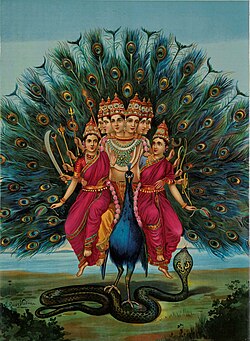
South Asian mythologies, spanning Vedic traditions to Hindu epics such as the Mahabharata (composed between approximately 400 BCE and 400 CE), feature war deities aligned with dharma, emphasizing the Kshatriya caste's obligation to wage righteous battles against chaos and adharma.[102] The Mahabharata's narrative of the Kurukshetra war portrays armies structured by varna, with Kshatriyas as frontline warriors upholding cosmic order through combat.[102]In Hindu mythology, Kartikeya (also Skanda or Murugan) serves as the god of war, born from Shiva and Parvati to lead divine forces against demons, notably slaying Tarakasura with his spear (vel).[103] Depicted with six heads, red skin, and riding a peacock, he commands the celestial army as senapati.[104] His iconography symbolizes victory and wisdom in warfare.[103]Durga, the invincible multi-armed warrior goddess embodying the fierce aspect of the divine feminine, was created by gods to combat unbeatable demons and represents battlefield dominance; she triumphs over Mahishasura, the buffalo demon, using her trident and multiple weapons in a battle affirming dharma's supremacy.[105][106] Her form, armed and mounted on a lion, represents collective divine power mobilized for protection.[105]In Tamil traditions, Murugan—syncretized with Kartikeya—appears as a youthful spear-wielding deity, revered for vanquishing demons like Surapadma and embodying victory in regional lore.[107] His vel, gifted by Parvati, signifies shakti deployed against ignorance and evil.[108]Among Sinhalese Buddhists, Dadimunda (Dedimunda Deviyo) functions as a guardian deity, invoked for protection akin to a war lord in defending Buddhist sasana against threats, with temples like Aluthnuwara dedicated to his martial oversight.[109]Manipuri Meitei mythology centers Pakhangba as a primordial dragondeity, shapeshifting and potent in cosmic struggles, including clan conflicts where his serpentine form coils to assert dominance and balance.[110] As the strongest dragon in lore, he embodies raw power in foundational battles shaping Meitei kingship.[111]
West Asian Mythologies
In West Asian mythologies, war deities frequently embodied storm, fertility, and destructive forces, as depicted in Ugariticcuneiform tablets from the city of Ugarit dating to the 14th–13th centuries BCE.[112] These texts reveal a pantheon where conflict resolved cosmic order, with gods like Baal engaging in battles against chaos figures such as the sea god Yam or death god Mot.[113]Anat was a prominent Canaanite goddess of war, portrayed as a violent virgin warrior who aided Baal in his kingship struggles and reveled in bloodshed, wading through gore in ritualistic fury.[113]Ugaritic myths describe her massacring enemies and monsters on Baal's behalf, emphasizing her role as a fierce ally in divine warfare rather than a mere fertility figure.[113]Baal, the Canaanite storm and fertility god, functioned as a central warriordeity, vanquishing rivals like Mot to assert dominance over fertility cycles and seasonal renewal.[114] His epic cycle in Ugaritic literature highlights battles symbolizing victory over death and aridity, with thunder as his weapon.[112]In Mesopotamian traditions, Ishtar (earlier Inanna) was a multifaceted goddess of love, fertility, and war, linked to the planet Venus and invoked for conquests that brought both victory and disaster.[115] Akkadian hymns and epics, such as her descent to the underworld, underscore her martial prowess, where she armed armies and demanded submission from foes.[115]Nergal represented war intertwined with plague and the underworld, accompanying kings into battle to deliver supernatural death to enemies across Sumerian, Akkadian, and Babylonian periods from the Early Dynastic era onward.[116] Texts portray him as a destroyer of cities and bringer of famine, embodying the chaotic aftermath of conflict.[117]Hebrew biblical texts depict Yahweh as a divine warrior leading Israel's exodus from Egypt, shattering enemies with monergistic might as in Exodus 15:3, where he is called "a man of war."[118] Psalms and prophetic books further emphasize his role in synergistic battles, smiting foes and riding on clouds like a cosmic chariot fighter.[119]Among Armenians, Vahagn served as a god of fire, thunder, war, and victory, renowned as a dragon-slayer (Vishapakagh) who forged weapons in cosmic flames and defended against chaos monsters.[120] Pre-Christian lore, preserved in medieval accounts, casts him in a heroic triad, embodying bravery in martial exploits akin to regional storm gods.[121]
Oceania
Polynesian Mythology
In Polynesian oral traditions, war deities represent the fierce, expansionist ethos of ancestral mariners who conducted raids and conquests across the Pacific islands, as evidenced by chants and temple complexes dedicated to martial rites.[122] These gods, invoked during inter-island conflicts, emphasized human sacrifice and weapon mastery to ensure victory in naval warfare and territorial seizures.[123]Kū, the principal Hawaiian god of war, was depicted in feathered wooden images such as Kūkaʻilimoku, erected in luakiniheiau temples where human sacrifices occurred to propitiate him before battles.[124][122] As patron of war clubs and political conquest, Kū embodied upright strength and was appealed to for success in fishing, farming, and sorcery alongside warfare, with manifestations like Kū-nui-akea invoked for supreme dominance.[123][125]Tūmatauenga, known as Tū in Māori lore, emerged as the god of war and human strife from the primordial separation of sky father Rangi and earth mother Papa, where he alone resisted peace by flaying his reconciled siblings—transforming them into elements like forests and seas—thus becoming the unyielding patron of weapons, hunting, and cultivation.[126] He protected warriors in battle and was revered for enabling food production amid conflict, reflecting the martial necessities of tribal raids.[126]ʻOro, a dominant figure in Tahitian and Society Islands mythology, functioned as a god of conquest who demanded human sacrifices at marae sites during wars, symbolizing the violent expansion of chiefly lineages through combat and ritual offerings.[127] His cult, son of creator Taʻaroa and Hina, spread via navigator-priests, underscoring the integration of warfare with divine favor in Polynesian island dominations.[127]
Americas
North American Indigenous Traditions
In the traditions of North American indigenous peoples, particularly those of the Great Plains and Pacific Northwest, powerful sky spirits known as thunder beings or the Thunderbird served as patrons of warfare, invoked for prowess in buffalo hunts, vision quests, and territorial raids. These entities, documented in oral histories and pictographic records, embodied destructive storms and protective might, granting warriors supernatural arrows, shields, or visions of victory against rivals. Among Plains tribes like the Lakota, Wakinyan—the thunder beings—were central to male rites of passage, where young men endured vision quests to receive war medicine, such as thunderbird imagery for unerring strikes in battle or pursuit of bison herds essential to tribal sustenance and economy.[128][129]Sun Dance ceremonies reinforced these pacts, with participants piercing flesh in vows for safe returns from raids and successful defenses, as thunder rumbled in affirmation from the spirits.[130]Pictographs etched on hides and rocks by Plains warriors chronicled these alliances, depicting thunderbirds clutching buffalo or enemies in talons, symbolizing conquests tied to resource control—over 19th-century ledger art from tribes like the Cheyenne records tallying horse captures and scalps under thunder motifs, reflecting causal links between spiritual favor and material survival amid intertribal competition for hunting grounds. In Lakota oral accounts, Wakinyan demanded strict taboos, like avoiding women or certain foods post-quest, to maintain power; violations invited lightning strikes, underscoring the spirits' dual role as allies and enforcers in a worldview where war preserved balance against scarcity.[128]Among Pacific Northwest coastal tribes such as the Kwakwaka'wakw and Makah, the Thunderbird's mythic struggles with the Whale represented epic contests of dominance, mirroring human raids for slaves, canoes, and prestige goods. Oral narratives describe Thunderbird lifting whales skyward in thunderous clashes—symbolizing seismic upheavals and floods—invoked by warriors carving the bird on war clubs or totem poles for strength in sea-borne skirmishes and defense of salmon-rich territories.[131] These stories, preserved through potlatch performances, emphasized Thunderbird's role in vanquishing underwater chaos, paralleling raids that secured food sovereignty; ethnographic records from the late 19th century note chiefs claiming visions of the bird for unassailable leadership in conflicts.[132]In northeastern traditions like those of the Iroquois (Haudenosaunee), Hé-no (also Hino), the thunder spirit and leader of sky warriors, wielded a magic feather-crowned club against stone giants and evil forces, as recounted in oral legends where he rains destruction on foes while nourishing crops.[133] The False Face Society, while focused on exorcising illness through masked rituals mimicking grotesque spirits, drew from similar thunder-born powers for communal protection, with warriors historically integrating these masks in war dances to intimidate enemies and summon ancestral might—evident in 18th-century accounts of Seneca raids invoking sky beings for tactical edge in longhouse confederacy expansions.[134] Such practices highlight thunder entities' broader utility in defense, grounded in empirical patterns of seasonal storms correlating with military campaigns.
Mesoamerican Civilizations
In Aztec religion, Huitzilopochtli functioned as the central war deity and solar patron of the Mexica, conceptualized as a hummingbird warrior whose daily cosmic battles necessitated the extraction and offering of human hearts to sustain the sun's movement.[135] This requirement underpinned rituals documented in pre-conquest codices, such as the Codex Magliabechiano, where priests are shown presenting still-beating hearts atop sacrificial stones at his Coatepetl temple in Tenochtitlan.[135] Archaeological excavations at the Templo Mayor have uncovered tzompantli skull racks containing over 130,000 crania from circa 1487 onward, confirming the industrial scale of these offerings—estimated in the thousands annually—to propitiate Huitzilopochtli amid empire expansion.[136]Complementing Huitzilopochtli, Tezcatlipoca, the Smoking Mirror god of rulership, sorcery, and conflict associated with night conquest, embodied jaguar-linked strife, sorcery, and adversarial warfare, manifesting as a nocturnal force demanding blood to avert chaos and enforce rulership through conflict.[137] His cult, tied to obsidian mirrors and shapeshifting, reinforced sacrificial imperatives, with jaguar pelts and warrior impersonations in codices illustrating his role in instigating strife for cosmic renewal. These deities' patronage extended to flower wars (xochiyaoyotl), formalized ritual combats from the 1450s under advisor Tlacaelel through the 1521 conquest, prioritizing captive acquisition over conquest to supply victims, thereby linking martial ideology to imperial tribute networks spanning central Mexico.[138]Toltec-Mexica precursors venerated Mixcoatl as a cloud serpent god of hunting, stars, and proto-warfare, deified from Chichimec warrior-leaders whose migratory hunts circa 900–1150 CE influenced Mexica militarism and fire-making rites.[139]Among the Maya, Buluc Chabtan presided over war, violence, and sacrificial rites, invoked for sudden death and conflict resolution in Postclassic contexts, with iconography featuring encircled eyes denoting martial ferocity.[140]K'awiil (God K), the lightning-axe deity, symbolized potent rulership and thunderous warfare, personified as a scepter wielded by kings on Classic-period stelae (e.g., at Tikal and Copán, 250–900 CE) and in codices like the Paris Codex, where his serpentine form and upturned snout evoked the thunderbolt's destructive power.[141]Bloodletting—evidenced in Yaxchilán lintels (e.g., Lintels 24–25, circa 755 CE) showing royal piercings to summon visions and nourish deities—interwove personal autosacrifice with these patrons, causal to state legitimacy and offensive campaigns across the Petén region.[142]
South American Indigenous Traditions
Illapa in Inca mythology was the god of thunder, lightning, and rain, often invoked during warfare for his control over storms that could aid or hinder battles. Depicted as a man wielding a slingshot made of lightning to hurl thunderbolts, Illapa's association with slings reflected the Inca's own reliance on sling warfare during their expansion from 1438 to 1533 CE, as chronicled by 16th-century Spanish accounts and interpreted through quipu records of military campaigns.[143] Inca rulers consulted Illapa for favorable weather in conquests, viewing his tempests as divine weapons akin to their tactical arsenals.[144]Among the Mapuche of southern Chile and Argentina, Pillan represented powerful ancestral spirits residing in volcanoes, embodying warrior essences of deceased chiefs and fighters absorbed into volcanic forces. These entities were called upon for strength in resisting Inca incursions and later Spanish colonization starting in the 1540s, with Pillan manifesting as thunder, fire, and eruptions to punish enemies or empower defenders.[145] Mapuche oral traditions, preserved through 16th- and 17th-century chronicler observations, link Pillan to guerrilla tactics and seismic upheavals symbolizing unyielding combat prowess against invaders.[146]In Muisca (Chibcha) cosmology of the Colombian highlands, Bochica acted as a civilizing figure who waged a form of cosmic conflict against floods unleashed by the vengeful Chibchacum, channeling waters through the Tequendama Falls around the 15th century to avert destruction, as detailed in early colonial ethnographies. This act of hydrological warfare preserved Muisca society amid environmental threats tied to their agricultural warfare preparations.[147] Similarly, Cuchavira, the rainbow deity born from those falls, symbolized post-battle renewal and protection for laborers and the infirm, indirectly supporting communal resilience in inter-tribal conflicts documented in 16th-century Spanish reports.[148] Supay, in Andean Quechua lore, oversaw underworld domains including mines, where ritual offerings mitigated perils akin to subterranean skirmishes during Inca resource extractions from the 1430s onward, though primarily a balancer of forces rather than a direct combatant.[149]
Caribbean Traditions
In Haitian Vodou, a syncretic faith developed among enslaved Africans in Saint-Domingue from West African spiritual elements—primarily Yoruba orisha traditions—and Roman Catholic practices during the 18th century, Ogoun stands as the central loa of warfare, ironworking, and revolutionary fervor. This loa, adapted from the Yoruba Ogun as god of metal, fire, and battle, manifests in multiple aspects such as Ogou Feray (the iron-clad warrior) and Ogoun Ferraille (the machete-wielding fighter), symbolizing disciplined combat and technological mastery over tools of war like blades and firearms.[150][151]Ogoun's martial attributes gained prominence during the Haitian Revolution (1791–1804), where Vodou practitioners invoked him for courage and victory against French colonial armies, crediting his influence with empowering enslaved fighters in machete charges and guerrilla tactics that led to independence.[152] Syncretized with Saint James the Greater (Santiago Matamoros), a Catholic warrior saint depicted slaying Moors, Ogoun embodies hot-tempered justice, demanding offerings of red rum, roosters, and iron objects to honor his role in clearing paths through adversity.[150]Within the broader Erzulie loa family, Erzulie Dantor represents a fierce, protective warrior aspect, distinct from the romantic Erzulie Freda; Dantor, a Petro nation spirit born of revolutionary violence, wields a dagger and guards single mothers and the oppressed, her veves marked by scars symbolizing battle wounds.[153]Preceding African diaspora influences, indigenous Taíno traditions of the Greater Antilles featured Guabancex, the supreme goddess of storms, volcanoes, and destructive chaos, who unleashed hurricanes—termed juracán—as acts of divine wrath, commanding lesser spirits like Coatrisquie (thunder) and Máxio (lightning) in torrential assaults akin to natural warfare.[154]Taínozemi carvings invoked her alongside Yúcahu for resilience against such tempests, reflecting pre-colonial views of environmental fury as a combative force.[155]





_-_Musei_Capitolini_-_MC0058_(2).JPG)