



Community hub
Wikipedia
Zodiac
View on Wikipedia


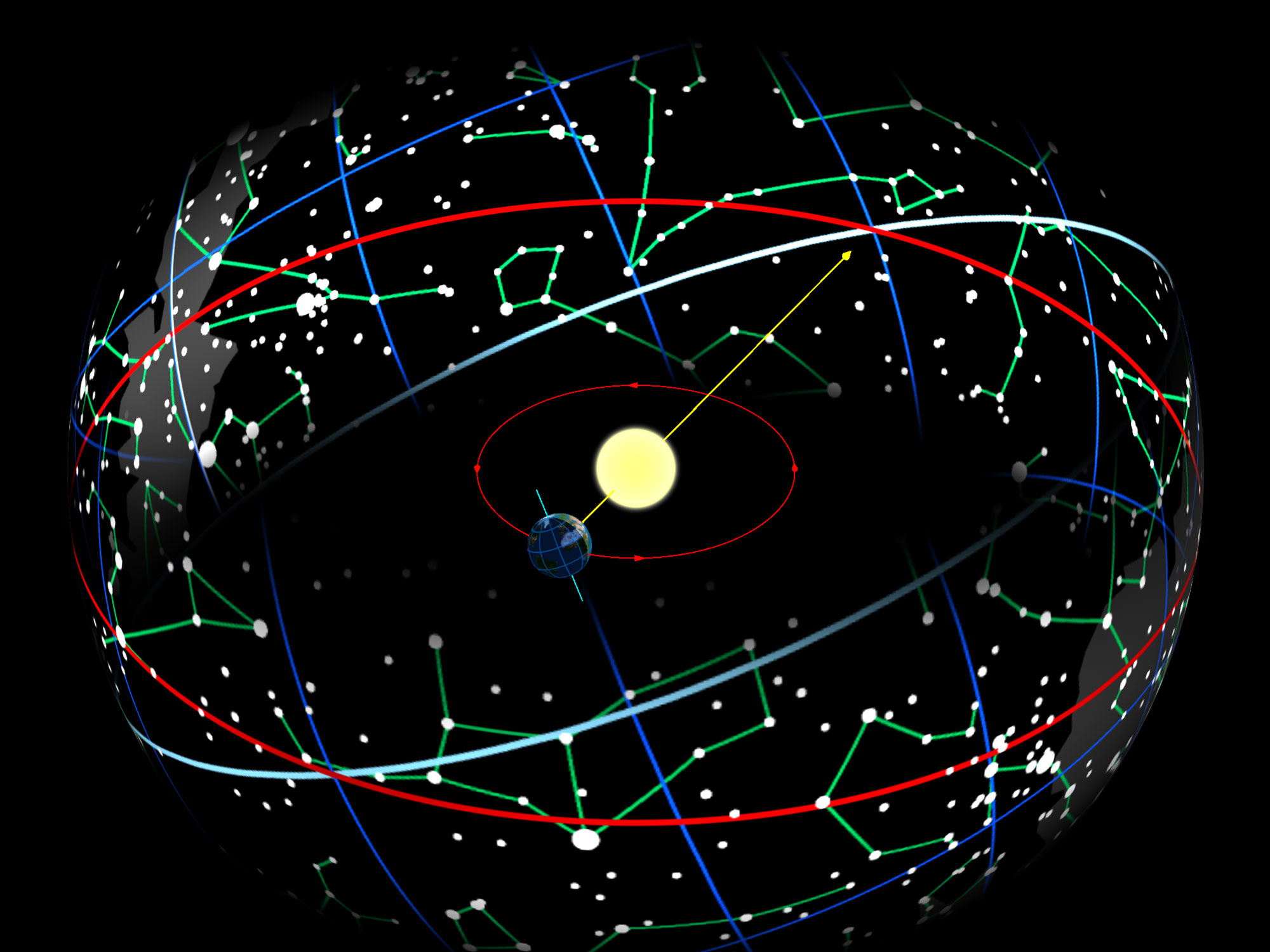
The zodiac is a belt-shaped region of the sky that extends approximately 8° north and south celestial latitude of the ecliptic – the apparent path of the Sun across the celestial sphere over the course of the year. Within this zodiac belt appear the Moon and the brightest planets, along their orbital planes.[1] The zodiac is divided along the ecliptic into 12 equal parts, called "signs", each occupying 30° of celestial longitude. These signs roughly correspond to the astronomical constellations with the following modern names:[2][3] Aries, Taurus, Gemini, Cancer, Leo, Virgo, Libra, Scorpio, Sagittarius, Capricorn, Aquarius, and Pisces.
The signs have been used to determine the time of the year by identifying each sign with the days of the year the Sun is in the respective sign. In Western astrology, and formerly astronomy, the time of each sign is associated with different attributes. The zodiacal system and its angular measurement in 360 sexagesimal degree (°) originated with Babylonian astronomy during the 1st millennium BC, probably during the Achaemenid Empire. It was communicated into Greek astronomy by the 2nd century BC, as well as into developing the Hindu zodiac. Due to the precession of the equinoxes, the time of year that the Sun is in a given constellation has changed since Babylonian times, and the point of March equinox has moved from Aries into Pisces.
The zodiac forms a celestial coordinate system, or more specifically an ecliptic coordinate system, which takes the ecliptic as the origin of latitude and the Sun's position at vernal equinox as the origin of longitude.[4] In modern astronomy, the ecliptic coordinate system is still used for tracking Solar System objects.
Name
[edit]The English word zodiac derives from zōdiacus,[5] the Latinized form of the Ancient Greek zōdiakòs (ζῳδιακός),[6] meaning "of or relating to little animals", Zōdion (ζῴδιον) being the diminutive of zōon (ζῷον, "animal").[7] The name reflects the prominence of animals (and mythological hybrids) among the twelve signs. In English, the term "zodiac" may also be used in reference to or translation for the similar twelve year cycle (also sometimes applied to other time units than years) of the East Asian-derived systems referred to as the Chinese zodiac (see also, Earthly Branches): similarities include the use of animal or theriomorphic figures associated with a twelve year cycle used culturally to allege or describe personality traits, life events, and their interrelationships—thus this use in translation.[citation needed]
Usage
[edit].png)
The zodiac was in use by the Roman era, based on concepts inherited by Hellenistic astronomy from Babylonian astronomy of the Chaldean period (mid-1st millennium BC), which, in turn, derived from an earlier system of lists of stars along the ecliptic.[8] The construction of the zodiac is described in Ptolemy's comprehensive 2nd century AD work, the Almagest.[9]
Although the zodiac remains the basis of the ecliptic coordinate system in use in astronomy besides the equatorial one,[10][11] the term and the names of the twelve signs are today mostly associated with horoscopic astrology.[12] The term "zodiac" may also refer to the region of the celestial sphere encompassing the paths of the planets corresponding to the band of about 8 arc degrees above and below the ecliptic. The zodiac of a given planet is the band that contains the path of that particular body; e.g., the "zodiac of the Moon" is the band of 5° above and below the ecliptic. By extension, the "zodiac of the comets" may refer to the band encompassing most short-period comets.[13]
History
[edit]Early history
[edit]As early as the 14th century BC a complete list of the 36 Egyptian decans was placed among the hieroglyphs adorning the tomb of Seti I; they figured again in the temple of Ramesses II, and characterize every Egyptian astrological monument. Both the famous zodiacs of Dendera display their symbols, identified by Karl Richard Lepsius.[14]


The division of the ecliptic into the zodiacal signs originates in Babylonian astronomy during the first half of the 1st millennium BC. The zodiac draws on stars in earlier Babylonian star catalogues, such as the MUL.APIN catalogue, which was compiled around 1000 BC. Some constellations can be traced even further back, to Bronze Age (Old Babylonian Empire) sources, including Gemini "The Twins", from Sumerian: 𒀯𒈦𒋰𒁀𒃲𒃲, romanized: MULMAŠ.TAB.BA.GAL.GAL "The Great Twins"; Cancer "The Crab", from Sumerian: 𒀯𒀠𒇻, romanized: MULAL.LUL "The Crayfish", among others.[15][16]
Around the end of the fifth century BC, Babylonian astronomers divided the ecliptic into 12 equal "signs", by analogy to 12 schematic months of 30 days each. Each sign contained 30° of celestial longitude, thus creating the first known celestial coordinate system. According to calculations by modern astrophysics, the zodiac was introduced between 409 and 398 BC, during Persian rule,[17] and probably within a very few years of 401 BC.[18] Unlike modern astrologers, who place the beginning of the sign of Aries at the position of the Sun at the vernal equinox in the Northern Hemisphere (March equinox), Babylonian astronomers fixed the zodiac in relation to stars, placing the beginning of Cancer at the "Rear Twin Star" (β Geminorum) and the beginning of Aquarius at the "Rear Star of the Goat-Fish" (δ Capricorni).[19]
Due to the precession of the equinoxes, the time of year the Sun is in a given constellation has changed since Babylonian times, as the point of March equinox has moved from Aries into Pisces.[20]
Because the divisions were made into equal arcs of 30° each, they constituted an ideal system of reference for making predictions about a planet's longitude. However, Babylonian techniques of observational measurements were in a rudimentary stage of evolution.[21] They measured the position of a planet in reference to a set of "normal stars" close to the ecliptic (±9° of latitude). The normal stars were used as observational reference points to help position a planet within this ecliptic coordinate system.[22]
In Babylonian astronomical diaries, a planet position was generally given with respect to a zodiacal sign alone, though less often in specific degrees within a sign.[23] When the degrees of longitude were given, they were expressed with reference to the 30° of the zodiacal sign, i.e., not with a reference to the continuous 360° ecliptic.[23] In astronomical ephemerides, the positions of significant astronomical phenomena were computed in sexagesimal fractions of a degree (equivalent to minutes and seconds of arc).[24] For daily ephemerides, the daily positions of a planet were not as important as the astrologically significant dates when the planet crossed from one zodiacal sign to the next.[23]
Hebrew astronomy and astrology
[edit]Knowledge of the Babylonian zodiac is said to be reflected in the Hebrew Bible; E. W. Bullinger interpreted the creatures that appear in the book of Ezekiel (1:10) as the middle signs of the four quarters of the zodiac,[25][26][better source needed] with the Lion as Leo, the Bull as Taurus, the Man as Aquarius and the Eagle as a higher aspect of Scorpio.[27] Some authors have linked the signs of the zodiac with the twelve tribes of Israel, and with the lunar Hebrew calendar, which has twelve lunar months in a lunar year. Martin and others have argued that the arrangement of the tribes around the Tabernacle (reported in the Book of Numbers) corresponded to the order of the zodiac, with Judah, Reuben, Ephraim, and Dan representing the middle signs of Leo, Aquarius, Taurus, and Scorpio, respectively. Such connections were taken up by Thomas Mann, who in his novel Joseph and His Brothers, attributes characteristics of a sign of the zodiac to each tribe, in his rendition of the Blessing of Jacob.[citation needed]
Hellenistic and Roman era
[edit]
The Babylonian star catalogs entered Greek astronomy in the 4th century BC, via Eudoxus of Cnidus.[15] Babylonia or Chaldea in the Hellenistic world came to be so identified with astrology that "Chaldean wisdom" became among Greeks and Romans the synonym of divination through the planets and stars. Hellenistic astrology derived in part from Babylonian and Egyptian astrology.[28] Horoscopic astrology first appeared in Ptolemaic Egypt (305 BC–30 BC). The Dendera zodiac, a relief dating to c. 50 BC, is the first known depiction of the classical zodiac of twelve signs.[citation needed]
The earliest extant Greek text using the Babylonian division of the zodiac into 12 signs of 30 equal degrees each is the Anaphoricus of Hypsicles of Alexandria (fl. 190 BC).[29] Particularly important in the development of Western horoscopic astrology was the astrologer and astronomer Ptolemy, whose work Tetrabiblos laid the basis of the Western astrological tradition.[30] Under the Greeks, and Ptolemy in particular, the planets, Houses, and signs of the zodiac were rationalized and their function set down in a way that has changed little to the present day.[31] Ptolemy lived in the 2nd century AD, three centuries after the discovery of the precession of the equinoxes by Hipparchus around 130 BC. Hipparchus' lost work on precession never circulated very widely until it was brought to prominence by Ptolemy,[32] and there are few explanations of precession outside the work of Ptolemy until late Antiquity, by which time Ptolemy's influence was widely established.[33] Ptolemy clearly explained the theoretical basis of the western zodiac as being a tropical coordinate system, by which the zodiac is aligned to the equinoxes and solstices, rather than the visible constellations that bear the same names as the zodiac signs.[34]
Hindu zodiac
[edit]According to mathematician-historian Montucla, the Hindu zodiac was adopted from the Greek zodiac through communications between ancient India and the Greek empire of Bactria.[35] The Hindu zodiac uses the sidereal coordinate system, which makes reference to the fixed stars. The tropical zodiac (of Mesopotamian origin) is divided by the intersections of the ecliptic and equator, which shifts in relation to the backdrop of fixed stars at a rate of 1° every 72 years, creating the phenomenon known as precession of the equinoxes. The Hindu zodiac, being sidereal, does not maintain this seasonal alignment, but there are still similarities between the two systems. The Hindu zodiac signs and corresponding Greek signs sound very different, being in Sanskrit and Greek respectively, but their symbols are nearly identical.[36] For example, dhanu means "bow" and corresponds to Sagittarius, the "archer", and kumbha means "water-pitcher" and corresponds to Aquarius, the "water-carrier".[37]
Middle Ages
[edit]
During the Abbasid era, Greek reference books were translated into Arabic, and Islamic astronomers then did their own observations, correcting Ptolemy's Almagest. One such book was Al-Sufi's Book of Fixed Stars, which has pictorial depictions of 48 constellations. The book was divided into three sections: constellations of the zodiac, constellations north of the zodiac, and southern constellations. When Al-Sufi's book, and other works, were translated in the 11th century, there were mistakes made in the translations. As a result, some stars ended up with the names of the constellation they belong to (e.g. Hamal in Aries).
The High Middle Ages saw a revival of interest in Greco-Roman magic, first in Kabbalism and later continued in Renaissance magic. This included magical uses of the zodiac, as found, e.g., in the Sefer Raziel HaMalakh.
The zodiac is found in medieval stained glass as at Angers Cathedral, where the master glass maker, André Robin, made the ornate rosettes for the North and South transepts after the fire there in 1451.[38]
Medieval Islamic era
[edit]
Astrology emerged in the 8th century AD as a distinct discipline in Islam,[39]: 64 with a mix of Indian, Hellenistic Iranian and other traditions blended with Greek and Islamic astronomical knowledge, for example Ptolemy's work and Al-Sufi's Book of Fixed Stars. A knowledge of the influence that the stars have on events on the earth was important in Islamic civilization. As a rule, it was believed that the signs of the zodiac and the planets control the destiny not only of people but also of nations, and that the zodiac has the ability to determine a person's physical characteristics as well as intelligence and personal traits.[40]
The practice of astrology at this time could be divided into four broader categories: Genethlialogy, Catarchic Astrology, Interrogational Astrology and General Astrology.[39]: 65 However the most common type of astrology was Genethlialogy, which examined all aspects of a person's life in relation to the planetary positions at their birth; more commonly known as our horoscope.[39]: 65
Astrology services were offered widely across the empire, mainly in bazaars, where people could pay for a reading.[41] Astrology was valued in the royal courts, for example, the Abbasid Caliph Al-Mansur used astrology to determine the best date for founding the new capital of Baghdad.[39]: 66 While horoscopes were generally widely accepted by society, many scholars condemned the use of astrology and divination, linking it to occult influences.[42] Many theologians and scholars thought that it went against the tenets of Islam; as only God should be able to determine events rather than astrologers looking at the positions of the planets.[41]
In order to calculate someone's horoscope, an astrologer would use three tools: an astrolabe, ephemeris and a takht. First, the astrologer would use an astrolabe to find the position of the sun, align the rule with the persons time of birth and then align the rete to establish the altitude of the sun on that date.[43] Next, the astrologer would use an ephemeris, a table denoting the mean position of the planets and stars within the sky at any given time.[44] Finally, the astrologer would add the altitude of the sun taken from the astrolabe, with the mean position of the planets on the person's birthday, and add them together on the takht (also known as the dustboard).[44] The dust board was merely a tablet covered in sand; on which the calculations could be made and erased easily.[41] Once this had been calculated, the astrologer was then able to interpret the horoscope. Most of these interpretations were based on the zodiac in literature. For example, there were several manuals on how to interpret each zodiac sign, the treatise relating to each individual sign and what the characteristics of these zodiacs were.[41]
Early modern
[edit]An example of the use of signs as astronomical coordinates may be found in the Nautical Almanac and Astronomical Ephemeris for the year 1767. The "Longitude of the Sun" columns show the sign (represented as a digit from 0 to and including 11), degrees from 0 to 29, minutes, and seconds.[45]
Mughal king Jahangir issued an attractive series of coins in gold and silver depicting the twelve signs of the zodiac.[46]
-
 A volvella of the moon. A volvella is a moveable device for working out the position of the Sun and Moon in the zodiac, 15th century
 -


Twelve signs
[edit]What follows is a list of the signs of the modern zodiac (with the ecliptic longitudes of their first points), where 0° Aries is understood as the vernal equinox, with their Latin, Greek, Sanskrit, and Babylonian names. But the Sanskrit and the name equivalents (after c.500 BC) denote the constellations only, not the tropical zodiac signs. The "English translation" is not usually used by English speakers. The Latin names are standard English usage (except that "Capricorn" is used rather than "Capricornus").
| House | Unicode Character | Ecliptic Longitude (a ≤ λ < b) |
Latin name | Gloss | Greek name (Romanization of Greek) | Sanskrit name | Sumero-Babylonian name[47] |
|---|---|---|---|---|---|---|---|
| 1 | ♈︎︎ | 0° | Aries | Ram | Κριός (Krios) | Meṣa (मेष) | MUL LU.ḪUN.GA[48] "Agrarian Worker", Dumuzi |
| 2 | ♉︎︎ | 30° | Taurus | Bull | Ταῦρος (Tauros) | Vṛṣabha (वृषभ) | MULGU4.AN.NA "Divine Bull of Heaven" |
| 3 | ♊︎︎ | 60° | Gemini | Twins | Δίδυμοι (Didymoi) | Mithuna (मिथुन) | MULMAŠ.TAB.BA.GAL.GAL "Great Twins" |
| 4 | ♋︎︎ | 90° | Cancer | Crab | Καρκίνος (Karkinos) | Karka (कर्क) | MULAL.LUL "Crayfish" |
| 5 | ♌︎︎ | 120° | Leo | Lion | Λέων (Leōn) | Siṃha (सिंह) | MULUR.GU.LA "Lion" |
| 6 | ♍︎︎ | 150° | Virgo | Maiden | Παρθένος (Parthenos) | Kanyā (कन्या) | MULAB.SIN "The Furrow"* *"The goddess Shala's ear of grain" |
| 7 | ♎︎︎ | 180° | Libra | Scales | Ζυγός (Zygos) | Tulā (तुला) | MULZIB.BA.AN.NA "Scales" |
| 8 | ♏︎︎ | 210° | Scorpio | Scorpion | Σκoρπίος (Skorpios)[49] | Vṛścika (वृश्चिक) | MULGIR.TAB "Scorpion" |
| 9 | ♐︎︎ | 240° | Sagittarius | (Centaur) Archer | Τοξότης (Toxotēs) | Dhanuṣa (धनुष) | MULPA.BIL.SAG, Nedu "soldier" |
| 10 | ♑︎︎ | 270° | Capricorn | Mountain Goat or "Goat-horned" Sea-Goat | Αἰγόκερως (Aigokerōs) | Makara (मकर) | MULSUḪUR.MAŠ "Goat-Fish" of Enki |
| 11 | ♒︎︎ | 300° | Aquarius | Water-Bearer | Ὑδροχόος (Hydrokhoos) | Kumbha (कुंभ) | MULGU.LA "Great One" (i.e. Enki), later qâ "pitcher" |
| 12 | ♓︎︎ | 330° | Pisces | 2 Fish[50] | Ἰχθύες (Ikhthyes) | Mīna (मीन) | MULSIM.MAḪ "Tail of the Swallow"; DU.NU.NU "fish-cord" |
These twelve signs have been arranged into a nursery rhyme as a mnemonic device:[51]
The ram, the bull, the heavenly twins,
And next the crab, the lion shines,
The virgin and the scales,
The scorpion, archer, and the goat,
The man who holds the watering-pot,
And fish with glittering scales.
Another mnemonic is A Tense Gray Cat Lay Very Low, Sneaking Slowly, Contemplating A Pounce.[52][53]
The following table compares the Gregorian dates on which the Sun enters a sign in the Ptolemaic tropical zodiac, and a sign in two sidereal systems: one proposed by Cyril Fagan, and a fourteen-sign system proposed by Steven Schmidt which adds Ophiuchus (see below) and Cetus (the IAU boundaries of which just graze by the ecliptic):

The beginning of Aries is defined as the moment of vernal equinox, and all other dates shift accordingly.[54] The precise Gregorian times and dates vary slightly from year to year as the Gregorian calendar shifts relative to the tropical year. These variations remain within less than two days' difference in the recent past and the near-future, vernal equinox in UT always falling either on 20 or 21 March in the period of 1797 to 2043, falling on 19 March in 1796 the last time and in 2044 the next. The vernal equinox has fallen on 20 March UT since 2008, and will continue to do so until 2043.[55]

| Symbol | Constellation | Tropical zodiac dates[56] | Sidereal zodiac dates[57][58][59] (Lahiri ayanamsa) |
Dates based on 14 equal length sign zodiac used by Schmidt[60][i] | Based on IAU boundaries[61] |
|---|---|---|---|---|---|
.svg) |
Aries | Mar 21 – Apr 19 | April 14 – May 14 | April 16 – May 11 | Apr 18 – May 13 |
.svg) |
Cetus[i] | — | — | May 12 – June 6[i] | — [dubious – discuss] |
.svg) |
Taurus | Apr 20 – May 20 | May 15 – Jun 15 | June 7 – July 2 | May 13 – Jun 21 |
.svg) |
Gemini | May 21 – Jun 20 | Jun 16 – Jul 16 | July 3 – July 28 | Jun 21 – Jul 20 |
.svg) |
Cancer | Jun 21 – Jul 22 | Jul 17 – Aug 16 | July 29 – August 23 | Jul 20 – Aug 10 |
.svg) |
Leo | Jul 23 – Aug 22 | Aug 17 – Sep 16 | August 24 – September 18 | Aug 10 – Sep 16 |
.svg) |
Virgo | Aug 23 – Sep 22 | Sep 17 – Oct 16 | September 19 – October 14 | Sep 16 – Oct 30 |
.svg) |
Libra | Sep 23 – Oct 22 | Oct 17 – Nov 15 | October 15 – November 9 | Oct 30 – Nov 23 |
.svg) |
Scorpio | Oct 23 – Nov 21 | Nov 16 – Dec 15 | November 10 – December 5 | Nov 23 – Nov 29 |
.svg) |
Ophiuchus[ii] | — | — | December 6 – December 31 | Nov 29 – Dec 17 |
.svg) |
Sagittarius | Nov 22– Dec 21 | Dec 16 – Jan 14 | January 1 – January 26 | Dec 17 – Jan 20 |
.svg) |
Capricorn | Dec 22 – Jan 19 | Jan 15 – Feb 12 | January 27 – February 21 | Jan 20 – Feb 16 |
.svg) |
Aquarius | Jan 20 – Feb 18 | Feb 13 – Mar 14 | February 22 – March 20 | Feb 16 – Mar 11 |
.svg) |
Pisces | Feb 19– Mar 20 | Mar 15 – Apr 13 | March 21 – April 15 | Mar 11 – Apr 18 |
- ^ a b c Schmidt (1970) added a Sun sign for Cetus, falling between Aries and Taurus from May 12 – June 6, as well as the more often seen addition of Ophiuchus, q.v. [ii]. However, his symbols for Cetus and Ophiuchus are not the same as the symbols used here. Under the IAU constellation boundaries, the sign of Cetus corresponds to the half of Taurus mostly west of Aldebaran and the Hyades, while the Taurus sign corresponds to the half of Taurus east of Aldebaran and the Hyades.
- ^ a b Ophiuchus is not a sign in traditional forms of tropical and sidereal astrology, and only appears in a few forms of astrology which use the nominal constellation boundaries adopted by the IAU.
As each sign takes up exactly 30 degrees of the zodiac, the average duration of the solar stay in each sign is one twelfth of a sidereal year, or 30.43 standard days. Due to Earth's slight orbital eccentricity, the duration of each sign varies appreciably, between about 29.4 days for Capricorn and about 31.4 days for Cancer (see Equation of time). In addition, because the Earth's axis is at an angle, some signs take longer to rise than others, and the farther away from the equator the observer is situated, the greater the difference. Thus, signs are spoken of as "long" or "short" ascension.[62]
Constellations
[edit]
.jpg)

In tropical astrology, the zodiacal signs are distinct from the constellations associated with them, not only because of their drifting apart due to the precession of equinoxes but because the physical constellations take up varying widths of the ecliptic, so the Sun is not in each constellation for the same amount of time.[63]: 25 Thus, Virgo takes up 5 times as much ecliptic longitude as Scorpius. The zodiacal signs are an abstraction from the physical constellations, and each represent exactly 1⁄12th of the full circle, but the time spent by the Sun in each sign varies slightly due to the eccentricity of the Earth's orbit.
Sidereal astrology assigns the zodiac sign approximately to the corresponding constellation. This alignment needs recalibrating every so often to keep the alignment in place.
The ecliptic intersects with 13 constellations of Ptolemy's Almagest,[64] as well as of the more precisely delineated IAU designated constellations. In addition to the twelve constellations after which the twelve zodiac signs are named, the ecliptic intersects Ophiuchus,[65] the bottom part of which interjects between Scorpius and Sagittarius. Occasionally this difference between the astronomical constellations and the astrological signs is mistakenly reported in the popular press as a "change" to the list of traditional signs by some astronomical body like the IAU, NASA, or the Royal Astronomical Society. This happened in a 1995 report of the BBC Nine O'Clock News and various reports in 2011 and 2016.[66][67][68]
Some "parazodiacal" constellations are touched by the paths of the planets, leading to counts of up to 25 "constellations of the zodiac".[69] The ancient Babylonian MUL.APIN catalog lists Orion, Perseus, Auriga, and Andromeda. Modern astronomers have noted that planets pass through Crater, Sextans, Cetus, Pegasus, Corvus, Hydra, Orion, and Scutum, with Venus very rarely passing through Aquila, Canis Minor, Auriga, and Serpens.[69]
Some other constellations are mythologically associated with the zodiacal ones: Piscis Austrinus, The Southern Fish, is attached to Aquarius. In classical maps, it swallows the stream poured out of Aquarius' pitcher, but perhaps it formerly just swam in it. Aquila, The Eagle, was possibly associated with the zodiac by virtue of its main star, Altair. Hydra in the Early Bronze Age marked the celestial equator and was associated with Leo, which is shown standing on the serpent on the Dendera zodiac.[15]
| Name | 1977 IAU boundaries[70] (approximate) | Solar stay[70] | Brightest star |
|---|---|---|---|
| Aries | 19 April – 13 May | 25 days | Hamal |
| Taurus | 14 May – 19 June | 37 days | Aldebaran |
| Gemini | 20 June – 20 July | 31 days | Pollux |
| Cancer | 21 July – 9 August | 20 days | Al Tarf |
| Leo | 10 August – 15 September | 37 days | Regulus |
| Virgo | 16 September – 30 October | 45 days | Spica |
| Libra | 31 October – 22 November | 23 days | Zubeneschamali |
| Scorpius | 23 November – 29 November | 7 days | Antares |
| Ophiuchus | 30 November – 17 December | 18 days | Rasalhague |
| Sagittarius | 18 December – 18 January | 32 days | Kaus Australis |
| Capricornus | 19 January – 15 February | 28 days | Deneb Algedi |
| Aquarius | 16 February – 11 March | 24 days | Sadalsuud |
| Pisces | 12 March – 18 April | 38 days | Alpherg |
Precession of the equinoxes
[edit]
The zodiac system was developed in Babylonia, some 2,500 years ago, during the "Age of Aries".[21] At the time, it is assumed, the precession of the equinoxes was unknown. Contemporary use of the coordinate system is presented with the choice of interpreting the system either as sidereal, with the signs fixed to the stellar background, or as tropical, with the signs fixed to the point (vector of the Sun) at the March equinox.[23]
Western astrology takes the tropical approach, whereas Hindu astrology takes the sidereal one. This results in the originally unified zodiacal coordinate system drifting apart gradually, with a clockwise (westward) precession of 1.4 degrees per century.
For the tropical zodiac used in Western astronomy and astrology, this means that the tropical sign of Aries currently lies somewhere within the constellation Pisces ("Age of Pisces").
The sidereal coordinate system takes into account the ayanamsa, ayan meaning "transit" or "movement", and amsa meaning 'small part', i.e. movement of equinoxes in small parts. It is unclear when Indians became aware of the precession of the equinoxes, but Bhāskara II's 12th-century treatise Siddhanta Shiromani gives equations for measurement of precession of equinoxes, and says his equations are based on some lost equations of Suryasiddhanta plus the equation of Munjaala.[citation needed]
The discovery of precession is attributed to Hipparchus around 130 BC. Ptolemy quotes from Hipparchus' now-lost work entitled "On the Displacement of the Solstitial and Equinoctial Points" in the seventh book of his 2nd century astronomical text, Almagest, where he describes the phenomenon of precession and estimates its value.[32] Ptolemy clarified that the convention of Greek mathematical astronomy was to commence the zodiac from the point of the vernal equinox and to always refer to this point as "the first degree" of Aries.[71] This is known as the "tropical zodiac" (from the Greek word trópos, turn)[72] because its starting point revolves through the circle of background constellations over time.
The principle of the vernal point acting as the first degree of the zodiac for Greek astronomers is described in the 1st century BC astronomical text of Geminus of Rhodes. Geminus explains that Greek astronomers of his era associate the first degrees of the zodiac signs with the two solstices and the two equinoxes, in contrast to the older Chaldean (Babylonian) system, which placed these points within the zodiac signs.[71] This illustrates that Ptolemy merely clarified the convention of Greek astronomers and did not originate the principle of the tropical zodiac, as is sometimes assumed.
Ptolemy demonstrates that the principle of the tropical zodiac was well known to his predecessors within his astrological text, the Tetrabiblos, where he explains why it would be an error to associate the regularly spaced signs of the seasonally aligned zodiac with the irregular boundaries of the visible constellations:
The beginnings of the signs, and likewise those of the terms, are to be taken from the equinoctial and tropical points. This rule is not only clearly stated by writers on the subject, but is especially evident by the demonstration constantly afforded, that their natures, influences and familiarities have no other origin than from the tropics and equinoxes, as has been already plainly shown. And, if other beginnings were allowed, it would either be necessary to exclude the natures of the signs from the theory of prognostication, or impossible to avoid error in then retaining and making use of them; as the regularity of their spaces and distances, upon which their influence depends, would then be invaded and broken in upon.[34]
In modern astronomy
[edit].jpg)
Astronomically, the zodiac defines a belt of space extending 8°[74] or 9° in celestial latitude to the north and south of the ecliptic, within which the orbits of the Moon and the principal planets remain.[75] It is a feature of the ecliptic coordinate system – a celestial coordinate system centered upon the ecliptic (the plane of the Earth's orbit and the Sun's apparent path), by which celestial longitude is measured in degrees east of the vernal equinox (the ascending intersection of the ecliptic and equator).[76] The zodiac is narrow in angular terms because most of the Sun's planets have orbits that have only a slight inclination to the orbital plane of the Earth.[77] Stars within the zodiac are subject to occultations by the Moon and other solar system bodies. These events can be useful, for example, to estimate the cross-sectional dimensions of a minor planet, or check a star for a close companion.[78]

The Sun's placement upon the vernal equinox, which occurs annually around 21 March, defines the starting point for measurement, the first degree of which is historically known as the "first point of Aries". The first 30° along the ecliptic is nominally designated as the zodiac sign Aries, which no longer falls within the proximity of the constellation Aries since the effect of precession is to move the vernal point through the backdrop of visible constellations. It is currently located near the end of the constellation Pisces, having been within that constellation since the 2nd century AD.[79] The subsequent 30° of the ecliptic is nominally designated the zodiac sign Taurus, and so on through the twelve signs of the zodiac so that each occupies 1⁄12th (30°) of the zodiac's great circle. Zodiac signs have never been used to determine the boundaries of astronomical constellations that lie in the vicinity of the zodiac, which are, and always have been, irregular in their size and shape.[75]
The convention of measuring celestial longitude within individual signs was still being used in the mid-19th century,[80] but modern astronomy now numbers degrees of celestial longitude continuously from 0° to 360°, rather than 0° to 30° within each sign.[81] This coordinate system is primary used by astronomers for observations of solar system objects.[82]
The use of the zodiac as a means to determine astronomical measurement remained the main method for defining celestial positions by Western astronomers until the Renaissance, at which time preference moved to the equatorial coordinate system, which measures astronomical positions by right ascension and declination rather than the ecliptic-based definitions of celestial longitude and celestial latitude. The orientation of equatorial coordinates are aligned with the Earth's axis of rotation, rather than the plane of the planet's orbit around the Sun.[79]
The word "zodiac" is used in reference to the zodiacal cloud of dust grains that move among the planets, and the zodiacal light that originates from their scattering of sunlight.[83] While its name is derived from the zodiac, the zodiacal light covers the entire night sky, with enhancements in certain directions.[84]
Unicode characters
[edit]In Unicode, the symbols of zodiac signs are encoded in block "Miscellaneous Symbols". They can be forced to look like text by appending U+FE0E, or like emojis by appending U+FE0F:[85]
| Unicode character | text | emoji |
|---|---|---|
| U+2648 ♈ ARIES | ♈︎ | ♈️ |
| U+2649 ♉ TAURUS | ♉︎ | ♉️ |
| U+264A ♊ GEMINI | ♊︎ | ♊️ |
| U+264B ♋ CANCER | ♋︎ | ♋️ |
| U+264C ♌ LEO | ♌︎ | ♌️ |
| U+264D ♍ VIRGO | ♍︎ | ♍️ |
| U+264E ♎ LIBRA | ♎︎ | ♎️ |
| U+264F ♏ SCORPIUS | ♏︎ | ♏️ |
| U+2650 ♐ SAGITTARIUS | ♐︎ | ♐️ |
| U+2651 ♑ CAPRICORN | ♑︎ | ♑️ |
| U+2652 ♒ AQUARIUS | ♒︎ | ♒️ |
| U+2653 ♓ PISCES | ♓︎ | ♓️ |
| U+26CE ⛎ OPHIUCHUS | ⛎︎ | ⛎️ |
See also
[edit]
- Astronomical symbols – Symbols in astronomy
- Chinese zodiac – Lunar calendar classification in a 12-year cycle
- Circle of stars – Symbolic motif
- Cusp (astrology) – Imaginary line that separates a pair of consecutive astrological signs in the zodiac
- Elements of the zodiac – Elements in zodiac signs
- History of astrology
- Jewish astrology
- Mazzaroth – Biblical term for the Zodiac
References
[edit]- ^ "zodiac". Oxford Dictionaries. Oxford University Press. Archived from the original on 26 September 2016. Retrieved 19 September 2017.
- ^ Because the signs are each 30° in longitude but constellations have irregular shapes, and because of precession, they do not correspond exactly to the boundaries of the constellations after which they are named.
- ^ Noble, William (1902). "Papers communicated to the Association. The Signs of the Zodiac". Journal of the British Astronomical Association. 12: 242–244. Bibcode:1902JBAA...12..242N.
- ^ Leadbetter, Charles (1742). A Compleat System of Astronomy. J. Wilcox, London. p. 94.; numerous examples of this notation appear throughout the book.
- ^ Skeat, Walter William (1924). A Concise Etymological Dictionary of the English Language. Clarendon Press. p. 622. Archived from the original on 7 April 2023. Retrieved 20 March 2023.
- ^ Hübner, Wolfgang; Hunger, Hermann. "Zodiac". Brill’s New Pauly. doi:10.1163/1574-9347_bnp_e1213810. ISBN 9789004122598.
- ^ Harper, Douglas. "zodiac". Online Etymology Dictionary. Retrieved 6 March 2023.
- ^ See MUL.APIN. See also Lankford, John; Rothenberg, Marc (1997). History of Astronomy: An Encyclopedia. Taylor & Francis. p. 43. ISBN 978-0-8153-0322-0.
- ^ Ptolemy, Claudius (1998). The Almagest. Princeton, New Jersey: Princeton University Press. ISBN 0-691-00260-6. Translated and annotated by G. J. Toomer; with a foreword by Owen Gingerich.
- ^ Shapiro, Lee T. "Constellations in the zodiac". NASA. Archived from the original on 4 March 2012. Retrieved 27 April 2011.
- ^ Timberlake, Todd; Wallace, Paul (28 March 2019). Finding Our Place in the Solar System: The Scientific Story of the Copernican Revolution. Cambridge University Press. p. 33. ISBN 9781107182295. Archived from the original on 7 April 2023. Retrieved 20 March 2023.
- ^ van der Waerden, B. L. (1953). "History of the zodiac". Archiv für Orientforschung. 16: 216–230. Bibcode:1953ArOri..16..216V.
- ^ OED, citing J. Harris, Lexicon Technicum (1704): "Zodiack of the Comets, Cassini hath observed a certain Tract [...] within whose Bounds [...] he hath found most Comets [...] to keep."
- ^ One or more of the preceding sentences incorporates text from a publication now in the public domain: Clerke, Agnes Mary (1911). "Zodiac". In Chisholm, Hugh (ed.). Encyclopædia Britannica. Vol. 28 (11th ed.). Cambridge University Press. p. 997.
- ^ a b c Rogers, J. H. (February 1998). "Origins of the ancient constellations: I. The Mesopotamian traditions". Journal of the British Astronomical Association. 108 (1): 9–28. Bibcode:1998JBAA..108....9R.
Rogers, J. H. (April 1998). "Origins of the ancient constellations: II. The Mediterranean traditions". Journal of the British Astronomical Association. 108 (2): 79–89. Bibcode:1998JBAA..108...79R. - ^ Langdon, S. (1935). "History of the Sumerian, Accadian, Assyrian, and West Semitic calendars". Babylonian menologies and the Semitic calendars (PDF). The Schweich Lectures of the British Academy, 1933. London: Oxford University Press. Retrieved 15 January 2024.
- ^ Ossendrijver, Mathieu (2013). "Science, Mesopotamian" (PDF). The Encyclopedia of Ancient History. doi:10.1002/9781444338386.wbeah21289. ISBN 9781405179355. Archived (PDF) from the original on 16 June 2022. Retrieved 18 April 2022.
- ^ Britton, John P. (2010). "Studies in Babylonian lunar theory: part III. The introduction of the uniform zodiac". Archive for History of Exact Sciences. 64 (6): 617–663. doi:10.1007/S00407-010-0064-Z. JSTOR 41134332. S2CID 122004678.
[T]he zodiac was introduced between −408 and −397 and probably within a very few years of −400.
- ^ Steele, John M. (2012) [2008]. A Brief Introduction to Astronomy in the Middle East (electronic ed.). London: Saqi. ISBN 9780863568961.
- ^ Plait, Phil (26 September 2016). "No, NASA hasn't changed the zodiac signs or added a new one". Bad Astronomy. Archived from the original on 2 October 2016. Retrieved 2 October 2016.
- ^ a b Sachs, A. (1948). "A Classification of the Babylonian Astronomical Tablets of the Seleucid Period". Journal of Cuneiform Studies. 2 (4). University of Chicago Press: 271–290. doi:10.2307/3515929. JSTOR 3515929. S2CID 164038422.
- ^ Aaboe, Asger H. (2001). Episodes from the Early History of Astronomy. New York: Springer. pp. 37–38. ISBN 9780387951362.
- ^ a b c d Rochberg, Francesca (1988). "Babylonian Horoscopes". Transactions of the American Philosophical Society. 88 (1). American Philosophical Society: i–164. doi:10.2307/1006632. JSTOR 1006632.
- ^ Aaboe, Asger H. (2001). Episodes from the Early History of Astronomy. New York: Springer. pp. 41–45. ISBN 9780387951362.
- ^ Bullinger, E.W. The Witness of the Stars
- ^ Kennedy, D. James. The Real Meaning of the Zodiac.
- ^ Allen, Richard Hinckley (1963). Star names - Their Lore and Meaning. New York: Dover Books. pp. 213–215. argued for Scorpio having previously been called Eagle. for Scorpio.
- ^ Powell, Robert (2004). Influence of Babylonian Astronomy on the Subsequent Defining of the Zodiac (PhD thesis). Archived from the original on 21 May 2009. summarized by anonymous editor.
- ^ Montelle, Clemency (2016). "The Anaphoricus of Hypsicles of Alexandria". In Steele, John M. (ed.). The Circulation of Astronomical Knowledge in the Ancient World. Time, Astronomy, and Calendars: Texts and Studies. Vol. 6. Leiden: Brill. pp. 287–315. ISBN 978-90-0431561-7.
- ^ Saliba, George (1994). A History of Arabic Astronomy: Planetary Theories During the Golden Age of Islam. New York: New York University Press. p. 67. ISBN 978-0-8147-8023-7..
- ^ Parker, Julia; Parker, Derek (1990). The New Compleat Astrologer. New York, NY: Crescent Books. p. 16. ISBN 978-0517697009.
- ^ a b Graßhoff, Gerd (1990). The History of Ptolemy's Star Catalogue. Springer. p. 73. ISBN 9780387971810.
- ^ Evans, James; Berggren, J. Lennart (2006). Geminos's Introduction to the Phenomena. Princeton University Press. p. 113. ISBN 069112339X.
- ^ a b Ashmand, J. M. (2011). Ptolemy's Tetrabiblos. Astrology Classics. p. 37 (I.XXV). ISBN 978-1461118251.
- ^ Mill, James (1817). The History of British India. Baldwin, Cradock, and Joy. p. 409.
- ^ Schmidt, Robert H. "The Relation of Hellenistic to Indian Astrology". Project Hindsight. Archived from the original on 3 July 2016. Retrieved 4 July 2016.
- ^ Dalal, Roshen (2010). Hinduism: An Alphabetical Guide. Penguin Books India. p. 89. ISBN 978-0-14-341421-6. Archived from the original on 7 March 2023. Retrieved 20 October 2016.
- ^ King, David. 'Angers Cathedral Archived 17 December 2013 at the Wayback Machine', (book review of Karine Boulanger's 2010 book, Les Vitraux de la Cathédrale d'Angers, the 11th volume of the Corpus Vitrearum series from France), Vitemus: the only on-line magazine devoted to medieval stained glass, Issue 48, February 2011, retrieved 17 December 2013.
- ^ a b c d Ayduz, Salim (2014). The Oxford Encyclopedia of Philosophy, Science, and Technology in Islam. Oxford University Press.
- ^ Andalusi, Salem (1991). Science in the medical world: 'Book of the categories of nations. Austin: University of Texas Press. p. XXV.
- ^ a b c d Sardar, Marika (August 2011). "Astronomy and Astrology in the Medieval Islamic World". Met Museum. Archived from the original on 23 October 2020. Retrieved 19 October 2020.
- ^ Varisco, Daniel Martin (2000). Selin, Helaine (ed.). Astronomy Across Cultures: The History of Non-Western Astrology. Springer Science+Business Media Dordrecht. p. 617. ISBN 978-94-010-5820-9.
- ^ Winterburn, Emily (August 2005). "Using an Astrolabe". Foundation for Science Technology and Civilisation: 7. Archived from the original on 28 February 2023. Retrieved 30 July 2022.
- ^ a b Saliba, George (1992). "The Role of the Astrologer in Medieval Islamic Society". Bulletin d'études orientales. 44: 50. JSTOR 41608345. Archived from the original on 20 October 2020. Retrieved 19 October 2020.
- ^ Nautical Almanac and Astronomical Ephemeris for the year 1767. London: Board of Longitude, 1766.
- ^ "Jahangir's 12 gold coins of the Zodiac, Mughal Empire, ca. 1620 A.D." University of Washington Libraries, Special Collections. 1972. Archived from the original on 17 May 2023. Retrieved 17 May 2023.
- ^ MUL.APIN; Peter Whitfield, History of Astrology (2001); W. Muss-Arnolt, The Names of the Assyro-Babylonian Months and Their Regents, Journal of Biblical Literature (1892).
- ^ "ccpo/qpn/Agru[1]". oracc.iaas.upenn.edu. Archived from the original on 2 September 2019. Retrieved 2 September 2019.
- ^ Alternative form: Σκορπίων Skorpiōn. Later form (with synizesis): Σκορπιός.
- ^ American Heritage Dictionary of the English Language 3rd ed., s.v. "Pisces."
- ^ Aitken, R. G. (1940). "The Apparent Motions of the Planets". Astronomical Society of the Pacific Leaflets. 3 (131): 238. Bibcode:1940ASPL....3..238A.
- ^ Jones, Meghan (23 December 2022). "15 Mnemonic Devices That'll Help You Remember Just About Anything". Reader's Digest. Archived from the original on 22 September 2023. Retrieved 26 January 2025.
- ^ Russell, James M. (18 October 2018). Never Eat Shredded Wheat: Weird Ways to Remember Things. Michael O'Mara Books. ISBN 978-1-78243-991-2.
- ^ ""Why is the vernal equinox called the "First Point of Aries" when the Sun is actually in Pisces on this date?"". University of Southern Maine. Archived from the original on 4 February 2021. Retrieved 9 February 2021.
- ^ See Meeus, Jean (1983). "Astronomical Tables of the Sun, Moon, and Planets". Richmond, Virginia: Willmann-Bell, Inc. Archived from the original on 9 April 2009. The date in other time zones may vary.
- ^ "Zodiac sign dates: What are the dates for every star sign?". Astrostyle: Astrology and daily, weekly, monthly horoscopes by the AstroTwins. Archived from the original on 7 August 2020. Retrieved 29 July 2020.
- ^ "Sidereal astrology explained". masteringthezodiac.com. Retrieved 23 February 2023.
- ^ "Western sidereal astrology is real astrology". westernsiderealastrology.wordpress.com. 28 November 2008.
- ^ "Free sidereal birth-chart calculator". Cafe Astrology (cafeastrology.com).
- ^ Schmidt, Steven (1970). The Astrology 14 Horoscope: Your new Sun sign – how to cast and interpret it (hrdb. ed.). Indianapolis, Ind., US: Bobbs-Merrill Company. pp. 6–8. ISBN 978-067251-3329. LCCN 75123232. OCLC 928769 – via archive.org. 1970: ISBN 0672516470; 1974: ISBN 978-067251-6474
- ^ "New astrological sign: Professor finds horoscopes may be a little off-kilter". Los Angeles Times. Times wire reports. 14 January 2011. Archived from the original on 19 January 2011.
- ^ Parker, Julia (2010). The Astrologer's Handbook. NJ: Alva Press. p. 10. ISBN 978-0916360597.
- ^ James, Edward W. (1982). Patrick Grim (ed.). Philosophy of science and the occult. Albany: State University of New York Press. ISBN 0873955722.
- ^ Peters, Christian Heinrich Friedrich; Knobel, Edward Ball (1915). Ptolemy's Catalogue of Stars: a revision of the Almagest]. Carnegie Institution of Washington. Archived from the original on 29 August 2013. Retrieved 19 June 2006. Ptolemy (1982) [2nd cent.]. "VII.5". In R. Catesby Taliaferro (ed.). Almagest. p. 239. Ptolemy refers to the constellation as Septentarius "the serpent holder".
- ^ Tatum, Jeremy B. (June 2010). "The Signs and Constellations of the Zodiac". Journal of the Royal Society of Canada. 104 (3): 103. Bibcode:2010JRASC.104..103T.
- ^ Kollerstrom, N. (October 1995). "Ophiuchus and the media". The Observatory. 115. KNUDSEN; OBS: 261–262. Bibcode:1995Obs...115..261K.
- ^ The notion received further international media attention in January 2011, when it was reported that astronomer Parke Kunkle, a board-member of the Minnesota Planetarium Society, had suggested that Ophiuchus was the zodiac's "13th sign". He later issued a statement to say he had not reported that the zodiac ought to include 13 signs instead of 12, but was only mentioning that there were 13 constellations; reported in Mad Astronomy: "Why did your zodiac sign change?" Archived 25 June 2011 at the Wayback Machine 13 January 2011.
- ^ Plait, Phil (26 September 2016). "No, NASA Didn't Change Your Astrological Sign". Slate Magazine. Archived from the original on 2 October 2016. Retrieved 2 October 2016.
- ^ a b Mosley, John (2011). "The Real, Real Constellations of the Zodiac". International Planetarium Society. Archived from the original on 1 July 2017. Retrieved 21 March 2017.
- ^ a b The Real Constellations of the Zodiac. Archived 28 March 2016 at the Wayback Machine Lee T. Shapiro, director of Morehead Planetarium University of North Carolina (Spring 1977)
- ^ a b Evans, James; Berggren, J. Lennart (2006). Geminos's Introduction to the Phenomena. Princeton University Press. p. 115. ISBN 069112339X.
- ^ "tropo-". Dictionary.com. Random House, Inc. Archived from the original on 2 March 2015. Retrieved 21 May 2015.
- ^ "False Dawn". www.eso.org. Retrieved 14 February 2017.
- ^ Holmes, Charles Nevers (November 1914). "The Zodiac". Popular Astronomy. 22: 547–550. Bibcode:1914PA.....22..547H.
- ^ a b Encyclopædia Britannica. "Zodiac". Encyclopædia Britannica Online. Archived from the original on 2 May 2015. Retrieved 7 May 2015.
- ^ Encyclopædia Britannica. "Ecliptic". Encyclopædia Britannica Online. Archived from the original on 28 April 2015. Retrieved 7 May 2015.
- ^ "Zodiac". Cosmos. Swinburne University of Technology. Archived from the original on 3 August 2021. Retrieved 31 May 2021.
- ^ "International Occultation Timing Association". 18 December 2017. Archived from the original on 13 March 2018. Retrieved 6 March 2018.
- ^ a b Encyclopædia Britannica. "Astronomical map". Encyclopædia Britannica Online. Archived from the original on 18 May 2015. Retrieved 7 May 2015.
- ^ G. Rubie (1830). The British Celestial Atlas: Being a Complete Guide to the Attainment of a Practical Knowledge of the Heavenly Bodies. Baldwin & Cradock. p. 79.
The Longitude of a Celestial Object is reckoned on the Ecliptic, in signs and degrees, eastward from the first point of Aries.
- ^ The Astronomical Almanac for the Year 2017. Washington D.C.: U.S. Government Publishing Office. October 2015. pp. C6 – C21. ISBN 978-0-7077-41666.
- ^ Clark, Alan T.; et al. (2008). Observing Projects Using Starry Night Enthusiast (eighth ed.). W. H. Freeman. p. 42. ISBN 978-1-4292-1866-5. Archived from the original on 7 April 2023. Retrieved 20 March 2023.
- ^ Licquia, Timothy C.; Newman, Jeffrey A.; Brinchmann, Jarle (August 2015). "Unveiling the Milky Way: A New Technique for Determining the Optical Color and Luminosity of Our Galaxy". The Astrophysical Journal. 809 (1): 19. arXiv:1508.04446. Bibcode:2015ApJ...809...96L. doi:10.1088/0004-637X/809/1/96. S2CID 118455273. 96.
- ^ Edberg, Stephen J.; Levy, David H. (6 October 1994). Observing Comets, Asteroids, Meteors, and the Zodiacal Light. Cambridge University Press. p. 151. ISBN 9780521420037. Archived from the original on 7 April 2023. Retrieved 20 March 2023.
- ^ "Zodiacal symbols in Unicode block Miscellaneous Symbols" (PDF). The Unicode Standard. 2010. Archived (PDF) from the original on 22 August 2017. Retrieved 23 March 2018.

External links
[edit]
- "A Treatise on Zodiacal Signs and Constellations: Unique Jewels on the Benefits of Keeping Time" – a manuscript that dates back to 1831 with a focus on Arabic, Coptic and Syriac calendars.

| Astronomy by |
| ||||||||||
|---|---|---|---|---|---|---|---|---|---|---|---|
| Optical telescopes | |||||||||||
| Related |
| ||||||||||


| International | |
|---|---|
| National | |
| Other | |

Grokipedia
Zodiac
View on GrokipediaEtymology and Definition
Origin of the Term
The term "zodiac" derives from the Ancient Greek phrase zōidiakòs kýklos (ζῳδιακὸς κύκλος), literally meaning "circle of little animals," a reference to the band of constellations along the ecliptic, many of which represent animals or hybrid creatures.[6] This nomenclature was coined in the context of early Greek astronomy around the 4th century BCE, during the time of figures like Eudoxus of Cnidus, who described a zodiacal circle divided into segments associated with these animal figures.[7] The Greek zōidion (ζῳδίον), diminutive of zōon (ζῷον, "animal"), underscores the predominance of beastly imagery in the twelve signs, such as Aries the ram and Scorpio the scorpion. The term entered Latin as zodiacus by the late Roman Republic, around the 1st century BCE, as evidenced in writings of authors like Cicero and Varro, who adapted Greek astronomical concepts.[8] This Latin form, a direct borrowing from the Greek, facilitated its spread into Romance languages; for instance, Old French zodiaque emerged in the medieval period, evolving into modern French zodiaque, Italian zodiaco, and Spanish zodíaco.[6] The adoption reflected Rome's integration of Hellenistic astrology, where zodiacus denoted the celestial belt used for horoscopic calculations. Related astronomical terminology also traces to Greek roots integral to zodiacal concepts. The "ecliptic," the apparent path of the Sun against the stars and the reference plane for the zodiac, originates from Medieval Latin ecliptica, derived from Greek ekleiptikos ("of an eclipse"), from ekleipein ("to fail to appear"), as eclipses occur when the Moon crosses this path.[9] Similarly, "horoscope," referring to the ascendant point or a natal chart, comes from Greek hōroskopos (ὡροσκόπος), combining hōra ("hour" or "season") and skopos ("observer"), literally "hour-viewer," indicating the observation of celestial positions at a specific time for astrological purposes.[10] In non-Western traditions, parallel terms evolved independently or through cultural exchange. In Sanskrit, the zodiac signs are termed rāśi (राशि), meaning "portion," "heap," or "quantity," reflecting the division of the ecliptic into twelve equal parts. This usage, introduced to Indian astrology around the early centuries CE via Hellenistic influences and described in texts like the Yavanajātaka and later the Sūrya Siddhānta (ca. 5th century CE), emphasizes the segmental nature of the zodiac rather than animal motifs. In Arabic, the zodiac signs are known as burj (برج, plural abraj, أبراج), originally meaning "tower" from a borrowing via Syriac from Greek pyrgos or Latin burgus, evoking prominent stellar structures visible in the night sky, as noted in medieval Islamic astronomical works like those of Al-Biruni.[11]Astronomical and Astrological Meanings
In astronomy, the zodiac refers to a belt-shaped region of the celestial sphere extending approximately 8° to 9° north and south of the ecliptic, which is the apparent annual path of the Sun against the background stars.[12][13] This zone encompasses the paths of the Moon and visible planets, facilitating the mapping of celestial objects. The twelve traditional zodiacal constellations—Aries, Taurus, Gemini, Cancer, Leo, Virgo, Libra, Scorpius, Sagittarius, Capricornus, Aquarius, and Pisces—lie along this belt, though their actual angular widths vary due to their irregular boundaries as defined by the International Astronomical Union in 1930.[14] Astronomers employ the zodiac as part of the ecliptic coordinate system, where positions are specified by ecliptic longitude (measured from 0° to 360° along the ecliptic, starting at the vernal equinox) and latitude. This system divides the ecliptic into twelve equal sectors of 30° each, aligning with the zodiac signs for standardized reference in calculating planetary and stellar positions, despite the mismatch with the unequal constellation sizes.[15] Such coordinates aid in precise observations, such as determining solar system dynamics or eclipse predictions, without interpretive symbolism. In contrast, the astrological zodiac is a symbolic framework dividing the ecliptic into twelve fixed 30° signs, used to interpret the influences of planetary positions on human affairs, personality, and events through natal charts and horoscopes.[16] Originating from Babylonian star catalogs in the late 2nd millennium BCE, this system evolved from early Mesopotamian observations of celestial omens into a divinatory tool associating each sign with specific archetypes and qualities.[4] Unlike the sidereal astronomical alignments, Western astrology primarily uses the tropical zodiac, fixed relative to Earth's seasons and the vernal equinox, leading to a gradual precession-induced drift from the actual constellations over centuries.[17] The distinction highlights the zodiac's dual role: as an observational coordinate tool in astronomy versus a symbolic schema in astrology for predictive and character analysis.[18] This separation from unified ancient practices to distinct disciplines occurred by the 2nd century CE, when works like Ptolemy's Tetrabiblos formalized astrology's interpretive methods while astronomy emphasized empirical mechanics.Historical Development
Origins in Mesopotamia and Egypt
The earliest conceptual foundations of the zodiac system emerged in Mesopotamia during the 2nd millennium BCE, with cuneiform texts documenting constellations along the ecliptic path used for calendrical and agricultural purposes. The compendium MUL.APIN, compiled around 1000 BCE, represents one of the oldest surviving astronomical records, listing 18 constellations that marked the moon's path through the sky, including precursors to zodiac signs such as the Bull of Heaven (MUL.GU.AN.NA, corresponding to Taurus) and the Scorpion (MUL.GIR.TAB, Scorpio).[19] These constellations drew from earlier Sumerian traditions, where god-lists associated deities with celestial bodies, influencing the symbolic representations of animals and figures in the proto-zodiac, such as the bull linked to the storm god and the scorpion to underworld deities.[20] The system divided the sky into segments akin to lunar mansions, serving as seasonal markers to guide farming cycles in the Tigris-Euphrates region.[21] In ancient Egypt, parallel developments occurred independently, with the decans forming a key innovation in stellar timekeeping by the Middle Kingdom (c. 2100–1800 BCE). The decans comprised 36 groups of stars or small constellations, each rising heliacally for approximately 10 days to divide the night sky and the 360-day civil year into manageable units, essential for predicting the Nile's annual floods and agricultural timing.[22] This system appears in coffin texts and astronomical ceilings from the period, emphasizing practical utility over a fully zodiacal framework.[23] By the Ptolemaic era, Egyptian astronomy incorporated Mesopotamian influences, as seen in the Dendera Zodiac—a 1st-century BCE bas-relief in the Hathor temple at Dendera—depicting hybrid signs blending Egyptian decans with zodiacal figures like a bull and scorpion, surrounded by deities and planetary symbols.[24] These elements highlighted the integration of stellar observations for ritual and calendrical functions tied to the Nile's rhythms. Mesopotamian and Egyptian systems laid groundwork for later refinements, with Babylonian scholars standardizing divisions along the ecliptic in subsequent centuries.Babylonian and Hebrew Traditions
The Babylonian zodiac evolved from earlier Mesopotamian astronomical traditions, such as the compendium MUL.APIN, compiled before the eighth century BCE, which cataloged approximately eighteen zodiacal constellations along the paths of celestial bodies without dividing the ecliptic into equal segments.[21] By the late fifth century BCE, Babylonian astronomers had standardized a full twelve-sign zodiac system, reducing and refining the earlier lists into a coherent band of constellations used primarily for omen astrology.[25] These signs bore distinct cuneiform names, such as mul lú HUN.GA ("The Hired Man") for Aries, GU₄.AN.NA ("The Bull of Heaven") for Taurus, and GABA.GIŠ.NU.GAL ("The Great Twins") for Gemini, reflecting their observational and mythological associations.[25] This system facilitated the interpretation of celestial phenomena as portents of terrestrial events, including weather, agriculture, and political fortunes, though the signs' unequal spans along the ecliptic were not yet mathematically equalized into 30-degree divisions.[25] In early predictive applications, Babylonian astrologers focused on planetary positions within these zodiacal constellations to generate omens, particularly for royal prophecies concerning the king's health, military campaigns, and state stability.[4] Texts like the Enūma Anu Enlil series, dating from the second millennium BCE onward, compiled observations of planets such as Jupiter and Venus in relation to zodiacal signs to forecast outcomes, such as "If Jupiter stands in Aries, the king will be strong," emphasizing collective rather than individual horoscopes.[26] This omen-based astrology, preserved in cuneiform tablets from the Neo-Babylonian period (626–539 BCE), prioritized empirical records of planetary movements for divination without relying on uniform zodiacal segmentation.[25] The Babylonian Exile, beginning in 586 BCE after the fall of Jerusalem, facilitated cultural exchanges that integrated zodiacal concepts into Hebrew cosmology, as exiled Judeans encountered Mesopotamian astronomy in Babylon.[27] The Book of Job, composed around the sixth century BCE, references the "Mazzaroth" in Job 38:32 as the zodiacal order of constellations brought forth in their seasons, evoking divine control over the celestial cycle amid themes of suffering and justice.[27] Similarly, Ezekiel's visions during the exile, particularly in Ezekiel 1, depict four living creatures with faces of a man, lion, ox, and eagle—which some scholars interpret as representing cardinal zodiacal constellations (man for Aquarius, lion for Leo, ox for Taurus, eagle for Scorpio)—surrounded by interlocking wheels full of eyes symbolizing the starry zodiac, linking these motifs to Yahweh's sovereignty and impending divine judgment on Israel.[28] However, this integration was not without controversy; later rabbinic texts, such as the Talmud (e.g., Shabbat 156a), largely rejected judicial astrology as incompatible with free will and divine providence, though natural astronomical observations were permitted.[29] These prophetic elements adapted Babylonian zodiacal imagery to affirm monotheistic theology, portraying the heavens as instruments of God's will rather than autonomous omens.[27] Evidence of this enduring integration appears in later Jewish art, such as the sixth-century CE mosaic in the Beit Alpha synagogue in northern Israel, which features a central zodiac wheel with the twelve signs encircling a solar figure (Helios), flanked by the four seasons and inscriptions attributing cosmic order to God.[27] This floor pavement, dated to the first half of the sixth century CE, underscores the zodiac's role in synagogue liturgy as a symbol of divine providence, bridging Babylonian influences with Jewish ritual observance.[30]Hellenistic and Roman Periods
The Hellenistic period marked a pivotal synthesis of Eastern astronomical traditions with Greek philosophy and mathematics, beginning with the adoption of the Babylonian zodiac by scholars in the 4th century BCE. Eudoxus of Cnidus played a key role in this integration, mapping the Babylonian zodiacal signs—derived from earlier Mesopotamian observations—onto the Greek celestial framework and dividing the ecliptic into twelve equal segments, each spanning 30 degrees. This adaptation transformed the zodiac from a primarily omen-based system into a tool for systematic celestial modeling, influencing subsequent Greek astronomy.[31] A century later, Hipparchus of Nicaea advanced this framework through his discovery of the precession of the equinoxes around 130 BCE, observing that the positions of the equinoxes relative to the fixed stars shifted westward along the ecliptic at a rate of about 1 degree per century. This phenomenon highlighted the gradual misalignment between the sidereal zodiac (based on constellations) and seasonal markers, laying the groundwork for later distinctions in astrological practice.[32] In the Roman era of the 2nd century CE, Claudius Ptolemy synthesized these developments in his seminal Tetrabiblos, formalizing the tropical zodiac as a fixed system aligned with the vernal equinox at 0° Aries, independent of stellar precession. He defined the twelve signs as uniform 30-degree houses along the ecliptic and classified them by elemental qualities: fire (hot and dry, for Aries, Leo, Sagittarius), earth (cold and dry, for Taurus, Virgo, Capricorn), air (hot and moist, for Gemini, Libra, Aquarius), and water (cold and moist, for Cancer, Scorpio, Pisces). These associations emphasized the zodiac's role in delineating planetary influences and human temperaments, establishing a enduring astrological canon.[33][34] The zodiac permeated Roman society and imperial ideology, symbolizing divine favor and cosmic order. Emperor Augustus prominently adopted Capricorn—his lunar sign—as a personal emblem, featuring it on coins, cameos, and architectural motifs to underscore his legitimacy and connection to celestial auspices. This integration extended to broader cultural practices, where zodiacal imagery reinforced the alignment of Roman governance with the heavens, as seen in the Horologium Augusti, a monumental sundial complex that harmonized calendrical time with solar and stellar cycles.[35][36][37] Greek mythology further enriched the zodiac's narrative during this period, recasting the signs as heroic figures from the age of Perseus and the Argonauts. For instance, Aries was depicted as the golden-fleeced ram sent by Nephele to rescue her children Phrixus and Helle from sacrifice; after carrying Phrixus to safety and being honored with a sacrifice, Zeus immortalized it as the constellation marking the vernal equinox. Such mythological ties imbued the zodiac with cultural resonance, blending astronomical precision with epic lore.[38]Hindu and Other Eastern Systems
In Hindu astrology, known as Jyotisha, the zodiac system developed independently but incorporated Hellenistic influences in the early centuries CE, with key texts like the Yavanajataka dated variably from the 2nd to 6th century CE depending on scholarly interpretations. These rāśis, such as Mesha (the ram, corresponding to Aries), are divided into 30-degree segments of the ecliptic and are fundamentally tied to the 27 nakshatras (lunar mansions), which serve as the foundational stellar backdrop for planetary calculations in Vedic traditions.[39] Unlike tropical systems, the Hindu zodiac employs the ayanāṃśa adjustment to account for the precession of the equinoxes, ensuring alignment with observable constellations over time, and is integral to practices like muhurta, the electional astrology used for determining auspicious timings for events such as weddings or rituals.[40] The Chinese zodiac, or shengxiao, represents a distinct Eastern tradition unrelated to the ecliptic-based Western zodiac, featuring a 12-year cycle of animals—Rat, Ox, Tiger, Rabbit, Dragon, Snake, Horse, Goat, Monkey, Rooster, Dog, and Pig—integrated into the lunisolar calendar for cyclical timekeeping and personality attributions.[41] Originating in the Han dynasty (circa 2nd century BCE to 2nd century CE), this system draws from earlier astronomical observations, possibly linked to Jupiter's 12-year orbital period, but emphasizes earthly branches and elemental associations rather than constellations, with the cycle repeating every 60 years when combined with heavenly stems.[41] Other Eastern systems, such as the Mayan calendar, exhibit zodiac-like elements through 20 day glyphs in the tzolkin (a 260-day ritual cycle), which correlate with solar observations in the haab (365-day vague solar year) but do not form a direct 12-sign zodiac tied to the ecliptic.[42] These glyphs, representing deities or natural forces, combine with numbered coefficients (1-13) to mark ceremonial periods, reflecting Mesoamerican astronomical priorities like solstice alignments over personality-based horoscopy.[43]Medieval Europe and Islamic World
During the Islamic Golden Age, scholars preserved and advanced zodiacal knowledge through translations and critical analyses of classical texts. Abu Maʿshar al-Balkhi (787–886 CE), known as Albumasar in Latin, played a pivotal role by authoring the Great Introduction to the Science of the Judgments of the Stars, which synthesized Ptolemy's Tetrabiblos—translated into Arabic in the 9th century—and elaborated on zodiacal influences in nativities and predictions.[44] His work emphasized the zodiac's role in delineating planetary effects on human affairs, influencing subsequent Islamic and European astrology.[45] Similarly, Abu al-Rayhan al-Biruni (973–1048 CE) contributed to zodiacal scholarship in his Book of Instruction in the Elements of the Art of Astrology (1029 CE), where he critiqued the implications of precession for astrological accuracy, noting its gradual shift of the vernal equinox relative to the zodiacal signs and advocating adjustments to align sidereal positions with observed phenomena.[46] Al-Biruni's analysis highlighted discrepancies between tropical and sidereal zodiacs, underscoring the need for empirical verification in astrological computations.[47] In medieval Europe, monastic scriptoria preserved zodiacal lore amid the Carolingian Renaissance of the 9th century, integrating it into illuminated manuscripts that transmitted ancient astronomical knowledge. The Leiden Aratea (c. 816–835 CE), produced in the court school of Charlemagne, features detailed illustrations of the 12 zodiacal constellations alongside other celestial figures, drawn from Aratus' Phaenomena and emphasizing their mythological and seasonal significance.[48] These manuscripts, such as those from Tours and Reims, served educational purposes, linking zodiac signs to calendar cycles and natural events. By the 12th century, universities like Bologna incorporated zodiacal concepts into medical astrology curricula, where professors such as Thaddeus of Florence applied the zodiac to diagnose illnesses by associating signs with bodily regions—for instance, Aries governing the head and Pisces the feet—to guide treatments like bloodletting.[49] This practical use reflected the era's synthesis of Aristotelian natural philosophy with Ptolemaic astrology, positioning the zodiac as a tool for understanding celestial influences on health.[50] Scholastic thinkers further refined zodiacal discourse by distinguishing legitimate astronomical study from speculative prediction. Thomas Aquinas (1225–1274 CE), in his Summa Theologica (II-II, q. 95, a. 5), differentiated "natural astrology"—the observable effects of celestial bodies, including zodiacal positions, on terrestrial phenomena like tides and temperaments—from "judicial astrology," which he deemed superstitious for claiming deterministic foreknowledge of individual fates through horoscopes. Aquinas argued that while the stars, via the zodiac, exert general influences on the sublunary world as secondary causes under divine providence, free will precludes precise predictions, thus safeguarding Christian doctrine while endorsing empirical astronomy.[51] This framework influenced university debates, promoting zodiacal studies in natural philosophy while condemning divinatory excesses. Zodiacal motifs also permeated medieval European art, symbolizing cosmic order and seasonal rhythms. In Chartres Cathedral (built c. 1194–1220 CE), the Zodiac and Labors of the Months window in the choir depicts the 12 signs encircling a central rose, paired with human activities like sowing in Aries (March) and harvesting in Virgo (September), illustrating the zodiac's integration with agrarian calendars and ecclesiastical timekeeping.[52] Similar zodiac wheels adorn cathedral portals, such as those at Amiens and Rouen, where signs align with monthly labors to evoke divine harmony in creation, blending astrological symbolism with Christian iconography.[53] These representations, rooted in 12th- and 13th-century Gothic architecture, underscored the zodiac's cultural role in visualizing the interplay between heavens and earthly life.Early Modern Developments
During the Renaissance, the zodiac experienced a revival through Neoplatonic scholarship, particularly via the translations and interpretations of Marsilio Ficino (1433–1499), who integrated ancient celestial concepts into a Christian framework. Ficino's De vita libri tres (1489) explored the zodiac's role in astrological medicine, advocating the use of talismans, herbs, and gems aligned with zodiacal influences to harness celestial powers for health and spiritual harmony, drawing on Plotinus and other Neoplatonists.[54] This resurgence built briefly on medieval Islamic astronomical texts, which preserved and refined zodiacal knowledge from Hellenistic sources. Simultaneously, the zodiac featured prominently in practical almanacs, which provided zodiacal positions of planets and the moon to guide navigation by celestial markers and farming activities, such as timing plantings and harvests based on lunar phases within zodiac signs.[55] These almanacs, often compiled by university mathematicians, blended zodiacal data with weather prognostications, making the system accessible for everyday empirical use across Europe.[56] In the 17th century, astronomers like Johannes Kepler (1571–1630) and Galileo Galilei (1564–1642) employed zodiac coordinates for precise planetary observations while distancing themselves from predictive astrology. Kepler's Rudolphine Tables (1627), based on Tycho Brahe's data, calculated planetary longitudes along the zodiac ecliptic, enabling accurate tracking of celestial motions essential for astronomical research.[57] Similarly, Galileo's telescopic observations of Jupiter's moons and Venus's phases were referenced in zodiacal terms to locate positions relative to fixed stars, advancing heliocentric models.[58] However, both rejected traditional astrological predictions: Kepler viewed planetary aspects as exerting physical forces on Earth but criticized judicial astrology's vagueness and superstition, calling it the "foolish daughter" of astronomy; Galileo, though he cast horoscopes for patrons, dismissed deterministic forecasts as unreliable compared to empirical evidence.[59][60] The Enlightenment marked a shift toward mechanistic explanations, exemplified by Isaac Newton's Philosophiæ Naturalis Principia Mathematica (1687), which prioritized universal gravitation and mathematical laws over zodiacal influences in elite scientific discourse. Newton's framework explained celestial mechanics without invoking astrological sympathies, diminishing the zodiac's authority in academic astronomy and fostering skepticism among philosophers like Descartes.[61] While popular almanacs retained zodiacal elements for practical guidance, the Principia's emphasis on quantifiable forces relegated astrology to pseudoscience in intellectual circles, accelerating its marginalization by the 18th century.[62] European colonial expansion spread zodiacal astronomy through Jesuit missions in Asia during the 16th to 18th centuries, where missionaries integrated Western systems with local traditions. In China, figures like Matteo Ricci (1552–1610) and Johann Adam Schall von Bell (1592–1666) introduced ecliptic zodiac coordinates and planetary tables to reform the imperial calendar, improving eclipse predictions and blending them with indigenous cyclical timekeeping.[63] Jesuits served as directors of Beijing's Astronomical Bureau, using zodiac-based computations to align solar and lunar observations with Chinese practices, fostering hybrid approaches that enhanced mutual astronomical knowledge exchange.[64]Chronology of Zodiac Development
The following table provides a timeline of key developments in the history of the zodiac:| Approximate Date | Key Event |
|---|---|
| 3rd millennium BC | Earliest evidence of calendrical systems using celestial observations in Mesopotamia. |
| c. 1800 BC | Babylonians develop early organized astrology and zodiac-like divisions. |
| c. 750 BC | Babylonian astronomers divide the ecliptic into 12 signs. |
| c. 500 BC | Standardization of 12 equal 30° zodiac signs in Babylonian tradition. |
| 4th–1st century BC | Hellenistic Greeks adopt and refine the zodiac, integrating philosophy and mathematics. |
| 2nd century AD | Ptolemy's Tetrabiblos codifies the Western astrological zodiac system. |
| 8th–13th centuries | Islamic scholars preserve, translate, and advance zodiacal knowledge; transmission to medieval Europe. |
| 15th–16th centuries | Renaissance revival through Neoplatonic scholarship and translations. |
| 17th–18th centuries | Shift toward scientific astronomy; zodiac's role diminishes in academic circles. |
The Zodiac System
The Twelve Signs
The twelve signs of the zodiac in Western astrology are Aries, Taurus, Gemini, Cancer, Leo, Virgo, Libra, Scorpio, Sagittarius, Capricorn, Aquarius, and Pisces, each spanning approximately 30 degrees of the ecliptic and linked to specific personality archetypes based on symbolic, elemental, and planetary associations. These signs derive from ancient Babylonian divisions of the sky into twelve equal parts around 500 BCE, with symbols inspired by constellations and myths that evolved through Greek and Roman interpretations.[4][65] The tropical zodiac assigns dates aligned with the seasons, beginning at the vernal equinox, though exact cusp dates can shift by a day or two annually due to variations in the solar year.[66] Each sign is classified by one of four elements—fire, earth, air, or water—which influence core traits like passion or practicality—and one of three modalities—cardinal (initiating), fixed (stabilizing), or mutable (adapting)—derived from Hellenistic astrology to describe seasonal transitions and behavioral tendencies.[67][68] Ruling planets, established in classical traditions, further shape the sign's archetypal qualities, with traditional assignments predating the discovery of outer planets.[69] The following table summarizes the key attributes of the twelve signs, including their symbols, approximate tropical dates, elements, modalities, ruling planets, and historical names (Latin, Greek where distinct, and known Babylonian equivalents):| Sign | Symbol | Dates (Tropical) | Element | Modality | Ruling Planet(s) | Historical Names (Latin/Greek/Babylonian) |
|---|---|---|---|---|---|---|
| Aries | Ram (♈) | March 21–April 19 | Fire | Cardinal | Mars | Aries (Greek/Latin); LU.HUN.GA (Hired Man/Farm Worker) |
| Taurus | Bull (♉) | April 20–May 20 | Earth | Fixed | Venus | Taurus (Greek/Latin); GU.AN.NA (Bull of Heaven) |
| Gemini | Twins (♊) | May 21–June 20 | Air | Mutable | Mercury | Gemini (Greek/Latin); MAS.TAB.BA.GAL.GAL (Great Twins) |
| Cancer | Crab (♋) | June 21–July 22 | Water | Cardinal | Moon | Cancer/Karkinos (Greek/Latin); AL.LUL (Crab) |
| Leo | Lion (♌) | July 23–August 22 | Fire | Fixed | Sun | Leo (Greek/Latin); UR.GU.LA (Lion) |
| Virgo | Maiden (♍) | August 23–September 22 | Earth | Mutable | Mercury | Virgo (Greek/Latin); AB.SIN (The Furrow/Plant Growth) |
| Libra | Scales (♎) | September 23–October 22 | Air | Cardinal | Venus | Libra/Zygos (Greek/Latin); ZI.BA.NI.TUM (Scales/Balancing) |
| Scorpio | Scorpion (♏) | October 23–November 21 | Water | Fixed | Mars (traditional) | Scorpio/Skorpios (Greek/Latin); GIR.TAB (Scorpion) |
| Sagittarius | Archer (♐) | November 22–December 21 | Fire | Mutable | Jupiter | Sagittarius (Latin); Toxotes (Greek); PA.BIL.SAG (Archer) |
| Capricorn | Sea-Goat (♑) | December 22–January 19 | Earth | Cardinal | Saturn | Capricornus/Aigokeros (Greek/Latin); SUHUR.MASH (Goat-Fish) |
| Aquarius | Water Bearer (♒) | January 20–February 18 | Air | Fixed | Saturn (traditional) | Aquarius (Latin); Hydrokhoos (Greek); GU.LA (The Great One) |
| Pisces | Fish (♓) | February 19–March 20 | Water | Mutable | Jupiter (traditional) | Pisces/Ikhthyes (Greek/Latin); ZIB.BA/ME (Tails/Great Swallowers) |
Zodiacal Constellations and Ophiuchus
The zodiacal constellations are a group of twelve star patterns that lie along or near the ecliptic, the apparent path of the Sun across the sky, forming the basis for the astrological signs. These constellations, named primarily after figures from ancient Greek mythology, were formalized in their modern boundaries by the International Astronomical Union (IAU) in 1928, which defined precise limits for all 88 constellations, resulting in the zodiacal ones spanning unequal arcs along the ecliptic—ranging from about 5 degrees for Scorpio to over 30 degrees for Virgo. This delineation ensures non-overlapping regions but highlights that the ancient zodiac divisions do not align perfectly with these stellar groupings, as the signs were originally equal 30-degree segments of the ecliptic. The constellations' stars vary in brightness and extent, with many featuring prominent features like the Pleiades cluster in Taurus or the Teapot asterism in Sagittarius. Aries, the Ram, is a small, faint constellation positioned near the Pleiades star cluster, encompassing an ecliptic arc of about 25 degrees; its brightest star, Hamal (Alpha Arietis), shines at magnitude 2.0. In Greek mythology, Aries represents the golden ram that rescued Phrixus and Helle, later sacrificed to Zeus, with its fleece becoming the sought-after Golden Fleece. Taurus, the Bull, spans roughly 37 degrees and includes the bright red giant Aldebaran (magnitude 0.9) as its "eye," along with the Hyades and Pleiades open clusters; mythologically, it depicts Zeus in bull form abducting Europa. Gemini, the Twins, covers 31 degrees with the prominent stars Castor and Pollux (magnitudes 1.6 and 1.2), symbolizing the divine twins who ascended to the stars after death. Cancer, the Crab, is a dim 20-degree arc featuring the Praesepe cluster (M44), representing the crustacean sent by Hera to distract Hercules during his battle with the Hydra. Leo, the Lion, extends 37 degrees with Regulus (magnitude 1.4) marking its "heart," embodying the Nemean Lion slain by Hercules, whose impenetrable skin became his armor. Virgo, the Virgin, is the largest at 44 degrees, including Spica (magnitude 1.0); she is Astraea, the goddess of justice, who fled Earth's wickedness and was placed among the stars by Zeus. Libra, the Scales, occupies a modest 24 degrees with Zubenelgenubi (magnitude 2.8), portraying the scales of justice held by Astraea in some tales. Scorpio, the Scorpion, spans just 7 degrees but boasts the red supergiant Antares (magnitude 1.0) as its "heart," mythologically the creature that stung Orion, prompting their eternal separation in the sky. Sagittarius, the Archer, covers 33 degrees with the Milky Way's Teapot asterism and bright stars like Kaus Australis (magnitude 1.9), representing the centaur Chiron or the archer who wounded a centaur in legend. Capricornus, the Sea-Goat, arcs 27 degrees with Deneb Algedi (magnitude 2.9), depicted as the goat-fish form of the god Pan who escaped a monster by diving into the Nile. Aquarius, the Water-Bearer, spans 23 degrees with Sadalmelik (magnitude 2.9), symbolizing Ganymede, the Trojan youth abducted by Zeus to serve as cupbearer to the gods. Pisces, the Fishes, extends 38 degrees with a faint circlet of stars, illustrating the fish that carried Aphrodite and Eros to safety from Typhon. These constellations are best observed from the Northern Hemisphere during evening hours in specific seasons, as the ecliptic tilts with Earth's orbit; for instance, Aries and Taurus rise prominently in late winter, while Sagittarius and Capricornus are visible in summer nights, allowing sequential viewing over the year. Their visibility aids in locating them against the backdrop of the Milky Way, though light pollution in urban areas can obscure fainter members. The sign symbols used in astrology, such as the ram's horns for Aries or the scorpion's tail for Scorpio, are directly derived from these constellations' stellar and mythological motifs. Ophiuchus, the Serpent-Bearer, is a large 13th constellation that also intersects the ecliptic, spanning from November 30 to December 18 in some recent years, with its IAU boundaries covering 19 degrees and including bright stars like Rasalhague (magnitude 2.1). Depicted as a man wrestling a serpent (Serpens), Ophiuchus represents Asclepius, the god of medicine and son of Apollo, who gained knowledge of healing from the snake-entwined staff and was later killed by Zeus for defying death, then immortalized among the stars. Although it crosses the ecliptic like the traditional twelve, Ophiuchus was not included in the zodiac by ancient astrologers, who prioritized the Babylonian-derived dozen; a 1970s NASA publicity effort briefly proposed it as a 13th sign, sparking debate, but astrologers rejected the change to preserve the system's symmetry and traditions.[71] The astronomical dates for the Sun's transit through the ecliptic constellations (including Ophiuchus as the 13th) differ from astrological zodiac signs and are based on IAU constellation boundaries. These dates vary slightly year to year (by 1-2 days) due to leap years and orbital effects, but here are representative dates from 2021 (similar in recent years):- Sagittarius: December 18 – January 19
- Capricornus: January 19 – February 16
- Aquarius: February 16 – March 11
- Pisces: March 11 – April 18
- Aries: April 18 – May 14
- Taurus: May 14 – June 21
- Gemini: June 21 – July 20
- Cancer: July 20 – August 10
- Leo: August 10 – September 16
- Virgo: September 16 – October 31
- Libra: October 31 – November 23
- Scorpius: November 23 – November 30
- Ophiuchus: November 30 – December 18
Celestial Mechanics
Precession of the Equinoxes
Comparison of Tropical and Sidereal Zodiacs
| Feature | Tropical Zodiac | Sidereal Zodiac |
|---|---|---|
| Basis | Earth's seasons and equinox/solstice positions | Actual positions of fixed stars and constellations |
| Reference Point | Vernal equinox fixed as 0° Aries | Stellar positions (e.g., Spica at 180° in Lahiri system) |
| Handling of Precession | Ignores precession; remains aligned with seasons | Adjusts for precession via ayanamsa correction |
| Approximate Difference | N/A | ~24° behind tropical (as of 2025) |
| Primary Cultural Use | Western astrology (personality, sun-sign horoscopes) | Vedic/Jyotish astrology (karmic, predictive timing) |
| Sign Dates Example | Aries: March 21 – April 19 | Aries: approximately April 14 – May 14 (Lahiri) |
| The precession of the equinoxes refers to the slow, cyclic wobble in the orientation of Earth's rotational axis, which causes the points of equinox—the intersections of the celestial equator and the ecliptic—to shift westward along the ecliptic plane at a rate of approximately 50.3 arcseconds per year.[72] This motion equates to about 1° every 72 years, completing a full cycle, known as the precessional period or Great Year, in roughly 25,772 years.[72] As a result, the positions of the equinoxes relative to the fixed stars gradually change over time, altering the backdrop of constellations against which the Sun appears at these seasonal markers.[73] |
Tropical and Sidereal Zodiacs
The tropical zodiac, employed predominantly in Western astrology, is defined by its alignment with the Earth's seasonal cycles rather than the positions of distant stars. It fixes the beginning of Aries at 0° on the vernal equinox, which occurs around March 21 in the Northern Hemisphere, marking the start of spring and establishing a symbolic connection to the equinoxes and solstices for each sign.[79] This system deliberately disregards the gradual shift caused by the precession of the equinoxes, prioritizing seasonal symbolism to represent archetypal energies tied to natural rhythms like growth, harvest, and renewal.[80] In contrast, the sidereal zodiac, central to Vedic (Jyotish) astrology, orients the zodiac to the fixed stars, maintaining alignment with the actual constellations over time. It positions key reference points such as the star Spica at precisely 180° Libra, serving as a benchmark for the entire system, with the zodiac divided into 12 equal 30° segments starting from this stellar framework.[81] The Lahiri ayanamsa, standardized by the Indian Calendar Reform Committee chaired by astronomer N.C. Lahiri in 1955 and widely adopted in India, calculates the offset between the tropical and sidereal systems, resulting in an approximate 24° difference as of 2025.[82][83] The primary calculation differences arise from their handling of precession: tropical zodiac dates remain static relative to the calendar year, while sidereal positions shift backward by about 1° every 72 years due to Earth's axial wobble.[84] This leads to most individuals' sun signs differing by one (or occasionally two) signs between the systems, with the Lahiri method providing the default adjustment in Vedic practice for consistency in planetary longitudes.[82] Culturally, the tropical zodiac underpins Western horoscopes focused on personality traits and psychological profiles, often derived from sun sign positions to offer insights into individual character and life themes.[85] Conversely, the sidereal zodiac supports Vedic applications like electional astrology (muhurta), where precise stellar alignments guide auspicious timings for events such as marriages or business ventures, emphasizing karmic and predictive precision over seasonal metaphors.[86]Modern Perspectives
In Astronomy
In astronomy, the zodiac serves as a foundational reference for the ecliptic coordinate system, which is essential for tracking the positions of the Sun, Moon, and planets along their apparent paths across the sky. This system uses ecliptic longitude and latitude, where longitude is measured eastward from the vernal equinox along the ecliptic plane—the plane of Earth's orbit around the Sun—with the zodiac's twelve 30-degree segments providing a historical yet practical division for specifying solar system object locations. For instance, planetary ephemerides from NASA's Jet Propulsion Laboratory often express positions in ecliptic coordinates to facilitate precise orbital predictions and mission planning.[87][88] The Voyager missions exemplify this utility, as both spacecraft were launched into the ecliptic plane to encounter the outer planets, with Voyager 1 subsequently ascending north of the plane at an angle of about 35 degrees after its Saturn flyby in 1980, allowing scientists to monitor its trajectory relative to zodiac longitudes for heliospheric studies.[89][90] Zodiacal light, a diffuse glow visible along the ecliptic, arises from sunlight scattered by interplanetary dust particles concentrated in a band near the ecliptic plane, forming the zodiacal cloud that extends throughout the solar system. This phenomenon has been extensively studied using space-based observatories, including the Gaia spacecraft, launched in 2013, which collected data from 2014 until January 2025 to map stellar positions while accounting for zodiacal light contamination in its photometric measurements. Gaia's Data Release 2, for example, reveals zodiacal light effects in the flux excess factor for faint sources, enabling refined models of dust distribution and its impact on galactic surveys. Subsequent releases, such as Data Release 3 in 2022, further refined models of zodiacal light contamination.[91][92][93] The International Astronomical Union (IAU) formalized constellation boundaries in 1930, drawing precise lines across the celestial sphere to delineate the zodiacal constellations, which now aids in organizing astronomical data and surveys. These boundaries, based on right ascension and declination coordinates, ensure unambiguous assignment of celestial objects to specific regions, supporting exoplanet detection efforts by missions like Gaia and TESS, where stars and planets are cataloged within defined constellation limits for naming conventions and sky partitioning.[94] Amateur astronomers frequently employ the zodiac for telescopic and naked-eye observations of transient events, such as meteor showers whose radiants lie within zodiacal constellations. The Leonids, peaking in mid-November with meteors appearing to radiate from Leo, offer accessible viewing opportunities, typically yielding 10–15 meteors per hour under dark skies, and serve as an engaging entry point for public engagement in solar system dynamics. Astronomical catalogs incorporate precession adjustments to maintain alignment between fixed zodiacal references and the shifting equinox, ensuring accurate long-term positional data for zodiac-related observations.[73]In Astrology and Science
In modern astrology, the zodiac continues to play a central role through practices like daily horoscopes, which are widely published in print and online media, providing generalized predictions based on sun signs to guide personal decisions and reflections.[95] This resurgence is partly attributed to psychological interpretations, where zodiac signs are viewed as archetypes representing universal human experiences, influenced by Carl Jung's theories on the collective unconscious and symbolic imagery in astrology.[96] The global astrology market, encompassing these services, is projected to reach approximately $15.16 billion in 2025, reflecting its integration into consumer culture.[97] The scientific community classifies astrology, including zodiac-based predictions, as a pseudoscience due to its lack of empirical support and failure to meet testable, falsifiable criteria.[98] In 1975, 186 prominent scientists, including members of the American Astronomical Society, issued a statement denouncing astrology as having no scientific foundation and expressing concern over its promotion in media.[99] A landmark 1985 double-blind study by physicist Shawn Carlson tested astrologers' ability to match natal charts to personality profiles using the California Personality Inventory; results showed no better accuracy than random chance, with astrologers performing at approximately 34% success rate compared to the 33% expected by guessing from three options.[100] According to a 2025 Pew Research Center survey, approximately 30% of U.S. adults report consulting astrology, horoscopes, tarot cards, or fortune tellers at least once a year, with higher rates among younger adults and women. This reflects the ongoing cultural popularity of zodiac-based practices despite scientific skepticism. Key critiques highlight cognitive biases and astronomical discrepancies that undermine zodiac astrology's claims. The Forer effect, demonstrated in Bertram Forer's 1948 experiment where students rated vague personality descriptions as highly accurate for themselves (average rating 4.26 out of 5), explains why horoscopes' broad statements feel personally relevant.[101] Additionally, the precession of the equinoxes—a 26,000-year cycle shifting Earth's axial tilt—has caused the tropical zodiac signs, used in Western astrology, to misalign with actual constellations by about 23 degrees, rendering sun sign assignments astronomically inaccurate for most individuals born after the 1st century CE.[102] Despite these debunkings, zodiac astrology persists culturally, particularly in wellness applications that blend it with mental health and self-care tools, such as meditation and journaling apps featuring personalized horoscopes for over 6 billion potential users globally.[103] This endurance is evident in the rapid growth of astrology apps, valued at $3 billion in 2024 and projected to triple by 2030, appealing to younger demographics seeking spiritual guidance amid uncertainty.[104]Glossary
Key terms related to the zodiac in astronomy and astrology:- Ayanamsa: The longitudinal difference between the tropical and sidereal zodiacs caused by precession, typically around 24° in modern calculations.
- Ecliptic: The apparent annual path of the Sun across the celestial sphere, serving as the reference plane for the zodiac.
- Element: One of four groupings (fire, earth, air, water) that classify zodiac signs and influence their symbolic qualities.
- Modality: One of three categories (cardinal, fixed, mutable) describing how signs initiate, sustain, or adapt to change.
- Precession of the equinoxes: The gradual westward shift of the equinox points along the ecliptic due to Earth's axial wobble, completing a cycle every ~25,772 years.
- Sidereal zodiac: A zodiac system aligned with the fixed stars and constellations, used primarily in Vedic astrology.
- Tropical zodiac: A zodiac system aligned with the equinoxes and seasons, standard in Western astrology.
- Zodiac: A 360° belt along the ecliptic divided into twelve 30° signs, originally referring to constellations but now symbolic in astrology.
- Ascendant (Rising sign): The zodiac sign rising on the eastern horizon at the time of birth, influencing personality in astrological charts.
- Horoscope: A chart depicting planetary positions in zodiac signs and houses at a specific time, used for astrological interpretation.