Hubbry Logo
Altai peopleAltai peopleMain
Open search
Altai people
Community hub
Altai people
logo
8 pages, 0 posts
0 subscribers
Be the first to start a discussion here.
Altai people
Altai people
from Wikipedia
Flag of the Altai Republic

Key Information

The Altai people (Altay: Алтай-кижи, romanized: Altay-kiji, IPA: [ɐɫtʰɐ́ɪ̯ kʰɪʑí]) of the Altaians (Altay: Алтайлар, romanized: Altaylar, IPA: [ɐɫtʰɐɪ̯ɫɐ́r]) are a Turkic ethnic group of Siberia mainly living in the Altai Republic, a federal subject of Russia.[7][8] Several thousand of the Altaians also live in Mongolia (Altai Mountains) and China (Altay Prefecture, Xinjiang) but are not officially recognized as a distinct group[2] and listed under the name "Oirats" as a part of the Mongols, as well as in Kazakhstan where they number around 200.[9] For alternative ethnonyms see also Tele, Black Tatar, and Oirats. During the Northern Yuan dynasty, they were ruled in the administrative area known as Telengid Province.

Ethnic groups and subgroups

[edit]
Altai horseman
Altai woman

The Altaians are represented by two ethnographic groups:[8][10][11]

The Northern and Southern Altaians formed in the Altai area on the basis of tribes of Kimek-Kipchaks.[12][13]

In the Soviet Union until 1991 and the Russian Federation until 2000, the authorities considered the Northern Altaians and the Teleuts to be part of the Altai people.[14] Currently, according to the Resolution of the Government of the Russian Federation No. 255 dated March 24, 2000, the Chelkans, Kumandins, Telengits, Teleuts, and Tubalars were recognized as separate ethnic groups as well as the indigenous small-numbered peoples of the North, Siberia and the Far East. However, in the 2010 Russian Census, the only recognized distinct ethnic groups are the Kumandins and Teleuts.

History

[edit]

The Altai region came within the sphere of influence of the Scythians, Xiongnu, the Rouran Khaganate, the Turkic Khanganate, the Uyghur Empire, and the Yenisei Kyrgyz.[15]

One study in 2016 suggest that, the Altaians, precisely some Southern Altaians, mixed with local Yeniseian people up to ~20% which were closely related to the Paleo-Eskimo groups.[16]

From the 13th to 18th century, the Altai people were dominated politically and culturally by the Mongols. The origin of the Southern Altaians can be traced during this period from the result of the mixing of Kipchak and Mongol tribes. Meanwhile, the Northern Altaians were a result of the fusion of Turkic tribes with Samoyeds, Kets, and other indigenous Siberian ethnic groups.[15]

The Altaians were annexed by the Four Oirat of Western Mongols in the 16th century.[citation needed] The Mongols called them "Telengid" or "Telengid aimag" in the period of the Northern Yuan dynasty, with the region known as Telengid Province.[17] After the fall of the Zunghar Khanate in the 18th century, the Altaians were subjugated by the Qing dynasty, which referred to them as Altan Nuur Uriyangkhai.[18] Altaians are genetically related to the Uriyangkhai, which is a common neighbouring Oirat Mongol ethnic group in Mongolia.

The Altai people came into contact with Russians in the 18th century. In the Tsarist period, the Altai were also known as Oirot or Oyrot (this name means "Oirat" and would later be carried on for the Oyrot Autonomous Oblast). The name was inherited from their being former subjects of the 17th-century Oirat-led Dzungar Khanate.[19] The Altai report that many of them became addicted to the Russians' vodka, which they called "fire water".[20]

With regard to religion, some of the Altai remained shamanists and others (in a trend beginning in the mid-19th century) have converted to the Russian Orthodox Church. In 1904, a millenarian indigenist religious movement called Ak-Jang or Burkhanism arose among these people.[21][22] Prior to 1917, the Altai were considered to be made up of many different ethnic groups.[23]

With the rise of the 1917 Russian revolution, Altai nationalists and Socialist-Revolutionaries attempted to make a separate Burkhanist republic called the Confederated Republic of Altai (Karakorum-Altai Region),[21] although only as part of the Russian Federation.[24] They also hoped to extend its territory to form a larger Oyrot republic that would include other former subjects of the Dzungar Khanate or even all Turkic peoples of Siberia.[25] Many Altai leaders supported the Mensheviks during the Civil War. After the Bolshevik victory, a separate Oyrot Autonomous Oblast was established as a national home for the Altais.[26] In the 1940s, during World War II, Joseph Stalin's government accused Altai nationalists of being pro-Japanese. After the war, the word "Oyrot" was declared to be counter-revolutionary due to its associations with the idea of a larger Oyrot state that could secede from the USSR.[27] Because of that, the oblast was renamed to Gorno-Altai Autonomous Oblast. By 1950, Soviet industrialization policies and development in this area resulted in considerable migration of Russians to this republic, reducing the proportion of Altai in the total population from 50% to 20%.[28]

In 1990, the Gorno-Altai Autonomous Oblast was declared an autonomous republic, the Gorno-Altai Autonomous Soviet Socialist Republic, which was renamed to the Altai Republic in 1992.[29] In the early 21st century, ethnic Altaians make up about 31% of the Altai Republic's population.[30] Today, the special interests of the Altaians are articulated and defended by the Association of Northern Ethnoses of Altai.[11]

Demographics

[edit]
A Voice of America reporter tours the Altai region in 2012

According to the 2010 Russian census, there was a total of 69,963 Altaians who resided within the Altai Republic. This represented 34.5% of the total population of the republic, compared with 56.6% with a Russian background, Altaian families are the majority only in certain villages. However, Altaian culture is still the local culture between people and communities.

Culture

[edit]

Traditional lifestyle

[edit]
Altai shaman in Kyzyl, Tuva

The Southern Altaians were mostly nomadic or semi-nomadic livestock holders. They raised horses, goats, sheep, and cattle.[15] The Northern Altaians mainly engaged in hunting as their primary form of subsistence. Their main prey were animals from the taiga (boreal forests). However, some Altaians also engaged in small scale agriculture, gathering, and fishing.[15][31]

Dwellings

[edit]
Ail, the traditional wooden dwelling

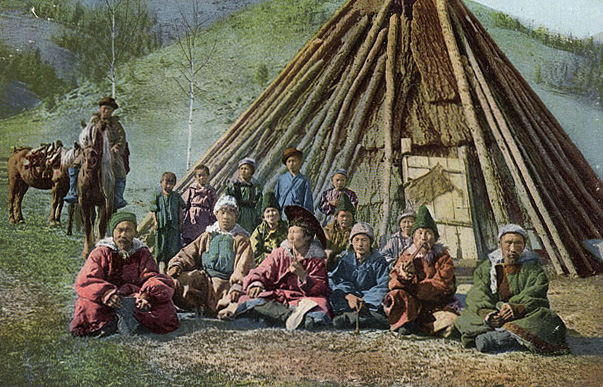
Most of the Southern Altaians traditionally lived in yurts. Many Northern Altaians mainly built polygonal yurts with conic roofs made out of logs and bark. Some Altai-Kizhi also lived in mud huts with birch bark gable roofs and log or plank walling. The Teleuts and a few Northern Altaians lived in conic homes made out of perches or bark. With the influx of Russians near the homeland of the Altaians, there was an increase of the construction of large huts with two to four slope roofs in consequence of Russian influence.[15] Despite the many social and political changes the Altaians have endured, many modern and settled families still keep a yurt in their yards. These yurts are usually used as a summertime kitchen or extra room.[32]

Clothing

[edit]
Altai woman in national dress

Historically, the traditional clothing of Southern Altaian men and women was very similar with little differences between the two.[33] Average clothing consisted of long shirts with wide breeches, robes, and fur coats. Other apparel often included fur hats, high boots, and sheepskin coats.[33] Northern Altaians and some Teleuts traditionally wore short breeches, linen shirts, and single-breasted oriental robes. Despite the fact that most Altaians today wear modern clothes, traditional wear still remains in use.[11]

Cuisine

[edit]

Altai cuisine consists of soups of horseflesh or mutton. Dishes with gopher, badger, marmot, fermented milk, cream (from boiled milk), blood pudding, butter, fried barley flour, and certain vegetables are also staples of Altai cuisine. Popular drinks include aryki (hard liquor made from kumis).[11][34]

Religion

[edit]

History

[edit]
Altai shaman with drum, Russian Empire, 1908[35]
Altai shamanic drum

Traditional Altai shamanism is rich with mythology and supernatural beings. Popular deities included Erlik, the god of the underworld, and Oyrot-Khan, a heroic figure who is a composite blend taken from historical Zungarian (Oirat) Khans and ancient legendary heroes. However, with many migrations, settlement changes, and the presence of Russians and their eventual union with the Russian Empire, the Altaians encountered three world religions: Buddhism, Christianity, and Islam. At first, the Altaians were indifferent and at times even hostile to these foreign faiths and their expansion in the region (modern Altai Republic). In 1829, a Russian Orthodox mission was founded in the region soon after it became a protectorate of the Russian Empire.[11] The mission and its missionaries were initially culturally sensitive and tolerant to the Altaians and their customs. However, the rise of Russian nationalism during the late 19th century caused the Russification of Orthodox Christianity in the country, and the mostly Russian clergy in Siberia also took up the ideology. This created intolerant views of the natives of Siberia (including the Altaians) and of their culture. This led to the rejection of Christianity by many Altaians, who saw it as a foreign Russian religion. However, Russian rule continued to grow increasingly strict both politically and religiously.[11] Russian Orthodox missionaries regularly confiscated land from Altaians who refused to convert to Christianity.[36] Altaians were often forcefully converted to Christianity.[37][38]

Mongolian Buddhist missionaries attempted to spread the faith among the Altaians during the 19th century. The Buddhist missionaries also encouraged the Altaians to unite together against the Russians. However, their activities and preaching were suppressed both by the Russian state and Orthodox Christian missionaries.[36] Buddhism made little headway among the Altaians but many Buddhist ideas and principles filtered into Altai spiritual beliefs.[36] However, some Altaians reportedly visited Mongolia and studied at Buddhist centers of learning before and after the rise of the Burkhanist movement in the early 20th century; indicating a significant Buddhist influence on the new religion.[39] Additionally, Mongolian Lamas were reported to have occasionally visited the region throughout the rest of the 19th century and into the early 20th century to dispense religious services to locals that requested them.[40]

Around 1904, the development of Burkhanism among the Altaians was underway. Burkhanism is a monotheistic religion named after Ak-Burkhan, a deity who is believed and recognized by its adherents to have been the sole god. Burkhanism was opposed to both the Russians and the traditional Altai shamans. The hostility towards the shamans was so great that the shamans had to seek protection from Russian authorities. The rise of the Bolsheviks in the first quarter of the 20th century also led to the brutal repression of all religions, which included the indigenous faiths of the Altai people. For the next few decades, public expressions of religion severely declined with only shamanistic and ancient polytheistic beliefs surviving the chaos. This was believed to have occurred because ancient religious beliefs could be easily orally transmitted from generation to another. It's also likely that no Burkhanist texts survived the repression and main sources for the beliefs of the religion come from Russian missionaries, travellers, and scholars.[11]

Modern spirituality

[edit]

Recently, both Burkhanism and traditional Altai shamanism have seen a revival in the Altai region, which is especially popular among Altaian youth. According to recent statistical studies, up to 70%[5] or 86 % (data of the Research State Institute of Altaic Studies)[4] of the Altaians continue to profess the "Altai Faith": Burkhanism, shamanism, and other native religions. According to Natalia Zhukovskaia, traditional Altai shamanism is the supreme religion of the majority of the Altai people.[8]

At present, shamanism is practiced by many Telengits, although there is a large amount that also profess Orthodox Christianity. Burkhanism is the main religion of the Altai-Kizhi, the largest group of Altaians, but there is a significant number of Orthodox Christians. The majority of Kumandins, Tubalars, Teleuts, and Chelkans are Russian Orthodox, although there is a significant minority that practice shamanism.[11] A few Altaians are Evangelical Christians[7] and Tibetan Buddhists.[32] There has been a revival of Tibetan Buddhism amongst the Altaians since the 1980s and there are now several Buddhist organizations, stupas and other religious infrastructure in the region.[41]

In principle, the division into the Burkhanists and shamanists has ceased to be relevant for the contemporary religiosity of the Altaians. According to a number of studies, by the beginning of the 21st century, there were practically no traditional shamans or classical Burkhanists anti-shamanists. The main one was the single "Altai Faith" (Altay: Алтай јаҥ, romanized: Altai jang)—a traditional ethnic religion in the form of a synthesis of Burkhanism with the remnants of Altai shamanism, Mongolian and Tibetan Buddhism, and other tribal beliefs and customs.[42][6]

Genetics

[edit]

Y Chromosome

Altai population can be divided into northern and southern clusters based on linguistics, culture, and genetics. According to a 2012 study that analyzed mtDNA (by PCR-RFLP analysis and control region sequencing) and nonrecombinant Y-DNA (by scoring more than 100 biallelic markers and 17 Y-STRs) obtained from Altaian samples, northern Altaians are genetically more similar to Yeniseian, Ugric, and Samoyeds to the north, while southern Altaians having greater affinities to other Turkic speaking populations of southern Siberia and Central Asia. The same study conducted a high-resolution analysis of Y chromosome Haplogroup Q-M242 that was found in Altaian samples and concluded that southern Altaians and indigenous peoples of the Americas share a recent common ancestor.[43]

According to a new study by Russian geneticists, a genetic separation of the northern and southern Altaians is undeniable. The southern Altaians are dominated by such variants of the Y chromosome haplogroup as Q-M242 and R1a, and there are also I-M170 and O-M175. Within the northern Altaians, the R1a haplogroup is dominant, Q-M242 is rarely found, and I-M170 and O-M175 are not found at all.[44]

Mitochondrial DNA

The maternal genetic ancestry of northern and southern Altaian populations was explored by characterizing coding region SNPs and control region sequences from 490 inhabitants of the Altai Republic. Differences in mtDNA haplogroup profiles were observed among northern Altaian ethnic groups and between northern Altaians and Altai-kizhi, with the Chelkans being extraordinarily distinct. Nevertheless, comparisons among other Altaian ethnic groups revealed some consistent patterns. mtDNA haplogroups B, C, D, and U4 were found in all Altaian populations, but at varying frequencies, whereas southern Altaians (Altai-kizhi, Telengits, and Teleuts) tended to have a greater variety of West Eurasian haplogroups at low frequencies. Shors, who have sometimes been categorized as northern Altaians,18 exhibited a similar haplogroup profile to other northern Altaian ethnic groups, including moderate frequencies of C, D, and F1, although they lacked others (N9a and U). Haplogroups C and D were the most frequent mtDNA lineages in the Altaians, consistent with the overall picture of the Siberian mtDNA gene pool.[45]

See also

[edit]

References

[edit]
[edit]
Revisions and contributorsEdit on WikipediaRead on Wikipedia
from Grokipedia
The Altai people, also known as Altaians, are a Turkic ethnic group indigenous to the in southern , , where they primarily reside in the and form about 34 percent of its population of approximately 211,000 as of 2023. They speak belonging to the Northern Turkic language family and are traditionally pastoral nomads who herd , , and sheep across the region's steppes and forests. The group comprises several subgroups, including the Altai-kizhi (southern), Kumandin, Tubalar, Chelkan, and Telengit (northern), reflecting adaptations to diverse ecological zones from mountainous to open plains. Historically, the Altaians trace their origins to ancient Turkic tribes that migrated to the Altai region around the 1st millennium BCE, interacting with neighboring Mongolic and Indo-European peoples, as evidenced by archaeological findings like the , though these predate the ethnogenesis of the modern Altaians. Their culture emphasizes oral epics recited by jomokchus (storytellers), shamanistic rituals invoking spirits for healing and guidance, and communal rites tied to nature and ancestry, which persisted despite Soviet-era suppression and have seen revival since the . Traditional practices include the use of ail (felt tents) for mobile herding life and horsemanship central to their identity, with many remaining bilingual in Altai and Russian today. In contemporary times, the Altaians navigate challenges of cultural preservation amid and economic shifts from nomadism to settled and , while asserting ethnic identity through revived —a syncretic blending and Tengriism—and advocacy for land rights in their sacred mountainous homeland. This resilience underscores their defining characteristics as stewards of a rugged, spiritually charged landscape that has shaped Central Asian nomadic traditions for millennia.

Ethnic Composition

Subgroups and Diversity

The Altai people exhibit internal diversity through ethnographic classifications primarily divided into northern and southern subgroups, delineated by linguistic dialects and historical settlement patterns rather than uniform ethnic purity. Northern Altaians encompass the Tubalars (also known as Tuba-Kizhi), , and Chelkans, who traditionally occupied forested and riverine areas in the northern Altai foothills, engaging in , , and limited . Southern Altaians include the Altai-kizhi (or simply Altai), , and , associated with more open and mountain terrains suited to nomadic herding. These divisions stem from 19th-century Russian ethnographic surveys and linguistic analyses distinguishing Northern Altai dialects (with Oghuz and Kipchak influences) from Southern ones (closer to Kyrgyz and Teleut variants). This subgroup structure reflects centuries of cultural and ethnic admixture with neighboring populations, including Oirat Mongols to the south and east, in adjacent Siberian territories, and Russian settlers from the 18th century onward, resulting in heterogeneous practices such as blended shamanistic rituals with elements of Mongolian among southern groups and Orthodox influences in the north. Such interactions, documented in imperial Russian administrative records and traveler accounts, contradict notions of isolated descent, as subgroups like the trace partial origins to Yeniseian River migrations involving Mongol-Turkic fusions around the 17th century. Historically, Altai subgroups have self-identified with ancient Turkic confederations, grounded in archaeological evidence of 5th-century CE Ashina clan resettlements to the Altai from , as recorded in Chinese annals describing migrations of approximately 500 Ashina families that contributed to early Turkic polities in the region. This linkage, rather than implying unbroken lineage, aligns with documentary traces of Turkic tribal amalgamations in the Altai as a convergence point for nomads, without reliance on unsubstantiated claims of primordial homogeneity.

Linguistic and Cultural Affiliations

The Altai language, spoken by the Altai people, belongs to the Siberian subgroup of the , characterized by its northeastern Turkic features including and agglutinative morphology typical of Turkic tongues. It comprises two primary dialect clusters—Northern Altai (associated with subgroups like the Kumandin and Tubalar) and Southern Altai (Telengit and Altai proper)—which exhibit but diverge in and due to historical isolation in the mountainous terrain. These dialects incorporate substantial loanwords from Mongolian, reflecting centuries of interaction with Mongolic-speaking neighbors, and from Russian, introduced through imperial and Soviet administrative dominance, with estimates suggesting up to 20-30% of modern vocabulary derives from these sources in everyday usage. While the broader Altaic hypothesis—proposing a genetic link between Turkic, Mongolic, and —has been advanced based on typological similarities like subject-object-verb , it remains widely rejected by historical linguists as a phenomenon driven by areal convergence rather than shared ancestry, with regular sound correspondences lacking empirical validation. Altai linguistics thus prioritize demonstrable Turkic substrates, such as shared core vocabulary for and (e.g., terms for horse-related activities), over speculative macro-family ties, emphasizing evolutionary divergence from Proto-Turkic around the 1st millennium CE. Culturally, the Altai people align with core Turkic traits, including patrilineal structures organized around ail ( units) and oral traditions of epic storytelling that parallel those in other Siberian Turkic groups, yet they diverge from Kipchak-branch in motifs, favoring mountain-centric cosmogonies involving sacred peaks and ancestral spirits over the vast-steppe hero narratives dominant among . systems emphasize totemic taboos and within seok lineages, akin to Tuvinian practices but distinct in their integration of localized Altai environmental symbolism—such as and eagle motifs—contrasting with the more nomadic, horse-centric genealogies of , who prioritize avoidance of consanguineous ties through broader tribal confederations. These affiliations underscore a Turkic substrate adapted to highland ecology, fostering unique like felt variants suited to alpine mobility, separate from the open-plains adaptations of neighboring groups.

Historical Origins and Development

Prehistoric and Ancient Periods

The have yielded archaeological evidence of human occupation dating back to the era, but systematic pastoralist settlements emerged during the Early with the , spanning approximately 3300–2500 BCE in the northwestern Altai region. This culture, characterized by burials, pit houses, and the introduction of domesticated sheep, goats, cattle, and horses alongside copper metallurgy, reflects an influx of populations linked to early Indo-European speakers from the Pontic-Caspian steppe, as evidenced by ceramic styles, burial rites, and faunal remains indicating mobile herding economies. Local admixtures with pre-existing East Asian-related groups are suggested by the presence of indigenous elements influencing Afanasievo through interactions, though the primary vector for was exogenous migration rather than development. By the Middle (circa 2000–1000 BCE), genetic analyses of human remains from Altai burials reveal significant East-West Eurasian admixture, with haplogroups such as H, U, and T (Western Eurasian) co-occurring with A, C, and D (Eastern Eurasian), indicating intermixing of Afanasievo-derived groups with incoming or local East Asian components predating later expansions. This period marks a consolidation of economies, supported by evidence of millet cultivation alongside , as millet grains appear in Afanasievo and subsequent sites, facilitating sustained mobility in the mountainous terrain. complexes from transitional phases show evolving , including tools and weapons, pointing to technological continuity amid demographic shifts. The Late to Early transition around 1000 BCE saw the rise of , exemplified by Scythian-influenced cultures like the Karasuk and subsequent Pazyryk complex (5th–3rd centuries BCE), where over 600 kurgans in the Altai, including frozen tombs preserving organic artifacts, attest to domestication, wheeled vehicles, and advanced ironworking. , featuring tattooed mummies, felt textiles, and sacrifices, demonstrate a warrior elite society reliant on transhumant herding across and highland zones, with petroglyphs and alignments providing further evidence of landscapes tied to mobility. from these contexts underscores genetic continuity with admixtures but highlights ongoing influxes, challenging notions of static indigeneity and aligning with broader proto-Turkic dispersals through recurrent migrations rather than isolated development.

Medieval Turkic Era and Migrations

The Turkic tribes of the Altai region, including precursors to modern Altaians, formed part of the foundational nomadic confederations that enabled the rise of the Göktürk Khaganate in 552 CE, when of the Ashina clan overthrew Rouran overlords and consolidated control from the eastward. These tribes supplied warriors and metallurgists, leveraging Altai's iron resources for the khaganate's expansive military campaigns that subdued neighboring groups and established a dual khagan system governing vast territories from the Altai to the . Internal divisions and defeats by Tang China fragmented the khaganate by the 740s CE, yet Altai-based groups adapted through alliances, contributing to the transitional Uyghur Khaganate's dominance from 744 to 840 CE, during which Turkic cultural elements like and shamanistic practices persisted in the periphery. The Mongol conquests of the early 13th century further reshaped Altai demographics through direct subjugation and integration; Genghis Khan's forces compelled the Oirat tribes, resident in the Altai and adjacent forests, to submit in 1208, incorporating them as a western Mongol vanguard for subsequent campaigns. This era saw the emergence of distinct subgroups, with Oirats evolving as a semi-autonomous Mongolic cluster under Mongol imperial oversight, while Teleuts—descended from the ancient Tiele confederation of Turkic nomads—retained linguistic and herding traditions amid alliances with Oirat khans by the 14th-15th centuries. Post-imperial fragmentation after 1260 CE prompted migrations of Turkic and Mongolic elements from Central Asian steppes into the Altai, driven by power vacuums and resource competition following the khanates' collapse. Amid these shifts, Altai groups transitioned toward intensified herding, alternating high-altitude summer pastures with valley winters to exploit the region's ecological niches, a practice rooted in earlier nomadic economies but amplified by medieval climatic fluctuations like the onset of cooler periods around the 13th century. Chronicles such as The Secret History of the Mongols document these adaptations, portraying Oirat and allied tribes as mobile herders of sheep, , and who leveraged seasonal mobility for resilience during conquests and integrations. Such strategies facilitated survival and expansion, with Teleut bands maintaining horse-based raiding economies that intertwined with Oirat overlords until the 15th century Oirat confederation solidified control over Altai highlands.

Russian Imperial and Soviet Integration

Russian expansion into the Altai region accelerated in the late 17th and early 18th centuries, with Cossack detachments establishing forts that fragmented traditional nomadic grazing lands. By 1709, the founding of Biysk fortress marked a key incursion, facilitating control over southern Siberia and imposing the yasak fur tribute system on indigenous groups, including the Altai people, which strained their pastoral economy through coerced labor and resource extraction. This integration disrupted autonomous tribal structures, leading to periodic resistance, such as localized uprisings against tribute collectors in the 19th century that highlighted tensions over land and sovereignty. Under Tsarist rule, the Altai people faced gradual , with operations in the from the onward attracting Russian settlers and further encroaching on native territories, while administrative divisions subordinated local clans to imperial governors. The obligations, enforced via Cossack enforcers, often resulted in debt cycles and population displacements, as nomadic herders were compelled to supply furs annually, undermining self-sufficiency. In the Soviet period, the Oyrot Autonomous Oblast was established on June 1, 1922, as a nominal ethnic territory within the Russian SFSR, ostensibly granting limited to the Altai people amid Bolshevik nationalities policies. However, from the onward, aggressive efforts promoted Russian as the in schools and administration, marginalizing and fostering . Collectivization campaigns in the 1930s enforced sedentarization, dismantling nomadic pastoralism through forced settlement into kolkhozes, which devastated traditional livelihoods and triggered demographic declines; Soviet censuses recorded the Altai population dropping from approximately 50,000 in 1926 to 45,000 by 1959, attributable to famines, purges, and relocation hardships. Literacy drives under the likbez program, launched in the 1920s, raised education levels but prioritized ideological conformity over cultural preservation, with Russian-medium instruction accelerating the erosion of indigenous practices. These policies, while modernizing infrastructure, causally linked to reduced autonomy and traditional authority, as purges targeted perceived nationalist elements among Altai elites.

Post-Soviet Autonomy and Challenges

The Gorno-Altai Autonomous Oblast was elevated to the Gorno-Altai Autonomous Soviet Socialist Republic on July 3, 1991, amid the Soviet Union's dissolution, granting it nominal within the Russian Federation. It was renamed the on March 31, 1992, marking a formal transition to republic status with initial efforts to revive indigenous Altai cultural practices, such as traditional and promotion, through local structures. However, these developments occurred within Russia's , where the republic's economy—dominated by and livestock rearing—remained heavily reliant on federal subsidies and transfers from , limiting true fiscal independence. In the 2020s, challenges intensified as centralizing reforms eroded local self-rule. On June 21, 2025, thousands rallied in against Governor Andrey Turchak's proposed municipal overhaul, which abolished the two-tier local government system, consolidating power at the district level and facilitating land appropriation by external investors. Protesters, numbering around 4,000 according to organizers, demanded Turchak's resignation and restoration of the republic's 1997 , viewing the changes as enabling tycoons and Moscow-backed businesses to seize communal lands previously protected by village councils. Similar demonstrations on June 13 and 24 led to arrests, underscoring fears of merger with the neighboring and dilution of Altai ethnic representation in governance. The 2022 partial mobilization further strained the republic's , with disproportionate recruitment from rural indigenous communities exacerbating existing demographic pressures in a where Altai people comprise about 35-40% of the 221,500 . These efforts, part of broader wartime policies, highlighted the republic's subordinate position in federal , where local objections yielded little influence over quotas or . Despite republic status, persistent economic subordination and political centralization have constrained Altai , fostering resentment toward perceived overreach from the federal center.

Demographics and Geography

Population Distribution

The Altai people number approximately 78,000 in as of the 2021 census, with the vast majority concentrated in the , where they comprise 37% of the republic's 210,924 residents. Ethnic form the plurality at 53.7%, underscoring the demographic majoritization by Slavic settlers in the titular indigenous republic. Beyond the , smaller communities exist in (numbering in the low thousands) and scattered across other Siberian regions, while several thousand reside in neighboring and China's Uyghur Autonomous Region's , though not always enumerated distinctly from related Turkic groups. Within the Altai Republic, Altaians predominate in rural, mountainous districts such as Kosh-Agach (where they account for about 44% alongside Kazakh majorities), Ulagansky, and Chemalsky, reflecting traditional lifestyles in highland areas. The republic overall remains 69% rural, with Altaians disproportionately represented outside urban centers like , the capital, which draws for employment and services. Demographic pressures include net out-migration from rural Altaian communities to urban areas and beyond, contributing to population stagnation despite a of 2.03 in the (above Russia's national average of around 1.4). These trends, combined with historical Russian influxes, sustain Altaians' minority status, with projections indicating continued relative decline absent policy interventions. The indigenous Altai population, concentrated primarily in Russia's , has seen gradual amid broader modernization pressures, though the republic maintains one of the lowest rates among Russian federal subjects at approximately 30% urban as of the 2021 census, up from even lower levels in the late Soviet era. This shift reflects socioeconomic drivers such as employment in mining industries—particularly and extraction—and pursuit of higher education in urban hubs like , which drew rural youth away from traditional during the post-1990 socio-economic transition stage of . Consequently, younger Altaians exhibit declining proficiency in nomadic skills, with ethnographic observations noting a generational erosion of knowledge in and seasonal due to urban job preferences and formalized schooling. Demographic imbalances have intensified, including a skew toward female-majority rural areas from out-migration for wage labor in extractive sectors and heightened vulnerability to drafts, as seen in regional patterns during conflicts like the 2022 onward operations in . The Altai Republic's aging coefficient stood at 18.5% in 2018, among Russia's higher regional figures, signaling an elderly-dependent structure exacerbated by low (around 2.03 births per woman in 2023) and net population outflows, with UN projections for anticipating further aging through mid-century absent offsetting migration. Interethnic intermarriage, particularly with , has risen in urban settings, diluting distinct Altaian ethnic markers as documented in marriage structure analyses; for instance, unions with Russian-speakers predominate among northern Altaian subgroups like and Tubalars, while town-based populations show elevated mixed rates approaching or exceeding 50% in some locales. These trends, per ethnographic surveys, contribute to pressures by reducing endogamous transmission of language and customs, though rural pockets retain higher ethnic homogeneity.

Genetic and Anthropological Profile

Key Genetic Studies

A study analyzing Y-chromosomal haplogroups in Northern and Southern Altaians identified 18 distinct lineages, with Northern groups exhibiting higher frequencies of R1a (41%), associated with West Eurasian steppe expansions, alongside Q (17%) and N (12%), the latter linked to Siberian and Uralic influences; Southern groups showed reduced R1a (22%) but elevated C (22%), indicative of East Asian contributions. Subsequent analyses confirmed R1a-Z93 subclades exceeding 30% in South Siberian Altai populations, underscoring Indo-Iranian-era without implying unadmixed descent. Autosomal DNA research, including ADMIXTURE and , reveals admixture proportions typically ranging from 40-60% East Eurasian/Siberian and 30-50% West Eurasian ancestry in modern Altaians, varying by subgroup and modeled via TreeMix to reflect multiple migration edges rather than binary origins. A 2014 analysis of Middle Altai remains demonstrated early uniparental admixture, with both Western (e.g., R1a) and Eastern (e.g., C, ) Y-DNA alongside ancestry-informative markers showing mixed Eurasian phenotypes, predating Turkic . These models debunk notions of genetic homogeneity, highlighting recurrent ; Northern Altaians cluster closer to West Eurasian references, while Southern subgroups exhibit stronger East Asian affinities, correlating with geographic gradients. Ancient DNA linkages trace West Eurasian components to Afanasievo (ca. 3300-2500 BCE) and Andronovo (ca. 2000-900 BCE) cultures in the Altai, with R1a and autosomal signatures persisting amid later Eastern influxes documented in 2020s syntheses of regional . Shared Y-haplogroup variants and autosomal affinities with Beringian populations further connect Altaians to Native American founder events, though without direct migration; qpAdm models estimate minimal but detectable Paleo-Siberian input via intermediate carriers. No unified "Altai genome" exists, as subgroup variability—e.g., Telengit dominance of R1a-YP1518 (58%) versus lower frequencies in Altai-Kizhi—reflects localized admixture histories rather than pan-regional purity.

Physical Anthropology and Admixtures

The Altai people display heterogeneous physical phenotypes, reflecting historical admixtures between Central Asian and Eurasian Caucasoid populations. Northern subgroups, including the Chelkans, , and Tubalars, tend toward dolichocephalic cranial indices and other Caucasoid traits such as narrower facial profiles, while southern subgroups like the Altai-kizhi and exhibit brachycephalic skulls, epicanthic eye folds, and broader nasal bridges characteristic of Central Asian types. These distinctions align with mid-20th-century classifications by Soviet ethnographer L.P. Potapov, who attributed southern Altaians to the brachycephalic Central Asian racial subtype akin to Tuvinians and . Anthropometric surveys of southern highland populations reveal robust thoracic dimensions, with average chest circumferences exceeding those of lowland northern groups by up to 5-7 cm in males, adaptations linked to the demands of high-elevation residence (1,500-3,000 meters) and labor. Such features, documented in 1990s-2000s studies of over 600 indigenous southern Altaians, include increased biacromial breadth and overall mesomorphic builds suited to hypoxic conditions and seasonal migrations. Epicanthic folds and straight predominate across subgroups, though prevalence varies, with southern frequencies approaching 80-90% in traditional communities per early Soviet craniometric data. Urbanization and interethnic marriages, particularly with since the mid-20th century, have blurred these markers, yielding greater phenotypic variability in younger generations; for instance, rural southern Altaian women retain higher rates of traits than urban counterparts, where mixed Eurasian features increase due to . Twentieth-century surveys, such as those by Levin and Potapov in the , noted purer expressions of subgroup traits in isolated herders, contrasting with contemporary dilution from settlement policies and mobility.

Traditional Culture and Economy

Nomadic Lifestyle and Subsistence

The traditional economy of the Altai people, particularly the Southern groups such as the Altai-kizhi and Telengit, centered on semi-nomadic pastoralism involving transhumant herding of livestock including sheep, goats, horses, cattle, and yaks. Families moved seasonally between lower steppe valleys in winter and higher taiga pastures in summer to exploit varying forage availability in the Altai Mountains' diverse ecological zones. Horses facilitated mobility and transport, while yaks and cattle provided dairy, meat, and labor suited to rugged terrains, with herd sizes historically limited to sustainable levels around 100-500 animals per family to avoid depleting pastures. Hunting and gathering supplemented herding, with northern subgroups like the relying more heavily on pursuits of deer, , and small game using bows and traps, alongside collection of berries, roots, and pine nuts from forests. These activities ensured dietary diversity but yielded lower caloric returns compared to livestock products, which formed the subsistence core amid the region's short growing seasons and harsh winters. Following Russian expansion into the Altai in the , Altai herders engaged in trade of furs and skins, such as and pelts obtained through , exchanging them for metal tools, , and textiles at outposts. This integration into the Siberian fur economy provided essential goods but shifted some labor from pure subsistence toward commercial , exposing communities to market fluctuations. Ecological constraints shaped sustainability, with historical records indicating vulnerabilities to in confined valleys during prolonged droughts or pressures, reducing grass regrowth and herd viability to as low as 20-30% survival in severe cases. Climate variability, including cold snaps and erratic in the taiga-steppe , further limited yields, enforcing low-density nomadic patterns to maintain long-term regeneration.

Material Culture and Crafts

The Altai people's traditional dwellings, such as the ail, consist of conical structures framed with poles and covered in or felt, enabling rapid assembly, disassembly, and horse transport essential for their nomadic economy. These portable homes, alongside yurts and chadyrs, provide insulation against Altai's extreme temperatures, with felt offering waterproofing and thermal regulation derived from local sheep . Construction prioritizes functionality, using lightweight materials to facilitate seasonal migrations across mountainous terrain. Clothing emphasizes durability and mobility, crafted from wool felt, sheepskin, fur, and leather to withstand cold climates and horseback travel. Key garments include the nekey ton, a long thick fur sheepskin coat for winter protection; the chekpen, a national gown; and boots like the bychkak ödÿk made from lower leg fur for grip and warmth during riding. Southern Altaians historically tailored these items at home, with married women specializing in complex pieces like the chegedek sleeveless jacket, now revived in post-Soviet workshops using machine embroidery and imported silks alongside traditional furs. Crafts extend to equestrian tools, including saddles assembled from layered felt, leather, and wooden frames, designs traceable to Scythian-era artifacts in Pazyryk kurgans from the 5th to 3rd centuries BCE. Jewelry and decorative metalwork draw from this heritage, with modern artisans revitalizing the Scythian animal style—featuring bronze or silver depictions of deer, griffins, and ibex—for functional adornments like harness fittings and personal ornaments. Culinary practices reflect pastoral resources, centering on mutton and smoked over wood fires for 6 to 24 hours to preserve portability for nomads, often consumed raw or with minimal cooking. fermentation yields kumys, a mildly from mare's churned in sacks, aiding and nutrition during migrations; this technique, using natural lactic , sustains herders in remote areas. Preparation tools include wooden churns and horn vessels, underscoring crafts' integration with subsistence.

Oral Traditions and Arts

The Altaian oral epic tradition features extensive heroic cycles recited by specialized performers known as jomok, who deliver narratives of ancient heroes, battles, and cosmological events. Major epics include Maadai-Kara, comprising 7,738 verses as performed by jomok Aleksej G. Kalkin (1925–1998), and Kaan Püdäi, documented by Wilhelm Radloff in the 19th century. These epics preserve motifs of tribal conflicts and migrations, with comparative linguistic analysis revealing shared Turkic roots, such as recurring themes of steppe warfare verifiable against archaeological evidence of Iron Age fortifications in the Altai region dating to 800–300 BCE. Recitation employs kai, a traditional throat-singing technique producing a dual-toned with intelligible , often accompanied by the topšuur, a three-stringed plucked tuned to complement the vocal style. This performative mode embeds historical kernels, such as clan alliances and horse-mounted raids, corroborated by petroglyphs and artifacts from the Altai-Sayan uplands depicting analogous equestrian warfare scenes from the 1st millennium BCE. Origin myths in Altaian lore, transmitted orally, recount descent from a guiding ancestral tribes from heavenly realms to earthly domains, a motif paralleled across Turkic groups and echoed in ancient Altai where wolf symbols evolve from realistic depictions to abstract totems by circa 10,000–3,000 years ago. Such narratives align with archaeological wolf imagery in (5th–3rd centuries BCE), including felt appliqués and tattoos suggesting totemic significance among proto-Turkic nomads, though causal links remain inferential without direct epigraphic ties. The shift to literacy in the early 20th century, accelerated by Soviet education policies introducing Cyrillic scripts by 1928, disrupted intergenerational transmission, reducing the number of proficient jomok and favoring written records over live recitation. By the late Soviet era, few elders retained full epic repertoires, with performances confined to cultural enclaves amid urbanization.

Religion and Belief Systems

Shamanistic Foundations

Traditional Altaian rests on animistic beliefs centered on eezi, the master spirits inhabiting natural features such as mountains, rivers, valleys, and springs, which are propitiated to ensure harmony and prosperity. These spirits, including ancestral and place-bound entities, are invoked through offerings and sacrifices to secure successful , avert misfortunes, and maintain ecological balance in the rugged Altai terrain. Ethnographic accounts from the late 19th and early 20th centuries document rituals involving animal sacrifices to eezi of game animals, reflecting practical adaptations to subsistence in a harsh, resource-scarce environment where such communal rites fostered social coordination and risk-sharing among herders. The kam, or shaman, serves as the primary mediator between humans and these spirits, achieving ecstatic trance states via rhythmic drumming on hide-covered instruments to diagnose illnesses, predict outcomes, and negotiate with supernatural entities. Documented in field studies by Russian ethnographers like Andrey Anokhin in the 1910s-1920s, kam performed healing rituals combining herbal remedies with incantations, attributing ailments to spirit imbalances while leveraging observable pharmacological effects from local plants, which provided empirical efficacy beyond mere superstition in isolated communities lacking formal medicine. Drums, often personalized and "animated" through initial ceremonies, symbolized the shaman's authority and facilitated spirit journeys to upper or lower worlds, as described in 19th-century reports by explorers like G. N. Potanin. These practices, while rooted in unverifiable supernatural causal claims, demonstrably supported survival through reinforced communal bonds and experiential knowledge of environmental cues—such as timing hunts after spirit appeasement to align with seasonal migrations—evident in persistent oral traditions and archaeological correlates like ritual sites predating Russian contact. In the Altai's extreme climate, where empirical success in and directly impacted mortality, shamanic offered a framework for collective decision-making, distinguishing adaptive cultural mechanisms from purely illusory elements.

Burkhanism and Syncretic Movements

Burkhanism, known locally as Ak Jang or "White Faith," emerged in May 1904 among the Altai people in the Gorny Altai region of the , triggered by a vision reported by a local figure named Chet Chelpan, who described encountering a white-clad entity bearing a rider symbolizing impending deliverance. This movement blended indigenous with prophetic elements envisioning the revival of a pure, ancestral , centered on the Ak Burkhan as a benevolent sky spirit promising prosperity and the expulsion of Russian colonial influences. It manifested as a nativist response to land reforms and cultural pressures, attracting thousands by rejecting blood sacrifices and ancestor cults associated with traditional in favor of ethical reforms and communal rituals emphasizing moral purity and . Prophecies tied to the movement anticipated the return of Oirot Khan, a legendary leader, heralding a messianic of Altaian sovereignty by 1910–1912, which fueled millenarian fervor and social mobilization. Soviet authorities suppressed in the and , viewing its unifying potential across Siberian Turkic groups as a nationalist threat that could undermine Bolshevik control, leading to the execution or of key proponents and the dispersal of adherents. Underground persistence occurred through oral transmission, but overt practice ceased amid campaigns. Following the Soviet Union's dissolution in 1991, partial revival ensued, driven by Altaian intellectuals seeking to reconstruct ethnic identity amid post-communist cultural erosion, with organizations like the group promoting Ak Jang as a syncretic framework integrating shamanistic rites with modern nationalist symbolism. This resurgence appealed to those experiencing demographic dilution and loss of traditional lifeways, though participation remained limited, estimated at under 20% of the population in surveys by the early . The millenarian core of , promising apocalyptic renewal through Ak Burkhan's intervention and the advent of Oirot Khan to end foreign domination, empirically faltered as historical events diverged from predictions: no sovereign Altaian state materialized, Russian imperial control transitioned seamlessly to Soviet incorporation by , and promised abundance yielded instead to collectivization famines and cultural suppression in . These unfulfilled prophecies, rooted in claims without verifiable causal mechanisms, highlight the movement's role as a reactive ideology rather than prescient framework, as subsequent integration into the USSR precluded the isolated ethno-religious envisioned, underscoring patterns observed in similar nativist revivals where eschatological hopes confronted geopolitical realities. Post-revival iterations have tempered such , focusing instead on cultural preservation amid ongoing Russian federal oversight.

External Religious Influences

Russian Orthodox missionary efforts in the Altai region intensified during the , particularly from the 1830s onward, aiming to integrate indigenous populations into the empire through and sedentarization. Despite establishing missions and schools, conversions remained largely nominal; by 1913, formal records indicated widespread among Altaians, but adherence was superficial, with many continuing shamanistic practices covertly due to cultural resistance and coercive tactics like land confiscation for non-converters. Overall penetration was limited, with estimates suggesting active Orthodox identification among Altaians never exceeding around 20-30% even in the Republican era, reflecting persistent traditionalist holdouts. Buddhist influences arrived indirectly via Oirat Mongol and Kalmyk migrations and trade routes, introducing elements into Altaian iconography and terminology despite the Turkic Altaians' non-adoption of as a primary . Altaians incorporated Mongolian-derived words for ritual objects, such as süme or khüree for monasteries, and syncretic motifs like lotus symbols or protective icons in shamanic art, blending them with animistic foundations rather than fully converting. This peripheral adoption underscores resistance to wholesale doctrinal shifts, with serving more as a cultural overlay than a transformative force, evidenced by the absence of established monasteries or mass adherence pre-20th century. The Soviet era imposed through propaganda campaigns in the Altai region from the 1960s to 1980s, suppressing religious expression via atheist lectures, media, and repression of shamans and , which eroded overt and fostered nominal among many Altaians. Post-1991 surveys indicate this legacy is waning, with revival of indigenous faiths outpacing Orthodox retention; for instance, regional data show declining self-identified atheists alongside growing identification with traditional beliefs, signaling incomplete and cultural rebound against imposed ideologies.

Contemporary Society and Issues

Political Representation and Protests

The , a federal subject of predominantly inhabited by the indigenous Altai people, maintains nominal through a unicameral and a head of state appointed by the Russian president, yet local has faced progressive centralization. In June 2025, the republic's enacted a single-tier system of local self-government, abolishing municipal councils across its ten districts and consolidating authority at the regional level, in alignment with federal legislation signed by President in March 2025. This reform, implemented despite opposition, has been characterized by independent analysts as diminishing grassroots democratic structures and enhancing control by regional elites aligned with . These changes provoked widespread protests, marking one of Russia's largest demonstrations during the ongoing Ukraine conflict. On June 21, 2025, approximately 5,000 residents rallied in the capital, , decrying the erosion of local autonomy and demanding the restoration of the republic's prior constitutional framework, alongside the resignation of Governor . Participants, including indigenous Altai activists, emphasized the reforms' threats to ethnic representation and , with chants and banners protesting the favoritism toward oligarchic interests in regional . Subsequent legal challenges, including a rejected by the republic's in August 2025, underscored the entrenched nature of these centralizing measures. Indigenous-led has intertwined these disputes with broader grievances over and external pressures. Critics, including local opposition figures, have highlighted how the dissolution of municipal oversight facilitates opaque deals in and extraction industries, where Altai's mineral wealth—such as and rare earths—has long been contested amid allegations of . While direct evidence of in specific 2025 contracts remains under investigation by regional watchdogs, the protests amplified calls for transparency in licensing processes, reflecting longstanding tensions between federal priorities and Altai communal interests. By late 2025, these events had not reversed the reforms but galvanized networks of Altai , fostering alliances with other Siberian indigenous groups against perceived .

Environmental and Land Rights

The Altai people encounter persistent resource conflicts in the , a inscribed in 1998, where proposals threaten sacred sites and hotspots. For instance, plans for near Lake Teletskoye, such as the Brekchiya deposit, have prompted meetings and opposition from communities citing risks to endemic like and argali sheep, as well as cultural of areas revered in indigenous traditions. Efforts by groups like the Fund for 21st Century Altai have previously halted large-scale , underscoring tensions between extractive industries and preservation of the region's altitudinal vegetation zones, which span from steppes to glaciers. Climate change intensifies these disputes by accelerating permafrost thaw on the —a sacred burial ground for Altaians—and diminishing grazing capacities essential to semi-nomadic . In western Mongolian Altai regions overlapping indigenous territories, over 70% of households report land shortages for , with 61-84% attributing declines to recent warming that fragments habitats and reduces . Such environmental shifts, including altered and , have contributed to a broader of traditional livestock-based economies, compelling pragmatic shifts toward mixed subsistence despite cultural emphases on harmonious land rooted in animistic beliefs. Russian legal frameworks for indigenous small-numbered peoples provide nominal protections under laws like Federal Law No. 82-FZ (2000), yet Altaians are frequently excluded from "indigenous" status due to population thresholds exceeding 50,000, allowing federal overrides of local claims in favor of pipelines and resource extraction. Conflicts, such as 2012 disputes over Gazprom's gas projects traversing protected zones, illustrate how environmental impact assessments are often bypassed or deemed insufficient, prioritizing national energy goals over community rights. Indigenous land defenders face harassment and legal reprisals, reflecting systemic enforcement gaps despite international standards like the UN on the of Indigenous Peoples. A tourism influx, reaching 2.64 million visitors in 2023—up from 2.2 million in —exacerbates ecological strain through unregulated off-road access and waste accumulation in UNESCO buffer zones, degrading soils and water sources critical for pastoral viability. IUCN assessments highlight uncontrolled development in regional parks leading to , with indigenous groups establishing mountain parks to safeguard sacred locales amid these pressures. While Altaian cosmology instills deep ecological reciprocity, federal policies often undervalue such perspectives, favoring economic gains from visitation that amplify cumulative degradation without commensurate mitigation.

Cultural Revitalization and Tourism Impacts

Efforts to revitalize Altai culture intensified after the Soviet Union's collapse in , with initiatives including language instruction programs in schools and the promotion of traditional festivals to preserve oral traditions and ethnic identity. These measures aimed to counter decades of policies that suppressed indigenous practices, leading to a 30% increase in students studying Altaian as a between and 2003. Additionally, contemporary crafts have incorporated revived motifs from ancient , such as the Scythian , to foster self-identification and economic viability through artisanal production. Despite these programs, Altai language fluency remains critically low, with surveys indicating only 2% of the population proficient, and youth demonstrating subtractive bilingualism favoring Russian over Altaian due to dominant educational and media influences. This linguistic erosion undermines broader cultural transmission, as empirical data from assessments show 73% fluency in Russian contrasted against minimal Altaian competence among children. Ethnographic analyses attribute this to globalization's assimilative pressures, where urban migration and media exposure prioritize Russian for socioeconomic mobility, causal factors rooted in post-Soviet economic disparities rather than deliberate alone. Tourism in the , driven by the region's natural landscapes, has generated seasonal income but facilitated the commodification of , with non-local practitioners conducting rituals at sacred sites, eliciting resistance from indigenous shamans who view such acts as dilutions of authentic spiritual authority. Indigenous perceptions, gathered via surveys in rural communities during 2018–2019, reveal mixed support for development, with cultural impacts—such as staged performances—enhancing economic ties yet risking erosion of through superficial engagements. Recent 2023 excavations uncovering artifacts from the , including warrior statues and nomadic relics, have reinforced heritage narratives, potentially aiding revival by linking modern identity to verifiable Turkic ancestry amid -driven interest. However, ethnographic studies document tangible erosions, such as of sacred rivers like the Katun from tourist influxes, which disrupt subsistence patterns and spiritual landscapes central to Altai .

References

Add your contribution
Related Hubs
User Avatar
No comments yet.