Hubbry Logo
ArhatArhatMain
Open search
Arhat
Community hub
Arhat
logo
8 pages, 0 posts
0 subscribers
Be the first to start a discussion here.
Arhat
Arhat
from Wikipedia

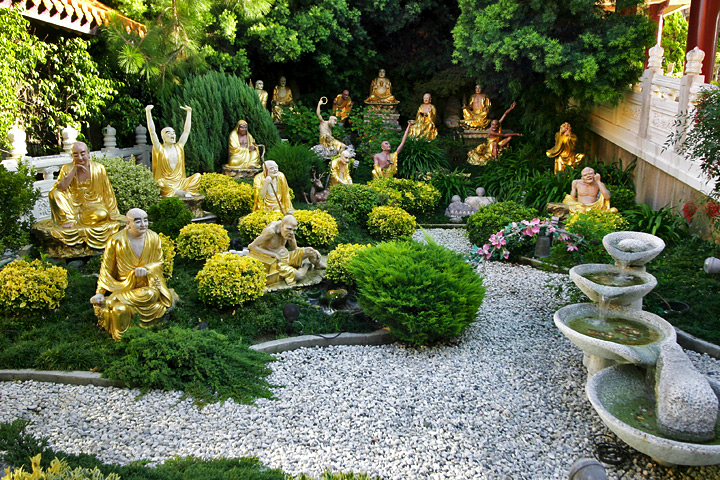
Arhat Garden at Hsi Lai Temple — in the San Gabriel Valley of Southern California.
Translations of
Arhat
Sanskritअर्हत्
(IAST: Arhat)
Paliअरहंत्
(Arahant or Arhant)
Bengaliঅর্হৎ
(ôrhôt)
Burmeseရဟန္တာ
(MLCTS: ra.ha.nta)
Chinese阿罗汉, 罗汉
阿羅漢, 羅漢 (Traditional)
(Pinyin: āluóhàn, luóhàn)
Japaneseあらかん
(Kanji: 阿羅漢, 羅漢)
(Katakana: アルハット)
(Rōmaji: arakan, rakan)
Khmerអរហន្ត
(Arahon)
Korean아라한, 나한
(Hanja: 阿羅漢, 羅漢)
(RR: arahan, nahan)
Sinhalaඅරහත්, රහත්
(Arahat, Rahat)
Tibetanདགྲ་བཅོམ་པ།
(Wylie: dgra bcom pa)
Tamilஅருகன்
(Aruhan)
TagalogAlhat
(Baybayin: ᜀᜎ᜕ᜑᜆ᜕)
Thaiอรหันต์
(RTGS: arahan)
VietnameseA-la-hán, La hán
(Chữ Nôm: 阿羅漢, 羅漢)
Glossary of Buddhism

In Buddhism, an Arhat (Sanskrit: अर्हत्) or Arahant (Pali: अरहंत्, 𑀅𑀭𑀳𑀦𑁆𑀢𑁆) is one who has gained insight into the nature of existence, has achieved Nirvana,[1][2] and has been liberated from the endless cycle of rebirth.

The understanding of the concept has changed over the centuries, and varies between different schools of Buddhism and different regions. A range of views on the attainment of arhats existed in the early Buddhist schools. The Sarvāstivāda, Kāśyapīya, Mahāsāṃghika, Ekavyāvahārika, Lokottaravāda, Bahuśrutīya, Prajñaptivāda, and Caitika schools all regarded arhats as imperfect in their attainments compared to buddhas.[3][4][5]

Mahayana Buddhist teachings urge followers to take up the path of a bodhisattva, and to not fall back to the level of arhats and śrāvakas.[6] The arhats, or at least the senior arhats, came to be widely regarded by Theravada buddhists as "moving beyond the state of personal freedom to join the Bodhisattva enterprise in their own way".[7]

Mahayana Buddhism regarded a group of Eighteen Arhats (with names and personalities) as awaiting the return of the Buddha as Maitreya, while other groupings of 6, 8, 16, 100, and 500 also appear in tradition and Buddhist art, especially in East Asia called luohan or lohan.[8][9] They may be seen as the Buddhist equivalents of the Christian saint, apostles or early disciples and leaders of the faith.[8][relevant?]

Etymology

[edit]
Gohyaku rakan - five hundred statues depicting arhats, at the Daishō-in temple in Miyajima

The Sanskrit word arhat (Pāḷi arahant) is a present participle coming from the verbal root √arh "to deserve",[10] cf. arha "meriting, deserving"; arhaṇa "having a claim, being entitled"; arhita (past participle) "honoured, worshipped".[11] The word is used in the Ṛgveda with this sense of "deserving".[12][13]

Meaning

[edit]

In early Buddhist schools

[edit]

In pre-Buddhist India, the term arhat (denoting a saintly person in general) was closely associated with miraculous power and asceticism. Buddhists made a sharp distinction between their arhats and Indian holy men, and miraculous powers were no longer central to arhat identity or mission.[14]

A range of views on the relative perfection of arhats existed in the early Buddhist schools. Mahāsāṃghikas, such as the Ekavyāvahārika, Lokottaravāda,[3] Bahuśrutīya,[15] Prajñaptivāda and Caitika[4] schools, advocated the transcendental nature of the buddhas and bodhisattvas and the fallibility of arhats;[16] the Caitikas advocated the ideal of the bodhisattva (bodhisattvayāna) over that of the arhat (śrāvakayāna), and viewed arhats as fallible and still subject to ignorance.[4]

According to A. K. Warder, the Sarvāstivādins held the same position as the Mahāsāṃghika branch about arhats, considering them imperfect and fallible.[5] In the Sarvāstivādin Nāgadatta Sūtra, the demon Māra takes the form of Nāgadatta's father and tries to convince Nāgadatta (who was a bhikṣuṇī) to work toward the lower stage of arhatship rather than strive to become a fully enlightened buddha (samyaksaṃbuddha):

Māra therefore took the disguise of Nāgadatta's father and said thus to Nāgadatta: "Your thought is too serious. Buddhahood is too difficult to attain. It takes a hundred thousand nayutas of koṭis of kalpas to become a Buddha. Since few people attain Buddhahood in this world, why don't you attain Arhatship? For the experience of Arhatship is the same as that of nirvāṇa; moreover, it is easy to attain Arhatship.[17]

In her reply, Nāgadatta rejects arhatship as a lower path: "A Buddha's wisdom is like empty space of the ten-quarters, which can enlighten innumerable people. But an Arhat's wisdom is inferior."[17] The Kāśyapīya school also believed that arhats were fallible and imperfect, similar to the view of the Sarvāstivādins and the Mahāsāṃghika sects.[5] The Kāśyapīyins believed that arhats have not eliminated desire, their "perfection" is incomplete, and it is possible for them to relapse.[5]

In Theravāda Buddhism

[edit]

In Theravada Buddhism, an arahant is a person who has eliminated all the unwholesome roots which underlie the fetters – who upon their death will not be reborn in any world, since the bonds (fetters) that bind a person to samsara have been finally dissolved. In the Pali Canon, the word tathāgata is sometimes used as a synonym for arhat, though the former usually refers to the Buddha alone.[note 1]

After attainment of nirvana, the five aggregates (physical forms, feelings/sensations, perception, mental formations and consciousness) will continue to function, sustained by physical bodily vitality. This attainment is termed the nirvana element with a residue remaining. But once the arhat passes away and with the disintegration of the physical body, the five aggregates will cease to function, hence ending all traces of existence in the phenomenal world and thus total release from the misery of samsara. It would then be termed the nirvana element without residue remaining.[18] Parinirvana occurs at the death of an arhat.

In Theravada Buddhism, the Buddha himself is first identified as an arhat, as are his enlightened followers, because they are free from all defilements, existing without greed, hatred, delusion, ignorance and craving. Lacking "assets" which will lead to future birth, the arhat knows and sees the real here and now. This virtue shows stainless purity, true worth, and the accomplishment of the end, nirvana.[19][20]

In the Pali canon, Ānanda states that he knows monastics to achieve nirvana in one of four ways:[original research?][21][note 2]

  • one develops insight preceded by serenity (Pali: samatha-pubbaṇgamaṃ vipassanaṃ),
  • one develops serenity preceded by insight (vipassanā-pubbaṇgamaṃ samathaṃ),
  • one develops serenity and insight in a stepwise fashion (samatha-vipassanaṃ yuganaddhaṃ),
  • one's mind becomes seized by excitation about the dhamma and, as a consequence, develops serenity and abandons the fetters (dhamma-uddhacca-viggahitaṃ mānasaṃ hoti).

For those that have destroyed greed and hatred (in the sensory context) with some residue of delusion, are called anagami (non-returner). Anagamis will not be reborn into the human world after death, but into the heaven of the Pure Abodes, where only anagamis live. There, they will attain full enlightenment.

The Theravadin commentator Buddhaghosa placed the arhat at the completion of the path to liberation.[note 3]

In Mahāyāna Buddhism

[edit]
Seated Luohan from Yixian, around 1000, one of a famous group of glazed pottery luohans from Yixian, British Museum

Mahayana Buddhists see Gautama Buddha himself as the ideal towards which one should aim in one's spiritual aspirations. A hierarchy of general attainments is envisioned with the attainments of arhats and pratyekabuddhas being clearly separate from and below those of samyaksambuddha or tathāgatas such as Gautama Buddha.[6]

In contrast to the goal of becoming a fully enlightened buddha, the path of a śrāvaka in being motivated by seeking personal liberation from saṃsāra is often portrayed as selfish and undesirable.[22] There are even some Mahāyāna texts that regard the aspiration to arhatship and personal liberation as an outside path.[23] Instead of aspiring for arhatship, Mahayanins are urged to instead take up the path of the bodhisattva and to not fall back to the level of arhats and śrāvakas.[6] Therefore, it is taught that an arhat must go on to become a bodhisattva eventually. If they fail to do so in the lifetime in which they reach the attainment, they will fall into a deep samādhi of emptiness, thence to be roused and taught the bodhisattva path, presumably when ready. According to the Lotus Sutra, any true arhat will eventually accept the Mahāyāna path.[24]

Mahāyāna teachings often consider the śrāvaka path to be motivated by fear of saṃsāra, which renders them incapable of aspiring to buddhahood, and that they therefore lack the courage and wisdom of a bodhisattva.[25] Novice bodhisattvas are compared to śrāvakas and arhats at times. In the Aṣṭasāhasrikā Prajñāpāramitā Sūtra, there is an account of sixty novice bodhisattvas who attain arhatship despite themselves and their efforts at the bodhisattva path because they lacked the abilities of prajnaparamita and skillful means to progress as bodhisattvas toward complete enlightenment (Skt. Anuttarā Samyaksaṃbodhi). This is because they are still viewed as having innate attachment and fear of saṃsāra. The Aṣṭasāhasrikā Prajñāpāramitā Sūtra compares these people to a giant bird without wings that cannot help but plummet to the earth from the top of Sumeru.[25]

Mahayan Buddhism has viewed the śrāvaka path culminating in arhatship as a lesser accomplishment than complete enlightenment, but still accords due respect to arhats for their respective achievements. Therefore, buddha-realms are depicted as populated by both śrāvakas and bodhisattvas.[25] Far from being completely disregarded, the accomplishments of arhats are viewed as impressive, essentially because they have transcended the mundane world.[26] Chinese Buddhism and other East Asian traditions have historically accepted this perspective, and specific groups of arhats are venerated as well, such as the Sixteen Arhats, the Eighteen Arhats, and the Five Hundred Arhats.[27] The first famous portraits of these arhats were painted by the Chinese monk Guanxiu (Chinese: 貫休; pinyin: Guànxiū) in 891 CE. He donated these portraits to Shengyin Temple in Qiantang (modern Hangzhou), where they are preserved with great care and ceremonious respect.[28]

In some respects, the path to arhatship and the path to complete enlightenment are seen as having common grounds. However, a distinctive difference is seen in the Mahāyāna doctrine pushing emotional and cognitive non-attachment to their logical consequences. Of this, Paul Williams writes that in Mahāyāna Buddhism, "Nirvāṇa must be sought without being sought (for oneself), and practice must be done without being practiced. The discursive mode of thinking cannot serve the basic purpose of attainment without attainment."[29]

Attainments

[edit]

A range of views on the attainment of arhats existed in the early Buddhist schools.

The Dharmaguptaka sect believed that "the Buddha and those of the Two Vehicles, although they have one and the same liberation, have followed different noble paths."[30]

The Mahīśāsaka and the Theravada regarded arhats and buddhas as being similar to one another. The 5th century Theravadin commentator Buddhaghosa regarded arhats as having completed the path to enlightenment.[note 4] According to Bhikkhu Bodhi, the Pāli Canon portrays the Buddha declaring himself to be an arahant.[32][note 5] According to Bhikkhu Bodhi, nirvāṇa is "the ultimate goal", and one who has attained nirvana has attained arhatship:[note 6] Bhikkhu Bodhi writes, "The defining mark of an arahant is the attainment of nirvāṇa in this present life."[32]

The Mahayana discerned a hierarchy of attainments, with samyaksambuddhas at the top, mahāsattvas below that, pratyekabuddhas below that and arhats further below.[33] "But what was it that distinguished the bodhisattva from the sravaka, and ultimately the buddha from the arhat? The difference lay, more than anywhere else, in the altruistic orientation of the bodhisattva."[34]

Translations

[edit]

The term arhat is often rendered in English as arahat. The term arhat was transliterated into some East Asian languages phonetically, for example, the Chinese āluóhàn (Ch. 阿羅漢), often shortened to simply luóhàn (Ch. 羅漢). This may appear in English as luohan or lohan. In Japanese the pronunciation of the same Chinese characters is rakan (Ja. 羅漢) or arakan (Ja. 阿羅漢).[35][36][37]

The Tibetan term for arhat was translated by meaning from Sanskrit. This translation, dgra bcom pa (Ti. དགྲ་བཅོམ་པ།), means "one who has destroyed the foes of afflictions".[38] Thus the Tibetan translators also understood the meaning of arhat to be ari-hanta.

See also

[edit]

Explanatory notes

[edit]

Citations

[edit]
  1. ^ "arhat | Buddhism | Britannica". www.britannica.com.
  2. ^ Warder 2000, p. 67.
  3. ^ a b Baruah, Bibhuti. Buddhist Sects and Sectarianism. 2008. p. 446
  4. ^ a b c Sree Padma. Barber, Anthony W. Buddhism in the Krishna River Valley of Andhra. 2008. p. 44
  5. ^ a b c d Warder, A.K. Indian Buddhism. 2000. p. 277
  6. ^ a b c Williams, Paul. Buddhism. Vol. 3: The origins and nature of Mahāyāna Buddhism. Routledge. 2004. p. 119
  7. ^ Rhie & Thurman 1991, p. 102.
  8. ^ a b Rhie & Thurman 1991, p. 102-119.
  9. ^ "Sixteen Arhats at Shengyin Temple-- the 15th: Ajita Arhat: Shi liu zun zhe xiang: 16 Lohans: A shi duo zun zhe xiang bing zan: Sheng yin si shi liu zun zhe xiang di shi wu". Chinese Rubbings Collection - CURIOSity Digital Collections. Retrieved 11 August 2019.
  10. ^ Whitney, D. W. Roots, Verb-forms and Primary Derivatives of the Sanskrit Language
  11. ^ Monier-Williams Sanskrit English Dictionary
  12. ^ RV 1.4.47, 2.5.51
  13. ^ Richard Gombrich, 2009, What the Buddha Thought, Equinox: London, pp. 57–58.
  14. ^ Richard Kieckhefer, George D. Bond. "Sainthood: Its Manifestations in World Religions" 1988. pp. 159-160.
  15. ^ Walser, Joseph. Nāgārjuna in Context: Mahāyāna Buddhism and Early Indian Culture. 2005. p. 218.
  16. ^ Baruah, Bibhuti. Buddhist Sects and Sectarianism. 2008. p. 48.
  17. ^ a b Kalupahana, David. Buddhist Thought and Ritual. 2001. p. 109
  18. ^ Bhikkhu Bodhi. "Transcendental Dependent Arising". Access to Insight. Archived from the original on 30 March 2009. Retrieved 16 March 2009.
  19. ^ "Yahoo! Groups". Archived from the original on 11 July 2012.
  20. ^ "Yahoo | Mail, Weather, Search, Politics, News, Finance, Sports & Videos". www.yahoo.com.
  21. ^ Ānanda's teaching on achieving arhantship can be found in AN 4.170. Translations for this sutta can be found in Bodhi (2005) pp. 268–9, 439, and Thanissaro (1998).
  22. ^ Baruah, Bibhuti. Buddhist Sects and Sectarianism. Sarup & Son. 2008. p. 192
  23. ^ Sheng Yen. Orthodox Chinese Buddhism. North Atlantic Books. 2007. p. 149.
  24. ^ Sheng Yen. Orthodox Chinese Buddhism. North Atlantic Books. 2007. p. 163.
  25. ^ a b c Williams, Paul. Buddhism. Vol. 3: The origins and nature of Mahāyāna Buddhism. Routledge. 2004. p. 120
  26. ^ Powers, John. A Concise Introduction to Tibetan Buddhism. Snow Lion Publications. 2008. p. 36.
  27. ^ Leidy, Denise. The Art of Buddhism: An Introduction to Its History and Meaning. Shambhala. 2009. p. 196
  28. ^ Susan Bush and Ilsio-yen Shih (1985). Early Chinese Texts on Painting. Cambridge, Massachusetts, and London. p. 314.
  29. ^ Williams, Paul. Buddhism. Vol. 3: The origins and nature of Mahāyāna Buddhism. Routledge. 2004. p. 50
  30. ^ 《異部宗輪論述記》:謂佛雖在僧中所攝,然別施佛果大,非僧(果大)。於窣堵波興供養業獲廣大果。佛與二乘解脫雖一,而聖道異。無諸外道能得五通。阿羅漢身皆是無漏。餘義多同大眾部執。
  31. ^ Charles Prebish and Damien Keown (2007), Routledge Encyclopedia of Buddhism, pp 36
  32. ^ a b c d Bhikkhu Bodhi, Arahants, Bodhisattvas, and Buddhas
  33. ^ Williams, Paul. Buddhism. Vol. 3: The origins and nature of Mahāyāna Buddhism. Routledge. 2004. pp. 119-120
  34. ^ Prebish & Keown 2004, p. 88.
  35. ^ "羅漢 - English translation – Linguee". Linguee.com. Retrieved 11 August 2019.
  36. ^ Visser, Marinus Willem de (1923). The Arhats in China and Japan. Oesterheld & Company.
  37. ^ "Sixteen Arhats at Shengyin Temple-- the 15th: Ajita Arhat | Guanxiu". ResearchGate. Retrieved 12 August 2019.
  38. ^ Cozort, Daniel. Unique Tenets of the Middle Way Consequence School. Snow Lion Publications. 1998. p. 259.

General sources

[edit]
  • Prebish, Charles; Keown, Damien, eds. (2004). Encyclopedia of Buddhism. Routledge. ISBN 978-0415314145.
  • Rhie, Marylin; Thurman, Robert (1991). Wisdom And Compassion: The Sacred Art of Tibet. new York: Harry N. Abrams (with 3 institutions). ISBN 0810925265.
  • Warder, A.K. (2000). Indian Buddhism. Delhi: Motilal Banarsidass Publishers.

Further reading

[edit]
[edit]
Revisions and contributorsEdit on WikipediaRead on Wikipedia
from Grokipedia
In Buddhism, an arhat (Sanskrit: arhat; Pāli: arahant) is an enlightened individual who has attained nirvana, the state of ultimate liberation from suffering and the cycle of rebirth (samsara), by completely eradicating all mental defilements such as greed, hatred, and delusion. This accomplishment marks the highest goal of spiritual practice in the Theravada tradition, where the arhat is regarded as a "perfected person" worthy of reverence for achieving the same enlightenment as the Buddha in terms of personal freedom, though without the boundless teaching capacity of a fully awakened Buddha. The term "arhat" derives from the Sanskrit root arh, meaning "to deserve" or "to be worthy," reflecting the individual's deserving status due to their conquest over inner afflictions. Alternative etymologies interpret it as "destroyer of enemies," with the "enemies" symbolizing the destructive forces of desire, aversion, and that bind beings to . Key characteristics of an arhat include profound that discerns the impermanent, , and non-self nature of all phenomena; the breaking of the ten fetters (identity view, , attachment to precepts and practices, sensual desire, ill will, desire for fine-material existence, desire for immaterial existence, conceit, restlessness, and ); and, in some accounts, supernormal powers like or arising from purified concentration. In , the path to arhatship unfolds through four progressive stages of awakening—stream-enterer (sotāpanna), once-returner (sakadāgāmi), non-returner (anāgāmi), and arhat—each marked by the weakening and ultimate elimination of defilements via insight meditation and ethical conduct. While central to as the ideal of self-liberation, the arhat concept holds a subordinate role in Buddhism, where it is viewed as a preliminary attainment overshadowed by the bodhisattva path, in which practitioners vow to delay full nirvana to cultivate and liberate all sentient beings. texts often portray arhats as potentially limited by residual subtle obscurations in wisdom and , positioning them below bodhisattvas who aspire to for the welfare of others, though arhats remain revered as exemplars of ethical and meditative prowess. Iconographically, groups of sixteen or eighteen arhats appear in art as protective figures awaiting the future Buddha , symbolizing the enduring legacy of the Buddha's original disciples.

Etymology and Terminology

Origins of the Term

The term arhat originates from the verbal root arh, which conveys meanings such as "to deserve," "to be worthy of," or "to merit," evolving into the sense of a "worthy one" or "one entitled to reverence." This etymological foundation is attested in classical lexicons, where arhat functions as a present denoting entitlement or fitness, often in contexts of honor or achievement. In Buddhist usage, the term extends to imply conquest over inner defilements, aligning with the root's connotations of obtaining or securing something valuable through effort. In the Pali language of early Buddhist texts, the equivalent arahant reflects phonetic adaptations typical of Middle Indo-Aryan evolution, while preserving the core semantics of worthiness and purity. This form appears consistently in the suttas, emphasizing not just desert but also the destruction of mental foes, as derived from interpretive expansions of the root arh. Semantic continuity between Sanskrit and Pali underscores the term's role in denoting spiritual accomplishment without significant alteration in early literature. The earliest documented uses of arhat/arahant occur in pre-sectarian Buddhist sources, notably the (Tipiṭaka), whose oral compositions are dated by scholars to the 5th–4th centuries BCE, with written fixation around the 1st century BCE. These texts, including the Sutta and Piṭakas, employ the term to describe enlightened disciples, marking its centrality in foundational Buddhist doctrine. This timing places the term within the historical Buddha's era, shortly after his lifetime (circa 563–483 BCE). The word's development draws from broader Vedic and pre-Buddhist Indian linguistic traditions, where arhat and related forms like the verb arhati ("he deserves") applied to seers (ṛṣis), ascetics, or deities worthy of offerings, worship, or respect due to their elevated status. In Vedic literature, such as the , similar roots denote merit in ritual or heroic contexts, influencing the Buddhist adaptation to signify ethical and meditative worthiness rather than mere social entitlement. This inheritance highlights how early repurposed indigenous terminology for its soteriological framework.

Translations and Variations

The term arhat originates from the root arh, signifying "to be worthy" or "to deserve," which underlies its adaptations in various Buddhist linguistic traditions. This sense of worthiness often extends to "worthy of offerings" (arhaṇa), influencing translations across traditions. In Chinese Buddhist texts, arhat is transliterated as Āluóhàn (阿羅漢), a phonetic rendering of the that preserves its sound while alternative translations like Yìnggòng (應供), meaning "worthy of offerings," highlight its connotation of veneration. The Tibetan equivalent is dgra bcom pa, literally "conqueror of foes" or "foe destroyer," emphasizing the vanquishing of internal afflictions, with this interpretive reflecting certain perspectives on enlightenment. In Japanese, especially within Zen Buddhism, the term is rendered as (阿羅漢), often shortened to Rakan (羅漢), directly adopting the Chinese transliteration for use in artistic and doctrinal contexts. Western scholarly English translations of arhat include "Worthy One," "Perfected One," and "Saint," though debates persist regarding the precision of these terms, particularly to avoid imposing non-Buddhist religious associations while conveying the original sense of moral and spiritual worthiness. In Southeast Asian Theravada traditions, such as in Thailand, the Pali-derived form Arahant (อรหันต์) is prevalent, maintaining close phonetic fidelity to the early Indian sources and underscoring its role in monastic attainment.

Definition and Meaning

In Early Buddhist Texts

In the Nikāyas of the Pāli Canon, the foundational scriptures of , an arahant (Pāli for "worthy one") is defined as a practitioner who has completely eradicated the āsavas—the taints or defilements of sense-desire (kāmāsava), desire for continued (bhavāsava), and ignorance (avijjāsava)—thereby realizing nirvāṇa in this life. This destruction of the āsavas is described as the culmination of the path, freeing the individual from the cycle of rebirth and suffering, as stated in numerous suttas where identifies the arahant as "one whose taints are destroyed" (khīṇāsava). For instance, in the Sabbāsava Sutta (MN 2), the Buddha outlines contemplative methods leading to this eradication, emphasizing discernment of phenomena to prevent the arising or increase of these defilements. The arahant represents the ideal disciple in the pre-Mahāyāna suttas, serving as a model for monastics emulating the Buddha's awakening while remaining subordinate to him as teacher. Exemplified by prominent figures such as Sāriputta and Moggallāna, the Buddha's chief disciples, the arahant demonstrates profound wisdom and ethical perfection, often assisting in propagating the Dhamma to others. Sāriputta, praised for his analytical insight, and Moggallāna, renowned for his supernormal powers, both attained arahantship shortly after and are frequently depicted in the Nikāyas as exemplars of this status, underscoring the arahant's role in sustaining the early saṅgha. Attainment of arahantship occurs through direct insight into the —the truth of , its origin, its cessation, and the path leading to cessation—and the principle of dependent origination (paṭiccasamuppāda), which reveals the conditioned arising and cessation of phenomena without recourse to notions of universal salvation. This realization severs the roots of craving and ignorance, enabling the irreversible entry into nirvāṇa, as articulated in discourses like the Mahānidāna Sutta (DN 15), where understanding interdependence dismantles the illusions sustaining . Historically, the concept of the arahant emerged in 5th-century BCE amid the 's teachings in the Gaṅgā valley, adapting pre-existing honorific terms for worthy ascetics to describe monastics who fully replicate his enlightenment while forgoing the unique of a . This early usage reflects the soteriological focus on personal liberation within the monastic community, predating later sectarian developments.

In Theravada Tradition

In Buddhism, the arhat (Pali: arahant) represents the highest spiritual attainment attainable by both lay and monastic practitioners, embodying full enlightenment and complete liberation from the cycle of samsara, though distinct from the supreme reserved for a perfectly enlightened . This ideal serves as the guiding goal for all followers, emphasizing individual realization of nibbana through the eradication of defilements, positioning the arahant as a worthy one who has destroyed the roots of . The concept builds briefly upon the , where the arahant is depicted as the foundational model of enlightenment achieved by the Buddha's disciples. A pivotal doctrinal exposition appears in the , composed by in the 5th century CE, which systematically outlines the path to arahantship through the complete eradication of the ten fetters—identity view, , attachment to rites and rituals, sensual desire, ill will, desire for fine-material , desire for immaterial , conceit, restlessness, and ignorance. describes these fetters as the binding forces that perpetuate rebirth, and their total abandonment marks the irreversible entry into the deathless state of nibbana, attainable only at the final stage of enlightenment. This work, drawing from the , underscores the arhat's freedom from all mental effluents, rendering them utterly pure and beyond the reach of further becoming. Arhatship constitutes personal liberation from the round of rebirths, realized primarily through vipassana () meditation that penetrates the three characteristics of —impermanence, , and non-self—leading to the direct knowledge of nibbana. In this tradition, the arahant achieves parinibbana upon death, entering final cessation without remainder, having fulfilled the noble path's requirements in this life. In contemporary contexts across , , and , arahants are revered as living exemplars of the Dhamma, with monastic communities and lay devotees honoring those recognized or reputed to have attained this state through rigorous practice and ethical conduct. Such figures inspire widespread veneration, often associated with meditation traditions that perpetuate the arhat ideal amid modern societal challenges.

In Mahayana Tradition

In Buddhism, the concept of the arhat is reinterpreted as representing a provisional stage of enlightenment, inferior to the bodhisattva path that aspires to full for the sake of all beings. Central , such as the (composed around the 1st century CE), portray arhats as having achieved personal liberation from and the cycle of rebirth but criticize them for prioritizing self-focused nirvana over universal compassion (). In this text, arhats like Śāriputra are depicted as initially content with their attainment, only to be urged by to recognize its limitations and commit to the higher bodhisattva ideal, emphasizing that true awakening involves boundless empathy for sentient beings rather than solitary escape. This hierarchical view extends to the Prajñāpāramitā sutras, early texts from the 1st to 2nd centuries CE, where the arhat's path is seen as incomplete without the bodhisattva's additional vows of compassion and skillful means (upāya). Arhats, classified under the śrāvaka vehicle, are described as capable of progressing to the stage by arousing the aspiration for enlightenment () and cultivating the perfections (pāramitās), thus transforming their nirvana into a dynamic force for liberating others. Mahayana doctrine often frames this through the "two vehicles" (dvayāna) framework, contrasting the "lesser vehicle" (hīnayāna)—encompassing arhat and pratyekabuddha paths—as limited and self-oriented with the "great vehicle" (mahāyāna) of the bodhisattva, which is deemed superior and complete. This critique positions the arhat ideal as a skillful expedient for those of lesser capacity but ultimately "small" or provisional, leading ultimately to the one vehicle (ekayāna) of universal buddhahood as revealed in texts like the Lotus Sutra. Despite this demotion, the arhat persists in East Asian Mahayana traditions, such as Chan () Buddhism, where figures like the sixteen or symbolize disciplined and guardianship of the , serving as exemplars of rigorous practice en route to ultimate awakening. In Chan lore, arhats embody the fruits of insight but are subordinated to the bodhisattva's compassionate engagement, inspiring practitioners toward non-dual realization beyond personal nirvana.

Path to Arhatship

The Four Stages of Enlightenment

In , the path to Arhatship is delineated through four progressive stages of enlightenment, known as the (stream-enterer), sakadāgāmī (once-returner), anāgāmī (non-returner), and arahant (fully enlightened one). These stages represent deepening insights into the , achieved through the cultivation of the , which integrates ethical conduct (sīla), meditative concentration (samādhi), and wisdom (paññā). Each stage corresponds to the eradication or attenuation of specific fetters (saṃyojana)—mental bonds that tether beings to —marking irreversible progress toward the complete cessation of . The first stage, , is attained by breaking the three lower fetters: self-identity view (sakkāyadiṭṭhi), doubt (vicikicchā), and attachment to rites and rituals (sīlabbataparāmāsa). This breakthrough ensures no future rebirth in the lower realms of existence, such as hells, , or animals, and guarantees full enlightenment within at most seven lifetimes, typically in the human or heavenly realms. The second stage, sakadāgāmī, builds upon the by further weakening the next two lower fetters: sensual desire (kāmacchanda) and ill will (vyāpāda). Although these are not fully eradicated, their influence is significantly diminished, leading to only one more rebirth in the sensuous realms, either as a or a divine being, before advancing to higher stages. At the third stage, anāgāmī, the five lower fetters are completely eliminated, uprooting all attachments to the sensuous sphere. This attainment precludes any return to the lower or sensuous realms. Non-returners are destined for rebirth solely in the pure abodes (suddhāvāsa)—the five highest Brahmā heavens reserved for non-returners—unless they attain arahantship in this life through continued practice, in which case final enlightenment is realized without further rebirth. The culminating stage, arahant, involves the total destruction of all ten fetters, including the five higher ones: lust for form (rūparāga), lust for the formless (arūparāga), conceit (māna), restlessness (uddhacca), and (avijjā). This complete liberation achieves parinibbāna, the unconditioned state free from all rebirth and .

Attainments and Qualities of an Arhat

An Arhat achieves the complete and irreversible cessation of the —greed (lobha), hatred (dosa), and delusion (moha)—which serve as the root causes of all unwholesome mental states, fetters, and the cycle of rebirth. This eradication eliminates every trace of mental defilements (kilesa) and outflows (āsava), rendering the Arhat utterly free from craving, aversion, and , and thereby realizing nirvana as an unshakeable liberation in the present life. Essential to the Arhat's attainment is the sixth higher knowledge (abhiññā), the knowledge of the destruction of mental effluents (āsavakkhaya-ñāṇa), which confirms the end of all rebirth-causing tendencies. The other five higher knowledges—profound cognitive faculties arising from deep concentration and in those who have developed the jhānas—may also be attained: (1) various psychic powers (iddhi-vidhā), (2) the divine ear (dibba-sota), enabling hearing distant or subtle sounds, (3) knowledge of others' minds (cetopariya-ñāṇa), (4) recollection of past lives (pubbenivāsānussati), and (5) the divine eye (dibba-cakkhu), perceiving beings' rebirths and karma. However, not all Arhats possess these five; paññāvimutta Arhats, liberated through alone, achieve enlightenment without prior jhāna development and thus without these knowledges, as detailed in early discourses like the Susīma Sutta. The āsavakkhaya-ñāṇa verifies the Arhat's enlightenment and distinguishes it from lesser realizations. While the first five higher knowledges encompass abilities—such as , passing through solid objects, or mind-reading—these are mere manifestations of a purified mind and are explicitly secondary to the Arhat's core liberation, as emphasized in suttas where cautions against their pursuit or display. Such powers emerge effortlessly from mastery of the jhānas but do not define enlightenment; the true attainment lies in freedom from . The Arhat's abiding mental states reflect perfect (upekkhā), free from bias or disturbance, coupled with constant (sati) that maintains clear awareness amid phenomena. This is underpinned by direct, irreversible into the —impermanence (anicca), (dukkha), and non-self (anattā)—ensuring the mind remains unentangled by sensory experiences or conceptual proliferations. These qualities manifest as the fourth and final stage of enlightenment, where all preparatory insights culminate in total release.

Role and Significance

Arhats in the Monastic Community

In the early Buddhist communities, arhats formed the foundational core of the following the Buddha's , providing leadership and continuity to the monastic order. Senior arhats, exemplified by Mahākassapa, assumed responsibility for organizing the , convening the First Buddhist Council to recite and preserve the Dhamma and , thereby ensuring the teachings' transmission without the Buddha's physical presence. This structure emphasized collective reliance on the Dhamma- as the guiding authority, with arhats directing communal practices such as the recitation and resolving disputes to maintain harmony. Arhats served as principal teachers and exemplars within the framework, embodying the monastic precepts through their enlightened conduct and instructing novices in ethical discipline and meditative practice. The Vinaya Pitaka depicts them as liberated individuals who demonstrate the precepts' efficacy, guiding others toward enlightenment by clarifying rules, resolving ethical dilemmas, and modeling detachment in daily observance. Their attainments of and freedom from defilements enabled this instructional role, allowing them to expound the path with precision and inspire adherence among the community.

Famous Arhats in Buddhist Lore

In Buddhist scriptures, several arhats stand out for their exemplary roles as chief disciples of , each embodying distinct qualities of enlightenment while contributing uniquely to the preservation and dissemination of the . Sāriputta (Pāli: Sāriputta), often regarded as the foremost in wisdom among the Buddha's monastic followers, was declared by himself as second only to him in analytical insight and doctrinal understanding. Born into a family in Nālaka village near Rājagaha, Sāriputta initially practiced under the saṃkhya teacher Sañjaya Belatthiputta alongside his friend Moggallāna. A pivotal encounter with the arhat Assaji, one of the first five disciples, led Sāriputta to grasp the essence of dependent origination through the simple verse on impermanence, prompting his under the Buddha. He attained arhatship shortly thereafter through profound analytical on the Dhamma, excelling in expounding complex teachings and serving as the Buddha's "general of the Dhamma" by instructing thousands of monks. Moggallāna (Pāli: Mahāmoggallāna), Sāriputta's close companion and the Buddha's chief disciple foremost in supernormal powers (), complemented his friend's wisdom with extraordinary psychic abilities that aided in teaching and verifying the Dhamma. Like Sāriputta, he was born in a wealthy family near Rājagaha and shared the initial ascetic pursuits, but his conversion followed Sāriputta's, leading to his and rapid attainment of arhatship through into the body's impermanence during . Renowned for feats such as divine ear, mind-reading, and recollecting past lives, Moggallāna used these powers to illustrate the Buddha's teachings, such as revealing karmic consequences to skeptical audiences or retrieving forgotten relics. His life ended tragically near Maddakucchi, where he was stoned and beaten by rivals incited by the heretic Ciñcāmaṇḍava, fulfilling a of retribution from a past-life misdeed; even then, he demonstrated by supernaturally returning to to pass away in the Buddha's presence. Mahākassapa (Pāli: Mahākassapa), epitomizing the ascetic ideal among the Buddha's disciples, was praised for his strict adherence to discipline and profound meditative absorption, earning him the distinction of being foremost in ascetic practices. Born Pipphali into a wealthy family in , he renounced worldly life after encountering and attained arhatship through insight into the futility of sensual pleasures during his ordination. As 's attendant during his final journey, Mahākassapa led the First Buddhist Council at Rājagaha shortly after the parinirvāṇa, presiding over the recitation of the Dhamma and to safeguard the teachings, a role that solidified his legacy as the "father of the ." The Buddha prophesied that Mahākassapa would realize full as Kāśyapa Buddha in a future aeon, underscoring his enduring spiritual stature. Ānanda (Pāli: Ānanda), the Buddha's beloved cousin and personal attendant for the last 25 years of his life, was renowned for his unparalleled memory, which preserved the vast corpus of the Buddha's discourses. Born into the Sakyan clan in Kapilavatthu, Ānanda ordained at age 25 and, upon becoming the Buddha's constant companion at his own request, committed to memory thousands of suttas without attaining enlightenment during the Buddha's lifetime due to lingering attachments. Following the parinirvāṇa, facing initial criticism at the First Council for his delayed attainment, Ānanda entered deep meditation and realized arhatship by contemplating the impermanence of the body and mind. His recitation at the council formed the basis of the , ensuring the oral transmission of the teachings. In Mahāyāna traditions, the Sixteen Arhats (Skt.: Ṣoḍaśa-śrāvaka; Ch.: Shílìliù Luóhàn) hold a prominent place in as immortal guardians vowed by to remain in the world until the advent of Buddha, protecting the from decline. Originating in Indian texts like the Mahāyāna Sūtra of the Tathāgata's Final Teaching and elaborated in Chinese sources such as the Liudu ji jing, these arhats— including figures like Kuṇḍadhāna, Rāhula, and Pārśva— are depicted in temple art as ascetic elders with distinctive attributes (e.g., a for Dhṛtaka or a mendicant staff for Kaṇṭhaka), symbolizing their ongoing vigilance over the and . Their ensemble, often shown flanking in paintings and sculptures from the onward, embodies the Mahāyāna emphasis on collective enlightenment and the enduring relevance of early disciples.

Comparisons and Contrasts

Arhat versus Bodhisattva

In Buddhism, the Arhat ideal is often critiqued as centered on personal liberation, aiming for individual nirvana by extinguishing one's own and the cycle of rebirth, which is viewed as potentially selfish for prioritizing self over the welfare of all beings. In contrast, the path emphasizes a universal vow to attain full not just for oneself but to liberate all sentient beings from , delaying entry into nirvana until that goal is achieved, with a primary focus on (karuna) alongside (prajna). This doctrinal difference underscores the elevation of altruistic action over solitary enlightenment, portraying the as embodying boundless empathy in service to others. This contrast emerged historically as developed, marking a shift from the early Buddhist emphasis on the Arhat to the as the superior ideal. For instance, the depicts Arhats like Shariputra as limited in understanding non-duality and compassion, with the lay Vimalakirti instructing them that true liberation involves engaging with the world to benefit others, rather than retreating into isolation like "dead trees" devoid of further growth. Such texts urge Arhats to progress toward the path, criticizing their attainment as incomplete and inferior, as it lacks the expansive merit and skillful means () needed for universal salvation. Later Buddhist traditions, particularly in the and lineages, attempt reconciliation by viewing Arhatship as a provisional stage on the broader journey, where even accomplished Arhats can awaken to their latent Bodhisattva potential and continue toward full . This integrative approach bridges the divide, affirming the value of personal liberation while subordinating it to the compassionate aspiration for collective enlightenment. traditions, however, maintain an exclusive focus on the Arhat without emphasizing the Bodhisattva ideal.

Arhat in Relation to Other Concepts

The pratyekabuddha, often translated as "solitary " or "private ," represents an independent path to enlightenment distinct from that of the arhat. Unlike the arhat, who attains nirvana as a disciple within a Buddhist community under the guidance of a fully awakened , the pratyekabuddha realizes the truth through self-reliant insight without a contemporary and does not establish or propagate the for others. This solitary nature emphasizes personal realization over communal teaching, positioning the pratyekabuddha as less socially engaged than the arhat, who actively participates in the and instructs fellow practitioners. In , such as the Ekottarika-āgama, the pratyekabuddha is depicted as achieving a profound but isolated awakening, often symbolized by realizing the through natural signs like a turning wheel or blooming lotus. In relation to the Buddha, specifically the sammāsambuddha or "fully and perfectly awakened one," the arhat embodies disciple-level enlightenment, having eradicated all defilements through adherence to the Buddha's teachings. The arhat, however, does not possess the unique qualities of a sammāsambuddha, such as the ten powers (including knowledge of past lives and the consequences of actions), complete , or the ability to independently rediscover and proclaim the to establish a new dispensation. This distinction underscores the arhat's role as a worthy follower who achieves personal liberation but relies on the Buddha's foundational , lacking the supreme pedagogical and visionary capacities that define the sammāsambuddha's universal mission. Within , the arhat serves as an intermediate stage on the path to full , integrated into tantric practices rather than as an ultimate goal. Practitioners view arhatship as a foundational attainment of freedom from afflictions, which is then transcended through advanced methods like , where arhats may be invoked as meditational figures or protectors to facilitate higher realizations. This integration aligns the arhat's qualities of insight and detachment with 's emphasis on rapid enlightenment via and visualization, positioning it as a stepping stone toward the non-dual awareness of a fully awakened tantric practitioner. Modern scholarly interpretations often frame the arhat as a psychological archetype symbolizing self-actualization and the transcendence of ego-driven suffering, particularly in the context of 20th- and 21st-century mindfulness movements. Drawing from early Buddhist ideals, this view portrays the arhat's liberation as a model for individual psychological integration and resilience, influencing secular adaptations that prioritize personal insight over doctrinal adherence. For instance, in contemporary Buddhist psychology, the arhat represents the culmination of introspective practices that foster emotional freedom, akin to achieving a state of non-reactive awareness in therapeutic settings. In eclectic traditions blending Theravada and Mahayana elements, the arhat path occasionally overlaps with bodhisattva aspirations, allowing practitioners to pursue personal enlightenment while cultivating compassion.

References

Add your contribution
Related Hubs
User Avatar
No comments yet.