Hubbry Logo
Commodity marketCommodity marketMain
Open search
Commodity market
Community hub
Commodity market
logo
8 pages, 0 posts
0 subscribers
Be the first to start a discussion here.
Commodity market
Commodity market
from Wikipedia

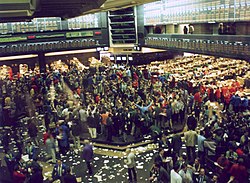
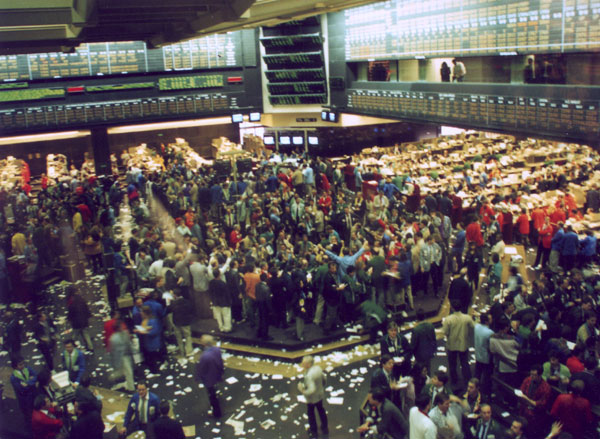
Chicago Board of Trade Corn Futures market, 1993
Oil traders, New York City, 2009

A commodity market is a market that trades in the primary economic sector rather than manufactured products. The primary sector includes agricultural products, energy products, and metals. Soft commodities may be perishable and harvested, while hard commodities are usually mined, such as gold and oil.[1] Futures contracts are the oldest way of investing in commodities.[citation needed] Commodity markets can include physical trading and derivatives trading using spot prices, forwards, futures, and options on futures.[clarification needed] Farmers have used a simple form of derivative trading in the commodities market for centuries for price risk management.[2]

A financial derivative is a financial instrument whose value is derived from a commodity termed an underlier.[3] Derivatives are either exchange-traded or over-the-counter (OTC). An increasing number of derivatives are traded via clearing houses some with central counterparty clearing, which provide clearing and settlement services on a futures exchange, as well as off-exchange in the OTC market.[4]

Derivatives such as futures contracts, Swaps (1970s–), and Exchange-traded Commodities (ETC) (2003–) have become the primary trading instruments in commodity markets. Futures are traded on regulated commodities exchanges. Over-the-counter (OTC) contracts are "privately negotiated bilateral contracts entered into between the contracting parties directly".[5][6]

Exchange-traded funds (ETFs) began to feature commodities in 2003. Gold ETFs are based on "electronic gold" that does not entail the ownership of physical bullion, with its added costs of insurance and storage in repositories such as the London bullion market. According to the World Gold Council, ETFs allow investors to be exposed to the gold market without the risk of price volatility associated with gold as a physical commodity.[7][8][notes 1]

History

[edit]

Commodity-based money and commodity markets in a crude early form are believed to have originated in Sumer between 4500 BC and 4000 BC. Sumerians first used clay tokens sealed in a clay vessel, then clay writing tablets to represent the amount—for example, the number of goats, to be delivered.[9][10] These promises of time and date of delivery resemble futures contract.

Early civilizations variously used pigs, rare seashells, or other items as commodity money. Since that time traders have sought ways to simplify and standardize trade contracts.[11][12]

Gold and silver markets evolved in classical civilizations. At first, the precious metals were valued for their beauty and intrinsic worth and were associated with royalty.[11] In time, they were used for trading and were exchanged for other goods and commodities, or for payments of labor.[13] Gold, measured out, then became money. Gold's scarcity, its unique density and the way it could be easily melted, shaped, and measured made it a natural trading asset.[14]

Beginning in the late 10th century, commodity markets grew as a mechanism for allocating goods, labor, land and capital across Europe. Between the late 11th and the late 13th century, English urbanization, regional specialization, expanded and improved infrastructure, the increased use of coinage and the proliferation of markets and fairs were evidence of commercialization.[15] The spread of markets is illustrated by the 1466 installation of reliable scales in the villages of Sloten and Osdorp so villagers no longer had to travel to Haarlem or Amsterdam to weigh their locally produced cheese and butter.[15]

The Amsterdam Stock Exchange, often cited as the first stock exchange, originated as a market for the exchange of commodities. Early trading on the Amsterdam Stock Exchange often involved the use of very sophisticated contracts, including short sales, forward contracts, and options. "Trading took place at the Amsterdam Bourse, an open aired venue, which was created as a commodity exchange in 1530 and rebuilt in 1608. Commodity exchanges themselves were a relatively recent invention, existing in only a handful of cities."[16]

In 1864, in the United States, wheat, corn, cattle, and pigs were widely traded using standard instruments on the Chicago Board of Trade (CBOT), the world's oldest futures and options exchange. Other food commodities were added to the Commodity Exchange Act and traded through CBOT in the 1930s and 1940s, expanding the list from grains to include rice, mill feeds, butter, eggs, Irish potatoes and soybeans.[17] Successful commodity markets require broad consensus on product variations to make each commodity acceptable for trading, such as the purity of gold in bullion.[18] Classical civilizations built complex global markets trading gold or silver for spices, cloth, wood and weapons, most of which had standards of quality and timeliness.[19]

Through the 19th century "the exchanges became effective spokesmen for, and innovators of, improvements in transportation, warehousing, and financing, which paved the way to expanded interstate and international trade."[20]

Reputation and clearing became central concerns, and states that could handle them most effectively developed powerful financial centers.[21]

Commodity price index

[edit]

In 1934, the U.S. Bureau of Labor Statistics began the computation of a daily Commodity price index that became available to the public in 1940. By 1952, the Bureau of Labor Statistics issued a Spot Market Price Index that measured the price movements of "22 sensitive basic commodities whose markets are presumed to be among the first to be influenced by changes in economic conditions. As such, it serves as one early indication of impending changes in business activity."[22]

Commodity index fund

[edit]

A commodity index fund is a fund whose assets are invested in financial instruments based on or linked to a commodity index. In just about every case the index is in fact a Commodity Futures Index. The first such index was the Dow Jones Commodity Index, which began in 1933.[23] The first practically investable commodity futures index was the Goldman Sachs Commodity Index, created in 1991,[24] and known as the "GSCI". The next was the Dow Jones AIG Commodity Index. It differed from the GSCI primarily in the weights allocated to each commodity. The DJ AIG had mechanisms to periodically limit the weight of any one commodity and to remove commodities whose weights became too small. After AIG's financial problems in 2008 the Index rights were sold to UBS and it is now known as the DJUBS index. Other commodity indices include the Reuters / CRB index (which is the old CRB Index as re-structured in 2005) and the Rogers Index.

Cash commodity

[edit]

Cash commodities or "actuals" refer to the physical goods—e.g., wheat, corn, soybeans, crude oil, gold, silver—that someone is buying/selling/trading as distinguished from derivatives.[2]

Electronic commodities trading

[edit]

In traditional stock market exchanges such as the New York Stock Exchange (NYSE), most trading activity took place in the trading pits in face-to-face interactions between brokers and dealers in open outcry trading.[25] In 1992 the Financial Information eXchange (FIX) protocol was introduced, allowing international real-time exchange of information regarding market transactions. The U.S. Securities and Exchange Commission ordered U.S. stock markets to convert from the fractional system to a decimal system by April 2001. Metrification, conversion from the imperial system of measurement to the metrical, increased throughout the 20th century.[26] Eventually FIX-compliant interfaces were adopted globally by commodity exchanges using the FIX Protocol.[27] In 2001 the Chicago Board of Trade and the Chicago Mercantile Exchange (later merged into the CME group, the world's largest futures exchange company)[26] launched their FIX-compliant interface.

By 2011, the alternative trading system (ATS) of electronic trading featured computers buying and selling without human dealer intermediation. High-frequency trading (HFT) algorithmic trading, had almost phased out "dinosaur floor-traders".[25][notes 2]

Complexity and interconnectedness of global market

[edit]

The robust growth of emerging market economies (EMEs, such as Brazil, Russia, India, and China), beginning in the 1990s, "propelled commodity markets into a supercycle". The size and diversity of commodity markets expanded internationally,[28] and pension funds and sovereign wealth funds started allocating more capital to commodities, in order to diversify into an asset class with less exposure to currency depreciation.[29]

In 2012, as emerging-market economies slowed down, commodity prices peaked and started to decline. From 2005 through 2013, energy and metals' real prices remained well above their long-term averages. In 2012, real food prices were their highest since 1982.[28]

The price of gold bullion fell dramatically on 12 April 2013 and analysts frantically sought explanations. Rumors spread that the European Central Bank (ECB) would force Cyprus to sell its gold reserves in response to its financial crisis. Major banks such as Goldman Sachs began immediately to short gold bullion. Investors scrambled to liquidate their exchange-traded funds (ETFs)[notes 3] and margin call selling accelerated. George Gero, precious metals commodities expert at the Royal Bank of Canada (RBC) Wealth Management section reported that he had not seen selling of gold bullion as panicked as this in his forty years in commodity markets.[30]

The earliest commodity exchange-traded fund (ETFs), such as SPDR Gold Shares NYSE ArcaGLD and iShares Silver Trust NYSE ArcaSLV, actually owned the physical commodities. Similar to these are NYSE ArcaPALL (palladium) and NYSE ArcaPPLT (platinum). However, most Exchange Traded Commodities (ETCs) implement a futures trading strategy. At the time Russian Prime Minister Dmitry Medvedev warned that Russia could sink into recession. He argued that "We live in a dynamic, fast-developing world. It is so global and so complex that we sometimes cannot keep up with the changes". Analysts have claimed that Russia's economy is overly dependent on commodities.[31]

Contracts in the commodity market

[edit]

A Spot contract is an agreement where delivery and payment either takes place immediately, or with a short lag. Physical trading normally involves a visual inspection and is carried out in physical markets such as a farmers market. Derivatives markets, on the other hand, require the existence of agreed standards so that trades can be made without visual inspection.

Standardization

[edit]

US soybean futures do not qualify as "standard grade" if they are "GMO or a mixture of GMO and Non-GMO No. 2 yellow soybeans of Indiana, Ohio and Michigan origin produced in the U.S.A. (Non-screened, stored in silo)". They are of "deliverable grade" if they are "GMO or a mixture of GMO and Non-GMO No. 2 yellow soybeans of Iowa, Illinois and Wisconsin origin produced in the U.S.A. (Non-screened, stored in silo)". Note the distinction between states, and the need to clearly mention their status as GMO (genetically modified organism) which makes them unacceptable to most organic food buyers.

Similar specifications apply for cotton, orange juice, cocoa, sugar, wheat, corn, barley, pork bellies, milk, feed stuffs, fruits, vegetables, other grains, other beans, hay, other livestock, meats, poultry, eggs, or any other commodity which is so traded.

Standardization has also occurred technologically, as the use of the FIX Protocol by commodities exchanges has allowed trade messages to be sent, received and processed in the same format as stocks or equities. This process began in 2001 when the Chicago Mercantile Exchange launched a FIX-compliant interface that was adopted by commodity exchanges around the world.[27]

Derivatives

[edit]

Derivatives evolved from simple commodity future contracts into a diverse group of financial instruments that apply to every kind of asset, including mortgages, insurance and many more. Futures contracts, Swaps (1970s–), Exchange-traded Commodities (ETC) (2003–), forward contracts, etc. are examples. They can be traded through formal exchanges or through Over-the-counter (OTC). Commodity market derivatives unlike credit default derivatives, for example, are secured by the physical assets or commodities.[3]

Forward contracts

[edit]

A forward contract is an agreement between two parties to exchange at a fixed future date a given quantity of a commodity for a specific price defined when the contract is finalized. The fixed price is also called forward price. Such forward contracts began as a way of reducing pricing risk in food and agricultural product markets. By agreeing in advance on a price for a future delivery, farmers were able protect their output against a possible fall of market prices and in contrast buyers were able to protect themselves against a possible rise of market prices.

Forward contracts, for example, were used for rice in seventeenth century Japan.

Futures contract

[edit]

Futures contracts are standardized forward contracts that are transacted through an exchange. In futures contracts the buyer and the seller stipulate product, grade, quantity and location and leaving price as the only variable.[32]

Agricultural futures contracts are the oldest, in use in the United States for more than 170 years.[33] Modern futures agreements, began in Chicago in the 1840s, with the appearance of grain elevators.[34] Chicago, centrally located, emerged as the hub between Midwestern farmers and east coast consumer population centers.

Call options

[edit]

In a call option counterparties enter into a financial contract option where the buyer purchases the right but not the obligation to buy an agreed quantity of a particular commodity or financial instrument (the underlying) from the seller of the option at a certain time (the expiration date) for a certain price (the strike price). The seller (or "writer") is obligated to sell the commodity or financial instrument should the buyer so decide. The buyer pays a fee (called a premium) for this right.[35]

Swaps

[edit]

A swap is a derivative in which counterparties exchange the cash flows of one party's financial instrument for those of the other party's financial instrument. They were introduced in the 1970s.[36][37]

Exchange-traded commodities (ETCs)

[edit]

Exchange-traded commodity is a term used for commodity ETFs (which are funds) or commodity exchange-traded notes (which are notes). These track the performance of an underlying commodity index including total return indices based on a single commodity. They are similar to ETFs and traded and settled exactly like stock funds. ETCs have market maker support with guaranteed liquidity, enabling investors to easily invest in commodities.

They were introduced in 2003.

At first, only professional institutional investors had access, but online exchanges opened some ETC markets to almost anyone. ETCs were introduced partly in response to the tight supply of commodities in 2000, combined with record low inventories and increasing demand from emerging markets such as China and India.[38]

Prior to the introduction of ETCs, by the 1990s ETFs pioneered by Barclays Global Investors (BGI) revolutionized the mutual funds industry.[38] By the end of December 2009 BGI assets hit an all-time high of $1 trillion.[39]

Gold was the first commodity to be securitised through an ETF in the early 1990s, but it was not available for trade until 2003.[38] The idea of a Gold ETF was first officially conceptualised by Benchmark Asset Management Company Private Ltd in India, when they filed a proposal with the Securities and Exchange Board of India in May 2002.[40] The first gold exchange-traded fund was Gold Bullion Securities launched on the ASX in 2003, and the first silver exchange-traded fund was iShares Silver Trust launched on the NYSE in 2006. As of November 2010 a commodity ETF, namely SPDR Gold Shares, was the second-largest ETF by market capitalization.[41]

Generally, commodity ETFs are index funds tracking non-security indices. Because they do not invest in securities, commodity ETFs are not regulated as investment companies under the Investment Company Act of 1940 in the United States, although their public offering is subject to SEC review and they need an SEC no-action letter under the Securities Exchange Act of 1934. They may, however, be subject to regulation by the Commodity Futures Trading Commission.[42][43]

The earliest commodity ETFs, such as SPDR Gold Shares NYSE ArcaGLD and iShares Silver Trust NYSE ArcaSLV, actually owned the physical commodity (e.g., gold and silver bars). Similar to these are NYSE ArcaPALL (palladium) and NYSE ArcaPPLT (platinum). However, most ETCs implement a futures trading strategy, which may produce quite different results from owning the commodity.

Commodity ETFs trade provide exposure to an increasing range of commodities and commodity indices, including energy, metals, softs and agriculture. Many commodity funds, such as oil roll so-called front-month futures contracts from month to month. This provides exposure to the commodity, but subjects the investor to risks involved in different prices along the term structure, such as a high cost to roll.[7][8]

ETCs in China and India gained in importance due to those countries' emergence as commodities consumers and producers. China accounted for more than 60% of exchange-traded commodities in 2009, up from 40% the previous year. The global volume of ETCs increased by a 20% in 2010, and 50% since 2008, to around 2.5 billion million contracts.{{[44]}}

Over-the-counter (OTC) commodities derivatives

[edit]

Over-the-counter (OTC) commodities derivatives trading originally involved two parties, without an exchange. Exchange trading offers greater transparency and regulatory protections. In an OTC trade, the price is not generally made public. OTC commodities derivatives are higher risk but may also lead to higher profits.[45]

Between 2007 and 2010, global physical exports of commodities fell by 2%, while the outstanding value of OTC commodities derivatives declined by two-thirds as investors reduced risk following a five-fold increase in the previous three years.

Money under management more than doubled between 2008 and 2010 to nearly $380 billion. Inflows into the sector totaled over $60 billion in 2010, the second-highest year on record, down from $72 billion the previous year. The bulk of funds went into precious metals and energy products. The growth in prices of many commodities in 2010 contributed to the increase in the value of commodities funds under management.[46]

Commodities exchange

[edit]

A commodities exchange is an exchange where various commodities and derivatives are traded. Most commodity markets across the world trade in agricultural products and other raw materials (like wheat, barley, sugar, maize, cotton, cocoa, coffee, milk products, pork bellies, oil, metals, etc.) and contracts based on them. These contracts can include spot prices, forwards, futures and options on futures. Other sophisticated products may include interest rates, environmental instruments, swaps, or freight contracts.[2]

Largest commodities exchanges
Exchange Country Volume per month $M
CME Group USA 26.3 million contracts (October 2025)[47]
Tokyo Commodity Exchange Japan -
Euronext France, Belgium, Netherlands, Portugal, UK -
Dalian Commodity Exchange China -
Multi Commodity Exchange India -
Intercontinental Exchange USA, Canada, China, UK -
Africa Mercantile Exchange Kenya, Africa -
Uzbek Commodity Exchange Tashkent, Uzbekistan -

Traded commodity classes

[edit]
Top traded commodities
Rank Commodity Value in US$ ('000) Date of
information
1 Electrical machinery and equipment 3,564,430,000 2024
2 Mineral fuels, oils, distillation products, etc. 2,977,270,000 2024
3 Machinery, nuclear reactors, boilers, etc. 2,760,900,000 2024
4 Vehicles other than railway, tramway 1,845,530,000 2024
5 Pearls, precious stones, metals, coins, etc. 953,720,000 2024
6 Pharmaceutical products 906,670,000 2024
7 Plastics and articles thereof 750,460,000 2024
8 Optical, photo, technical, medical, etc. apparatus 695,980,000 2024
9 Organic chemicals 488,060,000 2024
10 Iron and steel 453,470,000 2024

Source: World's Top Exports[48]

Energy

[edit]

Energy commodities include crude oil particularly West Texas Intermediate (WTI) crude oil and Brent crude oil, natural gas, heating oil, ethanol and purified terephthalic acid. Hedging is a common practice for these commodities.

Crude oil and natural gas

[edit]

Brent Crude serves as the world's leading crude oil benchmark, used to price more than 75% of globally traded oil cargoes due to its waterborne nature and broad market access.[49] Brent Crude, assessed daily by S&P Global Commodity Insights as Dated Brent, reflects physical cargo loadings from the North Sea two weeks ahead.[50] In the United States, West Texas Intermediate (WTI) functions as the primary benchmark; this light, sweet crude grades as the underlying commodity for futures contracts on the New York Mercantile Exchange (NYMEX), part of CME Group.[51] WTI, with lower sulfur content than Brent, trades at a premium to heavier grades such as Dubai or Oman.[52]

Crude oil grades range from light to heavy, based on density and sulfur levels. As the first energy source to achieve widespread commodity trading status, oil prices remain sensitive to geopolitical events in producer nations, including Iraq, Iran, and Venezuela.[53] However, trading volumes on major exchanges reflect broader market participation beyond regional politics.

Crude oil and refined products trade in standard contracts of 1,000 barrels (42,000 US gallons; 160,000 L).[54] WTI futures appear under symbol CL on NYMEX and WBS on Intercontinental Exchange (ICE). Brent futures trade under BRN on ICE and BZ on CME. Refined products include Gulf Coast gasoline (symbol LR on NYMEX), reformulated gasoline blendstock for oxygen blending (RBOB; symbol RB on NYMEX), and propane (symbol PN on NYMEX, an ICE subsidiary since 2013).

Natural gas trades in contracts of 10,000 million British thermal units (MMBtu).[55] Henry Hub natural gas futures use symbol NG on NYMEX. Heating oil futures, symbol HO on NYMEX, represent ultra-low sulfur diesel equivalents in 42,000-gallon lots.

Others

[edit]

Purified terephthalic acid (PTA) is traded through ZCE in units of 5 tons with the trading symbol of TA. Ethanol is traded at CBOT in units of 29,000 U.S. gal under trading symbols AC (Open Auction) and ZE (Electronic).

Metals

[edit]

Precious metals

[edit]

Precious metals currently traded on the commodity market include gold, platinum, palladium and silver which are sold by the troy ounce. One of the main exchanges for these precious metals is COMEX.

According to the World Gold Council, investments in gold are the primary driver of industry growth. Gold prices are highly volatile, driven by large flows of speculative money.[56]

Industrial metals

[edit]

Industrial metals are sold by the metric ton through the London Metal Exchange and New York Mercantile Exchange. The London Metal Exchange trades include copper, aluminium, lead, tin, aluminium alloy, nickel, cobalt and molybdenum. In 2007, steel began trading on the London Metal Exchange.

Iron ore has been the latest addition to industrial metal derivatives. Deutsche Bank first began offering iron ore swaps in 2008, other banks quickly followed. Since then the size of the market has more than doubled each year between 2008 and 2012.[57]

Agriculture

[edit]

Agricultural commodities include grains, food and fiber as well as livestock and meat, various regulatory bodies define agricultural products.[58]

In 1900, corn acreage was double that of wheat in the United States. But from the 1930s through the 1970s soybean acreage surpassed corn. Early in the 1970s grain and soybean prices, which had been relatively stable, "soared to levels that were unimaginable at the time". There were a number of factors affecting prices including the "surge in crude oil prices caused by the Arab Oil Embargo in October 1973 (U.S. inflation reached 11% in 1975)".[59]

On 21 July 2010, United States Congress passed the Dodd–Frank Wall Street Reform and Consumer Protection Act with changes to the definition of agricultural commodity. The operational definition used by Dodd-Frank includes "[a]ll other commodities that are, or once were, or are derived from, living organisms, including plant, animal and aquatic life, which are generally fungible, within their respective classes, and are used primarily for human food, shelter, animal feed, or natural fiber". Three other categories were explained and listed.[60]

In February 2013, Cornell Law School included lumber, soybeans, oilseeds, livestock (live cattle and hogs), dairy products. Agricultural commodities can include lumber (timber and forests), grains excluding stored grain (wheat, oats, barley, rye, grain sorghum, cotton, flax, forage, tame hay, native grass), vegetables (potatoes, tomatoes, sweet corn, dry beans, dry peas, freezing and canning peas), fruit (citrus such as oranges, apples, grapes) corn, tobacco, rice, peanuts, sugar beets, sugar cane, sunflowers, raisins, nursery crops, nuts, soybean complex, aquacultural fish farm species such as finfish, mollusk, crustacean, aquatic invertebrate, amphibian, reptile, or plant life cultivated in aquatic plant farms.[61][62]

Diamonds

[edit]

As of 2012, diamond was not traded as a commodity. Institutional investors were repelled by campaign against "blood diamonds", the monopoly structure of the diamond market and the lack of uniform standards for diamond pricing. In 2012 the SEC reviewed a proposal to create the "first diamond-backed exchange-traded fund" that would trade online in units of one-carat diamonds with a storage vault and delivery point in Antwerp, home of the Antwerp Diamond Bourse. The exchange fund was backed by a company based in New York City called IndexIQ. IndexIQ had already introduced 14 exchange-traded funds since 2008.[56][63][notes 4]

According to Citigroup analysts, the annual production of polished diamonds is about $18 billion. Like gold, diamonds are easily authenticated and durable. Diamond prices have been more stable than the metals, as the global diamond monopoly De Beers once held almost 90% (by 2013 reduced to 40%) of the new diamond market.[56]

Other commodity markets

[edit]

Rubber trades on the Singapore Commodity Exchange in units of 1 kg priced in U.S. cents. Palm oil is traded on the Malaysian Ringgit (RM), Bursa Malaysia in units of 1 kg priced in U.S. cents. Wool is traded on the AUD in units of 1 kg. Polypropylene and Linear Low Density Polyethylene (LL) did trade on the London Metal Exchange in units of 1,000 kg priced in USD but was dropped in 2011.

Impact on inflation

[edit]

Fossil fuels and other commodities have been major drivers of inflationary periods, including the 2021-2022 inflation spike exacerbated by the Russian Invasion of Ukraine.[64][65] Gernot Wagner argues that commodites are undesirable energy sources because of inflationary periods that come with commodity prices.[64][66]

In 2025, primary commodity prices fell 2.6% from March to August, with gains in precious metals offset by declines in energy and agriculture, contributing to stalled inflation near 3% in major economies.[67]

Regulatory bodies and policies

[edit]

United States

[edit]
Commodity Prices
  wheat
  corn
  copper

In the United States, the principal regulator of commodity and futures markets is the Commodity Futures Trading Commission (CFTC). The National Futures Association (NFA) was formed in 1976 and is the futures industry's self-regulatory organization. The NFA's first regulatory operations began in 1982 and fall under the Commodity Exchange Act of the Commodity Futures Trading Commission Act.[68]

Dodd–Frank was enacted in response to the 2008 financial crisis. It called for "strong measures to limit speculation in agricultural commodities" calling upon the CFTC to further limit positions and to regulate over-the-counter trades.[69]

European Union

[edit]

Markets in Financial Instruments Directive (MiFID) is the cornerstone of the European Commission's Financial Services Action Plan that regulate operations of the EU financial service markets. It was reviewed in 2012 by the European Parliament (EP) and the Economic and Financial Affairs Council (ECOFIN).[70] The European Parliament adopted a revised version of Mifid II on 26 October 2012 which include "provisions for position limits on commodity derivatives", aimed at "preventing market abuse" and supporting "orderly pricing and settlement conditions".[71]

The European Securities and Markets Authority (Esma), based in Paris and formed in 2011, is an "EU-wide financial markets watchdog". Esma sets position limits on commodity derivatives as described in Mifid II.[71]

The EP voted in favor of stronger regulation of commodity derivative markets in September 2012 to "end abusive speculation in commodity markets" that were "driving global food prices increases and price volatility". In July 2012, "food prices globally soared by 10 percent" (World Bank 2012). Senior British MEP Arlene McCarthy called for "putting a brake on excessive food speculation and speculating giants profiting from hunger" ending immoral practices that "only serve the interests of profiteers".[72] In March 2012, EP Member Markus Ferber suggested amendments to the European Commission's proposals, intended to strengthen restrictions on high-frequency trading and commodity price manipulation.[73]

See also

[edit]

Notes

[edit]

References

[edit]

Further reading

[edit]
[edit]
Revisions and contributorsEdit on WikipediaRead on Wikipedia
from Grokipedia
A market is a physical or virtual venue where standardized raw materials or primary products—such as agricultural , metals, and resources—are bought, sold, and traded, often via spot transactions or instruments like futures contracts that enable price locking for future delivery. These markets encompass both over-the-counter dealings and organized exchanges, where commodities are defined as fungible supplied without substantial differentiation, facilitating efficient transfer of ownership and risk. Commodity markets perform essential economic functions, including through competitive bidding that aggregates information, hedging to mitigate price risk for producers and consumers exposed to volatile costs, and that enhances while potentially amplifying fluctuations. Exchanges centralize trading to ensure transparent pricing and standardized contracts, reducing counterparty risk via clearinghouses, though participation ranges from commercial hedgers to financial investors diversifying portfolios with returns independent of stocks and bonds. Modern iterations trace to ancient systems in around 4500 BC but formalized with early futures-like contracts in medieval and , evolving into global hubs like the for agricultural and energy benchmarks. Despite their role in efficient and signaling via price mechanisms, commodity markets exhibit high volatility from supply disruptions, weather events, or geopolitical tensions, compounded by speculative inflows that can distort fundamentals. Notable controversies include manipulation tactics such as corners—where dominant positions force short sellers to cover at inflated prices—and trade-based schemes, which regulators combat through position limits and , though enforcement challenges persist due to the markets' scale and opacity in some segments. These dynamics underscore commodity markets' dual capacity to foster through transfer while occasionally exacerbating inflationary pressures or development hurdles in resource-dependent economies.

Fundamentals

Definition and Core Characteristics

A commodity market is a venue for the exchange of raw materials or primary products derived from natural resources, such as agricultural outputs, metals, and sources like crude . These markets facilitate the trading of physical commodities or contracts tied to their value, enabling price determination through the interaction of buyers and sellers based on fundamentals. Unlike markets for manufactured goods, commodity markets emphasize fungible items—standardized units where one unit is essentially interchangeable with another of the same grade and quality, minimizing differentiation across producers. Core characteristics include standardization and grading, which ensure tradability by establishing uniform quality benchmarks; for instance, agricultural commodities like are graded by factors such as protein content and moisture levels to allow seamless substitution. Markets exhibit high volatility driven by exogenous factors, including events affecting harvests (e.g., droughts reducing corn yields by up to 20% in major U.S. regions as seen in ), geopolitical tensions disrupting oil supplies, or shifts in global demand, leading to price swings that can exceed 50% annually for assets like . Liquidity provision is central, particularly on organized exchanges, where high trading volumes—such as average daily volumes surpassing 20 million contracts for energy futures on platforms like —support efficient and risk transfer without significant slippage. Commodity markets serve dual economic roles: enabling producers and consumers to against price risks via forward commitments and allowing speculators to provide liquidity that enhances . Physical delivery remains possible but rare, comprising less than 2% of futures contracts on major exchanges, with most transactions settling financially to avoid logistical complexities like transportation and storage costs. These markets are segmented into hard commodities (e.g., mined or extracted, such as with annual global production of approximately 3,000 metric tons) and soft commodities (e.g., perishables like ), each influenced by distinct dynamics.

Distinctions from Other Asset Markets

Commodity markets differ fundamentally from equity and fixed-income markets in that commodities represent tangible physical goods—such as agricultural products, metals, and resources—with intrinsic value derived from their in production and consumption processes, whereas equities confer in specific companies and bonds represent debt obligations without inherent physical attributes. Unlike , which generate cash flows through dividends or buybacks tied to corporate , commodities produce no such income streams, with returns stemming instead from price appreciation driven by supply disruptions or demand shifts. A core distinction lies in the physical nature of commodities, which often involve considerations of storage, transportation, and perishability absent in financial assets; for instance, agricultural commodities like incur holding costs and spoilage risks, leading to unique futures market dynamics such as backwardation (where near-term prices exceed distant ones due to immediate supply shortages) or (reflecting storage costs). In contrast, equity and bond markets operate on intangible claims, with facilitated by and no equivalent physical delivery obligations, resulting in different risk profiles where commodity futures expose participants to basis risk from convergence between cash and futures prices upon delivery. Commodity prices are predominantly influenced by exogenous factors like events, geopolitical events, and production cycles—evident in markets where quotas or hurricanes can cause sharp supply shocks—whereas equity prices more closely track microeconomic fundamentals such as earnings reports and like interest rates. This leads to higher volatility in commodities, with historical showing annualized volatility for crude futures exceeding 30% in periods of tension, compared to equity volatility averaging around 15-20%. Market participants in commodities primarily include hedgers (producers and consumers mitigating price ) alongside speculators, differing from equity markets dominated by long-term investors seeking capital gains or . Standardization by grade and quality enables in commodities, facilitating exchange-traded contracts, unlike the firm-specific nature of individual .

Historical Development

Origins in Ancient and Pre-Modern Trade

Commodity trading emerged from the barter and exchange of surplus agricultural goods, , and raw materials in early agrarian societies, where and seasonal production necessitated organized distribution to prevent and enable specialization. In Sumerian civilization (c. 4500–4000 BC), located in modern-day southern , communities traded staples like , dates, , and , using clay tokens and bullae as precursors to systems for tracking quantities and values. These exchanges occurred in temple complexes, where priestly administrators stored surpluses and allocated them via redistributive mechanisms, laying foundational practices for valuing homogeneous goods by weight or volume. By the 18th century BC, Mesopotamian legal codes formalized commodity transactions; the (c. 1754 BC) prescribed fixed prices for and silver equivalents, penalties for in grain loans, and regulations on conduct, reflecting causal links between predictable pricing and reduced transaction risks in inter-city trade networks extending to and the Indus Valley. Clay tablets from this era document forward-like agreements for future delivery of or dates, mitigating harvest uncertainties through binding contracts enforced by royal authority. In (c. 3000–30 BC), Nile-dependent production drove state-controlled trade; pharaonic granaries stockpiled emmer wheat and for redistribution, while private exchanged , , and with and the , using standardized measures like the hekat (approximately 4.8 liters) for bulk commodities. Greek poleis from the Archaic period (c. 800–480 BC) featured markets where olive oil, wine, and figs were commoditized, with amphorae seals ensuring quality and origin for interstate shipments via emporia like . Regulations under (c. 594 BC) curbed speculation in grain imports to , highlighting early awareness of supply shocks from distant sources. Roman commerce scaled these practices empire-wide; the (grain supply system, established c. 123 BC) imported up to 400,000 tons of wheat annually from and to feed Rome's populace, with horrea warehouses standardizing storage and spot pricing influenced by auctions and imperial edicts. Olive oil and wine followed similar circuits, traded in bulk via maritime routes, though state monopolies on key staples limited pure market dynamics compared to private metals like from . In medieval (c. 1000–1500 AD), feudal fragmentation gave way to itinerant in commodities like , salt, and furs, facilitated by seasonal fairs such as the Champagne cycles (c. 1160–1320 AD) in northeastern , where merchants from and converged to exchange standardized bolts of cloth (measured by the aune) and spices using bills of exchange to settle imbalances. These gatherings enforced uniform weights—e.g., the mina for silver—and royal protections reduced hold-up risks, enabling volume surges; exports from alone reached 30,000 sacks annually by the , fueling proto-capitalist financing via Italian banking houses. Concurrently, Asian networks predating European penetration included overland exchanges of silk, porcelain, and tea from China ( onward, c. 206 BC–220 AD), with routes commoditizing pepper and cloves by weight in Swahili ports, where Arab intermediaries applied forward pricing to hedge delays. Pre-modern thus transitioned from localized spot exchanges to networked systems valuing fungible , constrained by costs and information asymmetries but propelled by and monetary media like silver dirhams.

Emergence of Organized Exchanges

The first organized futures exchange emerged in with the establishment of the Dojima Rice Exchange in in 1697, where merchants traded receipts, effectively creating a market for forward contracts on , a staple tied to stipends. This exchange formalized trading practices that allowed producers and consumers to hedge against price fluctuations by agreeing on future delivery prices, with official authorization from the in 1730 for both spot and futures markets. Operations continued until its dissolution in 1939, marking it as a pioneering that standardized contracts and reduced through clearing mechanisms, though limited by feudal regulations and lacking the scale of later Western exchanges. In the United States, the (CBOT) was founded on April 3, 1848, initially as a cash market to organize the chaotic amid rapid agricultural expansion and improving transportation via canals and railroads. By the 1850s, the CBOT introduced forward contracts for grains like and corn, evolving into standardized futures by 1865 with fixed contract sizes, grades, and delivery points to mitigate disputes over quality and enable efficient hedging for Midwestern farmers facing distant markets. This development addressed causal pressures from seasonal production gluts, storage costs, and price volatility, fostering liquidity and speculation that stabilized supply chains. European organized commodity exchanges lagged behind, with early markets resembling informal trade fairs rather than structured futures platforms; for instance, medieval fairs in Champagne facilitated commodity deals but lacked formal clearing or until the . The Cotton Association formed in 1803 for spot trading, but dedicated futures exchanges, such as the London Metal Exchange's precursor in 1877, emerged later, influenced by American models amid industrialization and global trade growth. These institutions collectively shifted commodity trading from bilateral agreements to centralized, rule-based systems, enabling better and essential for expanding industrial economies.

Key Crises and Transformations (19th-20th Centuries)

The establishment of the (CBOT) in 1848 marked a pivotal transformation in commodity markets, standardizing trading amid rapid expansions in rail and canal infrastructure that amplified price volatility for agricultural products transported from rural areas to urban centers. By 1865, the CBOT introduced formalized futures contracts for , corn, and oats, shifting from informal forward agreements to exchange-traded instruments with standardized terms, which enabled hedgers to mitigate risks from seasonal gluts and shortages. This innovation reduced counterparty default risks through early clearing mechanisms, formalized in the , fostering greater and participation beyond physical traders. The triggered a prolonged depression that severely impacted commodity sectors, as the collapse of & Co.—a major financier of railroads integral to grain transport—led to widespread bank failures and a sharp contraction in agricultural credit, causing wheat prices to fall by over 40% from 1873 peaks by 1879. Similarly, the exacerbated farm distress, with corn and prices plummeting amid deflationary pressures and reduced export demand, contributing to rural bankruptcies and demands for policy reforms like the gold standard debates. These crises highlighted vulnerabilities in leveraged commodity financing, prompting incremental regulatory scrutiny on exchanges to curb manipulative practices such as corners and bucket shops prevalent in the late . In the early , commodity markets expanded with the founding of the (CME) in 1919, initially focusing on perishables before broadening to financial futures, while the introduction of the Grain Futures Act in 1922 imposed federal oversight on trading practices to prevent fraud following scandals like the wheat manipulations. The of the 1930s inflicted profound shocks, with real commodity prices declining sharply—wheat dropping from approximately $1.05 per in 1929 to $0.33 by 1932—due to overproduction, collapsed demand, and droughts, which eroded terms of trade for primary exporters and spurred interventions like the . The Commodity Exchange Act of 1936 further centralized regulation under the Commodity Exchange Commission, mandating open trading and position limits to stabilize markets. Mid-century transformations reflected productivity gains driving a long-term downward trend in real commodity prices, interrupted by wartime booms, but the oil crises redefined trading dynamics. The 1973 embargo quadrupled crude oil prices from $3 to $12 per barrel within months, exposing supply concentration risks and spurring hedging via (NYMEX) contracts established in 1974 for and . The 1979 further doubled prices to $39 per barrel, accelerating as futures volumes surged and volatility prompted innovations, though these shocks also revealed persistent real price declines for non-energy commodities over the century.

Post-2000 Globalization and Digitization

The entry of into the on December 11, 2001, accelerated its industrialization and urbanization, driving a surge in demand for raw materials such as , , , and . This demand shock contributed to a commodity supercycle from approximately 2000 to 2011, characterized by sustained price increases across energy, metals, and agricultural products, with global energy prices tripling and metal prices doubling between the turn of the century and the 2008 global financial crisis. The supercycle resulted from large, unexpected demand expansions outpacing slow supply responses, as producers faced lags in expanding capacity due to high and long lead times in and extraction. By 2013, accounted for 15% of global commodity imports, surpassing the and at 10% each, underscoring its pivotal role in reshaping trade flows. Parallel to this demand-driven , the of markets intensified after the 2000 dot-com bust, as institutional investors sought diversification and hedges, leading to commodities being treated as a distinct asset class. inflows into futures indices reached an estimated $200 billion from early 2000 to June 2008, primarily through index funds and exchange-traded products that passively held futures contracts, thereby increasing but also linking returns more closely to correlations. This shift amplified price volatility during the 2008 crisis, as financial traders' risk-sharing mechanisms interacted with physical supply-demand fundamentals, though attributes much of the mid-2000s price boom to physical demand rather than alone. Digitization transformed trading infrastructure, with electronic platforms supplanting traditional pits across major exchanges in the , enabling 24-hour global access and high-speed execution. The Chicago Mercantile Exchange's Globex system, launched in 1992, saw widespread adoption post-2000, facilitating the transition to fully for contracts like crude oil and agricultural futures. By the early , most major futures exchanges had introduced electronic systems for key products, phasing out floor trading by the mid-to-late decade, which reduced transaction costs, expanded participant pools to include algorithmic traders, and boosted trading volumes. The Commodity Futures Modernization Act of 2000 further deregulated over-the-counter , spurring innovation in electronic OTC platforms while clearing organizations ensured . This technological shift integrated commodity markets more seamlessly into global financial networks, enhancing efficiency but also exposing them to cyber risks and dynamics.

Trading Mechanisms

Spot and Physical Delivery Markets

The spot market in commodities refers to the trading of physical assets for immediate or prompt delivery at the current market price, contrasting with deferred delivery in futures contracts. Transactions typically settle within a short timeframe, such as two business days or adjusted for like shipping, enabling buyers and sellers to exchange goods like , metals, or grains without intermediary financial instruments. Physical delivery in these markets involves the actual transfer of the commodity, requiring adherence to standardized specifications for quality, quantity, and location to minimize disputes. For example, crude oil spot contracts may specify delivery at designated terminals, with settlement based on benchmarks like Brent or , where the physical handover occurs via pipelines, tankers, or storage facilities. In agricultural sectors, physical delivery entails transporting harvested to local markets or elevators for immediate sale and . Unlike futures markets, which often cash-settle or allow rolling positions, spot markets prioritize tangible exchange to meet immediate supply needs, directly linking prices to real-time fundamentals such as inventory levels and production disruptions. Spot prices thus form the basis for futures pricing. Physical premiums are the additional cost buyers pay for actual physical delivery of a commodity over the quoted futures or paper price, often due to regional supply tightness or strong immediate industrial needs. Divergences are explained by storage costs, interest rates, and convenience yields in equilibrium models. Trading in spot and physical delivery markets largely occurs over-the-counter (OTC) through bilateral negotiations between producers, consumers, and traders, fostering customized deals but reducing transparency relative to exchange-traded volumes. Certain commodities, like precious metals, utilize organized venues such as the London Bullion Market for , where daily fixing auctions determine reference prices for physical trades. These markets support essential economic functions, including for physical flows and for non-speculative participants reliant on actual possession.

Derivative Contracts

Derivative contracts in commodity markets are financial agreements whose value is derived from the price of an underlying physical , such as crude oil, , or , at a specified date. These instruments allow market participants, including producers, consumers, and investors, to transfer or assume risk without immediate physical exchange of the . Unlike spot transactions, facilitate forward-looking commitments, enabling hedging against volatility or on directions. The primary functions of commodity derivatives include through hedging, where producers secure future revenues by selling contracts at fixed prices to offset potential declines, and consumers lock in costs to guard against rises. Speculative trading by non-commercial participants enhances and aids , with research showing that speculative activity, rather than hedging alone, significantly contributes to informational in derivative markets, particularly for options on commodities. This dual role supports overall market stability, as hedgers transfer risk to speculators willing to bear it for potential gains, while aggregated trading volumes reveal consensus expectations about fundamentals. Commodity derivatives are traded either on organized exchanges, where standardized contracts ensure transparency and clearinghouse intermediation reduces counterparty risk, or over-the-counter (OTC) via customized agreements between parties. In the United States, exchange-traded futures and options are regulated by the (CFTC), which oversees trading integrity and prevents manipulation following the agency's creation in amid growing market complexity. OTC derivatives like forwards and swaps, while flexible for tailored needs, carry higher default risks absent central clearing, prompting post-2008 reforms to mandate clearing for certain standardized swaps. Principal categories encompass futures and forwards for obligatory price commitments, alongside options granting the right but not obligation to trade, and swaps exchanging price-linked cash flows over time.

Futures and Forward Contracts

Futures contracts are standardized agreements to buy or sell a specific of a commodity at a predetermined price on a future date, traded on organized exchanges such as the (CME) or (ICE). These contracts specify uniform terms for quality, , and delivery location, with daily settlement through mark-to-market adjustments that require participants to post initial and variation margins to cover potential losses. A central clearinghouse acts as the to both buyer and seller, mitigating default risk by guaranteeing performance and enforcing daily margin calls. In commodity markets, futures facilitate hedging against price fluctuations—for instance, a wheat producer might sell futures to lock in a price ahead of harvest, while speculators trade for profit based on expected price movements. Forward contracts, in contrast, are customized, over-the-counter (OTC) agreements between two parties to exchange a at an agreed price on a specified future date, without exchange intermediation or standardization. Terms such as quantity, delivery timing, and location can be tailored to the parties' needs, often used by commercial entities like oil refiners securing crude supplies or farmers negotiating crop sales directly with buyers. Settlement occurs only at maturity, typically via physical delivery or cash equivalent, exposing participants to significant counterparty risk if one party defaults, as there is no clearing mechanism or daily reconciliation. For example, a coffee importer might enter a forward with a grower for 1 million pounds of beans at $4 per pound in six months, adjustable for non-standard volumes unavailable in futures markets. The primary distinctions between futures and forwards lie in liquidity, regulation, and risk management: futures offer high liquidity through exchange trading, transparent pricing via public order books, and regulatory oversight by bodies like the U.S. (CFTC), reducing systemic risks evident in events like the where OTC derivatives amplified losses. Forwards provide flexibility for hedging but lack secondary markets, making them illiquid and prone to basis risk—discrepancies between contract and spot prices at settlement. Both instruments derive value from underlying spot prices, with futures prices incorporating carry costs like storage and interest, but forwards may embed premiums for customization. In practice, commodity futures dominate trading volumes—for instance, CME's agricultural futures averaged over 1.5 million contracts daily in 2023, covering corn, soybeans, and —enabling and alongside hedging. Forwards, comprising a smaller OTC segment estimated at 10-20% of activity in energy commodities like , suit long-term supply agreements where standardization is impractical. Benefits of futures include leverage (e.g., controlling $100,000 in with $5,000 margin) and no time decay, though they amplify losses via margin calls during volatility spikes, as seen in oil futures during the 2020 event. Forwards avoid daily settlements but heighten default exposure, with benefits in avoiding exchange fees for large, infrequent transactions. Both face basis risk and opportunity costs if prices move favorably post-contract, underscoring their role in risk transfer rather than risk elimination.

Options, Swaps, and Structured Products

Commodity options grant the holder the right, but not the obligation, to buy () or sell () a specified quantity of an underlying or a on that commodity at a predetermined on or before a set . These instruments derive their value from the underlying commodity's price volatility and are commonly used by producers, consumers, and speculators to against adverse price movements or to speculate on directional changes. In commodity markets, options are frequently written on s rather than physical delivery, facilitating leverage and margin efficiency; for instance, crude options on NYMEX futures allow settlement via cash or futures position assignment. Exchange-traded commodity options, regulated by bodies like the CFTC, provide standardized terms and clearing to mitigate counterparty risk, with premiums paid upfront by buyers. Commodity swaps are over-the-counter (OTC) contracts in which two parties agree to exchange cash flows based on the difference between a fixed and a floating tied to an underlying index or spot , typically over a multi-period . These swaps enable transfer without physical delivery; for example, a might pay a fixed to receive floating payments mirroring market prices, effectively locking in revenue amid volatility. Post-Dodd-Frank reforms, many swaps are cleared through central counterparties or reported to swap data repositories for transparency, though bilateral execution persists for customized terms. index swaps, a , replicate returns from diversified baskets, attracting investors seeking hedges or portfolio diversification. Structured products in commodity markets combine base securities, such as bonds or deposits, with embedded derivatives like options or swaps to create customized payoff profiles linked to performance. Common examples include -linked notes, where principal repayment is tied to prices—e.g., a note coupled with almond futures contracts offering upside participation above a threshold while protecting downside via embedded puts. Collars, formed by simultaneously purchasing a put and selling a on the same , provide costless or low-cost hedging by capping gains in exchange for protection, widely used by and gas firms; for instance, a zero-cost collar might set a $70 and $90 ceiling on crude prices. These products, often issued OTC by banks, carry basis risk from imperfect replication of physical exposures and challenges, with regulatory scrutiny increasing post-2008 to address opacity in valuation and leverage.

Electronic Platforms and OTC Trading

Electronic trading platforms facilitate the buying and selling of commodity derivatives, such as futures and options, through computerized systems that match orders automatically, providing near-instantaneous execution and global access. The Chicago Mercantile Exchange (CME) launched Globex in 1992 as the pioneering global electronic platform for futures and commodity contracts, initially using Reuters technology to enable after-hours trading beyond traditional open-outcry pits. This shift digitized trading, allowing 24-hour operations and reducing reliance on physical trading floors, which historically dominated commodity exchanges like the CME and Chicago Board of Trade. By 2004, electronic trading comprised 61% of CME's total volume, rising to 99% by 2015, driven by lower costs, higher speed, and broader participation including algorithmic traders. Major platforms include CME Globex, which lists contracts for energy, metals, and agricultural commodities, handling billions in daily notional value; for example, silver futures on COMEX, a CME division, trade nearly 24 hours a day, five days a week on Globex, alongside global over-the-counter spot markets. and the Intercontinental Exchange (ICE) platform, which supports electronic trading in oil, natural gas, and power futures since its expansion in the early 2000s. ICE's systems process intraday data for benchmark pricing in key commodities, integrating clearing and settlement to mitigate risks. These platforms enhanced market liquidity and efficiency by enabling high-frequency trading and real-time data dissemination, though they also introduced challenges like flash crashes from automated order flows, as seen in commodity volatility spikes. Adoption accelerated post-1990s internet proliferation, with electronic systems now dominating over 90% of exchange-traded commodity derivatives volume globally. In contrast, over-the-counter (OTC) trading in commodities occurs bilaterally between parties without centralized exchanges, emphasizing customized contracts like forwards, swaps, and physical deliveries tailored to specific quantities, qualities, or delivery points. OTC markets prevail in non-standardized products, such as energy swaps or forwards, where flexibility outweighs exchange standardization; for instance, OTC trading constitutes the majority of volume in many European and U.S. markets due to localized supply needs. Global OTC commodity derivatives notional outstanding reached trillions annually, per data, though exact figures vary by asset class with commodities forming a subset behind interest rates. OTC trading offers advantages in hedging bespoke risks but carries higher counterparty exposure and opacity, prompting post-2008 reforms like Dodd-Frank mandating central clearing for certain swaps to curb systemic risks exposed in the . In commodities, OTC volumes often exceed exchange-traded in physical and illiquid segments, with participants including producers, consumers, and banks negotiating via voice brokers or electronic RFQ systems. While electronic platforms blurred lines by incorporating OTC-like RFQ functionalities, core OTC remains decentralized, fostering innovation in structured products but demanding robust credit checks absent in exchange clearing.

Commodity Categories

Energy Commodities

Energy commodities, primarily consisting of crude oil, , , and , form the backbone of global energy supply chains and exhibit distinct market dynamics due to their inelastic demand, geopolitical sensitivities, and physical constraints on storage and transport. These markets are dominated by futures contracts on major exchanges, where (WTI) crude oil trades on the (NYMEX) and on the (ICE), serving as global benchmarks for pricing physical deliveries and derivatives. Volatility in these markets stems from supply disruptions—such as production quotas, which control about 40% of global crude supply, or weather events affecting extraction—and demand fluctuations tied to and seasonal heating or cooling needs. Trading volumes for futures are substantial, with NYMEX WTI contracts averaging millions of barrels equivalent daily, enabling producers, refiners, and speculators to against price swings that can exceed 50% annually during crises like the 2022 Russia-Ukraine conflict-induced spikes. , benchmarked at the in , trades on platforms and reflects regional pipeline constraints, leading to higher price volatility compared to oil due to limited storage and transport options. Electricity markets, by contrast, operate on near-real-time supply-demand balancing owing to its non-storability, with futures on platforms like for hubs such as pricing locational marginal costs influenced by fuel inputs and grid capacity. , used for power generation and steelmaking, trades less liquidly via contracts on exchanges like ICE or over-the-counter, with prices driven by mining output in regions like and .

Crude Oil and Natural Gas

Crude oil markets center on two primary benchmarks: WTI, a domestic U.S. grade delivered at , which represents about 40% of global traded volumes and is prized for its low sulfur content facilitating production; and Brent, sourced from the , which underpins international pricing due to its seaborne tradability and access to diverse global refineries. NYMEX WTI futures, introduced in 1983, allow for physical delivery of 1,000 barrels per contract, while ICE Brent futures, launched in 1988, similarly standardize 1,000-barrel lots but emphasize global opportunities absent in landlocked WTI . Supply factors include non-OPEC producers like U.S. , which boosted output to over 13 million barrels per day by 2023 via hydraulic fracturing, countering restrictions but introducing boom-bust cycles from capital discipline among drillers. Natural gas futures at , established as the U.S. benchmark in 1990, contract for 10,000 million British thermal units (MMBtu) and reflect the interconnected network, with prices highly sensitive to winter heating and summer air-conditioning loads, often exhibiting mean-reversion after spikes—such as the 2005-2008 period when volatility indices ranked it among the most unstable commodities. LNG exports, expanding post-2016 builds, link U.S. prices to Asian and European markets, where supply gluts from and have periodically depressed spot rates, while European reliance on Russian gas until 2022 amplified vulnerability to geopolitical cutoffs. inelasticity—households and industries requiring steady volumes regardless of —exacerbates swings when storage levels deviate from five-year averages, as tracked by the U.S. .

Electricity, Coal, and Emerging Renewables

Electricity trading occurs via day-ahead and real-time auctions on regional transmission organizations like PJM, with CME futures providing hedges against locational price risks driven by fuel costs ( comprising 40% of U.S. generation) and renewable , where non-storability demands instantaneous matching of generation to load, leading to occasional during oversupply. Coal markets distinguish thermal grades for power plants, traded on with Australian API2 as a European benchmark, and for via contracts linked to Chinese demand; global seaborne trade volumes hovered around 1.2 billion tons annually pre-2020, but decarbonization policies have curbed growth, with prices volatile from strikes and bottlenecks. Emerging renewables enter commodity frameworks through biofuels like and futures on CME and CBOT, mandated by U.S. Renewable Fuel Standards generating credits (RINs) that trade OTC to comply with blending quotas, and (RNG) qualifying for incentives amid reduction goals. Carbon credits, while not traditional energy commodities, intersect via voluntary and compliance markets—such as ETS allowances or U.S. LCFS credits—where avoidance credits from renewables like solar offsets remain subdued in demand, valued at $48 billion globally in 2025 projections, reflecting verification challenges and additionality debates rather than physical energy flows. These instruments transition risks but exhibit lower and higher basis risk compared to fossil benchmarks.

Crude Oil and Natural Gas

Crude oil, a extracted from underground reservoirs, serves as the primary input for refined products like and diesel, making it a cornerstone of global energy markets. Its price benchmarks include (WTI), traded as futures on the (NYMEX) under , which represents light sweet crude deliverable at . , sourced from the and serving as a global benchmark for about two-thirds of the world's traded oil, is primarily traded via futures on the (ICE). In 2023, the led global crude oil production at approximately 12.9 million barrels per day, followed by and , while consumption was highest in the (around 19 million barrels per day) and . Prices for crude oil are influenced by a balance of global supply and demand, with key drivers including non-OPEC production growth, OPEC+ output decisions, inventory levels, and geopolitical events. The Organization of the Petroleum Exporting Countries (OPEC) and its allies (OPEC+) coordinate production quotas to stabilize markets, as seen in their 2022-2023 cuts in response to post-pandemic demand recovery and Russian supply disruptions from the Ukraine conflict. Short-term price inelasticity in supply and demand amplifies volatility, often exacerbated by financial speculation on exchanges. Natural gas, a gaseous primarily composed of , is traded as a for heating, electricity generation, and industrial use, with futures centered on the in as the U.S. benchmark. natural gas futures on NYMEX provide settlement prices based on physical delivery at the interstate pipeline hub, influencing North American pricing. The dominates production, exporting (LNG) globally, which has integrated regional markets but exposed prices to weather-driven demand spikes and supply chain constraints. Trading in both commodities involves hedging against price risks for producers and consumers, with crude oil markets more globally interconnected due to seaborne trade, while relies on pipelines and LNG terminals, leading to regional price divergences. Recent trends show prices responding to storage levels reported by the (EIA), with U.S. spot prices averaging around 2.502.50-3.00 per million British thermal units (MMBtu) in 2024 amid mild weather and high production.

Electricity, Coal, and Emerging Renewables

Electricity trading occurs primarily through regional spot markets and derivative contracts due to its non-storability and real-time consumption requirements. In the United States, major spot markets include day-ahead and real-time auctions operated by Regional Transmission Organizations such as , which manages competitive wholesale markets across 13 states and the District of Columbia, and ERCOT, which oversees Texas's energy-only market without a separate capacity mechanism. Futures and options for are traded on exchanges like Nodal Exchange, which specializes in North American power contracts, and , offering products tied to hubs like PJM Western Hub and ERCOT North. These instruments allow utilities and traders to hedge against price volatility driven by fluctuations, weather, and grid constraints, with trading focused on locational marginal to reflect transmission costs. Coal, used predominantly for thermal power generation and steelmaking, is traded via futures contracts benchmarked to international delivery points. Key contracts include the ICE Newcastle Coal futures, referencing Australian export quality, and the CME Coal (API2) CIF ARA futures, based on Argus-McCloskey assessments for delivery to northwest Europe, with settlements in October 2025 around 104 USD per metric ton. Exchanges like ICE and CME facilitate hedging for producers, consumers, and speculators, with historical volume data indicating robust liquidity in these thermal coal benchmarks despite global decarbonization pressures. Spot prices, tracked weekly by the U.S. Energy Information Administration across regions like Central Appalachia, reflect supply disruptions and export dynamics, averaging declines of 28.65% year-over-year as of October 2025. Emerging renewables enter commodity markets mainly through Renewable Energy Certificates (RECs), tradable instruments representing one megawatt-hour of generated from sources like solar or , decoupled from the physical power to certify environmental attributes. REC markets, valued at approximately 27.99 billion USD in 2025, project growth to 45.45 billion USD by 2030, driven by compliance with renewable portfolio standards and voluntary corporate purchases. Trading occurs bilaterally or via platforms, with RECs functioning as commodities that enable unbundling of "green" value from , though critics note potential over-reliance on certificates without direct grid decarbonization. Direct futures for renewable power output remain limited due to intermittency, but related instruments like power purchase agreements and environmental derivatives on exchanges such as support hedging for solar and projects.

Metals

Metals constitute a vital segment of commodity markets, distinguished by their dual roles in industrial production and as financial assets. Precious metals, such as and silver, are prized for rarity, aesthetic value in jewelry, and applications in and , while also functioning as hedges against and currency devaluation during economic uncertainty. Base and industrial metals, including , aluminum, , lead, , and tin, underpin , , and , with demand closely tied to global economic cycles and trends. Trading volumes for metals futures and options on major exchanges like the CME Group's COMEX division and the London Metal Exchange (LME) reflect robust liquidity, driven by hedgers, speculators, and investors responding to supply disruptions from strikes or geopolitical tensions. Supply factors for metals are dominated by output, which accounts for the majority of , supplemented by ; for instance, global mine production reached approximately 21 million metric tons in 2023, with forecasts indicating modest growth amid demands for . Demand dynamics vary: precious metals exhibit sensitivity to investor sentiment and purchases, with often correlating inversely to real interest rates, whereas base metals track indicators like Purchasing Managers' Indices (PMIs) and spending. In April 2025, World Bank analysis projected metals prices to ease slightly over 2025-26 following a 2.5% rise in 2024, attributed to anticipated softening in industrial activity despite persistent supply constraints in critical minerals.

Precious Metals (Gold, Silver)

Gold and silver trading occurs predominantly via over-the-counter (OTC) markets and futures exchanges, with the London Bullion Market Association (LBMA) clearing over 20 million ounces of and more than 200 million ounces of silver daily on average. The Gold Exchange reports average daily volumes exceeding 6 million ounces for and 140 million ounces for silver, underscoring Asia's growing influence in physical delivery and . serves as a benchmark safe-haven asset, with central banks holding reserves totaling around 36,000 metric tons as of 2024, while silver's industrial demand—comprising over 50% of consumption in , , and medical applications—has outstripped supply since 2020, contributing to structural deficits estimated at 200-300 million ounces annually. Prices for precious metals fluctuate with macroeconomic variables; for example, prices rose amid safe-haven demand and supply disruptions through early 2025 before moderating, as noted in IMF assessments, while silver experienced surges due to persistent shortages. Precious metals prices surged 9.3% in the first quarter of 2025 per World Bank data, reflecting speculative trading and investor shifts toward tangible assets amid equity market volatility. These markets exhibit high , with aggregated trading volumes across OTC, futures, and ETFs surpassing $227 billion daily, enabling efficient price transmission but also amplifying volatility from leveraged positions.

Base and Industrial Metals

Base metals, chemically reactive and non-precious, are traded primarily on the LME for prompt and deferred delivery, with futures serving as a for economic health due to its ubiquity in , , and . Aluminum, the most abundant in production at over 70 million metric tons annually, finds extensive use in transportation, , and for its lightweight properties, while and lead support and battery technologies, respectively. Trading volumes on exchanges like COMEX and LME highlight industrial hedging needs, with prices highly responsive to global manufacturing output; for instance, prices are forecast to decrease considerably over the next two years due to projected slowdowns in industrial activity, per World Bank projections from April 2025. Demand for base metals correlates with and transitions, such as copper's role in electric vehicles requiring up to four times more than conventional cars, yet supply bottlenecks from mine closures and restrictions—particularly on metals exports—have intensified pressures. In mid-2025, tin prices shifted from supply-driven spikes to macroeconomic influences as initial shortage fears eased, illustrating how base metals balance physical utility with cyclical vulnerability. mitigates supply risks, recovering about 30-50% of aluminum and demand, though primary remains dominant amid rising costs for extraction.

Precious Metals (Gold, Silver)

Precious metals, particularly and silver, constitute a significant segment of markets due to their dual roles as stores of value and industrial inputs. is primarily traded as a and , while silver combines monetary attributes with substantial industrial applications, leading to more volatile pricing influenced by both flows and demand. These metals are exchanged via spot markets, futures contracts on platforms like the COMEX division of the , and over-the-counter (OTC) dealings, with prices denominated in U.S. dollars per troy ounce. Gold's global mine production reached approximately 3,300 metric tons in , marking a slight increase from 3,250 metric tons in 2023, with as the leading producer at around 380 tonnes. Total supply, including , grew 1% year-over-year to support of 4,974 tonnes, the highest on record, driven by purchases exceeding 1,000 tonnes annually and investor holdings via exchange-traded funds (ETFs) and bars. Jewelry fabrication, traditionally the largest component, declined 11% to 1,877 tonnes amid higher prices, while technology and other industrial uses remained stable at around 300 tonnes. , including those from and emerging markets, have accelerated gold accumulation since 2022 to diversify reserves amid geopolitical tensions and currency devaluation risks, contributing to 's price surging to multiple record highs in , with the LBMA PM fix averaging over $2,300 per ounce. In commodity trading, gold futures on COMEX dominate , with contracts standardized at 100 ounces and physical delivery options from approved depositories. The London Bullion Market Association (LBMA) oversees the OTC , where daily volumes exceed 1,000 tonnes, facilitating hedging for miners and allocation for investors. Price movements are propelled by real interest rates, where negative or low yields enhance gold's appeal over yield-bearing assets, alongside safe-haven demand during equity market drawdowns or spikes above 2-3% annually. supplied 1,238 tonnes in 2024, up 15% from prior years, as elevated prices incentivized scrap flows from electronics and jewelry. Silver mine production totaled 819.7 million ounces (Moz) in 2024, a 0.9% rise from 2023, primarily from lead-zinc operations in and , though total supply faced constraints leading to a market deficit. Demand reached 1.16 billion ounces, down 3% due to softer but buoyed by record industrial consumption of 680.5 Moz, with photovoltaics (solar panels) accounting for 197.6 Moz, alongside surging demand in electronics including AI data centers and applications in electric vehicles (EVs), amid global expansion and technological advancement. Electronics and brazing applications consumed over 300 Moz combined, leveraging silver's superior conductivity, while jewelry and silverware demand fell marginally to around 200 Moz. Persistent supply shortfalls, marking the fifth consecutive year of deficits and representing structural imbalances, have pressured prices upward, particularly in bull markets where surging industrial demand attracts investment inflows that amplify gains, with silver averaging $28-30 per ounce in late 2024 despite volatility from its beta to prices. Silver trading mirrors gold's structure, with COMEX futures (5,000 ounces per contract) serving as the benchmark for global pricing and hedging by miners and fabricators. Industrial users, including solar manufacturers, often secure supply via forward contracts to mitigate deficits projected to narrow but persist into 2025 at 117.6 Moz. Unlike , silver's 50% industrial demand exposure amplifies sensitivity to economic cycles, with growth in green technologies offsetting declines in traditional uses like , which now represents under 5% of consumption. Speculative positioning on exchanges has risen with industrial forecasts, though physical delivery volumes spiked in early 2024, signaling tightness in vaulted inventories.

Base and Industrial Metals

Base metals, also known as industrial metals, encompass non-ferrous metals essential for , , and , including , aluminum, , , tin, and lead. These metals differ from precious metals by their relative abundance, lower value per unit, and primary utility in industrial applications rather than as stores of value or jewelry. , the most traded base metal, is critical for and , with global mine production reaching approximately 22 million metric tons in 2023. Aluminum, valued for its properties, supports transportation and sectors, with annual output exceeding 70 million metric tons. Trading in base metals occurs predominantly on exchanges like the London Metal Exchange (LME), which handles the majority of global non-ferrous metals contracts, and the CME Group's COMEX and NYMEX divisions. The LME offers futures and options for physical delivery, with contracts priced in U.S. dollars per metric ton and settlement tied to warehouse stocks in key locations such as , New York, and . For instance, LME futures averaged around $9,000 per metric ton in mid-2024 before rallying amid supply disruptions. These markets facilitate hedging by producers and consumers against price volatility, with daily trading volumes often surpassing 100,000 lots for major contracts. Over-the-counter trading supplements exchange activity, particularly for customized forwards. Prices of base metals are driven by supply-demand imbalances, , and geopolitical factors. Supply constraints arise from mine disruptions, such as labor strikes or grade declines, with LME inventories for and aluminum rising significantly in Q3 due to increased deliveries but remaining tight historically. Demand is tied to global industrial output, particularly in , which accounts for over 50% of consumption; sectors like electric vehicles and solar panels have boosted and needs since 2020. Geopolitical events, including U.S.- tariffs and export restrictions from on , have amplified volatility, as seen in nickel's 250% price surge in March 2022 following supply squeezes. Zinc and lead, used in galvanizing and batteries respectively, exhibit correlated price movements with broader industrial cycles, while tin's niche role in sustains smaller but stable markets. In 2024, base metal prices broadly trended upward, with hitting multiyear highs above $10,000 per metric ton in Q3 due to demands and distortions, though aluminum benefited from macroeconomic recovery signals. These dynamics underscore base metals' sensitivity to cyclical growth and policy shifts, contrasting with the inflation-hedging role of precious metals.

Agricultural Commodities

Agricultural commodities consist of products from crop cultivation and animal husbandry traded primarily through futures and options contracts on major exchanges like the CME Group's Chicago Board of Trade (CBOT). Key categories include grains such as corn, wheat, and oats; oilseeds like soybeans; livestock including live cattle, feeder cattle, and lean hogs; and soft commodities encompassing sugar, cocoa, coffee, cotton, and orange juice. These markets enable producers, processors, and consumers to hedge against price fluctuations arising from unpredictable factors like weather events and global supply chain disruptions. Futures trading in agricultural commodities originated in the mid-19th century, with the CBOT founded in to standardize grain contracts and reduce risks for farmers and merchants facing volatile cash prices. By the Grain Futures Act of 1922, U.S. regulation emerged to prevent manipulation, leading to the creation of the Grain Futures Administration under the USDA. Today, these markets support global by facilitating and risk transfer; for instance, U.S. corn and farmers utilize futures, options, and marketing contracts on nearly 50,000 farms, predominantly for these crops, to manage financial exposures. Price dynamics in agricultural commodities are driven by fundamental factors including supply from planting yields and harvests, demand from food, feed, and sectors, , carryover stocks, and the stocks-to-use ratio. Corn futures, among the most liquid in the sector, trade over 350,000 contracts daily on average, reflecting high participation from hedgers and speculators. markets, such as those for live , similarly provide tools for ranchers to lock in prices amid feed cost volatility and outbreaks, with contracts standardized for delivery or settlement. Soft commodities exhibit greater sensitivity to tropical weather and policies, contributing to their role in diversified commodity portfolios. Overall, these markets underpin , with U.S. exports of grains and oilseeds playing a critical role in and global stability.

Grains, Oilseeds, and Soft Commodities

Grains encompass staple crops such as corn, wheat, and barley, which are heavily traded in futures markets to manage price risks for producers and consumers. Corn futures, the most liquid in this category, are standardized contracts on the (CME), with global production projected to support record U.S. exports of 71.7 million metric tons in the 2024/25 marketing year. , influenced by weather variability and export competition, saw global output revised to 797 million metric tons for 2024/25. complements these as a feed grain, with production cut in 2024/25 due to harvest shortfalls in key regions like . Oilseeds, dominated by soybeans, canola, and , serve dual purposes as sources of and protein. Soybeans account for approximately 90% of U.S. oilseed production, with acreage estimated at 87.1 million acres in , amid global output exceeding 400 million metric tons. Canola and , key in and , represent about 13% of global oilseed supply, with prices linked to soybean dynamics and demand. These commodities via CME contracts, where supply disruptions from adverse or policies directly impact crush margins and export flows. Soft commodities refer to perishable agricultural products like , , cocoa, and , distinguished from grains and oilseeds by their tropical or fiber-based origins and trading primarily on the (ICE). Sugar futures, for instance, reflect global production surpluses, with raw prices hitting a four-year low in May 2025 amid ample Brazilian supplies. and cocoa prices fluctuate with harvest yields in and , exacerbated by climate events, while responds to demand and U.S.- trade tensions. Prices across these categories are driven by fundamental supply-demand imbalances, weather patterns, and geopolitical events. Adverse conditions, such as droughts in major producing regions, elevate grains and oilseeds prices by constraining yields, as seen in 2024 barley reductions. Geopolitical tensions, including export restrictions from and , disrupt and corn flows, amplifying volatility. For softs, supply chain issues from weather in origin countries dominate, with demand from and consumer goods providing a counterbalance. Hedging via futures mitigates these risks, enabling reflective of real-world scarcities rather than speculative excess alone.

Livestock and Meat Products

Livestock and meat products form a key segment of agricultural commodity markets, with futures and options contracts enabling producers, packers, and processors to hedge against volatility. The primary instruments traded on the () include live cattle, , and lean hogs, which collectively see over 180,000 contracts traded daily and approximately one million contracts in . These markets facilitate based on physical delivery or cash settlement, reflecting underlying supply from U.S. herd inventories and demand driven by domestic consumption and exports. Live futures, introduced in , represent 40,000 pounds of suitable for slaughter, priced in U.S. cents per pound, and are physically delivered. This marked a significant innovation in derivatives trading by extending futures to perishable, living commodities, allowing ranchers to prices amid fluctuating feed costs and slaughter demand. Prices are influenced by long-term production cycles averaging 10 years, where expansions follow profitable periods and contractions occur during losses, as tracked by USDA reports on inventories and on-feed numbers. Feed grain prices, particularly corn, exert causal pressure, with a 10% rise in corn costs historically correlating to elevated prices due to higher production expenses. Feeder cattle futures cover 50,000 pounds of cattle weighing 650-849 pounds destined for feedlots, cash-settled against the CME Feeder Cattle Index. These contracts help intermediate producers manage risks before finishing, with prices sensitive to conditions, drought-induced shortages, and competition from alternative protein sources. Trading volumes reflect seasonal patterns, peaking during placement periods reported in USDA's monthly Cattle on Feed survey. Lean hog futures, each for 40,000 pounds of top-quality lean hogs averaging 250 pounds, support hedging in the pork sector and are physically delivered. Hog prices follow shorter cycles than cattle, impacted by events like disease outbreaks—such as African Swine Fever's global supply disruptions—or shifts in export demand to markets like China. Input costs, including soybean meal for feed, drive margins, with empirical data showing that a 20% increase in feed expenses can reduce producer profitability by up to 15% absent hedging. Overall, these markets exhibit volatility from geopolitical trade barriers and consumer preferences, but empirical hedging efficacy is evidenced by reduced price risk for participants using futures, as per CME Group analyses.

Other Categories (Timber, Water, Rare Earths)

Timber, often traded as , constitutes a commodity market centered on wood products used in and . futures contracts are listed on the (), specifying delivery of 110,000 board feet of 2x4-inch framing produced in designated U.S. states or Canadian provinces, with physical delivery to the Switching District to facilitate participation from diverse regions. These contracts enable producers, such as sawmills, and consumers, like homebuilders, to against price volatility driven by factors including , regulations, and weather disruptions to supply chains. As of September 22, 2025, the U.S. framing composite price stood at a level reflecting a 1.6% monthly decline amid softening activity, while futures prices hovered around 589.50 per 1,000 board feet in recent trading. Water markets remain nascent and regionally focused, with trading primarily involving water rights rather than the resource itself, to address allocation amid scarcity. In California, the largest such market, participants engage in short-term, long-term, or permanent transfers of water entitlements, often through spot transactions or bilateral agreements, influenced by droughts, agricultural needs, and urban demands. The CME Group introduced the first standardized water futures contract in December 2020, indexed to the ICE Water Index tracking California water allocations, allowing hedgers like farmers and utilities to manage price risks from variable supply. These instruments have seen limited volume, reflecting regulatory constraints and debates over commodifying a public good, though proponents argue they enhance efficient allocation without altering underlying rights. Globally, water trading volumes are low, with Australia's Murray-Darling Basin representing another established example of rights-based exchanges to balance environmental and economic uses. Rare earth elements (REEs), comprising 17 metals essential for , , and defense applications, operate in a fragmented, supply-constrained market lacking mature futures exchanges or benchmark pricing comparable to base metals. accounted for approximately 70% of global REE and over 85% of capacity as of 2023 data, enabling it to influence prices through export quotas and domestic stockpiling, which has prompted Western efforts to diversify supply chains. Trading occurs via spot markets, private brokers, and over-the-counter deals, with prices assessed by specialists like Fastmarkets and Argus Media; for instance, oxide traded at around 675,000 CNY per metric ton on October 24, 2025, down 14% monthly due to weak demand in electric vehicles and renewables. The absence of liquid exchanges stems from concentrated production and geopolitical sensitivities, leading to volatility; U.S. initiatives, such as those by USA Rare Earth, aim to establish domestic but have not yet yielded standardized commodity trading platforms.

Market Participants and Dynamics

Hedgers, Producers, and Consumers

Hedgers in commodity markets are entities that utilize futures contracts, options, or other to mitigate exposure to price volatility in the physical commodities they produce, process, or consume, thereby stabilizing revenues or costs. Producers, such as farmers, oil extractors, and miners, typically initiate short hedges by selling futures contracts to lock in anticipated selling s, guarding against declines between production and sale; for instance, a farmer might sell futures on the upon planting to secure a near current levels, as prices can fall due to abundant harvests or global supply surges. Consumers, including manufacturers, refineries, and utilities, employ long hedges by purchasing futures to fix input costs, protecting against rises; airlines, for example, hedge by buying crude oil or futures, as seen in practices by major carriers like Delta, which hedged up to 50% of its fuel needs in 2008 to counter oil spikes exceeding $140 per barrel. This hedging activity stems from the inherent mismatch in commodity markets between production timelines and price realization, where producers face output uncertainty and consumers contend with input variability; empirical analysis of U.S. grains markets reveals that hedgers' futures positions in , corn, soybeans, and cotton fluctuate significantly more than expected physical output, often exceeding 10 times the variance, indicating dynamic rather than static exposure matching. The U.S. (CFTC) classifies such participants as "commercials" in its weekly Commitments of Traders (COT) reports, which aggregate positions from traders holding reportable levels (e.g., 25,000 bushels for corn futures as of 2023 reporting thresholds); these reports, covering markets where 20 or more large traders participate, show commercials often net short in producer-dominated commodities like , reflecting systematic hedging pressure that can influence basis and risk premiums. For producers, hedging reduces the probability of financial distress from crashes, as evidenced by post-hedge revenue stability in agricultural sectors; a study of commodity futures markets found that producers' short positions contribute to negative premiums (backwardation) by transferring to speculators, with hedging pressure explaining up to 20-30% of term structure variations in and metals. Consumers benefit similarly by avoiding cost escalations that erode margins, such as in metals where fabricators hedge against supply disruptions; however, imperfect hedges due to basis —differences between futures and spot prices—can limit effectiveness, as seen in markets where ExxonMobil's hedging strategies still expose firms to locational variances. Overall, these participants comprise the core of commercial trading volume, often 40-60% in COT-disaggregated for major contracts, enabling transfer that underpins while prioritizing operational predictability over speculative gains.

Speculators and Financial Investors

Speculators in commodity markets are traders who enter futures contracts primarily to profit from expected fluctuations, without an underlying need to commercial exposures. They absorb risks transferred from hedgers, such as producers and consumers, thereby enhancing and enabling more efficient . Empirical analyses of Commitment of Traders (COT) data from the U.S. () classify speculators as non-commercial participants, whose net positions often reflect trend-following behavior rather than initiation of movements. In COMEX metals futures, speculators include day traders with holding periods of hours to 1-2 days focusing on intraday volatility, swing and trend-following traders holding positions for days to weeks to capture short-term trends, and position traders maintaining holdings for 2-8 weeks or months to exploit longer-term movements, in contrast to commercial hedgers who typically hold for months aligned with production cycles. Financial investors, encompassing hedge funds, commodity index funds, and exchange-traded funds (ETFs), represent a significant in speculative activity, treating commodities as a distinct asset class for portfolio diversification and inflation protection. This financialization trend intensified after 2000, with inflows into commodity futures indices exceeding $200 billion by 2008, driven by institutional demand for returns uncorrelated with equities and bonds. Such investors typically maintain long positions via passive indexing, contrasting with active speculators who may take directional bets based on macroeconomic signals or technical analysis. CFTC studies consistently find that speculative activity, including from financial investors, stabilizes rather than destabilizes prices, as evidenced by reduced volatility in markets with higher speculative participation and Granger causality tests showing fundamentals leading speculative flows. For instance, in crude oil futures, speculators' trend-following enhances liquidity without systematically driving deviations from supply-demand equilibria. However, some econometric evidence points to temporary price distortions during high-inflow periods, such as the 2007-2008 commodity boom, where financial demand contributed to short-term premiums amid constrained physical supply responses. Criticisms attributing excessive to sustained bubbles or crises, as voiced in congressional testimonies around , lack robust causal support, with countervailing data indicating speculation's net positive role in risk transfer and efficiency. To address risks of concentration, the CFTC enforces speculative position limits under the Commodity Exchange Act, capping non-commercial holdings in contracts like agricultural and futures to prevent manipulation, though enforcement relies on real-time of large trader reports. Overall, speculators and financial investors facilitate deeper markets, with their absence likely increasing costs and volatility for commercial users.

Intermediaries and Exchanges

Commodity exchanges serve as centralized platforms where standardized futures and options contracts on commodities are traded, enabling price discovery, risk hedging, and liquidity provision for market participants. These exchanges operate under regulatory oversight, such as from the U.S. Commodity Futures Trading Commission (CFTC), to ensure transparency and mitigate systemic risks. By standardizing contract specifications, exchanges facilitate efficient matching of buyers and sellers, with trading often conducted electronically for 23 hours a day. Prominent commodity exchanges include the , which encompasses the (CME), (CBOT), (NYMEX), and Commodity Exchange (COMEX), offering contracts across agricultural products like corn and soybeans, energy benchmarks, and metals such as and . In the second quarter of 2025, CME Group reported a record average daily volume (ADV) of 30.2 million contracts, reflecting heightened activity in commodities amid global economic shifts. The (ICE) operates futures markets for energy, agricultural, and soft commodities through ICE Futures U.S. and ICE Futures Europe, supporting global benchmarks like oil. The London Metal Exchange (LME), established in 1877, dominates non-ferrous metals trading, handling the majority of global futures business in aluminum, , and zinc. Intermediaries in commodity markets primarily consist of registered entities like futures commission merchants (FCMs) and introducing brokers (IBs), which bridge participants to exchanges. FCMs solicit or accept orders to buy or sell futures, handle customer funds, and must register with the CFTC and (NFA), ensuring compliance with segregation of funds and standards. IBs, in contrast, introduce clients to FCMs for order execution without directly handling funds, focusing on solicitation and advisory roles. Clearing houses, often affiliated with exchanges as derivatives clearing organizations (DCOs), act as central counterparties through novation, guaranteeing trade settlement and reducing counterparty default risk by requiring margin postings. For instance, CME Clearing novates trades, transforming bilateral obligations into obligations to the clearing house, which has helped maintain market stability during volatile periods. These intermediaries collectively enhance market integrity by providing execution, clearing, and settlement services, with FCMs and clearing members damping volatility through liquidity provision and risk transfer mechanisms.

Price Determination

Fundamental Drivers (Supply, Demand, Geopolitics)

Commodity prices are primarily determined by the balance between , with global shocks accounting for approximately 50 percent of price variance across commodities, while supply shocks contribute about 20 percent. These imbalances result in cyclical patterns of rising and falling prices, characterized by alternating bull and bear phases driven by economic expansions that boost demand and contractions that weaken it, as seen in historical patterns like the commodity supercycle ending around 2011 followed by a downturn through 2015. Empirical analyses confirm that factors dominate long-term price movements, particularly for and metals, as in emerging markets drives consumption. Supply responses to shocks vary by commodity, with elasticities indicating faster adjustments in markets like compared to rigid agricultural outputs constrained by harvest cycles. Supply-side drivers include production capacities, technological advancements, and environmental factors. For oil, non-OPEC production growth and extraction efficiencies have offset output cuts by + since 2022, stabilizing prices despite reduced quotas. In metals, mine development lags due to permitting delays and , leading to supply bottlenecks during surges, as seen in copper markets where global production grew only 2.5 percent annually from 2015 to 2023. Agricultural supply hinges on weather patterns and input availability; droughts in key regions reduced wheat output by 10-15 percent in affected years, amplifying price volatility. Demand is closely linked to global economic activity, industrialization, and substitution effects. Rapid GDP growth in and has historically boosted metal and , with elasticities estimated at 0.5-1.0 for most , implying significant price sensitivity to output changes. Post-pandemic recovery in drove a price surge, with rebounding 5-7 percent as industrial activity resumed, though subsequent slowdowns in 2023 tempered gains. Shifts toward green technologies, such as electric vehicles, have increased for and , outpacing supply expansions and pushing prices upward by over 200 percent for from to 2022. Macroeconomic factors also shape demand for metal commodities. Interest rate cuts by central banks, such as the Federal Reserve, reduce holding costs for non-yielding assets like gold and silver. A weakening US dollar enhances demand for dollar-denominated commodities by improving affordability for non-USD holders. Heightened geopolitical tensions drive safe-haven buying in precious metals. Policy expectations, such as tariffs, can fuel speculative demand in industrial metals like copper. Geopolitical events introduce abrupt supply disruptions or risk premia, often exacerbating underlying imbalances. Russia's 2022 invasion of reduced global exports by 20-30 percent initially, spiking prices to decade highs before partial Black Sea corridor reopenings eased pressures. Similarly, sanctions on Russian energy exports post-invasion contributed to price peaks above $120 per barrel in mid-2022, compounded by fears of broader supply interruptions. Ongoing tensions, including conflicts since October 2023, have added volatility to markets through potential chokepoint risks like the , though actual disruptions remain limited relative to demand offsets from economic softening. These factors underscore how amplifies fundamental drivers rather than supplanting them, with empirical models showing risk indices correlating positively with price spikes during conflict escalations.

Role of Speculation in Price Discovery

Speculation in commodity markets involves traders taking positions based on anticipated price movements rather than physical needs, thereby facilitating by incorporating diverse and expectations into market prices. In futures markets, speculators often serve as counterparties to hedgers—producers and consumers seeking to lock in prices—providing essential that allows trades to occur efficiently without significant price concessions. This liquidity provision enhances the market's ability to aggregate information rapidly, as speculators analyze fundamentals, geopolitical , and macroeconomic data to form views that influence bids and offers, leading to prices that more accurately reflect underlying dynamics. Empirical studies consistently demonstrate that speculative activity improves price efficiency and discovery in commodity futures. For instance, analysis of Commitments of Traders data from the (CFTC) shows that increased speculation correlates with reduced price volatility and better alignment of futures prices with fundamental values, as speculators' informed trading helps correct mispricings. A study examining agricultural commodities found that both total and excessive speculation enhance the futures markets' price discovery function by improving the incorporation of information into prices and reducing deviations from spot market equilibria. Similarly, research on metals and energy markets indicates that speculators do not drive prices away from supply-demand fundamentals, with no evidence of hoarding-induced distortions in spot prices. While critics have attributed commodity price spikes, such as the 2008 oil surge, to excessive , subsequent investigations and econometric analyses have largely refuted this, attributing movements to supply disruptions and demand growth rather than speculative bubbles decoupled from fundamentals. funds and other speculators, in particular, have been shown to provide during crises, stabilizing markets by absorbing selling pressure from hedgers and improving short-term efficiency. Overall, the preponderance of evidence from regulatory and academic sources supports speculation's constructive role in enabling timely and accurate price signals that guide across the .

Indices, Funds, and Volatility Measurement

Commodity indices aggregate the performance of futures contracts across various commodities to serve as benchmarks for price movements and investment returns. The , originally developed by in the early 1990s and acquired by in 2007, represents one of the earliest and most tracked investable indices, emphasizing production-weighted exposure to 24 commodities with heavy emphasis on energy sectors due to global output volumes. In contrast, the (BCOM) provides diversified exposure to 23 futures contracts, capping individual commodity weights at 15% to avoid over-reliance on any single category like energy, which constituted about 30% of its composition as of recent data. Other notable indices include the /CoreCommodity CRB Index, which balances 19 commodities with equal weighting adjustments, and the DBIQ Optimum Yield Diversified Commodity Index, designed to optimize roll yields through strategic contract selection. These indices typically track excess returns from futures rolls rather than spot prices, introducing basis risk from or backwardation structures that can erode long-term performance independent of underlying supply-demand fundamentals. Commodity funds, primarily structured as exchange-traded funds () and notes (ETNs), enable investors to gain indirect exposure without physical ownership, often by holding futures contracts or swaps tied to indices. Prominent examples include the GSCI Commodity Dynamic Roll Strategy ETF (COMT), which tracks the while employing roll strategies to mitigate negative carry costs, and the Commodity Index Fund (USCI), pursuing diversified futures positions across 14 commodities to capture dynamic sector rotations. ETNs like the ETRACS Crude Oil Shares Covered Call ETN (USOI) offer leveraged or option-enhanced returns on specific commodities such as , though they expose investors to absent in physically backed ETFs for metals. Unlike equity funds, most commodity ETFs do not hold physical assets—except for and silver grantor trusts stored in vaults—but instead replicate index returns via , subjecting them to tracking errors from roll yields and margin requirements that averaged negative impacts of 2-5% annually in contango-heavy periods like 2014-2016 for broad indices. Funds like the WisdomTree Enhanced Commodity Strategy Fund (GCC) incorporate signals to adjust allocations, aiming to outperform static benchmarks by favoring commodities in backwardation. Volatility in commodity markets is quantified through implied and realized measures derived from options and historical price data, reflecting both fundamental risks like weather disruptions and financial amplification from leverage. The CME Group Volatility Indexes (CVOL) family provides cross-asset implied volatility benchmarks calculated as annualized standard deviations of log returns from at-the-money options across 30-day horizons, covering commodities like crude oil and natural gas to enable consistent risk comparisons without equity market biases. Sector-specific indices include the CBOE Crude Oil ETF Volatility Index (OVX), launched in 2007, which gauges 30-day expected volatility for WTI crude via options on the United States Oil Fund (USO) ETF, often spiking above 50 during events like the 2020 oil price crash when realized volatility exceeded 100%. Similarly, the CBOE Gold ETF Volatility Index (GVZ) tracks gold futures options, typically exhibiting lower average levels around 18% compared to OVX's higher oscillations up to 13-50% ranges, underscoring gold's role as a relative safe-haven amid energy's geopolitical sensitivities. These metrics outperform simple historical standard deviations by incorporating forward-looking market expectations, though empirical studies show OVX predicts crude returns with mixed success, often overestimating persistence during low-volatility regimes driven by supply gluts.

Economic Impacts

Effects on Inflation and Monetary Policy

Commodity prices exert a significant influence on overall through their direct incorporation into and price indices, particularly via , , and components. Sharp increases in prices for , metals, and agricultural can generate cost-push inflationary pressures by raising production and transportation costs, which are passed through to final and services. Empirical analyses indicate that a 10% rise in prices can elevate headline price by 0.1-0.5 percentage points in advanced economies, with effects persisting for several quarters due to mechanisms and frictions. This pass-through is amplified in economies heavily reliant on commodity imports, where exacerbates the impact. Central banks typically target measures that exclude volatile food and energy prices to focus on underlying trends, yet sustained shocks compel policy adjustments to anchor expectations and prevent second-round effects, such as wage demands and broader price spirals. For instance, the has documented that price surges contribute to rises of about half the magnitude of headline effects, driven by indirect channels like heightened awareness in high- regimes. In response, monetary authorities often tighten policy by raising interest rates, as loose conditions can fuel demand-pull amplification of supply-driven shocks; a 10 U.S. rate hike has been shown to reduce prices by 0.5-2.5% after 18-24 business days, aiding . However, this creates output- trade-offs, with aggressive hikes risking recessions amid risks when booms coincide with strong currencies or fiscal expansions. Historical episodes underscore these dynamics. The 1973-1974 oil embargo quadrupled crude prices to over $10 per barrel, propelling U.S. inflation from 6% in 1972 to 11% in 1974 and prompting initial accommodative policies under Arthur Burns, which prolonged until Paul Volcker's 1979-1982 tightening raised rates to 20%, curbing inflation at the cost of a deep . Similarly, the 2021-2022 commodity surge—triggered by post-COVID demand recovery, supply disruptions, and the Russia-Ukraine conflict that spiked Brent oil above $120 per barrel in March 2022—drove global headline inflation to 8-10% in major economies, eliciting synchronized rate hikes: the Fed lifted its from near-zero to 5.25-5.50% by mid-2023, while the ECB raised its deposit rate from negative territory to 4%. These responses mitigated second-round effects but highlighted vulnerabilities in inflation-targeting frameworks to exogenous supply shocks. In commodity-exporting nations, booms can induce effects, overheating domestic economies and complicating monetary normalization, as seen in Australia's 2000s mining-led pressures necessitating Reserve Bank rate increases. Empirical evidence suggests credibility reduces pass-through: autonomous institutions dampen inflationary fallout from shocks compared to those with political interference. Overall, commodity market volatility underscores the limits of demand-management tools, prompting explorations of supply-side policies and diversified reserves to buffer autonomy.

Contributions to Global Trade and Development

Commodity markets underpin global trade by standardizing contracts for raw materials such as agricultural products, , and metals, which lowers transaction costs and mitigates risks for cross-border exchanges. Futures exchanges enable producers and exporters to against volatility, securing predictable revenues that encourage expanded output and integration into international supply chains. This mechanism supports efficient , aggregating diverse market signals to reflect true supply-demand dynamics, thereby guiding across continents. In developing economies, these markets drive export earnings that constitute a primary source, with commodities forming the bedrock of global flows and funding essential , , and initiatives. Approximately two-thirds of developing countries—95 out of 143—remained commodity-dependent between 2021 and 2023, where primary product exports exceed 60% of total merchandise exports, directly influencing GDP growth through heightened volumes. For instance, commodity price surges prior to the 2008 Global Financial Crisis boosted and economic activity in emerging markets reliant on oil, minerals, and , illustrating how amplifies fiscal capacity for development projects. Commodity exchanges in emerging markets further catalyze development by fostering , attracting , and promoting technological upgrades in extraction and sectors. These platforms reduce information asymmetries for small-scale producers, enabling them to compete globally and diversify beyond subsistence farming or rudimentary , which historically propelled industrialization in commodity-rich nations like through value-added processing. By transferring price risks from producers to speculators, markets stabilize incomes, incentivizing long-term investments in sustainable practices and , though outcomes depend on complementary policies to manage boom-bust cycles. Overall, this framework has elevated commodities' role in world merchandise trade, supporting broader economic resilience amid geopolitical and climatic disruptions.

Risk Transfer and Economic Stabilization

Commodity futures markets enable the transfer of price risk from hedgers—such as producers and consumers—to speculators, who accept volatility in exchange for potential profits. Producers by selling futures contracts to secure fixed selling prices, protecting against declines, while consumers buy contracts to cap costs amid potential rises. This mechanism allocates risk to those best equipped to bear it, as speculators provide and counterparties without direct exposure. Such risk transfer promotes economic stabilization by mitigating uncertainty for real-sector participants, facilitating , , and inventory management. Hedging reduces the impact of swings on cash markets, smoothing responses to shocks. Theoretical models, including those from (1953), posit that futures markets stabilize spot prices by enabling intertemporal and shock absorption. Empirical evidence corroborates this stabilizing role. A U.S. (CFTC) study analyzing futures markets found that speculative trading does not destabilize prices and actually lowers volatility levels through enhanced and risk absorption. on agricultural commodities, such as corn, indicates futures markets significantly reduce spot price volatility in both short- and long-run horizons by improving and risk distribution. Similarly, analyses of and other storable commodities show futures trading dampens spot volatility, particularly when markets exhibit strong spot-futures coupling that transmits stabilizing signals. In broader economic terms, this framework aids by tempering commodity-driven volatility, as hedged positions limit pass-through effects to consumer prices. During periods of financial stress, such as the 2022 energy crisis, commodity derivatives markets demonstrated resilience in risk transfer, supporting global supply chains despite heightened volatility. However, excessive leverage among speculators can amplify systemic if unmonitored, underscoring the need for balanced oversight to preserve stabilization benefits. Overall, the net effect remains positive, with markets channeling away from productive activities toward specialized absorbers.

Controversies and Criticisms

Debates on Speculation's Effects

Critics of , particularly following the 2007-2008 price surges in and grains, have contended that financial investors, including index funds and hedge funds, amplified volatility and detached prices from supply-demand fundamentals. Michael Masters testified before the U.S. Senate in 2008 that speculative buying by institutional investors contributed to a bubble, estimating that such activity accounted for up to 50% of price increases. Similar claims emerged from international organizations; a 2012 UNCTAD report asserted that , including , was the root cause of heightened and price swings, advocating for curbs on trading. These arguments often cite correlations between rising speculative positions, as measured by Commitments of Traders reports, and price peaks, positing that non-commercial traders' net long positions exacerbated shortages for physical users like farmers and consumers. Empirical research, however, has consistently found limited or no causal that speculation drives long-term price trends or bubbles, attributing 2007-2008 spikes primarily to strong global demand growth—such as from China's industrialization—and supply constraints like weather disruptions in grains or geopolitical tensions in oil-producing regions. A review of over 100 empirical studies on speculation's impact concluded that while short-term volatility may correlate with trading volume, speculation does not systematically inflate spot prices or cause deviations from fundamentals. CFTC analyses of futures data similarly demonstrate that speculative activity reduces overall price volatility by enhancing and enabling hedgers to offload , with no destabilizing effects observed across major commodities like , corn, and crude . For instance, econometric tests using often fail to establish speculation as a leading indicator of price changes, instead showing that volatility attracts speculators rather than vice versa, as evidenced in interwar Chicago Board of Trade grain markets. Proponents of speculation emphasize its role in efficient , where speculators' informed trading incorporates new information faster than physical market participants alone could achieve, ultimately benefiting producers and consumers through more accurate signals for investment and consumption. Meta-analyses of tests across commodities reveal mixed results but no robust support for speculation amplifying volatility; instead, factors like macroeconomic or shocks dominate. Regulatory responses, such as Dodd-Frank position limits implemented in , have not measurably reduced volatility, with post-reform data showing persistent swings tied to events like the 2022 Russia-Ukraine conflict rather than speculative flows. Critics' reliance on overlooks endogeneity, where rising prices draw speculators seeking profit, not vice versa—a dynamic supported by models in peer-reviewed studies. Ongoing debates highlight issues, with anti-speculation narratives often amplified by groups and international bodies favoring interventionist policies, despite contradictory econometric from exchange data and academic panels. For example, while some reports downplay speculation's role, others influenced by development agendas overstate it, underscoring the need for causal identification via variables or experiments, which generally affirm speculation's net positive or neutral effects on market efficiency. In energy markets, where speculation debates peaked during the 2008 oil run-up to $147 per barrel, retrospective analyses confirm demand inelasticity and supply decisions as primary drivers, with speculators providing necessary depth to absorb hedging demand from producers. This body of suggests that while excessive one-sided positioning can temporarily heighten swings, as in rare herd behaviors, systemic blame on ignores first-order causes like geopolitical risks and technological shifts in extraction.

Manipulation Cases and Enforcement

Commodity market manipulation involves deceptive practices intended to artificially influence prices, such as , spoofing (placing fictitious orders to mislead other traders), or banging the close (concentrating trades near settlement to distort prices). These violations contravene the Commodity Exchange Act (CEA), which prohibits any act or practice that distorts market prices or deceives traders about true . One of the most infamous historical cases occurred in 1979-1980, when brothers and attempted to corner the global silver market by accumulating over 200 million ounces of physical silver and futures contracts, representing about one-third of the world's deliverable supply. Silver prices surged from approximately $6 per ounce in early 1979 to a peak of $49.45 on January 18, 1980, before crashing on March 27, 1980—known as ""—when exchanges raised margin requirements and restricted trading, forcing liquidation and wiping out over $1.7 billion in market value. The Hunts and associates were found guilty in 1988 of civil charges including under CEA rules, resulting in a $134 million judgment (later settled) and personal bankruptcies, though debates persist on whether regulatory interventions exacerbated the collapse rather than solely punishing manipulation. In 2006, , a , engaged in attempted manipulation of (NYMEX) futures contracts through trader Brian Hunter, who amassed massive positions exceeding 60% of for winter delivery months and executed trades to influence expiry settlements. This strategy, combined with offsetting swaps, led to a $6 billion loss in September 2006 when prices moved adversely, but regulators charged intentional downward price pressure on two expiry days via concentrated trading. The CFTC imposed a $7.5 million on Amaranth entities in 2009 for attempted manipulation, while Hunter faced a separate $30 million fine from the CFTC in 2011 for related violations. More recently, from 2008 to 2016, traders engaged in spoofing across precious metals futures (, silver, , ) and U.S. Treasury futures, submitting thousands of fictitious orders to create false and induce price movements for profitable offsets, generating over $100 million in illicit gains. The practice involved rapid placement and cancellation of orders, totaling billions in notional value. In 2020, JPMorgan agreed to a deferred prosecution agreement with the Department of Justice, paying $920 million in penalties, disgorgement, and restitution across CFTC ($436 million), DOJ, and SEC ($25 million), plus admitting to the conduct. In 2024, the CFTC added a $200 million penalty for supervisory failures enabling the scheme. Other notable enforcement includes Trading LLC's 2017 manipulation of a benchmark index by trading physical cargoes to benefit positions, resulting in a $55 million CFTC penalty in 2024, including for and misuse of non-disclosure agreements to silence whistleblowers. Similarly, in 2024, Trading SA paid $48 million for attempted manipulation of U.S. and renewable diesel futures through coordinated trades influencing NYMEX settlements. Enforcement primarily falls to the U.S. (CFTC), whose Division of investigates tips, self-reports, and surveillance data to prosecute CEA violations, seeking civil monetary penalties, of gains, restitution to victims, and trading bans. The CFTC collaborates with the Department of Justice for criminal referrals, as in JPMorgan's case, and uses advanced to detect patterns like spoofing. In fiscal year 2024, the CFTC initiated 58 enforcement actions, including manipulation cases in energy and metals, recovering billions in penalties since Dodd-Frank enhancements expanded oversight to swaps. Internationally, bodies like the UK's coordinate, but U.S. dominance in futures trading makes CFTC actions central; critics note enforcement lags in non-U.S. domiciled firms despite extraterritorial CEA reach.

Environmental and Sustainability Claims

Commodity markets have increasingly incorporated environmental and claims, particularly through the promotion of "green" commodities such as carbon credits, certificates, and sustainability-linked metals or agricultural products certified under standards like those from the . These claims assert that trading mechanisms can incentivize reduced emissions and resource conservation by assigning to environmental attributes, with global sustainable in commodities exceeding portions of the $30 trillion ESG asset pool as of recent estimates. However, indicates that production phases for commodities like (contributing 10% of global GHG emissions) and (8%) remain highly carbon-intensive, undermining assertions of net without verifiable offsets or transparency. Criticisms center on greenwashing, where firms exaggerate to attract ESG-focused investors, as seen in carbon offset markets plagued by data opacity, misaligned incentives, and scandals involving over-credited or non-additional projects. For instance, announcements like Apple's 2030 carbon-neutral product goal rely on supply chains that often lack robust verification, leading to risks of illusory in traded goods. Peer-reviewed analyses reveal negative reactions to greenwashing exposures, particularly for manufacturers with prior strong ESG profiles, suggesting investor skepticism toward unsubstantiated claims. Market incentives in trading frequently prioritize volume over , as price signals from demand can drive expanded extraction—evident in where U.S. subsidies have historically encouraged resource overuse and soil degradation without corresponding gains. Efforts to counter these issues include in supply chains for green tech commodities like and , which aim to mitigate climate and justice impacts but face challenges from opaque trading practices. futures, by contrast, provide exposure without direct production footprints, potentially aligning with ESG goals by avoiding upstream environmental harms, though this decouples trading from real-world enforcement. Regulatory scrutiny has intensified, with bodies like the targeting greenwashing in , yet studies indicate persistent concerns in sustainability-linked instruments where ambition levels vary widely without uniform standards. Overall, while claims have spurred some transparency initiatives, causal links to reduced remain weak, as global demand continues to correlate with habitat loss and emissions growth absent binding, verifiable mechanisms.

Regulation and Interventions

Major Regulatory Bodies and Frameworks

The , an independent U.S. federal agency established on October 23, 1974, by the Commodity Futures Trading Commission Act, serves as the primary regulator of commodity derivatives markets in the United States, including futures, options, and swaps traded on designated contract markets and swap execution facilities. Its mandate encompasses preventing and manipulation, ensuring market integrity, protecting participants from abusive practices, and fostering transparent and competitive markets, with oversight extending to over-the-counter transactions involving U.S. persons or executed on domestic platforms. The CFTC enforces position limits, conducts surveillance, and imposes penalties for violations, such as the $1.2 billion fine levied against in 2020 for spoofing in precious metals futures markets. Underpinning the CFTC's authority is the Commodity Exchange Act (CEA), originally enacted in 1936 to curb excessive speculation in agricultural commodities and amended extensively thereafter, including expansions in 1978 via the Futures Trading Act to cover financial futures like interest rates and currencies. The Dodd-Frank Wall Street Reform and Consumer Protection Act of 2010, particularly Title VII, significantly broadened this framework by incorporating regulation of over-the-counter swaps—previously largely unregulated—requiring central clearing for standardized swaps, mandatory reporting to swap data repositories, and the establishment of swap dealers subject to capital and margin requirements, aiming to mitigate systemic risks exposed during the 2008 financial crisis. Complementary oversight falls to the Securities and Exchange Commission (SEC) for security-based swaps, with jurisdictional boundaries delineated through a 2012 joint rule to avoid overlap. Internationally, commodity trading regulation draws on principles from the , which in 2021 updated its benchmarks for commodity derivatives markets to address post-2011 developments like increased and physical commodity linkages, emphasizing , data reporting, and cross-border coordination to prevent across jurisdictions. In the , the Markets in Financial Instruments Directive II (MiFID II) and accompanying Regulation (MiFIR), effective January 3, 2018, impose position limits on commodity derivatives to deter excessive speculation, mandate daily position reporting to national competent authorities, and restrict ancillary activity exemptions for non-financial firms hedging commercial risks, with enforcement by the (ESMA) and bodies like the UK's (FCA), which in February 2025 finalized reforms easing certain position limit calculations while preserving market resilience. These frameworks promote harmonization, though divergences—such as U.S. emphasis on anti-manipulation versus EU focus on transparency—necessitate memoranda of understanding between regulators like the CFTC and ESMA for information sharing and enforcement cooperation.

Government Policies and Subsidies

intervene in markets through subsidies, tariffs, supports, and strategic reserves to promote domestic production, stabilize , and achieve goals like food and . These measures often involve direct payments to producers or consumers, exemptions, or trade barriers that alter supply-demand dynamics. For instance, subsidies can lower production costs for farmers or users, while tariffs protect against imports, potentially raising domestic . In agricultural commodities, the allocated $9.3 billion in subsidies for crops like corn, soybeans, and in 2024, accounting for 5.9% of total farm income and tied to mechanisms such as price-loss coverage in the Farm Bill. These payments, projected at $550.4 million for price-dependent programs in 2025, buffer producers against low market prices but have been criticized for concentrating benefits among large operations, with less than 0.1% of farms receiving over $125,000 in 2024 via price guarantees. Similarly, the European Union's (CAP) provides decoupled income support to farmers—totaling around €58 billion annually in direct payments as of recent reforms—conditioned on environmental compliance rather than output volume, yet prior production-linked subsidies fostered and dumping of dairy, sugar, and cereals, depressing global prices and harming net-exporter developing countries. Energy commodities face extensive subsidies, particularly for fossil fuels, which reached all-time highs globally during the 2022 due to underpricing mechanisms like tax breaks and consumer price caps that masked full costs. In 2023, such subsidies totaled over $1 trillion worldwide, artificially suppressing oil and gas prices, discouraging energy efficiency, and slowing transitions to unsubsidized renewables, which by 2024 were 41% cheaper than fossil alternatives for new solar projects on average. Producer subsidies in oil-exporting nations, including supports, further distort markets by enabling over-extraction, while consumer subsidies in import-dependent countries like and sustain high demand amid volatility. Other interventions include strategic reserves and ; the U.S. Strategic Reserve, holding up to 714 million barrels as of 2023, releases oil during disruptions to curb spikes, as seen in 2022 bids that temporarily eased prices by 10-15%. in developing economies, applied to staples like or , aim to shield consumers but often cause shortages and black markets by capping prices below equilibrium levels. Trade policies, such as U.S. tariffs affecting $20 billion in North American agricultural flows in 2025, protect domestic commodities but elevate costs and invite retaliation. These policies, while mitigating short-term shocks, frequently induce inefficiencies: agricultural subsidies promote surplus production unresponsive to global demand, supports lock in carbon-intensive paths, and overall interventions burden taxpayers—EU CAP alone costs €378 billion for 2021-2027—while skewing away from market-driven outcomes. Empirical analyses indicate subsidies reduce long-term efficiency and growth in subsidized sectors by distorting incentives, though proponents argue they prevent volatility-induced recessions in commodity-dependent economies.

Critiques of Over-Regulation and Distortions

Critics argue that post-2008 financial regulations, particularly the Dodd-Frank Act's provisions on derivatives clearing and reporting, have imposed substantial compliance burdens on commodity market participants, elevating transaction costs and diminishing overall market liquidity. Studies indicate that mandatory central clearing and collateral requirements for over-the-counter swaps have impaired risk-sharing functions between hedgers and speculators, with margin increases correlating to slower price adjustments and reduced trading volume in certain futures contracts. For instance, empirical analysis of commodity futures data from 2001 to 2020 shows that heightened regulatory margins under Dodd-Frank frameworks have systematically lowered liquidity metrics, such as Amihud price impact measures, particularly in less liquid markets. Position limits enforced by the (CFTC), aimed at curbing excessive , face criticism for potentially exacerbating market inefficiencies rather than mitigating risks. These limits, which cap holdings in futures and swaps, are said to constrain legitimate hedging activities for large producers and end-users, indirectly raising costs for smaller participants exempt from such caps but affected by thinned . Industry experts warn that aggregating positions across affiliated entities under recent CFTC rules could fragment , with simulations suggesting spillover effects that hinder and amplify volatility in commodities like . Academic reviews question their against manipulation, noting that while intended as a prophylactic, limits may fail to address trade-based schemes and instead deter capital inflows essential for efficient risk transfer. Government subsidies in agricultural commodities, such as U.S. federal farm programs totaling billions annually, distort production incentives by encouraging overplanting of subsidized crops like corn and soybeans, leading to surpluses that depress global prices and inflate land values. These interventions, including and direct payments, have been estimated to cost taxpayers over $20 billion in recent trade-disrupted years while skewing flows, with ad valorem equivalents of distortions often exceeding those from tariffs. In energy markets, subsidies for biofuels and renewables—such as U.S. tax credits under the —similarly warp supply dynamics, favoring intermittent sources over dispatchable fossil fuels and contributing to price volatility during supply shocks. World Bank analyses highlight how such policies, prevalent in large economies, escalate trade imbalances, particularly in distorted sectors like , where global support measures hinder competitive allocation. Environmental regulations, including schemes and carbon pricing, are critiqued for introducing artificial scarcities that elevate commodity costs without proportionally advancing emission reductions, thereby distorting investment toward politically favored technologies. from U.S. and policies shows statistically significant negative impacts on competitiveness and in carbon-intensive sectors like and , with compliance diverting resources from core operations. In the Emissions Trading System, spillover analyses reveal heightened uncertainty transmission to futures, undermining market signals for cleaner alternatives and prolonging reliance on subsidized imports. Proponents of contend these measures, often amplified by green subsidies, prioritize non-market criteria over empirical cost-benefit assessments, fostering inefficiencies akin to historical that exacerbate shortages.

References

Add your contribution
Related Hubs
User Avatar
No comments yet.