Hubbry Logo
search
logo

Constant of integration

logo
Community Hub0 Subscribers
Read side by side
from Wikipedia

In calculus, the constant of integration, often denoted by (or ), is a constant term added to an antiderivative of a function to indicate that the indefinite integral of (i.e., the set of all antiderivatives of ), on a connected domain, is only defined up to an additive constant.[1][2][3] This constant expresses an ambiguity inherent in the construction of antiderivatives.

More specifically, if a function is defined on an interval, and is an antiderivative of then the set of all antiderivatives of is given by the functions where is an arbitrary constant (meaning that any value of would make a valid antiderivative). For that reason, the indefinite integral is often written as [4] although the constant of integration might be sometimes omitted in lists of integrals for simplicity.

Origin

[edit]

The derivative of any constant function is zero. Once one has found one antiderivative for a function adding or subtracting any constant will give us another antiderivative, because The constant is a way of expressing that every function with at least one antiderivative will have an infinite number of them.

Let and be two everywhere differentiable functions. Suppose that for every real number x. Then there exists a real number such that for every real number x.

To prove this, notice that So can be replaced by and by the constant function making the goal to prove that an everywhere differentiable function whose derivative is always zero must be constant:

Choose a real number and let For any x, the fundamental theorem of calculus, together with the assumption that the derivative of vanishes, implying that

thereby showing that is a constant function.

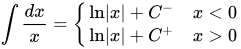
Two facts are crucial in this proof. First, the real line is connected. If the real line were not connected, one would not always be able to integrate from our fixed a to any given x. For example, if one were to ask for functions defined on the union of intervals [0,1] and [2,3], and if a were 0, then it would not be possible to integrate from 0 to 3, because the function is not defined between 1 and 2. Here, there will be two constants, one for each connected component of the domain. In general, by replacing constants with locally constant functions, one can extend this theorem to disconnected domains. For example, there are two constants of integration for , and infinitely many for , so for example, the general form for the integral of 1/x is:[5][6]

Second, and were assumed to be everywhere differentiable. If and are not differentiable at even one point, then the theorem might fail. As an example, let be the Heaviside step function, which is zero for negative values of x and one for non-negative values of x, and let Then the derivative of is zero where it is defined, and the derivative of is always zero. Yet it's clear that and do not differ by a constant, even if it is assumed that and are everywhere continuous and almost everywhere differentiable the theorem still fails. As an example, take to be the Cantor function and again let

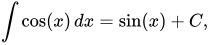
It turns out that adding and subtracting constants is the only flexibility available in finding different antiderivatives of the same function. That is, all antiderivatives are the same up to a constant. To express this fact for one can write: where is constant of integration. It is easily determined that all of the following functions are antiderivatives of :

Significance

[edit]

The inclusion of the constant of integration is necessitated in some, but not all circumstances. For instance, when evaluating definite integrals using the fundamental theorem of calculus, the constant of integration can be ignored as it will always cancel with itself.

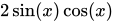
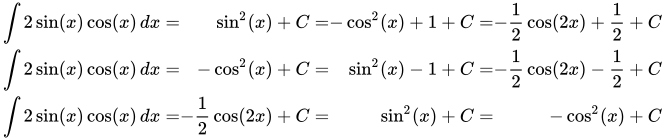
However, different methods of computation of indefinite integrals can result in multiple resulting antiderivatives, each implicitly containing different constants of integration, and no particular option may be considered simplest. For example, can be integrated in at least three different ways.
Additionally, omission of the constant, or setting it to zero, may make it prohibitive to deal with a number of problems, such as those with initial value conditions. A general solution containing the arbitrary constant is often necessary to identify the correct particular solution. For example, to obtain the antiderivative of that has the value 400 at x = π, then only one value of will work (in this case ).
The constant of integration also implicitly or explicitly appears in the language of differential equations. Almost all differential equations will have many solutions, and each constant represents the unique solution of a well-posed initial value problem.

An additional justification comes from abstract algebra. The space of all (suitable) real-valued functions on the real numbers is a vector space, and the differential operator is a linear operator. The operator maps a function to zero if and only if that function is constant. Consequently, the kernel of is the space of all constant functions. The process of indefinite integration amounts to finding a pre-image of a given function. There is no canonical pre-image for a given function, but the set of all such pre-images forms a coset. Choosing a constant is the same as choosing an element of the coset. In this context, solving an initial value problem is interpreted as lying in the hyperplane given by the initial conditions.

References

[edit]
Revisions and contributorsEdit on WikipediaRead on Wikipedia
from Grokipedia
In calculus, the constant of integration, denoted as $ C $, is an arbitrary constant added to the antiderivative of a function when computing an indefinite integral, representing the family of all possible antiderivatives that differ only by a constant value.[1] This constant is essential because differentiation eliminates any added constant—since the derivative of a constant is zero—meaning that integration, as the inverse operation, must account for this lost information to yield the complete set of solutions.[2] The indefinite integral is notated as $ \int f(x) , dx = F(x) + C $, where $ F(x) $ is a particular antiderivative satisfying $ F'(x) = f(x) $, and $ C $ is the constant of integration that can take any real value, ensuring the expression encompasses all antiderivatives.[1] Unlike the definite integral, which computes a specific numerical area under a curve between limits and yields a unique value without a constant, the indefinite integral produces a function plus $ C $, highlighting its role in describing general solutions rather than particular ones.[3] This concept is foundational in solving first-order differential equations of the form $ \frac{dy}{dx} = f(x) $, where the general solution is $ y = \int f(x) , dx = F(x) + C $, and initial conditions are used to determine a specific value for $ C $.[3] For example, integrating $ \int (x^2 + 1) , dx $ gives $ \frac{1}{3}x^3 + x + C $, where adding or subtracting constants to this result still produces valid antiderivatives, as their derivatives return the original integrand.[1] The constant appears only once in the final expression of an indefinite integral, even for polynomials or sums of terms, simplifying the notation while preserving completeness.[2]

Definition and Fundamentals

Definition

In calculus, the constant of integration, denoted by CC, is an arbitrary real number that appears in the general solution to the indefinite integral of a function, representing the family of all antiderivatives.[4] For a continuous function f(x)f(x), the indefinite integral f(x)dx\int f(x) \, dx is expressed as F(x)+CF(x) + C, where F(x)F(x) is any specific antiderivative of f(x)f(x) such that F(x)=f(x)F'(x) = f(x), and CC accounts for all possible such functions differing only by a constant shift.[3] This arbitrary constant CC arises because differentiation eliminates constants: the derivative of F(x)+CF(x) + C is f(x)f(x), as the derivative of any constant is zero, ensuring that every member of the family F(x)+CF(x) + C (for CRC \in \mathbb{R}) has the same derivative f(x)f(x).[5] Thus, the indefinite integral captures an infinite family of primitive functions, or antiderivatives, rather than a single unique function.[2] The introduction of CC is fundamental to the process of integration as the inverse of differentiation, where primitive functions serve as the basis for expressing the complete set of solutions to the differential equation $ \frac{d}{dx} g(x) = f(x) $.

Antiderivatives and the Role of C

In calculus, the constant of integration arises naturally from the properties of antiderivatives. An antiderivative of a function f(x)f(x) is any differentiable function F(x)F(x) such that F(x)=f(x)F'(x) = f(x). If F(x)F(x) satisfies this condition, then for any real constant CC, the function G(x)=F(x)+CG(x) = F(x) + C also qualifies as an antiderivative, since the derivative of a constant is zero:
G(x)=ddx[F(x)+C]=F(x)+0=f(x). G'(x) = \frac{d}{dx} [F(x) + C] = F'(x) + 0 = f(x).
This demonstrates that adding an arbitrary constant to a known antiderivative yields another valid one, introducing the family of all antiderivatives parameterized by CC.[6] To see why all antiderivatives of f(x)f(x) differ only by such a constant, consider two antiderivatives F(x)F(x) and G(x)G(x) of the same f(x)f(x), so F(x)=G(x)=f(x)F'(x) = G'(x) = f(x). Their difference H(x)=F(x)G(x)H(x) = F(x) - G(x) then has derivative
H(x)=F(x)G(x)=f(x)f(x)=0. H'(x) = F'(x) - G'(x) = f(x) - f(x) = 0.
A key result from real analysis states that if the derivative of a function is zero everywhere on an interval, then the function itself is constant on that interval. This follows as a corollary of the Mean Value Theorem: for any points a<ba < b in the interval, there exists c(a,b)c \in (a, b) such that H(c)=H(b)H(a)ba=0H'(c) = \frac{H(b) - H(a)}{b - a} = 0, implying H(b)=H(a)H(b) = H(a). Thus, H(x)=CH(x) = C for some constant CC, or equivalently, F(x)=G(x)+CF(x) = G(x) + C.[7][8] This uniqueness holds up to an additive constant precisely when the domain is a connected interval, where the function f(x)f(x) is defined and the antiderivative is differentiable. On such domains, the constant CC is the same throughout, ensuring all antiderivatives form a one-parameter family. This property underscores the indefinite nature of antiderivatives: while the derivative operation loses information about additive constants, it preserves the functional form up to that shift.[9] However, on disconnected domains—such as unions of separate intervals—the antiderivatives may involve different constants on each connected component. For instance, consider the Heaviside step function H(x)H(x), defined as H(x)=0H(x) = 0 for x<0x < 0 and H(x)=1H(x) = 1 for x>0x > 0, which is piecewise constant on the disconnected intervals (,0)(-\infty, 0) and (0,)(0, \infty). An antiderivative is F(x)=C1F(x) = C_1 for x<0x < 0 and F(x)=x+C2F(x) = x + C_2 for x>0x > 0, where C1C_1 and C2C_2 can be arbitrary and independent constants, reflecting the separation of the domains. This piecewise adjustment is necessary because the derivative condition must hold locally on each interval without a global constant bridging the discontinuity.[9]

Indefinite Integration

Indefinite Integral Notation

The indefinite integral of a function f(x)f(x) with respect to the variable xx is denoted symbolically as f(x)dx=F(x)+C\int f(x) \, dx = F(x) + C, where F(x)F(x) represents a specific antiderivative of f(x)f(x) such that F(x)=f(x)F'(x) = f(x), and CC is the arbitrary constant of integration. This notation encapsulates the family of all antiderivatives, as the derivative of any constant is zero, ensuring that adding CC preserves the result under differentiation. The integral symbol \int signifies the antiderivative operation, while dxdx specifies the variable with respect to which the integration is performed.[10] Variations in the notation include using a lowercase cc instead of uppercase CC for the constant, as both are conventional and interchangeable in most contexts. In some specialized applications or computational tools, the +C+C term may be omitted when a particular antiderivative is sufficient, but including it explicitly underscores the generality of the indefinite integral and avoids ambiguity in representing the complete solution set.[10]/05:_Integration/5.01:_Antiderivatives_and_Indefinite_Integration) The modern form of this notation originated with Gottfried Wilhelm Leibniz, who introduced the elongated "S" symbol \int on October 29, 1675, in an unpublished manuscript to denote summation of infinitesimals, paired with dxdx to indicate the differential element. This symbolic framework, first published in 1686, facilitated the development of calculus by emphasizing its operational aspects.[11][12] Although the focus here is on single-variable cases, in multivariable calculus, partial indefinite integration with respect to one variable treats the constant of integration as an arbitrary function of the other variables, reflecting the higher-dimensional family of antiderivatives.[13]

Computation and Examples

Computing an indefinite integral requires identifying a function whose derivative is the integrand, a process known as finding the antiderivative, and then appending the constant of integration CC to account for the family of all such functions. This reversal of differentiation ensures that the result satisfies the definition of the indefinite integral, as the derivative of any constant is zero.[10][14] A fundamental example applies the power rule, which states that for n1n \neq -1,
xndx=xn+1n+1+C. \int x^n \, dx = \frac{x^{n+1}}{n+1} + C.
For n=1n=1, this yields xdx=12x2+C\int x \, dx = \frac{1}{2} x^2 + C. To verify, differentiating 12x2+C\frac{1}{2} x^2 + C returns xx, confirming the antiderivative.[1] Another basic case involves trigonometric functions: sinxdx=cosx+C\int \sin x \, dx = -\cos x + C. Differentiation of cosx+C-\cos x + C gives sinx\sin x, as expected.[15] For exponential functions, exdx=ex+C\int e^x \, dx = e^x + C. Here, the antiderivative is the function itself since ddx(ex)=ex\frac{d}{dx} (e^x) = e^x, and the +C+C is retained even though any constant multiple would be absorbed into CC, emphasizing the general solution form.[1] Integration is linear, meaning (af(x)+bg(x))dx=af(x)dx+bg(x)dx+C\int (a f(x) + b g(x)) \, dx = a \int f(x) \, dx + b \int g(x) \, dx + C for constants aa and bb. Thus, for a polynomial like (2x+3)dx\int (2x + 3) \, dx, compute 2xdx+31dx=212x2+3x+C=x2+3x+C2 \int x \, dx + 3 \int 1 \, dx = 2 \cdot \frac{1}{2} x^2 + 3x + C = x^2 + 3x + C. This distributes the operation across terms, simplifying computation.[1] Common pitfalls in indefinite integration include omitting the +C+C, which fails to represent the full family of antiderivatives and can lead to incomplete solutions in applications like differential equations.[16] In techniques such as substitution, errors often arise from mishandling constants, like introducing extra constants during the substitution step instead of adding +C+C only once at the end; similarly, in integration by parts, multiple integrations may tempt adding +C+C intermediately, but it should be included solely in the final expression.

Definite Integration

Definite Integrals Without the Constant

In definite integrals, the constant of integration does not appear because the evaluation over a bounded interval from aa to bb results in its cancellation. The definite integral is denoted as abf(x)dx=F(b)F(a)\int_a^b f(x) \, dx = F(b) - F(a), where F(x)F(x) is any antiderivative of f(x)f(x). If the antiderivative includes an arbitrary constant CC, the expression becomes [F(b)+C][F(a)+C]=F(b)F(a)[F(b) + C] - [F(a) + C] = F(b) - F(a), showing that CC subtracts out regardless of its value.[17][18] For example, consider 0πsin(x)dx\int_0^\pi \sin(x) \, dx. An antiderivative of sin(x)\sin(x) is cos(x)-\cos(x), so evaluating gives [cos(x)]0π=(cos(π))(cos(0))=(1)(1)=2[-\cos(x)]_0^\pi = (-\cos(\pi)) - (-\cos(0)) = -(-1) - (-1) = 2. No constant is needed, as it would cancel in the difference.[17] This property holds because the definite integral abf(x)dx\int_a^b f(x) \, dx represents the net signed area under the curve of f(x)f(x) from aa to bb or the net accumulation of a quantity, which is a specific numerical value independent of the choice of antiderivative.[19][18] Fundamentally, the definite integral is defined as the limit of Riemann sums approximating the area, a process that yields a fixed result without introducing an arbitrary constant.[20]

Connection to the Fundamental Theorem of Calculus

The Fundamental Theorem of Calculus (FTC) establishes the profound connection between differentiation and integration, directly illuminating the role of the constant of integration in indefinite integrals. The first part of the FTC states that if $ f $ is continuous on an interval [a,b][a, b] and $ F(x) = \int_a^x f(t) , dt $, then $ F'(x) = f(x) $ for all $ x $ in [a,b][a, b].[21] This asserts that the definite integral from a fixed lower limit $ a $ to a variable upper limit $ x $ yields a function $ F $ whose derivative is precisely the integrand $ f $, thereby constructing a specific antiderivative without an explicit constant. However, the constant of integration arises implicitly here, as $ F(a) = 0 $ by definition, fixing the value at the lower limit and embedding any additive constant into the choice of $ a $.[21] The second part of the FTC complements this by stating that if $ f $ is continuous on [a,b][a, b] and $ F $ is any antiderivative of $ f $ (so $ F'(x) = f(x) $), then $ \int_a^b f(x) , dx = F(b) - F(a) $.[21] This evaluation theorem shows that integration reverses differentiation exactly over a definite interval, with no residual constant because the additive $ C $ in the general antiderivative cancels in the subtraction: if $ F(x) + C $ is used instead, then $ (F(b) + C) - (F(a) + C) = F(b) - F(a) $.[21] Thus, while indefinite integrals require the $ +C $ to account for the family of antiderivatives, definite integrals are independent of this constant, providing a unique numerical value. A brief outline of how the FTC implies the necessity of $ +C $ in indefinite integrals proceeds from the first part: define $ G(x) = \int_a^x f(t) , dt $, so the FTC guarantees $ G'(x) = f(x) $, making $ G $ one antiderivative. Now suppose $ H $ is another antiderivative, so $ H'(x) = f(x) = G'(x) $. Then $ H(x) - G(x) $ has derivative zero, implying $ H(x) - G(x) = C $ (a constant) on the interval, by the properties of functions with zero derivative on connected intervals.[22] This variable-limit construction formalizes the indefinite integral as $ \int f(x) , dx = G(x) + C $, where $ C $ captures the arbitrariness among all possible antiderivatives. The implications of the FTC extend to the structure of antiderivatives: on any connected interval where $ f $ is continuous, all antiderivatives differ only by a constant, as the theorem ensures the existence and uniqueness up to this additive term.[22] This formalizes the constant of integration as an essential feature of indefinite integration, bridging the inverse operations of calculus while explaining its absence in definite cases.[23]

Historical Development

Origin in Early Calculus

The roots of the constant of integration lie in pre-calculus efforts to compute areas under curves, such as Archimedes' method of exhaustion developed in the 3rd century BCE. This technique approximated the area of specific regions, like parabolic segments or circles, by inscribing and circumscribing polygons and using limits to bound the value between upper and lower estimates, yielding definite areas without any arbitrary constant since the focus was on bounded, fixed quantities rather than general antiderivatives. Unlike modern indefinite integration, Archimedes' approach did not involve inverse operations that introduce undetermined constants, as it targeted precise numerical results for particular geometric figures.[24] In the early 17th century, Isaac Newton advanced these ideas through his method of fluxions, developed around 1665–1666, where integration was conceptualized as the inverse process to differentiation for recovering a "fluent" quantity from its "fluxion" or rate of change. Newton's fluent equations, used to model continuous motion and areas, implicitly incorporated arbitrary constants, especially in general solutions to problems like planetary orbits or falling bodies, where initial conditions determined the specific value but the form allowed for an undetermined additive term.[25] This implicit handling arose because Newton's work often emphasized physical applications with boundary conditions, embedding the constant within the broader equation rather than isolating it explicitly.[26] Gottfried Wilhelm Leibniz contributed significantly in the late 1600s by introducing the integral notation ∫ around 1675, viewing integration as a summation of infinitesimals to find areas or solve quadratures. However, his initial published works, such as the 1684 paper in Acta Eruditorum, overlooked the explicit inclusion of the +C term, often assuming integrals passed through the origin or using specific limits that masked the arbitrary nature.[27] Leibniz's unpublished manuscripts from 1675–1680 reveal his awareness of arbitrary constants in inverse problems, where solving for quadratures of curves required adding undetermined terms to account for the family of antiderivatives, particularly in geometric constructions and series summations. This recognition marked an early step toward the general indefinite integral, though explicit notation for the constant emerged later in calculus development.[28]

Evolution and Notation

In the 18th century, Leonhard Euler advanced the understanding of antiderivatives by explicitly incorporating an arbitrary constant in his comprehensive treatise Institutiones calculi integralis (17681770), presenting the indefinite integral of a function g(x)g(x) as F(x)+CF(x) + C, where F(x)=g(x)F'(x) = g(x) and CC is a constant.[29] This formalization built on earlier intuitive uses of integration, clarifying that solutions to differential equations form families offset by arbitrary constants.[30] Joseph-Louis Lagrange reinforced the role of such constants in practical contexts through his Mécanique Analytique (1788), where he derived differential equations for mechanical systems and highlighted integration constants as essential parameters in their general solutions.[31] Lagrange's approach, focused on variational principles, demonstrated how these constants represent undetermined elements fixed by initial conditions in physical problems.[32] The 19th century saw further rigorization by Augustin-Louis Cauchy and Bernhard Riemann, who emphasized the constant's place in defining general antiderivative families amid their foundational work on integration theory. Cauchy's Cours d'analyse de l'École Royale Polytechnique (1821) introduced limit-based definitions that distinguished indefinite integrals as equivalence classes of functions differing by constants, providing a precise framework for their existence.[33] Riemann's work, first presented in 1854 and published in 1867 as Über die Darstellbarkeit einer Function durch eine trigonometrische Reihe, advanced the theory by formalizing the definite integral for bounded functions with discontinuities, contributing to the understanding of integration in broader contexts including antiderivatives.[34] By the early 1800s, the explicit +C+C notation shifted from occasional use to standardization in calculus textbooks, reflecting broader adoption in educational materials as integration theory matured. This evolution addressed earlier ambiguities in symbolizing arbitrary constants, ensuring consistent representation across mathematical literature.[35]

Applications and Significance

Solving Differential Equations

In ordinary differential equations (ODEs), solving the equation typically involves integration, which introduces one or more arbitrary constants of integration into the general solution. These constants represent the family of all possible solutions that satisfy the differential equation, as the integration process inherently loses information about specific values. For a first-order ODE like $ y' = y $, separation of variables and integration yield the general solution $ y = A e^x $, where $ A $ is the constant of integration.[36] To obtain a unique particular solution from this general form, initial value problems (IVPs) incorporate initial conditions that specify the value of the dependent variable at a particular point. These conditions determine the constant(s) by substitution into the general solution. For example, consider the IVP $ y' = 2x $ with $ y(0) = 1 $. Integrating both sides gives the general solution:
y=2xdx=x2+C. y = \int 2x \, dx = x^2 + C.
Applying the initial condition $ y(0) = 1 $ yields $ 1 = 0^2 + C $, so $ C = 1 $, and the particular solution is $ y = x^2 + 1 $. This step-by-step process ensures the solution matches the given data while satisfying the ODE.[37]
For higher-order ODEs, the general solution includes a number of constants equal to the order of the equation. A second-order linear ODE, for instance, might produce a solution like $ y = C_1 + C_2 x $ for the homogeneous case $ y'' = 0 $, requiring two initial conditions—such as $ y(0) = y_0 $ and $ y'(0) = y_0' $—to solve for $ C_1 $ and $ C_2 $. Without these constants, the solution would be incomplete, representing only one member of the solution family rather than the full set. Initial or boundary conditions thus play a critical role in selecting the physically or contextually relevant particular solution from the general one.[38]

Role in Physics and Engineering

In physics, particularly in kinematics, the constant of integration plays a crucial role when deriving velocity from acceleration via indefinite integration. For constant acceleration aa, the velocity is given by v(t)=at+Cv(t) = at + C, where CC represents the initial velocity v0v_0 determined by boundary conditions, such as the object's starting speed.[39][40] Integrating velocity to obtain position introduces another constant, x(t)=12at2+v0t+x0x(t) = \frac{1}{2}at^2 + v_0 t + x_0, with x0x_0 as the initial position. In projectile motion under gravity, neglecting x0x_0 (or y0y_0 in vertical coordinates) leads to erroneous predictions, such as assuming the projectile lands at the launch height when it is actually launched from an elevated platform.[41][42] In engineering applications, such as electrical circuits, the constant of integration similarly accounts for initial states in time-dependent analyses. For a capacitor, the voltage v(t)v(t) is derived from current i(t)i(t) as v(t)=1Ci(t)dt+v(0)v(t) = \frac{1}{C} \int i(t) \, dt + v(0), where CC is capacitance and v(0)v(0) is the initial voltage, reflecting the stored charge at t=0t=0.[43] Equivalently, for charge q(t)=i(t)dt+q0q(t) = \int i(t) \, dt + q_0, the constant q0q_0 encodes the initial charge, essential for simulating circuit behavior in systems like RC networks where transient responses depend on starting conditions.[44] The constant of integration fundamentally encodes the "memory" of a physical system's prior state through initial conditions, enabling unique solutions to differential equations that describe real-world dynamics.[45] Ignoring it results in incomplete models that fail to predict outcomes accurately, as seen in kinematics where omitting initial velocity or position alters trajectory forecasts. In scalar contexts of physics and engineering, this constant ensures solutions align with observable phenomena, whereas in vector calculus extensions like line integrals, path dependencies for non-conservative fields introduce analogous variations beyond a simple constant, though scalar integrations remain the primary focus for such applications.[46]

References

User Avatar
No comments yet.