Recent from talks
Nothing was collected or created yet.
Gradient theorem
View on Wikipedia| Part of a series of articles about |
| Calculus |
|---|
The gradient theorem, also known as the fundamental theorem of calculus for line integrals, says that a line integral through a gradient field can be evaluated by evaluating the original scalar field at the endpoints of the curve. The theorem is a generalization of the second fundamental theorem of calculus to any curve in a plane or space (generally n-dimensional) rather than just the real line.
If φ : U ⊆ Rn → R is a differentiable function and γ a differentiable curve in U which starts at a point p and ends at a point q, then
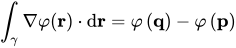
where ∇φ denotes the gradient vector field of φ.
The gradient theorem implies that line integrals through gradient fields are path-independent. In physics this theorem is one of the ways of defining a conservative force. By placing φ as potential, ∇φ is a conservative field. Work done by conservative forces does not depend on the path followed by the object, but only the end points, as the above equation shows.
The gradient theorem also has an interesting converse: any path-independent vector field can be expressed as the gradient of a scalar field. Just like the gradient theorem itself, this converse has many striking consequences and applications in both pure and applied mathematics.
Proof
[edit]If φ is a differentiable function from some open subset U ⊆ Rn to R and r is a differentiable function from some closed interval [a, b] to U (Note that r is differentiable at the interval endpoints a and b. To do this, r is defined on an interval that is larger than and includes [a, b].), then by the multivariate chain rule, the composite function φ ∘ r is differentiable on [a, b]:

for all t in [a, b]. Here the ⋅ denotes the dot product.
Now suppose the domain U of φ contains the differentiable curve γ with endpoints p and q. (This is oriented in the direction from p to q). If r parametrizes γ for t in [a, b] (i.e., r represents γ as a function of t), then
where the definition of a line integral is used in the first equality, the above equation is used in the second equality, and the second fundamental theorem of calculus is used in the third equality.[1]
Even if the gradient theorem (also called fundamental theorem of calculus for line integrals) has been proved for a differentiable (so looked as smooth) curve so far, the theorem is also proved for a piecewise-smooth curve since this curve is made by joining multiple differentiable curves so the proof for this curve is made by the proof per differentiable curve component.[2]
Examples
[edit]Example 1
[edit]Suppose γ ⊂ R2 is the circular arc oriented counterclockwise from (5, 0) to (−4, 3). Using the definition of a line integral,
This result can be obtained much more simply by noticing that the function has gradient , so by the Gradient Theorem:
Example 2
[edit]For a more abstract example, suppose γ ⊂ Rn has endpoints p, q, with orientation from p to q. For u in Rn, let |u| denote the Euclidean norm of u. If α ≥ 1 is a real number, then
Here the final equality follows by the gradient theorem, since the function f(x) = |x|α+1 is differentiable on Rn if α ≥ 1.
If α < 1 then this equality will still hold in most cases, but caution must be taken if γ passes through or encloses the origin, because the integrand vector field |x|α − 1x will fail to be defined there. However, the case α = −1 is somewhat different; in this case, the integrand becomes |x|−2x = ∇(log |x|), so that the final equality becomes log |q| − log |p|.
Note that if n = 1, then this example is simply a slight variant of the familiar power rule from single-variable calculus.
Example 3
[edit]Suppose there are n point charges arranged in three-dimensional space, and the i-th point charge has charge Qi and is located at position pi in R3. We would like to calculate the work done on a particle of charge q as it travels from a point a to a point b in R3. Using Coulomb's law, we can easily determine that the force on the particle at position r will be
Here |u| denotes the Euclidean norm of the vector u in R3, and k = 1/(4πε0), where ε0 is the vacuum permittivity.
Let γ ⊂ R3 − {p1, ..., pn} be an arbitrary differentiable curve from a to b. Then the work done on the particle is
Now for each i, direct computation shows that
Thus, continuing from above and using the gradient theorem,
We are finished. Of course, we could have easily completed this calculation using the powerful language of electrostatic potential or electrostatic potential energy (with the familiar formulas W = −ΔU = −qΔV). However, we have not yet defined potential or potential energy, because the converse of the gradient theorem is required to prove that these are well-defined, differentiable functions and that these formulas hold (see below). Thus, we have solved this problem using only Coulomb's law, the definition of work, and the gradient theorem.
Converse of the gradient theorem
[edit]The gradient theorem states that if the vector field F is the gradient of some scalar-valued function (i.e., if F is conservative), then F is a path-independent vector field (i.e., the integral of F over some piecewise-differentiable curve is dependent only on end points). This theorem has a powerful converse:
Theorem— If F is a path-independent vector field, then F is the gradient of some scalar-valued function.[3]
It is straightforward to show that a vector field is path-independent if and only if the integral of the vector field over every closed loop in its domain is zero. Thus the converse can alternatively be stated as follows: If the integral of F over every closed loop in the domain of F is zero, then F is the gradient of some scalar-valued function.
Proof of the converse
[edit]Suppose U is an open, path-connected subset of Rn, and F : U → Rn is a continuous and path-independent vector field. Fix some element a of U, and define f : U → R byHere γ[a, x] is any (differentiable) curve in U originating at a and terminating at x. We know that f is well-defined because F is path-independent.
Let v be any nonzero vector in Rn. By the definition of the directional derivative,To calculate the integral within the final limit, we must parametrize γ[x, x + tv]. Since F is path-independent, U is open, and t is approaching zero, we may assume that this path is a straight line, and parametrize it as u(s) = x + sv for 0 < s < t. Now, since u'(s) = v, the limit becomeswhere the first equality is from the definition of the derivative with a fact that the integral is equal to 0 at t = 0, and the second equality is from the first fundamental theorem of calculus. Thus we have a formula for ∂vf, (one of ways to represent the directional derivative) where v is arbitrary; for (see its full definition above), its directional derivative with respect to v iswhere the first two equalities just show different representations of the directional derivative. According to the definition of the gradient of a scalar function f, , thus we have found a scalar-valued function f whose gradient is the path-independent vector field F (i.e., F is a conservative vector field.), as desired.[3]
Example of the converse principle
[edit]To illustrate the power of this converse principle, we cite an example that has significant physical consequences. In classical electromagnetism, the electric force is a path-independent force; i.e. the work done on a particle that has returned to its original position within an electric field is zero (assuming that no changing magnetic fields are present).
Therefore, the above theorem implies that the electric force field Fe : S → R3 is conservative (here S is some open, path-connected subset of R3 that contains a charge distribution). Following the ideas of the above proof, we can set some reference point a in S, and define a function Ue: S → R by
Using the above proof, we know Ue is well-defined and differentiable, and Fe = −∇Ue (from this formula we can use the gradient theorem to easily derive the well-known formula for calculating work done by conservative forces: W = −ΔU). This function Ue is often referred to as the electrostatic potential energy of the system of charges in S (with reference to the zero-of-potential a). In many cases, the domain S is assumed to be unbounded and the reference point a is taken to be "infinity", which can be made rigorous using limiting techniques. This function Ue is an indispensable tool used in the analysis of many physical systems.
Generalizations
[edit]Many of the critical theorems of vector calculus generalize elegantly to statements about the integration of differential forms on manifolds. In the language of differential forms and exterior derivatives, the gradient theorem states that
for any 0-form, ϕ, defined on some differentiable curve γ ⊂ Rn (here the integral of ϕ over the boundary of the γ is understood to be the evaluation of ϕ at the endpoints of γ).
Notice the striking similarity between this statement and the generalized Stokes’ theorem, which says that the integral of any compactly supported differential form ω over the boundary of some orientable manifold Ω is equal to the integral of its exterior derivative dω over the whole of Ω, i.e.,
This powerful statement is a generalization of the gradient theorem from 1-forms defined on one-dimensional manifolds to differential forms defined on manifolds of arbitrary dimension.
The converse statement of the gradient theorem also has a powerful generalization in terms of differential forms on manifolds. In particular, suppose ω is a form defined on a contractible domain, and the integral of ω over any closed manifold is zero. Then there exists a form ψ such that ω = dψ. Thus, on a contractible domain, every closed form is exact. This result is summarized by the Poincaré lemma.
See also
[edit]References
[edit]- ^ Williamson, Richard E.; Trotter, Hale F. (2004). Multivariable mathematics. Pearson Education International (4th ed.). Upper Saddle River, N.J: Pearson Prentice Hall. p. 374. ISBN 978-0-13-067276-6.
- ^ Stewart, James; Clegg, Dan; Watson, Saleem (2021). "16.3 The Fundamental Theorem for Line Integrals". Calculus (Ninth ed.). Australia ; Boston, MA, USA: Cengage. pp. 1182–1185. ISBN 978-1-337-62418-3.
- ^ a b Williamson & Trotter 2004, p. 410
Gradient theorem
View on GrokipediaPrerequisites
Scalar Fields and Their Gradients
A scalar field, denoted as , is a function that assigns a real scalar value to each point in an -dimensional space, such as temperature or pressure distributions in physics.[5][6] In two dimensions, for example, might represent the height of a terrain at coordinates , providing a complete description of the field's variation across the domain.[7] To analyze changes in a scalar field, partial derivatives are computed with respect to each coordinate; for instance, in three dimensions, these are , , and , each holding other variables constant and indicating the instantaneous rate of change along that axis.[7][8] These derivatives form the components of the gradient vector, defined as in , where is the nabla operator, a vector differential operator .[8][7] Geometrically, the gradient at a point points in the direction of the scalar field's steepest ascent and its magnitude equals the maximum rate of change of at that point, perpendicular to level surfaces where is constant.[8][7] For the gradient to be well-defined and continuous, the scalar field must be continuously differentiable, belonging to the class , ensuring the partial derivatives exist and are continuous throughout the domain.[8] Such gradients yield vector fields that are conservative, meaning they derive from a potential function.[7]Line Integrals of Vector Fields
A parametrized curve in is defined as a smooth path traced out by the position vector for ranging from to , where serves as the tangent vector to the curve at each point .[9][10] For a continuous vector field , the line integral of along the curve , denoted , is given by the scalar integral .[9][10] Here, represents the infinitesimal displacement vector along the curve, approximated by , which captures the direction and magnitude of the path's tangent.[9] This integral physically interprets as the total work done by the vector field (such as a force field) when moving a unit mass along the path , accumulating the dot product of with each infinitesimal displacement.[9][10] The curve must be piecewise smooth and continuous to ensure the existence of the integral, meaning it consists of finitely many smooth segments with well-defined tangent vectors almost everywhere, while the vector field is required to be continuous along the image of .[9][10] The value of the line integral is independent of the specific parametrization chosen for , as long as the curve is traversed in the same direction and exactly once; a reparametrization with from to and yields the same result via the chain rule, .[9]The Gradient Theorem
Statement of the Theorem
The gradient theorem, also known as the fundamental theorem for line integrals, serves as the multivariable analog of the fundamental theorem of calculus, relating the accumulation of a vector field along a path to the net change in a scalar potential function.[11] The theorem states that if a vector field is the gradient of a scalar field (i.e., ), then for any piecewise smooth path from endpoint to endpoint , the line integral equals the difference in the potential at those points: [12]/16:_Vector_Calculus/16.03:_The_Fundamental_Theorem_of_Line_Integrals) This holds provided is differentiable on an open set in containing the image of . While the direct statement of the theorem does not require the domain to be simply connected, such a condition is relevant for ensuring the existence of globally, as addressed in the converse theorem.[12]/16:_Vector_Calculus/16.03:_The_Fundamental_Theorem_of_Line_Integrals) Intuitively, the result demonstrates that the line integral reduces to a telescoping difference in potential values, independent of the path's intermediate details, much like how the one-dimensional integral yields the antiderivative's net change regardless of the integration process.[11]Proof of the Theorem
To prove the gradient theorem, consider first the case of a single smooth path. Let be a scalar function with continuous gradient defined on an open set containing the curve that is piecewise smooth and oriented from the initial point to the terminal point . Parametrize the curve as for , where is differentiable and is continuous.[12] The line integral is given by . Define . By the multivariable chain rule, the derivative is .[12] Integrating both sides yields . The left side simplifies by the fundamental theorem of calculus to . Thus, . The continuity of ensures that the integrand is continuous and thus integrable over the compact interval .[12] For a piecewise smooth path consisting of smooth segments for , with for intermediate points, apply the result to each segment: . This telescopes to , as intermediate terms cancel.[12] The theorem respects path orientation: reversing the path negates the line integral, consistent with .[12]Illustrative Examples
Basic Computational Example
To illustrate the gradient theorem, consider the scalar potential function in the plane, whose gradient is the vector field . This field is conservative, as it arises from the gradient of a scalar potential. Parametrize a path from to by for , so . Along this path, . The line integral is then By the gradient theorem, this equals , confirming the result. In contrast, for a non-gradient vector field such as , the line integral between fixed endpoints depends on the chosen path, highlighting the path independence unique to gradient fields.Physical Application Example
A prominent physical application of the gradient theorem arises in the context of conservative forces, particularly the gravitational force between two point masses, which exemplifies how work in a gradient field depends solely on initial and final positions. Consider the gravitational potential energy between a central mass (such as a planet) and a test mass separated by a distance , given by where is the gravitational constant (), is the central mass in kilograms, and is the test mass in kilograms.[13] The corresponding gravitational force on , which points toward the center of , is the negative gradient of this potential: [14] By the gradient theorem, the work done by this force along any path from position A (at distance ) to position B (at distance ) is [14] This expression demonstrates that the work depends only on the initial and final distances from the center, independent of the path taken between A and B.[15] In practical scenarios near Earth's surface, where the form approximates the linear potential (with and the height above radius ), the work done against gravity when lifting an object is identical whether the path is vertical or along an inclined plane, provided the change in height (or radial distance) is the same.[15] This path independence underpins the conservation of mechanical energy, as the work by the conservative gravitational force equals the negative change in potential energy, allowing total energy (kinetic plus potential) to remain constant in the absence of non-conservative forces.[16]Path Independence Verification Example
To illustrate path independence, consider the scalar potential function defined on . The gradient of this scalar field is , which is a conservative vector field. The line integral of along any piecewise smooth path from the point to should equal , independent of the path taken, by the gradient theorem. Verify this by explicitly computing the line integral along two distinct paths: a straight line and a parabolic arc. Straight-line path , :The parameterization gives . Substituting into the vector field yields .
The dot product is .
Thus, Parabolic path , :
The parameterization gives . Substituting into the vector field yields .
The dot product is .
Thus, Both integrals evaluate to 1, matching the difference in potential values at the endpoints and confirming that the line integral is path-independent for this gradient field.
