


Community hub
Recent from talks
Contribute something
Nothing was collected or created yet.
Laser diode
View on Wikipedia | |
| Component type | semiconductor, light-emitting diode |
|---|---|
| Working principle | semiconductor, carrier generation and recombination |
| Inventor | Robert N. Hall, 1962; Nick Holonyak, Jr., 1962 |
| Pin names | Anode and cathode |


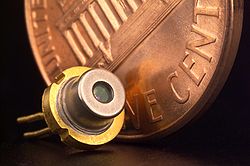
A laser diode (LD, also injection laser diode or ILD or semiconductor laser or diode laser) is a semiconductor device similar to a light-emitting diode in which a diode pumped directly with electrical current can create lasing conditions at the diode's junction.[1]: 3
Driven by voltage, the doped p–n-transition allows for recombination of an electron with a hole. Due to the drop of the electron from a higher energy level to a lower one, radiation is generated in the form of an emitted photon. This is spontaneous emission. Stimulated emission can be produced when the process is continued and further generates light with the same phase, coherence, and wavelength.
The choice of the semiconductor material determines the wavelength of the emitted beam, which in today's laser diodes range from the infrared (IR) to the ultraviolet (UV) spectra. Laser diodes are the most common type of lasers produced, with a wide range of uses that include fiber-optic communications, barcode readers, laser pointers, CD/DVD/Blu-ray disc reading/recording, laser printing, laser scanning, and light beam illumination. With the use of a phosphor like that found on white LEDs, laser diodes can be used for general illumination.
Theory
[edit] | This section needs additional citations for verification. (July 2011) |

A laser diode is electrically a PIN diode. The active region of the laser diode is in the intrinsic (I) region, and the carriers (electrons and holes) are pumped into that region from the N and P regions respectively. While initial diode laser research was conducted on simple P–N diodes, all modern lasers use the double-hetero-structure implementation, where the carriers and the photons are confined in order to maximize their chances for recombination and light generation. Unlike a regular diode, the goal for a laser diode is to recombine all carriers in the I region, and produce light. Thus, laser diodes are fabricated using direct band-gap semiconductors. The laser diode epitaxial structure is grown using one of the crystal growth techniques, usually starting from an N-doped substrate, and growing the I (undoped) active layer, followed by the P-doped cladding, and a contact layer. The active layer most often consists of quantum wells, which provide lower threshold current and higher efficiency.[1]
Electrical and optical pumping
[edit]Laser diodes form a subset of the larger classification of semiconductor p–n junction diodes. Forward electrical bias across the laser diode causes the two species of charge carrier – holes and electrons – to be injected from opposite sides of the PIN junction into the depletion region. Holes are injected from the p-doped into the undoped (i) semiconductor, and electrons vice versa. (A depletion region, devoid of any charge carriers, forms as a result of the difference in electrical potential between n- and p-type semiconductors wherever they are in physical contact.) Due to the use of charge injection in powering most diode lasers, this class of lasers is sometimes termed injection lasers, or injection laser diodes (ILD). As diode lasers are semiconductor devices, they may also be classified as semiconductor lasers. Either designation distinguishes diode lasers from solid-state lasers.
Another method of powering some diode lasers is the use of optical pumping. Optically pumped semiconductor lasers (OPSL) use a III-V semiconductor chip as the gain medium, and another laser (often another diode laser) as the pump source. OPSLs offer several advantages over ILDs, particularly in wavelength selection and lack of interference from internal electrode structures.[2][3] A further advantage of OPSLs is invariance of the beam parameters – divergence, shape, and pointing – as pump power (and hence output power) is varied, even over a 10:1 output power ratio.[4]
Generation of spontaneous emission
[edit]When an electron and a hole are present in the same region, they may recombine or annihilate producing a spontaneous emission — that is, the electron may re-occupy the energy state of the hole, emitting a photon with energy equal to the difference between the electron's original state and hole's state. (In a conventional semiconductor junction diode, the energy released from the recombination of electrons and holes is carried away as phonons (lattice vibrations) rather than as photons.) Spontaneous emission below the lasing threshold produces similar properties to an LED. Spontaneous emission is necessary to initiate laser oscillation, but it is one among several sources of inefficiency once the laser is oscillating.
Direct and indirect bandgap semiconductors
[edit]The difference between the photon-emitting semiconductor laser and a conventional phonon-emitting (non-light-emitting) semiconductor junction diode lies in the type of semiconductor used, one whose physical and atomic structure confers the possibility for photon emission. These photon-emitting semiconductors are the so-called "direct bandgap" semiconductors. The properties of silicon and germanium, which are single-element semiconductors, have bandgaps that do not align in the way needed to allow photon emission and are not considered direct. Other materials, the so-called compound semiconductors, have virtually identical crystalline structures as silicon or germanium but use alternating arrangements of two different atomic species in a checkerboard-like pattern to break the symmetry. The transition between the materials in the alternating pattern creates the critical direct bandgap property. Gallium arsenide, indium phosphide, gallium antimonide, and gallium nitride are all examples of compound semiconductor materials that can be used to create junction diodes that emit light.


Generation of stimulated emission
[edit]In the absence of stimulated emission (e.g., lasing) conditions, electrons and holes may coexist in proximity to one another, without recombining, for a certain time, termed the upper-state lifetime or recombination time (about a nanosecond for typical diode laser materials), before they recombine. A nearby photon with energy equal to the recombination energy can cause recombination by stimulated emission. This generates another photon of the same frequency, polarization, and phase, travelling in the same direction as the first photon. This means that stimulated emission will cause gain in an optical wave (of the correct wavelength) in the injection region, and the gain increases as the number of electrons and holes injected across the junction increases. The spontaneous and stimulated-emission processes are vastly more efficient in direct bandgap semiconductors than in indirect bandgap semiconductors; therefore, silicon is not a common material for laser diodes.
Optical cavity and laser modes
[edit]As in other lasers, the gain region is surrounded by an optical cavity to form a laser. In the simplest form of laser diode, an optical waveguide is made on that crystal's surface, such that the light is confined to a relatively narrow line. The two ends of the crystal are cleaved to form perfectly smooth, parallel edges, forming a Fabry–Pérot resonator. Photons emitted into a mode of the waveguide will travel along the waveguide and be reflected several times from each end face before they exit. As a light wave passes through the cavity, it is amplified by stimulated emission, but light is also lost due to absorption and by incomplete reflection from the end facets. Finally, if there is more amplification than loss, the diode begins to lase.
Some important properties of laser diodes are determined by the geometry of the optical cavity. Generally, the light is contained within a very thin layer, and the structure supports only a single optical mode in the direction perpendicular to the layers. In the transverse direction, if the waveguide is wide compared to the wavelength of the light, then the waveguide can support multiple transverse optical modes, and the laser is known as multi-mode. These transversely multi-mode lasers are adequate in cases where one needs a very large amount of power, but not a small diffraction-limited TEM00 beam, such as in printing, activating chemicals, microscopy, or pumping other types of lasers.
In applications where a small, focused beam is needed, the waveguide must be made narrow, on the order of the optical wavelength. This way, only a single transverse mode is supported and one ends up with a diffraction-limited beam. Such single-spatial-mode devices are used for optical storage, laser pointers, and fiber optics. These lasers may still support multiple longitudinal modes, and thus can lase at multiple wavelengths simultaneously. The wavelength emitted is a function of the bandgap of the semiconductor material and the modes of the optical cavity. In general, the maximum gain will occur for photons with energy slightly above the bandgap energy, and the modes nearest the peak of the gain curve will lase most strongly. The width of the gain curve will determine the number of additional side modes that may also lase, depending on the operating conditions. Single-spatial-mode lasers that can support multiple longitudinal modes are called Fabry-Pérot (FP) lasers. An FP laser will lase at multiple cavity modes within the gain bandwidth of the lasing medium. The number of lasing modes in an FP laser is usually unstable and can fluctuate due to changes in current or temperature.
Single-spatial-mode diode lasers can be designed so as to operate on a single longitudinal mode. These single-frequency diode lasers exhibit a high degree of stability, and are used in spectroscopy and metrology and as frequency references. Single-frequency diode lasers are classed as either distributed-feedback (DFB) lasers or distributed Bragg reflector (DBR) lasers.
Formation of laser beam
[edit]Due to diffraction, the beam diverges (expands) rapidly after leaving the chip, typically at 30 degrees vertically by 10 degrees laterally. A lens must be used in order to form a collimated beam like that produced by a laser pointer. If a circular beam is required, then cylindrical lenses and other optics are used. For single-spatial-mode lasers, using symmetrical lenses, the collimated beam ends up being elliptical in shape, due to the difference in the vertical and lateral divergences. This is easily observable with a red laser pointer. The long axis of the ellipse is at right-angles to the plane of the chip.
The simple diode described above has been heavily modified in recent years[when?] to accommodate modern technology, resulting in a variety of types of laser diodes, as described below.
History
[edit]
Following theoretical treatments of M.G. Bernard, G. Duraffourg, and William P. Dumke in the early 1960s, coherent light emission from a gallium arsenide (GaAs) semiconductor diode (a laser diode) was demonstrated in 1962 by two US groups led by Robert N. Hall at the General Electric research center[5] and by Marshall Nathan at the IBM T.J. Watson Research Center.[6] There has been ongoing debate as to whether IBM or GE invented the first laser diode, which was largely based on theoretical work by William P. Dumke at IBM's Kitchawan Lab (currently known as the Thomas J. Watson Research Center) in Yorktown Heights, NY. The priority is given to the General Electric group, who submitted their results earlier; they also went further and made a resonant cavity for their diode.[7] It was initially speculated, by MIT's Ben Lax among other leading physicists, that silicon or germanium could be used to create a lasing effect, but theoretical analyses convinced William P. Dumke that these materials would not work. Instead, he suggested gallium arsenide as a good candidate. The first visible-wavelength laser diode was demonstrated by Nick Holonyak, Jr. later in 1962; he used gallium arsenide phosphide.[8]
Other teams at MIT Lincoln Laboratory, Texas Instruments, and RCA Laboratories were also involved in, and received credit for, their historic initial demonstrations of efficient light emission and lasing in semiconductor diodes in 1962 and thereafter. GaAs lasers were also produced in early 1963 in the Soviet Union by the team led by Nikolay Basov.[9]
In the early 1960s, liquid-phase epitaxy (LPE) was invented by Herbert Nelson of RCA Laboratories. By layering the highest-quality crystals of varying compositions, it enabled the demonstration of the highest-quality heterojunction semiconductor laser materials for many years. LPE was adopted by all the leading laboratories worldwide and was used for many years. It was finally supplanted in the 1970s by molecular-beam epitaxy and organometallic chemical vapor deposition.
Diode lasers of that era operated with threshold current densities of 1000 A/cm2 at 77 K temperatures. Such performance enabled continuous lasing to be demonstrated in the earliest days. However, when operated at room temperature, about 300 K, threshold current densities were two orders of magnitude greater, or 100,000 A/cm2, in the best devices. The dominant challenge for the remainder of the 1960s was to obtain low threshold current density at 300 K and thereby to demonstrate continuous-wave lasing at room temperature from a diode laser.
The first diode lasers were homojunction diodes. That is, the material (and thus the bandgap) of the waveguide core layer and that of the surrounding clad layers were identical. It was recognized that there was an opportunity, particularly afforded by the use of liquid-phase epitaxy using aluminum gallium arsenide, to introduce heterojunctions. Heterostructures consist of layers of semiconductor crystal having varying bandgap and refractive index. Heterojunctions (formed from heterostructures) had been recognized by Herbert Kroemer, while working at RCA Laboratories in the mid-1950s, as having unique advantages for several types of electronic and optoelectronic devices, including diode lasers. LPE afforded the technology of making heterojunction diode lasers. In 1963, he proposed the double heterostructure laser.
The first heterojunction diode lasers were single-heterojunction lasers. These lasers used aluminum gallium arsenide p-type injectors situated over n-type gallium arsenide layers grown on the substrate by LPE. An admixture of aluminum replaced gallium in the semiconductor crystal and raised the bandgap of the p-type injector over that of the n-type layers beneath. It worked; the 300 K threshold currents went down by 10× to 10,000 A/cm2. Unfortunately, this was still not in the needed range, and these single-heterostructure diode lasers did not function in continuous-wave operation at room temperature.
The innovation that met the room temperature challenge was the double-heterostructure laser. The trick was to quickly move the wafer in the LPE apparatus between different melts of aluminum gallium arsenide (p- and n-type) and a third melt of gallium arsenide. It had to be done rapidly since the gallium arsenide core region needed to be significantly under 1 μm in thickness. The first laser diode to achieve continuous-wave operation was a double heterostructure demonstrated in 1970 essentially simultaneously by Zhores Alferov and collaborators (including Dmitri Z. Garbuzov) of the Soviet Union, and Morton Panish and Izuo Hayashi working in the United States. However, it is widely accepted that Alferov and team reached the milestone first.[10]
For their accomplishment and that of their co-workers, Alferov and Kroemer shared the 2000 Nobel Prize in Physics.
Types
[edit]The simple laser diode structure described above is inefficient. Such devices require so much power that they can only achieve pulsed operation without damage. Although historically important and easy to explain, such devices are not practical.
Double heterostructure lasers
[edit]
In these devices, a layer of low-bandgap material is sandwiched between two high-bandgap layers. One commonly used pair of materials is gallium arsenide (GaAs) with aluminium gallium arsenide (AlxGa(1-x)As). Each of the junctions between different bandgap materials is called a heterostructure, hence the name double heterostructure (DH) laser. The kind of laser diode described in the first part of the article may be referred to as a homojunction laser, for contrast with these more popular devices.
The advantage of a DH laser is that the region where free electrons and holes exist simultaneously—the active region—is confined to the thin middle layer. This means that many more of the electron-hole pairs can contribute to amplification—not so many are left out in the poorly amplifying periphery. In addition, light is reflected within the heterojunction; hence, the light is confined to the region where the amplification takes place.
Quantum well lasers
[edit]
If the middle layer is made thin enough, it acts as a quantum well. This means that the vertical variation of the electron's wavefunction, and thus a component of its energy, is quantized. The efficiency of a quantum well laser is greater than that of a bulk laser because the density of states function of electrons in the quantum well system has an abrupt edge that concentrates electrons in energy states that contribute to laser action.
Lasers containing more than one quantum well layer are known as multiple quantum well lasers. Multiple quantum wells improve the overlap of the gain region with the optical waveguide mode.
Further improvements in laser efficiency have also been demonstrated by reducing the quantum well layer(s) to a layer(s) with quantum wires and especially quantum dots.
Quantum cascade lasers
[edit]In a quantum cascade laser, the difference between quantum well energy levels is used for the laser transition instead of the bandgap. This enables laser action at relatively long wavelengths, which can be tuned simply by altering the thickness of the layer. They are heterojunction lasers.
Interband cascade lasers
[edit]An interband cascade laser (ICL) is a type of laser diode that can produce coherent radiation over a large part of the mid-infrared region of the electromagnetic spectrum.
Separate confinement heterostructure lasers
[edit]
The problem with the simple quantum well diode described above is that the thin layer is simply too small to effectively confine the light. To compensate, another two layers are added on, outside the first three. These layers have a lower refractive index than the center layers, and hence confine the light effectively. Such a design is called a separate confinement heterostructure (SCH) laser diode.
Almost all commercial laser diodes since the 1990s have been SCH quantum well diodes. [citation needed]
Distributed Bragg reflector lasers
[edit]A distributed Bragg reflector laser (DBR) is a type of single-frequency laser diode.[11] It is characterized by an optical cavity consisting of an electrically or optically pumped gain region between two mirrors to provide feedback. One of the mirrors is a broadband reflector and the other mirror is wavelength selective so that gain is favored on a single longitudinal mode, resulting in lasing at a single resonant frequency. The broadband mirror is usually coated with a low-reflectivity coating to allow emission. The wavelength-selective mirror is a periodically structured diffraction grating with high reflectivity. The diffraction grating is within a non-pumped, or passive, region of the cavity. A DBR laser is a monolithic single-chip device with the grating etched into the semiconductor. DBR lasers can be edge-emitting lasers or VCSELs. Alternative hybrid architectures that share the same topology include extended-cavity diode lasers and volume Bragg grating lasers, but these are not properly called DBR lasers.
Distributed-feedback lasers
[edit]A distributed-feedback laser (DFB) is a type of single-frequency laser diode.[11] DFBs are the most common transmitter type in DWDM systems. To stabilize the lasing wavelength, a diffraction grating is etched close to the p–n junction of the diode. This grating acts like an optical filter, causing a single wavelength to be fed back to the gain region and lase. Since the grating provides the feedback that is required for lasing, reflection from the facets is not required. Thus, at least one facet of a DFB is anti-reflection coated. The DFB laser has a stable wavelength that is set during manufacturing by the pitch of the grating, and can only be tuned slightly with temperature. DFB lasers are widely used in optical communication applications where a precise and stable wavelength is critical.
The threshold current of this DFB laser, based on its static characteristic, is around 11 mA. The appropriate bias current in a linear regime could be taken in the middle of the static characteristic (50 mA). Several techniques have been proposed in order to enhance the single-mode operation in these kinds of lasers by inserting a one-phase-shift (1PS) or multiple-phase-shift (MPS) in the uniform Bragg grating.[12] However, multiple-phase-shift DFB lasers represent the optimal solution because they have the combination of higher side-mode suppression ratio and reduced spatial hole-burning.
Vertical-cavity surface-emitting laser
[edit]
Vertical-cavity surface-emitting lasers (VCSELs) have the optical cavity axis along the direction of current flow rather than perpendicular to the current flow as in conventional laser diodes. The active region length is very short compared with the lateral dimensions so that the radiation emerges from the surface of the cavity rather than from its edge as shown in the figure. The reflectors at the ends of the cavity are dielectric mirrors made from alternating high- and low-refractive-index quarter-wave-thick multilayer.
Such dielectric mirrors provide a high degree of wavelength-selective reflectance at the required free surface wavelength λ if the thicknesses of alternating layers d1 and d2 with refractive indices n1 and n2 are such that n1d1 + n2d2 = λ/2, which then leads to the constructive interference of all partially reflected waves at the interfaces. But there is a disadvantage: because of the high mirror reflectivities, VCSELs have lower output powers when compared to edge-emitting lasers.
There are several advantages to producing VCSELs when compared with the production process of edge-emitting lasers. Edge-emitters cannot be tested until the end of the production process. If the edge-emitter does not work, whether due to bad contacts or poor material growth quality, then the production time and the processing materials have been wasted.
Additionally, because VCSELs emit the beam perpendicular to the active region of the laser as opposed to parallel as with an edge emitter, tens of thousands of VCSELs can be processed simultaneously on a three-inch gallium arsenide wafer. Furthermore, even though the VCSEL production process is more labor- and material-intensive, the yield can be controlled to a more predictable outcome. However, they normally show a lower power output level.
Vertical-external-cavity surface-emitting-laser
[edit]Vertical-external-cavity surface-emitting lasers, or VECSELs, are similar to VCSELs. In VCSELs, the mirrors are typically grown epitaxially as part of the diode structure, or grown separately and bonded directly to the semiconductor containing the active region. VECSELs are distinguished by a construction in which one of the two mirrors is external to the diode structure. As a result, the cavity includes a free-space region. A typical distance from the diode to the external mirror would be 1 cm.
One of the most interesting features of any VECSEL is the small thickness of the semiconductor gain region in the direction of propagation, less than 100 nm. In contrast, a conventional in-plane semiconductor laser entails light propagation over distances of from 250 μm upward to 2 mm or longer. The significance of the short propagation distance is that it causes the effect of antiguiding nonlinearities in the diode laser gain region to be minimized. The result is a large-cross-section single-mode optical beam that is not attainable from in-plane ("edge-emitting") diode lasers.
Several workers demonstrated optically pumped VECSELs, and they continue to be developed for many applications, including high-power sources for use in industrial machining (cutting, punching, etc.) because of their unusually high power and efficiency when pumped by multi-mode diode laser bars. However, because of their lack of p–n junctions, optically pumped VECSELs are not considered diode lasers, and are classified as semiconductor lasers.[citation needed]
Electrically pumped VECSELs have also been demonstrated. Applications for electrically pumped VECSELs include projection displays, served by frequency doubling of near-IR VECSEL emitters to produce blue and green light.
External-cavity diode lasers
[edit]External-cavity diode lasers are tunable lasers which use mainly double heterostructures diodes of the AlxGa1−xAs type. The first external-cavity diode lasers used intracavity etalons[13] and simple tuning Littrow gratings.[14] Other designs include gratings in grazing-incidence configuration, multiple-prism grating configurations, and piezo-transduced diode laser configuration.[15][16]
Reliability
[edit] | This section may be too technical for most readers to understand. (July 2011) |
Laser diodes have the same reliability and failure issues as light-emitting diodes. In addition, they are subject to catastrophic optical damage COD, when operated at higher power.
Many of the advances in reliability of diode lasers in the last 20 years[when?] remain proprietary to their developers. Reverse engineering is not always able to reveal the differences between more-reliable and less-reliable diode laser products.
Semiconductor lasers can be surface-emitting lasers such as VCSELs, or in-plane edge-emitting lasers. For edge-emitting lasers, the edge facet mirror is often formed by cleaving the semiconductor wafer to form a specularly reflecting plane.[1]: 24 This approach is facilitated by the weakness of the [110] crystallographic plane in III-V semiconductor crystals, such as GaAs, InP, GaSb, etc. compared to the other planes.
The atomic states at the cleavage plane are altered compared to their bulk properties within the crystal by the termination of the perfectly periodic lattice at that plane. Surface states at the cleaved plane have energy levels within the otherwise forbidden bandgap of the semiconductor. Thus, when light propagates through the cleavage plane and transits to free space from within the semiconductor crystal a fraction of the light energy is absorbed by the surface states, where it is converted to the heat by phonon-electron interactions. This heats the cleaved mirror. In addition, the mirror may heat simply because the edge of the diode laser—which is electrically pumped—is in less-than-perfect contact with the mount that provides a path for heat removal.
The heating of the mirror causes the bandgap of the semiconductor to shrink in the warmer areas. The bandgap shrinkage brings more electronic band-to-band transitions into alignment with the photon energy, causing yet more absorption. This is thermal runaway, a form of the positive feedback, and the result can be melting of the facet, known as catastrophic optical damage - COD.
In the 1970s, this problem, which is particularly nettlesome for GaAs-based lasers emitting between 0.630 μm and 1 μm (less so for InP-based lasers used for long-haul telecommunications, which emit between 1.3 μm and 2 μm), was identified.
Michael Ettenberg, a researcher and later Vice President at RCA Laboratories' David Sarnoff Research Center in Princeton, New Jersey devised a solution. A thin layer of aluminum oxide was deposited on the facet. If the aluminum oxide thickness is chosen correctly, it functions as an anti-reflective coating, reducing reflection at the surface. This alleviated the heating and COD at the facet.
Since then, various other refinements have been employed. One approach is to create a so-called non-absorbing mirror (NAM) such that the final 10 μm or so before the light emits from the cleaved facet are rendered non-absorbing at the wavelength of the interest.
In the very early 1990s, SDL Inc. began supplying high-power diode lasers with good reliability characteristics. CEO Donald Scifres and CTO David Welch presented new reliability performance data at, e.g., SPIE Photonics West conferences of the era. The methods used by SDL to defeat COD were considered to be highly proprietary and were still undisclosed publicly as June of 2006.
In the mid-1990s, IBM Research - Ruschlikon, Switzerland announced that it had devised its so-called E2 process, which conferred extraordinary resistance to the COD in GaAs-based lasers. This process also was undisclosed as of June 2006.
Reliability of high-power diode laser pump bars (used to pump solid-state lasers) remains difficult problem in the variety of applications, in spite of these proprietary advances. Indeed, the physics of diode laser failure is still[when?] being worked out, and research on this subject remains active, if proprietary.
Extension of the lifetime of laser diodes is critical to their continued adaptation to a wide variety of applications.
Applications
[edit]
Laser diodes are numerically the most common laser type, with 2004 sales of approximately 733 million units,[17] as compared to 131,000 of other types of lasers.[18]
Telecommunications, scanning, and spectrometry
[edit]Laser diodes are widely used in telecommunications as easily modulated and easily coupled light sources for fiber-optic communication. They are used in various measuring instruments, such as rangefinders. Another common use is in barcode readers. Visible lasers, typically red but later also green, are common as laser pointers.
Both low- and high-power diodes are used extensively in the printing industry, both as light sources for scanning (input) of images and for very-high-speed and high-resolution printing plate (output) manufacturing.
Infrared and red laser diodes are common in CD players, CD-ROMs, and DVD technology. Violet lasers are used in HD DVD and Blu-ray technology. Diode lasers have also found many applications in laser absorption spectrometry (LAS) for high-speed, low-cost assessment or monitoring of the concentration of various species in gas phase.
High-power laser diodes are used in industrial applications such as heat treating, cladding, seam welding, and for pumping other lasers, such as diode-pumped solid-state lasers.
Uses of laser diodes can be categorized in various ways. Most applications could be served by larger solid-state lasers or optical parametric oscillators, but the low cost of mass-produced diode lasers makes them essential for mass-market applications. Diode lasers can be used in a great many fields; since light has many different properties (power, wavelength, spectral and beam quality, polarization, etc.), it is useful to classify applications by these basic properties.
Many applications of diode lasers primarily make use of the directed energy property of the optical beam. In this category, one might include
- laser printers
- barcode readers
- image scanning
- illuminators
- designators
- optical data recording
- combustion ignition
- laser surgery - laser used to cut the tissue
- industrial [optical] sorting
- industrial machining
- wireless power transfer, as power beaming
- directed energy weaponry
Some of the above applications are well-established, while others are emerging.
Medical uses
[edit]Laser medicine: medicine and especially dentistry have found many new uses for diode lasers.[19][20][21][22][23][24] The shrinking size and cost[25] of the units and their increasing user-friendliness makes them very attractive to clinicians for minor soft-tissue procedures.
Diode wavelengths range from 810 to 1,100 nm, are poorly absorbed by soft tissue, and are not used for cutting or ablation.[26][27][28][29] Soft tissue is not cut by the laser's beam, but is instead cut by contact with a hot charred glass tip.[28][29] The laser's irradiation is highly absorbed at the distal end of the tip and heats it up to 500–900°C.[28] Because the tip is so hot, it can be used to cut soft tissue and can cause hemostasis through cauterization and carbonization.[28][29] Diode lasers when used on soft tissue can cause extensive collateral thermal damage to surrounding tissue.[28][29]
As laser beam light is inherently coherent, certain applications use the coherence of laser diodes. These include interferometric distance measurement, holography, coherent communications, and coherent control of chemical reactions.
Laser diodes are used for their narrow spectral properties in the areas of range-finding, telecommunications, infra-red countermeasures, spectroscopic sensing, generation of radio-frequency or terahertz waves, atomic clock state preparation, quantum key cryptography, frequency doubling and conversion, water purification (in the UV), and photodynamic therapy (where a particular wavelength of light would cause a substance such as porphyrin to become chemically active as an anti-cancer agent only where the tissue is illuminated by light).
Laser diodes are used for their ability to generate ultra-short pulses of light by the technique known as mode-locking. Areas of use include clock distribution for high-performance integrated circuits, high-peak-power sources for laser-induced breakdown spectroscopy sensing, arbitrary waveform generation for radio-frequency waves, photonic sampling for analog-to-digital conversion, and optical code-division-multiple-access systems for secure communication.
Maskless photolithography
[edit]Laser diodes are used as a light source for maskless photolithography.
Common wavelengths
[edit]Visible light
[edit]- 405 nm: InGaN blue-violet laser, in Blu-ray Disc and HD DVD drives
- 445–465 nm: InGaN blue laser multimode diode for use in mercury-free high-brightness data projectors
- 488 nm: InGaN green-blue laser; became widely available in mid-2018.
- 505 nm: InGaN bluish-green laser; also became widely available in mid-2018.
- 510–525 nm: InGaN green diodes developed by Nichia and OSRAM for laser projectors.[30]
- 635 nm: AlGaInP better red-laser pointers, same power subjectively twice as bright as 650 nm
- 650–660 nm: GaInP/AlGaInP CD and DVD drives, cheap red laser pointers
- 670 nm: AlGaInP bar-code readers, first diode-laser pointers (now obsolete, replaced by brighter 650 nm and 671 nm DPSS)
Infrared
[edit]- 760 nm: AlGaInP gas sensing: O
2 - 785 nm: GaAlAs compact disc drives
- 808 nm: GaAlAs pumps in DPSS Nd:YAG lasers (e.g., in green laser pointers or as arrays in higher-powered lasers)
- 848 nm: laser mice
- 980 nm: InGaAs pump for optical amplifiers, for Yb:YAG DPSS lasers
- 1,064 nm: AlGaAs fiber-optic communication, DPSS laser pump frequency
- 1,310 nm: InGaAsP, InGaAsN fiber-optic communication
- 1,480 nm: InGaAsP pump for optical amplifiers
- 1,512 nm: InGaAsP gas sensing: NH
3 - 1,550 nm: InGaAsP, InGaAsNSb fiber-optic communication
- 1,625 nm: InGaAsP fiber-optic communication, service channel
- 1,654 nm: InGaAsP gas sensing: CH
4 - 1,877 nm: GaInAsSb gas sensing: H
2O - 2,004 nm: GaInAsSb gas sensing: CO
2 - 2,330 nm: GaInAsSb gas sensing: CO
- 2,680 nm: GaInAsSb gas sensing: CO
2 - 3,030 nm: GaInAsSb gas sensing: C
2H
2 - 3,330 nm: GaInAsSb gas sensing: CH
4
See also
[edit]References
[edit]- ^ a b c Larry A. Coldren; Scott W. Corzine; Milan L. Mashanovitch (2 March 2012). Diode Lasers and Photonic Integrated Circuits. John Wiley & Sons. ISBN 978-1-118-14817-4.
- ^ Arrigoni, M. et al. (2009-09-28) "Optically Pumped Semiconductor Lasers: Green OPSLs poised to enter scientific pump-laser market", Laser Focus World
- ^ "Optically Pumped Semiconductor Laser (OPSL)", Sam's Laser FAQs.
- ^ Coherent white paper (2018-05). "Advantages of Optically Pumped Semiconductor Lasers – Invariant Beam Properties"
- ^ Hall, Robert N.; Fenner, G. E.; Kingsley, J. D.; Soltys, T. J.; Carlson, R. O. (November 1962). "Coherent Light Emission From GaAs Junctions". Physical Review Letters. 9 (9): 366–8. Bibcode:1962PhRvL...9..366H. doi:10.1103/PhysRevLett.9.366.
- ^ Nathan, Marshall I.; Dumke, William P.; Burns, Gerald; Dill, Frederick H.; Lasher, Gordon (1962). "Stimulated Emission of Radiation from GaAs p–n Junctions" (PDF). Applied Physics Letters. 1 (3): 62. Bibcode:1962ApPhL...1...62N. doi:10.1063/1.1777371. Archived from the original (PDF) on 2011-05-03.
- ^ Oral History Transcript — Dr. Marshall Nathan, American Institute of Physics
- ^ "After Glow". Illinois Alumni Magazine. May–June 2007.
- ^ "Nicolay G. Basov". Nobelprize.org. Retrieved 2009-06-06.
- ^ Chatak, Ajoy (2009). Optics. Tata McGraw-Hill Education. p. 1.14. ISBN 978-0-07-026215-7.
- ^ a b Hecht, Jeff (1992). The Laser Guidebook (Second ed.). New York: McGraw-Hill, Inc. p. 317. ISBN 0-07-027738-9.
- ^ Bouchene, M.M.; Hamdi, R.; Zou, Q. (2017). "Theorical analysis of a monolithic all-active three-section semiconductor laser". Photonics Letters of Poland. 9 (4): 131–3. doi:10.4302/plp.v9i4.785.
- ^ Voumard, C. (1977). "External-cavity-controlled 32-MHz narrow-band cw GaA1As-diode lasers". Optics Letters. 1 (2): 61–3. Bibcode:1977OptL....1...61V. doi:10.1364/OL.1.000061. PMID 19680331.
- ^ Fleming, M. W.; Mooradian, A. (1981). "Spectral characteristics of external-cavity controlled semiconductor lasers". IEEE J. Quantum Electron. 17: 44–59. Bibcode:1981IJQE...17...44F. doi:10.1109/JQE.1981.1070634.
- ^ Zorabedian, P. (1995). "8". In F. J. Duarte (ed.). Tunable Lasers Handbook. Academic Press. ISBN 0-12-222695-X.
- ^ Duca, Lucia; Perego, Elia; Berto, Federico; Sias, Carlo (2021-06-15). "Design of a Littrow-type diode laser with independent control of cavity length and grating rotation". Optics Letters. 46 (12): 2840–2843. arXiv:2202.07762. Bibcode:2021OptL...46.2840D. doi:10.1364/OL.423813. hdl:11696/78722. ISSN 1539-4794. PMID 34129554.
- ^ Steele, Robert V. (2005). "Diode-laser market grows at a slower rate". Laser Focus World. 41 (2). Archived from the original on 2006-04-08.
- ^ Kincade, Kathy; Anderson, Stephen (2005). "Laser Marketplace 2005: Consumer applications boost laser sales 10%". Laser Focus World. 41 (1). Archived from the original on June 28, 2006.
- ^ Yeh, S; Jain, K; Andreana, S (2005). "Using a diode laser to uncover dental implants in second-stage surgery". General Dentistry. 53 (6): 414–7. PMID 16366049.
- ^ Andreana, S (2005). "The use of diode lasers in periodontal therapy: literature review and suggested technique". Dentistry Today. 24 (11): 130, 132–5. PMID 16358809.
- ^ Borzabadi-Farahani A (2017). "The Adjunctive Soft-Tissue Diode Laser in Orthodontics". Compend Contin Educ Dent. 37 (eBook 5): e18 – e31. PMID 28509563.
- ^ Borzabadi-Farahani, A. (2022). "A Scoping Review of the Efficacy of Diode Lasers Used for Minimally Invasive Exposure of Impacted Teeth or Teeth with Delayed Eruption". Photonics. 9 (4): 265. Bibcode:2022Photo...9..265B. doi:10.3390/photonics9040265.
- ^ Deppe, Herbert; Horch, Hans-Henning (2007). "Laser applications in oral surgery and implant dentistry". Lasers in Medical Science. 22 (4): 217–221. doi:10.1007/s10103-007-0440-3. PMID 17268764. S2CID 23606690.
- ^ Borzabadi-Farahani, A (2024). "Laser Use in Muco-Gingival Surgical Orthodontics". In Coluzzi, D.J.; Parker, S.P.A. (eds.). Lasers in Dentistry—Current Concepts. Textbooks in Contemporary Dentistry (2nd ed.). Springer, Cham. pp. 379–398. doi:10.1007/978-3-031-43338-2. ISBN 978-3-031-43338-2.
- ^ Feuerstein, Paul (May 2011). "Cuts Like A Knife". Dental Economics. Retrieved 2016-04-12.
- ^ Wright, V. Cecil; Fisher, John C. (1993-01-01). Laser Surgery in Gynecology: A Clinical Guide. Saunders. pp. 58–81. ISBN 978-0-7216-4007-5.
- ^ Shapshay, S. M. (1987-06-16). Endoscopic Laser Surgery Handbook. CRC Press. pp. 1–130. ISBN 978-0-8247-7711-1.
- ^ a b c d e Romanos, Georgios E. (2013-12-01). "Diode laser soft-tissue surgery: advancements aimed at consistent cutting, improved clinical outcomes". Compendium of Continuing Education in Dentistry. 34 (10): 752–7, quiz 758. PMID 24571504.
- ^ a b c d Vitruk, PP (2015). "Oral Soft Tissue Laser Ablative and Coagulative Efficiencies Spectra". Implant Practice US. 7 (6): 19–27.
- ^ Lingrong Jian; et al. (2016). "GaN-based green laser diodes". Journal of Semiconductors. 37 (11) 111001. Bibcode:2016JSemi..37k1001L. doi:10.1088/1674-4926/37/11/111001. S2CID 114572097.
Further reading
[edit]- Van Zeghbroeck, B.J. "Principles of Semiconductor Devices". (for direct and indirect band gaps)
- Saleh, Bahaa E.A.; Teich, Malvin Carl (1991). Fundamentals of Photonics. Wiley. ISBN 0-471-83965-5. (For Stimulated Emission)
- Koyama, F.; Kinoshita, S.; Iga, K. (1988). "Room temperature cw operation of GaAs vertical cavity surface emitting laser". IEICE Transactions (1976-1990). 71 (11): 1089–90. (for VCSELS)
- Iga, Kenichi (2000). "Surface-emitting laser—Its birth and generation of new optoelectronics field". IEEE Journal of Selected Topics in Quantum Electronics. 6 (6): 1201–15. Bibcode:2000IJSTQ...6.1201I. doi:10.1109/2944.902168. (for VECSELS)
- Duarte, F.J. (2016). "Broadly tunable dispersive external-cavity semiconductor lasers". Tunable Laser Applications. CRC Press. pp. 203–241. ISBN 978-1-4822-6106-6. (For external cavity diode lasers)
External links
[edit]
- An Introduction to Laser Diodes
- Overview of available single mode diode lasers
- Video showing laser bar assembly process Archived 2018-02-18 at the Wayback Machine
- Sam's Laser FAQ by Samuel M. Goldwasser
- Driving Diode Lasers. EuroPhotonics, 08/2004 Archived 2021-04-24 at the Wayback Machine
- Britney Spears Guide to Semiconductor Physics Edge-emitting lasers
| Types of lasers | |
|---|---|
| Laser physics | |
| Laser optics | |

| Distinct subtypes | |
|---|---|
| Yttrium aluminium garnet |
|
| Glass | |
| Other gain media |
|
| Structures | |
| Specific lasers | |

| Basic types | |
|---|---|
| Hybrid types |
|
| Other Types | |
| Theory | |
| Materials |
|

| International | |
|---|---|
| National | |
| Other | |

Laser diode
View on GrokipediaPrinciples of Operation
Semiconductor Materials and Band Structures
Laser diodes rely on semiconductor materials with specific band structures that facilitate efficient light emission. In semiconductors, the energy band structure consists of a valence band, where electrons are bound, and a conduction band, separated by a bandgap energy . Semiconductors are classified as direct or indirect bandgap based on the alignment of the valence band maximum and conduction band minimum in momentum space (k-space). In direct bandgap materials, these band extrema occur at the same k-value, allowing electrons to transition between bands with minimal momentum change, primarily involving photon absorption or emission.[9] This direct process enables efficient radiative recombination, where an electron drops from the conduction band to the valence band, releasing a photon with energy approximately equal to .[9] In contrast, indirect bandgap materials have band extrema at different k-values, requiring phonon interactions to conserve momentum during transitions, which makes radiative processes less probable and recombination more likely to be non-radiative.[9] Consequently, direct bandgap semiconductors are preferred for laser diodes due to their high quantum efficiency in light emission, as demonstrated in the first GaAs p-n junction laser, which exploited GaAs's direct bandgap for stimulated emission at 77 K.[10] The primary materials for laser diodes are III-V compound semiconductors, which form from elements of groups III (e.g., Ga, In, Al) and V (e.g., As, P, N) in the periodic table, offering tunable direct bandgaps across visible to infrared wavelengths.[11] Key examples include gallium arsenide (GaAs) with a bandgap of 1.42 eV (emitting near 870 nm), indium phosphide (InP) at 1.34 eV (around 920 nm), and gallium nitride (GaN) at 3.4 eV (ultraviolet to blue).[12] These materials enable heterostructures, where layers of different compositions are grown epitaxially to confine carriers and light; lattice matching between layers, such as AlGaAs on GaAs (mismatch <0.1%), minimizes defects and strain, enhancing device performance.[11] For instance, InP substrates support lattice-matched quaternary alloys like InGaAsP for telecommunications wavelengths (1.3–1.55 μm).[13] The emission wavelength of a laser diode is inversely related to the bandgap energy via the equation where is Planck's constant and is the speed of light; this relation determines the operating wavelength by selecting appropriate material bandgaps.[12] To form the active region in laser diodes, semiconductors are doped to create n-type and p-type regions, establishing a p-n junction. N-type doping introduces donor impurities (e.g., group V atoms like phosphorus in silicon or analogous in III-Vs), adding excess electrons as majority carriers while leaving few holes as minorities.[14] P-type doping incorporates acceptor impurities (e.g., group III atoms like boron), creating holes as majority carriers and few electrons as minorities.[14] When an n-type region is joined to a p-type region, carriers diffuse across the interface: electrons from n-side to p-side and holes from p-side to n-side, forming a depletion region with a built-in electric field that opposes further diffusion and enables carrier injection under forward bias.[15] This p-n junction structure is fundamental to the diode's operation in laser diodes.[16]Pumping Mechanisms
In laser diodes, the primary pumping mechanism is electrical injection, achieved by applying a forward bias across a p-n junction in the semiconductor structure. This forward bias lowers the potential barrier at the junction, allowing electrons from the n-type region and holes from the p-type region to be injected into the active region, where they recombine either non-radiatively or radiatively, releasing photons. The injected carriers increase the electron density in the conduction band and hole density in the valence band, enabling efficient population inversion essential for lasing. This method was first demonstrated in 1962 using gallium arsenide (GaAs) junctions, marking the inception of semiconductor lasers.[10] Population inversion in laser diodes occurs when the quasi-Fermi level for electrons aligns above the conduction band edge and the quasi-Fermi level for holes aligns below the valence band edge at the lasing transition energy, such that the electron occupancy in the conduction band exceeds that in the valence band for the relevant photon energy , satisfying the condition where and are the Fermi-Dirac distribution functions for conduction and valence bands, respectively. The injected carrier density required to reach this inversion can be approximated in steady state below threshold as , where is the injection current, is the elementary charge, and is the active volume of the gain region. This carrier injection directly ties the pumping efficiency to the diode current, distinguishing semiconductor lasers from other types that rely on optical or chemical excitation.[17][1] The threshold for lasing is reached when the gain equals the losses, determining the minimum current density needed for population inversion. The threshold current density is , where is the threshold carrier density satisfying the material gain , with the nonradiative, radiative, and Auger recombination coefficients, the internal loss, the cavity length, the mirror reflectivities, the confinement factor, and the internal quantum efficiency. This equation highlights how material properties and device design influence the pumping requirements, with typical values in modern diodes ranging from hundreds to thousands of A/cm² depending on the semiconductor composition.[1] While electrical pumping is dominant due to its compactness and efficiency in semiconductor structures, optical pumping serves as an alternative method, particularly in research settings or for vertical-cavity surface-emitting lasers (VCSELs). In optical pumping, photons from an external source excite electrons across the bandgap, generating electron-hole pairs to achieve inversion; however, it typically requires higher pump intensities—often 10-100 times those of electrical methods—to overcome absorption losses and achieve comparable thresholds, making it less practical for integrated diode applications.[18]Spontaneous and Stimulated Emission
In semiconductors used for laser diodes, light emission arises from quantum mechanical processes involving electrons transitioning between energy states in the conduction and valence bands. Spontaneous emission occurs when an electron in an excited state randomly decays to a lower energy state, releasing a photon of energy equal to the difference between the states; this process is probabilistic and incoherent, with the rate characterized by the Einstein A coefficient, which represents the probability per unit time of spontaneous emission. Stimulated emission, in contrast, is induced by an incident photon of matching energy, causing the excited electron to decay and emit an identical photon in phase and direction with the stimulating one, resulting in coherent amplification; this requires population inversion, where more electrons occupy the upper state than the lower, and is governed by the Einstein B coefficient, which relates the stimulated emission rate to the energy density of the radiation field. The B coefficients for stimulated emission and absorption are equal in magnitude for thermal equilibrium, linking these processes through detailed balance.[19] These processes are described by rate equations for the populations. The spontaneous emission rate is , where is the population of the upper state. The stimulated emission rate is , where is the photon density, and and are the upper and lower level populations, respectively; absorption occurs analogously but subtracts from the upper population. Pumping mechanisms establish the necessary population inversion for stimulated emission to dominate.[19][1] In semiconductors, absorption and emission cross-sections differ due to the band structure, with stimulated emission cross-sections related to the B coefficient via , where is the spontaneous emission lifetime, is the refractive index, and is the lineshape function; the net gain arises when stimulated emission exceeds absorption. The spectral gain is given by , reflecting the difference in populations weighted by the spontaneous lifetime.[19] For population inversion in semiconductors, the Bernard-Duraffourg condition must be satisfied: , where and are the quasi-Fermi levels for the conduction and valence bands, is the bandgap energy, is Boltzmann's constant, and is temperature; this ensures the separation of quasi-Fermi levels exceeds the bandgap, enabling net stimulated emission across the relevant frequency range.Optical Cavity and Laser Modes
In edge-emitting laser diodes, the optical cavity is typically a Fabry-Pérot resonator formed by the parallel cleaved facets at the ends of the semiconductor chip, which serve as partial mirrors through Fresnel reflection arising from the large refractive index contrast between the semiconductor material and the surrounding air. These facets provide a reflectivity of approximately 0.32 for gallium arsenide at near-infrared wavelengths, enabling optical feedback that amplifies stimulated emission along the cavity axis. Often, one facet is coated with a high-reflectivity dielectric layer to increase asymmetry and direct more power to the output facet, while the cavity length L, usually 200–600 μm, determines the mode properties.[20][1] Lasing requires the round-trip gain to balance the losses while satisfying the resonance condition, with the magnitude condition (g - \alpha) L = \ln(1 / \sqrt{R_1 R_2}) where g is the optical gain coefficient from stimulated emission, \alpha is the internal absorption and scattering loss per unit length, L is the cavity length, and R_1, R_2 are the facet reflectivities (or \ln(1/R) with R = \sqrt{R_1 R_2}), and the separate phase condition \beta L = m \pi for integer mode number m ensuring constructive interference. At threshold, the peak gain must align with a cavity resonance to initiate coherent oscillation.[21][22] The Fabry-Pérot cavity supports discrete longitudinal modes, corresponding to standing waves along the propagation direction, with wavelength spacing given by , where is the central wavelength and is the effective refractive index (typically 3.5–4 for III-V semiconductors). For a 300 μm cavity at μm (n \approx 3.5), this yields nm ( GHz), resulting in multimode operation where several modes lase simultaneously within the gain bandwidth of 10–20 nm, producing a spectrum with Fabry-Pérot fringes. Single-longitudinal-mode operation is challenging in standard Fabry-Pérot diodes without additional mode selection, as the short cavity length allows many modes to overlap the broad semiconductor gain curve.[20][21] Transverse modes, perpendicular to the longitudinal axis, are confined to ensure efficient overlap with the gain region and good beam quality. In index-guided structures, such as ridge-waveguide designs, the refractive index is engineered higher in the active stripe (width 1–5 μm) via material composition or etching, providing strong lateral and vertical confinement for the fundamental transverse mode. Gain guiding occurs in simpler designs like oxide-confined or broad-area lasers, where nonuniform carrier injection creates a gain profile that induces an effective index variation through the plasma effect, though this can lead to filamentation and higher-order transverse modes at high powers. Single-transverse-mode operation is preferred for applications requiring low astigmatism and circular beams.[20][1] Mode stability is influenced by quantum phase noise, with the spectral linewidth of each lasing mode described by the Schawlow-Townes formula , where is Planck's constant, is the optical frequency, is the cavity bandwidth (inversely proportional to the photon lifetime), and is the output power. For typical Fabry-Pérot diodes with mW and short cavities, linewidths range from 1–10 MHz, broader than in longer-cavity gas lasers due to higher losses and lower power. This fundamental limit arises from spontaneous emission events adding random phase diffusion to the coherent field.[23][20] Variations in temperature or injection current can destabilize modes by shifting the gain peak relative to the cavity resonances. Temperature increases reduce the semiconductor bandgap, red-shifting the gain maximum by about 0.3–0.5 nm/K, while also broadening the gain spectrum; this often causes mode hopping, where lasing abruptly switches to an adjacent longitudinal mode, resulting in wavelength jumps of and potential output power fluctuations. Current changes alter carrier density, blue-shifting the gain peak via band-filling and inducing refractive index changes via the linewidth enhancement factor, further promoting hopping and spectral broadening above threshold. Such effects limit mode stability in uncooled Fabry-Pérot diodes to temperature drifts below 1 K for reliable single-mode-like operation.[20][22]Beam Formation and Characteristics
In edge-emitting laser diodes, the output beam forms at the cleaved or coated facets of the optical cavity, where stimulated emission amplifies light into a coherent wavefront propagating along the waveguide axis. This results in a highly directional beam, but its spatial profile is elliptical due to the asymmetric waveguide structure, with the active region typically much thinner in the vertical direction than in the lateral direction.[24] Beam divergence in these diodes is characterized by differing full-width half-maximum (FWHM) angles in the fast and slow axes, arising from diffraction limits set by the emitting aperture dimensions. The fast-axis divergence, perpendicular to the junction plane, is larger—often 30° to 60°—because the vertical aperture (typically 0.1–1 μm) is small, yielding an angle approximated by , where is the emission wavelength. In contrast, the slow-axis divergence, parallel to the junction, is smaller (around 10°), corresponding to the wider lateral waveguide width (several micrometers). This asymmetry leads to astigmatism, where the beam's focus points differ between axes by 10–100 μm, complicating collimation and coupling into optical systems.[25][24] High-power commercial diode lasers, such as 520 W stacks, exhibit high beam divergence and multimode output, resulting in poor beam quality with high beam parameter product and M² factors substantially greater than 1. Incoherent beam combining scales total power but not brightness (power per unit area per solid angle), yielding large spot sizes at distance and dramatically reduced intensity. This limits their suitability for military directed-energy weapons, which require high brightness for focusing lethal energy on small, distant targets over kilometers—a performance better achieved by fiber lasers with near-diffraction-limited beams.[26][27] The temporal coherence of the beam is quantified by its coherence length , where is the speed of light and is the optical linewidth. In single-mode operation, can exceed several meters, enabling interferometric applications, but multimode operation broadens (often to GHz or more due to mode competition), reducing to millimeters or less and limiting phase-sensitive uses. Cavity modes briefly influence this coherence by determining the spectral content.[28][29] Polarization of the output beam is predominantly transverse electric (TE), with the electric field parallel to the junction plane, due to higher gain for TE modes in III-V semiconductors like GaAs, where transverse magnetic (TM) modes experience stronger confinement losses and lower overlap with the quantum well gain medium. This TE dominance, often exceeding 20 dB over TM, is inherent to the waveguide geometry and material birefringence, though external stressors can induce switching.[30][31] The beam's power characteristics follow the light-current (L-I) curve, where output power remains near zero below the threshold current due to spontaneous emission dominance, then increases linearly above threshold as , with slope efficiency typically 0.5–1 W/A per facet, reflecting the internal quantum efficiency and optical losses. This linearity enables predictable power scaling but rolls off at high currents due to thermal effects.[32][33] Noise in the beam manifests as relative intensity noise (RIN), defined as the power spectral density of intensity fluctuations normalized to the average power squared, often expressed in dB/Hz (e.g., -140 to -160 dB/Hz at 1 GHz). RIN arises from carrier density fluctuations and mode partitioning, peaking near relaxation oscillation frequency (~GHz), and degrades signal-to-noise ratios in analog links, fiber communications, and sensing by introducing crosstalk or limiting dynamic range.[34][35][36]History
Early Theoretical Foundations and Invention
The foundations of laser diode technology trace back to early 20th-century observations of electroluminescence in semiconductors. In 1907, Henry Joseph Round reported the emission of yellow light from a silicon carbide crystal under forward bias, marking the first documented instance of electroluminescence from a solid-state device.[37] This phenomenon laid the groundwork for light-emitting devices, though its implications for coherent emission were not immediately pursued. Over five decades later, in 1962, Nick Holonyak Jr. at General Electric demonstrated the first visible-spectrum semiconductor laser diode using gallium arsenide phosphide (GaAsP), emitting red light at approximately 650 nm under electrical injection, which also functioned as the first visible LED. Holonyak's invention highlighted the potential of semiconductor p-n junctions for efficient electroluminescence and stimulated emission. Theoretical advancements in the late 1950s and early 1960s provided the conceptual framework for semiconductor lasers. Arthur L. Schawlow and Charles H. Townes extended maser principles to optical wavelengths in their 1958 paper, proposing resonant cavities for infrared and visible light amplification, which inspired adaptations to solid-state materials like semiconductors. Building on this, in 1961, Maurice G. A. Bernard and Georges Duraffourg derived the specific population inversion condition for semiconductors, stating that the quasi-Fermi level separation must exceed the bandgap energy for net stimulated emission between conduction and valence bands.[38] This condition, known as the Bernard-Duraffourg criterion, clarified that while full population inversion is not required in semiconductors due to their dense energy states, a sufficient carrier density is essential for gain. Semiconductor lasers were first demonstrated independently in late 1962 by several teams, including at IBM's Thomas J. Watson Research Center, where Marshall I. Nathan, William P. Dumke, Gerald Burns, Frederick H. Dill Jr., and Gordon J. Lasher observed stimulated emission from forward-biased GaAs p-n junctions cooled to 77 K; at General Electric by Robert N. Hall (infrared) and Nick Holonyak Jr. (visible); and at MIT Lincoln Laboratory by Robert Keyes et al.[39][4] Operating at a wavelength of about 0.85 μm, these devices exhibited sharp-line emission spectra indicative of laser action, with threshold current densities around 10,000 A/cm².[39] However, early prototypes faced significant hurdles, including the need for cryogenic cooling to achieve inversion and lasing, as room-temperature operation resulted in excessive non-radiative recombination and insufficient gain.[40] These challenges underscored the nascent stage of the technology, yet 1962 stands as the pivotal year of the semiconductor laser's invention, enabling subsequent rapid advancements.[39]Key Milestones in Development
In 1970, researchers at Bell Laboratories, including Izuo Hayashi and Marshall B. Panish, developed the double heterostructure (DH) laser, which incorporated GaAs active layers sandwiched between GaAlAs cladding layers, drastically reducing the threshold current density to approximately 1,000 A/cm² and enabling continuous-wave (CW) operation at room temperature for the first time. This breakthrough addressed key limitations of earlier homojunction designs by confining both carriers and optical modes more effectively, paving the way for practical semiconductor lasers. During the 1980s, the introduction of quantum well lasers by Russell D. Dupuis and Paul D. Dapkus, utilizing metalorganic chemical vapor deposition (MOCVD) for precise layer growth, significantly improved efficiency and lowered threshold currents compared to bulk DH structures.[41] These structures featured thin GaAs wells within AlGaAs barriers, enhancing carrier confinement and radiative recombination rates.[42] Concurrently, the first visible red laser diodes based on AlGaInP materials were demonstrated in 1985 by Kenji Kobayashi and colleagues at Fujitsu Laboratories, achieving CW room-temperature operation at wavelengths around 670 nm, which expanded applications in optical storage and sensing. In the 1990s, Shuji Nakamura at Nichia Chemical Industries achieved a major advance with the development of blue-violet GaN-based laser diodes in 1996, enabling CW operation at 417 nm and laying the foundation for high-density optical disc technologies like Blu-ray. This was complemented by the commercialization of vertical-cavity surface-emitting lasers (VCSELs) by Motorola in the mid-1990s, which offered circular beam profiles and easier integration for data communications, with oxide-confined designs improving performance and yield. The 2000s saw further scaling with high-power laser diode bars, such as InGaAs/GaAs arrays delivering over 200 W output for efficient pumping of solid-state and fiber lasers, enhancing applications in materials processing and medical systems. Additionally, advances in hybrid integration allowed laser diodes to be monolithically combined with photonic circuits, such as in indium phosphide platforms, facilitating compact transceivers for telecommunications.[43] Over these decades, these innovations collectively reduced laser diode threshold current densities by orders of magnitude, from several kA/cm² in early 1960s demonstrations to below 100 A/cm² in optimized quantum well designs, dramatically improving efficiency, reliability, and versatility.[44]Commercialization and Nobel Recognition
The commercialization of laser diodes began in earnest during the 1980s, with their integration into consumer electronics and telecommunications infrastructure marking a pivotal shift from laboratory devices to mass-produced components. In 1982, Sony introduced the world's first commercial compact disc player, the CDP-101, which utilized an infrared laser diode operating at 780 nm to read digital data from optical discs, enabling high-fidelity audio playback and spurring widespread adoption in home entertainment systems. By the mid-1980s, companies like ROHM had achieved mass production of these 780 nm laser diodes, with annual shipments reaching millions of units to support the burgeoning CD market.[45] Concurrently, fiber optic communications saw accelerated adoption post-1987, driven by advancements in single-mode fibers and reliable laser sources; the 1988 deployment of TAT-8, the first transatlantic fiber-optic cable, relied on 1.3 μm laser diodes for high-capacity data transmission, laying the groundwork for global telecom networks.[46] The 1990s telecom boom further propelled laser diode development, particularly InP-based variants tuned to 1.3–1.55 μm wavelengths for low-loss fiber transmission, as surging demand for internet infrastructure and wavelength-division multiplexing systems fueled massive investments during the era's economic expansion.[47] This period's "telecom bubble" accelerated production scaling, with distributed feedback (DFB) InP lasers becoming standard for high-speed, long-haul applications, transitioning the technology from niche to essential for backbone networks.[48] The 2000s witnessed explosive market growth in consumer optical storage, as DVD drives employing 650 nm red laser diodes proliferated, followed by Blu-ray discs using 405 nm violet lasers, which collectively drove annual shipments into the hundreds of millions—cumulatively exceeding billions of units by the decade's end and revolutionizing data storage and high-definition media.[49] Sony played a central role in this expansion through its pioneering work on GaN-based blue-violet laser diodes, achieving commercial viability by 2003 and enabling compact, high-density Blu-ray technology that dominated the market.[50] These advancements earned prestigious recognition, underscoring the foundational impact of heterostructure designs on laser diode efficiency. In 2000, the Nobel Prize in Physics was awarded to Zhores I. Alferov and Herbert Kroemer for their development of semiconductor heterostructures, which enabled low-threshold, room-temperature laser diodes critical for both optical communications and consumer applications.[51] Complementing this, the 2014 Nobel Prize in Physics went to Isamu Akasaki, Hiroshi Amano, and Shuji Nakamura for inventing efficient blue light-emitting diodes using GaN materials, a breakthrough that directly facilitated blue laser diodes for Blu-ray and advanced lighting technologies.[52] By the 2020s, the laser diode industry had evolved into a multi-billion-dollar sector, valued at over $10 billion annually (projected by 2027), propelled by sustained demand in telecommunications for high-speed data links and in consumer electronics for optical drives, sensing, and displays.[53]Types of Laser Diodes
Edge-Emitting Heterostructure Lasers
Edge-emitting heterostructure lasers represent the foundational design for most traditional semiconductor laser diodes, where the optical cavity is formed along the length of the chip, and light is emitted from cleaved facets at the edges. These lasers employ heterostructures—layers of different semiconductor materials—to achieve both carrier and optical confinement, enabling efficient stimulated emission and low-threshold operation. The active region, typically a narrower-bandgap material sandwiched between wider-bandgap cladding layers, confines injected carriers and the optical mode, reducing losses and improving performance compared to homostructure designs.[54] The double heterostructure (DH) configuration, pioneered in the early 1970s, forms the core of these lasers using materials like AlGaAs cladding layers surrounding a GaAs active region. This structure provides vertical carrier confinement through the bandgap discontinuity at the heterojunctions, preventing carriers from diffusing out of the active region, while the refractive index difference between the layers ensures optical confinement by guiding the light within the lower-index cladding. The DH design dramatically lowers the current threshold for lasing—by factors of 10 to 100 compared to earlier homojunction lasers—due to reduced non-radiative recombination and better overlap between the gain medium and optical mode. For instance, early DH lasers achieved room-temperature continuous-wave operation with thresholds around 2-5 kA/cm².[54][55] To further enhance waveguiding and reduce thresholds, the separate confinement heterostructure (SCH) builds on the DH by introducing additional layers outside the active region for improved optical confinement. In SCH designs, thin separate confinement layers of intermediate bandgap and refractive index surround the active layer, decoupling carrier injection from optical guiding and minimizing carrier leakage into the cladding. Graded-index SCH (GRINSCH) variants incorporate a refractive index gradient in these layers, forming a smoother waveguide that narrows the beam divergence and lowers thresholds to below 100 A/cm² in some cases. This structure, demonstrated in AlGaAs-based lasers in the early 1980s, enables better mode control and higher efficiency by optimizing the overlap between the carrier density and the optical field.[56] Lateral confinement in edge-emitting heterostructure lasers is achieved through gain-guided or index-guided structures to define the stripe geometry and prevent multimode operation. Gain-guided designs rely on the increased refractive index from carrier-induced gain in the active region under the current stripe, providing simple fabrication via oxide or proton isolation but resulting in higher thresholds and filamentation due to thermal lensing effects. In contrast, index-guided structures incorporate etched ridges or buried heterojunctions to create a permanent refractive index step laterally, offering stable single-mode operation, reduced astigmatism, and better beam quality, though at the cost of more complex processing. These methods typically use stripe widths of 5-10 μm for balancing power and mode control.[57][58] Typical edge-emitting heterostructure lasers operate at wavelengths from 780 nm (GaAs-based) to 1550 nm (InGaAsP-based), covering applications in data storage and telecommunications, with continuous-wave output powers reaching up to 100 mW from single-stripe emitters under standard conditions. These lasers excel in high power density, often exceeding 1 kW/cm² facet intensity, making them suitable for pumping and sensing. However, challenges include astigmatism in gain-guided variants, which can exceed 10 μm and degrade focusing, and susceptibility to catastrophic optical damage (COD) at the facets from high local fields causing thermal runaway and melting.[57][59]Quantum Well and Quantum Dot Lasers
Quantum well lasers represent an advancement over conventional heterostructure designs by incorporating two-dimensional (2D) quantum confinement in ultrathin active layers, typically 5-20 nm thick, which confines carriers in the growth direction while allowing free movement in the plane.[60] This confinement quantizes the energy levels, leading to a step-like density of states that enhances optical gain and differential gain compared to bulk active regions.[61] A representative example is the InGaAsP/InP quantum well structure, widely used for emission in the 1.3-1.55 μm telecommunications window due to its lattice matching and tunable bandgap. The quantized energy levels in a quantum well arise from the particle-in-a-box model, given by where is the bandgap energy, is the quantum number, is the effective mass of the carrier, and is the well width.[60] To further improve performance, multiple quantum well (MQW) configurations stack several wells separated by barriers, increasing total gain while strained-layer designs introduce lattice mismatch to modify the band structure, enabling higher modulation speeds up to tens of GHz for data transmission applications.[62] Quantum dot (QD) lasers achieve zero-dimensional (0D) confinement by embedding discrete nanoscale dots (typically 10-50 nm in size) within a matrix, providing three-dimensional carrier localization that results in delta-function-like density of states for even greater temperature insensitivity and lower threshold currents than QW structures.[63] These dots are commonly formed via the Stranski-Krastanov growth mode during epitaxial deposition, where initial layer-by-layer growth transitions to island formation due to strain relaxation.[64] Performance metrics for these nanostructured lasers highlight their advantages: quantum well devices often exhibit threshold current densities below 200 A/cm², while quantum dot lasers achieve values under 100 A/cm² with characteristic temperatures K, indicating minimal threshold variation over wide temperature ranges.[65] Additionally, quantum dot designs reduce the linewidth enhancement factor (α-factor) to near zero or below 1, suppressing frequency chirping and enabling stable single-mode operation under high-speed modulation.[66]Distributed Feedback and Bragg Reflector Lasers
Distributed feedback (DFB) lasers represent a class of edge-emitting semiconductor lasers where optical feedback is provided by a periodic grating structure integrated directly into the waveguide of the active region, enabling precise wavelength selection without relying on discrete end mirrors. This design contrasts with traditional Fabry-Pérot cavities, which use cleaved facets for reflection. The grating couples counter-propagating waves through Bragg scattering, selecting a single longitudinal mode for stable, narrow-linewidth operation. The seminal coupled-wave theory underlying DFB lasers was developed by analyzing backward Bragg scattering in periodic structures.[67] The Bragg condition governs the wavelength selection in DFB lasers, given by , where is the Bragg wavelength, is the effective refractive index of the waveguide mode, and is the grating period. This condition ensures strong feedback at the desired wavelength, typically achieved through electron-beam or holographic lithography to fabricate the grating with sub-micron precision. The grating is usually placed along the entire length of the gain section, providing distributed reflection that suppresses unwanted modes and promotes single-frequency lasing.[67][68] In contrast, distributed Bragg reflector (DBR) lasers employ separate grating sections outside the gain region to act as wavelength-selective mirrors, forming a hybrid cavity where the active medium is bounded by these reflectors. The gratings in DBR structures are often surface corrugations etched into the waveguide layers, offering reflectivity greater than 90% over a narrow bandwidth while allowing tunability through current injection into the grating sections, which alters the refractive index via the thermo-optic or carrier plasma effect. This configuration enables external cavity extensions for broader tuning ranges, with the passive grating regions isolating the feedback from gain variations. DBR lasers were first theoretically and experimentally outlined as distinct from fully distributed feedback designs, emphasizing their role in achieving high reflectivity with segmented gratings.[69][70] Both DFB and DBR lasers achieve single longitudinal mode operation with a side-mode suppression ratio (SMSR) exceeding 30 dB, often reaching 40-50 dB in optimized devices, which minimizes spectral broadening and ensures low phase noise for high-bit-rate transmission. This mode purity is critical for applications requiring stable wavelengths, such as dense wavelength-division multiplexing (DWDM) in telecommunications at 1.55 μm, where DFB lasers serve as compact sources with channel spacings as fine as 100 GHz. To improve fabrication yield in DFB lasers, phase-shifted gratings—introducing a π-phase shift at the grating center—enhance mode stability and reduce sensitivity to grating imperfections, boosting single-mode yield from below 50% to over 90% in production.[71][72][73][74] Despite their advantages, DFB and DBR lasers incur higher manufacturing costs compared to Fabry-Pérot types due to the precision lithography required for grating fabrication, which involves multiple alignment steps and can limit throughput in wafer-scale production. Efforts to mitigate this include alternative patterning techniques like nanoimprint lithography, but electron-beam lithography remains standard for high-resolution gratings, contributing to elevated per-unit expenses in telecom-grade devices.[75][76]Vertical-Cavity Surface-Emitting Lasers (VCSELs)
Vertical-cavity surface-emitting lasers (VCSELs) are semiconductor lasers that emit light perpendicular to the surface of the epitaxial layers, in contrast to edge-emitting designs, allowing for compact integration into arrays and two-dimensional configurations. This surface emission geometry facilitates on-wafer testing and processing, making VCSELs particularly suitable for high-volume production in applications requiring low-cost, scalable optical sources. The design relies on a vertical optical cavity formed between two highly reflective mirrors, with the active region positioned at the cavity antinode to maximize gain overlap.[77] The core structure of a VCSEL consists of top and bottom distributed Bragg reflector (DBR) mirrors, each comprising 20–40 periods of alternating semiconductor layers with quarter-wavelength thicknesses to achieve reflectivities exceeding 99%. Sandwiched between these mirrors is a thin active region, typically incorporating multiple quantum wells for enhanced carrier confinement and optical gain, such as GaAs quantum wells in AlGaAs barriers for near-infrared emission. The cavity length is approximately one wavelength (λ) in the material, often λ/2 in the effective medium, supporting a single longitudinal mode and enabling efficient low-threshold operation.[78][77][79] Due to the small effective aperture diameter of 3–10 μm, VCSELs naturally operate in the fundamental transverse mode, which provides a stable, Gaussian-like output with minimal higher-order modes under typical operating conditions. This confinement arises from the index-guiding properties of the aperture, promoting single-mode emission without additional external optics. The resulting beam is circular with low astigmatism, diverging at angles around 10–15 degrees, which simplifies coupling to optical fibers or lenses compared to the elliptical beams of edge emitters.[80][81] Fabrication of VCSELs employs planar processing techniques compatible with standard semiconductor manufacturing, enabling wafer-scale production and testing prior to dicing, which reduces costs and improves yield. Current and optical confinement is achieved through selective oxidation of high-aluminum layers to form an insulating aperture or via proton implantation to create high-resistivity regions, both of which define the lasing area and suppress parasitic currents. These methods allow for precise control over the device footprint, supporting dense arrays with pitches as small as tens of micrometers.[83][84] VCSELs exhibit low threshold currents on the order of 1 mA or less, owing to the high mirror reflectivities and short cavity length that minimize losses and enhance photon recycling. Modulation bandwidths reach tens of GHz, driven by the small device capacitance and intrinsic speed of the quantum well gain medium, enabling data rates beyond 50 Gbps in short-reach links.[77][85][86] Common variants include 850 nm VCSELs based on GaAs quantum wells, optimized for multimode fiber links in data centers due to their alignment with silicon detector sensitivities and low dispersion. Red-emitting VCSELs, operating around 650–680 nm using InGaP or AlGaInP materials, are developed for sensing applications like facial recognition and proximity detection, benefiting from visible wavelengths and compatibility with silicon CMOS processes.[87][81][88]Quantum Cascade and Interband Cascade Lasers
Quantum cascade lasers (QCLs) operate on unipolar electron injection, where carriers are sequentially transported through a series of identical active stages, each consisting of multiple coupled quantum wells, to achieve optical gain via intersubband transitions within the conduction band. This design, first demonstrated in 1994, enables emission wavelengths spanning the mid- to far-infrared range of 3 to 300 μm by engineering the subband energy separations rather than relying on material bandgaps. Unlike conventional interband diode lasers, QCLs exploit resonant tunneling for electron extraction and reinjection, allowing a single electron to generate multiple photons as it cascades through 20 to 50 stages, thereby enhancing output power. In QCL active regions, the intersubband transition energy between quantized levels (upper) and (lower) in a quantum well is approximated by solving the time-independent Schrödinger equation, where levels are tuned via well width and barrier composition to yield for an infinite square well model, with as the effective mass; in practice, dipole moments are engineered for strong oscillator strength and population inversion. The structure is typically integrated into a waveguide, such as a ridge or buried heterostructure, to confine both optical modes and current, supporting single-mode or broadband operation depending on the design.[89] Interband cascade lasers (ICLs), introduced in 1995, employ a bipolar mechanism with type-II band alignment in antimony-based heterostructures like InAs/GaInSb, where electrons and holes recombine across narrow-gap interfaces to produce mid-infrared photons, followed by carrier recycling through subsequent stages at lower voltage than QCLs due to reduced interstage energy drops.[90] This cascading recycles minority carriers, enabling 20 to 50 stages for amplified emission while maintaining low power dissipation, often below 1 V per stage.[90] Waveguide integration in ICLs mirrors QCLs, typically using InP cladding for low-loss mid-infrared guidance at wavelengths around 3 to 5 μm.[90] Performance metrics for both QCLs and ICLs include threshold current densities around 1 kA/cm² at room temperature, with QCLs achieving continuous-wave (CW) operation up to temperatures exceeding 300 K for wavelengths below 5 μm, and output powers reaching several watts in CW mode.[89] ICLs similarly support CW room-temperature lasing near 3.6 μm with thresholds under 1 kA/cm², benefiting from their lower operating voltages for portable applications.[91] These lasers are particularly valued in high-resolution molecular spectroscopy, where their tunable mid-infrared output enables trace gas detection with sensitivities down to parts per billion.[89]Performance and Reliability
Operating Wavelengths and Spectra
Laser diodes operate across a wide range of wavelengths, primarily determined by the bandgap energy of the semiconductor material in the active region, with an approximate relation given by nm, where is in electron volts.[92] This relation stems from the photon energy , where eV·nm, allowing tailored emission by selecting appropriate III-V compound semiconductors. In the visible spectrum (400–700 nm), gallium nitride (GaN)-based diodes achieve blue emission around 405 nm, enabling compact sources for high-resolution applications.[93] Similarly, aluminum gallium indium phosphide (AlGaInP) structures support red emission near 650 nm, leveraging lattice-matched growth on gallium arsenide substrates for efficient visible light generation.[94] However, the "green gap" between approximately 500–570 nm poses significant challenges, arising from reduced efficiency in indium gallium nitride (InGaN) quantum wells due to increased indium content, which introduces defects and lowers gain.[95] Extending into the near-infrared (700–2500 nm), gallium arsenide (GaAs)-based laser diodes commonly emit at 850 nm, benefiting from mature epitaxial processes for high-volume production in short-haul optics.[96] Indium phosphide (InP) substrates enable emissions at key telecommunications bands of 1310 nm and 1550 nm, using quaternary alloys like indium gallium arsenide phosphide (InGaAsP) to match the bandgap precisely for low-loss fiber transmission.[97] For mid-infrared wavelengths around 3.8 μm, interband cascade lasers employing InAsSb/GaSb active regions achieve room-temperature continuous-wave operation suitable for sensing.[98] Spectral properties of laser diodes vary by design, with multimode Fabry-Pérot cavities exhibiting linewidths around 0.1 nm due to multiple longitudinal modes within the gain bandwidth, while distributed feedback (DFB) lasers achieve narrower linewidths below 0.01 nm (often <1 MHz, equivalent to ~0.008 nm at 1550 nm) through grating-induced single-mode selection.[72] Temperature influences the emission spectrum, with a typical tuning coefficient nm/K arising from thermal expansion and refractive index changes in the waveguide.[96] Recent advances, such as 2024 demonstrations by NIST researchers, have produced chip-scale lasers emitting in orange (around 600 nm), yellow (570–590 nm), and green (515–530 nm) via micro-ring resonators pumped by near-infrared sources, effectively bridging the green gap for integrated photonics.[99]Power Output, Efficiency, and Modulation
The wall-plug efficiency of laser diodes, defined as where is the optical output power, the operating voltage, and the injection current, measures the overall conversion of electrical input to optical output. This metric is crucial for energy-efficient designs, particularly in high-power applications. For high-power diode laser bars operating at wavelengths near 975 nm, has reached up to 70% under continuous-wave conditions, achieved through optimized epitaxial structures and thermal management.[100] Similarly, passively cooled 808 nm bars have demonstrated 70% power conversion efficiency at 80 W output.[101] The internal quantum efficiency , representing the ratio of photons generated via stimulated emission to injected electron-hole pairs, typically ranges from 60% to 90% in well-designed quantum well structures, reflecting minimal non-radiative recombination losses.[102] Output power capabilities differ markedly across laser diode types, influencing their suitability for various designs. Single-mode edge-emitting lasers, which prioritize beam quality, typically deliver continuous-wave powers below 100 mW to avoid multimode operation and maintain coherence.[103] High-power configurations, such as 1 cm-wide diode bars, can exceed 100 W per bar under continuous-wave operation at 940 nm, enabling applications requiring intense illumination.[104] However, as drive current increases, thermal rollover occurs, where output power plateaus or declines due to junction heating that reduces gain and elevates internal losses, often limiting maximum power near 500 mA in mid-power devices.[105] This phenomenon underscores the need for effective heat sinking in high-output systems.[106] Direct current modulation enables dynamic control of laser output for data transmission, with the 3 dB bandwidth serving as a key metric of speed, approximately given by , where is the optical confinement factor, the group velocity, the differential gain per carrier, the elementary charge, the active region volume, and the linewidth enhancement factor; this limit arises from relaxation oscillations coupling carrier and photon densities.[107] These oscillations manifest as resonant peaks in the frequency response, typically damping at higher biases to broaden the usable bandwidth beyond 10 GHz in quantum well lasers. Modulation performance is further influenced by chirp effects, quantified by the Henry factor , where is the real part of the refractive index and the material gain, both varying with carrier density ; values of around 1-5 lead to frequency shifts during intensity modulation, broadening the spectral linewidth. In 2025, advancements in CMOS-compatible nano-ridge laser diodes fully fabricated on 300 mm silicon wafers have enabled electrically pumped GaAs-based multi-quantum-well structures with improved modulation bandwidths exceeding traditional limits for high-speed photonic integration.[108]Degradation Mechanisms and Lifetime
Laser diodes are susceptible to two primary degradation mechanisms: catastrophic optical damage (COD) and gradual degradation, both of which limit device lifetime and reliability. COD represents a sudden failure mode triggered by excessive optical power density at the output facets, leading to rapid thermal runaway and material destruction. This occurs when localized heating at the facet exceeds critical thresholds, often surpassing 500°C due to non-radiative recombination and absorption of laser light, causing melting or vaporization of the semiconductor material.[109] To mitigate COD, dielectric coatings such as alternating layers of high- and low-refractive-index materials are applied to the facets, reducing optical absorption and reflecting light to prevent heat buildup, thereby increasing the damage threshold significantly.[110] Gradual degradation, in contrast, involves a progressive decline in performance over time, primarily driven by the migration and multiplication of crystal defects within the active region. These defects act as non-radiative recombination centers, increasing internal losses and threshold current while reducing output power; the process is accelerated by elevated operating currents and temperatures, which enhance defect diffusion and generation.[111] For instance, dark line defects propagate along the cavity, exacerbating non-radiative recombination and leading to measurable power drops.[112] Device lifetime is typically modeled using the Arrhenius equation, , where is the mean time to failure, is a pre-exponential factor, is the activation energy (often 0.4–0.7 eV for common III-V materials), is Boltzmann's constant, and is the junction temperature. This model extrapolates accelerated test data to predict operational lifetime, with telecom-grade laser diodes achieving mean time between failures (MTBF) exceeding 1 million hours under standard conditions.[113] Reliability is quantified using failures in time (FIT), where rates below 500 FIT (equivalent to one failure per 2 million device-hours) are targeted for high-volume applications.[114] Accelerated aging tests, conducted at elevated temperatures (e.g., 60–85°C) and currents, simulate long-term operation to assess degradation rates and validate models, often running until 20–50% power drop defines failure. Specific material challenges, such as antiphase domains in GaN-based diodes grown on mismatched substrates, introduce initial defects that accelerate non-uniform degradation, while packaging solder issues—like voids, migration, or oxidation in Sn-Pb or AuSn joints—can induce thermal stresses and electrical failures, compromising overall reliability.[115][7]Applications
Communications and Data Storage
Laser diodes play a pivotal role in fiber optic communications, particularly through distributed feedback (DFB) lasers operating at wavelengths of 1310 nm and 1550 nm, which enable high-speed data transmission in systems like 100G Ethernet and wavelength-division multiplexing (WDM).[116] These DFB lasers provide narrow linewidths and stable single-frequency output, essential for dense WDM channels that multiplex multiple signals over a single fiber to achieve aggregate rates exceeding 100 Gbps.[117] Additionally, 980 nm laser diodes serve as efficient pump sources for erbium-doped fiber amplifiers (EDFAs), which boost signal power in long-haul transmission lines while minimizing noise and extending reach in telecom networks.[118] In optical data storage, laser diodes facilitate reading data encoded as microscopic pits and lands on disc surfaces, where the laser beam reflects differently from these features to detect binary information via variations in intensity.[119] Compact discs (CDs) employ 780 nm laser diodes to access up to 1.2 GB of data, while digital versatile discs (DVDs) use 650 nm wavelengths for 4.7 GB capacities on single-layer media.[120] Blu-ray discs advance this further with 405 nm violet laser diodes, enabling 25 GB storage per layer through smaller pit sizes and higher numerical aperture objectives that resolve finer details. For free-space optics, vertical-cavity surface-emitting laser (VCSEL) arrays support short-range wireless links, such as indoor gigabit communications, by providing parallel, high-speed beams that bypass fiber infrastructure in environments like data centers or femtocell networks.[121] Telecommunications and datacom applications dominate the laser diode market, accounting for approximately 32% of global volume in 2024, driven by demand for high-bandwidth infrastructure.[122] In these systems, bit error rates below 10^{-12} are routinely achieved with forward error correction, ensuring reliable data integrity over extended distances.[123]Sensing, Printing, and Display Technologies
Laser diodes play a crucial role in sensing applications, particularly in barcode scanning and precision distance measurement. In barcode scanners, edge-emitting laser diodes operating at wavelengths of 650–670 nm emit a visible red beam that reflects off the alternating bars and spaces of the code, allowing photodetectors to decode the pattern with high reliability.[124][125] These diodes are favored for their compact size and efficient coupling into scanning optics, enabling handheld devices to read linear codes like UPC and EAN at speeds exceeding 100 scans per second.[126] For distance sensing in LIDAR systems, pulsed laser diodes at 905 nm provide short, high-peak-power pulses (up to 75 W) that enable time-of-flight measurements with accuracies better than 1 cm over ranges up to 200 m.[127][128] These near-infrared diodes, often packaged in TO cans for robustness, are integrated into automotive and industrial sensors, where their nanosecond pulse durations minimize atmospheric interference and support point cloud generation at rates of thousands of points per second.[129] In spectroscopy, quantum cascade lasers (QCLs) tuned to mid-infrared wavelengths like 4.3 μm target absorption lines of gases such as CO₂, enabling sensitive detection down to parts-per-million levels in portable analyzers.[130] These thermoelectrically cooled QCLs offer narrow linewidths (<0.001 cm⁻¹) for high-resolution spectral analysis without cryogenic requirements.[131] Integration of micro-electro-mechanical systems (MEMS) enhances spectrometer performance by enabling rapid tuning of laser diodes over broad ranges, such as 222 nm in milliseconds, for real-time multispecies gas identification.[132] MEMS mirrors in external-cavity configurations adjust the feedback wavelength precisely, achieving side-mode suppression ratios >50 dB while maintaining output powers of 8–24 mW.[133] In printing technologies, laser diodes drive high-resolution electrophotographic processes by modulating a beam scanned across a photosensitive drum. Typically using 780–830 nm diodes for compatibility with organic photoconductors, the beam is reflected off a rotating polygon mirror with 4–12 facets spinning at 10,000–30,000 rpm to create horizontal lines at speeds up to 50 pages per minute.[134] This setup achieves resolutions greater than 1200 dpi, ensuring sharp text and graphics in commercial printers.[135] For display technologies, laser diodes enable vibrant, high-contrast projections in RGB systems. Blue diodes at 445 nm and red at 638 nm provide direct emission, while green at 532 nm is often generated via frequency doubling of an 1064 nm infrared diode using nonlinear crystals like KTP.[136] These combinations yield color gamuts exceeding 140% of Rec. 709, with low speckle through beam shaping. In pico-projectors, vertical-cavity surface-emitting lasers (VCSELs) arrayed in red, green, and blue offer compact illumination for pocket-sized devices, delivering >100 lumens with uniform beam profiles.[137] VCSELs' circular output and low threshold currents (<1 mA) facilitate integration with MEMS scanners for scanned displays up to 720p resolution.[138]Medical and Industrial Uses
Laser diodes play a pivotal role in medical applications, particularly in diode-pumped solid-state lasers used for surgical procedures such as endovenous ablation of varicose veins. For instance, 980 nm diode lasers deliver precise thermal energy to target vein walls, causing collagen denaturation and vessel closure while minimizing damage to surrounding tissues.[139] This technique has demonstrated high efficacy, with studies reporting successful occlusion rates exceeding 90% at six-month follow-up when using appropriate protocols.[140] In photodynamic therapy (PDT), laser diodes activate photosensitizing agents to selectively destroy cancer cells or treat dermatological conditions like actinic keratosis. Red laser diodes, typically operating around 635 nm, provide the monochromatic light needed to excite photosensitizers such as aminolevulinic acid, enabling non-invasive treatment of superficial tumors with reduced systemic side effects.[141] Custom diode laser systems optimized for PDT have shown improved light delivery efficiency and tissue penetration compared to broadband sources.[142] Low-level laser therapy (LLLT) employs diode lasers in the 635-850 nm range to promote wound healing, reduce inflammation, and alleviate pain through photobiomodulation. At 635 nm, these lasers stimulate cellular metabolism in conditions like chronic plantar fasciitis, with randomized trials indicating significant pain reduction after multiple sessions.[143] Similarly, 850 nm diodes achieve deeper tissue penetration, up to several millimeters in human skin, supporting applications in musculoskeletal therapy without thermal damage.[144] In dermatology, diode lasers operating at 800-1060 nm are widely used for hair removal by targeting melanin in hair follicles, achieving long-term reduction through selective photothermolysis. Devices like the 800 nm pulsed diode laser have proven safe and effective, with transient pigmentary changes as the primary side effect in diverse skin types.[145] Systems combining 810 nm and 1064 nm wavelengths, such as the Triton platform, enhance coverage for deeper follicles and darker skin tones, yielding up to 82% hair reduction after eight weeks.[146] Safety in these procedures is governed by ANSI Z136.3 standards, which outline maximum permissible exposures and engineering controls for lasers in health care settings to prevent ocular and skin hazards.[147] Industrial applications leverage high-power laser diode bars and arrays for materials processing, including welding and cutting. At 808 nm, these diodes efficiently pump fiber lasers, enabling kilowatt-level outputs for precise metal joining in automotive and aerospace manufacturing, where beam quality supports weld depths exceeding 5 mm in steel.[148] Direct diode systems using stacked bars achieve cutting speeds up to 10 m/min on thin sheets, benefiting from the diodes' compact size and high wall-plug efficiency above 50%.[149] Laser diode-based marking and engraving systems provide non-contact, high-contrast labeling on metals, plastics, and ceramics for traceability in electronics and medical device production. Fiber-coupled diode modules at near-infrared wavelengths ablate or anneal surfaces without material removal, ensuring durability under harsh conditions.[150] Power scaling in diode arrays has advanced industrial capabilities, with vertical and horizontal stacks delivering over 1 kW for demanding tasks like cladding and additive manufacturing. These configurations maintain beam brightness for focused processing, with recent developments achieving multi-kW outputs through wavelength stabilization and efficient cooling.[151][152] In 2024, high-modulation-rate diode laser modules have emerged for precise medical energy delivery, supporting pulsed therapies with rise times under 2 ns to minimize thermal spread in delicate procedures.[153]Emerging Applications in Automotive and Quantum Technologies
In automotive applications, vertical-cavity surface-emitting lasers (VCSELs) and quantum dot (QD) lasers are increasingly utilized for light detection and ranging (LiDAR) systems, particularly at wavelengths of 905 nm and 1550 nm to ensure eye safety. The 905 nm VCSELs offer cost-effective solutions with peak powers up to 25 W and pulse durations around 100 ns, enabling mid-range detection up to 200 m while adhering to Class 1 eye-safety standards under IEC 60825-1, though with stricter maximum permissible exposure (MPE) limits of 13 mW/cm². In contrast, 1550 nm lasers provide superior eye safety (MPE up to 0.1 W/cm²) and higher photon budgets (e.g., 12,700 photons at 100 m), supporting longer ranges of 300–400 m and better performance in frequency-modulated continuous-wave (FMCW) LiDAR, making them ideal for advanced driver-assistance systems (ADAS) in autonomous vehicles. QD-enhanced VCSELs further improve efficiency and beam quality, with multi-junction designs (8–10 junctions) reducing divergence for higher resolution. Laser diodes also play a pivotal role in head-up displays (HUDs), where red, green, and blue variants combine to deliver full-color, high-brightness projections with wide color gamuts onto windshields, enhancing driver focus without distraction. These systems leverage compact laser modules with MEMS-based beam steering for dynamic 3D imaging, achieving brightness levels over 1000 nits even in daylight conditions. From an industrial viewpoint in 2025, the evolution of laser diodes for automotive LiDAR emphasizes a shift toward solid-state VCSEL arrays at 905/940 nm, replacing bulkier 1550 nm fiber lasers to cut costs below $100 per unit while boosting vehicle penetration to 10%, driven by hybrid scanning technologies for reliability and scalability. In quantum technologies, quantum dot laser diodes serve as deterministic single-photon sources for quantum key distribution (QKD), enabling secure communication over fiber links up to 18 km with secret key rates exceeding 2.95 kbit/s and quantum bit error rates below 4%, using protocols like BB84 with near-unity fidelity and minimal multiphoton emission (g(2)(0) < 0.5%). These QD sources, often based on InAs/GaAs structures emitting at 942 nm and down-converted to telecom wavelengths, facilitate entanglement generation for Ekert-protocol QKD, achieving Bell parameters up to 2.647 over 250-m fiber and 270-m free-space links with raw key rates of 486 bit/s. High-power laser diodes, such as 1 kW-class infrared models with 125 W per channel, support ADAS LiDAR for precise distance measurement and spatial recognition, with low wavelength drift (0.1 nm/°C) ensuring stable performance in electric vehicle (EV) alignment tasks during charging or navigation. Market trends in 2025 highlight miniaturization through chip-scale photonic integrated circuits (PICs), integrating multiple optical functions for energy-efficient, compact laser diodes in automotive and quantum applications, with quantum lasers projected to reach $3.5 billion by 2033 at a 12.5% CAGR. However, reliability challenges persist in harsh automotive environments, including operation at junction temperatures up to 155°C, vibrations, and temperature swings from -40°C to +100°C, where diode modules must maintain >40% efficiency and withstand shocks without degradation, as validated by accelerated life tests. The overall laser diode market, fueled by these emerging uses, is expected to surpass $29.4 billion by 2034, growing at a 14.4% CAGR from automotive and quantum demands.References
- https://nepp.[nasa](/page/NASA).gov/docuploads/9341AB41-623D-4E45-82DF9735675CFD36/Marshall_VCSEL_TRO.pdf