

Dubuque, Iowa
View on Wikipedia
Dubuque (/dəˈbjuːk/ ⓘ, dəb-YOOK) is a city in Dubuque County, Iowa, United States, and its county seat.[4] The population was 59,667 at the 2020 United States census.[5] The city lies along the Mississippi River at the junction of Iowa, Illinois, and Wisconsin, a region locally known as the Tri-State Area. It serves as the main commercial, industrial, educational, and cultural center for the area. Geographically, it is part of the Driftless Area, a portion of North America that escaped all three phases of the Wisconsin Glaciation, resulting in a hilly topography unlike most of the Midwestern United States.
Key Information


Dubuque is a regional tourist destination featuring the city's unique architecture, casinos, and riverside location. It is home to five institutions of higher education. While Dubuque has historically been a center of manufacturing, the local economy also includes health care, publishing, and financial service sectors.[6]
History
[edit]
Spain gained control of the Louisiana Territory west of the Mississippi River following the 1763 defeat of the French; the British took over all territory to the east. The first permanent European settler in what is now Dubuque was Quebecois pioneer Julien Dubuque, who arrived in 1785. In 1788, he received permission from the Spanish government and the local Meskwaki people to mine the area's rich lead deposits. Control of Louisiana and Dubuque's mines shifted briefly back to France in 1800, then to the United States in 1803, following the Louisiana Purchase. The Meskwaki continued to mine with the full support of the U.S. government until 1830 when the Meskwaki were illegally pushed out of the mine region by American prospectors.[7]
The current City of Dubuque was named after Julien Dubuque, who settled at the southern end of a large flat plain adjacent to the Mississippi River. The city was officially chartered in 1833, located in unorganized territory of the United States. The region was designated as the Iowa Territory in 1838 and was included in the newly created State of Iowa in 1846. After the lead resources were exhausted, the city became home to numerous industries. Dubuque became a center for the timber industry because of its proximity to forests in Minnesota and Wisconsin, and was later dominated by various mill working businesses. Also important were boat building, brewing, and later, the railroad industry. In 1874, the Diamond Jo Line moved its company headquarters to Dubuque.[8] Diamond Jo Line established a shipyard at Eagle Point in 1878. Just two years later, the company was the largest employer in Dubuque, putting 78 people to work, 75 of whom worked at the shipyard earning their collective $800–$1,000 per week in wages.[9]
Between 1860 and 1880, Dubuque was one of the 100 largest urban areas in the United States.[10] Iowa's first church was built by Methodists in 1833.[11]
Beginning in the mid-19th century and into the early 20th century, thousands of poor German, Luxembourgish and Irish Catholic immigrants came to the city to work in the manufacturing centers. The city's large Roman Catholic congregations led to its designation as the seat of the newly established Archdiocese of Dubuque. Numerous convents, abbeys, and other religious institutions were built. The ethnic German and Irish descendants maintain a strong Catholic presence in the city. Nicholas E. Gonner (1835–1892), a Catholic immigrant from Pfaffenthal in Luxembourg, founded the Catholic Publishing Company of Dubuque, Iowa. His son Nicholas E. Gonner Jr. (1870–1922) took over in 1892, editing two German-language weeklies, an English-language weekly, and the Daily Tribune, the only Catholic daily newspaper ever published in the United States.[12]
Early in the 20th century, Dubuque was one of several sites of a brass era automobile company, Adams-Farwell; like most others, it folded. Subsequently, Dubuque grew significantly, and industrial activity remained its economic mainstay until the 1980s.
A series of changes in manufacturing and the onset of the Farm Crisis in the 1980s led to a large decline in the sector and the city's economy as a whole. In the 1990s, the economy diversified rapidly, shifting away from heavy industry.[13] Tourism, technology, and publishing are now among the largest and fastest-growing businesses. Dubuque attracts over 2 million tourists annually.[14]
At the start of the 21st century, the city focused its efforts on revitalizing the Port of Dubuque, which now includes the National Mississippi River Museum and Aquarium, Grand Harbor Resort and Waterpark, Grand River Event Center, Diamond Jo Casino, the nearly-mile long Mississippi Riverwalk, and Stone Cliff Winery, which is housed in the former Dubuque Star Brewery building.[15]
Also revitalized in recent years is Chaplain Schmitt Island, located near the Dubuque-Wisconsin Bridge. Q Casino, as of 2025, is undergoing an expansion, including the addition of arcade complex Island Social, as well as the building of an amphitheater and new hotel.[16]
In the early-to-mid 2010s, a large portion of the Dubuque Millworking Historic District was renovated. It is now home to several restaurants, stores, offices and apartments, as well as a monthly summertime night market.[17]
Geography
[edit].jpg)
According to the United States Census Bureau, the city has a total area of 31.22 square miles (80.86 km2), of which 29.97 square miles (77.62 km2) are land and 1.25 square miles (3.24 km2) are covered by water.[18] Lake Peosta Channel separates Chaplain Schmitt Island from the mainland.[19]
Neighborhoods
[edit]Downtown Dubuque is the city's central business district, housing many government and cultural institutions. It serves as the transportation and commercial hub, located along the Mississippi River in east-central Dubuque. Notable neighborhoods include Fenelon Place Residential Historic District, Jackson Park, Old Main Street and the Dubuque Millworking Historic District.[20] The Port of Dubuque features the Grand Harbor Resort, Alliant Energy Amphitheater, and Grand River Center.[21] Historic landmarks like the Shot Tower and the Dubuque County Courthouse reflect the city's regional importance.[22][23]
The North End, settled by German immigrants in the late 19th century, remains a working-class area with factories and key sites including Bee Branch Creek, Eagle Point Park, Holy Ghost Catholic Church, Linwood Cemetery, Lock and Dam No. 11, Mathias Ham House and Sacred Heart Catholic Church. The South End, historically Irish American, features Irish pubs, churches, and neighborhoods with "old money" homes, including St. Pius X Seminary, St. Raphael's Cathedral,[24] Mines of Spain State Recreation Area and the Wartburg Theological Seminary.
The West End, developed after World War II, is a suburban area that grew with the baby boom, featuring shopping centers like Plaza 20 and Kennedy Mall. It includes middle-class neighborhoods, parks, schools, and industrial areas, extending into the suburbs of Asbury and Peosta. Notable sites include the Dubuque Arboretum and Botanical Gardens and Emmaus University.
-
 Redstone Bed & Breakfast
 -
 Mississippi River


Climate
[edit]Dubuque has a humid continental climate (Köppen Dfa), which gives it four distinct seasons.[25] Spring is usually wet and rainy, summers are sunny and warm, autumn is mild, and winters are typically cloudy and snowy.[25]
| Climate data for Dubuque Regional Airport, 1991–2020 normals,[a] extremes 1873–present | |||||||||||||
|---|---|---|---|---|---|---|---|---|---|---|---|---|---|
| Month | Jan | Feb | Mar | Apr | May | Jun | Jul | Aug | Sep | Oct | Nov | Dec | Year |
| Record high °F (°C) | 63 (17) |
71 (22) |
86 (30) |
93 (34) |
104 (40) |
104 (40) |
110 (43) |
107 (42) |
99 (37) |
90 (32) |
78 (26) |
69 (21) |
110 (43) |
| Mean maximum °F (°C) | 46.0 (7.8) |
50.6 (10.3) |
67.6 (19.8) |
78.8 (26.0) |
85.4 (29.7) |
90.1 (32.3) |
91.0 (32.8) |
89.4 (31.9) |
87.2 (30.7) |
80.2 (26.8) |
64.5 (18.1) |
50.7 (10.4) |
92.5 (33.6) |
| Mean daily maximum °F (°C) | 26.5 (−3.1) |
30.9 (−0.6) |
44.1 (6.7) |
57.7 (14.3) |
69.2 (20.7) |
78.5 (25.8) |
81.5 (27.5) |
79.6 (26.4) |
72.9 (22.7) |
59.9 (15.5) |
44.8 (7.1) |
31.8 (−0.1) |
56.4 (13.6) |
| Daily mean °F (°C) | 18.8 (−7.3) |
22.9 (−5.1) |
35.2 (1.8) |
47.4 (8.6) |
58.8 (14.9) |
68.5 (20.3) |
71.7 (22.1) |
69.8 (21.0) |
62.3 (16.8) |
49.9 (9.9) |
36.4 (2.4) |
24.5 (−4.2) |
47.2 (8.4) |
| Mean daily minimum °F (°C) | 11.1 (−11.6) |
15.0 (−9.4) |
26.3 (−3.2) |
37.2 (2.9) |
48.5 (9.2) |
58.6 (14.8) |
62.0 (16.7) |
60.0 (15.6) |
51.8 (11.0) |
39.9 (4.4) |
28.1 (−2.2) |
17.2 (−8.2) |
38.0 (3.3) |
| Mean minimum °F (°C) | −12.7 (−24.8) |
−6.0 (−21.1) |
5.5 (−14.7) |
22.4 (−5.3) |
33.4 (0.8) |
45.7 (7.6) |
51.7 (10.9) |
50.0 (10.0) |
37.0 (2.8) |
23.5 (−4.7) |
10.7 (−11.8) |
−4.5 (−20.3) |
−17.0 (−27.2) |
| Record low °F (°C) | −32 (−36) |
−31 (−35) |
−20 (−29) |
10 (−12) |
21 (−6) |
36 (2) |
40 (4) |
40 (4) |
24 (−4) |
10 (−12) |
−17 (−27) |
−25 (−32) |
−32 (−36) |
| Average precipitation inches (mm) | 1.32 (34) |
1.57 (40) |
2.25 (57) |
4.06 (103) |
4.30 (109) |
5.19 (132) |
4.80 (122) |
3.95 (100) |
3.82 (97) |
2.93 (74) |
2.21 (56) |
1.80 (46) |
38.20 (970) |
| Average snowfall inches (cm) | 10.7 (27) |
10.6 (27) |
5.7 (14) |
1.9 (4.8) |
0.0 (0.0) |
0.0 (0.0) |
0.0 (0.0) |
0.0 (0.0) |
0.0 (0.0) |
0.5 (1.3) |
2.8 (7.1) |
10.3 (26) |
42.5 (108) |
| Average precipitation days (≥ 0.01 in) | 9.1 | 8.9 | 10.1 | 11.4 | 13.0 | 12.2 | 9.7 | 9.0 | 8.7 | 8.9 | 8.3 | 9.1 | 118.4 |
| Average snowy days (≥ 0.1 in) | 7.8 | 6.9 | 4.2 | 1.3 | 0.0 | 0.0 | 0.0 | 0.0 | 0.0 | 0.5 | 2.4 | 6.3 | 29.4 |
| Source: NOAA[26][27] | |||||||||||||
- Notes
- ^ Mean monthly maxima and minima (i.e. the expected highest and lowest temperature readings at any point during the year or given month) calculated based on data at said location from 1991 to 2020.
Demographics
[edit]| Year | Pop. | ±% |
|---|---|---|
| 1850 | 3,108 | — |
| 1860 | 13,000 | +318.3% |
| 1870 | 18,434 | +41.8% |
| 1880 | 25,254 | +37.0% |
| 1890 | 30,311 | +20.0% |
| 1900 | 36,297 | +19.7% |
| 1910 | 38,494 | +6.1% |
| 1920 | 39,141 | +1.7% |
| 1930 | 41,679 | +6.5% |
| 1940 | 43,892 | +5.3% |
| 1950 | 49,671 | +13.2% |
| 1960 | 56,606 | +14.0% |
| 1970 | 62,309 | +10.1% |
| 1980 | 62,374 | +0.1% |
| 1990 | 57,538 | −7.8% |
| 2000 | 57,686 | +0.3% |
| 2010 | 57,637 | −0.1% |
| 2020 | 59,667 | +3.5% |
| Source: U.S. Decennial Census[28][5] | ||

2020 census
[edit]As of the 2020 United States census,[29] the population was 59,667. The population density was 1,930.5 inhabitants per square mile (745.4/km2). There were 27,174 housing units at an average density of 879.2 per square mile (339.5/km2). The racial makeup of the city was 85.1% White, 6.3% Black or African American, 1.3% Pacific Islander, 1.2% Asian, 0.4% Native American, 1.3% from other races, and 4.4% from two or more races. Ethnically, the population was 3.7% Hispanic or Latino of any race and 83.8% Non-Hispanic White.
2010 census
[edit]As of the census[30] of 2010, there were 57,637 people, 23,506 households, and 13,888 families residing in the city. The population density was 1,923.2 inhabitants per square mile (742.6/km2). There were 25,029 housing units at an average density of 835.1 per square mile (322.4/km2). The racial makeup of the city was 91.7% White, 4.0% African American, 0.3% Native American, 1.1% Asian, 0.5% Pacific Islander, 0.6% from other races, and 1.8% from two or more races. Hispanic or Latino people of any race were 2.4% of the population.
There were 23,505 households, of which 27.4% had children under the age of 18 living with them, 43.6% were married couples living together, 11.1% had a female householder with no husband present, 4.3% had a male householder with no wife present, and 40.9% were non-families. 33.7% of all households were made up of individuals, and 12.7% had someone living alone who was 65 years of age or older. The average household size was 2.28 and the average family size was 2.92.
The median age in the city was 38 years. 21.4% of residents were under the age of 18; 13% were between the ages of 18 and 24; 23.3% were from 25 to 44; 25.9% were from 45 to 64; and 16.5% were 65 years of age or older. The gender makeup of the city was 48.4% male and 51.6% female.
2000 census
[edit]As of the census[31] of 2000, there were 57,686 people, 22,560 households, and 14,303 families residing in the city. The population density was 2,178.2 inhabitants per square mile (841.0/km2). There were 23,819 housing units at an average density of 899.4 per square mile (347.3/km2). The racial makeup of the city was 96.15% White, 1.21% Black or African American, 0.19% Native American, 0.68% Asian, 0.11% Pacific Islander, 0.69% from other races, and 0.96% from two or more races. 1.58% of the population were Hispanic or Latino of any race.
There were 22,560 households, out of which 30.0% had children under the age of 18 living with them, 50.3% were married couples living together, 10.0% had a female householder with no husband present, and 36.6% were non-families. 31.0% of all households were made up of individuals, and 12.6% had someone living alone who was 65 years of age or older. The average household size was 2.37 and the average family size was 2.99.
Age spread: 23.6% under the age of 18, 11.8% from 18 to 24, 26.5% from 25 to 44, 21.6% from 45 to 64, and 16.5% who were 65 years of age or older. The median age was 37 years. For every 100 females, there were 90.0 males. For every 100 females age 18 and over, there were 86.2 males.
The median income for a household in the city was $36,785, and the median income for a family was $46,564. Males had a median income of $31,543 versus $22,565 for females. The per capita income for the city was $19,616. About 5.5% of families and 9.5% of the population were below the poverty line, including 9.3% of those under age 18 and 12.5% of those age 65 or over.
Religion
[edit]
Dubuque has always had a strong religious tradition. Local Catholic settlers established St. Raphael's Cathedral in 1833. The city also played a key role in the expansion of the Catholic Church into the Western United States, as it was the administrative center for Catholics in Iowa, Minnesota, North Dakota, and South Dakota. Many important Catholic religious leaders have lived in Dubuque, including its first bishop Mathias Loras, Fr. Samuel Mazzuchelli, Clement Smyth, and Mother Mary Frances Clarke, BVM. Catholic parishes around the city include Saint Raphael's, Saint Mary's, Sacred Heart, Holy Ghost, Saint Patrick's, Saint Joseph the Worker, Resurrection, Saint Columbkille's, and Saint Anthony's.
In 2010, Catholic adherents who regularly attended services made up about 53-percent of Dubuque County residents.[32] This contrasts with Iowa as a whole, which was about 17% Catholic in 2010.[33] Five religious colleges, four area convents, and a nearby abbey and monastery add to the city's religious importance.
The city proper is home to 52 different churches: 11 Catholic, 40 Protestant, an Eastern Orthodox, a Jewish synagogue, and a mosque.[34][35] Most of non-Catholic population in the city belongs to various Protestant denominations. Dubuque is home to three theological seminaries: St. Pius X Seminary, a college seminary for Catholic men discerning a call to ordained priesthood; the University of Dubuque Theological Seminary, with the Presbyterian Church USA; and the Wartburg Theological Seminary with the Evangelical Lutheran Church in America. The University of Dubuque and Wartburg train both lay and ordained ministers for placements in churches nationwide.
Ben Jacobs of The New Republic described Dubuque as "one of the most Catholic areas in" the United States.[36]
Economy
[edit]
Dubuque's economy was traditionally centered on manufacturing companies such as John Deere and Flexsteel Industries. While industry still plays a major role in the city, the 2000s saw economic diversification with the city outpacing the state in job growth.[37][38] In 2022, Ben Jacobs of The New Republic wrote "Dubuque has weathered the economic transformations of the late twentieth century comparatively well."[36]
Dubuque's largest employers include:[6]
- John Deere (2,600)
- Dubuque Community School District (1,957)
- MercyOne Dubuque Medical Center (1,410)
- Medical Associates (1,061)
- Finley Hospital (975)
- Andersen Windows & Doors (900 est.)
- City of Dubuque (737)
- Sedgwick Claims Management Services (725)
- Cottingham & Butler (715)
- Heartland Financial USA, Inc (600)
- Medline Industries (500)
Other companies with a large presence in the area include Holy Family Catholic Schools, Prudential Financial, Diamond Jo Casino, University of Dubuque, A.Y. McDonald Manufacturing, Dubuque County, Dupaco Community Credit Union, Loras College and DuTrac Community Credit Union.[6]
Arts and culture
[edit]

Dubuque is culturally part of the Upper Midwest.[36] The National Mississippi River Museum & Aquarium is home to museum exhibits on the culture and history of America's rivers, as well as aquariums featuring wildlife found in the Mississippi River and Gulf of Mexico.[39]
The Dubuque Arboretum and Botanical Gardens is a 56 acres (230,000 m2) arboretum and botanical gardens established in 1980.[40][41] Another notable landmark is the Fenelon Place Elevator located in downtown Dubuque. It is a funicular railway that transports passengers up and down one of the city's towering bluffs; the current funicular was built in 1893.[42] Portions of Iowa, Illinois, and Wisconsin can all be seen from the elevator's observation decks.[43]
The Dubuque Museum of Art includes a significant collection by Grant Wood.[44]
The Dubuque County Courthouse, with its striking Beaux-Arts architecture, is listed on the National Register of Historic Places.[45] The Five Flags Center, built in 1910 and designed by George L. Rapp, holds the distinction of being a National Historic Landmark.[46] Dubuque's Shot Tower, one of the few remaining of its kind used to produce lead shot, is also recognized as a National Historic Landmark.[47]
The Mathias Ham House, a 19th-century home situated at the intersection of Shiras and Lincoln Avenues, is also listed on the National Register. This historic site offers tours, events, and group programs throughout the year.[48] The Grand Opera House, designed by Willoughby James Edbrooke and completed in 1890, stands as his only surviving opera house, showcasing the Richardsonian Romanesque style. It was added to the National Register of Historic Places in 2002.[46] The Julien Dubuque Bridge, another National Historic Landmark, was built in 1943 across the Mississippi River.
Dubuque has several notable parks, particularly Eagle Point Park and the Mines of Spain State Recreation Area. Eagle Point is mostly situated on a bluff that overlooks the Mississippi River and the Lock and Dam No. 11.[49] Mines of Spain includes hiking trails and archaeological sites from an early lead mining venture led by Julien Dubuque, as well as Dubuque's gravesite. Dubuque's waterfront features the Ice Harbor and, just north of it, the Diamond Jo Casino and Grand River Event Center. Linwood Cemetery is the resting place of many notable figures.
Dubuque is the home of the Colts Drum and Bugle Corps.[50] The Colts are a Drum Corps International World Class ensemble and tour the country each summer to attend competitions. Each summer, the Colts and Dubuque host "Music on the March", a Drum Corps International-sanctioned marching competition at Dubuque Senior High School.
The arts organization Voices Productions spearheaded a project to display large murals by street artists Gaia, Werc, and Gera and others in downtown Dubuque. So far over 30 murals have been painted. The original concept for the project was developed by Sam Mulgrew, Gene Tully and Wendy Rolfe.[51]
Sports
[edit]The city is home to the Dubuque Fighting Saints, who compete in the United States Hockey League at Tier I Junior A. The team plays at ImOn Arena. Dubuque was home to the original Fighting Saints team from 1980 to 2001, when the team relocated to Tulsa, Oklahoma. From 2001 to 2010, the Dubuque Thunderbirds replaced the Fighting Saints playing in the Tier III Junior A Central States Hockey League at the Five Flags Center.[52]
Dubuque was home to Union Dubuque F.C., which played in the United Premier Soccer League and Midwest Premier League.[53] The club folded following the 2021 season.[54]
Government
[edit]
The City of Dubuque operates on the council-manager form of government,[55] employing a full-time city manager and part-time city council. The city manager, Michael C. Van Milligen, runs the day-to-day operations of the city, and serves as the city's executive leader.
Dubuque has been using its city-owned Community Broadband Network to become a smart city. In 2014, city government officials created four apps to monitor data related to water use, electricity use, transit patterns, and waste recycling efforts. The City of Dubuque Sustainability Coordinator, Cori Burbach, stated this was "for educating citizens and implementing behavior changes that they control based on the data these applications provide". However, Dubuque has been reaching the limits of its network and lack sufficient services from giant providers.[56]
Policy and financial decisions are made by the city council, which serves as the city's legislative body. The council comprises the mayor, Brad Cavanaugh, who serves as its chairman, 4 ward-elected members, and 2 at-large members. The city council members are: Susan R. Farber[57] (Ward 1), Laura Roussell (Ward 2), Danny Sprank (Ward 3), Katy Wethal (Ward 4), Ric W. Jones (at-large), and David T. Resnick (at-large).[58] The city council meets at 6 P.M. on the first and third Mondays of every month in the council chamber of the Historic Federal Building. The city is divided into 4 electoral wards and 21 precincts, as stated in Chapter 17 of the Dubuque City Code.[59][60]
In the 89th Iowa General Assembly, Dubuque is represented by Senators Pam Jochum (D) for Senate District 29 and Carrie Koelker (R) for Senate District 50 in the Iowa Senate, and Representatives Charles Isenhart (D) for House District 100, Shannon Lundgren (R) for House District 57, and Lindsay James (D) for House District 99 in the Iowa House of Representatives.[61]
At the federal level in the 117th Congress, it is within Iowa's 2nd congressional district, represented by Ashley Hinson (R) in the U.S. House of Representatives. Dubuque, and all of Iowa are represented by U.S. Senators Chuck Grassley (R) and Joni Ernst (R).[61]
| City Council of Dubuque, Iowa | |
|---|---|
| Area | Name |
| Mayor | Brad Cavanaugh |
| At-Large | David Resnick |
| At-Large | Ric Jones |
| First Ward | Susan Farber |
| Second Ward | Laura Roussell |
| Third Ward | Danny Sprank |
| Fourth Ward | Katy Wethal |
Law Enforcement
[edit]Political climate
[edit]For most of its history, Dubuque has been mostly Democratic due to the large numbers of working-class people and Catholics living in the city.[62] At times, Dubuque was called "The State of Dubuque" because the political climate in Dubuque was very different from the rest of Iowa.[63]
However, at the turn of the twentieth century, the United States Congress was led by two Dubuque Republicans. Representative David B. Henderson ascended to Speaker of the U.S. House of Representatives in 1899, at the same time Senator William B. Allison served as Chairman of the Senate Republican Conference. Dubuque has experienced a shift toward the Republican party in the 2010s.[64]
Education
[edit]
Primary and secondary
[edit]Dubuque is served by the Dubuque Community School District, which covers roughly the eastern half of Dubuque County and enrolled 10,735 students in 20 school buildings in 2006. The district has 13 elementary schools, three middle schools, two high schools, and one preschool complex. Public high schools in Dubuque include Dubuque Senior High School and Hempstead High School.[65]
The city has a large number of students who attend private schools. All Catholic schools are run by the Roman Catholic Archdiocese of Dubuque. The Archdiocese oversees the Holy Family Catholic Schools, which operates 11 schools in the city, including nine early childhood programs, four elementary schools (one of which is a Spanish immersion program), one middle school, and one high school, Wahlert Catholic High School. As of 2006[update], Holy Family Catholic Schools enrolled 1,954 students in grades K-12.[66] Dubuque also had one Lutheran Church – Missouri Synod affiliated elementary school, the Dubuque Lutheran School. It closed in 2019.[67]
Higher education
[edit]Dubuque is home to several higher education institutions. Loras College and Clarke University are two four-year colleges operated by the Roman Catholic Archdiocese of Dubuque. Protestant colleges in the city include the University of Dubuque, which is associated with the Presbyterian Church (USA), and Emmaus University, connected with the Plymouth Brethren movement.
Three theological seminaries operate in the city: St. Pius X Seminary (Roman Catholic, associated with Loras College), the University of Dubuque Theological Seminary (Presbyterian), and Wartburg Theological Seminary (Lutheran).
Other post-secondary schools in the area include Northeast Iowa Community College, which operates its largest campus in nearby Peosta, Iowa and has a satellite campus in Dubuque; the Roman Catholic Divine Word College missions seminary in nearby Epworth, Iowa; and Capri Cosmetology College in Dubuque.
Media
[edit]The Telegraph Herald, a local newspaper, had a daily circulation of nearly 31,000 as of January 27, 2007.[68] Other papers and journals operating in the city include Tri-State Business Times (monthly business paper), 365ink Magazine (biweekly alt/cultural magazine), Julien's Journal (monthly lifestyle magazine), the Dubuque Advertiser (advertisement paper), and the "Tri-States Sports Look" (local sports publication).
Radio
[edit]AM radio stations
[edit]- KDTH 1370 "Voice of the Tri-States", news/talk
- WDBQ 1490 "News, Talk, & Sports Leader", news/talk/sports
FM radio stations
[edit]- WJTY 88.1 "Joy 88", Christian
- KIAD 88.5, Christian
- KNSY 89.7 "IPR News/Studio One", Iowa Public Radio
- KUNI 90.9 "KUNI Radio", Iowa Public Radio
- KATF 92.9 "Kat-FM", adult contemporary
- K240DZ 95.9 "Augustana Public Radio", public radio
- KGRR 97.3 "97.3 The Rock", active rock
- WGLR 97.7 "97.7 Country", country
- KCRD 98.3, Catholic
- WVRE 101.1 "The River", country
- K269EK 101.7 "Classical Music and More", Iowa Public Radio
- KXGE 102.3 "Eagle 102", classic rock
- WJOD 103.3 "New Country 103", country
- KLYV 105.3 "Today's Hit Music Y105", Top 40
- KIYX 106.1 "Superhits 106", classic hits
- WPVL 107.1 "Xtreme 107.1", Top 40
- WDBQ-FM 107.5 "Q107.5", classic hits
Television
[edit]Dubuque and surrounding areas are in the Cedar Rapids/Waterloo/Dubuque broadcast media market, which is monitored by the A.C. Nielsen Company for audience research data for advertisers. Dubuque formerly had a local TV news station, KFXA/KFXB Fox 28/40. In 2004, that station became an affiliate of CTN dropping all local programming leaving Dubuque without a local television newsroom. Dubuque is covered by local news bureaus of Cedar Rapids/Waterloo based affiliates. They are KCRG (ABC affiliate) and KWWL (NBC Affiliate).
Infrastructure
[edit]Transportation
[edit]
The Dubuque Intermodal Transportation Center serves as the primary intercity bus hub in Dubuque. Burlington Trailways and Lamers Bus Lines both serve the city. Dubuque was served by passenger rail until 1981; as of 2022, only the freight railroads Canadian National and Canadian Pacific serve the city.
Airport
[edit]Dubuque and its region are served by the general-aviation Dubuque Regional Airport (IATA: DBQ, ICAO: KDBQ). The airport has one carrier, Denver Air Connection, which operates one daily flight to Chicago O'Hare.[69] Several other airlines, mostly regional carriers, have historically served DBQ including Northwest Airlink, American Eagle, Avelo, and several smaller regional carriers. DBQ also serves general aviation and cargo traffic for the Dubuque area.
Highways
[edit]Dubuque is served by four U.S. Highways (20, 151, 61 and 52) and one state highway (3). Highway 20 going east, connects into Illinois over the Julien Dubuque Bridge.[70] In the west, it connects to Waterloo. Highways 151 and 61 run north–south through the city, with a shared expressway for part of the route. Highways 52 and 61 both connect Dubuque with the Twin Cities (Minnesota) to the north, with 61 connecting to Davenport, and 52 connecting to Bellevue to the south and then Clinton via U.S. Route 67. Highway 151 connects Dubuque with Madison, Wisconsin (via the Dubuque–Wisconsin Bridge) to the northeast and Cedar Rapids to the southwest.[citation needed]
Iowa State Highway 3 begins in Dubuque, connecting the city with central and western Iowa. The four-lane divided Northwest Arterial (former Iowa State Highway 32) acts as a beltway for parts of the North End and West Side, connecting Highways 3 and 20. Less than two miles (3.2 km) from the junction of the Northwest Arterial and Highway 20, the Southwest Arterial is a 6.1-mile (9.8 km) expressway carrying Highway 52 southeast from Highway 20 to Highways 151 and 61 near Key West and the Dubuque Regional Airport.[71]
Public transit
[edit]
In Dubuque, public transportation is provided by the city transit division The Jule.[72] The Jule operates multiple bus routes and on-demand paratransit Minibus service throughout the city.[73] The routes are based out of one or more of the three transfer locations and run in 30-minute loops. These loops serve neighborhoods, shopping areas, medical offices, and industrial parks and provide connections to other areas of the city with the 15-minute cross-town Express route. The system's three major transfer stations are Downtown Intermodal (9th & Elm St), Midtown (North Grandview & University Avenues), and the West End (Kennedy Circle/John F. Kennedy Road).[74]
Healthcare
[edit]Dubuque is the regional health care center of the Tri-State area. On March 15, 2012, the Commonwealth Fund released its first Scorecard on Local Health System Performance; it ranked Dubuque second in the nation.[75] The city is home to two major hospitals that, together, have 421 beds. Mercy Medical Center - Dubuque is the largest hospital in the city with 263 beds.[76] Mercy specializes in various cardiac-related treatments, among other things, and is affiliated with Trinity Health, one of the largest Catholic health delivery system in the United States.[77]
Dubuque's other hospital is The Finley Hospital, which is a member of UnityPoint Health's network of hospitals. Finley is JCAHO accredited, and has 126 beds.[78] Finley includes the Wendt Regional Cancer Center.[79]
Among other healthcare facilities, the city is home to two major outpatient clinics. Medical Associates Clinic is the oldest multi-specialty group practice clinic in Iowa, and currently operates two outpatient clinics in Dubuque, its "East" and "West" campuses. It is affiliated with Mercy Medical Center — Dubuque, and also operates its own HMO, Medical Associates Health Plans.[80] Affiliated with the Finley Hospital is Dubuque Internal Medicine, which as of 2007[update] was Iowa's largest internal medicine group practice clinic.[81] Another major outpatient Clinic In Dubuque was Grand River Medical Group that merged With Unity Point Health on May 4, 2025.[82]
Notable people
[edit]In popular culture
[edit]Dubuque is home to the Julien Dubuque Film Festival held every April.[83] Several movies have been filmed in and around Dubuque, including:
- F.I.S.T. (1978), loosely based on the Teamsters union and their former President Jimmy Hoffa.
- Take This Job and Shove It (1981), a comedy based on the true story of Dubuque Star Brewery after Joseph Pickett acquired the brewery.
- Various scenes in Field of Dreams (1989); most of the filming, and the actual field from the movie, were in nearby Dyersville.
- The popular YouTube video titled "Rappin' For Jesus", was uploaded on February 13, 2013, by Brian Spinney. This video features a Pastor Jim Colerick and his Wife, Mary Sue, singing a rap style song preaching Christianity for a Youth Outreach Program. The Church mentioned was listed as the "West Dubuque 2nd Church of Christ", which was found to not exist, and the video was determined to be a hoax.
See also
[edit]
References
[edit]- ^ "List of Incorporated Cities" (PDF). Iowa Secretary of State. Retrieved January 24, 2020.
- ^ "2020 U.S. Gazetteer Files". United States Census Bureau. Retrieved March 16, 2022.
- ^ a b U.S. Geological Survey Geographic Names Information System: Dubuque, Iowa
- ^ "Find a County". National Association of Counties. Archived from the original on July 12, 2012. Retrieved June 7, 2011.
- ^ a b "2020 Census State Redistricting Data". census.gov. United States Census Bureau. Retrieved August 12, 2021.
- ^ a b c "Dubuque Iowa Major Employers". Greaterdubuque.org. Retrieved January 31, 2022.
- ^ "Newspaper article about Meskwaki (Fox) Indians being removed from the Galena territory". Indianapolis Democrat. No. 2. September 25, 1830. Retrieved November 15, 2016.
- ^ "Reynolds, Joseph "Diamond Jo"". Biographical Dictionary of Iowa. University of Iowa. Retrieved October 29, 2017.
- ^ "Diamond Jo Line". Encyclopedia Dubuque. Retrieved November 9, 2017.
- ^ "Population of the 100 Largest Cities and Other Urban Places in the United States: 1790 to 1990". Retrieved September 1, 2009.
- ^ Morrice, Polly; Hart, Joyce (2007). Iowa. Marshall Cavendish. p. 64. ISBN 978-0-7614-2350-8. Retrieved September 16, 2009.
- ^ Adam, Thomas (2005). Germany and the Americas: vol 2. ABC-CLIO. p. 458. ISBN 9781851096282.
- ^ "The Farm Crisis of the 1980s | Iowa PBS". www.iowapbs.org. Retrieved October 8, 2022.
- ^ "Industry". Travel Dubuque. Retrieved February 5, 2024.
- ^ Albano, Emily (October 11, 2020). "Redevelopment Goals in Dubuque, Iowa, Come Alive by Strengthening Central Neighborhoods". Environmental Protection Agency. Retrieved May 24, 2025.
- ^ Nieland, Grace (January 5, 2025). "'Testament to perseverance': DRA marks 40 years of going all in on Dubuque". TelegraphHerald.com. Retrieved July 20, 2025.
- ^ Strzalka, Konrad (June 8, 2025). "Industry to mixed-use urbanism: Structures of Dubuque's past offer new purpose". TelegraphHerald.com. Retrieved July 20, 2025.
- ^ "US Gazetteer files 2010". United States Census Bureau. Archived from the original on July 2, 2012. Retrieved May 11, 2012.
- ^ "Dubuque's Gateway to Entertainment and the Mississippi". Schmitt Island. Retrieved August 3, 2025.
- ^ "MILLWORK DISTRICT REVITALIZATION - Encyclopedia Dubuque". Encyclopedia Dubuque. November 4, 2018. Retrieved July 15, 2019.
- ^ "The Port of Dubuque Master Plan" (PDF). imaginedubuque.com. March 2002. Retrieved September 12, 2023.
- ^ "Dubuque Shot Tower". Atlas Obscura. Retrieved July 15, 2019.
- ^ "DUBUQUE COUNTY COURTHOUSE - Encyclopedia Dubuque". Encyclopediadubuque.org. Retrieved July 16, 2019.
- ^ "ST. RAPHAEL'S CATHEDRAL - Encyclopedia Dubuque". Encyclopediadubuque.org. Retrieved July 16, 2019.
- ^ a b "Dubuque, Iowa Koppen Climate Classification (Weatherbase)". Weatherbase. Retrieved May 4, 2023.
- ^ "NowData – NOAA Online Weather Data". National Oceanic and Atmospheric Administration. Retrieved June 25, 2021.
- ^ "Station: Dubuque RGNL AP, IA". U.S. Climate Normals 2020: U.S. Monthly Climate Normals (1991–2020). National Oceanic and Atmospheric Administration. Retrieved June 25, 2021.
- ^ "Census of Population and Housing". Census.gov. Retrieved June 4, 2015.
- ^ "2020 Decennial Census: Dubuque city, Iowa". data.census.gov. U.S. Census Bureau. Retrieved July 13, 2022.
- ^ "U.S. Census website". United States Census Bureau. Retrieved May 11, 2012.
- ^ "U.S. Census website". United States Census Bureau. Retrieved January 31, 2008.
- ^ "Dubuque County, Iowa Religious Traditions, 2010". Association of Religion Data Archives. Archived from the original on October 11, 2013. Retrieved November 8, 2012.
- ^ "Iowa Religious Traditions, 2010". Association of Religion Data Archives. Archived from the original on December 20, 2012. Retrieved November 8, 2012.
- ^ "Temple Beth El." Archived January 11, 2008, at the Wayback Machine Retrieved on July 12, 2008.
- ^ "Churches in Dubuque". Churches in USA.com. Archived from the original on September 29, 2007. Retrieved January 13, 2007.
- ^ a b c Jacobs, Ben (June 28, 2022). "How Iowa Fell in Love With the Republican Party". The New Republic. Retrieved May 28, 2023.
- ^ "Dubuque Job Growth Ranking". Archived from the original on February 18, 2007. Retrieved February 5, 2007.
- ^ "Dubuque Job Growth: 2005" (PDF). Archived from the original (PDF) on June 24, 2008. Retrieved February 5, 2007.
- ^ "National Mississippi River Museum & Aquarium". rivermuseum.com. National Mississippi River Museum & Aquarium. Retrieved February 24, 2025.
- ^ "Home". dubuquearboretum.net.
- ^ "GARDENS FLOURISH IN HAWKEYE STATE". Grand Forks Herald. October 4, 2002. Retrieved October 18, 2008.
- ^ "Fenelon Place Elevator Company History". Fenelon Place Elevator Company. Archived from the original on April 28, 2002. Retrieved November 6, 2011.
- ^ "Fenelon Place Elevator Company". Fenelon Place Elevator Company. Archived from the original on April 28, 2002. Retrieved May 10, 2015.
- ^ "Collections". dbqart.org.
- ^ "National Register Information System". National Register of Historic Places. National Park Service. January 23, 2007.
- ^ a b "National Register Information System". National Register of Historic Places. National Park Service. July 9, 2010.
- ^ Brick, Greg A. (2004). Iowa Underground: A Guide to the State's Subterranean Treasures. Trails Books. p. 112. ISBN 978-1931599399.
- ^ "Mathias Ham House, Dubuque, Iowa". Iowa Beautiful. Archived from the original on April 4, 2006.
- ^ Shaffer, James L.; Tigges, John T. (2001). Dubuque, Iowa. Arcadia Publishing. p. 81. ISBN 9780738518510. Retrieved July 26, 2015.
- ^ "Colts are the pride of Dubuque". The Marion Star. July 24, 1983. pp. 13E.
- ^ Gloss, Megan (October 6, 2019). "Walking among art: A virtual tour through Dubuque's street mural collection". TelegraphHerald.com. Retrieved January 31, 2022.
- ^ "Dubuque Fighting Saints Team History". Dubuque Fighting Saints. Archived from the original on September 23, 2015. Retrieved July 22, 2015.
- ^ "Union Dubuque Joins United Premier Soccer League". Union Dubuque F.C. Archived from the original on January 31, 2022. Retrieved January 31, 2022.
- ^ O'Neill, Tim (February 10, 2022). "Union Dubuque F.C. temporarily suspending soccer operations". Telegraph Herald. Retrieved February 25, 2025.
- ^ Association, Illinois Government Finance Officers. "Out of State Positions". www.igfoa.org. Retrieved April 2, 2023.
- ^ Craig Settles, Gigabit Nation (July 27, 2014). "States, stand down! Let community broadband innovate". Gigaom Inc. Archived from the original on October 25, 2021. Retrieved February 25, 2015.
- ^ "Mayor & City Council | Dubuque, IA - Official Website". www.cityofdubuque.org. Retrieved July 19, 2023.
- ^ "Mayor & City Council | Dubuque, IA - Official Website". Cityofdubuque.org. Retrieved January 31, 2022.
- ^ "Dubuque City Code". Archived from the original on September 27, 2007. Retrieved August 5, 2007.
- ^ "City of Dubuque Ward and Precinct Map" (PDF). 2005. Archived from the original (PDF) on September 27, 2007. Retrieved August 5, 2007.
- ^ a b "Iowa Legislature - Find Your Legislator". Legis.iowa.gov. Retrieved June 27, 2021.
- ^ Godfrey, Elaine (June 7, 2022). "Are Iowa's Democratic Days Gone for Good?". The Atlantic. Retrieved March 29, 2023.
- ^ "NICKNAMES - Encyclopedia Dubuque". www.encyclopediadubuque.org. Archived from the original on March 29, 2023. Retrieved March 29, 2023.
- ^ "Politics & Voting in Dubuque, Iowa". Best Places. Retrieved March 27, 2023.
- ^ "Best High Schools in the Dubuque, IA Area". U.S. News & World Report. Retrieved April 24, 2023.
- ^ "Iowa Department of Education Nonpublic School Enrollment for 2009–2010". Archived from the original on September 28, 2007. Retrieved December 13, 2011.
- ^ Hinga, Allie (April 17, 2019). "Small Christian school in Dubuque to close doors after 16 years". TelegraphHerald.com. Retrieved May 27, 2023.
- ^ "Telegraph Herald: Circulation". Archived from the original on October 27, 2006. Retrieved January 27, 2007.
- ^ Green, Barry (November 4, 2024). "Denver Air Connect launches inaugural flight between Chicago & Dubuque". KGAN. Retrieved May 9, 2025.
- ^ "Special Route and Bridge Designations". Iowa Department of Transportation. Retrieved November 24, 2023.
- ^ Herald, Telegraph (August 17, 2020). "UPDATE: Southwest Arterial now open to traffic". TelegraphHerald.com. Retrieved August 29, 2020.
- ^ "The Jule | Dubuque, IA - Official Website". Cityofdubuque.org. Retrieved February 7, 2019.
- ^ "About Us | Dubuque, IA - Official Website". Cityofdubuque.org. Retrieved February 7, 2019.
- ^ "Jule Full System Map and Schedule". Cityofdubuque.org. Retrieved January 31, 2022.
- ^ Radley, David C.; How, Sabrina K. H.; Fryer, Ashley-Kay; McCarthy, Douglas; Schoe, Cathy (March 14, 2012). "Rising to the Challenge: Results from a Scorecard on Local Health System Performance, 2012" (PDF). The Commonwealth Fund. p. 14. Retrieved January 22, 2019.
- ^ "Mercy Medical Center — Dubuque: Licensed beds". Archived from the original on October 25, 2006. Retrieved January 9, 2007.
- ^ "About Us - Trinity Health". Trinity Health. Retrieved January 22, 2019.
- ^ "The Finley Hospital: Licensed beds". Archived from the original on October 16, 2006. Retrieved January 9, 2007.
- ^ "The Finley Hospital: Oncology Department". Finleyhospital.org. Retrieved January 9, 2007.
- ^ "Medical Associates Clinic: Information". Mahealthcare.com. Archived from the original on November 8, 2013. Retrieved January 9, 2007.
- ^ "Dubuque Internal Medicine: Information". Dubuqueinternalmed.com. Archived from the original on January 11, 2007. Retrieved January 9, 2007.
- ^ elizabeth.kelsey@thmedia.com, ELIZABETH KELSEY (May 2, 2025). "Grand River Medical Group sale to UnityPoint to be finalized Sunday". TelegraphHerald.com. Retrieved July 15, 2025.
- ^ "50 Film Festivals Worth the Entry Fee 2022, Presented by FilmFreeway". www.moviemaker.com. April 19, 2022. Retrieved March 11, 2023.
External links
[edit]


- Official Dubuque city website
- Encyclopedia Dubuque - searchable database with thousands of articles and images
- Co Dubuque - resources for the LGBTQ+ community of Dubuque
- City Data comprehensive statistical data and more about Dubuque
- How a Midwestern town reinvented itself, BBC News, November 23, 2011, video
- Pacific Standard Magazine article "Move to Dubuque, Not San Francisco," Jim Russell January 14, 2014
- Dubuque Newspapers in Google News Archive compiled by Carnegie-Stout Public Library in Dubuque
- . . 1914.
Municipalities and communities of Dubuque County, Iowa, United States | ||
|---|---|---|
| Cities | 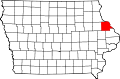 | |
| Townships | ||
| Unincorporated communities | ||
| Footnotes | ‡This populated place also has portions in an adjacent county or counties | |
| International | |
|---|---|
| National | |
| Geographic | |
| Other | |

Dubuque, Iowa
View on GrokipediaHistory
Indigenous Presence and Early European Settlement
The region encompassing modern Dubuque was long utilized by Native American tribes such as the Ho-Chunk, Meskwaki (also known as Fox), Sauk, and Ioway for hunting, seasonal habitation, trade along the Mississippi River, and extraction of lead deposits through rudimentary surface mining techniques dating back centuries before European contact.[4][1] Archaeological evidence indicates that these groups, particularly the Meskwaki, maintained villages and resource sites in the bluffs and river valleys, with lead smelting logs used as early as the late 18th century by Meskwaki communities near the Mines of Spain area.[5][6] French-Canadian trader and explorer Julien Dubuque established the area's first documented European foothold in 1788 by negotiating mining rights with the Meskwaki tribe, who granted him permission on September 22 to exploit lead ores in exchange for trade goods and alliance against rival groups.[7][8] Dubuque, who had arrived in the region around 1785 for fur trading, operated small-scale mines with Meskwaki labor, producing smelted lead for export via the Mississippi; this arrangement was later ratified by a Spanish land grant in 1796, reflecting the territory's status under Spanish Louisiana at the time.[4] His settlement, known as "Mines of Dubuque," remained isolated and dependent on indigenous cooperation until his death in 1810, after which the site was temporarily abandoned amid intertribal conflicts.[1] The United States acquired the territory through the Louisiana Purchase in 1803, but legal settlement by non-Native individuals was prohibited until the Black Hawk Purchase treaty of September 21, 1832, which followed the Black Hawk War and compelled the Sauk and Meskwaki to cede approximately six million acres east of the Mississippi River in Iowa for $640,000, opening the lead-rich bluffs to American claim-jumpers and speculators.[9] This cession directly catalyzed organized white migration, as the mineral wealth—estimated in surface deposits visible along the river—promised economic viability amid the era's demand for lead in munitions and industry.[10] Dubuque was formally platted and incorporated as a town on September 9, 1833 (with legal land office opening on June 1), marking Iowa's earliest permanent Euro-American community and driven primarily by the influx of miners exploiting the accessible galena veins, facilitated by steamboat navigation on the Mississippi.[1] By late 1833, over 500 settlers had arrived, establishing rudimentary claims amid disputes resolved by federal surveys, solidifying the site's role as a lead production hub that yielded thousands of pounds annually in the initial years.[11]19th-Century Boom and Immigration Waves
The economy of Dubuque experienced significant growth in the 1840s and 1850s driven by lead mining, which became the region's primary industry following Julien Dubuque's early operations. By 1840, the city's lead smelters produced 500,000 pounds of lead, establishing it as Iowa's largest industrial output according to federal census data. Mining output peaked further, with four million pounds of ore extracted in a seven-month period in 1860 valued at over $122,000 (equivalent to roughly $4.76 million in 2026 dollars, based on CPI inflation adjustments), attracting laborers and investors to the area. This boom transformed Dubuque from a frontier outpost into a bustling commercial center, with lead exports forming the backbone of early wealth accumulation.[11][12] The Mississippi River facilitated this expansion through steamboat trade, which preceded permanent settlement and enabled efficient transport of lead and other goods downstream to markets like St. Louis by the 1840s. Steamboats revolutionized commerce on the upper Mississippi after the first vessel navigated the river in 1823, with Dubuque serving as a key port for ore shipment and supply imports. This fluvial infrastructure supported population influx and economic diversification into related activities such as smelting and mercantile operations.[13][14] Immigration waves, particularly from Germany in the 1840s and Ireland in the 1850s, fueled demographic and social changes, with newcomers comprising a majority of the workforce in mining, farming, and labor. Germans, arriving post-1840, focused on agriculture and mining, becoming the largest ethnic group by 1860 after initially ranking second to the Irish in 1850. Irish immigrants, peaking in the 1850s, filled labor roles in mines and on the docks, accounting for about one-quarter of the population in the 1850 and 1860 censuses and reaching 1,800 Irish-born residents out of 13,000 total by 1860. These Catholic-majority groups established enduring religious institutions, contributing to the city's early Catholic predominance.[15][16][17] Railroad development in the 1850s complemented river trade, with the Dubuque and Pacific Railroad chartered in 1853 and reaching Dyersville by 1857 after the first locomotive arrived in 1856. During the Civil War, Dubuque supported the Union effort through recruitment camps like Camp Union and Camp Franklin, which trained Iowa regiments despite some local divisions. Post-war infrastructure advancements, including expanded rail lines, sustained growth until mining declined by the 1860s.[18][19][20]20th-Century Industrial Shifts and Challenges
By the early 1900s, lead and zinc mining in the Dubuque area, which had driven 19th-century growth, entered terminal decline as accessible deposits were exhausted; zinc ore extraction ceased entirely by 1910, with only residual recovery from mine dumps until 1917.[21] This bust compelled economic diversification into manufacturing sectors such as wood processing, meatpacking, and farm equipment production, with firms like the Dubuque Packing Company expanding operations to process cattle at rates exceeding 115 head per hour by the mid-20th century.[22] Wartime demands during World War II further spurred industrial output, particularly in milling and related goods, providing a temporary employment surge that alleviated pre-war stagnation.[23] The Great Depression exacerbated these transitions, with approximately 2,200 manufacturing jobs lost in Dubuque between 1927 and 1934 amid widespread factory closures and only 13 new businesses adding a net 300 positions.[23] Federal New Deal interventions, including Works Progress Administration (WPA) initiatives, mitigated the downturn through infrastructure projects such as Bee Branch sewer extensions, public swimming pools, and enhancements to Eagle Point Park with a $200,000 grant in 1934.[24][25] Post-World War II recovery fueled suburban expansion and manufacturing investment, exemplified by Deere & Company's establishment of a tractor production facility north of the city, which recruited thousands of veterans and spurred developments like the Deereville neighborhood.[26] Deindustrialization accelerated in the latter half of the century, as traditional sectors like millwork faced competition from synthetic materials and automation; by the early 1980s, manufacturing job losses plunged Dubuque into prolonged economic doldrums, with unemployment exceeding 20% at peaks.[27] Riverine vulnerabilities compounded these pressures, as the 1965 Mississippi River flood inflicted millions in regional damages, disrupting Dubuque's logistics-dependent industries.[28] The 1993 flood similarly devastated Midwest agriculture and infrastructure, underscoring the fragility of the city's Mississippi-adjacent economy.[29] Social frictions emerged amid these strains, particularly in the late 1980s and 1990s, when efforts to attract minority residents for diversification triggered backlash; a cross burning on October 23, 1989, marked the onset of at least 17 such incidents and hate crimes by early 1992, alongside Ku Klux Klan rallies protesting integration policies.[30][31] These events, concentrated in a predominantly white community, prompted civic introspection through initiatives like the "Why Do We Hate?" campaign, though they highlighted underlying prejudices intensified by economic insecurity rather than resolved through policy alone.[32][33]Post-2000 Revival and Modern Developments
The revitalization of Dubuque's riverfront and port facilities in the 2000s and 2010s played a central role in the city's economic recovery, converting underutilized industrial sites into logistics and commercial hubs. The North Port redevelopment addressed contaminated brownfields, fostering business expansion and residential development while enhancing access to the Mississippi River for freight and recreation.[34] Port improvements, including multimodal infrastructure funded by federal grants, supported cargo handling for agriculture and manufacturing by-products, with capacity projections for up to 300,000 tons annually in processed grain. Logistics Park Dubuque added specialized rail-to-barge transloading equipment, bolstering the region's supply chain efficiency.[35] Following the 2008 recession, Dubuque prioritized manufacturing stability and sector diversification, with sustained operations at facilities like John Deere's Dubuque Works, which produces construction equipment such as backhoes and loaders.[36] Historic tax credit projects since 2000 leveraged over $600 million in private investment for downtown rehabilitation, aiding job retention amid national industrial shifts.[37] Growth extended to healthcare and education, contributing to broader employment gains from approximately 37,300 jobs in the 1980s to nearly 62,000 by 2019.[38] Into the 2020s, Dubuque's metropolitan statistical area (MSA) exhibited strong pandemic resilience, with nonfarm employment exceeding August 2019 pre-crisis highs by 800 positions as of mid-2024.[39] The MSA recorded a 2.2% job increase from August 2023 to August 2024, adding 1,300 roles and outpacing other Iowa metros, driven by logistics and service sector expansions such as HODGE Company's headquarters relocation to the Port of Dubuque in mid-2024.[40][41] Unemployment remained low at 3.5% to 3.8% through 2024-2025, below national averages, reflecting effective local adaptation to economic disruptions.[42]Geography
Physical Features and Location
Dubuque is situated at the junction of Iowa, Illinois, and Wisconsin along the Mississippi River, marking the heart of the Tri-State Area.[43] The city's position on the river's east bank places it within the Driftless Area, a unglaciated region characterized by steep bluffs rising from floodplains, deeply incised valleys, and karst topography formed by differential erosion of Paleozoic bedrock.[21] This terrain, spared from Pleistocene ice sheets, features elevations ranging from about 600 feet at the riverfront to over 1,000 feet on surrounding bluffs, influencing settlement patterns by providing elevated sites for defense and agriculture amid flood-prone lowlands.[44] The municipal area spans 31.2 square miles, predominantly urbanized along the floodplain with development constrained by the encircling bluffs.[45] Geologically, the region exposes Ordovician dolomites and sandstones hosting rich lead-zinc deposits, particularly in the Galena Formation, which concentrated near the river and drove early economic activity through mining from the late 18th century.[21] These mineral resources, accessible via bluff outcrops, attracted Julien Dubuque's 1788 settlement grant from local tribes, establishing the area's role as a lead production hub that shaped infrastructure and trade.[1] Strategically located 183 miles west of Chicago and 70 miles north of the Quad Cities, Dubuque's riverine placement historically supported steamboat commerce and overland routes, while today enhancing logistics via Interstate 20 and rail connections to major Midwest markets.[46] The bluffs and river confluence not only defined natural boundaries for urban expansion but also facilitated port development, underscoring the interplay of topography and hydrology in the city's foundational geography.[43]Neighborhoods and Urban Development
Dubuque's neighborhoods blend historic industrial cores with post-2000 suburban expansions and revitalized mixed-use zones, reflecting organic growth patterns driven by manufacturing legacies and community-led initiatives rather than extensive centralized urban planning. The city proper recorded a population of 59,667 in recent estimates, concentrated in a compact urban fabric, while the broader metropolitan area spanned approximately 99,000 residents across low-density outskirts. [47] [48] Key districts include the Historic Millwork District, a former hub of lumber and millwork production encompassing large industrial buildings from the late 19th and early 20th centuries, which transitioned from abandonment to adaptive reuse with features like permeable pavement streets for stormwater management. [49] [50] The Millwork District, bounded roughly by 7th to 11th Streets and Jackson to Washington Streets, preserves over 150 years of industrial heritage while incorporating modern housing, entertainment venues, and sustainable infrastructure to reconnect it with adjacent areas like the Washington neighborhood and waterfront. [51] [52] Downtown Dubuque features five locally designated historic districts with 615 preserved buildings, undergoing revitalization since 2000 through federal and state historic tax credits that leveraged more than $600 million in private investment for mixed-use developments, including retail, offices, and residential conversions. [53] [37] This effort emphasized human-scale rehabilitation over demolition, fostering connectivity to surrounding zones without aggressive high-density impositions. [54] Suburban neighborhoods such as Asbury, located southwest of the core, exemplify low-density, family-oriented expansions with subdivisions like Asbury Estates and Arbor Oaks, prioritizing single-family homes and green spaces amid Dubuque's conservative approach to land use that favors incremental annexation over rapid urbanization. [55] [56] Working-class enclaves, often clustered near legacy manufacturing sites, maintain self-reliant structures through neighborhood associations that address local needs independently of broader municipal directives, sustaining a patchwork of modest housing tied to the city's lead-mining and milling history. [57] Overall, urban development post-2000 has prioritized district interconnections and brownfield remediation in areas like the Millwork zone, yielding over 500 public parking spaces and updated master plans in 2024 to support pedestrian-friendly growth without overriding established low-rise patterns. [58] [34]Climate and Environment
Climatic Patterns and Data
Dubuque, Iowa, features a humid continental climate (Köppen classification Dfa), marked by four distinct seasons with cold winters influenced by continental polar air masses and warm summers drawing from humid subtropical influences.[59] The proximity to the Mississippi River provides some temperature moderation, reducing extreme cold snaps compared to inland areas but contributing to higher humidity and occasional fog.[60] Mean annual temperature stands at approximately 47.2°F, with January averages featuring daily highs of 29°F and lows of 13°F, while July records highs of 83°F and lows of 65°F, based on 1991–2020 normals from the National Weather Service.[61] Winters often see subzero temperatures, with frost occurring from mid-October to mid-April, and summers can exceed 90°F on 10–15 days annually.[59] Annual precipitation averages 36.3 inches, distributed fairly evenly but peaking in spring and summer due to thunderstorm activity, with May typically the wettest month at around 4 inches.[62] Snowfall totals about 37 inches per year, concentrated from December to March, with December often recording the highest monthly accumulation of 4–5 inches.[63] The river's influence can lead to rapid snowmelt in spring, exacerbating precipitation-driven runoff, though this section addresses patterns rather than mitigation.[60]| Month | Average Maximum (°F) | Average (°F) | Average Minimum (°F) | Precipitation (inches) | Snowfall (inches) |
|---|---|---|---|---|---|
| January | 29 | 21 | 13 | 1.1 | 10.2 |
| February | 33 | 24 | 15 | 1.2 | 8.1 |
| March | 45 | 36 | 27 | 2.0 | 4.9 |
| April | 59 | 49 | 39 | 3.4 | 0.8 |
| May | 70 | 60 | 50 | 4.0 | 0.0 |
| June | 80 | 70 | 60 | 4.3 | 0.0 |
| July | 83 | 74 | 65 | 3.8 | 0.0 |
| August | 81 | 72 | 63 | 3.7 | 0.0 |
| September | 74 | 64 | 54 | 3.2 | 0.0 |
| October | 62 | 51 | 40 | 2.4 | 0.3 |
| November | 47 | 38 | 29 | 2.0 | 3.5 |
| December | 33 | 25 | 17 | 1.4 | 9.0 |
| Annual | 59 | 47.2 | 36 | 36.3 | 37 |
Environmental Risks and Management
Dubuque's Mississippi Riverfront location exposes it to recurrent flooding from snowmelt, heavy precipitation, and ice jams, with major events in 1965 cresting at 26.81 feet and inflicting over $10 million in damages (equivalent to approximately $97 million in 2024 dollars). The 1993 flood, Iowa's costliest at over $2 billion statewide, prompted evacuations and infrastructure strain in Dubuque, while the 2008 event exceeded prior crests in eastern Iowa rivers, leading to widespread levee overtopping and federal disaster declarations across 85 counties. The 2019 spring floods, driven by saturated soils and rainfall atop frozen ground, caused moderate to major river levels, underscoring persistent vulnerabilities despite prior interventions. These incidents highlight causal factors rooted in the river's hydrology and upstream land use, rather than isolated anomalies, with engineering alterations to the Mississippi system statistically linked to heightened flood magnitudes over the past century.[68][69][70] Flood mitigation relies heavily on the U.S. Army Corps of Engineers' levee and floodwall system, constructed in stages from 1968 to 1974, which protects low-lying areas but requires local maintenance often lagging behind federal design standards, as inspections reveal erosion and seepage risks in Iowa levees. Post-2008 enhancements included certification updates and interior drainage improvements, yet over-dependence on Corps projects has deferred comprehensive local engineering, such as watershed-scale detention basins, contributing to repeated urban flash flooding in tributaries like Bee Branch. A 1973 floodwall along the South Port safeguards industrial operations, enabling quicker recovery by limiting submersion duration, though broader resilience demands balanced federal-local approaches to avoid maladaptive reliance on aid that incentivizes suboptimal risk pricing.[71][72][73] Historical lead mining in Dubuque's vicinity, peaking in the 19th century, left sediment and soil contamination with heavy metals, addressed through EPA-led brownfields remediation programs that have restored dozens of sites for redevelopment since the early 2000s. Key efforts include Superfund actions at industrial legacies like John Deere Works, involving groundwater extraction and water supply alternatives, alongside voluntary cleanups under state oversight to mitigate leaching into waterways. These interventions, prioritizing empirical soil testing over precautionary overreach, have reduced exposure risks without halting urban revitalization, though residual monitoring persists due to mining's diffuse legacy.[74][75][34]Demographics
Population Dynamics and Census Trends
The population of Dubuque, Iowa, experienced significant growth during the early 20th century, rising from 20,244 in 1900 to 62,321 by 1980, driven by industrial expansion and immigration.[76] Following a period of stagnation and slight decline amid deindustrialization in the late 20th century, the city's population dipped to 57,637 in 2010 before a modest rebound to 59,667 in the 2020 census.[2] This stabilization reflects low net domestic migration and natural increase balancing outflows, with the Dubuque metropolitan statistical area maintaining around 99,310 residents in 2020.[77]| Year | City Population |
|---|---|
| 1900 | 20,244 |
| 1920 | 39,141 |
| 1940 | 43,892 |
| 1960 | 56,606 |
| 1980 | 62,321 |
| 2000 | 57,686 |
| 2010 | 57,637 |
| 2020 | 59,667 |