
.JPG/250px-Mission_Peak_over_Lake_Elizabeth,_in_Fremont,_California_(cropped).JPG)


.JPG)
Community hub
Recent from talks
Contribute something
Nothing was collected or created yet.
Fremont, California
View on Wikipedia
Fremont (/ˈfriːmɒnt/) is a city in Alameda County, California, United States. Located in the East Bay region of the Bay Area, Fremont has a population of 230,504 as of 2020,[11] making it the fourth most populous city in the Bay Area, behind San Jose, San Francisco, and Oakland. It is the closest East Bay city to the high-tech Silicon Valley network of businesses, and has a strong tech industry presence.[13][14]
Key Information

_(cropped).JPG)
.JPG)
.jpg)

_(cropped).JPG)


The city's origins lie in the community that arose around Mission San José, founded in 1797 by the Spanish under Padre Fermín Lasuén. Fremont was incorporated on January 23, 1956, when the former towns of Mission San José, Centerville, Niles, Irvington, and Warm Springs unified into one city.[15] Fremont is named after John C. Frémont, a general who helped lead the American Conquest of California from Mexico and later served as Military Governor of California and then U.S. Senator.
History
[edit]
Early history
[edit]
The recorded history of the Fremont area began on June 6, 1797, when Mission San José was founded by the Spaniard Father Fermín de Lasuén. The Mission was established at the site of the Ohlone village of Oroysom. The tribe lived between present-day San Francisco and Monterey and more lands eastward. They lived in dome-shaped shelters made out of redwood bark or woven tule. They were primarily hunter-gatherers; men hunted and trapped waterfowl, rabbits, deer, elk, and bears, whilst women gathered nuts, berries, and root vegetables.[16] The Ohlone tribe lived beside rivers and estuaries because of the natural resources like fish and shellfish. In warm weather, men wore mostly nothing; in the winter, they wore animal hide or feather capes. Other than the weather, ceremonies also decided what the Ohlone men wore. The women wore deerskin aprons over skirts made of tule or shredded bark.[16]
Until 1769, the tribe lived peacefully but Spanish soldiers and missionaries arrived in California to expand Spanish dominion in the Americas and convert the Native Americans to Catholicism.[16] The Ohlone people weren't intimidated by the Franciscan priests, who welcomed them into their missions to live and work. Before missions, the Natives used tools made of stone, animal bones, and wood.[16] The missionaries taught them how to make metal tools and weapons and priests also showed them how to make adobe bricks. The bricks were then used to build missions rather than for the tribe to utilize. The Spaniards brought cattle, pigs and sheep and encouraged the Ohlone to give up hunting and gathering to try farming and ranching instead.[16] Living in the missions meant Ohlone people were forced into converting to Christianity and told to forget the superstitious beliefs that connected them to nature. Along with that, overpopulation caused food shortages and the Spanish brought diseases to the tribe, causing a lot of deaths and trouble that made an impact on a lot of lives.[16]
On their second day in the area, the Mission party killed a grizzly bear in Niles Canyon. The first English-speaking visitor to Fremont was the renowned trapper and explorer Jedediah Smith in 1827. The Mission prospered, eventually reaching a population of 1,887 inhabitants in 1831. The influence of the missionaries declined after 1834 when the Mexican government enacted secularization.
José de Jesus Vallejo, brother of Mariano Vallejo, was the grantee of the Rancho Arroyo de la Alameda Mexican land grant. His family was influential in the Fremont area in the late colonial era and owned and built a flour mill at the mouth of Niles Canyon.[17] In 1846 the town's namesake John C. Frémont led a military expedition to map a trail through Mission Pass for reaching the Pacific coast and to take possession of California from Mexico for the United States.

The Fremont area grew rapidly at the time of the California Gold Rush. A town called Mission San José grew up around the old mission, with its own post office from 1850. Agriculture dominated the economy with grapes, nursery plants and olives as leading crops. In 1868 the 6.8-magnitude Hayward earthquake on the Hayward Fault collapsed buildings throughout the Fremont area, ruining Mission San José and its outbuildings. Until the 1906 San Francisco earthquake caused its destruction, the Fremont area's Palmdale Winery was the largest in California. The ruins of the Palmdale Winery are still visible near the Five Corners in Irvington at the intersection of Washington Boulevard and Osgood.[18] From 1912 to 1915, the Niles section of the Fremont area was the earliest home of California's motion picture industry[19] (see Essanay Studios). Charlie Chaplin filmed several movies in the Fremont area, most notably The Tramp.
Incorporation
[edit]Fremont was incorporated in 1956 under the leadership of Wally Pond, chair of the incorporation committee, when five towns in the area, Irvington, Centerville, Mission San José, Niles, and Warm Springs, came together to form a city.[20] Glenmoor Gardens, the largest subdivision in Fremont, was under construction in the area, by developers Ralph E. Cotter Jr., James R. Meyer, civil engineer Fred T. Duvall, and contractors James L. Reeder, and Robert H. Reeder. When the Glenmoor Gardens Homeowners Association (GGHA) was incorporated, in March 1953, there were no more than 75 houses in the subdivision. It was probably the first such organization in the Fremont area; in its scope and structure. The five-member board of directors (which included James Meyer and James Reeder) was set up to oversee a full range of services, from police and fire protection to street maintenance (which later became the purview of the city government).[21]
Fremont became more industrialized between 1953 and 1962. The first Fremont post office opened in 1956.[22] A boom in high-tech employment in the 1980s to the late 1990s, especially in the Warm Springs District, caused rapid development in the city and linked the city with the Silicon Valley. The Apple factory where the first Mac computer was manufactured was located in Fremont;[23] production ceased in 1993.[23] Other semiconductor and telecommunications firms soon opened in the city, including Cirrus Logic, Asyst Technologies, Mattson Technology, Lam Research, Premisys Communications, and Nextlink California.[23] Approximately 750 high-tech companies had offices, headquarters, or production facilities in Fremont by 1999.[23] These firms included fifteen of the top one hundred fastest-growing public companies in the San Francisco Bay Area and eighteen of the top fifty companies in the East Bay.[23] The high-tech growth in Fremont continues today and is a major industry for the city.

The General Motors automotive assembly plant in South Fremont was the town's largest employer, and Fremont was known for its drag strip. In the 1980s, the plant became a joint venture automotive assembly plant of Toyota and General Motors, and was renamed NUMMI. Toyota and NUMMI shut down its operations in early 2010. Part of the plant was acquired in June 2010 by Tesla Motors as its primary production plant, known as the Tesla Factory.
Solyndra, a solar panel manufacturer, was promoted in 2010 by President Barack Obama as a model for government investment in green technology[24] after his administration approved a $535 million Department of Energy loan guarantee and the company built a $733 million state-of-the-art robotic facility, but in 2011 the company filed for Chapter 11 bankruptcy and laid off 1,000 workers.[25] Data storage company Seagate Technology, incorporated in the Republic of Ireland with executive offices in Cupertino, acquired the former Solyndra building, which serves as Seagate's headquarters as of 2020.
Homeless criminalization
[edit]In May 2024, the city council began considering a "Strategic Plan to Address Homelessness" in the city, with a five-year time span, in order to reduce the homeless population. Many of the homeless in the city live in their vehicles, but the city's Safe Parking measures of having designated parking lots for homeless people to stay were seen as only a temporary solution.[26] This led to consideration in September 2024 of new rules that would place a ban on camping on public property and the use of large vehicles like RVs in residential areas. This would include a requirement for all parked vehicles in the city to be moved after 72 hours in a location.[27] It was noted by San Francisco Chronicle reporter Sarah Ravani that the city's previous efforts to actually help the homeless population by expanding housing options, among other methods, had resulted in a 21% reduction over the prior year in the number of people that were homeless without needing municipal punishments to be enacted.[28]
These bans were enacted by the city council in February 2025, with additional expansions to the proposed ordinance. The updated version included a $1000 fine and a misdemeanor criminal charge with six months jail time against anyone found "aiding, abetting, or concealing" members of the homeless population. The definition of these terms was not clarified in the ordinance.[29] Over a dozen local civil rights groups and community organizations sent a letter petition against the ordinance, noting that the camping provision effectively made it illegal to be homeless anywhere in the city and the added abetting provision made it illegal for anyone to help homeless people by providing shelter themselves. David Bonaccorsi from the Fremont for Everyone organization pointed out that the growing number of jobs in the city due to the expanding tech center had not included an adequate expansion in housing, meaning many of the people obtaining the new jobs had no housing available to purchase in the first place.[30]
Geography
[edit] | This section may contain an excessive amount of intricate detail that may only interest a particular audience. (June 2022) |
In 1956, five small, independent towns (Centerville, Niles, Irvington, Mission San José, and Warm Springs) located between the East Bay rolling hills and the San Francisco Bay were annexed into a single new, incorporated city called Fremont. Six decades later, these places have greatly expanded, are no longer separate communities, and are considered districts or community plan areas of the City of Fremont. The town of Newark was originally slated to join the annex, but ultimately its voters declined since Newark representatives suspected that they would become an industrial district; Newark became its own incorporated city in 1955. Later, Newark annexed a patch of unincorporated land between Mowry Avenue and Stevenson Boulevard, land which is now occupied by Newpark Mall and the surrounding plazas. Since incorporation, Fremont has created six more districts, which it calls "community plan areas" for planning purposes. These include Central, North Fremont, South Fremont, and Bayside. The two other districts, Baylands and the Hill Areas, are primarily open space.[31][32]
The area consisting of Fremont and the cities of Newark and Union City is known collectively as the Tri-City Area (different from the adjacent Tri-Valley area encompassing Pleasanton, Dublin, and Livermore).
Centerville District
[edit]Centerville was formerly the main town in Washington Township. Centerville is located at 37°33′15″N 121°59′57″W / 37.55417°N 121.99917°W. It lies at an elevation of 52 feet (16 m). Centerville was started by George Lloyd who started selling cold beer to stage passengers from a tent in 1850.[33] Capt. George Bond set up a general store and the name Centerville was chosen.[33] The post office opened Centreville post office in 1855 and changed the spelling to Centerville in 1893.[33] The Centerville Pioneer Cemetery contains the burial places of many of the city's founding pioneers.
Centerville can be traced back to its native American roots. Spanish, Mexican, Italian, Portuguese and Swiss (Swiss Park), peoples were among the early settlers that contributed greatly to the growth of Centerville.
Early Centerville was a quiet farming community, which consisted of large Spanish land grants divided into smaller farms. The Freitas Ranch on Thornton Ave was probably the largest of the working farms. There were acres of apricot along with other fruit and nut orchards and large fields of various types of fresh produce.[34]

After President Roosevelt issued Executive Order 9066, which authorized military commanders to exclude "any or all persons" from certain areas in the name of national defense, the Western Defense Command began ordering Japanese Americans living on the West Coast to present themselves for "evacuation" from the newly created military zones. This included many Centerville farming families.
Centerville was also a main stop for the early railways. This gave the local farmers a way to quickly get their produce to market. With the access to railway service there was once a large cannery on Baine Ave. west of Fremont Ave. (now Peralta) next to the tracks. In 1959, the cannery was destroyed in the largest fire in Fremont's history.[35] The fire lasted for two days, and effectively put an end to what had been the largest employer in Centerville at the time. The cannery was never rebuilt.[36]
Housing developments began to appear in the area after World War II. Most of the early housing stood along Fremont Blvd from Decoto Road south to Washington High school, along Thornton Ave from Fremont Blvd west to the Newark city border, and along Peralta Blvd from Fremont Blvd to Niles.
For city planning purposes, Centerville was enlarged to encompass most of the north central residential section of Fremont, from Mowry Ave to Decoto Rd, from I-880 to the BART line. This Centerville community plan area includes the sprawling subdivisions, developed in the 1950s and 1960s, of Glenmoor Gardens, bounded by Central Avenue, Fremont Boulevard, Mowry Avenue, and the I-880 freeway. and the Cabrillo Park subdivision bound by Thornton Ave, Fremont Blvd, Decoto Road and the I-880 freeway. Also the Brookvale subdivisions, the Quarry Lakes Regional Recreation Area, and part of Parkmont.[37] The area is served by two high schools, Washington High School established in 1892, which for a long time was the only high school in the area and American High School established in 1972. It also has two middle schools, Centerville Middle School and Thornton Middle School, which now stands on the old main site of the Freitas ranch.
Niles District
[edit]
The former town of Niles is physically divided from other parts of Fremont and neighboring Union City by Mission Boulevard (State Route 238) to the east and north, Alameda Creek to the south, Union Pacific Railroad to the west and southeast, and the Quarry Lakes to the southwest. The hills of Niles are lower than those of the area south of the Alameda Creek in Mission San Jose. Old Town Niles features its own library, post office, and silent movie theater as well as a large number of antique and craft stores. Niles is located at 37°34′44″N 121°58′40″W / 37.57889°N 121.97778°W. It lies at an elevation of 112 feet (34 m).
The community, once called Vallejo Mills, got its name from the Central Pacific Railroad's Niles junction and station, opened in April 1870[38] as part of the First transcontinental railroad and named after their railroad attorney and stockholder Addison Niles, who became associate justice on the California Supreme Court two years later.[39] A post office was opened at Niles on Vallejo Street in 1873.[40]
Niles was the West Coast home (1912–1916) of one of the first motion picture companies, Essanay Studios. Charlie Chaplin and Broncho Billy Anderson filmed some of their most famous silent movies in Niles and the scenic Niles Canyon that stretches between Niles and Sunol. The nonprofit Niles Essanay Silent Film Museum offers both artifacts of Niles' early years and, each Saturday evening, screenings of early-twentieth-century silent films, many of which were filmed locally.[41]
The Niles Canyon Railway runs along Alameda Creek in Niles Canyon and carries passengers on weekend excursions, including a holiday "train of lights", which is extremely popular – tickets for these trains typically sell out by early October. The Niles Canyon Railroad has a small but well-maintained collection of historic rail stock.[42]
Part of historic Niles is Mayhew Spring, also known as Mayhew's Sulphur Spring, which was owned by H.A. Meyhew and located 600 feet (180 m) north of the Niles railroad station.[39] In September 1869, four months after the famous golden spike ceremony at Promontory Summit, Utah, the Central Pacific Railroad completed the transcontinental rail link between Sacramento and the San Francisco Bay, with trains switching at the San Jose junction in the canyon.[43] Central Pacific then built a junction in the valley and opened it in April 1870 as Niles.[38]
Also part of Niles is 1909 Niles Junction built by the Western Pacific Railroad,[39] located at 37°34′35″N 121°58′17″W / 37.57639°N 121.97139°W and situated at an elevation of 79 ft (24 m).
Irvington District
[edit]The Irvington District area, once the town of Irving, has cycled through many name changes over time. In the early 1850s two emancipated black men were traveling with E.L. Beard through California, reputedly in search of a fortune. The former slaves noticed the busy traffic at the crossroads of what is today the "Five Corners" intersection. Although now gone, there were two embarcaderos (water crossings) at this area. One of these crossings had a ferry. Realizing the financial opportunity of the area, the former slaves constructed the first building at the cross roads, a tavern with an inn. This tavern was later known as Dave's Saloon.[44] This corner, today the intersection of Fremont and Washington Boulevards, Union and Bay Streets, is now commonly known as "Five Corners" or Irvington Square. Irvington Square's marker, Irvington Plaza park, is located at 37°31′22″N 121°58′18″W / 37.52278°N 121.97167°W. The inn and several of the other original buildings were demolished by the city of Fremont in the early 1980s. In 1871 Washington College, the first industrial educational institution in California was established in Washington township near the crossroads. As a result, the US Postal Service established a post office called Washington Corners at the college in 1870, which became the name of the settlement on the 1878 Alameda County map of Washington Township.
In 1884, realizing the need for a proper town name, local inhabitants selected the name of Irving. The name was chosen in honor of Judge Irving, the local traveling circuit judge of the time. Later, when the railroad came through the area, the published train schedule pamphlets erroneously listed the Irving train depot as "Irvington." The town petitioned the railroad about the error. The railroad company notified the town that it was too costly for them to replace the train schedule pamphlets (over $100,000); and in 1887 following the recommendation, the people of Irving changed the town name to Irvington.[citation needed]
The Irvington district has two main neighborhoods: Irvington Woods and the Irvington Square. The neighborhood is ethnically mixed and is primarily working class.[45] For city planning purposes, the Irvington area was enlarged to encompass most of the south central residential section of Fremont, from Auto Mall Parkway to Mowry Avenue, from I-880 to roughly the BART line (excluding the Central District described below). This Irvington community plan area includes the Sundale neighborhood, the South Sundale neighborhood, 28 Palms, Blacow, and Grimmer subdivisions. The area is served by three high schools: Irvington High School, Robertson High School, and John F. Kennedy High School.
The Irvingtonian period of North American mammals is named for this district due to the fossil sequence excavated here.[46]
Mission San Jose District
[edit]
At the time of the California Gold Rush, a boom town grew up around the old Mission, to equip and transport 49ers overland to the gold fields. A post office was opened at Mission San Jose in 1850.[47]
The district, like Niles, is surrounded by hills. The hills are higher and steeper than Niles, with the highest points being on the Mission Ridge. Mission San Jose district lies close to the northern two peaks, Mission Peak and Mount Allison. The height of the peaks range from 2,517 to 2,604 ft (794 m), and they see some snowfall occasionally. Mission Peak is a popular hiking spot and attracts residents from all over the East Bay.
Fremont's community college, Ohlone College, is situated one block away from the mission and serves over 12,000 students.
Mission San Jose has the highest concentration of Asian Americans in Fremont – over 50% of the population as of the 2000 census. The local high school is Mission San Jose High School, ranked as the 93rd best high school in the nation by U.S. News & World Report, as well as 13th in California (as of 2024).[48] The median family income for the Mission San Jose area (ZIP code 94539) exceeded $114,595 in 2005. Owing to an influx of professionals and other affluent families seeking access to the top-performing local public schools, Mission San Jose's median home value reached $831,000 in 2006, earning the community a rank of 237 on Forbes magazine's list of the 500 most affluent communities in the United States.[49]
Mission San Jose
[edit]
Nestled at the base of Fremont's rolling hills is the Mission San José, one of the oldest of the Spanish missions in California, for which this district is named. The church building that exists today is a reconstruction (dedicated in 1985 for daily Mass and tours) of the original 1809 adobe church that was destroyed by the 1868 Hayward-fault earthquake. One side of the original mission quadrangle remains, housing a museum. Mission San Jose is located at 37°31′59″N 121°55′13″W / 37.53306°N 121.92028°W; and lies at an elevation of 305 feet (93 m).
Warm Springs District
[edit]
The former town of Warm Springs is located on Rancho Agua Caliente and is so named for the springs that are located there.[50] In early times, there was a settlement called Harrisburgh (also, Harrisburg and Peacock's) a short distance east from the small settlement of Warm Springs.[50] A post office opened in Harrisburgh in 1865 and changed its name to Warm Springs in 1885.[50] The name Harrisburgh commemorated Abram Harris, who settled there in 1858.[50] The name Peacock's commemorated George W. Peacock, its first postmaster.[50] The post office name changed to Warmsprings in 1895 and reverted to Warm Springs in 1950.[50]
The Warm Springs district is the southernmost portion of Fremont whose hub is the Warm Springs and Mission Boulevard intersection. It is located at 37°29′14″N 121°55′45″W / 37.48722°N 121.92917°W, and lies at an elevation of 62 feet (19 m). Warm Springs has attracted the headquarters of many high-tech companies including Nielsen Norman Group, Lam Research, Corsair and Lexar of the US as well as foreign high-tech companies such as Elitegroup Computer Systems, and Asus. The district is also home to blue-collar industry. The San Jose mission is also present.
Warm Springs also serves as commercial center for the mainly residential Mission San Jose district, especially since the construction of Pacific Commons, a large, modern regional shopping center. The Oakland Athletics talked about moving their stadium to this area. Warm Springs was home to one of the SF Bay Area's only two coffee houses to employ baristas who wear bikinis, Your Coffee Cups, a concept that's gained some controversy from Bay Area newspapers and news stations.[51][52][53][54] This controversy led to the eventual closing of the business.
The BART extension to Warm Springs began construction in 2009[55] and Warm Springs/South Fremont station opened for service on March 25, 2017.[56]
Central district
[edit]
The central district is surrounded by the Centerville, Niles, Mission San Jose, and Irvington communities. The central district contains retail shopping centers (e.g., the Fremont Hub), the Fremont Bay Area Rapid Transit station, health care centers and Central Park (Lake Elizabeth).
City planners envisioned and have begun to develop a mid-density, pedestrian friendly, transit oriented development, bounded by Mowry Ave, Fremont Blvd, Walnut Ave, and Paseo Padre Pkwy referred to as Downtown Fremont.[31][57] To support enhanced access, one of the central streets, the Capital Avenue extension to Fremont Blvd, was completed in 2016, as the city pursues its plans for a Downtown Fremont.
Most of Fremont is part of the Laguna Creek Watershed.
North Fremont District
[edit]
North Fremont is a primarily residential district surrounded by Union City, Centerville District, Newark, and Coyote Hills Regional Park. It is a growing community that includes the Ardenwood neighborhood, the Lakes and Birds neighborhood, and the Northgate neighborhood.[58] It is the site of the Ardenwood Historic Farm, which has the George Washington Patterson House as one of its highlights, and the Ardenwood Technology Park. A 99 Ranch Market is one of many Asian businesses in the North Fremont District. Thornton Middle School and American High School, which are both physically located in the enlarged Centerville District, also serve as the middle and high school, respectively, for this community.
South Fremont District
[edit]South Fremont is a primarily industrial district, east of Interstate 880 and west of Interstate 680, south of Auto Mall Parkway and north of Brown Rd. The area overlaps with Warm Springs, with which it shares the eponymous BART station. The composition of the area will change, because thousands of residential units were under construction as of 2016. It is sandwiched between the Irvington and Warm Springs community plan areas.[31][57] It is noted as the site of the Tesla Factory as well as the site of the Warm Springs / South Fremont BART station. In 2022, a pedestrian bridge was built from the BART station to Lopes Court. It cost $41 million.[59][60]
Bayside Industrial District
[edit]Bayside Industrial is a primarily industrial and commercial district, west of Interstate 880 between Newark and Milpitas.[31][57]
Hill Area District
[edit]Hill Area is an open land district that forms the eastern edge of Fremont.[31][57] It is the site of Mission Peak.
Climate
[edit]Fremont has a warm-summer Mediterranean climate (Köppen: Csb) typical of the San Francisco Bay Area. This climate features warm, dry summers and cool, wet winters. Like nearby San Jose, precipitation is fairly low (about 17 inches or 430 mm per year) because the city lies in the rain shadow of the Santa Cruz Mountains to the west. The highest temperature recorded was 110 °F (43 °C) on September 6, 2022.[61] The lowest temperature recorded was 21 °F (−6 °C) on December 23, 1990.
| Climate data for Fremont, California, 1991–2020 normals, extremes 1996–present | |||||||||||||
|---|---|---|---|---|---|---|---|---|---|---|---|---|---|
| Month | Jan | Feb | Mar | Apr | May | Jun | Jul | Aug | Sep | Oct | Nov | Dec | Year |
| Record high °F (°C) | 74 (23) |
79 (26) |
87 (31) |
91 (33) |
98 (37) |
108 (42) |
103 (39) |
102 (39) |
110 (43) |
102 (39) |
84 (29) |
73 (23) |
110 (43) |
| Mean maximum °F (°C) | 67.5 (19.7) |
72.3 (22.4) |
77.2 (25.1) |
83.6 (28.7) |
87.9 (31.1) |
94.1 (34.5) |
91.1 (32.8) |
92.0 (33.3) |
93.1 (33.9) |
86.1 (30.1) |
77.1 (25.1) |
67.5 (19.7) |
96.6 (35.9) |
| Mean daily maximum °F (°C) | 58.6 (14.8) |
61.4 (16.3) |
65.1 (18.4) |
67.7 (19.8) |
71.1 (21.7) |
75.3 (24.1) |
77.9 (25.5) |
78.2 (25.7) |
78.3 (25.7) |
73.3 (22.9) |
64.6 (18.1) |
58.4 (14.7) |
69.2 (20.7) |
| Daily mean °F (°C) | 50.6 (10.3) |
52.9 (11.6) |
55.8 (13.2) |
58.0 (14.4) |
61.5 (16.4) |
65.0 (18.3) |
67.3 (19.6) |
67.7 (19.8) |
67.2 (19.6) |
62.6 (17.0) |
55.4 (13.0) |
50.5 (10.3) |
59.5 (15.3) |
| Mean daily minimum °F (°C) | 42.6 (5.9) |
44.4 (6.9) |
46.4 (8.0) |
48.3 (9.1) |
51.9 (11.1) |
54.7 (12.6) |
56.8 (13.8) |
57.1 (13.9) |
56.0 (13.3) |
52.0 (11.1) |
46.2 (7.9) |
42.5 (5.8) |
49.9 (9.9) |
| Mean minimum °F (°C) | 32.9 (0.5) |
34.9 (1.6) |
37.9 (3.3) |
40.5 (4.7) |
45.8 (7.7) |
49.1 (9.5) |
52.5 (11.4) |
53.5 (11.9) |
49.3 (9.6) |
44.1 (6.7) |
37.0 (2.8) |
31.7 (−0.2) |
30.6 (−0.8) |
| Record low °F (°C) | 26 (−3) |
31 (−1) |
34 (1) |
34 (1) |
41 (5) |
46 (8) |
48 (9) |
46 (8) |
46 (8) |
40 (4) |
32 (0) |
27 (−3) |
26 (−3) |
| Average precipitation inches (mm) | 3.00 (76) |
3.17 (81) |
2.52 (64) |
1.22 (31) |
0.50 (13) |
0.16 (4.1) |
0.00 (0.00) |
0.02 (0.51) |
0.10 (2.5) |
0.69 (18) |
1.59 (40) |
2.97 (75) |
15.94 (405) |
| Average precipitation days | 9.9 | 9.5 | 9.6 | 5.9 | 3.1 | 0.9 | 0.0 | 0.3 | 0.7 | 2.9 | 7.0 | 10.3 | 60.1 |
| Source 1: NOAA[62] | |||||||||||||
| Source 2: National Weather Service (mean maxima/minima 2006–2020)[63] | |||||||||||||
Demographics
[edit]| Census | Pop. | Note | %± |
|---|---|---|---|
| 1960 | 43,790 | — | |
| 1970 | 100,869 | 130.3% | |
| 1980 | 131,945 | 30.8% | |
| 1990 | 173,339 | 31.4% | |
| 2000 | 203,413 | 17.3% | |
| 2010 | 214,089 | 5.2% | |
| 2020 | 230,504 | 7.7% | |
| 2024 (est.) | 229,250 | [64] | −0.5% |
| U.S. Decennial Census[65] | |||
2020
[edit]| Race / Ethnicity (NH = Non-Hispanic) | Pop 2000[66] | Pop 2010[67] | Pop 2020[68] | % 2000 | % 2010 | % 2020 |
|---|---|---|---|---|---|---|
| White alone (NH) | 84,149 | 56,766 | 38,160 | 41.37% | 26.52% | 16.56% |
| Black or African American alone (NH) | 6,084 | 6,743 | 5,108 | 2.99% | 3.15% | 2.22% |
| Native American or Alaska Native alone (NH) | 656 | 458 | 470 | 0.32% | 0.21% | 0.20% |
| Asian alone (NH) | 74,773 | 107,679 | 146,875 | 36.76% | 50.30% | 63.72% |
| Pacific Islander alone (NH) | 736 | 1,064 | 967 | 0.36% | 0.50% | 0.42% |
| Other race alone (NH) | 553 | 388 | 1,315 | 0.27% | 0.18% | 0.57% |
| Mixed race or Multiracial (NH) | 9,053 | 9,293 | 8,593 | 4.45% | 4.34% | 3.73% |
| Hispanic or Latino (any race) | 27,409 | 31,698 | 29,016 | 13.47% | 14.81% | 12.59% |
| Total | 203,413 | 214,089 | 230,504 | 100.00% | 100.00% | 100.00% |
According to the 2020 census estimate, the median income for a household in the city is $142,374.[69] Males have a median household income of $59,274 versus $40,625 for females. The per capita income for the city was $31,411. About 4.5% of the population were below the poverty line, including 5.9% of those under age 18 and 6.2% of those age 65 or over. The most reported detailed ancestries were Indian (29.3%), Chinese (19.1%), Mexican (9.1%), Filipino (6.9%), English (4.9%), and German (4.8%).[70]
2010
[edit].png)
The 2010 United States census[71] reported that Fremont had a population of 214,089. The population density was 2,443.7 inhabitants per square mile (943.5/km2).
The Census reported that 212,438 people (99.2% of the population) lived in households, 969 (0.5%) lived in non-institutionalized group quarters, and 682 (0.3%) were institutionalized.
There were 71,004 households, out of which 31,070 (43.8%) had children under the age of 18 living in them, 45,121 (63.5%) were opposite-sex married couples living together, 7,070 (10.0%) had a female householder with no husband present, 3,382 (4.8%) had a male householder with no wife present. There were 2,779 (3.9%) unmarried opposite-sex partnerships, and 444 (0.6%) same-sex married couples or partnerships. 11,576 households (16.3%) were made up of individuals, and 3,697 (5.2%) had someone living alone who was 65 years of age or older. The average household size was 2.99. There were 55,573 families (78.3% of all households); the average family size was 3.36.
The population was spread out, with 53,216 people (24.9%) under the age of 18, 15,610 people (7.3%) aged 18 to 24, 66,944 people (31.3%) aged 25 to 44, 56,510 people (26.4%) aged 45 to 64, and 21,809 people (10.2%) who were 65 years of age or older. The median age was 36.8 years. For every 100 females, there were 98.9 males. For every 100 females age 18 and over, there were 96.4 males.
There were 73,989 housing units at an average density of 844.5 units per square mile (326.1 units/km2), of which 71,004 were occupied, of which 44,463 (62.6%) were owner-occupied, and 26,541 (37.4%) were occupied by renters. The homeowner vacancy rate was 1.3%; the rental vacancy rate was 4.5%. 136,606 people (63.8% of the population) lived in owner-occupied housing units and 75,832 people (35.4%) lived in rental housing units.
Fremont has a large Deaf community, in large part because it is home of the Northern California campus of the California School for the Deaf. The school district is called the Fremont Unified School District which also serves parts of Union City and Hayward.
Economy
[edit] | This section needs to be updated. The reason given is: Some companies have moved. (March 2025) |
Companies headquartered in Fremont include Antec Inc, Corsair Gaming, Electronics for Imaging, Ikanos Communications, Lam Research, Seagate Technology, Fremont Bank, Nielsen Norman Group, Oplink Communications, SYNNEX, S3 Graphics, Tailored Brands and DCKAP.
Top employers
[edit]According to the city's June 2024 Annual Comprehensive Financial Report,[72] the top employers in the city are:
| # | Employer | # of Employees |
|---|---|---|
| 1 | Tesla, Inc. | 25,000 |
| 2 | Lam Research | 4,000 |
| 3 | Washington Hospital | 2,400 |
| 4 | Kaiser Permanente | 1,600 |
| 5 | Synnex | 1,400 |
| 6 | Western Digital | 1,100 |
| 7 | City of Fremont | 1,000 |
| 8 | Fremont Unified School District | 800 |
| 9 | Boehringer Ingelheim | 800 |
| 10 | Sutter Health | 775 |
Culture and recreation
[edit]The City of Fremont has been a Tree City USA since 1996. There are approximately 55,000 trees in city parks, streets, and landscaped boulevard areas. The city operates the Olive Hyde Art Gallery, adjacent to Mission San Jose, which has featured Bay Area artists such as Wendy Yoshimura, the California Society of Printmakers and the Etsy collective.[73][74] The public gallery is housed in a former home of Olive Hyde, a descendant of early San Francisco Mayor George Hyde.[75][76]
Other cultural, historical, or scientific landmarks include: Fremont Central Park and Lake Elizabeth, Ardenwood Historic Farm, California Nursery Historical Park, Don Edwards National Wildlife Refuge, Mission Peak Regional Preserve, Niles Essanay Silent Film Museum, Washington Township Museum of Local History, Quarry Lakes Regional Recreation Area, Shinn Park and Arboretum, and Coyote Hills Regional Park.
Media
[edit]Founded in 2002, the Tri-City Voice serves Fremont and the nearby cities of Union City and Newark. The weekly is based in the Fremont, and publishes the city's legal notices.
Government
[edit]An elected mayor heads Fremont city government for a four-year term. The mayor chairs the city council, which has four elected council members in addition to the mayor. Two new seats have been added to the council beginning in 2018, for a total of seven seats when district-based elections are phased in. The council adopts the city's budget, and decides major policies. The city council appoints a city manager and city attorney. The city manager hires city staff and manages day-to-day business. Advisory bodies work with the city council on some issues, to facilitate the council's final decisions. The mayor appoints advisory body members, subject to the approval of a majority of the council. Most members serve four-year terms of office without pay, with the exception of planning commissioners.
The City of Fremont directly provides services related to public safety, land use regulation, infrastructure maintenance, parks and recreation, and local social services. To provide these services, the city government is organized into 22 departments, from Animal Services to Transportation Engineering.
According to a 2009 financial report, city revenues were $280 million, expenditures $200 million, assets $1,200 million, cash and investments $340 million, and liabilities $260 million.[77] As of 2015, the annual budget was $160 million and the city had 800 employees.[78]
The city council has adopted a balanced budget by July 1 of each year. Budget problems have in some past years involved cuts in services, reductions in city staffing and wage concessions by labor unions.
Special districts provide water and sewer services for the city: Alameda County Water District and Union Sanitary District. A private contractor, Allied Waste, provides garbage collection and recycling services to the city.
Grand jury investigation of record-keeping
[edit]In 2015, a grand jury found that the city government did not comply with state law on public records,[78] by deleting most emails after 30 days instead of the required two years. All emails were automatically labeled as "unsaved drafts" unless manually designated for retention. The city did not keep any record of councilmember emails, which used fremont.gov addresses and were relayed on to councilmembers' private email accounts. Though city officials held that automatic deletion would reduce data storage costs, the grand jury determined that the cost of complying with the state law would not be significant.[79][80]
District-based elections
[edit]The city phased in district-based instead of at-large elections for all but one seat on the city council, beginning in November 2018.[81][82] Two new seats were added, from five seats to seven. Six of the seats required residence inside a district, while the seat held by the mayor remained at large. The council chose the new district boundaries in June 2017, a controversial vote that drew accusations of gerrymandering to favor two of the incumbents.[83][82]
The districting was forced by the threat of a legal action from a group claiming that Latino minorities who were 14 percent of the population had not been adequately represented. Few or no Latinos were elected to the council during 1956–2017.[84] Some claimed that the results of precinct voting may have been polarized along racial lines.[82][85]
Politics
[edit]According to the California Secretary of State, as of February 20, 2024, the city of Fremont has 118,717 registered voters. Of those, 59,594 (50.19%) are registered Democrats, 17,021 (14.34%) are registered Republicans, and 37,095 (31.24%) have declined to state a political party.[86]
Education
[edit]Primary and secondary schools
[edit].JPG)
The Fremont Unified School District has five high schools for grades 9–12: American, Irvington, Kennedy, Mission San Jose and Washington. The 5,000 seat Tak Fudenna Stadium serves all five high schools as a venue for football, track, soccer and high school graduation ceremonies.[87] These five high schools, along with James Logan High School in Union City and Newark Memorial High School in Newark, make up the Mission Valley Athletic League (M.V.A.L.).
The district has a continuation high school (Robertson); two independent study programs (Vista and COIL); an adult school; five middle schools for grades 6–8 (Centerville, Hopkins, Horner, Thornton and Walters); and 29 elementary schools.[88] The district operates the Mission Valley Regional Occupational Program jointly with Newark and New Haven Unified School Districts.
For the year 2019, William Hopkins JHS, Mission San Jose HS, John F. Kennedy HS, and American HS all received the California Distinguished Schools Award, administered by the California Department of Education.[89]
Fremont Christian School and Averroes High School in Fremont are not part of FUSD. California School for the Deaf, Fremont serves Northern California and shares a campus with the statewide California School for the Blind.
Colleges and universities
[edit]The Ohlone Community College District operates Ohlone College in Fremont, and a smaller campus in Newark. The University of Phoenix Bay Area Campus and San Francisco Bay University offers undergraduate and graduate programs in technology and management areas.
Public libraries
[edit]The Alameda County Library is headquartered in Fremont.[90] The Fremont Main Library is the largest branch with the highest circulation of the Alameda County Library, and shares its building with the Alameda County Library Administration. It has the Maurice Marks Center for Local and California History, and the Fukaya public meeting room. Alameda County Library has other branch libraries in Centerville, Irvington and Niles.
Transportation
[edit]

Fremont is served by Interstate 880 (Nimitz Freeway) and Interstate 680 (Sinclair Freeway). Though they do not intersect, they are connected in the Warm Springs district via a very busy one-mile segment of Mission Boulevard which is SR 262. In addition, it is served by SR 84 and the segment of Mission Boulevard which is SR 238. The city is the eastern terminus of the Dumbarton Bridge.
Elevated sound levels exist along Interstate 880; Caltrans and the city have sought to mitigate sound levels by constructing noise barriers.[91]
Regional rail transportation is provided by BART and the Altamont Corridor Express (ACE). Fremont's BART station once served as the southernmost terminus for the BART system; a 5.4-mile (8.7 km) BART extension to the Warm Springs / South Fremont station opened on March 25, 2017. A southward BART extension into Santa Clara county and the Milpitas and Berryessa/North San José stations opened on June 13, 2020;[92] a further BART extension to downtown San Jose is in progress. The Fremont-Centerville station provides a stopping point for ACE service, which travels from Stockton to San Jose, as well as for Amtrak's Capitol Corridor service. Bus service is provided by AC Transit locally.
Future rail
[edit]Caltrain is undertaking environmental and engineering review for a planned Dumbarton Rail Corridor between the Peninsula and Alameda County. It would add Caltrain stations to Union City, Fremont-Centerville, Newark, and Menlo Park/East Palo Alto.[93]
Notable people
[edit] | This section needs additional citations for verification. (July 2020) |
- DeAnna Bennett, mixed martial artist
- Ashish Chattha, soccer player[94]
- Karen Chen, figure skater, US National Champion 2017
- Rosalie Chiang, actress
- Emilio Castillo, founding member of Tower of Power
- Vinod Dham, father of the Intel Pentium
- Shawon Dunston, Major League Baseball infielder
- Dina Eastwood, ex-wife of actor/director Clint Eastwood
- Dennis Eckersley, Major League Baseball Hall of Famer, pitched for several MLB teams; Washington High School graduate
- Harry Edwards, sociologist and civil rights activist; worked with San Francisco 49ers and Golden State Warriors, professor at UC-Berkeley; resides in Fremont
- Yousef Erakat, YouTube personality
- Qader Eshpari, Afghan musical artist
- Robb Flynn, musician
- Tony Gemignani, World Champion Pizza Maker.[95]
- Pragathi Guruprasad, Indian playback singer
- MC Hammer, musical artist
- Bud Harrelson, Major League Baseball player and coach
- Don Hertzfeldt, animator
- Ariel Hsing, Olympic table tennis player
- Khaled Hosseini, award-winning Afghan author
- Karin Ireland, author
- Ro Khanna, U.S. representative[96]
- Dominic Kinnear, professional soccer player and coach
- Steven Kwan - MLB player
- Steve Lewis, sprinter, Olympic gold medalist
- Christine Liang, president and founder of ASI Corp.[97]
- Allan Haines Loughead, co-founder of Lockheed Corporation
- Mikh McKinney, basketball player
- Justin Medlock, NFL placekicker
- Helen Wills Moody, tennis pro, won 31 Grand Slam championships
- Lamond Murray, John F. Kennedy High School graduate, UC-Berkeley and NBA basketball player
- Sammy Obeid, comedian, performed 1,000 nights of comedy in a row, a world record
- Julie Pinson, actress
- Gary Plummer, Mission San Jose High School graduate, USFL and NFL football player
- Rome Ramirez, of Sublime with Rome
- Randy Ready, John F. Kennedy High graduate; Major League Baseball player 1983–1995
- Dick Ruthven, Irvington High graduate, starting pitcher for 1980 World Series champion Philadelphia Phillies
- Ryan Sinn, musician
- Joel Souza, film director and screenwriter
- Sid Sriram, Indian playback singer
- Ray Stevens, pro wrestler
- Cal Stevenson (born 1996), baseball outfielder for the San Francisco Giants
- Kevin Tan, Olympic gymnast
- Meagan Tandy, model and actress
- Pat Tillman, football player who left his NFL career to enlist in the U.S. Army
- Robert Turbin, NFL running back
- Kevin Turner, Mission San Jose High School graduate, linebacker in NFL for several teams
- Vanity, former singer and actress turned evangelist; spent final years in Fremont
- Bill Walsh, coach of NFL's San Francisco 49ers in Hall of Fame; coached for Washington High School
- Sean Wang, film director
- Len Wiseman, film director
- John Woodcock, NFL defensive lineman
- Kristi Yamaguchi, figure skater, Olympic gold medalist
Sister cities
[edit]Fremont was formerly a sister city to Elizabeth, South Australia until Elizabeth merged with Munno Para to form the City of Playford in 1997.[98] Currently, Fremont is currently twinned with the following cities:[99]
| City | Subdivision | Country | Date |
|---|---|---|---|
| Puerto Peñasco | Sonora | Mexico | 1971 |
| Fukaya | Saitama Prefecture | Japan | 1979 |
| Horta | Azores | Portugal | 1987 |
| Lipa City | Batangas | Philippines | 1992 |
| Jaipur | Rajasthan | India | 1993 |
See also
[edit]
.svg)

References
[edit]Specific
- ^ "California Cities by Incorporation Date". California Association of Local Agency Formation Commissions. Archived from the original (Word) on November 3, 2014. Retrieved March 27, 2013.
- ^ "Comprehensive Annual Financial Report: Fiscal Year Ended June 30, 2013". City of Fremont, California. Archived from the original on December 25, 2018. Retrieved February 8, 2015.
- ^ "City of Fremont Official Website — City Manager". Retrieved May 28, 2022.
- ^ "Senators". State of California. Retrieved September 11, 2025.
- ^ "Members Assembly". State of California. Retrieved September 11, 2025.
- ^ "California's 14th Congressional District - Representatives & District Map". Civic Impulse, LLC. Retrieved September 11, 2025.
- ^ "California's 17th Congressional District - Representatives & District Map". Civic Impulse, LLC. Retrieved September 11, 2025.
- ^ "Mayor & City Council". City of Fremont. Retrieved September 11, 2025.
- ^ "2019 U.S. Gazetteer Files". United States Census Bureau. Retrieved July 1, 2020.
- ^ "Fremont". Geographic Names Information System. United States Geological Survey, United States Department of the Interior. Retrieved February 8, 2015.
- ^ a b "U.S. Census Bureau QuickFacts: Fremont city, California". United States Census Bureau. Retrieved September 26, 2021.
- ^ "ZIP Code(tm) Lookup". United States Postal Service. Retrieved November 23, 2014.
- ^ "Fremont's tech community flourishes as city leaders look for more ways to be efficient". KGO-TV. November 19, 2020. Retrieved August 8, 2020.
- ^ "Quinn: The next Silicon Valley? Fremont and Berkeley drive tech scene growth". Mercury News. April 29, 2016. Retrieved August 8, 2020.
- ^ Oral History Associates, Sausalito, California (1989). City of Fremont: The first thirty years, history of growth (LC 89-60547 ed.). The Mission Peak Heritage Foundation.
{{cite book}}: CS1 maint: multiple names: authors list (link) - ^ a b c d e f Lopez, Grecel (April 2019). "California's Lost Tribe". Wild West. 31: 28–29 – via MasterFILE Complete.
- ^ "Alameda County". California Historical Landmarks. State of California Office of Historic Preservation. Retrieved May 6, 2011.
- ^ "Jill M. Singleton. Lost Wineries and Vineyards of Fremont, California. Fremont Museum of Local History. Accessed 2006-11-09". Museumoflocalhistory.org. Archived from the original on February 11, 2012. Retrieved March 18, 2012.
- ^ "Niles Film Museum". nilesfilmmuseum.org. Archived from the original on February 24, 2006.
- ^ "Archived copy". Archived from the original on September 29, 2011. Retrieved May 5, 2011.
{{cite web}}: CS1 maint: archived copy as title (link) - ^ "Archived copy". Archived from the original on June 24, 2016. Retrieved July 17, 2016.
{{cite web}}: CS1 maint: archived copy as title (link) - ^ Durham, David L. (1998). California's Geographic Names: A Gazetteer of Historic and Modern Names of the State. Clovis, California: Word Dancer Press. p. 634. ISBN 1-884995-14-4.
- ^ a b c d e Dennis, Rob (December 30, 2011). "Fremont mayor Bob Wasserman dead at 77". The Argus (Fremont). Retrieved January 21, 2012.
- ^ "FBI raids solar firm Solyndra". The Oregonian. The Associated Press. September 8, 2011.
- ^ Goossens, Ehren (December 8, 2009). "Solyndra, Solar-Panel Company Visited by Obama, Shuts Down". Businessweek. Archived from the original on July 20, 2012. Retrieved September 2, 2011.
- ^ Martinez, Lauren (May 27, 2024). "Fremont residents calling for action on solutions to homelessness, parked RVs". ABC7 News. Retrieved February 14, 2025.
- ^ Martin, Kyle (September 24, 2024). "Fremont could ramp up sweeps on homeless encampments, ban camping and overnight parking". The Mercury News. Retrieved February 14, 2025.
- ^ Ravani, Sarah (September 19, 2024). "Another Bay Area city weighs aggressive action against homeless encampments and parked RVs". San Francisco Chronicle. Retrieved February 14, 2025.
- ^ Horta, Joey (February 12, 2025). "California city passes controversial homeless camping ban". The Hill. Retrieved February 14, 2025.
- ^ Anguiano, Dani (February 12, 2025). "'Poverty is not a crime': outrage after California city passes law targeting homeless encampments". The Guardian. Retrieved February 14, 2025.
- ^ a b c d e "Chapter 4: Community Character". General Plan 2030 Working Draft. City of Fremont, California. November 2010. Archived from the original (PDF) on December 29, 2010. Retrieved November 24, 2010.
- ^ Tat, Linh (September 19, 2005). "Newark, Fremont have love -hate bond". East Bay Times. Retrieved September 23, 2021.
- ^ a b c Durham, David L. (1998). California's Geographic Names: A Gazetteer of Historic and Modern Names of the State. Clovis, California: Word Dancer Press. p. 615. ISBN 1-884995-14-4.
- ^ Holmes, Philip (2011). Centerville, Fremont. Images of America. Arcadia Publishing. ISBN 978-0738581774.
- ^ "History of the Fremont Fire Department". fremont.gov. Archived from the original on June 29, 2016. Retrieved September 23, 2015.
- ^ Holmes, Philip (June 24, 2015). "History Column: Centerville Fire Department". Tri-City Voice. Fremont. Archived from the original on September 5, 2015. Retrieved September 23, 2015.
- ^ "Shape Our Fremont: Community Plan Areas". Archived from the original on September 28, 2015. Retrieved September 28, 2015.
- ^ a b "RAILROAD MATTERS". cdnc.ucr.edu. Daily Alta California, Volume 22, Number 7342, April 28, 1870.
The station known heretofore as San José Junction, will no longer be a stopping place for the trains either way. Passengers for San José will change cars at Niles.
- ^ a b c Durham, David L. (1998). California's Geographic Names: A Gazetteer of Historic and Modern Names of the State. Clovis, California: Word Dancer Press. p. 672. ISBN 1-884995-14-4.
- ^ Holmes, Philip; Singleton, Jill M. (2004). Niles, Fremont. Charleston, South Carolina: Arcadia Publishing, Images of America. p. 21. ISBN 978-0-7385-2912-7.
- ^ Newhouse, Dave (March 7, 2011). "Niles was the first Hollywood". The Mercury News. Retrieved January 31, 2024.
- ^ Pellissier, Hank (April 16, 2011). "Niles Canyon Railway". The New York Times. ISSN 0362-4331. Retrieved January 31, 2024.
- ^ "THE FIRST THROUGH TRAIN ON THE WESTERN PACIFIC ROAD". cdnc.ucr.edu. Daily Alta California, Volume 21, Number 7110, September 7, 1869.
- ^ "African-Americans in the Union City Area" (PDF). Archived from the original (PDF) on June 27, 2014. Retrieved September 16, 2013.
- ^ "Fremont | Warrant Search". www.govwarrantsearch.org. Retrieved June 7, 2018.
- ^ The _Blancan, Irvingtonian and Rancholabrean Mammal Ages by Christopher J. Bell and Ernest L. Lundelius Jr., Anthony D. Barnosky, Russell W. Graham, Everett H. Lindsay, Dennis R. Ruez Jr., Holmes A. Semken Jr., S. David Webb, and Richard J. Zakrzewski. January 2004 in the book: Late Cretaceous and Cenozoic Mammals of North America: Biostratigraphy and Geochronology. Chapter: 7. Publisher: Columbia University Press; Editors: Michael O. Woodburne. pp274-276
- ^ Durham, David L. (1998). California's Geographic Names: A Gazetteer of Historic and Modern Names of the State. Clovis, California: Word Dancer Press. p. 665. ISBN 1-884995-14-4.
- ^ "2024 Best U.S. High Schools".
- ^ "#237 94539". Forbes.com. September 13, 2007. Retrieved September 9, 2010.
- ^ a b c d e f Durham, David L. (1998). California's Geographic Names: A Gazetteer of Historic and Modern Names of the State. Clovis, California: Word Dancer Press. p. 720. ISBN 1-884995-14-4.
- ^ Artz, Matthew (August 29, 2010). "San Jose Mercury News Entry". Media News Group. Retrieved August 29, 2010.
- ^ Bronstein, Phil (2010). "Are Bikini Baristas 'Bad Feminists?'". San Francisco Chronicle. Retrieved September 7, 2010.
- ^ "One or Two Lumps in Your Cup?". August 30, 2010. Retrieved April 20, 2018.
- ^ "Bikini Baristas Lure In Fremont Coffee Drinkers". CBS News. August 30, 2010. Archived from the original on September 1, 2010. Retrieved September 7, 2010.
- ^ "Warm Springs BART link breaks ground in Fremont". October 2, 2009. Archived from the original on August 4, 2016. Retrieved September 7, 2016.
- ^ "First day of service at Warm Springs BART brings local visitors". Retrieved April 6, 2017.
- ^ a b c d "Chapter 2: Land Use". General Plan 2030 Working Draft. City of Fremont, California. November 2010. Archived from the original (PDF) on December 29, 2010. Retrieved November 24, 2010.
- ^ "Community Character Maps". Archived from the original on April 12, 2018. Retrieved April 20, 2018.
- ^ "Fremont's $41 million BART Warm Springs pedestrian bridge open". The Mercury News. February 3, 2022. Retrieved February 24, 2022.
- ^ "New pedestrian bridge boosts access for thousands of riders to Warm Springs/South Fremont Station | bart.gov". www.bart.gov. Retrieved February 24, 2022.
- ^ "🌤️ Free Open-Source Weather API | Open-Meteo.com". open-meteo.com. Retrieved October 3, 2023.
- ^ "U.S. Climate Normals Quick Access – Station: Fremont, CA". National Oceanic and Atmospheric Administration. Retrieved February 18, 2023.
- ^ "NOAA Online Weather Data – NWS San Francisco". National Weather Service. Retrieved February 18, 2023.
- ^ "E-5 Population and Housing Estimates for Cities, Counties, and the State, 2020-2024". State of California Department of Finance. May 2024. Archived from the original on May 15, 2024. Retrieved May 25, 2024.
- ^ "Census of Population and Housing". Census.gov. Retrieved September 20, 2021.
- ^ "P004: Hispanic or Latino, and Not Hispanic or Latino by Race – 2000: DEC Summary File 1 – Fremont city, California". United States Census Bureau. Retrieved January 26, 2024.
- ^ "P2: Hispanic or Latino, and Not Hispanic or Latino by Race – 2010: DEC Redistricting Data (PL 94-171) – Fremont city, California". United States Census Bureau. Retrieved January 26, 2024.
- ^ "P2: Hispanic or Latino, and Not Hispanic or Latino by Race – 2020: DEC Redistricting Data (PL 94-171) – Fremont city, California". United States Census Bureau. Retrieved January 26, 2024.
- ^ "U.S. Census Bureau QuickFacts: Fremont city, California".
- ^ "TOTAL POPULATION". data.census.gov. U.S. Census Bureau.
- ^ "2010 Census Interactive Population Search: CA – Fremont city". U.S. Census Bureau. Archived from the original on July 15, 2014. Retrieved July 12, 2014.
- ^ "City of Fremont, California Annual Comprehensive Financial Report, Fiscal Year ended June 30, 2024". p. 202. Retrieved January 9, 2023.
- ^ "City of Fremont Official Website — Upcoming Exhibitions". Fremont.gov. Archived from the original on June 30, 2012. Retrieved March 18, 2012.
- ^ "Past Exhibits". Olive Hyde Art Guild. Retrieved March 18, 2012.
- ^ "City of Fremont Official Website — Olive Hyde Art Gallery". Fremont.gov. Archived from the original on February 1, 2012. Retrieved March 18, 2012.
- ^ "Olive Hyde Art Gallery". Olive Hyde Art Guild. Retrieved March 18, 2012.
- ^ City of Fremont CAFR Archived May 27, 2010, at the Wayback Machine. Retrieved August 10, 2009.
- ^ a b "2014–2015 Alameda County Grand Jury Final Report" (PDF). June 30, 2015. pp. 85–92. Archived from the original (PDF) on July 12, 2015. Retrieved July 8, 2015.
The Grand Jury is deeply concerned with Fremont's loose interpretation of California government transparency and retention statutes and the city's apparent intentional efforts to exclude the public from accessing city emails ... The Grand Jury concludes that the city of Fremont's interpretation of California statutes cited in this report is contrary to the spirit of open and transparent government and must be changed.
- ^ "Grand jury: Fremont defied spirit of transparency with email retention policy". www.ebcitizen.com. June 30, 2015. Retrieved April 20, 2018.
- ^ "Fremont's email retention policy subject of Alameda County Grand Jury report". July 2, 2015. Retrieved April 20, 2018.
- ^ "District-Based Election System". fremont.gov. Archived from the original on June 15, 2017. Retrieved July 9, 2017.
- ^ a b c Geha, Joseph (June 7, 2017). "Council picks city's first district voting map". East Bay Times. Retrieved July 9, 2017.
- ^ "City of Fremont Plan C-2b 5-22-17 Council Districts". fremont.gov. June 13, 2017. Archived from the original on September 12, 2017. Retrieved July 9, 2017.
- ^ Geha, Joseph (March 23, 2017). "Fremont to switch to district-based election system". East Bay Times. Retrieved September 10, 2017.
- ^ Merl, Jean (September 14, 2013). "Voting Rights Act leading California cities to dump at-large elections". The Los Angeles Times. Retrieved September 10, 2017.
- ^ "Report of Registration - February 20, 2024 :: California Secretary of State". www.sos.ca.gov. Retrieved February 19, 2025.
- ^ "Tak Fudenna Stadium". Aedisgroup.com. Archived from the original on August 18, 2012. Retrieved March 18, 2012.
- ^ "Fremont USD Directory of Schools". Archived from the original on March 24, 2008.
- ^ "California Distinguished Schools Awardees 2019". California Department of Education. Archived from the original on February 5, 2019. Retrieved October 16, 2019.
- ^ "Library Administration Archived 2010-04-10 at the Wayback Machine." Alameda County Library. Retrieved on April 1, 2010.
- ^ Acoustical study for the widening of Interstate 880 in the cities of Newark and Fremont, Alameda County, California, Earth Metrics Inc, for the Federal Highway Administration, October 1989
- ^ "BART service to Milpitas and Berryessa stations starts Saturday". KTVU Fox 2. June 12, 2020. Retrieved June 12, 2020.
- ^ "Dumbarton Rail Corridor". San Mateo County Transportation Authority. Archived from the original on April 17, 2012. Retrieved January 24, 2007.
- ^ "Orange County signs midfielder Ashish Chattha". USL Championship. January 24, 2023. Retrieved April 1, 2025.
- ^ Gemignani, Tony (February 25, 2009). Tony and the Pizza Champions. Chronicle Books. p. Forward. ISBN 978-0811861625.
- ^ https://www.kron4.com/news/bay-area/elon-musk-tells-bay-area-rep-ro-khanna-dont-be-a-d/ [bare URL]
- ^ "Channel Vision". Goldsea. 1997. Retrieved November 18, 2015.
- ^ City of Fremont. "Sister Cities". About Fremont. Archived from the original on June 23, 2009. Retrieved October 5, 2008.
- ^ "Archived copy". Archived from the original on June 27, 2014. Retrieved July 19, 2013.
{{cite web}}: CS1 maint: archived copy as title (link)
General
External links
[edit] Definitions from Wiktionary
 Media from Commons
 News from Wikinews
 Quotations from Wikiquote
 Texts from Wikisource
 Textbooks from Wikibooks
 Resources from Wikiversity
 Travel information from Wikivoyage


| Education | |
|---|---|
| Transportation | |
| Landmarks | |

Municipalities and communities of Alameda County, California, United States | ||
|---|---|---|
| Cities | 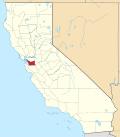 | |
| Census-designated places | ||
| Unincorporated communities | ||
| Annexed communities | ||
| Former townships | ||
| Former communities | ||
| Bodies of water |
|  | |||||||||||
|---|---|---|---|---|---|---|---|---|---|---|---|---|---|
| Counties | |||||||||||||
| Cities and towns |
| ||||||||||||
| CDPs over 10k | |||||||||||||
| Sub-regions | |||||||||||||
| Other | |||||||||||||


| International | |
|---|---|
| National | |
| Geographic | |
| Other | |

Fremont, California
View on GrokipediaFremont is a suburban city in Alameda County, California, located in the East Bay portion of the San Francisco Bay Area. Incorporated on January 23, 1956, through the unification of five preexisting communities—Centerville, Irvington, Mission San José, Niles, and Warm Springs—it was named in honor of the 19th-century explorer and military officer John C. Frémont.[1][2]
The city spans approximately 78 square miles and had an estimated population of 226,000 as of 2023, making it one of the larger municipalities in the region. Fremont exhibits exceptional ethnic diversity, with residents of Asian descent accounting for about 62.5% of the population, alongside significant White (19%), Hispanic (12%), and other groups, reflecting substantial immigration from South Asia, China, and other areas.[3]
Economically, Fremont thrives as a center for high-technology and advanced manufacturing, bolstered by its proximity to Silicon Valley; the Tesla Fremont Factory stands as the city's largest employer and North America's highest-volume automobile production facility, contributing substantially to local output and innovation in electric vehicles.[4][5] The area features elevated median household incomes around $153,000—well above national medians—and crime rates that, while varying by category, generally align with or fall below broader California and U.S. averages in property and violent offenses. Notable for its quality public schools, expansive parks such as Central Park, and historical sites including Mission San José, Fremont balances suburban residential appeal with industrial dynamism, though it grapples with challenges like housing affordability driven by regional demand.[3]
History
Pre-colonial era and Spanish mission period
The area encompassing modern Fremont, California, was inhabited prior to European contact by indigenous groups of the Ohlone people, specifically Chochenyo-speaking bands such as the Muwekma Ohlone, who occupied the San Francisco Bay region including the eastern shore of the bay near present-day Fremont. These groups lived in semi-permanent villages, relying on a hunter-gatherer economy that included acorn processing, fishing in the bay and streams, hunting small game, and gathering shellfish and roots. Population estimates for the broader Ohlone territory suggest densities of several thousand individuals across the bay area, organized in autonomous family-based bands without centralized political structures.[6][7] Spanish exploration of Alta California began in the mid-18th century, with the establishment of a chain of Franciscan missions to facilitate colonization, Christian conversion of natives, and agricultural self-sufficiency for presidios and pueblos. Mission San José, the fourteenth in the chain, was founded on June 11, 1797, by Father Fermín Francisco de Lasuén at a site known to locals as Oroysom, located in the Livermore Valley corridor now within Fremont's Mission San José district. Initial neophyte population was small, starting with 33 baptisms in 1797, but grew to over 1,800 by 1831 as surrounding Ohlone groups were induced or coerced into mission life through a combination of missionary persuasion, military enforcement, and disruption of traditional food sources by introduced livestock.[8][1][9] The mission period profoundly altered native demographics and lifeways, with neophytes subjected to regimented labor in farming, herding, and construction, alongside religious instruction. European-introduced diseases, to which the Ohlone lacked immunity, combined with malnutrition from dietary shifts and overcrowded conditions, led to high mortality rates; mission records indicate thousands of baptisms but substantial burials, contributing to an overall decline in the regional indigenous population during the Spanish era. By the time of secularization in the 1830s, the mission's native population had significantly diminished, with many survivors dispersing to ranchos or facing further upheaval.[10][11]19th-century settlement and naming
In the wake of California's transition from Mexican to American control following the Bear Flag Revolt of 1846 and the Treaty of Guadalupe Hidalgo in 1848, Anglo-American pioneers began establishing farms and ranches in the fertile valleys east of San Francisco Bay, drawn by the region's arable land and proximity to ports like San José and San Francisco.[1] By the early 1850s, this influx accelerated with statehood in 1850, leading to the subdivision of former mission and rancho lands for agriculture, including wheat, barley, and fruit orchards.[12] On May 28, 1853, the California Legislature created Alameda County from portions of Contra Costa and Santa Clara counties, organizing Washington Township as one of its six original divisions; the township, spanning about 100 square miles, was named in honor of President George Washington and encompassed nascent communities clustered around key landmarks and transport routes.[13] These included Centerville, established circa 1854 as a commercial hub midway between Mission San José and the port of Alvarado (now Newark), supporting travelers on the main road to the southern bay; its name reflected its central position.[14] Similarly, Warm Springs developed near natural hot springs on the former Rancho Agua Caliente, granted in 1839 to Antonio Suñol, a Spanish settler who adapted to American rule and promoted the area's mineral waters for health benefits.[1] Other settlements bore names tied to local features or founders: Mission San José grew from the nucleus of the 1797 Spanish mission but expanded under American ownership after secularization, serving as a religious and administrative anchor; Irvington emerged in the 1850s around vineyards and later became known for its apricot industry, possibly named after author Washington Irving to evoke cultural aspirations.[1] Niles formed near a grist mill built in the early 1840s along Alameda Creek, facilitating grain processing for surrounding farms.[15] These communities, totaling several hundred residents by the 1860s, relied on wagon roads and, after 1869, the Transcontinental Railroad's extension through Niles Canyon, which boosted trade but also strained water resources amid rapid land claims.[12] The modern city of Fremont, formed by consolidating these townships in 1956, derives its name from John C. Frémont, the 19th-century explorer whose 1844 expedition mapped Mission Pass trails, aiding overland migration and military movements during the conquest.[1]Incorporation and post-World War II suburbanization
Fremont was incorporated on January 23, 1956, through the consolidation of five previously unincorporated communities in Alameda County's Washington Township: Centerville, Irvington, Mission San José, Niles, and Warm Springs.[16] The effort, led by local advocate Wally Pond, aimed to create a unified municipality capable of addressing rapid postwar expansion by centralizing zoning authority, infrastructure planning, and public services amid pressures from encroaching development.[17][18] Voters selected the name "Fremont" in a referendum, honoring 19th-century explorer John C. Frémont, over alternatives such as "Washington" or "Mission."[17] This incorporation occurred against the backdrop of California's explosive postwar population surge, driven by returning veterans, federal housing programs like the GI Bill, and migration fueled by industrial job growth in the Bay Area.[19] Alameda County's population doubled from 290,547 in 1950 to 642,365 by 1960, reflecting broader regional suburbanization as affordable land in the East Bay attracted middle-class families seeking single-family homes away from congested urban cores.[20] In Fremont, agricultural orchards and ranches began yielding to tract housing developments, particularly along corridors like Fremont Boulevard, enabling the area to transition from semi-rural townships to organized suburban enclaves.[21] The new city's framework supported coordinated growth in civic facilities, parks, and transportation networks, mitigating fragmented development that had characterized the pre-incorporation era.[21] By fostering annexation policies and municipal planning, Fremont positioned itself to absorb influxes of residents commuting to San Francisco and Oakland, while preserving some open spaces amid the Bay Area's affluence-driven sprawl.[22] This suburbanization phase laid the groundwork for later economic diversification, though initial focus remained on residential expansion to meet housing demands without overextending limited township resources.[12]Technological boom and recent annexations
Following its incorporation in 1956, Fremont experienced accelerated suburban development in the postwar era, but the city's technological transformation accelerated in the 1980s with the influx of high-tech industries, particularly in the Warm Springs district, which became a hub for semiconductor and electronics manufacturing due to proximity to Silicon Valley and local tax incentives for industrial development.[1][23] This period saw the establishment of major employers in chip fabrication and related fields, contributing to a surge in high-skilled jobs and positioning Fremont as an extension of the broader regional tech ecosystem.[24] The acquisition of the former NUMMI automotive plant by Tesla in 2010 marked a pivotal escalation in Fremont's technological prominence, converting the facility into the Tesla Fremont Factory, which by 2023 employed over 20,000 workers and produced nearly 560,000 vehicles annually, making it California's largest automotive employer and injecting billions in economic activity through direct wages exceeding state averages by 50% and supply chain multipliers.[25][26] Tesla's expansion has spurred ancillary growth in logistics, engineering, and advanced manufacturing, with supported jobs in California rising 40% from 2018 to 2021, though it has also strained local infrastructure and housing amid rapid population and commercial influx.[27] To accommodate this industrial expansion and population growth—from approximately 20,000 residents at incorporation to over 230,000 by 2020—Fremont has pursued annexations of adjacent unincorporated lands, increasing its area from 33 square miles in 1956 to 78 square miles today, with notable recent efforts including approvals for territories in the Warm Springs and southern extensions to support BART rail extensions and tech parks in the 2010s and early 2020s.[1][28] These annexations, processed through Alameda County LAFCO, have facilitated mixed-use developments and preserved agricultural buffers while enabling the integration of new commercial zones aligned with the CHIPS Act's emphasis on semiconductor infrastructure.[24]Geography
Physical features and neighborhoods
Fremont covers 76.7 square miles of primarily flat terrain in Alameda County, situated on the Fremont Plain between San Francisco Bay to the west and the Diablo Range foothills to the east.[29] [30] The city's average elevation is approximately 50 feet above sea level, with much of the developed area consisting of low-lying alluvial plains historically used for agriculture.[31] Eastern portions transition to steeper hills, including Mission Peak, which reaches 2,517 feet and forms a prominent landmark visible across the region.[32] Alameda Creek, a major perennial stream originating in the Diablo Range, flows eastward through Fremont for about 12 miles along the northern boundary before emptying into the bay, shaping local hydrology and supporting the Alameda Creek Regional Trail.[33] Smaller tributaries like Laguna Creek drain the southern foothills, contributing to the 660-square-mile Alameda Creek Watershed that encompasses the city.[34] Man-made features include Lake Elizabeth in Central Park, a 7.5-acre reservoir used for recreation, and Quarry Lakes Regional Recreation Area, formed from former gravel pits.[35] Fremont's neighborhoods originated from five independent communities incorporated in 1956: Centerville, Irvington, Mission San Jose, Niles, and Warm Springs, each preserving distinct identities amid suburban growth.[36] Centerville features a historic downtown with Victorian architecture along Fremont Boulevard, while Niles retains a small-town feel with early 20th-century buildings and proximity to Niles Canyon.[36] Mission San Jose district centers around the preserved Spanish mission and includes upscale residential areas with high-rated schools. Irvington offers family-oriented suburbs near Mission Peak trails, and Warm Springs combines industrial zones with growing residential developments near the BART extension.[36] Central Fremont, encompassing areas like Lake Elizabeth and modern apartments, serves as a commercial hub, while North Fremont includes diverse housing in the Bayside and Lakes and Birds neighborhoods adjacent to the bay marshes.[37] Ardenwood, in the northwest, features open spaces like the historic Ardenwood Historic Farm amid equestrian properties and light industry.[37] These districts vary in density, with eastern hill areas like Canyon Heights remaining less developed due to hillside regulations.[38]Climate and environmental factors
Fremont exhibits a Mediterranean climate (Köppen Csb), marked by mild temperatures year-round, with warm, dry summers and cool, wet winters influenced by its position in the East Bay, inland from the San Francisco Bay. The average annual high temperature is 69°F, while the average low is 50°F, yielding a mean of about 60°F.[39] Annual precipitation averages 16 inches, concentrated between November and March, with negligible snowfall at 0 inches.[39] [40] The warmest month is September, with average highs near 78°F, and the coolest is January, with lows around 42°F.[41] [39]| Month | Avg High (°F) | Avg Low (°F) | Precipitation (in) |
|---|---|---|---|
| January | 60 | 42 | 2.9 |
| February | 62 | 44 | 2.7 |
| March | 64 | 46 | 2.2 |
| April | 67 | 48 | 1.1 |
| May | 70 | 51 | 0.5 |
| June | 74 | 54 | 0.2 |
| July | 77 | 56 | 0.1 |
| August | 77 | 56 | 0.1 |
| September | 78 | 55 | 0.3 |
| October | 74 | 52 | 0.9 |
| November | 65 | 47 | 1.8 |
| December | 59 | 42 | 2.5 |
Demographics
Population growth and census data
Fremont's population grew rapidly following its incorporation on January 23, 1956, as a consolidation of five surrounding communities amid post-World War II suburban expansion in the East Bay region. The 1960 decennial census enumerated 43,790 residents, reflecting early annexation and housing development.[50] Growth accelerated with industrial and residential influxes tied to regional economic shifts. Decennial census data illustrate sustained expansion through the late 20th and early 21st centuries, peaking in the 2020 census at 230,504 inhabitants. [50]| Census Year | Population | Decennial % Change |
|---|---|---|
| 1960 | 43,790 | — |
| 1970 | 100,869 | 130.3% |
| 1980 | 131,945 | 30.8% |
| 1990 | 173,339 | 31.3% |
| 2000 | 203,413 | 17.3% |
| 2010 | 214,089 | 5.3% |
| 2020 | 230,504 | 7.7% |
Ethnic composition and immigration patterns
As of the 2020 United States Census, Fremont's population of 230,504 was racially and ethnically diverse, with Asians comprising the largest group at 64.5% of residents, predominantly non-Hispanic.[51] Non-Hispanic Whites accounted for 16.7%, Hispanics or Latinos of any race 12.9%, Blacks or African Americans 3.1%, and multiracial individuals 2.8%.[51] Smaller shares included Native Americans and Alaska Natives at 0.3%, Native Hawaiians and Pacific Islanders at 0.4%, and other races at 0.3%.[51] Within the Asian category, Indian Americans formed the largest subgroup at approximately 29% of the total population, followed by Chinese Americans at 19%, reflecting concentrations in neighborhoods like Mission San Jose.[52] Filipinos constituted about 7%, with smaller Pacific Islander and other Asian groups.[52]| Racial/Ethnic Group | Percentage (2020 Census) |
|---|---|
| Asian (total) | 64.5% |
| Non-Hispanic White | 16.7% |
| Hispanic/Latino | 12.9% |
| Black/African American | 3.1% |
| Multiracial | 2.8% |
| Other groups | <1% each |
Socioeconomic indicators
Fremont displays affluent socioeconomic characteristics, driven by its proximity to Silicon Valley and concentration of high-skilled employment in technology and engineering. The median household income reached $176,350 for the period 2019-2023, more than double the national median and reflecting earnings from professional occupations.[51] [52] Per capita income averaged $101,256, underscoring broad prosperity amid a population of skilled workers and dual-income families.[56] The poverty rate remained low at 5.08%, substantially below California's 12.2% and the U.S. 11.5%, with child poverty under 200% of the federal threshold at 8.3%.[56] [57]| Socioeconomic Indicator | Value | Reference Period |
|---|---|---|
| Median Household Income | $176,350 | 2019-2023 |
| Per Capita Income | $101,256 | Latest available |
| Poverty Rate | 5.08% | Latest available |
| Bachelor's Degree or Higher (Age 25+) | ~66% | 2019-2023 |
| Median Property Value | $1.29 million | 2023 |
| Unemployment Rate | 4.1% | Recent estimate |
Economy
Key sectors and historical development
Fremont's economy historically centered on agriculture from the mid-19th century through the mid-20th century, with fertile lands supporting orchards, vineyards, farms, grains, vegetables, grapes, olives, and nursery plants as primary crops.[61][62] This agrarian base persisted until suburbanization and industrial growth post-World War II began transforming the area, particularly after the city's 1956 incorporation by merging five communities.[1] By the late 20th century, Fremont shifted toward manufacturing and technology, leveraging its proximity to Silicon Valley and transportation infrastructure.[1] Advanced manufacturing emerged as a cornerstone, with over 900 companies in the sector by the 2020s, accounting for approximately one in four local jobs and encompassing prototyping, assembly, and high-tech production.[63] Key subsectors include electronics, semiconductors, biomedical devices, and automotive assembly, bolstered by the presence of facilities like the former NUMMI plant repurposed for electric vehicle production.[64] In recent decades, Fremont has positioned itself as a hub for clean energy and battery technologies, hosting over 50 energy tech firms and leading in advanced battery development nationwide.[65] Professional, scientific, and technical services also dominate employment, with nearly 30,000 jobs in 2023, reflecting the integration of R&D with manufacturing.[52] This evolution from rural agriculture to innovation-driven industry has been driven by strategic zoning, infrastructure investments, and corporate relocations, sustaining economic growth amid regional tech expansion.[66]Major employers and Tesla's role
Fremont's economy features prominent employers in technology, manufacturing, and biotechnology sectors, including Lam Research, Western Digital, Seagate Technology, Thermo Fisher Scientific, and Boehringer Ingelheim.[63] These firms contribute to the city's status as a hub for advanced manufacturing and innovation within Alameda County.[67] Tesla's Fremont Factory stands out as the largest automotive employer in California, with over 20,000 workers as of early 2024.[68] Acquired by Tesla in 2010 from Toyota and NUMMI, the facility produces the majority of Tesla's vehicles, including Models S, 3, X, and Y, supporting the company's global electric vehicle output.[25] This operation has transformed Fremont into a center for high-tech automotive manufacturing, generating substantial direct and indirect employment.[69] The factory's economic footprint extends beyond payroll, with Tesla-related wages and supplier activity injecting billions into California's economy; for instance, employee compensation spurred an estimated $16.6 billion in statewide economic output as of 2023.[69] Each dollar in Tesla employee pay in California historically generated $0.9 in additional consumer spending across the state.[70] Despite company-wide workforce adjustments, the Fremont site remains a cornerstone of local job creation, classified in the 10,000+ employee tier by state labor data.[71]Innovation hubs and recent expansions
Fremont's Warm Springs district serves as a primary innovation hub, integrating advanced manufacturing, mixed-use developments, and transit infrastructure, with the Tesla Fremont Factory as its anchor. This area forms part of the broader Fremont Innovation District, fostering growth in technology and engineering sectors through proximity to BART extensions and planned public spaces.[72][73][74] In October 2025, the city broke ground on the Palisade Fremont Innovation Center, a 4.2-acre Class-A advanced manufacturing facility offering nearly 70,000 square feet of modern space, scheduled for completion in 2026. This project, developed by North Palisade Partners, targets high-tech industries and is expected to generate dozens of specialized jobs, enhancing Fremont's appeal as a center for innovation.[75][76][77] Tesla has pursued targeted expansions at its Fremont Factory, including ramped-up production of 4680 battery cells announced through new job postings in March 2025, building on prior infrastructure upgrades to support higher-volume electric vehicle manufacturing.[78] Additional hubs include HEIDENHAIN's "CONNECT" Manufacturing Innovation Hub, a 12,000-square-foot facility opened in 2024 to support regional sales, engineering, and precision manufacturing in Silicon Valley. Meanwhile, Nextracker expanded operations in the Ardenwood Technology Park in 2025, reinforcing Fremont's cluster of AI hardware leaders, which now includes seven of the world's ten largest firms in that domain.[79][80][81]Government and Politics
Municipal structure and administration
Fremont operates as a general law city under California state statutes, employing the council-manager form of government prevalent among such municipalities. In this system, an elected city council establishes policy and appoints a professional city manager to handle administrative functions, including budget preparation, service delivery, and staff oversight.[82][83] The structure emphasizes separation between legislative policymaking and executive implementation, with the manager serving at the council's pleasure and reporting directly to it.[83] The city council consists of seven members: a mayor elected at-large by all voters and six councilmembers elected from single-member districts, implemented following a 2020 transition from at-large elections to address representation concerns under the California Voting Rights Act.[84] Councilmembers must reside in their districts, and voters in each district elect their representative; terms last four years, with elections staggered across even-numbered years to ensure continuity—three seats typically up every two years alongside the mayoral race every four years.[84][85] The mayor presides over meetings, votes on all matters, and represents the city externally but lacks veto power or separate administrative authority.[82] As of October 2025, Mayor Raj Salwan holds office following his November 2024 election victory over challengers Vinnie Bacon, Rohan Marfatia, and Hiu Ng.[86] Karena Shackelford serves as city manager, appointed by the council as the ninth in Fremont's history after prior roles as assistant city manager; she manages a staff of approximately 1,000 across departments like public works, community development, and finance.[83] The council also appoints independent bodies, such as the city attorney and various advisory boards and commissions, to support specialized functions like planning and human relations.[87] This framework, rooted in state general law rather than a voter-adopted charter—last rejected by residents in 1998—limits local autonomy compared to charter cities but aligns with Fremont's emphasis on efficient, nonpartisan administration.[88]Electoral trends and voter behavior
Fremont voters have demonstrated a consistent strong preference for Democratic candidates in presidential elections, reflecting the broader political alignment of Alameda County. In the 2020 election, 80.2% of votes in Fremont supported Joe Biden, while 17.7% went to Donald Trump, resulting in a margin exceeding 60 percentage points.[89] This lopsided outcome mirrors patterns in prior cycles, where Democratic nominees captured similar supermajorities amid high turnout rates typical of educated, suburban Bay Area communities.[89] Voter registration data for Alameda County, encompassing Fremont, indicates Democrats constitute approximately 58% of registrants, no party preference voters around 25%, and Republicans about 14%, with smaller shares for other affiliations.[90] These figures suggest a Democratic plurality, though the significant no-party-preference segment—often comprising independents and tech professionals—may moderate outcomes on local issues. Turnout in presidential general elections routinely surpasses 70% countywide, driven by mail-in voting and civic engagement among the city's high-income, highly educated populace.[91] Municipal elections for mayor and city council are officially nonpartisan, emphasizing practical concerns such as infrastructure, housing development, and public safety over ideological divides. Winning candidates, including the 2024 mayor Raj Salwan—who secured a strong lead with over 50% in early counts—often appeal to a cross-section of voters prioritizing economic expansion and fiscal prudence, influenced by Fremont's tech-driven economy and diverse demographics.[92] This contrasts with national voting behavior, where partisan loyalty dominates, potentially indicating voter pragmatism on city-level governance amid rising local debates over growth and crime.[84]Major policy debates and reforms
In recent years, Fremont's city council has debated policies to curb homelessness, culminating in a February 2025 ordinance banning camping on all public property citywide, which aimed to enhance public safety and sanitation but drew criticism for its initial inclusion of penalties for "aiding or abetting" violations.[93] After hours of public comment and legal concerns raised by advocates, the council voted in March 2025 to remove the aiding clause, softening enforcement while maintaining the core prohibition to address visible encampments amid a reported 27% rise in homelessness since 2017.[94][95] This reform reflects broader tensions between compassionate outreach and stricter municipal controls, with the city allocating resources for shelter navigation alongside enforcement.[81] Housing development has sparked ongoing contention, as Fremont's certified Housing Element mandates accommodating nearly 13,000 new units by 2031 to meet state goals, pitting density increases against infrastructure limits like water scarcity, traffic congestion, and seismic vulnerabilities on the Hayward Fault.[96][97] Critics, including residents and seismic experts, argue that rapid approvals—such as over 1,200 homes under construction and 4,000 more approved by 2020—exacerbate earthquake risks and overburden existing systems without proportional upgrades, as evidenced by structural damage to the former city hall from fault movement.[98][99] Proponents emphasize economic necessity in a high-demand region, leading to reforms like streamlined permitting balanced with site-specific environmental reviews.[97] Budgetary reforms have focused on long-term fiscal stability amid rising labor costs and economic uncertainty, with the July 2025 adoption of a balanced FY 2025/26 operating budget allocating 94% of expenditures to public safety, fire, and police services while incorporating 13% salary hikes for non-safety unions over three years.[100][101] Negotiations with public employee unions have been contentious, as generous contracts strain reserves, prompting conservative planning for recessions and revenue diversification through economic development incentives.[102] City priorities also include environmental sustainability reforms, such as wildfire prevention and emissions controls, integrated into budget enhancements without specified tax increases.[81][103] Public safety strategies underwent reform with the Fremont Police Department's 2024-2027 Strategic Plan, unveiled in November 2024, which prioritizes efficiency, community engagement, and mental health response via a dedicated team budgeted at 0.9% of the police total for fiscal year 2020/21 (with ongoing funding).[104][105] This builds on council directives to bolster policing amid priorities like addressing homelessness-linked disorder, reflecting data-driven adjustments rather than defunding trends seen elsewhere in California.[81]Public Safety
Crime trends and policing strategies
Fremont maintains relatively low violent crime rates compared to California and national averages, with a 2021 victimization risk of 1 in 443 for violent incidents, translating to approximately 225 incidents per 100,000 residents annually based on population data.[106] Property crime rates, however, exceed national benchmarks, with a 2021 risk of 1 in 34, driven primarily by larceny, burglary, and motor vehicle theft.[106] Overall crime decreased by 8% in 2024 relative to 2023, reflecting a continuation of downward trends observed in prior years amid broader state-level fluctuations where violent crime rose modestly by 1.7% from 2022 to 2023.[107][108] The Fremont Police Department structures its patrol operations across three geographic zones, deploying over 160 personnel in shifts guided by data on criminal activity and calls for service to prioritize high-impact areas.[109] Core strategies include community-oriented policing, which fosters partnerships to address local concerns proactively, and intelligence-led policing, which directs enforcement toward prolific offenders responsible for disproportionate harm.[109] The department's 2024-2027 strategic plan prioritizes crime mitigation through enhanced incident response, school safety collaborations, and traffic enforcement, alongside operational improvements like policy updates and equipment modernization under CALEA accreditation standards.[110] Community engagement efforts emphasize transparency via digital tools and feedback mechanisms to build trust and inform adaptive tactics, particularly for persistent issues like property offenses and public safety in commercial districts.[110]Homelessness policies and enforcement outcomes
Fremont maintains a Homelessness Response Plan emphasizing prevention for residents at risk of eviction, alongside service provision through partnerships with nonprofits for shelter, outreach, and case management. The city's multi-departmental strategy includes mobile evaluation teams, overnight sheltering, and relocation assistance during encampment cleanups, with enforcement of local ordinances to address public camping and property storage. In fiscal year 2023-2024, these efforts resulted in 473 overnight shelter stays, 107 transitions to stable housing, and support for 14,666 service visits, though point-in-time counts documented a 72% rise in unsheltered individuals from 264 in 2022 to 455 in 2024.[111][112][113][114] In February 2025, the City Council adopted a citywide camping ordinance prohibiting encampments and personal property storage on public property, with limited allowances on private property subject to owner consent and local rules; violations carry misdemeanor penalties of up to $1,000 fines or six months imprisonment. The ordinance initially included provisions criminalizing "aiding, abetting, or concealing" such encampments, drawing criticism from advocacy groups like Abode Services for potentially deterring private aid efforts, but this clause was amended and removed in March 2025 following public backlash and legal concerns. Enforcement involves coordinated cleanups by police, code enforcement, and public works, prioritizing relocation offers before removal, aligned with state executive orders encouraging local bans post-U.S. Supreme Court rulings on encampment regulations.[115][93][94][116] Outcomes of enforcement remain mixed as of mid-2025, with a September 2025 lawsuit withdrawal by homeless advocates enabling fuller implementation, yet reports indicate persistent encampments in parks and parking lots despite sweeps, and no significant reduction in visible homelessness six months post-ordinance. City priorities for 2025 explicitly target homelessness reduction through expanded non-congregate shelter options, but empirical data shows prior service expansions coincided with rising counts, suggesting limited causal impact from voluntary programs alone amid broader Bay Area housing shortages and Alameda County trends. Critics, including nonprofits, argue punitive enforcement displaces rather than resolves issues, while city officials cite improved public safety and quality-of-life metrics in cleared areas, though independent evaluations of long-term efficacy are pending.[117][118][81][119]Education
Primary and secondary schools
Primary and secondary education in Fremont is predominantly provided by the Fremont Unified School District (FUSD), which serves approximately 33,107 students across 45 schools from transitional kindergarten through 12th grade as of recent data.[120] FUSD operates 29 elementary schools, five middle schools, five comprehensive high schools, and additional alternative and continuation programs, emphasizing STEM education, gifted programs, and extracurricular activities tailored to a diverse student body with significant Asian American representation.[121] [122] The district's high schools—American High School, Irvington High School, John F. Kennedy High School, Mission San Jose High School, and Washington High School—each enroll between 1,500 and 2,200 students and consistently outperform state averages on standardized assessments, with proficiency rates in English language arts and mathematics often exceeding 70% compared to the California average of around 50%. For instance, Mission San Jose High School, with 1,822 students, reports math proficiency at 85% and reading at 92%, reflecting rigorous academic standards and high college readiness, including widespread Advanced Placement participation.[123] [124] Elementary and middle schools in FUSD, such as Mission San Jose Elementary and Walters Middle School, similarly achieve strong outcomes, with top-ranked elementaries like John Gomes Elementary demonstrating superior growth in core subjects per state metrics.[125] The district's overall student-teacher ratio stands at about 23:1, supporting personalized instruction amid a student population where over 60% are Asian, 10% Hispanic, and English learners comprising around 10%.[126] While public schools dominate, private options like Basis Independent Fremont serve smaller cohorts with specialized curricula, though they enroll fewer than 1,000 students citywide.[127] FUSD invests in facilities and programs, including technology integration and special education services for 12% of students, contributing to graduation rates above 95% district-wide.[128] Academic pressures in high-achieving environments have prompted discussions on mental health support, with the district implementing counseling expansions since 2020 to address reported stress levels among competitive student demographics.[121]Higher education institutions
Ohlone College, a public community college within the California Community College system, maintains its primary campus in Fremont at 43600 Mission Boulevard.[129] Established to serve the Tri-City area including Fremont, Newark, and Union City, it provides associate degrees, certificates, and transfer programs to four-year universities, with a focus on fields such as business, health sciences, and technology.[129] In the 2020-2021 academic year, in-state tuition and fees totaled $1,196, while out-of-state rates reached $7,052, reflecting its affordability for local residents.[130] The institution enrolls thousands of students annually and ranks as an above-average community college in the San Francisco Bay Area, emphasizing career preparation and university transfer pathways.[131] San Francisco Bay University (SFBU), a private nonprofit institution accredited by the WASC Senior College and University Commission, operates a campus in Fremont at 161 Mission Falls Lane.[132] Specializing in undergraduate and graduate programs in computer science, business administration, and engineering, SFBU targets technology and innovation sectors aligned with the region's Silicon Valley economy.[132] It offers flexible scheduling including evening and online options to accommodate working professionals.[132] The Aviation Institute of Maintenance-Fremont, a private vocational college, is located at 420 Whitney Place and provides associate degrees and certificates in aviation maintenance technology. Programs emphasize hands-on training for FAA certification, serving students pursuing careers in aerospace repair and maintenance. While smaller in scale, it contributes to Fremont's higher education landscape by addressing specialized technical workforce needs.Public libraries and literacy programs
Public library services in Fremont are provided by the Alameda County Library district, which operates multiple branches within the city to serve residents' access to educational, informational, and recreational resources.[134] The system offers collections of books, audiobooks, digital media, and public computers, alongside community rooms for meetings and events.[135] Key branches in Fremont include the Fremont Main Library at 2400 Stevenson Boulevard, which functions as a central hub with extended hours including evenings and weekends; the Irvington Library at 41825 Greenpark Drive; and the Niles Discovery Church Library at 36600 Niles Boulevard.[136] These facilities support general lending services, youth programs, and technology access, with the Fremont Main Library managed by Becky Machetta and contactable at (510) 745-1400.[135] Literacy programs form a core component of the library's educational offerings, targeting adults and families to build foundational skills in reading, writing, and English proficiency. The One-on-One Learning with a Learning Partner initiative pairs participants with trained tutors for six-month sessions focused on independent reading, writing, and speaking abilities.[137] This free program is available to adults seeking literacy improvement and can be accessed by calling 510-745-1480 or submitting an online learner form.[137] Additional support includes one-time appointments for assistance with forms, mail, or basic tasks, as well as Family Literacy Days featuring events to engage youth and adults together in skill-building activities, often scheduled in branches like those in Fremont.[137] These efforts, part of the broader Write to Read adult literacy framework, incorporate small-group sessions, computer skills labs, and job readiness classes to address reading, writing, spelling, and comprehension gaps.[138] The programs emphasize practical outcomes, such as enhanced communication and employability, without reliance on external ideological frameworks.[137]Culture and Recreation
Cultural landmarks and events
Mission San José, established on June 11, 1797, as the fourteenth in the chain of Spanish missions in California, serves as a primary cultural landmark in Fremont, preserving architecture and artifacts from the early colonial period including adobe structures, a museum detailing Spanish exploration, and exhibits on Ohlone indigenous history.[139] The site attracts visitors for its historical significance in the region's transition from mission era to American settlement.[140] Ardenwood Historic Farm, a 205-acre living history site operational since 1985, recreates 19th-century agrarian life with preserved buildings like the Patterson Ranch House built in 1857, steam-powered equipment demonstrations, and heirloom crop cultivation, emphasizing Fremont's ranching heritage.[141] The Niles Essanay Silent Film Museum, housed in a 1916 depot, commemorates the early 20th-century film industry with collections from Essanay Studios, including works by Charlie Chaplin and the first western star Broncho Billy Anderson, who produced over 400 shorts in Niles between 1912 and 1916.[142] [143] Annual events highlight Fremont's cultural diversity, particularly its large Indian-American community comprising over 20% of residents. The Festival of India, organized by the Festival of Globe nonprofit, features a parade and mela fair on August 16-17, drawing tens of thousands for traditional dances, music, cuisine, and artisan displays in its 33rd year as of 2025.[144] [145] The Fremont Festival of the Arts, held in early August, showcases over 300 artists, live music, and family activities along Fremont Boulevard, promoting local creative expression since its inception.[146] The Summer Concert Series at Central Park Performance Pavilion presents diverse genres from jazz to rock on select evenings through summer 2025, fostering community engagement with free public performances.[147] In Niles district, the Fremont Art Association gallery hosts monthly exhibits and demonstrations, supporting regional artists amid the area's historic film legacy.[148] Seasonal events like the Niles Festival of Lights in December illuminate historic streets with parades and vendor markets, blending holiday traditions with community heritage.[149] These gatherings reflect empirical demographic shifts, with Asian residents forming 65% of the population per 2020 census data, driving multicultural programming over Eurocentric norms in prior decades.[145]Parks, trails, and outdoor activities
Fremont features a network of city-managed parks and regional preserves providing opportunities for hiking, walking, picnicking, and water-based recreation, with over 40 parks totaling thousands of acres under municipal and East Bay Regional Park District oversight. Central Park, the city's largest at more than 450 acres, centers on Lake Elizabeth, an 83-acre man-made lake completed in 1964 and surrounded by a 2-mile paved loop trail used for pedestrian and bicycle circulation. The park includes sports fields, playgrounds, and picnic facilities, attracting visitors for leisurely strolls amid views of the Mission Peak ridgeline.[150] Mission Peak Regional Preserve, encompassing 3,023 acres adjacent to Fremont's eastern boundary, offers strenuous hiking trails to its 2,520-foot summit, with popular routes like the 6-mile Stanford Avenue loop gaining 2,145 feet in elevation over rocky, exposed terrain requiring 4-5 hours round-trip. Managed by the East Bay Regional Park District since 1977, the preserve draws thousands annually for panoramic vistas of the San Francisco Bay and Diablo Range, though its steep ascents and minimal shade demand preparation for heat and crowds. Additional trails connect to nearby Ohlone College staging areas for longer out-and-back options exceeding 8 miles.[151][152] Ardenwood Historic Farm, a 205-acre East Bay park site preserving 19th-century agrarian life, combines gentle trails with interpretive outdoor activities such as organic crop tending demonstrations, animal interactions, and seasonal events like train rides on a narrow-gauge railroad. Visitors access flat, maintained paths suitable for families, alongside equestrian and biking routes extending into surrounding wetlands. Quarry Lakes Regional Recreation Area provides boating, fishing, and swimming on former gravel pits converted to lakes totaling 400 acres of water surface, emphasizing water-oriented pursuits with supervised swim beaches operational seasonally.[153][35] Multi-use trails like the Alameda Creek Trail, spanning 12 miles through Fremont's southern districts, facilitate hiking, biking, and equestrian use along the creek corridor, linking to regional networks such as Coyote Hills Regional Park's 12 miles of paths amid Native American shellmounds and marshes. Vargas Plateau Regional Park adds 6 miles of ridgeline trails for birdwatching and raptor observation across 1,249 acres of grassland, with steep climbs yielding elevated bay views. These facilities underscore Fremont's emphasis on accessible green spaces amid suburban density, though maintenance challenges arise from high usage and urban proximity.[154][155]Local media and arts scene
Fremont's arts scene features several galleries and cultural organizations dedicated to visual and performing arts. The Olive Hyde Art Gallery, managed by the city at 123 Washington Boulevard, exhibits traditional and contemporary works, accepting proposals for individual or group shows open Thursday through Sunday during exhibitions.[156] The Fremont Art Association hosts events such as the "Blooming Clay" exhibit featuring guest artists like Vicki Gunter, scheduled for November 2025.[148] The Fremont Cultural Arts Council advocates for arts policies and supports community enjoyment of fine arts through grants and events.[157] Community theater thrives with groups like Stage 1 Theatre, a nonprofit cultivating live performances in the Tri-City area since its founding, offering plays and musicals at local venues.[158] Fremont Community Theatre provides workshops, such as introductions to musical theater dance and tap held in July 2025, alongside ticketed productions to engage residents in performing arts.[159] The Smith Center for the Performing Arts at Ohlone College, opened in 1995, includes a theater and gallery supporting college programs and public cultural events.[160] Film history anchors the local arts with the Niles Essanay Silent Film Museum in the Niles district, preserving artifacts from Essanay Studios established in 1912, where early films including Charlie Chaplin's works were produced; the museum screens silent films weekly with live accompaniment.[161] Annual events like the Niles Artwalk highlight local artists and vendors, fostering community engagement with arts in historic settings.[162] Local media primarily relies on regional outlets for coverage, as Fremont lacks an independent daily newspaper. The East Bay Times and Mercury News maintain dedicated Fremont sections reporting on city news, with articles updated as of 2025.[163][164] Tri-City Voice serves as a weekly print and online publication covering Fremont, Union City, and Newark, distributing over 50,000 copies focused on local government, business, and events.[165] Bay Area broadcasters such as KTVU FOX 2 and KRON4 provide television news including Fremont-specific stories like public safety incidents.[166][167] The city's official website aggregates press releases and updates on initiatives.[168]Transportation
Road infrastructure and major routes
Fremont is primarily served by Interstate 880, a north-south freeway running through the city's western and central areas, paralleling local corridors like Mission Boulevard and providing connections to Oakland to the north and San Jose to the south.[169] Interstate 680 offers eastern access, with segments in the vicinity facilitating travel toward Livermore and the broader Bay Area highway system.[170] State Route 84 passes through southern Fremont, briefly overlapping with I-880 before extending westward to the Dumbarton Bridge across San Francisco Bay.[171] The city's local road network encompasses 498 miles of streets equipped with 219 traffic signals, of which 141 miles classify as major arterials handling higher-volume traffic. Caltrans maintains the interstates and state routes, while the city oversees arterials and collectors through annual pavement rehabilitation programs targeting deteriorated surfaces on routes like Paseo Padre Parkway.[172][173] Infrastructure improvements emphasize multimodal safety, incorporating roundabouts, protected intersections, bike lanes, and updated signals to reduce crash severity and vehicle speeds citywide.[174] Key projects include the Peralta Boulevard and Mowry Avenue Complete Streets initiative, rehabilitating former SR 84 segments with enhanced pedestrian and cyclist facilities from 2023 onward, and the Decoto Road Complete Streets project east of I-880 to Paseo Padre Parkway, focusing on pothole repairs and accessibility upgrades through 2025.[173][175] In December 2023, Fremont secured $8.5 million in state funding for road maintenance, pathway expansions, and transit integrations.[176] The East 14th Street/Mission Boulevard and Fremont Boulevard corridor, completed in phases through 2020, parallels I-880 to bolster north-south mobility with long-term multimodal enhancements.[169]Public transit systems
Fremont is served by Bay Area Rapid Transit (BART) with two stations: the central Fremont station at 2000 BART Way and the southern Warm Springs/South Fremont station.[177][178] The Fremont station connects riders to Oakland, San Francisco, and other East Bay locations via the Orange and Green lines.[177] Warm Springs/South Fremont station anchors the Warm Springs Innovation District and extends BART service southward.[178] Bus service is primarily provided by the Alameda-Contra Costa Transit District (AC Transit), which operates local routes throughout Fremont and transbay lines to San Francisco.[179] AC Transit buses connect to BART stations and serve key areas like NewPark Mall and Pacific Commons.[180] Commuter rail options include the Altamont Corridor Express (ACE), which stops at the Fremont/Centerville station at 37260 Fremont Boulevard for weekday service between Stockton and San Jose.[181][182] The same station accommodates Amtrak's Capitol Corridor trains, offering intercity connections with bus links to other regional services.[182] For specialized needs, the city supports paratransit through Ride-On Tri-City, providing door-to-door service within Fremont, Newark, and Union City for older adults and people with disabilities at $4 per one-way trip, limited to 31 trips per month.[183] AC Transit also offers FLEX demand-response service for flexible local travel.[180]Planned rail and infrastructure projects
The Irvington BART station is a planned infill station in Fremont's Irvington district, located at the intersection of Washington Boulevard and Osgood Road, intended to enhance regional rail access for approximately 45,000 residents and workers in the area.[184] Design work reached 90% completion by mid-2025, with construction anticipated to commence in mid-2026 and service opening projected for late 2031, at an estimated cost of $120 million funded through a combination of federal, state, and local sources including Measure RR bonds.[184] The Centerville Railroad Quiet Zone Project aims to implement safety upgrades at six at-grade railroad crossings along the Centerville corridor, including median barriers, advance warning signs, and pedestrian gates, to establish a federal quiet zone reducing train horn usage while maintaining compliance with federal safety standards.[185] Engineering and environmental reviews were completed by 2024, with implementation phased to minimize disruptions to the active freight and occasional passenger rail lines operated by Union Pacific and Amtrak's Capitol Corridor.[185] An intermodal station at Ardenwood is proposed to expand Capitol Corridor service, integrating bus, bike, and pedestrian connections to serve commuters toward the Dumbarton Bridge corridor and regional job centers, though it remains in preliminary planning without a fixed construction timeline as of 2025.[186] Infrastructure enhancements include the Interstate 680 and State Route 238 separation bridge rehabilitation in Fremont, addressing seismic vulnerabilities and corrosion on the structure carrying northbound and southbound I-680 over Mission San Jose District roads, with construction starting in April 2025 and completion targeted for winter 2025.[187] The Decoto Road Complete Streets project will widen sidewalks, add protected bike lanes, and upgrade signals along a 2.5-mile segment linking residential areas to BART and the Dumbarton Expressway, supported by $18.2 million in bridge toll allocations to improve multimodal access in the Dumbarton Corridor.[175][188] Fremont's Capital Improvement Program allocates $296 million over five years starting July 2025 for broader transportation upgrades, including pavement rehabilitation and traffic signal modernization at key intersections.[189]Notable People
Natives and long-term residents
Helen Wills Moody (1905–1998), a pioneering tennis player who won 19 Grand Slam singles titles between 1923 and 1938, was born on October 6, 1905, in Centerville, Alameda County, an area now incorporated into Fremont as of 1956.[190] She dominated women's tennis in the interwar period, securing eight Wimbledon singles championships and seven French Open titles, while also excelling in doubles and mixed doubles events.[191] Len Wiseman (born 1973), film director known for the Underworld franchise and Total Recall (2012), was born on March 4, 1973, in Fremont.[192] His work spans action and science fiction genres, with Underworld (2003) launching a series that grossed over $1 billion worldwide across five films.[193] Dina Eastwood (born 1965), former television news anchor and producer, grew up in Fremont and graduated from Mission San Jose High School there in the early 1980s.[194] She anchored local news in Monterey and hosted segments on Clint Eastwood-related projects after their 1996 marriage, during which they resided periodically in the Bay Area before moving to Carmel.[195] Other notable figures include figure skater Karen Chen (born 1999), a 2017 U.S. national champion raised in Fremont, who competed in the 2022 Winter Olympics; and mixed martial artist DeAnna Bennett (born 1984), a Bellator champion born and trained in the area.Business and tech figures associated with the city
Elon Musk, founder and CEO of Tesla, Inc., is prominently associated with Fremont through the company's primary manufacturing facility, the Tesla Fremont Factory, which produces the majority of Tesla's vehicles. Acquired by Tesla in 2010 from the defunct NUMMI joint venture, the factory has been central to Tesla's production scaling, including models like the Model S, Model 3, Model X, and Model Y, with output exceeding 500,000 vehicles annually as of 2023.[78][5] David K. Lam founded Lam Research Corporation in 1980, a leading supplier of semiconductor manufacturing equipment headquartered in Fremont since its early operations. Under Lam's initial leadership, the company developed key innovations in plasma etching systems, growing into a multinational firm with over $17 billion in annual revenue by 2023, employing thousands in Fremont and contributing significantly to the local tech ecosystem.[196][197] Raghu Belur and Martin Fornage co-founded Enphase Energy in 2006, pioneering microinverter technology for solar power systems from its Fremont headquarters. The company, which went public in 2012, reported $2.29 billion in revenue for 2023, driven by advancements in distributed energy solutions amid rising demand for residential solar.[198][199] James Peng and Tiancheng Lou established Pony.ai in Fremont in 2016, focusing on autonomous driving technology with Level 4 capabilities tested on public roads. The startup, backed by over $1 billion in funding, operates robotaxi services in China and has expanded U.S. operations, leveraging Fremont's proximity to Silicon Valley for talent and R&D.[200][201][202]International Relations
Sister cities and partnerships
Fremont established formal sister city relationships with several international municipalities between 1971 and 1993 to foster cultural, educational, and economic exchanges.[203] These partnerships were managed by the city's Sister Cities Commission until its dissolution by the City Council in October 2009, amid budgetary constraints and reports of minimal recent activity or exchanges.[203] Despite the commission's disbandment, some ties remain recognized by partner cities, including ongoing acknowledgments in joint events and diplomatic references as recently as 2025.[204][205] The sister cities, with establishment dates where documented, are:| City | Subdivision/Region | Country | Year Established |
|---|---|---|---|
| Puerto Peñasco | Sonora | Mexico | 1971 |
| Fukaya | Saitama Prefecture | Japan | 1979 |
| Lipa City | Batangas | Philippines | 1982 |
| Horta | Azores | Portugal | 1987 |
| Jaipur | Rajasthan | India | 1993 |
References
- https://nces.ed.gov/globallocator/index.asp?search=1&State=CA&city=[Fremont](/page/City)&zipcode=&miles=&itemname=&College=1