


Community hub
Recent from talks
Contribute something
Nothing was collected or created yet.
Geodesic
View on Wikipedia
In geometry, a geodesic (/ˌdʒiː.əˈdɛsɪk, -oʊ-, -ˈdiːsɪk, -zɪk/)[1][2] is a curve representing in some sense the locally[a] shortest[b] path (arc) between two points in a surface, or more generally in a Riemannian manifold. The term also has meaning in any differentiable manifold with a connection. It is a generalization of the notion of a "straight line".
The noun geodesic and the adjective geodetic come from geodesy, the science of measuring the size and shape of Earth, though many of the underlying principles can be applied to any ellipsoidal geometry. In the original sense, a geodesic was the shortest route between two points on the Earth's surface. For a spherical Earth, it is a segment of a great circle (see also great-circle distance). The term has since been generalized to more abstract mathematical spaces; for example, in graph theory, one might consider a geodesic between two vertices/nodes of a graph.
In a Riemannian manifold or submanifold, geodesics are characterised by the property of having vanishing geodesic curvature. More generally, in the presence of an affine connection, a geodesic is defined to be a curve whose tangent vectors remain parallel if they are transported along it. Applying this to the Levi-Civita connection of a Riemannian metric recovers the previous notion.
Geodesics are of particular importance in general relativity. Timelike geodesics in general relativity describe the motion of free falling test particles.
Introduction
[edit]A locally shortest path between two given points in a curved space, assumed[b] to be a Riemannian manifold, can be defined by using the equation for the length of a curve (a function f from an open interval of R to the space), and then minimizing this length between the points using the calculus of variations. This has some minor technical problems because there is an infinite-dimensional space of different ways to parameterize the shortest path. It is simpler to restrict the set of curves to those that are parameterized "with constant speed" 1, meaning that the distance from f(s) to f(t) along the curve equals |s−t|. Equivalently, a different quantity may be used, termed the energy of the curve; minimizing the energy leads to the same equations for a geodesic (here "constant velocity" is a consequence of minimization).[citation needed] Intuitively, one can understand this second formulation by noting that an elastic band stretched between two points will contract its width, and in so doing will minimize its energy. The resulting shape of the band is a geodesic.
It is possible that several different curves between two points minimize the distance, as is the case for two diametrically opposite points on a sphere. In such a case, any of these curves is a geodesic.
A contiguous segment of a geodesic is again a geodesic.
In general, geodesics are not the same as "shortest curves" between two points, though the two concepts are closely related. The difference is that geodesics are only locally the shortest distance between points, and are parameterized with "constant speed". Going the "long way round" on a great circle between two points on a sphere is a geodesic but not the shortest path between the points. The map from the unit interval on the real number line to itself gives the shortest path between 0 and 1, but is not a geodesic because the velocity of the corresponding motion of a point is not constant.

Geodesics are commonly seen in the study of Riemannian geometry and more generally metric geometry. In general relativity, geodesics in spacetime describe the motion of point particles under the influence of gravity alone. In particular, the path taken by a falling rock, an orbiting satellite, or the shape of a planetary orbit are all geodesics[c] in curved spacetime. More generally, the topic of sub-Riemannian geometry deals with the paths that objects may take when they are not free, and their movement is constrained in various ways.
This article presents the mathematical formalism involved in defining, finding, and proving the existence of geodesics, in the case of Riemannian manifolds. The article Levi-Civita connection discusses the more general case of a pseudo-Riemannian manifold and geodesic (general relativity) discusses the special case of general relativity in greater detail.
Examples
[edit]

The most familiar examples are the straight lines in Euclidean geometry. On a sphere, the images of geodesics are the great circles. The shortest path from point A to point B on a sphere is given by the shorter arc of the great circle passing through A and B. If A and B are antipodal points, then there are infinitely many shortest paths between them. Geodesics on an ellipsoid behave in a more complicated way than on a sphere; in particular, they are not closed in general (see figure).
Triangles
[edit]
A geodesic triangle is formed by the geodesics joining each pair out of three points on a given surface. On the sphere, the geodesics are great circle arcs, forming a spherical triangle.

Metric geometry
[edit]In metric geometry, a geodesic is a curve which is everywhere locally a distance minimizer. More precisely, a curve γ : I → M from an interval I of the reals to the metric space M is a geodesic if there is a constant v ≥ 0 such that for any t ∈ I there is a neighborhood J of t in I such that for any t1, t2 ∈ J we have

This generalizes the notion of geodesic for Riemannian manifolds. However, in metric geometry the geodesic considered is often equipped with natural parameterization, i.e. in the above identity v = 1 and

If the last equality is satisfied for all t1, t2 ∈ I, the geodesic is called a minimizing geodesic or shortest path.
In general, a metric space may have no geodesics, except constant curves. At the other extreme, any two points in a length metric space are joined by a minimizing sequence of rectifiable paths, although this minimizing sequence need not converge to a geodesic. The metric Hopf-Rinow theorem provides situations where a length space is automatically a geodesic space.
Common examples of geodesic metric spaces that are often not manifolds include metric graphs, (locally compact) metric polyhedral complexes, infinite-dimensional pre-Hilbert spaces, and real trees.
Riemannian geometry
[edit]In a Riemannian manifold with metric tensor , the length of a continuously differentiable curve is defined by


![{\displaystyle \gamma :[a,b]\to M}](https://wikimedia.org/api/rest_v1/media/math/render/svg/b5c2d8d0dd04be91ac24d40469cc8b8ad0c7057d)
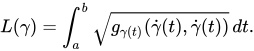
The distance between two points and of is defined as the infimum of the length taken over all continuous, piecewise continuously differentiable curves such that and . In Riemannian geometry, all geodesics are locally distance-minimizing paths, but the converse is not true. In fact, only paths that are both locally distance minimizing and parameterized proportionately to arc-length are geodesics.


Another equivalent way of defining geodesics on a Riemannian manifold, is to define them as the minima of the following action or energy functional

All minima of are also minima of , but is a bigger set since paths that are minima of can be arbitrarily re-parameterized (without changing their length), while minima of cannot. For a piecewise curve (more generally, a curve), the Cauchy–Schwarz inequality gives



with equality if and only if is equal to a constant a.e.; the path should be travelled at constant speed. It happens that minimizers of also minimize , because they turn out to be affinely parameterized, and the inequality is an equality. The usefulness of this approach is that the problem of seeking minimizers of is a more robust variational problem. Indeed, is a "convex function" of , so that within each isotopy class of "reasonable functions", one ought to expect existence, uniqueness, and regularity of minimizers. In contrast, "minimizers" of the functional are generally not very regular, because arbitrary reparameterizations are allowed.


The Euler–Lagrange equations of motion for the functional are then given in local coordinates by
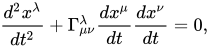
where are the Christoffel symbols of the metric. This is the geodesic equation, discussed below.

Calculus of variations
[edit]Techniques of the classical calculus of variations can be applied to examine the energy functional . The first variation of energy is defined in local coordinates by
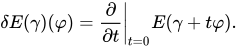
The critical points of the first variation are precisely the geodesics. The second variation is defined by

In an appropriate sense, zeros of the second variation along a geodesic arise along Jacobi fields. Jacobi fields are thus regarded as variations through geodesics.
By applying variational techniques from classical mechanics, one can also regard geodesics as Hamiltonian flows. They are solutions of the associated Hamilton equations, with (pseudo-)Riemannian metric taken as Hamiltonian.
Affine geodesics
[edit]A geodesic on a smooth manifold with an affine connection is defined as a curve such that parallel transport along the curve preserves the tangent vector to the curve, so


| 1 |

at each point along the curve, where is the derivative with respect to . More precisely, in order to define the covariant derivative of it is necessary first to extend to a continuously differentiable vector field in an open set. However, the resulting value of (1) is independent of the choice of extension.


Using local coordinates on , we can write the geodesic equation (using the summation convention) as
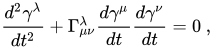
where are the coordinates of the curve and are the Christoffel symbols of the connection . This is an ordinary differential equation for the coordinates. It has a unique solution, given an initial position and an initial velocity. Therefore, from the point of view of classical mechanics, geodesics can be thought of as trajectories of free particles in a manifold. Indeed, the equation means that the acceleration vector of the curve has no components in the direction of the surface (and therefore it is perpendicular to the tangent plane of the surface at each point of the curve). So, the motion is completely determined by the bending of the surface. This is also the idea of general relativity where particles move on geodesics and the bending is caused by gravity.
Existence and uniqueness
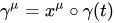
[edit]The local existence and uniqueness theorem for geodesics states that geodesics on a smooth manifold with an affine connection exist, and are unique. More precisely:
- For any point p in M and for any vector V in TpM (the tangent space to M at p) there exists a unique geodesic : I → M such that
- and
- where I is a maximal open interval in R containing 0.


The proof of this theorem follows from the theory of ordinary differential equations, by noticing that the geodesic equation is a second-order ODE. Existence and uniqueness then follow from the Picard–Lindelöf theorem for the solutions of ODEs with prescribed initial conditions. γ depends smoothly on both p and V.
In general, I may not be all of R as for example for an open disc in R2. Any γ extends to all of ℝ if and only if M is geodesically complete.
Geodesic flow
[edit]Geodesic flow is a local R-action on the tangent bundle TM of a manifold M defined in the following way
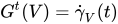
where t ∈ R, V ∈ TM and denotes the geodesic with initial data . Thus, is the exponential map of the vector tV. A closed orbit of the geodesic flow corresponds to a closed geodesic on M.



On a (pseudo-)Riemannian manifold, the geodesic flow is identified with a Hamiltonian flow on the cotangent bundle. The Hamiltonian is then given by the inverse of the (pseudo-)Riemannian metric, evaluated against the canonical one-form. In particular the flow preserves the (pseudo-)Riemannian metric , i.e.

In particular, when V is a unit vector, remains unit speed throughout, so the geodesic flow is tangent to the unit tangent bundle. Liouville's theorem implies invariance of a kinematic measure on the unit tangent bundle.
Geodesic spray
[edit]The geodesic flow defines a family of curves in the tangent bundle. The derivatives of these curves define a vector field on the total space of the tangent bundle, known as the geodesic spray.
More precisely, an affine connection gives rise to a splitting of the double tangent bundle TTM into horizontal and vertical bundles:

The double tangent bundle can be visualized as the space of simultaneous changes of both the base point and velocity, without committing to any method to transport velocity across base points.
For any , the vertical fiber is determined by the projection map . It consists of all ways to change the velocity while fixing the base point , and it is essentially a copy of translated from to . The affine connection then selects where would land under a change of base point while "fixing" velocity, which spans out the horizontal fiber . Conversely, given the split, transporting a vector along a trajectory simply means dragging the vector along the horizontal bundle, i.e. lifting the trajectory twice, from in to in to in , with the condition that .





The geodesic spray is the unique horizontal vector field W satisfying

at each point , here denotes the pushforward (differential) along the projection . Intuitively, discards the change to velocity and preserves change to base point.


More generally, the same construction allows one to construct a vector field for any Ehresmann connection on the tangent bundle. For the resulting vector field to be a spray (on the deleted tangent bundle TM \ {0}) it is enough that the connection be equivariant under positive rescalings, that is, it is enough that, if is transported by to , then must be transported to for any . It is not necessary that, if is also transported to , then must be transported .


That is, (cf. Ehresmann connection#Vector bundles and covariant derivatives) it is enough that the horizontal distribution satisfy

for every X ∈ TM \ {0} and λ > 0. Here d(Sλ) is the pushforward along the scalar homothety A particular case of a non-linear connection arising in this manner is that associated to a Finsler manifold.

Equivariance under positive rescalings is necessary to ensure that vector transport is well-defined along directed paths, that is, given any parameterization of the curve, and any strictly monotonically increasing "change of timing" , the new parameterization still produces the same vector transport. Without equivariance under positive rescalings, vector transport along a directed path depends on the specific parameterization.


Affine and projective geodesics
[edit]Equation (1) is invariant under affine reparameterizations; that is, parameterizations of the form

where a and b are constant real numbers. Thus apart from specifying a certain class of embedded curves, the geodesic equation also determines a preferred class of parameterizations on each of the curves. Accordingly, solutions of (1) are called geodesics with affine parameter.
An affine connection is determined by its family of affinely parameterized geodesics, up to torsion (Spivak 1999, Chapter 6, Addendum I). The torsion itself does not, in fact, affect the family of geodesics, since the geodesic equation depends only on the symmetric part of the connection. More precisely, if are two connections such that the difference tensor


is skew-symmetric, then and have the same geodesics, with the same affine parameterizations. Furthermore, there is a unique connection having the same geodesics as , but with vanishing torsion.

Geodesics without a particular parameterization are described by a projective connection.
Computational methods
[edit]Efficient solvers for the minimal geodesic problem on surfaces have been proposed by Mitchell,[3] Kimmel,[4] Crane,[5] and others.
Ribbon test
[edit]A ribbon "test" is a way of finding a geodesic on a physical surface.[6] The idea is to fit a bit of paper around a straight line (a ribbon) onto a curved surface as closely as possible without stretching or squishing the ribbon (without changing its internal geometry).
For example, when a ribbon is wound as a ring around a cone, the ribbon would not lie on the cone's surface but stick out, so that circle is not a geodesic on the cone. If the ribbon is adjusted so that all its parts touch the cone's surface, it would give an approximation to a geodesic.
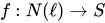
Mathematically the ribbon test can be formulated as finding a mapping of a neighborhood of a line in a plane into a surface so that the mapping "doesn't change the distances around by much"; that is, at the distance from we have where and are metrics on and .





Examples of applications
[edit]![[icon]](https://en.wikipedia.org/wiki/File:Wiki_letter_w_cropped.svg) | This section needs expansion. You can help by adding to it. (June 2014) |
While geometric in nature, the idea of a shortest path is so general that it easily finds extensive use in nearly all sciences, and in some other disciplines as well.
Topology and geometric group theory
[edit]- In a surface with negative Euler characteristic, any (free) homotopy class determines a unique (closed) geodesic for a hyperbolic metric. These geodesics contribute significantly to the geometric understanding of the action of mapping classes.
- Geodesic metric spaces and length spaces behave particularly well with isometric group actions (Švarc-Milnor lemma, Hopf-Rinow theorem, Morse lemma...). They are often an adequate framework for generalizing results from Riemannian geometry to constructions that reflect the geometry of a group. For instance, Gromov-hyperbolicity can be understood in terms of geodesic triangle thinness, and CAT(0) can be stated in terms of angles between geodesics.
Probability, statistics and machine learning
[edit]- Optimal transport can be understood as the problem of finding geodesic paths in spaces of measures.
- In information geometry, divergences such as the Kullback-Leibler divergence play a role analogous to that of a Riemannian metric, allowing analogies for connections and geodesics.
Physics
[edit]- In classical mechanics, trajectories minimize an energy according to the Hamilton-Jacobi equation, which can be regarded as a similar idea to geodesics. In some special cases, the two notions actually coincide.
- Relativity theory models spacetime as a Lorentzian manifold, where light follows Lorentzian geodesics.
Biology
[edit]- The study of how the nervous system optimizes muscular movement may be approached by endowing a configuration space of the body with a Riemannian metric that measures the effort, so that the problem can be stated in terms of geodesy.[7]
- Geodesic distance is often used to measure the length of paths for signal propagation in neurons.[8]
- The structures of geodesics in large molecules plays a role in the study of protein folds.[9]
- The structure of compound eyes, many parts of which are being held together and supported by a geodesic dome grid on the outside surface of the eye.[10]
Engineering
[edit]Geodesics serve as the basis to calculate:
- geodesic airframes; see geodesic airframe or geodetic airframe
- geodesic structures – for example geodesic domes
- horizontal distances on or near Earth; see Earth geodesics
- mapping images on surfaces, for rendering; see UV mapping
- robot motion planning (e.g., when painting car parts); see Shortest path problem
- geodesic shortest path (GSP) correction over Poisson surface reconstruction (e.g. in digital dentistry); without GSP reconstruction often results in self-intersections within the surface
See also
[edit]- Introduction to the mathematics of general relativity
- Clairaut's relation – Formula in classical differential geometry
- Differentiable curve – Study of curves from a differential point of view
- Differential geometry of surfaces
- Geodesic circle
- Hopf–Rinow theorem – Gives equivalent statements about the geodesic completeness of Riemannian manifolds
- Intrinsic metric – Concept in geometry/topology
- Isotropic line – Line along which a quadratic form applied to any two points' displacement is zero
- Jacobi field – Vector field in Riemannian geometry
- Morse theory – Analyzes the topology of a manifold by studying differentiable functions on that manifold
- Zoll surface – Surface homeomorphic to a sphere
- The spider and the fly problem – Recreational geodesics problem
Notes
[edit]- ^ For two points on a sphere that are not antipodes, there are two great circle arcs of different lengths connecting them, both of which are geodesics.
- ^ a b For a pseudo-Riemannian manifold, e.g., a Lorentzian manifold, the definition is more complicated.
- ^ The path is a local maximum of the interval k rather than a local minimum.
References
[edit]- ^ "geodesic". Lexico UK English Dictionary. Oxford University Press. Archived from the original on 2020-03-16.
- ^ "geodesic". Merriam-Webster.com Dictionary. Merriam-Webster.
- ^ Mitchell, J.; Mount, D.; Papadimitriou, C. (1987). "The Discrete Geodesic Problem". SIAM Journal on Computing. 16 (4): 647–668. doi:10.1137/0216045.
- ^ Kimmel, R.; Sethian, J. A. (1998). "Computing Geodesic Paths on Manifolds" (PDF). Proceedings of the National Academy of Sciences. 95 (15): 8431–8435. Bibcode:1998PNAS...95.8431K. doi:10.1073/pnas.95.15.8431. PMC 21092. PMID 9671694. Archived (PDF) from the original on 2022-10-09.
- ^ Crane, K.; Weischedel, C.; Wardetzky, M. (2017). "The Heat Method for Distance Computation". Communications of the ACM. 60 (11): 90–99. doi:10.1145/3131280. S2CID 7078650.
- ^ Vsauce (2017-11-02). Which Way Is Down?. Retrieved 2025-03-26 – via YouTube.
- ^ Neilson, Peter D.; Neilson, Megan D.; Bye, Robin T. (2015-12-01). "A Riemannian geometry theory of human movement: The geodesic synergy hypothesis". Human Movement Science. 44: 42–72. doi:10.1016/j.humov.2015.08.010. ISSN 0167-9457. PMID 26302481.
- ^ Beshkov, Kosio; Tiesinga, Paul (2022-02-01). "Geodesic-based distance reveals nonlinear topological features in neural activity from mouse visual cortex". Biological Cybernetics. 116 (1): 53–68. doi:10.1007/s00422-021-00906-5. ISSN 1432-0770. PMID 34816322.
- ^ Zanotti, Giuseppe; Guerra, Concettina (2003-01-16). "Is tensegrity a unifying concept of protein folds?". FEBS Letters. 534 (1): 7–10. Bibcode:2003FEBSL.534....7Z. doi:10.1016/S0014-5793(02)03853-X. ISSN 0014-5793. PMID 12527354.
- ^ Klassen, Filiz; Kronenburg, Robert (March 10, 2006). Transportable Environments 3. Taylor & Francis. p. 175. ISBN 9781134288793.
- Spivak, Michael (1999), A Comprehensive introduction to differential geometry (Volume 2), Houston, TX: Publish or Perish, ISBN 978-0-914098-71-3

Further reading
[edit] | This article includes a list of general references, but it lacks sufficient corresponding inline citations. (July 2014) |
- Adler, Ronald; Bazin, Maurice; Schiffer, Menahem (1975), Introduction to General Relativity (2nd ed.), New York: McGraw-Hill, ISBN 978-0-07-000423-8. See chapter 2.
- Abraham, Ralph H.; Marsden, Jerrold E. (1978), Foundations of mechanics, London: Benjamin-Cummings, Bibcode:1978fome.book.....A, ISBN 978-0-8053-0102-1. See section 2.7.
- Jost, Jürgen (2002), Riemannian Geometry and Geometric Analysis, Berlin, New York: Springer-Verlag, ISBN 978-3-540-42627-1. See section 1.4.
- Kobayashi, Shoshichi; Nomizu, Katsumi (1996), Foundations of Differential Geometry, vol. 1 (New ed.), Wiley-Interscience, ISBN 0-471-15733-3.
- Landau, L. D.; Lifshitz, E. M. (1975), Classical Theory of Fields, Oxford: Pergamon, Bibcode:1975ctf..book.....L, ISBN 978-0-08-018176-9. See section 87.
- Misner, Charles W.; Thorne, Kip; Wheeler, John Archibald (1973), Gravitation, W. H. Freeman, ISBN 978-0-7167-0344-0
- Ortín, Tomás (2004), Gravity and strings, Cambridge University Press, ISBN 978-0-521-82475-0. Note especially pages 7 and 10.
- Volkov, Yu.A. (2001) [1994], "Geodesic line", Encyclopedia of Mathematics, EMS Press.
- Weinberg, Steven (1972), Gravitation and Cosmology: Principles and Applications of the General Theory of Relativity, New York: John Wiley & Sons, Bibcode:1972gcpa.book.....W, ISBN 978-0-471-92567-5. See chapter 3.
External links
[edit]
- Geodesics Revisited — Introduction to geodesics including two ways of derivation of the equation of geodesic with applications in geometry (geodesic on a sphere and on a torus), mechanics (brachistochrone) and optics (light beam in inhomogeneous medium).
- Totally geodesic submanifold Archived 2015-08-10 at the Wayback Machine at the Manifold Atlas
| International | |
|---|---|
| National | |
| Other | |

Geodesic
View on GrokipediaIntroduction
Definition and Intuition
In geometry, a geodesic generalizes the concept of a straight line from Euclidean space to curved spaces, serving as the shortest path between two points along a surface or manifold. Just as a straight line minimizes distance in flat space, a geodesic locally minimizes length, providing an intuitive notion of "straightness" in environments where space itself is bent or warped. This analogy underscores how geodesics adapt the Euclidean ideal to non-flat geometries, where traditional straight lines no longer apply.[2] A classic example is the great circle on a sphere, which traces the shortest route between two points, such as the equator or meridians connecting the poles; unlike a flat map's straight line, these paths curve when viewed from outside but represent the minimal distance on the surface itself. Similarly, in optics, light rays follow paths analogous to geodesics under Fermat's principle, taking the route of stationary optical length in media with varying refractive indices, mimicking the "straightest" trajectory through curved environments. These illustrations highlight geodesics as natural extensions of shortest-path behaviors observed in everyday phenomena.[10] On two-dimensional surfaces, geodesics are often visualized as curves that neither bend left nor right relative to the surface's intrinsic geometry, characterized informally by zero geodesic curvature, meaning they lack sideways deviation when measured along the surface. In higher-dimensional spaces, such as three-dimensional manifolds, this intuition extends to paths that maintain this local straightness amid greater complexity, though the distinction lies in the increased degrees of freedom for curvature. This foundational view aligns with broader metric geometry concepts, where distances are defined intrinsically without reference to embedding spaces.[11][2]Historical Background
The concept of a geodesic originated in ancient Greek geometry, where Euclid described straight lines in his Elements as the shortest paths between two points on a plane, laying the groundwork for understanding length-minimizing curves in flat spaces. This Euclidean notion of straight lines as optimal paths influenced later developments in curved geometries, serving as the intuitive analog for geodesics on non-flat surfaces. In 1827, Carl Friedrich Gauss advanced the study of geodesics in his seminal paper Disquisitiones generales circa superficies curvas, where he defined them as the curves of shortest distance on curved surfaces, introducing intrinsic measurements independent of embedding in higher-dimensional space.[12] Gauss's work on surface theory, motivated partly by geodetic surveys, established geodesics as fundamental objects in differential geometry, emphasizing their role in local curvature properties. Bernhard Riemann expanded this framework in his 1854 habilitation lecture, Über die Hypothesen, welche der Geometrie zu Grunde liegen, by generalizing geodesics to n-dimensional manifolds equipped with a metric, providing the abstract foundation for Riemannian geometry.[13] Riemann's manifolds allowed geodesics to be characterized intrinsically through the metric tensor, bridging classical surface geometry to higher-dimensional spaces. The early 20th century saw further refinements, with Tullio Levi-Civita's 1917 paper Nozione di parallelismo in una varietà qualunque introducing the concept of parallel transport along geodesics via torsion-free connections compatible with the metric, enabling precise definitions of geodesic curvature. Around the same time, John Synge contributed to the understanding of geodesic behavior in his 1934 work On the Deviation of Geodesics and Null-Geodesics, deriving the equation for geodesic deviation that quantifies how nearby geodesics separate due to curvature.[14] These developments paralleled practical applications in cartography, where great circles—geodesics on the sphere—had been recognized since antiquity as the shortest routes for navigation, with systematic use emerging in the 16th century for transoceanic voyages.[15] The concept reached a pinnacle in physics with Albert Einstein's 1915 formulation of general relativity, where geodesics describe the paths of freely falling particles in curved spacetime, unifying geometry with gravitation.[16] This integration marked the transition from pure mathematics to a cornerstone of modern theoretical physics.Geodesics in Metric Geometry
Length-Minimizing Curves
In metric geometry, geodesics are defined as length-minimizing curves that achieve the shortest distance between their endpoints. A curve in a metric space is a geodesic if it is distance-preserving, meaning for all , and is typically parameterized by arc length, where the speed is constant (usually 1). The length of a curve is the supremum of over all partitions of ; curves with finite length are called rectifiable. The total variation of a curve is its length, measuring the supremum of such path segment sums.[17] Examples include straight lines in Euclidean space, which uniquely minimize distance between points. In taxicab (Manhattan) geometry, geodesics are grid-aligned paths that minimize the distance, such as horizontal-then-vertical routes between points.[17]Local and Global Properties
In metric geometry, geodesics are classified as local or global based on the extent to which they minimize length. A local geodesic in a length space is a curve that minimizes the length between its endpoints within some neighborhood of every point along the curve, but it may not achieve the global minimum distance between those endpoints. This distinction arises particularly in incomplete metric spaces, where local minimizers exist but cannot necessarily be prolonged indefinitely without increasing length. For instance, in spaces lacking completeness, a curve might be shortest only in a small tubular neighborhood around it, beyond which shorter paths become available. Global geodesics, by contrast, are curves that can be extended to infinite length in both directions while remaining length-minimizing between any pair of points on them. The existence and extendability of such geodesics are tied to the notion of geodesic completeness, where every maximal local geodesic can be prolonged to a global one. A foundational result in this area is the Hopf-Rinow theorem, which states that in a locally compact length space, metric completeness is equivalent to geodesic completeness. This theorem, originally formulated for Riemannian manifolds,[18] generalizes to metric spaces[19] and implies that closed and bounded subsets are compact, facilitating the extension of local geodesics. The Hopf-Rinow theorem serves as a key bridge to properties in Riemannian geometry, where similar completeness conditions ensure global behavior.[19] Certain length spaces exhibit additional structural properties related to convexity and midpoints along geodesics. In geodesic spaces—where shortest paths exist between any two points—the image of a geodesic segment is often convex, meaning that for any two points on the segment, the unique shortest path between them lies entirely within the segment. This convexity implies the existence of midpoints: for points at distance , there is a point on the geodesic at distance from each. Such properties hold in uniquely geodesic spaces, like Hilbert spaces or trees, where multiple shortest paths do not occur, ensuring that geodesic segments behave like straight lines in Euclidean geometry. These midpoint conditions underpin comparison theorems in metric geometry, such as those in spaces of bounded curvature.[19] A classic example of non-extendable geodesics occurs in the punctured Euclidean plane , equipped with the induced Euclidean metric. Consider a straight-line ray emanating from a point and directed toward the origin; this ray is a local geodesic, as it minimizes length in any neighborhood avoiding the puncture. However, it cannot be extended beyond a finite parameter value, since the distance to the puncture is finite, rendering the space geodesically incomplete. In this incomplete setting, global geodesics do not exist between points separated by the puncture, as paths must detour around it, violating global minimality. This illustrates how topological defects can prevent the prolongation of local minimizers.[19]Geodesics in Riemannian Manifolds
Definition and Exponential Map
In a Riemannian manifold , the Riemannian metric is a smooth assignment of an inner product to each tangent space at points , which is positive definite, symmetric, and varies smoothly with .[20] This structure extends the notion of length-minimizing curves from metric geometry to a smooth setting, enabling the definition of geodesics as locally shortest paths.[21] The exponential map at a point , denoted , is defined for vectors by , where is the unique geodesic satisfying and , provided such a geodesic exists on the interval.[22] For sufficiently small (with respect to the norm induced by ), the exponential map is well-defined and smooth, parametrizing a neighborhood of via geodesics emanating from the origin in . This local uniqueness follows from the existence and uniqueness theorem for solutions to the geodesic equation in the smooth category, ensuring that geodesics do not intersect prematurely near .[23] The injectivity radius at is the supremum of radii such that the exponential map restricts to a diffeomorphism from the open ball onto its image, a normal neighborhood of .[24] Within this radius, no two geodesics from meet, and the map is bijective. Normal coordinates, or geodesic normal coordinates, are those induced by on this neighborhood, where the coordinate chart satisfies and the geodesics from appear as straight lines for unit vectors .[25] In these coordinates, the metric takes the form at the origin, visualizing geodesics as Euclidean straight lines locally, which underscores their role as "straightest" paths on the manifold.[26]Geodesic Equation
In a Riemannian manifold equipped with the Levi-Civita connection , which is the unique torsion-free, metric-compatible affine connection, a smooth curve is a geodesic if its velocity vector field satisfies the geodesic equation .[27] This equation indicates that the tangent vector to the geodesic is covariantly constant along the curve, ensuring that the curve follows the "straightest" possible path in the manifold's geometry.[28] Geodesics are precisely the autoparallel curves with respect to the Levi-Civita connection, meaning their tangent vectors are parallel transported along the curve without deviation.[28] In local coordinates on , where the curve is parameterized by as , the geodesic equation assumes the second-order ordinary differential equation form: with summation over repeated indices , and where are the Christoffel symbols of the second kind, expressed symmetrically as in terms of the inverse metric and its partial derivatives.[29] This coordinate expression highlights the nonlinear dependence on the metric's geometry through the Christoffel symbols. The parameter is said to be an affine parameterization of the geodesic if it satisfies the above equation without an extraneous term proportional to the velocity ; non-affine parameterizations introduce such a term, but any reparameterization (with ) preserves the geodesic property while maintaining affinity.[30] Solutions to the geodesic equation, which form integral curves of the geodesic spray, can be constructed locally via the exponential map at a point, providing a geometric tool for parameterizing geodesics emanating from initial positions and velocities.[27] Along geodesics, certain quantities are conserved due to symmetries of the metric. For instance, if the manifold admits a Killing vector field —a vector field satisfying , preserving the metric under its flow—then the inner product is constant along any geodesic .Variational Formulation
Calculus of Variations Approach
In Riemannian geometry, geodesics emerge as the curves that extremize the length functional, providing a variational perspective on shortest paths between points on a manifold. The length of a piecewise smooth curve on a Riemannian manifold is given by the integral where denotes the Riemannian metric tensor, which induces an inner product on each tangent space.[31] This functional measures the total arc length of , and geodesics are defined as its critical points, meaning they locally minimize or maximize length among nearby curves with fixed endpoints.[32] A key challenge with the length functional is its lack of differentiability at points where , which can complicate variational analysis. To address this, an equivalent energy functional is often employed: This quadratic form is smooth and reparameterization-invariant up to scaling, ensuring that critical points of correspond precisely to those of , thus yielding the same geodesics.[31] The use of facilitates computations while preserving the geometric interpretation of geodesics as length-stationary curves.[32] The variational characterization arises from setting the first variation to zero: for a variation of with fixed endpoints, (or equivalently ) at imposes the condition that is a geodesic. This principle, rooted in the calculus of variations, underscores how geodesics satisfy the necessary condition for being locally shortest paths without directly invoking differential equations.[31]Euler-Lagrange Derivation
To derive the geodesic equation using the calculus of variations, consider the length functional for a smooth curve on a Riemannian manifold , given by where are local coordinates, , and are the components of the metric tensor.[33] The geodesics are the critical points of this functional, found by applying the Euler-Lagrange equations to the associated Lagrangian . The Euler-Lagrange equations for this Lagrangian, in each coordinate , are Direct computation with is cumbersome due to the square root; instead, the equivalent squared form is used, as its critical points coincide with those of the length functional for variations preserving endpoint conditions and yielding unit-speed curves.[33] For , so and Setting the Euler-Lagrange equation to zero gives Multiplying through by 2 and cyclically permuting indices to symmetrize, then raising with the inverse metric and using the definition of the Christoffel symbols yields the geodesic equation This equation holds for affinely parametrized geodesics, where the parameter satisfies constant (often normalized to 1 for unit-speed curves). Under a general reparametrization , the equation acquires an additional term proportional to the derivative of the reparametrization, for some function , but the curve remains a geodesic if and only if the parameter is affine (i.e., linear).[33]Affine and Projective Geodesics
Existence and Uniqueness Theorems
In smooth manifolds equipped with an affine connection of class C^1, the geodesic equation constitutes an initial value problem that can be recast as a first-order system of ordinary differential equations with locally Lipschitz right-hand side. The Picard–Lindelöf theorem then ensures the existence of a unique local solution, yielding a unique geodesic defined on a maximal open interval containing the initial time, starting from any point with any initial tangent vector. This local uniqueness theorem extends to the entire smooth manifold, as the connection's smoothness guarantees the Lipschitz condition locally around each point, preventing branching or crossing of geodesics in sufficiently small neighborhoods.[34] Regarding global existence, an analogue of the Hopf–Rinow theorem holds for certain classes of affine manifolds: if the manifold is geodesically complete—meaning every maximal geodesic is defined for all real time—then any two points can be joined by a geodesic under additional conditions, for example, when the connection belongs to a statistical structure with divisible cubic forms. In non-simply connected affine manifolds, global geodesics between fixed points may exhibit multiplicity, as distinct homotopy classes in the fundamental group can give rise to multiple distinct curves satisfying the geodesic equation connecting the same endpoints. Projective geodesics arise in the context of projective connections, which are equivalence classes of affine connections that determine the same unparametrized geodesics (autoparallels up to reparametrization). Two connections are projectively equivalent if their Christoffel symbols differ by a term proportional to the metric tensor in a specific way, ensuring the geodesic equations agree up to affine reparametrization. This structure generalizes straight lines in projective geometry to manifolds.Geodesic Flow and Spray
The geodesic flow on a manifold equipped with an affine connection is a dynamical system defined on the tangent bundle , capturing the evolution of geodesics as trajectories in the phase space of positions and velocities. For an initial tangent vector , the flow maps to , where is the geodesic with and . This flow generates a one-parameter group of diffeomorphisms on , assuming local existence and uniqueness of geodesics, and its orbits project onto the geodesics in .[36][37] The geodesic flow is governed by the geodesic spray, a smooth second-order vector field on whose integral curves are precisely the lifts of geodesics to . In local coordinates on , the spray takes the form where are the Christoffel symbols of the affine connection on . The horizontal component corresponds to the velocity along the base, while the vertical component encodes the connection, ensuring that the projections of the integral curves of satisfy the geodesic equation. This formulation embeds the geodesics as autoparallel curves in the nonlinear connection structure of .[37] In the special case of a Riemannian manifold with the Levi-Civita connection, the geodesic flow admits a phase space interpretation on the cotangent bundle , where it manifests as a Hamiltonian system. The Hamiltonian is the kinetic energy function given by , with the inverse metric tensor. The flow is then the integral flow of the Hamiltonian vector field , defined via the canonical symplectic form on , and its projections to yield reparametrization-invariant geodesics. This Hamiltonian structure highlights the symplectic geometry underlying free motion on curved spaces, with conserved energy levels corresponding to constant-speed geodesics. Jacobi fields provide the infinitesimal description of variations within the geodesic flow, quantifying how nearby geodesics diverge or converge. Along a geodesic , a Jacobi field is the velocity field of a one-parameter variation of through geodesics, satisfying the linear second-order Jacobi equation where is the curvature tensor of the connection and is the covariant derivative along . These fields form the tangent space to the submanifold of geodesics in the space of curves, with zero sections corresponding to infinitesimal isometries and nontrivial solutions encoding the focusing behavior induced by curvature.[38][39]Computational and Discrete Methods
Numerical Solutions
Numerical solutions for geodesics typically involve approximating solutions to the geodesic equation, which is a second-order ordinary differential equation (ODE) describing the path of shortest distance on a Riemannian manifold. These methods are essential for practical computations where analytical solutions are unavailable, such as in curved spaces or complex geometries. Common approaches include direct integration for initial value problems and iterative techniques for boundary value problems, often combined with discretization strategies for efficiency in applications like computer graphics. Runge-Kutta methods are widely used for numerically integrating the geodesic ODE as an initial value problem, providing a straightforward way to trace geodesic paths from a given starting point and direction. The classical fourth-order Runge-Kutta (RK4) scheme, which advances the solution using weighted averages of function evaluations at intermediate points, is particularly effective due to its balance of accuracy and computational cost. For instance, in geodetic applications on spheroids, RK4 with 100,000 steps yields position errors on the order of 10^{-5} meters and angular errors of 10^{-8} arcseconds when compared to exact solutions. This method preserves the manifold's geometry by incorporating the Christoffel symbols into the vector field of the ODE.[40] For boundary value problems, where geodesics must connect two specified points, shooting methods transform the problem into a series of initial value problems solved via root-finding. In the simple shooting approach, an initial velocity is guessed and integrated forward using an ODE solver like Runge-Kutta until the endpoint is reached, with the guess adjusted iteratively (e.g., via Newton-Raphson) to match the target boundary condition. Multiple shooting enhances stability by dividing the interval into subintervals and enforcing continuity, reducing sensitivity to poor initial guesses, as demonstrated in computations on Stiefel manifolds where it efficiently calculates minimal geodesic distances. These methods are particularly useful in optimization tasks on manifolds, achieving convergence when the shooting parameter space is compact.[41] In computer graphics, discrete approximations of geodesics on triangulated surfaces often employ graph-based algorithms adapted from shortest-path computations. The Fast Marching Method (FMM) solves the Eikonal equation on a mesh by propagating a wavefront using upwind finite differences and a priority queue, akin to a continuous Dijkstra algorithm, to compute approximate geodesic distances from a source point. FMM offers O(N log N) complexity for N vertices and is first-order accurate, with convergence rates of O(h) where h is the mesh resolution, making it suitable for real-time path planning on complex models. Similarly, Dijkstra's algorithm can be applied directly on the mesh graph, treating edge lengths as distances, to yield exact graph geodesics that approximate continuous paths; however, it may require windowing or exact unfolding for higher fidelity on polyhedral surfaces, with errors decreasing as mesh refinement increases.[42][43] Error analysis for these numerical solutions emphasizes global truncation errors and convergence properties. For Runge-Kutta integration of the geodesic ODE, the fourth-order variant exhibits local errors of O(h^5) and global errors of O(h^4), with convergence verified through step-size halving tests showing error reduction by factors of 16 in smooth manifolds. Shooting methods inherit the integrator's order but may introduce additional errors from root-finding, typically converging quadratically near solutions if the Jacobian is well-conditioned; instability can arise in stiff problems, mitigated by adaptive stepping. Discrete methods like FMM and Dijkstra achieve first-order convergence O(h) on uniform grids or meshes, with error bounds depending on the Lipschitz constant of the speed function and triangulation quality—empirical studies report relative errors below 1% for fine meshes in graphics applications. Overall, these rates ensure reliable approximations when step sizes or resolutions are sufficiently small, though adaptive techniques are recommended for variable curvature.[40][44][42]Discrete Geodesics in Graphs
In discrete settings, such as weighted graphs or polyhedral meshes, geodesics correspond to shortest paths that minimize the total edge weights or surface distances between vertices. These paths serve as approximations to continuous geodesics on the underlying manifold, enabling computational analysis in networks and geometric models. In weighted graphs, where edges represent distances or costs, algorithms like Bellman-Ford compute shortest paths from a single source to all other vertices, handling negative weights without cycles by iteratively relaxing edges up to |V|-1 times, where V is the number of vertices. This approach achieves O(|V| \cdot |E|) time complexity, with E edges, making it suitable for sparse graphs but inefficient for dense ones. For non-negative weights, the A* algorithm enhances efficiency by incorporating a heuristic estimate of remaining distance, such as Euclidean distance, to guide the search toward the goal, expanding fewer nodes than uniform-cost methods while guaranteeing optimality if the heuristic is admissible.[45] On polyhedral surfaces approximated by triangle meshes, geodesics are computed by unfolding sequences of adjacent triangles into the plane, where the path becomes a straight line, preserving intrinsic distances. This unfolding method ensures exact geodesics by considering all possible homotopy classes of paths, though it requires careful handling of overlapping unfoldings to avoid errors. A seminal implementation achieves exact computation in practical time for moderate meshes, but worst-case complexity approaches O(n^2 \log n) for n vertices due to the exponential number of potential unfoldings.[43] For faster approximations, the heat method solves the heat equation on the mesh to propagate distances from a source, followed by gradient tracing, yielding results accurate to within a small multiple of the mesh resolution in near-linear time O(n \log n) via sparse linear algebra. This approach, robust to mesh irregularities, has become widely adopted for large-scale geometric processing.[46] Approximation guarantees for these methods vary: exact unfolding provides global optimality but scales poorly for complex topologies, while heat-based and graph-shortest-path approximations offer bounded errors relative to edge lengths, often within 1-2% for fine meshes, enabling trade-offs between accuracy and speed. In graph-based discretizations of surfaces, such as the intrinsic Delaunay graph, shortest paths yield O(1)-approximate geodesics in O(n^2) time, contrasting with near-linear solvers that sacrifice exactness for scalability on million-vertex models.[43][46]Applications Across Disciplines
Physics and Relativity
In general relativity, geodesics serve as the worldlines traced by freely falling test particles in curved spacetime, a framework established by the Einstein field equations that relate spacetime geometry to the distribution of mass and energy. Timelike geodesics, characterized by a negative norm of their tangent vectors, describe the paths of massive particles under gravity alone, generalizing the inertial motion of special relativity to curved manifolds. Null geodesics, with tangent vectors of zero norm, govern the propagation of massless particles like photons, ensuring that light follows the shortest paths in spacetime as dictated by local Lorentz invariance. These concepts underpin the principle of equivalence, where gravitational and inertial mass are indistinguishable, leading to the geodesic equation as the relativistic analogue of Newton's first law.[47][5] A prominent application arises in the Schwarzschild metric, the exact solution to the vacuum Einstein field equations for a spherically symmetric, non-rotating mass such as a black hole or star. Timelike geodesics in this geometry yield bound orbits that deviate from Newtonian ellipses, manifesting as stable circular paths up to the innermost stable circular orbit at (where is the Schwarzschild radius) and plunging trajectories closer to the event horizon. Null geodesics reveal photon spheres at , where light can orbit unstably, influencing phenomena like gravitational lensing around black holes. Notably, the metric predicts the anomalous precession of planetary perihelia; for Mercury, Einstein calculated an advance of 43 arcseconds per century beyond Newtonian predictions, confirming general relativity's validity through solar system tests.[48][49] The geodesic deviation equation further elucidates tidal forces, quantifying the relative acceleration between nearby geodesics in a congruence—a family of curves filling a spacetime region. For a timelike congruence with tangent vector , the deviation vector satisfies where is the Riemann curvature tensor, is proper time, and denotes covariant differentiation along the geodesic. This equation demonstrates how curvature induces stretching or squeezing of separations, as in the tidal disruption of extended bodies near black holes or during gravitational wave passages, directly linking local geodesic behavior to global spacetime structure.[50] In cosmology, null geodesics play a central role in modeling light propagation through expanding universes described by the Friedmann-Lemaître-Robertson-Walker (FLRW) metric. These paths determine the redshift-distance relation for distant galaxies and the cosmic microwave background, as photons follow null curves from emission to observation, accumulating phase shifts due to metric evolution. Inhomogeneities along these geodesics contribute to weak lensing and the integrated Sachs-Wolfe effect, providing probes of dark matter and energy distributions on cosmic scales.[51]Engineering and Computer Graphics
In engineering, geodesic principles have been pivotal in structural design, particularly through the development of geodesic domes by Buckminster Fuller in the 1950s. These structures approximate a sphere using a network of triangular facets formed by great circle arcs, which represent the shortest paths on the spherical surface, enabling lightweight yet strong enclosures with minimal material use.[52] Fuller's design leverages the uniform stress distribution along these geodesic paths to achieve high efficiency, as demonstrated in early prototypes like the 1958 Union Tank Car dome.[52] In robotics, geodesics play a key role in path planning within configuration spaces, which model the possible poses of a robot as points on a manifold. The shortest path between two configurations corresponds to a geodesic that minimizes travel distance while avoiding obstacles, ensuring optimal motion for tasks like manipulation or navigation.[53] For instance, in multi-robot systems, computing geodesics on the configuration space of multiple points allows for collision-free trajectories, as explored in topological robotics frameworks.[53] Algorithms exploiting geodesic convexity further enable efficient planning on manifolds with curvature constraints, reducing computational complexity for real-time applications.[54] Computer graphics employs geodesic distances to enhance surface parameterization and texture mapping on 3D models, such as polyhedral meshes. Exact geodesic computation on polyhedra provides precise shortest paths across faces, facilitating distortion-minimizing mappings for applications like virtual reality rendering.[55] In mesh parameterization, geodesic metrics help unfold complex surfaces onto 2D domains while preserving intrinsic geometry, improving texture quality in animations and simulations; for example, methods using fast marching algorithms approximate these distances for large-scale models.[56] Discrete methods on meshes, such as window propagation, extend these computations efficiently for interactive graphics workflows.[55] In fiber optics, light propagation in graded-index media follows geodesic paths defined by the varying refractive index, which bends rays to minimize optical path length. This principle underlies the design of multimode fibers, where a parabolic index profile guides light along helical or sinusoidal geodesics, reducing modal dispersion for high-bandwidth transmission.[57] The geodesic equations for such media reveal that ray trajectories are solutions to the eikonal equation, enabling predictions of beam focusing and self-imaging effects in optical devices.[57]Biology, Statistics, and Machine Learning
In biology, geodesic active contours have been employed for the precise segmentation of organs in medical imaging, where deformable curves evolve along minimal paths defined by image gradients to delineate boundaries such as those of the heart or liver. This approach utilizes image gradients to guide contour propagation, enabling robust detection even in noisy or low-contrast images, facilitating automated analysis of anatomical structures.[58] In statistics, geodesic distances on statistical manifolds provide a geometrically informed measure of divergence between probability distributions, with the Fisher-Rao metric serving as a foundational Riemannian structure for densities on such manifolds. The geodesic length under this metric quantifies the shortest path connecting two distributions, offering a natural extension of Euclidean distance for non-linear statistical spaces and aiding in tasks like hypothesis testing and model comparison. In machine learning, geodesic regression extends linear regression to Riemannian manifolds, such as symmetric positive definite (SPD) matrices or Lie groups, by fitting curves that minimize the variance of perpendicular deviations along geodesics, particularly useful for longitudinal analysis in diffusion MRI to track microstructural changes in brain tissue. Similarly, Wasserstein geodesics in optimal transport theory underpin generative models by defining smooth interpolations between distributions, as in Wasserstein GANs, where the geodesic path informs stable training and high-quality sample generation without mode collapse. These methods leverage Riemannian metrics on data to capture intrinsic geometries, enhancing performance in tasks like domain adaptation and representation learning.Topology and Geometric Group Theory
In topology, geodesics serve as tools for detecting homotopy classes in manifolds through the lens of systolic geometry, where the systole denotes the length of the shortest non-contractible closed geodesic. This invariant captures essential topological features by relating the minimal length of loops in nontrivial homotopy classes to the manifold's volume or other geometric measures, as exemplified by Loewner's systolic inequality for the torus, which bounds the systole in terms of area. Systolic geodesics thus provide lower bounds on manifold complexity, distinguishing homotopy types via metric constraints, with Gromov's extensions yielding optimal inequalities for aspherical manifolds and essential classes.[59][60] In geometric group theory, quasi-geodesics—paths that deviate boundedly from true geodesics—emerge as fundamental objects in the study of hyperbolic groups, following Gromov's 1987 framework for word-hyperbolic groups acting on δ-hyperbolic spaces. These spaces exhibit thin triangle conditions, ensuring quasi-geodesics remain exponentially close to actual geodesics connecting the same endpoints, a property formalized by the Morse lemma, which implies that quasi-geodesics are "Morse," avoiding flat subspaces and thus encoding the negative curvature essential to hyperbolicity. This stability facilitates quasi-isometry invariance of hyperbolicity, allowing group actions to be analyzed via coarse geometry without reliance on smooth structures.[61][62] Closed geodesics further underpin filling functions and isoperimetric inequalities, quantifying the minimal area required to fill loops in manifolds or groups, thereby linking local metric properties to global topology. In Riemannian manifolds, Gromov's filling radius bounds the area of disks spanning closed geodesics, yielding inequalities that control embedding dimensions and homotopy groups. Within geometric group theory, these translate to Dehn functions for finitely presented groups, where hyperbolic groups satisfy linear isoperimetric inequalities, meaning the filling area of a loop grows linearly with its length, reflecting efficient word problem solvability and asphericity of presentations.[63] A prominent example arises in Teichmüller space, the space of marked hyperbolic structures on a surface, where the Teichmüller metric defines geodesics as extremal quasiconformal mappings that stretch along measured foliations. These geodesics probe surface topology by exhibiting convexity of geodesic length functions for simple closed curves, enabling the reconstruction of pants decompositions and cusp behaviors at infinity, which delineate the boundary of the space and inform moduli space compactifications. Such properties, as analyzed along Teichmüller rays, reveal how deformations preserve or alter topological invariants like Euler characteristics.[64]References
- https://arxiv.org/abs/2503.10024