Hubbry Logo
Distance lineDistance lineMain
Open search
Distance line
Community hub
Distance line
logo
8 pages, 0 posts
0 subscribers
Be the first to start a discussion here.
Distance line
Distance line
from Wikipedia
Distance line
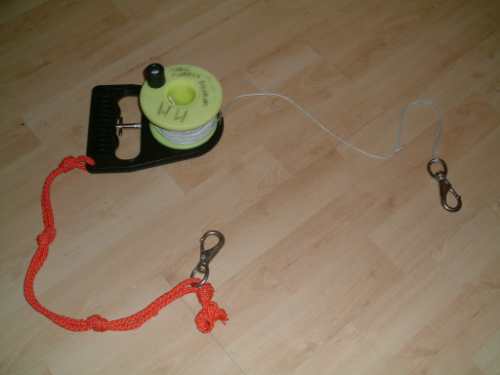
50 metres of line on a reel
Other namesguide line, cave line, wreck line, penetration line
UsesUsed to guide divers back to a specific point
Related itemsJackstay, jump line, search line, down-line, upline, messenger line
Cave diving guide line reel

A distance line, penetration line, cave line, wreck line or guide line is an item of diving equipment used by scuba divers as a means of returning to a safe starting point in conditions of low visibility, water currents or where pilotage is difficult. They are often used in cave diving and wreck diving where the diver must return to open water after a penetration when it may be difficult to discern the return route.[1][2] Guide lines are also useful in the event of silt out.[3]

A cave diver running a distance line into the overhead environment to facilitate a safe exit

Distance lines are wound on to a spool or a reel for storage, and are laid in situ by unrolling.[4] The length of the distance line used is dependent on the plan for the dive. An open water diver using the distance line only for a surface marker buoy may only need 50 metres (160 feet), whereas a cave diver may use multiple reels of lengths from 25 ft (7.6 m) to 1000+ ft (300 m).

Reels for distance lines may have a locking mechanism, ratchet or adjustable drag to control deployment of the line and a winding handle to help keep slack line under control and rewind line. Lines are used in open water to deploy surface marker buoys and decompression buoys and link the buoy on the surface to the submerged diver, or may be used to allow easy return navigation to a point such as a shotline or boat anchor.

The material used for any given distance line will vary based on intended use, nylon being the material of choice for cave diving.[4] A common line used is 2 mm (0.079 in) polypropylene line when it does not matter if the line is buoyant.

The use of guide line for navigation requires careful attention to laying and securing the line, line following, marking, referencing, positioning, teamwork, and communication.[3]

Applications

[edit]

Cave diving: Guide lines are used in cave diving as standard procedure whenever it is possible that the divers may be confused about the way out. In effect, this is in any dive where there is no free surface overhead and where daylight is not visible at all points of the dive. By the most common definition of cave diving, this would mean guide lines should be used for all cave dives.

Wreck diving: The use of guide lines in wreck diving is very similar to their use in cave diving.

Diving in low visibility: A guide line may be used for dives where poor visibility may make it difficult to return to the starting point, and there is a safety or operational requirement to return to that point.

Other dives where it is necessary or highly desirable to return to a starting point: This may include dives where a shot line or anchor line is to be used for ascent, and other dives where a specific exit point is chosen for safety or convenience. Working divers may use a guide line to allow confident and efficient movement to, from and around the workplace. This may also be referred to as a jackstay. In these applications the guide line is generally more for efficiency than for safety, but it may also help the divers stay away from potentially hazardous areas.

Guidelines may be used to direct divers on underwater search patterns.

Guide lines may also be used as a means of directing tourists around a dive site, between points of interest which may be difficult to find without the line. This form of guide line may be permanently placed.

Equipment

[edit]

Cave line and wreck line

[edit]

Cave line, strictly speaking, is line used for navigation in caves, but the term is used generically for the type of line carried by divers on reels and spools for use as guide lines and surface marker buoy lines. It is made using the same machines and materials to the same specifications as the equivalent line used for other purposes. When used in wreck diving, the same material is called wreck line, though a thicker line may be used for better abrasion and cut resistance in an environment of rusty metal edges.

Material
Nylon is strong, with a tenacity of 6.5 to 9 g/D (gram per denier), durable and sinks. The specific gravity (SG) is 1.14. Negative buoyancy is considered a desirable feature for some applications, where a line that sinks to the bottom is easier to find than one which may float up to the overhead if dislodged from tie-offs.[4] Abrasion resistance is poor when wet.[5][6]
Polypropylene is also strong and durable, with tenacity of 6.5 g/D, and fair abrasion resistance, but it floats, with SG of 0.91, and is preferred where the risk of floating up to the overhead and being difficult to find is offset by the line not being easily buried in silt on the bottom.[4][5][6]
Ultra-high-molecular-weight polyethylene (Spectra and Dyneema) is very strong and durable. Tenacity is between 35 and 48 g/D, more than 4 times the strength of nylon. It is also relatively expensive. More line can be carried on the reel with equivalent or greater strength and durability than other fibres. UHMWPE is slightly buoyant in fresh water with SG of 0.98. Abrasion resistance is excellent. It is slippery and knots must be tied with care.[5][6]
Natural fibres such as cotton and sisal are not usually used for guide line as they rot and lose strength relatively quickly, and are more bulky for equivalent strength. They may be used for temporary lines on wrecks where it may not be possible to recover the line before ascent, and biodegradation is desirable.[4]
Structure
Twisted line may have greater strength for the same bulk, but it is more easily broken by abrasion, and has a greater tendency to twist on itself when not under tension, and unlay when cut or broken, making it more difficult to handle.[4]
Single braid is more resistant to abrasion and twisting than twisted line, and is easily available in suitably small diameters. It is usually the preferred structure for temporary guide line and permanent line in places where conditions are not rough on the line.[4]
Double braid (Kernmantle) line consists of a core strength member and a sheathing for abrasion resistance. This is more expensive, larger and heavier than the thinner lines, but may be better for permanent guide lines, particularly in places where water movement reduces the expected lifespan of the line due to abrasion.[4]
Thickness
American measure: usually 18 to 36 gauge, with 24 gauge (about 1.86 mm diameter) single braid as a good general purpose size.[4]
Commonly used sizes of braided nylon cave line[7]: App.10 
Code Diameter in mm Diameter in inches approximate breaking strength [kg] approximate breaking strength [lbs]
#18 1.58 1/16" (0.0625) 65.4 144
#24 1.86 0.073 104 230-250
#36 2.11 0.083 150 330-360
#48 2.48 0.098 182 405-550
1/8" 3.18 0.125 331 728
Colour
White is generally the preferred choice as it shows up best in low light.[4]
Other high visibility colours may be used to allow the specific line to be easily identified, such as the main route, or a personal line.[4] Yellow is a popular colour for main route guide line, particularly for kernmantle line. In this application it is known as "gold line".[8]
Marking (knots)
Personal line may be marked at regular intervals by knots, allowing the diver to make an easy estimation of distance travelled by counting the knots as the line is deployed. 10 feet (3 m) is a popular spacing.[4]

Reels

[edit]
Plastic general purpose ratchet dive reel with rolled up DSMB attached with bungee loops.

A dive reel comprises a spool with a winding knob, which rotates on an axle, attached to a frame, with a handle to hold the assembly in position while in use.[4] A line guide is almost always present, and there is usually a method of clipping the reel to the diver's harness when not in use.

  • The handle may be positioned on top, behind, or at the side of the spool.[4]
  • The spool is the storage area for the line. It has a hub and two flanges, which prevent the line from falling off the sides of the hub. The size of the spool and the thickness of the line together determine the length of line the reel can hold, though this is also affected by how neatly the line is wound onto the spool.[4]
  • The winding knob is on the side of the spool. Most reels are laid out for holding in the left hand and winding with the right. The knob is usually attached by a bolt which allows it to rotate, giving a more secure grip to the winding hand.[4]
  • The line guide is a slotted attachment which guides the line onto the spool. This helps to control the stacking of the line on the spool when it is reeled in.

Other accessories which may be present (usually not all on the same reel) include:

  • Ratchet mechanism, which prevents the spool from rotating when there is tension on the line. this prevents inadvertent unreeling of line, as the ratchet lever must be held in the open position to allow unwinding. The ratchet mechanism is usually a ratchet wheel on the spool which engages with a spring-loaded pawl which can either be held open by a trigger lever, or clipped open by a knob or lever on the handle. The ratchet allows the spool to be manually rotated to wind in line when engaged.
  • A lock down screw or latch is an alternative way of preventing spool rotation if there is no ratchet. This will prevent rotation in both directions.[4]
  • An adjustable brake may be fitted to control the friction of the spool on the handle, so that some tension is required to unwind the line, and the spool can not spin freely, causing overruns and tangled line. The brake may be released when reeling in.[4]
  • The line may have a snap hook or an end loop to tie off the free end.[4]
  • A clip may be attached to the handle to clip the reel off to the diver's harness.
  • A lanyard may be connected to the handle to connect the reel to the diver while in use.
  • A wrist loop may be fitted to the handle to attach the reel to the diver while in use.

Reels may be made from a wide variety of materials, but near neutral buoyancy and resistance to impact damage are desirable features, which are easiest to achieve in engineering polymers such as nylon, acetal (delrin) and polyethylene.

Reels may also be open or closed. This refers to the presence of a cover around the spool, which is intended to reduce the risk of line tangles on the spool, or line flipping over the side and causing a jam. To some extent this works, but if there is a jam the cover effectively prevents the diver from correcting it. Open reels allow easy access to free jams caused by overwinds or line getting caught between spool and handle.

Spools

[edit]
Injection moulded plastic diving spool with 30m of 1.5mm braided line and a double ender bolt snap
Cave line spool with double end bolt snap. The yellow line is a stiffer loop attached to the end of the line for attaching it to the permanent line as described in the text

Finger spools, dive spools, line spools, or cave spools, are a simple, compact low tech alternative to reels best suited to relatively short lengths of line. They are simply a pair of circular flanges with a hole in the middle, connected by a tubular hub, which is suitably sized to use a finger as an axle when unrolling the line. Line is secured by clipping a bolt snap through a hole on one of the flanges and over the line as it leaves the reel. Line is reeled in by holding the spool with one hand and simply winding the line onto the spool by hand. Spools are most suitable for reasonably short lines, up to about 50m, as it becomes tedious to roll up longer lengths. The small, compact size, and low cost make them useful for various purposes where long line is not required.[4] Spools may be made from any material that is strong enough and suitable for underwater service, but engineering thermoplastics are most common.

Line holders

[edit]
A stainless steel line holder with a 20-metre line

A line holder is a simple device for storing and deploying line underwater. A simple type is an H-shaped piece of wood, plastic or stainless steel used to manually wrap a moderate length line.

It may be used in conjunction with a surface marker buoy or a delayed surface marker buoy by divers, or for a short guide line. When used to deploy a DSMB, negative buoyancy is helpful in to safely unwind the line underwater as the buoy floats to the surface, as it may not be possible to manually unwind the line fast enough to avoid being pulled upwards. For this method of deployment the line holder is dropped and left to unwind by gravity. This may not work as intended, and the line holder may unwind more line than is useful if deployed in midwater. This problem falls away when used with a regular SMB, or for a short guide line.

Types of reel or spool

[edit]

Cave reels

[edit]

Cave reels are reels used in cave diving. They are often specifically designed for laying and recovering line at swimming speeds, and may differ from reels used for other purposes such as deploying a DSMB. They usually have an adjustable drag facility to prevent overrun, and a lock, but may not have a ratchet.

Exploration reels are large cave reels that can hold a lot of line, in some cases as much as 2,000 ft (610 m), and are used during major exploration dives where this length is needed. They tend to be bulky and impractical for most other purposes. They are often used to lay permanent line.[4]

Penetration reels (also known as primary or lead reels) are used to run line from a point with direct access to the surface to the start of a permanent line. This may be as much as a few hundred feet into the overhead. These reels will usually carry 300 to 500 ft (91 to 152 m) of line. These reels are also used for short penetrations where there is no permanent line.[4]

Spool types

[edit]

Jump and gap spools are used to bridge gaps between two permanent guide lines. Line length is generally about 50 to 100 ft (15 to 30 m)[4]

Safety spools are used in emergencies such as line breaks, searches for a lost guide line or lost diver. They generally carry about 150 ft (46 m) of line, and one should be carried by each diver. They are not intended for use under an overhead except in an emergency.[4]

DSMB spools are used to deploy inflatable surface marker buoys from depth. They have negative buoyancy and enough line to reach the surface from the planned deployment depth, and are often made of injection moulded plastic and sold as a set with the DSMB. Larger versions which can carry more line and are suitable for use from deeper depths are more likely to be machined from aluminium and are both more ergonomically shaped and more expensive.

Ratchet reels

[edit]

General purpose reels used by open water divers usually feature a ratchet mechanism which allows rapid deployment of DSMBs, and secure recovery of line, using the spring-loaded ratchet to prevent unintended unrolling during ascent, but allowing deployed length to be increased rapidly under tension by disengaging the pawl, which is usually operated by a thumb lever or finger trigger. Ratchet reels are occasionally fitted with a drag mechanism to allow controlled line tension when laying guide line, and a ratchet release retainer, but these features add complexity and cost and potential failure points, and are not needed for open water use.

Line markers

[edit]
Line markers on a guide line

Line markers are used for orientation as a visual and tactile reference on a permanent guide line. Directional markers (commonly arrows), are also known as line arrows or Dorff arrows, and point the way to an exit. Line arrows may mark the location of a "jump" location in a cave when two are placed adjacent to each other. Two adjacent arrows facing away from each other, mark a point on the line where the diver is equidistant from two exits.

Non-directional markers ("cookies") are purely personal markers that mark specific spots, or the direction of one's chosen exit at line intersections where there are options. One important reason to be adequately trained before cave diving is that incorrect marking can confuse and fatally endanger not only oneself, but also other divers.

Silt screws

[edit]

Silt screws are pegs which are inserted into soft bottom sediments to tie off the guide line when there are no suitable natural formations. A common style of silt screw is a length of rigid PVC tube cut to a point at one end, with a notch at the other to secure a wrap. These are lightweight and durable, and are easily transported by attaching them to a cylinder with bungees.

Procedures

[edit]

The principle of a continuous guide line between the penetration diver and open water is central to cave and wreck diving safety.[1] Procedures associated with the use of guide lines include primary and secondary tie-off, laying line, positioning line, following line, marking and identifying line, identifying jumps and exit directions, searching for a lost line, repairing a break, and recovering line.

Laying line

[edit]

Most reels are designed to be held in the left hand, particularly for recovering line. Line should be kept under tension at all times to avoid slack which is more likely to snag on divers' equipment. An adjustable brake may be used to provide resistance to rotation, or this can be done by pressing a thumb or finger against the spool as it rotates, which is quick and controllable, but requires some attention, and fails if the reel is dropped. The line should be kept clear of the divers body during the laying to reduce risk of snagging on the diver's equipment. This can be achieved by holding the reel away from the body in clear water.[2]

The line should be laid so that it can be followed in the worst possible visibility, and allow for other emergency procedures such as gas sharing at the time. This generally means that the divers must be able to follow it by feel.[2]

Line traps are places that a line can pass through but are too tight for a diver, making it impossible to follow the line by feel. Avoiding line traps is a large part of the skill of laying line, and generally require the line to be tied off in such a way that it does not enter line trap areas when under the necessary tension to prevent slack. As a general principle, this requires the line to be secured at any change of direction, by a placement or a tie-off.[2]

A placement is made by running the line past a contact surface in such a way that friction or geometry of the line position prevents the line from moving. This may be adequate, for example, when going past a boulder which has a notch which holds the line in place.

A tie-off generally involves wrapping the line round a fixed object once or twice, and may be made more secure by adding a lock, which is made by looping the reel around the incoming line and taking up the slack, before continuing the lay. A lock also puts the incoming and continuing parts of the line in contact, which makes it much easier to follow by feel.[2]

The security of both placements and tie-offs depends on the detail of the place where they are made, and some may be disrupted by a pull on the line in the wrong direction. This makes the skill of following a line without dislodging it an important safety issue.

Placements and tie-offs take time to set up, and time to negotiate when following the line by feel, so they should be limited to those which are actually useful.[2] To be useful, a tie-off would limit the distance to the next tie-off to a reasonable distance which could be negotiated with a safety spool in case of a break, or which prevents a line trap. More frequent placements and tie-offs are likely to be used on a permanent line which does not have to be retrieved on the way back, and which must withstand use by many divers over a long period.

Line routing

[edit]

The position of the line can make a large difference to the ease with which divers may follow it.[2] The line would ideally allow divers to see or feel it while swimming comfortably without coming into contact with or being obstructed by, the bottom, sides or ceiling. This is not always possible.[9]

The bottom is often easy to follow by eye and often has suitable tie-off points, but sometimes swimming close to it may cause silting, and it may result in a higher inert gas loading and higher gas consumption than an alternative route.[9]

The sides have a problem in that they constrain divers to swim on one side of the line only.[2][9]

The ceiling may be difficult to tie-off to, and is difficult to follow, as the divers will generally have to look upwards. Following a ceiling guide line by feel can be even more awkward and tiring, and an overhead line is both more likely to get snagged by a diver's equipment, and be more difficult to unsnag, as the snag is likely to be behind the diver where it cannot be seen or easily reached.[9]

Entering the overhead

[edit]

If the lead diver is the one to lay line on entering the overhead environment, it is possible for other divers in the team to follow the guide line for their safety, and they can check the security of tie-offs and that the line is not moving into traps unnoticed. This order also reduces the risk that a diver will become separated from the team if the line-layer has to stop for any reason.[2]

Primary tie-off

[edit]

The primary tie off is made in a place with direct vertical access to the surface, if possible, in a place where it is unlikely to be interfered with by outsiders. This tie-off should be secure.[2]

Secondary tie-off

[edit]

The secondary tie-off is made just inside the overhead, where the route to the exit is obvious even if visibility is lost. This is a backup in case the primary tie-off is compromised.[2]

Connection to a permanent guide line

[edit]

The temporary entry guide line should be tied off to the permanent line and the reel locked.[2] A recommended method is to make two wraps around the permanent line and then clip the line end back to the line. Another method is to pass the reel or spool through a loop at the and of the line made for that purpose, the loop may be of stiffer and thicker line and may have a short extension to make it easier to undo on the return. This method cannot be accidentally released.

Recovering a temporary guide line

[edit]

If the last diver out is the one to reel in the line, the lead divers can prepare the way by loosening tie-offs just ahead of the reel, and there is less risk of them becoming separated from the group without the reel operator noticing.[2] This can significantly reduce the risk of anyone getting lost. This order is even more safety critical if the exit is in poor visibility. In an emergency, the reel would be left at a tie-off and the divers would exit without recovering the line, as this would save time.

[edit]

There is more to navigating by guide line than merely following the line.

Survey of line condition: A permanent guide line may have deteriorated since the latest reliable report on its condition. A complete check of line condition during the penetration will ensure that there are no unpleasant surprises like line breaks or line traps during the exit[3][9]

Distance from the guide line: Good visibility may be compromised very quickly in some environments. If a diver is more than arm's reach from the line when visibility is lost, it will be necessary to find the line in possibly adverse circumstances. This can be avoided by remaining within reach of the line.[2][9]

Guide lines are frequently used in areas with heavy silt, and the line may lie on the silt or be close above it. If silt is kicked up everyone following will have poor visibility, and the return along the line may be in low or zero visibility, which is at the very least inconvenient. The ability to fin without kicking up the silt relies on good level trim and appropriate finning techniques.[2][9]

Orientation

[edit]

It can be useful to build up a mental model of the route, even to make notes and sketches indicating major landmarks and changes of direction. This helps to reduce disorientation on return along the line, when the surroundings may look very unfamiliar because they are observed from a different direction. For the same reason, occasional checks in the exit direction will make the route look more familiar on return.[9]

Compass checks
[edit]

Use of a compass for occasional checks of direction has the advantage of providing a secondary input for sense of direction. This can be of great value when disorientated for any reason.[9]

Pace and order of activity

[edit]

It is important for safety to ensure that the gas supply for the return is sufficient for reasonable contingencies. It is more conservative gas management to do any work on the outward leg, and return directly, unless specifically planned otherwise. As the exit is approached, the gas stock and decompression obligations can be re-assessed, and plans adjusted accordingly.[9]

Safety

[edit]

Although distance lines are considered to be safety equipment, there are hazards associated with their use.

  • Entanglement: Loose line in the water is generally a greater entanglement risk than relatively taut line. The chances of snagging the diver's equipment on line depends on awareness of the line's position relative to the diver, and the number of possible snag points on the diver's equipment. The ability to release a line snag depends on the ability to identify and reach the snag. Keeping the line in view or in hand at arm's length, and keeping the number of possible snag points on equipment to a minimum will reduce the entanglement risk. Passing under a line increases the risk of snagging on a point that cannot be seen or reached, requiring assistance or the need to cut the guide line to get free. If the line is cut, it no longer serves the purpose of providing an unbroken guide to the exit, and this is another emergency. Thin line may snag more easily and can be more difficult to free by feel.
  • Line breaks: A line break during entry is an inconvenience. It may ruin the dive but should not endanger the divers. in many cases it can be repaired and the dive continued. On the way out, it can be an emergency, as the route may become uncertain, and remains uncertain until the other end has been found. The emergency spool is carried to allow a search for the lost end without losing the end in hand, which may have moved apart some distance due to sinking, floating, or drifting with a current.
  • Line traps:
  • Losing the line:

History

[edit]

In 1977, Sheck Exley published Basic Cave Diving: A Blueprint for Survival which pointed out that the lack of a continuous guide line was one of five main contributing factors in cave diving accidents.[1]

See also

[edit]

References

[edit]
[edit]
Revisions and contributorsEdit on WikipediaRead on Wikipedia
from Grokipedia
A distance line, also known as a penetration line, cave line, wreck line, or guideline, is a continuous or line used by scuba divers in overhead environments such as underwater and shipwrecks to serve as a navigational reference for safe return to the . Constructed from strong, abrasion-resistant materials like or , it is deployed by divers using reels or spools to maintain orientation in conditions of low visibility, strong currents, or complex passages where direct access to the surface is unavailable. In practice, distance lines are essential for preventing disorientation during dives into enclosed spaces, allowing divers to follow the line back to even in emergencies like silt-outs or equipment failures. Divers lay the line methodically from the entrance, securing it with clips or ties at junctions and marking it with directional arrows, cookies (small plastic markers), or lights to indicate the path to exit. The line's gauge varies by application: lighter #18-gauge is common for distance lines due to its low bulk and tangle resistance, while heavier #24 or #36 gauges suit for added durability against sharp edges. Reel capacities range from 50 meters for basic navigation to over 300 meters for extended cave penetrations, ensuring the line remains taut and accessible without excessive drag. The use of distance lines is a core safety protocol in training from organizations like the British Sub-Aqua Club (BSAC), emphasizing teamwork, precise deployment, and regular maintenance to mitigate risks in these high-hazard environments. By providing a reliable lifeline, distance lines have become indispensable for exploring submerged geological features and historical sites, contributing to advancements in and scientific research while prioritizing diver survival.

Introduction

Definition and purpose

A distance line, also known as a penetration line, , or guideline, is a continuous or deployed by scuba divers from a to serve as a navigational reference in underwater environments with low visibility, strong currents, or overhead obstructions that prevent to the surface. This line is typically anchored at the , such as a shot line or descent anchor, and extends into the dive site to mark the path explored by the team. The primary purpose of a distance line is to mitigate the risk of disorientation in confined or silty conditions by providing a tactile reference that guides divers back to the exit and open water, facilitating safe emergency ascents and reducing the likelihood of separation from the team. In , it establishes a reliable route for exploration while allowing divers to focus on tasks without relying solely on visual cues or compasses. It is particularly vital in scenarios where natural features like walls may become obscured, ensuring divers can execute a controlled return even under stress. Unlike shorter jump lines, which connect gaps between existing main lines, a distance line constitutes the core, unbroken pathway deployed for the duration of the dive.

Basic principles

The distance line, also known as a guideline in cave diving, provides a continuous tactile reference that enables divers to navigate safely even in zero-visibility conditions caused by disturbance or darkness. By maintaining physical contact with the line using a non-damaging hand position—such as forming an "" sign with the fingers—divers can follow the path back to open without relying on sight, reducing the risk of disorientation or separation from the exit route. This principle is fundamental to overhead environment diving, where visual cues are absent, and the line serves as the primary lifeline to ambient light and surface access. In , the plays a key role in planning the deployment to match the overall dive profile, allocating based on gas consumption limits: one-third of the available line for the outbound penetration, one-third for the return along the same path, and one-third held in reserve for contingencies such as lost visibility searches or adjustments. This approach ensures that the maximum distance explored does not exceed what can be safely retraced, mirroring the gas management —one-third for entry, one-third for exit, and one-third reserve—to prevent overextension in confined spaces. Proper allocation prevents line shortages that could force unplanned cuts or abandonments, maintaining the continuity essential for team safety. The distance line integrates seamlessly with the or team protocols, where the lead diver is responsible for laying and maintaining the line while trailing team members stay in close contact, often using touch signals to communicate position and confirm line awareness. In low-visibility scenarios, team members maintain simultaneous contact with both the buddy ahead or behind and the guideline, yielding right-of-way to exiting divers and coordinating handoffs to avoid conflicts. This collective handling distributes responsibility, enhances redundancy, and allows for mutual support during deployment or retrieval, ensuring no diver navigates alone. Basic physics governs the deployment of the distance line, particularly through maintaining consistent tension to prevent slack that could lead to tangles, loops, or jamming in the mechanism. Divers apply gentle, steady pull on the line during laying to keep it taut against the floor or contours, avoiding excessive force that might dislodge anchors. effects further influence deployment, as control is critical to position the line low and stable without stirring ; positive can cause the line to float upward into entanglement hazards, while negative risks dragging it across fragile formations or restricting movement. Effective trim and minimize hydrodynamic drag on the line, promoting smooth payout and retrieval under varying current or depth pressures.

Applications

Cave diving

In cave diving, permanent main lines are deployed by trained teams to establish safe, continuous pathways through explored cave systems, often secured with arrows or markers at regular intervals to indicate direction toward the exit. These lines are typically installed using durable materials like white cord of 3 mm thickness for main routes, allowing divers to follow a tactile and visual guide in low-light conditions. Permanent setups prioritize minimal environmental impact, with lines anchored to natural features to withstand currents and avoid dislodgement. Temporary distance lines, also known as jump or gap lines, are used by divers to connect the main line to side passages or bridge short interruptions, deployed with smaller reels and retrieved at dive's end to prevent entanglement or habitat disruption. These lines enable exploration of secondary tunnels without permanent installation, typically spanning 10 to 30 meters and marked with non-directional for orientation. Divers often use specialized cave reels for precise deployment of these temporary lines. In topography, where caves form in soluble and feature silty bottoms, distance lines are critical for as diver-induced disturbance or natural currents can reduce to near zero within seconds. These environments amplify disorientation risks, making lines essential for maintaining spatial awareness and emergency egress amid obscured passages. Major examples include the gold line at in , a permanent main line extending approximately 4,200 feet through silty passages, supplemented by temporary lines in high-traffic areas to manage diver flow. In Mexican cenotes like Gran Cenote, permanent main lines—often golden 4 mm cords—guide through interconnected systems such as , exceeding 350 km in total length (as of 2018), with temporary jumps facilitating access to branches like those in Dos Ojos.

Wreck diving

In wreck diving, distance lines, also known as penetration lines, are deployed to provide a tactile for navigating the complex interiors of shipwrecks, such as compartments, corridors, and stairwells, where visibility is often severely limited by and structural decay. These lines help divers maintain orientation and ensure a direct path back to open water, mitigating the risk of disorientation in labyrinthine layouts that can include sharp metal edges and protruding . By securing the line to stable features like bulkheads or frames, divers can systematically explore while avoiding entanglement in fishing nets, cables, or collapsed sections that pose significant hazards. Distance lines integrate seamlessly with wreck penetration protocols, which emphasize safety limits to prevent overextension into overhead environments. In limited-penetration dives, the total linear distance from the surface—combining depth and horizontal penetration—must not exceed 40 meters (130 feet), allowing divers to remain within or near the natural light zone for emergency exits. For non-penetration surveys, distance lines are laid externally around the wreck's perimeter to map features, assess structural integrity, or conduct photographic documentation without entering enclosed spaces, thereby reducing risks associated with entrapment. These protocols require advanced certification, precise buoyancy control, and team coordination, with the reel operator leading to manage line tension and avoid snags. For historical wrecks, distance line deployment demands heightened caution to preserve archaeological integrity, as careless placement can snag or dislodge artifacts like porcelain, tools, or structural remnants. Divers adhere to non-destructive guidelines, selecting tie-off points on robust, non-sensitive structures and using minimal tension to prevent abrasion or displacement of delicate items; moorings or existing features are preferred over anchors to avoid broader site disturbance. In such contexts, lines facilitate controlled surveys that document cultural heritage without excavation, ensuring compliance with preservation laws like the Abandoned Shipwreck Act. Prominent case studies illustrate these applications. On the , a 1956 wreck off at depths of 45-75 meters (150-250 feet), divers have used penetration lines to access interiors via breaches like "Gimbel's Hole," navigating silt-obscured decks while contending with entanglement from deteriorated wiring and collapsing bulkheads; early 1980s dives often proceeded without lines, heightening risks, but modern teams employ them for safer artifact observation amid strong currents. Similarly, explorations of wrecks like the , though primarily via remotely operated vehicles due to its extreme depth of over 5,000 meters (18,000 feet), underscore the conceptual extension of distance line principles to deep-water surveys, where tethered ROVs mimic guideline navigation to avoid debris fields and document historical features without physical intrusion.

Other environments

Distance lines play a crucial role in operations, where low visibility and expansive areas necessitate systematic navigation to locate lost objects such as debris, vehicles, or in forensic investigations. Divers deploy distance lines from a fixed reference point, such as a shot line or , to conduct patterned searches like circular sweeps, unreeling measured segments to maintain consistent radii and mark potential sites. For instance, if a is discovered, the line can be secured to it for later retrieval or to guide support teams, enhancing efficiency in operations conducted by professional dive teams or . In ice diving environments, where overhead cover from frozen surfaces creates partial overhead conditions and visibility is often severely limited by sediment or darkness, distance lines serve as a primary aid when tethers to surface tenders are impractical due to size or ice stability. Divers typically lay a distance line from the entry 's weighted shot line to the work site, allowing controlled movement while maintaining a direct path back to the surface for emergency ascents. This method is standard in and scientific ice dives, such as those in research, to mitigate disorientation risks in currents or under unstable ice. Similarly, in blue s—submerged sinkholes with limited visibility and partial overhead features—distance lines guide divers through vertical shafts and chambers, as seen in explorations of sites like , ensuring safe return to the entry point amid strong inflows or thermoclines. For scientific diving applications, distance lines are adapted to support precise transect surveys on coral reefs, where they form the backbone of monitoring protocols to assess benthic cover, , and . Divers lay weighted lines parallel to the reef crest at depths of 6-9 meters, using them as fixed references to sample points at regular intervals along the , facilitating repeatable data collection for long-term studies like those on the . In underwater archaeological surveys, distance lines enable grid-based or circular searches over wreck sites or artifact scatters, with divers running lines from baselines to measure offsets and features without disturbing sediments, as employed in systematic mapping of submerged . These uses prioritize minimal impact, aligning with guidelines from organizations like the International Council on Monuments and Sites. In modern recreational drift dives, particularly in areas with variable currents or poor visibility, temporary distance lines provide a reference for divers to return to a deployment point or shot line after drifting, enhancing safety without permanent installation. These lines, often clipped to a surface or , allow groups to explore while maintaining orientation, as recommended in training manuals for current-swept sites. This application extends basic principles by integrating with drift dynamics, reducing separation risks in non-overhead environments like coastal channels.

Equipment

Line materials and types

Distance lines for diving are constructed from synthetic materials prized for their mechanical properties, including high tensile strength, minimal elongation under load, and resistance to abrasion from underwater surfaces. The most prevalent material is braided (polyamide), which offers a balance of durability and handling ease, with dry tenacity around 6-7 cN/dtex and elongation at break of 16-27%, reducing sag in low-visibility conditions. Polyester (e.g., Dacron) is another common alternative, valued for its high strength, low stretch, and sinking properties, making it suitable for and wreck guidelines where maintaining line position on the bottom is essential. Dyneema (ultra-high-molecular-weight polyethylene) is used in specialized contexts, such as certain wreck penetrations, due to its exceptional strength-to-weight ratio, near-zero stretch, and high abrasion tolerance, often outperforming in harsh environments. Line diameters typically range from 1.8 mm to 3.2 mm, corresponding to gauge sizes like #24 (about 1.8 mm) for standard use and thicker #36 (around 2.2 mm) for increased robustness; lengths are customized to dive profiles, commonly 50-300 meters per reel, with longer runs up to 500 meters available for extended explorations. Cave lines emphasize durability with #24 to withstand rocky abrasion while maintaining tautness, whereas wreck lines often employ thicker #36 or #48 gauges for superior strength against sharp metal edges, though thinner variants may be selected in low-snag areas to minimize visibility and entanglement risks. Environmental factors influence , with providing good UV resistance to preserve integrity during surface storage and transport. These synthetics exhibit low biodegradability, posing potential risks if lines are lost, which underscores the importance of reusable, long-lasting designs to reduce environmental impact.

Reels and spools

Reels and spools serve as essential devices for storing, deploying, and retrieving distance lines in overhead diving environments, featuring mechanical designs that ensure reliable during navigation. These tools typically accommodate braided lines compatible with various diving applications, with capacities ranging from short segments for jumps to longer for primary guidelines. Finger reels, also known as finger spools, are compact, low-profile devices designed for short-distance line deployment, such as spools or gap jumps in , holding 15-40 meters of line and featuring a central for finger control during winding. Side-mount spools, often configured with side-mounted handles, provide enhanced for sidemount divers, allowing better tension control and reduced bulk when attached to harnesses, typically in sizes up to 60 meters. Cave reels with crank handles, used for primary guidelines, incorporate larger spools and extended crank mechanisms for efficient retrieval, supporting 75-150 meters of line in extended explorations. Key specifications include line capacities of 100-300 meters for primary reels, enabling coverage of substantial distances without frequent reloading, while handle prioritize side-mounted designs for secure grip and consistent tension during deployment. Locking mechanisms, such as -operated slide locks or ratchets, prevent unintended line payout, with one-handed " flick" operations common in models made from corrosion-resistant and . Ratchet reels incorporate a system for controlled line payout, particularly beneficial in currents where free-spooling could lead to entanglement; pressing the allows measured release, while disengaging it locks the spool to maintain tension. Maintenance of reels and spools in saltwater environments focuses on prevention through thorough rinsing with after each dive to remove salt residues, followed by and application of silicone-based lubricants to moving parts like handles and locks. For persistent , mild white solutions can clean affected areas, but thorough freshwater rinsing is essential afterward to avoid material degradation.

Markers and accessories

In cave diving, directional markers such as line arrows are essential for indicating the path to the nearest exit along the guideline. These markers typically consist of isosceles triangular shapes with slots for secure attachment to the line, often placed at intervals of approximately 30 meters or , and may include distance notations from the entrance. Non-directional markers, including and clothespins, serve to identify personal reference points, junctions, or the presence of a diver without implying direction. Cookies are compact, circular disks designed for attachment via slots or clips, commonly used to mark intersections, line jumps, or endpoints, and are preferred over clothespins for their smaller size and reduced risk of snagging. Clothespins, an earlier form of these markers, function similarly by clipping onto the line to denote team-specific locations but are less secure in high-flow environments. For secure tie-offs in soft-bottom environments like or clay, silt screws or bolts provide reliable anchoring points where natural features are absent. These devices, often constructed from durable pipe or metal, are inserted into the substrate to belay the line, ensuring stability in areas prone to shifting , though their use is reserved for rare circumstances to minimize environmental impact. Line holders and clips facilitate team coordination by organizing and accessing markers during dives. Specialized holders, such as rigid bars with tension tubing and bolt snaps for D-ring attachment, store arrows, , and related items to prevent loss and enable quick deployment, particularly in low-visibility conditions. Backup markers or redundant clips, like additional or securing snaps, allow teams to maintain multiple reference points for synchronized navigation and emergency redundancy. Non-directional markers also denote endpoints, hazards, or critical features along the line, such as potential silt-outs or structural restrictions, enhancing overall without altering exit orientation. Divers are trained to only rely on markers installed by their own team, removing temporary ones post-dive to avoid clutter.

Procedures

Laying and deploying line

Laying and deploying a begins with the initial tie-off, which establishes a secure connection to the surface or a known reference point. The primary tie-off is typically performed in open water using a or spool, where the line is wrapped twice around a fixed point, such as or stake, to ensure a direct vertical ascent path upon exit. This technique, often involving a slipping loop for quick release if needed, provides the foundational lifeline for the dive team. A secondary tie-off is then placed shortly after entering the overhead environment, commonly using a around a stable feature like or log, to offer in case the primary is compromised. Line routing principles emphasize and , with the line laid slightly below the center of the passage to facilitate horizontal swimming and easy tactile reference. Divers must avoid sharp turns by selecting natural contours that allow gradual curves, maintaining consistent tension to prevent slack that could create entanglement hazards or line traps. For jump connections to existing permanent lines, the deploying diver approaches perpendicularly, wraps the new line twice around the established guideline, and clips it back to itself, leaving sufficient space for additional connections. These practices ensure the line remains taut and predictable, minimizing risks during penetration. As the team enters the overhead environment, careful management of silt disturbance is critical to preserve . The line is routed off the floor and to one side of the passage, using natural features like boulders or ledges for secure placements (tuck-unders) or wraps around outcrops to it without excessive kicking up . Divers advance slowly, employing finger drags or gentle techniques to limit particulate suspension, particularly in silty caves where zero can occur rapidly. Team roles are clearly defined to coordinate deployment effectively. The lead diver, equipped with the primary , selects the route, installs tie-offs, and lays the line while maintaining tension. The second diver acts as a support, providing primary illumination to scout ahead, verifying tie-off security, and placing directional line arrows that point toward the exit at key junctions. Subsequent team members confirm the path and assist as needed, with communication achieved through standardized light signals—such as a circular "OK" gesture at each tie-off to affirm route approval—and touch contact for low-visibility segments. This structured approach ensures collective awareness and reduces errors during installation.

Retrieving line

Retrieving a in or involves reversing the deployment process to ensure a safe exit while minimizing risks such as snags, entanglements, or loss of the guideline. The exiting team follows the line in the direction indicated by directional arrows on markers, with the rearmost diver responsible for winding the line onto the primary or spool. This diver removes non-directional distance markers and cookie or arrow cookies as they backtrack, maintaining constant tension on the line to prevent slack that could lead to tangles or drifts into hazards. Tie-offs are carefully released in reverse order, starting from the farthest point, by unlocking and pulling the line free while the team advances slowly to keep the path clear. Entanglements during retrieval are addressed by immediately stopping forward progress and using one of the two required cutting tools—such as a line cutter or —to sever the line at the entanglement point without releasing tension elsewhere. For line breaks encountered while exiting, divers deploy a reserve safety spool to search for the main line within a limited radius, typically 30 feet (9 meters), before attempting repair. The cut-and-tie method is employed for repairs: the damaged section is cut away using the tool, and the ends are securely knotted with a strong, low-profile tie, such as a double , ensuring the line remains continuous and taut. This technique allows continuation of the exit without abandoning the line, though it requires practice to avoid creating new traps. Reserve is critical to maintain an uninterrupted path to open water, with each diver carrying at least two safety reels or spools containing 100-150 feet (30-45 meters) of line. These reserves are used only if the primary line is compromised, such as during a break or loss, by deploying one to bridge gaps or search systematically in a spiral pattern from the last known point. The unused reserve remains secured to prevent accidental deployment, ensuring at least one backup for the entire team throughout the exit. Proper management involves monitoring gas reserves and team position to avoid overextending beyond safe limits. In emergencies, such as low gas or equipment failure, protocols prioritize rapid exit over full line recovery; temporary distance lines may be abandoned if retrieval would delay egress or increase exposure. The team marks the abandonment point with a visible tag or non-directional marker for later retrieval by support divers, while using reserve line to establish an alternate continuous path to safety. Permanent guidelines in explored systems are never abandoned without inspection, but temporary jumps or lines are removed on the same dive when conditions allow to prevent environmental impact and future entanglements. In cave and wreck diving, tactile following of the guideline serves as a primary navigation method, particularly in low-visibility conditions where visual cues are limited. Divers maintain continuous contact with the line using the "OK" hand position, where the thumb and forefinger form a circle around the line while the other fingers extend, allowing for smooth hand-over-hand progression without snagging or dislodging the line. This technique ensures the diver remains oriented toward the exit and can quickly reference the guideline in emergencies, such as equipment failure or silt-out. Interpreting line markers is essential for decision-making at junctions, depth changes, and potential hazards during exploration. Directional markers, often arrow-shaped and placed every 30 meters (), indicate the path to the nearest exit and may include numerical distance notations for precise orientation. Non-directional markers, such as or clothespins with tactile features like slits or holes, denote team-specific reference points, including turns at intersections, depth milestones, or warnings for hazards like restrictions or unstable formations; these are personalized with initials to prevent confusion with others' placements. Hybrid markers, like the (rectangular with slots), combine directional arrows with space for notes on exit times or hazards, aiding in route planning but intended solely for the placing team. Divers must familiarize themselves with regional variations in marker systems prior to dives to accurately interpret these cues. Pace counting along the guideline helps divers estimate and memorize routes for , enhancing spatial in complex environments. Divers calibrate their pace by counting fin cycles—typically one full up-and-down motion of a —over a known , averaging multiple trials to establish a personal rate, such as 20-30 cycles per 30 meters depending on swimming efficiency. This method, combined with , allows tracking progress from markers; for instance, noting elapsed time between junctions facilitates quicker egress by recalling approximate durations rather than relying solely on visual . Slow, deliberate pacing on the inbound preserves and clarity for the outbound journey. Hybrid navigation integrates the guideline with and lights to corroborate direction and , reducing errors in branched or silty passages. While the line provides the core path, a wrist-mounted confirms heading at key points like jumps or turns, ensuring alignment with pre-dive plans— for example, verifying a 90-degree shift after a marker. Primary and backup lights illuminate markers and environmental features, enabling visual cross-checks with tactile input, though divers maintain line contact to prioritize the guideline over instrument reliance. This layered approach, emphasizing the line as the "lifeline," supports safe orientation without deviating from established procedures.

Safety considerations

Associated risks

One primary hazard associated with distance line use in is entanglement, which can occur when a diver's snags on the line, particularly in low-visibility conditions or during maneuvers near or currents. This risk is heightened by non-streamlined gear such as dangling clips, , or lights that catch on the line, potentially leading to restricted movement, , and subsequent like regulator dislodgement or entanglement. Line breaks represent another significant danger, often resulting from abrasion against sharp rock formations, damage, or excessive tension during retrieval, which can cause disorientation by severing the navigational path back to the exit. Fragile tie-off points in cave rock exacerbate this issue, as pulling on the line may dislodge anchors and create slack sections that further complicate navigation. Improper laying of distance lines can induce silt-out, where sediment is disturbed and suspended, drastically reducing visibility to near zero and trapping divers in a blinding cloud that amplifies other risks. This is particularly acute in silty cave floors, where fin kicks or line deployment stir up fine particles, making it difficult to maintain line contact and increasing the likelihood of straying off course. Over-reliance on the distance line may lead divers to prioritize following it at the expense of essential protocols, such as monitoring gas reserves or adhering to depth limits, potentially resulting in out-of-air emergencies or decompression issues during extended penetrations. This dependency can foster complacency, where environmental cues like currents or are overlooked, heightening overall vulnerability in overhead environments. Training emphasizes balanced awareness to mitigate such over-dependence.

Best practices and training

Certification from recognized agencies is essential for divers using distance lines in overhead environments such as caves or , ensuring proficiency in guideline management and navigation. The National Speleological Society - Cave Diving Section (NSS-CDS) requires completion of progressive courses, starting with Cavern Diver (limited to 130 linear feet from surface), followed by Apprentice Cave Diver and Full Cave Diver , which include training on laying, following, and distance lines during multi-day programs with a minimum of 8 dives and 360 minutes of bottom time. Similarly, Global Underwater Explorers (GUE) offers Cave Diver Level 1 , normally a six-day course emphasizing standardized guideline procedures, with skills like line installation and retrieval integrated into a minimum of 12 dives (including 10 dives). These from NSS-CDS and GUE, among others, focus on specialties in and to mitigate risks like entanglement by building foundational skills in controlled settings. Pre-dive planning forms the cornerstone of safe distance line use, incorporating line length calculations and team briefings to align objectives and contingencies. Divers must estimate required line based on planned penetration distance, typically using the rule of thirds—allocating one-third for outbound, one-third for inbound, and one-third as reserve—while accounting for jumps, gaps, and environmental factors like current or visibility. Team briefs cover dive profiles, roles (e.g., line tender, navigator), emergency signals, and gas management, ensuring all members understand the primary guideline's path and backup options, as outlined in NSS-CDS and GUE standards. Emergency drills are integral to training, simulating lost line scenarios to prepare divers for disorientation in low visibility. In GUE Cave 1, the lost line drill requires divers to deploy a backup reel, search methodically by touch (e.g., sweeping in a 180-degree arc), and relocate the guideline while maintaining calm and gas sharing if needed, often performed blindfolded to replicate zero-visibility conditions. NSS-CDS incorporates similar protocols in Full Cave Diver courses, including S-drill simulations for valve manipulation and gas donation during line loss, emphasizing team communication via light signals or touch contact to execute lost diver procedures without panic. Post-dive reviews and equipment checks reinforce learning and prevent future issues with distance lines. Teams conduct debriefs to analyze performance, such as line deployment efficiency or drill execution, adjusting techniques based on feedback to enhance future dives, as required in GUE's post-dive assessments. Equipment inspections involve verifying line integrity (e.g., no frays or knots), reel functionality, and marker attachments, with NSS-CDS standards mandating thorough checks to ensure reliability in subsequent uses. These practices promote continuous improvement and safety in overhead diving.

History and development

Origins in diving

The practice of using distance lines in diving has roots in early 20th-century European cave exploration, where divers in the UK and France began employing guide lines in the 1930s and 1940s to navigate underwater passages. This technique gained prominence in the United States during the 1950s and 1960s amid the rapid growth of cave exploration in Florida, where pioneers began systematically employing them to navigate submerged passages beyond natural daylight zones. Early adopters, including National Speleological Society (NSS) diver John Harper, were among the first to leave permanent lines in caves during the 1960s, enabling deeper penetrations such as the 1,000-foot exploration at Hornsby Sink in collaboration with Joe Fuller. Sheck Exley, who entered the field in the mid-1960s, further advanced these techniques in the 1970s and beyond by setting numerous records for linear cave penetration distances and emphasizing continuous guidelines in his seminal 1973 manual Basic Cave Diving: A Blueprint for Survival. These efforts marked a shift from sporadic open-water diving to structured underwater caving, with lines serving as lifelines for orientation in low-visibility environments. The adoption of distance lines in recreational cave diving drew indirect influence from World War II-era military operations, where U.S. Navy divers conducted extensive wreck salvage and reconnaissance using tethered lines and umbilicals for safe navigation through shipwrecks and obstructed underwater sites. During the recovery from 1941 to 1943, divers logged over 16,000 hours on tasks like ammunition extraction from sunken vessels, relying on surface-supplied air and guide tethers to manage disorientation in complex wreckage—practices that informed post-war civilian techniques for overhead environments. This military precedent highlighted the value of physical guides in preventing loss in confined spaces, paving the way for their adaptation in non-combat diving scenarios. Initially, cave divers depended on natural guides such as rock formations, sediment trails, or visual landmarks for orientation, but these proved unreliable in silty or branching systems, prompting a transition to artificial lines by the early . Harper's innovations involved deploying basic reels with or similar synthetic cords—durable materials post-dating natural fiber ropes—to create permanent paths, reducing the need to retrace routes manually on each dive. This evolution allowed for repeatable explorations and team coordination, evolving from ad-hoc placements to standardized continuous lines that could be marked with rudimentary clips or tape for junctions. Tragic incidents in 's caves during the underscored the critical need for reliable distance lines, as disorientation without them contributed to numerous fatalities. A 1966 report documented at least 11 U.S. cave diving deaths by that year, many involving solo dives or failure to maintain a lifeline, leading to silt-out and panic in overhead settings like those at springs. These events, concentrated in accessible sites such as and Peacock Springs, prompted safety reforms; Exley's analysis of such accidents later formalized the "continuous guideline" rule to mitigate navigation errors. By highlighting the perils of inadequate guidance, these fatalities accelerated the widespread adoption of distance lines as an essential protocol.

Evolution and key innovations

During the 1970s and 1980s, the National Association for Cave Diving (NACD), established in 1968 to promote safer practices through education and training, led efforts to standardize reels and marker systems for distance lines in cave diving. These developments addressed rising accident rates by emphasizing reliable navigation tools, including the primary reel for laying main lines and safety reels for gaps or jumps, typically holding 100-150 meters of low-stretch nylon line to ensure taut deployment and easy following. A pivotal innovation was the line arrow, invented by Forrest Wilson in 1976 following a fatal disorientation incident, replacing improvised tape markers with durable, tactile plastic arrows that clearly indicate the exit direction on permanent guidelines. NACD training manuals from this era mandated personal non-directional cookies for team identification and directional markers at junctions, fostering consistent protocols across Florida's karst systems. From the 1990s onward, distance line practices integrated with advanced equipment and the Doing It Right (DIR) philosophy, which originated in the Woodville Karst Plain Project (WKPP) explorations and was formalized by Global Underwater Explorers (GUE) in 1998. DIR stressed uniform gear configurations, such as backplate-mounted reels with standardized line types (e.g., 550-pound-test ), to optimize , trim, and streamlined line handling during deep, extended penetrations exceeding 1,000 meters. This approach enhanced team , with protocols requiring all divers to carry identical spools (30-50 meters) and use GUE-specific line arrows for back-referencing, reducing errors in low-visibility conditions. By the early , DIR principles influenced major training agencies, promoting redundant lighting for marker visibility and rule-of-thirds gas management tied to line reversals. Post-2010 innovations have emphasized alongside technological enhancements, including the adoption of biodegradable or low-impact line materials to mitigate entanglement risks and in sensitive aquifers. Training organizations like NSS-Cave Diving Section updated guidelines to prioritize eco-friendly nylon alternatives and line cleanup protocols during retrieval, aligning with broader sustainable diving initiatives. Concurrently, GPS-linked surface markers emerged, such as the Garmin Descent S1 smart buoy released in 2025, which integrates GNSS tracking and subsea communication to pinpoint cave entry points and monitor diver positions from the surface, improving safety in remote or silty environments. In the 2000s, global standardization advanced through bodies like the (ISO), with standards outlining safety requirements for diving services and equipment to support in various environments. These complemented cave-specific protocols from agencies like TDI, mandating line strength tests and marker reflectivity for overhead environments.

References

Add your contribution
Related Hubs
User Avatar
No comments yet.