Hubbry Logo
LongchenpaLongchenpaMain
Open search
Longchenpa
Community hub
Longchenpa
logo
8 pages, 0 posts
0 subscribers
Be the first to start a discussion here.
Longchenpa
Longchenpa
from Wikipedia
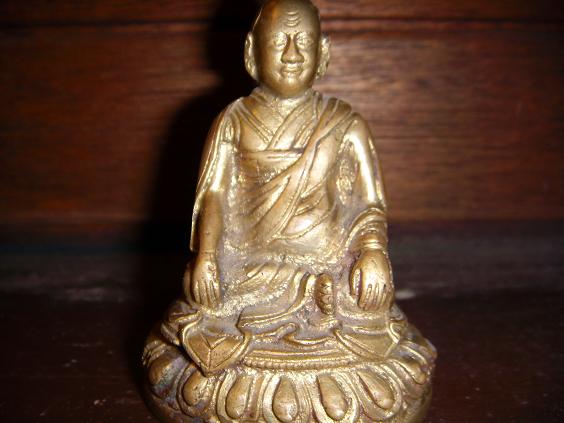
A statuette of Longchenpa
Longchenpa
Tibetan name
Tibetan ཀློང་ཆེན་རབ་འབྱམས་པ
Transcriptions
Wylieklong chen rab 'byams pa
THLLongchen Rapchampa (Longchenpa)
Tibetan PinyinLongqên Rabjamba (Longqênba)
Lhasa IPA[lɔŋtɕʰẽpa]
Chinese name
Traditional Chinese隆欽然絳巴
Simplified Chinese隆钦然绛巴
Transcriptions
Standard Mandarin
Hanyu PinyinLóngqīn Ránjiàngbā

Longchen Rabjam Drimé Özer (Tibetan: ཀློང་ཆེན་རབ་འབྱམས་པ་དྲི་མེད་འོད་ཟེར།, Wylie: klong chen rab 'byams pa dri med 'od zer), or simply Longchenpa (1308–1364, "The Vast Expanse") was a Tibetan scholar-yogi of the Nyingma school, the 'Old School' of Tibetan Buddhism.[1] According to tibetologist David Germano, Longchenpa's work led to the dominance of the Longchen Nyingthig lineage of Dzogchen, the Great Perfection, over the other Dzogchen traditions.[2] He is also responsible for the scholastic systematization of Dzogchen thought within the context of the wider Tibetan Vajrayana tradition of Buddhist philosophy.

Dzogchen thought was highly developed among both the Old School and New Sarma schools.[2] Germano also notes that Longchenpa's work is "generally taken to be the definitive expression of the Great Perfection with its precise terminological distinctions, systematic scope, and integration with the normative Buddhist scholasticism that became dominant in Tibet during the thirteenth and fourteenth centuries."[3]

Longchenpa is known for his voluminous writings, including the highly influential Seven Treasuries and his compilation of the Dzogchen text and commentary, the Nyingtig Yabshi, The Inner Essence in Four Parts.[4][5] Longchenpa was also a Tertön or treasure revealer, and some of his works, like the Khadro Yangtig, are considered terma and revealed treasure texts.[6] Longchenpa's oeuvre of over 270 texts encapsulates the core of Nyingma thought and praxis and is a critical link between the school's exoteric Sutra and esoteric Tantra teachings.

Longchenpa's work also unified the various Dzogchen traditions of his time into a single system.[7] Longchenpa is known for his skill as a poet and his works are written in a unique literary voice which was widely admired and imitated by later Nyingma figures.[8]

Longchenpa was the Khenpo of Samye Monastery, Tibet's first monastery, and the first Buddhist monastery established in the Himalayas. He spent most of his life travelling or in spiritual retreat.

Biography

[edit]

Incarnation lineage

[edit]

The incarnation lineage of Longchenpa is traced to Princess Pema Sal (c.758-766), King Trisong Deutsen's daughter and Padmasambhava's student who died young from a bug bite. Padmasambhava briefly revived her to give her the Khandro Nyingtik empowerment.[9] She incarnated as Pema Ledrel Sal (1291-1315/1319), the "fifth pure rebirth" of Princess Pema Sal, who became a great Terton as prophesied by Padmasambhava. He revealed the Khandro Nyingtik cycle as a terma treasure at the age of 23 years.[10][11] He then incarnated as the great Terton and scholar Longchenpa in the 14th century, who then incarnated as the Terton Pema Lingpa (1450-1521).[11]

Youth

[edit]

Longchen Rabjam was born in 1308 in a village in the Dra Valley in Yuru, U-Tsang.[12] He was born to the Nyingma lama Lopon Tsensung, a descendent of the Rog clan.[12] Longchenpa's mother died when he was nine and his father died two years after. After being orphaned, he entered Samye monastery in 1320 under the Abbot Sonam Rinchen and master Lopon Kunga Ozer.[12] Longchenpa was an avid student with a great capacity for memory.[13]

In 1327, Longchenpa moved to the Kadam monastic college of Sangpu Neutok, the most esteemed center of learning in Tibet at the time. He stayed for six years at Sangpu, mastering the entire scholastic curriculum of logical-epistemology, yogacara and madhyamaka as well as poetics.[13][14] During this period, Longchenpa also received teachings and transmissions from different Tibetan Buddhist traditions, including Kadam, Sakya, Kagyu and Nyingma.[15] Longchenpa studied under various teachers, including the famous Third Karmapa Rangjung Dorje (1284-1339), from whom he received the six yogas of the Kālacakra and the six dharmas of Nāropa.[16]

Longchenpa left Sangpu to practice in the solitude of the mountains, after coming into conflict with certain Khampa scholars.[17] After leaving Sangpu, Longchenpa entered a period of retreat for eight months in complete darkness (winter 1332–1333), where he had some important visions of a young girl who promised to watch over him and grant him blessings.[18] Afterwards, Longchenpa met his main teacher, the Ngagpa Rigdzin Kumaradza (1266-1343), from whom he received Dzogchen teachings while traveling from valley to valley with a nomadic group of about seventy students.[19][20] It is said Longchenpa lived in great poverty during this period, sleeping on a sack and eating only barley.[21]

Longchenpa accompanied Kumaradza and his disciples for two years, during which time he received all of Rigdzin Kumaradza's transmissions (mainly focusing on the Vima Nyingthig and the Khandro Nyingthig). Longchenpa was permitted to teach after a three-year period of retreat (1336-1338) in mChims phu, not far from Samye (according to the mThong snang ’od kyi dra ba, other sources give longer periods like six years).[22][23][21] He is said to have had various visions of different deities, including Padmasambhava, black Vajravārāhī, Guru drag po, and the goddess Adamantine Turquoise Lamp (rDo rje gyu sgron ma)[21]

Mature period

[edit]

In 1340, Longchenpa then gathered a group of eight male and female students in order to initiate them into the Dzogchen teachings.[22][6] During this initial period of teaching, Longchenpa and his students experienced a series of visions of dakinis, and states of possession that only happened to the women of the group. These experiences convinced him and his disciples that Longchenpa should teach the Dzogchen lineage of the Menngagde, the Esoteric Instruction cycle.[24][6]

Longchenpa also compiled the main texts of the Vima Nyingthig and the Khandro Nyingthig along with a series of his own commentaries on these works.[25] Most of Longchenpa's mature life was spent in his hermitage at Gangri Thokar, either in meditation retreat or studying and composing texts.[25]

In 1350, at the age of 42, Longchenpa had a vision of Vimalamitra in which he was asked to restore the temple of Zhai Lhakhang, where the Seventeen Tantras had been concealed by Nyang Tingdzin Zangpo.[26] In the process of this work, Longchenpa accepted a Drikung Kagyu student named Kunga Rinchen. Kunga Rinchen had political designs and came into conflict with the powerful Changchub Gyaltsen, who had the support of the Mongolian Authorities in Peking who attacked Kunga Rinchen's monastery.[27]

Longchenpa fled to Bumthang, Bhutan to avoid conflict. Here he relinquished his monastic vows, married and had a daughter and a son.[28] He also founded a series of small monasteries in Bhutan, including Tharpaling Monastery, his main seat. Longchenpa's lineage survives in Bhutan.[29] After living in Tharpa Ling for 10 years, he returned to Tibet and was reconciled with Changchub Gyaltsen, who even became Longchenpa's student.[29]

Legacy

[edit]

Longchenpa's writings and compilations were highly influential, especially on the Nyingma tradition. According to Germano, Longchenpa's work:

had an immediate impact, and in subsequent centuries was to serve as the explicit model for many Nyingma compositions. In particular, his Seminal Heart writings were intensely philosophical as well as contemplative, and architectonic in nature. Though on the whole their characteristic doctrines and terminology are present in the earlier literature stemming from ICe btsun seng ge dbang phyug onwards, their terminological precision, eloquent style, systematic range and structure, and integration with normative Buddhist discourse constitute a major innovation in and of themselves.[30]

A detailed account of Longchenpa's life and teachings is found in Buddha Mind by Tulku Thondup Rinpoche,[31] A Marvelous Garland of Rare Gems by Nyoshul Khenpo,[32] and The Life of Longchenpa by Jampa Mackenzie Stewart. Pema Lingpa, the famous terton (finder of sacred texts) of Bhutan, is regarded as the immediate reincarnation of Longchenpa.

Dzogchen

[edit]

View of Dzogchen

[edit]

Longchenpa is widely considered the single most important writer on Dzogchen teachings. He was a prolific author and scholar, as well as a compiler of Dzogchen texts. According to David Germano, Longchenpa's work systematized the Dzogchen tradition and its extensive literature while also providing it with a scholastic and philosophical structure based on the standard doctrinal structures that were becoming dominant in the Tibetan Buddhism of late tenth to thirteenth centuries.[33]

According to Germano, Longchenpa's main Dzogchen scriptural sources were: "(i) the Kun byed rgyal po, (ii) The Seventeen Tantras of the Great Perfection (including two closely affiliated tantras—the kLong gsal and Thig le kun gsal) (iii) the Seminal Heart system of Vimalamitra (Bi ma snying thig) and (iv) the Seminal Heart system of the Dakini (mKha' 'gro snying thig)."[3] Longchenpa's Dzogchen philosophy is based on the Dzogchen view outlined in these tantric texts. This worldview sees all phenomena (dharmas, Tib. chos) as the emanations or expressions (rtsal), displays (rol pa), and adornments (rgyan) of an ultimate nature or principle (Dharmatā, Tib. chos nyid, or Dharmadhātu, Tib. chos kyi dbyings)[34]

This ultimate principle is described in various ways by Longchenpa, using terminology that is unique to Dzogchen, such as the basis or ground (gzhi) or the "nature of mind" (sems nyid). Longchenpa describes this fundamental basis as being primordially pure and empty while also having the nature of a subtle self-arising awareness. This empty and spontaneous primordial glow (ye gdangs) is the subtle basis for the arising of all phenomenal appearances.[35]

Longchenpa brought Dzogchen thought more closely into dialogue with scholastic Buddhist philosophy and the Sarma tantric systems which were normative in the Tibetan academic institutions of his time.[36] One of Longchenpa's main motivations was to provide a learned defense of Dzogchen thought and practice.[37] Longchenpa's writings also intended to prove the overall superiority of the Dzogchen path over the other eight vehicles of sutra and tantra. His work also posits that this supreme Dzogchen view is not just the pinnacle of Buddhism (which Longchenpa compares the peak of a mountain), but it is in fact a keystone to the entire Buddhist Dharma, without which the "lower vehicles" cannot be fully understood or justified (just like one cannot see the entirety of a mountain unless one is at the top).[38]

In his Theg mchog mdzod, Longchenpa also provides an extensive doxography of Buddhism (based on the nine yanas) in order to explain why Dzogchen (i.e. Atiyoga) deserves the highest rank in this doxography.[39] Longchenpa's understanding of the relationship between Dzogchen and the lower vehicles is inclusive, and he sees Dzogchen as embracing all of the eight vehicles while also sublimating and transcending them.[40]

Dzogchen practice

[edit]

Longchenpa categorized Dzogchen as a teaching within "secret mantra" (Vajrayana), and specifically, he considered it to be part of the perfection stage of secret mantra practice, defining this "great perfection phase" (rdzogs rim chenpo), as "resting in the pristine unfabricated enlightening-mind of awareness" (in his bSam gtan ngal gso 80.2).[41] Furthermore, Longchenpa defended the validity of Dzogchen as a stand-alone system of formless and effortless perfection stage practice, which did not require preliminary practice of the generation stage of deity yoga (unlike other tantric systems) nor standard tantric initiation rituals. Instead, for Longchenpa, the practice of Dzogchen merely relies on a pointing out (sems khrid) of the mind's nature in an encounter with a teacher.[42]

In his Grub mtha' mdzod, Longchenpa describes how Dzogchen transcends the classic tantric generation and perfection stages which for him are based on effort, mental constructs and fixation. For Longchenpa, Dzogchen relies on simple (spros med) and more natural methods which are based on the recognition of the nature of the mind and the Dzogchen view (Ita ba) of reality.[43] Longchenpa also argues that this Dzogchen method is "superior to that of stress-filled actualization involved in ordinary generation and perfection" (Zab mo yang tig vol. 11, 344.2-6).[44]

In the root verses and auto-commentary to his chapter on meditation within The Treasury of the Dharmadhatu (chos dbyings mdzod), Longchenpa placed strong emphasis on the importance of the practice of the "four ways of resting" in the nature of awareness (cog gzhag bzhi) and the "three samadhis" (ting nge 'dzin gsum), offering also detailed explanations for their practice.[45] In the foreword to the book The Meditations of Longchen Rabjam, Thrangu Rinpoche explicitly notes:

One of the most renowned presentations of Dzogchen is given in Longchen Rabjam’s Chöying Dzöd. This text gives clear instructions on how to develop the view and practice the meditation of resting in the nature of awareness. Studying and practicing these meditations will be of great benefit to everyone who encounters these instructions.[46]

Longchenpa also critiques tantric perfection stage methods (such as the six yogas of Naropa) which focus on manipulating the winds (vayu) in the channels (nadis) of the subtle body in order to confine them into the central channel. Longchenpa sees these techniques are inferior, because they are strenuous and forceful and may lead to delusory appearances.[47] Longchenpa contrasts these tantric techniques with those of Dzogchen in which "the winds are left to naturally calm down of their own accord, there is no insertion into the central channel."[48]

Germano describes Longchenpa's view on this topic as follows:

In his Grub mtha' mdzod kLong chen rab 'byams pa also incisively criticizes these normative modernist tantric practices of forcefully inserting the energy winds into the central channel in the attempt to achieve primordial gnosis. He contrasts this to Great Perfection contemplation in which the body's luminous channels are let be, and thus naturally expand outwards from their current presence as a thin thread of light at the body's center, so as to directly permeate one's entire existence and dissolve all energy blockages therein. He retains the emphasis on the body's center and light-experiences, yet undercuts the tone of control and manipulation.[49]

Works

[edit]

Longchenpa wrote over 270 works according to Tulku Thondup.[29]

Seven treasuries

[edit]

The Seven Treasuries (mdzod bdun), which elucidate the meaning of the Nyingma school's worldview and Dzogchen, are his most influential and famous original treatises.[5][29]

The Seven Treasuries are:[50]

  • The Wish Fulfilling Treasury (Tib. ཡིད་བཞིན་མཛོད་, Yishyin Dzö; Wyl. yid bzhin mdzod, YZD), it has a long prose commentary, the White Lotus (padma dkar po). This text mainly deals with classic Buddhist topics common to all schools of Tibetan Buddhism and could be classified as a Lamrim type work according to Germano.
  • The Treasury of Pith Instructions (Tib. མན་ངག་མཛོད་, Mengak Dzö; Wyl. man ngag mdzod, MND), a short text which consists of advice for meditative contemplation and which only deals in passing with Dzogchen topics.
  • The Treasury of Philosophical Systems (Tib. གྲུབ་མཐའ་མཛོད་, Drubta Dzö; Wyl. grub mtha' mdzod, GTD), a work of the "tenets" ( grub mtha', Skt. siddhanta) genre which gives a systematic and doxographic account of the various Buddhist philosophical views. Longchenpa uses the nine yanas schema in this work to discuss the various Buddhist philosophies, and naturally places Dzogchen at the pinnacle.
  • The Treasury of Word and Meaning (Tib. ཚིག་དོན་མཛོད་, Tsik Dön Dzö; Wyl. tshig don mdzod, TDD), a shorter overview of Dzogchen thought and practice which follows the outline of the "eleven vajra topics".
  • The Treasury of the Supreme Vehicle (Tib. ཐེག་མཆོག་མཛོད་, Tekchok Dzö; Wyl. theg mchog mdzod, TCD), a large commentary on all topics of the Dzogchen tradition found in the Seventeen Tantras which provide a wide-ranging and systematic account of Dzogchen that goes into much more detail than the Tsik Dön Dzö.
  • The Treasury of the Dharmadhatu (Tib. ཆོས་དབྱིངས་མཛོད་, Chöying Dzö; Wyl. chos dbyings mdzod, CBD), a poem with a prose commentary called the Treasure Trove of Scriptural Transmissions (lung gi gter mdzod). This is a free ranging poetic work which discusses Dzogchen topics in much less comprehensive manner. According to Germano this can be seen as "a hymn to the mind of enlightenment (which is synonymous with the Great Perfection)."[51][better source needed]
  • The Treasury of the Natural State (Tib. གནས་ལུགས་མཛོད་, Neluk Dzö; Wyl. gnas lugs mdzod, NLD), a poem with its prose commentary, the Desum Nyingpo (sde gsum snying po). This work mainly discusses the four samayas or commitments of Dzogchen (ineffability, openness, spontaneous presence, and oneness).

According to Germano, the Tsik Dön Dzö and the Tekchok Dzö together constitute Longchenpa's primary scholastic work on the Dzogchen tradition.[51][better source needed]

Nyingthig Yabshi

[edit]

Longchenpa compiled various Dzogchen Menngagde scriptures (including the Seventeen Tantras) into the collection known as the Nyingthig Yabshi (The Inner Essence in Four Parts).[5] In this compilation, Longchenpa combines his editions of the Vima Nyingtig and the Khandro Nyingthig, along with his own commentaries on these cycles (the Lama Yangtik and the Khandro Yangtik respectively).[5] Longchenpa also composed a supplementary commentary to the Nyingthig Yabshi, called the Zabmo Yangtig.[22]

According to Germano, Longchenpa's compilation "brought much needed order and organizational clarity to the at times chaotic mass of the Vimalamitra-transmitted Seminal Heart scriptures inherited from Kumaradza."[7]

Other works

[edit]

Some of his other important original compositions include:[5][52]

English translations

[edit]

Seven Treasuries

[edit]

1.

  • Padma karpo (The White Lotus) (excerpts). In Tulku Thondup. The Practice of Dzogchen
  • Chapter One translated by Kennard Lipman in Crystal Mirror V: Lineage of Diamond Light (Compiled by Tarthang Tulku, Dharma Publishing, 1977), chapter "How Saṃsāra is Fabricated from the Ground Up" pp. 336–356.

2.

  • The Precious Treasury of Pith Instructions (Upadeśa ratna kośa nāma/Man ngag rin po che'i mdzod ces bya ba). Translated by Richard Barron (Lama Chökyi Nyima). Padma Publishing, 2006.

3.

  • The Precious Treasury of Philosophical Systems (Yāna sakalārtha dīpa siddhyanta ratna kośa nāma/Theg pa mtha' dag gi don gsal bar byed pa grub pa'i mtha' rin po che'i mdzod ces bya ba). Translated by Richard Barron (Chökyi Nyima). Padma Publishing, 2007.
  • The Treasury of Doxography (Grub mtha mdzod). In The Doxographical Genius of Kun mkhyen kLong chen rab 'byams pa. Translated by Albion Moonlight Butters. Columbia University, 2006.

4.

  • Precious Treasury of Genuine Meaning (tsig don rinpoche dzod). Translated by Light of Berotsana. Snow Lion 2015
  • The Treasury of Precious Words and Meanings. Illuminating the Three Sites of the Unsurpassed Secret, the Adamantine Nucleus of Radiant Light (Padārtha Ratnasya Kośa nāma/Tshig Don Rin-po-che mDzod Ces Bya Ba), chapters 1–5. In David Francis Germano. Poetic Thought, the Intelligent Universe and the Mystery of Self: the Tantric Synthesis of rDzogs Chen in fourteenth century Tibet. The University of Wisconsin, 1992.
  • Tshigdon Dzod (excerpts). In Tulku Thondup. The Practice of Dzogchen

6.

  • The Basic Space of Phenomena (Dharmadhātu ratna kośa nāma//Chos dbyings rin po che'i mdzod ces bya ba). Translated by Richard Barron (Chökyi Nyima). Padma Publishing, 2001.
  • Spaciousness: The Radical Dzogchen of the Vajra-Heart. Longchenpa's Treasury of the Dharmadhatu (Dharmadhātu ratna kośa nāma//Chos dbyings rin po che'i mdzod ces bya ba). Translated by Keith Dowman. Vajra Publishing, 2013.
  • The Precious Treasury of Phenomenal Space (Dharmadhātu ratna kośa nāma//Chos dbyings rin po che'i mdzod ces bya ba), in Great Perfection: The Essence of Pure Spirituality. Translated by Shyalpa Tenzin Rinpoche. Vajra, 2015.
  • Choying Dzod (excerpts). In Tulku Thondup. The Practice of Dzogchen
  • A Treasure Trove of Scriptural Transmission (Commentary on the Precious Treasury of the Dharmadhātu/Dharmadhātu ratna kośa nāma vṛtti/Chos dbyings rin po che'i mdzod ces bya ba'i 'grel pa). Translated by Richard Barron (Chökyi Nyima). Padma Publishing, 2001.

7.

  • The Precious Treasury of the Way of Abiding (Tathātva ratna kośa nāma/gNas lugs rin po che'i mdzod ces bya ba). Translated by Richard Barron (Chökyi Nyima). Padma Publishing, 1998.
  • Commentary on "The Treasury of the Precious Abiding Reality: A Meaning Commentary on the Quintessence of the Three Series" (Tathātva ratna kośa nāma vritti). In The Rhetoric of Naturalness: A Study of the gNas lugs mdzod. Translated by Gregory Alexander Hillis. University of Virginia 2003
  • Natural Perfection (gNas lugs mdzod). Translated by Keith Dowman. Wisdom Publications 2010
  • The Precious Treasury of the Fundamental Nature. Translated by the Padmakara Translation Group, 2022.

Trilogy of Natural Ease

[edit]

1.

  • Kindly Bent to Ease Us (Ngal-gso skor-gsum). "Part One: Mind" (Sems-nyid ngal-gso, Skt: Mahāsaṃdhi cittatā* viśrānta nāma). Translated and annotated by Herbert V. Guenther. Dharma Publishing, 1975.
  • Finding Rest in the Nature of the Mind: Trilogy of Rest, Volume 1. Translated by Padmakara Translation Group. Shambhala, 2017.

2.

  • Kindly Bent to Ease Us. Part Two: Meditation (bSam-gtan ngal-gso). Translated and annotated by Herbert V. Guenther. Dharma Publishing, 1976.
  • Mind in Comfort and Ease (bSam-gtan ngal-gso, Skt: Mahāsaṃdhi dhyāna vishrānta nāma), the Vision of Enlightenment in the Great Perfection. Translated by Adam Pearcey. Wisdom Publications, 2007.
  • Finding Rest in Meditation: Trilogy of Rest, Volume 2. Translated by Padmakara Translation Group. Shambhala, 2018.

3.

  • Kindly Bent to Ease Us. Part Three: Wonderment (sGyu-ma ngal-gso, Skt: Mahāsaṃdhi māyā viśrānta nāma). Translated and annotated by Herbert V. Guenther. Dharma Publishing, 1976.
  • Maya Yoga: Longchenpa's Finding Comfort and Ease in Enchantment (sGyu ma ngal gso). Translated by Keith Dowman. Vajra Publishing, 2010.
  • Finding Rest in Illusion: Trilogy of Rest, Volume 3. Translated by Padmakara Translation Group. Shambhala, 2020.

Trilogy of Natural Freedom

[edit]
  • The Natural Freedom of Mind (sems-nyid rang-grol/cittatva-svamukti). Translated by Herbert V. Guenther in Bringing the Teachings Alive (Crystal Mirror Series Volume IV). Edited by Tarthang Tulku. Dharma Publishing, 2004.
  • Naturally Liberated Mind, the Great Perfection (rdzogs pa chen po sems nyid rang grol). Translated by Tulku Thondup, in The Practice of Dzogchen, (Ithaca: Snow Lion, 1989), pages 316–354.
  • Quintessential Meaning-instructions on the Stages of the Path of Naturally Liberated Mind, The Great Perfection (rdzogs pa chen po sems nyid rang grol gyi lam rim snying po'i don khrid). Translated by Tulku Thondup, ibid. pp. 355–374.
  • Longchenpa's Three Cycles of Natural Freedom: Oral Translation and Commentary. Translated with commentary by Traleg Kyabgon Rinpoche. Shogam Publications, 2023.

Trilogy of Dispelling Darkness

[edit]
  • Extensive Commentary on the Guhyagarbha Tantra called Dispersing the Darkness of the Ten Directions (Tib. gsang snying 'grel pa phyogs bcu mun sel, Skt. daśadiś-andhakāra-vidhvaṃsana-guhya-garbha-bhāshya) in The Guhyagarbha Tantra: Definitive Nature Just as It Is, with Commentary by Longchen Rabjam. Translated by Light of Berotsana. Snow Lion, 2011.
  • ibid., in The Guhyagarbhatantra and its XIVth Century Commentary phyogs-bcu mun-sel. Translated by Gyurme Dorje (unpublished thesis, University of London). Gyurme Dorje, 1987.

Other translations

[edit]
  • The Excellent Path to Enlightenment (Avabodhi-supathā mahāsandhi-cittāvishrāntasya trsthānādams trikshemānām arthanayanam vijahāram). Translated by Khenpo Gawang Rinpoche and Gerry Winer. Jewelled Lotus, 2014.
  • The Full-fledged Khyung-chen Bird (Khyung-chen gshog-rdzogs/Suparṇaka mahāgaruḍa). An Essay in Freedom as the Dynamics of Being. Edited, translated and annotated by Herbert Guenther. The International Institute for Buddhist Studies of the International College for Advanced Buddhist Studies, 1996.
  • Now that I Come to Die (Zhal-chems dri-ma med-pa'i-'od). Intimate guidance from one of Tibet's greatest masters. Now that I Come to Die & The Four Immeasurably Great Catalysts of Being: Longchenpa's Verses and Commentary on the Four Immeasurably Great Catalysts of Being. Translated by Herbert V. Guenther and Yeshe De Translation Group. Dharma Publishing, 2007. Note that Guenther's translation of Now That I Come to Die (Zhal-chems dri-ma med-pa'i-'od) was first published in Crystal Mirror V: Lineage of Diamond Light (Compiled by Tarthang Tulku, Dharma Publishing, 1977), pp. 323–335.
  • You Are the Eyes of the World (Byaṅ chub kyi sems kun byed rgyal po'i don khrid rin chen gru bo/bodhicitta kulayarāja ratnanāva vr̥tti/The Precious Boat: A Commentary on the All-Creating King of the Family of Bodhicitta). Translated by Kennard Lipman and Merrill Peterson. Snow Lion Publications, 2000.
  • The Four-Themed Precious Garland (Caturdharma-ratnamālā/chos-bzhi rin-chen phreng-ba). An Introduction to Dzog-ch'en. Translated, edited and prepared by Alexander Berzin in conjunction with Sharpa Tulku and Matthew Kapstein. Library of Tibetan Works and Archives, 1979. Reprinted in Stephen Batchelor, The Jewel in the Lotus. Wisdom, 1987. Chapter One also published in Footsteps on the Diamond Path: Crystal Mirror Series I-III, compiled by Tarthang Tulku. Dharma, 1992.
  • The Light of the Sun: Teachings on Longchenpa's Precious Mala of the Four Dharmas (Caturdharma-ratnamālā/chos-bzhi rin-chen phreng-ba). Namkhai Norbu & Jacob Braverman. Shang Shung Publications, 2014.
  • The Practice of Dzogchen (Tshigdon Dzod [excerpts], Shingta Chenpo [excerpts], Changchub Lamzang [excerpts], Sems-Nyid Rang-Grol, Lamrim Nyingpo'i Donthrid, Pema Karpo [excerpts], Choying Dzod [excerpts], Namkha Longchen [excerpts], Namkha Longsal [excerpts], Lama Yangtig [excerpts]. Translated and annotated by Tulku Thondup. Edited by Harold Talbott. Snow Lion Publications, 1989.
  • A Song on Impermanence (no Tibetan title mentioned). In Karl Brunnhölzl. Straight from the Heart. Buddhist Pith Instructions. Snow Lion Publications, 2007.
  • Longchenpa's Advice from the Heart (Thirty Pieces of Advice from the Heart/sNying gtam sun bcu pa). Translated by Chogyal Namkhai Norbu & Elio Guarisco. Shang Shung Publications, 2009.
  • Looking Deeper: A Swan's Questions and Answers (Ngaṅ pa'i dris lan sprin gyi snyiṅ po/Haṃsa praśnottara tushāra). Translated by Herbert V. Guenther. Timeless Books, 1983.
  • A Visionary Journey. The Story of the Wildwood Delights (nags tshal kun tu dga' ba'i gtam/vanaspati moda kathā) and The Story of the Mount Potala Delights (po ta la kun dga' ba'i gtam/potala ānanda kathā). Translated by Herbert V. Guenther. Shambhala, 1989.
  • Cloud Banks of Nectar (no Tibetan title). In Erik Pema Kunsang. Perfect Clarity. A Tibetan Buddhist Anthology of Mahamudra and Dzogchen. Rangjung Yeshe Publications, 2012.
  • The Three Turnings of the Wheel of Dharma. In Erik Pema Kunsang. Jewels of Enlightenment: Wisdom Teachings from the Great Tibetan Masters. Shambhala (March 3, 2015), p. 8.
  • The Seven Mind Trainings - Essential Instructions on the Preliminary Practices Longchen Rabjam. In Steps to the Great Perfection: The Mind-Training Tradition of the Dzogchen Masters. by Jigme Lingpa (Author), Tuklu Thondup Rinpoche (Author), Cortland Dahl (Translator), Garab Dorje (Contributor), Longchenpa (Contributor). Snow Lion (July 26, 2016), pp. 7–14.
  • The Luminous Web of Precious Visions (mThong snang rin po che 'od kyi drva ba). Abridged translation by David Germano and Janet Gyatso in Tantra in Practice, edited by David Gordon White. Princeton University Press, 2000, pp. 239–265.
  • A reply to questions concerning mind and primordial knowing – An annotated translation and critical edition of Klong chen pa’s Sems dang ye shes kyi dris lan. Translated by David Higgins. Journal of the International Association of Buddhist Studies, Number 34, Volume 1–2, 2011 (2012).
  • The Net of Purity, A Clear Exposition of the Names for the Elaborate Mandala, The Net of Lotuses: A Ritual for the Extremely Unelaborate Empowerment, The Net of Precious Gems: A Ritual for the Unelaborate Empowerment, The Adornment of the Four Continents: An Offering Ritual of the Five Mandalas, The Net of Light: A Ritual for the Supremely Unelaborate Empowerment, The Wish-Fulfilling Net: An Offering Ritual of the Five Mandalas of the Five Offering Substances, The Wish-Fulfilling Sea: A Ritual for the Offering of Ganacakra, The Luminous Lamp: An Empowerment Ritual for the Secret Cycle of the Great Perfection, A Great Guide for the Supreme Path, The Heart of Practical Instructions, The Excellent Path to Enlightenment: A Three-Part Guide for Meditation on the Three Excellent Instructions of the Text, A Prayer Belonging to the Natural Openness and Freedom of the Nature of Mind, An Essential Meditation Guide for the Stages of the Path According to the Natural Openness and Freedom of the Nature of Mind, The Natural Openness and Freedom of Reality, The Natural Openness and Freedom of the State of Equality. In The Treasury of Precious Instructions, Volume 2: Nyingma, Part 2. Compiled by Jamgon Kongtrul Lodro Taye. Translated by Padmakara Translation Group. Snow Lion, 2024.

Name and titles

[edit]

Longchenpa's names given below are indicative of the high regard in which he and his teachings are held. Like the Third Karmapa Rangjung Dorje, Rongzompa and Jigme Lingpa, he carried the title "Kunkhyen" (Tibetan; "All-Knowing").

Various forms and spellings of Longchenpa's full name(s), in which Longchen means "great expanse", "vast space", and Rab 'byams "cosmic", "vast", "extensive", "infinite".

  • Longchen Rabjam (klong chen rab 'byams; "vast infinite expanse")
  • Longchen Rabjampa (klong chen rab 'byams pa)
  • Longchenpa Drimé Özer (klong chen pa dri med 'od zer [Skt. vimalaprabhāsa, Immaculate Splendour])
  • Künkhyen Longchenpa (kun mkhyen klong chen pa; the Omniscient [Skt. sarvajña] Longchenpa)
  • Künkhyen Longchen Rabjam (kun mkhyen klong chen rab 'byams, Omniscient Great Cosmic Expanse)
  • Künkhyen Chenpo (kun mkhyen chen po; Great Omniscient One [mahāsarvajña])
  • Künkhyen Chenpo Drimé Özer (kun mkhyen chen po dri med 'od zer [mahāsarvajñavimalaprabhāsa, Great Omniscient One Immaculate Splendour])
  • Künkhyen Chökyi (kun mkhyen chos kyi rgyal po; All-knowing Dharma King [sarvajñānadharmarāja])
  • Gyalwa Longchen Rabjam (rgyal ba klong chen rab 'byams, The Conqueror Longchen Rabjam)
  • Gyalwa Longchen Rabjam Drimé Özer (rgyal ba klong chen rab 'byams dri med 'od zer, The Conqueror Longchen Rabjam, Immaculate Splendour)

See also

[edit]

References

[edit]

Further reading

[edit]
[edit]
Revisions and contributorsEdit on WikipediaRead on Wikipedia
from Grokipedia
Longchenpa (1308–1364), born Longchen Rabjam Drimé Özer, was a preeminent Tibetan Buddhist master, scholar, and yogi of the Nyingma school's Dzogchen tradition, revered as one of the foremost exponents of the Great Perfection teachings and an emanation of masters like Vimalamitra and Shantideva. Born in 1308 to a tantric yogin father from the Rok clan and a mother from the Drom clan, he received novice ordination at age twelve at Samye Monastery and pursued extensive studies in sutra, tantra, and philosophy at institutions like Sangpu Neutok, training under over twenty masters including Rigdzin Kumaradza and the Third Karmapa Rangjung Dorje. His life was marked by profound meditative realization, leading him to live as a hidden yogi in forest retreats, where he reconciled discrepancies across Buddhist lineages through intellect and direct experience. Longchenpa's major achievements include the compilation and systematization of the Nyingtik (Heart Essence) cycles, particularly the Fourfold Heart Essences comprising the Bima Nyingtik, Khandro Nyingtik, and their exegetical works, which became foundational to Dzogchen practice in the Nyingma tradition. He authored over 270 volumes, with his most influential being the Seven Treasuries—a comprehensive collection covering Dzogchen philosophy, Madhyamaka, ethics, and meditation—including texts like the Treasury of the Dharmadhatu and Treasury of Wish-Fulfilling Jewels—alongside the Trilogy of Self-Liberation and Trilogy of Rest, which elucidate the natural liberation of mind and reality. These works emphasize the innate purity of awareness and the direct path to enlightenment, influencing subsequent Nyingma lineages and figures like Jigme Lingpa. Amid political turmoil in central Tibet beginning in 1349, Longchenpa faced conflicts leading to his exile, culminating in his relocation to Bhutan in 1359, where he spent the final years of his life, founding monasteries such as Tharpaling and restoring sacred sites, leaving a lasting spiritual legacy in both regions. He passed away in 1364 at age 56, survived by his son Drakpa Wozer, a key lineage holder, and is honored as the "Omniscient One" for his vast literary output and embodiment of Dzogchen realization, often ranked among Tibet's supreme spiritual luminaries.

Early Life

Birth and incarnation lineage

Longchenpa, also known as Longchen Rabjam Drimé Özer, was born on the tenth day of the second month of the Earth Monkey year, corresponding to 1308 CE, in the village of Todtrong in the Upper Dra Valley of southern Tibet. His father, Tenpasung, was an accomplished tantric yogin from the Rok clan, renowned for his mastery of mantra practices and ritual initiations. His mother, Dromza Sonamgyen, hailed from the Drom clan and was a descendant of Dromtönpa Gyalwé Jungné, the chief disciple of the Indian master Atiśa, linking the family to influential Kadam lineages. Traditional accounts identify Longchenpa as the indirect incarnation of Princess Pema Sal, the daughter of King Trisong Detsen and a direct disciple of Padmasambhava, who entrusted her with the transmission of the Khandro Nyingtik cycle of Dzogchen teachings. This lineage connection traces through Pema Ledreltsal, a previous rebirth who revealed the Khandro Nyingtik as a terma (hidden treasure), thereby establishing Longchenpa's spiritual pedigree within the Nyingma school's origins and emphasizing his role as a holder of Padmasambhava's profound instructions. Such hagiographical narratives underscore his karmic ties to the foundational figures of Tibetan Buddhism, positioning him as a bridge between imperial-era transmissions and later Nyingma developments. Hagiographies recount early signs of Longchenpa's spiritual aptitude, including visions experienced by his mother during his conception and birth. At conception, Dromza Sonamgyen dreamed of a lion crowned with sun and moon light, symbolizing enlightened qualities that radiated and were absorbed into her body. Following his birth, she beheld the protectress Namdru Remati in wrathful form, who seized the infant, vowed protection, and vanished, interpreted as a divine endorsement of his destined path. As a young boy, Longchenpa displayed precocious talent, excelling in reading and writing, and received initial initiations from his father, foreshadowing his profound scholarly and yogic achievements.

Childhood and initial studies

Longchenpa, born in 1308 in the village of Todtrong in the Upper Dra Valley of south-central Tibet, grew up in a devout Nyingma family environment steeped in yogic and tantric practices. His father, Tenpasung, was an accomplished tantric yogin from the Rok clan, renowned for his mastery of mantra, medicine, and astrology, while his mother, Sonamgyen from the Drom clan, contributed to a household centered on spiritual cultivation. This yogic setting fostered Longchenpa's early interest in Buddhist teachings, where he demonstrated precocious aptitude, learning to read and write by the age of five and beginning basic instruction in Buddhist principles under his father's guidance. From around age five, Longchenpa received initial tantric initiations from his father, including empowerments into core Nyingma practices such as the Peaceful and Wrathful Aspects of the Guru and the Eight Transmitted Precepts. By age seven, his studies deepened with more advanced tantric instructions, encompassing empowerments in various Nyingma tantras and treasure (terma) texts, as well as early exposure to hidden treasure traditions through his father's revelations and ritual expertise. In this period, he memorized key sutras and tantras, including practices like the Kīlaya and Guru Rinpoche sādhana, gaining initial insights into their meditative applications by age nine. At age twelve, Longchenpa decided to leave his family home and pursue a formal monastic path, seeking refuge in structured Buddhist institutions. This transition marked the end of his informal, home-based learning and the beginning of his broader engagement with monastic education.

Education and Ordination

Formal studies at monastic centers

At the age of twelve, in 1320, Longchenpa received novice ordination at Samye Monastery, where he was given the name Tsultrim Lodrö by the abbot Khenpo Samdrub Rinchen and the teacher Kunga Wozer. This initiation marked the beginning of his formal monastic training, focused initially on the Vinaya, the Buddhist monastic code, through which he received vows and instruction in ethical discipline. By age fourteen, he had demonstrated proficiency in Vinaya texts, engaging in debates and examinations that established his early scholarly aptitude. During his time at Samye Monastery, Longchenpa pursued foundational studies in key Buddhist doctrines, including Madhyamaka philosophy, Abhidharma, and further Vinaya under prominent teachers of the era. He also received introductory tantric teachings and empowerments from Nyingma, Sarma, and other traditions, studying texts such as the Sakya Lamdre, the Six Yogas of Nāropa, and practices related to Vajravārāhī, Cakrasaṃvara, Kālacakra, Chöd, and Zhijé under instructors including Tashi Rinchen, Wangchuk Yeshe, and Zalung Rinpoche. These studies, spanning sutra and tantra basics, provided a broad scholarly foundation in exoteric and esoteric Buddhism, emphasizing doctrinal analysis and ritual preparation. Around age 25, he received full monastic ordination. At nineteen, in 1327, Longchenpa enrolled at Sangpu Neutok, Tibet's premier scholastic institution at the time, renowned for its rigorous curriculum in Kadam and Sakya traditions. There, he spent six years delving into advanced subjects such as logic and pramāṇa (valid cognition) based on the works of Dignāga and Dharmakīrti, Madhyamaka philosophy, the Prajñāpāramitā sutras, the Five Treatises of Maitreya, the Samādhi Rāja Sūtra, Sanskrit grammar, and rhetorical debate under teachers like Lobpön Tsen Gonpa, Chöpel Gyaltsen, Jamgön Pa, and Lama Rangpa Chöpal Gyaltsen. This intensive training honed his skills in epistemological reasoning and philosophical argumentation, culminating in his recognition as a accomplished scholar by his mid-twenties.

Key teachers and Dzogchen introduction

Longchenpa's early intellectual development was shaped by the philosophical translations of Patsab Lotsawa Nyima Drakpa (1055–?), particularly in Madhyamaka, which informed his foundational studies in Buddhist philosophy during his time at monastic centers like Samye and Sangpu. He also received guidance from minor teachers on preliminary practices, including basic tantric initiations and meditative preliminaries, which prepared him for deeper yogic paths. After completing his studies at Sangpu around age 25, Longchenpa engaged in extensive wanderings across Tibet until his late twenties, seeking teachings from over twenty masters in sutra and tantra traditions, though these years marked a period of scholarly accumulation rather than profound realization. The pivotal turning point came in his late twenties (around 1335), when he encountered his root guru, Rigdzin Kumaradza (1266–1343), in the Tsari region of southern Tibet, initiating his immersion in Dzogchen. For the following two years, Longchenpa undertook intensive study and practice under Kumaradza, receiving the direct transmission of Dzogchen's three main divisions: Semde (Mind Series), Longde (Space Series), and Mennagde (Secret Instruction Series), along with the complete Heart Essence (Nyingthig) cycle, encompassing the Heart Essence of Vimalamitra and the Heart Essence of the Dakinis. This period transformed him from a scholar into a realized yogin, as Kumaradza empowered him as a lineage holder. During retreats under Kumaradza's guidance, Longchenpa experienced profound realizations, including visions of deities such as Mañjuśrī, Sarasvatī, Padmasambhava, and Yeshe Tsogyal, accompanied by direct insights into the nature of mind that solidified his mastery of Dzogchen. These events, occurring in isolated settings like mountain caves, confirmed his attainment and set the stage for his later contributions to the tradition.

Career and Wanderings

Teaching and writing in Tibet

Following his intensive Dzogchen training under Rigdzin Kumaradza, which lasted approximately two years starting around 1335, Longchenpa returned to central Tibet circa 1342 at the age of thirty-four. There, he began teaching at key Nyingma sites, including Chuwori (also known as Chukpodrak) and Gangteng (Gangri Tokar), where he attracted a growing number of students drawn to the Nyingma tradition's esoteric lineages. His teachings emphasized practical instructions in Dzogchen, fostering a community of practitioners amid the challenges of the era. During this early phase of his career in central Tibet, Longchenpa composed several preliminary texts to support his students' studies, including commentaries on Madhyamaka philosophy, tantric practices, and the Guhyagarbha Tantra. These works served as foundational expositions, clarifying complex doctrines for Nyingma adepts and integrating exoteric and esoteric elements. He also produced exegeses on the Bima Nyingtik and Khandro Nyingtik cycles, further solidifying his role as a systematizer of Dzogchen transmissions. Longchenpa's activities unfolded against a backdrop of political tension under Sakya-Mongol rule, which favored the Sakya school and viewed Nyingma influences with suspicion. This precarious position for non-Sakya traditions became evident during the Phagmodrupa transition. In response to these challenges, Longchenpa initiated the establishment of small hermitages for Dzogchen practitioners, such as at Gangri Tokar, providing secluded retreats for meditation and study away from political centers. These modest foundations laid the groundwork for later Nyingma communities, emphasizing solitary practice over institutional expansion.

Exile in Bhutan and monastic foundations

In the mid-1350s, amid escalating political persecution in central Tibet stemming from his involvement in mediating conflicts between rival factions, Longchenpa fled to the Gyelong region of Bhutan to seek refuge. This self-imposed exile, prompted by tensions with the Phagmodrupa ruler Tai Situ Jangchub Gyeltsen following an unsuccessful attempt to resolve the 1359 Drigung Kagyu revolt, lasted approximately a decade, from around 1350 to 1360. By this period, Longchenpa was widely known by his honorific name, meaning "Vast Expanse," evoking the boundless nature of awareness central to Dzogchen teachings and symbolizing his profound realization. Longchenpa's time in Bhutan marked a phase of institutional consolidation for the Nyingma tradition, as he founded eight key hermitages and monasteries to serve as centers for Dzogchen practice and study. These included Tharpa Ling in Bumthang, which became his primary seat and a hub for meditation retreats; Samten Ling in Paro; Dechen Ling in Shingkhar; Orgyen Ling and two Kunzang Lings in Chumey; Drechak Ling in Ha; and Rinchen Ling in Paro. These establishments fostered dedicated communities of practitioners, blending monastic life with lay involvement, and ensured the enduring presence of Nyingma Dzogchen lineages in Bhutanese spiritual culture. His daily routine in exile emphasized seclusion and dissemination of teachings, alternating between intensive personal retreats in remote caves and public instructions to local Bhutanese audiences, including chieftains, lamas, and villagers. Longchenpa composed significant portions of his oeuvre during these isolated periods, drawing on visionary experiences to articulate Dzogchen principles. Through strategic engagements with Bhutanese rulers and religious figures, such as forming alliances with regional leaders and ordaining disciples like Peljor Gyeltsen—who later expanded these foundations—Longchenpa solidified the Nyingma school's foothold in the region, countering its marginalization in Tibet. He also established familial ties, fathering a son, Drakpa Wozer, with his consort Ani Kyidpala, further embedding his lineage locally. This era not only preserved his scholarly legacy but also transformed Bhutan into a sanctuary for Dzogchen transmission.

Return to Tibet and final years

Following his period of exile in Bhutan, Longchenpa returned to Tibet around 1360 after a reconciliation with the Phag mo gru ruler Tai Situ Jangchub Gyaltsen, facilitated by patrons such as Situ Shakya Zangpo and Dorje Gyeltsen. He primarily resided at the hermitage of Gangri Thogar near Shukseb Monastery in Central Tibet, where he continued his contemplative practice and composition of key Dzogchen texts. In his final years, Longchenpa focused on transmitting advanced Dzogchen instructions to a select group of close disciples, underscoring a non-sectarian integration of Nyingma teachings with broader Buddhist traditions to benefit practitioners beyond sectarian boundaries. He alternated between retreats and public teachings, including rituals and expositions at sacred sites like Chimphu near Samye Monastery, where he composed his last works, such as Stainless Light and The Mirror of Key Points, as testaments to the profound view of Dzogchen. Longchenpa's health declined in his later years, leading to his passing on January 30, 1364 (the eighteenth day of the twelfth month of the Wood Monkey year), at the age of 56, while in the dharmakaya posture at Chimphu. Hagiographic accounts report signs of rainbow body realization, including luminosity and subtle bodily dissolution at the time of death. His body was subsequently cremated, with relics distributed to various Nyingma monasteries as objects of veneration and practice.

Philosophy and Teachings

Contributions to Nyingma tradition

Longchenpa (1308–1363/4) played a pivotal role in revitalizing the Nyingma school during a period of significant marginalization in fourteenth-century Tibet, when the Sakya sect dominated under Mongol-Yuan patronage, often sidelining the older Nyingma tradition's emphasis on terma revelations and atiyoga practices. Amid political upheavals, including the Sakya overthrow in 1349 and subsequent conflicts like the Drigung revolt, Longchenpa faced persecution, leading to his exile to Bhutan in 1359, yet he persisted in safeguarding Nyingma lineages against erasure. His efforts focused on preserving the terma (hidden treasure) tradition and atiyoga (Dzogchen's highest yoga), compiling fragmented transmissions into coherent cycles such as the Nyingtik Yabshi (Fourfold Heart Essence), which integrated the Vima Nyingtik and Khandro Nyingtik revelations. Through his scholarly synthesis, Longchenpa forged a unified Nyingma framework that harmonized sutra, tantra, and Dzogchen teachings, countering the era's scholastic biases toward gradualist paths in rival schools. In works like the mdzod bdun (Seven Treasuries), he delineated the progressive vehicles from Madhyamaka philosophy and sutrayana ethics through mantrayana practices to the direct realization of Dzogchen, presenting them as interdependent stages rather than isolated doctrines. This integration not only defended Nyingma's esoteric heritage but also provided a comprehensive philosophical map, as seen in the Treasury of Philosophical Tenets (grub mtha' mdzod), which systematically classified and elevated Nyingma views above competing interpretations. Longchenpa's non-sectarian stance further bolstered Nyingma's resilience, as he advocated for the compatibility of all Tibetan Buddhist schools while underscoring the unique primacy of the Great Perfection in Nyingma practice. Having studied under teachers from Sakya, Kadam, and Kagyu lineages—earning him the epithet "Samye Lungmangpa" (the Omniscient One with Vast Explanations)—he emphasized ecumenical learning, transmitting teachings that appealed across traditions without denigrating others. This approach fostered dialogue and preserved Nyingma's distinctiveness amid sectarian tensions. As a recognized tertön (treasure revealer), Longchenpa authenticated and expanded Padmasambhava's revelations, linking himself to the guru's lineage through visionary encounters and his prior incarnation as Pema Ledrel Tsal (1291–1315), who had revealed the Khandro Nyingtik. At sites like Gangri Tokar, he uncovered and elaborated on terma such as the Khandro Yangtik, ensuring the vitality of Padmasambhava's hidden teachings by codifying them into accessible commentaries and practices that sustained the Nyingma treasure tradition for future generations.

Dzogchen view and doctrine

Longchenpa's exposition of the Dzogchen view centers on the ultimate nature of reality as the ground of being, characterized by two inseparable qualities: primordial purity (ka dag) and spontaneous presence (lhun grub). This ground, known as the gzhi or basis, is the unchanging essence from which all phenomena arise and dissolve, transcending dualistic distinctions between samsara and nirvana. In this framework, awareness (rig pa) is not a constructed state but the primordial, self-arisen wisdom that pervades everything, free from fabrication or effort. Primordial purity (ka dag) refers to the inherent emptiness and clarity of awareness as the foundational ground of all existence, timelessly free from adventitious defilements, causality, or conceptual elaboration. Longchenpa describes it as the essence of phenomena that has never been tainted, akin to space that accommodates all without being altered, emphasizing that this purity is not achieved through purification but recognized as ever-present. This quality underscores the empty yet luminous nature of mind, where enlightenment is not a future attainment but an intrinsic, unoriginated condition beyond existence, nonexistence, or any limiting attributes. Complementing this is spontaneous presence (lhun grub), the natural, uncontrived manifestation of all phenomena from within the ground, arising effortlessly without reliance on causes or conditions. Longchenpa portrays it as the dynamic expression of awareness, where the entire array of samsara and nirvana emerges and subsides like reflections in a mirror, without fabrication or cessation. This presence is unceasing and all-encompassing, embodying the richness of enlightened qualities that are inherently complete, requiring no cultivation to actualize. Together, ka dag and lhun grub form the nondual basis, where emptiness and appearance are inseparable, liberating confusion upon direct recognition. Within this ontology, Longchenpa integrates the three kayas—dharmakaya, sambhogakaya, and nirmanakaya—as the spontaneous, triune structure of the ground, path, and fruition in Dzogchen terms. The dharmakaya represents the basis as the empty, nonconceptual evenness of primordial purity, the natural rest of awareness beyond elaboration. Sambhogakaya serves as the path, manifesting as the lucid clarity and richness of spontaneous presence, where awareness enjoys its own qualities without duality. Nirmanakaya appears as the fruition, the compassionate, unceasing responsiveness that diversely displays phenomena for the benefit of beings, all arising inseparably from the ground without contrived effort. This framework reveals the kayas not as sequential stages but as eternally present aspects of a single reality. Longchenpa distinguishes the Dzogchen view from gradual paths by stressing direct, immediate recognition of this ground over progressive cultivation or reliance on causality. Unlike the nine yanas, which involve effortful practices, accumulation of merit, or stepwise familiarization to overcome obscurations, Dzogchen posits enlightenment as timelessly indwelling and spontaneously present, accessible through instantaneous insight without preliminaries or contrived meditation. This approach, as the pinnacle of vehicles, bypasses dualistic striving, allowing those with acumen to rest in the natural state, where freedom arises effortlessly upon pointing out the rigpa.

Dzogchen practice and realization

In Longchenpa's Dzogchen teachings, the preliminary practices, known as ngöndro, establish the foundational conditions for entering the direct realization of the natural state. These include ethical conduct through upholding vows and samaya to purify the mind and body, taking refuge in the Three Jewels, Three Roots, and the altruistic commitment of bodhichitta until enlightenment, and cultivating the four immeasurables to generate compassion. Vajrasattva practice involves reciting the hundred-syllable mantra extensively to confess and purify obscurations, while mandala offerings accumulate merit by symbolically presenting the universe in the forms of the three kāyas. Guru yoga, central to the ngöndro, entails visualizing Guru Rinpoche and receiving the four empowerments, fostering unwavering devotion that directly introduces the wisdom of rigpa. These practices, as systematized in Nyingma Dzogchen traditions inspired by Longchenpa's works such as the Seven Treasuries, prepare practitioners by integrating purity, merit, and insight, ensuring a stable basis for the effortless recognition of the primordial state. The main practices of Dzogchen, as articulated by Longchenpa, comprise trekchö and tögal, which build upon the preliminaries to directly engage the innate awareness. Trekchö, or "cutting through," involves recognizing rigpa as the naturally luminous, non-dual wisdom that is primordially pure and free from arising, abiding, or ceasing. Practitioners are instructed to investigate the mind's essence through non-conceptual gaze, allowing thoughts and perceptions to self-liberate without grasping or rejection, thereby severing the root of dualistic delusion. Longchenpa emphasizes resting in this recognition without contrivance, like the unchanging sky, avoiding any effortful meditation that reinforces subject-object dichotomy. Tögal, or "direct crossing," follows as the fruition of trekchö, employing physical postures, gazes, and subtle yogic methods to manifest visionary experiences that reveal the dynamic display of awareness. These include symbolic lights and forms emerging from the four "lamps" of the eyes, body, and space, purifying the coarse elements into a body of light and integrating appearances as the play of dharmakāya. In texts such as the Khandro Yangtik, Longchenpa describes tögal as opening the secret doorways of the tathāgatas, where visions arise spontaneously to exhaust phenomenal arising. Longchenpa stresses the integration of Dzogchen realization into daily life through non-effortful abiding in the natural state, where meditation and post-meditation are indivisible. Practitioners sustain rigpa amid ordinary activities by relaxing without hope or fear, allowing all experiences—sounds, sights, emotions—to arise and dissolve as empty luminosity, free from fabrication. He warns against contrived practices that foster dualism, instead advocating a relaxed openness akin to an ocean undisturbed by waves, ensuring that even mundane perceptions become paths to liberation. This continuous presence transforms samsaric tendencies into displays of enlightenment, as detailed in his instructions on trekchö. The stages of realization in Longchenpa's system progress from an initial glimpse of rigpa to full awakening, mirroring the bhumis while culminating in unique Dzogchen fruitions. The first stage involves direct introduction and momentary recognition of the natural state, free from conceptual elaboration, establishing assurance in non-dual awareness. Subsequent phases deepen through sustained abiding, where experiences increase in clarity and stability, traversing the paths of accumulation, joining, seeing, and meditation, with visions maturing across the ten bhumis. In tögal, this unfolds via the four visions: direct perception of primordial purity, proliferation of experiential displays, full maturation of awareness, and exhaustion of the dharmadhātu, dissolving all dualities. Ultimate realization manifests as the rainbow body, where the physical form transmutes into light at death, signifying complete integration of body, speech, and mind into dharmakāya, as exemplified in the Longchen Nyingtik aspirations.

Literary Works

Overview of corpus

Longchenpa's literary corpus comprises over 270 texts, with scholarly estimates placing the total at 307 works attributed to him under various pseudonyms, encompassing treatises, poetic compositions, and ritual sadhanas written primarily in classical Tibetan prose and verse. These writings demonstrate a masterful command of traditional Tibetan literary forms, blending rigorous scholastic analysis with evocative poetic expression to elucidate Buddhist doctrines. His output reflects profound personal realization of Dzogchen, the Great Perfection, which served as the inspirational core for much of his exegetical and contemplative literature. Thematically, Longchenpa's works span a vast range, from detailed commentaries on vinaya (monastic discipline) and foundational sutra traditions to expansive exegeses on tantric cycles, including Mahāyoga, Anuyoga, and Atiyoga, while placing particular emphasis on integrating Dzogchen teachings within the broader Nyingma school's doctrinal framework. This breadth underscores his role as a systematizer who bridged exoteric and esoteric elements of Tibetan Buddhism, offering practical guidance for practitioners across all nine vehicles of the path. His texts prioritize conceptual clarity and philosophical depth, avoiding mere compilation in favor of innovative syntheses that resolve apparent contradictions between sutra, tantra, and the non-gradual Dzogchen approach. Longchenpa's composition unfolded across distinct phases of his life, beginning with early scholarly treatises produced during his studies and initial teaching in central Tibet, followed by major Dzogchen-oriented works composed during his later wanderings and exile, particularly from the 1340s to 1360, including during his time in Bhutan around 1350-1360, and concluding with later integrative syntheses upon his return to Tibet. In Tibet, particularly at hermitages like Gangri Thökar, he developed foundational expositions; in Bhutan, amid establishing monastic centers, he focused on profound Dzogchen elucidations; and in his final years back in Tibet, he refined holistic overviews of Nyingma thought. Preservation of his corpus involved both scriptural and esoteric methods, with many texts initially concealed as terma (treasure revelations), such as mind treasures revealed through visionary means, or transmitted orally within lineages before formal compilation into collected editions. This approach ensured the integrity of sensitive Dzogchen instructions amid political instability, allowing gradual dissemination through authorized teachers and later woodblock printing in Tibetan and Bhutanese monasteries.

The Seven Treasuries

The Seven Treasuries (Tibetan: mdzod bdun) is a collection of seven interlinked texts composed by Longchenpa, forming a comprehensive encyclopedia of Dzogchen teachings within the Nyingma tradition of Tibetan Buddhism. Although Longchenpa did not originally organize them as a unified series, later scholars recognized their interconnected themes and treated them as such, emphasizing their systematic exposition of the Great Perfection (Dzogchen) doctrine. Most of the texts were written at his hermitage of Gangri Thökar in Central Tibet, with composition dated to the 1330s and 1340s, prior to or during the early phases of his wanderings; Tibetan historical accounts place the writing before his exile in Bhutan, while Bhutanese traditions attribute them to that period, suggesting possible reconstruction upon his return. The collection includes key works such as the Wish-Fulfilling Treasury (yid bzhin mdzod), which presents a lamrim-style overview of the Buddhist path, focusing on the Dzogchen view of primordial purity and non-duality, structured in verses with an accompanying commentary called the White Lotus. The Treasury of Philosophical Systems (grub mtha' mdzod) offers a doxographical critique of non-Buddhist and Buddhist philosophical views, employing the schema of the nine vehicles (theg pa dgu) to position Dzogchen as the supreme pinnacle, analyzing schools from Vaibhāṣika to Yogācāra and Madhyamaka. Another central text, the Treasury of the Dharmadhatu (chos dbyings mdzod), explores the ground (gzhi), path (lam), and fruition ('bras bu) of enlightenment in poetic form, with an auto-commentary known as the Treasure Trove of the Dharmadhatu, elucidating the basic space of phenomena (chos dbyings) as the ultimate reality. These texts, along with the Treasury of the Supreme Vehicle (theg mchog mdzod), Treasury of Pith Instructions (man ngag mdzod), Treasury of the Natural State (gnas lugs mdzod), and Treasury of Word and Meaning (tshig don mdzod), interweave exoteric and esoteric topics, drawing on the Seventeen Tantras and other Nyingma sources. The purpose of the Seven Treasuries was to systematize Dzogchen for both scholars (pandita) and yogic practitioners, providing a scholarly framework that bridges philosophical analysis with contemplative realization, while clarifying the ground, path, and result of the Great Perfection. Longchenpa employs vivid metaphors, such as space to illustrate the vast, unborn nature of awareness and jewels to symbolize the precious, inherent qualities of buddha nature, rendering abstract doctrines accessible and profound. This encyclopedic approach elucidates the entire range of spiritual vehicles, from śrāvakayāna to Atiyoga, emphasizing timeless awareness (rig pa) and the transcendence of conceptual extremes. The Seven Treasuries hold foundational significance in the Nyingma school, serving as core references for later commentaries and transmissions, profoundly influencing masters such as Jigme Lingpa and Mipham Rinpoche, who drew upon them to further elaborate Dzogchen philosophy and practice. Their poetic yet rigorous style has ensured their enduring role in monastic curricula and yogic retreats, establishing Longchenpa's legacy as a synthesizer of Nyingma doctrine.

The Nyingthig Yabshi

The Nyingthig Yabshi, or Four-Part Heart Essence, represents Longchenpa's comprehensive compilation and elaboration of the profound Dzogchen Nyingthig cycle, drawing from the original Heart Essence teachings transmitted by Padmasambhava and Vimalamitra. This collection integrates the essential instructions of the Nyingma school's Atiyoga, synthesizing oral and textual lineages to form a complete system for realizing the Great Perfection. Longchenpa, having received these transmissions directly through visionary encounters and terma revelations, structured the Yabshi to preserve and clarify the core practices for qualified practitioners. The Yabshi is divided into four primary sections, often termed the "father-mother" structure, comprising two "mother" cycles—the Vima Nyingtik from Vimalamitra and the Khandro Nyingtik from the ḍākinīs via Padmasambhava—and two "father" cycles authored by Longchenpa as commentaries: the Lama Yangtik on the Vima Nyingtik and the Khandro Yangtik on the Khandro Nyingtik. An additional section, the Zabmo Yangtik, serves as a concise synopsis distilling key points from the preceding cycles, sometimes associated with "secret" or "expanse" aspects. Spanning thirteen volumes with over 300 texts, the collection includes lineage histories, root tantras, and pith instructions, forming the foundational practice manual for Dzogchen in the Nyingma tradition. Its contents begin with outer and inner preliminaries to prepare the practitioner's mind and body for direct introduction to the nature of awareness. Outer preliminaries encompass contemplations on impermanence, the defects of samsara, and the benefits of liberation, often structured in seven points as in the Vima Nyingtik. Inner preliminaries follow the standard ngöndro sequence—refuge, bodhichitta, Vajrasattva purification, mandala offering, and guru yoga—adapted with unique Dzogchen emphases, such as separating outer and inner phenomena or resting in the natural state through the three gates of body, speech, and mind. The main practices center on trekchö (breakthrough), which involves recognizing the original purity of mind through pointing-out instructions in a seven-step process, and tögal (direct crossing), which employs thögal visions to manifest spontaneous presence, culminating in the four visionary stages leading to the rainbow body. Supporting these are sadhanas for peaceful and wrathful deities, longevity practices like those of Vima Ladrup, and a range of empowerments, from elaborate vase initiations to symbolic and unelaborate forms, often in four levels for the Vima texts and multiple symbolic ones for the Ḍākinī cycles. Longchenpa's innovations in the Yabshi include the addition of explanatory tantras, such as the Garland of Pearls for the Lama Yangtik, which elucidates the root tantras of the Vima Nyingtik, and extensive commentaries providing practical, pithy guidance. He introduced detailed instructions for the visionary stages of tögal, emphasizing the integration of appearances with awareness to avoid pitfalls in practice, and unique preliminary frameworks that highlight guru yoga as the swift path to realization. These enhancements, drawn from his mind treasures, make the Yabshi a more accessible yet profound elaboration compared to the earlier cycles. Transmission of the Nyingthig Yabshi remains strictly restricted to advanced practitioners who have received the necessary empowerments and pointing-out instructions, ensuring its sanctity and efficacy. As the cornerstone of Longchenpa's Dzogchen lineage, it was disseminated selectively to his close disciples, such as those at Gangri Thökar, and later preserved through masters like Jigme Lingpa, forming the basis for subsequent revelations like the Longchen Nyingtik. The Dzodun serves as complementary doctrinal support for its philosophical underpinnings.

Other notable works

Beyond his major collections, Longchenpa composed the Trilogy of Natural Ease (ngal gso skor gsum), a series of three poetic texts that elucidate the effortless abiding in the natural state central to Dzogchen practice. These works, including Finding Comfort and Ease in the Nature of Mind (Sems nyid ngal gso), Finding Comfort and Ease in the Ultimate Nature (Chos nyid ngal gso), and Finding Comfort and Ease in Illusion ('Khrul lugs ngal gso), present the path of the Great Perfection through accessible, metaphorical language, integrating it with lower vehicles while emphasizing spontaneous liberation for both monastics and lay practitioners. The Trilogy of Dispelling Darkness (mun sel skor gsum) comprises three commentaries on the Guhyagarbha Tantra, Longchenpa's principal exegesis of Mahāyoga tantric doctrine, designed to resolve conceptual obscurations in understanding the view, meditation, and conduct. Titled Dispelling the Darkness in the Ten Directions (phyogs bcu mun sel), Dispelling the Darkness of Ignorance (ma rig mun pa sel ba), and The Lamp That Dispels Darkness (mun pa sel ba'i sgron me), these texts systematically clarify the tantra's symbolic language and philosophical implications, bridging exoteric Madhyamaka with esoteric realization. In his tantric corpus, Longchenpa extended Nyingma traditions through detailed exegeses and practical liturgies, including the above Guhyagarbha commentaries and other sadhanas for invoking key Nyingma deities like Hayagrīva and Vajrakīla, which facilitate deity yoga and enlightened activity. These works underscore the integration of visualization, mantra, and samaya in Mahāyoga practice, drawing from revealed treasures while systematizing their application. Longchenpa also produced poetic and autobiographical writings that capture his personal realizations and reflections, such as the Thirty Letters of the Alphabet (ka ka 'bum), a 30-stanza verse lamenting scholarly pretensions and advocating direct insight, and testamentary pieces like Stainless Light ('od zer dri med) and The Mirror of Key Points (gnad kyi me long), which blend songs of experience with hagiographic elements to instruct on impermanence and the Dzogchen path. These intimate compositions, often composed during retreats, reveal his yogic life and serve as inspirational guides for future generations.

Legacy

Disciples and lineage transmission

Longchenpa's primary disciples included his five heart-sons: Dokhampa Tengom Chokyi Drakpa, Gyelse Zangpo Drakpa, Lama Pelchok, Guru Yeshe Rabjam of Shukseb, and Zhonnu Sanggye, to whom he entrusted core Dzogchen instructions. His biological son, Drakpa Wozer (1356–1409), also became a key holder of the Nyingtik lineage, receiving direct transmission of these teachings and ensuring their preservation. Among other notable students were spiritually accomplished yogins such as Pago Tokden Gyelpo and Neljor Wozer Gocha, as well as scholars like Khedrub Delek Gyatso. Longchenpa transmitted his Dzogchen lineage through oral instructions, empowerments, and the entrustment of texts, selecting qualified recipients capable of upholding the teachings without distortion. For instance, at sites like Rimochen and Chimpu, he taught the Vima Nyingtik to eight disciples, including both men and women, following a prophecy from the protector Ekajaṭī. In Bhutan, at his residence Tharpa Ling, he instructed numerous disciples, establishing it as a major center for Dzogchen practice and transmission. His disciples founded sub-lineages that extended the transmission in both Tibet and Bhutan. In Tibet, heart-sons like Gyelse Zangpo Drakpa propagated the teachings through monastic and yogic communities. In Bhutan, the disciple Peljor Gyeltsen established monasteries such as Komtrang Tashi Tsemo and initiated a teaching tradition, while Longchenpa himself founded eight hermitages, some later passed to the Drukpa Kagyu lineage. Drakpa Wozer's lineage further branched out, with his later incarnation recognized as a mind-son born in 1416. The continuity of Longchenpa's lineage extended through later tulkus, notably Jigme Lingpa (1730–1798), who traced his realization to Longchenpa via visionary transmissions, revealing the Longchen Nyingtik cycle as a mind-treasure and becoming its primary holder. Jigme Lingpa, regarded as an emanation in Longchenpa's family line, integrated these revelations with earlier transmissions like the Vima Nyingtik and Khandro Nyingtik.

Influence on Tibetan Buddhism

Longchenpa's extensive literary corpus, comprising over 250 works including the Seven Treasuries and the Trilogy of Rest, became canonical within the Nyingma school, providing a comprehensive framework for Dzogchen doctrine and practice that revitalized the tradition during the 14th-century Tibetan renaissance. His systematization of the Seventeen Tantras and commentaries on seminal Dzogchen texts anchored the Nyingma in Mahāyāna philosophy, defending its esoteric elements against critiques from emerging Sarma schools and ensuring the tradition's doctrinal coherence. This foundational role extended to later treasure revealers, whose revelations drew on Longchenpa's expositions of the Guhyagarbha Tantra and Heart Essence cycles, integrating them into new terma discoveries that further propagated Nyingma teachings across Tibet and Bhutan. Longchenpa's influence transcended the Nyingma, reaching into Gelug and Kagyu traditions through his ecumenical approach, which prefigured the 19th-century Rimé movement by emphasizing compatibility across Tibetan Buddhist vehicles. His works are cited in Gelug texts for their Madhyamaka interpretations, particularly in discussions of emptiness and illusion-like phenomena, as seen in references to his Finding Rest in Illusion aligning Prāsaṅgika views with Dzogchen's primordial purity. Similarly, Kagyu scholars, including the Third Karmapa Rangjung Dorje (1284–1339)—from whom Longchenpa received initiations—incorporated his Dzogchen insights into Mahāmudrā frameworks, fostering cross-sectarian dialogues on non-dual awareness. Institutionally, Longchenpa established Tharpa Ling Monastery in Bumthang, Bhutan, in the 14th century, which served as a major Nyingma stronghold and meditation center, attracting practitioners and preserving his lineage transmissions for centuries. He also founded eight hermitages, such as Dechenling and Orgyenling, that became enduring sites for Dzogchen retreat and study, solidifying Nyingma presence in regions beyond central Tibet amid political upheavals. Doctrinally, Longchenpa's systematization was widely adopted in Nyingma curricula, with his Wish-Fulfilling Treasury and commentaries on the Heart Essence forming core components of monastic education, standardizing the presentation of the nine yānas and Dzogchen's three series. This structure influenced subsequent Nyingma scholars like Jigme Lingpa (1729–1798), whose Longchen Nyingtik cycle explicitly built upon Longchenpa's frameworks, embedding them in pedagogical traditions that emphasized both gradual and direct paths to realization.

Modern reception and interpretations

In the 20th century, Longchenpa's teachings experienced a significant revival within Tibetan exile communities following the Chinese occupation of Tibet, where Nyingma masters preserved and disseminated his Dzogchen corpus amid displacement. Key figures such as Dudjom Rinpoche (1904–1987), who completed the preliminary practices of the Longchen Nyingtik under qualified teachers, and Dilgo Khyentse Rinpoche (1910–1991), who extensively propagated the Longchen Nyingtik and other Dzogchen transmissions, played pivotal roles in maintaining these lineages in India, Nepal, and Bhutan. This rediscovery emphasized Longchenpa's systematic integration of Dzogchen with broader Buddhist traditions, ensuring their continuity through oral transmissions and textual study in monastic settings. Longchenpa's works have profoundly shaped Western adaptations of Dzogchen, contributing to its integration into global mindfulness practices as a non-dual awareness tradition. His emphasis on innate wisdom and spontaneity resonates in contemporary interpretations that bridge traditional meditation with modern psychological frameworks, such as microphenomenology for exploring unbidden awareness. Scholarly analyses, notably by Herbert V. Guenther, highlight Longchenpa's ontology of "mind-as-such" (sems nyid) as a prereflective lucency encompassing samsara and nirvana, challenging objectified views of experience and influencing phenomenological readings of Dzogchen. Critiques in Western scholarship, including those by Albion M. Butters, examine cultural translations of his concepts, noting tensions between Dzogchen's radical non-meditation and adapted therapeutic applications. Ongoing transmissions of Longchenpa's teachings persist in Bhutanese centers like Tharpaling Monastery, one of his original foundations, and Tibetan exile institutions such as Long-nying Chöling, where abbots like Khenpo Namchak Dorji impart the Longchen Nyingtik through empowerments, retreats, and rituals. In global Nyingma lineages, his Seven Treasuries and Nyingthig Yabshi remain central to practitioner training, supplemented by online resources including guided meditations and courses from organizations like Tergar, facilitating accessible study of his mind-training texts. Recent English translations, such as the 2023 publication of Finding Rest in Illusion (part of the Trilogy of Rest) by the Padmakara Translation Group and the 2024 The Precious Treasury of Essential Instructions, have further broadened access to his Dzogchen teachings for contemporary practitioners worldwide. These efforts underscore Longchenpa's enduring role in fostering direct realization amid contemporary spiritual diversification.

English Translations

Translations of major collections

English translations of Longchenpa's major collections have significantly enhanced accessibility to his Dzogchen teachings for non-Tibetan-speaking audiences, bridging the gap between classical Tibetan texts and contemporary Buddhist scholarship. These efforts, primarily undertaken by specialized translation teams, focus on key works such as the Seven Treasuries and the Trilogy of Rest (also known as the Trilogy of Natural Ease), while the Nyingthig Yabshi remains more restricted due to its esoteric nature. Partial renditions and selected commentaries have appeared since the late 20th century, with fuller series emerging in the 2000s through publishers like Padma and Shambhala. Ongoing projects, such as the Longchen Nyingtik Project, published 25 new translations related to Longchenpa's Nyingthig cycles in 2024. The Seven Treasuries (mdzod bdun), Longchenpa's seminal Dzogchen commentaries, have seen progressive English translations led by Richard Barron under the Padma Publishing imprint. Barron's work includes The Precious Treasury of the Way of Abiding (1998), which elucidates the four great samayas of Dzogchen; The Precious Treasury of the Basic Space of Phenomena (2001), a root text and commentary on the nature of reality (chos dbyings); The Precious Treasury of Philosophical Systems (2007), analyzing diverse spiritual approaches; and The Precious Treasury of Pith Instructions (2006), offering practical guidance on realization. These volumes provide structural outlines, glossaries, and notes to aid comprehension, making the collection's profound philosophical and meditative insights available to Western readers. Full direct renditions of the Treasury of the Dharmadhatu (chos dbyings mdzod) have been further advanced by the 2024 Jewel Treasure of the Dharmadhatu by the Light of Berotsana team (Lama Chönam and Sangyé Khandro), which provides an alternative full translation including the root text and auto-commentary, building on Barron's foundational efforts. The Light of Berotsana team also provided the first English translation of the Precious Treasury of the Genuine Meaning (ngo sprod mdzod) in 2015. The Nyingthig Yabshi (snying thig ya bzhi), Longchenpa's compilation of four core Dzogchen cycles, has fewer complete English translations owing to its status as advanced practice material, often disseminated only within authorized lineages through restricted manuals. Selected excerpts and overviews appear in broader Dzogchen anthologies, such as those drawing from The Precious Treasury of the Basic Space of Phenomena (2007 edition), which echoes themes from the Yabshi's outer and inner preliminaries. Ongoing projects, like the Nyingtik Yabzhi Project by Lotsawa House, aim to render key texts such as empowerments and sadhanas, providing provisional accessibility while preserving the tradition's initiatory requirements; full versions are typically confined to practice contexts under qualified teachers. Longchenpa's Trilogy of Rest (ngal gso skor gsum), emphasizing meditative repose in the mind's nature, has been fully translated into English by the Padmakara Translation Group. This series includes Finding Rest in the Nature of the Mind (2017, vol. 1), integrating sutra, tantra, and Dzogchen views; Finding Rest in Meditation (2018, vol. 2), detailing yogic practices; and Finding Rest in Illusion (2019, vol. 3), exploring illusory phenomena through poetic and analytical lenses. These translations highlight the trilogy's lyrical style, preserving its evocative imagery while clarifying its step-by-step path to liberation. An earlier translation is Herbert V. Guenther's Kindly Bent to Ease Us trilogy (1975–1977) published by Dharma Publishing. Translating Longchenpa's works presents notable challenges, particularly in conveying technical Dzogchen terms like rigpa (pure awareness) and lhundrub (spontaneous presence), which resist direct English equivalents and risk diluting their non-dual essence. Translators like Barron and Padmakara often retain Tibetan terms with explanatory glossaries, opting for phrases such as "pristine awareness" for rigpa to evoke its innate, non-conceptual quality, while lhundrub is rendered as "naturally occurring" or "spontaneous actualization" to capture its effortless manifestation. These choices balance fidelity to the original's precision with readability, ensuring the texts' transformative potential endures across linguistic boundaries.

Key translators and recent publications

Richard Barron (Lama Chökyi Nyima) serves as a primary translator for Padma Publishing, specializing in Longchenpa's Dzogchen texts, including the English rendition of The Precious Treasury of the Way of Abiding published in 1998. His translations emphasize precise philosophical terminology while maintaining accessibility for practitioners, contributing significantly to the dissemination of the Seven Treasuries. Herbert V. Guenther provided early philosophical interpretations of Longchenpa's works through his three-volume Kindly Bent to Ease Us trilogy (1975–1977), which translates and annotates the Trilogy of Finding Comfort and Ease with a focus on its ontological and meditative dimensions. Guenther's approach integrates Western phenomenology with Tibetan thought, offering scholarly insights into Dzogchen's non-dual perspective. In the 2010s, Keith Dowman produced poetic English versions of Longchenpa's texts, such as Natural Perfection: Longchenpa's Radical Dzogchen (2010), a translation of the Treasury of Natural Perfection that prioritizes experiential language over literal fidelity to appeal to contemporary readers. Dowman's interpretive style, informed by his studies with Tibetan masters, highlights Dzogchen's radical immediacy. Academic editions by Lotsawa House in the 2020s include digital projects featuring collaborative translations, such as Adam Pearcey's 2023 rendition of The Fully Fledged Garuḍa, making select works freely available online to support scholarly and practitioner access. These efforts focus on rigorous, annotated versions of shorter texts and prayers. Ongoing collaborative translations by groups affiliated with Rigpa and published by Shambhala, such as the Padmakara Translation Group's The Trilogy of Rest series (2017–2019), advance practitioner-oriented editions of major collections like the Trilogy of Rest. These initiatives emphasize communal review processes to ensure doctrinal accuracy and cultural nuance.

Name, Titles, and Depictions

Etymology and honorific titles

Longchenpa's full name in Tibetan is klong chen rab 'byams pa dri med 'od zer, which can be translated as "Expansive Expanse of the Vastly All-Pervading, Stainless Rays of Light." He was born with the name Dorje Gyaltsen and received the name Tsultrim Lodro upon his novice ordination at age twelve. The component klong chen refers to a "vast expanse" or "great space," evoking the boundless nature of reality in Dzogchen philosophy, while rab 'byams pa signifies "vastly all-pervading" or "greatly expansive," highlighting the comprehensive scope of his teachings. The latter part, dri med 'od zer, means "stainless rays of light," symbolizing purity and illuminating wisdom free from obscurations. The honorific name "Longchenpa" (klong chen pa), meaning "the one of the great expanse," was bestowed by the first Tai Situ, Jangchub Gyaltsen, upon his return from exile in Bhutan, underscoring the spatial vastness of Dzogchen's view, akin to the open sky unhindered by limitations. This name became his most widely used designation, reflecting his role in systematizing and expounding the profound, expansive doctrines of the Nyingma tradition. In Bhutanese contexts, where he founded monasteries like Tharpaling, the name retains its Tibetan form but carries added reverence due to his foundational influence on local Dzogchen lineages. Among his prominent titles is Kunkhyen (kun mkhyen), meaning "Omniscient One," bestowed for his unparalleled mastery over the entire spectrum of Buddhist scriptures and realizations, a rare accolade in Tibetan tradition. He is also known as Drime Ozer (dri med 'od zer), "Stainless Light," emphasizing his untainted insight and radiant contributions to Dzogchen. Posthumously, Longchenpa earned the epithet "Second Buddha of the Nyingma," recognizing him as the preeminent reviver of the school's teachings after Padmasambhava. In Chinese contexts, his name is rendered as Lóngqīn Ránjiàngbā (隆钦然绛巴), preserving the phonetic essence while adapting to Sinophone Buddhist scholarship.

Iconography and traditional representations

Longchenpa is typically portrayed in Tibetan Buddhist thangka paintings and sculptures as a serene monastic scholar seated in the vajra posture upon a lotus throne, reflecting his profound meditative realization in the Nyingma tradition. He is dressed in flowing monastic robes and wears the characteristic Nyingma pandita or lotus hat, often rendered in red to signify his affiliation with the ancient translation school and his mastery of Dzogchen teachings. In his right hand, he frequently holds a vajra symbolizing indestructible wisdom, while the left may grasp a bell representing emptiness or sacred texts alluding to his extensive literary contributions, such as the Seven Treasuries. These depictions often surround him with disciples or place him in a cave setting, evoking his renowned retreats and transmission of lineages to students. Symbolic elements include a radiant halo or aura of light, denoting his attainment of luminous awareness central to Dzogchen practice. Artistic variations appear in Bhutanese thangkas, which employ brighter palettes and softer contours compared to the more angular, mineral-pigmented styles of central Tibetan works. Contemporary representations feature photographs of his physical relics, including bone fragments preserved in Bhutanese monasteries and used in ritual inks for calligraphic reproductions of his texts.

References

Add your contribution
Related Hubs
User Avatar
No comments yet.