Hubbry Logo
SamyeSamyeMain
Open search
Samye
Community hub
Samye
logo
8 pages, 0 posts
0 subscribers
Be the first to start a discussion here.
Samye
Samye
from Wikipedia

Key Information

Samye Monastery (Tibetan: བསམ་ཡས་, Wylie: bsam yas, Chinese: 桑耶寺), full name Samye Migyur Lhundrub Tsula Khang (Wylie: Bsam yas mi ’gyur lhun grub gtsug lag khang) and Shrine of Unchanging Spontaneous Presence,[1] is the first Tibetan Buddhist and Nyingma monastery built in Tibet, during the reign of King Trisong Deutsen. Khenpo Shantarakshita began construction in 763, and Tibetan Vajrayana founder Guru Padmasambhava tamed the local spirits before its completion in 767. The first Tibetan monks were ordained there in 779. Samye was destroyed during the Cultural Revolution then rebuilt after 1988.

Samye Monastery is located in the Chimpu valley (Mchims phu), south of Lhasa, next the Hapori mountain along the greater the Yarlung Valley. The site is in the present administrative region of Gra Nang or Drananga Lhokha.

History

[edit]
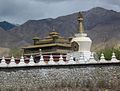
Samye Monastery in 1936
View of Samye Monastery's court, photographed in 1936 by Hugh Edward Richardson.

The Testament of Ba provides the earliest date for the construction of the temple, recording that the foundation was set in the "hare year" (either 763 or 775) and the completion and consecration of the main shrine taking place in the "sheep year" (either 767 or 779).[2] The Blue Annals of 1476 use later dates of 787 and 791, but those dates contradict the historical dates of Shantaraksita's ordination of monks in 779, and his arrival in 763. All accounts concur that the patron was King Trisong Detsen.[3]

Design

[edit]

The building plan of Samye Monastery follows the arrangement of a mandala depicting the Buddhist cosmos, which is also the source for the design of Odantapuri, in present-day Bihar, India.[4] The arrangement of the monastery had a main shrine building in the middle, enclosed by four symmetrical stupas of four different colors, and the whole surrounded by a circular wall with four openings at the cardinal points representing the Buddhist universe as a three dimensional mandala. This idea is found in a number of temples of the period in South East Asia and East Asia such as the Tōdai-ji in Japan.[5] As at the Tōdai-ji, the Samye temple is dedicated to Vairocana. A seminal text of Vairocana is the Mahavairocana Tantra, composed in India in the seventh century and translated into Tibetan and Chinese soon after.[6]

Detail of the inscribed pillar at Samye Monastery, photographed in 1949 by Hugh Edward Richardson. University of Oxford. Available at: http://tibet.prm.ox.ac.uk/photo_2001.59.13.38.1.html

The Samye Pillar, རྡོ་རིང་ and its inscription The few accessible Tibetan historical records are pillar inscriptions of treaties and events, found in Lhasa and elsewhere. Samye Monastery has a stone pillar belonging to the eighth century proper—but not carrying an actual date— (རྡོ་རིང་) preserved in front of Samye.[7] The pillar records the building of sSamye and other monasteries at Lhasa and Brag Mar, and records that the king, ministers and other nobles had made solemn oaths to preserve and protect the endowments of the monasteries. The term used for these endowments is 'necessities' or 'meritorious gifts' (Tib. ཡོ་བྱད་ Sanskrit deyadharma).[8]

The Samye bell inscription A second dynastic record at Samye is on the large bronze bell in the entrance to the monastery. This gives an account of the making of the bell by one of the queens of King Trisong Detsen. The text has been translated as follows:[9] "Queen Rgyal mo brtsan, mother and son, made this bell in order to worship the Three Jewels of the ten directions. And pray that, by the power of that merit, Lha Btsan po Khri Srong lde brtsan, father and son, husband and wife, may be endowed with the harmony of the sixty melodious sounds, and attain supreme enlightenment."

Samye Monastery's founding

[edit]

According to the Testament of Ba and other accounts, such as that compiled by Bsod-nams-rgyal-mtshan (1312–1374), the Indian scholar and philosopher Khenpo Śāntarakṣita began constructing the monastery c.763 after accepting the king's invitation to come to Tibet, where he also taught his synthesis of Madhyamaka philosophical thought.[10][11] Finding the Samye site auspicious, he set about to build a structure there. However, the building would always collapse after reaching a certain stage. Terrified, the construction workers believed that there was a demon or obstructive spirit in a nearby river making trouble.

Following his advice, the king invited Shantaraksita's contemporary Padmasambhava to come to Tibet, and he arrived from the Nepali border and was able to subdue the energetic problems obstructing the building of Samye. According to the 5th Dalai Lama,[12] Padmasambhava performed the Vajrakilaya dance and enacted the rite of namkha to assist Trisong Detsen and Śāntarakṣita clear away obscurations and hindrances in the building of Samye:

The great religious master Padmasambhava performed this dance in order to prepare the ground for the Samye Monastery and to pacify the malice of the lha [local mountain god spirits] and srin [malevolent spirits] in order to create the most perfect conditions."[13] He went on to say that after Padmasambhava consecrated the ground, he erected a thread-cross — a web colored thread woven around two sticks — to catch evil. Then the purifying energy of his dance forced the malevolent spirits into a skull mounted on top of a pyramid of dough. His tantric dance cleared away all the obstacles, enabling the monastery to be built by 767. This pacifying dance was reinforced by the construction of four Vajrakilaya stupas, as monuments honoring the ritual kilya (purba) daggers, at the cardinal points of the monastery where they would prevent demonic forces from entering the sacred grounds.[14])

At the time in which Samye Monastery was built, it automatically became a Nyingma school monastery since this original school of Tibetan Buddhism was the only school, while the king, queens, students and subjects all belonged to the Nyingma school sangha. Padmasambhava's Tantra Vajrayana thus became the third vehicle of Buddhism,[15] after the Sutra Mahayana.

Author Ellen Pearlman suggests a chart of the origin of the institution of the Nechung Oracle as it relates to Samye Monastery:

When Padmasambhava consecrated Samye Monastery with the Vajrakilaya dance, he tamed the local spirit protector, Pehar Gyalpo, and bound him by oath to become the head of the entire hierarchy of Buddhist protective spirits. Pehar, later known as Dorje Drakden, became the principal protector of the Dalai Lamas, manifesting through the Nechung Oracle.[16]

The Great Samye Debate

[edit]

One of the important events in the history of Samye occurred after Shantaraksita passed and a dispute began among his followers,[10] that grew into an debate between the Buddhist schools. Kamalasila represented Indian Buddhist theory and Hosang Mahayana represented Chinese Buddhist theory.[10] The debate was hosted by Trisong Detsen in the early 790s. A source provides a five-year range when Kamalasila and Mahayana (Moheyan of the East Mountain Teaching of Chan Buddhism) may have debated at Samye in Tibet. The outcome was that Kamalasila who was representing Shantaraksita's philosophical thought won the debate, as was decided by the king.

As is well known, the fate of Chan in Tibet was said to have been decided in a debate at the Samye monastery.[17]

Jeffrey Broughton identifies the Chinese and Tibetan nomenclature of Moheyan's teachings and identifies them principally with the China's East Mountain Teaching:

Mo-ho-yen's teaching in Tibet as the famed proponent of the all-at-once gate can be summarized as "gazing-at-mind" ([Chinese:] k'an-hsin... [...] [Tibetan:] sems la bltas) and "no examining" ([Chinese:] pu-kuan [...] [Tibetan:] myi rtog pa) or "no-thought no-examining" ([Chinese:] pu-ssu pu-kuan... [...] [Tibetan:] myi bsam myi rtog). "Gazing-at-mind" is an original Northern (or East Mountain Dharma Gate) teaching. As will become clear, Poa-t'ang and the Northern Ch'an dovetail in the Tibetan sources. Mo-ho-yen's teaching seems typical of late Northern Ch'an. Mo-ho-yen arrived on the central Tibetan scene somewhat late in comparison to the Ch'an transmissions from Szechwan.[18]

A commemorative annual cham dance is held at Kumbum Monastery in Amdo (Ch. Qinghai) when the great debate of the two principal debators or dialecticians, Mahayana (Moheyan) and Kamalaśīla is narrated and depicted.[19]

Influences

[edit]

The 18th century Puning Temple built by the Qianlong Emperor of Qing China in Chengde, Hebei was modeled after Samye.

Architectural features of the monastery and their history

[edit]

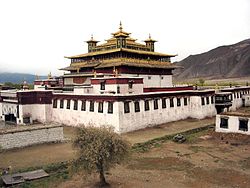
Samye Monastery is laid out on the shape of a giant mandala; in its center lies the main temple representing the legendary Mount Meru. Other buildings stand at the corners and cardinal points of the main temple, representing continents and other features of tantric Buddhist cosmology. The three-storied main building has been designed with the first floor in Indian style, the second in Chinese style and the third in Khotanese (Tibetan) style. The original building was completed in 780 CE.

In corners are 4 chörtens - white, red, green (or blue) and black. There are 8 main temples:

  • Dajor ling བརྡ་སྦྱོར་གླིང་ (brda sbyor gling)
  • Dragyar ling སྒྲ་བསྒྱར་གླིང་ (sgra bsgyar gling)
  • Bétsa ling བེ་ཙ་གླིང་ (be tsa gling)
  • Jampa ling བྱམས་པ་གླིང་ (byams pa gling)
  • Samten ling བསམ་གཏན་གླིང་ (bsam gtan gling)
  • Natsok ling སྣ་ཚོགས་གླིང་ (sna tshogs gling)
  • Düdül ling བདུད་འདུལ་གླིང་ (bdud 'dul gling)
  • Tamdrin ling རྟ་མགྲིན་གླིང་ (rta mgrin gling)

The original buildings have long disappeared. They have been badly damaged several times — by civil war in the 11th century[citation needed], fires in the mid 17th century[citation needed] and in 1826[citation needed], an earthquake in 1816[citation needed], and in the 20th century, particularly during the Cultural Revolution. As late as the late 1980s pigs and other farm animals were allowed to wander through the sacred buildings[citation needed]. Heinrich Harrer quoted his own words he said to the 14th Dalai Lama of what he saw in 1982 from his airplane en route to Lhasa,

"On our approach, in the Brahmaputra valley, the first terrible sight we saw confirmed all the bad news about Tibet's oldest monastery, Samye; it was totally destroyed. One can still make out the outer wall, but none of the temples or stupas survives."[20]

Each time it has been rebuilt, and today, largely due to the efforts of Choekyi Gyaltsen, 10th Panchen Lama from 1986 onward, it is again an active monastery and important pilgrimage and tourist destination.[21] Samye still preserves the original design of Trisong Detsen the 8th century Tibetan monarch (Van Schaik 2013:36).

Recent events

[edit]

Imprisonment and suicide

[edit]

In 2009, the Tibetan Centre for Human Rights and Democracy (TCHRD) reports that after a protest held on 15 March 2008 at the Samye government administrative headquarters in Dranang County, nine monks studying at Samye Monastery had been sentenced to prison terms varying from two to fifteen years, for participating. The monks were joined by hundreds of Tibetans demanding religious freedom, human rights for Tibetans and the return of the Dalai Lama to Tibet. The monks and others were held at the Lhoka Public Security Bureau (PSB) Detention Centre.

The TCHRD also reported that on 19 March 2008, a visiting scholar from Dorje Drak Monastery, Namdrol Khakyab, who claimed responsibility for organizing the 15 March protest had committed suicide, leaving a note speaking of unbearable suppression by the Chinese regime, citing the innocence of other monks of the monastery, and taking full responsibility for the protest.[22]

Statue of Padmasambhava dismantled by Chinese Authorities

[edit]

In May 2007, a 30 ft (9 metre) gold and copper plated statue of Guru Rinpoche, known as Padmasambhava, at Samye Gompa, and apparently funded by two Chinese devotees from Guangzhou in the southern Chinese province of Guangdong, was reportedly demolished by Chinese authorities.[23]

See also

[edit]
[edit]

Notes

[edit]

References

[edit]
[edit]
Revisions and contributorsEdit on WikipediaRead on Wikipedia
from Grokipedia

Samye Monastery is the first Buddhist monastery constructed in Tibet, established in the late eighth century CE during the reign of King Trisong Detsen (r. c. 755–794) with the guidance of the Indian abbot Śāntarakṣita and the tantric practitioner Padmasambhava from Oḍḍiyāna. Located in the Chimbu Valley south of Lhasa in present-day Dranang County, the complex features a distinctive mandala layout symbolizing the Buddhist cosmos, centered on the three-story Ütse temple representing Mount Meru, flanked by structures evoking the four continents and encircled by a protective wall. This architectural innovation, modeled partly on the Indian monastery of Odantapuri and incorporating elements of Indian, Chinese, and Tibetan styles, marked a foundational step in institutionalizing Buddhism in the region. Samye's historical significance includes hosting the Samye Debate (c. 793–797 CE), where proponents of gradual enlightenment prevailed, shaping Tibetan Buddhist doctrine and monastic ordination practices that persisted for centuries. Despite later renovations, destructions, and reconstructions—driven by fires, invasions, and political upheavals—the site remains a key Nyingma lineage center and testament to early Tibetan engagement with Indian Buddhist traditions.

History

Founding and Construction

Samye Monastery, Tibet's inaugural Buddhist monastic complex, was established in the late under the patronage of King (r. c. 755–797 CE), who sought to institutionalize as a amid competition from indigenous Bön practices. The project was initiated following the king's invitation of the Indian scholar-monk Śāntarakṣita, abbot of , who arrived in around 763 CE and commenced construction at the selected site in the Yarlung Valley, near the confluence of the Tsangpo River and smaller tributaries, chosen for its geomantic significance resembling the Indian monastic center of . Initial efforts faltered, with structures repeatedly collapsing due to attributed interference from local deities and spirits resistant to foreign religious imposition, prompting Śāntarakṣita to recommend summoning a tantric specialist. To overcome these obstacles, invited the tantric master (also known as Guru Rinpoche) from Uḍḍiyāna (modern Swat Valley region) around 767–775 CE, who performed rituals to subjugate and convert the obstructive entities, enabling construction to proceed. collaborated with Śāntarakṣita on the monastery's design, incorporating Indian architectural principles while adapting to Tibetan terrain; the complex was completed and consecrated by approximately 779 CE, marking the formal ordination of Tibet's first seven monks (sad mi bdun) under Śāntarakṣita's guidance and establishing monastic discipline. The endeavor involved thousands of laborers, including corvée from subjects across the , and symbolized the monarch's consolidation of power through religious legitimation, with resources drawn from royal treasuries and tributes. The construction adhered to a layout, with the central temple (Ütse) representing , surrounded by four directional shrines symbolizing continents, though full implementation spanned years and included iterative repairs to withstand seismic activity and material degradation in the high-altitude environment. Historical records, such as Tibetan chronicles, emphasize the project's scale—encompassing walls, gates, and over 100 subsidiary structures—but note discrepancies in exact timelines due to reliance on later hagiographic accounts blending factual events with legendary elements, such as Padmasambhava's subjugation narratives. This foundational phase cemented Samye's role as a translational hub for Buddhist texts and practices from into Tibetan, fostering the synthesis of Indian , , and indigenous elements.

The Great Samye Debate

The Great Samye Debate, also known as the Council of Lhasa in some accounts, refers to a purported philosophical confrontation held at Samye Monastery circa 792–794 CE under the patronage of Tibetan king (r. 755–797 CE). According to traditional Tibetan historical narratives, the event arose amid tensions between proponents of Indian Mahayana , represented by the monk Kamalaśīla (c. 713–763 CE), a disciple of , and advocates of Chinese Chan () , led by the monk Moheyan (Heshang Moheyan). The core dispute centered on the path to enlightenment: Kamalaśīla defended a gradualist approach emphasizing ethical , study of scriptures, logical analysis, and meditative cultivation in stages, as outlined in his Bhāvanākrama ("Stages of ") treatises composed in response to the proceedings. In contrast, Moheyan argued for sudden enlightenment through immediate cessation of conceptual thought and dualistic mind-activity, without reliance on scriptural study or gradual practices, aligning with Chan principles of direct insight into the mind's innate purity. Tibetan sources, such as later chronicles like the Testament of Ba and accounts from the 12th–14th centuries, assert that adjudicated the debate in favor of Kamalaśīla after two years of deliberations, reportedly involving tests like writing responses on the spot or symbolic proofs (e.g., blood from a pricked finger flowing differently to signify vital energy). This outcome allegedly led to the endorsement of Indian gradualist philosophy as the orthodox path in , the of the first Tibetan monks under Indian rites, and the expulsion or marginalization of Chinese Chan influences, solidifying the dominance of sutra-based, scholastic over antinomian meditative traditions. Chinese records, however, present a divergent view, claiming Moheyan's position prevailed or that no formal defeat occurred, with some texts suggesting harmonious resolution or Moheyan's teachings persisting in Tibetan esoteric lineages. Modern scholarship casts doubt on the debate's historicity as a singular, dramatic event, viewing it instead as a retrospective construct in Tibetan historiography to legitimize the importation of Indian and suppress Chan influences amid imperial politics and cultural synthesis. No contemporary Tibetan or Chinese documents directly corroborate the detailed confrontations; the earliest references appear in 11th–12th-century Tibetan texts, potentially amplified during periods of sectarian consolidation, such as under the later diffusion of (phyi dar). Critics argue the narrative serves ideological purposes, portraying Indian scholasticism as triumphant over "quietist" Chan to align with 's adoption of monastic hierarchies and discipline, though archaeological and manuscript evidence confirms Chan texts circulated in pre-794 CE, indicating hybrid influences persisted. This meta-narrative underscores how Tibetan accounts privilege causal efficacy of doctrinal debate in shaping religious institutions, yet empirical traces suggest a more gradual, multifaceted resolution rather than a decisive showdown.

Post-Debate Developments and Decline

Following the Great Debate, Samye Monastery maintained its role as Tibet's premier Buddhist institution under King Trisong Detsen's successors, particularly Ralpacan (r. 815–836 CE), who intensified patronage by inviting additional Indian scholars such as Jinamitra, Surendrabodhi, and Prajñavarman to accelerate scriptural translations into Tibetan. This era saw expanded monastic ordinations and doctrinal consolidation favoring the Indian gradualist approach, with Samye serving as the hub for practices rooted in Padmasambhava's legacy. The monastery's prominence waned sharply during the reign of (r. 836–842 CE), Trisong Detsen's descendant, who enacted policies suppressing institutional to revive influences and reduce monastic economic power. He ordered major monasteries, including Samye, closed, forcing s to disrobe or return to lay life, which dismantled the ordained and halted organized teachings at the site. While some accounts debate the persecution's severity—ranging from total destruction to mere patronage withdrawal—the outcome was a precipitous decline in Samye's activities, as evidenced by the dispersal of its community and abandonment amid the Tibetan Empire's fragmentation after Langdarma's in 842 CE by a , possibly linked to Samye's former leadership. Subsequent civil wars and regional splintering in the late 9th and 10th centuries left Samye in ruins, with Buddhist practice surviving only through terma traditions and lay lineages until the later dissemination phase around the 10th–11th centuries. The site's physical structures deteriorated without maintenance, symbolizing the broader eclipse of centralized until revival efforts under figures like Lhalama Yeshe Ö (d. 1024 CE).

20th-Century Disruptions and Restorations

The Chinese People's Liberation Army invaded on October 7, 1950, initiating a process of political and military incorporation that profoundly impacted religious sites like Samye Monastery. By 1951, the was signed under duress, affirming Chinese sovereignty and leading to gradual suppression of Tibetan autonomy and monastic autonomy. Tensions escalated in the 1950s, with reforms imposed on monastic landholdings and monk populations, reducing Samye's resident monks from historical highs to minimal numbers as Chinese administrative control tightened. The 1959 Lhasa uprising marked a violent escalation, with Tibetan resistance against Chinese forces resulting in widespread destruction of religious infrastructure; Samye, as a key center, suffered looting and partial damage during the conflict, after which the fled into exile and monastic activities were further curtailed. The (1966–1976) inflicted the most devastating blows, with Samye completely destroyed—its temples razed, murals and statues obliterated, and surviving monks imprisoned, disrobed, or executed amid a broader campaign that demolished over 6,000 Tibetan monasteries. Restoration commenced in the late 1970s following Mao Zedong's death and Deng Xiaoping's economic reforms, which permitted limited religious revival. In 1984, Ngawang Gyalpo was appointed to oversee rebuilding, with local Tibetan efforts reconstructing the central temple and layout using funds from pilgrims and state allocations. By 1990, major reconstruction phases were complete, restoring Samye's core structures, though initial repairs employed rather than traditional materials, reflecting resource constraints and modern influences. These efforts revived monastic life, allowing a small community of monks to resume practices, albeit under ongoing Chinese regulatory oversight.

Architecture and Layout

Symbolic Design and Influences

The architectural layout of Samye Monastery embodies a vast , symbolizing the Buddhist cosmological model of the universe as described in tantric texts. At its core stands the Ütse, the main temple, representing , the sacred and central mountain of the cosmos surrounded by concentric rings of oceans, continents, and sub-continents. This design integrates the physical structure with spiritual symbolism, where of the complex ritually enacts the practitioner's journey through enlightened realms. Enclosing the mandala are two concentric rectangular walls, with the inner wall featuring four directional temples corresponding to the four major continents—Purvavideha to the east, Jambudvipa to the south, Aparagodaniya to the west, and to the north—flanked by eight smaller structures for the sub-continents. The outer wall includes additional chapels and gates aligned with cardinal directions, reinforcing the geometric precision of the to facilitate meditation on impermanence and interdependence. Samye's design draws primary influence from Indian Buddhist viharas, specifically modeled after the Mahavihara in present-day , , which itself reflected Meru-centric cosmology. The Ütse temple incorporates three distinct architectural styles across its stories to symbolize the synthesis of Indian, Chinese, and traditions: the base in Indian pagoda form, the middle in multistoried Chinese pavilion style, and the upper in Tibetan cubic structure with golden roofs. This eclectic approach, commissioned by King , aimed to harmonize doctrinal influences amid early Tibetan Buddhism's development, though the predominance of Indian elements underscores Shantarakshita's foundational role.

Central Structures

The Utse, or main temple, forms the core of Samye Monastery's central structures, symbolizing as the in . This nine-story edifice, though often described in terms of its three primary floors, integrates architectural influences from Indian, Chinese, and Tibetan traditions to reflect the synthesis of Buddhist transmission to . The ground floor of the Utse functions as the primary assembly hall, housing statues of Sakyamuni Buddha flanked by attendant bodhisattvas and depictions of Guru , the figure credited with subduing local spirits to enable the monastery's construction. The second floor enshrines larger images of and associated tantric deities, while the upper floor adopts an Indian vihara-style design, emphasizing the doctrinal origins of in . Encircling the Utse are four stupas at the cardinal directions, each painted in distinct colors—red, white, black, and green—to represent the who guard the Buddhist . These stupas, positioned at the corners of an inner rectangular wall, demarcate the sacred core and align with the mandala's representation of the four continents surrounding .

Peripheral Features

The Samye Monastery complex is encircled by an oval-shaped protective wall, approximately 3.5 meters high and 1.2 meters thick, which delineates the sacred perimeter and symbolizes the boundary of the Buddhist cosmos. This wall is adorned with 1008 miniature stupas along its crest, representing the enlightened qualities of and serving as a defensive and . At the of the enclosure stand large stupas painted in distinct colors—red, green, black, and white—positioned to guard against natural calamities and embody directional protections in Tibetan . These stupas, integral to the layout, align with the cardinal directions and reinforce the monastery's role as a microcosm of the universe. Surrounding the central Utse temple are four subsidiary temples corresponding to the of Buddhist lore: the southern Jowo temple for (the human realm), and others to the north, east, and west representing the divine, anti-god, and elephant-voiced continents. These peripheral structures, along with associated lakes and hills mimicking cosmic features, complete the symbolic geography of Samye, though many have been reconstructed following historical damages.

Religious and Cultural Significance

Establishment of Tibetan Buddhism

King (r. 755–797 CE), the 38th ruler of the , actively promoted as a state-supported religion to consolidate imperial authority and cultural integration, commissioning the construction of Samye Monastery as Tibet's inaugural Buddhist monastic complex around 763–767 CE under the guidance of the Indian abbot Shantarakshita. Shantarakshita, drawing from Indian monastic models like , initiated the project but encountered supernatural and environmental obstacles attributed to local spirits, prompting to invite the tantric master (Guru Rinpoche) from around 767 CE. 's rituals subdued these forces, enabling completion of the monastery by approximately 779 CE and facilitating the ordination of the first seven Tibetan monks, known as the "seven awakened ones of Tibet," thus establishing the initial monastic . The founding of Samye marked the institutionalization of and Buddhism in through systematic translation of Indian scriptures into Tibetan, led by Shantarakshita, , and subsequent scholars like Jinamitra and Surendrabodhi, creating the foundational texts of . In 779 CE, erected an inscription pillar at Samye enshrining edicts that formalized 's role, prohibiting practices in monastic contexts and mandating adherence to Indian discipline, thereby embedding within Tibetan governance and society. Samye's establishment during the "early dissemination" (ngadar) phase laid the groundwork for Tibetan Buddhism's unique synthesis of Indian exoteric and esoteric traditions with indigenous elements, serving as the primary center for doctrinal propagation and monastic training until the 9th-century persecution under King . This foundational role positioned Samye as the origin point for the school's longevity and influenced subsequent Tibetan lineages, despite later imperial shifts.

Nyingma Tradition and Ongoing Practices

Samye Monastery functions as a central hub for the school, the earliest lineage of , which originated with the site's establishment in the 8th century under Padmasambhava's guidance and emphasizes direct transmission of esoteric teachings including , the "Great Perfection" doctrine viewed as the ultimate realization of non-dual awareness. Unlike later Tibetan schools that prioritize structured , Nyingma practices at Samye integrate tantric rituals from the inner yogas—Mahayoga (deity generation), Anuyoga (energy channels), and Atiyoga (spontaneous presence)—alongside the terma tradition of concealed treasures revealed by tertöns to adapt teachings to specific eras and practitioners. This approach, rooted in Padmasambhava's subjugation of local spirits and integration of indigenous elements, privileges experiential insight over doctrinal debate, as evidenced by the monastery's historical role in ordaining Tibet's first seven monks in 779 CE. Contemporary monastic life at Samye sustains customs through daily routines of meditation, scriptural study, and ritual performances dedicated to Guru Rinpoche (), including recitations from terma cycles like the Padma Kathang biography. Monks, primarily from the lineage, undertake extended retreats—such as the traditional three-year, three-month, and three-day seclusion—in over 175 hillside hermitages surrounding the complex, focusing on practices to cultivate innate . Communal observances feature tantric empowerments, fire pujas, and cham masked dances during annual festivals, drawing pilgrims for circumambulations of the mandala-like layout symbolizing and the four continents. As a destination, Samye facilitates lay participation in offerings, prostrations, and mantra repetitions honoring its founding masters, reinforcing 's emphasis on guru devotion and visionary experiences over institutional . Post-1980s restorations have enabled modest revival of these activities, though under state oversight limiting scale and autonomy, with the site's estimated resident monk population supporting ongoing transmission amid broader Himalayan networks. This persistence underscores Samye's causal role in perpetuating unaltered lineages, as terma revelations continue to emerge globally, adapting ancient practices to contemporary contexts without reliance on centralized authority.

Broader Impact on Himalayan Buddhism

Samye Monastery's establishment in 779 CE under King marked the institutionalization of in , providing a foundational model for organization that extended to Himalayan regions such as , Nepal's border areas, and . As the site of the first ordinations of seven Tibetan monks by the Indian master using the , Samye introduced standardized monastic discipline emphasizing ethical precepts, study, and meditation, which became normative across Tibetan-influenced Buddhist communities. This framework facilitated the transition from shamanistic practices to structured Vajrayāna institutions, enabling the sustained transmission of tantric lineages that later proliferated in Bhutanese monasteries and Ladakhi establishments. The doctrinal outcomes of the Great Debate at Samye, circa 792–794 CE, affirmed the Indian gradualist path of scriptural study and ritual practice over Chinese Chan sudden enlightenment, embedding Mahāyāna and Vajrayāna elements into Tibetan Buddhism's core. This resolution, documented in Tibetan chronicles, ensured a synthesis of and esoteric teachings that influenced Himalayan Buddhism's emphasis on guru-disciple transmission and , evident in Nepalese Tibetan exile communities and Bhutanese ngakpa traditions. Samye's role as a center for Indian texts further disseminated key sūtras and tantras, preserving lineages like those of that shaped regional practices resistant to purely meditative or indigenous syncretisms. Architecturally, Samye's layout—centering the Ütse temple as amid symbolic continents and temples—served as a prototype replicated in Himalayan sites, reinforcing cosmological symbolism in monastic planning from central to Bhutanese dzongs and Ladakhi gompas. This design not only encoded tantric cosmology but also promoted communal rituals that unified diverse ethnic groups under Buddhist , contributing to cultural cohesion amid geographic isolation. The monastery's enduring significance lies in its causal role as the origin point for Tibetan Buddhism's export, with practices originating there informing broader Himalayan tantric adaptations despite later sectarian diversifications.

Controversies and Modern Events

Cultural Revolution Damage

During China's from 1966 to 1976, Samye Monastery was completely destroyed, with its central temple, surrounding chapels, and other structures systematically razed by and local authorities enforcing anti-religious policies. This devastation aligned with Mao Zedong's directive to eradicate the ""—old ideas, culture, customs, and habits—targeting Buddhist sites as symbols of feudalism and superstition, resulting in the loss of ancient murals, statues, scriptures, and architectural elements that had survived prior centuries. The monastery's monastic population was dispersed, with residents subjected to persecution, forced labor, or disrobing, though precise figures for Samye remain undocumented amid the broader Tibetan monastic collapse, where over 6,000 monasteries nationwide were ransacked. The extent of the destruction left the site in ruins by the late 1970s, with eyewitness accounts from returning explorers like in 1982 confirming the site's near-total obliteration, including the demolition of irreplaceable artifacts central to Tibetan Buddhism's origins. Tibetan-language historical records corroborate this, attributing the annihilation to coordinated campaigns that spared few religious complexes in central , prioritizing ideological purity over cultural preservation. No original 8th-century fabric survived intact, rendering modern reconstructions reliant on historical descriptions rather than physical remnants.

2007 Padmasambhava Statue Demolition

In May 2007, during the Tibetan Buddhist holy month of Saga Dawa, Chinese People's Armed Police demolished a nearly completed 30-foot-high (9-meter) statue of Padmasambhava (Guru Rinpoche) at Samye Monastery in Tibet's Shannan Prefecture. The statue, constructed from gold- and copper-plated materials and funded by donations from two Chinese Buddhist laypeople, had been under construction since at least February 2007 without prior governmental approval. On June 9, 2007, the Democratic Management Committee of Samye Monastery issued an official statement acknowledging the "removal" of the structure, asserting that its construction violated China's Law on the Protection of Cultural Relics by altering the site's historical landscape and lacking required permits. Authorities described the action as necessary to preserve Samye's status as a protected cultural heritage site, emphasizing that unauthorized modifications threatened its authenticity as Tibet's first Buddhist monastery founded in the 8th century. Tibetan sources, including reports from monks and local observers, portrayed the demolition as an abrupt intervention that dispersed workers and left debris, with initial secrecy enforced to limit information flow. The incident drew criticism from Tibetan advocacy groups, who viewed it as part of broader restrictions on religious expression and site modifications deemed incompatible with state oversight of . holds foundational significance at Samye, credited in tradition with subduing local spirits to enable the monastery's construction under King Trisong Detsen, making the statue's removal symbolically charged for devotees. No large-scale protests occurred at the site, though the event contributed to documented tensions over cultural preservation amid administrative controls.

Chinese Administrative Policies and Tibetan Responses

Following the incorporation of Tibet into the People's Republic of China in 1951, administrative oversight of Samye Monastery shifted to state entities, with the central government assuming responsibility for major renovations and site protection. A dedicated project for preserving antiques at Samye was completed as part of broader initiatives in the (TAR), emphasizing state-sponsored maintenance to counter decay from prior periods. However, these efforts coexist with regulatory frameworks mandating Communist Party of China (CPC) control over monastic management, including the supervision of and lama selections, which critics argue subordinates Tibetan Buddhist institutions to political directives. In , Chinese authorities discontinued a prior arrangement permitting compliant monastic , imposing direct administrative rule on key Tibetan monasteries to enforce "stability maintenance" measures, such as mandatory political study sessions and . At Samye, this manifested in restrictions on monk enrollment and activities, aligned with national policies limiting religious personnel and prohibiting unauthorized teachings or communications. For instance, in April 2020, Samye was temporarily closed alongside other sites under the pretext of prevention, reflecting broader patterns of using rationales for access controls. The , ostensibly non-political, has facilitated these policies by promoting "" of , including reinterpreting doctrines to align with socialist values and relocating clergy for state-approved training. Tibetan responses at Samye have included organized protests against perceived cultural erosion. On March 18, 2008, during widespread unrest in , Samye staged a peaceful demonstration decrying administrative overreach and restrictions on religious practice, prompting arrests and heightened security deployments. Individual dissent has led to severe repercussions; for example, Gyaltsen from Samye received a 15-year sentence in 2011 for activities deemed subversive by authorities, including disseminating information on monastic conditions. Exile Tibetan organizations and monitors document ongoing grievances, such as forced participation in patriotic education campaigns, which view as undermining doctrinal , though Chinese state narratives frame such measures as essential for national unity and heritage preservation. These tensions persist amid tourism promotion at Samye, where locals report tacit stifling open religious expression.

References

Add your contribution
Related Hubs
User Avatar
No comments yet.