Hubbry Logo
M60 machine gunM60 machine gunMain
Open search
M60 machine gun
Community hub
M60 machine gun
logo
8 pages, 0 posts
0 subscribers
Be the first to start a discussion here.
M60 machine gun
M60 machine gun
from Wikipedia

The M60, officially the Machine Gun, Caliber 7.62 mm, M60, is a family of American general-purpose machine guns firing 7.62×51mm NATO cartridges from a disintegrating belt of M13 links. There are several types of ammunition approved for use in the M60, including ball, tracer, and armor-piercing rounds.[5]

Key Information

It was adopted in 1960 and issued to units later that year. It has served with every branch of the U.S. military and still serves with the armed forces of other nations. Its manufacture and continued upgrade for military and commercial purchase continues into the 21st century, although it has been replaced or supplemented in most roles by other designs, most notably the M240 machine gun in U.S. service.[8]

Overview

[edit]
A camouflaged infantryman armed with an M60 machine gun.

The M60 is a belt-fed machine gun that fires the 7.62×51mm NATO cartridge (similar to .308 Winchester), which is commonly used in larger rifles, such as the M14. The gun's weight and the amount of ammunition it can consume when firing make it difficult for a single soldier to carry and operate, so it is generally used as a crew-served weapon, operated by a team of two or three individuals. The team consists of the gunner, the assistant gunner (AG), and the ammunition bearer. The gunner carries the weapon and between 200 and 1,000 rounds of ammunition depending on strength and stamina. The assistant carries a spare barrel and extra ammunition and reloads and spots targets for the gunner. The ammunition bearer carries additional ammunition and the tripod with associated traversing and elevation mechanism (if issued) and fetches more ammunition as needed during firing.[citation needed]

A U.S. airman firing an M60 from the standing position during the Defender Challenge competition in 1988.

The M60 can be accurately fired at short ranges from the shoulder thanks to its design. This was an initial requirement for the design and a hold-over in concept from the M1918 Browning Automatic Rifle. It may also be fired from the integral bipod, M122 tripod, and some other mounts.[9]

M60 ammunition comes in a cloth bandolier containing a cardboard box of 100 pre-linked rounds. The M60 uses the M13 ammunition link, a change from the older M1 link system with which it was not compatible. The cloth bandolier is reinforced to allow it to be hung from the current version of the feed tray. Historically, units in Vietnam used B3A cans from C-rations packs locked into the ammunition box attachment system to roll the ammunition belts over for a straighter and smoother feed to the loading port to enhance reliability of feed. The later models changed the ammunition box attachment point and made this adaptation unnecessary.[10]

The M60 has been adopted by various military agencies around the world. It also has been updated and modernized throughout the years to meet modern military requirements.[citation needed]

History

[edit]
The experimental T-44 machine gun developed from the German FG 42 and MG 42 machine guns.[11]

The M60 machine gun began development in the late 1940s as a program for a new, lighter 7.62 mm machine gun. It was partly derived from German guns of World War II (most notably the FG 42 and the MG 42),[12][13] but it contained American innovations as well. The final evaluation version was designated the T161E3. It was intended to replace the M1918 Browning Automatic Rifle and M1919A6 Browning machine gun in the squad automatic weapon role, and in the medium machine gun role. One of the weapons tested against it during its procurement process was the FN MAG.

The U.S. Army adopted the T161E3 as the M60 in 1957.[14] The decision to adopt the M60 instead of foreign designs, like modified versions of the proven German MG 42 or the still-unproven FN MAG, was largely due to Congressional requirements that preference be given to the designs of U.S. arms manufacturers primarily to avoid licensing fees, but also to support U.S. firms.

Vietnam War

[edit]
An M60 machine gun being used during the Vietnam War in 1966.

Many U.S. units used the M60 during the Vietnam War as a squad automatic weapon. Every soldier in the rifle squad would carry an additional 200 linked rounds of ammunition for the M60, a spare barrel, or both. The up-gunned M113 armored personnel carrier added two M60 gunners beside the main .50-caliber machine gun while the Patrol Boat, River had one in addition to two .50-cal mounts.[15]

The M60 received the nickname "The Pig" due to its bulky size and appetite for ammunition.[16][17] Vietnam's tropical climate harshly affected weapons, and the M60 was no exception. Its light weight led to it being easily damaged and critical parts like the bolt and operating rod wore out quickly. Even so, soldiers appreciated the gun's handling, mechanical simplicity, and effective operation from a variety of firing positions. United States Navy SEALs used M60s with shorter barrels and no front sights to reduce weight. Some SEALs had feed chutes from backpacks to have a belt of hundreds of rounds ready to fire without needing to reload.[18]

Many incidents demonstrated the effectiveness of the M60 in combat. In 1966, Medal of Honor recipient Lance Corporal Richard Pittman, a Marine with 1/5 (1st Battalion/5th Marine Regiment), used the M60 to engage superior elements of the 324th North Vietnamese Army (NVA) Division, defeating two enemy machine gun positions and suppressing enemies in his immediate vicinity, then advancing another 50 meters into the face of more attacking NVA.[19]

Marine fires his M60 machine gun at an enemy position during the Battle of Huế in Vietnam War.

In the 1980s, the Army partially replaced the M60 by the M249 Squad Automatic Weapon within infantry squads. Their new doctrine reduced the general-purpose machine gun role in favor of portability and a greater volume of fire. However, many disliked the M249, which was less reliable, accurate, and long-ranged,[20] and fired a 5.56 mm round that was lighter than the M60's 7.62 mm round. The M60 was retained in the vehicle-mounted and the general-purpose roles due to its greater power and range.[18]

The U.S. Marine Corps, which became concerned about the M60's reliability, weight, and the high round counts, adopted the M60E3 to replace most original M60s in infantry units. The M60E3 was five pounds lighter than the original M60. It included a forward pistol grip and had the bipod mounted to the receiver rather than the barrel. The weapon still was not durable and its performance was reduced.[18]

In the early 1990s, Saco Defense addressed Navy Special Warfare requirements to develop a retrofit parts package for the machine gun. Called the M60E4, it was more reliable and durable than the M60E3, had a "duckbill" flash suppressor, and a shorter and thicker positive lock gas cylinder extension. The first NAVSPECWAR units received it in late 1994, when it was designated the Mk 43 Mod 0.[18]

A 19th Special Forces Group soldier mans an M60 machine gun on a Humvee in Afghanistan in March 2004. An AT4 anti-armor recoilless gun can be seen in the foreground.

In January 1994, the U.S. Army began the Medium Machine Gun Upgrade Kit program. The only two competitors were M60 and M240 versions. Saco offered an "enhanced" M60E3 with improved parts, and FN offered the M240 variant of its MAG; both weapons were upgrade kits of weapons already in service. Eighteen guns of each were tested until December 1995. There were two main performance areas: mean rounds between stoppages (MRBS-jams) and mean rounds between failures (MRBF-parts breaking). 50,000 rounds were fired through both guns. The M240 had 2,962 MRBS and 6,442 MRBF, compared to the M60's 846 MRBS and 1,669 MRBF. As a result, the M240 was declared the winner and accepted into infantry service. Although the M60 was lighter, had better balance, was more controllable, and there were many in the inventory, it did not work reliably enough.[18] Starting with Ranger battalions, the U.S. Army began adopting and modifying M240 variants to replace their remaining M60s in the early 1990s.

The M60, though largely phased out, continued to be used in the 21st century by U.S. Navy SEALs. It was the main 7.62 mm machine gun used by some U.S. special operations forces to the late 1990s. As of 2005 it was used by the U.S. Coast Guard, U.S. Navy, and some reserve units.

In 2015, the Danish Army adopted an M60E6 variant from U.S. Ordnance to replace their aging MG3s in infantry roles.[citation needed]

Design

[edit]
A British Royal Air Force officer handles an M60 during a demonstration for Combined Joint Task Force Exercise (CJTFEX) in 2004.

The M60 is a gas-operated, air-cooled, belt-fed, automatic machine gun that fires from the open-bolt position and is chambered in 7.62×51mm NATO. It has a cyclic rate of fire of around 500–650 rounds per minute (RPM). Ammunition is usually fed into the weapon from a 100 or 250-round disintegrating, metallic split-link belt.

The design drew on many common concepts in firearms manufacture of the period, such as stamped sheet metal construction, belt feed (a modified mechanism for belt feed from the MG 42 with a single pawl), quick barrel replacement, a pistol grip and stock, and a semi bullpup design similar to the FG 42 (much of the action occupies the weapon's stock). The M60's operating system of an operating rod turning a rotating bolt was inspired by the FG 42, which was based on the much earlier Lewis Gun. The M60 was even constructed with a secondary assisting firing pin spring that is used in the FG 42 in semi-automatic mode even though it is actually unnecessary in the M60, which operates only in full automatic mode. The M60's gas operation is unique, and drew on technical advances of the period, particularly the White "gas expansion and cutoff" principle also exploited by the M14 rifle. The M60's gas system was simpler than other gas systems and easier to clean.

The M60 was designed for mass production, like the MG 42 it was based on. While the M1919 required much machining for its large, recoil-operated internal mechanisms, the M60's stamped sheet receiver had a gas-operated, carrier-cammed bolt mechanism; the same type of mechanism was used on the Lewis machine gun.[18] The straight-line layout allowed the operating rod and buffer to run directly back into the buttstock and reduce the overall length of the weapon.

A navy sailor fires an M60E3 machine gun during a live-fire exercise at the Mobile Inshore Underwater Warfare Site (MIUW) at Guantánamo Bay, Cuba in 2003.

As with all such weapons, it can be fired from the shoulder, hip, or underarm position. However, to achieve the maximum effective range, it is recommended that a bipod-steadied position or a tripod-mounted position be used, and the gun fired in bursts of 3–5 rounds.[21] The weapon is heavy and difficult to aim when firing without support, though the weight helps reduce the felt recoil. The large grip also allowed the weapon to be conveniently carried at the hip. The gun can be stripped using a live round of ammunition as a tool.[definition needed]

The M60 is often used with its own integrated bipod or with the M122 tripod.[9] The M60 is considered effective up to 1,100 meters when firing at an area target and mounted on a tripod; up to 800 meters when firing at an area target using the integral bipod; up to 600 meters when firing at a point target; and up to 200 meters when firing at a moving point target. United States Marine Corps doctrine holds that the M60 and other weapons in its class are capable of suppressive fire on area targets out to 1,500 meters if the gunner is sufficiently skilled.

Originally, an experimental M91 tripod was developed for the M60, but an updated M2 tripod design, which became the M122, was selected over it. The M122 was replaced in the 2000s (decade) by a new mount, in time for the M60 to also be used with it.

Ammunition

[edit]
M60 machine gun fired during a small arms familiarization exercise aboard USS Blue Ridge (LCC-19); November 2004.

The M60 family of weapons are capable of firing standard NATO rounds of the appropriate caliber. Most common in U.S. use are M61 armor-piercing, M62 tracer, and M80 Ball. For training purposes, M63 Dummy and M82 blanks are used.[22] Newer tungsten-cored M993 Armor-piercing rounds may also be fired in the M60, though they did not enter the inventory until after the M60 was withdrawn from service in active-duty units.

When firing blanks, the M13 or M13A1 blank-firing adaptor (BFA) is necessary in order to produce enough gas pressure to cycle the weapon with blanks. All ammunition must be fixed in a NATO standard M13 disintegrating metallic split-link belt to feed into the weapon.

The standard combat ammunition mix for the M60 consists of sequences of four ball (M80) cartridges and one tracer (M62) in belts of 100 rounds. The four-to-one ratio theoretically allows the gunner to accurately "walk" the fire into the enemy. Tracer bullets do not fly quite the same trajectory as ball, and the weapon's sights must be used for accurate fire—particularly at ranges in excess of 800 meters, where 7.62×51mm NATO tracer bullets usually burn out and are no longer visible. This is a problem for all weapons in this caliber using this tracer round.

Design flaws

[edit]

At the time of the M60's development, other designs, like the Belgian FN MAG and the German Rheinmetall MG 3 (MG42 derivative), had yet to enter production. In Army tests, the M60 proved fairly effective, but in the jungles of Southeast Asia, it displayed a number of troubling issues.

The M60 machine gun crew member responsible for hot barrel changes uses protective asbestos gloves to prevent burns to the hands.

A common complaint was the weapon's weight; though the M60 was among the lightest 7.62 mm machine guns of the era, the weapon was poorly balanced and thus awkward to carry for long periods. The single most common complaint was that the M60 was unreliable in extreme conditions and prone to jamming and other malfunctions during heavy firing, especially when it was dirty. Sometimes spent casings would fail to extract and stay stuck inside the chamber, forcing a barrel change before it could be fired again.[23]

Due to the rotating bolt design, the M60 required stoning of burrs or roughness on the lugs, which could increase headspace, occasionally causing cartridge case stretching and head separation. This required replacement of the bolt.[24][verification needed] The M60 sometimes (depending on the version) tore off the rims from fired cartridge cases during the extraction cycle, causing a jam that required a cleaning rod to be rammed down the barrel to extract the torn cartridge, a potentially deadly procedure while under fire in combat. The barrel latch mechanism (a swinging lever) could catch on the gunner's equipment and accidentally unlatch, causing the barrel to fall out of the gun. On new M60s, the lever was replaced with a push button mechanism that was less likely to be accidentally released, but few of the older M60s were modified due to expense, with many of the extant weapons still bearing them.

The grip/trigger housing assembly is held in place with a rather fragile leaf spring clip instead of the captive pins used in other designs. The spring clip has been known to be prone to breakage since the first trials at Aberdeen Proving Ground. Duct tape and cable ties have been seen on M60s in the field, placed there by their crews in case the spring clip breaks. The sear in the trigger mechanism gained a reputation for wearing down, and a malfunction could cause the gun to "run away".[25] A second sear notch was eventually added to the operating rod to reduce the chance of this happening.

Variants

[edit]
A Gunner's Mate 3rd Class cleans and performs preventative maintenance on an M60 machine gun on the USS Constellation (CV-64), December 2002.
A member of the 101st Airborne Division, armed with an M60 machine gun, participates in a field exercise in 1972.

The nomenclature M60 describes either the first adopted variant or, generically, the family of weapons were derived from it. Major variations include the M60E1 (an improved variant that did not enter production), the M60E2 (a variant designed to be used from fixed mounts as a co-axial for armored vehicles or in helicopter armament systems), the M60E3 (a lightweight variant) and the M60E4 (another improved variant, designated as the Mk 43 Mod 0 by the U.S. Navy).

The M60C was adopted for use on fixed mounts on aircraft. It was characterized by the use of an electric solenoid to operate the trigger and a hydraulic system to charge the weapon. The M60D differed from the base model by employing spade grips, a different sighting system, and lacking a forearm. It was typically employed as a door gun on helicopters or as a pintle-mounted weapon as on the Type 88 K1 tank.

There are many smaller variants among each type, between makers of the firearm, and over time.

Variant summary

[edit]
  • T161: The M60's developmental designation before it was type-classified in the 1950s.
  • M60: The basic model, type-classified in 1957.
  • M60E1: An improved variant that did not enter production. The primary difference was the handle fixed to the barrel and the removal of the gas cylinder and bipod from the barrel assembly.
  • M60E2: Used in vehicles as a coaxial machine gun; electrically fired.
  • M60B: Used in helicopters in the 1960s and 1970s; unmounted.
  • M60C: Used in fixed mounts in aircraft in the 1960s and 1970s; electrically fired and hydraulically charged.
  • M60D: Replaced the M60B; a pintle-mounted variant used especially in armament subsystem for helicopters, but also some other roles.
  • M60E3: An updated, lightweight variant adopted in the 1980s.
  • M60E4 (Mk 43 Mod 0/1): An improved variant of the 1990s that looks similar to the M60E3, but has many improvements. It has subvariants of its own and is also used by the U.S. Navy (as the Mk 43 Mod 0/1). The Mk 43 Mod 1 is a specialized variant with additions such as extra rails for mounting accessories.
  • M60E6: A lightened and improved variant of the M60E4.

M60

[edit]
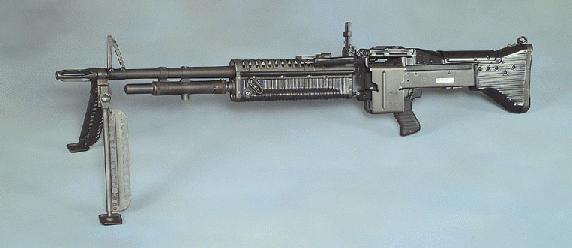
M60 with bipod extended
M60 on the deck of USS Theodore Roosevelt (CVN-71) in 2006.

The initial variant was officially adopted by the U.S. Army in the late 1950s, though at this time it was only intended for the infantry. It was known as the T161 before it was adopted (specifically the T161E3) and was chosen over the competing T52 during testing in the 1950s.[26] They both used a similar feed and were both gas-operated, but the T161 was easier to produce and its different internals performed better. The model that won the competition was the T161E3.

The model was type-classified in 1957 and entered production. It saw its first heavy use in the 1960s. The basic design has undergone some smaller changes and has been produced by different manufacturers.

M60E1

[edit]

The M60E1 was the first major variant of the original M60. It did not go into full-scale production, though many of its features were included in the later E3 and E4 variants. Some of its features were also incorporated into the existing M60 production. This mainly changed how the gas cylinder, the barrel, and the bipod were connected in the first iteration. The M60 and the M60E1 are two different versions. Opinions vary on whether the M60E1 was officially adopted.

One of the more noticeable changes on the M60E1 is that the bipod attachment point was moved to the gas tube rather than the barrel (like on the later M60E3). It did not, however, have a forward pistol grip, as was added on the E3 variant.

M60E2

[edit]
An M60E2 machine gun, intended for co-axial use. Note the gas tube extension and the lack of a pistol grip.

The M60E2 is used on armored fighting vehicles, such as the M48A5, later M60 Patton tanks and the K1 Type 88. It lacks many of the external components of the standard M60, including stock and grips. The M60E2 was electrically fired, but had a manual trigger as a backup, as well as a metal loop at the back for charging. The gas tube below the barrel was extended to the full length of the weapon to vent the gas outside the vehicle. This version achieved a mean time between failures of 1,669 during testing in the 1970s.

The M60E2 is used on the South Korea's K1 Type 88 tank as a co-axial weapon, along with an M60D on a pintle mount.

M60B

[edit]

The M60B was a short-lived variant designed to be fired from helicopters, with limited deployment made in the 1960s and 1970s. Nicknamed the "Free Gun" by aircrew door gunners,[27] it was not mounted, just held, and was soon replaced by the pintle-mounted M60D. The 'B' model differed most noticeably in that it had no bipod and featured a different rear stock than the regular model. It still had a pistol grip (as opposed to spade grips). The M60B's advantage over pintle-mounted variants was that it had a wider and much less restricted field of fire.

An unusual arrangement of the M60B was done by HA(L)-3 squadron aircrew by removing the sights, shortening the barrel inline to the gas block, removing the stock to shorten the receiver as the shorter buffer spring increased the rate of fire, an improvised side mounted grip was installed on the handguard. This arrangement allowed the door gunners easier movement of the weapon as well as firing sideways improved the belt feed performance.[28][29]

M60C

[edit]
An M60C machine gun with no iron sights, pistol grip or bipod

The M60C is a variant of the standard M60 for aircraft mounting, such as in helicopter armament subsystems. It lacks things like the bipod, pistol grip, and iron sights. The main difference between the standard M60 and the "C" variant is the electronic control system and the hydraulic swivel system used. It could be fired from the cockpit by the pilot or co-pilot. It is an electronically controlled, hydraulic-powered, air-cooled, gas-operated, belt-fed weapon system. It used the M2, M6, and M16 armament subsystems and was mounted on the OH-13 Sioux, the OH-23 Raven, the UH-1B Huey, and comprised the standard fixed armament of the OV-10 Bronco. M60C production was on the order of several hundred. It was also used in the XM19 gun pod.

M60D

[edit]
An M60D machine gun on the M23 Armament Subsystem.

The M60D is a mounted variant of the standard M60. It can be mounted on boats, vehicles and as a pintle-mounted door gun in helicopters. When used in aircraft, it differs from the M60C in that it is not controlled by the pilot—rather, it is mounted in a door and operated by a member of the crew. Like the rest of the M60 family, it is an air-cooled, gas-operated, belt-fed weapon. Unlike other models, however, the M60D normally has spade grips and an aircraft ring-type sight or similar, as well as an improved ammunition feed system. A canvas bag is also affixed to the gun to capture ejected casings and links, preventing them from being sucked into the rotor blades or into an engine intake. The M60D was equipped on the UH-1B Huey (using the M23, XM29, M59, and the Sagami mounts), the CH-47 Chinook (using the M24 and M41 mounts) in both door and ramp locations, the ACH-47A "Guns-A-Go-Go" variant of the Chinook (using the XM32 and XM33 mounts), and on the UH-60 Black Hawk (using the M144 mount). The M60D is also used by the British on Royal Air Force Chinooks. In US service, the M60D has been primarily replaced by the M240H. The M60D is still manufactured by U.S. Ordnance and still used on the SH-60 Seahawk.

M60E3

[edit]
Navy SEAL team member fires an M60E3 from the shoulder during a field training exercise in 1987.

The M60E3 was fielded c. 1986 in an attempt to remedy problems with earlier versions of the M60 for infantry use. It is a lightweight, "improved" variant intended to reduce the load carried by the gunner. Unlike its predecessors, the M60E3 has several updated modern features. It has a bipod (attached to the receiver) for improved stability, ambidextrous safety, universal sling attachments, a carrying handle on the barrel, and a simplified gas system. However, these features also caused almost as many problems for the weapon as they fixed. There were different types of barrels used, but the lightweight barrel was not as safe for sustained fire at 200 rounds per minute as heavier types. Despite this, some personnel claim to have witnessed successful prolonged firing of the weapon. The stellite superalloy barrel liner makes it possible, but the excessive heat generated by this process may quickly render the gun unusable. There were two main barrels, a lightweight barrel and another heavier type—the former for when lighter weight was desired, and the latter for situations where more sustained fire was required.

A recruit pulls back the bolt of an M60E3 machine gun during a weapons familiarization class. The weapon is mounted on a tripod with a traversing and elevation mechanism attached.

The reduced-weight components also reduced the durability of the weapon, making it more prone to rapid wear and parts breakage than the original. Most infantry units in the U.S. Army and Marine Corps have now switched over to the M240 as their general-purpose machine gun, which is more reliable (particularly when dirty) and seems to be well liked by the troops for its ruggedness, despite the fact that it weighs 27.6 lb (12.5 kg) compared to the standard M60 at 23.15 lb (10.5 kg).

U.S. Navy SEALs continued to use the "CAR-60" (M60E3) version due to its lighter weight and slower rate of fire, which allows a more effective duration of fire with allowable levels of ammunition carried.

The U.S. Air Force Security Forces received the M60E3 from 1988 to 1989. All USAF M60E3s were withdrawn from general issue by 1990, because it did not meet the vehicle mount requirements of the Cadillac Gage Ranger and due to overheating problems. The M60E3 did remain in the Air Force as weapons converted back to M60 configuration with the E3 X-stamped via locally installed kits issued from depot. The Air Force cut the barrel change times, sustained fire 100 rounds per minute change barrel every 10 minutes (M60) to five minutes (M60E3), and rapid fire 200 rounds per minute change barrel every five minutes to two minutes.

M60E4/Mk 43 Mod 0/1

[edit]

The M60E4 or Mk 43 is a 7.62×51mm NATO general-purpose machine gun. Evolved from the M60 machine gun series, it has several improvements over the originals. The M60E4/Mk 43 series includes the Mod 0 and Mod 1 configurations.

It is the primary light machine gun used in some NATO countries and other U.S. Government export-approved countries. The Mk 43 machine gun currently is manufactured solely by U.S. Ordnance (USORD). USORD has produced it since 2000.

The M60E4/Mk 43 is one of the modernized variants in the generations of the old M60 family and incorporates a number of improvements over past versions. Externally, it looks somewhat like the M60E3, but it has many internal changes and improvements that modernize the effectiveness and reliability of this weapon. In general it is a more reliable weapon than all previous M60s. Externally, it features a different forward grip, iron sights, butt stock and bipod. The M60E4/Mk 43 has higher pull for the belt, and is available in a variety of configurations. Older M60 models can be upgraded with a conversion kit manufactured by U.S. Ordnance to the M60E4/Mk 43. The M60E4/Mk 43 were primarily developed in the 1990s and have continued to be redeveloped in the 2000s (decade). Early Mk 43s had some distinct differences from the E4 (such as a duckbill flash suppressor), though by the 2000s these distinctions seemed to have ended.

A mounted Mk 43 Mod 0 (M60E4) (later model) is crewed by a Seabee of NMCB-15 (Naval Mobile Construction Battalion), on a convoy in Iraq in May 2003.

The Navy has designated this weapon as the Mk 43 Mod 0. It was developed for the U.S. Navy SEALs to replace their existing stock of M60E3 machine guns fitted with shorter "assault barrels". These weapons are identical to standard M60E4s, with the exception of the barrel length, and can be used either as suppressive fire or direct fire weapons. The Mk 43 Mod 1 adds significantly more rail attachment points to the weapon's receiver cover and handguard.

U.S. Ordnance's website states in their FAQ, as of 2005, that the "M60E4 and the Mk 43 are the same weapon system". The M60E4 and Mk 43 variants in the past were roughly similar, although they are part of the same family. While it might be fair to say that the Mk 43s are a type of M60E4, there are technical differences between any given M60E4 model. Early Mk 43s have certain differences over M60E4 from the same period, the most obvious being the duck-bill flash hider and different handguard. This difference is no longer seen on the current Mk 43s still manufactured by U.S. Ordnance.

In Army trials during the 1990s the M60E4 produced by Saco Defense was pitted against the M240E4 (then called) produced by FN for a new medium machine gun to be used by the infantry. The competition was to replace the decades-old M60s. The M240E4 won, and was then classified as the M240B. While the M240B had been more reliable in the tests, it was noted to be a heavier weapon than the M60E4.

The M60E4/Mk 43 is a modern update to the entire series, such that it is also available in many of the previous configurations, such as a co-axial weapon. Kits are offered to convert older models to the E4 standard.

  • M60E4 (light machine gun):
    • Short barrel: weight: 22.5 lb (10.2 kg); length: 37.7 in (95.8 cm)
    • Long barrel: weight: 23.1 lb (10.5 kg); length: 42.4 in (108 cm)
    • Assault barrel: weight: 21.3 lb (9.66 kg); length: 37.0 in (94.0 cm)
    • Width: 4.8 in (12.2 cm)
  • M60E4 (mounted):
    • Length: 43.5 in (110 cm)
    • Width: 5.9 in (15.0 cm)
    • Weight: 22.7 lb (10.3 kg)
  • M60E4 (co-axial):
    • Length: 42.3 in (107 cm)
    • Width: 4.8 in (12.2 cm)
    • Weight: 21.2 lb (9.62 kg)

Design details

[edit]

The M60E4/Mk 43 is a gas-operated, disintegrating-link, belt-fed, air-cooled machine gun that fires from an open bolt. It is the newest, upgraded variant of the M60 series machine guns.[30] It fires a 7.62×51mm NATO cartridge, which offers accuracy, reliability, and stopping power. It fires at a cyclic rate of around 500 to 600 rounds per minute, with an effective distance of 1200 yards (1100 meters). The weapon's controllable, yet lethal, rate of fire allows for accurate firing in the standing, kneeling and prone positions.

The M60E4/Mk 43 is ambidextrous, and shares its parts with all previous M60 configurations, including vehicle mounts. The adjustable front sight allows for zeroing of the primary and spare barrel, the chrome and induction hardening lengthens service life, and the ammunition is now mounted on the receiver, preventing damage, and thereby feed failure. The machine gun's light weight—20 to 21 pounds (9 to 10 kilograms)—and compact design make it easy to carry long distances and maneuver in tight spaces. It also allows for the weapon to be fired from the shoulder accurately.[citation needed]

The M60E4/Mk 43 Mod 0, typically used as an infantry machine gun, features an injection-molded composite handguard. The weapon system's quick-change barrel is crucial for safety and efficiency, particularly when the operator is under fire. With the lightweight bipod mounted to the receiver, the barrel can be changed without removing the bipod.[citation needed]

The M60E4/Mk 43 Mod 1 has multiple M1913 rail mounting points for mounting optics, aiming lasers, and accessories for around-the-clock capability. It mounts directly or adapts to all standard NATO tripod and vehicle mounts.[citation needed]

Barrels are stellite lined for sustained fire and extended barrel life. They are available in short, long and heavy fluted configurations for use in various applications. All major components of the M60E4/Mk 43 directly interchange with other M60 configurations. U.S. Ordnance manufactures a conversion kit that upgrades older M60s to its M60E4/Mk 43 model.[31]

M60E6

[edit]
An M60E6 machine gun adopted by the Danish Army, designated as the LMG M/60 with C79 LMG Optic

The M60E6 is an improvement on the M60E4 and the latest M60 variant. It won against the HK121 in the Danish Army's GPMG replacement program to replace the M/62 in March 2014. The weight has been reduced to 9.27 kg (20.4 lb), 2.23 kg (4.9 lb) lighter than the M/62. Its rate of fire of around 500–650 rounds per minute (RPM)[32] is significantly less than the Danish M/62's 1,200 RPM, but it allows for better control, greater accuracy, more conservation of ammunition, more versatile firing positions, and less risk of collateral damage from losing control while shooting.[33] The M60E6 features a redesigned quick-change barrel assembly with an offset barrel handle, which is also used to carry the weapon and allows for the replacement of a hot barrel without using protective gloves. Changes to the rail system and bipod have been made, and a significant number of internal improvements have also increased reliability.[34][35][36]

Danish C79 LMG Optic

[edit]

The Danish military uses a 3.4×28 optical sight mounted on top of the receiver which can be set from 300 to 800 meters (328 to 875 yd) in 100 meters (109 yd) increments on their M/60E6. What sets the Danish C79 LMG Optic designated as M/98 apart from the standard C79 optical sight is its unique reticle of a chevron with a height of 12,5 TS and two TS line left and right with a length of 7,5 TS beginning 2,5 TS away from the tip of the chevron. The sight is designated as M/99 also available in a night vision configuration.[37]

Civilian variants

[edit]

A number of semi-automatic only variants have been produced for the civilian market in the United States. The internals have been extensively modified to make it essentially impossible to convert them to fire in fully automatic. If the design is approved by the U.S. Bureau of Alcohol, Tobacco, Firearms and Explosives (BATFE), they are treated as belt-fed semi-automatic rifles; however, individual state and local regulations still apply.

There are a variety of M60 models, some that have been upgraded to the current M60E4 configuration, on the market as well, but they are heavily regulated and restricted by the National Firearms Act, and they cost over $40,000, with some models, such as a Maremont/SACO upgraded to M60E6 configuration costing as much as $65,000.

Users

[edit]
Map of M60 users in blue
South Korean soldiers with an M60 conduct combined amphibious landing during Foal Eagle 07.
Moro Islamic Liberation Front militant lying prone with an M60.
Portuguese Army V-150 Commando armed with an M60D.
U.S. airman with an M60, assigned to the 52nd Security Forces Squadron (SFS), at Spangdahlem Air Base (AB), Germany.
Senegalese Marine with an M60 in 2016.

Non-state operators

[edit]
[edit]

See also

[edit]

In general

[edit]

Comparable weapons

[edit]

References

[edit]
[edit]
Revisions and contributorsEdit on WikipediaRead on Wikipedia
from Grokipedia
The M60 machine gun is a family of American general-purpose machine guns that fire cartridges from a disintegrating metallic split-link belt, operating on a gas-powered, air-cooled, belt-fed mechanism from an open-bolt position to deliver sustained automatic fire in support of operations. Adopted by the in 1957 as a lighter replacement for the heavier M1919 Browning, the M60 weighs approximately 23 pounds (10.5 kg) unloaded with bipod, measures 43.5 inches (1,105 mm) in length, and achieves a maximum of 550 rounds per minute, with an effective range of up to 1,100 meters when mounted on a . Developed in the aftermath of , the M60 incorporated design elements from captured German weapons, including the paratrooper rifle's gas-operated rotating bolt and the MG 42's quick-change barrel and feed mechanism, evolving through prototypes like the , T52, and T161E3 to meet the need for a versatile (GPMG) suitable for both squads and vehicle mounts. It became a staple of U.S. forces during the , where it earned the nickname "The Pig" due to its weight and voracious ammunition consumption, providing critical for squads but plagued by reliability issues in the harsh jungle conditions, including jamming from dirt and mud. Key variants include the original M60 ground model, the M60D for fixed aircraft and vehicle installations, the lightened M60E3 for special operations use, and modernized M60E4 and M60E6 models featuring improved , bipod integration, and rail systems for . While largely replaced in standard U.S. Army service by the Belgian FN MAG-derived M240 in the and the lighter M249 SAW for squad automatic roles, the M60 remains in limited use by U.S. forces, such as SEALs, and dozens of nations, with recent U.S. contracts in 2024 procuring upgraded E4 and E6 variants and the Colombian National Army announcing the acquisition of 460 M60E6 machine guns in August 2025 for ongoing requirements.

Development and History

Origins and development

The development of the M60 machine gun originated in the aftermath of , when the U.S. Army sought a lighter, more versatile to replace the heavier M1919 series, which weighed around 31 pounds in its A6 configuration. Drawing heavily from captured German designs encountered during the war, particularly the paratrooper rifle and the , American engineers aimed to incorporate features like stamped metal construction for reduced weight and manufacturing costs, as well as a quick-change barrel to enable sustained fire without overheating. The influenced the gas-operated rotating bolt system and overall lightweight form, while the provided the basis for the belt-feed mechanism and ergonomic handling, allowing a single soldier to maneuver the weapon more easily than previous models. Initiated by the U.S. Army Ordnance Corps in the late 1940s, the project evolved through several prototypes starting with the in 1946, developed by the Bridgeport Tool & Die Company as a hybrid of the FG 42's operating system and the MG 42's feed tray cover, chambered initially in .30-06 but later adapted for the emerging cartridge. This was followed by the T52 series in 1947, produced by Inland Manufacturing, which introduced improvements like a heavier barrel for better sustained fire and a horizontal belt feed, with variants such as the T52E1 and T52E2 adding the quick-change barrel feature tested with both 4.5-pound and 7-pound options. By April 1951, the T161 family emerged to accelerate development and address production scalability, with the T161E3 variant finalizing the design through refinements in stamped components and a vertical foregrip, weighing approximately 23 pounds unloaded. Extensive testing in the validated the prototypes' potential, with the T161E3 undergoing field trials from 1955 to 1956 in temperate and arctic conditions at locations like Fort Benning and Fort Churchill, where it demonstrated superior portability and maneuverability compared to the M1919A6, earning praise from evaluators for its balance of weight and firepower. Reliability was a key focus, as one T161E2 prototype endured a sustained fire test firing 25,000 rounds over four hours at 100 rounds per minute, with barrel changes every 10 minutes, without major failures, while capability demonstrations for allies saw multiple units cycle through at least 60,000 rounds each. These results led to the formal adoption of the T161E3 as the M60 on January 30, 1957, designated as the U.S. Army's standard . Production contracts were awarded to Saco Defense in , which manufactured the initial batches using stamped steel for efficient , with early units entering limited field trials by the late .

Vietnam War service

The M60 machine gun began entering service with U.S. Army infantry squads in 1964, replacing the heavier in the role to provide more portable . Adopted officially in 1957, its deployment accelerated amid escalating U.S. involvement in , where it filled a critical gap for sustained automatic fire at the small-unit level. By 1968, the weapon had seen widespread integration into units, becoming a standard element of tactics for both offensive patrols and defensive positions. In major operations like Cedar Falls in January 1967, the M60 proved vital for against entrenched forces in the Iron Triangle region; infantrymen from the 25th Infantry Division, such as PFC Milton L. Cook, used it to engage suspected positions in dense tree lines, supporting sweeps that uncovered extensive enemy tunnel networks. Military Assistance Command, Vietnam-Studies and Observations Group (MACV-SOG) recon teams adapted the M60 for covert missions deep in enemy territory, modifying it with shortened 17-inch barrels, removed bipods and stocks, and sometimes backpack-fed 500-round drums to enhance maneuverability and deliver squad-level fire support during ambushes and extractions. These tactics emphasized short, intense bursts to pin down larger North Vietnamese Army formations, allowing smaller teams to evade or counter superior numbers. Troops often highlighted the M60's 23-pound weight—exacerbated by 100- to 300-round belts and full rucks—as a major hindrance to mobility in Vietnam's humid, vine-choked jungles, where the gun frequently snagged on undergrowth or proved unwieldy on steep terrain. Machine gunners like Victor Renza of the 1st Battalion, 8th Infantry recounted the physical toll of humping the weapon during patrols near Tuy Hoa and in 1966-1967, noting how it overheated rapidly but delivered psychologically dominant that kept enemies suppressed across rice paddies or in village assaults. At of in early 1968, M60s bolstered defenses against relentless North Vietnamese assaults; on April 6, Company E, 2d Battalion, 26th , employed the gun alongside M16 rifles in an near Hill 861, providing immediate that repelled close-range attackers and enabled a tactical withdrawal. Such applications contributed to the battle's overall defensive success, where combined small-arms fire, including machine guns, helped inflict heavy enemy losses—often exceeding 40-100 casualties per major probe—while minimizing vulnerabilities in prolonged .

Post-Vietnam and modern use

Following the , the U.S. military initiated a series of upgrades to the M60 to mitigate its reliability shortcomings, leading to the development of the M60E3 variant in the mid-1980s. This lighter model, weighing approximately 19 pounds (8.6 kg) compared to the original's 23 pounds (10.5 kg), featured a redesigned bipod and improved quick-change barrel system, and was primarily adopted by the and Marine Corps for and roles. The U.S. Army followed with the M60E4 in the early , incorporating further enhancements such as a hydraulic buffer and reinforced components to reduce stoppages during sustained fire, marking a phased integration into active service through the decade. Despite these improvements, the U.S. Army began transitioning away from the M60 in the role during the 1990s, formally adopting the FN MAG-based M240B as its standard in to address ongoing durability concerns. The M240B offered superior reliability, with mean rounds between failures exceeding 10,000 compared to the M60's historical average of around 1,600, though M60 variants were retained in vehicle-mounted configurations on platforms like the and UH-60 Black Hawk for their compatibility and availability. The U.S. Marine Corps accelerated its phase-out, fully replacing the M60 with the M240G by the early 2000s, completing the transition in front-line units by 2005 while some reserve elements held onto older stocks longer. In major conflicts post-Vietnam, upgraded M60s saw continued deployment, including vehicle-mounted systems during the 1991 , where they contributed to in mechanized operations alongside tanks. During the War in Afghanistan from 2001 to 2021, the M60E4 was employed in urban environments by special operations forces for its portability in close-quarters scenarios, often integrated into squad tactics for area denial. The U.S. SEALs have persisted with M60 variants, including the MK 43 Mod 0 (based on the E4), into the for maritime and boarding operations, valuing its balance and rapid deployment from small craft despite the broader shift to the M240 series. In the 2020s, the M60 has experienced renewed relevance through U.S. , with the Army contracting for over 1,000 M60E4 and M60E6 units in 2024 as part of packages supporting 's territorial defense against Russian forces since 2022, where the guns have appeared in frontline videos for static defensive positions. In 2025, M60 variants continued to see use in , and the Colombian National Army contracted for 460 M60E6 units to bolster capabilities. Allied forces, including the Israeli Defense Forces, continue limited use of M60 variants in ongoing operations, though primary reliance has shifted to indigenous designs like the .

Technical Design

Overall design and operation

The M60 machine gun is a general-purpose, gas-operated, air-cooled, belt-fed automatic that fires exclusively from the open-bolt position to enhance and reliability during automatic fire. It employs a short-stroke gas system, where expanding gases from the fired cartridge drive a located below the barrel, which in turn actuates the bolt carrier without the piston traveling the full distance of the bolt's stroke. This mechanism features fixed headspace and timing, allowing for rapid barrel changes without the need for adjustments, typically accomplished by unlatching the barrel retaining mechanism and sliding the barrel forward and out in a matter of seconds. Central to its design are several key components that support versatile operation and maintenance in the field. The quick-change barrel, measuring 22 inches in length, facilitates sustained fire by permitting swaps every 100 to 200 rounds to manage heat buildup, while a folding bipod attached near the muzzle provides stability for prone or supported firing positions. The weapon includes a and for ergonomic handling, enabling firing from the shoulder, hip, or underarm, and uses a left-side feed compatible with ammunition in 100-round soft packs or disintegrating-link belts stored in bandoleers or ammunition boxes. is mitigated through a heavy bolt assembly and buffer in the receiver, which absorb and dampen the forces generated during the 550–650 rounds-per-minute cyclic rate. Operationally, the M60 delivers an effective point target range of 1,100 meters (1,200 yards), supported by a muzzle velocity of approximately 853 meters per second, making it suitable for both suppressive and direct fire roles. The overall length of 43.5 inches (1,105 mm) and weight of approximately 23 pounds (10.5 kg) unloaded, including bipod, contribute to balanced weight distribution, aiding in control during extended bursts when mounted on its bipod or vehicle pintles. For field maintenance, the weapon disassembles into six to eight major groups—such as the barrel and bipod group, receiver group, bolt and bolt carrier group, operating rod group, cover and feed mechanism assembly, and trigger mechanism—via straightforward steps like removing the barrel assembly, pivoting the top cover, and separating the operating rod, all without specialized tools. This modular approach allows quick cleaning and reassembly to minimize downtime in operational environments.

Ammunition and feed system

The M60 machine gun is chambered for the cartridge, a rimless, bottlenecked centerfire round standardized for small arms. This cartridge is dimensionally identical to the civilian , allowing compatibility with commercial .308 ammunition in the M60, though military specifications emphasize NATO-compliant loads for reliability. Primary variants include the M80 ball round, a weighing 147 grains with a of approximately 2,750 feet per second from the M60's 22-inch barrel, designed for engaging personnel and light targets. The M62 tracer variant, identifiable by its orange tip, provides visible trajectory tracing up to 1,000 meters and is typically mixed in a 4:1 ratio with M80 ball rounds for combat belts to aid in fire adjustment without compromising volume of fire. Other authorized types include the M61 armor-piercing round for light armored vehicles and the M63 dummy for training, ensuring versatility across tactical scenarios. The M60 employs a belt-fed system using the M13 disintegrating metallic split-link, which allows links to separate and eject individually during firing, reducing weight and snag risks compared to non-disintegrating belts. is supplied in 100-round soft packs within cloth bandoleers, which fit directly onto the weapon's feed tray assembly for quick loading; these can be linked into longer belts for sustained fire. Larger 250-round configurations are achieved by combining multiple bandoleers into rigid metal boxes or packs, facilitating resupply in vehicle or fixed-position roles. The system feeds exclusively from the left side in standard configurations, with the cartridge positioned open-side down on the feed tray to align with the bolt's stripping action, though some variants adapt for right-side feed in armored applications. Reloading involves opening the feed cover, placing the belt on the with protruding facing down and forward, then closing the cover and pulling the to chamber the first round; the is set to fire ("F") before engagement. During operation, spent eject forward and to the right through the feed cover, captured in a bag to prevent loss or hazards in confined spaces. For jam clearance, immediate action requires tapping the feed cover, pulling and holding the rearward while observing the ejection port, then attempting to fire; if unresolved, includes inspecting the chamber with a cleaning rod, removing any stuck cartridges or debris, and cooling the barrel if overheated. Logistically, each 100-round belt weighs approximately 7 pounds, impacting mobility and requiring assistant gunners to carry multiple loads for prolonged engagements. In the , the U.S. shifted to disintegrating linked belts for the M60 to enable higher rates of sustained fire over earlier loose-round or cloth-belt systems, aligning with Vietnam-era demands for portable without frequent reloading interruptions. This adoption, formalized with the weapon's 1957 introduction but refined through early field testing, improved logistical efficiency by standardizing pre-linked bandoleers for rapid assembly and transport.

Reliability issues and modifications

The original M60 machine gun suffered from several inherent reliability flaws stemming from its lightweight stamped steel construction and gas-operated mechanism, which became evident during early field use in the . One primary issue was feed cover jams caused by dirt accumulation, where mud and debris interfered with the feed cam and , leading to bent components or cracked channels that halted operation. In muddy or tropical environments, such contributed to high stoppage rates, with tests revealing the weapon's vulnerability to environmental contaminants compared to heavier predecessors like the M1919A6. Barrel carrier cracks and bipod instability further compounded problems under sustained fire, as the stamped receiver warped from extreme heat—barrel temperatures often exceeding 1,000°F—causing misalignment and loss of stability in the receiver-mounted bipod. The gas system was particularly susceptible to from carbon buildup and dirt ingress, exacerbating malfunctions; field evaluations reported frequent stoppages, with the weapon demonstrating lower durability in rough handling than expected. Ammunition-related jams occasionally occurred due to link debris but were secondary to flaws. These issues resulted in operational mean rounds between failure (MRBF) rates around 1,700 in early tests, far below desired thresholds. To address these shortcomings, initial modifications focused on non-variant-specific enhancements, including reinforced feed tray components introduced in mid-1960s production updates to reduce jamming from . Improved gas seals and tighter tolerances were implemented to mitigate , while protocols emphasized frequent bore cleaning—recommended after every 200-400 rounds of sustained fire—to prevent buildup. technical bulletins stressed rigorous inspections of the feed assembly and receiver to catch warping early. Long-term, these reliability challenges imposed a significant burden, as evidenced by U.S. Army evaluations comparing the M60 to alternatives like the MAG58. The M60 exhibited mean rounds between stoppage (MRBS) of approximately 850 and MRBF of 1,700, necessitating more frequent part replacements and downtime—up to 60% higher failure rates in bolt assemblies alone—compared to the MAG58's 2,960 MRBS and 6,440 MRBF. This led to increased demands and reduced operational readiness, influencing later decisions despite the M60's lower unit cost.

Variants and Upgrades

Original and early variants

The original M60 machine gun, type classified in following development through the T161 series at , entered U.S. military service in 1959 as the standard general-purpose automatic weapon for infantry squads, replacing the heavier M1919 series. Designed for versatility in roles from squad support to vehicle mounting, it featured a gas-operated, belt-fed mechanism inspired by the German MG42, with a fixed wooden stock, integral bipod attached to the quick-change barrel, and no accessory rails for optics or other attachments. Weighing approximately 23.5 pounds unloaded, the weapon measured 43.5 inches (1105 mm) in overall length with a 22-inch (560 mm) barrel and fired ammunition from 100-round disintegrating M13 links at a cyclic rate of 550–650 rounds per minute, emphasizing sustained fire capability over the higher rates of earlier designs. Early modifications addressed mounting needs for emerging armored vehicles. The M60E1 was a developed in the to improve the original M60's reliability and simplify barrel changes, featuring a barrel handle and bipod relocated to the ; it was not adopted for production. The M60E2, introduced in the mid-1960s, represented a more specialized early variant optimized for fixed mounting in main battle tanks such as the M60 Patton, featuring a belt-fed system with a barrel extension and gas evacuator, integrated splash shield to protect the breech from debris, and solenoid-actuated electric firing for integration with the tank's . Lighter and more compact than the standard model at around 21 pounds, it maintained the 7.62mm caliber but operated at a reduced cyclic rate of approximately 500 rounds per minute to enhance controllability in confined vehicle spaces and reduce barrel wear during prolonged engagements. These initial models established the M60's baseline as a lightweight, adaptable platform, though early designs exhibited shared mechanical vulnerabilities like barrel alignment issues during changes, which influenced later refinements without altering the core or configurations.

Coaxial and special-purpose variants

The coaxial and special-purpose variants of the M60 machine gun were developed to adapt the weapon for integration into , , and platforms, featuring modifications for remote operation, , and mounting stability. These variants emphasized lightweight construction, electrical or hydraulic actuation to enable firing without direct manual input, and compatibility with aircraft sighting systems to support roles in dynamic combat environments. The M60B was an unofficial field modification of the M60 used as a flexible "free gun" on helicopters and patrol boats during the . The early M60E2 coaxial variant, briefly tested for armored vehicle turrets, shared some mounting principles but remained infantry-focused in its core configuration. Introduced in the 1970s, the M60C served as a lightweight, spade-grip variant optimized for door-mounted positions on UH-1 Huey helicopters, weighing approximately 19 pounds and featuring an electrically controlled, hydraulically charged mechanism for remote firing. It included an improved ammunition feed system and compatibility with the AN/VS-3 night sight for low-light operations, enabling flexible deployment in subsystems like the M6 and M16 on UH-1 series aircraft, as well as fixed mounts on OV-10 Broncos. A canvas ejection control bag captured spent casings to prevent interference in the cabin. The M60D, developed in the as a derivative of the M60C, provided pintle-mounted flexibility for helicopters such as the AH-1 Cobra and UH-1 series, with a 43.75-inch (1111 mm) barrel and weight of 24.3 pounds (11.0 kg) to deliver sustained from elevated positions. It incorporated spade grips, an aircraft ring sight for quick target acquisition, and electrical solenoids for remote triggering, allowing integration into mounts like the M23 or M59 on Hueys. Ammunition capacity reached up to 1,000 rounds in dedicated aircraft pods or cans, supporting prolonged engagements without frequent reloading. These adaptations ensured reliability in vibration-heavy airborne environments while maintaining the M60's compatibility.

Modernized and export variants

The M60E3, introduced in the mid-1980s, represented a significant modernization effort to enhance the portability of the original M60 for and use, particularly by the U.S. Marine Corps and Navy SEALs. Weighing approximately 18.75 pounds (8.51 kilograms), it achieved this reduction through a lighter barrel assembly, simplified fore-end without separate bipod legs, and overall design refinements that eliminated non-essential components while maintaining the gas-operated, belt-fed mechanism. Developed in the and entering service in the early , the M60E4 (designated Mk 43 Mod 0 and Mod 1 by the ) addressed persistent reliability issues with reinforced construction, including a machined aluminum feed cover and improved internal components for better tolerance to harsh environments. The variant weighs about 23.1 pounds (10.5 kilograms) with a long barrel, a marginal reduction from earlier models achieved via optimized materials and a more efficient gas system featuring a reversible that prevents misassembly and enhances field maintainability. This upgrade extended barrel life to around 15,000 rounds under sustained fire, significantly outperforming the original M60's limitations. The M60E5, introduced in the 2010s, is a coaxial upgrade to the M60E2 with an improved feed system and compatibility for modern vehicles like the Stryker. The M60E6, introduced in the 2010s by U.S. Ordnance, further refined the series with ergonomic enhancements for modern combat, including fully ambidextrous controls such as a push-button safety and modular rail interfaces compatible with optics like the Elcan C79 Specter. Adopted by the Royal Danish Army in 2014 as its standard general-purpose machine gun (designated M/14), replacing the MG3, it weighs 20.2 pounds (9.17 kilograms) with a short barrel and has seen additional procurements, including 2025 contracts for expanded infantry support. Export variants of the modernized M60 series have been adapted for international partners, emphasizing durability in diverse environments; for instance, Denmark's M60E6 integration includes compatibility with NATO-standard accessories for enhanced versatility in multinational operations.

Civilian versions

In the United States, civilian ownership of fully automatic firearms like the original M60 machine gun is severely restricted by . The (GCA) prohibited the importation of machine guns for sporting purposes, effectively limiting civilian access to domestically produced or pre-existing models, while the 1986 (FOPA), via the Hughes Amendment, banned the manufacture and registration of new machine guns for civilian transfer after May 19, 1986. As a result, no new full-auto M60s are available to civilians, and pre-1986 transferable examples command prices exceeding $50,000 due to their scarcity and NFA requirements, including ATF approval, $200 tax stamps, and background checks. To meet civilian demand, manufacturers have developed semi-automatic adaptations of the M60 design, configured as Title I firearms without NFA restrictions. One early example is the SA1, produced in limited quantities (approximately 200 units) during the 1980s, featuring a closed-bolt, striker-fired mechanism, belt-fed operation, and a quick-change barrel system weighing about 23 pounds empty. More recent offerings include the M60E6 semi-automatic variant, a gas-operated, open-bolt design with Picatinny rails for , a lightweight bipod, and interchangeable barrels (typically 22 inches), priced around $15,000, though often out of stock due to low production volumes. Similarly, Desert Ordnance's M60 semi-auto model, chambered in with a 22-inch barrel, retails for approximately $15,500 and emphasizes compatibility with military-style accessories while adhering to semi-auto fire controls. These models are marketed for collectors, range use, and sporting applications, with production focused on legal compliance to avoid full-auto classification. An aftermarket ecosystem supports these civilian M60 variants, offering accessories tailored for , target shooting, and compliance with state laws. Bipods, such as reproductions of the original M60 folding legs or modern adjustable Harris-style units, enhance stability for prone firing, while Picatinny-compatible mounts allow integration of red dots or low-power variables for improved accuracy at ranges up to 500 meters. These add-ons, available from specialized vendors, prioritize durability and legal modifications, such as fixed magazines or semi-auto sears, ensuring users maintain ATF-approved configurations.

Operators and Deployment

U.S. and primary allied operators

The U.S. adopted the M60 machine gun in 1957 as its first , with initial widespread deployment in the early 1960s during the , where it equipped squads and vehicle mounts. It served in roles ranging from to coaxial mounting on armored vehicles, providing support until the late 1990s when the more reliable FN MAG-based M240 began replacing it for dismounted use. By the 2000s, the M60 was largely phased out of frontline service, though limited use persists in secondary roles on some armored vehicles. The U.S. Marine Corps relied on the M60 as its primary from the 1960s through the Vietnam era, issuing it to every rifle squad for close support fire, before transitioning to the M249 SAW for lighter roles in the and the M240G for duties in the 1990s. By the mid-2000s, the had mostly retired the M60 from active units, retaining limited stocks of upgraded variants for reserve forces and training. In current status as of 2024, U.S. Command (SOCOM) continues to employ modernized M60E4 and M60E6 variants in limited numbers for training and special missions, particularly with Navy SEAL teams, following a U.S. Army contract awarded in September 2024 for these upgrades.

Other state operators

The M60 machine gun has been widely exported through the U.S. program to over 80 countries since its introduction, with significant use by allies and partners during the era. Israel acquired M60 units beginning in the 1960s, integrating them into (IDF) infantry and vehicle configurations for operations in arid environments. The weapon proved valuable during the 1973 , providing sustained in defensive and counteroffensive actions across the Sinai and fronts. Recent IDF upgrades in the 2020s include desert-adapted kits with enhanced cooling and dust-resistant feeds to maintain reliability in prolonged engagements. South Korea imported M60 machine guns in the 1970s as part of U.S. , incorporating them into (ROKA) units for fire support roles, particularly on vehicles. These remained in use through the late 20th century for territorial defense, with partial replacement by other systems in frontline formations by the 2020s. Iran obtained M60s from U.S. supplies prior to the 1979 revolution, which formed the basis for domestic reverse-engineering efforts yielding copies such as the Masaf variants. Limited numbers remain active in Iranian Army and units, often adapted for with locally produced 7.62×51mm ammunition. Recent procurements as of 2025 include the Colombian National Army ordering M60E6 variants to reinforce infantry units, and the acquiring M60E6 to replace older models in operations.

Non-state actors

During the , the captured American M60 machine guns from U.S. and ARVN forces, incorporating them into their arsenal for use in ambushes and guerrilla operations. These weapons were highly valued by the insurgents, who nicknamed the M60 "Đại liên đuôi cá" (Fish-tailed ) due to its distinctive stock design. Captured examples were often analyzed by Soviet advisors working with the and to evaluate U.S. weaponry. In the , non-state actors such as acquired M60 machine guns through captures from Israeli stocks following conflicts like the , integrating them into forces for defensive and offensive roles. Similarly, the (ISIS) utilized captured M60s from U.S.-supplied Iraqi military stockpiles between 2014 and 2019, employing them in urban combat and vehicle-mounted configurations during control of territories in . These diversions highlighted the proliferation of U.S.-origin to insurgent groups via battlefield captures. In , the (FARC) employed M60 machine guns during the 2000s, sourcing them through diversions from U.S. intended for Colombian forces, which were used in jungle ambushes until the group's under the 2016 peace accord. The weapons' reliability in harsh, humid environments proved advantageous for FARC operations, though maintenance challenges persisted.

Legacy and Cultural Impact

Reputation and nicknames

The M60 machine gun earned the enduring nickname "The Pig" among U.S. troops during the Vietnam War, primarily due to its bulky size, 23-pound unloaded weight, and voracious appetite for ammunition, which often required gunners to carry 100-round belts for sustained bursts at a cyclic rate of around 550-600 rounds per minute. This moniker reflected the weapon's cumbersome handling in dense jungle environments, where its heft made it a burden for infantry squads despite its role as a squad automatic weapon. Soldiers also referred to it as the "Hog," inspired by the deep, grunting report of its 7.62×51mm NATO rounds, which evoked the sound of a barnyard animal. The M60's reputation was decidedly mixed, lauded for its formidable firepower and envelope of up to 1,000 meters when properly mounted, which provided capabilities that proved invaluable in combat. However, it drew sharp criticism for frequent jams caused by its complex gas system and sensitivity to environmental contaminants like and , as well as the physical strain of its weight during prolonged patrols. Vietnam-era gunners often described a love-hate relationship with the weapon, appreciating its and like the rubberized foregrip while decrying maintenance challenges and barrel-change difficulties under fire; an Army Times poll from the era ranked it as the second-most recognizable U.S. weapon in , trailing only the UH-1 Huey helicopter. Over decades, the M60 has come to symbolize the ambitious but flawed innovations of 1960s U.S. military design, yet its legacy endures through modernized variants that address early reliability issues. The M60E6 upgrade, for instance, features an improved feed mechanism and gas system, achieving an average of 8,300 mean rounds between failures in testing—far surpassing earlier models—and has been adopted by forces like the Danish Army as recently as the 2010s, with additional acquisitions announced in August 2025 for delivery by the end of the year to enhance firepower across army branches and the , as well as by the Colombian National Army, which acquired 460 M60E6 units in August 2024 to reinforce its . U.S. contracts continuing into the 2020s for ongoing production further highlight this enhanced dependability, transforming the once-maligned "Pig" into a resilient mainstay for and export users.

Depictions in media and culture

The M60 machine gun has become an iconic symbol of firepower in popular media, frequently appearing in s to represent unrelenting during high-stakes confrontations. In the 1985 film Rambo: First Blood Part II, directed by , the M60E3 variant is the signature weapon of protagonist (), who wields it single-handedly in a climactic assault on an enemy base, embodying the lone hero in War-inspired scenarios. This portrayal cemented the M60's status as a cinematic staple for exaggerated, portable heavy weaponry. Similarly, in John McTiernan's 1987 science-fiction Predator, the short-barreled M60 is carried by Sergeant Mac () during the elite team's jungle operations in , where it is fired in desperate defensive bursts against unseen threats, contributing to the movie's tense sequences. In video games, the M60 is a recurring selectable weapon that emphasizes sustained fire and historical authenticity, particularly in titles simulating 20th-century conflicts. Call of Duty: Black Ops (2010), developed by Treyarch, features the M60 in its Vietnam War campaign missions, modeled closely on the early E3 configuration for realism, allowing players to deploy it as a belt-fed light machine gun unlocked at level 21 in multiplayer. The Battlefield series, from Battlefield 1942 (2002) through modern entries like Battlefield 2042 (2021) by DICE, includes the M60 as an unlockable light machine gun for U.S. forces, often balanced for mid-range suppression in both single-player campaigns and large-scale multiplayer battles, reflecting its enduring appeal in first-person shooter mechanics. The M60 also features in military literature that draws from real-world experiences, underscoring its practical role in combat narratives. In the 1992 memoir We Were Soldiers Once... and Young by Lt. Gen. Harold G. Moore (U.S. Army, Ret.) and journalist , the weapon is detailed in accounts of the 1965 , where U.S. troops relied on the M60 for defensive fire against overwhelming North Vietnamese forces, illustrating its reliability amid chaotic engagements. More contemporary depictions maintain the M60's relevance in special operations-themed media. The 2022 Amazon Prime Video series The Terminal List, adapted from Jack Carr's novel and starring as Navy SEAL James Reece, includes the M60 in a black-and-white of SEAL personnel, evoking its legacy in modern elite unit equipment despite the focus on contemporary firearms.

References

Add your contribution
Related Hubs
User Avatar
No comments yet.