Hubbry Logo
MassaiMassaiMain
Open search
Massai
Community hub
Massai
logo
8 pages, 0 posts
0 subscribers
Be the first to start a discussion here.
Massai
Massai
from Wikipedia
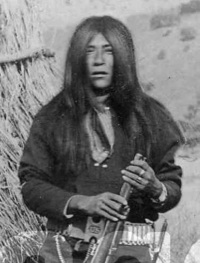
Left to right: "Massai", "Apache Kid", and "Rowdy" pictured in a March 1886 photograph taken by C. S. Fly at Geronimo's camp.

Key Information

Massai (also known as: Masai, Massey, Massi, Mah–sii, Massa, Wasse, Wassil, Wild, Sand Coyote or by the nickname "Big Foot" Massai) was a member of the Mimbres/Mimbreños local group of the Chihenne band of the Chiricahua Apache. He was a warrior who was captured, but escaped from a train that was sending the scouts and renegades to Florida to be held with Geronimo and Chihuahua.

It is possible that Massai's true Apache name was Nogusea (meaning "crazy", according to Jason Betzinez and James Kaywaykla); he was enlisted as a member of Chatto's band as known as Ma-Che.[1]

Life

[edit]

Born to White Cloud and Little Star at Mescal Mountain, Arizona, near Globe.[2][3] He later married a local Chiricahua and they had two children.[4]

Massai later met Geronimo, who was recruiting Apache to fight American settlers and soldiers. Massai and a Tonkawa named Gray Lizard agreed to join Geronimo, who instructed them to lay in supplies of arms, food, and ammunition.[5] Other sources state that Massai also served the United States government on two occasions, once in 1880 and the other in 1885, as an Apache Scout.[6] Upon traveling to meet Geronimo's forces, the two were informed that Geronimo had been arrested.[5] Both men were arrested by Chiricahua Apache Scouts and disarmed. Massai was placed onto a prison train as a prisoner of war along with Gray Lizard, who voluntarily agreed[7] to accompany Massai, together with the remaining Chiricahua Apache who had either been captured or had surrendered to the army. This included the Apache Scouts, who were now deemed expendable and undesirable.[5]

Massai and Gray Lizard later escaped from the prison train near Saint Louis, Missouri.[5] The two men walked some 1,200 miles back to the Mescalero Apache tribal area, crossing the Pecos River, and Capitan Gap. Near Sierra Blanca, New Mexico, the two men encountered a group of Mescalero Apache. Several days later, the two parted at Three Rivers, never to see each other again. Gray Lizard departed for Mescal Mountain and the San Carlos Indian Reservation near present-day Globe, Arizona, while Massai stayed on the run, raiding along what is today the New Mexico-Arizona border, and periodically taking refuge across the border in Mexico. His name appeared in San Carlos Agency reports from 1887 to 1890.[8] He later kidnapped and married (c. 1887) a Mescalero Apache girl named Zan-a-go-li-che and took her home to his family at Mescal Mountain. Massai and Zanagoliche had six children together.[9]

Massai was among those pursued during the April-June Apache Campaign of 1896, the final United States Army operation against the Chiricahua Apaches.

Demise

[edit]

In 1959, historian Eve Ball of Ruidoso interviewed Alberta Begay, Massai’s last surviving child. Through this interview, Ball learned many previously unknown details about Massai’s life during his final years. These insights were published by Ball in her 1980 book, Indeh: An Apache Odyssey. As a token of gratitude, Alberta gave Ball Massai's belt buckle that was passed on to her by Zanagoliche, after she found it among his burned remains.

On 4 September 1906, Massai, a Chiricahua Apache warrior often confused with the infamous Apache Kid, was killed near Chloride, New Mexico. On September 4, rancher Charlie Anderson discovered that his home had been ransacked and his horses stolen. Believing that Apaches were responsible, Anderson approached his friend Walter Hearn for assistance. Together, they attempted to organize a posse to track the culprits.[10] However, many locals were unwilling to participate. Eventually, Anderson and Hearn recruited a group of men that included Bill Keene, Harry James, Mike Sullivan, Burt Slinkard, Charley Yaples, Ben Kemp, Ed and John James, Sebe Sorrells, Wesley Burris, and Anderson’s brother-in-law, Jim Hiller. After gathering supplies, such as cheese, crackers, and sardines, the posse began tracking the suspected raiders through the San Mateo Mountains. After several days, the posse discovered Anderson’s stolen horses near a recently abandoned campsite. Believing they were close to catching the raiders, they decided to stake out the area. At dawn, a man and a boy approached the campsite. Without warning, the posse opened fire, killing the man. The boy managed to escape. Initially, the posse believed they had killed a well-armed Apache renegade. However, a search of the camp revealed that the man was unarmed and had no ammunition for his rifle. Burt Slinkard, one of the posse members, later expressed regret for his role in the killing, stating that ambushing an unarmed man was against his principles.[11] Among the items recovered from the camp were Saunders’ gold watch and other goods believed to have been stolen during the recent raids. The aftermath of the ambush took a darker turn. Massai’s family, who were hiding nearby, heard the gunfire and saw the posse build an unusually large fire. After the posse left, Massai’s wife, Zanagoliche, and their children returned to the site and discovered Massai’s charred remains among the ashes, along with his belt buckle.[12] Reports soon surfaced that the posse had decapitated Massai’s body and taken his head as a trophy. Ben Kemp later claimed that Bill Keene was seen boiling the head on his property, and Ed James admitted to being involved in the decapitation. There are conflicting accounts about what happened to Massai’s severed head. Some sources suggest that it was taken as a trophy and eventually gifted to Yale University’s Skull and Bones society. However, these claims remain unverified. The Tucson Daily Citizen expressed skepticism, noting that similar stories had been told about the Apache Kid and other prominent Apache figures. The newspaper even joked that skulls attributed to the Apache Kid could be acquired in Arizona at “wholesale rates,” casting doubt on the authenticity of such relics.[13] Despite the controversy surrounding Massai’s death, the posse members reportedly agreed to a vow of secrecy. This decision was likely influenced by concerns over the legality of their actions and the mutilation of Massai’s body.[14] Some members, such as Slinkard, denied any involvement in the decapitation, while others, like Ed James, openly admitted to it.[15]

After Massai's death, Zanagoliche took her children, including Alberta Begay, to the Mescalero Reservation. There, Zanagoliche was reunited with family members she hadn't seen since her abduction. Sadly, within the first year of life on the reservation, three of Begay's siblings died from disease. Mrs. A. E. Thomas, a former teacher at the Mescalero Indian School, remarked, "The older children, accustomed to a free, animal-like existence, pined away and died." Begay’s brother, Clifford, was later murdered as a teenager. Alberta Begay spent her final years in a retirement home in Alamogordo, New Mexico.[16]

Another account states that Massai escaped over the border to Mexico, eventually settling in the Sierra Madre mountains with a group of rebellious Chiricahuas who had refused to surrender with Geronimo.

[edit]

Massai was portrayed (in brownface) by Burt Lancaster in the 1954 film Apache.

See also

[edit]

References

[edit]
Revisions and contributorsEdit on WikipediaRead on Wikipedia
from Grokipedia
Massai (c. 1847 – c. 1911) was a Apache warrior of the Mimbres group in the Chihenne band, renowned for his resistance to U.S. military confinement following the . Born near the Black Range in present-day or , he trained from youth in Apache warfare tactics, including , marksmanship, and running. As a young man, Massai joined raids against settlers and Mexican forces, enlisting briefly as a U.S. Army scout in the 1880s against rival Apache leaders like before aligning with Geronimo's band amid escalating conflicts. Captured after Geronimo's surrender in , he escaped from a train transporting Apache prisoners to , embarking on an epic 700-mile journey back to Apache territory on foot and by stolen , during which he evaded pursuit and raided for supplies. In Mexico, Massai established a family by abducting Zanagoliche, a young White Mountain Apache woman, with whom he had two sons; he continued sporadic raiding across the border into Arizona and New Mexico, earning a reputation as one of the last independent Apache fighters before reportedly surrendering around 1890 or persisting until his death. His exploits, blending survival prowess, familial bonds, and defiance of forced relocation, cemented his legendary status in Southwestern frontier history, though accounts vary on the details of his later years due to reliance on oral traditions and sparse records.

Early Life

Upbringing and Chiricahua Apache Background

Massai was born in the 1850s to parents White Cloud and Little Star within the Mimbreño subgroup of the Chihenne band of Apaches, whose territory spanned parts of present-day and . His early years unfolded in a nomadic environment marked by the band's reliance on hunting, gathering, and seasonal migrations across rugged landscapes like the Mescal Mountains near . From childhood, Massai received rigorous training from his father in essential warrior skills, including proficiency with the bow, , , and long-distance running while carrying water in his mouth to build stamina. This instruction aligned with broader practices, where boys began physical and martial preparation at a young age to achieve self-reliance and readiness for raids, viewed as both economic necessities and rites affirming personal honor and tribal survival. Raiding villages and American settlements for , , and formed a core element of male adolescence and adulthood, fostering stealth, horsemanship, and combat expertise essential to band cohesion amid resource scarcity and territorial pressures. Such activities, conducted in small war parties, emphasized cunning over direct confrontation, embedding a cultural norm where successful exploits elevated status without idealization of violence for its own sake. Massai's formative immersion in these traditions instilled the autonomy and resilience characteristic of fighters prior to intensified U.S. military encroachments.

Military Involvement

Service as U.S. Army Scout

Massai, a member of the band, enlisted as a U.S. Army scout during the 1880 campaign against Victorio's Warm Springs Apaches, reflecting the opportunistic alliances warriors formed against perceived greater intra-tribal threats. This service positioned him to leverage his knowledge of tactics and to aid U.S. forces in tracking Victorio's raiding parties across southern and , where Victorio's warriors conducted guerrilla operations that killed over 50 settlers and soldiers in 1879-1880. Massai's scouting duties extended into 1882, during which he contributed to U.S. efforts amid escalating intra-Apache conflicts, including Geronimo's influence over Chief Loco's Warm Springs band at the San Carlos Reservation. As a scout, Massai utilized his tracking expertise and familiarity with Apache warfare patterns to support Army operations against hostile elements, demonstrating the pragmatic calculus of Apache enlistment where service against rival bands preserved resources and influence for one's own group. Contemporary accounts, such as those from Chiricahua Apache Jason Betzinez, confirm Massai's active role in these campaigns, underscoring his tactical acumen in reconnaissance despite the ordinary assessment of his abilities by some peers.

Participation in Geronimo's Resistance

In 1882, during a raid led by and on the San Carlos Agency reservation, Chief Loco's Warm Springs band—including members of Massai's family—fled southward into Mexico's Sierra Madre mountains to join the hostile Apache groups there. Discharged from his role as a U.S. shortly thereafter, Massai pursued his kin into this rugged sanctuary, effectively aligning himself with the resistance factions operating under 's influence. This shift marked his transition to active warfare against American expansion, as he integrated into bands conducting cross-border incursions from into U.S. territories in and . Massai participated in the hit-and-run raids characteristic of Geronimo's campaigns throughout the , which aimed to defend sovereignty amid relentless territorial encroachment while targeting vulnerable outposts, supply convoys, and herds. These operations inflicted economic disruption through stolen and —essential to mobility and sustenance—and resulted in civilian casualties, as bands evaded larger U.S. and Mexican forces by leveraging the Sierra Madre's terrain for retreats. While framed by Apaches as retaliatory defense against reservation confinement and prior massacres, the raids often blurred into opportunistic predation, contributing to heightened tensions and justifying intensified military pursuits that mobilized thousands of troops by 1886. Such tactics prolonged the Apache-U.S. conflict, with Geronimo's smaller bands evading capture through superior knowledge of borderlands , though at the cost of documented deaths and abandoned homesteads. Massai's involvement underscored the causal interplay of Apache assertions against the material incentives of raiding for survival, yet empirical records highlight the asymmetric impacts on populations, fostering narratives of Apache ferocity in contemporary accounts.

Capture and Imprisonment

Surrender with Geronimo's Band

On September 4, 1886, Massai surrendered alongside and approximately 35 members of the band in Skeleton Canyon, , to General , marking the effective end of organized resistance in the American Southwest after over a of intermittent warfare. Massai, originally a U.S. scout who had deserted to join the hostiles due to dissatisfaction with reservation conditions, participated in the band's final evasion tactics, which involved cross-border raids into to avoid the overwhelming U.S. military pursuit involving over 5,000 troops. This surrender followed failed negotiations under General earlier in 1886 and reflected internal fractures among the , where some bands had already submitted while 's faction persisted in guerrilla operations that U.S. authorities attributed to the deaths of at least several hundred settlers and Mexican civilians since 1881, alongside economic disruptions to mining and ranching in and . The U.S. government immediately classified the entire band, including Massai, as prisoners of war rather than criminals, transporting them by train first to Fort Sam Houston in San Antonio, Texas, for temporary holding amid logistical delays and public scrutiny. From there, the group was divided and relocated eastward to prevent resurgence of raids: many, including non-combatants, went to Fort Marion in Florida, while warriors faced internment at Mount Vernon Barracks near Mobile, Alabama, under harsh subtropical conditions that later contributed to high mortality from disease. This policy of exile stemmed from a military consensus that containment was essential to secure frontier expansion, as prior amnesties had allowed rearming and renewed hostilities, though it disregarded Apache kinship ties to the land and exacerbated divisions by punishing surrendered fighters alongside those who had collaborated as scouts. Subsequent U.S. efforts to enforce assimilation through relocation proved coercive, stripping the band of and exposing them to alien climates and oversight that prioritized pacification over negotiated peace, despite promises of eventual return to that were not honored for decades. oral accounts and military records highlight how such measures ignored cultural resilience and internal debates within Geronimo's band about the futility of continued flight versus the risks of captivity, underscoring a causal chain where evasion prolonged suffering but surrender initiated systemic uprooting.

Confinement at Carlisle Indian School

Following the surrender of Geronimo's band on September 4, 1886, Massai, then approximately 39 years old, was separated from his wife and child and transferred as a to the in , arriving in early 1887. The school, established in 1879 by U.S. Army Captain on the grounds of a former military barracks, embodied Pratt's doctrine of , encapsulated in his phrase to "kill the Indian... and save the man" by eradicating tribal identities through regimented education and labor. Massai and other prisoners—part of a group of 37 , including 29 males and 8 females transferred from —underwent immediate cultural suppression: long hair was cut, traditional clothing replaced with Western suits and uniforms, and Native languages prohibited in favor of English-only instruction. Daily routines enforced vocational training in trades like blacksmithing, baking, and farming, alongside academic lessons and military drills, all designed to dismantle the warrior ethos and instill subservience to industrial labor. This coercive targeted the Apache's ingrained martial culture, viewing it as incompatible with American civilization; Pratt argued that isolation from tribal influences would produce self-reliant individuals, but the ignored voluntary , relying instead on physical confinement and , including isolation in the school's guardhouse for infractions. For adult warriors like Massai, hardened by decades of raiding and , the regimen represented not reform but emasculation, fostering deep resentment rather than transformation; historical records note Apache students' frequent expressions of and cultural defiance, such as secret retention of traditional practices. Empirical outcomes underscored the approach's limits: among Carlisle's overall enrollment of over 10,000 Native youth from 1879 to 1918, fewer than 8% completed the full program, with many Apaches succumbing to diseases like due to poor sanitation and overcrowding—approximately 50 children died there between 1886 and 1887 alone. The Carlisle experiment with prisoners revealed causal flaws in top-down reeducation absent cultural buy-in: high attrition rates, documented resistance, and persistent tribal loyalties demonstrated that suppressing identity through force bred alienation, not integration, as evidenced by the school's to produce lasting assimilation for most participants and the broader pattern of Native dropout exceeding twice the national average in subsequent federal schooling efforts. For Massai, the confinement intensified his warrior resolve, highlighting how institutional policies prioritized ideological erasure over practical adaptation, yielding resentment that undermined long-term U.S. goals in the Southwest.

Escape and Renegade Period

The Train Escape from Captivity

In October 1886, during the rail transport of Chiricahua prisoners from to Fort Marion in , Massai and fellow captive Gray , a Warm Springs , seized an opportunity to escape near , . Working secretly over several days, they pried loose the bars of their window despite close supervision by guards, then jumped from the speeding into the darkness, sustaining injuries but evading immediate recapture. The pair then embarked on a grueling 1,200-mile journey southwest on foot, navigating unfamiliar terrain through the Midwest and Southwest while avoiding U.S. patrols dispatched in pursuit. Massai's intimate knowledge of arid landscapes, acquired from years as a warrior, enabled effective foraging for wild foods such as roots, berries, and small game, supplemented by stealthy evasion tactics like traveling at night and using natural cover. Though Gray Lizard accompanied him initially, accounts indicate the two eventually separated, with Massai continuing alone toward Apache territories in and , demonstrating remarkable endurance over months of isolation without weapons or horses. This escape underscored Massai's resourcefulness and determination, as federal authorities offered rewards for his capture but failed to apprehend him amid the vast , highlighting the challenges of policing remote areas against indigenous expertise in . By early , he had reached the Mescalero lands, having traversed rivers, deserts, and hostile settlements without detection, though the U.S. Army intensified searches along potential routes.

Raids and Survival in Mexico's

After escaping captivity in late 1886, Massai journeyed southward to the [Sierra Madre Occidental](/page/Sierra Madre_Occidental) mountains in Chihuahua, Mexico, establishing a remote base amid the rugged canyons and pine forests that provided natural cover and resources for evasion. There, he sustained himself through wild game with traditional weapons like bows and arrows, supplemented by gathering native plants, demonstrating the self-reliant honed in Apache warrior training. From approximately 1887 to the early 1900s, Massai undertook sporadic raids on ranchos and small settlements, primarily targeting , , and provisions to bolster his mobility and food stores in the isolated terrain. These operations were typically executed solo or with a handful of associates, relying on swift nighttime strikes, superior horsemanship, and intimate terrain knowledge to avoid detection, in contrast to the larger, more structured war parties of earlier leaders like . Accounts derived from Apache oral traditions, such as those recorded by Eve Ball from Massai's descendants, describe these tactics as essential for endurance but note their limited scale, often involving no more than a few animals per incursion to minimize pursuit risks. While enabling prolonged independence in a hostile environment, Massai's raiding perpetuated mutual hostilities with local populations and authorities, eliciting armed reprisals from Mexican rurales and settler militias that scorched Apache hideouts and escalated border insecurities. This dynamic of subsistence predation and counter-violence entrenched a pattern of instability, foreclosing avenues for negotiated coexistence or relocation amid intensifying regional pressures from , ranching, and military campaigns.

Personal Life

Relationship with Zanagoliche

Massai abducted Zanagoliche, a young Mescalero woman, from the Mescalero Reservation in around 1887, roughly six months after his escape from a prisoner train en route to . This act occurred during one of Massai's early raids as a , reflecting customary Apache warfare tactics where warriors captured women from reservations or settlements to bolster their bands or for personal unions. The partnership that ensued proved pragmatic and enduring, as Zanagoliche accompanied Massai to remote hideouts in Mexico's Sierra Madre mountains, where they navigated constant threats from and U.S. forces. In this harsh environment of evasion and scarcity, Zanagoliche handled essential domestic responsibilities, such as , preparing hides, and managing camp , which complemented Massai's focus on raiding for sustenance and horses. Her familiarity with survival techniques and knowledge of regional terrains aided their prolonged independence from authorities. Such unions formed through capture were not uncommon in Apache-Mexican and inter-Apache conflicts of the late , serving functional roles in band cohesion and amid ongoing hostilities, rather than adhering to contemporary notions of . Zanagoliche's sustained to Massai, despite opportunities for return or separation, underscores the adaptive alliances forged under survival imperatives, enabling their evasion for over two decades until his death.

Family and Offspring

Massai fathered six children with Zanagoliche during their approximately 16 years evading capture in the remote regions of , , and northern Mexico. The couple, who had formalized their union in traditional fashion following her abduction in 1887, maintained a unit that emphasized self-reliance amid constant mobility. The offspring were instilled with Apache survival proficiencies from an early age, including tracking, foraging, and rudimentary combat tactics suited to their isolated, raiding-based existence, which allowed the group to persist without reservation support. Accounts indicate Massai provided adequately for the family through such means, though the nomadic conditions limited formal or integration into broader communities. Verifiable details on the children are scarce due to the family's deliberate avoidance of settled populations and record-keeping; one documented offspring, Alberta Begay, reached adulthood and was noted as the sole survivor among the six by the early . This sparsity reflects the challenges of tracing lineages in such precarious circumstances, where pursuits by military and civilian forces compounded risks from environmental hardships and illness. The familial bond, while fostering generational continuity in traditions, highlighted the trade-offs of renegade autonomy against heightened vulnerability.

Death

Final Years and Surrender Attempts

In the early 1900s, Massai relocated northward from his strongholds in Mexico's Sierra Madre Mountains toward the -Arizona border region, amid mounting pressures on remnant Apache groups south of the border and the gradual relocation of imprisoned Apaches from to and Reservation lands. This movement positioned him in proximity to traditional Apache territories, such as areas near Sierra Blanca in , where he may have sought informal opportunities following decades of U.S. policies that had scattered and confined his people. Massai's activities during this period involved sporadic minor raids and sightings along the U.S.- border, including incursions into southern , where he evaded sustained pursuit by army patrols and local militias. These actions reflected a pattern of border-crossing by holdout Apaches, who periodically entered U.S. territory for supplies or while retreating to for refuge, sustaining a low-level renegade existence into the . U.S. authorities extended occasional overtures for to border , promising integration into reservations, but these were undermined by widespread rooted in prior deceptions, such as the 1886 imprisonment of loyal alongside Geronimo's hostile band in , which fueled fears of and re-incarceration upon surrender. Massai's aborted reintegration efforts exemplified this tension, as Apache oral traditions and contemporary reports indicate hesitation to fully submit despite relocation incentives for confined kin, prioritizing autonomy over uncertain clemency.

Killing Near Chloride, New Mexico

On September 4, 1906, Massai was killed near in the by a posse led by rancher Charlie Anderson, who had organized the group to pursue suspected horse thieves in the area. The confrontation occurred when posse members encountered an armed male matching descriptions of a renegade warrior, leading to an exchange of gunfire in which the man was fatally shot multiple times. Posse accounts described the deceased as wielding a and refusing to surrender, supporting claims that the killing constituted against an imminent threat from a known raider. Examination of the body revealed wounds consistent with defensive gunfire, along with physical markers such as scarring and build typical of Chiricahua Apache males, confirming the identity as Massai and marking the end of his two-decade evasion of U.S. authorities.

Legacy

Historical Assessments and Debates

Massai's exploits have frequently been conflated with those of the (Haska-bay-nay-ntayl) in historical accounts and popular narratives, owing to their shared backgrounds as U.S. Army scouts who turned renegade and conducted cross-border raids from Mexico's Sierra Madre into the late and . Timelines clarify distinctions: Massai, a Chiricahua Apache, escaped in September 1887 from a train transporting Geronimo's surrendered band eastward to exile, returning to before fleeing south; the , an Aravaipa Apache, evaded capture following a July 1887 killing of a relative of his former commander but remained active primarily after 1889. This confusion stems from overlapping operational areas and media , which merged their stories into a composite "last " archetype despite separate identities and motivations. Assessments of Massai portray him as a potent symbol of defiance, embodying resistance to U.S. relocation policies that dismantled traditional lifeways after Geronimo's September 4, , surrender at Skeleton Canyon, which ended major hostilities but spurred individual holdouts like Massai's decade-long evasion. His raids sustained small bands, preserving autonomy amid demographic collapse—Apache populations had dwindled from tens of thousands pre-contact to under 5,000 by due to warfare, , and displacement. Critiques, however, emphasize the futility of such prolonged renegadism against entrenched U.S. sovereignty, secured by the 1848 Treaty of Guadalupe Hidalgo and bolstered by technological edges like railroads, telegraphs, and repeating rifles that enabled rapid mobilization of thousands of troops. Massai's activities, including livestock thefts and ambushes, contributed to an estimated two dozen non-Apache civilian deaths in Sierra Madre border raids persisting into the 1920s, escalating retaliatory expeditions that inflicted disproportionate Apache casualties and hastened their marginalization. Historians like Paul Andrew Hutton argue these holdouts delayed pragmatic adaptation to reservation economies, perpetuating a cycle where traditional raiding—initiated by Apaches against Spanish, Mexican, and American settlers for centuries—met inevitable suppression as U.S. settlement densified, rendering guerrilla tactics obsolete by the 1890s. Countering victim-centric interpretations prevalent in some academic narratives, causal realism underscores Apache agency in conflict initiation, with raids predating major U.S. incursions as responses to bounties and encroachments but often targeting undefended civilians for and horses, which provoked lawful enforcements essential to stabilizing frontier claims. This view rejects portrayals omitting Apache warfare norms, attributing prolonged violence to mutual escalations rather than unilateral aggression, though U.S. policies like the 1886 exile amplified resentments without altering power imbalances.

Representations in Media and Culture

Massai's portrayal in and cinema emphasizes his escape from and unyielding resistance, framing him as a symbol of defiance. Paul I. Wellman's Broncho Apache (1936) fictionalizes Massai's 1886 train escape en route to Florida imprisonment, depicting his arduous return to the Southwest and raids against settlers and Mexican forces, transforming historical events into a narrative of individual heroism against overwhelming odds. This novel inspired the 1954 film Apache, directed by , where embodies Massai as a lone rejecting reservation life post-Geronimo's surrender, engaging in guerrilla tactics while grappling with cultural erosion. While these works align with verified aspects of Massai's arc—from Chiricahua scout to outlaw following betrayal by allied forces—their dramatizations amplify unsubstantiated elements, such as prolonged solitary survival and mythic endurance across vast terrains without logistical support evident in U.S. dispatches from the era. Contemporary accounts, including those from General Nelson Miles, document raids but lack evidence for the superhuman isolation portrayed, prioritizing narrative tension over archival precision. In folklore and broader Western genre tales, Massai merges with figures like the Apache Kid, fueling legends of "hidden Apaches" persisting as free raiders into the 1920s, despite records indicating Massai's death near Chloride, New Mexico, around 1911. This conflation, evident in oral histories and pulp narratives, sustains an aura of eternal evasion, overshadowing collaborative operations with other holdouts and eventual attrition from military pursuits. Over time, depictions shifted from 19th-century of "bronchos" as indiscriminate threats to 20th-century romanticization as noble resisters, mirroring evolving U.S. cultural sentiments on indigeneity rather than fidelity to eyewitness reports or tribal oral traditions.

References

Add your contribution
Related Hubs
User Avatar
No comments yet.