Hubbry Logo
Moët & ChandonMoët & ChandonMain
Open search
Moët & Chandon
Community hub
Moët & Chandon
logo
8 pages, 0 posts
0 subscribers
Be the first to start a discussion here.
Moët & Chandon
Moët & Chandon
from Wikipedia

Key Information

Moët et Chandon
Wine regionÉpernay
AppellationChampagne
Cases/yr2,000,000
Known forDom Pérignon
VarietalsPinot noir, Chardonnay, Pinot Meunier
Websitemoet.com
The Orangerie at Épernay

Moët & Chandon (French: [mɔɛt‿e ʃɑ̃dɔ̃]),[1] also known simply as Moët, is a French fine winery and part of the luxury goods company LVMH Moët Hennessy Louis Vuitton SE. Moët et Chandon is one of the world's largest champagne producers and a prominent champagne house. Moët et Chandon was established in 1743 by Claude Moët, and today owns 1,190 hectares (2,900 acres) of vineyards, and annually produces approximately 28,000,000 bottles of champagne.[2]

History

[edit]

Moët et Chandon began as Moët et Cie[1] (meaning "Moët & Co."), established by Épernay wine trader Claude Moët in 1743,[3] and began shipping his wine from Champagne to Paris. The reign of King Louis XV coincided with increased demand for sparkling wine. Soon after its foundation, and after son Claude-Louis joined Moët et Cie, the winery's clientele included nobles and aristocrats.

In 1833, the company was renamed Moët et Chandon after Pierre-Gabriel Chandon de Briailles, Remy Moët's son-in-law, joined the company as a partner of Jean-Remy Moët, Claude Moët's grandson.[4]

Following the introduction of the concept of a vintage champagne in 1840, Moët marketed its first vintage in 1842. Their best-selling brand, Brut Imperial, was introduced in the 1860s. Their best known label, Dom Perignon, is named after the Benedictine monk remembered in legend as the "Father of Champagne". The brand was owned by Champagne Mercier but was given to Moët in 1927.

Moët & Chandon merged with Hennessy Cognac in 1971 and with Louis Vuitton in 1987 to become LVMH (Louis-Vuitton-Moët-Hennessy), the largest luxury group in the world, netting over 16 billion euros in fiscal 2004. Moët & Chandon was holding a royal warrant as supplier of champagne to Queen Elizabeth II.[5][3][6]

In 2006, Moët et Chandon Brut Impérial issued an extremely limited bottling of its champagne named "Be Fabulous", a special release of its original bottle with decorative Swarovski crystals.

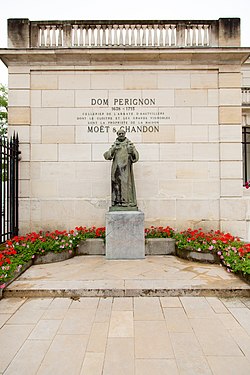
Dom Pérignon

[edit]

Dom Pérignon (/ˌdɒmpɛrɪˈnjɒn/; French pronunciation: [dɔ̃peʁiɲɔ̃]) is a brand of champagne produced by Moët & Chandon. It is named after Dom Pierre Pérignon, a Benedictine monk who was an important quality pioneer for Champagne wine but who, contrary to popular myths, did not discover the champagne method for making sparkling wines.[7] Dom Pérignon was the first prestige cuvée, an idea proposed by Englishman Laurence Venn.[8] The first vintage of Dom Pérignon was 1921 and was only released for sale in 1936. It is a vintage champagne, meaning that it is only made in the best years, and all grapes used to make the wine are harvested in the same year. Many champagnes, by contrast, are non-vintage, meaning that the champagne is made from grapes harvested in various years.

Current production

[edit]
Bottles in the caves

Around 5 million bottles are produced in each vintage.[8] The wine is 60% Chardonnay and 40% Pinot noir, with 6 g/L dosage.[8] According to Tom Stevenson, "All vintages need at least 12 years ageing to nurture Dom Pérignon's signature silky mousse".[8] As of 2020, the current release of Dom Pérignon is from the 2010 vintage[8] and the current release of Dom Pérignon Rosé is from the 2006 vintage. As of 2017 the senior winemaker was Richard Geoffroy, who has been chef de cave for Dom Pérignon since 1990.[9]

Domaine Chandon

[edit]

In 1973, the then Moët-Hennessy company founded Domaine Chandon, an outpost winery in the Napa Valley. It was the first French-owned sparkling wine venture in the United States. The fine dining restaurant étoile was located at the winery, until it closed in December 2014.[10]

Chandon had already founded an outpost in Argentina in 1959, and was doing the same in the southern city of Garibaldi in Brasil in 1973.[citation needed] Domaine Chandon was later established in 1986 in Australia in Coldstream, Victoria, in the Ningxia region in China in 2013 and India's Nashik region in 2014.[citation needed]

Sponsorships

[edit]

Moët was the official Formula One champagne provider between 1966 and 1999 and again from 2016[11] until 2017 when they signed a deal with champagne maker Carbon.[12]

On 30 November 2012, Swiss tennis player Roger Federer became Moët et Chandon's brand ambassador. On 30 September 2015, Chandon announced it would be a sponsor of the McLaren F1 team starting 2016.[13]

Pronunciation

[edit]

Moët is pronounced with a "t" at the end (IPA: [mɔɛt]) ('mo-et') as the French-born founder's surname is assumed to be of non-French (alleged Dutch-German) origin.[14][15][16]

Songs

[edit]

Richard Strauss' opera Arabella mentions it twice: "Moët-Chandon, halb herb und halb süss - der war es bei meiner Verlobung!" "Wünschen noch Moët-Chandon? Hier ist! Servieren der Frau Gräfin Mutter!"

In the band Queen's song "Killer Queen", the lead singer Freddie Mercury sings "She keeps her Moët et Chandon in her pretty cabinet".

Musician Prince mentions "a little Spanish man offering wine and Moët" in his song "Mr. Goodnight" from his Planet Earth album.

In his song "Big Poppa", the rapper Notorious B.I.G. sings "at the back of the club sipping Moët is where you'll find me".

In his song “Drop It Like It’s Hot”, the rapper Snoop Dogg sings “I got the Rollie on my arm and I'm pouring Chandon”.

In his song, "Comin Thru", Chali 2na sings "I don't drink, my glass never will hold Moët".

In his song "Check Out My Melody", Rakim says: "Emcees that wanna be best, they're gonna be dissed if they don't get from in front of All they can go get is me a glass of Moët, A hard time, sip your juice and watch a smooth poet".

In his song "Curls", MF Doom sings, "Yup, you know it, growin' up too fast; showin' up to class with Moet in a flask".

In her song “Win Again”, Nicki Minaj raps “They know that Nicki a poet, pop me a bottle of Moët”.

In his song, "The Way Life Goes", the rapper Lil Uzi Vert sings "She's sipping Moët, and yeah, I swear it gets her wetter".

Craig David mentions Moët as part of his week-long date plans in the song "7 Days."

In his song "Bloodless", Andrew Bird sings "And the poets, they explode like bombs, While the gentry is drinking Moët Chandon".

In her song "The Roof", Mariah Carey sings "So we finished the Moët and started feeling liberated".

In his song "Cristal & MOЁT", a Russian rapper Morgenshtern sings "I pour Cristal or Chantel MOЁT, you were dreaming about it, now it's mine".

In his song “Represent,” rapper Nas sings “Yo, they call me Nas, I’m not your legal type of fella, Moët drinkin’, marijuana smokin’ street dweller”. Moët is also mentioned in his song "It Ain't Hard to Tell" in the lyric "I drink Moët with Medusa, give her shotguns in Hell; From the spliff that I lift and inhale; it ain't hard to tell". The champagne is also mentioned in his songs Reach Out and Affirmative action.

In her song "The Motto", American singer Ava Max sings "popping that Moët, baby lets make some bubbles".

In her song "Muñecas", Argentinian singer Tini Stoessel sings "bottles are uncorked, tonight there will be rain of Moët".

Incident

[edit]

In June 2022, the Dutch Food and Consumer Product Safety Authority warned that the 3-liter champagne bottle from Moët & Chandon Ice Impérial contained MDMA, killing a person in Germany.[17]

See also

[edit]

References

[edit]
[edit]
Revisions and contributorsEdit on WikipediaRead on Wikipedia
from Grokipedia
Moët & Chandon is a renowned French champagne house founded in 1743 by in , within the Champagne region of , specializing in premium sparkling wines that embody elegance and celebration. The house, originally known as Moët et Cie, adopted its current name in 1833 when Pierre-Gabriel Chandon de Briailles, son-in-law of Moët's grandson Jean-Rémy Moët, joined as a partner, marking a pivotal expansion in its operations and international reach. Throughout its nearly 280-year history, Moët & Chandon has been defined by innovation and prestigious associations, including a close relationship with Napoleon Bonaparte, who visited the cellars multiple times and declared it his favorite champagne, even ordering shipments for his campaigns. In 1869, the house introduced Moët Impérial, originally named Brut Impérial, as its flagship non-vintage brut champagne, which revolutionized the category with its bright, fruit-forward style and accessibility. The brand further elevated its prestige in 1921 by launching Dom Pérignon with its first vintage, a cuvée inspired by the 17th-century monk Dom Pierre Pérignon, transforming it into a global symbol of luxury sparkling wine produced exclusively by Moët & Chandon. Today, as part of the group's Moët Hennessy division since 1987, Moët & Chandon operates as the world's largest champagne producer, cultivating 1,300 hectares of vineyards (as of 2024) and annually producing approximately 30 million bottles, with exports to over 150 countries. Its wines, crafted primarily from , , and grapes using the traditional méthode champenoise, continue to grace high-profile events as the official champagne of the NBA and numerous royal occasions, underscoring its enduring status in luxury and festivity.

History

Founding and early development

Moët & Chandon traces its origins to 1743, when established the wine trading firm Moët et Cie in , , focusing on both still wines and the emerging sparkling champagnes from the Champagne region. As a visionary merchant, Claude Moët recognized the potential of these wines beyond local markets, initiating exports that elevated the house's profile among discerning consumers. Claude's strategic shipments to and the royal court at Versailles quickly garnered acclaim from European royalty and nobility, including the influential Marquise de Pompadour, mistress of King Louis XV, who favored the house's offerings for their quality and finesse. This early success laid the foundation for Moët's reputation as a purveyor of luxury wines, with the firm's cellars in becoming a hub for innovative blending techniques that enhanced the effervescence and elegance of its sparkling products. The , beginning in 1789, posed significant challenges to the burgeoning enterprise, as upheavals in society and the seizure of noble and church-owned properties disrupted trade networks across Champagne. The founder's son, Claude-Louis Moët, passed away in , just as the Revolution intensified, but his grandson Jean-Rémy Moët assumed leadership and adeptly navigated the turmoil by maintaining a discreet profile, allowing the house to preserve its operations intact while competitors faltered. Post-revolutionary shifts toward a new elite class ultimately amplified demand for symbols of celebration and sophistication, propelling Moët's exports to royal courts and affluent circles throughout . Jean-Rémy Moët, building on his grandfather's legacy, further expanded the firm's reach by enhancing production capacity and forging international connections, which transformed Moët into a global emblem of festivity by the late . Although the foundational innovations originated in Claude's era, Jean-Rémy's stewardship paved the way for milestones like the house's first vintage-dated champagne in 1842, underscoring the enduring family commitment to excellence in sparkling wine production.

Expansion and family legacy

In 1833, following the retirement of Jean-Rémy Moët, his son Victor Moët partnered with his brother-in-law Pierre-Gabriel Chandon de Briailles to formalize the company as Moët & Chandon, marking a pivotal merger that strengthened its operational structure and . This union combined the Moët family's established expertise with Chandon's financial and managerial acumen, enabling rapid scaling of production and distribution networks across . The not only solidified the house's position in the Champagne trade but also emphasized intergenerational family collaboration, with Victor and Pierre-Gabriel steering the business through the burgeoning demand for sparkling wines. During the , Moët & Chandon pioneered innovations in style to cater to evolving tastes, particularly introducing the concept of -dated champagnes in 1840 and releasing their first in 1842, which laid the groundwork for drier expressions. By the mid-century, the house shifted from sweeter wines toward a drier brut profile to appeal to the , where preferences leaned toward less dosage; this adaptation culminated in the creation of Brut Impérial in 1869, but the trend began earlier with experimental drier cuvées in the and . These changes reflected strategic product innovations driven by family oversight, enhancing the brand's international appeal and setting standards for modern Champagne styles. The 19th century saw significant infrastructural expansion, including the construction of expansive chalk cellars in starting in the early 1800s and accelerating through the mid-century, which by spanned vast underground networks capable of aging millions of bottles under stable conditions. Concurrently, the family aggressively expanded vineyards, acquiring key plots such as those at Hautvillers Abbey in the early 1800s and amassing approximately 360 hectares by the early 20th century, bolstering grape supply amid growing output demands. The house also recovered from the epidemic in the late 19th century through grafted replanting efforts. These developments, funded and directed by the Moët and Chandon families, transformed the house into one of Champagne's largest producers, employing up to 1,600 workers and outputting two to three million bottles annually by the late 1800s. Family leadership transitioned smoothly from Jean-Rémy Moët to Victor and subsequent descendants, with the Chandon line providing continuity through the late ; notably, women like Madame Victor Auban-Moët played supportive roles in management and philanthropy, contributing to community initiatives such as hospital funding that underscored the family's legacy. By the early , under figures like Robert-Jean de Vogue from the extended family, the house navigated recovery and operational challenges while maintaining familial control. However, severely disrupted production, with the front-line location leading to significant reductions in output—as cellars doubled as soldier shelters and vineyards suffered bombardment and labor shortages.

Acquisition and modern ownership

In 1971, Moët & Chandon merged with the cognac house to form Moët Hennessy, establishing a powerful wines and spirits entity that combined expertise in sparkling wines and brandy production. This union laid the foundation for broader corporate synergies, enabling enhanced distribution networks and innovation in luxury beverages. The company's trajectory shifted dramatically in 1987 when Moët Hennessy merged with to create Moët Hennessy Louis Vuitton SE, the world's leading conglomerate. Under 's umbrella, Moët & Chandon benefited from the group's vast resources, accelerating its global expansion through integrated marketing, retail presence in over 150 countries, and strategic investments in production infrastructure. This integration transformed the house from a prominent Champagne producer into a cornerstone of the luxury sector, with annual production surpassing 30 million bottles by the mid-2020s. Entering the , Moët & Chandon prioritized amid growing environmental pressures on the Champagne region. Since the , the house has implemented comprehensive initiatives, including sustainable certifications across its 1,300-hectare vineyard holdings and partnerships with over 2,000 growers to promote and reduce chemical inputs. These efforts align with Moët Hennessy's broader "Living Soils" program, which has certified 25% of its vineyards in sustainable practices by the early 2020s. Key milestones in recent years underscore this commitment. In 2020, Moët & Chandon redesigned its Grand Vintage packaging, optimizing materials to cut CO2 emissions by nearly 1,350 tons annually, equivalent to saving 6,000 trees. By 2025, the house has advanced its response to through the Natura Nostra biodiversity program, launched in 2021, which targets 100 km of ecological corridors by 2027 and incorporates techniques. This includes trials with resilient hybrid grapes and historic vine cuttings to combat rising temperatures and maintain quality in the face of evolving conditions in Champagne. Today, Moët & Chandon remains fully integrated within LVMH's Wines and Spirits division, operated through Moët Hennessy, which oversees a portfolio of prestigious brands. The maison is led by President and CEO Sibylle Scherer, appointed in 2023, who guides its strategic direction amid the division's recent leadership transition—Philippe Schaus concluded his 21-year tenure as Moët Hennessy CEO in February 2025, succeeded by Jean-Jacques Guiony.

Products

Core champagne range

The core champagne range of Moët & Chandon centers on accessible, non-vintage blends designed for broad appeal, emphasizing balance, freshness, and fruit-forward profiles that reflect the house's signature style. The flagship Brut Impérial, introduced in the and refined over decades, forms the cornerstone of this lineup. It is crafted as a multi-vintage from over 150 base wines sourced across more than 1,000 hectares of vineyards in the Champagne region, with a typical blend comprising 30-40% for structure and intensity, 30-40% for roundness and fruitiness, and 20-30% for elegance and acidity. The wine undergoes 24 months' aging on lees in the bottle, exceeding the appellation's requirement, which imparts subtle autolytic notes of brioche and nuts while maintaining vibrancy; annual production exceeds 20 million bottles, making it one of the world's most produced Champagnes. Complementing the Brut Impérial are other entry-level offerings that extend the house's versatile style. achieves its pale salmon hue through the addition of 10% red wine to a base blend similar to the Brut—approximately 40-50% , 30-40% , and 10-20% —followed by the same extended lees aging for depth and finesse. , the Demi-Sec variant, mirrors this composition but with a dosage of 45 g/L to emphasize and approachability, balancing the grapes' natural acidity with notes of ripe orchard fruits. For those seeking a expression within the core range, Grand Vintage provides a single-year snapshot, such as the 2015 edition blending 44% , 32% , and 24% , aged for at least five years on lees to highlight the harvest's character without venturing into prestige territory. Tasting profiles across the core range prioritize lively fruit and finesse, with Brut Impérial offering aromas of green apple, citrus, and white flowers, evolving to a palate of mineral freshness, brioche, and elegant persistence. Rosé Impérial, despite similar dosage levels to Brut Impérial, shifts toward red berry intensity like , , and cherry due to its higher Pinot Noir proportion, which emphasizes flavors mimicking sweetness and fruitiness in contrast to the crisper, mineral notes of the Brut, with a supple texture. While Impérial adds layers of and honeyed sweetness. These wines have earned consistent acclaim, including scores of 91-93 points from for multiple releases, underscoring their reliability and quality. The pricing strategy positions the range for mass-market accessibility. In major international markets, Brut Impérial retails at approximately $50-60 per 750ml bottle. In France, the 75cl bottle typically retails for 35-40 € at major supermarkets such as Carrefour, Leclerc, and Auchan, with standard prices around 39-40 € (e.g., 39.89 € at Carrefour) and occasional promotions reducing it to around 34.90 €. Prices fluctuate seasonally and with promotions, with current ranges (2024-2025) generally applying and no specific prices available for 2025-2026. This encourages everyday celebrations and gifting. The evolution of the core range reflects Moët & Chandon's commitment to , notably with the introduction of eco-friendly sourcing practices in , including the integration of electric tractors and reduced chemical inputs across vineyards supplying these blends, ensuring long-term viability without altering the classic profiles.

Prestige cuvées

Moët & Chandon's prestige represent the pinnacle of its winemaking, focusing on vintage-dated champagnes that capture exceptional harvests with unparalleled depth and complexity. The flagship among these is , a prestige launched in 1921 by the house to honor the legacy of the 17th-century Benedictine monk Dom Pierre Pérignon, who managed vineyards at the Hautvillers Abbey but did not invent , contrary to popular myth. The inaugural vintage was 1921, though it was not commercially available until 1936, marking the birth of a line that has since defined luxury in Champagne. Dom Pérignon is crafted exclusively from Grand Cru and Pinot Noir grapes sourced from premier vineyards across Champagne, with the blend typically balancing around 50% of each variety, though proportions can shift to 60/40 depending on the vintage's character. Each bottling undergoes a minimum of seven years of lees aging in the bottle to develop its signature intensity and finesse, far exceeding standard requirements for vintage Champagne. Vintages are declared only in exceptional years, with no more than about 10 produced per decade, ensuring selectivity and rarity. This disciplined approach underscores the cuvée's commitment to expressing a single year's without compromise. Beyond , Moët & Chandon's prestige offerings include the Grand Vintage Collection, a line of single-vintage champagnes that highlight the house's expertise in blending for elegance and structure. The 2012 Grand Vintage, for instance, blends 41% , 33% , and 26% , resulting in a wine noted for its maturity, complexity, and charismatic evocation of spring-to-summer transition, with aromas of white flowers evolving into ripe pear and nectarine. These vintages are produced solely in outstanding years, emphasizing rarity and the house's pursuit of harmony between fruit, minerality, and acidity. Annual production of reaches approximately 5 million bottles, encompassing both blanc and expressions, though exact figures remain proprietary. Recent vintages include the 2015, celebrated for its balance and depth, and the 2018, which captures vibrant freshness with notes of and . The line extends to secondary releases known as Plénitudes: P2, disgorged after 12 to 15 years of aging for enhanced creaminess and evolution; and P3, after 25 to 40 years, offering profound tertiary aromas and structure for collectors. Dom Pérignon's introduction elevated Moët & Chandon's status as a symbol of opulence, transforming the house into a global benchmark for prestige Champagne and inspiring the luxury category. Its legacy also traces to the monk's pioneering use of blind tastings for objective blending decisions, a practice that originated in his meticulous management and endures as a foundational technique in modern enology.

International sparkling wines

Moët & Chandon extended its expertise in sparkling winemaking beyond through the brand, beginning with its establishment in in 1959 as the company's inaugural international venture. This was followed by the founding of in Napa Valley in 1973, where the traditional méthode champenoise—also known as méthode traditionnelle—was employed to produce sparkling wines adapted to the local . The brand's global footprint has since grown to encompass operations across six countries on four continents, including (established 1973), (1986), (2013), and (2014). In , the original site in Mendoza focuses on high-altitude vineyards, while Australian facilities in the Yarra Valley emphasize cool-climate expressions. Chinese production in utilizes local climate conditions for premium sparklers, and Indian operations in leverage Nashik's emerging wine region. Collectively, these sites produce approximately 25 million bottles annually, reflecting Chandon's scale as the world's largest vineyard network outside Champagne. Chandon's portfolio features accessible, fruit-forward sparkling wines tailored to diverse markets, with staples like Chandon Brut Classic—a crisp, non-vintage blend offering apple, , and notes—and Chandon Brut Rosé, which delivers vibrant , cherry, and flavors with a creamy texture. Region-specific offerings include Australian blends highlighting for structure and berry depth, as well as limited editions like vintage reserves in that showcase local and grapes. Some markets also see adaptations such as still wines, broadening the brand's appeal beyond effervescence. Unlike Moët & Chandon's Champagnes, which are governed by strict d'Origine Protégée (AOP) rules requiring production in the Champagne region with specific grape varieties, Chandon sparkling wines incorporate local grapes such as Argentine or Australian alongside and , allowing for innovative blending without geographic restrictions. This flexibility enables fresher, more approachable styles suited to casual consumption, while maintaining the secondary fermentation in bottle for complexity akin to Champagne. In recent years, Chandon has prioritized , particularly in , with Indian facilities much of their water usage and employing organic fertilizers to preserve . The brand's expansion in , including enhanced distribution to regions like by 2025, supports growing premium wine demand while integrating eco-friendly practices across its global operations.

Production

Vineyards and terroir

Moët & Chandon owns 1,300 hectares of vineyards across the Champagne region as of 2025, making it the largest estate-owned vineyard area in the appellation. These holdings are concentrated primarily in key sub-regions such as the Montagne de , known for its Pinot Noir-dominated slopes, and the Côte des Blancs, a premier area for Chardonnay cultivation, with additional parcels in the Vallée de la Marne, Sézanne, and . Approximately 50% of these vineyards are classified as Grand Cru and 25% as Premier Cru, providing access to around 200 of Champagne's 319 crus, including 17 Grands Crus and 32 of the 44 Premiers Crus. The house's grape sourcing reflects a balanced use of the three principal Champagne varieties: , , and . Typical blends, such as the flagship Brut Impérial, incorporate roughly 40% for structure and red fruit intensity, 30% for elegance and citrus-driven freshness, and 30% for roundness and white-fleshed fruit notes. These proportions are drawn from estate plots and sourced grapes, with and Meunier emphasizing the house's focus on robust, age-worthy bases, while contributes finesse from high-quality Premier and Grand Cru sites in the Côte des Blancs. The of Moët & Chandon's vineyards is defined by the region's iconic soils, which impart distinctive minerality and excellent drainage to the grapes. These Belemnite subsoils, formed from ancient marine deposits, retain during dry periods while promoting deep systems that enhance flavor concentration. Diverse microclimates across the holdings—cooler, fog-prone valleys in the Vallée de la Marne for balanced acidity, and sunnier, south-facing slopes in the for ripeness—allow for nuanced expression of each variety, with the overall cool preserving the high acidity essential for Champagne's vivacity and aging potential. A portion of the grapes used in production come from Moët & Chandon's estate-owned vineyards, with the remainder sourced from over 1,000 independent growers through long-term contracts that ensure consistent and sustainable practices. These partnerships span the Champagne , integrating grapes from a broad spectrum of to maintain blend complexity. has introduced challenges to the region's , including warmer temperatures leading to earlier harvests that affect acidity levels and ripening dynamics. In 2025, Moët & Chandon's harvest began on August 23, marking an unusually precocious start driven by heatwaves and accelerated maturity, a trend observed across Champagne where picking dates have advanced by up to three weeks compared to historical norms. To counter these impacts, the house has initiated experimental programs, such as trialing historic plant cuttings and disease-resistant varieties, alongside regenerative farming under the Natura Nostra initiative to preserve integrity.

Winemaking process

The winemaking process at Moët & Chandon begins with the grape harvest, which typically occurs in September and involves manual picking to ensure optimal ripeness and quality. The grapes are then gently pressed using pneumatic presses, extracting only the first pressing juices—known as the cuvée—to preserve purity and avoid bitterness from later fractions. Following pressing, the base wines undergo separate vinification in tanks, a technique pioneered by Moët & Chandon to maintain freshness and control. is systematically performed to soften acidity and enhance roundness, contributing to the house's signature balanced style. The blending stage, or assemblage, is central to non-vintage cuvées like Moët Impérial, where oenologists select and combine over 100 base wines from different vintages, crus, and varieties to achieve consistency and . Reserve wines, comprising 20-30% of the blend, add maturity and depth. The blended wine then undergoes tirage, initiating secondary in the bottle via the traditional méthode champenoise, where and sugar are added to produce . Bottles age on lees for 2-3 years for non-vintage expressions, imparting richness and finesse through autolysis. After aging, bottles are riddled—gradually rotated and tilted over weeks to consolidate sediment toward the neck—before disgorgement, a precise manual or automated expulsion of the lees plug while minimizing wine loss. The final dosage, a liqueur d'expédition of wine and cane sugar, is added to define the cuvée's style; for example, Brut Impérial receives about 8-9 g/L for subtle dryness. Quality control integrates advanced technology, including AI-driven systems for real-time fermentation monitoring implemented across Moët & Chandon wineries since the early 2020s, ensuring precision and batch consistency.

Marketing and sponsorships

Brand ambassadors

Moët & Chandon's association with influential figures dates back to the , when Claude Moët's champagne gained favor among European aristocracy, notably through the patronage of , the influential mistress of King , who supplied it to the French royal court and helped establish its reputation for luxury. In the early 19th century, the house forged a close friendship with Napoleon Bonaparte, who visited the Epernay estate multiple times, admired its wines, and inspired the naming of Moët Impérial after his imperial title, further cementing its status among elite circles. In the modern era, the brand has partnered with high-profile celebrities to embody its image of elegance and celebration. Actress served as a global ambassador from 2007 to 2012, featuring in campaigns that highlighted glamour and sophistication in film and lifestyle contexts. In 2012, tennis legend succeeded her as brand ambassador, with initiatives emphasizing precision, grace, and triumph on the court, including personalized promotions tied to his Grand Slam achievements. To expand in key markets, the house appointed Chinese actress as its first Asian ambassador in 2013, leveraging her star power for regional campaigns focused on cultural prestige. As of 2025, Moët & Chandon continues to engage emerging influencers in through targeted collaborations to drive market growth, often integrating and experiential events. These partnerships frequently incorporate campaign strategies like personalized bottle engravings for gifting and exclusive event tie-ins, enhancing connection to the brand's heritage of joyous occasions.

Major partnerships and events

Moët & Chandon established a longstanding association with Formula 1 as the official champagne from 1966 to 2000, providing bottles for podium celebrations during races worldwide. This partnership symbolized victory and luxury in motorsport, with the brand's cuvées becoming synonymous with triumphant moments on the track. In 2025, Moët & Chandon returned as the official champagne of Formula 1 through a 10-year global agreement between LVMH and the series, encompassing podium rituals and exclusive activations. As part of this deal, the brand served as title sponsor for the 2025 Belgian Grand Prix at Spa-Francorchamps, featuring hospitality experiences, bespoke editions, and podium ceremonies that highlighted its heritage in the sport. Beyond motorsport, Moët & Chandon has maintained key partnerships in other sports, including as the official champagne of the US Open tennis tournament, a role it has held intermittently since the early 2010s with a new multiyear partnership announced in 2024 and continuing through the 2025 tournament to enhance on-site experiences and celebrations. The brand also serves as the official champagne of the NBA, supporting Finals celebrations and locker room toasts, such as those following championship wins, through collaborations like limited-edition collections with designers inspired by basketball culture. Additionally, Moët & Chandon has featured prominently in James Bond films since 1962, with product placements in titles like The Man with the Golden Gun (1974), integrating the champagne into scenes of sophistication and espionage. The extends its presence through high-profile events under the "Moët Moments" initiative, which captures celebratory instants at occasions like the Oscars and fashion weeks. At the Oscars, Moët & Chandon has hosted viewing parties and contributed to official festivities, including themed events at venues like the to toast film achievements. During fashion weeks, such as , the creates dedicated lounges serving its and brut cuvées to complement runway shows and presentations. These activations align with Moët & Chandon's to associate its products with cultural milestones, fostering global . These partnerships have correlated with notable impacts, including contributions to LVMH's overall resilience in 2025, where increased for Moët & Chandon helped drive a return to growth in the third quarter amid broader luxury sector challenges. The F1 return, in particular, amplified exposure to millions of fans, supporting the brand's positioning in premium celebration markets.

Cultural impact

References in music

Moët & Chandon has been prominently referenced in hip-hop and rap since the , often symbolizing luxury, success, and the high life. In The Notorious B.I.G.'s "" (1994), he raps, "The back of the club, sippin' Moët is where you'll find me," positioning the champagne as a staple of club culture and aspiration. Similarly, in his track "Juicy" from the same year, Biggie mentions, "The Moët and Alizé keep me pissy," highlighting its role in celebrating rags-to-riches triumphs. has frequently name-dropped the brand, as in "Feelin' It" (1996), where he declares, "I'm feeling it, fill the glass to the top with Moët," evoking indulgence and confidence. , a noted admirer of fine champagnes, has incorporated similar luxury themes in his work, contributing to the genre's association with high-end bubbly. In pop and R&B, Moët & Chandon appears in celebratory and intimate contexts, underscoring themes of romance and revelry. Mariah Carey's "The Roof" (1997) includes the line, "And so we finished the Moët and I started feeling liberated," capturing a moment of emotional surrender during a rainy encounter. Drake often evokes champagne in party settings across his discography, aligning the brand's prestige with modern nightlife vibes. References extend to other genres, including rock, where Queen's "Killer Queen" (1974) famously opens with, "She keeps Moët et Chandon in her pretty cabinet," portraying the champagne as a marker of sophisticated allure in the song's depiction of an enigmatic . In the 2020s, mentions continue in tracks influenced by , with artists tying the brand to viral trends and digital-age luxury, as seen in its persistent presence in contemporary hip-hop and pop videos. Culturally, Moët & Chandon's lyrical evolution reflects its shift from an 1980s-1990s in hip-hop—exemplified by early references in Biggie's work—to a 2025 staple in meme-driven and challenges, where it embodies accessible opulence amid global streaming . According to a 2023 analysis, it has 861 total mentions across songs and ranks as the most influential drinks brand in music history, surpassing other champagnes and underscoring its enduring pop cachet.

Depictions in film and media

Moët & Chandon has long been portrayed in cinema as an emblem of luxury, success, and extravagance, often serving as a prop in scenes of celebration and . In the James Bond franchise, the brand appears in "The Man with the Golden Gun" (1974), featuring custom props produced directly by the house for to highlight sophisticated villainy and glamour. More contemporary depictions emphasize opulence and excess. In "The Great Gatsby" (2013), directed by Baz Luhrmann, Moët & Chandon is integrated into the film's lavish 1920s party sequences, with the house creating exact reproductions of its 1921 Brut Impérial vintage, including comically oversized bottles carried by partygoers; this placement was described as a "marketing coup" that delivered invaluable free publicity amid the movie's global release. Similarly, "The Wolf of Wall Street" (2013), directed by Martin Scorsese, showcases the champagne during wild, hedonistic celebrations that mirror the protagonists' Wall Street debauchery, reinforcing its association with unchecked ambition and wealth. The brand also features in high-profile advertising, including spots that leverage the event's massive to promote celebratory moments. The evolution of Moët & Chandon's media presence reflects broader shifts in , from overt 1970s product placements in action films like the Bond series to seamless integrations in 2010s blockbusters, and onward to digital platforms by 2025. On , the brand's campaigns blend heritage elegance with humorous, music-driven content—such as user-generated toasts and hacks—to appeal to younger demographics, amassing millions of views and fostering interactive . In 2025, its renewed decade-long partnership as the Official Champagne of Formula 1 extends to broadcast tie-ins, with sprays and branded segments during races amplifying visibility to a global motorsport of over 1.5 billion. These portrayals have markedly enhanced the brand's aspirational image, with film placements like ""—which grossed over $350 million worldwide—correlating to heightened consumer awareness and perceived prestige, often translating to indirect sales uplift through cultural osmosis rather than direct metrics.

Brand identity

Pronunciation and nomenclature

Moët & Chandon is commonly pronounced in English as "moh-ET and shahn-DON," with a distinct "t" sound at the end of Moët, distinguishing it from typical French pronunciation rules where final consonants are often silent. This pronunciation reflects the Dutch origin of the surname Moët, as the brand's founder, , was born in but bore a name with non-French roots that retained the pronounced "t." In French, the name is articulated similarly with a hard "t" in Moët due to the liaison with "et," resulting in a sound closer to "mwet ay shahn-dohn." A frequent mispronunciation in English-speaking contexts is "moh-ay," omitting the "t" and treating it as a purely French name, which overlooks its etymological background. The etymology of "Moët" traces directly to (1662–1750), the 17th-century wine trader who established the house in 1743; his surname's Dutch heritage explains the phonetic emphasis on the final consonant. "Chandon" originates from Pierre-Gabriel Chandon de Briailles (1798–1878), a French banker and son-in-law of Jean-Rémy Moët, who became a partner in 1833 and co-led the expansion of the business. The nomenclature evolved from the original "Moët et Cie" (Moët & ), used since the house's founding in 1743 to denote its status as a trading firm, to "Moët & Chandon" in 1833 upon Chandon's partnership, formalizing the dual family legacy. The "&" has remained a consistent element in the branding, symbolizing the merger of the two families, and persists in the modern as a hallmark of the brand's identity. In global markets, particularly non-English ones, the name adapts to local phonetic conventions while preserving the core structure; for instance, in Asian regions, it is often simplified in advertising to align with regional languages without altering the official French-Dutch inflection.

Visual branding and heritage

Moët & Chandon's visual branding has evolved significantly since its founding in 1743, beginning with a simple black script logo that emphasized the house's name in an elegant, handwritten style typical of 18th-century luxury goods. By the 19th century, the branding incorporated more ornate elements, including a gold label introduced in the 1830s to signify prestige and quality, which became a hallmark of their premium cuvées like Impérial. The iconic red ribbon, tied around the bottle neck, emerged as a key feature in the mid-19th century, evolving from a simple tie to a elaborate bow by 1889, symbolizing celebration and tying into the brand's association with victory and festivity. The packaging design reinforces this heritage through distinctive elements, such as the dry neck —a sleek, minimalist foil that contrasts with the opulent main , first prominent on the Dry Impérial cuvée from the late . Gift boxes often feature custom engravings on bottles or wooden casings, allowing while maintaining the brand's luxurious aesthetic, a practice promoted through official gifting services. In the , sustainability initiatives updated the packaging, including the introduction of recyclable, plastic-free foil caps made from aluminum and paper in 2024, reducing the by 31% compared to traditional plastic alternatives without compromising the elegant design. Central to the brand's heritage symbols is the motif, which appears on labels and packaging to represent excellence and aspiration, possibly inspired by the —known as Napoleon's Comet—though its use predates the event and aligns with the house's pursuit of stellar quality in champagne production. The cellars in , a spanning 28 kilometers of chalk tunnels, serve as branded tour destinations where visitors experience guided explorations highlighting the aging process and historical artifacts, reinforcing the maison's legacy of craftsmanship. In 2025, Moët & Chandon advanced its digital branding through its renewed partnership as the Official Champagne of Formula 1, featuring interactive online maps to track brand presence at Grand Prix events and special podium bottles, blending heritage motifs with modern celebratory experiences.

Controversies

In the 1990s, Moët & Chandon, through its U.S. distributor Schieffelin & Co., pursued trademark protection for its brand against imitators. In Schieffelin & Co. v. Jack Co. of Boca, Inc. (1994), the Southern District of New York ruled in favor of Schieffelin, finding that the defendant's "Dom Popignon" popcorn product infringed on Dom Pérignon's federally registered trademarks for "CUVÉE DOM PÉRIGNON" and its distinctive shield label design. The court determined a substantial likelihood of consumer confusion due to the phonetic and visual similarities, granting a preliminary to halt sales and reinforcing Moët & Chandon's rights to the Dom Pérignon name, which had been in use since 1936. During the 2010s, Moët & Chandon intensified efforts against counterfeiters, particularly in , where fake luxury wines proliferated. A notable case involved Moët (the parent entity) suing auction house Acker Merrall & Condit in Hong Kong's High Court over the 2012 sale of counterfeit Krug Collection 1947 champagne, a rare vintage from Moët Hennessy's portfolio. The auction house admitted and , leading to a 2017 settlement that included damages, an apology, and commitments to authenticity verification protocols, underscoring Moët & Chandon's global anti-counterfeiting strategy amid China's estimated 50% fake wine market for premium bottles. In 2024, Moët & Chandon prevailed in a Japanese trademark dispute when the canceled the "CLUB MOET" mark for services, citing a likelihood of confusion with the "Moët & Chandon" brand due to phonetic and visual similarities, including a element. This decision highlighted ongoing efforts to protect the brand in international markets. The formation of through the 1987 merger of Moët and proceeded without significant antitrust litigation, though it faced regulatory scrutiny under French and European laws due to the combined dominance in luxury spirits and . Internal executive disputes over control emerged shortly after, but no formal antitrust challenges disrupted the $4 billion deal, which was approved by shareholders and regulators, enabling expanded resources for Moët & Chandon. In recent years, Moët & Chandon has navigated IP challenges in digital realms, including NFTs. In March 2025, faced a patent infringement lawsuit in federal court from Watch Skins Corp., alleging unauthorized use of patented NFT display technology in smartwatches. Concurrently, Moët Hennessy filed U.S. applications in 2024 for "Moët & Chandon" and "" in metaverse and NFT contexts to preempt infringement in virtual spaces. No major legal disputes have arisen over its 2025 Formula 1 sponsorship, a 10-year partnership valued at over $100 million annually. These disputes highlight Moët & Chandon's proactive legal defenses, resulting in successful injunctions, settlements, and enhanced global registrations that have strengthened integrity against dilution and counterfeiting.

Notable incidents

During , Moët & Chandon's operations in Épernay were significantly disrupted by German occupation, with the company's cellars sequestered and used to store looted champagne and military supplies. The house's director, Robert-Jean de Voguë, played a key role in the , coordinating efforts to German shipments and protect stockpiles by mislabeling bottles or hiding them in underground tunnels. This resistance activity led to arrests within the company after German intelligence uncovered the network, though de Voguë survived deportation and the house avoided total destruction. In 2022, Moët & Chandon faced a major quality and safety crisis when multiple batches of its Ice Impérial champagne were found contaminated with (ecstasy), leading to a voluntary across . The adulteration, believed to stem from unauthorized tampering during distribution rather than production, affected limited-edition 3-liter bottles sold at high-end retailers, resulting in one and at least 12 hospitalizations from acute . The company responded swiftly by issuing public alerts through authorities, coordinating with retailers for returns, and emphasizing rigorous quality controls in subsequent statements, with no evidence of long-term reputational harm as sales recovered in following quarters. In May 2025, labor strikes at LVMH's Champagne houses, including Moët & Chandon, highlighted ongoing vulnerabilities amid job cuts and wage disputes. Workers in protested planned reductions of up to 1,200 positions in the wine and spirits division, disrupting production and logistics during a period of economic pressure from declining sales. These actions occurred shortly after Moët & Chandon's renewed partnership as Formula 1's official champagne provider, though the company maintained event supplies through contingency measures and transparent communication with unions, avoiding major interruptions to high-profile deliveries.

References

Add your contribution
Related Hubs
User Avatar
No comments yet.