Hubbry Logo
Peter DamianPeter DamianMain
Open search
Peter Damian
Community hub
Peter Damian
logo
8 pages, 0 posts
0 subscribers
Be the first to start a discussion here.
Peter Damian
Peter Damian
from Wikipedia

Peter Damian OSB (Latin: Petrus Damianus; Italian: Pietro or Pier Damiani; c. 1007 – 21 or 22 February 1072 or 1073)[1] was an Italian reforming Benedictine monk and cardinal in the circle of Pope Leo IX. Dante placed him in one of the highest circles of Paradiso as a great predecessor of Francis of Assisi and he was declared a Doctor of the Church on 27 September 1828. His feast day is 21 February.

Key Information

Early life

[edit]

Peter was born in Ravenna around 1007,[2] the youngest of a large but poor noble family. Orphaned early, he was at first adopted by an elder brother who ill-treated and under-fed him while employing him as a swineherd. After some years, another brother, Damianus, who was archpriest at Ravenna, had pity on him and took him away to be educated. Adding his brother's name to his own, Peter made such rapid progress in his studies of theology and canon law, first at Ravenna, then at Faenza, and finally at the University of Parma, that, around the age of 25, he was already a famous teacher at Parma and Ravenna.[3]

Religious life

[edit]
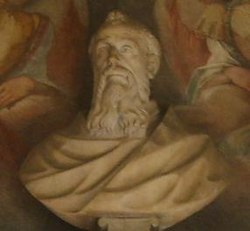
Peter Damian (far right), depicted with Augustine, Anne, and Elizabeth

About 1035, however, he gave up his secular calling and, avoiding the compromised luxury of Cluniac monasteries, entered the isolated hermitage of Fonte Avellana, near Gubbio. Both as a novice and as a monk, his fervour was remarkable but led him to such extremes of self-mortification in penance that his health was affected, and he developed severe insomnia.[3]

On his recovery, he was appointed to lecture to his fellow monks. Then, at the request of Guy of Pomposa (Guido d'Arezzo) and other heads of neighbouring monasteries, for two or three years he lectured to their brethren also, and (about 1042) wrote the life of Romuald for the monks of Pietrapertosa. Soon after his return to Fonte Avellana, he was appointed economus (manager or housekeeper) of the house by the prior, who designated him as his successor. In 1043 he became prior of Fonte Avellana and remained so until his death in February 1072.[3]

Subject-hermitages were founded at San Severino, Gamogna, Acerreta, Murciana, San Salvatore, Sitria and Ocri. A zealot for monastic and clerical reform, he introduced a more severe discipline, including the practice of flagellation ("the disciplina") into the house, which, under his rule, quickly attained celebrity, and became a model for other foundations, even the great abbey of Monte Cassino. There was much opposition outside his own circle to such extreme forms of penitence, but Peter's persistent advocacy ensured its acceptance, to such an extent that he was obliged later to moderate the imprudent zeal of some of his own hermits.[2]

Another innovation was that of the daily siesta, to make up for the fatigue of the night office. During his tenure of the priorate, a cloister was built, silver chalices and a silver processional cross were purchased, and many books were added to the library.[2]

Reformer

[edit]
Sancti Petri Damiani Opera Omnia (1743)

Although living in the seclusion of the cloister, Peter Damian closely watched the fortunes of the church, and like his friend Hildebrand, the future Pope Gregory VII, he strove for reforms in a deplorable time. After almost two centuries of political and social upheaval, doctrinal ignorance and petty venality among the clergy had reached intolerable levels. When the scandalous Benedict IX resigned the pontificate into the hands of the archpriest John Gratian (Gregory VI) in 1045, Peter hailed the change with joy and wrote to the new pope, urging him to deal with the scandals of the church in Italy, singling out the wicked bishops of Pesaro, of Città di Castello and of Fano.[2]

Extending the area of his activities, he entered into communication with the Emperor Henry III. He was present in Rome when Clement II crowned Henry III and his consort Agnes, and he also attended a synod held at the Lateran in the first days of 1047, in which decrees were passed against simony.[4]

After this, he returned to his hermitage. Damian published a constant stream of open letters on a variety of theological and disciplinary controversies. About 1050, he wrote Liber Gomorrhianus addressed to Pope Leo IX, containing a scathing indictment of the practice of simony, concubinage and sodomy, as threatening the integrity of the clergy. Meanwhile, the question arose as to the validity of the ordinations of simoniacal clerics. Peter Damian wrote (about 1053) a treatise, the Liber Gratissimus, in favour of their validity, a work which, though much combatted at the time, was potent in deciding the question in their favour before the end of the 12th century. Pope Benedict XVI described him as "one of the most significant figures of the 11th century, ... a lover of solitude and at the same time a fearless man of the Church, committed personally to the task of reform."[5]

Philosophy

[edit]

Damian was not so much hostile to philosophy as insistent "that the liberal arts, including philosophy, must remain subservient to religion".[6] He argued that monks should not have to study philosophy, because Jesus did not choose philosophers as disciples, and so philosophy is not necessary for salvation. But the idea (later attributed to Thomas Aquinas) that philosophy should serve theology as a servant serves her mistress originated with him.[7] However, this apparent animosity may reflect his view that logic is only concerned with the validity of the argument, rather than the nature of reality. Similar views are found in Al-Ghazali and Wittgenstein.

Damian's tract De divina omnipotentia is frequently misunderstood. Damian's purpose is to defend the "doctrine of omnipotence", which he defines as the ability of God to do anything that is good, e.g., God cannot lie. Toivo J. Holopainen identifies De divina omnipotentia as "an interesting document related to the early developments of medieval discussion concerning modalities and divine omnipotence".[3] Peter also recognized that God can act outside time, as Gregory of Rimini later argued.[8]

Papal envoy and cardinal

[edit]

During his illness the pope died, and Frédéric, abbot of Monte Cassino, was elected pope as Stephen IX. In the autumn of 1057, Stephen IX determined to make Damian a cardinal. For a long time, Damian resisted the offer, for he was more at ease as an itinerant hermit-preacher than as a reformer from within the Curia, but was finally forced to accept, and was consecrated Cardinal Bishop of Ostia on 30 November 1057.[9]

In addition, he was appointed administrator of the Diocese of Gubbio. The new cardinal was impressed with the great responsibilities of his office and wrote a stirring letter to his brother-cardinals, exhorting them to shine by their example before all. Four months later Pope Stephen died in Florence, and the church was once more distracted by schism. Peter was vigorous in his opposition to the antipope Benedict X, but the force was on the side of the intruder and Damian retired temporarily to Fonte Avallana.[citation needed]

Milan

[edit]

Around the end of 1059, Peter was sent as legate to Milan by Pope Nicholas II. So bad was the state of things at Milan, that benefices (a reward received in exchange for services rendered and as a retainer for future services) were openly bought and sold, and the clergy publicly married the women with whom they lived. The resistance of the clergy of Milan to the reform of Ariald the Deacon and Anselm of Lucca rendered a contest so bitter that an appeal was made to the Holy See.

Nicholas II sent Damian and the Bishop of Lucca as his legates. The party of the irregular clerics took alarm and raised the cry that Rome had no authority over Milan. Peter boldly confronted the rioters in the cathedral and proved to them the authority of the Holy See with such effect that all parties submitted to his decision.[5]

He exacted first a solemn oath from the archbishop and all his clergy that for the future no preferment should be paid for; then, imposing a penance on all who had been guilty, he reinstated in their benefices all who undertook to live in celibacy. The prudent decision was attacked by some of the rigorists at Rome but was not reversed. Unfortunately, on the death of Nicholas II, the same disputes broke out, and they were not finally settled till after the martyrdom of Arialdo in 1066. Meanwhile, Peter was pleading in vain to be released from the cares of his office. Neither Nicholas II nor Hildebrand would consent to spare him.

Later career

[edit]

He rendered valuable assistance to Pope Alexander II in his struggle with the antipope, Honorius II. In July 1061 Pope Nicholas II died and once more a schism ensued. Peter Damian used all his powers to persuade the antipope Cadalous to withdraw but to no purpose. Finally Anno II, Archbishop of Cologne and acting regent in Germany, summoned a council at Augsburg at which a long argument by Peter Damian was read and greatly contributed to the decision in favour of Alexander II.[5]

In 1063 the pope held a synod at Rome, at which Peter Damian was appointed legate to settle the dispute between the Abbey of Cluny and the Bishop of Mâcon. He proceeded to France, summoned a council at Chalon-sur-Saône, proved the justice of the contentions of Cluny, settled other questions at issue in the church of France, and returned in the autumn to Fonte Avellana.[citation needed]

While he was in France the antipope Cadalous had again become active in his attempts to gain Rome, and Peter Damian brought upon himself a sharp reproof from Alexander and Hildebrand for twice imprudently appealing to the royal power to judge the case anew. In 1067, the cardinal was sent to Florence to settle the dispute between the bishop and the monks of Vallombrosa, who accused the former of simony. His efforts, however, were not successful, largely because he misjudged the case and threw the weight of his authority on the side of the bishop. The matter was not settled until the following year by the pope in person.[citation needed]

Having served the papacy as legate to France and to Florence, he was allowed to resign his bishopric in 1067. After a period of retirement at Fonte Avellana, he proceeded in 1069 as papal legate to Germany and persuaded the emperor Henry IV to give up his intention of divorcing his wife Bertha. He accomplished this task at a council in Frankfurt before returning to Fonte-Avellana.[citation needed]

Early in 1072 or 1073,[1] he was sent to Ravenna to reconcile its inhabitants to the Holy See, they having been excommunicated for supporting their archbishop in his adhesion to the schism of Cadalous. On his return thence he was seized with fever near Faenza. He lay ill for a week at the monastery of Santa Maria degl'Angeli, now Santa Maria Vecchia. On the night preceding the feast of the Chair of St. Peter at Antioch, he ordered the office of the feast to be recited and at the end of the Lauds he died. He was at once buried in the monastery church, lest others should claim his relics.[citation needed]

During his concluding years, he was not altogether in accord with the political ideas of Hildebrand. He died the year before Hildebrand became pope, as Gregory VII. "It removed from the scene the one man who could have restrained Gregory", Norman F. Cantor remarked (Civilization of the Middle Ages, p. 251).

Veneration

[edit]

Peter Damian is venerated as a saint and was made a Doctor of the Church by Pope Leo XII on 27 September 1828 with a feast day which is now celebrated on 21 February (Ordinary calendar).[9] In 1970, his feast was moved there from its prior date of 23 February.

His body has been moved six times. Since 1898, Peter Damian has rested in a chapel dedicated to the saint in the cathedral of Faenza. No formal canonization ever took place, but his cult has existed since his death at Faenza, at Fonte-Avellana, at Monte Cassino, and at Cluny.[citation needed]

The saint is represented in art as a cardinal bearing a knotted rope (the disciplina) in his hand; also sometimes he is depicted as a pilgrim holding a papal Bull, to signify his many legations.[citation needed]

Works

[edit]
Vita Beati Romualdi (modern print edition)

Peter Damian's voluminous writings, including treatises (67 survive), letters, sermons, prayers, hymns and liturgical texts (though, in a departure from many early medieval monks, no biblical commentaries)[10] reflect the spiritual conditions of Italy: the groundswell of intense personal piety that would overflow in the First Crusade at the end of the century, and his Latin abounds in denunciatory epithets.

His works include:

  • His most famous work is De Divina Omnipotentia,[11] a long letter in which he discusses God's power. The De Divina Omnipotentia purports to be a letter from Peter Damian to Desiderius, abbot of Monte Cassino. Peter develops a position he had taken in an earlier discussion with Desiderius on the claim of St. Jerome that, although God can do all things, he cannot restore virginity to a woman who had lost it. Desiderius had sided with Jerome; Damian had claimed that God could indeed restore lost virginity. In this letter, Peter defends his views, an undertaking that takes him into the discussion of the scope of divine power, the possibility of God's annulling the past, and the problems that arise from using the language of human temporality to describe divine possibilities in an eternal present. The central question of the nature and scope of divine power is related to previous discussions of the question and to the more sophisticated debates of the later Middle Ages. Damian's apparent claims that the law of contradiction does not apply to God and that God is able to annul the past deserve recognition. In these discussions, Damian shows himself the equal of any of the dialecticians that he so severely criticizes.
  • In the short treatise Dominus vobiscum (The Book of "The Lord be with You") (PL 145:231-252), he questions whether a hermit praying in solitude should use the plural; Damian concludes that the hermit should use the plural since he is linked to the whole church by faith and fellowship.
  • His Life of Romauld and his treatise The Eremitical Order demonstrate his continuing commitment to solitude and severe asceticism as the ultimate form of Christian life.
  • He was especially devoted to the Virgin Mary, and wrote an Officium Beatae Virginis.
  • Liber Gomorrhianus, the treaty about sodomy and insiders of the Catholic Church
  • De Institutione monialis, which had the aim of safeguarding Western Christians from the decadent uses of the East. Notable in this work, among other things, Damiani, then Bishop of Ostia, condemned Maria Argyre's use of a golden fork to eat. Forks were a new invention at the time.[12][13][14]
  • Disceptatio synodalis, in defense of Pope Alexander II against Antipope Honorius II
  • De Sancta Simplicitate
  • Liber Gratissimus,[15] against simony

Modern editions

[edit]
  • Opera Omnia, in JP Migne, ed., Patrologia Latina, (PL), vols 144 and 145, Paris: Vives. [PL144 mostly contains his letters and sermons; PL145 contains his treatises]
  • Pierre Damien: Lettre sur la Toute-Puissance divine, ed. Andre Cantin, SC 191 [a modern critical edition of this work]

Translations

[edit]
  • St Peter Damian: Selected Writings on the Spiritual Life, trans. Patricia McNulty (London, 1959).
  • Damian, St Peter. The Book of Gomorrah: St Peter Damian's Struggle Against Ecclesiastical Corruption. Matthew Cullinan Hoffman (trans.). Ite ad Thomam. ISBN 978-0-9967042-1-2. Retrieved 20 December 2017.

See also

[edit]

Footnotes

[edit]

Further reading

[edit]
[edit]
Revisions and contributorsEdit on WikipediaRead on Wikipedia
from Grokipedia
Peter Damian (c. 1007, Ravenna – 22 February 1072, Faenza), both in Italy, born Petrus Damiani, was a Benedictine monk, cardinal-bishop of Ostia, and , renowned for his ascetic discipline and leadership in ecclesiastical reforms targeting and during the . Orphaned young and initially subjected to hardship by family members, he received education in the liberal arts and law from his eldest brother Damian, adopting the surname in gratitude, before entering the eremitic life at the monastery of Fonte Avellana around 1035. As prior of Fonte Avellana from 1043, Damian expanded the community by founding additional hermitages and enforcing strict observances, including corporal penances. He authored over 180 letters and treatises addressing moral laxity among clergy, such as the (c. 1051), a vehement critique of and incontinence. Reluctantly appointed cardinal-bishop of Ostia in 1057 by , he undertook papal legations to in 1059 to enforce reforms against and to other regions, supporting the broader Gregorian efforts under to purify Church hierarchy from secular influences. His intellectual pursuits extended to , notably in De divina omnipotentia (1065), defending God's absolute power against perceived logical constraints. Damian's legacy endures through his —acclaimed immediately after and formally recognized—and designation as a by in 1828, reflecting his enduring influence on monastic rigor and canonical discipline amid 11th-century Church crises. Though his uncompromising stance drew opposition, particularly for leniency debates on simoniacal ordinations, his writings provided foundational arguments for and institutional reform, shaping medieval ecclesiastical standards.

Early Life and Formation

Childhood and Family Background

Peter Damian was born circa 1007 in to a large family of modest that had descended into , as the youngest among several siblings. Following the early death of his parents, he was initially entrusted to an older brother who imposed severe hardships, including and forced labor tending , conditions that tested his endurance amid familial neglect. Subsequently, another elder brother, Damian—a and in —intervened, rescuing Peter from this servitude and assuming responsibility for his upbringing and basic education, prompting Peter to adopt Damian as his surname in lasting appreciation. These formative experiences of deprivation and abrupt shifts in fortune cultivated an early detachment from material comforts, shaping his later ascetic inclinations through direct encounters with vulnerability and dependence on familial intervention.

Education and Transition to Monasticism

Peter Damian, born circa 1007 near , was initially supported by his elder brother Damian, who provided for his after early hardships, including servitude to another brother. This enabled studies in the liberal arts at schools in and , where he gained proficiency in , , and . By approximately age twenty-five, around 1032, Damian had established himself as a prominent teacher at and , renowned for his erudition in secular learning despite his later critiques of excessive philosophical speculation. Discontent with the vanities of academic life and driven by a profound yearning for spiritual purification through solitude and self-denial, he abandoned his teaching post in 1035 to join the eremitic hermitage of Fonte Avellana near , founded on principles of strict . At Fonte Avellana, under prior Alberic, Damian immediately adopted severe disciplinary practices, including minimal sleep on hard floors, on bread supplemented by foraged items like maple bark and herbs, and unrelenting focus on scriptural and manual toil, which he viewed as essential antidotes to worldly corruption. These early years solidified his resolve for personal and ecclesiastical renewal, prioritizing detachment from material comforts over intellectual acclaim.

Monastic Leadership

Founding and Priorate at Fonte Avellana

Peter Damian entered the hermitage of Fonte Avellana, located in the Apennines near , around 1035 after a profound that drew him from a career in teaching . The community, founded earlier in the , followed a rigorous eremitic discipline inspired by figures like , emphasizing , , and over communal . In 1043, at approximately age 36, Damian was elected prior upon the of the previous leader, a role he accepted reluctantly as it conflicted with his desire for personal austerity and isolation. Under his leadership, the hermitage grew from a small group of hermits into the motherhouse of a network of dependent cells, including foundations at San Severino, Gamogna, Acerreta, and others, totaling around five by the mid-century. This expansion promoted a rule blending Benedictine stability with eremitic detachment, mandating manual labor for self-sufficiency, eschewing endowments, and severe ascetic practices such as prolonged and minimal sleep to combat and foster . Damian's priorate formalized these observances in statutes and, by 1057, a dedicated Rule for Hermits that underscored the "rigor of the hermitage" while attracting devout recruits from across , swelling the ranks despite his personal aversion to . He balanced administration with , initiating correspondence with local bishops and fellow ascetics on internal discipline, which honed his exegetical and advisory skills without venturing into broader politics. This phase solidified Fonte Avellana's reputation for uncompromised eremitic zeal, positioning Damian as a model prior whose influence radiated through emulation rather than decree.

Internal Reforms and Ascetic Practices

As prior of Fonte Avellana from 1043, Peter Damian enforced a rigorous eremitic discipline among approximately 20 hermits and 15 lay brothers, emphasizing bodily mortification and spiritual vigilance to counteract laxity prevalent in contemporary coenobitic monasteries. His reforms integrated manual labor in individual cells, extended fasting, and contemplative prayer, drawing on scriptural imperatives like bearing "the dying of the Lord Jesus" in one's body (2 Corinthians 4:10) to purify the soul through physical denial. These practices aimed to forge holiness by subduing carnal impulses, positing that unchecked fleshly indulgence inevitably erodes monastic virtue, as evidenced in his correspondence urging routine self-denial over permissive routines. Damian prominently advocated as a scriptural to , permitting it during daily recitations—up to 40 psalms with lashes, increasing to 60 in and —and endorsing public sessions on Fridays for communal . He defended this against critics, such as urban hermits, by citing its role in scourging both flesh and spirit to align with , a practice he exemplified personally and extended to rites like 1,000 lashes upon a brother's death. Complementing this, he imposed strict , particularly during Lenten observances limited to bread and water for three-day stretches, barefoot processions, and speech confined to , to stifle idle talk and foster inward over the distractions of looser Benedictine houses. To combat gluttony and idleness, Damian prescribed vigilant —five days weekly from September to on , salt, and , with moderated meals only on select days post-—and constant occupation through cultivation (furrowing every 20 days from to October) or psalmody, viewing the "greedy gullet" and sloth as thorns yielding spiritual barrenness (Genesis 3:18). Liturgical intensity featured prolonged offices and hymns, prioritizing solitude for "spiritual songs" while invoking patristic sources like Gregory the Great's on to underscore how such rigor cultivates fruits of the Spirit (:22-23). Damian's model balanced eremitic isolation in remote cells with communal , such as mutual care for the infirm and shared resources until disputes prompted dissolution around 1065-1071, distinguishing Fonte Avellana's network of daughter houses from Cluny's centralized opulence by favoring self-sufficiency and fraternal oversight over uniform coenobitic stability. This approach, rooted in apostolic detachment, posited that disciplined routines causally engender and divine union, enabling to embody the Church's purity amid worldly .

Reform Efforts in the Church

Campaigns Against Simony and Corruption

In the early 1050s, Peter Damian composed the Liber Gratissimus, a denouncing as a profound of , equating it to Judas's sale of Christ and arguing that it disrupted the divine by allowing unworthy individuals to wield spiritual authority. He contended that simoniacal ordinations rendered sacraments illicit, if not entirely invalid, thereby fostering widespread spiritual corruption and necessitating rigorous purification of the to restore efficacy. Damian's open letters, such as one from 1043 to the Archbishop of , further excoriated as a pervasive undermining , urging bishops to root it out through depositions rather than lenient alone. Damian's advocacy extended to synodal participation, including the in June 1055 under , where he supported decrees excommunicating simoniacs and invalidating their conferrals of orders, reflecting the era's empirical observations of corruption in Italian dioceses like and , where bishops routinely purchased sees amid feudal pressures. He aligned with 's (r. 1049–1054) reform initiatives, which documented simony's prevalence through investigations revealing that nearly all clerical orders in regions like engaged in the practice, prompting calls for restitution of purchased goods as essential to . Damian emphasized causal links between simony and broader ecclesiastical decay, insisting that mere insufficient without material reparations and removal from office to prevent ongoing harm to the faithful. These efforts highlighted Damian's commitment to causal realism in reform, viewing not as isolated but as a systemic eroding validity and , with historical records from 1050s Italian synods confirming its entrenchment through lay noble influence and monetary transactions for episcopal elections.

Advocacy for Clerical Celibacy and Purity

Peter Damian emerged as a leading voice in the 11th-century Church reform movement, where and were widespread practices that undermined discipline despite longstanding conciliar prohibitions dating back to the in 306, which barred subdeacons, deacons, presbyters, and bishops from cohabiting with wives after . In letters such as those addressed to around 1060–1064, Damian insisted on mandatory post- continence as essential to restoring , arguing that married clergy inevitably prioritized family interests over spiritual duties, leading to divided loyalties incompatible with the undivided devotion Paul described for the celibate in 1 Corinthians 7:32–35. Damian critiqued the hereditary nature of clerical families as a direct cause of and , where fathers secured benefices for sons through purchase or favoritism, perpetuating a cycle of corruption that eroded the Church's moral and administrative integrity; he cited examples from contemporary , where such practices turned parishes into familial estates, burdening the faithful with supporting clerical households and diverting tithes from sacred uses. To counter views normalizing as harmless or culturally adaptive, Damian emphasized causal links between incontinence and institutional scandals, asserting that tolerated unions desensitized clergy to , impaired efficacy due to ritual impurity, and invited lay for the , as evidenced by public outrage in regions like where married priests openly cohabited. Advocating verifiable enforcement, Damian urged popes and bishops to convene for rigorous investigations, favoring deposition and laicization of offenders over lenient tolerances that had historically failed, as seen in ineffective 9th- and 10th-century capitularies; he influenced 1063 Roman , which decreed separation from concubines and deposition for persistent violators, framing such measures as necessary to reclaim the Church's purity rather than punitive innovations. While acknowledging potential burdens like clerical , Damian prioritized the spiritual benefits of —enhanced focus on and imitation of Christ's chaste life—over familial stability, warning that the alternative entrenched a self-perpetuating detached from evangelical . His arguments, drawn from scripture, patristic councils, and observed abuses, positioned continence not as optional but as a structural safeguard against the causal decay he witnessed in pre-reform Europe.

Treatise on Clerical Sodomy and Moral Discipline

The Liber Gomorrhianus, composed circa 1051 and dedicated to Pope Leo IX, constitutes Peter Damian's most explicit treatise against sodomitical vices prevalent among the clergy, framing them as a profound moral contagion akin to the biblical sins of Sodom and Gomorrah. Drawing from confessions obtained during his monastic priorate, Damian catalogs specific acts—including self-pollution, mutual manual stimulation, interfemoral copulation, oral congress, and anal penetration—classifying them by degrees of culpability, with the penetrator bearing greater guilt than the passive recipient. He contends that such practices, often involving superiors abusing subordinates or networks of mutual corruption, erode clerical authority, provoke divine judgment, and scandalize the laity, urging confessors to impose graduated penances ranging from flagellation and fasting for minor offenses to deposition and perpetual exclusion from sacraments for habitual offenders. Damian's argumentation rests on scriptural precedents, such as the Levitical prohibitions and the exemplary punishments in Genesis 19, while invoking patristic authorities like and Augustine to underscore sodomy's unnatural disorder and incompatibility with priestly . He warns of cascading causal effects: unchecked vice fosters , weakens doctrinal witness, and invites lay contempt, potentially fracturing ecclesiastical unity amid contemporaneous challenges like lay . The work's dedication to Leo IX sought papal endorsement for stringent disciplinary measures, including the removal of incorrigible clerics to prevent and protect the Church's sacramental integrity. Upon presentation, Leo IX commended Damian's zeal but advocated tempered application, favoring rehabilitation over irreversible deposition in select cases to balance justice with mercy, a response reflecting the era's synodal efforts to curb clerical excesses without alienating reformers. The contributed to broader Gregorian initiatives by highlighting vice networks, influencing subsequent councils like that of 1059 under , which reinforced penalties for clerical immorality, though its immediate dissemination remained limited due to the sensitive subject matter. Historical evidence from 11th-century Italian dioceses, including and , documents recurrent accusations of sodomitical misconduct in episcopal and monastic circles, often intertwined with and , validating Damian's observations of systemic rather than isolated failings. Contemporaries occasionally critiqued the work's severity, with some archbishops resisting wholesale purges to avoid disrupting administrative functions, yet Damian's framework achieved partial successes in restoring purity to affected houses like Fonte Avellana through enforced ascetic rigor. Modern academic reception, particularly in secular historiography influenced by progressive paradigms, often portrays the Liber as an expression of medieval homophobia, prioritizing identity-based defenses over empirical patterns of abuse. This dismissal overlooks causal realism in Damian's analysis, corroborated by 20th- and 21st-century data on clerical misconduct: the 2004 John Jay report found 81% of U.S. priest abuse victims were post-pubescent males, indicative of homosexual predation patterns echoing the networks Damian decried, while Vatican assessments link seminary vice cultures to institutional cover-ups. Such evidence substantiates the treatise's warnings of moral contagion's long-term harms, outweighing concerns of overreach when weighed against documented prevalence and reform outcomes.

Ecclesiastical Roles and Missions

Appointment as Cardinal and Papal Envoy

In 1057, summoned Peter Damian from his hermitage at Fonte Avellana to , where he was consecrated as cardinal-bishop of Ostia on November 30, despite Damian's strong reluctance to abandon his eremitic . He accepted the office only under the pope's threat of , viewing the episcopal dignity as a burdensome incompatible with his ascetic ideals of and . Concurrently, Damian was appointed administrator of the of , further drawing him into active governance. As cardinal, Damian served as a key advisor to Stephen IX and his successors, including Alexander II, leveraging his position to enforce papal reforms against clerical abuses such as and incontinence, though he repeatedly petitioned to resign and return to monastic seclusion. This elevation marked a profound tension in his life, pitting his commitment to contemplative withdrawal against the demands of public duty, which he fulfilled with rigor but personal distress, traveling extensively through to confront corrupt bishops and promote disciplinary standards. Among his early diplomatic efforts as papal envoy under Alexander II, Damian was dispatched as legate to France in 1063 to adjudicate a dispute between the Abbey of and the Bishop of over jurisdictional rights and alleged abuses. Convening a council at Châlon-sur-Saône, he ruled in favor of , affirming its privileges and deposing or reprimanding offending , thereby extending Roman reform influence beyond while underscoring his role in resolving episcopal elections and moral lapses through authoritative intervention. These missions highlighted Damian's pragmatic adaptation of his reformist zeal to practical , even as they exacerbated his longing for the hermitage.

Intervention in the Milan Schism

In late 1059, Pope Nicholas II appointed Peter Damian as papal legate to Milan to mediate the escalating conflict known as the Milan Schism, which pitted the Pataria reform movement against the city's simoniacal and concubinous clergy under Archbishop Guido da Velate. The Pataria, a lay-led uprising initiated around 1057 by figures like Ariald of Carimate and Landulf Cotta, protested widespread simony—the purchase of ecclesiastical offices—and clerical marriage or concubinage, practices deeply entrenched in Milan's Ambrosian tradition where most priests openly cohabited with women and fathered children. Damian's mission involved fact-finding through consultations with both clerical authorities and Patarene leaders, followed by public preaching that denounced simoniacal corruption while simultaneously condemning the movement's violent tactics, including assaults on priests and disruption of liturgies. By early 1060, Damian negotiated a temporary that imposed oaths on the Milanese , including the , to renounce , restore any ill-gotten benefices, and separate from concubines, thereby enforcing clerical continence without immediate depositions. In exchange, the Patarenes pledged to cease hostilities and respect ecclesiastical order, aiming to restore stability to the archdiocese amid threats of imperial intervention from Emperor Henry III. This compromise achieved short-term pacification, as evidenced by the cessation of overt violence and partial compliance with anti-simoniacal reforms, though empirical records indicate that clerical cohabitation persisted among many priests, with estimates suggesting over half of Milan's lower remained non-celibate due to customary tolerances in rite. Radical Patarene factions, led by Ariald, criticized Damian's settlement as insufficiently punitive, arguing it preserved simoniacal clerics in office by prioritizing separation over or removal, thus failing to eradicate root causes of . Damian defended his approach in subsequent letters, emphasizing pragmatic stabilization over ideological purity to prevent schismatic fragmentation, a stance that balanced reformist zeal with unity but allowed lapses, as post-1060 accounts document renewed concubinage and simony by 1064, necessitating further papal interventions under Alexander II. Despite these shortcomings, the mission underscored Damian's role in bridging Roman reform demands with local customs, averting immediate collapse of Milanese church governance.

Later Diplomatic and Reform Activities

In the years following 1060, Peter Damian persisted in his reform advocacy, particularly cautioning against lay interference in appointments, which he regarded as a gateway to and clerical immorality. He articulated this stance in correspondence with papal authorities, arguing that imperial meddling eroded spiritual discipline by prioritizing political loyalty over moral fitness in selections, thereby fostering systemic corruption within the Church. This position prefigured the sharper confrontations of the , though Damian adopted a more pragmatic tone than contemporaries like , permitting limited lay involvement in temporal aspects of where spiritual independence was preserved. Diplomatic duties continued intermittently despite Damian's repeated pleas to resign his cardinal-bishopric of Ostia, citing frailty from lifelong . In 1063, Pope Alexander II dispatched him as legate to mediate the longstanding conflict between the Abbey of Cluny and the Bishop of Mâcon, underscoring his value in resolving institutional disputes through authoritative yet conciliatory intervention. He attended subsequent Roman synods with reluctance, often excusing himself from farther missions—such as a proposed 1069 journey to the council—due to worsening health, including chronic ailments exacerbated by travel and age. By the early 1070s, Damian's engagement waned as he withdrew progressively toward the eremitic solitude of Fonte Avellana, prioritizing contemplative over public roles amid declining vigor. His final letters reinforced earlier themes, linking unchecked secular influence to the Church's ethical decay, but he increasingly deferred active participation to younger reformers. This phase culminated in his death on February 22, 1072, en route from Ostia, marking the end of his direct diplomatic contributions.

Intellectual and Theological Contributions

Philosophical Views on Divine Omnipotence

Peter Damian articulated his views on divine omnipotence primarily in the treatise De divina omnipotentia (On Divine Omnipotence), composed around 1067 as a letter addressed to Desiderius, abbot of Monte Cassino. In this work, Damian defends the absolute power of God against attempts to limit it by human reason or natural necessity, arguing that divine omnipotence encompasses the ability to perform acts that appear impossible within created order, such as restoring lost virginity or altering the effects of past events. He defines omnipotence not merely as the capacity to do all logically possible things, but as the unrestricted exercise of God's will, unbound by the contingent structures of creation, including time and causality as humans conceive them. The treatise arose from a debate sparked by , who, following St. Jerome, contended that could not restore once deflowered, as this would violate the irreversible nature of the act and imply a contradiction in divine or . Damian counters that such limitations improperly subject 's power to creaturely necessities; , as a state of integrity, can be divinely recreated ex nihilo, akin to the original creation before the Fall, without contradicting 's goodness, since the restoration effects a new, sinless reality rather than negating moral culpability. He draws on scriptural precedents, such as 's renewal of creation and of sins, to assert that must prevail over rational objections rooted in Aristotelian categories of possibility, which Damian views as inadequate for comprehending an eternal, non-contingent deity. A second key argument addresses whether God can change the past, exemplified by whether the Eternal City could be restored as if the sack by Nero in 64 AD had never occurred. Desiderius argued this would entail logical absurdity, as it would require affirming and denying the same event simultaneously. Damian responds that God's omnipotence operates outside temporal sequence; by annihilating subsequent effects and reinstating the prior state, God effectively undoes the past's consequences without embracing formal contradiction, emphasizing that human logic derives from created dependencies and cannot delimit the Creator's causal primacy. This position underscores Damian's prioritization of theological voluntarism—God's will as the ultimate source of reality—over deterministic rationalism, countering contemporaries' tendency to impose philosophical constraints that diminish divine sovereignty. Damian's framework avoids pure antinomies by reframing apparent impossibilities as expressions of 's transcendent efficacy, where restoration preserves essential truths (e.g., the fact of remains known to and the sinner) while transcending their creaturely finality. In prioritizing scriptural and patristic over dialectical reason, he critiques overreliance on pagan , as seen in Desiderius's appeals, maintaining that true omnipotence manifests in acts defying empirical expectation, such as the or , which reason alone deems improbable. This approach, grounded in a realist of divine , resists modern secular interpretations dismissing such views as irrational, as it posits 's non-contingent as the uncaused cause exempt from created modalities.

Key Doctrinal and Ascetic Writings

Peter Damian composed over 180 epistles, many of which addressed doctrinal and ascetic themes central to monastic , including guidance on , devotion to the Virgin Mary, and practices of . These letters emphasized a direct, scripture-grounded approach to spiritual discipline, cautioning against overreliance on allegorical interpretations that could dilute practical ascetic rigor. In them, Damian promoted frequent recitation of the Little Office of Our Lady as a devotional practice to foster purity and contemplation, viewing Mary's intercession as essential for souls undergoing . His writings on highlighted through fasting, vigils, and corporal mortification as means to combat vices and achieve union with God, drawing from patristic precedents while adapting them to eleventh-century monastic needs. A notable treatise, De Abdicatione Episcopatus (Opusculum 19, circa 1059–1060), argued for the legitimacy of bishops resigning their offices due to age, infirmity, or moral unworthiness, critiquing those who clung to power despite incapacity. Damian balanced doctrinal severity—insisting that episcopal dignity demanded active pastoral efficacy—with merciful allowance for voluntary , citing scriptural examples like delegating authority and early church precedents. This work influenced later thought on retirement, underscoring Damian's view that spiritual fruitfulness outweighed titular honor. Damian's ascetic prescriptions, detailed across treatises like those on monastic , yielded verifiable spiritual benefits, such as deepened and communal at hermitages like Fonte Avellana, where his emphasis on and sustained a network of eremitical foundations. Practices including and minimal sustenance, which he practiced personally from age 25, fostered reported mystical experiences and moral resilience among followers, evidenced by the expansion of observance under his influence. However, contemporaries and later observers noted potential physical detriments, such as Damian's own recurring illnesses attributed to extreme , raising causal questions about without moderation. Despite such risks, his framework prioritized causal links between bodily discipline and soul's purification, rejecting leniency as spiritually corrosive.

Legacy and Reception

Veneration as Saint and Doctor

Peter Damian's emerged shortly after his on February 23, 1072, with local in regions tied to his life, including —his birthplace—and the hermitage of Fonte Avellana, where his tomb became a site of reported miracles and pilgrimages evidenced by medieval liturgical calendars and hagiographical accounts preserved in monastic records. Formal papal recognition came centuries later; Pope Leo XII extended Damian's feast to the universal and confirmed his sainthood through a dated August 1823, affirming the antiquity of his based on continuous devotion and attributed healings, such as relief from ailments at his relics, without requiring the post-Tridentine due to pre-congregational status. On September 27, 1828, Leo XII further proclaimed him a , honoring his theological writings on divine , , and ecclesiastical discipline as exemplary defenses against doctrinal error, though this elevation followed delays possibly attributable to the polemical edge of his critiques against clerical corruption, which contrasted with more conciliatory figures canonized earlier. His feast day is observed on February 21 in the General , commemorating his contributions to moral theology, with liturgical propers emphasizing purity and reform; patronage invocations include protection for , Fonte Avellana, and those afflicted by headaches or , drawn from biographical traditions of his personal sufferings and intercessory reports. No empirical data on quantified survives scrutiny beyond anecdotal medieval testimonies, underscoring reliance on continuity over isolated prodigies for his status.

Historical Impact and Modern Interpretations

Peter Damian's interventions against clerical corruption, including , , and , contributed causally to the moral purification of the Church in the mid-11th century, creating conditions that facilitated the more systematic under beginning in 1073. His Liber Gomorrhianus (1051), which documented networks of sodomitical vice among clergy and urged severe penalties, prompted to convene synods enforcing stricter discipline, thereby reducing tolerance for such abuses and enhancing papal authority over episcopal laxity. This pre-Gregorian groundwork is credited with doctrinal clarity on and continence, though critics contemporaneously and later viewed his polemical style—employing vivid scriptural analogies to sodomy as a "vortex of the infernal abyss"—as excessively harsh, potentially alienating reform-resistant bishops. In modern scholarship, Damian's legacy elicits polarized interpretations, often reflecting ideological biases in academic and media institutions. Left-leaning analyses, prevalent in secular historiography, frequently frame his anti-sodomy advocacy as medieval intolerance or proto-homophobia, minimizing its empirical basis in observed clerical scandals and prioritizing over causal links between moral indiscipline and decay. Conversely, conservative Catholic interpreters affirm Damian's prescience, drawing parallels to 20th- and 21st-century crises where investigations revealed disproportionate involvement of homosexual networks in predatory acts against minors and seminarians, vindicating his warnings of vice eroding institutional integrity. These views highlight pros of his methods—such as uncompromising exposure of networked corruption yielding tangible reforms—against cons like rhetorical excess that risked , yet empirical outcomes, including sustained enforcement post-1059 , underscore their net efficacy despite biases in source selection by modern left-leaning outlets that downplay data on patterns to avoid politically inconvenient conclusions.

References

Add your contribution
Related Hubs
User Avatar
No comments yet.