


Community hub
Recent from talks
Contribute something
Nothing was collected or created yet.


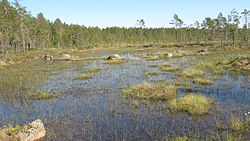
A bog or bogland is a wetland that accumulates peat as a deposit of dead plant materials – often mosses, typically sphagnum moss.[1] It is one of the four main types of wetlands. Other names for bogs include mire, mosses, quagmire, and muskeg; alkaline mires are called fens.[clarification needed] A bayhead is another type of bog found in the forest of the Gulf Coast states in the United States.[2][3] They are often covered in heath or heather shrubs rooted in the sphagnum moss and peat. The gradual accumulation of decayed plant material in a bog functions as a carbon sink.[4][5]
Bogs occur where the water at the ground surface is acidic and low in nutrients. A bog usually is found at a freshwater soft spongy ground that is made up of decayed plant matter which is known as peat. They are generally found in cooler northern climates and are formed in poorly draining lake basins.[6] In contrast to fens, they derive most of their water from precipitation rather than mineral-rich ground or surface water.[7] Water flowing out of bogs has a characteristic brown colour, which comes from dissolved peat tannins. In general, the low fertility and cool climate result in relatively slow plant growth, but decay is even slower due to low oxygen levels in saturated bog soils. Hence, peat accumulates. Large areas of the landscape can be covered many meters deep in peat.[1][8]
Bogs have distinctive assemblages of animal, fungal, and plant species, and are of high importance for biodiversity, particularly in landscapes that are otherwise settled and farmed.
Distribution and extent
[edit]
Bogs are widely distributed in cold, temperate climes, mostly in boreal ecosystems in the Northern Hemisphere. The world's largest wetland is the peat bogs of the Western Siberian Lowlands in Russia, which cover more than a million square kilometres.[9] Large peat bogs also occur in North America, particularly the Hudson Bay Lowland and the Mackenzie River Basin.[9] They are less common in the Southern Hemisphere, with the largest being the Magellanic moorland, comprising some 44,000 square kilometres (17,000 sq mi) in southern South America. Sphagnum bogs were widespread in northern Europe[10] but have often been cleared and drained for agriculture. A paper led by Graeme T. Swindles in 2019 showed that peatlands across Europe have undergone rapid drying in recent centuries owing to human impacts including drainage, peat cutting and burning.[11] A 2014 expedition leaving from Itanga village, Republic of the Congo, discovered a peat bog "as big as England" which stretches into neighboring Democratic Republic of Congo.[12]
Definition
[edit]Like all wetlands, it is difficult to rigidly define bogs for a number of reasons, including variations between bogs, the in-between nature of wetlands as an intermediate between terrestrial and aquatic ecosystems, and varying definitions between wetland classification systems.[13][14] However, there are characteristics common to all bogs that provide a broad definition:[7]
- Peat is present, usually thicker than 30 centimetres (12 in).
- The wetland receives most of its water and nutrients from precipitation (ombrotrophic) rather than surface or groundwater (minerotrophic).
- The wetland is nutrient-poor (oligotrophic).
- The wetland is strongly acidic (bogs near coastal areas may be less acidic due to sea spray).
Because all bogs have peat, they are a type of peatland. As a peat-producing ecosystem, they are also classified as mires, along with fens. Bogs differ from fens, in that fens receive water and nutrients from mineral-rich surface or groundwater, while bogs receive water and nutrients from precipitation.[7] Because fens are supplied with mineral-rich water, they tend to range from slightly acidic to slightly basic, while bogs are always acidic because precipitation lacks the dissolved minerals (e.g. calcium, magnesium, carbonate) that act to buffer the natural acidity of atmospheric carbon dioxide.[7] Geography and geology both impact the hydrology: as groundwater mineral content reflects the bedrock geology, there can be great deal of variability in some common ions (e.g. manganese, iron) while proximity to coastal areas is associated with higher sulfate and sodium concentrations.[15]
Ecology and protection
[edit]
There are many highly specialized animals, fungi, and plants associated with bog habitat. Most are capable of tolerating the combination of low nutrient levels and waterlogging.[1]: ch. 3 Sphagnum is generally abundant, along with ericaceous shrubs.[16] The shrubs are often evergreen, which may assist in conservation of nutrients.[17] In drier locations, evergreen trees can occur, in which case the bog blends into the surrounding expanses of boreal evergreen forest.[18] Sedges are one of the more common herbaceous species. Carnivorous plants such as sundews (Drosera) and pitcher plants (for example Sarracenia purpurea) have adapted to the low-nutrient conditions by using invertebrates as a nutrient source. Orchids have adapted to these conditions through the use of mycorrhizal fungi to extract nutrients.[1]: 88 Some shrubs such as Myrica gale (bog myrtle) have root nodules in which nitrogen fixation occurs, thereby providing another supplemental source of nitrogen.[19]

Bogs are recognized as a significant/specific habitat type by a number of governmental and conservation agencies. They can provide habitat for mammals, such as caribou, moose, and beavers, as well as for species of nesting shorebirds, such as Siberian cranes and yellowlegs. Bogs contain species of vulnerable reptilians such as the bog turtle.[20] Bogs even have distinctive insects; English bogs give a home to a yellow fly called the hairy canary fly (Phaonia jaroschewskii), and bogs in North America are habitat for a butterfly called the bog copper (Lycaena epixanthe). In Ireland, the viviparous lizard, the only known reptile in the country, dwells in bogland.[21]
The United Kingdom in its Biodiversity Action Plan establishes bog habitats as a priority for conservation. Russia has a large reserve system in the West Siberian Lowland.[22] The highest protected status occurs in Zapovedniks (IUCN category IV); Gydansky[23] and Yugansky are two prominent examples. [citation needed]
Bogs are fragile ecosystems, and have been deteriorating quickly, as archaeologists and scientists have been recently finding. Bone material found in bogs has had accelerated deterioration from first analyses in the 1940s.[24] This has been found to be from fluctuations in ground water and increase in acidity[25] in lower areas of bogs that is affecting the rich organic material. Many of these areas have been permeated to the lowest levels with oxygen, which dries and cracks layers. There have been some temporary solutions to try and fix these issues, such as adding soil to the tops of threatened areas; they do not work in the long-term.[24] Extreme weather like dry summers are likely the cause, as they lower precipitation and the groundwater table. It is speculated that these issues will only increase with a rise in global temperature and climate change. Since bogs take thousands of years to form and create the rich peat that is used as a resource, once they are gone they are extremely hard to recover. Arctic and sub-Arctic circles where many bogs are warming at 0.6 °C per decade, an amount twice as large as the global average. Because bogs and other peatlands are carbon sinks, they are releasing large amounts of greenhouse gases as they warm up.[26] These changes have resulted in a severe decline of biodiversity and species populations of peatlands throughout Northern Europe.[24]
Types
[edit]Bog habitats may develop in various situations, depending on the climate and topography.[27]
By location and water source
[edit]Bogs may be classified on their topography, proximity to water, method of recharge, and nutrient accumulation.[28]
Valley bog
[edit]%E2%80%93Valle_Carbajal_01.jpg)
These develop in gently sloping valleys or hollows. A layer of peat fills the deepest part of the valley, and a stream may run through the surface of the bog. Valley bogs may develop in relatively dry and warm climates, but because they rely on ground or surface water, they only occur on acidic substrates.[citation needed][clarification needed]
Raised bog
[edit] |

These develop from a lake or flat marshy area, over either non-acidic or acidic substrates. Over centuries there is a progression from open lake, to a marsh, to a fen (or, on acidic substrates, valley bog), to a carr, as silt or peat accumulates within the lake. Eventually, peat builds up to a level where the land surface is too flat for ground or surface water to reach the center of the wetland. This part, therefore, becomes wholly rain-fed (ombrotrophic), and the resulting acidic conditions allow the development of bog (even if the substrate is non-acidic). The bog continues to form peat, and over time a shallow dome of bog peat develops into a raised bog. The dome is typically a few meters high in the center and is often surrounded by strips of fen or other wetland vegetation at the edges or along streamsides where groundwater can percolate into the wetland.
The various types of raised bog may be divided into:
Blanket bog
[edit]

In cool climates with consistently high rainfall (on more than c. 235 days a year), the ground surface may remain waterlogged for much of the time, providing conditions for the development of bog vegetation. In these circumstances, bog develops as a layer "blanketing" much of the land, including hilltops and slopes.[29] Although a blanket bog is more common on acidic substrates, under some conditions it may also develop on neutral or even alkaline ones, if abundant acidic rainwater predominates over the groundwater. A blanket bog can occur in drier or warmer climates, because under those conditions hilltops and sloping ground dry out too often for peat to form – in intermediate climates a blanket bog may be limited to areas which are shaded from direct sunshine. In periglacial climates a patterned form of blanket bog may occur, known as a string bog. In Europe, these mostly very thin peat layers without significant surface structures are distributed over the hills and valleys of Ireland, Scotland, England, and Norway. In North America, blanket bogs occur predominantly in Canada east of Hudson Bay. These bogs are often still under the influence of mineral soil water (groundwater). Blanket bogs do not occur north of the 65th latitude in the northern hemisphere.[14]
Quaking bog
[edit]A quaking bog, schwingmoor, or swingmoor is a form of floating bog occurring in wetter parts of valley bogs and raised bogs and sometimes around the edges of acidic lakes. The bog vegetation, mostly sphagnum moss anchored by sedges (such as Carex lasiocarpa), forms a floating mat approximately half a meter thick on the surface of water or above very wet peat. White spruce (Picea glauca) may grow in this bog regime. Walking on the surface causes it to move – larger movements may cause visible ripples on the surface, or they may even make trees sway. The bog mat may eventually spread across the water surface to cover bays or even entire small lakes. Bogs at the edges of lakes may become detached and form floating islands.[30]
Cataract bog
[edit]A cataract bog is a rare ecological community formed where a permanent stream flows over a granite outcropping. The sheeting of water keeps the edges of the rock wet without eroding the soil, but in this precarious location, no tree or large shrub can maintain a roothold. The result is a narrow, permanently wet habitat.[14]
Uses
[edit]Industrial uses
[edit]
After drying, peat is used as a fuel, and it has been used that way for centuries. More than 20% of home heat in Ireland comes from peat, and it is also used for fuel in Finland, Scotland, Germany, and Russia. Russia is the leading exporter of peat for fuel, at more than 90 million metric tons per year. Ireland's Bord na Móna ("peat board") was one of the first companies to mechanically harvest peat, which is being phased out.[31]
The other major use of dried peat is as a soil amendment (sold as moss peat or sphagnum peat) to increase the soil's capacity to retain moisture and enrich the soil.[4] It is also used as a mulch. Some distilleries, notably in the Islay whisky-producing region, use the smoke from peat fires to dry the barley used in making Scotch whisky.[citation needed]
Once the peat has been extracted it can be difficult to restore the wetland, since peat accumulation is a slow process.[4][32][33] More than 90% of the bogs in England have been damaged or destroyed.[34][35] In 2011 plans for the elimination of peat in gardening products were announced by the UK government.[4]
Other uses
[edit]The peat in bogs is an important place for the storage of carbon. If the peat decays, carbon dioxide would be released to the atmosphere, contributing to global warming. Undisturbed, bogs function as a carbon sink.[4][36][37] As one example, the peatlands of the former Soviet Union were calculated to be removing 52 Tg of carbon per year from the atmosphere.[22]: 41 Therefore, the rewetting of drained peatlands may be one of the most cost-effective ways to mitigate climate change.[38]
Peat bogs are also important in storing fresh water, particularly in the headwaters of large rivers. Even the enormous Yangtze River arises in the Ruoergai peatland near its headwaters in Tibet.[1]: fig. 13.8
Blueberries, cranberries, cloudberries, huckleberries, and lingonberries are harvested from the wild in bogs. Bog oak, wood that has been partially preserved by bogs, has been used in the manufacture of furniture.[citation needed]
Sphagnum bogs are also used for outdoor recreation, with activities including ecotourism and hunting. For example, many popular canoe routes in northern Canada include areas of peatland. Some other activities, such as all-terrain vehicle use, are especially damaging to bogs.[citation needed][39]
Archaeology
[edit]The anaerobic environment and presence of tannic acids within bogs can result in the remarkable preservation of organic material. Finds of such material have been made in Slovenia, Denmark, Germany, Ireland, Russia, and the United Kingdom. Some bogs have preserved bog-wood, such as ancient oak logs useful in dendrochronology. They have yielded extremely well-preserved bog bodies, with hair, organs, and skin intact, buried there thousands of years ago after apparent Germanic and Celtic human sacrifice. Excellent examples of such human specimens include the Haraldskær Woman and Tollund Man in Denmark,[40] and Lindow man found at Lindow Common in England. The Tollund Man was so well preserved that when the body was discovered in 1950, the discoverers thought it was a recent murder victim[41] and researchers were even able to tell the last meal that the Tollund Man ate before he died: porridge and fish.[42] This process happens because of the low oxygen levels of bogs in combination with the high acidity. These anaerobic conditions lead to some of the best-preserved mummies and offer much archeological insight into society as far as 8,000 years back.[41] Céide Fields in County Mayo in Ireland, a 5,000-year-old neolithic farming landscape has been found preserved under a blanket bog, complete with field walls and hut sites. One ancient artifact found in various bogs is bog butter, large masses of fat, usually in wooden containers. These are thought to have been food stores of both butter and tallow.[43]
Image gallery
[edit]-
 Sphagnum with northern pitcher plants at Brown's Lake Bog, Ohio, US
 -
 A bog in Ostfriesland, Germany
 -
 Precipitation accumulates in many bogs, forming bog pools, such as Koitjärve bog in Estonia
 -


See also
[edit]
- Blackwater river – Slow, dark river in forested swamps or wetlands
- Bog body – Corpse preserved in a bog
- Bog butter – Ancient substance found in peat bogs
- Bog iron – Form of iron ore deposited in bogs
- Irish Peatland Conservation Council – Irish charitable organisation
- Kerry bog slides – 2008 series of bogslides in County Kerry, Ireland
- Kettle bog – Depression or hole in an outwash plain formed by retreating glaciers or draining floodwaters
- List of bogs
- Paludification – Ecological process of peatland formation
References
[edit]- ^ a b c d e Keddy, P.A. (2010). Wetland Ecology: Principles and Conservation (2nd ed.). Cambridge University Press. ISBN 978-0-521-73967-2.
- ^ Watson, Geraldine Ellis (2000) Big Thicket Plant Ecology: An Introduction, Third Edition (Temple Big Thicket Series #5). University of North Texas Press. Denton, Texas. 152 pp. ISBN 978-1574412147
- ^ Texas Parks and Wildlife. Ecological Mapping Systems of Texas: "West Gulf Coastal Plain Seepage Swamp and Baygall". Retrieved 7 July 2020
- ^ a b c d e Rosenthal, Elisabeth (6 October 2012). "British Soil Is Battlefield Over Peat, for Bogs' Sake". The New York Times. Archived from the original on 7 October 2012. Retrieved 7 October 2012.
- ^ "Peatlands and climate change". IUCN. 6 November 2017. Retrieved 15 August 2019.
- ^ "Bog". Education | National Geographic Society. Retrieved 25 February 2023.
- ^ a b c d Rydin, Håkan; Jeglum, J. K. (2013). The Biology of Peatlands (Second ed.). Oxford, UK: Oxford University Press Oxford. ISBN 978-0-19-150828-8. OCLC 861559248.
- ^ Gorham, E. (1957). "The development of peatlands". Quarterly Review of Biology. 32 (2): 145–66. doi:10.1086/401755. S2CID 129085635.
- ^ a b Fraser, L.H.; Keddy, P.A., eds. (2005). The World's Largest Wetlands: Ecology and Conservation. Cambridge, UK: Cambridge University Press. ISBN 978-0-521-83404-9.
- ^ Adamovich, Alexander (2005). "Country Pasture/Forage Resource Profiles: Latvia". Food and Agriculture Organization of the United Nations. Archived from the original on 11 August 2017. Retrieved 23 April 2010.
- ^ Swindles, Graeme T.; Morris, Paul J.; Mullan, Donal J.; Payne, Richard J.; Roland, Thomas P.; Amesbury, Matthew J.; Lamentowicz, Mariusz; Turner, T. Edward; Gallego-Sala, Angela; Sim, Thomas; Barr, Iestyn D. (21 October 2019). "Widespread drying of European peatlands in recent centuries". Nature Geoscience. 12 (11): 922–928. Bibcode:2019NatGe..12..922S. doi:10.1038/s41561-019-0462-z. hdl:10871/39305. ISSN 1752-0908. S2CID 202908362. Alt URL
- ^ Smith, David (27 May 2014). "Peat bog as big as England found in Congo". The Guardian. Retrieved 31 May 2014.
- ^ Mitsch, William J. (2007). Wetlands. James G. Gosselink (4th ed.). Hoboken, N.J.: Wiley. ISBN 978-0-471-69967-5. OCLC 78893363.
- ^ a b c Keddy, Paul A. (2010). Wetland ecology: principles and conservation (2nd ed.). Cambridge: Cambridge University Press. ISBN 978-1-139-22365-2. OCLC 801405617.
- ^ Newman, Michael C.; Schalles, John F. (1990). "The water chemistry of Carolina bays: A regional survey". Archiv für Hydrobiologie. 118 (2): 147–168. doi:10.1127/archiv-hydrobiol/118/1990/147.
- ^ "Home Organization Selection". docs.shib.ncsu.edu. doi:10.1046/j.1365-2699.2000.00458.x. S2CID 84241035. Retrieved 23 February 2021.
- ^ Keddy, P.A. (2007). Plants and Vegetation: Origins, Processes, Consequences. Cambridge, UK: Cambridge University Press. ISBN 978-0-521-86480-0.
- ^ Archibold, O.W. (1995). Ecology of World Vegetation. London: Chapman and Hall. ISBN 978-0-412-44290-2.
- ^ Bond, G. (1985). Salisbury, F.B.; Ross, C.W. (eds.). Plant Physiology (Wadsworth biology series) (3rd ed.). Belmont, CA: Brooks/Cole. p. 254. ISBN 0-534-04482-4. See figure 13.3.
- ^ Tutterow, Annalee M.; Graeter, Gabrielle J.; Pittman, Shannon E. (June 2017). "Bog Turtle Demographics within the Southern Population". Ichthyology & Herpetology. 105 (2): 293–300. doi:10.1643/CH-16-478. ISSN 2766-1512. S2CID 90491294.
- ^ Farren, Aodan; Prodöhl, Paulo; Laming, Peter; Reid, Neil (1 January 2010). "Distribution of the common lizard (Zootoca vivipara) and landscape favourability for the species in Northern Ireland". Amphibia-Reptilia. 31 (3): 387–394. doi:10.1163/156853810791769428. ISSN 1568-5381.
- ^ a b Solomeshch, A.I. (2005). "The West Siberian Lowland". In Fraser, L.H.; Keddy, P.A. (eds.). The World's Largest Wetlands: Ecology and Conservation. Cambridge, UK: Cambridge University Press. pp. 11–62. ISBN 978-0-521-83404-9.
- ^ "Russian Zapovedniks and National Parks". Russian Nature. Archived from the original on 11 March 2018. Retrieved 8 March 2018.
- ^ a b c Boethius, Adam; Kjällquist, Mathilda; Magnell, Ola; Apel, Jan (29 July 2020). "Human encroachment, climate change and the loss of our archaeological organic cultural heritage: Accelerated bone deterioration at Ageröd, a revisited Scandinavian Mesolithic key-site in despair". PLOS ONE. 15 (7) e0236105. Bibcode:2020PLoSO..1536105B. doi:10.1371/journal.pone.0236105. PMC 7390309. PMID 32726345.
- ^ Sperle, Thomas; Bruelheide, Helge (25 October 2020). "Climate change aggravates bog species extinctions in the Black Forest (Germany)". Diversity and Distributions. 27 (2): 282–295. doi:10.1111/ddi.13184.
- ^ Schuur, E. A. G.; McGuire, A.; Schadel, C. (9 April 2015). "Climate change and the permafrost carbon feedback". Nature. 520 (7546): 171–179. Bibcode:2015Natur.520..171S. doi:10.1038/nature14338. PMID 25855454. S2CID 4460926.
- ^ Glaser, P.H. (1992). "Raised bogs in eastern North America: regional controls for species richness and floristic assemblages". Journal of Ecology. 80 (3): 535–54. Bibcode:1992JEcol..80..535G. doi:10.2307/2260697. JSTOR 2260697.
- ^ Damman, A.W.H. (1986). "Hydrology, development, and biogeochemistry of ombrogenous bogs with special reference to nutrient relocation in a western Newfoundland bog". Canadian Journal of Botany. 64: 384–94. doi:10.1139/b86-055.
- ^ van Breeman, N. (1995). "How Sphagnum bogs down [sic] other plants". Trends in Ecology and Evolution. 10 (7): 270–275. Bibcode:1995TEcoE..10..270V. doi:10.1016/0169-5347(95)90007-1. PMID 21237035.
- ^ Appleton, Andrea (6 March 2018). "How Do You Solve a Problem Like a Giant Floating Bog?". Atlas Obscura. Retrieved 8 March 2018.
- ^ de Róiste, Daithí (5 October 2015). "Bord na Móna announces biggest change of land use in modern Irish history". Bord na Móna. Archived from the original on 7 October 2015. Retrieved 18 October 2021.
- ^ Campbell, D.R.; Rochefort, L. (2003). "Germination and seedling growth of bog plants in relation to the recolonization of milled peatlands". Plant Ecology. 169 (1): 71–84. Bibcode:2003PlEco.169...71C. doi:10.1023/A:1026258114901. S2CID 42590665.
- ^ Cobbaert, D.; Rochefort, L.; Price, J.S. (2004). "Experimental restoration of a fen plant community after peat mining". Applied Vegetation Science. 7 (2): 209–20. Bibcode:2004AppVS...7..209C. doi:10.1111/j.1654-109X.2004.tb00612.x.
- ^ "Insight into threatened peat bogs". BBC News. 31 July 2004. Archived from the original on 24 October 2007. Retrieved 8 March 2018.
- ^ "Destruction of peat bogs". RSPB. Archived from the original on 30 September 2007.
- ^ Gorham, E. (1991). "Northern peatlands role in the carbon cycle and probable responses to climatic warming". Ecological Applications. 1 (2): 182–95. Bibcode:1991EcoAp...1..182G. doi:10.2307/1941811. JSTOR 1941811. PMID 27755660. S2CID 2701885.
- ^ Loisel, Julie; Gallego-Sala, Angela (21 December 2020). "Guest post: How human activity threatens the world's carbon-rich peatlands". Carbon Brief. Archived from the original on 21 December 2020. Retrieved 1 January 2021.
- ^ Mandel, Martti (10 November 2018). "Interview: Rewetting Peatlands to Cut Emissions". EUKI. Retrieved 2 November 2019.
- ^ Taylor, Richard B, "THE EFFECTS OF OFF-ROAD VEHICLES ON ECOSYSTEMS," 2001.
- ^ Glob, P.V. (2011). The Bog People: Iron Age Man Preserved. Faber and Faber. ISBN 978-0-571-27090-3.
- ^ a b "Welcome to the story of the Tollundman". Silkeborg Museum.
- ^ Nielsen, N.; Henriksen, P.; Enevold, R.; Mortensen, M; Scavenius, C.; Enghild, J. (2021). "The last meal of Tollund Man: New analyses of his gut content". Antiquity. 95 (383): 1195–1212. doi:10.15184/aqy.2021.98. S2CID 238030730.
- ^ Earwood, Caroline (1997). "Bog Butter: A Two Thousand Year History". The Journal of Irish Archaeology. 8: 25–42. ISSN 0268-537X. JSTOR 30001649.
Bibliography
[edit]- Aiton, William (1811). General View of The Agriculture of the County of Ayr; observations on the means of its improvement; drawn up for the consideration of the Board of Agriculture, and Internal Improvements, with Beautiful Engravings. Glasgow.
External links
[edit]

- Ballynahone Bog Archived 19 October 2021 at the Wayback Machine
- Black Spruce Bog Describes a forested bog type of North America
- Bog bodies
- Germany's Endangered Bogs - slideshow by Der Spiegel
- 'Preserve peat bogs' for climate BBC 28 March 2007
- . Encyclopædia Britannica (11th ed.). 1911.
- . The American Cyclopædia. 1879.
| Types and landforms | |||||
|---|---|---|---|---|---|
| Life | |||||
| Soil mechanics | |||||
| Processes | |||||
| Classifications | |||||
| Conservation |
| ||||
| Related articles | |||||


Definition and Characteristics
Core Definition
A bog is a peat-accumulating wetland ecosystem where water saturation creates anaerobic conditions that inhibit the decomposition of dead plant material, primarily sphagnum mosses and ericaceous shrubs, leading to the buildup of peat.[3] This process is driven fundamentally by persistent hydrological saturation, which limits oxygen availability in the soil, slowing microbial activity and preserving organic matter.[8] Unlike other wetlands such as marshes, which feature emergent vegetation and flowing water with minimal peat accumulation, or fens, which receive mineral-rich groundwater, bogs are predominantly ombrotrophic, relying on precipitation for water and nutrients, resulting in oligotrophic and highly acidic environments.[1][9] The defining hydrological regime in bogs maintains a high water table close to or above the surface, fostering acidity through organic acid release from decomposing vegetation and cation exchange by sphagnum, with typical pH values ranging from 3.0 to 5.0.[10] Peat in bogs consists of at least 30 cm of accumulated organic material, often much thicker, distinguishing them from shallower wetlands.[11] Globally, bogs and broader peatlands cover approximately 3-4% of the Earth's land surface yet store nearly 30% of the world's soil carbon, underscoring their role in long-term carbon sequestration under undisturbed conditions.[12] This storage capacity arises from the millennial-scale accumulation rates, typically 0.5-1 mm per year, enabled by the persistent anaerobic inhibition of decay.[13]Physical and Hydrological Features
Bogs are characterized by waterlogged, peat-accumulating soils that remain saturated due to poor drainage and high water retention.[14] The surface typically features a dense mat of Sphagnum moss, which forms a spongy layer up to several meters thick in mature systems, contributing to the bog's characteristic softness and elasticity.[2] This mat often exhibits microtopographic variation, including hummocks (elevated mounds of compressed peat and vegetation rising 20-50 cm above the surrounding surface), lawns (flat expanses of continuous moss cover), hollows (depressions between hummocks), and pools (shallow, open water bodies).[15] [16] In quaking bogs, the floating mat—primarily Sphagnum anchored over deeper water—can tremble underfoot, with thicknesses reaching about 1 meter and supporting limited weight before rippling.[2] [17] Hydrologically, bogs maintain a high water table close to the surface throughout the year, typically fluctuating between 0 and 20 cm below ground level, which sustains saturation and limits oxygen diffusion into the peat.[18] This perched water table forms a dome shape in raised bogs, elevated above surrounding groundwater due to the impermeability of underlying peat layers, which exhibit low hydraulic conductivity on the order of 10^{-5} to 10^{-8} cm/s.[19] Water movement is minimal, primarily vertical recharge from precipitation with little lateral flow or drainage, resulting in stagnant conditions that promote anaerobic decomposition.[20] Peat's physical properties further enhance hydrological stability; its high porosity (over 90% water by volume) and low thermal conductivity (approximately 0.05-0.1 W/m·K, comparable to lightweight insulators) provide thermal insulation, moderating soil temperature fluctuations and preserving permafrost in northern bogs or slowing thaw in temperate ones.[21] [22] These features collectively ensure persistent waterlogging, with nutrient inputs restricted to atmospheric deposition in ombrotrophic systems.[23]Chemical Properties
Bogs are characterized by highly acidic conditions, with pore water pH typically ranging from 3.0 to 5.0, resulting from the accumulation of organic acids such as humic and fulvic acids derived from Sphagnum moss decomposition and other plant litter.[24][25] These acids lower the pH by dissociating hydrogen ions, creating an environment inhospitable to many decomposer organisms adapted to neutral or alkaline soils.[26] In comparison, mineral soils often maintain pH values above 5.5, supporting higher microbial diversity and decomposition rates.[24] The oligotrophic nature of bogs stems from nutrient-poor conditions, with nitrogen and phosphorus concentrations in pore water frequently below 1 mg/L and annual ecosystem nitrogen accumulation as low as 0.2 g N m⁻² year⁻¹.[27] This scarcity arises from limited mineral inputs in ombrotrophic systems reliant on atmospheric deposition and the immobilization of available nutrients in recalcitrant organic forms, contrasting with mineral soils where nutrient cycling is more dynamic due to higher mineralization.[27] Phosphorus levels remain particularly low, often balanced by minimal losses but insufficient for rapid plant growth beyond specialized bog flora.[27] Phenolic compounds and tannins, produced by Sphagnum and ericoid plants, contribute to preservation of organic matter through antimicrobial effects that suppress bacterial and fungal decomposers.[28][29] These polyphenols inhibit enzyme activities essential for lignin and cellulose breakdown, with even low concentrations in peat extracts reducing microbial respiration by up to 50% in laboratory assays.[28][29] Dissolved organic carbon (DOC) levels in bog pore waters are elevated, often exceeding 20 mg/L, driven by leaching from acid-tolerant vegetation and partial decomposition under low-oxygen conditions.[30] This contrasts sharply with mineral soils, where DOC is typically 75% lower due to greater adsorption onto mineral surfaces and faster microbial uptake.[30] Peat profiles divide into the acrotelm, where fluctuating water tables permit oxygen diffusion and support aerobic microbial activity, and the catotelm, a permanently waterlogged zone with near-anoxic conditions that severely restrict decomposition.[31] Oxygen levels in the catotelm drop below 1 mg/L, favoring anaerobic processes and halting oxidative breakdown of organic polymers, unlike the oxic acrotelm where partial decay occurs.[31][32]Formation and Geological Context
Natural Formation Processes
Bogs develop through paludification, the progressive waterlogging and peat accumulation on mineral soils, or terrestrialization, the infilling of shallow water bodies with organic sediments.[33] These processes require sustained anaerobic conditions that suppress microbial decomposition, allowing plant detritus to build up as peat.[34] In cool, humid climates with high precipitation relative to evaporation, excess water maintains saturated soils, particularly on flat or low-gradient terrains where drainage is impeded.[3] Autogenic mechanisms, primarily the growth of Sphagnum mosses, drive bog maturation by engineering self-reinforcing conditions. Sphagnum species colonize wet surfaces, their dense, capillary structure retains water and elevates the peat layer above regional groundwater levels, fostering ombrotrophy through isolation from mineral-rich inflows.[35] This expansion acidifies the habitat via phenolic compounds, further inhibiting decay and favoring acid-tolerant flora, with peat buildup rates averaging 0.1 to 1 mm annually under undisturbed conditions.[36][37] Allogenic influences, such as climatic shifts toward cooler, wetter regimes during the early Holocene, initiated widespread paludification by elevating water tables through increased rainfall and reduced evapotranspiration.[38] Post-glacial isostatic rebound in northern regions impounded surface waters in depressions, while eustatic sea-level fluctuations contributed to coastal bog genesis by altering hydrology.[39] These external forcings interact with autogenic feedbacks to sustain bog persistence, though initial formation hinges on topographic and climatic predispositions for perennial saturation.[40]Geological Timescales and Evolution
Peat bog development accelerated in the Holocene following deglaciation, with radiocarbon dating of basal peat layers revealing initiation dates primarily between 12,000 and 6,000 years before present (BP) in temperate zones of the Northern Hemisphere. In regions like the Scottish Highlands, blanket bogs formed on exposed glacial terrains around 8,000–6,000 BP, coinciding with increased effective precipitation and cooler temperatures that promoted ombrotrophic conditions. Pollen and macrofossil records from these cores document early transitions from mineral-rich fen-like deposits to Sphagnum-dominated peat, reflecting post-glacial stabilization of hydrological regimes.[41][42] Over geological timescales, bog evolution exhibits marked fluctuations driven by climatic oscillations, as evidenced by variations in peat accumulation rates and stratigraphic discontinuities in dated cores. Peat bogs function as high-resolution paleoclimate archives, with pollen assemblages and humification indices indicating expansions during wetter, cooler phases like the early to mid-Holocene and contractions or erosional hiatuses during warmer, drier intervals. Radiocarbon chronologies from multiple sites demonstrate non-linear growth, with average Holocene accumulation rates of 0.5–1 mm/year punctuated by periods of stasis or regression linked to shifts in effective moisture balance.[43][44] In the Irish midlands, raised bogs overlay late Quaternary glacial and glaciolacustrine substrates, with basal dates around 10,000–8,000 BP marking the onset of peat aggradation amid rising water tables from meltwater and climatic amelioration. Cores from these systems reveal episodic mineral inwash layers, signaling hydrological instability during Holocene climate transitions, such as the 8.2 ka event. During the Medieval Warm Period (approximately 950–1250 CE), proxy data from European bogs, including reduced peat humification and lower accumulation rates, suggest localized regressions in response to elevated temperatures and decreased precipitation in parts of northwest Europe, underscoring the sensitivity of bog systems to multi-centennial variability rather than implying perpetual stability.[45][46][36]Classification and Types
Ombrotrophic Bogs (Raised and Blanket)
Ombrotrophic bogs derive all water and nutrients from atmospheric precipitation, resulting in highly acidic conditions with pH levels typically ranging from 3.0 to 4.0 and extreme nutrient poverty, particularly in nitrogen, phosphorus, and calcium.[47] This isolation from mineral-rich groundwater fosters specialized vegetation dominated by Sphagnum mosses, which further acidify the environment through cation exchange and organic acid release.[48] Raised and blanket bogs represent the primary structural variants, distinguished by topography, peat morphology, and climatic niches. Raised bogs form in topographic basins or flat lowlands where peat accumulation elevates the surface into a dome shape, often reaching heights of 5-10 meters above surrounding terrain.[49] Peat buildup begins with minerotrophic fen-like conditions but transitions to ombrotrophy as the accumulating mass insulates the surface from groundwater influence, relying exclusively on rainfall exceeding 600-800 mm annually for sustenance.[50] The convex dome promotes radial water flow and aeration in hummocks, supporting sparse vascular plants like Eriophorum vaginatum and Andromeda polifolia alongside carnivorous species adapted to scarcity.[51] These bogs are prevalent in temperate continental to suboceanic climates across northern Europe, including Ireland where they historically covered approximately 310,000 hectares, and eastern North America.[52] In contrast, blanket bogs manifest as thin, continuous peat layers—typically 0.5-3 meters deep—draping over undulating slopes, plateaus, and uplands in hyper-oceanic regions with persistent high rainfall over 1,500 mm per year and cool temperatures.[53] Formation occurs through rapid moss colonization on mineral soils exposed by periglacial processes, with Sphagnum species engineering the acidic, waterlogged profile that inhibits decomposition.[54] Unlike the isolated domes of raised bogs, blanket bogs exhibit greater susceptibility to erosion from overland flow and wind exposure on inclines, leading to haggs and eroded patches in disturbed areas.[55] They dominate in western Britain and Ireland, such as Scotland's Flow Country spanning over 400,000 hectares, and similar extents in Atlantic-facing terrains of Scandinavia and Newfoundland.[47] Structurally, raised bogs maintain stricter ombrotrophy through their elevated, convex form that maximizes separation from mineral soils, achieving lower pH and higher carbon sequestration rates per unit area compared to the more laterally extensive but shallower blanket bogs.[56] Blanket bogs, while equally precipitation-dependent, often show transitional minerotrophy at edges or bases due to slope drainage, rendering them more vulnerable to climatic shifts and anthropogenic drying.[48] Distributionally, raised bogs cluster in lowland basins of mid-latitude temperate zones, whereas blanket bogs blanket upland expanses in persistently wet, foggy maritime climates, reflecting adaptations to distinct hydrological gradients.[57]Minerotrophic Bogs (Valley and Fen-like)
Minerotrophic bogs, including valley and fen-like variants, are peatlands that accumulate organic matter in topographic depressions or along streams, deriving a portion of their hydrology from groundwater or surface flows enriched with dissolved minerals from adjacent mineral soils.[58] This minerotrophic influence distinguishes them from purely ombrotrophic systems by introducing base cations such as calcium, elevating pH levels typically above 4 and enabling modestly higher nutrient availability compared to rain-fed bogs.[59] Peat depths in these systems often exceed 40 cm, with water tables maintained near the surface by lateral seepage and discharge, fostering conditions where Sphagnum moss coexists with graminoids rather than dominating exclusively.[60] Valley bogs specifically develop in linear depressions or basins where catchment-derived streams or groundwater sustain saturation, often on glacial or fluvial substrates that impart variable alkalinity depending on underlying geology.[61] These mires exhibit transitional hydrology, with base flows contributing to less oligotrophic conditions than raised bogs, supporting vegetation mosaics that include ericaceous shrubs alongside sedge tussocks in base-influenced zones.[62] Empirical measurements from northern European valley mires indicate pH ranges of 4.5 to 6.5 in discharge areas, correlating with increased microbial decomposition rates and peat accumulation influenced by mineral buffering.[59] Fen-like minerotrophic bogs represent hybrids where prolonged groundwater contact yields base-rich waters, promoting sedge dominance such as Carex lasiocarpa in lawns over extensive areas, as observed in weakly minerotrophic peatlands.[63] This nutrient elevation stems from cation inputs exceeding 1 ppm calcium, contrasting ombrotrophic acidity and allowing vascular plant diversity beyond moss monopolies.[59] Quaking variants feature unstable floating mats of living vegetation over deeper water, with peat layers 1-2 meters thick exhibiting seismic-like oscillations under load due to buoyant instability, often in valley impoundments blending bog and fen traits.[64] In the southern Appalachian Mountains, cataract bogs form narrow, linear communities adjacent to perennial streams cascading over granite outcrops, at elevations of 370 to 730 meters, where seepage hydrology introduces modest mineral enrichment despite overall acidic profiles (pH 4-5).[65] These systems host herbaceous and shrub-scrub peat with high organic content in loam-silt soils, supporting endemic carnivorous plants adapted to the hybrid nutrient regime, though stability is compromised by thin mats prone to shear under foot traffic.[66] Such formations underscore causal links between lithology-driven water chemistry and community structure, with base flows mitigating extreme oligotrophy.[67]Anthropogenic and Modified Bogs
Anthropogenic bogs encompass human-engineered systems, such as those modified for commercial cranberry production, where natural or incipient peatlands are altered through damming, excavation, and periodic flooding to support Vaccinium macrocarpon cultivation. These modifications disrupt original hydrology by introducing controlled water levels and sand layering, converting ombrotrophic conditions into managed, minerotrophic-like environments optimized for yield rather than natural peat accumulation.[68] In the United States, cranberry bogs cover approximately 40,000 acres in Massachusetts alone, representing a significant departure from undisturbed bog dynamics.[69] Economic pressures, including rising labor, utility, and weather-related costs alongside declining prices from global competition, have led to bog retirements, particularly in Massachusetts where production contributes $1.7 billion annually but supports diminishing returns for marginal operations. As of 2025, the state's Division of Ecological Restoration has restored eight former cranberry bog sites to wetlands at costs exceeding $27 million, with 12 additional projects planned, often leveraging federal grants like $5 million for 57 acres on Cape Cod. Restoration techniques include dismantling dikes, removing introduced sands, and reconfiguring ditches to elevate water tables, fostering native wetland plant regrowth and wildlife habitats such as for river herring.[70][71][72] Drained peatlands repurposed for agriculture or forestry represent another major category of modified bogs, with global drainage affecting 3-4% of peatland area, particularly in boreal and temperate zones where ditches lower water tables to enable crop or tree growth. Partial restorations via rewetting—such as blocking ditches and raising groundwater levels by an average of 60 mm—have demonstrated efficacy in halting peat oxidation and subsidence, thereby reducing carbon emissions and reversing degradation trajectories in boreal systems. However, empirical evidence indicates incomplete recovery: hydrology often shifts with altered flow paths and elevated nutrient exports (e.g., phosphorus and nitrogen), while vegetation transitions to helophyte-dominated communities rather than reverting to original Sphagnum-led assemblages, limiting full functional equivalence.[73][74][75] Biodiversity responses to these interventions are variable and typically slow, with gains in wetland species richness observed but constrained by legacy effects like soil compaction and legacy pollutants; for instance, rewetting yields lower short-term biodiversity scores compared to other freshwater restorations due to prolonged recolonization timelines. In forestry-drained sites, combining ditch blocking with tree removal enhances peat rewetting but risks temporary increases in dissolved organic carbon runoff, underscoring causal trade-offs where hydrological reconnection prioritizes emission reductions over immediate faunal or floral fidelity to pre-drainage states.[76][77][78]Global Distribution and Extent
Geographic Patterns
Bogs exhibit a pronounced predominance in the Northern Hemisphere, where they occupy vast expanses in boreal and temperate climatic zones influenced by high precipitation and cool temperatures that favor peat accumulation. Globally, peatlands—including bogs—cover approximately 4 million km², or about 3% of the Earth's land surface, with the majority concentrated north of the equator.[79] Russia holds the largest national extent, estimated at over 1 million km², followed closely by Canada with around 1.1 million km², much of which consists of ombrotrophic bogs in flat, poorly drained landscapes of the boreal forest.[80] In Europe, temperate bogs are widespread across Scandinavia, the British Isles, and parts of central and eastern regions, totaling roughly 500,000 km², though approximately 50% of peatlands within the European Union show signs of degradation due to historical drainage.[81] Boreal bogs in remote areas of Canada and Russia remain largely intact, benefiting from low human accessibility and natural hydrological stability.[82] Formation of these Northern Hemisphere bogs typically requires consistent high rainfall exceeding 600 mm annually, cool mean temperatures below 10°C to suppress microbial decomposition, and topographic features such as glacial depressions or flat lowlands that impede drainage and promote waterlogging. Ombrotrophic raised bogs dominate in these settings, sustained primarily by atmospheric precipitation, while minerotrophic variants occur in valley bottoms with some groundwater influence. In the Southern Hemisphere, bogs are far less extensive but occur in select regions with analogous wet, cool-to-moderate climates or persistent water saturation. Patagonia, particularly in Tierra del Fuego and the Andean foothills, hosts significant blanket and raised bogs covering tens of thousands of km², formed under high rainfall and oceanic influences.[8] Tropical peat swamps in Indonesia and Southeast Asia, often classified as bog-like due to their ombrotrophic characteristics in domed formations, span about 150,000–200,000 km², driven by equatorial rainfall exceeding 2,000 mm per year and impeded drainage in coastal lowlands, though these differ from classical boreal bogs in their warmer temperatures and forested vegetation.[83] Such distributions underscore bogs' dependence on regional hydrology and relief over strict latitudinal constraints.[84]Historical and Recent Changes
During the 19th and early 20th centuries, extensive drainage of bogs and peatlands occurred across Europe and North America primarily for peat extraction as fuel, agricultural conversion, and forestry, leading to substantial reductions in their extent. In Europe, nearly 50% of the pristine peatland area, approximately 0.53 million km², has been lost since the early 20th century due to systematic ditching and land use changes.[85] In the United Kingdom, lowland raised bogs experienced a 94% decline in area since 1850, driven by industrial-scale drainage for farming and peat cutting.[86] Globally, northern peatlands converted to croplands alone account for historical carbon emissions equivalent to significant areal losses, though precise global bog extent reductions vary by region, with estimates for drained peatlands reaching 15-30% of original coverage when accounting for both direct drainage and degradation.[87] These changes disrupted natural hydrological balances, causing irreversible peat subsidence in many cases, as oxidized peat compacts and erodes without restoration.[88] In recent decades, anthropogenic drainage has slowed in some regions due to policy shifts, but climate-induced drying has emerged as a complicating factor, with evidence showing divergent hydrological trends: 54% of monitored peatlands experiencing net drying from altered precipitation and temperature patterns since the late 20th century.[89] The Ramsar Convention's Global Wetland Outlook 2025 reports that over 411 million hectares of wetlands, including peatlands, have been lost globally since 1970—a 22% decline—with ongoing degradation at 0.52% annually, though peatland-specific losses are exacerbated by persistent emissions from prior drainage rather than uniform areal contraction.[90] Natural variability, such as cyclic wetting in boreal systems, tempers some losses, but causal analysis attributes most recent extent changes to compounded human legacies and warming-driven evaporation exceeding historical norms.[91] Restoration efforts have gained momentum post-2020, focusing on rewetting to reverse drainage effects, though full recovery of bog hydrology and carbon functions remains limited by lost peat volume. In Ireland, initiatives under the Peatland Action Plan 2020 have targeted rewetting of cutaway bogs like Turraun, reducing CO₂ emissions and promoting Sphagnum recolonization, with studies confirming radiative forcing benefits within years of blocking drains.[92] EU-funded projects such as REWET and WaterLANDS (2023-2027) aim to restore thousands of hectares across member states by reinstating water tables, integrating with the Common Agricultural Policy to incentivize peatland-friendly practices.[93][94] In the US, efforts to convert drained cranberry bogs back to wetlands have accelerated since 2023, supported by federal grants, though scalability is constrained by site-specific irreversibility, with only partial reversal of subsidence observed.[95] These interventions highlight potential for mitigating further losses, but empirical data underscore that restored bogs often function as emission hotspots initially before stabilizing, necessitating long-term monitoring.[73]Ecological Dynamics
Vegetation and Adaptations
Bog vegetation is predominantly composed of Sphagnum mosses, which form dense carpets and contribute to the characteristic acidity and water retention of these ecosystems. These mosses, particularly species like Sphagnum fuscum and Sphagnum magellanicum, dominate the ground layer, creating a peat substrate through slow decomposition and high water-holding capacity, often exceeding 20 times their dry weight due to specialized hyaline cells and capillary structures.[96] [97] Accompanying Sphagnum are ericaceous shrubs such as leatherleaf (Chamaedaphne calyculata), Labrador tea (Rhododendron groenlandicum), and cranberries (Vaccinium spp.), which form low shrub layers adapted to oligotrophic conditions. Carnivorous plants, including sundews (Drosera spp.) and pitcher plants (Sarracenia purpurea), occupy open areas, supplementing nutrient uptake through insectivory.[98] Graminoids like sedges (Carex spp.) and cotton grasses (Eriophorum spp.) are also prevalent in wetter zones.[99] Plants in bogs exhibit physiological adaptations to extreme conditions of low pH (typically 3-5), nutrient scarcity, and periodic desiccation. Ericaceous shrubs rely on ericoid mycorrhizal associations to access organic nitrogen and phosphorus in acidic, waterlogged soils, though these symbioses are limited by anaerobic conditions and low fungal diversity in saturated peat.[100] Carnivorous species have evolved trapping mechanisms—sticky mucilage in sundews or pitcher-shaped leaves in Sarracenia—to capture and digest arthropods, deriving up to 30-50% of nitrogen from prey in nutrient-poor habitats.[98] [101] Sphagnum species acidify surroundings via cation exchange and phenolic compounds, enhancing their competitive dominance while resisting decomposition through antimicrobial properties. Desiccation resistance in hummock-forming Sphagnum involves compact growth and reduced surface area, allowing survival during dry periods.[102] Nutrient scavenging is further aided by sclerophyllous leaves in shrubs, minimizing losses in low-fertility environments.[103] Vegetation zonation reflects microtopographic variation between hummocks (raised, drier mounds) and hollows (low-lying, flooded depressions), driving species differentiation. Hummock species, such as certain Sphagnum (e.g., S. fuscum) and ericaceous shrubs, tolerate aerobic but desiccating conditions above the water table, with slow growth rates and persistent litter accumulation building elevation.[104] Hollows support wet-adapted Sphagnum (e.g., S. cuspidatum) and floating mats with carnivorous plants and sedges, where waterlogging limits vascular plant rooting and favors bryophytes. This patterning enhances bryophyte diversity, as individual Sphagnum species occupy specific elevations relative to the water table, influencing hydrology and peat accumulation.[99] [105] Such zonation maintains habitat heterogeneity, with hummock-hollow cycles persisting over decades to centuries.[106]Fauna and Biodiversity
Bogs exhibit low faunal diversity and biomass owing to their acidic, nutrient-deficient conditions and waterlogged substrates, which limit metabolic rates and trophic complexity compared to mineral-rich wetlands. Empirical surveys indicate that animal communities are dominated by stress-tolerant specialists, including tyrphophiles (tolerant of bog conditions) and tyrphobionts (obligate bog-dwellers), with invertebrates comprising the majority of species richness. For instance, boreal peat bogs harbor distinctive insect assemblages, with over 40 taxonomic groups of invertebrates documented in multi-community assessments, though overall abundance remains sparse due to physiological constraints like anoxia and low pH in aquatic habitats.[107][108][109] Invertebrates, particularly insects, represent the most adapted fauna, with unique terrestrial taxa such as bog beetles and lepidopterans restricted to peatlands for larval host plants. Dragonflies and damselflies exploit bog pools for breeding, while butterflies like the large heath (Coenonympha tullia) exemplify vulnerability; UK populations declined by 58% between 1976 and 2014, primarily from drainage-induced habitat desiccation altering microclimates essential for oviposition. Moth and butterfly species tied to bog-specific flora show high endemism in regional contexts, with numerous taxa listed as indicators of peatland integrity on IUCN assessments, though global metrics reveal elevated extinction risks from hydrological disruption.[3][110][111] Vertebrate fauna is similarly sparse and specialized, with amphibians like the mink frog (Lithobates septentrionalis) breeding in acidic bog pools and reptiles such as Blanding's turtle (Emydoidea blandingii) using peatlands for foraging despite challenges from low oxygen. Mammals include bog lemmings (Synaptomys spp.), small rodents adapted to mossy understory with reduced metabolic demands, while birds feature raptors like the hen harrier (Circus cyaneus) nesting in tall vegetation for hunting over open peat. These groups exhibit low densities—e.g., peatland surveys report fewer than 50 vertebrate species per site on average—but high functional specificity, with biodiversity indices underscoring sensitivity to water table fluctuations that cascade through prey availability and habitat suitability.[112][109][113]Nutrient Cycling and Hydrology
Ombrotrophic bogs exhibit hydrology characterized by reliance on atmospheric precipitation, with negligible groundwater inputs, fostering a perched water table that sustains high saturation levels across the peat column.[114] Water flow is predominantly vertical in the upper acrotelm layer, transitioning to minimal lateral or subsurface exchange in the deeper catotelm, where anaerobic conditions prevail.[115] This structure minimizes mineral nutrient influx from surrounding catchments, enforcing oligotrophic dynamics through surface-dominated recharge and limited percolation.[116] Nutrient cycling in these systems is constrained by waterlogging and acidity, which inhibit aerobic decomposition and promote immobilization of elements like phosphorus via geochemical sorption and microbial incorporation into peat.[117] Nitrogen inputs derive mainly from atmospheric deposition and biological fixation by cyanobacteria symbiotically associated with Sphagnum, contributing to ecosystem accumulation rates of approximately 0.2 g N m⁻² year⁻¹, equivalent to 2 kg N ha⁻¹ year⁻¹.[118] [119] Annual total nitrogen outflows remain low at 0.11–0.69 kg ha⁻¹, underscoring the scarcity-driven retention.[120] Phosphorus budgets achieve near balance, with losses matching dilute atmospheric inputs, further limited by binding to organic matter.[27] Positive feedbacks amplify oligotrophy: peat-derived organic acids lower pH to below 4, suppressing microbial activity and nutrient mineralization, thereby sustaining slow turnover rates.[121] Stable isotope analyses, including δ¹⁵N, demonstrate post-depositional nitrogen mobility within peat profiles, revealing internal redistribution despite overall low fluxes and highlighting microbial mediation in cycling under nutrient-limited conditions.[122] These processes underpin bog persistence by curbing nutrient availability, favoring adapted flora over competitive species.[123]Carbon Cycle and Climate Interactions
Mechanisms of Carbon Sequestration
Bogs function as carbon sinks primarily through the accumulation of partially decomposed organic matter, known as peat, under persistently waterlogged and acidic conditions that inhibit microbial decomposition. Vegetation, dominated by Sphagnum mosses, fixes atmospheric CO₂ via photosynthesis, producing litter rich in phenolic compounds that further suppress bacterial and fungal activity. The water saturation creates anaerobic environments, limiting oxygen-dependent decomposers and favoring slower processes like methanogenesis, which results in net carbon burial over millennia rather than complete mineralization to CO₂ or CH₄.[124][125] This imbalance between primary production and decomposition yields long-term net carbon accumulation rates of approximately 20–30 g C m⁻² yr⁻¹ in intact bogs, with variations by region; for instance, boreal systems average around 24 g C m⁻² yr⁻¹ based on peat core reconstructions. Sphagnum growth, though modest at 1–3 cm yr⁻¹, exceeds decomposition losses due to the moss's recalcitrant biochemistry and the bog's hydrological stability, leading to peat depths exceeding 5–10 m in many sites. Globally, bogs and broader peatlands store 500–600 Gt C, equivalent to about twice the carbon in all forest biomass combined, despite occupying only 3% of terrestrial land area.[126][127][128] Stable carbon isotope ratios (δ¹³C) and radiocarbon dating of peat profiles provide evidence of this ancient sequestration, revealing that much stored carbon dates to the Holocene or earlier, with minimal recent mixing or turnover. In contrast to forests, where carbon cycles rapidly through biomass and soil with higher decomposition rates balancing net primary production, bogs achieve sequestration via physical burial and chemical recalcitrance, preserving carbon on millennial timescales without reliance on living biomass stocks.[129][130]Disturbance Effects and Emissions
Disturbances such as drainage and fire disrupt the anaerobic conditions in bogs, leading to accelerated peat oxidation or combustion that releases stored carbon primarily as CO₂, with lesser contributions from CH₄. Drainage for agriculture or forestry aerates the peat, transforming bogs from net carbon sinks to sources; empirical measurements indicate emission rates of 1.57 t C ha⁻¹ yr⁻¹ (equivalent to approximately 5.8 t CO₂ ha⁻¹ yr⁻¹) in drained raised bog margins. Updated emission factors for drained organic soils average 2.46 ± 0.25 t C ha⁻¹ yr⁻¹ for CO₂, reflecting a balance between heterotrophic respiration and any residual vegetation uptake, though rates vary by depth of drainage and site hydrology. These emissions can exceed pristine sequestration rates (typically 0.02–0.07 t C ha⁻¹ yr⁻¹) by factors of up to 20, based on comparative flux data from undisturbed versus perturbed sites.[92][131][132] Peatland fires, often ignited by human activity or exacerbated by prior drainage, cause acute carbon pulses through direct combustion. In tropical peatlands, such as those in Indonesia, individual fire events can release 842 ± 466 Mg CO₂-eq ha⁻¹, with CO₂ comprising the majority alongside CO and CH₄; CH₄ emissions, while potent, constitute a smaller fraction relative to CO₂ mass loss. Empirical observations from Sumatran fires in 2013 confirm elevated CH₄ release during smoldering phases, but total non-CO₂ contributions remain secondary to the bulk peat oxidation. In boreal contexts, wildfires on disturbed peatlands amplify belowground emissions, with post-fire heterotrophic respiration sustaining elevated CO₂ fluxes for years. These events underscore causal links between oxygen exposure and rapid carbon turnover, independent of broader climatic forcings.[133][134][135] Natural perturbations like drought induce transient water table declines, pulsing emissions via enhanced aerobic decomposition. Eddy covariance data from Finnish bogs reveal interannual variability where drought years elevate net ecosystem CO₂ exchange, shifting sites toward net sources with pulses exceeding annual averages by 20–50%. In northern wetlands, short-term droughts suppress autotrophic uptake more than heterotrophic respiration, resulting in net carbon losses that recover slowly post-rewetting. Rewetting drained bogs mitigates CO₂ emissions by restoring anoxia, but full stabilization lags, potentially spanning decades due to persistent labile carbon decomposition and CH₄ rebound; dynamic models indicate initial net warming from combined fluxes before long-term sequestration resumes. These patterns highlight inherent hydrological controls on emission pulses, with empirical flux towers providing direct validation over modeled projections.[136][137][138]Empirical Evidence and Uncertainties
Peat cores from intact northern peatlands reveal long-term net carbon accumulation, with estimates indicating potential stocks up to 875 Pg C accumulated over the current interglacial period, primarily through suppressed decomposition under waterlogged, acidic conditions.[139] Historical reconstructions from blanket bog cores in the UK demonstrate consistent carbon sequestration over the past 300 years, averaging rates that affirm bogs' role as sinks prior to widespread human disturbance. These paleorecords underscore causal drivers like persistent anoxia and cool climates favoring organic matter preservation over mineralization, though emissions from early cultivated peatlands—estimated at 72 Pg C from 850 to 2010—highlight anthropogenic overrides of natural sink dynamics.[87] Contemporary monitoring via eddy covariance flux towers yields mixed net ecosystem carbon balances in intact bogs, with boreal and temperate sites often registering as CO2 sinks under baseline hydrology but offset by methane (CH4) emissions equivalent to 20-50% of sequestered CO2 when weighted by global warming potential.[140] For instance, rewetted temperate peatlands like Burns Bog exhibit interannual CO2 uptake variability tied to precipitation and vegetation shifts, with net balances fluctuating from sinks to near-neutral sources across 2023 measurements.[141] In Wisconsin's Cedarburg Bog, soil CO2 flux data from 2017 onward indicate diffusive production controlled by water table depth and temperature, supporting net sequestration in undisturbed conditions but vulnerability to drying.[142] Australian Sphagnum peatlands, monitored in 2025, confirm strong annual sinks in intact systems, sequestering up to several t C ha⁻¹ yr⁻¹, though eroding sites flip to CO2 sources.[143][144] Uncertainties persist in reconciling CO2 sequestration with CH4 emissions, as water table drawdown boosts aerobic CO2 release while curbing anaerobic CH4 production, yielding unclear net radiative forcings that models often amplify beyond empirical flux data.[145] Global estimates of peatland carbon fluxes carry high error margins—up to ±50%—due to heterogeneous hydrology, vegetation, and scaling from site-specific towers to 4 million km² of peatland area, as detailed in the 2022 Global Peatlands Assessment.[146] Recent 2023-2025 studies emphasize sequestration variability, with degrading Australian mountain peatlands showing reduced belowground accumulation amid warming-induced water loss, and Arctic expansions potentially enhancing sinks short-term but risking long-term emissions.[147] Empirical critiques note that climate narratives overstate bog contributions to atmospheric CO2 (historically <1% of fluxes) while underplaying natural interglacial variability, where sinks reflect geomorphic stability more than uniform climatic control.[148] Drained forested peatlands, per 2025 modeling validated against fluxes, reveal temporal mismatches in carbon budgets, urging caution in extrapolating site data to policy scales without accounting for disturbance legacies.[149]Human Uses and Economic Value
Historical Exploitation
Peat extraction for fuel dates back to the Bronze Age in Europe, with archaeological evidence from sites in Scotland indicating deep peat cutting and stack construction around 2000 BCE for heating and possibly metalworking.[150] In regions with limited timber, such as northern Europe, peat served as a primary combustible resource, dried and stacked for domestic use.[151] Bog iron ore, precipitated in wetland environments including bogs, was smelted for iron production across prehistoric and early medieval Europe, particularly in Scandinavia and Central Europe.[152] Viking-era processes involved roasting and crushing bog iron with charcoal in simple clay furnaces, enabling widespread tool and weapon production without deep mining.[153] This resource exploitation shaped early metallurgical industries in iron-poor landscapes.[154] Prehistoric communities constructed wooden trackways to traverse impassable bogs, with examples like the Mayne Bog trackway in Ireland dating to approximately 1000 BCE using oak planks for transport and resource access.[155] These toghers facilitated movement across wetlands for hunting, herding, or peat harvesting, demonstrating adaptive engineering in boggy terrains.[156] Agricultural exploitation of bogs remained marginal due to nutrient-poor, acidic soils, though peripheral areas were occasionally used for limited hay or fodder collection from bog plants like heather.[157] By the medieval period, peat cutting intensified in the Netherlands and Ireland, where it became the dominant fuel source; annual extraction in Holland and Utrecht reached 220 to 440 hectares around the 16th century, supporting urban heating amid deforestation.[158] In Ireland, peat supplemented scarce wood, forming a staple of rural economies.[159]Industrial Applications (Fuel and Horticulture)
Peat is extracted industrially for use as a fuel source, particularly in regions like Ireland where it has historically supplied a notable portion of energy needs. In 2023, peat products accounted for 4% of Ireland's primary energy production, reflecting a decline from over 45% between 2000 and 2014 due to shifts toward other fuels.[160] Production efficiencies involve milling or sod cutting methods, yielding outputs of approximately 1-2 tons of dry peat per hectare annually from suitable sites, though global fuel use has diminished as peat's energy density (about 50-60% of coal) limits scalability.[161] In horticulture, peat serves as a primary substrate in growing media, comprising about 75% of the volume used for plant propagation in the European Union.[162] Its low pH (typically 3.5-4.5) benefits acidophilic plants such as ericaceous species, enabling optimal nutrient uptake and disease suppression through natural antimicrobial properties.[163] Industrial extraction for this purpose focuses on lightly humified Sphagnum peat, with annual global outputs supporting high-efficiency seedling production; for instance, it underpins media for roughly 80% of EU ornamental and vegetable seedlings by providing consistent aeration and water retention.[164] The global peat market, encompassing fuel and horticultural applications, was valued at approximately USD 4.32 billion in 2024.[165] Proponents argue peat qualifies as renewable due to ongoing accumulation rates of 0.5-1 mm per year in intact systems, potentially restoring extracted layers over decades to centuries under managed conditions, though full ecosystem recovery often spans millennia.[166] Recent analyses, including 2024 lifecycle assessments, defend continued peat use against alternatives like coconut coir, citing lower overall emissions from reduced long-distance transport (coir sourced from tropics) and comparable or superior global warming potentials in multiple studies.[167][168]Agricultural and Other Utilizations
Cranberry cultivation relies on artificially constructed bogs, where Vaccinium macrocarpon vines are grown on beds of sand overlying peat substrates, mimicking natural wetland conditions. These bogs are managed through controlled flooding: during harvest, fields are inundated with 12-18 inches of water to float the berries, which are then corralled and collected, a practice enabling efficient mechanical harvesting of up to 90% of the crop.[169] Flooding also occurs in winter, from December to March, to insulate vines against freezing temperatures by forming an ice layer that protects against desiccation and frost damage.[170] Annual water requirements average 7 to 10 feet per acre across production, irrigation, and flooding needs, with up to 90% recycled in modern systems to minimize withdrawals.[171][172] Rising production costs, including labor and water management, have prompted U.S. growers to retire marginal bogs, particularly in Massachusetts, converting them back to natural wetlands through state programs. As of 2025, Massachusetts has restored over 500 acres of former cranberry farmland to wetlands in the past 15 years, with an additional 500 acres in planning or underway, aiming to enhance nitrogen removal and habitat while allowing focus on higher-yield sites.[69][173] Projects like the Chop Chaque Bogs restoration, initiated in early 2025, involve removing dikes and sand layers to reestablish hydrologic flows and native vegetation.[174] Beyond cranberries, peat extracted from bogs functions as a filtration medium in wastewater and stormwater treatment, leveraging its absorbent properties, high cation exchange capacity, and microbial habitat to remove nutrients, heavy metals, and organics. Peat filters, often in modular systems, achieve reductions of 40-87% in BOD, COD, and ammonium nitrogen in effluent treatment.[175][176] Engineered granular peat media enhance durability and performance in odor and VOC control applications.[177] Peat's humic substances support medicinal uses, particularly in balneotherapy, where baths promote anti-inflammatory effects, immune modulation, and detoxification for conditions like rheumatism, osteoarthritis, and skin disorders.[178] Therapeutic peat packs and immersions, applied weekly for 6-12 sessions, improve microcirculation and relieve musculoskeletal pain more persistently than water baths alone.[179] In rural economies of regions like Northern Ireland and developing areas, small-scale peat harvesting provides local fuel, reducing household energy costs and generating supplemental income where transport of alternatives is uneconomic.[180] This niche sustains employment in remote communities but remains limited by labor intensity and environmental constraints.[161] The U.S. wetland management market, encompassing filtration and restoration technologies, is projected to grow at a 13.1% CAGR, reaching $1.22 billion by 2032, driven by regulatory demands for nutrient mitigation.[181]Environmental Impacts and Controversies
Biodiversity and Habitat Effects
Peat extraction disrupts the waterlogged, acidic conditions essential for bog ecosystems, leading to habitat degradation and fragmentation that disproportionately affects specialist species. Drainage associated with extraction lowers the water table, exposing peat to oxidation and altering hydrology, which eliminates niches for moisture-dependent organisms.[182] This process has contributed to widespread declines in bog-adapted flora and fauna, as fragmented remnants become isolated and vulnerable to edge effects and invasion by generalist species.[183] Plant communities suffer notably, with species like bog orchids (Hammarbya paludosa) experiencing severe reductions due to hydrological changes from drainage and peat removal. Carnivorous plants such as pitcher plants (Sarracenia purpurea) and sundews (Drosera spp.) also decline, as their habitats dry out and lose the nutrient-poor, water-saturated substrate required for survival. Invertebrate assemblages face substantial losses, with bog-specialist taxa like certain ants and Odonata disappearing post-drainage, while overall richness may temporarily increase from non-specialists before stabilizing at lower diversity levels.[109] [184] Avian populations in European peatlands have declined by approximately 40% from 1981 to 2014, largely attributable to habitat loss from drainage and extraction, impacting species protected under the EU Birds Directive such as certain waders and passerines reliant on intact bog mosaics. Extraction sites often fail to support these specialists long-term without intervention, though some generalist biodiversity can recolonize bare peat if hydrological conditions partially recover. A 2023 systematic review of after-use sites confirms that pre-restoration biodiversity remains suppressed, with specialist species richness reduced due to persistent alterations in soil structure and water retention.[185] [183]Extraction Debates: Carbon vs. Alternatives
Debates surrounding peat extraction center on its net carbon balance compared to alternative substrates like coconut coir and perlite, with lifecycle assessments revealing that peat often incurs lower overall greenhouse gas emissions. A 2024 study found that peat substrates emit up to seven times less CO₂ equivalent per cubic meter than coir (47 kg CO₂ eq) or mineral wool (32.1 kg CO₂ eq), attributing the difference to coir's high transport-related emissions from tropical origins and energy-intensive processing of alternatives.[186] Similarly, USDA researcher James Altland's analyses indicate that coir's environmental impact exceeds peat's across multiple metrics, including energy use and transportation, due to peat's local harvesting in temperate regions minimizing supply chain emissions.[167] Proponents argue that peat's renewability supports long-term carbon neutrality, as harvested bogs regenerate at rates of approximately 1 mm per year, allowing sustainable management under regulated extraction that preserves deeper carbon stores.[187] In 2025, Altland defended horticultural peat use, noting its role in enabling forest seedling production—over 3.3 million per acre harvested annually—which enhances global reforestation and offsets emissions through tree growth.[168] Horticultural extraction affects less than 1% of global peatlands, limiting its contribution to overall degradation compared to agriculture or forestry drainage.[188] Critics, including Oregon State University experts, counter that extraction causes immediate carbon release from oxidized peat, with drained sites emitting GHGs for 30–40 years post-harvest before potential stabilization, undermining short-term climate benefits.[189] This initial flux, combined with slow regrowth, results in net atmospheric carbon addition over decades, as peat accumulation rates (0.04 inches annually) fail to match harvest volumes extracted from millennia-old deposits.[190] For fuel applications, peat combustion yields emissions comparable to coal, prompting phase-outs in regions like Ireland and the EU by 2025–2030, though it historically provided localized energy independence with lower import dependencies than fossil alternatives.[191] These tensions highlight the need for site-specific assessments, as peat's carbon advantages persist in controlled horticultural contexts but diminish under intensive fuel extraction.[168]Policy Conflicts and Socioeconomic Trade-offs
In Ireland, European Union directives under the Habitats Directive have imposed restrictions on turf cutting since 2011, targeting raised bogs designated as Special Areas of Conservation to halt degradation and promote restoration for carbon sequestration and biodiversity.[192] These measures affect less than 2% of Ireland's bogs but encompass critical sites, leading to government enforcement of bans after an initial 10-year derogation period expired.[193] Traditional turf cutting, a longstanding practice for household fuel in rural communities, has persisted through resistance and illegal activities, with the Irish government reporting cessation on nearly 80% of targeted raised bogs by 2025.[194] Socioeconomic trade-offs arise from these policies, as peat extraction historically supported rural employment and energy independence, particularly through state-owned Bord na Móna operations that employed thousands until phased closures beginning in the late 2010s to align with decarbonization goals.[191] Job losses in peat-dependent regions have exacerbated economic vulnerabilities, with abrupt plant shutdowns in 2020 displacing hundreds and prompting community backlash against perceived prioritization of environmental targets over local livelihoods.[195] By 2025, ongoing large-scale unauthorized peat harvesting, including a €40 million annual export trade, highlights enforcement gaps and continued economic reliance despite bans, as local authorities face criticism for inadequate oversight.[196] In England, peatland protection rules, including a 2022 ban on vegetation burning intended to curb emissions, have drawn scrutiny for inconsistent enforcement and loopholes permitting degradation, with conservation groups warning of risks to carbon-storing habitats from apparent regulatory flouting.[197] Globally, policy tensions extend to developing regions where peat extraction for fuel and agriculture provides essential income and energy access amid limited alternatives, creating trade-offs between immediate socioeconomic benefits and long-term carbon goals, as drained peatlands release stored carbon equivalent to substantial national emissions.[198] Empirical assessments indicate that while bans yield environmental gains, they necessitate compensatory measures like retraining programs to mitigate localized poverty without verifiable substitutes for peat in low-income contexts.[199]Conservation and Restoration
Protection Strategies
Peatlands, including bogs, receive protection through international and national designations aimed at preserving their hydrological integrity and carbon storage functions. The Ramsar Convention on Wetlands designates specific peatland sites for conservation, emphasizing rewetting to mitigate greenhouse gas emissions and support biodiversity, with guidelines promoting sustainable management practices.[200] In the European Union, the Natura 2000 network safeguards bog habitats under the Habitats Directive, integrating peatland protection into broader biodiversity frameworks and funding mechanisms like the Common Agricultural Policy.[201] [202] Globally, approximately 17% of peatlands fall under formal protected area status, though coverage varies regionally with higher proportions in intact boreal systems.[203] Key preventive strategies focus on maintaining natural water regimes and limiting anthropogenic pressures. Drain blocking using peat dams or infill materials restores hydrology in degraded sites, preventing further oxidation and subsidence; data from European blanket bogs indicate this approach stabilizes water tables within 1-2 years post-implementation, reducing erosion risks without significantly altering downstream water quality parameters in most cases.[204] [205] Grazing control measures, such as livestock exclusion fencing, minimize soil compaction and vegetation trampling; replicated studies in temperate peatlands show that excluding sheep maintains or improves habitat condition metrics, including Sphagnum moss cover, compared to grazed controls.[206] Regulatory mandates enforce these strategies, particularly in Europe. The EU Nature Restoration Law, adopted on February 27, 2024, requires member states to rewet at least 30% of drained peatlands in agricultural use by 2030, escalating to 50% by 2050, with monitoring tied to emission reduction targets.[207] National programs provide targeted funding; Finland's HELMI initiative allocates €6.2 million for peatland habitat protection, prioritizing hydrological interventions on private lands.[208] Norway contributes to international funds supporting peatland monitoring, including UNEP's Nature Fund for global assessments.[209] The Global Wetland Outlook 2025 underscores the need for scaled-up protection, aligning with Kunming-Montreal Global Biodiversity Framework targets to conserve 30% of inland waters by 2030, with peatlands highlighted for their role in emission avoidance through site-specific monitoring frameworks.[210] Efficacy data from protected sites reveal sustained carbon sequestration rates of 20-50 g C/m²/year in rewetted bogs versus ongoing losses in unmanaged drained areas, informing adaptive management protocols.[203]Active Restoration Projects
Active restoration of bogs typically involves hydrological interventions such as blocking drainage ditches with peat dams or synthetic barriers to raise the water table, thereby recreating saturated conditions essential for peat accumulation.[200] Complementary techniques include the moss layer transfer method (MLTT), where diaspores of Sphagnum moss are harvested from donor sites and transplanted onto prepared peat surfaces to accelerate recolonization, achieving up to 80% success in establishing moss cover within restored peatlands.[211] These methods aim to reverse drainage-induced degradation while minimizing soil disturbance.[212] In the United States, the Nantucket Conservation Foundation's Windswept Bog project on Nantucket Island, Massachusetts, exemplifies large-scale wetland restoration from former cranberry bogs. Covering approximately 26.2 acres, the initiative involved phased berm removal and hydrological reconnection starting in November 2024, with construction completing by March 2025 to restore natural surface flows and habitat connectivity.[213] Similarly, Massachusetts' Division of Ecological Restoration has converted eight retired cranberry bog sites into wetlands at a cost exceeding $27 million as of August 2025, with 12 additional sites planned, focusing on removing barriers and reestablishing native hydrology to enhance water quality and ecosystem functions.[214] These efforts build on prior research into bog repurposing, prioritizing sites with intact peat depths for rapid hydrological recovery.[215] In Ireland, Bord na Móna is undertaking one of Europe's largest peatland restoration programs, targeting rewetting of 8,125 hectares of raised and blanket bogs to reinstate peat-forming conditions through ditch blocking and vegetation recovery initiatives.[216] A 2025 project in West Clare successfully rewetted a blanket bog on farmland, blocking drains to boost biodiversity for species like merlin and hen harrier while maintaining agricultural viability.[217] Tech companies including Google, Meta, and Microsoft pledged €3 million in September 2025 for rewetting 400-450 hectares of degraded peatlands, initiating site-specific hydrological adjustments.[218] Initial outcomes across such projects show water table stabilization within 1-3 years, though full Sphagnum dominance and associated biodiversity may require 5-10 years or more.[219]Effectiveness and Critiques
Rewetting drained peatlands has demonstrated reductions in CO2 emissions, with 2023 studies estimating average cuts of 1.343 ± 0.36 Mg CO2-C per hectare per year in agricultural sites.[220] In boreal contexts, rewetting can limit greenhouse gas emissions and enhance carbon uptake over time, though initial post-restoration periods may show net emissions of both CO2 and CH4 before stabilization.[221][222] These outcomes support restoration as a strategy for curbing emissions from degraded bogs, particularly where hydrology is restored to pre-drainage levels.[223] Critics highlight the high financial costs, with median restoration expenses ranging from £1009 to £1026 per hectare across interventions like blocking drains and vegetation management, escalating to £5000 per hectare for complex sites involving tree removal.[224][225] These outlays, often in the thousands of dollars per hectare when adjusted for scale and location, impose opportunity costs by diverting resources from alternative carbon mitigation approaches, such as direct air capture technologies or afforestation on non-peat soils, whose emissions profiles and scalability warrant comparison.[226] Moreover, recoveries remain incomplete, with vegetation and ecosystem functions showing partial regeneration even after 10-30 years, as nutrient legacies and altered hydrology persist.[227][228] Long-term viability faces uncertainties from climate variability, including variable precipitation and warming, which may undermine hydrological stability and elevate methane releases in rewetted sites.[73] Debates persist on net global benefits, as some restored areas exhibit ongoing net warming potentials from combined CO2 and CH4 fluxes, questioning whether localized emission cuts outweigh forgone agricultural outputs or the broader impacts of funding allocation.[229] 2024-2025 analyses emphasize that while rewetting yields emission reductions, full carbon sink restoration may require decades, with incomplete monitoring of after-use dynamics complicating claims of overarching climate efficacy.[230]Archaeological and Cultural Importance
Preservation Capabilities
Peat bogs exhibit exceptional preservation of organic materials due to their highly acidic, waterlogged, and anaerobic conditions, which collectively inhibit microbial decomposition. The pH in ombrotrophic bogs typically ranges from 3 to 4, akin to vinegar, primarily resulting from organic acids produced by sphagnum moss; this low pH suppresses the activity of decay-causing bacteria and fungi by disrupting their metabolic processes.[232][233][10] Water saturation creates persistent anaerobic environments with minimal dissolved oxygen, preventing aerobic respiration by decomposer organisms and limiting oxidative damage to buried organics. Sphagnum-derived compounds, including tannins, sphagnan polysaccharides, and polyphenols, further enhance preservation by exhibiting antimicrobial properties and tanning effects that cross-link proteins, akin to leather curing, thereby inhibiting enzymatic breakdown.[234][235] These mechanisms facilitate the retention of fragile biomolecules and structures, such as pollen grains encased in durable sporopollenin within anoxic sediments, chitinous insect exoskeletons, and human soft tissues including skin, hair, and internal organs. Unlike permafrost preservation, which relies on subzero temperatures to suspend biological activity, bog conditions achieve comparable long-term sequestration through chemical antagonism and oxygen exclusion, enabling the survival of temperature-vulnerable materials.[236][237][238]Key Discoveries (Bog Bodies and Artifacts)
Over 1,000 bog bodies, consisting of well-preserved human remains from various periods, have been recovered from peat bogs across northern Europe, providing direct evidence of prehistoric and early historic individuals.[239] These discoveries span from the Mesolithic to the medieval era, with concentrations in Denmark, Germany, the Netherlands, and Britain.[239] The Tollund Man, unearthed in 1950 from Bjældskovdalen Bog near Silkeborg, Denmark, dates to approximately 405–380 BCE and represents one of the most intact Iron Age examples.[240] Autopsy evidence indicates death by hanging, as a leather noose remained around the neck, with no signs of struggle or decomposition prior to bog immersion.[240] The individual, estimated at 30–40 years old and 1.6 meters tall, retained facial features, skin, and internal organs, yielding data on diet including seeds and grains from the last meal.[240] Lindow Man, discovered in 1984 at Lindow Moss peat bog near Wilmslow, England, dates to the late Iron Age between 2 BCE and 119 CE.[241] Forensic analysis revealed a violent death involving multiple traumas: a blow to the head fracturing the skull, a throat cut severing the jugular, and garroting with a sinew cord, consistent with patterns observed in other bog remains suggesting deliberate overkill.[242] The body, of a man in his mid-20s, also showed evidence of parasitic infection but no underlying illness.[241] Beyond human remains, bogs have preserved diverse artifacts illuminating ancient economies and technologies. Irish bog butter, slabs of rendered animal fat stored in wooden containers, have been found dating back to the Early Bronze Age around 1750 BCE, with some examples up to 3,000 years old, indicating organized dairying and preservation practices.[243] Over 500 such finds exist in Ireland, often weighing several kilograms and wrapped in organic materials.[244] Pollen trapped in bog sediments provides proxy data for paleo-economies, revealing shifts in vegetation from wild forests to cultivated cereals and pastoral grazing starting in the Neolithic, as evidenced by increased grass and crop pollen percentages in layered peat profiles.[245] Wooden trackways, such as those constructed from split planks and hurdles, demonstrate engineering for traversing wetlands, with examples preserving tools, weapons like axes, and ritual deposits from the Bronze and Iron Ages.[239]Cultural and Historical Narratives
In European folklore, bogs were often depicted as treacherous landscapes inhabited by supernatural entities, such as the will-o'-the-wisps—elusive, flickering lights observed over marshy ground at night, interpreted as mischievous spirits or souls of the dead luring travelers to their doom.[246] These phenomena, attributed to the spontaneous combustion of marsh gases like methane, featured prominently in Slavic traditions as cursed wanderers, such as surveyors punished to roam eternally for dishonest land measurements, reinforcing bogs' reputation as portals to peril and the otherworldly.[247] Historically, bogs served as vital economic resources in peat-dependent societies across northern Europe, where extraction provided a primary fuel source from the Middle Ages onward, powering households, industries, and even urban centers in regions like the Netherlands and Ireland.[248] In Ireland, turf-cutting emerged as a communal rite, with families employing specialized tools like the slane spade to harvest peat in spring, dry it over summer, and stockpile it for winter heating, embedding the practice in rural self-sufficiency and social bonds since prehistoric times.[249] Irish literary traditions have woven bogs into narratives of identity and memory, notably in the works of Seamus Heaney, whose "bog poems" in collections like North (1975) evoke the landscape as a repository of ancestral violence and resilience, drawing parallels between preserved peat relics and Ireland's turbulent history to explore themes of sacrifice and continuity.[250] Contemporary narratives frame restrictions on peat extraction as threats to cultural heritage, with Irish turf-cutters protesting bans—such as the 2022 prohibition on commercial sales—as eroding traditional livelihoods and communal rituals, igniting political debates over balancing environmental mandates with inherited practices that symbolize rural autonomy.[251][252]References
- https://www.[researchgate](/page/ResearchGate).net/publication/396660465_Peatland_restoration_is_anticipated_to_provide_climate_change_mitigation_over_all_time-scales_A_UK_case-study