

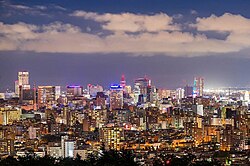

Sapporo
View on Wikipedia
Key Information


.jpg)


| Sapporo | |||||
|---|---|---|---|---|---|
.svg) "Sapporo" in kanji | |||||
| Japanese name | |||||
| Kanji | 札幌 | ||||
| Hiragana | さっぽろ | ||||
| Katakana | サッポロ | ||||
| |||||
Sapporo[a] (札幌市, Sapporo-shi; [sap.po.ɾo, sap.po.ɾoꜜ.ɕi] ⓘ) is a designated city in Hokkaido, Japan. Located in the southwest of Hokkaido, it lies within the alluvial fan of the Toyohira River, a tributary of the Ishikari River. Sapporo is the capital of Hokkaido Prefecture and Ishikari Subprefecture. As of July 31, 2023, the city has a population of 1,959,750, making it the largest city in Hokkaido and the largest north of Tokyo. It is the fifth-most populous city in Japan and is Hokkaido's cultural, economic, and political center.
Originally a plain sparsely inhabited by the indigenous Ainu people, the area contained a few trade posts of the Matsumae domain during the Edo period. The city began as an administrative centre with the establishment of the Hokkaido Development Commission headquarters in 1869. Inspired by the ancient cities of Kyoto and Heijō-kyō, it adopted a grid plan and developed around Odori Park. After the Second World War, it replaced Otaru as Hokkaido's commercial and business hub, and its population surpassed one million by 1970.
After giving up the planned 1940 Sapporo Winter Olympics, Sapporo hosted the 1972 Winter Olympics, the first Winter Olympics ever held in Asia, and the second Olympic games held in Asia after the 1964 Summer Olympics in Tokyo. Sapporo recently dropped its bid for the 2030 Winter Olympics.[3] The Sapporo Dome hosted three matches during the 2002 FIFA World Cup and two matches during the 2019 Rugby World Cup. Additionally, Sapporo has hosted the Asian Winter Games three times, in 1986, 1990, and 2017 and the 1991 Winter Universiade.
The annual Sapporo Snow Festival draws more than 2 million tourists.[4] Other notable sites include the Sapporo Beer Museum[5] and the Sapporo TV Tower located in Odori Park. It is home to Hokkaido University, just north of Sapporo Station. The city is served by Okadama Airport and New Chitose Airport in nearby Chitose.
Toponomy
[edit]Sapporo's name is taken from Ainuic sat poro pet (サッ・ポロ・ペッ), which can be translated as "dry, great river", a reference to the Toyohira River.[6]
History
[edit]Early history
[edit]
Before its establishment, the area occupied by Sapporo (Ishikari Plain, around Ishikari, Hokkaido) was home to indigenous Ainu settlements.[7] In 1866, at the end of the Edo period, construction began on a canal through the area, encouraging a number of early settlers to establish Sapporo village.[8] In 1868, the officially recognized year celebrated as the "birth" of Sapporo, the new Meiji government concluded that the existing administrative center of Hokkaido, which at the time was the port of Hakodate, was in an unsuitable location for defense and further development of the island. As a result, it was determined that a new capital on the Ishikari Plain should be established. The plain itself provided an unusually large expanse of flat, well-drained land which is relatively uncommon in the otherwise mountainous geography of Hokkaido.
During 1870–1871, Kuroda Kiyotaka, vice-chairman of the Hokkaido Development Commission (Kaitaku-shi), approached the American government for assistance in developing the land. As a result, Horace Capron, Secretary of Agriculture under President Ulysses S. Grant, became an oyatoi gaikokujin and was appointed as a special advisor to the commission. Construction began around Odori Park, which still remains as a green ribbon of recreational land bisecting the central area of the city. The city closely followed a grid plan with streets at right-angles to form city blocks. The continuing expansion of the Japanese into around Hokkaido continued, and the prosperity of Hokkaido and particularly its capital grew to the point that the Development Commission was deemed unnecessary and was abolished in 1882. In 1871, the Hokkaidō Shrine was built in its current location as the Sapporo Shrine.
Edwin Dun came to Sapporo to establish sheep and cattle ranches in 1876. He also demonstrated pig raising and the making of butter, cheese, ham and sausage. He was married twice, to Japanese women. He once went back to the US in 1883 but returned to Japan as a secretary of government. William S. Clark, who was the president of the Massachusetts Agricultural College (now the University of Massachusetts Amherst), came to be the founding vice-president of the Sapporo Agricultural College (now Hokkaido University) for eight months from 1876 to 1877. He taught academic subjects in science and lectured on the Bible as an "ethics" course, introducing Christian principles to the first entering class of the college.
In 1880, the entire area of Sapporo was renamed as "Sapporo-ku" (Sapporo Ward),[9] and a railroad between Sapporo and Temiya, Otaru was laid. That year the Hōheikan, a hotel and reception facility for visiting officials and dignitaries, was built adjacent to the Odori Park. It was later moved to Nakajima Park where it remains today. Two years later, with the abolition of the Kaitaku-shi, Hokkaidō was divided into three prefectures: Hakodate, Sapporo, and Nemuro. The name of the urban district in Sapporo remained Sapporo-ku, while the rest of the area in Sapporo-ku was changed to Sapporo-gun. The office building of Sapporo-ku was also located in the urban district.[9]
Sapporo, Hakodate, and Nemuro Prefectures were abolished in 1886, and Hokkaidō government office building, an American-neo-baroque-style structure with red bricks, constructed in 1888. The last squad of the Tondenhei, the soldiers pioneering Hokkaido, settled in the place where the area of Tonden in Kita-ku, Sapporo is currently located. Sapporo-ku administered surrounding Sapporo-gun until 1899, when the new district system was announced. After that year, Sapporo-ku was away from the control of Sapporo-gun.[9] The "ku" (district) enforced from 1899 was an autonomy which was a little bigger than towns, and smaller than cities. In Hokkaido at that time, Hakodate-ku and Otaru-ku also existed.[10]
20th century
[edit]
In 1907, Tohoku Imperial University was established in Sendai Miyagi Prefecture, and Sapporo Agricultural College became part of the university as its agriculture faculty. Parts of neighbouring villages including Sapporo Village, Naebo Village, Kami Shiroishi Village, and districts where the Tonden-hei had settled, were integrated into Sapporo-ku in 1910. The Sapporo Streetcar was opened in 1918, and Hokkaido Imperial University was established in Sapporo-ku, as the fifth Imperial University in Japan, by separating the agriculture faculty of Tohoku Imperial University again. Another railroad operated in Sapporo, the Jōzankei Line, which was ultimately abolished in 1969.
In 1922, the new city system was announced by the national government in Tokyo, and Sapporo-ku was officially renamed Sapporo City.[8] The Sapporo Municipal Bus System was started in 1930. In 1937, Sapporo was chosen as the site of the 1940 Winter Olympics, but due to the outbreak of the Second Sino-Japanese War, this was cancelled the next year. Maruyama Town was integrated as a part of Chūō-ku in 1940, and the Okadama Airport was constructed in 1942. During World War II, the city was bombed by American naval aircraft in July 1945.[11]

The first Sapporo Snow Festival was held in 1950. In the same year, adjacent Shiroishi Village was integrated into Sapporo City, rendered as a part of Shiroishi-ku, and Atsubetsu-ku.[12] In 1955, Kotoni Town, the entire Sapporo Village, and Shinoro Village were merged into Sapporo, becoming a part of the current Chūō-ku, Kita-ku, Higashi-ku, Nishi-ku, and Teine-ku.[12] The expansion of Sapporo continued, with the merger of Toyohira Town in 1961, and Teine Town in 1967, each becoming a part of Toyohira-ku, Kiyota-ku, and Teine-ku.[12]
The ceremony commemorating the 100th anniversary of the foundation of Sapporo and Hokkaido was held in 1968. The Sapporo Municipal Subway system was inaugurated in 1971, which made Sapporo the fourth city in Japan to have a subway system. From February 3 to 13, 1972, the 1972 Winter Olympics were held, the first Winter Olympics held in Asia.[8] On April 1 of the same year, Sapporo was designated as one of the cities designated by government ordinance, and seven wards were established.[12] The last public performance by the opera singer, Maria Callas, was in Sapporo at the Hokkaido Koseinenkin Kaikan on 11 November 1974.[13] The Sapporo Municipal Subway was expanded when the Tōzai line started operation in 1976, and the Tōhō line was opened in 1988, as well as the New Chitose Airport in the same year. In 1989, Atsubetsu-ku and Teine-ku were separated from Shiroishi-ku and Nishi-ku. Annual events in Sapporo were started, such as the Pacific Music Festival in 1990, and Yosakoi Sōran Festival in 1992. A professional football club, Consadole Sapporo, was established in 1996. In 1997, Kiyota-ku was separated from Toyohira-ku. In the same year, Hokkaidō Takushoku Bank, a Hokkaido-based bank with headquarters in Odori, went bankrupt.[14]
21st century
[edit]In 2001 the construction of the Sapporo Dome was completed, and in 2002 the Dome hosted three matches during the 2002 FIFA World Cup: Germany vs Saudi Arabia, Argentina vs England and Italy vs Ecuador, all of which were in the first round. Fumio Ueda, was elected as Sapporo mayor for the first time in 2003. Sapporo became the home to a Nippon Professional Baseball team, Hokkaido Nippon-Ham Fighters, in 2004, which won the 2006 Japan Series, and the victory parade was held on Ekimae-Dōri (a street in front of Sapporo Station) in February 2007.
The Hokkaidō Shinkansen line, which currently connects Honshu to Hakodate through the Seikan Tunnel, is planned to link to Sapporo by March 2039.[15]
Geography
[edit]
Sapporo is a city located in the southwest part of Ishikari Plain and the alluvial fan of the Toyohira River, a tributary stream of the Ishikari River.[16] It is part of Ishikari Subprefecture. Roadways in the urban district are laid to make a grid plan. The western and southern parts of Sapporo are occupied by a number of mountains including Mount Teine, Maruyama, and Mount Moiwa, as well as many rivers including the Ishikari River, Toyohira River, and Sōsei River. Sapporo has an elevation of 29 m (95 ft 2 in).[17]
Sapporo has many parks, including Odori Park, which is located in the heart of the city and hosts a number of annual events and festivals throughout the year. Moerenuma Park is also one of the largest parks in Sapporo, and was constructed under the plan of Isamu Noguchi, a Japanese-American artist and landscape architect.
Neighbouring cities are Ishikari, Ebetsu, Kitahiroshima, Eniwa, Chitose, Otaru, Date, and adjoining towns are Tōbetsu, Kimobetsu, Kyōgoku.
Climate
[edit]| Sapporo | ||||||||||||||||||||||||||||||||||||||||||||||||||||||||||||
|---|---|---|---|---|---|---|---|---|---|---|---|---|---|---|---|---|---|---|---|---|---|---|---|---|---|---|---|---|---|---|---|---|---|---|---|---|---|---|---|---|---|---|---|---|---|---|---|---|---|---|---|---|---|---|---|---|---|---|---|---|
| Climate chart (explanation) | ||||||||||||||||||||||||||||||||||||||||||||||||||||||||||||
| ||||||||||||||||||||||||||||||||||||||||||||||||||||||||||||
| ||||||||||||||||||||||||||||||||||||||||||||||||||||||||||||
Sapporo has a humid continental climate (Köppen: Dfa), with a wide range of temperature between the summer and winter. Summers are generally warm and humid, but not oppressively hot, and winters are cold and very snowy, with an average snowfall of 4.79 m (15 ft 9 in) per year.[18] Sapporo is one of few metropolises in the world with such heavy snowfall,[19] enabling it to hold events and festivals with snow statues. The heavy snowfall is due to the Siberian High developing over the Eurasian land mass and the Aleutian Low developing over the northern Pacific Ocean, resulting in a flow of cold air southeastward across Tsushima Current and to western Hokkaido. The city's annual average precipitation is around 1,100 mm (43.3 in), and the mean annual temperature is 8.5 °C (47.3 °F).[20]
The highest temperature ever recorded in Sapporo was 36.3 °C (97.3 °F) on August 23, 2023.[21] The coldest temperature ever recorded was −28.5 °C (−19.3 °F) on February 1, 1929.[21]
| Climate data for Sapporo (1991−2020 normals, extremes 1877−present) | |||||||||||||
|---|---|---|---|---|---|---|---|---|---|---|---|---|---|
| Month | Jan | Feb | Mar | Apr | May | Jun | Jul | Aug | Sep | Oct | Nov | Dec | Year |
| Record high °C (°F) | 11.2 (52.2) |
13.9 (57.0) |
18.3 (64.9) |
28.0 (82.4) |
33.7 (92.7) |
34.2 (93.6) |
36.0 (96.8) |
36.3 (97.3) |
32.7 (90.9) |
27.3 (81.1) |
22.4 (72.3) |
14.8 (58.6) |
36.3 (97.3) |
| Mean maximum °C (°F) | 5.1 (41.2) |
7.0 (44.6) |
12.3 (54.1) |
21.3 (70.3) |
27.4 (81.3) |
29.0 (84.2) |
31.4 (88.5) |
32.0 (89.6) |
28.8 (83.8) |
22.7 (72.9) |
17.2 (63.0) |
9.4 (48.9) |
32.7 (90.9) |
| Mean daily maximum °C (°F) | −0.4 (31.3) |
0.4 (32.7) |
4.5 (40.1) |
11.7 (53.1) |
17.9 (64.2) |
21.8 (71.2) |
25.4 (77.7) |
26.4 (79.5) |
22.8 (73.0) |
16.4 (61.5) |
8.7 (47.7) |
2.0 (35.6) |
13.1 (55.6) |
| Daily mean °C (°F) | −3.2 (26.2) |
−2.7 (27.1) |
1.1 (34.0) |
7.3 (45.1) |
13.0 (55.4) |
17.0 (62.6) |
21.1 (70.0) |
22.3 (72.1) |
18.6 (65.5) |
12.1 (53.8) |
5.2 (41.4) |
−0.9 (30.4) |
9.2 (48.6) |
| Mean daily minimum °C (°F) | −6.4 (20.5) |
−6.2 (20.8) |
−2.4 (27.7) |
3.4 (38.1) |
9.0 (48.2) |
13.4 (56.1) |
17.9 (64.2) |
19.1 (66.4) |
14.8 (58.6) |
8.0 (46.4) |
1.6 (34.9) |
−4.0 (24.8) |
5.7 (42.3) |
| Mean minimum °C (°F) | −11.8 (10.8) |
−11.7 (10.9) |
−7.9 (17.8) |
−1.4 (29.5) |
3.9 (39.0) |
9.0 (48.2) |
13.7 (56.7) |
14.7 (58.5) |
8.7 (47.7) |
2.1 (35.8) |
−4.6 (23.7) |
−9.0 (15.8) |
−12.8 (9.0) |
| Record low °C (°F) | −27.0 (−16.6) |
−28.5 (−19.3) |
−22.6 (−8.7) |
−14.6 (5.7) |
−4.2 (24.4) |
0.0 (32.0) |
5.2 (41.4) |
5.3 (41.5) |
−0.9 (30.4) |
−4.4 (24.1) |
−15.5 (4.1) |
−24.7 (−12.5) |
−28.5 (−19.3) |
| Average precipitation mm (inches) | 108.4 (4.27) |
91.9 (3.62) |
77.6 (3.06) |
54.6 (2.15) |
55.5 (2.19) |
60.4 (2.38) |
90.7 (3.57) |
126.8 (4.99) |
142.2 (5.60) |
109.9 (4.33) |
113.8 (4.48) |
114.5 (4.51) |
1,146.1 (45.12) |
| Average snowfall cm (inches) | 137 (54) |
116 (46) |
74 (29) |
6 (2.4) |
0 (0) |
0 (0) |
0 (0) |
0 (0) |
0 (0) |
1 (0.4) |
30 (12) |
113 (44) |
479 (189) |
| Average extreme snow depth cm (inches) | 76 (30) |
95 (37) |
82 (32) |
22 (8.7) |
0 (0) |
0 (0) |
0 (0) |
0 (0) |
0 (0) |
1 (0.4) |
15 (5.9) |
47 (19) |
97 (38) |
| Average precipitation days (≥ 0.5 mm) | 22.1 | 19.2 | 18.3 | 12.3 | 10.2 | 9.3 | 9.4 | 10.5 | 11.7 | 14.0 | 18.3 | 19.9 | 175.1 |
| Average snowy days (≥ 0.2 cm) | 29.1 | 25.2 | 22.5 | 6.7 | 0.0 | 0.0 | 0.0 | 0.0 | 0.0 | 1.0 | 13.5 | 26.8 | 124.4 |
| Average relative humidity (%) | 69 | 68 | 65 | 61 | 65 | 72 | 75 | 75 | 71 | 67 | 67 | 68 | 69 |
| Average dew point °C (°F) | −8 (18) |
−8 (18) |
−5 (23) |
−1 (30) |
6 (43) |
12 (54) |
16 (61) |
18 (64) |
13 (55) |
6 (43) |
0 (32) |
−6 (21) |
4 (39) |
| Mean monthly sunshine hours | 90.4 | 103.5 | 144.7 | 175.8 | 200.4 | 180.0 | 168.0 | 168.1 | 159.3 | 145.9 | 99.1 | 82.7 | 1,718 |
| Average ultraviolet index | 1 | 1 | 1 | 3 | 4 | 5 | 5 | 5 | 4 | 2 | 1 | 1 | 3 |
| Source 1: Japan Meteorological Agency[20][21] | |||||||||||||
| Source 2: Weather Atlas (UV),[22] Time and Date (dewpoints, 2005–2015),[23] Météo Climat[24][25] | |||||||||||||
 | This graph was using the legacy Graph extension, which is no longer supported. It needs to be converted to the new Chart extension. |
See or edit raw graph data.
Administration
[edit]Wards
[edit]Sapporo currently has ten wards (区, ku).

| Name | Kanji | Population | Land area in km2 | Pop. density
per km2 |
Map of Sapporo | |
|---|---|---|---|---|---|---|
| 1 | Atsubetsu-ku | 厚別区 | 127,299 | 24.38 | 5,221 |  |
| 2 | Chūō-ku | 中央区 | 237,761 | 46.42 | 5,122 | |
| 3 | Higashi-ku | 東区 | 261,901 | 56.97 | 4,597 | |
| 4 | Kita-ku | 北区 | 286,026 | 63.57 | 4,499 | |
| 5 | Kiyota-ku | 清田区 | 113,556 | 59.87 | 1,897 | |
| 6 | Minami-ku | 南区 | 136,774 | 657.48 | 208 | |
| 7 | Nishi-ku | 西区 | 216,835 | 75.10 | 2,887 | |
| 8 | Shiroishi-ku | 白石区 | 213,310 | 34.47 | 6,188 | |
| 9 | Teine-ku | 手稲区 | 141,886 | 56.77 | 2,499 | |
| 10 | Toyohira-ku | 豊平区 | 223,408 | 46.23 | 4,833 |
Demographics
[edit]The first census of the population of Sapporo was taken in 1873, when 753 families with a total of 1,785 people were recorded in the town.[26] The city has an estimated population of 1,959,750 as of July 31, 2023 and a population density of 1,748 inhabitants per square kilometre (4,530/sq mi). The total area is 1,121.26 km2 (432+15⁄16 sq mi).
|
| |||||||||||||||||||||||||||||||||||||||||||||||||||||||||||||||||||||
| Source: Statistics Bureau [1] | ||||||||||||||||||||||||||||||||||||||||||||||||||||||||||||||||||||||
Surrounding municipalities
[edit]Economy
[edit] | This section needs additional citations for verification. (May 2009) |

The tertiary sector dominates Sapporo's industry. Major industries include information technology, retail, and tourism, as Sapporo is a destination for winter sports and events and summer activities due to its comparatively cool climate.[27]
The city is also the manufacturing centre of Hokkaido, manufacturing various goods such as food and related products, fabricated metal products, steel, machinery, beverages, and pulp and paper.[28] The Sapporo Breweries, founded in 1876, is a major company and employer in the city.[29][30]
Hokkaido International Airlines (Air Do) is headquartered in Chūō-ku.[31] In April 2004, Air Nippon Network was headquartered in Higashi-ku.[32] Other companies headquartered in Sapporo include Crypton Future Media, DB-Soft, Hokkaido Air System, and Royce'.
Transport
[edit].jpg)


Sapporo has one streetcar line, three JR Hokkaido lines, three subway lines and JR Bus, Chuo Bus and other bus lines. Sapporo Subway trains have rubber-tired wheels.
Airways
[edit]Airport
[edit]The Sapporo area is served by two airports: Okadama Airport, which offers regional flights within Hokkaido and some parts of Japan, while New Chitose Airport, a larger international airport located in the city of Chitose 50 kilometres (30 mi) away, connected by regular rapid trains taking around 40 minutes. New Chitose is the primary gateway to the city and also the prefecture. The Sapporo-Tokyo route between New Chitose and Haneda is the second busiest in the world only after Gimpo to Jeju route.
Railways
[edit]JR Hokkaido Stations in Sapporo
High-speed rail
[edit]- Hokkaido Shinkansen(2039)
Conventional lines
[edit]- Hakodate Line: (Zenibako) – Hoshimi – Hoshioki – Inaho – Teine – Inazumi Kōen – Hassamu – Hassamu Chūō – Kotoni – Sōen – Sapporo – Naebo – Shiroishi – Atsubetsu – Shinrinkōen – (Ōasa)
- Chitose Line: Heiwa – Shin Sapporo – Kami Nopporo – (Kita-Hiroshima)
- Sasshō Line (Gakuentoshi Line): Sōen – Hachiken – Shinkawa – Shinkotoni – Taihei – Yurigahara – Shinoro – Takuhoku – Ainosato Kyōikudai – Ainosato Kōen – (Ishikari Futomi)
Subways
[edit]- Sapporo Municipal Subway provides urban transit service.
Tramways
[edit]Rapid transit
[edit]Busways
[edit]An airport shuttle bus servicing hotels in Sapporo operates every day of the year. SkyExpress was founded in 2005 and also provides transport to and from various ski resorts throughout Hokkaido, including Niseko.
Sightseeing
[edit]

.jpg)
Points of interest
[edit]- The former Hokkaidō government office building
- The Sapporo Clock Tower
- The Hokkaidō Shrine
- Nishino Shrine
- Hokkaido Museum
- Historical Village of Hokkaido
- Sapporo Buried Cultural Property Center
- The Sapporo City Archive Museum (Former Sapporo Court of Appeal)
- The Edwin Dun Memorial Hall
- The Hokkaido University & Hokkaido University Museum
- The Sapporo Beer Museum & Sapporo Factory
- The Sapporo TV Tower
- The Sapporo Convention Center
- The Sapporo Salmon Museum in Makomanai Park
- The Sunpiazza Aquarium
Sapporo JR Tower adjacent to Sapporo Station.[33]
Sapporo Ramen Yokocho and Norubesa (a building with a Ferris wheel) are in Susukino district. The district also has the Tanuki Kōji Shopping Arcade, the oldest shopping mall in the city.
The district of Jōzankei in Minami-ku has many resort hotels with steam baths and onsen.
The Peace Pagoda, one of many such monuments across the world built by the Buddhist order Nipponzan Myohoji to promote and inspire world peace, has a stupa that was built in 1959,[citation needed] halfway up Mount Moiwa, to commemorate peace after World War II. It contains some of the ashes of the Buddha that were presented to the Emperor of Japan by Prime Minister Nehru in 1954. [citation needed] Another portion was presented to Mikhail Gorbachev by the Nipponzan-Myohoji monk, Junsei Terasawa. [citation needed]
Parks/gardens
[edit]- Asahiyama Memorial Park offers great views of the city
- Hitsujigaoka Observation Hill has a farm with sheep and attracts visitors with a statue of William S. Clark
- Hokkaido University Botanical Gardens and The Chizaki Rose Garden
- Maruyama Park is located next to the Hokkaido Shrine and houses the Maruyama Zoo
- Moerenuma Park
- Nakajima Park
- Nishioka Park is a location of rich nature that centers around a pond and consists of marshland and the forest of the Tsukisamu River and its upper river basin. This park also serves as one of the main habitats in Hokkaido for many types of wild birds.
- Odori Park
Culture
[edit]Music
[edit]- 1934 – The International Contemporary Music Festival was held by Akira Ifukube, Fumio Hayasaka, Atsushi Miura, and Isamu Ifukube (30 September)
- 1936 – Russian composer Alexander Tcherepnin visited Sapporo
- 1960 – The Sapporo Symphony Orchestra founded
- 1962 – John Cage and David Tudor visited Sapporo
- 1966 – Berliner Philharmoniker with Herbert von Karajan performed Brahms's Symphony No. 2 at Sapporo Shimin Kaikan (April)
- 1974 – Maria Callas last public performance at the Hokkaido Koseinenkin Kaikan (11 November)
- 1986 – The Sapporo Art Park include the Outdoor Stage and Art Hall (27 July)
- 1990 – The Pacific Music Festival (PMF) started
- 1997 – The Sapporo Concert Hall Kitara opened
- 2007 - "01_ballade" by Eiji Hirasawa (from CFM) is released as a demo, later renamed to "Hoshi no Kakera" as the full song for Hatsune Miku's debut
- 2018 – The Sapporo Community Plaza opened
Art
[edit]- The Hokkaido Museum of Modern Art represents Hokkaido artists like Eien Iwahashi, Kinjiro Kida, Nissho Kanda, Tamako Kataoka, and especially glass objects of École de Paris
- The Hongō Shin Memorial Museum of Sculpture hosts a collection of over 1,800 works by the artist Hongō Shin.[34]
- The Sapporo Art Park contains Art museum featuring outdoor installations & a sculpture garden, and the old house of Takeo Arishima.
- The Moerenuma Park including the Glass Pyramid, designed by Isamu Noguchi
- The Migishi Kotaro Museum of Art
- The Miyanomori Art Museum
- The Sapporo Odori 500-m Underground Walkway Gallery
- Member of UNESCO Creative Cities Network as a Creative City of Media Arts since 2013
- Sapporo International Art Festival (2014/2017/2024)
Literature
[edit]- The Hokkaido Museum of Literature
- Takeo Arishima Residence in Sapporo Art Park
- Junichi Watanabe Museum of Literature
Film
[edit]- The Idiot (1951 film) by Akira Kurosawa
- The Northern Museum of Visual Culture
- Theater Kino
- The Sapporo International Short Film Festival and Market
Video games
[edit]- Yakuza 5
- Persona 5 Strikers
- Pokémon Diamond and Pearl, Pokémon Platinum and Pokémon Legends: Arceus, Jubilife City, the capital of the Sinnoh region, is based on Sapporo.
Events/festivals
[edit]

February: the Sapporo Snow Festival The main site is at Odori Park, and other sites include Susukino (known as the Susukino Ice Festival) and Sapporo Satoland. Many of the snow and ice statues are built by members of the Japan Ground Self-Defense Force.[35]
May: the Sapporo Lilac Festival. Lilac was brought to Sapporo in 1889 by an American educator, Sarah Clara Smith. At the festival, people enjoy the flowers, wine and live music.
June: the Yosakoi Soran Festival. The sites of the festival are centered on Odori Park and the street leading to Susukino, and there are other festival sites. In the festival, many dance teams dance to music composed based on a Japanese traditional song, "Sōran Bushi". Members of the dancing teams wear special costumes and compete on the roads or stages constructed on the festival sites. In 2006, 350 teams were featured with around 45,000 dancers, and over 1,860,000 people visited the festival.[35]
The Sapporo Summer Festival. People enjoy drinking at the beer garden in Odori Park and on the streets of Susukino. This festival consists of a number of fairs such as Tanuki Festival and Susukino Festival.[35]
September: the Sapporo Autumn Festival
December: Christmas market in Odori Park, similar to German Christmas markets.
From November through January, many citizens enjoy the Sapporo White Illuminations.
Cuisine
[edit]
The city is home to Sapporo Brewery, white chocolate biscuits known as 'shiroi koibito' (白い恋人), and also as the birthplace of miso ramen.[36] Kouraku Ramen Meitengai, in the Susukino district, is an alley lined with many miso ramen restaurants, since 1951. After its demolition, due to plans for the Sapporo Olympics, the Ganso Sapporo Ramen Yokocho was established in its place. It attracts many tourists throughout the year.[36] From 1966, a food company named, Sanyo Foods, began to sell instant ramen under the brand name, "Sapporo Ichiban".
Haskap, a local variety of edible honeysuckle, similar to blueberries, is a specialty in Sapporo. Other specialty dishes of Sapporo include; soup curry, a soupy curry made with vegetables and chicken, sometimes other meats too, and jingisukan, a barbecued lamb dish, named after Genghis Khan. Sapporo Sweets, is a confectionery using many ingredients from Hokkaido where there's also the Sapporo Sweets Competition held annually.[37] Sapporo is also well known for fresh seafood including salmon, sea urchin and crab. Crab in particular is famed. Many types of crab are harvested and served seasonally in Sapporo like the horsehair crab, snow crab, king crab, and Hanasaki crab, with numerous dishes revolving around them.[38]
Sports
[edit]
The Sapporo Dome was constructed in 2001 and is currently host to the local professional football team, Hokkaido Consadole Sapporo.
ES CON Field Hokkaido (エスコンフィールド北海道, Esukon Fīrudo Hokkaidō), a baseball park in Kitahiroshima, Hokkaido, is home to Nippon Professional Baseball's Hokkaido Nippon-Ham Fighters and opened in March 2023. From 2004 to 2022, the Fighters called Sapporo Dome home.
Winter sports
[edit]Sapporo was selected as host to the 5th Winter Olympics, scheduled for February 3 to 12, 1940; however Japan had to cancel the event, consequently handing the decision back to the IOC, after the Second Sino-Japanese War broke out in 1937.
In 1972, Sapporo hosted the 11th Winter Olympics. Some structures built for Olympic events remain in use today, including the ski jumps at Miyanomori and Okurayama. After considering a bid for the 2026 Winter Olympics and the 2030 Winter Olympics, Olympic representatives in Sapporo have said that the city is considering a bid for the 2034 Winter Olympics. The city predicted it may cost as much as 456.5 billion yen ($4.3 billion) to host the games and is planning to have 90 percent of the facilities within half an hour of the Olympic village, according to a report published 12 May 2016. The Alpen course would be in Niseko, the world's second-snowiest resort, while the village would be next to the Sapporo Dome, the report said.[39] The plans were presented to the Japanese Olympic Committee on 8 November 2016.[40][41] In 2002, Sapporo hosted three group matches of the FIFA World Cup at the Sapporo Dome. In 2006, Sapporo hosted some games of the 2006 Basketball World Championship and also for the 2006 Women's Volleyball World Championship. In 2007, Sapporo hosted the FIS Nordic World Ski Championships at the Sapporo Dome, Miyanomori ski jump, Okurayama ski jump, and the Shirahatayama cross-country course. It has been the host city to two Asian Winter Games and hosted the 2017 Asian Winter Games in Obihiro. Sapporo also hosted matches during the 2019 Rugby World Cup.
Skiing remains a major sport in Sapporo with almost all children skiing as a part of the school curriculum. Okurayama Elementary School is unusual in having its own ski hill and ski jumping hill on the school grounds. Within the city are commercial ski hills including Moiwayama, Bankeiyama, KobaWorld, Sapporo Teine and Fu's.
Many sports stadiums and domes are located in Sapporo, and some of them have been designated as venues of sports competitions. The Sapporo Community Dome, also known by its nickname "Tsu-Dome", has hosted the Golden Market, a huge flea market event which is usually held twice a year, along with some sports events. The Makomanai Ice Arena, in Makomanai Park, was one of the venues of the Sapporo Olympics in 1972. It was renamed the Makomanai Sekisuiheim Ice Arena in 2007, when Sekisui Chemical Co., Ltd., acquired naming rights and renamed the arena after their real estate brand.[42] Other large sports venues include the Makomanai Open Stadium, Tsukisamu Dome, Maruyama Baseball Stadium, and the Hokkaido Prefectural Sports Center, which hosts the professional basketball team, Levanga Hokkaido.
Toyota Big Air was a major international snowboarding event held annually in Sapporo Dome.
Professional sport teams
[edit]| Club | Sport | League | Venue | Established |
|---|---|---|---|---|
| Hokkaido Nippon-Ham Fighters | Baseball | Nippon Professional Baseball | Es Con Field Hokkaido | 2004 |
| Levanga Hokkaido | Basketball | B.League Division 1 | Hokkaido Prefectural Sports Center, Tsukisamu Dome |
2006 |
| Hokkaido Consadole Sapporo | Football (soccer) | J2 League | Sapporo Atsubetsu Park Stadium, Sapporo Dome |
1996 |
- J.League – Hokkaido Consadole Sapporo (J1 in 1998, 2001–2002, 2008, 2012, 2017–present; J2 in 1999–2000, 2003–2007, 2009–2011, 2013–2016).
- NPB – Hokkaido Nippon Ham Fighters in Pacific League
Education
[edit]


Universities
[edit]- National
See Japanese national university
- Public
- Private
- Fuji Women's University
- Health Sciences University of Hokkaido
- Hokkai School of Commerce
- Hokkai Gakuen University
- Hokkaido Bunkyo University
- Hokkaido College of Pharmacy
- Hokkaido Institute of Technology
- Hokkaido Musashi Women's Junior College
- Hokkaido University of Science
- Hokkaido Tokai University
- Hokusei Gakuen University
- Japan Health Care College
- Koen Gakuen Women's Junior College
- Sapporo International University
- Sapporo Ōtani University
- Sapporo University
- Sapporo University of Health Sciences
- Tenshi College
Primary and secondary schools
[edit]![[icon]](https://en.wikipedia.org/wiki/File:Wiki_letter_w_cropped.svg) | This section needs expansion. You can help by adding to it. (October 2015) |
There are 198 municipal elementary schools, and 98 municipal junior high schools in Sapporo. Sapporo Odori High School provides Japanese-language classes to foreign and Japanese returnee students, and the school has special admissions quotas for these groups.[43]
The city has two private international schools:
Twin towns and sister cities
[edit]Sister cities
[edit]International
[edit]Sapporo has twinning relationships with several cities worldwide.[44][45]
| City | Country | State | Since |
|---|---|---|---|
| Portland |  United States United States
|
Oregon | November 17, 1959 |
| Munich |  Germany Germany
|
Bavaria | August 28, 1972 |
| Shenyang |  China China
|
Liaoning | November 18, 1980 |
| Denver | United States
|
Colorado | September 1982 |
| Novosibirsk |  Russia Russia
|
Novosibirsk Oblast | June 13, 1990 |
| Daejeon |  South Korea South Korea
|
South Chungcheong | October 22, 2010 |
Sapporo also cooperates with:
| City | Country | State |
|---|---|---|
| Balikpapan |  Indonesia Indonesia
|
East Kalimantan |
| Brisbane |  Australia Australia
|
Queensland |
| Davao City |  Philippines Philippines
|
Davao Region |
| Seattle | United States
|
Washington |
Domestic
[edit]| City | Prefecture | Region | Since |
|---|---|---|---|
| Hamamatsu |  Shizuoka Shizuoka
|
Chūbu region | May 14, 2009 |
| Matsumoto |  Nagano Nagano
|
September 6, 2010 | |
| Kagoshima |  Kagoshima Kagoshima
|
Kyūshū region | November 16, 2013 |
In pop culture
[edit]- In the Pokémon franchise, Jubilife City, a location in the Sinnoh region, was based on Sapporo.[46] In Pokémon Legends: Arceus, the Galaxy Hall was designed after the Former Hokkaidō Government Office.
See also
[edit]Notes
[edit]References
[edit]- ^ "City of Sapporo". City of Sapporo. Archived from the original on August 26, 2006. Retrieved September 2, 2006.
- ^ Wells, John, ed. (2008). Longman Pronunciation Dictionary (3rd ed.). Pearson Longman. ISBN 978-1-4058-8118-0.
- ^ Yamaguchi, Mari (October 11, 2023). "JOC, Sapporo announce decision to abandon bid for 2030 winter games, seek possible bid from 2034 on". AP. Retrieved December 11, 2023.
- ^ さっぽろ雪まつり実行委員会. 前回のさっぽろ雪まつりの様子. Archived from the original on June 11, 2019. Retrieved October 11, 2018.
- ^ Japan National Tourist Organization — Sapporo Beer Museum Archived June 15, 2011, at the Wayback Machine.
- ^ ふるさとの川史話いっぱい. City of Sapporo. Archived from the original on July 2, 2015. Retrieved May 29, 2009.
- ^ "Recognition at last for Japan's Ainu ". BBC News. July 6, 2008
- ^ a b c サイト閉鎖のお知らせ. Archived from the original on June 19, 2012. Retrieved October 7, 2007.
- ^ a b c New Sapporo History 2nd edition (新札幌市史 第2巻, Shin Sapporo Shishi)
- ^ 北海道市町村自治制の沿革概要 (PDF) (in Japanese). Government of Hokkaido. Archived (PDF) from the original on November 11, 2018. Retrieved November 11, 2018.
- ^ The Asahi Shimbun. "朝日新聞デジタル:空襲の記憶 風化させぬ - 北海道 - 地域". www.asahi.com (in Japanese). Archived from the original on April 14, 2022. Retrieved April 13, 2022.
- ^ a b c d New Sapporo History 5th edition (新札幌市史 第5巻, Shin Sapporo Shishi)
- ^ Sutherland, Robert Maria Callas Diaries of a Friendship London Constable 1999 p265 ISBN 0-09-478790-5
- ^ "lawsuit against the bankruptcy of the Takushoku Bank". Archived from the original on December 22, 2007. Retrieved October 7, 2007.
- ^ Tsukada, Hajime (March 15, 2025). "Hokkaido bullet train extension delayed 8 years, rattling local communities". Nikkei Asia. Retrieved August 30, 2025.
- ^ 札幌市のあらまし. City of Sapporo. Archived from the original on July 2, 2017. Retrieved October 8, 2007.
- ^ "Where is Sapporo, Japan?". worldatlas.com. Archived from the original on July 15, 2019. Retrieved June 10, 2019.
- ^ 気象庁 | 平年値(年・月ごとの値) (in Japanese). Japan Meteorological Agency. Archived from the original on December 25, 2018. Retrieved January 14, 2008.
- ^ City of Sapporo. "General Overview of Sapporo" (PDF) (in English and Japanese). Archived from the original (PDF) on February 5, 2007. Retrieved March 30, 2018.
- ^ a b 気象庁 / 平年値(年・月ごとの値). Japan Meteorological Agency. Archived from the original on February 8, 2022. Retrieved May 19, 2021.
- ^ a b c 観測史上1~10位の値(年間を通じての値). Japan Meteorological Agency. Archived from the original on March 1, 2022. Retrieved March 1, 2022.
- ^ "Sapporo, Japan – Detailed climate information and monthly weather forecast". Weather Atlas. Archived from the original on July 9, 2019. Retrieved August 6, 2022.
- ^ "Climate & Weather Averages in Sapporo". Time and Date. Archived from the original on August 6, 2022. Retrieved August 6, 2022.
- ^ "Météo climat stats for Sapporo". Météo Climat. Archived from the original on March 19, 2022. Retrieved March 1, 2022.
- ^ "Météo climat stats for Sapporo". Météo Climat. Archived from the original on March 19, 2022. Retrieved March 1, 2022.
- ^ Japanese Imperial Commission (1878). Le Japon à l'exposition universelle de 1878. Géographie et histoire du Japon (in French). p. 31.
- ^ "Sapporo Winter Sport Museum Guide". Archived from the original on November 11, 2018. Retrieved November 11, 2018.
- ^ 工業統計調査/札幌市 (in Japanese). City of Sapporo. Archived from the original on November 11, 2018. Retrieved November 11, 2018.
- ^ "Sapporo Holdings: employee numbers 2019". Statista. Archived from the original on June 14, 2021. Retrieved June 14, 2021.
- ^ Japan, Brewery Convention of. "Brewers Association of Japan". Brewers Association of Japan (in Japanese). Archived from the original on June 6, 2021. Retrieved June 14, 2021.
- ^ "会社概要 (in Japanese). Hokkaido International Airlines. Archived from the original on August 14, 2017. Retrieved May 20, 2009.
- ^ " 会社概要 (in Japanese). Air Nippon Network. April 6, 2004. Archived from the original on April 6, 2004. Retrieved May 20, 2009.
- ^ Tourism Statistics of Sapporo Archived 2007-10-25 at the Wayback Machine, 2006, p.35 (pdf file)
- ^ "English Guide|Hongo Shin Memorial Museum of Sculpture, Sapporo". www.hongoshin-smos.jp. Archived from the original on January 29, 2020. Retrieved January 22, 2020.
- ^ a b c Tourism Statistics of Sapporo Archived October 25, 2007, at the Wayback Machine, 2006, p.29 (pdf file)
- ^ a b 元祖さっぽろラーメン横丁公式サイト. Archived from the original on October 12, 2007. Retrieved October 11, 2007.
- ^ "Sapporo, the sweets republic". Archived from the original on October 17, 2007. Retrieved October 11, 2007.
- ^ Dwyer, Chris (November 12, 2018). "Welcome to Sapporo, crab capital of Japan (and maybe even the world)". CNN. Archived from the original on December 3, 2020. Retrieved December 9, 2019.
- ^ "Sapporo to Show JOC Plan for 2026 Olympic Winter Games After Rio". Bloomberg News. May 17, 2016. Archived from the original on June 12, 2018. Retrieved April 7, 2017.
- ^ 札幌で再びオリンピックを JOCに開催提案書 (in Japanese). NHK. 8 November 2016. Archived from the original on 8 November 2016. Retrieved 13 November 2016.
- ^ "Olympics: Sapporo shows 2026 Winter Games plan to JOC". kyodonews.net. November 8, 2016. Archived from the original on November 12, 2016. Retrieved November 13, 2016.
- ^ "Makomanai Sekisuiheim Ice Arena Homepage". Archived from the original on October 15, 2007. Retrieved October 11, 2007.
- ^ "Education" (Archive). City of Sapporo. Retrieved on October 12, 2015.
- ^ 札幌市 – 国際交流 – 姉妹都市 (in Japanese). City of Sapporo. Archived from the original on July 2, 2017. Retrieved April 7, 2007.
- ^ Sister Cities | International Community Bureau Archived 2012-07-12 at archive.today (in Japanese)
- ^ "Pokemon Legends: Arceus - Real-World Counterparts for Sinnoh Towns and Landmarks". January 13, 2022.
External links
[edit]
- Official website
- Sapporo Travel
- Unesco Media City Sapporo
- Reel Life (1945). 1945 Sapporo and Aomori Japan, immediate post war, early occupation (video). Sapporo and Aomori: Youtube. Retrieved October 4, 2025. - Actual video footage of the damage to and occupation of Sapporo and Aomori at the end of WWII.


| International | |
|---|---|
| National | |
| Geographic | |
| Academics | |
| Other | |

Sapporo
View on GrokipediaEtymology and History
Etymology
The name "Sapporo" originates from the Ainu language, the tongue of the indigenous Ainu people of Hokkaido, and is derived from the compound "sat-poro-pet" (サッ・ポロ・ペッ), which translates to "dry, large river" or "big dry river," referring to the Toyohira River that flows through the area and was known for seasonal drying.[6][7] Alternative interpretations include "sari poro pet," meaning "reed field, large river" or "vast reed field river," highlighting the region's grassy plains and waterways.[8] Historical romanizations of the name have varied, such as "Satporopet" or "Sapporo-pet," reflecting early attempts to transcribe Ainu phonetics into Japanese katakana and later Latin script during the late 19th century.[9] During the Meiji era (1868–1912), Japanese colonization of Hokkaido involved systematic adoption and adaptation of Ainu place names for new administrative settlements, as part of broader efforts to integrate the island into the Japanese empire and facilitate settler migration.[10] This naming convention preserved elements of indigenous terminology while aligning them with Japanese governance structures, contrasting with the invention of entirely new names in other colonized regions.[11] The name "Sapporo" first appeared in official Japanese documents in 1869, coinciding with the establishment of the city's administrative center by the newly formed Kaitakushi (Hokkaido Development Commission), marking the formal beginning of organized colonization.[8] From this point, the name evolved in usage from its Ainu roots to a standardized Japanese rendering (札幌, Sapporo in Hepburn romanization), solidifying in maps, treaties, and government records throughout the Meiji period without significant alteration.[12]Pre-Modern History
The Sapporo area, situated in the Ishikari Plain of Hokkaido, has been inhabited by the Ainu people since ancient times, with archaeological evidence indicating continuous settlement from the Satsumon culture of the 9th-13th centuries through the Edo period. Sites such as Yukanboshi C15 and Sapporo K39 have yielded over 120,000 wooden artifacts, including tools and ritual items, demonstrating small-scale villages averaging 10 inhabitants and 6-7 dwellings along river terraces, where the Ainu pursued a hunter-gatherer lifestyle.[13] These communities utilized the fertile plain and Ishikari River as vital hunting grounds for Sika deer and brown bears, whose furs were essential for clothing and trade, and as trade routes connecting the Sea of Japan to the Pacific Ocean, facilitating exchanges of resources like feathers and dried salmon.[13][14] The environmental and cultural significance of the region to Ainu communities was profound, reflected in their oral histories (yukar) and place names that encoded ecological knowledge and spiritual reverence for the land. The Ishikari River, a central hub for salmon fishing using spears, weirs, and birch bark torches, was seen as a sacred pathway for kamuy (spirits), with rituals like inau offerings honoring returning salmon runs and ensuring sustainable harvests.[14] Myths in yukar tales, such as those linking bears to forest deities or rivers to ancestral gifts, underscored a worldview of harmony with nature, where mountains and waterways were homes to gods like the brown bear kamuy, central to ceremonies such as iyomante for returning animal spirits.[14] The name "Sapporo" itself derives from the Ainu words sat poro pet, meaning "large dry river," referring to the seasonal Toyohira River.[7] From the 17th to 19th centuries, interactions with the Matsumae clan intensified, as the clan received a shogunate license in 1604 to monopolize trade with the Ainu, establishing posts in the Ishikari Lowland for resource extraction. Early mapping efforts by Matsumae retainers documented falcon trapping grounds—up to 400 across Hokkaido—and salmon fisheries along rivers like the Shikotsu and Chitose, where Ainu laborers dried and traded salmon for Japanese goods such as metal tools, rice wine, and lacquerware.[13][15] These exchanges, while initially reciprocal, increasingly favored the Matsumae through exploitative policies, leading to conflicts over hunting and fishing rights, as seen in the 1669 Shakushain uprising against clan overreach in resource control.[15] Archaeological finds of integrated artifacts, like Japanese-influenced wooden libation sticks, highlight the cultural adaptations amid these interactions.[13]19th-Century Development
In 1869, following the Meiji Restoration, the Japanese government established the Hokkaido Development Commission (Kaitakushi) to oversee the systematic colonization and development of Hokkaido, formerly known as Ezo, with Sapporo designated as the primary administrative outpost and future capital due to its fertile location in the Ishikari Plain. This initiative, which involved the displacement of indigenous Ainu communities from their ancestral lands, aimed to transform the region into a productive agricultural and military frontier.[16][12][17] Under the leadership of Kuroda Kiyotaka, who served as vice-director from 1871 and director from 1874 to 1882, the commission recruited Western experts to modernize the area, including American engineer and agriculturist Horace Capron, appointed in 1871 as a commissioner for Hokkaido's development. Capron's recommendations shaped Sapporo's urban planning, implementing a grid-based layout with rectangular blocks and right-angled streets inspired by American cities like Washington, D.C., to facilitate orderly expansion and land use. The plan incorporated the allocation of approximately 8,000 cho (about 8,800 hectares) of surrounding land for farmland, distributed to settlers through policies modeled on the U.S. Homestead Act to encourage large-scale agriculture suited to the northern climate, such as wheat, potatoes, and livestock rearing.[18][19][20] To support settlement and economic viability, the commission prioritized basic infrastructure, constructing roads to link Sapporo with ports like Otaru and inland resources, establishing elementary schools for the influx of migrant families, and founding the Sapporo Agricultural College in 1876 as a center for scientific farming education under advisors like William S. Clark. These measures drove rapid demographic expansion, with Sapporo's population rising from near zero at the commission's inception to 14,000 by 1880, reflecting the success of early colonization incentives like subsidies for farmers and soldier-colonists (tondenhei).[18][21][20]20th-Century Growth
During the Taisho (1912–1926) and early Showa (1926–1989) eras, Sapporo experienced significant infrastructural development that spurred urban expansion. The city's railway network expanded notably in the early 1900s, with the Sassho Line connecting Sapporo to surrounding areas starting in 1923, facilitating the transport of goods and people and integrating the city more closely with Hokkaido's coal mining and agricultural sectors.[22] By the 1930s, Sapporo's population had grown to approximately 168,000 in 1930 and exceeded 200,000 by 1940, driven by migration and economic opportunities in industry and administration.[23] The city's military significance increased during this period as it served as the headquarters for the Imperial Japanese Army's 7th Division, established in 1888 and tasked with northern defense; during World War II, the division contributed to Hokkaido's strategic preparations against potential Soviet incursions, though the island saw no major ground combat.[24] Following Japan's defeat in World War II, Sapporo underwent rapid reconstruction amid the national economic miracle of the 1950s and 1960s. The city benefited from industrial growth and urbanization, with its population surging from about 754,000 in 1950 to over one million by 1970, supported by investments in manufacturing, education, and tourism.[2] A pivotal event was the hosting of the 1972 Winter Olympics, the first such games in Asia, which accelerated infrastructure development including the opening of the Makomanai Indoor Stadium and extensions to the city's subway and road systems; these improvements provided a substantial boost to the local economy through construction, tourism, and long-term urban modernization.[25] Culturally, the mid-20th century marked key milestones that enhanced Sapporo's identity. The Sapporo Snow Festival began in 1950 as a modest initiative by local high school students, who constructed six snow sculptures in Odori Park to attract winter visitors and promote the city's snowy heritage; it evolved into an annual international event by the 1960s, drawing millions and solidifying Sapporo's reputation as a winter destination.[26] Concurrently, the brewing industry expanded, with Sapporo Breweries—headquartered in the city since 1876—revitalizing operations post-war; after merging into Nippon Breweries in 1949 and resuming Sapporo Beer production in 1956, the company rebranded in 1964 and grew through domestic market penetration and product innovation, contributing to Hokkaido's economic diversification.[27]21st-Century Developments
In the early 21st century, Sapporo solidified its status as a hub for international winter sports events. The city hosted the FIS Nordic World Ski Championships in 2007, marking the second time it had done so after 1972 and attracting competitors from over 50 nations in cross-country skiing, Nordic combined, ski jumping, and ski orienteering events.[28] A decade later, Sapporo and nearby Obihiro co-hosted the 2017 Asian Winter Games, featuring 11 sports and 64 events with more than 1,190 athletes from 32 countries and regions, including figure skating, ice hockey, and biathlon; the event emphasized regional collaboration and drew over 200,000 spectators.[29] Sapporo also pursued a bid to host the 2030 Winter Olympics, leveraging its legacy from the 1972 Games, but withdrew in October 2023 due to public unease over bribery scandals linked to the Tokyo 2020 Olympics and challenges in securing local support.[30] Sapporo contributed to regional disaster recovery efforts following the 2011 Great East Japan Earthquake and tsunami in Tohoku, which caused indirect disruptions such as supply chain issues and power outages in Hokkaido despite minimal direct structural damage in the city. Local organizations, including the Sapporo Group, launched initiatives like the "Tohoku Future Project" to provide financial aid, product donations, and community support for reconstruction in affected areas, focusing on long-term revitalization through business partnerships.[31] The COVID-19 pandemic severely impacted Sapporo's tourism sector, with international visitor arrivals to Japan dropping 87% in 2020 to 4.12 million and further to 0.25 million in 2021 due to border closures and travel restrictions; locally, events like the Sapporo Snow Festival saw attendance plummet before rebounding to pre-pandemic levels of 2.39 million visitors in 2024 as restrictions eased, though the 2025 event at the Odori venue drew approximately 1.77 million.[32][33][34] Urban renewal projects have driven Sapporo's modernization, exemplified by the ongoing redevelopment of JR Sapporo Station, which includes a new commercial complex and high-rise tower to integrate with the Hokkaido Shinkansen extension. The project, delayed from initial timelines, is now divided into phases: the first block featuring retail and office spaces set for completion by fiscal 2030, and the full 43-story structure by fiscal 2034, aiming to enhance connectivity and economic vitality. However, the Hokkaido Shinkansen extension to Sapporo has faced further delays, now projected for completion in 2039 as of March 2025, due to escalating costs and labor shortages.[35][36] Complementing this, sustainability initiatives have gained momentum, with the 2023 Hokkaido-Sapporo Declaration promoting renewable energy adoption to position the region as a "green powerhouse," including efforts to expand solar and wind power usage in municipal facilities and support for industries like data centers powered by local renewables.[37] Co-op Sapporo, for instance, began supplying locally produced renewable energy from off-site solar plants in 2024, targeting up to 200 facilities by the late 2020s to reduce carbon emissions.[38]Geography
Location and Topography
Sapporo is located in southwestern Hokkaido, Japan, at approximately 43°06′N 141°21′E.[39] The city lies on the Ishikari Plain, a broad alluvial lowland, and is situated about 830 kilometers north of Tokyo.[40] This positioning in the northern part of the country places Sapporo as the administrative and economic center of Hokkaido, with its development influenced by the plain's fertile soils that facilitated early agricultural and urban expansion. The topography of Sapporo features a predominantly flat alluvial plain with elevations ranging from 15 to 20 meters above sea level in the central urban area.[41] Surrounding this low-lying core are forested mountains, including Mount Teine to the northwest at 1,023 meters and Mount Moiwa to the southwest at 531 meters, which provide natural boundaries and recreational highlands.[42][43] Geologically, the region is shaped by volcanic activity from the nearby Shikotsu-Toya volcanic field in southwest Hokkaido, contributing to the area's fertile volcanic soils and underlying caldera structures.[44] Hydrographically, Sapporo is centered along the Toyohira River, a major tributary of the Ishikari River, and its artificial branch, the Sōsei River, which was excavated in the 1870s to channel water through the city center.[45] These waterways have played a key role in flood control, with engineering projects dating to the Meiji era mitigating overflow risks in the densely populated basin, and have influenced the grid-like urban layout by defining east-west divisions.[46] Approximately 60% of the city's area remains covered by greenery, including forests and parks integrated along riverbanks, preserving natural buffers against urban expansion.[47]Climate
Sapporo experiences a humid continental climate classified as Dfb under the Köppen system, characterized by cold, snowy winters and mild, humid summers without a pronounced dry season. The city's location in northern Japan contributes to significant seasonal variation, with winter influenced by Siberian air masses and summer moderated by Pacific Ocean effects. Average annual precipitation totals approximately 1,146 mm, with the majority falling during the warmer months from June to August, often in the form of rain.[48] Winters are notably harsh, featuring prolonged snow cover from late November to early April, with an average annual snowfall of 4.92 meters. The average low temperature in January, the coldest month, reaches -6.4°C, while maximum snow depth typically accumulates to around 80-100 cm during peak periods.[48] Detailed winter temperature data broken down by ward, district, area, or neighborhood in Sapporo is not available from reliable sources. Weather observations and climate data are reported for Sapporo as a whole, with no significant intra-city variations documented in public records. City-wide winter (December–February) averages include highs of about 0°C to -2°C (32°F to 28°F) and lows of -5°C to -12°C (23°F to 11°F), with January being the coldest month. Sapporo experiences heavy snowfall, averaging around 470 cm annually. Summers remain comfortable, with July—the warmest month—recording an average high of 25.4°C and relatively high humidity. Notable historical events include the intense snowfall of December 1970, when monthly totals exceeded 188 cm, contributing to extreme snow accumulation and disruptions across Hokkaido.[49] Climate change has led to observable warming trends in Sapporo, with average temperatures rising by approximately 1.4°C from 1900 to 1996, driven by both global patterns and local urban heat island effects exceeding 2°C per century.[50] This warming has resulted in a reduction of snowfall by up to 20% in recent decades in parts of Hokkaido, including shorter snow cover durations and decreased maximum snow depths, though annual totals in Sapporo show no statistically significant long-term decline.[51] In response, the city has implemented adaptation measures such as extensive heated sidewalk and road systems with electric and hydronic heating to melt snow and prevent ice formation, reducing reliance on manual removal and chemical agents.[52] As of March 8, 2026, Sapporo has a snow depth of 54 cm, with light snow occurring or expected tonight. Temperatures are near or below freezing (around -2°C to 3°C in the coming days), so snow remains significant but urban areas are experiencing slushy (ドロドロ) conditions on roads due to daytime melting, traffic, and nighttime refreezing. March typically sees slush from snowmelt in Hokkaido. Forecasts are subject to change.[53] The following table provides the monthly climatological normals (1991–2020) for Sapporo according to the Japan Meteorological Agency:| Month | Avg Max Temp (°C) | Avg Mean Temp (°C) | Avg Min Temp (°C) | Avg Precipitation (mm) | Avg Snowfall (cm) |
|---|---|---|---|---|---|
| January | -0.4 | -3.2 | -6.4 | 108.4 | 149 |
| February | 0.4 | -2.7 | -6.2 | 91.9 | 118 |
| March | 4.5 | 1.1 | -2.4 | 77.6 | 78 |
| April | 11.7 | 7.3 | 3.4 | 54.6 | 12 |
| May | 17.9 | 13.0 | 9.0 | 55.5 | 0 |
| June | 21.8 | 17.0 | 13.4 | 60.4 | 0 |
| July | 25.4 | 21.1 | 17.9 | 90.7 | 0 |
| August | 26.4 | 22.3 | 19.1 | 126.8 | 0 |
| September | 22.8 | 18.6 | 14.8 | 142.2 | 0 |
| October | 16.4 | 12.1 | 8.0 | 109.9 | 1 |
| November | 8.7 | 5.2 | 1.6 | 113.8 | 49 |
| December | 2.0 | -0.9 | -4.0 | 114.5 | 109 |
| Annual | 13.1 | 9.2 | 5.7 | 1146 | 516 |
Administrative Boundaries
Sapporo serves as the capital of Hokkaido Prefecture and has held the status of a designated city under Japanese government ordinance since April 1, 1972, granting it significant administrative autonomy in areas such as urban planning and public welfare.[8] As a designated city, Sapporo is divided into 10 wards, each functioning as a semi-autonomous administrative unit with its own ward office responsible for local governance, resident services, and community affairs. These wards include Chūō-ku, which encompasses the central business district and key government buildings like the Sapporo City Hall; Kita-ku in the north; Higashi-ku in the east; Shiroishi-ku; Atsubetsu-ku; Toyohira-ku; Kiyota-ku; Minami-ku in the south; Nishi-ku in the west; and Teine-ku in the northwest.[55][56] The city's total administrative area spans 1,121.26 km², encompassing a mix of urban, suburban, and rural landscapes that extend into surrounding lowlands and foothills.[8] Sapporo's boundaries border several neighboring municipalities, including Ebetsu to the north, Ishikari to the northwest, Kitahiroshima and Eniwa to the east, and Chitose to the southeast, with the Jozankei Onsen area forming a notable hot spring district within Minami-ku along the southern edge.[57] This configuration has facilitated urban sprawl, particularly into adjacent suburban areas, integrating commuter belts and satellite developments while maintaining distinct municipal lines. Significant boundary changes have shaped Sapporo's ward structure over time. Upon its designation as a city in 1972, the initial framework established seven wards through the reorganization and merger of outlying districts, including the incorporation of areas like Teine into the system.[8] Further adjustments occurred in 1989, when Nishi-ku was split to create Teine-ku, enhancing governance for northwestern peripheral zones, bringing the total to nine wards; this was followed in 1997 by the division of Toyohira-ku to form Kiyota-ku, finalizing the current 10-ward configuration and improving administrative efficiency for southern suburbs.[55] These mergers and splits reflect ongoing efforts to adapt to population growth and regional needs without altering the city's overall prefectural boundaries.Government and Administration
City Governance
Sapporo employs a mayor-council form of government, typical of designated cities in Japan, where an elected mayor serves as the chief executive and a unicameral city assembly acts as the legislative body. The mayor, Katsuhiro Akimoto, was re-elected in April 2023 for a four-year term and remains in office as of 2025, overseeing executive functions including policy implementation and administration. The city assembly comprises 72 members, elected every four years in unified local elections, who deliberate and pass ordinances, approve the annual budget, and hold the mayor accountable through oversight committees. In the 2023 election, seats were distributed among major parties including the Liberal Democratic Party (26 seats), Constitutional Democratic Party (18 seats), Komeito (10 seats), Japanese Communist Party (7 seats), Japan Innovation Party (5 seats), and others. The city's fiscal operations are managed through a general account and various special accounts, with the total budget for fiscal year 2025 amounting to 1,976.1 billion yen (up 2.3% from the prior year), reflecting support for public services and infrastructure; for FY2024, it was 1,931 billion yen (up 1.5%). Revenue in the general accounts stood at 1,266.6 billion yen for FY2025 (down 2.0%), primarily from city taxes, national subsidies, and local bonds. Key administrative bureaus include the Education Bureau, which manages public schools, educational facilities, and lifelong learning programs; the Health and Welfare Bureau, responsible for social services, healthcare access, and support for vulnerable populations; and the Urban Development Bureau, which handles city planning, zoning, and sustainable growth initiatives. As Hokkaido's capital, Sapporo coordinates closely with the prefectural government on regional matters such as economic development and disaster preparedness, serving as a hub for prefecture-wide policies under frameworks like the Hokkaido Comprehensive Development Plan. Recent policies emphasize addressing demographic shifts and technological integration. To support the aging population, which constitutes a significant portion of residents, the city has expanded welfare programs including home care services and community centers, aligned with the Third Sapporo Future Creation Plan (2021–2030), which promotes innovative technologies to mitigate population decline and enhance quality of life for seniors. In April 2025, the city enacted an ordinance promoting diversity and inclusion to support its growing foreign resident population. Post-2020, digital governance initiatives have accelerated through the Team Sapporo-Hokkaido framework, focusing on digital infrastructure, e-government services, and green transformation to streamline administrative processes and improve citizen access to public resources. Ward-level administration supports these efforts by implementing city-wide policies at the local level.Wards
Sapporo is divided into ten administrative wards (ku), which serve as the primary sub-municipal units for local governance and community services. Each ward operates its own ward office, responsible for delivering essential administrative functions such as resident registration, welfare support, health services, and community development initiatives tailored to local needs. These offices facilitate close interaction between residents and city administration, promoting ward-specific projects and events.[8] The wards exhibit diverse characteristics shaped by their geography, history, and economic roles, ranging from urban centers to suburban and natural areas. Below is an overview of the ten wards, including approximate populations as of July 2025 and key features:| Ward | Population (July 2025) | Key Characteristics |
|---|---|---|
| Chūō-ku | 255,294 | Central downtown hub with major commercial districts like Susukino, tourist attractions such as Odori Park and the Clock Tower, and government offices; serves as the city's entertainment and business core.[58][1] |
| Kita-ku | 287,563 | Northern residential area featuring Hokkaido University and expansive green spaces; known for educational institutions and quiet neighborhoods around Sapporo Station.[58][1] |
| Higashi-ku | 263,735 | Eastern ward with quiet residential zones, parks like Moerenuma Park, and agricultural experiences at facilities such as Sapporo Satoland; emphasizes nature and farming heritage.[58][59][1] |
| Nishi-ku | 217,990 | Western residential district with mountainous scenery, forested areas, and attractions like Shiroi Koibito Park; includes educational facilities and promotes community-oriented living.[58][1] |
| Minami-ku | 132,916 | Southern suburban ward, the largest by land area, blending natural landscapes with industrial zones and sites like Sapporo Art Park; focuses on recreation and peripheral development.[58][1] |
| Toyohira-ku | 228,873 | Southeastern residential area along the Toyohira River, home to the Sapporo Dome and Hitsujigaoka Observation Hill; known for sports venues and scenic parks.[58][1] |
| Shiroishi-ku | 212,003 | Eastern ward rich in flowers and parks, featuring the Asahi Breweries Hokkaido Brewery; supports residential and light industrial activities.[58][1] |
| Atsubetsu-ku | 121,487 | Eastern outskirts with natural parks and the Historical Village of Hokkaido; emphasizes historical preservation and suburban living.[58][1] |
| Teine-ku | 139,995 | Northwestern suburban area around Mount Teine, including ski resorts; known for outdoor recreation and residential communities.[58][1] |
| Kiyota-ku | 108,017 | Southeastern newest ward (established 1997), featuring parks like Hiraoka Park and abundant greenery; prioritizes modern residential and environmental development.[58][1] |