Hubbry Logo
ScryingScryingMain
Open search
Scrying
Community hub
Scrying
logo
8 pages, 0 posts
0 subscribers
Be the first to start a discussion here.
Scrying
Scrying
from Wikipedia
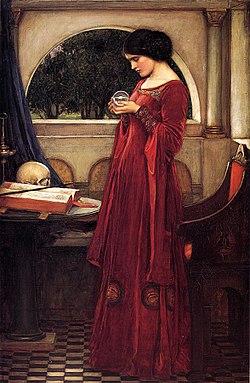
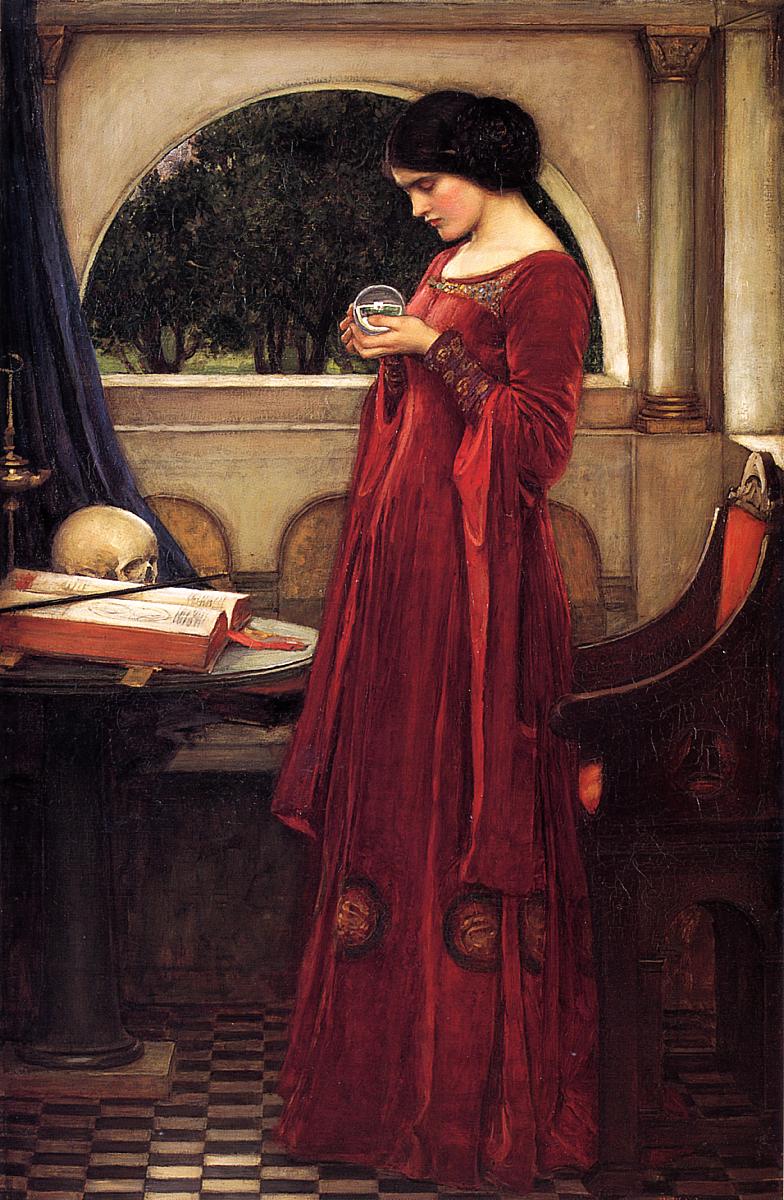
The Crystal Ball by John William Waterhouse (1902, oil on canvas)

Scrying, also referred to as "seeing" or "peeping," is a practice rooted in divination and fortune-telling. It involves gazing into a medium, hoping to receive significant messages or visions that could offer personal guidance, prophecy, revelation, or inspiration.[1] The practice lacks a definitive distinction from other forms of clairvoyance or divination but generally relies on visions within the chosen medium. Unlike augury, which interprets observable events, or divination, which follows standardized rituals, scrying's impressions arise within the medium itself.

The terminology and methods of scrying are diverse and lack a standardized structure. Practitioners coin terms such as "crystallomancy," "spheromancy," or "catoptromancy," naming practices based on the medium or technique employed. These practices have been reinvented throughout history, spanning cultures and regions. Scrying media encompass reflective, refractive, or luminescent surfaces like crystals, mirrors, water, fire, or smoke. Some practitioners even close their eyes, engaging in "eyelid scrying."

Methods of scrying often include self-induced trances, using media like crystal balls or even modern technology like smartphones. Practitioners enter a focused state that reduces mental clutter, enabling the emergence of visual images. These initial images, however trivial, are amplified during the trance. Some scryers report that they hear their voice affirming what they see, creating a mental feedback loop.

Throughout history, various traditions and cultures have practiced scrying as a means of revealing the past, present, or future. The practice involves diverse media, from reflective surfaces to shimmering mirages, and is often accompanied by rituals inducing altered states of consciousness. Despite its popularity in occult circles and its portrayal in media, scrying lacks empirical support and has been met with skepticism from the scientific community.

Definitions and terminology

[edit]

There is no definitive distinction between scrying and other aids to clairvoyance, augury, or divination, but roughly speaking, scrying depends on impressions of visions in the medium of choice. Ideally in this respect it differs from augury, which relies on interpretations of objectively observable objects or events (such as flight of birds); from divination, which depends on standardized processes or rituals; from oneiromancy, which depends on the interpretation of dreams; from the physiological effects of psychoactive drugs; and from clairvoyance, which notionally does not depend on objective sensory stimuli. Clairvoyance in other words, is regarded as amounting in essence to extrasensory perception.

Scrying is neither a single, clearly defined, nor formal discipline and there is no uniformity in the procedures, which repeatedly and independently have been reinvented or elaborated in many ages and regions.[2][3] Furthermore, practitioners and writers coin terminology so arbitrarily, and often artificially, that no one system of nomenclature can be taken as authoritative and definitive. Commonly terms in use are Latinisations or Hellenisations of descriptions of the media or activities. Examples of names coined for crystal gazing include 'crystallomancy', 'spheromancy', and 'catoptromancy'. As an example of the looseness of such terms, catoptromancy should refer more specifically to scrying by use of mirrors or other reflective objects rather than by crystal gazing. Other names that have been coined for the use of various scrying media include anthracomancy for glowing coals, turifumy for scrying into smoke, and hydromancy for scrying into water. There is no clear limit to the coining and application of such terms and media.[4]

Scrying has been practiced in many cultures in the belief that it can reveal the past, present, or future.[5][6] Some practitioners assert that visions that come when one stares into the media are from the subconscious or imagination, while others say that they come from gods, spirits, devils, or the psychic mind, depending on the culture and practice. There is neither any systematic body of empirical support for any such views in general however, nor for their respective rival merits; individual preferences in such matters are arbitrary.[5]

Media

[edit]

The media most commonly used in scrying are reflective, refractive, translucent, or luminescent surfaces or objects such as crystals, stones, or glass in various shapes such as crystal balls, mirrors, reflective black surfaces such as obsidian, water surfaces, fire, or smoke, but there is no special limitation on the preferences or prejudices of the scryer; some may stare into pitch dark, clear sky, clouds, shadows, or light patterns against walls, ceilings, or pond beds. Some prefer glowing coals or shimmering mirages. Some[who?] simply close their eyes, notionally staring at the insides of their own eyelids, and speak of "eyelid scrying".[citation needed]

Scrying media generally either suggest images directly (such as figures in fire, fluid eddies, or clouds), or else they distort or reflect the observers' vision confusingly, in the manner to be seen in crystals or transparent balls. Such fancies have long been satirised by sceptics, for example in Hamlet III.ii:[citation needed]

Do you see yonder cloud that's almost in shape of a camel?
By the mass, and 'tis like a camel, indeed.
Methinks it is like a weasel.
It is backed like a weasel.
Or like a whale?
Very like a whale.

Alternatively the medium might reduce visual stimuli to thresholds below which any clear impressions could interfere with fancied visions or free association. Examples include darkened reflections of night sky, or plain shadow or darkness.[7]

Methods

[edit]
Modern-day scrying experience

One class of methods of scrying involves a self-induced trance, with or without the aid of a medium such as a crystal ball or, even via modern technology such as a smartphone among other things. Some say that the sensation is drug-like, some that various drugs can potentiate the experience; others categorically exclude any connection with drug usage, believing that it invalidates any images observed.

Many practitioners say that the scrying medium initially serves to focus attention, removing unwanted thoughts from the mind in much the same way as repetition of a mantra, concentration on a mandala, inducing the relaxation response, or possibly by hypnosis. Once this stage is achieved, the scryer may begin free association with the perceived images. The technique of deliberately looking for and declaring these initial images aloud, however trivial or irrelevant they may seem to the conscious mind, attempts to deepen the trance state. In this state some scryers hear their own disassociated voices affirming what they see, in a mental feedback loop.

Practitioners apply the process until they achieve a satisfactory state of perception in which rich visual images and dramatic stories seem to be projected within the medium itself, or in the mind's eye of the scryer. They report that the technique allows them to see relevant events or images within the chosen medium.

Nostradamus practiced scrying; he would stare into a bowl of water or a magic mirror to see the future while he was in trance.[6]

Religion and mythology

[edit]

Hebrew Bible

[edit]

Divination is briefly mentioned in chapter 44 of the Book of Genesis. A silver chalice or cup is deliberately planted in Benjamin's sack when he leaves Egypt, later to be used as evidence of theft. It is revealed the cup belongs to Joseph, the vizier of Egypt, whose steward said it was used for drinking and divination during the course of his accusation. This is mentioned to reinforce his disguise as an Egyptian nobleman. Nothing in the book of Genesis indicates that Joseph actually used the cup for divination.

Ancient Persia

[edit]

The Shahnameh, a 10th-century epic work narrating historical and mythological past of Persia, gives a description of what was called the Cup of Jamshid (Jaam-e Jam), which was used by the ancient (mythological) Persian kings for observing all of the seven layers of the universe. The cup was said to contain an elixir of immortality, but without cogent explanation for any relevance of the elixir to the scrying function.

Latter Day Saint movement

[edit]

In the late 1820s, Joseph Smith founded the Latter Day Saint movement based in part on insights gained from the reflections of seer stones. Smith had at least three separate stones which he used initially in treasure-hunting expeditions. Subsequently, he took to placing his favorite stone inside his hat to read what he said were miraculous reflections from the stone.[8] Smith also said he possessed a pair of spectacles manufactured from seer stones, which he called the Urim and Thummim and which he said enabled him to translate the golden plates that are the stated source of the Book of Mormon.[9]

In folklore

[edit]
Divination rituals such as the one depicted on this early 20th-century Halloween greeting card, where a woman stares into a mirror in a darkened room to catch a glimpse of the face of her future husband while a witch lurks in the shadows, may be one origin of the Bloody Mary legend.
This Halloween greeting card from 1904 satirizes divination: the young woman hoping to see her future husband sees the reflection of a nearby portrait instead.

Rituals that involve many acts similar to scrying in ceremonial magic are retained in the form of folklore and superstition. A formerly widespread tradition held that young women gazing into a mirror in a darkened room (often on Halloween) could catch a glimpse of their future husband's face in the mirror — or a skull personifying Death if their fate was to die before they married.

Another form of the tale, involving the same actions of gazing into a mirror in a darkened room, is used as a supernatural dare in the tale of "Bloody Mary". Here, the motive is usually to test the adolescent gazers' mettle against a malevolent witch or ghost, in a ritual designed to allow the scryers' easy escape if the visions summoned prove too frightening.[10]

Folklore superstitions such as those just mentioned, are not to be distinguished clearly from traditional tales, within which the reality of such media are taken for granted. In the fairytale of Snow White for example, the jealous queen consults a magic mirror, which she asks "Magic mirror on the wall / Who is the fairest of them all?", to which the mirror always replies "You, my queen, are fairest of all." But when Snow White reaches the age of seven, she becomes as beautiful as the day, and when the queen asks her mirror, it responds: "Queen, you are full fair, 'tis true, but Snow White is fairer than you."[11] There is no uniformity among believers, in how seriously they prefer to take such tales and superstitions.

In Western esotericism

[edit]

The Hermetic Order of the Golden Dawn (1888-c.1902 in its original form) taught their own version of scrying that could be done individually or as a group. It emphasized three levels:[12]

  1. "Scrying in the Spirit Vision" with an emphasis on inner seeing by focusing on a symbol or mirror,
  2. "Traveling in the Spirit Vision" involves going to the place seen and interacting with what is found there,
  3. "Rising on the Planes" focuses on a spiritual process (involving scrying via the Tree of Life) that has the potential to elevate consciousness to the level of the Divine.

Scientific reception

[edit]

Scrying is not supported by science as a method of predicting the future or obtaining information unavailable to empirical investigation.[13] Some critics consider it to be a pseudoscience.[5] Skeptics consider scrying to be the result of delusion or wishful thinking.[14]

Psychologist Leonard Zusne suggested that scrying images are hallucinations or hypnagogic experiences.[15]

A 2010 paper in the journal Perception[16] identified one specific method of reliably reproducing a scrying illusion in a mirror and hypothesized that it "might be caused by low level fluctuations in the stability of edges, shading and outlines affecting the perceived definition of the face, which gets over-interpreted as ‘someone else’ by the face recognition system."[17]

See also

[edit]

References

[edit]

Further reading

[edit]
[edit]
Revisions and contributorsEdit on WikipediaRead on Wikipedia
from Grokipedia
Scrying is an ancient form of practiced by gazing fixedly into a reflective surface or translucent medium, such as a , mirror, or body of water, with the intent of perceiving visions, symbols, or messages from spiritual or subconscious realms that can be interpreted for guidance, prophecy, or revelation. The practice has deep roots in ancient Mesoamerican civilizations, where polished mirrors known as tezcatl served as key instruments for sorcerers and priests to enter trance-like states and journey to the worlds of gods and ancestors by peering into the mirrors' smoky depths. These mirrors were closely associated with the Aztec deity , the "smoking mirror," who was depicted wearing them as symbols of rulership, night, and sorcery, reflecting both the viewer and the to bridge time and space. Archaeological evidence from sites like shows that such mirrors were not merely cosmetic but integral to ritual costume and divinatory scrying, often held in the hand or worn to invoke otherworldly insights during ceremonies. In the Renaissance period, scrying gained prominence in through figures like the English mathematician, astrologer, and royal advisor (1527–1608/9), who integrated it into his studies to contact angelic entities. Dee employed an obsidian mirror of Aztec origin—likely acquired through colonial trade—and a to facilitate visions, applying his knowledge of to enhance the process, though early attempts yielded limited results until his collaboration with medium in 1582. This mirror, now housed in the , exemplifies how scrying tools circulated globally, blending indigenous Mesoamerican traditions with European esotericism. Common methods of scrying involve selecting a suitable medium—such as polished stones, reflective liquids, or even —and entering a relaxed, meditative state to allow intuitive images to emerge, which the practitioner then deciphers for meaning. Historically, these techniques emphasized through rituals, dim lighting, and mental focus to induce altered consciousness, as seen in Mesoamerican shamanistic practices where mirrors deflected malevolent spirits while revealing hidden truths. Despite its condemnation by early Christian authorities as heretical, scrying persisted as a tool for personal insight and mystical exploration across cultures.

Fundamentals

Definition and Etymology

Scrying is a form of that involves gazing fixedly into a reflective or translucent medium to perceive visions, symbols, or insights that may reveal information about the past, present, or future. This practice relies on the practitioner's ability to enter a trance-like state, allowing the mind to project or interpret imagery within the medium for guidance, , or revelation. Unlike other divinatory arts such as , which interprets omens from natural phenomena like bird flight patterns, or , which analyzes dreams for hidden meanings, scrying emphasizes the deliberate use of a visual medium to induce and observe hallucinatory or symbolic content. The term "scry" derives from the verb "descryen," meaning "to reveal," "announce," or "make out dimly," which itself stems from the "descrire" or "descrirer," ultimately tracing back to the Latin "describere," meaning "to write down" or "copy." As a variant or shortening of "descry," the word "scry" first appears in English records before 1400, though its specific application to visionary divination solidified in the 1520s. At its core, scrying operates on the principle of inducing an through prolonged, unfocused gazing, which facilitates access to the and the emergence of spontaneous, symbolic, or prophetic imagery. This process is believed to bypass rational thought, enabling intuitive revelations that can be interpreted for personal or spiritual insight.

Historical Origins

The practice of scrying, involving the use of reflective or translucent surfaces to induce visions for , has ancient roots, though exact prehistoric origins remain speculative. One of the earliest documented forms is lecanomancy from ancient around 2000 BCE, where oil was poured into water basins to observe patterns interpreted as divine messages. The practice is also attested among Celtic tribes around 1200 BCE, who used balls and reflective surfaces in . In from the 8th century BCE onward, scrying developed into formalized techniques such as , where seers and oracles at sites like peered into polished metal mirrors, water basins, or bronze cauldrons to interpret omens, as referenced in classical texts on prophetic rites. This tradition persisted into the Roman period, where , in his (completed in 77 CE), detailed the use of crystal spheres—termed crystallum orbis—by soothsayers for visionary , noting their refractive properties as key to eliciting supernatural revelations from reflective stones like beryl. These accounts highlight scrying's integration into Greco-Roman , bridging earlier Near Eastern influences with Mediterranean esoteric traditions. In medieval , scrying proliferated through alchemical manuscripts and grimoires, with crystal balls emerging as prominent tools by the 13th century. Texts like the (translated into Latin around 1256 CE) describe gazing into polished crystals to summon visions or spirits, reflecting the synthesis of occult knowledge with . This period saw scrying's evolution from solitary ritual to structured ceremonial practice, often linked to invocations in Solomonic grimoires, where reflective media served to bridge the material and spiritual realms, as analyzed in studies of late medieval magic.

Tools and Media

Common Scrying Media

Crystal balls, typically fashioned from clear or , have been prized for their optical clarity and ability to create illusions of depth, which practitioners believe induce states conducive to visionary experiences. In medieval , beryl crystals—sourced from regions like the —were particularly valued for scrying due to their translucency and refractive qualities, as documented in early Church critiques of the practice that reference Anglo-Saxon use of such stones for . , the 16th-century English occultist, employed a large beryl in his scrying sessions, attributing its efficacy to its capacity to serve as a focal point for angelic communications. Bowls of water, employed in , represent one of the earliest scrying media, leveraging the liquid's reflective surface and subtle movements—such as ripples or color shifts—to evoke altered states of consciousness. Ancient Greek practices involved gazing into still water pools to interpret omens, a method echoed in early Jewish Hekhalot texts where hydromancy facilitated mystical ascents through divine palaces via symbolic immersion in water's fluidity. In , vestiges of hydromancy persisted into the early , with rural traditions using water in bowls or natural springs for prophetic visions, as recorded in ethnographic surveys. Black mirrors, often made from polished or treated glass, absorb light to produce a void-like depth that minimizes distractions and promotes , symbolizing portals to the unseen realms. In Aztec culture, obsidian mirrors were sacred tools linked to , the "Smoking Mirror" deity, whose chest-mounted mirrors enabled priests to access the and divine future events through reflective voids representing cosmic smoke and fate. European adoption of this medium is exemplified by John Dee's obsidian mirror, likely of Mesoamerican origin, used for to evoke spirits within its dark, enigmatic surface. Fire, central to pyromancy, utilizes the dynamic flicker and shapes of flames to reveal symbolic patterns, with the element's transformative energy believed to bridge the material and spiritual worlds. In , pyromancy involved interpreting flames during rituals and sacrifices as divine messages. In Shang Dynasty (circa 1600–1046 BCE), heated oracle bones produced cracks interpreted via pyromantic principles. Smoke, as in capnomancy, offers ephemeral forms rising from incense or sacrificial fires, its swirling motions interpreted for omens due to the medium's transient nature symbolizing fleeting fates. Originating in ancient around 2000 BCE, priests divined by observing cedar smoke's density and direction during rituals, a practice that influenced Zoroastrian and Greek traditions where light, ascending vapors signified positive auguries. Modern adaptations include "cyber-scrying," where computer screens or digital displays serve as scrying foci, their glowing pixels and infinite depths mimicking traditional mirrors to induce visions in contemporary esoteric circles. This evolution draws parallels to historical scrying by viewing screens as modern catoptric devices, as explored in analyses linking John Dee's techniques to cinematic and digital media.

Preparation of Tools

Preparation of scrying tools typically begins with cleansing rituals designed to purify the medium from any lingering energies or impurities. Common methods include immersing the tool in a saltwater solution, which draws from ancient lustrations described in Solomonic grimoires to achieve spiritual cleanliness. Alternatively, exposure to serves as a gentle purification, particularly recommended for spheres to enhance their receptive qualities. These practices ensure the tool is free from external influences before consecration. Consecration follows cleansing and involves dedicating the tool to its divinatory purpose through and acts. In the , instruments are consecrated by sprinkling them with prepared via prayers, fumigating with sacred such as and , and reciting invocations to divine names or guardian spirits to imbue the tool with protective and revelatory power. with consecrated oils, often infused with herbs like or lavender for attunement, further binds the tool to the practitioner's will, transforming it into a sacred conduit. Environmental setup plays a crucial role in tool preparation, creating an atmosphere conducive to focused . Dim is employed to reduce distractions and promote inward gazing, while burning aids in elevating consciousness and fostering mental clarity during the process. Practitioners often attune personally through , visualizing the tool aligning with their energy field to establish a harmonious connection. Safety considerations are integral, especially in historical and traditional contexts where intense rituals could lead to disorientation. Grounding techniques, such as deep breathing or light physical contact with the post-preparation, help restore balance and prevent energetic overload. Medieval variations occasionally incorporated herbal infusions in elite grimoires for potent binding, though these were reserved for advanced operators due to their intensity.

Methods and Techniques

Core Procedures

Scrying typically commences with an induction phase designed to calm the mind and body, facilitating entry into a receptive state conducive to divination. Practitioners begin with relaxation techniques, such as slow, deep breathing exercises, to shift into an alpha brainwave state—characterized by relaxed alertness and heightened intuition—which generally takes 10-20 minutes to achieve. This phase often involves sitting comfortably in a dimly lit space, closing the eyes initially to center focus, and progressively attuning to the prepared scrying medium, such as a crystal or mirror, without any preparatory rituals beyond basic tool setup. Once induced, the core gazing technique employs a soft or defocused gaze upon the medium's surface, where the eyes remain open but relaxed to avoid strain, permitting hypnagogic imagery—such as fleeting shapes, colors, or scenes—to arise spontaneously from the without conscious effort or interpretation during the process. A specific example rooted in ancient obsidian practices involves using a black mirror, typically made of obsidian or painted glass, in low light with a single candle positioned behind the practitioner to avoid direct reflection on the surface. The practitioner enters a trance by breathing slowly and focusing on the surface until it clouds or darkens, then poses a query about the future, watching for emerging visions such as faces, scenes, or symbols. This passive observation, akin to meditative staring, can last 15-60 minutes per session, depending on the practitioner's experience and the depth of attained, with the goal of allowing visions to unfold like dream fragments on the medium's reflections. Following the gazing period, recording the visions is essential to capture ephemeral insights; practitioners immediately journal details like symbols, colors, figures, or emotional impressions encountered, often using sketches or free-form notes to preserve the raw experience before rational analysis dilutes it. Sessions conclude with gentle re-grounding, such as additional breathing, to return to normal awareness. Common challenges in scrying include from prolonged gazing and the emergence of false positives—random mental intrusions mistaken for genuine visions—which can frustrate beginners; tips for persistence emphasize short initial sessions building to longer ones and consistent daily practice to build tolerance and discernment. For basic interpretation, a framework drawing on may be applied post-session, viewing symbols as manifestations of universal psychic patterns like or anima, though this remains a preliminary tool rather than a definitive method.

Cultural Variations in Methods

In Asian contexts, Tibetan practitioners employ the melong, a polished metal mirror, for scrying to access spiritual insights, often by a lama posing questions to a young child who gazes into the reflective surface, interpreting emerging visions or symbols as messages from deities or spirits. This method, known as thugs-kyi melong or mirror divination, is integrated into broader Bon and Buddhist rituals, where the mirror symbolizes clarity of mind and facilitates communication with non-physical entities. Among of , (Diné) healers utilize or coal gazing, often combined with hand trembling, where a diagnostician sings while focusing on a crystal, coals, or starry reflections to induce visions that identify illness causes and prescribe restorative ceremonies. These songs, drawn from traditional repertoires, harmonize the patient's spirit with natural forces, emphasizing healing through visionary balance rather than mere prediction.

Cultural and Religious Contexts

Ancient and Non-Western Traditions

In ancient , scrying practices included lecanomancy, which involved pouring oil onto water in a basin to observe the resulting patterns, like stripes or drops, interpreted as omens foretelling events such as prosperity or calamity; this technique was attributed to the deities and Adad in the Enmeduranki tradition of divinatory lore. Ancient Egyptian traditions employed lecanomancy, or bowl divination, where priests poured oil or used water in bronze vessels to induce visions, often invoking gods like for prophetic insights into battles or personal fates. These rituals, documented in pharaonic magical papyri such as the Greek Magical Papyri (PGM 4.154–285), involved adding to rainwater or spring water while reciting invocations, allowing the diviner to witness apparitions of deities or enemies, reflecting oracular practices adapted from temple ceremonies. Among Mesoamerican cultures, mirrors served as key scrying tools, with the Olmec employing early polished examples around 1200–500 BCE for visionary rites, while the integrated them into ceremonies to induce prophecies from the god , whose epithet "smoking mirror" symbolized access to insights and ancestral guidance. Sorcerers gazed into the mirrors' dark surfaces during autosacrifice rituals, interpreting smoky apparitions as divine omens for rulership or cosmic events.

Abrahamic and Folklore References

In Abrahamic traditions, scrying-like practices and metaphors appear in scriptural and mystical contexts, often symbolizing limited human perception of the divine or serving as tools for . The New Testament's 1 Corinthians 13:12 describes human knowledge as seeing "through a glass, darkly," a for the imperfect clarity of earthly insight compared to future perfect understanding. Jewish mysticism in the medieval period incorporated elements of scrying within broader magical and kabbalistic rituals. Texts compiling medieval Jewish rites, such as those preserved in later European grimoires, describe the use of crystal stones for conjurations and visions, integrating scrying into protective or revelatory practices. Post-2020 analyses of late medieval Jewish magic emphasize the of such rituals, including reflective or luminous objects for invoking spiritual entities, highlighting their role in folk-religion amid . In Islamic mysticism, particularly , the mirror serves as a profound for divine reflection, where the soul acts as a polished surface revealing God's attributes. Ibn ʿArabī's writings extensively employ this imagery, portraying the human heart as a mirror that, when purified, reflects the divine reality without distortion. A related practice involves mirror gazing (sometimes termed contemplation or nazar), drawn from Neoplatonic influences in Islamic thought, where gazing into one's reflection facilitates self-knowledge and union with the divine, echoing scrying's introspective visions but oriented toward spiritual unveiling rather than prediction. European folklore within Abrahamic-influenced regions integrates scrying into ancestral and fairy lore. In Celtic traditions, water scrying—gazing into wells or pools for omens or fairy communications—appears in Irish accounts, where clear waters were seen as portals to the , used for or healing wishes during rituals. Slavic folklore similarly features fire gazing for communing with ancestor spirits, as flames were believed to bridge the living and the dead, with patterns in the hearth fire interpreted during winter rites to foresee family fates or spiritual guidance. Within the Latter Day Saint movement, scrying tools hold a central historical role. Joseph Smith used seer stones, referred to as the Urim and Thummim, to translate the Book of Mormon in the 1820s and 1830s; these were translucent stones placed in a hat to block light, allowing divine text to appear for dictation. Smith had employed similar stones earlier for locating treasures, but in religious context, they functioned as revelatory instruments akin to biblical urim and thummim, emphasizing their sacred rather than folkloric use.

Esoteric and Modern Practices

Role in Western Occultism

Scrying played a pivotal role in occultism, particularly through the practices of mathematician and astrologer and his associate , who employed an mirror to communicate with angels during the 1580s. Dee, serving as Queen Elizabeth I's advisor, recorded these sessions in detailed diaries, where Kelley acted as the scryer, gazing into the mirror to receive visions and messages from entities such as the archangel , which they believed revealed divine knowledge including the language and magical systems. This method integrated scrying as a tool for angelic and apocalyptic , influencing subsequent Western esoteric traditions. In the , scrying became formalized within the Hermetic Order of the Golden Dawn, a influential magical society founded in , where black mirrors were used in rituals for spirit evocation and astral exploration. Practitioners, drawing from Kabbalistic and sources, employed scrying to navigate the and invoke elemental or planetary forces, often as part of initiatory grades like the Zelator or Philosophus. Israel Regardie's compilation of the order's teachings details these procedures, emphasizing the black mirror as a speculum for achieving visionary states during evocations, thereby synthesizing medieval grimoires with modern . Aleister Crowley's Thelemic system in the early 1900s elevated scrying to a central practice for pathworking and , viewing it as essential for attaining Knowledge and Conversation of the Holy Guardian Angel. In works like (1909), Crowley documented his scrying of the 30 Enochian Aethyrs using a shewstone, interpreting the visions as symbolic journeys along the astral paths of the to uncover one's . This approach, outlined in Liber O, adapted Golden Dawn techniques into a more individualistic framework, promoting scrying as a meditative tool for and magical advancement within . In the late 20th century, the New Age movement revitalized interest in scrying through crystal healing workshops, integrating it with meditation and spiritual growth practices that gained popularity after the 1970s. These sessions often involve gazing into crystal balls or obsidian mirrors to foster intuition and personal insight, as detailed in contemporary guides like Uma Silbey's Crystal Ball Gazing, which emphasizes accessible tools for everyday divination. Workshops, such as those offered by metaphysical centers like Gaia's Workshop, teach scrying techniques using crystal balls alongside other media to enhance psychic development. A modern variation of scrying involves mirror gazing to connect with a guardian angel, popular in some spiritual communities though less traditional compared to historical practices. In low light, the practitioner sits facing a mirror, softens their gaze into or past their own eyes without staring intensely, relaxes deeply through breathing exercises, and invites the angel to appear in the reflection as shapes, lights, or figures. By the 2020s, digital adaptations emerged with mobile apps simulating scrying for modern users, such as "The Fortune Teller - Scrying," which connects users to virtual energy spheres for destiny insights via interactive gazing , updated in 2025. Another example, the "Scrying Techniques" app released in March 2024, provides guided exercises for detecting visions in digital mediums, blending ancient methods with smartphone accessibility. Therapeutically, scrying has been adapted in art therapy as a mindfulness tool for visualization and emotional processing, particularly since the 2010s, where gazing into reflective surfaces like inked water bowls precedes creative responses to uncover subconscious patterns. Practitioners report benefits including reduced anxiety and heightened self-awareness, as seen in workshops that combine scrying with drawing or painting to promote introspection without requiring artistic expertise. In popular culture, scrying appears in media as a dramatic element of witchcraft and mysticism, notably in the 1996 film The Craft, influencing portrayals of teen occultism. Video games like The Elder Scrolls Online feature scrying as a core mechanic in its Antiquities system, introduced in 2020, where players gaze into a mystical lens to locate hidden artifacts through rune-matching puzzles. Modern hybrids blend scrying with tarot, as in practices where card imagery serves as a scrying surface for intuitive visions, popularized in New Age texts like Donald Tyson's Scrying for Beginners.

Reception and Analysis

Scientific Explanations

Scrying experiences, often involving prolonged gazing into reflective or translucent surfaces under low-light conditions, can be attributed to well-documented optical illusions. Troxler fading occurs when fixating on a central point causes peripheral visual stimuli to fade due to in the and , creating a blank or distorted field that the brain may fill with emergent patterns. In scrying contexts, such as mirror gazing, this fading combines with —the tendency to perceive familiar shapes, like faces or figures, in ambiguous visual noise—leading to the of dynamic scenes or apparitions. Experimental studies on mirror gazing under dim illumination confirm that after approximately 10 minutes, participants report seeing distorted or faces in their reflection, resulting from these perceptual mechanisms rather than external input. Neurologically, scrying induces a trance-like state akin to , the transitional phase between wakefulness and sleep characterized by spontaneous imagery and reduced sensory awareness. This state activates the (DMN), a set of brain regions including the and medial , which supports internally directed thought and . Functional MRI studies from the onward show that meditative practices, which similarly promote focused yet relaxed attention, decrease DMN activity and connectivity, correlating with reduced and enhanced focused attention that may facilitate internal visualizations and altered perception in scrying-like states. In scrying, the prolonged fixation and dim environment mimic these conditions, facilitating hypnagogic-like imagery without pharmacological intervention. Scientific investigations have found no supporting visions in scrying, with reported phenomena consistently explained by perceptual and cognitive processes. Historical accounts of successful scrying, such as those in 19th-century spiritualism, are often attributable to techniques, where vague or generalized interpretations are adjusted based on the subject's reactions to appear prescient. Recent 2020s research extends these explanations to (VR) environments, where simulated scrying-like gazing into dynamic, low-contrast visuals induces hallucination-like effects through controlled perceptual manipulation. For instance, VR exposure to algorithmically generated visual noise enhances by mimicking psychedelic visions, activating similar neural pathways as traditional scrying without physical tools. These studies highlight how digital interfaces can replicate and study scrying phenomena, providing objective measures of the underlying dynamics.

Skeptical and Psychological Views

Skeptics argue that scrying, like other forms of , is susceptible to , where practitioners selectively interpret ambiguous visual patterns to align with preconceived expectations or desires, leading to perceived validations that reinforce belief without objective evidence. This phenomenon is exemplified in James Randi's controlled tests of similar divinatory practices, such as during the 1970s and 1980s through the , where participants failed to demonstrate abilities beyond chance, attributing successes to rather than insight. A 2024 meta-analysis of 25 effect sizes from studies involving 16,129 participants found a moderate (r = 0.40) between beliefs, including those underpinning scrying, and core knowledge confusions—cognitive errors blending ontological categories like mind and —which further explains the persistence of such practices through biased . From a psychological perspective, scrying's trance-inducing gazing can pose risks for vulnerable individuals, potentially exacerbating dissociation or fostering delusional interpretations, particularly among those with trauma histories or predisposition to . Studies on analogous practices like show elevated dissociation scores among participants, though typically below clinical thresholds, highlighting the need for caution to avoid misattribution of psychological symptoms as events. The American Psychiatric Association's resource document on , , and psychiatric practice warns therapists to assess spiritual experiences for potential implications, recommending interventions to differentiate adaptive from pathological dissociation in individuals engaging in intense ritualistic activities. Culturally, scrying functions as a relativist mechanism rather than a vehicle for literal , providing psychological relief through and symbolic interpretation across societies, with efficacy often stemming from placebo-like effects that reduce uncertainty and anxiety. analyses reveal divination's role in maintaining and emotional regulation, as seen in practices from ancient to African Turkana communities, where ambiguous outcomes allow flexible tailored to local beliefs, independent of empirical accuracy. Recent meta-analyses on underscore this, linking such beliefs to universal cognitive adaptations for handling , though emphasizing their non-prophetic nature through heterogeneous cultural expressions rather than verifiable foresight.

References

Add your contribution
Related Hubs
User Avatar
No comments yet.