


Community hub
Recent from talks
Contribute something
Nothing was collected or created yet.
Green papaya salad
View on Wikipedia | |
| Type | Salad |
|---|---|
| Place of origin | Laos |
| Region or state | Southeast Asia |
| Associated cuisine | Xishuangbanna (China), Burmese, Cambodian, Lao, Thai, Vietnamese |
| Main ingredients | Green papaya |
Green papaya salad[a] is a spicy salad made from shredded unripe papaya. Originating in Laos, it is a national dish and a cornerstone of Lao cuisine, known locally as tam som or tam mak hoong. The dish exemplifies bold, vibrant flavors, blending sour, spicy, salty, and sweet elements, and holds deep cultural significance in Laos.[1][2][3][4][5][6][7][8]
Green papaya salad is also widely popular in Thailand, particularly in the Isan region, which shares close ethnic and cultural ties with Laos due to its predominantly ethnic Lao population. Introduced to Thailand via Isan, the dish—called som tam[b] in Thai—became a staple of Thai cuisine and spread nationwide.[9][10][11][12][13][14] Beyond Laos and Thailand, green papaya salad has also gained regional prominence across continental Southeast Asia, including Cambodia,[15] Myanmar,[16] and Vietnam.[17]
Etymology
[edit]The dish is deeply rooted in Lao cuisine, where it is traditionally called tam mak hoong (Lao: ຕຳຫມາກຫຸ່ງ, pronounced [tàm mȁːk.hūŋ], lit. 'pounded papaya') or tam som (Lao: ຕໍາສົ້ມ, pronounced [tàm.sȍm], lit. 'sour pounded [salad]'), in which the word tam (Lao: ຕໍາ) refers to the pounding of ingredients in a mortar, a method of preparation central to Lao and neighboring culinary traditions.
In Thailand, the salad is widely known as som tam (Thai: ส้มตำ, pronounced [sôm.tām], RTGS: somtam), combining the Thai words som (ส้ม, "sour") and tam (ตำ, "pounded"). In Isan, a region with strong cultural and linguistic ties to Laos, the salad uses Lao-derived names tam bak hung (Northeastern Thai: ตำบักหุ่ง) or tam som (Northeastern Thai: ตำส้ม).
Regional variations and names include:
- Burmese: သင်္ဘောသီးသုပ် (thìn bau: thi: thoùp)
- Khmer: បុកល្ហុង (bok l’hong)
- Rakhine: ပဒကာသီးသုပ် (pədəɡà θí θùp)
- Vietnamese: gỏi đu đủ (a general term for papaya salad, often less spicy)
History
[edit]Papayas and chili peppers were introduced to Southeast Asia by the Spanish and Portuguese explorers in the 17th century from the Americas in the Columbian Exchange.[18] Simon de la Loubère (1642–1729), a French diplomat, mentioned in his book that the cultivation of papaya was already widespread in Siam in 1693.[19][20]
Although it is unknown when papayas and chili peppers entered Laos specifically, they had already been fully integrated into the Lao territory by the time Jean-Baptiste Pallegoix and Henri Mouhot visited in mid-1800s,[21][22] and were listed among key ingredients for preparing main Lao dishes.[23][24][25] The Lao were introduced to papaya (mak hung) from Khmer Loeu living in provinces bordering the southeastern Laos (who called them l'hun or lohung/rohung in Khmer).[26] Papaya, among other fruits, were cultivated in Cambodia in the 1500s.[27]
Green papaya salad was mentioned as a favorite Lao dish by a former Lao politician, Katay Don Sasorith (1904–1959), in a memoir recounting his experience during his primary school years in 1910s.[28] Furthermore, according to the travelogue “Nirat Wang Bang Yi Khan” written in 1869 by Thai poet Khun Phum, the dish was already known among members of the Lao royal family living as war hostages in Bang Yi Khan compound in Bangkok, Siam.[29][30] Thai historian Sujit Wongthes has speculated that the green papaya salad originated during the late 18th to early 19th centuries in the communities of ethnic Chinese–Lao settlers living in what is now Central Thailand, where papayas were widely cultivated by Chinese immigrants. The Lao settlers, who were war captives deported from Lan Xang, adopted the ancient Lao tradition of preparing salads from fruits, called tam som, to make salads from papayas. The new dish became known as som tam (the reversed order of tam som) and, along with the papayas, then spread to today's Northeast Thailand following the construction of the Northeastern railway line during the turn of the 19th–20th centuries. The dish became more popular after the opening of Mittraphap Road in 1957, and has since become widely adopted by the ethnic Lao people of both Isan and Laos. Likewise, the hot flavour also spread to Isan and Laos from Central Thailand, which had been introduced to chilli peppers first.[31][32]
However, papayas and chili peppers were already integrated in the Lao territory and Lao culinary recipes in mid-1800s to early 1900s[21][22][23][28] while, during the 1950s and 1960s, green papaya salad and other Lao dishes were rarely known in Bangkok. They could only be found around the boxing stadium that gathered boxers and fans from Northeastern Thailand, as well as in mobile food carts outside construction sites with Northeastern workers and gas stations serving long-distance bus drivers. Some believe that som tam gained popularity among the young Thai generations following an active publicity in the 1970s.[33][34] Furthermore, it was created using refined recipes of Lao tam som, or tam mak hung,[35][36][37] likely brought to Bangkok by migrant workers from the Northeast during the mid-1900s.[38] During the standardization of the Thai national cuisine, green papaya salad was among the Northeastern or Lao dishes to be included into the Thai national cuisine and modified by reducing the amount of chilli peppers and increasing the amount of sugar.[39]
Others believe that som tam has evolved from a Thai dish called pu tam or tam pu (Thai: ปูตำ หรือ ตำปู, lit. 'crab salad') mentioned in a recipe by chef, Khunying Plian Phatsakarawong in her 1908 cookbook. This dish shares similarities with modern-day som tam but does not include papaya as an ingredient.[40][38] The earliest known recipe of som tam in Thailand appeared in the Yaowapha cookbook series by Princess Yaovabha Bongsanid in 1935, which included Som tam ton malako (Thai: ส้มตำต้นมะละกอ) or Khao man som tam (Thai: ข้าวมันส้มตำ). This recipe is similar to som tam as prepared today and includes roasted peanuts and dried shrimp as key ingredients. It is often served with rice cooked in coconut milk.[41][40][38][42]
Preparation
[edit]
 |
The dish combines the five main basic tastes: the sourness of the lime, spiciness of the chili, saltiness and savoriness of the fish sauce, and sweetness of palm sugar.[disputed – discuss]
Pounded salads in Laos all fall under the parent category of tam som, which may or may not contain green papaya, however, when no specific type of tam som is mentioned, it is generally understood to refer to green papaya salad. For absolute clarity, however, the name tam maak hoong may be used, since this name means "pounded papaya".
In Thailand, it is customary that a customer ask the preparer to make the dish suited to his or her tastes. To specifically refer to the original style of papaya salad as prepared in Laos or Isan, it is known as ส้มตำลาว or som tam Lao or simply as tam Lao and the dish as prepared in central Thailand may be referred to as som tam Thai.
Traditionally, the local variety of green papaya salad in the streets of Bangkok is very spicy due to the addition of a fistful of chopped hot bird's eye chili. However, with its rising popularity among tourists, it is now often served less spicy as it used to be in the past.
Additional ingredients
[edit]

Together with the papaya, some or most of the following secondary items are added and pounded in the mortar with the pestle:
- Asparagus beans
- Brined "rice field crabs". These belong to the freshwater crab genera Sayamia, Chulathelphusa, and Esanthelphusa (previously classified as part of the genus Somanniathelphusa), which all belong to the Gecarcinucid crab subfamily Parathelphusinae.[43] found in flooded rice fields and canals. Isan people eat the entire crab, including the shell.
- Chili pepper
- Dried shrimp
- Fish sauce
- Garlic
- Monosodium glutamate
- Hog plums
- Lime slice and lime juice
- Palm sugar
- Shrimp paste
- Fish paste
- Raw Thai eggplant
- Cherry or grape tomatoes (green or ripe)
Green papaya salad is often served with glutinous rice and kai yang/ping gai (grilled chicken). It can also be eaten with fresh rice noodles or simply as a snack by itself with, for instance, crispy pork rinds. The dish is often accompanied by raw green vegetables such as water spinach and white cabbage wedges on the side to mitigate the spiciness of the dish.
Variations
[edit] | This section needs additional citations for verification. (February 2023) |
A non-spicy green papaya salad version exists in Laos, Vietnam and Thailand, which is much sweeter; it often contains crushed peanuts and is less likely to have fish paste or brined crab.[44] Dried brine shrimp are used in this Central Thai version. There are also versions that make use of unripe mangoes, apples, cucumbers, carrots and other firm vegetables or unripe fruit. Besides using varieties of fruits or vegetables as the main ingredient a popular option is to use vermicelli rice noodles wherein the dish is known as tam sua.[45]
Instead of papaya, other ingredients can be used as the main ingredient. Popular variations in Laos and Thailand include the salad with:[citation needed]
- Cucumber, usually the small variety (tam maak taeng, tam taengkwa)
- Green and unripe mango (tam maak muang, tam mamuang)
- Green and unripe bananas (tam maak kuai, tam kluai)
- Hard and unripe santol (tam krathon)
- Banana flowers (tam hua pli)
- Malay gooseberry (tam mayom)
- Pomelo (tam som o)
- Mu yo sausage (tam mu yo)
- Mixed fruit (tam phonlamai ruam)
- Coconut rice (khao man som tam)
-
 Lao papaya salad with pork rinds
 -
 Luang Prabang style Lao papaya salad from Northern Laos
 -
 Lao papaya salad with selected crustacea, mollusks, and shellfish in addition to papaya strips
 -
 Thai green papaya salad with peanuts
 -
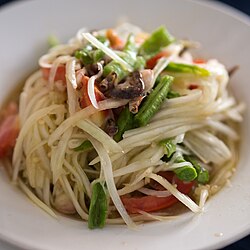 Green papaya salad with brined rice paddy crabs (som tam pu)
 -
 Green papaya salad with mixed fruit (tam phonlamai ruam)
 -
 Green papaya salad with banana flowers (tam hua pli)
 -
 Green papaya salad with mu yo sausage (tam mu yo)
 -
 A variation of the salad with green mango instead of papaya and dried anchovies (tam mamuang pla haeng thot)
 -
 Tam maphrao on sen mi krop: a variation with soft coconut meat and deep-fried rice noodle


Reception
[edit]The Thai variation som tam has been listed at number 46 on World's 50 most delicious foods[46] compiled by CNN Go in 2011[47] and 2018.[48]
See also
[edit]
Note
[edit]- ^ Burmese: သင်္ဘောသီးသုပ်; Khmer: បុកល្ហុង; Lao: ຕຳຫມາກຫຸ່ງ/ຕໍາສົ້ມ, pronounced [tàm mȁːk.hūŋ, tàm.sȍm]; Rakhine: ပဒကာသီးသုပ်; Northeastern Thai: ตำบักหุ่ง/ตำส้ม, pronounced [tām bǎk.hūŋ, tām.sòm]; and Vietnamese: gỏi đu đủ
- ^ Thai: ส้มตำ, pronounced [sôm.tām], RTGS: somtam
References
[edit]- ^ "Laotian Food Is The International Cuisine You've Been Missing". The Huffington Post (published 6 December 2015). 5 February 2015. Archived from the original on 18 January 2023. Retrieved 18 January 2023.
Sticky rice, laap, papaya salad: this is Thai food, right? Not originally. These well-known Asian dishes that have traveled the globe to appear on Thai restaurant menus everywhere are actually Laotian in origin.
- ^ "The Tao of Papaya". Las Vegas Weekly. 5 January 2010. Archived from the original on 30 July 2017. Retrieved 28 February 2013.
- ^ Jonathan H. X. Lee; Kathleen Nadeau, eds. (2010). Encyclopedia of Asian American Folklore and Folklife. ABC-CLIO. p. 733. ISBN 978-0-313-35066-5.
Some Laotians will argue that the papaya salad was invented in Laos and then exported to Cambodia, Thai, and Vietnam, where it was adopted.
- ^ Iverson, Kelly (9 May 2017). "A Brief History of Som Tum, Thailand's Popular Green Papaya Salad". Culture Trip. Archived from the original on 11 May 2021. Retrieved 26 May 2021.
Food historians believe the dish originated in Thailand's northeast neighbor of Laos, which might be why green papaya salad is one of the most popular dishes in Isaan, the northeastern region of the country.
- ^ "The Curious History of Som Tum (Papaya Salad)". Thai Ginger. 24 August 2020. Archived from the original on 7 May 2021. Retrieved 26 May 2021.
While papaya salad is a signature dish in Cambodia, Laos, and Vietnam, it's the Thai version that is the most famous. However, food historians believe that this dish originated in Laos.
- ^ "10 National Dishes from Southeast Asia". Go Backpacking (published 22 October 2021). 24 October 2011. Archived from the original on 18 January 2023. Retrieved 18 January 2023.
- ^ Schulz, Daniela; Drescher, Stephanie (24 May 2017). "Papaya salad with shrimp, Laos". Deutsche Welle. Archived from the original on 4 May 2018. Retrieved 21 June 2021.
- ^ "Southeast Asian Cuisine: What to Eat in Southeast Asia and Where to Find It". tripsavvy. 26 June 2019. Retrieved 18 January 2023.
- ^ สุชาฎา ประพันธ์วงศ์ (7 March 2004). "ส้มตำไม่ใช่อาหารประจำชาติไทยจริงหรือไม่". oknation.net (in Thai). Retrieved 24 March 2024.
- ^ Ian (n.d.). "The Som Tum Thai Story". IamKohChang.com. Archived from the original on 8 April 2023. Retrieved 6 April 2023.
- ^ "Som Tam, the Ori-gins and Recipe/". theakyra.com. n.d. Archived from the original on 8 April 2023. Retrieved 6 April 2023.
- ^ "The Ultimate Guide to Som Tum (Papaya Salad)". Expique. 15 September 2022. Archived from the original on 8 April 2023. Retrieved 7 April 2023.
- ^ "Som Tam Recipe (Thai Green Papaya Salad) from Chef David Thompson". Top Asian Chefs. 6 April 2023. Archived from the original on 6 April 2023. Retrieved 6 April 2023.
- ^ "Best somtum places in Bangkok". Time Out Bangkok. 21 February 2018. Archived from the original on 21 May 2021. Retrieved 20 August 2022.
- ^ Rivière, Joannès (2008). Cambodian Cooking: A humanitarian project in collaboration with Act for Cambodia. Periplus Editions. p. 29. ISBN 978-0-794-65039-1.
- ^ Robert, Claudia Saw Lwin; Pe, Win; Hutton, Wendy (4 February 2014). The Food of Myanmar: Authentic Recipes from the Land of the Golden Pagodas. Tuttle Publishing. ISBN 978-1-4629-1368-8.
- ^ Thida Koeut (24 January 2023), Papaya Salad Recipe: How to Make Green Papaya Salad (Cambodian Version), archived from the original on 28 February 2023, retrieved 28 February 2023
- ^ Van Esterik, Penny (2008). Food Culture of Southeast Asia. Greenwood Press. p. 12. ISBN 978-0-313-34419-0.
- ^ de La Loubère, Simon (1693). A New Historical Relation of the Kingdom of Siam A Description of the principal Fruits of Siam. Translated by A.P. Archived from the original on 17 February 2023. Retrieved 17 February 2023.
- ^ Bernard Maloney (October 1999), Environmental Reconstruction at Ayutthaya, Southeast Asian Archaeology Newsletter
- ^ a b Callis, Kristine Lee (2005). The History of Plant Use in Laos: Analysis of European Accounts of Plant Use for Primarily Religious and Medicinal Purposes (PDF). North Carolina State University. pp. 43–44. Archived (PDF) from the original on 10 December 2021. Retrieved 10 December 2021.
- ^ a b Mouhot, Henri, and Ferdinand de. Lanoye. Voyage Dans Les Royaumes De Siam, De Cambodge, De Laos Et Autres Parties Centrales De L'Indo-Chine: Relation Extraite Du Journal Et De La Correspondance De L'auteur. Hachette, 1868. 322. Print
- ^ a b Estrade, Docteur (1895). Manuel de conversation, franco-laotiens: prononciation en français avec signes conventionnel, transcription de tous les termes en caractères laotiens., deuxieme edition. Dictionnaire et guide franco-laotien. pp. 25–26. hdl:2027/hvd.32044088603329.
- ^ Carné, Louis de; Carné, Louis-Joseph-Marie de (1872). Voyage En Indo-Chine Et Dans L'empire Chinois. Paris: E. Dentu. E. Dentu. pp. 86, 91. hdl:2027/hvd.32044055336309.
- ^ Massie, Victor-Alphonse (1894). Dictionnaire français-laotien: Mission Pavie, exploration de l' indochine (Latin characters).
- ^ Vidal, J.-E; Martel, Gabrielle; Lewitz, Saveros (1969). "Notes ethnobotaniques sur quelques plantes en usage au Cambodge" (PDF). Bulletin de l'École Française d'Extrême-Orient. 55 (1): 192. doi:10.3406/befeo.1969.4862.
- ^ Poilane, Eugene (1965). "Les arbres fruitiers d'Indochine" (PDF). Journal d'agriculture traditionnelle et de botanique appliquée. 12 (6–8): 250.
- ^ a b Sasorith, Katay D (1958). Souvenirs d'un ancien écolier de Paksé. Editions Lao Sedone. p. 31.
- ^ Svasti, Pichaya (19 March 2015). "Remnants of the Laos connection". Bangkok Post. Retrieved 7 February 2025.
- ^ "นิราศวังบางยี่ขัน". vajirayana.org (in Thai). n.d. Retrieved 7 February 2025.
- ^ "′มะละกอ′มีกำเนิดจากทวีปอเมริกา มาเป็น′ส้มตำ′ เริ่มมีในบางกอก - สุวรรณภูมิในอาเซียน" ['Papaya' - originated in the Americas, became 'som tam' in Bangkok]. Matichon (in Thai). 25 December 2014. Archived from the original on 4 March 2016. Retrieved 29 July 2017.
- ^ "ส้มตำของใคร?". anukpn.wordpress.com (in Thai). 20 April 2007. Retrieved 7 February 2025.
- ^ "Open Source!!Somtum Song (เปิดที่มา!! "เพลงส้มตำ")". Thainewsonline (in Thai). 31 October 2016. Retrieved 14 August 2023.
- ^ "Lao Papaya Salad". Laos Life. n.d. Archived from the original on 30 March 2023. Retrieved 28 March 2023.
- ^ "Somtum Song (Lyrics)". Sirindhorn Anthropolo-gy Center (in Thai). n.d. Retrieved 16 August 2023.
- ^ "เปิดประวัติ ส้มตำ เมนูรสเด็ดที่ใคร ต่างก็ชื่นชอบ แถมยังสามารถทำทานเองได้ง่ายๆ". sou-dai (in Thai). 1 September 2020. Retrieved 16 August 2023.
- ^ "ตำบักหุ่งนัวคัก". finalproject (in Thai). n.d. Retrieved 16 August 2023.
- ^ a b c ธงชัย ลิขิตพรสวรรค์ (25 July 2020). "สืบที่มา "ส้มตำ" เข้ากรุงเทพฯ เมื่อไหร่-คนกรุงสมัยก่อนกินส้มตำที่ไหน". ศิลปวัฒนธรรม (in Thai). Archived from the original on 28 February 2023. Retrieved 28 February 2023.
- ^ Van Esterik, Penny (1992). "From Marco Polo to McDonald's: Thai cuisine in transition" (PDF). Food and Foodways: Explorations in the History and Culture of Human Nourishment. 5 (2): 177–193. Archived (PDF) from the original on 10 December 2021. Retrieved 10 December 2021.
- ^ a b แม่ครัวหัวป่าก์. 1908. p. 98.
- ^ Yaowaphapong Sanit HRH Princess Maha Chakri Sirindhorn (1884–1934), ตำหรับสายเยาวภา: บอกวิธีปรุงอาหารคาวหวาน มีภาพประกอบ (in Thai), Thammasat University, pp. 25, 116
- ^ คมกฤช อุ่ยเต็กเค่ง (1 February 2021), "ลอ-กอ-ยอก" ปักษ์ใต้ก็มีส้มตำที่ไม่ได้มาจากกรุงเทพฯ หรืออีสาน (in Thai), archived from the original on 28 February 2023, retrieved 28 February 2023
- ^ Ponchunchoovong, Samorn (2006). Species identification of Thai Rice-field Crab in the lower north-eastern region of Thailand Archived 9 August 2017 at the Wayback Machine.
- ^ "Clay's Kitchen : Tam Ra Ahan Thai (Thai Recipes) ตำราอาหารไทย". panix.com. Archived from the original on 4 March 2016. Retrieved 11 April 2015.
- ^ "Green Papaya Salad Recipe: 6 Papaya Salad Variations". MasterClass. 1 August 2022. Archived from the original on 19 May 2023. Retrieved 19 May 2023.
- ^ "The world's 50 best foods". CNN Travel. 12 July 2017. Archived from the original on 27 July 2020. Retrieved 25 July 2020.
- ^ "World's 50 most delicious foods". CNN GO. 21 July 2011. Archived from the original on 21 July 2011. Retrieved 11 October 2011.
46. Som tam, Thailand
- ^ "The world's 50 best foods". CNN Travel. 14 March 2018. Archived from the original on 11 January 2019. Retrieved 9 March 2019.
Further reading
[edit]- Cummings, Joe. (2000). World Food: Thailand. UK: Lonely Planet Publishers. pp. 157–8. ISBN 1-86450-026-3
- Williams, China ‘’et al.’’. (). ‘’Southeast Asia on a Shoestring: Big Trips on Small Budgets.’’ Lonely Planet. p. 31. ISBN 1-74104-164-3
- Brissenden, Rosemary. (2007). Southeast Asian food: Classic and Modern Dishes from Indonesia, Malaysia, .. Tuttle Publishing. pp. 434 – 439. ISBN 0-7946-0488-9
- McDermoot, Nancie. (1992). Real Thai: The Best of Thailand’s Regional Cooking. Chronicle Books. pp. 121 – 146. ISBN 0-8118-0017-2

| Salads | |
|---|---|
| Rice dishes | |
| Noodle dishes | |
| Other dishes | |
| Snacks |
|
| Drinks and beverages | |
| Seasonings and ingredients | |
| Miscellaneous | |

| Individual dishes |
|
|---|---|
| Curries | |
| Salads | |
| Sauces, spices and flavourings | |
| Desserts, snacks and pastries | |
| Beverages | |
| Cambodian Chinese dishes | |

| Staples | |
|---|---|
| Soups / stews | |
| Salads / wraps | |
| Snacks / desserts | |
| Beverages | |
| Condiments | |
| Utensils | |


Green papaya salad
View on GrokipediaEtymology and Origins
Linguistic Roots
The name "som tam," used for the Thai version of green papaya salad, derives from the Thai words som (ส้ม), meaning "sour," and tam (ตำ), meaning "pounded," reflecting the dish's characteristic tangy flavor and the pounding technique central to its preparation.[3] In Lao cuisine, the equivalent dish is known as "tam mak hoong" (ຕໍາໝາກຫຸ່ງ), where tam (ຕໍາ) signifies "pounded" or "crushed," referring to the mortar-and-pestle method, and mak hoong (ໝາກຫຸ່ງ) translates to "papaya."[4] This naming convention highlights the shared emphasis on the pounding action across Thai and Lao languages, which belong to the Kra-Dai family and show phonetic and semantic parallels due to historical linguistic exchanges in the Mekong region.[5] In English-speaking markets, particularly in the United States, the dish is sometimes called "pok pok salad," an onomatopoeic term mimicking the rhythmic "pok pok" sound produced by the pestle striking the mortar during preparation; this name gained prominence through the branding of chef Andy Ricker's Pok Pok restaurant chain, which popularized authentic Northeastern Thai (Isan) flavors.[6] The influence of neighboring languages is evident in Khmer and Vietnamese terms, where cross-cultural borrowing underscores regional culinary interconnectedness. In Khmer, the dish is termed "bok l'hong" (បុកល្ហុង), literally meaning "pounded papaya," with bok (បុក) denoting the pounding action akin to tam in Thai and Lao.[7] Similarly, the Vietnamese name "gỏi đu đủ" combines gỏi, a term for a tossed or mixed salad derived from Sino-Vietnamese roots referring to finely cut raw ingredients, and đu đủ, simply meaning "papaya." These variations illustrate how the core concept of a pounded papaya dish has been linguistically adapted across Austroasiatic and Kra-Dai language families, often through migration patterns like those of Isan communities.[5]Historical Development
Green papaya salad, known as tam mak hoong in Lao and som tam in Thai, originated in the rural farming communities of Laos and the northeastern Isan region of Thailand, with debated roots possibly in the 19th century or earlier Khmer-influenced pounded salads like tam pu (pounded crab). The dish emerged as a practical use of locally available unripe papaya, which had been introduced to Southeast Asia by Portuguese and Spanish traders in the mid-16th century and became widespread by the 1800s. Farmers in these agrarian societies pounded the shredded green papaya with available ingredients like chilies, lime, and fish sauce to create a refreshing, spicy side dish suited to the tropical climate.[8][9] The culinary technique of pounding salads traces its roots to broader Southeast Asian traditions, including influences from the ancient Khmer Empire in the region that encompasses modern-day Isan and Laos, where similar sour and spicy preparations using local produce were common in pre-modern recipes. By the early 20th century, the dish spread through Thai-Lao migration patterns, as workers from Isan moved to urban centers like Bangkok in search of employment, introducing som tam to street food vendors and markets. This migration, intensified after World War II and during the Lao civil conflicts of the 1970s, helped integrate the salad into central Thai cuisine, transforming it from a regional specialty into a national staple by the late 1970s.[5][10][8] In the post-2000 era, som tam gained international acclaim, ranking 46th on CNN's list of the world's 50 most delicious foods in 2011, which boosted its global popularity through tourism and diaspora communities. The dish's role in Thai street food culture has contributed to broader recognition of Thai culinary heritage, exemplified by the 2024 UNESCO inscription of tom yum on the Representative List of the Intangible Cultural Heritage of Humanity.[11][12]Ingredients and Preparation
Core Ingredients
The core ingredient of green papaya salad, known as som tam in Thai, is shredded unripe green papaya (Carica papaya), which provides a crisp, firm texture that holds up to the dressing and other components without becoming mushy.[13] This unripe fruit is valued not only for its crunch but also for containing the enzyme papain, a proteolytic compound that aids in protein digestion and contributes to the salad's reputed digestive benefits.[14][15] The dish's signature flavor profile balances umami, acidity, sweetness, heat, and pungency through several key seasonings. Fish sauce delivers the umami depth, derived from fermented anchovies and essential to the salty-savory backbone.[16] Lime juice supplies tart acidity to brighten and cut through richness, while palm sugar adds a subtle caramel-like sweetness for harmony.[17] Bird's eye chilies impart sharp heat, adjustable to preference, and fresh garlic provides aromatic pungency that intensifies when pounded.[13] Complementary fresh elements enhance texture, freshness, and nutrition. Cherry tomatoes offer juicy bursts of mild sweetness and acidity, while long beans (also called yardlong beans) contribute snappy crunch when cut into short segments.[16] Roasted peanuts or dried shrimp serve dual roles, adding nutty crunch and protein; peanuts are toasted for deeper flavor, whereas dried shrimp bring a briny, seafood note.[17][3] In rural Isan preparations, traditional substitutions reflect local availability and intensify authenticity, such as replacing fish sauce with pla ra—a pungent fermented fish paste made from mudfish or freshwater fish, valued for its robust umami and cultural significance in northeastern Thai cuisine.[18][13]Preparation Steps
The preparation of green papaya salad follows a traditional sequence that emphasizes bruising and mixing ingredients in a mortar to integrate flavors while preserving textures, a method central to its authenticity in Thai cuisine.[13] Core ingredients such as unripe green papaya and fish sauce form the base, which are transformed through these steps.[17]- Shred the papaya: Begin by peeling the skin from a firm, unripe green papaya and removing any seeds. Shred it into fine, julienne strips using a specialized peeler or by making thin lengthwise cuts with a sharp knife and shaving across them. For a standard serving, prepare 200-300 grams of shreds, which should be soaked briefly in cold water if needed to crisp them up before draining. This technique yields uniform strips that remain crunchy after mixing.[13][19][17]
- Pound the aromatics and vegetables: In a mortar, start by pounding 2-3 Thai chilies and 2 garlic cloves together until they are coarsely broken down, releasing their pungent oils. Add segments of 1-2 long beans (cut into short lengths) and pound lightly for 15-30 seconds to bruise them without pulverizing. Incorporate 1-2 small tomatoes or cherry tomatoes next, pounding gently to split them and release their juices, about 15 seconds. Finally, add the shredded papaya in batches and pound softly while stirring with a spoon for 30-60 seconds to soften the strips slightly and coat them, ensuring they do not turn mushy. This sequential bruising builds layered flavors and textures.[13][17][19]
- Mix the wet ingredients and toss: In a small bowl or directly in the mortar, combine fish sauce, fresh lime juice, and palm sugar (or granulated sugar) in a typical ratio of 2:1:1 by volume—such as 2 tablespoons fish sauce, 1 tablespoon lime juice, and 1 tablespoon sugar—stirring until the sugar fully dissolves into a balanced dressing. Pour this over the pounded papaya mixture and toss vigorously with the pestle and spoon for 15-30 seconds until every strip is evenly coated, allowing the flavors to meld without over-saturating.[13][17][20]
- Adjust and serve: Taste the salad and fine-tune the seasoning to achieve harmony among the sour (lime), spicy (chilies), salty (fish sauce), and sweet (sugar) elements, adding more of any component as needed. Optionally, incorporate 1-2 tablespoons of crushed roasted peanuts at this stage for added crunch, stirring them in just before serving to preserve their freshness and prevent sogginess. The salad is best consumed immediately to maintain its vibrant textures.[13][19][17]