Hubbry Logo
Tie-dyeTie-dyeMain
Open search
Tie-dye
Community hub
Tie-dye
logo
8 pages, 0 posts
0 subscribers
Be the first to start a discussion here.
Tie-dye
Tie-dye
from Wikipedia
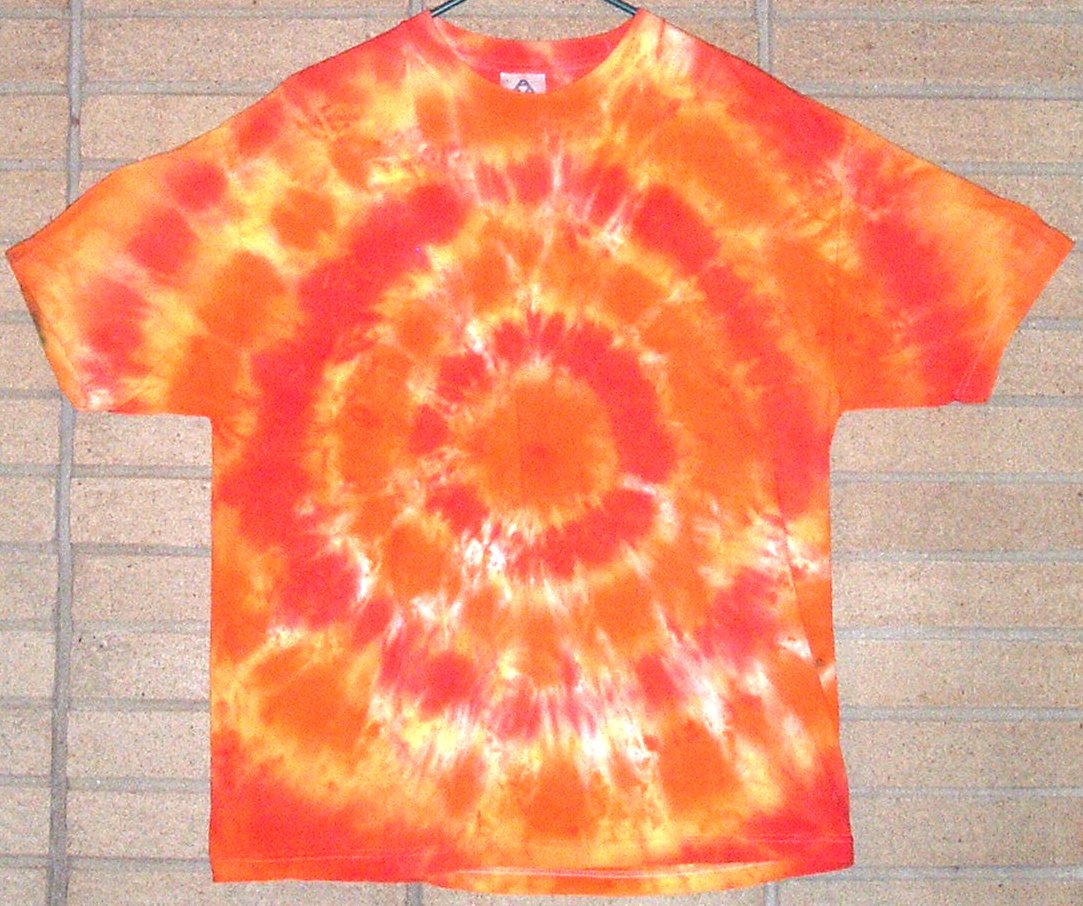
An example of a tie-dyed T-shirt
A video about how to tie-dye

Tie-dye is a term used to describe a number of resist dyeing techniques and the resulting dyed products of these processes. The process of tie-dye typically consists of folding, twisting, pleating, or crumpling fabric or a garment, before binding with string or rubber bands, followed by the application of dye or dyes.[1] The manipulations of the fabric before the application of dye are called resists, as they partially or completely prevent ('resist') the applied dye from coloring the fabric. More sophisticated tie-dye may involve additional steps, including an initial application of dye before the resist, multiple sequential dyeing and resist steps, and the use of other types of resists (stitching, stencils) and discharge.

Unlike regular resist-dyeing techniques, modern tie-dye is characterized by the use of bright, saturated primary colors and bold patterns. These patterns, including the spiral, mandala, and peace sign, and the use of multiple bold colors, have become widely recognized as symbols of the 1960s and 1970s counterculture movement. However tie-dye wasn't as pronounced in fashion even among the counterculture as it would be in later years and the present day. The vast majority of tie-dye garments and objects produced for wholesale distribution use these designs, with many being mass-produced.

In the 21st century, a revived interest in more 'sophisticated' tie-dye techniques emerged in the fashion and hobby industry, characterized by simple motifs, monochromatic color schemes, a focus on fashionable garments and fabrics other than cotton,[2] and the pursuit of tie-dye as an art form, rather than a commodity.

Dyes, fabrics, and discharge agents

[edit]

A variety of dyes are used in tie-dyeing, including household, fiber reactive, acid, and vat dyes. Most early (1960s) tie-dyes were made with retail household dyes, particularly those made by Rit.[3] These dyes were designed for use on a number of different fibre types, and consisted of several different dyes, making them less effective[how?] and less colourfast than purely fiber-reactive dyes.

Most tie-dyes are now dyed with fiber-reactive dyes, a class of dyes effective on cellulose fibers such as cotton, hemp, rayon, and linen. This class of dyes reacts with fibers at alkaline (high) pH, forming a wash-fast, permanent bond. Soda ash (sodium carbonate) is the most common agent used to raise the pH and initiate the reaction, and is either added directly to the dye or in a solution of water in which garments are soaked before dyeing. Fiber-reactives dyes are relatively safe and simple to use,[4] and are the same dyes used commercially to color cellulosic fabrics.

Protein-based fibers such as silk, wool, and feathers, as well as the synthetic polyamide fiber nylon, can be dyed with acid dyes. Acid dyes are effective at acidic (low) pH, where they form ionic bonds with the fiber. Acid dyes are also relatively safe (some are used as food dyes) and simple to use.[5] Vat dyes, including indigo, are a third class of dyes that are effective on cellulose fibers and silk. Vat dyes are insoluble in water in their unreduced form, and must be chemically reduced before they can be used to color fabric. This is accomplished by heating the dye in a strongly basic solution of sodium hydroxide (lye) or sodium carbonate (caustic potash) containing a reducing agent such as sodium hydrosulfite or thiourea dioxide. The fabric is immersed in the dye bath, and after removal, the dye oxidizes to its insoluble form, binding with high wash-fastness to the fiber. However, vat dyes, and especially indigo, must be treated after dyeing by 'soaping' to prevent the dye from rubbing (crocking) off.[6] Vat dyes can be used to simultaneously dye the fabric and to remove underlying fiber-reactive dye (i.e., can dye a black cotton fabric yellow) because of the bleaching action of the reducing bath. The extra complexity and safety issues (particularly when using strong bases such as lye) restrict the use of vat dyes in tie-dye to experts.[citation needed]

Discharge agents are used to bleach color from the previously dyed fabrics and can be used as a reverse tie-dye, where the application of the agent results in loss of color rather than its application. Household bleach (sodium hypochlorite) can be used to discharge fiber-reactive dyes on bleach-resistant fibers such as cotton or hemp, but not on wool or silk, though the results are variable, as some fiber-reactive dyes are more resistant to bleach than others. It is important to bleach as long as required to obtain the desired shade (which will be lighter than observed on wet, unwashed fabric), and to neutralize the bleach with agents such as sodium bisulfite, to prevent damage to the fibers. Thiourea dioxide is another commonly used discharge agent that can be used on cotton, wool, or silk. A thiourea dioxide discharge bath is made with hot water made mildly basic with sodium carbonate. The results of thiourea dioxide discharge differ significantly from bleach discharge due to the nature of the reaction. Since thiourea dioxide only bleaches in the absence of oxygen, and the fabric to be bleached retains oxygen, a fractal pattern of bleaching will be observed. This is in distinct contrast with household bleach discharge, where the bleaching agent penetrates fabric easily (particularly in bleach formulations containing detergent). For example, pleating fabric multiple times and clamping on a resist will yield a clear design after outlining the resist with household bleach, but discharge with reducing agents will only partially penetrate the resisted area.

In general, discharge techniques, particularly using household bleach, are a readily accessible way to tie-dye without the use of often messy and relatively expensive dyes. It is particularly easy to put a design on cloth using stencils and sprayed-on solutions of household bleach, but the intricate and unintended results of discharge using reducing agents often surpass the results of oxidizing discharge techniques.

Designs and patterns

[edit]
A tie-dyed spiral pattern

Tie-dye can be used to create a wide variety of designs on fabric, from standard patterns such as the spiral, peace sign, diamond, sunburst, and the marble effect to beautiful works of art. Using techniques such as stencils (as in screen printing using dyes or discharge pastes), clamped-on shaped blocks, and tritik (stitching and gathering), tie-dye can produce almost any design desired. If a modern kit is used, then it is easier to accomplish a spiral or circle.

History

[edit]

Earliest examples

[edit]

The earliest examples of tie-dye in the Far East are from Sui dynasty (5th century AD) China.[7]

The earliest surviving examples of pre-Columbian tie-dye in Peru date from 500 to 810 AD. Their designs include small circles and lines, with bright colors including red, yellow, blue, and green.[8]

Asia

[edit]
Example of Mudmee tie-dye, an art form originating in Thailand

Shibori is a form of tie-dye which originated in Japan, and has been practiced there since the 8th century. Shibori includes several labor-intensive resist techniques which include stitching elaborate patterns and tightly gathering the stitching before dyeing, forming intricate designs for kimono, obi and other accessories and garments. Another shibori method is to wrap the fabric around a core of rope, wood, or other material, and bind it tightly with string or thread. The areas of the fabric that are against the core or under the binding would remain undyed.

In Indonesia, especially in Java, tie-dye is known as jumputan.[9] Other terms including plangi and tritik are Indonesian terms derived from Javanese words for methods related to tie-dye. In Indonesia, tie-dye might be combined with other dyeing technique, such as batik jumputan, which combine tie-dye with batik wax-resist dyeing.[10] Ikat is a method of tie-dyeing the warp or weft before the cloth is woven.

Bandhani is an Indian form of tie-dye that originated in western India.

Mudmee tie-dye originates in Thailand and the neighboring part of Laos. It uses different shapes and colors from other types of tie-dye, and the colors are, in general, more subdued. Another difference is that the base color is black.

In the 1941 book, "Orphans of the Pacific", about the Philippines, it was noted: "There are a few thousand Bagobos, who wear highly decorated clothing made of hemp fiber, all tied-and-dyed into fancy designs, and who further ornament themselves with big metal disks."

In China, especially in Dali, Yunnan Province, a traditional form of tie-dye is practiced by the Dali Bai people, known as Dali Bai nationality tie-dye (大理白族扎染).[11]

Traditional Dali Bai tie-dye

Africa

[edit]

Tie-dye techniques have also been used for centuries[12][13][14] in the Hausa region of West Africa, with renowned indigo dye pits located in and around Kano, Nigeria. The tie-dyed clothing is then richly embroidered in traditional patterns. It has been suggested that these African techniques were the inspiration for the tie-dyed garments identified with hippie fashion.[15]

In southwestern Nigeria, the technique known as adire is produced, using a variety of resist-dyeing techniques.

Tie-dye in the Western world

[edit]
Tie dye vendor, July 2013
A tie-dyed lab coat

Tie-dyeing was known in the US by 1909, when Professor Charles E. Pellow of Columbia University acquired some samples of tie-dyed muslin and subsequently gave a lecture and live demonstration of the technique.[16]

Although shibori and batik techniques were used occasionally in Western fashion before the 1960s, modern psychedelic tie-dyeing did not become a fad until the late 1960s following the example set by rock stars such as Janis Joplin and John Sebastian (who did his own dyeing).[17] The 2011 film documentary Magic Trip, which shows amateur film footage taken during the 1964 cross-country bus journey of countercultural icon Ken Kesey and his Merry Pranksters, shows the travelers developing a form of tie-dye by taking LSD beside a pond and pouring enamel-based model airplane paint into it, before placing a white T-shirt upon the surface of the water. Although the process is closer to paper marbling, in the accompanying narrative, the travelers claim credit for inventing tie-dyeing.[18]

Tie-dyeing, particularly after the introduction of affordable dyes, became popular as a cheap and accessible way to customize inexpensive T-shirts, singlets, dresses, jeans, army surplus clothing, and other garments into psychedelic creations.[15][17] Some of the leading names in tie-dye at this time were Water Baby Dye Works (run by Ann Thomas and Maureen Mubeem), Bert Bliss, and Up Tied, the latter winning a Coty Award for "major creativity in fabrics" in 1970.[17][19][20] Up Tied created tie-dyed velvets and silk chiffons which were used for exclusive one-of-a-kind garments by Halston, Donald Brooks, and Gayle Kirkpatrick,[17] whilst another tie-dyer, Smooth Tooth Inc., dyed garments for Dior and Jonathan Logan.[15] In late 1960s London, Gordon Deighton created tie-dyed shirts and trousers for young fashionable men which he sold through the Simpsons of Piccadilly department store in London.[21]

Verified Records

[edit]

Longest Tie-Dye Cloth

[edit]
  • Record holder: Inez Harwood (United States)
  • Length: 926.93 meters (3,041 feet 1.44 inches)
  • Date achieved: 2013
  • Recognized by: Guinness World Records

Inez Harwood created the world's longest tie-dye cloth as part of her "Vibrant Protest" project. The fabric, titled Liberty, was dyed using over 120 pounds (54 kg) of dye and 8,000 zip ties. The cloth was made from 100% U.S.-grown cotton and woven at Inman Mills in South Carolina. It aimed to raise awareness about the decline of the American textile industry.[22][23]

Largest Gathering of People Wearing Tie-Dye

[edit]
  • Record holder: Frank Augustus Miller Middle School, Riverside, California
  • Participants: 1,790
  • Date achieved: 1 June 2017
  • Recognized by: Guinness World Records

A school-organized event in California brought together 1,790 individuals wearing tie-dye simultaneously, setting a new world record.[24]

Most Articles of Tie-Dye Clothing Worn at Once

[edit]
  • Record holder: Candice Matthews
  • Number of items: 21
  • Date achieved: 17 May 2015
  • Event: Bay to Breakers road race, San Francisco
  • Recognized by: RecordSetter

Candice Matthews wore 21 articles of tie-dye clothing simultaneously at the Bay to Breakers race in San Francisco. The record was verified by RecordSetter.[25]

[edit]

See also

[edit]

References

[edit]

Further reading

[edit]
Revisions and contributorsEdit on WikipediaRead on Wikipedia
from Grokipedia
Tie-dye is a technique in which fabric is folded, twisted, pleated, or crumpled and then bound with thread, , or rubber bands to create patterns by blocking from penetrating tied areas. This method produces vibrant, mottled designs on textiles such as shirts, scarves, and kimonos, utilizing dyes derived historically from natural sources like plants and mordants such as to fix colors to fibers. Originating over 4,000 years ago, tie-dye variants like emerged in the Indus Valley Civilization around 4,000 B.C. for decorative garments symbolizing cultural motifs, while developed in by the 4th century and was refined in for ceremonial wear. Similar practices appeared independently in as adire among the Yoruba for status-indicating cloths and in as amarra around 1,500 years ago with geometric patterns evoking natural symbols. The technique's global diffusion reflects human innovation in manipulation using mechanical resistance rather than advanced chemistry until synthetic dyes in 1856 enabled brighter, more durable results. In some societies, such as Tokugawa , elaborate was banned in the late 1600s under sumptuary laws restricting luxury to elites, only to be reinstated after 1868. Tie-dye surged in popularity during the North American , associating it with and self-expression, though its roots predate this by millennia and persist in traditional crafts worldwide. Modern applications extend to fashion, art, and even lab coats, with resurgences during economic hardships like the and the for fabric renewal.

Techniques and Materials

Dyes, Fabrics, and Preparation

Natural fibers, particularly cellulose-based materials such as , , , and , exhibit superior dye absorption in tie-dye processes due to their porous structure, which facilitates deep penetration and binding of . , in particular, is preferred for its high absorbency and ability to form strong chemical bonds with fiber-reactive dyes, yielding vibrant, long-lasting results. Protein-based fibers like and can also be used but require acid dyes rather than reactive ones, as their molecular structure supports different bonding mechanisms. Synthetic fabrics, such as , perform poorly because their non-porous fibers resist dye uptake, often resulting in faded or uneven coloration. The predominant dyes in contemporary tie-dye are fiber-reactive types, exemplified by Procion MX, which chemically bond to fibers through covalent linkages in alkaline conditions, ensuring colorfastness and resistance to washing. These dyes incorporate a group that absorbs specific wavelengths of light for coloration and a reactive group that forms permanent electron-sharing bonds with the hydroxyl groups on molecules, activated at pH levels around 10-11 via (soda ash). All-purpose dyes, combining and variants, offer versatility for blended fabrics but yield less intense results on pure compared to dedicated fiber-reactive options. Preparation begins with pre-washing the fabric in hot water using a to eliminate residues like agents, oils, and that could impede adhesion. For fiber-reactive , the fabric is then soaked in a soda ash solution—typically 1 cup of per gallon of water—for 15-30 minutes to protonate the fibers and optimize for the reaction. The material is wrung to dampness (not dripping) before binding, as excess moisture can dilute concentration while insufficient hydration hinders even application. Gloves and protective measures are essential during handling to avoid skin contact with alkaline solutions.

Binding Methods and Resist Techniques

Binding methods and resist techniques in tie-dyeing create patterns by mechanically preventing from penetrating specific areas of the fabric. These methods involve manipulating the fabric through folding, twisting, pleating, or crumpling, followed by securing the manipulations with bindings such as strings, rubber bands, or clamps to form resist zones. The tightness of the bindings determines the sharpness of the resulting undyed lines or shapes, as cannot seep through densely compressed fabric layers. Common binding approaches include the use of rubber bands or strings to tightly secure folded sections, which block absorption and produce circular or linear patterns upon unbinding and rinsing. For instance, in spiral designs, the fabric is twisted from the center outward into a flat spiral and bound with multiple rubber bands radiating from the core, resisting in banded areas to yield concentric circles when unfolded. pleating, where fabric is folded back and forth in parallel strips, is then bound perpendicularly at regular intervals with strings, creating striped or chevron effects as the resists form sharp edges along the folds. Twisting techniques extend resists by rolling the fabric into a rope-like form along its length, followed by even binding with thread or bands, which generates diagonal or wavy patterns due to the helical compression that limits diffusion. Clamping methods employ wooden blocks, marbles, or clips to pinch and isolate small fabric sections, providing localized resists for polka-dot or geometric motifs, with the clamp's pressure ensuring minimal bleed. These mechanical resists differ from chemical alternatives like or paste, which are less common in modern tie-dye but achieve similar blocking through impermeable coatings rather than physical compression.

Discharge Agents and Advanced Variations

Discharge agents in tie-dyeing selectively remove color from pre-dyed fabrics, producing patterns through decolorization rather than dye addition, often on dark garments to yield whites, pastels, or subsequent overdyes. Common agents include chlorine bleach (sodium hypochlorite), which oxidizes dyes but can weaken fibers if overused, and reducing agents like thiourea dioxide, which break dye molecular bonds more precisely and leave fabric closer to its undyed state. Sodium hydrosulfite serves as another reducer for vat dyes, though it requires rinsing in its leuco form to prevent redeposition. The process begins with binding the fabric using resists like or clamps to define patterns, followed by application of the diluted agent—typically a 1:1 water-bleach mix for chlorine-based methods—via spraying, dipping, or , with monitoring every 5-10 minutes to control discharge depth. Neutralization with agents like or halts the reaction, preventing further fiber damage, after which rinsing removes residues; all steps demand ventilation and protective gear due to chemical fumes and corrosiveness. Testing on fabric scraps is essential, as results vary by type, fabric content (e.g., discharges better than synthetics), and agent strength, often failing to achieve pure white on commercial black dyes. Advanced variations incorporate discharge pastes thickened with agents like sodium alginate for brush-applied precision, enabling hand-painted designs or stenciling on untied areas. Multi-stage techniques involve initial discharge on tied fabric, unbinding and rinsing, then re-tying and discharging again for layered patterns, or overdying discharged areas with fiber-reactive dyes to introduce new hues without full recoloring. Non-chlorine discharges, such as commercial color removers, facilitate eco-friendlier options by minimizing fiber degradation, though they process slower (up to 24 hours) and suit smaller-scale artisanal work over . These methods expand tie-dye's palette beyond , but demand empirical calibration per fabric batch to mitigate inconsistencies from dye fastness or agent potency.

Historical Development

Earliest Global Origins

The technique of , which includes tying or binding fabric to create undyed patterns during immersion in dye baths, developed independently in ancient civilizations worldwide, predating modern tie-dye by millennia. Archaeological findings from the Indus Valley Civilization site of in present-day , dating to around 2500 BCE, reveal evidence of textiles dyed with madder and possibly early resist methods, marking some of the oldest known instances of patterned dyeing practices that influenced later tie-resist traditions like bandhani in . In the Americas, tied-resist dyeing emerged among Andean cultures, with amarra techniques documented in Peruvian textiles approximately 1,500 years ago, around 500 CE; these involved knotting or stitching yarn into fabric before dyeing to produce motifs on cotton or wool, as seen in artifacts from post-Paracas societies. Earlier Peruvian coastal sites yield dyed cotton fragments from as far back as 2500 BCE, though specific tie-resist evidence appears later in the record. East Asian origins trace to , where resist-dyeing variants spread to by the CE, with surviving textiles from that era demonstrating folded, stitched, or clamped resists for patterns; these methods, while refined over centuries, likely drew from even earlier continental practices. In , the earliest verified resist-tied artifact is an oniko-style dyed cap from the 11th-century Dogon kingdom in , using resists on cotton, predating widespread Yoruba adire production in , which utilized similar tying with from the 19th century onward but echoed ancient regional techniques. Archaeological traces of tied textiles along ancient trade routes, from to , date to 400–500 CE, suggesting early diffusion and adaptation across , though independent invention in isolated regions underscores the technique's universality driven by practical needs for durable, decorative cloth.

Asian Traditions

Tie-dye practices in trace back to ancient , where the technique known as zharan or xie (缬) emerged during the (475–221 BCE) and is evidenced by silk fragments from (221–206 BCE) tombs. This method entailed binding or stitching fabric to prevent dye absorption, yielding decorative patterns on , and reached prominence in the (618–907 CE) with intricate designs tied using threads or clamps. Among ethnic groups like the Bai in Yunnan Province, zharan persists as a traditional in regions such as Dali, utilizing natural dyes like for over 2,000 years. In , shibori—derived from the verb shiboru meaning "to wring" or "squeeze"—entered from around the 6th–7th centuries CE, evolving into a sophisticated resist-dyeing art by the (794–1185 CE). Techniques varied from simple tying (momen shibori) to complex folding and stitching, often with indigo vats, and gained commercial traction during the (1603–1868); for instance, Arimatsu shibori began in 1608 near , where villagers dyed textiles for travelers using pole-wrapping methods. Historical records from Nara (8th century CE) document Chinese-influenced tie-dye variants lumped under shibori. India's bandhani tradition, centered in and , involves artisans tying minute fabric portions with fingernails or tools to form dots and motifs before , a labor-intensive process yielding vibrant sarees and turbans. While general dates to the Civilization circa 2500 BCE, specific bandhani evidence aligns with medieval texts like Bana's (7th century CE), though practitioners trace it to 4,000–5,000 years ago based on regional oral histories and archaeological residues. Natural dyes such as and predominate, with patterns symbolizing prosperity in Hindu and . Southeast Asian variants, like Thailand's mudmee, blend tie-resist with by binding warp yarns before weaving and dyeing, originating in region silk traditions for ceremonial garments, though distinct from fabric-only tying. These practices underscore Asia's diverse resist-dyeing heritage, often tied to cultivation and ethnic craftsmanship rather than widespread commercialization until modern eras.

African and Indigenous Traditions

In , resist dyeing techniques akin to tie-dye have been practiced for centuries, primarily using natural indigo from plants like to create patterned cotton cloths worn for clothing, ceremonies, and trade. Among the of southwestern , the adire process emerged in the early 19th century, involving tying, stitching, or applying starch paste as a resist on folded fabric before immersion in dye baths, yielding geometric motifs symbolizing protection, fertility, and social status. By the late 1800s, Yoruba women had refined these methods into a cottage industry, exporting adire cloths via caravan routes possibly originating from indigo dyeing traditions in as early as the , though direct evidence for pre-19th-century Yoruba tie-resist is limited to oral histories and archaeological indigo residues. Techniques varied by region: in , the Temne and Mende practiced gara, tying cloth with raffia or thread and dyeing with fermented plant extracts like alongside for reddish-brown hues on garments denoting lineage or . In and , similar binding resists produced bold, irregular patterns on mud-resistant cloths, often layered with fermented mud dyes for earthy tones, reflecting environmental adaptation to Sahelian resources rather than imported synthetics. These methods prioritized local mordants like for color fastness, contrasting later synthetic dyes, and were typically executed by women in communal settings, embedding social narratives into the fabric's irregularities caused by uneven tying tensions. Among , pre-Columbian tie-dye appears in Peruvian textiles dating to 500–810 AD, where bundles of or were tied to form small circles and lines dyed with or extracts for garments and blankets bearing sacred geometric motifs tied to cosmology and ancestry. South American groups, such as those in the , continued these practices into colonial eras, using knotted resists on fibers to evoke spiritual protections, though Spanish prohibitions on indigenous dyeing in the suppressed documentation, leaving survivals in artifacts rather than unbroken lineages. Unlike African indigo dominance, American variants emphasized and dyes for brighter reds and yellows, with patterns arising from practical knotting to prevent dye penetration, underscoring causal links between material availability and design evolution independent of influences.

Pre-20th Century Western Encounters

European merchants first encountered tie-dye and related resist-dyeing techniques through trade with Asia during the early modern period, importing fabrics such as Indian bandhani and Indonesian plangi as exotic luxuries. The Portuguese, via their Estado da Índia established in the early 16th century, facilitated the arrival of tie-resisted cotton textiles from Gujarat and Rajasthan, where bandhani—involving meticulous tying of fabric knots to create dotted patterns—had been practiced for centuries. These imports reached European ports like Lisbon and Antwerp, appealing to elite consumers for their intricate, vibrant designs achieved with natural dyes like indigo and madder, though they remained novelties rather than influencing local production techniques. By the 17th century, the (VOC), founded in 1602, expanded imports of Javanese plangi and tritik cloths, which used thread-binding and stitching resists on silk and cotton to produce wave-like or geometric motifs. Dutch traders documented these methods during exchanges at Batavia (modern ), noting their labor-intensive nature and resistance to European mechanical dyeing preferences, with surviving examples in museum collections like the Tropenmuseum in dating to the 1650s–1700s. Such textiles were often re-exported within Europe or adapted for upholstery and garments among the bourgeoisie, but faced regulatory pushback; for instance, England's 1700 banned imported dyed cottons to safeguard woolen industries, limiting dissemination. In the 18th and 19th centuries, British East India Company shipments introduced more saris and shawls to markets, where they inspired curiosity among Orientalists and collectors, as evidenced by auction records from in the 1780s describing "Indian tied and dyed silks" with "tie-resist patterns in crimson and saffron." Travelers' accounts, such as those by British resident James Forbes in (1760s–1780s), detailed observing local artisans tying thousands of points per square meter—a process yielding up to 4,000 dots on bridal veils—highlighting the technique's precision unattainable by European standards reliant on vats and mordants. Despite this, adoption remained marginal; Western dyers favored immersion methods over binding resists, viewing Asian variants as artisanal curiosities suited to "ethnic" contexts rather than scalable industry, with no significant technological transfer until synthetic dyes emerged post-1856. Southeastern European variants, such as fold-resist dyeing in and the documented in Ottoman-era records from the 16th century, suggest localized practices possibly influenced by exchanges, but these were peripheral to core Western centers like or and did not represent mainstream encounters. Overall, pre-20th-century Western exposure emphasized consumption over emulation, constrained by economic and cultural preferences for uniform coloration in industrializing hubs.

Western Adoption and Popularization

Early 20th-Century Introduction

Tie-dye techniques entered Western academic awareness in the United States in 1909, when professor Charles E. Pellow acquired samples of tie-dyed from the Cameroons and incorporated them into lectures for his students, demonstrating the African resist-dyeing process of binding fabric to create patterns before immersion in dye. This marked an early documented exposure to the method in American institutions, though it remained confined to scholarly interest rather than widespread practice. Practical adoption emerged in the , as Americans began experimenting with tie-dye for home crafts, often to imitate imported fabric effects or customize textiles amid rising interest in . By , during the , the technique proliferated as a thrifty hobby, particularly among women, who used affordable synthetic dyes to refresh worn clothing, curtains, and linens, thereby extending the utility of without significant expense. Magazines and craft guides promoted it as a sensible, creative pursuit aligned with economic constraints, emphasizing simple binding methods like folding or twisting fabric with string. Unlike later commercial or cultural revivals, early 20th-century Western tie-dye focused on utility and personalization rather than symbolic expression, with patterns typically limited to basic motifs achieved through natural or early chemical dyes available at the time. Its niche status reflected limited access to diverse dyes and the absence of mass-produced kits, distinguishing it from pre-20th-century sporadic encounters via colonial trade.

Counterculture Era (1960s-1970s)

Tie-dye emerged as a hallmark of the 1960s hippie counterculture, embodying rejection of industrial uniformity through handmade, vibrant textiles that evoked psychedelic experiences and personal creativity. Adherents, influenced by Eastern and African resist-dyeing traditions encountered via travel or Peace Corps volunteers returning from West Africa, produced garments at home using accessible household dyes, promoting self-sufficiency and anti-consumerist values. In 1965, Rit Dye, facing declining sales from traditional uses like curtain dyeing, pivoted by marketing directly to artists in ; marketer Don Price's door-to-door efforts demonstrated tie-dye techniques, sparking widespread experimentation among youth. This coincided with the 1967 , where tie-dye shirts proliferated as symbols of peace and nonconformity, often featuring swirling patterns that mirrored LSD-induced visuals. The technique's visibility peaked at the Woodstock Music and Art Fair in August 1969, attended by approximately 400,000 people, where performers including , , and donned tie-dyed attire onstage, and Rit Dye supplied hundreds of pre-dyed T-shirts. Throughout the 1970s, tie-dye persisted in fading communes and fan circles but increasingly entered commercial fashion, diluting its subversive edge while retaining associations with the era's ideals.

Post-Hippie Decline and Sporadic Revivals

Following the peak of tie-dye's association with the and its mainstream adoption in the early , the technique experienced a marked decline in broader appeal by the late . As the movement dissipated amid shifting cultural priorities and the rise of aesthetics, tie-dye came to symbolize an outdated, overly psychedelic relic, leading to reduced visibility in commercial clothing lines and everyday wear. The landscape, characterized by structured , shoulder pads, and a deliberate rejection of excess—including vibrant, unstructured patterns—further marginalized tie-dye, confining it largely to novelty items or ironic references rather than serious style. Sporadic revivals emerged in subcultural niches during the and , often detached from mainstream trends. In the , elements of tie-dye resurfaced in punk and alternative scenes through brighter, more experimental applications, aligning with the era's embrace of bold, DIY rebellion, though it remained peripheral to dominant or minimalist looks. By the , tie-dye gained renewed traction among enthusiasts, particularly fans of the and , who adopted it as a hallmark of attire, evoking continuity with the band's countercultural and fostering a sense of communal identity at live events. This subcultural persistence, rather than widespread commercialization, sustained tie-dye's visibility in niche markets, with vendors specializing in custom-dyed apparel for gatherings reporting steady demand through the decade. These episodes underscored tie-dye's cyclical nature, driven by nostalgic or expressive impulses in specific communities rather than broad societal shifts.

Cultural and Symbolic Role

Associations with Counterculture and Protest

Tie-dye clothing became emblematic of the American , particularly among hippies who embraced it as a form of handmade self-expression rejecting the of post-World War II suburban life and social norms. The DIY process aligned with the movement's ethos of communal creativity and anti-commercialism, using household dyes to produce psychedelic patterns that evoked expanded consciousness and unity. During this era, tie-dye garments frequently appeared at music festivals and gatherings like the Woodstock festival from August 15 to 18, 1969, where over 400,000 attendees donned them alongside bands such as the , reinforcing associations with , , and communal living. Its bold colors and abstract designs mirrored the era's experimentation with hallucinogens and Eastern , serving as visual shorthand for of mainstream society. In the context of , tie-dye symbolized non-violent defiance and , particularly during opposition to the , with its flashy patterns worn by youth in demonstrations starting as early as 1967 to signify rebellion against military drafts and government policies. Participants in marches and sit-ins adopted it as attire that blurred individuality with collective resistance, contrasting stark uniforms of authority figures and embodying a casual, unthreatening aesthetic amid escalating tensions over U.S. escalation in by 1968. This usage peaked in the late and early , when the technique's accessibility empowered grassroots expression without reliance on corporate .

Commercialization and Mainstream Integration

The commercialization of tie-dye gained momentum in the mid-1960s when Rit Dye, facing near bankruptcy in 1965 after primarily serving home accessory dyeing, shifted focus to promote tie-dyeing for apparel amid rising counterculture interest. The company introduced squeezable liquid dyes in 1964, simplifying application and enabling broader adoption beyond powder forms. By late 1960s, Rit funded artists to produce several hundred tie-dye T-shirts for sale at the 1969 Woodstock festival, establishing it as the "official hippie dye" and facilitating initial mass retail entry through DIY kits distributed nationwide. This pivot transformed tie-dye from a niche, handmade craft into a viable commercial product, with dye kits and pre-dyed garments entering general retail channels by the early 1970s. Manufacturers began producing tie-dye items for wholesale distribution, leveraging synthetic fiber-reactive dyes commercialized in the 1950s for more efficient, vibrant results on cotton and blends. By the , tie-dye achieved full mainstream integration as mass-produced apparel sold in mall retail shops, contrasting the personalized, artisanal origins of versions tied to individual expression. Commercial brands adopted standardized patterns for uniformity and , embedding tie-dye in everyday lines while high-end variants on or appeared in designer boutiques as premium items. This era solidified tie-dye's presence in consumer markets, detached from its countercultural roots.

Criticisms, Misappropriations, and Social Costs

Tie-dye techniques, originating independently in various non-Western cultures such as ancient , , and , have prompted debates over cultural appropriation in Western contexts, particularly during the adoption. Critics argue that the movement's widespread use of the method, often without acknowledgment of its Asian and African roots, commodified and stripped traditional practices of their artisanal or symbolic significance, reducing intricate methods like Japanese shibori or Indonesian batik to casual fashion statements. However, such claims are contested, as resist-dyeing predates modern globalization and emerged convergently across civilizations without exclusive cultural ownership, rendering appropriation accusations empirically tenuous absent evidence of economic displacement or sacred desecration. Misappropriations have surfaced in commercial fashion, where designers incorporate tie-dye patterns into mass-produced items without crediting source traditions, potentially homogenizing diverse ethnic aesthetics into generic "tribal" motifs. For instance, early 20th-century American adoption repurposed imported Asian textiles for novelty, evolving into without reciprocal cultural exchange. This pattern persists in , where brands replicate patterns en masse, diluting artisanal value but yielding no documented lawsuits for design theft specific to tie-dye, unlike more proprietary motifs. Social costs arise primarily from production in developing regions, where small-scale tie-dye enterprises face socio-cultural barriers including family obligations conflicting with business demands, inadequate societal support, and ethnic or religious pressures limiting female participation despite the technique's role in providing income for women in areas like and . In commercial settings, workers encounter hazardous chemical exposures from synthetic dyes, contributing to risks without proportional economic benefits, though data on tie-dye-specific incidents remains sparse compared to broader industries. These challenges have not halted global proliferation but highlight disparities in labor conditions between artisanal origins and industrialized output.

Technological and Commercial Advancements

In the realm of , digital printing technologies have emerged as a significant advancement for replicating tie-dye patterns, surpassing traditional manual binding and by enabling precise, scalable production with reduced variability. Rotary screen, flatbed, and methods apply simulated tie-dye designs directly to fabrics, yielding impeccable reproducibility and shorter lead times compared to labor-intensive hand-tying processes. These techniques leverage computational design tools to generate complex, organic-looking patterns without physical resist application, facilitating commercial viability for apparel brands seeking consistent output. Automated tie-dyeing systems and software simulations further represent technological progress, allowing predictive modeling of diffusion and to optimize results before physical production. from 2018 demonstrated computer algorithms that replicate traditional tie-dye variations through digital simulation, reducing trial-and-error in workflows. Complementary developments include digital tie-dyeing platforms that integrate with CAD software for custom designs, enhancing efficiency in value-added . Such innovations have been applied in peer-reviewed studies assessing durability, where automated methods preserve aesthetic appeal while improving color fastness over manual alternatives. Commercially, these advancements have driven of tie-dye garments, with manufacturers adopting standardized folding techniques like spirals or crumples followed by machine for high-volume output. Fiber-reactive dyes, refined for cold-process application since their mid-20th-century introduction, remain foundational for vibrant, wash-fast results in industrial settings, enabling widespread without specialized equipment. for process innovations, such as plastic film-based tying for uniform resist effects, underscore efforts to mechanize for efficiency, as evidenced by Chinese inventions filed in the early . By 2023, global apparel firms reported utilizing these hybrid methods to meet demand for customized tie-dye products, balancing artisanal aesthetics with economic scalability.

Resurgence in the 2020s

Tie-dye experienced a notable resurgence beginning in early , coinciding with widespread that encouraged at-home DIY activities. Searches for "tie-dye at home" on surged by 462% in the weeks leading up to April 2020, reflecting increased interest in crafting as a pastime. Similarly, searches for "tie-dye loungewear" rose by 5,000% compared to the previous year, with spikes starting in March 2020 as people sought comforting, nostalgic hobbies amid uncertainty. This trend translated into measurable market growth, with reporting a 75% increase in tie-dye apparel listings and purchases for women and a 100% rise for men by July 2020. The activity's appeal lay in its low cost and therapeutic qualities, allowing individuals to repurpose existing garments and achieve unpredictable, vibrant results that evoked nostalgia without requiring new purchases. By fall 2021, tie-dye appeared in 16 women's wear collections, comprising 0.7% of looks and marking a 139% increase from prior seasons, signaling commercial adoption by brands like and . Into the mid-2020s, the trend persisted, bolstered by platforms and drives. Wholesale tie-dye product growth reached 264.3% over the 24 months preceding July 2025, with selling prices typically between $11 and $24. data for "tie dye" showed sustained search volumes normalized between 33 and 84 from April 2024 to April 2025, indicating ongoing interest rather than a sharp decline. Eco-friendly practices, such as using natural dyes on upcycled fabrics, further aligned tie-dye with contemporary environmental concerns, though mass-produced versions raised questions about diluted authenticity in contexts.

Environmental and Health Considerations

The processes central to tie-dye production, typically involving synthetic fiber-reactive dyes such as Procion or mixtures in commercial kits like Rit, generate laden with unfixed dyes, salts, and auxiliary chemicals, contributing to broader that accounts for approximately 20% of global industrial . These effluents elevate biochemical and in water bodies, impair in aquatic plants, and release persistent colorants that reduce light penetration, thereby disrupting ecosystems and rendering water unsuitable for and other organisms. In home-based tie-dyeing, which predominates for hobbyists, smaller volumes of —often containing 10-50% unbound dyes—are typically discharged into municipal sewers, exacerbating cumulative when scaled across millions of users, though industrial-scale dyeing amplifies these effects through higher chemical loads including like and mercury. Health risks arise primarily from direct exposure during application and from residual chemicals in finished garments. Synthetic dyes used in tie-dye, including azo and disperse varieties, can cause skin sensitization, allergic reactions, and upon contact, with prolonged handling of dye powders risking respiratory or . Certain azo dyes degrade into aromatic amines under metabolic conditions, which are classified as carcinogenic and mutagenic by regulatory bodies, posing long-term risks such as liver damage or increased cancer incidence for frequent users or workers. Wearers may experience genotoxic or neurotoxic effects from leaching dyes, particularly in synthetic fabrics, though evidence indicates fiber-reactive dyes like those common in tie-dye kits bind more securely to , reducing but not eliminating release during wear or washing. Efforts to mitigate these concerns include natural dye alternatives derived from plant sources like , , or onion skins, which avoid synthetic toxins and but often require mordants for colorfastness and yield less vibrant or durable results compared to chemical methods. Such plant-based approaches reduce and , aligning with empirical observations of lower ecological footprints in small-scale applications, though their remains limited by inconsistent yields and higher resource demands for sourcing.

Notable Records

Verified Guinness World Records

The longest verified tie-dye measures 926.93 meters (3,041 feet 1.44 inches) in length and was created by Inez Harwood in Hayfork, California, , on 25 September 2013, using a continuous fabric sheet dyed in multiple colors. The largest gathering of people wearing tie-dye clothing involved 1,790 participants, organized by Frank Augustus Miller Middle School in , , on 1 June 2017, surpassing prior attempts by requiring verifiable attire and simultaneous assembly.

Other Documented Achievements and Attempts

In 2013, tie-dye artist Inez Harwood produced a single continuous sheet of tie-dyed fabric measuring 5.5 feet tall by 3,153 feet long (approximately 1,040 yards), using over 900 pounds of and 130 pounds of donated fiber-reactive dyes, which participants described as breaking the previous for the longest tie-dyed fabric. The project, conducted at , involved collaborative dyeing efforts but lacked formal certification from , distinguishing it from verified category-specific feats. On February 4, 2023, the ECHL hockey team hosted a tie-dye-themed game at the Amway Center, attempting to assemble the largest gathering of people wearing tie-dye apparel and drawing a franchise-record 11,382 attendees. Despite the event's scale and promotion of tie-dye participation among fans, it failed to satisfy verification standards for the gathering category, attributed to evidentiary requirements rather than insufficient numbers. This attempt highlighted tie-dye's appeal in commercial entertainment settings, generating significant local engagement without achieving official record status.

References

Add your contribution
Related Hubs
User Avatar
No comments yet.