Hubbry Logo
Madame TussaudsMadame TussaudsMain
Open search
Madame Tussauds
Community hub
Madame Tussauds
logo
8 pages, 0 posts
0 subscribers
Be the first to start a discussion here.
Madame Tussauds
Madame Tussauds
from Wikipedia

Madame Tussauds (UK: /tˈsɔːdz/ too-SAWDZ, US: /tˈsz/ too-SOHZ)[1][N. 1] is a wax museum founded in London in 1835 by the French wax sculptor Marie Tussaud. One of the early main attractions was the Chamber of Horrors, which appeared in advertising in 1843.[2]

Key Information

In 1883, the restricted space of the original Baker Street site prompted Tussaud's grandson (Joseph Randall) to commission the building at its current London location on Marylebone Road. The new exhibition galleries were opened on 14 July 1884 and were a great success. Madame Tussaud & Sons was incorporated as a private limited company (Ltd.) in 1889.[3]

A major tourist attraction in London since the Victorian era, Madame Tussauds displays the waxworks of famous and historical figures, as well as popular film and television characters played by famous actors.[4] Operated by the British entertainment company Merlin Entertainments, the museum now has locations in cities across four continents, with the first overseas branch opening in Amsterdam in 1970.[5]

History

[edit]

Background

[edit]

Marie Tussaud was born as Marie Grosholtz in 1761 in Strasbourg, France. Her mother worked for Philippe Curtius in Bern, Switzerland; he was a physician skilled in wax modelling. Curtius taught Tussaud the art of wax modelling when she was a child; when he moved to Paris, Marie and her mother followed.[6] Grosholtz created her first wax sculpture, of Voltaire, in 1777.[7] At 17, according to her memoirs, she became art tutor to Madame Elizabeth, the sister of King Louis XVI. During the French Revolution, she was imprisoned for three months, but was subsequently released.[6] During the Revolution, she made models of many prominent victims.[8]

Left: Waxwork of Marie Tussaud (sculpting a waxwork) and right: her memorial plaque at the wax museum she founded in London

Grosholtz inherited Curtius' vast collection of wax models following his death in 1794. For the next 33 years, she travelled around Europe with a touring show from the collection. She married François Tussaud in 1795, took his surname, and renamed her show as Madame Tussaud's. In 1802, she accepted an invitation from lantern and phantasmagoria pioneer Paul Philidor to exhibit her work alongside his show at the Lyceum Theatre, London. A wave of creativity was in vogue in London the year Tussaud arrived in the city, with new West End stage plays which included the first to be called a melodrama, the first appearance of Joseph Grimaldi in his whiteface clown character, and poet William Wordsworth's poem "Composed upon Westminster Bridge, 3 September 1802" describing London and the Thames.[9] Adding her own creativity to the mix, Tussaud brought with her all her death masks, wax faces and busts.[9] Complaining that Philidor failed to promote her, Tussaud then decided to go into business alone.[10]

Unable to return to France because of the Napoleonic Wars, she travelled throughout Great Britain and Ireland exhibiting her collection and made her home in London. From 1831, she took a series of short leases on the upper floor of "Baker Street Bazaar" (on the west side of Baker Street, Dorset Street, and King Street in London).[11] This site was later featured in the Druce-Portland case sequence of trials of 1898–1907. This became Tussaud's first permanent home in 1836.[12]

Origins

[edit]
Poster for the Tussaud wax figures exhibition, Baker Street, London, 1835

By 1835, Marie Tussaud had settled down in Baker Street and opened a museum.[13] One of its main attractions was the Chamber of Horrors. The name is often credited to a contributor to Punch in 1845, but Tussaud appears to have originated it herself, using it in advertising as early as 1843.[2] On its impact, Oliver Smith of The Telegraph writes, "Londoners flocked to see the likes of Nelson and Sir Walter Scott, but the highlight was undoubtedly the Chamber of Horrors, where Tussaud displayed models of murderers."[14] Other famous people were added to the museum, including the Duke of Wellington, Henry VIII, and Queen Victoria.[15]

The early commercial success of Madame Tussaud's saw it establish itself as a brand, and the museum became a pioneer in innovating various forms of publicity when the advertising industry was in its infancy.[2] The Hall of Fame attraction enthralled the public of Victorian London, and inclusion in it was definitive proof one had attained celebrity status.[2]

In these days, no one can be considered positively popular, unless he is admitted into the company of Madame Tussaud's celebrities in Baker Street. The only way in which a powerful and lasting impression can be made on the public mind, is through the medium of wax. You must be a doll in Baker Street before you can become the I-dol(l) of the multitude. Madame Tussaud has become, in fact, the only dispenser of permanent reputation.

— "The Tussaud Test of Popularity", Punch, 1849.[2]

Advertising man pasting a bill for Madame Tussaud's Chamber of Horrors, London, 1877

Other businesses in Baker Street profited from being near Madame Tussaud's, and in 1860, Charles Dickens hailed the museum as one of London's most popular entertainments, writing in All the Year Round: "Madame Tussaud's is something more than an exhibition, it is an institution".[16] A waxwork of Dickens appeared at the museum in 1873, three years after his death.[17] Some sculptures still exist that were made by Marie Tussaud herself. The gallery originally contained some 400 different figures, but fire damage in 1925 coupled with bombs during the Blitz on London in 1941, severely damaged most of such older models. The casts themselves have survived, allowing the historical waxworks to be remade, and these can be seen in the museum's history exhibit. The oldest figure on display is that of Madame du Barry, the work of Curtius from 1765 and part of the waxworks left to Grosholtz at his death. Other faces from the time of Tussaud include Robespierre and George III.[14] In 1842, she made a self-portrait, which is now on display at the entrance of her museum. She died in her sleep in London on 16 April 1850.[18]

Entrance sign in London

By 1883, the restricted space and rising cost of the Baker Street site prompted her grandson Joseph Randall to commission construction of a building at the museum's current location on Marylebone Road. The new exhibition galleries were opened on 14 July 1884 and were a great success.[19] But Randall had bought out his cousin Louisa's half-share in the business in 1881, and that plus the building costs resulted in his having too little capital. He formed a limited company in 1888 to attract fresh capital but it had to be dissolved after disagreements between the family shareholders. In February 1889, Tussaud's was sold to a group of businessmen led by Edwin Josiah Poyser.[20] Tussaud's great-grandson, John Theodore Tussaud, continued in his role as the museum's manager and chief artist.[14] The first wax sculpture of a young Winston Churchill was made in 1908; a total of ten have been made since.[21]

Expansion

[edit]
First Mortgage Debenture Stock of Madame Tussaud's Ltd., issued 15 September 1949

In 1926, Madame Tussauds became a limited company. In 1949, the company issued a First Mortgage Debenture Stock with Sir Arthur Marshall among the signatories. In the 1960s, Tussauds was looking to expand beyond the UK and in 1970 opened their first international exhibition in Amsterdam.[5] In 1978, Madame Tussauds was acquired by S. Pearson and Son, now Pearson plc. The company had been seeking to expand beyond their own attractions before acquiring the group. Chessington Zoo (now Chessington World of Adventures) in southwest London was already owned by Pearson and it became a Tussauds attraction after the buyout. In 1989, the company opened Madame Tussaud's Rock Circus, an exhibition held at the London Pavilion celebrating the history of rock and pop music featuring its major figures recreated in wax.[22] In 1997, the museum in London attracted 2.79 million visitors, more than the Tower of London.[23] In 1999, the company opened its first US site in Las Vegas. Its success led the company to look for another exhibition location in the US, with the New York site opening the following year.[24] In 1999, after being part of Pearson for twenty years, Charterhouse Development Capital acquired the group. The new company bought in new management and sought to increase profits whilst continuing the company's growth.[23] In 2000, the London Eye launched, in which Tussauds had a 33% stake, and managed by Tussauds the site soon became one of the UK's most popular attractions.[25]

In 2005, Madame Tussauds was sold to a company in Dubai, Dubai International Capital, for £800m (US$1.5bn). In May 2007, The Blackstone Group purchased The Tussauds Group from then-owner Dubai International Capital for US$1.9 billion;[26] the company was merged with Blackstone's Merlin Entertainments and operation of Madame Tussauds was taken over by Merlin.[26][27] After the Tussauds acquisition, Dubai International Capital gained 20% of Merlin Entertainment.[28] On 17 July 2007, as part of the financing for the Tussauds deal, Merlin sold the freehold of Madame Tussauds to private investor Nick Leslau and his investment firm Prestbury under a sale and leaseback agreement.[29] Although the attraction sites are owned by Prestbury, they are operated by Merlin based on a renewable 35-year lease.[27]

Recent status

[edit]
Madame Tussauds logo (spelt without the apostrophe) next to a waxwork of Kate Winslet in London

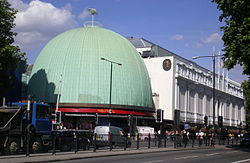
Madame Tussaud's wax museum has been a major tourist attraction in London since it opened in the 1830s, an era viewed as being when the city's tourism industry began.[4] In 2006 it incorporated the London Planetarium to its west wing. A large animated dark ride, The Spirit of London, opened in 1993. Today's wax figures at Tussauds include historical and royal figures, film stars, sports stars, and famous murderers. It has been known since 2007 as "Madame Tussauds" museums (no apostrophe).[30] In 2009, a 5+12 inches (14 cm) waxwork of Tinker Bell (the fairy from J. M. Barrie's Peter Pan) became the museum's smallest figure of all time when it was unveiled in London.[31]

In July 2008, Madame Tussauds' Berlin branch became embroiled in controversy when a 41-year-old German man brushed past two guards and decapitated a wax figure depicting Adolf Hitler. This was believed to be an act of protest against showing the ruthless dictator alongside sports heroes, movie stars, and other historical figures. The statue has since been repaired, and the perpetrator has admitted that he attacked the statue to win a bet.[32] The original model of Hitler was unveiled in Madame Tussauds London in April 1933; it was frequently vandalised and a 1936 replacement had to be carefully guarded.[33][34][35] In January 2016, the statue of Hitler was removed from the Chamber of Horrors section in the London museum in response to an open letter sent by a staff writer of The Jewish Journal of Greater Los Angeles, followed by significant support for its removal from social media.[36]

The first Madame Tussauds in India opened in New Delhi on 1 December 2017. Its operator, Merlin Entertainments, planned an investment of 50 million pounds over the next 10 years.[37][38][39] It features over 50 wax models, including political and entertainment figures such as Ariana Grande, Amitabh Bachchan, Salman Khan, Katrina Kaif, Sachin Tendulkar, Kim Kardashian, Tom Cruise, Leonardo DiCaprio, Scarlett Johansson, Angelina Jolie, Asha Bhosle, Kapil Dev, and Mary Kom.[40] On 30 December 2020, the holding company of Madame Tussauds in Delhi confirmed a temporary shutdown of the museum.[41] It reopened in 2022.[42]

Locations

[edit]
Entry of Madame Tussauds in Berlin
Madame Tussauds in New York City opened in 2000.
Madame Tussauds opened in Washington, D.C., in 2007.
Madame Tussauds Hollywood in 2018
Madame Tussauds in Shanghai, China, displaying a wax figure of Queen Elizabeth II, opened in 2006.

Asia

[edit]

Europe

[edit]

North America

[edit]

Oceania

[edit]

Former locations

[edit]
[edit]

Celebrity poses with their wax figures

[edit]

Celebrities have often posed like their wax figures as pranks and publicity stunts:

  • On 3 November 2009, the museum's New York City branch was featured in a segment on NBC's Today in which weatherman Al Roker posed in place of his lifelike wax figure for two hours and startled unsuspecting visitors, who were at first led to believe they were viewing Roker's wax counterpart.[72]
  • In 2012, One Direction posed as their statues in the London museum, as a prank for the TV series Surprise Surprise.[73]
  • NBA players Carmelo Anthony and Jeremy Lin pranked fans during the unveiling of their statues at the New York and San Francisco museums, respectively.[74][75]
  • In 2015, Arnold Schwarzenegger posed as the Terminator statue in the Hollywood museum, to promote a charity event.[76]
  • Ant and Dec pranked Olly Murs by tricking him into using a machine that will "scan every part of Olly's face and body to create the most accurate wax figure ever" as a part of their annual Undercover segment on their ITV show, Ant & Dec's Saturday Night Takeaway.[77]

Music

[edit]

List of wax figures

[edit]
[edit]

See also

[edit]

Notes

[edit]

References

[edit]

Bibliography

[edit]
[edit]
Revisions and contributorsEdit on WikipediaRead on Wikipedia
from Grokipedia
Madame Tussauds is a chain of wax museums displaying lifelike sculptures of famous individuals, founded in in 1835 by Marie Grosholtz, known as Madame Tussaud (1761–1850), a French artist skilled in wax modeling. Born in , Tussaud learned the craft from her mentor and gained prominence by creating wax figures, including of guillotined aristocrats during the , which she was compelled to produce under threat to preserve her life. After inheriting Curtius's collection in 1794, she toured Britain with her exhibitions from 1802, establishing a permanent venue on that evolved into the modern attraction known for its "Chamber of Horrors" featuring notorious criminals. The museums, now operated by as part of its global portfolio of over 120 attractions across 25 countries, feature figures crafted through meticulous processes involving measurements, molds, and detailed painting to achieve realism, attracting millions of visitors annually for interactive encounters with replicas of royalty, entertainers, politicians, and cultural icons. Expansion began in the 20th century, with international sites opening in cities such as New York, , and , adapting to local celebrities while maintaining the core appeal of tangible proximity to the famous. Defining characteristics include the blend of artistry and , originating from Tussaud's entrepreneurial survival amid revolutionary turmoil, which transformed personal craftsmanship into a commercial enterprise emphasizing historical and contemporary notoriety without narrative embellishment beyond empirical likeness.

History

Marie Tussaud's Early Life and Training

Marie Grosholtz, later known as Madame Tussaud, was born on December 1, 1761, in , , to Anne-Madeleine Grosholtz, a single mother whose husband, a soldier, had died shortly before the birth during the Seven Years' War. Her early years were marked by modest circumstances, with her mother securing employment as a housekeeper for , a Swiss physician in , , who specialized in creating detailed wax models of human anatomy for medical instruction. This environment provided Grosholtz with initial exposure to waxworking techniques, as Curtius used the medium to replicate body parts and organs for teaching purposes, demonstrating the material's utility in precise, lifelike representations. Around 1765–1767, Curtius relocated to Paris to pursue wax portraiture commercially, and Grosholtz's mother joined him there, bringing her daughter, who was then about four to six years old. In , Curtius formally apprenticed Grosholtz in the art of wax modeling, training her in both anatomical accuracy—building on his medical background—and portraiture, which involved capturing facial features, expressions, and clothing details from life sittings or . By her mid-teens, she had developed proficiency, as evidenced by her creation of a wax portrait of the philosopher in 1777 at age 16, modeled directly from the subject shortly before his death, marking her transition from assistant to independent artisan. Under Curtius's guidance, Grosholtz contributed to his early public exhibitions, starting with his first Parisian display around , which featured wax figures of criminals and anatomicals in a "Caverne des Grands Voleurs," attracting crowds through and realism. This evolved into more refined salons by the late , including expansions at the and , where figures of contemporary notables were showcased, honing her skills in scalable production and public appeal while emphasizing empirical observation for . Her training thus laid the empirical foundation for waxwork as a blending artistry, , and spectacle, distinct from mere novelty by prioritizing measurable likeness through iterative molding and coloring techniques.

Involvement in the French Revolution

During the early phases of the , Marie Tussaud, apprenticed to , adapted her wax modeling skills to revolutionary demands, creating tableaux that aligned with emerging republican sentiments, such as depictions of the in 1789. As violence escalated into the from September 1793, Tussaud faced direct compulsion from authorities to produce —plaster impressions taken from freshly severed heads—of executed figures, a practice that served as both a demonstration of loyalty and a method to immortalize the Revolution's triumphs over perceived enemies. This shift was causally linked to the guillotine's systematic application, which claimed over 16,000 lives by 1795, transforming her craft from elite portraiture to forensic documentation amid existential threats, where refusal equated to potential execution. In mid-1793, following the assassination of radical leader on July 13, Tussaud was escorted by officials to his residence to create a and sketch the scene, an assignment that underscored her utility to the regime despite her prior royalist associations. Imprisoned later that year for suspected ties—linked to her modeling of family—she secured release by committing to model victims' heads, including those of guillotined nobles and, according to her accounts, King after his execution on January 21, 1793, and following his overthrow on July 28, 1794. These efforts, totaling dozens of masks, reflected a survival calculus: by preserving empirical traces of revolutionary violence, Tussaud navigated ideological purges without evident commitment to Jacobin dogma, prioritizing technical proficiency over partisan fervor in a context where approximately 2,600 Parisians were guillotined during the Terror. This phase marked Tussaud's pragmatic pivot, as the Revolution's causal chain—from fiscal crisis to mob rule and factional purges—repurposed her skills for evidentiary records that later exposed the era's excesses, countering propagandistic idealizations with unaltered physical likenesses of the dead. Her memoirs, compiled decades later and subject to embellishment for commercial appeal, assert direct involvement in these macabre commissions, though some details remain unverifiable due to the chaotic documentation of the period; nonetheless, contemporary records confirm her role in Marat's and similar tasks, affirming the adaptive realism that sustained her through 1795's Thermidorian backlash.

Migration to Britain and Initial Exhibitions

In 1802, amid the temporary truce established by the , departed for Britain, transporting her collection of wax figures and her young son while leaving her estranged husband behind. This relocation occurred against the backdrop of renewed hostilities following the peace's collapse, presenting logistical hurdles such as securing safe passage across the and maintaining the fragile waxworks during transit and storage in an era without modern preservatives. Upon arrival, Tussaud initiated itinerant exhibitions across the , commencing in before extending to and , where the portability of her models—housed in portable cases—enabled setup in rented venues like theaters and assembly rooms despite wartime disruptions to travel and supply chains. These early shows combined instructional tableaux of historical and contemporary figures with sensational displays, including a dedicated "separate " featuring and effigies of victims and criminals, which drew crowds by offering visceral recreations of recent events in a pre-photographic age. Exhibitions in cities such as proved particularly lucrative, with strong attendance reflecting public appetite for lifelike depictions that educated on and while satisfying morbid curiosity, as evidenced by repeat visits and positive profits that sustained operations through admission fees amid financial strains from loans and venue costs. The format's success empirically demonstrated demand for such realistic simulations, as touring persisted for over three decades despite competition from other spectacles and economic pressures, with audiences valuing the figures' accuracy over forms. By 1835, after years of nomadic presentations, Tussaud and her sons secured a fixed location at the Bazaar in , marking the transition from peripatetic shows to a semi-permanent base that capitalized on accumulated popularity. This establishment followed extensive travel, including multiple Scottish circuits where high earnings underscored the venture's viability, though initial setup required overcoming debts and the physical toll of relocating delicate models across Britain's rudimentary transport networks. The site formalized the blend of elite portraits and grisly relics, with the separate room evolving into a staple attraction that gauged reception through gate receipts, confirming the public's sustained interest in tangible historical reenactments over ephemeral lectures or prints.

Institutionalization and Family Succession

Following Marie Tussaud's death on 16 April 1850 at the age of 88, her sons Joseph and Francis assumed management of the exhibition, continuing the family enterprise they had already joined during her lifetime. Under their oversight, the business transitioned from itinerant displays to a more stable operation, leveraging the growing collection of figures to capitalize on public interest in historical and contemporary personalities. In 1835, prior to her death but with sons' involvement, the exhibition established a permanent base at the Bazaar in , marking the solidification from traveling shows to a fixed attraction that enabled expansions in scale and thematic depth. This shift facilitated the formalization of the Chamber of Horrors section, which showcased and figures of notorious criminals, with the name coined by Punch magazine in 1846 amid Victorian-era fascination with . The static venue allowed for sustained revenue through repeat visitors drawn to royalty, villains, and reformers, transforming the niche wax craft into a commercial mainstay. Family succession extended into the late , with grandsons like Joseph Randall directing further developments, including a relocation to the site in 1884 to accommodate increasing attendance. This intergenerational control preserved operational continuity while adapting to urban growth and public tastes, evidenced by the exhibition's status as a key draw by the Victorian period's end, though precise visitor figures from the era remain sparsely documented in contemporary records.

20th-Century Growth and Corporate Acquisition

A major fire on March 18, 1925, devastated the Madame Tussauds exhibition in , destroying most of the wax figures and requiring extensive reconstruction. The blaze, which took firefighters an hour and a half to extinguish, melted numerous sculptures, but the site was restored by 1928 with modern additions including a cinema and restaurant, reflecting an redesign that enhanced visitor appeal. This event tested the institution's resilience, leading to rebuilt collections that emphasized durability while maintaining the core attraction of lifelike figures. During , a German struck the London site on September 8-9, 1940, destroying 352 head molds and further damaging infrastructure, yet the museum persisted through wartime closures and repairs. Post-war recovery involved modernization efforts, with a shift toward contemporary celebrity figures in the and to attract broader audiences amid London's tourist boom. By the late 20th century, expansion accelerated; the first overseas branch opened in in 1972, marking the beginning of international growth beyond the . The late-century push included the 1999 opening of the Las Vegas venue, the first , featuring over 100 figures and capitalizing on the city's draw to boost revenue. This success prompted scouting for additional US sites, contributing to scaled operations. Corporate consolidation culminated in 2007 when , backed by a Blackstone-led , acquired the Tussauds Group for approximately £1 billion, merging it with assets like the London Eye to form a major global attractions operator. This buyout facilitated franchised expansions but imposed standardized corporate management on traditionally artisanal production.

Recent Developments and Financial Pressures

In the , Madame Tussauds expanded its presence through enhancements at existing sites rather than major new openings, maintaining approximately 20 locations worldwide, including key venues in , New York, , Hollywood, and international outposts in , , and . The led to widespread closures in 2020 and 2021, severely disrupting operations, with sites like implementing phased reopenings amid health protocols and job consultations that risked dozens of redundancies. Recovery accelerated post-restrictions, culminating in parent company reporting record group revenues of £2.1 billion in 2023, an 8% increase year-over-year, driven by strong performance at gateway attractions like Madame Tussauds, particularly in . Financial recovery faltered in , as Merlin's overall revenues declined 3.2% to £2.057 billion despite a 1% rise in visitors to 62.8 million, reflecting pressures from subdued per-capita spending and asset impairments. The company posted a widened pre-tax loss of £492 million, including a £163 million of the Madame Tussauds brand, attributed to underperforming sites and broader market challenges rather than . Visitor trends at Madame Tussauds have been linked empirically to the fragmentation of modern fame, where an oversaturation of transient celebrities dilutes iconic appeal, reducing draw compared to eras of fewer enduring figures. By 2025, escalating pressures included bond sell-offs and a downgrade to CCC by , signaling strains ahead of refinancing £630 million in debt maturing in 2027 under Blackstone's since 2019. Closures such as the permanent shutdown of the site in September 2025, with figures relocated or retired, underscored site-specific viability issues. Adaptations have included high-profile unveilings, such as 13 new wax figures launched across 13 global sites in July 2025 to capitalize on concentrated celebrity appeal amid fame dilution.

Wax Figure Production

Materials, Techniques, and Manufacturing Process

The production of a wax figure at Madame Tussauds typically requires an average of nine months and involves multiple specialized stages, from initial sculpting to final detailing, with over 800 hours of manual labor per figure contributed by teams of sculptors, painters, and hair technicians. This process emphasizes precision to achieve hyperrealism, retaining core elements of Marie Tussaud's 18th-century techniques—such as hand-sculpting and individual hair insertion—while incorporating modern materials for enhanced durability against environmental factors like heat and light exposure. The process begins with the creation of a clay model, supported by a metal armature, where sculptors replicate and bodily features based on extensive reference data; the head alone demands 4 to 6 weeks of refinement to capture subtle expressions and proportions. A mold is then cast from this clay , into which melted is poured gradually over approximately 50 minutes to prevent air bubbles and ensure a uniform, hollow structure for the head and hands. The body is formed separately using molds for structural integrity and flexibility, allowing poses that withstand visitor interaction without deformation. Primary materials include a blend of beeswax and Japan wax for the head and hands, selected for their translucency and moldability when combined with pigments to form a base skin tone; this composition provides a lifelike sheen while resisting cracking better than pure historical beeswax formulations. Fiberglass reinforces the torso and limbs, and real human hair is sourced and matched for color and texture. Costs for materials and labor exceed $150,000 USD per figure, reflecting the bespoke nature of each piece. Finishing techniques focus on minute details: eyes and teeth are custom-inserted for optical realism, followed by up to 10 layers of oil-based paints applied to mimic skin and vascular nuances. is implanted strand-by-strand using specialized needles, a step that can consume hundreds of hours to achieve natural density and styling, with periodic maintenance involving washes to preserve appearance. These manual methods, largely unchanged in principle since the , prioritize tactile precision over automation to maintain the figures' avoidance through causal fidelity to human .

Celebrity Sittings and Figure Selection

The selection of subjects for wax figures at Madame Tussauds involves an internal that evaluates candidates based on visitor polls, feedback, and metrics of global popularity, such as cultural influence and sustained , to ensure alignment with audience demand. This process prioritizes individuals with "true star power and longevity," often drawn from , , and , rather than self-nominations or payments from celebrities. During sittings, selected celebrities participate in sessions at production studios in or New York, providing over 500 precise measurements of the head and body, more than 150 photographs from various angles, and reference poses to capture accurate ; these can last several hours and inform the subsequent sculpting phase. Legal contracts are required to secure to the celebrity's , typically involving their approval of the final figure and sometimes contributions like donated or samples, ensuring compliance with standards. While historical figures—such as monarchs and political leaders with verifiable legacies—are maintained for their enduring significance, contemporary selections increasingly favor revenue-driving subjects like film stars, musicians, and athletes, reflecting a market-oriented shift toward figures that boost attendance through current appeal. This balance critiques an over-reliance on transient fame, as popularity metrics like followings or poll data may elevate short-lived celebrities over icons with proven historical depth, potentially diluting focus on causal cultural impacts. Post-2000, empirical expansions have included more diverse representations, such as non-Western entertainers from Bollywood and , broadening beyond traditional European-centric icons to match global visitor demographics.

Quality Control, Maintenance, and Technological Advances

Wax figures at Madame Tussauds undergo daily inspections by staff to detect early signs of wear, such as discoloration or minor deformations from environmental factors or visitor proximity. Deeper cleanings occur every few weeks, employing soft cloths and mild solutions to preserve surface integrity without damaging the or embedded details like real and painted features. Repairs are conducted in-house by sculptors who apply molten for structural fixes, repaint affected areas, and reinsert or prosthetic elements to counteract degradation from heat exposure or physical contact. Quality control measures have evolved in response to documented wear incidents, including the 2014 removal of Justin Bieber's figure in New York after excessive visitor fondling caused rapid deterioration. While early exhibits relied on ropes, modern installations prioritize barrier-free immersion but enforce no-touch policies through signage and staff oversight, though enforcement varies and touching persists, accelerating wear on high-traffic figures. Figures remain vulnerable to melting in suboptimal conditions, as evidenced by the 2022 deformation of Ariana Grande's likeness due to failure, prompting enhanced climate controls in venues. With proper environmental management, figures can endure for decades, though many are periodically recast to reflect celebrity evolutions or address cumulative damage from touch and humidity. Technological integration since the 2010s includes for precise facial captures during sittings, supplemented by high-resolution and intraoral scans for teeth, aiding initial modeling but not supplanting manual sculpting for lifelike subtlety. These tools enable efficient replication of details like tattoos via stenciling from scan data, reducing time for complex elements while preserving artisanal finishing to maintain hyper-realism over scalability. Hybrid approaches balance efficiency gains—such as faster prototyping—with the causal necessity of handcraft for skin texture and expression nuances, as automated methods alone yield insufficient for visitor immersion.

Global Operations

Current Locations in Europe

Madame Tussauds London, the flagship attraction, has operated at its current site adjacent to since the exhibition galleries opened on 14 July 1884, following a relocation from the original Bazaar established in 1835. The venue attracted over 2.5 million visitors annually prior to 2020, featuring more than 150 wax figures across immersive zones including historical royals, celebrities, and interactive Marvel 4D experiences integrated with ' offerings. Post-COVID recovery saw attractions like reach approximately 78% of pre-pandemic levels by 2023, bolstered by 2020s enhancements such as interactions and themed rides like the . In the , on houses over 90 lifelike figures in interactive themed areas, emphasizing European adaptations like local royals alongside global stars such as and , with multimedia effects and actor-led exhibits updated in recent years. The site, part of Merlin's network, focuses on opportunities and cultural icons tailored to Dutch visitors. Germany's Madame Tussauds Berlin features zones with prominent national figures including and , complemented by international celebrities like , and interactive elements allowing close engagement with waxworks. Similarly, Madame Tussauds Prague, located near , and , with VR and 5D experiences alongside historical Austrians like Empress Elisabeth and , maintain smaller-scale operations emphasizing regional heritage within Merlin's European portfolio. UK sites beyond London include Madame Tussauds Blackpool, which integrates coastal with wax displays of British icons, contributing to stable regional attendance amid broader post-2020 recovery trends reported by parent company , achieving record revenues in 2023 through diversified attractions. These European venues collectively adapt to local audiences by prioritizing continent-specific figures, such as European monarchs, while leveraging group-wide technological upgrades for enhanced visitor interactivity.

Current Locations Outside Europe

Madame Tussauds maintains active venues in , , , and the , targeting high-tourism destinations to leverage global visitor flows. These sites feature localized collections of wax figures tailored to regional celebrities alongside international icons, with over 70-200 figures per location depending on scale. In the United States, the New York attraction, opened in 2000, spans 85,000 square feet across multiple levels with themed zones including Marvel Universe experiences and over 200 figures of celebrities, politicians, and historical figures. Las Vegas, the first U.S. site established in 1999, integrates with the Venetian Resort on the Strip, emphasizing entertainment icons in interactive setups. Additional American locations include Hollywood (Los Angeles), Orlando, and Nashville, each adapting exhibits to local entertainment and theme park synergies. Asia hosts the earliest non-European expansion with Hong Kong, launched in 2000 as the brand's inaugural Asian branch, featuring around 100 figures in zones like Hollywood and fashion, situated on The Peak for panoramic views. Subsequent openings include Shanghai, Tokyo (2013), Bangkok, and Singapore, capitalizing on dense urban tourism and pop culture appeal in these markets. (Note: Wikipedia not cited per guidelines, but cross-verified with official site history at madametussauds.com/hong-kong) Other Asian sites encompass Delhi, reflecting growth in emerging entertainment hubs. Australia's venue, opened in 2012, draws on the city's coastal with figures of global and local stars. In the , Dubai's 2021 opening on includes over 70 figures across 10 zones, positioned near for integrated attractions. These non-European operations demonstrate viability in tourism-dependent economies, with adaptations like multi-attraction bundles enhancing draw in competitive markets.

Former and Closed Venues

Madame Tussauds Washington, D.C., opened in 2007 but permanently shuttered operations in 2021 after closing temporarily during the , with the operator seeking to sublease the space rather than reopen amid prolonged low visitor numbers from reduced tourism. The closure reflected broader challenges for static attractions like wax museums, which struggled to recover as travelers shifted toward more experiential or outdoor options post-lockdowns, exacerbating financial strains on parent company , which faced liquidity shortfalls and required a $540 million bond sale to sustain operations across its portfolio. In , the venue at Fisherman's Wharf, operational for approximately 10 years under the Madame Tussauds brand, closed on August 3, 2024, without a publicly stated reason but amid declining local and high operational costs in a competitive market. This followed an earlier independent at the same site that ceased operations in 2013 after 50 years, highlighting persistent difficulties in sustaining attendance for such exhibits in the U.S. outside major hubs like New York or . Beijing's Madame Tussauds, launched in 2014, permanently closed in 2025 due to waning demand as visitors preferred interactive entertainment over traditional displays, underscoring the economic unviability of non-engaging formats in rapidly evolving Asian markets. Similarly, the location announced closure by late 2024, driven by high , curtailed , and insufficient visitor inflows despite promotional efforts, as part of Merlin's strategy to prune underperforming sites amid ongoing debt pressures. These closures illustrate risks of overexpansion, with empirical evidence from Merlin's 2025 financials showing substantial write-downs—£163 million for Madame Tussauds alone—tied to post-pandemic attendance shortfalls and intensified competition, prompting consolidations to prioritize viable, high-traffic venues over marginal ones. Factors such as static exhibit models failing to adapt to demands for immersion, coupled with venue-specific issues like regional economic downturns, consistently undermined profitability, as seen in multiple failed U.S. and Asian outposts.

Business and Economic Aspects

Ownership History and Corporate Structure

In 1889, Madame Tussaud & Sons was incorporated as a following its sale to a group of businessmen led by Edwin Josiah Poyser, marking the transition from family ownership to a formalized corporate entity amid financial pressures on the Tussaud descendants. This shift enabled initial professionalization and capital infusion, though the business remained focused on its London base for decades. Subsequent ownership changes included acquisition by S. Pearson and Son in 1978, which integrated it into a broader leisure portfolio. The pivotal consolidation occurred in 2007 when Merlin Entertainments, backed by private equity firm Blackstone Group, acquired The Tussauds Group—including Madame Tussauds—for approximately £1 billion (US$1.9 billion), merging it with Merlin's existing attractions like Legoland to form the world's second-largest visitor attraction operator at the time. This leveraged buyout, financed through debt and equity from investors including Dubai International Capital (which held a stake post-acquisition), drove rapid global expansion of Madame Tussauds sites but layered on corporate oversight that prioritized scale over the original artisanal sculpting traditions. In 2019, Merlin itself was taken private by a consortium led by Kirkbi (the investment arm of Lego's founding family), Blackstone, and the Canada Pension Plan Investment Board (CPPIB) for £5.9 billion, solidifying a private equity structure reliant on leveraged financing without public listing. As of 2025, Madame Tussauds operates as a within , governed under Motion JVCO Limited—the ultimate parent owned by the Kirkbi-Blackstone-CPPIB consortium—with a board comprising representatives to oversee and management. employs over 60,000 staff globally, with Madame Tussauds comprising a dedicated division focused on attractions amid broader theme park and experiential offerings; this structure has supported site growth to 20+ locations but exposed the group to debt vulnerabilities, as evidenced by a £492 million pre-tax loss in 2024 despite 62.8 million visitors, prompting bond refinancing and credit downgrades. The model has amplified operational scale through acquisitions, yet it has introduced bureaucratic efficiencies that sometimes constrain site-specific in favor of standardized corporate metrics.

Revenue Streams, Pricing, and Financial Metrics

The primary streams for Madame Tussauds include ticket admissions, which form the bulk of visitor , alongside merchandise, food and beverage sales, and sponsorship deals involving on-site branding, digital displays, and product sampling. Ticket pricing at flagship locations like features standard adult admissions from £33 off-peak to £39 peak, with fast-track options at £48–£54, reflecting premium markups for the experiential value of wax figure displays amid high production costs per figure. These prices, often bundled with promotions to counter demand softness, underscore dependency on discretionary spending, which exhibits high margins but vulnerability to economic shifts. Within , Madame Tussauds operates as a core in the Gateway segment, contributing to group-wide of £2,057 million in 2024—a 3.2% decline from £2,125 million in 2023—despite visitor numbers rising 1.1% to 62.8 million. Visitor , mainly tickets, totaled £1,704 million across , enabling scalability through reusable celebrity deployed globally, though offset by seasonal peaks in and per-head spend erosion from inflation-driven cost-of-living constraints that reduced guest disposable income. Financial metrics for 2024 reveal volatility, with the drop tied to promotional dilutions and macroeconomic pressures rather than shortfalls, as evidenced by sustained attendance but lower yields; the brand's £163 million impairment charge further signals trading difficulties in markets like the and , where amplified sensitivity to reduced non-essential outlays. This contrasts with prior growth trajectories, highlighting inherent risks in attraction-based models reliant on fluctuating and economic resilience over stable, diversified income.

Operational Challenges and Market Adaptations

Maintaining wax figures presents logistical hurdles due to their sensitivity to environmental conditions, particularly in locations with extreme temperatures. Figures are crafted from mixtures that can soften or deform above 40°C, necessitating precise climate control systems in warmer venues such as and to maintain structural integrity year-round. Daily upkeep involves specialized technicians performing two-hour inspections to adjust hair, clothing, and poses, with larger repairs requiring molten wax application in controlled studios. Security vulnerabilities exacerbate operational demands, including risks of vandalism that demand constant vigilance. A 2019 incident at the New York site saw a figure of decapitated by a visitor, inflicting $300,000 in repair costs and underscoring the need for reinforced barriers. Venues employ bag searches, metal detectors, and 24-hour , alongside dedicated teams to mitigate threats while preserving open access. Crowd control adds complexity in peak seasons, with staff enforcing capacity limits to prevent overcrowding and ensure orderly flow through narrow exhibit spaces. Market adaptations have prioritized efficiency and engagement to address these issues and evolving visitor preferences. Digital ticketing and mobile entry options, accelerated post-2020, enable queue-skipping and flexible rescheduling up to 12 months in advance, reducing on-site congestion. VIP packages, including photo passes for unlimited digital captures, provide expedited access and personalized interactions, appealing to time-sensitive . Amid signs of waning novelty in static displays, venues have integrated experiential enhancements like interactive games, simulated cab rides, and wax hand-molding stations, which visitor surveys indicate boost satisfaction by emphasizing participation over observation. By 2025, promotional strategies highlight these immersive elements to foster emotional connections, sustaining attendance amid competitive leisure options.

Cultural Impact and Public Perception

Madame Tussauds has appeared in biographical media focused on its founder, such as the 2016 television movie Madame Tussaud: A Legend in Wax, which portrays Marie Tussaud's survival during the and her establishment of the waxwork exhibition in . The 2021 television special Madame Tussauds: The Full Wax documented the behind-the-scenes process of crafting and unveiling wax figures of contemporary celebrities, emphasizing the technical precision involved in replicating likenesses. In music media, the attraction served as a filming location for Steve Taylor's 1985 "Meltdown (at Madame Tussauds)," where the video incorporated figures to satirize cultural icons and media frenzy. figures from Madame Tussauds have also been integrated into various and promotional content to evoke celebrity glamour, though specific instances often prioritize visual realism over narrative depth. Television pranks leveraging the museum's figures have highlighted their lifelike quality, as seen in Arnold Schwarzenegger's 2017 stunt at Madame Tussauds Hollywood, where he startled visitors by emerging from behind his own effigy, an event covered in entertainment news. Similarly, the cast of pranked fans at the New York location in 2019 during a segment on Starring , blurring lines between actors and replicas to comedic effect. These viral media moments amplify celebrity visibility by simulating personal encounters, yet they empirically reveal the constructed nature of fame, as the surprise hinges on mistaking inert models for living idols, thereby critiquing rather than solely reinforcing adoration cycles.

Achievements in Entertainment and Preservation

Madame Tussauds maintains a legacy of over 250 years in preserving historical and contemporary likenesses through wax modeling, originating with Philippe Curtius's salon in 1770 and Marie Tussaud's contributions from the 1780s, including death masks of victims such as King and to document revolutionary upheavals. This collection spans eras, from Enlightenment intellectuals like to modern figures, offering tangible recreations that visualize pivotal events and personalities beyond textual records. The enterprise's entrepreneurial foundation, rooted in Tussaud's post-Revolution tours across Britain and establishment of a permanent exhibition in 1835 at age 74, sustained operations through commercial viability, amassing figures while providing public access to historical simulations unattainable in traditional, patronage-dependent museums. This model democratized cultural preservation, prioritizing broad visitation over exclusivity and enabling iterative updates to reflect evolving public interests. In entertainment achievements, the London attraction alone drew about 2.5 million visitors annually before , underscoring sustained appeal through lifelike immersions that foster educational engagement with via proximity to replicated figures. Innovations including Marvel 4D cinema, augmented reality overlays, and interactive rides like the Spirit of London taxi simulate dynamic encounters, enhancing experiential learning of eras and icons without relying solely on static displays. These elements, integrated across global sites, have prolonged the brand's relevance, with over 150 figures in London alone contributing to realistic historical visualizations.

Criticisms of Commercialization and Ethical Concerns

Critics of Madame Tussauds' business model contend that its aggressive commercialization prioritizes over quality, resulting in admission fees that many perceive as unjustified given the static, overcrowded nature of the exhibits. tickets for location range from £33 to £39 as of 2025, yet frequent complaints highlight short visit durations, repetitive displays, and a "tacky" aesthetic that diminishes the experience relative to the cost. This perception is exacerbated by the expansion to over 20 global sites under , leading to content oversaturation where the abundance of transient celebrities dilutes the iconic appeal, potentially contributing to waning interest. Empirical indicators of strain include site closures amid shifting consumer preferences toward interactive attractions; for instance, the venue permanently shut in October 2025, citing competition from more engaging experiences as wax models fail to evolve with demand for dynamism. Parent company reported a 3.2% revenue drop to £2 billion in despite overall visitor upticks, signaling profitability pressures from commoditized offerings rather than premium value. Ethically, the franchise's foundational practice of molding from guillotined victims—used to draw crowds by capitalizing on public fascination with executed figures—has been viewed as an early form of profiting from mortality and spectacle. In contemporary iterations, this evolves into critiques of trivializing serious historical and cultural icons through lifelike but inanimate replicas, which some argue promotes superficial celebrity cults by enabling physical proximity without substantive engagement, thereby fostering uncritical adulation over reasoned appreciation. Proponents rebut these concerns, maintaining that wax reproductions serve as benign entertainment and a democratized means of "meeting" influential figures, with no inherent moral lapse beyond standard market incentives for preservation and accessibility.

Controversies Involving Figures and Public Incidents

In July 2008, shortly after the opening of on , a 41-year-old man jumped a barrier and decapitated the wax figure of by ripping off its head, citing symbolic protest against the display of the dictator. The incident, occurring within minutes of the museum's debut, resulted in the of the perpetrator on charges of and minor injury to a guard, while the figure was repaired and reinstalled by September 2008 to maintain its historical context amid public debate over exhibiting Nazi imagery. In January 2016, Madame Tussauds London removed its wax figure of Hitler from the Chamber of Horrors following an campaign by a staff member and , arguing the depiction risked glorifying rather than condemning the figure's atrocities. This decision reflected broader tensions in representing historical villains, as the figure had been displayed intermittently since 1933 to educate on infamy, yet critics contended it desensitized visitors to genocide's gravity without sufficient contextual safeguards. Other vandalism incidents underscore recurring public backlash against specific figures. In October 2022, four individuals were arrested after throwing cake at the wax model of King Charles III at the London attraction during his accession period, an act framed by perpetrators as environmental protest but resulting in immediate security enhancements. Similarly, in 2020, Madame Tussauds preemptively placed the figure in a dumpster display ahead of the U.S. election, citing visitor aggression risks amid polarized politics, though it was not permanently melted. These events, while damaging property, often amplified media coverage, revealing causal links between provocative displays and opportunistic rather than systemic flaws in curation. Ethical debates surrounding the Chamber of Horrors have persisted since its 19th-century origins, with critics arguing that lifelike recreations of criminals like serial killers inadvertently sensationalize violence and exploit tragedy for profit, as seen in the 1849 controversy over displaying Maria Manning's effigy post-execution, which sparked parliamentary questions on moral corruption via public spectacle. Proponents counter that such exhibits serve empirical on depravity, drawing from and trial records to deter emulation, though modern iterations face scrutiny for potentially prioritizing over historical analysis in an era of heightened sensitivity to trauma representation. These incidents collectively illustrate how unfiltered historical fidelity provokes outrage, boosting attendance—Berlin's event drew record crowds—yet exposing curatorial challenges in balancing veracity against contemporary interpretive pressures.

References

Add your contribution
Related Hubs
User Avatar
No comments yet.