


Community hub
The Uzi ( /ˈuːzi/ ⓘ; Hebrew: עוּזִי, romanized: ʿûzî; officially cased as UZI) is a family of Israeli open-bolt, blowback-operated submachine guns and machine pistols first designed by Major Uziel "Uzi" Gal in the late 1940s, shortly after the establishment of the State of Israel. It is one of the first weapons to incorporate a telescoping bolt design, which allows the magazine to be housed in the pistol grip for a shorter weapon.
Key Information


The Uzi prototype was finished in 1950. It was first introduced to Israel Defense Forces (IDF) special forces in 1954, and the weapon was placed into general issue two years later. The IDF supplied Uzis to rear-echelon troops, officers, artillery troops and tank crews, as well as a frontline weapon by elite light infantry assault forces.
The Uzi has been exported to over 90 countries.[14] Over its service lifetime, it has been manufactured by Israel Military Industries, FN Herstal, and other manufacturers. From the 1960s through to the 1980s, more Uzi submachine guns were sold to more military, law enforcement and security markets than any other submachine gun ever made.[17]
Design
[edit]
The Uzi uses an open-bolt, blowback-operated design, quite similar to the Jaroslav Holeček-designed Czech ZK 476 (prototype only)[18] and the production Sa 23, Sa 24, Sa 25, and Sa 26 series of submachine guns introduced in 1948. The open bolt design exposes the barrel's breech end, improving cooling after periods of continuous fire. However, it means that since the bolt is held to the rear when cocked, the receiver is more susceptible to contamination from sand and dirt. It uses a telescoping bolt design, in which the bolt wraps around the breech end of the barrel.[19] This allows the barrel to be moved far back into the receiver and the magazine to be housed in the pistol grip, allowing for a heavier, slower-firing bolt in a shorter, better-balanced weapon.[17]
The weapon is constructed primarily from stamped sheet metal, making it less expensive per unit to manufacture than an equivalent design machined from forgings. With relatively few moving parts, the Uzi is easy to strip for maintenance or repair. The magazine is housed within the pistol grip, allowing for intuitive and easy reloading in dark or difficult conditions, under the principle of "hand finds hand". The pistol grip is fitted with a grip safety, making it difficult to fire accidentally. However, the protruding vertical magazine makes the gun awkward to fire when prone.[19] The Uzi features a bayonet lug.[20]
Operation
[edit]The non-reciprocating charging handle on the top of the receiver cover is used to retract the bolt. Variants have a ratchet safety mechanism which will catch the bolt and lock its movement if it is retracted past the magazine, but not far enough to engage the sear. When the handle is fully retracted to the rear, the bolt will cock (catch) on the sear mechanism and the handle and cover are released to spring fully forward under power of a small spring. The cover will remain forward during firing since it does not reciprocate with the bolt. The military and police versions will fire immediately upon chambering a cartridge as the Uzi is an open bolt weapon.
There are two external safety mechanisms on the Uzi. The first is the three-position selector lever located at the top of the grip and behind the trigger group. The rear position is "S", or "safe" (S = Sicher or Secure on the MP2), which locks the sear and prevents movement of the bolt.
The second external safety mechanism is the grip safety, which is located at the rear of the grip. It is meant to help prevent accidental discharge if the weapon is dropped or the user loses a firm grip on the weapon during firing.
The trigger mechanism is a conventional firearm trigger, but functions only to control the release mechanism for either the bolt (submachine gun) or firing pin holding mechanism (semi-auto) since the Uzi does not incorporate an internal cocking or hammer mechanism. While the open-bolt system is mechanically simpler than a closed-bolt design (e.g. Heckler & Koch MP5), it creates a noticeable delay between when the trigger is pulled and when the gun fires.
The magazine release button or lever is located on the lower portion of the pistol grip and is intended to be manipulated by the non-firing hand. The paddle-like button lies flush with the pistol grip in order to help prevent accidental release of the magazine during rigorous or careless handling.
When the gun is de-cocked the ejector port closes, preventing entry of dust and dirt. Though the Uzi's stamped-metal receiver is equipped with pressed reinforcement slots to accept accumulated dirt and sand, the weapon can still jam with heavy accumulations of sand in desert combat conditions when not cleaned regularly.[21] The magazine must be removed prior to de-cocking the weapon.
Stocks
[edit].jpg)
.jpg)
There are different stocks available for the Uzi proper.[22] There is a wooden stock with a metal buttplate that comes in three similar variations that were used by the IDF. The first version had a flat butt and straight comb and had hollows for a cleaning rod and gun oil bottle. The second had an angled butt and a straight comb and no hollows. The third had an angled butt and curved comb and no hollows; a polymer version is currently available from IMI. The wooden stocks originally had a quick-release base but the ones sold in the United States often had a permanent base for legal reasons, as detachable stocks on pistols or other short-barreled weapons upgrade the weapon to NFA status.[23][24]
Choate made an aftermarket polymer stock with a rubber butt-pad that had a flat butt, a straight comb, and a permanent base.
In 1956,[25] IMI developed a downward-folding twin-strut metal stock with two swivelling sections that tuck under the rear of the receiver. The Mini Uzi has a forward-folding single-strut metal stock that is actually an inch longer than the Uzi's. Its buttplate can be used as a foregrip when stowed. The Micro Uzi has a similar model.
Magazines
[edit]The original box magazines for the 9mm Uzi had a 25-round capacity. Experimental 40- and 50-round extended magazines were tried but were found to be unreliable. A 32-round extended magazine was then tried and was later accepted as standard. The Mini Uzi and Micro Uzi use a shorter 20-round magazine. Available extended magazines include 40-, and 50-round magazines. Other high-capacity aftermarket magazines exist such as the Vector Arms 70-round and Beta Company (Beta C-Mag) 100-round drums.
The .45 ACP Uzi used a 16- or 22-round magazine, while the .45 ACP Micro Uzi and Mini Uzi used a 12-round magazine. A conversion kit by Vector Arms allowed the .45-caliber Uzi to use the same 30-round magazines as the M3 "Grease Gun".[8]: 20–25
Caliber conversions
[edit]The Uzi was available with caliber conversion kits in .22 LR or .41 AE. The operator just has to change the barrel, bolt and magazine. The .22 LR had 20-round magazines; the original IMI kit used a barrel insert while the aftermarket Action Arms kit used a full replacement barrel. The .41 AE also had a 20-round magazine; since it has the same bolt face as the 9×19mm Parabellum, only the barrel and magazine needed to be changed.[8]: 20–25
IMI also manufactured a .45ACP conversion kit both in full auto/open bolt with a 10.2" barrel for the 9mm SMG and a semi only/closed bolt with a 16" barrel for the carbine version. Magazine capacity is limited, with 2 sizes of 16 and 10 rds each.
History and operational use
[edit]

The Uzi submachine gun was designed by Captain (later Major) Uziel Gal of the Israel Defense Forces (IDF) following the 1948 Arab–Israeli War. The weapon was submitted to the Israeli Army for evaluation and won out over more conventional designs due to its simplicity and economy of manufacture. Gal did not want the weapon to be named after him, but his request was ignored. The Uzi was officially adopted in 1951. First introduced to IDF special forces in 1954, the weapon was placed into general issue two years later. The first Uzis were equipped with a short, fixed wooden buttstock, and this is the version that initially saw combat during the 1956 Suez Campaign. Later models would be equipped with a folding metal stock.[21]
The Uzi was used as a personal defense weapon by rear-echelon troops, officers, artillery troops and tankers, as well as a frontline weapon by elite light infantry assault forces. The Uzi's compact size and firepower proved instrumental in clearing Syrian bunkers and Jordanian defensive positions during the 1967 Six-Day War. Though the weapon was phased out of frontline IDF service in the 1980s, some Uzis and Uzi variants were still used by a few IDF units until December 2003, when the IDF announced that it was retiring the Uzi from all IDF forces.[26] It was subsequently replaced by the fully automatic Micro Tavor.
In general, the Uzi was a reliable weapon in military service. However, even the Uzi fell victim to extreme conditions of sand and dust. During the Sinai Campaign of the Yom Kippur War, IDF Army units reaching the Suez Canal reported that of all their small arms, only the 7.62mm FN MAG machine gun was still in operation.[27]
The Uzi proved especially useful for mechanized infantry needing a compact weapon and for infantry units clearing bunkers and other confined spaces. However, its limited range and accuracy in automatic fire (approximately 50 m (160 ft)) could be disconcerting when encountering enemy forces armed with longer-range small arms, and heavier support weapons could not always substitute for a longer-ranged individual weapon. These failings eventually caused the phasing out of the Uzi from IDF front-line assault units.[26]
The Uzi has been used in various conflicts outside Israel and the Middle East during the 1960s and 1970s. Quantities of 9 mm Uzi submachine guns were used by Portuguese cavalry, police, and security forces during the Portuguese Colonial Wars in Africa.[21]
Worldwide sales
[edit]
Total sales of the weapon to date (end of 2001) has netted IMI over 2 billion US dollars, with over 90 countries using the weapons either for their armed forces or in law enforcement.[17]
- The Royal Netherlands Army first issued the Uzi in 1956. It was the first country other than Israel to use it as a service weapon. Their models are distinct in that they have a wooden stock (made to their specifications) that is more angular, an angled butt and a curved comb, and is 2 inches longer than the IDF model. The wooden stock versions were mainly used by the Royal Netherlands Navy and the Marine Corps. The Army and Airforce received the metal foldable stock versions as replacement. No bayonets were issued.
- The German Bundeswehr (especially its tank crews) used the Uzi since 1959 under the designation MP2.[28][29] It replaced the MP1 (Beretta M1938/49) and Thompson M1 in service. The MP2 was fitted with the IDF-style wooden stock and the later MP2A1 was fitted with the metal folding stock. It can be recognized by its distinctive three-position "DES" selector switch: "D" for "Dauerfeuer" ("continuous-fire", or "automatic"), "E" for "Einzelfeuer" ("single-fire", or "semi-automatic"), and "S" for "Sicher" ("secure", or "safe"). It was replaced with the Heckler & Koch MP7 Personal Defense Weapon in 2007.[29] Most of the Uzis used in Germany consisted of receivers with Israeli markings and grips made by FN.[29]
- The Belgian Armed Forces have used Uzi machine pistols in 9mm, .45 ACP and 22LR calibres, license-made by FN Herstal from 1958 to 1971.[30] They were also issued to the paramilitary Gendarmerie.[31]
- The Irish Gardaí ERU and RSU were issued the Uzi from the 1970s to 2012. It was replaced with the Heckler & Koch MP7 in March 2014.[32]
- In Rhodesia, the Uzi was produced under license from 1976 until the fall of Rhodesia in 1980. It was made from Israeli-supplied (and later Rhodesian-made) components.
- Sri Lanka ordered a few thousand Mini Uzi and Uzi carbines in 1990s. Currently those are deployed with the Sri Lanka Army, Sri Lanka Navy Elite Forces, and the Sri Lanka Police Special Task Force as their primary weapon when providing security for VIPs.
- The United States Secret Service used the Uzi as their standard submachine gun from the 1960s until the early 1990s, when it was phased out and replaced with the Heckler & Koch MP5 and FN P90. When President Ronald Reagan was shot on March 30, 1981, Secret Service Special Agent Robert Wanko pulled an Uzi out of a briefcase and covered the rear of the presidential limousine as it sped to safety with the wounded president inside.[17]
- All merchant mariners of the Zim Integrated Shipping line are trained in the use of, and issued, the Uzi.[33]
Military variants
[edit]


The standard Uzi has a 10-inch (250 mm) barrel. It has a rate of automatic fire of 600 rounds per minute (rpm) when chambered in 9mm Parabellum; the .45 ACP model's rate of fire is slower at 500 rpm.[21]
The Mini Uzi is a smaller version of the regular Uzi, first introduced in 1980. The Mini Uzi is 600 mm (24 in) long or 360 mm (14 in) long with the stock folded. Its barrel length is 197 mm (7.8 in), its muzzle velocity is 375 m/s (1,230 ft/s) and its effective range is 100 m (330 ft). It has a greater automatic rate of fire of 950 rounds per minute due to the shorter bolt. Its weight is approximately 2.7 kg (6.0 lb).[21]
The Micro Uzi is an even further scaled down version of the Uzi, introduced in 1986. The Micro Uzi is 486 mm (19.1 in) long, reduced to 282 mm (11.1 in) with the stock folded, and its barrel length is 117 mm (4.6 in). It has a closed bolt compared to its original counterpart.[34] Its muzzle velocity is 350 m/s (1,100 ft/s) and its cyclic rate of fire is 1,200 rpm. It weighs slightly over 1.5 kg (3.3 lb).[21]
The Uzi Pro, an improved variant of the Micro Uzi, was launched in 2010 by Israel Weapon Industries Ltd. (I.W.I.), formerly the magen ("small arms") division of Israel Military Industries. The Uzi Pro is a blowback-operated, select-fire, closed-bolt submachine gun with a large lower portion, comprising grip and handguard, entirely made of polymer to reduce weight; the grip section was redesigned to allow two-handed operation and facilitate control in full-automatic fire of such a small-sized firearm. The Uzi Pro features four Picatinny rails, two at the sides of the barrel, which can be removed, one below the barrel for the addition of foregrips and one on the top for optics. The under barrel rail is often shown with a specialised foregrip which attaches to the pistol grip to form a handguard. In addition, the cocking handle has been moved to the left side.[35] The new weapon weighs 2.32 kg (5.1 lb) and has a length of 529 mm (20.8 in) with an extended stock,[36] and 300 mm (12 in) while collapsed. As of 2011 it has been purchased by the IDF in limited numbers for evaluation and it is yet to be decided whether or not to order additional units for all of its special forces.[36][37]
Civilian variants
[edit]Uzi carbine
[edit]The Uzi carbine is similar in appearance to the Uzi submachine gun. The Uzi carbine is fitted with a 400-millimetre (16 in) barrel, to meet the minimum rifle barrel length requirement for civilian sales in the United States. A small number of Uzi carbines were produced with the standard length barrel for special markets. It fires from a closed-bolt position in semi-automatic mode only and uses a floating firing pin as opposed to a fixed firing pin.[27] The FS-style selector switch has two positions (the automatic setting was blocked): "F" for "fire" (semi-auto) and "S" for "safe". Uzi carbines are available in .22 LR, 9mm, .41 AE, and .45 ACP calibers.
The Uzi carbine has two main variants, the Model A (imported from 1980 to 1983) and the Model B (imported from 1983 until 1989). The Type A was the same as the fully automatic Uzi, while the Type B had a firing pin safety and improved sights and sling swivels. These two variants were imported and distributed by Action Arms.[27]
The American firm Group Industries made limited numbers of a copy of the Uzi "B" model semiauto carbine for sale in the US along with copies of the Uzi submachine gun for the U.S. collectors' market. After registering several hundred submachine guns transferable to the general public through a special government-regulated process, production was halted due to financial troubles at the company. Company assets (including partially made Uzi submachine guns, parts, and tooling) were purchased by an investment group later to become known as Vektor Arms. Vektor Arms built and marketed numerous versions of the Uzi carbine and the Mini Uzi.[38] As of 2024, average prices can be over $25,000.00 USD.[39]
Today, while the civilian manufacture, sale and possession of post-1986 select-fire Uzi and its variants is prohibited in the United States, it is still legal to sell templates, tooling and manuals to complete such conversion. These items are typically marketed as being "post-sample" materials for use by federal firearm licensees for manufacturing/distributing select-fire variants of the Uzi to law enforcement, military and overseas customers.[40]
Mini Uzi carbine
[edit]The Mini Uzi carbine is similar in appearance to the Mini Uzi machine pistol. The Mini Uzi carbine is fitted with a 500-millimetre (20 in) barrel, to meet the minimum rifle overall length requirement for civilian sales in the United States. It fires from a closed-bolt position in semi-automatic mode only.[27]
Uzi pistol
[edit]
The Uzi pistol is a semi-automatic, closed bolt, and blowback-operated pistol variant. Its muzzle velocity is 345 m/s. It is a Micro Uzi with no shoulder stock or full-automatic firing capability. The intended users of the pistol are various security agencies in need of a high-capacity semi-automatic pistol, or civilian shooters who want a gun with those qualities and the familiarity of the Uzi style. It was introduced in 1984 and produced until 1993.[21]
Uzi Pro pistol
[edit]The Uzi Pro pistol is a current version of the Uzi pistol. It has rails on the top and bottom, and there is an optional stabilizing brace. Unlike any other Uzi variant, the Uzi Pro pistol has a side charging handle, rather than a top charging handle, and has a three-stage safety. There are three safeties on the Uzi Pro pistol: a thumb safety, a grip safety, and a firing pin block. This model was intended for law enforcement and civilian use, due to the compact size, rails, and a semi-automatic rate of fire. Unlike other Uzi variants, the Uzi Pro pistol is only chambered for 9×19 Parabellum.
Copies
[edit]AG Strojnica ERO
[edit]
The Arma Grupa Strojnica ERO (Arms Group "ERO machine-gun") was a Croatian Uzi clone made locally by Arma Grupa of Zagreb during the Yugoslav War. It was made entirely from steel stampings, causing it to weigh more (3.73 kg (8.2 lb)).[41] The only difference from the Uzi is the selector switch, which is marked "R" (Rafalno {"burst"}, for full automatic fire), "P" (Pojedinačno, for single shot) and "Z" (Zaključan {locked}, for safe) and its rate of fire is 650 rounds per minute. It uses the 32-round magazine as standard, but can use any 9mm Uzi-interface magazine of 25 rounds or larger.
The Strojnica Mini ERO is a clone of the Micro Uzi; it differs in that it had a heavy-gauge folding wire stock like the Skorpion Machine Pistol. It weighs 2.2 kilograms (4.9 lb) unloaded and is 545.5 millimetres (21.48 in) overall with the folding stock extended and 250 millimetres (9.8 in) with the stock folded. It uses the 20-round Mini Uzi magazine.
The EROs were used by the Croatians as early as 1992.[42]
BA93 and BA94
[edit]The BA93 and BA94 are Myanmar made clones of the Uzi.[43] Production started in Myanmar after 1991 when an Israeli delegation visited the country and supplied the Tatmadaw with Uzis.[44][45] It also included the rights to manufacture the Uzi under license.[46]
The BA93 is based on the Uzi, but with a longer barrel and fixed stock.[47] It was introduced in 1993.[46] It is commonly seen with Myanmar soldiers and special forces units operating in commando or VIP protection operations.[46]
The BA94 was introduced in 1994.[48] Improvements made include moving the charging handle from the top to the left with a shorter barrel.[46] This model is mostly seen with Myanma police forces.[46]
As of 2018, both weapons were renamed MA-13.[47]
Socimi Type 821
[edit]Norinco Model 320
[edit]Norinco of China manufactures an unlicensed copy of the Uzi Model B that is sold as the Model 320.[49] Early versions were marked "POLICE Model" in English. Modifications were made to avoid the US Assault Weapon Import Ban: the folding stock was replaced with a wooden thumbhole stock, the barrel nut was welded in place, and the bayonet lug was removed.[50] The gun had a gray parkerized finish,[49] a 410 millimetres (16 in) carbine-length barrel and is 800 millimetres (31 in) overall.
TK-K12
[edit]The TK-K12 (or TL-K12) is a Vietnamese clone of the IMI Micro Uzi since 2013.[51]
Zastava M97
[edit]The Zastava M97 is a Serbian clone of the Mini Uzi.[52] Two variants consist of the M97 with an 8 in (200 mm) barrel and the M97K with a 6.5 in (170 mm) barrel and no folding stock with a vertical foregrip permanent attached.[52][53]
Hamas clone
[edit]From 1993 to 1996, Hamas manufactured a total of 350 Uzi clones, until its production was dismantled by the Palestinian Security Services' intelligence unit led by Moussa Arafat.[54]
Users
[edit]
Africa
[edit] Algeria[55]
 Angola[56]
 Botswana[57]
 Burundi: Burundian rebels[58]
 Cameroon[59][60]
 Central African Republic[56]
 Chad[56][61]
 Democratic Republic of Congo[56]
 Eritrea[56]
 Eswatini[56]
 Ethiopia[56]
 Gabon[56]
 Kenya[56][61]
 Lesotho[62]
 Liberia[56]
 Niger[56]
 Nigeria[56]
 Rwanda[56]
 Sierra Leone: Croatian made Ero and Mini-Ero in use.[63]
 Somalia[56]
 South Africa:[61] Manufactured under license as the S1 by Lyttelton Engineering Works.[28][55][64]
 Sudan[56]
 Togo[56]
 Uganda[56]
 Zimbabwe[56]


Asia
[edit] Azerbaijan[55]
 Cambodia[55]
 India: Uzi was used by the Special Protection Group until 2008, when it was replaced with the FN P90. Micro Uzi variants are still used by Para SF of the Indian Army.[66]
 Indonesia[56]
 Iraq[55]
 Iran[12]
 Israel: Uzi and Mini Uzi variants.[56] Mini Uzi variant was used by the YAMAM elite unit and Shin Bet.[67]
 Malaysia: Used by Unit Tindakan Khas[68]
 Myanmar: Locally produced under model number BA93 (wooden stock) and BA94 with, used mainly by Myanmar Police Force and Special Operation Task Force.[56]
 Philippines[56]
 South Korea: Issued to special forces in the 1970s. Later replaced by the Daewoo K1[69]
 Sri Lanka[56]
 Syria: limited usage [70][55]
 Taiwan[56]
 Thailand[12][56]
 Turkey[55]
 Vietnam[55] - People's Army news (Báo Quân đội nhân dân) informed that Technical Department of Special Operation Command (Sapper) had a project to design and manufacture calibration device for MARS attached on Micro Uzi.[71]


Europe
[edit] Belgium: Made under license by FN Herstal.[12][72]
 Croatia: Produces unlicensed copies of the Uzi and Micro Uzi called the ERO and Mini ERO respectively.[56][73]
 Estonia: Uses the Mini Uzi variant.[74]
 France[55][70]
 Germany: Made under license as MP2.[12]
 Greece[55]
 Ireland:[70] Used by the Garda Regional Support Unit.[75][76] Formerly available in each Garda District HQ to suitably trained plainclothes officers.
 Italy: The Mini Uzi variant results by official schedules to be in the inventories of the Italian National Police.[77] A local version called the Type 821-SMG was manufactured from 1984 to 1989 by the SOCIMI - Società Costruzioni Industriali Milano, S.p.A. in Milan.
 Lithuania: Lithuanian Armed Forces.[78]
 Luxembourg[56]
 Malta[56]
 Netherlands[12][79]
 Poland[55]
 Portugal: Portuguese Army.[56][80]
 Romania: Mini Uzi variant is used by the Military Police.[81]
 Serbia: Used by the Military Police Battalion Cobra.[82]
 Ukraine[11]


North and central America
[edit] Bermuda: Bermuda Regiment.[83]
 Costa Rica[55]
 Cuba[84]
 Dominican Republic[56]
 El Salvador[56]
 Guatemala[56][61]
 Haiti: Uzi and Mini Uzi variants used by Haitian National Police.[56]
 Honduras: Uzi and Mini Uzi variants.[56]
 Nicaragua[56]
 Panama[56]
 United States:[27][70] From 1968 to 1973, the CIA bought 3,000 Uzis for use in Southeast Asia by Direct Action operatives and Special Forces troops. From the 1960s to 1990s, The US Secret Service's VIP details used a chopped-down model that could be concealed in a briefcase.


Oceania
[edit]


South America
[edit] Argentina[55]
 Bolivia[56]
 Brazil:[70] Mini Uzi variant.[56]
 Chile[56] Carabineros de Chile.
 Colombia[56]
 Ecuador[56][61]
 Paraguay[56][61]
 Peru: Uzi, Mini Uzi, and Micro Uzi variants.[56]
 Suriname[56]
 Uruguay[56]
 Venezuela[12][56]


Non-state users
[edit]
Gallery
[edit]-
 An Uzi-armed Israeli on guard duty in the Negev (1956), note wooden stock
 -
 Israeli paratroopers armed with Uzis in 1958
 -
 An Uzi submachine gun
 -
 Uzi with suppressor
 -
 An Uzi pistol
 -
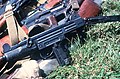 An Uzi seized during Operation Urgent Fury


See also
[edit]- List of equipment of the Israel Defense Forces
- ASMI
- Colt 9mm SMG
- Daewoo Telecom K7 – Submachine gun
- FB PM-63 – Polish submachine gun
- MAC-10 – American machine pistol
- Minebea PM-9 – Japanese machine pistol
- Modern Sub Machine Carbine – Indian submachine gun
- MP7 – German series of submachine guns/personal defence weapons
- PM-84 Glauberyt – Polish submachine gun
- PP-2000
- Ruger MP9 – American submachine gun/machine pistol
- SR-2 Veresk
References
[edit]- ^ "Kiprah Tempur Pasukan Belanda" [Dutch Troops Combat History]. Angkasa Edisi Koleksi No. 82: Kisah Heroik Pertempuran Laut Trikora (in Indonesian). Jakarta: Kompas Gramedia Group. February 2013. pp. 90–91.
- ^ ""Today a New Stage Begins" Che Guevara in Bolivia". Archived from the original on January 28, 2023.
- ^ Fitzsimmons, Scott (November 2012). "Callan's Mercenaries Are Defeated in Northern Angola". Mercenaries in Asymmetric Conflicts. Cambridge University Press. p. 155. doi:10.1017/CBO9781139208727.005. ISBN 9781107026919.
- ^ Sicard, Jacques (November 1982). "Les armes de Kolwezi". La Gazette des armes (in French). No. 111. pp. 25–30. Archived from the original on 2018-10-19. Retrieved 2018-10-18.
- ^ Lee E. Russel (1985). Grenade 1983. p. 39.
- ^ Wille, Christina (May 2005). "Children Associated with Fighting Forces and Small Arms in the Mano River Union". In Florquin, Nicolas; Berman, Eric G. (eds.). Armed and Aimless: Armed Groups, Guns, and Human Security in the ECOWAS Region. Small Arms Survey. p. 198. ISBN 2-8288-0063-6. Archived from the original (PDF) on 2019-01-31. Retrieved 2019-01-30.
- ^ Small Arms Survey (2005). "The Central African Republic: A Case Study of Small Arms and Conflict". Small Arms Survey 2005: Weapons at War. Oxford University Press. p. 318. ISBN 978-0-19-928085-8. Archived from the original (PDF) on 2018-08-30. Retrieved 2018-08-29.
- ^ a b c McNab, Chris (20 Nov 2011). The Uzi Submachine Gun. Osprey Publishing. ISBN 978-1-84908-543-4.
- ^ Small Arms Survey (2015). "Waning Cohesion: The Rise and Fall of the FDLR–FOCA" (PDF). Small Arms Survey 2015: weapons and the world (PDF). Cambridge University Press. p. 201. Archived from the original (PDF) on 2018-01-28. Retrieved 2018-08-29.
- ^ de Tessières, Savannah (April 2012). Enquête nationale sur les armes légères et de petit calibre en Côte d'Ivoire: les défis du contrôle des armes et de la lutte contre la violence armée avant la crise post-électorale (PDF) (Report). Special Report No. 14 (in French). UNDP, Commission Nationale de Lutte contre la Prolifération et la Circulation Illicite des Armes Légères et de Petit Calibre and Small Arms Survey. p. 75. Archived from the original (PDF) on 2018-10-09. Retrieved 2018-08-30.
- ^ a b "Uzi In Ukraine". The Armourers Bench. 14 May 2023.
- ^ a b c d e f g h i j k l Miller, David (2001). The Illustrated Directory of 20th Century Guns. London: Salamander Books. pp. 391–393. ISBN 1-84065-245-4. OCLC 59522369.
- ^ Gaboury, David (3 July 2017). The UZI Submachine Gun Examined. Andrew Mowbray Publishing, Inc. p. 25. ISBN 978-1931464765.
- ^ a b McManners, Hugh (2003). Ultimate Special Forces. New York: DK Publishing. p. 157. ISBN 0-7894-9973-8. OCLC 53221575. Retrieved 6 January 2011.
- ^ "Firearms". The Uzi Official Website. Uzi Brands International. Archived from the original on 6 May 2013. Retrieved 6 January 2011.
- ^ Popenker, Max R. (27 October 2010). "UZI / Mini UZI / Micro UZI submachine gun (Israel)". World Guns: Modern Firearms & Ammunition. Archived from the original on 10 January 2011. Retrieved 6 January 2011.
- ^ a b c d Hackathorn, Ken (1995). "Using the Uzi". Fighting Firearms. 3 (1). Soldier of Fortune: 18–23.
- ^ Mulcahy, Paul. "IMI Uzi". Archived from the original on 20 January 2013. Retrieved 25 November 2012.
- ^ a b Hogg, Ian V. (1979). Guns and How They Work. New York: Everest House. pp. 157–158. ISBN 0-89696-023-4.
- ^ Lewis, Jack; Steele, David E. (2000). The Gun Digest Book of Assault Weapons (5th ed.). Iola, Wis.: Krause Publications. p. 222. ISBN 0-87341-778-X. OCLC 43521989.
- ^ a b c d e f g Dockery, Kevin (2007). Future Weapons. New York: Berkley Caliber. pp. 227–229. ISBN 978-0-425-21750-4.
- ^ Gaboury, David (3 July 2017). The UZI Submachine Gun Examined. Andrew Mowbray Publishing, Inc. p. 234. ISBN 978-1931464765.
- ^ "FAQ". UZI Talk.
- ^ "If a person has a pistol and an attachable shoulder stock, does this constitute possession of an NFA firearm?". Bureau of Alcohol, Tobacco, Firearms and Explosives. April 13, 2020.
- ^ Gaboury, David (3 July 2017). The UZI Submachine Gun Examined. Andrew Mowbray Publishing, Inc. p. 40. ISBN 978-1931464765.
- ^ a b "Israel's army phases out country's iconic Uzi submachine gun". USA Today. Associated Press. 18 December 2003. Archived from the original on 4 February 2012. Retrieved 6 January 2011.
- ^ a b c d e Long, Duncan (1989). Terrifying Three: Uzi, Ingram and Intratec Weapons Families. Boulder, Colo.: Paladin Press. pp. 25–31. ISBN 978-0-87364-523-2. OCLC 21678853.
- ^ a b http://wwww.gunmountain.com/display.article.cfm?idarticles=3884
- ^ a b c https://smallarmsreview.com/weapon-of-service-the-uzi-submachine-gun-in-germany/
- ^ https://armourersbench.com/2023/05/14/uzi-in-ukraine/
- ^ "Uzi 9 mm". La Défense (in French). Ministère de la Défense. 18 April 2013. Archived from the original on 12 March 2017. Retrieved 9 March 2017.
- ^ "Gardaí feel like ‘sitting ducks’ after decision to withdraw Uzi submachine guns" Archived 2016-04-14 at the Wayback Machine, TheJournal.ie, March 23, 2015
- ^ Capt. Kelly Sweeney (October–November 2008). "Mariners need to be able to defend themselves against pirates". Professional Mariner. Archived from the original on 2012-04-01. Retrieved 2011-10-26.
- ^ "IMI Micro-UZI (Israel)". WEAPON.GE. Archived from the original on 2011-07-21. Weapon.GE, retrieved on February 01, 2011.
- ^ "UZI Pro". Israel Weapon Industries (IWI) Ltd. Archived from the original on 24 November 2010. Retrieved 6 January 2011.
- ^ a b Katz, Yaakov (5 December 2011). "New version of legendary Uzi unveiled". JPost.com. Archived from the original on 6 December 2011. Retrieved 6 December 2011.
- ^ "Uzi 2012". Bamahane (in Hebrew). No. 3109. November 25, 2011. p. 13.
- ^ Peterson, Phillip (2010). Gun Digest Buyer's Guide to Tactical Rifles. Iola, WI: Gun Digest Books. pp. 180–181. ISBN 978-1-4402-1446-2.
- ^ "September 2024 Report: 19 Most Expensive Items Sold on GunBroker by Total Dollars | Auction or Fixed-Price". GunBroker. September 2024.
- ^ "Select-Fire (Fully Automatic) conversion information". Archived from the original on 2015-06-20. Retrieved 2019-06-16.
- ^ Fowler, Will; North, Anthony; Stronge, Charles; and Sweeney, Patrick. The Illustrated Encyclopedia of GUNS (New York: Metro Books, 2013), p.242.
- ^ "Kratke strojnice" [Short machine guns] (in Croatian). Republic of Croatia Ministry of Internal Affairs Police Museum.
- ^ "'Killing spree': Myanmar's military is using battle tactics, firing live ammunition on protesters". ABC News. 11 March 2021.
- ^ "Burmese Small Arms Development". 26 August 2009. Archived from the original on 2018-07-15. Retrieved 2018-07-25.
- ^ "Myanmar and Israel develop military". www.burmalibrary.org. Archived from the original on 2018-10-27. Retrieved 2018-07-25.
- ^ a b c d e "以色列血统的缅甸MA-13冲锋枪". Archived from the original on 2018-11-30. Retrieved 2018-08-03.
- ^ a b "缅军最新军演中出现的"海豹"特种部队武器". Archived from the original on 2018-11-30. Retrieved 2018-08-03.
- ^ Asian Military Review - March 2010, Page 15.
- ^ a b http://archive.smallarmsreview.com/display.article.cfm?idarticles=1411
- ^ https://www.atf.gov/resource-center/docs/guide/department-treasury-study-sporting-suitability-modified-semiautomatic/download
- ^ Nguyễn Minh (2020-02-26). "Khám phá vũ khí đặc trưng của quân đội Việt Nam". Tienphong.vn. Archived from the original on April 4, 2023. Retrieved 2022-03-01.
- ^ a b Cutshaw, Charles Q. (2006). Tactical Small Arms Of The 21st Century: A Complete Guide to Small Arms From Around the World. Iola, Wis.: Krause Publications. p. 171. ISBN 087349914X.
- ^ "Automati 9x19mm M97 i M97K (UZI)". 11 August 2019.
- ^ "Underground Military Production In Gaza – Part 1". Silah Report. 2021-03-18. Archived from the original on April 4, 2023. Retrieved 2021-04-20.
- ^ a b c d e f g h i j k l m Bonn International Center for Conversion; Bundeswehr Verification Center. "MP UZI". SALW Guide: Global distribution and visual identification. Archived from the original on 31 August 2018. Retrieved 31 August 2018.
- ^ a b c d e f g h i j k l m n o p q r s t u v w x y z aa ab ac ad ae af ag ah ai aj ak al am an ao ap aq ar as at Jones, Richard D.; Ness, Leland S., eds. (27 January 2009). Jane's Infantry Weapons 2009–2010 (35th ed.). Coulsdon, Surry: Jane's Information Group. p. 117. ISBN 978-0-7106-2869-5. OCLC 268790196.
- ^ "Google Sites". sites.google.com. Archived from the original on 2016-11-24. Retrieved 2017-09-14.
- ^ Small Arms Survey (2007). "Armed Violence in Burundi: Conflict and Post-Conflict Bujumbura" (PDF). The Small Arms Survey 2007: Guns and the City. Cambridge University Press. p. 204. ISBN 978-0-521-88039-8. Archived from the original on 2018-08-27. Retrieved 2018-08-29.
- ^ Forestier, Patrick (18 February 2015). "Contre-offensive - Cameroun et Tchad contre Boko Haram". Paris Match (in French). Archived from the original on 29 August 2018. Retrieved 21 October 2018.
- ^ de Noirmont, Patrick (9 July 1996). "A Cameroonian soldier, armed with an Uzi submachine gun, stands guard outside the Palais des Congres". Reuters. Archived from the original on 22 October 2018. Retrieved 21 October 2018 – via stock.adobe.com.
- ^ a b c d e f Diez, Octavio (2000). Hand Guns (in Arabic). Barcelona: Lema Publications. ISBN 84-8463-013-7. OCLC 44059526. Archived from the original on 2014-09-16. Retrieved 2016-03-06.
- ^ Berman, Eric G. (March 2019). Beyond Blue Helmets: Promoting Weapons and Ammunition Management in Non-UN Peace Operations (PDF). Small Arms Survey/MPOME. p. 43. Archived from the original (PDF) on June 3, 2019.
- ^ "World Infantry Weapons: Sierra Leone". 2013. Archived from the original on 24 November 2016.[self-published source]
- ^ https://www.uzitalk.com/reference/pages/timeline-good.htm
- ^ "IMI Uzi - Submachine gun". ARG. Archived from the original on 2012-05-10. Retrieved 2011-04-27.
It was license-produced in ... Rhodesia (now Zimbabwe).
- ^ Unnithan, Sandeep (August 22, 2008). "If Looks Could Kill". India Today (Online). Archived from the original on February 12, 2010. Retrieved 2009-04-04.
- ^ Meyr, Eitan (6 January 1999). "Special Weapons for Counter-terrorist Units". Jane's — Law Enforcement. Archived from the original on 1 March 2008. Retrieved 2009-09-26.
- ^ "(VIDEO) UZI PRO Sub-Machine Gun Ke Itu???" (in Malay). Defense Security Asia. 4 September 2023.
- ^ "The Evolution of K1/K2 Families in the ROK Military". Small Arms Defense Journal. 9 (5). 2023-02-24. Retrieved 2022-10-11.
- ^ a b c d e f Cadiou, Yves L.; Richard, Alphonse (1977). Modern Firearms. London: Routledge & Kegan Paul. pp. 86–93. ISBN 978-0-7100-8424-8.
- ^ Improvement, Modernization and Development for Special Operation Weapons (Cải tiến, hiện đại hóa, phát triển vũ khí đặc công, in Vietnamese) Archived 2012-03-08 at the Wayback Machine
- ^ "UZI". www.mil.be (in Dutch). Belgische Defensie. Archived from the original on 7 March 2012. Retrieved 7 January 2011.
- ^ "Submachine Gun Type "Ero" cal. 9x19mm > Alan Agency > Product Catalogue". Aalan.hr. Archived from the original on 2009-10-01. Retrieved 2009-10-22.
- ^ "Eesti Kaitsevägi — Tehnika — Püstolkuulipilduja Mini UZI". Mil.ee. Archived from the original on 2009-06-07. Retrieved 2009-06-09.
- ^ "Commuter-belt garda squad to carry new armour-piercing submachine gun". Irish Independent. 30 August 2009. Archived from the original on 5 October 2009. Retrieved 2010-01-31.
- ^ "Garda College Yearbook listing weapons training on page 66" (PDF). Archived from the original (PDF) on 2014-01-24.
- ^ Italian Ministry of Interior - Decree n° 559/A/1/ORG/DIP.GP/14 of March 6, 2009, concerning weapons and equipments in use with the Italian National Police - in Italian Archived July 16, 2011, at the Wayback Machine Retrieved on August 25, 2010.
- ^ "Pistoletas - kulkosvaidis UZI" (in Lithuanian). LR Krašto apsaugos ministerija. 11 December 2009. Archived from the original on 30 November 2010. Retrieved 7 January 2011.
- ^ Unwin, Charles C.; Vanessa U., Mike R., eds. (2002). 20th Century Military Uniforms (2nd ed.). Kent: Grange Books. p. 179. ISBN 1-84013-476-3.
- ^ "PISTOLA METRALHADORA "UZI" 9 MM M/61" (PDF) (in Portuguese). Portuguese Army. Archived from the original (PDF) on 2011-08-09. Retrieved 2011-02-21.
- ^ "Politia Militara". Ministerul Apararii Nationale. Archived from the original on 2016-04-18. Retrieved 2010-02-15.
- ^ "Specijalne-jedinice.com - Bataljon vojne policije specijalne namene "Kobre"". specijalne-jedinice.com. Archived from the original on 2017-02-02. Retrieved 2017-01-25.
- ^ "Uzi sub-machine gun". Archived from the original on 2014-02-26.
- ^ Gonzalez, Servando (2001). The Secret Fidel Castro: Deconstructing the Symbol. Oakland, California: InteliNet/InteliBooks. p. 93. ISBN 0-9711391-1-3.
FN manufactured Uzis were provided in 1960 in an arms shipment aboard 'La Coubre'. An example can be seen in the Military Museum at Valencia, with Cuban markings.
- ^ McCulloch, Jude (2001). Blue Army: Paramilitary Policing in Australia. Carlton South, Vic.: Melbourne University Press. p. 66. ISBN 0-522-84960-1. OCLC 48129650. Retrieved 7 January 2011.
uzi.
- ^ Capie, David (2004). Under the Gun: The Small Arms Challenge in the Pacific. Wellington: Victoria University Press. pp. 70–71. ISBN 978-0864734532.
- ^ "Tongan Navy March". Pacificdocs. 3 November 2009. Archived from the original on 22 December 2014. Retrieved 5 December 2014.
- ^ "Iris, No. 7". Sinn Féin. 1983. Retrieved 22 August 2023.
- ^ "Where did the Adidas Tracksuit Wearing IRA Gunmen Get Their Gear?". 14 September 2020. Retrieved 22 August 2023.
External links
[edit]
- Israel Weapon Industries (IWI): Mini Uzi & Micro Uzi
- Uzi Pro at Modern Firearms
- Uzi History, Reference Material, Parts, Discussion Forum
- Uzi in Parts (in German)
- Video of suppressed Uzi being fired
- Video of operation on YouTube (in Japanese)

Design and Technical Features
Operating Mechanism
The Uzi submachine gun utilizes an open-bolt, blowback-operated mechanism, a design choice that prioritizes simplicity, reliability, and compactness for close-quarters combat. In this system, the bolt remains locked to the rear by a sear when the weapon is ready to fire, leaving the chamber empty and reducing the risk of cook-off from sustained barrel heat compared to closed-bolt designs.[6][7] Upon pulling the trigger, the sear releases the bolt, which is propelled forward by a recoil spring, stripping a 9×19mm Parabellum cartridge from the magazine, chambering it, and igniting the primer via a fixed firing pin integral to the bolt face as it slams closed.[6][8] The blowback operation relies on the inertia of a heavy, telescoping bolt—whose body partially wraps around the fixed barrel to minimize overall weapon length—combined with the recoil spring's tension to counteract chamber pressure without a locked breech.[8] As the fired cartridge's propellant gases propel the bullet down the barrel, the expanding pressure drives the empty case rearward against the bolt face, overcoming the bolt's mass (approximately 1.5 pounds in the standard model) and spring resistance only after the bullet exits, thus delaying extraction until safe pressures are achieved.[9][10] This simple recoil dynamic enables a cyclic rate of fire between 600 and 1,200 rounds per minute, depending on the variant and ammunition, while the bolt's rearward travel cocks the striker mechanism for subsequent shots in full-automatic mode. The simple blowback system, heavy bolt mass, and typical cyclic rate of approximately 600 rounds per minute for the standard model deliver mild, manageable recoil with limited muzzle rise during full-automatic fire, enhancing controllability compared to higher-rate submachine guns like the Micro Uzi or MAC-10.[11][12] Extraction and ejection occur during the bolt's return stroke: the case rim is held by a spring-loaded extractor claw until the ejector—a fixed protrusion on the receiver—strikes it, flinging the spent casing outward through a port on the top cover.[7] The design incorporates a three-position selector (safe, semi-automatic, full-automatic) integrated into the grip safety, which prevents firing unless the weapon is firmly grasped, alongside a manual safety lever to block bolt movement.[13] Later variants, such as the Uzi Pro, shift to closed-bolt operation for improved accuracy in semi-automatic fire, but the original models' open-bolt blowback proved robust in dusty environments due to fewer moving parts exposed to fouling.[14]Ergonomics and Accessories
The Uzi submachine gun features a compact, lightweight design emphasizing simplicity and portability, with its stamped sheet-metal construction weighing approximately 3.5 kg (7.7 lb) when loaded with a 32-round magazine.[15] The ergonomic layout includes an integrated pistol grip formed from the receiver's lower section, promoting a natural hold for close-quarters use, though the open-bolt mechanism and high cyclic rate of 600 rounds per minute contribute to noticeable muzzle climb during sustained fire.[16][17] Safety and control mechanisms consist of three independent features: a fire selector lever on the left side above the pistol grip, which blocks the trigger in the safe position and enables full-automatic fire; a grip safety at the rear of the pistol grip that prevents firing unless fully depressed by the shooter's hand; and a retracting safety ratchet on the bolt to halt unintended movement.[18] The absence of a dedicated semi-automatic mode in early full-auto models simplifies operation but limits precision shooting, while the telescoping bolt—enveloping the barrel—reduces overall length to 445 mm (17.5 in) with the wire folding stock collapsed, enhancing maneuverability in confined spaces at the cost of stability when extended.[19][15] Standard accessories include a fixed iron sight with a protected front post and rear notch adjustable for elevation, a folding metal wire stock for shouldering, and a sling attachment point on the forward handguard.[17] Optional wooden fixed buttstocks were produced for semi-automatic civilian variants to improve cheek weld and reduce felt recoil, while bayonet lugs appeared on some models for melee attachment.[20] Aftermarket additions, such as recoil springs, pistol grips, and bipods from manufacturers like FAB Defense, have been developed for enhanced customization, though compatibility varies with barrel length.[21] Suppressors and optical sights are rarely factory-integrated on original military Uzis due to the fixed-top design but have been adapted post-production for specialized roles.[22]Caliber and Ammunition Adaptations
The Uzi submachine gun was originally designed and produced to fire the 9×19mm Parabellum cartridge, selected for its balance of stopping power, availability, and controllability in full-automatic fire.[1] This caliber supported standard magazine capacities of 20, 25, 32, or 40 rounds, with Israeli Military Industries (IMI) developing specialized loads including high-velocity and +P variants to optimize performance in the weapon's blowback-operated system.[23] Military-issue ammunition emphasized reliability in adverse conditions, such as the jacketed hollow-point or full-metal-jacket types used by the Israel Defense Forces during conflicts like the 1967 Six-Day War.[24] Caliber adaptations emerged primarily for civilian, law enforcement, and export markets, facilitated by conversion kits that replaced the barrel, bolt, and recoil spring to accommodate differing cartridge dimensions and recoil characteristics.[25] The .45 ACP variant, introduced in limited production by IMI and importers like Action Arms in the 1980s, used 12-, 16-, or 22-round magazines and increased the weapon's weight to better manage higher recoil, though it reduced cyclic rate to approximately 600 rounds per minute compared to the 9mm's 650.[25] These kits were not standard for military use but saw adoption in semi-automatic carbine configurations for training and recreational shooting due to the .45's greater muzzle energy.[26] Further adaptations included .22 Long Rifle conversions, marketed by Action Arms starting in the early 1980s for cost-effective plinking and familiarization training, employing drop-in kits with a 10.5-inch barrel and 20- or 40-round magazines modified with slower recoil springs to handle the rimfire cartridge's lower pressure.[27] Priced around $225 for the kit in 1985, these enabled semi-automatic fire at reduced velocities but required careful maintenance to prevent feeding issues from the lighter projectile.[27] The .41 Action Express caliber was briefly offered in the mid-1980s as a high-velocity option for export semi-auto models, using 10-round magazines, though production volumes remained low due to limited ammunition availability.[26] Such modifications preserved the Uzi's telescoping bolt design but necessitated recalibration of the fixed firing pin to ensure safe ignition across calibers.[25] Overall, while 9mm remained dominant for its logistical compatibility, these adaptations extended the platform's versatility without altering core ergonomics.Development and Production History
Origins and Prototyping
The Uzi submachine gun originated in the aftermath of Israel's 1948 War of Independence, when the nascent state faced international arms embargoes that necessitated domestic weapons production. Major Uziel Gal, an officer in the Israel Defense Forces (IDF), began designing a compact, reliable submachine gun in the late 1940s to meet these needs, drawing on blowback-operated principles similar to those in earlier designs like the Czechoslovak ZK 476.[28][15] The first Uzi prototype was completed in 1950 by Gal at Israel Military Industries (IMI), featuring an innovative telescoping bolt that wrapped around the barrel to minimize overall length while maintaining firepower.[29][1] This design allowed for a lightweight, 9mm Parabellum-chambered weapon suitable for close-quarters combat, with the prototype emphasizing simplicity for mass production using limited industrial resources. Early testing focused on reliability in harsh conditions, addressing issues like bolt inertia and feed mechanisms through iterative refinements.[30] Prototyping continued into 1951, culminating in official adoption by the IDF that year, though initial deployment was limited to special forces in 1954. Gal patented the design in 1952, assigning rights to the Ministry of Defense to prioritize military utility over personal gain.[31][29] These prototypes laid the foundation for the Uzi's hallmark traits: open-bolt operation for cooling and safety, and a robust stamped-metal construction that enabled rapid manufacturing.[32]Israeli Adoption and Early Deployment
The Uzi submachine gun was officially adopted by the Israel Defense Forces (IDF) in 1951, after prototypes designed by Major Uziel Gal underwent successful evaluations starting from the late 1940s.[33] Initial production focused on reliability and ease of manufacture, addressing the IDF's need for a domestically produced weapon amid arms embargoes following Israel's independence in 1948.[34] However, widespread distribution was gradual; the weapon was first issued to IDF special forces units in 1954, with full standard-issue status across regular infantry achieved by 1956.[35][4] Early deployment emphasized the Uzi's role in close-quarters and rapid assault operations. Its debut in significant combat occurred during the 1956 Sinai Campaign (Suez Crisis), where Israeli paratroopers from elite units, including predecessors to modern special forces, utilized the Uzi in advances across the Sinai Peninsula against Egyptian positions.[35][36] On October 29, 1956, as Israel launched its offensive mobilizing over 100,000 troops, the Uzi proved effective in the hands of airborne and commando elements, contributing to breakthroughs in fortified areas despite the weapon's relative novelty.[36] This initial wartime exposure validated its design for high-mobility infantry tactics, though early models occasionally exhibited issues like sear wear leading to unintended full-auto fire, which were later refined through field experience.[37] By the late 1950s, the Uzi had solidified its place in IDF doctrine, supplanting older foreign submachine guns like the Sten and MP40 in frontline service. Its compact size and controllability in automatic fire suited Israel's defensive posture and emphasis on versatile, infantryman-carried firepower. Production ramped up at Israel Military Industries (IMI), enabling exports while prioritizing domestic needs, with the weapon appearing in IDF parades and training by the early 1960s.[38][29]Manufacturing Evolution
The Uzi submachine gun entered full-scale production in 1954 at Israel Military Industries (IMI), utilizing stamped sheet metal construction that facilitated low-cost, high-volume manufacturing suitable for equipping the Israel Defense Forces and export markets.[1] This design emphasized simplicity and durability, with the weapon's pressed steel receiver and minimal machined parts enabling rapid assembly lines; by 1982, IMI had produced over 1 million units since initial manufacturing began around 1953.[39] To address surging international demand during the 1960s and 1970s, IMI authorized licensed production abroad, beginning with FN Herstal in Belgium in 1958; FN manufactured Uzis until the early 1970s, primarily for European and export contracts.[40] Subsequent licensees included Rhodesia, where production ran from 1976 to 1980 using locally sourced components after initial Israeli kits, and South Africa's Lyttleton Engineering Works, which assembled Uzis for regional security forces.[30] These arrangements proliferated the design to over 90 countries, though some nations like China produced unlicensed copies via Norinco in the 1980s, diverging from IMI specifications in materials and finishes.[1] Overall, licensed and derivative manufacturing contributed to total Uzi production exceeding 10 million units by the late 20th century.[41] IMI maintained primary oversight of core production techniques, refining quality control and introducing incremental improvements like polymer components in later variants such as the Mini-Uzi (introduced 1982) without altering the fundamental stamped fabrication process.[24] In 2005, Israel's government privatized IMI's small arms division, reestablishing it as Israel Weapon Industries (IWI), which inherited Uzi manufacturing rights and shifted focus toward export-oriented semi-automatic models and modernized iterations like the Uzi Pro pistol while upholding the original's economical stamped construction for global markets.[42][43] This transition marked a evolution from state-directed military output to privately driven commercial production, sustaining the Uzi's legacy amid declining frontline military use.[42]Military and Operational Effectiveness
Combat Performance
The Uzi submachine gun demonstrated strong performance in close-quarters combat during Israeli Defense Forces (IDF) operations, particularly in urban environments and confined spaces where its compact design and high cyclic rate of 600 rounds per minute enabled rapid suppressive fire.[44] In the Six-Day War of 1967 and subsequent conflicts, the weapon proved effective for elite light infantry assault forces, allowing quick maneuvers in built-up areas like Jerusalem and the Sinai Peninsula.[3] Its telescoping bolt and blowback operation contributed to reliability under sustained fire, with reports indicating consistent function despite the simplicity of its stamped metal construction.[45] Empirical accounts from IDF usage highlight the Uzi's suitability for rear-echelon troops, officers, and vehicle crews, where its 9mm Parabellum chambering provided adequate stopping power at short ranges up to 50 meters in automatic mode.[46] The weapon's accuracy extended to 200 yards in semi-automatic fire, supporting defensive positions during ambushes and counterattacks in the Yom Kippur War of 1973.[44] Field tests and operational feedback emphasized its low malfunction rates in dusty conditions, attributing this to the open-bolt design that minimized fouling accumulation.[47] In special forces applications, the Uzi's lightweight profile—approximately 3.5 kg loaded—and pistol-grip magazine integration facilitated rapid target engagement, outperforming bulkier rifles in room-clearing scenarios.[15] Combat logs from IDF engagements noted its role in neutralizing threats at under 100 meters, with the high-volume fire compensating for the 9mm round's moderate penetration against cover.[48] By the 1980s, accumulated data from multiple Middle Eastern conflicts validated its tactical value, though evolving threats prompted gradual phase-out in frontline roles by 2003.[49]Strengths and Reliability
The Uzi submachine gun's primary strengths lie in its mechanical simplicity and rugged construction, utilizing stamped sheet metal components that facilitate low-cost production and ease of field maintenance. This design enables rapid disassembly and cleaning, with users reporting it as one of the simplest firearms to maintain among submachine guns.[6] The open-bolt blowback operation, combined with a cyclic rate of approximately 600 rounds per minute, provides controllable full-automatic fire suitable for close-quarters engagements, while semi-automatic mode extends effective accuracy to around 200 yards.[44] Its compact dimensions—measuring about 18.5 inches with stock extended—and lightweight build (around 7.7 pounds unloaded) make it highly maneuverable in urban or confined spaces, a feature validated through Israeli Defense Forces (IDF) use in conflicts like the 1956 Sinai Campaign and subsequent wars.[50][3] Reliability in operational environments stems from the weapon's tolerance for neglect and abuse, with military evaluations noting its performance in dusty and arid conditions typical of Middle Eastern theaters, though extreme sand exposure could induce occasional malfunctions requiring minimal intervention.[51] The stamped construction and lack of complex parts contribute to its durability, allowing it to function after submersion, burial in sand, or prolonged disuse without significant degradation, as demonstrated in IDF field tests and combat deployments.[52] Over 10 million units produced since the 1950s underscore its logistical robustness, with the design's three internal safety mechanisms—grip safety, manual selector, and bolt hold-open—further enhancing safe handling under stress.[53] Independent reviews affirm its reputation for consistent ignition and minimal stoppages compared to contemporaries, attributing this to the advanced primer ignition system that initiates firing upon bolt closure.[54]Limitations and Criticisms
The Uzi's open-bolt firing mechanism, while enhancing simplicity and reliability in dirty environments, reduces precision compared to closed-bolt designs by introducing bolt mass momentum that shifts the point of impact during recoil.[6] This effect compounds with the weapon's cyclic rate of 600 rounds per minute, causing pronounced muzzle rise and limiting effective aimed fire to short ranges of 50 meters or less in full-automatic mode.[54] Ergonomic drawbacks include a folding metal stock with sharp edges that digs into the shoulder during extended firing sessions, and a pistol grip safety demanding constant thumb pressure, which can induce hand fatigue or accidental release under stress.[54] The external manual safety and selector lever also require two-handed operation for changes, complicating rapid transitions in dynamic scenarios.[54] In Israeli Defense Forces use, operators reported the Uzi as inaccurate and sensitive to malfunctions like misfires, factors cited in its phase-out by the 1990s in favor of assault rifles such as the M16 and later the Tavor.[55] Sustained fire risks cook-off from residual chamber heat in the open-bolt system, potentially leading to uncontrolled bursts after magazine exhaustion.[56] Common mechanical issues encompass top cover misalignment causing feeding failures, extractor wear leading to ejection problems, and occasional bolt face obstructions resulting in failures to fire, though these are mitigable with routine maintenance.[57][56] The 9×19mm Parabellum cartridge further constrains lethality against intermediate barriers or body armor, diminishing viability in modern peer conflicts where personal defense weapons like the 4.6×30mm HK MP7 offer superior penetration.[58] Compared to modern personal defense weapons such as the CZ Scorpion EVO 3, the original Uzi is heavier (approximately 3.7 kg empty versus about 2.4 kg unloaded) and lacks standard accessory rails and ambidextrous controls, reducing modularity and ergonomic adaptability.[59] Broad adoption gave way to replacements in forces like the German Bundeswehr after four decades, reflecting limitations in controllability and adaptability to evolving tactical demands over submachine gun paradigms.[58][60]Variants and Modern Iterations
Full-Size and Carbine Models
The full-size Uzi submachine gun, chambered in 9×19mm Parabellum, operates on a simple blowback mechanism with an open-bolt design, enabling reliable function in adverse conditions.[61] It measures 650 mm in length with the telescoping metal stock extended and 470 mm with the stock collapsed, with a 260 mm barrel.[62] Unloaded weight is 3.5 kg, increasing to approximately 4 kg when loaded with a standard 25- or 32-round box magazine.[62] The cyclic rate of fire is around 600 rounds per minute, with selective fire capability for semi-automatic and full-automatic modes.[14] Key features include a telescoping bolt that houses the recoil spring, reducing the overall profile for concealed carry, and a stamped steel construction for durability and low-cost production.[63] The Uzi's full-size model emphasizes compactness relative to its firepower, with the grip integrated into the receiver and a top-mounted charging handle.[61] Sights consist of a fixed front post and a rear flip aperture adjustable for elevation, effective out to 200 meters though optimized for close-quarters use.[14] Accessories compatibility was limited in early models, but later iterations added provisions for suppressors and optical sights.[64] Production began at Israel Military Industries in the mid-1950s, with the design prioritizing simplicity—fewer than 50 parts total—facilitating field maintenance and mass manufacture.[1] The Uzi carbine variant adapts the full-size design for semi-automatic civilian and law enforcement use, particularly in markets like the United States, featuring a longer 16.1-inch barrel to meet rifle-length requirements under the National Firearms Act.[65] Imported by Action Arms from Israel Military Industries, the Model A carbine entered the U.S. market in 1980 and was produced until 1983, followed by the Model B from 1983 to 1989, which incorporated a slotted bolt for compliance with import restrictions and improved rear sights.[66] These carbines retained the open-bolt operation initially but shifted to closed-bolt in some configurations for enhanced accuracy, with wooden or polymer stocks replacing the folding metal one for better shouldering.[66] Overall length extended to about 780 mm, increasing weight to around 3.2 kg unloaded, while maintaining compatibility with standard Uzi magazines.[67] Carbine models prioritized controllability and velocity over the SMG's portability, achieving higher muzzle velocities of approximately 370 m/s compared to the SMG's 340 m/s, though at the cost of added bulk unsuitable for vehicle crews or paratroopers.[1] Post-1989 U.S. import bans shifted production to domestic assemblers using imported parts kits, leading to variants like those from Group Industries, but original IMI carbines remain valued for their robust construction and fidelity to Gal's design.[65] Modern equivalents from Israel Weapon Industries focus on pistol-caliber carbines with Picatinny rails, but full-size carbine production has largely ceased in favor of compact SMG derivatives.[64]Compact and Pistol Variants
The Mini Uzi, introduced by Israel Military Industries (IMI) in 1980, serves as the primary compact variant of the Uzi family, designed for enhanced maneuverability in confined spaces such as urban environments and vehicle operations.[68] This blowback-operated submachine gun features a shorter barrel and side-folding stock compared to the standard model, reducing overall length to 588 mm extended or 360 mm folded, with an empty weight of 2.65 kg.[68] It fires 9×19mm Parabellum cartridges at a cyclic rate of 950–1,100 rounds per minute, depending on open- or closed-bolt configuration, and accepts 20-, 25-, or 32-round magazines.[68] Effective range extends to 150 meters, with muzzle velocity around 380 m/s.[68] Adopted by special operations units, law enforcement, and VIP protection details worldwide, including the Israeli Sayeret and U.S. Secret Service, the Mini Uzi prioritizes portability without sacrificing the core telescoping bolt mechanism's reliability.[59] The Micro Uzi, developed in the early 1980s and entering service in 1986, further miniaturizes the design into a pistol-caliber carbine suitable for concealed carry by security personnel and commando forces.[69] Measuring 504 mm extended or 282 mm folded, with a 134 mm barrel and 1.95 kg empty weight, it maintains 9×19mm chambering and compatibility with Uzi magazines, but achieves a higher rate of fire at 1,200 rounds per minute due to its lighter bolt assembly, sometimes augmented by a tungsten weight for control.[69] Muzzle velocity is approximately 350 m/s.[69] Primarily a closed-bolt, full-automatic weapon, the Micro Uzi emphasizes rapid deployment in close-quarters scenarios, though its compact size increases muzzle climb and reduces practical accuracy beyond short ranges.[59] A semi-automatic civilian derivative, the Uzi Pistol, emerged around 1984 from the Micro Uzi platform to meet commercial demands, particularly in the U.S. market, lacking a stock and limited to single-shot fire for regulatory compliance.[69] Imported today by IWI US, it retains the compact profile for self-defense and sporting purposes but omits select-fire capability.[1]| Variant | Length Extended/Folded (mm) | Barrel Length (mm) | Weight Empty (kg) | Rate of Fire (rpm) |
|---|---|---|---|---|
| Mini Uzi | 588 / 360 | 197 | 2.65 | 950–1,100 |
| Micro Uzi | 504 / 282 | 134 | 1.95 | 1,200 |
Recent Developments
In the 2010s, Israel Weapon Industries (IWI) introduced the Uzi Pro series, a redesigned iteration of the original Uzi incorporating modern enhancements derived from Israeli special forces operational feedback.[64] This line maintains the blowback-operated, open-bolt mechanism but features a lighter polymer frame, integrated Picatinny rails for optics and accessories, threaded barrels for suppressor compatibility, and improved ergonomics including adjustable iron sights and a grip safety.[70] Configurations include full-auto submachine gun variants for military use, semi-automatic carbines, and compact pistols, with the SMG model emphasizing concealability and reduced weight compared to predecessors.[71] The Uzi Pro pistol, chambered in 9x19mm Parabellum, measures approximately 9.5 inches in length and weighs 3.66 pounds unloaded, prioritizing personal defense weapon roles with options for stabilizing braces in civilian markets.[72] Carbine variants extend barrel length for enhanced velocity while retaining modular rails, appealing to law enforcement and collectors seeking updated legacy designs.[73] By 2023, user modifications such as aftermarket braces and optics adaptations gained traction among enthusiasts, reflecting sustained interest despite competition from newer platforms like the MP5 or B&T APC9.[74] As of 2024, certain Uzi Pro pistol models entered discontinuation in some markets, shifting focus toward carbine and SMG exports, though semi-automatic versions remain available for civilian purchase where regulations permit.[75] These developments underscore IWI's strategy to modernize the Uzi for niche tactical applications, balancing historical reliability with contemporary accessory integration, amid broader military transitions away from submachine guns in favor of assault rifles.[76]Proliferation and International Copies
Licensed Productions
The Uzi submachine gun was manufactured under official license by a limited number of foreign entities, primarily to support military needs of allied or adopting nations while adhering to Israeli export controls from Israel Military Industries (IMI). These agreements facilitated local production to reduce dependency on imports and enable customization, though output volumes were generally smaller than Israeli production. Licensed variants typically retained core design features, such as the telescoping bolt and blowback operation, with minor adaptations for local materials or calibers in some cases.[34] FN Herstal in Belgium held one of the earliest licenses, commencing production in 1958 and continuing into the early 1970s, producing full-size Uzis for Belgian and export markets. These Belgian-made Uzis were marked with FN stamps and supplied to NATO allies, including West Germany (designated MP2), emphasizing reliability in European climates. Production emphasized precision machining, with estimates of several thousand units fabricated before the license expired amid shifting arms priorities.[40] In Rhodesia, licensed assembly began in 1976 under the RH-ALAN designation, initially using Israeli-supplied components before transitioning to locally sourced parts due to international sanctions. Output continued until the government's fall in 1980, yielding hundreds of units for Rhodesian Security Forces during the Bush War, with adaptations for rugged field use including simplified suppressors. This production highlighted the Uzi's adaptability in isolated manufacturing environments.[77] South Africa's ARMSCOR (later under Vektor Arms and Denel Land Systems) produced the Uzi under license as the S1 carbine variant, primarily from the 1970s through the 1980s to equip South African Defence Force units during the Border War. These locally made weapons incorporated South African steel and polymers for cost efficiency, with production focused on 9mm Parabellum chambering and export restrictions under apartheid-era embargoes limiting scale to domestic needs.[77][78]| Licensee | Country | Production Period | Key Details |
|---|---|---|---|
| FN Herstal | Belgium | 1958–early 1970s | Full Uzi SMG; exported to NATO users; precision-focused builds.[40] |
| RH-ALAN | Rhodesia | 1976–1980 | Assembly from kits to full local parts; wartime adaptation.[77] |
| ARMSCOR/Vektor | South Africa | 1970s–1980s | S1 carbine; embargo-driven self-sufficiency.[77] |
Unauthorized Clones and Derivatives
The simplicity of the Uzi's blowback-operated, sheet-metal construction facilitated unauthorized replication by state and non-state actors seeking affordable small arms without incurring licensing fees from Israel Military Industries (IMI). These clones often featured local modifications for material availability or ergonomics but typically suffered from inferior metallurgy, inconsistent quality control, and reliability issues compared to originals, leading to higher malfunction rates in adverse conditions.[1] Production occurred primarily in developing nations amid conflicts or arms embargoes, contributing to proliferation in regions with limited access to licensed imports. In China, Norinco manufactured unlicensed copies of the Uzi carbine during the 1980s, followed by the Model 320 variant in the mid-1990s, which incorporated a wooden stock for enhanced stability. These replicas closely mimicked the Uzi's telescoping bolt and open-bolt firing mechanism but were barred from U.S. importation due to intellectual property violations and trade restrictions.[1][28] Croatia's Končar-Arma d.o.o. (also known as Arma Grupa) produced the ERO submachine gun in 1992 amid the Yugoslav Wars, creating a near-exact, parts-interchangeable duplicate of the full-size Uzi chambered in 9×19mm Parabellum. The ERO retained the original's 600-700 rounds-per-minute cyclic rate and 25- or 32-round magazines, with subsequent Mini-ERO variants blending Uzi and Micro-Uzi elements for compactness. Approximately 5,000-10,000 units were made for Croatian forces, though production quality varied due to wartime resource constraints.[79][80] Myanmar's military-industrial complex developed the BA-93 and BA-94 submachine guns post-1991, direct unlicensed derivatives of the Uzi featuring wooden stocks reminiscent of early models and firing 9×19mm ammunition at similar rates. These weapons, produced domestically after an Israeli delegation's visit introduced technical knowledge, have been documented in use by Myanmar security forces, including against protesters in 2021, highlighting their role in internal suppression despite accuracy limitations at ranges beyond 50 meters.[81][82] Cottage industries in regions like Pakistan's Khyber Pass have yielded rudimentary Uzi-inspired firearms, handcrafted from scavenged parts for local militias, though these often exhibit crude welding and frequent jams, underscoring the design's adaptability at the cost of safety and durability.[83] Such unauthorized derivatives evaded IMI oversight, exacerbating global small arms diffusion without royalties or quality assurances.[1]Notable Non-State Adaptations
The Carlo submachine gun represents a prominent example of non-state adaptation of compact submachine gun designs akin to the Uzi, produced in small-scale workshops by Palestinian militant groups in the West Bank and Gaza Strip. These improvised firearms, chambered in 9×19mm Parabellum, feature a basic blowback-operated mechanism, tubular construction, and pistol-grip magazine well, enabling production with rudimentary machining tools amid restrictions on imported weaponry. Employed by organizations such as Hamas's Izz ad-Din al-Qassam Brigades and Palestinian Islamic Jihad's Al-Quds Brigades, as well as unaffiliated attackers, the Carlo circumvents smuggling challenges through local fabrication, though its inconsistent quality often leads to jamming or premature failure during sustained fire.[84][85] First documented in attacks around 2015, Carlos have been seized in raids on underground metal shops and used in drive-by shootings and stabbing assaults targeting Israeli civilians and security forces, including a September 2025 incident at Jerusalem's Ramot Junction where attackers fired on a bus stop, killing four. Their low cost—estimated under $1,000 per unit—and concealability make them suitable for "lone wolf" operations, though Israeli security assessments highlight vulnerabilities like poor accuracy beyond 50 meters due to handmade barrels and sights. Production persists despite IDF efforts to dismantle workshops, with components sometimes sourced from scavenged industrial scrap or black-market parts.[86][87] Beyond the Palestinian territories, non-state actors have occasionally produced crude Uzi replicas, such as a homemade full-auto variant seized in the United Kingdom in 2018, featuring welded tubing and a copied open-bolt system but lacking the original's telescoping bolt for reliability. These efforts underscore the Uzi's simple blueprint enabling replication by groups with limited technical expertise, though such adaptations rarely match factory performance and are prone to catastrophic malfunctions. In contrast, groups like the Provisional Irish Republican Army during the Troubles (1969–1998) primarily utilized smuggled authentic Uzis without significant local modifications, valuing their compactness for urban hits but relying on external supply chains rather than domestic production.[88][89]Users and Global Distribution
State Military and Law Enforcement Users
The Uzi submachine gun entered service with the Israel Defense Forces in 1954 as a primary personal defense weapon, remaining in widespread use through multiple conflicts until its replacement by more modern designs in the early 2000s.[90] Its compact design and reliability in close-quarters combat contributed to its adoption by armed forces and law enforcement agencies across over 90 countries, particularly in Europe, Africa, and South America, where it persists in service among many non-Western militaries.[90] Notable military adoptions include the Royal Netherlands Army in 1956, the German Bundeswehr in 1959 under the designation MP2 for tank crews and military police units until approximately 2001, and licensed production in Belgium by FN Herstal from 1958 to 1971 for local forces.[29][91] Other countries incorporating the Uzi into their armed forces encompass Japan, Peru, Brazil, and South Africa, often through licensed manufacturing to meet domestic needs.[92] In the United States, U.S. Navy SEAL teams and Army Special Forces employed the Uzi for special operations, valuing its concealability and firepower.[93]| Country | Adoption Details |
|---|---|
| Israel | IDF standard issue from 1954; phased out early 2000s[90] |
| Netherlands | Royal Army issuance starting 1956[29] |
| Germany | Bundeswehr MP2 from 1959; used by tank crews and MP until ~2001[91] |
| Belgium | Armed forces via FN production 1958-1971[90] |
| United States | Special operations forces including SEALs and Special Forces[93] |
| Brazil | Armed forces adoption with licensed production[92] |