



Community hub
Recent from talks
Contribute something
Nothing was collected or created yet.
Asterisk
View on Wikipedia| * | |
|---|---|
Asterisk | |
| In Unicode | U+002A * ASTERISK (*, *) |
| Related | |
| See also | U+203B ※ REFERENCE MARK (komejirushi) U+A673 ꙳ SLAVONIC ASTERISK |

The asterisk (/ˈæstərɪsk/ *), from Late Latin asteriscus, from Ancient Greek ἀστερίσκος, asteriskos, "little star",[1][2] is a typographical symbol. It is so called because it resembles a conventional image of a heraldic star.
Computer scientists and mathematicians often vocalize it as star (as, for example, in the A* search algorithm or C*-algebra). An asterisk is usually five- or six-pointed in print and six- or eight-pointed when handwritten, though more complex forms exist. Its most common use is to call out a footnote. It is also often used to censor offensive words.
In computer science, the asterisk is commonly used as a wildcard character, or to denote pointers, repetition, or multiplication.
History
[edit]


The asterisk was already in use as a symbol in ice age cave paintings.[4] There is also a two-thousand-year-old character used by Aristarchus of Samothrace called the asteriskos, ※, which he used when proofreading Homeric poetry to mark lines that were duplicated.[5] Origen is known to have also used the asteriskos to mark missing Hebrew lines from his Hexapla.[6] The asterisk evolved in shape over time, but its meaning as a symbol used to correct defects remained.
In the Middle Ages, the asterisk was used to emphasize a particular part of text, often linking those parts of the text to a marginal comment.[7] However, an asterisk was not always used.
One hypothesis to the origin of the asterisk is that it stems from the 5000-year-old Sumerian character dingir, 𒀭,[8] though this hypothesis seems to only be based on visual appearance.[9]
Usage
[edit]Censorship
[edit]When toning down expletives, asterisks are often used to replace letters. For example, the word "badword" might become "ba***rd", "b*****d", "b******" or even "*******".[10] Vowels tend to be censored with an asterisk more than consonants, but the intelligibility of censored profanities with multiple syllables such as "b*dw*rd" and "b*****d" or "ba****d", or uncommon ones is higher if put in context with surrounding text.[11]
When a document containing classified information is published, the document may be "sanitized" (redacted) by replacing the classified information with asterisks. For example, the Intelligence and Security Committee Russia report.
Competitive sports and games
[edit]In colloquial usage, an asterisk attached to a sporting record indicates that it is somehow tainted. This is because results that have been considered dubious or set aside are recorded in the record books with an asterisk rendering to a footnote explaining the reason or reasons for concern.[12]
Baseball
[edit]The usage of the term in sports arose during the 1961 baseball season in which Roger Maris of the New York Yankees was threatening to break Babe Ruth's 34-year-old single-season home run record. Ruth had amassed 60 home runs in a season with only 154 games, but Maris was playing the first season in the American League's newly expanded 162-game season. Baseball Commissioner Ford C. Frick, a friend of Ruth's during the legendary slugger's lifetime, held a press conference to announce his "ruling" that should Maris take longer than 154 games both records would be acknowledged by Major League Baseball, but that some "distinctive mark" [his term][13] be placed next to Maris', which should be listed alongside Ruth's achievement in the "record books". The asterisk as such a mark was suggested at that time by New York Daily News sportswriter Dick Young, not Frick.[13] The reality, however, was that MLB actually had no direct control over any record books until many years later, and it all was merely a suggestion on Frick's part. Within a few years the controversy died down and all prominent baseball record keepers listed Maris as the single-season record holder for as long as he held the record.[13]
Nevertheless, the stigma of holding a tainted record remained with Maris for many years, and the concept of a real or figurative asterisk denoting less-than-accepted "official" records has become widely used in sports and other competitive endeavors. A 2001 TV movie about Maris's record-breaking season was called 61* (pronounced sixty-one asterisk) in reference to the controversy.
Uproar over the integrity of baseball records and whether or not qualifications should be added to them arose again in the late 1990s, when a steroid-fueled power explosion led to the shattering of Maris' record. Even though it was obvious - and later admitted[14] - by Mark McGwire that he was heavily on steroids when he hit 70 home runs in 1998, ruling authorities did nothing - to the annoyance of many fans and sportswriters. Three years later self-confessed steroid-user Barry Bonds pushed that record out to 73, and fans once again began to call for an asterisk in the sport's record books.
Fans were especially critical and clamored louder for baseball to act during the 2007 season, as Bonds approached and later broke Hank Aaron's career home run record of 755.[15]
The Houston Astros' 2017 World Series win was marred after an investigation by MLB revealed the team's involvement in a sign-stealing scheme during that season. Fans, appalled by what they perceived to be overly lenient discipline against the Astros players, nicknamed the team the "Houston Asterisks".[16]
In recent years, the asterisk has come into use on baseball scorecards to denote a "great defensive play."[17]
Usage in anti-doping campaigns
[edit]- By the end of the first decade of the 21st century, the association of baseball and its records with doping had become so notorious that the term "asterisk" had become firmly associated with doping in sport. In February 2011 the United States Olympic Committee and the Ad Council launched an anti-steroid campaign called "Play Asterisk Free"[18] aimed at teens. The campaign, whose logo uses a heavy asterisk (✱), first launched in 2008 under the name "Don't Be An Asterisk".[19]
Cricket
[edit]- In cricket, it signifies a total number of runs scored by a batsman without losing their wicket; e.g. "107*" means "107 not out".
- Where only the scores of the two batsmen that are currently in are being shown, an asterisk following a batsman's score indicates that he is due to face the next ball to be delivered.
- When written before a player's name on a scorecard, it indicates the captain of the team.
- It is also used on television when giving a career statistic during a match. For example, "47*" in a number of matches column means that the current game is the player's 47th.
Other sports
[edit]During the first decades of the 21st century, the term asterisk to denote a tainted accomplishment[citation needed] caught on in other sports first in North America and then, due in part to North American sports' widespread media exposure, around the world.
Computing
[edit]- In regular expressions, the asterisk is used to denote zero or more repetitions of a pattern; this use is also known as the Kleene star or Kleene closure after Stephen Kleene.
- In Unified Modeling Language, the asterisk is used to denote zero to many classes.
- In some command line interfaces, such as the Unix shell and Microsoft's CMD, the asterisk is the wildcard character (or wildcard symbol) and stands for any string of characters. A common use of the wildcard is in searching for files on a computer. For instance, if a user wished to find a document called
Document 1, search terms such asDoc*andD*ment*would return this file. Due to being a wildcard, they could also return files likeDocument 2and (only the latter)Dark Knight Monument.jpg.Document*would in fact return any file that begins withDocument, andD*ment*any file that began with D and had 'ment' somewhere in its name. - In some graphical user interfaces, an asterisk is pre- or affixed to the current working document name shown in a window's title bar to indicate that unsaved changes exist.
- In many computing and Internet applications, an asterisk is displayed in place of the characters of sensitive or confidential visible information, such as a password.
- In Commodore (and related) file systems, an asterisk appearing next to a filename in a directory listing denotes an improperly closed file, commonly called a "splat file".
- In travel industry Global Distribution Systems, the asterisk is the display command to retrieve all or part of a Passenger Name Record.
- In HTML web forms, a (usually red) asterisk can be used to denote required fields.
- Chat room etiquette calls on one asterisk to correct a misspelled word or typo that has already been submitted. For example, one could post
lck, then follow it with*luckorluck*(the placement of the * on the left or right is a matter of personal style) to correct the word's spelling, or if it's someone else that notices the mistake, they might also use*luckorluck*.[20] This also applies to typos that result in a different word from the intended one but are correctly spelled. - In comics, enclosing a word or phrase between two asterisks is used to denote an action the subject is "performing", e.g.
*cough*.[21][better source needed] - In Markdown and other markup languages, surrounding a set of characters or words in one asterisk italicizes, two asterisks bolds, and three asterisks both italicizes and bolds.[22] See the table below for examples of all three uses of the asterisk in Markdown, including how it translates to HTML and how it renders.
| Markdown | Italicized text is the *cat's meow*.
|
I just love **bold text**.
|
This text is ***really important***.
|
|---|---|---|---|
| HTML | Italicized text is the <em>cat's meow</em>.
|
I just love <strong>bold text</strong>.
|
This text is <em><strong>really important</strong></em>.
|
| Rendered Output | Italicized text is the cat's meow. | I just love bold text. | This text is really important. |
Adding machines and printing calculators
[edit]- Some models of adding machines and printing calculators use the asterisk to denote the total, or the terminal sum or difference of an addition or subtraction sequence, respectively. The symbol is sometimes given on the printout to indicate this total.[citation needed]
Programming languages
[edit]Many programming languages and calculators use the asterisk as a symbol for multiplication. It also has a number of special meanings in specific languages, for instance:
- In some languages such as C, C++, Rust and Go, the asterisk is used to dereference or declare a pointer variable.
- In Common Lisp, the names of global variables are conventionally set off with asterisks,
*LIKE-THIS*. - In Ada, Fortran, Perl, Python, Ruby, some dialects of Pascal, and many others, a double asterisk is used to signify exponentiation:
5**3is 53 = 125. - In Perl, the asterisk is used to refer to the typeglob of all variables with a given name.
- In Ruby and Python, the asterisk has two specific uses. First, the unary * operator applied to a list object inside a function call will expand that list into the positional arguments of the function call. Second, a parameter preceded by * in the parameter list in a function definition will result in any extra positional parameters being aggregated into a tuple (Python) or array (Ruby), and likewise a parameter preceded by ** will result in any extra keyword parameters being aggregated into a dictionary (Python) or hash (Ruby):
from typing import Any

def function1(a: int, b: int, c: int, d: int) -> None:
    print(a, b, c, d)

def function2(first: int, *args: tuple[int, ...]) -> None:
    # args will be a tuple
    # the name 'args' is convention: it may be any parameter name
    print(args)

def function3(first: int, **kwargs: dict[str, Any]) -> None:
    # kwargs will be a dict
    # the name 'kwargs' is convention: it may be any parameter name
    print(kwargs)

function1(1, 2, 3, 4) # prints 1 2 3 4
function1(*[1, 2, 3, 4]) # prints 1 2 3 4
function1(**{"a": 5, "b": 6, "c": 7, "d": 8}) # prints 5 6 7 8

function2(1, 2, 3, 4) # prints (2, 3, 4), 1 is not part of args
function2(99) # prints (), unfilled *parameter will be ()

function3(0, e = 3, f = 9) # prints {'e': 3, 'f': 9}, 0 is not part of kwargs
function3(0) # prints {}, unfilled **parameter will be {}
- In APL, the asterisk represents the exponential and exponentiation functions, with
*Xrepresenting eX, andY*Xrepresenting YX. - In IBM Job Control Language, the asterisk has various functions, including in-stream data in the DD statement, the default print stream as
SYSOUT=*, and as a self-reference in place of a procedure step name to refer to the same procedure step where it appears. - In Haskell, the asterisk represents the set of well-formed, fully applied types; that is, a 0-ary kind of types.
Comments in programming languages
[edit]In the B programming language and languages that borrow syntax from it, such as C, PHP, Java, or C#, comments in the source code (for information to people, ignored by the compiler) are marked by an asterisk combined with the slash:
 /* This section displays message if user input was not valid
    (comment ignored by compiler) */
CSS also uses this comment format:
body {
  /* This ought to make the text more readable for far-sighted people */
  font-size: 24pt;
}
Some Pascal-like programming languages, such as Object Pascal, Modula-2, Modula-3, and Oberon, and other languages such as ML, Wolfram Language (Mathematica), AppleScript, OCaml, Standard ML, and Maple, use an asterisk combined with a parenthesis:
 (* Do not change this variable - it is used later
    (comment ignored by compiler) *)
Each computing language has its own way of handling comments; /* ... */ and similar notations are not universal.
History of information technology
[edit]The asterisk was a supported symbol on the IBM 026 Keypunch (introduced in 1949 and used to create punch cards with data for early computer systems).[23] It was also included in the FIELDATA character encoding[24] and the ASCII standard.[25][26][27]
Economics
[edit]- In economics, the use of an asterisk superscript indicates that the variable such as price, output, or employment is at its optimal level (that which is achieved in a perfect market situation). For instance, is the price level when output is at its corresponding optimal level of .
- Also in international economics asterisks are commonly used to denote economic variables in a foreign country. So, for example, is the price of the home good and is the price of the foreign good, etc.


Education
[edit]- In the A-Level examinations in the United Kingdom and the PSLE in Singapore, A* ("A-star") is a special top grade that is distinguished from grade A.
- In the Hong Kong Diploma of Secondary Education (HKDSE) examination in Hong Kong, 5** (5-star-star) and 5* (5-star) are two special top grades that are distinguished from Level 5. Level 5** is the highest level a candidate can attain in HKDSE.
Fluid mechanics
[edit]In fluid mechanics an asterisk in superscript is sometimes used to mean a property at sonic speed.[28]
Games
[edit]- Certain categories of character types in role-playing games are called splats, and the game supplements describing them are called splatbooks. This usage originated with the shorthand "*book" for this type of supplement to various World of Darkness games, such as Clanbook: Ventrue (for Vampire: The Masquerade) or Tribebook: Black Furies (for Werewolf: The Apocalypse), and this usage has spread to other games with similar character-type supplements. For example, Dungeons & Dragons Third Edition has had several lines of splatbooks: the "X & Y" series including Sword & Fist and Tome & Blood prior to the "3.5" revision, the "Complete X" series including Complete Warrior and Complete Divine, and the "Races of X" series including Races of Stone and Races of the Wild.
- In Magic: The Gathering, an asterisk is used on a creature's power and/or toughness when it's a variable amount.
- In many MUDs and MOOs, as well as "male", "female", and other more esoteric genders, there is a gender called "splat", which uses an asterisk to replace the letters that differ in standard English gender pronouns. For example, h* is used rather than him or her. Also, asterisks are used to signify doing an action, for example, "*action*".
- Game show producer Mark Goodson used a six-pointed asterisk as his trademark. It is featured prominently on many set pieces from The Price Is Right.
- Scrabble players put an asterisk after a word to indicate that an illegal play was made.[29]
Human genetics
[edit]- In human genetics, * is used to denote that someone is a member of a haplogroup and not any of its subclades (see * (haplogroup)).
Linguistics
[edit]In linguistics, an asterisk may be used for a range of purposes depending on what is being discussed. The symbol is used to indicate reconstructed words of proto-languages (for which there are no records). For modern languages, it may be placed before posited problematic word forms, phrases or sentences to flag that they are hypothetical, ungrammatical, unpronounceable, etc.
Historical linguist August Schleicher is cited as first using the asterisk for linguistic purposes, specifically for unattested forms that are linguistic reconstructions.[30]: 208
Using the asterisk for descriptive and not just historical purposes arose in the 20th century.[31]: 334 By analogy with its use in historical linguistics, the asterisk was variously prepended to "hypothetical" or "unattested" elements in modern language.[31]: 332 Its usage also expanded to include "non-existent" or "impossible" forms. Leonard Bloomfield (1933) uses the asterisk with forms such as *cran, impossible to occur in isolation: cran- only occurs within the compound cranberry.[32]: 160 [31]: 331 Such usage for a "non-existent form" was also found in French, German and Italian works in the middle of the 20th century.[31]: 332–34
Asterisk usage in linguistics later came to include not just impossible forms, but "ungrammatical sentences", those that are "ill formed for the native speaker".[31]: 332 The expansion of asterisk usage to entire sentences is often credited to Noam Chomsky, but Chomsky in 1968 already describes this usage as "conventional".[31]: 330 Linguist Fred Householder claims some credit,[33]: 365 [31]: 331 but Giorgio Graffi argues that using an asterisk for this purpose predates his works.[31]: 336 [a]
The meaning of the asterisk usage in specific linguistic works may go unelucidated so can be unclear.[33]: 369 [b] Linguistics sometimes uses double asterisks (**), another symbol such as the question mark, or both symbols (e.g. ?*) to indicate degrees of unacceptability.[33]: 369
Historical linguistics
[edit]In historical linguistics, the asterisk marks words or phrases that are not directly recorded in texts or other media, and that are therefore reconstructed on the basis of other linguistic material by the comparative method.[34]
In the following example, the Proto-Germanic word *ainlif is a reconstructed form.
- *ainlif → endleofan → eleven
A double asterisk (**) sometimes indicates an intermediary or proximate reconstructed form (e.g. a single asterisk for reconstructed thirteenth century Chinese and a double asterisk for reconstructions of older Ancient Chinese[35]: 5 or a double asterisk for proto-Popolocan and a single asterisk for intermediary forms[36]: 322 ).
In other cases, the double asterisk denotes a form that would be expected according to a rule, but is not actually found. That is, it indicates a reconstructed form that is not found or used, and in place of which another form is found in actual usage:
- For the plural, **kubar would be expected, but separate masculine plural akābir أكابر and feminine plural kubrayāt كبريات are found as irregular forms.
Ungrammaticality
[edit]In most areas of linguistics, but especially in syntax, an asterisk in front of a word or phrase indicates that the word or phrase is not used because it is ungrammatical.[31]: 332
- wake her up / *wake up her
An asterisk before a parenthesis indicates that the lack of the word or phrase inside is ungrammatical, while an asterisk after the opening bracket of the parenthesis indicates that the existence of the word or phrase inside is ungrammatical—e.g., the following indicates "go the station" would be ungrammatical:
- go *(to) the station
Use of an asterisk to denote forms or sentences that are ungrammatical is often complemented by the use of the question mark (?) to indicate a word, phrase or sentence that is avoided, questionable or strange, but not necessarily outright ungrammatical.[c]
Other sources go further and use several symbols (e.g. the asterisk, question mark, and degree symbol °) to indicate gradations or a continuum of acceptability.[d]
Ambiguity
[edit]Since a word marked with an asterisk could mean either "unattested" or "impossible", it is important in some contexts to distinguish these meanings. In general, authors retain asterisks for "unattested", and prefix x, **, †, or ? for the latter meaning.[e] An alternative is to append the asterisk (or another symbol, possibly to differentiate between even more cases) at the end.[citation needed]
Optimality theory
[edit]In optimality theory, asterisks are used as "violation marks" in tableau cells to denote a violation of a constraint by an output form.[42]
Phonetic transcription
[edit]In phonetic transcription using the International Phonetic Alphabet and similar systems, an asterisk was historically used to denote that the word it preceded was a proper noun.[43][44] See this example from W. Perrett's 1921 transcription of Gottfried Keller's Das Fähnlein der sieben Aufrechten:[45]
- ˈkɑinə ˈreːdə, virt ˈniçts daˈraˑus! zɑːktə *ˈheːdigər ˈkurts.
- (»Keine Rede, wird nichts daraus!« sagte Hediger kurz.)
This convention is no longer usual.[46]
Mathematics
[edit]The asterisk has many uses in mathematics. The following list highlights some common uses and is not exhaustive.
- stand-alone
- An arbitrary point in some set. Seen, for example, when computing Riemann sums or when contracting a simply connected group to the singleton set .

- as a unary operator, denoted in prefix notation
- The Hodge star operator on vector spaces .

- as a unary operator, written as a subscript
- The pushforward (differential) of a smooth map between two smooth manifolds, denoted .
- And more generally the application of any covariant functor, where no doubt exists over which functor is meant.


- as a unary operator, written as a superscript
- The complex conjugate of a complex number (the more common notation is ).[47]
- The conjugate in a composition algebra
- The conjugate transpose, Hermitian transpose, or adjoint matrix of a matrix.
- Hermitian adjoint.
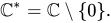
- The multiplicative group of the units of a ring; when the ring is a field, this is the group of all nonzero elements. For example,
- The dual space of a vector space , denoted .
- The combination of an indexed collection of objects into one example, e.g. the combination of all the cohomology groups into the cohomology ring .
- The reflexive transitive closure of a binary relation.
- In statistics, and are given critical points for -distributions and -distributions, respectively.



- as a binary operator, in infix notation
- A notation for an arbitrary binary operator.
- The free product of two groups.
- is a convolution of with .
- A notation for the horizontal composition of two natural transformations.
- A notation to denote a parallel sum of two operands (most authors, however, instead use a or sign for this purpose).


The asterisk is used in all branches of mathematics to designate a correspondence between two quantities denoted by the same letter – one with the asterisk and one without.
Mathematical typography
[edit]In fine mathematical typography, the Unicode character U+2217 ∗ ASTERISK OPERATOR (in HTML, ∗; not to be confused with U+204E ⁎ LOW ASTERISK) is available. This character also appeared in the position of the regular asterisk in the PostScript symbol character set in the Symbol font included with Windows and Macintosh operating systems and with many printers.[citation needed] It should be used for a large asterisk that lines up with the other mathematical operators, sitting on the math centerline rather than on the text baseline.[48]
Music
[edit]- In musical notation the sign
 (U+1D1AF 𝆯 MUSICAL SYMBOL PEDAL UP MARK) indicates when the sustain pedal of the piano should be lifted.
 - In liturgical music, an asterisk is often used to denote a deliberate pause.

Religious texts
[edit]- In the Geneva Bible and the King James Bible, an asterisk is used to indicate a marginal comment or scripture reference.
- In the Leeser Bible, an asterisk is used to mark off the seven subdivisions of the weekly Torah portion. It is also used to mark the few verses to be repeated by the reader of the Haftara.
- In American printings of the Book of Common Prayer, an asterisk is used to divide a verse of a Psalm in two portions for responsive reading. British printings use a spaced colon (" : ") for the same purpose.[49]
- In pointed psalms, an asterisk is used to denote a break or breath.
Star of Life
[edit]
A Star of Life, a six-bar asterisk overlaid with the Rod of Asclepius (the symbol of health), may be used as an alternative to cross or crescent symbols on ambulances.
Statistical results
[edit]In many scientific publications, the asterisk is employed as a shorthand to denote the statistical significance of results when testing hypotheses. When the likelihood that a result occurred by chance alone is below a certain level, one or more asterisks are displayed. Popular significance levels are <0.05 (*), <0.01 (**), and <0.001 (***).
Telephony
[edit]On a tone dialling telephone keypad, the asterisk (called star) is one of the two special keys (the other is the 'square key – almost invariably replaced by the number sign # (called 'pound sign' (US), 'hash' (other countries), or 'hex'), and is found to the left of the zero[50]). They are used to navigate menus in systems such as voice mail, or in vertical service codes. Its codepoint in Unicode is U+2217 ∗ ASTERISK OPERATOR (∗) as a valid alternative usage.[51]
Typography
[edit] | This section needs additional citations for verification. (April 2020) |
- The asterisk is used to call out a footnote, especially when there is only one on the page. Less commonly, multiple asterisks are used to denote different footnotes on a page (i.e., *, **, ***).[52][53] Typically, an asterisk is positioned after a word or phrase and preceding its accompanying footnote. Other characters are also used for this purpose, such as dagger (†, ‡) or superscript letters and numbers (as in Wikipedia). In marketing and advertising, asterisks or other symbols are used to refer readers discreetly to terms or conditions for a certain statement, the "small print".
- In English-language typography the asterisk is placed after all other punctuation marks (for example, commas, colons, or periods) except for the dash.[54][55]

- Three spaced asterisks centered on a page is called a dinkus and may represent a jump to a different scene, thought, or section.
- A group of three asterisks arranged in a triangular formation is called an asterism. It may be used instead of a name on a title page.[53]
- One or more asterisks may be used as censorship over all or part of a word.
- Asterisks are sometimes used as an alternative to typographical bullets to indicate items of a list.
- Asterisks can be used in textual media to represent *emphasis* when bold or italic text is not available (e.g., Twitter, text messaging).
- Asterisks may denote conversational repair, or corrections to misspelling or misstatements in previous electronic messages, particularly when replacement or retraction of a previous writing is not possible, such as with "immediate delivery" messages or "instant messages" that can not be edited. Usually this takes the form of a message consisting solely of the corrected text, with an asterisk placed before (or after) the correction. For example, one might send a message reading "*morning" or "morning*" to correct the misspelling in the message "I had a good mroning".[20][citation needed]
- Bounding asterisks as "a kind of self-describing stage direction", as linguist Ben Zimmer has put it. For example, in "Another gas station robbery *sigh*", the writer uses *sigh* to express disappointment (but does not necessarily literally sigh).[56]
- Bounding asterisks can also represent an action in online situations where they aren't shown.[57]
Unique uses in other languages
[edit]| Part of a series on |
| Linguistics |
|---|
 Portal Portal |

The gender star (German: Genderstern, or diminutive Gendersternchen; lit. 'gender asterisk') is a nonstandard typographic style used by some authors in gender-neutral language in German.[58]
It is formed by placing an asterisk after the stem and appending the feminine plural suffix "-innen". For example, Fahrer ([male] driver, singular & plural) becomes Fahrer*innen (drivers). The gender star makes it possible to refer to all genders while also including non-binary people.[59]
In speech, the gender star is sometimes signalled by a glottal stop.[60][61]
Alternatives to the gender star include Binnen-I (with medial capital I), the gender gap (where an underscore takes the place of the asterisk) or using inherently gender neutral terms, such as 'people' instead of 'man' or 'woman'.[62]
The gender star was named the German Anglicism of the Year in 2018 by the Leibniz-Institut für Deutsche Sprache.[63]Encodings
[edit]The Unicode standard has a variety of asterisk-like characters, compared in the table below. (Characters will display differently in different browsers and fonts.) The reason there are so many is chiefly because of the controversial[citation needed] decision to include in Unicode the entire Zapf Dingbats symbol font.
| Asterisk | Asterisk operator | Heavy asterisk | Small asterisk | Full-width asterisk | Open-centre asterisk |
|---|---|---|---|---|---|
| * | ∗ | ✱ | ﹡ | * | ✲ |
| Low asterisk | Arabic star | East Asian reference mark | Teardrop-spoked asterisk | Sixteen-pointed asterisk |
|---|---|---|---|---|
| ⁎ | ٭ | ※ | ✻ | ✺ |
In Unicode
[edit]- U+002A * ASTERISK (*, *)
- U+0359 ͙ COMBINING ASTERISK BELOW͙
- U+066D ٭ ARABIC FIVE POINTED STAR
- U+203B ※ REFERENCE MARK
- U+2055 ⁕ FLOWER PUNCTUATION MARK
- U+2042 ⁂ ASTERISM
- U+204E ⁎ LOW ASTERISK
- U+2051 ⁑ TWO ASTERISKS ALIGNED VERTICALLY
- U+20F0 ⃰ COMBINING ASTERISK ABOVE
- U+2217 ∗ ASTERISK OPERATOR (∗) May be used as the star key (telephony)[64]
- U+229B ⊛ CIRCLED ASTERISK OPERATOR (⊛, ⊛)
- U+2722 ✢ FOUR TEARDROP-SPOKED ASTERISK
- U+2723 ✣ FOUR BALLOON-SPOKED ASTERISK
- U+2724 ✤ HEAVY FOUR BALLOON-SPOKED ASTERISK
- U+2725 ✥ FOUR CLUB-SPOKED ASTERISK
- U+2731 ✱ HEAVY ASTERISK
- U+2732 ✲ OPEN CENTRE ASTERISK
- U+2733 ✳ EIGHT SPOKED ASTERISK
- U+273A ✺ SIXTEEN POINTED ASTERISK
- U+273B ✻ TEARDROP-SPOKED ASTERISK
- U+273C ✼ OPEN CENTRE TEARDROP-SPOKED ASTERISK
- U+273D ✽ HEAVY TEARDROP-SPOKED ASTERISK
- U+2743 ❃ HEAVY TEARDROP-SPOKED PINWHEEL ASTERISK
- U+2749 ❉ BALLOON-SPOKED ASTERISK
- U+274A ❊ EIGHT TEARDROP-SPOKED PROPELLER ASTERISK
- U+274B ❋ HEAVY EIGHT TEARDROP-SPOKED PROPELLER ASTERISK
- U+29C6 ⧆ SQUARED ASTERISK
- U+2A6E ⩮ EQUALS WITH ASTERISK (⩮)
- U+A673 ꙳ SLAVONIC ASTERISK
- U+FE61 ﹡ SMALL ASTERISK
- U+FF0A * FULLWIDTH ASTERISK
- U+1D1AF 𝆯 MUSICAL SYMBOL PEDAL UP MARK
- U+1F7AF 🞯 LIGHT FIVE SPOKED ASTERISK
- U+1F7B0 🞰 MEDIUM FIVE SPOKED ASTERISK
- U+1F7B1 🞱 BOLD FIVE SPOKED ASTERISK
- U+1F7B2 🞲 HEAVY FIVE SPOKED ASTERISK
- U+1F7B3 🞳 VERY HEAVY FIVE SPOKED ASTERISK
- U+1F7B4 🞴 EXTREMELY HEAVY FIVE SPOKED ASTERISK
- U+1F7B5 🞵 LIGHT SIX SPOKED ASTERISK
- U+1F7B6 🞶 MEDIUM SIX SPOKED ASTERISK
- U+1F7B7 🞷 BOLD SIX SPOKED ASTERISK
- U+1F7B8 🞸 HEAVY SIX SPOKED ASTERISK
- U+1F7B9 🞹 VERY HEAVY SIX SPOKED ASTERISK
- U+1F7BA 🞺 EXTREMELY HEAVY SIX SPOKED ASTERISK
- U+1F7BB 🞻 LIGHT EIGHT SPOKED ASTERISK
- U+1F7BC 🞼 MEDIUM EIGHT SPOKED ASTERISK
- U+1F7BD 🞽 BOLD EIGHT SPOKED ASTERISK
- U+1F7BE 🞾 HEAVY EIGHT SPOKED ASTERISK
- U+1F7BF 🞿 VERY HEAVY EIGHT SPOKED ASTERISK
- U+E002A TAG ASTERISK
See also
[edit]- Arabic star – Punctuation mark used for Arabic
- Asterism (typography) – Typographic symbol of three asterisks
- Dagger (mark) – Typographical mark indicating footnotes
- Dinkus – Typographic device ( * * * ) to indicate a change
- Obelism – Editors' marks on manuscripts, for example to identify errors
- List of typographical symbols and punctuation marks
- Reference mark (komejirushi), the symbol used in Chinese, Japanese and Korean typography for an equivalent purpose
- Sextile – an asterisk-like astrological symbol (⚹), six lines radiating at 60⁰ intervals
Notes
[edit]- ^ "...Chomsky adopted, with some delay, a convention which had been (possibly) circulated among generative grammarians by Householder. However, Householder (who was not a generative grammarian) was simply following a practice which had already been introduced by others, and which was so automatic as to be adopted almost unconsciously."[31]: 336
- ^ The numerous and confusing uses are detailed in Householder (1973).[33]
- ^ One article notes succinctly that "...common practice in linguistics [is that] an asterisk preceding a word, a clause or a sentence is used to indicate ungrammaticality or unacceptability, while a question mark is used to indicate questionable usage",[37]: 15 another that, "A question mark indicates that the example is marginal; an asterisk indicates unacceptability"[38]: 409 and another that "examples preceded by an asterisk are ungrammatical, and those preceded by a question mark would be considered strange".[39]: 623
- ^ One example is "rough approximations of acceptability are given in four gradations and indicated as follows: normal and preferred, no mark; acceptable but not preferred, degree sign
°; marginally acceptable, question mark (?); unacceptable, asterisk (*)."[40]: 123–24 - ^ For example, one linguistic article states that, "A question mark (
?) denotes uncertainty; an asterisk (*) indicates a classificatory base not encountered in my own data."[41]: 119
References
[edit]- ^ "asterisk" Archived 2015-12-08 at the Wayback Machine, American Heritage Dictionary
- ^ ἀστερίσκος Archived 2021-01-17 at the Wayback Machine, Henry George Liddell, Robert Scott, A Greek-English Lexicon, on Perseus
- ^ "Jewish Gnosticism, merkabah mysticism, and Talmudic tradition : Scholem, Gershom, 1897-1982 : Free Download, Borrow, and Streaming : Internet Archive". Internet Archive. 2023-03-25. Retrieved 2024-05-21.
- ^ D'Arcy, Patrick (June 7, 2017). "32 mysterious symbols made by early humans". ted.com. Archived from the original on June 2, 2019. Retrieved June 2, 2019.
- ^ Kathleen McNamee, "Sigla," in Sigla and Select Marginalia in Greek Literary Papyri (Brussels: Fondation Egyptologique Reine Elisabeth, 1992), 9.
- ^ McNamee, "Sigla," 12.
- ^ Parkes, "The Technology of Printing and the Stabilization of the Symbols," 50-64.
- ^ Robert Bringhurst, "Asterisk," in The Elements of Typographic Style: Version 3.2 (Vancouver, BC: Hartley & Marks, 2008), 303.
- ^ Houston, Keith (2013). Shady Characters. W. W. Norton & Company, Inc. p. 98. ISBN 978-1-846-14647-3.
- ^ Werner, Edgar (1997). Englishes Around the World: Caribbean, Africa, Asia, Australasia. p. 284.
- ^ Wutiolarn, Nopsarun, and Damrong Attaprechakul. A study of nonstandard orthography and vowel omission in an international online game: AuditionSEA. Language Institute, Thammasat University, 2012.
- ^ Allen Barra (2007-05-27). "An Asterisk is very real, even when it's not". New York Times. Archived from the original on 10 December 2008.
- ^ a b c Barra, Allen (October 3, 2001). "The myth of Maris' asterisk". Salon.com. Archived from the original on April 12, 2021. Retrieved November 15, 2014.
- ^ "McGwire comes clean, admits steroids use". ESPN.com. January 11, 2010. Archived from the original on January 23, 2016. Retrieved September 5, 2019.
- ^ Michael Wilbon (2004-12-04). "Tarnished records deserve an Asterisk". Washington Post. p. D10. Archived from the original on 2018-04-19. Retrieved 2017-08-24.
- ^ "Let's Call Them the Houston Asterisks". Forbes. Archived from the original on 2020-10-03. Retrieved 2020-08-26.
- ^ "Scoring Baseball: Advanced Symbols". Baseball Almanac. Archived from the original on 2011-10-12. Retrieved 2018-09-18.
- ^ "Facebook.com". Facebook.com. Archived from the original on 2016-02-10. Retrieved 2018-09-18.
- ^ Adcouncil.org Archived 2011-09-29 at the Wayback Machine, Ad Council, August 8, 2008
- ^ a b Collister, Lauren B. (2011-02-01). "*-repair in Online Discourse" (PDF). Journal of Pragmatics. 43 (3): 918–921. doi:10.1016/j.pragma.2010.09.025. Archived (PDF) from the original on 2017-09-22. Retrieved 2018-05-31.
- ^ Zimmer, Ben (7 February 2013). "The cyberpragmatics of bounding asterisks". Language Log. Archived from the original on 16 August 2025. Retrieved 16 August 2025.
- ^ "Markdown Guide - Basic Syntax: Emphasis". Markdown Guide. 2024-04-16. Archived from the original on 2024-04-13. Retrieved 2024-04-16.
- ^ "the IBM 026 Key Punch". Columbia University. Archived from the original on 20 June 2011.
- ^ ""Univac Fieldata Codes"".
- ^ "WPS:Projects:History of character codes:X3.4 1963". www.sensitiveresearch.com. Retrieved 2023-11-18.
- ^ "American Standard Code for Information Interchange (page 5)".
- ^ X3, American Standards Association Sectional Committee on Computers and Information Processing (1963). American Standard Code for Information Interchange: Sponsor: Business Equipment Manufacturers Association. Approved June 17, 1963.
{{cite book}}: CS1 maint: numeric names: authors list (link) - ^ White, F. M. Fluid Mechanics, Fourth Ed. WCB McGraw Hill.
- ^ "Scrabble Glossary". Tucson Scrabble Club. Archived from the original on 2011-08-30. Retrieved 2012-02-06.
- ^ Golla, Victor (June 1999). "Reconstruction". Journal of Linguistic Anthropology. 9 (1/2): 208–211. doi:10.1525/jlin.1999.9.1-2.208. ISSN 1055-1360. JSTOR 43102468. Retrieved 5 September 2023.
- ^ a b c d e f g h i j Graffi, Giorgio (May 2002). "The Asterisk from Historical to Descriptive and Theoretical Linguistics: An historical note". Historiographia Linguistica. 29 (3): 329–338. doi:10.1075/hl.29.3.04gra. Retrieved 5 September 2023.
- ^ Bloomfield, Leonard (1984) [1933]. Language. Chicago: University of Chicago Press. ISBN 9780226060675.
- ^ a b c d Householder, F. W. (September 1973). "On Arguments from Asterisks". Foundations of Language. 10 (3): 365–376. ISSN 0015-900X. JSTOR 25000725. Retrieved 5 September 2023.
- ^ "Here is how linguists know that extinct languages existed". thelanguagenerds.com. Archived from the original on 18 August 2020. Retrieved 21 August 2020.
- ^ Cheng, Tsai Fa (1985). "Ancient Chinese and Early Mandarin". Journal of Chinese Linguistics Monograph Series (2): i–vi, 1–182. ISSN 2409-2878. JSTOR 23886826. Retrieved 5 September 2023.
- ^ Veerman-Leichsenring, Annette (July 2000). "Popolocan Independent Personal Pronouns: Comparison and Reconstruction". International Journal of American Linguistics. 66 (3): 318–359. doi:10.1086/466428. ISSN 0020-7071. JSTOR 1265625. S2CID 143785664. Retrieved 5 September 2023.
- ^ Xu, Hui Ling (2007). "Aspect of Chaozhou Grammar A Synchronic Description of the Jieyang Variety / 潮州話揭陽方言語法研究". Journal of Chinese Linguistics Monograph Series (22): i–xiv, 1–304. ISSN 2409-2878. JSTOR 23826160. Retrieved 5 September 2023.
- ^ Simons, Mandy (August 1996). "Pronouns and Definite Descriptions: A Critique of Wilson". The Journal of Philosophy. 93 (8): 408–420. doi:10.2307/2941036. JSTOR 2941036. Retrieved 5 September 2023.
- ^ Everett, Daniel L. (August–October 2005). "Cultural Constraints on Grammar and Cognition in Pirahã: Another Look at the Design Features of Human Language". Current Anthropology. 46 (4): 621–646. doi:10.1086/431525. hdl:2066/41103. JSTOR 10.1086/431525. S2CID 2223235. Retrieved 5 September 2023.
- ^ Timberlake, Alan (Summer 1975). "Hierarchies in the Genitive of Negation". The Slavic and East European Journal. 19 (2): 123–138. doi:10.2307/306765. JSTOR 306765. Retrieved 5 September 2023.
- ^ Benton, Richard A. (Winter 1968). "Numeral and Attributive Classifiers in Trukese". Oceanic Linguistics. 7 (2): 104–146. doi:10.2307/3622896. JSTOR 3622896. Retrieved 5 September 2023.
- ^ McCarthy, John J. (2007). "What Is Optimality Theory?". Language and Linguistics Compass. 1 (4): 268. doi:10.1111/j.1749-818X.2007.00018.x. Archived from the original on 2017-04-03. Retrieved 2017-05-02.
- ^ International Phonetic Association (2010). "The Principles of the International Phonetic Association (1949)". Journal of the International Phonetic Association. 40 (3): 317. doi:10.1017/S0025100311000089. hdl:2027/wu.89001200120. S2CID 232345365.
- ^ Vachek, Josef (1989) [1987]. "Remarks on redundancy in written language with special regard to capitalization of graphemes". In Luelsdorff, Philip A. (ed.). Written Language Revisited. John Benjamins. p. 152. doi:10.1075/z.41. ISBN 978-90-272-2064-6.
- ^ Perrett, W. (1921). "dɔytʃ". Textes pour nos Élèves. 1. Association Phonétique Internationale: 4. hdl:2027/wu.89048935472.
- ^ Pullum, Geoffrey K.; Ladusaw, William A. (1996). "Asterisk". Phonetic Symbol Guide (2nd ed.). Chicago: University of Chicago Press. p. 228.
- ^ "Complex Conjugate - from Wolfram MathWorld". Mathworld.wolfram.com. 2018-09-12. Archived from the original on 2018-10-22. Retrieved 2018-09-18.
- ^ Unicode Consortium (2022). "Chapter 22: Symbols". The Unicode Standard (PDF) (15.0 ed.). pp. 877–878.
- ^ Thomas MacKellar: The American Printer: A Manual of Typography: containing complete instructions for beginners, as well as practical directions for managing all departments of a printing office. MacKellar, Smiths & Jordan, Philadelphia 1870, p. 55 (Google Books Archived 2023-03-26 at the Wayback Machine).
- ^ "E.161 : Arrangement of digits, letters and symbols on telephones and other devices that can be used for gaining access to a telephone network". www.itu.int. Archived from the original on 2019-11-14. Retrieved 2019-11-14.
- ^ "Miscellaneous mathematical symbols". Unicode Consortium.
- ^ H. P. Trueman: The Eclectic Hand-book of Printing: Containing Practical Instructions to Learners; With Copious Quotations from Standard Works; Forming a Complete Guide to the Art of Printing. Second edition, Abel Heywood & Son, London 1880, p. 27 Google Books Archived 2023-03-26 at the Wayback Machine),
- ^ a b Walter Thomas Rogers: A Manual of Bibliography: Being an Introduction to the Knowledge of Books, Library Management and the Art of Cataloguing, with a List of Bibliographical Works of Reference, a Latin-English and English-Latin Topographical Index of Ancient Printing Centres, and a Glossary. H. Grevel & Co., London 1891, p. 184 (Google Books Archived 2023-03-26 at the Wayback Machine).
- ^ United Nations Editorial Manual Online, IX. Footnote indicators, archived from the original on 2016-10-05, retrieved 2016-10-03
- ^ Fogarty, Mignon (November 15, 2012), "How to Use an Asterisk," QuickandDirtyTips.com, archived from the original on October 5, 2016, retrieved October 3, 2016
- ^ Zimmer, Ben. "The cyberpragmatics of bounding asterisks". Language Log, University of Pennsylvania. Archived from the original on 14 September 2013. Retrieved 24 August 2013.
- ^ Halley, Mitch. "descriptions of internet English punctuation". seximal.net. Retrieved 2025-05-31.
- ^ Loxton, Rachel (1 November 2019). "From Fräulein to the gender star: Germany's language revolution". The Local. Retrieved 5 April 2020.
- ^ Berger, Miriam (15 December 2019). "A guide to how gender-neutral language is developing around the world". The Washington Post. Retrieved 5 April 2020.
- ^ Bukenberger, Carina (22 January 2020). "Wie spricht man einen Genderstern?". Leonarto (in German). Retrieved 5 April 2020.
- ^ Stefanowitsch, Anatol (9 June 2018). "Gendergap und Gendersternchen in der gesprochenen Sprache". Sprachlog.de (in German). Retrieved 5 April 2020.
- ^ Walser, Franziska (September 2019). "Gender: how fair is the German language?". Alumniportal Deutschland. Retrieved 5 April 2020.
- ^ "Anglizismus des Jahres 2018". Leibniz-Institut für Deutsche Sprache. Retrieved 5 April 2020.
- ^ "Miscellaneous mathematical symbols". Unicode Consortium.

Asterisk
View on GrokipediaHistory
Origins and Etymology
The word asterisk derives from Late Latin asteriscus, borrowed from Ancient Greek asteriskos (ἀστερίσκος), the diminutive form of astēr (ἀστήρ) meaning "star," thus signifying "little star," in reference to the symbol's star-like appearance.[11][1] This etymology reflects the symbol's visual resemblance to a small star, a characterization noted in scholarly texts since antiquity.[12] The asterisk symbol's earliest documented use appears in ancient Greek textual scholarship, particularly by Aristarchus of Samothrace (c. 220–143 BC), the head librarian at Alexandria, who employed it as part of an editorial apparatus to denote passages in Homeric texts suspected of interpolation or requiring comparison with parallel versions.[13][14] Aristarchus's system included the asterisk alongside other marks like obeloi for deletions, establishing a precursor to modern critical editing practices.[13] By the 3rd century AD, the Church Father Origen of Alexandria incorporated the asterisk into his monumental Hexapla (c. 240 AD), a six-column comparative edition of the Old Testament, where it signaled words or phrases present in the Greek Septuagint but absent from the Hebrew text, indicating potential additions.[15] This application extended the symbol's role in biblical criticism, influencing subsequent scribal traditions in early Christian manuscripts.[16] Claims of even earlier origins, such as in Sumerian pictographs dating back 5,000 years, lack direct verification and are considered speculative by historians of punctuation.[2]Early Manuscript and Scribal Uses
The asterisk, known in ancient Greek as asteriskos ("little star"), originated as a critical symbol in Hellenistic textual editing. Aristarchus of Samothrace (c. 220–143 BC), chief librarian of the Library of Alexandria, introduced it in his scholarly editions of Homer's Iliad and Odyssey to mark passages suspected of interpolation from other sources or lines repeated elsewhere in the text, signaling the need for reader caution without excision.[12][13] This usage complemented other Aristarchian signs, such as the obelos (÷) for spurious content and the diple (>) for textual agreements, forming an early system of philological annotation.[12] Subsequent scholars adopted these markers; Origen of Alexandria (c. 185–253 AD) incorporated the asteriskos in his Hexapla, a massive comparative edition of the Old Testament, to indicate words or phrases in the Septuagint absent from the Hebrew but present in Aquila's or Symmachus's Greek versions, or vice versa, aiding in the detection of translational discrepancies.[17] Such applications underscored the asterisk's role in preserving textual integrity amid copying errors and variant traditions, with surviving papyri and scholia confirming its deployment in second-century BC manuscripts.[12] In medieval scribal practice, the asterisk persisted for similar scholarly purposes, particularly in biblical manuscripts where it flagged passages drawn from non-canonical or alternative sources to denote potential interpolations.[13][16] Scribes employed it alongside marginal notations for corrections, cross-references, or doubtful readings, as evidenced in Carolingian-era codices and later monastic copies, though its use remained sporadic compared to more common punctuation like points or spaces.[2] This continuity reflects the asterisk's evolution from a precise editorial tool to a versatile scribal aid in an era of manual transcription prone to human error.[13]Adoption in Printing and Early Modern Typography
The asterisk, long established in medieval scribal practices for marking cross-references and textual variants, was incorporated into early printed books shortly after the invention of movable type around 1450. Printers, often trained as scribes, retained familiar symbols like the asterisk due to its utility in guiding readers to marginal annotations or supplementary notes, a continuity evident in the production of incunabula—European books printed before 1501. Its straightforward, star-like form proved advantageous for casting in durable metal type, allowing consistent reproduction across editions without the variability of handwritten variants such as dotted crosses.[12][18] In biblical and classical texts, early printers employed the asterisk as a signe de renvoi to flag interpolations, parallel passages, or editorial clarifications, mirroring its manuscript role in distinguishing authentic content from additions. For example, printed Vulgate Bibles and patristic works from the 1460s onward used asterisks to link body text to side notes, facilitating scholarly navigation in an era when full footnotes were rare and space constraints favored compact symbols over numerals. This adoption accelerated the symbol's standardization, as printers in Mainz, Venice, and Paris—key centers of 15th-century production—integrated it into type families alongside punctuation like the period and comma.[16][12] By the early 16th century, amid the expansion of humanist scholarship and vernacular printing, the asterisk evolved into a primary footnote marker, especially for single or initial references on a page. Typographers sequenced it with the dagger (†) and double dagger (‡) for subsequent notes, a convention that addressed the limitations of superscript numerals, which required finer type and were prone to misalignment in early presses. This system supported the era's proliferation of annotated editions, legal texts, and scientific treatises, where precise referencing enhanced credibility amid debates over textual authenticity. Printers like Aldus Manutius in Venice exemplified this by using asterisks in polyglot Bibles and Aristotle editions around 1500, promoting legibility and intellectual rigor in response to growing print volumes exceeding 20,000 incunabula titles by 1501.[2][7]Symbol Properties and Encodings
Graphical Forms and Evolution
The asterisk symbol traces its graphical origins to ancient Greek scholarship, where Aristarchus of Samothrace (c. 216–143 BC) introduced it as a marginal mark in editions of Homer to indicate lines present in other manuscripts but deemed spurious or noteworthy by him. This early form, reflecting its etymological root in asteriskos ("little star"), likely consisted of a simple star-like or cross-shaped notation, akin to four radiating lines or points intersecting at a center, used alongside other critical signs like the obelus.[12][13] In medieval European manuscripts, the asterisk evolved into more elaborate handwritten variants, often rendered as a six- or eight-pointed star to draw attention to textual annotations, omissions, or cross-references, particularly in biblical codices where it flagged passages drawn from variant sources or Hebrew originals. Its appearance varied by scribe and region, sometimes incorporating dots or flourishes for emphasis, but it retained a stellar motif to signify significance or return points in the text; however, usage declined in frequency after the early Middle Ages as other notae like manicules gained prominence.[13][16] The transition to print in the 15th century standardized the asterisk's form for metal typecasting, favoring a compact five- or six-pointed star that balanced legibility and production efficiency, as seen in incunabula where it served as a footnote or index marker. By the 16th century, typographic refinements in works by printers like Aldus Manutius solidified its modern silhouette—typically symmetrical rays extending from a central void—while accommodating decorative flourishes in scholarly editions; this shift from fluid manuscript strokes to rigid glyphs enhanced reproducibility but reduced variability.[6][7] Contemporary graphical forms maintain the asterisk's core stellar identity, with printed versions usually five- or six-pointed and handwritten ones often six- to eight-pointed, though font-specific designs introduce subtle variations: serif typefaces may curve the points for elegance, sans-serifs simplify to straight lines, and decorative styles multiply rays up to sixteen. Digital standards, such as Unicode U+002A, ensure consistent baseline alignment and scalability, yet preserve typographic flexibility across media.[19]Digital Encodings and Standards
The asterisk (*) is encoded as the decimal value 42 (hexadecimal 2A) in the American Standard Code for Information Interchange (ASCII), a 7-bit character encoding standard developed in the 1960s for digital telecommunication and data processing equipment.[20] This encoding positions the asterisk among the printable ASCII characters (codes 32–126), specifically as a punctuation symbol following the plus sign and preceding the comma.[20] ASCII's adoption as a foundational standard for early computing ensured the asterisk's portability across systems, from teletypewriters to mainframes, without alteration in its byte representation.[21] In Unicode, the asterisk is assigned the code point U+002A within the Basic Latin block (U+0000–U+007F), which directly mirrors the ASCII repertoire to maintain compatibility.[22] Introduced in Unicode version 1.1 (June 1993), it is categorized as "Punctuation, Other," exhibits neutral bidirectional behavior (Other Neutrals), and is not mirrored in right-to-left scripts.[23] Its UTF-8 encoding is the single byte 0x2A, UTF-16 is 0x002A, and UTF-32 is 0x0000002A, enabling efficient representation in modern text processing.[24] HTML entities include * (decimal) or * (hexadecimal), with * as a named equivalent for semantic markup.[24] Extended 8-bit encodings such as ISO/IEC 8859-1 (Latin-1), part of the ISO/IEC 8859 family standardized in 1987, retain the asterisk at byte 0x2A in the ASCII-compatible range (0x00–0x7F), supporting Western European languages while preserving basic symbols.[25] Similar consistency appears in other ISO 8859 variants (e.g., ISO 8859-2 for Latin-2), where the asterisk occupies the same position to ensure interoperability with ASCII-derived systems.[26] These standards, alongside Unicode's superset approach, have standardized the asterisk's digital form, minimizing rendering variances across fonts and platforms, though glyph design may vary (e.g., four- to six-pointed stars).[22]Core Typographic and Editorial Uses
Footnotes, References, and Cross-References
The asterisk functions primarily as the initial superscript marker for footnotes in typographic conventions, initiating a traditional sequence of symbols—asterisk (*), dagger (†), double dagger (‡), paragraph (§), and pilcrow (¶)—before numerical superscripts are employed for additional notes.[27][28] This symbolic hierarchy, rooted in early printing practices, minimizes visual clutter and distinguishes editorial annotations from inline numbering in dense texts such as legal documents, academic works, and periodicals.[7] In style guides like those referenced by the Associated Press, the asterisk mandates a matching footnote at the page bottom, ensuring direct linkage without ambiguity.[29] Placement rules position the superscript asterisk immediately after the relevant word or punctuation—commas, periods, or colons—but before em dashes, with no intervening space to maintain textual flow.[30][31] Corresponding footnotes begin with a full-sized asterisk followed by content, often separated by a horizontal rule or indentation for clarity.[32] This format persists in digital typesetting software, where custom markers can replicate the symbol for non-numerical sequences.[33] Beyond standard footnotes, asterisks facilitate cross-references by signaling supplementary material, such as editorial clarifications or navigational cues in manuscripts and early printed Bibles, where they denoted marginal scriptural links.[5] In contemporary editing, they mark references to external or internal content, including omitted details or withheld titles, promoting precise reader redirection without disrupting primary narrative flow.[7] International bodies like the United Nations employ asterisks alongside numbers and letters as footnote indicators for official documents, underscoring their versatility in formal referential systems.[34]Censorship, Obscenity Masking, and Self-Censorship Practices
The asterisk serves as a typographical device for partially obscuring obscene or profane words in print and digital media, typically by replacing internal letters—often vowels—with one or more asterisks, as in "f**k" or "sh*t." This masking conveys the word's vulgarity to informed readers while nominally complying with editorial standards or legal constraints on explicit language.[35][36] The practice traces to at least the 18th century in English literature, where asterisks, alongside dashes and ellipses, signaled suppressed letters in profane oaths or blasphemous expressions to evade common-law prohibitions on obscene libel.[36] Religious oaths faced stricter censorship than secular profanity, with publishers substituting symbols to avoid charges of corrupting public morals under evolving statutes like the UK's Obscene Publications Act of 1857.[37] By the 19th century, such representations as "d--n" or initial letters followed by asterisks appeared routinely in novels and periodicals, enabling authentic depiction of coarse speech without full exposure.[35] Charles Dickens, in a preface to one of his works, derided this as a "degree of execution" akin to refilling an empty bottle, highlighting its prevalence yet ineffectiveness in truly concealing intent. In the 20th and 21st centuries, asterisk masking shifted toward self-censorship by authors and editors wary of audience offense, advertiser boycotts, or platform algorithms.[38] Victorian-era bowdlerizations persisted into modern reprints, but contemporary fiction often employs partial asterisks to balance realism with marketability, as full profanity risks alienating conservative readers or violating content guidelines.[38] Journalism exhibits similar practices; for instance, some outlets mask expletives in quotes to soften impact, though this has drawn criticism for undermining the quoted material's force and treating audiences paternalistically.[35] The Guardian's style guide explicitly advises against asterisks, mandating full spelling when profanity is germane to reporting, as partial censorship distorts evidence central to events like legal cases involving coarse language.[35][39] Digitally, asterisks facilitate evasion of automated profanity filters on social media, search engines, and publishing platforms, where full words trigger demotion or removal—yet the substitution preserves semantic clarity, rendering the "censorship" largely performative.[40] This persists despite trends toward linguistic candor in literature, where unmasked profanity enhances authenticity, as evidenced by declining use in post-2000 fiction amid relaxed norms.[40] Empirical critiques note that masking fails to obscure meaning—readers routinely reconstruct terms like "f*ck" from context—thus serving more as a social signal of restraint than genuine suppression, often driven by institutional pressures rather than reader demand.[35][38]Corrections, Emphasis, and Informal Annotations
In ancient textual criticism, the asterisk served as a critical mark to denote additions, corrections, or passages interpolated from other sources. Aristarchus of Samothrace, head of the Library of Alexandria in the 2nd century BCE, employed the asteriskos to flag lines in Homeric texts borrowed from alternate versions, distinguishing them from the primary recension.[13] Similarly, Origen of Alexandria, in the 3rd century CE, used asterisks in his Hexapla to indicate verses added to the Septuagint translation from Hebrew originals not present in earlier Greek versions, aiding scholars in reconstructing textual variants.[12] During the medieval period, scribes continued this tradition in biblical manuscripts, applying asterisks to highlight supplemental or corrective material sourced externally, such as harmonizations from parallel scriptural accounts.[16] In proofreading and editorial practices, the asterisk functioned as a marginal symbol to direct attention to errors or required insertions, often paired with specific instructions like "insert" or "delete," as standardized in typographic conventions from the printing era onward.[41] For emphasis, asterisks enclose words or phrases in plain-text environments to simulate italics or bolding, a convention predating rich formatting in digital writing; for instance, emphasized term renders as italicized in Markdown parsers.[42] This usage underscores key ideas without semantic alteration, though overuse can dilute impact, as noted in typographic guidelines favoring restraint to maintain readability.[5] Informal annotations leverage the asterisk for self-corrections in real-time digital communication, such as placing corrected word after a misspelling to clarify intent without formal revision, a practice emerging in late-1980s bulletin board systems and proliferating in 1990s chat rooms.[43] Enclosing actions or asides, like pauses for effect, mimics stage directions, enhancing expressiveness in unformatted text while signaling non-literal content.[44] These applications prioritize utility over formality, often bypassing traditional editorial rigor.Computing and Information Technology Applications
Wildcards, Pattern Matching, and File Operations
In Unix-like operating systems, the asterisk (*) serves as the primary wildcard character for filename globbing, enabling pattern matching during file operations in shell commands. The shell expands patterns containing * before passing arguments to programs; for instance,ls *.txt matches and lists all files ending in ".txt", where * substitutes for zero or more characters excluding slashes.[45] This expansion, known as globbing, originated in early Unix implementations around 1971, initially handled by a separate utility like /etc/glob that programs invoked to resolve wildcards.[46] By Version 7 Unix in 1979, the Bourne shell integrated globbing directly, replacing external calls and standardizing * for any sequence in filenames.[47]
Globbing patterns treat * as matching non-directory-separator characters within a single path component, distinguishing them from full regular expressions where * acts as a quantifier (Kleene star) for zero or more repetitions following another element.[48] In file operations, this supports efficient manipulation of groups, such as cp *.log /backup/ to copy all log files or grep error *.c to search source files for errors.[49] If no files match an unquoted pattern, most shells pass the literal string to the command, potentially causing errors, though options like Bash's nullglob can suppress expansion.[50]
Extensions in modern shells enhance * for complex matching: Bash's globstar option (enabled via shopt -s globstar) interprets ** as recursive, matching files across subdirectories, e.g., find **/*.o for all object files.[51] Similar functionality appears in programming libraries like Python's glob module or C's fnmatch, which emulate shell patterns for programmatic file selection.[52] These uses prioritize simplicity for interactive and scripted file handling over the precision of regex, though mismatches can arise when glob * encounters special characters like dots unless quoted.[53]
Programming Syntax, Pointers, and Arguments
In C and C++, the asterisk denotes pointer types in declarations and serves as the dereference operator. A pointer is declared by placing an asterisk between the base type and the variable name, such asint *ptr;, where ptr holds the memory address of an integer.[54] The asterisk's placement associates it with the variable rather than the type alone, as evidenced by the need for repetition in multiple declarations like int *ptr1, *ptr2; to ensure both are pointers, whereas int* ptr1, ptr2; makes only ptr1 a pointer.[55] Dereferencing with *ptr retrieves or assigns the value at that address, enabling direct memory manipulation.[56]
Pointers are commonly used in function arguments to simulate pass-by-reference, avoiding value copying for large data structures. A parameter like void modify(int *value) receives an address, allowing internal dereferencing such as *value += 1; to alter the original argument.[57] Multiple asterisks indicate higher-order pointers, e.g., char **argv for an array of string pointers, as in command-line argument processing.[58] This syntax originated in C for efficiency in systems programming, where direct address handling is essential, and persists in C++ alongside references (denoted by &).[59]
In Python, a leading asterisk in function parameters captures variable positional arguments into a tuple. The syntax def func(*args): packs excess arguments passed positionally into args, supporting flexible arity as in def [average](/page/Average)(*numbers): return sum(numbers) / len(numbers).[60] This enables calls with varying counts, like average(1, 2, 3), where numbers becomes (1, 2, 3). A bare asterisk, as in def func(a, *, b=0):, enforces subsequent parameters as keyword-only, preventing positional misuse and enhancing readability.[61]
Conversely, prefixing an iterable with * unpacks it during function calls, e.g., func(*[1, 2, 3]) expands to separate arguments.[62] In C variadic functions like printf(const char *format, ...);, the ellipsis handles extra arguments, processed via va_list (a pointer-like type), but the asterisk appears in the fixed format parameter rather than the variable syntax itself.[63]
#include <stdarg.h>
void print_ints(int count, ...) {
    va_list args;
    va_start(args, count);
    for (int i = 0; i < count; i++) {
        int val = va_arg(args, int);
        // Output val
    }
    va_end(args);
}
#include <stdarg.h>
void print_ints(int count, ...) {
    va_list args;
    va_start(args, count);
    for (int i = 0; i < count; i++) {
        int val = va_arg(args, int);
        // Output val
    }
    va_end(args);
}
Command-Line Interfaces and User Interfaces
In command-line interfaces of Unix-like operating systems, the asterisk (*) serves as the primary wildcard character for globbing, or filename expansion, matching zero or more arbitrary characters in patterns supplied to commands. For example, the ls *.txt command expands to list all files with the .txt extension in the current directory, while rm *~ removes all backup files ending in ~. This mechanism, defined in POSIX shell standards, originated in early Unix versions through a separate glob utility introduced in Unix Version 1 in 1971, before being integrated directly into shells like the Bourne shell released in 1977.[64][47]
ls *.txt # Expands to list all .txt files
ls *.txt # Expands to list all .txt files
shopt -s nullglob in Bash to avoid errors. Globbing enhances efficiency for bulk file operations but requires escaping the asterisk (e.g., \*) to treat it literally, as unescaped instances trigger expansion.[50]
In graphical user interfaces (GUIs), asterisks frequently mask sensitive inputs, such as in password fields where each character typed is visually replaced by * to prevent disclosure via shoulder surfing. This practice emerged with early GUI systems, including MS-DOS login interfaces in the 1980s, and remains standard in web forms and applications using HTML <input type="password"> elements. Empirical analysis indicates, however, that full masking can reduce typing accuracy and discourage complex passwords, offering limited protection against determined observers while complicating self-verification during entry.[65][66]
Another prevalent GUI convention places an asterisk next to form labels to denote required fields, signaling mandatory input to users and reducing submission errors. This notation traces to 1970s mainframe data entry systems and aligns with usability guidelines emphasizing clear affordances over vague legends. For instance, in web design, CSS can automate asterisk rendering via :required pseudo-classes on form elements. Compliance aids accessibility, though over-reliance without semantic HTML attributes like aria-required="true" may confuse screen reader users.[67][68]
Linguistic and Philological Applications
Marking Hypothetical or Ungrammatical Forms
In historical linguistics and philology, the asterisk precedes reconstructed forms of words or morphemes that are unattested in surviving texts but hypothesized through comparative methods, such as the analysis of cognates across related languages.[69] For instance, the Proto-Indo-European root for "father" is denoted as *ph₂tḗr, derived from systematic sound correspondences in daughter languages like Latin pater and Sanskrit pitṛ, but never directly recorded.[70] This convention, established by the 19th century in works on Indo-European reconstruction, signals the provisional nature of such forms, which remain subject to revision based on new evidence or refined methodologies.[69] The asterisk's application extended into descriptive and theoretical linguistics during the 20th century, particularly in syntax, where it prefixes sentences or phrases judged ungrammatical by native speakers or grammatical models.[69] Examples include *The cat the dog chased, which violates English phrase structure rules by lacking a relative pronoun or preposition, contrasting with the grammatical The cat that the dog chased.[71] This usage, formalized in generative grammar frameworks from the 1950s onward, aids in testing hypotheses about innate linguistic competence, though acceptability judgments can vary across dialects and contexts, prompting supplementary notations like ? for marginal cases or # for semantically anomalous but syntactically well-formed utterances.[72] Empirical studies, such as those aggregating speaker intuitions via magnitude estimation scales, have quantified these distinctions, revealing gradients of grammaticality rather than binary categories in some languages.[73]Phonetic Transcription and Historical Reconstruction
In historical linguistics, the asterisk (*) serves as a standard diacritic prefixed to reconstructed forms of words or morphemes that lack direct attestation in surviving texts, signaling their hypothetical status derived via the comparative method. This convention emerged in the 19th century amid the formalization of Indo-European studies, where scholars inferred ancestral proto-languages from systematic correspondences among descendant tongues, such as Grimm's law for consonant shifts. The asterisk distinguishes these constructs from empirically verified forms, underscoring their provisional nature subject to refinement with new archaeological or textual evidence; for example, Proto-Indo-European *ph₂tḗr (reconstructed "father") explains attested reflexes like Latin pater, Sanskrit pitṛ́, Greek patḗr, and English father through regular sound changes, including the loss of initial aspiration and vowel gradation.[9][69] Phonetic transcription of such reconstructions typically employs symbols from the International Phonetic Alphabet (IPA) or ad hoc notations to hypothesize ancestral phonemes, with the asterisk emphasizing the form's non-empirical basis. Laryngeal consonants (e.g., *h₁, *h₂, *h₃) in Proto-Indo-European reconstructions, posited by Saussure in 1879 and later evidenced by Hittite texts from the early 20th century, illustrate this: *ph₂tḗr incorporates *h₂ to account for vowel coloring and lengthening in daughters, transcribed phonetically as [pʰa.tʰéːr] with aspirated stops and ablaut. Deeper or more speculative tiers may use double asterisks (**), as in ultra-conservative "Nostratic" proposals linking Indo-European to Uralic or Altaic, though these remain fringe due to insufficient regular correspondences.[69][74] The following table exemplifies a basic cognate set for the "hundred" numeral, contrasting attested forms with the starred Proto-Indo-European reconstruction:| Language | Attested Form | Phonetic Transcription |
|---|---|---|
| Latin | centum | [ˈkentum] |
| Greek | ἑκατόν (hekatón) | [he.ka.tón] |
| Sanskrit | śatám | [ɕɑ.tɑ́m] |
| Proto-Indo-European | *ḱm̥tóm | [kʰm̥.tóːm] |
Gender-Inclusive Notation and Associated Empirical Critiques
In German-language contexts, the asterisk serves as a symbol in gender-inclusive writing, known as the Gendersternchen, to denote inclusion of all genders within nouns and pronouns, such as "Studentin" or "Kollegin", interrupting the word to avoid male-generic forms like "Studenten".[76] This practice emerged prominently in the 2010s among activists, academics, and some public institutions to challenge perceived male bias in generic masculine forms, with adoption increasing in media and education despite lacking standardization by bodies like the Duden dictionary.[77] Proponents argue it promotes equity by mentally activating representations of women and non-binary individuals, supported by studies showing reduced male bias in mental imagery compared to unmarked masculines.[78] Empirical investigations into its effects yield mixed results, with some peer-reviewed experiments finding no significant reduction in text comprehensibility or aesthetic appeal. A 2021 study with 159 participants exposed to asterisk-modified texts reported equivalent comprehension scores to neutral controls, alongside neutral aesthetic ratings, though interest slightly declined. Similarly, a 2024 analysis of student samples confirmed no broad impairment from plural forms, attributing any singular-form difficulties to unfamiliarity rather than inherent flaws.[80] However, other research identifies limitations: a 2024 experiment noted decreased readability in singular usages due to disrupted word flow, and screen-reader incompatibility for visually impaired users, potentially exacerbating exclusion.[80] A meta-review of 38 studies on gender-fair alternatives, including the asterisk, concluded generally neutral impacts on processing but highlighted contextual variability, such as minor female representational biases. Critiques emphasize practical and ideological shortcomings, with the Gesellschaft für deutsche Sprache (GfdS), a non-profit linguistic authority, recommending its abandonment in 2020 for failing to handle irregular plurals (e.g., "Ärzte" vs. "Ärztinnen") and introducing orthographic inconsistencies absent from traditional grammar.[76] Regional policies reflect opposition: Bavaria prohibited its use in official school documents in 2024, citing readability barriers for children and ideological imposition over empirical necessity.[82] Academic sources promoting the asterisk often align with progressive linguistics, potentially underweighting usability data from conservative-leaning critiques, though empirical neutrality in controlled studies tempers claims of universal harm. Usage remains low overall, affecting under 1% of tokens in analyzed corpora, suggesting limited real-world disruption despite cultural debates.[83]Mathematical, Statistical, and Scientific Notation
Multiplication, Exponentiation, and Algebraic Operations
In mathematical notation, the asterisk (*) commonly denotes the multiplication operation, particularly in contexts such as computing, inline expressions, and historical texts where the × symbol risks confusion with variables like x. This usage traces to at least 1631 in William Oughtred's Clavis Mathematicae, with further adoption by Johann Rahn in 1659 and widespread in programming languages for unambiguous arithmetic.[3][8] For exponentiation, the asterisk features in computational and array-programming contexts rather than pure mathematics. In the APL language, developed in 1962 by Kenneth E. Iverson, the monadic * computes e^x (natural exponential), while dyadic y * x yields y^x (power function). FORTRAN employs ** (double asterisk) for exponentiation, a convention influencing languages like Python and reflecting the asterisk's adaptability in numerical computation. These are not conventional in algebraic texts, where ^ or superscript notation prevails.[3] In algebraic structures, the asterisk superscript or subscript denotes specialized operations reflecting duality or transformation. In linear algebra over fields like the reals or complexes, V^* signifies the dual space of vector space V, the set of continuous linear functionals V → ℝ (or ℂ), with dimension matching dim(V) under finite-dimensionality; this notation, standardized by mid-20th-century texts, enables precise handling of covectors and adjoints. For complex numbers z = a + bi, z^* = a - bi is the conjugate, preserving modulus |z^| = |z| and satisfying (z w)^ = z^* w^. In manifold theory, f_ denotes the pushforward (differential of smooth map f: M → N, mapping tangent vectors via Df_p: T_p M → T_{f(p)} N, foundational to differential geometry since the 1930s. Adjoint operators A^* satisfy ⟨A x, y⟩ = ⟨x, A^* y⟩ in Hilbert spaces, with * indicating Hermitian transpose in matrix representations. These usages, rooted in functional analysis and category theory, prioritize notational economy over explicit multiplication.[3][84][85]Statistical Significance and Convolution
In statistical analysis, the asterisk () serves as a superscript marker to indicate levels of statistical significance in regression tables, hypothesis test outputs, and empirical summaries, with conventions varying slightly by field but commonly assigning one asterisk to p-values below 0.05, two (** ) to those below 0.01, and three (** ) to those below 0.001.[86][87] This notation originated in the early 20th century amid the rise of null hypothesis significance testing (NHST), becoming standardized by the mid-1900s in econometrics and psychology journals to denote rejection of the null hypothesis at predefined alpha levels like 5%, often symbolized by a single asterisk for the .05 threshold.[88] Such marking facilitates quick visual assessment of result strength in dense tabular data, though it presupposes familiarity with the underlying p-value framework, where the asterisk flags low probability of observing data under the null but does not quantify effect magnitude or practical importance.[89] Critiques of asterisk-based significance have intensified since the American Statistical Association's 2016 statement, which highlighted risks of dichotomous thinking—treating results as "significant" or not—potentially inflating Type I errors in large samples or underpowered studies, and urged reporting precise p-values, confidence intervals, and contextual evidence instead.[90] Empirical replication crises in fields like psychology (e.g., only 36% of studies replicating significant effects in a 2015 analysis) underscore limitations, as asterisks can mask small effects amplified by p-hacking or publication bias favoring starred results.[89] Despite this, the convention persists in software outputs (e.g., R's lm() summaries) and journals like the American Economic Review, reflecting inertia from its efficiency in communicating inferential claims amid vast datasets.[91] In mathematical analysis, the asterisk denotes the convolution operator, a binary operation on functions that integrates one against the reflection and shift of the other: for integrable functions and , , producing a third function that measures overlap or "blending."[92][93] This notation, distinct from pointwise multiplication (often · or juxtaposition), emerged in the 19th century alongside integral transforms—traced to Cauchy in 1821 for discrete sums and formalized continuously by Volterra in 1913—but gained the * symbol in mid-20th-century texts for its associative, commutative properties in spaces, enabling decomposition of complex signals into convolved components.[94][95] Convolution's causal interpretation aligns with first-principles modeling of systems where outputs arise from input accumulation over time, as in probability (sum of independent random variables' densities via convolution) or physics (diffusion equations solved as Green's function convolutions).[95] The Fourier transform converts it to multiplication——facilitating efficient computation via fast Fourier transform algorithms, standard since Cooley's 1965 implementation for signal processing applications like filtering noise in datasets with over 10^6 points.[94] While alternatives like ⋆ exist in some abstract algebra contexts, * remains canonical in analysis textbooks (e.g., Rudin's Real and Complex Analysis, 1987) for its brevity and historical precedence over explicit integral notation.[92]Applications in Physics, Fluid Mechanics, and Genetics
In physics, the superscript asterisk denotes the complex conjugate of a complex-valued quantity, such as a wave function or field. For a complex number , its conjugate is , ensuring real-valued inner products in quantum mechanics, where probability densities are computed as . This notation extends to operators, with representing the adjoint or Hermitian conjugate, satisfying for vectors .[3] In fluid mechanics, the asterisk superscript identifies reference or critical conditions, particularly in boundary layer analysis. The displacement thickness , defined as , quantifies the streamwise displacement of the inviscid outer flow due to viscous effects in the boundary layer, aiding predictions of pressure gradients and separation. In compressible flows, starred variables like speed or pressure denote sonic conditions where the Mach number equals 1, crucial for isentropic flow relations in nozzles and airfoils.[96] In genetics, the asterisk serves in standardized nomenclature for variants and alleles. The Human Genome Variation Society (HGVS) uses * to indicate translation termination codons, as in p.Trp41* for a protein truncated at tryptophan 41, and for downstream numbering of nucleotide changes beyond the stop codon, such as c.32G>A. In allele designations, it separates the gene locus from specific variants, exemplified by HLA-A01:01 for a human leukocyte antigen allele, facilitating precise cataloging in databases like IMGT/HLA. This convention, established in 1987 for human genes, ensures unambiguous communication of genetic data across studies.[97][98]Domain-Specific and Cultural Uses
Sports, Games, and Notation Systems
In competitive sports, the asterisk symbol is colloquially applied to records or achievements perceived as qualified or tainted by external factors, such as rule changes, performance-enhancing substances, or shortened seasons, though official record books rarely incorporate it literally. The most prominent example originated in Major League Baseball (MLB) during the 1961 season, when Roger Maris hit 61 home runs to surpass Babe Ruth's 1927 mark of 60, achieved in a 154-game schedule; MLB Commissioner Ford Frick proposed appending an asterisk to Maris's total due to the expanded 162-game season, but this was never formally implemented in official records and was later abandoned.[99][100] In the late 1990s and early 2000s steroid era, public discourse intensified calls for asterisks on single-season home run records set by Mark McGwire (70 in 1998), Sammy Sosa (66 in 1998), and Barry Bonds (73 in 2001), amid revelations of their use of anabolic steroids and other banned substances, though MLB has maintained these totals without qualifiers in its record books to avoid subjective judgments.[101][102] Beyond baseball, asterisks appear in other sports' scoring and leaderboards for practical notation. In golf tournaments, an asterisk beside a player's name on leaderboards denotes that they teed off on the back nine (holes 10-18) rather than the front nine, aiding quick visual distinction of starting positions in multi-tee starts.[103] In broader athletic contexts, such as high school or collegiate sports schedules, asterisks mark home games, forfeited matches due to eligibility violations, or varsity letter counts in rosters, serving as footnotes for contextual details without altering the core statistic.[104] In games and notation systems, the asterisk functions as a terminator or qualifier. In chess, Portable Game Notation (PGN), a standard text format for recording games since its formalization in the early 1990s, uses a lone asterisk (*) at the end of move lists to indicate an ongoing, incomplete, or unfinished game, distinguishing it from results like "1-0" (white wins) or "1/2-1/2" (draw).[105] This usage ensures compatibility across chess software and databases, where the symbol acts as a self-terminating token without implying evaluation symbols like "!" for good moves. In some tabletop or card games' rulebooks, asterisks denote special conditions, such as wild cards or purchase restrictions, though this varies by title and lacks standardization akin to sports records.[106] Overall, the asterisk's role emphasizes transparency in notation, highlighting deviations from baseline conditions to preserve interpretive accuracy in competitive contexts.Telephony, Keypads, and Signaling
The asterisk symbol (*) designates the "star key" on the standard 12-button telephone keypad, positioned at the intersection of the first row and first column in the 3-by-4 numeric array (excluding the 0 key's position). This configuration emerged from human factors research conducted by Bell Laboratories in the late 1950s and early 1960s, culminating in the dual-tone multi-frequency (DTMF) signaling system designed to supplant rotary pulse dialing with faster, more reliable push-button input.[107] The DTMF keypad layout, including the asterisk, was finalized after extensive testing to optimize finger reach, error rates, and dialing speed, with the non-numeric asterisk and pound (#) keys incorporated to enable signaling for emerging network services beyond digit-only addressing.[108] DTMF technology, trademarked as Touch-Tone by the Bell System, entered commercial service on November 18, 1963, initially with 10-button keypads omitting the asterisk and pound for civilian use, though full 12-button versions proliferated by the late 1960s to support expanded functionalities.[107] Actuation of the asterisk key generates a composite audio signal comprising a low-frequency tone of 697 Hz and a high-frequency tone of 1209 Hz, transmitted in-band over the analog voice channel to convey the symbol to switching equipment or endpoints.[109] These tones adhere to the DTMF matrix standard, where rows correspond to low frequencies (697, 770, 852, and 941 Hz) and columns to high frequencies (1209, 1336, 1477, and 1633 Hz for military-grade extensions), ensuring robust detection amid voice traffic through orthogonal frequency selection that minimizes crosstalk.[110] In telephony operations, the asterisk primarily initiates vertical service codes—short sequences prefixed by the star key to invoke subscriber features without operator intervention. Common examples in North American networks include *67 to suppress caller ID on outbound calls, *69 to return the most recent incoming call (introduced in 1960s trials and widespread by the 1980s), and *72 to activate unconditional call forwarding, with deactivation via *73; these codes, standardized variably by carriers like AT&T and Verizon, leverage the asterisk's distinct tone to differentiate service requests from dialed numbers.[111][112] Such usage extends to interactive voice response (IVR) systems, where the asterisk tone signals options like menu resets or input cancellations, and in private branch exchange (PBX) environments for functions such as call parking or operator recall.[109] Signaling applications of the asterisk encompass both consumer and enterprise contexts, where its DTMF signature facilitates automated call routing, remote diagnostics, and tone-based control in legacy analog systems persisting into digital VoIP transitions. In early DTMF deployments, the asterisk's inclusion anticipated scalable services like automated coin collection verification and trunk signaling, though modern protocols (e.g., SIP with RFC 4733 for out-of-band DTMF) emulate its role to maintain compatibility with embedded keypads. Empirical testing by Bell Labs confirmed the asterisk's tones yielded detection accuracies exceeding 99% under typical line conditions, underpinning its reliability in high-volume networks handling billions of annual activations.[107][110]Music, Religious Texts, and Symbolic Representations
In ancient textual criticism of religious scriptures, the asterisk, derived from the Greek asteriskos meaning "little star," was utilized by Origen of Alexandria in the early 3rd century CE within his Hexapla—a comparative edition of Old Testament versions—to denote verses present in the Septuagint Greek translation but absent from the Hebrew text, signaling additions or interpolations requiring scholarly attention.[113] This practice, paired with the obelus for suspected omissions, facilitated critical comparison across Hebrew, Greek, and other renditions, influencing subsequent biblical scholarship despite the Hexapla's partial survival only in fragments.[74] Medieval scribes extended this application in Bible copying, employing asterisks to highlight passages drawn from alternative sources or to link marginal annotations to the main body, thereby preserving textual variants amid transmission challenges.[16] In Jewish midrashic traditions and Talmudic texts, asterisk-like marks, sometimes termed asteriscus, appeared in manuscripts to indicate interpretive expansions or cross-references, aiding rabbinic exegesis though less standardized than Origen's system. During the Middle Ages, asterisks in Hebrew-derived Christian texts marked translations or glosses from Hebrew originals, underscoring the symbol's role in bridging linguistic and doctrinal divides in scriptural editing.[13] Within musical notation, particularly in sacred chant and psalmody, asterisks have served niche functions; for instance, in certain psalm-tone terminations, an asterisk appended to a mode letter (e.g., A*) signals an extended final cadence ascending to the note above, a convention observed in Gregorian and related repertoires to accommodate textual phrasing. In modern scores, asterisks occasionally denote performance cues, such as slight tempo delays ("let the time wait") on specific notes or pedal lifts in piano music, though these uses remain ad hoc rather than systematic.[114] Symbolically, the asterisk evokes its etymological roots as a diminutive star, historically representing celestial or divine notation in manuscripts where it flagged significant or extraneous content, akin to a guiding light amid textual obscurity. This stellar connotation persists in liturgical contexts, such as the Eastern Orthodox asterisk—a metal star-shaped implement hovering over Eucharistic elements to prevent contact—though physically distinct, it echoes the symbol's ancient form and protective, demarcating intent in ritual purity.[12] In broader iconography, the asterisk's star-like form has occasionally substituted for asterisks in heraldic or emblematic designs denoting emphasis or omission, reinforcing its meta-textual role without evolving into standalone religious symbology.[7]Economics, Education, and Unique Language Variations
In economic theory, the superscript asterisk denotes equilibrium or optimal values in models, distinguishing them from initial or observed variables. For instance, represents the equilibrium price where supply equals demand in competitive markets, derived through solving simultaneous equations for market clearing.[115] Similarly, indicates steady-state output in growth models, as used in dynamic spatial general equilibrium analyses.[116] This convention, rooted in comparative statics, highlights outcomes of rational agent behavior under given constraints.[115] In education systems, particularly in the United Kingdom, the A* grade signifies superior performance in public examinations such as GCSEs and A-levels, typically requiring raw scores equivalent to 90% or higher to differentiate elite achievers from standard A grades. Introduced for A-level economics in 1991 and expanded across subjects by 2010, A* addresses grade inflation by setting higher thresholds, with only about 8-10% of candidates attaining it annually in core subjects.[117] Outside grading, asterisks appear in pedagogical texts for footnotes clarifying complex concepts or denoting corrections in student work. In linguistic analysis, the asterisk prefixes reconstructed forms in historical linguistics, marking unattested proto-words inferred from comparative data, such as *ph₂tḗr for the Proto-Indo-European root of "father," absent from direct records but supported by cognates across daughter languages.[9] This usage, standardized since the 19th century, underscores hypothetical status while enabling systematic phylogeny tracing. In descriptive and theoretical linguistics, a leading asterisk flags ungrammatical or impossible constructions, e.g., *Colorless green ideas sleep furiously, to demonstrate syntactic deviance despite semantic coherence.[118] Informally, in digital vernaculars like online forums, asterisks enclose actions or emphasis—nods for gestures or stresses for italics—evolving as a non-standard orthographic variant for conveying prosody in text-based communication.[119]
Debates, Criticisms, and Cultural Implications
Effectiveness and Psychological Impact of Censorship Uses
The asterisk's application in censoring profanity, as in "fck" or "sht", seeks to attenuate perceived offensiveness by obscuring portions of taboo terms while preserving contextual meaning. Empirical assessments of such practices reveal limited efficacy in concealing the referent word, as recipients typically reconstruct the full profanity from orthographic patterns, phonetics, and situational cues. In a 2016 Ofcom-commissioned survey of UK audiences on broadcast language, the majority of respondents indicated that censored swear words—often via asterisks or bleeps—were readily comprehensible, with understanding rates exceeding 80% for common terms, thereby failing to fully suppress exposure to the underlying obscenity.[120] This aligns with linguistic conventions where partial veiling relies on shared knowledge, rendering the method more symbolic than substantive in blocking comprehension.[121] Research on profanity's persuasive and perceptual effects further underscores the asterisk's inefficacy. A 2022 study in the Journal of Marketing Research examined swear word variants in consumer reviews, including asterisk-censored forms like "holy sh*t"; while such modifications enable speakers to suppress overt obscenity and reduce phonetic salience, they do not eliminate the term's inferential impact on reader attitudes, with censored instances still evoking similar evaluative responses to uncensored ones in low-context scenarios.[121] Obscenity's arousal-enhancing properties, which can bolster message persuasion by signaling intensity, persist post-censorship, as partial forms maintain the taboo's connotative force without diluting its emotional valence.[122] Conversely, in high-stakes reporting, asterisk use has been critiqued for understating profanity's centrality—such as in legal testimony—while inviting mental completion that sustains or heightens the word's provocative sting, potentially eroding narrative authenticity.[35] Psychologically, asterisk censorship exerts subtle influences on cognition and social signaling. Readers encountering veiled profanity often experience heightened focal attention to the obscured element, akin to ironic rebound effects in suppression tasks, where attempted avoidance amplifies mental activation of the forbidden content.[35] This can foster frustration or infantilization among audiences presumed incapable of handling unfiltered language, as noted in analyses of media self-regulation, where the convention signals cautionary deference to norms without mitigating visceral responses.[123] For producers, habitual self-censorship via asterisks may habituate reduced authenticity in expression, correlating with broader patterns of linguistic hedging that dilute rhetorical force, though direct causal links remain underexplored.[124] In multilingual or cross-cultural contexts, first-language swear words retain elevated taboo perception even when censored, suggesting asterisks inadequately buffer emotional arousal tied to native phonological processing.[125] Overall, while providing superficial compliance with decorum standards, the practice yields negligible reductions in offensiveness and may inadvertently reinforce profanity's salience through anticipatory decoding.[126]Readability and Cognitive Costs in Inclusive Language Reforms
The gender asterisk, known as Gendersternchen in German, is employed in inclusive language reforms to denote gender neutrality or inclusivity by inserting the symbol within compound nouns, such as Lehrerin* for "teacher" encompassing male, female, and non-binary identities.[127] This practice, promoted since the mid-2010s in official German communications and media, aims to challenge perceived male-centric generics but has sparked debate over its impact on text processing.[77] Critics contend that the non-alphabetic insertion disrupts standard orthographic word recognition, potentially elevating cognitive load by interfering with lexical access in models like the dual-route cascade framework, where unfamiliar graphemes slow sublexical assembly.[128] Empirical investigations using lexical decision tasks reveal no substantial objective hindrance to word recognition speed or accuracy from the asterisk form compared to masculine or feminine variants. In a study with 103 native German speakers processing 72 role nouns, reaction times showed no significant differences across conditions (p > 0.05), with error rates marginally higher for asterisk forms (5.2%) than masculine (4.4%) or feminine (4.7%), though not statistically robust via post-hoc tests.[128] Processing efficiency improved over trials, indicating adaptation through familiarity rather than inherent disruption. However, subjective assessments diverge: in experiments contrasting asterisk-inclusive texts, participants rated singular forms (e.g., derdie Spielerin) as more difficult and less comprehensible than plurals (e.g., die Spielerinnen*), with decreased perceived language variety and interest in one sample of 127 participants (mean age 26.93).[127] Plural contexts yielded neutral or slightly positive effects on perceived readability in another group of 159 (mean age 31.40).[127] These subjective costs suggest an initial cognitive burden from orthographic novelty, particularly under higher loads like singular parsing, where the asterisk may demand additional phonological or morphological reconciliation.[129] Increased cognitive demands in stressful or multitasking scenarios could exacerbate reversion to habitual forms, as evidenced by reduced inclusive usage under load in attitude surveys.[129] For populations with reading impairments, such as dyslexia, the intrusion of non-standard symbols risks amplifying decoding errors, though direct studies remain scarce; analogous research on irregular orthography implies heightened effort for atypical letter-like elements.[130] Proponents counter that familiarity mitigates deficits, with longitudinal exposure normalizing processing akin to dialectal variations, yet persistent aesthetic aversion—reported in over 20% of respondents across surveys—may sustain perceived barriers to adoption.[127] Broader implications include trade-offs in communication efficiency: while objective metrics affirm viability, the asterisk's visual salience could fragment attention in dense texts, paralleling findings on punctuation overload in readability indices like Flesch-Kincaid, where symbol density correlates with grade-level inflation.[131] Reforms mandating such forms in education or policy documents, as in Germany's 2021 administrative guidelines, thus impose adaptation demands unevenly, potentially widening accessibility gaps for non-native or elderly readers unfamiliar with the convention since its proliferation post-2018.[77] Empirical consensus leans against severe objective impairment but underscores subjective and contextual costs, warranting balanced implementation to preserve informational clarity.[132][127]Broader Critiques of Symbolic Over-Reliance and Historical Biases
Critics contend that the asterisk's integration into gender-inclusive language forms, such as the German "Gendersternchen" (e.g., "Bürger*innen" for citizens), exemplifies an over-reliance on symbolic interventions that compromise textual clarity and processing efficiency. Empirical experiments involving native speakers have shown that sentences with the gender asterisk elicit lower fluency ratings, reduced aesthetic appeal, and slower reading times compared to standard masculine generics or alternatives like the interior colon.[127][133] These findings suggest that such symbols disrupt phonological and morphological expectations, imposing cognitive burdens without demonstrable gains in perceived inclusivity beyond self-reported ideological preferences.[127] The Gesellschaft für deutsche Sprache, Germany's preeminent linguistic institution, formally advised against the asterisk in 2020, arguing it fails to accommodate irregular plurals (e.g., "Studenten" where gender endings do not uniformly apply) and fragments words in ways incompatible with spoken language or screen readers for the visually impaired.[76] Opponents, including linguists and policymakers, describe this usage as ideologically imposed orthographic experimentation, prioritizing non-binary representation over grammatical coherence and empirical validation of its societal impact.[134] This pattern extends to broader symbolic practices, where asterisks in censorship (e.g., "f*ck") or emphasis serve as proxies for obscured content, potentially reinforcing taboos through implication rather than resolution, as noted in typographical analyses of concealment versus revelation.[135] Historically, the asterisk originated in Hellenistic textual criticism around the 2nd century BCE, employed by scholars like Aristarchus of Samothrace to flag passages for transposition or authenticity in Homeric texts, often signaling editorial doubt or relocation.[13] Such applications introduced subjective biases, as decisions on what merited marking reflected the critic's philological assumptions—favoring Attic standards over variant traditions—potentially marginalizing non-canonical interpretations in classical and biblical scholarship.[69] Modern extensions of this symbolic tradition into linguistic reforms mirror these historical precedents, where institutional endorsements in academia—frequently aligned with progressive paradigms—overlook counter-evidence of readability deficits, perpetuating a bias toward symbolic equity gestures at the expense of functional language evolution.[127][76] This over-reliance risks diluting the asterisk's utility as a precise marker, transforming it from a tool of scholarly precision into a vehicle for unverified social engineering.References
- https://www.frontiersin.org/journals/[psychology](/page/Psychology)/articles/10.3389/fpsyg.2021.760062/full
- https://www.[researchgate](/page/ResearchGate).net/publication/382664254_Does_the_gender_asterisk_Gendersternchen_as_a_special_form_of_gender-fair_language_impair_comprehensibility