


Community hub
0 subscribers8 pages, 0 posts
Recent from talks
All channels
Be the first to start a discussion here.
Be the first to start a discussion here.
Be the first to start a discussion here.
Be the first to start a discussion here.
Contribute something
Welcome to the community hub built to collect knowledge and have discussions related to 1842.
Nothing was collected or created yet.
from Wikipedia
 | This article needs additional citations for verification. (October 2011) |
| Years |
|---|
| Millennium |
| 2nd millennium |
| Centuries |
| Decades |
| Years |


| 1842 by topic |
|---|
| Humanities |
| By country |
| Other topics |
| Lists of leaders |
| Birth and death categories |
| Establishments and disestablishments categories |
| Works category |
| Gregorian calendar | 1842 MDCCCXLII |
| Ab urbe condita | 2595 |
| Armenian calendar | 1291 ԹՎ ՌՄՂԱ |
| Assyrian calendar | 6592 |
| Balinese saka calendar | 1763–1764 |
| Bengali calendar | 1248–1249 |
| Berber calendar | 2792 |
| British Regnal year | 5 Vict. 1 – 6 Vict. 1 |
| Buddhist calendar | 2386 |
| Burmese calendar | 1204 |
| Byzantine calendar | 7350–7351 |
| Chinese calendar | 辛丑年 (Metal Ox) 4539 or 4332 — to — 壬寅年 (Water Tiger) 4540 or 4333 |
| Coptic calendar | 1558–1559 |
| Discordian calendar | 3008 |
| Ethiopian calendar | 1834–1835 |
| Hebrew calendar | 5602–5603 |
| Hindu calendars | |
| - Vikram Samvat | 1898–1899 |
| - Shaka Samvat | 1763–1764 |
| - Kali Yuga | 4942–4943 |
| Holocene calendar | 11842 |
| Igbo calendar | 842–843 |
| Iranian calendar | 1220–1221 |
| Islamic calendar | 1257–1258 |
| Japanese calendar | Tenpō 13 (天保13年) |
| Javanese calendar | 1769–1770 |
| Julian calendar | Gregorian minus 12 days |
| Korean calendar | 4175 |
| Minguo calendar | 70 before ROC 民前70年 |
| Nanakshahi calendar | 374 |
| Thai solar calendar | 2384–2385 |
| Tibetan calendar | ལྕགས་མོ་གླང་ལོ་ (female Iron-Ox) 1968 or 1587 or 815 — to — ཆུ་ཕོ་སྟག་ལོ་ (male Water-Tiger) 1969 or 1588 or 816 |

Wikimedia Commons has media related to 1842.
1842 (MDCCCXLII) was a common year starting on Saturday of the Gregorian calendar and a common year starting on Thursday of the Julian calendar, the 1842nd year of the Common Era (CE) and Anno Domini (AD) designations, the 842nd year of the 2nd millennium, the 42nd year of the 19th century, and the 3rd year of the 1840s decade. As of the start of 1842, the Gregorian calendar was 12 days ahead of the Julian calendar, which remained in localized use until 1923.
Events
[edit]January–March
[edit]- January 6–13 – First Anglo-Afghan War – Massacre of Elphinstone's army (Battle of Gandamak): British East India Company troops are destroyed by Afghan forces on the road from Kabul to Jalalabad, Afghanistan, by Akbar Khan, son of Dost Mohammad Khan.
- January 8 – Delft University of Technology is established by William II of the Netherlands, as a 'Royal Academy for the education of civilian engineers'.[1]
- January 23 – Antarctic explorer James Clark Ross, charting the eastern side of James Ross Island, reaches a Farthest South of 78°09'30"S.[2]
- January
- Michael Alexander takes office, as the first appointee to the Anglican-German Bishopric in Jerusalem.
- American medical student William E. Clarke of Berkshire Medical College becomes the first person to administer an inhaled anesthetic, to facilitate a surgical procedure. After Clarke uses a towel and ether to anesthetize a patient identified as "Miss Hobbie", Dr. Elijah Pope pulls her tooth.[3]
- February 1 – The modern-day Willamette University, the oldest institution of higher learning in the western United States, is established in Salem, Oregon as "The Oregon Institute". The first students begin classes begin on August 13, 1844.[4]
- February 7 – Battle of Debre Tabor: Ras Ali Alula, Regent of the Emperor of Ethiopia, defeats warlord Wube Haile Maryam of Semien.
- March – Commonwealth v. Hunt: The Massachusetts Supreme Court rules that labor strikes and the formation of labor unions are both legal in the United States.
- March 2 – Gaylad, ridden by Tom Olliver, wins the Grand National at Aintree Racecourse in England.
- March 5 – Mexican troops led by Ráfael Vásquez invade Texas, briefly occupy San Antonio, and then head back to the Rio Grande. This is the first such invasion since the Texas Revolution.
- March 9 – Giuseppe Verdi's third opera Nabucco premieres at La Scala in Milan; its success establishes Verdi as one of Italy's foremost operatic composers.
- March 17 – The Female Relief Society of Nauvoo, forerunner to the philanthropic and educational women's organization of the Church of Jesus Christ of Latter-day Saints (LDS Church) is formally organized.[5]
- March 28 – The Vienna Philharmonic Orchestra, founded by Otto Nicolai, performs its first concert.[6]
- March 30 – American physician and pharmacist Crawford Long administers an inhaled anesthetic (diethyl ether) to facilitate a surgical procedure, performing the removal of a neck tumor.[7][8]
- March 31 – The Middleton Junction and Oldham Branch Railway line is opened up to Werneth in North West England.
April–June
[edit]- April–September – 1842 general strike spreads across England's industrial districts, driven by Chartism. Includes the Preston Strike and Pottery Riots. Protestors are killed by the military in several places.[9]
- April 13 – First Anglo-Afghan War: Battle of Jellalabad – British troops are victorious.
- May 5–8 – The Great fire of Hamburg in Germany destroys around one-third of the city centre and kills 51.[10]
- May 8 – Versailles rail accident: A train traveling between Versailles and Paris, France derails, due to a broken locomotive axle, and catches fire, killing at least 55 passengers in the locked carriages.[11]
- May 11 – The Income Tax Act establishes the first peacetime income tax in the United Kingdom; 7 pence in the pound, for incomes over 150 pounds.[12]
- May 19 – Dorr Rebellion: Militiamen supporting Thomas Wilson Dorr attack the arsenal in Providence, Rhode Island, but are repulsed.
- June 4 – In South Africa, hunter Dick King rides into a British military base in Grahamstown, to warn that the Boers have besieged Durban (he had left 11 days earlier). The British army dispatches a relief force.
- June 13 – Queen Victoria becomes the first reigning British monarch to travel by train, on the Great Western Railway between Slough and London Paddington station.[13]
- June 18 – Education in Sweden: A primary school system is established in Sweden.[14]
- June – James Nasmyth patents the steam hammer in the United Kingdom.[15]
July–September
[edit]- July 8 – The total solar eclipse of July 8, 1842 is visible from Asia.
- July 13 – The Tri-Kap fraternity is founded at Dartmouth College (the oldest local fraternity in the United States).
- August 4 – The Armed Occupation Act is signed, providing for the armed occupation and settlement of the unsettled part of the Peninsula of East Florida.
- August 9 – The Webster–Ashburton Treaty is signed between the United States and United Kingdom, establishing the United States–Canada border east of the Rocky Mountains.
- August 10 – The Mines and Collieries Act 1842 in the United Kingdom makes it illegal for women and girls of any age, and boys under ten years, to work underground.
- August 14 – American Indian Wars: United States general William J. Worth declares the Second Seminole War to be over.
- August 29 – The Treaty of Nanking, an unequal treaty between the United Kingdom and Qing dynasty China, ends the First Opium War, and establishes Hong Kong as a British colony (later a British dependent territory until 1997).
- September – Wesleyan University is established in Ohio.
- September 16–17 – The Treaty of Chushul ends the Dogra–Tibetan war (Sino-Sikh War).
October–December
[edit]- October 5 – Josef Groll brews the first pilsner light lager beer in the city of Pilsen, Bohemia (the modern-day Czech Republic).
- October 29 – The Iberian Peninsula is struck by a category 2 hurricane.
- November 10 & 19 – London debtor's prisons the Fleet Prison and Marshalsea are closed and inmates transferred to Queen's Bench Prison.[16] Pentonville Prison for criminals is completed in north London this year.
- November 26 – The University of Notre Dame in Notre Dame, Indiana (United States) is established by Father Edward Sorin, of the Roman Catholic Congregation of Holy Cross.
- December 7 – The New York Philharmonic, founded by Ureli Corelli Hill, performs its first concert.[17]
- December 20 – The Citadel, The Military College of South Carolina, is established.
Date unknown
[edit]- The Polynesian islands of Tahiti and Tahuata are declared a protectorate of France.
- The New Zealand seat of government moves from Russell to Auckland.
- Dzogchen Monastery, in Sichuan, China, is almost completely destroyed by an earthquake.
- English palaeontologist Richard Owen coins the name Dinosauria, hence the Anglicized dinosaur.[18]
- Julius von Mayer proposes that work and heat are equivalent.[19]
- Pickelhaube helmet introduced in the Prussian Army.[20]
- The Sons of Temperance is founded in New York City.
- Beecham's Pills (a laxative) is first marketed in Lancashire, England, by Thomas Beecham, forming the basis of the Beecham Group and GSK plc pharmaceutical companies.[21]
- Founding of:
- Cumberland University (in Lebanon, Tennessee).
- Hollins University (as Valley Union Seminary in Roanoke, Virginia by Charles Cocke).
- Villanova University (in Villanova, Pennsylvania by the Augustinian order).
- Indiana University Maurer School of Law at Indiana University Bloomington.
Births
[edit]January–June
[edit]
.jpg)

- January 11 – William James, American psychologist, philosopher (d. 1910)
- January 15 – Mary MacKillop, first Australian saint (d. 1909)
- February 3 – Sidney Lanier, American writer (d. 1881)
- February 7 – Alexandre Ribot, 46th Prime Minister of France (d. 1923)
- February 11
- Erik Gustaf Boström, 2-Time Prime Minister of Sweden (d. 1907)
- Maria Louise Eve, American author (d. 1900)
- February 23 – Karl Robert Eduard von Hartmann, German philosopher (d. 1906)
- February 24 – Arrigo Boito, Italian poet, composer (d. 1918)
- February 25 – Karl May, German writer (d. 1912)
- March 2 – Carl Jacobsen, Danish brewer, patron of the arts after whom the Carlsberg brewery was named (d. 1914)
- March 5 – A. Viola Neblett, American activist, suffragist, women's rights pioneer (d. 1897)
- March 10 – Mykola Lysenko, Ukrainian composer (d. 1912)
- March 18 – Stéphane Mallarmé, French poet (d. 1898)
- March 20 – María Cabrales, Cuban independence activist, revolutionary and nurse (d. 1905)
- March 25 – Susan Augusta Pike Sanders, American teacher, clubwoman, author; national president of the Woman's Relief Corps (d. 1931)
- March 26 – Alexandre Saint-Yves d'Alveydre, French occultist (d. 1909)
- March 30 – John Fiske, American philosopher (d. 1901)
- April 2 – Dominic Savio, Italian adolescent student of John Bosco (d. 1857)
- April 17 – Maurice Rouvier, Prime Minister of France (d. 1911)
- May 4 – Marietta Bones, American suffragist, social reformer, philanthropist (d. 1901)
- May 7 – Isala Van Diest, Belgian physician (d. 1916)
- May 8 – Emil Christian Hansen, Danish fermentation physiologist (d. 1909)
- May 13 – Sir Arthur Sullivan, English composer (d. 1900)
- June 11 – Carl von Linde, German scientist, engineer (d. 1934)
- June 12 – Rikard Nordraak, Norwegian composer (d. 1866)
- June 16 – David Herold, accomplice of John Wilkes Booth (d. 1865)
- June 24 – Ambrose Bierce, American writer, satirist (d. ca. 1914)
- June 25 – Eloy Alfaro, 15th President of Ecuador (d. 1912)
July–December
[edit]
.jpg)

- July 2 – Albert Ladenburg, German chemist (d. 1911)
- July 4 – Hermann Cohen, German-Jewish philosopher (d. 1918)
- July 14 – Christian Lundeberg, 10th Prime Minister of Sweden (d. 1911)
- July 18 – William D. Coleman, 13th President of Liberia (d. 1908)[22]
- July 19 – Lydia Hoyt Farmer, American author, women's rights activist (d. 1903)
- July 30 – Thomas J. O'Brien, American politician, diplomat (d. 1933)
- August 21 – Harriet Earhart Monroe, American lecturer, educator, writer, producer (d. 1927)
- August 23 – Osborne Reynolds, Irish engineer, physicist (d. 1912)
- September 3 – John Devoy, Irish rebel leader, exile (d. 1928)
- September 10 – Henry Granger Piffard (d. 1910), New York dermatologist and author of the first systematic treatise on dermatology in America
- September 13 – John H. Bankhead, American senator (d. 1920)
- September 20 – Sir James Dewar, Scottish chemist, physicist (d. 1923)
- September 22 – Abdul Hamid II, Ottoman Sultan (d. 1918)
- September 29 – Sir Joseph Palmer Abbott, Australian politician and solicitor (d. 1901)
- October 3 – Frederick Rodgers, American admiral (d. 1917)
- October 14 – Joe Start, American baseball player (d. 1927)
- October 17 – Gustaf Retzius, Swedish physician, anatomist (d. 1919)
- October 27 – Giovanni Giolitti, 5-time prime minister of Italy (d. 1928)
- October 28 – Anna Elizabeth Dickinson, American orator (d. 1932), younger sister of journalist Susan E. Dickinson[23]
- November 12
- Ōyama Iwao, Japanese field marshal, a founder of the Imperial Japanese Army (d. 1916)
- John Strutt, 3rd Baron Rayleigh, English physicist, Nobel Prize laureate (d. 1919)
- November 26 – Madeleine Brès, French physician (d. 1921)
- December 2 – C. W. Alcock, English footballer, football official (d. 1907)
- December 3 – Ellen Swallow Richards, American chemist (d. 1911)
- December 9 – Peter Kropotkin, Russian anarchist (d. 1921)
- December 12 – Alfred Parland, Russian architect (d. 1919)
Deaths
[edit]January–June
[edit]- January 12 – Johanna Stegen, German heroine (b. 1793)
- January 19 – Comte Siméon Joseph Jérôme, French jurist and politician (b. 1749)
- February 15 – Carlo Andrea Pozzo di Borgo, Corsican politician, Russian diplomat (b. 1764)
- March 4 – James Forten, African American abolitionist
- March 6 – Constanze Mozart, German-born wife of Wolfgang Amadeus Mozart (b.1762)
- March 13
- Samuel Eells, American founder of Alpha Delta Phi fraternity (b. 1810)
- Henry Shrapnel, English army officer, inventor (b. 1761)
- March 15 – Luigi Cherubini, Italian composer (b. 1760)
- March 23 – Stendhal, French novelist (b. 1783)
- March 30 – Louise Élisabeth Vigée Le Brun, French painter (b. 1755)
- May 8 – Jules Dumont d'Urville, French explorer (b. 1790)
- May 12 – Walenty Wańkowicz, Polish painter (b. 1799)
- June 9 – Maria Dalle Donne, Bolognese physician (b. 1778)
- June 18 – François-André Baudin, French admiral (b. 1774)
July–December
[edit]

- July 13 – Prince Ferdinand Philippe, Duke of Orléans, French prince (b. 1810)
- July 21 – Laura M. Hawley Thurston, American poet and educator (b. 1812)
- July 25 – Dominique Jean Larrey, French surgeon (b. 1766)
- July 28 – Clemens Brentano, German poet (b. 1778)
- August 24 – Leona Vicario, leader of Mexican War of Independence and wife of Andrés Quintana Roo (b. 1789)[24]
- September 10
- William Hobson, Irish-born officer in the British Royal Navy, first Governor-General of New Zealand and co-author of Treaty of Waitangi (b. 1792)
- Letitia Christian Tyler, First Lady of the United States 1841–1842 (b. 1790)[25]
- September 15 – Francisco Morazán, Honduran-born politician, President of Federal Republic of Central America (b. 1792)
- October 2 – William Ellery Channing, American Unitarian theologian, minister (b. 1780)
- October 20 – Grace Darling, English heroine (b. 1815)
- October 24 – Bernardo O'Higgins, first Chilean head of state after independence (b.1778)
- October 25 – Sampson Salter Blowers, American lawyer, jurist (b. 1742)
- December 1 – Philip Spencer, American founder of Chi Psi fraternity, midshipman aboard the USS Somers, hanged for mutiny.[26]
- December 12 – Robert Haldane, British theologian (b. 1764)
- December 24 – Adam Gillies, Lord Gillies, Scottish judge (b. 1760)
Date unknown
[edit]References
[edit]- ^ "History of the university". TU Delft. Archived from the original on February 28, 2008. Retrieved July 10, 2012.
- ^ Coleman, E. C. (2006). The Royal Navy in Polar Exploration, from Frobisher to Ross. Stroud: Tempus Publishing. p. 335. ISBN 978-0-7524-3660-9.
- ^ Lyman, H. M. (1881). "History of anaesthesia". Artificial anaesthesia and anaesthetics. New York: William Wood and Company. p. 6.
- ^ "About: History of Willamette: 1834 – 1899 | Willamette University". willamette.edu. Retrieved July 7, 2017.
- ^ Newell, Linda King; Avery, Valeen Tippetts (1994). "In Search of Iniquity". Mormon Enigma: Emma Hale Smith (2nd ed.). New York: Doubleday. pp. 106–108. ISBN 0-252-06291-4. OL 1422345M – via Internet Archive.
- ^ "The History of the Vienna Philharmonic". Vienna Philharmonic. Archived from the original on January 19, 2017. Retrieved March 2, 2017.
- ^ Long, C. W. (1849). "An account of the first use of Sulphuric Ether by Inhalation as an Anæsthetic in Surgical Operations". Southern Medical and Surgical Journal. 5: 705–13. Archived from the original on April 1, 2019. Retrieved June 12, 2012.
- ^ Long, Tony (March 30, 2007). "March 30, 1842: It's Lights Out, Thanks to Ether". Wired. Archived from the original on October 24, 2012. Retrieved December 29, 2007.
- ^ Jenkins, Mick (1980). The General Strike of 1842. London: Lawrence & Wishart. ISBN 978-0853154884.
- ^ Braun, Harry; Gihl, Manfred (2012). Der große Hamburger Brand von 1842. Erfurt: Sutton. ISBN 9783866809963.
- ^ Charles Francis Adams (1879). Notes on Railroad Accidents. G. P. Putnam's Sons. Available online at catskillarchive.com The Versailles Accident. Accessed 26 October 2012.
- ^ Palmer, Alan; Palmer, Veronica (1992). The Chronology of British History. London: Century Ltd. pp. 264–266. ISBN 978-0-7126-5616-0.
- ^ Green, Oliver (2011). Discovering London Railway Stations. Shire Publications. ISBN 978-0-7478-0806-0.
- ^ Hans Högman. "Några årtal i skolans historia" (in Swedish). Göteborg town museum. Archived from the original on September 27, 2016. Retrieved July 2, 2016.
- ^ Smiles, Samuel (1912). James Nasmyth Engineer: an Autobiography. John Murray. Retrieved November 14, 2009.
- ^ Roth, Mitchel P. (2006). Prisons and Prison Systems: A Global Encyclopedia. Greenwood Publishing Group. ISBN 978-0-313-32856-5.
- ^ "Ureli Corelli Hill". New York Philharmonic. Archived from the original on March 3, 2017. Retrieved March 2, 2017.
- ^ Owen, R. (1842). "Report on British Fossil Reptiles." Part II. Report of the British Association for the Advancement of Science, Plymouth, England.
- ^ von Mayer, J. R. (1842). "Bemerkungen über die Kräfte der unbelebten Nature ("Remarks on the forces of inorganic nature")". Annalen der Chemie und Pharmacie. 43 (2): 233–40. doi:10.1002/jlac.18420420212. hdl:2027/umn.319510020751527.
- ^ "The German Pickelhaube, 1914-1916". Trenches on the Web. May 1, 2007. Archived from the original on May 1, 2007. Retrieved January 13, 2021.
- ^ "'Best for Me, Best For You' — a History of Beecham's Pills 1842–1998". The Pharmaceutical Journal. 269: 921–924.
- ^ Dunn, Elwood D.; Beyan, Amos J.; Burrowes, Carl Patrick (2000). Historical Dictionary of Liberia. Lanham, Maryland: Scarecrow Press. pp. 80–81. ISBN 9781461659310.
- ^ "Anna Elizabeth Dickinson (1842-1932)". Joseph Hawaorth.com. Archived from the original on June 22, 2019. Retrieved May 30, 2019.
- ^ Leona Vicario (in Spanish), Biografias y Vidas, archived from the original on May 30, 2019, retrieved May 30, 2019
- ^ First Lady Biography: Letitia Tyler, National First Ladies Library, archived from the original on September 30, 2018, retrieved May 30, 2019
- ^ Memmott, Jim (November 20, 2017), "Jim Memmott: A high-seas mutiny with a Canandaigua connection", Democrat & Chronicle (USA Today), Rochester, archived from the original on August 10, 2020, retrieved May 30, 2019
from Grokipedia
Events
January–March
On January 6, 1842, British and East India Company forces, numbering around 16,000 soldiers and civilians, began their retreat from Kabul amid the First Anglo-Afghan War, facing severe winter conditions and attacks by Afghan tribesmen; over the following week, nearly the entire column was massacred, marking one of the British Empire's greatest military humiliations.[2] On January 13, Dr. William Brydon, an assistant surgeon, arrived at the British garrison in Jalalabad as the sole European survivor, riding a horse exhausted from carrying him through the ordeal, symbolizing the collapse of British occupation in Afghanistan.[2] The disaster stemmed from overextended supply lines, internal Afghan alliances against the British, and poor leadership under Major-General William Elphinstone, leading to a subsequent British counteroffensive to avenge the loss and evacuate remaining personnel.[9] On January 8, King William II of the Netherlands chartered the Royal Academy for the Education of Civil Engineers in Delft by royal decree, establishing the first institution in the country dedicated to training engineers for public works and infrastructure projects amid the industrial era's demands.[10] The academy, initially focused on civil engineering, laid the foundation for what became Delft University of Technology, emphasizing practical education to support Dutch colonial and domestic development.[10] In the United States, February saw early postal innovations with the issuance of the first adhesive postage stamps by the private City Despatch Post in New York City on February 1, a one-cent stamp featuring a bust of George Washington, predating official federal stamps and reflecting private enterprise's role in urban mail delivery.[11] On March 3, the Massachusetts legislature enacted the first child labor law in the United States, prohibiting children under 12 from working more than 10 hours per day in factories, driven by reports of exploitation in textile mills and representing an initial regulatory response to industrialization's social costs.[12] Also on March 5, approximately 500 Mexican troops under Colonel Rafael Vásquez crossed into Texas Republic territory, capturing San Antonio for a day before withdrawing, an incursion aimed at testing Texan defenses and asserting Mexican claims post-independence, though it provoked heightened border tensions without escalating to full war.[12] A pivotal medical advancement occurred on March 30 when Dr. Crawford Williamson Long of Jefferson, Georgia, administered diethyl ether by inhalation to patient James Venable, enabling the painless surgical removal of a neck tumor; this marked the first documented use of ether as a surgical anesthetic, though Long delayed public announcement, allowing later claims by others to gain prominence.[13] Long's method involved soaking a towel with ether for inhalation, confirming ether's efficacy in suppressing pain without full unconsciousness, based on prior recreational observations of its effects.[14] This private procedure preceded public demonstrations by four years and established the feasibility of chemical anesthesia, revolutionizing surgery by decoupling pain from operative trauma.[14]April–June
On April 13, William Parsons, the 3rd Earl of Rosse, successfully cast the first 72-inch (183 cm) speculum metal mirror at his foundry in Parsonstown (now Birr), Ireland, marking a key step in constructing the world's largest reflecting telescope at the time, later known as the Leviathan of Parsonstown.[15] In Rhode Island, the Dorr Rebellion intensified during May as reformers under Thomas Wilson Dorr challenged the colonial charter's restrictive property-based suffrage, which disenfranchised much of the white male population. The People's Convention, organized by Dorr's supporters, drafted a new constitution granting broader voting rights; Dorr was elected and inaugurated as governor of the rival "People's Government" on May 3. Tensions escalated with the charter government's mobilization of militia, culminating in Dorr's failed attempt to seize the Providence arsenal on May 17 using a small force armed with cannons and rifles procured from Boston.[16] The Great Fire of Hamburg erupted on May 5 in a warehouse near the Nikolaifleet, fueled by dry conditions, strong winds, and inadequate firefighting resources, including low water levels in the canals. It spread rapidly across timber-framed buildings, destroying about one-third of the city's structures, including churches, warehouses, and residences; at least 52 people died, and around 50,000 of Hamburg's 120,000 residents were left homeless. The disaster prompted significant rebuilding efforts and insurance reforms in the Hanseatic city-state.[17][18] On June 25, U.S. President John Tyler signed the Apportionment Act of 1842 into law, allocating 223 seats in the House of Representatives based on the 1840 census—reducing the chamber's size from 242 members—and mandating contiguous single-member districts for all representatives, ending at-large elections to curb corruption and ensure geographic representation.[4] In Britain, Parliament passed the Income Tax Act 1842, receiving royal assent on June 22, which reinstated the income tax—previously used only during wartime—at a rate of 7 pence per pound on annual incomes exceeding £150, as proposed by Prime Minister Robert Peel to balance the budget amid economic depression without broadly increasing tariffs or excises. The measure applied temporarily for three years but generated £2.8 million in its first year, funding reductions in other duties like soap and timber.[19]July–September
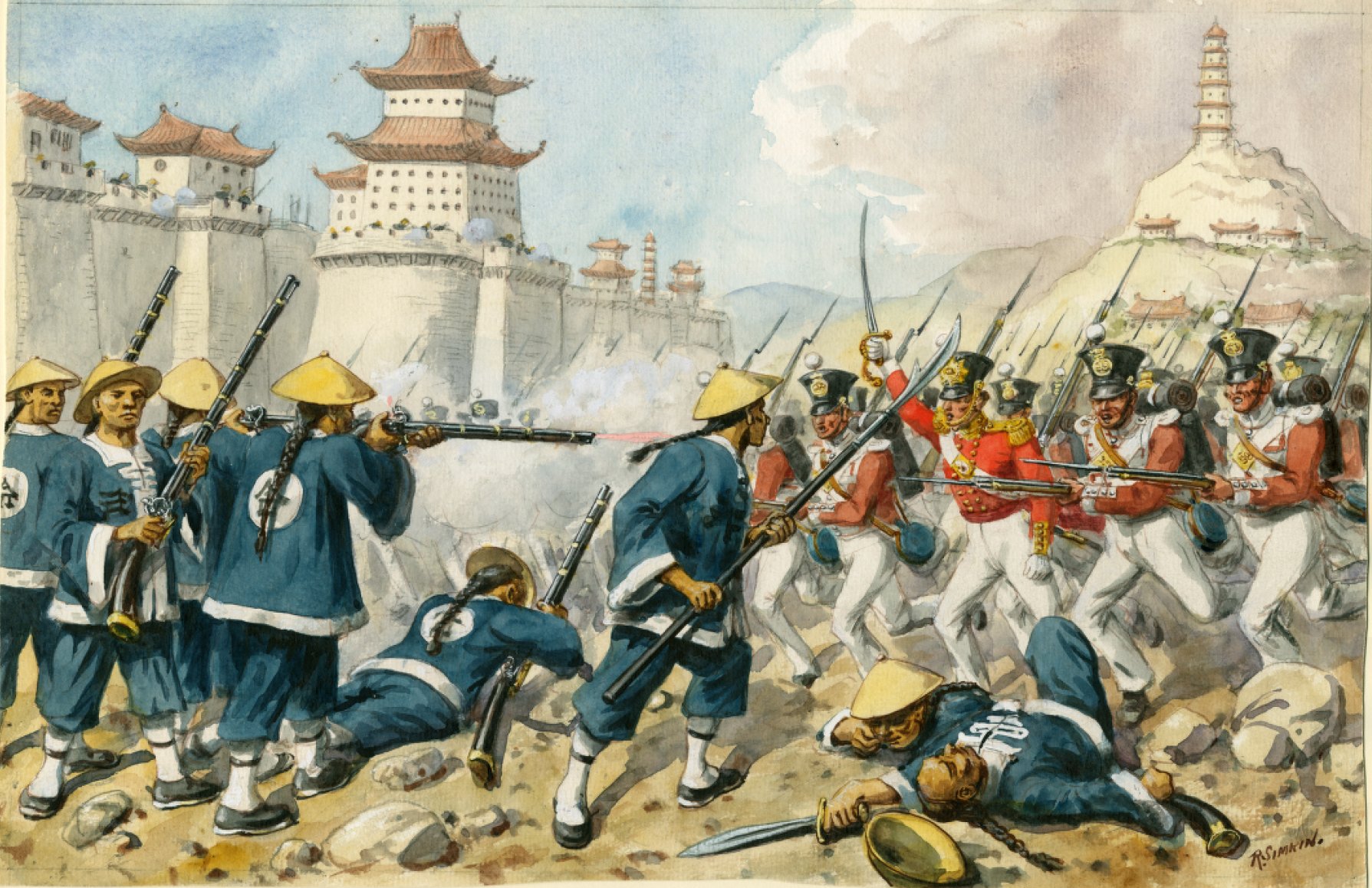
On July 21, British and Indian forces under General Hugh Gough captured the city of Chinkiang (modern Zhenjiang) during the First Opium War, blocking the junction of the Yangtze River and Grand Canal to pressure Qing China.[20] The assault involved scaling walls amid intense heat, resulting in 40 British deaths (including from sunstroke) and 128 wounded, while Chinese defenders suffered around 3,000 casualties, many from suicide to avoid capture.[21] This victory advanced British naval dominance upriver toward Nanjing, hastening peace negotiations.[21] In early August, the 1842 general strike, also known as the Plug Plot Riots, peaked across industrial England and Scotland, involving up to 500,000 workers protesting wage cuts amid economic depression and demanding Chartist political reforms like universal male suffrage.[22] Originating in July Staffordshire coal mines, strikers removed boiler plugs from engines to halt production, leading to clashes with troops; the movement, blending economic and democratic grievances, subsided by late September under military suppression and arrests.[23] On August 1 in Philadelphia, the Lombard Street Riot erupted when a white mob, primarily Irish immigrants, attacked a parade of about 1,000 African Americans commemorating West Indies emancipation and promoting temperance, fueled by ethnic tensions and competition for jobs.[24] The violence lasted three days, with rioters burning the Second African Presbyterian Church and Smith's Hall, injuring dozens, and prompting black residents to flee; authorities deployed militia to restore order amid broader nativist resentments.[25] The Webster-Ashburton Treaty, signed August 9 between U.S. Secretary of State Daniel Webster and British envoy Lord Ashburton, resolved lingering border disputes from the American Revolution and War of 1812, establishing the northeastern U.S.-Canada boundary along the Maine-New Brunswick line and clarifying divisions in the Great Lakes region.[26] It also addressed extradition for criminals and suppressed the African slave trade, averting potential war while conceding about half of the disputed Aroostook tract to the U.S.[26] The Treaty of Nanking, signed August 29 aboard HMS Cornwallis near Nanjing, concluded the First Opium War, compelling Qing China to cede Hong Kong Island to Britain in perpetuity, open five treaty ports (Canton, Amoy, Foochow, Ningpo, Shanghai) to foreign trade, pay 21 million silver dollars in reparations, and grant extraterritoriality to British subjects.[27] This unequal treaty, dictated by British naval superiority after victories like Chinkiang, marked the onset of China's "Century of Humiliation" and formalized opium imports despite prior Qing bans.[21] In September, British forces in the First Anglo-Afghan War, comprising the Army of Retribution under General William Nott from Kandahar and forces under General George Pollock from Jalalabad, re-entered Kabul on September 15 as retribution for the January massacre during the retreat from Kabul.[28] They demolished the Kabul bazaar to punish Afghan tribes but faced no major resistance, withdrawing by October after installing a pro-British emir, effectively ending the campaign without reoccupying the city long-term.[29] On September 4, construction resumed on Cologne Cathedral in Prussia after a 284-year hiatus since 1560, initiated by King Frederick William IV amid Gothic Revival enthusiasm and using original medieval plans with modern techniques like iron girders.[30] This effort, led by architect Ernst Friedrich Zwirner, aimed to complete the structure symbolizing medieval piety and national pride, culminating in full dedication in 1880.[30]October–December
On October 5, Bavarian brewer Josef Groll produced the first batch of Pilsner Urquell, a pale lager using soft local water, barley malt, Saaz hops, and bottom-fermenting yeast at the Burghers' Brewery in Plzeň, Bohemia (modern Czech Republic), marking the origin of the Pilsner style that influenced global brewing.[31] On October 15, Karl Marx, aged 24, assumed the role of editor-in-chief of the Rheinische Zeitung, a liberal Cologne newspaper, where he shifted its focus toward radical critiques of Prussian censorship and social inequalities during his tenure until March 1843.[32] In November, geological activity intensified at Mount St. Helens in Washington Territory, with an eruption on November 22 producing ash plumes and seismic reports observed by settlers, part of a series of minor explosive events from 1842 to 1845 that deposited tephra layers traceable in tree rings and eyewitness accounts.[33] On November 4, Abraham Lincoln, then a 33-year-old Illinois state legislator and lawyer, married 23-year-old Mary Todd in a small ceremony at her sister Elizabeth Edwards' home in Springfield, attended by about 30 guests including Lincoln's friend Joshua Speed, following a reconciliation after a prior broken engagement.[34] The University of Notre Dame was founded on November 26 by French priest Edward Sorin of the Congregation of Holy Cross and seven companions on 524 acres near South Bend, Indiana, initially as a Catholic college for men emphasizing classical education amid the frontier's sparse settlements.[35] On December 7, the Philharmonic Society of New York—now the New York Philharmonic—held its inaugural concert at the Apollo Rooms on Broadway, performing works by Beethoven and Mozart to an audience of around 600, establishing the oldest symphony orchestra in the United States with 543 subscribers funding its cooperative model.[36] President John Tyler transmitted a message to Congress on December 30 affirming the United States' recognition of Hawaiian independence under Kamehameha III, rejecting annexation claims and emphasizing non-interference in Pacific affairs amid British and French influences, based on diplomatic assurances from Hawaiian envoys.[37]Date unknown
The United States Army commenced construction of Fort Washita in 1842 near the Red River in what is now Oklahoma, fulfilling treaty obligations to protect the relocated Chickasaw and Choctaw nations from incursions by Plains tribes such as the Comanche and Kiowa.[38] The fort served as the southwesternmost U.S. military outpost, housing dragoons tasked with frontier defense amid ongoing tensions from Indian removal policies.[38] In southern California, Mexican national Francisco López discovered placer gold deposits in Placerita Canyon near modern-day Newhall during 1842, representing the first commercially viable gold find in the territory, though it prompted only limited extraction at the time rather than mass migration.[39] This event preceded the larger 1848 Gold Rush by six years and highlighted early mineral potential in Mexican Alta California before U.S. annexation.[39]Scientific and Technological Developments
Inventions and Patents
In 1842, the United States Patent Office issued its first design patent on November 9 to George Bruce, a printer and lithographer, for a new ornamental design of printing type faces, designated as U.S. Design Patent D1.[40] This marked the inaugural application of the design patent category, established under the Patent Act of 1842, which protected aesthetic aspects of manufactured articles separately from their functional utility.[40] Earlier that year, on February 21, John A. Greenough received U.S. Patent 2,466 for the first sewing machine patented in the United States, featuring a two-pointed needle with an eye at the middle and a mechanism to feed and clamp fabric.[41] Although innovative in concept, Greenough's device was primarily suited for heavy materials like leather rather than garments and did not achieve commercial success, paving the way for later refinements by inventors such as Elias Howe.[41] Joseph Dart, a Buffalo merchant, developed the first steam-powered grain elevator in 1842 to address inefficiencies in unloading grain from lake freighters to canal boats at the port.[42] Constructed with associate Robert Dunbar, the device used continuous buckets on an endless chain driven by steam to lift grain vertically, enabling rapid storage capacities up to 1,000 bushels per hour and transforming Buffalo into a key transshipment hub for Midwestern agriculture.[42][43] In the United Kingdom, Scottish engineer James Nasmyth secured a patent in June for his steam hammer, a double-acting hydraulic device capable of delivering precise, variable-force blows for forging large iron components.[44] Conceived to meet demands for heavy naval forgings, the invention featured self-acting valves for automatic control, allowing strikes from 1 to 15 tons and revolutionizing metalworking by enabling accurate shaping of massive pieces previously limited by manual hammers.[44] Matthias W. Baldwin patented a flexible beam truck design for locomotive driving wheels on August 25, aimed at improving stability on uneven tracks by permitting independent axle movement.[45] This innovation addressed derailment risks in early rail transport, influencing subsequent American locomotive engineering amid expanding railway networks.[45]Medical and Scientific Advances
In physics, Christian Andreas Doppler presented his theory of the Doppler effect on May 25, 1842, in a paper titled Über das farbige Licht der Doppelsterne und einiger anderer Gestirne des Himmels, explaining how the observed frequency of waves, such as light or sound, varies due to the relative motion between source and observer. This principle, initially applied to binary stars, later proved essential for understanding stellar motion and phenomena like the redshift in astronomy. In hematology, French physician Alfred Donné identified blood platelets as a third cellular component distinct from red and white cells, using microscopy to observe their role in coagulation, as detailed in his 1842 lectures despite initial skepticism from contemporaries.[46] Concurrently, British physician William Addison described the aggregative function of these particles in blood clotting through experiments on animal and human samples.[47] In surgery, American physician Crawford Williamson Long administered diethyl ether as a general anesthetic on March 30, 1842, during the excision of a neck tumor from patient James Venable, marking the first documented use of inhalation anesthesia to eliminate pain without patient awareness, though Long delayed publication until 1849, allowing later claimants like William Morton in 1846 to receive primary historical credit.[48] This application demonstrated ether's potential to revolutionize operative procedures by enabling painless interventions.[47] In electrochemistry, Welsh scientist William Robert Grove demonstrated the first fuel cell, known as the "gas battery," in October 1842, combining hydrogen and oxygen in platinum electrodes to produce electricity via electrochemical reaction, yielding water as byproduct and foreshadowing applications in energy conversion.[49] Grove's device highlighted the reversibility of fuel combustion into electrical power, influencing subsequent developments in voltaic cells.[49] In paleontology, British anatomist Richard Owen coined the term "dinosaur" (meaning "terrible lizard") in his 1842 classification of fossil reptiles like Megalosaurus, Iguanodon, and Hylaeosaurus, establishing them as a distinct extinct order based on shared anatomical traits such as large size and reptilian features.[50] This taxonomic framework advanced understanding of Mesozoic fauna beyond mere curiosities.[50] In mycology, Scottish physician John Hughes Bennett provided the first medical description of the pathogenic fungus Aspergillus in human tissue, linking it to disease in a patient case reported in 1842, contributing to early recognition of fungal infections.[51]Cultural and Social Developments
Arts, Literature, and Music
In literature, Edgar Allan Poe published the short story "The Masque of the Red Death" in Graham's Magazine in April 1842, depicting a prince's futile attempt to evade a plague through isolation in a abbey divided into color-themed chambers symbolizing life's stages.[52] Nikolai Gogol released Dead Souls, his satirical novel critiquing Russian serfdom through the scheme of a landowner buying deceased peasants to inflate his estate's value, marking a pivotal work in 19th-century Russian prose.[53] Alfred Tennyson issued a revised collection Poems in 1842, incorporating updated versions of earlier works like "The Lady of Shalott," which narrates a cursed maiden's tragic gaze upon the world beyond her tower.[54] Charles Dickens published American Notes for General Circulation in October 1842, a travelogue based on his 1842 tour of the United States, offering observations on American society, prisons, and asylums while expressing reservations about slavery and cultural habits.[55] In music, Giuseppe Verdi's opera Nabucco premiered on March 9, 1842, at La Scala in Milan, with its chorus "Va, pensiero" evoking Italian longing for independence amid a biblical narrative of Babylonian captivity, propelling Verdi to prominence.[56] Felix Mendelssohn conducted the debut of his Symphony No. 3 in A minor, known as the "Scottish," on March 3, 1842, at the Gewandhaus in Leipzig; inspired by his 1829 Scottish visit, the work's brooding themes and folk-like elements reflected Romantic nationalism without explicit program music.[57] Visual arts saw the Royal Academy's annual exhibition open on May 2, 1842, at the National Gallery in London, featuring works by J.M.W. Turner including Snow Storm - Steam-Boat off a Harbour's Mouth, which employed turbulent brushwork to convey chaotic maritime peril.[58] American painter Thomas Cole reproduced his allegorical series The Voyage of Life in 1842, comprising four canvases—Childhood, Youth, Manhood, and Old Age—illustrating human life's progression from innocence to redemption via a river journey, commissioned by New York patron Samuel Ward.[59]Social and Economic Reforms
In the United Kingdom, the Coal Mines and Collieries Act 1842, enacted on August 10, prohibited the employment of all women and girls of any age, as well as boys under ten years old, in underground coal mining operations.[60] This legislation stemmed from a royal commission report earlier that year documenting hazardous conditions, including frequent accidents, moral degradation, and physical abuse faced by child and female workers in mines.[61] The Act required mine owners to maintain employment registers and mandated government inspectors to enforce compliance, marking an early step in state intervention to curb exploitative labor practices amid the Industrial Revolution's expansion of coal extraction.[62] In the United States, the Tariff Act of 1842, signed into law on August 30 by President John Tyler, raised average import duties to approximately 40 percent, reversing the revenue reductions of the 1833 Compromise Tariff.[63] This protectionist measure aimed to generate federal revenue during an economic depression and shield domestic manufacturing from foreign competition, particularly British goods, by imposing higher rates on raw materials and manufactured imports.[64] It represented a Whig policy victory under congressional control, prioritizing industrial protection over free trade principles advocated by Southern interests.[65] Labor rights advanced in Massachusetts with the Commonwealth v. Hunt decision on March 14, 1842, where the state supreme court ruled that peaceful labor unions and strikes to improve wages or conditions did not constitute criminal conspiracy.[66] This overturned prior common law precedents treating union activity as inherently illegal, enabling organized worker associations without automatic prosecution. Several U.S. states enacted child labor restrictions in 1842, with Massachusetts limiting workdays for children under 12 to ten hours and Connecticut imposing similar ten-hour limits for minors.[67] These laws responded to growing concerns over factory exploitation but lacked robust enforcement mechanisms, reflecting initial, limited efforts to mitigate industrial child labor's health impacts.Births
January–June
On January 6, 1842, the British garrison in Kabul, consisting of approximately 4,500 troops and 12,000 camp followers including civilians and families, began its withdrawal toward Jalalabad under an agreement with Afghan leaders promising safe passage.[29] Harsh winter conditions, supply shortages, and relentless attacks by Afghan tribesmen led to the near-total annihilation of the column; by January 13, only Assistant Surgeon William Brydon reached Jalalabad on a wounded horse, becoming the sole European survivor to confirm the disaster.[68] This retreat effectively concluded the First Anglo-Afghan War (1839–1842) in humiliating defeat for Britain, exposing vulnerabilities in imperial overextension and prompting a later punitive expedition to reassert control.[69] British author Charles Dickens arrived in Boston on January 22, 1842, aboard the RMS Britannia, initiating a five-month tour of the United States and Canada that included public readings, social engagements, and observations of American institutions.[70] Traveling by rail, steamboat, and carriage, Dickens visited cities such as New York, Philadelphia, Washington (where he met President John Tyler and observed congressional debates), and Richmond, documenting experiences in letters and later in American Notes for General Circulation (1842), which critiqued slavery, urban squalor, and the absence of copyright protections for foreign authors.[71] His departure from New York in late June marked the end of the journey, which boosted his fame but strained his health due to relentless schedules and transatlantic travel.[72] In Rhode Island, the Dorr Rebellion reached its peak in May 1842 amid demands to replace the state's restrictive 1663 royal charter—which limited suffrage to property owners—with a more democratic constitution.[73] Reform leader Thomas Wilson Dorr organized a "People's Convention" and held a parallel election, declaring himself governor on May 3 after voters ratified the People's Constitution expanding white male suffrage.[74] Tensions escalated with a failed Dorrite attack on the Providence arsenal on May 17 using antiquated cannons, met by state militia; no major bloodshed occurred, but dual governments persisted until Dorr fled in October, leading to his 1844 treason conviction and eventual constitutional reforms granting broader voting rights by 1843.[75] The U.S. Congress passed the Apportionment Act on June 25, 1842, reallocating House seats based on the 1840 census to 223 members at a ratio of one representative per 70,680 inhabitants, reducing total seats from prior levels amid population growth to over 17 million.[76] Signed by President Tyler despite his veto threats on other issues, the act mandated single-member congressional districts for the first time—shifting from at-large elections in some states—to curb multi-member distortions and enhance local representation, influencing electoral practices until later reapportionments.[77]July–December
Albert Ladenburg, a German chemist who advanced the synthesis of organic compounds including the first artificial production of coniine and atropine, was born on July 2, 1842, in Mannheim. Hermann Cohen, a German-Jewish philosopher and founder of the Marburg School of neo-Kantianism, emphasizing ethical and logical interpretations of Kant's critiques, was born on July 4, 1842, in Coswig an der Elbe.[78]Abdul Hamid II, who later served as the 34th Sultan of the Ottoman Empire from 1876 to 1909 and oversaw centralization efforts amid territorial losses and internal reforms, was born on September 21, 1842, in Constantinople.[79] John William Strutt, 3rd Baron Rayleigh, a British physicist awarded the 1904 Nobel Prize in Physics for discovering argon and contributions to scattering of light explaining sky's blue color, was born on November 12, 1842, in Langford Grove, Essex.[80][81] Madeleine Brès, the first woman to receive a medical doctorate in France in 1875 and an advocate for women's access to higher education and pediatric care, was born on November 26, 1842, in Bouillargues.[82] Peter Alekseyevich Kropotkin, a Russian geographer, evolutionary theorist, and anarchist philosopher who argued for mutual aid as a factor in evolution countering social Darwinism's competition emphasis, was born on December 9, 1842 (Old Style; December 21 Gregorian), in Moscow.[83]
Deaths
January–June
On January 6, 1842, the British garrison in Kabul, consisting of approximately 4,500 troops and 12,000 camp followers including civilians and families, began its withdrawal toward Jalalabad under an agreement with Afghan leaders promising safe passage.[29] Harsh winter conditions, supply shortages, and relentless attacks by Afghan tribesmen led to the near-total annihilation of the column; by January 13, only Assistant Surgeon William Brydon reached Jalalabad on a wounded horse, becoming the sole European survivor to confirm the disaster.[68] This retreat effectively concluded the First Anglo-Afghan War (1839–1842) in humiliating defeat for Britain, exposing vulnerabilities in imperial overextension and prompting a later punitive expedition to reassert control.[69] British author Charles Dickens arrived in Boston on January 22, 1842, aboard the RMS Britannia, initiating a five-month tour of the United States and Canada that included public readings, social engagements, and observations of American institutions.[70] Traveling by rail, steamboat, and carriage, Dickens visited cities such as New York, Philadelphia, Washington (where he met President John Tyler and observed congressional debates), and Richmond, documenting experiences in letters and later in American Notes for General Circulation (1842), which critiqued slavery, urban squalor, and the absence of copyright protections for foreign authors.[71] His departure from New York in late June marked the end of the journey, which boosted his fame but strained his health due to relentless schedules and transatlantic travel.[72] In Rhode Island, the Dorr Rebellion reached its peak in May 1842 amid demands to replace the state's restrictive 1663 royal charter—which limited suffrage to property owners—with a more democratic constitution.[73] Reform leader Thomas Wilson Dorr organized a "People's Convention" and held a parallel election, declaring himself governor on May 3 after voters ratified the People's Constitution expanding white male suffrage.[74] Tensions escalated with a failed Dorrite attack on the Providence arsenal on May 17 using antiquated cannons, met by state militia; no major bloodshed occurred, but dual governments persisted until Dorr fled in October, leading to his 1844 treason conviction and eventual constitutional reforms granting broader voting rights by 1843.[75] The U.S. Congress passed the Apportionment Act on June 25, 1842, reallocating House seats based on the 1840 census to 223 members at a ratio of one representative per 70,680 inhabitants, reducing total seats from prior levels amid population growth to over 17 million.[76] Signed by President Tyler despite his veto threats on other issues, the act mandated single-member congressional districts for the first time—shifting from at-large elections in some states—to curb multi-member distortions and enhance local representation, influencing electoral practices until later reapportionments.[77]July–December
Albert Ladenburg, a German chemist who advanced the synthesis of organic compounds including the first artificial production of coniine and atropine, was born on July 2, 1842, in Mannheim. Hermann Cohen, a German-Jewish philosopher and founder of the Marburg School of neo-Kantianism, emphasizing ethical and logical interpretations of Kant's critiques, was born on July 4, 1842, in Coswig an der Elbe.[78]Abdul Hamid II, who later served as the 34th Sultan of the Ottoman Empire from 1876 to 1909 and oversaw centralization efforts amid territorial losses and internal reforms, was born on September 21, 1842, in Constantinople.[79] John William Strutt, 3rd Baron Rayleigh, a British physicist awarded the 1904 Nobel Prize in Physics for discovering argon and contributions to scattering of light explaining sky's blue color, was born on November 12, 1842, in Langford Grove, Essex.[80][81] Madeleine Brès, the first woman to receive a medical doctorate in France in 1875 and an advocate for women's access to higher education and pediatric care, was born on November 26, 1842, in Bouillargues.[82] Peter Alekseyevich Kropotkin, a Russian geographer, evolutionary theorist, and anarchist philosopher who argued for mutual aid as a factor in evolution countering social Darwinism's competition emphasis, was born on December 9, 1842 (Old Style; December 21 Gregorian), in Moscow.[83]